“Claudiney Prieto is the kind, wise, and fervent voice so very essential to modern Witchcraft. In The Kybalion for Witches, he offers clear and solid instructions for building an effective and powerful magickal practice. … This is a book I wish I’d had years ago but will relish for years to come.”
—Courtney Weber, author of Hekate and Sacred Tears
“A thorough and well-plotted course through The Kybalion, presented with rich commentary and exercises to bring it all home. A must-read for any magickian.”
—Devin Hunter, author of The Witch’s Book of Power
“Claudiney Prieto provides commentary as well as practical guidance on using The Kybalion from a witch-centered perspective. This is a one-of-a-kind book that will benefit both newcomers and established practitioners.”
—Ivo Dom nguez Jr., author of Spirit Speak
“An essential and grounding compass for the modern practitioner. … Prieto offers more than just theory; he provides a ‘Master Key’ to navigating the digital age with intentionality and spiritual depth.”
—Elhoim Leafar, author of Manifestation Magic and Dream Witchery
“A deep and thoughtful exploration of The Kybalion and what it has to offer contemporary magical practitioners. Claudiney deftly extracts the workable magic from his source material, showing the reader what the key ideas of The Kybalion are, where they come from, and—most importantly—what a Witch can do with them.”
—Jack Chanek, author of Tarot for the Magically Inclined
“The Kybalion has had an enormous influence on Wicca and Witchcraft. … Claudiney Prieto breaks it all down, giving us great depth and insight into the spiritual, practical, and magical implications of this work for the modern Witch.”
—Deborah Lipp, author of Bending the Binary
“The Kybalion for Witches is not a reworking of Hermetic philosophy but a bridge between Hermetic thought and lived Witchcraft, built through The Kybalion. Claudiney Prieto shows how its principles can be understood and applied within Pagan, Wiccan, and magical practice. … This book is clear, grounded, and genuinely useful.”
—Sorita d’Este, author of Circle for Hekate
“A monumental esoteric work blending ancient occult philosophies with modern conceptions of witchcraft and magic. With a foot in both worlds, Claudiney Prieto places familiar Hermetic principles in fresh alignment with the rites of Witchcraft style.”
—Travis McHenry, author of The Occult Tarot
“The present volume not only reintroduces a classic of modern Hermetism but also elaborates and expands upon it. This undertaking is notably arduous, and Claudiney Prieto has meticulously executed it, integrating practical application with theoretical foundations.”
—Johann Heyss, author of Initiation into Numerology
“Prieto introduces the intricate tapestry of this 1908 Hermetic text for the Witch, although this exploration is also a gift for those of all esoteric paths. … With meditations, ritual, and practical exercises, the author’s gift is that he keeps us fully grounded and engaged.”
—Caroline Wise, Fellowship of Isis, coauthor of The Secret Lore of London, with John Matthews, and author of Finding Elen
“A fascinating and lucid exploration of Hermeticism as revealed in The Kybalion. Claudiney Prieto is an exceptionally able guide through these mysteries. Drawing on even less well-known Hermetic manuscripts, he succeeds in shining a bright pure light on these fundamental concepts.”
—deTraci Regula, author of Mysteries of Isis
“Claudiney’s wisdom and devotion to the path radiate from every page of this book. … He provides fresh ways to integrate these enduring teachings into every aspect of contemporary life. This is a masterful exploration of ancient tenets perfectly reframed for the modern practitioner.”
—Jesamyn Angelica, author of Llewellyn’s Complete Book of the Moon
About the Author
Claudiney Prieto is one of the most influential voices in modern Witchcraft and Wicca in Brazil. A respected author, High Priest, and spiritual leader, he has devoted more than three decades to the study, practice, and dissemination of Wicca. His groundbreaking book, Wicca: The Goddess Religion, became Brazil’s first bestseller on the subject, selling more than 300,000 copies and shaping generations of Brazilian Witches.
Founder of the Dianic Nemorensis Tradition and a High Priest in Gardnerian Tradition, he is also a Minos in the Minoan Brotherhood, an Archpriest in Fellowship of Isis, and is a member of the FOI ArchPriesthood Union. He is also a High Priest in Apple Branch Tradition and was the first and only man ordained by Zsuzsanna Budapest in Dianic Wicca.
As a visionary leader, Claudiney has been instrumental in preserving and expanding the legacy of Witchcraft. He established Brazil’s first Museum of Magic and Witchcraft, founded the Sanctuary of the Great Mother, and created the World Goddess Day Project, a global initiative now celebrated in more than forty countries. His dedication to education also led to the establishment of Brazil’s first postgraduate program in thealogy.
Beyond Brazil, Claudiney is an internationally recognized speaker, having presented at major forums, including the Parliament of the World’s Religions. His expertise has been featured on radio, television, and digital platforms, making him a trusted authority in demystifying Wicca and Pagan spirituality.
With a lifelong mission to empower Pagan seekers, Claudiney’s work transcends borders, inspiring and transforming the landscape of contemporary Paganism worldwide.
Photography is used for illustrative purposes only. The persons depicted may not endorse or represent the book’s subject.
Llewellyn Publications is a registered trademark of Llewellyn Worldwide Ltd.
Library of Congress Cataloging-in-Publication Data
Names: Prieto, Claudiney author
Title: The Kybalion for witches : rituals, magick, and witchcraft with the seven hermetic principles / Claudiney Prieto.
Description: 1. | Woodbury, Minnesota : Llewellyn Worldwide, [2026] | Includes bibliographical references and index. | Summary: “This book bridges Hermetic philosophy and modern magical practice, guiding readers through the seven principles of The Kybalion and exploring what each means for Witches, Wiccans, and Pagans. The book moves from philosophical grounding to hands-on application. Includes rituals, exercises, and meditations for each principle”— Provided by publisher.
Identifiers: LCCN 2026015433 (print) | LCCN 2026015434 (ebook) | ISBN 9780738781785 trade paperback | ISBN 9780738782195 ebook
LC record available at https://lccn.loc.gov/2026015433
LC ebook record available at https://lccn.loc.gov/2026015434
Llewellyn Worldwide Ltd. does not participate in, endorse, or have any authority or responsibility concerning private business transactions between our authors and the public.
All mail addressed to the author is forwarded but the publisher cannot, unless specifically instructed by the author, give out an address or phone number.
Any internet references contained in this work are current at publication time, but the publisher cannot guarantee that a specific location will continue to be maintained. Please refer to the publisher’s website for links to authors’ websites and other sources.
Llewellyn Publications
A Division of Llewellyn Worldwide Ltd. 2143 Wooddale Drive Woodbury, MN 55125-2989 www.llewellyn.com
Printed in the United States of America
GPSR Representation: UPI-2M PLUS d.o.o., Medulićeva 20, 10000 Zagreb, Croatia matt.parsons@upi2mbooks.hr
Other Books by Claudiney Prieto
Ritos e Mist rios da Bruxaria Moderna (1999)
Wicca—A Religi o da Deusa (2000)
ABC of Bruxaria (2001)
Todas as Deusas do Mundo (2002)
Wicca para Bruxos Solit rios (2005)
A Arte da Invoca o (2008)
Wicca para Todos (2013)
Or culo da Grande M e (2017)
O Or culo das Bruxas (2020)
Rituais de Magia com Tar (2021)
60 Minutos para Entender a Wicca (2022)
O Caibalion para Bruxos (2023)
Tar das Vis es (2024)
O Or culo Alqu mico (2025)
Tar e o Cubo do Espa o (2026)
To the immortal memory of Hypatia of Alexandria, a beacon of wisdom in times of darkness. Her unflagging spirit echoed through the ages. In a time when few dared to seek the truth, she kept the spark of her wisdom alive. In these dark times, when the shadows of ignorance threaten to overshadow the brightness of reason, we need her light more than ever.
Acknowledgments
Writing is an alchemical work. In this book of words and knowledge, some people have become vital elements. I invoke their names and celebrate their contributions with deep respect and gratitude:
Lilian Dionysia and Giovani das Gra as, the Prima Materia; Yuri Mocellin, the Sulfur; Leo Lousada, the Mercury; and Luciana, the Salt.
Each of them has been essential to the creation of this book. Their collaboration, wisdom, and support were essential for accomplishing this work.
And so, I seal this acknowledgment with the famous alchemical adage:
Aurum Nostrum Non Est Aurum Vulgi
Introduction … 1
Part 1–Ratio Hermetica
Chapter 1: From Thoth to Trismegistus: The Ancient Roots of Hermeticism … 9
Hermetic Transmission, Influence, and Revival … 12
The Hermetic Texts 16 Who Was Hermes Trismegistus? 20
Chapter 2: The Kybalion and the Modern Rebirth of Hermetic Wisdom … 23
Principles and Perspectives of The Kybalion 26
Between Tradition and Transformation 28
Chapter 3: The Kybalion for Witches … 31
Integrating the Seven Hermetic Principles into Witchcraft 33
The Timeless Magick of Adaptation 35
Chapter 4: The Kybalion: Introduction … 39
Commentary on the Introduction 44
Chapter 5: The Kybalion: The Hermetic Philosophy … 47
Commentary on the Hermetic Philosophy … 53
Hermetic Contemplation Ritual 56
Chapter 6: The Kybalion: Seven Hermetic Principles … 63
Commentary on the Seven Hermetic Principles … 72
Chapter 7: The Kybalion: Mental Transmutation … 79
Commentary on Mental Transmutation … 84
Chapter 8: The Kybalion: The All … 87
Commentary on the All … 93
Chapter 9: The Kybalion: The Mental Universe … 99
Commentary on the Mental Universe … 106
Chapter 10: The Kybalion: The Divine Paradox … 113
Commentary on the Divine Paradox … 122
Chapter 11: The Kybalion: “The All” in All 127
Commentary on “the All” in All … 135
Chapter 12: The Kybalion: The Planes of Correspondence 139
Commentary on the Principle of Correspondence … 151
Chapter 13: The Kybalion: Vibration … 161
Commentary on the Principle of Vibration 167
Chapter 14: The Kybalion: Polarity … 175
Commentary on the Principle of Polarity 181
Chapter 15: The Kybalion: Rhythm … 189
Commentary on the Principle of Rhythm … 195
Chapter 16: The Kybalion: Causation … 201
Commentary on the Principle of Causation … 207
Chapter 17: The Kybalion: Gender 217
Commentary on the Principle of Gender … 223
Chapter 18: The Kybalion: Mental Gender 235 Commentary on Mental Gender 245
Chapter 19: The Kybalion: Hermetic Axioms … 251 Commentary on Hermetic Axioms 258
Chapter 20: The Principle of Mentalism … 263
Mind as the Creative Force: Energy, Cosmos, and Consciousness … 265
Magick and the Mind: Mentalism in Witchcraft Practice 266
Mentalism and Modern Science: Consciousness as the Fabric of Reality 267
Responsibility, Power, and the Heart of Magick … 270
Part 2–Praxis Hermetica
Chapter 21: From Theory to Practice 275
Creating a Hermetic Sanctuary for Your Practices … 276
The Altar … 282
Ceremonial Dressing … 283
Lamp of the Wise 284
Baculum … 285
Tripod Incense Burner … 288
Stylus … 289
Other Tools 290
Consecration of Tools … 292
Chapter 22: Opening Ritual: Creating a Sacred Space for Your Practices … 295
Casting the Hermetic Magick Circle 299
Understanding the Symbolism Behind the Opening Ritual … 302
Closing the Magickal Operation … 310
Chapter 23: Rituals and Practices for Connection with the Seven Hermetic Principles … 313
The Descent and Ascent of the Soul in Hermetic Cosmology … 313
Planetary Hierarchies and the Symbolic Structure of the Cosmos 314
Theurgy and the Planetary Ladder of Principles … 318
The Seven Principles and the Planets … 319
Planetary Symbolism and the Seven Hermetic Principles 320
The Tradition of Hermetic Planetary Magick … 323
The Chaldean Order and the Cosmology of the Universe … 325
Sound, Vowels, and the Harmony of the Spheres … 327
From the Stars to the Self: Embodying Hermetic Wisdom 329
Chapter 24: Mentalism in Practice … 331
Applying the Principle of Mentalism in Daily Life … 332
The Sun and the Principle of Mentalism 333
Ritual with the Sphere of the Sun to Attune to the Principle of Mentalism … 334
Exercises for the Principle of Mentalism … 338
To Understand the Principle of Mentalism … 338
Classification of Thoughts 340
Journey of Beliefs Recognition 341
Meditation: The Magic of Mentalism and the Manifestation of Desires … 342
Chapter 25: Correspondence in Practice … 345
Principle of Correspondence in Practice … 345
Applying the Principle of Correspondence in Daily Life 346
The Moon and the Principle of Correspondence … 346
Ritual with the Sphere of the Moon to Attune to the Principle of Correspondence … 348
Exercises for the Principle of Correspondence … 352
Connection with the Principle of Correspondence 352
Liberation from the Past and Inner Contemplation 354
Meditation: Analyzing Yourself and Your Life … 356
Chapter 26: Vibration in Practice … 359
Principle of Vibration in Practice … 359
Applying the Principle of Vibration in Daily Life 359
Mercury and the Principle of Vibration … 360
Ritual with the Sphere of Mercury to Attune to the Principle of Vibration … 362
Exercises for the Principle of Vibration … 366
Becoming an Active Participant in the Cosmic Dance of Vibrations 366
The Importance of Practicing Silence 368
Vibrating with Colors … 369
Meditation: The Power of Vibration and Emotional Connection with Our Goals … 370
Chapter 27: Polarity in Practice 373
Principle of Polarity in Practice … 373
Applying the Principle of Polarity in Daily Life … 373
Venus and the Principle of Polarity … 374
Ritual with the Sphere of Venus to Attune to the Principle of Polarity 375
Exercises for the Principle of Polarity … 380
Exploring the Law of Polarity … 380
The Art of Amplifying Opposite Polarity to Achieve Goals … 382
Establishing a Partnership 383
Meditation: Reflecting on the Polarity of Life Events 384
Chapter 28: Rhythm in Practice … 387
Principle of Rhythm in Practice 387
Applying the Principle of Rhythm in Daily Life … 388
Mars and the Principle of Rhythm … 389
Ritual with the Sphere of Mars to Attune to the Principle of Rhythm … 390
Exercises for the Principle of Rhythm … 393
Melody Adaptation … 393
The Power of Words and the Principle of Rhythm in Human Relationships 394
Observation of the Principle of Rhythm 395
Meditation: The Magic of Celestial Rhythm … 397
Chapter 29: Causation in Practice 401
Principle of Causation in Practice … 401
Applying the Principle of Causation in Daily Life … 401
Jupiter and the Principle of Causation … 402
Ritual with the Sphere of Jupiter to Attune to the Principle of Causation 404
Exercises for the Principle of Causation 407
Creating Your Reality … 407
The Art of Accepting and Manifesting Desires … 409
Liberation Through Renunciation of Karma 410
Meditation: A Personal Mapping for Evolution 411
Chapter 30: Gender in Practice … 413
Principle of Gender in Practice 413
Applying the Gender Principle in Daily Life 414
Saturn and the Principle of Gender … 414
Ritual with the Sphere of Saturn to Attune to the Principle of Gender … 416
Exercises for the Principle of Gender … 419
Gender Observation and Integration 419
The Journey to Discover Divine Purpose … 421
Mental Gender Exercise … 422
Meditation: Finding Balance and Internal Growth by Integrating Active and Receptive Energies … 425
Conclusion … 427
Bibliography … 431
Art Credits … 441
Index … 445
Introduction
As you turn the pages of the book now in your hands, you will travel through time and explore the immortal wisdom of The Kybalion. You will also delve into the mystical depths of Witchcraft and Paganism.
The teachings of The Kybalion have long intrigued me, but I often felt they lacked a practical lens, one that truly resonates with those who walk the path of the Craft. This book was born from a deep inner calling: to fill that gap and to weave together the threads of Hermetic wisdom and Witchcraft.
Originally published in Brazil, this book found a warm and powerful reception among Brazilian Witches and magickal practitioners. But the wisdom it carries is not bound by borders or languages. I felt compelled on a soul level to translate this work into English so that my insights could also serve the global, English-speaking Witchcraft community. The Kybalion principles are universal, and their potential to awaken, transform, and empower deserves to be shared widely.
The Kybalion was published in 1908 by the Masonic Lodge of Chicago. Despite the obscurity surrounding its origins and the secretive nature of the society responsible for its production, the work meticulously distills the ancient Hermetic philosophy into seven fundamental principles: mentalism, correspondence, vibration, polarity, rhythm, causation, and gender.1
The Kybalion makes it clear that these seven principles support the entire Hermetic philosophy. These pillars help us understand the universe and ourselves. Its principles offer a deep perspective on reality and our role in it, leading
1. Florian Ebeling, The Secret History of Hermes Trismegistus: Hermeticism from Ancient to Modern Times (Cornell University Press, 2007), 135.
us on a journey of self-discovery and understanding of the universe. This understanding has withstood the test of time, paving the way for seekers on the path of universal wisdom: Hermeticism. The book provides insight into the interconnection between mind, matter, and the subtleties of the universe, guiding readers on a journey of understanding and enlightenment.
While the authorship of The Kybalion is not directly attributed to any individual, the profound effect of its contents has made it a timeless and influential work in the esoteric community.2 This book offers a fresh perspective on Hermetic teachings, providing thought-provoking insight: True wisdom is not bound to identity but rather to the ability of a message to resonate through the ages, touching hearts and awakening minds regardless of its origin. However, it must be acknowledged that the book’s unique style, characterized by its use of dated and sometimes cryptic language, may not resonate with modern readers.
The Kybalion has earned a reputation as a significant work in the field of modern Hermetic interpretation. Despite its brevity, it presents a concise exposition of seven key principles of ancient Hermetic thought. Readers familiar with modern Witchcraft and other magickal systems will recognize esoteric affinities between these principles and their own philosophical frameworks.
In this book, you will find both the original texts of The Kybalion and my own contemplations and interpretations of Hermetic principles through the lens of Wicca. For my purposes here, I have chosen not to delve into the conceptual divisions between the terms Wicca and Witchcraft. At times, I may use the two terms interchangeably, considering them synonymous but I also acknowledge that in certain contexts and for some personal interpretations, nuances and distinctions exist between the two. Readers interested in a more detailed analysis of these distinctions are encouraged to seek additional sources.
While I have chosen not to explore the nuanced distinctions between Wicca and Witchcraft in this work, I want to be clear: This book is not exclusive to Wiccans, nor does it require formal adherence to a Wiccan tradition. Rather, it speaks to all Witches. Whether you identify as a Wiccan, a traditional Witch, a solitary practitioner, or simply a seeker walking a magickal path, the teachings within these pages are meant to support your journey. The Hermetic principles transcend labels. They speak not to dogma but to the universal rhythms that shape all magickal work.
2. More information about the true authorship of The Kybalion is found in chapter 2.
In the interest of clarity and to avoid any potential confusion, I would like to emphasize that in the first part, Ratio Hermetica, I have taken the liberty of offering my personal insights and analyses of each Hermetic principle with a focus on Witchcraft following the chapters of the original Kybalion text. This structure has been carefully designed to enrich your understanding of how these two traditions intertwine and complement each other.
To provide clarity and distinction, I’ve marked the original passages from The Kybalion with different borders to clearly distinguish them from my own commentary and interpretations.
In each section of this book, the original texts of The Kybalion will be presented first. These excerpts are timeless and profound, offering a modern interpretation of classical Hermetic thought that has stood the test of time. Following these passages, you will find a thorough analysis viewed through the Witchcraft lens. This analysis bridges the gap between ancestral Hermetic knowledge and contemporary magickal practices and beliefs.
These analytical sections serve as expansions of key concepts, exploring nuances and perspectives that, while not explicitly addressed in The Kybalion, are intrinsic to the universe of Witchcraft. Additionally, they examine possible connections between science and the spiritual or mystical. In Witchcraft, while exact repeatability may not always be possible due to the individualized nature of the practice, many Witches refine their methods based on experience and past results. This book does not seek to transfigure Hermetic principles into strictly scientific concepts; rather it aims to explore potential parallels and intersections between the principles presented in The Kybalion and contemporary scientific theories and spirituality, building bridges between conventional scientific knowledge and arcane wisdom. This comparative approach invites readers to observe how science and spirituality have often coexisted and influenced one another throughout history, highlighting both their intersections and divergences.
The second part of this work, Praxis Hermetica, presents real-world applications through exercises, meditations, and rituals. These practices are designed to help readers not only intellectually absorb the Hermetic principles but also experience and integrate the teachings of The Kybalion into their daily lives. This section offers an opportunity to engage not only with the mind but also with the spirit and body, immersing oneself in the universal truths outlined in the original text. The content of this second section is not part of the original
Kybalion text; rather, I have designed it entirely to provide a practical experience with each of the seven Hermetic principles.
The Kybalion for Witches aims to gently guide practitioners through this synthesis, helping them position the Hermetic sciences within a cohesive structure. This approach enables them to grasp The Kybalion as a whole and draw parallels between the Hermetic principles and the foundational concepts of Witchcraft itself. It may become evident that along with the essential science behind them, the seven principles form a guide to a new era of understanding—one in which the spiritual and the scientific converge in harmony, opening new doors to the exploration of existence.
By embracing Hermetic principles, Witches can achieve greater selfawareness, balance, and spiritual growth—essential qualities for mastery in the magickal arts. For many, a connection to the past and ancestral traditions is fundamental, and The Kybalion offers a window into the ancient teachings of Hermes Trismegistus. By understanding the principles of mentalism, vibration, and correspondence, Witches can refine their intuitive and psychic abilities, becoming more attuned to the invisible world around them.
Contemporary Witches seek to integrate ancient practices with modern concepts. The Kybalion serves as a bridge for this integration, fusing ancient wisdom with early twentieth-century New Thought. It is both a book of principles and a book of mysteries. For Witches, delving into these teachings is a journey of discovery, revealing deeper layers of hidden knowledge with each reading.
The Kybalion is a compass, a key, and a mirror for Witches. It guides, unlocks hidden doors, and reflects the universal truths that reside in the hearts of all magickal practitioners. As with all great esoteric works, its value deepens with the reader’s time and dedication. In today’s world, mystical traditions interweave and influence each other. The Kybalion stands as a point of convergence, allowing Witches to integrate different perspectives into their practice.
If you’ve read The Kybalion before, I invite you to return to it, this time with a Witch’s eye and a magickal heart. You may wish to begin directly with my reflections and commentaries, where I explore the deeper resonance of each principle within the context of the Craft and spiritual development.
If you’re not one for theory and long for the practical aspects, feel free to journey straight to Praxis Hermetica. There you will find practical workings,
meditations, and rituals aligned with each Hermetic laws, tools designed to move energy, shift consciousness, and empower your Craft.
As you progress through this book, it will become evident that the concepts discussed herein, while largely supported by established science, also extend into domains traditionally associated with the supernatural. However, it is essential to emphasize that this volume does not seek to be a scientific treatise. Rather, it offers a Wiccan interpretation of the principles articulated in The Kybalion, interwoven with scientific references and my personal contemplations. The content presented transcends doctrinal boundaries, providing a foundation for observation that is accessible to individuals regardless of their religious beliefs—or lack thereof.
The worldview explored in this book seeks to illuminate phenomena that have long been shrouded in mystery or considered beyond human comprehension. Over time, many such phenomena have been dismissed as mere superstitions or accepted solely as articles of faith. By framing the Hermetic principles in a way that is as accessible as possible, this work aims to bring these aspects of human understanding into the light, making them more tangible and comprehensible. Furthermore, it seeks to demonstrate that the essence of these principles is not confined to texts or theories but is directly experienced in our daily lives. In this sense, readers are invited not only to understand but also to feel and embody these truths, in the process gaining both theoretical knowledge and a practical, immediate awareness of the principles presented in The Kybalion.
So, with an open heart and a curious mind, join me on this journey. Let the wisdom of The Kybalion blend with the practices of Witchcraft, forming a rich tapestry of knowledge and magick. As we navigate these pages together, I trust you will find understanding, inspiration, passion, and a renewed sense of wonder for the magickal arts.
If you have encountered The Kybalion before, you already know the depth of wisdom it contains. For newcomers, prepare for a journey that may forever transform your worldview.
If you have found this book, consider it a sign: The universe is sending you a message. Approach these pages with an open mind and a receptive heart, and you will discover the answers you seek. Accept the call. Embark on this journey. Allow The Kybalion to reveal its mysteries to you.
Blessed Be, Claudiney Prieto
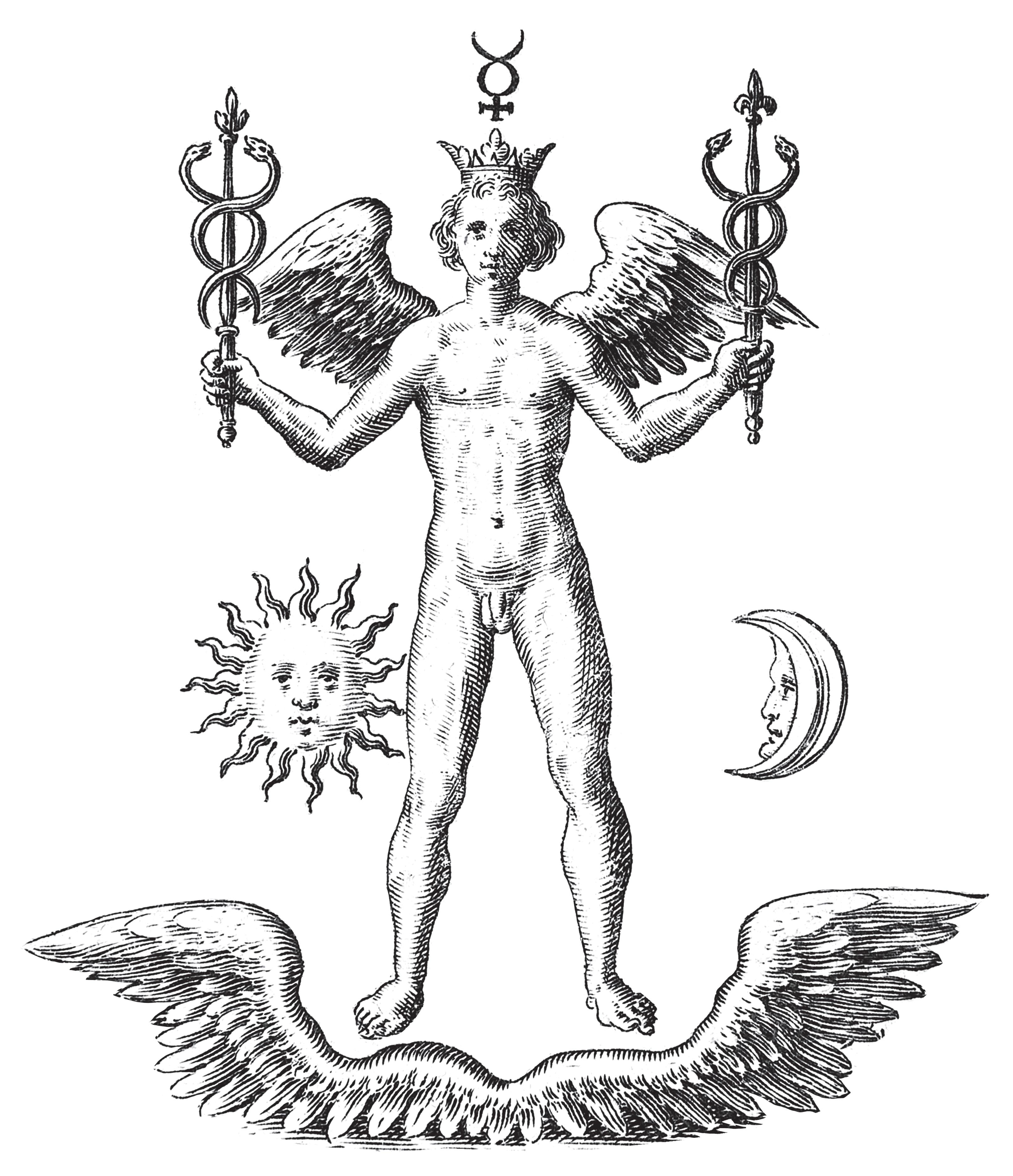
Figure 1: “The second key,” The Twelve Keys of Basil Valentine (1618)
PART 1 RATIO HERMETICA
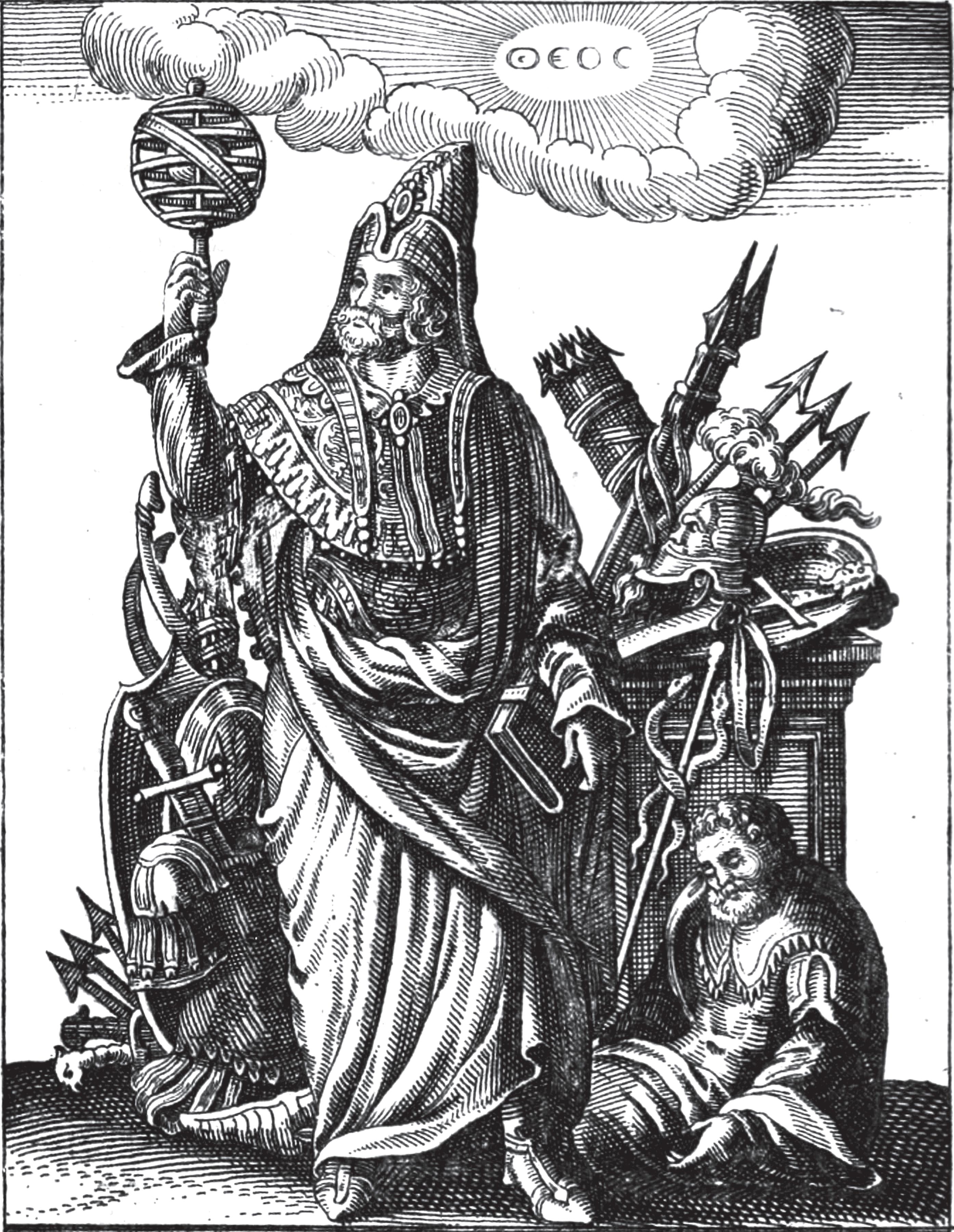
Figure 2: “Mercurius Trismegistus,” Historia Deorum Fatidicorum, Pierre Mussard (1675)
Hermes Trismegistus, the “Thrice Great,” is the personification of esoteric and Hermetic wisdom. He is the link between the divine and the human, and he is the bearer of the keys to cosmic understanding.
CHAPTER 1
From Thoth to Trismegistus: The Ancient Roots of Hermeticism
Hermeticism is a rich philosophical and spiritual tradition with roots deeply embedded in ancient Egypt, radiating its influence across time and geography.3 Its origins trace back to the Egyptian god Thoth, who is associated with wisdom, writing, and magick. Over time, through cultural interactions, Thoth merged with the Greek god Hermes, giving rise to the legendary figure of Hermes Trismegistus—a synthesis of Egyptian and Greek knowledge. Hermetic philosophy draws from both Greek and Egyptian thought, offering a multifaceted perspective on divinity. When describing the nature of ultimate reality, hermetists use a variety of titles: God, Lord, Father, Mind (Nous in Greek), Creator, All, One, and others. This Hermetic view is unique in its assertion that the divine is not only the fundamental fabric of the universe but also its origin. It posits an intrinsic connection between the Creative Force and Creation—one that not only brings the cosmos into being but also emanates from it. This
3. While some authors use the term Hermetism to refer to Hermetic knowledge prior to the Renaissance and Hermeticism for the syncretic tradition that emerged after the translations of the Corpus Hermeticum, the terms sometimes overlap. In this work, we choose to use “Hermeticism” to highlight the systematic dimensions of these teachings and maintain consistency with the specialized bibliography.
idea reflects Stoic thought, wherein divinity is seen as both transcendent and immanent, simultaneously permeating and surpassing its creation.
The Hermetic teachings identify three types of knowledge as fundamental pillars of understanding:
Alchemy: More than the literal transmutation of metals, it is a study of spiritual essence and metamorphosis of matter. Alchemy is a journey that explores the cycles of birth, death, and renewal, culminating in the Magnum Opus—the sublime achievement of spiritual perfection.
Astrology: In Hermeticism, astrology represents a profound understanding of divine intentions as reflected in the planets and stars. This wisdom seeks to discern the heavenly influences that shape human existence.
Theurgy: It is a magickal practice aimed at aligning the human soul with the divine. It stands in contrast to Goetia, which invokes lower forces. Theurgy aspires to communion with the highest manifestations of divinity.
In Hermeticism, three ways of wisdom stand out: Alchemy, which explores the spiritual metamorphosis of matter; astrology, understanding divine designs via celestial bodies; and theurgy, the magickal practice aimed at achieving union with the divine.
Figure 3: Hermetic Three Ways of Wisdom
As a philosophical and esoteric tradition rooted in the teachings attributed to Hermes Trismegistus, Hermeticism encompasses a body of writings known as the Hermetic texts. This legendary master is believed to be the author of these works, spanning nearly a millennium (approximately 300 BCE to 1200 CE) and exploring a wide range of topics from the nature of the divine to alchemy.
A significant portion of these writings, often characterized by their philosophical and theological nature, is collectively referred to as Hermetic Philosophical Literature. Within this body of work, the Corpus Hermeticum4 stands out as a key anthology of seventeen treatises, written in Greek between the second and fourth centuries CE. This collection represents a distinct branch of Hermetic thought.
In historical context, the impact of Hermeticism is considerable. Emerging during a period when wisdom was traditionally imparted through religious texts and oral traditions, Hermeticism sought to integrate diverse traditions into a unified synthesis. This philosophical movement fostered rich cultural exchange, particularly between Egyptian and Greek thought. Humanists, scientists, and mystics throughout history have turned to antiquity for answers to contemporary questions, and Hermeticism, with its promise of occult knowledge and ancient wisdom, became a compelling source of inspiration.
During the transition from the Classical Period to Late Antiquity, numerous philosophical and religious currents emerged, profoundly shaping Western thought and culture. Hermeticism developed alongside foundational movements such as early Christianity, Gnosticism, Neoplatonism, as well as the enigmatic Chaldean Oracles and the evolving Orphic and Pythagorean traditions. Despite an intellectual environment marked by both rigorous logic and unwavering faith, these doctrines demonstrated remarkable resilience.
In its broadest sense, the term Hermeticism does not refer exclusively to a single tradition or historical period. Instead, it serves as an umbrella term encompassing a vast array of systems of thought inspired—either directly or indirectly—by the teachings of Hermes or concepts associated with him.
During the Hellenistic period, when Greek culture and philosophy spread throughout the Mediterranean world, Hermeticism flourished. The corpus
4. Brian P. Copenhaver, Hermetica: The Greek Corpus Hermeticum and the Latin Asclepius in a New English Translation, with Notes and Introduction (Cambridge University Press, 1992), xiii.
attributed to Hermes Trismegistus played a pivotal role in the development of Neoplatonism, a philosophical movement that sought to harmonize the teachings of Plato with those of ancient mystery religions, thereby fostering dialogue between diverse schools of thought. Great thinkers of that time, such as Plutarch, already referred to Hermes Trismegistus in the first century CE. Tertullian, Iamblichus, and Porphyry all studied these texts in depth.
Hermetic Transmission, Influence, and Revival
The transition to the Middle Ages saw Hermeticism maintain its relevance, particularly in the Arab world.5 During this period, numerous Hermetic texts were translated into Arabic, becoming integral parts of the extensive Islamic philosophical and mystical corpus. These texts served as a bridge between different cultures, enriching the philosophical and spiritual understanding of the time. However, it wasn’t until 1460 that Hermeticism experienced a significant resurgence in the West. This resurgence was triggered by Leonardo de Candia Pistoia, who, while serving the visionary Cosimo de’ Medici, brought a copy of the Corpus Hermeticum back to Pistoia, Italy.
The Renaissance thus witnessed a resurgence of Hermetic interest, catalyzed in part by the translations of the Corpus Hermeticum by scholars such as Marsilio Ficino and Lodovico Lazzarelli, and also by the revolutionary medical ideas of Paracelsus, who drew deeply from the Hermetic fountain. Concurrently, the European rediscovery of the Corpus Hermeticum initiated a surge in studies and interpretations, aiming to establish connections between Hermetic philosophy and Christian mysticism. These writings, which are often dated to the early second century or even earlier, engage profoundly with the transcendent nature of the divine, the process of purification of the human soul, and the intricate relationship between mind and spirit. A significant number of these texts are presented in the form of dialogues, wherein the central figure of Hermes Trismegistus disseminates his esoteric wisdom to a student seeking comprehension.
5. Kevin van Bladel, The Arabic Hermes: From Pagan Sage to Prophet of Science (Oxford University Press, 2009), 115.
In the Renaissance, Hermeticism expanded to encompass the concept of a “primordial theology”—a system of universal spiritual truths bestowed upon early humanity by a divine entity. From this perspective, the notion emerged that the sacred teachings of diverse cultures, exemplified by figures such as Zoroaster and Orpheus, served as expressions of this universal truth.
During this period, the idea of a prisca theologia (an ancient and primordial theology) flourished. According to this perspective, true religion would have been revealed to the first humans and subsequently distorted or forgotten. This doctrine suggests that God gifted a true and pure theology to humanity at the dawn of civilization. It is believed that this set of sacred teachings could be the source of all religious traditions. This notion was so influential that even early Christian theologians attempted to assimilate Hermetic teachings, proposing that Hermes Trismegistus might have been a contemporary of Moses or perhaps the culmination of a lineage of sages that included Enoch and Noah. Renaissance scholars endeavored to recover this lost truth, perceiving Hermeticism as a significant element in this endeavor. Many believed that by deciphering the teachings of Hermes Trismegistus, it would be possible to access universal truths that preceded and surpassed the religious divisions of the time.
It wasn’t until the seventeenth century when the antiquity of the Hermetic texts was called into question. The scholar Isaac Casaubon analyzed the linguistic style of the texts and proposed that they were not as old as previously thought. Ralph Cudworth subsequently challenged this view in 1678, arguing that the texts were based on a much older oral tradition. This topic continued to be a point of discussion among scholars in the twentieth century with respected figures such as Walter Scott and W. Flinders Petrie offering their own insights on its dating.6
The term Hermetic has evolved significantly over the centuries, first denoting the specific wisdom attributed to Hermes but since coming to encompass a vast spectrum of esoteric knowledge and practices, especially those related to alchemy and magick. Occult movements in the nineteenth and twentieth centuries further expanded the term’s popularity and use.
6. Walter Scott (1855–1925), a scholar responsible for an important edition and translation of the Corpus Hermeticum published in 1924; and W. Flinders Petrie (1853–1942), a renowned British Egyptologist, maintained that although the Hermetic writings contain Egyptian elements, they are essentially syncretic works from the Hellenistic or Roman periods.
In the twentieth century, Frances A. Yates advanced the theory that Renaissance Hermeticism played a critical role in the emergence of modern science. Although this assertion has sparked controversy, it’s indisputable that alchemy, often dubbed a Hermetic discipline, has influenced the thinking of renowned scientists such as Robert Boyle and Isaac Newton.
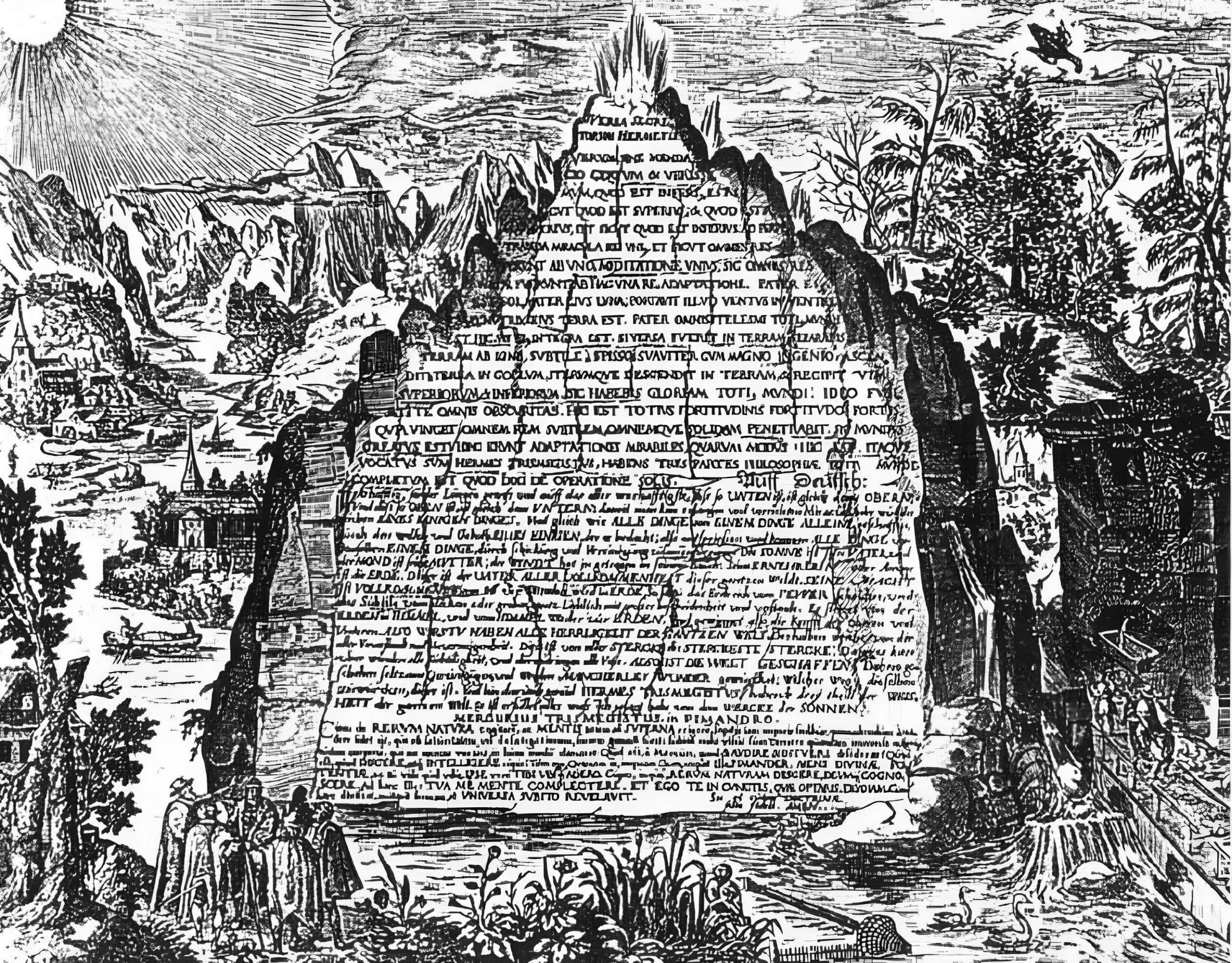
The Emerald Tablet is an ancient and enigmatic text associated with alchemy and hermeticism. It is widely accepted that this text encapsulates the fundamental principles of alchemical teachings. While it is traditionally attributed to Hermes Trismegistus, its precise origins remain uncertain. Nevertheless, it has exerted a profound influence on Western esoteric thought.
The discovery of the Nag Hammadi codices in 1945 provided new insights into the nature of Hermeticism.7 These manuscripts, which include dialogues between Hermes and Asclepius, serve to reinforce the connection between Her-
7. Jame M. Robinson (ed.), The Nag Hammadi Library in English (HarperCollins, 1990), 21–29.
Figure 4: “Tabula Smaragdina,” Heinrich Khunrath (1609)
meticism and Hellenistic mysticism. In this framework, Hermes Trismegistus is regarded as a reinterpretation of the ancient Egyptian god of wisdom, Thoth.
The historical progression of Hermeticism underscores the profound adaptability of ideas and traditions, thereby illuminating the intricate tapestry of human history, where cultural, philosophical, and spiritual elements interweave and perpetually evolve.
The influence of Hermeticism was not confined to specific periods in history; rather, its essence permeated various facets of Western and Eastern thought. The complexity and depth of these ideas have caused them to find resonance across different eras and cultures, from the Jewish mysticism of Kabbalah to aspects of Islamic Sufism to certain strands of Hindu thought.
As scientific and rational thought began to predominate in the European intellectual landscape, Hermeticism and other esoteric traditions were relegated to the periphery of society. Nevertheless, it never fully disappeared. In response to the existential and spiritual crises of the modern world, many sought refuge and wisdom in ancient traditions. The nineteenth and twentieth centuries therefore saw a resurgence of interest in the occult with Hermeticism attracting a new audience. Secret societies, mystical groups, and individuals seeking spiritual wisdom once again turned to Hermetic teachings, perceiving them as a conduit between the past and the present, the mundane and the divine. Thus was the Hermetic tradition able to maintain relevance, becoming the object of study and practice for esoteric groups particularly in the Western world. Spiritual and philosophical movements, including Theosophy, Rosicrucianism, and the New Age movement, have drawn from the sources of Hermeticism to shape their worldviews.
To this day, Hermeticism continues to inspire and influence various spiritual and philosophical movements. Its concepts resonate in many modern Neopagan traditions and various schools of esoteric thought. Despite the contemporary prevalence of rationalism and scientific thought, Hermeticism’s appeal symbolized by its ancient wisdom has endured, persisting as it serves as testament to the profound influence of the rich network of ideas and traditions that have shaped the human trajectory over millennia.
In literary and artistic circles, Hermeticism has influenced writers, poets, and artists who have found in ancient texts a source of inspiration and a means
of exploring the interconnection between the visible and the invisible.8 For instance, the Surrealist movement incorporated Hermetic elements into their works, seeking to transcend the material world and explore the realms of the subconscious and spiritual.
Moreover, with the progression of globalization and the concomitant increase in the interconnectedness of cultures, Hermeticism has garnered new adherents in regions previously unexposed to these ideas. In the contemporary digital age, the dissemination of Hermetic wisdom has become increasingly prevalent on social networks, online platforms, educational courses, and forums. This accessibility has led to a generation that is actively seeking to understand its place in the cosmos.
The enduring legacy of Hermeticism underscores the human capacity to seek meaning and connection amidst the vicissitudes of time. Despite periods of obscurity and rejection, the Hermetic tradition has demonstrated its resilience, resurfacing to illustrate its enduring relevance and its capacity to inspire generations to reconnect with ancestral wisdom and the mystery of the universe.
This phenomenon underscores the notion that Hermeticism is not merely a relic of the past. It endures as a vibrant phenomenon, with adherents and scholars committed to the exploration and reinterpretation of ancestral teachings, seeking their pertinence within the domain of contemporary spirituality and philosophy. The evolution of Hermes Trismegistus from his origins as an Egyptian deity to his contemporary multifaceted influence exemplifies the resilience and adaptability of spiritual and philosophical traditions over time.
The Hermetic Texts
Antiquity presents us with a vast array of texts and teachings that have shaped and influenced the spiritual and philosophical traditions of the world. Among these treasures are Hermetic writings, deeply esoteric texts covering topics ranging from philosophy and astrology to medicine and alchemy.
We can definitively date the origin of Hermetic texts to the Hellenistic period, an era marked by the fusion of cultures following the conquests of
8. Frances A. Yates, The Occult Philosophy in the Elizabethan Age (Routledge & Kegan Paul, 1979), 90.
Alexander the Great. This era saw the birth and development of several philosophical and spiritual currents, creating a melting pot of ideas and practices. It was in this context that Hermes Trismegistus emerged as an emblematic figure. It is widely accepted that the figure of Hermes Trismegistus represented the pinnacle of ancient wisdom, serving as the original master who imparted esoteric teachings to humanity. The dissemination of his legend throughout the Mediterranean region attracted adherents and intellectuals seeking to expand their understanding of the universe and the role of humankind within it.
Hermetic writings are often presented in the form of dialogues between Hermes Trismegistus and his disciples. These dialogues explore ideas about the nature of reality, the cosmos, the human soul, and the divine. One feature that sets these texts apart is the concept of the universal mind or Nous, which is often interpreted as an all-pervading divine force or principle.
The hermetists believed that by understanding these teachings, one could achieve gnosis—a higher knowledge that leads to enlightenment and union with the divine. This process has been described as a journey of the soul in which the individual purifies, elevates, and ultimately reintegrates into the divine source from which they originated.
Hermetic writings also explore the idea that the universe is constructed through correspondences. One of the most well-known maxims from these texts is “As above, so below; as below, so above,” suggesting a view of interconnectedness and a potential divine pattern or design throughout the cosmos.
The influence of Hermes Trismegistus and his teachings has been said to extend beyond the realms of religion and philosophy. His concepts and ideas have been integrated into many esoteric traditions over the centuries, including Kabbalah, Freemasonry, and even certain currents of Christian thought.
The Hermetic writings and the figure of Hermes Trismegistus occupy a special place in the Western esoteric tradition. His teachings, steeped in Hellenistic wisdom and reflecting the synthesis of ancient cultures, serve as a reminder of humanity’s eternal quest for knowledge and the divine. The Hermetic writings gently guide us to reflect on the mysteries of the cosmos and our place within it, offering a journey that, though ancient, remains as pertinent today as ever.
As we explore the various layers of these texts, it becomes evident that despite their ancient origins, the teachings possess a remarkable timeless quality.
In a world where many are searching for meaning and connection, Hermetic principles offer a unique perspective on the interconnected nature of reality.
Within these writings, we find the notion that humans are not merely passive observers of the cosmos, but rather, active participants in it. This perspective invites us to contemplate the possibility that through understanding, introspection, and deliberate action, we may have the capacity to influence our reality and, in a sense, collaborate with universal forces.
It is intriguing to observe how Hermes Trismegistus discusses the influence of words and thoughts. In some ways, these ideas seem to align with modern principles of positive psychology and the Law of Attraction, suggesting that our thoughts and words may have a certain influence on our reality. This perspective invites us to consider the possibility of a more conscious and intentional mindset in our journey through life.
Furthermore, the Hermetic focus on personal transformation and spiritual alchemy could be seen as a precursor to modern personal development movements.9 The notion that we can refine our essence, purifying ourselves of impurities and elevating our nature to its most divine form, is a message that resonates in many contemporary practices.
However, it is also vital to recognize that although these texts offer rich wisdom, they are not immune to misinterpretation. As with any esoteric text, it is essential to approach it with discernment, seeking to understand the context in which it was written and the intentions behind its words.
In the current era with its renewed interest in esotericism and ancient traditions, Hermetic texts continue to resonate with relevance. Schools of thought, study groups, and individual practitioners have been known to turn to these texts, seeking to decipher their mysteries and apply their teachings to their daily lives.
The figure of Hermes Trismegistus and his writings invite us to contemplate the deeper aspects of existence, encouraging us to explore the profound depths of our being. It has been suggested that within each of us lies a divine potential waiting to be awakened, and that true wisdom is timeless and relevant in all ages. In our ongoing search for meaning and connection, these ancient
9. Arthur Versluis, The Esoteric Origins of the American Renaissance (Oxford University Press, 2001), 75.
The Ancient Roots
writings can serve as a beacon, illuminating the path toward deeper understanding of ourselves and the cosmos around us.
Hermetic texts are not a single and cohesive work but rather a compilation of writings from different times and origins.10 The following list offers a selection of notable and influential treatises included in this collection:
Corpus Hermeticum: The most famous collection of Hermetic texts, consisting of seventeen main treatises. It addresses a variety of philosophical and theological themes, from the nature of divinity to humanity’s place in the cosmos.
Poimandres: The first and perhaps best-known treatise of the Corpus Hermeticum. It describes Hermes’s vision of a luminous divine figure and the origin of the universe, introducing the idea of the soul’s ascension.
Asclepius: Also known as The Perfect Book, this dialogue between Hermes Trismegistus and his disciple Asclepius focuses on themes of religion, spirituality, and the eventual fall and rebirth of the Hermetic tradition.
Armenian Hermetic Definitions: A text written in Armenian that explores Hermetic alchemy. It provides a detailed list of definitions related to God, the universe, the sky, the mind, the soul, the Earth, and the elements.
Discourses on the Ogdoad and the Ennead: A treatise discussing the creation of the world and the divine spheres represented by the Ogdoad (eight) and the Ennead (nine).
The Book of the Secret of Creation and the Art of Nature: Often associated with alchemical literature, this text explores ideas about the creation of the world and the intrinsic nature of things.
The Excerpts of Stobaeus: A collection of Hermetic fragments preserved by John of Stobi, the compiler. These excerpts contain valuable insights not found elsewhere in Hermetic literature.
Each text enriches the diverse panorama of the Hermetic tradition in its own unique way. They unveil a sophisticated system of thought aimed at comprehending the nature of divinity, the universe, and humanity, as well as the intricate
10. Brian Copenhaver, Hermetica
relationships between them. Through these writings, we glimpse the ancients’ profound yearning for connection with the divine and their relentless pursuit of wisdom and spiritual enlightenment.
Who Was Hermes Trismegistus?
Widely regarded as the father of Hermeticism, Hermes Trismegistus is traditionally attributed with the authorship of the Corpus Hermeticum, which includes the Emerald Tablet. However, the consensus among most scholars is that he was not a historical figure but rather a composite of several mythological figures, including the Greek god Hermes and the Egyptian god Thoth. Conversely, some scholars contend that Hermes Trismegistus may have been a real historical figure, offering theories suggesting that there could have been two individuals bearing this name who both contributed significantly to Hermetic philosophy.
For many followers of the Hermetic tradition, however, the identity of Hermes Trismegistus is less important than the teachings he left behind. His lessons maintain their relevance in the present day. Regardless of the historical accuracy of his identity, he is regarded as a symbol of magick, mysticism, interconnection, and alchemy.
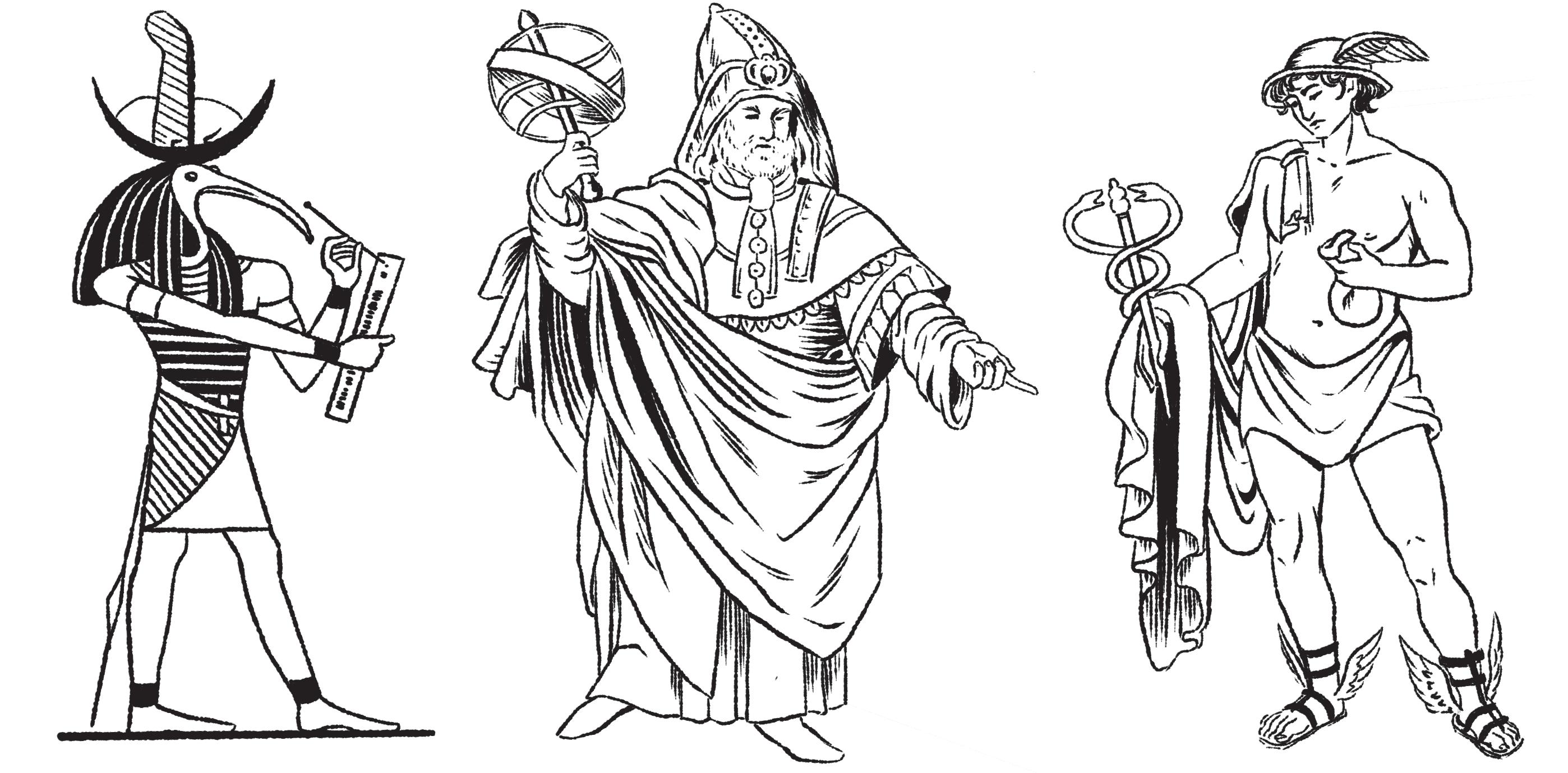
Hermes Trismegistus, frequently translated as “Hermes thrice-great,” serves as a symbol of the synthesis of Greek and Egyptian cultures during the Hellenistic era. He exemplifies the convergence of beliefs and mythologies inherent in these two ancient civilizations.
The origins of Hermes Trismegistus trace back to the Ptolemaic kingdom of Egypt (305–330 BCE), at which time the Greeks began to notice the parallels between their god Hermes, associated with communication and interpretation, and the Egyptian god Thoth. This recognition gave rise to a unified figure, Hermes Trismegistus, who was worshiped in the Temple of Thoth in the city of Khemenu, later renamed Hermopolis in the Hellenistic era.
The blending of these cultural traditions is further evidenced in examining the trajectories of other deities. Imhotep, an Egyptian polymath who was later deified, became associated with Thoth during the classical period. Similarly, notable figures such as Amenhotep and Te s were integrated into the combined worship of Hermes-Thoth, exemplifying the unique confluence of Greek and Egyptian spiritual traditions.
Figure 5: Thoth, Hermes Trismegistus, Greek God Hermes Hermes Trismegistus is a mythical figure often considered a fusion of the Greek god Hermes and the Egyptian god Thoth, both associated with wisdom, writing, magick, and science among other domains. The expression Trismegistus, derived from the ancient Greek Τρισμέγιστος (Trismegistus, “thrice great”), comes from τρῐ́ς (tr s, “three times”) and μέγιστος (m gistos, “the greatest”). This title emphasizes the immense wisdom and power attributed to him, reflecting an almost divine status in ancient philosophy and mystical traditions.
The name Hermes Trismegistus embodies a profound understanding of both the spiritual and material realms. The writings attributed to this figure are said to have provided the foundation for Hermeticism, exploring the relationship between the material world and the divine, as well as the link between the physical and spiritual realms.
Beyond the borders of Greece and Egypt, the persona of Hermes Trismegistus found expression in Muslim and Bah ’ traditions. In Islamic narratives, he is often equated with the prophet Idris, further solidifying his image as a spiritual guide and a figure of wisdom. Over time, Hermetic literature became intertwined with rituals and practices such as spirit conjuration and the animation of statues. Through these practices, we witness the emergence of alchemy and Greco-Babylonian astrology, both of which expanded the scope and depth of Hermeticism. Furthermore, Hermetic philosophy contributed to the systematization of religious practices during that time, offering adherents a structured path to spiritual ascension.
Renaissance thinkers and Christian scholars regarded Hermes Trismegistus as a prophetic figure, believing he had foreseen the advent of Christianity. They embraced the concept of prisca theologia—a universal theology underlying all religious beliefs—and viewed Hermes Trismegistus as one of its key proponents. However, this Renaissance veneration faced significant challenges. The scholar Isaac Casaubon argued that the Hermetic writings were composed after the emergence of Christianity, leading to a decline in the credibility of Renaissance Hermeticism. Subsequent analyses revealed that these texts were authored by multiple Greek writers and reflected a fusion of diverse traditions, including Platonism, Stoicism, and possibly Persian and Jewish influences.
Within Islamic tradition, Hermes Trismegistus was a highly revered figure, often identified with the prophet Idris or the biblical Enoch.11 His character and teachings were interpreted through various lenses: Some viewed him as having a triple origin (symbolizing his mastery over three realms of knowledge), while others linked him to the foundational development of alchemy.
Hermes Trismegistus stands as a pivotal figure in the history of Western Esotericism, acting as a bridge between ancient philosophies and more modern mystical and occult movements. He symbolizes the convergence of cultures and the synthesis of diverse spiritual traditions. His legend, which encapsulates the combined wisdom of Greek and Egyptian thought, has left an enduring imprint on the philosophical and spiritual heritage of numerous cultures. This legacy continues to resonate, most notably through works like The Kybalion, which bring his teachings into a more contemporary context.
11. Garth Fowden, The Egyptian Hermes: A Historical Approach to the Late Pagan Mind (Cambridge University Press, 1986), 75.
Body, Mind & Spirit / Witchcraft
“Claudiney Prieto is the kind, wise, and fervent voice so very essential to modern Witchcraft. He offers clear and solid instructions for building an effective and powerful magickal practice.”
—Courtney Weber, author of Hekate and Sacred Tears
Discover a Classic Hermetic Text Through the Lens of Modern Witchcraft
Featuring a fresh perspective, practical exercises, and The Kybalion in full, this groundbreaking book bridges the gap between Hermetic knowledge and Witchcraft. A full chapter is dedicated to exploring each of the seven Hermetic principles—mentalism, correspondence, vibration, polarity, rhythm, causation, and gender—and how to apply them in the life of a modern Witch. This masterful book is meticulously structured into two main sections: Ratio Hermetica, which delves into theoretical aspects, and Praxis Hermetica, which offers hands-on rituals, meditations, and other exercises. You’ll learn how to unite ancient philosophical wisdom with empowering practices, such as building a Hermetic sanctuary and casting magic circles. With its accessible language and profound insights, The Kybalion for Witches is an invitation to anyone, regardless of experience, who seeks to understand the mysteries of the Universe.
Claudiney Prieto is one of the most well-known and respected Brazilian occult authors today. He wrote Wicca: A Religião da Deusa (Wicca: The Goddess Religion), selling more than 300,000 copies and shaping generations of Brazilian Witches. He is the founder of the Dianic Nemorensis Tradition, a third-degree High Priest in the Gardnerian Tradition, a Minos in the Minoan Brotherhood, an Archpriest of the Fellowship of Isis, and a member of the FOI ArchPriesthood Union. He is also a High Priest in the Apple Branch Tradition and the founder of the first Museum of Magic and Witchcraft in Brazil. Visit him at Instagram.com/ClaudineyPrieto.