'
.
ARITY
RECIPES MAGIC
L. BED
& F0RM & SP
Praise for Powerful Powders “An INCREDIBLY POWDER-FUL book. In the words of bestselling author Charity L. Bedell, ‘Magic doesn’t have to be hard. It can be simple.’ And, after reading the book, I wholeheartedly agree. Not only was I mesmerized by her profound depth of knowledge in witchcraft and folklore, but Charity’s sense and sensibility of working with everyday magical powders and spells helps aspiring witches to put her Powerful Powders to work for you. …An enlightening, must-read book for everyone looking to elevate their magical practice. It’s a treasure trove of magical insights and inspiration for all. Buy it now!” —Shawn Robbins, coauthor of Wiccapedia and The Good Witch’s Guide “Charity’s fine book is both an introduction to powders and a guide for practitioners who are expanding their field of study. Well-written and chock-full of information, this book is a wonderful addition to any witch’s or herbalist’s library.” —H. Byron Ballard, author of A Feral Church and Small Magics “Have you ever had a life moment after reading a book that made you realize that you found a classic in its first release? This is it. Whether you are a phenom in folk magic studies or just looking into a simple primer on the topic, this book belongs on your shelf. I even recommend asking your local
library to add it to the reference collection. Why? Because it’s that good. I should know. I am about this magical life and it’s going on my shelf.” —Kenya Coviak, folk magician/Hoodoo practitioner and owner of Detroit Conjure “There’s dust, and then there is dust. The first type is the dusty powder that’s a household nuisance, but there are powders that are of the beneficial type as well. There are floor sweeps, edible magical powders, witch salts, and many more. Charity L. Bedell introduces readers to her latest book, Powerful Powders. It’s one of a kind. Taught by way of exercises, recipe creations, and formulas, you will learn how to work with all of your magical workings. It’s one of those books of wisdom that need to be in your bookcase.” —Marla Brooks, author and host of Stirring the Cauldron on the Para X Radio Network “Ms. Bedell has crafted a book for beginning and seasoned magical practitioners alike. As she says in the opening chapter, powders are an easy way to create a tool for immediate use and also store that tool for quite a while. From easy-tofollow instructions for creating powders to suggestions for spells in which to use them, she walks you through crafting magical powders for virtually any need. This book should be on every witch’s reference shelf!” —Deborah J. Martin, MH, author of Herbs: Medicinal, Magical, Marvelous!
“Powerful Powders by Charity is both spiritually uplifting as well as magically grounding. There is so much peace, power, and connection when conversing with the natural world and the spirits of the land. Whether it is through the dirt in our gardens, or the powders of herbs and other substances; each of us can experience playful yet powerful magic. In this book, Charity walks us through magic and spellcasting ways to enhance our magical practices.” —Granddaughter Crow, author of The Wisdom of the Natural World “Charity Bedell’s Powerful Powders honors her roots as an initiate of Conjure and a practitioner of folk magic while offering a deeply accessible pathway for any witch on their own journey to reach beyond black salt and begin working more deeply with powders. Powerful Powders is an empowering companion for any sacred wild soul.” —Elyse Welles, author of Sacred Wild
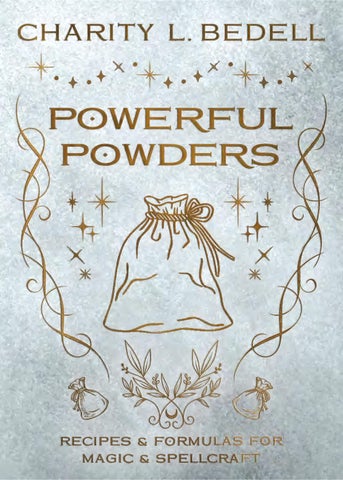
Powerful Powders
About the Author © Photo provided by HMages: Photography by HM & Hilareigh Maxson
Charity L. Bedell (Maine), also known as Loona Wynd, is one of the coauthors of The Modern-Day Witch series and the Wiccapedia Spell Deck. She has studied Conjure with Starr Casas and Feri with Veedub, and she is initiated in the Temple Tradition. Bedell has written for The Witches’ Almanac and Kindred Spirit Magazine, and she has presented at festivals such as WitchCon2020. Learn more at Mystic-Echoes.com.
To Write to the Author If you wish to contact the author or would like more information about this book, please write to the author in care of Llewellyn Worldwide Ltd. and we will forward your request. Both the author and the publisher appreciate hearing from you and learning of your enjoyment of this book and how it has helped you. Llewellyn Worldwide Ltd. cannot guarantee that every letter written to the author can be answered, but all will be forwarded. Please write to: Charity L. Bedell
⁄o Llewellyn Worldwide 2143 Wooddale Drive c
Woodbury, MN 55125-2989 Please enclose a self-addressed stamped envelope for reply, or $1.00 to cover costs. If outside the U.S.A., enclose an international postal reply coupon.
Many of Llewellyn’s authors have websites with additional information and resources. For more information, please visit our website at https://www.llewellyn.com.
Powerful Powders: Recipes & Formulas for Magic & Spellcraft Copyright © 2026 by Charity L. Bedell. All rights reserved. No part of this book may be used or reproduced in any manner whatsoever, including internet usage, without written permission from Llewellyn Worldwide, Ltd., except in the case of brief quotations embodied in critical articles and reviews. No part of this book may be used or reproduced in any manner for the purpose of training artificial intelligence technologies or systems. First Edition First Printing, 2026 Based on book design by Christine Ha Book format by Samantha Peterson Cover design by Shannon McKuhen Llewellyn Publications is a registered trademark of Llewellyn Worldwide Ltd. Library of Congress Cataloging-in-Publication Data (Pending) ISBN: 978-0-7387-8056-6 Llewellyn Worldwide Ltd. does not participate in, endorse, or have any authority or responsibility concerning private business transactions between our authors and the public. All mail addressed to the author is forwarded but the publisher cannot, unless specifically instructed by the author, give out an address or phone number. Any internet references contained in this work are current at publication time, but the publisher cannot guarantee that a specific location will continue to be maintained. Please refer to the publisher’s website for links to authors’ websites and other sources. Llewellyn Publications A Division of Llewellyn Worldwide Ltd. 2143 Wooddale Drive Woodbury, MN 55125-2989 www.llewellyn.com Printed in the United States of America GPSR Representation: UPI-2M PLUS d.o.o., Meduli eva 20, 10000 Zagreb, Croatia, matt.parsons@upi2mbooks.hr
Other Books by Charity L. Bedell The Good Witch’s Guide: A Modern-Day Wiccapedia of Magickal Ingredients and Spells (cowritten with Shawn Robbins, Sterling Ethos, 2017) The Good Witch’s Perpetual Planner (cowritten with Shawn Robbins, Sterling Ethos, 2019) The Wiccapedia Spell Deck: A Compendium of 100 Spells & Rituals for the Modern-Day Witch (cowritten with Leanna Greenaway and Shawn Robbins, Sterling Ethos, 2020) The Modern-Day Witch 2023 Wheel of the Year 17-Month Planner (cowritten with Shawn Robbins, Sterling Ethos, 2022) Container Magic: Spellcraft Using Sachets, Bottles, Poppets & Jars (Llewellyn, 2023) Divine Dirt: The Art of Using Dirt in Magic, Ritual & Spellcraft (Llewellyn, 2024)
Dedication This book is dedicated to my mom, Linda Bedell. She has always been an influential force in my life. She taught me about tarot cards, angels, and spirits. She was also the one who bought me my first tarot deck. When it comes to my spirituality and magical practice, she has encouraged it from the start, taking some classes with me, and helping me find others. She was the first person to support my dreams of becoming an author and running my own metaphysical shop. Thank you for all the support, Mom. This book is my thank you to you.
Disclaimer The publisher and author assume no liability for any injuries caused to the reader that may result from the reader’s use of content contained in this publication and recommend common sense when contemplating the practices described in the work. In the following pages you will find recommendations for the use of certain essential oils, incense blends, and ritual items. If you are allergic to any items used in the exercises, please refrain from use. Essential oils are potent; use care when handling them. Always dilute essential oils before placing them on your skin, and make sure to do a patch test on your skin before use. There are spells in this text that deal with mental illness support. These spells are to supplement proper treatment for your mental health, and they are not substitutions for treatment by a professional. If you are in crisis, talk to a professional and get proper treatment first. Only use the spells after seeking professional help.
Contents
Introduction … 1 Part I: Magical Powder Basics
Understanding Magical Powders … 13 Choosing Your Materials … 25 Creating the Powder & Casting the Spell … 47 Storing, Feeding & Recharging Your Powder … 65 Part II: Magical Powder Formulas
Common Magical Powders … 87 Witches’ Salts … 133 Sweetening Magical Powders … 177 Floor Sweeps … 215 Edible Magical Powders … 243 Baneful Magical Powders … 273
Contents
Part III: Resources
Animal Correspondences … 307 Herb Correspondences … 311 Crystal, Stone & Mineral Correspondences … 327 Dirt Correspondences … 329 Manufactured Curio Correspondences … 331 Incense Recipes … 333
Conclusion … 339 Acknowledgments … 343 Appendix I: Recipes & Spells in Order of Appearance … 345 Appendix II: Recipes & Spells by Intent … 355 Recommended Reading … 379 Works Cited … 385
xiv
Introduction
A
young woman has just moved into a new home and needs to ward it. She takes a vial out of her purse and starts walking along the border of her property. While she walks, she begins to scatter the contents of the vial. As she sprinkles the mixture, she recites prayers, mantras, and chants to empower the protection. When she reaches the point where she started, she seals the vial once again and stands up straight knowing that her home now has a strong ward against evil and other forms of negativity. A young mother sits with a small blue fabric dolly. She comes from a long line of cunning women and healers. In the room behind her, her small child rests, sick with a bad fever and illness. Tears of hope and love fill the mother’s eyes as she fills the doll with a mixture of materials. As she
1
Introduction
does so, she whispers a healing prayer, calling on her ancestors. When the doll is full, she finishes sewing its head and sets it in front of a candle. Every day she lights the candle and recites the same prayers until the child begins to get better. The two stories above involve the use of magical powders. Magical powders are powerful tools that can be used or adapted to any magical work you have in mind. In each of the stories, a magical powder provides the power for the spell being worked. These simple mixtures of herbs and curios provide all of the energy and power for the spells they were used in.
What Are Magical Powders? Magical powders are blends of herbs and curios that have been ground to a fine consistency. These powders are often sprinkled or dusted over objects or locations to enact specific magical works. The practice of dusting objects and materials with powders is why some magical powders are referred to as dusting powders. Dusting is only one of many ways magical powders can be worked with, which is why I choose to simply call them magical powders rather than dusting powders. The combination of various unique curios gives each powder a unique magical signature. Once created, a powder can store its magical charge until its power is needed.
2
Introduction
The process of creating a magical powder gives you a tool that can be used instantly or stored for future use.
Why Use Powders? Powders are versatile magical tools. They can be used by themselves as a spell, or they can be included with other materials for a larger and more powerful working. The creation of magical powders is an excellent example of how witchcraft is a craft. You craft the powders by combining herbs and curios, working physically and practically but also subtly and energetically. Magical powders also give us ways that we can be a bit playful with our magic. As the energetic forces that make up the powder combine to create a cohesive whole, it is important to be able to play with the energy and feel how it meshes. It’s a chance to experiment with herbs and other curios in new ways. You can use powders as fillings for container spells, pouring them into poppets, sachets, jars, and balls. As a filling, these powders can be used by themselves or combined with other materials. As the powder is added to the vessel, a small bit of energy is released to start the spell process. The rest gets released a little at a time as the primary spellwork is performed. Powders can also be used in spellwork by being dusted or scattered about the area you want the magic to impact.
3
Introduction
Fast cash powders are often sprinkled in wallets to bring money into the household quickly. For candle spells, you can spread the powder around the base of the candle, or you can run the powder over the candle after anointing it with an oil.
About Me I have been a practicing witch for twenty-five years now. My journey into witchcraft began when I was thirteen years old. I was gifted a copy of the book Teen Witch by Silver Ravenwolf. From then on, I knew that not only was I a witch but that my path in life involved teaching witchcraft in some way, shape, or form. It was when I entered college that I decided I wanted to have some formal training. When I had a chance to receive formal training in the Temple of Witchcraft tradition, I took it. I was initiated to the second degree of the Temple Tradition in 2020. I also had a chance to study the Feri tradition in the Dustbunny line under Veedub, or Valerie Walker. While I have not been initiated into the Feri tradition, it has still been an influence in my magical and spiritual path. The Feri tradition of witchcraft contains elements that come from Hoodoo or Conjure, and when I had an opportunity to study with a Conjure elder, I jumped at that chance as well and signed up with the Conjure Academy.
4
Introduction
Today I am a proud graduate of the Conjure Academy and able to call myself a Conjure worker.
Practices Within This Text The spells and workings in this book come from the basis of folk magic, and there are two systems of magic that make up the practices that are found in this text. The first system of magic is witchcraft. The second magical system is that of Hoodoo or Conjure. Conjure is an American system of folk magic that developed during the times of slavery by those who were enslaved. They created Conjure as a way to preserve what practices they could from their homelands. Using brooms and herbal sweeps to bless and protect the home while reciting Bible verses is an example of how Conjure combined their ancestral practices with the Christianity forced upon them. While Hoodoo or Conjure originated through slavery and persecution, the practice is open to everyone. As former enslaved people lived among other minority populations, the practice of Conjure began to spread to the public in general. I have been taught that as long as you respect the origins and ancestors of Conjure, you can practice Conjure. When talking about the practice of Conjure, the word Conjure will always be capitalized to make a distinction between the folk magic and the practice of conjuring spirits.
5
Introduction
Conjure as a magical practice involves the use of the Bible. Any spell or working in this book that comes from Conjure will contain a Bible verse. In Conjure work, the Bible is viewed both as the word of God and as a magical book. Even if you do not believe in the Bible and its teachings, the Conjure spells will work for you because of the power within the Bible.
Ethical Expectations This book contains workings from both witchcraft and Conjure practices. As the book contains both magical traditions, there will also be some baneful magic within this text. It is my belief that to understand magic the best, one needs to understand both the healing and beneficial crafts as well as the baneful crafts. By understanding baneful magic (even if we never use it), we can better protect ourselves against it and remove it when called to. It is up to you, the reader, to decide what is and isn’t ethical for you. In my practices, it is perfectly ethical to work baneful magic so long as everything else has been tried to deal with the situation. Baneful magic, while a tool and resource, is a last resort—and one that I do not take without first asking myself several questions. Asking these questions helps me to really think about the work and often helps me find other solutions to the problem.
6
Introduction
The first question I ask myself before engaging in any sort of baneful magic is: Have I or my loved ones done anything to bring harassment, such as showing off something that triggered jealousy? If there is something that has been done, you must take ownership of said behavior. Taking ownership of behaviors prevents spells from backfiring. The second question I ask is: Can I live with the consequences of my actions or inaction? If I can live with the action, I will do the work. If, however, I may regret acting later on, I will not cast the spell. Regretting baneful magic causes it to backfire. I once had a spell backfire on me because I started to question if it was the right thing to do. After I started to question my actions, what I wanted to happen to my target happened to me as well. This persisted until I took the time to reassess my actions and affirm I made the right choice. When it comes to baneful magic, I advise you to think hard about the actions you are about to take. Another ethical consideration is that of controlling and dominating magic. Except for baneful magic, which is used when you are trying to stop specific behaviors, it is unethical to control the way another person thinks or acts. Using magic to have an individual think or act in a way they normally would not is disrespectful to the individual and goes against their personal will.
7
Introduction
A Word on the Materials The spells and workings in this text use a variety of materials. Some of the work includes the use of animal remains or leavings. Working with animal remains has been a traditional part of many magical practices. Witches and Conjure workers have always used whatever tools they have had at hand to get the work done. The section on animal materials is included for informative purposes. Many of the animal parts mentioned can readily be found in nature. There is no reason to harm any animal for your magical practices. Only use materials that you can ethically purchase or gather from an animal that has already died. If you are uncomfortable working with animal components, you can skip that part of the work. All the spells and formulas use dried herbal ingredients. Grinding and powdering herbal materials is easier once they have been properly dried. Some herbal materials can be found already in a ground or powdered form. Whenever possible, you should work with those forms to save yourself time, effort, and energy, which can then go elsewhere in your spellwork. One last note: Some of the spells and formulas contain materials that could be allergens. If you or the people around you have allergies to certain materials, do not work with them. There are alternative formulas and ingredients for allergens.
8
Introduction
It is my hope that through this book you will develop a deeper connection to the world around you. From animals to minerals and herbs, every material found within this book has its own magic to teach and offer you. Magic can be found in everything and everywhere. It can just take some time to learn how to see it and use it. Good luck and welcome to the world of magical powders.
9
PART I
Magical Powder Basics
Understanding Magical Powders
P
owders are not something that people often associate with witchcraft and magic. Occasionally there are references to uses of black salt for protection and that’s about it, but powders are a versatile tool in magic that can be used anywhere and anytime. One of the benefits of powders is that they can be used discreetly. For those who need to be careful about how they practice their magic and find ways to hide it, powders can be useful. Need to ward your home? Just sprinkle a protective powder of your choice around the doors and windows once a month to keep it safe. A second benefit of working with magical powders is how they can store power. Through the creation process, these powders are infused with magical and spiritual 13
Understanding Magical Powders
energy. Once created, the powder will store the magic and energy within until it is needed for spellwork. A third benefit of using magical powders is their ability to be used in multiple spells and workings. Powders can be used by themselves as a spell or included as ingredients to empower other types of spellwork. Need a filling for a sachet or spell ball? Use a magical powder. For any spell or magical working, there is a powder that can be used to add power.
Utilizing the Magic of Powders These powders work to direct our will, desire, and intent. That’s why sprinkling or applying a magical powder alone can work as a spell. The energy was gathered, charged, and stored in the powder for future use. As the powder is sprinkled, the energy and intent within it is directed and released for the spell. Powders that are made from more than one material contain an energetic force that is a combination of all the materials used to create the powder plus mental and physical energy. How the magic within the powder is activated will depend on the spell you are doing. For container magic, the energy is released whenever the container is worked. When used in a candle magic spell, the power is released as the
14
Understanding Magical Powders
candle burns. The fire from the candle heats the powder, beginning the process of releasing the stored energy. You can even combine the use of powders and personal effects to create powerful magical works. The powder will hold the energy and essence of the spellwork while the personal effect contains the energy of that individual. Covering a personal effect or other direct representation (a photo, drawing, written name) will send that energy directly where you need it to go.
Types of Magical Powders There are many different types of magical powders that can be utilized in your practice. Whether you are working kitchen witchery, using poppets, or performing candle magic, there is a type of magical powder that can suit your need. Each type of powder approaches the manifestation of a spell in a unique way. Different powders work best for different situations. Witches’ salt is the most well-known magical powder. As the name implies, this powder’s base is salt. If there are known blocks in your path, using witches’ salt is the way to go. The salt neutralizes the blocks while the other materials transform the neutralized energy into something that works for you. Sweetening powders are another well-known type of magical powder. A sweetening powder typically uses sugar
15
Understanding Magical Powders
or cocoa powder as its base. The goal of a sweetening powder is to attract your goal to you quickly and to open the world to your perspective. When you need to manifest magic quickly, a sweetening powder makes the perfect addition to your spell. Edible powders are a third type of magical powder. The thing that makes edible powders unique is that they are the only powders created exclusively from food-based materials. Edible powders are a great way to engage in kitchen magic and share your spells with those open to them. Floor sweeps, or dusting powders, are a type of magical powder I learned about through my Conjure studies. This fourth type of magical powder shows the true essence of folk magic: using what’s available. The use of floor sweeps is one of the ways that Conjure was able to help preserve some of the ancestral practices of enslaved people. Two other types of magical powder are common magical powders and baneful powders. Common magical powders are magical powders that don’t really fit anywhere else; they aren’t a salt, a sweep, or a sweetening powder. Baneful powders are great tools to add to your magical toolbox. These powders are used strictly for baneful magic. As with all baneful magic, it is important to be careful regarding how, when, and why you use them. There are other blends that can also work as magical powders. Herbal teas can be used the same way you would
16
Understanding Magical Powders
use an edible powder. Baths and washes can also be used as powders. Simply use them as is—without involving water. Powdered herbal incenses are another magical tool that can double as a powder. Deciding What Type of Powder to Make
The following exercise can help you decide what type of magical powder you might want to make. Remember to explore and experiment. These considerations are what have worked best for me and my practice. You may find that things are different for you. At the end of the day, you should always use what works best for you and your practice. MATERIALS
• Pen • Paper WORKING
1. Write down what the general intent behind the magical powder will be. 2. Ask yourself if your goal is to attract something, remove something, maintain something, or control something. Record your answer. Consider the following: • Attracting something lends itself to sweetening powders, common magical powders, and powdered herbal incenses. It is not uncommon
17
Understanding Magical Powders
to find magnetic sand in attracting powder recipes. • Floor sweeps work best if your goal is to remove something. • Witches’ salts, sweetening powders, and common magical powders are well suited for maintaining magical goals and use in spells that are long lasting. • Controlling work is best done with sweetening powders or baneful powders. 3. How will the powder be used? Record your answer. Consider the following: • Witches’ salts work best when used to charge a charm or scattered around an area to distribute the magic within it—just do not use salt-based powders in nature or you will kill any plants in the area. • Edible powders work best when consumed as part of the magical working. • Floor sweeps work best to remove and protect against energetic forces. • Common magical powders and baneful powders are best when they can be used as fillings for charms or part of a candle spell. • Sweetening powders are the most versatile of magical powders, working well by themselves, as fillings, or to charge other spells and materials. 4. What materials do you have on hand? Remember to check your spice cabinet and kitchen for spell 18
Understanding Magical Powders
supplies as well as to look at what’s available outside your home. Take note of the materials available and how you might use them. 5. With the answers to these questions, you can figure out what type of magical powder is best for the situation you are in.
Tools & Materials Crafting magical powders is one of the simplest magical practices. There are very few tools required for this work. Most of the tools used can be found in your kitchen or pantry. It is this simplicity that makes the use of magical powders a practice that is available and accessible to everyone. The following is a list of tools that I use and recommend to other people.
Gloves & Masks Some of the materials in certain magical powders should be handled with care. For safety reasons, either plastic medical gloves or gardening gloves should be utilized when dealing with those materials. You may also want to use a mask to prevent lung irritation. Mortar & Pestle The first tool used in crafting magical powders (aside from the curios themselves) is that of a mortar and pestle. This tool is the one that you will use to grind and pound the
19
Understanding Magical Powders
materials into as fine of a consistency as possible. Blenders, coffee grinders, and food processors make excellent substitutions for a mortar and pestle. If using these tools, make sure you keep your magical grinders separate from your kitchen grinders, the exception being if you are creating an edible powder.
Used Spice Jars Old spice jars are the perfect containers to store magical powders in. Many spice jars have shaker lids. These shaker lids make it easy to apply magical powders to objects and settings. Reusing spice jars is also a great way to reduce the amount of trash that ends up in landfills, as you are providing a new use for an old container. You simply need to clean them before use. Buying new jars is also an option. Measuring Tools There are a variety of measuring tools that can be used when crafting magical powders. The most important and common ones would be measuring spoons and cups. These tools allow you to have precise measurements and ensure that you can replicate your formula later. To prevent cross contamination of edible versus inedible components, use a separate set of measuring tools for your magical work.
20
Understanding Magical Powders
Mixing Bowl One tool you will need is a bowl of some sort to mix your powders in. This can be anything from a plastic mixing bowl to a cauldron. I recommend against using wooden bowls, as wood is a porous material and will over time absorb the various oils. Here you will be combining both the physical materials and the energetic aspects of the powder. To prevent cross contamination, set aside a specific mixing bowl for your magical work and keep your other bowls for cooking. Spoon or Wand While I encourage everyone to mix some of the powder using their hands, it’s not always going to be possible. Some herbs are messy, and others, such as stinging nettle and poison ivy, may cause adverse reactions. Having a spoon or wand to stir and mix the components of your powder is useful. The spoon or wand also works as a tool to help direct and focus the energetic forces as they become one united force. As with the mixing bowl and other kitchen utensils, make sure you use a different spoon for magical work than for cooking. Food Coloring or Dye For some magical powders, color plays a key component in the power behind the powder. Witches’ salts are a great example of powders where color plays a role. When possible, 21
Understanding Magical Powders
the colors of your magical powders should come from the materials used, such as flowers, herbs, and crystals. In some cases, the desired colors are not easy to find in nature, so dye may be needed. There will be more information about the use of color and dye in chapter 2, “Choosing Your Materials.”
Pens & Label Stickers The last things that I include in my kit are pens and label stickers or paper and tape. I use these to label the powders I create. It is important to remember which container holds which powder. Not only can you label your powder what it is, but you can also note the date and time it was created.
Other Ingredients & Curios When it comes to magical powders, you need to have an understanding of the materials that make them up. The ingredients in the powders determine a lot of power. This is why it is important to choose the ingredients for each powder carefully. Herbal materials make up the bulk of the ingredients used in magical powders. Dried herbs can easily be ground into fine powders and combined with other materials. All plant matter, from flowers to roots, stems, seeds, and bark, is considered an herbal component. Note that plant thorns and bark may require the use of sandpaper to achieve a fine powder.
22
Understanding Magical Powders
Animal components are some potential ingredients in magical powders. Many animals shed skin, fur, and claws. These materials can be gathered and worked with. Some animals, such as insects, can be found dead and dried. These can be ground up and used as a potent component in your magical powders. Dirt carries power. Dirt absorbs the energy and symbolism of every action that takes place at its location. For example, bank dirt carries the energy of financial success and prosperity, while dirt from a hospital carries both healing energy and the energy of decay and death. By adding dirt to your powders, you add the power of the land to your magical works. The final type of material that is used in crafting and creating magical powders is that of manufactured curios. These are powdered materials that do not occur in nature and are things that humans have made. Materials such as gunpowder, cornstarch, and baby powder not only add power but can make the final product easier to apply and work with.
23
Body, Mind & Spirit / Witchcraft “An enlightening, must-read book for everyone looking to elevate their magical practice. It’s a treasure trove of magical insights and inspiration for all.” —Shawn Robbins, coauthor of Wiccapedia and The Good Witch’s Guide
Drawing upon American folk traditions and witchcraft, Charity Bedell provides practical and spiritual advice for working with powdered plant, animal, and mineral curios. She takes you step-by-step through storing energy in finely ground materials and releasing it to enhance spells and rituals.
© HM & HILAREIGH MAXSON
Learn how to direct your will by dusting powder on a candle, sprinkling it into a bath, or pouring it into a container. Elevate your practice with witch salts, floor sweeps, spice blends, and other substances. Whether you desire protection, empowerment, or love, this book offers numerous easy-to-use formulas for this uniquely portable and discreet form of natural magic. , also known as Loona Wynd, is the one of the coauthors of The Modern-Day Witch series and the Wiccapedia Spell Deck. She has studied Conjure with Starr Casas and Feri with Veedub, and she is initiated in the Temple Tradition. Bedell is the author of Container Magic and Divine Dirt. She has written for The Witches’ Almanac and Kindred Spirit Magazine, and she has presented at festivals such as WitchCon Online. Learn more at Mystic-Echoes.com. Facebook.com/LlewellynBooks X: @LlewellynBooks Instagram: @LlewellynBooks
www.Llewellyn.com
$19.99 US