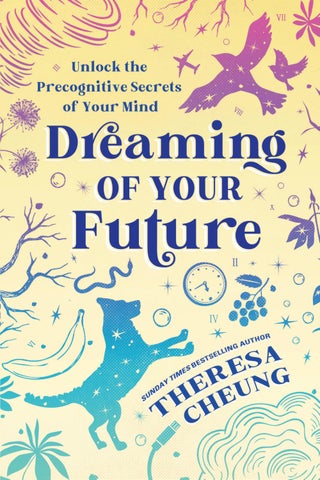
Believe in the beautiful future of your own dreams
About the Author
Theresa Cheung is a Sunday Times bestselling dreams author. She has a degree in theology and English from King’s College, Cambridge University, and a master’s in English from King’s College, London University. She is the author of numerous titles that have been translated into over forty languages, including the bestselling Dream Dictionary from A to Z (HarperCollins) and the Dream Decoder card pack and Dream Rituals Oracle Cards (Hachette). Theresa works closely with scientists researching consciousness and has contributed features about dreams to national and international newspapers, websites, and magazines, including Bustle, Vice, Cosmopolitan, Good Housekeeping, InStyle, Red, Grazia, Heat, Metro, Glamour, and many more. She has been interviewed by Claudia Winkleman on BBC Radio 2, Nicky Campbell on BBC Radio 5 Live, Roman Kemp on Capital Radio, Regina Meredith on Gaia TV, George Noory on Coast-to-Coast AM, Piers Morgan on ITV, Terrence Lee on Fox News, Chicago, and by other leading media outlets, including KTLA, Today Extra, Channel 4 and BBC Radio. The subject of a night poet episode on Nicky Campbell’s BBC Sounds 5 Live podcast, Different, and a frequent dream-decoding guest on ITV’s This Morning, Theresa has hosted numerous national dream call-ins live on TV and radio decoded dreams for numerous celebrities and influencers. She has given dream-decoding talks and webinars to leading companies and brands, such as Action Coach, Anthropologie, Beauty Bay, Dynavision, Immediate Media, Shiseido, Kiss Cosmetics USA, Premier Inn, Olympia Mind Body Spirit, and the Hearst magazine group. She also hosts her own popular podcast, White Shores. You can message, share your dreams with, and follow Theresa on Instagram @thetheresacheung and via her Facebook and X author pages, and learn more about her dreamwork at www.theresacheung.com.
Unlock the Precognitive Secrets of Your Mind Sunday Times Best-Selling Author
THERESA CHEUNG
Dreaming of Your Future: Unlock the Precognitive Secrets of Your Mind Copyright © 2025 by Theresa Cheung. All rights reserved. No part of this book may be used or reproduced in any manner whatsoever, including internet usage, without written permission from Llewellyn Worldwide Ltd., except in the case of brief quotations embodied in critical articles and reviews. No part of this book may be used or reproduced in any manner for the purpose of training artificial intelligence technologies or systems. First Edition First Printing, 2025 Cover design by Shira Atakpu Llewellyn Publications is a registered trademark of Llewellyn Worldwide Ltd. Library of Congress Cataloging-in-Publication Data (Pending) ISBN: 978-0-7387-7938-6 Llewellyn Worldwide Ltd. does not participate in, endorse, or have any authority or responsibility concerning private business transactions between our authors and the public. All mail addressed to the author is forwarded but the publisher cannot, unless specifically instructed by the author, give out an address or phone number. Any internet references contained in this work are current at publication time, but the publisher cannot guarantee that a specific location will continue to be maintained. Please refer to the publisher’s website for links to authors’ websites and other sources. Llewellyn Publications A Division of Llewellyn Worldwide Ltd. 2143 Wooddale Drive Woodbury, MN 55125-2989 www.llewellyn.com Printed in the United States of America
Other Books by Theresa Cheung
The Dream Cure The Dream Dictionary from A to Z Dream Decoder (card pack) Night Vision The Premonition Code with Dr. Julia Mossbridge Dream Ritual Oracle Cards Empower Your Inner Psychic How to Catch a Dream The Element Encyclopaedia of Birthdays The Afterlife Is Real Haunted World 21 Rituals to Ignite Your Intuition
Forthcoming Books by Theresa Cheung The Akashic Records
For the ghost of what is yet to come
Contents Introduction
1
Part One: It’s Dream Time! Chapter 1: Powered by Your Dreams
11
Chapter 2: A Natural-Born Precognitive Chapter 3: Precognitive Living
27
41
Chapter 4: Prepare to Dream Your Future
61
Part Two: The Precognitive Dream Directory Directory of Precognitive Dream Threads Actions 96 Animals 103 Body 114 Clothing 122 Colour and Shape 127 Death 131 Disaster 136 Everyday 143 Feelings 154 Food 169 Houses 176 Life Stages 181 Metaphysical 189 Nature 195 Nightmares 207 People 215 Relationships 224 School 235 Settings 239 Travel 245
91
x
Contents
Conclusion
253
Appendix: The Science of Precognition Recommended Resources Acknowledgments Bibliography
257
265
269
271
Index: A to Z of Dream Symbols Listed in the Book
279
Introduction You are, always have been, and always will be a precognitive being. You may not know it (yet), but it is a truth universally unacknowledged that precognition is a natural-born ability hidden deep within everyone, including you. Sixth sense is hardwired into your DNA. You already can sense what is way ahead of your time. You just haven’t been noticing it. This book will show you how your sleeping precognitive ability is always waiting for you to wake up to its visionary presence in your very own dream time. The overwhelming majority of precognitions occur in the nocturnal dream state. This doesn’t mean waking precognition isn’t possible. It most certainly is, and you’ll learn how you can sense your future with your eyes wide open too. But by far the swiftest, simplest, safest, and sweetest way to see your future first is in your dreams, a.k.a. your night vision.
It’s Your Dream Time
The mindfulness movement preaches that fulfilment can only be found by focusing all your attention on the present moment—the power of your now. Given the undeniable truth of this, you may wonder why I’m suggesting that you consider diverting some of your precious attention to what hasn’t happened yet in real time. I’m suggesting it because the meaning of your life may well depend on it. 1
2
Introduction
To reference Viktor E. Frankl, psychiatrist, Holocaust survivor, and multi-million-selling author of the enduring masterpiece of survival literature, Man’s Search for Meaning, the inability to see the future is linked to “dangerous giving up.” With “loss of belief in the future,” you risk losing your mental, physical, and spiritual “hold.” 1 Trusting in the hope of your tomorrow matters. It brings you meaning. This may sound like a direct contradiction to the mindfulness mantra until you start to experience the life-changing power of conscious precognition for yourself. And when you do experience it, you realise that it doesn’t contradict being mindful at all. Rather, it complements and enhances it, because you understand how your future is always being created by your present. This book will help you directly experience the life-enhancing power of precognition. Your direct personal experience is the game changer. To paraphrase a quote commonly attributed to the ancient Chinese sage Confucius, what you hear, you forget, and what you see, you remember, but what you do, you understand. That’s why this book has been designed to be as practical as possible, offering things you can do immediately to help you not just see and believe in the future but also lovingly hold onto it. It will show you that your future is already alive and bringing infinite reassurance and meaning to your present. And although it is possible to glimpse your future ahead of time when you are awake, most typically your future will reveal itself to you first while you are sleeping.
Dreams Really Can Come True
You have likely experienced the elements of a nocturnal dream mysteriously playing out in your waking life a few days later so that you have that sensational moment of déjà rêvé, or a dream remembered (literally “already dreamed”). For instance, you dream about someone you have not heard from in years and then a day or so later you get a surprise text message from them. But despite the normality of déjà rêvé, it is only recently that scientists and psychologists stopped dismissing predictive night visions as random. 1. Frankl, Man’s Search for Meaning, 79.
Introduction
3
I was born into a family of dream-loving psychics and spiritualists and from an early age was encouraged to explore the futuristic potential of my dreams. My passion for dream power led to my career as a dream author, and for decades I have been writing best-selling dream titles informed by my own dreams and research and the countless dreams sent to me by my readers. I’m grounded in academia, having studied theology and English for my bachelor’s degree at King’s College, Cambridge University. But I’m not a scientist, and in my university days I swiftly discovered that precognitive dreamwork was considered unscientific. I gave up on the science of precognitive dreamwork being out there, but my belief in and passion for precognition never diminished. You can imagine my elation when, about a decade ago, I discovered there was ongoing credible research into the very real possibility of dreams being predictive. There were visionary scientists willing to take an active interest in the precognitive dreams of people all over the world, which I have devoted my writing career to collating. These scientists were studying these dreams as the data they are, and I began to collaborate with them to create books, blogs, podcasts, and presentations. Forgive the pun (the dreaming mind loves puns, as you will learn later), but it was a dream come true! From that moment on, I have referred my readers not just to the future they can glimpse in their dreams and waking hunches but also to the science. And the science is revealing that there is convincing statistical evidence to suggest that precognition—the ability to know the future before it happens—is real. It is an innate ability within us all, but one most of us have lost touch with and faith in. Dreams foreshadowing the future, a.k.a. precognitive dreams, have been reported throughout time in every culture and belief system. Precognition can certainly happen when you are awake (and this book will explore that, too, and what you can do to increase the chances of it happening more often), but it is most likely to occur when you are deep in slumber. Indeed, I’m taking a giant leap of faith and proposing to you here, for the first time in my career as a dreamwork author, that every dream has (seriously overlooked) precognitive themes foreshadowing a potential future for you.
4
Introduction
That is why the second, larger portion of this book is a directory of the most common dream threads and how to start interpreting them as premonitions. It draws on the latest science as well as my own precognitive dreams and those sent to me by my readers over the last three decades. It also encapsulates my decades of research into the very real possibility that the future can be glimpsed night after night, and time and time again, in our dreams. I want this book to wake you up so that you can fall asleep and dream bigger. Like a vividly recalled precognitive dream, I want this book to surprise you in every possible way. In hindsight, I can see now that this is a book my future has always wanted me to write. I just needed to catch up with that future and believe in it.
Dream Directions
Since childhood, my dreams have repeatedly revealed glimpses of my future to me. I could write an entire book about those precognitive dreams, but I will restrict myself to the following two examples, as this book is hopelessly devoted to you. This is because by far the best way for you to understand the precognitive power of your dreams is not to read about the dreams of others, however precognitively accurate they may be, but to directly experience your own dream power. I am simply sharing these two personal stories because I believe they can help set the dream scene for you. The first example happened many moons ago when I was just starting out in my writing career. I woke up one morning with the memory of the voice of my departed mother speaking loud and clear to me. In my dream, I was in a magical forest and unsure of which direction to take, and she told me to take the right path. I heard her say it in the dream. I did not ponder the meaning of the dream too deeply upon waking. I simply thought it meant “follow your heart,” as that is what my mother always told me to do when she was alive, and I really needed to be reminded. At the time, my heart was calling me towards a career in spiritual writing, but my pocketbook was calling me to return to school teaching. That same day, I was driving towards a busy junction intending to turn left to get to a radio interview. But then I spontaneously recalled the clear and present directive from my dream to “turn right,” and without under-
Introduction
5
standing why, I instinctively obeyed. Later, I discovered that if I had turned left as originally planned, I almost certainly would have been involved in a fatal pileup. Had a precognitive dream warning saved my life? Whether it did or not cannot be proved. But it proved to me that listening to my dreams could open the door to my future in a way I had not fully experienced before. My dreams also protect and prepare me in less dramatic but always empowering ways. Indeed, the inception of this book was appropriately marked by a clear vision in a dream. In the final days of 2023, although I didn’t realise it at the time, my inner precognitive revealed itself loud and clear. As is often the case, it surfaced first in my dreams and then in my intuitive waking response to a memory of those dreams. Over the course of several nights, I had a series of vivid dreams featuring images of cherry blossoms, the national flower of Japan. I had recently been teaching precognitive dreamwork to an online Japanese spiritual growth company, so this was unsurprising. The deeper meanings behind sacred symbols of Japanese culture, such as the cherry blossom, had already found a welcoming home in my heart. With New Year’s 2024 a few days away, I assumed that my dreaming mind was drawing upon the beautiful symbol of the cherry blossom to aptly remind me of the fragility of life and the poetic potential for rebirth and new beginnings that can be found in every ending. As I believe my dreams are a richer, more alive, and more creative version of myself, living out the wisdom of my night vision and proactively incorporating elements of a dream into my waking life (if safe to do so) is something I instinctively do. Cherry blossoms featured strongly in my dreams, so I felt called from within to promote to my readers and podcast listeners the intriguing Japanese tradition of hatsuyume.
Hatsuyume
Hatsuyume is the Japanese term for the first dream recalled in the new year. In Japanese culture, it is traditionally believed that your hatsuyume is strikingly precognitive and can often foretell your luck in the ensuing year.
6
Introduction
I felt that referencing hatsuyume would be an enchanting way to motivate my readers and listeners to make dream journaling a New Year’s resolution and to consider their dreams as potentially precognitive. As January approached, I drew on the metaphor of hatsuyume to remind anyone willing to listen to me of the life-changing significance of writing down and reflecting on the meaning of their new year dreams. Then, in the early days of 2024, Japan was uncharacteristically and for distressing reasons dominating the news cycle. The country was hit without warning by an earthquake and then an air disaster. Given that I had so heavily promoted hatsuyume a few days before tragedy struck Japan, I found myself invited out of the blue to discuss hatsuyume and the meaning of new year dreams on major media channels. This unexpected media spotlight encouraged more people than I could have dreamed of not only to learn something fascinating about Japanese culture and send loving prayers to Japan during a time of need, but also to reflect on the precognitive potential of the first dream they recalled in the new year. There are some who would call all of this random, down to chance, but I believe otherwise. For me, it is a “meaningful coincidence,” or what Swiss psychiatrist and psychoanalyst Carl Jung, the godfather of psycho-psychic dream interpretation, termed synchronicity.2 I believe that precognition, whether it manifests personally, for others, or in global events, is synchronicity in disguise. After what felt like a striking vote of confidence from my precognitive mind to write this book, the words flowed through me in the weeks and months that followed. I channelled without hesitation, doubt, or fear my lifetime of precognitive dream research into the pages that follow. My aim throughout is to help you notice, decode, and fully experience the precognitive potential of your dreams and waking hunches for yourself, but most important of all, to empower you to practise simple precognition-boosting techniques that will—if applied daily—ignite your natural-born precognitive ability, when your eyes are shut tight and wide open. 2. Holmes, “Carl Jung on Synchronicity.”
Introduction
What Lies Ahead?
7
To help you clearly see what lies ahead in this book, here’s a heads-up on what to expect. Part 1 sets the timeless dream scene for you. You’ll be immediately introduced to your essential precognition-boosting action plan. To get the most out of this book, you are strongly advised from the onset to start incorporating these simple, effective precognition-boosting actions into your daily routine. They are the essential foundation stones that will ignite all of your future visions. Don’t overthink. Just start doing them, and let the understanding and validation of them emerge in the days and weeks that follow. Aim to consciously do them every single day, so that over time they become unconscious and feel like a natural expression of who you are. Following your precognition-boosting daily plan, which firmly lays down the solid foundations needed to process and progress to the time-travelling revelations that lie ahead, the rest of part 1 will jump right back into your future. You will dip into the scientific theories of time, discover the likely personality traits of visionaries, and explore optimal methods of precognitive dreamwork. You will also be encouraged to experiment with a series of supplemental exercises designed to enhance the precognition-boosting action plan set out in chapter 1. All of the techniques shared here have just one clear vision: to dramatically increase your chances of accurately reading your future, in both your waking life and your dream life. Part 2 is your ahead-of-time dream decoding directory, featuring the most common precognitive dreaming threads. For easy reference, there is also a handy index in the back of the book listing the most common symbols to appear within those dream threads. This dream symbol directory differs from other dream-decoding resources available both in book form and online because all of the themes and symbols are interpreted not just from a psychological, self-help perspective but also primarily precognitively. Using this directory on a daily basis will help you effortlessly interpret the future-forward meanings of the most common dream threads—the dreams that research shows you are most likely to have. The word thread is
8
Introduction
used here deliberately, as every dream is like a thread connecting it to all of the other night visions used by your precognitive mind. From now on, you can immediately refer to this precognitive dream directory when a dream memory surfaces upon waking, whether you have read part 1 or not. Just make sure you have started to incorporate into your daily routine the precognition-boosting action plan set out in chapter 1. Repeatedly interpreting your dreams precognitively will absolutely kick-start, train, and strengthen your future vision. I foresee that after reading this book, applying the techniques suggested, and using the dream directory frequently, you will never lose sight of your lifesaving future again and the sense of meaning it can bring you. In your own dream time, you will prove to yourself time and again that your dreams offer you guidance, clarity, and purpose because they know your future direction long before you do. You will never again say or think “it was just a dream,” because you will have fallen deeply in love with the infinite time-travelling potential of your very own dream time. Falling asleep will become the greatest adventure and waking up the greatest joy. Ah, what future-forward dreams, what revelations and infinite eureka moments, are coming your way!
Part One It’s Dream Time!
Chapter 1
Powered by Your Dreams The issue with mainstreaming the reality that we all have precognitive ability is that we are so indoctrinated in the belief that time is linear. This book will dramatically challenge that belief and help you rethink your own perception of time in a radical new light. The science of precognition, and trying to explain how the future can dip into the present, is a head crash, but the science matters and the coming chapters will not shy away from presenting some of it and key findings for you to reflect on. However, I’m fully aware as you begin reading this book that when it comes to processing the reality of precognition, the theory feels abstract—impractical and impersonal. There is nothing as convincing or real as your own direct personal experience, so from this moment on you are strongly urged to start gathering your own proof that you are a precognitive being and do all of the suggested exercises in this book. Your future is ready and waiting for you to catch up with it. There’s no better time to begin dreaming your future-forward life than right now. Let’s dive right in.
11
12 Chapter 1
Your Daily Precognition-Boosting Action Plan
Precognition, like life itself, can only be understood or recognised as the miracle it is backwards, or in hindsight. But it must be fully experienced and lived forwards. The more attention you pay in the present moment to your waking hunches and night visions and the future they are constantly pointing you towards, the more you will learn not just to “see” the future of your dreams but also to attract or manifest it. Start incorporating the following precognition boosters into your life every single day. In time, perhaps even before you finish reading this book, these simple techniques, if you repeat them daily and consistently, might just prove to you once and for all that your dreams really can and do come true. Make sure you have this precognition action plan marked for handy reference, as it is going to be your future-forward catalyst from this moment on. Don’t worry if it feels like a lot to immediately take on board. Let me reassure you that all of the suggested actions are far easier to incorporate into your daily life than you might initially think. And even if you start to practise only one of the recommended actions, rest assured that you will still be seriously sharpening your future vision. Part 1 will revisit these techniques and offer more detailed insights and targeted ways to overcome common roadblocks to sticking with them in the long term, but for now you are encouraged without hesitation to leap right into the unknown.
Remember Your Nocturnal Dreams
The first rule of empowering your precognition is to recall and write down your dreams upon waking. The second rule is to recall and write down your dreams upon waking. If the only thing you take from this book is to remember and write down more of your dreams so that you can consider in hindsight how much they have foreshadowed a future event, situation, or mindset, your time travel adventure will have begun in earnest. Recalling your dreams is crucial because most of your dreams contain precognitive themes, whether that be in showcasing potential future events, emotional reactions, situations, or mindsets. If you have ever experienced déjà rêvé (a dream remembered) on the day after a memorable
Powered by Your Dreams
13
dream or a few days, weeks, months, or even years later, and you had the foresight to write it down, then you already have your personal proof that you are a precognitive being. This is the perfect moment to stop dismissing this experience as random and to shine a light directly on it. The only way to do that is to make recalling and writing down your dreams a top priority every time you wake up from a sleep or nap.
Prove Yourself
Be sure to keep a written and date-stamped record every time you notice something in your waking life that you have experienced previously in a dream. This could be an object, event, situation, symbol, person, or location or even a feeling, reaction, or mindset. It’s your personal proof—the scientific data you need—that you really are a dream oracle. One thing I’ve learned from collaborating with scientists over the last few years is the importance of collecting evidence that can be verified. After-the-event anecdotes are compelling, but their impact is weakened if there is no proof that you recorded your precognition before it happened. Note: Be mindful that your precognitive dreams showcase potential futures, so never fear recording them. If you don’t like the future foreshadowed in your dreams, remember that you have free will and can change that potential future by the choices you make in the present. Your future is out there, but it is also always hiding in your own hands and endlessly being created by you in the present. (More about dreams as powerful manifesting tools in chapter 4.)
Live Your Dream
As your dreaming mind transcends the laws of everyday life, logic, and reason, your dreams can show glimpses of your future. This entire book is designed to help you to fall in love with the precognitive (psychic) potential of your dreaming mind, encouraging you to consciously seek out déjà rêvé in your waking life so your future is constantly guided and inspired by the feelings of your own dreams and the flash forwards they are revealing to you every single night. To reassure your dreaming mind that you really are taking it seriously as a precognitive asset and that you want to live its wisdom, upon waking
14 Chapter 1
when you recall a dream, choose a colour, object, sound, or any other safe/ everyday symbol that featured in it. Then during the day, actively notice, seek out, or follow the associations you make with that symbol, as I did for my cherry blossom dreams. Create your own déjà rêvé synchronicity until you don’t have to anymore. For example, if you dreamt of a bicycle and own one, go for a ride on it. If you don’t own one, notice bicycles more during the day or search online for a video of one to see what associations it triggers in you. If you noticed the colour blue in your dream, wear something blue the next day or make sure the pen you write with has blue ink and so on. If you were walking up some stairs in your dream, then every time you climb stairs during the day, take your mind right back to your dream staircase. This “live your dream” exercise is super helpful because your precognitive mind has got used to being ignored over the years. It needs reassurance not just through your intention to recall and record your dreams upon waking but also through your actions—just as you learn to trust others because of their actions and not their words. You need to show, not just tell, your dreaming mind that you are authentic, that you want to connect to it and live its wisdom in your waking life. Observe how actively connecting to your dream symbol and bringing it to life (consciously seeking out déjà rêvé) makes you feel, and what sacred/ creative associations are triggered by that feeling of familiarity and interconnection between your inner and outer worlds.
Trust in You
Believing something is possible is key. Nothing illustrates this better than that watershed moment for human potential on 6 May 1954 when British runner Roger Bannister smashed the four-minute mile barrier. Knowing the four-minute mile was no longer impossible inspired other athletes to do the same. The key to their success was believing that what was previously deemed impossible was now possible. The power of collective belief is strong. It illustrates how interconnected we all are on an energetic level. In much the same way, belief in your own precognitive potential is the single most important factor when it comes to precognitive experiences.
Powered by Your Dreams
15
Repeat this affirmation daily out loud or in your thoughts: “I am a precognitive being. I see the future I am attracting clearly in my dreams and in my waking hunches.” Your belief that precognition happens and is real will inspire others to smash through doubt and fear and awaken precognitively too. Your belief will change not just your life but the lives of others as well.
Meditate
Most of us have experienced a hunch that proved to be correct or had a dream that played out. This is normal and not exceptional, but if you are in the minority and feel you have never had a precognitive experience, a daily course of meditation could very well do the trick. Meditation can stimulate the parts of your brain associated with empathy, intuition, and creativity—all doors to unlocking your innate precognitive potential. That’s why just a few minutes of daily meditation (or, if you struggle with meditation, some calm alone time to simply clear your mind and notice your thoughts but not interact with them) is highly recommended for every budding precognitive.
Let Your Body Talk
Although precognition is most likely to occur in the dream state, it can happen when you are awake as well. When it does happen, precognitive signals tend to be experienced first in your body, most especially in your gut and your heart rate. The term used for physical foreshadowing is presentiment. Notice what your gut and your heart tell you immediately upon waking and throughout the day, especially when you meet someone new or visit a place for the first time. Let your body do the sensing.
Daily and Consistent Practice
Keep repeating the precognition-boosting techniques in this chapter every day until they feel entirely natural. A positive sign that you are heading in the right direction with your precognition training is how much you enjoy or look forward to doing these
16 Chapter 1
exercises and how excited they make you feel about your own precognition. Notice how the shift in perspective they offer raises your vibration and reminds you that whatever is happening in your life right now, you always can rise above it, see the bigger picture, and transcend time.
Everything, Everywhere, All at Once
Never lose sight of the fact that precognitive experiences and dreams happen, and when they do, they make a nonsense of the traditionally accepted concept that time is linear. They suggest that your past, present, and future might just be happening all at once and there is a part of you that is infinite. Here’s another instantly vibration-raising thought for you to consider. It’s well known among psychologists that if people feel they are being observed, they instinctively perform better. This phenomenon is known as the “observer effect.” Well, you are being watched all the time. Your future self is here watching you, meaning it really is always the right time to go ahead and impress yourself! Your future self is already way ahead of you and eagerly absorbing this new insight. You may as well read on now and catch up with yourself ahead of time. Now that you have begun your future-forward life in earnest, it’s the perfect time to answer to some frequently asked questions that may well be running through your mind.
FAQ
Q: Should I know what the future holds? A: Your ability to dream or sense a potential future carries great responsibility. The power of suggestion is strong. When you start developing your precognition, it is vital that you do so with feelings of unconditional love for yourself and others and make a promise with your future self to share and act on only the empowering information it sends to you. Should you sense something potentially negative coming for yourself, you now can mend your future, choose a different mindset or approach, and avoid a potentially toxic scenario. Things can get more complicated when you sense something negative in the future for others. My advice would be to share your concerns if you can to the person or people involved, but do so with a lightness of spirit
Powered by Your Dreams
17
and a reminder that this is a probability you sense ahead for them. The direction of another person’s future is always their choice. Then let it go. If you can’t share your precognition or you feel anxious about doing so, be sure to write it down with a time and date stamp so you have proof should anything play out in the future. This proof will perhaps give you confidence to reach out to others, if need be, in the future. Q: Can anyone dream or sense their future? A: Yes, but rather like learning to play the piano, those who practise their scales daily are more likely to excel. Q: Are dreams literal or symbolic in their predictive potential, and how can you tell the difference? A: Your dreams can be both literal and symbolic. But literal dreams— where the meaning requires no decoding—are exceedingly rare. Most of your dreams should be interpreted symbolically rather than literally, in that it is the personal associations you make with your dream symbols/ scenarios that are predictive and not the symbols themselves. Given most dreams are symbolic, the dream directory in part 2 will help you interpret their symbolic meanings from a precognitive perspective. However, as dreams can on rare occasion be literal, it is always worth ruling out any literal interpretation. This is often easily done. For example, if your teeth fall out in your dream, have you been to the dentist for a checkup recently? If you are still anxious about whether an accident-themed dream, for instance, is literal, there’s no harm in doing personal safety checks or reaching out to people you dreamt about to ask if they are okay. Then let it go, and if it does unfortunately play out, it is not your fault. The only surefire way to know if a dream is speaking to you literally is if the dream plays out in waking life. Should that happen, see if you can detect any patterns or signs that might help you determine the next time if a dream is literal rather than symbolic. Literal dreams often feel uber-realistic, and there is likely to be a clear storyline, or a beginning, middle, and end. Symbolic dreams tend to have a fragmented, incoherent feel, rather like a music video. You typically find
18 Chapter 1
yourself right in the middle of the action, with no awareness of how you got there, and the storyline (if there is one) is all over the place. Curiously, dreams of departed loved ones often have this uber-realistic, linear narrative feel, too. Just because you dream something does not mean it will happen. It just means that, with your current mindset, this is the potential future situation, event, or emotional response you are attracting. If you don’t feel happy about that future, now is your opportunity to reset by changing your mindset and approach. In some rare cases your precognitive dreams can be literal rather than symbolic. You can only find out if this is the case in hindsight, so here is another reason to faithfully record all of your dreams. Should you recognise a dream that was more literal than symbolic in its depiction of your future, study everything about it and what you were doing in the days before you dreamt it to see if you can detect a pattern. Q: Is precognition the same as intuition? A: Intuition is your gut instinct, your inner voice. It is “thinking without thinking.” Intuition is the more socially acceptable term for inexplicably knowing or sensing the future. It draws on your unconscious stored knowledge and, unlike precognition, can sometimes, but not always, be explained rationally. However, the similarities between intuition and precognition are super strong. Precognition and intuition are both unconscious or spontaneous insight informed, but not entirely made, by your rational mind. In my humble opinion, intuition is precognition, or at the very least, a surefire precursor or path to precognition. Q: What is the difference between a premonition and precognition? A: Precognition is using an alternative sense (your sixth sense) to tap into the future. It encapsulates all of the different ways you can know the future, such as precognitive dreams, thoughts, visions, sensations, feelings, and so on, but it does this without drawing on information from your five senses, memory, or logic.
Powered by Your Dreams
19
Premonition is the term used to describe just one way of knowing the future, via a specific feeling, which means that precognition is the umbrella term that includes premonition. Q: Are remote viewing and telepathy the same as precognition? A: Remote viewing is the ability to accurately visualise a location or target that you have never seen or experienced before or been given any information about. Telepathy, or mind reading, is the ability to empathise so much with a person that you literally know what they are thinking and feeling as they are thinking and feeling it. Both remote viewing and telepathy are therefore the ability to inexplicably see or sense something in the present moment. They spill over into precognition only if whatever is glimpsed or sensed is unknown or has not occurred yet and is then proved to be accurate at a future date. Q: Can I consciously control my precognition? A: Most precognitions happen randomly in your dreams and in waking life. In other words, they tend to happen when they want to happen. There are things you can do to induce precognitive dreams and hunches (and this book offers training techniques for that), and you can train your precognition to make it more likely to happen and to help you notice when it happens, but you can’t operate it like an on-off switch, because its natural state is to be spontaneous and unpredictable. Like the ocean, you can learn how to sail and navigate it, but you can never fully control it. Q: Why does the future I accurately sense or dream about often concern trivial or insignificant things? A: It’s true that many of the dreams you have that predict future events will foreshadow things that on the surface appear relatively trivial. This is especially the case when you initially start training your precognition. For example, you may dream about a colleague at work wearing a distinctive pink scarf you have never seen them wear before. The following day they are wearing a scarf similar to the one you saw in your dream! These kinds of precognitions can feel like a waste of time, but the deeper you go with precognition, the more you will understand that no
20 Chapter 1
sensing about your future, however trivial, is ever a waste of time. Your dreaming mind is simply showing you that you can see your future in a way that is not going to alarm you. It is drawing your attention to the present moment being one of great significance, even if you don’t think it is. If you do experience a “trivial” precognition, whether as a waking hunch coming true or a dream playing out in waking life, seize the moment to reflect on your current mindset. You may not understand why, but your precognition is surfacing at this moment in time for a reason. It is a power point, an opportunity to change your present reality and the future you are busy attracting. Q: Why can’t I recall my dreams? A: Poor dream recall happens to us all from time to time. For advice on how to reactivate your dream recall muscle, see page 73. Q: I am diligently writing down my dreams but not making any progress. What am I doing wrong if everyone is precognitive? A: If you are not having any precognitive dreams, thoughts, or feelings, this is unusual. Your mind must work hard to block its natural predictive tendency. If you have given the daily precognition-boosting action plan on page 12 in this chapter at least three weeks, paid special attention to the advice about meditation in chapter 3 on page 45, and tried the additional techniques listed at the end of each chapter, then it’s possible your mind is saying no for a good reason. There may be things stored in your subconscious that right now may be too challenging or overwhelming for you to process, and you may need to switch off totally and come back to your training in a few months. Or, if you still want to train your precognition, you may need to do so with the assistance of a trusted therapist or mental health professional. Typically, though, once you really start to believe in your inner precognitive, you may end up with the opposite problem: dream-overcrowding. An overwhelming number of random images and sensations surfacing in your awareness when you are awake may make it tough for you to distinguish between negative thinking and wishful thinking, which dovetails neatly into the next question.
Powered by Your Dreams
21
Q: How can I tell the difference between negative thinking and precognition? A: Both anxiety and wish fulfilment dreams leave you in a rich emotional state upon awakening, thinking things such as “OMG, I actually flew!” or “I have lost my job.” One potential marker to help you determine whether a dream is precognitive is that your emotional response upon waking will be more muted, almost neutral. It will feel like a fait accompli, like what you dreamt about has already happened.3 For instance, you wake up thinking “I know I won’t get the job today” and then you get the call you just knew was coming. It’s the same with precognitive dreams that showcase positive outcomes for you. You will not have a shadow of doubt that something great is coming your way. Now that you know precognitions happen, you should always start with the assumption that your flash forward could potentially be true. But you also need to know how to internally differentiate genuine precognition from negative self-talk and bias. The way to do that is to practise the techniques in this book daily and patiently and accurately record your results. You need to study your results, both the successes and the failures, like a scientist and become the scientist of your own precognition. And should you wake with a feeling of calm knowing or inner certainty, pay close attention, as your dreaming mind may—and I stress may—have sent you a literal precognition. Chances are you will notice a pattern when your future thinking is proved correct or incorrect. For example, in addition to an inexplicable inner certainty, you may notice that precognitive thinking tends to be specific and one-track or focused around one event, goal, mindset, or experience, whereas anxiety tends to jump wildly and incoherently from one different and unconnected or unrelated scenario to another. You may also find that precognitive experiences motivate you to take some kind of positive action, to do something about it. You don’t feel helpless or passive or want to remain inactive anymore. And precognition feels calmer, less wordy and more supportive. It motivates and inspires you, 3. Stowell, “Precognitive Dreams: A Phenomenological Study.”
22 Chapter 1
whereas negativity is highly self-critical chatter rattling around in your head. Precognition raises your vibration, while negative thinking drains you. But although these are likely indicators of precognition, you still need to work out how precognition speaks to you. Note: If you have many negative precognitions, please seek immediate advice from your doctor or a trained counsellor or therapist. Q: How can I tell the difference between wishful thinking and precognition? A: If the precognition comes true, it’s the real deal. Before that, it is always best to treat any kind of future forward as a probability that could be right but could also be wrong. So use your common sense and always do your own research if you need to make important decisions. Don’t rely on your precognition alone, especially at this early stage in your awareness of it. One characteristic of positive premonitions that turn out to be true is that they don’t tend to be consciously induced. In other words, they appear out of nowhere and with strong conviction. You don’t know how or even why you know—you just know. Q: Can you use your precognition to win the lottery or predict the stock market? A: I’ve lost count of the number of times I’ve been asked this question, and the short answer is yes, you can. In 2022 I interviewed an inspiring filmmaker/journalist named Timothy Schultz on my White Shores podcast. In 1999, at age twenty one, he became the youngest-ever winner of the Powerball lottery in the US, winning around 28 million dollars. He got in touch with me after reading The Premonition Code, a 2017 title I coauthored with neuroscientist and leading presentiment researcher Dr. Julia Mossbridge. He told me that before he won the Powerball, he had a vivid and realistic dream that he would win it. That dream played out precisely, and you can listen to his remarkable
Powered by Your Dreams
23
true story on my White Shores podcast 4 or his popular Lottery, Dreams and Fortune podcast on YouTube.5 The long answer is that if you have a precognitive hunch that you are going to win the lottery, follow it through and buy your ticket if you can, but please don’t count on it and remind yourself that it is a probability, not an actuality. The same applies if you have a lottery-winning dream, although lottery-winning dreams are exceedingly rare. It sounds clichéd, but the goal of your precognition training and dreaming is your inner rather than outer wealth. The more you look within to find answers, the more you will evolve into a wiser and kinder version of yourself. Happiness gained from the outside is fragile and fleeting. There is no point gaining the world and losing your soul. This search for inner answers is continuous and has no destination, but it is a search that is never tiresome, because along the way, you open your mind to new possibilities and learn so much of value about yourself, others, and the world. Curiosity drives you forward and reminds you what a thrilling adventure your life is. As far as the stock market is concerned, I believe that many covert precognitive dreamers work there. They may not be aware that they are using their precognitive skills, but ask any successful trader and they will talk about following logic but also an inexplicable gut instinct—precognition by another name. Indeed, any career that requires predictive or forecasting skills or intuitive decision-making, such as healthcare professionals, may well be using premonition in plain sight. I know for a fact that many highly successful global businesses, as well as detective organisations, hire undercover psychics and consider their predictions. Q: Is precognition the same as déjà vu? A: Déjà vu (“already seen”) is the feeling of having already lived an event or experience. Déjà rêvé (“already dreamed”) is seeing an event or experience in the dream state and then noticing when that event or experience happens in your waking life. 4. Cheung, “Lottery Dreams and Your Fortune with Powerball Winner, Timothy Schulz.” 5. Schultz, Lottery, Dreams and Fortune.
24 Chapter 1
It is possible that déjà feelings have been ignited by memories of past events surfacing because they feel so much like an event occurring in the present. Precognition, however, carries with it a feeling of something wildly unexpected and unknown rather than something familiar. Having said that, I believe that spontaneous déjà feelings are typically highly precognitive. Q: Is precognition the same as synchronicity? A: There is a school of thought that believes that synchronicity, the spiritual term for meaningful coincidence, when unrelated events or circumstances inexplicably concur at just the right moment, is precognition. For example, you think about a person and then they call out of the blue. It is as if you knew or had a predictive hunch that they would call. And there is that goosebump, synchronistic feeling when you realise you have pre-experienced an event or circumstance in a dream. It could also be argued that your subconscious, the place where all of your dreams and intuitions originate, is entirely precognitive. To take another big leap from here, all other psychic abilities, such as telepathy, could also be described as precognitive. Q: What is the future of precognition research? A: Precognition is establishing itself in scientific circles as worthy of investigation, but the number of scientists currently studying it remains small. The important thing, though, is that it is being studied and is no longer immediately dismissed as pseudoscience or woo-woo. Some scientists are investigating precognition for its ability to potentially predict global events. They do this using international dream databases. Another line of inquiry is to test and identify people who consistently score high in precognitive experiments and then investigate their personality traits and brain activity when they’re dreaming or doing controlled precognition tests. I dream of a day when precognitive research and training earns its rightful place in mainstream neuroscience, physiology, psychology, physics, counselling, education, and healthcare. I dream of this because I firmly believe that the more you develop your precognition, the more you con-
Powered by Your Dreams
25
nect calmly and lovingly to your own inner world, the place where all creativity, meaning, and inner strength are found. Your ability to somehow sense the unknown doesn’t just aid your own evolution, but also helps you connect with greater empathy to others— because precognition and compassion, a desire to help and heal both yourself and others, go hand in hand.
Body, Mind & Spirit / Dreams
Theresa Cheung, whom Women’s Health magazine called “the British Grande Dame of psychic and spiritual studies,” reveals how to interpret precognitive messages in your dreams.
Discover the Predictive Power of your Dreams
You can sense what is in your future. This book shows you how to harness your precognitive abilities while you sleep, which will give you a heads-up for tomorrow. Leading dream decoder Theresa Cheung offers simple precognition-boosting methods you can easily incorporate into your daily routine.
Featuring numerous exercises and a detailed directory of symbols divided into twenty themes, Dreaming of Your Future is far beyond a standard dream dictionary. It provides practices for mental time travel, memory games, making predictions, staying motivated, and much more. From learning how to trust your gut instinct when you are awake to understanding what it means for your future when you dream of animals, food, or feelings, this book helps you confidently plan for a bright future.
Theresa Cheung (United Kingdom) is a Sunday
Times bestselling author and dream decoder. She has a degree from King’s College, Cambridge, and is the author of numerous titles, including The Dream Cure and The Dream Dictionary from A to Z. Theresa has appeared on ITV’s This Morning and Capital FM and has been featured in Cosmopolitan, Good Housekeeping, Red, Grazia, Heat, Glamour, Vice, Bustle, and many more. Visit her at TheresaCheung.com. Facebook.com/LlewellynBooks X: @LlewellynBooks Instagram: @LlewellynBooks
www.Llewellyn.com
$22.99 US