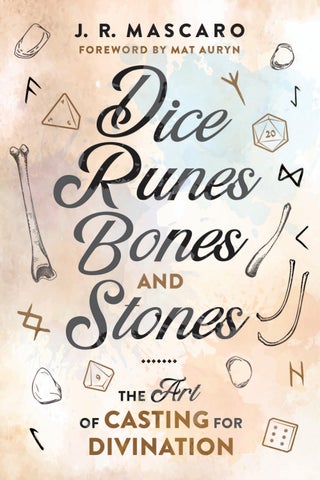
Praise for Dice, Runes, Bones, and Stones
“I am a fan of J. R. Mascaro’s innovations and his fresh takes on most occult matters and his book Dice, Runes, Bones and Stones confirms my opinion. Don’t be fooled by the title into thinking that this is material that you already know and use. Yes, the book does focus on divination using these tools, and it does so admirably. However, it is also a brilliant exploration of the metaphysics that underlies divination and offers a glimpse into the worldview of being a diviner.”
—Ivo Dominguez Jr., author of Casting Sacred Space
“Dice, Runes, Bones, and Stones offers clear, understandable, and deeply personal insight into what should, by all accounts, be a frighteningly overwhelming subject. Through his thoughtful and comprehensive explanations of both ancient and modern divinatory methods, as well as his gentle guidance for cleromancers of all skill levels, J. R. Mascaro leaves no stone unturned (so to speak) and brings readers along on a journey that is as fascinating as it is practical.”
—Thumper Forge, author of The Chaos Apple
“J. R. Mascaro has written a complete guide to the art of divinatory casting, covering topics from creating and sourcing tools, to the philosophy behind the magic, to enthusiastically sharing the unique symbolic systems he has developed over years of honing his practice. This is a great book for anyone who is interested in expanding their knowledge beyond tarot and oracle cards, into the vast kinetic universe of thrown object divination. No prior experience is necessary to engage with this book, but even the most seasoned diviner will find something that shifts or grows their perspective within these pages. Mascaro’s innovative conception of the magical arts, combined with his visionary, approachable methods for incorporating divination, make this book a must-have for your occult collection. I highly recommend anything by this author!”
—Jamie Waggoner, author of Hades
“An essential, practical, and inspirational tome for any magickal practitioner interested in casting, whether they are brand-new to the subject or looking to deepen their experience with new and more complex techniques.”
—Enfys J. Book, author of Queer Rites
“This book offers an inspiring and thoughtfully crafted exploration of divination methods. Drawing from personal experience, J. R. provides fresh approaches that are sure to be of value to both experienced diviners and newbies.”
—Maevius Lynn, author of The Holy Year of Thelema
“So much more than a ‘how-to’ manual, this book is a treasure and an opener of doors. It has taught me to think about divination in a whole new and refreshingly pure way. Until fairly recently, I shied away from it out of fear of possible futures or of doing it wrong, even though I’ve been a magical practitioner for thirty years. I now understand not only how to look for clues and revelations, but more importantly, what types of questions to ask and how to apply and interpret the messages I receive. All while expanding, honing and honoring my own senses in all of life’s experiences and having fun doing it I truly believe that this book will do the same for you.”
—Kajira Djoumahna, author, artist, dancer, crone
“A wonderfully accessible start for folks looking to expand their divinatory repertoire beyond tarot and cartomancy. I’ve been casting bones for years and I truly appreciate how J. R. has captured the variety of ways this practice can show up. As someone who is trying to develop a deeper familiarity with crystals and stones, the chapter on ‘Crystal Casting’ was fascinating. I’m personally curious how I can incorporate their method of ‘Adjacent Crystal Casting’ into my own osteomancy practice!”
—Ron Padrón, Cuban-American hedge priest
Dice Runes Bones Stones And
About the Author
J. R. Mascaro is an ink-soaked hallucination that has manifested to dispense portents and half-whispered facts about various and sundry subjects of great interest and dubious usefulness. He is a sorcerer, an author, a rogue waveform drifting through the cosmos whose signal can sometimes be received around teatime via a Marconi machine. He appears at events on occasion, and he also appears in the background of several French daguerreotypes from the mid-1840s, but only if the viewer is squinting and exceedingly intoxicated.
To Write to the Author
If you wish to contact the author or would like more information about this book, please write to the author in care of Llewellyn Worldwide Ltd. and we will forward your request. Both the author and the publisher appreciate hearing from you and learning of your enjoyment of this book and how it has helped you. Llewellyn Worldwide Ltd. cannot guarantee that every letter written to the author can be answered, but all will be forwarded. Please write to: J. R. Mascaro ⁄ Llewellyn Worldwide 2143 Wooddale Drive Woodbury, MN 55125-2989 c o
Please enclose a self-addressed stamped envelope for reply, or $1.00 to cover costs. If outside the U.S.A., enclose an international postal reply coupon.
Many of Llewellyn’s authors have websites with additional information and resources. For more information, please visit our website at https://www .llewellyn.com.
Dice Runes Bones Stones And
the
Art
of casting for
divination
J. R. Mascaro foreword by Mat Auryn
Dice, Runes, Bones, and Stones: The Art of Casting for Divination Copyright © 2026 by J. R. Mascaro. All rights reserved. No part of this book may be used or reproduced in any manner whatsoever, including internet usage, without written permission from Llewellyn Worldwide Ltd., except in the case of brief quotations embodied in critical articles and reviews. No part of this book may be used or reproduced in any manner for the purpose of training artificial intelligence technologies or systems. No AI was used in the writing of this book in any way; all written material was produced by the author or cited from other human authors. All illustrations were created based on the author’s original hand-drawn sketches by the Llewellyn Art Department. First Edition First Printing, 2026 Book design by Christine Ha Cover design by Kevin R. Brown Interior illustrations by the Llewellyn Art Department Llewellyn Publications is a registered trademark of Llewellyn Worldwide Ltd. Library of Congress Cataloging-in-Publication Data Names: Mascaro, Joseph Raphael, author Title: Dice, runes, bones, and stones : the art of casting for divination / by J. R. Mascaro. Description: First edition. | Woodbury, MN : Llewellyn publications, a division of Llewellyn Worldwide Ltd, 2026. | Includes bibliographical references. | Summary: “Here is a complete working instruction manual of several different casting devices: dice, runes, sticks, bones, stones, and many other forms that fit in the palm of your hand. Learn how to not only create your own divination tools, boxes, and cloths for casting but also how to store and repair them”– Provided by publisher. Identifiers: LCCN 2026041235 (print) | LCCN 2026041236 (ebook) | ISBN 9780738777665 trade paperback | ISBN 9780738777771 ebook Subjects: LCSH: Fortune-telling | Divination | Runes | LCGFT: Trivia and miscellanea Classification: LCC BF1861 .M373 2026 (print) | LCC BF1861 (ebook) LC record available at https://lccn.loc.gov/2026041235 LC ebook record available at https://lccn.loc.gov/2026041236 Llewellyn Worldwide Ltd. does not participate in, endorse, or have any authority or responsibility concerning private business transactions between our authors and the public. All mail addressed to the author is forwarded but the publisher cannot, unless specifically instructed by the author, give out an address or phone number. Any internet references contained in this work are current at publication time, but the publisher cannot guarantee that a specific location will continue to be maintained. Please refer to the publisher’s website for links to authors’ websites and other sources. Llewellyn Publications A Division of Llewellyn Worldwide Ltd. 2143 Wooddale Drive Woodbury, MN 55125-2989 www.llewellyn.com Printed in the United States of America GPSR Representation: UPI-2M PLUS d.o.o., Medulićeva 20, 10000 Zagreb, Croatia matt.parsons@upi2mbooks.hr
Other Books by J. R. Mascaro Seal, Sigil & Call Serpents of Circe (contributor)
For all those awake for the journey adrift in time and space eye on a distant star
Disclaimer
The forms of divination in this book are offered as aids in a holistic decisionmaking process. They are not to be used as stand-alone tools to make medical, financial, or legal decisions or any life decisions of an impactful nature. When used as part of an informed decision-making process, they are still vastly influenced by personal intuition and interpretive preference. As such, the author and publisher of this book absolve themselves of any liability for your use of these techniques in your decision-making process. Reading further constitutes an agreement to indemnify and hold harmless any individual other than yourself for the decisions you make based on your thrown object divinations.
Contents
Foreword xv Introduction 1 Chapter 1: The Casting Surface and Tools 11 Chapter 2: Casting for Yourself and Others 17
The Methods Chapter 3: Osteomancy 27 Chapter 4: Dice Casting 43 Chapter 5: Norse Runes 59 Chapter 6: Crystal Casting 73 Chapter 7: Charm Casting 83 Chapter 8: Symbol Tokens 89
Advanced Work Chapter 9: Dice Divination: The Eidolon Oracle Chapter 10: The Map of Stars 111 Conclusion: Cast Away 179 Recommended Reading 183 Bibliography 185
97
Foreword
To say I don’t like country music would be the understatement of the century. Despite that, it’s hard not to appreciate Dolly Parton or her music. My favorite song of hers is one called “These Old Bones.” What’s so great about it is its storytelling and message. The song tells the story of an old woman who lives alone in the mountains and reads people’s fortunes by casting bones. People come from near and far seeking guidance on love, health, wealth, and power, listening to what the woman says her old bones reveal. The song expresses that, as with any diviner, people have very strong and mixed opinions of her. Some say she’s a prophet. Some say she’s crazy. Some call her a witch. Some think she’s a fraud. And yet … people keep coming. Throughout the song, the old woman explains that the bones will always tell the truth of a situation, depending on how they land. Eventually, the narrator sits with the woman on her deathbed and receives two deathbed confessions. First, the old woman is the narrator’s mother, revealing she had been taken from her as a baby. Second, she explains that the bones are only a tool and that the real power comes from within, from the “bones” inside the body itself. I love this message because it’s absolutely true. The first method of divination that I fell in love with was tarot. When I started branching out into other forms of divination, I used to make the joke that you could probably gather a bunch of sticks and assign them meaning and divine with them xv
xvi — Foreword
correctly. Of course, I found that this is literally done in divination, whether it’s casting ogham sticks or yarrow stalks for I Ching readings. The real power of a reading isn’t so much in the objects themselves but the conversation that you’re having with deeper parts of yourself that can converse with spirits, particularly the Divine. In fact, that’s the whole basis of the word divination. That being said, divinatory items create a language that can ensure clarity in that dialogue by clearly mapping out what’s coming through in the reading. One of the beautiful things about divination is that the more you work with it and your skill develops in understanding that language, the stronger the intuitive and psychic portions of yourself come forward more and more. This is why if you were to hypothetically have five very talented readers get the same exact results of a reading, they’re all going to bring forward their own interpretation, perspectives, and understanding of what that reading is saying. There’s always that inner part that you need to tap into to truly bring out the depth of a reading. However, as stated, you need that strong foundation of how to do the reading and what’s being said in that reading—in a similar manner that you need to understand the alphabet before you can start learning how to create words and then eventually sentences. It can be a bit confusing knowing where to start or which types of forms of casting divination that call to you that you’ll end up falling in love with. That’s what’s so excellent about this book you’re reading. J. R. does a fantastic job of not only introducing cleromancy but giving you a smorgasbord of all the major forms of it so you can learn and try out different forms of it for yourself. I don’t want to give the impression that this is just another beginner’s book with all the same information you can find in other books. That’s far from the case. If you’re familiar with J. R.’s previous book, Seal, Sigil & Call: A New Approach to Ritual Magic, then you already know what I mean. The authors that I’m always really drawn to tend to be like J. R., someone with a brilliant mind who brings innovation and depth to topics that others haven’t, or at least in the way that they are with their own unique perspectives. I promise that you will find new ideas, insights, tips, tricks, and techniques that are going to enhance your casting readings. In fact, there are methods of divination in here that are completely unique to J. R.
Foreword — xvii
For example, those of you who fell in love with J. R.’s paradigm of magick and his system of eidolons as laid out in his first book will be delighted to see that he provides a great way to divine with them using dice. Along with that, my personal favorite unique method that J. R. brings to the table in this book is in the last chapter with his map of the stars method of dice divination using eighteen different colored six-sided dice! Regardless of your experience with any of the methods of divination discussed throughout this book (or with divination at all), you’re in good hands with Mascaro. I invite you to dive in and let him cast his spell on you. You’ll find guidance, inspiration, and even a few surprises along the way. Roll with it, follow the patterns, and watch as the pieces fall into place. Every toss, every scatter, and every roll is an invitation to see something new and gain deeper insight. By the end, you might just find that the real magick is not only in the bones, stones, charms, or dice but in how you read them and how you let them read you. —Mat Auryn, Author of Psychic Witch, Mastering Magick, and The Psychic Art of Tarot
Introduction
Divination is the art of observing and predicting the ever-branching patterns of chaos and causality that compose our experiential existence. Some might say that divination is the art of predicting the future. I am too enamored with concepts of nonlinear time to view the future as a fixed object. The future is a moving target, always shifting, never quite in our grasp, a cryptid thing that doesn’t show up cleanly on cameras. Time is a Fibonacci spiral winding through a Möbius strip crammed into a Klein bottle. Life, as a musician once said, is what happens to you while you’re busy making other plans. I would assert that divination is the art of asking questions to the universe and interpreting its answers, which are received in language at once foreign to our minds and innate to our spirits. We cultivate our intuition so that we might better understand those answers. We ask these questions through divinatory tools, Rosetta stones that translate as best they can between the universe and we who ask so much of it. While there are many tools used for divination, such as tarot, pendulums, or oracle cards, this book seeks to elucidate several of the many forms of thrown object divination, an art called cleromancy. I have always preferred cleromancy as a divinatory tool because it involves many random variables of angle and placement and, therefore, provides robust possibilities for the ignition of intuition in its interpretation.
1
2 — Introduction
On writing, Ernest Hemingway had this to say: “All you have to do is write one true sentence.”1 I offer you this true sentence: I had spent much of the past few years in a bit of a malaise. My own family had experienced some serious health challenges that demanded our attention above all else. Meanwhile, the depredations of the world system march ever onward, the endless pursuit of profit further marginalizing and extracting from all people not part of the global owning class at the cost of countless species and the planet itself. In these uncertain times, accomplishing personal goals, such as writing books, was not the first thing on my mind. However, this very feeling, this despair from which I could not muster passion for anything other than direct aid toward those most in need, made me consider that turn of phrase uncertain times. Have there ever been certain times? Did my grandfather in the Army Signal Corps in World War II consider himself to be living in “certain times”? Did his father who, newly immigrated and enlisted in World War I, lost his leg to gangrene in a trench consider himself to be living in “certain times”? Did my ancestors, blacksmiths, farmers, and innkeepers living in the shadow of Mount Etna, an active volcano, consider the times in which they lived to be “certain”? I would wager that the answer to these questions is no, they did not. There have never been certain times. It is from this understanding that I rekindled my drive to keep moving forward with my personal projects, because the divination I am currently writing about is the very art of attempting to wrestle some form of forewarning against the vast uncertainty that is the course of human events. It exists not to create certain times but to allow for the possibility of informed times. While certainty eludes us, perhaps we can come away with an idea, a glimpse, an ephemeral window into what may lay before us. Our known world is a shimmering mote in a vast chthonic expanse, and every bit of human knowledge is a thimbleful of memories poured into a hadal sea. On an intrinsic level, we understand this as a species. We feel the telomeres of our cells unraveling, the atomic half-life of our quintessential carbon ticking away into infinity to aid future archaeologists in dating our bones. At once despite this and because of this, we are constantly seeking 1. Hemingway, A Moveable Feast, 12.
Introduction — 3
knowledge beyond our human experience. We grasp at the infinite to seize a moment in the sunlight. At times, the infinite will grasp back. I state again that divination is not the prediction of future events, strictly speaking. That can be a simplified way to express it, like a shadow puppet of a bird might express the idea of a bird without possessing beating wings and a beating heart. However, expressing it this way implies a definitive nature of causality that I do not subscribe to. Time is fractal, branching paths proceeding from every decision and seemingly random event. Asking what will happen to yourself or someone else in the future frames the question in the passive voice and presupposes the presence of a future, which is quite the supposition. In my divinatory practice, I believe the question most worth asking is “What can I do now to achieve the outcome I desire?” It is active, because it focuses on what you can do to affect the causality of events favorably. It is also focusing on the single moment for which you have a guarantee, now. There is no moment to act but now. I am also one to subscribe to the notion of fractality, the idea that macrocosmic patterns can be glimpsed within microcosmic patterns, and that consciousness on an individual scale suggests consciousness on a collective or even cosmic scale. As such, I operate on the assumption that the outcome most worthwhile, most influential in the face of the cosmic brevity of our individual egos, is that of moving the needle of the collective consciousness toward justice, harmony, and joy. In this light, the divinatory question most worth asking becomes “What can I do now to create a more just and compassionate existence for everyone.” Our actions, and indeed all happenings, are fractal generators; they create causal ripples that branch from them into infinite moments of time. Pattern is the nature of existence, an endless golden spiral of patterns upon patterns, great and small. Divination is the perception of these patterns to understand how they may be influenced. The holographic principle suggests that information about the vast reality is encoded in even the smallest particle of existence.2 In this way, observing the most localized of patterns can provide information on events on a greater scale. The fall of a token, the roll of a die, these things can allow us to glimpse the echoes of far greater tessellations 2. McTaggert, foreword to The Holographic Universe.
4 — Introduction
of multiversal patterns. On a quantum scale, infinite angels can dance their electron dance on the head of a pin. In the small, one finds the All. Alongside our ability to glimpse these overarching patterns of reality, I must address the notion of our ability to influence them. I am intrigued by the way quantum physics intersects with what is seemingly supernatural. I believe that this avenue of study would bear greater fruit if it were not too-often stymied by the scientific orthodoxy of what is considered acceptable inquiry, reaching back to the progenitors of the field of quantum physics.3 There are, despite this, several intriguing studies on how thought and will interact with physical matter, such as machinery.4 I would assert that most magical work written about today falls into what I would call the subtle realm of magic/k, which is to say it interfaces with force beyond the physically manifest—forces such as probability, causality, thought, emotion, and the realms of dream and spirit. However, I believe the idea of will influencing physical matter, the solid realm, is one that should be pursued. Indeed, this idea is closely tied with the classical magician’s goal of self-transformation into a greater state of being, the transmutative process of philosophical alchemy from the being of clay to the being of gold. In a state of nonduality, perceptive of and harmonious with all things, could this ascendant will then apply itself to the shifting of base matter with the same ease one may move their hand? A thought for further study. In the context of this book, I examine the idea of perceiving these existential patterns so that our actions can influence the fruition or avoidance of their imminent effects. However, we are not the only forces that act upon our lives, so a useful divination will allow for the prediction of those other forces’ actions or, rather, advise on the positioning of those forces in time and proximity based on their current trajectory through the infinite Khaoplasm. Let’s take a moment to discuss that concept, Khaoplasm. Many ancient creation myths begin with a single substance, non-substance, or anti-substance. Cultures separated by continents and centuries placed this substance as the pure elemental nature of reality predating even the creative will of their gods. 3. Becker, What Is Real? 4. Jahn and Dunne, “On the Quantum Mechanics of Consciousness, with Application to Anomalous Phenomena,” 306.
Introduction — 5
While their words and metaphors differ, many peoples ancient and modern recognize what we call chaos as the quintessential underpinning of reality— the void before creation, the waters upon which the first word moved, the formless expanse of unfettered potentiality, the immaterial state from which materiality arises. As science clawed out a philosophical foothold in the world, early alchemists did not forget the importance of chaos. They began to identify with it a root element, which they called quintessence, azoth, or alkahest. Even today we understand that much of existence is seemingly empty space, intermolecular space, the radiant fields in which electrons dance, and the void between worlds in which the planets displace the foggy gas-strewn vacuum and impose their gravity. This void is physical emptiness but metaphysically abundant with chaos, the dark matter of the subtle multiverse. Chaos is unbound potentiality, force without form. In this book, I refer to the tabula rasa of time and space as Khaoplasm, the medium through which existence transpires, the nonexistence upon which existence rests. Everything that we see as random is a firing synapse of chaos, a ripple in the Khaoplasm. The fractal patterns of time and space twirl endlessly in the nurturing abyss of chaos. The waking mind perceives the solid multiverse, but the shadow mind shapes it. The shadow mind comprises all the facets of consciousness that are not readily or easily translated into the confines of the solid multiverse. Psychologists may identify the surface qualities of the shadow mind as the unconscious or subconscious mind. Through the magician’s lens, we see the shadow mind as the agent that shapes consensus reality; it sculpts existence as we have agreed to call it from the root chaos, the existential alkahest. If we accept that the underpinning of all reality is a quintessential Khaoplasm beyond matter and that we unwittingly and perpetually alter it with thought and perception, our endeavor becomes attempting to do so consciously and for the highest good. This is what we call magic. At its simplest manifestation, this can encompass things such as the power of positive thought. However, at a deeper level of scrutiny, we can discover formulas to forge powerful chaos conduits that can alter our personal perceptions of interactions with reality at a root level.
6 — Introduction
If attempting to cause a ripple in the Khaoplasm is magic, attempting to understand its innate and ever-changing rippling is divination. As events unfold in their fractal dance, we view them from within with the waking, rational mind. This is akin to standing in a vast labyrinth and attempting to understand the shape of it. It’s difficult from the inside. At its best, divination allows us to achieve an aerial view of the labyrinth of causality and, most importantly, learn where we might act now to navigate it favorably, and that is where we apply our magic. I cover the act of magic itself in my 2022 book Seal, Sigil & Call as well as the philosophy, ethics, and practice of paneidolism, my own magical system. I will not reiterate them here, but if you are looking to read on how to enact your magic, once you have divined where to apply it, I will point you to that book. This will also provide further insight into a few of the divinatory methods I share here that are part of the paneidolist system and suffused with its concepts and symbols, such as the eighteen eidolons and the nine elemental gates that form the allegorical crossroads of material existence in that practice. These are elaborated upon in greater detail in that book. When speaking of allegory and symbol, it is vital to understand that they are part of the code library of the subconscious. They are the ways in which our species conveys large, complicated messages efficiently and flexibly. They are triggers for intuition, which is at its core the ability to glimpse the patterns of existence wherever they may momentarily refract in the mind through time and space. Images and meanings in divinatory systems are rarely literal; they touch on universal concepts. It is important to acknowledge that symbols have multiple meanings culturally, historically, and even individually. The symbol of a snake means something different to a herpetologist than it does to someone with a deathly phobia of snakes. Chaos communicates with us, patterns express themselves to us, in our own symbolic language, in the ways we are most likely to understand. Existence seeks to be understood. In this book, I will cover the act of divination in many variations of a specific form: that of thrown object divination, referred to as cleromancy. I focus my own divinatory practice on this form of divination because it introduces the greatest number of random variables to the equation, and chaos speaks through what we perceive to be random. On a casting surface, there are
Introduction — 7
myriad ways for various tokens to fall and, depending on the methodology employed, the tokens themselves may have dozens of significant markings or positions to fall in, providing a multitude of diverse combinations for chaos to ignite the spark of intuition. It is important to state here that we are not separated from chaos. We drift through the Khaoplasm of causality and probability daily. Just as we are at once animated by and inextricably an expression of the conscious multiverse, so too do we act upon the patterns of chaos while at the same time we are acted upon by them. We harmonize in a feedback loop where our actions influence outcomes and outcomes influence our actions. As such, we all possess a certain understanding of the patterns of events as they occur and indeed may be occurring simultaneously, as linear time can be said to be solely a property of the physical world and not the spiritual one. This understanding is a facet of intuition, and it can be cultivated into a deeper psychic awareness. In many ways, this book exists to teach you how to use the divinatory methods within to begin to rouse and hone your own intuitive capabilities. In addition to the many esoteric considerations mentioned above, thrown object divination is also just good fun. It provides the opportunity for many exciting variations that keep the practice fresh over the years, and throwing things on a table or mat and seeing them scatter in colorful array is a simple joy that is not solely reserved for board games and casinos. We must take our harmless joy where we may.
How to Use This Book
I will present to you the information within this book across several sections. In the first section, I will share ideas that can be used throughout all the methods presented later in the book, such as the importance of positioning and the casting area in thrown divinations, how to cast for yourself and for others, and a few exercises for strengthening your relationship with chaos emanation and the mechanisms of causality. In the second section, I will cover various divinatory methods using thrown objects. I will share methods from antiquity, such as throwing bones, dice, and rune stones. I will also discuss newer methods, such as the casting of polished crystals, metal charms, and personal sigil tokens. It is important
8 — Introduction
to note that we are not assigning value judgments to the age of a method. Too often we assign value based on length of pedigree, and these biases go both ways. We can be prone to treat what is ancient as somehow more valuable, mystical, or real, where on the other hand, we may treat what is new as somehow more innovative, valid, or relevant. These are forms of primacy bias and recency bias. I urge you to use only one criterion to judge your divinatory methods: their efficacy for you. We each have methods that we prefer, that we feel more comfortable with or drawn to, and those are the ones for us whether they’re ancient, novel, or entirely unique to us. Time is only the demesne of physical matter. Consciousness and ideas are eternal; they need not concern themselves with the cycles of growth and decay present in material reality. Each chapter of the methods section of this book is meant to serve as a self-contained guide to the method discussed. It will tell you how to go about using the method as well as how to procure, or create, and care for the tools themselves, as well as any special accessories needed to engage with them, such as casting cloths or dice trays. I have always advocated for taking a hand in the creation of your own tools, if possible, as it helps to forge a connection with them and allows you to tailor them to your specific needs. However, even if you’re not enthused about crafts, it is important to understand how to maintain your tools, both in the ritual and in the physical sense, to ensure they function properly for years to come.
Terminology
Like all specialized pursuits, divination comes with its own lexicon, and I am going to take some time to familiarize you with those used in this book in the context that they are used. If at any point in this book you come across a term specific to divination that you do not recognize, you can return here and I will have hopefully listed it in the following sections. If I have not, I will have to apologetically direct you to your preferred dictionary. astragalomancy: Divination by use of dice. cartomancy: Divination by use of cards, including but not limited to tarot, playing, and oracle cards.
Introduction — 9
cast: The act of throwing divinatory objects. Diviners cast divinations. casting, “clear”: Casting divination in which the cast objects themselves are the sole source of interpreted meaning, rather than any other items they are cast upon or near. casting, “in provenance”: Casting divination in which the casting surface or items on the casting surface influence the interpreted meanings of the cast tokens. cleromancy: Any form of divination relying on the use of thrown objects, a form of sortilege. diviner: Anyone who casts divination for themselves or others. lithomancy: Divination by use of stones. osteomancy: Divination by use of bones. querent: The person asking the question the divination will be cast to answer; can be the diviner themselves but is often another party on whose behalf the diviner is casting. sortilege: Divination by use of methods relying on inherently random techniques.
In the Beginning
It is important to note that all the methods contained in these pages are worth writing multiple books on, and indeed many have been written on each. This book is meant to give you a solid groundwork in the practical use of each system of cleromancy it covers. The detailed history of each system is not included in this practical guide, but they are worth reading into using books dedicated to each subject. This book exists to allow you to pick up one of these methods, open the chapter on it, and be able to understand, care for the tools of, and use that method of divination through engaging with that chapter. Before I commence, it is imperative to reiterate that the methods in this book are meant to serve as intuitive triggers. As you learn to perceive the patterns of existence, you can receive intuitive understanding beyond linguistic expression. These methods are not meant to be rote. The task is not
10 — Introduction
to memorize instructions but rather to tap into a wavelength and find your own way of doing things that will work best for you and your own intuitive senses. If the patterns of existence can be seen metaphorically as leitmotifs, recurring themes communicated through music, you will learn to recognize them by the first notes.
Chapter 1 The Casting Surface and Tools
Just as the unfettered potentiality of chaos is the substrate upon which the solid realms are formed, as silence is the vessel for music and darkness the backdrop of starlight, so is the casting surface the medium upon which our thrown divinations are interpreted. Many are familiar with cartomancy, such as the use of tarot or oracle cards. In these methods of divination, the table you’re laying your cards upon is usually, though not always, given little importance, if it is given any at all. This is not so with the majority of thrown divinatory forms. When speaking of the seemingly random scattering of objects, it is useful to engage with the idea of superposition, a principle of quantum mechanics that states that, in quantum systems, all outcomes can be true simultaneously until measured. The act of interacting with the observable world through measurement evokes the wave collapse function, the retraction of simultaneous possible realities into a single outcome. I am neither qualified nor inclined to elaborate on the subtleties of quantum physics, but I am always on the lookout for a good metaphor. Superposition and subsequent wave collapse is a good metaphor for a thrown object divination, in which any token can be drawn but its meaning will not be known until it reaches its final position upon being thrown. A token contains information in and of itself, but its final interpretation is not fixed in a reading until it has 11
12 — Chapter 1
succumbed to inertia and stopped tumbling. All outcomes are possible until the dice stop rolling. A diviner’s pouch of tokens is a Schrödinger’s vessel of possible realities. Since, in an untampered and correctly done divination, we have no control over the selection or final position of a set of tokens, the only thing that we do have control over is our casting surface. The casting surface is our laboratory; it contains the set of experimental parameters over which we are able to exert a semblance of control. For a token to fall in an area of significance, the diviner must assign significance to that area, as well as determine how large the area is and, therefore, how likely the token is to fall within it. In thrown divination methods, the casting area is typically deliberately chosen and can be just as important as, or even more important than, the thrown tokens themselves. Thrown object diviners, referred to as cleromancers, remember that what we perceive to be random is often the subtle language of the conscious multiverse, a pattern echoing through time and space. Therefore, we understand that the introduction of variables to a divination is tantamount to adding words to the vocabulary of these chaos messengers, which in turn allows divinatory messages to be more specific. Tailoring the casting surface is one way to achieve this. If we throw three tokens, we have three token meanings we must contextualize and interpret alongside one another. However, if we have three tokens cast upon a cloth, board, or box with three sectors of significance, suddenly we have nine possible meanings to interpret, a different one for each of the three tokens depending upon the sector it has tumbled into. This is one way in which variables are introduced. Aside from the introduction of variables, casting surfaces also serve in a way that is purely physical and practical: They protect the thrown tokens by providing cushioning and often serve as a barrier that keeps them from tumbling off the table. The second part is particularly true with dice. Diviners interpret divinatory throws, which I have always referred to as casts, in several ways. These include the markings on the tokens themselves, the sectors of the casting area or vessel, the positioning of tokens in relation to one another, or the positioning of tokens in relation to objects in the casting area, which I refer to as signifiers. Common signifiers include markers at each cardinal direction of a casting area, representing the four
The Casting Surface and Tools — 13
classical elements or their corresponding tarot or playing card suits, as well as signifiers representing the astrological houses or seasons. Depending upon which signifier a token has fallen closest to, its meaning may be influenced or changed entirely.
Common Casting Surfaces
Bearing all of this in mind, the most common casting surfaces used in my thrown object divinations broadly fall into two categories: cloths and trays. A cloth can be something as simple as a square of unhemmed fabric divided into elemental quadrants with an ink marker or as elaborate as a silk circle hand embroidered with astrological houses. I have even used oversized mouse pads with custom printing at times. There is very little limitation with casting cloths, provided they are large enough to allow for items to be cast upon them without scattering off. I usually recommend eighteen to twenty-four inches across or in diameter. If this is not enough to prevent your divinatory tokens from escaping, you may be throwing your tokens a bit too enthusiastically or releasing them too far away from your surface. I must confess that I have a bit more enthusiasm for casting trays than cloths, because I have fond memories of woodworking with my grandfather and my trays are usually made of wood. I find wood to be preferable to plastic due to both sustainability and workability considerations. Trays are used most often for dice, as the lipped edges prevent them from rolling off onto the floor. Today, we tend to use dice made of plastic, and as such, throwing them at a harder surface is less of a gamble than throwing bones, softer varieties of clay runes, or other items of a more breakable nature. I recommend a square casting tray of at least eighteen inches to a side with a two-inch-high lip around the entire tray. If you have the space and desire to keep many trays, the bottom of the tray can be painted or pyrographed with the diagrams you prefer. Alternatively, and to my preference, you may wish to keep interchangeable squares to place in the bottom of your tray, one blank and one for each diagram you plan to use that is painted or otherwise marked with that diagram. Using markers on felt or canvas squares can create casting cloths that are quick, cost effective, and easy to obtain for use as interchangeable tray bottoms. You can even purchase wooden trays with raised edges ready-made at many home décor and craft stores. Of course, the absolute
14 — Chapter 1
best rolling tray would be very similar to a casino craps table, and I have often entertained the idea of buying a miniature one and replacing the bottom felt with a suitable esoteric diagram. However, I’ve never been able to justify the cost or space used in doing so to myself. Certain forms of thrown object divinations that I would classify as “scatter” divination forms take nearly the entirety of their meaning from the place in which they are cast or the position of the cast items rather than any inherent meaning in the items that have themselves been cast. One example of this is throwing a handful of rice or fine gravel upon an elaborate casting surface and interpreting results based on the images you may see in the shapes made by the particulate in relation to the surface or the amount of grain or gravel that falls in each region. Similarly, a line of statues of deities, major arcana cards, or other significant images may be placed and the rice or gravel scattered toward them, results being interpreted based on which images or statues have the most collected around them or the shapes in the material nearest to each statue. In these practices, the rice or gravel has no inherent meaning, as would a rune or the number on a die, but rather the thrown scree is only meaningful in relation to how and where it falls and gathers. In these instances, the casting surface and its significant adornments or additions are of more importance than the thrown objects themselves.
Caring For and Cleansing Your Divining Tools
While the surface that you cast upon can drastically alter the potential interpretations of your thrown object divinations, a less directly influential but equally critical consideration is how you store your divinatory sets. This is at once a practical and metaphysical consideration. On the one hand, divinatory tools need to be cared for as any other physical tools in regard to their material composition. On the other hand, these are tools used to interface with existential forces, perhaps even divine forces depending on your view of divinatory work. While the following chapters on each divinatory method will each have a short section on how to best physically care for the items used in those methods, in this section I will include some broad material considerations to keep in mind when dealing with divination sets, as well as notes on treating
The Casting Surface and Tools — 15
them with a certain respect that will be applicable to all methods discussed in later chapters. Divining sets are at once tools to accomplish a purpose and items of a magical nature. They interface directly with the chaos current of the all-pervading consciousness of existence; they are moved by the ripples of the Khaoplasm. They should be kept with respect and perhaps even reverence. Different diviners approach their art with different levels of spirituality or religiosity. For some, divination is directly linked to notions of deity and divine will. For others, it is a secular tool for the ignition of human intuition wholly separate from any sort of spiritual force of will or fate, and for many, it occupies a space suspended between these ideas. Regardless of how you choose to approach the art of divination, its tools remain items set aside for a special purpose and should be treated with the respect such things deserve. Divining sets should be stored in a manner that protects them and does not expose them to the harshness of the elements, such as their own dedicated pouch or box. They should be kept in a place of respect rather than tossed in a random junk drawer. To the devout, this may be an altar. To those who do not practice keeping an altar, it can be a special place on a shelf reserved for such tools. Divining sets should be regularly tuned, which is done as part of the prereading receptivity exercise contained in the next chapter, and they should be cleansed. Cleansing is an interesting subject, because it ultimately exists to achieve a state of belief in their cleanliness, a state free of outside influence or the static of psychic residue from prior readings, and this depends entirely on your own beliefs about what can be done to achieve that. Some lean toward the more simple cleansing of wafting incense over their set, some incorporate a prayer, and some engage in elaborate cleansing rituals enacted at certain lunar phases or other times of significance. As with many things, it’s a matter of preference. Following, I provide a short cleansing exercise for those who do not have their own preestablished cleansing preferences.
Divining Set Cleansing
Begin this exercise by laying the pieces of your divining set out on a cloth or mat atop a table, counter, or other flat, stable surface. Place your set’s receptacle behind the laid out set. Stand in front of the chosen surface and take
16 — Chapter 1
several deep breaths, holding for a moment when your lungs are filled and exhaling slowly. Do this until you feel relaxed and ready to move forward. At this point, you may choose to light incense, if you have it available and wish to do so. The incense represents a material offering to bless and cleanse the divining set, but it is a preferential component rather than a necessary one. Continuing, you will either waft the incense over the divining set by blowing the smoke gently toward it, being careful not to touch the incense with your lips and burn yourself, or if you are not using incense, you can just blow gently, visualizing your breath gathering and dispersing any psychic static or other residue that may have been picked up by your divining set. This static gathers like lint and blazes into ashes that are taken by the breeze and dispersed back into potential energy. You will now hold the palm of your hand over the divining set, visualizing an ultraviolet glow emanating from your palm onto the set, imagining it imbuing your tools with a mystic barrier that actively repels residue from clinging to them in the future. Think of this like a sort of selectively permeable membrane that allows messages to pass through without the emotions or reactions of the reader or querent making contact. At this point, you will speak a small consecratory verse, which you may choose to replace with a prayer, if you are so inclined. For the sake of example, the following verse is provided: “I cleanse these tools and bid that they receive the messages meant for them clearly, kindly, and without delay, interference, or obfuscation.” Once your tools are cleansed and have a home in which to reside between readings, you are ready to begin using them for their associated form of divination.
“A brilliant exploration of the metaphysics that underlies divination and also offers a glimpse into the worldview of being a diviner.” —Ivo Dominguez Jr., author of Casting Sacred Space
CAST YOUR FUTURE
with Cleromancy
Cleromancy is the art of divining through casting thrown objects and interpreting their positions. With this comprehensive book, you will develop your personal cleromancy practice using different casting devices: dice, bones, crystals, runes, stones, and many other forms that fit in the palm of your hand. J. R. Mascaro examines each casting method and presents several options for interpretation, allowing you to intuitively gravitate toward the ones that fit best with your personal practice. Along with advice on casting for yourself, for friends, and professionally, learn how to create and care for your own divination tools, boxes, and cloths. Featuring several advanced methods, such as the eidolon oracle and Map of Stars, this guide will ignite your intuitive fire and enrich your world. “Dice, Runes, Bones, and Stones offers clear, understandable, and deeply personal insight into what should, by all accounts, be a frighteningly overwhelming subject.” —Thumper Forge, author of The Chaos Apple
Facebook.com/LlewellynBooks © J. R. Mascaro
X: @LlewellynBooks Instagram: @LlewellynBooks
www.Llewellyn.com
$16.99 US
Mascaro
J. R. Mascaro has been immersed in the practice of sorcery for over thirty years, applying the art in pursuit of the transcendental transformation of consciousness. J. R. employs their academic background in Anthropology of Religion, work as an artist, and twenty years as a pathworking guide to deliver anecdotes, innovations, and insights to readers through their published works, including Seal, Sigil & Call.
Dice, Runes, Bones, and Stones
Body, Mind & Spirit / Divination