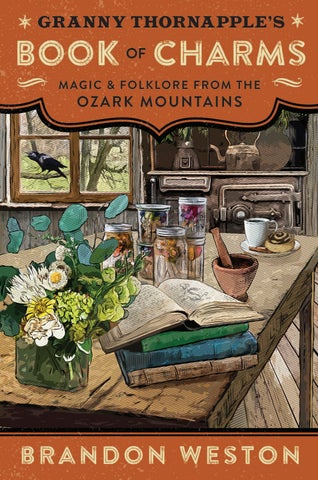
Praise for Granny Thornapple’s Book of Charms “Every bit as entertaining as it is informative, Granny Thornapple’s Book of Charms brings the time-honored traditions of Ozark charming to life. Following the story of the titular character, readers are presented with dozens of useful, and at times quite whimsical, charms for everything from health to hexing. Brandon Weston has once again provided an invaluable collection of folk magic, and readers of this volume are sure to be both delighted and charmed by the fabulous Granny Thornapple.” —Kelden, author of The Crooked Path and The Witches’ Sabbath “This book offers a unique exploration of Ozark charming traditions through examination of regional storytelling tropes, tales, and narratives. … Brandon’s careful analysis grounds these witch tales in the craft-logics and operative techniques of Ozark magical practices, offering supplemental advice, spell-craft, and formulary for working these storied charms in one’s own work. In so doing, the author traces (amongst many other things) the oftcrossed hedge-lines between healer, charmer, granny, and witch and the uneasy folkloric tensions between communal fears of harmful witchcraft and the fondness for telling of the exploits of this larger-than-life granny/ witch figure.” —Dr. Alexander Cummins, author of The Starry Rubric, An Excellent Booke of the Arte of Magicke (with Phil Legard), and A Book of the Magi “Brandon Weston masterfully takes us into the world of Granny Thornapple, where we learn about her life and the spells she casts to help her community. Storytelling in magic is a long-lost art that not only teaches us enchantments but also helps us understand the person who is conjuring the magic. Step into the world of Granny Thornapple, pull up a chair, and ask her to teach you the magic of the Ozarks.” —Chris Allaun, author of The Black Book of Johnathan Knotbristle
“Weston weaves the reader into the flow of Ozark folk charming practices, showing how they move and change over time to meet the needs of those using them. Charms for healing and harm, charms for love and beauty, charms for knowing what others don’t and speaking to the spirits others won’t all fill this hearty compendium. … The research we expect from Weston is still here but tempered by modern twists on old charms, linking the lore of the past to the world of the present.” —Cory T. Hutcheson, author of New World Witchery “A rare volume, not merely a collection of tales or raw folkloric data, but a whole landscape populated by characters you will come to love by the end. Weston’s teachers, neighbours, and friends all find their voice in this deeply personal work, their stories supporting the magical practices outlined. So often in magical books we get the practices divorced from culture, but in this book we have all of it right in front of us. Weston gives us rituals, charms, prayers, and all manner of magical practice. … and supports almost every single one with a story. … This book will appeal not only to those interested in the Ozarks, but to all who want to connect to their own landscape as deeply as Weston has.” —Ben Stimpson, author of Ancestral Whispers “As a lifelong Ozarker as well, I was immediately drawn into the story of Granny Thornapple. She is the Granny woman we all wished we’d had in our life. Brandon Weston has given us a connection to those healers, teachers, and workers that many of us missed in our youth. He demystifies the charm practice, allowing us to give ourselves permission to explore this path. He shows us that anyone who is willing to do the work can fold this practice into their own.” —Debra L. Burris PhD, professor, farmer, and author of Weather Magic
GRANNY THORNAPPLE’S
Book OF Charms
About the Author Brandon Weston (Fayetteville, AR) is a healer, writer, and folklorist who owns and operates Ozark Healing Traditions, an online collective of articles, lectures, and workshops focusing on the Ozark Mountain region. As a practicing folk healer, his work with clients includes everything from spiritual cleanses to house blessings. He comes from a long line of Ozark hillfolk and is also a folk herbalist, yarb doctor, and power doctor. His books include Ozark Folk Magic, Ozark Mountain Spell Book, and Granny Thornapple’s Book of Charms. Visit him at www.OzarkHealing.com.
Llewellyn Publications Woodbury, Minnesota
Granny Thornapple’s Book of Charms: Magic & Folklore from the Ozark Mountains Copyright © 2024 by Brandon Weston. All rights reserved. No part of this book may be used or reproduced in any manner whatsoever, including internet usage, without written permission from Llewellyn Worldwide Ltd., except in the case of brief quotations embodied in critical articles and reviews. First Edition First Printing, 2024 Cover design by Kevin R. Brown Cover illustration by Jerry Hoare Zodiac Man (Man of Signs) illustration © Mary Ann Zapalac Unless otherwise noted, the New Revised Standard Version Updated Edition (NRSVUE) of the Bible was referenced throughout. Llewellyn Publications is a registered trademark of Llewellyn Worldwide Ltd. Library of Congress Cataloging-in-Publication Data (Pending) ISBN: 978-0-7387-7608-8 Llewellyn Worldwide Ltd. does not participate in, endorse, or have any authority or responsibility concerning private business transactions between our authors and the public. All mail addressed to the author is forwarded but the publisher cannot, unless specifically instructed by the author, give out an address or phone number. Any internet references contained in this work are current at publication time, but the publisher cannot guarantee that a specific location will continue to be maintained. Please refer to the publisher’s website for links to authors’ websites and other sources. Llewellyn Publications A Division of Llewellyn Worldwide Ltd. 2143 Wooddale Drive Woodbury, MN 55125-2989 www.llewellyn.com Printed in the United States of America
Other Books by Brandon Weston
Ozark Folk Magic Ozark Mountain Spell Book
Dedication To Granny Thornapple, “Pauline,” Gram French, Gram Wasset, Granny Nallow, Doc Green, Gram Watson, Aunt Hazel, Uncle Bill, and all Ozark charmers of fact and fiction.
Contents Disclaimer / xiii Introduction / 1 1. The Ozark Charming Tradition / 9 2. To Bless You through the Holy Year … / 29 3. To Grow You Like a Green Tree … / 63 4. To Tie Your Ills upon a Stone … / 87 5. To Bring You Love, If It Be True … / 119 6. To Set a Watch on House and Home … / 141 7. To Right All Wrongs that You Might See … / 169 8. To See in Dreams and Visions Too … / 203 9. To Pass Beyond and Back Again … / 233
Conclusion / 265 Bibliography / 267
Disclaimer The old-fashioned remedies in this book are historical references used for teaching purposes only. The recipes are not for commercial use or profit. New herbal recipes should be taken in small amounts to allow the body to adjust. Please note that the information in this book is not meant to diagnose, treat, prescribe, or substitute consultation with a licensed healthcare professional. This book is not intended to provide medical advice or to take the place of medical advice and treatment from your personal physician. Readers are advised to consult their doctors or other qualified healthcare professionals regarding the treatment of their medical problems. Neither the publisher nor the author take any responsibility for possible consequences of any person reading or following the information in this book.
xiii
All names have been changed for the privacy and protection of individual informants.
Introduction
Let’s begin with a story … Little Ann was born on the same night her grandmother died. It was on May Day, just after midnight, and in a thunderstorm so strong it flooded ol’ Paul Landry’s mill and killed at least ten cows out on Buffalo Ridge. A local midwife called Gram Watson was present, as she had been for many of the children born in Nelson’s Holler. Besides the auspicious timing, she reported two unusual tokens, or omens, at the birth of Little Ann: one, she was born in the caul, meaning the placenta was fully covering her head and face at birth and had to be removed by hand, and two, she was born silent and remained so for three whole minutes until all of a sudden, she let out a banshee wail that shocked even Gram Watson. At the same time, a bolt of lightning struck a wild plum tree out in the yard and split it completely in twain. The ruckus woke up the old hound dog asleep beside the fireplace, who started to bark toward the cabin ceiling. Little Ann’s mother grabbed hold of the bedsheets beneath her and gripped them tight with her fingers, wincing at the sudden cacophony of sounds. Gram Watson just laughed and rocked the baby in her arms. “Well, bless my soul, Lucy,” she said, handing the swaddled newborn to her mother. “She’s got some of her grandmother’s gift in her!” Lucy shook her head in disbelief. “Don’t go puttin’ that on her, Gram!” she shouted, pulling the baby to her breast. The storm suddenly calmed. There was a silent moment while the crickets outside were still sheltering from the rain. The wooden ceiling above the two women creaked as though something was walking across it with careful steps. “Gram, what is that?” Lucy whispered, the words catching in her throat. 1
2
Introduction
Gram had been gathering up blood-soaked rags into an old bucket when she heard the sound. She set the bucket down and loaded up her briarwood pipe with a good-sized plug of tobacco. Whatever was on the roof continued its path toward the chimney. “It’s a monster,” Gram whispered, “sent for the baby.” The wild, chaotic universe could never allow such an auspicious child to be born. The old woman lit the pipe and took two long puffs, then a third, which she held in her mouth. She stepped softly across the cabin floor, tracing the path made by the noise up on the roof. Then she stopped and blew a strong line of tobacco smoke up toward the ceiling. The creature on the rooftop scratched and clawed in place as though it was struggling against something trying to pull it away from the house. “Remember this charm, child!” Gram said, grinning toward the baby, pipe clinched in between her sparse, yellowed teeth. “Carry him crow!” she yelled toward the ceiling, blowing another trail of tobacco smoke. “Carry him kite!” A third stream of smoke twisted an unnatural line toward the sound of frantic clawing and scratching on the roof. “Carry him away ’til the apples are ripe! And when they’re ripe and ready to fall, bring him back, apples and all!” The scratching intensified. It sounded to Lucy like whatever demon was on her roof was about to take the whole thing clean off. Then, all of a sudden, the clambering stopped. All she heard now was the popping of embers in the fireplace and Gram’s heavy breathing. “Is it gone, Gram?” she asked, holding her baby closer. “It is for now,” the old woman answered as she stoked the fire with a metal poker. “Ain’t there nothin’ we can do?” “This’ll keep her safe.” Gram rolled a charred piece of wood out of the fire and onto the hearthstones. She took a dipper of water from a pail nearby and quenched the smoking log. It sputtered and steamed. “Whittle this down into a chunk big enough for the child to wear on a necklace string. She’s got to wear it all her life.” “Gram, and that’ll keep her safe?” Lucy asked sternly. “That’ll keep her safe,” the old woman nodded, reading some secret signs and tokens in the glowing fireplace embers. Lucy named her baby Ann in honor of her own mother, who, unbeknownst to Lucy, had passed with grace in her home on the other side of Nelson’s Holler at the very second little Ann was born.
Introduction
3
The fireside tales you will read in this book all feature the same protagonist: Granny Thornapple. This is in keeping with the age-old Ozark storytelling tradition that features a common heroic (or antiheroic) figure throughout many different adventures. Perhaps the most famous of this type of story are the Jack tales. Many will no doubt remember Jack’s adventures with the beanstalk, but do you know the story of Jack and the possum? Or how about Jack and the magic cow skin? These are only a couple examples amongst many found across the Ozarks as well as our sister culture in Appalachia. My favorite Ozark story cycles all feature a protagonist who is a granny woman or witch. Folklorists like Vance Randolph, Mary Parler, and Otto Ernest Rayburn collected many of these witch tales from informants across the region. In my own travels across the Ozark Mountains, I’ve collected many modern versions of these wonderful tall tales. These stories represent an interesting area within Ozark studies and feature the witch as a villainousyet-somehow-still-relatable character. Many of the stories of this type even present the witch as an admirable individual, which stands in direct contrast to traditional Ozark views about witchcraft. Culturally, witchcraft and witches were held in a negative light in Ozark communities. “Healers always heal and witches always hurt,” as it was once explained to me. But the reality of the situation was often more complicated than this, especially when we look at the role of the granny woman in Ozark society. The character of Granny Thornapple is my own creation, but she is based on one of my actual teachers. Her fanciful name derives from the thorn apple, or jimsonweed (Datura stramonium), which, according to Ozark legends, is a favorite herb of witches. She represents an amalgam of many Ozark granny women, charmers, healers, and witches, both from the storytelling tradition as well as reality. That’s a funny word, “reality.” In the Ozarks, sometimes fact and fiction are closer together than outsiders are comfortable with. I remember one time I took a friend to meet an old-school storyteller I knew who lived out in the middle of nowhere, off a dirt road that, at certain times of the year, doubled as a creek bed. He told us many fantastic tales by the glow of the fireplace, most of which were from his own life. One in particular—my favorite—was a tale about how when the old man was much younger, he had a ten-year love affair with a fairy woman who lived in an ancient tree
4
Introduction
stump near his home. My friend sat with a puzzled but intrigued look on his face as the old man told the tale in great detail. When we were on our way back home the next day, my friend finally asked me, “Were those stories real or just made up?” to which I answered with a chuckle, “Yes.” Granny Thornapple’s stories are just like this: they blur the line between fact and fiction, like so many things do here in the Ozarks. I don’t know how many times I’ve talked to Ozarkers who outwardly didn’t seem like they would believe in ghosts and the Little People (Ozark fairies) but who told elaborate and heartfelt tales about encounters with these very beings. Famous Ozark witches from local legends are incorporated into the figure of Granny Thornapple. Many of their stories were published by folklorists like Vance Randolph: figures like Gram French, Gram Wasset, and Granny Whittiker, who once turned herself into a spectral turkey to haunt a neighbor girl who called Granny Whittiker’s grandbaby ugly.1 Granny Thornapple also represents many of my own teachers who would have been considered granny women had they lived in the old Ozarks. In this way, I’m proud to be able to honor their memories—as well as the memories of all Ozark healers and magical practitioners—through this book.
The Charming Way You might already be familiar with Ozark folk magic and healing practices. Some of you might have grown up with these beliefs, or maybe even been passed something by healers like Granny Thornapple. Others of you might have read about these traditions in my other books, Ozark Folk Magic: Plants, Prayers & Healing and Ozark Mountain Spell Book: Folk Magic & Healing. Whether you’re a seasoned practitioner or just starting out, I’d like to introduce you to a unique tradition within this tradition. It’s just as important as the more complicated methods of magical divination, diagnosis, and ritual procedure I’ve spoken about elsewhere in my works. I like to call it the “Charming Way” of rhymes, poems, and verses. Many of these are treasured and passed down from charmer to student. Others are born from within the womb of one’s own inborn inspiration, imagination, and power. This
1. Randolph, Ozark Magic and Folklore, 298.
Introduction
5
ancient path has been passed down for generations from Old World to the New, to this very day. This is a path that I’m now passing down to you. I’m a multigenerational Ozarker. Both sides of my family have deep connections to the region, but like many Ozarkers, my family was disconnected from their culture. I really only discovered there was a deep stream of tradition here when I found Vance Randolph’s Ozark Magic and Folklore in my university’s library. Reading Randolph opened my eyes to how much “Ozarkness” my family really had. The stories and traditions collected by Randolph in the 1920s and ’30s felt like stories from my own family. I don’t come from a long line of healers and magical practitioners. I do have them in my family, but most Ozark families do if you look hard enough. One ancestor, Hazel, was gifted with the “second sight” and read fortunes in tea leaves. She could also see emotional states in the color of a person’s aura. My great uncle Bill, who I did have the fortune of knowing while he was alive, was a known Wart Charmer and Blood Stopper. Specifically, he had the ability to buy warts off people. The process was simple: He’d walk up, look at your wart, then usually say something like, “That’s a good one. I’ll buy it off you,” and then hand you a penny or dime. We knew to take the money, and then overnight, the wart would disappear. I never got to experience his role as a Blood Stopper, which—along with wart charming—was once a highly prized healing ability in the old Ozarks. As with many of these traditions, folks only know they’re special and worth recounting after the healer is long gone. The charming tradition has been the heart of my personal practice for years now. I immediately took to the simple approach to magic that is offered by this tradition. I’ve always had a mind for rhymes, songs, and verses. My family likes to recall how when I was a kid, I used to memorize commercial jingles off the TV and sing them endlessly. As one of my teachers said, this was an early token or sign that I have a gift for this work. Charmers especially often look for good memories in their students, as many of the verbal charms and prayers used in this work have traditionally been passed down orally. Of all the practices of Ozark folk healing and magic, the Charming Way has traditionally held the most taboos surrounding holding and passing down this unique gift. These taboos have been put in place to prevent the
6
Introduction
tradition from dying off. Tradition can be a tricky thing, though, especially in the modern world.
Passing Down the Charms In the old days, charms like you’ll find in this book were only passed down to others who were identified as having “the gift.” These folks included both those born with the gift and those who had already been passed the gift by another. This gift is difficult to explain in modern terms, but perhaps the best way to think of it is as an aptitude. In the old days, having this inborn gift meant that you were more likely to become a talented healer or magical practitioner. The gift was only a marker, however, not a set-in-stone destiny. One could choose not to embrace their gift. Amongst more traditional Ozarkers, however, this has been considered squandering something valuable in the community. Unlike the old ways of viewing the gift, I believe that everyone possesses the ability, but everyone also has specific magical talents, capacities, and leanings. Consider a talented painter and a talented sculptor: both have aptitudes to create art, but they use very different mediums. There were once many taboos surrounding passing down verbal charms, remedies, and rituals, the most important being that such things could only be passed down to someone who has been identified as already having the gift inside of them. This could be identified through various traditional methods; for example, peculiar circumstances around the individual’s birth or certain birthmarks on the body. One of the most common ways of identifying the gift was to have someone with the second sight “see” it inside the person. Other taboos surrounding passing down charms and healing methods included that they could only be passed down orally, across genders (man to woman, woman to man), from an older person to a younger, and, in some cases, charms had to stay within a bloodline. One of my favorite teachers taught me a different way. This isn’t a more modern way nor a way that deviated from any of the foundational Ozark methods of working; it was just different. According to my mentor, charms love an open heart. Openness on the part of the magical practitioner creates a little nest, or home, inside of their own spirit where these charms will live out their days. So, first and foremost, this openness becomes the foundation for receiving any verbal charms, prayers, verses, etc. After that, there are
Introduction
7
some traditional practices of passing down power that you can use. Many of these I use in my own practice. Verbal charms were traditionally passed down only by word of mouth from one practitioner to another, or from a practitioner to their student. There are still verbal charms that I’ve received that I will never write down; I only pass them along orally. This is a deep connection that goes back to our ancient ancestors, most of whom were illiterate. In the Ozarks, literacy didn’t become commonplace until well into the twentieth century. Even when most folks could read and write, healers and magical practitioners often chose to stick with the old ways and only pass things down by word of mouth. This practice also traditionally applied to passing down herbal and home remedies. In many cases amongst Traditionalist practitioners, a person is only able to pass down verbal charms to a certain number of people (usually three). After that, all of the power will be lost for the original holder of the charm and will now reside in the person the charm was passed to. Because of this, it’s traditional for many healers and magical practitioners to keep their verbal charms secret until they reach retirement age. Then they pass the charms down to members of their family, students, or others with the gift. In some cases, writing down a charm might be allowed only for the purpose of memorizing the words. Once the words are committed to memory, the paper is burned. Often, the same limitation for how many people can receive the charm still applies to the writing-down method. For this reason, many Traditionalists look at the charms published by folklorists as being “dead” or no longer usable. Modern healers (as well as most of my personal mentors) tend to approach the charming tradition in a different way. I was taught that there are verbal charms you can share as well as those you should keep secret. The shareable charms are the ones commonly known throughout the region that are passed back and forth amongst healers, practitioners, and even ordinary folks. These include charms like the blood-stopping verse in the Bible, Ezekiel 16:6 (“I passed by you and saw you flailing about in your blood. As you lay in your blood, I said to you, ‘Live!’”) as well as all the charms I’ve included in this book. Secret charms, as I was taught, are the ones we pull out of our own wellspring of magical power and breathe into the world. These are charms that
8
Introduction
might be spoken in the moment, or delivered to the practitioner by way of divination, dreams, trances, visions, or other magical methods. One of my teachers always told me that the charms that just suddenly appear fully formed in your mind are deeply special and magical. These charms are commonly kept secret in order to sustain the inborn magical power that gave them life. As a folk character, Granny Thornapple is a great example of a bridge between the old ways and modern practices. Like many real-world Ozark magical practitioners, she keeps her own charming book. This is a secret patchwork collection of rhymes, verses, poems, songs, and prayers she’s collected from other healers, from books she found in the library, or from the Bible. Charming books are more common in the modern world; in the old days, charmers would have needed to memorize everything. This book is based on charming books from several of my teachers. It too is a patchwork of pieces I’ve collected from charmers, granny women, healers, practitioners, and commonfolk across the Ozark Mountains. The inspiration for the chapter structure of this book came from a blessing charm my teacher sang to me one night. I give these words to you now. My hope is that all the charms in this book will live inside of you and be good little helpers for you and your work. I’ve got charms aplenty to give to you. Charms to bless you through the holy year. Charms to grow you like a green tree. Charms to tie your ills upon a stone. Charms to bring you love, if it be true. Charms to set a watch on house and home. Charms to right all wrongs that you might see. Charms to pass beyond and back again. Charms to see in dreams and visions too. Yes, I’ve got charms aplenty to give to you.
Chapter 1
The Ozark Charming Tradition
No doubt many of you already know some of the verbal charms contained in this book. Quite a few of them have been a part of our shared cultural experience for centuries—like one famous burn charm, for example: Two angels came out of the east. One brought fire, the other frost. In frost, out fire! Or perhaps you know many of these spells by another name—nursery rhyme. These are the Mother Goose rhymes and fairytales many of us grew up hearing and memorizing as small children. Charms that today seem like nothing more than nonsense babbling in many cases originated within practices of folk healing and magic. Like the old rhyme that can double as a charm to cause tension and anger between two people: There were once two cats of Kilkenny. Each thought there was one cat too many; So they fought and they fit, And they scratched and they bit, Till, excepting their nails, And the tips of their tails, Instead of two cats, there weren’t any. Or the milking charm that I’ve heard repeated by a number of Ozarkers. I can even remember it from my own childhood. This rhyme can double as a
9
10
Chapter 1
charm that links offerings in exchange for prosperity and health, symbolized by milk: Cushy Cow bonny, let down your milk, And I will give you a gown of silk, A gown of silk and a silver tee, If you’ll let down your milk to me. There are so many others that will fill the later pages of this book. Charmers are very clever in their use, repurposing, and creating of verbal charms and prayers. With the right intention, one person’s nursery rhyme could easily be another person’s spell. As magical practitioners, witches, healers, or whatever we choose to call ourselves, we tend to get lost in complicated rituals and lengthy spells, mistakenly equating complication and effectiveness. We’ve forgotten many of the older, simpler charms that practitioners of the past would have cherished for centuries. One of the famous Ozark charms for stopping a bleeding wound is a meager twenty words long: Upon this grave Three roses grew, Stop, blood, stop! From wound to wound The pain [he/she/they] drew, Stop, blood, stop! And yet, it’s believed that this simple charm, easily memorized, has the power to heal if one believes in that power. Verbal charms are often hard to define, but if I could try, I’d posit them as short recitations, poems, or even verses from the Bible that are memorized, kept secret (relatively), and used on their own as part of a healing or magical act. Someone who uses these verbal charms as the principle method of working is then called a charmer. Verbal charms can be just a small part of a more elaborate ritual, but in this work, we’re going to be looking at charming as a path of its very own. Charming is often viewed as a fast-acting magical method, when compared to the much lengthier and more complicated rituals and diagnosis processes that many healers choose to utilize. The charmers and granny women
The Ozark Charming Tradition
11
who I count as my teachers often pushed aside magical timing in favor of observing tokens, or omens, in the world around them. For those unfamiliar with the practice, magical timing refers to formulating rituals based upon the cycles of celestial bodies, specifically the moon phases, zodiac moon days, and days of the week (planetary signs). This astrological tradition often yields very specific, but very complicated, magical rituals—the idea being that by connecting with the innate flow of magic by way of nature’s cycles, your magic will be more effective. It’s not that charmers have disagreed with this concept. Some that I’ve met do, in fact, work with magical timings. Generally speaking, though, charmers have traditionally been in the role of providing “quick magic.” For example, someone cuts their hand while working out in the field and the nearest doctor is hours away. What can they do? Well, this is when the role of the charmer becomes vitally important. Blood stoppers in particular were individuals who held charms that could stop a bleeding wound. They would be called in at times like this to help save people. Sometimes their work provided exactly the care needed in the moment or until more extensive medical care could be found. The work of the charmer is often reactionary, as in the case of Gram Watson in the story that introduced this book. A clawing sound was heard on the rooftop and Gram reacted with a charm and simple ritual. These magical reactions and countercharms often fall under the traditional Ozark phrase of “taking the cuss,” or curse, off a situation. There are many of these countermeasures in the Ozarks because in the old days, hillfolk had a lot of tokens that they watched out for. Today, when someone hears an owl hoot, they might think it’s a pleasant sound. In the old days, however, when an Ozarker heard an owl, it meant some evil was outside their house, trying to get inside to cause mischief or harm. The countercharm for hearing an owl hoot is to throw a pinch of salt into a fire, usually in the fireplace or on the stove. Of course, charmers know many verbal charms that can act as counters to these ill omens as well. Many of the old taboos and tokens have died out, like so many Ozark folk traditions. Charming, however, still remains a reactionary art for the most part, as well as being quite simple in its methods. There is rarely any sort of lengthy ritual that accompanies a verbal charm; the charmer might
12
Chapter 1
simply make three crosses with their thumb over a wound, in the case of a healing charm, or blow a stream of tobacco smoke out of their mouth, in the case of several specific protection and countering charms. But make no mistake: the charming tradition might not involve a lot of ritual, but it is still considered a vital part of traditional healing and folk magic.
Women of Power Traditionally in the Ozarks, women have primarily held the position of charmer. In many cases, these highly important community healers were called granny women. Terms of affection and respect like Gram, Gran, or Granny were given to these women despite their age and whether or not they actually had grandchildren of their own. I once met a twenty-eight-year-old midwife who many of the old-timers in her community affectionately called Gram. As members of the community, granny women were considered vital healers and midwives, especially in the old Ozarks where it was once considered taboo for male folk healers to work with “women’s issues.” The granny woman was then the only one who could heal the women of their communities until country doctors and pharmacists became more common in the region. Amongst both the generalist and specialist healers in the Ozark tradition, granny women stood out as having training in all areas. At times the term granny woman was synonymous with the role of the midwife, but these figures were so much more than that. Granny women often took on the role of Yarb Doctor, or traditional herbalist (yarb being Ozark-speak for a medicinal plant). Granny women also often filled the role of Power Doctor, generalist healers who worked with ritual methods, divination, and amulet making as opposed to physical medicines. Granny women also served as skilled charmers who held prayers and recitations for all manner of ills that might afflict a person. In the old Ozarks, there wasn’t a more well-rounded magical practitioner in the community than the granny woman. This situation has changed over the years. Nowadays, you are likely to find many generalists amongst the Neotraditionalist practitioners. Neotraditionalists are individuals who still have some connection to Ozark folk magic but who break from the older traditions in many areas, and who incorporate other systems of magic that would have been unknown in the Ozarks until after the 1950s.
The Ozark Charming Tradition
13
Unfortunately, granny women were often the first people in the community to be targeted as witches. In the old days, there was a very fine line between a healer who used their God-given power to do good in the community and the figure of the witch, who was seen as someone who either stole their power or inherited it through a bond with the devil. Often this line was based solely off how the community viewed the healer’s work; one bad review from someone important could label a practitioner as a witch. Being a witch in the old Ozarks meant exile from the society that was vital for the survival of the individual and their family. For this reason, healers, granny women, and other magical folk kept their practices secret and often bolstered themselves with piety. Local preachers, ministers, and praying grannies often doubled as healers and charmers because they were already seen as being closer to a divine source of healing and power. It’s an unfortunate fact that granny women were sometimes the first ones to point the finger at others in the community for practicing the dark arts. This was often the only way someone could keep fingers from pointing at their own work. Although the name has fallen out of use, the role of the granny woman as a magical and spiritual pillar of the Ozark community remains even today. As charmers, their work has shaped the tradition in countless ways. Of the fourteen individuals I consider to be my own mentors and teachers of this charming path, ten are women. This isn’t to say that this work has any gender limitations in the modern world; I myself am nonbinary and have met many other Neotraditionalist practitioners across the gender spectrum. But the stories of healers in general (and women healers, specifically) have a history of going untold here in the mountains. In honoring the ancestors of this path, we can’t forget that, by-and-large, it’s been women who have healed the Ozark community, and women who have been the first persecuted within the Ozark community.
Simple Magic Ozarkers have famously been averse to anything overly complicated. This has historically fueled many stereotypes about the laziness of hillfolk, who were often recorded by tourists and folklorists alike sitting outside on the porches of their mountain cabins doing absolutely nothing. Outward appearances are often deceptive. It’s not that Ozarkers have been do-nothings or lazy; it’s just
14
Chapter 1
that maybe we know how to sit back and enjoy the present moment a little better than others. This outlook on the world has greatly influenced our traditions of healing and folk magic. In Ozark cosmology, all of nature is permeated by a stream of neutral, innate magic. More traditional folks never use the term magic, choosing instead to refer to this flow as that-of-God in all things. This flow includes human beings, who aren’t traditionally separated from nature like some will try and tell you. This puts an entirely different spin on the old phrase “Go with the flow.” For Ozark healers and magical practitioners, going with the flow of nature’s magic is exactly how one should work. As I was taught, the best way to get down a river is to just fall back and let the current carry you. For healers that work in a Christian context, this often goes by the phrase of working in the Spirit or working Spirit-led. The Spirit here refers to the Christian concept of the Holy Spirit, a figure that is commonly credited by these more traditional healers as the very source of their gift. Going with the flow means connecting to your own inborn power, imagination, inspiration, and intention above reliance on external rituals, tools, and ingredients. As I was taught, all the external work is just icing on the cake, to use a familiar phrase. Or, in the context of going with the flow, sometimes we need to get down the river quicker or maybe even run against the current. In this case, we can build ourselves a boat, which is using external tools, ingredients, and rituals as aids. Charmers have traditionally viewed this state of going with the flow as being of supreme importance to any act of magic. At its heart, the charming path means fostering a whole lot of faith in your own innate gifts as well as developing a clever mind that can work through all sorts of issues in a flash. Like I said earlier, charming is almost always reactionary, meaning that having eyes, ears, and intuition that are keenly fixed on all things in the world around you is seen as a great gift in and of itself. In the old countries, many traditional healers were given names like cunning folk or wise folk.2 In Denmark, they are called kloge folk.3 In Finland, they are called Tietäjä or knower.4 Even in the Ozarks, healers are still often referred to as people who “know things,” hinting at the ability of the healer 2. Davies, Cunning-Folk, 163. 3. Davies, Cunning-Folk, 163. 4. Stark, The Magical Self, 43.
The Ozark Charming Tradition
15
or magical practitioner to be able to work through problems in ways other people in the community can’t. This cunningness is distinctly separate from what can be learned and is almost always considered a natural ability or connection that springs up when the individual is ready to embrace their inborn gift. As one of my teachers told me, “There’s knowing and then there’s knowing,” making a firm distinction between the cunningness of the healer and perhaps the knowledge obtained by a medical professional or academic. Charmers of old used to rely on their cunningness for almost everything in their practice. Rather than relying upon methods of divination, set ritual formulations, or even magical timings provided by the almanac, charmers often went inside themselves to find vital information or tokens surrounding a situation. For this reason, charmers are often said to naturally possess the “second sight.” Because of this, many charmers also have the ability to see into the otherworld of ghosts and fairies.
Working Spirit-Led When I was growing up, I loved a good spell book. I had several that I kept hidden away from my parents who, at that time, would have fiercely disapproved. I loved the formulas, the mixing and matching when it came to all the symbolic ingredients. I loved assembling my favorite bowls and wooden spoons, bringing them together on the kitchen counter like I was baking a cake. I still have a deep love for ritualistic spell work, and I still try and calculate the perfect auspicious timing for my more complicated work. But I also remember well the first time I met an Ozark charmer and the profound effect it had upon my work. She was my first teacher and the one who identified the gift inside of me. I met her by real happenstance while chatting with another informant of mine in a rural café. As we finished up our coffee, an old woman whom I didn’t recognize walked confidently up to our table. She was dressed in denim overalls and a flannel shirt. Her thin, gray hair was braided in two ropes that were tied and pinned across the top of her head in the popular Ozark “old German style,” as one informant told me. I looked up at the woman and smiled. She smiled back and without any greeting or introduction said, “We need to talk.”
16
Chapter 1
I took this as a token from the universe that I shouldn’t ignore. So, I agreed to meet her at her house later that day. While I brought out my notebook and pens, she flitted around her kitchen gathering provisions we might need for our talk. She heated up a percolator for coffee on the stove, cut some freshly baked banana bread, and poured some peanuts into a wooden bowl at the center of her dining table. Ozarkers often take hospitality as serious business. As one old belief goes, a stranger can be an angel in disguise. When we finally got to talking, she said that the Spirit had told her to be in that café at that moment, and that if she’d ignored it, we never would have met. I’d heard this phrase that she used many times before, but usually while talking to religious folks; “the Spirit” is commonly a reference to the Christian Holy Spirit. After this, we talked about everything she knew, from plant remedies to a few old folktales and even a song or two. She immediately felt comfortable with me, which can be unusual with Ozark old-timers, who are often suspicious of outsiders. The Spirit always leads in a trusted direction, however; on more than one occasion, I’ve had informants open up to me because they “prayed on it” and the Holy Spirit told them I was a good person. Soon we got onto the subject of magic-based healing practices, which she referred to as “trying” for someone, a term common amongst Ozark practitioners of German heritage. I asked her how she worked and what actions she used as a part of her healing process. I avoid the term ritual, as it often makes old-timers uncomfortable because of the connotations between ritual work and witchcraft. She just laughed and responded with her own question: “What actions should I be usin’?” I responded that I didn’t really know and that I figured it was completely up to her how she “tried” for people. “So there’s somethin’ inside me that tells me how to try for people?” she asked with a grin. “I reckon it’s the Spirit that leads me.” I finally recognized that she was attempting to break down all my preconceived notions about how people with the gift should be working. I automatically assumed she used some kind of ritual as part of her work, which is why I asked such a leading question to begin with. She immediately saw through this and returned with her own question, making me reconsider
The Ozark Charming Tradition
17
everything I’d planned on asking her previously. “All right then,” I answered, returning her smile, “Why don’t you tell me how you try for people?” She nodded, proud that I had picked up on my original mistake so quickly, and then went on to explain her process. This was my first encounter with the deep and powerful simplicity at the heart of the charming path. It was also my introduction to the inborn leading or guidance that comes from within the charmer themselves. I refer to this as a person’s cunningness, inspiration, or intuition. For others, this is the Spirit, Holy Spirit, or, in many cases, a spiritual entity of a different sort. I’m referring specifically to the tradition of charmers receiving their gift from the Little People, angels, or spirits of the dead. In that moment, I knew I had to dig deeper with this stranger. Little did I know what sort of poetic inspiration and magic she would stoke inside me through our interactions.
Poetic Power Oral folk cultures traditionally hold the power of spoken word in the highest esteem. Today we often forget that our Ozark ancestors would have lived in an oral culture as well. Even to this day, many aspects of our folk culture are still passed down orally rather than through the written word. I’ve even met famed mountain cooks and bakers who prefer passing down recipes through word of mouth and observation, believing the resulting food tastes better than if it came from a written recipe. The belief in the inherent power of words by no means popped up in the Ozarks of its own accord. This connection to imagination and inspiration has roots back into ancient days, especially the Gaelic cultures from Scotland, Ireland, Wales, Cornwall, and Brittany, which have had such an important influence upon Ozark folk practices. Across the Gaelic world, bards (called Filí in Ireland and Scotland) were often considered magicians who used their words to spin the raw, innate magic of the world like wool being spun into yarn. Praise and its opposite, satire, were once powerful tools of the poets for bestowing both blessings and curses.5 This power, of course, didn’t just stay in the past, but found its path to the Ozarks through folk cultures and 5. Breatnach, “Satire, Praise, and the Early Irish Poet,” 63–84.
“Step into the world of Granny Thornapple, pull up a chair, and ask her to teach you the magic of the Ozarks.” —Chris Allaun, author of The Black Book of Johnathan Knotbristle
Little Ann was born in Nelson’s Holler during a thunderstorm on the same day her grandmother died. She was also born with the gift. Follow Ann’s story as she grows up learning the folkways, embraces her natural cunning, and eventually becomes her town’s charmer, earning the nickname “Granny Thornapple.” Brandon Weston begins each chapter with a compelling snippet from the life of this fictional practitioner who is based on the many healers he has interviewed. In addition to these vignettes, Weston shares authentic teachings and workings from the Ozark charming tradition that have been passed down orally for generations. He introduces dozens of charms for practical purposes, such as preventing thievery, building a fire, and alleviating a toothache. Become part of this mountain magic that utilizes familiar poems and verses, including some featured in nursery rhymes and fairy tales. These intuitive folkways can help you seize your inborn power and enhance your own charming abilities. “A unique exploration of Ozark charming traditions through examination of regional storytelling tropes, tales, and narratives.” —Dr. Alexander Cummins, author of A Book of the Magi
Facebook.com/LlewellynBooks Twitter: @LlewellynBooks Instagram: @LlewellynBooks
www.Llewellyn.com
$19.99 US
?
WESTON
Brandon Weston is a healer, writer, and folklorist who owns and operates Ozark Healing Traditions, an online collective of articles, lectures, and workshops focusing on the Ozark Mountain region. As a practicing folk healer, his work with clients includes everything from spiritual cleanses to house blessings. He comes from a long line of Ozark hillfolk and is also a folk herbalist, yarb doctor, and power doctor. His previous books include Ozark Folk Magic and Ozark Mountain Spell Book. Visit him at OzarkHealing.com.
BOOK OF CHARMS
Speak in the Charming Tradition of Ozark Rhymes, Poems & Verses
GRANNY THORNAPPLE’S
Body, Mind & Spirit / Folk Magic
?