Praise for Resurrecting Heathenry “Resurrecting Heathenry offers a beginner-friendly guide for the modern reader curious about Heathenry. It demystifies a spiritual path that is often difficult to research, offering readers not only valuable historical context but also practical advice for beginning their own practice. What I appreciated most is that the book deepened my understanding not only of Heathenry but also the broader nature of religion—how belief systems function and shape human understanding across cultures and time. While I might not call myself a Heathen, this book gave me a deeper appreciation for a tradition that fosters a meaningful connection to both nature and a shared ancestral past. Through its straightforward and honest explanation of the Heathen landscape, it’s even encouraged me to connect with my own deities.” —Taylor Leigh, host of The Antibot on YouTube “Resurrecting Heathenry is setting the new standard for texts in the modern Heathen space. For practicing Heathens, this book radiates with a passion for the religion and a drive to educate about the aspects seldom touched by other authors. For those scholars of religion or the simply curious, Ocean does not shy away from the hard philosophical questions, looking for definitions, and even directly addressing uncertainty, with a nice bibliography for the reader. Finally, Ocean works tirelessly to educate in good faith to pry modern Heathenry from the hands of white nationalists, folkists, conspiracy peddlers, and grifters. I can say that Ocean deftly handles those propaganda narratives that act parasitically on Heathenry, banishing them with eloquence. A book worthy of everyone’s shelf.” —Dr. Eric D. Berg, philosopher and propaganda/extremism expert, GaelNorse Heathen “Ocean Keltoi has done the impossible with Resurrecting Heathenry. He has taken a spiritual path with rough edges and convoluted twists and turns and smoothed it out for all to see. It’s easy to digest yet does not
shy away from digging into the difficult topics that so few texts dare to approach. This book sets the new standard for what Heathenry is, and what it has to offer. This book explores those seeking answers to the deep questions that burn inside all of us. Who are the Gods? What are the Gods? Why is Gamora? How and why do we venerate them? And what the Hel do we do with this mountain of information? Resurrecting Heathenry may be the best spiritual book I have ever had the pleasure of reading, and in my humble opinion every Pagan should own a copy regardless of tradition. From the long-time practitioners to the folks who may just be interested in what the fuss is all about, there’s something in here for everyone.” —Wolf the Red, Goði of Hearthfire, author of Declaration of Flames “Finding a clear path through the enormous world of Old Norse tradition can feel overwhelming and easy to get lost in. Resurrecting Heathenry is the map that gets you there. It does something genuinely rare. It skips the surface level-stuff and anchors modern praxis right in the grit of the sagas and the reality of the ancestors. The Gods don’t get locked into rigid, one-dimensional labels here. Their complexity gets explored, not just acknowledged, and that’s what lets you build a real, individual relationship with them. History, myth, and daily practice sit right next to each other here, and you end up absorbing deep, accurate lore without it ever once feeling like a lecture. This is an essential, uncompromising blueprint for the contemporary Heathen.” —Distressed, writer at jarnvidr.blogspot.com
RESURRECTING HEATHENRY
About the Author Ocean Keltoi is a Heathen Youtuber who breaks down complex concepts in Heathenry into accessible, beginner-friendly content. Ocean began his journey as a pagan over fifteen years ago while getting his bachelor’s degree in history and religion. He has presented workshops at Mystic South that focus on often misunderstood deities such as Hel and Loki. He lives in Georgia, where he gets lost in the woods and is a friend of cats. Visit him on his YouTube channel or at linktr.ee/oceankeltoi.
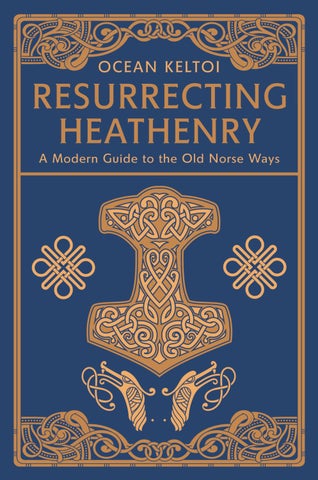
RESURRECTING HEATHENRY A Modern Guide to the Old Norse Ways
OCEAN KELTOI
Resurrecting Heathenry: A Modern Guide to the Old Norse Ways Copyright © 2026 by Ocean Keltoi. All rights reserved. No part of this book may be used or reproduced in any manner whatsoever, including internet usage, without written permission from Llewellyn Worldwide Ltd., except in the case of brief quotations embodied in critical articles and reviews. No part of this book may be used or reproduced in any manner for the purpose of training artificial intelligence technologies or systems. First Edition First Printing, 2026 Cover design by Kevin R. Brown Interior art by Llewellyn Art Department Llewellyn Publications is a registered trademark of Llewellyn Worldwide Ltd. Library of Congress Cataloging-in-Publication Data Names: Keltoi, Ocean author Title: Resurrecting heathenry : a modern guide to the old norse ways / Ocean Keltoi. Description: First edition. | Woodbury, Minnesota : Llewellyn Publications, [2026] | Includes bibliographical references. | Summary: “An in-depth guide to creating a living, personal Heathen practice that is faithful to the old ways but excludes harmful relics of the past”— Provided by publisher. Identifiers: LCCN 2026038095 (print) | LCCN 2026038096 (ebook) | ISBN 9780738775777 trade paperback | ISBN 9780738775838 ebook Subjects: LCSH: Heathenry (Germanic paganism) | Norse cults | Polytheism Classification: LCC BL860 .K3927 20226 (print) | LCC BL860 (ebook) LC record available at https://lccn.loc.gov/2026038095 LC ebook record available at https://lccn.loc.gov/2026038096 Llewellyn Worldwide Ltd. does not participate in, endorse, or have any authority or responsibility concerning private business transactions between our authors and the public. All mail addressed to the author is forwarded but the publisher cannot, unless specifically instructed by the author, give out an address or phone number. Any internet references contained in this work are current at publication time, but the publisher cannot guarantee that a specific location will continue to be maintained. Please refer to the publisher’s website for links to authors’ websites and other sources. Llewellyn Publications A Division of Llewellyn Worldwide Ltd. 2143 Wooddale Drive Woodbury, MN 55125-2989 www.llewellyn.com Printed in the United States of America GPSR Representation: UPI-2M PLUS d.o.o., Medulićeva 20, 10000 Zagreb, Croatia matt.parsons@upi2mbooks.hr
For my mother and father. Thanks for the bedtime stories.
Contents Introduction
1
Chapter 1: What Is a Heathen?
7
Chapter 2: Our Sources 21 Chapter 3: Polytheism
47
Chapter 4: Rebuilding an Ancient Faith
67
Chapter 5: The Gods 85 Chapter 6: Ancestors and Land Spirits
143
Chapter 7: Reciprocity, Prayer, Altars, and Offerings Chapter 8: Divination Past and Present 195 Chapter 9: The Multipart Soul
221
Chapter 10: Death and the Afterlife
235
Conclusion and Moving Forward
249
Acknowledgments
253
Further Reading
255
Bibliography
261
167
INTRODUCTION It seems that Heathens grow out of the ground. We do not find this religion through other Heathens proselytizing to us, and many of us were not raised in this faith. Yet here we are. We will often find this religion out of a genuine desire to explore ourselves, our spirituality, our history, and the Gods. Hidden within Heathenry is a chance for personal growth through our traditions and fostering a relationship with our environment and the Gods. Reviving the Old Ways, such that we can, is a romantic gesture worth pursuing, and it is one that I have undertaken myself for many years. My own journey into Heathenry started with attempting to reconcile my Protestant Christian belief in an eternal hell with the idea of God’s infinite love and omnibenevolence. This eventually resulted in me exploring other denominations of Christianity. In another world, my journey could have concluded there, but it seemed that as one problem was solved, seven more would appear. This prompted me to look elsewhere.
My Journey to Heathenry I explored Taoism, Greek and Roman philosophy, and little bits of Celtic spirituality that I could find. These influences have remained with me on my spiritual journey into polytheism. I traveled a lot, sometimes for work, sometimes just on my own. I got lost, often on purpose, but
s
2
Introduction
found myself in places of ancient spirituality. A feeling of presence, and a feeling of home, struck me in those old stones. This eventually led me to Heathenry, building a relationship with the Gods using the clues left behind by our ancestors. Regardless of what draws us to this path, Heathens will generally seek to find wisdom in the past. This may be driven by a desire to connect with our ancestors, or we may feel some other force pulling us closer to these traditions. The Gods reach out to many, and many reach out to them, starting the cycle of reciprocity between us. A common thought process among Heathens is that those people in the past had a connection with the Gods. What better way might there be to connect with these Gods today than to emulate their practices to the best of our ability? Here starts the journey down a path of spirituality with an admittedly frustrating path of research. At the dawn of my pagan journey, I didn’t even know where to begin. I delayed getting into Heathenry for some time because the entire idea of looking into the resources seemed daunting. The process of finding out what to read in the first place was messy. Eventually, equipped with a bachelor’s in history with a minor in religion, I was able to stumble around and find my way through the complicated process of discerning what were good sources and what were maybe not so good. After a few years as a polytheist and a Heathen, I was a regular in the religious debate scene on YouTube, occasionally representing polytheism and Heathenry on debate shows. Through this process, I learned many lessons on how to articulate and defend my ideas in the face of fierce opposition. My opponents included a variety of Christians, atheists, and members of a handful of other traditions. Many of these debates were friendly, though some got more antagonistic, but each of them allowed me to further refine my perspective. Over time, I grew tired of these debates, as they would be focused on the same topics over and over. I felt that important issues were getting missed in favor of repeatedly debating a narrow set of topics.
Introduction
3
At this point, my YouTube channel had already gained a few hundred subscribers despite not having much content. An atheist YouTuber named Suris who had become a close friend through a series of good faith debates suggested that I just make videos on YouTube tackling the topics that I felt needed to be discussed but would never come up in a debate. I took his advice, making videos on polytheist philosophy, basic concepts in Heathenry, comparisons with Christianity and atheism, profiles on Heathen Gods, and breaking down stories in Heathen myths and sagas. Through this process, a theme of taking often difficult-to-find information and making it accessible to a beginner developed. My channel has since taken off, even with my sporadic habits of posting videos, exceeding 100,000 subscribers. Over the course of this journey, my reading list ballooned as I fell down historical and philosophical rabbit holes, finding that every subject was just so much more complicated than it initially seemed. There was always another angle to explore, even on subjects long considered established in modern Heathenry. While putting together the scripts, I took into consideration the lessons I learned from my debate opponents. From Christians, I learned the value of a robust theology and community action. From atheists, I learned about the dangers of religious extremism, pseudoscience, and their journeys of deconstructing religious trauma. And both taught me valuable lessons in philosophy and philosophical argumentation, which drove me to dive deeper into the polytheist philosophers across the ages.
And So It Begins Every religion has its challenges for the newcomer, and they’re all a little different. For Heathenry, there is a host of misinformation, missing information, far too much racism, and very few people making complicated concepts within the religion accessible to beginners. I find that each year that I’ve been Heathen, I learn so much more, especially as I read more, write more, and perform rituals, both on my own and publicly for my local community.
4
Introduction
This book is a product of that journey. My goal in these pages is to provide an accessible guide to any Heathen, new or experienced, to Heathenry through theology, history, and practice. This book will hopefully provide a step over that massive informational barrier to entry so that you can more easily explore and build a practice for yourself. This is a religion long thought to be dead, so there is much that is obscured by time and much that is left to us to explore while we are resurrecting Heathenry. While this book leans into the Revivalist method, something I will detail more in chapter 4, I will provide a ton of information that will be useful to any pagan who is looking into Heathen traditions or the Norse Gods. In fact, this book is designed so that you can selectively read chapters independently if you wish. If there is a chapter that feels intimidating or there are chapters ahead that you feel are going to be more relevant to the information you need right now, feel free to skip ahead. These chapters do build on each other, so I do suggest going back, but the book is designed to be able to read the chapters independently and for you to be able to easily go back and reference the information. Write your notes in the margins, dog-ear the pages, put sticky notes in it, fill it with bookmarks—whatever works for you and helps you absorb information. This book is a tool for you to use. All the information is out there, scattered through various sources, sources that I’ll describe in this book and for which I’ll give citations so you can follow up on this information for yourself. This way, you are armed with not only information but also the ability to find it for yourself and find your own path. This book will also contain my personal perspective. If you find yourself disagreeing with aspects of my perspective, that’s great. Take what you agree with and leave what you don’t. That’s part of the point. It is my firm belief that every Heathen should have access to the information and philosophy with which they can construct their individual practice. While writing this book, I have kept in mind what I would have wanted to tell myself as a young Heathen exploring this path. What were
Introduction
5
the things I wanted to know? What did I wrestle with? What did I need to know that I hadn’t even considered? What concepts would have been useful to me and saved me so much time and maybe a little pain? This is as much a letter to my old self as it is to new Heathens. This is the book I wish I’d had. In the end, despite a journey that can be frustrating at times, I have found significant love for Heathenry. It is a path that has given me the ability to honor my past, stay focused on the present, and look with hope to the future. Heathenry offers within it a steely determination that I have not quite seen in other paths. The relationship with the Gods in Heathenry is special and contains a focus on your own action that may feel new and unfamiliar. A Heathen altar can be a place of beautiful peace and introspection. The heroic tales of the past provide incredible inspiration. And finally, Heathenry’s animistic stripe allows for a sacred relationship with the land and animals around you. Heathenry can foster a good life. What you bring to your practice will determine what you gain from it. The Gods, the ancestors, and the land spirits are part of this equation, but there is significant personal responsibility in how you interact with these forces. The cycle of reciprocity endures between us. From the Gods, to the earth, to us. From us, to the earth, to the Gods. So let it be.
Chapter 1
WHAT IS A HEATHEN? What even is a Heathen in the first place? In short, a Heathen is a Germanic Polytheist, though I’ll make the case that there’s more to it than that. However, the conversation around these terms gets more in depth. The meaning of words can be funny in that different people using the same term to identify themselves can mean different things, especially among pagans. The words Norse Pagan, Asatru, and Heathen get thrown around with various meanings. Arguably, a single individual could utilize all three of these terms. I have, in the past, used all three at various points. I used the word Asatru when I first began to worship the Norse Gods but have since moved away from that label. I’ve used Norse Pagan, Norse Polytheist, or Germanic Polytheist to refer to myself when talking to people who are new to these concepts. I’ll use Heathen as a more technical term to refer to myself, especially around other pagans, though it can be a confusing term for those who are unfamiliar with paganism.
A World of Nameless Faiths An important consideration is that people in the past did not have a name for this religion. We are in an age now when religions are seen as distinct, and they all have names. This is a fairly recent development. Even the word religion seems to convey this understanding. In the ancient world, and even during the spread of Christianity, many of these
s
8
Chapter 1
ideas that we might label religions just did not have names and were not seen with hard distinctions between each other. People had their various cultures and those cultures had associations with various Gods, but the worship of these Gods would be transferrable from culture to culture. The Romans, for example, had assimilated the Gods of many regions into their pantheon and would even pray to the Gods of their enemies as their legions marched beyond the frontier. The Roman historian Livy gives us an example of this when he writes of a Roman practice called evocatio, in which the Roman commander Camillus promises offerings and a temple to the Etruscan Goddess before his successful invasion of the city of Veli. This story is one narrative of how the Romans came to worship Juno, a Goddess central to the Roman pantheon.1 Practices like this were common of polytheistic imperial empires across history. As they expanded, the Gods of other peoples became part of their own beliefs as cultures intermixed and religious beliefs syncretized. It was not strange in the past to acknowledge the Gods of other peoples as just as real as their own. The mindset of polytheists of the past was not that there were many religions; the mindset was that there were many Gods. Therefore, when trying to discuss what we are to call ourselves, we should know that for thousands of years, there has been no such name. This doesn’t stop at Heathenry; it continues through various civilizations. Even today, we often refer to these religions under names such as Roman Polytheism or Egyptian Polytheism. Modern movements have used the names Cultus Deorum Romanorum and Kemeticism, respectively, to name these religions for modern practice. Kemeticism refers to the black soil of the fertile Nile River, and Cultus Deorum Romanorum translates roughly to “Religious Practice/Worship of the Roman Gods.” So why has the name Heathenry come to be the widely accepted name for those who follow the Germanic Gods? 1. Mary Beard, John North, and Simon Price, Religions of Rome, vol. 2, A Sourcebook (Cambridge University Press, 1998), 41.
What Is a Heathen?
9
Ultimately, the name of a religion is going to come down to what the adherents call themselves.
Asatru The word Asatru was popularized for a while as a name for this religion, but it seems to have declined in recent years, at least in America. This is largely to do with what the term references and some of its associations. The term Asatru results from a combination of Icelandic words. The breakdown of it means “belief ” or “faith” in the Aesir. Asa references the Aesir, and tru references belief or faith. This implies a few things, namely that this is an Icelandic tradition. This conflicts with the fact that people who practice with the Germanic Gods today engage with traditions that extend beyond the Icelandic iteration of this ancient religion. There are those who pursue an Icelandicinspired tradition, but there are those who pursue Anglo-Saxon, Danish, or Swedish traditions or some combination of them. Perhaps they go even farther back in time for their inspiration and look to Tacitus’s Germania and find inspiration from the Suebi, or perhaps one finds they are drawn to the cultures of the migration era with the Goths or the Lombards. Maybe someone is inspired by all these cultures and has a Pan-Germanic view in which they draw from various aspects of all these cultures. The second objection has to do with how the word itself breaks down, not just that it is an Icelandic term but which Icelandic term it uses. Asa refers to the Aesir. Germanic traditions of polytheism have Gods that extend beyond the Aesir, such as the Vanir, the Jotun, and several other deities that defy categorization. Some find that the word Asatru does not fit when they worship Gods such as Ægir, Ran, Hel, or even Loki, who is considered an Aesir but a controversial one.2 This will be further explored in chapter 5, which is devoted to the Gods.
2. John Lindow, Norse Mythology: A Guide to the Gods, Heroes, Rituals, and Beliefs (Oxford University Press, 2002), 216.
10
Chapter 1
Even among those who worship the Aesir exclusively, Asatru does seem to be a term that excludes more than it includes. There are terms that attempt to make up for this shortcoming by building a similarly structured word, such as Vanatru, Jotnatru, Thursatru, or Rokkatru, but I find these terms do not really solve the problem and simply create more terms with the same problem differently. While there may be an argument to use these terms for certain subsets of Germanic Polytheism, they do not serve the purpose of a generalized name for the religious tradition. The third issue is more of a cultural objection, which is that among Heathens, the term Asatru will often cause people to raise their eyebrow due to the term’s association with the Asatru Folk Assembly (AFA), a rather public group that has branded themselves with an extremely racist approach to this faith and are further plagued with several other brands of bigotry. Obviously, many want to be as disassociated from them as possible, sometimes to the point of abandoning the term Asatru due to that association. There’s dialogue about whether or not this is reasonable, and many do fight for the term, as it doesn’t originate with these clowns. For me, all these objections are part of my personal reasoning for no longer using the term Asatru. I have a Pan-Germanic approach; I worship Gods beyond the Aesir.
Norse Pagan Another popular term is Norse Pagan, which I’ve used especially in cases where there might be unfamiliarity. Other options that accomplish the same goal might be Norse Polytheist or Germanic Polytheist. This term most works in environments where one might be speaking to Christians, atheists, or people who may not be familiar with paganism just to quickly give them an accurate idea of your approach. The only problem with it is that whereas Asatru was far too specific, Norse Pagan can feel too broad. The main culprit in this is the word pagan, which is typically an umbrella term of sorts itself. The general understanding of the term pagan seems to be a label that includes those who practice with Ger-
What Is a Heathen?
11
manic (or perhaps limited to the Norse) Gods, but Norse Pagan would essentially include anyone who engages in any practice that relates to these Gods even if the differences between them are so wide that it justifies a distinguishing label. Included under the label of pagan would be various atheistic incarnations of pagan practices, such as atheopaganism or various pagan subgroups that hold to the Gods as something other than external agents. This is why I’ll often substitute the word pagan for polytheist, because it offers clarity on that distinction. We should note, however, that the label of pagan is still an important label, given the social dynamics around paganism’s ability to be accepted in broader society. The term Big Tent of Paganism is often used to discuss this concept.3 The Big Tent of Paganism is an important component of the various movements within paganism getting recognition in rights often as simple as burial rights; recognition in the military and, by consequence, access to chaplains and religious care; ability to have public practice free from harassment; and several other rights that we may have on paper but that might be risky to exercise in practice.
Heathen Finally, there is the term Heathen. Let’s talk about the positives and negatives of the term, which seems to have become the more established name encompassing the practice associated with the Germanic Gods. To do so, I need to talk more substantively about the origins of the term pagan. Where did this term pagan even come from, and why is it the established word in the way that it is? The word is derived from the Latin paganus, which was used to refer to villagers. This term evolved to become synonymous to the Latin word rusticus and the Germanic word Heathen, both of which referred to rural people. Over time, these terms were used by Christians to refer to those 3. John Beckett, The Path of Paganism: An Experience-Based Guide to Modern Pagan Practice (Llewellyn Publications, 2017), 35–38, discusses the Big Tent of Paganism and some of its advantages and disadvantages.
12
Chapter 1
country folk who still engaged in these pre-Christian folk practices. Essentially, this became a term with a derogatory implication akin to the modern word redneck or similar terminology. Christians would then broaden the usage of these words to refer to anyone not practicing Christianity.4 Finally, the term pagan has been used as a broad self-identifying term for those engaging in folk practices such as witchcraft, and eventually, by those reconstructing various pre-Christian religions. The term Heathen grew to be synonymous with the term pagan, in that these words served the same function and referenced the same type of person. Heathens were those backward people in the countryside who were seen as not having yet caught up with Christian society, those people set in their old ways worshipping idols and trees. This, like paganism, turned into a simplified image of an ideology. The Laws of King Cnut of England refers to “heathenism” and gives a helpful definition. Cnut was also the King of Denmark and Norway starting in different years, as he was the head of the short-lived North Sea Empire. His reign in all three came to an end with his death in 1035. The definition in his Laws reads, “And we earnestly forbid every heathenism: heathenism is, that men worship idols; that is, that they worship heathen gods, and the sun or the moon, fire or rivers, water-wells or stones, or forest trees of any kind; or love witchcraft, or promote ‘morth’-work in any wise; or by ‘blot,’ or by ‘fyrht;’ or perform any thing pertaining to such illusions.” 5 This provision against Heathenism is honestly one of the coolest little passages when looking through Heathen history, because in making the practice illegal, the law takes great pains to describe what is illegal. In doing so, history has provided us with a nice little definition of what a Heathen is, how they might behave, and what their religious practices and way of life might look like, all in one sentence. There are several little laws like this scattered across Europe, many of them referencing the same or similar practices, but this one is rich in detail by comparison.6 4. Ken Dowden, European Paganism: The Realities of Cult from Antiquity to the Middle Ages (Routledge, 2000), 3–4. 5. Benjamin Thorpe, ed., Ancient Laws and Institutes of England, vol. 1 (1840; repr., Cambridge University Press, 2012), 379. 6. Dowden, European Paganism, 42–43.
What Is a Heathen?
13
From this provision we learn that the Christian Anglo-Saxons held that a Heathen (hæðen) worships these Gods, has a number of animistic beliefs, may practice various forms of witchcraft, and gives sacrifices to the Gods. The word Heathen broadened in usage through history. As there were fewer Heathens, the word came to mean anyone who believed other than the established views of Christianity. The word made its way into English translations of the Bible to refer both to polytheists and to any other unbeliever, which informs one of the negatives of the term Heathen that I will soon discuss. Later, however, the word found its way into discussions of history and modern scholarship. Discussions of “heathens” and “the heathen world” would reference the practitioners of Germanic Polytheism in history and the geographic areas associated with peoples practicing with those Gods. Hilda Ellis Davidson, a scholar on Norse folklore whose work remains influential long since her death, utilized the word Heathen in this way, and was not the first nor the last to do so. Those in power who authored The Laws of King Cnut reveal that the defining attributes of what they considered Heathen worship extended far beyond simply the worship of these Gods. Therefore, summarizing this practice as Germanic Polytheism doesn’t seem to fit, because the practice is far more than merely believing in the Gods of whichever Germanic pantheon. There is, in addition to that belief, a practice of sacrifice and reciprocity with those Gods, the ancestors, even with the spirits of the land, and, as I’ll discuss, a variety of other beliefs and practices. The word found in history defined in these terms is Heathen, and therefore, I call myself a Heathen. There are obviously problems with this term. Common usage of the word seems to have taken on another meaning in general society, colored by Christianity’s cultural dominance in recent centuries. Self-identifying as a Heathen in certain social circles can simply result in miscommunication. People might think you’re just saying you’re not a Christian but being overly edgy about it. Without clarification, someone may walk away thinking you’re an atheist.
14
Chapter 1
This impression is not by accident. Atheists, in the early 2000s, utilized the strategy of taking ownership of a term that had been used to deride them. The activists pushing this strategy were likely not aware of the religious movement of Heathenry at the time, but they likely would not have cared if they had been. So to answer the earlier question, “What is a Heathen?”: The answer, for the purposes of this book, contains a variety of attributes. A Heathen is a polytheist who worships the Gods, typically from a Germanic tradition, and engages in practices of reciprocity with them. A Heathen engages in ancestor veneration. A Heathen might have some practice of witchcraft. A Heathen is also an animist who likely has practices of reciprocity with the land spirits around them.
The Minefield The next step as a Heathen would be to fill in the blanks of the various parts of this definition. For example, which Gods? What are the Gods? How do I engage in reciprocity with them? What is ancestor veneration? Which ancestors? Do I build an altar? How do I even begin to approach that? These and a myriad of other questions will be examined in the following chapters of this book, but navigating those answers requires traversing the minefield. Most new Heathens, in my experience, are looking for information on how to have a historically inspired practice. Intuitively, the first step toward this—and it was mine as well—is to dive into historical resources in order to learn as much as possible about what historical Heathen worship looked like. This means sifting through what seems like endless books on history as it relates to subjects like the Vikings and various Germanic tribes and peoples. Unfortunately, these books are not focused on giving you the information you need to jump into a practice, and they aren’t tailored toward a Heathen experience but instead toward people studying history. And … that’s cool, but it’s also not quite what you’re looking for. Sometimes there are nuggets of information, such as an archeological dig revealing a communal ritual space, but the details beyond that are miss-
What Is a Heathen?
15
ing. But why is that? Historical resources should contain details about the history of religious practice. So why don’t they? And here we hit the first element of the minefield.
Christianization Here we find one of the defining elements of the Heathen path. It is a pathway covered in ash and built over by those wishing no one to ever walk there again. Christianization saw fit to eliminate as much as possible all practice of Heathen ways. This was done in a number of ways, but mainly through conquest, economic pressures, and social pressures. After the fall of the Western Roman Empire, Europe fell into the hands of a broad collection of kingdoms of various sizes across the continent, many of which were Christian. These kingdoms would fight each other for control of land, people, and resources. The Catholic Church would often urge against these Christian kingdoms fighting each other, which did not always stop them but sometimes did. That discouraging force, however, was not present in the case of Christian kingdoms going to war against their Heathen neighbors. After some time, Heathen kings would find themselves under immense pressure to convert in order to, if nothing else, benefit from trade with the surrounding Christian kingdoms. Heathen kings had to decide either to keep their faith and enter a decline or to convert and align themselves with the more powerful bloc of kingdoms in Christendom. In history, pragmatism won the day for many royal lines, and the Heathenry of old entered a gradual decline as centers of power became Christianized. If you wanted to attain any sustainable power in Europe as the Middle Ages marched on, you had to be a Christian, even if you were already a king. The Danish king, Harald Bluetooth, is a prime example of this and seems to have converted to avoid war with the Christian Franks. This, of course, allowed Christianity to gain a substantial foothold in Denmark.7 7. Alexandra Sanmark, “Power and Conversion: A Comparative Study of Christianization in Scandinavia,” Occasional Papers in Archeology 34 (2004): 81, https://pureadmin.uhi .ac.uk/ws/files/15417485/Sanmark2004_OPIA34.pdf.
16
Chapter 1
This gradual process of Christianization had the eventual effect of Heathenry dying off as a religion, its strands of tradition forever and irreversibly cut off from the future, leaving us sifting through the ashes for clues. While there remain bits of information here and there, whatever reaches us today had to survive this historical barrier.
Misinformation Another challenge in finding information is the sheer amount of misinformation that is present in modern Heathenry. This may, in part, have to do with the value that Reconstructionist Heathens place on history, combined with the facts that history can be an intimidating subject to research and that often there is no way to access historical information in the first place. The effect, however, is that sometimes people will just speculate or make up stories to fill in the gaps and then claim that information is historical. As a result, there is the challenge not only of the limitations of history but of the pervasiveness of pseudohistory. A major goal that I have with this book is to arm you with the skills to better discern good scholarship from weak scholarship. I will be taking you through the available historical sources, laying out the process of reconstruction, the philosophy of polytheism, and how we apply this information to reconstruct a coherent religion. Some steps in this process are inspired by history, and some steps in this process are filling in the gaps with a modern approach. This process is one that you may tweak for your personal practice. Heathenry has had and will continue to have a broad variety in practice. Importantly, there should be a recognition of what is the contribution of our ancestors and what is our contribution. There is nothing wrong with having a modern practice to fill in the very real and existing gaps so long as it is expressed as one. There is nothing wrong with adapting an ancient practice for ease in modern society and passing that along as long as one is clear about what they are doing.
What Is a Heathen?
17
White Supremacy and Folkism A reality to contend with when exploring Heathenry is that there is a strong subculture of white supremacy that has found its way into various movements within it. Interestingly, this overtly political insertion of white supremacy into Heathenry is most often supported by those who vocally decry the insertion of politics into religion. This seems to be a strategy of attempting to silence the response. In reality, discussion of history or religion will invariably involve politics on some level. Most beginner content in Heathenry avoids discussing the racism thing for whatever reason. But, if you are searching the internet for information about Heathenry, this is one of the first things that you’ll find. You might run into discourse about this issue or content from the white supremacists themselves, so discussing it, in my opinion, is a requirement. Using the image of the Vikings for racist ends is nothing new. The Vikings have been used for whatever political end for centuries now. The British have a mixed history of framing the Vikings in a myriad of ways, from barbarous pagan invaders as a foil for their heroic King Alfred to getting caught up in the romantic nature of the sagas and drawing parallels between themselves and the greatest heroes among the Vikings. Interestingly, the Vikings make great villains as well as great protagonists in cultural narratives. That’s part of what makes them so fascinating.8 The most obvious and most sinister usage of the Vikings in history for political ends is the interpretation by the Nazis. In their vision of themselves as the master race, they adopted the Vikings as their cultural predecessors. This can be seen through much of Nazi imagery. Runes found their way into Nazi military insignia. Even the swastika itself, which is brandished on the Nazi flag, has roots in ancient Germanic iconography but has been cemented as a symbol of racism. This imagery contributed to the Nazis’ imagined rendition of what it called “Aryan” culture, which was supposed to replace the “decadent” modern culture. This was largely 8. Julian D. Richards, The Vikings: A Very Short Introduction, rev. ed. (Oxford University Press, 2018), 121–25.
18
Chapter 1
a result of the humiliation of Germany following the First World War. Nationalist narratives of imagined strength fester in times of humiliation, as people call back to some romanticized past.9 This behavior is repeated today on a smaller scale within Heathenry in an ideology called Folkism, which is an attempt to link ancestry or DNA to spirituality. Folkism attempts to say that ancestral ties, or the appearance of ancestral ties, grant access or some kind of special relationship to traditions or the worship of the Gods. Entailed in this belief are positions such as that race mixing reduces connection to the Gods. This position is, on its face, ridiculous, as it suggests that the Gods are limited by DNA molecules. It is also ahistorical and ignores the existence of multiethnic empires in history, often with syncretic religions that incorporated aspects of different traditions into one or more broader traditions. Folkism is also highly tied up in modern conceptions of race, conceptions that did not exist until fairly recently. This is, of course, despite attempts to reject other modern concepts as a way to connect with their imagined image of the past.10 Just like Germany in the aftermath of the First World War, Folkism manifests in Heathens who exist in a state of humiliation. They blame their failures on the world around them, and they find solace in racism and other forms of bigotry to build a narrative of self-inflated greatness. Functionally, this only obscures their humiliation from themselves. The effect of their humiliation is to build a narrative that reduces the Gods into concepts smaller than themselves. To be clear, there is nothing actually wrong with investigating Heathenry because it was among the religions of your ancestors. That is certainly one of the reasons I started investigating Celtic Polytheism and Heathenry early in my journey into Paganism. Responding to that pull to be connected with your past and learning about your ancestors is both understandable and reasonable, and there is nothing even a little racist 9. Richards, The Vikings: A Very Short Introduction, 125–26. 10. Jennifer Snook, American Heathens: The Politics of Identity in a Pagan Religious Movement (Temple University Press, 2015), 140–71.
What Is a Heathen?
19
about that exploration. Having an altar to your ancestors that includes some figures from the Viking sagas also makes complete sense. Where it starts to get weird is when this turns into a focus on racialized religion and becomes the central focus of your spirituality. For example, let’s say I build an altar to my ancestors and I include some figures from the Norse Sagas. Let’s say Grettir the Strong and Eirik the Red, both of whom are figures who highly influence me as a Heathen. Both of these figures are Icelanders with ties back to Norway. My ancestry ties back to Sweden and Finland but not Norway. It is highly unlikely that Grettir the Strong or Eirik the Red are my actual ancestors, even tangentially. But they have influenced my spirituality in such a way that I feel it is appropriate to offer them veneration as my ancestors. There is no reasonable objection to this. This argument would apply just as well to anyone else who is also not related to them but finds themselves spiritually influenced by these figures. This argument would also apply by extension to anyone who seeks to venerate the Norse Gods. Folkism’s strategy for exclusivity is irrational and unreasonable. It has no place in modern Heathenry.
Moving Forward While awareness of this minefield and all its challenges, such as those listed above, is important, so is your spirituality itself. There is no need to get bogged down in this part of the journey. These are good things to have in mind as you venture through this path, and they will arm you against inevitable challenges ahead, but there is so much more to learn. It is now time to focus on the building blocks that we use for resurrecting Heathenry. There are sources, history, and philosophy to ground us. There is our relationship with the Gods, land spirits, and ancestors to explore. And finally, there is our relationship with ourselves.
“A beginner-friendly guide for the modern reader curious about Heathenry. It demystifies a spiritual path that is often difficult to research, offering readers not only valuable historical context but also practical advice for beginning their own practice.” —Taylor Leigh, host of The Antibot on YouTube
RECONSTRUCT THE OLD WAYS FOR THE MODERN WORLD
B
reak through the informational barrier that has frustrated many beginners with this comprehensive guide to resurrecting Heathenry through theology, history, and practice. Ocean Keltoi guides you through historical sources and teaches you how to apply their information to build a living, personal practice. With Heathenry becoming so popular in recent years, wading through all the information about it—positive and negative—can be intimidating. This accessible, inclusive book is faithful to the old ways but discards harmful relics of the past. Explore the philosophy of polytheism, discover peace and introspection before a Heathen altar, find inspiration in the Sagas and Eddas, and learn about historical divination. You’ll even build a sacred relationship with not only the Norse Gods, but also the land and animals around you. Ocean empowers you to blaze your own path and make the ancestors proud.
Facebook.com/LlewellynBooks X: @LlewellynBooks Instagram: @LlewellynBooks
www.Llewellyn.com
$18.99 US
Keltoi
Ocean Keltoi is a Heathen YouTuber who breaks down complex concepts in Heathenry into accessible, beginner-friendly content. Ocean began his journey as a pagan over fifteen years ago while getting his bachelor’s degree in history and religion. He has presented workshops at Mystic South that focus on often-misunderstood deities, such as Hel and Loki. He lives in Georgia, where he gets lost in the woods and is a friend of cats. Visit him at Linktr.ee/OceanKeltoi.
RESURRECTING HEATHENRY
Body, Mind & Spirit / Heathenry
OC E A N KE LTOI
RESURRECTING HEATHENRY A Modern Guide to the Old Norse Ways