Hemorrhoids 108
Indigestion 110
Irritable Bowel System (IBS) 112
Nausea 113
Stomach Pain 114
Eight: The Integumentary System (Skin) 117
Acne 117
Athlete’s Foot 119
Boils and Carbuncles 121
Dandruff 122
Dermatitis 124
Eczema 125
Hives 128
Jock Itch 129
Psoriasis 131
Ringworm 133
Scabies 134
Shingles 136
Warts 137
Nine: The Musculoskeletal System 141
Arthritis 141
Bursitis and Tendonitis 143
Carpal Tunnel Syndrome 145
Gout 147
Low Back Pain 148
Muscle Soreness or Stiffness 150
Muscle Spasm and Cramp 152
Rheumatoid Arthritis 153
Sciatica 155
Shin Splints 157
Ten: The Nervous System 159
Insomnia and Sleep 159
Mental Fatigue 161
Motion Sickness 163
Nerve Pain 164
Nervous Tension 166
Postpartum Blues 168
Seasonal Affective Disorder (SAD) 169
Stress and Anxiety 170
Eleven: The Reproductive System 173
Breastfeeding 173
Menopause 177
Menstrual Cycle 179
Prostatitis 184
Vaginitis 186
Twelve: The Circulatory, Endocrine, and Urinary Systems 189
The Circulatory and Lymphatic Systems 189
The Endocrine System 198
The Urinary System 200
Thirteen: Common Kitchen Herbs and Spices 205
Anise 205
Basil 206
Bay Laurel 207
Caraway 208
Cayenne 209
Chamomile, German 210
Coriander 211
Dill 212
Fennel 213
Garlic 214
Ginger 215
Lemon Balm 216
Oregano 217
Parsley 218
Peppermint 219
Rosemary 220
Sage 221
Spearmint 222
Thyme 223
Turmeric 224
Fourteen: Additional Herbs and Other Ingredients 227
Angelica 227
Black Cohosh 229
Burdock 230
Dandelion 230
Feverfew 231
Hyssop 232
Lavender 233
Lemongrass 234
Mullein 235
Nettle 236
the various remedies so I didn’t have to skim through all the pages looking for instructions for a particular one. Last but not least, I wanted a book that was more than just recipes, one that would give me a better understanding of common ailments and what types of treatments and remedies were effective. I wanted holistic information.
My goal for this project has been to put together a “best of” book that provides an introduction and foundation for making remedies and working with herbs, but also serves as a comprehensive reference for years to come. To that end, Chapter 1 provides the lowdown on botanical names, information on where to buy herbs if you don’t grow your own, an overview on dosages, what equipment is needed, and much more to get you started. Chapters 2 and 3 provide information on how to make and use various types of remedies from a simple tea to a beeswax ointment. Although recipes are given throughout the book, it is important to read the full descriptions provided in these chapters. They also serve as a go-to reference as you try new remedies and incorporate new herbs into your repertoire.
Focusing on first aid, Chapter 4 contains remedies that you can whip up quickly and others you may want to make ahead of time to have on hand. Chapters 6 through 12 focus on individual systems or parts of the body and the remedies that can be used to deal with common ailments.
Chapters 13 and 14 contain brief profiles of the herbs mentioned throughout this book. Each profile includes the plant’s description, scientific name, precautions and contraindications, and medicinal uses so you can get the most from the herbs you have on hand. In addition to herbs, Chapter
14 contains details on several commonly used base ingredients, such as cocoa butter, beeswax, aloe vera gel, and others. Because these ingredients also have some healing properties, this information can help you plan and make remedies that are best for you.
Appendix A provides a convenient alphabetical listing of all the ailments covered in this book. It also serves as a quick reference for the herbs and other ingredients that can be used for each ailment. Appendix B contains measurement equivalents to help you determine the easiest way to measure ingredients for your preparations.
Even if you are already working with herbs, this book will serve as a convenient reference on herbal remedies to support healing and good health for you and your family.
one Getting Started
Making herbal remedies is an empowering and fun experience. While it may seem as though there is so much to learn when you are just getting started, don’t feel daunted; you don’t need to know everything immediately. Working with herbs is a journey, not a destination. You can start with one of your favorite herbs and learn its medicinal uses. Or, you can start with an ailment and learn which herbs can be used to treat it and sometimes keep it from recurring. As you go along, you will learn what you need to know for you and your family because you will be able to tailor remedies to your specific needs and preferences.
While a number of recipes in this book include more than one herb, you do not need a long list of ingredients to make an effective remedy. In fact, for centuries herbalists prepared medicines known as simples, remedies made with only one herb. Working with one herb is a good way to get to know it and understand how it works for you. The recipes in this book are suggestions, and for most of them, you can substitute any of the other herbs listed for an ailment.
Making our own remedies is also like a little adventure where we get to experiment and work with ingredients that we may not have used before. That is one reason why I recommend making remedies in small amounts. Another reason is to have fresh ones on hand.
The Importance of Scientific Names
While the common names of plants are easy to remember, they can be a source of confusion because a plant may be known by multiple names or two plants can share a common name. For example, there are several types of lavender, which makes it important to purchase the right one. For the purposes described in this book, English lavender (Lavandula angustifolia, syn. L. officinalis) is the one to buy. Spanish lavender (L. stoechas) is a stimulating herb and has the opposite effect of English lavender. Spanish lavender is also called French lavender.
Genus and species are part of a complex naming structure devised by Swedish naturalist Carl Linnaeus (1707–1778) whose work became the foundation for the International Code of Botanical Nomenclature. Over time, as new knowledge about plants emerged, their names were changed to reflect the new data or correct mistakes.
This is one reason why we find synonyms in botanical names as noted above with English lavender. The antiquated names are not completely dropped because they aid in identification. For example, the botanical names for German chamomile are noted as Matricaria recutita, syn. M. chamomilla, and black cohosh as Actaea racemosa, syn. Cimicifuga
racemosa. Other reasons for the use of synonyms are scientific disagreement and sometimes stubbornness.
The names are in Latin because during Linnaeus’s time it was a common language for people engaged in scientific research. The first word in a botanical name is the plant’s genus, which is often a proper noun and always capitalized. Because aloe vera is also the plant’s common name, the word aloe is only capitalized when referring to the botanical name.
The second word, the species name, is an adjective that usually provides something descriptive about the plant. For example, the genus for coriander, Coriandrum, is the Latin name for the plant, which was derived from the Greek koriannon. The species name, sativum, means “cultivated” as opposed to a plant that is gathered from the wild.1
Often used as species names, the terms officinalis and officinale indicate that an herb was an official medicinal plant of apothecaries and physicians when it was named. Examples include ginger, Zingiber officinale, and lemon balm, Melissa officinalis. 2 In the botanical names for thyme and oregano (Thymus vulgaris and Origanum vulgare) the terms vulgare and vulgaris do not refer to coarse manners but indicate that it is a common species of plant.3
You may also see the letter X in a name, which indicates that the plant is a hybrid, a cross between two plants. For example, peppermint, Mentha x piperita, is a naturally occurring hybrid between spearmint (M. spicata) and water mint (M. aquatica). A letter or abbreviation sometimes follows
1. Cumo, Encyclopedia of Cultivated Plants, 436.
2. Madison, The Illustrated Encyclopedia of Fruits, 270.
3. Neal, Gardener’s Latin, 133.
a botanical name and identifies the person who named the plant. For example, “F. Meull” is the abbreviation for Ferdinand von Mueller (1825–1896), a German-Australian botanist. The letter L at the end of a botanical name means that Linnaeus himself bestowed the name.
While it is not necessary to memorize botanical names, it is helpful to jot them down so you can have them handy when shopping for herbs. As mentioned, getting the correct one is important because even similar herbs can have different properties and, more importantly, different precautions and contraindications.
General Precautions
Although I like to encourage people to explore, have fun, and reap the benefits of herbs without feeling intimidated by not being an expert, working with herbs must be done with knowledge and common sense. Although they are natural alternatives to synthetic, chemical-based treatments, herbs must be used with safety in mind. They are powerful healers that can be harmful when not used properly. For each herb you use, it is important to read the precautions and contraindications in the profiles provided in Chapters 13 and 14 and any safety guidelines provided by a vendor. Depending on the ailment you are treating, you may want to speak with your doctor before using herbs, especially if you are taking any type of medication.
When you use an herbal remedy internally for the first time, start with a small amount to make sure you do not have an adverse reaction. If you have any sign of nausea, diarrhea, stomach upset, or headache, discontinue it immedi-
herbs are frozen, store them in containers. Herbs can be frozen whole, or they can be chopped. When making remedies with frozen herbs, thaw and drain them first to reduce their water content.
Equipment for Making Remedies
Chances are you already have most of what you need for making remedies because fancy equipment is not necessary. When preparing remedies, use stainless-steel sieves and glass, enamel, or stainless-steel pots and pans. Avoid aluminum because the herbs can absorb chemicals from the metal and potentially become toxic. Before pouring boiling water or anything hot into a container, especially if it is glass, warm it with hot tap water to prevent it from cracking or shattering. Pre-warming a cup or jar helps keep an infusion or tea warm while it steeps.
Be sure all utensils and containers for making and storing remedies are clean and dry. Basic equipment for making herbal remedies includes the following:
• Various-size saucepans
• Stockpot for when a large amount of an infusion is needed
• Double boiler for hot oil infusions
• Measuring cups and spoons
• Glass or ceramic bowls
• Various-size glass jars with tight-fitting lids
• Mortar and pestle for crushing seeds
• Fine-mesh sieves, a small one for tea and a larger one for infusions and decoctions
Dosages
One of the wonderful things about herbal remedies is that we can tailor them to our specific needs; however, in the beginning it may seem a little daunting to figure out how much to use. When using an herb for the first time, go minimal to determine the amount that is effective for you. Topical applications are relatively easy to gauge the herb’s effectiveness. The internal use of teas, infusions, decoctions, syrups, and tinctures are not as straightforward. The following general guidelines are based on an average adult weighing 150 pounds. You will need to adjust accordingly:
• Tea, infusion, decoction—up to 3 or 4 cups a day
• Syrup—up to 6 or 8 teaspoons a day
• Tincture—up to 2 or 4 teaspoons a day
Another thing to consider is whether the ailment is acute (rapid onset and lasting for a short period) or chronic (persistent and of long duration). For acute problems, take dosages in smaller amounts more frequently. For example, if the dosage is 3 cups a day, take it in ½ cup amounts. For a chronic condition, you can take 1 cup at a time.
Dosages for children are much smaller. The following guidelines are based on an adult dose of 1 cup and the average weight for children’s age groups. You will need to adjust accordingly. The smaller amounts are for the youngest in each age group. For example, in the dosage of 1 to 3 teaspoons, give a two-year-old 1 teaspoon and a four-year-old up to 3.
• Ages two to four—1 to 3 teaspoons a day
• Ages five to seven—1 to 3 tablespoons a day
• Ages eight to twelve—5 to 8 tablespoons a day
Use only the mildest herbs such as chamomile, lemon balm, and spearmint for small children. For the elderly, follow the adult dosage with adjustments for weight unless the person is frail or weak, in which case you may want to use the dosage for a seven-year-old. Regardless of age, if a person is on any type of medication, check with their physician before administering an herbal remedy.
Keep in mind that these are basic guidelines and the doses given throughout this book are suggestions. If an herb is not working for you, try a different one. Keep detailed notes when making and using remedies so you can adjust your recipes and dosages. Most of all, have fun and enjoy your work with herbs.
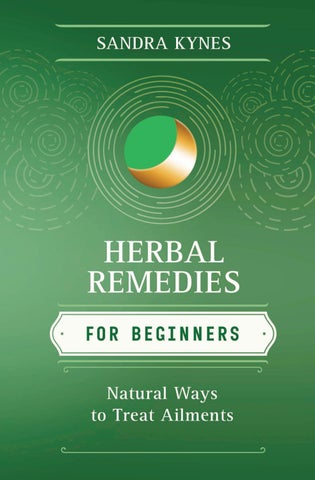
This impressive book contains almost 200 recipes for herbal remedies that anyone can use, even if you’ve never worked with herbs. Expert Sandra Kynes shows how herbal remedies can treat everything from the flu to kidney stones and can be made from ingredients commonly stocked in your kitchen.
Herbal Remedies for Beginners is cleverly organized and cross-referenced so you can look up remedies by ailment or by herb, making it easy to find what you need. You’ll discover how to make the remedies and a wide variety of application methods from teas and oils to balms and gels. With everything from a basil and lemongrass salve for soothing insect bites to a ginger and turmeric syrup for alleviating motion sickness, this is the perfect beginner’s guide to natural wellness.
Sandra Kynes (Mid coast Maine) is a member of the Order of Bards, Ovates & Druids and the author of twenty-one books, including The Witches’ Encyclopedia of Magical Plants, Magical Faery Plants, Llewellyn’s Complete Book of Correspondences, Mixing Essential Oils for Magic , and Sea Magic . Additionally, her work has been featured in Utne Reader, The Portal, and Circle Magazine . Sandra’s writing also appears regularly in Llewellyn’s popular almanacs and datebooks. Visit her at Kynes.net.
Facebook.com/LlewellynBooks
X: @LlewellynBooks
Instagram: @LlewellynBooks
www.Llewellyn.com
$17.99 US