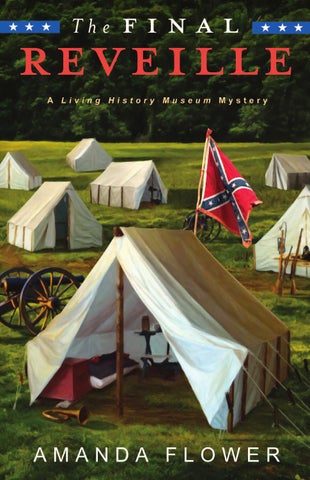
F i na l Reveille The
The
F i na l
Reveille A Living History Museum Mystery
A ma n d a F l o w e r
Midnight Ink
woodbury, minnesota
The Final Reveille: A Living History Museum Mystery © 2015 by Amanda Flower. All rights reserved. No part of this book may be used or reproduced in any manner whatsoever, including Internet usage, without written permission from Midnight Ink, except in the case of brief quotations embodied in critical articles and reviews. First Edition First Printing, 2015 Cover design by Kevin R. Brown Cover illustration © 2015 Tom Jester/Jennifer Vaughn Artist Agency Map by Llewelyn Art Department Midnight Ink, an imprint of Llewellyn Worldwide Ltd. This is a work of fiction. Names, characters, places, and incidents are either the product of the author’s imagination or are used fictitiously, and any resemblance to actual persons, living or dead, business establishments, events, or locales is entirely coincidental. Library of Congress Cataloging-in-Publication Data Flower, Amanda. The final reveille / by Amanda Flower. — First edition. pages cm. — (A living history museum mystery ; #1) Summary: Kelsey Cambridge becomes a prime suspect when the tight-fisted nephew of her living history museum’s main benefactor is murdered on the grounds amid a Civil War reenactment. ISBN 978-0-7387-4473-5 (softcover) I. Title. PS3606.L683F56 2015 813'.6—dc23 2014033919 Midnight Ink Llewellyn Worldwide Ltd. 2143 Wooddale Drive Woodbury, MN 55125-2989 www.midnightinkbooks.com Printed in the United States of America
dedication For Suzy
Kelsey’s Cottage
Maple Grove
Woods
Garage
vii
Parking Lot
Visitor Center
Union Camp
Pebbled Path
Confederate Camp
Pasture/Reenactment Battlefield
Maple Grove Lane
Brickyard
Barn
beehives
School House
General Store
Medicinal Garden
(location of Blue & Gray Ball)
Farm Green
Church
Barton House
Carpenter Shop
Barton Farm New Hartford, Ohio
Oxen Pen
Main Garden
Beat! beat! drums!—Blow! bugles! blow! –Walt Whitman
On e
The Union solider glared at his Confederate counterpart. “You’re lucky I’m all out of gunpowder, or I’d blow you all the way back to the Mason-Dixon Line.” “Oh you would, would you? I’d like to see you try.” The Confederate soldier was red-faced as he tugged on the collar of his heavy denim jacket. The Confederate encampment behind him, a cluster of several dozen white cotton tents held upright with wooden poles, bustled with activity. Children in their breeches and cotton shirts ran barefoot from tent to tent in an elaborate game of hide-and-seek while their mothers started the long process of cooking lunch over their tiny fire pits. The Confederate flag hung proudly from every flag post. On the Union side, the encampment was almost identical with the exception of the thirtyfive-starred American flag displayed at every campsite and Abraham Lincoln strolling in and around the Union tents, repeating the Gettysburg Address to anyone who would listen. 1
Crack! Crack! To my right, a battle raged in the grassy field. As the sound of musket fire broke the silence of the usually tranquil river valley, the regiment from the Ohio Volunteer Infantry charged toward their adversaries with a triumphant yell. The Confederate Division of the King’s Brigade also charged forward brandishing their bayonets and stout knives retrieved from their boots. As the two opposing armies met, the clatter of metal on metal reverberated across the field. Soldiers from both sides fell to the ground with cries of pain and disbelief. The Union and Confederate soldiers in front of me ignored the demise of their comrades just a few feet away. While the two soldiers argued, a third man lay fallen less than a yard from my feet on the other side of the wooden rail fence that surrounded the pasture. “Water, please, Miss?” he murmured. I looked down at him. He was another Union solider. His right arm was flung out dramatically above his head, and his left arm lay across his chest as if covering a wound. His blond hair was encrusted with mud as it had rained the night before the battle. His forage cap had a tear in the brim and one of the brass buttons was missing from his dark blue wool shirt. Despite his condition, a smile teased at the corners of his mouth. I peered down at him. “I’m sure your medic will be along shortly.” The soldier shook his head with a twinkle in his eye. “I am the medic. There’s no help for me. Can’t you tell I’m dead?” I raised an eyebrow. “You don’t look dead to me.” He winked, closed his eyes, and resumed playing dead. 2
The Confederate soldier, who was a large man with a handlebar mustache, grumbled. “I see your men aren’t trained well enough to stay dead when they’re hit straight on by a musket ball.” He appeared to be at a serious risk of heat stroke. The Union solider who stood across from him was at least twenty years younger and looked like the poster child for enlistment. He held his kepi, his regiment-issued hat, in his hands, and his dark hair was brushed back from his forehead. He touched his cleft chin as he thought of a comeback. “Please calm down,” I cried over the din, clutching my everpresent notebook. The two arguing men stared at me in surprise. I may be a tiny woman, but I know how to project my voice when needed, a trick I learned from my father who was an amateur stage actor. It’s a skill that came in handy in my job as the director of Barton Farm, a living history museum situated an hour south of Cleveland, Ohio. Now that I had their attention, I asked, “What’s the problem?” The Confederate soldier wiped his brow. “He stole a canteen from my encampment.” “Why would I steal anything from you? I’m surprised everyone in your company has shoes!” The Confederate soldier’s face turned even redder as he struggled for a rebuttal. This was the first Civil War reenactment I had hosted, and I didn’t want any casualties. I stepped in between the pair, who were now attracting more attention than the battle raging on the Barton Farm pasture. “What are your names?” 3
“I’m Sergeant Wesley Mayes,” the Union solider replied. “And I’m Corporal Henry Adams,” the Confederate soldier said. His flushed cheeks began to lighten. “Adams?” Wesley snorted. “A fine federal name for a Rebel.” Henry’s nostrils flared, reminding me of the Farm’s oxen when they were in a foul mood. “Is this true about the canteen?” I asked Wesley, using the voice I usually reserved for unruly grade schoolers visiting the Farm on a field trip. Wesley placed his kepi on his head. “No.” “Liar!” Henry accused. “I saw you in my camp.” “You must have mistaken me for someone else,” Wesley said coolly. “We aren’t going to settle this now,” I said. “Henry, if you would like to file a complaint, there are forms in the visitor center. At the same time, report the missing canteen to the front desk. We’ll keep an eye out for it in the lost-and-found.” “That’s it?” Henry cried. “That’s all you’re going to do?” “Listen.” I put my hands on my narrow hips and straightened to my full five-foot-two height. “I have one hundred and forty-two reenactors, thirty Farm staffers—most of whom are seasonal and believe Abraham Lincoln fought in the Revolutionary War—and nearly four hundred visitors here. I don’t have time to hunt down your canteen.” Wesley grinned and polished the third brass button on his coat with a handkerchief. Henry sniffed. “Well, I will certainly report this to my commanding officer.” He stomped away.
4
Wesley called after him, “Just remember who won the war!” before strutting back to his own encampment. The flirty dead solider opened his eyes again. “You handled that well.” “Can’t you stay dead?” I asked. He snorted a laugh. “Kelsey,” the soft voice of my assistant, Ashland George, whispered into my ear. She teetered back and forth on her ostrich-like legs. A stiff wind could topple my gawky assistant and send her sprawling into the middle of the battlefield. “What is it?” I felt sweat trickle down my back. June wasn’t usually this muggy in the Cuyahoga Valley, but we’d had an early spring that led into a long hot summer. Ashland’s eyes, fringed by blond lashes, blinked at me from behind her glasses. “Umm, well.” Her voice was as powerful as a baby chick’s. She certainly didn’t know how to project. Maybe I should ask Dad to give her some tips. I scanned the crowd. He was around the Farm somewhere, along with my five-year-old son, Hayden. Undoubtedly, the pair was in loads of trouble already. I wondered if they had anything to do with the missing canteen. “Well,” she said again. Ashland was a doctoral candidate in American History at a nearby university. I tried to imagine her teaching a theater-sized classroom of two hundred undergraduate students. I knew that was part of her job as a teaching assistant, but the image didn’t fit. I became concerned. “Is anything wrong?” “Cynthia is here and would like you to give her a tour of the reenactment,” she said. 5
“Of course. Where is she?” I couldn’t imagine why Cynthia’s appearance would tongue-tie my assistant. Ms. Cynthia Cherry was Barton Farm’s benefactress and, for lack of a better word, my boss as she was also the chairwoman on the Farm’s board of trustees. “Is that all?” “Her nephew is with her,” she added in a rush. “They’re waiting inside the visitor center.” I made a face. “Why is he here?” I asked. I could count on one hand the number of times Maxwell Cherry had visited the Farm. He was Cynthia’s only heir and did not approve of the money Cynthia donated to the Farm through the Cherry Foundation, which Cynthia’s tire tycoon father had created over a century ago to promote the arts and culture in Summit County. Barton Farm certainly wasn’t the only museum the foundation supported, but we were the most expensive. Ashland clenched her hands together in front of her, not answering. I tapped a rhythm on the back of my notebook. “Well, this should be fun.”
6
T wo
With Ashland shuffling close to my heels, I wove through the crowd of reenactors and Farm visitors back to the visitor center. Two little girls ran along the path knocking a wooden hoop with a stick, one dressed in Civil War–era clothing, the other in shorts and a fluorescent tank top. Their yelps of glee made me smile. The visitor center was fifty yards beyond the trail. It was the only “new” building on the property; all the others were over a century old. However, under Cynthia’s guidance the architect had made the building fit with the Farm. It resembled an overgrown ranch house, with white wooden siding and forest green shutters. It wasn’t all built for the nineteenth century, I thought as I stepped through the automatic glass doors. I entered the great room with high ceilings, exposed maple beams, and polished pine floors. There were glass doors on either side of the room. The first set led to the Farm, and the doors on the far side of the 7
room opened onto the parking lot. Just before them was our ticket counter and gift shop. Children hopped in place as they anxiously waited for their parents to pay for their tickets so they could enter the Farm and tour the encampments. On the opposite side of the room from the ticket counter, a hallway framed with wooden beams led to the restrooms, a small cafeteria, and my small office. I spotted Cynthia and her nephew along with a dark-haired woman I didn’t know. She was busy admiring the large blackand-white photographs of the Farm that surrounded the great room. Each picture was from a different season of the year. Even in the dead of winter, Barton Farm was picturesque. Our official open season ran from the middle of April through the end of October, but I had hoped to speak with the board of trustees about opening for special occasions throughout the late fall and winter. Perhaps for a snowshoeing hike through our woods or sleigh rides around Christmas or maple sugaring in March? The Farm held so much potential, and I’d only touched the tip of iceberg in my two years as director. Cynthia held onto the mother-of-pearl knob of her black walnut cane with strength and assurance. “Kelsey, dear, this is spectacular!” she said with her usual enthusiasm. She wore a lavender pantsuit paired with a ruffled blouse and reading glasses hanging from her neck from a beaded chain. Her improbable red curls bounced on the top of her head. “You’ve outdone yourself again! Maxwell circled the parking lot three times before he found a spot. The place is packed. What an achievement for our little museum.” She air kissed me on both cheeks.
8
I blushed at the praise but did not disagree. Despite a few scuffles between the North and South, the reenactment was a success. The Farm visitors were eating up the history and atmosphere, just as I knew they would when I approached the board of trustees with the idea seven months ago. The reenactment was a four-day event, running Thursday through Sunday, with battles every day. The grand finale would be a Blue and Gray Ball, a Civil War–inspired dance in the middle of the village. Tickets for the ball had sold out even before the reenactment began. Cynthia smiled over my shoulder. “Ashland, it is always nice to see you, my dear. I enjoy our little visits.” Maxwell rolled his class ring back and forth over his knuckle. “Are you sure you’re following code to allow this many people on the grounds?” He was a small man, only a few inches taller than me. His narrow face and pointed nose gave him a ratlike appearance. “Yes, the fire chief was here last week to assess the grounds, and some members of his firehouse are here today as reenactors.” I held my hand out to the dark-haired woman at Maxwell’s side. “Hello. I’m Kelsey Cambridge, director of Barton Farm.” She shyly shook my hand. “Portia Bitner,” she murmured. I barely heard her over the cannon shots outside. She was an attractive, tall woman, at least half a foot taller than I was, and had long straight black hair tied at her neck with a yellow ribbon. Her ponytail hung over her shoulder, and she held it as if it was a personal security blanket. “Where are my manners?” Cynthia asked. “Kelsey, this is Maxwell’s fiancée.” 9
Behind me, Ashland gave a sharp intake of breath. I turned, but she was flipping through her notebook, which was identical to my own. Perhaps I’d imagined the sound. Maxwell gave me a triumphant glare. “Yes, Portia is truly the one for me.” He reached for the woman twenty years his junior who towered several inches above him. After the slightest hesitation, she folded her thin hand into his. Not long after I started working at Barton Farm, Maxwell Cherry had asked me out on a date. I turned him down, claiming I wasn’t ready because of my recent divorce. It was an excuse on my part. Even if I found him remotely attractive, I would have never dated Maxwell. He had no respect for history. I smiled sweetly. “Congratulations!” “I’m just tickled by the whole thing.” Cynthia’s curls bounced. “Can you believe I’ll finally have a niece-in-law after all these years? I never thought Maxwell would settle down. It’s been one girl after another for a decade. I can’t even remember all their names. Maxwell is nearly fifty.” Maxwell scowled. “Aunt Cynthia, I don’t think Ms. Cambridge needs to know all the details.” “Oh, pish. Kelsey is practically family,” the older woman replied and grinned at me. “Since Portia is with us and this is her first visit to the Farm, I want the grand tour, Kelsey.” She shook her cane at me. “Don’t leave anything out. With your help I’m hoping to convince them this is the perfect location for their wedding.” Maxwell bristled. “I already told you we have no intention of getting married here.” His gaze followed a boisterous family
10
of five leaving the visitor center for the Farm. “We prefer a more formal setting.” “It’s the bride’s decision,” Cynthia said as she winked at Portia. In return, Portia nervously tugged on her ponytail. “I’m happy to show you the Farm.” I put on my best tour guide smile. The trio and Ashland followed me out of the visitor center, and I turned toward the reenactors’ camps. I thought showing Cynthia and her party how authentic the reenactors were would impress them, though in truth, it probably wouldn’t impress Maxwell. Portia touched my arm. “Can we go this way?” She pointed in the opposite direction of the camps. I spun on my heels, and Cynthia’s drawn-on eyebrows disappeared into her hairline. “Is something wrong, Portia?” she asked. The tall woman blushed and continued playing with her hair. “No, only you’ve told me so much about the Barton Farm that I would much rather see the actual farm than the Civil War reenactment.” Cynthia waved her comment away with a bejeweled hand. “You can see Barton Farm any old day of the week. The War Between the States will only be here a few days.” On that note, I began walking toward the battlefield again. “What if,” Portia spoke up again, causing me to turn around a second time. She cleared her throat. “What if we tour the village first? Would that be all right? I’m so eager to see it. You said there was a church there,” Portia added.
11
Maxwell watched his bride-to-be closely. For a half of a second, I thought his nose twitched liked a rodent’s, but that could have been my imagination. Cynthia’s eyes sparkled. “Yes, and it’s the perfect location for your wedding. Do you mind visiting the village first, Kelsey?” “Of course not,” I said hesitantly. My Mama Spidey sense was piqued. Whenever Hayden insisted he wanted to do something so adamantly, I knew he was hiding something from me. Usually it was a frog in the bathtub. I smiled, hoping to put Portia at ease. “Actually, this is a great time to visit the Farm since most of our guests are watching the reenactment. It won’t be nearly as crowded as it will be after the battle.” Portia gave me a half smile in thanks. I guided the trio down the pebbled path that led to Barton’s mock village. The path stopped at Maple Grove Lane, which divided the Farm’s property in half. On the west side of the road was the visitor center, my cottage, and a handful of outbuildings. It also held the grazing pasture for our five cows and two oxen, which was currently the location of the battle. During the reenactment, the animals were staying in the south pasture, as far away from the reenactment’s noise and uproar as possible without leaving Barton property. The east side of the road held the Barton family home (a three-story brick colonial), the main barn, and the village. The village was a quarter-mile circle of six buildings. Only Barton House was original to the property. The rest were relocated to the farm piece by piece from other parts of Ohio with the intention to preserve them. After transport, they were reassembled on the property as enormous three-dimensional jigsaw 12
puzzles. Cynthia’s Cherry Foundation fronted the money for the moves and reassembly of all of those buildings, which included the church, schoolhouse, two homes, a carpenter’s workshop, and a general store. The largest of those building was the whitewashed, singlesteepled church. It was Cynthia’s pride and joy. As we approached, the church looked like it was ready for its beauty shot. Its pointed steeple stood in a backdrop of the bright blue summer sky. Beyond the church were the homes of our villagers, seasonal workers who played roles of men and women living in northeastern Ohio in the mid-nineteenth century. In honor of the reenactment, they were spending the entirety of June living in the specific year of 1863. Laura Fellow, a high school history teacher and my partner in crime since we met in first grade, sat outside of the church under a massive chestnut tree, carding wool. She wore a blue shirtwaist and skirt that went all the way to the ground. A pale cameo closed the collar at her throat, and she’d parted her strawberry-blond hair down the middle and pinned it into a bun on the back of her head. Despite the near-ninety-degree heat and stifling humidity, she looked a cool as can be as she spoke with a young teenager in droopy cargo shorts and a band T-shirt two sizes too big for his thin frame. The only indication that she might be warm was the rosy color on her plump cheeks. As we approached, I heard a snippet of Laura’s conversation with the young visitor. “A cell phone you say. I’ve never heard of such a thing. What does this cell phone contraption do?”
13
The teen held a smartphone in his hand and waved it back and forth in front of her face. “It makes calls? You make calls, don’t you?” the boy said with a malicious twinkle in his eye. I suppressed a smile. He didn’t know who he was messing with. In addition to being my best friend, Laura was one of my best first-person interpreters. She knew her nineteenth-century American history backwards and forwards and never broke character in front of a guest. Laura smiled sweetly and her green eyes sparkled. “Oh my yes, I make calls. Every time I call on a friend I bring them a pie. I’m well known for my pie crust. I know I should be more modest, but it’s the best crust in the village.” The boy yanked at his shorts, which were threatening to fall off. “How can you take a pie on a call?” Laura cocked her head, and as the sunlight broke thought the chestnut’s thick foliage it fell on her red-gold hair, giving her a deceptively angelic appearance. “By calls you do mean going to visit a friend or neighbor at his or her home, do you not? Because that is what I mean when I say calls.” The boy scowled. “This is lame.” He stalked away. Laura rose when we approached. “Good afternoon. Welcome to Barton Farm.” Cynthia tapped the end of her cane into the grass. “Laura, I enjoyed seeing you put that whippersnapper in his place.” Laura simply smiled. “It’s kind of you to say. It is nice to see you, Cynthia.” Laura nodded at Maxwell, but didn’t pay him the same compliment. “Portia, this is Laura Fellow, one of our twelve first-person interpreters in the village.” 14
“Interpreters?” Portia looked just as confused as the teen had been. “We’re kind of like the reenactors, except we don’t have guns,” Laura said. “The first-person interpreters dress up in period clothing and act out the part of someone living in this part of Ohio in the mid-nineteenth century. That boy who was just here was trying to make her drop character.” I felt the sunrays beat down on my dark hair, and I lifted my heavy braid off of my neck and stepped into the shade. “We also have third-person interpreters. Those are people who work here and wear Barton Farm polo shirts like mine. Many of them are crafters who make the crafts and goods we sell in the gift shop using only nineteenth-century technology.” “That means no power tools,” Cynthia said. “Isn’t it fabulous? Everything is made by hand.” Portia had a strange expression on her heart-shaped face, but before she could reply, Maxwell screamed.
15
Mystery
“Flower combines a plethora of suspects, a soupçon of history, and a dash of romance.” —Kirkus Reviews
A Deadly Mystery at a Living History Museum As the director of Barton Farm, a living history museum, Kelsey Cambridge is underpaid and underappreciated, but she loves every minute of it. Determined to keep the struggling museum open, she plans to impress Barton Farm’s wealthy benefactress, Cynthia Cherry, with a Civil War reenactment on the farm’s grounds. Unfortunately, the first shot in the battle isn’t from a period soldier. It’s from Cynthia’s greedy nephew, Maxwell, who fires a threat at Kelsey to cut the museum’s funding. The next morning, things go from bad to worse when Kelsey discovers Maxwell dead. Now Kelsey is the number one suspect, and she must start her own investigation to save Barton Farm . . . and herself.
“A thoroughly enjoyable mystery with history, humor, and heart!” —Krista Davis, New York Times bestselling author of the Domestic Diva Mystery series $14.99 US / $17.50 CAN ISBN 978-0-7387-4473-5
www.midnightinkbooks.com • Facebook.com/MidnightInkBooks • Twitter:@MidnightInkBook