


MARCH 2026
MARCH 2026
Liverpool John Moores University (LJMU) is committed to developing a whole university approach to mental health and wellbing for our staff and students. We pride ourselves on placing students at the heart of everything we do and are guided by our values of being student-focused, inclusive, community-oriented, and courageous.
Our Health and Wellbeing Plan builds on this foundation, structured around the Public Health England (PHE) three Ps: Prevention of avoidable illness, health Protection, and the Promotion of wellbeing resilience. This evidence informed approach is centred on creating a culture where staff and students are supported to make informed choices and encouraged to prioritise self-care, helping members of our university community to thrive.
Since 2021 LJMU has been a programme member of the University Mental Health Charter (UMHC), developed by Student Minds. The Charter provides an evidence-informed framework to support universities in adopting a whole institution approach to mental health and wellbeing for both students and staff. This includes the accessibility and effectiveness of support services; inclusive teaching, learning and assessment practices; opportunities to build community and belonging; staff training and development; and the wider institutional culture. LJMU’s participation reflects our strategic commitment to creating an inclusive, supportive and healthy university community, aligned with our institutional values.
The purpose of this report is to celebrate the cross-institutional action we’ve undertaken and make a transparent commitment to the work we are continuing to do.
At LJMU, our whole university approach to mental health and wellbeing reflects our commitment to putting people first and creating a positive, inclusive culture. We know that wellbeing is not just the responsibility of support services, but something that is shaped by everyday experiences across our whole community. A healthy university is one where both students and staff feel supported, respected and able to be themselves. This is an ongoing journey and we are continually learning and evolving how we support the wellbeing of our students and staff.
Phil Vickerman, Pro Vice-Chancellor Student Experience

At LJMU, and in the sector more broadly, there is an upward trend in disability declarations, including for mental health conditions.
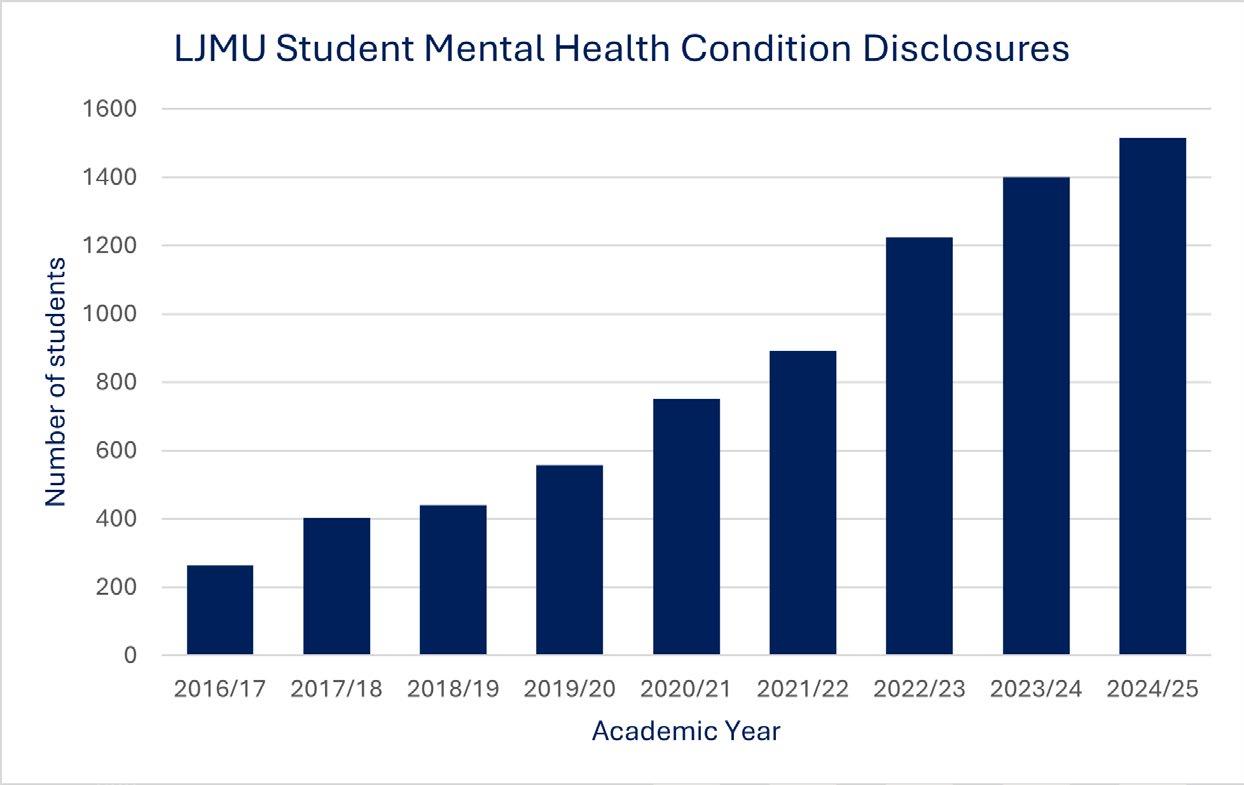
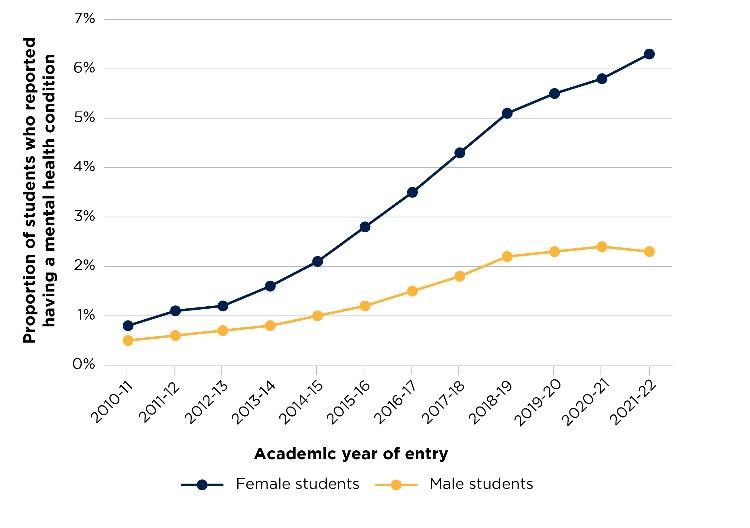
The graph demonstrates a year-onyear increase in the number of LJMU students declaring a mental health condition. It is important to note that these figures do not include students who disclose ‘multiple impairments’, a category that may also encompass mental health conditions.
[Source: Higher Education Statistics Agency (HESA), annual student return]
This is not unique to LJMU with UCAS reporting that the number of accepted applicants sharing a disability reached 103,000 in 2023, up from 77,000 in 2022 (+33.8%) and 58,000 in 2019 (+77.5%). Mental health conditions disclosed by applicants rose to 36,000 in 2023, up from 22,000 in 2022 (+63.6%) and 16,000 in 2019 (+125%).
[Source: UCAS end of cycle data 2023]
The challenges of university life can impact the mental health and wellbeing of all students, not only those with diagnosed conditions. Academic demands, financial pressures and the transition to independent living can be overwhelming, highlighting the importance of a whole-university approach that supports all students.
• Anonymous survey responses typically show a higher prevalence of mental health challenges than institutional records. In a 2022 Student Minds survey 57% of students self-reported a mental health issue whilst 27% said they had a diagnosed condition
• Our LJMU Student Health and Lifestyles Survey (2024) demonstrates a similar pattern, with 50% of students self-reporting symptoms of moderate to severe anxiety and 50% self-reporting symptoms of major to severe depression. In the same survey 20% of respondents disclosed a disability
• This evidences that whilst there is a general upward trend in disability disclosure there may be an under-reporting of students experiencing mental health difficulties, pointing to persistent barriers like stigma or lack of awareness about support options
• Mental health risk is not evenly distributed across the student population. Structural, financial and caring pressures intersect with study demands and can increase both psychological distress and barriers to accessing support
• Our student body is diverse with 47% students from IMD quintiles 1 and 2 (indicating higher levels of deprivation), approximately 40% of students commuting to university and mature learners (over 21 at point of entry) making up 15.5% of our student population. This means many experience heightened financial pressure, time poverty and reduced access to protective factors such as campus belonging
• National trends demonstrate that students who have disclosed mental health conditions face lower continuation and completion rates than those without, highlighting the need for proactive support and inclusive practices. At LJMU, our Access & Participation Plan commits to reducing these gaps by 2028/29, demonstrating our institutional commitment to equity in academic outcomes
• Our 2025 NSS results demonstrated that 83.8% of LJMU students agreed that wellbeing support services were well communicated, above the sector average
Mental health has a direct and measurable impact on students’ ability to engage with learning, affecting their attendance, concentration, assessment performance, continuation and completion. Across the sector increased disclosure and help-seeking are recognised as positive indicators of reduced stigma and greater awareness. However, they also reflect rising levels of need and place sustained pressure on wellbeing, counselling and disability support services. At LJMU, high demand for support highlights the importance of moving beyond a service-led response towards a whole-university approach, in which inclusive learning design, flexible academic practices and early identification all play a role in supporting student mental health. Embedding responsibility across the institution is essential both to support student success and to ensure the sustainability of support services.
Initiatives related to inclusive teaching practices, support for student transitions, and efforts to reduce academic-related stress.
• A cross-institutional working group focused on Induction where departments share information and collaborate on transition activities to support a seamless introduction to life at LJMU. This group continues to grow, share good practice and respond to student voice
• Annual Induction Guidance is disseminated across the institution to promote a consistent experience and supports student wellbeing e.g. community building and belonging
• A pre-arrival survey has been introduced to provide staff with information about their incoming cohorts prior learning experience, expectations and concerns
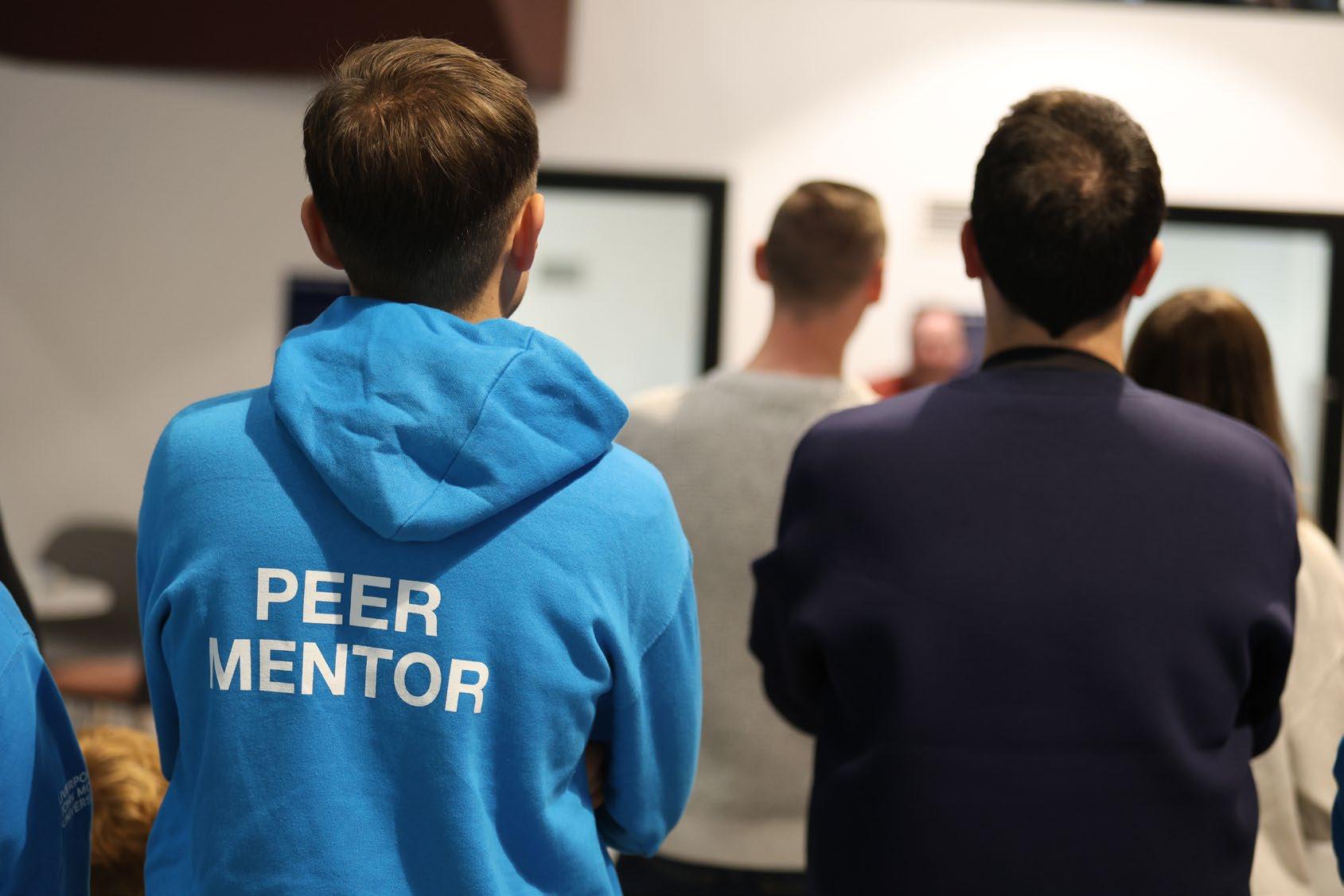
• Some departments have trialled approaches to peer mentoring to support induction activities, sharing their practice to support institutional-wide uptake of successful interventions

• Reinduction guidance has been circulated with the aim of supporting the transition between years of study, including prompts for academic teams to share timely reminders of student support available
• Following consultation, the Personal Tutor Framework has been updated and accompanying resources have been developed including enhanced functionality to organise and document meetings and a new training module which includes information about student wellbeing, appropriate boundaries and effective signposting
• An updated student disability declaration process, making it easier for students to disclose a disability at any point in the academic year and sharing this information with relevant academic staff
• In collaboration with the RAISE network LJMU colleagues have organised consultations to inform the development of a Manifesto for Compassionate Curriculum and have been instrumental in the development and dissemination of this trailblazing work within the sector
• Utilising the University Mental Health Charter and Manifesto for Compassionate Curriculum to review our Curriculum Design Guide and where appropriate updating it to embed wellbeing principles in the design and delivery of course materials
• The Teaching and Learning Academy continue to champion Curriculum Enhancement Internships. These funded projects encourage co-produced approaches led by academics and student interns and are focussed on intuitional priorities, including inclusive practice
• Integration of Ally software within Canvas resulting in significant improvement in course material accessibility scores and student uptake of alternative formats.
• Conduct a review of the pre-arrival survey to understand how it has been utilised by academics to inform our approach going forward
• Develop automated personalised reports to signpost students to relevant support and services following completion of the pre-arrival survey
• Introduce a pre-arrival survey for post-graduate students
• A university-wide approach to reinduction activities which aims to support the transition between levels of study, building skills, confidence and preparedness for the next stage
• Continued monitoring and evaluation of the updated Personal Tutor Framework
• Implementation of the Framework for High Quality Teaching and Learning
• Support curriculum design activity associated with the launch of the revised Curriculum Design Guide
• Funding for a new post providing targeted support for programme teams to develop their curriculum design and delivery
• Continued monitoring and evaluation of the student experience to inform improvements
• Targeted academic support for identified groups through our institutional Access and Participation Plan activity
• Introduction of a podcast series to support students to access information to support their adjustment to the higher education learning environment and develop key academic skills.
Improvements in residential life, campus facilities, and initiatives fostering social integration and a sense of belonging.
• We have extended our partnership contracts with our hall providers to cover a 3-year period. This will result in closer working with Hall Managers to improve the experience for our students in halls
• LJMU has achieved 2nd place for university accommodation nationally in the annual Uni Compare rankings, which is based on student feedback. Our students rated us 4.14/5 overall and 97% would recommend our accommodation to others

• Rebranding of Sports Centre to LJMU Move to improve inclusivity and accessibility
• Introduction of the Moves+ app which incentivises day-to-day movement and encourages community building. This complements the existing gym provision and offers inclusion for those who may not otherwise be involved in physical activity at LJMU
• LJMU gym continues to offer affordable memberships for our students and staff. Our provision has expanded to include sports activities across the city to offer a diverse portfolio and inclusive opportunities
• Students who are engaged in wellbeing, mental health or counselling support can be referred into the Healthy Lifestyles Programme which aims to support students to engage with movement and nutrition in a supported environment

• Fitness opportunities are available across campus, including in the library and student accommodation. This encourages students to take breaks and supports community building
• A weekly ‘Tranquil Training’ hour provides a calm atmosphere without music for anyone who prefers a quieter space in the gym
• Our social media intern has developed an engaging communication plan and increased the reach of the posts to promote healthy behaviours and advertise services
• Our nutrition intern works with students to increase their knowledge and skills whilst promoting healthy lifestyles in a group setting. Free food is provided to incentivise participation and to reduce barriers to accessing healthy meals
• The Sports Centre spaces can be used by teams or departments to encourage wellbeing and team building. Activities include archery and yoga
• Campus development and improved wayfinding have been implemented across campus. Estates have undergone consultation with staff and students to improve buildings and signposting
• The Safe Zone app has been introduced, a free app which provides students and staff with fast access to campus security and emergency support
• The Biodiversity Plan 2030 has been launched. The plan has 3 key themes which underpin the planned improvements to our campus biodiversity which are habitat quality, green space provision and climate resilience

• Review our Student Living Plan to support student belonging, engagement and proactive interventions across the institution
• Evaluation of student experience within our partner halls
• Supporting consistent training for Hall Managers across our partnership covering student wellbeing, signposting to services and safety
• Review expectations on Hall Managers for reporting and responding to concerns raised about students
• Following Suicide Safer guidance on reducing access to means across our campus
• Increasing our offer of proactive initiatives to support wellbeing and mental health including introducing wellbeing walks, run clubs and facilitated movement breaks in academic spaces
• Our new Community Garden to be open to staff, students and the local community to encourage engagement in meaningful opportunities and meet new people
• Embed and monitor the engagement with our new apps, Safe Zone and Moves+
Enhancements to student services , accessibility of mental health resources, risk management strategies, and collaborations with external partners.
• Continuous development of support services in response to student feedback, audit recommendations and the latest sector guidance
• Support service practitioners utilising their expertise, skills and insight into the student experience to develop therapeutic group environments including: Bibliotherapy, Women’s Empowerment Programme, Uni Man, Black Student Leadership Academy and Neurodiversity Support Group. Group environments support community building alongside the development of key skills and knowledge
• Introduced Dialectical Behaviour Therapy group sessions to our support service offer
• Implementation of new systems for case and risk management within the Mental Health and Wellbeing Teams
• Introduction of outcome measures and evaluation tools to monitor the effectiveness of our services

• Triangulation of data collected to better understand how students interact with our services and make decisions informed by data and student voice
• Continuous development including training and supervision for our practitioners
• Introducing a Student Concern Form for staff outside of SAW to raise concerns about students whilst maintaining the appropriate boundaries for their role
• Practitioners successfully securing Diversity and Inclusion funding to trial new approaches to student support
• Our Suicide Safer university working group includes cross-institutional membership, colleagues with academic expertise and external colleagues from Mersey Care and the Public Health Team within Liverpool City Council. Collectively the group has developed a robust action plan to advance our institutional approach and utilise the learning from serious case reviews
• Continuing to develop and embed external partnerships to improve access and support pathways for our diverse university community, including the Student Liaison and UCOPE services in partnership with Mersey Care, as well as Togetherall and SilverCloud
• Working in partnership with Mersey Care NHS Trust and local HEIs through the strategic oversight and operations groups facilitates us collectively moving in the same direction and developing practice based on student feedback

• Our Support Service is a member of Liverpool MARAC, working with statutory agencies to support cases of domestic abuse where homicide is a risk
• Develop a Clinical Governance document to reflect our service, demonstrating how we operate safely and effectively, minimising risk to our students and staff
• Collecting student insight and feedback to inform service design and delivery
• Regularly review data and outcome measures to inform service design and delivery
• Monitor engagement with the Student Concern Form and Report and Support
• Utilise social media and communications to promote our services
• Implement the recommendations from sector insights and our internal Suicide Safer audit
Programs aimed at staff wellbeing, professional development opportunities, and training in mental health awareness.
• Make Every Contact Count is a bespoke mental health alertness training developed for our staff in partnership with the Royal Society of Public Health and NHS England. It is designed to equip staff with the knowledge and skills to have courageous conversations about mental health and signpost to appropriate support available. Staff from all areas of the university have engaged and provided positive feedback
• An adapted version of the Make Every Contact Count is now being embedded into training for line managers as part of the Leadership Enhancement and Development programme
• A comprehensive package of organisational development training opportunities available to staff including training to improve awareness of different lived experiences within our university community, for example; neurodiversity, menopause awareness and sessions from Cancer Support UK. We continually review our offer to identify areas to raise awareness, knowledge and skills

A HR staff absence dashboard has been developed to enable line managers to utilise live data in monitoring sickness absence and identifying themes
Our annual Staff Survey and Stress Risk Assessment Survey provides insight into staff experiences across a range of themes and results are available at an institutional and department level. Multiple action plans are developed in response to the findings and enable leaders across LJMU to drive progress and improve our working culture
LJMU has an extensive wellbeing offer, including our Employee Assistance Programme offering counselling, financial advice and much more. We also offer virtual wellbeing platforms including Togetherall and Silvercloud providing staff with anonymous spaces to connect with others and engage with clinically approved content
We have a programme of wellbeing events throughout the year to encourage work-life balance and connection
• All staff are eligible for a discounted LJMU gym membership to encourage healthy behaviours
• We have a number of policies to support flexible working, family and caring commitments
• Our Equality, Diversity and Inclusion team have established peer-led Staff Networks, creating a safe space for employees to come together, share their stories and build a sense of community based on their shared identity and lived experiences. They play a vital role in promoting diversity and inclusion within the university, using collective voice to highlight areas that need improvement and advocating for policy changes to ensure equal opportunities for all
• Our LJMU Connectors are wellbeing ambassadors who provide peer support to any member of staff. Volunteers from across the university receive ongoing training to spot early signs of mental ill health, listen to staff in confidence and without judgement, and signpost to professional support
• LJMU are proud to have been awarded Menopause Friendly Accreditation. We have developed a new Staff Menopause Policy with ongoing training and menopause cafes providing awareness and networks across our staff communities
• We are members of the Domestic Abuse Workplace Scheme and have Workplace Champions across the university who are trained to provide peer support
• Our newly launched Cancer Support Ambassador Network offers a supportive network for those with cancer or those who are supporting someone with cancer, be that a family member, friend or colleague

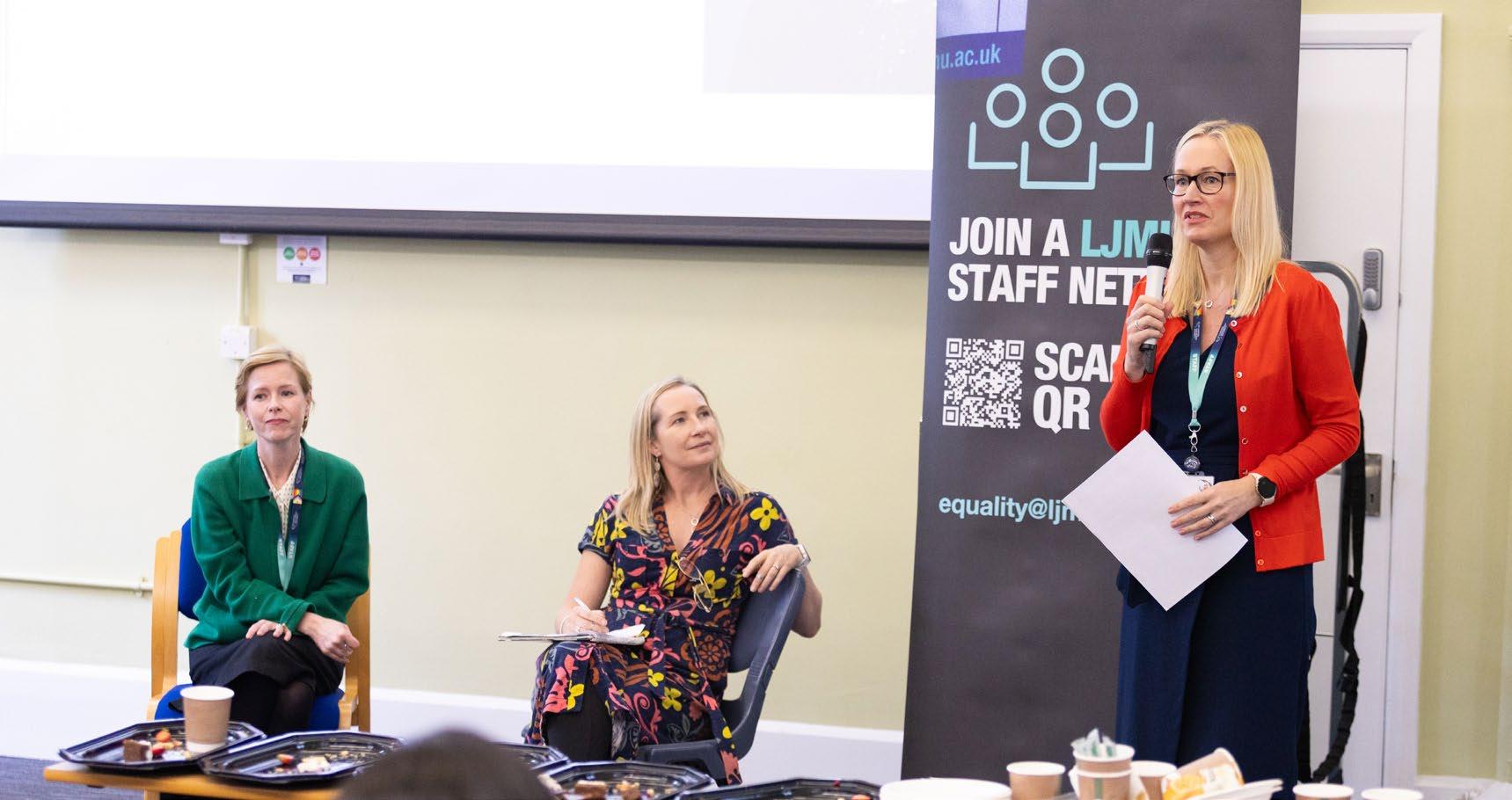
• Communication with staff, particularly those who do not regularly engage with email communications, to raise awareness of support available including our internal offer of events and staff networks, and external support available to LJMU staff for example the Employee Assistance Programme, Togetherall and Silvercloud
• Progress organisational actions linked to the institutional Staff Survey and Stress Risk Assessment Survey action plans including a project reviewing academic administration and identifying opportunities for efficiency
• Utilising institutional tools to reduce stigma towards mental health and promote an inclusive culture. This includes our Respect Always Campaign, EDI activities and institutional Health and Wellbeing Plan
• Review our existing training offer and develop an institutional training plan to ensure staff have access to mental health and wellbeing training that is relevant to their role. As a minimum staff should have training and resources to signpost others to relevant support available
• Evaluate the impact of our Make Every Contact Count Training and our existing Wellbeing Events to ensure our offer remains relevant and beneficial to our staff community
• Ongoing conversations with external support providers to monitor uptake of services and identify opportunities to promote provision to encourage participation
• Design a tool to aid staff in signposting students to the relevant internal and local support services in collaboration with the Teaching and Learning Academy and Student Life and Wellbeing
Actions taken to cultivate a supportive university culture, including leadership engagement, policy development, and resource allocation.
• Our NNECCL quality mark has been renewed. This accreditation recognises the work we do to support our care experienced and estranged students
• Our renewed Access and Participation Plan outlines our objectives for ensuring all students are able to access, participate and succeed during their time at LJMU
• Our updated Equality, Diversity and Inclusion action plan recognises that everyone at our university is equal but never the same. This plan has been co-produced with students and staff to outline key priorities over the next 4 years
• Being informed by the student voice continues to be a priority for both LJMU and JMSU. We continue to learn from institutional surveys, communities and workshops and endeavour to provide multiple opportunities for students to shape the future of LJMU
• Our Respect Always Charter has been co-produced by staff and students to enable everyone who studies here, works here and works with us to feel respected and to respect others

• Following guidelines from the Higher Education Mental Health Implementation Taskforce we have developed our own Compassionate Communication guidance grounded by the principles of empathy and mutual respect
• We have completed extensive work around our approach to sexual violence and misconduct following the condition for registration from the OfS. This includes developing a compulsory training module for both staff and students and a single comprehensive document detailing our approach
• The merger between Student Advice and Wellbeing, Accommodation and Student Living and Physical Activity provides new opportunities to take a holistic approach to the health and wellbeing of our university community
• A consultation has begun on our refreshed Disability Policy which is informed by the social model of disability and the EHRC advice note following University of Bristol vs Abrahart
• Our annual institutional Student Health and Lifestyles Survey is a collaboration between multiple academic and professional service departments and aims to understand student behaviours and wellbeing. The survey results are used across the university to inform service design and delivery. A smaller survey designed and delivered by students follows the institutional survey to gain further insight on linked themes
• Our emerging commitment to becoming a Trauma Informed Campus led by a group of research and professional services staff who have approached the senior leadership team with a plan to become one of the first (and potentially leading) institutions in this area
• Using current research into Adverse Childhood Experiences (ACEs) to co-develop our Trauma Informed and Responsive Institution (TIARI) approach
• The safeguarding annual report is now in the second year of production, advising senior leadership and Board of Governors on issues and emerging trends for student’s health and wellbeing
• Liaison with the local Public Health department looking at deaths as a result of suicide and future prevention work alongside academics who actively research in this area
• Development of the Students of Liverpool Strategic Board looking at all aspects of student life, whilst ensuring the wider city region makes appropriate provision in resourcing and services
• Reviewing our institutional Health and Wellbeing Plan and associated implementation plan
• Furthering our Respect Always campaign to improve our university culture, reduce barriers to reporting incidents and effectively communicate support available to students and staff

• Drive work towards destigmatisation and open conversations about mental health and wellbeing by utilising leaders across the university to have courageous conversations, speaking openly about wellbeing, encouraging behaviours which support good wellbeing and supportive environments
• Regular communication on the topic of mental health and wellbeing to increase visibility and awareness of services
• Increased opportunities for meaningful student co-creation to improve our policies and practice across the university, including the development of Community Guides to support transitions and belonging for specific demographic groups
• Further develop our impact and evaluation to evidence the effectiveness of our approaches and measure the activity linked to our APP commitment to improve the continuation and completion for students with a mental health condition
• Our trauma informed institutional commitment to inform an inclusive culture which reduces stigma around mental health and wellbeing and encourages students and staff to access the support they need
• Implement and action our harm reduction approach to drugs and alcohol ensuring appropriate policies, information and support is available to staff and students
• Our updated Disability Policy to inform processes and practice, including assessment choice, accessibility of reasonable adjustments and inclusive practice by design

Activity led by John Moores Students’ Union (JMSU) putting students at the heart of what we do and listening to their experiences to shape and improve mental health strategy, services and university policies by sharing ideas, raising concerns, giving feedback, and co-creating change.
• JMSU has launched a new Student Voice Framework to connect students, report directly to services and inspire positive change across campus. This puts student voice and cocreation at the heart of decision making
• Our new Wellbeing Forum, chaired by our VP of Community & Wellbeing and ran in collaboration with Student Life and Wellbeing, is an inclusive space where students can share feedback on LJMU services, co-create campaigns, and shape the direction of wellbeing support across JMSU and LJMU
• The Student Equity Council includes School Reps, Officers, and Student Campaigners. Members develop knowledge of the Access and Participation Plan, relevant intervention strategies, and discuss student barriers they’re aware of. They then present ideas and insights to staff
• A Student Equity Assembly has been created to enable LJMU and JMSU to access broad student consultation across a range of topics
• Our Lunch and Listen is a space for Course and School Reps. We provide topics for discussion, for example, how prepared students felt for assignments, and what LJMU could do to better support them ahead of exams and assessment periods. Students are able to decide and shape the direction of conversation
• JMSU’s Annual Freshers Survey received 3462 responses and asked students about their wellbeing and induction experience. Findings from this survey are now being reported back to the university to improve induction, re-induction, transition and timetabling
• JMSU’s annual Movember campaign focused on having meaningful conversations and included 18 conversations with students and staff, including ELT, about how they maintain their own mental health and wellbeing
• JMSU collaborated with local Students’ Unions to march in the annual Reclaim the Night walk to stand against gender-based violence, and promote LJMU Report and Support services, and the Safe Zone app
• JMSU Student Leader Training and Development includes Mental Health First Aid, Look After Your Mate and bystander intervention. This training provision aims to equip students with the tools and confidence to look after themselves, signpost safely and champion health and wellbeing
• Following student feedback highlighting the financial struggles of students at university, JMSU developed a broad cost of living campaign. It targets parent & carer students with half term care hampers, students in halls with a supermarket voucher scheme, and the general student body with budgeting tips and financial advice shared throughout the year via social media.

• JMSU re-launched its Buddy Scheme in 25/26, supporting 50+ students in the first weeks by providing peer connection, reducing loneliness and transition anxiety, and improving wellbeing through trained volunteer buddies offering one-to-one support and signposting
• Mental Health First Aid Training equips all staff and officers with skills to recognise early signs of poor mental health, reduce stigma, and signpost safely
• Safeguarding training ensures all staff understand safeguarding policy and procedures, enabling consistent, safe responses to concerns or disclosures
• Achieving the Neurodiverse Friendly Award demonstrates our organisational commitment to neurodiversity and inclusion through recognised accreditation
• Neurdiversity Training offers specialist modules providing all staff and managers with knowledge to create inclusive, supportive environments, where neurodivergent staff can thrive
• Train-the-Trainer (Young Minds Wellbeing) qualifies staff to train student leaders (sports and society committee, course reps, school reps, campaigners) in peer support, signposting, and basic wellbeing awareness
• Staff Wellbeing Plans offers structured, personalised adjustments to help staff optimise their wellbeing, working conditions, and performance
• Developing a student co-creation charter as a collaboration between LJMU and JMSU
• Continue the momentum from Movember with a women’s mental health focused month in March to coincide with International Women’s Day activity
• Embed the new Student Voice Framework across all schools ensuring consistent reporting, feedback loops, and visibility of outcomes across a range of themes
• Use the Freshers Survey and ongoing feedback mechanisms to shape induction, timetabling, and academic support
• Strengthen how insights are fed back to the university
• Increase staff awareness and capability through continued neurodiversity training
• Use Lunch & Listen feedback to help inform equitable assessments, induction, and transition
• Ensure that safeguarding and Mental Health First Aid are fully embedded, consistent across all teams, and supported by clear reporting pathways
• Continue to roll out Staff Wellbeing Plans to promote retention, performance, belonging, and a wider culture of care and inclusion
• Expand the train-the-trainer delivery to a wider audience of student leaders, increasing access to quality peer-support