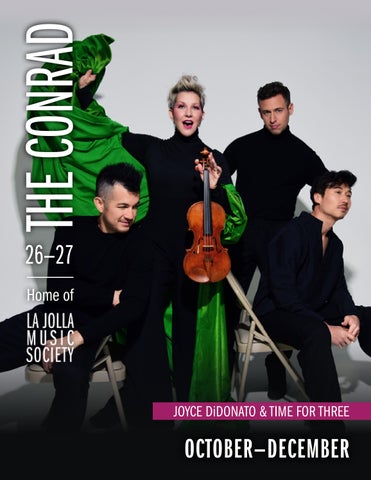
THE CONRAD 26—27 Home of
JOYCE DiDONATO & TIME FOR THREE
OCTOBER—DECEMBER 858.459.3728 • THECONRAD.ORG | 1
Calendar of Events SEPTEMBER 2026 FRED HERSCH TRIO SUNDAY, SEPTEMBER 20 · 5 PM & 7:30 PM Jazz @ The JAI
LINDA MAY HAN OH TRIO FRIDAY, SEPTEMBER 25 · 5:30 PM & 8 PM Jazz @ The JAI
OCTOBER 2026
Emanuel Ax
LES ARTS FLORISSANTS WILLIAM CHRISTIE, PAUL AGNEW, co-directors THE MAGIC OF MONTEVERDI FRIDAY, NOVEMBER 13 · 7:30 PM Revelle Chamber Music Series
MANUAL CINEMA LEONARDO! SUNDAY, NOVEMBER 15 · 3 PM The ConRAD Kids Series
JOYCE DiDONATO & TIME FOR THREE EMILY — NO PRISONER BE: A SONG CYCLE BY KEVIN PUTS THURSDAY, OCTOBER 8 · 7:30 PM
THE NAGHASH ENSEMBLE SUNDAY, NOVEMBER 22 · 3 PM
ProtoStar Innovative Series
DECEMBER 2026
POIESIS QUARTET SUNDAY, OCTOBER 11 · 3 PM
MEOW MEOW FELINE FESTIVE FRIDAY, DECEMBER 4 · 7:30 PM
Discovery Series
GABRIELA MONTERO, piano FRIDAY, OCTOBER 23 · 7:30 PM Piano Series
JOHN PIZZARELLI PRESENTS “DEAR MR. BENNETT” SATURDAY, OCTOBER 24 · 5:30 PM & 8 PM SUNDAY, OCTOBER 25 · 5 PM & 7:30 PM Jazz @ The JAI
LILA DOWNS: DIA DE MUERTOS CAMBIAS MI MUNDO THURSDAY, OCTOBER 29 · 7:30 PM Global Roots Series • Balboa Theatre
JEAN-GUIHEN QUEYRAS, cello & ALEXANDRE THARAUD, piano FRIDAY, OCTOBER 30 · 7:30 PM Recital Series
Global Roots Series
Special Event
CONNECT TO THE CONRAD HILARY HAHN, violin; MATTHIAS GOERNE, baritone; GLORIA CHIEN, piano SATURDAY, DECEMBER 5 · 7:30 PM Recital Series
EDMAR CASTAÑEDA QUARTET FRIDAY, DECEMBER 11 · 5:30 PM & 8 PM Jazz @ The JAI
LUKAS STERNATH, piano SUNDAY, DECEMBER 13 · 3 PM Discovery Series
THE HOT SARDINES FRIDAY, DECEMBER 18 · 7:30 PM Jazz Series
NOVEMBER 2026
JANUARY 2027
NEMANJA RADULOVIĆ & DOUBLE SENS SATURDAY, NOVEMBER 7 · 7:30 PM
EMANUEL AX, piano FRIDAY, JANUARY 8 · 7:30 PM
Revelle Chamber Music Series
Piano Series
MAGIC PIANO & THE CHOPIN SHORTS SATURDAY, JANUARY 23 · 10 AM & 11:30 AM The ConRAD Kids Series • The JAI
2 | THE CONRAD | HOME OF LA JOLLA MUSIC SOCIETY · 2026—27 SEASON
Wynton Marsalis
CAMILLE THURMAN WITH THE DARRELL GREEN QUARTET SUNDAY, JANUARY 24 · 5 PM & 7:30 PM Jazz @ The JAI
ERIKA WOOLSEY DIVING IN THE GREAT BARRIER REEF THURSDAY, JANUARY 28 · 7:30 PM Speaker Series
KRONOS QUARTET: PHILIP GLASS AT 90 SATURDAY, JANUARY 30 · 7:30 PM ProtoStar Innovative Series
ITZHAK PERLMAN IN THE FIDDLER’S HOUSE SUNDAY, JANUARY 31 · 7 PM
Global Roots Series • Jacobs Music Center
FEBRUARY 2027 JULIUS RODRIGUEZ FROM THE BENCH TO THE THRONE THURSDAY, FEBRUARY 4 · 5:30 PM & 8 PM Jazz @ The JAI
KODO ONE EARTH TOUR 2027 LUMINANCE FRIDAY, FEBRUARY 5 · 7:30 PM Special Event • Balboa Theatre
ANGEL STANISLAV WANG, piano SUNDAY, FEBRUARY 7 · 3 PM Discovery Series
BLACK GRACE SATURDAY, FEBRUARY 13 · 7:30 PM Dance Series • Balboa Theatre
ANAND VARMA EXPLORING NATURE’S HIDDEN WORLDS THURSDAY, FEBRUARY 18 · 7:30 PM Speaker Series
CIRCA THE ART OF FUGUE SATURDAY, FEBRUARY 20 · 7:30 PM ProtoStar Innovative Series
TYSHAWN SOREY TRIO SUNDAY, FEBRUARY 21 · 5 PM & 7:30 PM Jazz @ The JAI
Yuja Wang
Dreamers’ Circus
VÍKINGUR ÓLAFSSON, piano THURSDAY, FEBRUARY 25 · 7:30 PM Piano Series
JAZZ AT LINCOLN CENTER WITH WYNTON MARSALIS FRIDAY, FEBRUARY 26 · 7:30 PM Jazz Series • Jacobs Music Center
MARCH 2027 SEONG-JIN CHO, piano FRIDAY, MARCH 5 · 7:30 PM Piano Series
STANLEY CLARKE AND HIROMI ALONG WITH THE PUBLIQuartet SATURDAY, MARCH 6 · 7:30 PM Jazz Series • Balboa Theatre
JAEMIN HAN, cello & DAVID FUNG, piano THURSDAY, MARCH 11 · 7:30 PM Recital Series
ACADEMY OF ST MARTIN IN THE FIELDS SATURDAY, MARCH 13 · 3 PM & 7:30 PM Revelle Chamber Music Series
GOITSE SUNDAY, MARCH 14 · 5 PM & 7:30 PM Global @ The JAI
MARK MORRIS DANCE GROUP SATURDAY, MARCH 20 · 7:30 PM Dance Series • Civic Theatre
INMO YANG, violin SUNDAY, MARCH 21 · 3 PM Discovery Series
JODI ROWLEY WEIRD WORLD OF FROGS THURSDAY, MARCH 25 · 7:30 PM Speaker Series
Kurt Elling
AN EVENING WITH AUDRA McDONALD FRIDAY, APRIL 2 · 8 PM
ARTEMIS FRIDAY, MAY 7 · 7:30 PM
IL POMO D’ORO WITH MICHAEL SPYRES, baritenor SATURDAY, APRIL 3 · 7:30 PM
JASON MORAN & THE HARLEM HELLFIGHTERS JAMES REESE EUROPE AND THE ABSENCE OF RUIN SATURDAY, MAY 8 · 7:30 PM
Special Event WINTERFEST GALA
Revelle Chamber Music Series
Jazz Series / JAZZ MINI-FESTIVAL
SONA JOBARTEH, kora THURSDAY, APRIL 8 · 7:30 PM
ProtoStar Innovative Series / JAZZ MINI-FESTIVAL
DREAMERS’ CIRCUS SATURDAY, APRIL 10 · 5:30 PM & 8 PM SUNDAY, APRIL 11 · 5 PM & 7:30 PM
Jazz @ The JAI / JAZZ MINI-FESTIVAL
Global Roots Series
Global @ The JAI
NOGRAVITY THEATRE SATURDAY, APRIL 17 · 3 PM & 7:30 PM Dance Series
STEVE WINTER THE RACE TO SAVE BIG CATS THURSDAY, APRIL 22 · 7:30 PM Speaker Series
YUJA WANG, piano SATURDAY, APRIL 24 · 7:30 PM Piano Series • Jacobs Music Center
LAKECIA BENJAMIN FRIDAY, MAY 14 · 5:30 PM & 8 PM ALONZO KING LINES BALLET SATURDAY, MAY 15 · 7:30 PM
Dance Series / JAZZ MINI-FESTIVAL Civic Theatre
NADINE SIERRA, soprano BRYAN WAGORN, piano SUNDAY, MAY 16 · 7 PM Recital Series
ELENA MOON PARK AND FRIENDS SATURDAY, MAY 22 · 10 AM & 11:30 AM The ConRAD Kids Series • The JAI
ENDEA OWENS & THE COOKOUT THURSDAY, MAY 27 · 5:30 PM & 8 PM Jazz @ The JAI
MAY 2027 HIMARI, violin & CHELSEA WANG, piano SUNDAY, MAY 2 · 3 PM Discovery Series
JASON MORAN PRESENTS THE MUSIC OF DUKE ELLINGTON: MY HEART SINGS THURSDAY, MAY 6 · 7:30 PM Jazz Series / JAZZ MINI-FESTIVAL
APRIL 2027 WILDFLOWERS: KURT ELLING WITH CHRISTIAN SANDS THURSDAY, APRIL 1 · 5:30 PM & 8 PM Jazz @ The JAI
Mark Morris Dance Group
858.459.3728 • THECONRAD.ORG | 3
TRANSFORMATIVE SUPPORT
Our gratitude to these Medallion Society Pillars founding members who have made significant four-year commitments that will help us better serve all of the San Diego region. The Conrad can be a catalyst to bring thousands of adults and children together through a common appreciation of the performing arts, which enhance the artistic fabric of our community.
$1 MILLION and above
$1 MILLION and above
$1 MILLION and above
Brenda Baker and Steve Baum
Irwin and Joan* Jacobs
Dorothea Laub
$500,000 and above
$400,000 and above
$400,000 and above
Karen and Kit Sickels
Raffaella and John* Belanich
Eleanor and Ric* Charlton
$400,000 and above
$400,000 and above
$400,000 and above
Mary Ellen Clark
Jacqueline and Jean-Luc Robert
Debbie Turner
4 | THE CONRAD | HOME OF LA JOLLA MUSIC SOCIETY · 2026—27 SEASON
TRANSFORMATIVE SUPPORT
$400,000 and above
$200,000 and above
$200,000 and above
Marco Londei and Liqun Wang
Julie and Bert Cornelison
Herbert Solomon and Elaine Galinson
$200,000 and above
$200,000 and above
$200,000 and above
Keith and Helen Kim
Angel and Fred Kleinbub
Vivian Lim and Joseph Wong
$200,000 and above
$200,000 and above
Haeyoung Kong Tang
Sue and Peter Wagener
Thank you
to these Pillars in the community.
For information about supporting La Jolla Music Society through membership in the Pillars program, please contact Ferdinand Gasang at 858.526.3426 or FGasang@TheConrad.org. *in memoriam 858.459.3728 • THECONRAD.ORG | 5
6 | THE CONRAD | HOME OF LA JOLLA MUSIC SOCIETY · 2026—27 SEASON
TABLE OF CONTENTS CALENDAR OF EVENTS
2
TRANSFORMATIVE SUPPORT
4
ABOUT THE CONRAD
8
BOARD & STAFF OF LA JOLLA MUSIC SOCIETY
10
FROM THE CEO
11
JOYCE DiDONATO & TIME FOR THREE
12
POIESIS QUARTET
15
GABRIELA MONTERO
18
LILA DOWNS
22
JEAN-GUIHEN QUEYRAS & ALEXANDRE THARAUD
23
NEMANJA RADULOVIĆ & DOUBLE SENS
27
LES ARTS FLORISSANTS
30
THE NAGHASH ENSEMBLE
33
MEOW MEOW
34
HILARY HAHN, MATTHIAS GOERNE, GLORIA CHIEN
35
LUKAS STERNATH
41
THE HOT SARDINES
44
ARTIST PROFILES
45
THANK YOU FOR YOUR SUPPORT | DONOR LISTINGS
50
THE CONRAD Home of La Jolla Music Society
Todd R. Schultz President & CEO Leah Rosenthal Artistic Director MISSION STATEMENT Our mission is to enrich the evolving cultural landscape of San Diego by curating a dynamic array of world-class performing arts programming, creating meaningful learning opportunities, and building connections between artists and audiences.
Randall Goosby, Elli Choi, Inon Barnatan, Dimitri Murrath, Sterling Elliott, Yoonah Kim, Rose Lombardo
858.459.3728 • THECONRAD.ORG | 7
THE CONRAD Home of La Jolla Music Society
Vision Statement To transform lives through the performing arts, serving as a beacon of world-class artistic excellence, innovation, and inclusivity.
Mission Statement To enrich the evolving cultural landscape of San Diego by curating a dynamic array of world-class performing arts programming, creating meaningful learning opportunities, and building connections between artists and audiences.
The 2026−27 Season From classical, jazz, and dance to global music, exciting speakers, and family concerts, each season Artistic Director Leah Rosenthal brings the best artists in the world to the San Diego community. This season will feature more than 80 artists, including superstars like Audra McDonald, Itzhak Perlman, Joyce DiDonato, Emanuel Ax, KODO, Les Arts Florissants, Yuja Wang and many more.
Audra McDonald
Víkingur Ólafsson
SummerFest La Jolla Music Society’s acclaimed chamber music festival, curated by award-winning pianist and festival Music Director Inon Barnatan, celebrates its 40th anniversary in 2026. SummerFest engages more than 80 of the world’s finest musicians to perform at The Conrad throughout the month of August. In addition to remarkable mainstage performances, SummerFest offers over 50 free and open-to-the-public educational activities. To learn more, visit TheConrad.org/SummerFest.
Follow Us
@ljmusicsociety
La Jolla Music Society
8 | THE CONRAD | HOME OF LA JOLLA MUSIC SOCIETY · 2026—27 SEASON
Nathan Meltzer, Njioma Chinyere Grevious, Steven Osborne, Jonathan Swensen, Matthew Lipman
The Conrad The Conrad opened in 2019 and serves as a gathering place for cultural, arts education, and community activity. As the permanent home of La Jolla Music Society, The Conrad hosts worldclass performances presented by La Jolla Music Society and other local arts organizations in its four outstanding performance and activity spaces, The Baker-Baum Concert Hall, The JAI, The Atkinson Room, and the picturesque Wu Tsai QRT.yrd.
Ndudzo Makhathini, Melissa Aldana, Linda May Han Oh, Joe Lovano, Jeff “Tain” Watts
Learning & Engagement La Jolla Music Society’s award-winning Learning & Engagement Programming provides unmatched access and learning opportunities to more than 15,000 students and community members throughout San Diego County annually. With learning and engagement at the heart of our mission, we work closely with each visiting artist and ensemble to create outreach activities that highlight their unique talents and expertise at both The Conrad and in the community. With our state-of the-art video and streaming capabilities at The Conrad, we are able to provide live streaming for events such as our annual SummerFest and education events for free in our Digital Concert Hall.
Besos Jazz Trio
Land Acknowledgment The Conrad Prebys Performing Arts Center acknowledges the ancestral, unceded territory of the Kumeyaay people, on which The Conrad was built. We hold great respect for the land and the original people of the area where our performing arts center is located. The Kumeyaay continue to maintain their political sovereignty and cultural traditions as vital members of the San Diego community.
Table of Contents
858.459.3728 • THECONRAD.ORG | 9
BOARD OF DIRECTORS · 2026–27 Bert Cornelison - Chair Stacy Kellner Rosenberg - Vice Chair Mary Ellen Clark - Treasurer David Belanich - Secretary
Lehn Goetz John Hesselink Teresa Hixson Susan Hoehn David Kabakoff Vivian Lim Nancy Linke Patton Diana Lombrozo Sue Major Richard A. Norling Kazeem Omidiji Tom Rasmussen Sylvia Ré
Marla Bingham Eleanor Y. Charlton Sharon Cohen Ellise Coit Peter Cooper Ann Parode Dynes Jennifer Eve Debby Fishburn Stephen Gamp
Leah Rosenthal Sheryl Scarano Neal Schmale Todd Schultz Maureen Shiftan Jeanette Stevens Debbie Turner Liqun Wang Lise Wilson
HONORARY DIRECTORS Brenda Baker Stephen L. Baum Raffaella Belanich Joy Frieman, Ph.D Irwin M. Jacobs Joan Jacobs (1933—2024) Lois Kohn (1924—2010) Helene K. Kruger (1916—2019) Conrad Prebys (1933—2016) Peggy Preuss Ellen Revelle (1910—2009) Leigh P. Ryan, Esq. Dolly Woo
LA JOLLA MUSIC SOCIETY STAFF Todd R. Schultz President & CEO
Leah Rosenthal Artistic Director
Inon Barnatan SummerFest Music Director
ADMINISTRATION Casey McEnelly
PRODUCTION, OPERATIONS & FACILITIES Jamie Coyne Senior Director of Production & Operations
Tyler Merrihew Technical Director
David Ventura Assistant Technical Director
Chief Finance Officer
Dominic La Frantz
Sylvia Tierney
Technical Coordinator – Lighting Lead
Serafin Paredes Community Music Center Director Community Music Center Administrative Assistants:
Aimee Alvarado, Juan Villegas Community Music Center Instructors:
Marcus Cortez, David Garcia, Saul Garcia, Freddie Gonzales, Ian Lawrence, Anishka Lee-Skorepa, Sofia Magallanes, Juan Sanchez, Natalie Wheeler
MARKETING & GUEST SERVICES (REVENUE DIVISION) Stephanie Saad Communications & Public Relations Director
David Silva Marketing & Sales Director
Cristal Salow Database & Analytics Manager
Katherine Jenswold Digital Marketing Associate
Human Resources Manager
Sam Bedford
Breanne Self
Technical Coordinator & Stage Manager
REVENUE DIVISION
Jonathan Gellar
Mary Cook
Marsi Bennion
Production Manager
Chief Revenue Officer
Box Office & Guest Services Director
Caren Heintzelman
DEVELOPMENT (REVENUE DIVISION)
Patrick Mayuyu
Finance & Office Administrator
ARTISTIC Grace Smith Artistic Planning & Operations Director
Assistant Production Manager
Annie Stender
Graphic Designer
Box Office & Guest Services Manager
Sam Crowley
Production Coordinator & Stage Manager
Individual Giving & Development Operations Director
Jonnel Domilos
Wadeaa Jubran
Mitch Maker
Piano Technician
Donor Programs Manager
Colin Dickson
Wil Owen
Box Office Representative & Development Liaison
Facilities Manager
Donor Services & Stewardship Coordinator
Veronica Eddings
Evan Calderon
Nicole Slavik
Box Office & Guest Services Associate
Associate Facilities Engineer
Special Events & Catering Director
Shaun Davis
Kim Chevallier
Vivian Vu
House Manager
Security Guard
Special Events & Catering Manager
Lead Artist Liaison
LEARNING & ENGAGEMENT
Sarah Wood Torrey
Maggie de Lorimier
Allison Boles
Anne-Marie Dicce Artistic Planning Manager
George Pritzker Artistic Operations Manager
Juliet Zimmer Artistic Rentals & Partnerships Director
Braulio Fernandez-Flores Artistic Rentals Coordinator/ Assistant Front of House Manager
John Tessmer
Lauren Cernik-Price
Mariel Pillado
Institutional Giving Consultant
Artist Liaison
Senior Director of Learning & Engagement
GIFTS & ENDOWMENT
Isaac Pastrana
Jade Lewenhaupt
Ferdinand Gasang
Artist Liaison
Learning & Engagement Coordinator
Director of Principal Gifts & Endowment
Dana Rossi
Frida Ibarra
Artist Liaison
Music Education Programs Assistant
10 | THE CONRAD | HOME OF LA JOLLA MUSIC SOCIETY · 2026—27 SEASON
Box Office & Guest Services Lead
La Jolla Music Society’s 58 57 Season thth
Dear Friends, Welcome to the opening performances of our 2026–27 season, curated by Artistic Director Leah Rosenthal, whose discernment and connections continue to bring us the finest and most exciting artists from around the world. Your presence and continued support are the lifeblood of our organization, and we are grateful for your being part of it. Our first years at The Conrad Prebys Performing Arts Center have focused heavily on launching this premier venue, and our initial goals centered on establishing a vibrant home for great artists as an asset for and integral part of this community. This included developing seamless operational processes and building a foundation for sustainable success. Although we will always work toward constant improvement, thanks to your participation, we’ve achieved many of these early objectives. Building on this, our Board of Directors recently approved a new strategic plan. The process began with an assessment of where we are today and confirmation that we believe we’re headed in the right direction. The next five years will be a time to solidify who we are, reinforcing existing lines of programming while developing areas of greatest opportunity and growth, such as expanding our dance, jazz, and Global Roots programming, plus deepening our relationships with and programming for young artists and reaching out to more diverse audiences across San Diego. Thank you for being an integral part of our journey. Whether you are a lifelong subscriber or joining us for the first time or somewhere in-between, your passion makes our work possible. Warmly,
Todd R. Schultz President & CEO
Table of Contents
858.459.3728 • THECONRAD.ORG | 11
JOYCE DiDONATO, mezzo-soprano TIME FOR THREE, string trio EMILY — NO PRISONER BE Education Ambassador-in-Residence THURSDAY, OCTOBER 8, 2026 · 7:30 PM THE BAKER-BAUM CONCERT HALL
KEVIN PUTS (b. 1972)
Support for the ProtoStar Innovative Series is provided by:
ProtoStar Foundation Support for our vocal music programs is provided by:
Mary Ellen Clark La Jolla Music Society’s 2026–27 Season is supported by The City of San Diego Cultural Affairs, County of San Diego, Prebys Foundation, Farfy Foundation, ProtoStar Foundation, Vail Memorial Fund, The Lodge at Torrey Pines, Banc of California, ResMed Foundation, San Diego Theatres Foundation, Bright Events Rentals, Cafe Coyote, Rancho Coyote, GRNFC Hospitality Group, Ace Parking, Brenda Baker and Steve Baum, Raffaella Belanich, Gordon Brodfuehrer, Eleanor Charlton, Mary Ellen Clark, Bert and Julie Cornelison, Elaine Galinson and Herbert Solomon, Irwin Jacobs, Helen and Keith Kim, Angelina and Fred Kleinbub, Dorothea Laub, Vivian Lim and Joseph Wong, Jaqueline and Jean-Luc Robert, Marge and Neal Schmale, Karen and Kit Sickels, Jeanette Stevens, Debra Turner, Sue and Peter Wagener, Liqun Wang and Marco Londei, Anna and Edward Yeung, Bebe and Marvin Zigman, Anonymous.
EMILY — NO PRISONER BE They Shut Me Up I Was the Slightest in the House— The Soul Selects Her Own Society Again—His Voice Is at the Door— Interlude No. 1 I Dwell in Possibility Because I Could Not Stop For Death— A Bee I Personally Knew (Bee Scherzo No.1) I Felt a Funeral I Reason, Earth Is Short— A Little Snow I Tie My Hat—I Crease My Shawl “Hope” Is the Thing Interlude No. 2 The Props Assist the House There Is a Solitude of Space Could I But Ride Indefinite (Bee Scherzo No.2) So Set Its Sun in Thee Her Face Tell Her His Feet Are Shod with Gauze— (Bee Scherzo No.3) Wild Nights! There Is Another Sky ’Tis True—They Shut Me in the Cold— If I Can Stop One Heart From Breaking (On Praetorius Lo How a Rose E’er Blooming) No Prisoner Be— Joyce DiDonato, mezzo-soprano Time For Three, string trio Ranaan Meyer, bass, vocals; Nicolas Kendall, violin, viola, vocals; Charles Yang, violin, vocals
THE PERFORMANCE CONTAINS THEATRICAL HAZE AND STROBE LIGHTS. THERE IS NO INTERMISSION AND THE RUN TIME IS APPROXIMATELY 90 MINUTES. Joyce DiDonato last performed for La Jolla Music Society in a Special Event on December 7, 2024. Time For Three last performed for La Jolla Music Society in The JAI on November 5, 2022.
12 | THE CONRAD | HOME OF LA JOLLA MUSIC SOCIETY · 2026—27 SEASON
JOYCE DiDONATO & TIME FOR THREE — PROGRAM NOTES
Director Joyce DiDonato Production Designer Ryan J. O’Gara Stage Manager Lars Marcel Braun
Sound Engineer Colin Egan Tour Management & Producer Askonas Holt Time For Three General Management Park Avenue Artists
Time For Three Tour Management David Ross Dress Designer Metamorphoza Producers Joyce DiDonato, Ranaan Meyer, Nicolas Kendall, Charles Yang
Emily — No Prisoner Be has been generously supported by Mary Ellen Clark, Helen Berggruen for Five Arts Foundation, Gordon P. Getty, and Elaine Camarda & Morris Williams. The creation of Emily – No Prisoner Be was made possible by the Lead Commissioner, Bregenzer Festspiele; and Co-Commissioners Cal Performances at University of California, Berkeley; University of California, Santa Barbara Arts & Lectures; and Carnegie Hall.
EMILY — NO PRISONER BE
KEVIN PUTS
Born: January 3, 1972, St. Louis, Missouri Composed: 2025 Approximate Duration: 90 minutes
EMILY — NO PRISONER BE emerged through my collaboration with great performers from two different realms. The Hours—an opera based on the novel by Michael Cunningham with a libretto by Greg Pierce—was commissioned by the Metropolitan Opera and featured a trio of stars including Joyce DiDonato, who created the role of Virginia Woolf to rapturous acclaim. My creative work during the Covid-19 pandemic toggled between this mammoth project and another: a triple concerto called Contact for the dynamic string trio Time For Three. At some point during our work on Contact, the members of Time For Three and I realized we were having too much fun and needed to look ahead to another project in the near future. When the idea of an album of songs arose, I had just the singer in mind! I had a strong feeling the deep musical intuition, larger-than-life personalities and fiercely creative minds of all four of these powerhouse artists might gel in a very special way. I wasn’t wrong. But an album of songs based on what text? I stumbled upon this poem of Emily Dickinson and had the answer: They shut me up in Prose—As when a little Girl They put me in the Closet – Because they liked me “still” – Still! Could themself have peeped – And seen my Brain – go round – They might as wise have lodged a Bird For Treason – in the Pound – Himself has but to will And easy as a Star
Look down upon Captivity – And laugh – No more have I – Though Juilliard- and Curtis Institute-trained musicians of the highest caliber, Time For Three exudes the energy of a rock/ pop concert at its most exhilarating. I could imagine this energy right from the start, with “shredding” violin virtuosity ushering in Joyce’s first lines. The trio could even sing back her lines in counterpoint and provide harmonic support in the manner of Aretha Franklin’s backup singers. In short, I could see from the start this wasn’t going to be your grandmother’s Emily Dickinson song cycle. The breadth of the entire work became vaguely apparent in my mind, a rather massive journey through Dickinson’s poetry framed by her refusal to be contained in “prose,” or—put less poetically—within the confines of conventional religious ideology, societal norms of the era, traditional social conventions or even sexual identity. Though she famously cloistered herself in a room in her father’s house for much of her life, she would be a prisoner of nothing and no one. To be sure, there is nothing groundbreaking in the choice to set Emily Dickinson’s poetry to music, and admittedly my mention of it caused a few eyes to roll in the early stages. In fact, according to David Nirenberg, Director of Princeton’s Institute for Advanced Studies who graciously hosted the five of us for two immensely productive workshops, there have been over 3,000 musical settings of Emily Dickinson’s poetry. It positively cries out to be sung. There is music in every line, every word, and in the spaces between the words. It inspires rhythm, harmony, melody, musical atmosphere—it leaps off the page in a way composers have been unable to resist. So I simply began to set poems—some well-known, some more obscure—as I discovered them, writing quickly and with little sense of where each song might eventually appear sequentially in the cycle. This approach to form represented a departure from the way I normally work, and frankly it made me nervous. Not until I began workshopping the various songs with Joyce and Time For Three did I discover we could allow
Table of Contents
858.459.3728 • THECONRAD.ORG | 13
JOYCE DiDONATO & TIME FOR THREE — PROGRAM NOTES the music to dictate the course of things. Historians have relied on Dickinson’s handwriting to make rough guesses as to when in her life a poem was written, but we do not know the precise order. It seems she wrote them as the spirit moved her. So once I disavowed myself any obligation to preserve chronology or give the work a sequential thematic structure, isolated songs began to coalesce into small groups of songs. Dickinson enjoyed a particular fascination with bees, judging from the number of poems written about them, so I found myself composing “bee scherzos” which serve the dual function of showcasing Time For Three’s virtuosity and giving Joyce’s voice a much-needed rest during this rather colossal cycle. In fact, I was delighted to find that, in her indispensable book Dickinson, Helen Vendler fittingly describes the following as a “winsomely playful scherzo”: Bee! I’m expecting you! Was saying Yesterday To Somebody you know That you were due — The Frogs got Home last Week — Are settled, and at work — Birds, mostly back — The Clover warm and thick — You’ll get my Letter by The seventeenth; Reply Or better, be with me — Yours, Fly. These scherzos also serve as connective material between clusters of songs. Sometimes I even found myself flipping through Dickinson’s 1,800 poems to find one whose musical setting might close a “gap” in a similar way within the arc of the whole piece.
Though the intention of a poem like the wonderful “I Dwell in Possibility” is clear enough, others are more resistant to interpretation, at least for this composer. Again, to quote Tendler, “like all capacious writers, she baffles complete understanding,” yet these more enigmatic offerings often create the most alluring space for musical setting. For example, the following: So set its Sun in Thee What Day be dark to me—What distance— far— So I the Ships may see That touch—how seldomly—Thy Shore? There is the sense of longing for something just out of reach, and there is the setting sun and the gentle rhythm of the tide. And for me, that is enough. In my program note for The Hours, I described a rather metaphysical experience after spending so much time considering the predicaments and motivations of Virginia Woolf, albeit through a second-hand incarnation of the great writer formed in the mind of Michael Cunningham. It truly began to feel as if she was in the room with me as I grafted melodies and harmonies onto her story. I experienced something similar with the ghost of Georgia O’Keeffe as I mined hundreds of her letters to create The Brightness of Light for Renée Fleming. Emily Dickinson also stopped by my little third-floor office in Yonkers, New York (it’s getting crowded up here!). And when I visited Dickinson’s house in Amherst, Massachusetts, in summer 2024, I felt an odd familiarity and sense of recognition, though undoubtedly one formed by my own projecting and romanticizing. But this is, after all, what we do with our heroes. — Kevin Puts
Joyce DiDonato and Time For Three invite you to fill out the response cards made available in the lobby, answering the question “WHERE DO YOU FIND LIBERTY?” after the performance. The responses will be collected or handed in at the end of the show.
14 | THE CONRAD | HOME OF LA JOLLA MUSIC SOCIETY · 2026—27 SEASON
PRELUDE 2 PM Musical Prelude by students from the Colburn School
POIESIS QUARTET SUNDAY, OCTOBER 11, 2026 · 3 PM THE BAKER-BAUM CONCERT HALL
PROKOFIEV String Quartet No. 1 in B Minor, Opus 50 (1891–1953) Allegro Andante molto—Vivace Andante JEFF SCOTT
(b. 1957)
Tapestry of the Beloved Beatified
INTER MISSION
Support for the Discovery Series and Musical Prelude is provided by:
Gordon Brodfuehrer Jeanette Stevens La Jolla Music Society’s 2026–27 Season is supported by The City of San Diego Cultural Affairs, County of San Diego, Prebys Foundation, Farfy Foundation, ProtoStar Foundation, Vail Memorial Fund, The Lodge at Torrey Pines, Banc of California, ResMed Foundation, San Diego Theatres Foundation, Bright Events Rentals, Cafe Coyote, Rancho Coyote, GRNFC Hospitality Group, Ace Parking, Brenda Baker and Steve Baum, Raffaella Belanich, Gordon Brodfuehrer, Eleanor Charlton, Mary Ellen Clark, Bert and Julie Cornelison, Elaine Galinson and Herbert Solomon, Irwin Jacobs, Helen and Keith Kim, Angelina and Fred Kleinbub, Dorothea Laub, Vivian Lim and Joseph Wong, Jaqueline and Jean-Luc Robert, Marge and Neal Schmale, Karen and Kit Sickels, Jeanette Stevens, Debra Turner, Sue and Peter Wagener, Liqun Wang and Marco Londei, Anna and Edward Yeung, Bebe and Marvin Zigman, Anonymous.
SKY MACKLAY
Many Many Cadences
(b. 1988)
BEETHOVEN String Quartet No. 16 in F Major, Opus 135 (1770–1827) Allegretto Vivace Lento assai, cantante e tranquillo Der schwer gefasste Entschluss. Grave, ma non troppo tratto Allegro Poiesis Quartet Sarah Ying Ma, Coco Mi, violins; Jasper de Boor, viola; Drew Dansby, cello This performance marks Poiesis Quartet’s La Jolla Music Society debut.
Table of Contents
858.459.3728 • THECONRAD.ORG | 15
POIESIS QUARTET — PROGRAM NOTES Program notes by Scott Foglesong, except where indicated.
String Quartet No. 1 in B Minor, Opus 50
SERGEI PROKOFIEV Born: April 23,1891, Sontsovka, Ukraine Died: March 5, 1953, Moscow, Russia Composed: 1930 Approximate Duration: 24 minutes
Prokofiev’s youthful reputation as the Brat Prince of Russian music belies the rich vein of traditionalism that runs through his catalog. Not only was he partial to established instrumental genres such as sonata, symphony, and concerto, but he also made extensive use of their associated forms—sonata-allegro, variation, and rondo. That said, chamber music wasn’t really his cup of tea. Apart from a handful of duo sonatas, a wind quintet, and an oddball sextet that he later orchestrated, he wrote only two (excellent) string quartets. That’s quite the contrast to his colleague Dmitri Shostakovich, whose fifteen quartets served as intensely personal vehicles for his innermost thoughts and emotions. Prokofiev was nearly 40 when he began work on his first quartet, so he studied the Beethoven quartets as preparation for writing in an unfamiliar medium. His diligence paid off in the masterful quartet he submitted to the Library of Congress’ Elizabeth Sprague Coolidge Foundation, which had commissioned the work in 1930. One of the finest products of Prokofiev’s expatriate years in Europe and America, there’s absolutely nothing of the “first attempt” about it, nor does it give the slightest hint that its author was anything other than a born chamber music composer. Structured in three movements, of which the second serves a dual purpose as slow movement and scherzo, it both honors and builds on the achievements of its predecessors. The first movement Allegro is cast in the sonata-allegro form that was the norm for Haydn, Mozart, Beethoven, and just about every other quartet writer worth mentioning. It’s a large-scale treatment, making use of a secondary theme that, in addition to being in the requisite contrasting key, is also in a noticeably slower tempo. After a “closing” theme with a distinct marchlike quality, the extended development section features one of Haydn’s favorite tricks, a so-called “false reprise” that sounds like the commencement of the recapitulation but is in fact a mirage; the real recapitulation comes later. The second-place Andante molto starts out like a carefully layered slow movement, filled with markings such as dolce e tranquillo (sweet and tranquil) and gravamente (gravely). That lasts for a mere 14 bars, however, and what follows is a quicksilver Vivace in Prokofiev’s Sunday-best scamper mode, always maintaining a high temperature throughout its numerous sections. Then comes the quartet’s most striking departure from tradition, by way of an introverted Andante finale in lightly undulating triple meter that gradually intensifies to a crisis-like climax, fortissimo, before gradually settling back to the hushed mood of its opening. Prokofiev was justifiably proud of this movement, so much so that he transcribed it twice: first for string
orchestra (Opus 50bis) and then for solo piano in his Opus 52 Pieces for Piano.
Tapestry of the Beloved Beatified
JEFF SCOTT
Born: 1967, Queens, New York Composed: 2026 Approximate Duration: 18 minutes
Jeff Scott’s Tapestry of the Beloved Beatified honors queer radicals in history, including Marsha P. Johnson and Harvey Milk, by canonizing them as saints. The music uses a range of musical traditions from Africa, including dance rhythms, spoken prayer-like text in languages between Yoruba and Latin, and mimicry of the mbira, a traditional West African fingerplucking instrument. There are emotions ranging from violence and sadness to hope and celebration. It’s a really beautiful and reflective work! —Poiesis Quartet
Many Many Cadences
SKY MACKLAY
Born: 1988, Waseca, Minnesota Composed: 2016 Approximate Duration: 8 minutes 30 seconds
Let me introduce Sky Macklay’s Many Many Cadences by sharing a story from my five decades of teaching music theory to conservatory undergraduates. During a one-on-one meeting, I was obliged to inform a student that his structural analysis of a Haydn piece was fundamentally incoherent. He didn’t believe me at first. I explained that because he had ignored Haydn’s cadences, he had mis-identified most of the phrases, and that pretty much wiped out his entire presentation. I reminded him that a phrase is defined as “a coherent musical unit ending with a cadence, i.e., a harmonic close.” I also reminded him that I had spent considerable class time going over the many types of cadences and their usage. He mulled that over for a bit. Then he burst out in exasperation: “Oh, cadences … SCHMADENCES!!” Cadences-schmadences are the stars of Many Many Cadences, more cadences than you can shake a stick at. Fast cadences, slow cadences, resolved cadences, unresolved cadences, soothing cadences, irritating cadences, normal cadences, weird cadences. All cadences. “Heaping nothing but cadences on top of one another is a little like an America’s Funniest Home Videos highlight reel of dads getting head-butted by waist-high toddlers,” wrote violist Doyle Armbrust of the Spektral Quartet, for whom Macklay composed the work. Having taught at The Walden School and now at the Peabody Conservatory, Sky Macklay is devoted to “weird contemporary music and sharing it with the next generation.” She explains that “I think a lot of it is sharing my own personal perspective—just to show how much a particular sound excites me and how beautiful I think it is.”
16 | THE CONRAD | HOME OF LA JOLLA MUSIC SOCIETY · 2026—27 SEASON
POIESIS QUARTET — PROGRAM NOTES
String Quartet No. 16 in F Major, Opus 135
LUDWIG VAN BEETHOVEN Born: December 16, 1770, Bonn, Germany Died: March 26, 1827, Vienna, Austria Composed: 1826 Approximate Duration: 26 minutes
A special aura hovers about Beethoven’s final five string quartets. That’s very much as it should be, for they encapsulate the distilled essence of Beethoven in his last years. But they needn’t be intimidating. Stories about an emotionally isolated Beethoven writing solely for posterity, guided only by the dictates of his inner ear and unconcerned with pleasing his audience, are best taken with a grain of salt. Far better to let the music—and the actual evidence—speak for itself. Consider that Beethoven wrote three of the five late quartets on commission and planned to publish the remaining two. They were distinctly commercial endeavors that he wanted to succeed. He was delighted when several movements of his Opus 130 quartet were encored at the première. He even supplied Opus 130 with a new, lighter finale when the original Grosse Fuge proved indigestible to performers and listeners alike. Clearly, Beethoven was concerned about pleasing his audience. Which leads to Opus 135, among the most approachable of Beethoven’s late works. His choice of F Major is revealing: that’s Beethoven’s key for lyrical, upbeat optimism, such as the sixth and eighth symphonies and the “Spring” violin sonata. So it is with Opus 135, sometimes portrayed as a throwback to the style of Mozart and Haydn but more accurately described as a prime specimen of Beethoven’s most transparent and streamlined mode. It’s his last completed major composition— followed only by the replacement finale for Opus 130—but it doesn’t give off a final-testament vibe. Its overall demeanor is lighthearted, remarkable given the chaos attending Beethoven’s last year and his near-desperate concern over his nephew Karl’s suicide attempt. There’s a calligraphic quality to the opening Allegretto. A bouncy primary theme is passed around from instrument to instrument, contrasted by a robust secondary theme accompanied by triplet figurations. The second movement is a tour de force in which the basic elements of a scherzo-and-trio are dropped into a pressure cooker, there to be shrunk, compressed, and superheated. The third-place Lento assai, cantante e tranquillo blends a classic three-part layout with subtle variations of its main theme, the whole treated with sustained, concentrated serenity leavened by the occasional outburst. Then comes the finale, and with it, an enigma: what did Beethoven mean by the title “The Difficult Decision,” followed by melodic snippets that set “Must it be?” and “Yes, it must!” Acres of metaphysical and/or existential commentary notwithstanding, this may be little more than a bit of Beethovenian snark along the lines of “Must I write this? Yes, I must!” Otherwise one must conclude that the philosophical pearls are well concealed in this high-spirited movement that brings Beethoven’s entire cycle of sixteen string quartets to a rousing close with a textbook-perfect fortissimo cadence in gleaming F Major.
Table of Contents
858.459.3728 • THECONRAD.ORG | 17
GABRIELA MONTERO, piano FRIDAY, OCTOBER 23, 2026 · 7:30 PM THE BAKER-BAUM CONCERT HALL
SCARLATTI
Sonata in C-Sharp Minor, K. 247
(1685–1757)
SOLER
PRELUDE 6:30 PM Lecture by Kristi Brown-Montesano
(1729–1783)
Sonata in C-Sharp Minor, R. 21 Sonata in G Major, R. 45
SCARLATTI
Sonata in G Major, K. 427
ALBÉNIZ
Triana from Iberia, Book II
(1860–1909)
GRANADOS
8 Valses Poéticos Introducción. Vivace molto Melodico Tempo de Vals noble Tempo de Vals lento Allegro humoristico Allegretto (elegante) Quasi ad libitum (sentimental) Vivo Coda. Presto - Andante - tempo dil 1.º Vals
CHOPIN
Scherzo No. 3 in C-Sharp Minor, Opus 39
(1867–1916)
(1810–1849)
INTER MISSION
ALBÉNIZ
Sevilla from Suite española, Opus 47
CHOPIN
Boléro, Opus 19
DE LARROCHA
Minué Triste Sueño Infantil
(1923–2009)
La Jolla Music Society’s 2026–27 Season is supported by The City of San Diego Cultural Affairs, County of San Diego, Prebys Foundation, Farfy Foundation, ProtoStar Foundation, Vail Memorial Fund, The Lodge at Torrey Pines, Banc of California, ResMed Foundation, San Diego Theatres Foundation, Bright Events Rentals, Cafe Coyote, Rancho Coyote, GRNFC Hospitality Group, Ace Parking, Brenda Baker and Steve Baum, Raffaella Belanich, Gordon Brodfuehrer, Eleanor Charlton, Mary Ellen Clark, Bert and Julie Cornelison, Elaine Galinson and Herbert Solomon, Irwin Jacobs, Helen and Keith Kim, Angelina and Fred Kleinbub, Dorothea Laub, Vivian Lim and Joseph Wong, Jaqueline and Jean-Luc Robert, Marge and Neal Schmale, Karen and Kit Sickels, Jeanette Stevens, Debra Turner, Sue and Peter Wagener, Liqun Wang and Marco Londei, Anna and Edward Yeung, Bebe and Marvin Zigman, Anonymous.
(1893–1987)
MOMPOU
Cançó i dansa No. 6 Cançó Dansa
GRANADOS
Andaluza from 12 Danzas españolas
ALBÉNIZ
Eritaña from Iberia, Book IV
LISZT Rhapsodie Espagnole, S. 254 (1811–1886) Gabriela Montero, piano Gabriela Montero last performed with La Jolla Music Society during SummerFest on August 18, 2010.
18 | THE CONRAD | HOME OF LA JOLLA MUSIC SOCIETY · 2026—27 SEASON
GABRIELA MONTERO — PROGRAM NOTES
Sonata in G Major, K. 427
Program notes by Scott Foglesong
DOMENICO SCARLATTI
Sonata in C-Sharp Minor, K. 247
Composed: c. 1750s Approximate Duration: 3 minutes
DOMENICO SCARLATTI
Scarlatti’s Sonata K. 427 in G Major eschews the dance in favor of a glittering and propulsive toccata (touch piece) that instructs the performer to play as fast as possible.
Born October 26, 1685, Naples Died July 23, 1757, Madrid Composed: c. 1750s Approximate Duration: 5 minutes
Domenico Scarlatti offers encouragement for senior citizens everywhere. He was well past fifty when his first collection of ‘keyboard exercises’ (a.k.a. sonatas) was published. It’s too bad that we don’t know all that much about him; he kept his private life private and tended to stay put. That may be a reaction to his unsettled upbringing with his brilliant but self-destructive father Alessandro, an A-list composer with a knack for snatching defeat from the jaws of victory. Scarlatti’s approximately 550 keyboard sonatas are two-part affairs that thrum with the idioms of his adopted homelands of Portugal and Spain; transitional works between Baroque and Classical, their textures lean towards homophony, i.e., melodies with chords, with imitative counterpoint kept to a bare minimum. Overall, they aim for glittering keyboard effects and memorable melodies, their moods ranging from sweetly introverted to flamboyantly exhibitionist, often manifesting dancelike qualities. The Sonata K. 247 in C-Sharp Minor has all the hallmarks of the passepied, with its quick triple meter and dotted rhythms.
Sonata in C-Sharp Minor, R. 21
ANTONIO SOLER Born December 3, 1729, Olot, Catalonia, Spain Died December 20, 1783, Madrid Composed: c. 1760s Approximate Duration: 5 minutes
Naples-born Scarlatti was an immigrant to Iberia, but his younger colleague Antonio Soler was a native Catalonian who spent most of his life in Castile. He wrote 150 someodd Scarlatti-ish keyboard sonatas, but his extensive output also included considerable liturgical music. Some of Soler’s keyboard sonatas look to the future by being in three or even four movements, but most of them follow the Scarlatti template. The Sonata R. 21 in C-Sharp Minor takes on the style of a gigue, that standard finale of Baroque suites, characterized by a roly-poly compound meter that divides its beats into threes. (Think “Row, Row, Row Your Boat” for a familiar example.)
Sonata in G Major, R. 45 Composed: c. 1760s Approximate Duration: 4 minutes
Triana from Iberia, Book II
ISAAC ALBÉNIZ
Born: May 29, 1860, Camprodon, Catalonia, Spain Died: May 18, 1909, Cambo-les-Bains, France Composed: 1905–09 Approximate Duration: 5 minutes
Spain’s leading late-Romantic composers, Isaac Albéniz and Enrique Granados, run a distinct risk of being compounded into a fellow named Granadosandalbéniz, along the lines of those eminent composers Debussyandravel and Mozartandhaydn. Much like their fused counterparts, the two Spanish masters were more different than alike; Granados was the broadly Romantic virtuoso pianist with a Lisztian flair, while Albéniz’s distinctly impressionistic idiom pushes a pianist’s technique to the breaking point and then some. Critic Donal Henahan hit the nail on the head by pointing out that “there is really nothing in Isaac Albéniz’s Iberia that a good three-handed pianist could not master, given unlimited years of practice and permission to play at half tempo.” Even by Iberia’s vaunting technical standards, Triana poses a massive challenge for pianists. (According to some sources, Albéniz himself cheated a bit when playing it.) It’s a joyous, celebratory piece that portrays the vibrant street and public life in the Triana district of Seville, especially during the summer festivals when people drink sherry, dance the sevillanas, and munch roasted sardines.
8 Valses Poéticos
ENRIQUE GRANADOS
Born: July 27, 1867, Lérida, Spain Died: March 24, 1916, English Channel (aboard the passenger ship SS Sussex) Composed: c. 1889 Approximate Duration: 12 minutes
Granados’ Valses Poéticos may be showy virtuoso piano works, but they are vastly more manageable than Iberia. Nor are they overtly programmatic. Instead, they channel those elegant waltzes of keyboard composers such as Schubert and Liszt. Each of the waltzes is short, either in two-part or three-part form, and some (such as No. 7) offer late-Romantic pianistic fireworks galore.
Soler’s Sonata R. 45 in G Major may be less showy, but within all that suave smoothness there lies an uninhibited virtuoso spirit.
Table of Contents
858.459.3728 • THECONRAD.ORG | 19
GABRIELA MONTERO — PROGRAM NOTES
Scherzo No. 3 in C-Sharp Minor, Opus 39
FRÉDÉRIC CHOPIN Born: March 1, 1810, Żelazowa Wola, Poland Died: October 17, 1839, Paris Composed: 1839 Approximate Duration: 7 minutes
Despite his popular image as the ultimate Romantic composer, Frédéric Chopin disliked romanticism and had little regard for the extra-musical associations so popular with his colleagues. Holding himself as heir to the Viennese Classical tradition, he eschewed descriptive titles for his compositions, so you will look in vain for a Chopin piece called By a Mountain Brook or Portrait of Manon. Instead, Chopin identified his works with abstract titles such as impromptu and prelude, or as dances such as waltzes and polonaises, or by formal identifiers such as sonata, ballade, and scherzo. Alas, posterity has supplied an assortment of fanciful names anyway—consider the “Winter Wind” and “Revolutionary” études or the “Raindrop” prelude. Frédéric would not have been amused. Anybody carrying around a notion of Chopin as the writer of pastel “sickroom music” is sure to be disabused of same by the four Scherzi, moderate-length piano showpieces that savor of Lisztian virtuosity and heroic effects. Scherzo No. 3 is marked “Presto con fuoco,” and that third word—fire—speaks volumes about the emotional tenor of this astonishing piece. Even its relatively calm contrasting interlude, featuring a chorale-like melody interwoven with shimmering passagework, retains a caloric vibe amidst its composure. But all repose is thrown aside in a sizzling coda that brings the piece to an appropriately superheated close.
Sevilla from Suite española, Opus 47
ALBÉNIZ
Composed: 1886 Approximate Duration: 5 minutes
Ever since its birth in 1886, Sevilla, Albéniz’s popular evocation of Andalusian life, has really gotten around. Even if nowadays it’s usually encountered in one of its several guitar transcriptions, the piano is its home base. As such, it’s one of the most accessible of Albéniz’s keyboard compositions—i.e., it doesn’t require superhuman technical skill. (Not that it’s exactly kid’s stuff.) Cast in the ubiquitous three-part form found in keyboard compositions from Schubert through Debussy and beyond, it juxtaposes a recitative-like central episode, shot through with moments of lyrical melancholy, against the irresistibly toe-tappy rhythms of its main reprise.
Boléro, Opus 19
CHOPIN
Composed: 1833 Approximate Duration: 7 minutes
Chopin wrote a lot of dance-inspired piano pieces, very much in keeping with the overall tenor of his age when it
seemed that just about everybody had a piano and was taking piano lessons or forcing them on their kids. Composers were only too happy to supply a burgeoning amateur market for keyboard dances, their technical demands as modest as their page counts. Furthermore, the era’s barnstorming piano virtuosos depended on audience goodwill for their livelihood, and to that end often programmed music that employed rhythmic patterns likely to be familiar among people from whom dancing was an essential component of social life. Chopin’s waltzes and polonaises are his best-known dance pieces, but there’s also a single piece with an Iberian title: the Boléro of 1833, a product of his early years as a darling of fashionable Parisian salon society—consider its dedication to the Countess Émilie de Flahault. It’s a matter of conjecture just how Spanish the piece really is; on the whole it manifests more Polish. In fact, some have dubbed it Boléro à la Polonaise in recognition of the polonaise-like rhythm of its main section.
Minué Triste Sueño Infantil
ALICIA DE LARROCHA Born: May 23, 1923, Barcelona Died: September 25, 2009, Barcelona Composed: 1943, 1941 Approximate Duration: 1 minute; 2 minutes
Alicia de Larrocha was all of nine years old when she made a recording of the Chopin A-minor waltz. She was such an itty-bitty little thing that her feet couldn’t reach the pedals, so she had to depend entirely on her fingers for legato. But there’s nothing childish about her performance; she plays like a seasoned Romantic, with lovely tone and a finely honed rhythmic flexibility. All in all, it could be the playing of a much older musician. What followed was one of the finest performing careers of the 20th century as she graced audiences with her always-welcome presence for decades to come. In her early days de Larrocha wrote a bouquet of short, fragrant piano pieces, some scented with the idioms of her Spanish homeland, others more in keeping with the piano works of composers such as Chopin, Schumann, and Schubert. Minué Triste is an ultra-brief morceau that combines the stately rhythm of a classic Minuet with a distinctly Iberian, albeit melancholic, flair. A sweet portrait of childhood dreams, Sueño Infantil captures the innocence of nap-time with its lullaby-like melody and soothing rhythm.
Cançó i dansa No. 6
FREDERICO MOMPOU Born: April 16, 1893, Barcelona Died: June 30, 1987, Barcelona Composed: 1942–43 Approximate Duration: 4 minutes
“The music of evaporation,” according to British pianist Stephen Hough, who adds that “we are in a glasshouse, and the
20 | THE CONRAD | HOME OF LA JOLLA MUSIC SOCIETY · 2026—27 SEASON
GABRIELA MONTERO — PROGRAM NOTES resulting transparency is unnerving, for it creates a reflection in which our face and soul can be seen.” Mompou, born in Barcelona but educated largely in Paris, was at least as influenced by French composers such as Ravel and Satie as he was by the music of his native Catalonia. His piano works run short and improvisatory, whiffs of emotion in a bottle. Consider his long series of Cançons i danses, written between 1918 and 1972. Each starts with a meditative, introverted song that then gives way to a dance infused with native folk rhythms. In Cançó i dansa No. 6 the “dance” part manifests a particularly Latin rhythm in which triple divisions alternate with duple, sure to be familiar to listeners from Leonard Bernstein’s “America” from West Side Story: I like to BE in A-MER-I-CA. It’s one of Mompou’s most effective piano pieces and was played frequently by master pianist Arthur Rubinstein, to whom it is dedicated. (Rubinstein gifted posterity with a terrific recording. It wasn’t released during his lifetime, but it’s easily available nowadays.)
Andaluza from 12 Danzas españolas
GRANADOS Composed: 1890 Approximate Duration: 4 minutes
Folk idioms can be employed in a wide variety of ways, including the oh-so-simple expedient of slapping a harmonization on a folk tune and letting it go at that. Fortunately, first-rate composers bring a wide culture to their folk-based concert music, often subjecting the original materials to significant reinterpretations, thereby building bridges between the basic simplicity of folk music and the sophistication of the concert hall. Enrique Granados did that as well as anyone, especially with his twelve Spanish dances, written while he was in his twenties. They rank along his most popular pieces, not only in their original guises for solo piano, but in a host of transcriptions and orchestrations. The dances are organized in four volumes of three pieces each, of which Andaluza is found in the second volume. Often described as the crown jewel of the set, it distills the very essence of duende, or the deep emotional power, of Andalusian flamenco, described by Federico García Lorca as a dark, vital energy that rises up from the soles of the feet. Spanish Romanticism has never hummed with more ardor than in this fragrant masterpiece in miniature.
for a more subdued central interlude; instead, the rhythms of the sevillanas sustain throughout. In a suite of pieces renowned for both their staggering technical difficulty and their startling originality, Eritaña ranks highly on both counts. Claude Debussy even went so far as to claim it as the standout piece of the Iberia cycle.
Rhapsodie Espagnole, S. 254
FRANZ LISZT
Born: October 22, 1811, Raiding, Hungary Died: July 31, 1886, Bayreuth, Germany Composed: 1863 Approximate Duration: 12 minutes
Ah, the Liszt Spanish Rhapsody, ubiquitous presence on recital programs and piano competitions everywhere. That has led it to be discounted as an over-familiar virtuoso chestnut, but if we can listen to it with fresh ears—not an easy task for most piano aficionados—what is revealed is an effective showpiece that combines skilled construction with an unabashed joy in pianistic derring-do. Liszt was one of Europe’s pioneering touring virtuosos, and as such he needed plenty of high-octane repertory to fill the hall and thrill his listeners. The Spanish Rhapsody is a particularly enticing entry in the La Folia sweepstakes, that familiar 15th-century Iberian tune that has provided fodder for the imaginations of composers including Vivaldi, Corelli, and Rachmaninoff. (For trivia buffs: La Folia started out as bass line used by instrumentalists to improvise dance music; the tune attached itself later.)
Eritaña from Iberia, Book IV
ALBÉNIZ
Composed: 1908 Approximate Duration: 4 minutes
Imitations of hand clapping and rhythmic guitar strumming kick off Eritaña, the twelfth and final piece of Iberia. Albeniz’s inspiration was the Venta de Eritaña, a tavern on the outskirts of Seville that was renowned for its flamenco dancing. Unlike many of the Iberia portraits, Eritaña doesn’t let up the energy
Table of Contents
858.459.3728 • THECONRAD.ORG | 21
PRELUDE 6:30 PM Lecture
LILA DOWNS
DÍA DE MUERTOS CAMBIAS MI MUNDO THURSDAY, OCTOBER 29, 2026 · 7:30 PM BALBOA THEATRE
Lila Downs, vocals Geroge Saenz Jr., trombone, accordion Josh Deutsch, trumpet, keyboards Rafael Gomez, electric and acoustic guitars Luis Guzman, bass, synth Sinuhe Padilla, jarana, bajo acoustic Nakeiltha Campbell, percussion Lautaro Burgos, drums DanzArts, ballet folklorico
PROGRAM Works to be announced from the stage. THIS PERFORMANCE HAS NO INTERMISSION AND IS APPROXIMATELY 90 MINUTES.
ABOUT La Jolla Music Society’s 2026–27 Season is supported by The City of San Diego Cultural Affairs, County of San Diego, Prebys Foundation, Farfy Foundation, ProtoStar Foundation, Vail Memorial Fund, The Lodge at Torrey Pines, Banc of California, ResMed Foundation, San Diego Theatres Foundation, Bright Events Rentals, Cafe Coyote, Rancho Coyote, GRNFC Hospitality Group, Ace Parking, Brenda Baker and Steve Baum, Raffaella Belanich, Gordon Brodfuehrer, Eleanor Charlton, Mary Ellen Clark, Bert and Julie Cornelison, Elaine Galinson and Herbert Solomon, Irwin Jacobs, Helen and Keith Kim, Angelina and Fred Kleinbub, Dorothea Laub, Vivian Lim and Joseph Wong, Jaqueline and Jean-Luc Robert, Marge and Neal Schmale, Karen and Kit Sickels, Jeanette Stevens, Debra Turner, Sue and Peter Wagener, Liqun Wang and Marco Londei, Anna and Edward Yeung, Bebe and Marvin Zigman, Anonymous.
Lila Downs, one of Latin America’s most influential voices with a singular sound and magnetic stage presence, is bringing a powerful live performance that seamlessly blends the essence of her 2026 album, Cambias mi Mundo (You Change My World), with the rich traditions of Día de Muertos. Rooted in Oaxaca and celebrated on prestigious global stages like Carnegie Hall, Downs turns this show into an intimate, fearless, and deeply human gathering. Audiences will experience a voyage of emotions, movement, and sound where her most acoustic and intimate original songs from Cambias mi Mundo meet deeply personal renditions of classic rancheras. Through this unique musical fusion, the concert invites the audience to dance, feel, and honor the sacred tradition of remembering the departed on both sides of the border. Lila Downs last performed for La Jolla Music Society in the Global Roots Series on October 22, 2023.
22 | THE CONRAD | HOME OF LA JOLLA MUSIC SOCIETY · 2026—27 SEASON
JEAN-GUIHEN QUEYRAS, cello & ALEXANDRE THARAUD, piano FRIDAY, OCTOBER 30, 2026 · 7:30 PM THE BAKER-BAUM CONCERT HALL
POULENC (1899−1963)
PRELUDE 6:30 PM Lecture by Michael Gerdes
BRAHMS (1833−1897)
Suite française Bransle de Bourgogne Pavane Petite marche militaire Complainte Bransle de Champagne Sicilienne Carillon Cello Sonata No. 1 in E Minor, Opus 38 Allegro non troppo Allegretto quasi Menuetto Allegro INTER MISSION
BERG (1885−1935)
SCHUBERT
Vier Stücke, Opus 5 Mäßig Sehr langsam Sehr rasch Langsam Adagio from Sonata for Arpeggione and Piano in A Minor, D. 821
(1797−1828)
BRITTEN
Dialogo and Presto from Sonata in C Major, Opus 65
(1913−1976)
MARAIS
Prélude from Suite No. 1 in D Minor (Pièces de viole, Livre II)
(1656−1728)
DEBUSSY
Lent from Sonata for Cello and Piano, L. 135
(1862−1918) La Jolla Music Society’s 2026–27 Season is supported by The City of San Diego Cultural Affairs, County of San Diego, Prebys Foundation, Farfy Foundation, ProtoStar Foundation, Vail Memorial Fund, The Lodge at Torrey Pines, Banc of California, ResMed Foundation, San Diego Theatres Foundation, Bright Events Rentals, Cafe Coyote, Rancho Coyote, GRNFC Hospitality Group, Ace Parking, Brenda Baker and Steve Baum, Raffaella Belanich, Gordon Brodfuehrer, Eleanor Charlton, Mary Ellen Clark, Bert and Julie Cornelison, Elaine Galinson and Herbert Solomon, Irwin Jacobs, Helen and Keith Kim, Angelina and Fred Kleinbub, Dorothea Laub, Vivian Lim and Joseph Wong, Jaqueline and Jean-Luc Robert, Marge and Neal Schmale, Karen and Kit Sickels, Jeanette Stevens, Debra Turner, Sue and Peter Wagener, Liqun Wang and Marco Londei, Anna and Edward Yeung, Bebe and Marvin Zigman, Anonymous.
FAURÉ (1845−1924)
BRAHMS
Sicilienne, Opus 78 Papillon, Opus 77 Selections from Hungarian Dances (arr. Queyras/Tharaud) Allegro molto Allegretto – Vivo Allegro molto – Vivace Jean-Guihen Queyras, cello; Alexandre Tharaud, piano This performance marks Jean-Guihen Queyras’ and Alexandre Tharaud’s La Jolla Music Society debuts.
Table of Contents
858.459.3728 • THECONRAD.ORG | 23
JEAN-GUIHEN QUEYRAS & ALEXANDRE THARAUD — PROGRAM NOTES Program notes by Benjamin Pesetsky
Suite française
FRANCIS POULENC Born: January 7, 1899, Paris Died: January 30, 1963, Paris Composed: 1935 (arr. 1953) Approximate Duration: 13 minutes
Francis Poulenc originally composed this suite as incidental music for Édouard Bourdet’s play La Reine Margot about Margaret of Valois, a 16th-century queen consort of France. He was inspired by era-appropriate music by Claude Gervaise (1525–83) and first scored it for an eclectic band of winds, percussion, and harpsichord, later arranging it for cello and piano in 1953. Poulenc was a member of Les Six, a group of young Parisian composers who championed a stripped-down neoclassical aesthetic beginning in the 1920s. In these dances, we can hear two sides that define his musical personality: a plucky humor on the one hand, and a sense of deep reflection on the other.
Cello Sonata No. 1 in E Minor, Opus 38
JOHANNES BRAHMS Born: May 7, 1833, Hamburg, Germany Died: April 3, 1897, Vienna Composed: 1862–65 Approximate Duration: 26 minutes
Johannes Brahms’s Cello Sonata in E Minor was his first completed duo sonata for any instrument with piano. As a child growing up in Hamburg, Brahms had studied cello before turning to the piano, so both instruments would have been familiar and significant to him. He worked on the piece between 1862 and 1865—early in his career, Brahms was often a slow and deliberate composer, dropping and returning to overlapping works-in-progress as he stretched himself into different genres. Brahms got much of his composing done during extended summer vacations in scenic spots around Germany and Austria, spending the rest of the year either on concert tours or at home in Hamburg. In June 1862 he spent two weeks with a friend near the spa town of Münster am Stein, staying near Ebernburg Castle, where he began work on the sonata. The following autumn, Brahms was denied a coveted position as conductor of the Hamburg Philharmonic, and so he began spending more and more time in Vienna, gradually making it his home. He received a one-year appointment as director of the Vienna Singakademie thanks to Josef Gänsbacher, a prominent voice teacher and cellist there. Brahms wrote the Cello Sonata in E Minor to play with Gänsbacher, adding the last movement in 1865 during another summer holiday in Lichtental near Baden-Baden. Somewhere along the way, he cut a completed slow movement (the fate of which is unknown), leaving a three-movement sonata that puts most of its runtime into the first movement. Brahms had a strong interest in Baroque music, which was generally out of fashion in the 19th century, and he led
the Singakademie in works by Bach as well as Renaissance composers. This influence also appears in the cello sonata, with a kind of quasi-Baroque ornamentation in the first movement and a dense fugue in the finale. Eagle-eyed scholars have also noted thematic connections between the first and last movements and the Contrapunctus Nos. 3 and 13 from Bach’s Art of Fugue. The connection with the sonata’s opening melody is cryptic, but the connection with the finale is immediately audible when heard side-by-side. In other respects, however, the sonata is absolute Romanticism. The first movement, Allegro non troppo, has a brooding opening with offbeat punctuations in the piano leaving the harmony always a second behind. What began haltingly becomes impassioned with dense, arpeggiated figurations, while the cello sings and growls. Brahms expands and contracts the sonority, with the piano at times ferociously dominating, then reduced to sotto voce. The Allegretto is marked quasi Menuetto, and Brahms leans into a sense of whimsy and nostalgia. The finale begins with an octave jump and rapid triplet figures in the piano, leading to a three-voice fugue. Brahms contrasts his close counterpoint with a freer, more tranquil second theme. If the first movement experimented with large and small sonorities, then the finale is an exploration of strict and loose rhythmic feels.
Vier Stücke, Opus 5
ALBAN BERG Born: February 9, 1885, Vienna Died: December 24, 1935, Vienna Composed: 1913 Approximate Duration: 9 minutes
Alban Berg composed these Four Pieces, originally for clarinet and piano, in the spring or summer of 1913. They’re written in a freely atonal style influenced by his teacher, Arnold Schoenberg, but predate the introduction of the twelve-tone technique in 1923. Put yourself in the Viennese world of symbolism and psychoanalysis: this is the musical equivalent of Gustav Klimt and Sigmund Freud. Berg studied theory and composition with Schoenberg from 1904 through 1909 and became unhealthily reliant on him, as Schoenberg was often highly critical and took advantage by sending his pupil out on mundane personal errands. He ridiculed the young Berg’s obsession with vocal over instrumental music, as well as his tendency to write miniatures. Schoenberg nonetheless arranged for Berg’s short clarinet pieces to première on October 17, 1919, at his own Society for Private Musical Performances, which existed to champion all stripes of modern music. Maurice Ravel heard a repeat performance at the Society in October 1920 and brought a copy of the score back to Paris. Theodor W. Adorno, who studied with Alban Berg in the 1920s, would later describe Opus 5 as “to put it exaggeratedly, music from the void.”
24 | THE CONRAD | HOME OF LA JOLLA MUSIC SOCIETY · 2026—27 SEASON
JEAN-GUIHEN QUEYRAS & ALEXANDRE THARAUD — PROGRAM NOTES
Adagio from Arpeggione Sonata in A Minor, D. 821
Prélude from Suite No. 1 in D Minor (Pièces de viole, Livre II)
Born: January 31, 1797, Vienna Died: November 19, 1828, Vienna Composed: 1824 Approximate Duration: 4 minutes
Baptized: May 31, 1656, Paris Died: August 15, 1728, Paris Composed: c. 1701 Approximate Duration: 3 minutes
FRANZ SCHUBERT
MARIN MARAIS
Franz Schubert wrote this popular sonata in November of 1824, a difficult year during which he first fell ill with syphilis. The intended solo instrument was a bowed guitar-cello hybrid that had been invented by a pair of Viennese luthiers the year before, and was being championed by the guitarist Vincenz Schuster. The instrument would later come to be known as the arpeggione, after Schubert’s title, but it never really caught on, and the piece has most often been performed on cello or viola. The lullaby-like Adagio is bleak and mournful with slowly arching lines.
Dialogo and Presto from Cello Sonata in C Major, Opus 65
BENJAMIN BRITTEN Born: November 22, 1913, Lowestoft, England Died: December 4, 1976, Aldeburgh, England Composed: 1960–61 Approximate Duration: 9 minutes
A title like Sonata in C Major suggests a cheerful, sunny piece. Not so with Benjamin Britten’s Cello Sonata: from the first measure, he sets it in an unstable, steely world littered with sharps and flats. In fact, short of the last few chords, there is so little C major that the title seems a bit tongue-in-cheek. Britten wrote the sonata for the cellist Mstislav Rostropovich, whom he met in 1960 at the Edinburgh Festival through their mutual friend Dmitri Shostakovich. Living behind the Iron Curtain, the Russian cellist knew only Britten’s Variations and Fugue on a Theme of Purcell, and as he recalled in a later interview, “thought that maybe Britten was somebody from the past who was no longer alive.” So Rostropovich was quite surprised by the introduction. “I laughed like mad—what a marvelous joke. But then when I saw the expression on Shostakovich’s face I quickly thought that maybe this was the real Benjamin Britten.” Rostropovich and Britten premièred the sonata together in July 1961 at the Aldeburgh Festival, recording it two weeks later for Decca. (At the première, they also performed the Schubert Arpeggione Sonata and Debussy Sonata, excerpted on tonight’s recital.) The first movement, Dialogo, begins haltingly in single notes between the cello and piano. This dialogue could have a diplomatic dimension: Britten was an English pacifist and supporter of nuclear disarmament making music with a Soviet cellist in the early 1960s. So this may well be a depiction of a musical détente. The perpetual-motion finale builds off the thematic material of the first movement: the cello and piano twist together before finally hitting the long-promised C-major chord.
Marin Marais was a French composer and virtuoso on the viola da gamba, a six-string bowed and fretted instrument of the Baroque era. Marais studied with Jean de Sainte-Colombe, the leading viol player of the previous generation, and went on to learn under the composer Jean-Baptiste Lully in the court of Louis XIV. Marais published five books of viol music from 1686–1725, with the deuxième livre issued in 1701. Jean-Guihen Queyras and Alexandre Tharaud recorded selections from these books, arranged for cello and piano, for a 2023 album on Harmonia Mundi. Queyras describes them as “a succession of radiant, extremely refined, concentrated worlds, in which invention and precision go hand in hand with playfulness, gourmet pleasure, an affinity with transcendence, with dance, with inspired sensuality.”
Lent from Sonata for Cello and Piano, L. 135
CLAUDE DEBUSSY Born: August 22, 1862, St Germain-en-Laye, France Died: March 25, 1918, Paris Composed: 1915 Approximate Duration: 5 minutes
Claude Debussy planned to write a set of six sonatas beginning in 1914 to ease a creative block, but completed only three before his death from cancer in 1918. The first among these was the Cello Sonata. The First World War was on his mind, and he wrote the following to his publisher, Durand, when he submitted the sonata’s manuscript in August 1915: “[I am] thinking of France’s young people, brainlessly mowed down by those merchants of Kultur [i.e. Germans].... What I have written is a secret tribute to those young people, for what good would a dedication do? ... it will bring nothing back to life.” The sonata was first read by the cellist Maurice Maréchal and pianist André Caplet, who were serving with the French infantry near the front lines, and the public première took place on March 4, 1917, at London’s Aeolian Hall. The first movement, Lent, tends toward gauziness, but lets loose in a boiling middle section that channels Debussy’s outrage.
Table of Contents
858.459.3728 • THECONRAD.ORG | 25
JEAN-GUIHEN QUEYRAS & ALEXANDRE THARAUD — PROGRAM NOTES
Sicilienne, Opus 78 Papillon, Opus 77
GABRIEL FAURÉ Born: May 12, 1845, Pamiers, France Died: November 4, 1924, Paris Composed: 1893, 1884 Approximate Duration: 4 minutes; 3 minutes
Gabriel Fauré had a workman-like career as an organist, choirmaster, and private teacher before rapidly climbing the French musical establishment in middle age, becoming choir-master and later organist at Paris’s Madeleine Church, and ultimately director of the Paris Conservatory, where he influenced the next generation of French composers. The pastoral dance Sicilienne, from 1893, originated as incidental music for a play that was never produced, and was later adapted into both cello and orchestral versions. Papillon, from 1884, starts out like a showy salon piece, but then finds greater expressivity in a long-lined second theme. The title, meaning “Butterfly,” was added by his publisher, Hamelle, to help promote it. Fauré supposedly replied: “Butterfly or Dung Fly, call it whatever you like.”
Selections from Hungarian Dances (arr. Queyras/Tharaud)
JOHANNES BRAHMS Composed: 1869 Approximate Duration: 7 minutes
Brahms first heard Hungarian music as a teenager in 1848 when a group of refugees passed through his native Hamburg on their way to the United States. Two decades later, he published his first 10 Hungarian Dances to help satisfy an Austrian craze for the style hongrois, which adapted Hungarian and Romanistyle music as something exciting and exotic. Originally conceived for piano four-hands, several of the dances were later orchestrated by Brahms, and they’ve been arranged for many different combinations since. Writing to his publisher Fritz Simrock, Brahms emphasized they were “genuine” folk dances that he simply arranged. Perhaps he did not realize that most were not anonymous folk tunes, but rather recent compositions by living Hungarian musicians including Ede Reményi and Béla Kéler, who lodged a copyright complaint over No. 5. Still, the pieces must have been close to Brahms’ heart. In 1889, when an assistant to Thomas Edison came to make a wax cylinder recording, the elderly composer chose to play part of Hungarian Dance No. 1 at the piano. Though almost unintelligible, it’s the only audio record of Brahms himself, and you can just barely make out the familiar contours of the melody through all the crackle.
26 | THE CONRAD | HOME OF LA JOLLA MUSIC SOCIETY · 2026—27 SEASON
PRELUDE 6:30 PM Lecture by Michael Gerdes
NEMANJA RADULOVIĆ, violin DOUBLE SENS SATURDAY, NOVEMBER 7, 2026 · 7:30 PM THE BAKER-BAUM CONCERT HALL
The Four Seasons, Opus 8 Violin Concerto in E Major, RV 269 “La primavera” (Spring) Allegro Largo Danza pastorale. Allegro
VIVALDI (1678−1741)
Violin Concerto in G Minor, RV 315 “L’estate” (Summer) Allegro non molto Adagio e piano – Presto e forte Presto Violin Concerto in F Major, RV 293 “L’autunno” (Autumn) Allegro Adagio molto Allegro ‘Caccia’ Violin Concerto in F Minor, RV 297 “L’inverno” (Winter) Allegro non molto Largo Allegro La Jolla Music Society’s 2026–27 Season is supported by The City of San Diego Cultural Affairs, County of San Diego, Prebys Foundation, Farfy Foundation, ProtoStar Foundation, Vail Memorial Fund, The Lodge at Torrey Pines, Banc of California, ResMed Foundation, San Diego Theatres Foundation, Bright Events Rentals, Cafe Coyote, Rancho Coyote, GRNFC Hospitality Group, Ace Parking, Brenda Baker and Steve Baum, Raffaella Belanich, Gordon Brodfuehrer, Eleanor Charlton, Mary Ellen Clark, Bert and Julie Cornelison, Elaine Galinson and Herbert Solomon, Irwin Jacobs, Helen and Keith Kim, Angelina and Fred Kleinbub, Dorothea Laub, Vivian Lim and Joseph Wong, Jaqueline and Jean-Luc Robert, Marge and Neal Schmale, Karen and Kit Sickels, Jeanette Stevens, Debra Turner, Sue and Peter Wagener, Liqun Wang and Marco Londei, Anna and Edward Yeung, Bebe and Marvin Zigman, Anonymous.
INTER MISSION
RIMSKY-KORSAKOV (1844−1908)
Scheherazade, Opus 35 (Symphonic Suite arr. for Vioiln and Chamber Ensemble by Sedlar) The Sea and Sinbad’s Ship The Legend of the Kalendar Prince The Young Prince and Princess Festival at Baghdad. The Sea. Ship Breaks upon a Cliff Surmounted by a Bronze Horseman Double Sens Nemanja Radulović, violin
This performance marks Nemanja Radulović’s and Double Sens’ La Jolla Music Society debuts.
Table of Contents
858.459.3728 • THECONRAD.ORG | 27
NEMANJA RADULOVIĆ & DOUBLE SENS — PROGRAM NOTES Program notes by Scott Foglesong
The Four Seasons, Opus 8
ANTONIO VIVALDI Born: March 4, 1678, Venice Died: July 28, 1741, Vienna Composed: 1725 Approximate Duration: 44 minutes
They called him the Red Priest of Venice. He really had bright red hair and he really was a priest, albeit a pretty mediocre one. He was even censured at one point for conduct unbecoming a priest. Scandalous gossip about an opera-singer mistress or two can do that. Antonio Vivaldi was outrageously good at two things: writing music and navigating the toxic musical politics of 18thcentury Venice. Hired and fired several times from the faculty of an orphanage for musically talented young women, he always seemed to land on his feet as he produced a torrent of sacred choral works, operas, and above all, concertos. But those honed survival skills were propped up by plenty of good old luck, and by the late 1730s that luck had run out. Vivaldi’s woeful decision to relocate to Vienna in 1740 in search of career advancement backfired badly; grinding poverty, illness, and death a year later at age 63 resulted. With that, he and his music retreated into deep obscurity, not to be revived until the 20th century. It was the first four violin concertos from the Opus 8 collection Il cimento dell’armonia e dell’inventione (“The Contest between Harmony and Invention”) that kicked off Vivaldi’s modern rehabilitation. These are no ordinary Baroque concertos, for each portrays one of the four seasons, starting in the spring and ending in the winter. Vivaldi not only filled them with marvelous sound effects that suggest barking dogs, twittering birds, lightning flashes, and icicles, but he even sprinkled the scores with verses from sonnets about the joys and sorrows of each season. The Four Seasons probably dates from his years as the music director for the court of Mantua, during one of his periodic absences from Venice. Since its rediscovery in the 1930s it has become an ubiquitous presence in the modern world; performed and recorded by just about everybody everywhere, it has been adapted, excerpted, transcribed, rearranged, re-orchestrated, remixed, and co-opted. That said, there’s an undeniable advantage to playing the concertos as Vivaldi wrote them, keeping his trademark energy, lyricism, and wit intact. It all begins in the Spring, with a scene of unruffled sunny contentment, the whole enlivened by twittering birds and a brief spring shower. Insects buzz and dogs bark while sleepy shepherds snooze in the shade for the second movement, followed by a happy-dance finale that even throws in bass drones representing the sound of bagpipes. Summers in Mantua can get seriously hot, and as the heat sets in, somnolence follows. But not everybody is taking it easy in the molten sunshine. The solo violinist is called on for an array of imitations—cuckoos, turtledoves, breezes and rushing winds—in passages that often anticipate the free-form sound effects of a later age. But there’s a change in the weather afoot, as can be heard in the Adagio slow movement that blends a lovely solo violin line with anticipatory tremors in the orchestra. Then comes a summer storm in all its facets: lightning flashes, thunder booms, and warm rain pours down in splashes.
The harvest time arrives in the Autumn, and as the crops come in, celebratory dancing and feasting ensues. The foodcoma second movement ranks amongst Vivaldi’s most harmonically complex inspirations. But it all wakes up soon enough as calls from the violin-bugle summon everybody to a hunt that blazes with tally-ho energy, complete with yapping dogs and galloping horses. Then it’s the Winter: silvery chill beauty despite all that snow and freezing cold. Fascinating string effects portray icicles and chill winds, but the second movement goes inside for a nice cozy fire. The blasts of winter have the last word in a brilliant, sonorous finale. We’re still coming to grips with Vivaldi and his volcanic output. The operas are just now receiving attention, for example, after their long slumber in monastery libraries and theater archives. Substantial Vivaldi compositions have been found just since 2000, including two large-scale sacred works and an entire opera Argippo, reconstructed and performed in 2008 for the first time since 1730. Catalogs remain in flux, with no end in sight. So we’re by no means finished with the Red Priest of Venice, with perhaps the best still yet to come.
Scheherazade, Opus 35 (Symphonic Suite arr. for Vioiln and Chamber Ensemble by Sedlar)
NIKOLAI RIMSKY-KORSAKOV Born: March 18, 1844, Tikhvin, Russia Died: June 21, 1908, Luga, Russia Composed: 1888 Approximate Duration: 52 minutes
Even if Rimsky-Korsakov’s posthumous reputation has been somewhat dented by the popularity of such easy-listening pops trifles as Flight of the Bumblebee and Song of India, nothing has really diminished his status as the eminence gris of Russian music. His magisterial harmony textbook was a bedrock text for generations and his Principles of Orchestration remains a valuable resource to this day. He taught Stravinsky, Prokofiev, and Respighi, while his innovative harmonic practices influenced both Debussy and Ravel. Nowadays the scope of his achievement is readily acknowledged by Western musicians while his music—including his fascinating operas—is reaching listeners with ever-increasing frequency. And while all those corny arrangements of Bumblebee and Song of India are fading away to nostalgic knickknacks, his orchestral masterwork Scheherazade has rapidly gained ground as a late Romantic symphony on par with the best of its era. For a symphony it is, although not in the Brahmsian or even Tchaikovskian sense. Rather, it follows the lead of composers such as Berlioz and Liszt, in that it threads recurring melodies— idées fixes—throughout the work as unifying and narrative devices, on the model of the haunting theme that represents the object of the young artist’s passion in Hector Berlioz’s Symphonie fantastique. Just as Berlioz’s idée fixe eventually morphs from unapproachable ideal into rowdy cackling witch, the characters of Scheherazade trace out their own journeys with evolving melodic imagery. First and foremost of those is the sociopathic Sultan Shahryar. Determined at any cost to avoid being cuckolded, the Sultan has acquired the exceedingly unpleasant habit of
28 | THE CONRAD | HOME OF LA JOLLA MUSIC SOCIETY · 2026—27 SEASON
NEMANJA RADULOVIĆ & DOUBLE SENS — PROGRAM NOTES beheading each of his wives after the wedding night. Before his sultanate completely runs out of marriageable maidens, his newest wife, the resourceful Scheherazade, employs a nightly strategy of beginning—but not finishing—an engrossing story. A framing device, in other words, much like Chaucer’s pilgrims swapping tales on the way to Canterbury. It provides a sturdy container for a sprawling treasure of South and West Asian folk tales known as the Thousand and One Nights. Rimsky-Korsakov presents the Sultan right at the very beginning via a stern and forbidding theme that positively reeks of malice. But it is followed immediately by a quote from Felix Mendelssohn’s A Midsummer Night’s Dream overture, establishing by association that this is indeed a fantasy, a dream. Here a word is in order about Scheherazade’s instrumentation. Despite its reputation as an orchestral blockbuster, its overriding characteristic is restraint, not excess. Filled with solos and near-cadenzas, it weaves its instrumental portrayals throughout the orchestral fabric in order to help the story along. The examples are far too numerous to cover, even in digest form, but let just one masterstroke from The Tale of the Kalendar Prince stand for all the rest. Near the opening, the solo bassoon—expertly cast in the role of plaintive muezzin— begins the tragic tale. The accompaniment is as unorthodox as it is evocative: four double basses, each holding a single note in a lowering and nearly unidentifiable chord. It’s so simply achieved, and yet so perfect. Which means that Scheherazade is an ideal candidate for a chamber ensemble treatment that really lets those solos and small instrumental groupings shine. The version heard here is Aleksandar Sedlar’s Symphonic Suite, an arrangement for solo violin and chamber ensemble that reimagines RimskyKorsakov’s orchestral score on an intimate scale. Rather than simply reducing the original instrumentation, Sedlar redistributes its colors among a smaller ensemble, placing the solo violin even more emphatically at the center of the storytelling. Consider Scheherazade herself; she’s always played by the solo violin, in an elegant and intricately ornamented theme that provides the gentle voice of the spellbinding storyteller weaving her magic. That magic kicks off with the intrepid Sinbad as he sails the wide seas in search of adventure and romance. We may safely assume that Shahryar sees himself as Sinbad, given the transformation of his formerly snarling theme into a swashbuckling melody that billows and surges through some of the most aquatically evocative music ever written. Whether Shahryar also puts himself into the shoes of the unjustly persecuted wandering (kalendar) Prince, or becomes the ardent young prince with his princess, isn’t clear in either RimskyKorsakov’s settings or in the descriptions he supplied for the first edition. But no matter; the stories themselves come alive in a colorful instrumental canvas that bears powerful witness to the sheer technical skill wielded by a composer who rates amongst the most successful autodidacts in all Western music. Of course everything has to end, so after the festival in Baghdad and the spectacular shipwreck at the work’s climax, we hear a tamed and domesticated Shahryar, his oncefearsome theme now purring quietly in loving satisfaction, as Scheherazade wraps up her thousand-plus nights of storytelling. In the last moments that quote from A Midsummer Night’s
Dream returns to assure us that—what else?—they lived happily ever after.
Table of Contents
858.459.3728 • THECONRAD.ORG | 29
PRELUDE 6:30 PM Lecture by Michael Gerdes
LES ARTS FLORISSANTS William Christie, music direction and organ Paul Agnew, music direction and tenor THE MAGIC OF MONTEVERDI FRIDAY, NOVEMBER 13, 2026 · 7:30 PM THE BAKER-BAUM CONCERT HALL
MONTEVERDI
Ballo from Volgendo il ciel from Madrigals, Book 8
(1567–1643)
Baci soavi e cari from Madrigals, Book 1 Ecco mormorar l’onde from Madrigals, Book 2 Chiome d’oro from Madrigals, Book 7 Lamento della Ninfa from Madrigals, Book 8 Sfogava con le stelle from Madrigals, Book 4 Si ch’io vorrei morire from Madrigals, Book 4 A quest’olmo from Madrigals, Book 7
Support for our vocal music programs is provided by:
Mary Ellen Clark
INTER MISSION La Jolla Music Society’s 2026–27 Season is supported by The City of San Diego Cultural Affairs, County of San Diego, Prebys Foundation, Farfy Foundation, ProtoStar Foundation, Vail Memorial Fund, The Lodge at Torrey Pines, Banc of California, ResMed Foundation, San Diego Theatres Foundation, Bright Events Rentals, Cafe Coyote, Rancho Coyote, GRNFC Hospitality Group, Ace Parking, Brenda Baker and Steve Baum, Raffaella Belanich, Gordon Brodfuehrer, Eleanor Charlton, Mary Ellen Clark, Bert and Julie Cornelison, Elaine Galinson and Herbert Solomon, Irwin Jacobs, Helen and Keith Kim, Angelina and Fred Kleinbub, Dorothea Laub, Vivian Lim and Joseph Wong, Jaqueline and Jean-Luc Robert, Marge and Neal Schmale, Karen and Kit Sickels, Jeanette Stevens, Debra Turner, Sue and Peter Wagener, Liqun Wang and Marco Londei, Anna and Edward Yeung, Bebe and Marvin Zigman, Anonymous.
Les Arts Florissants appears by arrangement with David Rowe Artists (www.davidroweartists.com)
MONTEVERDI
Il Combattimento from Madrigals, Book 8 Ohimè, dov’è il mio ben, dov’è il mio core from Madrigals, Book 7 Zefiro Torna from Madrigals, Book 6 Ballo from Tirsi e Clori from Madrigals, Book 7 Les Arts Florissants William Christie, music director & organ; Paul Agnew, music director; Ana Viera Leite, soprano; Rebecca Leggett, mezzo-soprano; Melodie Ruvio, alto; Paul Agnew, Bastien Rimondi, tenors; Edward Grint, bass-baritone; Emmanuel Resche-Caserta, violin & leader; Tami Troman, violin; Simon Heyerick, viola; Félix Knecht, cello; Michael Chanu, bass; Yuli Bayeul, theorbo Rita de Letteriis, language coach Les Arts Florissants last performed for La Jolla Music Society in the Revelle Chamber Music Series on March 22, 2025.
30 | THE CONRAD | HOME OF LA JOLLA MUSIC SOCIETY · 2026—27 SEASON
LES ARTS FLORISSANTS — PROGRAM NOTES Program notes by Benjamin Pesetsky
The Madrigals
CLAUDIO MONTEVERDI Born: Baptized May 15, 1567, Cremona, Italy Died: November 29, 1643, Venice Composed: c. 1587–1638 First Half Approximate Duration: 39 minutes Second Half Approximate Duration: 38 minutes
Claudio Monteverdi was an exact contemporary of Shakespeare and Galileo, which should give a sense of the dramatic changes in art and thought that were taking place across Europe during his lifetime. Monteverdi himself was the leader of a stylistic revolution that would come to distinguish the music of the late Renaissance from that of the Baroque era. Technically, this meant a freer use of dissonance and a growing emphasis on chord-driven harmony rather than polyphony of equal voices. Aesthetically, the idea was to use any means necessary to convey the drama of poetry when set to music, throwing out the prevailing theoretical rulebook of the 1500s if necessary. Monteverdi was born in Cremona, where the earliest modern violins were already being made. He was a working musician by his teenage years and apprenticed himself to the composer Marc’Antonio Ingegneri, who was maestro di cappella at the local cathedral. Around 1590, Monteverdi moved to Mantua, where he worked his way up as a court musician for Duke Vincenzo I Gonzaga. In 1613 he upgraded to Venice, where he was appointed maestro di cappella at St Mark’s Basilica. In addition to a large number of sacred works, Monteverdi published eight wide-ranging books of madrigals across five decades. He is also a key figure in the development of opera, having composed L’Orfeo for the 1607 Carnival at Mantua (one of the first operas ever written, and the earliest still regularly performed), as well as two surviving mature operas from the 1640s, written for a newfangled public theater in Venice. Not surprisingly, Monteverdi faced opposition as his cutting-edge music gained attention. In 1600, the conservative theorist Giovanni Maria Artusi wrote a treatise titled L’Artusi, overo Delle imperfettioni della moderna musica (On the Imperfections of Modern Music), with Monteverdi as a main target. The controversy played out over several years, and finally Monteverdi responded directly in a note attached to his fifth book of madrigals. He reframed the argument by saying that while Artusi was still going by the rules of the prima pratica (first practice), he was now working within a newly minted seconda pratica (second practice). It was a clever way to dismiss his critic as old fashioned and out of touch. Monteverdi promised to eventually write a treatise laying out the rules of his new style, but never seems to have gotten around to it. Today, these terms have come to broadly describe the two sides of a stylistic boundary in Italian music, though the seconda pratica didn’t cleanly supersede prima pratica. Elements of both (particularly canon and fugue, associated with the older style), would resurface happily side-by-side in later Baroque music as the controversy lost relevance.
Tonight’s concert by Les Arts Florissants includes madrigals published between 1587 and 1638, with a special emphasis on Monteverdi’s fully developed later style. As a genre, madrigals are secular vocal compositions that emerged in the early 16th century and marry poetry and music without a strict verse structure. Though of Italian origin, they also became popular in northern Europe and especially among English composers. Some were intended for private performances among connoisseurs, while others marked public festivals and events. Beyond that, they range widely: Some are small choral works, while others are more like songs or arias. Some may be performed a cappella, while others have elaborate instrumental accompaniments. Some, as we will see, even verge on miniature operas. The program opens with Volgendo il ciel from Monteverdi’s eighth book of madrigals (1638). This is a ballo, meaning a dance number or ballet, and may have been written for the election of the Holy Roman Emperor Ferdinand III in 1636. It features an ensemble and a solo voice representing the poet. Next, we jump back more than 50 years to Baci soave e cari from book one (1587). Composed for five voices, it’s still in the prima pratica, and is based on a delicate piece of love poetry. Ecco Mormorar l’onde is notable for its vivid textpainting (the depiction of images through music), particularly its depiction of murmuring waves and quivering leaves. Chiome d’oro is a canzonetta from book seven, a flirtatious duet with a pastoral feel. With Lamento della Ninfa, we return to the expansive eighth book and find this nymph’s lament. Monteverdi sets it in three sections: the outer ones for four equal voices, while in the middle movement, the soprano becomes a soloist singing the nymph’s own words while the lower voices back her up with narrative commentary. The repeated descending bass line, called a chaconne, is a common accompaniment for a lament. Sfogava con le stelle and Sì ch’io vorrei morire both come from book four (1603), perhaps the key volume in Monteverdi’s stylistic development, and the one that drew Artusi’s wrath. Sfogava combines subdued, chantlike measures with sudden florid runs on the most emotionally charged lines: “O imagini belle del’idol mio ch’adoro” (Oh beautiful images of my beloved). Here we really hear how this new style of madrigal can turn on a dime to amplify every twist and turn of a poem. Si ch’io vorrei morire breaks into passages of arching dissonances, but rather than expressing pain, it teases the hairraising physicality of pleasure: “Oh dear sweet tongue…” (Ahi car’e dolce lingua). Monteverdi titled his seventh book of madrigals Concerto (1619), indicating the growing prominence and grandeur of the instrumental accompaniment. (The term is distinct from the later meaning of a solo concerto). In addition to six voices, A quest’olmo calls for two violins, two flutes or recorders, and a basso continuo section that might include a keyboard instrument, lutes, and low bowed strings. Altogether, Monteverdi uses his ensemble to evoke a woodland scene, and we can also notice how instrumental chord changes are becoming an essential underpinning for song.
Table of Contents
858.459.3728 • THECONRAD.ORG | 31
LES ARTS FLORISSANTS — PROGRAM NOTES Il Combattimento is a quasi-operatic tour-de-force depicting the tragic combat of the crusader Tancredi against Clorinda, an Arabian warrior who disguised herself as a man. Premièred in 1624 for the Venetian Carnival and published 14 years later in the eighth book of madrigals, the text was adapted from Tasso’s Jerusalem Delivered. Monteverdi developed what he called the stile concitato (agitated style) for scenes like this, melding innovative instrumental effects with declamatory singing to paint a battle in music. It was important to Monteverdi to explore the full range of emotional extremes in music—not just love and longing, but also anger, violence, and tragedy. The three singers portray Tancredi, Clorinda, and a narrator. The Christian knight challenges the helmeted Arabian warrior to combat, not realizing she is a woman. After he strikes a mortal blow, he is shocked to discover the identity of his opponent, and she asks to be baptized as a Christian before dying. Ohimè, dov’è il mio ben, dov’è il mio core? from book seven offers four different duets for two sopranos over the same fixed bass line called a romanesca. Zefiro Torna from book six (1614) is a virtuosic five-voice madrigal that celebrates the return of spring. The concert ends with Tirsi e Clori, an operatic ballo that wraps up Monteverdi’s book seven. It was first performed in Mantua in 1616, though by then Monteverdi had already moved to Venice. The first two numbers are aria-like solos for the titular lovers who observe a gathering of dancing nymphs and shepherds from a distance. They agree to attend the festival and vow to be faithful to each other. The following sections introduce the full vocal ensemble as Tirsi and Clori join the throng and start to dance.
Les Arts Florissants receives financial support from the State — the Regional Direction of Cultural Affairs (DRAC) and the Département de la Vendée. The Selz Foundation is their Principal Sponsor. The American Friends of Les Arts Florissants are Major Sponsors. Les Arts Florissants has been ensemble-in-residence at the Philharmonie de Paris and is recognized as a “Heritage Site for Culture.”
32 | THE CONRAD | HOME OF LA JOLLA MUSIC SOCIETY · 2026—27 SEASON
PRELUDE 2 PM Hosted by Meghan Hynson
THE NAGHASH ENSEMBLE SUNDAY, NOVEMBER 22, 2026 · 3 PM THE BAKER-BAUM CONCERT HALL
Hasmik Baghdasaryan, soprano Tatevik Movsesyan, soprano Shahane Zalyan, alto Andranik Gasparyan, duduk Aram Nikoghosyan, oud Tigran Hovhannisyan, dhol John Hodian, piano/composer
PROGRAM Works to be announced from the stage. THIS PERFORMANCE HAS NO INTERMISSION AND IS APPROXIMATELY 90 MINUTES.
La Jolla Music Society’s 2026–27 Season is supported by The City of San Diego Cultural Affairs, County of San Diego, Prebys Foundation, Farfy Foundation, ProtoStar Foundation, Vail Memorial Fund, The Lodge at Torrey Pines, Banc of California, ResMed Foundation, San Diego Theatres Foundation, Bright Events Rentals, Cafe Coyote, Rancho Coyote, GRNFC Hospitality Group, Ace Parking, Brenda Baker and Steve Baum, Raffaella Belanich, Gordon Brodfuehrer, Eleanor Charlton, Mary Ellen Clark, Bert and Julie Cornelison, Elaine Galinson and Herbert Solomon, Irwin Jacobs, Helen and Keith Kim, Angelina and Fred Kleinbub, Dorothea Laub, Vivian Lim and Joseph Wong, Jaqueline and Jean-Luc Robert, Marge and Neal Schmale, Karen and Kit Sickels, Jeanette Stevens, Debra Turner, Sue and Peter Wagener, Liqun Wang and Marco Londei, Anna and Edward Yeung, Bebe and Marvin Zigman, Anonymous.
ABOUT The Naghash Ensemble combines the earthy spirituality of Armenian folk song, new classical music, contemporary post-minimalism, and the energy of jazz and rock. Three brilliant vocalists and some of Armenia’s finest instrumentalists on duduk, oud, dhol, and piano play new music based on sacred texts by the medieval Armenian mystic poet and priest Mkrtich Naghash. This performance marks The Naghash Ensemble’s La Jolla Music Society debut.
Table of Contents
858.459.3728 • THECONRAD.ORG | 33
© Magnus Hastings
MEOW MEOW FELINE FESTIVE FRIDAY, DECEMBER 4, 2026 · 7:30 PM THE BAKER-BAUM CONCERT HALL
Meow Meow, vocals Jack Lipson, piano Daniel Shevlin, cello Chris Jago, drums
PROGRAM Works to be announced from the stage. THIS PROGRAM HAS NO INTERMISSION AND IS APPROXIMATELY 90 MINUTES.
ABOUT La Jolla Music Society’s 2026–27 Season is supported by The City of San Diego Cultural Affairs, County of San Diego, Prebys Foundation, Farfy Foundation, ProtoStar Foundation, Vail Memorial Fund, The Lodge at Torrey Pines, Banc of California, ResMed Foundation, San Diego Theatres Foundation, Bright Events Rentals, Cafe Coyote, Rancho Coyote, GRNFC Hospitality Group, Ace Parking, Brenda Baker and Steve Baum, Raffaella Belanich, Gordon Brodfuehrer, Eleanor Charlton, Mary Ellen Clark, Bert and Julie Cornelison, Elaine Galinson and Herbert Solomon, Irwin Jacobs, Helen and Keith Kim, Angelina and Fred Kleinbub, Dorothea Laub, Vivian Lim and Joseph Wong, Jaqueline and Jean-Luc Robert, Marge and Neal Schmale, Karen and Kit Sickels, Jeanette Stevens, Debra Turner, Sue and Peter Wagener, Liqun Wang and Marco Londei, Anna and Edward Yeung, Bebe and Marvin Zigman, Anonymous.
Joy. Mayhem. A live band. And absolutely no silent nights. Enter the gloriously off-kilter world of international chanteuse and comedic force of nature Meow Meow. Part cabaret, part concert, this festive evening travels from jazzy showbiz and witty Weimar-era tunes to French chanson, contemporary classics, and original surprises. Meow Meow last performed for La Jolla Music Society in The JAI on March 10, 2024.
34 | THE CONRAD | HOME OF LA JOLLA MUSIC SOCIETY · 2026—27 SEASON
HILARY HAHN, violin MATTHIAS GOERNE, baritone GLORIA CHIEN, piano SATURDAY, DECEMBER 5, 2026 · 7:30 PM THE BAKER-BAUM CONCERT HALL
PRELUDE 6:30 PM Lecture by Michael Gerdes
BEETHOVEN Violin Sonata No. 5 in F Major, Opus 24 “Spring” (1770–1827) Allegro Adagio molto espressivo Scherzo. Allegro molto—Trio Rondo. Allegro ma non troppo Hilary Hahn, violin; Gloria Chien, piano Three Lieder Adelaide, Opus 46 Mailied, Opus 52, No. 4 Der Liebende, WoO 139 An die Ferne Geliebte, Opus 98 Auf dem Hügel sitz ich spähend Wo die Berge so blau Leichte Segler in den Höhen Diese Wolken in den Höhen Es kehret der Maien, es blühet die Au Nimm sie hin denn, diese Lieder Matthias Goerne, baritone; Gloria Chien, piano REENA ESMAIL
Wir Die Urnen der Stille Noone Sees Niemandes Stimme Sight Hurts Jedem das Wort Unseen Cathedrals Wir Matthias Goerne, baritone; Hilary Hahn, violin Co-commissioned by the University of Georgia, San Francisco Symphony, UC Santa Barbara Arts & Lectures, Los Angeles Philharmonic and La Jolla Music Society
J.S. BACH
Two Arias Hier in meines Vaters Stätte from Liebster Jesu, mein Verlange, BWV 32 Welt, ade, ich bin dein müde from Der Friede sei mit Dir, BWV 158 Matthias Goerne, baritone; Hilary Hahn, violin; Gloria Chien, piano
(b. 1983)
Support for our vocal music programs is provided by:
Mary Ellen Clark La Jolla Music Society’s 2026–27 Season is supported by The City of San Diego Cultural Affairs, County of San Diego, Prebys Foundation, Farfy Foundation, ProtoStar Foundation, Vail Memorial Fund, The Lodge at Torrey Pines, Banc of California, ResMed Foundation, San Diego Theatres Foundation, Bright Events Rentals, Cafe Coyote, Rancho Coyote, GRNFC Hospitality Group, Ace Parking, Brenda Baker and Steve Baum, Raffaella Belanich, Gordon Brodfuehrer, Eleanor Charlton, Mary Ellen Clark, Bert and Julie Cornelison, Elaine Galinson and Herbert Solomon, Irwin Jacobs, Helen and Keith Kim, Angelina and Fred Kleinbub, Dorothea Laub, Vivian Lim and Joseph Wong, Jaqueline and Jean-Luc Robert, Marge and Neal Schmale, Karen and Kit Sickels, Jeanette Stevens, Debra Turner, Sue and Peter Wagener, Liqun Wang and Marco Londei, Anna and Edward Yeung, Bebe and Marvin Zigman, Anonymous.
(1685-1750)
THIS PERFORMANCE HAS NO INTERMISSION AND IS APPROXIMATELY 90 MINUTES. Hilary Hahn last performed for La Jolla Music Society in a Special Event on April 5, 2019. Matthias Goerne last performed for La Jolla Music Society in a Special Event on April 7, 2022. This recital marks Gloria Chien’s La Jolla Music Society debut.
Table of Contents
858.459.3728 • THECONRAD.ORG | 35
HILARY HAHN, MATTHIAS GOERNE, GLORIA CHIEN — PROGRAM NOTES But physical awkwardness is more or less par for the Program notes by Scott Foglesong Beethovenian course; he was never one to make things easy Violin Sonata No. 5 in F Major, Opus 24 “Spring” for performers, be they vocal or instrumental. When violinist Ignaz Schuppanzigh complained about a particularly intractable Born December 17, 1770, Bonn, Germany passage in a string quartet, Beethoven roared back: “Do you Died March 26, 1827, Vienna think I care for your silly fiddle when the spirit is upon me?” Composed: 1801 Instrumentalists have long learned to cope with Beethoven’s Approximate Duration: 27 minutes ungainly moments, and after a certain amount of resistance, so The title page of the first edition reads Sonata for the have singers. That’s a good thing since Beethoven’s songs reveal Pianoforte with a Violin, which would seem to demote the him as a clear precursor of the Romantic lieder composers soon violin to second-banana status, as was common in the 18th to come. century. Apparently the publisher wasn’t up to speed with the evolutionary changes brought about first by Mozart, then by Adelaide, Opus 46 Beethoven. For this is no accompanied piano sonata. This is Composed: c. 1795 a full duo sonata, both instruments engaged in a collaborative Approximate Duration: 5 minutes partnership. Furthermore, this is a duo sonata in F major, and The opus number is a bit misleading. Adelaide is actually in Beethoven keys speak volumes. Just as Mozart had a special a product of Beethoven’s earlier years in Vienna. The text, by relationship with A major, so Beethoven with F major; it’s his Friedrich von Matthisson, speaks of the poet’s yearning for an key for pastoral naturalism and good cheer. unattainable woman, a state of mind and heart that would run as The nickname “Spring” wasn’t Beethoven’s idea but it’s a a leitmotif through Beethoven’s life. “My most ardent wish will good fit. That doesn’t imply a nonstop pastoral idyll. The sonata be fulfilled if you are not dissatisfied with the manner in which I has its stern moments, not to mention its rowdy ones. The have set your heavenly ‘Adelaide’ to music,” wrote Beethoven to Allegro first movement is a happy affair that tosses a finely-spun Matthisson. lyrical primary theme about before gliding on to a dancelike It’s a ‘through-composed’ art song, meaning that the music secondary theme and concluding with a spray of fast scales in follows the text without being organized into repetitive strophes. both instruments. But that doesn’t make it formless: its four musical sections The second movement drops down to B-Flat Major (a correspond to the poem’s stanzas, each of which ends with the resolving motion from the first movement’s F major) and slows exclamation ‘Adelaide!’ to Adagio molto espressivo—relaxed and very expressive. The gently ornamented themes are shared equally between both Mailied, Opus 52, No. 4 Composed: 1771 instruments, the whole marked by an almost nonstop undulation Approximate Duration: 2 minutes of accompanying arpeggios. Beethoven’s first setting of a Goethe text, Mailied, might The blink-and-you-miss-it Scherzo almost didn’t happen, but date as early as his years in Bonn. It features a trope that would happily for posterity, Beethoven decided that the sonata needed a become ubiquitous amongst Romantic composers: the awakening shot of adrenalin. Beethoven even specifies that the first part is to of spring as a metaphor for the heady exhilaration of new love. be played without repetition. He wants it short and sweet. The piano part departs from the usual simple accompaniment by Given the sonata’s overall pastoral character, a slam-bang mimicking the sounds of the wind and bird calls. virtuoso finale would be inappropriate. Instead, Beethoven gives us a genial Allegro ma non troppo, cast in the sonata-rondo Der Liebende, WoO 139 form that fuses the overall loose-jointed nature of a rondo with Composed: 1809 the rhetorical tautness of sonata form. It’s so graceful, free, Approximate Duration: 2 minutes and spontaneous that its meticulous craftsmanship may well go The word “Schubertian” comes irresistibly to mind with this unnoticed. That’s precisely how it should be. charming morceau, based on a three-stanza poem by Christian Ludwig Reissig. The piano part even makes use of brief rightThree Lieder hand trills to mimic the ‘quivering emotion’ that has taken Beethoven isn’t usually the first name on anybody’s control of the poet’s heart. Alas: no matter how deeply the lips where art songs are concerned. The honor roll of lieder narrator is smitten, “she does not feel what my heart speaks composers is typically headed by Schubert, followed by through my eyes.” Ergo, it’s all about that universal emotional Schumann, Brahms, Wolf, Fauré, and a host of others. Beethoven catastrophe: unrequited love. generally ranks somewhere around the middle, odd for a composer of his Olympian stature. One needn’t look far to An die ferne Geliebte, Opus 98 find out why that is. For one thing, lieder were peripheral to Composed: 1816 Beethoven’s musical thinking, even though he wrote a hundredApproximate Duration: 14 minutes odd instances over his career. Then there was his propensity Popular parlance would have it that the period from roughly for writing borderline unsingable music, a persistent source of 1814 to 1819 is a dead zone in Beethoven’s compositional irritation for singers from his day to ours. output. The notion contains just enough of a kernel of truth to
LUDWIG VAN BEETHOVEN
36 | THE CONRAD | HOME OF LA JOLLA MUSIC SOCIETY · 2026—27 SEASON
HILARY HAHN, MATTHIAS GOERNE, GLORIA CHIEN — PROGRAM NOTES be plausible, but a closer inspection reveals that Beethoven’s creative juices hadn’t really dried out all that much. To be sure, he was struggling with health and family problems. But he was nonetheless Beethoven, and he couldn’t stop composing any more than the wind can stop blowing. Works dating from this period include Beethoven’s one and only song cycle An die ferne Geliebte, written in 1816 to texts from an otherwise obscure medical student named Alois Isidor Jeitteles. “To the Distant Beloved” may well be the first Romantic song cycle, soon to be joined by masterful examples by both Schubert and Schumann. The folk-song-ish nature of the songs, amorous and pastoral in turn, is complemented by a richly interwoven design, the whole ending with the same theme as the beginning—thus a cycle (liederkreis) in both the literal as well as figurative sense.
Wir
REENA ESMAIL
Hier in meines Vater Stätte from Liebster Jesu, mein Verlangen, BWV 32
JOHANN SEBASTIAN BACH Born March 31, 1685, Eisenach, Germany Died July 28, 1750, Leipzig Composed: 1726 Approximate Duration: 8 minutes
Nestled throughout the vast treasure trove that is Bach’s 200 some-odd extant cantatas are arias cast as duets for voice and a solo instrument, sometimes oboe d’amore—has there ever been a better-named instrument than the ‘oboe of love’?—other times solo violin or flute. Thus it is with Cantata 32 of 1726, with a libretto that posits a conversation between the believer (a soprano) with Jesus (bass). In this aria accompanied by violin solo, the troubled soul is invited into a place of peace.
Welt, ade, ich bin dein müde from Der Friede sei mit dir, BWV 158
Born February 11, 1983, Chicago Composed: 2026 Approximate Duration: 30 minutes
“My life was completely transformed when I heard Samuel Barber’s Knoxville: Summer of 1915 for the first time,” writes Reena Esmail. “At the age of fourteen, I was sitting under the stars with my parents at the stunning Ford Theater in Los Angeles on a summer night. I could relate to the child’s voice narrating the piece’s text because I was so aware of the vast, complicated world I was witnessing, even through my young eyes. I can identify that particular performance as a turning point in my decision to pursue a career in music. All I wanted was to be able to produce such beauty.” Esmail’s primary sphere of occupation has been in fusing two important musical traditions—that of the West, and of Indian classical music, particularly the Hindustani traditions of northern India. To that end, she is the Co-Founder and Artistic Director of Shastra, a non-profit organization that promotes cross-cultural music connecting India and the West. Now she has written a half-hour long duo, Wir (German for “We”) for violinist Hilary Hahn and baritone Matthias Goerne, with no accompaniment except “the silence the piece seeks.” She tells us that “in this time of constant noise, Wir invites us to remember that silence is the nourishing gift we now most need. “Written by poet Rebecca Gayle Howell, this new bespoke text moves us through a lyric elegy for the quiet we risk losing. As Howell prays for its return, she weaves her own English poetry with German fragments from Paul Celan, a poet survivor of the Holocaust who knew all too well the dangers caused by constant din. “We begin with a sober chant—Die Urnen der Stille sind leer / Die Urnen der Stille sind leer / Silence, your ash is spread. As the cycle advances, the two poets call and respond to each other in a dialogue that echoes across the canyons of history into our present hope that it’s not too late to recover solitude.” Silence and faith: Wir aims to “guide us back to one another and to ourselves.”
Composed: c. 1735 Approximate Duration: 5 minutes
Cantata 158 is one of Bach’s most tender and beguiling utterances. It’s also a bit mysterious. Is it complete or a fragmentary compilation? Who, precisely, wrote the libretto? And what is the solo instrument in the central bass aria—flute or violino piccolino? Let the scholars thrash those out, and bask in the aria’s exquisitely ornamented obbligato line and the sweet resignation of its text: world, farewell, I am weary of you.
Table of Contents
858.459.3728 • THECONRAD.ORG | 37
Texts and Translations Adelaide, Opus 46
Adelaide
Der Liebende, WoO 139
The Lover
German source: Matthison, Friedrich von
English translation © Richard Stokes
German source: Reissig, Christian
English translation © Anon.
Einsam wandelt dein Freund im Frühlingsgarten, Mild vom lieblichen Zauberlicht umflossen, Das durch wankende Blütenzweige zittert, Adelaide!
Your friend wanders lonely in the spring garden, Gently bathed in the magical sweet light That shimmers through swaying boughs in bloom, Adelaide!
Welch ein wunderbares Leben, Ein Gemisch von Schmerz und Lust, Welch ein nie gefühltes Beben Waltet jetzt in meiner Brust!
What a wonderful new life, A mixture of sadness and joy, What new-found emotions Tremble in my breast!
In der spiegelnden Flut, im Schnee der Alpen, In des sinkenden Tages Goldgewölken, Im Gefilde der Sterne strahlt dein Bildnis, Adelaide!
In the mirroring waves, in the Alpine snows, In the golden clouds of the dying day, In the fields of stars your image shines, Adelaide!
Herz, mein Herz, was soll dies Pochen? Deine Ruh’ ist unterbrochen; Sprich, was ist mit dir gescheh’n? So hab’ ich dich nie geseh’n!
My heart, what does your pounding mean? Your peace has been shattered, Answer me, what has happened? You were never like this before!
Abendlüfte im zarten Laube flüstern, Silberglöckchen des Mais im Grase säuseln, Wellen rauschen und Nachtigallen flöten: Adelaide!
Evening breezes whisper in the tender leaves, The silvery bells of May rustle in the grass, Waves murmur and nightingales sing: Adelaide!
Hat dich nicht die Götterblume Mit dem Hauch der Lieb’ entglüht, Sie, die in dem Heiligtume Reiner Unschuld aufgeblüht?
Has the holy flower never Set you alight with its loving breath, Which, within the holy shrine Grows in purest innocence?
Einst, o Wunder! entblüht auf meinem Grabe Eine Blume der Asche meines Herzens; Deutlich schimmert auf jedem Purpurblättchen: Adelaide!
One day, O miracle! there shall bloom on my grave A flower from the ashes of my heart; On every purple leaf shall clearly shimmer: Adelaide!
Ja, die schöne Himmelsblüte Mit dem Zauberblick voll Güte Hält mit einem Band mich fest, Das sich nicht zerreissen lässt!
Yes, heaven’s beautiful flower Whose magical glance is full of kindness Shackles me with chains From which there is no escape.
Mailied, Opus 52, No. 4
May Song
Czech source: Johann Wolfgang von Goethe
English translation © Richard Stokes
Oft will ich die Teure fliehen; Tränen zittern dann im Blick, Und der Liebe Geister ziehen Auf der Stelle mich zurück.
Often I fly away from my dearest; Then tears fill my eyes And friendly spirits pull me Back to this place.
Wie herrlich leuchtet Mir die Natur! Wie glänzt die Sonne! Wie lacht die Flur!
How gloriously Nature gleams for me! How the sun sparkles! How the field laughs!
Denn ihr pocht mit heissen Schlägen Ewig dieses Herz entgegen, Aber ach, sie fühlt es nicht, Was mein Herz im Auge spricht!
I for ever feel the pounding of My heart inside my chest, But alas, she cannot read The thoughts my eyes express.
Es dringen Blüten Aus jedem Zweig Und tausend Stimmen Aus dem Gesträuch,
Blossoms burst From every bough And a thousand voices From every bush
Und Freud und Wonne Aus jeder Brust. O Erd, o Sonne! O Glück, o Lust!
And delight and rapture From every breast. O earth, O sun! O joy, O bliss!
O Lieb, o Liebe! So golden schön, Wie Morgenwolken Auf jenen Höhn!
O love, O love! So golden fair As morning clouds On yonder hills!
Du segnest herrlich Das frische Feld, Im Blütendampfe Die volle Welt.
You bless with glory The fresh field, In a mist of blossom The teeming world.
O Mädchen, Mädchen, Wie lieb ich dich! Wie blickt dein Auge! Wie liebst du mich!
O maiden, maiden, How I love you! How you look at me! How you love me!
So liebt die Lerche Gesang und Luft, Und Morgenblumen Den Himmelsduft,
The skylark loves Song and air, And morning flowers The hazy sky,
Wie ich dich liebe Mit warmen Blut, Die du mir Jugend Und Freud und Mut
As I with warm blood Love you, Who give me youth And joy and heart
Zu neuen Liedern Und Tänzen gibst. Sei ewig glücklich, Wie du mich liebst!
For new songs And new dances. Be happy always As in your love for me!
38 | THE CONRAD | HOME OF LA JOLLA MUSIC SOCIETY · 2026—27 SEASON
An die ferne Geliebte, Opus 98
To the Distant Beloved
Auf dem Hügel sitz ich spähend I Sit on the Hill, Gazing German source: Alois Jeitteles
English translation © Richard Stokes
Auf dem Hügel sitz ich spähend In das blaue Nebelland, Nach den fernen Triften sehend, Wo ich dich, Geliebte, fand. Weit bin ich von dir geschieden, Trennend liegen Berg und Tal Zwischen uns und unserm Frieden, Unserm Glück und unsrer Qual. Ach, den Blick kannst du nicht sehen, Der zu dir so glühend eilt, Und die Seufzer, sie verwehen In dem Raume, der uns teilt. Will denn nichts mehr zu dir dringen, Nichts der Liebe Bote sein? Singen will ich, Lieder singen, Die dir klagen meine Pein! Denn vor Liebesklang entweichet Jeder Raum und jede Zeit, Und ein liebend Herz erreichet Was ein liebend Herz geweiht!
I sit on the hill, gazing Into the misty blue countryside, Towards the distant meadows Where, my love, I first found you. Now I’m far away from you, Mountain and valley intervene Between us and our peace, Our happiness and our pain. Ah, you cannot see the fiery gaze That wings its way towards you, And my sighs are lost In the space that comes between us. Will nothing ever reach you again? Will nothing be love’s messenger? I shall sing, sing songs That speak to you of my distress! For sounds of singing put to flight All space and all time; And a loving heart is reached By what a loving heart has hallowed!
HILARY HAHN, MATTHIAS GOERNE, GLORIA CHIEN — TEXTS & TRANSLATIONS Wo die Berge so blau
Where the Blue Mountains
German source: Alois Jeitteles
English translation © Richard Stokes
Wo die Berge so blau Aus dem nebligen Grau Schauen herein, Wo die Sonne verglüht, Wo die Wolke umzieht, Möchte ich sein! Dort im ruhigen Tal Schweigen Schmerzen und Qual. Wo im Gestein Still die Primel dort sinnt, Weht so leise der Wind, Möchte ich sein! Hin zum sinnigen Wald Drängt mich Liebesgewalt, Innere Pein. Ach, mich zög’s nicht von hier, Könnt ich, Traute, bei dir Ewiglich sein!
Where the blue mountains From the misty grey Look out towards me, Where the sun’s glow fades, Where the clouds scud by – There would I be! There, in the peaceful valley, Pain and torment cease. Where among the rocks The primrose meditates in silence, And the wind blows so softly – There would I be! I am driven to the musing wood By the power of love, Inner pain. Ah, nothing could tempt me from here, If I were able, my love, To be with you eternally!
Leichte Segler in den Höhen
Light Clouds Sailing on High
German source: Alois Jeitteles
English translation © Richard Stokes
Leichte Segler in den Höhen, Und du, Bächlein klein und schmal, Könnt mein Liebchen ihr erspähen, Grüßt sie mir viel tausendmal. Seht ihr, Wolken, sie dann gehen Sinnend in dem stillen Tal, Laßt mein Bild vor ihr entstehen In dem luft’gen Himmelssaal. Wird sie an den Büschen stehen, Die nun herbstlich falb und kahl. Klagt ihr, wie mir ist geschehen, Klagt ihr, Vöglein, meine Qual. Stille Weste, bringt im Wehen Hin zu meiner Herzenswahl Meine Seufzer, die vergehen Wie der Sonne letzter Strahl. Flüstr’ ihr zu mein Liebesflehen, Laß sie, Bächlein klein und schmal, Treu in deinen Wogen sehen Meine Tränen ohne Zahl!
Light clouds sailing on high, And you, narrow little brook, If you catch sight of my love, Greet her a thousand times. If, clouds, you see her walking Thoughtful in the silent valley, Let my image loom before her In the airy vaults of heaven. If she be standing by the bushes Autumn has turned fallow and bare, Pour out to her my fate, Pour out, you birds, my torment. Soft west winds, waft my sighs To her my heart has chosen – Sighs that fade away Like the sun’s last ray. Whisper to her my entreaties, Let her, narrow little brook, Truly see in your ripples My never-ending tears!
Diese Wolken in den Höhen
These Clouds on High
German source: Alois Jeitteles
English translation © Richard Stokes
Diese Wolken in den Höhen, Dieser Vöglein muntrer Zug, Werden dich, o Huldin, sehen. Nehmt mich mit im leichten Flug! Diese Weste werden spielen Scherzend dir um Wang’ und Brust, In den seidnen Locken wühlen. – Teilt ich mit euch diese Lust! Hin zu dir von jenen Hügeln Emsig dieses Bächlein eilt. Wird ihr Bild sich in dir spiegeln, Fließ zurück dann unverweilt!
These clouds on high, This cheerful flight of birds Will see you, O gracious one. Take me lightly winging too! These west winds will playfully Blow about your cheeks and breast, Will ruffle your silken tresses. – Would I might share that joy! This brooklet hastens eagerly To you from those hills. If she’s reflected in you, Flows directly back to me!
Es kehret der Maien, es blühet die Au
May Returns, the Meadow Blooms
German source: Alois Jeitteles
English translation © Richard Stokes
Es kehret der Maien, May returns, Es blühet die Au, The meadow blooms. Die Lüfte, sie wehen The breezes blow So milde, so lau, So gentle, so mild, Geschwätzig die Bäche nun rinnen. The babbling brooks flow again, Die Schwalbe, die kehret The swallow returns Zum wirtlichen Dach, To its rooftop home, Sie baut sich so emsig And eagerly builds Ihr bräutlich Gemach, Her bridal chamber, Die Liebe soll wohnen da drinnen. Where love shall dwell. Sie bringt sich geschäftig She busily brings Von kreuz und von Quer From every direction Manch weicheres Stück Many soft scraps Zu dem Brautbett hieher, For the bridal bed, Manch wärmendes Stück für die Kleinen. Many warm scraps for her young. Nun wohnen die Gatten Now the pair lives Beisammen so treu, Faithfully together, Was Winter geschieden, What winter parted, Verband nun der Mai, May has joined, Was liebet, das weiß er zu einen. For May can unite all who love. Es kehret der Maien, May returns, Es blühet die Au. The meadow blooms. Die Lüfte, sie wehen The breezes blow So milde, so lau; So gentle, so mild; Nur ich kann nicht ziehen von hinnen. I alone cannot move on. Wenn alles, was liebet, When spring unites Der Frühling vereint, All lovers, Nur unserer Liebe Our love alone Kein Frühling erscheint, Knows no spring, Und Tränen sind all ihr Gewinnen. And tears are its only gain.
Nimm sie hin denn, diese Lieder
Accept, then, These Songs
German source: Alois Jeitteles
English translation © Richard Stokes
Nimm sie hin denn, diese Lieder,
Accept, then, these songs I sang for you, beloved; Sing them again at evening To the lute’s sweet sound! As the red light of evening draws Towards the calm blue lake, And its last rays fade Behind those mountain heights; And you sing what I sang From a full heart With no display of art, Aware only of longing: Then, at these songs, The distance that parted us shall recede, And a loving heart be reached By what a loving heart has hallowed!
Die ich dir, Geliebte, sang, Singe sie dann abends wieder Zu der Laute süßem Klang! Wenn das Dämmrungsrot dann ziehet Nach dem stillen blauen See, Und sein letzter Strahl verglühet Hinter jener Bergeshöh; Und du singst, was ich gesungen, Was mir aus der vollen Brust Ohne Kunstgepräng erklungen, Nur der Sehnsucht sich bewußt: Dann vor diesen Liedern weichet Was geschieden uns so weit, Und ein liebend Herz erreichet Was ein liebend Herz geweiht!
Table of Contents
858.459.3728 • THECONRAD.ORG | 39
HILARY HAHN, MATTHIAS GOERNE, GLORIA CHIEN — TEXTS & TRANSLATIONS J.S. Bach Two Arias Hier in meines Vaters Stätte, BWV 32
Here, in [God] my Father’s [Dwelling] Place
Jesus Hier, in meines Vaters Stätte Findt mich ein betrübter Geist. Da kannst du mich sicher finden Und dein Herz mit mir verbinden, Weil dies meine Wohnung heisst.
Jesus Here, in [God] my father’s [dwelling] place, Will a grieved spirit find me. You can assuredly find me there And bind your heart with me, Because this [place] is called my dwelling.
Welt, ade, ich bin dein müde, BWV 158
World, Farewell, I am Tired of You
Welt, ade, ich bin dein müde, Salems Hütten stehn mir an, *Welt, ade! ich bin dein müde,** *Ich will nach dem Himmel zu,** Wo ich Gott in Ruh und Friede Ewig selig schauen kann. *Da wird sein der rechte Friede** *Und die ewge, stolze Ruh.** Da bleib ich, da hab ich Vergnügen zu wohnen, *Welt, bei dir ist Krieg und Streit,** *Nichts denn lauter Eitelkeit,** Da prang ich gezieret mit himmlischen Kronen. *In dem Himmel allezeit** *Friede, Freud und Seligkeit.**
World, farewell, I am tired of you, the tents of Salem stand before me, *World, farewell! I am tired of you,** *I want to go to heaven,** Where in rest and peace, forever happy, I shall behold God. *true peace** *and eternal, glorious rest will be there.** There I shall stay, there I shall delight to dwell, *World, war and conflict are yours,** *nothing but pure vanity;** there I shall sparkle resplendent with a heavenly crown. *in heaven eternally** *is peace, joy, and happiness.**
Biblical text from Romans 12:1–12:6; Luke 2:41–2:52
Biblical text from Acts 13:26–13:33; Luke 24:36–24:47
English translation by Michael Marissen and Daniel R. Melamed
English translation © Pamela Dellal, courtesy Emmanuel Music Inc.
40 | THE CONRAD | HOME OF LA JOLLA MUSIC SOCIETY · 2026—27 SEASON
PRELUDE 2 PM Musical Prelude by students from the Colburn School
LUKAS STERNATH, piano SUNDAY, DECEMBER 13, 2026 · 3 PM THE BAKER-BAUM CONCERT HALL
SCHUBERT/LISZT (1797—1828)/(1811—1886)
Der Wanderer, D. 489/S. 558/11 Frühlingsglaube, D. 686/S. 558/7 Auf dem Wasser zu singen, D. 774/S. 558/2 Litanei auf das Fest Allerseelen from Geistliche Lieder, D343/S562/1 Der Müller und der Bach from Die schöne Müllerin, Opus 95, D. 795, No. 19/S. 565/2
SCHUBERT Support for the Discovery Series and Musical Prelude is provided by:
Gordon Brodfuehrer Jeanette Stevens
La Jolla Music Society’s 2026–27 Season is supported by The City of San Diego Cultural Affairs, County of San Diego, Prebys Foundation, Farfy Foundation, ProtoStar Foundation, Vail Memorial Fund, The Lodge at Torrey Pines, Banc of California, ResMed Foundation, San Diego Theatres Foundation, Bright Events Rentals, Cafe Coyote, Rancho Coyote, GRNFC Hospitality Group, Ace Parking, Brenda Baker and Steve Baum, Raffaella Belanich, Gordon Brodfuehrer, Eleanor Charlton, Mary Ellen Clark, Bert and Julie Cornelison, Elaine Galinson and Herbert Solomon, Irwin Jacobs, Helen and Keith Kim, Angelina and Fred Kleinbub, Dorothea Laub, Vivian Lim and Joseph Wong, Jaqueline and Jean-Luc Robert, Marge and Neal Schmale, Karen and Kit Sickels, Jeanette Stevens, Debra Turner, Sue and Peter Wagener, Liqun Wang and Marco Londei, Anna and Edward Yeung, Bebe and Marvin Zigman, Anonymous.
Fantasie in C Major, Opus 15, D. 760 “Wanderer Fantasy” INTER MISSION
LISZT
Années de Pèlerinage, Deuxième Année – Italie, S. 161 Sposalizio Il Pensieroso Canzonetta del Salvator Rosa Sonetto 47 del Petrarca Sonetto 104 del Petrarca Sonetto 123 del Petrarca Après une lecture du Dante. Fantasia quasi Sonata Lukas Sternath, piano This performance marks Lukas Sternath’s La Jolla Music Society debut.
Table of Contents
858.459.3728 • THECONRAD.ORG | 41
LUKAS STERNATH — PROGRAM NOTES Program notes by Scott Foglesong
A note on Liszt’s Schubert Transcriptions
Gifted with stellar musicianship, phenomenal piano technique, and matinée-idol sex appeal, Franz Liszt barnstormed Europe as a pioneering touring virtuoso and was showered with all the goodies that celebrity and money could provide. But within all that showbiz pizzazz was a good heart, as Liszt demonstrated in April 1838 when he played eight benefit concerts in Vienna for victims of a devastating Danube flood. Included on those programs were solo piano transcriptions of Schubert’s songs, then mostly unknown, that Liszt had begun writing in 1833. They were such a hit with audiences that publishers clamored for more, and Liszt was only too happy to comply—even if he griped about the time required to fulfill all the requests. Transcriptions were all the thing in those piano-mad days. Most of them were drivel, crass potpourris of popular opera tunes festooned with empty-calorie fingerwork, sweeping arpeggios, and thundering octaves, all calculated to wow the rubes and make a quick buck. Although Liszt contributed his share of noisy showpieces to the overall din, his sixty-odd transcriptions of Schubert’s songs dwell in another realm. In them, Liszt remains faithful to Schubert and true to himself, by protecting the heart’s wood of the lieder while providing tasteful and appropriate pianistic enhancements. (He even printed the lyrics above the notes in the scores.) They are wholly honorable artistic creations—sincerely heartfelt homages from one composer to another.
Der Wanderer, D. 489/S. 558/11
FRANZ SCHUBERT Born January 31, 1797, Vienna Died November 19, 1828, Vienna Composed: 1816/1838 Approximate Duration: 5 minutes 30 seconds
It’s the perfect Gothic setting: mountains, a dark valley, a surging sea. The wanderer asks “Where” is his dear land, his happiness, but it is not to be found where he is. Schubert’s 1816 setting of Georg Philipp Schmidt’s poem was eventually to provide him with the theme underpinning his “Wanderer” Fantasy. Liszt’s transcription of Der Wanderer, D489 (Liszt S. 558/11) captures the song’s longing, its wistfulness, and its gentle resignation.
Frühlingsglaube, D. 686/S. 558/7 Composed: 1820/1838 Approximate Duration: 3 minutes
Perhaps we associate Schubert with the springtime more than we should—consider that twee old movie Blossom Time— but in truth the yearly awakening of the natural world was a treasured Romantic trope, especially its parallels with our emotional lives. Schubert’s exquisite setting of Johann Ludwig Uhland’s text tells us that “the gentle breeze has awakened” and we too will find renewal and hope. Frühlingsglaube, D686
(Liszt, S. 558/7) captures that whiff of emotion perfectly, in all its fragile hopefulness and winsome optimism.
Auf dem Wasser zu singen, D. 774/S. 558/2 Composed: 1823/1838 Approximate Duration: 4 minutes
The play of light on the water excited poetic and musical imaginations from Schubert through Debussy and beyond. Sunset reflections inspired the imposingly-named Friedrich Leopold Graf zu Stolberg-Stolberg to create Auf dem Wasser zu singen, D774 (Liszt, S. 558/2) for his new wife. Schubert’s setting is awash with aquatically-suggestive pianistic figurations, faithfully picked up by Liszt in his transcription.
Litanei auf das Fest Allerseelen from Geistliche Lieder, D. 343/S. 562/1 Composed: 1816/1840 Approximate Duration: 4 mintues
Meditations on death thread through Romantic consciousness. Johann Georg Jacobi’s Litanei auf das Fest Allerseelen provided Schubert with a nearly-ideal text for a devotional, almost hymnlike setting in his early Geistliche Lieder, D343. Liszt (S562/1) doesn’t so much reinterpret this exquisite lied as he reflects it through a pianistic lens, highlighting its warm lyricism without adding undue complication.
Der Müller und der Bach from Die schöne Müllerin, Opus 95, D. 795, No. 19/S. 565/2 Composed: 1823/1846 Approximate Duration: 6 minutes
Unrequited love: an emotional catastrophe that few escape. A young miller becomes a suffering Everyman in Wilhem Müller’s Der Müller und der Bach, which Schubert placed as the penultimate song in his 1823 cycle “Die schöne Müllerin”, Op. 95, D795. The aching youth despairs over his hopeless yearning as he contemplates the soothing depths of the brook, all captured in Schubert’s sensitive tone painting and later by Liszt (S565/2) in his scrupulous conservation of the song’s elusive mood.
Fantasie in C Major, Opus 15, D760 “Wanderer Fantasy” Composed: 1822 Approximate Duration: 21 minutes
Franz Schubert has always been a tough nut for biographers to crack, given the obligation to attempt détente with an artist who dwelled mostly in the confines of his own mind. We just don’t know all that much about him: his opinions, his beliefs, his love life, his sexual orientation, and even the primary cause of his early death remain unresolved. Like Winston Churchill’s Russia, Schubert is a riddle, wrapped in a mystery, inside an enigma. In the popular mindset Schubert’s piano music dwells mostly in the ‘intermediate’ difficulty level – i.e., not all that technically challenging, although to anybody who has ever attempted any of it, inordinately difficult to bring to heel, musically speaking.
42 | THE CONRAD | HOME OF LA JOLLA MUSIC SOCIETY · 2026—27 SEASON
LUKAS STERNATH — PROGRAM NOTES Consider the conservatory piano major who sighed that even though she had the notes down to a particular Schubert impromptu, now she had to make it beautiful. That’s a familiar conundrum. Schubert’s music can be every bit as elusive as he was. The Wanderer Fantasy, on the other hand, is a frankly virtuoso affair, one of the few bonafide gut-busters in Schubert’s piano catalog. He wrote it in 1822 hoping to snag a commission from a wealthy musical patron, but to no avail. Schubert himself wasn’t any more than a middling pianist, but he did hobnob with some of the era’s touring piano barnstormers, so he knew his pianistic hawks from his handsaws. Schubert was no doubt aware that the music played by those travelling virtuosos belonged mostly in the gutter, and happily he refrained from following their lead. The Wanderer Fantasy stands well apart by being as ambitious musically as it is technically. Each movement opens with the same basic musical idea – the opening phrase of Schubert’s lied The Wanderer D. 489 – and the movements flow into each other without a break. Perhaps best known is the second movement, a full set of variations on the “Wanderer” theme. The variations tend towards flowing arabesques, in sharp contrast to the decidedly angular theme from which they are derived. A vintage Schubertian scherzo follows, and then for the finale Schubert concocts a Lisztian fireworks display out of his Wanderer theme, beginning as a fugue but continuing onwards all a-quiver with octaves and flamboyant piano figurations.
Années de Pèlerinage, Deuxième Année – Italie, S. 161
FRANZ LISZT
Born October 22, 1811, Doborján, Hungary Died July 31, 1886, Bayreuth, Germany Composed: 1846 Approximate Duration: 51 minutes
Liszt was many things to many people, but lazy he most indubitably was not. His catalog of piano music contains hundreds upon hundreds of pieces in a vast array of genres. The sheer bulk threatens to overwhelm newcomers, and even seasoned Lisztians can experience agoraphobia amidst the vastness. Fortunately, Liszt gathered some of his prolific output into named collections, among which we find the three volumes of Années de pèlerinages, i.e., Years of Pilgrimage. It’s 26 pieces in all, geographically organized; the first volume focuses on Switzerland, and the second on Italy. (The third volume is rather less rooted.) The Années give us access to the mind of a high-voltage personality who never let a single experience escape his creative dynamo. Liszt looked at, listened to, thought on, and dreamed about everything he encountered. In the second volume Italie he gives us his thoughts on the Italian Renaissance via some of its finest creators and thinkers. First up, Raphael’s 1504 Betrothal (Spozalizio) of the Virgin Mary, in which Renaissance perspective gives a special depth to the formality of the scene as the teenage Mary is engaged to Joseph. Spozalizio captures the scene with a gentle barcarolle-like march rhythm; the piece steadily grows to a flamboyant and majestic climax.
Inspired by a Michelangelo sculpture on the tomb of Lorenzo de’Medici in Florence, Il penseroso takes a stern, even forbidding demeanor, based as it is on a hypnotically repeating dotted-note rhythm, at times as though following Michelangelo’s poetic admonition “Disturb me not, pray—lower your voice!” On the evidence of Liszt’s treatment, painter, actor, poet, satirist, and composer Salvator Rosa just might have been sparkling company. The tune Liszt calls Canzonetta del Salvator Rosa is actually by Handel’s colleague Giovanni Bononcini, but Liszt didn’t seem to know that—or if he did, he wasn’t bothered by it. His setting is a light-hearted, sunny affair, shot through with swinging, happy-go-lucky rhythms and a deliberate lack of harmonic complexity. The three Petrarch sonnet settings reached the Années as solo piano works only after their previous incarnations as songs for voice and piano. Sonetto 47 del Petrarca is a love song par excellence, as the poet recalls the first soft pang, to me most dear, Which thrill’d my heart, when Love became its guest. Lyrical, effusive, and filled with quiet yearning, it flows along on a cloud of enchantment. Sonetto 104 del Petrarca, on the other hand, churns with passion, infatuation, and conflicting emotions. It is followed by the perfect contrast: Sonetto 123 del Petrarca, a quietly ecstatic vision of beauty. I beheld on earth angelic grace reads Petrarch’s text, still about a man’s love for a woman, but now elevated into spiritual purity. Then comes Après une lecture du Dante ‘Fantasia quasi Sonata’, a.k.a the “Dante Sonata.” Taking its inspiration from Victor Hugo’s poem “Après une lecture de Dante,” it’s an out-andout virtuoso exploration of Dante’s Inferno (first section), followed by the wonders of Paradise. (Nota bene: the second part’s Heaven theme is derived from the first part’s Inferno theme. Make of that what you will.)
Table of Contents
858.459.3728 • THECONRAD.ORG | 43
THE HOT SARDINES FRIDAY, DECEMBER 18, 2026 · 7:30 PM THE BAKER-BAUM CONCERT HALL
Elizabeth Bougerol, vocals/washboard Evan Palazzo, piano/organ J. Walter Hawkes, trombone/ukulele Ben Golder-Novick, tenor saxophone/reeds Paul Brandenburg, trumpet Rob Garcia, drums Chris Van Voorst Van Beest, bass
PROGRAM Works to be announced from the stage. THIS PERFORMANCE HAS NO INTERMISSION AND IS APPROXIMATELY 90 MINUTES. La Jolla Music Society’s 2026–27 Season is supported by The City of San Diego Cultural Affairs, County of San Diego, Prebys Foundation, Farfy Foundation, ProtoStar Foundation, Vail Memorial Fund, The Lodge at Torrey Pines, Banc of California, ResMed Foundation, San Diego Theatres Foundation, Bright Events Rentals, Cafe Coyote, Rancho Coyote, GRNFC Hospitality Group, Ace Parking, Brenda Baker and Steve Baum, Raffaella Belanich, Gordon Brodfuehrer, Eleanor Charlton, Mary Ellen Clark, Bert and Julie Cornelison, Elaine Galinson and Herbert Solomon, Irwin Jacobs, Helen and Keith Kim, Angelina and Fred Kleinbub, Dorothea Laub, Vivian Lim and Joseph Wong, Jaqueline and Jean-Luc Robert, Marge and Neal Schmale, Karen and Kit Sickels, Jeanette Stevens, Debra Turner, Sue and Peter Wagener, Liqun Wang and Marco Londei, Anna and Edward Yeung, Bebe and Marvin Zigman, Anonymous.
ABOUT Step into the golden age of jazz with The Hot Sardines, the genre-defying ensemble that brings the spirit of New York speakeasies roaring back to life. Launched by co-founders Elizabeth Bougerol (vocals) and Evan Palazzo (piano), the ensemble grew from underground parties in Brooklyn to touring worldwide, selling out Carnegie Hall and recording a string of albums with more than 60 million streams, With brassy horns, rollicking piano, and irresistible vocals by Bougerol, this evening of vintage jazz—with a few holiday numbers sprinkled throughout—is sure to be an electrifying live-music experience. The Hot Sardines last performed for La Jolla Music Society in a livestreamed event on June 29, 2021.
44 | THE CONRAD | HOME OF LA JOLLA MUSIC SOCIETY · 2026—27 SEASON
ARTIST PROFILES Les Arts Florissants
Founded in 1979 by harpsichordist and conductor William Christie, Les Arts Florissants has played a pioneering role in the revival of the Baroque repertoire. Since 2007, the ensemble is also conducted by the British tenor Paul Agnew, appointed Musical Co-director of Les Arts Florissants in 2019. Each season Les Arts Florissants give around 100 concerts and opera performances in France and are an active ambassador for French culture abroad, being regularly invited to New York, London, Edinburgh, Brussels, Vienna, Salzburg, Madrid, Barcelona, Moscow, and elsewhere. In recent years, Les Arts Florissants have launched several education programs for young musicians. The most emblematic is the Academy of Le Jardin des Voix: created in 2002, it is held every two years and has already brought a substantial number of new singers into the limelight. Les Arts Florissants receives financial support from the State—the Regional Direction of Cultural Affairs (DRAC), the Département de la Vendée, and the Région Pays de la Loire. Les Arts Florissants has been ensemble-in-residence at the Philharmonie de Paris and is recognized as a “Heritage Site for Culture.”
Paul Agnew, musical co-director
Noticed by William Christie, British tenor and conductor Paul Agnew has established himself on the greatest stages as an interpreter of the Baroque repertoire. In 2013, he became assistant musical director of Les Arts Florissants, with whom he has performed the complete madrigals by Monteverdi and Gesualdo, as well as Monteverdi’s L’Orfeo—all recorded by harmonia mundi. Co-director of the Jardin des Voix academy and of William Christie’s Dans les Jardins festival, he is also artistic director of the Festival de Printemps. Since 2020 he has been co-musical director of Les Arts Florissants.
William Christie, founder and co-musical director
Harpsichordist, conductor, musicologist and teacher, William Christie is the architect of one of the most remarkable musical adventures of the last thirty years. Born in Buffalo, NY, and based in France, his career took a decisive turn in 1979 when he founded Les Arts Florissants. At the helm of this instrumental and vocal ensemble, he has established a highly personal style as a musician and theatre director in major productions, both in concert and on the opera stage. His discography includes over a hundred recordings.
Gloria Chien, piano
Taiwanese-born pianist Gloria Chien made her orchestral debut at the age of 16 with the Boston Symphony Orchestra with Thomas Dausgaard, and she performed again with the BSO with Keith Lockhart. In recent seasons, she has performed as a recitalist and chamber musician at Alice Tully Hall, the Library of Congress, the Phillips Collection, the Dresden Chamber Music Festival, and the National Concert Hall in Taiwan. She performs frequently with the Chamber Music Society of Lincoln Center. In 2009, she launched String Theory, a chamber music series in Chattanooga, Tenn., that has become one of the region’s premier classical music presenters. The following year she was appointed Director of the Chamber Music Institute at Music@Menlo, a position she held for the next decade. In 2017, she joined her husband, violinist Soovin Kim, as artistic director of the Lake Champlain Chamber Music Festival in Burlington, Vt. The duo became artistic directors at Chamber Music Northwest in Portland, Or., in 2020. Chien is Artist-in-Residence at Lee University in Cleveland, Tenn., and is a Steinway Artist.
Joyce DiDonato, mezzo-soprano
Joyce DiDonato has been hailed as one of the most extraordinary singers of our time. Kansas-born and a winner of multiple GRAMMY® Awards
Table of Contents
and the Olivier Award for Outstanding Achievement in Opera, she has inspired audiences and critics alike across the globe, described by The New Yorker as “perhaps the most potent female singer of her generation” and by The Times as possessing a sound “nothing less than 24-carat gold.” On the world’s great stages including the Metropolitan Opera, the Royal Opera House, and the Wiener Staatsoper, as well as concert halls in Berlin, Tokyo, Buenos Aires, and beyond, DiDonato has forged collaborations with leading conductors, orchestras, and directors. Her recitals and residencies at institutions such as Carnegie Hall and London’s Barbican Centre have further established her as a musical force. An advocate for the transformative power of the arts, DiDonato has created global projects that combine music with a call to reflection and action. Most recently, her EDEN initiative spanned more than 50 cities across four continents, weaving together music, education, and community engagement.
Double Sens
Founded by violinist Nemanja Radulović in 2008, Double Sens is an ensemble that embodies musical dialogue, freedom, and cross-cultural exchange. Bringing together musicians from France and Serbia, the group reflects Radulović’s artistic vision of breaking down boundaries between genres, traditions, and styles. The ensemble’s sound moves fluidly between classical repertoire, Eastern European folk influences, and contemporary expression. Radulović and Double Sens have recorded eight albums together. The ensemble performs internationally at leading venues including the Philharmonie de Paris, Tokyo Opera City Concert Hall, Berlin Philharmonie, Vienna Konzerthaus, Munich’s Prinzregententheater, and Hamburg’s Elbphilharmonie. In 2026, Double Sens makes its U.S. debut with a coast-to-coast tour spanning ten states, including performances at Cleveland’s Severance Hall, Chicago’s Orchestra Hall, Baltimore’s Meyerhoff Symphony Hall, and Boston’s Jordan Hall.
858.459.3728 • THECONRAD.ORG | 45
ARTIST PROFILES Lila Downs
Lila Downs is one of Latin America’s most influential voices. She weaves Mexican tradition with jazz, cumbia, folk, and contemporary rhythms. With a career that has taken her from iconic halls to collaborations across genres, and recognized with multiple GRAMMY® and Latin GRAMMY® Awards, Downs’ art remains grounded in what matters most: dignity, beauty, and the human spirit. Downs’ 2026 album, Cambias mi Mundo (You Change My World), marks a return to her essence: deeply committed to global causes, passionate, intimate, and celebratory. It is her first album made entirely of original songs, with the exception of one love song bridging Mexico and Portugal. Downs has graced the stages of many of the world’s most prestigious festivals and venues including Jazz at Lincoln Center, Carnegie Hall, and the Hollywood Bowl. She has been invited to sing at the White House, and performed on the Academy Awards and Latin GRAMMY® Awards telecasts. Her music has also been included in feature films including The Counselor, Tortilla Soup, Real Women Have Curves, The Three Burials of Melquiades Estrada, Carlos Saura’s Fados, Mariachi Gringo, and Hecho en Mexico.
Matthias Goerne, baritone
Matthias Goerne is one of the most versatile and internationally sought-after vocalists and a frequent guest at renowned festivals and concert halls. He has collaborated with the world’s leading orchestras, conductors and pianists. Goerne has appeared on the world’s principal opera stages including the Metropolitan Opera in New York, Gran Teatre del Liceu, Zürich Opera House, Royal Opera House Covent Garden, Teatro Real in Madrid, Paris National Opera, and the Vienna State Opera. Goerne’s artistry has been documented on numerous recordings, many of which have received prestigious awards, including four GRAMMY® nominations, an ICMA Award, a Gramophone Award, the BBC Music Magazine Vocal Award 2017, and a Diapason d’or arte. After his legendary recordings with Vladimir Ashkenazy and Alfred Brendel for Universal Music, he recorded a series of selected Schubert songs on 12 CDs for harmonia mundi (The Goerne/
Schubert Edition) with eminent pianists. His latest recordings of Brahms songs with Christoph Eschenbach, of Schumann songs with Markus Hinterhäuser, of Mahler songs with the BBC Symphony, and of Wagner arias with the Swedish Radio Symphony have received rave reviews.
Hilary Hahn, violin
Three-time GRAMMY® Award-winning violinist Hilary Hahn is a prolific recording artist and commissioner of new works, and her 23 feature recordings have received every critical prize in the international press. Hahn has personally commissioned and championed works by a diverse array of more than 40 living composers. She is known for having a close relationship with her fans; her social media-based initiative, #100daysofpractice, has transformed practice into a community-building celebration of artistic development, with fellow performers and students contributing more than one million posts. Hahn’s feature albums on Decca, Deutsche Grammophon, and Sony have all opened in the top ten of the Billboard charts. Three of her albums have been awarded GRAMMY®s. Jennifer Higdon’s Violin Concerto, which was composed for Hahn and which she recorded in 2008, was awarded the Pulitzer Prize. In recent seasons, Hahn received the Avery Fisher Prize, was named Musical America’s Artist of the Year for 2023, delivered the keynote speech of the Second Annual Women in Classical Music Symposium, received the 2021 Herbert von Karajan award, and was awarded the eleventh Annual Glasshütte Original Music Festival Award.
The Hot Sardines
Emerging a decade ago from the underground parties of Brooklyn to touring worldwide and recording a string of albums that’s racked up more than 60 million streams, The Hot Sardines’ own “potent and assured” (The New York Times), “simply phenomenal” (The Times) brand of reinvigorated classic jazz landed them at the center of a whirlwind. In 2024, cofounders Elizabeth Bougerol and Evan Palazzo debuted the Sardines’ new project at Carnegie Hall,
46 | THE CONRAD | HOME OF LA JOLLA MUSIC SOCIETY · 2026—27 SEASON
selling out within hours. Banned Jazz is a celebration of joy as an act of resistance and the unifying power of music, recounting how political forces in the U.S. and Europe tried (and failed) to suppress the music of Louis Armstrong, Josephine Baker, Benny Goodman, and more. The Sardines’ latest recording is C’est la Vie, a bilingual affair of vintage jazz standards and originals. The title track, a Bossa nova original in French, is a timely ode to fully living each moment, even when you don’t know what the next will bring. A gospelinflected “Moon River” came about when Bougerol and Palazzo were tapped by director Greg Mottola to contribute music to the Miramax release Confess, Fletch.
Meow Meow
Post-post-modern diva Meow Meow has amazed audiences globally from New York’s Lincoln Center and Berlin’s Bar Jeder Vernunft to London’s West End and the Sydney Opera House. Named one of the “Top Performers of the Year” by The New Yorker, the spectacular crowd-surfing tragi-comedienne’s awardwinning solo works have been curated by David Bowie, Pina Bausch, Mikhail Baryshnikov, and numerous international arts festivals. Meow Meow specializes in the Weimar repertoire and French chanson, performing with orchestras and opera companies around the world. She had an opera written for her by Richard Mills and Victorian Opera, and has appeared on the West End in The Umbrellas of Cherbourg. Her piece An Audience with Meow Meow premièred at Berkeley Rep and was recreated for Boston Arts Emerson. Meow Meow has performed with Pink Martini at the Berlin Philharmonie, Royal Albert Hall, Opéra Garnier Monte Carlo, the Hollywood Bowl, and across Europe, Canada, and the United States. Her original shows have played from Edinburgh International Festival to Berkeley Rep, from the Southbank Centre to the Sydney Festival and Shakespeare’s Globe, and from Shanghai to Slovenia, garnering numerous awards.
Gabriela Montero, piano
Gabriela Montero’s recent and forthcoming highlights include debut invitations to perform with the Royal Concertgebouw
Orchestra, San Francisco Symphony, New World Symphony, and the Orchestre National de France; a European tour with the City of Birmingham Symphony; residencies with the Sao Paolo, Prague Radio, and Basel symphonies, as well as regular appearances at the National Arts Centre of Canada, where is Creative Partner. She won her first Latin GRAMMY® for Best Classical Album in 2019 and in 2008 received a GRAMMY® nomination for her album Baroque. Montero made her formal debut as a composer with Ex Patria, a tone poem designed to illustrate and protest Venezuela’s descent into lawlessness, corruption, and violence. The piece was premièred in 2011 by the Academy of St Martin in the Fields. Montero was named an Honorary Consul by Amnesty International in 2015 and recognized with Outstanding Work in the Field of Human Rights by the Human Rights Foundation for her ongoing commitment to human rights advocacy in Venezuela. She was also awarded the 2012 Rockefeller Award for her contribution to the arts and performed at President Barack Obama’s 2008 Inauguration.
The Naghash Ensemble
The Naghash Ensemble’s music combines the earthy spirituality of Armenian folk song, new classical music, contemporary postminimalism, and the energy of jazz and rock. Hailed as “the sound of ancient Armenia reinvented for the 21st century” by composer Tigran Mansurian, the ensemble’s Songs of Exile is a meditation on man’s relationship to God from the perspective of a monk forced to live in exile for many years. Featuring some of Armenia’s finest musicians and singers, The Naghash Ensemble has been touring to accolades throughout Europe for the past ten years. Their 2014 recording, Songs of Exile, is the first of a three-volume set, which includes Songs of Exile, Volume II: Credos & Convictions and Songs of Exile: Lamentations & Benedictions. Their studio recording Songs of Wisdom is a collection of new works based on texts by the 13th-century Armenian poet Kostandin Erznkaci, released in 2025. On the heels of their highly successful U.S. tours in 2023 and 2025 (including performances at Carnegie Hall in New York, Strathmore in Washington, D.C., and SFJAZZ in San Francisco), The Naghash Ensemble is thrilled to return to North America in 2026.
Poiesis Quartet
Sarah Ying Ma, violin; Coco Mi, violin; Jasper de Boor, viola; Drew Dansby, cello The Poiesis Quartet is the winner of the 2026 Cleveland Quartet Award and the First Prize and Commission Prize recipients of the 2025 Banff International String Quartet Competition. In 2023, they were named the Grand Prize and Lift Every Voice Prize winners of the Fischoff National Chamber Music Competition, as well as Gold Medal and BIPOC Prize winners at the 2023 St. Paul String Quartet Competition. Derived from ancient Greek (ποιεῖν), the word Poiesis means “to make;” specifically, to create something that has never existed before. The Poiesis Quartet infuses each performance with unique moments of synchronicity and verve. Their 2024 debut album as we are features world première recordings with mezzosoprano Nancy Maultsby and was lauded for the quartet’s “bottomless depth” (Cleveland Classical). The Poiesis Quartet is currently the Graduate Quartet-in-Residence at the University of Cincinnati CollegeConservatory of Music (CCM) studying under the Ariel Quartet. In addition to their performance degrees from Oberlin, members of the quartet also individually received formal education in disciplines such as chemistry, comparative American studies, feminist studies, baroque, and jazz.
Jean-Guihen Queyras, cello
French cellist JeanGuihen Queyras shared a profound artistic partnership with composer and conductor Pierre Boulez, serving as a soloist with Boulez’ Ensemble Intercontemporain and recording works like Boulez’ Messagesquisse. Queyras has collaborated with the Freiburg Baroque Orchestra and the Akademie für Alte Musik Berlin and has given world premières of works by, amongst others, Ivan Fedele, Gilbert Amy, Bruno Mantovani, Michael Jarrell, Johannes-Maria Staud, Thomas Larcher and Tristan Murail. He was a founding member of the Arcanto Quartet and performs as part of a trio with Isabelle Faust and Alexander Melnikov. Queyras records
Table of Contents
ARTIST PROFILES
exclusively for harmonia mundi. His recordings of the cello concertos of Edward Elgar, Antonín Dvořák, Philippe Schoeller, and Gilbert Amy were met with critical acclaim. His Schumann project includes the complete piano trios recorded with collaborators Isabelle Faust and Alexander Melnikov. On his album THRACE—Sunday Morning Sessions he explores the intersections of contemporary music, improvisation, and Mediterranean musical tradition. He also released a new recording of the complete cello suites by Johann Sebastian Bach. He plays the “Kaiser” Stradivarius made in Cremona in 1707, kindly made available to him by Canimex Inc. of Drummondville (Quebec), Canada.
Nemanja Radulović, violin
Serbian-French violinist Nemanja Radulović is the winner of the 2024 OPUS KLASSIK Award for Concerto Recording of the Year and has performed at major venues and with prestigious orchestras across the world. Signed exclusively to Warner Classics in 2021, Radulović’s debut album on the label, ROOTS, represents a beguiling sonic journey inspired by his many influences. Radulović maintains an equal passion for the intimacy of chamber music and is an increasingly active recitalist on the international stage. He has performed at distinguished venues such as Carnegie Hall, Concertgebouw Amsterdam, Berlin Philharmonie, Salle Pleyel, Théâtre des Champs-Élysées, Athens Megaron, Suntory Hall, Teatro Colón, and Melbourne Recital Centre. Radulović has received Opus Klassik and Echo Klassik awards, was named International Revelation of the Year and Artist of the Year by Victoires de la Musique Classique, holds an Honorary Doctorate from the University of Arts in Niš, Serbia, and was honored with ELLE’s Style Award for Musician of the Year. He has won prizes at the Joseph Joachim (Hanover), George Enescu (Bucharest), and Stradivarius (Cremona) competitions. He was appointed Chevalier de l’Ordre des Arts et des Lettres by the French Republic.
858.459.3728 • THECONRAD.ORG | 47
ARTIST PROFILES Lukas Sternath, piano
Born in Vienna in 2001, pianist Lukas Sternath has quickly established himself as one of the most exciting artists of his generation. A former member of the Vienna Boys’ Choir, he studied with Igor Levit and Paul Lewis, embarking on his international career after causing a sensation at the 2022 ARD Music Competition, where he won First Prize and seven special prizes. Recognized globally for his exceptional artistry, Sternath was named an ECHO Rising Star and a BBC Radio 3 New Generation Artist. He is also the winner of the Terence Judd-Hallé Award 2026. He made history as the first artist to curate his own concert cycle at the Brahms-Saal at the Musikverein Wien. Sternath has performed with the Vienna Philharmonic under Tugan Sokhiev, the Lucerne Festival Orchestra under Riccardo Chailly, and the BBC Symphony Orchestra for a landmark immersive filming project for Apple Vision Pro. His 2026–27 season features his North American recital debut—including Carnegie Hall and Chicago’s Symphony Center—alongside European appearances at Wigmore Hall and the Concertgebouw. His highly anticipated debut album of Liszt and Schubert releases in fall 2026. Sternath is a Steinway Artist.
Alexandre Tharaud, piano
This season, Alexandre Tharaud appears with the Orchestre Symphonique de Québec and the Slovenian Philharmonic in performances of Beethoven, makes his debut with the Bournemouth Symphony Orchestra, collaborates with Angélique Kidjo at the London Jazz Festival, and embarks on a European and Asian tour with Jean-Guihen Queyras, celebrating 30 years of their collaboration. Tharaud is a frequent recitalist at the world’s most prestigious venues, such as Wigmore Hall, Philharmonie de Paris, and Musikverein Wien, among others. Tharaud is an exclusive recording artist with Warner Classics. His most recent album, Pianosong, is dedicated to French chanson. In 2024, Tharaud featured on the soundtrack of Boléro, a biopic about the creation of Maurice Ravel’s celebrated work. For the film, he recorded several of the composer’s piano pieces and appeared as music critic Pierre Lalo. He is also
the subject of the documentary Alexandre Tharaud, Le Temps Dérobé, and played the role of the pianist “Alexandre” in Michael Haneke’s acclaimed 2012 film Amour. Tharaud has published two books: Montrez-moi vos mains, an introspective and engaging account of daily life as a pianist, and Piano Intime, co-authored with journalist Nicolas Southon.
Time For Three
The GRAMMY® and Emmywinning ensemble Time For Three (TF3)’s thriving collaborations with top contemporary composers, including Kevin Puts and Jennifer Higdon, led to the GRAMMY®winning album Letters for the Future, recorded with the Philadelphia Orchestra. Their most recent collaboration, a concerto written for them by Mason Bates, premièred in 2025 and enjoyed performances by the San Francisco Symphony, Philadelphia Orchestra, and Louisville Orchestra, among others. Despite the individual members’ classical origins, TF3 “look[s] and act[s] more like an indie rock band” (Chicago Sun Times). Their show “Time For Three Jukebox” is a musical journey that reflects the trio’s boundless range and curiosity. Their newest single, “Learn to Love,” was released on Platoon in 2025. Time For Three has captivated audiences at major venues like Carnegie Hall, the Kennedy Center, and the Royal Albert Hall, while also shining in intimate spaces and on tours like Europe’s “Night of the Proms” alongside artists such as Chaka Khan and Ronan Keating. Their collaborations span a diverse range of artists, including Ben Folds, Branford Marsalis, Joshua Bell, Aoife O’Donovan, Natasha Bedingfield, and Arlo Guthrie.
48 | THE CONRAD | HOME OF LA JOLLA MUSIC SOCIETY · 2026—27 SEASON
Photo Credits: Cover: J. Didonato & Time For Three © Shervin Lainez; Pg.1-2: E. Ax © Robert Torres, W. Marsalis © Lawrence Sumulong, Y. Wang © Bbc Studios, Dreamers’ Circus Courtesy Of Artists, K. Elling Courtesy Of Artist, M. Morris Dancers © Richard Termine; Pg.7: Summerfest Musicians © Ken Jacques; Pg.8-10: A. Mcdonald © Drew Elhamalawy, V. Ólafson © Yäri Magg, Summerfest Musicians © Ken Jacques, Coltrane 100 © Ken Jacques, Besos Jazz Trio © Katherine Jenswold; Pg.11: T. Schultz © Sam Zausch; Pg.12: J. Didonato & Time For Three © Shervin Lainez; Pg.15: Poiesis Quartet © Eden Davis; Pg.18: G. Montero © Anders Brogaard; P.22: L. Downs © Enrique Leyva; P.23: J. Queyras, A. Tharaud © Marco Borggreve; P.27: N. Radulović & Double Sens © Charles Alexander Englebert; P.30: Les Arts Florissants © J. Gazeau; P.33: The Nagash Ensemble © David Galstyan; Pg.34: Meow Meow © Magnus Hastings; Pg.35: H. Hahn © Chris Lee, M. Goerne © Marie Staggat, G. Chien © Lisa-Marie Mazzucco; Pg.41: L. Sternath © Peter Rigaud; Pg.44: The Hot Sardines © Shervin Lainez; Pg.45-48: Les Arts Florissants © Vincent Pontet, P. Agnew © Oscar Ortega, W. Christie © Oscar Ortega, G. Chien Courtesy Of Artist, J. Didonato © Zurich F. Kalotay; N. Radulović & Double Sens © Charles Alexander Englebert, L. Downs © Enrique Leyvas, M. Goerne © Marie Staggat, H. Hahn © Chris Lee; The Hot Sardines © Shervin Lainez; Meow Meow © Karl Giant, G. Montero © Anders Brogaard, The Nagash Ensemble © Garegin Aghabekyan, Poiesis Quartet © Eden Davis, J. Queyras Courtesy Of Artist, N. Radulović © Sever Zolak, L. Sternath © Peter Riguard, A. Tharaud © Jean-Baptiste Millot, Time For Three © Shervin Lainez
Season 2026–27 Prelude Lecturers, Interviewers, and Performers Kristi Brown-Montesano, Piano Series lecturer
As a faculty member at the Colburn School Conservatory of Music from 2003–22, Dr. Kristi BrownMontesano served as Chair of Music History and helped shape the degree programs of the institution. Today, she is a Lecturer in Musicology at the UCLA Herb Alpert School of Music. She also collaborates with many of Southern California’s most distinguished musical organizations, including the Los Angeles Philharmonic, Los Angeles Opera, La Jolla Music Society, and the Philharmonic Society of Orange County. For more information, please visit kristibrownmontesano.com.
Michael Gerdes, Revelle Chamber Music and Recital Series lecturer
Michael Gerdes is Director of Orchestras at San Diego State University, where he conducts the San Diego State Symphony Orchestra, Chamber Orchestra, and Opera Orchestra. He earned his Bachelor of Music degree in Music Education and Bachelor of Arts Degree in Philosophy from Concordia College in Moorhead, Minnesota. Selected by the San Diego Union-Tribune as one of three “Faces to Watch in Classical Music” during his first year as Director of Orchestras, Gerdes is focused on creating a thriving orchestral community at San Diego State University.
Robert John Hughes, Jazz Series interviewer
Journalist, broadcaster, musician, author, and record producer Robert John Hughes has interviewed hundreds of musical artists in classical, jazz, pop, rock, R&B, and blues, including Sting, Wynton Marsalis, Bonnie Raitt, Paul Simon, B.B. King, Adele, and Peter Gabriel. As a record producer and member of the GRAMMY® Academy, Hughes has released
five albums of live performances by artists heard on San Diego FM station 102.1 KPRi. Hughes has hosted La Jolla Music Society Preludes since 2018.
Tiffany Kuo, Piano Series lecturer
Professor Tiffany Kuo is a conservatory-trained pianist (Juilliard), and a liberal-arts educated musicologist (Stanford and NYU). Her interdisciplinary research and teaching integrate labor relations, economic inequality, and philanthropic patronage with musicological inquiry to offer culturally relevant perspectives on contemporary music-making. Currently, she holds faculty positions at Mt. San Antonio College, where she has taught since 2011, and the Colburn Conservatory, which she joined in 2019. As an affiliate scholar at the Los Angeles Opera and researcher, Kuo has contributed to scholarly publications, including Critical Historiographies of the Post-War AvantGarde, Dramaturgie Musicale Contemporaine en Europe, and Mitteilungen der Paul Sacher Stiftung. Her work at Mt. San Antonio College includes leading grant-funded initiatives supported by the California Community Colleges Chancellor’s Office and the U.S. Department of Education.
Molly Puryear, Dance Series interviewer
Molly Puryear brings passion for dance and nonprofit administration to her position as Executive Director of Malashock Dance. Puryear has worked with Malashock Dance since 2006, and previously served in the role of Education Director. She strategically aligns artistic and educational efforts to create a dynamic relationship between programs, the communities they serve, and the organization’s valuable funders. Puryear is committed to serving the San Diego community through the development and administration of vibrant dance programs. She believes that dance is an avenue for personal expression that engages people from all walks of life.
Table of Contents
The Colburn School, Discovery Series Musical Preludes
A performing arts institution located in the heart of Los Angeles, the Colburn School trains students from beginners to those about to embark on professional careers. The academic units of the school provide a complete spectrum of music and dance education united by a single philosophy: that all who desire to study music or dance should have access to top-level instruction. Each year, nearly 2,000 students from around the world come to Colburn to benefit from the renowned faculty, exceptional facilities, and focus on excellence that unites the community. colburnschool.edu
Meghan Hynson, Global Roots lecturer
Meghan Hynson, PhD, is an ethnomusicologist, music educator, performer, and sound healing enthusiast. She has spent over a decade living and studying music in Indonesia, particularly the performing arts of Bali and West Java. Before joining the University of San Diego, Dr. Hynson worked at Duquesne University, The University of Pittsburgh, and Monmouth University, where she taught Western art music history, directed gamelan ensembles, and offered globally oriented courses such as Musical Cultures of the World, Global Popular Music, Music and World Religions, and Music, Gender and Sexuality. Throughout her career, she has developed world music curricula and outreach programs for K-12 schools and worked with major museums and international world music festivals. She is an elected member on the council for the Society for Ethnomusicology and reviews submissions for the International Council for Traditional Music and the Smithsonian Folkways Recordings project on Global Learning Pathways.
858.459.3728 • THECONRAD.ORG | 49
THANK YOU! The remarkable performances presented by La Jolla Music Society are made possible through the generous support of our donor family. Your contributions help close the gap between ticket revenue and the full cost of presenting world-class musicians, dancers, and speakers in San Diego. Your generosity also extends beyond the stage—supporting our educational initiatives and community programs that enrich the lives of students and residents throughout the region. Thank you for making this important work possible.
Nadine Sierra
Alonzo King LINES Ballet
Goitse
Hiromi & Stanley Clarke
Julius Rodriguez
KODO
On the following pages La Jolla Music Society pays tribute to you. Your passion makes it possible to share the magic of the performing arts with our community.
50 | THE CONRAD | HOME OF LA JOLLA MUSIC SOCIETY · 2026—27 SEASON
ANNUAL SUPPORT We are deeply grateful to the generous supporters who share our passion for the arts. It is our privilege to recognize the following donors, whose commitment makes it possible for us to present exceptional programming year-round. Raphaël Feuillâtre
FOUNDER ($250,000 and above)
ANGEL ($100,000 - $249,999)
BENEFACTOR ($50,000 - $99,999)
GUARANTOR ($25,000 - $49,999)
Brenda Baker and Steve Baum Raffaella and John* Belanich The City of San Diego Cultural Affairs The Conrad Prebys Foundation
Joan* and Irwin Jacobs Dorothea Laub Ron Wakefield Estate Anna and Edward Yeung
Eleanor and Ric* Charlton Mary Ellen Clark Peter Cooper and Erik Matwijkow* Farfy Foundation Jaqueline and Jean-Luc Robert
Stacy and Don Rosenberg Karen and Kit Sickels Debra Turner Liqun Wang and Marco Londei Clara Wu Tsai and Joseph Tsai
Wendy Brody Estate Julie and Bert Cornelison Teresa and Merle Fischlowitz* Elaine Galinson and Herbert Solomon Helen and Keith Kim Angelina and Fredrick Kleinbub Vivian Lim and Joseph Wong ProtoStar Foundation Sheryl and Bob Scarano
Marge and Neal Schmale Mao and Doctor Bob Shillman Jeanette Stevens Elizabeth and Joseph* Taft Revocable Trust Haeyoung Kong Tang Vail Memorial Fund Sue and Peter Wagener Bebe and Marvin Zigman
Mary Ann Beyster Robert Black Karen and Jim Brailean Gordon Brodfuehrer Eric Cohen and Bill Coltellaro* Silvija* and Brian Devine Barbara Enberg Jennifer and Kurt Eve Debby and Wain Fishburn Lehn and Richard Goetz Jeanne Herberger John Hesselink
Teresa and Harry* Hixson Susan and Bill Hoehn Nancy Linke Patton and Rip Patton The Lodge at Torrey Pines Diana and Eli Lombrozo Viviana and Enrique Lombrozo Arlene and Lou Navias Jeanne and Rick Norling Thomas Rasmussen and Clayton Lewis Sylvia and Steve Ré Gloria and Joseph Shurman Lise Wilson and Steven Strauss
Table of Contents
858.459.3728 • THECONRAD.ORG | 51
ANNUAL SUPPORT SUSTAINER ($15,000 - $24,999) Judith Bachner and Dr. Eric L. Lasley Banc of California | Stephen Gamp Jasna and David Belanich Marla Bingham and Gary Gallagher Jim Beyster Café Coyote and Rancho Coyote Wines California Arts Council Sharon L. Cohen Karen and Don* Cohn Ellise and Michael Coit Cushman Foundation Jendy Dennis Endowment Fund Martha and Edward Dennis Ann Parode Dynes and Robert Dynes* Dr. Seuss Foundation Pamela Farr and Buford Alexander Pam and Hal Fuson Brenda and Michael Goldbaum Susan and David Kabakoff Jo Kiernan Elaine Lipinsky Family Foundation Ann and Gerald* Lipschitz Kathleen and Ken Lundgren Sue and John Major Miguel R. Mata MD Kazeem Omidiji Leigh P. Ryan Clifford Schireson and John Venekamp Maureen and Thomas* Shiftan Robert Singer Dagmar Smek and Arman Oruc Reesey and David Shaw Susan Shirk and Sam Popkin Diane and DJ Smith Stephanie and Nick Stone Mariko Sawa and Ulf Sundberg Greta and Steve Treadgold Abby and Ray Weiss Dolly and Victor Woo
SUPPORTER ($10,000 - $14,999) Anonymous Celeste and Timothy Bailey Angela and Abdul Bitar The Blades Foundation Robyn Bottomley and Glenn Gutridge Colette Carson Royston and Ivor Royston Lisa and David Casey Raymond Chinn Amy Corton and Carl Eibl County of San Diego Community Enhancement Fund Una Davis Nina Doede The Hon. Diana Lady Dougan
Kate Leonard and Richard Forsyth Joy Frieman Wendy Frieman Angela Hansen and Koji Fukumura Margaret and Michael Grossman Tracie and Terence Hart Cheryl J. Hintzen-Gaines and Ira J. Gaines Angela and Cory Homnick Marilee and Peter Kovacs Gini and Dave Meyer Elaine and Doug Muchmore Barbara Muenzen and Thomas Daniel Robin and Hank Nordhoff Carol Randolph and Robert Caplan ResMed Foundation Annie So Maryanne and Irwin Mary Sophos and William Pitts Peggy and Peter Preuss Barbara and Sam Takahashi Gwynn and Brian Thomas Susan and Richard Ulevitch Mary L. Walshok Cynthia Webb and Craig Dorval Sheryl and Harvey* White Armi and Al Williams Carol Young and Leonard Kornreich Aaron Zigman
AMBASSADOR ($5,000 - $9,999) Anonymous (3) Arleene Antin and Leonard Ozerkis Judith Adler Jeffrey Barnouw Maurine Beinbrink Donna and Dr. Fred Berger Emily and Barry Berkov Carolyn and Giovanni Bertussi Deanna Bittker Berenice and Jerry Blake Benjamin Brand and Shara Williams Isabel and Stuart Brown Marilyn Huff and William Boggs Vito Campese Carol Carlisle Cathy and Michael Casteel Katherine and Dane Chapin June Chocheles Rachel and PJ Chryssostomides Carolyn and Clifford Colwell Elaine Darwin Shelly and Stephen Davalos George and Tallie Dennis Jill Esterbrooks and James Robbins Karen Fox Beverly Fredrick
52 | THE CONRAD | HOME OF LA JOLLA MUSIC SOCIETY · 2026—27 SEASON
ANNUAL SUPPORT Barbara and Joseph Giammona Buzz and Peg Gitelson Lisa Braun Glazer and Jeff Glazer Virginia Graham Deborah and Ronald Greenspan Barbara and Paul Hirshman Nancy and Stephen Howard David Hsieh Elisa and Rick Jaime Theresa Jarvis Lynn Kirkpatrick Barbara Kjos Bill and Sallie Larsen Sylvia Liwerant Christine and Charles Lo Barbara Loonin Stacey J. Lucchino Jain Malkin Janine Marcus Dennis A. McConnell M. Margaret McKeown and Peter Cowhey Andrea Migdal and Mike Tierney Nicola and Tom Miller Betsy Mitchell Cynthia and George Mitchell Foundation Joyce and Ron Nelson Marie Olesen Pam Palisoul Linda Platt Ursula Pfeffer Debbe and Jack Powell Vivien Ressler Eva and Doug Richman Catherine Rivier Carole and Howard Robin San Diego Theatres Todd R. Schultz Barbara and Lawrence Sherman Marivi and Ruey Shivers Susan and Gerald Slavet Iris Strauss Gloria and Rod Stone Gayle and Philip Tauber Ayse Underhill Ana de Vedia Susan Ward and Lawrence Gartner Lynne and David Weinberg Joyce Williams Mary and Joseph* Wiztum Katrina Wu Jeanette and Jack Young
AFICIONADO ($2,500 - $4,999) Anonymous Marilyn Colby
Ann Craig Sue Dramm Margaret Dudas Mary Duncan Phyllis and Dan Epstein Girard Foundation|Debe and Mike Alpert Cynthia and Tom Goodman Cynthia King and John Graul Linda Howard Lulu Hsu Marilyn K. James and Rick Phetteplace Sheri Jamieson Lisa Kay and Rod Betts Karen and Warren Kessler Jeeyoon Kim Chantelle and Kenneth Labowe Kimberly K. and Torrey Lee Carol Lam and Mark Burnett Eliza Lee Barbara Maggio Nancy H. and Brian Malk Eileen A. Mason Ted McKinney Susan and Doug McLeod Sandra Miner Muchnic Foundation Garna Muller Beth Murray Virginia Oliver Marina and Rafael Pastor Allison and Robert Price Christine Purcell Cynthia and Barry Rosenbush Cynthia Rosenthal Cristina and Victor Saldivar Robert Schapiro Anne and Ronald Simon Jean Sullivan and David Nassif Yvonne E. Vaucher Jo Weiner Lisa Widmier David A. Wood Christy and Howard Zatkin
ASSOCIATE ($1,000 - $2,499) Jadwiga Alexiewicz Anonymous (3) Axel’s Gift Terence Balagia Christopher Beach and Wesley Fata Julie and Edgar Berner Krissy and Jeremy Caldwell Molly and Charles Brazell Diane M. Brockington
Table of Contents
Ryan Brown Carol and Jeff Chang Guangli Chen Anthony Chong and Annette Nguyen Linda Christensen and Gonzalo Ballon-Landa Carol and Joe Danks Caroline DeMar Marilou and Marty Dense Gail Donahue Karen Dow Sheryl and Michael Durkin Marianne and Robert Engle Larry Fechter and Tom Stansbury Irene and Eduardo Feller Diane and Elliot Feuerstein Ferdinand Marcus Gasang Anne and Richard J. Glynne Kimberly and Jeffrey Goldman Jane Burns and John Gordon Carrie Greenstein Lee Ann and Jud Groshong Jill Hall Jim Lennox Samuel Lawrence Foundation | Bart Ziegler Pamela Hamilton Lester Cindy and Roger Hedgecock Carol Harter and William Smith Ann Holt Ida Houby and Bill Miller Patricia and Kenneth Janda Thesa Jolly Zella Kahn-Jetter and Gary Jetter Dwight Kellogg Stephanie Kogan and Lawrence Fritz Dr. Haig and Susan Koshkarian Kathleen Kovacs Tina and Julian Krinsky Katie Li Robin Luby Elinor Merl and Mark Brodie Maggie and Paul Meyer Hans and Ursula Moede Moody Insurance Judie and David Nielsen Caroline and Nicolas Nierenberg Barbara and Donald Niemann Charles Perrin Barbara Rabiner Stephen Ryder and Nicola Helm Hermeen Scharaga Denise Selati Minna Shah Phyllis and David Snyder Judith and Larry Sowder Ann Spira Campbell 858.459.3728 • THECONRAD.ORG | 53
ANNUAL SUPPORT Annemarie and Leland Sprinkle Dale and Mark Steele Lester and Elizabeth Stiel John Tauscher Jennifer Tillman N.B. Varlotta Karen M. Walter Jin Wang Suzanne and Edward Weissman Suhaila White Symphorosa Williams, MD Carole Wilson Lisa and Michael Witz Natasha Wong and Kevin Chen Danielle Xu Mona Yousry Barbara and Michel Zelnick Phyllis and Phil Ziring
Sigrid Pate Mary and John David Peters Elizabeth Phelps Bill Purves and Don Schmidt Sharon Rearwin and Thomas Delmer Jodyne Roseman Gabriele and Nathan Rosenblatt Marc and Naomi Sacks Nora and Fritz Sargent Ione R. and Anthony M. Stiegler Lee Talner Anne Turhollow Jennifer J. Werner Carol West Ian A. Wilson Olivia and Marty Winkler Tanya Young and Michael McManus Charleen Zieky and Robert Berman
FRIEND ($500 - $999)
ENTHUSIAST ($250+)
Anonymous (3) Dean Abelon Robin Allgren Laura Applegate Carol and Bruce Boles Margie Carroll Kathy Chambery Elizabeth and Donald Cobin Alain J.-J. Cohen* Kim Doren Z.E. Dziewanowska, M.D. Ph.D. Stephen Feldman Foundation for the Children of the Californias Catherine Friedman Robert Gleason and Marc Matys Tom Gleich Beth Goodman Sharon Gorevitz and Alan Greenberg Susan and Ken Heffner Michael Kaehr Gabrielle and Jay Kunin Laura and Robert Kyle Jacqueline Laria C.A. La Pierre Helen M. Shafir and Lewis Leicher Linda and Michael Mann Patricia Moises Francie Murphy and Rick Mitchell Norman Needel Kyomi O’Connor
Sue Andreasen Yulia Atoyan and Alexander Mirolyan Andrew Baird Colleen Bingham Sondra J. Boddy and Robert C. Smith Katie and Chuck Boyer Gloria and Sed Browne Linda and Edgar Canada Barbara Carey Michael Casey Jean and Robert Chan Lanna Cheng Lewin David Chu Marjorie Coburn Karen and Harris Cohen Rosalie and Max Cooper Susan Crutchfield Linda and Rick Dicker Beverly Fremont Pamela and L. Michael Foley Kathleen L. Fredman Margareta and Bruce Galanter Rogelio Garza Sue Greenway Sean Gref Mary and Rodger Heglar Kyle Hendrie Walter Hickey Rob Hixson Nicole Holland Vivian and Greg Hook
Gregory A. Jackson David K. Jordan Anne Ladu Hugh Lawrence Stefanie Levine Paul Maier Patricia Manners John B. Marshall Ariana Merlino Gerald J. Miller Mary Mulvihill Nora and Will Newbern Brigitte and Richard Obetz Leah Ollman Adam A. Padua Susan Z. Pantaleoni Julie and Lowell Potiker Irina and Mikhail Prishchepa Fran and Robert Preisman Patricia Rosenberg Katya Rubanov Carolyn Rynard Ken Shaw and Shawn Webster Judith Springer Alice and Brad Saunders Marjorie Hansen Shaevitz Debra J. Shannon Julie Singletary Esther Sluzky Carol Ann Susla Marie Tartar and Steve Eilenberg Jordan Toellner Susan Tousi and Randy Camp Anthony Vail Gonul Velicelebi Marty Visitacion Suzanne Weiner Drs. Er-Kai Gao and Bien Zhang Kevin Zheng Jay Zybelman monthly Ostinato donor * in memoriam
This list is current as of September 1, 2026. We regret any errors. Please contact Wil Owen at WOwen@TheConrad.org or 858.526.3447 to make a correction.
54 | THE CONRAD | HOME OF LA JOLLA MUSIC SOCIETY · 2026—27 SEASON
DANCE SOCIETY
GIFTS IN HONOR/MEMORY
GRANDE JETÉ
In Memory of Bjorn Bjerede:
In Memory of Joan Jacobs:
Jo Kiernan
Dorothea Laub Elaine Galinson and Herbert Solomon Bebe and Marvin Zigman
In Memory of Ric Charlton:
Ferdinand Marcus Gasang Eliza Lee Sylvia and Steve Ré Todd Schultz John Venekamp and Clifford Schireson
Ferdinand Marcus Gasang Sylvia and Steve Ré Stacy and Don Rosenberg Abby and Ray Weiss
In Honor of Bill Coltellaro:
JETÉ Amy Corton and Carl Eibl Annie So
ARABESQUE Maureen Beinbrink Ellise and Michael Coit Jeanette Stevens
POINTE
Marilyn Adler Lauren Cernik-Price Kimberly and Christophe Chevallier Eric Cohen Mary and Carl Cook Sam Crowley and Cameron Blankenship Shaun Davis Kane Foster Ferdinand Gasang Sue Greenway Sean Gref Wadeaa Jubran and Scott Meader Nancy Linke Patton and Rip Patton Ken Shaw and Shawn Webster Monique Smith Annie and Brady Stender Barbara and Sam Takahashi Julie Ustin Holly Verman Lawrence Woodburn
In Honor of The Conrad Box Office:
Anonymous Carolyn and Giovanni Bertussi We are grateful for each member for their passion and support of our dance programs.
Samuel Lawrence Foundation | Bart Ziegler
In Honor of Bob Dynes:
In Honor of Wadeaa Jubran: Hermeen Scharaga
In Honor of Angel and Fred Kleinbub Susan and Richard Ulevitch
In Memory of Bob Kyle: Laura Kyle
In Memory of Theodora Lewis: Jennifer Lewis
In Honor of Sue Major Joyce and Ron Nelson
In Memory of Erik Matwijkow: Christopher Beach and Wesley Fata Susan and Bill Hoehn Cathryn Golden Pamela Farr and Buford Alexander Ferdinand Gasang Peter Cooper Elizabeth and George Michael
In Memory of Harlan Ochs: Barbara Carey
In Honor of Marilyn Perrin: Charles Perrin
Sylvia and Steve Ré
In Honor Tom Rasmussen and Clayton Lewis
In Memory of Teresa and Merle Fischlowitz:
In Honor of Leah Rosenthal:
Susan Talton
Camden and Rob Fischlowitz
Samuel Lawrence Foundation | Bart Ziegler
In Honor of Ferdie Gasang:
In Honor of Todd Schultz:
Peg and Buzz Gitelson Maggie and Paul Meyer Mao and Doctor Bob Shillman
In Memory of Hanna Hanlin
Anonymous Pam and Hal Fuson Marilyn James and Rick Phetteplace Hermeen Scharaga
Rosalie and Max Cooper Claudia Hanlin Katherine V Larchian
In Honor of Maureen and Thomas Shiftan:
In Memory of Harry Hixson:
Ferdinand Marcus Gasang Susan and Richard Ulevitch Sylvia and Steve Ré Abby and Ray Weiss
Robert and Jean Chan Judith Frame Ferdinand Marcus Gasang Susan and Ken Heffner Cynthia King and John Graul Paul Maier Dennis McConnell Virginia McDonald Hans and Ursula Moede Household Will and Nora Newbern Caroline and Nicolas Nierenberg Anthony and Ione Stiegler Susan and Richard Ulevitch
Nicole Holland
In Memory of Thomas Shiftan:
In Memory of Ford Stone: Barbara Carey
In Memory of Dr. Steve Thomas: Barbara Carey
In Honor of Liqun Wang and Marco Londei: Mary K. Plantes, PhD.
In Honor of Dolly and Victor Woo: Anonymous
In Memory of Joseph Witztum Michael T Lam Susan and Richard Ulevitch
Martha Graham Dance Company
Table of Contents
858.459.3728 • THECONRAD.ORG | 55
LEGACY SOCIETY GIFTS RECEIVED The following have made gifts or pledges to the endowment that have been fully or partially received. $10 million or higher Steve Baum The Conrad Prebys Foundation $1 million to $9,999,999 Wendy Brody* Nancy Linke Patton and Rip Patton Stacy Kellner Rosenberg and Don Rosenberg Haeyoung Kong Tang Sue and Peter Wagener Bebe and Marvin Zigman
$999,999 and under Jendy Dennis* Fechter-Stansbury Family Trust Teresa and Merle Fischlowitz* Lynda Fox* Ted and Ingrid Friedmann Maxwell H. and Muriel S. Gluck* Trude Hollander* Helen and Keith Kim Theodora Lewis* Joani Nelson* Jay W. Richen* Leigh P. Ryan Jack and Joan Salb* Sheryl and Bob Scarano Karen and Christopher Sickels Ronald Wakefield*
FORMAL LEGACY COMMITMENTS The following have provided signed commitments of gifts in their estate plans that have not yet been received. Judith Bachner and Eric Lasley Christopher Beach and Wesley Fata Raffaella Belanich Marla Bingham and Gary Gallagher Eleanor and Ric* Charlton Julie and Bert Cornelison Elaine Galinson
Vivian Lim and Joseph Wong Jaime z”l and Sylvia Liwerant Sylvia and Steven Ré Marge and Neal Schmale Todd Schultz Reesey and David Shaw Jeanette Stevens
PLANNED GIFTS The following have indicated that La Jolla Music Society is in their estate plans. Anonymous (2) Brenda Baker Maurine Beinbrink June L. Bengston* Donna and Dr. Fred Berger Joan Jordan Bernstein Bjorn Bjerede* and Jo Kiernan James C. and Karen A. Brailean Gordon Brodfuehrer Barbara Buskin* Trevor Callan
Geoff and Shem Clow George and Cari Damoose* Sue Dramm Joy and Ed* Frieman Sally Fuller Cynthia and Tom Goodman Joan* and Irwin Jacobs Maria and Dr. Philippe Prokocimer Bill Purves Darren and Bree Reinig Johanna Schiavoni
Pat Shank Joseph and Gloria Shurman Marge and Neal Schmale Elizabeth and Joseph* Taft Norma Jo Thomas Yvonne E. Vaucher Lucy and Ruprecht von Buttlar John B. and Cathy Weil Karl and Joan Zeisler Josephine Zolin * in memoriam indicates donors who have made both planned gifts and endowment cash commitments.
If you have included LJMS in your estate plans, please let us know so we may recognize you. Please contact Ferdinand Gasang at FGasang@TheConrad.org or (858) 526-3426. 56 | THE CONRAD | HOME OF LA JOLLA MUSIC SOCIETY · 2026—27 SEASON
MEDALLION SOCIETY CROWN JEWEL
SAPPHIRE
Brenda Baker and Steve Baum Joan* and Irwin Jacobs Dorothea Laub
Virginia* and Robert Black Raymond Chinn John Hesselink Kathleen and Ken Lundgren Elaine and Doug Muchmore Annie So Elizabeth and Joseph* Taft Bebe and Marvin Zigman
DIAMOND Lang Lang
Raffaella and John* Belanich Eleanor and Ric* Charlton Mary Ellen Clark Jaqueline and Jean-Luc Robert Karen and Kit Sickels Debra Turner Liqun Wang and Marco Londei RUBY Julie and Bert Cornelison Silvija* and Brian Devine Elaine Galinson and Herbert Solomon Helen and Keith Kim Angelina and Fred Kleinbub Vivian Lim and Joseph Wong Neal and Marge Schmale Haeyoung Kong Tang Sue and Peter Wagener Anna and Edward Yeung EMERALD
Gautier Capuçon
Barbara Enberg Arlene and Louis Navias GARNET Pam and Hal Fuson
TOPAZ Anonymous Jeff Barnouw Mary Ann Beyster Abdul Bitar James C. and Karen A. Brailean Benjamin Brand and Shara Williams Karen Fox Buzz and Peg Gitelson Lisa Braun-Glazer and Jeff Glazer Brenda and Michael Goldbaum Margaret Stevens Grossman and Michael Grossman Theresa Jarvis Christine and Charles Lo Barbara Loonin Peggy and Peter Preuss Don and Stacy Rosenberg Leigh P. Ryan Sheryl and Bob Scarano Gloria and Joseph Shurman Susan and Gerald Slavet Diane and DJ Smith Jeanette Stevens Gloria and Rodney Stone Susan and Richard Ulevitch Dolly and Victor Woo
*in memoriam
We are honored to have this extraordinary group of friends who have made multi-year commitments to La Jolla Music Society, ensuring that the artistic quality and vision we bring to the community continues to grow. Angélique Kidjo
Table of Contents
858.459.3728 • THECONRAD.ORG | 57
60 x 60 ENDOWMENT CAMPAIGN Securing the Future of La Jolla Music Society and The Conrad La Jolla Music Society stands at a pivotal moment in its history. As we look ahead to our 60th Anniversary Season in 2028—29, we have embarked on an ambitious $60 million endowment campaign to ensure a bold, sustainable, and artistically vibrant future.
This campaign is more than a commitment to stability—it’s about unlocking possibility to: Advance San Diego’s future by building our national reputation as a beacon of excellence and opportunity
Present the world’s leading artists with creativity, boldness, and confidence Cécile McLorin Salvant
Deepen and expand our community impact far beyond the stage
Yura Lee
Sustain and enhance our state-of-the-art facilities
Louis Cato
Inspire lifelong learning through dynamic education and engagement programs
Endowment support is a powerful way to ensure that La Jolla Music Society continues to thrive—artistically, educationally, and culturally—for generations to come. Critically, it provides the stability to dream boldly, take creative risks, and welcome more people of all ages into the magic of live performance. With your support, we can ensure that every performance at The Conrad continues to astonish, inspire, and connect—now and far into the future.
58 | THE CONRAD | HOME OF LA JOLLA MUSIC SOCIETY · 2026—27 SEASON
We are deeply grateful to the individuals listed below whose vision and dedication ensure that artistic excellence, educational impact, and cultural vibrancy will continue to thrive.
VISIONARIES Judith Bachner and Eric Lasley Steve Baum Christopher Beach and Wesley Fata Raffaella Belanich Eleanor and Ric Charlton
Julie and Bert Cornelison Elaine Galinson Pati Heestand Helen and Keith Kim Vivian Lim and Joseph Wong Nancy Linke Patton and Rip Patton
Sylvia and Steven Ré Stacy Kellner Rosenberg and Don Rosenberg Leigh P. Ryan Sheryl and Bob Scarano Marge and Neal Schmale Todd R. Schultz
Reesey and David Shaw Jeanette Stevens Haeyoung Kong Tang Debbie Turner Sue and Peter Wagener Bebe and Marvin Zigman
Be part of the legacy. Let’s shape the future together. Contact Ferdinand Gasang at 858.526.3426 or FGasang@TheConrad.org to discuss how you can enrich lives for decades to come.
Table of Contents
858.459.3728 • THECONRAD.ORG | 59
FOUNDATION & INSTITUTIONAL
TERRA LAWSON-REMER San Diego County Supervisor, District 3
VAIL MEMORIAL FUND CORPORATE PARTNERS
60 | THE CONRAD | HOME OF LA JOLLA MUSIC SOCIETY · 2026—27 SEASON
58 SEASON
CREATE YOUR OWN SEASON EXPERIENCE
Classical | Jazz | Dance | Global Music & More
Alonzo King LINES Ballet
Pick your favorite 3 performances and instantly save 10%! Explore the thrilling new season at TheConrad.org. Table of Contents
858.459.3728 • THECONRAD.ORG | 61
Resident Companies @ The Conrad La Jolla Music Society welcomes back its inaugural Resident Companies @ The Conrad, four of San Diego’s leading classical music organizations who this year are entering their second year of a three-year residency. This collaboration celebrates the strength and vibrancy of San Diego’s arts scene— uniting distinctive voices that not only enliven our stage, but champion and sustain classical music for generations to come.
Upcoming Resident Companies Performances at The Conrad: Art of Elan
Bach Collegium San Diego
Art of Elan at The JAI featuring Brooklyn Rider String Quartet
Salzburg Connections
Tuesday, October 6, 2026 · 7 PM
Messiah
Sounds & Swells
Saturday, December 12, 2026 · 7 PM
Sunday, January 17, 2027 · 6 PM
Agony & Ecstasy
Saturday, October 17, 2026 · 7 PM
An Evening with Caroline Shaw at The JAI Saturday, March 20, 2027 · 7 PM Wednesday, May 19, 2027 · 7 PM Bound for Bachfest 2 Sunday, May 9, 2027 · 4 PM
62 | THE CONRAD | HOME OF LA JOLLA MUSIC SOCIETY · 2026—27 SEASON
Camarada
Mainly Mozart
Time Traveler
39th Annual All-Star Orchestra Festival
Saturday, November 14, 2026 · 7:30 PM
Concerts will be announced in spring 2027.
Charlie Brown Jingles & JAZZ Saturday, December 19, 2026 · 7:30 PM Sunday, December 20, 2026 · 4 PM
Where Beauty Persists Saturday, January 23, 2027, 7:30 PM
The Art of Tango III Sunday, February 27, 2027 · 7:30 PM
The Wild Blue Sunday, April 25, 2027 · 4 PM
Table of Contents
858.459.3728 • THECONRAD.ORG | 63
Today’s top musicians play Jazz @ The JAI—the jazz club at The Conrad Make it a Date Night!
See what’s coming up next. Lakecia Benjamin
64 | THE CONRAD | HOME OF LA JOLLA MUSIC SOCIETY · 2026—27 SEASON
Table of Contents
858.459.3728 • THECONRAD.ORG | 65
66 | THE CONRAD | HOME OF LA JOLLA MUSIC SOCIETY · 2026—27 SEASON
Locally sourced, regional cuisine with breathtaking views of the Torrey Pines Golf Course and stunning sunsets over the Pacific Ocean.
ARValentien.com | For reservations, call (858) 777-6635
Table of Contents
858.459.3728 • THECONRAD.ORG | 67
WWW.ZOYALAJOLLA.COM
A TASTE OF THE MEDITERRANEAN Experience the Authentic Flavors of the Mediterranean & Middle East
OPENING HOURS: MONDAY – THURSDAY: 11:00 AM – 9:00 PM FRIDAY, SATURDAY & SUNDAY: WEEKEND BRUNCH: 9:00 AM – 12:00 PM ALL-DAY DINING: 12:00 PM – 11:00 PM info@zoyalajolla.com
1000 Prospect St, La Jolla, CA 92037
68 | THE CONRAD | HOME OF LA JOLLA MUSIC SOCIETY · 2026—27 SEASON
(858) 203-7049
A SYMPHONY O F TA S T E George’s at the Cove is a Proud Community Partner in support of
THE CONRAD The Conrad Prebys Performing Arts Center
experience g e o rg e s a t t h e co v e . co m •
858.454.4244 •
1 2 5 0 P ro s p e c t S t re e t , L a J o l l a , C A 9 2 0 3 7
Table of Contents
858.459.3728 • THECONRAD.ORG | 69
WHERE THE NEIGHBORHOOD PLAYS
ENJOY THE ULTIMATE
CINEMA & DINING EXPERIENCE
THE LOT LA JOLLA 7611 FAY AVE, LA JOLLA, CA 92037 WWW.THELOTENT.COM
70 | THE CONRAD | HOME OF LA JOLLA MUSIC SOCIETY · 2026—27 SEASON
SCAN TO VIEW SHOWTIMES
2019 NINE-TEN SummerFest Program Ad.pdf 1 05/29/2019 9:55:32 AM
Table of Contents
858.459.3728 • THECONRAD.ORG | 71
Foundation
The ResMed Foundation is pleased to support your excellent programs in musical arts education. Board of Trustees Edward A. Dennis, PhD Chairman
Mary F. Berglund, PhD Treasurer
Peter C. Farrell, PhD, DSc Secretary
Charles G. Cochrane, MD Michael P. Coppola, MD Anthony DeMaria, MD Sir Neil Douglas, MD, DSc, FRCPE Klaus Schindhelm, BE PhD Jonathan Schwartz, MD Kristi Burlingame Executive Director
7514 Girard Avenue, Suite 1-343 La Jolla, CA, USA, 92037
72 | THE CONRAD | HOME OF LA JOLLA MUSIC SOCIETY · 2026—27 SEASON
Tel 858-361-0755
ResMedFoundation.org
QUALITY SERVICE EXPERIENCE INNOVATION Chairs to China
Linens to Lighting
Tables to Tents
bright.com • 858.496.9700
Proud Supporter of the La Jolla Music Society Los Angeles • West Los Angeles • Santa Barbara • Orange County • San Diego Palm Springs • San Francisco • Sonoma • Saint Helena • Healdsburg • Phoenix
Table of Contents
858.459.3728 • THECONRAD.ORG | 73
"Candor is La Jolla's hidden gem!" Brian L. — Tripadvisor
74 | THE CONRAD | HOME OF LA JOLLA MUSIC SOCIETY · 2026—27 SEASON
Table of Contents
858.459.3728 • THECONRAD.ORG | 75
76 | THE CONRAD | HOME OF LA JOLLA MUSIC SOCIETY · 2026—27 SEASON
Table of Contents
858.459.3728 • THECONRAD.ORG | 77
FLOWERCHILDSANDIEGO.COM
78 | THE CONRAD | HOME OF LA JOLLA MUSIC SOCIETY · 2026—27 SEASON
WE PROUDLY SUPPORT
La Jolla Music Society Thank you for your commitment and dedication to our community.
bancofcal.com
© 2025 Banc of California. All rights reserved. Member FDIC.
Table of Contents
858.459.3728 • THECONRAD.ORG | 79
2027 WINTER HIGHLIGHTS
JANUARY ITZHAK PERLMAN IN THE FIDDLER’S HOUSE SUNDAY, JANUARY 31 · 7 PM Global Roots Series Jacobs Music Center
FEBRUARY CIRCA THE ART OF FUGUE SATURDAY, FEBRUARY 20 · 7:30 PM ProtoStar Innovative Series The Baker-Baum Concert Hall
MARCH ACADEMY OF ST MARTIN IN THE FIELDS SATURDAY, MARCH 13 • 3 PM & 7:30 PM Revelle Chamber Music Series The Baker-Baum Concert Hall
TheConrad.org · 858.459.3728 All events are held in The Baker-Baum Concert Hall unless otherwise noted.
80 | THE CONRAD | HOME OF LA JOLLA MUSIC SOCIETY · 2026—27 SEASON