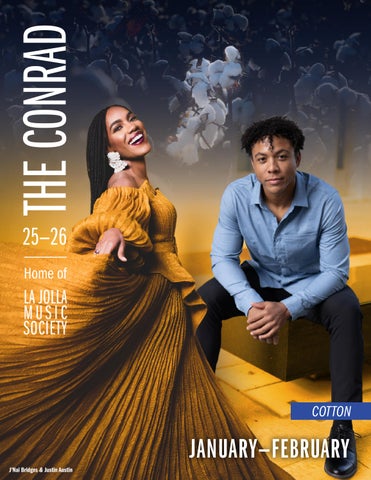
THE CONRAD 25—26 Home of
COTTON
JANUARY—FEBRUARY J’Nai Bridges & Justin Austin
TheConrad.org · 858.459.3728 | 1
Angélique Kidjo
Augustin Hadelich
Calendar of Events JANUARY DOUG SMITH*: WILD WOLVES OF YELLOWSTONE THURSDAY, JANUARY 15, 2026 • 7:30 PM
EPHRAT ASHERIE DANCE* WITH ARTURO O’FARRILL: SHADOW CITIES
SUNDAY, MARCH 29, 2026 • 7 PM
2 Performances
Global Roots Series
SUNDAY, FEBRUARY 22, 2026 • 3 PM & 7 PM
Speaker Series
ProtoStar Innovative Series
COTTON*
KEITH LADZINSKI : FORCES OF NATURE
FRIDAY, JANUARY 16, 2026 • 7:30 PM
Speaker Series
ProtoStar Innovative Series
MAO FUJITA, piano
SUNNY JAIN’S WILD WILD EAST *
FRIDAY, FEBRUARY 27, 2026 • 7:30 PM
Co-production with San Diego Opera
SUNDAY, JANUARY 18, 2026 · 5 PM & 7:30 PM Concerts @ The JAI
LUCAS & ARTHUR JUSSEN, pianos THURSDAY, JANUARY 22, 2026 • 7:30 PM
*
THURSDAY, FEBRUARY 26, 2026 • 7:30 PM
Piano Series
MARCH
COMPAGNIE HERVÉ KOUBI*: SOL INVICTUS
2 Performances
FRIDAY, JANUARY 30, 2026 • 7:30 PM
WEDNESDAY, MARCH 4, 2026 • 7:30 PM THURSDAY, MARCH 5, 2026 • 7:30 PM Jazz Series
ALFREDO RODRIGUEZ & PEDRITO MARTINEZ SUNDAY, FEBRUARY 1, 2026 · 5 PM & 7:30 PM
THE BAD PLUS* WITH CHRIS POTTER AND CRAIG TABORN THURSDAY, MARCH 12, 2026 • 5:30 PM & 8 PM
Concerts @ The JAI
Concerts @ The JAI
JOEL ROSS* GOOD VIBES
LE CONSORT: A TRIO SONATA SOIRÉE*
THURSDAY, FEBRUARY 5, 2026 · 5:30 PM & 8 PM
FRIDAY, MARCH 20, 2026 • 7:30 PM
Concerts @ The JAI
Revelle Chamber Music Series
JUAN DIEGO FLÓREZ*, tenor
AUGUSTIN HADELICH, violin FRANCESCO PIEMONTESI*, piano
THURSDAY, FEBRUARY 12, 2026 • 7:30 PM Recital Series
BALOURDET QUARTET SATURDAY, FEBRUARY 14, 2026 • 7:30 PM Revelle Chamber Music Series
KALANI PE‘A* SUNDAY, FEBRUARY 15, 2026 • 3 PM Global Roots Series
JAZZ Mini FESTIVAL EMMET COHEN PRESENTS: MILES AND COLTRANE AT 100 4 Performances
CHUCHO VALDÉS & ARTURO SANDOVAL LEGACY QUINTET
FEBRUARY
APRIL APRIL 6−11
Piano Series
Dance Series • Balboa Theatre
RAVI SHANKAR ENSEMBLE*
SATURDAY, MARCH 21, 2026 • 8 PM Recital Series
MONDAY, APRIL 6, 2026 • 5:30 PM & 8 PM TUESDAY, APRIL 7, 2026 • 5:30 PM & 8 PM Concerts @ The JAI: Jazz Mini-Festival
TERENCE BLANCHARD & RAVI COLTRANE* MILES DAVIS & JOHN COLTRANE AT 100 THURSDAY, APRIL 9, 2026 • 7:30 PM Jazz Series: Jazz Mini-Festival • Balboa Theatre
COLTRANE 100: BOTH DIRECTIONS AT ONCE SATURDAY, APRIL 11, 2026 • 7:30 PM Jazz Series: Jazz Mini-Festival
DANISH STRING QUARTET DANISH NATIONAL GIRLS’ CHOIR* SUNDAY, APRIL 12, 2026 • 3 PM Revelle Chamber Music Series
GAUTIER CAPUÇON, cello JEAN-YVES THIBAUDET, piano WEDNESDAY, APRIL 15, 2026 • 7:30 PM Recital Series
Doodle POP
*
SUNDAY, MARCH 22, 2026 • 3 PM The ConRAD Kids Series
BENNY BENACK III*: THE MAGIC OF MANHATTAN SATURDAY, APRIL 18, 2026 • 5:30 PM & 8 PM
LANG LANG, piano
Concerts @ The JAI
THURSDAY, MARCH 26, 2026 • 7:30 PM
ARISTO SHAM*, piano VAN CLIBURN GOLD MEDAL WINNER
Special Event · Jacobs Music Center
SUNDAY, APRIL 19, 2026 • 3 PM Discovery Series
2 | THE CONRAD | HOME OF LA JOLLA MUSIC SOCIETY · 2025–26 SEASON
Balourdet Quartet
Chucho Valdés
TRACY DRAIN*: COSMIC ADVENTURES
Concerts @ The JAI
DAVID McLAIN*: BLUE ZONES UNLOCKING THE SECRETS OF LONGEVITY
ART OF ELAN: DANCING ON TIPTOES
THURSDAY, APRIL 30, 2026 • 7:30 PM
SHENEL JOHNS*
AARON DIEHL TRIO FRIDAY, APRIL 24, 2026 • 5:30 PM & 8 PM
SATURDAY, APRIL 25, 2026 • 10 AM & 11:30 AM The ConRAD Kids Series • The JAI
ALEXANDRE KANTOROW*, piano SATURDAY, APRIL 25, 2026 • 7:30 PM Piano Series
THURSDAY, MAY 14, 2026 • 7:30 PM Speaker Series
Speaker Series
SATURDAY, MAY 16, 2026 · 5:30 PM & 8 PM Concerts @ The JAI
MAY
STELLA CHEN*, violin GILLES VONSATTEL, piano
LUCÍA* FRIDAY, MAY 1, 2026 • 5:30 PM & 8 PM Concerts @ The JAI
ANGÉLIQUE KIDJO*
SUNDAY, MAY 31, 2026 • 3 PM Discovery Series
SUNDAY, MAY 3, 2026 • 7 PM
JUNE
Global Roots Series
JIHYE LEE ORCHESTRA*
HAYATO SUMINO*, piano SATURDAY, MAY 9, 2026 • 7:30 PM ProtoStar Innovative Series
SATURDAY, JUNE 6, 2026 • 5:30 PM & 8 PM Concerts @ The JAI *LJMS debut
Lang Lang
All events are in The Baker-Baum Concert Hall unless otherwise noted
TheConrad.org · 858.459.3728 | 3
UP NEXT: MARCH—APRIL 2026 CHUCHO VALDÉS & ARTURO SANDOVAL LEGACY QUINTET
THE BAD PLUS WITH CHRIS POTTER AND CRAIG TABORN THURSDAY, MARCH 12 5:30 PM & 8 PM
WEDNESDAY, MARCH 4 · 7:30 PM THURSDAY, MARCH 5 · 7:30 PM
Concerts @ The JAI
The Baker-Baum Concert Hall Jazz Series
LE CONSORT: A TRIO SONATA SOIRÉE FRIDAY, MARCH 20 • 7:30 PM The Baker-Baum Concert Hall Revelle Chamber Music Series
“
Artistry characterized by fluid, flawless technique, daring ideas, and sensitivity” — Stage and Cinema
AUGUSTIN HADELICH, violin FRANCESCO PIEMONTESI, piano SATURDAY, MARCH 21 • 8 PM The Baker-Baum Concert Hall Recital Series
DOODLE POP
LANG LANG, piano
The Baker-Baum Concert Hall
Jacobs Music Center
ConRAD Kids Series
Special Event
SUNDAY, MARCH 22 • 3 PM
THURSDAY, MARCH 26 • 7:30 PM
“
Uncanny virtuosity, wondrous control of shadings and sound and unbridled urgency” — The New York Times
4 | THE CONRAD | HOME OF LA JOLLA MUSIC SOCIETY · 2025–26 SEASON
RAVI SHANKAR ENSEMBLE
JAZZ Mini FESTIVAL
The Baker-Baum Concert Hall
MONDAY, APRIL 6 • 5:30 PM & 8 PM TUESDAY, APRIL 7 • 5:30 PM & 8 PM
SUNDAY, MARCH 29 • 7 PM Global Roots Series
In its debut tour, the Ravi Shankar Ensemble presents a special program featuring visual elements from the Ravi Shankar archives alongside a dynamic selection of Shankar’s soul-stirring music.
EMMET COHEN Concerts @ The JAI
JAZZ Mini FESTIVAL
TERENCE BLANCHARD & RAVI COLTRANE THURSDAY, APRIL 9 • 7:30 PM Balboa Theatre Jazz Series
JAZZ Mini FESTIVAL
COLTRANE 100: BOTH DIRECTIONS AT ONCE
SATURDAY, APRIL 11 • 7:30 PM
DANISH STRING QUARTET WITH THE DANISH NATIONAL GIRLS’ CHOIR SUNDAY, APRIL 12 • 3 PM The Baker-Baum Concert Hall Recital Series
The Baker-Baum Concert Hall Jazz Series
TheConrad.org · 858.459.3728 | 5
SENIOR LIVING, REDEFINED.
New friendships, new passions, new discoveries and new freedoms. It’s all here. Book a tour and find the retirement you imagine.
LA VIDA DEL MAR
850 Del Mar Downs Road • Solana Beach • 858.463.4973 LaVidaDelMar.com An SRG Senior Living Community
RCFE 374602832
Coming Soon
SUMMERFEST 2026
July 31—August 29 · Inon Barnatan, Music Director Four weeks of dynamic chamber music performances in the acoustically-superb Baker-Baum Concert Hall SummerFest is celebrating its 40th Anniversary this year. Save the date for a landmark festival you won’t want to miss!
Programming and subscriptions available in March 2026 Liza Ferschtman
6 | THE CONRAD | HOME OF LA JOLLA MUSIC SOCIETY · 2025–26 SEASON
Gala Chairs Liqun Wang and Marco Londei, together with the Board of Directors of La Jolla Music Society, warmly invite you to join them at the annual WinterFest Gala.
WITH LANG LANG, PIANO A Selection of Mazurkas by Chopin
WEDNESDAY, MARCH 25, 2026 The Conrad Prebys Performing Arts Center 5:00 PM Champagne Reception 6:30 PM Live Auction and Paddle Raise 7:00 PM Lang Lang, piano 8:00 PM Elegant Seated Dinner 9:30 PM After-Party Celebration Black Tie Visit TheConrad.org/gala for more information, contact Special Events at Gala@TheConrad.org or call 858.526.3450.
TheConrad.org · 858.459.3728 | 7
The moment has arrived... Join us for our grand reopening. Acclaimed Executive Chef Kelli Crosson presents locally sourced, regional cuisine with breathtaking views of the Torrey Pines Golf Course and stunning sunsets over the Pacific Ocean.
ARValentien.com | For reservations, call (858) 777-6635
8 | THE CONRAD | HOME OF LA JOLLA MUSIC SOCIETY · 2025–26 SEASON
WE PROUDLY SUPPORT
La Jolla Music Society Thank you for your commitment and dedication to our community.
bancofcal.com
© 2025 Banc of California. All rights reserved. Member FDIC.
TheConrad.org · 858.459.3728 | 9
WHERE THE NEIGHBORHOOD PLAYS
ENJOY THE ULTIMATE
CINEMA & DINING EXPERIENCE
THE LOT LA JOLLA 7611 FAY AVE, LA JOLLA, CA 92037 WWW.THELOTENT.COM
10 | THE CONRAD | HOME OF LA JOLLA MUSIC SOCIETY · 2025–26 SEASON
SCAN TO VIEW SHOWTIMES
A SYMPHONY O F TA S T E George’s at the Cove is a Proud Community Partner in support of
THE CONRAD The Conrad Prebys Performing Arts Center
experience g e o rg e s a t t h e co v e . co m •
858.454.4244 •
1 2 5 0 P ro s p e c t S t re e t , L a J o l l a , C A 9 2 0 3 7
T h e C o n r a d . o r g · 8 5 8 . 4 5 9 . 3 7 2 8 | 11
TRANSFORMATIVE SUPPORT
Our gratitude to these Medallion Society Pillars founding members who have made significant four-year commitments that will help us better serve all of the San Diego region. The Conrad can be a catalyst to bring thousands of adults and children together through a common appreciation of the performing arts, which enhance the artistic fabric of our community.
$1 MILLION and above
$1 MILLION and above
$1 MILLION and above
Brenda Baker and Steve Baum
Irwin and Joan* Jacobs
Dorothea Laub
$500,000 and above
$400,000 and above
$400,000 and above
Karen and Kit Sickels
Raffaella and John* Belanich
Eleanor and Ric* Charlton
$400,000 and above
$400,000 and above
$400,000 and above
Mary Ellen Clark
Jacqueline and Jean-Luc Robert
Debbie Turner
12 | THE CONRAD | HOME OF LA JOLLA MUSIC SOCIETY · 2025–26 SEASON
TRANSFORMATIVE SUPPORT
$400,000 and above
$200,000 and above
$200,000 and above
Marco Londei and Liqun Wang
Julie and Bert Cornelison
Herbert Solomon and Elaine Galinson
$200,000 and above
$200,000 and above
$200,000 and above
Keith and Helen Kim
Angel and Fred Kleinbub
Vivian Lim and Joseph Wong
$200,000 and above
$200,000 and above
Haeyoung Kong Tang
Sue and Peter Wagener
Thank you
to these Pillars in the community.
For information about supporting La Jolla Music Society through membership in the Pillars program, please contact Ferdinand Gasang at 858.526.3426 or FGasang@TheConrad.org. *in memoriam T h e C o n r a d . o r g · 8 5 8 . 4 5 9 . 3 7 2 8 | 13
Proud partner in support of The Conrad Prebys Performing Arts Center A one minute walk from THE CONRAD LUNCH | DINNER | HAPPY HOUR SATURDAY & SUNDAY BRUNCH
7550 FAY AVENUE, LA JOLLA, CA 92037 | 858 454-5013 berninisbistro.com 14 | THE CONRAD | HOME OF LA JOLLA MUSIC SOCIETY · 2025–26 SEASON
TABLE OF CONTENTS CALENDAR OF EVENTS
2
COMING UP NEXT
4
TRANSFORMATIVE SUPPORT
12
ABOUT THE CONRAD
16
BOARD & STAFF OF LA JOLLA MUSIC SOCIETY
18
FROM THE ARTISTIC DIRECTOR
19
DOUG SMITH
20
COTTON
21
LUCAS & ARTHUR JUSSEN
23
COMPAGNIE HERVÉ KOUBI
27
JUAN DIEGO FLÓREZ
29
BALOURDET QUARTET
38
KALANI PE‘A
42
SHADOW CITIES
43
KEITH LADZINSKI
45
MAO FUJITA
46
ARTIST PROFILES
51
MUSICAL GLOSSARY
56
THANK YOU FOR YOUR SUPPORT | DONOR LISTINGS
58
THE CONRAD Home of La Jolla Music Society
Todd R. Schultz President & CEO Leah Rosenthal Artistic Director MISSION STATEMENT Our mission is to enrich the evolving cultural landscape of San Diego by curating a dynamic array of world-class performing arts programming, creating meaningful learning opportunities, and building connections between artists and audiences.
T h e C o n r a d . o r g · 8 5 8 . 4 5 9 . 3 7 2 8 | 15
THE CONRAD Home of La Jolla Music Society
Vision Statement To transform lives through the performing arts, serving as a beacon of world-class artistic excellence, innovation, and inclusivity.
Mission Statement To enrich the evolving cultural landscape of San Diego by curating a dynamic array of world-class performing arts programming, create meaningful learning opportunities, and build connections between artists and audiences.
The 2025−26 Season From classical, jazz, and dance to global music, exciting speakers, and family concerts, each season Artistic Director Leah Rosenthal brings the best artists in the world to the San Diego community. This season will feature more than 70 artists, including superstars like Lang Lang, Angélique Kidjo, MOMIX, Daniil Trifonov, Juan Diego Flórez, and many more. Join us at The Conrad as well as the Civic Theatre, Balboa Theatre, and Jacobs Music Center to see the best the world has to offer.
Mariza
Chucho Valdés
SummerFest La Jolla Music Society’s acclaimed chamber music festival, curated by award-winning pianist and festival Music Director Inon Barnatan, celebrates its 40th anniversary in 2026. SummerFest engages more than 80 of the world’s finest musicians to perform at The Conrad throughout the month of August. In addition to remarkable mainstage performances, SummerFest offers over 50 free and open-to-the-public educational activities. To learn more, visit TheConrad.org/SummerFest.
Follow Us
@ljmusicsociety
La Jolla Music Society
16 | THE CONRAD | HOME OF LA JOLLA MUSIC SOCIETY · 2025–26 SEASON
Noah Bendix-Balgley, Stefan Jackiw, Inon Barnatan, Alisa Weilerstein, Teng Li
The Conrad
The Conrad opened in 2019 and serves as a gathering place for cultural, arts education, and community activity. As the permanent home of La Jolla Music Society, The Conrad hosts world-class performances presented by La Jolla Music Society and other local arts organizations in its four outstanding performance and activity spaces, The Baker-Baum Concert Hall, The JAI, The Atkinson Room, and the picturesque Wu Tsai QRT.yrd.
Mireya Ramos
Canadian Brass
Lori Bell Quartet
Learning & Engagement
La Jolla Music Society’s award-winning Learning & Engagement Programming provides unmatched access and learning opportunities to more than 15,000 students and community members throughout San Diego County annually. With learning and engagement at the heart of our mission, we work closely with each visiting artist and ensemble to create outreach activities that highlight their unique talents and expertise at both The Conrad and in the community. With our state-of the-art video and streaming capabilities at The Conrad, we are able to provide live streaming for events such as our annual SummerFest and education events for free in our Digital Concert Hall.
Balourdet Quartet
Land Acknowledgment
Allison Boles, Edward Dusinberre, Harumi Rhodes, Inon Barnatan
The Conrad Prebys Performing Arts Center acknowledges the ancestral, unceded territory of the Kumeyaay people, on which The Conrad was built. We hold great respect for the land and the original people of the area where our performing arts center is located. The Kumeyaay continue to maintain their political sovereignty and cultural traditions as vital members of the San Diego community.
Table of Contents
T h e C o n r a d . o r g · 8 5 8 . 4 5 9 . 3 7 2 8 | 17
BOARD OF DIRECTORS · 2025–26 Teresa Hixson David Kabakoff Nancy Linke Patton Diana Lombrozo Sue Major Richard A. Norling Kazeem Omidiji Arman Oruc Tom Rasmussen Sylvia Ré Sheryl Scarano Neal Schmale Jeanette Stevens Stephanie Stone Peter Wagener Liqun Wang Lise Wilson Bebe L. Zigman
Vivian Lim – Chair Bert Cornelison – Vice Chair Mary Ellen Clark - Treasurer Stacy Kellner Rosenberg - Secretary Stephen L. Baum David Belanich Marla Bingham Eleanor Charlton Sharon Cohen Ellise Coit Peter Cooper Ann Parode Dynes Jennifer Eve Debby Fishburn Stephen Gamp Lehn Goetz John Hesselink
HONORARY DIRECTORS Brenda Baker Stephen L. Baum Raffaella Belanich Joy Frieman, Ph.D. Irwin M. Jacobs Joan Jacobs (1933—2024) Lois Kohn (1924—2010) Helene K. Kruger (1916—2019) Conrad Prebys (1933—2016) Peggy Preuss Ellen Revelle (1910—2009) Leigh P. Ryan, Esq. Dolly Woo
LA JOLLA MUSIC SOCIETY STAFF PRODUCTION & OPERATIONS
Community Music Center Instructors:
Patrick Mayuyu
Mariana Flores Bucio, Marcus Cortez, David Garcia, Ian Lawrence, Sofia Magallenes, Marko Paul, Eduardo Ruiz, Juan Sanchez, Miguel Zazueta
Box Office & Guest Services Manager
Technical Coordinator – Lighting Lead
DEVELOPMENT
Veronica Eddings
Casey McEnelly
Caren Heintzelman
Ferdinand Gasang
Director of Finance
Assistant Production Manager
Director of Development
Brady Stender
Lauren Cernik-Price
Anne Delleman
Controller
Production Coordinator & Stage Manager
Development Manager
Breanne Self
Jonnel Domilos
Wadeaa Jubran
Human Resources & Finance Manager
Piano Technician
Development Coordinator
ARTISTIC
FACILITIES
Nicole Slavik
Grace Smith
Jason Martin
Todd R. Schultz President & CEO
Leah Rosenthal Artistic Director
Inon Barnatan SummerFest Music Director
ADMINISTRATION
Artistic Planning & Operations Director
Anne-Marie Dicce Artistic Planning Manager
George Pritzker Artistic Operations Coordinator
Juliet Zimmer Artistic Rentals & Partnerships Director
Braulio Fernandez-Flores Artistic Rentals Coordinator/ Assistant Front of House Manager
John Tessmer
Jamie Coyne Director of Production & Operations
Tyler Merrihew Associate Technical Director
Dominic La Frantz
Director of Facilities
Colin Dickson Facilities Manager
Evan Calderon
Vivian Vu Special Events Coordinator
Sarah Wood Torrey Institutional Giving Consultant
Associate Facilities Engineer
MARKETING & GUEST SERVICES
Kim Chevallier
Mary Cook
Security Guard
Director of Communications, Marketing & Guest Services
LEARNING & ENGAGEMENT Allison Boles Director of Learning & Engagement
Lead Artist Liaison
Jade Lewenhaupt
Maggie de Lorimier
Learning & Engagement Coordinator
Artist Liaison
Frida Ibarra
Isaac Pastrana
Music Education Programs Assistant
Artist Liaison
Serafin Paredes
Dana Rossi
Community Music Center Director
Artist Liaison
Aimee Alvarado
Eric Bromberger
Community Music Center Administrative Assistant
Program Annotator
Special Events & Catering Director
Stephanie Saad Communications & Public Relations Director
David Silva Marketing Manager & Sales Director
Cristal Salow Database & Analytics Manager
Katherine Jenswold Digital Marketing Associate
Mariel Pillado Graphic Designer
Marsi Bennion Box Office & Guest Services Director
18 | THE CONRAD | HOME OF LA JOLLA MUSIC SOCIETY · 2025–26 SEASON
Sam Crowley Box Office & Guest Services Lead
Mitch Maker Box Office & Guest Services Associate Box Office & Guest Services Associate
Shaun Davis House Manager
La Jolla Music Society’s 57 Season th
Dear friends, This year begins with a truly remarkable slate of artists, exactly the kind of programming I dream about when shaping a La Jolla Music Society season. My goal is always to bring you the finest performers, those whose artistry reminds us why we gather to experience music and live performance. We’ll journey from Doug Smith’s extraordinary stories of the return of wild wolves to Yellowstone which opens our Speaker Series curated by our Director of Learning and Engagement Allison Boles, to the thrilling piano virtuosity of Dutch brothers Lucas and Arthur Jussen. We’ll revel in the fresh, electrifying sound world of vibraphonist Joel Ross and welcome back the dazzling pianist Mao Fujita, whose return promises to be a highlight of the winter. One project especially close to my heart is Cotton—a powerful, deeply moving song cycle inspired by John E. Dowell’s haunting photography of South Carolina cotton fields. This work weaves together African American narratives of past and present, creating a bridge from the rural South to the vibrant, complex streets of New York City. We are enormously proud to present it in partnership with San Diego Opera, featuring two of the most exciting voices in opera today: J’Nai Bridges and Justin Austin. Dance lovers will also find much to celebrate. 2026 opens with the bold physicality of Compagnie Hervé Koubi’s Sol Invictus and continues with the inventive, street-inflected artistry of Ephrat Asherie Dance in Shadow Cities. And for those who treasure great singing, we offer not one but two unforgettable evenings: the legendary Juan Diego Flórez, “King of the High Cs,” and Hawaiian superstar and four-time GRAMMY© winner Kalani Pe‘a—both shining in the intimate beauty of The Baker-Baum Concert Hall. My hope is that you won’t agonize too much over which performances to attend—because truly, each one offers something singular and uplifting. I would love nothing more than to see you at all of them. I’m confident this season will leave you enriched, inspired, and reminded of just how transformative live performance can be. I look forward to welcoming you to The Conrad or one of our downtown venues very soon. Sincerely,
Leah Rosenthal Artistic Director
Table of Contents
T h e C o n r a d . o r g · 8 5 8 . 4 5 9 . 3 7 2 8 | 19
DOUG SMITH WILD WOLVES OF YELLOWSTONE THURSDAY, JANUARY 15, 2026 · 7:30 PM THE BAKER-BAUM CONCERT HALL
PROGRAM Presentation Question & Answer Session THIS PRESENTATION HAS NO INTERMISSION La Jolla Music Society’s 2025–26 Season is supported by The City of San Diego Cultural Affairs, California Arts Council, County of San Diego, Prebys Foundation, Farfy Foundation, The Lodge at Torrey Pines, ProtoStar Foundation, Vail Memorial Fund, Rancho La Puerta, Banc of California, ResMed Foundation, San Diego Theatres Foundation, Bright Events Rentals, Cafe Coyote, Rancho Coyote, GRNFC Hospitality Group, Ace Parking, Brenda Baker and Steve Baum, Raffaella Belanich, Gordon Brodfuehrer, Eleanor and Ric Charlton, Mary Ellen Clark, Bert and Julie Cornelison, Elaine Galinson and Herbert Solomon, Irwin Jacobs, Helen and Keith Kim, Angelina and Fred Kleinbub, Dorothea Laub, Vivian Lim and Joseph Wong, Jaqueline and Jean-Luc Robert, Marge and Neal Schmale, Karen and Kit Sickels, Jeanette Stevens, Haeyoung Kong Tang, Debra Turner, Sue and Peter Wagener, Liqun Wang and Marco Londei, Anna and Edward Yeung, Bebe and Marvin Zigman.
ABOUT Yellowstone National Park contains many stories, including one of the best case studies in wildlife conservation. Wildlife biologist and National Geographic Explorer Doug Smith led the project that reintroduced gray wolves in the 1990s. We join him on assignment in the park to see how the landscape has changed since the wolves arrived, including never-before-seen photos and videos of the quest to bring back this apex predator.
This presentation marks Doug Smith’s La Jolla Music Society debut.
20 | THE CONRAD | HOME OF LA JOLLA MUSIC SOCIETY · 2025–26 SEASON
COTTON
Co-Produced with San Diego Opera Education Ambassador-in-Residence FRIDAY, JANUARY 16, 2026 · 7:30 PM THE BAKER-BAUM CONCERT HALL
DAMIEN GETER (b. 1980)
COTTON A Multimedia Song Cycle for Mezzo-Soprano, Baritone, and Piano Inspired by the cotton photography of John Dowell
The Cotton Weeps (Text by Marc Bamuthi Joseph) Justin Austin, baritone The Night Before the Run (Text by Alora Young) J’Nai Bridges, mezzo-soprano They Took My Sister (Text by Lauren K. Alleyne) J’Nai Bridges, mezzo-soprano Homegoing for the People of the Sun (Text by Trapeta B. Mayson) Justin Austin, baritone Cotton in the Arms of the Mountains (Text by Nikki Giovanni) J’Nai Bridges, mezzo-soprano
Support for this program is provided by:
When the Ancestors Speak (Text by Glenis Redmond) Justin Austin, baritone
ProtoStar Foundation La Jolla Music Society’s 2025–26 Season is supported by The City of San Diego Cultural Affairs, California Arts Council, County of San Diego, Prebys Foundation, Farfy Foundation, The Lodge at Torrey Pines, ProtoStar Foundation, Vail Memorial Fund, Rancho La Puerta, Banc of California, ResMed Foundation, San Diego Theatres Foundation, Bright Events Rentals, Cafe Coyote, Rancho Coyote, GRNFC Hospitality Group, Ace Parking, Brenda Baker and Steve Baum, Raffaella Belanich, Gordon Brodfuehrer, Eleanor and Ric Charlton, Mary Ellen Clark, Bert and Julie Cornelison, Elaine Galinson and Herbert Solomon, Irwin Jacobs, Helen and Keith Kim, Angelina and Fred Kleinbub, Dorothea Laub, Vivian Lim and Joseph Wong, Jaqueline and Jean-Luc Robert, Marge and Neal Schmale, Karen and Kit Sickels, Jeanette Stevens, Haeyoung Kong Tang, Debra Turner, Sue and Peter Wagener, Liqun Wang and Marco Londei, Anna and Edward Yeung, Bebe and Marvin Zigman.
When the Angels Come (Text by Afaa Michael Weaver) Justin Austin, baritone
The Struggle Goes On: A Mural Speaks (Text by Charlotte Blake Alston) J’Nai Bridges, mezzo-soprano Damien Geter, composer; J’Nai Bridges, mezzo-soprano; Justin Austin, baritone; Laura Ward, piano
THIS PERFORMANCE IS APPROXIMATELY ONE HOUR AND SEVEN MINUTES AND HAS NO INTERMISSION. This performance marks J’Nai Bridges’ La Jolla Music Society debut. Justin Austin last performed for La Jolla Music Society in the ProtoStar Innovative Series on January 19, 2025. This performance marks Laura Ward’s La Jolla Music Society debut.
J’Nai Bridges appears by arrangement with IMG Artists, 7 West 54th Street, New York, NY 10019. Tel: 212.994.3500 Justin Austin appears by arrangement with IMG Artists, 7 West 54th Street, New York, NY 10019. Tel: 212.994.3500
Table of Contents
T h e C o n r a d . o r g · 8 5 8 . 4 5 9 . 3 7 2 8 | 21
Let us remember the shoulders we stood and stand on. We must give thanks and stop longing for what we did not receive, but reflect on the blessings we have acquired. Please, give thanks and show appreciation for our ancestors near and far, for the foundation we have been given. Without it, how could we be? So, take a few moments for love, respect, and an appreciation for life. — John E. Dowell
ABOUT
“…Cotton is a hurricane swept through and then gone swept in like a black life and then gone like a truth gone with the wind of a dark American night” — Marc Bamuthi Joseph The past decade has seen Americans engaging in complex work—that of reconciling the ideals of this country with the reality of our history, and now, the reality of our present. COTTON, a multi-media project combining photography, poetry, and song, is Lyric Fest’s earnest contribution to this dialogue and this need for clarity and truth. To the difficulties of our times, it offers inspiration and its hope for healing. At the heart of this project is the extraordinary cotton photography of Philadelphia artist John Dowell. John’s work came to my attention through a friendship begun at The Philadelphia Episcopal Cathedral. Around that time, John was presenting “Cotton—The soft, dangerous beauty of the past” at the African American Museum in Philadelphia. The exhibition was intense, beautiful—and resonant. It called out to us to be amplified. The story that led to John’s exhibit was as extraordinary as the work itself: A decade ago John felt called by his grandmother in a dream to travel to the cotton fields of South Carolina, where his ancestors had likely been enslaved. Thus, he commenced a profound journey deep into the world of cotton, taking over 15,000 images in these fields over several years. Treating cotton as both subject and metaphor, John began to create penetrating, superimposed, composite photographs that speak to the historic, generational experiences of being Black in America. “Black people still struggling,” John has said, “that’s what cotton is.” Dowell’s cotton photography also speaks to a singular resilience of soul and psyche. It evokes, he says, “the remembering, feeling, and sense of wonder at our ancestral
strategies of survival. And this is timely, as countless African Americans lose their lives in an era fraught with politically sanctioned white supremacy—an era steeped in the careless attitude that Black lives really do not matter. My work is meant to encourage contemporary African Americans to move forward with the same courage and determination as our ancestors.” With Dowell’s photographic art pieces as inspiration, Lyric Fest then commissioned new verse from eight current African American poets, each of whom responded to his images in their own unique voice. Lyric Fest is deeply honored to have garnered the work of nationally recognized word-artists, including poets laureate, award-winning speakers, and best-selling authors: Nikki Giovanni (a luminary lost to us in 2025), Marc Bamuthi Joseph, Lauren Alleyne, Afaa Michael Weaver, Trapeta Mayson, Glenis Redmond, Charlotte Blake Alston, and Alora Young. The poetry that John’s work inspired is exceptional. The final step, of course, was to turn all this into song. Lyric Fest commissioned composer Damien Geter to create a song cycle from these poems. Geter produced a new work of intense vocal beauty, power, and poignancy. In performance, the song cycle unfolds interspersed with video of the poets reading their own poems, all against a backdrop of evolving images of Dowell’s Cotton. The goal throughout has been to tell this story in a pansensory experience, one that might speak profoundly to the mind and heart of the audience. — Suzanne DuPlantis, Lyric Fest Co-Founding Artistic Director
Video Design and Creation/Program Concept Suzanne DuPlantis
Technical Director / Lighting Design Allen Doak
Technical Design Midnight Productions
Production Video and Audio Travis Johnson
COTTON was commissioned by Lyric Fest
22 | THE CONRAD | HOME OF LA JOLLA MUSIC SOCIETY · 2025–26 SEASON
PRELUDE 6:30 PM Lecture by Tiffany Kuo
LUCAS & ARTHUR JUSSEN, pianos THURSDAY, JANUARY 22, 2026 · 7:30 PM THE BAKER-BAUM CONCERT HALL
MOZART
Sonata in C Major for Piano Four-Hands, K.521 Allegro Andante Allegretto
SCHUMANN
Andante and Variations for Two Pianos, Opus 46
(1756–1791)
(1810–1856)
JÖRG WIDMANN (b. 1973)
Support for this program is provided in part by:
Julie and Bert Cornelison
Bunte Blätter for Two Pianos Fanfare Fangspiel Walzer Danse macabre Rätsel Zirkusparade INTERMISSION
La Jolla Music Society’s 2025–26 Season is supported by The City of San Diego Cultural Affairs, California Arts Council, County of San Diego, Prebys Foundation, Farfy Foundation, The Lodge at Torrey Pines, ProtoStar Foundation, Vail Memorial Fund, Rancho La Puerta, Banc of California, ResMed Foundation, San Diego Theatres Foundation, Bright Events Rentals, Cafe Coyote, Rancho Coyote, GRNFC Hospitality Group, Ace Parking, Brenda Baker and Steve Baum, Raffaella Belanich, Gordon Brodfuehrer, Eleanor and Ric Charlton, Mary Ellen Clark, Bert and Julie Cornelison, Elaine Galinson and Herbert Solomon, Irwin Jacobs, Helen and Keith Kim, Angelina and Fred Kleinbub, Dorothea Laub, Vivian Lim and Joseph Wong, Jaqueline and Jean-Luc Robert, Marge and Neal Schmale, Karen and Kit Sickels, Jeanette Stevens, Haeyoung Kong Tang, Debra Turner, Sue and Peter Wagener, Liqun Wang and Marco Londei, Anna and Edward Yeung, Bebe and Marvin Zigman.
DEBUSSY
(1862–1918)
RACHMANINOFF
(1873–1943)
Lucas and Arthur Jussen are managed by Arabella Arts www.arabella-arts.com
Table of Contents
Six Épigraphes Antiques To Invoke Pan, God of the Wind of Summer For a Tomb without Name That the Night Might Be Propitious For the Dancer with Miniature Cymbals For the Egyptian To Thank the Morning Rain Suite No. 2 for Two Pianos, Opus 17 Introduction Waltz Romance Tarantella *Lucas Jussen, Arthur Jussen, pianos
*Lucas and Arthur Jussen will rotate throughout the program. Lucas and Arthur Jussen last performed for La Jolla Music Society in the Piano Series on January 25, 2024.
T h e C o n r a d . o r g · 8 5 8 . 4 5 9 . 3 7 2 8 | 23
LUCAS & ARTHUR JUSSEN - PROGRAM NOTES
Program notes by Eric Bromberger
Sonata in C Major for Piano Four-Hands, K.521
WOLFGANG AMADEUS MOZART Born January 27, 1756, Salzburg Died December 5, 1791, Vienna Composed: 1787 Approximate Duration: 22 minutes
During his years in Vienna Mozart became very good friends with a young man named Baron Gottfried von Jacquin. Mozart was a frequent visitor in the Jacquin home, and his friendship extended so far that he wrote several pieces and gave them to Gottfried with the understanding that his friend would pass them off as his own. In the spring of 1787, Mozart wrote a Sonata for Piano Four-Hands for Gottfried and his sister Francisca to play. He completed it on May 29, 1787, and sent the manuscript off to Gottfried with this message: “Please be so good as to give this sonata to your sister with my compliments, and tell her to tackle it at once, for it is rather difficult.” Mozart could not have known when he sent off this music that the day before in Salzburg his father had died at the age of 73. Mozart rarely wrote for piano four-hands (he wrote only two sonatas for this combination), but two pianists playing on the same instrument can make a brilliant sound, and he makes the most of these possibilities here. Arthur Hutchings describes this music as frankly “a display piece,” while Alfred Einstein notes that “the two parts are friendly rivals” and praises the “brilliance” and “chivalrous amiability” of the sonata. This agreeable music requires little detailed comment. Throughout, it exhibits much of the bright spirit that the key of C major always seemed to inspire in Mozart. The first movement is marked by rippling energy and smooth exchanges between the two performers as the melodic line moves easily from the top to the bottom of the keyboard. The Andante has a music-box delicacy about much of the writing, though matters grow more intense in the development. The concluding Allegretto is a rondo based on an almost innocent tune that Mozart marks dolce. There are some brilliant interludes along the way, but the sweetness of this tune always returns to iron out any troubles, and the sonata sweeps to its unclouded close.
Andante and Variations for Two Pianos, Opus 46
ROBERT SCHUMANN Born June 8, 1810, Zwickau, Germany Died July 29, 1856, Endenich Composed: 1843 Approximate Duration: 15 minutes
knew how formidable the competition was. Schumann spent the spring of 1842 studying quartets by Haydn, Mozart, and Beethoven, and then—in a great rush of energy—he composed three string quartets that summer. The Piano Quintet followed in October, and Schumann kept going: after “constant fearful sleepless nights,” he completed the Piano Quartet in November. All of these works have become part of the repertory, but now Schumann pressed on and wrote two more chamber works that have not: he completed a Piano Trio in A Minor in December, and in January 1843 he wrote a work he titled Andante and Variations for Two Pianos, Horn, and Two Cellos. At this point Schumann began to have doubts about his work—he was dissatisfied with these last two works and held them back. Seven years later he would recast the trio as the Phantasiestücke, Opus 88, but—acting on the recommendation of Felix Mendelssohn—Schumann quickly revised the Andante and Variations, recasting it for two pianos, and in this form it was published as his Opus 46 in August 1843. The manuscript of the original chamber version went onto the shelf, and there it might have remained to this day but for one man. Johannes Brahms, who as a youth of twenty had been championed by Schumann, knew and loved this music in its original form. In 1893—half a century after it was composed— Brahms convinced Schumann’s widow, Clara, to allow him to edit and publish the original version. Ironically, that original version for two pianos, horn, and two cellos has become better known than the published version for two pianos (the chamber version has been performed at three different SummerFests, but this evening’s concert appears to be the first time La Jolla Music Society has ever presented the two-piano version). Even in Schumann’s original version, the two pianos have most of the musical interest, (the cellos and horn are used primarily for color and harmonic underpinning), so it was not difficult to arrange the piece for just the two pianos. When creating the two-piano version, Schumann shortened the chamber version considerably, cutting out an introduction, two of the variations, and a brief interlude. The Andante (Schumann’s marking is actually Andante espressivo) begins with the two pianos introducing the principal theme, a flowing melody in 3/4 that moves back and forth between the two instruments. A series of brief variations follows. Schumann does not number these variations, and they flow from one to the next without pause. The variations are at sharply contrasted tempos, so the music can be subdued and calm one moment, fast and furious the next. At the end, quiet chains of sixteenthnotes weave together and draw this little-known music to its soft concluding chords.
This unusual piece is almost unknown to audiences. It gave Schumann a great deal of trouble, and it has come down to us in two different versions. In 1842 Schumann turned to chamber music. He was most naturally a composer of piano music and songs, and he felt threatened by the thought of composing chamber music, for he
24 | THE CONRAD | HOME OF LA JOLLA MUSIC SOCIETY · 2025–26 SEASON
LUCAS & ARTHUR JUSSEN - PROGRAM NOTES
Bunte Blätter for Two Pianos
JÖRG WIDMANN Born June 19, 1973, Munich Composed: 2022 Approximate Duration: 12 minutes
Composer and clarinetist Jörg Widmann received his early training in his native Munich, then spent a year at the Juilliard School studying clarinet with Charles Neidich. He returned to Munich to study composition with Hans Werner Henze and Wilfried Hiller and later with Wolfgang Rihm. Widmann has been Professor of Clarinet at the Hochschule für Musik in Freiburg since 2001, and he currently divides his time between Freiburg and Munich. As a composer, he has won numerous awards, and his music has been widely performed by such conductors as Jonathan Nott, Sylvain Cambreling, Christian Thielemann, and Kent Nagano. Widmann served as Composer-in-Residence with the Berlin Philharmonic during the 2023–24 season. In 1852, Robert Schumann published a collection of fourteen brief piano pieces titled Bunte Blätter, or “Many-Colored Leaves.” There was no unifying principle to those fourteen pieces, and that title reflects Schumann’s original plan to publish each individual piece with a cover of a separate color. In 2022 Jörg Widmann took Schumann’s title for a collection of six short pieces for two pianos. For both composers, that title indicates that the pieces in these collections are multi-colored and unconnected. Widmann has provided a brief introduction to his Bunte Blätter: “After an early mini piece for this instrumentation, Bunte Blätter (Coloured Leaves) is my first real piece for two pianos. It has become a collection of highly diverse and multifaceted pieces and forms, ranging from Walzer (Waltz) to Danse macabre, from Fanfare to Zirkusparade (Circus Parade). The fact that the interpreters of the world premiere, Arthur and Lucas Jussen, are siblings, may and should be felt in the teasingly affectionate Fangspiel (Game of Tag) in which the two pianists sometimes deliberately “play past” each other. The collection is completed by Rätsel (Riddle) for Peter Sloterdijk’s 75th birthday, a small, sphinx-like piece for the librettist of my Babylon opera.” — Jörg Widmann
Six Épigraphes Antiques
CLAUDE DEBUSSY Born August 25, 1862, Saint Germain-en-Laye Died March 25, 1918, Paris Composed: 1914 Approximate Duration: 16 minutes
Debussy’s Six Épigraphes Antiques are unfamiliar to most audiences, and the music performed in this concert has an especially complex history. In 1897–98, Debussy wrote a collection of pieces to accompany a reading of his friend Pierre Louy’s Chansons de Bilitis. A photographer, poet, and author of erotic novels, Louys had published Chansons de Bilitis in 1894, the same year Debussy’s Prelude to the Afternoon of a Faun was premiered. The Chansons, purportedly Greek poems in the
Table of Contents
manner of Sappho, were actually the work of Louys himself. They tell of the sexual awakening and experience of a Greek maiden “born at the beginning of the sixth century preceding our era, in a mountain village on the banks of the Melas forming the eastern boundary of Pamphylia.” Debussy doubted the recitation of these poems needed music and wrote brief backgrounds for two flutes, two harps, and celesta to accompany some of them; he also wrote some brief piano pieces as part of this. In 1914, only four years before his death, Debussy rewrote these earlier pieces for piano four-hands and published them as the Six Épigraphes Antiques (they are sometimes performed in an arrangement for chamber orchestra made after Debussy’s death). The music itself bears some relation to Debussy’s two books of piano preludes, published in 1910 and 1913: these six brief pieces are harmonically spare and subdued in mood. Each has an evocative title—the epigraph—and all except the third end very quietly. Just as the Preludes are evocations of moods and moments, the Épigraphes may be thought of as impressions of faraway places or particular moments. The six pieces: To Invoke Pan, God of the Wind of Summer, which Debussy asks to have performed “in the style of a pastorale;” For a Tomb without Name, with outer sections in a very free 5/4 meter; That the Night Might Be Propitious, with a quietly shimmering beginning that gives way to bright flashes of sound; For the Dancer with Miniature Cymbals, which features arpeggiated chords at the beginning and bright sounds later; For the Egyptian, which Debussy asks to have performed “without stiffness;” and To Thank the Morning Rain, where the steady patter of sixteenthnotes echoes the sound of rain—Debussy brings back the main theme of the opening piece at the close.
Suite No. 2 for Two Pianos, Opus 17
SERGEI RACHMANINOFF Born April 1, 1873, Semyonovo, Russia Died March 28, 1943, Beverly Hills Composed: 1900–01 Approximate Duration: 22 minutes
The critical response to Rachmaninoff’s First Symphony in 1897 had been so vicious that the young composer was left shaken and unable to compose. His family finally convinced him to see a psychologist, who treated him through hypnotic suggestion. Rachmaninoff spent the summer of 1900 in Italy, then returned to Russia and that fall composed the second and third movements of his Second Piano Concerto. The triumphant premiere of those two movements in Moscow on December 2 seemed to restore his confidence: between December 1900 and April 1901 Rachmaninoff composed the present Suite for Two Pianos, then completed the first movement of the concerto and his Cello Sonata. Rachmaninoff and Alexander Ziloti gave the first performance of the Suite in Moscow on November 24, 1901. This is big music—ebullient and powerful—and its good tunes and rich sonority have made it a favorite with duo-pianists. The four movements rest on some unusual key progressions, and harmonically the Suite concludes far from its beginning. Each of
T h e C o n r a d . o r g · 8 5 8 . 4 5 9 . 3 7 2 8 | 25
LUCAS & ARTHUR JUSSEN - PROGRAM NOTES the movements has a title as well as an Italian tempo indication. The Introduction, in heroic C major, has a firm, declarative opening that gives way to a more poised (but still quite animated) second subject. Its propulsive rhythms continue throughout, even as the movement draws to a quiet close. The second movement, a Waltz in G major, opens with a burst of shining energy from which the broad waltz melody gradually emerges and then develops at length. The Romance, in A-flat major, is based on one of those wonderful Rachmaninoff melodies—deep and dark— that eventually grows to a ringing climax before the movement concludes peacefully. The finale, a Tarantella in the unexpected key of C minor, is based on a theme Rachmaninoff is said to have found in a collection of old tunes during his visit to Genoa and Milan the summer before composing the Suite. The energy that has characterized the entire work returns here with a vengeance, eventually driving this movement to a thunderous conclusion that remains unremittingly in C minor. Rachmaninoff recorded many of his own works, but never this Suite. He did, however, continue to perform it—and under some unusual circumstances. Late in life, Rachmaninoff became good friends with Vladimir Horowitz and greatly respected the younger man’s abilities. Occasionally—and for family members only—they would perform two-piano music together, and the Second Suite was one of the works they would play. Rachmaninoff’s biographer Sergei Bertensson was present at the composer’s home in Beverly Hills in June 1942, only nine months before his death, and left this account of a Rachmaninoff– Horowitz performance of this Suite: “It is impossible to word my impression of this event. ‘Power’ and ‘joy’ are the two words that come first to mind—expressive power, and joy experienced by the two players, each fully aware of the other’s greatness. After the last note no one spoke—time seemed to have stopped.” It is our loss that no one thought to record that performance, now gone forever.
26 | THE CONRAD | HOME OF LA JOLLA MUSIC SOCIETY · 2025–26 SEASON
PRELUDE 6:30 PM Interview hosted by Molly Puryear
COMPAGNIE HERVÉ KOUBI SOL INVICTUS FRIDAY, JANUARY 30, 2026 · 7:30 PM BALBOA THEATRE
Support for this program is provided by:
Dorothea Laub
SOL INVICTUS
Elaine Galinson and Herbert Solomon
Choreography Hervé Koubi
Amy Corton and Carl Eibl Annie So
La Jolla Music Society’s 2025–26 Season is supported by The City of San Diego Cultural Affairs, California Arts Council, County of San Diego, Prebys Foundation, Farfy Foundation, The Lodge at Torrey Pines, ProtoStar Foundation, Vail Memorial Fund, Rancho La Puerta, Banc of California, ResMed Foundation, San Diego Theatres Foundation, Bright Events Rentals, Cafe Coyote, Rancho Coyote, GRNFC Hospitality Group, Ace Parking, Brenda Baker and Steve Baum, Raffaella Belanich, Gordon Brodfuehrer, Eleanor and Ric Charlton, Mary Ellen Clark, Bert and Julie Cornelison, Elaine Galinson and Herbert Solomon, Irwin Jacobs, Helen and Keith Kim, Angelina and Fred Kleinbub, Dorothea Laub, Vivian Lim and Joseph Wong, Jaqueline and Jean-Luc Robert, Marge and Neal Schmale, Karen and Kit Sickels, Jeanette Stevens, Haeyoung Kong Tang, Debra Turner, Sue and Peter Wagener, Liqun Wang and Marco Londei, Anna and Edward Yeung, Bebe and Marvin Zigman.
www.cie-koubi.fr Representation: Margaret Selby Selby Artists Management mselby@selbyartistsmgmt.com · 212-382-3260
Assistant Fayçal Hamlat
DANCERS Francesca Bazzucchi Badr Benr Guibi Joy Isabella Brown Denis Chernykh Samuel Da Silveira Lima Youssef El Kanfoudi
Abdelghani Ferradji Elder Matheus Freitas Fernandes Oliveira Oualid Guennoun Hsuan-Hung Hsu Pavel Krupa
Nadjib Meherhera Ismail Oubbajaddi Ediomar Pinheiro De Queiroz Matteo Ruiz Allan Sobral Dos Santos Karn Steiner
Music Mikael Karlsson Maxime Bodson Steve Reich Ludwig Van Beethoven
Costumes Guillaume Gabriel
Arrangements Guillaume Gabriel
External Advisors Odile Cougoule Mohamed Zerouali
Light Lionel Buzonie
Artistic Advisor Bérengère Alfort
Production Compagnie Hervé Koubi
THIS PERFORMANCE LASTS APPROXIMATELY 75 MINUTES AND HAS NO INTERMISSION. This performance marks Compagnie Hervé Koubi’s La Jolla Music Society debut.
Table of Contents
T h e C o n r a d . o r g · 8 5 8 . 4 5 9 . 3 7 2 8 | 27
Coproduction Ballets De Monte-Carlo – Direction Jean-Christophe Maillot Le Grrranit – Scène Nationale De Belfort La Barcarolle – Scène Conventionnée De Saint-Omer L’empreinte – Scène Nationale Brive-Tulle Centre Chorégraphique National De Biarritz – Thierry Malandain Bcmo Pôle Chorégraphique De Calais Théâtre De Grasse – Scène Conventionnée D’Intérêt National Ville De Cannes Oara – Résidences De Création Avec Le Soutien De L’Esplanade Du Lac De Divonne-Les Bains Conservatoire De Calais Le Channel Scène Nationale De Calais Spedidam
SOL INVICTUS A manifesto for life. Sol Invictus will be Luminous, Generous and Universal. Always halfway between hip-hop physicality and classic elevation, Sol Invictus will be a declaration of love, my declaration of love to dance, to its past, to its present, to its future. Celebrating the links that unite us, those of life entangled in the cycle of the seasons. To be reborn and then rediscover childhood, to become again this child amazed by the discovery of the world and the mystery of Life. Oh yes, dancing like a child. Dizzying with the place of the living in the immensity of the universe, with our place. Maybe it is just only about dancing, but dance allows this, beyond words, to celebrate life and bring us together. But what is “dancing together”? The answer remains a mystery to me. What I do know, however, is that I want to talk about love, mutual help, solidarity, light and bonds, the one that unites us to life. I call on stage, a whole world and its smiles, a liberated spelling in the service of a writing that goes beyond borders, aesthetics, languages and styles. There will also be rounds and spirals. Those who raise each one of us thanks to the others, thanks to the Other. So, here we are…maybe. I want to make the stage a playground of all possibilities to welcome a dance that laughs, a dance that comes from the heart, from the mouth, from the hips, from the feet on a burning floor. There is an emergency, that of gathering, yes, but also of arousing hope. So I choose. It will be a rite, a rite that we will invent at each performance to celebrate that we are alive. Stanley Kubrick said: “The most terrifying fact about the universe is not that it is hostile but that it is indifferent; but if we can come to terms with this indifference and accept the challenges of life within the boundaries of death our existence as a species can have genuine meaning and fulfillment. However vast the darkness, we must supply our own light.” And since for me loving and dancing are indeed part of the same indivisible whole that is life, I would like Sol Invictus to be a spark. A spark as brilliant as a life filled with the joy of dancing...together. — Hervé Koubi, Founder and Choreographer
28 | THE CONRAD | HOME OF LA JOLLA MUSIC SOCIETY · 2025–26 SEASON
CONNECT TO THE CONRAD JUAN DIEGO FLÓREZ, tenor & VINCENZO SCALERA, piano THURSDAY, FEBRUARY 12, 2026 · 7:30 PM THE BAKER-BAUM CONCERT HALL
Le sylvain from Péchés de vieillesse
ROSSINI (1792–1868)
BELLINI
Malinconia, ninfa gentile from Sei Ariette Vanne, o rosa fortunata from Sei Ariette La ricordanza Juan Diego Flórez, tenor; Vincenzo Scalera, piano Arietta: Almen se non poss’io (arr. Czerny) Vincenzo Scalera, piano
DONIZETTI
Ah! Rammenta, o bella Irene Ed ancora la tremenda porta… Come uno spirito angelico from Roberto Devereux Juan Diego Flórez, tenor; Vincenzo Scalera, piano
(1801–1835)
PRELUDE 6:30 PM Lecture by Michael Gerdes
(1797–1848)
INTERMISSION
Support for vocal music programs at LJMS is provided by:
Mary Ellen Clark
SOUTULLO/VERT
Bella enamorada from El último romántico
PÉREZ SORIANO
Suena, guitarrico mío from El guitarrico
(1880–1932) (1890–1931)
(1846–1907)
SERRANO (1873–1941)
LECUONA (1895–1963)
La Jolla Music Society’s 2025–26 Season is supported by The City of San Diego Cultural Affairs, California Arts Council, County of San Diego, Prebys Foundation, Farfy Foundation, The Lodge at Torrey Pines, ProtoStar Foundation, Vail Memorial Fund, Rancho La Puerta, Banc of California, ResMed Foundation, San Diego Theatres Foundation, Bright Events Rentals, Cafe Coyote, Rancho Coyote, GRNFC Hospitality Group, Ace Parking, Brenda Baker and Steve Baum, Raffaella Belanich, Gordon Brodfuehrer, Eleanor and Ric Charlton, Mary Ellen Clark, Bert and Julie Cornelison, Elaine Galinson and Herbert Solomon, Irwin Jacobs, Helen and Keith Kim, Angelina and Fred Kleinbub, Dorothea Laub, Vivian Lim and Joseph Wong, Jaqueline and Jean-Luc Robert, Marge and Neal Schmale, Karen and Kit Sickels, Jeanette Stevens, Haeyoung Kong Tang, Debra Turner, Sue and Peter Wagener, Liqun Wang and Marco Londei, Anna and Edward Yeung, Bebe and Marvin Zigman.
Aquí está quien lo tiene tó y no tiene ná from La alegría del batallón Juan Diego Flórez, tenor; Vincenzo Scalera, piano Mazurka Glissando for solo piano Vincenzo Scalera, piano
Ah, tout est bien fini… Ô souverain, ô juge, ô père from Le Cid GOUNOD Quel trouble inconnu me pénètre… Salut! Demeure chaste et pure (1818–1893) from Faust Juan Diego Flórez, tenor; Vincenzo Scalera, piano MASSENET (1842–1912)
GODARD (1849–1895)
PUCCINI (1858–1924)
Table of Contents
Berceuse from Jocelyn Vincenzo Scalera, piano Che gelida manina from La bohème Juan Diego Flórez, tenor; Vincenzo Scalera, piano This performance marks Juan Diego Flórez’s and Vincenzo Scalera’s La Jolla Music Society debuts.
T h e C o n r a d . o r g · 8 5 8 . 4 5 9 . 3 7 2 8 | 29
JUAN DIEGO FLÓREZ - PROGRAM NOTES
Program notes by Eric Bromberger
Le sylvain from Péchés de vieillesse
GIOACHINO ROSSINI Born February 29, 1792, Pesaro Died November 13, 1868, Passy Composed: 1857 Approximate Duration: 7 minutes
Rossini had one of the most remarkable careers in music. He composed his first opera at age 20, and he could—when a deadline was upon him—work at white heat, sometimes composing and scoring a complete opera in a matter of weeks. But with William Tell, composed in 1829 when he was 38, Rossini brought his career as an opera composer to a complete stop: he would live for nearly forty more years, but never again would he write for the stage. But if he gave up opera, Rossini did not give up composing, and over the remaining four decades of his life he wrote a large number of small pieces for piano, voice and piano, or small ensembles. He collected about 150 of these under the title Péchés de vieillesse (“Sins of Old Age”), and they were introduced at the elegant soirées that Rossini and his wife presented on Saturday evenings at their home in Paris. Le sylvain, for tenor and piano, is the ninth piece in the third volume of Péchés de vieillesse, which Rossini titled Morceaux réservès (“Reserved [or ‘Held Back’] Pieces”). The song sets a text by the French librettist Emilien Pacini (1811–98), who was a friend of Rossini’s. Le sylvain is a substantial song, spanning nearly seven minutes. A piano prelude sets the mood for what turns out to be a miniature scena. Rossini’s writing for voice is elegant, and the song—full of pain—drives to an unexpectedly dramatic conclusion.
Malinconia, ninfa gentile Vanne, o rosa fortunata La ricordanza Arietta: Almen se non poss’io (arr. Czerny)
VINCENZO BELLINI Born November 3, 1801, Catania, Sicily Died September 23, 1835, Puteaux Composed: 1827–34
Approximate Duration: 12 minutes When we think of Bellini, we think of opera, as is only right with the composer of Norma and I puritani. But Bellini also wrote a number of songs—he called them “ariette”—for voice and piano across his brief career (he died at 33), and this recital offers four of these songs, all of them love-songs in some form. There are occasional moments here—sudden flares of emotion, grand sweeps of melody—when we are aware that these songs are the work of an opera composer, but in general these “ariette” are small-scaled: the expression here tends to be intimate and personal, and the piano accompaniment remains generally understated.
The first two songs in this set were written while Bellini was living in Milan (1827–33)—this was the period when he composed Norma and La sonnambula. In Malinconia, ninfa gentile the singer commits to a life of melancholy; the text is by the Italian poet Ippolito Pindemonte. Bellini’s marking for the song is Allegro agitato, and his setting rides along a quick 3/8 meter, rises to a heartfelt climax, and falls away to a peaceful (and resigned) conclusion. Vanne, o rosa fortunata (“Go, O fortunate rose”) sets a text by Pietro Metastasio (1698–1782) that is addressed to a rose with both envy and resignation. Set in a flowing 6/8, the song is structured on short phrases with very brief pauses between them. Bellini composed La ricordanza (“Memory” or “Recollection”) in 1834, while living in Paris and working on his opera I puritani; in fact, this song appears to represent an early version of Elvira’s aria “Qui la voce sua soave” from that opera. A heartfelt love song, it drives to a soaring climax before falling away to its quiet conclusion. Almen se non poss’io is another love song on a text by Metastasio. It is heard at this recital in an arrangement for solo piano by Carl Czerny, a student and friend of Beethoven’s. Czerny made countless piano arrangements of works by other composers—all the Beethoven symphonies, Handel’s Messiah, and Mozart’s Requiem among them—and he took particular pleasure in arranging themes from songs and opera arias by other composers. These took many forms: straightforward arrangements, variations based on themes from them, and brilliant virtuoso pieces using the vocal themes as starting points.
Ah! Rammenta, o bella Irene Ed ancora la tremenda porta . . . Come uno spirito angelico, from Roberto Devereux
GAETANO DONIZETTI Born November 29, 1797, Bergamo Died April 8, 1848, Bergamo Composed: 1830–31; 1837 Approximate Duration: 14 minutes
Like Bellini, Gaetano Donizetti made his reputation as an opera composer. Lucia di Lammermoor, L’elisir d’amore, and La fille du regiment will probably remain audience favorites forever, but Donizetti also wrote a vast number of songs and duets, some in salon style and probably intended for performance at home. This recital offers one of these songs, as well as an intensely dramatic scene from an opera. “Ah! Rammenta, o bella Irene” sets a text by Metastasio in which the singer calls for his lover to be faithful to him, for without her he is nothing. A gentle introduction marked Larghetto sets the first part of the poem, but the music presses ahead on a firm Allegretto for the more declarative second part. This is a brilliant song, full of trills, runs, 32nd-note figures, and some extremely high writing for the singer, and it has become a favorite of sopranos as well as tenors. Donizetti composed Roberto Devereux in 1837, basing it on the complex relationship between Robert Devereux (the
30 | THE CONRAD | HOME OF LA JOLLA MUSIC SOCIETY · 2025–26 SEASON
JUAN DIEGO FLÓREZ - PROGRAM NOTES Earl of Essex) and Elizabeth I. Devereux was a courtier in Elizabeth’s court and was much admired as a military leader, but his reputation declined, he tried to lead a coup, and he was captured, convicted, and beheaded in the Tower of London. The powerful aria heard in this concert comes from Act III of the opera. Roberto is in the Tower of London awaiting execution but hoping for mercy from Elizabeth. He laments being in prison (“Ed ancora la tremenda porta”), but proclaims the innocence of his beloved Sara (“Como un spirito angelico”).
Bella enamorada from El último romantico
REVERIANO SOUTULLO Born July 11, 1880, Ponteareas, Galicia, Spain Died October 29, 1932, Vigo, Spain
JUAN VERT
Born April 22, 1890, Carcaixent, Spain Died February 16, 1931, Madrid Composed: 1928 Approximate Duration: 5 minutes
The first three songs in the second half of this recital come from zarzuelas composed just over one hundred years ago. A zarzuela is a form of popular Spanish musical entertainment that mixes singing, spoken dialogue, dancing, and popular tunes. The form originated early in the seventeenth century, and over the last four hundred years it evolved into an operetta-like form. During that period it has gone in and out of fashion, and the last golden age of the zarzuela began about 1850 and ran into the early twentieth century—all the songs on this program come from that era. Reveriano Suotullo and Juan Vert were both from far western Spain, growing up in cities on the Atlantic coast just north of the border with Portugal. They became one of the most celebrated teams in the history of the zarzuela, collaborating on twenty-two of them between 1919 and 1930. One of their most famous was El último romantico, premiered in Madrid on March 9, 1928, and the most famous song from it was “Bella enamorada” (“Beautiful Lover”). In it, the hero Enrique, a tenor, sings of his love for a woman and of the power she has over him.
Suena, guitarrico mío from El guitarrico
AGUSTÍN PÉREZ SORIANO Born August 28, 1846, Valtierra, Navarra, Spain Died February 27, 1907, Madrid Composed: 1900 Approximate Duration: 4 minutes
Agustín Pérez Soriano trained as an organist and guitarist and went on to become a composer of zarzuelas. By far the most successful of his zarzuelas was El guitarrico (“The Little Guitar”), premiered in Madrid on October 12, 1900, and by far the most famous part of El guitarrico is “Suena, guitarrico mío” (“Sing, My Little Guitar”). In it, the hero Perico plays and sings as part of his effort to win his beloved Trini (he succeeds). Set in a quick 3/8 and cast as a jota, this lively song has been recorded
Table of Contents
by José Carreras, Placido Domingo, Alfredo Kraus, and many others. It is sometimes given the title “Jota de Perico.”
Aquí está quien lo tiene tó y no tiene ná from La alegría del batallón
JOSÉ SERRANO
Born October 14, 1873, Sueca, Valencia, Spain Died March 8, 1941, Madrid Composed: 1909 Approximate Duration: 3 minutes
José Serrano learned to play the violin and guitar as a boy, trained at the Valencia Conservatory, and then made his career in Madrid, where he was regarded as one of the greatest of zarzuela composers—he composed fifty of them. La alegría del batallón (“The Joy of the Regiment”), premiered in Madrid on March 11, 1909, has become one of his best-known. It tells a complex story set during the Spanish Civil War of 1833–40: the soldier Rafael steals a jeweled crown from a monastery and is condemned to death, but he is saved by the intervention of his friend Cascales, whom Rafael had saved during battle. The jaunty “Aquí está quien lo tiene” is sung at the beginning of the zarzuela by Tajuña, a soldier and friend of Rafael and Cascales.
Mazurka Glissando
ERNESTO LECUONA
Born August 6, 1895, Guanabaco, Cuba Died November 29, 1963, Santa Cruz de Tenerife, Canary Islands Composed: 1940 Approximate Duration: 2 minutes
The most famous composer to come out of Cuba, Ernesto Lecuona was a child prodigy, playing the piano and composing as a boy and graduating from the National Conservatory in Havana at 17. A prolific composer, Lecuona wrote over 600 works, primarily songs, zarzuelas, and piano music, and he remained active as a performer: he played Rhapsody in Blue at the Hollywood Bowl and learned only after the concert that Gershwin had been in the audience—the two became close friends. A number of Lecuona’s songs and piano pieces became hits, including such famous works as “Malaguena” and “Siboney,” and Desi Arnaz was among the artists who helped make his music popular. Lecuona composed Mazurka Glissando (sometimes known as Mazurka en glissando) in 1940, and it has become one of his best-known keyboard works. Basically, it’s two minutes of pure fun. Lecuona takes the old mazurka form, made famous by Chopin, and turns it into a saucy little dance. But what makes this mazurka distinctive are its glissandos, played by one or four fingers, that sweep up and down across the white keys of the keyboard and propel us from one episode to the next. It is exciting music, and it’s over almost before one knows it.
T h e C o n r a d . o r g · 8 5 8 . 4 5 9 . 3 7 2 8 | 31
JUAN DIEGO FLÓREZ - PROGRAM NOTES
Ah, tout est bien fini . . . Ô souverain, ô juge, ô père from El Cid
JULES MASSENET Born May 12, 1842, Montand, St.-Etienne, France Died August 13, 1912, Paris Composed: 1885 Approximate Duration: 5 minutes
Massenet’s four-act opera El Cid, first produced in Paris in 1885, tells of the love between Rodrigue and Chimène, their utter and total alienation when he kills her father in a duel, and their ultimate reconciliation. “Ô souverain, ô juge, ô père” comes from Act III. Now alienated from Chimène, Rodrigue is leading the Spanish army in a war against the Moors, and things are not going well. In this aria, he prays for victory but accepts his fate. The brief aria combines military resolve, religious submission, and impassioned love, and if El Cid is seldom produced today, “Ô souverain” has become a favorite of tenors everywhere. It can be heard in numerous recordings, including one made by Caruso in 1914, in remarkably good sound.
Quel trouble inconnu me pénètre . . . Salut! Demeure chaste et pure from Faust
CHARLES GOUNOD Born June 17, 1818, Paris Died October 18, 1893, St. Cloud, France Composed: 1859 Approximate Duration: 5 minutes
Based on Part I of Goethe’s poem, Charles Gounod’s Faust was premiered in Paris in 1859 and quickly became one of the most popular operas ever written. It was the opera that opened the original Metropolitan Opera House in New York in 1883, and Faust was performed there so often that the Met was sometimes referred to as the “Faustspielhaus.” In the opera the simple peasant girl Marguerite encounters a handsome stranger (Faust), who treats her with respect, and she begins to fall in love. Mephistopheles, however, is manipulating their entire encounter, one that will have tragic consequences. In Act III, Faust comes to Marguerite’s cottage and finds her gone. Alone in that cottage, he is overwhelmed by his increasing love, and he marvels at the sight of the place where she grew up. His cavatina moves from an uneasy beginning (“Quel trouble”) to increasing wonder (“Salut! Demeure chaste et pure”) and then on to a soaring climax.
tuberculosis. Though popular in its own day, Godard’s music has essentially vanished from the repertory, and the only one of his works heard regularly today is the Berceuse from his opera Jocelyn. That opera, set during the French Revolution and premiered in Brussels in 1888, tells of the shepherd Jocelyn and his love for a noblewoman. His Act II aria “Oh! ne t’éveille pas encore” proceeds from a haunting slow introduction through a stirring vocal line. Under the title Berceuse (Lullaby), it has been performed in countless arrangements, including a version for cello and piano that was a favorite of Pablo Casals. The Berceuse is heard at this concert in an arrangement for piano.
Que gelida manina from La bohème
GIACOMO PUCCINI December 23, 1858, Lucca, Italy Died November 29, 1924, Brussels Composed: 1895 Approximate Duration: 4 minutes
La bohème needs little introduction: Puccini’s 1896 opera about young Bohemians in Paris has become one of the most popular operas ever written. Near the end of Act I, a group of impoverished artists go out from their humble garret apartment to find dinner, leaving behind one of their number, the writer Rodolfo. There is a knock on the door, and Rodolfo opens it to discover a frail young woman, who asks for help re-lighting her candle. She drops her room key, and as the two of them search for it, Rodolfo accidentally touches her hand and sings “Que gelida manina” (“What a frozen little hand’). He introduces himself, identifies himself as a writer and poet, confesses his poverty, and declares that he is beginning to fall in love.
Berceuse from Jocelyn
BENJAMIN GODARD Born August 18, 1849, Paris Died January 10, 1895, Cannes Composed: 1888 Approximate Duration: 3 minutes
Benjamin Godard studied violin and composition at the Paris Conservatory and then became a prolific composer. Godard wrote eight operas, five symphonies, and much orchestral and chamber music, though his career was brief: he died at 45 of
32 | THE CONRAD | HOME OF LA JOLLA MUSIC SOCIETY · 2025–26 SEASON
JUAN DIEGO FLÓREZ - PROGRAM NOTES
Rossini
Bellini
Le Sylvain Text by Émilien Pacini
The Wood Sprite Translation by Susannah Howe
Malinconia, ninfa gentile Text by Ippolito Pindemonte
Melancholy, gentle nymph Translation by Anon.
Belles Nymphes blondes des forêts profondes, des moissons fécondes et des vertes ondes, vous fuyez le Sylvain qui vous appelle en vain. L’heure est solitaire, tout semble se taire; l’ombre et le mystère règnent sur la terre. Sois moins cruel, moins cruel, Dieu de Cythère, c’est pour mon cœur, pour mon cœur trop de rigueur! Rêves d’esperance, cette indifférence qui fait ma souffrance, vous bannit désormais. Ô peine extrême, ô peine extrême, celle que j’aime n’entend pas même mon vœu suprême. Grands Dieux, non, non, non, jamais! Ô peine extrême, non jamais! La laideur sauvage de mon noir visage semble faire outrage à l’Amour volage… Adonis! ta beauté pour ma divinité! Que la pâle Aurore diese aux fleurs d’éclore, que Phoebe colore le vallon sonore. Seul, le Sylvain, le Sylvain supplie, implore et nuit et jour, nuit et jour languit d’amour. Nymphes immortelles, à Vénus rebelles, pourquoi donc, cruelles, me percer de vos traits? Ô peine extrême, celle que j’aime n’entend pas même mon vœu suprême. Grands Dieux, non, non, jamais! Ô peine extrême, non, non, jamais!
Beautiful, golden-haired Nymphs of the deepest forest, of fruitful harvests, and of fresh, green waters, you run from the wood-sprite who calls in vain to you. The hour is lonely, all seems to fall silent; shadow and mystery reign over the earth. Be less cruel, less cruel, god of Cythera, such hardship is too much for my heart to endure! The indifference that is causing my pain has banished you for good, my dreams of hope. O utmost agony, the one I love never even hears my heartfelt prayer. Dear gods, no, no, never! O utmost agony, no, never! So ugly is my swarthy face it seems to offend fickle Cupid… Adonis! Your beauty in exchange for my divinity! Let pale Aurora tell the flowers to bloom, let Phoebus bring colour to the sonorous valley. Alone the wood-sprite pleads, implores, and night and day, night and day, lies dying of love. Immortal Nymphs, you rebel against Venus, why, then, cruel ones, do you wound me with your beauty? O utmost agony, the one I love never even hears my heartfelt prayer. Dear gods, no, no, never! O utmost agony, no, no, never!
Malinconia, ninfa gentile, la vita mia consacro a te; i tuoi piaceri chi tiene a vile, ai piacer veri nato non è.
Melancholy, gentle nymph, I devote my life to you. One who despises your pleasures Is not born to true pleasures.
Fonti e colline chiesi agli Dei; m’udiro alfine, pago io vivrò. Né mai quel fonte co’ desir miei, né mai quel monte trapasserò, no, no mai.
I asked the gods for fountains and hills; They heard me at last; I live satisfied Even though, with my desires, I never Go beyond that fountain and that mountain. No, no never.
Vanne, o rosa fortunata Text by Pietro Metastasio
Go, fortunate rose Translation by Camilla Bugge
Vanne, o rosa fortunata, a posar di Nice in petto ed ognun sarà costretto la tua sorte invidiar.
Go, fortunate rose, to rest at Nice’s breast and all will be forced to envy your fate.
Oh, se in te potessi anch’io transformarmi un sol momento; non avria più bel contento questo core a sospirar.
Oh, if I could change myself into you, but for a moment, my heart would long for no greater happiness.
Ma tu inchini dispettosa, bella rosa impallidita, la tua fronte scolorita dallo sdegno e dal dolor.
But you bow your head with spite, fair faded rose, your brow loses all colour from disdain and pain.
Bella rosa, è destinata ad entrambi un’ugual sorte; là trovar dobbiam la morte, tu d’invidia ed io d’amor.
Lovely rose, it is destined, that we meet the same fate: we shall both meet death there, you from envy and I of love.
La ricordanza Text by Carlo Pepoli
Recollection Translation by Antonio Giuliano
Era la notte, e presso di colei che sola al cor mi giunse e vi sta sola, con quel pianger che rompe la parola, io pregava mercede a martir miei.
It was night, and beside her who alone reached my heart and there remains alone, with those tears that impede words I pleaded for pity on my anguish.
Quand’ella, chinando gli occhi bei, disse (e il membrarlo sol me, da me invola): “Ponmi al cor la tua destra, e ti consola; ch’io amo e te sol’amo intender dei.”
When she, lowering her lovely eyes, said (the mere memory of it makes my head whirl): “Place your hand on my heart, and be consoled; You should know that I love you and you alone.”
Poi fatta, per amor, tremante e bianca, in atto soavissimo mi pose la bella faccia sulla spalla manca.
This said from love, pale and trembling, in the sweetest of acts she leaned her lovely face on my left shoulder.
Se dopo il dolce assai più duol l’amaro; se per me nullo istante a quel ripose, “Ah! quant’era in quell’ora il morir caro!”
Even if, after this bliss, grief was far more bitter, Even if, for me, no moment matched this, “Ah! how dear was dying in that hour!”
Table of Contents
T h e C o n r a d . o r g · 8 5 8 . 4 5 9 . 3 7 2 8 | 33
JUAN DIEGO FLÓREZ - PROGRAM NOTES
Donizetti Ah! Rammenta, o bella Irene Text by Pietro Metastasio
Remember, Lovely Irene Translation by Luk Laerenbergh
Ah! Rammenta, o bella Irene, che giurasti a me costanza. Ah, ritorna, amato bene, ah! Ritorna al primo amor, qual conforto, oh Dio, m’avanza, chi sarà la mia speranza? Per chi viver più degg’io, se più mio non è quel cor?
Ah! Remember, lovely Irene, that you have sworn to be faithful to me. Ah! return, my love, Ah! return to your first love, what comfort, oh God, is left for me, what hope shall I have? For whom do I have to stay alive, If that heart is no longer mine?
Chi mai di questo core saprà le vie secrete, se voi non le sapete, begl’occhi del mio ben?
Who shall ever know The secret ways of this heart, If you do not know them, Beautiful eyes of my love?
Voi che dal primo istante, quando divenni amante, il mio nascosto foco mi conosceste in sen, il mio nascosto amore mi conosceste in sen.
You, who from the first moment, When I became your lover, Knew the fire hidden In my heart. Knew the love hidden In my heart.
“Ed ancor la tremenda porta…” Text by Salvatore Cammarano
Still the Fearsome Door Stands Fast... Translation by Anne-Marie Dicce (from the original)
Ed ancor la tremenda porta non si dischiude?... Un rio presagio Tutte m’ingombra di terror le vene! Pur fido è il messo, e quella gemma è pegno Securo a me di scampo. Uso a mirarla in campo Io non temo la morte; io viver solo tanto desio, che la virtù di Sara A discolpar mi basti... O tu, che m’involasti Quell’adorata donna, i giorni miei Serbo al tuo brando, tu svenar mi dei.
Still the fearsome door stands fast, still it will not open? Dark foreboding chills my blood, terror fills my veins. Yet the messenger is faithful, and this jewel stands as pledge, certain sign that I may yet Be spared this doom. Used to meeting death in battle, I do not fear to die; I ask only life enough that Sara’s truth may clear my name at last. Oh you who stole from me The woman that I love, my life I give into your blade Strike, and let me fall!
A te dirò negli ultimi singhiozzi, in braccio a morte: Come uno spirto angelico Pura è la tua consorte... Lo giuro, e il giuramento Col sangue mio suggello... Credi all’estremo accento Che il labbro mio parlò Chi scende nell’avello Sai che mentir non può.
To you, with my last breath, in death’s cold arms, I swear: like an angel’s spirit, pure is your faithful wife. I swear it, seal this vow with my own blood; Trust this final word my dying lips proclaim: He who goes down to the grave cannot speak in lies.
Bagnato il sen di lagrime, Tinto del sangue mio, Io corro, io volo a chiedere Per te soccorso a Dio!... Impietositi gli angeli Eco al mio duol faranno... Si piangerà d’affanno La prima volta in ciel!
My breast is bathed in tears, stained with my lifeblood, I run, I fly to plead for you before our God. The angels, moved with pity, Will echo all my pain for the first time in Heaven they will weep in sorrow!
34 | THE CONRAD | HOME OF LA JOLLA MUSIC SOCIETY · 2025–26 SEASON
JUAN DIEGO FLÓREZ - PROGRAM NOTES
Soutullo/Vert Bella enamorada Text by Reveriano Soutullo and Juan Vert
Beautiful in Love Translation by Luiz Ramirez
Bella enamorada, con tu imagen sueño y un amor dichoso busco para mí.
Beautiful in love with your dream image And a happy love I search for myself
Bella enamorada, que eres mi consuelo, ya sin tu cariño, ya sin tu cariño, no podré vivir.
Beautiful in love, you are my comfort Now without your love, now without your love I will not be able to live
Noche de amor, noche misteriosa, ven hacia mí, sombra de mujer. Suave placer, ver lo que soñamos. Quiero vivir por volverla a ver.
Night of love, mysterious night Come to me, shadow of woman Soft pleasure, see what we dream. I want to live.
Ilusión perdida, quiero recordar de un amor lejano que no volverá.
To see her again, lost illusion I want to remember a distant love, that will not return
Dama misteriosa que en la sombra vives, dime ya quién eres y sabrás mi amor. Bella entre las bellas, linda enamorada, tú eres mi tormento, tú eres mi tormento, yo tu esclavo soy.
Mysterious lady, that in the shadow you live Tell me who you are, and you will know my love. Beautiful among the beautiful, pretty in love. You are my torment, you are my torment. I am your slave.
Noche de amor, noche misteriosa, ven hacia mí, sombra de mujer. Suave placer, ver lo que soñamos. Quiero vivir por volverla a ver.
Night of love, mysterious night Come to me, shadow of woman Soft pleasure, see what we dream. I want to live to see her again.
Noche de amor, noche misteriosa, ven hacia mí, sombra de mujer. Ilusión perdida, quiero recordar de un amor lejano que ya no volverá.
Night of love, mysterious night Come to me, shadow of woman Lost illusion, I want to remember a distant love that will not return.
Soriano Suena guitarrico Text by Luis Pascual Frutos
Play, Little Guitar Translation by John Kirk
Suena, guitarrico mío, suena, guitarrico, suena, y no te importe que el viento vaya barriendo tus quejas.
Play, my little guitar, play, little guitar, play, and don’t let it concern you that the wind may go sweeping your complaints
Como el viento es para todos, puede tropezar con ella.
As the wind is for everybody, it can accidentally meet her.
Dile si la ves cruzar, dila, pero muy bajito, dila que estoy medio loco, dila que loco perdido, dila que la Inquisición, dila que era un gran tormento, pero que aquello no es nada, para lo que estoy sufriendo.
Tell her if you see her cross, but tell her very quietly, Tell her that I am half-crazy, tell her [that I am] completely crazy. Tell her that the Inquisition, tell her that it was a great torment but that it is nothing compared with my suffering.
Dila muchas cosas, dila que la quiero, dila que no vivo, dila que me muero. Dila que me mire siquiera un poquico, dila que se apiade de este baturrico.
Tell her many things, tell her that I love her, tell her that I can’t live, tell her that I will die, tell her that she should notice me, even a little bit, tell her to take pity on this little Aragonese peasant.
Suena, guitarrico mío.
Play, my little guitar.
Dila que mi corazón, dila que lo estoy buscando, dila que en ella lo puse, dila que dónde lo ha echado, dila que calme mi amor, dila que escuche mi quejas, dila que me estoy muriendo y quiero vivir para ella.
Tell her that I am looking for my heart, tell her that I gave it to her, tell her that wherever she has put it, tell her that she soothes my love. Tell her that she may listen to my complaints, tell her that I am dying, and I want to live for her. Be quiet, my little guitar.
Dila muchas cosas, dila que la quiero, dila que no vivo, dila que me muero. Dila que me mire siquiera un poquico, dila que se apiade de este baturrico.
Tell her many things, tell her that I love her, tell her that I can’t live, tell her that I will die, tell her that she should notice me, even a little bit, tell her to take pity on this little Aragonese peasant.
Suena, guitarrico, suena.
Play, little guitar, play.
Table of Contents
T h e C o n r a d . o r g · 8 5 8 . 4 5 9 . 3 7 2 8 | 35
JUAN DIEGO FLÓREZ - PROGRAM NOTES
Serrano Aquí está quien lo tiene to y no tiene na… Text by Federico Romero/Guillermo Fernández Shaw
Here I am, the one who has everything and nothing Translation by Anne-Marie Dicce (after the original)
Aquí está, quien lo tiene to y no tiene na. Por el mismo rey del moro, no me cambiara yo que no tengo na y lo tengo to.
Here I am, the one who has everything and has nothing at all. For the very king of the Moors, I wouldn’t trade places, for I have nothing—and I have it all.
Con lo que guardo aquí pa mi morena, nena, nena, nena, que me importa que haya pena si no hay pena para mí.
With what I keep here for my dark-haired girl, darling, darling, darling, what does it matter to me if there is sorrow when there is no sorrow for me?
Ah, la, la, la, la, la, la, la, la, la, la, la, Al mismito rey del moro que no le envidiara yo que no tengo na y lo tengo to.
Ah, la, la, la, la, la, la, la, la, la, la, la, Even the very king of the Moors I would not envy, for I have nothing—and I have it all.
Ni el tronío del cañón, ni de la noche el callar hacen perder la alegría que el alma mía siempre, siempre tendrá.
Neither the thunder of the cannon nor the hush of the night can take away the joy that my soul will always, always have.
Que el que no puede perder y sin na lo tiene to dende que el sol se levanta canta que canta sin dar tregua a su garganta pasa er día como yo.
For the one who cannot lose and, with nothing, has everything, from the moment the sun rises he sings and sings, without giving his throat a rest, he spends the day just like I do.
Ah, la, la, la, la, la, la, la, la, la, la, la, Al mismito rey del moro que no le envidiara yo que no tengo na y lo tengo to.
Ah, la, la, la, la, la, la, la, la, la, la, la, Even the very king of the Moors I would not envy, for I have nothing—and I have it all.
¡Ay, nena! Solo no ver tu carita me da pena. ¡Ay, lucero! Solo por no verte muero. ¡Ah! ¡Ah!
Ay, darling! Just not seeing your little face pains me. Ay, bright star! Just for not seeing you, I die. Ah! Ah!
Massenet Ah! Tout est bien fini… Text by Adolphe d’Ennery/Louis Gallet/Édouard Blau
Ah, It is All Over… Translation by Neil Kurtzman
Ah! tout est bien fini... Mon beau rêve de gloire, Mes rêves de bonheur S’envolent à jamais! Tu m’as pris mon amour... Tu me prends la victoire... Seigneur, je me soumets!
Ah, it is all over. My fine dream of glory And my dreams of happiness are gone forever! You took my love, now you take away my victory Lord, I yield to You!
Ô souverain, ô juge, ô père, Toujours voilé, présent toujours, Je t’adorais au temps prospère Et te bénis aux sombres jours! Je vais où la loi me réclame Libre de tous regrets humains!
Oh Sovereign, oh Judge, oh Father, always hidden yet always present, I worshipped You in time of success, and bless You in these dark days. I go where Your law commands, free of all human regret.
Ô souverain, ô juge, ô père, Ta seule image est dans mon âme Que je remets entre tes mains!
Oh Sovereign, Oh Judge, oh Father, Yours alone is the image I carry in my soul, which I commit into Your hands.
Ô firmament, azur, lumière, Esprit d’en haut penché sur moi C’est le soldat qui désespère Mais le chrétien garde sa foi. Tu peux venir, tu peux paraître, Aurore, du jour éternel!
Oh firmament, azure, light, spirit from on high bending over me, it is as a soldier I despair, but the Christian keeps his faith. You can come, you can appear, dawn of the eternal day!
Ô souverain, ô juge, ô père, Le serviteur d’un juste Maître Réponds sans crainte à ton appel. Ô souverain, ô juge, ô père!
Oh Sovereign, oh Judge, oh Father, the servant of a just master answers Your call without fear. Oh Sovereign, oh Judge, oh Father.
36 | THE CONRAD | HOME OF LA JOLLA MUSIC SOCIETY · 2025–26 SEASON
JUAN DIEGO FLÓREZ - PROGRAM NOTES
Gounod Quel trouble inconnu me pénètre! Text by Jules Barbier
What Unknown Emotion Now Fills Me Translation by Dudley Buck
Quel trouble inconnu me pénètre? Je sens l’amour s’emparer de mon être O Marguerite! à tes pieds me voici!
What unknown emotion now fills me? I feel that my whole being is in the grip of love. O Marguerite, here I am at your feet!
Salut! demeure chaste et pure, où se devine La présence d’une âme innocente et divine! Que de richesse en cette pauvreté! En ce réduit que de félicité! O nature, c’est là que tu la fis si belle, C’est là que cette enfant à grandi sous ton aile, A dormi sous tes yeux! Là que, de ton haleine enveloppant son âme, Tu fis avec amour épanouir la fêmme En cet ange des cieux! Salut! demeure chaste et pure, où se divine La présence d’une âme innocente et divine!
Hail, chaste and pure dwelling, where one can feel the presence of an innocent and holy soul. What wealth in this very poverty! What bliss in this humble cottage! O Nature, this is where you created her beauty! This is where the maid grew up beneath your wing, Grew up under your gaze! Here, too, breathing into her soul, you lovingly turned this angel of heaven into a fresh blooming woman. This is the place, yes, here it is! Hail, chaste and pure dwelling, where one can feel the presence of an innocent and holy soul.
Puccini Che gelida manina Text by Giuseppe Giacosa/Luigi Illica
What a Frozen Little Hand Translation by Peter J. Nasou
Che gelida manina Se la lasci riscaldar. Cercar che giova? Al buio non si trova. Ma per fortuna È una notte di luna, E qui la luna L’abbiamo vicina. Aspetti, signorina, Le dirò con due parole, Chi sono, chi son e che faccio, Come vivo, vuole? Chi son? Chi son? Sono un poeta. Che cosa faccio? Scrivo. E come vivo? Vivo! In povertà, mia lieta Scialo da gran signore Rime ed inni d’amore. Per sogni e per chimere E per castelli in aria, L’anima ho milionaria Talor dal mio forziere Ruban tutti i gioelli Due ladri, gli occhi belli. V’entrar con voi pur ora, Ed i miei sogni usati E i bei sogni miei, Tosto si dileguar! Ma il furto non m’accora, Poichè, poichè v’ha preso stanza La speranza! Or che mi conoscete, Parlate voi! Deh, parlate. Chi siete? Vi piaccia dir.
What a frozen little hand, let me warm it for you. What’s the use of looking? We won’t find it in the dark. But luckily it’s a moonlit night, and the moon is near us here. Wait, mademoiselle, I will tell you in two words, who I am, what I do, and how I live. May I? Who am I? I am a poet. What do I do? I write. And how do I live? I live. In my carefree poverty I squander rhymes and love songs like a lord. When it comes to dreams and visions and castles in the air, I’ve the soul of a millionaire. From time to time two thieves steal all the jewels out of my safe, two pretty eyes. They came in with you just now, and my customary dreams my lovely dreams, melted at once into thin air! But the theft doesn’t anger me, for their place has been taken by hope! Now that you know all about me, you tell me who you are. Please do!
Table of Contents
T h e C o n r a d . o r g · 8 5 8 . 4 5 9 . 3 7 2 8 | 37
PRELUDE 6:30 PM Lecture
BALOURDET QUARTET SATURDAY, FEBRUARY 14, 2026 · 7:30 PM THE BAKER-BAUM CONCERT HALL
RAVEL (1875–1937)
NICKY SOHN (b. 1992)
String Quartet in F Major Allegro moderato. Très doux Assez vif. Tres rythmé Très lent Vif et agité Galaxy Back to You Active Nucleus Celestial Motion Cosmic Dance Mystical Depths Water Masers Supermassive Black Hole Gravitational Waves INTERMISSION
La Jolla Music Society’s 2025–26 Season is supported by The City of San Diego Cultural Affairs, California Arts Council, County of San Diego, Prebys Foundation, Farfy Foundation, The Lodge at Torrey Pines, ProtoStar Foundation, Vail Memorial Fund, Rancho La Puerta, Banc of California, ResMed Foundation, San Diego Theatres Foundation, Bright Events Rentals, Cafe Coyote, Rancho Coyote, GRNFC Hospitality Group, Ace Parking, Brenda Baker and Steve Baum, Raffaella Belanich, Gordon Brodfuehrer, Eleanor and Ric Charlton, Mary Ellen Clark, Bert and Julie Cornelison, Elaine Galinson and Herbert Solomon, Irwin Jacobs, Helen and Keith Kim, Angelina and Fred Kleinbub, Dorothea Laub, Vivian Lim and Joseph Wong, Jaqueline and Jean-Luc Robert, Marge and Neal Schmale, Karen and Kit Sickels, Jeanette Stevens, Haeyoung Kong Tang, Debra Turner, Sue and Peter Wagener, Liqun Wang and Marco Londei, Anna and Edward Yeung, Bebe and Marvin Zigman.
BRAHMS (1833–1897)
String Quartet in B-flat Major, Opus 67 Vivace Andante Agitato (Allegretto non troppo) Poco Allegretto con Variazioni Balourdet Quartet *Angela Bae, Justin DeFilippis, violins; Benjamin Zannoni, viola; Russell Houston, cello *Violins will rotate throughout the program.
Balourdet Quartet last performed for La Jolla Music Society in the Discovery Series on February 4, 2024.
38 | THE CONRAD | HOME OF LA JOLLA MUSIC SOCIETY · 2025–26 SEASON
BALOURDET QUARTET - PROGRAM NOTES
Program notes by Eric Bromberger, except where indicated.
String Quartet in F Major
MAURICE RAVEL Born March 7, 1875, Ciboure, Basses-Pyrenées Died December 28, 1937, Paris Composed: 1903 Approximate Duration: 29 minutes
Ravel wrote his only string quartet in 1902–3, while still a student at the Paris Conservatory, and the first performance was given by the Heymann Quartet in Paris on March 5, 1904, two days before the composer’s twenty-ninth birthday. Ravel’s quartet is in many ways similar to the Debussy quartet, written in 1893—there are parallels between the structure, rhythmic shape, and mood of the two works—but Ravel dedicated his quartet “To my dear teacher Gabriel Fauré,” who was directing Ravel’s work at the Conservatory. One of the most distinctive features of Ravel’s quartet is its cyclic deployment of themes: the first movement’s two main themes return in various forms in the other three movements, giving the quartet a tight sense of unity. Some have charged that such repetition precludes sufficient thematic variety, but Ravel subtly modifies the color, harmony, and mood of each reappearance of these themes so that from this unity comes enormous variety. The first movement is marked Allegro moderato, but Ravel specifies that it should also be Très doux (“Very gentle”). The calm first subject is heard immediately in the first violin over a rising accompaniment in the other voices, and this leads— after some spirited extension—to the haunting second theme, announced by the first violin and viola, two octaves apart. The relatively brief development rises to a huge climax—Ravel marks it triple forte—before the movement subsides to close with its opening theme, now gracefully elongated, fading gently into silence. The second movement, Assez vif–Très rythmé, is a scherzo in ternary form. The opening is a tour de force of purely pizzicato writing that makes the quartet sound like a massive guitar. Some of this movement’s rhythmic complexity comes from Ravel’s use of multiple meters. The tempo indication is 6/8(3/4), and while the first violin is accented in 3/4 throughout, the other voices are frequently accented in 6/8, with the resulting cross-rhythms giving the music a pleasing vitality. The slow center section is a subtle transformation of the first movement’s second theme. At the conclusion of this section comes one of the quartet’s most brilliant passages, the bridge back to the opening material. Here the pizzicato resumes quietly, gathers speed and force, and races upward to launch the return of the movement’s opening theme. This is wonderful writing for quartet, and the scherzo drives straight to its explosive pizzicato cadence. The third movement—Très lent—is in free form, and perhaps the best way to understand this movement is to approach it as a rhapsody based loosely on themes from the
Table of Contents
first movement. Beneath these themes Ravel sets a rhythmic cell of three notes that repeats constantly, but it remains an accompaniment figure rather than becoming an active thematic participant. The movement’s impression of freedom results in no small part from its frequent changes of both key and meter. After the serene close of the third movement, the fourth, Agité, leaps almost abrasively to life. Agitated it certainly is, an effect that comes from its steadily driving double-stroked passages, and this mood continues across the span of the movement. The basic metric unit here is the rapid 5/8 heard at the beginning, though Ravel changes meter frequently, with excursions into 3/4 and 5/4. Once again, material from the first movement returns, and after several lyric interludes the finale takes on once again the aggressive mood of its opening and powers its way to the close. Ravel’s quartet generated a mixed reaction at its premiere in 1904. One of those most critical was the dedicatee, Gabriel Fauré, who was especially bothered by the unorthodox finale, which he thought “stunted, badly balanced, in fact a failure.” But when Ravel, troubled by such criticism, turned to Debussy for his estimation, the latter offered the best possible response: “In the name of the gods of Music and for my sake personally, do not touch a note of what you have written.”
Galaxy Back to You
NICKY SOHN Born 1992, Seoul, South Korea Composed: 2024 Approximate Duration: 14 minutes
Nicky Sohn studied piano and composition in Korea and then came to the United States. After graduating from the Mannes School of Music in New York, she continued her studies at Juilliard and UCLA and is currently pursuing a doctorate at Rice’s Shepherd School of Music. She has had works commissioned by the Saint Louis Symphony, Minnesota Orchestra, and National Orchestra of Korea and dance scores commissioned by the New York Choreographic Institute, Stuttgart Ballet, and Ballet Collective. Galaxy Back to You was commissioned by the Balourdet Quartet, which gave the premiere performance at the William Andrews Clark Memorial Library in Los Angeles on December 15, 2024. On her website, the composer has made a program note available: Two of the most exciting aspects of being a composer have become the inspirations for “Galaxy Back to You”—working within the parameters of each commission and drawing from my personal experiences. The Balourdet Quartet is an ensemble I have admired for years, and it was an absolute delight to finally write for them. All four of them are ecstatic players with so much character and depth, and every performance of theirs has been electric. I wanted to write a piece that showcases their powerful dynamic as a group but also highlights their individuality, with a variety of textures, moods, and energy. Each commission brings interesting, sometimes challenging
T h e C o n r a d . o r g · 8 5 8 . 4 5 9 . 3 7 2 8 | 39
BALOURDET QUARTET - PROGRAM NOTES objectives, and for me, parameters are the most fascinating inspirations for my creative process. They help narrow down my ideas, making the process extremely productive and effective. For this project, Balourdet Quartet asked me to incorporate some aspects of AI. While AI can be seen as a threat to artists in all genres, I decided to explore various music-generating AI programs to see what they offered. Though intriguing, I wanted to create a work where I could maintain full ownership of the musical material. So, I turned to ChatGPT, arguably the most widely used AI program, to brainstorm and structure the piece. Earlier this year, my partner gifted me a “galaxy” named after me for my birthday. It was an unusual but incredibly sweet gift because he thought I deserved a whole galaxy. The galaxy he gave me is NGC 4258, discovered in 1781. It is an intermediate spiral galaxy in the constellation Canes Venatici, rich with fascinating characteristics. ChatGPT helped conceptualize seven distinct sections, each with names and musical descriptions, which I endeavored to honor with my imagination. I used the galaxy number 4258 as the main thematic idea, focusing on the intervallic relationships of those four numbers. I feel that a string quartet is the most intimate and personal genre for composers—one can truly get a sense of who the composer is through exploring their string quartet repertoire. I believe a string quartet may be the best gift a composer can offer to another (unfortunately, perhaps!). The title, “Galaxy Back to You,” is quite self-explanatory, as I am giving the galaxy back to my special person, but in my own musical form, for his birthday. Seven section titles and descriptions created by ChatGPT: Active Nucleus: A rapid and intense section with frenetic bowing and dissonant chords, representing the energetic activity of the galaxy’s central nucleus. Celestial Motion: Flowing and melodic, with graceful melodies and gentle swells, capturing the majestic movement of stars and galaxies through space. Cosmic Dance: Upbeat and rhythmic, with lively melodies passed between the instruments, reflecting the dynamic interplay of celestial bodies. Mystical Depths: Deep and resonant tones, with sustained notes and rich textures, evoking a sense of infinite space and the mysteries that lie within the depths of the universe. Water Masers: Delicate and shimmering passages, perhaps with harmonics and tremolo, evoking the ethereal and watery nature of the masers. Supermassive Black Hole: Deep, resonant tones in the cello, accompanied by ominous chords in the lower registers of the violins and viola, conveying the immense gravity and mystery of the black hole. Gravitational Waves: Reflective and contemplative, with gentle, undulating melodies and harmonic swells that evoke the ripples of gravitational waves traveling through the fabric of spacetime. This section features a soothing interplay between the
instruments, creating a sense of wonder and awe at the beauty of the cosmos. — Nicky Sohn
String Quartet in B-flat Major, Opus 67
JOHANNES BRAHMS Born May 7, 1833, Hamburg Died April 3, 1897, Vienna Composed: 1875 Approximate Duration: 37 minutes
Brahms’ final string quartet is his most original essay in that form. He completed this quartet and several other works during the summer of 1875, which he spent happily at Ziegelhausen, near Heidelberg. Throughout that relaxed summer, though, Brahms continued to work on his First Symphony, a project that had occupied (some would say obsessed) him for over twenty years. He could at least escape into the other works he wrote that summer, and typically he deprecated them as “useless trifles, to avoid facing the serious countenance of a symphony.” The Quartet in B-flat Major— hardly a useless trifle—had its first performance on October 30, 1876, five days before the long-awaited premiere of the First Symphony. Brahms’s first two string quartets had been tightly argued affairs, but the Third shows a sense of play absent from his two earlier efforts, and this music flows and shimmers. Its bright surface, though, conceals many original touches, and the genial finale in particular is a compositional tour de force. Brahms gives the opening movement the unusual marking Vivace, more typical of a scherzo than a sonata-form first movement. It is built on two contrasted theme-groups, but in fact the real contrast in this movement is between two quite different meters. The opening—inevitably compared to hunting horn calls—is in 6/8, while the second theme is in 2/4: its slightly square rhythms have reminded some of a polka. Brahms builds the movement around subtle contrasts between these different meters, jumping back and forth between them and at several points experimenting with some modest polyrhythmic overlapping. The movement concludes with a cadence derived from the “hunting-horn” opening. The ternary-form second movement opens with a long violin melody reminiscent of the music of Schumann. Brahms marks the violin part cantabile, but it must cut through a thick accompaniment, which is often double-stopped. The middle section, full of fierce declarations and rhythmic swirls, gradually gives way to the opening material and quiet close. The third movement is marked Agitato, but that is more an indication of mood than tempo, and Brahms puts the real tempo direction—Allegretto non troppo—in parentheses. Particularly remarkable here is the sound: Brahms mutes all instruments except the viola, which dominates this movement. Its husky, surging opening idea contrasts with the silky, rustling sound of the muted accompanying voices. The trio section likewise emphasizes the sound of the viola, followed by a da capo repeat and coda.
40 | THE CONRAD | HOME OF LA JOLLA MUSIC SOCIETY · 2025–26 SEASON
BALOURDET QUARTET - PROGRAM NOTES The finale, Poco Allegretto con Variazioni, is the most remarkable of the four movements, and Brahms’ biographer Karl Geiringer called it “the nucleus of the whole work.” As Brahms’ marking suggests, it is a set of variations, based on a folk-like tune announced immediately. There follow six variations, all fairly closely derived from the opening tune, and then some remarkable things begin to happen. Into the seventh variation suddenly pops the hunting-horn tune from the quartet’s very beginning, the eighth variation is based on a transition passage from the first movement, and in the closing moments Brahms puts on a real show of compositional mastery: he combines the hunting-horn tune from the very beginning with the variation melody of the finale and presents them simultaneously. Such a description makes this music sound terribly learned, and that might in fact be the case, were it not so much fun. We greet these themes as old friends when they appear to take up their place in the dance, and Brahms rounds off the quartet with this bright union of his opening and closing movements. The Quartet in B-flat Major was Brahms’ favorite among his quartets, but with it he appears to have exhausted his interest in the form. He would live another twenty-four years and publish more than fifty further opus numbers, but he never wrote another string quartet.
Table of Contents
T h e C o n r a d . o r g · 8 5 8 . 4 5 9 . 3 7 2 8 | 41
KALANI PE‘A SUNDAY, FEBRUARY 15, 2026 · 3 PM THE BAKER-BAUM CONCERT HALL
Kalani Pe‘a, voice Wailua Ryder, guitar Jonathan Cua, bass Michael Casil, drums Chardonnay, backup vocals Hālau O Heali‘i, hula
PROGRAM
PRELUDE 2 PM Hosted by Meghan Hynson
Works to be announced from stage THIS PERFORMANCE IS APPROXIMATELY 90 MINUTES AND HAS AN INTERMISSION.
ABOUT Four-time GRAMMY® Award-winning Hawaiian music artist Kalani Pe‘a proudly announces a milestone in his career, celebrating a decade of recording Hawaiian, contemporary, and soul music. With an unwavering dedication to his heritage, Pe‘a reflects on the journey that has shaped his artistry and deepened his connection to his ‘ohana (family), kaiāulu (community), and lāhui (nation). “Eia Lā—I’m here. I’m present and here to stay. With the guidance of our akua and nā akua, the universe’s deities, I am here to represent my people and my culture,” shares Pe‘a. “I celebrate a decade of forging pilina (connections) with people who bring love, value, and aloha through my music. I honor the past, embrace the present, and welcome the future with gratitude.”
La Jolla Music Society’s 2025–26 Season is supported by The City of San Diego Cultural Affairs, California Arts Council, County of San Diego, Prebys Foundation, Farfy Foundation, The Lodge at Torrey Pines, ProtoStar Foundation, Vail Memorial Fund, Rancho La Puerta, Banc of California, ResMed Foundation, San Diego Theatres Foundation, Bright Events Rentals, Cafe Coyote, Rancho Coyote, GRNFC Hospitality Group, Ace Parking, Brenda Baker and Steve Baum, Raffaella Belanich, Gordon Brodfuehrer, Eleanor and Ric Charlton, Mary Ellen Clark, Bert and Julie Cornelison, Elaine Galinson and Herbert Solomon, Irwin Jacobs, Helen and Keith Kim, Angelina and Fred Kleinbub, Dorothea Laub, Vivian Lim and Joseph Wong, Jaqueline and Jean-Luc Robert, Marge and Neal Schmale, Karen and Kit Sickels, Jeanette Stevens, Haeyoung Kong Tang, Debra Turner, Sue and Peter Wagener, Liqun Wang and Marco Londei, Anna and Edward Yeung, Bebe and Marvin Zigman.
Since the release of his debut album, Pe‘a has captivated audiences worldwide with his soulful voice, poetic storytelling, and commitment to preserving and evolving Hawaiian music. Over the years, his contributions to the music industry have garnered prestigious accolades, including multiple GRAMMY Awards, cementing his place as a leading voice in contemporary Hawaiian music. To commemorate this significant anniversary, Pe‘a invites fans and supporters to join him in a special celebration featuring live performances, cultural experiences, and reflections on his journey. This event promises to be a heartfelt expression of gratitude for the blessings bestowed upon him and those he holds dear. More details about the event and upcoming projects will be announced soon. Stay connected with Kalani Pe‘a by visiting kalanipeamusic.com. “Eia Lā. I’m here.” This performance marks Kalani Pe‘a’s La Jolla Music Society debut.
42 | THE CONRAD | HOME OF LA JOLLA MUSIC SOCIETY · 2025–26 SEASON
EPHRAT ASHERIE DANCE WITH ARTURO O’FARRILL SHADOW CITIES SUNDAY, FEBRUARY 22, 2026 · 3 PM & 7 PM THE BAKER-BAUM CONCERT HALL
EPHRAT ASHERIE DANCE Artistic Director Ephrat Asherie
Lighting Design Kathy Kaufmann
Choreography Ephrat Asherie in collaboration with the company
Costume Design David Dalrymple
Original Music Arturo O’Farrill Support for this program is provided by:
ProtoStar Foundation Additional support of our dance programs is povided in part by our Dance Society members.
Performed with Live Music
DANCERS Ephrat “Bounce” Asherie, Manon Bal, Ron “Stealth-1” Chunn, Teena Marie Custer, Val “Ms Vee” Ho, Eriko Jimbo, Dorren “Moglii” Smith
MUSICIANS Arturo O’Farrill, piano Eduardo Belo, bass Juan Carlos Polo, percussion Larry Bustamante, woodwinds
This work was co-commissioned by La Jolla Music Society and ProtoStar Foundation. La Jolla Music Society’s 2025–26 Season is supported by The City of San Diego Cultural Affairs, California Arts Council, County of San Diego, Prebys Foundation, Farfy Foundation, The Lodge at Torrey Pines, ProtoStar Foundation, Vail Memorial Fund, Rancho La Puerta, Banc of California, ResMed Foundation, San Diego Theatres Foundation, Bright Events Rentals, Cafe Coyote, Rancho Coyote, GRNFC Hospitality Group, Ace Parking, Brenda Baker and Steve Baum, Raffaella Belanich, Gordon Brodfuehrer, Eleanor and Ric Charlton, Mary Ellen Clark, Bert and Julie Cornelison, Elaine Galinson and Herbert Solomon, Irwin Jacobs, Helen and Keith Kim, Angelina and Fred Kleinbub, Dorothea Laub, Vivian Lim and Joseph Wong, Jaqueline and Jean-Luc Robert, Marge and Neal Schmale, Karen and Kit Sickels, Jeanette Stevens, Haeyoung Kong Tang, Debra Turner, Sue and Peter Wagener, Liqun Wang and Marco Londei, Anna and Edward Yeung, Bebe and Marvin Zigman.
Artistic Advisor Nick Minas
Company Manager Bridget Caston
Audio Engineer Will Stanton
Production Manager and Lighting Supervisor LD DeArmon
Prop Supervisor Val “Ms Vee” Ho
THIS PERFORMANCE IS APPROXIMATELY ONE HOUR AND HAS NO INTERMISSION.
World Première November 14, 2025 at the Zellerbach Theatre, Annenberg Center in Philadelphia, PA This performance marks Ephrat Asherie Dance’s La Jolla Music Society debut. Arturo O’Farrill last performed for La Jolla Music Society in the Jazz Series on January 27, 2012.
Table of Contents
T h e C o n r a d . o r g · 8 5 8 . 4 5 9 . 3 7 2 8 | 43
SHADOW CITIES
Shadow Cities is made possible by Lead Commissioning support provided by Modlin Center for the Arts University of Richmond, Jody and John Arnhold, and in part by Harkness Dance Center’s Artist-in-Residence Program at 92NY. Co-commissioning support is provided by Penn Live Arts Accelerator Program, Duke Arts, La Jolla Music Society, and the ProtoStar Foundation. Additional support provided by O’Donnell–Green Music and Dance Foundation, One World Fund, New Music USA’s Organization Fund, and New York State Council on the Arts with the support of the Office of the Governor and the New York State Legislature. Development support provided by the Studio Artists program of the NYC Public School’s Arts Office. Additionally, Ephrat Asherie Dance gratefully acknowledges the support from members of its Commissioning Circle, with lead gift provided by Deborah and Charles Adelman. Special thanks to dedicated EAD colleagues and supporters Sandy Garcia, Bridget Caston, Amy Lam, Sarah Long Holland, and Owen Burnham.
ABOUT SHADOW CITIES
Ephrat Asherie Dance (EAD) collaborates with GRAMMY® Award-winning pianist and composer Arturo O’Farrill on its newest creation, Shadow Cities, a contemplative and multi-faceted reflection on the beauty, vastness and joy of the in-between. With a cast of seven dancers and four musicians, the performers explore the myriad ways they feel split between cities, memories, and generations, encountering their most enlivened selves in unexpected moments. EAD, rooted in a multitude of Afro-diasporic vernacular dances, explores the expansive narrative qualities of breaking, hip hop, house, and waacking to tell stories and find new modes of expression. Featuring live music by Arturo O’Farrill and friends, Shadow Cities is a conversation between O’Farrill’s vast compositional voice and EAD’s dynamic, rigorous, and idiosyncratic choreography. For more information please visit: www.ephratasheriedance.com | IG: @ephratasheriedance | Facebook: Ephrat Asherie Dance Shadow Cities is made possible by Lead Commissioning support provided by Modlin Center for the Arts, University of Richmond and in part by Harkness Dance Center’s Artist-in-Residence Program at 92NY. Additional Commissioning support is provided by Penn Live Arts Accelerator Program, Duke Arts, La Jolla Music Society and the ProtoStar Foundation, the O’Donnell-Green Music and Dance Foundation, New Music USA’s Organization Fund and New York State Council on the Arts with the support of the Office of the Governor and the New York State Legislature. Development support provided by the Studio Artists program of the NYC Public School’s Arts Office. Exclusive USA Tour Representation:
PENTACLE Sandy Garcia sandyg@pentacle.org www.pentacle.org
PENTACLE SOCIAL MEDIA Instagram and X: @pentacledance #pentacleroster www.pentacle.org
44 | THE CONRAD | HOME OF LA JOLLA MUSIC SOCIETY · 2025–26 SEASON
KEITH LADZINSKI FORCES OF NATURE THURSDAY, FEBRUARY 26, 2026 · 7:30 PM THE BAKER-BAUM CONCERT HALL
PROGRAM Presentation Question & Answer Session THIS PRESENTATION HAS NO INTERMISSION La Jolla Music Society’s 2025–26 Season is supported by The City of San Diego Cultural Affairs, California Arts Council, County of San Diego, Prebys Foundation, Farfy Foundation, The Lodge at Torrey Pines, ProtoStar Foundation, Vail Memorial Fund, Rancho La Puerta, Banc of California, ResMed Foundation, San Diego Theatres Foundation, Bright Events Rentals, Cafe Coyote, Rancho Coyote, GRNFC Hospitality Group, Ace Parking, Brenda Baker and Steve Baum, Raffaella Belanich, Gordon Brodfuehrer, Eleanor and Ric Charlton, Mary Ellen Clark, Bert and Julie Cornelison, Elaine Galinson and Herbert Solomon, Irwin Jacobs, Helen and Keith Kim, Angelina and Fred Kleinbub, Dorothea Laub, Vivian Lim and Joseph Wong, Jaqueline and Jean-Luc Robert, Marge and Neal Schmale, Karen and Kit Sickels, Jeanette Stevens, Haeyoung Kong Tang, Debra Turner, Sue and Peter Wagener, Liqun Wang and Marco Londei, Anna and Edward Yeung, Bebe and Marvin Zigman.
ABOUT
Whether dangling from ropes thousands of feet up to document first ascents in interior Antarctica, stormchasing in Tornado Alley, scaling ancient giant redwoods, or diving with wild alligators in the Florida Everglades, Keith Ladzinski goes to the extreme to capture the moment and share it with us. Journey to the farthest reaches of our planet in this sweeping look at nature and man.
This presentation marks Keith Ladzinski’s La Jolla Music Society debut.
Table of Contents
T h e C o n r a d . o r g · 8 5 8 . 4 5 9 . 3 7 2 8 | 45
PRELUDE 6:30PM Lecture by Tiffany Kuo
MAO FUJITA, piano FRIDAY, FEBRUARY 27, 2026 · 7:30 PM THE BAKER-BAUM CONCERT HALL
BEETHOVEN Piano Sonata in F Minor, Opus 2, No. 1 (1770–1827) Allegro Adagio Menuetto: Allegretto Prestissimo WAGNER
Albumblatt, WWV 94
(1813–1883)
BERG
Twelve Variations on an Original Theme
(1885–1935)
MENDELSSOHN (1809–1847)
Variations sérieuses in D Minor, Opus 54 INTERMISSION
La Jolla Music Society’s 2025–26 Season is supported by The City of San Diego Cultural Affairs, California Arts Council, County of San Diego, Prebys Foundation, Farfy Foundation, The Lodge at Torrey Pines, ProtoStar Foundation, Vail Memorial Fund, Rancho La Puerta, Banc of California, ResMed Foundation, San Diego Theatres Foundation, Bright Events Rentals, Cafe Coyote, Rancho Coyote, GRNFC Hospitality Group, Ace Parking, Brenda Baker and Steve Baum, Raffaella Belanich, Gordon Brodfuehrer, Eleanor and Ric Charlton, Mary Ellen Clark, Bert and Julie Cornelison, Elaine Galinson and Herbert Solomon, Irwin Jacobs, Helen and Keith Kim, Angelina and Fred Kleinbub, Dorothea Laub, Vivian Lim and Joseph Wong, Jaqueline and Jean-Luc Robert, Marge and Neal Schmale, Karen and Kit Sickels, Jeanette Stevens, Haeyoung Kong Tang, Debra Turner, Sue and Peter Wagener, Liqun Wang and Marco Londei, Anna and Edward Yeung, Bebe and Marvin Zigman.
BRAHMS Piano Sonata No. 1 in C Major, Opus 1 (1833–1897) Allegro Andante Scherzo: Allegro molto e con fuoco Allegro; Presto non troppo ed agitato WAGNER/LISZT
Isoldens Liebestod: Schlußszene aus Tristan und Isolde, S.447
(1811–1886) Mao Fujita, piano
Mao Fujita last performed for La Jolla Music Society in the Discovery Series on November 19, 2023.
46 | THE CONRAD | HOME OF LA JOLLA MUSIC SOCIETY · 2025–26 SEASON
MAO FUJITA - PROGRAM NOTES
Program notes by Eric Bromberger
Piano Sonata in F Minor, Opus 2, No. 1
LUDWIG VAN BEETHOVEN Born December 16, 1770, Bonn Died March 26, 1827, Vienna Composed: 1795 Approximate Duration: 20 minutes
Haydn returned to Vienna in August 1795 after his second visit to England, and shortly thereafter—at one of Prince Lichnowsky’s Friday morning concerts—the young Beethoven played three piano sonatas for him. These were Beethoven’s first piano sonatas (they would eventually comprise his Opus 2), and evidence suggests that he had written them somewhat earlier and then performed them privately for friends and refined them over a period of time. When the sonatas were published in March 1796, they bore a dedication to Haydn, but Beethoven would not identify himself as a “Pupil of Haydn” on the title page, as the older composer wished him to do. Beethoven may have respected his former teacher, but he remained ambivalent as to how much he had learned from Haydn and refused to acknowledge the connection in the published score. The three sonatas of Opus 2 have their roots in the classical piano sonata, but already the young Beethoven is willing to experiment with the form: these sonatas are in four movements rather than three, and the “extra” movement, the third, is in the second two sonatas a scherzo rather than the minuet of classical form. And beyond this, the sonatas are notable for their scope, their difficulty, and their many surprising (and often piquant) modulations. These may be Beethoven’s first sonatas and he may still be working to master the form, but already he is willing to make it his own. The first of the Opus 2 sonatas is the only one of the set in a minor key, F minor, and all four of its movements are in either F minor or F major, a rare example of a composer building all the movements of a work around one tonal center. The Allegro is built on two contrasting “directions”—the opening theme drives upwards, while the more lyric second subject glides downward—and Beethoven will energize this sonata-form movement on the contrast of those directions. The development brings harmonic tensions, and this movement—which began so genially—concludes on three powerful chords. The Adagio, in F major, takes us into a different world entirely. Beethoven marks its beginning dolce, and the simple melody of that opening will be elaborated, often with turns, across the span of the movement before the music winks out on two pianissimo chords. The third movement brings another sharp contrast. Beethoven may call this movement a Menuetto, but it has nothing of the courtly dance about it—instead it brings dark, shadowy, halting music that will suddenly flare up dramatically. Its brief trio section moves into the sunlight of F major before the return to the shadows as the minuet repeats. The Prestissimo finale rips ahead with an impetuous energy. So fierce is this energy that we may miss the fact that Beethoven
Table of Contents
builds the opening on the same three chords that concluded the first movement, and that pattern of three firm chords will dominate this finale. The movement is in sonata form, and Beethoven springs yet another surprise at the exposition: instead of developing material from the opening section, he now introduces a completely new idea, a flowing melody that he marks sempre piano e dolce. The relief is short-lived. Back come the seething energy and three-note salvos that opened this movement, and the sonata hurtles to its dark conclusion on a deep low F.
Albumblatt, WWV94
RICHARD WAGNER Born May 22, 1813, Leipzig Died February 13, 1883, Venice Composed: 1861 Approximate Duration: 5 minutes
Albumblatt means “album leaf.” In the nineteenth century, it was the custom of some to carry with them a personal album, a sort of memory-book in which they might collect autographs of famous people, a line of verse from a poet, or a bit of music from a composer. In music, the title Albumblatt eventually came to mean a short piece, usually relaxed and attractive in character, that would often be dedicated to a particular individual. Composers as different as Brahms, Grieg, Liszt, Chopin, Schubert, Reger, and many others wrote such short compositions; these might not be dedicated to a specific person, but they preserved the light character of “album-music.” We do not readily associate Richard Wagner with piano music, but he wrote a number of such pieces and dedicated them to people he knew, and such is the case with the present Albumblatt. In the fall of 1859, Wagner moved to Paris and began to prepare for the French premiere of Tannhäuser, which would be sung in French. It would be an expensive undertaking, and Wagner had the support of Princess Pauline Metternich, the wife of the Austrian ambassador to Paris. She was anxious to be a patron of the arts, and Wagner was grateful for her help. The Paris premiere of Tannhäuser on March 13, 1861, though, turned out to be a disaster. The explanation for this has always been that the members of the Jockey Club—outraged by the opera’s omission of what they considered the obligatory ballet—rioted and interrupted the performance, but apparently some of the tumult was directed at the support of Princess Pauline. This was in the troubled years before France’s defeat in the FrancoPrussian War—Parisian sentiment against Austria was strong, and the ambassador’s wife became a convenient target. In any case, Wagner remained grateful for the princess’ support, and on June 18, 1861, he composed a short piano piece that he titled In das Album der Furstin Metternich: “In the Album of Princess Metternich.” He meant the piece as a gesture of thanks, but he probably also hoped for her future support. Wagner’s Albumblatt is a graceful musical gesture. He marks it Leicht bewegt (“Moving easily”), and the music flows gracefully across its two-minute span. No one hearing this music without
T h e C o n r a d . o r g · 8 5 8 . 4 5 9 . 3 7 2 8 | 47
MAO FUJITA - PROGRAM NOTES knowing its composer would ever guess that it was the work of Wagner, but on this occasion he relaxed his style and created a gentle gesture of gratitude.
Twelve Variations on an Original Theme
ALBAN BERG Born February 9, 1885, Vienna Died December 24, 1935, Vienna Composed: 1908 Approximate Duration: 11 minutes
Even as a boy, Alban Berg knew that he wanted to write music, and he essentially taught himself to compose: while still a teenager he sketched five piano sonatas and about fifty songs. But Berg knew that he needed formal training, and in 1904, at the age of 19, he began to study with Arnold Schoenberg. He would stay with that master for the next seven years, and his “graduation” piece would be his Piano Sonata of 1910, which he would publish as his Opus 1. Berg had written several earlier pieces while studying with Schoenberg, and one of these was his Twelve Variations on an Original Theme, composed in 1908 when he was 23. Berg chose not to publish this work—he considered it a student composition—and it was not published and performed publicly until 1957, over twenty years after his death. This is a very compact work: the theme and twelve variations span only about ten minutes. Berg’s theme feels almost Brahmsian in its late-romantic intensity, but even as this theme is stated, we sense its complexity: it is almost impossible to detect a downbeat or the meter (which is in fact 2/4), and the music is so full of chromatic writing that its home key—C major—is never fully settled. The variations, often very brief, follow immediately. Berg changes meter frequently, jumping from 2/4 to 3/8 to 9/8, and the music can be complex rhythmically: he will set 3 against 2 and 3 against 4. Two of the variations (the third and sixth) are written as canons, and Berg concludes with a grand final variation. Marked Presto at first, it soon slows down and builds to a rich organ-like sonority, full of runs across the range of the keyboard. This drives a climax marked triple forte, but from these heights the music falls away and fades into silence.
Variations sérieuses in D Minor, Opus 54
FELIX MENDELSSOHN Born February 3, 1809, Hamburg Died November 4, 1847, Leipzig Composed: 1841 Approximate Duration: 12 minutes
The Variations sérieuses are the work of a composer working under severe stress. In 1840 the newly crowned King of Prussia, Friedrich Wilhelm IV, proposed a plan to revitalize the arts in the German-speaking world. He opened a New Academy of the Arts in Berlin and named Mendelssohn head of the music school there. Mendelssohn was anxious to satisfy the king, but loath to leave Leipzig and the excellent orchestra he had created there. He accepted the position reluctantly, then found himself frustrated when his proposals disappeared into governmental
bureaucracy. Mendelssohn would stick it out for five years in Berlin, but at the conclusion of his first year he was already unhappy with the situation. From this moment of frustration came two of Mendelssohn’s finest works: he completed the Variations sérieuses on June 4, 1841, then immediately pressed on to compose his “Scottish” Symphony. Some biographers have been quick to attribute these superb pieces to Mendelssohn’s unhappiness in Berlin, but that must remain conjecture. What is clear, though, is the quality of the music itself: the piano pedagogue Ernest Hutcheson has called the Variations sérieuses “certainly one of Mendelssohn’s best piano compositions, perhaps the best of all.” It has been suggested that Mendelssohn chose the name Variations sérieuses to distinguish these variations from the sets of frivolous variations on popular tunes that were appearing by the middle of the nineteenth century. This is deeply serious music, and it is also quite concentrated: the theme and seventeen variations span only eleven minutes, and some of the variations pass by in only a matter of seconds. The theme—Mendelssohn’s own—is quite interesting. Of a chorale-like simplicity, it is stated quietly at the very beginning: Mendelssohn marks it both Andante sostenuto and piano on its first appearance. But even on its first statement, that (seemingly) simple little tune is full of harmonic tension—the music may nominally be in D minor, but there are so many accidentals here that the sense of a home key is shaken. Mendelssohn’s theme may seem wistful and gentle, but listeners should be particularly alert to the bass line that underpins that theme—that line will provide the foundation for many of the variations. Over the first several variations Mendelssohn’s theme remains clearly discernible, but as the variations speed ahead and involve chordal, staccato, and syncopated writing that theme becomes harder to trace, and one becomes more aware of the theme’s bass line as the organizing principle in this music. The tempo relaxes at the tenth variation, a brief fugato, then races ahead brilliantly at the twelfth; this variation is marked Tempo di Tema but is written entirely in 32nd-notes, so the pulse is quite fast. The fourteenth variation is a lovely Adagio, and Mendelssohn brings the set to its conclusion with several fast variations. The last of these is extended, and within it Mendelssohn quotes his original theme and briefly recalls the shape of several of his variations. The music drives to what promises to be a grand conclusion, but at the last moment Mendelssohn reins in this energy, and the Variations sérieuses fade into silence on somber D-minor chords.
Piano Sonata No. 1 in C Major, Opus 1
JOHANNES BRAHMS Born May 7, 1833, Hamburg Died April 3, 1897, Vienna Composed: 1853 Approximate Duration: 26 minutes
On October 1, 1853, the 20-year-old Brahms appeared at the Schumann home in Düsseldorf and began to play the piano.
48 | THE CONRAD | HOME OF LA JOLLA MUSIC SOCIETY · 2025–26 SEASON
MAO FUJITA - PROGRAM NOTES Robert listened for only a few moments before he summoned his wife, and the two of them were enthralled. That night Clara wrote in her journal: Here again is one of those who comes as if sent straight from God. He played us sonatas, scherzos etc. of his own, all of them showing exuberant imagination, depth of feeling, and mastery of form . . . It is really moving to see him sitting at the piano, with his interesting young face which becomes transfigured when he plays, his beautiful hands, which overcome the greatest difficulties with perfect ease (his things are very difficult), and in addition these remarkable compositions. In a notice published later that month, Robert hailed the young composer: “Sitting at the piano he began to disclose wonderful regions to us. We were drawn into even more enchanting spheres. Besides, he is a player of genius who can make of the piano an orchestra of lamenting and loudly jubilant voices. There were sonatas, veiled symphonies rather . . . ” The first work Brahms played for the Schumanns was his Piano Sonata in C Major, which he had completed in January of 1853, four months before his twentieth birthday. Brahms published this sonata later that year as his Opus 1, even though several works written earlier were assigned higher opus numbers, and he was honest about his reasons: he was proud of this music and wanted his first published work “to appear in the most favorable light.” In a famous remark, Brahms spoke of his anxiety over working in the shadow of Beethoven and of “how the tramp of a giant like him” haunted his efforts to compose a symphony. The very young Brahms was no less aware of the example of Beethoven’s piano sonatas, and everyone feels the similarity between the opening of Brahms’ Sonata in C Major and Beethoven’s “Hammerklavier” Sonata: the rhythm is identical, and the openings make the same broad and dramatic gesture. But the teenaged composer is already in possession of his own voice, and this sonata is unmistakably the music of Brahms rather than an imitation of Beethoven. It is a big-boned work in four substantial movements, and it stretches out to over half an hour in performance. Already evident are many of the trademarks of Brahms’ piano music: rolled chords, frequent use of the piano’s ringing high register, rhythmic complexities, a particular fondness for passages written in thirds, extensive octave and chordal writing, and moments of such power that they seem to confirm Schumann’s assertion that these early sonatas were really “veiled symphonies.” The opening Allegro is in a broad sonata form: the dramatic beginning gives way to extensive and varied secondary material, which Brahms specifies should be both dolce and con espressivo; much of the development, in fact, treats this lyric material before the movement pounds to its dramatic close. The second movement is in variation form, and Brahms uses as his theme an old German folk song: he writes the words of the song into the piano score and treats this line as if it were being sung by a soloist who is answered by a chorus. The four variations, all decorative, grow increasingly complex, and
Table of Contents
along the way Brahms breaks the metric flow down into such unusual units as measures of 3/16 and 4/16 This movement proceeds without pause into the Scherzo, appropriately marked Allegro molto e con fuoco, which gallops along its 6/8 meter. The relatively cheerful mood of its beginning is gradually left behind as the music approaches the end of the opening section, and again Brahms’ markings tell the tale. He moves from feroce to fortissimo and molto pesante, proceeds just as quickly to staccatissimo e marcato, and pounds home on a cadence marked strepitoso (“noisy”) that seems to end in the middle of nowhere on stark E-minor chords. The flowing trio section makes a similar progression, moving from its restrained and melodic opening through a powerful climax; a sudden rip down the scale plunges us back into the opening material and a da capo repeat. The finale is in rondo form, and its opening theme is a variant of the opening gesture of the first movement, now rebarred into 9/8 and featuring some wonderfully unexpected accents as its rips along. There are two major episodes along the way, and the sonata dances its way to an ebullient close on a lengthy coda, now in 6/8, that Brahms marks Presto non troppo ed agitato. This youthful sonata had some distinguished performances in its early years, occasions when it would have been fun just to have been there and watch and listen. These include not only Brahms’ private performance for Robert and Clara Schumann, but also a performance of the first movement in Hamburg by the young Hans von Bülow in 1854, and—maybe best of all—the performance that Franz Liszt sight-read from Brahms’ manuscript when the young composer visited him at Weimar in the summer of 1853.
Isoldens Liebestod: Schlußszene aus Tristan und Isolde, S.447
RICHARD WAGNER Born May 22, 1813, Leipzig Died February 13, 1883, Venice Composed: 1867 Approximate Duration: 7 minutes
FRANZ LISZT
Born October 22, 1811, Raiding, Austria Died July 31, 1886, Bayreuth, Germany
Liszt and Wagner shared a long and at times difficult relationship. During his years as music director in Weimar, Liszt championed Wagner’s music and led a number of his operas, including the premiere of Lohengrin. But in 1865 Liszt’s daughter Cosima abandoned her husband Hans von Bülow, ran off with Wagner, and eventually married him. Liszt was furious with both Cosima and Wagner and remained estranged from them until a reconciliation was worked out in 1872. If Liszt could disapprove of Wagner’s actions, he nevertheless admired his music, and he made piano transcriptions of music from eleven of Wagner’s operas. Liszt wrote a number of what have been called paraphrases or reminiscences of music from the operas of many composers—
T h e C o n r a d . o r g · 8 5 8 . 4 5 9 . 3 7 2 8 | 49
MAO FUJITA - PROGRAM NOTES often these were completely original compositions in which the opera music served only as the starting point for Liszt’s own virtuosity. But Liszt’s transcriptions of excerpts from Wagner’s operas were much more respectful—they were almost always straightforward and literal. Liszt’s intentions here were generous: he liked this music and felt that he could make it better known by creating piano versions of works that would be heard only rarely in their original form. Liszt made his transcription of Isoldens Liebestod in 1867, only two years after the premiere of Tristan und Isolde (and during his period of estrangement from Wagner and Cosima). Isolde’s final scene is of course best-known as the Liebestod (or “love-death”). At the end of the opera, as Tristan lies dead before her, Isolde sings her farewell to both Tristan and to life. This music has become familiar as one of the most famous orchestral excerpts from Wagner’s operas: as Isolde finds ecstatic fulfillment in death, Wagner surrounds her with a shimmering, glowing orchestral sound. Liszt’s transcription of this scene is remarkable for its fidelity to Wagner’s music and for his subtle approach to the sonority of the piano.
50 | THE CONRAD | HOME OF LA JOLLA MUSIC SOCIETY · 2025–26 SEASON
ARTIST PROFILES Justin Austin, baritone
Drama Desk Awardnominated baritone Justin Austin was named Rising Star of the Year at the 2024 International Opera Awards and is a recipient of the 2024 Marian Anderson Vocal Award. Most recently, Austin performed in the world premiere of Damien Geter’s American Apollo at Des Moines Metro Opera, and made his house debut at Los Angeles Opera as Mercutio in Roméo et Juliette and in his role debut as Guglielmo in Così fan tutte. He also returned to Opera Theatre of St. Louis for the world premiere of Ricky Ian Gordon’s This House, starring as Lindon. In concert, he bowed at Carnegie Hall for Brahms’ Deutsches Requiem with the Cecilia Chorus of New York, performed in the New York premiere of Damien Geter’s COTTON alongside Denyce Graves at the 92nd Street Y, and sang selections from Terence Blanchard’s Champion and Fire Shut Up In My Bones, touring across the US. Austin has performed with top opera companies, including Lyric Opera of Chicago, the Metropolitan Opera, Washington National Opera, Houston Grand Opera, and Opera Theatre of St. Louis.
Balourdet Quartet Angela Bae, violin; Justin DeFilippis, violin; Benjamin Zannoni, viola; Russell Houston, cello The Balourdet Quartet is acclaimed for its vibrant energy and masterful blend of technical precision and emotional depth that brings a fresh perspective to both beloved classics and modern compositions. As curators of classical music, its members bring deeply human ideas to life in the world we all share—making the profound feel personal and the unfamiliar feel welcoming. The quartet currently serves Quartet-inResidence at the Seattle Chamber Music Society. Its unique closeness and willingness to take creative risks earned it the 2024 Avery Fisher Career Grant, as well as Chamber Music America’s 2024 Cleveland Quartet Award. With more than 70 concerts
per season, recent highlights include the Balourdet’s debuts at Carnegie and Wigmore Halls, and new string quartets by composers Karim Al-Zand, Paul Novak, and Nicky Sohn through grants from Chamber Music America (2021) and the Barlow Foundation (2023). Its members are graduates of the New England Conservatory’s Professional String Quartet Program and Graduate Quartet in Residence at the Jacobs School of Music at Indiana University. The quartet takes its name from Antoine Balourdet, chef extraordinaire and beloved member of the Taos School of Music.
J’Nai Bridges, mezzo-soprano
Two-time GRAMMY® Awardwinning American mezzo-soprano J’Nai Bridges made her role debut last season as Maddalena in Verdi’s Rigoletto at The Metropolitan Opera. She recently returned to Seattle Opera in her role debut as Didon in Les Troyens and sang the title role in Carmen in her debut at the Wiener Staatsoper. Her recent concert engagements include Erika in Vanessa with the National Symphony Orchestra and engagements with Symphony Tacoma, the Minnesota Orchestra, the Boston Symphony Chamber Players, and the Detroit Symphony Orchestra. Bridges recently made her Lincoln Center debut performing Peter Lieberson’s Neruda Songs, and sang the role of Mary in John Adams’ El Niño at the Metropolitan Opera to critical acclaim. In 2022 Bridges was announced as one of the Kennedy Center’s NEXT50 cultural leaders, and appeared with The National Philharmonic in the world premiere of Adolphus Hailstork’s A Knee on the Neck that same year. She is a recipient of the prestigious 2018 Sphinx Medal of Excellence Award and a 2016 Richard Tucker Career Grant, among others.
Compagnie Hervé Koubi
Table of Contents
Trained at the “École de la danse,” notably with Rosella Hightower, Hervé Koubi
began his career as a performer in pieces by Jean-Christophe Paré and Emilio Calcagno. A dancer at the Centre Choréographique National de Nantes with Claude Brumachon and Benjamin Lamarche, then at the Centre Choréographique National de Caen with Karine Saporta and in the Thor Company in Brussels with Thierry Smits, he decided to develop his own choreographic project in 2000. Since 2017, he has collaborated on all of his creations with Fayçal Hamlat, a dancer and choreographer with a background in urban dance, with whom he shares a common vision. Fayçal Hamlat, formerly the official choreographer of the National Ballet of Algiers, first worked as a dancer for Hervé Koubi and later became his assistant. A field choreographer, Koubi also develops numerous territorial projects through the encounters and sharing of his works with audiences and different practices. He and his team develop numerous territorial projects that question and define the implicit boundaries of a 21st-century ballet that is at once heir to its history, open, and contemporary. He was awarded the Order of Chevalier des Arts et des Lettres in July 2015.
John E. Dowell, Jr., photography
John E. Dowell, Jr., a nationally recognized artist, captures the pulse of cities and agricultural landscapes of America in his large-scale photographs. For the past several years, he has also built extended photographs of the modern agronomy. These crops provoke thoughts of cultural, political, and economic concerns that are often overlooked. He strives to incite the viewer to re-examine their assumptions of place and time, and to sense the evolution of history. His body of cotton photography, especially, has been the focus of many exhibitions, and has inspired several collaborative works. An artist and master-printer for more than four decades, Dowell’s fine art prints, paintings and photographs have been featured in more than 50 one-person exhibitions, and represented in the permanent collections of 70 museum and public collections, including the Museum of Modern Art and the Metropolitan Museum of Art in New York
T h e C o n r a d . o r g · 8 5 8 . 4 5 9 . 3 7 2 8 | 51
ARTIST PROFILES City, the Museum of Fine Arts, Boston, the San Francisco Museum of Modern Art, and the Bibliothèque Nationale in Paris, France. John Dowell is a Philadelphia native and Professor Emeritus of Printmaking at the Tyler School of Art at Temple University.
Ephrat Asherie Dance
Founded in 2012, New York City-based Ephrat Asherie Dance (EAD) is made up of a dynamic group of multifaceted street and club dance artists. A dance company dedicated to honoring the ethos of the underground club community, EAD is rooted in Black and Latine vernacular dance, including breaking, hip hop, house, waacking, and the New York style hustle. A two-time National Dance Project awardee, EAD has presented work at 92NY, Apollo Theater, ChangMu International Festival (Korea), El Festival Internacional Cervantino (Mexico), Firatarrega (Spain), Jacob’s Pillow Dance Festival, Joyce Theater, Kennedy Center Theater for Young Audiences, La MaMa, La Mercé Festival (Spain), River to River Festival, New York City Center, New Victory Theater, New York Live Arts, Spoleto Festival USA, Vail Dance Festival, White Bird, Works & Process at the Guggenheim, and The Yard, among others. EAD is committed to celebrating and bringing awareness to the history, expansiveness and vastness of street and club dance culture by creating and sharing innovative performance works, teaching workshops and classes, and creating platforms for dialogue across the field.
Ephrat Asherie, choreographer
Ephrat “Bounce” Asherie is a NYCbased choreographer, performer and b-girl. A Bessie Award winner for Innovative Achievement in Dance, Asherie creates work for the dynamic group of dancers in her company, Ephrat Asherie Dance (EAD). Dedicated to honoring the ethos of NYC’s underground
club community, EAD explores the inherently complex and dynamic qualities of various Black and Latine vernacular forms, including breaking, hip hop, house, and waacking. Asherie’s singular way of creating “compact bursts of choreography with rapid-fire changes in rhythm and gestural articulation” (The New York Times) brings forth work that is aesthetically innovative, physically rigorous, and unceasingly curious. Asherie has received numerous awards to support her work including Dance Magazine’s inaugural Harkness Promise Award, a Jerome Artist Fellowship, and two fellowships from the New York Foundation for the Arts. Asherie’s work has been presented on stages nationally and internationally with additional commissions from Vail Dance Festival, Fall for Dance, Works & Process at the Guggenheim, Kennedy Center Theater for Young Audiences, PHILADANCO!, Parsons Dance and Malpaso. Asherie is honored to have been mentored by Richard “Break Easy” Santiago and to have collaborated with Michelle Dorrance, Doug Elkins, Rennie Harris, Bill Irwin, Gus Solomons Jr. and Buddha Stretch, among others. Asherie earned her BA from Barnard College, Columbia University in Italian and her MFA from the University of Wisconsin Milwaukee where she researched the vernacular jazz dance roots of street and club dance. She is a co-founding member of the all-female house dance collective, MAWU.
Juan Diego Flórez, tenor
Juan Diego Flórez (Lima, 1973) began singing and playing Peruvian folk and pop music at an early age, studying later at Peru’s National Conservatory of Music, and eventually winning a scholarship to the renowned Curtis Institute of Music in Philadelphia. In 1996 he made his professional debut at the Rossini Opera Festival, Pesaro, stepping in at the last minute to sing the leading role of Corradino in Matilde di Shabran. Since then, he has made regular appearances at all major international opera houses and venues, with the world’s leading
52 | THE CONRAD | HOME OF LA JOLLA MUSIC SOCIETY · 2025–26 SEASON
conductors. Flórez has recorded numerous solo albums, as well as complete operas on CD and DVD. He has been recognized as one of the best tenors in history by the BBC, and has received numerous accolades and awards including Peru’s highest distinction, the Gran Cruz de la Orden del Sol, and the Austrian’s government title of Kammersänger. In 2011, Flórez founded Sinfonía por el Perú, an inclusive social project that aims to enhance the personal and artistic development of the most vulnerable children and youth in the country through music.
Sinfonía por el Perú is a non-profit organization led by Peruvian tenor Juan Diego Flórez committed to generating processes of social transformation through the collective teaching of music. Children in the program receive training focused on developing life skills, artistic abilities, values, and civic education. At Sinfonía por el Perú, children find a safe and nurturing environment within their families, strengthen their skills and values such as discipline, respect, and teamwork, and, above all, become agents of change for our society.
Learn more at https://sinfoniaporelperu.org.
ARTIST PROFILES Mao Fujita, piano
Born in Tokyo, pianist Mao Fujita was still studying at the Tokyo College of Music in 2017 when he took First Prize at the prestigious Concours International de Piano Clara Haskil, along with the Audience Award, Prix Modern Times, and the Prix Coup de Coeur. He was also the Silver Medalist at the 2019 Tchaikovsky Competition in Moscow. Fujita has appeared at international festivals including the Klavier-Festival Ruhr, Tsinandali, and Riga—Jurmala festivals, among others, and he made his US recital debut at Carnegie Hall in 2023. He has appeared at the Gewandhausorchester, Munich Philharmonic, Royal Philharmonic, Royal Concertgebouw, Philharmonique de Radio France, Konzerthaus Berlin, Yomiuri Nippon Symphony, Tokyo Metropolitan Symphony, Israel Philharmonic, RAI, Filarmonica della Scala, and Lucerne Festival orchestras, while his many conductor relationships include Vasily Petrenko, Christoph Eschenbach, Riccardo Chailly, and Andris Nelsons. Fujita is an exclusive Sony Classical International artist. His studio recording of Mozart’s complete piano sonatas was released in 2022 to unanimous acclaim. His second album, 72 Preludes, which champions the 24 Preludes of Chopin, Scriabin, and Yashiro, was released in the autumn of 2024.
Damien Geter, composer
Damien Geter is an acclaimed American composer whose rapidly growing body of work includes chamber, vocal, orchestral, and full operatic works. Geter is Richmond Symphony’s Composer-in-Residence through 2026, and Composer-in-Residence for Fall 2025 at both Indiana State University’s Contemporary Music Festival and Ear Taxi Festival. He serves as Music Director for Portland Opera. In the 2025–26 season, Geter’s brand-new opera, The Delta King’s Blues, will be premiered by IN Series in Washington, DC, and Baltimore. Richmond Symphony premieres his Loving
v. Virginia Suite, the Chicago Philharmonic and Richmond Symphony present An African American Requiem, Ear Taxi Festival presents I Said What I Said, VocalEssence presents The Justice Symphony, Fresno Philharmonic performs Sinfonia Americana, and Resonance Works presents Weave In My Hardy Life. As a conductor, Geter appears this season with Portland Opera, Symphony New Hampshire, and Redlands Symphony. He hosts the podcast ARTillery and is the owner of DG Music, Sans Fear Publishing. Music in Context: An Examination of Western European Music Through a Sociopolitical Lens, the book he co-authored, is available on Amazon or directly from publisher Kendall Hunt.
Lucas & Arthur Jussen, pianos
Lucas and Arthur Jussen are among the most soughtafter piano duos of our time. Born in 1993 and 1996, they are the Netherlands’ pre-eminent ambassadors for classical music. With their energetic, almost symbiotic playing, their great refinement of sound, and gripping interpretations, they are praised vigorously by press and audiences alike. They have performed internationally with prestigious orchestras including the Boston Symphony, Chicago Symphony, and Royal Concertgebouw Orchestra, collaborating with conductors like Andris Nelsons and Jaap van Zweden. Recording exclusively with Deutsche Grammophon since 2010, their albums—including a debut Beethoven recording (platinum status) and a Mozart album (gold status)—have won multiple Edison Klassiek Awards. For the 2025—26 season, they will be Artists in Residence with the Frankfurt Radio Symphony and make a major debut with the Berliner Philharmoniker in February 2026. A significant highlight will be premiering a new double concerto by Andrew Norman with the Boston Symphony Orchestra under Susanna Mälkki in April 2026. The duo will also tour the US as soloists with the Munich Philharmonic and the Vienna Symphony Orchestra, and debut with the Pittsburgh Symphony Orchestra, alongside extensive European festival and recital appearances.
Table of Contents
Keith Ladzinski, photographer
Keith Ladzinski is a National Geographic photographer and Emmy-nominated director. His work primarily focuses on natural history, climate change, and extreme sports. He also creates fine art prints for gallery exhibition and advertising campaigns for select brands and organizations. His work sends him to the furthest reaches of all seven continents. Ladzinski is the co-founder of Triage Creative, a founding member of the Sea Legacy Collective, and regularly works with household brands such as Adidas, Apple, Canon, Discovery, Disney, Google, Nike, Oprah, Red Bull, Subaru, The New York Times, and Toyota. He is a highly decorated photographer and director who has earned three Telly Awards and two Emmy nominations. He has also received top honors from Communication Arts, PDN, The International Library of Photography, and National Geographic. He is a regular contributor to The New York Times, The Washington Post Sunday Magazine, and National Geographic.
Arturo O’Farrill, piano & composer
Mexican-American pianist, composer, and bandleader Arturo O’Farrill stands as a towering figure in contemporary music, renowned for his genre-defying virtuosity, leadership, and unwavering commitment to social justice through music. O’Farrill is a celebrated composer whose work has been performed by Dr. Cornel West, pianist Lara Downes, the San Francisco Ballet, and more. Hailed by DownBeat as “one of our greatest living pianists,” O’Farrill bridges the gap between traditional Latin rhythms, modern jazz, and contemporary composition, continually pushing the boundaries of the art form while maintaining a profound connection to his roots. Beyond performing worldwide, O’Farrill is a passionate educator and advocate for social justice, using his platform to champion diversity and unity. As founder and director of both the Afro Latin Jazz Orchestra (ALJO) and Belongó
T h e C o n r a d . o r g · 8 5 8 . 4 5 9 . 3 7 2 8 | 53
ARTIST PROFILES (formerly known as the Afro Latin Jazz Alliance), O’Farrill plays a pivotal role in nurturing cultural dialogue through the transformative power of music. Driven by a mission to merge Afro Latin traditions with the innovation of modern jazz, Arturo O’Farrill founded the Afro Latin Jazz Orchestra (ALJO) in 2002, redefining Latin jazz through bold performances, social commentary, and global collaborations. From Carnegie Hall to NYU Abu Dhabi, the ALJO has become a vital force in music, recently appearing at Town Hall with Brazilian legends and at WNYC’s Centennial Broadcast. O’Farrill has partnered with choreographers from Alvin Ailey to Ballet Hispanico and scored major works like Arielle Smith’s Carmen for the San Francisco Ballet. His compositions, like Tabla Raza with Tania León and Four Questions with Dr. Cornel West, reflect a deep engagement with heritage and activism. In 2007, he launched the Afro Latin Jazz Alliance (now Belongó), a nonprofit advancing Afro Latin jazz and community empowerment. A renowned educator at UCLA and beyond, O’Farrill also leads Casa Belongó, a new cultural hub in East Harlem. A six-time GRAMMY winner, his acclaimed recordings include Fandango at the Wall in New York, Four Questions, and the 2024 release Mundoagua: Celebrating Carla Bley, hailed by The Wall Street Journal as a GRAMMY®-nominated “masterwork.”
Kalani Pe‘a, voice
Kalani Peʻa has captivated audiences worldwide with his soulful voice, poetic storytelling, and commitment to preserving and evolving Hawaiian music since the release of his debut album E Walea ten years ago. It won him his first GRAMMY Award and made Hawaiian music history as the only album ever to win both a GRAMMY and Nā Hōkū Award (Hawaii’s music awards). He went on to win GRAMMYs for his next three albums, including his most recent release, Kuini, earning him his fourth GRAMMY in Regional Roots and bringing his total Nā Hōkū Awards to five, including the coveted Male Vocalist of the Year. Pe‘a made his New York debut in 2020 at a
sold-out performance at Jazz at Lincoln Center for Lincoln Center’s American Songbook, the first and only Hawaiian artist to be featured on the series. He returned to New York in 2024 for Carnegie Hall’s Musical Explorers program, for a full week of sold-out performances. Committed to his Hawaiian culture, he has performed several times at the prestigious Merrie Monarch hula competition and was recently inducted into the Maui Nui Hall of Fame.
Vincenzo Scalera, piano
Vincenzo Scalera began playing the piano at age five. He was educated at the Manhattan School of Music and worked as an assistant conductor at the New Jersey State Opera. He continued his studies in Italy and was appointed a coach and pianist at La Scala, Milan, where he worked with conductors such as Claudio Abbado, Riccardo Chailly, Gianandrea Gavazzeni, and Carlos Kleiber. Scalera has played at many major festivals including Edinburgh, Jerusalem, Istanbul and Les Chorégies d’Orange, as well as the Carinthian Summer Music Festival, the Salzburg Festival, and the Rossini Opera Festival. He has accompanied many renowned singers including Carlo Bergonzi, Andrea Bocelli, Montserrat Caballé, José Carreras, Leyla Gencer, Vittorio Grigolo, Sumi Jo, Raina Kabaivanska, Katia Ricciarelli, and Renata Scotto, and has performed in all the world’s prominent musical venues. He can be heard playing the harpsichord on the soundtrack of the film of La cenerentola, as well as on the first ever recording of Il viaggio a Reims, both under Claudio Abbado. Scalera is a Steinway Artist and is currently on the staff of the Academy for the Performing Arts at La Scala.
Doug Smith, National Geographic Explorer and biologist
Doug Smith is a biologist who has studied wildlife in Yellowstone National Park for nearly 30 years—from beavers to birds. Most importantly, he led the Yellowstone Wolf
54 | THE CONRAD | HOME OF LA JOLLA MUSIC SOCIETY · 2025–26 SEASON
Project, which reintroduced the apex predator to the park. Before arriving in Yellowstone, Smith earned his Ph.D. from the University of Nevada, Reno, and worked for more than a decade at Isle Royale National Park in Michigan. He has written numerous scientific publications and has been featured in four National Geographic television specials, as well as interviewed by the likes of 60 Minutes and the BBC. He has also written and edited several books about the Greater Yellowstone Ecosystem, including the 2023 book Yellowstone’s Birds: Diversity and Abundance in the World’s First National Park. Smith is an avid canoeist, having paddled many remote rivers in Alaska and northern Canada.
Laura Ward, piano
Laura Ward is pianist and Co-Artistic Director of Philadelphia’s Lyric Fest. Her concert engagements have taken her to Carnegie Hall, the Kennedy Center, Boston’s Isabella Stewart Gardner Museum, the Spoleto Festival (Italy), and the Colmar International Music Festival and Saint Denis Festival in France. She has served on the faculty of the CoOPERAtive Program at Westminster Choir College, the Academy of Vocal Arts, Temple University, Ravinia Festival Stean’s Institute, Washington Opera, University of Maryland, and the Music Academy of the West. Ward’s discography includes Lineage with GRAMMY-nominated baritone Randall Scarlata, In This Blue Room, Lyric Fest performs Songs of Kile Smith, Daron Hagen 21st Century Song Cycles, and most recently, Hat er mir Rosen Gebracht: Songs of Joseph Marx with soprano Kendra Colton. Ward is also a recording artist and editor of song accompaniments for publisher Hal Leonard, having co-edited Richard Strauss: 40 Songs, Gabriel Fauré: 50 Songs, and Johannes Brahms: 75 Songs, and recorded over 2,000 song accompaniments for Hal Leonard Publishing.
Season 2025–26 Prelude Lecturers, Interviewers, and Performers Kristi Brown-Montesano, Piano Series lecturer
As a faculty member at the Colburn School Conservatory of Music from 2003–22, Dr. Kristi BrownMontesano served as Chair of Music History and helped shape the degree programs of the institution. Today, she is a Lecturer in Musicology at the UCLA Herb Alpert School of Music. She also collaborates with many of Southern California’s most distinguished musical organizations, including the Los Angeles Philharmonic, Los Angeles Opera, La Jolla Music Society, and the Philharmonic Society of Orange County. For more information, please visit kristibrownmontesano.com.
Michael Gerdes, Revelle Chamber Music and Recital Series lecturer
Michael Gerdes is Director of Orchestras at San Diego State University, where he conducts the San Diego State Symphony Orchestra, Chamber Orchestra, and Opera Orchestra. He earned his Bachelor of Music degree in Music Education and Bachelor of Arts Degree in Philosophy from Concordia College in Moorhead, Minnesota. Selected by the San Diego Union-Tribune as one of three “Faces to Watch in Classical Music” during his first year as Director of Orchestras, Gerdes is focused on creating a thriving orchestral community at San Diego State University.
Robert John Hughes, Jazz Series interviewer
Journalist, broadcaster, musician, author, and record producer Robert John Hughes has interviewed hundreds of musical artists in classical, jazz, pop, rock, R&B, and blues, including Sting, Wynton Marsalis, Bonnie Raitt, Paul Simon, B.B. King, Adele, and Peter Gabriel. As a record producer and member of the GRAMMY® Academy, Hughes has released
five albums of live performances by artists heard on San Diego FM station 102.1 KPRi. Hughes has hosted La Jolla Music Society Preludes since 2018.
Tiffany Kuo, Piano Series lecturer
Professor Tiffany Kuo is a conservatory-trained pianist (Juilliard), and a liberal-arts educated musicologist (Stanford and NYU). Her interdisciplinary research and teaching integrate labor relations, economic inequality, and philanthropic patronage with musicological inquiry to offer culturally relevant perspectives on contemporary music-making. Currently, she holds faculty positions at Mt. San Antonio College, where she has taught since 2011, and the Colburn Conservatory, which she joined in 2019. As an affiliate scholar at the Los Angeles Opera and researcher, Kuo has contributed to scholarly publications, including Critical Historiographies of the Post-War AvantGarde, Dramaturgie Musicale Contemporaine en Europe, and Mitteilungen der Paul Sacher Stiftung. Her work at Mt. San Antonio College includes leading grant-funded initiatives supported by the California Community Colleges Chancellor’s Office and the U.S. Department of Education.
Molly Puryear, Dance Series interviewer
Molly Puryear brings passion for dance and nonprofit administration to her position as Executive Director of Malashock Dance. Puryear has worked with Malashock Dance since 2006, and previously served in the role of Education Director. She strategically aligns artistic and educational efforts to create a dynamic relationship between programs, the communities they serve, and the organization’s valuable funders. Puryear is committed to serving the San Diego community through the development and administration of vibrant dance programs. She believes that dance is an avenue for personal expression that engages people from all walks of life.
Table of Contents
The Colburn School, Discovery Series Musical Preludes
A performing arts institution located in the heart of Los Angeles, the Colburn School trains students from beginners to those about to embark on professional careers. The academic units of the school provide a complete spectrum of music and dance education united by a single philosophy: that all who desire to study music or dance should have access to top-level instruction. Each year, nearly 2,000 students from around the world come to Colburn to benefit from the renowned faculty, exceptional facilities, and focus on excellence that unites the community. colburnschool.edu
Meghan Hynson, Global Roots lecturer
Meghan Hynson, PhD, is an ethnomusicologist, music educator, performer, and sound healing enthusiast. She has spent over a decade living and studying music in Indonesia, particularly the performing arts of Bali and West Java. Before joining the University of San Diego, Dr. Hynson worked at Duquesne University, The University of Pittsburgh, and Monmouth University, where she taught Western art music history, directed gamelan ensembles, and offered globally oriented courses such as Musical Cultures of the World, Global Popular Music, Music and World Religions, and Music, Gender and Sexuality. Throughout her career, she has developed world music curricula and outreach programs for K-12 schools and worked with major museums and international world music festivals. She is an elected member on the council for the Society for Ethnomusicology and reviews submissions for the International Council for Traditional Music and the Smithsonian Folkways Recordings project on Global Learning Pathways.
T h e C o n r a d . o r g · 8 5 8 . 4 5 9 . 3 7 2 8 | 55
MUSICAL GLOSSARY Agitato · Italian: agitated, restless. In an agitated manner. Allegro · Italian: merry, lively. “Allegro” designates a fast tempo. (“Allegretto,” a diminutive of “allegro,” is used to indicate a tempo slightly slower than “allegro.”) Andante · Italian: at a walking pace. “Andante” designates a moderate tempo. (“Andantino,” a diminutive of “andante,” is used to indicate a tempo slightly quicker than “andante.”) Aria · Italian: air. A lyrical work for voice (though the term has been used in instrumental works, as well), typically part of a larger work such as an opera or cantata. Arietta · Italian: a short aria. Arpeggio · Italian: the sounding of individual notes of a chord in succession rather than all at once. Baritone · A type of classical male singing voice whose vocal range lies between the bass and the tenor voice-types. Cavatina · Italian: “little song,” originally meaning a short song of simple character, without a second strain or any repetition of the air. It is now frequently applied to any simple, melodious air, as distinguished from brilliant arias or recitatives. Chamber music · A form of classical music composed for a small group of instruments—traditionally a group that could fit in a palace chamber or a large room. Most broadly, it includes any art music that is performed by a small number of performers, with one performer to a part. Chorale · A polyphonic passage typically comprising a sequence of chords in rhythmic unison or near unison; the chorale originated as four-part congregational GermanProtestant hymns. Con espressivo · Italian: with expression Con fuoco · Italian: with fire Da capo · Italian: “from the beginning” (literally, “from the head”). A directive to repeat the previous part of music. Dolce · Italian: sweet (play sweetly) Duet · A musical composition for two performers in which the performers have equal importance to the piece. Fanfare · A fanfare (or fanfarade or flourish) is a short musical flourish which is typically played by trumpets (including fanfare trumpets), French horns or other brass instruments, often accompanied by percussion. Feroce · Italian: ferocious (play ferociously) Forte · Italian: loud. (Fortissimo: very loud.) Fugue · A composition in which a short melody or phrase (the subject) is introduced by one part and successively taken up by others and developed by interweaving the parts. Fugato · Italian: having the style of a fugue, but not in strict or complete fugal form.
Glissando · Italian: A sliding movement from one note to another. Harmony · Combining different notes or sounds to create chords and a richer texture. Interlude · A short piece of music inserted between other songs or sections of a larger musical work. Jota · A genre of music and the associated dance known throughout Spain, most likely originating in either Aragon or the Valencian Community. K. · Abbreviation for Köchel, used to catalogue Mozart’s works; after Ludwig Ritter von Köchel (1800–1877). Larghetto · Italian: in a fairly slow tempo. Marcato · Italian: a note, chord, or passage is to be played louder or more forcefully than the surrounding music. Mazurka · A Polish musical form based on stylised folk dances in triple meter, usually at a lively tempo. Melody · A linear succession of musical tones that the listener perceives as a single entity. Minuet · An aristocratic French dance, played in a moderate triple tempo, which became a standard movement in works of the Classical period. It came to be replaced toward the end of the eighteenth century by the scherzo. (French: menuet; Italian: minuetto.) Meter · The rhythmic organization of a piece of music (e.g., 4/4 meter: ONE-two-three-four, ONE-two-three-four). Mezzo-soprano · A classical female singing voice whose vocal range lies between the soprano and the contralto voice types. Moderato · Italian: A directive to perform the music at a moderate tempo. Molto · Italian: very. Used as a qualification of a tempo marking, as in “Molto allegro.” Movement · A self-contained section of a larger composition. Movements of a piece of music are analogous to chapters in a book: although they can stand on their own to some degree, they more significantly combine with and relate to each other in ways that produce a cohesive whole. Opera · Italian: “work.” A form of Western theatre in which music is a fundamental component and dramatic roles are taken by singers. Operetta · Operetta is a form of theatre and a genre of light opera. It includes spoken dialogue, songs, and dances. It is lighter than opera in terms of its music, orchestral size, and length of the work. Opus · Latin: work. The most common method of cataloguing a composer’s work (Abbreviation: op.). Pesante · Italian: heavy and ponderous.
56 | THE CONRAD | HOME OF LA JOLLA MUSIC SOCIETY · 2025–26 SEASON
MUSICAL GLOSSARY Pianissimo · Italian: very quiet. Piano · Italian: quiet. Pizzicato · Italian: played by plucking the strings of a stringed instrument. Prelude · A piece preceding other music; its function is to introduce the mode or key. Prestissimo · Italian: very fast. Presto · Italian: fast. Quartet · An ensemble of four singers or instrumental performers, or a piece of music written for this combination. Rhapsody · A one-movement work that is episodic yet integrated, free-flowing in structure, featuring a range of highly contrasted moods, colour, and tonality. Rondo · A musical structure, commonly used throughout the Classical and Romantic eras, in which a main passage, called the refrain, alternates with episodes, which depart from the movement’s central musical material.
Tenor · A type of male singing voice whose vocal range lies between the countertenor and baritone voice types. Ternary · Ternary form is a three-part musical form consisting of an opening section, a following section, and then a repetition of the first section. Theme · A central melodic idea, recurring subject, or main concept in a piece of music or song. Trio · An ensemble of three performers, or a composition for such an ensemble. Also the contrasting middle section of a minuet or scherzo. Theme and variations · A standard musical form in which a main theme is followed by a succession of variations on that theme. (Italian: tema con variazioni.) Virtuoso · Italian: an individual who possesses outstanding talent and technical ability in a particular art or field such as fine arts, music, singing, playing a musical instrument, or composition. Vivace · Italian: lively and fast.
Scena · Italian: scene. A sequence in an aria
Waltz · A dance in 3/4 time. (French: valse.)
Scherzo · Italian: joke. A fast movement that came to replace the minuet around the turn of the nineteenth century. (Scherzando/scherzoso: playfully.)
Zarzuela · A Spanish lyric-dramatic genre that alternates between spoken and sung scenes, the latter incorporating operatic and popular songs, as well as dance.
Sonata · A composition for one or more instruments, usually comprising several movements. While the term has been used to describe works quite different from each other formally and stylistically depending on the period of composition, a sonata almost always describes a work for solo instrument with or without piano accompaniment. Soprano · Italian: A classical singing voice with the highest vocal range of all voice types. Sostenuto · Italian: sustained. Staccato · Italian: detached. A musical expression indicating that notes should be played with separation. Strepitoso · Italian: Noisy or boisterous: A direction to play with a loud, energetic, and exciting quality. Forceful or emphatic: Playing with strong accents and dynamism. Suite · A set of musical pieces considered as one composition. Symphony · An extended musical composition in Western classical music, most often for orchestra. Tarantella · A group of various southern Italian folk dances originating in the regions of Calabria, Campania, Sicilia, and Apulia. It is characterized by a fast upbeat tempo, usually in 6/8 time. Tempo · Italian: time. Measured in beats per minute, the speed or pace of a given composition, and often also an indication of the composition’s character or atmosphere.
Table of Contents
Photo Credits: COVER: They Took My Sister © John E. Dowell, J. Bridges © Dario Acosta, J. Austin © Gillian Riesen; Pgs.2−3: A. Kidjo © Erwan Blaszka, A. Hadelich © Suxiao Yang, Balourdet Quartet courtesy of artists, C. Valdés © Martin Espino, L. Lang © Sonja Mueller; Pgs.4−5: C. Valdés & A. Sandoval © Martin Espino and Innercat, The Bad Plus w/ C. Potter & C. Taborn courtesy of artists, Le Consort © Julien Benhamou, A. Hadelich ©Suxiao Yang, F. Piemontesi © Camille Blake, Doodle POP courtesy of artists, L. Lang © Sonja Mueller, R. Shankar courtesy of artists, E. Cohen © Gabriela Gabrielaa, T. Blanchard © Cedric Angeles, R. Coltrane © Erin O’Brian, Coltrane 100 art courtesy of artists, Danish String Quartet courtesy of artists, Danish National Girls’ Choir courtesy of artists; Pgs.5−6: L. Ferschtman © Ken Jacques, L. Lang © Sonja Mueller; Pg.15: B. Pouliot, S. Porter, P. Wiancko, M. Rostad © Madi Nguyen; Pg.16−17: The Conrad Prebys Performing Arts Center © Bradley Joslin, Mariza © Eduardo Ramos, C. Valdés, N. Bendix-Balgley, S. Jackiw, I. Barnatan, A. Weilerstein, T. Li © Ken Jacques, Canadian Brass © Ken Jacques, M. Ramos © Ken Jacques, Lori Bell Quartet courtesy of The Conrad, Balourdet Quartet courtesy of The Conrad, A. Boles, E. Dusinberre, H. Rhodes, I. Barnatan © Ken Jacques; Pg.19: L. Rosenthal © Jamie Dixx Photography; Pgs.20−21: D. Smith & grey wolves courtesy of National Geographic, J. Bridges © Dario Acosta, J. Austin © Dario Acosta; Pg.23: L. Jussen & A. Jussen © Sanja Marusic; Pg.27: Compagnie Hervé Koubi © Mélanie Lhôte; Pg.29: J. Flórez © Kristin Hoebermann; Pg.38: Balourdet Quartet © Luke Ratray; Pgs.42−43: K. Pe‘a © Antonio Agosto, Ephrat Asherie Dance © Nir Arieli; Pg.45: K. Ladzinski © Cristina Mittermeier; Pg.46: M. Fujita courtesy of artist; Pg.51−54: J. Austin © Gillian Riesen, Balourdet Quartet © Luke Ratray, J. Bridges © Arvin Prem Kumar, Compagnie Hervé Koubi © Mélanie Lhôte, Ephrat Asherie Dance © Nir Arieli, Ephrat Asherie courtesy of artist, J. Flórez © Gregor Hohenberg, M. Fujita courtesy of artist, D. Geter courtesy of artist, L. Jussen & A. Jussen © Jesaja Hizkia, K. Ladzinski courtesy of artist, A. O’Farill courtesy of artist, K. Pe‘a © Brittney Baker, V. Scalera courtesy of artist, L. Ward courtesy of artist; Pg.55: K. Brown-Montesano, M. Gerdes, R.J. Hughes, T. Kuo, M. Puryear, M. Hynson courtesy of presenters; BACK COVER: E. Cohen © Gabriela Gabrielaa, T. Blanchard © Cedric Angeles, R. Coltrane © Erin O’Brian, J. Lovano © Aquapio Films, L. Lang © Sonja Mueller
T h e C o n r a d . o r g · 8 5 8 . 4 5 9 . 3 7 2 8 | 57
THANK YOU! The remarkable performances presented by La Jolla Music Society are made possible through the generous support of our donor family. Your contributions help close the gap between ticket revenue and the full cost of presenting world-class musicians, dancers, and speakers in San Diego. Your generosity also extends beyond the stage—supporting our educational initiatives and community programs that enrich the lives of students and residents throughout the region. Thank you for making this important work possible.
Ballet Preljocaj
Augustin Hadelich
Angélique Kidjo
Juan Diego Flórez
Aristo Sham
On the following pages La Jolla Music Society pays tribute to you, your passion makes it possible to share the magic of the performing arts with our community.
58 | THE CONRAD | HOME OF LA JOLLA MUSIC SOCIETY · 2025–26 SEASON
Sona Jobarteh
ANNUAL SUPPORT We are grateful to all of our contributors who share our enthusiams and passion for the arts. Every donor is a valued partner and they make it possible for one of San Diego’s premier music organizations to present year-round. It is our honor to recognize the following donors.
FOUNDER ($250,000 and above)
ANGEL ($100,000 - $249,999)
BENEFACTOR ($50,000 - $99,999)
Brenda Baker and Steve Baum Wendy Brody Estate The City of San Diego Cultural Affairs The Conrad Prebys Foundation
Joan* and Irwin Jacobs Dorothea Laub Ron Wakefield Estate Anna and Edward Yeung Bebe and Marvin Zigman
Raffaella and John* Belanich Eleanor and Ric* Charlton Mary Ellen Clark Farfy Foundation Jaqueline and Jean-Luc Robert Stacy and Don Rosenberg
Karen and Kit Sickels Debra Turner Liqun Wang and Marco Londei Clara Wu Tsai and Joseph Tsai
Peter Cooper and Erik Matwijkow Julie and Bert Cornelison Elaine Galinson and Herbert Solomon Susan and Bill Hoehn Helen and Keith Kim Angelina and Fredrick Kleinbub
Vivian Lim and Joseph Wong Marge and Neal Schmale Elizabeth and Joseph* Taft Revocable Trust Haeyoung Kong Tang Vail Memorial Fund Sue and Peter Wagener
Table of Contents
T h e C o n r a d . o r g · 8 5 8 . 4 5 9 . 3 7 2 8 | 59
ANNUAL SUPPORT GUARANTOR ($25,000 - $49,999) Mary Ann Beyster Robert Black Gordon Brodfuehrer Eric Cohen and Bill Coltellaro* Silvija* and Brian Devine Barbara Enberg Jennifer and Kurt Eve Marla Bingham and Gary Gallagher Lehn and Richard Goetz Jeanne Herberger John Hesselink Nancy Linke Patton and Rip Patton The Lodge at Torrey Pines Diana and Eli Lombrozo Viviana and Enrique Lombrozo Sue and John Major Arlene and Lou Navias Jeanne and Rick Norling ProtoStar Foundation Thomas Rasmussen and Clayton Lewis Sylvia and Steve Ré Sheryl and Bob Scarano Mao and Doctor Bob Shillman Jeanette Stevens Lise Wilson and Steven Strauss
SUSTAINER ($15,000 - $24,999) Judith Bachner and Dr. Eric L. Lasley Banc of California | Stephen Gamp Jeffrey Barnouw Jasna and David Belanich Jim Beyster Café Coyote and Rancho Coyote Wines California Arts Council Sharon L. Cohen Ellise and Michael Coit Cushman Foundation Jendy Dennis Endowment Fund Martha and Edward Dennis Ann Parode Dynes and Robert Dynes* Pamela Farr and Buford Alexander Debby and Wain Fishburn Dr. Seuss Foundation Ingrid and Theodore Friedmann Hal and Pam Fuson Teresa and Harry Hixson Susan and David Kabakoff Jo Kiernan
Elaine Lipinsky Family Foundation Kathleen and Ken Lundgren Jacqueline Mars Miguel R. Mata MD Gini and Dave Meyers Kazeem Omidiji Leigh P. Ryan Maureen and Thomas* Shiftan Robert Singer Dagmar Smek and Arman Oruc Reesey and David Shaw Susan Shirk and Sam Popkin Stephanie and Nick Stone Greta and Steve Treadgold
SUPPORTER ($10,000 - $14,999) Anonymous Celeste and Timothy Bailey Carolyn and Giovanni Bertussi Robyn Bottomley and Glenn Gutridge Raymond Chinn Amy Corton and Carl Eibl County of San Diego Community Enhancement Fund Una Davis Dr. Seuss Foundation Beverly Fredrick Joy Frieman Wendy Frieman Sarah and Mike Garrison Buzz and Peg Gitelson Brenda and Michael Goldbaum Margaret and Michael Grossman Ingrid Hibben Angela and Cory Homnick Marilee and Peter Kovacs Elaine and Doug Muchmore ResMed Foundation Gloria and Joseph Shurman Annie So Barbara and Sam Takahashi Susan and Richard Ulevitch Abby and Ray Weiss Dolly and Victor Woo
AMBASSADOR ($5,000 - $9,999) Anonymous (2) Judith Adler Jadwiga Alexiewicz Arleene Antin and Leonard Ozerkis
60 | THE CONRAD | HOME OF LA JOLLA MUSIC SOCIETY · 2025–26 SEASON
ANNUAL SUPPORT Dr. Fred and Donna Berger Abdul Bitar Deanna Bittker Berenice and Jerry Blake Boys & Girls Foundation The Blades Foundation Karen and Jim Brailean Benjamin Brand and Shara Williams Lisa and David Casey Michael and Cathy Casteel Katherine and Dane Chapin Karen and Don* Cohn Lori and Aaron Contorer Elaine Darwin Debbe Deverill and Jack Powell The Hon. Diana Lady Dougan George and Tallie Dennis Sheryl and Michael Durkin Mary Emerson Jill Esterbrooks and James Robbins Sue and Chris Fan Diane and Elliot Feuerstein Barbara and Joseph Giammona Lisa Braun Glazer and Jeff Glazer Deborah and Ronald Greenspan Cheryl Hintzen-Gaines and Ira Gaines Barbara and Paul Hirshman Nancy and Stephen Howard Elisa and Rick Jaime Theresa Jarvis Barbara Kjos Kate Leonard and Richard Forsyth Ann and Gerald* Lipschitz Sylvia Liwerant Christine and Charles Lo Barbara Loonin Jain Malkin M. Margaret McKeown and Peter Cowhey Andrea Migdal and Mike Tierney Gail and Edward Miller Betsy Mitchell Cynthia and George Mitchell Foundation Robin and Hank Nordhoff Marina and Rafael Pastor Linda Platt Ursula Pfeffer Debbe and Jack Powell Peggy and Peter Preuss Carol Randolph and Robert Caplan Vivien Ressler
Catherine Rivier Colette Carson Royston and Ivor Royston San Diego Theatres Clifford Schireson and John Venekamp Todd R. Schultz Gerald and Susan Slavet Diane and DJ Smith Mary Sophos and Williams Pitts Iris Strauss Gloria and Rod Stone Shelby and Bill Strong Ulf Sundberg and Mariko Sawa Gwynn and Brian Thomas Mary Ann Tilotta Ayse Underhill Mary L. Walshok Susan Ward and Lawrence Gartner Armi and Al Williams Mary and Joseph Witztum Carol Young Jeanette and Jack Young
AFICIONADO ($2,500 - $4,999) Anonymous Laura Applegate Carson Barnett and Tom Dubensky Emily and Barry Berkov William Boggs Carol Carlisle Aeria Chang and Scott Eisenberg Marilyn Colby Melanie Cruz Craig Dorval and Cynthia Webb Marilyn and Ernie Dronenburg Sharon Dunn Virginia Graham Tracie and Terence Hart Linda Howard Lulu Hsu Marilyn K. James and Rick Phetteplace Karen and Warren Kessler Jeeyoon Kim Wally Klein Leonard Korneich Kenneth Labowe Carol Lam and Mark Burnett Mark Machina Barbara Maggio Eileen A. Mason Dennis A. McConnell Douglas and Susan McLeod
Table of Contents
Elinor Merl and Mark Brodie Sandra Miner Muchnic Foundation Garna Muller Joyce and Ron Nelson Virginia Oliver Robert and Allison Price Christine Purcell Cynthia Rosenthal Cristina and Victor Saldivar Adriana and Brian Scott Anne and Ronald Simon Jean Sullivan and David Nassif Yvonne E. Vaucher Lynne and David Weinberg Jo Weiner Sheryl and Harvey White Lisa Widmier Howard and Christy Zatkin Bart Zeigler
ASSOCIATE ($1,000 - $2,499) Anonymous (3) K Andrew Achterkirchen Albertsons-Safeway Foundation Axel’s Gift David Bennett Nicholas and Samantha Binkley Molly and Charles Brazell Diane M. Brockington Isabel and Stuart Brown James Carter Carol and Jeff Chang June Chocheles Anthony Chong and Annette Nguyen Linda Christensen and Gonzalo Ballon-Landa Ann Craig D’Addario Foundation Carol Danks Caroline DeMar Marilou and Marty Dense Gail Donahue Karen Dow Susan Dramm Renee and James Dunford Phyllis and Dan Epstein Irene and Eduardo Feller Nancy Forcier Stephanie and Roman Friedrich III Sally and Einar Gall Girard Foundation | Debe and Mike Alpert Kimberly and Jeffrey Goldman Cynthia and Tom Goodman
T h e C o n r a d . o r g · 8 5 8 . 4 5 9 . 3 7 2 8 | 61
ANNUAL SUPPORT John Gordon and Jane Burns The Granada Fund Marcia Green Carrie Greenstein Lee Ann Groshong Jill Hall Pamela Hamilton Lester Nellie High-Iredale Carol Harter and William Smith Ted Hoehn and Matt Clermont Ann Holt Nancy Hong and Dr. Ardem S. Patapoutian Patricia and Kenneth C. Janda Zella Kahn-Jetter and Gary Jetter Dwight Kellogg Cynthia King and John Graul Stephanie Kogan and Lawrence Fritz Dr. Haig and Susan Koshkarian Kathleen Kovacs Eliza Lee Greg Lemke Jenna Liu Robin Luby Stacey J. Lucchino Ted McKinney Maggie and Paul Meyer Norman Needel David and Judie Nielsen Barbara and Donald Nieman Charles Perrin Dana and Stella Pizzuti Barbara Rabiner Jay Rosen Barry Rosenbush Arlene and Peter Sacks Doreen and Myron Schonbrun David and Phyllis Snyder Dale and Mark Steele Lester and Elizabeth Stiel Lee Talner Jennifer Tillman N.B. Varlotta Muffy Walker and John Reed Karen M. Walter Suzanne and Edward Weissman Joyce Williams Lisa and Michael Witz David A. Wood
Natasha Wong and Kevin Chen Susan and Gavin Zau Barbara and Michael Zelnick
Joani Nelson* Kyomi O’Connor Sigrid Pate John David and Mary Peters Sharon Rearwin and Thomas Delman Barbara Rosen and Robert Fahey FRIEND ($500 - $999) Gabriele and Nathan Rosenblatt Tracy and Tim Sanford-Wachtel Anonymous (3) Hermeen Scharaga Robin Allgren Hannah Schlachet Paddi and Nicholas Arthur Denise Selati Balloon Man Dan Alfred T. Smith Thomas H Bauer Christopher Beach and Wesley Fata Annemarie and Leland Sprinkle Stephanie Bergsma and Dwight Hare Anne Turhollow Karen L. Valentino Carol and Bruce Boles Victor A. Van Lint Margie Carroll Carol West Alain J.-J. Cohen Suhaila White Carolyn and Clifford Colwell Olivia and Martin Winkler Linda and Rick Dicker Tanya Young and Michael McManus Kim Doren Phyllis and Phil Ziring Stanley Drosch Z.E. Dziewanowsky, M.D. Ph.D. Jeane Erley ENTHUSIAST ($250+) Stephen Feldman Sue Andreasen Melissa Foo Yulia Atoyan and Alexander Mirolyan Foundation for the Sharon Bendall Children of the Californias Colleen Bingham Beverly Fremont Joyce and Robert Blumberg Catherine Friedman Sandra Boddy and Robert C. Smith Ferdinand Marcus Gasang Chuck and Katie Boyer Robert Gleason and Marc Matys Sed and Gloria Brown Beth Goodman Ron Campnell Lynn Gorguze Linda and Edgar Canada and The Hon. Scott Peters Barbara Carey Andrea Harris Michael Casey Nicole Holland Kathy Chambery Gregory A. Jackson Marjorie Coburn Thesa Jolly Karen and Harris Cohen Nancy and Michael Kaehr Susan Crutchfield Carol Lynne Krumhansl Hugh Davies and Jeffrey Roberts Lesley and Roy Davis C.A. La Pierre Bernadette Dobbs Lewis Leicher and Helen M. Shafir Barbara Edgington Jennifer Luce Pamel and L. Michael Foley Peter and Susan Mallory Kathleen L. Fredman Linda and Michael Mann Yoshiro Fukuoka Susan and Craig McClellan Margareta and Bruce Galanter Nita Mehta Renée and Tony Gild Steve and Ellen Mitgang Martha and Bill Gilmer Patricia Moises Diana and Tom Gingell Francie Murphy and Rick Mitchell
Patt and Jeff Hall Mary and Rodger Heglar Walter Hickey Vivian and Greg Hook Marilyn Powell Hulquist David K. Jordan Sofia and Leon Kassel Kelley Keatly Nancy Kennedy Alexander Kirschner Paul and Meg Krueger Hugh Lawrence Linda Low-Kalkstein and Allen Kalkstein Patricia Manners John B. Marshall Brigitte and Richard Obetz Timothy O’Connor Leah Ollman Adam A. Padua Grace Y. Park Irina and Mikhail Prishchepa Bill Purves and Don Schmidt Hanna Reisler Jessica and Eberhard Rohm Anne Rudolph Carolyn Rynard James F. Sallis Nora and Fritz Sargent Judith Springer Alice and Brad Saunders Marjorie Hansen Shaevitz Debra J. Shannon Julie Singletary Esther Sluzky Kinga S. Soni Marie Tartar and Steve Eilenberg Jordan Toellner Richard Vasquez Gonul Velicelebi Jen-Yi Wang Suzanne Weiner Carole Wilson Jay Zybelman monthly Ostinato donor * in memoriam
This list is current as of December 1, 2025. We regret any errors. Please contact Wadeaa Jubran at WJubran@TheConrad.org or 858.526.3447 to make a correction.
62 | THE CONRAD | HOME OF LA JOLLA MUSIC SOCIETY · 2025–26 SEASON
DANCE SOCIETY
GIFTS IN HONOR/MEMORY
GRANDE JETÉ
HONORARIA
Dorothea Laub Elaine Galinson and Herbert Solomon Bebe and Marvin Zigman
In Memory of John Belanich:
In Memory of Harlan Ochs:
Martha and Ed Dennis Ferdinand Marcus Gasang Sylvia and Steve Ré Todd Schultz
Barbara Carey
In Honor of Ginny Black:
Bart Ziegler
Ferdinand Marcus Gasang Sylvia and Steve Ré
In Honor of Sheryl and Bob Scarano:
In Memory of Ric Charlton:
In Honor of Todd Schultz:
JETÉ Amy Corton and Carl Eibl Annie So
In Honor of Marilyn Perrin: Charles Perrin
In Honor of Leah Rosenthal:
Susan and Craig McCLellan
Ferdinand Marcus Gasang Sylvia and Steve Ré Stacy and Don Rosenberg
ARABESQUE
Pam and Hal Fuson Marilyn James and Rick Phetteplace Hermeen Scharaga
In Honor of Maureen Clancy:
Ellise and Michael Coit Jeanette Stevens
POINTE Anonymous Carolyn and Giovanni Bertussi We are grateful for each member for their passion and support of our dance programs.
Lester and Elizabeth Stiel
In Honor of Maureen and Thomas Shiftan:
In Honor of Bill Coltellaro:
Nicole Holland
Eric Cohen Ferdinand Marcus Gasang Barbara and Sam Takahashi
In Memory of Thomas Shiftan:
In Memory of Silvija Devine:
In Memory of Joanne Snider:
Ferdinand Marcus Gasang Sylvia and Steve Ré
In Honor of Bob Dynes: Sylvia and Steve Ré
In Memory of Alan Gary: Ferdinand Marcus Gasang David Rosenthal Natasha Wong and Kevin Chen Dolly Woo Ellen Worthington
In Honor of Ferdie Gasang:
Ferdinand Marcus Gasang Susan and Richard Ulevitch Ferdinand Marcus Gasang Jud, LeeAnn, and Tyler Groshong Glenn Mosier Kevin Pearson and Stephen Murphy Renee Roth Reissa Schrager-Cole and Hilary Cole Kerry Symonds Dolly and Victor Woo
In Memory of Alan Springer: Ferdinand Marcus Gasang Barbara Maggio
Peg and Buzz Gitelson Maggie and Paul Meyer Mao and Doctor Bob Shillman
In Memory of Fred Stone:
In Memory of Joan Jacobs:
Barbara Carey
Barbara Carey
In Memory of Dr. Steve Thomas:
Ferdinand Marcus Gasang Sylvia and Steve Ré Todd Schultz John Venekamp and Clifford Schireson
Twyla Tharpe Dance Company Table of Contents
T h e C o n r a d . o r g · 8 5 8 . 4 5 9 . 3 7 2 8 | 63
60 x 60 ENDOWMENT CAMPAIGN Securing the Future of La Jolla Music Society and The Conrad La Jolla Music Society stands at a pivotal moment in its history. As we look ahead to our 60th Anniversary Season in 2028—29, we have embarked on an ambitious $60 million endowment campaign to ensure a bold, sustainable, and artistically vibrant future.
This campaign is more than a commitment to stability—it’s about unlocking possibility to: Advance San Diego’s future by building our national reputation as a beacon of excellence and opportunity
Present the world’s leading artists with creativity, boldness, and confidence Cécile McLorin Salvant
Deepen and expand our community impact far beyond the stage
Jaemin Han
Sustain and enhance our state-of-the-art facilities Chiara Capobianco
Inspire lifelong learning through dynamic education and engagement programs
Endowment support is a powerful way to ensure that La Jolla Music Society continues to thrive—artistically, educationally, and culturally—for generations to come. Critically, it provides the stability to dream boldly, take creative risks, and welcome more people of all ages into the magic of live performance. With your support, we can ensure that every performance at The Conrad continues to astonish, inspire, and connect—now and far into the future.
64 | THE CONRAD | HOME OF LA JOLLA MUSIC SOCIETY · 2025–26 SEASON
We are deeply grateful to the individuals listed below whose vision and dedication ensure that artistic excellence, educational impact, and cultural vibrancy will continue to thrive.
VISIONARIES Judith Bachner and Eric Lasley Steve Baum Christopher Beach and Wesley Fata Raffaella Belanich Eleanor and Ric Charlton
Julie and Bert Cornelison Elaine Galinson Pati Heestand Helen and Keith Kim Vivian Lim and Joseph Wong Nancy Linke Patton and Rip Patton
Sylvia and Steven Ré Stacy Kellner Rosenberg and Don Rosenberg Leigh P. Ryan Sheryl and Bob Scarano Marge and Neal Schmale Todd R. Schultz
Reesey and David Shaw Jeanette Stevens Haeyoung Kong Tang Debbie Turner Sue and Peter Wagener Bebe and Marvin Zigman
Be part of the legacy. Let’s shape the future together. Contact Ferdinand Gasang at 858.526.3426 or FGasang@TheConrad.org to discuss how you can enrich lives for decades to come.
Table of Contents
T h e C o n r a d . o r g · 8 5 8 . 4 5 9 . 3 7 2 8 | 65
PLANNED GIVING LEGACY SOCIETY Anonymous (2) Brenda Baker and Steve Baum June L. Bengston* Donna and Dr. Fred Berger Joan Jordan Bernstein Bjorn Bjerede* and Jo Kiernan James C. and Karen A. Brailean Gordon Brodfuehrer Wendy Brody* Barbara Buskin* Trevor Callan Eleanor and Ric* Charlton Geoff and Shem Clow Anne and Robert Conn George and Cari Damoose* Jendy Dennis* Sue Dramm Teresa and Merle Fischlowitz* Lynda Fox* Ted and Ingrid Friedmann Joy and Ed* Frieman Sally Fuller Maxwell H. and Muriel S. Gluck* Trude Hollander* Joan* and Irwin Jacobs Eric Lasley Theodora Lewis* Vivian Lim and Joseph Wong Jaime z”l and Sylvia Liwerant Joani Nelson* Maria and Dr. Philippe Prokocimer Bill Purves Darren and Bree Reinig Jay W. Richen* Leigh P. Ryan Jack and Joan Salb* Johanna Schiavoni Pat Shank Reesey Shaw and David Joseph Shaw, M.D. Joseph and Gloria Shurman Karen and Christopher Sickels Marge and Neal Schmale
Todd R. Schultz Jeanette Stevens Elizabeth and Joseph* Taft Norma Jo Thomas Yvonne E. Vaucher Lucy and Ruprecht von Buttlar Ronald Wakefield* John B. and Cathy Weil Dolly and Victor Woo Karl and Joan Zeisler Bebe and Marvin Zigman Josephine Zolin
*in memoriam
REMEMBERING LJMS IN YOUR WILL It is easy to make a bequest to La Jolla Music Society, and no amount is too small to make a difference. Here is a sample of language that can be incorporated into your will: “I hereby give ___% of my estate (or specific assets) to La Jolla Music Society, Tax ID 23-7148171, 7600 Fay Avenue, La Jolla, CA 92037, for its artistic programs (or education, general operating, or where needed most).” Then, please contact Ferdinand Gasang at FGasang@TheConrad.org or 858.526.3426 and let him know you have included LJMS in your estate plans. The Legacy Society recognizes those generous individuals who have chosen to provide for La Jolla Music Society’s future. Members have remembered La Jolla Music Society in their estate plans in many ways—through their wills, retirement gifts, life income plans, and many other creative planned giving arrangements. We thank them for their vision and hope you will join this very special group of friends.
66 | THE CONRAD | HOME OF LA JOLLA MUSIC SOCIETY · 2025–26 SEASON
Abel Selaocoe
MEDALLION SOCIETY CROWN JEWEL
SAPPHIRE
Brenda Baker and Steve Baum Joan* and Irwin Jacobs Dorothea Laub
Virginia* and Robert Black Raymond Chinn John Hesselink Kathleen and Ken Lundgren Elaine and Doug Muchmore Annie So Elizabeth and Joseph* Taft Bebe and Marvin Zigman
DIAMOND Raffaella and John* Belanich Eleanor and Ric* Charlton Mary Ellen Clark Jaqueline and Jean-Luc Robert Karen and Kit Sickels Debra Turner Liqun Wang and Marco Londei
RUBY Julie and Bert Cornelison Silvija* and Brian Devine Elaine Galinson and Herbert Solomon Helen and Keith Kim Angelina and Fred Kleinbub Vivian Lim and Joseph Wong Neal and Marge Schmale Haeyoung Kong Tang Sue and Peter Wagener Anna and Edward Yeung
EMERALD Barbara Enberg Arlene and Louis Navias
GARNET
TOPAZ Anonymous Jeff Barnouw Mary Ann Beyster Abdul Bitar James C. and Karen A. Brailean Benjamin Brand and Shara Williams Buzz and Peg Gitelson Lisa Braun-Glazer and Jeff Glazer Brenda and Michael Goldbaum Margaret Stevens Grossman and Michael Grossman Theresa Jarvis Christine and Charles Lo Barbara Loonin Peggy and Peter Preuss Don and Stacy Rosenberg Leigh P. Ryan Sheryl and Bob Scarano Gloria and Joseph Shurman Susan and Gerald Slavet Diane and DJ Smith Jeanette Stevens Gloria and Rodney Stone Susan and Richard Ulevitch Dolly and Victor Woo
Pam and Hal Fuson *in memoriam
We are honored to have this extraordinary group of friends who have made multi-year commitments to La Jolla Music Society, ensuring that the artistic quality and vision we bring to the community continues to grow.
Table of Contents
T h e C o n r a d . o r g · 8 5 8 . 4 5 9 . 3 7 2 8 | 67
FOUNDATION, INSTITUTIONAL & CORPORATE SUPPORT FOUNDATION & INSTITUTIONAL
TERRA LAWSON-REMER San Diego County Supervisor, District 3
VAIL MEMORIAL FUND
CORPORATE PARTNERS
68 | THE CONRAD | HOME OF LA JOLLA MUSIC SOCIETY · 2025–26 SEASON
JOE LACAVA
City of San Diego Councilmember, District 1
The Ultimate Wellness Resort and Spa
Discover the magic of Rancho La Puerta, the world’s best destination spa. Enjoy sunrise hikes, indulge in healing massages, and savor nourishing farm-fresh cuisine. Bask in the beauty of our breathtaking natural surroundings and experience renewal like never before. Retreats are available for 3-, 4-, and 7-night stays.
Experience Broadway Week, January 31-February 7, 2026. Monique Mead
Violinist and Artistic Director of Broadway Week
Adam Kantor
Broadway Star of Rent, Fiddler on the Roof, and The Band’s Visit
Stephen Neely
Nick Adams
Award-Winning Star of Broadway, Film, and Television
Eden Espinosa
Tony-Nominated Star of Wicked, Rent, and Lempicka
Carnegie Mellon Professor and Celebrated Vocal Coach
And that’s just the beginning… More stars will be announced soon!*
Michele de la Reza
*Performers are subject to change.
Award-Winning Choreographer and Co-Founder of Attack Theatre
Van Kaplan
Veteran Theatre Director and Producer
Table of Contents
800-443-7565
rancholapuerta.com
T h e C o n r a d . o r g · 8 5 8 . 4 5 9 . 3 7 2 8 | 69
2019 NINE-TEN SummerFest Program Ad.pdf 1 05/29/2019 9:55:32 AM
70 | THE CONRAD | HOME OF LA JOLLA MUSIC SOCIETY · 2025–26 SEASON
Table of Contents
T h e C o n r a d . o r g · 8 5 8 . 4 5 9 . 3 7 2 8 | 71
72 | THE CONRAD | HOME OF LA JOLLA MUSIC SOCIETY · 2025–26 SEASON
QUALITY SERVICE EXPERIENCE INNOVATION Chairs to China
Linens to Lighting
Tables to Tents
bright.com • 858.496.9700
Proud Supporter of the La Jolla Music Society Los Angeles • West Los Angeles • Santa Barbara • Orange County • San Diego Palm Springs • San Francisco • Sonoma • Saint Helena • Healdsburg • Phoenix
Table of Contents
T h e C o n r a d . o r g · 8 5 8 . 4 5 9 . 3 7 2 8 | 73
Foundation
The ResMed Foundation is pleased to support your excellent programs in musical arts education. Board of Trustees Edward A. Dennis, PhD Chairman
Mary F. Berglund, PhD Treasurer
Peter C. Farrell, PhD, DSc Secretary
Charles G. Cochrane, MD Michael P. Coppola, MD Anthony DeMaria, MD Sir Neil Douglas, MD, DSc, FRCPE Klaus Schindhelm, BE PhD Jonathan Schwartz, MD Kristi Burlingame Executive Director
7514 Girard Avenue, Suite 1-343 La Jolla, CA, USA, 92037
Tel 858-361-0755
74 | THE CONRAD | HOME OF LA JOLLA MUSIC SOCIETY · 2025–26 SEASON
ResMedFoundation.org
Table of Contents
T h e C o n r a d . o r g · 8 5 8 . 4 5 9 . 3 7 2 8 | 75
"Candor is La Jolla's hidden gem!" Brian L. — Tripadvisor
76 | THE CONRAD | HOME OF LA JOLLA MUSIC SOCIETY · 2025–26 SEASON
FLOWERCHILDSANDIEGO.COM
Table of Contents
T h e C o n r a d . o r g · 8 5 8 . 4 5 9 . 3 7 2 8 | 77
78 | THE CONRAD | HOME OF LA JOLLA MUSIC SOCIETY · 2025–26 SEASON
Resident Companies @ The Conrad La Jolla Music Society is proud to launch its new Resident Companies @ The Conrad program, welcoming four of San Diego’s leading classical music organizations into an inaugural three-year residency beginning this season. This collaboration celebrates the strength and vibrancy of San Diego’s arts scene—uniting distinctive voices that will not only enliven our stage, but champion and sustain classical music for generations to come.
Art of Elan
Bach Collegium San Diego
Camarada
Mainly Mozart
Leah Rosenthal, Beth Ross Buckley, Ruben Valenzuela, Nancy Laturno, Kathryn Hatmaker
Upcoming Resident Companies @ The Conrad Performances Art of Elan
Camarada
Sounds & Swells Creativity & Madness Sunday, January 11 • 7 PM Saturday, January 24 • 7:30 PM The JAI The Baker-Baum Concert Hall
Camarada
The Art of Tango II Saturday, February 28 • 7:30 PM The Baker-Baum Concert Hall
Visit TheConrad.org for more information Table of Contents
T h e C o n r a d . o r g · 8 5 8 . 4 5 9 . 3 7 2 8 | 79
JAZZ Mini FESTIVAL APRIL 6−11
In honor of the 100th birthdays of Miles Davis and John Coltrane, The Conrad presents a weeklong jazz festival that brings their revolutionary artistry into the present moment. The Conrad will become a hub for discovery and dialogue, with free QRT.yrd concerts, lectures, and panel discussions exploring the profound legacy of Davis and Coltrane. Dive deep into their music, their messages, and the ways their innovations continue to shape the sound of today. This is more than a tribute. It’s a living celebration of two artists whose work changed the course of music—and a glimpse into the future they inspired.
EMMET COHEN PRESENTS: MILES AND COLTRANE AT 100 MONDAY, APRIL 6, 2026 · 5:30 PM & 8 PM TUESDAY, APRIL 7, 2026 · 5:30 PM & 8 PM The JAI
TERENCE BLANCHARD & RAVI COLTRANE MILES DAVIS & JOHN COLTRANE AT 100 THURSDAY, APRIL 9, 2026 · 7:30 PM Balboa Theatre
COLTRANE 100: BOTH DIRECTIONS AT ONCE SATURDAY, APRIL 11, 2026 · 7:30 PM The Baker-Baum Concert Hall
SELLING FAST!
LANG LANG
THURSDAY, MARCH 26 · 7:30 PM Jacobs Music Center
Hear the superstar pianist in recital! Featuring masterworks by Mozart, Beethoven, Albéniz, Granados, and Liszt.
Get your tickets today!
TheConrad.org · 858.459.3728 | THE CONRAD | HOME 80 OF LA JOLLA MUSIC SOCIETY · 2025–26 SEASON