SUMMER FEST 2026

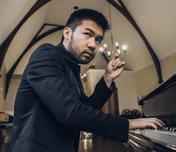
JULY 31–AUGUST 29 | Inon Barnatan,
Music Director
JULY 31–AUGUST 29 | Inon Barnatan,
31—AUGUST 29
2 SUNDAY
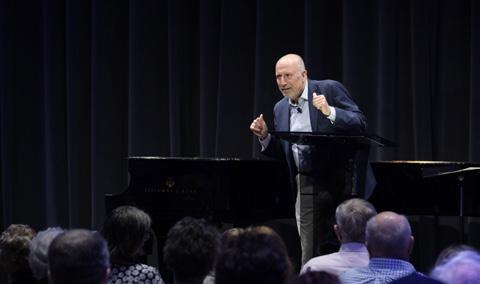
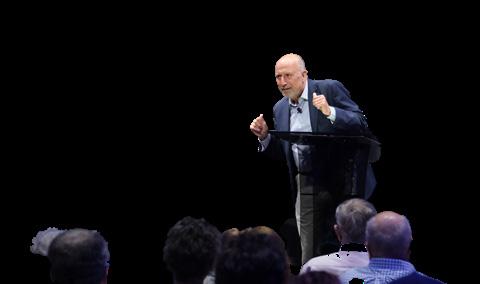
PRELUDE | 2 PM The JAI Lecture by Kristi Brown-Montesano WHAT IF? 3 PM
3 MONDAY
LISTENING LOUNGE | 1 PM
The Atkinson Room Hosted by Michael Gerdes

4 TUESDAY
COACHING WORKSHOPS 10 AM–12 PM · The JAI
ENCOUNTER | 2 PM
SummerFest Community Orchestra Reading Session
7600 FAY AVENUE
LA JOLLA, CA 92037
For parking information please visit TheConrad.org
All events are in The Baker-Baum Concert Hall unless otherwise noted.
All dates, times, programs, artists, and venues are subject to change.
9 SUNDAY
PRELUDE | 2 PM The JAI Lecture by Patrick Castillo
LOST AND FOUND 3 PM
10 MONDAY
LISTENING LOUNGE | 1 PM
The Atkinson Room Hosted by Michael Gerdes
11 TUESDAY
COACHING WORKSHOPS 10 AM–12 PM · The JAI
ENCOUNTER | 2 PM
Unmuting Masterworks at the Evolving Keyboard with Angie Zhang
16 SUNDAY
THE COMPLETE BRANDENBURGS: Part II 3 PM
TAKEOVER @ THE JAI with Paul Wiancko
7 PM The JAI
23 SUNDAY
PRELUDE | 2 PM The JAI Lecture by Tiffany Kuo
OLD COUNTRY, NEW AGE 3 PM
17 MONDAY
LISTENING LOUNGE | 1 PM
The Atkinson Room Hosted by Michael Gerdes
18 TUESDAY
ENCOUNTER | 2 PM Farfy Foundation Fellowship Artist Spotlight I
24 MONDAY
LISTENING LOUNGE | 1 PM
The Atkinson Room Hosted by Michael Gerdes
25 TUESDAY
ENCOUNTER | 2 PM Farfy Foundation Fellowship Artist Spotlight II
7/29 WEDNESDAY
SUMMERFEST PREVIEW
6 PM · The JAI
Interview with Inon Barnatan hosted by Leah Rosenthal
5 WEDNESDAY
COACHING WORKSHOPS
10 AM–12 PM · The JAI
MUSICAL PRELUDE | 6 PM
Performance by Radu Rățoi
RESHAPING THE PAST
7 PM
Midweek Masterworks
12 WEDNESDAY
COACHING WORKSHOPS
10 AM–12 PM · The JAI
OPEN REHEARSAL | 2 PM
KORNGOLD’s Suite for Left Hand and Strings, Op. 23
PRELUDE | 6 PM • The JAI
Lecture by Patrick Castillo
AMERICAN LEGACY | 7 PM
Midweek Masterworks
19 WEDNESDAY
COACHING WORKSHOPS
10 AM–12 PM · The JAI
PRELUDE | 6 PM The JAI
Lecture by Tiffany Kuo
REMADE/REBORN
7 PM
Midweek Masterworks
26 WEDNESDAY
COACHING WORKSHOPS
10 AM–12 PM · The JAI
PRELUDE | 6 PM The JAI
Lecture by Ara Guzelimian
SCHUBERTIADE
7 PM
Midweek Masterworks
30 THURSDAY 31 FRIDAY
PRE-CONCERT PARTY 5:30 PM
Free for Opening Night ticket holders
OPENING NIGHT: The Incomplete History of the World in Ten Pieces 7 PM
SYNERGY SERIES
8/1 SATURDAY
PRELUDE | 6 PM The JAI
Lecture by Kristi Brown-Montesano
VIENNA 1900 7 PM
6 THURSDAY
COACHING WORKSHOPS
10 AM–12 PM · The JAI
7 FRIDAY
MUSICAL PRELUDE | 6 PM
Performance by Prometheus Quartet EASTERN VISIONS 7 PM
13 THURSDAY
COACHING WORKSHOPS
10 AM–12 PM · The JAI
JAZZ @ THE JAI
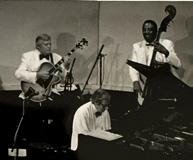
SULLIVAN FORTNER TRIO
5:30 PM & 8 PM The JAI
20 THURSDAY
COACHING WORKSHOPS
10 AM–12 PM · The JAI
OPEN REHEARSAL | 2 PM TCHAIKOVSKY’s Souvenir de Florence
14 FRIDAY
MUSICAL PRELUDE | 6 PM
Performance by Kairos Piano Quartet
OUT OF THE SHADOWS 7 PM
21 FRIDAY
MUSICAL PRELUDE | 6 PM
Performance by Prometheus Quartet
SUMMERFEST AT 40! 7 PM
27 THURSDAY
COACHING WORKSHOPS
10 AM–12 PM · The JAI
ENCOUNTER | 2 PM The JAI
Remembrance of Things Past with Ara Guzelimian
BRAD MEHLDAU: Ride into the Sun | 7 PM Balboa Theatre
28 FRIDAY
MUSICAL PRELUDE | 6 PM
Performance by Kairos Piano Quartet
CONVERSATION ACROSS CENTURIES 7 PM
8 SATURDAY
OPEN REHEARSAL | 2 PM
VAUGHAN WILLIAMS’ Piano Quintet in C Minor
MUSICAL PRELUDE | 6 PM
Performance by Kairos Piano Quartet
ROOTS 7 PM
15 SATURDAY
PRELUDE | 6 PM The JAI
Interview with Inon Barnatan hosted by Leah Rosenthal THE COMPLETE BRANDENBURGS: Part I 7 PM
22 SATURDAY
OPEN REHEARSAL | 10:30 AM ELGAR’s Piano Quintet in A Minor, Op. 84
SUMMERFEST 40TH ANNIVERSARY GALA 5:30 PM
29 SATURDAY
MUSICAL PRELUDE | 6 PM
Performance by Prometheus Quartet
FINALE: THE RULE OF THREE 7 PM
This year La Jolla Music Society celebrates the landmark 40th anniversary of SummerFest! Established in 1986 under the musical leadership of Heiichiro Ohyama, this internationally recognized chamber music festival has become a summer destination for classical music. For four decades, the festival has maintained an intimate, familystyle connection between world-class artists and audiences by keeping chamber music at its core, even as it evolved to embrace multi-genre collaborations, jazz sets, and boundary-pushing contemporary masterpieces. Today, the festival spans four weeks of programming, featuring 21
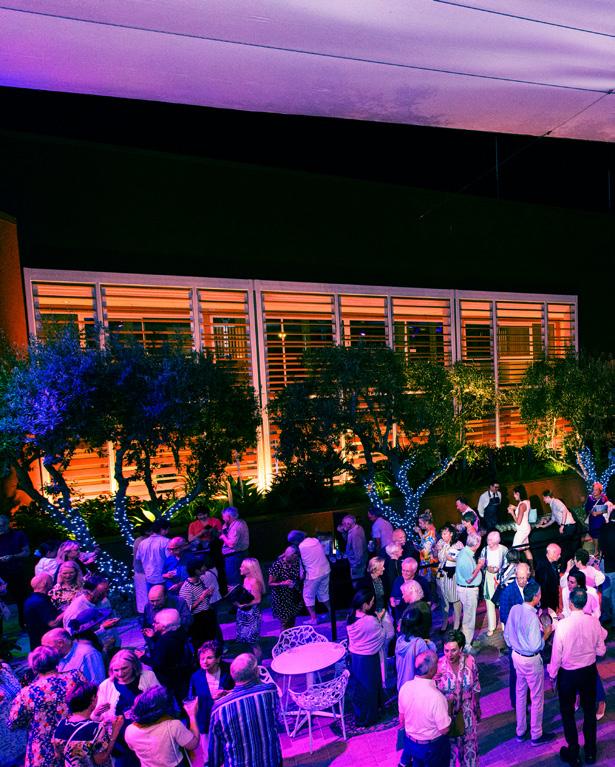
concerts and 50 free Learning & Engagement events, plus much more.
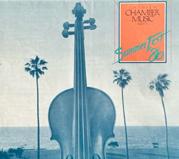
Over its forty-year history, SummerFest has been guided by exceptional artistic leadership that shaped its growth. Following Ohyama, notable milestones include the tenure of David Finckel and Wu Han as music directors in the late 1990s, followed by renowned violinist Cho-Liang Lin, who led the festival for nearly two decades and commissioned major new pieces. World-renowned artists who have graced SummerFest’s stages include André Previn, Daniil Trifonov, Renée Fleming, Midori, Emanuel Ax, Leon Fleisher, Menahem
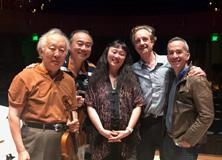
Pressler, Cécile McLorin Salvant, Alisa Weilerstein, Augustin Hadelich, Jeremy Denk, and many more.
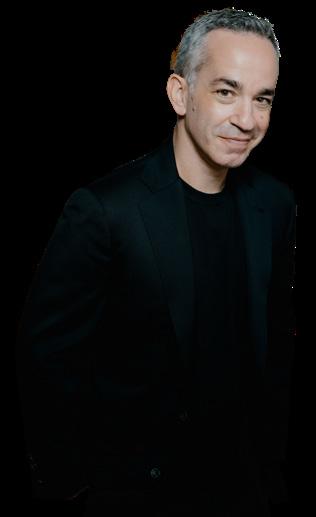
Since 2019, acclaimed concert pianist Inon Barnatan has served as Music Director, expanding the festival’s presence on the world stage and leading it through a major structural transition into its permanent home, The Conrad. Select SummerFest concerts can now be viewed around the world on the prestigious classical music streaming platform medici.tv, reaching so far more than 80,000 music lovers in more than 80 countries.
With nearly 90 total events, SummerFest 2026 is bigger and more exciting than ever. The tremendous
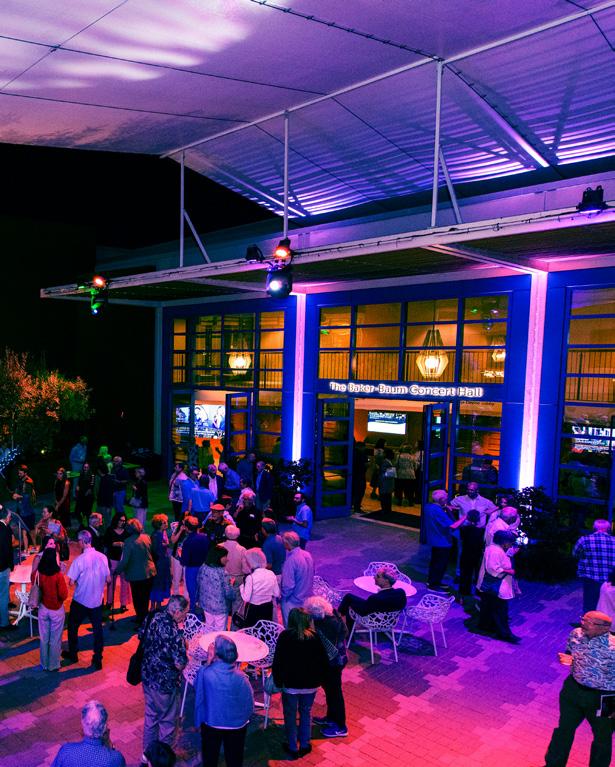
support of many dedicated donors and patrons has made the growth and evolution of the festival possible. The La Jolla Music Society staff and Board of Directors look forward to presenting another 40 years of top-notch, innovative programming and world-class performances right here in La Jolla.
A full history of the company is available on our website, TheConrad.org.

For forty years, SummerFest has been a place where great artists, adventurous programming, and a spirit of curiosity come together in a way that feels unique to San Diego. Over those four decades, the festival has built its own history—through unforgettable performances, enduring musical friendships, and a growing sense of community that continues to deepen with each season. This year, as we celebrate that milestone anniversary, it feels especially fitting to gather around the theme “Making History.”
This summer’s programs invite us to listen across time: to the moments, movements, and imaginations that shaped the music we love, and to the ways these works continue to speak to us now. Throughout the season, we’ll explore music that changed the course of history, music that reflects the world from which it emerged, and music that still feels urgent and revealing today. Some programs revisit pivotal artistic moments; others recover lost worlds, uncover unexpected connections, or cast familiar works in a new light. In a year that also marks the 250th anniversary of the United States, the season’s invitation to reflect on history feels especially timely.
We begin with The Incomplete History of the World in Ten Pieces, a journey across centuries featuring an all-star cast of musicians—an opening night that sets the tone for a season of curiosity, breadth, and discovery. The event is part of our Synergy Initiative, which continues to place music in imaginative dialogue with other disciplines. Our second Synergy program is one of the season’s most ambitious: a meeting of the genre-defying jazz legend Brad Mehldau, mandolin virtuoso Chris Thile, a host of special guests, and full string orchestra.
Our Midweek Masterworks offer immersive, intermissionfree concerts designed for deep listening, followed by a shared drink and conversation in the courtyard.
This summer, we are especially pleased to feature Paul Wiancko as our Composer-in-Residence. A cellist with the
legendary Kronos Quartet and one of the most original and compelling compositional voices of our time, he feels beautifully aligned with a season devoted to the living, evolving nature of musical history.
One of the pleasures of SummerFest is the way it brings together artists from different generations, backgrounds, and musical worlds. Some have been part of the festival’s story for years; others are joining us for the first time this summer. That exchange—between old friends and new collaborators, between tradition and fresh perspective—feels very much in keeping with this season’s theme.
Thank you for being part of this special anniversary season. As we celebrate forty years of SummerFest, I hope you’ll join us for a summer of insight, celebration, and unforgettable music—and become part of the festival’s continuing story.

Inon Barnatan Music Director
VIOLIN
Benjamin Beilman
Owen Dalby
James Ehnes
Karen Gomyo*
Randall Goosby*
Njioma Chinyere Grevious
Kathryn Hatmaker
Stefan Jackiw
Erin Keefe
Ela Kodžas*
Tessa Lark
Yura Lee
Cho-Liang Lin
Aisslinn Nosky
Simone Porter
Blake Pouliot
Wesley Precourt*
Edson Scheid*
Arnaud Sussmann
Jeffrey Thayer
Stephen Waarts
Andrew Wan
Cherry Yeung
VIOLA
Rebecca Albers
Hsin-Yun Huang
Ayane Kozasa*
Teng Li
Matthew Lipman
Daniel McCarthy*
Dimitri Murrath*
Paul Neubauer
Milena Pajaro-van de Stadt
Timothy Ridout*
Masumi Rostad
Jonathan Vinocour
BASS
Doug Balliett
Timothy Cobb
Mark Dresser
Samuel Hager
Jeremy Kurtz-Harris
Anthony Manzo
PIANO
Thomas Adès
Inon Barnatan
Jonathan Biss
Jeremy Denk
Zoltán Fejérvári
Sullivan Fortner
Henry Kramer
George Li
Pedja Mužijevi ć *
HARPSICHORD
David Belkovski*
ORGAN
Ruben Valenzuela
LUTE
Alejandro Jenné*
FLUTE
Emi Ferguson
Brandon Patrick George*
Rose Lombardo
CLARINET
Mark Dover
Graeme Steele Johnson*
Yoonah Kim*
Ricardo Morales
Osmo Vänskä
John Bruce Yeh

CELLO
Ani Aznavoorian*
Efe Baltacigil
Jay Campbell
Sterling Elliott
Coleman Itzkoff
Nina Lee
Jonathan Swensen
Alisa Weilerstein
Paul Wiancko
OBOE
Claire Brazeau
Mekhi Gladden*
Sarah Skuster*
BASSOON
Monica Ellis
Eleni Katz
TRUMPET
Brandon Ridenour
TROMBONE
Eric Starr
TUBA
Aaron McCalla*
HORN
Stefan Dohr
Kevin Newton*
Kaylet Torrez
SAXOPHONE
Steven Banks*
PERCUSSION
Sidney Hopson
Steven Schick
VOICE
Jennifer Johnson Cano
Kiera Duffy*
Reginald Mobley*
Robin Tritschler
NARRATOR
Fred Child
HARP
Julie Smith Phillips
ACCORDION
Radu R ăț oi* ‡
CONDUCTOR
Thomas Adès
Inon Barnatan
Stephanie Childress*
COMPOSER-IN-RESIDENCE
Paul Wiancko
ENSEMBLES
Imani Winds

Brandon Patrick George, flute ;
Mekhi Gladden, oboe ; Mark Dover, clarinet ;
Kevin Newton, horn ;
Monica Ellis, bassoon
Sullivan Fortner Trio
Sullivan Fortner, piano ;
Tyrone Allen, bass ;
Kayvon Gordon, drums
Brad Mehldau*
Ride into the Sun—
The Music of Elliot Smith
Chris Thile*, Blake Mills*,
Matt Chamberlain*, & John Davis*
FARFY FOUNDATION
FELLOWSHIP ARTIST ENSEMBLES
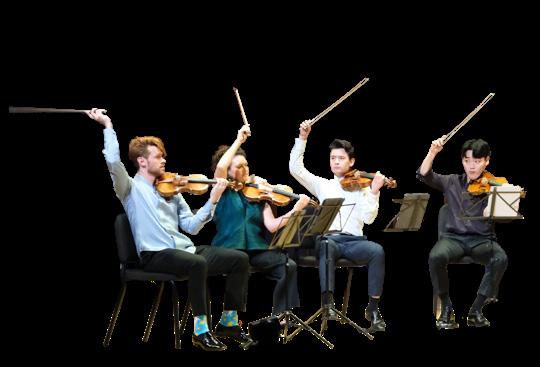
Prometheus Quartet* †
Roger Shao, Anthony Chan, violins ;
Brian Jennings, viola ;
Wilson Vanderslice, cello
Kairos Piano Quartet* †
Anthony Ratinov, piano ;
Elli Choi, violin ;
Ayano Nakamura, viola ; Eliana Razzino Yang, cello
LECTURERS & GUEST SPEAKERS
Kristi Brown-Montesano
Patrick Castillo
Michael Gerdes
Ara Guzelimian
Tiffany Kuo
Leah Rosenthal
Angie Zhang
FILMMAKER-IN-RESIDENCE
Tristan Cook
* SummerFest debut
† Farfy Foundation Fellowship Artist
‡ Young Concert Artists (YCA) Artist-in Residence
Latecomers will be seated after the first work has been performed or at the first full pause in the program as designated by the performing artists. During a performance, patrons who must leave will be readmitted between works at the discretion of the House Manager.
PHOTOS
In The Baker-Baum Concert Hall: taking photos and/ or videos during the performance is prohibited. You may take photos during the artist(s) bows! In The JAI: non-professional cell phone photos and videos are permitted. For further information on using professional cameras at a JAI concert, contact the Box Office.
Please turn off any unneeded electronic devices or set them to silent (not vibrate) mode prior to the start of the performance to ensure everyone’s enjoyment. Note that many electronic devices emit unexpected noises which are amplified in the highly acoustic concert hall. Please assist your neighbor if they are unable to hear their own device emitting
Valet service is available in front of The Conrad for many performances: $30.00, cash/credit card, subject to change. garage is the Garage on 909 Kline Street.
sound. Please be aware that an illuminated phone screen for any use is a distraction to others enjoying the performance.
Concessions are available for purchase at Carolyn’s as soon as gates open for the event. Outside food and beverages are not permitted. Food items are not allowed in The Baker-Baum Concert Hall. Concessions beverages with a lid are allowed in all performance spaces.
Our artists would be grateful if you gave another music lover your seat by gifting them any tickets that you are unable to use. Seats returned to us last-minute often remain unsold and empty, while passing your tickets along helps give our artists the warm audience that they deserve. We are unable to offer refunds or cancellations on tickets; however, we understand that last-minute emergencies arise. If you must cancel, contact our Box Office no later than two (2) days before the performance date to discuss possible options.
All non-subscriber exchanges will incur a $10 per ticket exchange fee plus any applicable price differences between the selected performances.
Children under the age of 6 are not permitted in the concert hall.
All of La Jolla Music Society’s program notes are protected under copyright by the authors. For permission and information on use of the contents of this publication, please contact the Box Office.
Reach out to the Box Office for any ticketing assistance at 858.459.3728 or BoxOffice@ TheConrad.org. Hours: Monday - Friday from 10am to 6pm; Saturdays 12 pm- 6pm. On performance days the Box Office opens 2 hours prior to curtain and closes 30 minutes after the start of the performance.
Vision Statement
To transform lives through the performing arts, serving as a beacon of world-class artistic excellence, innovation, and inclusivity.
Mission Statement
To enrich the evolving cultural landscape of San Diego by curating a dynamic array of world-class performing arts programming, creating meaningful learning opportunities, and building connections between artists and audiences.
From classical, jazz, and dance to global music, exciting speakers, and family concerts, each season
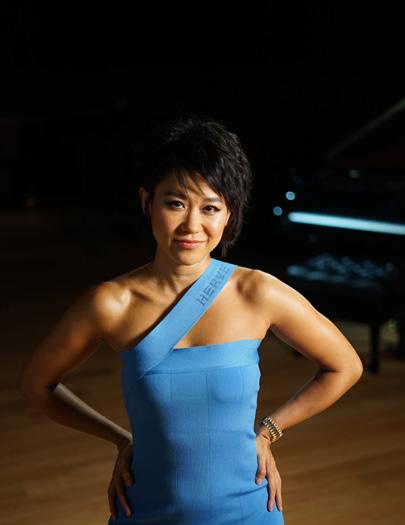
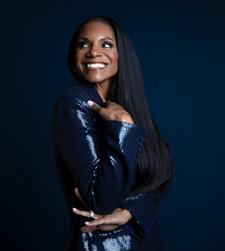
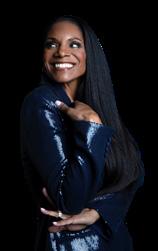
Artistic Director Leah Rosenthal brings the best artists in the world to the San Diego community. This season will feature more than 80 artists, including superstars like Audra McDonald, Itzhak Perlman, Joyce DiDonato, Emanuel Ax, KODO, Les Arts Florissants, Yuja Wang and many more.
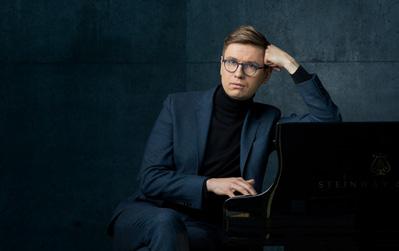
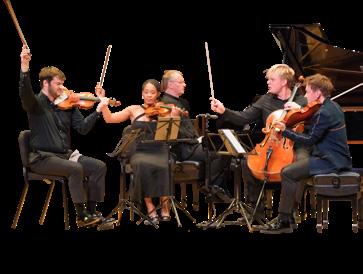
La Jolla Music Society’s acclaimed chamber music festival, curated by award-winning pianist and festival Music Director Inon Barnatan, celebrates its 40th anniversary in 2026. SummerFest engages more than 80 of the world’s finest musicians to perform at The Conrad throughout the month of August. In addition to remarkable mainstage performances, SummerFest offers over 50 free and open-tothe-public educational activities.
To learn more, visit TheConrad.org/SummerFest.
Follow Us @ljmusicsociety La Jolla Music Society
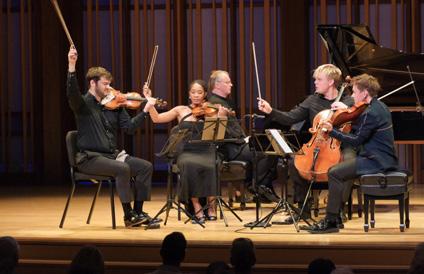
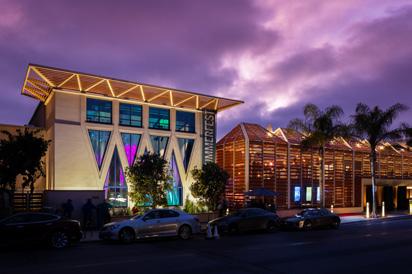
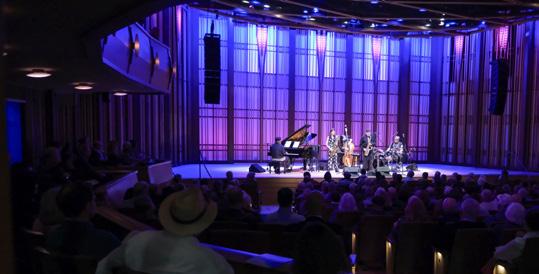
The Conrad opened in 2019 and serves as a gathering place for cultural, arts education, and community activity. As the permanent home of La Jolla Music Society, The Conrad hosts worldclass performances presented by La Jolla Music Society and other local arts organizations in its four outstanding performance and activity spaces, The Baker-Baum Concert Hall, The JAI, The Atkinson Room, and the picturesque Wu Tsai QRT.yrd.
La Jolla Music Society’s award-winning Learning & Engagement Programming provides unmatched access and learning opportunities to more than 15,000 students and community members throughout San Diego County annually. With learning and engagement at the heart of our mission, we work closely with each visiting artist and ensemble to create outreach activities that highlight their unique talents and expertise at both The Conrad and in the community.
With our state-of the-art video and streaming capabilities at The Conrad, we are able to provide live streaming for events such as our annual SummerFest and education events for free in our Digital Concert Hall.
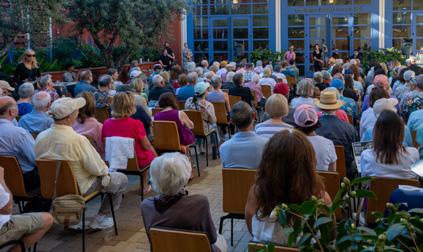
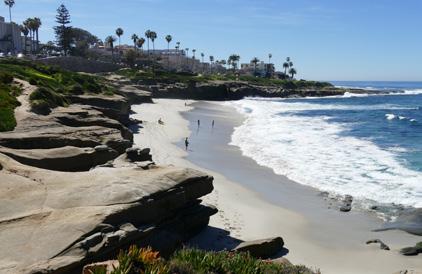
The Conrad Prebys Performing Arts Center acknowledges the ancestral, unceded territory of the Kumeyaay people, on which The Conrad was built. We hold great respect for the land and the original people of the area where our performing arts center is located. The Kumeyaay continue to maintain their political sovereignty and cultural traditions as vital members of the San Diego community.

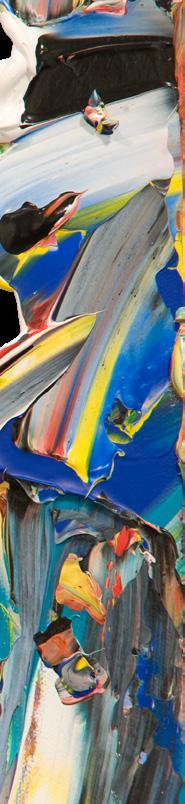

The exceptional musical experiences of SummerFest are made possible by the generosity of our dedicated family of donors. Your support helps bridge the gap between ticket revenue and the true cost of presenting world-class musicians and premier chamber music here in San Diego. Beyond the concert hall, your contributions also power our vital Learning & Engagement programs in local schools and bring the joy of music to communities throughout San Diego.
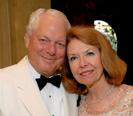
FESTIVAL FOUNDING UNDERWRITERS
Brenda Baker and Steve Baum
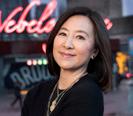
SYNERGY INITIATIVE UNDERWRITER
Clara Wu Tsai
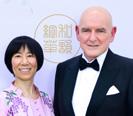
FARFY FOUNDATION FELLOWSHIP ARTISTS UNDERWRITERS
Liqun Wang and Marco Londei
SUMMERFEST MUSIC DIRECTOR UNDERWRITERS
Raffaella and John* Belanich
SPECIAL DEDICATION UNDERWRITING
Peter Cooper and Erik* Matwijkow
In addition to our Underwriters, the following pages pay tribute to all of our partners who make it possible to share the magic of the performing arts with our community.
*in memoriam
Free On-Demand Viewing | Free In-Person Admission with Purchased Concert Ticket for Prelude Lectures and Interviews | Free In-Person Admission for Musical Preludes
Find more information about pre-concert Prelude lectures, interviews, and performances on each concert program. In celebration of the festival’s 40th Anniversary, all Musical Preludes will be free and open to the public. To attend, register online at TheConrad.org.
LISTENING LOUNGES
Free Admission | Limited Seating
Michael Gerdes hosts a guided listening series for curious concertgoers who want to expand how they hear music. Each session examines a single work, exploring how a piece is built, what to listen for as it unfolds, and how different performers bring contrasting perspectives to the same notes. To attend, register online at TheConrad.org.
Free Admission | Limited Seating
La Jolla Music Society’s Farfy Foundation Fellowship Artist Program is one of the longest-running SummerFest traditions. Follow these musicians as they prepare for their SummerFest performances with a series of master classes.
This year we welcome Farfy Foundation Fellowship Artists Prometheus Quartet: Roger Shao, Anthony Chan, violins ; Brian Jennings, viola ; Wilson Vanderslice, cello ; and Kairos Piano Quartet: Anthony Ratinov, piano ; Elli Choi, violin ; Ayano Nakamura, viola ; Eliana Razzino Yang, cello .
WEDNESDAY
JULY 29
MONDAY
AUGUST 3

TUESDAY
AUGUST 4
LISTENING LOUNGE
The Atkinson Room
COACHING WORKSHOPS
The JAI
ENCOUNTER
The Baker-Baum Concert Hall
WEDNESDAY
AUGUST 5 COACHING WORKSHOPS
THURSDAY
AUGUST 6
SATURDAY
6 PM–7:30 PM
1–2 PM
10–10:50 AM 11–11:50 AM
2–3:30 PM
10—10:50 AM 11—11:50 AM
The JAI
COACHING WORKSHOPS
The JAI
AUGUST 8 OPEN REHEARSAL†
MONDAY
Free Admission | Limited Seating
Featuring intriguing discussions, performance, and diverse perspectives, SummerFest Encounters reveal fascinating insights into the ways in which music is created, influenced, interpreted, and performed.
To attend, register online at TheConrad.org.
Free Admission | Limited Seating
Open Rehearsals provide audience members with the rare opportunity to observe the intricate rehearsal process before the stage lights shine.
To attend, register online at TheConrad.org.
La Jolla Music Society has a long tradition of supporting artist development and is proud to partner with Young Concert Artists (YCA) to welcome SummerFest YCA Artist-in-Residence, accordionist Radu Râțoi . In addition to his main stage performances, he will be featured in a special Musical Prelude on Wednesday, August 5.
To attend, register online at TheConrad.org.
* These events will also be recorded and available for free on-demand viewing.
† These events will also be livestreamed and available for free on-demand viewing.
Visit TheConrad.org for more information.
Artistic Director Leah Rosenthal and Music Director Inon Barnatan chat about what to expect in this milestone 40th Anniversary Festival. Learn how the festival themes, repertoire, and artists come together in Inon’s unparalleled vision. Complimentary dessert reception follows. Registration required.
Explore Bartók’s Divertimento for String Orchestra at this Listening Lounge, hosted by Michael Gerdes. Registration required.
Inon Barnatan coaches Kairos Piano Quartet on Fauré’s Piano Quartet No. 1 in C Minor, Op. 15
Blake Pouliot coaches Prometheus Quartet on Lei Liang’s Gobi Gloria or selections from Rózsa’s String Quartet No. 1, Op. 22
SummerFest Community Orchestra Reading Session: Community string musicians of all ages and abilities take the stage and rehearse side-by-side with beloved SummerFest artists led by violinist Andrew Wan, Concertmaster of the Montreal Symphony Orchestra. Space is limited and registration is required. Music will be sent in advance.
Milena Pajaro-van de Stadt coaches Prometheus Quartet on Debussy’s String Quartet in G Minor, Op. 10
Efe Baltacigil coaches Kairos Piano Quartet on Fauré’s Piano Quartet No. 1 in C Minor, Op. 15
10 10:50 AM 11 11:50 AM Henry Kramer coaches Kairos Piano Quartet on Fauré’s Piano Quartet No. 1 in C Minor, Op. 15 Matthew Lipman coaches Prometheus Quartet on Brahms’ String Quartet No. 1 in C Minor, Op. 51 No. 1
The Baker-Baum Concert Hall 2–3 PM
10 10:50 AM
COACHING WORKSHOPS
The JAI
TUESDAY AUGUST 11
Henry Kramer, Blake Pouliot, Milena Pajaro-van de Stadt, Efe Baltacigil, and Anthony Manzo rehearse Vaughan Williams’ Piano Quintet in C Minor. Registration required.
Explore Copland’s Appalachian Spring at this Listening Lounge, hosted by Michael Gerdes. Registration required.
11:50 AM Arnaud Sussmann coaches Prometheus Quartet on Brahms’ String Quartet No. 1 in C Minor, Op. 51 No. 1. Ayane Kozasa coaches Kairos Piano Quartet on Walton’s Piano Quartet in D Minor ENCOUNTER*
The Baker-Baum Concert Hall 2–3:30 PM
Unmuting Masterworks at the Evolving Keyboard: Award-winning pianist Angie Zhang returns to SummerFest with an engaging lecture-recital exploring how the evolution of the keyboard shapes interpretation. Audiences will hear masterworks performed on three instruments: a Viennese fortepiano reproduction, an original Broadwood piano from Beethoven’s era, and a modern concert grand. Registration required.
WEDNESDAY AUGUST 12
THURSDAY AUGUST 13
COACHING WORKSHOPS The JAI
OPEN REHEARSAL† The Baker-Baum Concert Hall
COACHING WORKSHOPS The JAI
10 10:50 AM 11 11:50 AM
2–3 PM
10–10:50 AM 11–11:50 AM
MONDAY AUGUST 17 LISTENING LOUNGE The Atkinson Room 1–2 PM
TUESDAY
AUGUST 18 ENCOUNTER† The Baker-Baum Concert Hall 2–3:30 PM
WEDNESDAY AUGUST 19
THURSDAY AUGUST 20
SATURDAY AUGUST 22
MONDAY
24
TUESDAY AUGUST 25
WEDNESDAY
AUGUST 26
COACHING WORKSHOPS The JAI
COACHING WORKSHOPS The JAI
OPEN REHEARSAL†
10–10:50 AM 11–11:50 AM
10—10:50 AM 11—11:50 AM
The Baker-Baum Concert Hall 2–3 PM
REHEARSAL† The Baker-Baum Concert Hall 10:30 AM–11:30 AM
Zoltán Fejérvári coaches Kairos Piano Quartet on Walton’s Piano Quartet in D Minor
Coleman Itzkoff coaches Prometheus Quartet on Dvořák’s String Quartet No. 12 in F Major, Op. 96 “American.”
Zoltán Fejérvári, Arnaud Sussmann, Tessa Lark, and Paul Wianko rehearse Korngold’s Suite for Left Hand and Strings, Op. 23. Registration required.
Members of Kairos Piano Quartet coach local students. Paul Wiancko coaches Kairos Piano Quartet on Krása’s Tanz for String Trio
Explore Thomas Adès’ Concerto Conciso at this Listening Lounge, hosted by Michael Gerdes. Registration required.
Farfy Foundation Fellowship Artist Spotlight I: Violinist Edson Scheid joins the Kairos Piano Quartet and Prometheus Quartet for a dynamic program featuring Schumann’s Piano Quintet in E-flat Major, Op. 44 and Brahms’ String Quartet No. 1 in C Minor, Op. 51 No. 1. A leading performer on modern and period instruments, Scheid brings international artistry to this Encounter. Registration required.
Cho-Liang Lin coaches Prometheus Quartet on Dvořák’s String Quartet No. 12 in F Major, Op. 96 “American.” Paul Neubauer coaches Kairos Piano Quartet on Turina’s Piano Quartet in A Minor, Op. 67
Simone Porter coaches Prometheus Quartet on Haydn’s String Quartet in E-flat Major, Hob.III:38 “The Joke” and Webern’s Six Bagatelles for String Quartet, Op. 9 Members of Prometheus Quartet coach local students.
Benjamin Beilman, Cho-Liang Lin, Paul Neubauer, Teng Li, Jonathan Swensen, and Nina Lee rehearse Tchaikovsky’s Souvenir de Florence. Registration required.
Inon Barnatan, James Ehnes, Stephen Waarts, Timothy Ridout, and Jonathan Swensen rehearse Elgar’s Piano Quintet in A Minor, Op. 84. Registration required.
Explore Vaughan Williams’ Fantasia on a Theme by Thomas Tallis at this Listening Lounge, hosted by Michael Gerdes. Registration required.
Farfy Foundation Fellowship Artist Spotlight II: Cellist Nina Lee of the Brentano Quartet collaborates with the Prometheus Quartet on D’Ambrosio’s Suite, Op. 8, alongside works by Krása and Turina performed by members of the Kairos Piano Quartet. A celebrated chamber musician and educator, Lee brings depth and versatility to this Encounter. Registration required.
COACHING WORKSHOPS
The JAI
COACHING WORKSHOPS The JAI
THURSDAY
AUGUST 27
10–10:50 AM 11–11:50 AM
10–10:50 AM 11–11:50 AM
ENCOUNTER* The JAI 2–3:30 PM
Stephen Waarts coaches Kairos Piano Quartet on Mozart’s Piano Quartet No. 1 in G Minor, K.478 Ani Aznavoorian coaches Prometheus Quartet on selections from Schubert’s String Quartet No. 14 in D Minor, D.810, “Death and the Maiden.”
James Ehnes coaches Kairos Piano Quartet on Mozart’s Piano Quartet No. 1 in G Minor, K.478 Prometheus Quartet and Kairos Piano Quartet reflect on their SummerFest experience.
Remembrance of Things Past: Ara Guzelimian leads an insightful exploration into how composers reinterpret the past, pairing Dowland and Adès in a program performed by Robin Tritschler, Alejandro Jenné, and Inon Barnatan. This talk highlights the enduring interplay of memory, tradition, and innovation across centuries of music. Registration required.
* These events will also be recorded and available for free on-demand viewing.
† These events will also be livestreamed and available for free on-demand viewing.
Quick notes excerpted from program notes by Eric Bromberger, except where indicated.
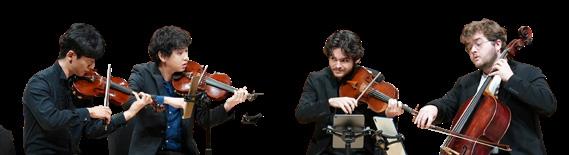
Wednesday, August 5, 2026 · 6 PM
RAMEAU Overture from Pygmalion, RTC 52 (arr. Râțoi) (1683–1764)
LISZT No. 10 “Appassionata” from Transcendental Études, S.139 (1811–1886)
KUSYAKOV Finale from Sonata No. 6 (1945–2007)
SAINT-SAËNS Danse macabre, Opus 40 (1835–1921) Radu Râțoi, accordion
With this program, I invite you to follow me on this lifelong journey of redefining the classical accordion. This is a “prelude” performance, a prelude can be deeply rewarding—a threshold that opens entirely new colors in music you thought you knew.
We begin with Rameau’s Pygmalion overture, diving into the elegance of the French Baroque, the accordion transforming into a vivid, breathing orchestra.
Liszt’s Transcendental Étude No. 10 then demonstrates the instrument’s capacity to tackle one of the most demanding piano cycles ever written, matching fierce Romantic passion while unlocking a new expressive dimension.
Kusyakov’s Sonata No. 6 Finale—the sole original work here—bridges Liszt’s virtuosity and the symphonic finale to come, treating the accordion as a full orchestra, which mirrors my own approach: a powerful, portable orchestra.
Finally, Saint-Saëns’ Danse macabre brings the journey full circle, showcasing the accordion’s ultimate dual nature—fiercely powerful, yet incredibly delicate.
Radu Râțoi
Friday, August 7, 2026 · 6 PM
DEBUSSY Selections from String Quartet in G Minor, Opus 10 (1862–1918) Scherzo: Asssez vif et bien rythmé Andantino doucement expressif
RÓZSA Scherzo: In modo Ongarese from String Quartet No. 1, Opus 22 (1907–1995)
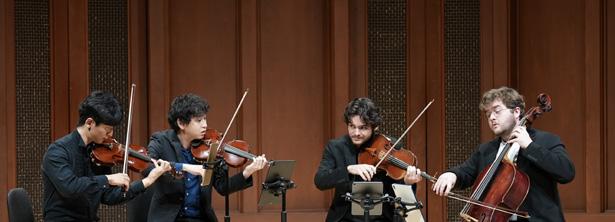
LEI LIANG Gobi Gloria (b. 1972) Prometheus Quartet
Roger Shao, Anthony Chan, violins; Brian Jennings, viola; Wilson Vanderslice, cello
Saturday, August 8, 2026 · 6 PM
FAURÉ Piano Quartet No. 1 in C Minor, Opus 15 (1845–1924) Allegro molto moderato Scherzo: Allegro vivo
Adagio Allegro molto
Kairos Piano Quartet
Anthony Ratinov, piano; Elli Choi, violin; Ayano Nakamura, viola; Eliana Razzino Yang, cello
QUICK NOTE:
Claude Debussy’s String Quartet captures a young composer discovering a new musical language, inspired by the sounds of East Asia that would forever change his sense of color, harmony, and rhythm. Half a century later, after establishing a celebrated career in Hollywood, Miklós Rózsa returned to the folk traditions of his Hungarian upbringing in the scherzo from his First String Quartet, where folk melodies and rustic dances burst vividly to life. We conclude with San Diego-based composer Lei Liang, whose Gobi Gloria presents a powerful meditation inspired by the vast landscapes and cultural heritage of the Gobi Desert. Spanning more than a century, these works offer three distinct perspectives on the idea of “East”—through curiosity, heritage, and lived experience—while tracing an unexpected path from Paris to Hollywood to San Diego.
Anthony Chan
Fauré wrote the Piano Quartet in C Minor between 1876 and 1879, when he was in his early thirties. Despite the work’s success, the composer was dissatisfied with the final movement and rewrote it in 1883. In its completed form, the quartet is an extraordinary achievement. The Allegro molto moderato opens with a sturdy theme in the strings, with off-the-beat accompaniment from the piano. Fauré reverses the expected order of the interior movements and places the scherzo, marked Allegro vivo, second. Because of their many similarities, the final two movements should be considered together. The Adagio is built on the brief dotted phrase first heard in the cello: this rising figure will unify the final two movements. It is a measure of Fauré’s achievement in this music that so simple a figure can be made to yield such a range of expression.
Friday, August 14, 2026 · 6 PM
WALTON Piano Quartet in D Minor (1902–1983) Allegramente
Allegro scherzando
Andante tranquillo
Allegro molto
Kairos Piano Quartet
Friday, August 21, 2026 · 6 PM
DVOŘÁK String Quartet in F Major, Opus 96 “American” (1841–1904) Allegro ma non troppo Lento
Molto vivace
Vivace ma non troppo Prometheus Quartet
Friday, August 28, 2026 · 6 PM
MOZART Piano Quartet in G Minor, K.478 (1756–1791) Allegro
Andante
Allegro moderato
Kairos Piano Quartet
Saturday, August 29, 2026 · 6 PM
HAYDN String Quartet in E-Flat Major, Opus 33, No. 2 “The Joke” (1732–1809) Allegro moderato
Scherzo: Allegro
Largo
Presto
WEBERN Six Bagatelles for String Quartet, Opus 9 (1913) (1883–1945) Mässig
Leicht bewegt
Ziemlich fliessend
Sehr langsam
Äusserst langsam
Fliessend
SCHUBERT Allegro from String Quartet in D Minor, D.810 (1797–1828) “Death and the Maiden” Prometheus Quartet
English composer William Walton’s Piano Quartet has a melodic and rhythmic invention that came naturally to the composer. Written when the composer was just 16, it is undoubtedly a precocious piece, showing not only how much Walton had absorbed from his predecessors, but also the beginnings of his own voice. The first movement is in conventional sonata form and opens in the same wistful mood as a Herbert Howells quartet which inspired it. The lively, pointed rhythms of the Scherzo lead to a fugue derived from the work’s opening theme and a rather grand, well-contrasted second theme. The tender Andante tranquillo has clear Ravel moments and at least initially recalls the certainties of pre-First World War England. These certainties are broken by the harsh rhythms of the final Allegro molto, whose initial material again is built on that of the opening movement, but this time with a harder edge.
—Chris Darwin
During his tenure as director of the National Conservatory of Music in New York, Dvořák was fascinated by life in the New World, but he missed his homeland. Dvořák’s secretary in New York City invited him to spend the summer of 1893 in his hometown—the Czech community of Spillville, Iowa. There Dvořák spent a happy and productive summer, surrounded by familiar language, customs, and food. He sketched the String Quartet in F Major in only three days. The quartet quickly acquired the nickname “American.” The source of that nickname is uncertain, but it has become an inescapable part of how we think of this music. Dvořák would later denounce any “nonsense about my having made use of original American melodies.” He himself offered a useful introduction to his quartet: “I wanted to write something for once that was very melodious and straightforward, and dear Papa Haydn kept appearing before my eyes, and that is why it all turned out so simply.”
The Quartet in G Minor, particularly the first movement, is Mozart at his most powerful. The piano part is extremely difficult (he clearly wrote it with his own abilities in mind), and this music demands three absolutely first-class string players. All four instruments spit out the brusque opening theme of the Allegro, an abrupt six-note phrase very much like the powerful mottos Beethoven would later use as thematic material. After the tensions of the first movement, the Andante—in B-flat major—brings an interlude of delicacy and beauty. Mozart had integrated piano and strings in the first movement, but here he sometimes treats them as separate units. The finale is a rondo: the piano states the propulsive opening theme, quickly taken up by the strings, and Mozart furnishes a wealth of sharply contrasted interludes along the way. A powerful coda, itself of uncertain tonality, drives the quartet to its full-throated cadence.
Haydn’s “Joke” Quartet, written in 1781, reveals not only a renewed mastery of the genre but also his tongue-in-cheek humor at its most overt. A jovial opening movement gives way to an off-kilter scherzo, a nostalgic slow movement, and an impeccably designed finale that earns the quartet its nickname. More than a century later, Webern’s Six Bagatelles push Classical ideals toward unfamiliar austerity. The work condenses remarkable expressivity into just four minutes, so fleeting that a single sensory impression barely registers in memory, challenging performers and listeners alike to hold on to elusive wisps of sound. Between these two worlds stands Schubert’s Death and the Maiden, composed in 1824 amid ill health. The first movement transforms Classical form into a gripping struggle against the inexorable force of mortality. Despite their strikingly different musical languages, these works together tell the story of a Vienna that continually reinvented the string quartet genre.
Roger Shao and Wilson Vanderslice
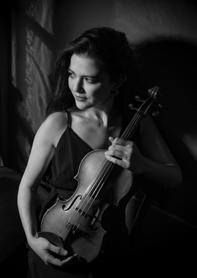
FRIDAY, JULY 31, 2026 · 7 PM · THE BAKER-BAUM CONCERT HALL
Fred Child, narrator
Bingen, 1150s VON BINGEN O Virtus Sapientiae (1098–1179) Reginald Mobley, countertenor ; Eliana Razzino Yang*, cello
London, 1590s
MORLEY It was a Lover and His Lass (1557–1602) Reginald Mobley, countertenor ; Alejandro Jenné, lute
Venice, 1720s
VIVALDI Presto from The Four Seasons: Summer (1678–1741) Stefan Jackiw, solo violin; Randall Goosby, Blake Pouliot, violin I; Roger Shao*, violin II; Brian Jennings*, viola; Eliana Razzino Yang*, cello; Jeremy Kurtz-Harris, bass; Alejandro Jenné, baroque guitar
Prague, 1780s
MOZART Overture from Don Giovanni (1756–1791) Blake Pouliot, Randall Goosby, violins; Ayano Nakamura*, viola; Eliana Razzino Yang*, cello; Jeremy Kurtz-Harris, bass
Vienna, 1820s
BEETHOVEN Cavatina from String Quartet No. 13 in B-Flat Major, Opus 130 (1770–1827) Stefan Jackiw, Karen Gomyo, violins; Masumi Rostad, viola; Alisa Weilerstein, cello
Weimar, 1850s
LISZT La Campanella (1811–1886) George Li, piano
WAGNER Prelude from Tristan und Isolde (arr. for string sextet by Guertler) (1813–1883) Karen Gomyo, Blake Pouliot, violins; Masumi Rostad, Ayano Nakamura*, violas; Alisa Weilerstein, Sterling Elliot, cellos
Paris, 1910
Support for this program is provided by: Clara Wu Tsai
La Jolla Music Society’s 2026–27 Season is supported by The City of San Diego Cultural Affairs, County of San Diego, Prebys Foundation, Farfy Foundation, ProtoStar Foundation, Vail Memorial Fund, The Lodge at Torrey Pines, Banc of California, ResMed Foundation, San Diego Theatres Foundation, Bright Events Rentals, Cafe Coyote, Rancho Coyote, GRNFC Hospitality Group, Ace Parking, Brenda Baker and Steve Baum, Raffaella Belanich, Gordon Brodfuehrer, Eleanor Charlton, Mary Ellen Clark, Bert and Julie Cornelison, Elaine Galinson and Herbert Solomon, Irwin Jacobs, Helen and Keith Kim, Angelina and Fred Kleinbub, Dorothea Laub, Vivian Lim and Joseph Wong, Jaqueline and Jean-Luc Robert, Marge and Neal Schmale, Karen and Kit Sickels, Jeanette Stevens, Debra Turner, Sue and Peter Wagener, Liqun Wang and Marco Londei, Anna and Edward Yeung, Bebe and Marvin Zigman, Anonymous.
STRAVINSKY
Sacrificial Dance from The Rite of Spring (arr. for Piano Four-Hands) (1882–1971) Inon Barnatan, George Li, piano
Leningrad, 1940s
SHOSTAKOVICH
Largo from Piano Trio No. 2 in E Minor, Opus 67 (1906–1975) Inon Barnatan, piano; Karen Gomyo, violin; Alisa Weilerstein, cello
New York, 1960s
BERNSTEIN America from West Side Story for Piano Four-Hands (1918–1990)
George Li, Inon Barnatan, piano
CODA
PETER HEIDRICH Happy Birthday Variations (b. 1935) Theme
Variation I: In the style of Johann Sebastian Bach
Variation II: In the style of Joseph Haydn
Variation III: In the style of Wolfgang Amadeus Mozart
Variation IV: In the style of Ludwig van Beethoven
Variation V: In the style of Robert Schumann
Variation VI: In the style of Johannes Brahms
Variation VII: In the style of Richard Wagner
Variation VIII: In the style of Antonín Dvořák
Variation IX: In the style of Max Reger
Variation X: In Viennese style
Variation XI: In the style of film music
Variation XII: In jazz style
Variation XIII: In the style of dance music
Variation XIV: In Hungarian style
Blake Pouliot, Karen Gomyo, Roger Shao*, Elli Choi*, violin I; Stefan Jackiw, Randall Goosby, Anthony Chan*, violin II; Masumi Rostad, Brian Jennings*,
Ayano Nakamura*, violas; Alisa Weilerstein, Sterling Elliot, Eliana Razzino Yang*, cellos;
Jeremy Kurtz-Harris, bass
*2026 Farfy Foundation Fellowship Artist
Texts and Translations
O Virtus Sapientiae
Text from Antiphon for Divine Wisdom by Hildegard von Bingen
O virtus Sapientiae, quae circuiens circuisti comprehendendo omnia in una via, quae habet vitam, tres alas h-bens, quarum una in altum volat, et altera de terra sudat, et tertia undique volat. Laus tibi sit, sicut te decet, O Sapientia.
It Was a Lover and His Lass
Text by William Shakespeare
It was a lover and his lass,
With a hey, and a ho, and a hey nonino, That o’er the green cornfield did pass, In springtime, the only pretty ring time, When birds do sing, hey ding a ding, ding; Sweet lovers love the spring.
Between the acres of the rye, With a hey, and a ho, and a hey nonino, Those pretty country folks would lie, In springtime, the only pretty ring time, When birds do sing, hey ding a ding, ding; Sweet lovers love the spring.
This carol they began that hour, With a hey, and a ho, and a hey nonino, How that a life was but a flower
In springtime, the only pretty ring time, When birds do sing, hey ding a ding, ding; Sweet lovers love the spring.
And therefore take the present time, With a hey, and a ho, and a hey nonino, For love is crownèd with the prime
In springtime, the only pretty ring time, When birds do sing, hey ding a ding, ding; Sweet lovers love the spring.
O Strength of Wisdom
Translation by Kate Quartano Brown
O strength of Wisdom who, circling, circled, enclosing all in one lifegiving path, three wings you have: one soars to the heights, one distils its essence upon the earth, and the third is everywhere. Praise to you, as is fitting, O Wisdom.

PRELUDE · 6 PM
THE JAI
Lecture by Kristi Brown-Montesano
La Jolla Music Society’s 2026–27 Season is supported by The City of San Diego Cultural Affairs, County of San Diego, Prebys Foundation, Farfy Foundation, ProtoStar Foundation, Vail Memorial Fund, The Lodge at Torrey Pines, Banc of California, ResMed Foundation, San Diego Theatres Foundation, Bright Events Rentals, Cafe Coyote, Rancho Coyote, GRNFC Hospitality Group, Ace Parking, Brenda Baker and Steve Baum, Raffaella Belanich, Gordon Brodfuehrer, Eleanor Charlton, Mary Ellen Clark, Bert and Julie Cornelison, Elaine Galinson and Herbert Solomon, Irwin Jacobs, Helen and Keith Kim, Angelina and Fred Kleinbub, Dorothea Laub, Vivian Lim and Joseph Wong, Jaqueline and Jean-Luc Robert, Marge and Neal Schmale, Karen and Kit Sickels, Jeanette Stevens, Debra Turner, Sue and Peter Wagener, Liqun Wang and Marco Londei, Anna and Edward Yeung, Bebe and Marvin Zigman, Anonymous.
SATURDAY, AUGUST 1, 2026 · 7 PM
THE BAKER-BAUM CONCERT HALL
J. STRAUSS Kaiser-Walzer “Emperor Waltz,” Opus 437 (arr. Schoenberg) (1825–1899) Rose Lombardo, flute; Yoonah Kim, clarinet ; Randall Goosby, Elli Choi*, violins; Dimitri Murrath, viola; Sterling Elliott, cello; Inon Barnatan, piano
R. STRAUSS Violin Sonata in E-Flat Major, Opus 18 (1864–1949) Allegro, ma non troppo
Andante cantabile
Andante
Stefan Jackiw, violin; George Li, piano
INTERMISSION
BERG Sieben frühe Lieder (1885–1935) Nacht
Schilflied
Die Nachtigall
Traumgekrönt
Im Zimmer
Liebesode
Sommertage
Kiera Duffy, soprano; Inon Barnatan, piano
SCHOENBERG Verklärte Nacht, Opus 4 (1874–1951) Blake Pouliot, Karen Gomyo, violins; Masumi Rostad, Dimitri Murrath, violas; Alisa Weilerstein, Sterling Elliott, cellos
*2026 Farfy Foundation Fellowship Artist
Born October 25, 1825, Vienna
Died June 3, 1899, Vienna
Composed: 1925
Approximate Duration: 13 minutes
Seeing the names Johann Strauss II and Arnold Schoenberg in the same sentence may strike some as surreal, but there is a connection between these two men, and it involves some interesting history. In February 1919, in the grim aftermath of World War I, Schoenberg founded in Vienna the Society for Private Musical Performances, which gave performances for lovers of new music. People could pay for tickets according to their means, the press (and music critics) were excluded, and many orchestral works were performed either in versions for piano four-hands or for piano and chamber ensemble. In those days before recordings, the Society’s performances allowed music lovers to hear a great deal of music they might otherwise not hear, particularly in its arrangements of orchestral works for smaller ensembles. The Society gave performances of 154 works in 117 concerts before it was forced to disband at the end of 1921 due to the financial situation after World War I.
In 1921 the Society gave a benefit concert, and—in search of works that might be attractive to general audiences— Schoenberg asked his former students Anton Webern and Alban Berg each to make an arrangement of a Strauss waltz for chamber ensemble. These were performed (and have been recorded a number of times), and Schoenberg himself must have felt their appeal, because four years later—in 1925, long after the Society had been disbanded—he made an arrangement of Strauss’ famous Emperor Waltz for an ensemble of string quartet, piano, flute, and clarinet.
The Emperor Waltz was one of Strauss’ late works (it was his Opus 437), originally published in 1889. The titles of Strauss’ waltzes were often fanciful and might bear little relation to the music itself, but this waltz was composed specifically to commemorate the visit of Kaiser Wilhelm I of Germany to Emperor Franz Josef in Vienna in 1889. That was a grand occasion, and Strauss’ waltz—elegant and sumptuous—may be understood as an act of homage not just to this occasion but also to the entire society that the two emperors represented. It may be easy for musical snobs to look down on the music of Johann Strauss II, but he was a powerful, innovative composer, and he had the respect of his contemporaries—Brahms once copied out the opening bars of the Blue Danube Waltz on a lady’s fan and inscribed it: “Unfortunately not by Johannes Brahms.”
Arnold Schoenberg, who was 25 when Strauss died in Vienna, felt a similar reverence, and his arrangement of the
Emperor Waltz may be understood as an act of affection, a tribute from one great Viennese composer to another. His arrangement is for a large ensemble—seven instruments, including the powerful resources of the piano—and it can make a sound big enough to capture some of the rich sweep of the Emperor Waltz. Strauss’ waltzes were not single waltzes, but collections of different waltz sequences, and the Emperor Waltz—which stretches out to nearly a quarter of an hour—is made up of five separate waltzes.
Born June 11, 1864, Munich
Died September 8, 1949, Garmisch-Partenkirchen, Germany
Composed: 1887–88
Approximate Duration: 28 minutes
The Violin Sonata came at a pivotal point in Richard Strauss’ career. He wrote it in 1887–8, when he was only 24 and just beginning work on the symphonic poem Don Juan. The success of Don Juan would lead Strauss to concentrate on the symphonic poem and later on opera; the Violin Sonata, in fact, was his final piece of chamber music. Coming at so important an intersection in his career, the Violin Sonata shows features of both the world Strauss was leaving and the world he was about to enter. In its structure and harmonic language, the sonata looks back to the classical tradition of Brahms and Schumann, but in its dramatic scope and the sheer panache of the writing, it looks ahead to the symphonic poems.
Not all listeners have found this combination convincing, and some have questioned whether Strauss’ Violin Sonata, full of volcanic fury and dense textures, is chamber music at all. Strauss’ biographer Norman Del Mar notes that “the piano part resembles nothing so strongly as a Liszt Piano Concerto, while the violin line…rather suggests a full body of strings.” The fusion of styles in Strauss’ Violin Sonata can be jarring, but this is nevertheless brilliant, exciting music. Strauss played both piano and violin, and the writing for the two instruments is virtuosic. The piano opens the Allegro, ma non troppo, and its first figure—immediately picked up the by the violin—contains the rhythmic cell that will animate the entire movement: a sixteenth-note pickup leading into a triplet. This figure, full of the rhythmic snap so typical of Strauss’ tone poems, recurs throughout the movement. The second theme soars through a range of two-and-a-half octaves, while the third, marked appassionato, climbs into the violin’s highest register. This sonata-form movement, marked by an exceedingly active development, closes on a restatement of the first idea.
The Andante cantabile was written after the outer movements were completed and published separately under the title Improvisation. It is in ABA form, with an opening section that has reminded many of Mendelssohn’s Songs
Without Words. The interior sequence is impassioned, with the violin line riding high above shimmering arpeggios of 64thnotes in the piano; Strauss quotes Schubert’s song Erlkönig in the turbulent middle section and the slow movement of Beethoven’s “Pathetique” Sonata in the coda.
Nowhere does the transitional nature of this sonata appear more clearly than at the opening of the finale. After an Andante introduction that sounds as if it might have been written by Brahms, the first theme rockets upward at the Allegro, sounding very much like the great upward rush of orchestral sound at the beginning of Don Juan, written at almost the same time. The finale is much in the manner of the opening movement, with an espressivo second theme, a soaring third, and a superheated development. The coda is a graceful and imaginative extension of the opening theme.
Born February 9, 1885, Vienna
Died December 24, 1935, Vienna
Composed: 1905–08
Approximate Duration: 15 minutes
As a young man, Alban Berg was drawn to both music and poetry, and he actually considered becoming a poet before he became a composer. This passion for language and music led him to compose a large number of songs while still in his teens and early twenties, a time when he had virtually no formal musical training. The number of these songs, composed between 1901 and 1908, is somewhere between 80 and 150, and Berg—as he grew older—put them away and wished them suppressed. But two decades later, in 1928, Berg returned to these early songs.
He was now a far different composer from the awkward young man who had written these songs (by 1928 he had composed Wozzeck and the Lyric Suite and was about to begin Lulu), but he recognized the merit of some of these early efforts. He selected seven of the songs from the years 1905–8 (composed during the first years of his study with Schoenberg), arranged them for solo voice and orchestra, and published both the orchestral and piano versions. The orchestral version was successfully premièred in Vienna on November 6, 1928.
It may seem remarkable that a sophisticated and established composer should return to the discarded music of his youth, especially when it is so different from the music of his maturity, and Berg explained a personal reason in a letter to Schoenberg: “The fact that these songs are so intimately connected with the time of my studies with you, makes them for me more valuable than they actually are. And that I succeeded in scoring these piano songs in such a way that you found they sounded well, has brought this past still nearer to me.” Though these songs had not been written as part of Berg’s studies with Schoenberg, the older composer found much to admire in them, and he specifically recognized the influences
of Brahms and Wolf on them; others have heard the influence of Mahler and Strauss.
The choice of texts is a mark of Berg’s own sophistication as a reader: these poems are the work of seven different German poets, several of whom (Rilke, Schlaf) were still alive when he set their texts. Though not planned as a cycle, the Seven Early Songs are all in some way about night. Yet the night of Berg’s songs is not the night of terror, goblins, or madness. It is instead a time of reflection, of rest, of love, and these seven poems suffuse a mood of peace and ecstasy and—most often—wonder. These are late-Romantic topics, and Berg’s musical idiom is also late-Romantic: these are lyric settings—melodic, soaring, expansive, and often rich in harmony. Yet at moments one senses—despite the influences— music that is looking ahead rather than back, particularly in some harmonic experiments and episodes of what might almost be termed an expressionistic intensity.
The songs were not published in the order in which they were written. The opening Nacht, with its whole-tone scales and great romantic climaxes, was one of the last to be composed, and it makes a stirring introduction to the set. There follows a series of contrasting songs, some of them brief and restrained, others full-throated and dramatic. Im Zimmer and Nachtigall both show the influence of Brahms (the latter even repeats its first stanza in full), while others range from the delicacy of Traumgekrönt to the soaring climaxes of Liebesode and Sommertage. Sommertage, the last to be composed (it dates from the summer of 1908), is the most “expressionistic” of the set: despite driving to an ecstatic climax, the music remains tense, and it comes out of that climax to resolve darkly on a firm C-minor chord.
Born September 13, 1874, Vienna
Died July 13, 1951, Los Angeles
Composed: 1899
Approximate Duration: 32 minutes
Verklärte Nacht (Transfigured Night) was one of Schoenberg’s first successes, and it remains his most popular work. He wrote this thirty-minute piece for string sextet (string quartet plus extra viola and cello) in the final months of 1899, when he was 25, but could not get it performed. When he submitted it for performance to the Tonkunstlerverein, Vienna’s chamber music society, the judges rejected it because the score contained a chord they could not find in their harmony textbooks. Referring to its unusual tonalities, one of the judges made a now-famous crack, saying that Verklärte Nacht sounded “as if someone had taken the score of Tristan when the ink was still wet and smudged it over.”
Verklärte Nacht was finally performed in 1903 in Vienna by the Rosé Quartet. The leader of that quartet, Arnold Rosé, was Gustav Mahler’s brother-in-law, and Mahler met
Schoenberg at rehearsals for Verklärte Nacht and became his champion, though he confessed that some of Schoenberg’s music was beyond him. The first performance brought howls from conservatives, but this music made its way quickly into the repertory. In 1917 Schoenberg arranged Verklärte Nacht for string orchestra, and he revised this version in 1943; at this concert, the music is heard in its original form.
Verklärte Nacht—the title translates to Transfigured Night is based on a poem of the same name by Richard Dehmel (1863–1920), a German lyric poet. The subject of Dehmel’s poem may have been as difficult for early Viennese audiences as Schoenberg’s music. It can be summarized briefly: a man and a woman walk together through dark woods, with only the moon shining down through the black branches above their heads. The woman confesses that she is pregnant, but by another man—her search for happiness led her to seek fulfillment in physical pleasure. Now she finds that nature has taken vengeance on her. The man speaks, and—instead of denouncing her—he accepts her and the child as his own: their love for each other will surround and protect them. The
Nacht
German source: Carl Hauptmann
Dämmern Wolken über Nacht und Tal. Nebel schweben. Wasser rauschen sacht. Nun entschleiert sich’s mit einem Mal. O gib acht! gib acht!
Weites Wunderland ist aufgetan, Silbern ragen Berge traumhaft groß, Stille Pfade silberlicht talan Aus verborg’nem Schoß.
Und die hehre Welt so traumhaft rein. Stummer Buchenbaum am Wege steht Schattenschwarz – ein Hauch vom fernen Hain Einsam leise weht.
Und aus tiefen Grundes Düsterheit Blinken Lichter auf in stummer Nacht. Trinke Seele! trinke Einsamkeit! O gib acht! gib acht!
Schilflied
German source: Nikolaus Lenau
Auf geheimem Waldespfade Schleich’ ich gern im Abendschein
An das öde Schilfgestade, Mädchen, und gedenke dein!
Wenn sich dann der Busch verdüstert, Rauscht das Rohr geheimnisvoll, Und es klaget und es flüstert, Daß ich weinen, weinen soll. Und ich mein’, ich höre wehen Leise deiner Stimme Klang, Und im Weiher untergehen Deinen lieblichen Gesang.
man and woman embrace, then continue their walk through the dark woods. But the night has now been transfigured, or transformed, by their love. The first line of Dehmel’s poem—“Two people walk through bleak, cold woods”—is transformed in the last line: “Two people walk through exalted, shining night.”
Musically, Schoenberg’s Verklärte Nacht can be understood as a tone poem depicting the events of Dehmel’s poem, and it falls into five sections: Introduction, Woman’s Confession, Man’s Forgiveness, Love Duet, and Apotheosis Verklärte Nacht may look forward to the music of the twentieth century, but its roots are firmly in the nineteenth: the influences are Brahms (in the lush, dramatic sound), Wagner (in the evolving harmonies), and Richard Strauss (whose tone poems served as models). The music is dark and dramatic, and Schoenberg drives it to several intense climaxes. Particularly interesting are the harmonies: this music begins in dark D minor and evolves through troubled and uncertain tonalities to the bright D Major of the Man’s Forgiveness and the concluding walk through the transfigured night.
Translation © Richard Stokes Clouds loom over night and valley. Mists hover, waters softly murmur. Now at once all is unveiled. O take heed! take heed!
A vast wonderland opens up, Silvery mountains soar dreamlike tall, Silent paths climb silver-bright valleywards From a hidden womb.
And the glorious world so dreamlike pure. A silent beech-tree stands by the wayside Shadow-black—a breath from the distant grove Blows solitary soft.
And from the deep valley’s gloom Lights twinkle in the silent night. Drink soul! drink solitude!
O take heed! take heed!
English translation © Richard Stokes Along a secret forest path I love to steal in the evening light To the desolate reedy shore And think, my girl, of you!
When the bushes then grow dark, The reeds pipe mysteriously, Lamenting and whispering, That I must weep, must weep. And I seem to hear the soft sound Of your voice, And your lovely singing Drowning in the pond.
German source: Theodor Storm
Das macht, es hat die Nachtigall Die ganze Nacht gesungen; Da sind von ihrem süssen Schall, Da sind in Hall und Widerhall Die Rosen aufgesprungen. Sie war doch sonst ein wildes Blut, Nun geht sie tief in Sinnen; Trägt in der Hand den Sommerhut Und duldet still der Sonne Glut Und weiß nicht, was beginnen. Das macht, es hat die Nachtigall Die ganze Nacht gesungen; Da sind von ihrem süssen Schall, Da sind in Hall und Widerhall Die Rosen aufgesprungen.
German source: Rainer Maria Rilke
Das war der Tag der weißen Chrysanthemen, mir bangte fast vor seiner Pracht. Und dann, dann kamst du mir die Seele nehmen tief in der Nacht. Mir war so bang, und du kamst lieb und leise, ich hatte grad im Traum an dich gedacht. Du kamst, und leis wie eine Märchenweise erklang die Nacht.
German source: Johannes Schlaf Herbstsonnenschein.
Der liebe Abend blickt so still herein. Ein Feuerlein rot Knistert im Ofenloch und loht. So! Mein Kopf auf deinen Knie’n. So ist mir gut; Wenn mein Auge so in deinem ruht. Wie leise die Minuten ziehn!
German source: Otto Erich Hartleben
Im Arm der Liebe schliefen wir selig ein. Am offnen Fenster lauschte der Sommerwind, und unsrer Atemzüge Frieden trug er hinaus in die helle Mondnacht. Und aus dem Garten tastete zagend sich Ein Rosenduft an unserer Liebe Bett Und gab uns wundervolle Träume, Träume des Rausches, so reich an Sehnsucht!
German source: Paul Hohenberg
Nun ziehen Tage über die Welt, gesandt aus blauer Ewigkeit, im Sommerwind verweht die Zeit. Nun windet nächtens der Herr Sternenkränze mit seliger Hand über Wander- und Wunderland. O Herz, was kann in diesen Tagen dein hellstes Wanderlied denn sagen von deiner tiefen, tiefen Lust: Im Wiesensang verstummt die Brust, nun schweigt das Wort, wo Bild um Bild zu dir zieht und dich ganz erfüllt.
English translation © Richard Stokes
It is because the nightingale Has sung throughout the night, That from the sweet sound
Of her echoing song
The roses have sprung up.
She was once a wild creature, Now she wanders deep in thought; In her hand a summer hat, Bearing in silence the sun’s heat, Not knowing what to do.
It is because the nightingale Has sung throughout the night, That from the sweet sound
Of her echoing song
The roses have sprung up.
English translation © Richard Stokes
That was the day of the white chrysanthemums Its brilliance almost frightened me. And then, then you came to take my soul at the dead of night.
I was so frightened, and you came sweetly and gently, I had been thinking of you in my dreams. You came, and soft as a fairy tune the night rang out.
English translation © Richard Stokes Autumn sunshine. The lovely evening looks in so silently. A little red fire Crackles and blazes in the hearth.
Like this! With my head on your knees. Like this I am content; When my eyes rest in yours like this. How gently the minutes pass!
English translation © Richard Stokes
In love’s arms we fell blissfully asleep. The summer wind listened at the open window, and carried the peace of our breathing out into the moon-bright night.
And from the garden a scent of roses came timidly to our bed of love and gave us wonderful dreams, ecstatic dreams, so rich in longing!
English translation © Richard Stokes Days, sent from blue eternity, journey now across the world, time drifts away in the summer wind. The Lord at night now garlands star-chains with his blessed hand across lands of wandering and wonder.
In these days, O heart, what can your brightest travel-song say of your deep, deep joy?
The heart falls silent in the meadows’ song, words now cease when image after image comes to you and fills you utterly.
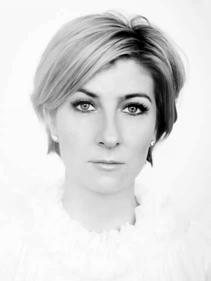
PRELUDE · 2 PM THE JAI
Lecture by Kristi Brown-Montesano
SUNDAY, AUGUST 2, 2026 · 3 PM
THE BAKER-BAUM CONCERT HALL
L. BOULANGER
Two Pieces for Violin and Piano (1893–1918) Nocturne
Cortège
Karen Gomyo, violin; Inon Barnatan, piano
ULLMANN
String Quartet No. 3, Opus 46 (1898–1944) Allegro moderato
Presto
Largo
Allegro vivace
Blake Pouliot, Stefan Jackiw, violins; Masumi Rostad, viola; Alisa Weilerstein, cello
Support for our vocal music programs is provided by:
Mary Ellen Clark
La Jolla Music Society’s 2026–27 Season is supported by The City of San Diego Cultural Affairs, County of San Diego, Prebys Foundation, Farfy Foundation, ProtoStar Foundation, Vail Memorial Fund, The Lodge at Torrey Pines, Banc of California, ResMed Foundation, San Diego Theatres Foundation, Bright Events Rentals, Cafe Coyote, Rancho Coyote, GRNFC Hospitality Group, Ace Parking, Brenda Baker and Steve Baum, Raffaella Belanich, Gordon Brodfuehrer, Eleanor Charlton, Mary Ellen Clark, Bert and Julie Cornelison, Elaine Galinson and Herbert Solomon, Irwin Jacobs, Helen and Keith Kim, Angelina and Fred Kleinbub, Dorothea Laub, Vivian Lim and Joseph Wong, Jaqueline and Jean-Luc Robert, Marge and Neal Schmale, Karen and Kit Sickels, Jeanette Stevens, Debra Turner, Sue and Peter Wagener, Liqun Wang and Marco Londei, Anna and Edward Yeung, Bebe and Marvin Zigman, Anonymous.
GERSHWIN
Transcriptions from Porgy and Bess (arr. Heifetz) (1898– 1937)
Summertime
A Woman Is a Sometime Thing
Tempo di Blues
Randall Goosby, violin; George Li, piano
INTERMISSION
PERGOLESI
Stabat Mater (1710–1736)
Stabat Mater Dolorosa
Cujus animam gementem
O quam tristis et afflicta
Quae moerebat et dolebat
Quis est homo
Pro peccatis suae gentis
Vidit suum dulcem natum
Eja mater fons amoris
Fac ut ardeat cor meum
Sancta mater, istud agas
Fac ut portem Christi mortem
Inflammatus et accensus
Quando corpus morietur
Amen
Kiera Duffy, soprano; Reginald Mobley, countertenor ;
Stefan Jackiw, Karen Gomyo, Randall Goosby, Roger Shao*, violins; Dimitri Murrath, viola; Sterling Elliott, cello; Timothy Cobb, bass; Ruben Valenzuela, organ
*2026 Farfy Foundation Fellowship Artist
Program notes by Eric Bromberger
Born August 21, 1893, Paris
Died March 15, 1918, Mézy-sur-Seine, France
Composed: 1911/1914
Approximate Duration: 5 minutes
The younger sister of the great teacher Nadia Boulanger, Lili Boulanger was a musician of extraordinary talent. Lili was the first woman ever to win the Prix de Rome, but that promise was cut short by perpetually poor health and by an early death: she was only 24 when she died, ten days before the death of Debussy. So short a life inevitably means that one’s output is small, and today Lili is remembered for her vocal settings and a small amount of instrumental music. As might be expected from the sister of Nadia Boulanger, Lili’s music is beautifully crafted. She has been described as an impressionist, but more striking is her instinctive sense of form and an expressive control of what is at times a surprisingly chromatic harmonic language.
This recital offers two brief works for violin and piano by Lili Boulanger: Nocturne (composed in 1911, when she was 18) and Cortège (1914). Nocturne begins quietly as the pianist rocks softly across three octaves of repeated Cs and the violin sings its gentle song. But soon the quiet mood of the beginning (marked doux: “soft, gentle”) is penetrated by unexpected harmonies, the violin line grows more animated, and the music rises to a climax. Matters calm, the rocking accompaniment of the opening reasserts itself, and Nocturne concludes in the home key of F major, with the violin high above, the piano in its deepest register.
The title Cortège might seem to suggest something funereal, or at least ceremonial, but Boulanger’s Cortège is sprightly music, spirited and fun. Over an extremely active piano accompaniment, the violin has its own energetic line. This music concludes all too quickly, leaving behind its high spirits—and a sense of what might have been.
Born January 1, 1898, Cieszyn, Silesia, Austia-Hungary Died October 18, 1944, Auschwitz-Birkenau concentration camp
Composed: 1943
Approximate Duration: 14 minutes
Viktor Ullmann studied music as a boy in his native city, Prague, but during World War I (at age 16) he moved to Vienna, where he studied briefly with Schoenberg. In 1920 he returned to Prague as an assistant to Alexander Zemlinsky at the New German Theatre, and thereafter he made his career as a freelance musician in Germany and in Prague—during these years he composed, conducted, performed, taught, and wrote (as a music critic).
In September 1942, Ullmann and his wife were arrested by the Nazis and incarcerated at the Theresienstadt concentration camp, about forty miles north of Prague. Theresienstadt was the “model” camp designed by the Nazis to show the world their humane treatment of Jews, and among its inmates were some of the most artistic and talented people in Europe; it was the setting for the infamous 1944 Nazi propaganda film Der Führer Presents the Jews with a City. Ullmann spent two years at Theresienstadt, serving as camp music critic and composing works that could be performed by his fellow prisoners. Among these was his satiric opera Der Kaiser von Atlantis, in which the central figure, Kaiser Overall, is an acid portrait of Hitler Ullmann and his wife were taken from Theresienstadt on October 16, 1944, and transported to Auschwitz, where they were executed, probably two days later.
Ullmann completed his Third String Quartet in January 1943, only four months after his arrival at Theresienstadt, and it was doubtless performed by musicians in the camp. Lasting only about a quarter of an hour, it is in four brief movements played without pause. Ullmann was a pianist rather than a string player, but the writing for string instruments here is quite idiomatic, and Ullmann sometimes offers his players extended moments of solo playing. The opening Allegro moderato, dark but lyric, concludes with a long cello solo that leads directly into the Presto. This movement, bitter and dissonant, dances propulsively before giving way to the solo viola, which opens the Largo with a twelve-tone row. The Largo is not a serial movement, but it is quite bleak, and Ullmann underlines that bleakness with the lean textures of his writing. Some degree of relief comes at the opening of the Allegro vivace, where the music bursts ahead powerfully; the movement rises to a broad—almost ecstatic—climax, then rushes suddenly to its close.
Born September 26, 1898, Brooklyn
Died July 11, 1937, Hollywood
Composed: 1935/1947
Approximate Duration: 13 minutes
Gershwin’s Porgy and Bess is regarded today as one of the great works of the American theater, perhaps even The Great American Opera, and so it comes as a surprise to discover that it was anything but a success at the time of its première in New York in 1935. Though it ran for 124 performances, the production closed $70,000 in debt, and reportedly Gershwin’s royalties were not even enough to cover the cost of having the parts copied. Gershwin was stung by the failure of his “folk opera” to find the success he had hoped for, and he is said to have remarked: “I think the music is so marvelous. I really can’t believe I wrote it.”
That music truly is “marvelous,” and even if Porgy and Bess had not been a success in the theater, its music continued
to haunt composers. One of those haunted was Gershwin himself, who promptly arranged a suite of orchestral excerpts titled Catfish Row, and there have been countless arrangements of excerpts for individual instruments. Some of the best of these were made by an unexpected arranger.
Gershwin was good friends with violinist Jascha Heifetz, who asked Gershwin to write a violin concerto for him. Gershwin’s death in 1938 at age 38 made this impossible, but nine years later, in 1947, Heifetz arranged six excerpts from Porgy and Bess for violin and piano, and this recital offers three of these. The famous Summertime comes from the very beginning of Porgy and Bess, where this lullaby is sung by Clara, the wife of Jake the fisherman. This is followed by A Woman Is a Sometime Thing, sung by Jake, who offers commentary on women and on romance. Tempo di blues comes from the very end of Porgy and Bess, as Porgy sets off in pursuit of Bess; it includes There’s a Boat Dat’s Leavin’ Soon for New York.
Born January 4, 1710, Iesi, Marche, Italy
Died March 16, 1736, Naples
Composed: 1736
Approximate Duration: 38 minutes
Dead at the age of 26 from the complications of tuberculosis, Giovanni Battista Pergolesi joins that list of composers (which includes Mozart, Weber, Schubert, Mendelssohn, and Chopin) who died with their great promise unfulfilled. Trained in Naples, Pergolesi composed operas, musical comedies, sacred music, and a small amount of instrumental music. His most famous work is probably the comic intermezzo La Serva Padrona of 1733; in this and other comic operas, Pergolesi is credited with helping invent the opera buffa form. Pergolesi’s reputation grew quickly after his early death, and a number of works of uncertain authorship were attributed to him; themes from some of these were used by Stravinsky in his ballet Pulcinella.
Pergolesi wrote his Stabat Mater during the winter of 1736, just a few weeks before his death. The Stabat Mater is based on the text Stabat Mater Dolorosa (“There Stood the Grieving Mother”) by Jacapone da Todi (1228–1306). A description of the grieving Virgin Mary at the foot of the cross, this text became a part of Catholic liturgy in 1727 and has frequently been set to music. The versions by Pergolesi, Rossini, and Dvořák are the best known, but among other composers who have set the text are Josquin des Pres, Palestrina, Lassus, Haydn, Schubert, Verdi, Stanford, and Szymanowski.
Rather than the large-scale contrapuntal setting for full chorus typical of church music of his day, Pergolesi’s twelvemovement version shows the influence of his interest in opera: this music, unfailingly lyric, is scored for just two vocal
soloists and a string orchestra. The soloists were originally male soprano and male alto, but in this performance the two solos will be sung by a female soprano and male countertenor (alto). Of particular interest is the writing for these soloists, because Pergolesi gives them what are essentially arias. These are not the coloratura arias of subsequent Italian opera, but they nevertheless require singers of formidable technique, able to sing with brilliance and to float a long lyric line.
Pergolesi’s Stabat Mater is music of dark and somber beauty—lyric, spare, and haunting. It is not surprising that its fame spread quickly in the years after Pergolesi’s death or that nearly three centuries later it remains one of the most moving settings of this text.
Stabat Mater 13th century Franciscan hymn
Stabat Mater dolorosa Iuxta crucem lacrimosa
Dum pendebat Filius.
Cuius animam gementem Contristatam et dolentem Pertransivit gladius.
O quam tristis et afflicta Fuit illa benedicta Mater unigeniti!
Quae moerebat et dolebat, Pia Mater, dum videbat Nati poenas incliti.
Quis est homo qui non fleret, Matrem Christi si videret In tanto supplicio?
Vidit suum dulcem natum Moriendo desolatum Dum emisit spiritum.
Eja Mater, fons amoris Me sentire vim doloris Fac, ut tecum lugeam.
Fac, ut ardeat cor meum In amando Christum Deum Ut sibi complaceam.
Sancta Mater, istud agas, Crucifixi fige plagas cordi meo valide.
Fac ut portem Christi mortem, passionis fac consortem, et plagas recolere.
Inflammatus et accensus per te, Virgo, sim defensus in die iudicii.
Fac me cruce custodiri morte Christi praemuniri confoveri gratia.
Quando corpus morietur, fac ut animæ donetur Paradisi gloria. Amen.
Translation by Hans van der Velden
The grieving Mother stood weeping beside the cross where her Son was hanging.
Through her weeping soul, compassionate and grieving, a sword passed.
O how sad and afflicted was that blessed Mother of the only-begotten!
Who mourned and grieved, seeing and bearing the torment of her glorious child.
Who is it that would not weep, seeing Christ’s Mother in such agony?
She saw her sweet child die desolate, as he gave up His spirit.
O Mother, fountain of love, make me feel the power of sorrow, that I may grieve with you.
Grant that my heart may burn in the love of Christ my God, that I may greatly please Him.
Holy Mother, may you do thus: place the wounds of the Crucified deep in my heart.
Make me to bear Christ’s death, sharing in His passion, and commemorate his wounds.
Inflame and set on fire, may I be defended by you, Virgin, on the day of judgment.
Let me be guarded by the cross, armed by Christ’s death and His cherished by His grace. When my body dies, grant that to my soul is given the glory of paradise. Amen.
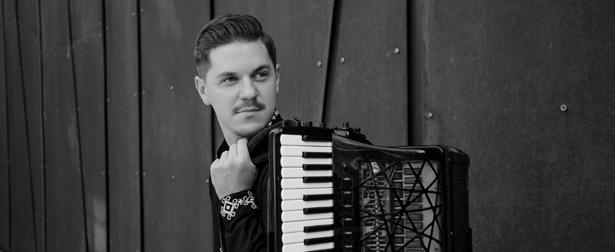
PRELUDE · 6 PM
THE BAKER-BAUM CONCERT HALL
Young Concert Artists (YCA)
Artist-in-Residence Radu Rățoi ‡ performs works by Rameau, Liszt, Kusyakov, and Saint-Saëns
WEDNESDAY, AUGUST 5, 2026 · 7 PM
THE BAKER-BAUM CONCERT HALL
STRAVINSKY
Suite Italienne for Cello and Accordion (arr. Rățoi) (1882–1971)
Introduzione
Join us for a celebration in the Wu Tsai QRT.yrd immediately following the performance.
Must be 21+ with valid ID for sparkling wine service.
Midweek Masterworks
Support for the Musical Preludes is provided by:
Gordon Brodfuehrer
Jeanette Stevens
La Jolla Music Society’s 2026–27 Season is supported by The City of San Diego Cultural Affairs, County of San Diego, Prebys Foundation, Farfy Foundation, ProtoStar Foundation, Vail Memorial Fund, The Lodge at Torrey Pines, Banc of California, ResMed Foundation, San Diego Theatres Foundation, Bright Events Rentals, Cafe Coyote, Rancho Coyote, GRNFC Hospitality Group, Ace Parking, Brenda Baker and Steve Baum, Raffaella Belanich, Gordon Brodfuehrer, Eleanor Charlton, Mary Ellen Clark, Bert and Julie Cornelison, Elaine Galinson and Herbert Solomon, Irwin Jacobs, Helen and Keith Kim, Angelina and Fred Kleinbub, Dorothea Laub, Vivian Lim and Joseph Wong, Jaqueline and Jean-Luc Robert, Marge and Neal Schmale, Karen and Kit Sickels, Jeanette Stevens, Debra Turner, Sue and Peter Wagener, Liqun Wang and Marco Londei, Anna and Edward Yeung, Bebe and Marvin Zigman, Anonymous.
SCHUBERT
Serenata
Tarantella
Gavotte
Scherzino
Minuet; Finale
Sterling Elliott, cello; Radu Rățoi ‡ , accordion
Octet in F Major, D.803 (1797–1828)
Adagio; Allegro
Adagio
Allegro vivace
Andante
Menuetto: Allegretto
Andante molto: Allegro
Andrew Wan, Karen Gomyo, violins; Milena Pajaro-van de Stadt, viola; Alisa Weilerstein, cello; Timothy Cobb, bass; Ricardo Morales, clarinet ; Eleni Katz, bassoon; Stefan Dohr, horn
THIS PERFORMANCE HAS NO INTERMISSION
‡YCA Artist-in-Residence
Born June 17, 1882, Oranienbaum, Russia
Died April 6, 1971, New York City
Composed: 1925
Approximate Duration: 19 minutes
In the years after World War I Stravinsky found himself at an impasse as a composer, unwilling to return to the grand manner of the “Russian” ballets that had made him famous, but unsure how to proceed. Serge Diaghilev, impresario of the Ballets Russes, suggested a ballet based on themes by the Italian composer Giovanni Pergolesi (1710–36) and showed him some of Pergolesi’s music. Stravinsky was entranced. Over the next year he composed a ballet with song in eighteen parts, based on themes from Pergolesi’s operas and instrumental music (though subsequent research has shown that not all these themes were written by Pergolesi). Stravinsky kept Pergolesi’s melodic and bass lines, but supplied his own harmony and brought to this music his incredible rhythmic vitality. First produced in Paris on May 15, 1920, with sets by Picasso and choreography by Massine, Pulcinella was a great success.
Ever the pragmatist, Stravinsky had become interested at this time in ballets for smaller ensembles, for he realized that they could save expense and make possible productions in places that lacked a large symphony orchestra. Pulcinella was a step in this direction—it is scored for an orchestra of 37 players—but Stravinsky was interested in ensembles of just a few players, and his arrangements of excerpts from Pulcinella may be regarded as explorations of those possibilities.
Stravinsky made several arrangements for instrumental duos of excerpts from Pulcinella. First was a Suite for Violin and Piano based on themes from the ballet, made in 1925. Next came an arrangement of different excerpts for cello and piano, made in 1932 by the composer and Gregor Piatigorsky; this version was the first to be called Suite Italienne. The following year, Stravinsky and violinist Samuel Dushkin made an arrangement of excerpts for violin and piano and called it Suite Italienne as well.
For this performance, accordionist Radu Rǎțoi has arranged Suite Italienne for cello and accordion in six movements. It opens with a jaunty Introduzione (the ballet’s Overture), followed by a lyric Serenata, based on an aria from Pergolesi’s opera Il Flaminio. A blistering Tarantella (with its surprising and sudden ending) leads to a stately Gavotte, which is followed by two ornate variations. The Scherzino flies along on an almost nonstop pulse of eighth-notes; Stravinsky specifies that he wants it played sempre staccato. The concluding section is in two parts: a slow Minuet leads without pause to the exciting Finale
Born January 31, 1797, Vienna
Died November 19, 1828, Vienna
Composed: 1824
Approximate Duration: 60 minutes
The year 1823 was difficult for Schubert. He was ill for much of it, at one point so seriously that he had to be hospitalized. Discouraged and without energy, he wrote little that year, but in the first months of 1824 the 27-year-old composer regained his strength and turned to chamber music. In March would come two of his greatest string quartets, the Quartet in A Minor and the Quartet in D Minor (the “Death and the Maiden” Quartet), but before writing these, he spent February 1824 composing the Octet. This is one of the most amiable works in the chamber music literature, and it is hard not to believe that this good-spirited music reflects Schubert’s relief at the return of his strength.
The Octet was commissioned by Ferdinand, Count Troyer, the chief steward of the household of Archduke Rudolph, Beethoven’s friend and patron. An amateur clarinetist, Count Troyer suggested that Schubert write something on the order of Beethoven’s Septet, then wildly popular in Vienna. In fact, Schubert modeled his Octet very closely on Beethoven’s Septet To Beethoven’s instrumentation (clarinet, horn, bassoon, violin, viola, cello, and bass), Schubert added a second violin, and he chose the same pattern of movements Beethoven had used: six movements alternating slow and fast tempos. And, again like Beethoven, he gave each of the outer movements a slow introduction.
But the Octet is not a slavish imitation, and many consider it one of Schubert’s finest works—one critic has gone so far as to call the Octet “quintessential Schubert.” The Octet is similar in form to Mozart’s serenades and divertimentos: essentially light music in multiple movements designed to entertain or—simply—to give pleasure. But to classify the Octet as entertainment music is in no way to denigrate it. This is beautifully crafted music, gracefully written for all eight instruments (the clarinet is given a particularly prominent role, perhaps as a nod to Count Troyer). Beyond this, Schubert makes some unusual thematic connections between the movements, which gives the generously proportioned Octet (it lasts nearly 60 minutes) surprising unity.
The slow introduction contains a rhythmic cell that will recur in several of the movements. Heard first in the strings, this dotted figure will form the basis of the main theme at the Allegro; a gracefully singing clarinet introduces the second theme, and a striking horn solo leads to the final cadence. Count Troyer must have been delighted with the Adagio, for it opens with a lovely and long-lined clarinet tune over quietly murmuring strings. Schubert’s development makes surprising key shifts, full of subtle shading. The Allegro vivace, a scherzo, has proven one of the most popular movements in the Octet. Its main theme is full of energy, and Schubert propels it vigorously
along the snap of its dotted notes. The sonority of this movement is unusual as well—Schubert sometimes masses all eight instruments in resounding unison passages.
The Andante is in theme-and-variation form (Beethoven’s Septet also contains a variation movement). Here the first violin lays out the theme, which Schubert took from a duet in his opera Die Freunde von Salamanka (1815). Seven ornate variations follow before a brief coda closes the movement. The fifth movement is a minuet, and the outer sections make use of the dotted figure from the first movement. Its trio section is based on what sounds like an Austrian tune, but Schubert treats it lovingly—Schubert scholar John Reed notes that this section “elevates the folk-dance to the level of great music.”
The concluding movement is in some ways the most striking. It opens with what sounds like orchestral music: a tremolo from the low strings leads to exchanges between wind and string choirs, and the careful listener will hear once again the dotted figure from the very beginning. At the Allegro, Schubert leaves quasi-orchestral sonorities behind and returns to true chamber music—the strings introduce the main idea, full of rustic energy, and the music dances happily. At the very end, Schubert brings back the “orchestral” music for a moment before the exhilarating rush of the final coda. The man who could write music like this was clearly one who had regained both his strength and his good spirits.
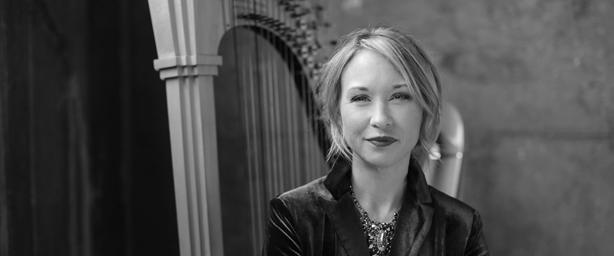
PRELUDE · 6 PM
THE BAKER-BAUM CONCERT HALL
Prometheus Quartet performs works by Debussy, Rózsa, and Lei Liang
THE BAKER-BAUM CONCERT HALL
DEBUSSY
Sonata for Flute, Viola and Harp (1862–1918)
Rose Lombardo, flute; Matthew Lipman, viola; Julie Smith Phillips, harp
HARRISON Varied Trio (1917–2003)
Pedja Mužijević, piano; Blake Pouliot, violin; Steven Schick, percussion
Support for this program is provided by a Legacy gift from:
Jendy Dennis
La Jolla Music Society’s 2026–27 Season is supported by The City of San Diego Cultural Affairs, County of San Diego, Prebys Foundation, Farfy Foundation, ProtoStar Foundation, Vail Memorial Fund, The Lodge at Torrey Pines, Banc of California, ResMed Foundation, San Diego Theatres Foundation, Bright Events Rentals, Cafe Coyote, Rancho Coyote, GRNFC Hospitality Group, Ace Parking, Brenda Baker and Steve Baum, Raffaella Belanich, Gordon Brodfuehrer, Eleanor Charlton, Mary Ellen Clark, Bert and Julie Cornelison, Elaine Galinson and Herbert Solomon, Irwin Jacobs, Helen and Keith Kim, Angelina and Fred Kleinbub, Dorothea Laub, Vivian Lim and Joseph Wong, Jaqueline and Jean-Luc Robert, Marge and Neal Schmale, Karen and Kit Sickels, Jeanette Stevens, Debra Turner, Sue and Peter Wagener, Liqun Wang and Marco Londei, Anna and Edward Yeung, Bebe and Marvin Zigman, Anonymous.
RAVEL
Tzigane (1875–1937)
Tessa Lark, violin; Inon Barnatan, piano
INTERMISSION
CAGE
Selections from Sonatas and Interludes for Prepared Piano (1912–1992)
Sonata I
Sonata II
Sonata III
Sonata IV
Sonata V
Third Interlude
Pedja Mužijević, piano
IAIN FARRINGTON
Andrew Wan, Erin Keefe, violins; Milena Pajaro-van de Stadt, viola; (1844-1908)/(b. 1977)
Efe Baltacigil, cello; Sam Hager, bass; Rose Lombardo, flute; Graeme Steele Johnson, clarinet ; Stefan Dohr, horn; Julie Smith Phillips, harp
Commissioned by La Jolla Music Society for SummerFest
Program notes by Eric Bromberger
Born August 22, 1862, Saint-Germain-en-Laye, France
Died March 25, 1918, Paris
Composed: 1915
Approximate Duration: 18 minutes
Near the end of his life Debussy planned a cycle of six sonatas for various combinations of instruments. He completed only the first three: for cello and piano (1915); flute, viola, and harp (1915); and violin and piano (1917). Projected—but never written—were sonatas for oboe, horn, and harpsichord; for trumpet, clarinet, bassoon, and piano; and a final sonata that would have included all the instruments from the five earlier sonatas.
This was not a happy period in Debussy’s life. He was suffering from the cancer of the colon that would eventually kill him, and World War I was raging across Europe—Paris was actually being shelled on the day the composer died there. The three sonatas that Debussy completed have never achieved the popularity of his earlier works, and Debussy himself deprecated them with the self-irony that marked his painful final years. But this music has a power all its own, and listeners who put aside their preconceptions about what Debussy should sound like (and about what a sonata should be) will find this spare music moving and—in its austere way—painfully beautiful. Debussy wrote the Sonata for Flute, Viola, and Harp in 1915 in a small cottage in Pourville, looking out over the English Channel. He had originally intended to use oboe instead of viola, and the revision is fortunate, for the completed sonata contrasts three different sonorities: plucked strings, bowed strings, and a wind instrument. Of the three sonatas, this is the least severe. Listening to this ethereal music, one would not guess that the most cataclysmic war history had ever seen was raging across trenches 100 miles east of where it was written.
The sonata’s structure is as unusual as Debussy’s choice of instruments. The opening movement, Pastorale, offers six different melodic ideas, but these often feel more like fragments than fully stated themes. The movement is not in traditional sonata form; the melodic ideas recur in an unusual sequence, and the tempo changes so often that the movement seems to break down into short episodes.
The same design shapes the final two movements. The Interlude is marked Tempo de menuetto, but that is only a general indication of speed, for there is nothing minuet-like about this movement, which brings back themes from the first movement. The Finale, too, is freely structured. Whirring harp figures launch this movement on its way, and the other voices quickly join it. But even in this rapid finale the mood remains subdued, the music fragmentary.
Something of Debussy’s own mood at the time he wrote the Sonata for Flute, Viola, and Harp may be seen in letters to his friend Robert Godet. At just the time he was finishing the sonata, Debussy wrote: “I am writing down all the music that
passes through my head, like a madman, and rather sadly.”
And after hearing the sonata performed for the first time the following year, Debussy wrote: “The sound of it is not bad, though it is not for me to speak to you of the music. I could do so, however, without embarrassment for it is the music of a Debussy I no longer know. It is frightfully mournful and I don’t know whether one should laugh or cry—perhaps both?”
Born May 14, 1917, Portland, Oregon
Died February 2, 2003, Lafayette, Indiana
Composed: 1987
Approximate Duration: 16 minutes
Lou Harrison was one of those original figures who seem to be both quintessentially American and completely international at the same time. American in the sense that—like Ives, whom he deeply admired—Harrison was willing to rethink the entire nature of what constitutes music. International in the sense that he was open to the music of all cultures, particularly those of Asia, and was always seeking new sounds, making his own instruments (often out of such unusual materials as flowerpots, washtubs, pails, and tacks), employing new rhythms, finding new ways of making music. Harrison grew up in California and studied with Henry Cowell and Arnold Schoenberg. He held a number of jobs (dancer, percussionist, and critic among them) before moving in 1943 to New York, where he worked as a music critic and championed the music of Charles Ives: it was Harrison who conducted the première of Ives’ Third Symphony in 1947 (35 years after it was written)—that performance earned the Pulitzer Prize for Ives, who generously shared the money from that award with Harrison. Harrison taught briefly at Black Mountain College in North Carolina before deciding that he needed to return to California, where he lived the remaining half-century of his life.
Harrison began work on the Varied Trio for Violin, Piano, and Percussion in 1986 and completed the score on February 4, 1987, shortly before his seventieth birthday. The work was first performed as a quintet before Harrison settled on its final instrumentation. Trios that include violin and piano are common enough, but what makes this one unique is its “varied” percussion, and in the score Harrison specifies exactly the instruments he requires:
large tam-tam
vibraphone
8 rice bowls tuned with water and struck with chopsticks
2 tambourines
6 baking pans of different sizes (tuning is random)
2 drums
To these should be added the gong, and the piano is sometimes used as a percussion and rhythmic instrument rather than a melodic one: Harrison instructs that at some points the piano’s strings are to be plucked and its frame struck with a mallet; at
other moments the piano accompanies very quietly with the rhythmic patterns of Indian music. Violin and piano play in all five movements, but each movement is scored for a different combination of percussion instruments, and so the sonority of the music changes with each movement.
The opening movement is titled Gending, a term that refers to the metric patterns of Indonesian gamelan music, specifically the overlay of different groups of instruments playing in different metric units. This movement is scored for violin, piano, gong, and vibraphone. Bowl Bells is scored for rice bowls and chopsticks; their spiky sonority is intensified by the sound of pizzicato violin and staccato piano. The violin is the featured instrument in Elegy; its long, grieving melodic line is accompanied by piano and vibraphone. The fourth movement is titled Rondeau in Honor of Fragonard (after the great French painter, 1732–1806); this poised movement is the only one that does not include percussion. The Varied Trio concludes with an energetic Dance that features the sound of Chinese drums and baker’s pans.
Born March 7, 1875, Ciboure, Basses-Pyrenées, France
Died December 28, 1937, Paris
Composed: 1924
Approximate Duration: 12 minutes
In the summer of 1922, just as he began his orchestration of Mussorgsky’s Pictures at an Exhibition, Ravel visited England for several concerts of his music, and in London he heard a performance of his brand-new Sonata for Violin and Cello by Jelly d’Arányi and Hans Kindler. D’Arányi must have been a very impressive violinist, for every composer who heard her was swept away by her playing—and by her personality (Bartók was one of the many who fell in love with her). Ravel was so impressed that he stayed after the concert and talked her into playing Romani tunes from her native Hungary for him—and he kept her there until 5 a.m. the next morning, playing for him. Tzigane probably got its start that night. Inspired by both d’Arányi’s playing and the fiery Romani tunes, Ravel set out to write a virtuoso showpiece for the violin based on Romanilike melodies (the title Tzigane means simply “Romani”). Its composition was much delayed, however, and Ravel did not complete Tzigane for another two years. Trying to preserve a distinctly Hungarian flavor, he wrote Tzigane for violin with the accompaniment of lutheal, a device which—when attached to a piano—gave the piano a jangling sound typical of the Hungarian cimbalon. The first performance, by d’Arányi with piano accompaniment, took place in London on April 26, 1924, and later that year Ravel prepared an orchestral accompaniment. In whatever form it is heard, Tzigane remains an audience favorite.
It is unusual for a French composer to be so drawn to Romani music. Usually it was the composer from central Europe—Liszt, Brahms, Joachim, Hubay–who felt the charm of this music, but Ravel enters fully into the spirit and creates
a virtuoso showpiece redolent of Romani campfires and smoldering dance tunes. Tzigane opens with a long cadenza (nearly half the length of the entire piece) that keeps the violinist solely on the G-string across the span of the entire first page. While Tzigane seems drenched in an authentic Romani spirit, all its themes are Ravel’s own, composed in the spirit of the tunes he heard d’Arányi play late that night. Gradually the accompaniment enters, and the piece takes off. Tzigane is quite episodic, and across its blazing second half Ravel demands such techniques from the violinist as artificial harmonics, lefthand pizzicatos, complex multiple-stops, and sustained octave passages. Over the final pages the tempo gradually accelerates until Tzigane rushes to its scorching close, marked Presto
Born September 5, 1912, Los Angeles Died August 12, 1992, New York City
Composed: 1946–48
Approximate Duration: 15 minutes
In the years after World War II John Cage was living in New York City and composing scores for Merce Cunningham’s dance company. This was a restless time for the composer, then in his mid-thirties. The wholly original scores that would represent his “breakthrough” as a composer were still a few years in the future: Music of Changes, based on chance procedures, would appear in 1951, and 4’33” (four minutes and 33 seconds of silence) in 1952. Now, composing piano scores for dancers, Cage set out to overcome what he saw as some of the limits of the piano. He had for several years been experimenting with altering the sound of the piano by inserting unexpected objects into its strings, and between 1946 and 1948 Cage composed a series of twenty short pieces that he titled Sonatas and Interludes for Prepared Piano and which made full use of these piano-altering sonorities
To “prepare” the piano to play this music, Cage inserted screws, bolts, nuts, an eraser, and pieces of plastic into the strings of a concert grand piano. He described this process in a note in the score: “mutes of various materials are placed between the strings of the keys used, thus effecting transformations of the piano sounds with respect to all of their characteristics.” Cage outlined with extraordinary precision how the piano should be “prepared”: he used only 45 of the piano’s notes, and he specified precisely the length and width of each screw and where it was to be inserted. In the first years after composing the Sonatas and Interludes, Cage prepared a kit of exactly the objects he wanted inserted and sent that out when someone purchased a copy of the score, but later he had to leave it to individual performers to find those objects on their own. He recognized that this would inevitably mean that someone else’s prepared piano might sound different from his, and in an interview he wryly noted: “I think anyone will have to remark eventually on the fact that all of the performances are different, because my table of preparations is not precise and only suited the piano that I was actually working on. So
that the result is that everyone’s performance of the Sonatas and Interludes is a fresh experience. And this is a feather in the hat of indeterminacy, I think. Or it could be a black eye on indeterminacy, according to how you look at it.”
These changes—which Cage describes as “mutes”—do not just dampen the sound of the piano but transform it entirely. They emphasize the percussive nature of the instrument and can produce ringing bell-like sounds; they can truncate the decay of individual notes; they can change the sound of chords so that individual notes will sound louder within the same chord.
The Sonatas and Interludes—sixteen sonatas and four interludes—span slightly over an hour, so all are necessarily concise. The sonatas are not on the Beethovenian model of conflict and harmonic resolution, but are much shorter and are unconcerned with conflict. Instead, most are in binary form with both halves repeated, and many have noted that Cage’s real model may have been the concise keyboard sonatas that Domenico Scarlatti composed in the eighteenth century. The Sonatas are constructed on a rhythmic structure based on “nested proportions”: each piece is structured on a sequence of numbers or fractions that shape the length of phrases and the rhythm of each individual measure.
During the years when he composed the Sonatas Cage was becoming interested in Eastern music and philosophy, particularly Zen Buddhism and Hindu aesthetics. Cage said that he felt that this music portrayed the four “white” emotions of Buddhism (humor, wonder, heroism, the erotic) and the four “black” emotions (anger, fear, disgust, sorrow), and he noted that all of these tend toward tranquility. He felt that certain of the sonatas were inspired by the music of the East, and some were inspired by Western music. One need not know exactly which pieces Cage identified with which emotion to enjoy this music, and listeners should not take Cage’s “preparation” of the piano as an end in itself but as a refinement of the means he employed as he began to write music inspired in part by his growing awareness of the differences between Eastern and Western music.
Performances of the Sonatas are rare: listeners find it much easier to hear a few of these pieces at one time rather than trying to encompass the hour-long span of the complete work. This program offers a selection of the Sonatas.
Born March 18, 1844, Tikhvin
Died June 21, 1908, Lyubensk
Born July 19, 1977, Hitchin, Hertfordshire, England
Composed: 2026
Approximate Duration: 25 minutes
The legendary character of Scheherazade has inspired numerous works of art, literature and music, across many centuries. She features in the ancient Middle Eastern collection of folktales One Thousand and One Nights, and provides the
framework for various stories and adventures. Scheherazade tells numerous tales night after night to her brutal husband, the Sultan, who has vowed to put to death each of his wives after one night. Through her storytelling and guile, he postpones her execution until finally giving in, relinquishing his vow.
One of the most famous musical settings of the legend is Rimsky-Korsakov’s four-movement orchestral work Scheherazade, from 1888. It is a highly evocative, sweeping and glittering work, brilliantly combining alluring melodies with dramatic excitement and emotional fervour. As a largescale orchestral showpiece, it creates a bold technicolour experience, one that requires a full symphonic force to be effective. This new chamber work, Fantasy on Scheherazade, is not simply a reduced version of the original, which would feel underpowered and merely a pale imitation. Instead, it is a reworking of the material, using new harmonies, adding countermelodies, and condensing the structure into a single movement. This is in the tradition of the many 19th century Fantasies based on operas, especially those for piano.
Rimsky’s use of “Eastern”-influenced melodies is heightened with a richer harmonic palette, taking in Arabic scales as well as the evocative sound-world of later composers such as Ravel. The aim is to create a greater sense of mystery, intimacy and surprise around this familiar music, as well as a different perspective on the figure of Scheherazade herself.
— Iain Farrington
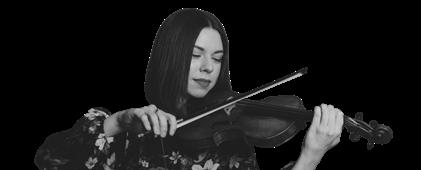
PRELUDE · 6 PM
THE BAKER-BAUM CONCERT HALL
Kairos Piano Quartet performs Fauré’s
Piano Quartet No. 1 in C Minor, Op. 15
Support for the Musical Preludes is provided by:
Gordon Brodfuehrer
Jeanette Stevens
Additional support for the Farfy Fellowship Artists is provided by:
Judith Bachner and Eric Lasley
La Jolla Music Society’s 2026–27 Season is supported by The City of San Diego Cultural Affairs, County of San Diego, Prebys Foundation, Farfy Foundation, ProtoStar Foundation, Vail Memorial Fund, The Lodge at Torrey Pines, Banc of California, ResMed Foundation, San Diego Theatres Foundation, Bright Events Rentals, Cafe Coyote, Rancho Coyote, GRNFC Hospitality Group, Ace Parking, Brenda Baker and Steve Baum, Raffaella Belanich, Gordon Brodfuehrer, Eleanor Charlton, Mary Ellen Clark, Bert and Julie Cornelison, Elaine Galinson and Herbert Solomon, Irwin Jacobs, Helen and Keith Kim, Angelina and Fred Kleinbub, Dorothea Laub, Vivian Lim and Joseph Wong, Jaqueline and Jean-Luc Robert, Marge and Neal Schmale, Karen and Kit Sickels, Jeanette Stevens, Debra Turner, Sue and Peter Wagener, Liqun Wang and Marco Londei, Anna and Edward Yeung, Bebe and Marvin Zigman, Anonymous.
SATURDAY, AUGUST 8, 2026 · 7 PM
THE BAKER-BAUM CONCERT HALL
TAJČEVIĆ
Seven Balkan Dances (1900–1984) Con moto
Rustico
Vivo
Sostenuto e Cantabile
Allegro ritmico
Allegretto
Allegro quasi pesante
Pedja Mužijević, piano
DVOŘÁK
Piano Trio No. 4 in E Minor, Opus 90 “Dumky” (1841–1904)
Lento maestoso; Allegro quasi doppio movimento
Poco adagio; Vivace non troppo
Andante; Vivace non troppo
Andante moderato; Allegretto scherzando
Allegro; Meno mosso
Lento maestoso; Vivace
Tessa Lark, violin; Efe Baltacigil, cello; Zoltán Fejérvári, piano
INTERMISSION
WEINBERG Rhapsody on Moldavian Themes, Opus 47 (1919– 1996)
Tessa Lark, violin; Radu Rățoi‡, accordion
BARTÓK Divertimento for String Orchestra (1881–1945)
Allegro non troppo
Molto adagio
Allegro assai
Erin Keefe, Andrew Wan, Blake Pouliot, Wesley Precourt, Roger Shao*, violin I; Cherry Yeung, Anthony Chan*, Elli Choi*, Kathryn Hatmaker, violin II; Matthew Lipman, Milena Pajaro-van de Stadt, Brian Jennings*, Ayano Nakamura*, violas; Efe Batacigil, Sterling Elliott, Wilson Vanderslice*, Eliana Razzino Yang*, cellos; Anthony Manzo, Sam Hager, bass
‡YCA Artist-in-Residence
*2026 Farfy Foundation Fellowship Artist
Program notes by Eric Bromberger
Born January 29, 1900, Osijek, Austro-Hungary (now Croatia)
Died July 19, 1984, Belgrade, Yugoslavia (now Serbia)
Composed: 1927
Approximate Duration: 10 minutes
Marko Tajčević studied violin and piano as a boy, and as a young man he was able to study briefly in Prague and Vienna. He made his career first in Zagreb, where he worked as a choral conductor and music critic, and in 1940 he moved to Belgrade, where he spent the rest of his life. Tajčević taught at the Belgrade Academy of Music and composed, though he was a careful craftsman and worked slowly: across the span of his long life, he composed only 54 works. He did not compose on a big scale, but instead wrote largely for the voice (both solo songs and choral music) and for chamber ensembles.
Like so many other Eastern European composers of his era, Tajčević was profoundly interested in folk music, and in 1923 he and several other Croatian composers put together a concert in Zagreb consisting of songs they had composed based on folk melodies. Tajčević would incorporate that technique in many other works, sometimes writing piano pieces based on folk music. One of these works is his Seven Balkan Dances, composed in 1927. This is a set of seven piano pieces based on dance tunes from the Balkans. Each dance is very short: the whole set spans about nine minutes (and it almost takes more time to describe them than to hear them).
All seven dances end very quietly, except for the last. The Con moto rushes along in a whirl of 32nd-notes, while the jaunty Rustico offers glissandos that sweep across the keyboard. The Vivo dances over asymmetric rhythms: the meter leaps between 2/8, 4/8, 3/8, and 3/4 almost by the measure. The Sostenuto e Cantabile, in the unusual meter of 7/8, begins with a simple, almost chaste melody, though this soon grows in strength before fading to a close marked triple piano. The Allegro ritmico, another piece based on changing meters—5/8, 4/8, 3/8, 7/8—makes nice use of chirping grace-notes. Tajčević specifies that the Allegretto should be played sempre staccato, while the concluding Allegro quasi pesante moves quickly along its steady tread and rushes the set of dances to an abrupt conclusion.
The Seven Balkan Dances has become Tajčević’s bestknown work, and it has been championed by a number of pianists, among them Arthur Rubinstein.
Born September 8, 1841, Muhlhausen, Bohemia (now Czechia)
Died May 1, 1904, Prague
Composed: 1891
Approximate Duration: 32 minutes
Dumky is the plural form of the Russian dumka, a type of Slavonic ballad—perhaps of Ukrainian origin—characterized
by a dark and elegiac character. In his “Dumky” Trio, Dvořák makes an important change in this form: to the melancholy music of the traditional dumka, he adds fast and jubilant music, so that each of his movements consists of sharply contrasted parts. Dvořák began work on the “Dumky” Trio in November 1890 and completed it on February 12, 1891. When he played the piano part at the first performance in April 1891, Dvořák was a few months short of his fiftieth birthday and at the height of his powers. During the previous year, he had conducted the première of his Eighth Symphony, and in June 1891 would come double honors: he received an honorary degree from Cambridge and was invited to become director of the National Conservatory of Music in New York. Dvořák played the piano in a series of farewell concerts featuring the “Dumky” Trio before departing in the fall of 1892 for his new position in the New World.
The last of Dvořák’s four piano trios, the “Dumky” has an unusual form, consisting of six dumka movements, each with slow and fast sections. The first three are played without pause, the fourth dumka is primarily a slow movement, the fifth primarily a fast one, and the sixth shows some elements of the rondo-finale, and so Dvořák’s highly unusual structure may be said—if one needs or wants to understand it that way—to conform to the four-movement shape of the standard piano trio. Far better, though, to take this highly original music, which annihilates sonata form, on its own terms.
The “Dumky” Trio is powerfully expressive music, ranging in emotional extremes from fragmentary, grieving slow phrases that often sound right out of Janáček to fast sections much like Dvořák’s own buoyant Slavonic Dances. The odd combination of dark music side-by-side with bright is curiously satisfying, the elegiac and festive sides of Dvořák’s soul flashing out by turns in this intense music. The Lento maestoso opens with falling piano triplets that soon give way to ascetically lean and beautiful string lines; at the Allegro vivace, quasi doppio movimento the music leaps brightly forward, and these two sections alternate before leading directly into the second dumka: Poco Adagio. Here the somber and steady opening pulse gradually leads to a dancing Vivace non troppo, where the violin flies quietly but brilliantly over staccato piano accompaniment; along the way Dvořák offers a brief cello cadenza. The third—Andante—is built on the piano’s chaste opening melody, played at first only by the right hand; the fast section—as in the second dumka—belongs to the violin. The fourth dumka Andante moderato—has the feel of a slow movement because the fast sections are brief and restrained, almost a part of the fabric of the overall slow tempo. In a similar way, the fifth—Allegro—functions as the work’s fast movement because it opens at a fast tempo and, despite some slow interludes, remains largely at this pace. The opening of the Lento maestoso is dark, grieving, painful, as are the Lento interludes. Dvořák binds them together with vigorous dance sections.
Rhapsody on Moldavian Themes, Opus
Born December 8, 1919, Warsaw
Died February 26, 1996, Moscow
Composed: 1949
Approximate Duration: 12 minutes
The music of Polish–Russian composer Mieczysław Weinberg is little known to Western audiences, but it has a devoted following among those familiar with it. The American musicologist Steven Schwarz has been frank in his admiration, describing Weinberg as “the third great Soviet composer, along with Prokofiev and Shostakovich.” Weinberg was unbelievably prolific. He wrote seven operas, twenty-two symphonies, seventeen string quartets, and numerous orchestral and chamber works—his list of opus numbers runs to 192. Weinberg also wrote about forty film scores, including the music for Mikhail Kalatozov’s famous The Cranes Are Flying (1957).
Weinberg may have been a successful and honored composer, but he led a horribly difficult life, and his life reflects many of the currents that ripped through the twentieth century. He came from a musical family in Poland (his father was a violinist and conductor), and as a young man he studied piano at the Warsaw Conservatory. But when Hitler invaded Poland in 1939, Weinberg fled to the Soviet Union (his parents and sister died in concentration camps). Weinberg studied at the Minsk Conservatory, but when he sent the score of his First Symphony to Shostakovich, the older composer encouraged him to move to Moscow. Weinberg never studied formally with Shostakovich, but the two became colleagues and friends, and they remained close for the next thirty years. Shostakovich, in fact, risked his own career to intercede on Weinberg’s behalf when the younger composer was arrested and imprisoned in February 1953 on the charge of “Jewish bourgeois nationalism” during the so-called “Doctors’ Plot” against Stalin (Stalin died in March 1953, and Weinberg was released the following month). Weinberg’s final years were difficult: he suffered from debilitating illnesses that left him an invalid.
The Rhapsody on Moldavian Themes is based on folk tunes from Moldova, a tiny country between Russia and the Ukraine. Weinberg’s parents were originally from Bessarabia, largely contiguous with present-day Moldova, and the composer doubtless grew up hearing these melodies as part of his daily life. The Rhapsody exists in several forms. Weinberg originally composed it in 1949 as a work for orchestra, and this was successfully premièred on November 10, 1949. But Weinberg quickly recognized that this music, with its fiery folk themes, might work even better as a violin showpiece, and so he arranged it for violin and orchestra; this version was premièred in 1951 and dedicated to the composer’s friend, Boris Tchaikovsky. The Rhapsody is most often heard today in an arrangement for violin and piano, but at this concert the keyboard accompaniment is undertaken by an accordion, which may preserve the music’s folk flavor more authentically than the piano.
The Rhapsody is sectional in construction. It opens with an Adagio introduction, then Weinberg introduces his folk material, moving easily between slow and fast sections. Though the Rhapsody is quite difficult for the violinist, it is beautifully written for the instrument, which can veer from moments of Romani-like fiddling to some of the most violent, wild music ever written for the violin. This is fun music, but it can also be quite intense, and it rips to a fiery close in which everyone hears the influence of klezmer music.
Born March 25, 1881, Nagyszentmiklós, Hungary
Died September 26, 1945, New York City
Composed: 1939
Approximate Duration: 25 minutes
In 1935 the young Swiss conductor Paul Sacher commissioned what turned out to be one of the greatest of twentieth-century works, Bartók’s Music for Strings, Percussion, and Celesta. Its première in 1937 proved such a success that Sacher not only commissioned another work but invited the composer to be his guest at a chalet in the Swiss Alps. Bartók spent several weeks in Saanen during the summer of 1939 and loved the craggy peaks and deep valleys (photos taken that summer show the normally frosty composer actually smiling). To his son Bartók wrote: “Somehow I feel like a musician of olden times—the invited guest of a patron of the arts. For here I am, as you know, entirely the guest of the Sachers; they see to everything . . . I can’t take advantage of the [beautiful] weather to make excursions: I have to work. And for Sacher himself—on a commission (something for string orchestra); in this respect also my position is like that of the old-time musician. Luckily the work went well, and I finished it in 15 days.”
Bartók was writing for Sacher’s Basle Chamber Orchestra, and he took the baroque concerto grosso as his model for the Divertimento: it is scored for string orchestra and makes contrast between soloists and the main body of strings. Yet the Divertimento is much more complicated formally than a concerto grosso: Bartók sets the outer movements in sonata and rondo form, and this music—built on canons, fugatos, and inversions—shows the composer at the height of his formidable powers. All this makes the Divertimento sound threatening, but in fact the opposite is true. This truly is a divertimento—music intended for diversion and enjoyment—and it remains one of Bartók’s most approachable scores, particularly in its sunny outer movements.
Over a stamping rhythm, first violins announce the flowing, twisting main theme, quickly tossed between solo strings and full orchestra. The swaying second subject is similarly shared, alternating solo and tutti by measure. Bartók did not play a string instrument but nevertheless had an instinctive sense of string sonority, and this movement is remarkable for its many contrasts of sound: the solo quartet against the whole orchestra,
massed chords alternating with barely audible wisps of sound, grinding dissonances set against some of the sweetest, most consonant music Bartók ever wrote. The movement proceeds in sonata form, though nothing is ever traditional in Bartók: much of the development is canonic, and material continues to develop even in the recapitulation. The movement concludes as the opening accompaniment rhythm dissolves into silence.
The atmosphere in the middle movement is quite different. This is dark music, sometimes intense, and it has provoked a great deal of pretentious nonsense from some commentators who believe that because war broke out two weeks after Bartók completed this score, it must be his agonized response to the world situation. Actually, this Molto Adagio is another of Bartók’s “night-music” movements: atmospheric and evocative, but hardly prophetic. The instruments are muted at the beginning, and over murmuring accompaniment second violins lay out the chromatic three-note cell that serves as the core of the movement. Violas have the dotted outburst that opens the second episode, which subsides into the chordal density of the third part; this leads to a return of the opening material, one soaring and rhapsodic outburst, and a quiet close.
The finale bursts to life with a run up the scale and pulsing rhythms, and once again the main theme is announced by alternating solo and tutti statements. This Allegro assai is a rondo full of ingenious episodes, including a double fugato (the second is an inversion of the first), cadenzas for cello and violin, and—near the end—a lilting (and tongue-in-cheek) send-up of the waltz. Bartók rounds things off with a white-hot coda, marked Vivacissimo
The première of the Divertimento took place on June 11, 1940, just after the Dunkirk evacuation and surrender of France, a meaningless coincidence that has led some to hear yet more premonitions of war in this music. Bartók was well aware of the worsening political climate, but this music was written on holiday by a composer who found himself in nearly ideal circumstances, and the Divertimento—which offers some of the most relaxed music Bartók ever wrote—reflects the idyllic setting and situation in which it was composed.
PRELUDE · 2 PM
THE JAI
Lecture by Patrick Castillo
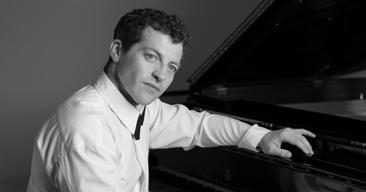
SUNDAY, AUGUST 9, 2026 · 3 PM
THE BAKER-BAUM CONCERT HALL
J.S. BACH
La Jolla Music Society’s 2026–27 Season is supported by The City of San Diego Cultural Affairs, County of San Diego, Prebys Foundation, Farfy Foundation, ProtoStar Foundation, Vail Memorial Fund, The Lodge at Torrey Pines, Banc of California, ResMed Foundation, San Diego Theatres Foundation, Bright Events Rentals, Cafe Coyote, Rancho Coyote, GRNFC Hospitality Group, Ace Parking, Brenda Baker and Steve Baum, Raffaella Belanich, Gordon Brodfuehrer, Eleanor Charlton, Mary Ellen Clark, Bert and Julie Cornelison, Elaine Galinson and Herbert Solomon, Irwin Jacobs, Helen and Keith Kim, Angelina and Fred Kleinbub, Dorothea Laub, Vivian Lim and Joseph Wong, Jaqueline and Jean-Luc Robert, Marge and Neal Schmale, Karen and Kit Sickels, Jeanette Stevens, Debra Turner, Sue and Peter Wagener, Liqun Wang and Marco Londei, Anna and Edward Yeung, Bebe and Marvin Zigman, Anonymous.
Chaconne in D Minor, BWV 1178 (arr. Rățoi) (1685– 1750)
CHOPIN
Passacaglia in C Minor, BWV 582 (arr. Rățoi)
Radu Rățoi‡, accordion
Waltz in A Minor “Found in New York” (1810–1849)
Henry Kramer, piano
VAUGHAN WILLIAMS
Piano Quintet in C Minor (1872–1958)
Allegro con fuoco
Andante
Fantasia (quasi variazioni) Moderato
Henry Kramer, piano; Blake Pouliot, violin;
Milena Pajaro-van de Stadt, viola; Efe Baltacigil, cello; Anthony Manzo, bass
INTERMISSION
MOZART
Horn Concerto No. 1 in D Major, K. 412/514 (arr. Horvath) (1756–1791)
Allegro
Rondo: Allegro
Stefan Dohr, horn; Roger Shao*, Anthony Chan*, violins; Brian Jennings*, viola; Wilson Vanderslice*, cello; Anthony Manzo, bass
LOEFFLER
Octet for Clarinets, Strings, and Harp (arr. Graeme Steele Johnson) (1861–1935)
Allegro moderato
Adagio molto
Andante; Allegro alla Zingara
Graeme Steele Johnson, Osmo Vänskä, clarinets; Erin Keefe,
Andrew Wan, violins; Matthew Lipman, viola; Sterling Elliott, cello; Anthony Manzo, bass; Julie Smith Phillips, harp
*2026 Farfy Foundation Fellowship Artist ‡YCA Artist-in-Residence
Program notes by Eric Bromberger, except where indicated.
Born March 31, 1685, Eisenach, Germany
Died July 28, 1750, Leipzig
Composed: 1705
Approximate Duration: 8 minutes
This concert opens with two variation-form movements by Johann Sebastian Bach, both played this afternoon on the accordion. One of them is famous, the other almost unknown, but the distinguishing thing about these two works is that both have a fugue at their center.
The Chaconne in D Minor is a very recent addition to the catalog of Bach’s works. It was discovered in 1992 in a bundle of old manuscripts at the Royal Library in Brussels. The manuscript is not in Bach’s hand and instead is the work of one of his young students, Salomon Günther John, who appears to have made a copy of his teacher’s music for himself about 1705. This would mean that Bach himself was very young: he was twenty years old at that point and serving as organist in Arnstadt. The work was for some time attributed to the organist Johann Christoph Graff, but recent scholarship has affirmed its authenticity, and Peter Wollny, who discovered the manuscript in Brussels, has said that he is “99.99% sure” that this is the work of Bach.
Bach left no tempo marking for the Chaconne in D Minor, only a tempo marking of 3. The chaconne subject spans the expected eight measures, and then the variations begin. The first four are all in eight measures, and each of these is repeated, but the final two are much longer and more extroverted. The music comes to a cadence, and Bach proceeds directly into the fugue, based on an almost stark subject. This is worked out over a span of 90 measures, and then Bach writes da capo: return to the beginning and conclude with the chaconne.
Composed: 1708–17
Approximate Duration: 7 minutes
Bach was known in his own day not so much as a composer as a virtuoso organist, one of the greatest in Europe and (if we are to judge from the complexity and virtuosity of his writing for the instrument) probably one of the greatest who ever lived. Bach established his reputation as an organist very early with works like the Passacaglia in C Minor. The exact date of its composition is unknown, though it appears to have been written sometime between 1708 and 1717, when Bach— then in his late twenties or early thirties—was court organist to the Duke of Saxe-Weimar.
It is a measure of Bach’s genius that he can take a strict old variation form like the passacaglia and transform it into a
work of expressive freedom and technical virtuosity, and the Passacaglia in C Minor is one of his most powerful works. A passacaglia is a set of variations on an eight-bar ground bass, and Bach begins with a slow and solemn ground, announced first deep in the organ’s register and played only on the pedals. The variations, subdued at first, begin at the first repetition of the ground, and gradually these grow in complexity and intensity as that solemn ground continues implacably beneath them. Bach writes twenty variations on the ground, and along the way the ground moves out of the bass and into the organ’s upper register (the pedals are silent here for some time). Gradually the ground returns and the music drives to a grand cadence. Out of that silence Bach then builds a complex fugue on the first four bars of the ground bass, which he titles in the score “Thema fugatum” (this piece is sometimes known as the Passacaglia and Fugue in C Minor). This fugue, which immediately introduces a lively conutertheme, itself builds to a huge climax, and Bach drives the music to the powerful concluding bars, which he marks Adagio
In its grandeur, complexity, and expressive power, the Passacaglia in C Minor is one of Bach’s greatest works, and perhaps it comes as no surprise that music this rich should seem to some to cry out for the resources not just of an organ but of a full symphony orchestra. Over the last century it has been arranged for orchestra by Ottorino Respighi, Leopold Stokowski, Eugene Ormandy, and others.
Born March 1, 1810, Želazowa Wola, Poland
Died October 17, 1849, Paris
Composed: 1830–35
Approximate Duration: 1 minute 30 seconds
It had long been assumed that Chopin wrote a total of nineteen waltzes across the span of his brief life, but in 2024 came a surprise. That year, a tiny manuscript (about the size of a postcard) was discovered in the Morgan Library and Museum in New York City. On it was the beginning of a waltz, 24 measures long, with an indication that it should be repeated. At the top was written the name “Chopin,” but in someone else’s hand. What was more intriguing was that the paper and the ink were the same kind of paper Chopin used, the bass clef was written in the strange way Chopin used (a very small C), and the music sounds exactly like Chopin. Further details may be discovered, but for the moment Chopin experts believe this work to be authentic and probably written between 1830 and 1835, when Chopin was in his early twenties and had recently arrived in Paris.
The form remains elusive, however. Even when the repeat is taken, the music lasts only about 80 seconds, so this is at best a fragment of a waltz. Was this the beginning of a waltz that Chopin chose not to complete? Was it dashed off on the small bit of manuscript as a gift to a student or friend? (What
a hostess gift that would make!) No one knows. The waltz, though, sounds unmistakably like the music of Chopin. It gets off to a stormy start in dark A minor, and this rises quickly to a dynamic marking of triple forte (a marking Chopin rarely used). At this point comes the sinuous waltz tune, all of this is repeated, and suddenly the music is over.
Born October 12, 1872, Down Ampney, England Died August 26, 1958, London
Composed: 1903
Approximate Duration: 28 minutes
Success did not come easily for Ralph Vaughan Williams. Though he had decided as a boy that he wanted to be a composer, he struggled for years to refine his technique and develop a voice of his own. It may be symbolic of that struggle and lack of progress that after Vaughan Williams graduated from Trinity College, Cambridge, with a bachelor’s degree in music in 1894, he stayed on for another year and earned a further degree in history. Real success as a composer would not come until 1910, which saw the premières of both his Fantasia on a Theme of Thomas Tallis and his Sea Symphony. At that time he was 38 years old.
As part of his long apprenticeship, Vaughan Williams wrote a number of works that have not made it into the standard repertory. In 1903, when he was 31, Vaughan Williams composed a Piano Quintet in C Minor, but this is not the piano quintet—piano plus string quartet—that Schumann, Brahms, and others have written for. Instead, Vaughan Williams scored his quintet for an ensemble of violin, viola, cello, doublebass, and piano, the same instrumentation that Schubert used in his “Trout” Quintet. Vaughan Williams’ Piano Quintet was performed, and he revised it several times, but he was never fully satisfied with it and chose not to publish it. The work was not performed after 1918, and it was not published until forty years after the composer’s death.
Vaughan Williams’ Quintet may use the same instrumentation as the “Trout” Quintet, but this music does not sound like Schubert. In fact, it sounds a great deal more like Brahms, who had been dead for only six years when Vaughan Williams wrote it–it offers the same grand gestures and the same full-throated sound one associates with Brahms. The Quintet is a substantial work—its three movements stretch out to a full half-hour. The aptly named Allegro con fuoco (“with fire”) opens with four sharp chords, and that pattern of four descending chords will recur in various forms throughout the first movement. By contrast, the second theme-group feels quite subdued (it is marked both dolce and piano), though Vaughan Williams returns to the movement’s vigorous opening gestures to launch the extended development.
The central Andante flickers between different moods. Vaughan Williams marks its opening both molto espressivo and
teneramente (“tenderly”), but from this gentle beginning the music grows in strength. gradually building to an unexpectedly powerful climax marked appassionato. The final movement may be titled Fantasia, but it is in fact quite a disciplined movement: it is a set of variations on a theme that Vaughan Williams had introduced quietly in the first movement. The movement gets off to a very restrained beginning, as the strings introduce that theme senza espressione: “without expression.” This theme will then reappear in a variety of forms and expression, finally soaring to an impassioned climax fully worthy of Brahms, and then—unexpectedly—it falls away to a quiet close.
Born January 27, 1756, Salzburg
Died December 5, 1791, Vienna
Composed: 1791
Approximate Duration: 13 minutes
Mozart wrote all four of his horn concertos for Ignaz Joseph Leutgeb, whom he had known when Leutgeb played in the Archbishop’s orchestra in Salzburg. Leutgeb moved to Vienna at about the same time Mozart did (1781) and supported himself by opening a cheese shop, described by Mozart’s father, Leopold, as being “about the size of a snail’s shell.” Leutgeb asked young Mozart to write concertos for him to play as a way of establishing himself in Vienna, and while Mozart did write four concertos for him, he tormented the apparently simple Leutgeb in the process. The score for the First Concerto is written in blue, red, green, and black ink, and in the final movement Mozart scrawled a series of insults that Leutgeb would have to read every time he played the music.
The brief First Concerto is a very pleasing work, but beneath its sunny surface lurk a number of problems. Chief of these is the fact that no one is sure when it was written. Mozart usually dated his manuscripts carefully, and the first movement was apparently written in 1782. But the final movement appears to have been written later; some have felt that Mozart re-composed it in 1787, but recently the date has been established as 1791, the year the composer died. The fact that the concerto has only two movements and that they were written so far apart has led some scholars to conclude that these two movements do not belong together at all and that this concerto has been assembled from random movements. The absence of a slow movement and the fact that the orchestration varies (this arrangement by Roland Horvath calls for horn and string quintet, omitting the oboes and bassoons altogether) may support this view. Recent scholarship has suggested, in fact, that the final movement may have been completed by Mozart’s pupil F.X. Sussmayr, who also prepared a performing version of Mozart’s Requiem, left unfinished at the composer’s death.
In any case, Mozart’s First Horn Concerto—ironically his last to be completed—is charming music. The fact that Mozart wrote it for natural (or valveless) horn suggests just how good a player Leutgeb must have been, for this concerto demands a full range of notes, many of which were difficult to produce without valves. Both movements are marked Allegro. The first is very direct, maybe even innocent (in the best sense of that term)—Mozart biographer Alfred Einstein calls it “gemütlich.” It is built on two themes, and the horn enters on a restatement of the violins’ opening melody; there is no cadenza, and the ideas are worked out concisely. The finale is a rondo based on hunting horn rhythms (6/8) and noble horn calls. At the center of all this energy, though, lies an extended minor-key episode full of heartfelt expression.
Born January 30, 1861, Schöneberg, Germany
Died May 19, 1935, Medfield, Massachusetts
Composed: 1896/2021-2024
Approximate Duration: 33 minutes
Tonight’s audience will be among the first in living memory to hear Charles Martin Loeffler’s rediscovered Octet, a piece that was left unpublished, unrecorded, and unheard since 1897. But the Octet’s silence for more than a century should not be taken as an indicator of its quality any more than Loeffler’s obscurity today should represent his historical and musical significance.
Hailed in obituaries as “the dean of American composers,” Loeffler joined the Boston Symphony as assistant concertmaster in 1882—the orchestra’s second season, and a time when Boston was “the musical Athens of America.” He rose to such prominence that he became something of a cult figure in Boston society, and the BSO clocked no fewer than 117 performances of his music by the end of his life. For the first part of the 20th century, Loeffler was one of the most performed American composers in this country and in Europe. One reviewer present at the 1897 première of Loeffler’s Octet “could hardly say enough” about the piece, writing, “the work took nearly everyone by storm.”
Why, then, have Loeffler and his music faded from popular consciousness? Part of the answer lies in the same cosmopolitanism that made the transplanted composer so irresistible to Americans during his lifetime. In an era acutely inflected by nationalism, Loeffler’s complicated heritage made him a cultural chameleon. German-born but masquerading as French after immigrating to the United States, his flexible identity allowed him to assimilate at times, marked him as appealingly exotic at others, or condemned him to an awkward misfit position between the continents. Despite his prominence on both sides of the Atlantic, for posterity Loeffler was ultimately too American for the European
musical establishment, and too European for the maverick sound of the New World—a predicament that effectively wrote him out of both musical histories. A cosmopolitan in one sense, Loeffler, in another, belonged not to all countries but to none.
Today, Loeffler’s tangled identities and his Octet’s polyglot compositional vernacular offer a fresh hearing of the “American sound” on the occasion of our 250th anniversary, a foil to the more familiar musical Americana of Copland and Gershwin. When the piece was last heard in 1897, Loeffler’s influence was helping shape early American musical life and guiding the young country toward an authentic voice. Today, resuscitating Loeffler’s Octet not only gives voice to the forgotten sounds of its score, but suggests an alternative model of American musical identity by embodying the cultural complexities of his adopted country.
The piece stands as a reminder that our modern sense of the canon and our whole musical frame of reference are based only on that narrow sliver of music we know today—the music that survived. And in this way, Loeffler’s seminal role in American music continues today, by helping us paint a more complete picture of musical history so that we can imagine a more colorful musical future.
Graeme Steele Johnson
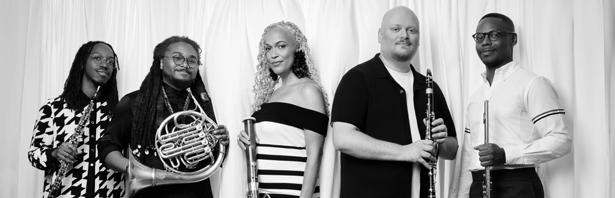
PRELUDE · 6 PM THE JAI
Lecture by Patrick Castillo
WEDNESDAY, AUGUST 12, 2026 · 7 PM
THE BAKER-BAUM CONCERT HALL
PROKOFIEV String Quartet No. 1 in B Minor, Opus 50 (1891–1953) Allegro
Andante molto; Vivace Andante
Blake Pouliot, Arnaud Sussmann, violins; Ayane Kozasa, viola;
Paul Wiancko, cello
POULENC
Sonata for Flute and Piano, FP 164 (1899–1963) Allegro malincolico
Join us for a celebration in the Wu Tsai QRT.yrd immediately following the performance. Must be 21+ with valid ID for sparkling wine service.
Midweek Masterworks
La Jolla Music Society’s 2026–27 Season is supported by The City of San Diego Cultural Affairs, County of San Diego, Prebys Foundation, Farfy Foundation, ProtoStar Foundation, Vail Memorial Fund, The Lodge at Torrey Pines, Banc of California, ResMed Foundation, San Diego Theatres Foundation, Bright Events Rentals, Cafe Coyote, Rancho Coyote, GRNFC Hospitality Group, Ace Parking, Brenda Baker and Steve Baum, Raffaella Belanich, Gordon Brodfuehrer, Eleanor Charlton, Mary Ellen Clark, Bert and Julie Cornelison, Elaine Galinson and Herbert Solomon, Irwin Jacobs, Helen and Keith Kim, Angelina and Fred Kleinbub, Dorothea Laub, Vivian Lim and Joseph Wong, Jaqueline and Jean-Luc Robert, Marge and Neal Schmale, Karen and Kit Sickels, Jeanette Stevens, Debra Turner, Sue and Peter Wagener, Liqun Wang and Marco Londei, Anna and Edward Yeung, Bebe and Marvin Zigman, Anonymous.
Cantilena: Assez lent
Presto giocoso
Emi Ferguson, flute; Zoltán Fejérvári, piano
SHORTER Terra Incognita (1933–2023) Imani Winds
Brandon Patrick George, flute; Mekhi Gladden, oboe; Mark Dover, clarinet ; Kevin Newton, horn; Monica Ellis, bassoon
COPLAND Appalachian Spring (1900–1990)
Tessa Lark, Blake Pouliot, Elli Choi*, Anthony Chan*, violins;
Rebecca Albers, Ayano Nakamura*, violas;
Efe Baltacigil, Wilson Vanderslice*, cellos; Anthony Manzo, bass;
Brandon Patrick George, flute; Mark Dover, clarinet ; Monica Ellis, bassoon; Henry Kramer, piano
THIS PERFORMANCE HAS NO INTERMISSION
*2026 Farfy Foundation Fellowship Artist
Program notes by Eric Bromberger, except where indicated.
Born April 23, 1891, Sontsivka, Ukraine
Died March 5, 1953, Moscow
Composed: 1931
Approximate Duration: 24 minutes
Three of the four works on this concert were commissioned by one of the most generous and discerning patrons of music in American history, Elizabeth Sprague Coolidge (1864–1953). Coolidge created her own foundation at the Library of Congress to commission new works, to sponsor festivals, and to put on concerts. She gave the money to build a concert hall at the Library of Congress that is still in use today, and she created two string quartets (the Berkshire and Coolidge Quartets) to help advance the cause of new music. She was also involved in other philanthropic causes, including schools and hospitals—but her most important legacy lies in the music she commissioned from over 150 composers, including many of the most distinguished composers of the twentieth century. She was a discerning patron: a number of her commissions have gone on to become part of the repertory.
The name Sergei Prokofiev is not one we automatically associate with the string quartet—the composer who had achieved notoriety for such dazzling (and assaultive) scores as The Age of Steel and Scythian Suite does not seem a likely candidate to take up this most disciplined of high classical forms. And that makes the decision by the Elizabeth Sprague Coolidge Foundation to commission a quartet from Prokofiev in 1930 all the more surprising. That year, the Boston Symphony Orchestra premièred Prokofiev’s Fourth Symphony as part of its fiftieth anniversary celebration, and Prokofiev came to the United States for that occasion and to give a series of concerts. Faced with the commission to compose a kind of music he had never written before, Prokofiev prepared very carefully, studying the scores to Beethoven’s string quartets as he traveled by train to concert engagements. Listeners may be hard-pressed to discover the influence of Beethoven in Prokofiev’s First Quartet, though Prokofiev himself pointed out “a somewhat ‘classical’ idiom in the first movement of my quartet.” The first performance of the quartet took place at the Library in Congress in Washington on April 25, 1931.
Prokofiev noted two distinctive features of his quartet: it ends with a slow movement, and it is in B minor, an unusual key for a quartet. The opening Allegro is in sonata form, based on two theme-groups: the angular first subject is announced immediately by the first violin, with the more lyric second theme following quickly in the cello. The development is spirited and athletic, full of the surprising harmonic turns typical of Prokofiev’s best music, before the movement marches firmly to its sudden close.
The second movement begins with a brief slow introduction (Prokofiev specifies in the score that it should be played gravamente) before the main section—Vivace—leaps
ahead with the lower strings in octaves. Much of the writing here is brilliant, with many passages suggesting a perpetualmotion rush. Prokofiev varies the pulse by switching to a rocking 6/8 meter and only gradually working back to 2/4 for the cadence.
Prokofiev was especially happy with the concluding Andante, saying that he “ended the quartet with a slow movement because the material happened to be the most significant in the whole piece.” Concluding a string quartet with a slow movement is unusual but not unheard of: Bartók’s Second Quartet (1917) offers one of the most famous examples of a slow finale. Prokofiev liked his own finale enough to use it twice more: he arranged it for string orchestra and as one of his Six Pieces for Piano, Opus 52. It is a long, grieving song that passes through several remote keys, some of them rather astringent, before the music winds down to a quiet close on sustained Bs from the violins.
Born January 7, 1899, Paris
Died January 30, 1963, Paris
Composed: 1956–57
Approximate Duration: 12 minutes
Poulenc’s reputation rests on his dramatic works, religious settings, songs, and music for piano, and in this distinguished company it is easy to overlook the three sonatas for woodwind instruments he wrote late in life: for flute (1957), for clarinet (1962), and for oboe (1962). An interest in these instruments was no late discovery, however; thirty years earlier, Poulenc had written his famous Sextet for Piano and Woodwind Quintet, noting that he intended that music as “homage to the wind instruments I have loved from the moment I began composing.”
The Flute Sonata has been acclaimed one of the finest of Poulenc’s late works. Composed at the Cannes Hotel between December 1956 and March 1957, it is dedicated to the memory of Elizabeth Sprague Coolidge, who had died four years earlier. The overall progress of this brief (twelve-minute) sonata is from the dark opening movement (marked “melancholy”) to the high-spirited finale (marked “happy”). The threepart first movement opens with a 32nd-note swirl that will recur throughout; the sinuously winding main theme— which descends melodically and chromatically—is one of those melodies that stays to haunt the memory. The second movement, marked Cantilena, has always been a favorite of audiences—at the first performance, given in Strasbourg by Jean-Pierre Rampal and the composer on June 18, 1957, it had to be repeated. This movement was described by a critic at that time as “a great rainbow of melody”; characteristically, Poulenc instructs the pianist to make that part sound “sweetly bathed in pedal.” The brief finale rounds off the traditional fastslow-fast sequence of movements with bright energy.
Born August 25, 1933, Newark, New Jersey
Died March 2, 2023, Los Angeles
Composed: 2006
Approximate Duration: 8 minutes
“Terra Incognita is a musical dialogue on the nature of the unknown and the unexpected. It seems as if every aspect of living has been subject to ‘not knowing’ where life takes us or, what it will bring. The courage needed to live with dignity in a world beset with the unimaginable is the catalyst to the creation of this work. In the face of an unpredictable future, the story of the ‘human condition’ promises to transcend even the unknown.”
— Wayne Shorter
This piece had its world première at SummerFest on August 16, 2006, as a joint commission between La Jolla Music Society, Krannert Center for the Performing Arts, Da Camera of Houston, and the Library of Congress.
Born November 14, 1900, Brooklyn
Died December 2, 1990, North Tarrytown, New York
Composed: 1944
Approximate Duration: 27 minutes
Aaron Copland’s Appalachian Spring has become such a classic that it is surprising to learn that this ballet took shape rather haphazardly. Copland and Martha Graham had long wanted to work together before that opportunity came in 1942 when Elizabeth Sprague Coolidge commissioned three new dance works from Graham and gave the choreographer her choice of composers. One of those Graham chose was Copland, and they set to work. But their plans were unclear. It was wartime and Graham wanted a specifically American subject, but her initial thought of something that would include spoken text, a Native American girl, and the Civil War did not appeal to Copland. The composer went ahead with only a general sense of Graham’s evolving scenarios. He began composition in June 1943 in Hollywood, where he was working on a film score, and completed the ballet the following summer in Cambridge, while teaching at Harvard; the orchestration was completed in Mexico. Graham was delighted with Copland’s music and adapted her choreography to fit his score (she in fact chose the title Appalachian Spring just weeks before the first performance, taking it from Hart Crane’s poem The Bridge). For his part, Copland conceived this music specifically for Martha Graham rather than for her constantly evolving plotlines. “When I wrote Appalachian Spring, I was thinking primarily about Martha and her unique choreographic style, which I knew well. Nobody else seems quite like Martha: she’s so proud, so very much herself. And she’s unquestionably very American: there’s something prim and restrained, simple yet strong, about her which one tends to think of as American.”
Copland’s working title for this music was simply “Ballet for Martha” (and it still says that on the score’s title page).
The première, at the Library of Congress in Washington on October 30, 1944, was a great success, and Copland’s score was awarded the Pulitzer Prize and the New York Music Critics Circle Award the following year. Because the pit at the première was so small, Copland originally scored Appalachian Spring for an ensemble of only thirteen instruments: three woodwinds (flute, clarinet, bassoon), double string quartet, contrabass, and piano. In the spring of 1945, he arranged a suite from the ballet for full symphony orchestra, deleting about eight minutes from the original ballet, and this has become the best-known version of this music. However, many preferred the clarity and purity of Copland’s original chamber orchestration, and so in 1958 he prepared a version of the suite for the original thirteen-instrument ensemble (specifying that the number of string players could be augmented if desired). This is the version performed at the present concert.
A note in the score outlines the subject of Appalachian Spring as Graham and Copland finally evolved it: the ballet tells of “a pioneer celebration in spring around a newly built farmhouse in the Pennsylvania hills in the early part of the last century. The bride-to-be and the young farmer-husband enact the emotions, joyful and apprehensive, their new domestic partnership invites. An older neighbor suggests now and then the rocky confidence of experience. A revivalist and his followers remind the new householders of the strange and terrible aspects of human fate. At the end the couple are left quiet and strong in their new house.”
This scenario is rather simple, but the story is timeless, and Copland’s wonderful music—glowing, fresh, strong— catches its mood perfectly. The action is easily followed. The opening section, which introduces the characters one by one, outlines the main theme of the ballet—a simple risingand-falling shape—within a quiet haze of sound, and out of this bursts the general gathering: Copland portrays this with a jubilant A-major explosion that suggests country fiddling. A hopping little episode for woodwinds is the dance of the Bride and her Intended, who look forward to their life together (there is a dark interlude here—not all of life will be happy). Suddenly the revivalist and his flock appear and help celebrate the wedding with a barn dance. The Solo Dance of the Bride, marked Presto, is her attempt to convey her complex feelings on this day, and this leads to one of the most striking moments in Appalachian Spring: Copland has a solo clarinet sing the Shaker melody “’Tis the Gift To Be Simple,” and there follow five variations, each a vision of the married couple’s life together. The last is stamped out triumphantly, and, then over prayer-like music from the strings, the Bride goes to take her place among her neighbors. The young couple is left together, “quiet and strong” as the ballet fades into silence on the music from the very beginning.
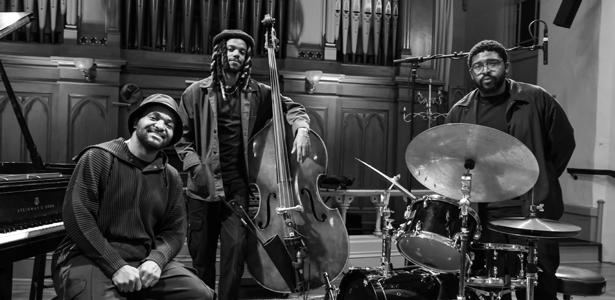
THURSDAY, AUGUST 13, 2026 · 5:30 PM & 8 PM THE JAI
Sullivan Fortner Trio
Sullivan Fortner, piano
Tyrone Allen II, bass Kayvon Gordon, drums
Support for our jazz programs is provided by:
Dorothea Laub
La Jolla Music Society’s 2026–27 Season is supported by The City of San Diego Cultural Affairs, County of San Diego, Prebys Foundation, Farfy Foundation, ProtoStar Foundation, Vail Memorial Fund, The Lodge at Torrey Pines, Banc of California, ResMed Foundation, San Diego Theatres Foundation, Bright Events Rentals, Cafe Coyote, Rancho Coyote, GRNFC Hospitality Group, Ace Parking, Brenda Baker and Steve Baum, Raffaella Belanich, Gordon Brodfuehrer, Eleanor Charlton, Mary Ellen Clark, Bert and Julie Cornelison, Elaine Galinson and Herbert Solomon, Irwin Jacobs, Helen and Keith Kim, Angelina and Fred Kleinbub, Dorothea Laub, Vivian Lim and Joseph Wong, Jaqueline and Jean-Luc Robert, Marge and Neal Schmale, Karen and Kit Sickels, Jeanette Stevens, Debra Turner, Sue and Peter Wagener, Liqun Wang and Marco Londei, Anna and Edward Yeung, Bebe and Marvin Zigman, Anonymous.
PROGRAM
Works to be announced from the stage
THIS PERFORMANCE HAS NO INTERMISSION.
Returning to SummerFest after last season’s electrifying collaboration with Cécile McLorin Salvant, Sullivan Fortner—GRAMMY® award winner, recipient of the Gilmore Jazz Pianist Award, and one of today’s most celebrated jazz pianists—brings his incredible trio to The JAI.
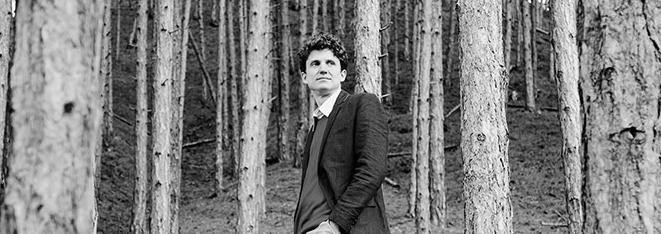
PRELUDE · 6 PM
THE BAKER-BAUM CONCERT HALL
Kairos Piano Quartet performs Walton’s Piano Quartet in D Minor
FRIDAY, AUGUST 14, 2026 · 7 PM THE BAKER-BAUM CONCERT HALL
DEBUSSY En blanc et noir for Two Pianos (1862–1918) Avec emportement
Lent. Sombre. Scherzando
Inon Barnatan, Henry Kramer, pianos
BRIDGE Lament for Two Violas (1879–1941) Rebecca Albers, Ayane Kozasa, violas
POULENC Sextet for Piano and Woodwind Quintet, FP 100 (1899–1963) Allegro vivace
Divertissement
Support for this program is provided by: UC San Diego
La Jolla Music Society’s 2026–27 Season is supported by The City of San Diego Cultural Affairs, County of San Diego, Prebys Foundation, Farfy Foundation, ProtoStar Foundation, Vail Memorial Fund, The Lodge at Torrey Pines, Banc of California, ResMed Foundation, San Diego Theatres Foundation, Bright Events Rentals, Cafe Coyote, Rancho Coyote, GRNFC Hospitality Group, Ace Parking, Brenda Baker and Steve Baum, Raffaella Belanich, Gordon Brodfuehrer, Eleanor Charlton, Mary Ellen Clark, Bert and Julie Cornelison, Elaine Galinson and Herbert Solomon, Irwin Jacobs, Helen and Keith Kim, Angelina and Fred Kleinbub, Dorothea Laub, Vivian Lim and Joseph Wong, Jaqueline and Jean-Luc Robert, Marge and Neal Schmale, Karen and Kit Sickels, Jeanette Stevens, Debra Turner, Sue and Peter Wagener, Liqun Wang and Marco Londei, Anna and Edward Yeung, Bebe and Marvin Zigman, Anonymous.
Finale: Prestissimo
Inon Barnatan, piano
Imani Winds
Brandon Patrick George, flute; Mekhi Gladden, oboe; Mark Dover, clarinet ; Kevin Newton, horn; Monica Ellis, bassoon;
KORNGOLD Suite for Two Violins, Cello, and Piano Left-Hand, Opus 23 (1897–1957) Präludium und Fuge: Kräftig und bestimmt
Walzer: Nicht schnell, anmutig
Groteske: Möglich rasch
Lied: Schlicht und innig. Nicht zu langsam
Rondo-Finale (Variationen): Schnell heftig
Arnaud Sussmann, Tessa Lark, violins; Paul Wiancko, cello; Zoltán Fejérvári, piano;
Program notes by Eric Bromberger
En blanc et noir
Born August 22, 1862, Saint-Germain-en-Laye, France
Died March 25, 1918, Paris
Composed: 1915
Approximate Duration: 15 minutes
Debussy died at only 55, and his final years were wretched. At 48 he had been diagnosed with colon cancer, and despite radiation treatment and an operation, the disease took its steady course: his last years were spent in great pain and finally as an invalid. The outbreak of World War I plunged him into deep depression and reawakened his old hatred of all things German, both political and musical. As the war descended into the carnage of trench warfare and casualties mounted, Debussy resolved to respond artistically. To a friend he wrote: “I want to work, not so much for myself, but to give proof, however small it may be, that even if there were thirty million Boches, French thought will not be destroyed.” Debussy spent the summer of 1915 in Pourville on the English Channel, and there he completed his set of Twelve Études for piano and began a set of six sonatas for various combinations of instruments. He would live to complete only three of those sonatas, but he defiantly signed their manuscript “Claude Debussy—musicien français”: French musician!
Early that summer in Pourville Debussy composed another work, a piece for two pianos four-hands that he titled Caprices en blanc et noir, though he eventually dropped the first word and called them simply En blanc et noir: “In White and Black.” That title is quite functional—it refers to the keys of the piano—and Debussy stressed that the three movements “derive their color and feeling merely from the sonority of the piano.” Yet beneath that abstract title lies a seething fury—this music was written in direct response to the war and the presence of a German army on French soil.
Debussy prefaces each of the three movements with a brief quotation from French art. The opening movement is introduced with a quotation from the libretto of Gounod’s Roméo et Juliette: “He who stays in this place and does not dance, quietly admits to a disgrace.” As his friends and colleagues went off to fight the war, Debussy noted that he had never held a rifle in his life and admitted that he would not have been able to defend a fence, yet he felt guilty about not being able to contribute. The first movement might be thought of as a very high-energy waltz. Debussy marks its beginning Avec emportment (“With passion or excitement”), and the notes virtually spill over themselves in great cascades of sound. Debussy may have felt that this was black-and-white music, but he is able to generate a huge range of color in this movement, which moves through several waltz episodes to a climax marked Appassionato
The relation to the war is made more explicit in the second movement, which is headed by a brief quotation from François
Villon’s Ballade Against the Enemies of France. Debussy dedicated this movement to the memory of the nephew of his publisher Durand, Jacques Charlot, who had been killed in the fighting. Marked slow and somber, it almost becomes a miniature tone poem, though Debussy tells his tale subtly. In the distance, faint bugle calls establish the wartime context, and soon we hear Martin Luther’s hymn Ein’ feste Burg, for Debussy a symbol of the German nation. Eventually, animated music rises up, drives out the hymn tune, and reaches a conclusion marked Joyeux. Debussy was explicit about the course of his little music-drama: the concluding music “cleanses the atmosphere . . . of its poisonous fumes . . . or rather what it represents.”
En blanc et noir concludes with a brilliant finale marked Scherzando. Yet even here the mood is restrained—Debussy prefaces it with a brief line from the sixteenth-century French poet Charles d’Orleans: “Winter, you are nothing but an enemy.” After all its vibrant energy, this movement comes to a supremely understated close.
SOME NOTES: It is hard for us, a century later, to understand how daring En blanc et noir seemed to its first audiences. SaintSaëns, so rattled by this music that he got its name wrong, wrote to Fauré: “I advise you to look at the pieces for two pianos, Noir et blanc, which M. Debussy has just published. It’s incredible, and the door of the Institute must at all costs be barred against a man capable of such atrocities.” Debussy dedicated the final movement of En blanc et noir to Stravinsky, who did not learn of the dedication until after Debussy’s death in 1918. The Russian composer was moved by the dedication, and in 1920 he composed his Symphonies of Wind Instruments in Debussy’s memory.
Born February 26, 1879, Brighton, England
Died January 10, 1941, Eastbourne, England
Composed: 1912
Approximate Duration: 8 minutes
American audiences know Frank Bridge (when they know him at all!) as the teacher of Benjamin Britten. Bridge studied viola and composition at the Royal College of Music and then made his career as a violist, a conductor, and a composer: he played viola in several string quartets and conducted in both England and the United States. As a composer, he made a gradual evolution from a conservative musician, heir to nineteenth-century English music, to an explorer, interested in new ideas and willing to experiment with a new harmonic language. Bridge became interested in Britten when the latter was still a boy and for three years gave him private composition lessons. Bridge was a demanding teacher, and his concern for craftsmanship, self-criticism, and economy of expression made a strong impression on the young Britten; Bridge’s pacifism was also an influence on Britten’s values.
During the winter of 1912 two young English violists gave a joint recital at Aeolian Hall in London. One of them was Lionel Tertis, then 36; the other was Bridge, then 33. For that occasion, Bridge composed several works for two violas. The two violists performed these pieces, but Bridge chose not to publish them, and the music disappeared. Many years later, Bridge scholar Paul Hindmarsh found the sketches for one of these pieces, the Lament for Two Violas, and was able to reconstruct it from them. Hindmarsh observed that the piece was nearly complete in these sketches, and a note in the published score reads: “Edited from an untitled, unfinished draft and some additional sketches in the Parry Room Library, Royal College of Music, London.”
“Lament” was a favorite title with Bridge—he used it for a number of different works, including one of his best-known compositions, the Lament for String Orchestra of 1915. Certainly his somber music for two violas deserves that title. This piece, only about nine minutes long, is in ternary form. Its dark, husky beginning—perfectly conceived for the sound of the viola—is noble and spare, but the music grows more animated as it proceeds. A brief central episode leads to a return of the opening material, with textures now enlivened and embroidered. Gradually this energy falls away, and the Lament comes to a most subdued conclusion.
Born January 7, 1899, Paris
Died January 30, 1963, Paris
Composed: 1932/1939
Approximate Duration: 18 minutes
Poulenc wrote the Sextet for Piano and Woodwind Quintet in 1932 but was dissatisfied and withdrew it. He revised the work in 1939, and in this final version it was first performed on December 9, 1940. Poulenc described his sextet as “chamber music of the most straightforward kind: an homage to the wind instruments I have loved from the moment I began composing.” Full of superb writing for woodwinds as well as clever thematic interrelationships between movements and some surprising harmonies, the Sextet is bubbling and refreshing, like cold champagne on a hot summer day.
The Allegro vivace—which Poulenc specifies should be “Very quick and passionate”—is in ternary form. The opening section offers brightly chattering winds, and a bassoon solo leads to the slow middle section, which Poulenc asks to have played at half the opening tempo. After the piano’s lovely opening melody, this center section is filled with Poulenc’s precise instructions for the players—“intense,” “very gentle,” “expressive”—before the return of the opening material.
The second movement is also in ternary form, but now the outer sections are slow, the inner part fast. The oboe has the haunting first theme (“very gentle and expressive”), but the tempo doubles in the lively middle section. Again, Poulenc’s
instructions to the players are quite specific—he wants this music to sound “very merry,” but he also cautions “dry” and “gentle” as the music makes its way back to the opening section.
The finale—a rondo marked Prestissimo—sails along on the sound of busy winds and staccato piano. The rondo theme is interrupted by lyric episodes, and at the coda the tempo suddenly becomes very slow and an oboe melody (“very sweet and melancholy”) leads to the noble close.
Born May 29, 1897, Brno, Czechia
Died November 29, 1957, Hollywood
Composed: c. 1930
Approximate Duration: 38 minutes
Paul Wittgenstein (1887–1961) came from one of the most urbane families in turn-of-the-century Vienna: his brother was the philosopher Ludwig Wittgenstein, and Paul studied piano with Theodore Leschetizky, teacher of Paderewski and Schnabel. The young pianist made his professional debut in Vienna in December 1913 and seemed on the verge of distinguished career. And then, disaster: World War I began eight months later, and Wittgenstein—serving on the Eastern front—was wounded so badly during the first month of fighting that his right arm had to be amputated. He returned to Vienna after spending the war in a prisoner camp in Siberia.
A lesser man might have been crushed by such a fate, but Wittgenstein came home determined to create a piano repertory for the left hand. He turned the family fortune to the creation of such music, and the list of works he commissioned is distinguished. Most famous of these is Ravel’s Piano Concerto for the Left Hand, and Strauss, Britten, Prokofiev, and others wrote works for Wittgenstein. One of the composers to whom Wittgenstein turned for a concerto was the prodigious Erich Wolfgang Korngold, whose opera Die tote Stadt had been premièred simultaneously in Hamburg and Cologne in 1920, when the composer was only 23. Korngold composed a massive and very difficult Piano Concerto in C-sharp Minor for Wittgenstein, who gave the première in 1923. The pianist was pleased with the concerto, and five years later he came back to Korngold and asked for a chamber piece. For this commission, Korngold composed an unusual work for unusual forces: a Suite for Two Violins, Cello, and Piano Left-Hand Completed in the spring of 1930, it was first performed in Vienna on October 21, 1930, by Wittgenstein and members of the Rosé Quartet (led by Arnold Rosé, Mahler’s brother-inlaw). Wittgenstein liked the piece and performed it frequently on his tour of the western United States in 1934.
Wittgenstein had every reason to be pleased with this music. The Suite is a large-scale work (its five movements span nearly forty minutes), and the writing for the left hand is
so brilliant and wide-ranging that anyone just hearing this music would imagine that it requires both hands. Further, Korngold’s late-Romantic idiom, which ranges from a Viennese elegance to a Mahlerian grotesquerie, makes for some very appealing music—only the unusual forces required have kept this music from being performed more often and so from being better-known.
The opening movement gets off to an aggressive start. Piano alone has the long opening statement (Korngold marks it “Powerful and determined”) before the strings make their own decisive entrance. The main part of this extended movement is a fugue, introduced by the cello with successive entrances from piano and then the violins. Along the way come a rhapsodic interlude and a cadenza-like passage for solo piano before the movement drives to its soaring conclusion.
The next two movements are sharply contrasted. The second movement is a sequence of waltzes (filtered through a late-romantic perspective), while the aptlynamed Groteske is a scherzo in ternary form—its skittering, nervous outer sections frame a somber central episode. The fourth movement, called Lied, is just that: Korngold based this movement on his song Was du mir bist?, which he had composed the year before. This movement is a lyric meditation on the song, and Korngold asks that the performance be “simple and expressive.” The powerful finale is a rondo in the form of a set of variations. Korngold marks it “vehement,” though the music feels more exuberant than violent. The basic theme-shape, an amiable subject announced by the cello at the beginning, evolves across the span of this movement.
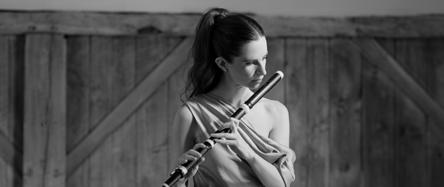
PRELUDE · 6 PM
THE JAI
Interview with Inon Barnatan hosted by Leah Rosenthal
SATURDAY, AUGUST 15, 2026 · 7 PM
J.S. BACH
Brandenburg Concerto No. 6 in B-Flat Major, BWV 1051 (1685–1750)
Allegro
Adagio ma non troppo; Allegro
Daniel McCarthy, solo viola; Rebecca Albers, solo viola; Coleman Itzkoff, Paul Wiancko, Eliana Razzino Yang*, cellos; Doug Balliett, bass; David Belkovski, harpsichord
Brandenburg Concerto No. 3 in G Major, BWV 1048
Allegro
Adagio
In loving tribute to his beloved soulmate
Erik Matwijkow, tonight’s performance is underwritten by Peter Cooper.
La Jolla Music Society’s 2026–27 Season is supported by The City of San Diego Cultural Affairs, County of San Diego, Prebys Foundation, Farfy Foundation, ProtoStar Foundation, Vail Memorial Fund, The Lodge at Torrey Pines, Banc of California, ResMed Foundation, San Diego Theatres Foundation, Bright Events Rentals, Cafe Coyote, Rancho Coyote, GRNFC Hospitality Group, Ace Parking, Brenda Baker and Steve Baum, Raffaella Belanich, Gordon Brodfuehrer, Eleanor Charlton, Mary Ellen Clark, Bert and Julie Cornelison, Elaine Galinson and Herbert Solomon, Irwin Jacobs, Helen and Keith Kim, Angelina and Fred Kleinbub, Dorothea Laub, Vivian Lim and Joseph Wong, Jaqueline and Jean-Luc Robert, Marge and Neal Schmale, Karen and Kit Sickels, Jeanette Stevens, Debra Turner, Sue and Peter Wagener, Liqun Wang and Marco Londei, Anna and Edward Yeung, Bebe and Marvin Zigman, Anonymous.
PAUL WIANCKO
Allegro
Aisslinn Nosky, Edson Scheid, Ela Kodžas, violins; Daniel McCarthy, Rebecca Albers, Ayane Kozasa, violas; Coleman Itzkoff, Paul Wiancko, Eliana Razzino Yang*, cellos; Doug Balliett, bass; David Belkovski, harpsichord
INTERMISSION
Vox Petra (b. 1983)
Ayane Kozasa, Rebecca Albers, violas; Paul Wiancko, Coleman Itzkoff, cellos
J.S. BACH
Brandenburg Concerto No. 5 in D Major, BWV 1050
Allegro
Affetuoso
Allegro
David Belkovski, harpsichord; Emi Ferguson, flute; Aisslinn Nosky, solo violin; Edson Scheid, violin;
Daniel McCarthy, viola; Coleman Itzkoff, cello; Doug Balliett, bass
*2026 Farfy Foundation Fellowship Artist
Program notes by Eric Bromberger, except where indicated.
Born March 31, 1685, Eisenach, Germany
Died July 28, 1750, Leipzig
Bach served as Kapellmeister at the court of AnhaltCöthen from 1717 until 1723, an unusually happy period for the composer. Prince Leopold was an enthusiastic and informed amateur musician who put the full resources of his court—including a seventeen-piece orchestra—at Bach’s disposal. From this period comes the vast majority of Bach’s secular instrumental music, including the sonatas and partitas for unaccompanied violin, the violin concertos, and the six orchestral concertos that we know today—for better or worse—as the Brandenburg Concertos
Early in his tenure at Cöthen, Bach had journeyed to Berlin to order the construction of a new organ at Cöthen. While in Berlin, he played for Christian Ludwig, the younger brother of King Wilhelm I of Prussia; as a member of the royal family, Christian Ludwig enjoyed the official title of Margrave of Brandenburg. He expressed some interest (perhaps simply polite) in Bach’s music, and the composer promised to send him some. Bach, however, was in no hurry to get around to this, and it was not until several years later, in March 1721, that he finally sent off a handsomely copied manuscript of six orchestral concertos—with a flowery letter of dedication—to the Margrave in Berlin. The manuscripts were later found among the margrave’s papers (he apparently never had them performed), and the nickname Brandenburg Concertos was attached to them long after the composer’s death.
Bach probably drew these six concertos from music he had written for the Cöthen orchestra over the previous several years; evidence suggests that he revised the music somewhat before sending it off to Berlin. The painful truth is that many of Bach’s instrumental works from these years have disappeared, and among these casualties were doubtless more concertos in the same style (and of the same quality) as the Brandenburg Concertos. There is certainly no evidence that Bach thought of these six concertos as a unified set, and scholars had disagreed about how they should be classified. One of the sources of sharpest dispute is the size of the forces Bach had in mind when he composed this music; Bach himself gave little help on this issue, calling the set simply “Six Concertos for Several Instruments.” The Third and Sixth can be played as chamber pieces (and frequently are), and there are those who suggest that the entire cycle is really chamber music. Others point out that several of the Brandenburgs conform fairly closely to concerto grosso form and so must have orchestral sonorities. Such debates will probably go on forever. In the meantime, the rest of us can be grateful that this music has survived to gladden hearts and souls nearly three centuries after the Margrave of Brandenburg consigned it—unplayed and forgotten—to his dusty shelves.
Composed: 1718
Approximate Duration: 16 minutes
The Brandenburg Concerto No. 6 is one of the most unusual of the set. Bach eliminates violins altogether from the orchestra (their absence gives this concerto a dark hue) and instead scores this music for two viola da braccia, two viola da gamba, cello, and continuo part (usually played by bass and harpsichord). The scoring is quite flexible: this concerto can be performed by as few as seven players, making it chamber music, or it can be expanded to orchestral dimensions by adding more players. The viola da braccio is the modern viola, held under the chin with one’s arm (braccio is Italian for arm; this sense of the term survives the German word for viola: Bratsche). The viola da gamba was a bass-viola with frets, played while held between the knees (gamba is the Italian word for leg; it has come into modern American usage as the slang term for legs: gams). The viola da gamba part in this concerto is relatively easy, suggesting that Bach may have written it for Prince Leopold, who liked to take part in orchestral performances; today, the gamba parts are usually undertaken by the modern viola.
Bach left no tempo indication for the opening movement, but the general thrust of the music suggests an Allegro. The Brandenburg Concerto No. 6 is essentially a double concerto for two violas, and the writing for the solo violas in this movement is extremely ingenious. Much of it is canonic, with one instrument repeating the other’s music. The violas are sometimes several measures apart, sometimes as close as an eighth-note, giving this movement an extremely “busy” feel as the melodic lines mesh and interlock.
The Adagio ma non tanto is a lovely, extended duet for the solo violas. The viola da gamba are silent in this movement, and the only accompaniment is a walking bass line far below the solo voices. The concluding Allegro is an energetic gigue, a dance form related to the jig. The two violas sail brilliantly forward, at first playing in unison and soon rapidly exchanging phrases. The center section brings cadenza-like passages for the soloists before the opening material returns and the concerto flies energetically to its close.
Composed: 1718
Approximate Duration: 11 minutes
The genial Third Brandenburg has presented scholars and performers with a surprising number of problems, and those who feel that it is more properly chamber music than an orchestral concerto may have a point. They note that it is scored for three violin parts, three viola parts, and three cello parts, plus bass and continuo, and so modest an ensemble belongs in a small room suited to intimate music rather than the concert hall. The competing view notes that the three cellos, which usually play in unison, create an overpowering sound in the lower register that must be compensated for by increasing the number of violins and violas; thus, the Third
Brandenburg demands a chamber orchestra just to keep the voices balanced.
A further problem is the slow movement, an Adagio only one measure long: what possibly could Bach have meant by this? Some have suggested that this measure is there just as a modulation, but since both outer movements are in G major, no modulation is necessary. Others believe that there existed a movement for several instruments which is now missing; the modulating chords make good sense if the concerto moves from a slow movement in E minor to a finale in G major (which is the exact harmonic progression of the Brandenburg Concerto No. 4). Still others believe that Bach, who doubtless played in performances of this music at Cothen, simply improvised on the violin or viola in this interval. We will probably never know what Bach had in mind, and modern performers have solved this problem in a number of ways, including placing other Bach slow movements in this slot.
In any case, the exuberant Brandenburg Concerto No. 3 takes its character from the outer movements, both marked by bright energy and the warm sound of a string ensemble. Bach left no tempo marking for the first movement, but it must be some form of Allegro. The sturdy main theme, heard immediately, dominates the movement. It is a long theme, but Bach builds the movement on parts of this theme, with brief figures tossed between different voices, rocking along and intermeshing beautifully. At certain points, instrumental solos emerge briefly from the orchestral texture, then quickly return to the ensemble. The concluding Allegro is a gigue in 12/8. The different voices make what seem to be fugal entrances (though the movement is not a fugue), and once again solo voices emerge from the orchestral texture for brief moments of individual glory. The energy of this two-part movement is remarkable; even more remarkable is Bach’s ability to wring rhythmic variety from what is an almost nonstop progression of steady sixteenth-notes.
Born June 8, 1983, San Clemente, CA
Composed: 2018
Approximate Duration: 10 minutes
Vox Petra is inspired by the sculptures of Isamu Noguchi. I approached this composition as an extension of how Noguchi approached stone—with an absolute freedom of intention despite the strict limitations of the medium. Much of Noguchi’s work seems to me to turn inwardly on itself while emotionally and aesthetically transforming the space around it, much like nature itself. His work in basalt (notably the sculptures that stand in the courtyard of the Noguchi Museum in Queens, NY) feature rough, dynamite-blasted sides which abut unnaturally smooth, polished surfaces. This piece mimics that contrast— adjoining textures compete for space as the piece looks within to express itself.
—Paul Wiancko
Brandenburg Concerto No. 5 in D Major,
Composed: 1720–21
Approximate Duration: 20 minutes
The Fifth Brandenburg is a true concerto grosso: a small band of soloists (the concertino) is contrasted with string orchestra and continuo (the ripieno). But in this concerto Bach avoids the expected combination of solo violins in the standard concerto grosso, instead offering an unusual set of soloists: flute, violin, and harpsichord. The flute in this case is the modern flute, the transverse (or horizontal) flute, and Bach gives the harpsichord so prominent a part that many feel that this is the first harpsichord concerto: the first movement brings a harpsichord cadenza of unusual brilliance and length (65 measures).
The Allegro opens with a joyous and vigorous orchestral outburst; the orchestra is unusual in that it has only one violin part, rather than the standard two. This movement features bright sounds—rippling trills and harpsichord runs— punctuated by the return of the opening refrain, though Bach often abbreviates this figure when it returns. Near the end of the movement comes the huge harpsichord cadenza; an earlier version of this concerto had a cadenza only 19 measures long, and Bach significantly lengthened it when he prepared the handsome presentation copy of the manuscript for the Margrave of Brandenburg.
The slow movement, marked Affetuoso (“affectionate” or “tender”), is a lovely chamber music interlude for the three soloists with continuo accompaniment, while the finale, marked Allegro, begins with fugal entries from the three soloists; as it proceeds, this dance-like movement shows some similarity to the gigue. All three soloists have music of high spirits and unusual brilliance in this movement.
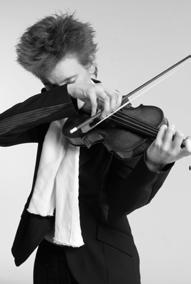
SUNDAY, AUGUST 16, 2026 · 3 PM
J.S. BACH
Brandenburg Concerto No. 1 in F Major, BWV 1046 (1685–1750)
Allegro
Adagio; Allegro
Menuetto; Trio I; Menuetto; Polacca; Menuetto; Trio II; Menuetto
Aisslinn Nosky, Ela Kodžas, Edson Scheid, violins; Daniel McCarthy, viola; Coleman Itzkoff, cello; Doug Balliett, bass; David Belkovski, harpsichord; Claire Brazeau, Sarah Skuster, Mekhi Gladden, oboes; Monica Ellis, bassoon; Kaylet Torrez, Kevin Newton, horns
Brandenburg Concerto No. 2 in F Major, BWV 1047
Allegro
Andante
Allegro assai
Aisslinn Nosky, Ela Kodžas, Edson Scheid, violins; Daniel McCarthy, viola; Coleman Itzkoff, cello; Doug Balliett, bass; David Belkovski, harpsichord; Brandon Ridenour, trumpet ; Emi Ferguson, flute; Claire Brazeau, oboe
In loving tribute to his beloved soulmate Erik Matwijkow, tonight’s performance is underwritten by Peter Cooper.
La Jolla Music Society’s 2026–27 Season is supported by The City of San Diego Cultural Affairs, County of San Diego, Prebys Foundation, Farfy Foundation, ProtoStar Foundation, Vail Memorial Fund, The Lodge at Torrey Pines, Banc of California, ResMed Foundation, San Diego Theatres Foundation, Bright Events Rentals, Cafe Coyote, Rancho Coyote, GRNFC Hospitality Group, Ace Parking, Brenda Baker and Steve Baum, Raffaella Belanich, Gordon Brodfuehrer, Eleanor Charlton, Mary Ellen Clark, Bert and Julie Cornelison, Elaine Galinson and Herbert Solomon, Irwin Jacobs, Helen and Keith Kim, Angelina and Fred Kleinbub, Dorothea Laub, Vivian Lim and Joseph Wong, Jaqueline and Jean-Luc Robert, Marge and Neal Schmale, Karen and Kit Sickels, Jeanette Stevens, Debra Turner, Sue and Peter Wagener, Liqun Wang and Marco Londei, Anna and Edward Yeung, Bebe and Marvin Zigman, Anonymous.
SHAWN OKPEBHOLO
Selections from Rise for Wind Quintet (b. 1981)
Deep Harmony
Spark!
TAYLOR
I Wish I Knew How It Would Feel to be Free (arr. Dover) (1921–2010)
Imani Winds
Brandon Patrick George, flute; Mekhi Gladden, oboe; Mark Dover, clarinet ; Kevin Newton, horn; Monica Ellis, bassoon
J.S. BACH
Brandenburg Concerto No. 4 in G Major, BWV 1049
Allegro
Andante; Presto
Aisslinn Nosky, solo violin; Emi Ferguson, Brandon Patrick George, flutes; Ela Kodžas, Edson Scheid, violins; Daniel McCarthy, viola; Coleman Itzkoff, cello; Doug Balliett, bass; David Belkovski, harpsichord
Program notes by Eric Bromberger, except where indicated.
For a general introduction to Bach’s Brandenburg Concertos, see the note for August 15
Composed: 1721
Approximate Duration: 20 minutes
While some may argue that the Brandenburg Concertos represent a form of chamber music, there can be little argument that the First is an orchestral work: it requires a woodwind section (three oboes and a bassoon), a brass section (two horns), and a string section large enough to balance the wind players. The First is also the most complex textually—it exists in an earlier version that lacks the present third movement and the Polacca section of the final movement. This earlier version also asks in the score for a violine piccolo, an instrument that essentially no longer exists. Smaller than the modern violin, it was tuned a third or a fourth higher and doubtless had a more piercing sound; performances today usually replace it with the modern violin.
The First Brandenburg is a concerto in the same sense that Béla Bartók’s Concerto for Orchestra is: both are orchestral works that allow individual players—and sections—to emerge from the general texture in passages that highlight the character and virtuosity of their respective instruments. The busy first movement—Bach gave it no tempo marking, but it is clearly some form of Allegro—opens with hunting-horn calls that would doubtless be easier to hear if they were not buried beneath the lively accompaniment. This movement is built largely on those two figures: the rising horn call and its chattering counter-theme. The Adagio spotlights the solo oboe and violin, whose long and somber melodic lines interweave over steady accompaniment from the orchestra; along the way, there is some odd—but clearly intentional—dissonance in the accompaniment. The propulsive Allegro offers a prominent part to the solo violin, while the last movement has the most interesting structure: it is a minuet movement with three separate trio sections, each featuring a different instrumental section. The minuet itself is for full orchestra, and the first trio is for a pair of oboes over walking bassoon accompaniment. Bach calls the second trio Polacca (a dance in triple time which is, as its name suggests, of Polish origin) and scores it for strings only. The concluding trio section is the most brilliant—a blistering horn duet to the rousing accompaniment of all three oboes. A return to the minuet section brings the First Brandenburg Concerto to its stately conclusion.
Composed: 1721
Approximate Duration: 12 minutes
The Second Brandenburg Concerto is in concerto grosso form, but here Bach assembles an unusual set of solo instruments: trumpet, flute, oboe, and violin. The trumpet part has caused a number of problems. The trumpet Bach wrote
for was the small F trumpet, an instrument with a sound so piercing that it almost seems capable of shattering glass. Such an instrument can with ease drown out the other solo voices, especially the flute (which in Bach’s time would have been the wooden recorder), and conductors face difficult problems balancing the voices in this concerto. So extreme are these problems that some scholars have gone so far as to suggest that Bach actually intended that this part should be played on the horn, whose mellow sonority balances more easily with the other voices.
The ear-piercing sound of the high trumpet is so much a part of this music, however, that it is hard to imagine that Bach could have intended it for any other instrument. The robust opening movement (Bach left no tempo indication) alternates extended passages for the four soloists with tutti interjections from the full orchestra. Bach solves balance problems very neatly in the slow movement—he simply leaves the trumpet (and the rest of the orchestra) out, turning the music over to the remaining soloists and continuo for a chamber music interlude; this Andante is based on a short melodic phrase that repeats throughout the movement. The finale, marked Allegro assai, is fugal, and the trumpet celebrates its return by introducing the main subject, followed by oboe, violin, and flute. This movement belongs largely to the soloists, who often play with only continuo accompaniment; the writing in this movement for trumpet, which often plays in its highest register, is of unbelievable brilliance and virtuosity.
Born March 28, 1981, Lexington, Kentucky
Composed: 2023
Approximate Duration: 11 minutes
Nigerian American composer Shawn Okpebholo began studying music as a boy and went on to earn his bachelor’s degree at Asbury College and his master’s and doctorate from the University of Cincinnati. He has composed for orchestra and chamber ensembles, and some of his most impressive works are his compositions for voice: he has written song cycles and works for chorus, and many of these explore the rich heritage of spirituals. Okpebholo has had works commissioned by orchestras and chamber groups throughout the United States, and he has been nominated for two GRAMMY® awards. The Chicago Tribune named him the 2024 Chicagoan of the Year in Classical Music. He is currently professor of composition at Wheaton College.
Okpebholo’s Rise was premièred on January 21, 2024, by the Cincinnati Symphony Orchestra Wind Quintet. On his website, the composer has provided an introduction to Rise (this concert will offer only the second and third movements of that work):
Unfolding as a musical journey through the ongoing struggle for racial justice, the piece offers three movements
that reflect on progress, unity, and collective resolve. From the urgent momentum of Seeds to the lyrical yearning of Deep Harmony and the rousing call to action in Spark!, it invites listeners to imagine change—and to take part in it. Commissioned by the Linton Chamber Music Series with the generous support of Ann Santen in honor of her husband Harry Santen’s 95th birthday, it is co-commissioned by the John F. Kennedy Center for the Performing Arts, Chamber Music Northwest, Phoenix Chamber Music Society, Adelante Winds, the Black Student Union of the Cleveland Institute of Music, Imani Winds, and the New York Wind Quintet.
— Shawn Okpebholo
I Wish I Knew How It Would Feel to Be Free (arr. Dover)
Born July 24, 1921, Greenville, North Carolina
Died December 28, 2010, New York City
Composed: 1967
Approximate Duration: 5 minutes
We remember Billy Taylor as a jazz pianist, composer, and educator, but Taylor himself was aware that his most important legacy may have been his effort to assemble and protect the history of jazz—he was indefatigable in his work on behalf of jazz, its history, and its musicians. Perhaps his most famous work remains his 1967 song I Wish I Knew How It Would Feel to Be Free, which was recorded that year by Nina Simone. Everyone describes the song as the “unofficial anthem of the civil rights movement of the 1960s”: it has been covered by a variety of artists, ranging from Leontyne Price to John Denver, and it was used as part of the soundtrack of the movie Ghosts of Mississippi.
I Wish I Knew How It Would Feel to Be Free is heard at this concert in an arrangement for wind quintet by Mark Dover, the clarinetist of Imani Winds.
Concerto
in
Composed: 1719–20
Approximate Duration: 16 minutes
The Fourth Concerto is in concerto grosso form, but this is another concerto grosso with an unusual set of soloists. Rather than using the violinists and continuo typical of Vivaldi’s concerti grossi, Bach instead chose one solo violin and two wind instruments that he called flauti d’echo. Exactly what he meant by this term is unclear, and when Bach later revised this music as a harpsichord concerto, he replaced the flauti d’echo with flauti a bec, which we know as the recorder; the parts are usually undertaken by transverse flutes in modern performances.
In any case, the contrast of the bright, purling sound of the flutes and the resonant glow of the violin is one of the most distinctive—and ingratiating—features of the Fourth Concerto
The Allegro opens with the bubbling sound of the flute duet, soon joined by the solo violin. Bach makes virtuoso demands on the violinist in the outer movements of this concerto: the flutes are a pleasing part of the musical texture, but the violinist is given music of extraordinary difficulty, full of swirling runs, awkward string crossings, and multiple stops. In fact, many consider this Fourth Brandenburg Bach’s finest violin concerto. The Andante moves to G minor and brings pulsing, dark music; this is the only slow movement in the entire cycle of Brandenburg Concertos that requires a full orchestra. After the grieving quality of the second movement, the concluding Presto leaps out brightly in G major. This a fugal movement, with the main subject introduced by the strings and eventually joined by the flute duet. Along the way, Bach requires some heroic playing by the solo violin and crowns the virtuosity of this writing by weaving the violin’s part into the movement’s contrapuntal bustle. The concerto comes to a sturdy close on vigorous tutti passages.
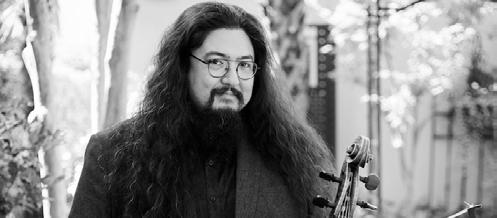
SUNDAY, AUGUST 16, 2026 · 7 PM
THE JAI
PAUL WIANCKO
(b. 1983)
(b. 1981)
Cities of Air
Emi Ferguson, flute; Tessa Lark, Roger Shao*, violins; Ayane Kozasa, viola; Paul Wiancko, cello
Marejada
Prometheus Quartet*
Roger Shao, Anthony Chan, violins; Brian Jennings, viola; Wilson Vanderslice, cello
SALINA FISHER
(b. 1993)
MESSIAEN
Mata-Au
Tessa Lark, violin; Ayane Kozasa, viola; Paul Wiancko, cello
Louange à l’Éternité de Jésus from Quatuor pour la fin du temps (1908–1992)
PAUL WIANCKO
La Jolla Music Society’s 2026–27 Season is supported by The City of San Diego Cultural Affairs, County of San Diego, Prebys Foundation, Farfy Foundation, ProtoStar Foundation, Vail Memorial Fund, The Lodge at Torrey Pines, Banc of California, ResMed Foundation, San Diego Theatres Foundation, Bright Events Rentals, Cafe Coyote, Rancho Coyote, GRNFC Hospitality Group, Ace Parking, Brenda Baker and Steve Baum, Raffaella Belanich, Gordon Brodfuehrer, Eleanor Charlton, Mary Ellen Clark, Bert and Julie Cornelison, Elaine Galinson and Herbert Solomon, Irwin Jacobs, Helen and Keith Kim, Angelina and Fred Kleinbub, Dorothea Laub, Vivian Lim and Joseph Wong, Jaqueline and Jean-Luc Robert, Marge and Neal Schmale, Karen and Kit Sickels, Jeanette Stevens, Debra Turner, Sue and Peter Wagener, Liqun Wang and Marco Londei, Anna and Edward Yeung, Bebe and Marvin Zigman, Anonymous.
Coleman Itzkoff, cello; Anthony Ratinov*, piano
String Quintet No. 1 Tiny Doors to Big Worlds
Part I
Part II
Part III
Tessa Lark, Elli Choi*, violins; Ayane Kozasa, viola;
Coleman Itzkoff, Paul Wiancko, cellos
THIS PERFORMANCE HAS NO INTERMISSION
*2026 Farfy Foundation Fellowship Artist
Program notes by Eric Bromberger, except where indicated.
Born June 8, 1983, San Clemente, CA
Composed: 2021
Approximate Duration: 10 minutes
Cities of Air is music to breathe to. Composed during the height of the pandemic, the piece was inspired by our collective, newly heightened awareness of the concept of sharing air with each other. At the time, so much of life in big cities was reframed by this awareness—buildings felt less like solid structures than they did mazes of trapped air, and parks weren’t as much pathways and plants than precious filling stations for our lungs and psyches. The title is also an adaptation of the metaphor “castles in the sky”—or grand schemes that never come to fruition. That was the story of the pandemic for so many—trapped at home, imagining alternate futures, and looking for ways to escape reality when reality became too much to bear. Cities of Air is both a reflection on and a result of those conditions, and the compositional process proved to be a functional exercise in escapism as well as a meditation on our relationship with air itself.
—Paul Wiancko, 2023
Commissioned by Music From Angel Fire and premièred in Angel Fire, NM on August 25, 2021 by Tara Helen O’Connor, Daniel Philips, Kathy Meng Robinson, Ayane Kozasa, and Arlen Hlusko
Born: 1981. San Juan, Puerto Rico
Composed: 2020
Approximate Duration: 8 minutes
Marejada is a piece written for Kronos Quartet inspired by the pixelated landscapes of artist Justin Favela and the desire to escape to a place that feels and sounds like home. The piece combines field recordings from the waves in Seven Seas Beach in Fajardo, and birds from La Jungla Beach in Guánica, both located in Puerto Rico, along with undulating gestures in the strings reminiscent of the sound of waves.
I wanted to capture the feeling of joy and calmness I feel when I’m in Puerto Rico in these beautiful places while also expressing the complexity of the diaspora experience for those who, like me, cannot be physically present in those places and close to their friends and family most of the time.
When Kronos approached me in March 2020 to write a piece for them to rehearse and perform together during this difficult moment of social isolation, I wanted to create something playful and rhythmic yet flexible and malleable that would be fun to put together. Something that responded directly to the challenges during this time of performing music together while not being able to be together in the same room. But also, something that took into consideration the limitations of the video communications platforms and used those
challenges as compositional material and creative impulse. The natural delay, the canceling of sound frequencies, and the inability for everyone to fully play together at the same time and in perfect synchronization are all challenges that I decided to embrace as unique elements that make this piece thrive even within the limitations of the medium.
Marejada is an invitation to sonically escape from your room and to actively imagine and immerse yourself in a different place and time.
—Angélica Negrón
Born: October 6, 1993, Christchurch, New Zealand
Composed: 2021
Approximate Duration: 8 minutes
Mata-Au, the Māori name of the Clutha River, means “surface current.” In Japanese, the homophonous phrase また 逢う (mata-au) means “to meet again.” The water dances and swirls as it connects places and people. It flows and gushes with forward momentum and anticipation. In writing this piece I was also inspired by spring, both as the season of its première, and as a bubbling source of water.
—Salina Fisher
Born December 10, 1908, Avignon, France
Died April 27, 1992, Paris
Composed: 1940
Approximate Duration: 8 minutes
Called up during World War II, Olivier Messiaen was serving as a medical auxiliary when the Germans overran France in the spring of 1940. He was taken prisoner and sent to a POW camp east of Dresden, where he discovered among his fellow prisoners a violinist, a clarinetist, and a cellist. A sympathetic German camp commander supplied Messiaen with manuscript paper and arranged to have an upright piano—albeit old and out of tune—brought in for his use. That fall, Messiaen wrote an extended work called Quatuor pour la Fin du Temps (Quartet for the End of Time) for the four musicians, who gave the première performance at that prison camp—Stalag VIII A—on January 15, 1941. Their audience consisted of 5000 fellow POWs, who sat outside in subfreezing temperatures to hear the performance. “Never have I been listened to with such attention and understanding,” said Messiaen of that occasion.
It would be incorrect, however, to assume that the Quartet for the End of Time was written in response to the seemingly endless existence of prisoners of war. Rather, Messiaen—a devout Catholic—took his inspiration from the Revelation of St. John the Divine in the Apocrypha, specifically from the
tenth chapter: “I saw a mighty angel, descending from heaven, clothed in a cloud, having a rainbow on his head. His face was as the sun, his feet as columns of fire. He placed his right foot on the sea and his left foot on the earth, and, supporting himself on the sea and on the earth, he raised his hand towards Heaven and swore by Him who lives forever and ever, saying: There will be no more Time; but on the day of the trumpet of the seventh angel, the mystery of God will be completed.”
Messiaen’s Quartet is an expression of faith in the resurrection from temporal existence, a faith expressed in many ways. For example, the work is in eight movements because while seven is “the perfect number” (the number of days of the creation), the music here “extends into eternity and becomes the eighth, of unfailing light, of immutable peace.” The notion of the dissolution of time is further reflected in the metrical notation of the music itself. Messiaen sometimes uses traditional meters and bar lines, but the actual metric flow of the music often has nothing to do with the prescribed measures; at other points he dispenses with an established meter altogether. The instrumentation varies (only in certain movements do all four instruments play simultaneously), and the Quartet also marks the first appearance of birdsong in Messiaen’s music—throughout his life he was fascinated by the songs of individual birds, he carefully notated these songs, and he used them as an important thematic feature of his music from this point on.
Messiaen himself prepared a detailed and colorful description of the eight movements, including the final movement, worth quoting at length:
Louange à l’Immortalité de Jésus (Praise to the Immortality of Jesus) “Expansive violin solo balancing the cello solo of the fifth movement. Why this second glorification? It addresses itself more specifically to the second aspect of Jesus—to Jesus the man, to the Word made flesh, raised up immortal from the dead so as to communicate His life to us. It is total love. Its slow rising to a supreme point is the ascension of man toward his God, of the Son of God toward his Father, of the mortal newly made divine toward paradise. And I repeat anew what I said above: All this is mere striving and childish stammering if one compares it to the overwhelming grandeur of the subject!”
Composed: 2021
Approximate Duration: 22 minutes
This piece was composed for the St. Lawrence String Quartet and is intended to be a companion piece to Schubert’s String Quintet of the same instrumentation. Though I have always found it difficult to compose music that is about any particular experience or subject, I have learned over the years that whatever is on my mind on a given day heavily influences the direction my music goes in. This is not always a good
thing. However, I have also found that by focusing on specific thoughts and feelings before setting out to write, the resulting session often acts as a sort of slow filtering process in which fragments of those thoughts and feelings are captured and processed through music. In turn, these arbitrary fragments occasionally serve as gateways to unexpected musical places—and it is in the discovery and exploration of those places that I have experienced my most profound moments of joy, introspection, and exhilaration as a composer.
Tiny Doors to Big Worlds was written with that spirit of deviation and discovery in mind. It is a celebration of those smallest of decisions and nearly missed junctures—be they musical, societal, or scientific in nature—which end up leading to monumental change. It is an acknowledgement of our ability to experience and appreciate worlds beyond our own purview, when we are fortunate enough to encounter them—much like new music to our ears.
—Paul Wiancko
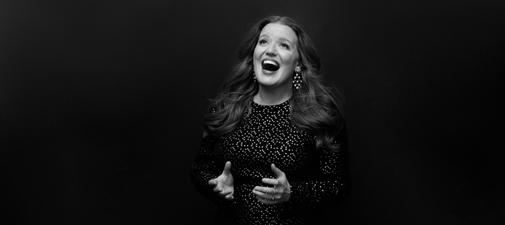
PRELUDE · 6 PM
THE JAI
Lecture by Tiffany Kuo
WEDNESDAY, AUGUST 19, 2026 · 7 PM
THE BAKER-BAUM CONCERT HALL
PURCELL Four Songs (arr. Adès) (c.1659–1695) By Beauteous Softness
Come Unto These Yellow Sands Full Fathom Five
An Evening Hymn
Jennifer Johnson Cano, mezzo-soprano; Thomas Adès, piano
Join us for a celebration in the Wu Tsai QRT.yrd immediately following the performance. Must be 21+ with valid ID for sparkling wine service.
Midweek Masterworks
La Jolla Music Society’s 2026–27 Season is supported by The City of San Diego Cultural Affairs, County of San Diego, Prebys Foundation, Farfy Foundation, ProtoStar Foundation, Vail Memorial Fund, The Lodge at Torrey Pines, Banc of California, ResMed Foundation, San Diego Theatres Foundation, Bright Events Rentals, Cafe Coyote, Rancho Coyote, GRNFC Hospitality Group, Ace Parking, Brenda Baker and Steve Baum, Raffaella Belanich, Gordon Brodfuehrer, Eleanor Charlton, Mary Ellen Clark, Bert and Julie Cornelison, Elaine Galinson and Herbert Solomon, Irwin Jacobs, Helen and Keith Kim, Angelina and Fred Kleinbub, Dorothea Laub, Vivian Lim and Joseph Wong, Jaqueline and Jean-Luc Robert, Marge and Neal Schmale, Karen and Kit Sickels, Jeanette Stevens, Debra Turner, Sue and Peter Wagener, Liqun Wang and Marco Londei, Anna and Edward Yeung, Bebe and Marvin Zigman, Anonymous.
THOMAS ADÈS Concerto Conciso WORLD PREMIÈRE (b. 1971)
Thomas Adès, piano; Stephanie Childress, conductor ; John Bruce Yeh, clarinet ; Steven Banks, baritone saxophone; Brandon Ridenour, trumpet ; Eric Starr, trombone; Aaron McCalla, tuba; Sidney Hopson, percussion; Simone Porter, Njioma Chinyere Grevious, Anthony Chan*, violins; Mark Dresser, bass
Commissioned by La Jolla Music Society for SummerFest
BRAHMS Quintet for Piano and Strings in F Minor, Opus 34 (1833–1897)
Allegro non troppo
Andante un poco adagio
Scherzo: Allegro
Finale: Poco sostenuto; Allegro non troppo
Jeremy Denk, piano; Yura Lee, Njioma Chinyere Grevious, violins; Teng Li, viola; Jonathan Swensen, cello
THIS PERFORMANCE HAS NO INTERMISSION
*2026 Farfy Foundation Fellowship Artist
Born: September 10, 1659, London
Died: November 21, 1695, London
Composed: 1689/1695/1695/1688
Born March 1, 1971, London
Composed: 2012/2017
Approximate Duration: 12 minutes
Thomas Adès’ arrangements of four songs by Henry Purcell bring two of England’s most distinctive musical voices into conversation across more than three centuries. Adès has praised Purcell’s “magnificent” setting of English text, observing that “the way that emotion, the rhythm of the words, is rendered into music is incomparably natural and powerful.” Those qualities remain at the heart of these sensitive realizations.
The set opens with By Beauteous Softness, drawn from Now Does the Glorious Day Appear, Purcell’s 1689 ode celebrating Queen Mary. In this graceful song, Purcell evokes beauty and tenderness with characteristic elegance, shaping the text with a naturalness and expressive poise that exemplify the qualities Adès most admires in his predecessor’s music.
It is followed by Come Unto These Yellow Sands and Full Fathom Five, both drawn from Shakespeare’s The Tempest, a work of special significance for Adès: it inspired his first fullscale opera, The Tempest (2003), with a libretto by Meredith Oakes.
The beloved Evening Hymn has also found a place in Adès’ own music. He reworked it as the final movement of Forgotten Dances for solo guitar, premièred by Sean Shibe and heard by SummerFest audiences in 2024, and more recently as a solo piano piece premièred during the 125th-anniversary celebrations of Wigmore Hall in May 2026.
These arrangements reveal the enduring freshness, eloquence, and expressive power of Purcell’s music through Adès’ contemporary perspective.
— Anne-Marie Dicce
Born May 7, 1833, Hamburg
Died April 3, 1897, Vienna
Composed: 1864
Approximate Duration: 41 minutes
Brahms began work on the music that would eventually become his Piano Quintet in F Minor during the summer of 1862, when he was 29 years old and still living in Hamburg. As first conceived, however, this music was not a piano quintet. Brahms originally composed it as a string quintet— string quartet plus an extra cello—and almost surely he took as a model the great String Quintet in C Major of Schubert, a composer he very much admired. But when Joseph Joachim
and colleagues played through the string quintet for the composer, all who heard it felt it unsatisfactory: an ensemble of strings alone could not satisfactorily project the power of this music. So Brahms set out to remedy this—he returned to the score during the winter of 1863-64 and recast it as a sonata for two pianos. Once again the work was judged not wholly successful—it had all the power the music called for, but this version lacked the sustained sonority possible with strings that much of this music seemed to demand. Among those confused by the two-piano version was Clara Schumann, who offered the young composer a completely different suggestion: “Its skillful combinations are interesting throughout, it is masterly from every point of view, but—it is not a sonata, but a work whose ideas you might—and must—scatter, as from a horn of plenty, over an entire orchestra . . . Please, dear Johannes, for this once take my advice and recast it.”
Recast it Brahms did, but not for orchestra. Instead, during the summer and fall of 1864 he arranged it for piano and string quartet, combining the dramatic impact of the two-piano version with the string sonority of the original quintet. In this form it has come down to us today, one of the masterpieces of Brahms’ early years, and it remains a source of wonder that music that sounds so right in its final version could have been conceived for any other combination of instruments. Clara, who had so much admired her husband’s piano quintet, found Brahms’ example a worthy successor, describing it as “a very special joy to me” (Brahms published the two-piano version as his Opus 34b, and it is occasionally heard in this form, but he destroyed all the parts of the string quintet version).
The Piano Quintet shows the many virtues of the young Brahms—strength, lyricism, ingenuity, nobility—and presents them in music of unusual breadth and power. This is big music: if all the repeats are taken, the Quintet can stretch out to nearly three-quarters of an hour, and there are moments when the sheer sonic heft of a piano and string quartet together makes one understand why Clara thought this music might be most effectively presented by a symphony orchestra.
The Quintet is also remarkable for young Brahms’ skillful evolution of his themes: several of the movements derive much of their material from the simplest of figures, which are then developed ingeniously. The very beginning of the Allegro non troppo is a perfect illustration. In octaves, first violin, cello, and piano present the opening theme, which ranges dramatically across four measures and then comes to a brief pause. Instantly the music seems to explode with vitality above an agitated piano figure. But the piano’s rushing 16th-notes are simply a restatement of the opening theme at a much faster tempo, and this compression of material marks the entire movement—that opening theme will reappear in many different forms. A second subject in E major, marked dolce and sung jointly by viola and cello, also spins off a wealth of secondary material, and the extended development leads to a quiet coda, marked poco sostenuto. The tempo quickens as the music powers its way to the resounding chordal close.
In sharp contrast, the Andante, un poco Adagio sings with a quiet charm. The piano’s gently rocking opening theme, lightly echoed by the strings, gives way to a more animated and flowing middle section before the opening material reappears, now subtly varied. Matters change sharply once again with the C-minor Scherzo, which returns to the dramatic mood of the first movement.
The cello’s ominous pizzicato C hammers insistently throughout, and once again Brahms wrings surprising wealth from the simplest of materials: a nervous, stuttering 16th-note figure is transformed within seconds into a heroic chorale for massed strings, and later Brahms generates a brief fugal section from this same theme. The trio section breaks free of the darkness of the scherzo and slips into C-major sunlight for an all-too-brief moment of quiet nobility before the music returns to C minor and a da capo repeat.The finale opens with strings alone, reaching upward in chromatic uncertainty before the Allegro non troppo main theme steps out firmly in the cello. The movement seems at first to be a rondo, but this is a rondo with unexpected features: it offers a second theme, sets the rondo theme in unexpected keys, and transforms the cello’s healthy little opening tune in music of toughness and turbulence.
Clara Schumann, who had received the dedication of her husband’s quintet, was instrumental in the dedication of Brahms’. Princess Anna of Hesse had heard Brahms and Clara perform this music in its version for two pianos and was so taken with it that Brahms dedicated not only that version to the princess but the Piano Quintet as well. When the princess asked Clara what she might send Brahms as a measure of her gratitude, Clara had a ready suggestion. And so Princess Anna sent Brahms a treasure that would remain his prized possession for the rest of his life: Mozart’s manuscript of the Symphony No. 40 in G Minor
Born March 1, 1971
Composed: 1997/2025
Approximate Duration: 10 minutes
The work is scored for solo piano and an ensemble of ten players, comprising clarinet, baritone saxophone, trumpet, trombone, tuba, percussion, three violins, and double bass. It is in three movements. The first, originally entitled Study for a Coda, splits the ensemble into two slightly different speeds: violins and clarinet on the one hand, and wind instruments and bass on the other, with the percussion taking sides and the soloist trying to keep order. The tension is released at its maximum point by a magic gesture from the soloist, who then claims centre stage at the beginning of the second movement—a slow ciacconetta, which runs through six divisions on a seven-bar chord sequence announced by the piano. The final cycle releases the music into a new tonality, and escapes into the third movement: a fast brawl (a mediaeval
English dance)—from the French branle: a form of rounddance: “the linked dancers. . . face inwards to the centre of an arc, or a full circle, moving sideways to the left and the right”.
— Thomas Adès (2026)
Four Songs
By Beauteous Softness
From Ode for Queen Mary’s Birthday Now Does the Glorious Day Appear By beauteous softness mix’d with majesty, An empire over ev’ry heart she gains; And from her awful pow’r none would be free, She with such sweetness and such justice reigns.
Come Unto These Yellow Sands
From Act I, Scene 2 of The Tempest
By William Shakespeare
Come unto these yellow sands, And there take hands; Foot it featly here and there, And let the rest the chorus bear.
Full Fathom Five
From The Tempest by William Shakespeare
Full fathom five thy father lies; Of his bones are coral made; Those are pearls that were his eyes: Nothing of him that doth fade But doth suffer a sea-change Into something rich and strange. Sea-nymphs hourly ring his knell Hark! Now I hear them, ding-dong, bell.
An Evening Hymn
English source: Bishop William Fuller Now that the sun hath veil’d his light, And bid the world goodnight; To the soft bed my body I dispose, But where shall my soul repose?
Dear God, even in thy arms, And can there be any so sweet security! Then to thy rest, O my soul! And singing, praise the mercy
That prolongs thy days. Hallelujah!
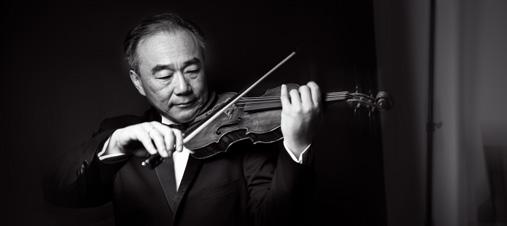
PRELUDE · 6 PM
THE BAKER-BAUM CONCERT HALL
Prometheus Quartet performs Dvořák’s
String Quartet in F Major, Op. 96 “American”
FRIDAY, AUGUST 21, 2026 · 7 PM
THE BAKER-BAUM CONCERT HALL
LUTOSŁAWSKI
La Jolla Music Society’s 2026–27 Season is supported by The City of San Diego Cultural Affairs, County of San Diego, Prebys Foundation, Farfy Foundation, ProtoStar Foundation, Vail Memorial Fund, The Lodge at Torrey Pines, Banc of California, ResMed Foundation, San Diego Theatres Foundation, Bright Events Rentals, Cafe Coyote, Rancho Coyote, GRNFC Hospitality Group, Ace Parking, Brenda Baker and Steve Baum, Raffaella Belanich, Gordon Brodfuehrer, Eleanor Charlton, Mary Ellen Clark, Bert and Julie Cornelison, Elaine Galinson and Herbert Solomon, Irwin Jacobs, Helen and Keith Kim, Angelina and Fred Kleinbub, Dorothea Laub, Vivian Lim and Joseph Wong, Jaqueline and Jean-Luc Robert, Marge and Neal Schmale, Karen and Kit Sickels, Jeanette Stevens, Debra Turner, Sue and Peter Wagener, Liqun Wang and Marco Londei, Anna and Edward Yeung, Bebe and Marvin Zigman, Anonymous.
Variations on a Theme of Paganini (1913–1994)
Inon Barnatan, Jeremy Denk, pianos
JOHN WILLIAMS Quartet La Jolla (b. 1932)
Introduction
Aubade
Scherzo
Cantando
Finale
Cho-Liang Lin, violin; Jay Campbell, cello; John Bruce Yeh, clarinet ; Julie Smith Phillips, harp
INTERMISSION
STEVEN BANKS to be free CALIFORNIA PREMIÈRE (b. 1993)
Simone Porter, violin; Yura Lee, viola; Jay Campbell, cello; Jeremy Kurtz-Harris, bass; Rose Lombardo, flute; Steven Banks, saxophone; Jeremy Denk, piano; Jennifer Johnson Cano, mezzo-soprano
Commissioned by Bridgehampton Chamber Music, Chamber Music Northwest, and La Jolla Music Society for SummerFest.
TCHAIKOVSKY Sextet for Strings in D Minor, Opus 70 “Souvenir de Florence” (1840–1893)
Allegro con spirito
Adagio cantabile e con moto
Allegretto moderato
Allegro vivace
Benjamin Beilman, Cho-Liang Lin, violins; Paul Neubauer, Teng Li, violas;
Jonathan Swensen, Nina Lee, cellos
Program notes by Eric Bromberger, except where indicated.
Born January 25, 1913, Warsaw
Died February 7, 1994, Warsaw
Composed: 1941
Approximate Duration: 5 minutes
This brilliant, sparkling music was composed during a period of enormous turmoil in Lutosławski’s life. Lutosławski began to play the piano at age six and received a diploma in piano from the Warsaw Conservatory in 1936. When World War II began, Lutosławski served as a radio operator in the Polish army but was captured by the Nazis. He escaped, made his way back to Warsaw, and essentially went underground. Concerts were banned during the Nazi occupation, and Lutosławski supported himself by playing the piano in nightclubs and cabarets (his wife’s sister-in-law was one of Poland’s leading cabaret singers). Soon Lutosławski formed a two-piano team with another pianist named Andrezj Panufnik, and by strange coincidence those two pianists would become Poland’s leading composers in the generation after World War II. For the moment, however, the two young men (both were in their twenties) needed music to play, and Lutosławski made a number of arrangements for two pianos of music by other composers.
In 1941 he composed an original piece for them, Variations on a Theme of Paganini. That theme is, of course, Paganini’s “famous” Caprice No. 24 in A Minor for solo violin, composed about 1820. That theme–full of rhythmic spring and chromatic tension—has haunted composers for the last two hundred years. Among those who have written extended variations on it are Paganini himself, Liszt, Brahms, Rachmaninoff, and— more recently—Boris Blacher and George Rochberg. There may be more to come—the theme appears inexhaustible.
Lutosławski approached Paganini’s famous Caprice somewhat differently than those earlier masters, who had used its theme as the basis for a series of virtuoso variations of their own. Lutosławski keeps the shape of Paganini’s entire original caprice—both the theme and Paganini’s own twelve variations on it—and then treats that fundamental structure in a wholly original way.
He rewrites the variations slightly, he provides completely new harmonies (harmonies never imagined by Paganini), and with the resources available from two pianos rather than one violin he fleshes out textures and accompaniment; he also provides a new concluding section. The result might be described as Lutosławski’s variations on Paganini’s variations. This is imaginative and very difficult music for two first-class pianists, and Lutosławski’s Variations on a Theme of Paganini, composed when he was 28, has become his earliest work to find a place in the repertory.
Born February 8, 1932, Queens, New York
The idea for the Quartet La Jolla resulted from a conversation that I had with Cho-Liang Lin at Tanglewood, after we had performed a Mozart concerto together. Cho-Liang, familiar to me for many years as a magnificent artist, delighted me when he told me of his music festival in beautiful La Jolla, California, and when he graciously asked if I would contribute a piece for his festival there. I was gratified and even flattered by his suggestion, and given the usual constraints of my work in film, I was especially grateful for the freedom that he offered in saying… “write for any combination of instruments you wish”… and so, I agreed to contribute what I could. The concept of a quartet comprised of violin, cello, clarinet and harp intrigued me, and so I set out to do a piece that would explore some of the interesting sonorities available in this seldom-heard instrumentation.
The work is in five movements, beginning with an Introduction, which presents declamatory gestures framing some of the contextual parameters of volume, texture, and color that we’re about to hear. The second movement, Aubade, explores the harp’s very unique role as the spiritual center and life-enhancing force of the entire piece. The Scherzo is a brief and gossamer flight where the quartet defies gravity as it dips, dives, and soars… hopefully without ever touching the ground! The fourth movement, Cantando, gives the clarinet the opportunity to reflect and ruminate to the accompaniment of a steady cello pizzicato, and leads the journey of exploration, finishing with a brief cadenza. And finally in the fifth movement, Finale, the entire group… con brio… collects and gathers its energy to produce a forceful and uplifting finale.
Without the constraints of any programmatic scheme, numerical formulations, or procedures, writing this piece was a joy for me. I simply relished the pleasure of exploring the instrumental possibilities that would allow four magnificent artists to display their art.
I have dedicated the entire work to my friend ChoLiang Lin. However… for the second movement, I wish to acknowledge my debt to harpist Ann Hobson Pilot, who was the inspiration for my Harp Concerto, and who was something of a spiritual guide as I worked on the Aubade movement, which reflects some of my research and preparatory work on the concerto.
Also, I have to mention the great clarinetist John Bruce Yeh, whose work in the Chicago Symphony I’ve greatly admired. When John learned that I was writing this piece, he encouraged me to finish it, and when I was told that he was a frequent guest at SummerFest I decided to write the fourth movement, Cantando, expressly for him. Of course, my greatest thanks and deepest indebtedness go to Cho-Liang Lin for having conceived this project, which I hope in some small measure, might reward listeners and players alike.
— John Williams
Quartet La Jolla was written as a gift to SummerFest Music Director Cho-Liang Lin.
Born 1993, Winston-Salem, North Carolina
Composed: 2026
Approximate Duration: 15 minutes
The commission is written to mark the 250th anniversary of the United States and to honor the life and work of legendary singer, songwriter, pianist, and activist Nina Simone. Scored for mezzo-soprano, saxophone, flute, violin, viola, cello, double bass, and piano, the piece reflects on the desire for liberation and what it means to be truly free.
— Steven Banks
of dynamic surges and quiet pizzicatos before the opening material returns.
The scherzo, Allegretto moderato, is in ternary form, with the middle—surprisingly—faster than the outer sections. The opening sequence sounds as if it is based on Russian folk song material, while the exhilarating middle section—full of ricochet bowing—flies. The coda leads to a cadence on a giant pizzicato chord. The finale, Allegro vivace, is the shortest of the four and again opens with another passage that sounds as if it may have folk origins. The second theme is one of those unmistakable Tchaikovsky tunes, soaring and surging. At the climax of the movement comes the fugato treatment of the first theme of which Tchaikovsky was so proud, and a blazing coda brings the sextet to a conclusion full of sunlight.
Sextet for Strings in D Minor, Opus 70 “Souvenir de Florence”
Born May 7, 1840, Votkinsk, Russia
Died November 6, 1893, St. Petersburg
Composed: 1890
Approximate Duration: 35 minutes
Like so many other composers from cold European climates, Tchaikovsky had a special fondness for the countries of southern Europe. Rimsky-Korsakov’s Capriccio Espagnol is an affectionate portrait of Spain, but Tchaikovsky—like Brahms—was particularly attracted to Italy. An exciting visit during the carnival season of 1880 to Rome (where his brother had an apartment) inspired Tchaikovsky’s brilliant Capriccio Italien. And it was to Florence that Tchaikovsky went in 1890 to complete his opera The Queen of Spades
Upon his return to Russia, Tchaikovsky wrote a sextet for strings, which he significantly subtitled “Souvenir de Florence.” His motive appears clear—he wanted to remember in music the sunny climate and friendly atmosphere of that Italian city, and he succeeded. The sextet has none of the gloomy, tortured music that Tchaikovsky wrote in his blackest moods. Instead, suffused with the golden glow of warm nostalgia, it offers some of his most good-natured music.
The choice of string sextet for this music is unusual, particularly for a composer who wrote so little chamber music. The additional voices created all kinds of compositional problems for Tchaikovsky, and he struggled with them. Though the work was completed in 1890 and performed privately then, he revised it thoroughly before its first public performance on December 6, 1892. The proud composer wrote to his brother: “What a sextet—and what a fugue at the end— it’s a pleasure. Awful, how pleased I am with myself!”
The lengthy opening movement, Allegro con spirito, is in extended sonata form, with the first violin announcing both main themes. The surging opening idea gives way to a songful second subject over steady accompaniment, and a long development leads to a dramatic close. The slow movement, Adagio cantabile e con moto, opens with a series of chords, rich layers of sound, before the first violin’s melody rises above pizzicato accompaniment. The movement’s brief midsection rustles ahead with tremolo-like passages full
PRELUDE · 2 PM
THE JAI
Lecture by Tiffany Kuo
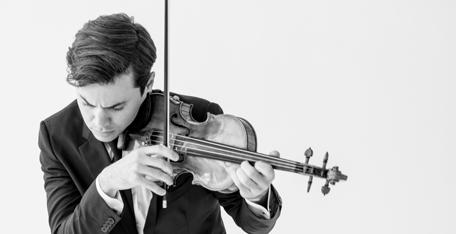
SUNDAY, AUGUST 23, 2026 · 3 PM
THE BAKER-BAUM CONCERT HALL
VAUGHAN WILLIAMS On Wenlock Edge (1872–1958) On Wenlock Edge
From far, from eve and morning Is my team ploughing Oh, when I was in love with you Bredon Hill
Clun
Robin Tritschler, tenor ; Jeremy Denk, piano; Benjamin Beilman, Njioma Chinyere Grevious, violins; Teng Li, viola; Nina Lee, cello
La Jolla Music Society’s 2026–27 Season is supported by The City of San Diego Cultural Affairs, County of San Diego, Prebys Foundation, Farfy Foundation, ProtoStar Foundation, Vail Memorial Fund, The Lodge at Torrey Pines, Banc of California, ResMed Foundation, San Diego Theatres Foundation, Bright Events Rentals, Cafe Coyote, Rancho Coyote, GRNFC Hospitality Group, Ace Parking, Brenda Baker and Steve Baum, Raffaella Belanich, Gordon Brodfuehrer, Eleanor Charlton, Mary Ellen Clark, Bert and Julie Cornelison, Elaine Galinson and Herbert Solomon, Irwin Jacobs, Helen and Keith Kim, Angelina and Fred Kleinbub, Dorothea Laub, Vivian Lim and Joseph Wong, Jaqueline and Jean-Luc Robert, Marge and Neal Schmale, Karen and Kit Sickels, Jeanette Stevens, Debra Turner, Sue and Peter Wagener, Liqun Wang and Marco Londei, Anna and Edward Yeung, Bebe and Marvin Zigman, Anonymous.
ELGAR
Piano Quintet in A Minor, Opus 84 (1857–1934)
Moderato
Adagio
Andante; Allegro
Inon Barnatan, piano; James Ehnes, Stephen Waarts, violins; Timothy Ridout, viola; Jonathan Swensen, cello
INTERMISSION
WALTON
Façade (1902–1983)
Thomas Adès, Stephanie Childress, conductors/narrators; Rose Lombardo, flute; John Bruce Yeh, clarinet/bass clarinet ; Brandon Ridenour, trumpet ; Steven Banks, saxophone; Sidney Hopson, percussion; Jay Campbell, cello
Born October 12, 1872, Down Ampney, England
Died August 26, 1958, London
Composed: 1908–09
Approximate Duration: 22 minutes
In 1896 A.E. Housman, a government clerk and translator of classical languages, published a slim volume of 63 poems called A Shropshire Lad. Set in a somewhat-mythical Shropshire, these poems—with their themes of youthful hope and disappointment, transience, irony, humor, and melancholy—charmed a generation of young readers at the turn of the century (and countless others since then). They also attracted a generation of English composers who were in the process of discovering the heritage of English folk-music. In 1908–9, barely a decade after its publication, Vaughan Williams set six poems from A Shropshire Lad, giving his set the title of the first song, On Wenlock Edge. He scored these songs for an unusual ensemble—tenor, piano, and string quartet—and On Wenlock Edge was first performed in London on November 15, 1909 (in the early 1920s, Vaughan Williams arranged these songs for tenor and orchestra, and they are sometimes heard today in this later version).
On Wenlock Edge should be understood not as a cycle—a title that implies a unity and a direction—but as a collection of six settings of individual poems by the same poet. These poems can be quite different in manner and theme, and Vaughan Williams’ treatment varies accordingly. The songs can range from the dramatic (On Wenlock Edge, with its rush of wintry winds) to the jaunty and very brief Oh, when I was in love with you to the atmospheric detachment of the concluding Clun. Sometimes Vaughan Williams will create miniature dramas, as with his use of two different kinds of music for the two voices in is my team ploughing, or in the lengthy Bredon Hill, in which the rapt, shimmering music of the beginning gradually evolves to a numbed close. In some of these songs, Vaughan Williams rounds matters off with a piano postlude that underlines the atmosphere and meaning of the poem.
Vaughan Williams had studied briefly with Ravel in Paris in 1908, just before beginning to compose On Wenlock Edge. Several years later—in 1912, as he was overseeing the première of his Daphnis and Chloe—Ravel helped arrange a performance of On Wenlock Edge in Paris, and he later wrote to the English composer to convey the “pleasure of congratulating you and telling you of my delight at your great success. In everyone’s opinion your lyrical settings were a revelation.”
Born June 2, 1857, Broadheath, England
Died February 23, 1934, Worcester, England
Composed: 1918–19
Approximate Duration: 35 minutes
Elgar wrote little chamber music. He appears to have been more comfortable with the resources of the symphony orchestra and the human voice, and he wrote most often for orchestra and for chorus. In fact, after writing some brief pieces for violin and piano early in his career, Elgar turned away from chamber music almost permanently.
But during the summer of 1918, at the very end of his creative career, the 61-year-old composer suddenly produced three substantial pieces of chamber music. There was no readily apparent reason for him to turn to a type of music he had neglected for so long. But during that summer England was nearing the end of a horrifying war, Elgar was facing the deteriorating health of his wife, and he may well have been confronting his own waning powers as a composer (he wrote only one more major work, the Cello Concerto of 1919). Perhaps all these had an influence on his decision to turn to so personal a form as chamber music. Perhaps none of them did— we can only guess. But in quick succession (he worked on all three simultaneously) he produced a violin sonata, a string quartet, and a piano quintet.
The Piano Quintet is remarkable for the range and sharp contrast of its moods, and nowhere is this more evident than in its opening Moderato. This movement is based on a wealth of ideas, all presented in the first few moments. The very beginning is particularly impressive: the piano quietly announces the movement’s main theme, while in the background the strings sound the three-note figure that will echo like faint drum-taps throughout the movement. A few moments later the upper strings in exotic harmony (English commentators invariably refer to this as “the Spanish theme”) give way to a yearning cello figure, to be quickly followed by an Allegro that sounds as if it should be scored for full orchestra. The movement pitches between these extremes: at moments it can sound confident and full, almost like salon music in its smoothness. And at others, it sounds spare and hard and haunting. The bleak ending, where fragments of the beginning break down and collapse, is especially effective.
The Adagio is one of Elgar’s most successful slow movements. Its glowing beginning, with a ravishing theme for viola, sounds very much like the kind of music Brahms was writing thirty years earlier. Elgar’s development is extended, and an animated middle section leads to a quiet close. The final movement returns to the mood and manner of the first—Elgar even uses some of the same themes, as the slow introduction gives way to a confident Allegro (Elgar marks this con dignita, cantabile). This movement is very much in the grand manner: its gestures are dramatic, its themes full of sweep, its sonorities
at times almost orchestral. The ending, marked Grandioso, is opulent in its rich sound and confidence. But just before the coda comes an extraordinary moment: the music grows quiet, and Elgar brings back the haunting and quiet music of the first movement, even with the ghostly drum-taps in the background. This note of stinging, quiet beauty in the midst of such splendor and energy is typical of the Quintet’s sharply ranging moods.
For all the surface confidence, for all its grand gestures, the Quintet is tense music in the best meaning of that term. Throughout, one feels that this is many-faceted music, that those faces are often at odds emotionally with each other, and that from their collision comes some very moving music.
Born March 29, 1902, Oldham, England
Died March 8, 1983, Ischia, Italy
Composed: 1922–23
Approximate Duration: 37 minutes
In the library of Christ Church College at Oxford is a handsome bronze bust of William Walton, one of that college’s most famous alumni. But Walton never graduated from Christ Church. He had entered in 1918 at the age of sixteen, but after repeatedly failing a round of exams he left in 1920 without a degree. His family was alarmed, but things promptly got worse: the 18-year-old Walton was invited to become a member of one of the oddest, most original, and most creative families in England, the Sitwells—brothers Osbert and Sacheverell and their sister Edith. Poets, critics, and writers, they took the young Walton into their Chelsea home.
Most striking of the Sitwells was Dame Edith (1887–1964). Six feet tall and eccentric in both dress and behavior, she was an original and challenging poet. During these years she rebelled against the tameness and predictability of conventional poetry and created a new poetic language: experimental, surrealistic, at times nonsensical, but conceived as an exercise in rhythm, rhyme, and sound. As she wrote these poems, it occurred to her (and to her brothers) that they might be most effectively presented with music, and who better to write that music than the talented young Walton, who had a room upstairs in their house? After first resisting, he was swept up in the project, working closely with Edith on each setting. Osbert later wrote: “I remember so well the long sessions that my sister and William had in the rather small room he occupied upstairs and her going over and over the words with him, to show their rhythm and exactly how they went.” There is evidence, in fact, that she adjusted some of her poems to fit the rhythms of Walton’s music.
The result was what its creators called an “entertainment.” Named Façade, it consisted of a brief Fanfare followed by twenty-one poems that are recited to musical accompaniment. The obvious model was Schoenberg’s Pierrot Lunaire (1912)
for reciter/singer and an ensemble of five instrumentalists who play eight different instruments (Walton’s claim that he hadn’t heard Pierrot when he wrote Façade is true only in a technical sense: he did own a copy of the score). But where Schoenberg’s settings of Albert Giraud’s poems take us into a nightmare world of expressionist visions, Façade is full of light and consciously high spirits. Walton’s music—breezy and bouncy—shows the influence of jazz at many places, and Sitwell’s surrealistic poetry inhabits a world far removed from Giraud’s.
The first performance of Façade, a private one, took place in the Sitwell home on January 24, 1922. Running across the stage was a painted screen with a hole in it, and from this hole protruded a Sengeraphone, an amplified megaphone originally invented to help project the voice of the giant Fafner over the orchestra in Wagner’s Das Rheingold—the reciter spoke through this megaphone. Walton originally scored Façade for an ensemble of flute/piccolo, clarinet/bass clarinet, trumpet, percussion, and cello, but he added a part for alto saxophone when he revised the score. The early performances of Façade created a sensation, and that sensation sometimes bordered on outrage. Some performances were hissed, and one critic titled his review of a 1923 performance “Drivel They Paid to Hear.” Another, perhaps more perceptive, noted that the role of Walton’s music “seemed to be to sprinkle jewels and flowers with an apt hand on the pathway of Miss Sitwell’s poetry.”
Today, over a century after its première, Façade retains much of its strange charm for the deft fusion of Dame Edith’s exotic language and young Walton’s breezy score (he was almost twenty when the first performance took place). Individual listeners will respond to different aspects of this “entertainment.” Some will enjoy Dame Edith’s keen ear and her ingenious experiments with language (for a fuller understanding of her achievement in these poems, try reading some them aloud and quickly). Others will enjoy Walton’s music, which mixes together pop tunes, dance music, bits of Rossini, patriotic music, and other elements. Still others will respond to Façade’s mixture of satire and nostalgia, humor and romance; its fusion of nonsense verse and nostalgia for a simpler time sometimes recalls Lewis Carroll.
On Wenlock Edge
English source: Alfred Edward Housman
On Wenlock Edge the wood’s in trouble; His forest fleece the Wrekin heaves; The gale, it plies the saplings double, And thick on Severn snow the leaves.
T’would blow like this through holt and hanger When Uricon the city stood; ’Tis the old wind in the old anger, But then it threshed another wood.
Then, ’twas before my time, the Roman At yonder heaving hill would stare; The blood that warms an English yeoman, The thoughts that hurt him, they were there.
There, like the wind through woods in riot, Through him the gale of life blew high; The tree of man was never quiet; Then ’twas the Roman, now ’tis I.
The gale, it plies the saplings double, It blows so hard, ’twill soon be gone: Today the Roman and his trouble Are ashes under Uricon.
An die Musik, D.547
Text by Franz Adolph Friedrich von Schober
Du holde Kunst, in wie viel grauen Stunden, Wo mich des Lebens wilder Kreis umstrickt, Hast du mein Herz zu warmer Lieb entzunden, Hast mich in eine beßre Welt entrückt. Oft hat ein Seufzer, deiner Harf entflossen, Ein süßer, heiliger Akkord von dir, Den Himmel bessrer Zeiten mir erschlossen, Du holde Kunst, ich danke dir dafür.
To Music
Translation © Malcolm Wren
Oh beauteous art, in so many dreary hours, Where I have been swept up in the savage circle of life, You have ignited my heart, giving it a warmer love. You have carried me off into a better world. There has often been a sigh flowing from your harp, A sweet sacred chord of yours, Which has opened up to me the better times of heaven. Oh beauteous art, I thank you for it.
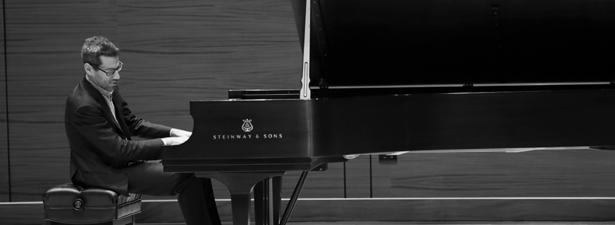
PRELUDE · 6 PM
THE JAI
Lecture by Ara Guzelimian
WEDNESDAY, AUGUST 26, 2026 · 7 PM
THE BAKER-BAUM CONCERT HALL
SCHUBERT An die Musik, D.547 (1797–1828)
Ganymed, D.544
Join us for a celebration in the Wu Tsai QRT.yrd immediately following the performance. Must be 21+ with valid ID for sparkling wine service.
Midweek Masterworks
Support for this program is provided by:
John Hesselink
La Jolla Music Society’s 2026–27 Season is supported by The City of San Diego Cultural Affairs, County of San Diego, Prebys Foundation, Farfy Foundation, ProtoStar Foundation, Vail Memorial Fund, The Lodge at Torrey Pines, Banc of California, ResMed Foundation, San Diego Theatres Foundation, Bright Events Rentals, Cafe Coyote, Rancho Coyote, GRNFC Hospitality Group, Ace Parking, Brenda Baker and Steve Baum, Raffaella Belanich, Gordon Brodfuehrer, Eleanor Charlton, Mary Ellen Clark, Bert and Julie Cornelison, Elaine Galinson and Herbert Solomon, Irwin Jacobs, Helen and Keith Kim, Angelina and Fred Kleinbub, Dorothea Laub, Vivian Lim and Joseph Wong, Jaqueline and Jean-Luc Robert, Marge and Neal Schmale, Karen and Kit Sickels, Jeanette Stevens, Debra Turner, Sue and Peter Wagener, Liqun Wang and Marco Londei, Anna and Edward Yeung, Bebe and Marvin Zigman, Anonymous.
Die Forelle, D.550
Robin Tritschler, tenor ; Jonathan Biss, piano
Fantasy in F Minor for Piano Four-Hands, D.940
Allegretto molto moderato
Largo
Allegro vivace Tempo I
Jonathan Biss, Inon Barnatan, piano
Die Sterne, D.939
Du bist die Ruh, D.776
Erlkönig, D.328
Robin Tritschler, tenor ; Inon Barnatan, piano
Quartettsatz in C Minor, D.703
Stephen Waarts, Benjamin Beilman, violins; Hsin Yun Huang, viola;
Nina Lee, cello
Rondo for Violin and Strings in A Major, D.438
James Ehnes, solo violin; Owen Dalby, Njioma Chinyere Grevious, violins; Jonathan Vinocour, viola; Ani Aznavoorian, cello
THIS PERFORMANCE HAS NO INTERMISSION
An die Musik, D.547
Ganymed, D.544
Die Forelle, D.550
Born January 31, 1797, Vienna
Died November 19, 1828, Vienna
Composed: 1817
Approximate Duration: 9 minutes
The three songs in this set were composed during the first three months of 1817, just as Schubert turned twenty. The glorious An die Musik seems so simple that one can almost overlook its perfection. The text of this stropic song is a simple tribute to the power of music by Schubert’s friend Franz von Schober, and the vocal line soars above a steady accompaniment of eighth-notes. Part of the magic here is in the details: the two-measure piano prelude that anticipates the vocal line, the octave drop of the grace-note at the start of the fifth measure (Schubert added this much later when revising the song), the perfect restraint of the expression.
Ganymed tells the story of Ganymede, taken up to heaven on the back of an eagle to become cupbearer for the gods. This brief song, which sets one of the clearest statements of Goethe’s pantheism, begins with the fresh sound of morning and grows more dramatic as the youth is taken into the heavens and to union with an “all-loving Father.”
Die Forelle, on a text by Christian Schubart, quickly became one of Schubert’s most popular songs. Schubert revised it several times, and this is one of the comparatively few of his songs that were published during his brief lifetime. It became so popular, in fact, that when he wrote his Quintet in A Major in 1819, he was prevailed upon to use the infectious main melody of this song as the basis for a set of variations in the fourth movement of that quintet. The song gets off to an engaging and energetic beginning. The first two stanzas are presented strophically: the same music sets different verses, as the poet watches the graceful fish in the crystalline water and senses the frustration of the fisherman on the opposite bank. But matters change—both musically and morally—at the start of the third stanza: the wily fisherman roils the pond, and the confused trout is hooked and dragged out of the now-dirty water. The original poem concluded with four more stanzas that taught a moral lesson—Schubert’s biographer John Reed has noted drily that their effect is to warn “young girls to be on their guard against young men with rods.” The composer had the good sense to cut these moralizing verses and to conclude the song with the poet’s stunned realization of the fate that has befallen the trout that only moments before was darting through sunlit water.
Composed: 1828
Approximate Duration: 18 minutes
The Fantasy in F Minor for Piano Four-Hands is one of the creations of Schubert’s miraculous final year of life, which saw a nearly unbroken rush of masterpieces. Schubert wrote most of the Fantasy in January 1828 but ran into problems and set the work aside for several months, returning to complete it in April. He and his friend Eduard von Bauernfeld gave the first performance on May 9 of that year, six months before the composer’s death at age 31.
Music for piano four-hands is a very particular genre, now unfortunately much out of fashion. In early nineteenth-century Vienna, however, there was a growing market for music that could be played in the home, where there might be only one piano but several pianists, usually amateur musicians. Such music often had an intentionally “social” appeal—it was not especially difficult, and it tended to be pleasing rather than profound. Much of Schubert’s four-hand piano music was intended for just such “home” performers (he often wrote music for his students to play together), but the Fantasy in F Minor is altogether different: this work demands first-class performers and contains some of the most wrenching and focused music Schubert ever wrote. John Reed has gone so far as to call it “a work which in its structural organisation, economy of form, and emotional depth represents his art at its peak.”
The title “fantasia” suggests a certain looseness of form, but the Fantasy in F Minor is extraordinary for its conciseness. Lasting barely a quarter of an hour, it is in one continuous flow of music that breaks into four clear movements. The very beginning—Allegretto molto moderato—is haunting. Over murmuring accompaniment, the higher voice lays out the wistful first theme, whose halting rhythms and chirping grace notes have caused many to believe that this theme had its origins in Hungarian folk music. Schubert repeats this theme continually—the effect is almost hypnotic—and suddenly the music has slipped effortlessly from F minor into F major. The second subject, based on firm dotted rhythms, is treated at length before the music drives directly into the powerful Largo, which is given an almost baroque luxuriance by its trills and double (and triple) dotting. This in turn moves directly into the Allegro vivace, a sparkling scherzo that feels like a very fast waltz; its trio section (marked con delicatezza) ripples along happily in D major. The writing for the first pianist here goes so high that much of this section is in the bell-like upper register of the piano—the music rings and shimmers as it races across the keyboard. The final section (Schubert marks it simply Tempo I) brings back music from the very beginning, but quickly the wistful opening melody is jostled aside by a vigorous fugue derived from the second subject of the opening section. On tremendous chords and contrapuntal complexity the Fantasy drives to its climax, only to fall away to the quiet close.
Schubert dedicated this music to the Countess Caroline Esterhazy, who, ten years before—as a girl of fifteen—had been
one of his piano students. Evidence suggests that Schubert was—from a distance—always thereafter in love with her: to a friend he described her as “a certain attractive star.” Given the intensity of this music, it is easy to believe that his love for her remained undiminished in the final year of his life.
Erlkönig, D.328
Composed: 1828, 1823, 1815
Approximate Duration: 12 minutes
Die Sterne (January 1828), on a text by Karl Gottfried von Leitner, invokes the stars as a symbol of divine order, always reliably in place and reassuring. Schubert marks the song Etwas geschwind (“Somewhat quick”), but the song does not feel rushed in any way. Quite the opposite: the piano’s constant dactylic rhythm (long-short-short) banishes uncertainty with its steady pulse, and above this Leitner’s gentle hymn to the stars unfolds securely. Schubert separates the verses with brief piano interludes.
Schubert wrote the stunning Du bist die Ruh in 1823, and that alone is a measure of his awareness of contemporary literature—Friedrich Rückert had published this poem only the previous year in his collection Östliche Rosen (“Eastern” or “Oriental Roses”). The poem is a rapt expression of love, and Schubert’s setting is effective precisely because it seems so restrained. The marking is Langsam (“slow”), the dynamic pianissimo, and the soprano sings the opening lines softly over subdued accompaniment. This song, though, is very subtly made. It is strophic, with the stanzas set off by brief piano interludes, but in the third stanza the voice—previously so understated—soars upward on the line “von deinem Glanz allein erhellt” as the passion behind these gentle words suddenly breaks loose. Schubert repeats this, and then the song falls away to its quiet close, with all its intensity still echoing in the air.
Most famous of the songs in this set is, of course, Erlkönig (1815), on a poem by Goethe. Schubert’s depiction of a desperate father riding through the dark woods with his terrified son in his arms has become one of his best-known compositions and is for many the embodiment of the art-song. Schubert’s accomplishment in this song is impressive: the use of three different speaking characters, each of whom is assigned his own music; the furious pounding triplets in the accompaniment to echo the sound of the horse’s hooves; the quick transitions between sections, perfectly gauged to shift the mood; the discordant minor ninths as the terrified child shrieks “Mein Vater!; the stunning lapse into speech at the song’s climax.
Composed: 1820
Approximate Duration: 10 minutes
Schubert composed the Quartettsatz—that title, which did not originate with Schubert, means simply “quartet movement”—in December 1820, when he was just a few weeks short of his twenty-fourth birthday. He had apparently planned to write a standard four-movement quartet, but completed only the first movement and a 41-measure fragment of what would have been an Andante second movement. No one knows why he set so promising a work aside and left it unfinished, but—like the “Unfinished” Symphony—what survives is significant enough by itself to stand as a satisfying whole.
Curiously, the Allegro assai opening movement of this quartet is similar to the first movement of the “Unfinished” Symphony: both feature the same sort of double-stroked opening idea in the first violins, both are built on unusually lyric ideas, and both offer unexpected key relations between the major theme-groups. In fact, the key relationships are one of the most remarkable aspects of the quartet: it begins in C minor with the first violin’s racing, nervous theme, and this quickly gives way to the lyric second idea in A-flat major, which Schubert marks dolce. The quiet third theme—a rocking, flowing melody—arrives in G major. As one expects in Schubert’s mature music (and the 23-year-old who wrote this music was a mature composer), keys change with consummate ease, though one surprise is that the opening idea does not reappear until the coda, where it returns in the closing instants to hurl the movement to its fierce conclusion.
Listed as the twelfth of Schubert’s fifteen string quartets, the Quartettsatz is generally acknowledged as the first of his mature quartets. The first eleven had been written as Hausmusik for a quartet made up of members of Schubert’s own family: his brothers played the violins, his father the cello, and the composer the viola. Because he was writing for amateur musicians in those quartets, Schubert had kept the demands on the players relatively light—his cellist-father, in particular, was given a fairly easy part in those quartets. But in the Quartettsatz and the three magnificent final quartets Schubert felt no such restrictions. The Quartettsatz, which makes enormous technical demands (including virtuoso runs for the first violin that whip upward over a span of three octaves), was clearly intended for professional performers.
Composed: 1816
Approximate Duration: 14 minutes
Schubert wrote no concertos. Though he played both violin and piano and though much of his music demands performers of the highest ability, Schubert seems not to have been at all attracted by the idea of a solo instrument accompanied by orchestra or by music that emphasized technical display for its
own sake. The score of the Rondo in A Major notes that it is for violin with the accompaniment of string quartet, and while this is usually taken to mean a small string orchestra, the intimacy of this music makes a performance with a quartet entirely appropriate.
The Rondo dates from 1816, when the nineteen-year-old composer was still a schoolteacher in Vienna and was working on his Fourth Symphony. A graceful Adagio opens the work, and soon the solo violin soars high above the accompaniment. The music comes to a pause, and the solo violin presses ahead
Ganymed, D.544
Text by Johann Wolfgang von Goethe Wie im Morgenglanze Du rings mich anglühst, Frühling, Geliebter!
Mit tausendfacher Liebeswonne
Sich an mein Herze drängt
Deiner ewigen Wärme
Heilig Gefühl, Unendliche Schöne!
Dass ich dich fassen möcht In diesen Arm!
Ach an deinem Busen Lieg’ ich, und schmachte, Und deine Blumen, dein Gras Drängen sich an mein Herz. Du kühlst den brennenden Durst meines Busens, Lieblicher Morgenwind!
Ruft drein die Nachtigall Liebend nach mir aus dem Nebeltal. Ich komm! ich komme! Wohin? Ach, wohin?
Hinauf! Hinauf strebt’s. Es schweben die Wolken Abwärts, die Wolken Neigen sich der sehnenden Liebe. Mir! Mir!
In eurem Schoße
Aufwärts! Umfangend umfangen! Aufwärts an deinen Busen, Alliebender Vater!
at the Allegro giusto with a more vigorous theme of its own. A few moments later comes one of those glorious melodies that are pure Schubert: the violin sings a graceful, lyric, and beautifully balanced phrase, which alternates with the Allegro giusto theme throughout the rest of the work. There is little development of these two themes in the Rondo: the episodes repeat—often literally—rather than grow and evolve. Throughout, Schubert emphasizes the lyric side of the violin rather than the virtuosic, and the Rondo closes as gracefully as it began.
Translation © Malcolm Wren
In the glow of the morning, how You are heating things up around me, Spring, beloved!
With a thousand-fold loving bliss, Pressing onto my heart is Your eternal warmth’s Sacred feeling, Endless beauty!
If only I could get hold of you In these arms!
Oh, on your breast I am lying and languishing, And your flowers, your grass Are pushing themselves towards my heart. You cool the burning Thirst of my breast, Lovely morning wind!
The nightingales are calling down Lovingly towards me out of the misty valley. I am coming, I am coming! Where to? Oh, where to?
Up! There is a striving up. The clouds are floating Down, the clouds Are bending down to this yearning love. To me! To me!
Into your lap, Upwards!
Embracing embraced! Upwards to your breast, All-loving father!
Die Forelle, D.550
Text by
Christian Friedrich Daniel Schubart
In einem Bächlein helle, Da schoss in froher Eil Die launische Forelle Vorüber wie ein Pfeil. Ich stand an dem Gestade Und sah in süsser Ruh Des muntern Fischleins Bade Im klaren Bächlein zu.
Ein Fischer mit der Rute Wohl an dem Ufer stand Und sah’s mit kaltem Blute, Wie sich das Fischlein wand. So lang dem Wasser Helle, So dacht’ ich, nicht gebricht, So fängt er die Forelle Mit seiner Angel nicht.
Doch endlich ward dem Diebe Die Zeit zu lang, er macht Das Bächlein tückisch trübe, Und eh ich es gedacht, So zuckte seine Rute, Das Fischlein zappelt dran, Und ich mit regem Blute Sah die Betrogne an.
Ihr, die ihr noch am Quelle Der sichern Jugend weilt, Denkt doch an die Forelle; Seht ihr Gefahr, so eilt!
Meist fehlt ihr nur aus Mangel Der Klugheit; Mädchen, seht Verführer mit der Angel –Sonst blutet ihr zu spät.
The Trout Translation
© Malcolm Wren
In a bright little stream
Shooting past in carefree haste
Was a capricious trout, Going off like an arrow: I stood by the edge of the water
And in sweet peace I watched The lively little fish as it bathed In the clear little stream.
A fisherman with his rod Was standing on the bank, though, And cold-bloodedly he watched As the little fish twisted.
So long as the bright water Is not disturbed, I thought, He won’t be able to catch the trout With his fishing rod.
But in the end the thief felt That it was taking too long; he made The little stream treacherously cloudy: Before I realised it, His rod started twitching; The little fish wriggled about on it; And I, with my blood boiling, Watched on as she was tricked.
Those of you who are still near the source Of confident youth, waiting there, Remember that trout; When you see danger, then hurry away!
The main danger for you is a lack Of wisdom; Girls, look out for Seducers with their rods
Otherwise it will be too late and you will bleed.
Die Sterne, D.939
Text by Carl Gottfried von Leitner
Wie blitzen
Die Sterne
So hell durch die Nacht! Bin oft schon Darüber Vom Schlummer erwacht.
Doch schelt ich
Die lichten
Gebilde drum nicht, Sie üben Im Stillen Manch heilsame Pflicht.
Sie wallen
Hoch oben
In Engelgestalt, Sie leuchten
Dem Pilger Durch Heiden und Wald.
Sie schweben Als Boten
Der Liebe umher Und tragen Oft Küsse
Weit über das Meer.
Sie blicken
Dem Dulder
Recht mild ins Gesicht Und säumen
Die Tränen Mit silbernem Licht.
Und weisen
Von Gräbern
Gar tröstlich und hold Uns hinter Das Blaue Mit Fingern von Gold.
So sei denn Gesegnet
Du strahlige Schar, Und leuchte
Mir lange Noch freundlich und klar.
Und wenn ich
Einst liebe, Seid hold dem Verein, Und euer Geflimmer Lasst Segen uns sein.
The Stars Translation © Malcolm Wren
How they glow
The stars So bright through the night! I have often, Because of them, Awoken from slumber.
But I do not criticize Those light Images for that, They perform (In silence) Many healing duties. They process High above In the form of angels, They light The pilgrim Through heathland and forest.
They hover As messengers Of love all around, And they carry Kisses, often Far across the sea. They look at The person in distress Gently, directly in the face, And they line The tears With a silver light. And they point Away from the graves, With such comfort and beauty, Directing us behind The blue With golden fingers. Therefore accept my Blessing, You shining throng, And enlighten Me for a long time With continuing friendship and clarity. And if I At some point fall in love, Be favorable to the union, And may your Shimmering Be a blessing on us.
Du bist die Ruh, D.776
Text by Friedrich Rückert
Du bist die Ruh, Der Friede mild, Die Sehnsucht du, Und was sie stillt.
Ich weihe dir
Voll Lust und Schmerz Zur Wohnung hier
Mein Aug und Herz.
Kehr ein bei mir, Und schließe du Still hinter dir Die Pforten zu.
Treib andern Schmerz Aus dieser Brust. Voll sei dies Herz Von deiner Lust.
Dies Augenzelt, Von deinem Glanz Allein erhellt, O füll es ganz.
Erlkönig, D.328
Text by Johan Wolfgang von Goethe
Wer reitet so spät durch Nacht und Wind? Es ist der Vater mit seinem Kind; Er hat den Knaben wohl in dem Arm, Er fasst ihn sicher, er hält ihn warm.
Mein Sohn, was birgst du so bang dein Gesicht? Siehst, Vater, du den Erlkönig nicht?
Den Erlenkönig mit Kron’ und Schweif?
Mein Sohn, es ist ein Nebelstreif.
“Du liebes Kind, komm, geh mit mir! Gar schöne Spiele spiel’ ich mit dir; Manch bunte Blumen sind an dem Strand; Meine Mutter hat manch gülden Gewand.”
Mein Vater, mein Vater, und hörest du nicht, Was Erlenkönig mir leise verspricht?
Sei ruhig, bleibe ruhig, mein Kind; In dürren Blättern säuselt der Wind.
“Willst, feiner Knabe, du mit mir gehn?
Meine Töchter sollen dich warten schön; Meine Töchter führen den nächtlichen Reihn, Und wiegen und tanzen und singen dich ein.”
Mein Vater, mein Vater, und siehst du nicht dort Erlkönigs Töchter am düstern Ort?
Mein Sohn, mein Sohn, ich seh es genau; Es scheinen die alten Weiden so grau.
“Ich liebe dich, mich reizt deine schöne Gestalt; Und bist du nicht willig, so brauch ich Gewalt.”
Mein Vater, mein Vater, jetzt fasst er mich an!
Erlkönig hat mir ein Leids getan!
Dem Vater grauset’s, er reitet geschwind, Er hält in Armen das ächzende Kind, Erreicht den Hof mit Müh’ und Not: In seinen Armen das Kind war tot.
You are Rest Translation © Malcolm Wren
You are rest, Gentle peace, You are longing And what quenches it.
I dedicate to you, Full of pleasure and pain, A dwelling place here in My eyes and heart.
Take up your home with me And close the gates Quietly behind you, Close the gates.
Drive other pain Out of this breast.
May this heart be full Of your delight.
My field of vision Takes in your radiance
And is lit by that alone, Oh fill it completely.
Translation © Malcolm Wren
Who is riding so late through night and wind?
It is the father with his child; He has the lad there in his arms, He is holding on to him tight, he is keeping him warm.
“My son, why are you burying your face so anxiously?”
“Father, can’t you see the Erl King?
The Erl King with his crown and tail?”
“My son, it is a streak of mist.”
“You dear child, come, go off with me! I shall play such beautiful games with you; There are so many bright flowers on the bank, My mother has plenty of golden costumes [you can put on].”
“My father, my father, can’t you hear now What the Erl King is quietly promising me?”
“Be calm, stay calm, my child: It is the wind rustling in the dry leaves.”
“Do you want to go with me, you fine lad? My daughters will look after you well; My daughters lead the line dancing at night And they will rock you and dance and sing for you.”
“My father, my father, can’t you see over there, The Erl King’s daughters in that gloomy spot?”
“My son, my son, I can see it clearly: It is the brightly shining grey [bark of the] old willow trees.”
“I love you, your beautiful face appeals to me; And if you don’t consent, then I shall have to use force.”
“My father, my father, he is getting hold of me now!
Erl King has hurt me!”
The father becomes horrified, he rides at a gallop, He holds the groaning child in his arms, Having reached the courtyard exerting himself and in dire need: In his arms the child was dead.
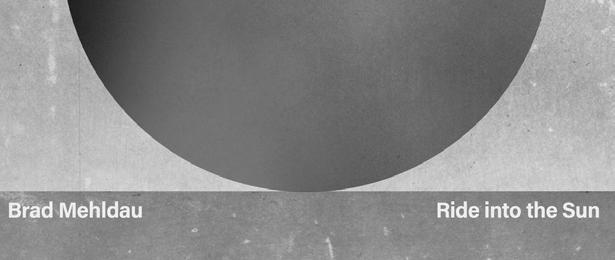
THURSDAY, AUGUST 27, 2026 · 7 PM
SYNERGY SERIES
Support for this program is provided by:
Clara Wu Tsai
Ride into the Sun—the Music of Elliott Smith featuring Chris Thile, Blake Mills, Matt Chamberlain & John Davis with USC Thornton Chamber Virtuosi, Dan Coleman, conductor
THIS PERFORMANCE HAS NO INTERMISSION AND IS APPROXIMATELY 90 MINUTES.
La Jolla Music Society’s 2026–27 Season is supported by The City of San Diego Cultural Affairs, County of San Diego, Prebys Foundation, Farfy Foundation, ProtoStar Foundation, Vail Memorial Fund, The Lodge at Torrey Pines, Banc of California, ResMed Foundation, San Diego Theatres Foundation, Bright Events Rentals, Cafe Coyote, Rancho Coyote, GRNFC Hospitality Group, Ace Parking, Brenda Baker and Steve Baum, Raffaella Belanich, Gordon Brodfuehrer, Eleanor Charlton, Mary Ellen Clark, Bert and Julie Cornelison, Elaine Galinson and Herbert Solomon, Irwin Jacobs, Helen and Keith Kim, Angelina and Fred Kleinbub, Dorothea Laub, Vivian Lim and Joseph Wong, Jaqueline and Jean-Luc Robert, Marge and Neal Schmale, Karen and Kit Sickels, Jeanette Stevens, Debra Turner, Sue and Peter Wagener, Liqun Wang and Marco Londei, Anna and Edward Yeung, Bebe and Marvin Zigman, Anonymous.
World-renowned pianist Brad Mehldau expands the language between genres with an homage to the late indie folk artist Elliott Smith, whose music inspired a generation of songwriters, joined by Chris Thile (mandolin/vocal), Blake Mills (guitar/vocal), Matt Chamberlain (drums), and John Davis (bass). This lauded band is backed by the 17-piece USC Thornton Chamber Virtuosi on Mehldau’s rich cinematic arrangements.
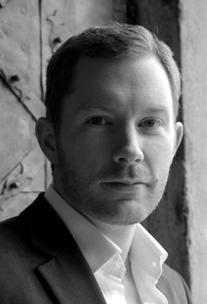
PRELUDE · 6 PM
THE BAKER-BAUM CONCERT HALL
Kairos Piano Quartet performs Mozart’s Piano Quartet No. 1 in G Minor, K.478
FRIDAY, AUGUST 28, 2026 · 7 PM
THE BAKER-BAUM CONCERT HALL
HAYDN
She Never Told her Love (1732–1809)
VAUGHAN WILLIAMS
Orpheus with his Lute (1872–1958)
QUILTER
O Mistress Mine (1877–1953)
RAUTAVAARA
La Jolla Music Society’s 2026–27 Season is supported by The City of San Diego Cultural Affairs, County of San Diego, Prebys Foundation, Farfy Foundation, ProtoStar Foundation, Vail Memorial Fund, The Lodge at Torrey Pines, Banc of California, ResMed Foundation, San Diego Theatres Foundation, Bright Events Rentals, Cafe Coyote, Rancho Coyote, GRNFC Hospitality Group, Ace Parking, Brenda Baker and Steve Baum, Raffaella Belanich, Gordon Brodfuehrer, Eleanor Charlton, Mary Ellen Clark, Bert and Julie Cornelison, Elaine Galinson and Herbert Solomon, Irwin Jacobs, Helen and Keith Kim, Angelina and Fred Kleinbub, Dorothea Laub, Vivian Lim and Joseph Wong, Jaqueline and Jean-Luc Robert, Marge and Neal Schmale, Karen and Kit Sickels, Jeanette Stevens, Debra Turner, Sue and Peter Wagener, Liqun Wang and Marco Londei, Anna and Edward Yeung, Bebe and Marvin Zigman, Anonymous.
Shall I Compare Thee to a Summer’s Day? (1928–2016)
DALE
Robin Tritschler, tenor; Inon Barnatan, piano
Come Away, Death (1885–1943)
Robin Tritschler, tenor; Hsin-Yun Huang, viola; Inon Barnatan, piano
BEETHOVEN
Piano Trio in D Major, Opus 70, No. 1 “Ghost” (1770–1827)
Allegro vivace e con brio
Largo assai ed espressivo
Presto
Jonathan Biss, piano; Benjamin Beilman, violin; Nina Lee, cello
INTERMISSION
HALVORSEN Passacaglia for Violin and Viola (after Handel) (1864–1935)
Stephen Waarts, violin; Timothy Ridout, viola
VAUGHAN WILLIAMS
Fantasia on a Theme by Thomas Tallis SummerFest Chamber Orchestra
James Ehnes, Njioma Chinyere Grevious, Benjamin Beilman, Stephen Waarts, Roger Shao*, Anthony Chan*, Elli Choi*, violin I; Owen Dalby, Simone Porter, Kathryn Hatmaker, Jeff Thayer, Cherry Yeung, Wesley Precourt, violin II; Jonathan Vinocour, Hsin-Yun Huang, Timothy Ridout, Brian Jennings*,
Ayano Nakamura*, violas; Ani Aznavoorian, Jonathan Swensen, Wilson Vanderslice*, Eliana Razzino Yang*, Nina Lee, cellos; Anthony Manzo, Sam Hager, basses
*2026 Farfy Foundation Fellowship Artist
Program notes by Eric Bromberger
Born March 31, 1732, Rohrau, Austria
Died May 31, 1809, Vienna
Composed: 1794–95
Approximate Duration: 3 minutes 40 seconds
Haydn struggled mightily to master the English language during his two extended visits to London in 1791–92 and 1794–95, but English always remained an alien language for him. While living in London, he wrote a number of songs for voice and piano in English, perhaps as a way of helping to understand that language, and in these efforts he had the help of a devoted woman. In London he became friends with an interesting couple: John Hunter was a distinguished surgeon and anatomist, and his wife, Anna, was a lyric poet. It was Anna who encouraged Haydn to compose songs in English: he set several of her poems, she wrote several poems specifically for him to set to music, and she also arranged a text for him from Shakespeare’s Twelfth Night
She never told her love comes from Viola’s speech to the Duke in Act II of Twelfth Night, and Hunter cut down that speech, focusing on the closing image of “smiling at grief.” Haydn gives the song a correspondingly dark setting, with a chordal prelude and a subdued vocal line that rises to a climax on the word “grief” before the song falls away to its subdued conclusion.
Born October 12, 1872, Down Ampney, England
Died August 26, 1958, London
Composed: 1903
Approximate Duration: 2 minutes 40 seconds
Shakespeare’s Henry VIII, written in 1613, was one of his final plays (it was during a performance of this play in June 1613 that a small cannon used in the play set fire to the Old Globe and burned it to the ground). Orpheus with his lute comes from the beginning of Act III. The troubled queen asks one of her attendant women to sing a song to dispel her mood, and the woman sings in praise of Orpheus, the god of music. Vaughan Williams was only 31 and still relatively unknown when he composed his noble setting of this text in 1903; the première took place the following year when Vaughan Williams and his good friend Gustav Holst put on a joint recital of their songs.
Born November 1, 1877, Brighton, England
Died September 21, 1953, London
Composed: 1905
Approximate Duration: 2 minutes
Roger Quilter’s music has unfortunately almost vanished from concert halls. He studied piano as a young man in England, then went to Frankfurt, where he continued his studies with Iwan Knorr at the Hoch Conservatory (fellow piano students included Percy Grainger and Balfour Gardiner). Quilter returned to England, and there he had his greatest success as a composer of songs. He composed one opera, Julia, which was a failure when it was produced in 1936, and he wrote a handful of pieces for orchestra. His Children’s Overture of 1919, based on such nursery tunes as Girls and Boys, Come Out to Play; Sing a Song of Sixpence; Baa, Baa, Black Sheep; and Oranges and Lemons, had a vogue for awhile, but today it can be found only on obscure recording labels.
All of this is too bad, for Quilter was a deft musician (he frequently accompanied singers when they presented his songs), and he wrote very nicely for the voice. “O Mistress Mine” comes from the second act of Shakespeare’s Twelfth Night, where it is sung by the Clown; it includes the famous line “Journeys end in lovers’ meetings.” Quilter’s setting is one of his Three Shakespeare Songs, published in 1905.
Born October 9, 1928, Helsinki
Died July 27, 2016, Helsinki
Composed: 1954
Approximate Duration: 2 minutes
This famous text does not come from one of Shakespeare’s plays but instead his Sonnet 18. The sonnet’s proclamation of ardent, undying love has made it attractive to composers, and it has been set to music many, many times. Finnish composer Einojuhani Rautavaara composed his Three Sonnets of Shakespeare, Opus 14 in 1952, when he was only 24.
Born July 17, 1885, London
Died July 30, 1943, London
Composed: 1918
Approximate Duration: 5 minutes
Benjamin Dale entered the Royal Academy of Music at age 15, studying composition and keyboard, and he went on to a career as a teacher and prolific composer. His music has been largely forgotten, but his 1905 Piano Sonata—admired then for its harmonic daring—is still performed and recorded. Dale was at the Bayreuth Festival in the summer of 1914 when World
War I broke out. As a foreign national, he was detained, and he spent the entire war in a civilian detention center outside Berlin. Those in that camp included many talented musicians, and they performed Gilbert and Sullivan operettas and other music.
In February 1918, while still detained, Dale composed his Two Songs from Shakespeare. The text for the second of these comes from Act II of Twelfth Night. The lovestricken Duke Orsino calls for music to comfort him, and the clown Feste sings Come away, death. Dale marks the tempo Slow, with a certain noble pathos and provides a role for viola obbligato as part of the lover’s lament.
Born December 17, 1770, Bonn, Germany
Died March 26, 1827, Vienna
Composed: 1808
Approximate Duration: 25 minutes
The exact source of the nickname “Ghost” for this trio is unknown, but it clearly refers to the middle movement, a striking Largo in D minor. This is dark, almost murky music— the piano murmurs a complex accompaniment while the strings twist and extend bits of melody above it. This unusual music (Beethoven rarely marked a movement Largo) has excited a great deal of curiosity about its inspiration. One possibility is particularly intriguing.
Beethoven had worked on his opera Leonore (later renamed Fidelio) from 1804 until 1806. It had not achieved success, and—anxious to try another opera—Beethoven explored many possible subjects. One of these was Shakespeare’s Macbeth, and he and the playwright Heinrich Collin went so far as to discuss a libretto. In fact, Beethoven began work on the music for Macbeth, for there are sketches in D minor marked “Macbeth.” Nothing ever came of them, though the idea of an opera based on this play continued to fascinate Beethoven, even in his final years.
But on the same sheet that contains the sketches for Macbeth are the first sketches for the Largo assai ed espressivo movement of this trio, also in D minor. Whether this somber and brooding music, written in 1808, grew out of Beethoven’s projected music for Macbeth cannot be known for sure, but the connection—however distant—is clearly there, and this movement may be our one hint as to what Beethoven’s music for that tragedy might have been like. Surely it is not too great a leap to imagine this music in conjunction with the witches or Macbeth’s dark final days.
Beethoven frames this remarkable Largo with two fast movements, both in radiant D major. The middle movement is so powerful that the outer movements seem a little light by comparison, and some observers have gone so far as to suggest that they should be seen as prelude and postlude to the Largo. The Allegro vivace e con brio opens with a pithy rhythmic figure that recurs throughout the movement and finally brings it
to a close. The main theme is a flowing, elegant idea heard first in the cello and quickly passed between all three instruments. This theme dominates the opening movement, giving it an atmosphere of easy expansiveness. The concluding Presto sounds innocent after the grim pizzicato strokes that end the Largo. It offers long melodic lines, a graceful partnership between the instruments, and a smooth flow of good-spirited music throughout.
Born February 23, 1685, Halle, Germany
Died April 14, 1759, London
Born March 15, 1864, Drammen, Norway
Died December 4, 1935, Oslo
Composed: 1893
Approximate Duration: 8 minutes
This pleasing music is a joint composition by two composers who lived 150 years apart. One of those composers is worldfamous, the other almost unknown. Handel we know. Johann Halvorsen began his career as a violinist. He studied with Adolph Brodsky in Berlin and César Thomson in Beligum and then returned to Norway, where he became concertmaster of the Bergen orchestra. A friend and disciple of Grieg’s, Halvorsen married Grieg’s niece. He wrote three symphonies, a violin concerto, and chamber music, but only two of his works have achieved popularity outside Norway. One is The Triumphant March of the Boyars, a stirring orchestral march that was quite popular a generation or two ago. The other is the Passacaglia for Violin and Viola, composed in 1893.
Halvorsen described this work as being “after Handel,” and its fundamental thematic material is derived from the last movement of Handel’s Suite No. 7 in G Minor, originally composed for harpsichord in London about 1720. The last movement of that suite is a passacaglia: Handel composed a four-bar ground bass, then wrote a series of variation on that ground bass as it repeated. Halvorsen took that movement as his starting point, and his treatment of it is quite interesting. He begins by offering the first several sections of Handel’s music almost literally, arranging the right-hand line for violin, the left-hand line for viola. But as the music proceeds, it becomes less Handel and more Halvorsen. The Norwegian composer writes variations of his own that challenge the technique of two good string players. Halvorsen was a terrific violinist, and his variations are based on techniques dear to the hearts of string players: some are double-stopped, some alternate pizzicato and bowed passages, others require dazzling runs. The music proceeds from its solemn opening statement through a series of increasingly ornate and brilliant variations until finally it reaches a bravura climax marked Allegro con fuoco, then falls away to end with a grand cadence marked Adagio.
It’s too bad Handel isn’t around to see what Halvorsen did with his music—he would have loved it.
While readily accessible to audiences, this is not easy music for its performers, and it requires first-class string players. Halvorsen’s original version was soon transcribed for violin and cello, and this version is widely played as well. Among the music’s admirers was Jascha Heifetz, who recorded the Passacaglia several times: once with violist William Primrose and once with cellist Gregor Piatigorsky.
Composed: 1910
Approximate Duration: 18 minutes
In 1904 Ralph Vaughan Williams, then 32 and a respected if not widely known composer, was asked to edit a new edition of the English Hymnal. He was at first reluctant to take on the task, fearing that it would demand too much of his time, but he finally agreed and for the next two years gave virtually all his energies to editing hymns from England’s past. The immediate result of his labors was the new hymnal, published in 1906, but a more important effect was that he became interested in the music of England’s past, a discovery that was to have a powerful impact on his subsequent career as a composer.
One of the hymns he edited drew his particular attention. In 1567, Thomas Tallis (1505?–1585) had contributed nine tunes to Archbishop Parker’s Metrical Psalter, and the third of these was later set with Addison’s words: “When rising from the bed of death.” When Vaughan Williams was asked to contribute a work of his own to the Gloucester Festival of 1910, he wrote a piece for string orchestra based on Tallis’ tune. The Fantasia on a Theme by Thomas Tallis was first performed on September 6, 1910, in Gloucester Cathedral, the composer conducting.
The composer’s wife felt that the knowledge that he was composing a work for performance in a cathedral helped shape the music he eventually wrote. Everyone who hears the Fantasia instinctively feels that it has a “cathedral” sound— it should be heard not in a concert hall but in some huge cathedral, with stone arches far above and the sound echoing across vast and solemn spaces. This “cathedral” sound results in great part from Vaughan Williams’ ingenious handling of his forces, which produces the “cathedral” sound even when this music is performed in a small or uncongenial space. Rather than writing for a normal string orchestra, the composer divides his players into three groups: a string quartet, a large string orchestra, and a small string orchestra of nine players that Vaughan Williams asks be set some distance away from the other players. The separation of forces gives the Fantasia its special sound: the music shifts between these groups, much as in early antiphonal church music. Vaughan Williams also employs a great range of string sonorities: massed chords, pizzicato, tremolo, solo writing, passages played entirely without vibrato. This is music that must be heard in live
performance to be heard at all, for no recording—no matter how good its sound reproduction or stereophonic separation—can give a true sense of its contrasting sonorities or of the way those sounds move from group to group within the orchestra.
But if this music were distinguished only by the use of the Tallis theme or its sonorities, it would not have achieved its present popularity (and it has been recorded countless times). The real power of the Fantasia lies in the fact that it is such endlessly beautiful music—every measure is suffused with a sense of peace, radiance, and solemnity in a way that seems to transport its audience into another world for the few minutes it takes to perform this music. One of the listeners at the first performance in 1910 grasped this immediately, saying: “The work is wonderful because it seems to lift one into some unknown region of musical thought and feeling. Throughout its course, one is never quite sure whether one is listening to something very old or very new.”
She Never Told Her Love
Text from Act II of Twelfth Night by William Shakespeare
She never told her love, But let concealment, like a worm in the bud, Feed on her damask cheek… She sat like patience on a monument, Smiling at grief.
Orpheus with His Lute
Text from Henry VIII by William Shakespeare
Orpheus with his lute made trees, And the mountain tops that freeze, Bow themselves when he did sing: To his music plants and flowers Ever sprung; as sun and showers There had made a lasting spring. Every thing that heard him play, Even the billows of the sea, Hung their heads, and then lay by. In sweet music is such art, Killing care and grief of heart Fall asleep, or hearing, die.
O Mistress Mine
Text from Act II Scene 3 of Twelfth Night by William Shakespeare
O mistress mine, where are you roaming?
O stay and hear; your true love’s coming, That can sing both high and low; Trip no further, pretty sweeting; Journeys end in lovers’ meeting, Every wise man’s son doth know. What is love? ’tis not hereafter; Present mirth hath present laughter; What’s to come is still unsure: In delay there lies no plenty; Then come kiss me, sweet and twenty; Youth’s a stuff will not endure.
Shall I Compare Thee to a Summer’s Day?
Text by William Shakespeare Shall I compare thee to a summer’s day?
Thou art more lovely and more temperate: Rough winds do shake the darling buds of May, And summer’s lease hath all too short a date: Sometime too hot the eye of heaven shines, And often is his gold complexion dimm’d; And every fair from fair sometime declines, By chance or nature’s changing course untrimm’d; But thy eternal summer shall not fade, Nor lose possession of that fair thou ow’st, Nor shall death brag thou wand’rest in his shade, When in eternal lines to Time thou grow’st. So long as men can breathe, or eyes can see, So long lives this, and this gives life to thee.
Come Away, Death
Text from Act II Scene 4 of Twelfth Night by William Shakespeare
Come away, come away, death, And in sad cypress let me be laid. Fly away, fly away, breath; I am slain by a fair cruel maid. My shroud of white, stuck all with yew, O, prepare it!
My part of death, no one so true Did share it.
Not a flower, not a flower sweet, On my black coffin let there be strown. Not a friend, not a friend greet My poor corpse, where my bones shall be thrown. A thousand thousand sighs to save, Lay me, O, where Sad true lover never find my grave, To weep there!
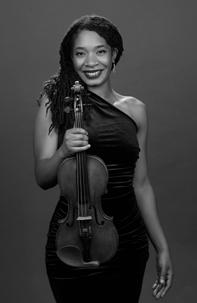
PRELUDE · 6 PM
THE BAKER-BAUM CONCERT HALL Prometheus Quartet performs works by Haydn, Webern, and Schubert
SATURDAY, AUGUST 29, 2026 · 7 PM
DAVID SERKIN LUDWIG Rule of Three (b. 1974)
Sonata Nos. I-IX
Owen Dalby, Njioma Chinyere Grevious, violins;
Jonathan Vinocour, viola
MOZART
Concerto in F Major for Three Pianos, K. 242 (1756–1791)
Allegro
Adagio
Rondeau: Tempo di minuetto
Inon Barnatan, Jonathan Biss, Anthony Ratinov*, pianos
SummerFest Chamber Orchestra
Njioma Chinyere Grevious, Owen Dalby, Kathryn Hatmaker, Wesley Precourt, violin I; Cherry Yeung, Elli Choi*, Roger Shao*, Anthony Chan*, violin II; Hsin-Yun Huang, Jonathan Vinocour, Ayano Nakamura*, Brian Jennings*, violas; Ani Aznavoorian, Jonathan Swensen, Nina Lee, Eliana Razzino Yang*, Wilson Vanderslice*, cellos; Anthony Manzo, bass; Claire Brazeau, Sarah Skuster, oboes
DVOŘÁK
Terzetto in C Major for Two Violins and Viola, Opus 74 (1841–1904)
Introduzione; Allegro ma non troppo
Larghetto
Scherzo: Vivace
Tema con variazioni: Poco adagio; Moderato; Molto allegro
James Ehnes, Stephen Waarts, violins; Timothy Ridout, viola
Support for this program is provided by: Brenda and Michael Goldbaum
La Jolla Music Society’s 2026–27 Season is supported by The City of San Diego Cultural Affairs, County of San Diego, Prebys Foundation, Farfy Foundation, ProtoStar Foundation, Vail Memorial Fund, The Lodge at Torrey Pines, Banc of California, ResMed Foundation, San Diego Theatres Foundation, Bright Events Rentals, Cafe Coyote, Rancho Coyote, GRNFC Hospitality Group, Ace Parking, Brenda Baker and Steve Baum, Raffaella Belanich, Gordon Brodfuehrer, Eleanor Charlton, Mary Ellen Clark, Bert and Julie Cornelison, Elaine Galinson and Herbert Solomon, Irwin Jacobs, Helen and Keith Kim, Angelina and Fred Kleinbub, Dorothea Laub, Vivian Lim and Joseph Wong, Jaqueline and Jean-Luc Robert, Marge and Neal Schmale, Karen and Kit Sickels, Jeanette Stevens, Debra Turner, Sue and Peter Wagener, Liqun Wang and Marco Londei, Anna and Edward Yeung, Bebe and Marvin Zigman, Anonymous.
OLLI MUSTONEN
Triple Concerto for Three Violins and Chamber Orchestra (b. 1967)
Overture
Vivace
Larghetto
Finale
James Ehnes, Stephen Waarts, Simone Porter, solo violins; Inon Barnatan, conductor
SummerFest Chamber Orchestra
Owen Dalby, Njioma Chinyere Grevious, Kathryn Hatmaker, Wesley Precourt, violin I; Cherry Yeung, Elli Choi*, Roger Shao*, Anthony Chan*, violin II; Hsin-Yun Huang, Jonathan Vinocour, Ayano Nakamura*, Brian Jennings*, violas; Ani Aznavoorian, Jonathan Swensen, Nina Lee, Eliana Razzino Yang*, Wilson Vanderslice*, cellos; Anthony Manzo, bass; Claire Brazeau, Sarah Skuster, oboes; Sidney Hopson, timpani/triangle
*2026 Farfy Foundation Fellowship Artist
Born 1974, Bucks County, Pennsylvania
Composed: 2015
Approximate Duration: 16 minutes
Composer David Ludwig comes from a distinguished musical background: his uncle was American classical pianist Peter Serkin, and his grandfather was Bohemian-born Austrian-American pianist Rudolf Serkin. Ludwig studied at Oberlin and the Manhattan School of Music and received his Ph.D. from the University of Pennsylvania. He taught first at The Curtis Institute, and he currently serves as Dean of Music and Chair of Composition at The Juilliard School. Ludwig has had works commissioned by the New York Philharmonic, Philadelphia Orchestra, Minnesota Orchestra, Jeremy Denk, Jennifer Koh, eighth blackbird, and many other performers. His choral work The New Colossus was performed as part of Barack Obama’s second inauguration.
Rule of Three was commissioned by Music from Angel Fire and first performed in 2015 by violinists Bella Hristova and Ida Kavafian and violist Steven Tenenbom. The composer has prepared a program note:
There are some basics in art that I keep coming back to—little bits of conventional wisdom that a teacher passes on to a student that over time make an impression. That passing down of knowledge first inspired this piece “Rule of Three,” both in my own studies and in the three extraordinary musicians I had the privilege to write it for: my wife Bella Hristova and her two teachers, Ida Kavafian and Steve Tenenbom.
The “Rule of Three” is an idea probably as old as counting, itself. The Rule takes many forms (it’s a cornerstone of joke-telling, for instance…) but in music I think of it as presenting an idea, establishing it on the second go around, and then making it again—but the third time a little different. Really in the simplest way, so much of composing music (or writing a story) is about creating expectation and then fulfilling or denying it. The “Rule of Three” explores all of that.
There aren’t a lot of pieces for two violins and viola—the one I think of the most is Dvořák’s “Terzetto.” But the music that I thought of that inspired this piece was Corelli’s body of trio sonatas. And so I’ve woven the great Italian master’s music throughout these short movements, or miniatures, as a kind of writing prompt. The concept of the Rule was well known to Baroque composers, and their principles and virtuosic instrumental writing spoke to me here, and into the music of the piece.
— David Serkin Ludwig
Born January 27, 1756, Salzburg
Died December 5, 1791, Vienna
Composed: 1776
Approximate Duration: 23 minutes
As a composer in Salzburg, Mozart had to thread his way between competing obligations. He was a court musician for Archbishop Colloredo, and his primary job was to provide liturgical and ceremonial music for court functions. But the Mozart family was also a part of Salzburg’s social life, and it was for occasions put on by Salzburg families that Mozart wrote his “Haffner” Serenade, his divertimenti, and many other works. Sometimes these obligations coincided. Early in 1776, just as Mozart turned twenty, the wife of one of Salzburg’s leading families, Antonia Lodron, asked Mozart to write a concerto for three pianos and orchestra that she might play with her two daughters. Antonia Lodron was in fact the sister of Archbishop Colloredo, so this was a commission the young composer needed to take seriously, and he wrote the Concerto in F Major for Three Pianos in February 1776. The three pianos are supported by a small orchestra (two oboes, two horns, and strings) that could be reduced to chamber proportions so that this concerto could be played in Salzburg drawing rooms. But those forces could also be expanded into a much larger orchestra, and Mozart himself appeared in later performances of this concerto in Salzburg, Mannheim, and Augsburg.
In his study of Mozart’s piano concertos, Cuthbert Girdlestone laments the absence here of the polyphonic writing that Bach brought to his concertos for multiple keyboards. But Mozart had other considerations: he was writing music that would be agreeable to his modestly talented performers and would be instantly attractive to their friends in Salzburg, so he kept textures clear, wrote tuneful themes, and made sure that the parts were not too demanding. The manuscript bears Mozart’s flowery inscription: “Dedicated to the incomparable merit of Her Excellency the Signora Contessa Lodron and her two daughters, Countesses Aloisa and Giuseppa, by their most devoted servant Wolfgang Mozart.” Antonia and her two daughters—Luisa and Josepha, in their German spelling— appear to have been capable pianists, but evidence suggests that Josepha was the weakest of the three, and Mozart knew it: he kept the third part relatively easy, and in fact he later made a version of this concerto for two pianos by folding the third part into the second. He had his father send him the two-piano version after he had moved to Vienna, and he apparently performed it in that city with his pupil Josepha von Auernhammer.
The opening Allegro is in sonata form. The orchestra’s exposition announces the two main themes—a firm opening idea and a more melodic second subject—before the pianists
enter. The writing for the three pianos is straightforward and clear as the performers pass the themes to each other and trade long runs. Mozart himself supplied the cadenza for this movement. Longest of the movements, the Adagio has been admired as the finest part of this concerto. It too is in sonata form, and this music rises to a depth and dignity absent from the outer movements. The concluding movement is a rondo, but Mozart casts it as a minuet, just as he had done in his Bassoon Concerto (1774) and his Fifth Violin Concerto (1775). This movement dances agreeably, and once again the melodic line flows smoothly between the three soloists.
Born September 8, 1841, Muhlhausen, Bohemia (now Czechia) Died May 1, 1904, Prague
Composed: 1887
Approximate Duration: 19 minutes
A terzetto is simply a trio. In opera, the term denotes a piece for three voices, but in chamber music it usually means a trio for some combination other than violin-cello-piano; it is in the latter sense that Dvořák uses the term, for his Terzetto is scored for the unusual combination of two violins and viola. He wrote it in the space of a week in January 1887, originally intending that he would play the viola and that an amateur violinist would play first violin. The music turned out to be too difficult for the amateur violinist, and Dvořák compensated for this by writing him a somewhat easier set of pieces (arranged by the composer for piano and violin, the easier set is known today as the Four Romantic Pieces, Opus 75).
Dvořák felt no hesitation about composing for amateur musicians. In fact, he was adamant about the importance of writing for them, and while working on these pieces he wrote to his publisher: “I am now writing some small Bagatelles for two violins and viola, and this work gives me just as much pleasure as if I were composing a great symphony; what do you say to that? They are, of course, intended for amateurs, but didn’t Beethoven and Schumann also write quite insignificant material, and how?”
The Terzetto, though, is hardly “insignificant.” Goodnatured as this music may be, it demands three accomplished musicians and shows some unusual technical features. Faced with the challenge of writing for three high voices (string quartet minus the cello), Dvořák had to provide a full harmonic palette and a bass line. He accomplished this by frequent multiple-stopping and by the viola’s active role in underpinning the harmony. One of the other surprising aspects of the Terzetto is the freedom with which Dvořák chooses keys. The first movement opens in C major, while the second is in E major; the third switches to A minor, but the finale begins in F major, moves through D-flat major, and concludes in the unexpected key of C minor.
The four brief movements require little comment. The first two are similar: both are lyric, both open gently, and
both feature more animated material in the development. The third movement is a scherzo in ABA form. Its outer sections show some similarity to the furiant, a Bohemian folk dance, while the middle section is a genial waltz. Longest of the movements, the finale is in theme-and-variation form; the theme itself is marked Poco adagio, but the five variations are quick-paced. Dvořák toys with the listener by moving through several different keys as he announces the theme; only eventually does it settle into C major, and then—as we have seen—he concludes in the unexpected key of C minor. This all sounds technical, and the listener should not be put off by it— Dvořák’s Terzetto is as genial, attractive, and good-spirited as anything that composer ever wrote.
Born June 7, 1967, Vantaa, Finland
Composed: 1998
Approximate Duration: 19 minutes
Olli Mustonen’s musical education got its start in a curious way: he began to study the harpsichord when he was five. Two years later he took up the piano, and in 1975—at the age of eight—he began to study composition with the distinguished Finnish composer Einojuhani Rautavaara. Along the way, Mustonen learned to conduct, and today he makes his career as pianist, composer, and conductor. As a pianist, he has recorded the complete concertos of Beethoven and Bartók and has appeared as soloist with orchestras all over the world—in 1999 he gave the première performance of Rodion Shchedrin’s Piano Concerto No. 5 with Esa-Pekka Salonen and the Los Angeles Philharmonic. As a conductor, Mustonen was cofounder of the Helsinki Chamber Orchestra and director of the Tapiola Sinfonietta; since 2021 he has been conductor and musical adviser to the Turku Philharmonic in Finland. His compositions include three symphonies and concertos for varied instruments, he has written chamber music for large ensembles and for single performers, and he has composed extensively for piano and for voice. When asked which of those roles he considers most important, Mustonen has replied that he thinks of himself as a musician first, and as a pianist, conductor, and composer as only parts of that identity.
Mustonen composed his Triple Concerto for Three Violins and Chamber Orchestra in 1998, and it was premièred at the Helsinki Festival on September 1 of that year. The soloists were Pekka Kuusisto, Jaakko Kuusisto, and Elizabeth Batiashvilli, with the composer conducting the Tapiola Sinfonietta. The Triple Concerto has its roots in baroque music, specifically the concerto grosso form employed by Bach, Handel, Corelli, and many others. In the concerto grosso, a small group of soloists—winds or strings—were accompanied by a string orchestra and would dart into and emerge from the texture of the orchestra. The Triple Concerto takes that general approach: the soloists (three violins) are accompanied by a small string orchestra, to which Mustonen adds two oboes (and
two very non-baroque instruments: timpani and triangle). The form of the Triple Concerto may also be described as neobaroque: it opens with the customary grand overture, which is then followed by movements of contrasting tempos. The Triple Concerto very much has the “feel” of the baroque concerto: it is full of nonstop energy, high spirits, and quick exchanges between the soloists.
Mustonen has stated that he views the three violin soloists not so much as individuals but “as components of a sort of mythical giant violin,” and the three soloists play virtually throughout the concerto, the melodic line weaving through their rapid interchanges. The Overture has the customary slow introduction (marked Grave) of the baroque instrumental suite. This one is built on constantly shifting meters as the energy level builds, then subsides, and the music proceeds directly into main body of the movement, marked Allegro; this section features rapid exchanges between the soloists. Mustonen recalls the Grave introduction and brings the movement to an understated close.
The Vivace is full of blistering energy, with the soloists playing at full speed throughout and with no chances to rest. This is the movement that sounds most “Bach-like” in its textures, and once again Mustonen brings it to an unexpectedly subdued conclusion. The orchestra takes a larger role in the Larghetto. Here the soloists are muted, and they are often in dialogue with the orchestra, as the melodic line moves between different sections. The movement builds to an almost frantic conclusion, then proceeds directly into the Finale, a movement full of what might best be described as joyous baroque fiddling. A Presto coda drives the Triple Concerto to its sizzling conclusion.
This year, Eric Bromberger, the irreplaceable program annotator for La Jolla Music Society and many other top performing arts organizations around the country, brings his more than forty years of service to LJMS to an end as he retires from this dedicated work. For decades, Bromberger has crafted the illuminating program notes that serve as vital guideposts for both the winter seasons and SummerFest. His deeply insightful writing helps audiences understand and connect with every single performance.
Bromberger brings a rare, practical expertise to his craft. He earned a Ph.D. in American Literature from UCLA and played violin for 32 years in the La Jolla Symphony. This background allows him to see music from the inside out. Former SummerFest Artistic Director Cho-Liang Lin praised him as one of the world’s finest annotators, thanks to his encyclopedic knowledge.
Through his committed work, Bromberger has enriched the concert experience for thousands of music lovers. The wealth of knowledge he has transmitted to our patrons through his lively and insightful program notes is invaluable. We thank him for being the intellectual heartbeat of our organization for so many wonderful years, and wish him well in his retirement!
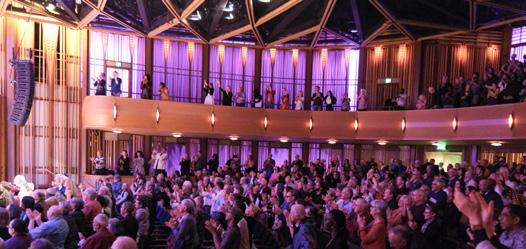

English composer
Thomas Adès conducted a new production of his most recent opera, The Exterminating Angel, at the Paris Opera in early 2024; the critically acclaimed piece was premièred at the Salzburg Festival in 2016 and traveled to the Royal Opera House and the Metropolitan Opera in 2017, all with Adès conducting. He also led the première and revival of his opera The Tempest at the Royal Opera House, with new productions at the Metropolitan Opera, Vienna Staatsoper, and La Scala, Milan. As conductor, Adès also appears regularly with the Berlin, Los Angeles, London, and Vienna Philharmonic orchestras, the Boston Symphony (where he was Artistic Partner for four seasons), the London, BBC, Finnish Radio and City of Birmingham Symphony Orchestras, the Royal Concertgebouworkest, Leipzig Gewandhaus, and the Orchestra of Santa Cecilia, Rome. Recent highlights include the première of Aquifer, a new orchestral piece, and the première of his first ballet score, Dante, at The Royal Ballet. A recording of Dante by the Los Angeles Philharmonic and Gustavo Dudamel won a 2023 GRAMMY® Award.

Rebecca Albers joined the Minnesota Orchestra as Assistant Principal Viola in 2010 and won the position of Principal Viola in 2017. She made her New York debut at Lincoln Center, performing the New York première of Samuel Adler’s Viola Concerto with the Juilliard Orchestra. She performs often at such festivals as the Marlboro Music Festival, Seattle Chamber Music Society Summer and Winter Festivals, and Rome Chamber Music Festival. Albers is a member of Accordo, a Twin Cities-based chamber ensemble made up of present and former principal players from the Saint Paul Chamber Orchestra and the Minnesota Orchestra.

Since moving to New York City in 2018, bassist Tyrone Allen II has established himself as a “generational talent” and one of the scene’s most versatile musicians. Recognized in the 2024 DownBeat Critics Poll as a Rising Star with the Sullivan Fortner Trio, Allen’s
career spans high-profile jazz stages, international tours, and the Broadway pit. Allen’s extensive sideman credits include jazz luminaries such as Terri Lyne Carrington, Jazzmeia Horn, JD Allen, and Ralph Peterson. He currently holds the bass chair for the Tony Award-winning Broadway production of Moulin Rouge! The Musical. As a bandleader and composer, Allen explores diverse sonic landscapes through his solo project TY.000 and the Tyrone Allen II Quartet (TAiiQ). He served as the 2024 Artist-in-Residence for Tribe for Jazz and was a founding co-leader of the group BRAHIM!. Following a landmark 2025 residency at the Village Vanguard with Sullivan Fortner, Allen released his debut LP, UPWARD, in Spring 2026. The album, co-produced by Allen and longtime collaborator Abe Nouri, marks a significant milestone in his evolution as a premier voice in creative music.

Cellist Ani Aznavoorian has established a distinguished career as a soloist and chamber musician, performing with leading ensembles including the Chicago Symphony Orchestra, Tokyo Philharmonic, Helsinki Philharmonic, and the Boston Pops. This season marks her fifteenth year as Principal Cellist of Camerata Pacifica. A prolific recording artist for Cedille Records, Aznavoorian is a dedicated champion of new music. She has premièred major works by Ezra Laderman and Lera Auerbach, including Auerbach’s Dreammusik, which was commissioned specifically for her. Her international accolades include the Bunkamura Orchard Hall Award and top prizes at the International Paulo Competition and the American String Teachers Association. A former Presidential Scholar in the Arts, Aznavoorian made history at The Juilliard School as the youngest cellist to win the institution’s concerto competition. Her notable appearances span prestigious venues such as Carnegie Hall, Alice Tully Hall, and the Kennedy Center. She earned both her Bachelor and Master of Music degrees from Juilliard under the tutelage of Aldo Parisot. Aznavoorian performs on a cello crafted by her father, Peter Aznavoorian.

Doug Balliett is a composer, instrumentalist and poet based in New York City. The Los Angeles Times recently wrote “Bassist Doug Balliett, who teaches a course
on the Beatles at The Juilliard School and writes cantatas for Sunday church services, as well as wacky pop operas, is in a class of his own.” Balliett has been professor of baroque bass and violone at The Juilliard School since 2017, and leads the Theotokos ensemble every Sunday at St. Mary’s church on the Lower East Side of Manhattan, where he also composes new music every week. Theotokos has given immersive performances of sacred music in New York, France, and Germany. Balliett plays regularly with the American Modern Opera Company, Les Arts Florissants, Jupiter Ensemble, ACRONYM, Ruckus, Boston Early Music Festival, Alarm Will Sound, and other ensembles.He has led Les Arts Florissants in his own work on several occasions, including Ovid Cantatas, filmed for Qwest TV with The Juilliard School, and a new St. Mark Passion performed and filmed in August 2025. Upcoming and recent performances include his newest opera, Rome is Falling!I, with AMOC in Lincoln Center, his Ovid Cantatas at Alte Musik Zürich, new songs for Reggie Mobley’s recent album Solitude, his St. Mark Passion in New York City, and Beast Fights with the Boston Symphony bass section at Tanglewood.

Principal Cello of the Seattle Symphony since fall 2011, Efe Baltacigil was previously Associate Principal Cello of the Philadelphia Orchestra since 2003. Recent highlights include his debut with the Berlin Philharmonic, performances of Tchaikovsky’s Variations on a Rococo Theme with the Bilkent Symphony and the Seattle Symphony, and Brahms’ Double Concerto with violinist Juliette Kang and the Curtis Symphony Orchestra. Baltacıgil performed a Brahms Sextet with Itzhak Perlman, Midori, Yo-Yo Ma, Pinchas Zukerman, and Jessica Thompson at Carnegie Hall, and has participated in Yo-Yo Ma’s Silk Road Project. He has toured with the group Musicians from Marlboro, and is a member of Lincoln Center’s Chamber Music Society II. Named String Player of the Year in Turkey in 2013, Baltacıgil received the Peter Jay Sharp Prize, the Washington Performing Arts Society Prize, and first prizes in concerto competitions in Istanbul and New York, as well as in the Allentown (Pennsylvania) Schadt String Competition. He was the winner of the Young Concert Artists International Auditions and received an Avery Fisher Career Grant. Born in Istanbul, Turkey, Baltacigil received his Bachelor’s degree from Mimar Sinan University Conservatory in Istanbul and an artist diploma from The Curtis Institute of Music.

Saxophonist and composer Steven Banks is a “transformational musician” dedicated to bringing the saxophone to the forefront of the classical world. A recipient of the 2022 Avery Fisher Career Grant, Banks made history as the first saxophonist to win First Prize at the Young Concert Artists Susan Wadsworth International Auditions. As a soloist, he has performed with The Cleveland Orchestra, Boston Symphony, Orchestre Symphonique de Montréal, and Netherlands Radio Philharmonic under the leadership of conductors including Stéphane Denève, Manfred Honeck, and Xian Zhang. A champion of new music, Banks has premièred and toured new concertos by GRAMMY®winners Billy Childs and Joan Tower with co-commissioners including NSO Washington, Colorado Symphony, and Indianapolis Symphony. His own compositions, including Cries, Sighs and Dreams, are praised for their intimacy and vulnerability. A founding member of the award-winning Kenari Quartet, Banks is also a tireless advocate for diversity and inclusion, launching the Come As You Are initiative to increase representation in the concert hall. He serves on the Conservatory Saxophone and Chamber Music Faculty at the Cleveland Institute of Music and will join the University of North Carolina School of the Arts’ School of Music as saxophone instructor next season.

Equally celebrated as a soloist, curator, and collaborator, Inon Barnatan is a regular soloist with many of the world’s foremost orchestras and conductors, and served as the inaugural Artist-in-Association of the New York Philharmonic for three seasons. The recipient of the Avery Fisher Career Grant and Lincoln Center’s Martin E. Segal Award, Barnatan is also a sought-after recitalist and chamber musician. In recent seasons he played solo recitals at Carnegie’s Zankel Hall and London’s Wigmore Hall and reunited for a European tour with his frequent recital partner, cellist Alisa Weilerstein, as well as performing with soprano Renée Fleming. He has been music director of SummerFest since 2019.

Benjamin Beilman has earned international acclaim for his passionate performances and distinctive tone—The New York Times called it “muscular with a glint of violence,” while The Strad praised its “pure poetry.” Praised for his instinctive sense of form and color, he uncovers new depths in familiar works and expands the violin’s expressive range through his commitment to contemporary music. Recent and upcoming orchestral highlights include his subscription debut with the Berlin Philharmonic— following a 2024 US tour with the orchestra— and appearances with the Minnesota Orchestra, Dresden Philharmonic, Antwerp Symphony, and Nashville Symphony. Beilman records for Warner Classics and has received a Borletti-Buitoni Trust Fellowship, an Avery Fisher Career Grant and a London Music Masters Award. He performs with the ex-Balaković F. X. Tourte bow (c. 1820), and plays the “Ysaÿe” Guarneri del Gesù from 1740, on loan from the Sasakawa Music Foundation.

Born in Skopje, Macedonia, David Belkovski’s musical journey began with Balkan folk traditions and has evolved into a vibrant career as conductor, soloist, and continuist. Known for vivid programming and compelling interpretations, he has directed Philharmonia Baroque Orchestra, New World Symphony, Milwaukee Symphony, and Les Violons du Roy, with appearances at the Norfolk, Ryedale, and Aix-en-Provence festivals. He is co-founder of the New York–based period ensemble Twelfth Night, alongside violinist Rachell Ellen Wong. Together, they maintain a busy 2025–26 season at Carnegie Hall, Early Music Seattle, and Cal Performances. A versatile performer on harpsichord, fortepiano, and modern piano, Belkovski won first prize at the 2019 Sfzp International Fortepiano Competition and received the Robert A. and Patricia S. Levinson Award, the first awarded in early music. He has served as Assistant Conductor to Richard Egarr, Raphaël Pichon, John Butt, and William Christie, and formerly held the post with Philharmonia Baroque Orchestra. Continuo playing remains central to his work, collaborating with Vox Luminis, Jupiter Ensemble, Saint Paul Chamber Orchestra, and Trinity Baroque Orchestra. Belkovski is on faculty at The Juilliard School.

Pianist Jonathan Biss is globally recognized for his “impeccable taste and formidable technique” (The New Yorker). A thirdgeneration musician and Co-Artistic Director of the Marlboro Music School and Festival, Biss has performed as a soloist with the world’s foremost orchestras, including the New York Philharmonic, Royal Concertgebouw, and London Symphony. A profound thinker and “insightful music writer” (The Boston Globe), Biss is the author of the award-winning Audible Original Unquiet: My Life with Beethoven. His commitment to the composer’s repertoire is further evidenced by his recording of the complete Beethoven piano sonatas and his popular Coursera series, “Exploring Beethoven’s Piano Sonatas.” The 2025–26 season sees Biss as Artist-inResidence at the Kaufman Music Center and performing across Europe and the U.S., including returns to Wigmore Hall and Théâtre des Champs-Élysées. An avid champion of contemporary music, he leads the Beethoven/5 commissioning project, collaborating with composers like Caroline Shaw and Brett Dean. A recipient of the Avery Fisher Career Grant and the Leonard Bernstein Award, Biss previously served on the faculty of the Curtis Institute of Music.

Allison Boles, La Jolla Music Society’s Director of Learning & Engagement, joined the nonprofit in 2015 after beginning her career as an instrumental music editor with the Neil A. Kjos Music Company. Boles earned her BA in Music from UC San Diego and her MA in Nonprofit Leadership and Management from the University of San Diego. She volunteers as secretary on the Advisory Council for the Visual and Performing Arts (VAPA) Department of the San Diego Unified School District.

American oboist Claire Brazeau holds the principal chair of the Los Angeles Chamber Orchestra. She most recently performed concertos by Mozart, Martinu and Strauss. Brazeau has recorded for several film and TV soundtracks, including The Mandalorian, Tenet, and Call of the Wild. She plays with
period instrument ensemble Musica Angelica and is a member of the new music group WildUp. Brazeau is an awarded finalist in the International Gillet-Fox Oboe Competition and has appeared as guest principal with the Los Angeles Philharmonic, Lucerne Festival Alumni Orchestra, and the Phoenix Symphony. Recently she joined the faculty at Idyllwild Arts Academy, and since 2016 has maintained an active oboe studio at California State University in Long Beach. Her festival engagements include the Lucerne Festival Academy, Yale School of Music Norfolk Chamber Music Festival, Aspen Music Festival, the New York String Orchestra Seminar, Pierre Monteux School, Bravo! Vail, and the Ojai Music Festival.

Chair of the Music History Department at the Colburn Conservatory of Music in Los Angeles, Kristi Brown-Montesano is an enthusiastic “public musicologist.” She is an active lecturer for the LA Philharmonic, the Opera League of Los Angeles, the Salon de Musiques series, and Mason House Concerts. Her book, The Women of Mozart’s Operas (UC Press, 2007), offers a detailed study of these fascinating roles; more recent scholarly interests include classical music in film, women in classical music, and opera for children.

Cellist Jay Campbell has been praised by the New York Times for his “electrifying performances.” Campbell holds the distinction of being the only artist ever to receive two Avery Fisher Career Grants— as a soloist and again as a member of the JACK Quartet. In the 2019–20 season Campbell served as co-curator of the Los Angeles Philharmonic’s Green Umbrella series opener with composer John Adams. He also performs with Stefan Jackiw and Conrad Tao as part of Junction Trio.
Jennifer Johnson Cano, mezzo-soprano

“riveting” world première of Gregory Spears’s The Righteous at Santa Fe Opera. A winner of the Metropolitan Opera National Council Auditions, she has performed over 100 times at the MET, with her 150th appearance occurring in her 2025–26 role debut as Suzuki in Madama Butterfly. Her career spans major roles like Donna Elvira, Carmen, and Offred, plus the world première of Kevin Puts’ The Hours. Cano’s 2025–26 season features engagements with the Chicago, San Francisco, and Seattle Symphonies, and a new song cycle première at the Tucson Desert Song Festival. She has collaborated with conductors including Yannick Nézet-Séguin, Gustavo Dudamel, and Riccardo Muti. Cano’s honors include the George London Award, Richard Tucker Career Grant, and Young Concert Artist International Auditions. A graduate of Rice and Webster Universities, her recordings include Beethoven’s Symphony No. 9 and her debut recital, Unaffected. She currently balances a prolific schedule of orchestral, opera, and chamber music performances.


Award-winning broadcaster and arts advocate Fred Child is the president and CEO of All Classical Radio, an independent, community-funded radio station and multimedia platform with international reach. Previously Child enjoyed a 25-year run as host of the nationally syndicated classical music radio program Performance Today, heard on hundreds of radio stations nationwide. Child has served as the Emmy-winning announcer for PBS’ Live From Lincoln Center, as well as the host of NPR’s Creators @ Carnegie Before joining American Public Media, Child was music director and Director of Cultural Programming at WNYC in New York, host of a live daily performance and interview program on WNYC, and, for a decade, a host at Oregon Public Broadcasting.
Mezzo-soprano
Jennifer Johnson Cano is a “matchless interpreter of contemporary opera,” recently earning acclaim for her
Patrick Castillo leads a multifaceted career as a composer, performer, writer, and educator. His music has been presented at festivals and venues throughout the United States and internationally, including Chamber Music Northwest, the Chamber Music Society of Lincoln Center, Schubert Club, Birdfoot Festival, Spoleto Festival USA, June in Buffalo, the Santa Fe New Music Festival, Queens New Music Festival, Hot Air Music Festival, National Sawdust, Interlochen Center for the Arts, Bavarian Academy of Music (Munich), the Nuremberg Museum of Contemporary Art, and the Havana Contemporary Music Festival. Recent season highlights include commissions and premières by violinist Jennifer Koh, the Jasper String Quartet, cellist David Finckel and pianist Wu Han, the Experiential Orchestra, Delphi Trio, Areon Flutes, the Manhattan Choral Ensemble, and others. Castillo is founding composer and managing director of the ensemble Third Sound and executive director of the contemporary music collective Hotel Elefant. The Quality of Mercy, an album of Patrick Castillo’s vocal chamber music, has been praised as “affecting and sensitively orchestrated… [a] gorgeous, masterfully crafted canvas” (Cleveland Classical). His music also appears on Jennifer Koh’s Alone Together (Cedille), which received the 2022 GRAMMY® Award for Best Classical Instrumental Solo.

Franco-British conductor Stephanie Childress has rapidly established herself as a rising star on both sides of the Atlantic, equally at home in opera and the symphonic repertoire. Known for her striking individuality and bold, cross-disciplinary programming, she brings a forward-looking vision to the role of the 21st-century conductor. Acclaimed for her interpretations of Mozart’s operas (“a Mozartian to her fingertips” OperaToday), she will make her Opéra de Paris debut in a new production of Don Giovanni in Spring 2027. Other operatic credits include Die Entführung aus dem Serail (Hamburg), Don Giovanni and Le Nozze di Figaro (Glyndebourne), and La Traviata at the Finnish National Opera. An advocate of contemporary opera, she has conducted works by Missy Mazzoli at Detroit Opera and Simon Voseček at the Prague State Opera. Passionate about interdisciplinary projects, she collaborated with director Tom Morris on a re-exploration of Mahler’s Symphony No. 1 in June 2026. Recent symphonic highlights include debuts with the Los Angeles Philharmonic, Houston Symphony, and San Francisco Symphony orchestras, her ongoing work as Principal Guest Conductor of the Barcelona Symphony Orchestra, and returns to the Berlin Konzerthausorchester, Cleveland, and Minnesota orchestras.

Bassist Timothy Cobb joined the New York Philharmonic as Principal Bass in May 2014, after serving as principal bass of The Metropolitan Opera Orchestra, and principal bass of the Mostly Mozart Festival Orchestra since 1989. He has appeared at numerous chamber music festivals worldwide, including the Marlboro Music festival, through which he has toured with the Musicians from Marlboro series. A faculty member of the Sarasota Music Festival, he is helping to launch a new bass program for the Killington Music Festival in Killington, Vermont. Cobb also serves as principal bass for Valery Gergiev’s World Orchestra for Peace, an invited group of musicians from around the world who donate their time biannually and perform to promote international harmony. Cobb has been designated a UNESCO Artist for Peace from his affiliation with the World Orchestra.

Whether conceptual film, documentary or live concert, the work of director Tristan Cook examines systems of human expression at the intersection of cinema and the performing arts. His new feature documentary, Four Rational People, which follows the GRAMMY® Award-winning Emerson String Quartet in their final year together before disbanding, is in theaters now and has been called “a dream come true” by The Wall Street Journal. His previous documentary, Strangers on the Earth, was hailed by the Los Angeles Times as “an inspiring and transporting portrait” of life and music along Spain’s Camino de Santiago pilgrimage. He is a frequent collaborator with organizations such as the New York Philharmonic, Chamber Music Society of Lincoln Center, La Jolla SummerFest, Bravo! Vail, and Ojai Music Festival.

Praised as “dazzling,” “expert and versatile,” and “a fearless and inquisitive violinist,” Owen Dalby has cultivated a dynamic career as a soloist, chamber musician, and educator. As a member of the acclaimed St Lawrence String Quartet (2015–24), he toured extensively across North America and Europe,
contributing to celebrated recordings like Haydn Opus 20 and Korngold’s Piano Quintet. Before SLSQ, Dalby co-founded Decoda, Carnegie Hall’s affiliate ensemble, and served as concertmaster for Novus NY and the Trinity Baroque Orchestra. Highlights include his Lincoln Center debut performing Lou Harrison and premiering Timo Andres’ double concerto with the Albany Symphony. A former fellow of Ensemble Connect, Dalby is currently Artist-in-Residence at Stanford University and co-directs Noe Music in San Francisco. Dalby performs on the “Fetzer” Stradivarius made in Cremona in 1694.

Jeremy Denk is one of America’s foremost pianists, a New York Times bestselling author, winner of both the MacArthur Genius Fellowship and the Avery Fisher Prize, and a member of the American Academy of Arts and Sciences. Denk recently returned to London’s Wigmore Hall for a three-concert residency, as well as collaborating with the Danish String Quartet, and performing works by Charles Ives with violinist Maria Włoszczowska. He has performed multiple times at Carnegie Hall and in recent years has worked with such orchestras as Chicago Symphony, Philadelphia Orchestra, New York Philharmonic, Los Angeles Philharmonic, San Francisco Symphony, and Cleveland Orchestra. He has appeared at the BBC Proms and Klavierfestival Ruhr, and in such halls as the Köln Philharmonie, Concertgebouw in Amsterdam, and Boulez Saal in Berlin. His recording of the Goldberg Variations for Nonesuch Records reached No. 1 on the Billboard Classical Charts, and his recording of Beethoven’s Piano Sonata Opus. 111 paired with Ligeti’s Études was named one of the best discs of the year by the New Yorker, NPR, and the Washington Post

Stefan Dohr, Principal Horn of the Berliner Philharmoniker, has collaborated as a soloist with the world’s leading conductors, including Sir Simon Rattle, Claudio Abbado, Daniel Barenboim, Bernard Haitink, Christian Thielemann, Neeme and Paavo Järvi, and Marc Albrecht. He has performed with orchestras such as the Berliner Philharmoniker, Los Angeles Philharmonic, Deutsche Kammerphilharmonie Bremen, Swedish Radio Symphony Orchestra, Oslo Philharmonic, Orchestre Philharmonique de Radio France,
Orquesta Nacional de España, Shanghai Philharmonic Orchestra, NHK Symphony Orchestra, and Osaka Philharmonic Orchestra. Dohr is continually expanding his instrument’s repertoire, commissioning and premiering new pieces by today’s foremost composers.

GRAMMY® Awardwinning clarinetist
Mark Dover has served as the clarinetist of Imani Winds since 2016, and has appeared as a soloist with the Atlanta, Baltimore, and Albany Symphonies. Dover received a GRAMMY® as a player and producer for “Best Classical Compendium” at the 2024 GRAMMY® Awards for Imani Wind’s Passion for Bach and Coltrane. His debut album with Imani Winds, Bruits, was nominated for Best Chamber Music/Small Ensemble Performance at the 2022 GRAMMY® Awards. Recent highlights include appearances at Carnegie Hall Presents, NPR’s tiny desk, and debuts at La Jolla Music Society and Tippet Rise Arts Center. Dover joined the chamber music faculty of the Curtis Institute of Music in 2021 and serves on the clarinet faculty at Mason Gross School of the Arts at Rutgers University, and at Queens College, CUNY. Dover is a frequent collaborator with Vulfpeck, an American funk band. He received his Master of Music degree from Manhattan School of Music and his Bachelor of Music degree from the University of Michigan. He is a Buffet Crampon and Vandoren Artist.

Mark Dresser is a GRAMMY®-nominated bassist, improviser, and composer dedicated to expanding the contrabass’ sonic and expressive possibilities—an exploration culminating in his upcoming book, Mapping the Bass. He has recorded over 150 albums, with Tines of Change named among Downbeat’s “Best Recordings of 2023.” After a decade with Anthony Braxton’s Quartet, he has collaborated with artists ranging from John Zorn and Joe Lovano to Anthony Davis. Since 2007, he has pioneered telematic performance, frequently combining networked music with social commentary in global concerts from Deep Tones for Peace to recent socio-political works like Witness: Consequences and Testimonies. Awarded the Doris Duke Impact Award and two Shifting Foundation Awards, he is a Distinguished Professor of Music at UC San Diego and a former International Society of Bassists board member.

American soprano Kiera Duffy is acclaimed for her versatile high soprano and incisive musicianship across a vast repertoire from Bach to Mazzoli. A specialist in modern opera, her 2025–26 season features the world première of Complications in Sue at Opera Philadelphia. Recent highlights include leading roles in the world premières of René Orth’s 10 Days in a Madhouse and George Lewis’ The Comet, as well as portraying Bess in Missy Mazzoli’s Breaking the Waves. Duffy has performed at major venues including The Metropolitan Opera, Lyric Opera of Chicago, and the Lincoln Center. Her extensive concert career involves collaborations with renowned conductors like Gustavo Dudamel and Pierre Boulez, performing with orchestras such as the Berlin Philharmonic and New York Philharmonic. Her discography features recordings on Hyperion, Sony, and Deutsche Grammophon, including Mahler’s Symphony No. 8. Beyond the stage, Duffy is a distinguished clinician and educator. Formerly at the University of Notre Dame, she currently serves as Associate Professor of Voice at the Eastman School of Music.

James Ehnes has established himself as one of the most sought-after musicians on the international stage. 2025–26 concerto highlights include Orpheus at Carnegie Hall, Chicago Symphony Orchestra, Orchestre Symphonique de Montréal, Royal Concertgebouw Orchestra, and London Philharmonic. He is the first violinist of the Ehnes Quartet and the Artistic Director of the Seattle Chamber Music Society. His extensive discography has won many awards including two GRAMMY® awards, three Gramophone awards, and 12 Junos. Ehnes plays the “Marsick” Stradivarius violin of 1715.

Cellist Sterling Elliott is a 2021 Avery Fisher Career Grant recipient and a winner of the 2019 National Sphinx Competition. He has appeared with the Philadelphia Orchestra, the New York Philharmonic, the Boston Symphony, the Cleveland Orchestra, the Los Angeles Philharmonic, the Detroit
Symphony and the Dallas Symphony, among others, with conductors Yannick NézetSéguin, Thomas Wilkins, Jeffrey Kahane, Mei Ann Chen and others. Elliott recently debuted with Minnesota Orchestra, Grand Rapids Symphony, Charlotte Symphony, Pacific Symphony, San Antonio Symphony and New Jersey Symphony. He also performed the world première of a new orchestral version of John Corigliano’s Phantasmagoria, commissioned for him by a consortium of orchestras including the Orlando Philharmonic. He made his UK recital debut at Wigmore Hall in 2024. He performs on a 1741 Gennaro Gagliano cello on loan through the Robert F. Smith Fine String Patron Program, in partnership with the Sphinx Organization.

Monica Ellis is a GRAMMY® Awardwinning, four-time nominated bassoonist and founding member of the acclaimed wind quintet Imani Winds. For nearly three decades, the ensemble has captivated audiences with dynamic performances, bold programming, new commissions, and educational outreach. Growing up, she studied with Mark Pancerev of the Pittsburgh Symphony, and later with George Sakakeeny at Oberlin Conservatory (BM) and Frank Morelli at The Juilliard School (MM) and Manhattan School of Music (PS). Passionate about entrepreneurship and representation in the arts, Ellis teaches at the Curtis Institute of Music and Manhattan School of Music. She is also the co-artistic and executive director of Imani Winds and its Chamber Music Festival and treasurer of the Imani Winds Foundation. The daughter of a jazz saxophonist and a fashion-forward mother, Ellis was raised in a household full of creativity, ambition, and style. She is a Fox Bassoon Artist, performing exclusively on a Model 201.

Hungarian pianist
Zoltán Fejérvári is a “deeply communicative artist” and winner of the 2017 Concours Musical International de Montréal. A recipient of the Borletti-Buitoni Trust Fellowship, he has performed at Carnegie Hall, the Liszt Academy, and Gasteig. His orchestral collaborations include the Budapest Festival Orchestra, Czech Philharmonic, and San Antonio Symphony, working under conductors such as Iván Fischer and Zoltán
Kocsis. Mentored by Sir András Schiff, Fejérvári was selected for the “Building Bridges” series and has appeared at the Marlboro Music Festival at the invitation of Mitsuko Uchida. As a chamber musician, he has collaborated with Steven Isserlis, Gary Hoffman, and the Elias Quartet. His discography includes the Grand Prix du Disque-winning recording of Liszt’s Malédiction. His solo debut, Janáček (2019), was hailed by Gramophone as “deeply probative,” followed by a critically acclaimed Schumann album in 2020. Fejérvári’s repertoire spans five centuries, encompassing solo recitals, chamber music, and concerti by Bach, Bartók, and Beethoven.

A recipient of the Avery Fisher Career Grant, Emi Ferguson is the founder of interdisciplinary ensemble Exquisite Corpse and can be heard live in concerts and festivals with groups including the Handel and Haydn Society, AMOC*, Ruckus, the New York New Music Ensemble, the Manhattan Chamber Players, and as the music director of Camerata Pacifica Baroque. Her recordings By George!, Amour Cruel, and Fly the Coop: Bach Sonatas and Preludes celebrate her fascination with reinvigorating music and instruments of the past for the present and have been called “blindingly impressive ... a fizzing, daring display of personality and imagination” by The New York Times. Ferguson has spoken and performed at TEDx events and has been featured on the Discovery Channel, Amazon Prime, WQXR, and Vox talking about how music relates to our world today. With WQXR, she hosts the Young Artists Showcase and Once Upon A Composer, and created the series This Composer Is SICK! Her book Iconic Composers was released in 2023. Born in Japan and raised in London and Boston, she now resides in New York.

Sullivan Fortner is a GRAMMY® Awardwinning pianist, composer, and bandleader who has received international praise as both key player and producer for his collaborative work on The Window alongside multi-GRAMMY®-winning vocalist-composer Cécile McLorin Salvant. As a solo leader, he has released Moments Preserved and Aria to critical acclaim. He frequently collaborates with artists including
Wynton Marsalis, Paul Simon, Diane Reeves, Etienne Charles and John Scofield and has performed at Jazz at Lincoln Center, Jazz Standard, Smalls Jazz Club, Snug Harbor, and Sweet Lorraine’s, as well as festivals including Newport, Monterey, Discover, and Gillmore Keyboard, among others. Fortner won the GRAMMY® for Best Jazz Instrumental Album this year for his record Southern Nights

Brandon Patrick George is a GRAMMY®-winning flutist and member of Imani Winds, praised as a “virtuoso” by The Washington Post. His solo career includes performances at Lincoln Center, the Kennedy Center, and the Dresden Music Festival. He has appeared as a soloist with the Atlanta and Baltimore Symphonies, and previously served as guest principal flute for the Los Angeles Philharmonic under Gustavo Dudamel. A dedicated advocate for diversity, George launched BPG: The Community Concerto Project to mentor young musicians of color and expand orchestral repertoire. He was part of the inaugural WQXR Artist Propulsion Lab and serves on the faculty of the Curtis Institute of Music and Mannes School of Music. His discography includes the four-star rated album Twofold (2023) and a 2020 debut profiled by The New York Times. Trained at Oberlin Conservatory and Manhattan School of Music, George has collaborated with leading composers like John Adams and Tania León. He also serves as a music consultant for The Morgan Library & Museum.
Michael Gerdes, lecturer

Michael Gerdes is Professor of Music and Director of Orchestral Studies at San Diego State University, where he has spent over a decade building a thriving orchestral community. Under his leadership, the university’s program has doubled in size while expanding its ensembles and performances. His alumni perform and teach worldwide, spanning from the Los Angeles Philharmonic to the Armenian National Opera. San Diego Story has praised his conducting as “refined, dynamically nuanced,” and “thoughtfully layered.” Winner of the 2022 Richard Levin Orchestra Educator Award, Gerdes previously served as Assistant Conductor of the La Jolla Symphony and Chorus and has held positions with the Los Angeles Conducting Institute and BRAVO International Music Academy. A fierce champion of new music, Gerdes has
premièred major works by contemporary composers including Vivian Fung, Richard Thompson, and Jocelyn Hagen. Highly sought-after as a clinician, he recently led over 1,000 musicians at the South Dakota All-State Orchestra and Chorus, and conducted the California Orchestra Directors Association All-State Orchestra alongside numerous regional honor ensembles.

Mekhi Gladden is an oboist and changemaker whose work bridges the worlds of music and medicine. Originally from Atlanta, GA, and based in Philadelphia, they began studying oboe at 15 through the Talent Development Program, later earning degrees at the Curtis Institute of Music and Thomas Jefferson University. Gladden has performed with leading orchestras across the U.S., including the Atlanta Symphony, Baltimore Symphony, Saint Paul Chamber Orchestra, and Memphis Symphony. Committed to using music as a tool for connection and transformation, they have collaborated with Times Square Arts, Astral Artists, the People’s Music Supply, Sugar Hill Salon, and the Composers Conference at Avaloch. Beyond the stage, Gladden is a nationally certified pharmacy technician and vaccinator, working to expand access to medications, vaccines, and health literacy. Their dual commitment to care and creativity fuels a unique and deeply human artistic voice.

Karen Gomyo is one of today’s leading violinists, acclaimed for her artistry, poise, and passionate performances. Her 2025–26 season features returns to the New York Philharmonic, National Symphony Orchestra Taiwan, and Rome’s Accademia Nazionale di Santa Cecilia, alongside debuts with the SWR Symphonieorchester Stuttgart and the Malaysian Philharmonic. Recent highlights include performances with the Chicago Symphony, Gewandhausorchester Leipzig, and the Czech Philharmonic. A champion of living composers, Gomyo has given U.S. premières of works by Samy Moussa and Matthias Pintscher, and also premièred a chamber concerto by Samuel Adams commissioned for her by the Chicago Symphony. She is a noted interpreter of Astor Piazzolla’s nuevo tango, and released A Piazzolla Trilogy on BIS Records in 2021. Born in Tokyo and raised in Montreal and
New York, she studied under Dorothy DeLay at The Juilliard School and later with Mauricio Fuks and Donald Weilerstein. She also served as violinist and narrator for the NHK documentary The Mysteries of the Supreme Violin

American violinist Randall Goosby is acclaimed for his sensitive musicianship and commitment to making classical music inclusive. Signed exclusively to Decca Classics, his discography includes Roots, a celebration of African-American music, and a concerto album featuring works by Max Bruch and Florence Price with Yannick Nézet-Séguin and the Philadelphia Orchestra. A former student of Itzhak Perlman, Catherine Cho, and Phillippe Quint, Goosby became the youngest First Prize winner of the Sphinx Competition at age thirteen. His 2025–26 season features debuts with the Atlanta and San Diego Symphonies and the Orchestre National de France, following previous engagements with the Chicago Symphony and London Philharmonic. In 2025, he joined the Juilliard School Pre-College faculty. Goosby’s honors include the 2024 Harmony for Change Award and a residency as the Cincinnati Symphony’s MAC Music Innovator. Deeply passionate about outreach, he collaborates with the Iris Collective and Opportunity Music Project. He performs on the 1708 “ex-Strauss” Stradivarius. Goosby holds multiple degrees from Juilliard and is a member of the Konzerthaus Dortmund “Junge Wilde” series.
Kayvon Gordon, drums

Kayvon Gordon was born and raised in Detroit. At a young age, he was taken under the mentorship of legendary trumpeter Marcus Belgrave. Later, he went on to the University of Michigan where he studied with Robert Hurst and Benny Green. Gordon has performed in Europe, Africa, South Asia, the United Arab Emirates, and North America. He has also had the honor of sharing the stage with Marcus Belgrave, Joe Lovano, Johnny O’Neal, Robert Hurst, Rodney Whitaker, Sullivan Fortner, Ravi Coltrane, JD Allen, and Wynton Marsalis, to name a few. Kayvon Gordon seeks to contribute to the forward thinking aesthetic of his contemporaries while honoring the rich musical legacy of Detroit.

Described as “superb” by the Chicago Classical Review, violinist Njioma Chinyere Grevious is a winner of the prestigious 2024 Avery Fisher Career Grant. Celebrated for her expressive playing, she has earned acclaim for a “dazzling performance” with the National Symphony Orchestra. Grevious is a Grand Prize winner of the 2023 Concert Artist Guild and the Young Classical Artist Trust (YCAT) CAG Elmaleh Competition, and also received First Prize and Audience Choice awards at the 2023 Sphinx Competition. A Juilliard graduate and John Erskine Prize recipient, she has also debuted as a soloist at Carnegie Hall with Sphinx, at the Concertgebouw with the Brussels Philharmonic, the Indianapolis Symphony, Chicago Philharmonic and at Wigmore Hall, among others. She is a founding member of the Abeo Quartet, which debuted at SummerFest in 2024 and won prizes at the Bad Tölz and Yellow Springs competitions. Grevious is also a member of the Orpheus Chamber Orchestra. She is the recipient of an outstanding violin by Pietro Guarneri of Mantua c. 1679 on generous loan from the Stradivari Society.

Ara Guzelimian is artistic and executive director of the Ojai Festival in California. He served as Provost and Dean of The Juilliard School in New York City from 2007 to 2020, and continues at Juilliard in the role of special advisor to the Office of the President. Prior to that, he was senior director and artistic advisor of Carnegie Hall from 1998 to 2006. In addition, he is a member of the Steering Committee of the Aga Khan Music Awards, the Artistic Committee of the Borletti-Buitoni Trust in London, and a Board member of the Amphion and Pacific Harmony Foundations. Guzelimian is editor of Parallels and Paradoxes: Explorations in Music and Society (Pantheon Books), a collection of dialogues between Daniel Barenboim and Edward Said. In September 2003, he was awarded the title Chevalier des Arts et des Lettres by the French government for his contributions to French music and culture.

Bassist Samuel Hager has been a member of the San Diego Symphony Orchestra since October 2006 and has served two seasons as Acting Associate Principal Bass. He has been a regular performer at SummerFest since 2011, with this season marking his tenth appearance. Before joining the San Diego Symphony, Hager played one season with the Oregon Symphony and has performed with the Los Angeles Philharmonic at both Walt Disney Concert Hall and the Hollywood Bowl. Hager performs on a Modern Italian double bass circa 1930, made by Giuseppe Tarantino. Known for his rich tone and versatility, he is highly respected for both his orchestral and chamber music work, bringing depth and passion to every performance.

Violinist Kate Hatmaker is the co-founder and Executive/Artistic director of Art of Elan, a San Diego-based chamber music organization that has been building community through music since 2007, and has been a tenured violinist with the San Diego Symphony since 2006. Hatmaker has been a featured soloist with a wide variety of North American orchestras, including the San Diego Symphony, and in addition to SummerFest, has performed at the Vail International Dance Festival, Tanglewood, and the Ojai Music Festival, among others. She has served on the faculty at the University of California–San Diego and the Coronado School of the Arts, and is a frequent chamber music recitalist, guest clinician, and keynote speaker.

A member of the GRAMMY®-nominated collective Wild Up, Sidney Hopson has appeared with the Los Angeles Philharmonic, LA Chamber Orchestra, Color of Noize, Indianapolis Symphony, Austin Symphony, LA Master Chorale, Bang on a Can All-Stars, American Modern Opera Company, and more. He has performed at the Academy Awards, Spoleto Festival USA, SF Jazz, Ojai Festival, Sick New World, and the Lincoln Center Festival, Big Ears, and Coachella Festivals. He has recorded for hundreds of motion picture scores, including: Star Wars: The Mandalorian
& Grogu, Superman (2025), Coming 2 America, NOPE, Avatar: The Way of Water, and Encanto. As a percussionist, drummer, timpanist, and hand percussionist, he routinely crosses genres; he has performed and recorded with John Adams, Danny Elfman, Billie Eilish, Earth Wind & Fire, Rhiannon Giddens, Ludwig Göransson, Wynton Marsalis, T-Pain, Ellen Reid, Esa-Pekka Salonen, Kaija Saariajo, John Williams, and Stevie Wonder. Hopson produces arts programs, cultural policy, and strategic plans for culture organizations, labor unions, government agencies, and artists worldwide. He has presented masterclasses and policy lectures at The Juilliard School, USC, Butler University, and the Music Academy of the West.

Hsin-Yun Huang, viola Violist Hsin-Yun Huang has appeared as soloist with leading orchestras in Berlin, London, Tokyo, Beijing, Taipei, and Bogota, amongst others. Her upcoming project “Sisila ila ila,” a multidisciplinary musical poem in collaboration with theater director Doug Fitch and composer Shih-Hui Chen, will debut in the 2026–27 season. She has commissioned compositions from Steven Mackey, Shih-Hui Chen, Poul Ruders and Lei Liang. Her 2012 recording for Bridge Records, Viola Viola, won accolades from Gramophone and BBC Music Magazine. Her most recent release is the complete unaccompanied sonatas and partitas of J.S. Bach, in partnership with her husband, violist Misha Amory, as well as an album, VivaViola, which includes exclusive arrangements for the viola. Huang regularly appears at festivals, including Marlboro, Spoleto, Ravinia, Santa Fe, and Music@ Menlo, among many others. She was the gold medalist in the 1988 Lionel Tertis International Viola Competition, the top-prize winner in the ARD International Competition in Munich, and was awarded the highly prestigious Bunkamura Orchard Hall Award. She now serves on the faculties of Juilliard and Curtis.

Hailed by Alex Ross in The New Yorker for his “flawless technique and keen musicality,” cellist Coleman Itzkoff thrives at the intersection of multiple musical worlds—from cutting-edge contemporary works to Baroque repertoire on period instruments. A versatile soloist and chamber musician, he brings equal commitment to premiering new compositions and exploring historical performance practice.
Since becoming a founding member of the American Modern Opera Company (AMOC) in 2017, Coleman has been a key creative voice in shaping ensemble visions, and his work with the ensemble has led him to explore acting, dancing, and theatrical collaboration. He is also a core member of Ruckus Early Music and Twelfth Night Ensemble. Coleman performs regularly at leading festivals including Marlboro and venues such as Carnegie Hall and London’s Wigmore Hall. Throughout his career, he has been committed to bringing music to broader audiences, receiving the Sviatoslav Richter Grant for Music Outreach and the Cleveland Clinic Arts and Medicine Award.

Stefan Jackiw is a leading American violinist, praised for his “uncommon musical substance” and “intelligence and sensitivity.” He has soloed with major orchestras including the Boston, Chicago, Cleveland, New York, Philadelphia, and San Francisco symphony orchestras. Jackiw’s recent recordings include Charles Ives’ complete violin sonatas with Jeremy Denk, which The New Yorker hailed as setting “a new standard,” and Beethoven’s Triple Concerto with Inon Barnatan, Alisa Weilerstein, and the Academy of St. Martin in the Fields conducted by Alan Gilbert. This season, Jackiw reunites with Barnatan and Weilerstein at London’s Southbank Centre, and also appears with the Pittsburgh Symphony, the Baltimore Symphony, the Seoul Philharmonic, and the San Diego Symphony under Rafael Payare at the Rady Shell. A dedicated chamber musician, Jackiw is Artistic Director of the Hawaii Chamber Music Festival and frequently tours with The Junction Trio. A recipient of a prestigious Avery Fisher Career Grant, Jackiw plays a violin made by Domenico Montagnana “ex. Rossi” c. 1730, generously loaned by a private foundation.

Alejandro Jenné is drawn to music and the arts as a path toward awakening our full human potential. From his first encounter with the lute, he was deeply moved by the instrument’s capacity to express gentleness, nostalgia, and beauty. His musical journey has been rich and diverse, spanning multiple genres and styles, professional performance settings, educational work,
recording songs and the use of music as a vehicle for healing, transformation, and personal growth. His primary lute teacher was David Tayler (Voices of Music). He has performed with numerous prestigious early music groups, from Michael Chance to Bach Collegium San Diego to Central city Opera. He is currently developing several musical projects that weave together song, dance, theater, and ritual. Jenné believes that musical instruments are organs of perception. Once a particular instrument has opened a specific door of perception, that doorway allows us to explore other aspects of life with a new sense-ability—a new capacity to sense, feel, and understand the world. He is grateful to be here and share in this experience.

Praised as “technically and interpretively impeccable and passionately communicative”
(Boston Musical Intelligencer), Graeme Steele Johnson is an artist of uncommon imagination and versatility. The clarinetist, curator and “musical detective” (New York Classical Review) garnered international attention for his rediscovery, reconstruction, and recording of a 125-year-old Octet by Charles Martin Loeffler, profiled in a full-page spread by The Washington Post and named one of The New York Times’ Best Classical Music Albums of 2024. Johnson led the work’s first present-day performances at the Library of Congress, Morgan Library, Harvard Musical Association, Emerald City Music, Chamber Music Northwest, and more. Since 2022 Johnson has served as clarinetist of the award-winning quintet WindSync. He has appeared as soloist with the San Diego Symphony, Vienna International Orchestra, and Springfield Symphony Orchestra, and collaborated with the Miró, Balourdet, Aeolus, and Callisto Quartets, as well as the Copland House, Twelfth Night, and New York New Music Ensembles. He has also appeared as a TEDx speaker, authored chamber arrangements heard around the world, and serves as Artistic Director of the Onstage Offstage Chamber Music Festival in Houston.
Anthony Ratinov, piano; Elli Choi, violin; Ayano Nakamura, viola; Eliana Razzino Yang, cello Anthony Ratinov, piano

Hailed for his “unwavering energy and precision” (La Scena Musicale), American pianist Anthony Ratinov captivates audiences worldwide, commanding the stage with “class, style, technical mastery, and solo prowess” (Beckmesser). Ratinov won Third Prize at the 2024 Concours Musical International de Montréal, and in 2025 won Second Prize at the National U.S. Chopin Competition. Additional honors include Second Prize at the Busoni International Piano Competition, First Prize at the Ricard Viñes International Piano Competition, and Second Prize at the Iturbi International Piano Competition. His first teacher was his grandmother, Edit Ratinova, who taught at Moscow’s Gnessin Music School for 45 years before emigrating to the United States. Ratinov holds an Artist Diploma from The Juilliard School and completed graduate studies at the Yale School of Music, after earning a Bachelor’s degree in chemical engineering from Yale University. Ratinov has performed at major venues including Amsterdam’s Royal Concertgebouw and Barcelona’s Palau de la Música. Upcoming highlights include his Carnegie Hall solo recital debut, and appearances with the Wisconsin Philharmonic, Symphony of the Americas, and Sedona Symphony. Ratinov is a Young Steinway Artist.
Elli

Award-winning violinist Elli Choi has performed throughout North America, Europe, Asia, and the Middle East at venues such as Carnegie Hall, Lincoln Center’s
David Geffen Hall, the Berliner Philharmonie, Het Concertgebouw, Maison Symphonique de Montréal, Tonhalle Zürich, Rudolfinum Dvořák Hall in Prague, BOZAR Brussels, the Abu Dhabi Palace, and Beijing’s National Center for the Performing Arts, appearing with major orchestras such as the Orchestre Philarmonique de Monte-Carlo, the Belgian National Orchestra, the Novosibirsk Philharmonic Orchestra, Sofia Philharmonic Orchestra, Ulster Orchestra, Orchestre Philharmonique Royal de Liège, the Armenian State Symphony Orchestra, and The Juilliard Orchestra. Choi has been invited to perform for several heads of state,
including President Emmanuel Macron of France and former Vice President Mike Pence at the United States Department of State, as well as the Duchess of Gloucester at Buckingham Palace. Choi graduated from Columbia University while simultaneously enrolled at The Juilliard School, and has recently completed her Master’s degree as a Kovner Fellow. She will start studying at Kronberg Academy this fall with Professor Antje Weithaas. Choi currently plays a J. B. Vuillaume c. 1840 on generous loan.
Nakamura, viola

Violist Ayano Nakamura has won second prize at the 2025 Washington International Strings Competition, the Prize for the Best Interpretation of a piece by Bohuslav Martinů at the 2025 Oskar Nedbal competition in Prague, and the 2023 A Far Cry Collaborative Competition. As an avid chamber musician, she has participated in many festivals in the U.S. and Europe, such as Kronberg Chamber Music Connects the World, NUME Festival Academy, Verbier Festival Academy, Edinburgh International Festival, Gstaad String Academy, and Perlman Chamber Music Workshop. She has collaborated and performed with established artists including Andreas Brantelid, Merry Peckham, Gary Hoffman, Mathieu Herzog, and A Far Cry Chamber Ensemble. Nakamura has performed as a soloist in masterclasses for artists including Tabea Zimmermann, Antoine Tamestit, Lars Anders Tomter, Matte Szucs, Steven Tenenbom, among others. Originally from Hudson, Ohio, she is a graduate of the New England Conservatory and Yale School of Music. This fall, she will continue her studies at Queen Elisabeth Music Chapel as an Artist in Residence, under the direction of Miguel da Silva.

Philadelphia-born cellist Eliana Razzino Yang has performed solo recitals in London, Paris, Rome, Brussels, Frankfurt, New York, Helsinki, Boston, and Philadelphia and concertos with orchestras in Italy, across the US, and England. Yang has collaborated with members of the Emerson, Tokyo, Borromeo, Vermeer, Audubon, Aizuri, and Momenta string quartets, Ensemble Epomeo, and Chamber Music Society of Lincoln Center. Past programs include IMS Prussia Cove, Norfolk Chamber Music Festival, Taos School of Music, Kneisel Hall, Perlman Music
Program, Sarasota Music Festival, Heifetz Institute, Castleman Quartet Program, Thy Chamber Music Festival, Colorado Music Festival, Meadowmount School of Music, and Carnegie Hall’s New York String Orchestra Seminar. Yang received her Bachelor’s and Master’s degrees from The Juilliard School under the tutelage of Natasha Brofsky, Richard Aaron, Zvi Plesser, and Clara Kim.

Hailed for her virtuosity and vibrant musical spirit, bassoonist Eleni Katz has established herself as a prominent soloist, chamber musician, and orchestral player. Her “thoughtful and expressive” (San Diego Union-Tribune) approach to music making has led her from performances by the bright blue waters of Bermuda to the lights of Carnegie Hall. Katz is a winner of the 2022 Concert Artist Guild Victor Elmaleh Competition and has performed with the likes of Chamber Music Society of Lincoln Center, Camerata Pacifica, and the Saint Paul Chamber Orchestra. Currently, she is bassoon teaching faculty at the University of WisconsinMadison’s Mead Witter School of Music. Her approach to playing the bassoon has been described as “uncannily human” (The Royal Gazette) and she has always believed the bassoon should strive to emulate the organic resonance of the human voice. Next season, Katz looks forward to several commissioning projects and tours with her newly formed duo, Basso Vox, with double bassist Nina Bernat.

Violinist Erin Keefe is Concertmaster of the Minnesota Orchestra and on the violin faculty of the Curtis Institute of Music. Winner of an Avery Fisher Career Grant, the Pro Musicis International Award, and numerous international competitions, she has made concerto and recital appearances throughout the United States, Europe, and Asia. She has collaborated with artists including the Emerson String Quartet, James Ehnes, Richard Goode, Leon Fleisher, and Menahem Pressler and has recorded for Naxos, the CMS Studio label, BIS, Onyx, and Deutsche Grammophon. Her festival appearances include Music@Menlo, Marlboro, Seattle, Bravo! Vail Valley, and Bridgehampton Chamber Music Festivals, among others.

Clarinetist Yoonah Kim, praised by The New York Times for her “inexhaustible virtuosity,” is a versatile soloist, chamber musician, and educator. She launched her career as the first solo clarinetist in nearly 30 years to win the Concert Artists Guild (CAG) International Competition in 2016. She also holds the distinction of being the first woman to win first prize at the Vandoren Emerging Artist Competition, alongside top honors at the George Gershwin and Vienna International Competitions. From 2016 to 2018, Kim was a member of Ensemble Connect, a prestigious fellowship at Carnegie Hall and The Juilliard School. Through this program, she collaborated with renowned artists such as Sir Simon Rattle and soprano Natalie Dessay at the Philharmonie de Paris. As a soloist, she has performed with the New England Philharmonic, Wheeling Symphony, and Maui Chamber Orchestra. Her recital appearances include Carnegie Hall’s Weill Recital Hall and the Dame Myra Hess Memorial Concerts. She is a Duo Music and Vandoren Artist.

Serbian-American violinist Ela Kodžas is a dedicated soloist and collaborator whose career spans the United States, Europe, and Asia. A specialist in historical performance, she won the 2024 Juilliard Historical Performance Concerto Competition and was a prizewinner at the 2025 Premio Bonporti. She has performed under renowned directors including Masaaki Suzuki, Rachel Podger, and William Christie, and was featured as a soloist with Juilliard415 in Alice Tully Hall and on tour in China. Kodžas’ recent and upcoming engagements include performances with Les Arts Florissants, Vox Luminis, and the American Bach Soloists. She has been appointed as a Mercury-Juilliard Fellow (2025–2026) and an inaugural Academist of the Insula Camerata in France. As a founding member of the period ensemble Quartet Novalis, she has appeared at the Utrecht and Boston Early Music Festivals. A native of Rochester, NY, Kodžas holds degrees from the Eastman School of Music, UCLA, and The Juilliard School. She is a member of Pi Kappa Lambda and recipient of the Christopher Hogwood Award at the Royal Academy of Music in London.
Ayane Kozasa, viola

Hailed for her “magnetic, wideranging tone” and her “rock solid technique” (Philadelphia Inquirer), violist Ayane Kozasa is a member of the San Francisco-based Kronos Quartet. Their current season tours include performance venues ranging from Carnegie Hall to the London Jazz Festival, and they will be making stops in Japan, Germany, Greece, and Ireland. Many of their concerts include dynamic collaborators such as Indonesian singer Peni Candra Rini, visual storyteller Ariel Aberg-Riger, and percussionist Quentin Baxter. Kozasa is also a member of the quartet collective Owls, whose debut album Rare Birds was just released on New Amsterdam Records this spring. As a founding member of the Aizuri Quartet, she toured with the group for 11 years, garnering a GRAMMY® nomination and capturing grand prizes at the M Prize Chamber Arts Competition and the Osaka International String Quartet Competition. Much of Kozasa’s current work involves mentoring young musicians through programs like the Meadowmount School of Music. She formerly served on the viola faculty at the University of Cincinnati College-Conservatory of Music.
Henry Kramer, piano

Praised by The New York Times for “thrilling [and] triumphant” performances, pianist Henry Kramer combines stylish programming with insightful and exuberant interpretations. A recipient of the Avery Fisher Career Grant and Second Prize winner of the Queen Elisabeth Competition, Kramer has performed in recital at venues such as Alice Tully Hall and Amsterdam’s Concertgebouw, and recently performed at the Phillips Collection, Bargemusic, Newport Classical, Toronto’s Koerner Hall, Vancouver Chamber Music Society, and Cecilia Concerts in Halifax. He has been featured as soloist with orchestras around the world, including the Bilkent Symphony, Belgian National Orchestra, Shanghai Philharmonic, Hartford Symphony, Indianapolis Symphony, and the Calgary Philharmonic, among many others. Kramer regularly appears at leading festivals including the Mostly Mozart, Mainly Mozart, BravoPiano! and Rockport Festivals, and Northwestern’s Winter Chamber Music Festival. Highlights of the 2025–26 season included performances with the Baton Rouge
Symphony, Chamber Orchestra of Philadelphia, and Windham Festival Chamber Orchestra, and recitals at the Bender JCC of Greater Washington, the Seattle Series, Artist Series of Sarasota, Portland Ovations, Salle Bourgie in Montreal, Parlance Chamber Concerts, and a solo recital presented by the American Piano Association in New York City.

Bassist Jeremy Kurtz-Harris has a diverse musical background that includes solo, chamber, and orchestral performance. He has been the Principal Bassist of the San Diego Symphony since 2004 and has also played Guest Principal Bass with the Saint Paul Chamber Orchestra and the Australian Chamber Orchestra. During 2015–16, Kurtz-Harris was an acting member of the San Francisco Symphony, performing as Principal for most of the season. He has performed solo recitals throughout the U.S. and Canada, and recorded an album, Sonatas and Meditations, which featured his longtime collaborator, pianist Ines Irawati. He has performed chamber music at La Jolla Summerfest and Carnegie’s Weill Hall, and is a regularly featured artist with San Diego’s Art of Elan chamber series. Kurtz-Harris is a graduate of the Curtis Institute and Rice University, and is currently on the music faculty at San Diego State University.

Professor Tiffany Kuo is a conservatorytrained pianist (Juilliard), and a liberal-arts educated musicologist (Stanford and NYU). Her interdisciplinary research and teaching integrate labor relations, economic inequality, and philanthropic patronage with musicological inquiry to offer culturally relevant perspectives on contemporary musicmaking. Currently, she holds faculty positions at Mt. San Antonio College, where she has taught since 2011, and the Colburn Conservatory, which she joined in 2019. As an affiliate scholar at the Los Angeles Opera and researcher, Kuo has contributed to scholarly publications, including Critical Historiographies of the Post-War AvantGarde, Dramaturgie Musicale Contemporaine en Europe, and Mitteilungen der Paul Sacher Stiftung. Her work at Mt. San Antonio College includes leading grant-funded initiatives supported by the
California Community Colleges Chancellor’s Office and the U.S. Department of Education.

Violinist Tessa Lark was nominated in 2020 for a GRAMMY® in the Best Classical Instrumental Solo category, and is also an acclaimed fiddler in the tradition of her native Kentucky. Recent highlights have included the world première of Carlos Izcaray’s Violin Concerto and performances of Michael Torke’s violin concerto, Sky—both pieces written for her—as well as her European orchestral debut with the Stuttgart Philharmonic. Lark’s newest album, The Stradgrass Sessions, was released in 2024. Her debut commercial recording was the GRAMMY®-nominated Sky, and her discography also includes Fantasy; Invention, recorded with Michael Thurber, and a live recording of Piazzolla’s Four Seasons of Buenos Aires. Lark champions young aspiring artists and supports the next generation of musicians through her work as Co-host/Creative of NPR’s From the Top. Lark is the newly appointed Artistic Director of the Moab Music Festival (Moab, UT), and continues her tenure as Artistic Director of Musical Masterworks in Old Lyme, CT. Lark plays a ca. 1600 G.P. Maggini violin on loan from an anonymous donor through the Stradivari Society of Chicago.

Cellist Nina Lee began her studies at age ten in a public school program before attending the Curtis Institute of Music and The Juilliard School, where she earned her Bachelor and Master of Music degrees. A former student of David Soyer and Joel Krosnick, Lee has collaborated with legendary artists such as Mitsuko Uchida and András Schiff through the Marlboro Music Festival. In 1999, Lee joined the Brentano Quartet, performing extensively across North America, Europe, and Asia. With the ensemble, she has recorded staples of the classical repertoire and championed new works by composers including Sofia Gubaidulina and Vijay Iyer. Notably, she recorded the soundtrack for the 2012 film A Late Quartet and appeared in a cameo. Lee has served on the faculty at Princeton and Columbia Universities. She joined the cello faculty this year at The Juilliard School and currently coaches
chamber music at the Yale School of Music, where the Brentano Quartet is in residence. Her festival appearances include Spoleto Festival USA, the Apple Hill Center for Chamber Music, the St. Lawrence Chamber Music Seminar, and the Portland Chamber Music Festival. Upcoming appearances include the Toronto Chamber Music Festival.

Violinist/violist Yura Lee has performed with major orchestras including New York, Chicago, Baltimore, Cleveland, San Francisco, and Los Angeles. She has given recitals in London’s Wigmore Hall, Vienna’s Musikverein, Salzburg’s Mozarteum, the Palais des Beaux-Arts in Brussels, and the Amsterdam Concertgebouw. She is the recipient of a 2007 Avery Fisher Career Grant and was the only first prize winner awarded across four categories at the 2013 ARD Competition. Her CD Mozart in Paris, with Reinhard Goebel and the Bayerische Kammerphilharmonie, received the Diapason d’Or Award. As a chamber musician, she regularly takes part in the festivals of Seattle, Marlboro, Salzburg, Verbier, La Jolla, Caramoor, and others. Lee is currently a member of the Chamber Music Society of Lincoln Center in New York City, as both violinist and violist, and the Boston Chamber Music Society. She plays a Giovanni Grancino violin loaned to her through the Beare’s International Violin Society by generous sponsors.

Pianist George Li established a major international reputation after winning the Silver Medal at the 2015 International Tchaikovsky Competition.
Recognized for his “staggering technical prowess,” Li has performed with leading orchestras including the Los Angeles, New York, and London Philharmonics, collaborating with conductors such as Gustavo Dudamel, Valery Gergiev, and Michael Tilson Thomas. His career highlights include a performance for President Barack Obama at the White House and recitals at Carnegie Hall, the Louvre, and the Elbphilharmonie. An exclusive Warner Classics artist, his discography features live recordings from the Mariinsky and a 2019 release with the London Philharmonic. Li’s numerous accolades include the 2016 Avery Fisher Career Grant, the 2012 Gilmore Young Artist Award, and
First Prize at the 2010 Young Concert Artists International Auditions. He holds a dual degree in English Literature and Music from Harvard and the New England Conservatory, where he also earned an Artist Diploma.

Teng Li was recently appointed Principal Violist of the Chicago Symphony Orchestra. She previously held the same position with the Los Angeles Philharmonic and the Toronto Symphony Orchestra. Li is an ardent chamber musician with notable past engagements at the Marlboro, Santa Fe Chamber, Rome Chamber and Moritzburg music festivals; Chamber Music Northwest, La Jolla Music Society SummerFest, ChamberFest Cleveland, and the prestigious Lincoln Center Chamber Music Society Two program. She is a founding member of the Rosamunde Quartet, together with violinists Noah Bendix-Balgley and Shanshan Yao and cellist Nathan Vickery, with whom she has given performances and masterclasses throughout the United States and Canada.

Violinist Cho-Liang Lin was the Artistic Director of La Jolla Music Society’s SummerFest from 2001 to 2018. Lin has also led the J&A Beare Premier Festival in Hong Kong and founded the Taipei Music Academy & Festival in 2019. Born in Taiwan, he launched his career in 1980 with a debut performing the Mendelssohn Concerto with the New York Philharmonic under Zubin Mehta. Since then, he has performed as a soloist with virtually every major orchestra globally. A student of Dorothy DeLay at The Juilliard School, Lin later joined the school’s faculty and was appointed a professor at Rice University. A champion of contemporary music, he has commissioned works from composers such as John Williams, Tan Dun, and Esa-Pekka Salonen. Musical America named him the 2020 “Instrumentalist of the Year.” His extensive discography has earned Gramophone Concerto Record of the Year awards and GRAMMY® nominations. He plays the 1715 “Titian” Stradivarius.

Praised by the New York Times for his “rich tone and elegant phrasing,” in recent seasons American violist Matthew Lipman has appeared with the Chicago Symphony Orchestra, Chamber Orchestra of Europe, American Symphony Orchestra, Munich Symphony Orchestra, and Minnesota Orchestra. He has performed recitals at Carnegie Hall, Aspen Music Festival, and the Zürich Tonhalle; was invited by Michael Tilson Thomas to be a soloist at the New World Symphony Viola Visions Festival; and has appeared in chamber music with AnneSophie Mutter at the Berlin Philharmonie and Vienna Musikverein. An alum of the Bowers Program, he performs regularly on tour and at Alice Tully Hall with the Chamber Music Society of Lincoln Center. In 2022, he made his Sony Classical debut on The Dvořák Album. An Avery Fisher Career Grant recipient and prize winner at the Primrose and Tertis International Viola Competitions, Lipman is on faculty at Stony Brook University. He performs on a 2021 Samuel Zygmuntowicz viola, made for him in New York.

Hailing from Norwell, MA, Rose Lombardo was appointed Principal Flute of the San Diego Symphony Orchestra in 2011. Lombardo received a Bachelor of Music Degree from The Juilliard School under the tutelage of Jeffrey Khaner, and continued on to the Colburn School where she studied with Jim Walker. Lombardo has enjoyed a vibrant musical career traveling around the globe as an orchestral, chamber, and solo artist, collaborating with musicians across various genres of music. In addition to her work with the San Diego Symphony, she has been featured at La Jolla Music Society’s SummerFest, the Mainly Mozart All-Star Orchestra Festival, Art of Elan, and this season she will also be performing at the Ojai Music Festival. During her time away from the stage, Lombardo enjoys surfing up and down the California coastline.

Anthony Manzo’s vibrantly interactive music-making makes him a ubiquitous figure in the chamber music world, appearing regularly with the
Chamber Music Society of Lincoln Center and at festivals including Spoleto USA, La Jolla SummerFest, Santa Fe Chamber Music Festival, and the Bowdoin International Festival. A core member of ECCO (the East Coast Chamber Orchestra), he was previously the solo bassist of the Munich Chamber Orchestra and the New Century Chamber Orchestra. He has also been guest principal with Camerata Salzburg in Austria, where collaborations included a summer residency at the Salzburg Festival and two tours as soloist alongside bass-baritone Thomas Quasthoff, performing Mozart’s “Per questa bella mano.” An active performer on period instruments, Manzo appears regularly with groups including the Handel & Haydn Society (where his playing was lauded as “endowed with beautiful and unexpected plaintiveness” by the Boston Musical Intelligencer), and Philharmonia Baroque. Manzo is a member of the double bass faculty at the University of Maryland. His instrument was made in 1890 by Jérôme Thibouville-Lamy in Paris, and has a removable neck for travel!

Aaron McCalla, a native of Dallas, TX, has performed around the world in orchestras as a soloist, as a chamber musician, and in rock bands. In 2022 he became Principal Tuba of the San Diego Symphony Orchestra. McCalla previously was Principal Tuba of the Naples Philharmonic for 17 years. Before that, he was the Principal Tuba for the Colorado Symphony for three years. In addition, McCalla has performed with the New York Philharmonic, the Boston Symphony, toured with The Boston Pops, and also performed with the orchestras of Albany, Vermont, Rhode Island, Jacksonville, Tampa and Sarasota. He was the Tanglewood Music Center Tuba Fellow in 2005. McCalla has performed as a soloist in multiple capacities, including with the Naples Philharmonic, the Colorado Symphony, Musica Sacra, and as a recitalist in many venues. He was also the featured soloist in Carnegie Hall with the Florida Gulf Coast University Wind Orchestra. He studied at The Juilliard School, the New England Conservatory and Southern Methodist University.
Daniel McCarthy, viola

from the field of Early Music in the United States. McCarthy is regularly featured playing viola d’amore with groups such as Washington Bach Consort, Clarion Music Society, and Bach Bethlehem. Recent and upcoming appearances on Tenor Viola include Bach Vespers in New York, Yale Institute of Sacred Music, Washington Bach Consort, Harmonia Stellarum Houston, and The Fooles—a New York-based violin consort. McCarthy was a part of the first class of baroque violists ever accepted into the Historical Performance program at Juilliard. He has served as section violist with the Trinity Baroque Orchestra, concertmaster of the Austin Baroque Orchestra, and tenor gambist with Parthenia. He has also toured throughout North America, East Asia, and Europe with artists and groups such as Jordi Savall, Masaaki Suzuki, Orchestra of the Age of Enlightenment, American Bach Soloists, and Tempesta di Mare. McCarthy is an expert on historical gut strings and is a distributor for Cordedrago strings based in Bologna, Italy.

One of the most lyrical and intimate voices of contemporary jazz piano, Brad Mehldau has forged a unique path, which embodies the essence of jazz exploration, classical romanticism and pop allure. From critical acclaim as a bandleader to major international exposure in collaborations with Pat Metheny, Renée Fleming, and Joshua Redman, Mehldau continues to garner numerous awards and admiration from both jazz purists and music enthusiasts alike. His forays into melding musical idioms, in both trio and solo settings, has seen brilliant re-workings of songs by contemporary songwriters like The Beatles, Cole Porter, Radiohead, Paul Simon, Gershwin, and Nick Drake, alongside the ever-evolving breadth of his own significant catalogue of original compositions. With his self-proclaimed affection for popular music and classical training, “Mehldau is the most influential jazz pianist of the last 20 years” (The New York Times).
Multi-instrumentalist
Dan McCarthy is sought after as an expert and performer of historical instruments that are sadly and conspicuously absent

Reginald Mobley is a GRAMMY®-nominated American countertenor renowned for his interpretations of baroque, classical, and modern repertoire. A prominent advocate for diversity, he is the first Programming Consultant for the Handel & Haydn Society, Artistic Advisor at the Portland Baroque
Orchestra, and Visiting Artist for Diversity Outreach with Apollo’s Fire. He also leads a UK-based research project uncovering music by composers from diverse backgrounds. Mobley has performed with major orchestras, including the New York Philharmonic, Chicago Symphony, and Philadelphia Orchestra. His European engagements feature the Monteverdi Choir, English Baroque Soloists, and the Budapest Festival Orchestra, where he appeared as Ottone in L’incoronazione di Poppea. Notable appearances include the BBC Proms, Wigmore Hall, and Carnegie Hall. His debut solo CD with ALPHA Classics won an Opus Klassik Award in 2023. Recent highlights include a tour of Australia and a performance of Bach’s St. John Passion with Orchestre de Chambre de Paris. Mobley’s recording career also includes collaborations with Agave Baroque and the Stuttgart Bach Society.

Ricardo Morales, Principal Clarinet of the Philadelphia Orchestra, Saito Kinen Orchestra, and Mito Chamber Orchestra, is highly esteemed for his virtuosity. He previously served as principal clarinet of the Metropolitan Opera Orchestra at age 21 and has performed as guest principal with the Berlin Philharmonic, Chicago Symphony, and New York Philharmonic. A featured soloist with numerous orchestras, including the Met Opera Orchestra and the Chicago Symphony, he premièred Jonathan Leshnoff’s Clarinet Concerto. An active chamber musician, Morales has collaborated with the Juilliard Quartet and the Kalichstein-Laredo-Robinson Trio, and artists such as Emanuel Ax and Gil Shaham, appearing at festivals like Santa Fe and Seattle. His debut solo recording, French Portraits, is available on Boston Records, and his recordings with the Pacifica Quartet received a Latin GRAMMY® nomination.

Belgian-American violist Dimitri Murrath has established a distinguished international career as a soloist and recitalist, performing at premier venues such as the Kennedy Center, Wigmore Hall, and Théâtre de la Ville. A first prize winner of the Primrose International Viola Competition, his accolades also include top prizes at the ARD Munich and Tokyo International Viola Competitions, a Juventus Festival laureateship, and a 2014 Avery Fisher Career Grant. An avid chamber
musician, Murrath joined the Esmé Quartet in 2023 following a ten-year tenure with the Boston Chamber Music Society. He has collaborated with legendary artists including Mitsuko Uchida, Gidon Kremer, and Menahem Pressler, and appeared at festivals such as Marlboro and Verbier. His discography includes a 2017 solo album featuring works by Vieuxtemps, Clarke, and Hindemith. Educated at the Yehudi Menuhin School, Guildhall School, and the New England Conservatory under Kim Kashkashian, Murrath is now a Professor and Chair of Chamber Music at the San Francisco Conservatory of Music. He also contributes to the Music for Food project, using music to address local hunger.

Pianist and curator Pedja Mužijević has defined his career with creative programming and lasting collaborations with artists and ensembles performing with the Atlanta Symphony, Dresden Philharmonic, New Jersey Symphony, Residentie Orkest in The Hague, St. Paul Chamber Orchestra, and Shinsei Nihon Orchestra in Tokyo. Mužijević has played solo recitals at Alice Tully Hall, 92NY and The Frick Collection in New York, Terrace Theater at Kennedy Center, and Phillips Collection in Washington, DC, Piano aux Jacobins in Toulouse, Casals Hall, and Bunka Kaikan in Tokyo. Mužijević’s interdisciplinary projects include touring with Mikhail Baryshnikov throughout the United States, South America, Europe, and Asia and with Simon Keenlyside in Trisha Brown’s staged version of Schubert’s Winterreise at Lincoln Center in New York, the Barbican in London, La Monnaie in Brussels, Opéra National de Paris, as well as Holland, Lucerne, and Melbourne festivals. Mužijević is the artistic advisor for Tippet Rise Art Center in Montana, artistic administrator at Baryshnikov Arts in New York, and he also directs workshops around the world, from Verbier Festival Academy and Banff Center to Curtis, Juilliard, and Colburn schools.

has performed as a soloist with more than 100 orchestras, including the New York, and Los Angeles Philharmonics, Chicago, St. Louis, Dallas, and San Francisco Symphonies and the English Chamber Orchestra. Neubauer is a prolific champion of new music, having premièred concertos by composers such as Krzysztof Penderecki, Joan Tower, and Aaron Jay Kernis. In the summer of 2026, he will première a new concerto by Ellen Taaffe Zwilich. His 2025 discography includes all-Bartók and Shostakovich albums for First Hand Records. Neubauer is a frequent performer with the Chamber Music Society of Lincoln Center and a member of the trio SPA. He serves as the artistic director of the Mostly Music series and is on the faculty of The Juilliard School and Mannes College. Neubauer has been featured on CBS Sunday Morning, A Prairie Home Companion, and in Strad, Strings, and People magazines.

Paul Neubauer, viola Violist Paul Neubauer, described by The New York Times as a “master musician,” became the youngest principal violist of the New York Philharmonic at age 21. A two-time GRAMMY® nominee, he
Manhattan-based hornist Kevin Newton is a GRAMMY®winning chamber musician, soloist, and educator. As the horn player for Imani Winds, he has performed with prestigious ensembles including the Orpheus Chamber Orchestra, Orchestra of St. Luke’s, and Roomful of Teeth. His versatile career includes performing in the Broadway pits of The Lion King and The Wiz, as well as serving as former principal horn of the Waynesboro Symphony. A dedicated advocate for new music, Newton has premièred works by composers such as Valerie Coleman and Carlos Simon, and has commissioned solo pieces from Jeff Scott and Tsuneo Imahori. Also a composer, he recently fulfilled a commission for the Juilliard School Pre-College. Newton holds faculty positions at the Curtis Institute of Music and the Manhattan School of Music’s Contemporary Performance Program. He has delivered masterclasses at Yale and Oberlin and was a featured artist at the 2024 International Horn Symposium. He holds degrees from Virginia Commonwealth University and Manhattan School of Music, and is currently pursuing a DMA at SUNY Stony Brook.
she was appointed Concertmaster of the Handel and Haydn Society of Boston. Her leadership roles also include serving as Co-artistic leader of Bach Charlotte (NC) and Guest Artist-in-Residence with the Manitoba Chamber Orchestra since 2018. Nosky was a member of the Tafelmusik Baroque Orchestra from 2005 to 2016 and previously served as Principal Guest Conductor of the Niagara Symphony. She has collaborated with international ensembles such as the Orchestra of the Age of Enlightenment, the New Zealand Symphony Orchestra and Holland Baroque. A passionate educator, Aisslinn has been on faculty at Amherst Early Music Festival, Tafelmusik Baroque Summer Institute, Mount Holyoke College and The Banff Centre. She has given masterclasses, workshops and performances at The Guildhall School of Music and Drama, the New England Conservatory of Music, and The Juilliard School.

viola Praised for her “silky tone and beautiful, supple lines,” Milena Pajaro-van de Stadt has garnered recognition as a leading violist, performing as a soloist with the New York String Orchestra at Carnegie Hall and the Tokyo Philharmonic, among others. Her acclaimed 2011 Wigmore Hall debut was lauded for its “fleet and energetic” playing. As the founding violist of the twice-GRAMMY®nominated Dover Quartet (2008–2022), she received numerous accolades, including First Prize and all special awards at the 2013 Banff International String Quartet Competition, and the 2010 Fischoff Grand Prize. The Dover Quartet also received the Cleveland Quartet Award and an Avery Fisher Career Grant. Pajaro-van de Stadt herself won First Prize at the Lionel Tertis International Viola Competition. During her time with the Dover Quartet, she held faculty positions at The Curtis Institute of Music and Northwestern University’s Bienen School of Music and was part of the Kennedy Center’s Quartet in Residence. She is now a member of the piano quartet “Espressivo!”.

Canadian violinist
Aisslinn Nosky is a “fearsomely powerful musician” recognized for her expertise as a soloist, director, and conductor. In 2011,

Principal Harpist of the San Diego Symphony since 2007, Julie Smith Phillips is an award-winning concert artist and chamber musician. A
top prize winner in the 2004 and 2001 USA International Harp Competition, she has appeared as soloist with the National Symphony Orchestra, San Diego Symphony, the New World Symphony, the South Dakota Symphony, and the Cleveland Institute of Music Orchestra. As an orchestral harpist, she has served as Guest Principal Harp with the Chicago Symphony, St. Louis, Houston and Dallas Symphonies, has held Principal Harp posts with the Milwaukee Symphony and New World Orchestra, and has also played with the LA Phil and Minnesota Orchestra. Her festival credits include the Cabrillo Festival, Bay Chamber, Piedmont, Festival Mozaic, Mainly Mozart, Sun Valley, Tanglewood, National Repertory Orchestra, Spoleto USA, and Japan’s Pacific Music Festival. An active recitalist and teacher, Phillips is founder and director of the Nebraska Harp Retreat and is a graduate of the Cleveland Institute of Music, where she studied with Yolanda Kondonassis.

Violinist Simone Porter has been recognized as an artist of impassioned energy, interpretive integrity, and vibrant communication. She has debuted with the New York Philharmonic, the Philadelphia Orchestra, the Los Angeles Philharmonic, Seattle and Pittsburgh Symphonies and with a number of renowned conductors, including Stéphane Denève, Gustavo Dudamel, Yannick NézetSéguin, Esa-Pekka Salonen, Manfred Honeck, and David Danzmayr. In March 2015, she was named a recipient of an Avery Fisher Career Grant. Recent seasons have included extensive tours and debuts across the US and internationally. In the 2026–27 season, Porter will perform with the Virginia, Colorado, Pasadena, Princeton, and Oregon Symphonies, as well as Gonzaga, Greensboro, Eugene, and Port Angeles Symphonies. Starting in 2025–26, Porter will serve as Artist-inResidence with the Oregon Symphony through the 2027–28 season. Recent recital highlights include a tour in Spain and debuts at Celebrity Series in Boston and NY92. February 2025 marked the release of her highly acclaimed first solo album, ad tendo. Porter performs on a 1740 Carlo Bergonzi violin made in Cremona, Italy on generous loan from The Master’s University, Santa Clarita, California.

2025–26 highlights include debuts at the Berlin Philharmonie with Matthias Pintscher and the Kansas City Symphony on their European tour, a US tour with the Prague Philharmonic culminating in a performance at Carnegie Hall’s Stern auditorium, the Cincinnati Symphony and James Conlon, the Bravo! Vail festival with the Chamber Orchestra of Europe and conductor Matthias Pintscher and cellist Alisa Weilerstein, the LA Philharmonic at the Hollywood Bowl, San Diego Symphony and Rafael Payare, as well as return performances at the Aspen Music Festival with Matthias Pintscher, the San Francisco Symphony with Stephanie Childress and the National Arts Center Orchestra with Alexander Shelley. Pouliot expands his presence in Europe and abroad this season with performances with the London Philharmonic, George Enescu Philharmonic Orchestra, Prague Philharmonic, and the Cape Town Symphony. As a chamber musician, Pouliot performs at the Spoleto USA festival, Cleveland Chamberfest, and Toronto Summer Music. He has performed with many musical luminaries including conductors Sir Neville Marriner, Pablo Heras-Casado, Vasily Petrenko, Thomas Søndergård, and Yannick Nézet-Séguin. Pouliot performs on the 1728 “Thunis” Stradivarius on generous loan from an anonymous donor.

Winner of the Grand Prize at the 2016 Orchestre Symphonique de Montréal Competition, Blake Pouliot’s
San Diego Symphony Orchestra Associate Concertmaster Wesley Precourt has appeared as a soloist with numerous orchestras around North America and is an avid recitalist, recording artist and new music collaborator. He has been presented by the Musical Merit Foundation, First United Methodist Churches of San Diego and Escondido and the La Jolla Athenaeum’s series. He was a featured performer at the dedication ceremony of the Heifetz Studio at The Colburn Conservatory where he also collaborated with Paul Neubauer, Ida Levin, Ronald Leonard and Richard Beene. He has performed and recorded with pop artists including Christina Aguilera, Justin Timberlake, No Doubt, Taylor Swift, Robbie Williams, Rod Stewart, and many others. Precourt has won awards at international competitions, including the Spotlight Awards of Los Angeles, the NFAA ARTS Awards, and the Kingsville International Competitions. He is a graduate of the Thornton School of Music at USC and the Colburn Conservatory.
Roger Shao, Anthony Chan, violins ; Brian Jennings, viola; Wilson Vanderslice, cello Based in New York City, the Prometheus Quartet is celebrated for their “taut and refined collective sound” (Santa Barbara

Independent). Formed in 2023 at The Juilliard School, they served as a Gluck Fellowship ensemble and are currently the Graduate String Quartet in Residence at the University of Delaware under the Calidore String Quartet. The quartet was named the inaugural Emerging Artist String Quartet at the Music Academy of the West and won prizes at the Chamber Music Society of Fort Worth’s Emerging Artist competition. They were recently awarded Second Prize at the Saint Paul String Quartet Competition. They have appeared at the Schiermonnikoog Festival (Netherlands), the McGill International String Quartet Academy (Canada), Vibre! in France, and IMS Prussia Cove in the U.K. Dedicated to innovation, they were a New York Classical Review Critic’s Choice (2024–25) for their première of Terry Riley’s Holy Liftoff. Other significant performances include The Mad King at Carnegie Hall and collaborations with artists such as Jeremy Denk, Sasha Cooke, and Claire Chase. This season features engagements with the Chamber Music Society of Lincoln Center. The quartet has coached with prestigious ensembles including the Juilliard, Takács, and Emerson String Quartets and Quatuor Modigliani.

Moldovan accordionist Radu Rățoi is celebrated for his “originality, versatility, and virtuosity” across classical and contemporary repertoires. A landmark achievement in his career came in 2024 when he won the YCA “Susan Wadsworth” International Auditions in New York. His professional excellence has been further recognized with the Léonie Sonning Music Prize- Talent Prize in Denmark and the Master in Arts award presented by the President of Moldova. Rățoi’s competitive record is unparalleled; between 2018 and 2020, he won the world’s six most prestigious accordion competitions, including the Coupe Mondiale, Klingenthal, and Trophy Mondiale. Notably, he was the first to win these titles in both the Classical and Virtuoso categories. Since 2024, he has served as a soloist with the National
Chamber Orchestra of Moldova. Dedicated to expanding the accordion’s repertoire, he performs his own transcriptions of works by J.S. Bach, Liszt, and Scarlatti. A graduate of the Royal Danish Academy of Music, Rățoi performs globally, aiming to demonstrate the “unlimited possibilities” of his instrument. He plays a Pigini Nòva-RR specially built and modified for him.

Trumpet soloist
Brandon Ridenour graduated from The Juilliard School and immediately began touring with the Canadian Brass and embarked on a solo career. He has won competitions ranging from the International Trumpet Guild Solo Competition to the American Composers Forum. He formed the quintet Founders in 2014, and in 2023 he started Brassology with co-founder and jazz trombone virtuoso Marshall Gilkes. Ridenour has worked with a diverse array of musicians including Sting, James Taylor, Marvin Hamlisch, Yo-Yo Ma, Esperanza Spalding, Bruce Cockburn, Caroline Shaw, Vienna Teng, and ensembles such as the New York Philharmonic, International Contemporary Ensemble, the Knights, Mahler Chamber Orchestra, Ymusic, Publiquartet, NuDeco Ensemble and many others. He’s been a featured soloist with the National Symphony Orchestra, Los Angeles Philharmonic, Indianapolis Symphony Orchestra, Grand Rapids Symphony, and more. He also frequently plays with the Chamber Music Society of Lincoln Center. In 2023, Brandon came full circle joining the American Brass Quintet and becoming faculty at his alma mater The Juilliard School of Music. He is also on faculty at The New School (Mannes) and the Manhattan School of Music.
Timothy Ridout, viola

Violist Timothy Ridout is a “Young Instrumentalist of the Year” Opus Klassik winner (2025) and Gramophone Award recipient (2023). His 2025–26 season features appearances with the BBC Symphony, Orchestre de Paris, and Dresden Philharmonic. He maintains a close collaboration with Sir Simon Rattle and recently gave the world première of Mark Simpson’s Viola Concerto. Ridout’s prestigious honors include the Royal Philharmonic Society 2023 Young Artist Award, a Borletti-Buitoni Trust Fellowship, and First Prize at both the Lionel Tertis and
Cecil Aronowitz International Viola Competitions. A former BBC New Generation Artist, he has performed with the Chamber Orchestra of Europe and Tonhalle-Orchestre Zürich under conductors such as Sir András Schiff and David Zinman. As a chamber musician, Ridout serves as Guest Artistic Director at Festspiele Frühling MecklenburgVorpommern (2026) and is in residency at Junge Wilde in Dortmund. A graduate of the Royal Academy of Music and Kronberg Academy, he records for Harmonia Mundi and performs on a c. 1565–75 Peregrino di Zanetto viola, generously on loan from a patron of the Beare’s International Violin Society.

Leah Rosenthal, Artistic Director for La Jolla Music Society, has held positions with some of the most prestigious nonprofit organizations in the country, including the Chicago Symphony Orchestra, the Ravinia Festival, The Recording Academy, and PBS. Rosenthal completed undergraduate studies in voice performance and went on to receive her Master’s degree in Arts Management at Columbia College of Chicago.

Masumi Rostad, viola GRAMMY® Awardwinning violist Masumi Rostad is in demand as a soloist, chamber musician, and teacher. Recent performance highlights include concerto appearances with The Knights, LA Chamber Orchestra, and Grant Park Symphony as well as festival appearances with Music@Menlo, Beare’s Première Performances Hong Kong, and Spoleto USA, among many others. Rostad was violist of the Pacifica String Quartet for 17 years and recorded and toured extensively in that role. Currently on faculty at the Eastman School of Music, he resides in Rochester, NY. Rostad makes videos about music and musicians for his popular eponymous YouTube channel. His viola was crafted in 1619 by the Brothers Amati.

Praised by The Strad for his “polished playing,” Brazilian violinist Edson Scheid is a prominent New York-based soloist and concertmaster. He currently serves as concertmaster for Opera Lafayette and is a
member of the Orchestra of St. Luke’s. A versatile performer on both modern and period instruments, Scheid frequently tours globally with elite ensembles like Les Arts Florissants and Il Pomo d’Oro. His notable performances include a Carnegie Hall concert as soloist alongside Joyce DiDonato, and leading ensembles at prestigious venues such as the Concertgebouw Amsterdam and the Elbphilharmonie Hamburg. Renowned for his interpretations of Paganini’s 24 Caprices, Scheid released a critically acclaimed recording of the cycle on baroque violin for Naxos. His second solo album, On Paganini’s Trail, was the first period-instrument recording of its repertoire. An active educator, Scheid has given masterclasses at UNC Chapel Hill, UCSB, and the Il Pomo d’Oro Academy. He holds degrees from the Mozarteum University Salzburg, Yale, and Juilliard, where he was a Kovner Fellow. His accolades include Juilliard’s Historical Performance Concerto Competition and Yale’s Broadus Erle Prize.

Steven Schick was born in Iowa and raised in a farming family. Hailed by Alex Ross in The New Yorker as “one of our supreme living virtuosos, not just of percussion but of any instrument,” he has championed contemporary percussion music for more than fifty years. In 2014 Schick was inducted into the Percussive Arts Society Hall of Fame. Schick’s publications include a book,“The Percussionist’s Art: Same Bed, Different Dreams, and numerous recordings including the percussion music of Iannis Xenakis and Karlheinz Stockhausen. Weather Systems, a multi-part retrospective recording of solo percussion music, was listed among the best recordings of 2023 by both The New York Times and The New Yorker. In 2019, he and his wife, Brenda, began The Brenda and Steven Schick Commissions to foster new creative work that embraces qualities of optimism in themes dealing with community or the environment. Schick is Distinguished Professor of Music and the inaugural holder of the Reed Family Presidential Chair at the University of California, San Diego.

Sarah Skuster is the principal oboist with the San Diego Symphony and has appeared as a featured soloist with the orchestra on several occasions. Skuster
previously served as interim second oboe with the Dallas Symphony and as second oboe in the Akron Symphony. She has appeared as guest principal oboist with the Los Angeles Chamber Orchestra, Los Angeles Philharmonic, San Francisco Symphony, and as a substitute with the Metropolitan Opera Orchestra. She has performed at the music festivals of Ojai, Mainly Mozart, Music in the Mountains, Festival Mozaic, and Tanglewood. She is on faculty at the Hidden Valley Seminars Festival of Winds, and has also taught at Interlochen Arts Camp, John Mack Oboe Camp, and the San Diego Summer Music Institute. Skuster earned a Bachelor of music degree from the Cleveland Institute of Music as a student of John Mack and attended Mannes College where she studied with Elaine Douvas. Skuster is a lecturer at San Diego State University, the oboe instructor at Point Loma Nazarene University, and maintains an active private teaching studio.

Eric Starr maintains a diverse career as faculty member at SDSU, trombonist for Westwind Brass, and an active performer. At SDSU, he serves as Studio Artist Teacher of Trombone and Euphonium, Director of Brass Chamber Music, co-director of the Experimental Music Ensemble, Brass Coordinator, Program Advisor for the Music, Entrepreneurship and Business degree, and Head Coach for SDSU Cycling. He was named “Most Influential Faculty” in 2025, 2023, and 2018. Dubbed a “trombone champion” with “stunning style” (San Diego Union-Tribune), Starr has performed as a soloist and chamber musician at Copley Symphony Hall, Spreckels Organ Pavilion, San Diego Museum of Art, Athenaeum Music and Arts Library, and with ensembles including the San Diego Symphony, Pacific Symphony, Sigur Rós, and Broadway San Diego. Starr is a board member for The Music Company, Hausmann Quartet Foundation, and San Diego New Music, where he serves as Director of the Emerging Composers Project. He is also Creative Director of Sounds and Swells for Art of Elan. Starr earned a B.M. from the University of Southern California, an M.M. and A.D. from the Cleveland Institute of Music and a D.M.A. from Stony Brook University.

Winner of a 2009 Avery Fisher Career Grant, Arnaud Sussmann has distinguished himself with his unique sound, bravura, and profound musicianship. He has recently appeared as a soloist with the Mariinsky Orchestra under Valery Gergiev, the Vancouver Symphony, and the New World Symphony. As a chamber musician, he has performed at the Tel Aviv Museum in Israel, London’s Wigmore Hall, Lincoln Center’s Alice Tully Hall, the White Nights Festival in Saint Petersburg, the Dresden Music Festival in Germany, and the Phillips Collection in Washington, DC. He has been presented in recital in Omaha on the Tuesday Musical Club series, New Orleans by the Friends of Music and at the Louvre Museum in Paris. He has also given concerts at the OK Mozart, Moritzburg, Caramoor, Music@Menlo, Mainly Mozart, Seattle Chamber Music, Chamber Music Northwest, and the Moab Music festivals. Mr. Sussmann has performed with many of today’s leading artists including Itzhak Perlman, Menahem Pressler, Gary Hoffman, Shmuel Ashkenasi, Wu Han, David Finckel and Jan Vogler. He plays a 1731 Stradivarius violin on loan from a private owner.

Jonathan Swensen is the recipient of the 2022 Avery Fisher Career Grant and was featured as Musical America’s “New Artist of the Month” and “One to Watch” in Gramophone Magazine. He is playing his debuts the coming season in Carnegie Hall doing a Solo Cello Program he is very passionate about, and in Wigmore Hall doing a duo program with Marianna Shirinyan. His debut recording, Fantasia, received rave reviews from Gramophone, BBC Music, Musical America and The Strad. He has performed with the orchestras in Europe, the UK and the US, and made critically acclaimed debuts at the Kennedy Center in 2019, Merkin Concert Hall, Jordan Hall, Morgan Library and Museum, Vancouver Recital Society, San Francisco Performances and the Krannert Center. Swensen joined the Bowers Program of the Chamber Music Society of Lincoln Center in 2024 and played his Alice Tully Hall debut this past season.

Violinist Jeff Thayer holds the Deborah Pate and John Forrest Concertmaster Chair of the San Diego Symphony Orchestra. He is a founding member of the Camera Lucida ensemble and previously served as assistant concertmaster of the Atlanta Symphony and concertmaster of the Music Academy of the West for 13 years. Thayer is a graduate of the Cleveland Institute of Music, Eastman School of Music, and The Juilliard School’s Pre-College Division, having studied under Dorothy DeLay Zvi Zeitlin, William Preucil Jr., and Donald Weilerstein. A laureate of the 2001 Wieniawski Violin Competition, his numerous honors include the Stephen Hahn/ Lillybelle Foundation Award, the Starling Foundation Award, and victory in the Fort Collins Symphony Young Artist Competition. He has appeared as a soloist with the Atlanta Symphony, the San Diego Symphony, Jupiter Symphony, North Carolina Symphony, and Canton Symphony, among others. A frequent festival guest, he has performed at The Orcas Island Chamber Music Festival, Interlochen, Amelia Island Chamber Music Festival, Mainly Mozart, and the Grand Teton Music Festival. Through a generous gift to the SDSO from Joan and Irwin Jacobs and the Jacobs Family Trust, Thayer performs on the 1708 “Bagshawe” Stradivarius.

Venezuelan horn player Kaylet Torrez is known for her versatile career across the orchestral and film music worlds. A product of Venezuela’s acclaimed “El Sistema,” she spent a decade touring internationally with the Simon Bolivar Symphony Orchestra under Gustavo Dudamel, performing in venues such as Carnegie Hall, the Berlin Philharmonie, Royal Albert Hall, and La Scala. In 2014, she was appointed Principal Horn of the National Symphony Orchestra of Colombia, and later received a full scholarship to the Colburn School in Los Angeles. Since then, she has performed with major orchestras including the Los Angeles Philharmonic, Chicago Symphony, San Francisco Symphony, London Symphony, and Seattle Symphony. She has also served as guest principal horn with both the LA Phil and San Francisco Symphony. In addition to her orchestral work, Torrez is an active studio musician in Hollywood. Her horn playing can be heard on
numerous film scores including Superman, The Lion King, Avatar, Jumanji, Minions, Aquaman, Predator, and Transformers. She currently holds the position of Assistant Principal Horn with the Pacific Symphony Orchestra.

Irish tenor Robin Tritschler is a graduate of the Royal Academy of Music and a former BBC New Generation Artist, acclaimed by Gramophone for his “mellifluous tone” and “impeccable diction.” This season features high-profile concert performances, including Purcell’s King Arthur with Le Concert Spirituel in Paris, Bach’s Christmas Oratorio with the Wiener Symphoniker, and Mozart’s Great Mass in C minor with the Gulbenkian Orchestra. A sought-after recitalist, Tritschler performs at Wigmore Hall and Konserthuset Stockholm. Recent career highlights include Beethoven’s 9th Symphony at the Paris Philharmonie, Monteverdi’s Vespers with Ensemble Pygmalion, and Bartok’s Cantata Profana with the BBC Symphony Orchestra. Tritschler’s international reach includes his debut at the Seoul Arts Center and performances at the PyeongChang Festival, where he sang Britten’s Serenade and The Turn of the Screw. He also made his Australian recital debut with pianist Olli Mustonen. Known for a voice described as “radiantly lyrical,” he continues to collaborate with leading conductors such as Fabio Biondi and Raphaël Pichon.

Ruben Valenzuela is the founder and artistic director of Bach Collegium San Diego (BCSD). As a conductor and keyboardist, he has led BCSD in acclaimed performances of music of the Renaissance, Baroque, and early Classical periods. In addition to his work with BCSD, Valenzuela regularly performs as a guest director, most notably for Bach Vespers at Holy Trinity (New York City), Bach at Emmanuel Church (Boston), Julliard 415 at Lincoln Center (New York City); Washington Bach Consort (Washington, D.C), Seraphic Fire (Miami), Handel+Haydn Society (Boston), Philharmonia Baroque (San Francisco), including an upcoming set of performances with the San Francisco Symphony.

Osmo Vänskä, Conductor Laureate of the Minnesota Orchestra (voted Gramophone’s 2021 Orchestra of the Year) and former Music Director of the Seoul Philharmonic Orchestra, is celebrated for his compelling interpretations and energetic podium presence. His 19-year tenure with the Minnesota Orchestra included five European tours, a historic trip to Cuba, and a groundbreaking tour to South Africa, alongside acclaimed performances at the BBC Proms. This season, he conducts orchestras such as Montreal, Cleveland, Philadelphia, Bayerische Rundfunk, Philharmonia, Oslo Philharmonic and the Tokyo Symphony Orchestra. A distinguished recording artist for BIS, Vänskä has recorded the complete symphonies of Mahler, Beethoven and Sibelius (winning a 2014 GRAMMY®). He received the 1982 Besançon Competition first prize and has been honored with a Royal Philharmonic Society Award and the Ditson Award and an Honorary Doctorate from The Curtis Institute of Music. Vänskä also performs chamber music and has recorded clarinet works for BIS.

Violist Jonathan Vinocour was appointed Principal Viola of the San Francisco Symphony in 2009, having previously served as Principal Viola of the Saint Louis Symphony and Guest Principal of the Gewandhaus Orchestra of Leipzig and the Chicago Symphony Orchestra. He has appeared frequently as a soloist with the San Francisco Symphony, Saint Louis Symphony, Mainly Mozart Festival Orchestra, and the New World Symphony where he was a featured artist of their Viola Visions Festival alongside Tabea Zimmerman, Kim Kashkashian, Roberto Diaz, and Cynthia Phelps. He is a regular guest of festivals such as the Seattle Chamber Music Society, Marlboro, Bridgehampton, and Salt Bay Festivals and Chamberfest Cleveland. He also performs frequently on the chamber music series of the San Francisco Symphony and as a recitalist and chamber musician on concert series around the country. Vinocour plays on a 1784 Lorenzo Storioni viola on loan from the San Francisco Symphony.

Stephen Waarts, celebrated for his poetic musicality, has quickly established himself internationally, boosted by his successes at the Menuhin and Queen Elisabeth Competitions. He has since debuted with major orchestras including the City of Birmingham Symphony Orchestra and Oregon Symphony, and frequently collaborates with ensembles such as the Chamber Orchestra of Europe and the Hallé Orchestra. A sought-after recitalist and chamber musician, Waarts regularly performs with artists like Sir András Schiff and Tabea Zimmermann at prestigious festivals including Aspen and Verbier, and in renowned halls like Wigmore Hall and the Philharmonie Berlin. His discography includes critically acclaimed releases of Mozart Violin Concerto No. 1 and Hindemith Kammermusik No. 4. Waarts received the Avery Fisher Career Grant in 2017 and the International Classical Music Awards Orchestra Award in 2019.

Andrew Wan has been Concertmaster of the Orchestre symphonique de Montréal since 2008, while maintaining an international career as soloist, chamber musician, and recording artist. He has performed with leading orchestras across North America, Europe, and Asia under conductors including Rafael Payare, Kent Nagano, Maxim Vengerov, and Vasily Petrenko. A dedicated chamber musician, Wan is a founding member of the New Orford String Quartet, one of Canada’s most acclaimed ensembles, known for its dynamic performances and award-winning recordings. He has collaborated with many of today’s leading artists and is a frequent guest at major festivals including Seattle Chamber Music, Ottawa Chamberfest, Toronto Summer Music, and Cleveland ChamberFest. He also appears regularly as guest concertmaster with major North American orchestras. His discography has earned multiple distinctions, including several JUNO Awards and nominations. His recording with the OSM of works for violin and orchestra by Bernstein, Moussa, and Ginastera won the 2021 JUNO Award for Best Classical Album (Large Ensemble), and his complete Beethoven sonatas with Charles Richard-Hamelin received a 2022 JUNO Award. Wan studied at The Juilliard School and is Associate Professor of Violin at McGill University’s Schulich School of Music.

Alisa Weilerstein was recognized with a MacArthur “genius grant” Fellowship in 2011. Today, her career is truly global in scope. In 2025–26, she continues her multiseason solo cello project, “FRAGMENTS,” at Carnegie Hall and San Diego’s Jacobs Music Hall, as well as giving the European, Czech, German, and UK premières, the latter at London’s Southbank Centre. Weilerstein has also premièred new concertos written for her by leading contemporary composers. In the 2025–26 season, she plays the UK première of Gabriela Ortiz’s Dzonot with Marin Alsop and the Philharmonia Orchestra, before reprising the same work with the San Diego Symphony and performing Joan Tower’s concerto with the commissioning Detroit Symphony. Other 2025–26 highlights include performances with the Atlanta Symphony and Nathalie Stutzmann; the Los Angeles Philharmonic led by the cellist’s husband, Rafael Payare; Hamburg’s NDR Elbphilharmonie Orchestra and the Staatskapelle Berlin, both conducted by Alan Gilbert; and many more. Weilerstein’s bestselling Pentatone recording of Bach’s six suites for unaccompanied cello was nominated for a 2021 Gramophone Award. In 2022 she released the complete Beethoven Sonatas for Cello and Piano with frequent collaborator Inon Barnatan. She is married to conductor Rafael Payare, with whom she has two young children.
Paul Wiancko, cello, composer-in-residence

Paul Wiancko is an acclaimed composer, Director of Chamber Music at Spoleto Festival USA, and cellist of the Kronos Quartet, viola/cello duo Ayane & Paul, and quartet-collective “dream group” (NY Times) Owls.He has collaborated with artists ranging from Max Richter, Chick Corea, and Norah Jones—to members of the Guarneri and JACK quartets—to bands like Arcade Fire, Dirty Projectors, and Wye Oak. Wiancko’s own music has been described as “delicate, harmonically rich,” “joyous, hard-driven” (NY Times), “dazzling, compelling” (Star Tribune), and “vital pieces that avoid the predictable” (Allan Kozinn). He has been composer-inresidence at Spoleto Festival USA, Caramoor, Music from Angel Fire, Portland Chamber Music Festival, and numerous others, and has recently been commissioned by Alisa Weilerstein, Alexi Kenney, Brooklyn Chamber
Music Society, and the St. Lawrence, Kronos, Aizuri, Calder, and Attacca Quartets.

Clarinetist John Bruce Yeh is a historic figure in the Chicago Symphony Orchestra (CSO), becoming its first Asian musician in 1977 at age 19. The longest-serving clarinetist in CSO history, he has held roles as Assistant Principal, Solo E-flat, and Acting Principal. His international career includes guest principal appearances with the Philadelphia Orchestra and Seoul Philharmonic, and solo performances under conductors like Pierre Boulez and Neeme Järvi.
A prizewinner at the Munich International Music Competition and the Naumburg Clarinet Competition, Yeh is a dedicated champion of new music, with works dedicated to him by composers such as John Williams. He is a cofounder of Chicago Pro Musica, which won the 1985 GRAMMY® Award for Best New Classical Artist, and a member of the crosscultural quartet Birds and Phoenix. Yeh’s chamber music collaborations include the Chamber Music Society of Lincoln Center and the Guarneri Quartet. Currently on the faculty of Roosevelt University, he has released over 20 acclaimed recordings, including the recent Cedille album Chicago Clarinet Classics

Violinist Cherry Choi
Tung Yeung, Associate Principal Second Violin of the San Diego Symphony Orchestra, secured her first orchestral position at just 21. She has performed with the New York Philharmonic and served as concertmaster for The Juilliard School and Curtis Symphony Orchestras, leading the latter at Carnegie Hall during the 2020 Curtis on Tour. A laureate of the Michael Hill International Violin Competition and the Alice and Eleonore Schoenfeld International String Competition, Yeung also won first prize at the Hudson Valley Philharmonic String Competition, leading to engagements with the Hudson Valley Philharmonic and Orchestra Sinfonica Rossini di Pesaro. An artist at the prestigious Marlboro Music Festival, she recently toured with the Four Seasons Chamber Music Festival and was invited back to Caramoor’s “Evnin Rising Stars” program. She has also appeared at the Norfolk Chamber Music Festival, Music Academy of the West, and Meadowmount School of Music, collaborating with luminaries like Jonathan Biss and Mitsuko Uchida. In 2018, she was
named a New York Philharmonic Global Academy Zarin Mehta Fellow. Yeung plays on a 1768 Pietro Giovanni Mantegazza. Angie Zhang, lecturer

American concert pianist and fortepianist Dr. Angie Zhang appears regularly as a soloist, chamber musician, and pedagogue on stages and in masterclasses around the world. Accepted to Juilliard at age ten, Zhang is a top prizewinner in major international competitions, including the International Chopin Competition on Period Instruments in Warsaw, American Piano Awards, and Honens, and is a three-time winner of the Juilliard Concerto Competition. She has performed at leading festivals and series such as Music@Menlo, Perlman Music Program, Bravo! Vail, Ravinia, Taos, Aspen Music Festival, and the Sarasota Music Festival. As a soloist, Zhang has performed with ensembles including the Juilliard Orchestra, Juilliard Chamber Orchestra, Indianapolis Symphony and Chamber Orchestras, and the National Symphony Orchestra of the Dominican Republic. She made her conducting debut at Alice Tully Hall, leading Mozart’s Piano Concerto No. 9, K. 271 from the keyboard. Zhang holds BM and MM degrees with honors from Juilliard, and earned her Doctor of Musical Arts and MM in Fortepiano Performance from the University of Michigan. She has over a decade of experience teaching, including appointments at Juilliard, University of Michigan, and Concordia University.
THOMAS ADÈS
Concerto Conciso (rev. 2026)
Thomas Adès, piano; John Bruce Yeh, clarinet; Steven Banks, baritone saxophone; Brandon Ridenour, trumpet; Eric Starr, trombone; Aaron McCalla, tuba; Sidney Hopson, percussion; Simone Porter, Njioma Chinyere Grevious, Anthony Chan*, violins; Mark Dresser, bass; Stephanie Childress, conductor
BRUCE ADOLPHE
Couple (1999)
David Finckel, cello; Wu Han, piano Oceanophony (2003)
Bruce Adolphe, conductor; Marisela Sager, flute; Frank Renk, clarinet; Ryan Simmons, bassoon; Aiyun Huang, percussion; Marija Stroke, piano; Tereza Stanislav, violin; Richard Belcher, cello; Allan Rickmeier, bass Into a Cloud (2005)
Bruce Adolphe, narrator; Zheng Huang, oboe; Jun Iwasaki, violin; Erin Nolan, viola; Davin Rubicz, cello; Marija Stroke, piano
Zephyronia (2006) Imani Winds
FRANGHIZ ALI-ZADEH
Sabah (morning/tomorrow/in the future) (2003)
Aleck Karis, piano; Cho-Liang Lin, violin; Felix Fan, cello; Wu Man, pipa
JULIAN ANDERSON
String Quartet No. 2 “300 Weihnachtslieder” (2014)
FLUX Quartet
CLARICE ASSAD
Synchronous (2015)
Liang Wang, oboe; Andrew Wan, Fabiola Kim, violins; Robert Brophy, viola; JeongHyoun “Christine” Lee, cello
SÉRGIO ASSAD
Candido Scarecrow (2014) The Assad Brothers
STEVEN BANKS to be free (2026)
Simone Porter, violin; Yura Lee, viola; Jay Campbell, cello; Jeremy Kurtz-Harris, bass; Rose Lombardo, flute; Steven Banks, saxophone; Jeremy Denk, piano; Jennifer Johnson Cano, mezzo-soprano
DEREK BERMEL
Death with Interruptions (2014)
David Chan, violin; Clive Greensmith, cello; John Novacek, piano
CHEN YI
Ancient Dances (2004)
I. Ox Tail Dance
II. Hu Xuan Dance
David Schifrin, clarinet; Andre-Michel Schub, piano
Night Thoughts (2004)
Catherine Ransom, flute; Keith Robinson, cello; Andre-Michel Schub, piano
STEWART COPELAND
Retail Therapy (2009)
Kyoko Takezawa, violin; Nico Abondolo, bass; Frank Renk, bass clarinet; Stewart Copeland, drums;
Joyce Yang, piano
CHICK COREA
String Quartet No. 1, The Adventures of Hippocrates (2004)
Orion String Quartet
MARC-ANDRÉ DALBAVIE
Quartet for Piano and Strings (2012)
Yura Lee, violin; Paul Neubauer, viola; Felix Fan, cello; Jeremy Denk, piano
RICHARD DANIELPOUR
Clarinet Quintet “The Last Jew in Hamadan” (2015)
Burt Hara, clarinet; Verona Quartet
BRETT DEAN
Epitaphs for String Quintet (2010)
Brett Dean, viola; Orion String Quartet
Seven Signal (2019)
Joseph Morris, clarinet; Qian Wu, piano; Liza Ferschtman, violin; Felix Fan, cello
DAVID DEL TREDICI
Bullycide (2013)
Orion Weiss, piano; DaXun Zhang, bass; Shanghai Quartet
IAIN FARRINGTON
Fantasy on Scheherazade (2026)
Andrew Wan, Erin Keefe, violins; Milena Pajaro-van de Stadt, viola; Efe Baltacigil, cello; Sam Hager, bass; Rose Lombardo, flute; Graeme Steele Johnson, clarinet; Stefan Dohr, horn; Julie Smith Phillips, harp
GABRIELA LENA FRANK
Contested Eden (2021)
Canto para California in extremis
Attacca Quartet
MARC-ANDRÉ HAMELIN
String Quartet (2016)
Hai-Ye Ni, cello; Marc-Andre Hamelin, piano
JOHN HARBISON
String Quartet (2002)
Orion String Quartet
Crossroads (2013)
Jennifer Johnson Cano, mezzo-soprano; Peggy Pearson, oboe; Linden String Quartet; Nico Abondolo, bass
STEPHEN HARTKE
Sonata for Piano Four-Hands (2014)
Orion Weiss, Anna Polonsky, piano
JOEL HOFFMAN
of Deborah, for Deborah (2015)
Nancy Allen, harp; Cho-Liang Lin, violin; Toby Hoffman, viola; Gary Hoffman, cello
HUANG RUO
Real Loud (2018)
Real Quiet
TOSHI ICHIYANAGI
String Quartet No. 5 (2008)
FLUX Quartet
PIERRE JALBERT
Piano Quintet (2017)
Juho Pohjonen, piano
Rolsoton String Quartet
AARON JAY KERNIS
Perpetual Chaconne (2012)
John Bruce Yeh, clarinet; Calder Quartet
LEON KIRCHNER
String Quartet No. 4 (2006)
Orion String Quartet
DAVID LANG
String Quartet “almost all the time” (2014)
FLUX Quartet
LEI LIANG
Vis-à-vis, for Pipa and Percussion (2018)
Wu Man, pipa; Steven Schick, percussion
MAGNUS LINDBERG
Konzertstück for Cello and Piano (2006)
Anssi Karttunen, cello; Magnus Lindberg, piano
JACQUES LOUSSIER
Divertimento (2008)
Jacques Loussier Trio; SoJin Kim, Shih-Kai Lin, violins; Elzbieta Weyman, viola; Yves Dharamraj, cello; Mark Dresser, bass
JULIAN MILONE
La Muerte del Angel
(arr. movement from Piazzolla’s Tango Suite) (2008)
Gil Shaham, Kyoko Takezawa, Cho-Liang Lin, Margaret Batjer, violins; Chris Hanulik, bass
MARC NEIKRUG
Ritual (2007)
Real Quiet
A Song by Mahler (2018)
Jennifer Johnson Cano, mezzo-soprano; Kelly Markgraf, bass-baritone; David Shifrin, clarinet; FLUX Quartet; Doug Fitch, director; Nicholas Houfek, lighting design
MARK O’CONNOR
String Quartet No. 2 “Bluegrass” (2005)
Mark O‘Connor, Cho-Liang Lin, violins; Carol Cook, viola; Natalie Haas, cello
ANDRÉ PREVIN
Vocalise (1996)
Ashley Putnam, soprano; David Finckel, cello
CHRISTOPHER ROUSE
String Quartet No. 3 (2010)
Calder Quartet
KAIJA SAARIAHO
Serenatas (2008)
Real Quiet
ESA-PEKKA SALONEN
Lachen verlernt (Laughing Unlearnt) (2002)
Cho-Liang Lin, violin
PETER SCHICKELE
Spring Ahead Quintet for Clarinet and String Quartet (2015)
Burt Hara, clarinet; Huntington Quartet
LALO SCHIFRIN
Letters from Argentina (2005)
Lalo Schifrin, piano; David Schifrin, clarinet; Cho-Liang Lin, violin; Nestor Marconi, bandoneón; Pablo Aslan, bass; Satoshi Takeishi, percussion
PAUL SCHOENFIELD
Sonata for Violin and Piano (2009)
Cho-Liang Lin, violin; Jon Kimura Parker, piano
GUNTHER SCHULLER
Quintet for Horn and Strings (2009)
Julie Landsman, horn; Miro Quartet
BRIGHT SHENG
Three Fantasies (2006)
Cho-Liang Lin, violin; Andre-Michel Schub, piano Northen Lights, for Violon, Cello and Piano (2010)
Lynn Harrell, cello; Victor Asuncion, piano
SEAN SHEPHERD
Oboe Quartet (2011)
Liang Wang, oboe; Jennifer Koh, violin; Cynthia Phelps, viola; Felix Fan, cello
String Quartet No. 2 (2015)
FLUX Quartet
HOWARD SHORE
A Palace Upon the Ruins (A Song Cycle) (2014)
Jennifer Johnson Cano, mezzo-soprano; Catherine Ransom
Karoly, flute; Coleman Itzkoff, cello; Andrew Staupe, piano; Julie Smith Phillips, harp; Dustin Donahue, percussion
WAYNE SHORTER
Terra Incognita (2006)
Imani Winds
STEVEN STUCKY
Sonata for Violin and Piano (2013)
Cho-Liang Lin, violin; Jon Kimura Parker, piano
AUGUSTA READ THOMAS
Bells Ring Summer (2000)
David Finckel, cello
CONRAD TAO
Movement II from “All I had forgotten or tried to” (2019)
Stefan Jackiw, violin; Conrad Tao, piano
JOAN TOWER
Big Sky (2000)
Chee-Yun, violin; David Finckel, cello; Wu Han, piano
Trio La Jolla (2007) (Renamed Trio CAVANY)
Cho-Liang Lin, violin; Gary Hoffman, cello; Andre-Michel Schub, piano
White Granite (2011)
Margaret Batjer, violin; Paul Neubauer, viola; Joshua Roman, cello; Andre-Michel Schub, piano
GEORGE TSONTAKIS
Stimulus Package (2009)
Real Quiet
CHINARY UNG
AKASA: “Formless Spiral” (2010)
Real Quiet
JOHN WILLIAMS
Quartet La Jolla (2011)
Cho-Liang Lin, violin; Joshua Roman, cello; John Bruce Yeh, clarinet; Deborah Hoffman, harp
CYNTHIA LEE WONG
Piano Quartet (2011)
Joyce Yang, piano; Martin Beaver, violin; Kazuhide Isomura, viola; Felix Fan, cello
XIAOGANG YE
Gardenia for String Quartet and Pipa (2017) Wu Man, pipa; Miro Quartet
ELLEN TAAFFE ZWILICH
Quintet for Violin, Viola, Cello, Contrabass and Piano (2011)
Kalichstein-Laredo-Robinson Trio; Michael Tree, viola; Harold Robinson, bass Pas de Trois (2016)
Kalichstein-Laredo-Robinson Trio
SYNERGY COMMISSIONS & SPECIAL PROJECTS
Co-produced by Clara Wu Tsai & Inon Barnatan
Intersection (2019)
Cécile McLorin Salvant, voice; Aaron Diehl, Inon Barnatan, pianos
TAMAR MUSKAL
Facing the Automaton (2021)
Steven Schick, percussion; Joseph Morris, clarinet; Brad Balliett, bassoon; David Byrd-Marrow, horn; David Chan, Justin DeFilippis, violins; Jonathan Moreschel, viola; Joshua Roman, cello; David Grossman, bass; Chelsea de Souza, piano
New York Counterpoint (2022)
Film directed by Tristan Cook
Cinematography by Zac Nicholson
Anthony McGill (New York Philharmonic), clarinet; On film: Alec Manassee (The Juilliard School), clarinet
& bass clarinet; Ricardo Morales (Chamber Music Society of Lincoln Center), clarinet; Jessica Phillips (The MET Orchestra), clarinet; Victor Goines (Jazz at Lincoln Center Orchestra), clarinet; Jon Manassee (The Juilliard School), clarinet; Carol McGonnell (The Juilliard School), bass clarinet; Kristina Teuschler (Lincoln Center for the Performing Arts), clarinet; Alexander Fiterstein (Chamber Music Society of Lincoln Center), clarinet; Anton Rist (The MET Orchestra), clarinet; Dean LeBlanc (The MET Orchestra), bass clarinet
An Evening of Kurt Weill: Seven Deadly Spins (2022)
Directed by Zack Winokur
Anthony Roth Costanzo, countertenor; Cécile McLorin Salvant, voice; Sullivan Fortner, piano; The Knights with Special Guests; Eric Jacobsen, conductor
Carnival of the Animals (2023)
Conceived and written by Marc Bamuthi Joseph Choreographed and directed by Francesca Harper
Composed by Sugar Vendil
Wendy Whelan, dance; Marc Bamuthi Joseph, spoken word; Joyce Yang, Inon Barnatan, pianos; Geneva Lewis, violin; Gabriel Martins, cello
Counterpoint II (2024)
Conceived and choreographed by Conrad Tao and Caleb Teicher
Conrad Tao, piano; Caleb Teicher, dance
Aguilar, Paul 2019*
Ahn, Heejeon 2022*
Allen, Isaac 2010*,’13
Almond, Frank 1988
Anthony, Adele 2001,’03,’05-’06,’18
Arvinder, Eric 2015
Ashikawa, Lori 1988◊
Bae, Angela Jiye 2021*
Banerdt, Rhiannon 2017*
Barnett-Hart, Adam 2007*,’16
Barston, Elisa 1992*◊,’94
Batjer, Margaret 2001-’03,’07-’11,’13,’17-’18
Beaver, Martin 2011,’14,’16
Beilman, Benjamin 2019,’21-’22,’25-’26
Bendix-Balgley, Noah 2023,’25
Benjamin, Rebecca 2024*
Biss, Paul 1986-’87
Blumberg, Ilana 1993*◊
Borok, Emanuel 2004
Borup, Hasse 1999*
Bouey, Christina 2017*
Boyd, Aaron 2003*,’16
Cardenes, Andres 1986-’89
Chan, David 1995◊-’97*◊,2001,’04-’05,’07-’11,’13,’15,’17
Chan, Ivan 1998
Chang, Sarah 2007
Chapelle, Corinne 1997*
Chee-Yun 2000,’02,’06-’07,’10,’16-’17
Chen, Jiafeng 2013*
Chen, Robert 1990
Ching, Daniel 2014
Chiu, Lucinda 2018
Cho, Yumi 2007,’09
Choi, Jennie 1997*
Choi, Jennifer 1994*◊
Cohen, Diana 2021, ’23
Copes, Steven 2008, ’23
Cosbey, Catherine 2013*
Coucheron, David 2010*
DeFilippis, Justin 2021*
Dalby, Owen 2025-’26
Derkervorkian, Armen 2017
Deutsch, Lindsay 2006*
Dicterow, Glen 2017
Dolkas, Bridget 2001-’02,’07, 09-’10,’12-’18
Drucker, Eugene 1988-’89, 2000,’17
Ehnes, James 2019-’22,’24, ’26
Emes, Catherine 1988◊
Englund, Meri 2013-’14
Fedkenheuer, William 2014
Ferschtman, Liza 2019,’22,’25
Frang, Vilde 2025
Frank, Pamela 1994-’95
Frankel, Joanna 2007*
Frautschi, Jennifer 1990*-’92*◊,’94*◊-’95◊,’14,’25
Frautschi, Laura 1990*-’92*◊
Fried, Miriam 1986-’87, 2006
Freivogel, J 2009*
Fujiwara, Hamao 1992-’94
Fullana, Francisco 2022
Ganatra, Simin 1995◊
Gerard, Mary 1988◊
Georgieva, Mila 1996*◊
Gigante, Julie 2011
Gilbert, Alan 2023,’25
Goldstein, Bram 2010*
Gomyo, Karen 2026
Goosby, Randall 2026
Grevious, Njioma 2024*-’26
Gringolts, Ilya 2001
Gruppman, Igor 1988◊
Gruppman, Vesna 1988◊
Gulli, Franco 1990
Hadelich, Augustin 2010-’13,’15,’19,’21-’24
Harasim, Sonja 2011*
Hatmaker, Kathryn 2012-’19,’22-’23, ’26
Hershberger, Amy 1997◊
Horigome, Yuzuko 1991
Hou, Yi-Jia Suzanne 2003*
Hsu, Luke 2016*
Hsu, Shu-Ting 2010
Huang, June 1988◊
Huang, Paul 2016,’18,’21
Hyun, Eileen 1988◊
Hyun, Katie 2012*
Iwasaki, Jun 2005*,’19,’21
Jackiw, Stefan 2019,’21-’26
Jacobson, Benjamin 2009
Jeong, Stephanie 2013
Jiang, Yi-Wen 2003
Josefowicz, Leila 2002,’04,’08
Kaplan, Mark 2001
Kavafian, Ani 1988,’94,’98, 2000,’06
Kavafian, Ida 1998
Keefe, Erin 2019,’22-’26
Kenney, Alexi 2022-’25
Kerr, Alexander 2009,’14
Kikuno, Rintaro 2023*
Kim, Benny 1999
Kim, Fabiola 2015*
Kim, Helen Hwaya 1996*◊-’97*◊
Kim, Michelle 1992◊,’93*◊-’95*◊,’96◊,’08,’12-’13,’15,’17
Kim, Valerie* 2025
Kim, SoJin 2008*-’09*
Kim, Young Uck 1990-’91
Kitchen, Nicholas 2010
Kodžas, Ela 2026
Koh, Jennifer 2008,’11,’17
Koo, Daniel 2015*
Kraggerud, Henning 2002
Kruspe, Emily 2018*
Kwon, Yoon 2002*,’05,’07,’09
Kwuon, Joan 1996*◊, 2004,’07
Laredo, Jaime 2011
Lark, Tessa 2020-’26
Lee, Bryan 2011*
Lee, Byungchan 2021*
Lee, Gina 1992◊,’93*,’94*◊-95*◊
Lee, Joanna 2017
Lee, Kristin 2014,’16-’17
Lee, Luri 2018*
Lee, Se-Yun 1999*
Lee, SooBeen 2024*
Lee, Yura 2012,’14,’16-’20,’24-’26
Lewis, Geneva 2023
Liebeck, Jack 2024
Lin, Cho-Liang 1989-’93,’95-’99, 2001-’19, ’26
Lin, Jasmine 2008
Lin, Shih-Kai 2008*
Ling, Andrew 2010
Link, Joel 2011*
Lippi, Isabella 1993*◊
Lockwood, Kathryn 1993*
Ma, Michael 2009
Martin, Philip 2017*
Martinson, Haldan 1993*◊-’95*◊
Marwood, Anthony 2021,’23
McDermott, Kerry 2003,’07,’15
McDuffie, Robert 1999
McElravy, Sarah 2013*
McIntosh, Andrew 2019,’24
Meltzer, Nathan 2025
Meyers, Anne Akiko 2005
Midori 2011
Misawa, Kyoka 2023*
Monahan, Nicole 1992◊
Namkung, Yuri 2004*
Nelson, Maureen 2003*
Nightengale, Helen 2005,’07
Niwa, Sae 2009*
Nosky, Aisslinn 2014-’15, ’26
Nuttall, Geoff 2021-’22
O’Connor, Mark 2001,’05,’09
Oland, Frederik 2016
Ong, Jonathan 2016*
Otani, Reiko 1996*◊
Park, Alyssa 2016-’19
Park, Tricia 2003*-’04*
Pauk, Gyorgy 1986-’87,’90
Peskanov, Mark 1990
Phillips, Daniel 1992-’93,’95-’97, 2002,’04
Phillips, Todd 1992-’93, 2002,’04
Place, Annaliesa 1999*
Porter, Simone 2022,’24, ’26
Pouliot, Blake 2021-’26
Precourt, Wesley 2026
Preucil, Alexandra 2005*
Preucil, William 1999, 2000
Qiang, Xiaoxiao 2011*,’14
Quint, Philippe 2012-’13,’19
Redding, Deborah 1990
Ro, Dorothy 2016*
Robinson, Cathy Meng 1998
Roffman, Sharon 1999*
Roos, Tatjana 2019*
Rosenfeld, Julie 1989-’99
Scheid, Edson 2026
Setzer, Philip 1999, 2000,’03,’15
Shaham, Gil 2001,’03,’05-’06,’08,’11,’16,’18
Shay, Yvonne 2012-’14
Shih, Michael 2003
Shim, Jake Dongyoung * 2025
Shimabara, Sae 1996◊
Sitkovetsky, Dmitry 2015
Skene, Delphine 2022*
Skrocki, Jeanne 2009-’19,’21
Smirnoff, Joel 2004,’07
Sohn, Livia 2021
Southorn, David 2012*
Stanislav, Tereza 2003*,’12,’14
Staples, Sheryl 1990*-’91*,’92◊-’94◊,’95, 2006’07,’09,‘11,’14,’16
Stein, Eddie 1988◊
Steinhardt, Arnold 2002,’06
Stenzel, Rachel 2019*
Stoyanovich, Sophia 2022*
Sussmann, Arnaud 2014, ’26
Swensen, Joseph 1989, 2013
Takezawa, Kyoko 1998-’99,2001,’03,’05-’06,’08-’09,’11,’15,’18
Tan, Max 2023*
Thayer, Jeff 2005,’23,’26
Tognetti, Richard 2005
Tong, Kristopher 2010
Toyoshima, Yasushi 1997
Tree, Michael 2002
Troback, Sara 2002*,’05
Tursi, Erica 2014*
Ung, Susan 2002
Urioste, Elena 2008*
Ushikubo, Ray 2017
Ushioda, Masuko 1986-’87,’89
Vergara, Josefina 1993*◊,’95◊,97◊
Waarts, Stephen 2025-26
Wan, Andrew 2012,’14-’16,’19,’22,’24-’26
Warsaw-Fan, Arianna 2012*
Weilerstein, Donald 1986
Wilkie, Roger 1991,’97,’17
Wu Jie 2007*
Wu, Tien-Hsin Cindy 2011,’18,’21
Yang, Jisun 2007
Yeung, Cherry 2025-26
Yoo, Hojean 2015*
Yoon, Yejin* 2025
Yoshida, Ayako 1991*
Yu, Mason 2014*
Zehetmair, Thomas 1988
Zehngut, Jeffrey 2010
Zelickman, Joan 2002
Zhao, Chen 1994*◊
Zhao, Yi 2014*
Zhu, Bei 2006*,’07,’10
Zori, Carmit 1993
Albers, Rebecca 2023,’26
Amory, Misha 2025
Ando, Fumino 1996*◊
Armbrust, Kyle 2025
Baillie, Helena 2011
Barston, Elisa 1994
Benjamin, Rebecca 2024*
Berg, Robert 1988◊
Biss, Paul 1986-’87
Brooks, Colin 2017*
Brophy, Robert 2003*,’13,’15-’16
Bulbrook, Andrew 2009
Carrettin, Zachary 2011*
Chen, Che-Yen 2005,’07-’10,’12-’13,’15-’16,’18
Chen, Chi-Yuan 2022-’23
Choi, En-Sik 1990*
Choong, Angela 2010*,’19
Cook, Carol 2005
Dean, Brett 2010,’19
Dirks, Karen 1986-’87
Divall, Nicole 2024
DuBois, Susan 1993*,’95*◊ Dunham, James 2007,’09,’12
Dutton, Lawrence 1999, 2003,’15 Frankel, Joanna 2007*
Gilbert, Alan 2003
Gulkis, Susan 1992*
Ho, Shirley 1994*◊,’95*,’96*◊,’97*◊, 2006
Hoffman, Toby 1989-’92,’95-’96,’98, 2000-’01,’11-’12,’15,’17,’18
Holtzman, Carrie 1988◊
Huang, Hsin-Yun 2008,’25-’26
Husum, Marthe 2015*
Huang, Hsin-Yun 2019
Imai, Nobuko 1986
Isaacs, Brian 2024*
Isomura, Kazuhide 2011
Jacobson, Pamela 2009
Kang, James 2024*
Kam, Ori 2003,’14,’15,’21
Karni, Gilad 1993*◊
Kavafian, Ida 1998
Kennedy, Eva 2019*
Kozasa, Ayane 2026
Kraggerud, Henning 2002
Lapointe, Pierre 2007*,’16
Largess, John 1994*◊-’96*◊,’14,’17
Lee, Scott 1997*◊, 2002,’04,’07
Lee, Sung Jin 2022*
Lee, Yura 2014,’16-’20,’22,’24-’25
Leung, Hezekiah 2018*
Li, Honggang 2003
Li, Teng 2022-’26
Lin, Wei-Yang Andy 2012*
Lipman, Matthew 2023-’26
Liu, Yun Jie 1990*
Lockwood, Kathryn 1995◊ LoCicero, Joseph 2014*
Longhi, Caterina 2016-’17,’19
Martin, Francesca 1988-’90
Maril, Travis 2009-’14,’16-’19,’21
McCarthy, Daniel 2026
Moerschel, Jonathan 2009
Molnau, Michael 2012
Motobuchi, Mai 2010
Murrath, Dimitri 2026
Neubauer, Paul 1992-’96,’98-’99, 2001,’03-’07,’09-’12,’15, ’17-’18,’26
Neuman, Larry 1991*
Ngwenyama, Nokuthula 2000
Nilles, AJ 2014
Nolan, Erin 2005*
Norgaard, Asbjorn 2016
Ohyama, Heiichiro 1986-’97, 2004,’06,’08-’09,’11,’14-’16,’18
O’Neill, Richard 2013-’15,’19,’22
Pajaro-van de Stadt, Milena 2011*,’25-’26
Papach, Maiya 2023
Per Rostad, Masumi 2019,’21-’26
Pernela, Ethan 2021
Phelps, Cynthia 1989-’90,’99- 2002,’05-’08,’10-’11, ’13-’14,’16,’19,’22
Quincey, Brian 1992*◊-’93*◊
Quintal, Sam 2009*
Richburg, Lynne 1992*◊
Ridout, Timothy 2026
Rojansky, Abigail 2016*
Runde, Ingrid 1988◊
Sanders, Karen 1988
Skerik, Joseph* 2025
Strauss, Michael 1991*
Suzuki, Leo 1994*◊,’99*
Tenenbom, Steven 2004
Thomas, Whittney 2005
Toyoshima, Yasushi 1997
Tree, Michael 2001-’02,’08,’11
Ung, Susan 2010
Vernon, Robert 1987-’88
Vinocour, Jonathan 2021-’26
Waid, Andrew 2024
Walther, Geraldine 1993-’95
Weyman, Elzbieta 2008*
Wickert, Eve 2003*
Wilson, Evan N. 2001-’02
Wu, Tien-Hsin Cindy 2017-’18,’21
Wong, Eric 2013*
Yamamoto, Itsuki 2023*
Yun, Sohui* 2025
Zannoni, Benjamin 2021*
Zehngut, Gareth 2010
Albers, Julie 2022-’23
Altstaedt, Nicolas 2025
Arron, Edward 2017,’19
Aznavoorian, Ani 2026
Baltacigil, Efe 2021-’23,’26
Belcher, Richard 2003*
Braun, Jacob 2008
Brey, Carter 1990-’91,’93,’95-’96,’99-2001,’03-’06,’08-’10, ’12-’13,’16,’18-’19,’22
Bruskin, Julia 2003*
Byers, Eric 2009
Byun, Andrew 2022*
Campbell, Jay 2021-’22,’24,’26
Canellakis, Nicholas 2014
Castro-Balbi, Jesus 2002*
Chaplin, Diane 1989-’90
Chien, Chia-Ling 2012,’15-’18
Cho, Eunghee 2021*
Cho, Stella 2015*
Cooper, Kristina 2003
Cottrell, Nathan 2022*
Cox, Alexander 2014*
Crosett, Rainer 2016*
Curtis, Charles 2003,’05,’09
DeMaine, Robert 2017
DeRosa, William 2002
Dharamraj, Yves 2008*
Diaz, Andres 1992,’94,’99, 2000
Drakos, Margo Tatgenhorst 2009-’10
Eddy, Timothy 1993, 2004
Eldan, Amir 2004*
Elliot, Gretchen 1999
Elliott, Sterling 2022-’26
Fan, Felix 1992*◊-’96*◊,’97◊,’98-’99, 2001,’03,’06-’13,’16,’19
Fiene, Sarah 1999
Fife, Stefanie 1988◊
Finckel, David 1992-’96,’98-2000,’06
Fung, Zlatomir 2025
Geeting, Joyce 1999
Gelfand, Peter 1999
Gerhardt, Alban 1998
Gindele, Joshua 2014
Greenbaum, Alex 2017-’18
Greensmith, Clive 2015-’23,’25
Haas, Natalie 2005
Hagerty, Warren 2016*
Haimovitz, Matt 1986
Halpern, Joshua 2017*
Hammill, Rowena 1999
Han, Eric 2010*
Handy, Trevor 2011-’12
Harrell, Lynn 2005-’07,’10,’14,’18
Henderson, Rachel 2009*
Herbert, Oliver 2021,’23
Ho, Grace 2017*
Hoebig, Desmond 2010,’12,’14
Hoffman, Gary 1987-’93,’95-’97,’99, 2001,’03-’04,’06-’07,’10, ’12-’13,’15,’18
Hong, Ben 1990*, 2001,’13-’16,’18
Houston, Russell 2021*
Hunt, Shirley 2014
Itzkoff, Coleman 2014*,’23,’26
Iwasaki, Ko 1995
Jacobs-Perkins, Annie 2019*
Janecek, Marie-Stephanie 2007*
Janss, Andrew 2007*
Kabat, Madeleine 2009*
Kalayjian, Ani 2008*
Kang, Kristopher 2010
Karizna, Ivan 2025
Karoly, Jonathan 2005,’07
Karttunen, Anssi 2006
Kim, Connor* 2025
Kim, Eric 1998, 2004,’06,’11,’14
Kim, Yeesun 2010
Kirshbaum, Ralph 1986-’89,’91,2001-’04,’07-’08,’11,’15
Kloetzel, Jennifer 1992*◊-’93*◊
Ko, Leland 2024*
Kostov, Lachezar 2011*
Kubota, Maki 2018
Kudo, Sumire 1995*◊,’96◊,’97, 2006
Langham, Jennifer 1999
Lee, Daniel 2005
Lee, JeongHyoun “Christine” 2015*
Lee, Jiyoung 2013*
Lee, Julia 2023*
Lee, Nina 2022,’26
Leonard, Ronald 1986-’88,’90-’91, 2002
Levenson, Jeffrey 1986-’87
Little, Dane 1988◊
Liu, Yun Jie 1990*
Lo, Jonathan, 2018*
Ma, Yo-Yo 2005
Maisky, Mischa 2016
Marica, Mihai 2012*
Martins, Gabriel 2023
Mollenauer, David 1988◊
Moon, Eileen 2016
Moores, Margaret 1986-’87,’99
Moses, Hannah 2019*
Moser, Johannes 2022
Myers, Peter 2011
Ni, Hai-Ye 2003-’04,’08,’11,’14,’16,’18
Olsen, Kenneth 2019
Ostling, Kristin 1991*
Ou, Carol 1993*◊-’94*◊
Ou, Samuel 1994*◊
Pereira, Daniel 2002
Putnam, Dana 1994*◊
Rejto, Peter 1987,’89
Roman, Joshua 2011-’13,’15,’21
Rosen, Nathaniel 1994
Rubicz, Davin 2005*
Saltzman, David 1999
Samuel, Brent 1996*◊-’97*◊
Sharp, John 2015-’16
Shaw, Camden 2011*
Sherry, Fred 2000,’09
Shulman, Andrew 2010,’15
Sjolin, Fredrik Schoyen 2016
Smith, Ursula 1991*
Smith, Wilhelmina 1990*,’92*◊
Speltz, Brook 2016
Starker, Janos 1999
Sutherland, Wyatt 1999
Swallow, Gabriella 2013
Swensen, Jonathan 2024-’26
Szanto, Mary 2001
Taback, Macintyre 2024*
Taylor, Jakob Giovanni* 2025
Toettcher, Sebastian 1999
Tsan, Cecilia 1996
Tsukiji, Anri 2023*
Tzavaras, Nicholas 2003
Umansky, Felix 2013*
Vamos, Brandon 1995◊
Wang, Jian 2002,’05,’11,’18
Watkins, Paul 2021,’24
Weilerstein, Alisa 2006-’08,’11,’17,’19-’21,’23-’26
Weiss, Meta 2012*
Wiancko, Paul 2023-’24,’26
William-Olsson, Kajsa 2023,’25
Wirth, Barbara 1999
Yoon, Han Bin 2012
Zeigler, Jeff 1999
Zhang, Yuan 2010*
Zhao, Yao 2009,’18
Zlotnikov, Kyril 2024-’25
Abondolo, Nico 1989-’93,’97◊, 2002–’03,’07,’09,’11-’19
Aslan, Pablo 2005,’13,’16
Balliett, Doug 2022,’26
Cho, Han Han 2010
Coade, Sarah 1992◊
Cobb, Timothy 2019,’21-’23,’26
Danilow, Marji 1994◊-’95◊,’97◊
Dresser, Mark 2005,’08,’26
Finck, David 1996
Foley, Xavier 2021
Green, Jonathan 1986
Grossman, David 2021
Gurrola, Mike 2023
Haden, Charlie 1995
Hager, Samuel 2011-’18,’23,’25-’26
Hanulik, Christopher 2007-’10,’15
Hermanns, Don 1994◊,’96◊
Hovnanian, Michael 1988◊
Kurtz-Harris, Jeremy 2004-’05,’24-’26
Lloyd, Peter 2018
Magnusson, Bob 2001
Manzo, Anthony 2022,’24-’26
Meyer, Edgar 1996
Meza, Oscar 1987
Nakamura, Yasushi 2025
Palma, Donald 2000
Pitts, Timothy 2013-’14
Ranney, Sue 1986
Revis, Eric 2012
Rickmeier, Allan 2001-’03
Robinson, Harold 2011
Thurber, Michael 2020,’23
Turetzky, Bertram 2002
Van Regteren Altena, Quirijn 1999
Wais, Michael 2000-’01
Worn, Richard F. 1993*
Wulff, Susan 2009-’10
Zhang, DaXun 2004,’11,’13-’14,’17-’18
Zory, Matthew 1992◊
Hunt, Shirley 2014
Balarin, Dušan 2025
Leopold, Michael 2014
Adès, Thomas 2023-’24,’26
Adolphe, Bruce 2001
Andres, Timo 2019,’25
Asuncion, Victor Santiago 2010
Avdeeva, Yulianna 2025
Ax, Emanuel 1990, 2010,’18
Ax, Yoko Nozaki 1990
Barnatan, Inon 2012-’14,’17,’19-’26
Battersby, Edmund 1994
Biss, Jonathan 2006,’13,’19,’26
Blaha, Bernadene 1996-’97
Bolcom, William 2003
Bookstein, Kenneth 1990*
Bronfman, Yefim 1989,’92, 2003,’06,’14,’18
Brown, Alex 2016 Brunetti, Octavio 2013
Chen, Weiyin 2006-’07*
Cole, Naida 2004
Cooper, Imogen 2022
Corea, Chick 2004
Coucheron, Julie 2010
Cuellar, Scott 2017*
Cunliffe, Bill 2023
de Souza, Chelsea 2021*
Denk, Jeremy 2012,’26
Diehl, Aaron, 2019,’21
Fejérvári, Zoltán 2023,’26
Feltsman, Vladimir 2008,’10,’15
Fitzgerald, Kevin 1997
Fleisher, Katherine Jacobson 2008
Fleisher, Leon 2000,’02-’03,’08
Follingstad, Karen 1986-’87
Fortner, Sullivan 2022,’25-’26
France, Hal 2001
Francois, Jean-Charles 1987
Goldstein, Gila 1993*
Golub, David 1986-’93,’95-’97
Graffman, Gary 1999
Grinnell, Melonie 2025
Haefliger, Andreas 2009,’11
Hamelin, Marc-Andre 2011,’16,’22
Han, Anna 2024*
Hanick, Conor 2025
Harris, John Mark 2002
Hewitt, Angela 2005
Hewitt, Anthony 1991*
Higuma, Riko 2003*-’04*
Hsiao, Ching-Wen 2004*
Hsu, Julia 2015
Huang, Helen 2001,’06,’09
Jablonski, Peter 2008
Jian, Li 2003
Julien, Christie 1997*
Kahane, Gabriel 2012
Kahane, Jeffrey 1986-’89,2002,’04,’06,’12-’13
Kalichstein, Joseph 1998, 2006-07,’10,’13,’15
Kalish, Gilbert 1998-’99
Kaplan, David 2025
Karis, Aleck 2003
Kern, Olga 2011,’17
Kern, Vladislav 2011
Kodama, Mari 2012
Kogan, Richard 2014
Kramer, Henry 2012*,’26
Kuerti, Anton 1986
Laredo, Ruth 1994
Lee, Jeewon 2008*
Levinson, Max 1990*-’91*,’94-’95◊,’97, 2000,’06
Li, George 2019,’26
Li, Ying 2019*,’25
Licad, Cecile 1998, 2005,’07
Lifschitz, Konstantin 2000
Lin, Gloria 2002*
Lin, Steven 2013*
Lindberg, Magnus 2006
Ling, Jahja 2004
Litton, Andrew 2004
McDermott, Anne-Marie 2007-’09
Meldau, Brad 2026
Montero, Gabriela 2010
Murphy, Kevin 2002,’07
Mustonen, Olli 2017
Mužijević, Pedja 2026
Naughton, Christina 2017
Naughton, Michelle 2017
Neikrug, Marc 2007
Newman, Anthony 2001-’02,’07,’10,’13
Noda, Ken 2008-’10,’12,’14,’18
Novacek, John 1992*, 2002,’08-’10,’12,’14-’18
O’Riley, Christopher 1999, 2000,’02,’06,’10
Ohlsson, Garrick 2003,’08,’22
Orloff, Edith 1986-’88
Osborne, Steven 2025
Park, Jeongwon 1995*
Parker, Jon Kimura 2002,’06,’09,’12-’13,’16-’18
Piemontesi, Francesco 2022
Pohjonen, Juho 2016,’18,’25
Polonsky, Anna 2014
Pressler, Menahem 1998, 2009
Previn, Andre 1987,’90-’92,’96
Rabinovich, Roman 2021,’23
Russo, Andrew 2007
Schifrin, Lalo 2005
Schub, Andre-Michel 1990-’91,2001,’04-’07,’11
Schumann, Sonya 2023
Serkin, Peter 2015
Shaham, Orli 2009
Sheng, Bright 1993
Staupe, Andrew 2014*
Stepanova, Liza 2009*
Strokes, Marija 2003,’05
Tao, Conrad 2019,’23-’24
Tang, Stephanie 2025
Taylor, Christopher 2008
Taylor, Ted 2007
Tepfer, Dan 2024
Tramma, Marzia 1996*
Trifonov, Daniil 2013,’21
Vonsattel, Gilles 2017-’18,’24
Wang, Wynona Yinuo 2022*
Watts, Andre 2005
Weilerstein, Vivian Hornik 1986
Weiss, Orion 2007-’10,’13-’14,’18
Woo, Alan 2015*
Wosner, Shai 2005-’08,’16-’18
Wu Han 1992-’96,’98-2000,’06
Wu, Qian 2019
Wuu, Elliot 2023*
Yrjola, Maria 2002
Yang, Joyce 2008-’11,’13,’15,’18,’22-’24
Zhang, Haochen 2017
Ziegler, Pablo 2012
HARMONIUM & HARPSICHORD
Barnatan, Inon 2019
Beattie, Michael 2013-’14
Belkovski, David 2026
Chong, Tina 2019
Fowler, Colin 2019
Koman, Hollace 1992◊-’94◊,’96
Kroll, Mark 1991
Luedecke, Alison 2019
Mabee, Patricia 2007,’14-’15
McGegan, Nicholas 2011,’19
McIntosh, Kathleen 1997◊
Newman, Anthony 2001-’02,’04-’05,’07,’09,’12-’13
Novacek, John 1992◊
Valenzuela, Ruben 2022,’25
Zearott, Michael 1987-’88◊
Zhang, Angie 2022
Beattie, Michael 2014
Newman, Anthony 2002,’10,’14
Valenzuela, Ruben 2024,’26
Del Curto, Hector 2013
Marconi, Nestor 2005
Anderson, Arpi C. 1994*
Bursill-Hall, Damian 1986-’89
Ellerbroek, Clay 2002
Ferguson, Emi 2024-’26
Giles, Anne Diener 1990
George, Brandon Patrick 2026
Heide, Henrik 2019
Karoly, Catherine Ransom 2001-’02,’04-’05,’07-’09,’11-’18,’21
Lombardo, Rose 2019,’21,’23-’26
McGill, Demarre 2007-’08,’10
Martchev, Pamela Vliek 2011-’18,’21
O’Connor, Tara Helen 1997
Piccinini, Marina 1991
Sager, Marisela 2002-’04
Tipton, Janice 1997,’99, 2002-’03
Wincenc, Carol 1990,’92,’94, 2000
Petri, Michala 2012
Avril, Franck 2008
Barrett, Susan 2003
Boyd, Thomas 1988
Brazeau, Clarie 2024,’26
Daniel, Nicholas 2024-’25
Davis, Jonathan 2014-’15
DeAlmeida, Cynthia 1996
Enkells-Green, Elizabeth 1986
Ghez, Ariana 2013
Gilad, Kimaree 1997
Gladden, Mekhi 2026
Griffiths, Laura 2016-’19
Horn, Stuart 1997
Hove, Carolyn 1991
Huang, Zheng 2004-’06
Hughes, Nathan 2017,’21
Janusch, J. Scott 2001-’02
Kuszyk, Marion Arthur 2002
Lachat, Marc 2023
Lynch, Mary 2021
Michel, Peggy 1996◊
Overturf, Andrea 2009-’15,’17
Parry, Dwight 2007
Paulsen, Scott 1996◊
Pearson, Peggy 2013
Rapp, Orion 2007
Reed, Electra 2002
Reed, Leslie 1993,’95
Resnick, Lelie 2014-’15
Reuter, Gerard 1989-’90
Skuster, Sarah 2026
Smith, James Austin 2019
Vogel, Allan 1987-’89,’91-’95,’97-’99, 2008-’10
Wang, Liang 2011-’12,’14-’16,’18
Whelan, Eileen 1994*
Wickes, Lara 2009-’11,’19
Woodhams, Richard 2003-’04,’07,’09
Hove, Carolyn 1991
CLARINET
Calcara, Tad 1994*
Dover, Mark 2023,’26
D’Rivera, Paquito 2016
Hara, Burt 2003,’05,’07,’11-’16
Johnson, Graeme Steele 2026
Kim, Yoonah 2026
Lechusza, Alan 2004
Levee, Lorin 2005-’07
Liebowitz, Marian 1986
Livengood, Lee 1991*,’93*
Lonquich, Tommaso 2024
McGill, Anthony 2017-’19,’21-’25
Moffitt, James 2011
Morales, Ricardo 2025-’26
Morris, Joseph 2019,’21
Palmer, Todd Darren 1999
Peck, David 1986-’90
Reilly, Teresa 2004,’14,’16,’18
Renk, Frank 1993,’97, 2003-’04,’08-’09,’19
Renk, Sheryl L. 1993-’95, 2001-’02,’04,’08,’11-’13,’17
Risk, Anton 2023
Rosengren, Hakan 1995
Shankar, Jay 2021,’25
Shifrin, David 1986-’87,’92-’93,’96-’98, 2000,’04-’05,’13,’21
Simpson, Mark 2023-‘24
Vänskä, Osmo 2019,’22,’26
Yeh, John Bruce 2001-’02,’04,’08-’14,’16,’18,’22,’26
Zelickman, Robert 2002–’04
BASSET HORN
Eiffert, Taylor 2024
Opferkuch, Max 2024
BASS CLARINET
Howard, David 1990
Renk, Frank 2002,’08-’09
Renk, Sheryl 2002
Yeh, John Bruce 2002
BASSOON
Balliett, Brad 2019,’21-’22
Buncke, Keith 2016-’18
Ellis, Monica 2026
Farmer, Judith 1997,’99
Fast, Arlen 1993
Goeres, Nancy 1996
Grego, Michele 1991,’94-’95
Katz, Eleni 2023-’24,’26
Kolkay, Peter 2025
Mandell, Peter 1993
Martchev, Valentin E. 2004-’05,’07-’09,’11-’15,’19
Michel, Dennis 1986-’90,’92-’95
Nielubowski, Norbert 1991
Simmons, Ryan 2001-’04,’08,’11-’13,’16-’18
Zamora, Leyla 2009,’14-’15,’17,’24
CONTRABASSOON
Savedoff, Allen 2013
Zamora, Leyla 2008,’17
SAXOPHONE
Banks, Steven 2026
Marsalis, Branford 2012
Rewoldt, Todd 2007
Sundfor, Paul 2004
HORN
Almond, Mark 2025
Bain, Andrew 2014
Byrd-Marrow, David 2021-’22
Dohr, Stefan 2023,’25-’26
Drake, Susanna 1996◊
Folsom, Jerry 1987
Grant, Alan 2003
Gref, Warren 1986,’93, 2001-’02,’04,’07-’10
Hart, Dylan 2018,’21
Jaber, Benjamin 2012-’13
Landsman, Julie 1994-’95◊,’97,2009
Lorge, John 1990,’93,’95◊,2004
McCoy, Mike 2011,’15-’17,’19,’24
Montone, Jennifer 2005,’16-’17,’21,’24
Newton, Kevin 2026
Popejoy, Keith 2002-’04,’07-’11,’13-’15,’17,’19
Ralske, Erik 2012,’18
Ruske, Eric 2013-’14
Skye, Tricia 2009,’11,’17,’24
Thayer, Julie 2013
Todd, Richard 1988-’89,’92-’94,’99, 2004,’07-’09,’11
Toombs, Barry 2002
Torrez, Kaylet 2023-’26
Balsom, Alison 2014
Bensdorf, Ethan 2021
Coletti, Chris 2024
Marotta, Jennifer 2016-’18
Nowak, Ray 2009-’12,’14
Owens, Bill 2010-’11
Perkins, Barry 2004,’09
Price, Calvin 1993,’95,’97
Reynolds, John 2021
Ridenour, Brandon 2023,’26
Ruiz, Eduardo 2021,’23
Shinogle, Ellen 2022
Stevens, Thomas 1991
Washburn, David 2002-’04,’07,’09-’10,’12-’14,’16-’18
Wilds, John 2001
Buchman, Heather 1993
Gordon, Richard 2004
Hoffman, Mike 2001
Mendiguchia, Kyle 2023
Miller, James 2002,’24
Panos, Alexander J. 2002
Reusch, Sean 2012,’14
Starr, Eric 2022-’23,’26
Trumbore, Rachel 2021
McCalla, Aaron 2026
PERCUSSION
Aguilar, Gustavo 2006
Copeland, Stewart 2009
Cossin, David 2006-’07,’09-’10,’12
Derr, Eric 2021
Donahue, Dustin 2012-’14,’19,’21-’24
Dreiman, Perry 1993
Esler, Rob 2006
Ginter, Jason 2009-’12,’18-’19
Hopson, Sidney 2023-’26
Huang, Aiyun 2002-’03,’16
Mack, Tyler 1993
McCurdy, Roy 2023
Nestor, Ryan 2018
Nichols, Don 2006
Ogawa, Keita 2025
Palter, Morris 2004
Pfiffner, Pat 2012
Plank, Jim 1995◊
Rhoten, Markus 2013
Schick, Steven 1997, 2002-’04,’06,’13,’15,’18,’21,’26
Smith, Bonnie Whiting 2012
Stuart, Greg 2006
Szanto, Jonathan 2001
Takeishi, Satoshi 2005,’13
Yeh, Molly 2014,’16
Yeung, Michael 2024
Allen, Nancy 2005,’15
Hays, Marian Rian 1986-’87
Hoffman, Deborah 1990,2001,’10-’12
Kibbey, Bridget 2022
Smith-Phillips, Julie 2021,’23-’26
Sterling, Sheila 2002-’03,’07
Rățoi, Radu 2026
PIPA
Wu Man 2003,’10,’15,’17-’18
Blount, Jake 2025
Jewell, Joe 2003
LUTE
Holmes Morton, Paul 2022
GUITAR
Cato, Louis 2023
Isbin, Sharon 2003
Johnson, Art 2001
Kahane, Gabriel 2012
Mackey, Steven 2001
Romero, Celin 2001
Romero, Pepe 2001
Shibe, Sean 2024
Sprague, Peter 2001
Viapiano, Paul 2003
Johnson, Derek 2019
DIGITAL SAMPLER
Chen, Yuanlin 2012
Boone, Sherri 2002
Bryant, Stephen 2012
Burdette, Kevin 2006
Cairns, Christine 1990
Cano, Jennifer Johnson 2013-’14,’21,’26
Cooke, Sasha 2009,’23
Costanzo, Anthony Roth 2022
Dix, Marjorie Elinor 2003
Duffy, Kiera 2026
Duncan, Tyler 2019
Ferguson, William 2006
Fischer, Nora 2019
Fleming, Renée 2025
Gould, Vanisha 2023
Groves, Paul 2023
Hall, Cecelia 2014
Hellekant, Charlotte 2010
Holiday, John 2019
Hong, Haeran 2012-’13
Huang, Ying 2007,’12
Hughs, Evan 2013
Kahane, Gabriel 2012
Kim, Young Bok 2006
Kuznetsova, Dina 2006
Leonard, Isabel 2006
Lindsey, Kate 2007
Markgraf, Kelly 2010,’21
McLorin Salvant, Cécile 2019,’22
McNair, Sylvia 2001,’07
Mobley, Reginald 2026
Molomot, Mark 2006
Morris, Joan 2003
Mumford, Tamara 2008,’18
Murphy, Heidi Grant 2002,’04,’07
Paz, Guadalupe 2021
Pershall, David 2019
Petrova, Lyubov 2015,’17-’18
Phillips, Susanna 2019
Plantamura, Carol 1987
Plenk, Matthew 2013
Putnam, Ashley 1996
Saffer, Lisa 1993
Trakas, Chris 2002
Trebnik, Andrea 2000
Tritschler, Robin 2019,’22,’26
Wilder, Zachary 2025
Wolfson, Sarah 2006
Yeghiazaryan, Lucy 2023
Zetlan, Jennifer 2019
Zhang, Jianyi 2003
Adolphe, Bruce 2001
Child, Fred 2026
Eichenthal, Gail 1988-’89
Ellsworth, Eleanor 2009
Goldman, Kit 1988
Joseph, Marc Bamuthi 2023
McNair, Sylvia 2007
Mark Pinter 2018
Rubinstein, John 1997, 2002
York, Michael 2009
Adès, Thomas 2024,’26
Adolphe, Bruce 2001
Barnatan, Inon 2026
Beattie, Michael 2013
Childress, Stephanie 2026
Cohen, Jonathan 2024
Conlon, James 2016-’17
Edmons, Jeff 2010-’13,’16-’17
Gilbert, Alan 2003,’23,’25
Hermanns, Carl 1994-’95
Huang Ruo 2008
Jacobsen, Eric 2021
Kahane, Jeffrey 2006
Kapilow, Robert 2002,’04
Laredo, Jamie 2011
Leppard, Raymond 2013
Lin, Cho-Liang 2011
Ling, Jahja 2006,’09
Litton, Andrew 2004
Mackey, Steven 2008
McGegan, Nicholas 2011,’19
Mickelthwate, Alexander 2007
Morlot, Ludovic 2024
Nagano, Kent 1993,’12
Neikrug, Marc 1997
Newman, Anthony 2009-’10
Ohyama, Heiichiro 1988,’90-’97, 2006,’09,’11,’16
Previn, Andre 1990-’91
Salonen, Esa-Pekka 2002
Schick, Steven 2008-’09
Slatkin, Leonard 2014
Swensen, Joseph 2013
Tan Dun 2003,’12
Vänskä, Osmo 2019,’25
Zinman, David 2017-’18
Aaron Diehl Trio 2021
Abeo Quartet 2024*
Aestas Trio 2022*
Amelia Piano Trio 2000*
American String Quartet 2007
Amphion String Quartet 2012*
Andre Previn Jazz Trio 1991
Arioso Wind Quintet 1993
Arcadian Academy 2013
Assad Brothers 2011,’14
Attacca Quartet 2021
Australian Chamber Orchestra 2005
Avalon String Quartet 2000*
Balourdet String Quartet 2021*
Beacon Street Trio 2016*
Bettina String Quartet 1996*
BodyVox 2007
Borromeo String Quartet 2000-’01,’10,’15
Brandee Younger Trio 2024
Brentano Quartet 2019
Calder Quartet 2005,’09-’10,’12,’21,’23
Calidore String Quartet 2021
Callisto Quartet 2019*
Cambridge Trio 2018*
Cécile McLorin Salvant 2022,’25
Cohda Trio/Quartet 2024*
Colorado String Quartet 1989-’90
Coolidge String Quartet 1999*
Dance Heginbotham 2022
Danish String Quartet 2016
Dover Quartet 2022
Eclat Quartet 2011*
Ehnes Quartet 2019
Emerson String Quartet 2018
Enso String Quartet 2001*,’03*
Escher String Quartet 2007*,’15-’16
Firebird Quartet 1998*
FLUX Quartet 2014,’16,’18,’21
Formosa Quartet 2008
Gemini Trio 1998*
Goffriller Piano Trio 1999*
Hausmann Quartet 2010*
Hesper Quartet* 2025
Huntington Quartet 2015*
Igudesman & Joo 2012
Imani Winds 2006,’26
International Sejong Soloists 2006
Jacques Loussier Trio 2008
Jasper String Quartet 2009*
Kairos Piano Quartet 2026*
Kalichstein-Laredo-Robinson Trio 2002,’11,’17
KahaneSwensenBrey 2013
Kings Return 2021
La Jolla Symphony 2008-’09
Larinae Ensemble* 2025
Late Night with Leonard Bernstein 2018
Linden String Quartet 2013*
Louis Cato Trio 2023
Lucy Yeghiazaryan & Vanisha Gould 2023
Malashock Dance 2002
Mark Morris Dance Group 2019
Miami String Quartet 1998,2003-’04
Miró Quartet 2009,’14,’17,’19,’22
Montrose Trio, The 2016
Newbury Trio 2012*
New Orford String Quartet 2018
Old City String Quartet 2011*
Omer Quartet 2014*
Orion String Quartet 1992-’93,2002,’04,’06,’10
Ornati String Quartet 2000*
Pablo Ziegler Classical Tango Quartet 2012
Pacifica Quartet 1995*
Pegasus Trio 2014*
Pelia Quartet 2022*
Phaedrus Quartet 2001*
Prometheus Quartet 2026*
John Pizzarelli Trio 2018
Quartet Integra 2023*
Real Quiet 2007-’10
red fish blue fish 2004,’08-’09,’15,’19
Regina Carter Quartet 2017
Ride into the Sun 2026
Ridge String Quartet 1991
Rioult 2008
Rodin Trio 2017*
Rolston String Quartet 2018*
SACRA/PROFANA 2013
San Diego Chamber Orchestra 1987-’88
San Diego Master Chorale 2012,’18
San Diego Symphony 1990, 2004
SDYS’ International Youth Symphony 2010-’13,’16-’17
Shanghai Quartet 2003,’07,’13
Silk Road Ensemble 2005
Sonora String Quartet 2008*
St. Lawrence String Quartet 1999
Sullivan Fortner Trio 2026
SummerFest Ensembles 1988,’92-’97
Sycamore Trio 2015*
Takács Quartet 2023
The Knights 2022
The Paper Cinema 2024
Time for Three 2015-’16
Tokyo String Quartet 2008,’11,’12
Trio Agape 1998*
Trio Clara 2019*
Trio Syzygy 2021*
Trio Vivo 2013*
trioJEM 2023*
Turtle Island String Quartet 1998
Ulysses Quartet 2017*
Vega String Quartet 2001*
Verona Quartet 2016*
VOCES8 2024
Wayne Shorter Quartet 2006
Westwind Brass 1994-’95,’97
Xando Quartet 1999*
Zukerman Trio 2016
Adams, John 2002
Adès, Thomas 2023-’24
Adolphe, Bruce 1998-2003,2005-’06
Ali-Zadeh, Franghiz 2003
Anderson, Julian 2014
Assad, Clarice 2015
Assad, Sergio 2014
Bermel, Derek 2015
Bolcom, William 2003
Castillo, Patrick 2025
Chen Yi 2004
Copeland, Stewart 2009
Corea, Chick 2004
Dalbavie, Marc-Andre 2012
Dean, Brett 2010
Del Tredici, David 2013
Dutton, Brent 1997
Frank, Gabriela Lena 2021
Golijov, Osvaldo 1999
Hamelin, Marc-Andre 2016
Harbison, John 2002,’13
Hartke, Stephen 2014
Hoffman, Joel 2015
Huang Ruo 2008
Kahane, Gabriel 2012
Kapilow, Robert 2002,’04
Kirchner, Leon 2006
Lang, David 2019
Lindberg, Magnus 2006
Loussier, Jacques 2008
Mackey, Steven 2001,’08
Meyer, Edgar 1996
Montgomery, Jessie 2025
Neikrug, Marc 1997,’07,’21
O’Connor, Mark 2001,’05,’09
Powell, Mel 1989
Previn, Andre 1990,’96
Rouse, Christopher 2005,’10
Salonen, Esa-Pekka 2002
Schoenfield, Paul 2009
Schifrin, Lalo 2005
Schuller, Gunther 2009
Shaw, Caroline 2022
Sheng, Bright 1993, 2004,’06,’10
Shepherd, Sean 2011,’16
Shorter, Wayne 2006
Stucky, Steven 2013
Tan Dun 2003,’12
Thomas, Augusta Read 2000
Tower, Joan 2000,’07,’11
Tsontakis, George 2009
Ung, Chinary 2003,’10
Wiancko, Paul 2026
Wong, Cynthia Lee 2011
Ye, Xiaogang 2017
Zigman, Aaron 2021
Zwilich, Ellen Taaffe 2011
Greene, Allyson 2005-’06
Harper, Francesca 2023
Heginbotham, John 2022
Malashock, John 1994, 2002
Teicher, Caleb 2024-’25
Gareiss, Nic 2025
Whelan, Wendy 2023
Jolles, Annette 2024
Winokur, Zack 2022
Bromberger, Eric 2014-’18
Kogan, Richard 2014
Pollack, Howard 2013
Reveles, Nicolas 2016
Taruskin, Richard 2015
Sam Zygmuntowicz 2018
Adamson, Robert, M.D. 2001
Adolphe, Bruce 1999
Agus, Ayke 2003
Allison, John 2000
Amos, David 1994
Barnatan, Inon 2023-’26
Bell, Diane 2001
Beres, Tiffany Wai-Ying 2017
Boles, Allison 2017-’20,’23-’24
Brandfonbrener, Alice G. 2002
Bromberger, Eric 1988-’96,’98-2009,’11-’13,’19-’21
Brooks, Geoffrey 1988
Brown Montesano, Kristi 2019,’22-’24
Cassedy, Steve 2007-’10,’12-’14,’16
Chapman, Alan 1988
Child, Fred 2001-’06
da Fonseca-Wollheim, Corinna 2024
Davies, Hugh 2000
DeLay, Dorothy 2001
Drexler, Dave 2022
Eichenthal, Gail 1987
Epstein, Steven 2001
Erwine, Dan 2000-’01
Fay, Laurel 1991
Feldman, Michael 1999-2000
Fiorentino, Dan 2003
Flaster, Michael 2001
Gatehouse, Adam 2000
Gerdes, Michael 2022-’24
Guzelimian, Ara 1987,’89-’90,’23-’24
Hampton, Jamey 2007
Hanor, Stephanie 2003
Harris, L. John 2001
Helzer, Rick 2006
Hermanns, Carl 1997
Hughes, Robert John 2019,’21
Lamont, Lee 2002
Liang, Lei 2017
Longenecker, Martha W. 2003
Malashock, John 2000
Mehta, Nuvi 2010,’16-’17
Mello, Scott 2022
Mobley, Mark 2001-’03
Morel, Rene 2000
Noda, Ken 2000
O’Connor, Sandra Day 2004
Overton, Marcus 2000-’01,2004-’18
Paige, Aaron 2021
Pak, Jung-Ho 2001
Perl, Neale 2000-’01
Prichard, Laura 2021
Puryear, Molly 2023-’24
Quill, Shauna 2005
Reveles, Nicolas 1994-’95,’99,2000,’11,’13-’14,’18-’19,’21
Roden, Steve 2007
Rodewald, Albert 1990
Roe, Benjamin K. 2001,’04-’05,’10
Rosenthal, Leah Z. 2010-’24
Roland, Ashley 2007
Ross, Alex 2019,’21-’23
Ruggiero, Dianna 2011
Russell, Claudia 2008,’18
Salzman, Mark 2001
Sanroman, Lucia 2007
Scher, Valerie 2000-’01
Schick, Steven 2010,’21
Schomer, Paul 2001
Schultz, Eric 2003-’04
Shaheen, Ronald 2007-’08
Silver, Jacquelyne 1994,’96-’97
Smith, Ken 2000
Stein, Leonard 1992
Steinberg, Russell 2007-’11
Stevens, Jane R. 1991
Stokes, Cynthia 2011
Sullivan, Jack 2000
Sutro, Dirk 2001-’04
Teachout, Terry 2000
Valenzuela, Ruben 2012
Varga, George 2004
Walens, Stanley 2007,’11
Walker, Jennifer 2022
Wallace, Helen 2000
Willett, John 1991
Winter, Robert 1987, 2000
Yeung, Angela 2008
Youens, Susan 2012
Yung, Gordon, M.D. 2001
VISUAL ARTIST-IN-RESIDENCE
Cook, Tristan 2019-’26
Chihuly, Dale 2000^
Curry, Stephen P. 2001 #
Engle, Madelynne 1996
Farber, Manny 1997
Fitch, Doug 2019,’21
Fonseca, Caio 1998-’99^,’19
Ohyama, Gail 1986-’95
Roden, Steve 2007 #
Rodig, Lutz 2019
Rozin, Daniel 2021
Scanga, Italo 2000^
Smithey, Zack 2019
Zamora, Michelle 2019
ARTIST-IN-RESIDENCE
López-Alt, J. Kenji 2025
Sherman, Sean 2025
Van Arsdale, Kelly 2025
Zepeda, Claudette 2025
SUMMERFEST MUSIC & ARTISTIC DIRECTORS
Barnatan, Inon 2019-’26
Finckel, David and Wu Han 1998-’00
Lin, Cho-Liang 2001-’18
Ohyama, Heiichiro 1986-’97
Photo Credits: COVER: Richard Allen Morris, Untitled, 1999. Acrylic on canvas, 12 x 9 in. (30.5 x 22.9 cm). Collection Museum of Contemporary Art San Diego, Museum purchase, Elizabeth W. Russell Foundation, 2004.77. © Richard Allen Morris, Pablo Mason; P.6: I. Barnatan © Marco Borggreve; P.10: The Conrad Prebys Performing Arts Center © Darren Bradley, A. McDonald © PHOTOGRAPHER, V. Ólafsson © Yäri Magg, SummerFest Ensemble © Ken Jacques, COLTRANE 100 © Ken Jacques, QRT.yrd Concert © Katherine Jenswold, La Jolla Shores courtesy of Adobe; P.13: A. Guzelimian © Ken Jacques; P.14: Prometheus Quartet © Emma Matthews; P.16: K. Gomyo © Irène Zandel; P.18: S. Elliott © Titilayo Ayangade; P.23: K. Duffy courtesy of artist; P.26: R. Rățoi © Eremoff Studio; P.29: J.S. Phillips courtesy of artist; P.33: T. Lark © Lauren Desberg; P.37: H. Kramer courtesy of artist; P.41: Imani Winds © Titilayo Ayangade; P.44: S. Fortner Trio © Mark Sheldon; P.45: Z. Fejérvári courtesy of artist; P.49: Emi Ferguson © Fay Fox; P.52: A. Nosky © Cylla von Tiedemann; P.55: P. Wiancko © Peter Frank Edwards; P.58: J. Cano courtesy of artist; P.61: C. Lin © Sophie Zhai; P. 64: B. Beilman © Stefan Ruiz; P.68: J. Biss © Robin Herrod; P.75: R. Tritschler © Garreth Wong; P.80: N. Grievous © Elizabeth Longi Danekind; P.84-85: T. Adès © Marco Borggreve, R. Albers courtesy of artist, T. Allen II courtesy of artist, A. Aznavoorian © Lisa Marie Mazzucco; D. Balliett © Céline Nieszawer, E. Baltacigil courtesy of artist, S. Banks © Angela Orellana, I. Barnatan © Marco Borggreve, B. Beilman © Stefan Ruiz, D. Belkovski courtesy of artist, J. Biss © Benjamin Ealovega, A. Boles © Sam Zauscher, C. Brazeau courtesy of artist, K. Brown-Montesano courtesy of artist, J. Campbell © Shervin Lainez, J. Cano courtesy of artist, P. Castillo courtesy of artist, F. Child courtesy of artist, S. Childress courtesy of artist, T. Cobb © Chris Lee, T. Cook courtesy of artist, O. Dalby © Marco Borggreve, J. Denk © Josh Goleman, S. Dohr © Simon Pauly, M. Dover courtesy of artist, M. Dresser © Jim Carmody; P.88-89: K. Duffy courtesy of artist, J. Ehnes © Ben Ealovega, S. Elliott © Titilayo Ayangade; M. Ellis © Titilayo Ayangade, Z. Fejérvári courtesy of artist, E. Ferguson © Fay Fox; S. Fortner courtesy of artist, B. George courtesy of artist, M. Gerdes courtesy of artist, M. Gladden © Titilayo Ayangade, K. Gomyo © Gabrielle Revere, R. Goosby courtesy of artist, K. Gordon © Jim Bourne; P. 90-91: N. Grievous © Elizabeth Longi Danekind, A. Guzelimian courtesy of artist, S. Hager courtesy of artist, K. Hatmaker courtesy of artist, S. Hopson courtesy of artist, H. Huang courtesy of artist, C. Itzkoff © Kevin Hsu, S. Jackiw © Sangwook Lee, A. Jenné courtesy of artist, G. Johnson © Melissa Ungkuldee, A. Ratinov © Jiyang Chen, E. Choi © Gio Photography, A. Nakamura © Picaso, E. Yang courtesy of artist, E. Katz © Kevin Hsu, E. Keefe courtesy of artist, Y. Kim courtesy of artist, E. Kodžas courtesy of artist, A. Kozasa © Lenny Gonzalez, H. Kramer courtesy of artist, J. Kurtz-Harris courtesy of artist, T. Kuo courtesy of lecturer, T. Lark © Richard Bowditch, N. Lee courtesy of artist, Y. Lee, G. Li © Simon Fowler, T. Li courtesy of artist, C. Lin © Sophie Zhai, M. Lipman courtesy of artist, R. Lombardo courtesy of artist, A. McCalla courtesy of artist, D. McCarthy courtesy of artist, B. Mehldau © Yoshika Horita, R. Mobley © Richard Dumas, R. Morales © Studio CLAUSE, D. Murrath © Alice Ahn, P. Mužijević © Kevin Kinzley, P. Neubauer © Rosalie O’Connor, K. Newton courtesy of artist, A. Nosky © Sian Nosky, M. Pajaro-van de Stadt, J.S. Phillips © SOCIETY HOUSE, S. Porter © Elisha Knight, B. Pouliot © Lauren Hurt, W. Precourt courtesy of artist, Prometheus Quartet courtesy of artists, R. Rățoi © Efremoff Studio, B. Ridenour courtesy of artist, T. Ridout © Jiyang Chen, L. Rosenthal © Sam Zauscher, M. Rostad courtesy of artist, E. Scheid © Mei Stone, S. Schick courtesy of artist, S. Skuster courtesy of artist, E. Starr courtesy of artist, A. Sussman courtesy of artist, J. Swensen courtesy of artist, J. Thayer courtesy of artist, C. Thile courtesy of artist, K. Torrez courtesy of artist, R. Tritschler © Garreth Wong, R. Valenzuela © Gary Payne
Photography, Osmo Vänskä © Joel Larson, J. Vinocour © Anastasia Chernyavsky, S. Waarts © Andrej Grilc, A. Wan © Julien Faugere, A. Weilerstein © Evelyn Freja, P. Wiancko © Danica Taylor, J. B. Yeh © Todd Rosenberg, C. Yeung courtesy of artist, A. Zhang courtesy of artist
Bert Cornelison - Chair
Stacy Kellner Rosenberg - Vice Chair
Mary Ellen Clark - Treasurer
Teresa Hixson - Secretary
David Belanich
Marla Bingham
Eleanor Y. Charlton
Sharon Cohen
Ellise Coit
Peter Cooper
Ann Parode Dynes
Jennifer Eve
Debby Fishburn
Stephen Gamp
Lehn Goetz
John Hesselink
Susan Hoehn
David Kabakoff
Vivian Lim
Nancy Linke Patton
Diana Lombrozo
Sue Major
Richard A. Norling
Kazeem Omidiji
Arman Oruc
Todd R. Schultz
President & CEO
Leah Rosenthal
Artistic Director
Inon Barnatan
SummerFest Music Director
ADMINISTRATION
Casey McEnelly Director of Finance
Brady Stender Controller
Breanne Self
Human Resources & Finance Manager
ARTISTIC
Grace Smith
Artistic Planning & Operations Director
Anne-Marie Dicce
Artistic Planning Manager
George Pritzker
Artistic Operations Manager
Juliet Zimmer
Artistic Rentals & Partnerships Director
Braulio Fernandez-Flores
Artistic Rentals Coordinator/ Assistant Front of House Manager
John Tessmer
Lead Artist Liaison
Maggie de Lorimier
Artist Liaison
Isaac Pastrana
Artist Liaison
Dana Rossi
Artist Liaison
Eric Bromberger
Program Annotator
PRODUCTION & OPERATIONS
Jamie Coyne Director of Production & Operations
Tyler Merrihew
Technical Director
David Ventura
Assistant Technical Director
Dominic La Frantz
Technical Coordinator – Lighting Lead
Sam Bedford
Technical Coordinator & Stage Manager
Caren Heintzelman
Assistant Production Manager
Lauren Cernik-Price
Production Coordinator & Stage Manager
Jonnel Domilos
Piano Technician
Jaz Villalino
SummerFest Assistant Stage Manager
Riley Thompson
SummerFest Assistant Stage Manager
Angel Huang
SummerFest Recording Assistant
Logan Pepper
SummerFest Recording Assistant
FACILITIES
Colin Dickson
Facilities Manager
Evan Calderon
Associate Facilities Engineer
Kim Chevallier
Security Guard
Tom Rasmussen
Sylvia Ré
Leah Rosenthal
Sheryl Scarano
Neal Schmale
Todd Schultz
Maureen Shiftan
Jeanette Stevens
Stephanie Stone
Debbie Turner
Liqun Wang
Lise Wilson
Allison Boles
Director of Learning & Engagement
Jade Lewenhaupt
Learning & Engagement Coordinator
Frida Ibarra
Music Education Programs Assistant
Maggie Woods
Learning & Engagement Intern/ Artistic Assistant
Serafin Paredes
Community Music Center Director
Aimee Alvarado
Community Music Center
Administrative Assistant
Community Music Center Instructors:
Mariana Flores Bucio, Marcus Cortez,
David Garcia, Saul Garcia, Ian Lawrence,
Sofia Magallenes, Marko Paul, Eduardo Ruiz, Juan Sanchez, Miguel Zazueta
Ferdinand Gasang Director of Development
Annie Stender
Individual Giving & Development Operations Director
Wadeaa Jubran
Donor Programs Manager
Wil Owen
Donor Services & Stewardship Coordinator
Nicole Slavik
Special Events & Catering Director
Vivian Vu
Special Events & Catering Manager
Sarah Wood Torrey
Institutional Giving Consultant
HONORARY DIRECTORS
Brenda Baker
Stephen L. Baum
Raffaella Belanich
Joy Frieman, Ph.D
Irwin M. Jacobs
Joan Jacobs (1933—2024)
Lois Kohn (1924—2010)
Helene K. Kruger (1916—2019)
Conrad Prebys (1933—2016)
Peggy Preuss
Ellen Revelle (1910—2009)
Leigh P. Ryan, Esq.
Dolly Woo
Mary Cook
Director of Communications, Marketing & Guest Services
Stephanie Saad
Communications & Public Relations Director
David Silva
Marketing & Sales Director
Cristal Salow
Database & Analytics Manager
Katherine Jenswold
Digital Marketing Associate
Mariel Pillado
Graphic Designer
Marsi Bennion
Box Office & Guest Services Director
Patrick Mayuyu
Box Office & Guest Services Manager
Sam Crowley
Box Office & Guest Services Lead
Mitch Maker
Box Office Representative & Development Liaison
Veronica Eddings
Box Office & Guest Services Associate
Shaun Davis
House Manager

Our gratitude to these Medallion Society Pillars founding members who have made significant four-year commitments that will help us better serve all of the San Diego region. The Conrad can be a catalyst to bring thousands of adults and children together through a common appreciation of the performing arts, which enhance the artistic fabric of our community.
$1 MILLION and above
Brenda Baker and Steve Baum
$1 MILLION and above
Irwin and Joan* Jacobs
$1 MILLION and above
Dorothea Laub
$500,000 and above
Karen and Kit Sickels
$400,000 and above
Mary Ellen Clark
$400,000 and above
Raffaella and John* Belanich
$400,000 and above
Eleanor and Ric* Charlton
$400,000 and above
Jacqueline and Jean-Luc Robert
$400,000 and above
Debbie Turner
$400,000 and above
Marco Londei and Liqun Wang
$200,000 and above
Keith and Helen Kim
$200,000 and above
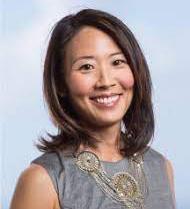
Haeyoung Kong Tang
Thank you to these Pillars in the community.
$200,000 and above
Julie and Bert Cornelison
$200,000 and above
Angel and Fred Kleinbub
$200,000 and above
Sue and Peter Wagener
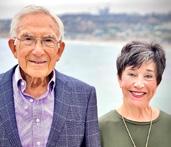
$200,000 and above
Herbert Solomon and Elaine Galinson
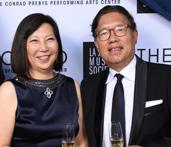
$200,000 and above
Vivian Lim and Joseph Wong
For information about supporting La Jolla Music Society through membership in the Pillars program, please contact Ferdinand Gasang at 858.526.3426 or FGasang@TheConrad.org.
SUMMERFEST CHAIRS
Marge Schmale
Nancy Linke Patton
GALA CHAIRS
Lise Wilson and Steve Strauss
ARTIST HOSTING COMMITTEE
Brenda Baker
Marla Bingham
Vivian Lim
Sheryl Scarano
Marge Schmale
Maureen Shiftan
Sue Wagener
Dolly Woo
FESTIVAL FOUNDING UNDERWRITERS
Brenda Baker and Steve Baum
THE SYNERGY INITIATIVE PRODUCERS
Inon Barnatan
Clara Wu Tsai
SUMMERFEST MUSIC DIRECTOR UNDERWRITERS
Raffaella Belanich
FARFY FOUNDATION FELLOWSHIP ARTISTS UNDERWRITERS
Liqun Wang and Marco Londei
MEDALLION SOCIETY AND FESTIVAL SPONSORS
Judith Bachner and Eric Lasley
Benjamin Brand and Shara Williams
Brenda Baker and Steve Baum*
Jeff Barnouw
Jasna and David Belanich
Raffaella Belanich*
Mary Ann Beyster
Abdul Bitar
Robert Black
Karen and Jim Brailean
Eleanor Charlton*
Raymond Chinn
Mary Ellen Clark*
Peter Cooper
Julie and Bert Cornelison*
Martha and Ed Dennis
Jendy Dennis
Brian Devine
Barbara Enberg
Karen Fox
Pam and Hal Fuson
Elaine Galinson and Herbert Solomon*
Buzz and Peg Gitelson
Lisa Braun-Glazer and Jeff Glazer
Brenda and Michael Goldbaum
Margaret Stevens Grossman and Michael Grossman
Pati Heestand
John Hesselink
Irwin Jacobs*
Theresa Jarvis
Helen and Keith Kim*
Angelina and Fred Kleinbub*
Dorothea Laub*
Vivian Lim and Joseph Wong*
Christine and Charles Lo
Diana and Eli Lombrozo
Viviana and Enrique Lombrozo
Barbara Loonin
Kathleen and Ken Lundgren
Elaine and Doug Muchmore
Arlene and Louis Navias
Nancy Linke Patton and Rip Patton
Peggy and Peter Preuss
Tom Rasmussen and Clayton Lewis
Sylvia and Steve Ré
Jaqueline and Jean-Luc Robert*
Cassidy Robins
Stacy and Don Rosenberg
Leah Rosenthal and Matthew Geaman
Leigh P. Ryan
Sheryl and Bob Scarano
Clifford Schireson and John Venekamp
Marge and Neal Schmale
Maureen Shiftan
Susan Shirk and Sam Popkin
Karen and Kit Sickels*
Robert Singer
Susan and Gerald Slavet
Diane and DJ Smith
Annie So
Jeanette Stevens
Gloria and Rodney Stone
Elizabeth Taft
Haeyoung Kong Tang*
Debra Turner*
Susan and Richard Ulevitch
Sue and Peter Wagener*
Liqun Wang and Marco Londei*
Abby and Ray Weiss
Lise Wilson and Steve Strauss
Dolly and Victor Woo
Clara Wu Tsai
Anna and Edward Yeung
Bebe and Marvin Zigman
Anonymous
FESTIVAL HOSTS
Betty Amber
Mary Ann Beyster
Marla Bingham and Gary Gallagher
Alicia and Rocky Booth
Jane Burns and John Gordon
Mary Caffery and Martin Stein
Jean Castruita
Kay Chandler
Linda Christensen and Gonzalo Ballon-Landa
Susan Coll
Julie and Bert Cornelison
Amy Corton and Carl Eibl
Ann Craig
Martha and Edward Dennis
Sue Dramm
Barbara Enberg
Gail Ermer
Jennifer and Kurt Eve
Sue and Chris Fan
Lehn and Richard Goetz
Pati Heestand
Nicole Holland
Irwin Jacobs
Sue Kalish
Molly Lee and Christopher Li
Vivian Lim and Joseph Wong
Nancy Linke Patton and Rip Patton
Diana and Eli Lombrozo
Margaret McKeown and Peter Cowhey
John Miller
Elaine and Doug Muchmore
Garna Muller
Susan Shirk and Samuel Popkin
Thomas Rasmussen and Clayton Lewis
Carol Raynard
Sylvia and Steve Ré
Cassidy Robins
Stacy and Don Rosenberg
Cynthia Rosenthal
Leah Rosenthal and Matthew Geaman
Arlene and Peter Sacks
Jane and Eric Sagerman
Sheryl and Bob Scarano
Clifford Schireson and John Venekamp
Maureen Shiftan
Marge and Neal Schmale
Robert Singer
Diane and DJ Smith
Helen Tomlinson
Greta and Stephen Treadgold
Susan and Richard Ulevitch
John and Kathleen Vaughan
Diana Vines
Sue and Peter Wagener
Liqun Wang and Marco Londei
Abby and Ray Weiss
Dolly and Victor Woo
Listing as of June 2026
* Pillars member(s)
We are deeply grateful to the generous supporters who share our passion for the arts. It is our privilege to recognize the following donors, whose commitment makes it possible for us to present exceptional programming year-round.
($250,000 and above)

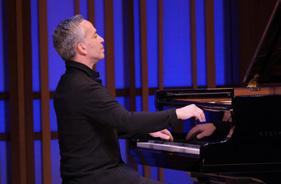
Brenda Baker and Steve Baum
Raffaella and John* Belanich
The City of San Diego Cultural Affairs
The Conrad Prebys Foundation
ANGEL
($100,000 - $249,999)
Eleanor and Ric* Charlton
Mary Ellen Clark
Peter Cooper and Erik Matwijkow*
Farfy Foundation
Jaqueline and Jean-Luc Robert
BENEFACTOR
($50,000 - $99,999)
GUARANTOR
($25,000 - $49,999)
Wendy Brody Estate
Julie and Bert Cornelison
Teresa and Merle Fischlowitz*
Elaine Galinson and Herbert Solomon
Helen and Keith Kim
Angelina and Fredrick Kleinbub
Vivian Lim and Joseph Wong
ProtoStar Foundation
Sheryl and Bob Scarano
Mary Ann Beyster
Robert Black
Gordon Brodfuehrer
Eric Cohen and Bill Coltellaro*
Silvija* and Brian Devine
Barbara Enberg
Jennifer and Kurt Eve
Lehn and Richard Goetz
Jeanne Herberger
John Hesselink
Teresa and Harry* Hixson
Nancy Linke Patton and Rip Patton
Joan* and Irwin Jacobs
Dorothea Laub
Ron Wakefield Estate
Anna and Edward Yeung
Stacy and Don Rosenberg
Karen and Kit Sickels
Debra Turner
Liqun Wang and Marco Londei
Clara Wu Tsai and Joseph Tsai
Marge and Neal Schmale
Mao and Doctor Bob Shillman
Jeanette Stevens
Elizabeth and Joseph* Taft
Revocable Trust
Haeyoung Kong Tang
Vail Memorial Fund
Sue and Peter Wagener
Bebe and Marvin Zigman
The Lodge at Torrey Pines
Diana and Eli Lombrozo
Viviana and Enrique Lombrozo
Arlene and Lou Navias
Jeanne and Rick Norling
Thomas Rasmussen and Clayton Lewis
Sylvia and Steve Ré
Gloria and Joseph Shurman
Lise Wilson and Steven Strauss
($15,000 - $24,999)
Judith Bachner and Dr. Eric L. Lasley
Banc of California | Stephen Gamp
Jasna and David Belanich
Marla Bingham and Gary Gallagher
Jim Beyster
Café Coyote and Rancho Coyote Wines
California Arts Council
Sharon L. Cohen
Karen and Don* Cohn
Ellise and Michael Coit
Cushman Foundation
Jendy Dennis Endowment Fund
Martha and Edward Dennis
Ann Parode Dynes and Robert Dynes*
Dr. Seuss Foundation
Pam and Hal Fuson
Brenda and Michael Goldbaum
Susan and Bill Hoehn
Susan and David Kabakoff
Jo Kiernan
Elaine Lipinsky Family Foundation
Ann and Gerald* Lipschitz
Kathleen and Ken Lundgren
Sue and John Major
Miguel R. Mata MD
Kazeem Omidiji
Leigh P. Ryan
Clifford Schireson and John Venekamp
Maureen and Thomas* Shiftan
Robert Singer
Dagmar Smek and Arman Oruc
Reesey and David Shaw
Susan Shirk and Sam Popkin
Diane and DJ Smith
Stephanie and Nick Stone
Mariko Sawa and Ulf Sundberg
Greta and Steve Treadgold
Abby and Ray Weiss
Dolly and Victor Woo
SUPPORTER ($10,000 - $14,999)
Anonymous
Celeste and Timothy Bailey
Angela and Abdul Bitar
The Blades Foundation
Robyn Bottomley and Glenn Gutridge
Colette Carson Royston and Ivor Royston
Raymond Chinn
Amy Corton and Carl Eibl
County of San Diego Community Enhancement Fund
Una Davis
Nina Doede
The Hon. Diana Lady Dougan
Kate Leonard and Richard Forsyth
Dr. Seuss Foundation
Joy Frieman
Wendy Frieman
Margaret and Michael Grossman
Tracie and Terence Hart
Cheryl Hintzen-Gaines and Ira Gaines
Angela and Cory Homnick
Marilee and Peter Kovacs
Elaine and Doug Muchmore
Barbara Muenzen and Thomas Daniel
Robin and Hank Nordhoff
Carol Randolph and Robert Caplan
ResMed Foundation
Annie So
Mary Sophos and William Pitts
Peggy and Peter Preuss
Barbara and Sam Takahashi
Gwynn and Brian Thomas
Susan and Richard Ulevitch
Mary L. Walshok
Sheryl and Harvey* White
Armi and Al Williams
Carol Young and Leonard Kornreich
Aaron Zigman
($5,000 - $9,999)
Anonymous (3)
Judith Adler
Jeffrey Barnouw
Donna and Dr. Fred Berger
Emily and Barry Berkov
Carolyn and Giovanni Bertussi
Deanna Bittker
Berenice and Jerry Blake
Karen and Jim Brailean
Benjamin Brand and Shara Williams
Isabel and Stuart Brown
Marilyn Huff and William Boggs
Carol Carlisle
Lisa and David Casey
Cathy and Michael Casteel
Katherine and Dane Chapin
June Chocheles
Rachel and PJ Chryssostomides
Carolyn and Clifford Colwell
Elaine Darwin
Shelly and Stephen Davalos
George and Tallie Dennis
Jill Esterbrooks and James Robbins
Karen Fox
Beverly Fredrick
Barbara and Joseph Giammona
Buzz and Peg Gitelson
Lisa Braun Glazer and Jeff Glazer
Virginia Graham
Deborah and Ronald Greenspan
Barbara and Paul Hirshman
Nancy and Stephen Howard
David Hsieh
Theresa Jarvis
Lynn Kirkpatrick
Barbara Kjos
Bill and Sallie Larsen
Sylvia Liwerant
Christine and Charles Lo
Barbara Loonin
Jain Malkin
Janine Marcus
Dennis A. McConnell
M. Margaret McKeown and Peter Cowhey
Gini and Dave Meyer
Andrea Migdal and Mike Tierney
Nicola and Tom Miller
Betsy Mitchell
Cynthia and George Mitchell Foundation
Joyce and Ron Nelson
Pam Palisoul
Linda Platt
Ursula Pfeffer
Debbe and Jack Powell
Vivien Ressler
Eva and Doug Richman
Catherine Rivier
Carole and Howard Robin
San Diego Theatres
Todd R. Schultz
Marivi and Ruey Shivers
Susan and Gerald Slavet
Iris Strauss
Gloria and Rod Stone
Gayle and Philip Tauber
Ayse Underhill
Ana de Vedia
Susan Ward and Lawrence Gartner
Lynne and David Weinberg
Joyce Williams
Mary and Joseph Witztum
Katrina Wu
Jeanette and Jack Young
AFICIONADO ($2,500 - $4,999)
Anonymous
Arleene Antin and Leonard Ozerkis
Marilyn Colby
Ann Craig
Sue Dramm
Margaret Dudas
Mary Duncan
Phyllis and Dan Epstein
Girard Foundation|Debe and Mike Alpert
Cynthia and Tom Goodman
Cynthia King and John Graul
Lulu Hsu
Marilyn K. James and Rick Phetteplace
Sheri Jamieson
Karen and Warren Kessler
Jeeyoon Kim
Chantelle and Kenneth Labowe
Carol Lam and Mark Burnett
Eliza Lee
Barbara Maggio
Nancy H. and Brian Malk
Eileen A. Mason
Ted McKinney
Susan and Doug McLeod
Sandra Miner
Muchnic Foundation
Garna Muller
Beth Murray
Virginia Oliver
Marina and Rafael Pastor
Allison and Robert Price
Christine Purcell
Cynthia and Barry Rosenbush
Cynthia Rosenthal
Cristina and Victor Saldivar
Anne and Ronald Simon
Jean Sullivan and David Nassif
Yvonne E. Vaucher
Cynthia Webb and Craig Dorval
Jo Weiner
Lisa Widmier
David A. Wood
Christy and Howard Zatkin
ASSOCIATE ($1,000 - $2,499)
Anonymous (3)
Axel’s Gift
Terence Balagia
Christopher Beach and Wesley Fata
Julie and Edgar Berner
Krissy and Jeremy Caldwell
Molly and Charles Brazell
Diane M. Brockington
Ryan Brown
Carol and Jeff Chang
Guangli Chen
Anthony Chong and Annette Nguyen
Linda Christensen and Gonzalo Ballon-Landa
Carol and Joe Danks
Caroline DeMar
Marilou and Marty Dense
Gail Donahue
Karen Dow
Sheryl and Michael Durkin
Marianne and Robert Engle
Larry Fechter
Irene and Eduardo Feller
Diane and Elliot Feuerstein
Ferdinand Marcus Gasang
Anne and Richard J. Glynne
Kimberly and Jeffrey Goldman
Jane Burns and John Gordon
Carrie Greenstein
Lee Ann and Jud Groshong
Jill Hall
Samuel Lawrence Foundation |
Pamela Hamilton Lester
Cindy and Roger Hedgecock
Carol Harter and William Smith
Ann Holt
Ida Houby and Bill Miller
Patricia and Kenneth Janda
Zella Kahn-Jetter and Gary Jetter
Dwight Kellogg
Stephanie Kogan and Lawrence Fritz
Dr. Haig and Susan Koshkarian
Kathleen Kovacs
Tina and Julian Krinsky
Katie Li
Robin Luby
Elinor Merl and Mark Brodie
Maggie and Paul Meyer
Moody Insurance
Judie and David Nielsen
Barbara and Donald Niemann
Charles Perrin
Barbara Rabiner
Stephen Ryder and Nicola Helm
Hermeen Scharaga
Phyllis and David Snyder
Judith and Larry Sowder
Annemarie and Leland Sprinkle
Dale and Mark Steele
Lester and Elizabeth Stiel
John Tauscher
Jennifer Tillman
N.B. Varlotta
Karen M. Walter
Jin Wang
Suzanne and Edward Weissman
Symphorosa Williams, MD
Carole Wilson
Lisa and Michael Witz
David A. Wood
Natasha Wong and Kevin Chen
Danielle Xu
Barbara and Michel Zelnick
Bart Ziegler
Phyllis and Phil Ziring
FRIEND ($500 - $999)
Anonymous (3)
Dean Abelon
Robin Allgren
Laura Applegate
Carol and Bruce Boles
Margie Carroll
Alain J.-J. Cohen*
Kim Doren
Z.E. Dziewanowska, M.D. Ph.D.
Stephen Feldman Foundation for the Children of the Californias
Catherine Friedman
Robert Gleason and Marc Matys
Tom Gleich
Beth Goodman
Sharon Gorevitz and Alan Greenberg
Linda Howard
Thesa Jolly
Nancy and Michael Kaehr
Gabrielle and Jay Kunin
Laura and Robert Kyle
Jacqueline Laria
C.A. La Pierre
Helen M. Shafir and Lewis Leicher
Linda and Michael Mann
Patricia Moises
Francie Murphy and Rick Mitchell
Norman Needel
Kyomi O’Connor
Sigrid Pate
Mary and John David Peters
Bill Purves and Don Schmidt
Sharon Rearwin and Thomas Delmer
Jodyne Roseman
Gabriele and Nathan Rosenblatt
Marc and Naomi Sacks
Nora and Fritz Sargent
Denise Selati
Esther and Vladamir Sluzky
Lee Talner
Anne Turhollow
Jennifer J. Werner
Carol West
Suhaila White
Olivia and Marty Winkler
Tanya Young and Michael McManus
Charleen Zieky and Robert Berman
Sue Andreasen
Yulia Atoyan and Alexander Mirolyan
Colleen Bingham
Sondra J. Boddy and Robert C. Smith
Katie and Chuck Boyer
Gloria and Sed Browne
Linda and Edgar Canada
Barbara Carey
Michael Casey
Lanna Cheng Lewin
Marjorie Coburn
Karen and Harris Cohen
Susan Crutchfield
Linda and Rick Dicker
Beverly Fremont
Pamela and L. Michael Foley
Kathleen L. Fredman
Margareta and Bruce Galanter
Sue Greenway
Sean Gref
Mary and Rodger Heglar
Walter Hickey
Nicole Holland
Vivian and Greg Hook
Gregory A. Jackson
David K. Jordan
Anne Ladu
Hugh Lawrence
Patricia Manners
John B. Marshall
Ariana Merlino
Gerald J. Miller
Brigitte and Richard Obetz
Leah Ollman
Adam A. Padua
Susan Z. Pantaleoni
Irina and Mikhail Prishchepa
Patricia Rosenberg
Katya Rubanov
Carolyn Rynard
Ken Shaw and Shawn Webster
Judith Springer
Alice and Brad Saunders
Marjorie Hansen Shaevitz
Debra J. Shannon
Julie Singletary
Carol Ann Susla
Marie Tartar and Steve Eilenberg
Jordan Toellner
Gonul Velicelebi
Marty Visitacion
Suzanne Weiner
Drs. Er-Kai Gao and Bien Zhang
Kevin Zheng
Jay Zybelman
monthly Ostinato donor
* in memoriam
This list is current as of July 1, 2026. We regret any errors. Please contact Wil Owen at WOwen@TheConrad.org or 858.526.3447 to make a correction.
Dorothea Laub
Elaine Galinson and Herbert Solomon
Bebe and Marvin Zigman
Amy Corton and Carl Eibl
Annie So
Ellise and Michael Coit
Jeanette Stevens
Anonymous
Carolyn and Giovanni Bertussi
We are grateful for each member for their passion and support of our dance programs.
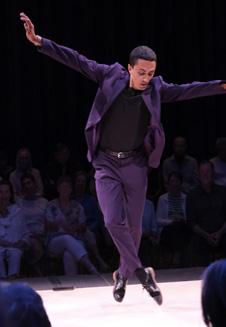
In Memory of Bjorn Bjerede: Jo Kiernan
In Memory of Ric Charlton:
Ferdinand Marcus Gasang
Sylvia and Steve Ré
Stacy and Don Rosenberg
Abby and Ray Weiss
In Honor of Bill Coltellaro:
Marilyn Adler
Lauren Cernik-Price
Kimberly and Christophe Chevallier
Eric Cohen
Mary and Carl Cook
Sam Crowley and Cameron Blankenship
Shaun Davis
Kane Foster
Ferdinand Gasang
Sue Greenway
Sean Gref
Wadeaa Jubran and Scott Meader
Nancy Linke Patton and Rip Patton
Ken Shaw and Shawn Webster
Monique Smith
Annie and Brady Stender
Barbara and Sam Takahashi
Julie Ustin
Holly Verman
Lawrence Woodburn
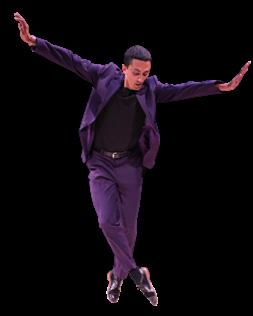
In Honor of The Conrad Box Office: Samuel Lawrence Foundation | Bart Ziegler
In Honor of Bob Dynes:
Sylvia and Steve Ré
In Memory of
Teresa and Merle Fischlowitz:
Camden and Rob Fischlowitz
In Honor of Ferdie Gasang:
Peg and Buzz Gitelson
Maggie and Paul Meyer
Mao and Doctor Bob Shillman
In Memory of Harry Hixson:
Ferdinand Gasang
In Memory of Joan Jacobs:
Ferdinand Marcus Gasang
Eliza Lee
Sylvia and Steve Ré
Todd Schultz
John Venekamp and Clifford Schireson
In Honor of Wadeaa Jubran: Hermeen Scharaga
In Memory of Bob Kyle: Laura Kyle
In Memory of Theodora Lewis: Jennifer Lewis
In Memory of Erik Matwijkow: Ferdinand Gasang
Peter Cooper
In Memory of Joani Nelson: The Nelson Family
In Memory of Harlan Ochs: Barbara Carey
In Honor of Marilyn Perrin: Charles Perrin
In Honor of Leah Rosenthal: Samuel Lawrence Foundation | Bart Ziegler
In Honor of Todd Schultz:
Anonymous
Pam and Hal Fuson
Marilyn James and Rick Phetteplace
Hermeen Scharaga
In Honor of Maureen and Thomas Shiftan: Nicole Holland
In Memory of Thomas Shiftan:
Ferdinand Marcus Gasang
Susan and Richard Ulevitch
Sylvia and Steve Ré
Abby and Ray Weiss
In Memory of Ford Stone: Barbara Carey
In Memory of Dr. Steve Thomas: Barbara Carey
In Honor of Liqun Wang and Marco Londei: Mary K. Plantes, PhD.
In Honor of Dolly and Victor Woo: Anonymous
The following have made gifts or pledges to the endowment that have been fully or partially received.
$10 million or higher
Steve Baum
The Conrad Prebys Foundation
$1 million to $999,999
Wendy Brody*
Nancy Linke Patton and Rip Patton
Stacy Kellner Rosenberg and Don Rosenberg
Haeyoung Kong Tang
Sue and Peter Wagener
Bebe and Marvin Zigman
$999,999 and under
Jendy Dennis*
Teresa and Merle Fischlowitz*
Lynda Fox*
Ted and Ingrid Friedmann
Maxwell H. and Muriel S. Gluck*
Trude Hollander*
Helen and Keith Kim
Theodora Lewis*
Joani Nelson*
Jay W. Richen*
Leigh P. Ryan
Jack and Joan Salb*
Sheryl and Bob Scarano
Karen and Christopher Sickels
Ronald Wakefield*
The following have provided signed commitments of gifts in their estate plans that have not yet been received.
Judith Bachner and Eric Lasley
Christopher Beach and Wesley Fata
Raffaella Belanich
Marla Bingham and Gary Gallagher
Eleanor and Ric* Charlton
Julie and Bert Cornelison
Elaine Galinson
Vivian Lim and Joseph Wong
Jaime z”l and Sylvia Liwerant
Sylvia and Steven Ré
Marge and Neal Schmale
Todd Schultz
Reesey and David Shaw
Jeanette Stevens
The following have indicated that La Jolla Music Society is in their estate plans.
Anonymous (2)
Brenda Baker
June L. Bengston*
Donna and Dr. Fred Berger
Joan Jordan Bernstein
Bjorn Bjerede* and Jo Kiernan
James C. and Karen A. Brailean
Gordon Brodfuehrer
Barbara Buskin*
Trevor Callan
Geoff and Shem Clow
George and Cari Damoose*
Sue Dramm
Joy and Ed* Frieman
Sally Fuller
Joan* and Irwin Jacobs
Maria and Dr. Philippe Prokocimer
Bill Purves
Darren and Bree Reinig
Johanna Schiavoni
Pat Shank
Joseph and Gloria Shurman
Marge and Neal Schmale
Elizabeth and Joseph* Taft
Norma Jo Thomas
Yvonne E. Vaucher
Lucy and Ruprecht von Buttlar
John B. and Cathy Weil
Karl and Joan Zeisler
Josephine Zolin
* in memoriam
indicates donors who have made both planned gifts and endowment cash commitments.
If you have included LJMS in your estate plans, please let us know so we may recognize you.
Please contact Ferdinand Gasang at FGasang@TheConrad.org or (858) 526-3426.


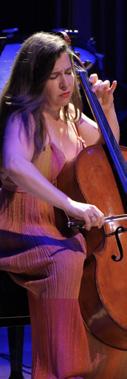
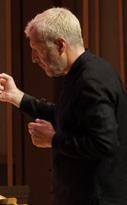
CROWN JEWEL
Brenda Baker and Steve Baum
Joan* and Irwin Jacobs
Dorothea Laub
DIAMOND
Raffaella and John* Belanich
Eleanor and Ric* Charlton
Mary Ellen Clark
Jaqueline and Jean-Luc Robert
Karen and Kit Sickels
Debra Turner
Liqun Wang and Marco Londei
RUBY
Julie and Bert Cornelison
Silvija* and Brian Devine
Elaine Galinson and Herbert Solomon
Helen and Keith Kim
Angelina and Fred Kleinbub
Vivian Lim and Joseph Wong
Neal and Marge Schmale
Haeyoung Kong Tang
Sue and Peter Wagener
Anna and Edward Yeung
EMERALD
Barbara Enberg
Arlene and Louis Navias
GARNET
Pam and Hal Fuson
SAPPHIRE
Virginia* and Robert Black
Raymond Chinn
John Hesselink
Kathleen and Ken Lundgren
Elaine and Doug Muchmore
Annie So
Elizabeth and Joseph* Taft
Bebe and Marvin Zigman
TOPAZ
Anonymous
Jeff Barnouw
Mary Ann Beyster
Abdul Bitar
James C. and Karen A. Brailean
Benjamin Brand and Shara Williams
Karen Fox
Buzz and Peg Gitelson
Lisa Braun-Glazer and Jeff Glazer
Brenda and Michael Goldbaum
Margaret Stevens Grossman and Michael Grossman
Theresa Jarvis
Christine and Charles Lo
Barbara Loonin
Peggy and Peter Preuss
Don and Stacy Rosenberg
Leigh P. Ryan
Sheryl and Bob Scarano
Gloria and Joseph Shurman
Susan and Gerald Slavet
Diane and DJ Smith
Jeanette Stevens
Gloria and Rodney Stone
Susan and Richard Ulevitch
Dolly and Victor Woo
*in memoriam
We are honored to have this extraordinary group of friends who have made multi-year commitments to La Jolla Music Society, ensuring that the artistic quality and vision we bring to the community continues to grow.
La Jolla Music Society stands at a pivotal moment in its history. As we look ahead to our 60th Anniversary Season in 2028—29, we have embarked on an ambitious $60 million endowment campaign to ensure a bold, sustainable, and artistically vibrant future.
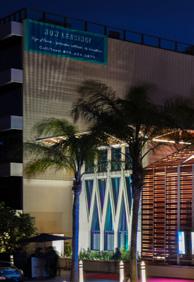
This campaign is more than a commitment to stability—it’s about unlocking possibility to:
Present the world’s leading artists with creativity, boldness, and confidence
Deepen and expand our community impact far beyond the stage
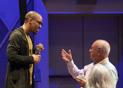
Inspire lifelong learning through dynamic education and engagement programs
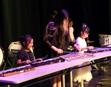
Advance San Diego’s future by building our national reputation as a beacon of excellence and opportunity
Sustain and enhance our state-of-the-art facilities
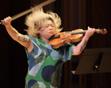
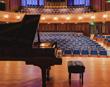
Endowment support is a powerful way to ensure that La Jolla Music Society continues to thrive—artistically, educationally, and culturally—for generations to come. Critically, it provides the stability to dream boldly, take creative risks, and welcome more people of all ages into the magic of live performance. With your support, we can ensure that every performance at The Conrad continues to astonish, inspire, and connect—now and far into the future.
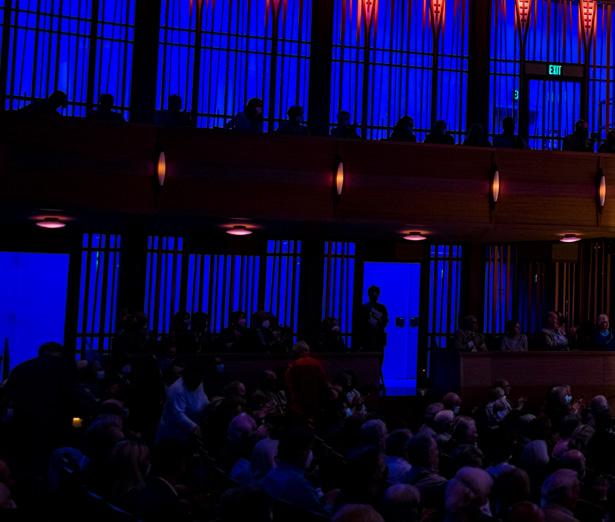
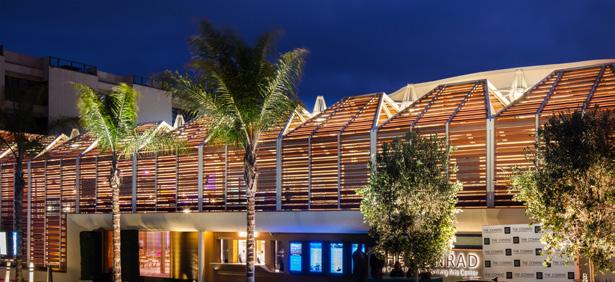
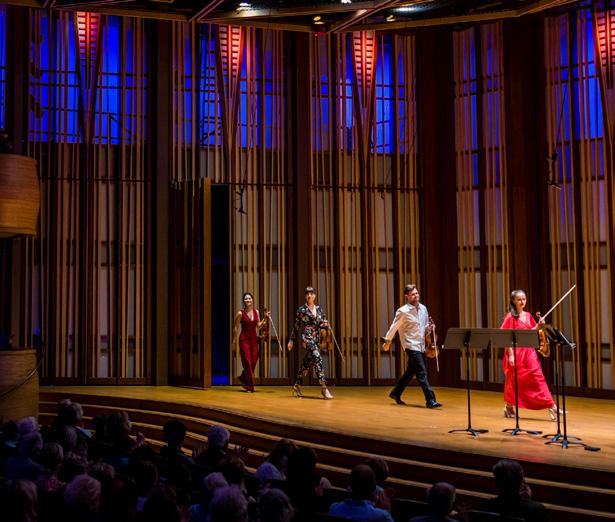
We are deeply grateful to the individuals listed below whose vision and dedication ensure that artistic excellence, educational impact, and cultural vibrancy will continue to thrive.
Judith Bachner and Eric Lasley
Steve Baum
Christopher Beach and Wesley Fata
Raffaella Belanich
Eleanor and Ric Charlton
Julie and Bert Cornelison
Elaine Galinson
Pati Heestand
Helen and Keith Kim
Vivian Lim and Joseph Wong
Nancy Linke Patton and Rip Patton
Sylvia and Steven Ré
Stacy Kellner Rosenberg and Don Rosenberg
Leigh P. Ryan
Sheryl and Bob Scarano
Marge and Neal Schmale
Todd R. Schultz
Reesey and David Shaw
Jeanette Stevens
Haeyoung Kong Tang
Debbie Turner
Sue and Peter Wagener
Bebe and Marvin Zigman























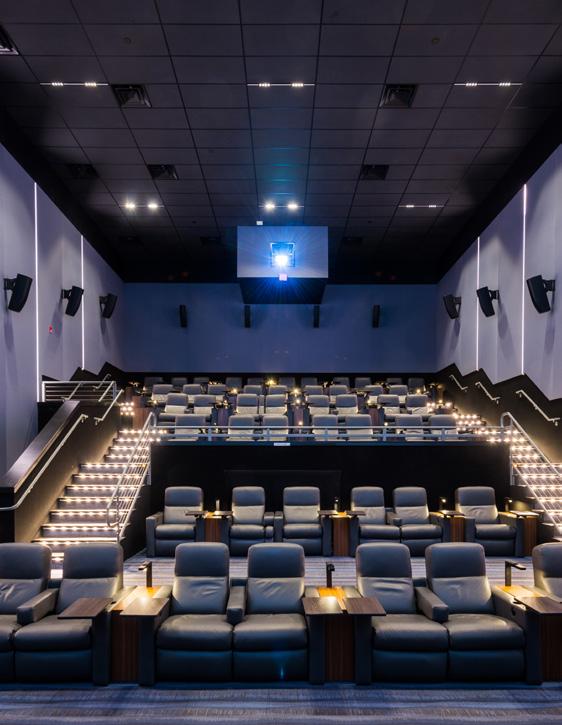




H NY OO HASE!
present from the same day's performance to claim


Edward A. Dennis, PhD Chairman
Mary F. Berglund, PhD Treasurer
Peter C. Farrell, PhD, DSc Secretary
Charles G. Cochrane, MD
Michael P. Coppola, MD
Anthony DeMaria, MD
Sir Neil Douglas, MD, DSc, FRCPE
Klaus Schindhelm, BE PhD
Jonathan Schwartz, MD
Kristi Burlingame Executive Director

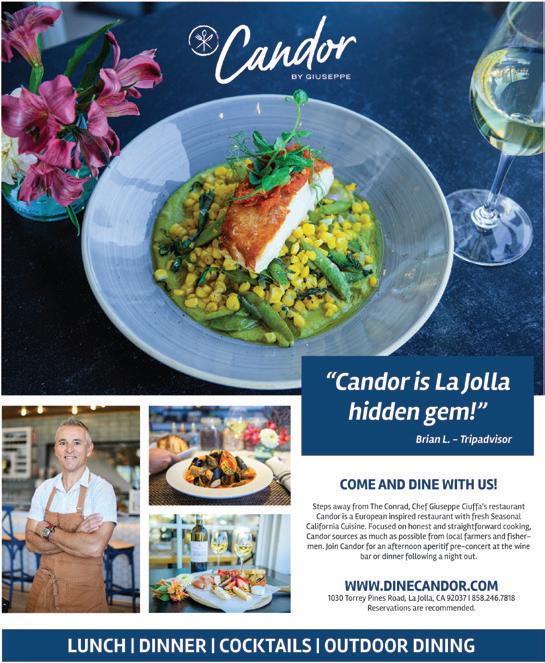
"Candor is La Jolla's hidden gem!"
Brian L. — Tripadvisor


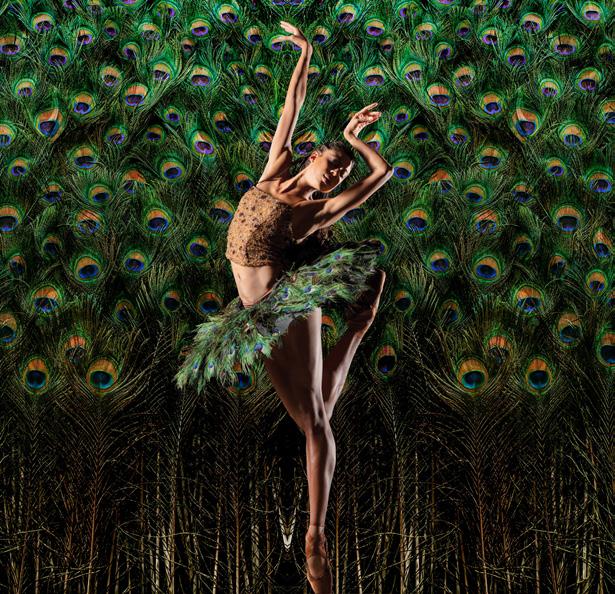
OPENING NIGHT @ THE JAI
FRED HERSCH TRIO*
SUNDAY, SEPTEMBER 20, 2026 · 5 PM & 7:30 PM Concerts @ The JAI
LINDA MAY HAN OH TRIO
FRIDAY, SEPTEMBER 25, 2026 · 5:30 PM & 8 PM Concerts @ The JAI
OPENING NIGHT AT THE BAKER-BAUM JOYCE DiDONATO & TIME FOR THREE
EMILY — NO PRISONER BE
THURSDAY, OCTOBER 8, 2026 · 7:30 PM ProtoStar Innovative Series
POIESIS QUARTET*
SUNDAY, OCTOBER 11, 2026 · 3 PM Discovery Series
GABRIELA MONTERO*, piano
FRIDAY, OCTOBER 23, 2026 · 7:30 PM Piano Series
4 PERFORMANCES
JOHN PIZZARELLI PRESENTS
“DEAR MR. BENNETT”
SATURDAY, OCTOBER 24, 2026 · 5:30 PM & 8 PM
SUNDAY, OCTOBER 25, 2026 · 5 PM & 7:30 PM Concerts @ The JAI
LILA DOWNS
DÍA DE MUERTOS
THURSDAY, OCTOBER 29, 2026 · 7:30 PM Global Roots Series • Balboa Theatre
JEAN-GUIHEN QUEYRAS*, cello & ALEXANDRE THARAUD*, piano FRIDAY, OCTOBER 30, 2026 · 7:30 PM
Recital Series
NEMANJA RADULOVIĆ*& DOUBLE SENS*
SATURDAY, NOVEMBER 7, 2026 · 7:30 PM
Revelle Chamber Music Series
LES ARTS
WILLIAM CHRISTIE, PAUL AGNEW, co-directors THE MAGIC OF MONTEVERDI
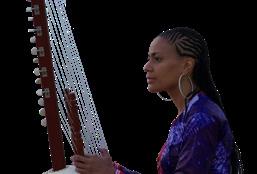
EMANUEL AX, piano
FRIDAY, JANUARY 8, 2027 · 7:30 PM
FRIDAY, NOVEMBER 13, 2026 · 7:30 PM Revelle Chamber Music Series
MANUAL CINEMA* LEONARDO!
SUNDAY, NOVEMBER 15, 2026 · 3 PM
The ConRAD Kids Series
THE NAGHASH ENSEMBLE*
SUNDAY, NOVEMBER 22, 2026 · 3 PM Global Roots Series
MEOW MEOW
FELINE FESTIVE
FRIDAY, DECEMBER 4, 2026 · 7:30 PM Special Event
CONNECT TO THE CONRAD HILARY HAHN, violin; MATTHIAS GOERNE, baritone; YEKWON SUNWOO, piano
SATURDAY, DECEMBER 5, 2026 · 7:30 PM Recital Series
EDMAR CASTAÑEDA QUARTET*
FRIDAY, DECEMBER 11, 2026
5:30 PM & 8 PM
Concerts @ The JAI
LUKAS STERNATH*, piano
SUNDAY, DECEMBER 13, 2026 · 3 PM Discovery Series
HOLIDAY OPEN HOUSE
FRIDAY, DECEMBER 18, 2026 · 4–7:30 PM
THE HOT SARDINES
FRIDAY, DECEMBER 18, 2026 · 7:30 PM Jazz Series
Piano Series
MAGIC PIANO & THE CHOPIN SHORTS*
SATURDAY, JANUARY 23, 2027
10 AM & 11:30 AM
The ConRAD Kids Series • The JAI
CAMILLE THURMAN* WITH THE DARRELL GREEN QUARTET*
SUNDAY, JANUARY 24, 2027
5 PM & 7:30 PM
Concerts @ The JAI
ERIKA WOOLSEY*
DIVING IN THE GREAT BARRIER REEF
THURSDAY, JANUARY 28, 2027 · 7:30 PM
Speaker Series
KRONOS QUARTET
SATURDAY, JANUARY 30, 2027 · 7:30 PM
ProtoStar Innovative Series
ITZHAK PERLMAN IN THE FIDDLER’S HOUSE
SUNDAY, JANUARY 31, 2027 · 7 PM
Global Roots Series • Jacobs Music Center
JULIUS RODRIGUEZ* FROM THE BENCH TO THE THRONE THURSDAY, FEBRUARY 4, 2027
5:30 PM & 8 PM
Concerts @ The JAI
KODO ONE EARTH TOUR 2027 LUMINANCE
FRIDAY, FEBRUARY 5, 2027 · 7:30 PM
Special Event • Balboa Theatre
ANGEL STANISLAV WANG*, piano
SUNDAY, FEBRUARY 7, 2027 · 3 PM
Discovery Series
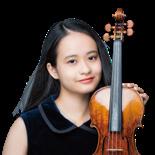
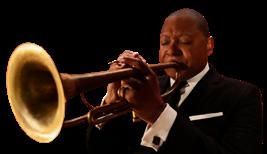
BLACK GRACE
SATURDAY, FEBRUARY 13, 2027 · 7:30 PM
Dance Series • Balboa Theatre
ANAND VARMA*
EXPLORING NATURE’S HIDDEN WORLDS
THURSDAY, FEBRUARY 18, 2027 · 7:30 PM
Speaker Series
CIRCA*
THE ART OF FUGUE
SATURDAY, FEBRUARY 20, 2027 · 7:30 PM
ProtoStar Innovative Series
TYSHAWN SOREY TRIO
SUNDAY, FEBRUARY 21, 2027
5 PM & 7:30 PM Concerts @ The JAI
VÍKINGUR ÓLAFSSON*, piano
THURSDAY, FEBRUARY 25, 2027 · 7:30 PM
Piano Series
JAZZ AT LINCOLN CENTER WITH WYNTON MARSALIS
FRIDAY, FEBRUARY 26, 2027 · 7:30 PM
Jazz Series • Jacobs Music Center
SEONG-JIN CHO, piano
FRIDAY, MARCH 5, 2027 · 7:30 PM Piano Series
STANLEY CLARKE* AND HIROMI ALONG WITH THE PUBLIQuartet
SATURDAY, MARCH 6, 2027 · 7:30 PM Jazz Series • Balboa Theatre
JAEMIN HAN, cello & DAVID FUNG*, piano
THURSDAY, MARCH 11, 2027 · 7:30 PM Recital Series
2 PERFORMANCES
CONNECT TO THE CONRAD
ACADEMY OF ST MARTIN IN THE FIELDS
SATURDAY, MARCH 13, 2027 · 3 PM & 7:30 PM
Revelle Chamber Music Series
SUNDAY, MARCH 14, 2027 · 5 PM & 7:30 PM Concerts @ The JAI
MARK MORRIS DANCE GROUP
SATURDAY, MARCH 20, 2027 · 7:30 PM Dance Series • Civic Theatre
INMO YANG*, violin
SUNDAY, MARCH 21, 2027 · 3 PM Discovery Series
JODI ROWLEY*
WEIRD WORLD OF FROGS
THURSDAY, MARCH 25, 2027 · 7:30 PM Speaker Series
WILDFLOWERS: KURT ELLING WITH CHRISTIAN SANDS
THURSDAY, APRIL 1, 2027 · 5:30 PM & 8 PM Concerts @ The JAI
AN EVENING WITH AUDRA McDONALD
FRIDAY, APRIL 2, 2027 · 8 PM Special Event WINTERFEST GALA
IL POMO D’ORO WITH MICHAEL SPYRES*, baritenor
SATURDAY APRIL 3, 2027 · 7:30 PM Revelle Chamber Music Series
SONA JOBARTEH
THURSDAY, APRIL 8, 2027 · 7:30 PM Global Roots Series
4 PERFORMANCES DREAMERS’ CIRCUS
SATURDAY, APRIL 10, 2027 · 5:30 PM & 8 PM
SUNDAY, APRIL 11, 2027 · 5 PM & 7:30 PM Concerts @ The JAI
2 PERFORMANCES
NOGRAVITY THEATRE*
SATURDAY, APRIL 17, 2027 · 3 PM & 7:30 PM Dance Series
STEVE WINTER*
THE RACE TO SAVE BIG CATS
THURSDAY, APRIL 22, 2027 · 7:30 PM Speaker Series
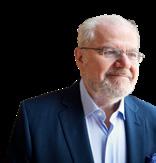
YUJA WANG, piano
SATURDAY, APRIL 24, 2027 · 7:30 PM
Piano Series • Jacobs Music Center
HIMARI*, violin & CHELSEA WANG*, piano
SUNDAY, MAY 2, 2027 · 3 PM
Discovery Series
JASON MORAN* PRESENTS THE MUSIC OF DUKE ELLINGTON: MY HEART SINGS
THURSDAY, MAY 6, 2027 · 7:30 PM
Jazz Series / JAZZ Mini-FESTIVAL
ARTEMIS*
FRIDAY, MAY 7, 2027 · 7:30 PM
Jazz Series / JAZZ Mini-FESTIVAL
JASON MORAN & THE HARLEM HELLFIGHTERS* JAMES REESE EUROPE AND THE ABSENCE OF RUIN
SATURDAY, MAY 8, 2027 · 7:30 PM
ProtoStar Innovative Series / JAZZ Mini-FESTIVAL
LAKECIA BENJAMIN
FRIDAY, MAY 14, 2027 · 5:30 PM & 8 PM
Concerts @ The JAI / JAZZ Mini-FESTIVAL
ALONZO KING LINES BALLET
SATURDAY, MAY 15, 2027 · 7:30 PM
Dance Series / JAZZ Mini-FESTIVAL Civic Theatre
NADINE SIERRA*, soprano BRYAN WAGORN*, piano
SUNDAY, MAY 16, 2027 · 7 PM
Recital Series
ELENA MOON PARK AND FRIENDS*
SATURDAY, MAY 22, 2027
10 AM & 11:30 AM
The ConRAD Kids Series • The JAI
ENDEA OWENS & THE COOKOUT
THURSDAY, MAY 27, 2027 · 5:30 PM & 8 PM
Concerts @ The JAI
Season 58 is packed with performances you won’t want to miss.
Acclaimed international orchestras, including Academy of St Martin in the Fields, Les Arts Florissants, and il Pomo d’Oro, make their thrilling returns to The Conrad. Vocal music lovers can experience Met Opera stars Nadine Sierra and Matthias Goerne, as well as Joyce DiDonato in a semi-staged performance of Kevin Puts’ Emily—No Prisoner Be, alongside the acclaimed string ensemble Time For Three. Next season also welcomes superstar pianists Yuja Wang and Víkingur Ólafsson, violin virtuoso Hilary Hahn, the multi-GRAMMY®-winning Kronos Quartet celebrating the music of Philip Glass, and many more.
Interested in more than one concert?
Pick three of your favorite performances and instantly save 10%.