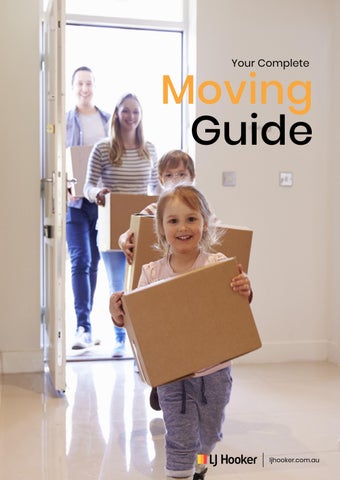
YOUR COMPLETE MOVING GUIDE
Your Complete
Moving Guide
ljhooker.com.au
YOUR COMPLETE MOVING GUIDE
Contents CHAPTER #1
04
CHAPTER #2
07
CHAPTER #3
09
CHAPTER #4
10
CHAPTER #5
12
CHAPTER #6
16
CHAPTER #7
17
Planning Is Key
Organising the Move
Choosing the Right Storage
Clearing Out Your Home
Packing Up Your Belongings
Connecting Your New Home Moving Day
2
YOUR COMPLETE MOVING GUIDE
Introduction Congratulations on your new home! Whether you have purchased a property or secured a new rental, an exciting chapter awaits. But there is a reason why we usually only relocate a couple of times in our lives – moving is hard work. The good news is that it can be stress-free with the right planning. To ensure things go as smoothly as possible, we have compiled expert tips, advice and checklists to make your move as easy as possible. Keep this guide handy as you pack up your old home and get set for a fresh start in your new place.
YOUR COMPLETE MOVING GUIDE
CHAPTER #1
Planning Is Key Success comes with the right preparation Don’t make the mistake of leaving everything to just a week out from your move, as it could cause major delays and headaches. Time has a habit of disappearing quickly – especially when you are clearing out an entire house. Here are some important points to consider to make a successful transition into your new home.
Taking the first step Before anything else, set a timeline. The key is finding out when you will need to vacate your current property and when you can move into your new place. If there is a gap, contact your real estate agent to check if the dates are flexible. Unfortunately, this isn’t always possible and could mean putting items into self-storage and finding some temporary accommodation (‘hello, friend’s couch’) or booking into a hotel for a couple of days.
4
| ljhooker.com.au
YOUR COMPLETE MOVING GUIDE
Organise the essentials •
Create a list of everything that needs packing in each room to estimate logistics or storage (i.e. how many beds will you be moving?)
•
Measure large or bulky furniture items and take careful note of height and width
•
A floor plan of your new home will help to work out whether it will all fit
•
Find out where the easier points of access are in your new home for moving in furniture
•
Double-check if the driveway at your new home can accommodate a small truck or moving van
•
You may also need to reserve street parking, especially if removalists will be unloading items into a narrow lane or busy inner-city area. Some moving companies may cover these costs and even organise it – but you need to check at least 10 days in advance
Documents Some essential documents that you might need on hand for during your move, such as: •
Your old and new tenancy agreements (if renting)
•
Floor plans
•
Checklists
•
Utility provider contact numbers
•
Plane tickets, visas and passports (if moving overseas)
Collate all of these important moving documents in one easy-to-find place or folder and keep them on hand during your move.
Schools If your child is moving to a new school, you will need to organise their transfer. For the state system, this is largely determined by your new address. If you are looking for a Catholic school, then you will need to find one that is within your new local parish area. Your school administrator is a great resource and should be able to help you with any necessary paperwork. Allow enough time to purchase new school uniforms and bus passes. No child wants to attend a new school in different clothing, or worse, their old uniform.
5
| ljhooker.com.au
YOUR COMPLETE MOVING GUIDE
Mail Pay attention when collecting your mail so you know who to notify about your upcoming change of address.
Create a paperwork file The last thing you want is to lose important documentation – such as passports, birth certificates, tax returns and photo albums – in the move. Invest in a small filing cabinet, hanging file box or even a large folder. Scan and photocopy important documents. Make multiple backups of your computer’s hard drive, including your online photo albums.
“
The last thing you want is to lose important documentation such as passports, birth certificates, tax returns and photo albums in the move.
Keep all your documentation in the one packing box - to ensure you don’t lose track of it. Label it with something generic such as ‘craft items’ or ‘textbooks’ so that only you will realise its value. This is one item probably best to move yourself.
6
| ljhooker.com.au
YOUR COMPLETE MOVING GUIDE
CHAPTER #2
Organising the Move Taking the next step Once you have booked in your dates, you need to decide whether you will be moving yourself or using professional removalists. Some people are too busy to do the move themselves, but others may prefer to save the money and recruit friends to help them. Here are some tips to keep in mind for whichever option you select.
Using A Professional If you are opting to use professional packers, we’ve taken a step to make that easier. LJ Hooker Assist can sort out all your moving needs. Every day, they help families to relocate, connecting them to recommended local removalists. With one phone call, they can arrange all your core home moving needs and connections to most utilities. And best of all, this service is offered free of charge. If you prefer to do the research yourself, be sure to source at least three quotes from different moving services. Providing them with a list of items to be moved will also mean a more accurate idea on costing. Also ask: •
Are their rates daily or by the hour?
•
What is their moving process?
•
Check if there are extra fees for tricky access, multiple flights of stairs or lifting heavy items
•
Packing and storage services
•
Referrals/ recommendations
•
Are they members of a professional body such as the Australian Furniture Removers Association (AFRA)?
•
Do they offer insurance?
7
| ljhooker.com.au
YOUR COMPLETE MOVING GUIDE
Most removalists offer insurance on top of their services, and this can be a useful tool to protect your contents from accidental loss or damage. It is also worth checking with your home insurance provider to see if it is included or could be added to your current policy. If you are relocating overseas, some specific items may be prohibited, so be sure to check. Your fur-baby will need special arrangements too, so be sure to source a reliable and caring transport company. A check of online reviews of removalist and pet transport companies can be a helpful s tarting point too.
Doing It Yourself If you are up for a challenge, a ‘DYI move’ can certainly save on money and be hugely rewarding. But you will need to rope in a few friends and family to make the workload a lot lighter. Be sure to offer your helpers food or drink as a way of saying thanks, and offer to return the favour. You’ll also need to organise transport. This might be through a truck rental, ute hire or even a trailer on the back of your personal vehicle. Don’t forget to organise ropes, blankets and ties to ensure that everything stays safe and secure in transit. Identify any hazards, such as cables running along the floor or uneven or slippery surfaces. Be sure to use proper lifting techniques when it comes to large or bulky items. Lift with the legs rather than the back, and for bigger items, try to spread the weight evenly across a few people. You will need to hire a trolley for extra support when moving refrigerators or other large items. Be realistic when it comes to lifting heavy items. The last thing you want to do is injure yourself, a family member or friend, just to save a few dollars.
8
| ljhooker.com.au
YOUR COMPLETE MOVING GUIDE
CHAPTER #3
Choosing the Right Storage Depending on your move-in date for your new home, you might have to use storage facilities to keep your contents safe and secure. In Australia, there are three main types of storage services you can use. As with removalist services, make sure you obtain a few quotes to find the best deal possible.
Container Storage This is a simple and easy method of storing your contents. Prior to your move, the company will deliver a storage container to your home. You fill it up and organise the provider to pick it up from your property to place it in a storage facility. This service is usually called a ‘self-load container service’ and is quite popular due to the minimal need for handling. However, the service can be quite costly due to the delivery and pickup features.
Self-Storage Through self-storage, you can choose an appropriately sized space to suit your needs. With this process, you’ll be the one moving your items in and out of the space. Self-storage locations are very secure and will usually come with a padlock, which will give you peace of mind, as you will be the sole keyholder. Usually, you’ll sign up for a set rental period for your storage space. This can be month by month or longer terms over 6 months to give you flexibility.
Garage Storage Alternatively, you could ask friends and family if you can store items at their property or garage for a short period of time. This will help to cut down costs significantly, as every little bit counts. But remember they will want you to move them out. All the boxes. And on time.
Organising Temporary Accommodation You might need a place to stay to fill in the time between moving out of your old home and into your new one. Check with serviced apartment providers or motels for weekly rates. Otherwise, see if you can stay with family or friends for a few days. While it’s not ideal, especially with young children or teens, sell it to them as part of the ‘moving adventure’.
9
| ljhooker.com.au
YOUR COMPLETE MOVING GUIDE
CHAPTER #4
Clearing Out Your Home Moving is the perfect time to cull unwanted and unneeded items from your life. You don’t want to be filling up your lovely new home with clothing, furniture or ornaments that you never wear or use. A good way to start is to empty your wardrobe or cupboard contents on the floor. Sort it into four piles – keep, donate, sell and throw out. And be ruthless. Remember, you don’t want to pay to move an item, only to throw it out at the end of the move. So, just what can you do with all your unwanted items? •
Garage Sale – a great idea if you have lots of items in good condition
•
Donate furniture to local schools or charities such as the local Salvos
•
Give items away to friends and family
•
Sell items online or through local swap or second-hand item groups
•
If items can’t even be given away then consider booking a Council Clean-up
It is easy to feel overwhelmed by sorting through all your belongings. You can hire a professional organiser to help you to declutter. Alternatively, ask a friend or family member to help.
10
| ljhooker.com.au
YOUR COMPLETE MOVING GUIDE
Stay on the task Create your own moving calendar and set reminders on your phone. Allow enough time to complete each step. You don’t want to be just throwing things in boxes and feeling completely stressed out when the moving vans pull up in the driveway.
Get the kids sorted If you have littlies, recruit a trusty babysitter to take the kids off your hands - even if it is for just a few hours. You will be putting in some long days, and this will allow you to keep focused.
“
Set one box aside and label it ‘first night’. Load it up with sheets, pillows and blankets for each bed. Throw in some towels, too.
Clear out your kitchen cupboards Expect to be eating some unusual meals in the lead up to moving day! This is not the time to be buying too many groceries. Instead, look at what is in the pantry and be creative. The last thing you want to be taking with you is tins of soup or tomatoes or throwing uneaten food in the bin.
11
| ljhooker.com.au
YOUR COMPLETE MOVING GUIDE
CHAPTER #5
Packing Up Your Belongings Let the challenge begin. After you’ve organised storage, removalists and decluttered, it’s time to take on the nitty-gritty part: packing up your belongings. This can take quite some time, but be sure to do a proper job, so it’s easier to unpack at the other end. Create a deadline to have everything packed at least two days before the moving van is due to arrive. Set aside any essentials that you’ll need in the last few days in your old home. This could be a couple of changes of clothes, some cookware, toiletries and any essential documents you need. Keep these in a smaller suitcase or backpack so you’ll easily be able to access them when needed.
Make a room-by-room checklist to ensure you don’t forget any items Be creative and look for time-savers. For instance, keep clothes on hangers - put into suit bags or even garbage bags. Utilise suitcases, especially those with wheels, to move items. And don’t forget the finer details. For example, taping any nuts, bolts or cables to furniture or electronics so they don’t go missing in transit. Set up a few portable packing workstations with tape, bubble wrap, scissors, markers and newspaper. And remember to label, label and label! You are unlikely to remember which box has the toaster and which one contains shoes. Use a detailed description and always remember to include your name, phone number and new shipping address.
12
| ljhooker.com.au
YOUR COMPLETE MOVING GUIDE
Packing techniques Whether using professionals or a DYI move, here are some helpful tips for a smooth transit: •
Be colour-coded – assign each room a different colour and use a matching label on packing boxes (ie. blue for master bedroom, green for bathroom)
•
Get wrapping – protect glassware with newspaper or paper wrap inside and out
•
Heavy underneath and lighter on top – stick to this ‘golden rule’ when packing
•
Dissembling any flat-pack furniture – be sure to video so you know how to put items back together
•
Always empty drawers – Most movers will most likely refuse to lift a full chest of drawers, especially if it involves carrying it downstairs. Light-weight furniture may be possible – but check first.
•
Moving boxes need a strong base – tape underneath and even along the side for extra strength – especially for heavy items
•
Second-hand boxes –check they are still sturdy enough for the job and a similar size
•
Don’t overfill - Try to limit each box to no more than 15kgs
Pack for your first night Set one box aside and label it ‘first night’. Load it up with sheets, pillows and blankets for each bed. Throw in some towels, too, as you will most definitely want to take a hot shower at the end of moving day. Don’t forget your kids’ favourite sleep toy. This will also make them feel secure spending their first night in new surroundings.
“
Create your own moving calendar and set reminders on your phone.
What not to pack You may not like waste, but there are some items removalists will not transport. The Dangerous Goods Act of 1985 prohibits moving dangerous and hazardous goods. And you may actually be surprised at what is hiding in your laundry, garage or garden shed that can’t make the move with you.
13
| ljhooker.com.au
YOUR COMPLETE MOVING GUIDE
This includes anything considered an explosive or combustible such as: •
Fertilisers
•
Weedkiller
•
Fuel
•
Pool chemicals
•
Pesticides
•
Paint, paint thinner and varnish
•
Gas cylinders (unless purged and certified)
•
Household cleaning products
•
Methylated Spirits
•
Aerosol cans
•
Home soft drink makers
Contact your local Council for details on how to discard these items.
Wine collections Some removalists will also refuse to take anything with liquid – but don’t fret, you won’t need to leave your favourite Cabernet Shiraz behind for the next tenant or owner. Specialist wine removal companies can safely transport your collection to your new place. There are also special wine packing boxes with Styrofoam or cardboard inserts to keep bottles from shattering. Alternatively, you can wrap each bottle in paper. Bottles are also transported lying down or upside down to keep corks wet. Wine should always be kept cool, so avoid putting them in the boot of a car.
Washing machines Washing machines require specialist care to ensure they are not damaged during transit. It may be easier to include them in the sale of your home or sell privately.
Pianos This is another job best left for the experts, especially as pianos can weigh as much as 200kgs.
14
| ljhooker.com.au
YOUR COMPLETE MOVING GUIDE
15
| ljhooker.com.au
YOUR COMPLETE MOVING GUIDE
CHAPTER #6
Connecting Your New Home Making a seamless transition Moving into your brand new home or rental property means you’ll need to organise the connection of utilities. And while you are at it, why not negotiate a better rate from your service providers? Think of any savings as your own house-warming gift. LJ Hooker Assist can organise and connect your electricity, gas, internet, pay-TV, home phone and more. To get started click here. If you want to tackle this on your own – we have compiled a checklist of utilities. Electricity – Candlelight may be romantic, but not as your only light source for your new home. Make this important utility a priority. Most electricity providers are quite happy to organise in advance. Take a reading of the gas and electricity meters when you move in to ensure the first bill is accurate. Change of address – This can be arranged through Australia Post for a small fee. The service can run for a fixed period of time, usually 3-12 months, so you will have time to also notify banks, magazine subscriptions or any other organisations. Gas – Many homes use gas for stove top cooking, hot water and general heating. Check if your new property is on a main gas line or uses cylinders or tanks which may need refilling. Landline – Around half of Australian households no longer have a phone landline. The good news is landlines are relatively quick to connect, but allow at least a week, so plan ahead. Internet – Having no wi-fi at your new place will be a bit like having no hot water. Make this a priority and ensure that you will be happy with the connection speed. If you are on a long-term plan, you may incur a cost to relocate your service. Water – Be sure to take a reading of the meter on move-in day so that you don’t have to pay for water you haven’t used. Pay -TV – Check that you can still access pay -TV in your new area. Existing boxes can usually be self-installed. If you can’t reconnect because of no access, your service provider will most likely disconnect service and waiver any exit fees.
16
| ljhooker.com.au
YOUR COMPLETE MOVING GUIDE
CHAPTER #7
Moving Day You are almost there! It’s likely you’re probably feeling excited and a little anxious as you count down to the arrival of your removalists. Here are some last-minute jobs that you may have overlooked: •
Confirm the day and time with your movers – whether using professionals or friends and family
•
If you are moving out of an apartment, let everyone know of any disruptions you may cause. An easy way is to put up a message on a notice board. Contact the body corporate to check if you need special covering in the lift
•
Likewise let your neighbours know if you will have removalists arriving early
17
| ljhooker.com.au
YOUR COMPLETE MOVING GUIDE
Remember to take the following items with you – and not with the movers. This includes: •
Valuables – for peace of mind, keep all your precious items on you
•
Documentation – the same for important paperwork
•
Overnight bag - with PJs and a fresh set of clothes plus toiletries for everyone
•
Toilet paper – you don’t want to turn up at your new place with none!
•
Phone charger - just in case you need to ring your real estate agent or for pizza delivery
•
Medical kit – include any prescription medications
•
Small toolkit – a lifesaver when reassembling furniture and beds
Work with your movers Assist your movers by identifying fragile or large items right away: •
Be clear about what needs moving
•
Supervise without being intrusive
•
Be polite when giving instructions
•
Be responsible for your own valuables
•
Don’t haggle payment once the job is complete
•
Sign off to confirm everything has been moved
18
| ljhooker.com.au
YOUR COMPLETE MOVING GUIDE
Kids toys and games Youngsters may not be as excited as everyone else about setting up the new home. This is not the time to fret about screen time. Charge up those devices and download movies or games. Empty moving boxes or bubble wrap can be a lot of fun. Give youngsters crayons, textas or sticky tape and let their imagination run wild with some of your discarded packaging. You might be able to recruit older kids to help out with a few jobs – especially if you are paying some pocket money.
Say goodbye to your old home Take time to farewell your old home before things get too busy. Children, in particular, need closure. Walk through the property and recall fond memories, but don’t forget to also talk about all the fun you’ll have in your new place.
Final check Before the movers drive off, do one last check through the property to make sure you haven’t missed anything. Take one final look around before walking out the door. It’s very normal to feel emotional about moving house. Then switch your thoughts to your new property and starting the next chapter in your life.
19
| ljhooker.com.au
YOUR COMPLETE MOVING GUIDE
Disclaimer This eBook does not necessarily reflect the opinion of the publisher. It is intended to provide general news and information only. The content does not take into account your personal objectives, financial situation or needs. While every care has been taken to ensure the accuracy of the information it contains, neither the publishers, authors nor their employees, can be held liable for inaccuracies, errors or omission. Copyright is reserved throughout. No part of this publication can be reproduced or reprinted without the express permission of the publisher. All information is current as at publication release and the publishers take no responsibility for any factors that may change thereafter. Readers are advised to contact their financial adviser, broker or accountant before making any investment decisions and should not rely on this eBook as a substitute for professional advice. This information is to be used as a guide only and is subject to change at any time.
| ljhooker.com.au