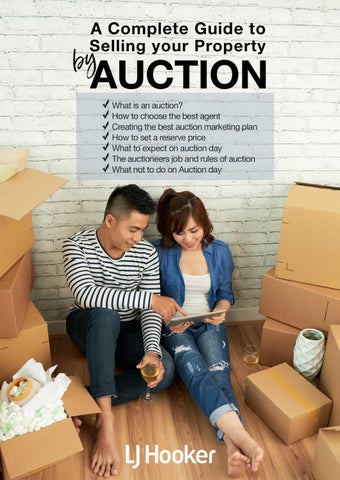
A Complete Guide to Selling your Property by Auction
Chapter 1 What is an auction & how to choose the best agent Auctions are one of the oldest forms of selling property, their history spans centuries and time has only increased their popularity. However behind all the fast paced entertainment lies a very serious process. So what is an auction and how can you choose the best agent to partner with to sell your property?
What is an auction ? An auction is a public sale, usually conducted by a licensed auctioneer and is governed by strict rules that vary across each state and territory. It’s advertised for a specific place, time and date and prospective buyers bid for the property with the property being sold to the highest bidder. Given the auction is set for a specific time it creates a sense of urgency amongst buyers as they must act or risk losing their opportunity to buy the property. It also groups all interested buyers together at the one time, creating a competitive environment and the greatest chance to achieve the highest possible price.
The first step in selling your property is to find the best agent for you. Given your property is likely to be your most valuable asset, finding the best agent to partner with, someone who lives and breathes real estate, should be a priority. Whilst it is a very personal decision, when interviewing prospective agents you should ask the following questions: Are you a licensed real estate agent…Good news is all LJ Hooker real estate agents are licensed in their state or territory. Are they local – it’s important they live and breathe real estate in your local area What experience do you they in the local market, do they have experience selling via auction and can they show you recent comparable sales? What is happening in the local market and can they give you a local market report? Do they feel trustworthy and approachable? Can they supply you with references and referrals? Are they professional – can they outline the activities and marketing they will undertake, share their recent results including sale price and time on market Become a secret shopper and see the agent in action. This is as easy as going to one of their open homes and see what they are like, how they engage with the attendees, how knowledgeable they are and how they follow up a er the open home.
How do you find the best agent to sell your property by auction? Ok so now you know what an auction is…. let’s take a step back.
For more real estate eBooks head to our library at www.ljhooker.com.au/ebooks
A Complete Guide to Selling your Property by Auction
Chapter 2 Creating the best marketing campaign When selling your property by auction, how do you create a high impact marketing campaign? It’s really important to understand when you’re thinking about your marketing…. that your home has to compete for attention in a highly competitive market – so the more marketing impact you can generate the better. At the start of your auction campaign, your LJ Hooker agent will prepare a marketing plan for your property and discuss and agree it with you. This investment will help expose your property to the highest number of people possible so it’s important you are across all of the different elements and agree with the strategy. When planning, keep in mind the best plans include a mix of print and online. It has been proven that this combination equals More Exposure, More Buyers, More Competition and Higher Prices. 1. Prof essiona l p hotog ra p hy of y our p rop erty with the majority of buyers seeing your property for the first time on line, the best way to grab their attention is with some great photos….. Video’s also work exceptionally well. 2. S ig nb oa rds – these are the cornerstone of property marketing; they are your 24 x 7 sales person. They enable you to showcase the features of your property and are one of the best ways to capture local buyers who may not be actively seeking a new property but are willing to purchase when the right property appears.
1. S i g n b o a r d s – these are the cornerstone of property marketing; they are your 24 x 7 sales person. They enable you to showcase the features of your property and are one of the best ways to capture local buyers who may not be actively seeking a new property but are willing to purchase when the right property appears. 2. Spoke Social Media – This enables you to promote your property on our LJ Hooker Facebook and Instagram pages. This industry leading p latform ensures you reach the maximum number of relevant buyers via these key social channels. With everyone on social this is a must for all campaigns. 3. P r o p e r t y S p o t l i g h t enables you to have a personalized website for your property to ensure it stands out from the crowd. 4. R e a l E s t a t e p o r t a l s –Advertise your property on the key national and international real estate portals such as realestate.com.au, domain.com.au, allhomes.com.au and ljhooker.com.au – with 97% of active buyers looking at these portals this is a must for all campaigns. 5. N e w s p a p e r a d v e r t i s i n g - Advertise your property in local newspapers and in the national newspaper lift outs – this is a great way to reach both passive and emotional buyers who may not be actively looking but prepared to move if the right property comes along….and that could be yours. 8. Prop erty b rochures a nd drop ca rds – these are a great take away at open for inspections, to display in your agent’s office window and as letter box drops 9. And Finally, Ag ent da ta b a se ma rketing – your agent will also promote your property to their database of active buyers in the local market.
For more real estate eBooks head to our library at www.ljhooker.com.au/ebooks
A Complete Guide to Selling your Property by Auction
Chapter 3 How to set a reserve price What is a reserve? For those of you who don’t know what a reserve is, it is the minimum figure you would be happy to sell the property for. If the bidding reaches the reserve the property will definitely sell to the highest bidder. The good news is any bids achieved above the reserve is essentially bonus money in your pocket! In some instances, if bidding doesn’t go over the reserve, then a sale is negotiated between the vendor and any interested buyers.
What to consider when setting your reserve? When setting your reserve make sure you consider the following: 1. Your initia l a p p ra isa l At the beginning of your campaign your agent would have appraised your property. To get to this figure they would have conducted a comparative market analysis and looked at similar properties that have sold within the last 90 days. They would have considered current competition, wider market trends and your properties structure and conditions to arrive at a value that they believe you could achieve if you sold your property at that point in time.
2. Buy ers sentiment Auctions often achieve high sales prices because 2 or more emotional buyers keep bidding against each other, motivated to buy the property. Understanding buyer sentiment is important when setting your reserve. Talk to your agent and see if there are any passionate buyers, what does the agent think they would be willing to spend, what is the general feeling at the open homes? 3. Advice f rom y our a g ent Your agent is at the coal face of your marketing campaign, they are hosting open homes, fielding calls, sending contracts, following up attendees after inspections. They know how much interest there is in your property plus any positive or negative feedback. They know what the market is thinking about your property and are an important resource to tap into when setting your reserve. 4 . Any of f ers a nd ma rket f eedb a ck It is important not to get sentimental about your property and set an unrealistic reserve. It is very important to talk to your agent, to review any preauction offers and listen to market feedback from your agent. Over the course of the auction campaign, which is normally 3-4 weeks, the property market can fluctuate and it’s important to factor these changes in when setting your reserve. You want to be “in the market” not “on the market”. Consider carefully - are you prepared to sell for what the market is prepared to pay?
For more real estate eBooks head to our library at www.ljhooker.com.au/ebooks
A Complete Guide to Selling your Property by Auction
Chapter 4 What to expect on auction day OK…so the big day has arrived. To keep the nerves under control, think of the auction as a process, a process that will get your property sold in a great time frame with a great result. Being process focused, not out come focused is key here. Two days before the auction you should meet with your agent to go through the auction day strategy and set the reserve. During this meeting you will confirm the following important information: Any offers and market feedback Your reserve price How many bidders are expected to attend? How and when you will communicate with the agent and auctioneer during the auction What happens if the reserve is not met? How any vendor bids will be used? Run of the day 1. Pre-a uction insp ection Most agents will open your property for one final inspection. Frequently we have buyers turn up on auction day for the first time so make sure your property is looking spotless and well-presented. You never know you may pick up a buyer at the last minute and you certainly don’t want to deter buyers that are there to bid. If the auction is on-site, set up a suitable area to hold the auction. Usually it is held in the garden or on the front footpath, however your agent and auctioneer will be able to guide you.
2. Reg istra tion of b idders In most states, all interested buyers are required to register before the auction commences in order to receive a bidder’s number. This protects you, the seller from people who may not complete the auction process. 3. S ta rt of the a uction At the start of the auction the auctioneer will detail the positive attributes of your property and outline the state laws and settlement terms applying to this particular property including whether vendor bids will be used. 4 . Bidding Now things are really starting to heat up….. The auctioneer will call for an opening bid or in other words the first bid from the crowd. From this point onwards the auctioneer will control the flow of the bidding and will encourage bidders to go higher, but at the end of the day, each bidder decides how much they are prepared to pay and the seller decides whether they’re prepared to sell at that price. 5 . If it doesn't sell under the ha mmer If your property doesn’t sell under the hammer – don’t panic – the great news is both you and your agent have an overwhelming amount of intelligence as to what the market will potentially pay to purchase your property, plus your agent has a book of potential buyers to talk to. In our 90's years’ experience a sale is normally made soon after the auction – so don’t be alarmed if it doesn’t sell under the hammer. 6. C omp letion of sa le If your reserve price is reached during the auction, the hammer will sell to the highest bidder. The winning bidder will sign the contract there and then, pay a deposit which is normally 10% of the winning bid…… and you can pop open the champagne!
For more real estate eBooks head to our library at www.ljhooker.com.au/ebooks
A Complete Guide to Selling your Property by Auction
Chapter 5 The auctioneers job and rules of auction Essentially the role of the auctioneer is to control a public negotiation process where potential buyers are competing to buy a property. The auctioneer has to make sure the process takes place in an orderly and legal manner and they must always conduct themselves professionally. A good auctioneer though stands out from the rest as they use tools like humour and wit to make the buyers feel more comfortable. The more relaxed they are, the better the results.
Bidding a t the a uction Following the introduction from the auctioneer, the auction will get under way. The auctioneer will call for an opening bid or in other words the first bid from the crowd. From this point onwards the auctioneer will control the flow of the bidding and will encourage bidders to go higher, but at the end of the day, each bidder decides how much they are prepared to pay and the seller decides whether they’re prepared to sell at that price. All bids must be acknowledged and recorded, so there are no misunderstandings over who has bought the property and for how much. And no bid can be accepted after the hammer falls.
Auctioneer a nnouncements Before the auction commences the auctioneer will introduce themselves and the agency they work for and they will announce terms and conditions in accordance with state law and any rules that surround your auction in particular.
Auctions by nature are often emotionally charged, but a good auctioneer knows how to take the pressure out of this very serious process by making the buyers feel comfortable. They have the ability to get the best out of the buyers and to achieve the best possible price for the seller.
Following this the auctioneer will give a detailed description of your property and list its valuable features and benefits.
We can’t stress enough the importance of choosing a professional auctioneer with a commanding presence as they are the decider in all disputes.
Rules of a uction Terms and conditions of the auction are on display before and during the auction and are always available from the agent throughout the campaign.
For more real estate eBooks head to our library at www.ljhooker.com.au/ebooks
A Complete Guide to Selling your Property by Auction
Chapter 6 Understanding key auction terms You may have heard many of the terms below, but may not be familiar with what they mean. Here is an overview of the main auction phrases O p ening Bid a nd Bidding After the auctioneer has run through the property being auctioned, detailed the features and an overview of the what is included with the property one last time, they will invite the buyers to put in an opening bid - or in other words for someone to place the first bid on the property. Other interested parties will then bid on the property in increments until either the property is sold or it is passed in (not sold). V endor's Bids A vendor's bid is used to encourage bidding from buyers. Think of it as a momentum bid…..a bid to keep buyers interested, to keep the process flowing. This is placed by the auctioneer on the vendor's behalf to assist the property reaching its reserve price. The amount of the bid needs to be below the reserve price and must be disclosed to all buyers in the interest of transparency. Dummy b id A dummy bid on the other hand is a false bid made by a non-genuine buyer. All dummy bids are illegal and attract significant penalties for the vendor, the dummy bidder and in some cases the agent. Professional auctioneers will not engage in dummy bidding.
Bidding increments This is the amount by which bids increase during an auction and is usually dictated by the auctioneer. O n the ma rket a nd p a ssed in If the bidding does not reach the reserve price or a price the seller is happy with, the property may be passed in. In this case your agent will encourage interested parties to stay behind to negotiate a sale with the agent. Don’t panic, in our 90 years’ experience a sale is normally made soon after the auction. If the bidding doesn’t reach the reserve price, the auctioneer will ask you if you are willing to adjust your reserve and sell the property for the highest price. If you are, the auctioneer will announce to the crowd that the property is on the market or in other words, that it will be sold to the highest bidder. The final and usual scenario is when the bidding has reached the reserve price. The auctioneer will briefly stop the auction and confirm with the seller that they are happy to sell at that price. If they are, the property will be sold to the highest bidder. Pre-a uction of f ers When you list your property for sale by auction, you still have the ability to accept pre-auction offers before the auction day deadline. All pre-auction offers need to be submitted in writing to your agent who in turn will present it to you for consideration. However, in order for this to be rewarding, the offer needs to be solid and stand out to catch your attention. Otherwise, it may be a good plan to allow your property to go to auction and see what the market will give you for your home.
For more real estate eBooks head to our library at www.ljhooker.com.au/ebooks
A Complete Guide to Selling your Property by Auction
Chapter 7 What not to do on auction day What not to do on auction day! You may think that's a weird topic, but it's an important one. Auctions are by nature emotionally charged, but keeping your wits about you and avoiding these pitfalls will help you navigate the auction day without any hiccups. Don't ta lk a b out y our selling p rice to a ny one including the neig hb ours We know it can be hard, but you need to keep the price you would sell for to yourself. Disclosing the reserve price or what you would sell the property for to neighbours, family or friends increases the chance of prospective buyers finding out.
Don't set y our reserve too hig h We’ve spoken about reserves earlier, but when setting your reserve for your property don’t make it unrealistic. Setting a price that is too high can turn off buyers who would be willing to pay the market value for your property. Re-looking at your property appraisal, talking to your agent and gauging buyer sentiment should help you determine the reserve price. Remember inside a 3-4 week auction campaign, market changes can occur so make sure you stay abreast of market information and set your reserve accordingly. Don't p a nic if it doesn't sell during the a uction If your property doesn’t sell at auction – don’t panic. Your agent is an expert at negotiating successful sales after auction. In our experience auction day yields a sale on the day or flushes out interested parties to negotiate with that results in a sale soon after the auction.
Rumors spread quickly and you don’t want potential buyers to be one step ahead with this insider knowledge. It can also turn people off if they think the price is too high. Don't ha ve f riends or f a mily interf ere with the b idding Whilst it is great to have family and friends at the auction to support you on the day, make sure they aren’t tempted to make a dummy bid to help inflate the price. Firstly, these are illegal and secondly they can scare away genuine bidders. Of course if your friends or family want to buy your place then let them bid away.
For more FREE Real Estate eBooks head to our eBook library. www.ljhooker.com.au/ebooks
For more real estate eBooks head to our library at www.ljhooker.com.au/ebooks