2030
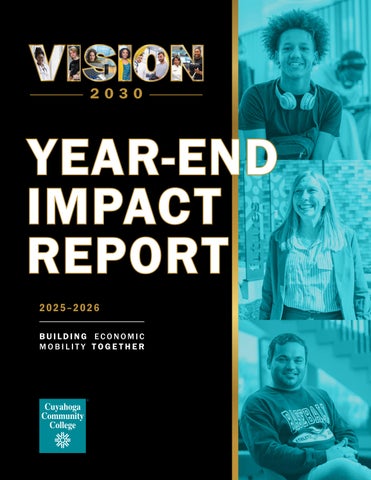
YEAR-END IMPACT REPORT 2025–2026 BUILDING ECONOMIC MOBILITY TOGETHER
VISION 2030 / 2025–2026
Y E A R - E N D I M PAC T R E P O R T
CONTENTS
MESSAGE FROM THE PRESIDENT
4
BOARD OF TRUSTEES
5
WHY CHANGE IS NEEDED NOW
6
WHERE WE’RE HEADED
8
HOW WE KNOW WE’RE SUCCEEDING
10
OUR PROGRESS
11
O U R I M PAC T O N N O R T H E A S T O H I O
21
W H AT ’ S N E X T F O R T R I - C ?
22
BUILDING THE FUTURE TOGETHER
22
A SHARED DIRECTION Vision 2030 provides a shared direction for how we serve learners, support our communities and prepare the College for the future.
BUILDING ECONOMIC MOBILITY TOGETHER
3
VISION 2030 / 2025–2026
A MESSAGE FROM THE PRESIDENT
DEAR TRI-C COMMUNITY, At Cuyahoga Community College (Tri-C®), we believe in the power of education to change lives, strengthen families and transform communities. Over the past year, we continued putting that belief into action by creating opportunities for learners and strengthening our impact across Northeast Ohio. This year marked an important step forward with the launch of Vision 2030, our Strategic Transformation Plan to help more people in Northeast Ohio achieve more in life through careers and greater opportunity. Guided by our mission and a North Star of economic and social mobility, Vision 2030 provides a shared direction for how we serve learners, support our communities and prepare the College for the future.
responding with purpose — aligning our people, pathways and partnerships around outcomes that matter and ensuring education leads to meaningful opportunity. This report highlights the progress made throughout fiscal year 2026 and the many ways our faculty, staff and partners are turning Vision 2030 into measurable results for learners and the region. I am grateful for all we have accomplished together and energized by what comes next. As we continue implementing Vision 2030, we will remain focused on what has always been at the heart of Tri-C: expanding opportunity, helping learners realize their potential and building economic mobility together.
Higher education, workforce needs and learner expectations continue to evolve. Tri-C is
4
V I S I O N 2 0 3 0 / Y E A R - E N D I M PAC T R E P O R T
SINCERELY,
Michael A. Baston, J.D., Ed.D. President Cuyahoga Community College
C U YA H O G A C O M M U N I T Y C O L L E G E
PRESIDENT AND BOARD OF TRUSTEES
Michael A. Baston, J.D., Ed.D. President
Geralyn Presti Chair
Phoebe Lee Vice Chair
County Executive Appointment Term ends 06-22-31
Governor Appointment Term ends 10-12-23
Kevin Clayton
Helen Forbes Fields
County Executive Appointment Term ends 1-16-30
County Executive Appointment Term ends 01-16-30
*Pending reappointment
Ann Frangos
Howard Lewis
Alan Rosskamm
Victor A. Ruiz
Rudy Stralka
Governor Appointment Term ends 10-12-27
Governor Appointment Term ends 10-12-27
County Executive Appointment Term ends 1-17-27
County Executive Appointment Term ends 01-17-27
County Appointment Term ends 6-22-28
BUILDING ECONOMIC MOBILITY TOGETHER
5
VISION 2030 / 2025–2026
THE CASE FOR CHANGE
WHY CHANGE IS NEEDED NOW Higher education and workforce development are changing rapidly. Demographic shifts, evolving workforce needs, emerging technologies and changing learner expectations are reshaping who we serve and how we define success. Vision 2030 positions Tri-C to respond by aligning our people, pathways and partnerships around the needs of learners and an evolving regional economy. Vision 2030 is our response to those changes — not simply to adapt but to ensure our College remains a trusted and responsive institution for generations to come. By aligning our people, pathways and partnerships around the needs of today’s learners and an evolving regional economy, we can advance the well-being and prosperity of our learners and communities while strengthening the College for the future.
Changing demographics
Higher education trends
Cuyahoga County’s population is shrinking and aging, while Tri-C increasingly serves adults beyond the traditional college-going age.
Across the country, community college enrollment has declined since 2011. Tri-C’s own credit enrollment has fallen roughly 40% over that period. Future success will depend increasingly on engaging learners, supporting persistence and creating pathways for people to continue or return to education throughout their lives.
Workforce needs, technology and AI Employers increasingly value demonstrated skills, adaptability and applied experience, while AI and automation are reshaping entry-level work. Learners need shorter pathways, stackable credentials and opportunities for continuous upskilling.
Adult learners bring prior education, workforce experience and clearly defined goals. They need flexible pathways that recognize what they already know and allow them to maintain momentum.
Financial sustainability
Public accountability and levy stewardship
Tri-C continues prioritizing affordability while strengthening its financial position for the future.
As a publicly supported institution, Tri-C must continue demonstrating clear value, measurable results and responsible stewardship ahead of the 2028 operating levy campaign.
OHIO’S FIRST COMMUNITY COLLEGE,
FOUNDED IN 1963 6
Learner expectations
LOWEST TUITION IN OHIO —
$139.54 per credit hour
V I S I O N 2 0 3 0 / Y E A R - E N D I M PAC T R E P O R T
CUYAHOGA COUNTY POPULATION FORECASTS BY AGE GROUP
BUILDING ECONOMIC MOBILITY TOGETHER
7
VISION 2030 / 2025–2026
2030 S T R AT E G I C F O U N D AT I O N
WHERE WE’RE HEADED N O R T H S TA R
Our North Star is economic and social mobility. It shapes how we define success, make decisions and measure our progress under Vision 2030. For Tri-C, that means empowering individuals and families to achieve greater economic stability, expanded opportunity and sustained upward progress through education that connects learning to meaningful credentials, employment and career advancement within the regional economy. Our vision describes the future we are working toward, while our mission guides how we get there. Together with our core values, they provide a shared foundation for the decisions we make, the programs and services we provide and the ways we serve learners and our region.
MISSION We empower learners, ignite purpose and impact the regional economy through exceptional education, holistic support and innovative pathways for students, faculty, staff and the community. VISION Cuyahoga Community College will be recognized as an exemplary teaching and learning community that fosters service and student success. The College will be a valued resource and leader in academic quality, cultural enrichment and economic development, characterized by continuous improvement, innovation and community responsiveness.
VALUES
Belonging | Academic Excellence | Mutual Respect | Integrity
8
V I S I O N 2 0 3 0 / Y E A R - E N D I M PAC T R E P O R T
HOW VISION 2030 WORKS
Vision 2030 is our plan to help more people in Northeast Ohio earn and achieve more in life through careers and greater opportunity. One mission. Three pillars. Six goals. Each of us connects through our role at the College.
THE WHOLE SYSTEM AT A GLANCE Vision 2030 fits together from the top down. One North Star sets the direction. Our mission drives us toward it. Three pillars support the mission. Each pillar has two goals. Here is the whole system:
NORTH STAR
Economic Mobility
Economic Mobility for Tri-C is: “Advancing the well-being and prosperity of our learners and our community.”
MISSION We empower learners, ignite purpose and impact the regional economy through exceptional education, holistic support and innovative pathways for students, faculty, staff and the community.
PI L L A R 1 Activate People and Potential
1.1 Welcome Create a welcoming, high-support learner experience and culture
1.2 Adapt Strengthen the College’s ability to adapt to best serve learners
PI L L A R 2 Align Path and Purpose
2.1 Momentum
PI L L A R 3
Amplify Community Impact 3.1 Mobility
Ensure learners start strong and sustain momentum
2.2 Pathways
Equip learners to secure thriving-wage jobs and economic mobility
3.2 Value
Align learner pathways to meaningful credentials and thriving careers
Drive enrollment and community support by demonstrating clear value and proven results
MEASURES
belonging • retention • momentum • completion and transfer • enrollment • living-wage jobs • economic impact
ONE MISSION. THREE PILLARS. SIX GOALS. BUILDING ECONOMIC MOBILITY TOGETHER
9
VISION 2030 / 2025–2026
VISION 2030 KEY METRICS
HOW WE KNOW WE’RE SUCCEEDING
Belonging and Inclusion Index Students, Faculty and Staff
FY25 Baseline
FY26
Ending June 30, 2025
Ending June 30, 2026
“RECOGNIZED” RANKING
“RECOGNIZED” RANKING
Great Colleges to Work For
171 participated 76 recognized
71.1%
71.2%
19.8%
23.5% (+3.6%)
FALL 21
FALL 22
45.5%
44.6%
35,895
37,046 (+3.2%)
FY23
FY24
57.4%
58.7%
Fall-to-Spring Retention Rate One semester, final retention rate All students (new, continuing, full-time and part-time, degree- and credit-certificate seeking students who are not transient). Final retention numbers capture all students enrolled in the term, not just those at the 15th day.
First-Year Momentum Credit students who completed collegelevel math, English and at least 15 credits in the first year at Tri-C (excludes students in high school).
Completion and Transfer Graduation and transfer rates reflect the 2021 and 2022 cohorts of first-time, fulltime students and serve as the baseline.
Enrollment Rate Unduplicated credit and noncredit headcount.
Career Outcomes Percentageof credit and noncredit employed graduates making a living wage one year post-completion. Excludes students who transfer or continue enrollment at Tri-C.
10
V I S I O N 2 0 3 0 / Y E A R - E N D I M PAC T R E P O R T
OUR PROGRESS ACTIVATE PEOPLE AND POTENTIAL Building a workplace and learning culture where faculty, staff and students have the support, skills and confidence to succeed. ALL-EMPLOYEE CONVENING Vision 2030 formally launched at The Power of Us on Oct. 17, 2025, bringing more than 1,300 employees together for Tri-C’s inaugural all-employee convening. The event highlighted the College’s new mission statement and the strategic direction of Vision 2030, connecting Tri-C’s renewed sense of purpose with a shared vision for the future. Employees began connecting their individual roles with the College’s shared goals, while the gathering strengthened connections across campuses and reinforced the collective responsibility employees share for bringing Vision 2030 to life.
Convening reinforced how my work in Financial “AidTheandAll-Employee Scholarships supports Tri-C’s mission. It reminded me that helping students overcome barriers to education is a shared effort that contributes to the College’s Vision 2030 goals.
”
— Keesha Allen, Campus Director, Student Financial Aid and Scholarships
OVER 1,300 EMPLOYEES
PARTICIPATED, REPRESENTING ALL CAMPUSES, DIVISIONS AND DEPARTMENTS. The convening celebrated the College’s collective achievements while strengthening connections across campuses and helping employees see how Vision 2030 can inform their daily work. The Power of Us event positioned the College for sustained growth, adaptability and innovation, reinforcing its commitment to excellence and setting the stage for measurable progress in the years ahead. BUILDING ECONOMIC MOBILITY TOGETHER
11
VISION 2030 / 2025–2026
EMPLOYEE HIGHLIGHTS
During the Power of Us, multiple employees were celebrated for their contributions to the Tri-C community. Marci Rupp received the first Robert and Joanne Lewis Award for Creativity, Innovation and Engagement, a $10,000 honor recognizing exceptional leadership and commitment to the College and its learners. Employee recognition like this reinforces a culture where innovation, leadership and meaningful contributions are valued and celebrated.
G R E AT C O L L E G E S T O WO R K F O R
ONE OF
76
INSTITUTIONS RECOGNIZED OUT OF 171
ONE OF 22 TWO-YEAR INSTITUTIONS RECOGNIZED
12
Tri-C received many awards, recognizing its workplace culture, community engagement and commitment to learner success, including its 19th consecutive NorthCoast 99 award and the 2026 Civic Engagement and Community Service Award. It was named a 2026 Leader College of Distinction by Achieving the Dream and recognized as a 2025 Great College to Work For.
V I S I O N 2 0 3 0 / Y E A R - E N D I M PAC T R E P O R T
LEARNER SUCCESS
The S.T.O.M.P. Experience introduced a shared standard for how employees welcome, support and engage learners, colleagues and community members, strengthening belonging, care and connection across the College. These principles help employees create more consistent, solution-oriented interactions and contribute to a stronger learner experience.
T R I - C DAY Employees demonstrated their commitment to learner success through strong participation in Tri-C Day.
618
EMPLOYEE DONORS
1,534
TOTAL DONORS
early success of this initiative makes “itThe clear that together, we create belonging through our everyday interactions. By strengthening how we support one another and engage with our learners, we’re cultivating a Culture of Care at the College where everyone feels valued, connected and empowered to succeed.
”
— Ami Hollis, Vice President, People, Culture and Talent Development, Human Resources
347
NEW DONORS
$343,270 RAISED
+30%
YEAR-OVER-YEAR
$1.84M OVER 10 YEARS
The S.T.O.M.P. framework directly supports Tri-C’s Strategic Enrollment Management plan, reinforcing the College’s dedication to excellence and best serving learners. BUILDING ECONOMIC MOBILITY TOGETHER
13
VISION 2030 / 2025–2026
ALIGN PATH AND PURPOSE Redesigning the student experience from entry through completion so every step leads toward a meaningful credential and thriving career. C O N N E C T E D PAT H WAY S Tri-C is strengthening connections between workforce training, academic programs and careers by building clearer pathways in industries where employers need skilled workers. By the end of FY26, Workforce Innovation had 16 noncredit-to-credit pathways in development and six fully completed, exceeding initial targets and giving learners clearer routes from training to credentials, continued education and employment. Workforce Innovation is aligning these pathways through five Workforce Academies organized around key workforce sectors. Learners will be connected with an academy when they enroll, providing more personalized career guidance, academic support and a clear route designed to help them earn a credential quickly while continuing toward a degree or further professional development.
NEARLY 200 ACADEMIC, CAREER AND TECHNICAL PROGRAMS We want learners to see a clear path from where they are today to the credential, “degree or career they’re working toward. The Workforce Academies help connect those steps while giving learners the support they need to keep moving forward.” — Steve Griffin, Chief Learning Officer and Vice President, Skills-Based Education & Career Pathways
Tri-C also established seven new articulation pathways connecting Workforce Innovation, Corporate College® and academic programs, with four more in progress. Together, these efforts are creating a more connected learner experience in which each step can build on the one before it, helping learners sustain momentum toward additional credentials, academic achievement and thriving careers while keeping programs aligned with regional employer needs. 14
V I S I O N 2 0 3 0 / Y E A R - E N D I M PAC T R E P O R T
LEARNER SUCCESS
TRI-C ADVANCED ITS
Strategic Enrollment Management (SEM) plan to provide more personalized support from inquiry through graduation.
Workforce Innovation joined the nationally recognized
The President’s Society launched with 18 learners, providing mentoring, leadership development, cultural enrichment and career preparation while strengthening belonging, persistence and academic confidence. Tri-C also expanded co-curricular and service-learning opportunities, embedded career exploration into first-year courses and established a cross-campus Student Success Council to coordinate support.
One Million Degrees program
AVERAGE CLASS SIZE:
to strengthen support for workforce learners. Tri-C is using the model to identify barriers and better coordinate academic, financial, professional and personal resources around learner needs.
student-to-faculty ratio
23 to 18:1
THE TRI-C FOUNDATION AWARDED A RECORD
$6.4 million in scholarships to 3,930 learners
while expanding emergency assistance, mentoring and other resources that help learners overcome barriers and persist toward their goals.
BUILDING ECONOMIC MOBILITY TOGETHER
15
VISION 2030 / 2025–2026
A C A D E M I C I N N O VAT I O N Tri-C completed the first full year of its five-school academic model, creating greater clarity for learners. Academic Affairs also advanced an advising redesign that better connects counselors, program leaders and faculty. The five academic schools group related credit and noncredit programs to give students a clear academic home, personalized support and streamlined pathways to credentials, degrees and careers.
School of Advanced Manufacturing, Engineering and Computer Science School of Business, Legal Professions and Hospitality School of Creative Arts School of Liberal Arts and Sciences School of Nursing and Health Professions
CREDIT/NONCREDIT ALIGNMENT Tri-C established seven new articulation pathways connecting Workforce Innovation, Corporate College® and academic programs, with four additional pathways in progress.
LEARNER EXPERIENCE Academic Affairs advanced an advising model to provide more coordinated support throughout the learner journey. Peer Mentoring pilots in the School of Business, Legal Professions and Hospitality and the School of Nursing and Health Professions demonstrated positive results in learner engagement and retention and are positioned for broader implementation in the coming academic year.
16
V I S I O N 2 0 3 0 / Y E A R - E N D I M PAC T R E P O R T
AMPLIF Y COMMUNITY IMPACT Strengthening partnerships and connecting education to regional prosperity — so graduates achieve economic mobility and Tri-C is seen as a dependable community asset. GUARDIANS TRAINING CENTER Tri-C, the Cleveland Guardians and EL1 Sports partnered to launch the first Guardians Training Center at the Western Campus. The renovated 20,000-plus-square-foot facility will provide year-round baseball and softball development while creating new educational, career and community opportunities. The partnership will connect Tri-C learners with the sports and entertainment industry through career panels, internships, employment opportunities and other hands-on experiences. Through the Classroom-to-Career Innovation Challenge, faculty will develop projects connecting classroom learning with the Training Center, beginning with pilots in Spring 2027 and broader expansion in Fall 2027. Youth programming begins in Fall 2026 with lessons, camps, clinics, team training and year-round practice space for athletes across Northeast Ohio. Flexible options, including the Futures development pathway, will expand access for athletes of varying ages, experience levels and financial commitments. The Guardians will also provide an annual $25,000 contribution to the Tri-C Foundation to support the College’s baseball and softball programs.
Student workforce/internship opportunities Career panels, guest speakers, internships and employment opportunities in the sports and entertainment industry Youth programming Year-round lessons, classes, camps, clinics and team training beginning Fall 2026 Workforce innovation Classroom-to-Career Innovation Challenge pilots in Spring 2027, with broader expansion beginning Fall 2027 Other impact $25,000 annual Guardians contribution supporting Tri-C baseball and softball programs
Launched as the Western Campus celebrated its 60th anniversary, the Guardians Training Center strengthens connections among athletics, education, career exploration and community opportunity across Northeast Ohio. BUILDING ECONOMIC MOBILITY TOGETHER
17
VISION 2030 / 2025–2026
E M P L OY E R PA R T N E R S H I P S
LEARNER SUCCESS
Tri-C expanded pathways from high school to college and from college to careers through new Direct Admission Partnerships with K-12 districts and five new employer relationships established through the Career Marketplace. These partnerships are expanding support for career preparation, including a $35,000 Citizens Tools to Succeed grant for learners entering the construction sector.
Diane Kavalchek’s journey illustrates how access to education, scholarships and connected pathways can create economic opportunity over a lifetime.
Through its partnership with Medical Mutual, the Foundation helped establish the Resilient Scholar Fund. Medical Mutual pledged $1 million to provide flexible, need-based financial support to help learners stay enrolled and on track.
WO R K F O R C E I N N O VAT I O N Tri-C established the Center for the Future of Work to help the College anticipate labor market change, respond to employer needs and strengthen its regional leadership. Workforce Innovation supported more than 400 displaced Cleveland Metropolitan School District employees through job fairs, career counseling and customized workshops. The Foundation made possible more than $23,000 in Work Readiness stipends to 36 learners to assist with technology, uniforms, certification exams and other course-related equipment and activities.
MORE THAN 600 WORKFORCE AND PROFESSIONAL DEVELOPMENT OPPORTUNITIES OFFERED ANNUALLY 18
When Kavalchek first came to Tri-C in her late 20s, college seemed far from certain. After teaching herself to read as an adult, she began in developmental math and reading courses and worked her way to the college level. She later stepped away to raise a family before returning to Tri-C determined to create new possibilities for herself and her future. Through the WIT Program, Kavalchek gained skills, career direction and connections to resources that helped her move forward. She later joined the Jack, Joseph and Morton Mandel Honors Program, where scholarship support enabled her to attend full time. She earned an Associate of Science degree from Tri-C and continued her education through the Cleveland Humanities Collaborative and Mandel Continuing Scholars Program. Kavalchek went on to graduate from Cleveland State University at the top of her class and is now completing a master’s degree in urban planning while taking plant science courses at Tri-C. Her goal is to build a career that combines the natural and built environments, improving parks, neighborhoods and communities while creating a new professional path for herself.
definitely set me “onTri-C my path for where I am today. I wouldn’t be even in my program that I’m at if it hadn’t have been for my start here.
”
What began with foundational coursework at Tri-C has grown into advanced education and preparation for a career through which she hopes to improve both her own future and the communities she serves.
V I S I O N 2 0 3 0 / Y E A R - E N D I M PAC T R E P O R T
C O R P O R AT E C O L L E G E Corporate College marked its 20th anniversary and soft-launched the Transformation Studio in Spring 2026. Combining expert facilitation, digital collaboration tools and interconnected spaces, the studio supports custom events of up to 500 participants while expanding capacity and revenue opportunities.
C O M M U N I T Y PA R T N E R S H I P S Tri-C opened the Care Alliance Clinic at the Metropolitan Campus, expanding access to affordable preventive and immediate care for learners, employees and the community.
The 2025 Presidential Scholarship Luncheon raised $1 million for learner support while strengthening Tri-C’s connections with community partners and donors. Its high-profile keynote conversation with Cleveland Cavaliers Head Coach Kenny Atkinson also created an opportunity to connect supporters with the College’s mission.
OVER FY25,
Tri-C dedicated the renovated Westshore Campus Food Pantry in November 2025, expanding efforts to address learner food insecurity.
BUILDING ECONOMIC MOBILITY TOGETHER
5.8%
MORE PEOPLE VISITED THE FOUR PANTRIES, WITH 2,648 STUDENTS MAKING A TOTAL OF
17,025 VISITS. 19
ai17895775938_26-0383 Campus Site Location Map 2026_PR_NoCrops.pdf
VISION 2030 / 2025–2026
1
9/16/26
12:53 PM
TRANSPORTATION INNOVATION CENTER
MAP NOT TO SCALE
DISTRICT JERRY SUE ADMINISTRATIVE THORNTON CENTER SERVICES CARNEGIE AVE CEDAR ROAD HOSPITALITY MANAGEMENT CENTER AT PUBLIC SQUARE METROPOLITAN KeyBank CAMPUS ADVANCED TECHNOLOGY TRAINING CENTER .
VE
E. 30 TH
EY
E
RA LO
AV
R ROAD
EN
HARVARD ROAD
MILES ROAD
GRANGER RD.
LIBBY ROAD
RIDGE ROAD
252
RO AD
PEA
CO LU
BAGLEY ROAD
ROYALTON ROAD
R
O LR
AD
YORK ROAD
SNOW ROAD
WESTERN CAMPUS
ROCKSIDE ROAD
PLEASANT VALLEY ROAD
80
ROYALTON ROAD
AUR
ORA
ROA
D
RICHMOND ROAD
BROOKPARK ROAD
M B IA
EMERY ROAD
MILES ROAD
NORTHFIELD ROAD
KE CR OC
EN UE
UE
IN AV
EN
LO RA
80
82
EASTERN CAMPUS
CORPORATE COLLEGE® EAST
AV
NEARLY 80%
AV
AY
K
IN
DW
CMY
RA
OA
LO
HARVARD ROAD BR
CY
UE
W. 25 ST
MY
. TH
RID GE RD
RIDGE ROAD
CE NTE R
CORPORATE COLLEGE® WEST
S. WOODLAND ROAD
CHAGRIN BLVD
E
252
Y
CM
SHAKER BLVD RD
RICHMOND ROAD
CK
GREEN ROAD
RA
R IO
PE
SU
UE EN
BU
AN
IN
DETROIT ROAD
DETROIT ROAD
M
FAIRMOUNT BLVD
WOODLAND AVENUE
SM
C
PETTIBONE ROAD
ALEXANDER ROAD
82
82
80 303
W. STREETSBORO RD.
303
A
CENTER ROAD
NN
CENTER ROAD
VE
BRUNSWICK UNIVERSITY CENTER 303
RA RD
VIEW TRI-C POSITIVELY
MANUFACTURING TECHNOLOGY CENTER
AV
CLEMENS ROAD
COLUMBIA ROAD
BRADLEY ROAD
WESTSHORE CAMPUS
K IN
A Community Perspective Survey reflects strong awareness and positive perceptions of Tri-C.
BASSETT ROAD
LAKE ERIE
GREEN ROAD
R E G I O N A L I M PAC T
.
Under new executive director Orlando Watson, Tri-C JazzFest Cleveland expanded programming and regional marketing to reach new and younger audiences. The outdoor experience combined free performances, food and community activities at Playhouse Square, helping attendance grow to 32,720 from 27,000 the previous year.
20
V I S I O N 2 0 3 0 / Y E A R - E N D I M PAC T R E P O R T
OUR IMPACT ON NORTHEAST OHIO From serving learners and engaging community members to expanding scholarships, strengthening philanthropic support and building employer partnerships, Tri-C continues to connect education with opportunity and strengthen Northeast Ohio.
35,000+
1.2M+
served since 1963
ANNUAL LEARNERS One of the largest institutions in Ohio
3,550 DEGREES AND
CERTIFICATES AWARDED
AWARDED A RECORD
$6.4 M scholarships to
3,930
32,000+ JAZZFEST ATTENDEES
learners
5,809
Up 24% over LY
906
Encore 55+ learners, including new classes at the Brunswick University Center and the Westshore Campus
2 BACHELOR’S DEGREES offered at Tri-C
College Credit Plus students from 187 high schools, including 55 partner schools offering courses on site
Bachelor of Applied Science in Integrated Digital Manufacturing Engineering Technology Bachelor of Science in Nursing
FOR EVERY $1 INVESTED IN TRI-C, THE COLLEGE PROVIDES $11.80 IN ECONOMIC BENEFIT TO SOCIETY
OVER 65 EMPLOYER PARTNERSHIPS BUILDING ECONOMIC MOBILITY TOGETHER
21
VISION 2030 / 2025–2026
WHAT’S NEXT FOR TRI-C Vision 2030 now moves from strategy into sustained implementation through 2030. Beginning in Fall 2026, divisions across the College will translate its pillars, goals and KPIs into implementation plans with clear priorities, responsible leads, timelines and measures of progress. Results and feedback will guide ongoing improvement and help employees see how their work contributes to our shared goals. This Collegewide implementation will also prepare Tri-C for several significant milestones ahead. In
2028, the College will undergo its Higher Learning Commission Comprehensive Evaluation for reaffirmation of accreditation and conduct its next operating levy campaign. Federal Title IV funds distribution reauthorization follows in 2029, while Tri-C continues working toward submitting five applied bachelor’s degree programs to the state by 2030. Together, these milestones reflect both the work required to strengthen Tri-C internally and the commitments we make to learners, our community and the region. Reaching them will depend on sustained collaboration, thoughtful use of evidence and shared accountability across the College.
M I L E S T O N E S T H AT M AT T E R
2025
2028
2028
2029
2030
Strategic Transformation Plan Implementation
Successful Accreditation Reaffirmation
Successful Levy Campaign
Federal Title IV Funds Distribution Reauthorization
Five Applied Bachelor Degrees Submitted to the State
2030
(HLC Visit February 2028)
(November 2028)
(by 2030)
BUILDING THE FUTURE TOGETHER The progress reflected in this report belongs to all of us. Every course taught, service provided, learner supported, partnership strengthened and improvement made helps bring Vision 2030 to life. As we move forward together, our shared work will continue strengthening Tri-C, expanding opportunity and building economic mobility for learners, families and Northeast Ohio.
22
V I S I O N 2 0 3 0 / Y E A R - E N D I M PAC T R E P O R T
BUILDING ECONOMIC MOBILITY TOGETHER
23
tri-c.edu
District Administrative Services 700 Carnegie Ave. Cleveland, OH 44115 26-0568