
By Ann Law, Barking Legs Theater
May 29 and 30, 2026
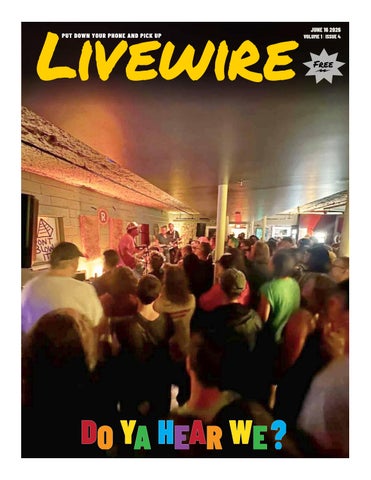
If you pay close attention to that moment when the theater goes completely dark and the audience, in great anticipation, takes a deep communal breath that ends the day and allows space for what is to come, you too, can experience the magic that only live performances can offer.
The Pop-Up Project embraces many different styles of dance that punctuate space and time.
Activating the night was a dance (Noypi 74 by Jerigray Eduave) where we returned to our functional and natural movement that cultivates new life, reminding us of why we started dancing in the first place! Like those morning rituals when no one else is watching you, another dance (Kai’Lani Zyloe’s & Beyond) took movement initiated in the pelvis and transferred it all the way up and out our fingertips, freeing us even as we sat in our seats. Even when a solo dancer (Marah Bates’ Phrases) steps quietly onto the empty stage supported by a pianist, fabric and a costume that stays in constant motion, we float, spin and lift further into her universe, wishing for just a moment more. When a trio of dancers (Kendra Norwood’s Imbas Rising) juxtaposed soft touches with linear direct arm movement balanced with circular pathways that cut across the stages, we know that no matter how difficult things get, this pulsing motion helps renew our sense of hope. And just as quickly, a duet (Matty Dangerfield’s Ubuntu) comes twisting, jabbing, and punching onto the stage
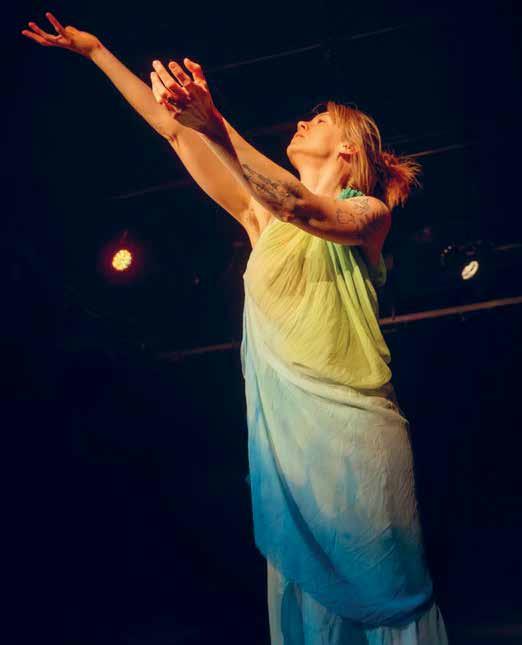
reminding you of the time you spend with your best friend. It is all right here, no matter how silly you get or how many tears flow, here, you can share it all.
The last piece of the evening (Andrea Solis Tankersley and Louie Marin-Howard’s Hechizos Y Fantasmas) found a softness that is so rare in today’s life, changing the energy of the evening to allow for a personal reflection of who and where we are. In the opening duet, a connecting physical contact searches for what might be out there, especially if we stay lifted upward.
Perhaps the suggestion being made tonight is that our voices cannot be silenced, especially when we come together. Reaching outward with an elasticity that snaps and pulls us back together, we will not be silenced as the dance starts again and again connecting us all together with a pulsating sound that moves everyone.
As in human relationships, these dances carry us from within, connecting us all because if you fall, I fall. Live performances have a way of reaching you even when each dance has its own individual and intentional voice. We all felt the internal wave of the art of dance moving us up and outward, making us all glad that we were here on a Friday night.
As a lifelong dancer, Ann Law has always been interested in how dances speak to us, allowing personal stories to organically move us in present day life. She is the founder and director of Barking Legs Theater where she gently facilitates all conversations in honest and meaningful ways.
by Chuck Crowder
Going viral can be deadly
I recently noticed a hard spike in the number of “not from around here” folks jamming up my favorite neighborhood bar at any given time. Then I noticed some homemade signs posted around the place with curt phrases like “no ketchup” and “no fries—don’t ask.”
Upon inquiring with my buddies who own the place, it was revealed that their tasty, creative take on the boring bar burger had gone viral on TikTok….by at least THREE influencers. “What does that mean?” I asked. “It means we have a lot of new one-time customers who won’t be back. And they’re killing the vibe,” the frustrated owner replied.
And he’s not wrong. You see, TikTok has taken “a neighborhood bar that happens to serve food” and turned it into an “I found it burger joint that you just have to go try.” And so begins the viral death sentence.
Social media influencers (and sadly, their followers) have this horrible misconception that going viral in ALL cases is a good thing. “Why wouldn’t a small business want to go big time from my free advertising?” Here are three great reasons why:
First, their followers don’t appreciate or care about the charm of the place. They make demands. “No fries? No sweet tea? Are you insane!?!” They just want what they want when they want it, and if you don’t have it—be damned.
Secondly, they drive away the regulars. I’ve recently tried to time my visits around the number of tourists standing outside and parked vehicles from counties other than Hamilton. And I’ve noticed other regulars doing the same. Sadly, if this keeps up, many may find another hidden gem to frequent. And that would certainly kill the vibe—forever.
Finally, no one asked to go viral. And, given the high price they’re forced to pay for it (like it or not), no one wants the added business. It just keeps showing up, unannounced. And it can’t go away fast enough.
At least the infectious influx of “mama and them” parties dissipates after dark. Likely because several Yelp reviews of the place claim (without evidence) that it’s “located in a bad neighborhood.” One reviewer went as far as to echo that claim, “even though my husband is covered in tattoos.” Whatever that means.
Fact is, if you’re looking to TikTok for the cool places to go—you’re a lazy lay. The whole thrill of knowing the best-kept-secret, hole-in-thewall places comes from discovering them yourself.
Meanwhile, there’s a new coffee-based food truck just down the road from the bar in question with a perpetual line of 15-20 people every time I drive by. But I’m not going to tell you where it is. That would kill the vibe.

Q: I heard that you have a full-time day job in a completely unrelated field. How do you find the time to type out all of those little blocks of events?
A: A python does that for me. Python script that is. All the events for the calendar are in a spreadsheet, and the python script can work the magic of breaking the spreadsheet into text blocks in a plain .txt file. This takes a few seconds to run in the Terminal window on my Macbook.
It also puts the symbols where they need to go for the next part of the process- style formatting in InDesign. GREP styles automate formatting with the use of various punctuation marks and hashtags called meta-characters. All I have to do is copy and paste the text that the python script created into InDesign, and apply the GREP paragraph style that was prepared for me by a trained professional (see credits page), and VOILA.
Q: Why do those text blocks look kinda weird with no commas or colons?
This GREP style is also why there aren’t many punctuation marks I can use inside the formatted text because so many of them have a special purpose. No semicolons, no parentheses, not even a comma. Hence all those en dashes. Anything after that big em dash is free to have those things. It's a bit beyond me and I’m a little scared of it.
So we take the good with the bad. The GREP styles are time saving miracle workers. But the trade off is some loss of nuanced control over the formatting. Maybe this user needs to learn more about how they work, but for now it gets the job done.
Q: Is this also why there are strange symbols inside the text sometimes?
I try to catch those in proofreading, but yes. From start to finish the text has been processed by different scripts and apps, so that an apostrophe morphs into a Cyrillic O of some kind.