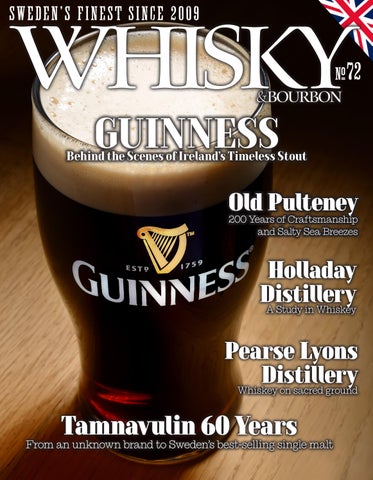
#72-2026
PRODUKTIONSGRUPPEN EK FÖRV AB / LIVETS GODA BOX 4152, 131 04 NACKA
SW E DE N ’ S FI N E ST S I N C E 2 0 0 9
Whisky
# 72
&Bourbon
”WHISKY & BOURBON: DÄR PASSION MÖTER PROMILLE – OCH BÅDA FÅR TALA TILL PUNKT.”
ORGANIC “WHISKYPRALINEN” Med toner av gräddnogat, vanilj och apelsinchoklad
EJ RÖKIG
WWW.SYMPOSIONHOT.COM
Benromach Organic, 46% Pris 549 kr. Art.nr 14501
Alkohol kan skada din hälsa.
GUINNESS
Behind the Scenes of Ireland’s Timeless Stout
Old Pulteney 200 Years of Craftsmanship and Salty Sea Breezes
Holladay Distillery A Study in Whiskey Pearse Lyons Distillery Whiskey on sacred ground
Tamnavulin 60 Years
From an unknown brand to Sweden’s best-selling single malt
ETT VÄLK ÄNT RESMÅ L M EN ETT HELT N YTT Ä VE NTYR Tillsammans med våra vänner på Destilerias Unidas i Venezuela, producenten bakom succéer som Diplomático, presenterar vi nu ett nytt kapitel i den spännande världen av fantastisk rom – Tepuy Monumento. Tro nu inte att det här bara är en ny Diplomático. Tvärtom har ambitionen från början varit att skapa ett nytt uttryck för venezuelansk rom med en egen identitet, en annan stil och en historia som står helt på egna ben. Men visst finns det likheter. Ursprunget och destilleriet är detsamma. Människorna, kunskapen och traditionen av att göra unik rom finns där. Och naturligtvis finns också den generösa, mjuka och komplexa karaktär som fått så många av oss att bli förälskade i venezuelansk rom. Så följ med oss på ett nytt äventyr. Låt dig förföras av en rik och nyanserad rom med toner av mörka körsbär, torkade plommon, kryddor och rostad ek. Smaken är fyllig och sammetslen med inslag av torkad frukt, rostade nötter, djupa kryddtoner och ek tillsammans med en elegant ton av mörk choklad. Avslutningen är lång, mjuk och välbalanserad. Använd QR-koden om du vill fördjupa dig i vårt nya äventyr tillsammans med Destilerias Unidas och – Tepuy Monumento.
T EP UY MO NUMENTO DE ST ILER IA S UNIDA S | V EN E Z U E L A #82420 | 40 % | 70 cl | 525:-
Är du intresserad av goda drycker? Använd QR-koden och kom med i F R I E N D S O F HA N D P I CK E D . Tips, kunskap, provningar och senaste nytt om oss på Handpicked Wines och alla våra produkter. A N VÄ N D Q R - K O DE N O CH R E G I S T R E R A D I G FÖ R V Å R T N Y H E TS B R E V | h an d p i c k e d . s e
Alkoholkonsumtion under graviditeten kan skada barnet. WB72-ANNs.indd 13 WB72.indd 2
2026-10-02 15:24:41
BERG P E D R O
X I M É N E Z
Taste the silence. 5 0 0 M L – 5 0 % A LC . / V O L . – 5 2 9 S E K – A R T. N R : 8 2 3 7 5 - 0 2
Alkohol kan skada din hälsa. WB72-ANNs.indd 4
2026-10-01 10:47:19
AMERIKANSK WHISKEY OCH BOURBON PÅ SYSTEMBOLAGET Dal 1761
Hantverk och historia i varje droppe
FÖR FULLSTÄNDIGT SORTIMENT BESÖK VÅR HEMSIDA: WWW.REWINE.SE
Rebel Stave Finish Collection Single Cask Sweden Exclusive, 55% 699 KR
KENTUCKEY, USA / LUX ROW DISTILLERS / 700 ML / NR 84040
Yellowstone Rum Cask Finish, 50% 579 KR
KENTUCKY / USA / LIMESTONE BRANCH DISTILLERS / 700 / 84603
Rebel 100 Cabernet Barrels Finished, 50% 459 KR KENTUCKY / USA / LUX ROW DISTILLERS / 700 / 85888
Yellowstone Single Malt Whiskey, 54% 659 KR
KENTUCKY / USA / LIMESTONE BRANCH DISTILLERS / 700 / 58217
Rebel Yell Kentucky Straight Bourbon Whiskey, 40% 359 KR
Ezra Brooks Single Barrel Stave Finish Collection 699 KR
Rossville Union Master Crafted Straight Rye Whiskey 5 Years, 47% 569 KR
KENTUCKY / USA / LUX ROW DISTILLERS / 700 / 81479
KENTUCKEY, USA / LUX ROW DISTILLERS / 700 ML / NR 84135
INDIANA / USA / ROSS & SQUIBB DISTILLERY / 700 / 85444
Yellowstone Limited Edition 2024, 50,5% 1895 KR
Yellowstone Select Kentucky Straight Bourbon Whiskey, 46,5% 529 KR
Yellowstone Toasted, 50% 579 KR
KENTUCKY / USA / LIMESTONE BRANCH DISTILLERS / 700 / 84448
KENTUCKY / USA / LIMESTONE BRANCH DISTILLERS / 700 / 82083
KENTUCKY / USA / LIMESTONE BRANCH DISTILLERS / 700 / 84437
Rossville Union Master Of Rye Crafted Straight Rye Whiskey 6 Years, 50% 599 KR
Rossville Union Rye Whiskey Barrel Strength 7 Years, 58,5% 799 KR
INDIANA / USA / ROSS & SQUIBB DISTILLERY / 700 / 84946
INDIANA / USA / ROSS & SQUIBB DISTILLERY / 700 / 85598
Remus Repeal Reserve VII 2023, 50% 899 KR
Remus Repeal Reserve VI, 50% 899 kr
INDIANA / USA / ROSS & SQUIBB DISTILLERY / 700 / 85636 INDIANA / USA / ROSS & SQUIBB DISTILLERY / 700 / 84917
BORGOGNO LANGHE ROSSO 2023 | NR 7038401 | 149 kr | ALK. 13 % VOL. | 750 ML | BORGOGNO BAROLO RISERVA 2018 | NR 244301 | 729 kr | ALK. 14,5 % VOL. | 750 ML BORGOGNO BARBERA D’ALBA SUPERIORE 2023 | NR 7420101 | 199 kr | ALK. 14% VOL. | 750 ML | BORGOGNO NO NAME 2022 | NR 7366101 | 319 kr | ALK. 14% VOL. | 750 ML
Alkohol i samband med arbete ökar risken för olyckor. ReWine_2026_v2.indd 1 WB72-ANNs.indd 7
2026-06-11 11:19:46 2026-10-01 10:47:47
Smaken av Islay Tradition. Torv. Rök.
Sveriges mest köpta Islay Single Malt Ett superfynd! ”Det här är det autentiska Islay som alla vi röktokar vill ha. Inga halvmesyrer utan tung jod och kvävande torvrök. En rökbomb till pangpris.” Henrik Aflodal, Whiskyspot
A very excellent Islayer ”Excellent, mildly sherried (small raisins, walnut liqueur, dried figs) with quite a lot of heather honey too, some salty and mentholy liquorice, and really, notes of Lagavulin 16.” Serge Valentin, whiskyfun.com
335 kr Art.nr: 515
WWW.SYMPOSIONHOT.COM
Alkohol är beroendeframkallande. WB72-ANNs.indd 8
2026-10-02 15:27:25
#72
78
8
The Editor-in-Chief has the floor. Whiskey remains
10
The Editor-in-Chief raises his glass. Jernverk 25
14
The Spirits Corner. Anders Enquist moves between
steady as global alcohol consumption declines—but the landscape is changing. India is emerging as a massive whiskey market, while Kentucky sits on millions of barrels of bourbon and faces a significantly tougher export market.
may be young on paper, but behind the distillery in Gävle lie decades of experience in Swedish spirits production. Enquist samples gin, aquavit, bitters, and several cask samples—including whiskey in its very first, unadulterated form.
Islay, Speyside, Japan, and Venezuela with current bottlings from Ardnahoe, Glen Moray, Nikka, and Ron Tepuy. We also encounter Underberg in a new espressoinspired look and Finlaggan Batch Strength in a new format.
22
Blended – News from the World of Beverages
32
Tasted July–September
38
Guinness. We step through the gates at St. James’s
46
Old Pulteney. In the fishing town of Wick, with the
News and highlights from the world of beverages.
58
A Study in Whiskey Style: Holladay Distillery
66
Pearse Lyons Distillery. In the heart of Dublin’s
74
Tamnavulin 60 Years. Tamnavulin is turning
78
Tipperary Distillery. On a small farm amid the
86
Cigars: A Burning Question
90
Recipes & Drinks. Aberlour A’Bunadh pairs with
The editorial team shares its impressions from the tasting table with a selection of spirits and beers that graced our glasses during July, August, and September.
Gate in Dublin and trace the history behind one of the world’s most famous stouts. A visit that, of course, ends as it should—with a fresh pint and Dublin outside the window.
North Sea as a constant companion, Old Pulteney celebrates two centuries of whiskey history. We meet the people behind the distillery and sample, among other things, the magnificent 30- and 50-year-old anniversary bottlings.
Missouri’s oldest distillery has been making whiskey in the same location since 1856. We take an in-depth look at Holladay’s style, history, and distinctive character—with limestone springs and American whiskey tradition as part of the story.
Liberties neighborhood, an old 19th-century church has been given a vibrant new lease on life as a whiskey distillery. Here we visit Pearse Lyons Distillery and learn about its homegrown grain, a unique yeast strain, and whiskey crafted on exceptionally historic grounds.
60 and celebrating with a new 25-year-old anniversary bottling. We meet blender Kirsty Hodge and distillery manager Trevor Milne and get to know the distillery behind Sweden’s best-selling single malt.
barley fields of Tipperary, Jennifer Nickerson and Liam Ahearn have built one of Ireland’s smallest whiskey distilleries. Here, agriculture, local ingredients, and small-scale distillation come together—from field to glass.
If the humidor were on fire—which cigars would be worth saving? Four select cigars get to come out the door as we pose an unusually concrete question to the cigar lover.
candied hazelnuts and dark chocolate; crayfish salad is served on butter-fried rye bread; and autumn finds its way into the glass with Shanky’s Apple Autumn Crumble. In addition, the classic Strega and the new Strega Green each get their own cocktail.
FOR SUBSCRIPTIONS AND DIGITAL VERSIONS FOR THE IPAD AND OTHER TABLETS, SEE: WWW.LIVETSGODA.SE WHISKE Y & BOURBON A RE : Anders Enquist Erik Dahlström Christoffer Enquist
C EO & EDI TOR-IN-CH IEF P UB LISH ER
Vikdalsvägen 50, Nacka Strand
V ISITING A DDRESS
SCO R ING SCALE
Anders Enquist, 08-448 25 53 anders.enquist@livetsgoda.se
M A ILING A DDRESS
9 7 –1 0 0 Highest recommendation, monumental.
P.O. Box 4152, 131 04 Nacka
C REATI VE DIRECTOR & DESIGN
Daniel Bruce
Erik Dahlström erik.dahlstrom@livetsgoda.se
Staff: see page 98.
christoffer.enquist@livetsgoda.se
ADVERTI S I NG BOOKING C OVER PH OTO Photo: Guinness
6 Whiskey & Bourbon
CUSTOMER SERV ICE
92 –9 6 Very strong recommendation. A really good drink.
8 7 –9 1 Strong recommendation. A good , high-quality drink.
Switchboard: 08-448 25 50 Wednesdays: 10 a.m.–12 p.m.
Multiply
8 2 –8 6 Passable, nothing to write home about.
Always double cask matured, depth in every drop. EVERYTHING CONSIDERED Aberlour 12 Years | 40% | 700 ml | 499 kr | Nr 529 © 2024 Pernod Ricard Sweden
Alkohol kan skada din hälsa. WB72-ANNs.indd 11
2026-10-01 10:52:29
Editor-in-Chief Enquist Has the Floor
The Whisky World in 2026
– India Drinks and Kentucky Stockpile
A
fter several years in which the industry seemed convinced that humanity’s greatest future need would be limited-edition single malt in a wooden box, reality has muscled its way in. The frenzied boom years are over. Even so, people are still drinking whisky, and plenty of it. The latest global figures from IWSR show that total alcohol consumption fell by 2% in 2025, while spirits overall declined by 3%. Whisky, however, behaved exactly like that guest who refuses to accept that the restaurant has closed. It stayed put. Global whisky volumes rose by 2%. But behind that figure, statistics reveal a fairly dramatic redrawing of the whisky world’s map. On one side is a country that seems determined to single-handedly prop up the world’s whisky industry: India. On the other is a country that has been producing bourbon as though the entire population of the planet might start drinking Old Fashioneds for breakfast at any moment: the USA. India is now the world’s largest whisky market and therefore, with the blessing of the statistics, the world’s thirstiest whisky nation. Indian whisky grew by around 4% in 2025, while the country’s overall alcohol market also expanded by roughly 4%. And we are hardly talking small quantities. India’s whisky market is estimated at around 265 million nine-litre cases a year.
8 Whisky&Bourbon
That amounts to nearly 2.4 billion litres of whisky. This is roughly where the expression “a little whisky after dinner” starts running into geographical interpretation problems. A single brand also illustrates the absurd scale of it all. Royal Stag sold around 32.6 million nine-litre cases in 2025, equivalent to roughly 293 million litres of whisky. One brand. 293 million litres. You no longer need to ask whether anyone wants ice. You need to ask whether anyone has a port. For Scotch, the party is considerably quieter. In 2025, Scotch exports fell by 1.8% in value to around £5.3 billion, while volumes dropped by 4.3%. Despite this “crisis”, the Scots still managed to export the equivalent of roughly 1.34 billion bottles of Scotch. So this is a downturn in much the same way that a billionaire having to fly business instead of first class is a financial catastrophe. The trouble is mainly further up the price ladder. Single malt and seriously expensive whisky have had a harder time as consumers have grown more cautious. Whisky drinkers still seem keen to drink well. But they have rediscovered an old economic principle: SEK 5,000 really is SEK 5,000. For a few years, the formula otherwise seemed fairly straightforward. Take whisky. Choose a cask.
Write Single Cask. Add Limited Edition. Put the bottle in a wooden box. Raise the price. But consumers have increasingly started asking what producers consider a thoroughly unreasonable question: “Is the whisky actually worth the money?” Yet India does not drink only its own whisky. Its thirst goes further than that. In 2025, the equivalent of more than 220 million bottles of Scotch was exported to India, making it Scotch’s largest export market by volume. And yet Scotch accounts for only around 3% of the Indian whisky market, assuming the figures add up. If the Scots manage to get that figure to 6%, someone should check, just to be safe, whether there are enough oak casks left in the world. Imports of other whisky styles are growing too. Scotch rose by around 5%, Japanese whisky by roughly 7% and Irish whiskey by a full 21% on the Indian market. Meanwhile, in Kentucky, as India appears to be looking for more whisky, the Americans have spent the past few years making enormous quantities of it. The US alcohol market had a tough 2025. Total consumption fell by around 5% in volume, while spirits declined by roughly [figure missing]%. American whiskey, with bourbon as its main engine, still generated around $5.1 billion in US sales. But sales fell by 0.9%. Hardly a catastrophe in itself, but around 16.1 million barrels of bourbon are maturing in Kentucky. Count all spirits in storage and the figure reaches 17.1 million barrels. That is less an inventory than a civil defence plan. And barrels cost money. In 2025, Kentucky’s distilleries paid a record $75 million in taxes on ageing barrels, according to industry statistics. So it is entirely possible to own millions of litres of bourbon and still wake up in the morning feeling that you have money problems. American whiskey exports fell by a full 19% in 2025, to around $1.08 billion. Exports to the EU dropped by around 35%, although that figure is exaggerated by large shipments brought forward into 2024 ahead of possible new tariffs. Then there is Canada. Following the trade dispute with the USA, American spirits were removed from shop shelves in several Canadian provinces. Between March and December, US spirits exports to Canada fell by more than 70%. For an industry already sitting on 16 million barrels of bourbon, the news was about as welcome as: “No thanks, I’m driving tonight.” The bourbon industry thus managed, more or less simultaneously, to acquire record inventories, more cautious domestic customers and sharply falling exports. It is rather like building the world’s largest wine cellar the same week your family and most of your friends announce that they are switching to kombucha.
But American consumers have not entirely abandoned expensive spirits, the statistics show. On the contrary, the super-premium segment grew by around 1% in volume in 2025, even as the overall spirits market declined. Whisky drinkers still seem willing to pay serious money for exceptional bourbon, Scotch or Irish whiskey. But simply writing Rare Cask, putting the bottle in a piano-lacquered wooden presentation box and hoping nobody asks what is inside no longer does the trick quite so reliably. So here we have India, with a whisky market of around 265 million cases, where domestic whisky continues to grow and imported Scotch, Irish whiskey and Japanese whisky are finding ever more consumers. And then we have the USA, where a bourbon industry that has spent years expanding is sitting on something like 16.1 million barrels in Kentucky, just as the domestic market slows and American whiskey exports fall. One market needs more whisky. The other needs more people to drink it. And somewhere in between sit Japan and Scotland. Here is roughly how whisky’s temperature reads, according to the latest figures: Global whisky: +2% Indian whisky: +4% Irish whiskey globally: +2% Scotch globally: −2% Japanese whisky: −3% Canadian whisky: −1% Royal Stag: 32.6 million nine-litre cases Indian whisky market: approximately 265 million cases American whiskey, USA: approximately $5.1 billion American whiskey, USA: −0.9% in value American whiskey exports: −19% American whiskey exports to the EU: approximately −35% Whisky, then, is far from dead. But producers have discovered that trees do not grow to the sky, even when the tree happens to be American white oak. And is Kentucky nursing a hangover that only Canada can cure? Meanwhile, India is growing so quickly that it is shifting the whisky world’s centre of gravity eastwards. So where is the whisky world heading in 2026? Well, eastwards, by the look of it. At 265 million cases of whisky a year, though, India feels less like a market and more like an office party where nobody quite dares to ask when last orders will be called. And should India somehow need more? Call Kentucky!
Sources: IWSR, Scotch Whisky Association, Distilled Spirits Council of the United States (DISCUS), Kentucky Distillers’ Association, Pernod Ricard, HMRC, and published industry and company statistics for 2025/2026.
Whisky&Bourbon 9
The Editor-in-Chief Raises a Glass
NO COFFEE BREAKS OR SPEED BUMPS: we are getting straight to the heart of the matter. Jernverk 25 is a young, small-scale spirits distillery in Gävle, but the people behind the name are anything but beginners. Founded in 2025 by Patrick Björsjö, Lii Johnson and Louise Karlsson, it brings together three accomplished names with backgrounds at Mackmyra Svensk Whisky and more than 25 years of combined experience in Swedish spirits production. In other words, there is solid expertise here in distillation, cask maturation and flavour development, experience now taking fresh shape under their own flag. Jernverk 25 produces single malt whisky, gin, aquavit and bitters, with craftsmanship and curiosity at the heart of everything. There is a particular appetite for experimenting with different casks and the ways they can shape and refine the spirits. Cask maturation is also a key part of the business, with a cask ownership programme allowing individuals and companies to follow their own cask from filling through to bottling. The distillery also offers tastings, visits and direct sales, and I have now had the opportunity to taste four cask samples from Jernverk 25’s ongoing production, plus a gin and an aquavit already available to order from Systembolaget. Among them is Jernverk 25 Tvärgatans Gin, 45% (No. 3087402, 500 ml, SEK 499, 93), an unaged gin straight from the still. No shortcuts with bought-in flavourings here. Instead, the botanicals cold-macerate in the spirit for four days, taking their time to release all the good stuff. Then the whole glorious lot goes into the still, where spirit and botanicals are distilled together, calmly, gently and without unnecessary drama. Lemon and lime, however, get the VIP treatment and skip the boiling. They go into the botanical basket instead, meeting the alcohol vapour on the home straight towards the condenser. The botanical cupboard holds juniper, coriander, mountain angelica (angelica root), pink peppercorns, grains of paradise, lemon and lime, plus a considerably less expected guest: black shrimp. Hardly standard equipment in a gin, but it certainly makes the ingredient list harder to forget. Everything feels assured, fresh and sharply polished. Lemon and lime take command, snuggle up to a little orange, and the spice settles respectfully into your lap, unfolding in lovely layers. A fine beginning to something we hope to see more of.
10 Whisky&Bourbon
Jernverk 25 Tvärgatans Akvavit, 45% (No. 3259402, 500 ml, SEK 479, 91), is also available at Systembolaget, and this unaged aquavit comes straight from the still. No help from casks, then, which in this case hardly feels necessary either. The botanicals first cold-macerate in the spirit for four days, with no added flavourings. Then into the still for a harmonious distillation together. Caraway and fennel seed provide the botanical backbone, but things soon get more adventurous. Chamomile, black Kampot pepper and grains of paradise pick up the pace, while freshly grated horseradish makes sure we get a proper wake-up call. Despite the absence of oak, the resulting aquavit sets beautifully silky tannins in motion, carrying everything forward with dignity, viscosity and authority. Lovely breezes of floral citrus drift through, and despite, or thanks to, the spice, there is a gentle side to all that power, giving it something of an after-dinner character too. Am I imagining things, or is that a hint of vanilla docking somewhere deep in the background? Next come four cask samples. Jernverket 25 Fatlagrad Gin, 48.8%, is, as its name plainly suggests, cask-aged: two months in new, heavily charred 30-litre American oak casks. That throws a lovely curveball into the mix. The dominant citrus and juniper get, unmistakably this time, a vanilla hug, though without the overload you might expect from that heavily charred billing. Instead, it elegantly rounds out the structure and the ambitions of the other botanicals. I can also imagine some chocolate notes and dark red, lightly caramelised berries deep down, without any loss of freshness. Lovely spice and hints of anise too. I like it! Jernverk 25 Fatlagrad akvavit, 50.1%, also has heavily charred American oak casks on the agenda, but with four months of maturation here. We also cross the 50% threshold, putting a little more speed into the machinery. But the casks keep a watchful eye and the whole outfit in order. They bring balance along with a slightly exotic spiciness, subtle chocolate and, believe it or not, toffee among the more classic aquavit botanicals. There are also touches reminiscent of a really good gin: anise, citrus and juniper, all neatly woven together. The length is magnificent, with wine-like, tightening tannins and a mineral nerve that keeps the flavours on their toes. A gentle nuttiness peeks out in the closing moments, enriching things further. In short, this is an aquavit I am happy to treat like whisky: a generous bowl, small sips and absolutely no plans to bring out the herring. Jernverk 25 Jernet (bitter), 40.1%, spends two months in new, heavily charred 30-litre American oak casks: small casks with big ambitions. Jernverk 25 describes it as a big recipe with plenty of botanicals, and the guiding principle here seems to be that more really is more. The botanicals cold-macerate for a full month before the liquid is sweetened with 1:1 sugar syrup and sent into cask. Two months later, the American oak has made its mark: in 30-litre casks, the relationship between spirit and oak moves quickly from first date to living together. It is good, and if you like Beska Droppar and things such as Underberger and Fernet-Branca, but with a more polished, silky, wine-like touch, you have come to the right place. The casks bring a little nuttiness to their spice and, strange as it sounds, the botanical mix even suggests a lovely glögg. The final sample is Jernverk 25 New Make (whisky), 62%-ish, straight from “today’s run” and diluted by eye to somewhere around 62%. When the spirit goes into cask, however, it will be filled at 58% to create comparable maturation conditions across the casks. This really is whisky in its embryonic stage, without oak’s safety net, the raw material, fermentation and distillation fully exposed, rather like Eva Dahlgren’s “Jag klär av mig naken” (“I Strip Naked”). And it is a successful unveiling. The raw material speaks loud and clear, certainly, but behind that youthful power lies finely chiselled sweetness, delicate vanilla notes and an almost oily viscosity that gives the spirit both body and authority. This is actually a new make that might send your thoughts wandering towards really good mezcal, which is certainly no bad company to find yourself in.
• Drottningholms Bränneri is based on Drottningholmsmalmen, a stone’s throw from Drottningholm Palace, and is the spirits arm of Drottningholms Bryggeri. It picks up a local drinks tradition with roots stretching back to the seventeenth century. Today, small-scale craftsmanship is the order of the day, with Swedish ingredients and classic flavourings centre stage. The range includes aquavit, Hirkumpirkum and a triple-distilled unflavoured brännvin. In short: Swedish spirits tradition with a royal address, but no courtly curtsying. We have selected three of the distillery’s five spirits available at Systembolaget. Before we begin: damned fitting bottles! Drottningholms Bränneri Klar Extra Renat Brännvin, 38% (No. 3411602, 500 ml, SEK 349, 90) is an unflavoured Swedish snaps for anyone who feels that flavouring is mainly a way of hiding the truth, or simply wants some variety in their brännvin drinking. It all starts with honest wheat from Swedish fields, which is then distilled three times. Not because it has misbehaved, but to make the result so clean and fine it could practically apply for a job in a laboratory. The dilution water is gently mineralised to create balance and give the spirit precisely the right conditions. In the glass, the snaps is utterly crystal-clear, literally with nothing to hide, though lovely citrus notes touched with liquorice hover on the nose. Serve lightly chilled as a digestif, or with herring, good friends and people who still consider drinking songs an entirely reasonable form of entertainment. In short: Swedish wheat, three distillations, water and absolutely no nonsense. You can hardly get purer than this with your clothes on. Drottningholms Bränneri Aquavit, 38% (No. 3520202, 500 ml, SEK 400, 90), also starts with wheat from Swedish fields. Why complicate things? The botanicals are caraway, anise, fennel and angelica, which reveals fairly quickly where this journey is heading. This is Swedish snaps territory, flag flying, herring on the table and an imminent risk of someone singing about a little bird. Yet there are also subtle, carefully judged touches of vanilla and chocolate(?). And it is lovely. The botanicals get along in the glass without anyone demanding exclusive rights to the attention. The structure has a fine measure of viscosity and harmonious power, so it can do considerably more than sit beside a jar of matjes herring and uphold tradition. Drink lightly chilled, neat or on the rocks as a drink in its own right, or let it loose among
the herring dishes and on the smörgåsbord, where it also feels at home. Last comes Drottningholms Bränneri Hirkumpirkum, 38% (No. 3053802, 500 ml, SEK 400, 91, but 100 for the name), a snaps whose name sounds like something one, or I, might say after the third glass. But there is some genuine historical standing here. Hirkumpirkum derives from an old rendering of the Latin name for St John’s wort and was already in use in eighteenth-century Sweden. Again, spirit distilled from Swedish-grown wheat forms the base, but now St John’s wort takes the spotlight. Dill seed has joined it, and the marriage is a happy one. The herbal, gently bitter character of St John’s wort gets a lively, aromatic lift from the dill, without either partner throwing crockery at the other. Balance, in other words, is in place. The botanicals have personality and just enough wilfulness, while the whole holds together beautifully in the glass. Here is snaps with history and humour in its very name, and an excellent way to make someone at the table ask: “Sorry, what did you say we were drinking?” • Gotlands Ginfabrik Dry Gin, 42.1% (No. 12902, 500 ml, SEK 359, 93), and yes, if you read W&B, Gotlands Ginfabrik hardly needs a lengthy introduction. So we will skip the tourist brochure and cut straight to the chase. Since 1 June, Dry Gin has been certified organic. That means certified organic botanicals and ingredients, still using Swedish base spirit and small-scale production at Stafva Farm, where every step is quality-checked and documented. Everything in order. The botanical side is considerably wilder. Gotland supplies juniper, wild thyme, sweet woodruff, horseradish, bladderwrack, rosehips and lavender. Blood orange, coriander seeds and rosemary have to catch the ferry from the mainland and the world beyond. And in the glass? Oh yes. The balance is almost languidly seductive, with a viscous elegance that lets the gin glide along. Juniper wields the baton with authority as the citrus players move gracefully around it in concert. Fine breezes of anise, herbs and a distinctly mineral salinity evoke sea-smoothed stones in shallow water along Gotland’s coastline. The whole is both elegant and expressive. In short: organic, Gotland-born and seriously well crafted, and above all still damned delicious. >>
Whisky&Bourbon 11
• We finish this short-and-sweet round-up with six whisky acts that have been at Systembolaget for a while, all in the portfolio of Swedish importer Galatea. First comes Cane & Grain Jura 17 Years Marsala Barrique, 2008, 52.1% (No. 8652801, 700 ml, SEK 1,267, 92+), a 17-year-old Jura single malt, distilled in 2008 and released by independent bottler Cane & Grain. The Sicilian Marsala casks have done their work in good spirits, filling out the whisky with dried apricots, orange peel and raisins, flanked by toasted nuts and gentle caramelisation. Beneath lurk Jura’s maritime, salt-sprayed traits and smoky liquorice to keep the sweet stuff in check. Dried tobacco and oak tighten the finish. Seventeen years under its belt, but no compression socks required. Cane & Grain Craigellachie 10 YEARS PX, 2015, 59.3% (No. 8652801, 700 ml, SEK 961, 93). We do like Speyside’s Craigellachie these days, so appreciating this ten-year-old act is hardly difficult. Distilled in 2015, it was bottled at a sturdy 59.3% after ten years’ rest in carefully chosen Pedro Ximénez sherry casks. Exotic breezes sweep through the glass, especially within a spice architecture where ginger, cardamom, nutmeg and cinnamon seem to have rented the entire upstairs. Below lies lovely, generous sweetness with figs, raisins and dark berries, given a much-needed straightening-up by lively citrus touches. There is muscle here, depth and a hefty scoop of tobacco. Cane & Grain Teaninich 15 Years Haut Brion Barrique, 55.3% (No. 8218301, 700 ml, SEK 1,265, 94). Teaninich Distillery lies just outside Alness in the northern Highlands, a few dozen kilometres north of Inverness. Founded in 1817 by Hugh Munro, it has been “cooking up” whisky for over 200 years, but Teaninich has long led a fairly anonymous life as a single malt. Today it belongs to Diageo, and most of its spirit has gone into Diageo’s blends. Its own single malt bottlings are a little like discovering that the bassist at the back of the band is actually the one who can play. Lovely chocolate and vanilla notes drift through lightly scorched, caramelised dried fruit, with orange and apricot, cassis and apples brushed with grassy herbs. Cedar spice and tobacco waft in, the structure is wine-like and tannic, with mineral salinity touched with liquorice. Not bad at all.
12 Whisky&Bourbon
Old Perth Bodega Limited Edition, 52.4% (No. 8231901, 700 ml, SEK 801, 93+), comes from Morrison Scotch Whisky Distillers and was released in 2025 in a run of 1,200 bottles. Here is a sherry-laden blended malt with a proud strength and purposeful character, built on malts from Oloroso, Palo Cortado and Pedro Ximénez casks, with a connection to a traditional 70-year-old solera too. The fruit is dense and dark, with refreshing flashes of citrus in breezes brushed with chocolate, toffee and nuts. The spice is substantial but nuanced, turning through cinnamon, pepper and nutmeg. A lovely flirtation with brandy, you might say, with smoky tobacco leaves flying from the flagpole. It may sound like a dense, dark compote, but there is a fresh breeze in its soul, putting air beneath its wings. Old Perth Manzanilla Limited Edition, 53.4% (700 ml, No. 8451001, SEK 955, 93) also comes from Morrison Scotch Whisky Distillers. This is the 2024 limited edition, an exquisite, exotic, fresh blended whisky matured in eleven Manzanilla casks and bottled in a run of 4,200, of which only 120 reached Sweden. Honey, chocolate, nuts and vanilla play among sugar-caramelised fruit reflecting raisins, dried figs, dried orange and apricot, plus cherries and apples, all deftly brushed with sugared mint, liquorice, gentle cinnamon, cedar spice and dried tobacco leaves. Citrus zest brings a bittersweet edge, and the sturdy 53.4% gives plenty of punch without picking a fight. Rest & Be Thankful Small Batch Whisky #3 Ex Jamaican Rum 6 Years Peated, 46% (No. 8554501, 700 ml, SEK 801, 92), comes, as the name suggests, from independent bottler Rest & Be Thankful, whose acts are always worth watching. Imagination encounters no speed bumps with the souls behind the company, who have Bruichladdich on their CVs. This six-year-old peated whisky has spent its maturation in ex-bourbon casks, with a final stay in Jamaican rum casks. So we have a tropical flirtation with arrack, banana and coconut, without the whisky losing its trousers. Lovely citrus in shades of orange and yellow steers things freshly along, milk chocolate and vanilla fill out the picture, and classic maritime, salty breezes with liquorice and peat smoke keep its origins clear and its spirits in check. The smoke has no intention of knocking you out, offering a little dried cigar tobacco and ash instead. Six may be young in the whisky world, but this lad hardly needs to show ID.
LOCH LOMOND FÖR VARJE SMAK
327 :-
327:-
329:-
369:Finns på Systembolaget 40%
Alkohol kan orsaka skador på lever och bukspottskörtel. Whisky&Bourbon 13
The Spirits Corner with Anders Enquist Ardnahoe Chairman’s Selection – A Tribute to Stewart Laing Hunter Laing & Co, founded in 2013, submitted its planning application in 2016 to build Ardnahoe Distillery on Islay’s north-east coast. The distillery, the island’s ninth, was completed in April 2019, and bottlings have since trickled out one by one. Here is the distillery’s latest release, a limited-edition Chairman’s Collection. This whisky holds a very special and poignant place in the young Islay distillery’s history: it is the last whisky created entirely to Stewart Laing’s own personal specifications, shortly before he passed away at the age of 79 in April this year. The bottling has therefore also become a tribute to the distillery’s founder. It is described as his final “farewell” and ultimate vision for the distillery. Stewart Hunter Laing was one of the Scotch whisky industry’s most respected and influential pioneers, with a career spanning more than 60 years. Honouring his love of powerful Islay whisky, this is the peatiest expression Ardnahoe Distillery has ever released.
Ardnahoe Chairman’s Selection 6 Years, 60,2%
ISLAY / SCOTLAND / ARDNAHOE DISTILLERY, HUNTER LAING & CO LTD / 700 / 8235101 / 1 348 SEK
93+
Given the story behind this whisky, more than a purely objective assessment naturally comes into play. The very fact that the bottle comes with a personal reflection from Stewart Laing adds another dimension. Does that affect the score too? Perhaps, perhaps not. Either way, this is a really good whisky, matured for six years in selected sherry and bourbon casks and bottled at a powerful 60.2%. As for peat levels, Ardnahoe’s usual spirit tends to sit around 40 ppm. There is no official figure from the distillery for this particular whisky, but rumours range from 80 and 100 to 160 ppm. The truth may lie somewhere in between. Exactly where hardly matters, because this is unquestionably a whisky with real authority, yet one that handles its own power with remarkably sound judgement. Neither the alcohol nor the oak smothers things, allowing the fruit to step through the dense curtain of peat smoke. Brown sugar lays down a dark, caramelised bass line alongside chocolate toffee, lending richness to shades of dried orange and apricot. Cherries, baked apples and figs join in, while a maritime salinity, gently brushed with liquorice, leaves little doubt about where we are. A brighter citrus breeze brings a welcome touch of freshness, and the spice is beautifully integrated, with cinnamon, refined ginger and nutmeg in motion. Towards the finish, the expression turns darker, humming fondly of cigar ash, cedar and leather. This is a decidedly proud six-year-old, young in years, yet possessed of power, depth and composure.
14 Whisky&Bourbon
The Spirits Corner with Anders Enquist
Glen Moray Twisted Vine
– A New Limited-Edition Whisky with a Charming French Accent
Over the past few years, Sweden has enjoyed several exclusive bottlings from the small Glen Moray Distillery in Elgin, in northern Speyside. Now comes another addition: Glen Moray Twisted Vine, making its debut today in Systembolaget’s order-only range. Just over 400 bottles of this slightly unusual Speysider have found their way to Sweden, its French accent acquired through maturation in ex-Cognac casks.
Glen Moray Twisted Vine, 40%
SPEYSIDE / SCOTLAND / NR 8401501 (700 ML) 389 SEK
90+
Glen Moray Twisted Vine is a NAS whisky (No Age Statement), launched in 2023 and bottled at 40% after maturation entirely in French oak ex-Cognac casks. So there are no grand age statements or alcoholic displays of muscle here, but a whisky showing that even an understated Speysider can acquire a French accent without taking to wearing a beret. Coffee, prunes, raisins, nuts and brioche join forces with dried apricot, ripe apples, cherries, orange and vanilla, settling into a generous, gently seductive landscape of flavours. Toffee, milk chocolate and crème brûlée brush the fruit with sweeter strokes, without the whole losing either energy or direction. The French oak adds further charm to its successful guest appearance with cedarscented oak spice and a gently tightening tannic structure, bringing both vinous elegance and spicy depth. The Cognac casks broaden the flavour architecture while allowing Glen Moray’s fruity malt core to speak, albeit with a charming French accent.
Whisky&Bourbon 15
The Spirits Corner with Anders Enquist
An Elegant Quartet of Current Nikka Releases Nikka has always followed its own path. When Masataka Taketsuru founded the company in 1934, he brought the whisky knowledge acquired during his years in Scotland, along with an ambition to create whisky with a distinctly Japanese identity, something that has shaped Nikka ever since. Since Japanese whisky producers have traditionally not exchanged whisky in the same way as their Scottish counterparts, Nikka has had to build its own toolkit. At Yoichi and Miyagikyo, different still types, distillation methods, yeast strains, fermentation times and cask types allow the production of whiskies with widely differing flavour profiles. The Coffey stills add further scope for experimenting with both malt and grain whisky. A quartet of Nikka whiskies is now available at Systembolaget in their 2026 editions.
Nikka The Tailored, 43%
Nikka Coffey Malt Whisky, 45%
95
94
Nikka Miyagikyo Single Malt Whisky, 45%
Nikka Yoichi Single Malt Whisky, 45%
94
94
JAPAN / 700 / NO. 4223901 / SEK 1,139
Time for the 2026 release of The Tailored, as alert, elegant and well tailored as ever. The combination of single malts from Miyagikyo and Yoichi, carefully brought together with Coffey Still grain whisky from Miyagikyo, is a winning, seemingly timeless formula. The malt whisky has been raised mainly in ex-sherry casks, while the grain whisky has rested in reconstructed American oak casks. Grace and power coexist almost seamlessly here. The oak spice is finely polished yet effective, present with precision without ever stifling the fruit’s vitality. At its heart runs a pure, energetic citrus note, painted in shades of yellow and orange, soon joined by a generous procession of stone fruit: peach, apricot, nectarine and mirabelle plum, elegantly brushed with liquorice-hugged herbal notes. Toffee, soft chocolate and vanilla lend a measured sweetness, rounding off the fruit’s fresher contours. Towards the finish, a translucent cloud of dried tobacco leaves and well-worn leather drifts in, as the spices stretch the aftertaste into long, subtle ripples. Elegant without becoming overly cautious.
JAPAN / 700 / NO. 4097601 / SEK 759
This single malt first saw the light of day in 2016 and has since established itself as another dependable whisky from Nikka. It carries no age statement, but as we know with Nikka, youth often possesses a quiet maturity within its vitality, where power and elegance play a harmonious melody. Sherry casks wield the chairman’s gavel, complemented by touches from virgin American oak, together bringing a soothing accord to the courtroom, with silky currents running through the texture. Vanilla and soft, toffee-cloaked chocolate thread their way through citrus and orange peel, sun-warmed apricot and figs, followed by freshly baked apple pie and a breeze of coconut. Pepper and cedar lend spicy poise, rounded out by an aromatic darkness into which nutmeg, gentle ginger and cinnamon are woven with fine precision. Forty-five per cent equals balance. The alcohol carries the flavours without raising its voice, giving the whisky both structure and a pleasing calm. The finish settles into lovely cigar leaf tightened by oak, perfectly dried, nobly restrained and with a spicy warmth that lingers.
16 Whisky&Bourbon
JAPAN / 700 / NO. 1127701 / SEK 625
This year’s batch once again draws its backbone from spirit distilled in Nikka’s Coffey stills at Miyagikyo Distillery, while some earlier batches include spirit imported from Ben Nevis. It is a brilliant combination, matured mainly in reconstructed and recharred bourbon casks that leave an assured, well-judged imprint on the whisky. Despite its likely youth, there is a confident maturity here and an almost effortless elegance of expression. Tobacco and soft leather build the darker backdrop, while the fruit sweeps forward with seductive, generous curves. Citrus and ripe plums meet baked apples, creamy peach and caramelised cherries, before figs add further depth and sweet-fruited roundness. The spice is elegantly woven through rather than laid on top, with gentle ginger, cinnamon and vanilla following the fruit across the palate. The result is both vibrant and mature, the fruit’s generosity finding just enough resistance from oak, spice, tobacco and leather. This is a whisky that combines youthful energy with a considerably older soul.
JAPAN / 700 / NO. 1135801 / SEK 759
On Hokkaido, the northernmost of Japan’s four main islands, Masataka Taketsuru founded Yoichi in 1934, the distillery that would become the very foundation of Nikka’s history. Traditional direct coal-firing of the copper pot stills lives on here, a demanding method that gives the spirit a powerful, distinctive character. Yet Yoichi’s single malt also possesses an effortless elegance. Coal-fired distillation gives the whisky a raw, lively pulse, polished and refined through maturation in casks including virgin American oak and sherry. Its age may be unstated, but its expression reveals both maturity and a deft touch that brings power and finesse together. In the glass, a harmonious whole unfolds with a creamy texture, vanilla, toffee and milk chocolate set against caramelised cherries and apples, young figs and sultanas. The oak spice is beautifully integrated, and subtle smoke runs through the fruit before maritime salinity touched with mint and liquorice sweeps in, giving the whisky both nerve and direction. The finish is long, warm and evocative. The humidor’s lid opens a fraction, and a noble cigar note slips out from the oak spice and smoke. A dignified finale to a whisky that combines Yoichi’s robust origins with Japanese precision: powerful without raising its voice, elegant without losing its raw pulse.
The Spirits Corner with Anders Enquist
Whisky&Bourbon 17
The Spirits Corner with Anders Enquist
Ron Tepuy Monumento – A New Rum Chapter from the House Behind Diplomático The distillery now known as Destilerías Unidas traces its roots to 1959, but the next major chapter began in 2002, when Venezuelan investors took over the business and formed DUSA. From here, Diplomático would grow into an international rum success. When the brand was sold to Brown-Forman just over two decades later, the door also opened to a new venture. We have taken a closer look at the history of Destilerías Unidas S.A. and reviewed Ron Tepuy Monumento, now making its debut on the Swedish market. A tribute to Venezuela’s monumental tepuis and a new expression of the distillery’s long experience in rum. The name Tepuy comes from the mighty table-top mountains that rise almost vertically from the landscape of northern South America, particularly associated with Venezuela and the Guiana Highlands. These formations are among the Earth’s oldest geological structures, their bedrock dating far back into the Precambrian. They have lent both their name and visual identity to Ron Tepuy, and especially to the range’s flagship, Monumento.
Ron Tepuy Monumento
VENEZUELA / NO. 8242001 (700 ML) / SEK 525
93
Monumento is a blend with a clear emphasis on pot still distillates and rum components with a little more weight in their stride, without becoming bottom-heavy. More dance than heavy groove. There is a good rhythm here, and Monumento clearly reflects a distillery with more than half a century of experience and roots in the Diplomático era. Tropical maturation takes place in American ex-bourbon casks, with the oldest components spending up to twelve years in oak. This is followed by a Triple Sherry Oak Finish in casks that previously nurtured Amontillado, Oloroso and Pedro Ximénez. Voilà, and onwards to bottling at an internationally familiar 40% ABV. This keeps the rum’s power modest, though it certainly has spice definition and aromatic depth from the casks, bringing energy and verve to the architecture of nose and palate, along with a pleasing tannic friction. Vanilla and chocolate play their parts in fine balance with fruity aromas of dried orange, figs and apricots, gently caramelised apples and cherries, all caressed by a nutty vein. The sweetness is present but restrained in its expression, carrying a fresh, tangy sheen that puts a brisk breeze in the sails. A tightening tie knot works beautifully in the finish, which also carries a hint of cigar tobacco aired in cedar. A stylish hand in rum that bodes well for Ron Tepuy’s next chapter.
18 Whisky&Bourbon
The Spirits Corner with Anders Enquist
One of Sweden’s Best-Selling Islay Whiskies Arrives in a Half Bottle – Finlaggan Batch Strength One of Sweden’s best-selling Islay whiskies now arrives in a half bottle – Finlaggan Batch Strength. An elegantly vinous creation with smoky breezes we have happily surrounded ourselves with over the past few years, it is now also available in this smaller format at half of all Systembolaget stores. When the Vintage Malt Whisky Company was founded in the early 1990s, Finlaggan became the brand for its Mystery Malt – whisky bottled without naming its source distillery. The reason for the secrecy is that the distillery behind the whisky does not want it competing with its own brand, though a few facts have emerged over the years. The whisky comes from one of the three classic distilleries on Islay’s south coast, the so-called Kildalton Three. It is bottled at 50% ABV and is smoky, with a phenol level of at least 40 ppm. Matured exclusively in first-fill bourbon casks, it is at least five years old, but also includes whisky from older casks that adds further complexity. Finlaggan Batch Strength has been on the shelves of most Systembolaget stores in a full-sized bottle since 1 September 2021. Now, exactly five years later, it makes its half-bottle debut in half of all Systembolaget stores, at the attractive price of SEK 239.
Finlaggan Batch Strength 50% ISLAY / 350 / NR 505802 / 239 KR
91
Sometimes you really are allowed to revise your opinion. Which is what I am doing with this whisky. No, I am not apologising, I am revising. There is a difference. Either way, at our first meeting I was a little stingy with the score, but after spending more time with this elegantly balanced, smoky Finlaggan, small details I previously overlooked have come into sharper focus. My appreciation has grown for this peaty Islay, mostly five years old and matured in firstfill bourbon casks, particularly for how skilfully and maturely the oak handles its contents. Take the way those maritime, salty and green herbal breezes lend a distinctively vinous character to its elegantly spiced fruit of citrus, cherries and ripe apples. The grip is clear, yet the structure has a refined, stone-polished silkiness, creating a tannic drive that lends a cohesive firmness, with fine viscosity bringing a sense of space to the mouthfeel. The sweetness is delicately caramelised, drawing in tasteful notes of liquorice, tar and violet pastilles, while towards the end of our journey together, fine breezes of humidor-aged tobacco drift through. I pour myself a measure in a bourbon glass, cool and without ice. An excellent whisky, and an exceptionally good buy!
Whisky&Bourbon 19
The Spirits Corner with Anders Enquist
Underberg – A Family Affair Since 1846 It has been 180 years since the family firm Underberg was founded in 1846 – and only now does the house unveil the first truly new creation in its history. No small occasion, in other words. The idea for Herbtini was born when a Berlin bartender discovered how naturally Underberg’s intense herbal character settled in alongside the dark-roasted bitterness of espresso. The inspiration goes back to the iconic Espresso Martini of the 1980s, but here it takes on a distinctly personal and unmistakable Underberg signature.
Underberg Espresso Herbtini, 27%
GERMANY / UNDERBERG / 12 × 20 ML / LAUNCHING AT SYSTEMBOLAGET THIS AUTUMN / SEK 229
An intriguing combination of the espresso beans’ roasted intensity and Underberg’s distinctive herbal bitterness makes for – I would say – a natural way in for anyone who has yet to give Underberg a glass. My own parents occasionally gave us children a dose of Underberger when our stomachs had a mind of their own, with effective results. Probably just as well Herbtini did not exist back then, because we kids would have clamoured for more, having also been introduced to coffee at an early age. Yes, those were our parents. And no slight intended towards Underberg, which has
20 Whisky&Bourbon
The espresso is organic, made from 100% Arabica beans, its roasted depth meeting Underberg’s almost mythical herbal world. Just as in Underberg Original, the botanicals are sourced from 43 countries before their aromas are gently extracted using the house’s closely guarded methods. The result is an intriguing meeting of two worlds – coffee’s dark intensity and Underberg’s complex, bittersweet wealth of herbs.
been a faithful companion ever since, but one dose back then was quite enough. Espresso Herbtini moves elegantly between the herbs’ aromatic depth and the dark-roasted intensity of espresso. The bitterness is tasteful and lively, with just the right edge to give the drink verve and character. Amid the darkness and herbs, a natural vanilla note slips through – soft, enticing and gently rounding. It catches the bitterness without taming it, creating a rich, complex whole where coffee, herbs and vanilla intertwine with both power and finesse. A darkly seductive Herbtini with grown-up bitterness, aromatic depth and a soft vanilla warmth that lingers. Naturally, it comes in Underberg’s iconic format – the classic 20 ml single-serve bottle, this time dressed in elegant espresso-brown straw paper.
Underberg
GERMANY / UNDERBERG / 12 × 20 ML / NO. 70676 / SEK 249
Besides being a soothing, medicinal sort of stomach cleanser, this herbal digestif makes an excellent snaps, or nubbe, sitting not far from Beska Droppar on the family tree. In a direct comparison, Underberg rides a wave of liquorice and anise, with certain faint – I did write certain faint – nods to absinthe that Beska lacks, and perhaps a silkier stride and a gentler spicy bite. This also makes it an excellent drink served chilled as an aperitif, on the rocks, as a shot and, as mentioned, a digestif. A much-loved child has many names…
Whisky&Bourbon 21
BLENDED
NEWS FROM THE DRINKS WORLD
A New Look for Agitator Distillery
Agitator Distillery has always challenged traditional ways of making spirits such as whisky, rum and gin. Now its bottles are getting a look that reflects the same philosophy. The entire range is getting a new exterior.
The World’s First Brown Butter Gin – in Collaboration with Roy Nader Gotlands Ginfabrik proudly presents the world’s first gin distilled with brown butter. A unique collaboration with restaurateur, bon vivant and YouTube personality Roy Nader, where classic gin meets the caramelised character of brown butter. In the bar world, fat washing has long been a trend, used to give cocktails a rounder mouthfeel and draw out the toffee notes of brown butter. But the technique has never resulted in a commercial product — and certainly never a gin with brown butter. Gotlands Ginfabrik has chosen another path: distillation. By distilling brown butter together with botanicals, they achieve a cleaner, clearer and more stable flavour profile without compromising the gin. A limited first release of 5,000 bottles, in an amber-coloured bottle, launched on 21 September. No. 8238102 (500 ml, 40%) / SEK 359 Nr 8238102 (500 ml, 40%) 359 kr
22 Whisky&Bourbon
“Many spirits brands are built on history and tradition. We wanted to create a visual identity that more clearly reflects who we actually are – curious, modern and fearless in how we think about spirits,” says Oskar Kalmaru, CEO of Agitator Distillery. The new design, developed by Neumeister Strategic Design, encompasses the bottle shape, labels and a refined logo. Distinct blocks of colour, diagonal graphic elements and a clear visual system create a cohesive overall impression, designed to stand out and assert itself. “In a category where many brands still look backwards, we wanted to create something that feels forward-looking and confident. The design should reflect the same quality and innovative thinking found in the products,” says Peter Neumeister, CEO of Neumeister Strategic Design. The change does not affect recipes, contents or production. All products continue to be made at the distillery in Arboga, using the same methods and with the same focus on quality. Distribution of the first products featuring the new design begins in September 2026.
20 Years of Responsible Alcohol Advertising This year marks the 20th anniversary of Alkoholgranskningsmannen (AGM), Sweden’s alcohol advertising watchdog. Since its launch in 2006, the industry’s own self-regulation has played a central role in ensuring responsible alcohol advertising in Sweden. All this during a period in which both the media landscape and marketing have changed fundamentally.
”När du väljer det bästa blir varje dag lite vackrare”
Behind AGM are the Swedish Brewers Association and the Swedish Spirits & Wine Suppliers Association, which together have developed a model whereby the industry takes responsibility for how alcohol is marketed. “Companies in the industry want to take responsibility for responsible marketing, and AGM’s advice, training and independent scrutiny have been crucial to the high level of compliance. In a changing world, strong, modern self-regulation is more important than ever,” says Elisabeth Due, CEO of the Swedish Spirits & Wine Suppliers Association. “Having had effective self-regulation for 20 years shows that responsibility, competition and public health can go hand in hand. AGM has been crucial in translating legislation into practice in a rapidly changing world,” says Anna-Karin Fondberg, CEO of the Swedish Brewers Association. Since 2006, the landscape for alcohol advertising has changed dramatically. From print advertisements to social media, influencers and international players. Despite this, the self-regulatory model has remained robust, with swift decisions, clear precedents and extensive preventive work. “The strength of self-regulation lies precisely in its speed and closeness to everyday practice. We can identify emerging issues, develop precedents and offer guidance before problems grow – helping companies get things right from the outset, rather than only acting once something has gone wrong,” says Mattias Grundström, Sweden’s alcohol advertising watchdog. To mark the anniversary, the industry associations have looked back over the past two decades. Their review shows that spending on alcohol advertising has risen sharply over the past 20 years, while alcohol consumption in Sweden has fallen – particularly among young people. “This shows that responsible marketing works. Advertising primarily influences which products we choose, not how much we drink overall,” says Mattias Grundström. Facts: Alkoholgranskningsmannen (AGM) • Founded in 2006 • The alcohol industry’s selfregulatory body for marketing • Assesses advertising against legislation, industry rules and established practice • Provides guidance, training and advice • Run by the Swedish Brewers Association and the Swedish Spirits & Wine Suppliers Association
GÖTEBORG
STOCKHOLM
MALMÖ
brobergs.se
Whisky&Bourbon 23
Celebrate Elijah Craig Old Fashioned Week in Sweden - ends 18 October
Elijah Craig Old Fashioned Week is back! For nine days in October, bars and restaurants across the country come together to celebrate the classic Old Fashioned cocktail – and all its creative interpretations. Each year, bourbon lovers and curious cocktail fans are invited to discover new variations on this timeless drink. A Quick Journey Through History •1806 – Originally known as the “whisky cocktail”, often enjoyed in the morning. • 1862 – Jerry Thomas’s book The BarTender’s Guide describes the recipe: bitters, sugar and whisky. • 1880s – The name Old Fashioned becomes established, a reaction to the cocktail experiments of the day. • 1930s – Fruit is often mixed into the drink, particularly during Prohibition in the US. • 2010 – The drink returns to its roots: simple, elegant and with fruit as a garnish. • 2019 – Named the world’s leading classic cocktail for the fifth consecutive year by Drinks International. • 2020 – Elijah Craig holds its first annual Old Fashioned Week® and raises $100,000 for bar and restaurant workers affected by the pandemic – a commitment that has guided Old Fashioned Week ever since!
24 Whisky&Bourbon
Celebrate with Elijah Craig From 9–18 October, it’s that time again. Whether you prefer your Old Fashioned classic or with a modern twist, there’s a bar near you joining the celebrations. Find your favourite bar and raise a glass to the Old Fashioned – the classic of classics! Make Your Own ELIJAH CRAIG OLD FASHIONED 5 cl Elijah Craig Small Batch 1 cl sugar syrup 3 dashes Angostura bitters Combine the sugar syrup, bitters and bourbon in a shaker with ice. Stir until chilled, then strain into an ice-filled glass. Garnish with a twist of orange peel.. ELIJAH CRAIG ROSEMARY OLD FASHIONED 5 cl Elijah Craig Small Batch Kentucky Straight Bourbon 3 dashes Angostura bitters 1.5 cl cinnamon and rosemary syrup* Fresh rosemary 1 cinnamon stick Muscovado sugar Orange peel Maraschino cherry Ice cube
Pour the bourbon, syrup and three drops of bitters into a mixing glass with ice and stir. Strain into a bourbon glass over a large ice cube. Skewer the cherry with a rosemary sprig and use as a garnish. Serve. *Sugar Syrup Place a frying pan over medium heat, add 100 ml water, 1 cinnamon stick, 2 rosemary sprigs and a strip of orange peel, and bring to the boil. Then add 100 ml muscovado sugar and stir until dissolved. Pour into a clean container and leave to cool.
O.P. Anderson Celebrates 135 Years with Spice Master Jonas Odland’s Final Blend
O.P. Anderson celebrates its 135th anniversary with the most exclusive release in the brand’s history. O.P. Anderson Special Reserve 25 YO is a limited anniversary aquavit matured in casks for 25 years and blended with the last drops from a unique cask maturation. Just 3,450 individually numbered bottles will be released, bottled by hand and presented in an exclusive gift box. The release is spice master Jonas Odland’s final masterpiece, following more than three decades in the role. Special Reserve is available through Systembolaget’s order-only range from 22 September 2026. Jonas Odland’s Mark on O.P. Anderson Since 1891, O.P. Anderson has been an integral part of Swedish drinking culture. For more than 30 years, spice master Jonas Odland has helped preserve its classic character and develop several of the flavours associated with O.P. Anderson. Now he is retiring, rounding off his time with his final recipe. “At the turn of the millennium, I had the chance to try ageing O.P. Anderson for extended periods in different oak casks that had previously held whisky, Cognac and sherry. It started as an experiment, but the results were fantastic, so over the years I have blended several different releases. Most recently a 21-year-old O.P., but I saved the finest casks for this blend. It really feels like a lovely way to round things off, with a delicious farewell gift for O.P. Anderson’s fans,” says Jonas Odland, spice master at O.P. Anderson. Special Reserve brings together O.P. Anderson’s long history and Jonas Odland’s personal touch as spice master. “Jonas has been an important part of O.P. Anderson’s journey. For more than three decades, he has left his mark on one of Sweden’s most classic aquavits. Special Reserve is an anniversary release and a tribute to the craftsmanship, knowledge and passion he has contributed throughout those years,” says Malin Ollas, Brand Manager at Anora.
O.P. Anderson Special Reserve 25 YO – Limited Anniversary Aquavit Maturation: 25 years in cask Number of bottles: 3,450 individually numbered bottles ABV: 40% Volume: 50 cl Price: SEK 1,249 Product number: 83297-02
Whisky&Bourbon 25
For the 9th Year Running:
Time for a Favourite – Primátor Festive Lager On 1 September, Primátor Festive Lager returned to Systembolaget for the ninth consecutive year. As always, a very good reason to look forward to autumn. Since its founding in 1872, Primátor has remained a local brewery, based in the town of Náchod in the northeast of the Czech Republic. Today it is one of the country’s most technologically advanced breweries, yet Primátor cherishes its traditional brewing methods and still uses open fermentation vessels in the cellar. The brewery is best known for its classic Bohemian pilsner, which has won numerous awards both in the Czech Republic and internationally. But master brewer Pavel Novák also brews innovative, award-winning top-fermented beers such as Weizen, EPA, Stout and IPA. Primátor means mayor. No. 1152701 (500 ml) / SEK 26.80
Sève Fournier – A French Liqueur from Cognac under Swedish Ownership Sève Fournier is a French liqueur dating back to 1832, with roots in Saint-AmandMontrond near Cognac. Developed by the family firm Fournier-Demars, it became particularly popular in the Nordic countries. During the 1980s, up to 400,000 bottles were sold annually in Scandinavia. When production faced closure, Eric Berntson bought the brand to preserve this piece of drinks history. Today, production continues in France, respecting the original recipe. Sève Fournier liqueur is now available at Systembolaget, 35% ABV (500 ml, No. 63802), for SEK 289.
26 Whisky&Bourbon
Busnel Calvados VSOP Bio tillverkas av 100% ekologiska cideräpplen från ekologiska fruktträdgårdar.
Fine & Rare Whisky Fair – A Cruise with a Taste for the Good Life Fine & Rare Whisky Fair takes you back to the whisky fairs of the 1990s, with plenty of room, exclusive rarities and several of the world’s leading whisky producers. Following last year’s success, this year doubles the fun with two packed cruises offering unique whisky experiences.
The Archive Bar returns, replenished with new antiques. New this year is Lost & Found, offering individual bottles that have been sold out for years, often bottled long ago and almost impossible to find today. To take the experience up another notch, three single cask releases are being bottled at full cask strength for this year’s cruises. How about a 15-year-old Springbank from a first-fill bourbon cask (SEK 1,185), a sherry-soaked Glenfarclas 2016 (SEK 999), or a Laphroaig matured for 21 years in a bourbon cask (SEK 1,695)? Naturally, there are plenty of masterclasses with leading names from Scotland, Japan, the USA and Sweden.
91p LIVETS GODA 2024
Busnel Calvados VSOP Bio Vol: 70 cl Alk: 40% Nr: 177
364 kr
moestuecask.se
The cruises depart Stockholm on 15 and 16 October. On board, top names from the whisky world fill the tasting rooms with rarities. Flying the flag for Sweden, Helena from Bredaryds Wärdshus takes on Maja from The Bishops Arms in a Whisky Battle, while – as last year – Chabbe from Ardbeg Embassy faces Reine from Brygghuset. Hasse Nilsson also holds court with anecdotes and his personal favourites.
Whisky Legends on Board Kilchoman – Anthony Wills / Springbank – David Allen / Nikka – Takeharu Kawamura / Gordon & MacPhail – Richard Urquhart / Willet Bourbon – Drew Kulsveen / Benromach – Murdo Mackenzie / Kavalan – Didier Ghorbanzadeh / Glenfarclas – Kirsten MacDonald / Cadenhead’s – Cameron McGeachy / Vintage Malt Whisky – Andrew Crook / Arran Distillers – Fred Baumgärtner / Lagg – Graham Omond / Bredaryds Wärdshus – Helena Hugo / The Bishops Arms – Maja Kozul / Ardbeg Embassy – Chabbe Daoud / Brygghuset – Reine Patriksson / Symposion – Thomas Kuuttanen Book your place at www.vikingline.se.
Whisky&Bourbon 27
New Bourbon Glasses from Riedel Introducing All American Bourbon, an innovative glass specifically developed to enhance the bourbon experience. Its unique shape and functional details set it apart from traditional bourbon glasses in many ways, and the design has already won international acclaim. At its heart is the specially designed oval bowl. Rather than masking the alcohol in the spirit, the shape is designed to highlight and concentrate its complex aromas. The design deliberately invites you to nose, explore and drink slowly in small sips for the fullest flavour experience. Award-Winning Design with Thoughtful Details All American Bourbon balances aesthetics with pure function. The thin bowl feels elegant and light against the lips, while the heavy base provides a secure grip. The base also serves an important purpose, preventing your hand from warming the drink as you hold it. The design work extends to every visual detail. Viewed directly from above, the glass echoes the shape of a classic bourbon barrel – a subtle touch that reflects the meticulous craftsmanship behind the product. Approx. recommended retail price: SEK 899 for a set of 2 glasses. www.sundqvist.se
Single Malt Cask Beer | 19.90 kr + pant | 6.6% | 33cl | Nr. 1144735
Caribbean Rum Cask Beer | 19.90 kr + pant | 6.8% | 33cl | Nr. 1159835
Att börja dricka i tidig ålder ökar risken för alkoholproblem.
28 Whisky&Bourbon
Glen Scotia 12 Years Old Icons of Campbeltown Release No. 4: The Griffin Glen Scotia 12 Years Old Icons of Campbeltown Release No. 4: The Griffin is an exclusive single malt whisky. It was launched internationally in 2026 as the fourth instalment in the distillery’s acclaimed collectors’ series. It was launched internationally in 2026 as the fourth instalment in the distillery’s acclaimed collectors’ series. The whisky spent 11 years in carefully selected first-fill American oak bourbon casks, followed by a one-year finish in exclusive Vin Santo wine casks. It is bottled at cask strength, here meaning 53.8% ABV. A total of 803 bottles will be released on 2 October (No. 4223401), priced at SEK 997. The Icons of Campbeltown series celebrates the town’s rich history and community spirit. Its inspiration comes from the Campbeltown Market Cross, a historic stone cross dating from the 14th century that stands in the town centre. Decorated with reliefs of saints and mythical creatures, the cross provides the figures represented by each release in the series. ICON #1: The Mermaid ICON #2: The Dragon ICON #3: The Wulver ICON #4: The Griffin To bring these stories to life, Glen Scotia has collaborated with artist Joel Holzman. Having previously worked with both Lucasfilm and Marvel, he is responsible for the richly detailed, cinematic packaging across the entire series.
A Record Year for Bryggmästarens Bästa Pilsner – Introducing a Third Format
Bryggmästarens Bästa Pilsner continues its strong growth. On 1 September, the beer launches in another format at Systembolaget – this time in a 33 cl can. Since September last year, Bryggmästarens Bästa Pilsner has been available in Systembolaget’s permanent range in a 50 cl glass bottle. In June this year, the range expanded to include a 33 cl glass bottle. Now the pilsner’s success story continues with another addition – a 33 cl can. “Bryggmästarens Bästa Pilsner has had its strongest year yet, something we are immensely proud of. Its success is a testament to the beer’s high quality and the craftsmanship and dedication that run through the entire brewery,” says Linn Wanderoy, Brand Manager at Åbro Bryggeri. Bryggmästarens Bästa Pilsner is a classic pilsner with a pronounced hop character, brewed with the traditional German hop varieties Herkules, Perle and Spalter Select. The new 33 cl can launches in Systembolaget’s permanent range on 1 September.
Whisky&Bourbon 29
THE MALT THAT MADE MALTS FAMOUS
Glenfiddich 12 YO | Nr 440 | Alk 40 % | 70 cl | 479 kr Glenfiddich Solera 15 Years |Nr 308 | Alk 40 % | 70 cl | 689 kr Glenfiddich Small Batch Reserve 18 YO |Nr 83569 | Alk 40 % | 70 cl | 1 290 kr
.se
Att börja dricka i tidig ålder ökar risken för alkoholproblem. WB72-ANNs.indd 1
2026-10-01 11:20:15
KAFFE, SOM FÖR FÖRSTA GÅNGEN. Att dricka ett nyrostat kaffe är omvälvande. Rostningen får bönan att släppa lös sina tusen aromer och smaker. Nu är njutningen som allra rikast. Koppar är ett nytt litet kafferosteri drivet av eldsjälar. Vi rostar världens bästa bönor idag, så du kan njuta dem imorgon. Vi undviker fördyrande mellanhänder. Kaffet skickas direkt till din brevlåda. Välkommen till vår hemsida och upptäck en ny värld av kaffe. Beställ innan kl17.00, så postar vi nyrostat kaffe samma arbetsdag.
kafferosterietkoppar.se 32
WB72-ANNs.indd 2
Boxtoppen Mat
2026-10-02 10:42:22
TASTED JULY – SEPTEMBER
TASTED JULY – SEPTEMBER
Here is a selection of spirits and beers tasted by the editorial team from July to September.
WHISKY/WHISKEY JAPAN Nikka Yoichi Single Malt Whisky, 45% JAPAN / THE NIKKA WHISKY DISTILLING CO / 700 / 1135801 / SEK 758
94
On Hokkaido, the northernmost of Japan’s four main islands, Masataka Taketsuru founded Yoichi in 1934 – the distillery that would become the very foundation of Nikka’s history. Traditional direct coal firing of the copper stills lives on here, a demanding method that gives the spirit a powerful and distinctive character. Yoichi’s single malt also carries an effortless elegance. Coal-fired distillation gives the whisky a raw, vibrant pulse, polished and refined during maturation in casks including virgin American oak and sherry. Its age may be unstated, but its character reveals both maturity and a deft touch where power and finesse have found one another. In the glass, a harmonious whole unfolds with a creamy texture, bringing vanilla, toffee and milk chocolate alongside caramelised cherries and apples, young figs and sultanas. The oak spice is finely integrated, and a subtle smokiness runs through the fruit before maritime salinity, tinged with mint and liquorice, sweeps in to give the whisky both verve and direction. The finish is long, warm and evocative. Here, the humidor lid opens a little, and a noble cigar note slips out from the oak spice and smoke. A fitting finale to a whisky that unites Yoichi’s robust origins with Japanese precision – powerful without raising its voice, elegant without losing its raw pulse.
32 Whisky&Bourbon
Nikka Miyagikyo Single Malt Whisky, 45% JAPAN / THE NIKKA WHISKY DISTILLING CO / 700 / 4097601 / SEK 758
94
This single malt first saw the light of day in 2016 and has since established itself as another dependable whisky from Nikka. It carries no age statement, but as we know with Nikka, youth often possesses a quiet maturity within its vitality, with power and elegance playing a harmonious melody. The sherry casks wield the gavel, supported by touches of virgin American oak, together creating a soothing blend in the courtroom, with silky strokes running through the texture. Vanilla and soft, toffee-cloaked chocolate weave their veins through citrus and orange peel, sunwarmed apricots and figs, followed by freshly baked apple pie and a breeze of coconut. Pepper and cedar lend spicy stature, rounded by an aromatic darkness where nutmeg, gentle ginger and cinnamon are woven in with fine precision. 45% means balance. The alcohol carries the flavours without raising its voice, giving the whisky both poise and a pleasant calm. The finish settles into cigar leaves with a pleasing oak firmness, perfectly dried, nobly restrained and carrying a spicy warmth that lingers.
Nikka Coffey Malt Whisky, 45% JAPAN / THE NIKKA WHISKY DISTILLING CO / 700 / 1127701 / SEK 624
94
This year’s batch once again has its backbone in spirit distilled in Nikka’s Coffey stills at Miyagikyo Distillery, while some older batches include spirit imported from Ben Nevis. It is a brilliant combination, matured mainly in reconstructed and recharred bourbon casks, which leave a distinct and well-judged
imprint on the whisky. Despite its likely youthful age, there is an assured maturity here and an almost effortless elegance of expression. Tobacco and soft leather build the darker backdrop, while the fruit sweeps forward with seductive, generous curves. Citrus and ripe plums meet baked apples, creamy peach and caramelised cherries, before figs add further depth and sweet-fruited roundness. The spice is elegantly woven through rather than layered on top, with gentle ginger, cinnamon and vanilla following the fruit across the palate. The result is both vibrant and mature, the generosity of the fruit finding just the right resistance from oak, spice, tobacco and leather. A whisky that combines youthful energy with a considerably older soul.
Nikka Taketsuru Pure Malt, 43% JAPAN / THE NIKKA WHISKY DISTILLING CO / 700 / 4221801 / SEK 699
94+
The whisky takes its name from Nikka’s legendary founder Masataka Taketsuru, the great pioneer of Japanese whisky, and brings together malt whisky from the house’s two distilleries, Yoichi and Miyagikyo. No age is stated, but nor is one missed. Maturation in ex-sherry casks and reconstructed American oak casks works precisely behind the scenes, lending structure and exotically aromatic spice without ever raising its voice. It is elegant, beautifully balanced and almost seamless between mature roundness and a wonderfully viscous vitality. The fruit is delicately caramelised, settling over the palate like a warm, comforting blanket. Orange, apricot and peach are joined by cherries, apples baked into pie and soft figs, all with an almost silken generosity. Liquorice caresses, while vanilla and milk chocolate draw a finely judged
sweetness through the whisky, allowing the fruit to keep the leading role. A cedar-dry cigar note glides into the finish alongside spice, polished oak and the last warmth of sweet fruit. Everything fades with an almost typically Japanese courtesy and restraint, never a gesture too many, never a note too loud. Just balance, finesse and a quiet confidence that makes Taketsuru a whisky we gladly linger over a little longer.
Nikka Miyagikyo 10 Years, 45% JAPAN / THE NIKKA WHISKY DISTILLING CO / 700 / 4221401 / SEK 1,479
95+
Miyagikyo 10 Year Old comes from Nikka’s Miyagikyo Distillery, founded by Masataka Taketsuru in 1969. The whisky is made primarily from Optic malt and ferments for around 72 hours in steel tanks before distillation in steamheated copper pot stills with gently ascending lyne arms. Here we can trace the origins of Miyagikyo’s softer spirit character. Over its ten years, the whisky has matured in several cask types, including sherry casks and virgin American oak. These complement the whisky’s gentle rhythm, their careful stewardship unfolding in subtle oak spice, vanilla and polished tannins. The fruit strikes its notes with balanced, integrated sweetness and hints of caramelised apples and cherries, citrus, dried apricots and figs. Chocolate and toffee caress gently, and the finish bids farewell with a breeze of dried tobacco leaves. Harmony and elegance are the watchwords. This 2026 bottling will be a particularly rare acquaintance in Sweden, with just 90 bottles allocated to the country.
Nikka Yoichi 10 Years, 45%
YOICHI, HOKKAIDO / JAPAN / THE NIKKA WHISKY DISTILLING CO / 700 / 4221501 / SEK 1,479
95+
We were delighted when, a couple of releases ago, it was announced that we would regularly be treated to this ten-year-old from Nikka’s first distillery, Yoichi. And the acquaintance continues to impress. Balance is never compromised for a moment; every component seems to know exactly where to stand when the curtain rises. The whisky has matured in various cask types for ten years, and its caresses of vanilla, milk chocolate and soft toffee are finely tuned rather than ingratiating, building a generous frame around subtly exotic fruit with gentle herbal reflections. Nobly tart citrus brings tension and freshness, as figs, pears, bananas and apples slowly unfold through a maritime thread of liquorice-laced salinity. Here is sea air in a suit rather than wellington boots. An elegant burst of spice turns up the energy, and the finish stands tall, with a proud, cigar-caressing touch that adds both presence and grown-up warmth without disturbing the well-groomed whole. Precise, restrained and yet alive, this is a poised Japanese whisky performance where elegance holds the baton, while Yoichi’s slightly rugged soul keeps peeking out beneath the well-tailored jacket. Just 192 bottles are coming to Sweden, making this a rather elusive Japanese whisky.
SKOTTLAND Benromach 2003 First Fill Bourbon and Sherry Casks Small Batch Edition # 1, 56%
SPEYSIDE / SCOTLAND / BENROMACH DISTILLERY / 700 / 9046301 / SEK 2,500
96+
Benromach 2003 Small Batch Edition #1 is the first release in the distillery’s new Small Batch series. Distilled in 2003, the whisky matured for 22 years in handpicked first-fill bourbon and sherry casks before being bottled in 2025 at 56% ABV. Just 979 bottles were produced, with natural colour and no chill filtration. Twentytwo years of maturation does not automatically mean the clock strikes twelve, but here a beautiful chime rings through the years. The dried fruit has soul and depth, with red berries mingling with citrus and ripe apples, while fresh pears bring acidity and lift further down the register. Cocoarich chocolate lays a modest bitterness across the palette, lending structure to the generous fruit. Woodland leaves and dried tobacco sweep in on a handsome breeze. There is no pronounced smokiness, more a smouldering fire whose grey ash lingers, bringing things to an elegant close. A mature Benromach whose age has refined rather than rounded off its character – rich and deep, yet still lively and energetic. The fruit remains beautifully taut through the finish, where tobacco-inflected tannins and spice lend both grip and length, lingering with a pleasing presence.
Glen Grant First Fill Sherry Hogshead, 2013, 59,4%
SCOTLAND / JAS GORDON / 700 / 4227701 / SEK 899
93
Distilled at Glen Grant in 2013 and later bottled by Jas Gordon after maturation in a first-fill sherry hogshead. The name Jas Gordon refers to James Gordon, with historical ties to Gordon & MacPhail, and has found new life through the revived Spirit of Scotland series, among other releases. At 59.4% ABV, this whisky brings both power and presence, with the sherry cask leaving a generous, well-integrated imprint. The nose opens with dark fruit, raisins and ripe apples, followed by cinnamon, distinct black pepper and a subtler thread of ginger. The sherry cask’s richness is palpable without overshadowing the spirit, and lightly roasted coffee beans gradually slip through, adding further depth. The palate is dense and powerful, with raisins and apple fruit leading the way before the spices steadily turn up the intensity. Cinnamon, pepper and ginger run through the full-bodied fruit, while the coffee bean’s roasted bitterness lends structure and contrast. The finish is long and cedar-spiced, with dried tobacco and dark sherry fruit lingering, elegantly refreshed by a fine streak of citrus zest. A powerful Glen Grant where the generosity of the first-fill cask meets the spirit’s fruitiness with energy and plenty of sherry-soaked depth.
Glengoyne Single Malt 16 Years Old, 48%
HIGHLANDS / SKOTTLAND / GLENGOYNE DISTILLERY / 700 / 144301 / 699 KR
93
A sense of poised elegance and rounded precision always hovers around Glengoyne’s whisky. Especially as it gains a little age, the depth grows and the complexity begins to move through more layers. I could add “as the whisky settles into a more vinous texture” – so I will. And that is precisely where this new 16-yearold release from the distillery finds its true radiance. At least sixteen years resting in a combination of first-fill bourbon casks, sherry casks and refill Scotch whisky casks have allowed the whisky to grow into itself. Here is that seductive balance of fruit, spice and oak, each component seeming to know exactly when to step forward. Everything is held together by elegant oak spice with a delicate friction, ever-present but never intrusive, allowing the house’s characteristic fruitiness to unfold with an almost aristocratic ease. Honey-caressed, caramelised dried fruit moves through notes of orange and apricot towards apples that have found their way into the warm embrace of a freshly baked pie. A lightly nutty nuance slips between the layers, as milk chocolate, vanilla and liquorice deepen the palette. Then the spices sweep in like an exotic breeze, bringing cinnamon, ginger and nutmeg, refining the oak’s more peppery verve without disturbing the gentle rhythm. In the finish, a discreet veil of darkly sweet cigar smoke drifts through the flavours, creating further resonance and length. There is calm here, an effortless presence and a depth that invites you to return – and to linger.
Bruichladdich Yellow Submarine, 54,2% ISLAY / SCOTLAND / BRUICHLADDICH / 700 / 4226001 / SEK 1,399
94
One of Bruichladdich’s true cult classics resurfaces (sorry…). Yellow Submarine returns in a limited edition marking the distillery’s 25th anniversary, breathing new life into one of the more unlikely stories from its modern era (see below). The new Yellow Submarine (Reclassified) navigates by the same idea as the 2005 and 2018 releases, with just over 14 years of maturation, but its course has been adjusted with a new cask programme and a higher bottling strength. The entire voyage has also taken place at home on Islay. 75% has rested in first-fill bourbon casks, with the remainder nurtured in first- and secondfill Bordeaux red wine casks, a vinous change of scenery from the Rioja casks that played the leading role in the 2005 original. The Bordeaux casks slip in a delicious viscosity, giving the unpeated whisky’s maritime foundation of liquorice-laced salinity and honey-rich citrus a softer, more flowing roundness. Orange, apricot, cassis and ripe apples emerge beneath a caramelised, nut-caressed veil, while vanilla, toffee and dark chocolate stitch the suit together with bespoke precision. The oak spice holds the baton, with black pepper, gentle ginger and a little flick of cinnamon. Towards the finish, mint and violet appear alongside tobacco leaves and a deliciously sugared note, while the wine casks’ tannins settle like silk around the whisky’s power. There are muscles here, certainly, but they wear a dinner jacket…
Whisky&Bourbon 33
TASTED JULY – SEPTEMBER Balblair Distillery 15 Years Old Highland Single Malt Scotch Whisky, 46%
HIGHLANDS / SCOTLAND / BALBLAIR DISTILLERY / 700 / 4225801 / SEK 949
94+
The distillery’s 15-year-old spent its first 13 years in ex-bourbon casks before a final maturation in sherry casks from José y Miguel Martin. The bourbon casks have treated the spirit in their care kindly, and the final spell in sherry oak has both rounded off the edges and enriched the fruit with further depth. An elegant meeting of lightly grilled lemon, dried orange, apricot and figs, caramelised apples and cherries, with nuanced caresses of honey, vanilla, liquorice, coconut, chocolate and nuts. Cinnamon, gentle ginger and black peppercorns bring a subtle yet distinct spiciness, while a smoky thread slowly emerges from the depths towards the finish, with more cigar box and glowing tobacco than outright smoke. The whisky’s velvety tannins reinforce its elegant poise without disturbing the structured flow. A very handsome Balblair that settles into middle age beautifully: stylish and expressive today, yet with the backbone and balance to remain in fine form for years to come.
Glenlossie-Glenlivet Bourbon Cask Cadenhead 12 Years, 2013, 46%
SPEYSIDE / SCOTLAND / CADENHEAD / 700 / 4221901 / SEK 675
93
Glenlossie 12 Year Old from Cadenhead’s was distilled in 2013 and bottled in May 2026 after twelve years in bourbon hogsheads. In customary Cadenhead’s fashion, it has neither added colour nor chill filtration – cosmetic intervention is hardly needed when the unpeated malt has aged with natural grace. The fruit moves lightly through a fresh citrus landscape, where grilled lemon and its more orange-hued relatives are joined by lively pears, sultanas and figs. A thin caramelised film of brown sugar settles elegantly over the fruit, while vanilla, milk chocolate and buttery shortbread build on the flavour architecture without overstating their own importance. Structurally, the whisky dances with a feather-light step, yet behind the elegance there is enough muscle to keep the beat. A firm, energising spiciness cuts through the sweetness, meeting liquorice-salted, lightly mineral touches that bring edge, backbone and appetising friction. A Glenlossie that would rather dance than march. 96 bottles are allocated to Sweden.
Fettercairn Bourbon Cask Cadenhead 19 Years, 2006, 46%
HIGHLANDS / SCOTLAND / CADENHEAD / 700 / 4222001 / SEK 1,375
96
Fettercairn 19 Year Old from Cadenhead’s was distilled in 2006 and bottled in May 2026 after 19 uninterrupted years in bourbon casks. As it should be, the whisky is unadorned, with no added colour or chill filtration. At a modest 46% ABV, this whisky performs without any lusty roars of muscle. There is a harmonious flow here, with floral breezes and liquorice-scented herbs bringing freshness and aromatic lift to the fruit. Vanilla, milk chocolate and puff pastry caress notes of sun-kissed, lightly grilled lemon, mandarin, sultanas, apricot and apples, all carrying that pleasing maturity only time can negotiate. The spice is sophisticated, with no need for grand gestures. Ginger, nutmeg and cinnamon, in a
34 Whisky&Bourbon
carefully judged lighter guise, set the agenda and provide just enough bite to keep the generous fruit alert. Nineteen years in cask have also left traces of dusty oak, old wood and an almost cellar-cool suggestion of long maturation. The beauty lies in how old-fashioned and modern elements rest side by side. That mature, lightly patinated whisky character meets fruit that remains vibrant and full of floral energy, and the result is effective, charming and deeply rewarding. Just 48 bottles are coming to Sweden, making this almost less a release than an audience.
Ben Nevis Oloroso Cask Finish, 2012, 46%
HIGHLANDS / SCOTLAND / CADENHEAD / 700 / 4222101 / SEK 869
93
Ben Nevis 13 Year Old from Cadenhead’s was distilled in 2012 and bottled in May 2026 after 13 years of maturation. The whisky matured in bourbon hogsheads before a final sojourn in Oloroso casks added further natural colour to the flavour palette. Personally, we would happily have seen it linger a little longer in Oloroso’s embrace; more time might well have unearthed greater depth and vinous complexity. But these are minor details, for the balance of the cask handling feels almost impeccable. There is a beautiful florality and a herbal, sagescented freshness growing through the bright citrus fruit, where apricot and coconut are joined by darker shadows of cassis and cherries. Vanilla, nuts and milk chocolate lend their quiet support, and a fine energy and natural tartness keep the fruit alive, giving the mature sweetness a welcome lift. Towards the end, the nuttiness deepens, the spice firms up the posture and dried tobacco leaves add a beautifully patinated final touch. A well-directed performance, and one well worth watching.
Bowmore Bourbon Cask Cadenhead 10 Years, 2015, 46%
ISLAY / SCOTLAND / CADENHEAD / 700 / 4222201 / SEK 739
95
Bowmore 10 Year Old from Cadenhead’s was distilled in 2015 and bottled in May 2026, with bourbon casks entrusted with the entire maturation. The barley is partly malted at the distillery itself, and the whisky has left the casks without colour adjustment or chill filtration – no cosmetic intervention, then. This is an exceptionally elegant and affectionate Bowmore, considerably more rewarding than its price tag suggests. The smoke remains subtle and well-mannered, more caress than fire drill, while vinous tannins sail with a following wind, creating precisely the friction needed. The spice stands proudly in the background with aromatic power and energy, but knows better than to hijack the performance. The fruit offers a wonderfully exotic wink, with a thin maritime haze across the flavour landscape. Sun-ripened, lightly grilled lemon leads a citrus parade in shades of yellow and orange, before pineapple and mango join in with a tropical disposition. Vanilla and milk chocolate with a gently nutty touch caress the fruit, adding roundness and body. Bowmore and Islay with sand between their toes, the suit still elegantly buttoned. Just 90 bottles are coming to Sweden, so this little tropical Islay excursion is unlikely to linger on the shelves.
Tamdhu-Glenlivet Oloroso Cask Cadenhead 12 Years, 2013, 46%
SPEYSIDE / SCOTLAND / CADENHEAD / 700 / 4222301 / SEK 825
94
Tamdhu-Glenlivet 12 Year Old was distilled in 2013 and bottled in May 2026 after twelve years in refill Oloroso sherry hogsheads. By now, mentioning that the whisky has neither added colour nor chill filtration seems almost superfluous in Cadenhead’s world, but order must prevail even in the most wellmannered whisky ranks, so down it goes in writing. Over the past 15 years, Tamdhu has undergone a particularly uplifting makeover, with sherry casks taking an increasingly prominent leading role without the distillery’s own identity being sent out through the back door. This bottling makes a convincing case for that direction. Bright yellow citrus, built around lively acidity, sets the vibrant keynote, fleshed out by pears and apples baked into pie, alongside darker threads of cassis. Vanilla, chocolate and fudge wheel out the dessert trolley, but refrain from tipping its entire contents over the whisky. It is precisely this balancing act that charms. Neither too bare and sharply tart, nor sweet enough to glue the palate to the front row. Ginger, nutmeg and pepper bring finely pointed, gently aromatic spice that keeps the energy alive across the palate. Towards the finish, ash and dried tobacco leaves find a natural affinity with fruit, sherry and spice. Beneath it all runs a fine mineral salinity, bringing both friction and depth. A whisky in which refill Oloroso plays the role of a good father. 84 bottles have arrived in Sweden.
Glendullan First Fill Bourbon Barrel Connoisseurs Choice, 2007, 59,2%
SPEYSIDE / SCOTLAND / GORDON & MACPHAIL / 700 / 4220101 / SEK 1,799
95+
The limited Glendullan First Fill Bourbon Barrel Connoisseurs Choice was distilled in 2007 and bottled after 17 years in a first-fill bourbon barrel as batch 24/132 by Gordon & MacPhail in March 2025, as part of the Connoisseurs Choice Cask Strength series. Its natural cask strength reaches an impressive 59.2% ABV, giving the whisky a solid, proud backbone. The power is unmistakable, yet it behaves with an accommodating temperament and respect for the spirit’s own voice. The tone is bright, floral and vibrant, and the cask has commendably understood its role: to amplify rather than bury. It contributes cedar, toasted oak and a distinct peppery spice, while a beautifully toasted, caramelised veil settles over the fruit. Yellow and orange citrus mingle with pears and fresh apples in an expression that retains its tension and transparency throughout. Mint and violet send cool aromatic breezes through the architecture, while vanilla, liquorice and chocolate add richness. A lightly tropical coconut note also drops in, finding its rightful place at the table without much discussion. Towards the finish, the suit darkens a little. Cedar and spice gain more room, and the cigar comes out, complete with an elegant thread of ash that lingers after the last puff. Despite the alcohol strength, there is no unnecessary elbowing: the energy is powerful yet relaxed, the intensity precise and the length beautifully cohesive. Glendullan lies in Dufftown, in the heart of
Speyside, and was founded in the late 1890s. The distillery now belongs to Diageo, and much of its production has historically gone into blends rather than its own single malt bottlings. This makes independent releases such as this particularly interesting.
Glentauchers Speyside First Fill Sherry Hogshead Distillery Label, 2008, 46% SPEYSIDE / SCOTLAND / GORDON & MACPHAIL / 700 / 4220201 / SEK 949
94+
Glentauchers in Speyside is one of the distilleries that form the single malt backbone of Ballantine’s. In Gordon & MacPhail’s special bottlings, however, the whisky gets to shine entirely on its own, under its own name. Here we have a 2008 distillation, bottled in 2023 after 14 years in a first-fill sherry hogshead. This is a lush whisky, with dark chocolate, vanilla and toffee setting a slightly decadent backdrop for beautifully caramelised fruit caressed by brown sugar. Dried cherries, apples baked into pie and cassis move through the darkness alongside peach, figs, dates, apricot and citrus, the brighter fruit notes sending welcome rays through the generous richness. The spice steps forward clearly, but without sharp elbows. Rounded ginger, cinnamon and nutmeg work elegantly through the fruit, keeping the sumptuous sweetness on its best behaviour. The interplay between sweetness and tart, tannic energy is one of the whisky’s great strengths. Meanwhile, something more quietly intriguing is happening in the depths. Liquorice-scented herbs and violet slowly unfold, bringing aromatic lift and a gently cooling contrast. Tobacco, cedar and old leather settle into the finish. Here is a whisky happy to sink deep into a leather armchair, yet still sprightly enough to get back out of it.
Springbank Vintage, 1994, 45,1%
CAMPBELTOWN / SCOTLAND / SPRINGBANK DISTILLERS / 700 / 4222501 / SEK 12,749
98+
Springbank 31 Year Old Vintage 1994 is part of the exclusive Springbank Vintage series, launched in 2025 to showcase some of the distillery’s oldest stocks while capturing that elusive yet instantly recognisable “old school Springbank” character. This release was distilled in 1994 from barley malted in-house and moderately peated, then spent 31 years in a combination of 80% bourbon casks, 10% sherry casks and 10% red wine casks before bottling in 2026. No modern beauty treatments here. Instead, the whisky has managed its own ageing with presence, dignity and impressive freshness. The casks have performed their task exquisitely, allowing both aromatic spice and fruit to emerge without the slightest greed. Honey-caressed dried orange and mandarin mingle with apricot, peach and figs, while brown sugar, caramelised red berries and apples lend a warm depth lightly brushed with syrup. A herbal glimmer flickers past, and the spice remains subtle, yet with precisely the edge needed to follow the whisky’s rhythm without trying to conduct the orchestra. Vanilla and milk chocolate lay their soft caresses over the whole before the finish darkens and becomes more aristocratic: cedar, tobacco and a well-kept cigar that seems to have spent a few happy decades in a leather-clad humidor. The age shows, but in that
enviable way that makes younger bottlings look a little nervous. There is both history and a sense of the present here. A total of 1,180 bottles were produced, with just 22 making their way to Sweden.
Springbank Hazelburn Oloroso Cask Matured 7 Years, 47,9%
CAMPBELTOWN / SCOTLAND / SPRINGBANK DISTILLERS / 700 / 4222401 / SEK 959
94
Hazelburn 7 Year Old from Springbank Distillery was distilled in June 2018 and bottled in March 2026. This is Springbank’s unpeated, triple-distilled expression, made from barley malted in-house and, in this release, matured exclusively in Oloroso sherry casks. True to the house philosophy, it is bottled without colour adjustment or chill filtration. Thankfully, the Oloroso casks keep anything but a low profile, and the colour suggests a considerably older performance than this actually is. The palate dispels that illusion, though the whisky carries itself with maturity and proud poise in its young and spirited years. This is an almost tannically vinous whisky of that exquisite kind that can happily stretch the evening well beyond what is sensible. A delicate note of caramelised brown sugar sets the tone, and dark chocolate and vanilla caress dried orange, dark cherries and apple-kissed figs, building a generous, slightly decadent flavour architecture with hints of violet and liquorice. An exotically inclined spiciness infiltrates the fruit with cinnamon, gentle ginger and pepper, energetically expressive yet well-mannered enough to avoid knocking over the glasses. Towards the end, a fine, cedar-scented caress of cigar lingers with both bitterness and sweetness, trailing a delicate thread of ash. Hazelburn deserves a little more credit than it currently gets. Just 496 bottles were produced, all of them destined for Sweden.
Towards the finish, the casks advance their position, releasing a more forthright, cedarscented spiciness that works energetically, lending intensity, structure and convincing length. Classic without becoming a museum piece, nostalgic without looking back for too long, and another persuasive release from this exceptionally gifted house. 318 bottles have made their way to Sweden.
Springbank 15 Years Old, 46%
CAMPBELTOWN / SCOTLAND / SPRINGBANK DISTILLERS / 700 / 4222601 / SEK 975
95+
Springbank 15 Year Old was distilled in 2011 and bottled in 2026 after fifteen years entirely in sherry casks. Distillation followed Springbank’s distinctive two-and-a-half-times method, using barley malted in-house and dried over peat smoke for six hours to around 12–15 ppm. Both our boots are firmly planted in Campbeltown. A lively verve and energy run through the whole expression. Cocoa, nutty nougat and deep toffee notes settle comfortably into sun-ripened, grilled lemon, orange and darker, caramelised cherries and apples. This is a flavour architecture where the robust and the delicate seem to have made an unusually happy peace. The sweetness never spreads unchecked, kept in buoyant spirits by tart energy, a light maritime salinity and that slightly wilful Springbank rusticity, giving the whisky pulse, personality and a sense that nothing here has been polished more than absolutely necessary. Towards the finish, the humidor opens and a wellkept cigar makes its entrance, accompanied by tobacco, cedar and a delicate trail of ash. The spice firms up, working with a firm yet silken elegance through the remaining fruit sweetness, leading to a long, warming retreat with plenty of intensity. It is Springbank: wilful, self-assured and utterly, damnably necessary.
Springbank 12 Years Old Cask Strength, Batch 2, 56,6%
Ardnamurchan AD Tokaji Cask Release, 52%
95
94
CAMPBELTOWN / SCOTLAND / SPRINGBANK DISTILLERS / 700 / 4211301 / SEK 950
Springbank 12 Year Old was distilled in 2014 and bottled in 2026 after 12 years entirely in bourbon casks. As always at Springbank, most of the work takes place with sleeves rolled up at home in Campbeltown. The barley is malted on the distillery’s own floors and dried over peat smoke for six hours, giving that subtle smokiness of around 12–15 ppm. Cosmetic trends hold no sway here, so naturally there is no colour adjustment or chill filtration. This is a whisky with classic, nostalgic winds in its sails, yet without getting stuck in yesterday’s frame of mind. Its roots are tended with elegance and respect, while its expression wears a suit that should also appeal to today’s newer whisky drinkers: well-tailored and, thankfully, without sandals. The bourbon casks deliver an almost unexpectedly deep complexity, and vanilla, milk chocolate with nougat and fudge make their noble, caressing way through fruit notes of orange, cassis, sultanas, peach and baked apples, anchored by liquorice salinity and violet-threaded herbs. Restrained peat smoke draws the expression towards cigar and a fine trail of ash, seemingly best contemplated from the depths of a well-worn leather armchair. It brings both atmosphere and further mature elegance.
HIGHLANDS / SCOTLAND / ARDNAMURCHAN DISTILLERY / 700 / NO. 4221701 / SEK 744
Tokaji Cask Release is the distillery’s first whisky to give Hungarian Tokaji casks the leading role. The release is made from entirely unpeated spirit, most of which first matured in bourbon casks before finishing its journey in casks that previously held the classic Hungarian dessert wine Tokaji. To preserve the spirit’s clean, elegant underlying character, two bourbon casks matured without transfer were also included in the final blend. A total of 8,736 bottles were produced. The result is a whisky that, despite its relative youth, has already found a harmonious, wellbalanced expression without sacrificing its vibrant energy. Honeyed sweetness settles softly over a steady beat of spice, with cedar, pepper and ovenbaked ginger setting the rhythm. The fruit steps forward with generous shades of apricot, peach, apple, sugared orange zest and sultanas, elegantly woven together with caramelised notes, vanilla, nuts and milk chocolate. Violet, salted liquorice and tobacco drift through the finish, while a light embrace of leather brings a sense of maturity and presence. The composition is thoughtful and finely judged, a whisky offering both charm and depth, leaving a distinct desire for another encounter.
Whisky&Bourbon 35
TASTED JULY – SEPTEMBER Arran Single Malt Sauternes Cask Finish, 50%
OTHER ORIGINS RUM
94
Cadenhead Foursquare Single Cask Bourbon Barrel 15 Years, 2010, 55%
ISLE OF ARRAN / HIGHLANDS / SCOTLAND / LOCHRANZA DISTILLERY / 700 / 4218501 / SEK 699
The concept is built around unpeated malt that spends around eight years in ex-bourbon casks, followed by roughly another year in ex-Sauternes casks. As for the casks’ origins, the producer is content to refer to an “iconic” château. Wherever that takes us, there is no doubt that the cask combination is particularly successful. The Sauternes casks add aristocratic grace to the bourbon casks’ underlying structure, bringing vinous, lightly viscous nuances with an elegant tannic character. This is a whisky with a pleasing humility behind its robust façade. The fruit carries a lightly caramelised note, with citrus, lychee and figs woven together with a maritime minerality that brings sea-salted liquorice and a subtle coastal touch. The spice is finely judged, with cedar, white pepper, ginger and cinnamon, while discreet herbal notes add another dimension. Vanilla and milk chocolate work seamlessly into the whole, rounding out the expression before the finish slowly fades with shades of cigar leaf and an elegant ashy note that lingers with fine resonance.
Kilnaughton Secret Islay Port Cask Finish, Coopers Choice, 56% ISLAY / SCOTLAND / THE VINTAGE MALT WHISKY CO / 700 ML / 4220901 / SEK 765
94
DThis single malt from The Vintage Malt Whisky Co. was distilled in June 2020 and bottled in 2026 at around six years old, from a distillery whose name has yet to be revealed. It is made from heavily peated malted barley, distilled in traditional pot stills. Maturation began in American oak casks, where the whisky spent most of its time, before a final finish in a ruby port pipe. There is a solid underlying force here, with a classic Islay feel dancing in the depths. Dark cocoa, roasted notes and tar pastilles immediately set the direction, while citrus and maritime salinity bring energy. Pronounced oak spice also asserts its presence. The expression has every opportunity to run wild with rugged yet seductive Islay power, but here the port cask steps in with a finely judged touch, rounding off the edges, harmonising the force and adding generous fruit, where candied cherries, apples and apricot are joined by figs and raisins. The spice broadens with festive associations, while tightly restrained sweetness is elegantly woven into the salty, smoky fabric. The finish is long and beautifully composed, with shades of mint, violet and tobacco emerging in an almost symbolic, perfectly timed union. Just 390 bottles were produced, all exclusively destined for the Swedish market.
36 Whisky&Bourbon
BARBADOS / CADENHEAD / 700 / 4225201 / SEK 1,345
94
Foursquare 15 Years is a rum from Foursquare Distillery on Barbados, distilled in 2010 and bottled by independent bottler Cadenhead in May 2026 after 15 years in a single bourbon cask. It comes in at 55% ABV and, as customary for Cadenhead, has neither been chill-filtered nor given any added colour. For all its proud strength, this is exquisitely elegant and polished, with a pleasing balance and fine rhythm throughout the flavour register. Acidity keeps the sweetness in check, while a gentle tannic bite creates refined friction and structure. Oak spice is woven into a lightly sugared, caramelised and nut-caressed architecture of flavour and aroma, where vanilla, milk chocolate and arrack meet orange zest, dried apricots and coconut. Towards the finish, dried tobacco leaves and liquorice step forward, accompanied by a salt-sprayed sea breeze that brings freshness and character to the long, well-articulated aftertaste.
Cadenhead Jamaica Single Cask Bourbon Barrel 15 Years, 2011, 50,4% JAMAICA / CADENHEAD / 700 / 4225001 / SEK 895
93
The rum was distilled in 2011 at an unnamed Jamaican distillery and matured for 15 years before being bottled in May 2026 at a natural cask strength of 50.4% ABV. Just 216 bottles have been released, without chill filtration. Classic Jamaican rum meets nose and palate with bold character and fine verve. Arrack is a clear guiding light, flanked by ripe banana, dried orange peel, pineapple and coconut, wrapped in touches of palm leaves and coastal herbs. The oak spice is distinctly pronounced, yet finds a silken counterweight in sandy, seacaressed tannins, creating both structure and elegant friction. The finish is long and warm, with dried tobacco leaves, cedar and lingering maritime salinity keeping the expression fresh and alive to the very end.
Cadenhead Travellers Single Cask Bourbon Barrel 10 Years, 2015, 55% BELIZE / CADENHEAD / 700 / 4225101 / SEK 779
93
This rum comes from Travellers Liquors in Belize, distilled in 2015 and matured for ten years in bourbon casks before bottling in May 2026 at a well-balanced 55% ABV. Cadenhead’s Dated Distillation series undergoes further maturation in Campbeltown and is bottled naturally, without chill filtration or added colour. There is no added sugar here either, yet a pronounced sweetness is elegantly countered by balancing acidity. This brings a citrus-tart caramel note to the flavour architecture, where vanilla, white chocolate and arrack mingle with dried, lightly caramelised orange, apricot, raisins and pie-kissed apples. The bourbon casks make themselves known through modest yet distinct nuttiness and spice, with cinnamon and a gentle chilli sting woven into a peppery warmth. Despite its 55% ABV, the alcohol remains well integrated, lending
backbone and energy rather than heat. The result is a generously fruity, flavoursome rum where sweetness, acidity and spice work beautifully together.
Foursquare Barbados Pure Singel Rum Habitation Velier, 2013, 60%
BARBADOS / LM&V - LE MAISON & VELIER / 700 / 4227901 / SEK 1,955
96+
FFoursquare 2013 Habitation Velier is a 12-year-old Pure Single Rum from Foursquare Distillery on Barbados, distilled in 2013 and bottled in 2026 at a proud 60% ABV. Made from molasses, it is distilled exclusively in Foursquare’s double-retort pot still, setting it apart from the distillery’s usual combination of pot and column still distillates. Maturation took place entirely in a tropical climate in 370-litre ex-Cognac casks, with more than 60% of the contents lost to evaporation. The result is as powerful as it is elegant. Dark, rich and intense, yet with airy breathing spaces between its more concentrated elements. The oak spice makes its presence clearly felt, with pepper and cinnamon in accord, while sugared mint, coconut, banana, dried apricots and orange peel meet chocolate and vanilla beneath a caramelised film of muscovado sugar. Apples baked into pie and dark berries are joined by violet and liquorice, while a cool breath of mint lightens and broadens the register further. Sweet tobacco leaves slip through in the background, adding darker depth to the whole. Despite the alcohol strength, there is no clumsiness here – the casks lend the rum an almost silken power, with concentration and elegance going hand in hand. Acidity meets sweetness, alcohol meets fruit and fruit meets oak – and everything falls perfectly into place.
Rainforest Philippines Pure Single Rum Habitation Velier, 2024, 58% PHILIPPINES / LM&V - LE MAISON & VELIER / 700 / 4227801 / SEK 979
94
Rainforest 2024 is a Pure Single Rum from Rainforest Distillery in the Philippines, founded in 2015 by master distiller Marc Schulze, who is also behind Kasa Kaña Rum Agrikultura. The rum is made from molasses derived from the Philippine sugarcane variety Manpu and distilled in a pot still. Fermentation is unusually long, lasting 9–11 days and incorporating young muck developed in Bukidnon’s tropical climate. The rum then matured tropically for 20 months in ex-Chardonnay casks before bottling at 58% ABV, without chill filtration, added caramel or other additives. Velier describes the release as a world premiere from the distillery, and despite the absence of added caramel, there is a highly pleasing caramelised character in both the aromatic and flavour architecture, along with vinous touches in the texture. Dark chocolate and vanilla caress coconut, banana, dried figs, orange peel, apricot, peach and cherries. A hint of citrus zest brings a tart tug to the sweet opening, as a distinctly vegetal vein emerges. Rain-scented palms meet sea-influenced, grass-brushed herbal notes, liquorice-sugared mint and dark tobacco, bringing both depth and presence. A little different – in a very good way.
Navy Island PX Sherry Cask Finish Limited Edition 2026 Release, 63.5%
JAMAICA / NAVY ISLAND RUM COMPANY / 700 ML / 928465 / SEK 688
93
This is a new limited cask-strength interpretation of Navy Island Rum Company’s PX concept, with powerful Jamaican rum from selected distilleries given a six-month finish in Pedro Ximénez casks after traditional tropical maturation in bourbon casks. Previous PX XO Reserve bottlings have drawn on rum from Worthy Park, Monymusk and Hampden Estate, among others, which may also offer a rough indication of this rum’s origins. We are dealing, then, with molasses-based pot still rum, Jamaican explosiveness, toasted oak and sweet PX roundness in a rum that barely bothers to knock politely, arriving instead with the entire door frame. Once inside, however, its manners prove impeccable. The muscles are there and the shirtsleeves already rolled up, but nobody feels the need to rearrange the furniture. Instead, a gently vibrating compromise emerges between Jamaica’s dominant funky bass line and the PX casks’ considerably rounder negotiating style. Tropical fruit, with banana and coconut in the hallway, is soon joined by caramelised figs, cherries, orange and apples baked into pie. Nutty chocolate caresses from the sidelines as aromatic spice and cedar-inflected tobacco gradually turn up the temperature. Towards the end, maritime salinity, mint-fresh and liquorice-scented, glides in without a care. What began with a slap in the face ended with a… slap in a velvet glove.
Colours of Rum Trinidad TDL 2017, Single Cask #1964, 69.5%
TRINIDAD & TOBAGO / COLOURS OF RHUM / 700 / NO. 4221201 / SEK 1,099
93
This rum dispenses with all false modesty and clocks in at nearly 70% ABV. A spirit that chooses to speak at full force from the outset, yet loses neither focus nor self-control along the way. At this strength, it might be easy to imagine an experience dominated by brute force, but something more sophisticated lies behind the boisterous entrance. There is a distinctive structure here, with power marching forward with surprising discipline rather than charging aimlessly around bare-chested. Like the simultaneously released Colours of Rum Trinidad TDL 2010, Single Cask #1955, 68%, this eight-yearold rum was created exclusively for the Swedish market, under the name Sweden Edition No. 1. Maturation took place in a single ex-bourbon cask, yielding 230 bottles. The oak spice is lively and energetic, and dark, mahogany-oiled tones move through the experience with great confidence and pleasing viscosity. But the fruit refuses to be pushed aside. Orange, apricot, peach and plum take their places in caramelised attire, showing there is substance behind the high-octane façade. Then nuts, chocolate, coconut and vanilla sweep in like the dessert nobody had actually planned to order, but everyone wants.
GIN Forgotten Casks Gin 47,8%
SWEDEN / GOTLAND / GOTLANDS GINFABRIK / 500 / 3230402 / SEK 599
94+
It is utterly exquisite. A generous alcohol strength heightens both presence and energy without losing composure, while a tannic structure lends vinous shifts to the expression. The balance of distinguished sweetness, mineral salinity, aromatic spice and power deserves admiration. Classic notes of juniper and citrus stand firmly at the centre, aired by herbs, liquorice root, tarragon and cloves, each nuance given space without disturbing the whole. This is a gin with wonderful drive – a supple yet focused flow where viscosity and precision go hand in hand, carrying the flavour deep into the finish.
BEER The Stubborn Sheep NZ Lager, 5,2%
SWEDEN / PINE BREWING COMPANY / 330 ML / 3460535 / SEK 30
91
Here we have a lively, modern take on lager, where a charmingly expressive, balanced hop profile meets a colourful spectrum of tropical fruit and crisp, elegant undertones. Pineapple, passion fruit and crisp white grapes are supported by bright citrus freshness and herbal flourishes, the fruit resting on gentle bitterness within a medium-bodied structure and a dry finish. A well-brewed lager full of character, finesse and easy drinkability.
Captain Lawrence Burning Amber, 5,5%
NEW YORK / USA / CAPTAIN LAWRENCE BREWING COMPANY / 355 / 1344635 / SEK 27.90
Smuttynose Brewery Old Brown Dog, 6,5% USA / SMUTT YNOSE BREWING CO. / 355 / 1030135 SEK 27.90
89
A beautiful sight greets us in the glass, its deep amber hue hinting at substance. The nose opens with a solid, aristocratic malt foundation, where pleasing threads of toasted syrup bread, hazelnuts, figs and caramelised sugar weave neatly together with a refreshing touch of citrus zest, bitter orange and dried herbs. A balanced dance follows, the malt’s rounded sweetness meeting sublime, pine-needlecaressed artisan hops, leading to a clean, structured finish with an admirably full, velvety texture.
Deschutes Fresh Squeezed IPA, 6,4%
OREGON / USA / DESCHUTES BREWERY / 355 / 2019735 / SEK 24.90
90
MWith its Fresh Squeezed IPA, the brewery demonstrates its skill in balancing pronounced hop bitterness with pine needles and appealing tropical notes of freshly squeezed oranges, mandarin, mango, grapefruit and citrus. The mouthfeel is pleasantly full, resting on a solid malt base that leads to a dry, appetising finish.
Zubr Grál, 4,2 %
CZECH REPUBLIC / PIVOVAR ZUBR / 500 ML / NO. 129701 / SEK 18.90
90
The brewery holds firmly to tradition, resulting here in a golden lager with a fine malt base and balanced bitterness. Elegant threads of freshly baked crispbread are joined by breezes of honey, orange zest and dried herbs on the horizon. The carbonation is pleasantly judged, and the mouthfeel is full and fresh, leading to a dry, taut and appetising finish that leaves a fine impression. Just as enjoyable in its own right as alongside a homemade Swedish hash.
90
New York craft brewery Captain Lawrence Brewing Company continues to show its range on the Swedish market. Previously known here mainly for its hop-laden, crowd-pleasing IPAs, it now introduces us to a more composed and classic side of its craft – American Amber Ale. The beautiful amber hue is complemented by a fine, dense head. An inviting opening on the palate reveals a toasted malt base with notes of Swedish syrup bread, buttery toffee, nuts and chocolate, supported by bitter orange, orange, mandarin and pine resin. Threads of finely tuned hop bitterness add freshness, making this a foodfriendly beer with a fine balance of malt, bitterness and fruit.
Whisky&Bourbon 37
Guinness – Behind the Scenes
of Ireland’s Timeless Stout
38 Whisky&Bourbon
Given that 1.8 million people visit the Guinness Storehouse at St. James’s Gate in Dublin each year – a museum and visitor centre that was once part of the brewery – I count myself a little lucky to book a tour at short notice on a Saturday morning in March. Full of anticipation, I step into the historic brick building and find seven floors packed with brewing history, tastings and interactive exhibitions. The crowning glory is surely the rooftop bar, with its 360-degree panoramic views, where I exchange the voucher included in my ticket for a fresh pint of Guinness and gaze out across Dublin’s rooftops. TEXT AND PHOTOGRAPHY: DANIEL BRUCE
Whisky&Bourbon 39
GUINNESS
I
nside the Guinness Storehouse, the first thing you come across is a shop filled with T-shirts, caps, sweets and all sorts of souvenirs adorned with the brewery’s iconic logo in the shape of an Irish harp. Add to that some less common beers such as Guinness Foreign Extra Stout and the limited-edition Lambic & Stout, where two completely different styles come together in a collaboration between the Guinness and Timmermans breweries. Before the self-guided tour begins, a guide gives a brief account of the founder, Arthur Guinness, who established the brewery in 1759 and signed a 9,000-year lease – proof that he truly believed in his idea, to say the least. The building I’m in, however, was constructed in the early 1900s and housed the brewery’s vats until 1988. The conversion into a visitor centre began nine years later, and in December 2000 the first visitors were welcomed. AFTER THE GIFT SHOP, THE TOUR WINDS ITS WAY upwards through the building’s seven storeys. It begins with an introduction to the four ingredients of stout: barley, water, hops and yeast. By seeing and smelling both the heavily roasted barley and the aromatic hops, you quickly get a sense of how the raw ingredients contribute to the beer’s flavour. Although you aren’t allowed to taste the water sourced from the Wicklow Mountains south of Dublin, you do get to see a spectacular little waterfall that forms the outline of a classic Guinness pint. The yeast strain used in Guinness today has been preserved since at least 1904 and is one of the brewery’s most valuable assets. When not in use, it is stored in liquid nitrogen at minus 196 degrees, where it can be kept unchanged for future brews.
All Guinness for the European market is still brewed at St. James’s Gate in Dublin.
40 Whisky&Bourbon
The shop stocks just about every variety of Guinness you can imagine.
Samples från ett av destilleriets fem lagerhus.
It takes just over two minutes to pour a perfect pint of Guinness.
The Guinness Storehouse welcomes 1.8 million visitors each year.
Whisky&Bourbon 41
GUINNESS ONCE YOU’VE FAMILIARISED YOURSELF WITH THE RAW INGREDIENTS, the next step is to explore how they are transformed into a Guinness through the various stages of the brewing process. For those interested in how beer was brewed in the past, there is plenty of historical equipment on display, including an old mill and a barley roasting machine. A personal favourite is stepping inside an old mash tun from the 19th century whilst having the mashing process explained – the process by which sugar is extracted from the barley using hot water. On the third floor, visitors are treated to a trip down memory lane in the form of old advertising campaigns. One of the best known is probably ‘My Goodness, My Guinness’, in which various animals try in ingenious ways to get hold of a Guinness. Who, for example, doesn’t remember the toucan balancing a pint on its long beak? A short distance away on the same floor, I join the queue for the so-called STOUTie experience (an optional extra that costs extra), where you take a selfie, after which your portrait is printed using malt-based food colouring on either Guinness or Guinness 0.0. The fact that the result turns out so well is largely down to the dense head, which is created by nitrogen rather than carbon dioxide alone.
On the third floor, you can have your portrait printed on the head of your Guinness using malt-based food colouring.
ON THE SEVENTH AND TOP FLOOR, the sky bar is, to say the least, buzzing. Although it’s only one o’clock in the afternoon, it’s teeming with men and women of all ages, and the beer is literally flowing. The preconception that drinking Guinness is an ‘old man’s’ pastime feels like a thing of the past. I manage to find a seat at a table, order a Guinness and enjoy the magnificent view over Dublin. Then I take the opportunity to jot down a few thoughts and questions that have cropped up during my visit. I’ve arranged to meet Padraig Fox, global brand ambassador and the public face of Guinness, to find out what lies beneath that thick head of foam.
This early 20th-century building housed the brewery’s fermentation vessels until 1988. In December 2000, the Guinness Storehouse opened here across seven floors.
Balblair har jäskar av trä som rymmer 19 000 liter vardera.
42 Whisky&Bourbon
Q&A:
Padraig Fox,
Global Brand Ambassador for Guinness
It feels as though Guinness is experiencing a huge boom at the moment and attracting more and more younger drinkers. Is that true, and if so, what lies behind this trend? – People easily forget just how old Guinness actually is – we’ve been brewing beer for 267 years. Our current success didn’t happen overnight, but after the pandemic, when people returned to the pubs, there was a strong desire for authentic and flavourful experiences. Many who thought Guinness was a heavy and bitter beer were pleasantly surprised by its velvety texture and balanced, dark flavour. What’s more, drinking a pint has become more of a playful experience. Ten years ago, people simply drank their beer. Today, people take photos for Instagram and interact with their pint in a whole new way. Guinness does look very dark and rich. Does that mean it’s also a heavy beer with lots of calories? – That’s a common misconception! The brain associates dark colours – such as coffee or hearty stews – with something rich. But Guinness Draft has a low alcohol content of 4.2 per cent and actually contains only around 189 calories per pint. Thanks to the nitrogen carbonation and the fact that it’s served really cold (between 5 and 7 degrees), it’s surprisingly light, thirst-quenching and refreshing. The brewery once started out making ale. How did it come to become a specialist stout
brewery? – In the 18th century, almost everyone in Ireland drank ale, as it was healthier than the local water. Arthur Guinness founded the brewery in 1759 and initially brewed ale as well. However, after a business trip to London, he brought back a recipe for porter – a dark beer named after the porters who worked in London’s docks. Arthur began brewing his own version, and for a decade ale and porter were brewed side by side. We still have the recipe book in which he noted, ‘This is the last ale to be brewed at St James’s Gate’, whereupon he turned the page and wrote only porter recipes. Stout was originally just a stronger, fuller-bodied version of porter. It is said that Arthur Guinness signed a 9,000year lease. Is that really true, and why? – Yes, that’s absolutely correct! Arthur was an extremely ambitious and fearless man. Under 18th-century Irish law, long leases of 99 or 900 years were not uncommon, but 9,000 years was an extreme exception. He simply had an unshakeable belief in his idea and wanted to secure the business for generations to come. Looking ahead has always been part of the brewery’s DNA. How important is quality control for the barley used in production? – It is absolutely crucial. We use around 10 per cent of all the barley grown in Ireland. We have our own agronomist at the brewery who works directly with local farmers throughout the
growing season. We carry out a total of 284 quality checks on the beer before it leaves the brewery, and the very first check is on the seed as it is sown in the soil. Every year, we also present an award to the best barley farmer of the year – an accolade of which farmers in south-east Ireland are very proud. Do you buy the barley and roast it on site, or how does it work? – Around 10 per cent of the barley we use is untreated barley that we roast ourselves in four giant drums, much like roasting coffee. The rest, the malted barley, provides the sugar and enzymes that later turn into alcohol – whilst the roasted barley contributes the colour, texture and flavour. We roast it to exactly 232 degrees Celsius. Two degrees lower and the barley won’t be dark enough; two degrees higher and it’ll catch fire. It’s therefore a very narrow window, and our roasters continuously take samples from the drum, cut and taste them to ensure the right colour and flavour before the barley moves on to the brewery. The roasting house operates 365 days a year, without exception. The yeast in Guinness is also said to have a very unique history? – We’ve been using the same yeast strain since at least 1904, when we established our first yeast library. Guinness yeast is unique as it contains genetic traces of both European yeast and wild yeast from Patagonia. It is very aggressive, and it
Whisky&Bourbon 43
GUINNESS is important that we keep it healthy. To keep the yeast in top condition, we propagate it in eight batches but only use the middle six in the actual brewing process. We even always keep a reserve culture stored off-site in case anything happens, and someone has to come in on Christmas Day to check on the yeast! What exactly is the difference between the various Guinness varieties – Draft, Foreign Extra Stout and Extra Stout? – They are three completely different experiences. Draft is nitrogen-enriched with a creamy head, and is served on tap and in cans. Foreign Extra Stout is carbonated and considerably stronger, at 6.5–7.5 per cent; originally our export beer from the 19th century, it was brewed stronger and with more hops to withstand long sea voyages to tropical climates. The flavour is roasted with hints of coffee, toffee and caramel. Extra Stout uses the same recipe as Draft, but the carbonation gives it dark fruit notes and a hint of Christmas cake instead of Draft’s creaminess. Nitrogen and carbon dioxide therefore affect the same beer in completely different ways – a bit like the difference between coffee with milk and a cappuccino.
Where did the idea of using nitrogen in beer come from? – In the 1950s, steel became a new alternative to wood for storing beer. But Guinness was so heavily carbonated at the time that it was almost impossible to pour it straight from a tap without it foaming over. A mathematician and brewer named Michael Ash spent four years working to solve the problem and discovered that nitrogen bubbles are about a thousand times smaller than carbon dioxide bubbles. The nitrogen ‘melted’ into the beer, creating the smooth, velvety flow and the dense head that we associate with Guinness Draft today. Guinness 0.0 is one of my personal favourites when it comes to non-alcoholic beer. How did you manage to retain that full-bodied flavour without the alcohol? – It was a development project that took four years. The key is that Guinness 0.0 is actually brewed just like a regular Guinness from the start. We then remove the alcohol through a gentle cold-filtration process. The challenge lies in the fact that alcohol and yeast contribute significantly to the beer’s body and richness. Our innovation team refused to release the product until it tasted exactly like a real Guinness Draft. The reception has been fantastic, and in Ireland it’s now on tap in nearly 3,000 pubs.
Why do many people think a pint of Guinness tastes better in Dublin than in the rest of the world? – The short answer is that the beer in the glass or can is exactly the same! We export 65 per cent of everything brewed in Dublin and make no distinction between the beer that goes to Sweden and that which stays in Ireland. The difference in taste almost always comes down to the last two metres – from the cask to the glass. The right serving temperature, clean beer lines, correct carbonation and a perfectly clean glass make a huge difference. And you shouldn’t underestimate the atmosphere: sitting in a cosy Dublin pub on holiday with live music also has quite a big impact on the taste experience! Is there really a connection between Guinness and the Guinness Book of Records? – Yes, there actually is. In the 1950s, our then CEO was out hunting and ended up in a discussion in a pub about which was the world’s fastest land bird. He realised that there were surely hundreds of thousands of similar discussions taking place in pubs all over the world about what was the biggest, fastest or longest. He then created the Guinness Book of Records (1955) so that pub owners could settle their customers’ bets. Today, we play no active role in its publication, but the Guinness name lives on through a licensing agreement.
Casks like these were used by Guinness for almost 200 years to store and transport its beer before metal kegs took over.
44 Whisky&Bourbon
Pine Brewing Company erbjuder svensktillverkad, smakrik hantverksöl med mycket attityd. I vårt sortiment hittar du ett brett utbud, både mångåriga storsäljare och tidsbegränsade specialutgåvor. Vi har haft äran att ta emot flera prestigefyllda utmärkelser för våra öl, och 2023 blev vi utsedda till Årets Svenska Bryggeri. Häng med på resan och upptäck vårt sortiment online. WWW.PINEBREWINGCOMPANY.SE
STARKÖL BRYGGD I FALKENBERG
Att börja dricka i tidig ålder ökar risken för alkoholproblem. WB72-ANNs.indd 6
2026-10-01 11:33:29
Old Pulteney – 200 Years of Craftsmanship and Salty Sea Breezes
Almost as far north as you can go on the Scottish mainland, just south of Orkney, lies the old fishing town of Wick, whose name derives from the Old Norse word vik, meaning bay. In the heart of the town, with the North Sea as its backdrop, Old Pulteney stands testament to a venerable whisky tradition. To mark the distillery’s 200th anniversary, I spent a whole day travelling by train and taxi to meet distillery manager Malcolm Waring and master of whisky creation Sarah Burgess, and to taste, among other things, Old Pulteney’s 30- and 50-year-old anniversary bottlings. TEXT & PHOTOGRAPHY: DANIEL BRUCE
Old Pulteney lies almost as far north as you can go on the Scottish mainland, just south of Orkney.
46 Whisky&Bourbon
Whisky&Bourbon 47
OLD PULTENEY
W
hen I arrive at the sleepy harbour in Wick, together with a handful of other whisky writers, it is relatively quiet, apart from a few squawking seagulls. It is hard to imagine that, in the mid-19th century, this small town was Europe’s largest and most important port for herring fishing, with a population twice as large as today’s 6,000 inhabitants. As there were no proper roads at the time, the barley, whisky casks and all other equipment were transported by boat, often sailed by herring fishermen. Inside the well-curated Wick Heritage Museum, both the history of herring fishing and whisky are well documented. An old tax document shows that in 1847, during the town’s herring season, just over 3,600 litres of whisky were consumed each week across the town’s 43 pubs. Many of the distillery workers were also employed as fishermen from time to time. In other words, fishing and whisky went hand in hand. Although herring fishing declined sharply towards the end of the 19th century and eventually more or less petered out – partly due to overfishing – Old Pulteney continued to produce whisky. The distillery did close temporarily in 1930 – partly due to the local county’s temperance movement, Prohibition in the US and the global economic crisis of 1929 – but reopened its doors 21 years later and has continued to produce whisky ever since. Before it’s time to taste the anniversary whisky, Malcolm Waring – who began his career at Old Pulteney in 1990 – shows us round the distillery with its dark grey stone walls. The hundred-year-old porter mill is a gleaming red and grinds the unpeated, locally grown malt with a deafening roar. At the time of writing, it is a blend of the barley varieties Sassy, Diablo and Laureate – in batches of five tonnes. The sugar is then leached from the ground malt in four stages using water at gradually rising temperatures in a semi-lauter mash tun. It’s rather cramped inside the distillery, and there doesn’t appear to be any spare space should they wish to expand. Originally, the wort fermented in wooden vats, but these are thought to have been replaced with steel ones during the distillery’s renovation in the 1950s, after it reopened. Today, there are six steel vats, each with a capacity of 23,500 litres. “Our
Old Pulteney celebrates its 200th anniversary this year.
48 Whisky&Bourbon
The bottle design is inspired by the shape of the stills.
Samples från ett av destilleriets fem lagerhus.
The mash tun is a semi-lauter type.
Much of the historic 19th-century stone architecture has been preserved, despite several rounds of renovation at the distillery.
Whisky&Bourbon 49
OLD PULTENEY
The spirit still has a distinctive design, with an unusually short lyne arm shaped like an upside-down U.
50 Whisky&Bourbon
short fermentation time is 65 hours and the long one is around 115 hours. By mixing short and long fermentations throughout the week, we bring out more of the distillery’s true, fruity character and esters, rather than just pure cereal notes. Everything ends up in the same tank to keep the style balanced and consistent,” explains Malcolm, before letting me taste the distillery’s delicious mash with hints of stone fruit. At the other end of the building, where distillation takes place, a few workers are dismantling scaffolding around the copper stills that have just been serviced. “The design of our mash tun is very unusual with its flat top, but it increases reflux. When the vapour hits the top, it falls straight back down again. Together with the shape of the condenser tube and the traditional worm tubs we use, it is precisely this that gives our spirit its fantastic character,” says Malcolm. The spirit still also has a distinctive design, with its unusually short condenser tube that looks like an upside-down U. When I taste the new make spirit, I’m impressed by its aromatic profile, with hints of freshly cut grass, pepper and a lovely creamy, oily texture. The new make spirit’s DNA naturally lays the foundation for the whisky’s character, but after wandering through the warehouses and tasting the whisky on site, it is the maritime saltiness that stands out – presumably a result of the salty sea winds seeping through the wood’s pores.
TO UNDERSTAND THE ART BEHIND HOW OLD PULTNEY’S VARIOUS CASKS ARE BLENDED AND TRANSFORMED INTO THE FINISHED WHISKY, I SAT DOWN FOR A CHAT WITH SARAH BURGESS – MASTER OF WHISKY CREATION. You grew up in Speyside, surrounded by distilleries. How did your interest in whisky begin? Speyside has the world’s highest concentration of distilleries – it’s simply part of everyday life when you grow up there. You don’t realise it’s anything special. I got my first job as a distillery guide and didn’t have any particular interest in whisky. But the visitors were so enthusiastic and knew so much more about my own country and our own drink than I did. That sparked my curiosity. So I started reading, learning and tasting, and very quickly I became an enthusiast. I came for a summer job and ended up wanting to make a career of it. You spent 20 years at the same company and worked your way up from guide to distillery manager. What was that journey like? I held many different roles, including running the visitor centre, health and safety, and operational management – and eventually became distillery manager for Clynelish and Brora, Glenkinchie and Oban. By the time I left, I’d gone from the lowest position in the industry to the top job at the distillery. Much of that was down to the development programmes within the organisation and the mentors who believed in me and encouraged me.
Master of whisky creation Sarah Burgess. Photo: Old Pulteney
Ken Loach spelade in delar av filmen The Angels' Share på Balblair.
Whisky&Bourbon 51
OLD PULTENEY
How did you get into blending? I thought I’d stay on the production side. But after moving back to Speyside, I spotted a job opportunity at The Macallan, which was building a new distillery. I took a chance, applied and got the job. Then one thing led to another and I ended up at The Lakes Distillery as a blender. From there, Old Pulteney came along, and I thought: I’ve worked in very large companies, I’ve blended whisky at a very large distillery and at a really small new distillery. This is something in between. Your sense of smell is one of your most important tools of the trade. When did you realise that not everyone experiences smells in the same way as you do? You don’t actually compare your sense of smell in the same way as other senses. If any of your other senses are impaired, you notice it quickly – you realise you’re colour-blind, you realise you don’t hear very well. But smell is only discussed in extremes: it smells wonderful, or it’s disgusting. Nobody talks about the nuances. I didn’t realise that my sense of smell was different or better than normal until I started working in this industry.
In the mid-19th century, Wick’s harbour was the largest and most important in Europe for herring fishing.
Balblair har jäskar av trä som rymmer 19 000 liter vardera.
52 Whisky&Bourbon
The maritime salinity in Old Pulteney is likely a direct result of years of salty sea breezes slowly penetrating the pores of the cask wood.
All the distillery’s casks are filled with new make spirit here.
Distillery manager Malcolm Waring began his career at Old Pulteney in 1990.
You’ve described how you can tell when there’s no longer any ‘dialogue’ between a whisky and its cask. What does that mean in practice? It comes from having sniffed tens of thousands of cask samples and seen all the variations. Sometimes the difference is minimal – I can hold up two glasses and sense a clear difference, but to someone without a trained nose, they’re just two glasses of whisky. But you quickly get a feel for what will work in a combination, what’s special and unique, and then you take the whisky to the next stage. It’s like when you’re cooking and tasting the soup – you just know what it needs, without being able to explain why. When you took on the role of Master of Whisky Creation at Old Pulteney, how did you go about understanding what you had to work with? First, you sit down and go through all the whisky stocks on a screen, which helps to create a picture of what you’re working with. But I also need to be at the distillery. I need to meet the people. I need to try to understand what the soul of this place is. And, of course, it’s about smelling through the whisky to try and understand what possibilities are here. However, I don’t know the distillery well enough yet – we’re still in the honeymoon phase and I’m a bit obsessed with it. >>
Whisky&Bourbon 53
OLD PULTENEY
Sarah Burgess. Photo: Old Pulteney
54 Whisky&Bourbon
A few old single casks.
Currently, the barley varieties Sassy, Diablo and Laureate are milled in five-tonne batches in this 100-year-old Porteus mill.
You were relatively new to the distillery when you were tasked with creating the 30and 50-year-old expressions for the 200th-anniversary celebrations. How did you go about it? It was a fantastic experience – to be involved in such an exceptional product and to play even a small part in the 200th-anniversary celebrations. Normally, when you start a new role, you learn how to make the distillery’s core range. But working with that age range was an excellent way to understand how whisky changes, how it develops over time. The only thing we were absolutely certain about was that we wanted to make a 30-year-old and a 50-year-old. Then it’s a matter of finding exactly what’s actually there. And the whisky guides you – you can steer it to a certain extent, but you can’t force a round peg into a square hole. How do you balance the creative and practical aspects of the blending process? It’s like asking how you tie your shoelaces in the morning – you just do it. But in practical terms,
you have to look at your warehouses and ensure you maintain the age ranges, that you don’t take everything from a single year. And within that, you get a sense of it: this cask needs a bit of love and attention. This one’s already just right. But when you blend what’s fantastic with what might need a bit of help – does that create something that didn’t exist in any of the casks before the blend? That’s usually how it turns out. That’s the magic of it. Old Pulteney is known for its maritime character. How does the environment in Wick influence the whisky? You can definitely taste it in all the whisky. Sometimes it feels as though you’re by the coast on a wild, windy day, and sometimes it’s like a sunny day on the beach. I think the sea air somehow seeps into the cask and the flavour. And the new-make character is rich, heavy and oily. From a heavy new-make, you’d normally expect it to mature and become something much lighter, but Old Pulteney doesn’t do that.
You manage a distillery with 200 years of history. How does that shape your role? It’s not about me making changes or coming up with a revamped Pulteney. It’s about heritage; it’s about Wick; about the county of Caithness; about the flavours that people recognise and love. I want to protect that and be able to pass it on to someone else in the future. It’s a custodial role. Whatever job you have at a distillery, you’re a custodian for a short time, and you have to take that responsibility seriously. Finally – what would you say to someone who hasn’t yet discovered Old Pulteney? Those who’ve already been lucky enough to discover Old Pulteney love it. And those who haven’t discovered it yet – they have a love in their lives that they just don’t know about yet.
>> TO THE TASTING
Whisky&Bourbon 55
OLD PULTENEY
A substantial proportion of the whisky matures at the distillery.
Stencils for marking the casks.
56 Whisky&Bourbon
Tasting Old Pulteney
Old Pulteney 200th Anniversary Distillery Exclusive 48 %
93
This 10-year-old single malt was released as part of Old Pulteney’s 200th anniversary celebrations. After an undisclosed number of years in ex-bourbon casks, the whisky was finished in a combination of two sherry cask types – Oloroso and Manzanilla. The nose has a bright, summery quality, with notes of ripe pears, honey, lemon and vanilla. On the palate, ginger mingles with caramel biscuits, lemon peel and a little sea salt. Nectarines and red apples, too. The finish is remarkably long and full for a whisky just 10 years old.
Old Pulteney 30 yo 50,4 %
96
This whisky began its journey 30 years ago, when distillery manager Malcolm distilled the new make spirit and filled several ex-bourbon casks, which were laid down in one of the distillery’s dunnage warehouses. Before bottling, the whisky was finished in sherry casks. A total of 1,000 bottles were produced. The nose offers caramel, orange marmalade, hazelnuts, vanilla biscuits and apricot. The palate is both fruity and spicy, with notes of dried mango, ginger, marzipan and sweet gingerbread biscuits. Further layers bring sea salt, apple pie and a little grated lemon zest.
Old Pulteney 50 year old 40,8 %
97
Here we have Old Pulteney’s oldest single malt to date! A whisky created to celebrate the distillery’s 200th anniversary. Sarah Burgess personally selected the four casks, with the whisky matured predominantly in American oak and a smaller contribution from European oak adding depth and complexity. The result was 200 mouth-blown bottles, each housed in a handmade presentation case of fine oak inspired by driftwood. The nose is delicate and floral, with light fruit notes of yuzu, pineapple and a little lime. The palate is equally elegant and light in style, offering blanched almonds, toasted pine nuts, yuzu again and grapefruit. There are also notes of marzipan, candied apples and milk chocolate with sea salt. A masterpiece, quite simply.
Whisky&Bourbon 57
58 Whisky&Bourbon
A Study of Whiskey
Holladay Distillery Holladay Distillery was founded as early as 1856 by Ben “The Stagecoach King” Holladay, with the able assistance of his brother David. This makes Holladay Missouri’s oldest distillery—and also the oldest distillery west of the Mississippi that is still in operation at its original location. That alone, of course, holds enough American whiskey history to make the glasses clink with anticipation. And the location was hardly chosen by chance. Active limestone springs run beneath the distillery, and their water became a vital part of the operation. These are the same springs that were mapped as early as 1804 during Lewis and Clark’s famous expedition westward—a piece of American history that was thus already on the map long before the first drop of whiskey flowed from Holladay’s stills. BY ANDERS ENQUIST
The entrance.
Whisky&Bourbon 59
HOLLADAY DISTILLERY
B
eventually handed the business over to his brother David, and from there, the story took some of those winding detours that old distilleries tend to accumulate. Owners came and went, names changed, and in 1942, the business finally became known as the McCormick Distilling Company. In 1993, the distillery was acquired by Ed Pechar and the late Mike Griesser, who expanded the business and ushered it into a new chapter. When the distillery celebrated its impressive 160th anniversary in 2016, it was time to look back in order to take a big step forward. As a tribute to the Holladay brothers, they returned to their bourbon-making roots and, at the same time, revived the name Holladay Distillery under the McCormick Distilling Company. The circle was complete—but the whiskey’s new journey had only just begun, and distilleries haven’t had to fabricate their history for marketing purposes. Holladay already has it right under its feet, in the buildings, and in the limestone water that has been part of this place for centuries. This is about more than 160 years of American distilling history, but above all, it’s about what one chooses to do with it today. That’s why we’ve delved a good deal deeper into Holladay’s whiskey here.
The surroundings.
60 Whisky&Bourbon
Whisky&Bourbon 61
HOLLADAY DISTILLERY
62 Whisky&Bourbon
Visitor Center.
The Lewis and Clark Expedition in 1804 Long before anyone had even dreamed of a distillery on the site, the Lewis and Clark Expedition passed through the area in 1804 and documented its valuable natural resources. Among their discoveries were springs with pure, iron-free water, naturally filtered through limestone. When the Holladay brothers, with the whiskey of their home state of Kentucky in their blood, later discovered the spring, they hardly needed any time to think it over. After all, pure limestone water and bourbon are a match made in heaven—one that rarely needs couples’ therapy. The location was tailor-made for whiskey of the highest caliber. “The Stagecoach King” Ben Holladay was hardly the kind of man to settle for just one iron in the fire. During the 19th century, he built a massive stagecoach empire that linked the East and West, earning him the nickname “The Stagecoach King.” The empire was later sold to Wells Fargo, but Holladay also found time to run silver mines, hotels, and saloons. Together with his brother David, he also founded the Blue Springs Distillery. Simply driving a stagecoach across America was apparently not adventurous enough.
Whisky&Bourbon 63
HOLLADAY DISTILLERY
Previously released on SB and there are a few bottles left:
Whiskey & Bourbon Tastings Holladay Single Cask, aged 6 to 6.5 years
The “Real Missouri Bourbon” classification stems from a 2019 law requiring that all whiskey labeled as Missouri bourbon must not only meet federal bourbon standards but also be mashed, fermented, distilled, aged in oak barrels made in the state, and bottled in the state.
Holladay Soft Red Wheat Rickhouse Proof Missouri Straight Bourbon Whiskey, 60.7%
MISSOURI / USA / HOLLADAY DISTILLERY / 700 / 41883 / 999 SEK
94
This Soft Red Wheat Rickhouse Proof should not be confused with Soft Red Wheat Bottled-In-Bond—the alcohol percentage gives a clue, as Bottled-In-Bond always has a proof of 100%, which is 50%. In the Rickhouse Proof, master distiller Kyle Marklein goes all in, selecting and balancing various barrels that are at least six years old and bottling them at their natural strength—unfiltered and without chill filtration. No two releases are alike in terms of strength, and in this 2017-distilled batch, we end up with 60.7%, which fits perfectly into the overall profile, where 73% corn, 15% soft red wheat, and 12% malted barley make up the base. It’s a well-balanced, dynamic, and powerfully elegant performance unfolding in the glass. Expressive from the outset, with an irresistible, crisp sweetness of vanilla, chocolate, and clear syrup embracing violet-floral and fruity notes of baked apples, citrus, and pears. The casks impart a distinct spiciness that doesn’t overwhelm the experience, and the finish unfolds with licorice, sugared mint, and tobacco. Spot-on.
Cask samples:
Estimated launch price in Sweden for all whiskeys: 999 SEK
Ben Holladay Soft Red Wheat Single Cask 19K17 13162, 58.6%
Delicate apricot and orange fruitiness with exotic nuances, baked apples, and maple syrup, where chocolate and vanilla broaden the palette. Welldefined spiciness with enveloping licorice, mint, and a light sweetness in a viscous and powerful body, yet well-behaved given its alcohol content. After six years and four months in the cask, the cask character is beautifully integrated, cohesive, and balanced.
Ben Holladay Soft Red Wheat Single Cask 19529, 61.4%
Rich and expansive in its flavor profile, with soul and a strong personality where power and temperament combine superbly. Vanilla, chocolate, and maple syrup embrace violet-floral and fruity notes of baked apples, citrus, and pears. Six years and five months in the cask have left a clear imprint, with a distinct yet well-balanced cask spiciness where cedar and dried tobacco serve as subtle accents without overpowering the experience. The sweetness is elegantly managed and is met by an integrated, tart brightness that lends much-needed freshness and vibrancy. Toward the finish, notes of licorice, sugared mint, and additional hints of tobacco emerge. The cask management is spot-on, retaining both depth and elegance.
Ben Holladay Soft Red Wheat Single Cask 20C23, 14671, 59.3%
Six years in the cask and a slightly tougher edge to the expression. This is a bourbon for the more hard-nosed whiskey connoisseurs, with a cask-driven kick that grabs your attention without, however, overshadowing the entire experience. There’s also a more herbal and vegetal note that lends the flavor additional character and spirit. With its slightly cockier attitude, this is a great bar-hanger bourbon— uncomplicated in just the right way and best enjoyed alongside an ice-cold Coors or Budweiser.
Ben Holladay Soft Red Wheat Single Cask 19K17 13158, 57.5%
Six years and four months in the cask, and the fullest-bodied whiskey in the group. Despite its power, there’s a palpable harmony here. The casks allow the nuances to shine through rather than holding them back, and the interplay between sweetness, alcohol, and oak is perfectly balanced. It has great viscosity and a broad flavor profile, where dried orange is joined by violet-floral notes, chocolate, and vanilla. Added to this are caramelized red and dark berries, with hints of cassis and ripe cherries, which contribute to an almost wine-like structure. Perhaps the showstopper of the group. Expressive and confident, with its balance intact throughout the entire experience.
64 Whisky&Bourbon
Stillhouse.
Whisky&Bourbon 65
Pearse Lyons Distillery – whiskey on sacred ground It’s hard to imagine a more unusual location for a whiskey distillery. In the heart of Dublin’s historic Liberties neighborhood and next door to Guinness, the decommissioned 19th-century St. James’ Church—along with its cemetery—has been transformed into a distillery named after its founder, Pearse Lyons. One afternoon in March, production manager Conor Ryan showed me around the former church. He explained what makes their whiskey unique—from the grain they grow themselves to a yeast strain that no one else uses. TEXT AND PHOTO: DANIEL BRUCE
66 Whiskey & Bourbon
Pearse Lyons is located in the heart of Dublin, in the decommissioned 19th-century St. James' Church.
All single malt and pot still whiskey is distilled exclusively in three Italian-made copper stills from Frilli.
Whiskey & Bourbon 67
PEARSE LYONS DISTILLERY
L
ong before Pearse Lyons founded his own distillery, he had already made a name for himself in the whiskey industry. Pearse was, in fact, one of the engineers behind the new Midleton Distillery in Cork, which opened in 1975. He then moved to Kentucky and eventually founded the yeast company Alltech. In a short time, he succeeded in developing revolutionary products in animal and plant nutrition—a company that now has a turnover of several billion U.S. dollars. With plenty of money in the bank, he decided to buy a run-down brewery in Lexington, which he transformed into Town Branch Brewing & Distilling. But the Irish whiskey tradition was too close to his heart to stay in the U.S., and in 2013 he bought the unused church in Dublin and began a long and costly transformation. When the church was designated a national monument during the renovation, both the timeline and the budget spiraled out of control. What was supposed to be an 18-month project ultimately took four years and cost five times more than estimated. “Since it was a national monument, we literally had to reopen a defunct quarry in Wales to get the same kind of slate for the roof. We also had to reopen an old limestone quarry in France to source the exact same type of bricks for the vaults where the old ones had fallen out,” Conor explains as I admire the church’s Neo-Gothic style, which features a very unusual detail at the top. The old spire on the tower had been damaged when lightning struck in the 1950s. Instead of replacing it with a similar spire, Pearses’ wife, Deirdre Lyons, came up with the idea of designing a turquoise glass spire herself—one that both signals that this is no longer an ordinary church and also lets in plenty of light.
Conor Ryan is the production manager at Pearse Lyons
THE FIRST THING YOU ENCOUNTER AT THE BACK of the old church is a small shop with colorful, traditional Irish storefronts featuring built-in shelves filled with the distillery’s various whiskey bottles. The actual production takes place a little further down the church aisle, near
Pearse Lyons opened in 2017 after four years of renovation
68 Whiskey & Bourbon
The mash tun on the left and the still on the right—both manufactured in Kentucky by Vendome Copper and Brass Works.
where the altar once stood. Initially, they purchased grain from a farmer in Dundalk, where Pearse grew up. But in 2019, the team at the distillery came up with the idea of growing their own grain using Alltech’s agricultural products on land owned by the Lyons family in Dunboyne, County Meath—about 25 kilometers by car from the distillery. “Our process from start to finish begins long before the whiskey is even produced, since we grow our own grain. It’s not about claiming that what we grow is better or worse than anyone else’s, but about knowing exactly where it comes from and what’s been done to it. It’s like links in a chain—when you put all our little pieces together, we get a product unlike anyone else’s,” he says. By using Alltech’s own natural and yeast-based products instead of chemicals in the fields, they are very committed to the long-term health of the soil. To promote biodiversity, they also work with a concept called agroforestry, which involves, among other things, planting apple trees right in the middle of their grain fields, while owl boxes and wide strips of wildflowers surround the crops. The Loughran family, who previously supplied the grain, now tends the fields throughout the year. After the harvest, they take the grain to their farm in Dundalk to malt what needs to be malted, before both the malted and unmalted grain are ground and packed into bags that are ultimately delivered to the distillery. INSIDE THE DISTILLERY, EACH BATCH of whiskey begins with the bags of grain being emptied by hand into a so-called mash conversion vessel, where the starch is converted into sugar under controlled temperature conditions. The mixture is then pumped over to the adjacent lauter tun, which separates the sugary wort from the solid grain. Fermentation then begins in four stainless-steel fermentation tanks by adding a dried yeast originally sourced from the Bavarian Brewers’ Association. “Pearse was looking for a yeast that could create very fruity esters in his whiskey. After testing several strains, he chose the one we still use—precisely for its fruitiness,” Conor explains. Pearse then purchased exclusive rights to the yeast strain, and
When you enter the old church, you're greeted by a distillery shop with colorful, traditional Irish storefronts
Whiskey & Bourbon 69
PEARSE LYONS DISTILLERY today Pearse Lyons Distillery is the only one to use it. Fermentation lasts between three and four days. During the last one to two days, the mash is transferred to two wooden fermentation vats, where it is warmed slightly and stirred gently to ensure that all the sugar is converted into alcohol. WHILE ST. JAMES’ CHURCH WAS SLOWLY BEING TRANSFORMED into a distillery, Pearse made sure not to waste any time. Since he already knew he wanted to use two copper stills from the renowned manufacturer Vendome in Kentucky, he ordered them as early as 2012. While waiting for the distillery to be completed, the copper stills were housed at the Carlow Brewing Company in southeastern Ireland, and the first distillation took place in September of that same year. As soon as the distillery was fully renovated in 2017, those same stills were moved to Dublin. Facing the spot where the altar once stood, the mash tun is now on the left and the still on the right. The mash tun, with a capacity of 2,400 liters, is relatively narrow and is equipped with a so-called “boil ball” in the center to increase reflux and, consequently, fruitiness. The spirit still, on the other hand, is not a standard pot still, but is instead built as a hybrid still with four rectification plates. Despite its design, it is not used as a column still. According to Irish law, the spirit may only be drawn off at the top, never at intermediate points, so the distillation is still considered classic double distillation. The plates, however, provide extended copper contact and further purify the spirit before it is condensed at just under 67 percent alcohol by volume. Although several Irish distilleries triple-distill their whiskey, Pearse Lyons Distillery chooses to stop at two distillations. “The proof is in the taste. With the amount of copper contact and reflux we already get in our mash tun and still, there’s nothing left for us to purify,” says Conor.
A few samples of possible future releases.
All the grain is grown on land owned by Pearse Lyons in Dunboyne, County Meath.
GIVEN the limited space in the old church and the adjacent graves, there is no possibility of aging the whiskey on site. Instead, all the raw spirit is sent to two different locations in Ireland for aging—Stafford’s Bonded Warehouse in Wexford and West Cork Distillers in Skibbereen. According to Conor, the choice of these specific locations is purely a matter of logistics; it’s not because the aging climates differ significantly. A large portion of the whiskey is aged in ex-bourbon barrels from the sister distillery Town Branch in Kentucky, while both oloroso and new American oak barrels are commonly used. Since the distillery is still relatively young and produces no more than 60,000 liters of new make per year, it’s not surprising that most of the whiskey released by Pearse Lyons until recently has been various types of blends or purchased malt whiskey. But in August, they released their first Single Malt Single Cask, their first Pot Still Single Cask Release (which is part of their Camino Cask series), and also switched to using exclusively their own distilled malt whiskey for their single malt Pearse Founder’s Choice 12yr —a milestone Conor and his team have been waiting for a long time.
Fermentation takes 3–4 days and is completed in a wooden fermentation vat.
70 Whiskey & Bourbon
Fermentation begins in stainless steel tanks and is completed in wooden barrels
Many of the barrels are ex-bourbon barrels and are sourced from the sister distillery, Town Branch, in Kentucky.
Whiskey & Bourbon 71
PEARSE LYONS DISTILLERY
Pearse Lyons
Pot Still Single Cask Release – Oloroso Sherry 59.1%
93+
This is Pearse Lyon’s first release of a Pot Still single cask, launched in August 2026. The grain bill consists of 65% malt, 30% unmalted barley, and 5% oats. After being distilled in April 2021, the whiskey has been aged exclusively in Oloroso sherry casks. The nose is clean and full-bodied, with distinct notes of cherry, freshly cut grass, honey, and a hint of nutmeg. On the palate, it offers a lovely blend of honeyed sweetness, homemade muesli, cherry pie, and a hint of black pepper. The fact that it also has a truly pleasant texture with a subtle layer of tannins takes it up another notch. A spot-on pot still debut from Pearse Lyons!
72 Whiskey & Bourbon
Single Malt Single Cask Release – PX Sherry 55.6%
92+
Here we have Pearse Lyons’ first release of a single malt single cask. The spirit was filled into the cask in February 2019 before being bottled in August 2026. The aging took place exclusively in a Pedro Ximénez sherry cask. The aroma is sweet with notes of pickled prunes, toasted almonds, and a hint of honey. The flavor offers notes of apple crumble, raisins, dried apricots, and plums. The fruit has a very nice concentration. Plus, a hint of white pepper adds the perfect finishing touch.
Pearse Founder’s Choice 12-Year-Old Single Malt 43%
92
This is the first time Pearse Lyons has used its own whiskey for its 12-year-old single malt (previously, the whiskey was sourced from a secret distillery). The aroma is both herbal and fruity in style, with distinct notes of esters that remind me of Jamaican rum. The flavor also offers plenty of fruit, particularly of a tropical nature. Think pineapple, lychee, and mango. There’s also a hint of grated lemon toward the finish. Elegant, fruity, and summery!
Character Runs Deep
409 kr | 40% | 70cl | Nr. 1046501
ONLY WHISKY MADE WITH PASSION AND EXPERTISE...
MAKES 18 YEARS WORTH THE WAIT.
Matured over 18 years in hand-selected Bourbon and Sherry casks to give decadent notes of rich toffee, stone fruits and dark chocolate.
NON CHILL FILTERED & NATURAL COLOUR. 979 KR | 46% | 70CL | NR. 14301
Alkohol i samband med arbete ökar risken för olyckor. WB72-ANNs.indd 10
2026-10-01 11:54:44
Tamnavulin 60 Years – from an unknown brand to Sweden’s best-selling single malt When I’m asked if I’d like to join in celebrating Tamnavulin’s 60th anniversary at a hotel in Richmond, London, one afternoon in June, I don’t hesitate for a second. Getting to meet both the distillery’s blender, Kirsty Hodge, and After more than distillery manager Trevor Milne, and 18 years at tasting the new 25-year-old anniversary Tamnavulin, Trevor Milne took over as bottling together is a unique opportunity. distillery manager earlier this year. I’ve also long been curious to get to know Tamnavulin better—the distillery that, in recent years, has been behind Sweden’s bestselling single malt. TEXT & PHOTO: DANIEL BRUCE
A
t the Bingham Riverhouse Hotel —where Tamnavulin’s 60th anniversary celebration is taking place—I’m greeted by beautiful tables set with white linens, adorned with fruits and spices meant to symbolize the aromas and flavors of the distillery’s core lineup, which has been finished in sherry, port, and white wine casks, among others. Tasting the Tamnavulin Sherry Cask Edition while surrounded by orange, toffee, ginger, and raisins definitely helps set the tone for the experience. But it’s in the adjoining garden overlooking the River Thames that I get to sample the anniversary bottling and a single cask that was launched during the Spirit of Speyside festival. Kirsty and Trevor, who helped create the whiskey, take turns leading personalized tastings in small groups. The very fact that Tamnavulin still exists is a story in itself. The distillery was built in 1966 to produce malt whiskey for blends, but closed in 1995 due to overproduction in the industry and didn’t resume production in earnest until 2007. It wasn’t until 2016 that Double Cask was launched as the distillery’s first modern flagship product. The fact that the 25-year-old we
74 Whiskey & Bourbon
tasted in the garden is the distillery’s first age-stated whiskey in thirty years speaks volumes about its journey. Add to that the fact that Tamnavulin tops the list of Sweden’s best-selling single malts and is also the UK’s secondbest-selling single malt. To get to know Kirsty and Trevor better, I’ll check in with them again a couple of weeks later—this time via video call. What does the 60th anniversary mean to you, Kirsty? KIRSTY: It means a tremendous amount. The brand is still relatively young in its current form, which makes reaching 60 years even more special— especially considering how far we’ve come in the last ten years since the relaunch. I’m proud to be part of a team that works so hard and with such passion. We’re not in the same league as distilleries celebrating 200 years, but in an industry that’s currently going through a downturn, a milestone like this feels even more worth celebrating.
Tamnavulin Sherry Cask begins its journey in American white oak barrels before being finished in three different types of sherry casks.
Tamnavulin's 60th anniversary was celebrated at a hotel in Richmond on the banks of the Thames.
What’s your background, and how did you end up at Tamnavulin? KIRSTY: I studied chemistry, and my first job was at Port Dundas, a grain whisky distillery in Glasgow. I knew nothing about the industry back then—my dad drank whisky, sure, but I didn’t. But I was completely hooked once I joined the distillery’s aroma panel. I started at Whyte & Mackay five years ago, first on the blending team, and pretty quickly took on responsibility for Tamnavulin’s whisky production. It’s been fantastic to be able to focus entirely on that particular distillery. What is your role in the actual production process? KIRSTY: We have a distinct character we want to preserve at Tamnavulin, and the quality of our new make spirit is my responsibility and that of the blending team, in close collaboration with the lab and with Trevor at the distillery. We don’t experiment much with the production process itself—partly because of the volumes we need, and partly because we know what has made the brand successful. The fruity and creamy notes are at the heart of our spirit, and I trust that Trevor and his team deliver that consistently. Can you tell us about the journey from Double Cask to the later wine cask experiments? KIRSTY: Double Cask was our first launch ten years ago and remains our signature style—primarily American white oak with a final aging in sherry casks. Shortly thereafter, we launched Sherry Cask. Since then, we’ve experimented with various barrel aging techniques using, among others,
Kirsty Hodge works as Tamnavulin's blender.
Cabernet Sauvignon, Sauvignon Blanc, Pinot Noir, and Spanish Grenache. We’ve discovered that a beautiful red fruit character is actually present naturally in our spirit, and wine barrels bring out those notes even in younger vintages. As part of that journey, we also created the Port Cask Edition, finished in Tawny port casks—a release that has been a tremendous success in Sweden since its launch in 2024. All the whiskey in the core lineup is 40 percent ABV. Is that something you plan to stick with? KIRSTY: Absolutely, we’ll definitely continue with that. For us, it’s all about accessibility—delivering plenty of flavor even at 40 percent. Our newer single-cask releases have a higher ABV, but that doesn’t affect the core range. We can play both sides of the field. Tamnavulin is all about accessibility, great flavor, and a beautiful moment of enjoyment for everyone. Trevor, you recently took over as distillery manager. What was your path to that role? TREVOR: I’ve been working here for 18.5 years. Before that, I worked in winter road maintenance on the highways, but my dad was already working at the distillery and told me about a job opening. I started in January 2008, six months after he did, and after that we split shifts for 14 years. In April 2024, I became assistant manager, and at the beginning of this year, I took over as distillery manager. I hardly realized myself how much more I had to offer after so many years in production. But this year, I’ve had the
Whiskey & Bourbon 75
TAMNAVULIN two. During festival weeks, everyone is fully focused—we get a lot of help from people like Kirsty, who comes up and stays for a weekend. We don’t usually have tour guides or shop staff, so everyone pitches in. How is production divided between single malts and blends? KIRSTY: Historically, part of our production has gone to both Whyte & Mackay and other trading partners who make blends, which is common in the Scotch whisky industry. But more and more is now being set aside for our single malt—especially this year, when production volume is lower than in previous years. Is everything stored on-site? KIRSTY: We only have two warehouses at the distillery; the rest is sent to our warehouse in Invergordon. But a significant portion—about 40,000 casks—is actually still maturing on-site. For example, we selected a cask from Tamnavulin’s own warehouses for this year’s Spirit of Speyside edition, which provided a nice connection to the location.
Trevor Milne.
opportunity to travel to London and Edinburgh to present the whiskey— and then to stand in the distillery and let guests taste something I’ve helped create is hard to describe, especially when it’s so well received.
Has Tamnavulin always been 100 percent unpeated? TREVOR: All the whisky we’ve released has been unpeated, but we used to produce peated whisky in the past. We used to do that for a month or six weeks a year, but we stopped around 2010 or 2011. I think there’s still some of that spirit left in our warehouses. KIRSTY: It’s an interesting whiskey, but I’m not sure if it really suits Tamnavulin. We have no plans to make any smoky batches right now, but we’ve done quite a bit of experimenting over the years—including with wine yeast—which is currently aging and might become future Spirit of Speyside releases. Do you have plans for a visitor center, considering that the distillery is otherwise closed to the public? KIRSTY: It’s definitely something we’re considering for the future. Trevor has to politely turn away many visitors despite the sign on the door. Speyside has so many distilleries that you could spend an entire month visiting them and still not see them all, so the interest is definitely there. But it’s a major investment, and the timing has to be right. The mill building—which is actually depicted on every bottle—would be a great location for a modern version of a visitor center—but nothing has been decided yet.
What was it like working side by side with your dad? TREVOR: We always got along well; in fact, I can’t remember us ever arguing. He’d been working at distilleries for so long that I was able to learn a lot from him. Whatever happens in the future, I’ll always have that connection to both him and this place. I can’t see myself working anywhere else. I’ll probably either die in the office or retire here—whichever comes first. What do you think is behind the success in the Swedish market, Trevor? TREVOR: I think it comes down to the quality in the bottle compared to the price. Prices have risen so much that people can’t afford their favorite whiskey. The only thing cheap about Tamnavulin is the price—the whiskey is fantastic. While we can now offer slightly more exclusive releases for those who can afford them, we still want people to be able to go home on a Friday and buy a really good bottle of whiskey without it costing a fortune. Tamnavulin has always been a working-class drink, a reward after a long week. KIRSTY: I don’t think our consumers would accept it if we strayed from that. The distillery was built in 1966. How is that evident in the facility? TREVOR: You can tell it was built in the ’60s, but that’s an advantage—the technology was modern for its time without being so automated that we’ve lost touch with the process. Making whiskey here is still very much a craft. What’s a typical day like at the distillery? TREVOR: We have ten employees in total—two in the office and eight in production. On a typical day, there are four of us on site, and at night, just
76 Whiskey & Bourbon
Wine barrel aging has become something of a hallmark of Tamnavulin, and in their White Wine Cask, it is the Sauvignon Blanc barrels that add the finishing touch.
Testing at Tamnvaulin Tamnavulin Spirit of Speyside Release 13 Year Old 57.8%
92+
It’s not often that Tamnavulin releases a single cask, so when they did so in conjunction with the annual Spirit of Speyside festival earlier this year, it didn’t take long for the 228 bottles to sell out. The whiskey was initially aged in a refill hogshead before undergoing final maturation in a first-fill ex-bourbon cask. The nose has a very pleasant fruity character with notes of red apples, strawberries, and pear pie. Add to that white pepper, toasted almonds, and a hint of white chocolate. The taste offers a similar fruity profile with hints of spices like ginger and white pepper, as well as a touch of grated lime. Very fruity and clean in style.
Tamnavulin 25 Year Old 51.8%
95
As part of Tamnavulin’s 60th-anniversary celebration, this 25-year-old single malt was released in the spring of 2026. It is the distillery’s first age-stated release in 30 years. After 20 years of aging in an ex-bourbon cask, the whiskey was finished in a Moscatel cask. The aroma is deep and complex, with notes of prunes, dried orange peel, and a cigar box. The flavor offers plenty of freshness and fruit, including dried apricot, orange marmalade, apricot, and balsamic vinegar, as well as ginger and dried lemon. A rich flavor experience with impressive elegance! Launches in Sweden on November 2.
PRODUCTION BY THE NUMBERS
Fermentation: 58–60 hours Yeast: liquid cream yeast Fermentation tanks: 48,500 liters Production in 2026: approximately 1.8 million liters On-site storage capacity: approximately 40,000 barrels; the remainder is stored in Invergordon Sales in 2024: approximately 2.8 million bottles Tamnavulin Sherry Cask is Sweden’s best-selling single malt
www.clydesdale.se
Alkohol kan skada din hälsa
Whiskey & Bourbon 77
78 Whiskey & Bourbon
Tipperary Distillery
– from locally grown barley to artisan whiskey On a small farm surrounded by barley fields in County Tipperary lies one of Ireland’s smallest whiskey distilleries. Founder Jennifer Nickerson previously worked as a tax advisor for the consulting firm KPMG in Dublin. But when a desire to create something more authentic took hold, she switched careers to become a whiskey producer alongside her husband, Liam Ahearn, who is a farmer by trade. TEXT AND PHOTO: DANIEL BRUCE
Whiskey & Bourbon 79
TIPPERARY DISTILLERY
The Alembique-type copper stills were purchased from Hoga in Portugal.
T
ipperary Boutique Distillery Limited was officially founded in 2014, but it took a few years before the first whiskey could be distilled. To generate positive cash flow and build her brand from the very beginning, Jennifer purchased whiskey from other Irish distilleries, which she then aged and bottled under her own name. At the same time, Jennifer also began using barley from the family farm to make her own whiskey, which was initially distilled at a distillery with which they had a good relationship, while they waited for their own stills. Their own distillery, built on the Ballindoney estate, was completed and began operations in 2020. This finally allowed her to start producing whiskey using the family’s locally grown barley right on their own farm. ALTHOUGH ON PAPER IT MIGHT SEEM like a major shift for Jennifer to go from international tax matters to producing whiskey, the decision was perhaps not so unexpected after all. Her father, Stuart Nickerson, had dedicated his life to the Scottish whiskey industry and had worked as a manager at distilleries such as Highland Park, Glenfiddich, and Glenrothes. “I grew up in places where whiskey was the absolute priority for everyone. By the time I was 18, I’d lived in nine different places, because my dad moved to new distilleries every few years,” Jennifer says when we meet at the distillery on a rainy afternoon in March. AFTER STUDYING AT THE UNIVERSITY IN EDINBURGH, Jennifer moved to Dublin, where she met Liam. Since he was a farmer from Tipperary and wasn’t prepared to give up the land his family had farmed for over 200 years, it eventually became natural for them to move there. “I wanted to do something interesting, and if I hadn’t had the upbringing I did, I don’t think
80 Whiskey & Bourbon
The mash tun.
Founder Jennifer Nickerson.
Whiskey & Bourbon 81
TIPPERARY DISTILLERY I would ever have even considered getting into whiskey. And secondly, it would never have worked out if I hadn’t had my dad’s expertise for free,” says Jennifer with a laugh. The conditions were also ideal. Liam’s land lies in the heart of The Golden Vale—one of Ireland’s most fertile agricultural regions—and County Tipperary is known for its pure spring water. “We knew we could grow good barley, and when you have good water and well-malted barley, what more do you really need to make good whiskey?” she says. LEARNING THE THEORY BEHIND DISTILLATION is one thing, but putting it into practice and knowing exactly what to do when something goes wrong requires decades of experience. When the distillery received its licenses in late 2020, Stuart spent several months at the farm in Tipperary working with Jennifer to go over all the standard procedures and fine-tune the processes. He guided her through everything from how to adjust the mill for perfect grinding to the exact water temperatures during mashing. The most important contribution, however, lay in identifying the distillery’s so-called cut points—the crucial moments during the second distillation when the spirit is separated into what are known as the head, heart, and tail. “That’s when the real craftsmanship and artistry come into play. You can learn to manage day-to-day operations and do the same thing over and over again as you go along. But when it comes to setting up the equipment from the very beginning to get the best out of it, you need someone who knows exactly what they’re doing,” says Jennifer. UNLIKE THE VAST MAJORITY OF distilleries, which purchase their barley from external producers, Tipperary’s production chain begins with plowing the soil, then sowing the seed, letting it grow, and finally harvesting the barley in fields located right next to the distillery. “I can tell you exactly which field each and every one of our whiskeys comes from. I have the soil samples for every year. I also know what fertilizer was used and what the climate was like. Yes, we know exactly what’s happened to all of our whiskey,”
The whiskey is aged in a small barn near the distillery.
82 Whiskey & Bourbon
In addition to whiskey, they also produce various types of gin and poitin.
Tipperary's barley fields lie in the heart of the Golden Vale—one of Ireland's most fertile agricultural regions.
Jennifer says, sweeping her hand out over the barley fields surrounding the distillery. Although Jennifer would love to malt her own barley, she currently lacks the capacity to do so. Instead, malting takes place at the small-scale Athy Maltings, located about eight mil away. INSIDE THE DISTILLERY—WHICH, WITH its steel beams and sheet-metal exterior, resembles a machine shop—the ceilings are high, and all the production equipment fits into a single room. On the floor stand a mash tun and four stainless-steel vats side by side, while the copper stills are placed on a raised platform with a natural slope leading down to their respective spirit tanks. Once the sugar has been leached from the ground malt using the farm’s own spring water, standard distillery yeast is added. After experimenting with different fermentation times, Jennifer found that the flavor was best after about a week. Her decision to purchase alembique-style copper stills from the Portuguese manufacturer Hoga was largely a financial one. “That was what we could afford to invest in to get what we wanted, and they’ve worked really, really well for us. We plan to upgrade the heat sources so they’re a bit more stable and can bring the temperature up a little faster, even though the actual brewing time will remain roughly the same. But we won’t be replacing the stills themselves,” she says. ONE THING JENNIFER DOES WANT to replace in the near future, however, is the mash tun. “My mash tun lacks a mechanical agitator and has to be stirred entirely by hand. The plan is to install a new vat that’s two and a half times larger and has automatic stirring,” she says. In addition to eliminating the heavy manual labor, this will also spare Jennifer from having to climb down into the vat to scoop out and clean it after each batch. The
leftovers from mashing, also known as draff, are either used as livestock feed on a neighboring farm or mixed with pot ale—that is, the liquid left over from distillation—and used as fertilizer on the family’s own fields. Jennifer was also the first in Ireland to install solar panels at a distillery, which allows her to run the stills on renewable energy during the summer. ALTHOUGH Jennifer has, on a few occasions, made a triple-distilled whiskey for a customer who specifically requested it, the vast majority of her whiskey is double-distilled. Her choice of double distillation over triple distillation—which is much more common in Ireland—is entirely about preserving flavor and identity. “I prefer the taste of double-distilled whiskey. Most of the time, I’m not looking for the spirit to be as smooth as possible; I’m aiming for more character. I want to make something that stands out, and I feel that a third distillation strips away some of the heavier flavor notes. The final distillation certainly makes the spirit more refined, but it also becomes noticeably lighter,” says Jennifer. THE CHOICE OF STYLE IS A RESULT of both her own taste palette— developed over years of tasting whiskey from around the world—and a clear vision for the distillery’s future. “It’s partly about what I personally like. If I’d wanted to make something more accessible to a broader audience, I would have gone for a lighter style,” explains Jennifer. “But I also want our distillery to stand out and do something a little unusual, with a more complex flavor profile, and double distillation is the right way to go to achieve that. And thirdly,” she adds with a smile, “it’s my distillery, and I make the kind of whiskey that I personally enjoy.”
Whiskey & Bourbon 83
TIPPERARY DISTILLERY
Testing Tipperary
Home-Grown Barley Sake Finish
92+
This whiskey is made from barley grown on Jennifer’s family farm, distilled at a secret distillery, and then aged in Tipperary. It spent 6.5 years in a first-fill ex-Rioja cask from Bodega Faustino before undergoing final aging in a sake cask for another five months. The first thing that strikes me in the aroma is a blend of dried stone fruit, white pepper, and straw bales. It’s an honest aroma that makes no attempt to hide the spirit—quite the opposite, in fact. On the palate, it initially offers freshly baked pancakes with maple syrup, chili, apricot, and caramelized ginger. After a short while, the vinous notes—in the form of freshly stirred lingonberries, raspberries, and black currants—also emerge, without taking over. Truly impressive, and it’s fun to get to know Tipperary’s DNA without the whiskey feeling too young.
84 Whiskey & Bourbon
Home Grown Barley Mezcal Finish
92
Same origin as the previous whiskey— that is, barley from the family farm, a secret distillery, and aging in Tipperary—but here it’s the mezcal cask that determines the final result. After 6.5 years in first-fill ex-Rioja casks from Bodega Faustino, the whiskey spent an additional eight months in mezcal casks. The aroma offers subtle notes of smoke followed by ripe red apples and light spices. The flavor also features plenty of apples, white pepper, and hints of honey. The smokiness, which has a somewhat creamy character, comes through more clearly on the palate and blends with milk chocolate and a touch of sea salt.
Home Grown Barley Rioja + Sherry Finish
91+
Eight years old and sharing the same DNA as the others, but here the Rioja and sherry casks are used for the final aging. Most of the aging takes place in first-fill ex-Rioja casks from Bodega Faustino, followed by just over three months in sherry casks. The aroma has a truly lovely, fruity character with ripe strawberries, freshly baked cherry pie, vanilla, and raisins. The flavor also offers plenty of ripe red fruit, such as red currants and ripe raspberries. Toward the finish, there are also hints of Christmas spices and a touch of orange zest.
Founder Jennifer Nickerson.
Whiskey & Bourbon 85
CIGAR
A pressing issue AVO XO INTERMEZZO The AVO XO Intermezzo is a cigar that stands out no matter the occasion. A robusto from the Dominican Republic with a mild, smooth, and creamy character. The strength of this cigar lies in its balance, where aromas of wood, nuts, and coffee interplay with a subtle note of black pepper. The common thread throughout the cigar, however, is its creaminess. When the series was first launched, it was something of a revolution. AVO XO was among the first cigar series to age the tobacco for a full six years before the cigars were rolled. A method that is much more common today, but which at the time was something out of the ordinary. The long aging allows the tobacco to mature and develop a
smoother, more harmonious character, where the flavors weave together into an elegant and nuanced whole. The filler consists of Dominican Piloto tobacco, while the binder is Olor from the well-known Villa González region in the Dominican Republic. The wrapper is a Connecticut Shade from Ecuador, which contributes to the cigar’s smooth and well-balanced character. After this cigar has been rescued from the flames, it pairs perfectly with a fortifying cognac to soothe the nerves following the drama. For those who prefer something non-alcoholic, a creamy latte is just as pleasant a companion and also an excellent way to enhance the cigar’s smooth, nutty notes.
LAMPERT 1675 MORADO TORO The next cigar well worth saving from the flames is an obvious choice for anyone who appreciates maduro cigars with both depth and finesse. The Lampert 1675 Morado Toro is made in Nicaragua and offers a medium-bodied profile where strength is balanced with impressive harmony and a rich array of flavors. The name 1675 is no coincidence. It refers to the year the Lampert family was granted a new family coat of arms, featuring, among other things, a lamb and a crown. The coat of arms’ blue and silver details symbolized loyalty, endurance, purity, and hope for the future— values that still define the brand’s identity today. The wrapper is a dark San Andrés from Mexico that contributes
natural sweetness and generous notes of chocolate and espresso. Beneath the wrapper lies a Nicaraguan binder, which, together with the Nicaraguan filler, creates a smoking experience that is both spicy and smooth at the same time. Right from the start, you’re greeted by aromas of roasted espresso and dark cocoa, followed by notes of wood, sweet spice, and a pleasant earthiness that give the cigar additional depth. The flavors gradually increase in intensity without ever becoming overwhelming, allowing the cigar to maintain its fine balance throughout the entire smoking experience. A well-aged rum that isn’t too sweet pairs perfectly with this cigar. The combination enhances the cigar’s chocolate character and rounds out the spiciness in a very pleasant way.
86 Whiskey & Bourbon
Fall has arrived and summer is a distant memory, and with it, everyday life and the hectic pace of work are back in full swing. For some, the weeks are filled with travel, meetings, and kick-offs—occasions where it’s not at all uncommon to be expected to mingle with a drink in hand to network and, hopefully, make contacts that are more or less critical to business.
“O
h, and where are you from?” And just like that, the conversation was underway. At first, it was a bit tentative and maybe not entirely comfortable. You mention your name and what you do for a living, maybe get a few follow-up questions, and then the conversation hangs by a thread. Come on, think of something now. Say anything. Then someone beats you to it and asks that brilliant small-talk question: “What would you save if your house caught fire?” The great thing about this question is that it reveals a lot about a person, and the answers are usually easier to remember than both names and job titles. On second thought, and setting aside the important but somewhat predictable answers like family, pets, and keepsakes, there are actually other things worth saving. For cigar aficionados, they can even fit in one hand, leaving the other free to help the family out the door. So here is a list of four cigars that would be saved from a burning humidor.
CLE CRIOLLO ROBUSTO If the AVO XO Intermezzo is the cigar that stands out for its reliability, then the C.L.E. Criollo is the cigar that stands out for its personality. This is the kind of cigar that reminds you why you became interested in cigars in the first place. The C.L.E. Criollo is made in Honduras and is a medium-bodied cigar with a Honduran Criollo wrapper that envelops both the binder and filler, which are also from Honduras. The result is a flavor profile that feels classic, yet nuanced enough to remain interesting even after many repeat smokes. The flavor is dominated by cedar, earth, and a pleasant spiciness, complemented by a light, natural sweetness. This is not a cigar that
tries to impress with raw strength or spectacular flavor shifts. Instead, it remains consistently balanced from the first puff to the last. Perhaps that is precisely why it gets to come out of the hypothetically burning humidor. There are cigars that are more exclusive and cigars that cost significantly more, but few that so consistently deliver a well-balanced and enjoyable smoking experience. Once the fire alarm has finally gone off, this cigar would be perfect to light up alongside a glass of bourbon, which pairs beautifully with the cigar’s spicy and woody character.
DAVIDOFF ANIVERSARIO NO. 3 Last but not least is a cigar saved for the celebration of the fact that you, your family, and the cigars have all made it through unscathed. On a day like this, there’s only one thing to do: celebrate. That’s why it’s also time for the best cigar on this list. Davidoff Aniversario No. 3 is a cigar created to celebrate life’s great moments. The series was originally launched in 1986 to mark Zino Davidoff’s 80th birthday. The name “Aniversario” not only means “anniversary,” but also serves as a reminder of the value of pausing to appreciate
what you have. The cigar is an elegant toro with a medium-bodied character. The tobacco comes from several levels of the plant, creating a harmonious and well-balanced flavor profile with both depth and nuance. From the first puff, you’re met with creamy notes that then develop into hints of cedar, roasted nuts, coffee, and oak. Throughout the smoke, there’s a subtle spiciness that adds structure without overpowering, while the characteristic creaminess ties the experience together. In the glass, we’d love to see a more exclusive, dry champagne as a pairing to emphasize the solemnity of Aniversario No. 3.
The guests at the gathering look puzzled; there’s something special in everyone’s eyes. Until now, they’ve been standing there with their own answers at the ready. In their minds, they’re carrying hair dryers, book series, Japanese chef’s knives, and other priceless possessions out of their burning homes. But something has changed. Suddenly, a certain interest and longing can be seen in their eyes. Finally, someone breaks the silence. “Is there more than one of each cigar?” Suddenly, that exclusive chef’s knife doesn’t feel quite as important. Neither does the book series or the hair dryer. In their imagination, the cigars are generously distributed among the group, while several of the participants discreetly begin to reconsider their priorities in light of the next hypothetical fire scenario.
Whiskey & Bourbon 87
Livets Goda PR EM I U M PLUS Med Premium Plus får du tillgång till allt vårt digitala innehåll. DET HÄR INGÅR: • Våra bästa tips inför Systembolagets lanseringar varje vecka – med särskilt fokus på whisky, öl, rom, cognac och andra destillat. • Alla nummer av Whisky & Bourbon digitalt. • Alla ordinarie nummer av Livets Goda digitalt. • Alla våra specialutgåvor. • Hela Vinoteket med tusentals recensioner. • Alla våra recept. • Alla våra dryckesmatchningar – vad du ska dricka till maten och vad du kan laga till drycken. • Fördjupningar, guider, producentporträtt och annat exklusivt digitalt material.
LG190.indd 45
2026-10-01 18:10:06
Premium Plus samlar allt vi gör digitalt på ett och samma ställe – från veckans bästa köp på Systembolaget till magasin, recensioner, recept och inspiration. www.lgoda.se/plus
Välkommen
LG190.indd 46
2026-10-01 18:10:06
Food, Beverages & Drinks
90 Whiskey & Bourbon
ABERLOUR A'BUNADH AND STYLISH ACCESSORIES
The sophisticated A’Bunadh is a whiskey that, with its own richness, stands firmly on its own. It offers a journey of indulgence that really requires no accompaniment at all to sweep its admirers off their feet. Nevertheless, there may be moments when the palate seeks a contrasting texture to pair with the glass. We have therefore created the ultimate yet simple accompaniment: crisp candied hazelnuts paired with the deep, bitter elegance of high-quality dark chocolate—a combination that elevates the whiskey’s rich sherry notes to new heights. Candied Hazelnuts & Chocolate • 50 grams of hazelnuts • About 0.5 dl of maple syrup • 50 grams of dark chocolate • A pinch of flaky salt • 50–100 grams of high-quality dark chocolate with a high cocoa content.
DIRECTIONS: Sauté the hazelnuts in maple syrup in a skillet over medium heat. Stir occasionally and remove from heat once the syrup has caramelized the nuts. Sprinkle with a little salt and let cool for a while. Serve with dark chocolate.
Aberlour A'Bunadh, Batch #86 NO. 4175301 (700 ML, 61.2%) 749 SEK
94
The most fascinating aspect of the journey with Aberlour A’Bunadh is how the whiskey has gradually refined itself to achieve greater finesse without losing either its soul or its spirit. The cask strength now exhibits an almost exemplary, controlled presence, where the power never becomes clunky but is instead carried with natural balance across an age range said to span from about five to twenty-five years. In the new batch #86, this evolution continues with a profile where the generous richness of the sherry casks blends with a distinct elegance. The classic A’Bunadh character is still present here, with dark muscovado sugar and caramelized fruit—where raisins, cherries, dried apricots, orange peel, and pie-baked apples line up with generous, natural ease. The Oloroso casks contribute their spicy subtlety and delicate nuttiness, giving the whiskey both vibrancy and depth. Dark chocolate weaves its way into the fruitiness, before the finish gradually deepens with tobacco leaves and a wild hint of licorice. The alcohol is powerful yet exemplary in its integration, acting more as a driving force than an obstacle, allowing the flavors to unfold with both intensity and precision. When Aberlour turns up the power, it doesn’t compromise an inch on its elegant character. It’s still A’Bunadh with its fists clenched, but now dressed in an exceptionally well-tailored suit.
Whiskey & Bourbon 91
Food, Beverages & Drinks
CRAB SALAD ON BUTTERFRIED RYE BREAD It’s hard to resist the classic charm of hand-peeled shellfish, but when paired with the right drink, the flavors are elevated to a whole new level. In this culinary and harmonious pairing, a rich, creamy crayfish salad and crispy, butter-fried rye bread meet the balanced sweetness of a well-crafted cider. It’s simple, unpretentious, and yet wonderfully sophisticated.
RECIPE - SERVES 4–6 PEOPLE
TIPS:
• About 300 g of crayfish tails in brine
Magners Original Irish Cider, 4.5%
• 0.5 dl crème fraîche • 1–1.5 dl mayonnaise • 1 small red onion, finely chopped • Half a pot of fresh dill, chopped • The juice and zest from half a lemon • 4 slices of rye bread • 1 generous pat of butter • Salt, white pepper
DIRECTIONS: Drain the crayfish tails (set aside a few tails for garnish), chop them coarsely, and then mix with crème fraîche, mayonnaise, red onion, dill, and the juice and grated zest from half a lemon, along with a few turns of the white pepper mill. Season to taste with salt and white pepper, then let it chill in the refrigerator. Heat a skillet over medium heat and fry the slices of rye bread with a generous pat of butter for about 2 minutes per side, or until the bread has a nice, crispy surface. Place the rye bread on paper towels to blot off excess butter, then top with the crayfish mixture. Garnish with a few crayfish tails and a sprig of dill. Finish with a twist of the white pepper mill.
92 Whiskey & Bourbon
IRELAND, NO. 147111 (1000 ML) 4.5%, 49 SEK + DEPOSIT, 87P
The first sip reveals an expressive and deeply charming aroma and flavor profile where crisp red apples take center stage. It’s a beautifully orchestrated palette where pears and subtle nuances of ripe applesauce are elegantly interwoven with delicate hints of wild strawberries, strawberries, and straw. On the periphery, a delicate and refreshing hint of vibrant orange citrus peeks through. Structurally, the cider displays impeccable precision; it is full-bodied and delightfully crisp, with an exemplary balance of sweetness rounded out by a dry, taut, and distinct finish. Magners cider is a gastronomic and refreshing creation that shines brilliantly in a goblet with ice on a hot summer day, or, as in this case, as a perfect pairing for the magic of crayfish.
SHANKY’S APPLE FALL CRUMBLE A liquid version of the classic fall apple pie. The combination of tart apples and the sweet, vanilla-flavored liqueur is magical.
INGREDIENTS: • 5 cl Shanky’s Whip •3 cl Concentrated or high-quality apple cider (preferably cloudy) 2•cl Freshly squeezed lemon juice 1•cl Cinnamon sugar syrup (equal parts water and sugar simmered with a cinnamon stick) • Garnish: A dried or fresh apple slice and a sprinkle of ground cinnamon. Directions: Shake all ingredients vigorously with ice in a cocktail shaker. Strain into a suitable cocktail glass. Garnish with the apple slice and dust the top with a little cinnamon.
Shanky's Whip, 33% NO. 54177 (700 ML) 339 SEK
The editorial team is thoroughly taken with this exceptional whiskey liqueur, which charms and seduces us with its notes of crème brûlée, vanilla toffee, nuts, and a well-balanced coffee-caramel base. It is both distinctly whiskey-spiced and sweetly alluring. In terms of fruitiness, it features notes of apple candy coated in caramelized sugar with hints of cherry. It should also be noted that Shanky’s, in all its flavor richness, has an extremely silky finish, which in fact adds a touch of structural finesse to the whole experience and provides a crisp, clean finish.
Whiskey & Bourbon 93
Food, Beverages & Drinks Strega, that well-known Italian herbal liqueur that people either love (or hate), has been a staple at Systembolaget since its launch in 1986. We’ve previously written—in a loose interpretation—that it can be seen as somewhat of an Italian counterpart to the French Chartreuse. At the end of March, this classic gained a sibling at Systembolaget— Strega Green. If the yellow variety brought to mind yellow Chartreuse, then diehard fans can probably guess what the stronger, greener variety makes us think of. Here, we’ve mixed a cocktail using one of each color.
STREGA SWIZZLE
An incredibly refreshing cocktail where Strega Green takes center stage alongside tropical tartness. INGREDIENTS: • 4 cl Strega Green • 2 cl fresh lime juice • 1.5 cl simple syrup • A generous handful of fresh mint. Directions: Gently muddle the mint leaves at the bottom of a tall glass (don’t crush them completely). Fill the glass with crushed ice, pour in the remaining ingredients, and stir (swizzle) thoroughly with a bar spoon until the glass becomes frosty. Top with a little extra crushed ice and a few dashes of Angostura bitters.
94 Whiskey & Bourbon
Strega Green, 55%
ITALY / STREGA ALBERTI BENEVENTO / 500 / 8218701 / 619 SEK
Anyone familiar with the classic yellow Strega already knows that we’re in a world where herbs, spices, and Italian eccentricity happily share the table. Here we have its green cousin—a little wilder, a little more intense. Hidden within are over 70 different herbs and spices from all corners of the world, which have been macerated and distilled using traditional Italian methods. Despite this impressive collection, the flavor never feels dusty or old-fashioned. On the contrary. Here you’ll find spice, energy, structured sweetness, and an intensity that manages to appeal to both those who remember when phones were hardwired to the wall and those who’ve never seen a CD. The flavor profile moves effortlessly between herbs, anise, citrus, spices, and a cooling freshness that holds the whole experience together with an iron fist in a velvet glove. If you like Chartreuse, absinthe, Pernod, or other drinks that make your taste buds sit up and take notice, there’s a good chance you’ll find yourself hooked on this one, too.
WITCH HUNT
A rich and modern cocktail where bourbon and herbs blend perfectly.
INGREDIENTS: • 45 ml bourbon • 15 ml Strega Yellow • 20 ml fresh lemon juice • 10 ml maple syrup Directions: Fill a shaker with ice. Add all the ingredients and shake vigorously until the drink is ice-cold. Strain into a suitable cocktail glass.
Strega Gul, 40%, Italy
ITALY / STREGA ALBERTI BENEVENTO / 500 / 70602 / 319 SEK
The classic Strega liqueur can, to some extent, be compared to Chartreuse to get an idea of its flavor. There’s also a slight hint of absinthe. Strega is fullbodied, viscous, intensely sweet, yet deliciously fiery, with a distinct spiciness from the specific barrel aging it undergoes. The secret recipe is said to contain 70 different herbs, which naturally harmonize to shape the flavor profile, and we can pick out notes of anise, fennel, licorice, saffron, violet, lime curd, and a few others—including banana, actually(!). All in all, we end up in a flavorful realm with all these notes, reminiscent of “Konungen av Danmark” pastilles and even that wonderful cough syrup with a hint of syrup from the late ’60s.
Whiskey & Bourbon 95
The App for Whisky&Bourbon and Livets Goda
– a world of drinks, always within reach A MODERN, INSPIRING AND ESSENTIAL APP FOR WINE AND GASTRONOMY ENTHUSIASTS
The Livets Goda App is your personal companion in the world of fine drinks. Free to download and available for both iOS via the App Store and Android via Google Play, it brings the full Livets Goda experience wherever you go. Premium subscribers can log in to unlock the app’s full potential, gaining access to the Wine Cellar, Recipe Bank, and much more. If you are a Premium Plus subscriber, you can also read our regular editions and special supplements directly within the app. Whether you are navigating the challenge of selecting the right wine or whisky, looking for inspiration for an outstanding meal, or simply browsing the latest news, reviews and features, the Livets Goda App is your ultimate guide. It offers the same rich content as our website, along with additional functionality – including the Livets Goda Restaurant Guide.
With or without a subscription, this is an app designed to enhance the experience of every food and wine enthusiast. Download it today and discover why Livets Goda is Sweden’s leading source of knowledge and inspiration in the worlds of wine and gastronomy.
AppStore (iOS): https://lgoda.se/app
Google Play (Android): https://lgoda.se/app-google
THE CREW ANDERS ENQUIST CEO & Editor-in-Chief.
DANIEL BRUCE
After studying Romance languages in his hometown of Lund, Daniel’s interest in wine was sparked in a Sicilian wine cellar in 2008. With a stop in Naples, he then headed to Copenhagen, where he took a job at Juuls Vin & Spiritus. Several glasses of Nerello Mascalese later, he picked up his pen and began writing about his wine journeys. Today, he also writes about whiskey and takes photographs from various parts of the world.”
98 Whiskey & Bourbon
ERIK DAHLSTRÖM
Designer, photographer, and culinary creator at Whisky & Bourbon and Livets Goda since the beginning. He has a deep passion for food and drink that has developed over the years through hundreds of restaurant visits, travels, and adventures around the world.
CHRISTOFFER “KRICKAN” ENQUIST
Our hero and one of the sons of the Enquist family. A magician both on the phone with the magazine’s network of contacts and at the stove when it’s time to cook. He’s also the guy you’ll have to come up with something extra tricky to fool if you want to trick him with a blind wine tasting.
JOIN OVER 62,700 FOLLOWERS ON INSTAGRAM... Follow us for the latest wine and whisky tips, inspiring recipes, restaurant visits and exclusive behind-the-scenes access to Sweden’s leading drinks magazine.
HTTPS://WWW.INSTAGRAM.COM/LIVETSGODA_MAGAZINE
#72-2026
PRODUKTIONSGRUPPEN EK FÖRV AB / LIVETS GODA BOX 4152, 131 04 NACKA
”WHISKY & BOURBON: DÄR PASSION MÖTER PROMILLE – OCH BÅDA FÅR TALA TILL PUNKT.”
ORGANIC “WHISKYPRALINEN” Med toner av gräddnogat, vanilj och apelsinchoklad
EJ RÖKIG
WWW.SYMPOSIONHOT.COM
Benromach Organic, 46% Pris 549 kr. Art.nr 14501
Alkohol kan skada din hälsa. WB72.indd 1 WB72-ANNs.indd 13
2026-10-02 15:22:30