BETTER FEED, BETTER RESULTS
SUMMER 2022
NEWS COMMERCIAL CATTLE PRODUCER NEWSLETTER
LNC-ONLINE.COM
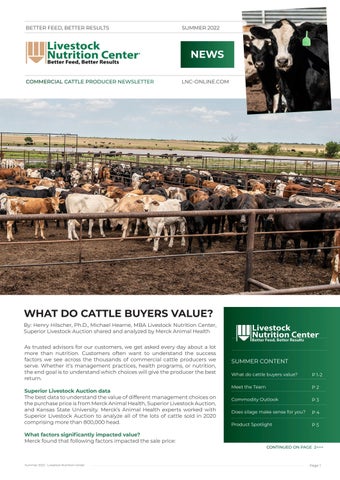
WHAT DO CATTLE BUYERS VALUE? By: Henry Hilscher, Ph.D., Michael Hearne, MBA Livestock Nutrition Center, Superior Livestock Auction shared and analyzed by Merck Animal Health As trusted advisors for our customers, we get asked every day about a lot more than nutrition. Customers often want to understand the success factors we see across the thousands of commercial cattle producers we serve. Whether it’s management practices, health programs, or nutrition, the end goal is to understand which choices will give the producer the best return. Superior Livestock Auction data The best data to understand the value of different management choices on the purchase price is from Merck Animal Health, Superior Livestock Auction, and Kansas State University. Merck’s Animal Health experts worked with Superior Livestock Auction to analyze all of the lots of cattle sold in 2020 comprising more than 800,000 head.
SUMMER CONTENT What do cattle buyers value?
P 1-2
Meet the Team
P2
Commodity Outlook
P3
Does silage make sense for you?
P4
Product Spotlight
P5
What factors significantly impacted value? Merck found that following factors impacted the sale price: CONTINUED ON PAGE 2>>>
Summer 2022 - Livestock Nutrition Center
Page 1
CONTINUED FROM PAGE 1 >>> WHAT DO CATTLE BUYERS VALUE?
FACTOR
CHARACTERISTIC
IMPACT
AS COMPARED
ON SALE
TO
PRICE ANIMAL FACTORS (TX, OK, AR & LA) Gender
Steers
+$16.15/cwt Heifers
Flesh
Medium-heavy frame
-$7.38/cwt
Medium
Breed
Brahman or Exotic
-$2.14/cwt
English
Horns
No Horns
+$2.48/cwt
Horns
Weight Variations
Very Uneven
-$2.29/cwt
Missing/uneven
VAC 34
+$2.58/cwt
VAC 24
VAC 45
+$7.51/cwt
VAC 24
VAC 60
+$7.92/cwt
VAC 24
VAC PRECON
+$8.60/cwt
VAC 24
BQA
+$0.50/cwt
NO CLAIM
GAP
+$5.48/cwt
NO CLAIM
NHTC
+$3.30/cwt
NO CLAIM
PROGRESSIVE GENETICS
+$1.27/cwt
NO CLAIM
RIGHTSLIDE,
+$3.33/cwt
2 WAY SLIDE
MEET THE TEAM LNC takes great pride in sourcing our employees. Each issue we will introduce you to one of our own.
HEALTH PROGRAMS Vaccine Programs
OTHER Quality/Natural
SLIDE & WEIGHT STOP
WEIGHT
STOP
In addition to the factors above, buyers did not pay differently based on the days until delivery, implant status, Bangs vaccination, or PI free status. It’s important to look at your actual costs, but there are a lot of opportunities to improve margins by implementing practices that consistently add value. Do vaccine programs have a positive return on investment? Getting higher prices is just one part of the return-on-investment equation. The additional costs to implement these changes must be considered. Using the KSU-Merck Calf Vaccination Program Assessment Tool, Merck found that VAC24 and VAC34 programs had a negative return on investment as measured by net margin difference. The VAC 60 and VAC Precon programs had the best returns. SALES
SALES
PRICE
WEIGHT
REVENUE
($/CWT)
COST
PROJECTED
INCREASE
NET MARGIN
($/HD)
DIFFERENCE ($/HD)
550
$896.02
NA
NA
$162.92
550
$887.08
$6.00
-$14.93
$165.23
550
$899.65
Sell at Weaning $162.91 (No VAC Program) Precondition, VAC 24 Program Precondition, VAC 34 Program
-$5.37 49.00
P r e c o n d i t i o n , $171.74
640
$1,088.17
$114.75
$77.40
VAC 45 Program Precondition, VAC
$172.04
670
$1,141.11
$150.00
$95.09
$171.50
670
$1,137.56
$150.00
$91.54
60 Program Precondition, VAC PreCon Program
As we start to think about next season, consider what do your buyers value? How are you are going to adjust your marketing and management to continue to improve your margins, reduce risk, and increase consistency? Page 2
Cody Hixon, M.S. Nutritionist
Keota, OK // North Kansas City, MO
Cody Hixon earned his Bachelor’s and Master’s degrees in Animal Science from Oklahoma State University. Upon completing his Master’s degree in 2014, he worked for a backgrounding and cow-calf operation in southern Oklahoma. After joining LNC in August 2015 in a Sales role at Keota, Cody transitioned to being a member of LNC’s Nutrition Team in 2017. In 2021, Cody continued to support LNC’s Sales Team by taking the position of Associate Sales Manager and overseeing sales at LNC’s Keota and Kansas City facilities. Cody resides outside of Keota, OK with his lovely wife and four children.
JOIN OUR TEAM
Do you know someone that would be interested in joining our team? At Livestock Nutrition Center we are always looking for qualified, hard-working individuals. All of our positions offer a competitive salary, full benefits and uniforms. https://www.lnc-online.com/careers/
Summer 2022 Livestock Nutrition Center
COMMODITY OUTLOOK By: Jon Leonard, Director, Supply Chain Management Just as the world was starting to see signs of supply-chain woes recovering from the pandemic, the next “black swan” event to occur has been the Russian invasion of Ukraine. As has been widely reported, Ukraine is the world’s largest sunflower oil producer and exporter, the fifth largest exporter of wheat, and in the top three for corn and barley. Therefore, the disruption of export shipments due to war has forced the world to other countries in the near term. Additionally, there is extreme concern over just how much sowing of wheat, corn, and barley will occur in Ukraine this spring. Since the start of the invasion on February 24th, old crop corn futures have rallied by $1.25 per bushel, and the basis has firmed as well. Already at historically high levels, this additional supply-chain shock has catapulted prices of grain, and therefore feed ingredients, even higher than they already were. Weather remains a major topic of conversation for U.S. Spring planting. Warmer and drier weather is needed in the Midwest, as we’re nearly 30% behind the long-term average for corn planting progress nationwide. It’s still early for soybeans, and we only lag 12% behind our average progress currently. The opposite is needed across the southwest plains, where the hard red winter wheat conditions are some of the worst we’ve seen. We are also keeping a close eye on hay and forage supplies, and the impact that sustained dryness has had across our region. Somewhat better than expected ruminant feed demand to finish the winter has also contributed to keeping prices high. Seasonally, we would normally expect to begin to see price declines for ingredients that compete with improving spring pasture conditions. However, anything that can be substituted for corn has been in high demand and cleared from the market - and at a higher relative value than what normally would be expected. Those ingredients are components such as Soy Hulls, Wheat Midds, and Corn Gluten Feed to mention a few. So, while grass cattle feeding demand in our geography tapers near-term, the price direction of corn, wheat, and soybeans will continue to drive where the price of feed trends from here for the summer. The monthly USDA crop production and World Agricultural Supply and Demand Estimates (WASDE) was released on May 12th and gave us our first official reports on 2022/23 U.S. and global new crop balance sheet projections. Starting first with corn, they left U.S. carryout unchanged for 21/22 at 1.440 billion bushels. The surprise for corn was in the 22/23 balance sheet where they reduced the average yield to 177.0 bu/acre, lower than most estimates. Soybeans were impacted very little, where exports increased by 25 million bushels for the 21/22 crop year, leaving the yield for 22/23 in line with their previous guidance of 51.5 bu/acre. Wheat was the friendliest to price action, starting with cutting the 21/22 carryout to 655 million bushels due to an increase in exports and feed use. For 22/23, all wheat production was reduced by 62 million bushels – attributed mainly to lowering Hard Red Winter wheat production expectations across KS, OK, TX and CO. Post report corn and beans moved higher, while wheat had a near limit-up finish to the day. Looking forward, the market will continue to grapple with tightening supplies of grains and oilseeds, coupled with massive global trade flow shifts due to the ongoing Russia/Ukraine war. Here are a few other situations that we continue to monitor: •
Detrimental weather conditions are impacting Brazilian corn production, Indian wheat production, and U.S. spring crop planting activity.
•
Export demand for U.S. corn and soybeans has been strong in recent months, leading to expectations higher for old and new crop demand.
•
Domestically, there is a concern for feed demand in all sectors due to continued high feed prices. Though recent Cattle on Feed numbers have been above a year ago, broiler hatch is unchanged from last year, while hogs and pigs numbers are below year-ago levels.
•
Weekly ethanol production is running below estimates. This has in part been due to historically poor rail performance issues forcing reductions in run rates, from the inability to load rail cars of ethanol and dried distiller’s grains. However, railroad velocity is expected to rebound, and the typical seasonal increase in gasoline demand during the summer months should support ethanol production rates in the months ahead.
•
Soybean crush has been running at or near record levels so far this marketing year, and with substantial margins, processors are expected to continue at that pace. Consequently, supplies of meal and hulls should remain available.
In summary, we expect feed prices to remain high, and the current price structure to continue for the foreseeable future. The U.S. must raise a trendline crop, or we’ll be looking at even higher prices (perhaps much higher) moving forward. Given all the uncertainty around global supply and seemingly insatiable demand for commodities, all eyes will continue to be on the Northern Hemisphere crops until we pass through our critical growing season. After that, we’ll be looking back to Ukraine to determine the long-term price impact of the conflict. We need to resolve supply disruptions in both hemispheres before feed prices can return to more historically moderate levels. Summer 2022 - Livestock Nutrition Center
Page 3
DOES SILAGE MAKE SENSE FOR YOU? By: Cody Welchons, Ph.D. Nutritionist, Livestock Nutrition Center As everyone is all too aware, the cost of doing business is rising. Whether it’s feed ingredients, fertilizer, or labor we have had continuous discussions lately about ways for producers to operate more cost efficiently. One of the common topics we discuss is the potential use of silage in someone’s feeding program. Anecdotally, as mixer wagons become more widespread, the amount of silage being put up has also increased. For many, the ability to grow or purchase silage for their feeding operation can bring great value, but it’s also important to understand what exactly you are getting and how to properly store and handle it to maximize your investment. What is Silage? - Silage is the name given when a whole plant, whether it’s a grain or grass, is harvested at a dry matter of 30-40% and preserved by a fermentation process which lowers the pH to the point of acidification. The most common types of silage for our region would be corn silage, sorghum and forage sorghum silage, and small grain silages such as wheat, triticale, or oats. The whole plant is chopped, packed, and then, preferably, sealed for a period of 4-8 weeks prior to feed out during which time there is rapid drop in pH to “pickle” the system. From this point on, proper storage is important to keep air out to maintain a stable, high-quality product. Benefits and Downsides - The use of silage lends many benefits to backgrounding and cow-calf operations. While the process of harvesting silage is a significant investment in time and resources, the ability to have a large store of a high-quality feed can reduce the producers reliance on purchasing hay and other feed ingredients through the winter when prices are at their highest as silage can make up a significant portion of diets for both cows and growing animals. Additionally, silage
can act as a conditioning agent for your ration which can take the place of a separate conditioning agent such as water or a molasses based blend. Most of the potential downsides to using silage are to do with harvesting and storing the silage properly to minimize shrink and decreases in forage quality associated with spoilage. Harvesting silage at the correct moisture level is important because if harvested too early (too much moisture) fermentation is much quicker and can be excessive leading to decreased nutrient density. Conversely, harvesting silage too late (too little moisture) can lead to slow and restricted fermentation leading due to insufficient water limiting the growth of microbes in the silage. Therefore, something to consider is the impact that waiting on a custom harvester can have on your silage crop if they must come too early or too late. After harvesting, proper packing and storage of silage minimizes dry matter loss due to aerobic spoilage. Even under the best management, dry matter losses of silage will be 10-15% while under poor conditions losses can be more than 25%. When purchasing silage from someone else’s pit, its still important to consider potential shrink after the silage is delivered to your location. Valuing Silage - The largest determinant of whether a given silage is a fit for your operation likely lies in the cost. To accurately compare the cost of nutrients in silage to alternative feedstuffs such as soyhulls or wheat midds, you need to have a cost per ton along with an accurate dry matter of the silage. From here, you can evaluate the cost per unit of energy and cost per unit of protein on a dry basis and compare that to other potential feeds. In the case of silage, we will likely always be comparing it on a cost per unit of energy as protein levels in most silages are deficient for growing animals. To note, at this time there is very little silage available from last years crop and no new crop silage has been put up yet. Additionally, prices of all commodities are much higher than in recent years, therefore, the prices below are purely for illustration rather than representative of prices we may see this year. Table 1. As-Fed Costs of Corn Silage & Soybeans at equivalent DM cost CORN SILAGE
SOYHULLS
Cost/ton as fed
$80.00
$201.14
Dry Matter, %
35%
88%
Cost/ton dry basis
$228.57
$228.57
From Table 1 we can see that when corn silage costs $80/ton delivered and has a dry matter of 35%, the equivalent price of soyhulls (roughly equal in energy to corn silage on a dry basis) would be $201/ton. Page 4
Summer 2022 Livestock Nutrition Center
Table 2. As-Fed Costs of Sorghum Silage and Soyhulls at Equivalent Cost per Mcal of NEg. SORGHUM SILAGE
SOYHULLS
Cost/ton as fed
$60.00
$232.94
Dry Matter, %
32%
88%
Cost/ton dry basis
$187.50
$264.71
Mcal of NEg/lb, Dry-basis
$0.34
$0.48
Cost/MCal of NEg
$0.28
$0.28
Table 2 shows the same evaluation for sorghum silage compared to soyhulls. In this scenario, the energy values aren’t equal and must be evaluated on a price per unit of
energy. With sorghum silage costing $60/ton at 32% dry matter the equivalent price for soyhulls would be $233/ ton. Vital to point out is that the dry matter and energy density of silage can vary widely so prior to making an evaluation of whether silage is the correct choice for your operation is to have a sample analyzed so that you have accurate information to make decisions with. Silage can be a viable roughage and energy source for your operation. However, its important to evaluate the cost benefits of silage correctly to accurately determine if silage is the value that it may seem when only looking at it from an as-fed cost per ton. Additionally, we have to consider the potential for greater shrink and take that into account when making growing or purchasing decisions.
Product Spotlight...
GUARANTEED ANALYSIS Fortified Calf TMR from Livestock Nutrition Center compliments a complete nutrition program to supply macro minerals, trace minerals and vitamins. Provides an all-in-one solution to end users mineral, vitamin and additive supplementation program in an easy to use product.
BETTER RESULTS WITHOUT THE GUESSWORK Easy to calculate inclusion rates (0.25 lbs/hd/d). TECHNOLOGIES • Intellibond® TM sources (increased bioavailability) • Carrier for ionophores, antibiotics, or other medicated additives including: • Rumensin®, Bovatec®, CTC, Deccox® & Clarifly® • Access to nutritionist and experienced personnel for diet formulation and designed feeding programs • Takes the guess work and variation out of TM and vitamin supplementation • All-in-one solution DIRECT DELIVERY TO FARM OPTIONS • Connect all aspects of your program • Ingredient procurement • Nutrition ration development & feeding program selection • Mineral nutrition • All with customized service
Summer 2022 - Livestock Nutrition Center
Calcium………......................................….Min. 23.75%............................................Max. 27.75 % Salt…………..............................................…Min. 17.50%.............................................Max. 22.50 % Magnesium…………..................................................................………....…………..……...Min. 2.00 % Potassium……………………………....……………………............................................…..…….Min. 2.00 % Cobalt……………………….....………....................................................………………...…..…Min. 9.8 ppm Copper…….......................................……………....………………………………………....…Min. 640 ppm Iodine………………………....…………….......................................…………………………...….Min. 32 ppm Manganese………............................................………………………………………...….Min. 1,300 ppm Selenium……………....…………………………………........................................……….…..Min. 12.8 ppm Zinc……………………....…......................................……………………………………….…..Min. 4,800 ppm Vitamin A……..........................................………………………………………..………Min. 96,000 IU/LB Vitamin E………....…………………......................................…………………………….......Min. 545 IU/LB FORTIFIED CALF TMR ADDITIVE OPTIONS: • Rumensin 1600 g/ton • Bovatec 1600 g/ton • Aureomycin (CTC) 3500 g/ton • ClariFly 218.88 g/ton • Any FDA approved combination of listed medications INGREDIENTS: Calcium Carbonate, Salt, Potassium Chloride, Magnesium Oxide, Soybean Oil, Zinc Sulfate, Copper Sulfate, Manganese Sulfate, Zinc Hydroxychloride, Ferrous Sulfate, Basic Copper Chloride, Sodium Selenite, Ethylenediamine Dihydroiodide, Cobalt Carbonate, Mineral Oil, Vitamin E Supplement, Vitamin A Supplement. FEEDING DIRECTIONS: Mix Fortified Calf TMR with grain and/or roughage and target a feeding rate of 0.25 lbs. per head per day. Provide fresh, clean water and good quality forage at all times. CAUTION: This product contains added copper and is not recommended for sheep or goats. WARNING: Feed is perishable and should be stored in a clean, dry, wellventilated area so it will remain fresh and palatable. DO NOT feed moldy or insect infested feed to animals as it may cause illness, abortion or death. Fresh, clean water should be available at all times. Page 5
CUSTOMER
Affirmations “It’s important when you’re doing business with a feed company like Livestock Nutrition Center, that they stay on top of the commodity markets and can anticipate the price changes that might affect the price of the feed that we feed the cattle to keep the cost of feed per pound of gain at a reasonable amount so we don’t have a huge loss on our cattle feed.” - Winston Hansma, NCHA Horse Trainer
800.777.1562 // LNC-ONLINE.COM