BETTER FEED, BETTER RESULTS
SPRING 2021
NEWS Commercial Cattle Producer Newsletter
LNC-ONLINE.COM
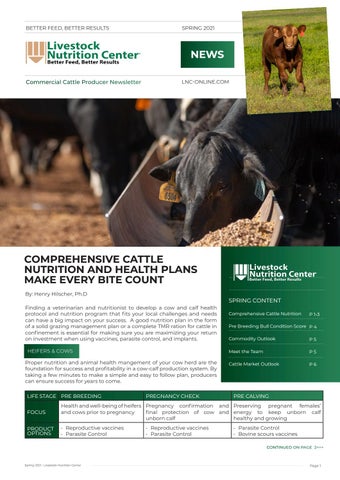
COMPREHENSIVE CATTLE NUTRITION AND HEALTH PLANS MAKE EVERY BITE COUNT By: Henry Hilscher, Ph.D Finding a veterinarian and nutritionist to develop a cow and calf health protocol and nutrition program that fits your local challenges and needs can have a big impact on your success. A good nutrition plan in the form of a solid grazing management plan or a complete TMR ration for cattle in confinement is essential for making sure you are maximizing your return on investment when using vaccines, parasite control, and implants. HEIFERS & COWS Proper nutrition and animal health mangement of your cow herd are the foundation for success and profitability in a cow-calf production system. By taking a few minutes to make a simple and easy to follow plan, producers can ensure success for years to come. LIFE STAGE PRE BREEDING
PREGNANCY CHECK
SPRING CONTENT Comprehensive Cattle Nutrition
P 1-3
Pre Breeding Bull Condition Score P 4 Commodity Outlook
P5
Meet the Team
P 5
Cattle Market Outlook
P6
PRE CALVING
FOCUS
Health and well-being of heifers Pregnancy confirmation and Preserving pregnant females’ and cows prior to pregnancy final protection of cow and energy to keep unborn calf unborn calf healthy and growing
PRODUCT OPTIONS
• Reproductive vaccines • Parasite Control
• Reproductive vaccines • Parasite Control
• Parasite Control • Bovine scours vaccines CONTINUED ON PAGE 2>>>
Spring 2021 - Livestock Nutrition Center
Page 1
CONTINUED FROM PAGE 1 >>> Comprehensive cattle nutrition and health plans make every bite count
HEALTH FOCUS • Vaccinate against the worst: Addressing IBR, BVD, and Vibrio/Lepto is the first step in setting up cows for success. Consider pre-breeding shots for the cows that cover viral and bacterial pathogens and top diseases that cause abortions (Table 1). • Control parasites: Deworming and parasite control is important to avoid complications that impact performance. NUTRITION FOCUS • Match nutrition to life stage: Manage cows in groups that calve in 60-day intervals. This will help ensure cows are all on the same nutritional plane and help build strong immune systems early in the calves’ lives. Heifers and 2- to 3-year-old cows should be managed separately if possible, to make sure their nutritional needs are met while they are still growing. • Control scours: The Sandhills Calving System, in which producers move pregnant cows to clean pastures for calving and then segregate calves by age to prevent direct and indirect disease transmission from old to younger calves, can be used to decrease scours in newborn calves. • Right macronutrients: Matching your cows’ nutrient requirements to their forage availability and quality will help them maintain BCS, breed back, and provide nutrients to your growing calves. • Right minerals and supplementation: Maintain a quality nutrition program by providing mineral year-round and using supplemental feed in poor or limited forage situations to keep animals productive and healthy. CALVES With the onset of spring, we typically see an increase in the number of calves being born across the southern and central plains. It is important to consider the life stage they are in from a nutrition and animal health perspective in order to achieve optimal growth and maturity. LIFE STAGE BRANDING/TURNOUT
PRE WEANING
WEANING
FOCUS
Overall health of calf from birth Health and well-being of calf Transition of nursing calf to 3 months of age from 3 to 7 months of age stocker/feedlot environment
PRODUCT OPTIONS
• Respiratory vaccines • Implants • Clostridial vaccines
• Respiratory vaccines • Parasite control • Clostridial vaccines
to
• Respiratory vaccines • Implants
BRANDING/TURNOUT: In the first three month of a newborn’s life, passive immunity gained from the consumption of colostrum helps provide resistance against potential diseases and infections. The transfer of antibodies from the cow to the calf via colostrum is extremely important to newborn calves because their immune systems are not mature enough to develop antibodies themselves. The calf should be immune to most of the pathogens present in the environment, since the dam has already been exposed to them and has developed protective antibodies (Cooke, 2010). A cow’s peak milk production will occur 60-90 days post calving. From this time forward, a cow’s ability to meet the growing demands of the growing calf declines. This coincides with the calf’s increasing ability to consume and digest feed and forage, which will increasingly beome the foundation of their nutrient intake. (Figure 2). HEALTH FOCUS • Build active immunity: Leverage calf vaccines to build the calf’s own active immunity as the protection from maternal antibodies wanes. • Control parasites: Calves’ may need deworming and parasite control to avoid wasted potential. • Alleviate stress: Dehorning, castrating, and branding at this time will help alleviate stress during the weaning period. NUTRITION FOCUS • Adjust nutrition for forage conditions: Consider early weaning or creep feeding as forage quality declines or forage availability dwindles to maintain adequate growth in calves and ensure breed back in cows. • Implement an implant program: This is the time to consider a suckling calf implant.
PREWEANING: Pre-weaning management, 2 to 3 weeks before weaning, it is important to ensure calves can continue to grow and stay healthy when exposed to the stressors associated with weaning.
HEALTH FOCUS • Vaccine timing is critical: The immune response to vaccination is not immediate, and it is recommended that ranchers vaccinate calves a few weeks prior to weaning for the calf’s immune system to be prepared for the stress of the weaning process. Superior Livestock Auction has a list of vaccine programs that are well-received in the industry. Page 2
Spring 2021 - Livestock Nutrition Center
• Control parasites: It may be worthwhile to consider deworming and parasite control NUTRITION FOCUS • Nutrition buffers against stress: The nutritional status of the calf will determine how well it mounts an immune response to vaccination and responds to challenges associated with the stress of weaning. Calves in a negative plane of nutrition will tend to struggle more in the weaning process than calves receiving adequate nutrient intake.
WEANING: Given the challenges of weaning, a nutrition and vaccine program developed in tandem before weaning will pay for itself. Although weaning is an inherently stressful process for a calf, taking steps to remove or reduce stress a much as possible will be extremely beneficial to improving calf health and performance. Due to the stress of the process, intakes will be low, so making sure every bite counts is crucial to helping stressed calves maintain adequate health and continue growing. HEALTH FOCUS • Bolster immunity: Weaning rations may include coccidiostats, ionophores, vitamins and minerals, and antibiotics. The first 14 to 21 days should be geared around driving intake and maintaining rumen health. Consider implanting again depending on your marketing goals. • Control parasites: If not done at pre-weaning, deworm again to avoid complications that affect performance. NUTRITION FOCUS • Water first: Provide calves with abundant access to clean water. • Weaning ration: Weaning rations should be highly palatable and nutrient dense due to limited intakes. Producers should also provide good quality forages that the calf is familiar with during the weaning process. Adequate bunk space is very important to allow animals plenty of access to feed. By working with a nutritionist to develop a weaning ration and feeding program, you can tailor your ration to work with ingredients that aid in the weaning process.
MANAGEMENT PRACTICES: A strong relationship with your veterinarian and nutritionist can allow you to make the most of your situation. Every situation is unique and presents challenges, but with a strong plan and a willingness to adapt, every problem is solvable. • Communicate early: Being proactive and meeting with your nutritionist and veterinarian can set your program up for success. If everyone agrees on the plan from the start, communication will be easier when there is a problem. • Fenceline weaning: Fenceline weaning can help alleviate stress and improve weight gain when compared to traditional weaning programs. Pierce et al. (2003) reported that fenceline weaned calves have decreased signs of stress, spent less time bawling and walking and more time eating and lying down than calves assigned to traditional weaning. • Vaccine handling: BQA certified employees can help ensure proper handling of vaccines and cattle. • Record keeping: Scales at your facilities can help you in the long term by collecting weights and measuring performance. Keeping records of morbidity and mortalities will help your team (your employees, vet, and nutritionist) understand what is working and what is not. TABLE 1
FIGURE 2
Figure 2 Cow Dry Matter Milk Production vs Calf DM Intake Cooke, R. F., Overview of the Cattle Immune System. 2010. Oregon State University – Beef Cattle Library. BEEF043 , Price, E. O., J. E. Harris, R. E. Borgwardt, M. L. Sween, J. M. Connor. 2003. Fenceline contact of beef calves with their dams at weaning reduces the negative effects of separation on behavior and growth rate. J. Anim. Sci. 81:116-121, Troxel, T., S. Gadberry, D. Philipp, and J. Powell. 2014. Backgrounding. University of Arkansas MP379. 1-25. http://www.superiorlivestock.com/files/vac_programs.pdf, http:// www.superiorlivestock.com/images/forms/qualifiedvaccines.pdf LEFT - Table 1. Texas Agri-Life Extension. Common cattle reproductive diseases. https://agrilifeextension.tamu. edu/library/ranching/reproductive-diseases-in-cattle/#:~:text=The%20most%20common%20reproductive%20 diseases,complexes%3B%20vibriosis%3B%20and%20trichomoniasi
Spring 2021 - Livestock Nutrition Center
Page 3
Pre-Breeding Bull Body Condition – Keep the Battery Fully Charged By: Justin Axman, M.S. Nutritionist, Livestock Nutrition Center It is that time of the year when warmer weather allows for the opportunity to begin planning or actively transporting cattle to pasture, working on farming/ranching plans for the foreseeable future, attend spring sporting events, endure the occasional extreme storm event, and last but not least evaluate your bull battery before breeding. Adequate time should be allotted for this latter exercise to allow for any deficiencies to be corrected in an appropriate amount of time, or in severe cases, purchase and replace unfit breeding stock. In terms of profitability for your cattle enterprise, proper management and nutrition of bulls are paramount to promote optimal reproductive efficiency and further advance the genetics of your herd. It can become rather routine to neglect bulls during certain periods of the year after they have performed their necessary role and are idle until the next cycle. To combat any detriments neglect may cause, bulls should be visually appraised for body condition score (BCS; scale 1-9) with an optimal body condition target of 5.5-6.5 achieved at a minimum of six weeks (spermatogenesis completed in 60 days) before breeding season. Visually, this should appear as an animal with full rib cover, plump hindquarters, noticeable sponginess over the fore ribs, and fat deposits appearing in the brisket. It is not uncommon for bulls to lose weight (100-200 lbs.) and body condition throughout a breeding season, which creates the risk for subsequent bull performance to suffer and longevity in the herd to diminish if not corrected. When exposed to females, bulls in poor condition are less active and present the potential to cover fewer cows than intended. As
described in Table 1, bulls in greater body condition have larger scrotal circumference than their counterparts in poorer condition and possess greater potential to achieve reproductive success. In short, this metric is a component of breeding soundness exams and is used to estimate the reproductive capacity of breeding stock. Table 1. Effect of body condition on scrotal circumference BCS
NUMBER OF BULLS
SCROTAL CIRCUMFERENCE (CM)
4
5
36.9
5
242
37.7
6
80
38.6
(Adapted from Rusk et al., 2002)
On the contrary, over-conditioned bulls also possess their concerns in that excess fat in the scrotal region can have detrimental effects on semen quality. As described in Table 2, decreases in semen quality can be witnessed when BCS approaches 4 or below on the low end, and 7 or greater on the high end. Additionally, over-conditioned bulls are at high risk of under-performing once on an altered plane of nutrition and are expected to breed an acceptable number of females. A scenario like this will often leave you dissatisfied with your investment, in addition to a greater proportion of open cows. Table 2. Effect of body condition on semen quality in physically normal beef bulls BCS
% OF BULLS WITH SEMEN QUALITY
SATISFACTORY
NUMBER OF BULLS
3
70.0
20
4
80.0
30
5
85.5
891
6
84.1
69
7
49.4
77
(Adapted from Barth et al., 2002)
It is imperative to avoid entering critical times of the year with cattle in poor, or excessive, body condition to create the most opportunity for your business model to be effective and profitable. Livestock Nutrition Center is outfitted to assist in the visual appraisal process and ensure your nutrition program is on target before breeding season. Be sure to contact your nearest LNC location to work with our Feed Consultative Sales Representatives and Nutritionists on devising a successful plan. References
Barth, A. D. and C. L. Waldner. 2002. Factors Affecting Breeding Soundness Classification of Beef Bulls Examined at the Western College of Veterinary Medicine. Can. Vet. J. 43:274-284. Farney, J. K., D. A. Blasi, S. Johnson, C. Reinhardt, A. J. Tarpoff, J. Waggoner, R. Weaber. Guide to Body Condition Scoring Beef Cows and Bulls. Kansas State University MF3274. 1-8. Rusk, C. P., M. E. King, R. G. Mortimer, and N. C. Speer. 2002. Case Study: Relationships of Scrotal Circumference and Scrotal Volume to Growth and Semen Traits in Beef Bulls. Prof. Anim. Sci. 18:79-84.
Page 4
Spring 2021 - Livestock Nutrition Center
COMMODITY OUTLOOK By: Matt DeFlon Procurement Manager, Livestock Nutrition Center We have certainly seen our fair share of volatility over this past feed season. What has been driving this volatility? DEMAND, especially corn and soybeans. We have seen very large exports of corn and soybeans this crop year driven mostly by China. For instance, as we entered the 2020-21 crop year, anticipated corn exports were 2.2 billion bushels. We are now on pace with shipments and sales to export 2.9 billion bushels. This now has our carryout down to 1.2 to 1.3 billion bushels. Demand from China on soybeans has been just as astounding this year as they are importing record quantities this year. Soybean carryout is estimated to be in the 110 to 120 million bushels area.
MEET THE TEAM LNC takes great pride in sourcing our employees. Each issue we will introduce you to one of our own.
So how does all of the above affect the prices of our basic ingredients such as Corn Gluten Feed, DDG, Soyhulls, Wheat Midds, and others? It is key to remember these are by-products, i.e. ethanol plants do not run to produce DDG, they run to produce ethanol. So the demand for ethanol will drive the supply of DDG. Flour mills do not run to produce midds, they run to produce flour. COVID has reduced the demand for ethanol, corn sweeteners, and flour for bread which has decreased the supply of the by-products we consume for feed. In conjunction with the by-products discussed above, the fiber/ roughage market remains elevated as well. We are not quite to price levels we saw in the 2011/12 drought, but inching that way. A dry spring/early summer of 2020 in hay-producing areas resulted in a decrease in overall production. This has led to a minimal roughage carryout from the old crop into the new. Add in rumors of additional acres being taken from alfalfa production into planting row crops and supply will certainly tighten. Although roughage values are high, they remain competitive vs other ingredients in rations today. As we move forward, the weather will come front and center to our volatility. We have to get through planting season promptly. Then we will have to watch our temperatures and moisture levels, especially in the June, July, and August time frames. The markets will watch each weather report for changes that can flip the direction of market trends on a dime. Weekly crop ratings will be monitored closely for any type of crop problems. With tight carry-outs on both corn and soybeans, the pressure for bountiful crops is paramount and volatility will remain a keyword this spring and summer.
Henry Hilscher, Ph.D. Nutritionist
Cameron,TX // Gonzales, TX // Tenaha, TX // Foreman, AR
Henry Hilscher joined LNC as a Nutritionist in July 2018. A native of Shiner, Texas, Henry received his bachelor’s degree in Animal Science from Texas A&M University. He continued his education at the University of Nebraska, where he earned M.S. and doctorate degrees in Ruminant Nutrition. While in Nebraska, he also served as the university’s Research Feedlot Manager from 2014 to 2018. He provides technical support and training for the LNC sales team as well as expertise in beef cattle nutrition for customers in central, eastern, and southern Texas, western Louisiana and southwest Arkansas. Henry and his wife, Claire, reside in Cameron with their two sons, Barrett and Hollis.
JOIN OUR TEAM
Do you know someone that would be interested in joining our team? At Livestock Nutrition Center we are always looking for qualified, hard-working individuals. All of our positions offer a competitive salary, full benefits and uniforms. https://www.lnc-online.com/careers/
Spring 2021 - Livestock Nutrition Center
Page 5
CATTLE MARKET OUTLOOK • The Cow herd is continuing to liquidate in areas of drought. Combined with smaller calf crops from 2019 and 2020, we expect tighter fed supplies and higher prices by late 2021. • Higher prices for fed cattle and feeder cattle later in the year will keep the fall calf run higher priced than it would be in normal years. • All classes of cattle are getting to above year-ago prices, we expect this will continue this year. OUTLOOK • Stockers: On summer grass, producers can expect solid profitability • Cow/Calf: Producers will see improved profitability vs. a year ago
800.777.1562 // LNC-ONLINE.COM