Rocky Mountain Santa Gertrudis Association October 1, 2016 Volume 1
INSIDE THIS ISSUE
Issue 1
Fall Cool Down
1
Fall Cool Down
By Adolfo Sanchez
2
RMSGA Dues
3
Getting Your Seedstock Calves Off to the Right Start
4
One Pot Lasagna Pasta Recipe
5
Dates to Remember
We are happy to roll out the Inaugural Fall Newsletter, the “Fall Cool Down” for the Rocky Mountain Santa Gertrudis Association. RMSGA is committed to outreach with both Registered and Commercial Santa Gertrudis producers in order to educate cattleman and promote progressive breeding and management strategies. We hope to offer Biannual newsletters that high-light upcoming Cattle event in the Western States and throughout the Santa Gertrudis Breed. We also plan to include educational topics as well as some country living tips to lighten up the newsletter. Our Spring Newsletter will be titled the “Spring Runoff” and will detail the spring events occurring in RMSGA and within the Santa Gertrudis breed.
Rocky Mountain Santa Gertrudis Association Dues RMSGA Membership $40.00 Make check Payable to:
RMSGA
Contact:
Vice President of RMSGA Stacy Montono Phone: 1(505) 429-0067
Mail to:
703 S. Christopher Rd. Belen, NM 87002
https://www.facebook.com/rockymountainsantagertrudisassociation/
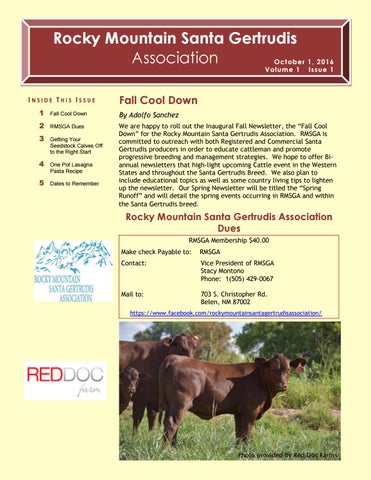
Photo provided by Red Doc Farms
Fall Cool Down
Page 2
Getting Your Seedstock Calves Off to the Right Start By Dr. Frank White, PhD, PAS “An ounce of prevention is worth a pound of cure (Benjamin Franklin).” Benjamin Franklin’s quote is evident when managing young calves, and the focus of this article is to help develop strategies to manage seedstock calves near weaning to prevent stress, disease, and maximize growth and performance. Preconditioning is a term usually associated with calves entering the stocker/feedlot segment of the beef industry, but many of the same principles can be applied to a purebred operation. Preconditioning can be defined as nutritional, health, and management strategies around weaning to optimize health and performance of young bulls and heifers.
Creep Feeding Preparing calves for weaning starts months prior, and creep feeding is a great way to condition calves to the feed bunk and their future diets as well as increase weaning weights. Research shows that creep feeding will increase calf weights by 25-60 pounds with average forage (Lusby; Gould, 2012).
BBBBBBBBBBBBBBB “An ounce of prevention is worth a pound of cure (Benjamin Franklin)” _________________
Creep feeding should be considered mainly an energy supplement for calves. Milk production of beef cows declines after 2 months of lactation; however, the nutrient requirement of calves continues to increase until weaning. This creates a “hungry calf gap” where nutrients must be met by feedstuffs other than cow’s milk (Eversole). Creep feeding can be used to compensate for poor milk production in first calf heifers and cows. It is also a great tool to increase condition, size, and growth of purebred bull and heifer calves getting them off to the right start to reach sale weights or target breeding weights. Creep feeding will be most advantageous when forage quality declines or during times of drought to help calves meet the hungry calf gap. Creep feeding will be especially beneficial for fall calving operations because protein and energy are both lacking in native forage. Creep feed should contain 14 to 16% crude protein without any NPN. Creep feed should be fed for at least 60 days to realize gains. These supplements should be energy dense and formulated to meet the vitamin and mineral requirement of calves at the target intakes. Increasing mineral and vitamin stores in the calves will help prepare them for stress of weaning. However, creep feeding is not economical for all management situations. If you have high milking cows and high quality forage, calves will be able to meet the hungry calf gap with milk and forage, which will be more efficient than creep feeding. If your calves will be on a lower plane of nutrition after weaning such as dormant or low quality forage, additional weight gains from creep feeding will be lost. Also, creep feeding is not desirable when markets discount fleshy calves. Care must be taken when creep feeding replacement heifers because over conditioned heifers at weaning will deposit fat in the udder which has been shown to decrease milk production. When creep feeding replacement heifers, be careful to wean them in a good body condition without getting them too fat.
Health The seedstock industry is not immune to health issues even though good protocols are in place at most operations. Preconditioning protocols are designed to prevent Bovine Respiratory Disease (BRD) in calves at weaning. BRD is major cause of death in young cattle and is estimated to cost the beef industry more than $1 billion dollars annually (Brodersen, 2010). In the feedlot, sick calves have lower average daily gain, but preconditioning improves post weaning weight gains, feed efficiency, cost, and decreases death lost (Lalman and Mourer). If not managed, BRD will cause a decrease in performance of young calves at a time when you can least afford it.
Fall Cool Down
Page 3
(Continued)
Health BRD is an opportunistic disease that is caused by the interaction of stress, viruses, and bacteria. The stress of traditional weaning management practices weakens the immune system of calves making them more susceptible to viral infections. The viruses damage the respiratory surface and give the bacteria an opportunity to thrive and cause further damage. BRD control programs will use a comprehensive vaccination program, and the following preconditioning protocol will help control BRD in young calves: •
Work with your veterinarian to make sure you have a comprehensive vaccination program for bacteria (Mannheimia haemolytica, Pasteurella multocida, and Histophilus somni) and viruses (IBR, BVDV, PI-3, and BRSV) that are known to contribute to BRD in a herd.
•
Have a good deworming program in place as this will reduce stress on calves.
•
Provide a complete nutrition program with a highly palatable nutrient dense diet balanced for copper, selenium, and zinc because these minerals are known to affect immune function of calves.
•
Feed a coccidiostat for control of coccidiosis.
•
Adapt calves to water troughs before weaning.
•
Train calves to eat feed out of a bunk before weaning.
•
Provide a sick pen for treatment.
•
Dehorn calves before weaning. 3KRWR 3URYLGHG E\ .OLQJH /LYHVWRFN
Ranch-Way Feeds’ Role
Ranch-Way Feeds has a 15% Premium Calf Creep w/Bio-MOS that is our first recommendation for creep feeding. We also have a 14% HE Seedstock Starter Ration w/Bio-MOS that we recommend for weaning and starting young calves on dry feed. Both of these products have elevated trace mineral levels to support the immune system response against the stress and disease associated with weaning. They also contain Bio-MOS, a natural yeast-based product that promotes beneficial bacteria and inhibits certain pathogenic bacteria in the gut of young calves. Medication can also be added to aid in the prevention of coccidiosis and respiratory disease. Please contact Rach-Way Feeds at 1-800-3337929 for more information. Dr. Frank White, PhD, PAS Nutrition Services Manager and Lead Nutritionist fwhite@ranch-way.com 1-800-333-7929 www.ranch-way.com
2QH 3RW /DVDJQD 3DVWD 5HFLSH INGREDIENTS 1 lb. ground beef 1 medium zucchini, chopped 1 jar (24 to 26 oz.) Pasta Sauce 2 cups water 6 oz. uncooked pasta ½ tsp pepper 2/3 c reduced-fat ricotta cheese 1 c reduced-fat shredded mozzarella cheese Thinly sliced or chopped fresh basil For further cooking instructions please refer to: http://www.ohsweetbasil.com/one-pot-lasagna-pasta-recipe.html 5HFLSH GHYHORSHG E\ 2K 6ZHHW %DVLO DQG 7KH %HHI &KHFNRII
Rocky Mountain Santa Gertrudis Association 703 Christopher Road Belen, NM 87002
Dates to Remember October 15, 2016 – November 1, 2016 receive cattle for RMSGA “Spring Run Off” Criteria: All heifers must be: BANGS Vaccinated prior delivery to Red Doc or Cherokee Ranch. Heifers or Bulls be registered prior to delivery Recommend Vac 45 program or at least one round of Respiratory Vaccines, Dewormer, (Ivomec Equivalent) and 7-way. November 19, 2016 - South Texas Heritage sale Robstown Texas (Corpus Christi TX) December 29, 2016 - Arizona Cattleman’s Day Heifer pen Dale, 2 pens of Santa Gertrudis heifers Also featuring: SGBI Director John Ford’s, presentation to Arizona Cattleman “Do EPD’s Really Work?” January 2017 - “Explore New Opportunities at the NWLSR in Denver” March 2017 - Houston Livestock Show and Super Sale: March 9th – Super Sale March 10th - Show March 2017 - Cattle Prep for RHBS Ultrasound, photography and Catalog. April 8, 2016 – 13th Annual “RHBS” and RMSGA 3rd “Annual Spring Run Off Sale”
PRESORTED STANDARD MAIL U.S. POSTAGE PAID LivestockDirect 66030