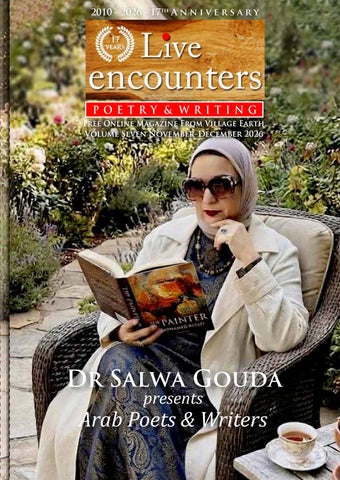
2010 - 2026 - 17th A n n i v e r s a r y
P O E T R Y & W R I T I N G Free Online Magazine From Village Earth Volume Seven November-December 2026
Dr Salwa Gouda presents
Arab Poets & Writers 2026 November-December POETRY & WRITING © liveencounters.net
LIVE ENCOUNTERS MAGAZINE
©Mark Ulyseas
Photograph by Mark Ulyseas. © liveencounters.net POETRY & WRITING Volume Seven November-December 2026 Celebrating 17th Anniversary
P O E T R Y & W R I T I N G
Volume Seven 17th Anniversary November-December 2026
Support Live Encounters.
Donate Now and Keep the Magazine Live in 2027 Live Encounters is a not-for-profit free online magazine that was founded in 2009 in Bali, Indonesia. It showcases some of the best writing from around the world. Poets, writers, academics, civil & human/animal rights activists, academics, environmentalists, social workers, photographers and more have contributed their time and knowledge for the benefit of the readers of:
Live Encounters Magazine (2010), Live Encounters Poetry & Writing (2016), Live Encounters Young Poets & Writers (2019) and now, Live Encounters Books (August 2020).
We are appealing for donations to pay for the administrative and technical aspects of the publication. Please help by donating any amount for this just cause as events are threatening the very future of Live Encounters. Om Shanti Shanti Shanti Om Mark Ulyseas Publisher/Editor
All articles and photographs are the copyright of www.liveencounters.net and its contributors. No part of this publication may be reproduced without the explicit written permission of www.liveencounters.net. Offenders will be criminally prosecuted to the full extent of the law prevailing in their home country and/or elsewhere. 2026 November-December POETRY & WRITING © liveencounters.net
Contributors
© liveencounters.net POETRY & WRITING Volume Seven November-December 2026 Celebrating 17th Anniversary
P O E T R Y & W R I T I N G
Volume Seven 17th Anniversary November-December 2025
Dr Salwa Gouda – guest editorial Abdel Wahab Al-Melaweh Aicha Bassry Ali Al-Hazmi Asaad Al-Jabbouri Avin Hamo Aziz Azrhai Azmi Abdel Wahab Charbel Dager Eid Abdel-Halim Emad Ghazali Fawzia Alawi Alawi Ibrahim Abdel Meguid Khulood Al-Mualla Mohamed Refaie Mohammad al-Domaini Mounir Otaiba Omar Abuo Al-Haija Sameh Mahgoub Sharif El-Shafiey Tahani Fajer Younes Abu Sabea Zaki Al-Ali Zaynab Laouedj
2026 November-December POETRY & WRITING © liveencounters.net
GUEST EDITORIAL
Dr Salwa Gouda © liveencounters.net POETRY & WRITING Volume Seven November-December 2026 Celebrating 17th Anniversary
SALWA GOUDA Salwa Gouda is an Egyptian literary translator, critic, and academic at the English Language and Literature Department at Ain-Shams University. She holds a PhD in English literature and criticism. She received her education at Ain-Shams University and California State University in San Bernardino. Furthermore, she has published several academic books, including Lectures in English Poetry and Introduction to Modern Literary Criticism, and others. She has also contributed to the translation of “The Arab Encyclopedia for Pioneers,” which includes poets, philosophers, historians, and men of letters, under the supervision of UNESCO. Also, her translated poetry anthology, entitled Dogs Pass Through My Fingers, was published recently through Alien Buddha Press in Arizona, USA. Additionally, her literary translations have been published in various international magazines.
Dr Salwa Gouda
The Second Language I Didn’t Know I Was Learning These past few months, perhaps because of the sudden failure of my health, I have felt an urgency to set down the things that happened in my life. Among the stories I need to tell is the story of how poetry worked on me, until I came to feel that I am myself a poem, and that what I carry not only nourishes me but the world as well. I did not come to poetry on purpose. I came to it the way most people come to the things that end up saving them, by heavenly decisions. Everything is genuinely arranged.
I was seven years old, in my grandmother’s garden in the village, and there was a man there named Abu Ali who took care of the trees. I did not know, then, that he was reciting poetry. I only knew that when he worked, he talked to himself in a voice that rose and fell, and that the words had a shape I could feel even though I could not have explained it. He would stop mid-sentence, look at a branch, and start again, and the second time it was different, as if he were trying to get it right. Sometimes he sang instead of reciting, and one of those songs stayed with me longer than the poems did: He traveled far and left my eye in tears and left the whole sorrow here with me. If only someone, on that day, had held him back and kept him here with me. I did not know then that it was a song about being left. I only knew the tune stayed with me longer than the meaning did. I remember sitting on the low wall by the fig tree, pretending to be busy with something, just listening. I did not understand a single line. But I understood that the words mattered to him in a way that ordinary speech did not, and that was the first time I ever wanted to know why. continued overleaf... © Salwa Gouda 2026 November-December POETRY & WRITING © liveencounters.net
GUEST EDITORIAL
It was years before I learned what Abu Ali had been reciting. But that came later. What I learned first, though I did not understand it as learning, was that he did not only recite other people’s poems. He made his own. He would stop midbranch, look at nothing, and say a line that had no book behind it. I only knew that when he said his own lines, his voice changed, quieter, as if he were checking whether the words would hold. Years later, in a classroom, I heard a poem read aloud properly for the first time. I do not remember which poem. What I remember is the vertigo of hearing in a book what I had first heard from a gardener. But the greater vertigo came later still, when I understood that the man who taught me poetry was not only carrying it. He was making it, in the same garden, with the same hands. Abu Ali taught me attention before I could read a word. I noticed that my grandmother kept her sugar in a coffee tin, that the light in her kitchen at four o’clock in November was a particular shade of grey gold, that she cleared her throat before saying anything true. I had lived in that kitchen for years without seeing it. Then I read a poem, I don’t remember the poet, describing the earth as a peacock and the air as a cooing dove, and then, five lines later, admitting that there is a mote in his eye from the light of spreading white hair, beauty and grief in the same breath, neither cancelling the other. After that I could not look at that kitchen the same way. That discipline, I came to understand, is most of what love is. The care Abu Ali gave the trees, the way he looked at a branch before touching it, was already a kind of poem.
My father was the other voice. At home, in the evenings, he recited Shakespeare. He had memorized the sonnets at school. His teacher, who was Yugoslav by nationality and came to live in Egypt like many during this time, had made the class learn them by heart, and my father had never let them go. He would stand by the window with his tea and say, “Shall I compare thee to a summer’s day?” Not as a performance, but the way a man hums a tune he has known his whole life. I did not understand English well enough then to follow the meaning. What I followed was the rhythm, the same rising and falling I had heard from Abu Ali in the garden. Two men, two languages, two entirely different worlds, and the same thing happening in both: a person speaking words that had been given to him and making them his own. © liveencounters.net POETRY & WRITING Volume Seven November-December 2026 Celebrating 17th Anniversary
SALWA GOUDA
But the influence of poetry on my father went further than the voice. It made him a certain kind of man. He was sentimental in a way that embarrassed me as a child and moved me now. He wept at things that did not concern him. News reports. Strangers’ funerals. Once, a documentary about a dog. He was noble in a way I did not understand until I was older: he assumed everyone’s pain was real; he treated the smallest kindness as a debt he owed. I used to think this was simply his nature. Now I think it was partly Shakespeare’s. The sonnets his Yugoslav teacher made him memorize did something to him that forty years of ordinary life could not undo. They made him tender. They made him care about all. And my father, in turn, gave this to me without ever sitting me down to explain it. He simply stood by the window and said the lines, and I listened, and something in me learned that poetry was a thing adults did when they were thinking about something they could not otherwise say, and that the men who did it became, slowly, gentler than the world around them.
Then poetry began to work on me directly. At several points in my life, it has been a kind of survival equipment. I do not know what I would have done without it. I do not mean this dramatically. I mean that in the worst weeks, the weeks of grief, of failure, of the despair that comes at three in the morning, I did not reach for a novel, because a novel asks for sustained faith in the future. I reached for a poem, because a poem asks for only one thing: fifteen seconds of attention. It does not require you to believe that things will get better. It only requires you to stay in the room for fourteen lines. When this health crisis came, I read Amal Dunqul’s “Do Not Reconcile” over and over, not because it consoled me but because it refused to lie. It did not say the wound would heal. It said: do not pretend. I needed a poem that would stand with me in the refusal rather than usher me toward an acceptance I did not feel. And then there was Darwish. I came to Mahmoud Darwish late in my life. What struck me was not politics, everyone had told me about politics, but the insistence. His poetry does not offer resolution. It offers the act of naming itself as a form of survival, the insistence that a self exists even when the world denies it. I read him during a year when I felt invisible, and the poems did not tell me I was wrong to feel that way. They told me that naming the feeling was already a form of resistance. That was the year I started writing again.
continued overleaf... © Salwa Gouda
2026 November-December POETRY & WRITING © liveencounters.net
GUEST EDITORIAL
Working with poetry, in teaching classes with my students or with the poets in translation, has taught me something the reading alone could not. It taught me that the first draft is not the point. The point is the revision, the willingness to look at what you have made and say, “No, that’s not it yet,” and try again. This has leaked into everything. It has made me more patient with myself, more willing to fail at something for a long time before I succeed at it. It has also, I think, made me kinder. When you have spent an hour trying to find the right word for a feeling, you become reluctant to assume that another person’s wrong words mean they have no feelings at all. Poetry has given me a theory of other people: everyone is carrying around an unspoken poem, and most of us are doing our best to translate it.
The deepest change poetry has made in me is harder to put into words, because it is a change in the shape of my days rather than in my opinions. I learned that the ordinary is where the sacred lives, if you look closely enough. The burnt pot, the bus ticket, the sugar in the coffee tin. For years I had been waiting for my life to become interesting, and all the while it was interesting, and I was looking past it. Poetry did not give me a better life. It gave me back the one I already had, with its chipped cups and its small griefs, and taught me to find it enough. And I have never felt alone when there is work with poetry. Not once. Even in the worst weeks, when the room was empty and the night was long, there was always a poem to return to, and returning to it was a kind of company. That is what poetry has done for me. It has not answered my questions, but it has stayed with me while I asked them. And it began with a gardener in a village and a father by a window.
I used to think I inherited my father’s tenderness. Now I think I inherited his teacher’s sonnets, passed down through him like a second blood. And I used to think I learned attention from poetry. Now I think I learned it from a gardener who looked at a branch before touching it. One gave me the discipline of looking. The other gave me the softness to care about what I saw.
© liveencounters.net POETRY & WRITING Volume Seven November-December 2026 Celebrating 17th Anniversary
SALWA GOUDA
I think, in the end, that is what I would say if poetry could hear me. Not thank you for the beautiful lines, though there are so many. Not thank you for the comfort, though it has saved me. But thank you for teaching me to look. Thank you for the second language I did not know I was learning, the language in which a burnt pot is a grief, a bus ticket is a departure, and a few dozen words arranged with care can carry across the distance between two people who have never met. I have lived a more attentive, more honest, more survivable life because of it. And every time I read a poem properly, slowly, aloud, willing to be changed, I am still that seven-year-old on the low wall by the fig tree, listening to Abu Ali talk to himself in a voice that rose and fell, and later, at home, hearing my father say “Shall I compare thee to a summer’s day?” to no one in particular, learning to name what I feel.
© Salwa Gouda 2026 November-December POETRY & WRITING © liveencounters.net
THE DEEP
Abdel Wahab Al-Melaweh © liveencounters.net POETRY & WRITING Volume Seven November-December 2026 Celebrating 17th Anniversary
ABDEL WAHAB AL-MELAWEH Abdel Wahab Al-Melaweh (b. 1961) is a prolific Tunisian author whose diverse body of work includes over ten poetry collections, two novels, and several critical studies, in addition to his contributions as a translator.
Translated from Arabic by Dr. Salwa Gouda.
The Deep The gardens that stay awake at night disturb no one. The sea is not as deep as you believe; and the sky that rises high is no higher in its turn; the days do not follow one another sometimes they falter at the fullness of their roundness and curl back upon themselves. A little recklessness will suffice for life to stop lying and for the trees to strip off their shirts despite the so-called justice of the seasons. Woodstock was not merely a carnival of lust, or billboards advertising the usefulness of chaos in an age of mass suicide; how astonishing it was that butterfly wings could bear the ecstasy of the universe! and that the apple could give the lie to Newton’s final prayer and it has nothing to do with Ginsberg’s howl or Kerouac’s road or Kubrick’s apple. For the flower can no longer bear its fragrance imprisoned in the archive of the future. The trees were adept at blending rock with blues; as for the air, it abandoned its neutrality and became less modest. It had to be: to break the neck of time and invent another emotion deeper than the sea and higher than the sky and more silent than the gardens; it had to be: music without rhythm, weeping without tears, joy without laughter, dance without drums, sorrow without sadness. That is the deep.
© Abdel Wahab Al-Melaweh 2026 November-December POETRY & WRITING © liveencounters.net
THE DEEP
The Weary It is unreasonable for the poem to begin with an open eye; The hanging balconies are scars from which the cough of memory dangles, The walls cough in turn, And the day runs wounded. I am the wounded one. I am still practicing diminishment, Toying with my life like a doll, I distract each time with the sticks of the grammatical markings of wretched ideologies. O shadow, step aside from my voice and let it stretch its legs a little in its silence; O present, do not stare too long into the past, for you have been past from this very moment; O illusion, do not judge the imagination of thresholds harshly, For the weary do not knock on the door of speech but walk on in their weariness, light-footed, their pupils widening to hold the sorrows of trees and the sweat of glooms. They walk humming rotten songs just to amuse the air, for broken tears do not go out like a flash of lightning. And it is the habit of the poem not to open its eyes to anyone. Thus, the weary go on, weighed down by their fractured footsteps, fearing for the pebbles of the road from their own breath.
© liveencounters.net POETRY & WRITING Volume Seven November-December 2026 Celebrating 17th Anniversary
ABDEL WAHAB AL-MELAWEH
They sit among the crumbling corridors of their own limbs. They dream of nothing, not even the comfort of homelands. They are tender with the grass that heaven has neglected, They nurse it with their sweat and the milk of their gazes, And they go on, nothing ahead of them, Nothing behind them. They follow the trail of sparrows after their birth, They climb hills forgotten in the pupils of exiled shepherds with their flocks between broken seasons. The weary knock on no one’s door, For all the others do not know the meaning of weariness. Only the poem, with its two closed eyes, sums up the idea of pain.
© Abdel Wahab Al-Melaweh 2026 November-December POETRY & WRITING © liveencounters.net
IN SEARCH FOR MYSELF
Aicha Bassry © liveencounters.net POETRY & WRITING Volume Seven November-December 2026 Celebrating 17th Anniversary
AICHA BASSRY Aicha Bassry is a distinguished Moroccan poet, novelist, and storyteller. She is the author of multiple acclaimed novels and poetry collections. Her work has been honored with several prestigious awards, including the International Kateb Yassin Prize for the Novel (Algeria, 2016) for Greta Garbo’s Granddaughters, the Simone Landry Prize for Women’s Poetry (Paris, 2017) for her collection The Bathers in Thirst, and the Award for Best Arabic Novel in 2018 at the Sharjah International Book Fair (UAE). Bassry’s writing has reached a global readership through translation into English, French, Spanish, Italian, and Turkish. She is a frequent participant in major cultural forums across the Arab world and internationally, contributing to book fairs, literary festivals, and conferences.
Translated from Arabic by Dr. Salwa Gouda.
In Search for Myself From an airport to a station to a port, you roam the countries, your death follows you the one you left one morning waiting for you on a white bed in a clinic on United Nations Street. You wander, extending a palm crisscrossed with lines to every passerby who greets you, perhaps one of them will read what is hidden between the lines, and uncover your eternal thirst. Perhaps one of them is skilled at reading palms and will lead you to your final harbor. Though it would have been enough to count the number of daggers/ welts on your body, and the smells of disappointment on the orchards of silk, to know that no color suits you except the whiteness of death.
© Aicha Bassry 2026 November-December POETRY & WRITING © liveencounters.net
IN SEARCH FOR MYSELF
On the Definition of Cardiac Arrest A blood clot, a desperate scream of the body, a station for changing direction, an alarm bell: that what remains is not enough to finish a poem, to exchange a kiss, to write a will, to send off the three brides, for a golden autumn, to open one’s mouth and confess, to seek forgiveness for small sins, to embroider a handkerchief for farewell. A warning that what remains is only enough to place a final period at the bottom of the last page.
© liveencounters.net POETRY & WRITING Volume Seven November-December 2026 Celebrating 17th Anniversary
AICHA BASSRY
What Does Life Owe Me? From my language, I made lives and lived them, I made a house of words and dwelled in it, I drew a sea and set sail, I placed a sky and soared, I imagined a man and loved. From my ashes I grew a garden of roses. From wounds in the palm, I released a flock of butterflies. From the womb of snow, I ignited the meteors of desire. I interpreted myself by myself, and named myself the riddle of names. Even my death my body made from its own cells. So what does life owe me?
© Aicha Bassry 2026 November-December POETRY & WRITING © liveencounters.net
THE DEPARTED
Ali Al-Hazmi © liveencounters.net POETRY & WRITING Volume Seven November-December 2026 Celebrating 17th Anniversary
ALI AL-HAZMI Ali Al-Hazmi (born 1970) is a renowned Saudi poet who earned his bachelor’s degree in Arabic Language from Umm Al-Qura University in Mecca. His poetry has been widely published in Arab newspapers, magazines, and various specialized cultural periodicals. Al-Hazmi has actively contributed to the literary scene by participating in and enlivening numerous poetry evenings at local literary clubs, as well as at literary festivals and forums across several countries worldwide. He has authored nearly seven poetry collections, which have been translated into multiple languages, including French, English, Turkish, Romanian, German, and Spanish. Al-Hazmi’s literary excellence has been recognized with several prestigious national and international awards, including: Poetry Prize at the Uruguayan Poetry Festival (2015). The Grand International Prize at the International Poetry Nights Festival in Romania (2017). “Verbumlandi” International Poetry Prize in Italy (2017). “Best International Poet of 2018” award from the International Poetry Translation and Research Center (IPTRC) in China.
Translated from Arabic by Dr. Salwa Gouda.
The Departed He whom the guide of absence chooses their features, in the soul’s stillness, guard their silence. A hidden voice in the recesses kept calling from afar in their name.
They advance with all the hope that fate affords toward an absence furnished by edges. They walk in an awe-inspiring destiny toward the bank of their own death, like those who know the secret of existence’s questions, they advanced. Like those assured by the scripture of life’s illusions and the specter of salvation’s causes, they advanced. Because they thought the earth too narrow for their spacious eyes, and because they found a marble path, obscure, leading to the absence of beginnings, they departed. They set beyond all sight like a forgotten poem alighting on the lip of absence. They wrote not a single line to our hearts in the mail of absence after their departure. They remained there, in probabilities staring into the far reaches and their barrenness.
continued overleaf... © Ali Al-Hazmi 2026 November-December POETRY & WRITING © liveencounters.net
THE DEPARTED
They vanished and described to us nothing of their wandering not the tree of distance nor its shade. They did not tell us what their eyes said to them in the silver of the mirror one last time. Contemplation remained our path through the shimmering mirage, our portion of their warmth a feather scattered by dust.
Yet they despite time’s withdrawal from their clocks come in the dusk of the tale without any prior appointment. We barely hear their footsteps. In dream we glimpse them descending on the eyelash of imagination. We love them and prolong the kissing of the free radiance in their eyes. With all the longing of the worlds we hold them to our chests, to the fire of this loss in our souls. But they, at dawn, when we open our eyelids, evaporate with the air.
© liveencounters.net POETRY & WRITING Volume Seven November-December 2026 Celebrating 17th Anniversary
ALI AL-HAZMI
They granted our illusions no extra time for longing to improvise the hymn of its prolonged agony from the cries of nothingness.
© Ali Al-Hazmi 2026 November-December POETRY & WRITING © liveencounters.net
THE DEPARTED
No Time for Sorrows No time for sorrows. She realizes she has lost the bracelets of her soul behind the distant one. It is life’s fate to toss you about truth lies in the wilderness of its falsehood and you must go on without an existential reason, to stumble upon the paths of your own self. No time for sorrows. She knows she has slipped from the past, and before her eyes there is nothing but a metaphorical twilight looking out upon the absence of loved ones who lived long in the folds of the heart and departed to their own horizons. Barely has sunset taught her to lengthen her day with dream and delicate illusion a forgotten happiness walks toward her, enough for a cloud to pour upon the soul in the heat of the roads.
No time for sorrows. The glance of the gazelle of forgetfulness toward the distant past and its spring concerns her, but she paid no heed to the cooing of those who appeared on her eyelids. She kept searching in the orbit of her years for the pulse of questions folded by absence from memory. © liveencounters.net POETRY & WRITING Volume Seven November-December 2026 Celebrating 17th Anniversary
ALI AL-HAZMI
No time for sorrows. She said to the echo: “Take me to the tree of beginning. I would recover in its field a child who turned in absence and found not my eyes near his sleep at midnight. A thirst chooses me, staring into the void, and the hymns of clouds turn away from the barrenness of my days.” No time for sorrows. Wishes guard her whenever longing pours down and a dawn appears for happiness in its pillow of sleep a dawn looking out from absence upon the brow of silence in her eyelids.
How often the south moon bends to the majesty of her eyes when she smiles and returns from the wilderness of her yesterday, cleaving its way through the fog.
© Ali Al-Hazmi 2026 November-December POETRY & WRITING © liveencounters.net
E N K I D U P R E D I C T S...
Asaad Al-Jabbouri © liveencounters.net POETRY & WRITING Volume Seven November-December 2026 Celebrating 17th Anniversary
ASAAD AL-JABBOURI Asaad Al-Jabbouri is an Iraqi-born poet, novelist, and researcher (b. 1951 in Dhi Qar) who has lived in Denmark since 1989; a member of the Arab and Danish Writers’ Unions and the Cambridge International Encyclopedia of Poetry, he has worked as a journalist and runs the website Al-Imbaratur, with an extensive bibliography that includes over a dozen poetry collections (from I Slaughtered the Rose in 1977 to Texts from the Cold Sanatoriums in 2025), several novels (such as The Armed Fever and The Assassination of Nobel, the latter also published in English), and major encyclopedic works like the 23-volume Anthology of Modern Arabic Poetry and the ongoing 10-volume Anthology of the Arabic Novel, alongside critical studies on modern poets published across Syria, Egypt, Algeria, Morocco, and Jordan.
Translated from Arabic by Dr. Salwa Gouda.
Enkidu Predicts the Forgetting of Sleep 1
And he said: Walk through my blood like a clock, poem nothing has ever grown older than the body’s own language cutting its way toward the rattler curled in memory. It grows with the camera’s slow sweep over the workers in the rice fields. And a depression, perfectly calibrated, rides its bike across every screen, heading for eyes emptied of anyone living there. 2
The book is late. The author is a smartass. And the soldiers at the checkpoint are hunting a lost thread of dreaming with their flashlights dead. Is the sound of secret songs just an erotic ruin of dolphins dancing in their underwear? Time is alone now
while some archaeologist of ruins, deep in the encyclopedia of the internet’s sky, tries to pull women back out of the ash and hand the she-devils their throne again. There’s no night like this one, mixed on the speakers between Édith Piaf and Afifa Iskandar, between wolves that brought the white moon down to the autopsy table. Questions are stars, here, then gone while the poet-magician turns the key in the universe’s lock and walks the equator, staggering along with cognac glasses smeared in lipstick.
continued overleaf... © Asaad Al-Jabbouri 2026 November-December POETRY & WRITING © liveencounters.net
E N K I D U P R E D I C T S...
4
Exactly the moment you fell in love, free and clear, you got evicted from your own book into the vaults of other people’s eyes. 5
He sets a drop of oil on the earth’s forehead and the night takes him, a whole dictionary of what firewood wants, into a paradise of meat and fire. 6
I’m here I never quite settle. 7
The gods are in the myths looking for something to wear. And a naked mirror is crying over a woman made of the wrong genes. 8
How many witches eat you alive shaping the text. And you’re still you, a caravan of words that won’t lie down except in what I grow.
© liveencounters.net POETRY & WRITING Volume Seven November-December 2026 Celebrating 17th Anniversary
ASAAD AL-JABBOURI
9
A lover isn’t just some giraffe’s profile, neck deep in the blue of Facebook. In other people, he’s a snapshot that fills their pages with longing, craziness, lust, pomegranates, and invisible ink for writing down what the soul’s afraid of, so it doesn’t rot in houses or on the sidewalks of nowhere or on café tables. Here, poetry is the chorus of the mother’s time, the father’s time, the spirit of the text. So, any woman who loses her poet dries up. 10
And the day hearts turn to rubble love will sit down in its mourning clothes and stay a long, long time.
© Asaad Al-Jabbouri 2026 November-December POETRY & WRITING © liveencounters.net
THE TALE OF THE GRASS
Avin Hamo © liveencounters.net POETRY & WRITING Volume Seven November-December 2026 Celebrating 17th Anniversary
AVIN HAMO Avin Hamo is a Syrian Kurdish poet based in Germany, a member of the Union of Kurdish Writers and Journalists, and founder of a cultural poetry page with over 94,000 followers. Her work has appeared widely in print and online, drawn attention from readers and critics, and been translated into English, French, Kurdish, and Amazigh. She has published four poetry collections, On the Wolf in My Heart, Singing on the Road to the Cemetery, An Orphan Shadow in the Suitcase of My Hand, and The Flute That Mocks Your Procession, with two of them released under the supervision of the renowned poet Adonis, and a fifth, Barking at the Birthplace of the Universe, currently in press.
Translated from Arabic by Dr. Salwa Gouda.
The Tale of the Grass That Was Never Trodden They used to say: “Women are like grass no sooner do they announce their fertility than feet come trampling over them.” But I remained a plant no feet ever trod upon, a minefield no one crossed except the wind and the delusions of conquerors. At ten, I saw women driven into cages, waiting to be called by other names, to be carried like suitcases to places they never chose. I saw them invent poems about love to cover the marks of chains, while I trained my lips for silence like the last wall no “For Sale” sign was ever hung upon. At twenty, I practiced loss like a daily sport. I searched my body for a name not yet carved. I touched my breasts the way a fearful sculptor does, afraid to ruin the stone.
continued overleaf... © Avin Hamo 2026 November-December POETRY & WRITING © liveencounters.net
THE TALE OF THE GRASS
I watched the mirror like one awaiting a letter that will never arrive. And I realized I had remained a poem without a margin, a tale no narrator ever dared to enter.
But the city kept inventing lovers for me in every alley. It would count noses, measure the span of my waist, and whisper: “Girl, where are your chains? Why aren’t you bleeding on schedule?” And I would laugh a laugh I had sewn myself from the remnants of a scream and say: “I am the grass that learned to grow in the cracks of their ledgers, the story that slipped through the fingers of the census-taker.”
At thirty, I stopped counting the men who passed through my life like tourists through a museum they neither understood nor respected. I stopped folding myself into the size of their expectations, stopped translating my body into a language they could mispronounce.
© liveencounters.net POETRY & WRITING Volume Seven November-December 2026 Celebrating 17th Anniversary
AVIN HAMO
I began to write my name on the inside of my wrist, where no one could read it without first asking permission. I began to walk as though the earth had been waiting for my footsteps to teach it the meaning of weight. They still say: “Women are like grass.” But I have become the field they forgot to burn, the root they couldn’t pull, the green that returns after every drought, every occupation, every attempt to rename the land.
My mother, if I die, do not weep over your little girl. Write on my grave: Here lies a woman no one ever walked over, because she was a field the earth could hear the moan of grass that was never trodden.
I am the tale the narrator was too afraid to tell. And I am telling it now not as a wound, but as a map to the country I built from my own ribs.
© Avin Hamo 2026 November-December POETRY & WRITING © liveencounters.net
EZRA POUND
Aziz Azrhai © liveencounters.net POETRY & WRITING Volume Seven November-December 2026 Celebrating 17th Anniversary
AZIZ AZRHAI Aziz Azrhai (1965) is a Moroccan poet and visual artist. He published eight poetry collections. He, also, held several art exhibitions inside Morocco and outside. In addition, he is a member of the House of Poetry in Morocco and a former official in its executive office.
Translated from Arabic by Dr. Salwa Gouda.
What Did Not Happen in the Arms Museum After a history of missed shots, They should have dumped a truckload of poison into his drink just to bring him to his knees, gasping like a beast at the slaughterhouse. They should have blown up every bridge that led to his quiet sanctuary, where endless clouds go dancing by and earthquakes take a break from the Earth’s frantic begging. They should have done it with ruthless fury, yet as carefully as crafting a kiss made of dynamite or like someone placing their entire life’s stash into a duffel bag, leaving it on a poker table surrounded by introverted killers. They should have done all that and more as they scrambled up the heights of his elegance: the man in the grey fedora who stood on one leg in the arms museum.
© Aziz Azrhai 2026 November-December POETRY & WRITING © liveencounters.net
EZRA POUND
EZRA POUND A betrayal, Sir Ezra, if I did not know you since the first bullet when you aimed your fullness at me like a shrapnel of madness. You appeared to me, as you lorded over your frailty as if you were lightening yourself of the whispering of words as if you and the wrinkles of the tongue had just exchanged shrouds. You seemed, in the immense dryness, like a metal without shine like a vainness wiping itself with the ghosts of richness Your eyes are dead, your beard neglected and that is a memento. Your vertigo, around a point in a void was your filled proof of a war that did not happen. A mere false vanishing emptying the clouds. Then, since when did you become certain of the depletion of your reserves? And from what ambiguity did all this gentleness that splits breaths envelop you? Something remained obscure in the clarity of the shot. Perhaps it was the hand of a loser that rearranged the pleasures upon an ill omen! Perhaps you are, alone, the one who relieved the burden of sorrow from the stagnation of the dry land.
© liveencounters.net POETRY & WRITING Volume Seven November-December 2026 Celebrating 17th Anniversary
AZIZ AZRHAI
I am here, Sir Ezra, in the shot of the opposite mirage, contemplating your gentleness from a shameless age and praying for the dead for long life!
© Aziz Azrhai 2026 November-December POETRY & WRITING © liveencounters.net
A FORGOTTEN BEING
Azmi Abdel Wahab © liveencounters.net POETRY & WRITING Volume Seven November-December 2026 Celebrating 17th Anniversary
AZMI ABDEL WAHAB Azmi Abdel Wahab is an Egyptian poet and journalist. He published eight collections of poetry, and his poems were issued in most Egyptian and Arab periodicals and newspapers. Moreover, his poetry is translated into more than one language, including English, French, and Persian. He, also, participated in many poetry conferences in the Arab world and won several awards from Egyptian cultural institutions.
Translated from Arabic by Dr. Salwa Gouda.
A Forgotten Being For the sake of a morning cup of tea you drag your feet leaving a room with one suitcase and clothes waiting for someone to wash them. You left your father’s back and the hem of your mother’s robe. No harm in a room thick with frost and a boy pointing you to the last carriage bound for hell so you can shed your face on its back seat. The strangers They came out of the morgue not as they went in, but they arrived, at any rate, with a few flowers and the whole scene fell apart: one sits at the front of the café; you run into him on the road;
continued overleaf... © Azmi Abdel Wahab 2026 November-December POETRY & WRITING © liveencounters.net
A FORGOTTEN BEING
he’d stashed a corpse in his clothes, then walked to the next sidewalk and dropped and the passersby didn’t spare him a glance, for all the crimes they’d committed and the paradise they’d dreamed of. The man just kept sleeping in the open, and you never found time to breathe or shout: I’m dying! A cloud too heavy to carry to the far-off farms.
The man whose bladder won’t leave him alone knocks at your door and moves on without seeing you; and the woman who traded you the morning’s bread-greeting still, every day, studies the creases in her neck, standing at the mirror a long while.. and the depressed men wake up to write their names in the register of the dead! So what’s new?! A woman you met by chance will rain down somewhere far from your hands, looking for a face she knows to free you from a corpse that looks like you.
© liveencounters.net POETRY & WRITING Volume Seven November-December 2026 Celebrating 17th Anniversary
AZMI ABDEL WAHAB
The face doesn’t come.. and friends leave on the first train that wanders out of your brain, so you excuse yourself with wanting sleep for one reason only: life slipped out of the desk drawer. Maybe you’re mulling some perfect fix say, withdrawing from your own limbs without a fuss. ……………. What are you doing behind the window?!
© Azmi Abdel Wahab 2026 November-December POETRY & WRITING © liveencounters.net
A FORGOTTEN BEING
Daily Scenes That’s how you were walking to your death with the same confidence you’d stroll to a romantic tryst. Why did you back off, putting off the decision, when you heard a trapped cat mewing on the fourth floor? It has thirty-six branches; the invaders stripped its leaves with the blade of their appetite and the shirts they’d torn from behind.
The men you saw slipping one by one through the crack in the door, burying your head in the cold hallway fine, now you see better than you did. The girls you knew, the ones who married, and the ones who shut the door in your face they’ll turn into apes (when the recording angels present them) as payback for the follies you committed in every public restroom.
© liveencounters.net POETRY & WRITING Volume Seven November-December 2026 Celebrating 17th Anniversary
AZMI ABDEL WAHAB
You won’t wait. You’ll go to them, and by the river where you once saw them you’ll pour out the freshness of your cheer and reclaim the offerings the gods had plundered. They left. They didn’t leave a single clue to guide anyone to the mass grave where they finally settled. So cling to your withered cactus!
© Azmi Abdel Wahab 2026 November-December POETRY & WRITING © liveencounters.net
THE WIDOWS
Charbel Dagher © liveencounters.net POETRY & WRITING Volume Seven November-December 2026 Celebrating 17th Anniversary
CHARBEL DAGHER Charbel Dagher (b. 1950), a Lebanese professor at the University of Balamand, is a prominent Arab cultural figure renowned as a bilingual (Arabic/French) poet, writer, novelist, translator, journalist, and scholar specializing in Arabic language, Arabic poetry, and Arab/Islamic aesthetics. Holding dual PhDs, he has collaborated internationally with universities in France, Italy, Malta, and Tunisia. Dagher has published extensively, including numerous poetry collections, novels, and influential scholarly works on Arabic calligraphy, Islamic art history, and modernity in Arabic poetry and language. He has organized major cultural conferences, held key positions like Secretary General of the Arab African Cultural Forum, chaired international art juries (e.g., Sharjah Biennial), and served as coordinator for Léopold Sédar Senghor’s international acknowledgment. His poetry has been translated into several languages and inspired visual art and theatre, while he has also translated significant works of French and African poetry into Arabic. Recently, his poetry book “The River Bathes in Its Own Prose” won the Abu al-Qasim al-Shabi Prize for Poetry.
Translated from Arabic by Dr. Salwa Gouda.
The Widows Lofty in their despair, over what happens, over what does not happen, they turn their faces away. Their gazes like figures in a photograph, they know that a director sees with his hidden eye, with his trained eye, what needs no new shot. She would leave the house only at night, so no one would see her except one who fancies her an extra veil upon the moon’s neck, walking as she was used to in the neighbor’s stories, after the grandmother, in the evening solace of consolation, upon the carpet of mercy. She was, behind her instrument, mending with the needle of a veiled elegy what hung loose from its holes, from its tears: she was pulling threads of patience so she might sweep once more in her veil.
© Charbel Dagher 2026 November-December POETRY & WRITING © liveencounters.net
THE WIDOWS
The Ancestors The absent ones snore in the family’s chimneys, in summer, at any hour, out of that concentrated care any patient needs who has just tumbled from the bed of calm, which any comfort seeker spreads from the ranks of stillness dwelling in the emptiness of drowsy walls.
The ancestors do not die, they stretch wherever they please, without shame, in the air of houses bowed over their stirrups for prayer, for reverence, for gathering what is scattered of longings. The ancestors spread without tiring in the quilt, beneath the quilt, on the pillow, under the pillow, in whatever any guest longs to sit in, to climb to, to take hold of, to kiss from afar, to nudge with a gentle shove toward the drop.
The ancestors never shrink from breathing without dread, from living in our swollen cracks, in the high places of our despair, and the curve of our sorrow, after they walked the very road, but the other way round.
The ancestors never weary of repeating the very sentences on the plea that they are old hands at life once the grave has come and gone.
© liveencounters.net POETRY & WRITING Volume Seven November-December 2026 Celebrating 17th Anniversary
CHARBEL DAGHER
O Dust O Dust, carry us along with you. Lift us up to where the birds wheel. Take us far away to where the buildings rise, without a tremor. I have one wish: that you would raise me alone so I might gather my remnants and scatter them on some land other than this barren one.
© Charbel Dagher 2026 November-December POETRY & WRITING © liveencounters.net
THE WOMEN OF THE OTHER SHORE
Eid Abdel-Halim © liveencounters.net POETRY & WRITING Volume Seven November-December 2026 Celebrating 17th Anniversary
EID ABDEL-HALIM Eid Abdel-Halim is an Egyptian poet and critic, and the editor-in-chief of Adab wa Naqd (Literature and Criticism) magazine. He has published more than thirty books, spanning both poetry and criticism. Among his poetry collections are The Shadow of the Family, The Foxes’ Garden, Moving the Hands with One Hand, Browsing the War’s Mail, and My Seeing Hand. He has received several awards, the most recent being the prize for Best Poetry Collection at the Cairo International Book Fair in 2025, for his collection The Turtle Farm.
Translated from Arabic by Dr. Salwa Gouda.
Near the Other Shore The past, once again, like a wounded dove that lost its balance in the war. I return to your door astonished, for I left my trees in the land of the past and came here to knock on the door crowned with dust and forgotten tales.
© Eid Abdel-Halim 2026 November-December POETRY & WRITING © liveencounters.net
THE WOMEN OF THE OTHER SHORE
The women of the other shore We were used to, every morning, going down to the river carrying our nets, and the women behind us carrying the water jars, so the family might drink its fill of the thirst that had tyrannized it for long years.
We learned, back then that love is an outstretched land behind the trees, packed close with utmost care. So we let loose a surging desire, and the women’s wombs were ravenous as a forest, its fire igniting the veins. We were, at that time, in the first bloom of adolescence, and hearts hung from an apple tree in the gardens of our fathers.
We used to call the kiss the beginning of gentle air, and the moment of embrace the blowing of winds from the northern regions, and the intertwining of lower limbs the irrigation of the ponds. © liveencounters.net POETRY & WRITING Volume Seven November-December 2026 Celebrating 17th Anniversary
EID ABDEL-HALIM
Contentment was the dominant mark of that phase of the mischief of little devils, who kept leaping from the balconies of childhood. We learned passion early, and the sky supplied us with pure milk, so we were satisfied, and the Lord was near, looking down from His balcony, pleased with us.
And when we grew up suddenly, the trees disappeared the ones that had been packed close with utmost care and the women became mothers with big bellies, and children stole from their ripe breasts and left us to the distant city, where we begged women at night resembling stale loaves of bread under the crushing weight of frost.
And yet we admit that what protects us in those sealed streets is our desire, which we raised there in the fields of the family. © Eid Abdel-Halim 2026 November-December POETRY & WRITING © liveencounters.net
THE MAT OF SPACETIME
Emad Ghazali © liveencounters.net POETRY & WRITING Volume Seven November-December 2026 Celebrating 17th Anniversary
EMAD GHAZALI Emad Ghazali (1962) is an Egyptian poet who published nine poetry collections. His poems were issued in most literary periodicals in Egypt and in some Arab countries. He is a member of the Writers’ Union in Egypt and a member of the Poetry Committee of the Egyptian Supreme Council of Culture.
Translated from Arabic by Dr. Salwa Gouda.
The Dimensionality of Dimension The fleeting moments flicker, flicker before they go out. They are made, somehow, of matter, even if their fabric is time. So they have the right to possess something of the soul’s sweetness and a promise to remain at the moment of withering. Thus their flicker hides itself toward extinction, and the wick says, without a sound: I fold within me a certain promise, a promise of continuing in a vague place; a place not built upon motion nor upon a set of dimensions. There, behind everything, above all that the dimensionality of dimension bestows, lies a complete universe... and a complementary one a universe for eternal wastes.
© Emad Ghazali 2026 November-December POETRY & WRITING © liveencounters.net
THE MAT OF SPACETIME
The Mat of Spacetime The “Now” can manifest in any form, take shape in any manner, deceive me into thinking it’s still while it moves but it cannot fool me. It is, without doubt, heading into the shadows of the past. The past can disguise itself in any guise, but it cannot be honest with me as I watch it toy with my mind so I won’t notice its utter weakness as it bends over an emptiness that the dream overlooked.
The future can sparkle for me like a dazzling light gleaming from afar, drawing slowly near but it will never set my heart at ease in any moment until I feel toward it some certainty. And so... the placements of time; its children those who do not know one another, yet they are there; they meet and pass the evening together on a mat called; Spacetime.
© liveencounters.net POETRY & WRITING Volume Seven November-December 2026 Celebrating 17th Anniversary
EMAD GHAZALI
But I feel there are other times, and they, certainly, do not quarrel with the family. They are, rather, of complete relation... fully defined, made by the intersection of stillness and motion, and the exit from... and the entry into; what they call; what do they call it?
© Emad Ghazali 2026 November-December POETRY & WRITING © liveencounters.net
THE MAT OF SPACETIME
A Wavelength This is the great cave; the cave that molds desolation upon its first principles and extinguishes the glow of longing and subdues the impulses. Upon its walls, mirrors are distributed at positions and angles designed with cunning, produced by experiences and ages and the succession of the tried. That corner for receiving the waves of desire’s color. And that one for the waves of rancor’s color. And that one, which tilts sharply, for the waves of madness’s color. Here, the light reflected by the mirrors does not go to waste; it falls upon corrugated surfaces that make it decompose slowly into its primary elements; its root elements that preceded its formation. And thus the scenes return to be colored by emotions and whims and undulations and all that human absurdity secretes. They return to produce the past in the future until every performer acknowledges what he has performed.
© liveencounters.net POETRY & WRITING Volume Seven November-December 2026 Celebrating 17th Anniversary
EMAD GHAZALI
The cave, without doubt... is saturated with a sense of pursuit, as if it gloats over every entrant. And it, most likely, knows his fate from his form before the mirrors and the decompositions of light shape it. It anticipates the color his being will don; so it leads him to his promised passage behind the cave, where the many, many passages were prepared for every wavelength.
© Emad Ghazali 2026 November-December POETRY & WRITING © liveencounters.net
WARNING
Fawzia Alawi Alawi © liveencounters.net POETRY & WRITING Volume Seven November-December 2026 Celebrating 17th Anniversary
FAWZIA ALAWI ALAWI Fawzia Alawi Alawi is a Tunisian poet, novelist and essayist who has published nine poetry and short story collections, in addition to a novel entitled “Faces for One Woman” (2020). She also won several national and regional awards.
Translated from Arabic by Dr. Salwa Gouda.
Warning Nothing compels you to anything— not time, not place, not the scorching desert wind. Nothing compels me either, not even your grandfathers’ commandments. Rest easy, then, and walk softly as the hands of clocks on the wrists of the wise. Do not gloat overlong at the night when it stretches, nor at a star flickering in the thicket of its hair. But beware, do not mock the poets, nor follow Plato’s way when he drove them out. They have their own cities, so do not fear for them, and do not call them strangers with no shelter, no wine, no water. They have their doors, and all the roads that lead to the meteors of metaphor. They have the Iraq of the voice carried on the pulse of the Hijaz. They have what I have of the rapture of flight— so beware of unsettling the phoenix as she flies with you; do not force me into a swift descent, and do not persuade my birds to accept the shabbiness of history until they turn, in time, into reptiles laying eggs in the damp dark. Fly with me nothing stands in my way, not even the sun. Nothing stops me from burning so that I may rise again in a garment woven from the ink of stubborn words. © Fawzia Alawi Alawi 2026 November-December POETRY & WRITING © liveencounters.net
WARNING
My Mother Spells Me As usual, I feared crying in front of my mother I was afraid for her pale cheeks, afraid of the crack. And because her heart was stronger than her eyesight, she would plug the holes in my heart with whatever she had stored up, bread and memories. I was young when your father brought me a red rooster, and because you were tender-hearted, you refused to let us slaughter it. You were like a date pit when I bore you, and because I feared the cold for you, I wrapped you in wool. She circles the house with her small frame, conversing with her pillows she who keeps tending their cotton, and her sheets scented with paradise. She brings the yellow tray and says your father brought it from Tunisia in the Second War. And because I love her, I scour its dullness with ash and lemon until it gleams like a disk of sun. She blows on the roasted chickpeas from the oven and brings out her gilded cups to pour the tea I know its mint from the head of the alley. She says: you don’t know oppression as we did, you weren’t scorched by France’s fire, you didn’t go hungry, you didn’t flee to the mountains after the houses collapsed on our heads, after people were stripped bare until they wore tents.
© liveencounters.net POETRY & WRITING Volume Seven November-December 2026 Celebrating 17th Anniversary
FAWZIA ALAWI ALAWI
She says this to dry the tears that never fell, to darn the cracks in my heart whose story she doesn’t know, to pour hot tea over the balcony of my soul where the snow has encamped. She places in my basket the brass rose-water sprinkler and her ring with the cat’s eye, and says: my daughters are always envied. Then she rushes to the kitchen to fetch the spindle and spells me with it against whatever jinn may come so that I don’t come to until the sunset prayer, and the sky is wide, the color of amethyst.
© Fawzia Alawi Alawi 2026 November-December POETRY & WRITING © liveencounters.net
OLD SHIPS
Ibrahim Abdel Meguid © liveencounters.net POETRY & WRITING Volume Seven November-December 2026 Celebrating 17th Anniversary
IBRAHIM ABDEL MEGUID Ibrahim Abdel Meguid is a renowned contemporary Egyptian novelist and writer, born in 1946 in Alexandria. He has authored numerous novels, short stories, and critical works, celebrated for their artistic and social depth, as well as their exploration of diverse human and national themes. Among his many accolades are the Naguib Mahfouz Medal for Literature, presented by the American University in Cairo; the Egyptian State Appreciation Award in Literature; the Katara Prize for Arabic Novel in the Published Novels category for his work “Adagio” in 2015; and the prestigious Nile Prize in 2022. His works have been translated into multiple languages, solidifying his reputation as one of the leading figures who have significantly enriched modern Arabic literature.
Translated from Arabic by Dr. Salwa Gouda.
Old Ships I noticed he was talking to his son without lifting his eyes from the beer bottle on the small white table. I couldn’t tell if the boy was listening. He seemed cheerful enough, sipping his Seven Up and staring through the glass at the kids playing in the street. It was a holiday. I let my gaze drift past the street and the children, out to the sea stretching in pure blue, the sky above it a white expanse without end, a few light clouds drifting aimlessly, tearing softly into small pieces that swam under the sky. The father’s bald spot was large, merging with his broad forehead. His head was bigger than I remembered, maybe from the baldness, maybe from prosperity. But the thick mustache was the same, above the wide mouth, and the nose was in place, only its base had widened.
The father was still nursing his beer, eyes fixed on the bottle. The waiter hadn’t come back. The bar was empty except for us, and it was noon. Not the right time for beer. I always pick the wrong time. I like a bar empty or nearly empty. That’s my habit when I’m alone in some foreign city. Nothing keeps me company but my own isolation. I can study the walls, the paintings that crowds usually keep you from really seeing. Either way, the history of the place rises before me, out of the pictures and the names that clever owners write on their walls, the celebrities who once drank there. I’ve seen it in Paris, Vienna, New York, Chicago, Moscow. I often think these owners are either sharp operators or con artists. If you say Sartre sat here, the way they say it at Les Deux Magots on Boulevard Saint-Germain, who’s going to argue? Who’s going to object? Just the opposite. The customer plays along, sits in Sartre’s chair, and tells everyone about it.
continued overleaf... © Ibrahim Abdel Meguid 2026 November-December POETRY & WRITING © liveencounters.net
OLD SHIPS
Happiness is what people really want, even if they get it by giving it to someone else. We chase happiness even through lies. But this old Alexandrian bar doesn’t hang pictures of famous people. Its regulars know the owner was a Greek who left Alexandria for Athens in the late fifties. The truth is that waves of emigration swept through Alexandria after the 1956 war. The Jews left first and in the greatest numbers. No one knows why the Greeks, Italians, and Cypriots left. The new owner, an Egyptian from Alexandria, kept the old pictures of oysters, sea fish, and old sailing ships shining on the horizon under clouds, and other ships on a clear day with dolphins dancing playfully around them. I used to love the sea. I dreamed of working on it. But the land wouldn’t let me. That’s how it was.
“Excuse me, is your brother’s name Idris?” “I’m Idris.”
That’s exactly what happened. I asked the question I’d been hesitating over for a while, and he answered at the same moment, as if he’d been waiting for it. I smiled and felt a strange relief, even though I hadn’t been upset before. “I recognized you from your voice.” “But I didn’t speak.”
“You answered me, at least.”
He gave a short laugh and blushed. I asked him: “Do you know how many years it’s been?”
© liveencounters.net POETRY & WRITING Volume Seven November-December 2026 Celebrating 17th Anniversary
IBRAHIM ABDEL MEGUID
“Ten.”
“Nine.”
He laughed again and blushed. I said: “You weren’t married yet.”
I saw a group of children peering at us through the glass, their eyes small and restless. At first there was one, then another joined him, then a third, and then more. They peered at us and smiled in genuine astonishment. “I used to do the same when I was their age.” “The days turn.”
“But I didn’t just look.”
“Kids these days are afraid of everything.”
His answer surprised me. His son was exchanging smiles with the children, and we were quiet for a while. Then he said: “I divorced her the day after I got back.” “Who?”
“My wife. Didn’t you just ask me about her?” I hadn’t asked, but I said: “Yes.”
continued overleaf... © Ibrahim Abdel Meguid 2026 November-December POETRY & WRITING © liveencounters.net
OLD SHIPS
“I went to work in Libya and came back to find her with another man. I took the boy with me.” He pointed at his son, who was still absorbed in smiling at the children, and went on:
“I got back from Libya on the twenty-seventh and divorced her on the twentyeighth. I don’t forget that day.”
The boy had suddenly left us and gone out to stand with the children, pointing at us and smiling like them, and their smiles grew and shone brighter. Then suddenly they thinned out, little by little, until there were three with the boy, then they began to grow again, like waves following one another. I always looked past them to the sea stretching out smooth and calm on warm winter days like this. I suddenly felt cramped by his talk and asked him: “Will you go back to Libya?”
“Maybe. But I opened a furniture shop on Khaled Ibn Al-Walid Street, the old shop I sold before I got married. It was losing a lot.” “I remember. I remember you sold it to buy a flat in a better neighborhood.”
“That’s right. Your father helped me a lot. I haven’t forgotten what he did for me, and that’s not a lie. My father died twenty years ago.” He kept talking:
“If it weren’t for your father, I might have left the neighborhood in debt and disgrace. And your father warned me about that girl, too.” “What girl?”
“The one who became my wife and whom I divorced. The one you asked me about and I just told you about.” © liveencounters.net POETRY & WRITING Volume Seven November-December 2026 Celebrating 17th Anniversary
IBRAHIM ABDEL MEGUID
He fell silent, and I fell silent too, and I began looking at his son and the children watching us through the glass. Then they thinned out until only the boy was left, and at the moment he was about to come back to us, a young woman appeared, stood talking with him, bent over him, and kissed him, then signaled to him to come out to her quickly. He left his bill on the table and went out.
He did that while I was busy looking at her. It wasn’t hard to remember her. Her temples had sagged a little, her eyes had wandered and faded a lot, and I saw her lips pale and chapped as she smiled at me through the glass. She was wearing an old blue skirt under a wide white sweater. My mother always said about her, “There’s nothing special about her.” But I was drawn to her anyway, and I used to wait for her smile from the high balcony on the seventh floor while I stood on the roof. The smile would shine in the sun, and it seemed to me that we were suspended in some distant space from which we would never come down to earth. But she would hurry back inside from the balcony and leave me hanging there in the void alone. I don’t forget the taste of the joy that used to spread through my chest. It’s the same joy that crept into me now after that faint smile from her tired lips, but it doesn’t have the same breadth or depth. Yes, the sweetness of things has faded, and they’re not what they were, and nothing has stayed the same except the boredom.
© Ibrahim Abdel Meguid 2026 November-December POETRY & WRITING © liveencounters.net
THE RESTLESSNESS OF MEMORY
Khulood Al-Mualla © liveencounters.net POETRY & WRITING Volume Seven November-December 2026 Celebrating 17th Anniversary
KHULOOD AL-MUALLA Khulood Al-Mualla is an Emirati poet and writer. She has published six poetry collections, and her work has been translated into several languages, including Spanish, Turkish, Russian, French, Hindi, Italian, and English. She won the Buland Al-Haidari Prize for Young Poets in 2008 at the Asilah Festival in Morocco. She also served as a jury member for the 2011 Buland Al-Haidari Prize. In 2016, she was honored alongside three world poets as part of His Highness Sheikh Mohammed bin Rashid Al Maktoum’s Initiative for Poets of Peace. She was also selected as a consultant for the International Poetry Festival in Costa Rica in 2020.
Translated from Arabic by Dr. Salwa Gouda.
The Restlessness of Memory I button up my poems, curl up in my bed Shrivel into my nightshirt Coax my heart into believing I can sleep without ghosts Memory drifts slowly across the chambers of my heart Swims through my surrounding Never settles So when will I sleep through the fullness of my loneliness?
My Love Is Forever I still love him, and because I am I set his birds free into the open air and made do with the emptiness they left behind.
© Khulood Al-Mualla 2026 November-December POETRY & WRITING © liveencounters.net
THE RESTLESSNESS OF MEMORY
A Dark Migration A Dark Migration Where do these black birds keep coming from, the sea, or this mountain squatting on my chest?
The Winter of the Body The sun has seeped into every detail, there is no room for shadow Everything burns And this body is still cold.
The Language of the Sea I want to learn the language of the sea so, I can sleep deeply Between the islands and the rising tide.
© liveencounters.net POETRY & WRITING Volume Seven November-December 2026 Celebrating 17th Anniversary
KHULOOD AL-MUALLA
A Lingering Ache Every time a tear falls into memory, the heart aches with dread Of what tomorrow may drop.
Ever Green I still love him, and because I am I set his birds free into the open air and made do with the emptiness they left behind.
A Different Kind of Crash Fall showed up early this year This year is like no other The fallen leaves scatter around me like nagging thoughts I’ll never shake off the withering of my seasons My trees will drop one day But my heart will stay ever green.
© Khulood Al-Mualla 2026 November-December POETRY & WRITING © liveencounters.net
THE CROSS
Mohamed Refaie © liveencounters.net POETRY & WRITING Volume Seven November-December 2026 Celebrating 17th Anniversary
MOHAMED REFAIE Mohamed Refaie is an Egyptian poet and chemical engineer born in Alexandria in 1991, whose work bridges technical expertise and deep human sensitivity. His academic background includes a B.Sc. in Chemical Engineering, postgraduate diplomas in Natural Gas Extraction and Learning Disabilities, an MBA in Strategic Planning and Digital Transformation (2027), and an executive diploma from Harvard University (2025). As a poet, he has received Egypt’s prestigious State of Encouragement Award (2025) and the Supreme Council of Culture Award (2024), along with being crowned “Prince of Poets of Egyptian Universities” in 2016. His poems have been translated into English and French, with one collection currently undergoing translation. Refaie has published three poetry collections: An Attempt to Kill My Shadow (2019), Weeping of a Metal Coin (2023), and the forthcoming Kicking the World with My Feet. His work has appeared at major book fairs in Cairo, Baghdad, and Riyadh, and has been featured in Egyptian, Jordanian, and Lebanese media outlets, including Al-Ahram Gate and Sawt Al-Jeel Magazine. He has also made television appearances on Nile Life TV and Channel 5 in Alexandria, solidifying his presence as a distinguished voice in contemporary classical Arabic poetry.
Translated from Arabic by Dr. Salwa Gouda.
The Cross The cross: a child spreading its arms on a hill so the breeze can breathe in.
The limbs: the remains of colorful branches that haven’t yet bloomed. The blood: a damask rose that grew on barren land. The tears: shy water bursting from the wound of a sad street. Sorrow: nature looking at itself in the mirror, turning into a bride. People: birds dancing ballet. The wailing: colorful love songs. The shattered glass was nothing but God’s light.
A suicide belt remembers its childhood and says: “I was born a rose on a little girl’s lock of hair, until I suddenly grew up and took the shape of a collar that the girl gave to a lonely old man.”
And when the cross surprised him with its innocence, a small child after two silver wings had sprouted from him, playing high on the hill in the sky, “And how did we get here?” He was silent for a while, then added, weeping: “I exploded with love.”
© Mohamed Refaie 2026 November-December POETRY & WRITING © liveencounters.net
THE CROSS
Mothers Their arms turn into a bow, and their fear into music. And when a tear of theirs falls, it becomes a violin string. That’s how, since ancient times, when they first held their children to their chests, mothers became the most delicate violinists.
© liveencounters.net POETRY & WRITING Volume Seven November-December 2026 Celebrating 17th Anniversary
MOHAMED REFAIE
The Circus With the innocence of a tear, the world dances in my eyes, the colorful world that looks like a circus.
© Mohamed Refaie 2026 November-December POETRY & WRITING © liveencounters.net
A SERVANT FOR LIFE
Mohammad al-Domaini © liveencounters.net POETRY & WRITING Volume Seven November-December 2026 Celebrating 17th Anniversary
MOHAMMAD AL-DOMAINI Mohammad al-Domaini is a Saudi poet and writer. He served as an editor for the Cultural Literary Review published by the Al-Yaum daily newspaper and was later appointed editor of Dareen, a cultural quarterly published in Dammam. In 2010, he became Editor-in-Chief of al-Qafilah (The Caravan), the cultural magazine produced by Saudi Aramco. Four collections of his poetry have been published: The Ruins of Joy (1989), Ears On A Slope (1994), Days Saved by Nobody (2014), and A Bird Missed By Shots (2025). Several of his poems have been translated into English, French, German, and Spanish.
Translated from Arabic by Dr. Salwa Gouda.
A Servant for Life He’d grown old and always needed a buddy to haul his years around for him, or dust them off, or dump a few of them by the roadside.
I often stopped outside his house to watch a few of his years shivering under the claws of cats or … dangling by their gray necks out of the trash bins. The man was empty-headed to the point of never thinking about time.
Finally, they got him a servant to help him with forgetting and with poverty. The servant was a decent sort, sagging , sometimes, like me under the load of a thankless day’s work, and thinking about quitting. Sometimes I’d stop to share the sunset with the two of them, and I’d see them staring off in one direction, some direction … where the winds of a crime blow.
continued overleaf... © Mohammad al-Domaini 2026 November-December POETRY & WRITING © liveencounters.net
A SERVANT FOR LIFE
The servant was, at first, a shy kid wearing new shoes so he could forget the old country and crash into the future. One morning, the neighbor was getting old we knew it from all the canes propped by the door, and the morning cough that didn’t need to be there, and we had to clear away a few of his runaway years from in front of our cars so we could get to work on time.
© liveencounters.net POETRY & WRITING Volume Seven November-December 2026 Celebrating 17th Anniversary
MOHAMMAD AL-DOMAINI
Elegy for the Early Morning So long, early morning. So long to the cold drops that spill over my hands in a hurry, and to the wife lying bored in my bed.
So long to the first threads of sun that shielded my childhood from the gusts of jinn and from stubborn diseases and here they are, slamming with a suspicious randomness into the walls of my house.
I’ve quit my job, and now I have to gulp down the empty time just like them and drive my lost sheep home.
So long to the fluff of sleep that I steal between one dream and the next, then wake up like someone hit by a stray piece of shrapnel. So long to the cheerful birds that wait for me to leave the house so they can swoop down on my green shrubs.
So long to the sound of the automatic garage door closing to become a wall between my sleep and my work hours. So long to my elderly neighbors who come down every morning in their shabby house clothes to walk their grandkids to school and shoo off the illness lurking under the stairs.
2026 November-December POETRY & WRITING © liveencounters.net
TWO STORIES
Mounir Otaiba © liveencounters.net POETRY & WRITING Volume Seven November-December 2026 Celebrating 17th Anniversary
MOUNIR OTAIBA Mounir Otaiba is a prolific and influential Egyptian writer, critic, and cultural figure known for his extensive body of work spanning novels, short stories, flash fiction, poetry, and literary criticism. He holds several key positions, including Founder and Director of the Narratologies Lab at the Bibliotheca Alexandrina and editor-in-chief for major publication series. His impact extends beyond writing through radio and TV contributions, and his projects like the “Report on the State of Egyptian Narrative.” The recipient of numerous prestigious awards, including the State Encouragement Award, his work is studied internationally, translated into multiple languages, and he is recognized as one of Egypt’s leading cultural personalities.
Translated from Arabic by Dr. Salwa Gouda.
Breaking the Illusion The narrow room seems narrower than it truly is, as the old woman moves within it in short, frail steps, one step, or at most two, in each direction from the center where she stands. She talks to herself like a woman who could go mad after a little while. She looks ahead as though speaking to someone who exists only in her imagination, then to the right, then the left, then ahead, then left, then behind, her head turning wherever this person moves, this person who seems to have grown weary of the endless complaints she pours out, yet who is also trapped within the narrow room, imprisoned with the old woman, unable to break free.
She feels tired, so she sits on the only sofa, crouched beneath the window. The colors of the kilim covering it are faded, so she does not feel estranged from the black of her dress. She tightens the black kerchief tied around her hair, making her head look large beneath its sparse, disheveled white strands. She rubs her feet with her right hand, speaking of an exhaustion that borders on death, the kind she endures whenever she must go out to collect her husband’s pension, the husband who passed away decades ago and left her to solitude; or when she longs for him and visits his grave to talk to him, to pour out her complaints. Those visits, once daily, became weekly, then monthly, then only on holidays, and then grew too arduous. Yet it seems she managed, somehow, to bring her husband’s spirit into the room, to speak to him and lament what she suffers each day, especially the crushing loneliness of recent weeks, after the cat threw itself from the window, fleeing the weight of grief that sits heavy upon the room. The copious tears that streamed from the old woman’s eyes, tracing the nine decades of wrinkles on her face, made everyone weep. Everyone sympathized with her, except Dina, who had been bottling up her fury for the past few minutes. Then she could bear it no longer, and she screamed as she leapt from her chair behind the camera: “Cut!”
continued overleaf... © Mounir Otaiba 2026 November-December POETRY & WRITING © liveencounters.net
TWO STORIES
All eyes turned to Dina. The old woman looked at her in bewilderment. Dina had always been a model of calm and understanding; she had never screamed like this before. She marched toward the elderly actress, her whole body trembling with exasperation, words tumbling from her mouth in a chaotic rush, as though more than one person were speaking at once, sentences fighting to outrun each other and slap the actress’s face, freezing everyone on the set. She spoke of breaking the illusion. She said she had explained it more than once, yet the elderly actress refused to listen, insisting on a performance that made the viewer merge with her.
“We don’t want merging. We want distance between the viewer and what they’re watching, so they can think about it without emotional bias, with a cold mind. You are not Mrs. Gamalat, whose husband died and left her alone without children. You are an actress playing this role. And this business about the cat that committed suicide, I don’t know how I ever accepted this scene in the script. It’s melodramatic to the extreme. We’ll cut it entirely. Cats don’t kill themselves because grief sits heavy on a place or fills the hearts of their owners. These are fantastical absurdities the viewer must be rid of. Please, ma’am, time is money. We don’t want to reshoot the scene again.”
When the cinematographer, the lighting director, the camera operator, the sound technician, and the rest of those present on set applauded while weeping, the old woman had managed to overcome her weakness and refuse to throw herself from the same window the cat had leapt from. Dina stormed out of the place, shouting “That’s a wrap!” though she intended to reshoot the scene again the next day. The elderly actress was in her own very narrow room, undressing as she wept. Meanwhile, Dina was in her own very narrow room, sitting beneath the window, running her fingers over the scratch marks her cat had left on the wood. She raised her head, looking out at the street, wishing there were life out there, not as she had last seen it two weeks ago. And she could not stop the tears from falling from her eyes.
© liveencounters.net POETRY & WRITING Volume Seven November-December 2026 Celebrating 17th Anniversary
MOUNIR OTAIBA
My Name Is Izzat Awad Abdel-Mawla We found him standing before us without noticing the office door open and close. He cleared his throat. We looked at him all at once. We tried to remember him. None of us succeeded. He looked at us slowly, pleadingly. He looked shyly into our eyes, one after another. He was straightening his posture in an almost imperceptible way. His extremely thin body suggested there was nothing beneath the blue shirt. The wrinkles on his face granted him a visa to the age of sixty. But the glow in his eyes, on the verge of fading, was puzzling. Finally, one of us remembered: “Awad...?”
He smiled with overwhelming joy. “Awad Awf?”
The smile faded. He spoke in a sharp, rasping, faint voice. He spoke as though embarrassed by what he was about to say: “I am Awad... Awad Izzat Abdel-Mawla!”
We remembered him with difficulty. But we asked him to sit. Exhaustion was visible on his sweating face despite the air conditioning that softened the office air. I asked him: “Do you want to review any papers related to your work or your salary? We are at your service.”
continued overleaf... © Mounir Otaiba 2026 November-December POETRY & WRITING © liveencounters.net
TWO STORIES
“Thank you. I... I left the company three years ago.” “Why?”
“Pulmonary fibrosis.”
I remembered him completely now. Awad Izzat. The quiet, tall, plump young man, brimming with energy. I had never seen him standing or sitting. Always in motion. Always striding. Always alone.
A year after he left the company, the office staff had the idea of collecting all the old photographs of the employees. It was an attempt to capture sweet memories. The black-and-white photos gave me a feeling of endless delight. I do not know how I remembered him after examining all the photos we had gathered. “All the employees and workers, living and dead, are in these photos... only one is not in them... Awad Izzat Abdel-Mawla.” “Of course! He never stood still, not even to take a photo.”
Sheikh Bakr said it. So Daoud nicknamed him “The One Who Passed.” And he left each of us to interpret it as he pleased. “I have a camera. I bought it last week. It is easy to use. A respectable digital camera.” Awad said with childlike joy. Then shyness returned as he said: “Would you allow me to take a group photo with you?”
We stood at once as though it were an order from a senior manager to be carried out immediately. I felt pity for Awad. I knew his condition was hopeless. I knew he had never married after his mother’s death and his younger brother’s emigration. I did not try to imagine how he lived now. I thought of asking him.
© liveencounters.net POETRY & WRITING Volume Seven November-December 2026 Celebrating 17th Anniversary
MOUNIR OTAIBA
“Call Hassan the office boy.”
Daoud requested. So, Sheikh Bakr called the office boy to take our picture. A minute later we were in a single row. I was standing between Awad and Daoud. Awad placed his hands on my shoulder and Sheikh Bakr’s. Hassan took the photo. Before each of us returned to his chair, Awad said quickly: “Would you allow me a solo photo with each of you?”
Four photos were taken of Awad with me, Daoud, Sheikh Bakr, and Hassan. We thanked Awad and he left. I remembered that I had not asked him how he lived now.
The internet. Companion of the long night. Chat rooms, forums, and Facebook. Another world of freedom and sweet friendship without real responsibility. I no longer liked sitting in the café. All my free time after work I spent between sleep and the internet. I tutored Ahmed and Seham. Laila would ask if I wanted anything. I would ask her for a cup of tea with cloves. She would place it before me on the desk. And go to sleep.
I sipped the tea slowly, savoring it, as I roamed the world of the internet. I was surprised to find Awad Izzat Abdel-Mawla everywhere. In literary, political, and artistic chat rooms, and in gossip and sex rooms. In forums of every orientation. On Facebook he was a member of every group I knew. He had a blog in his name. And he had a Facebook group called “My Name Is Awad Izzat Abdel-Mawla.” I entered his blog. And became a member of his group. There were no words. There were only photos. So many photos. He was in every photo, and beneath every photo a caption. Awad Izzat Abdel-Mawla in front of the Library of Alexandria. Awad Izzat Abdel-Mawla with Labiba the monkey at the Giza Zoo in Nozha. Awad Izzat Abdel-Mawla eating a foul sandwich from Mohamed Ahmed in front of the Saad Zaghloul statue in Raml Station. Awad Izzat Abdel-Mawla holding a live turtle at the fish market in Bahary. Awad Izzat Abdel-Mawla with Sheikh Bakr. Awad Izzat Abdel-Mawla with the company employees... And my photo with him was there too, among hundreds of other photos. © Mounir Otaiba 2026 November-December POETRY & WRITING © liveencounters.net
TWO STORIES
The headmistress of Seham’s school asked to meet me because my daughter had worn a non-compliant uniform. I went to apologize to her. The headmistress was late. They asked me to wait in the teachers’ room. I was surprised by a large photo of him. Beneath the photo is a caption: Awad Izzat Abdel-Mawla with the school’s teachers. One of the teachers explained to me:
“He donated the renovation of all the furniture in the room in exchange for placing this photo!” “Is this his old school?” “No.”
The anticipation for the Egypt-Algeria match was at its peak. A madness of zeal swept through both countries. Programs, accusations, tensions, and rational attempts at calm. I was surprised by a full page in a local newspaper. A photo of the Egyptian national team and another of the Algerian team, and between them, the same size, a photo of him. And a caption in large red letters: “Awad Izzat Abdel-Mawla wishes victory for the Egyptian team and good luck for the Algerian team!”
There was a knock on the door. He entered. He greeted us warmly. I noticed he had grown even thinner, until he almost vanished. And that he was breathing with great difficulty. I asked him to sit. He thanked me and sat close to my desk. He took out several frames from a bag in his hand and distributed them to us. In each frame was his photo with one of us. He left Hassan the office boy’s frame with me. He thanked me for joining his group on Facebook.
© liveencounters.net POETRY & WRITING Volume Seven November-December 2026 Celebrating 17th Anniversary
MOUNIR OTAIBA
Before he left us, he took out of the bag a large frame with our group photo with him:
“I implore you by God to hang this frame here in the office. As for the other frames, in your homes!”
© Mounir Otaiba 2026 November-December POETRY & WRITING © liveencounters.net
INCOMPLETE LIVES
Omar Abuo Al-Haija © liveencounters.net POETRY & WRITING Volume Seven November-December 2026 Celebrating 17th Anniversary
OMAR ABUO AL-HAIJA Omar Abuo Al-Haija is a Jordanian Palestinian poet and journalist born in Irbid, Jordan. He earned a diploma in accounting in 1982, formerly headed the cultural section at Al-Dustour newspaper, and still works there. He belongs to numerous writers’ and journalists’ unions across Jordan and the Arab world, and has published over a dozen poetry collections since 1989, most recently A Narrative for the Family of Dust (2021), with another forthcoming in Italy. He won the Khaled Mahadeen Poetry Award in 2019, has been featured in a Jordanian television film about his work, and is the subject of a critical book edited by Ahmed Al-Lawendi. He has judged poetry prizes, participated in festivals internationally, and serves as a correspondent in Jordan for several Sharjah-based cultural publications and Middle East Online.
Translated from Arabic by Dr. Salwa Gouda.
The Poets They walked in the earth’s cradle. The earth keeps the secret of those who bleed for the green. They are the clear word and the bullet. They were like the titles of novels, the ones that mean the most about leaving. Their rhythm is louder than the thirst that never leaves. Their houses sleep in the lap of night, a night stung by cold. Their bodies hold on to the light. They sing the soil of metaphor into the palm of rhythm. They were another language .. and the gardens of those who know. Their letters are the face of grass, the braid of the soul. Their unspoken language says: The earth is what lovers look like as they go to their final dance. They were the first to set loose the birds of longing behind the dust of the sun. And still the tree of vision stands tall behind them, reading their unspoken language and rising into revelation, dressed in the fire of desire that runs through the poem’s veins.
© Omar Abuo Al-Haija 2026 November-December POETRY & WRITING © liveencounters.net
INCOMPLETE LIVES
Incomplete Lives 1
What do you see, said a star far away. Am I spelling out the clay of the alphabet in the belly of the streets and sorting out the smell of ink? 2
The first of those who go to the dust, the story of the country carries him into a trembling day as if what he saw were the holes of a flute and severed fingers in the rubble. 3
Salt tears that children know too well, wandering through the dust of houses. Or a mother sleeping in an empty room, drawing on the pillows of sparrows a prayer of heavy tears.
© liveencounters.net POETRY & WRITING Volume Seven November-December 2026 Celebrating 17th Anniversary
OMAR ABUO AL-HAIJA
5
How can I be alone, with no fire having touched me, no kiss melting on my mouth, as if my heart were running away from me because I never learned how to scream. 6
There is still room for my mother’s fingers to touch the hair of loneliness and the dough of memory. She has brothers in the fleeing days. A mother turning skulls over in hospitals and smelling them, a rose in her hands. She is the wisdom of birds in flight, the shaping of language into the meaning of witness. 7
They slept, a false cloud walking them home. They leave before their time, smiling. How do birds sleep with nothing on? The trees alone miss the back-and-forth of talk. A line of dead birds, a tree touched by a sadness that overflows into the music of emptiness.
continued overleaf... © Omar Abuo Al-Haija 2026 November-December POETRY & WRITING © liveencounters.net
INCOMPLETE LIVES
8
I never told what a tent in the open told me. We are all the same in the bed of the museum of the poor. We left the horses of places to metaphor out of sheer confusion. We didn’t borrow other times to get through the stage. How the blind snow-wolf hurts me. The perfect city is like a child with no face, hanging from above, questions with no use. 9
I train my senses a little not to touch the gray sleepiness of the country. Streets turned off running after the hungry. Moving corpses rising up to God. Tongues of fire shaking hands with butterflies. And the memory of a sea pouring with sweat. A sleepiness of drought.
© liveencounters.net POETRY & WRITING Volume Seven November-December 2026 Celebrating 17th Anniversary
OMAR ABUO AL-HAIJA
10
With all her eloquence, a woman combing the fringe of the wind, leaving a sigh caught in the edges of the camp. A rhythm of moons swaying on the walls. A star fading on the face of the shore. That is the story of an incomplete family.
© Omar Abuo Al-Haija 2026 November-December POETRY & WRITING © liveencounters.net
AS BEFITS A STONE HAND
Sameh Mahgoub © liveencounters.net POETRY & WRITING Volume Seven November-December 2026 Celebrating 17th Anniversary
SAMEH MAHGOUB Sameh Mahgoub is a distinguished Egyptian poet and a graduate of the prestigious Faculty of Dar Al Uloom. An active figure in the international literary scene, he has participated in major cultural festivals across the Arab world, including in Tunisia, Morocco, the UAE, Saudi Arabia, Iraq, Algeria, and Jordan. His expertise is recognized through his roles on the jury committees for prestigious state awards. Mahgoub’s celebrated work has earned him numerous accolades, such as the Ahmed Shawky Shield, the Al-Babtain Award for his poem “On the Rhythm of His Laughter, He Walks,”.
Translated from Arabic by Dr. Salwa Gouda.
As Befits a Stone Hand Be calm while you tame her ears to music and lies and while you free her lips from silence and defeat and stubbornness and while you peel her shyness cloud by cloud Be calm while you draw her naked except for her blue that loud blue in the middle of the sea Be calm like the night like the waiting for storms like anesthesiologists like marble Be calm as befits a killer who takes care to clean his teeth before counting his victims. © Sameh Mahgoub 2026 November-December POETRY & WRITING © liveencounters.net
AS BEFITS A STONE HAND
Soprano Her laugh the one that crosses one leg over the other that opens fortresses and kingdoms that jumps over the wall that runs away from time her laugh the one that spreads God’s sky in front of the poor that lets down her braids over the pomegranate that lowers her eyes like Abu Zayd’s sword in its sheath that gives the bitter orange as lips and wine jugs her laugh the one that sets the night free and holds its magic wand her laugh (the Soprano) that plays the soul drowned in heaven’s kingdom her laugh the ruby her laugh the killer the charmer the reckless the one that reaches
© liveencounters.net POETRY & WRITING Volume Seven November-December 2026 Celebrating 17th Anniversary
SAMEH MAHGOUB
her distance with mine her laugh the lavish as my sorrow the towering as my meaning the mysterious as a desert her laugh, the virgin the child how could a guy like me wound what it means and give away the secret of the dimples when water melts into water.
© Sameh Mahgoub 2026 November-December POETRY & WRITING © liveencounters.net
H O W D O Y O U D R A W M E W H OL E ?
Sharif Al-Shafiey © liveencounters.net POETRY & WRITING Volume Seven November-December 2026 Celebrating 17th Anniversary
SHARIF AL-SHAFIEY Sharif El-Shafiey is an Egyptian poet, writer, and journalist born in 1972 in Menouf, Egypt. He holds a journalism degree from Cairo University, is a member of the Egyptian Writers’ Union and Journalists’ Syndicate and works at Al-Ahram. He has published eight poetry collections, including Between Them Time Rusts, Alone He Listens to the Chemistry Concerto, and the two-volume The Complete Works of a Robot, which have gone through multiple Arabic editions across Egypt, Syria, Lebanon, and London.
Translated from Arabic by Dr. Salwa Gouda.
How Do You Draw Me Whole? In the crowd, do not look for me.. nor among the stars of the sky I am your torn pillow when you embrace it weeping in your solitude. ***
This deep window they dug into my chest is a colossal lie I am the wall that stands between two cells. ***
The earth trembles violently yet I feel nothing A child’s heart clenches and I say: “Earthquake”. ***
She who tore her fingers drew some of my features And she who tore her canvas drew me whole. ***
continued overleaf... © Sharif Al-Shafiey 2026 November-December POETRY & WRITING © liveencounters.net
H O W D O Y O U D R A W M E W H OL E ?
The water’s vapor rising from the lake is the remnant of the water’s speech to you O you who suddenly turned from a fish into a star ***
O you who hide inside me break the glass of my eyes and come out, I am not a cave ***
I sleep as though I do not sleep, and whenever a breeze draws near, I wake hoping that it is you
© liveencounters.net POETRY & WRITING Volume Seven November-December 2026 Celebrating 17th Anniversary
SHARIF AL-SHAFIEY
A Kind Statue Sometimes I find my shadow scented with rosewater and I know there is a garden in my chest And sometimes I see it has itself become rosewater and I realize you are swimming in my blood. ***
Because the sun is my wound the wound bleeds light. ***
He was a kind statue laughing with me in the morning weeping with me at night And when I became a statue he cracked like a human ***
My pillow stuffed with feathers is just like me no longer dreams of flying. We slaughtered you, O bird of the sky but you were crueler than our suspicions. ***
continued overleaf... © Sharif Al-Shafiey 2026 November-December POETRY & WRITING © liveencounters.net
H O W D O Y O U D R A W M E W H OL E ?
It is not my trade to make toys nor does my chest hold room for a wager He is a lone horse I invented frolicking so he may live unbothered by the stumbling of the road. ***
Say whatever you wish about the cold I will describe it in one word trembling.
© liveencounters.net POETRY & WRITING Volume Seven November-December 2026 Celebrating 17th Anniversary
SHARIF AL-SHAFIEY
My Foolish Clock My foolish clock keeps turning, even though time has stopped with you. My clock that once stood still, fixed by my steady circling around the very same troubles. ***
And in the cold season sometimes I find my soul evaporating, and I learn of fire what I never knew, and I love you.
I believe every new thing that happens here except what people say And when I saw a fish crossing the road I named life drowning. ***
My house never collapses my house is that you dwell within me.
***
It is not a white cloud it is a flying laugh searching faces for a safe runway to land. ***
You will speak much of my absence with the noisy stars And I will forget you alone like a pale moon. ***
© Sharif Al-Shafiey 2026 November-December POETRY & WRITING © liveencounters.net
SELL-BY DATE
Tahani Fajer © liveencounters.net POETRY & WRITING Volume Seven November-December 2026 Celebrating 17th Anniversary
TAHANI FAJER Tahani Fajer is a Kuwaiti poet and translator whose poetry has been translated into French, Italian, Bulgarian, and Kurdish. She has written two books, a poetry collection, A Self-Portrait of Love (Al-Mutawassit, Italy), and The Third Side of the Triangle (Dar Al-Ain, Egypt), and has translated nine works from English into Arabic, published by Dar Al-Rafidain (Beirut), Dar Rawayat (UAE), and Wasm Publications (Kuwait).
Translated from Arabic by Dr. Salwa Gouda.
Sell-By Date I cram my picture into a sardine can. The smell of red pepper clings under my arms. I look good in a metal frame, hair spilling out of the tin. I don’t plan on being a fish, and you won’t be my fisherman. But I’m waiting to see how my tits will rot, sticking out in the photo, the moment the sell-by date hits, the one printed badly on the back of the can.
© Tahani Fajer 2026 November-December POETRY & WRITING © liveencounters.net
SELL-BY DATE
Cancer I’ll draw us a house with a smooth wooden door my back slides down easy when you kiss me, a handle I hang my heart on so you touch it every time you open up, a window painted with our breath, and a kitchen so small only one of us fits so we have to press together, a bed that squeaks every time we move, a little shelf where I set a photo of us, with love, smiling back, a wall where I hang all the snapshots of us, full and happy about a year from now. I’ll draw us a house exactly the way you draw me every night: two circles and a pair of cherries where the hollow is in my chest.
© liveencounters.net POETRY & WRITING Volume Seven November-December 2026 Celebrating 17th Anniversary
TAHANI FAJER
Innovative Ways I’ll get over you in ways nobody’s tried. Like tying a kite string to the end of my heart, then letting it go so it sails up high, and I go home. Or I dunk it in a big tub full of something that dissolves things, call it regret. Or I leave it in the kitchen, crack the gas, and wait for the smell to tickle the ear of happiness lying on its back right now like some old bug, so it bites the nose of a memory between my legs, so it chokes out all the snapshots we ever took of that song, “All of Love” and every time we were together slips out of my hands. That’s how, baby, that’s how I’ll get over you in ways nobody’s tried. Me, who every time a new heart sprouts in me, falls for you again! © Tahani Fajer 2026 November-December POETRY & WRITING © liveencounters.net
ALL THINGS GO DARK
Younes Abu Sabea © liveencounters.net POETRY & WRITING Volume Seven November-December 2026 Celebrating 17th Anniversary
YOUNES ABU SABEA Younes Abu Sabea is an Alexandria-born voice-over artist and linguistic proofreader who graduated from the Faculty of Dar Al-Uloom at Cairo University; he has won several literary awards, including the Central Competition Award from the General Authority for Cultural Palaces for his first poetry collection Serenade for the Bride of the Sea (2020), the House of Poetry Publishing Award from the Department of Culture in Sharjah for his second collection Fog, My Father (2023), and the State Encouragement Award (2026) for the same collection, and he has participated in numerous festivals, events, and television interviews, with several of his poems published in newspapers, magazines, and on social media.
Translated from Arabic by Dr. Salwa Gouda.
All Things Go Dark Say you’re sorry for me if some mistakes brushed against our meeting. A bird can’t tell green paper from a branch. And in that instant I might curse the light, the fire, blow out your picture, and go out with it.
Say you’re sorry for me if some rhyme has ripped your voice away. This is what a herd and a long noon left of you: a fistful of water, a fistful of dirt, and stars I could actually count. Go on, be the belle of the ball, then disappear! Your silence is my silence. Your sky is the roof of my skull. Your road is this wreck of a wound. Say you’re sorry for me if the air lies when I say, “I’m fine.” When I take off and the birds just watch. Or when I scold your voice those phone lines, they steal names, they lie when I teach them to burn with missing you, torches, banners, they fling it back at you like a curse that’s us, all right, lying even in bed something’s always hiding in the room.
continued overleaf... © Younes Abu Sabea 2026 November-December POETRY & WRITING © liveencounters.net
ALL THINGS GO DARK
Say you’re sorry for me if your beauty, your little games, make me angry. Love is selfish. Love is greedy as death. And the sea is delicious and far away as silence. And this screen (is blue), and doesn’t look like a sea, (is green), and isn’t trees, (is black), but doesn’t declare a war . . . It doesn’t tell. It doesn’t begin.
Say you’re sorry for me I’m the one asking. All things go dark, and this black is every color except black. We’re mirrors made of clay, glinting This white is every color except white. We’re the eyes of a losing, lost glow We hand things back their likenesses, taken from us, we wander between the shortest lines, we read our fates in the shadow, we bring our consciences to life and greet them out loud . . . We drown until we become the water ourselves, and the thirst quenches us.
© liveencounters.net POETRY & WRITING Volume Seven November-December 2026 Celebrating 17th Anniversary
YOUNES ABU SABEA
A Useless Rescue Full of what I won’t name, I slip into the role of the watcher, not despairing of my fate, not plunging into the scattering and it comforts me that I’m still a boy who loves to leave, as if the truth hadn’t betrayed him yet, as if the garden hadn’t grown fuller from his songs through the long winter. Truth and the garden meet in love on some stray rhyme. My explosion won’t be enough to cross this air lightly, and my wants no longer stay at the table. So it goes, my friend, the road will vanish and love will remain, untested by heaven or earth, untested by any losing with two eyes lit from its lanterns, or a farewell staring hard at the fading moment. When the songs fall asleep on my palm, and speech falls asleep, and these fingers drop away from their skin, and a stone tells me about its heavens, the laurel takes me over, steals my hands and my eyes, closes its grip on my mouth and my blood, all at once.
continued overleaf... © Younes Abu Sabea 2026 November-December POETRY & WRITING © liveencounters.net
ALL THINGS GO DARK
What drives a man into this eternal curse? Cursed be hope stretched out across the river’s face. Cursed be poverty, and death in every house, every moment. My dear God I remember the eyes of a stray girl that turned my direction and my steps so I could cross this road with her. I remember the eyes of a father who doesn’t sleep because the heavens are narrower than his ceiling and the angels are losing the bet. My dear God I remember a widow who offered herself and wept. O my dear God and the flood pours down from my shoulders to my toes. O my God! What luck I have, with these envious eyes! What a useless rescue!
© liveencounters.net POETRY & WRITING Volume Seven November-December 2026 Celebrating 17th Anniversary
YOUNES ABU SABEA
©Mark Ulyseas
Photograph by Mark Ulyseas. © Younes Abu Sabea 2026 November-December POETRY & WRITING © liveencounters.net
VOID
Zaki Al-Ali © liveencounters.net POETRY & WRITING Volume Seven November-December 2026 Celebrating 17th Anniversary
ZAKI AL-ALI The Iraqi poet Zakariya Abd Ali Al-Muhail, widely known as Zaki Al-Ali, is the author of five poetry collections, three of whichBefore the Loss of Fingers from a Chant, Stardust, and Dark Circles- were published in the Arab world (Kuwait, Saudi Arabia, and Oman, respectively), while his two translated collections, Blue Blood and Nirvana, were published in the United States and the United Kingdom; his distinguished career includes winning the “Poet of the Al-Mu’allaqa” competition in Saudi Arabia and the Canadian Maplestaple award for best translated text globally, in addition to his active participation in numerous local and Arab festivals.
Translated from Arabic by Dr. Salwa Gouda.
Void You deliberately choose the wrong answers while you fill the blanks of the questions stuck in my head. I tell you pick A, you say B. I get annoyed, and you laugh. Then we agree to put two answers in every blank. We reach a question about friends: we leave it empty and vanish into the void.
© Zaki Al-Ali 2026 November-December POETRY & WRITING © liveencounters.net
VOID
One Is Not Enough And I set the pack of cigarettes he loved on his grave I forgot to bring the lighter we bought together on Al-Saadoun Street. He settled on his marble slab, mocking me. There you go again! How are we supposed to smoke now? I punched him, joking, in the chest. The medals rattled, and his wound bled anew. If only we had died together that day, I wouldn’t have had to endure the journey to the graves. Every time I write a new poem, we’d both be on the podium. And I brace myself to seize the moment, to hijack history. If only I hadn’t forgotten the lighter, you wouldn’t have died of smoke’s sorrow, and all this dry brush around us wouldn’t have caught fire on its own.
© liveencounters.net POETRY & WRITING Volume Seven November-December 2026 Celebrating 17th Anniversary
ZAKI AL-ALI
Smoke Yesterday I drew your face then burned the paper You are now white smoke in my lungs.
© Zaki Al-Ali 2026 November-December POETRY & WRITING © liveencounters.net
O MY ANCIENT GRANDMOTHER
Zaynab Laouedj © liveencounters.net POETRY & WRITING Volume Seven November-December 2026 Celebrating 17th Anniversary
ZAYNAB LAOUEDJ Zaynab Laouedj is one of the distinguished voices in Algerian poetry. She earned her master’s degree in Damascus in 1985 and later obtained her Doctorate of State in 1990. She taught as a professor at the Institute of Arabic Literature at the University of Algiers before moving in 1994 to teach at the University of Paris VIII.
Translated from Arabic by Dr. Salwa Gouda.
O My Ancient Grandmother O my ancient grandmother, The journey is still long. Heartbeats are numbered, and steps are unsteady. The journey is still the color of a raven; there is no guide, no leader for whatever secret remains in the dust. The sky is veiled, and the night is blind, and this defenseless age has not yet ceased its wailing and its howling.
Here, my tears rise up like monuments, becoming tombstones and banners. The grave is one, and the bier is one, and you, the solitary one, are vast, vast, vast. O you with bare, bloodied feet and a towering heart, O you drowning in unyielding words, your tattoo still oozes with the taste of embers between the hands of Maslama the Liar. So how long will you stay awake over all this ruin and this ruin?
continued overleaf... © Zaynab Laouedj 2026 November-December POETRY & WRITING © liveencounters.net
Here, the jars promised to store my blood multiply in the unseen, across the breadth of a night that gathers the phantoms of its colors and vanishes. It flirts with windmills and draws the echo of silence over the burning clouds in the slave market. I have not ceased craving a voice steeped in longing, taming my spirits along the edge of the fire. May I snatch a handful of prayers to hide in them the last seedling of my palm tree before the heart of Shahryar is stolen?
I am weary. I have been slipping away since the dawn of ages. I lingered too long in my outdated details, stripped bare of all seasons. I ignite the scent of rigid light in the heart of a patience that stared for so long into my eyes, drowned in waiting, as it set the features in place and drew the maps of elegies.
© liveencounters.net POETRY & WRITING Volume Seven November-December 2026 Celebrating 17th Anniversary
Here, no passing, no embers. Here, no breast to shelter our terrified hunger, and no sage to anchor a rainbow in the soul of the sand. Here, the seasons are weary, and this bitter life is crowded by distances.
Who will release my neck from the grip of Scheherazade,* and snatch my lightning from the lust of luxury? Here, my secrets, which grew old among fortune tellers lie exhausted on the eyelash of chance. They slip into threads that interweave my shadows, extinguishing the flash, waving an apparition with vague features.
2026 November-December POETRY & WRITING © liveencounters.net
2010 - 2026 - 17th A n n i v e r s a r y
P O E T R Y & W R I T I N G Free Online Magazine From Village Earth Volume Seven November-December 2026
© liveencounters.net POETRY & WRITING Volume Seven November-December 2026 Celebrating 17th Anniversary