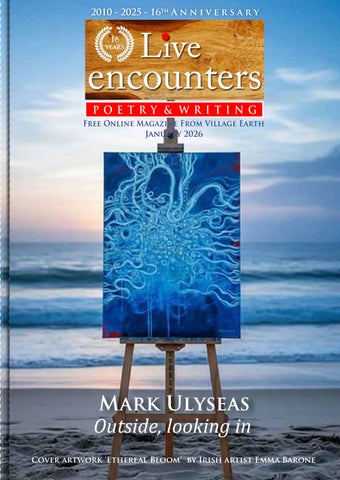
2010 - 2025 - 16th A n n i v e r s a r y
P O E T R Y & W R I T I N G Free Online Magazine From Village Earth January 2026
Mark Ulyseas Outside, looking in Cover artwork ‘Ethereal Bloom’ by Irish artist Emma Barone 2026 January POETRY & WRITING © liveencounters.net
LIVE ENCOUNTERS MAGAZINE
P O E T R Y & W R I T I N G
January 2026
Support Live Encounters.
Donate Now and Keep the Magazine Live in 2026 Live Encounters is a not-for-profit free online magazine that was founded in 2009 in Bali, Indonesia. It showcases some of the best writing from around the world. Poets, writers, academics, civil & human/animal rights activists, academics, environmentalists, social workers, photographers and more have contributed their time and knowledge for the benefit of the readers of:
Live Encounters Magazine (2010), Live Encounters Poetry & Writing (2016), Live Encounters Young Poets & Writers (2019) and now, Live Encounters Books (August 2020).
We are appealing for donations to pay for the administrative and technical aspects of the publication. Please help by donating any amount for this just cause as events are threatening the very future of Live Encounters. Om Shanti Shanti Shanti Om Mark Ulyseas Publisher/Editor ©Mark Ulyseas
Sunrise, Jomtien Beach, Thailand. Photograph by Mark Ulyseas. © liveencounters.net POETRY & WRITING January 2026 Celebrating 16th Anniversary
All articles and photographs are the copyright of www.liveencounters.net and its contributors. No part of this publication may be reproduced without the explicit written permission of www.liveencounters.net. Offenders will be criminally prosecuted to the full extent of the law prevailing in their home country and/or elsewhere. 2026 January POETRY & WRITING © liveencounters.net
P O E T R Y & W R I T I N G
January 2026
Contributors
© liveencounters.net POETRY & WRITING January 2026 Celebrating 16th Anniversary
Mark Ulyseas - editorial Diane Fahey David Rigsbee Jane Frank John Philip Drury Daniel Lusk Noel Monahan Terry McDonagh Randhir Khare Sally Bliumis-Dunn Richard W Halperin Stephanie Green Paddy Donoghue Esther Ottaway Anna Yin Aristi Trendel Bernadette Gallagher
2026 January POETRY & WRITING © liveencounters.net
PUBLISHER/EDITOR
MARK ULYSEAS Mark Ulyseas has served time in advertising as copywriter and creative director selling people things they didn’t need, a ghost writer for some years, columnist of a newspaper, a freelance journalist and photo-grapher. In 2009 he created Live Encounters Magazine, in Bali, Indonesia. It is a not for profit (adfree) free online magazine featuring leading academics, writers, poets, activists of all hues etc. from around the world. March 2016 saw the launch of its sister publication Live Encounters Poetry, which was relaunched as Live Encounters Poetry & Writing in March 2017. In February 2019 the third publication was launched, LE Children Poetry & Writing (now renamed Live Encounters Young Poets & Writers). In August 2020 the fourth publication, Live Encounters Books, was launched. He has edited, designed and produced well over 300 editions of Live Encounters. Mark’s philosophy is that knowledge must be free and shared freely to empower all towards enlightenment. He is the author of three books: RAINY – My friend & Philosopher, Seductive Avatars of Maya – Anthology of Dystopian Lives and In Gethsemane: Transcripts of a Journey. https://www.amazon.com/Mark-Ulyseas/ https://liveencounters.net/mark-ulyseas-publisher-editor-of-live-encounters-magazines/
Outside, Looking in Travel doesn’t enrich oneself. It dissolves the memories of innocence and replaces them with usurpers of alien nature by dismantling the aura of engrained belonging. And this, perhaps, turns one into an outsider.
Amidst the menagerie of meaning runs an endless deserted road, which the outsider treads seeking to connect the inside and outside worlds. The attempt is futile for without the self creating a bridge of tangible reality, the outsider remains thus – outside.
Imagination is the refuge of those among us who need to retreat from this alienation. The conjuring of images and words is an attempt to escape the solitude of living as an outsider.
Does one become an outsider by rejecting this invasive species and carefully nurturing one’s own within the self-created parenthesis?
The chauvinism of language further alienates the self, leaving one adrift and alone in the crowd.
We seek the wisdom of the intellectual sages to translate our own thoughts, our view of ‘outside looking in’ to the throbbing life around. We attempt to understand the mindlessness of the drudgery of daily routines, of love, hate, violence and pathological mendacity. But the continuous din of conundrums deafens one to the rhythms of life on the other side. Someone once told me that the only thing that we do without which we will cease to exist and yet seem unconscious of it is - breathing. So, is the outsider the one who listens to one’s breath and consciously lives within its periphery? And thus, encapsulates the self, shutting out the outside world and thereby remaining an outsider? Every time one reads a book, reconstruction of the self begins. Continuous reading turns one into an ongoing construction zone with building materials others have created with their thoughts. It never ends. The self then becomes alienated from the self. The outer shell - a mask at a parade, while the inner self crouches in bewilderment. Being an outsider is like being a chameleon, taking the colours of the background so that none can see you. And yet you can watch and listen to the wonderful and dreadful things that erupt ever so often in a volatile society.
© liveencounters.net POETRY & WRITING January 2026 Celebrating 16th Anniversary
Is it possible that one has become the sum total of other people’s thoughts through their writings? And that the true essence of self is adulterated by this invasive species that present their own meaning of life, replacing one’s own meaning of life? Unfortunately, most of us live willingly in a global ‘electronicity’ held captive in a net that continues to feed our primeval instincts, drawing us away from our own breath. Moving images and sound infiltrate our senses luring us into one compost heap of humanity.
Will the outsiders survive this aberration of human development and continue to breathe through their poetry and writing? Or, will they too succumb to the divided self – one wearing a mask at a parade, and the other cowering in bewilderment? Peace and Love
Om Shanti Shanti Shanti Om
This is an excerpt from an essay that I am working on.
© Mark Ulyseas
2026 January POETRY & WRITING © liveencounters.net
THE GARDEN IN FLOWER
DIANE FAHEY Diane Fahey’s sixteenth poetry collection is Sanctuaries (Puncher & Wattmann, 2024). She has received various awards and fellowships for her poetry. Her poetry has been published widely in Australia and internationally, and has been represented in over 80 anthologies. She holds a PhD in Creative Writing.
Monet’s The Garden in Flower An overhang of branches cherishes the last of darkness as light enters between slender trunks,
fires up a long billow of cosmos, crimson and white, scattered with yellow – massed blooms, such as the painter loved. Below, a frieze, delectably pink, of dahlias – still in eclipse, ready to be bright together.
Even for Monet, the fresh pleasure of making, with each dappling stroke, a flower. Multiple times.
Some few hollyhocks tower, cameo portraits, singly iconic above clumps of mauve-pink, bluish green. The pathway – nave and arcade – is crossed by shadows tinted with earth colours, flower colours.
Everywhere, with or without a dawn breeze, perfumes unmask their power. Each pollened heart waits.
Diane Fahey © liveencounters.net POETRY & WRITING January 2026 Celebrating 16th Anniversary
© Diane Fahey
2026 January POETRY & WRITING © liveencounters.net
THE GARDEN IN FLOWER
DIANE FAHEY
At Daybreak
Threshold
The Artful Crow by Jiří Hřebíček
A Moonlit River Landscape, c.1855 – Charles-François Daubigny
On a bough vaguely in leaf, a crow: its ebony shine masked, what must be an eye
for these rose cloud-colours to prevail, reshaping the moon, brokenly gold,
Shapeless drifts pervade a park in Basel, its tallest trees wrapped like spars in a sea mist.
at one with that dulled plumage. Stage right, luminance hovers, enters: a prescient veil with traces of white gold, a subliminal green.
The photographer’s open lens moves slightly, quickly, here-and-there, creating airy tremors of foliage, edging branches with doubt, so that the crow takes on something of their story, worn like a ghostly patina, a dream being dreamed. No songs. But this silence, its soft splendour shared with every leaf.
© liveencounters.net POETRY & WRITING January 2026 Celebrating 16th Anniversary
There must be a fallen sun close under the horizon
in a sky wherein the blue of day companions night’s indigo. The river, richly darkened by tree shadows, captures
that sky, moment by moment, lending shine and substance.
Easy, once you have accepted that everything is passing, becoming, to enter this summer night scene, its serene atmosphere –
rendered, with heartfelt attention, through the glide and risk of oils.
Everything holds its own freedom: the human figure on the far bank, those high trees roughly, loosely clad in many greens, a vermilion sailing boat poised on its double, waiting.
© Diane Fahey
2026 January POETRY & WRITING © liveencounters.net
TRY A LITTLE TENDERNESS
DAVID RIGSBEE David Rigsbee is the recipient of many fellowships and awards, including two Fellowships in Literature from The National Endowment for the Arts, The National Endowment for the Humanities (for The American Academy in Rome), The Djerassi Foundation, The Jentel Foundation, and The Fine Arts Work Center in Provincetown, as well as a Pushcart Prize, an Award from the Academy of American Poets, and others. In addition to his twelve collections of poems, he has published critical books on the poetry of Joseph Brodsky and Carolyn Kizer and coedited Invited Guest: An Anthology of Twentieth Century Southern Poetry. His work has appeared in Agni, The American Poetry Review, The Georgia Review, The Iowa Review, The New Yorker, The Southern Review, and many others. Main Street Rag published his collection of found poems, MAGA Sonnets of Donald Trump in 2021. His translation of Dante’s Paradiso was published by Salmon Poetry in 2023, and Watchman in the Knife Factory: New & Selected Poems was published by Black Lawrence Press in 2024.
A chapter from my memoir Three Teachers: Kizer, Brodsky, and Rorty
Try a Little Tenderness I was a fellow at the Djerassi Foundation in the late 1980s, an art colony which happened to be situated next to Neil Young’s farm south of Palo Alto when Carolyn Kizer called and said, “Diane Johnson has invited us to a dinner party. You’ll have a good time. There’ll be a room full of writers and poets, and I want to introduce you to the short story writer Alice Adams.” I had only heard the name. She admitted later, “I think you will like her. She comes from your part of the world, you know.” I sensed a setup, although Carolyn neglected to add that Alice Adams already had an interesting partner, a wellknown interior designer, one of whose credits was to have been punched by Norman Mailer at a party. Carolyn, her husband John, and I arrived at “Dinnie” Johnson’s house in San Francisco, where the diminutive Dinnie greeted us, along with her husband John, a prominent pulmonary surgeon. I flushed when realized I had a pack of Larks stashed in the breast pocket of my sport coat. Wanting to avoid a sermon, I turned to insert the pack in my inside pocket and afterward hunched my shoulders as I spoke to the surgeon. Lark had been advertised as the “safest” cigarette, and I, along with my brother, remained loyal to the brand that had been made by our father at Liggett & Myers in Durham.
David Rigsbee © liveencounters.net POETRY & WRITING January 2026 Celebrating 16th Anniversary
The party was already in full swing. Robert Sward was there, a poet whose work I admired. Amiable and engaging, with a broad smile and sweep of still-dark hair, Sward talked about his influences and admiration for Carolyn. Edward Hirsch appeared, the only person younger (marginally) than me, although he exuded a maturity and polish beyond my range. I also thought the same about his poems. Looking around, I spotted Philip Levine and Gerald Stern, both arriving in trench coats, Phil adding his trademark fedora. In one corner, Dinnie was engaged with the turtle-headed Leon Edel, Henry James’ biographer, who had arrived in his beret. As I looked around, I realized Dinnie’s husband had escaped the cocktail portion of the evening, disappearing shortly after greeting the guests. continued overleaf... © David Rigsbee
2026 January POETRY & WRITING © liveencounters.net
TRY A LITTLE TENDERNESS
Before long, Carolyn swooped in with Alice Adams in her grip and introduced me, and once she was satisfied she had made a connection, stepped away and headed for Phil and Jerry. I liked Alice at once. I explained to her that my father had grown up in Chapel Hill and that I had attended the university, where I studied with Carolyn and often visited with Max Steele. We agreed that Max was an underrated master of the short story. She was curious to hear that at the end of his career he had become something of a recluse, rarely departing from his purple house near campus, except to attend to his academic duties. I said that he had once been a purveyor of literary party life, along with his wife, Diana, mentioning that Max and Diana had introduced me both to steak tartar and caviar—outlandish food items— when I was a student. Alice replied that there was in fact caviar here at the party, offering a slightly bucktoothed grin by way of affirmation.
When called to dinner, we were served baked salmon at a long farmer’s table. I sat with Alice on one side and Levine on the other. Everyone deferred to Dinnie, who offered gossip about writing for The New York Review of Books and of fellow fiction writers, especially Alison Lurie, her friend and competitor, who also wrote for the NYRB and had won a Pulitzer, unlike Johnson, who was recently only a finalist for the prize. Then she turned to Leon Edel and asked him if he had finished with his massive biography of Henry James and whether he had anything else he wanted to offer. Edel, who modestly replied that he was working on a condensed version, culled from the five-volume work, said that he needed to determine which episodes would provide the most helpful introduction to James’ life. As far as I know, no such abridged work ever emerged. Everyone was interested in James’ private life, including Carolyn, who asked him bluntly if James ever acted on his homosexuality. Edel responded that the evidence was inconclusive. Carolyn added that the very fact suggested a positive answer. I inserted myself at this point, as I knew Edel had been editing the diaries of Edmund Wilson. I said that I had been teaching at Hamilton College some years before, when our department chair had been approached by Rosalyn Wilson, the writer’s daughter, to find out if any graduate student would be interested in house-sitting Wilson’s stone house in tiny Talcottville, NY, some forty miles to the north. Of course, we had no graduate students, but my chair mentioned a young instructor who might be interested in spending a summer there. He had recommended Wilson’s Upstate (recently published) to me, which I read with pleasure. © liveencounters.net POETRY & WRITING January 2026 Celebrating 16th Anniversary
DAVID RIGSBEE
I was also familiar with A Fan’s Notes, Frederick Exley’s autofiction about a despondent writer obsessed with baseball and with Wilson himself, whose house sat in the middle of nowhere looking off across fields of Timothy grass and Queen Anne’s Lace to the Adirondack foothills. Exley would sit in front of Wilson’s house in his car, without having the courage to get out and go meet the occupant. I told the story of meeting Rosalyn Wilson, getting the key to the house and spotting a telltale butterfly net in the umbrella stand in the foyer—a present, I imagined, from his then-friend Vladimir Nabokov. Their friendship was to end in acrimony when Wilson had the cheek to make a small critical caveat to Nabokov’s three-volume translation of Pushkin’s Eugene Onegin in the NYRB. The table liked this detail. Edel asked me if I had seen the famous window, explaining to the other guests that Wilson had purchased a diamond-tipped pen for visiting writers to autograph the glass. I said that the window had been removed and put in storage after Wilson died, Rosalyn fearing further vandalism of the empty house, which has already been burglarized once. I wanted to mention that I had written a poem about the stone house and had received a letter of appreciation from Wilson’s widow Elena, then living in Wellfleet, when it appeared in The American Poetry Review, but I held my breath.
Sward had departed before dinner, and I was sorry to see him go, hoping to talk to him more. Jerry and Phil, sitting next to each other, bantered amiably, pitching some questions to Ed Hirsch. Dinnie was working on Edel. I kept chatting with Alice, while Carolyn eyed us with a hint of satisfaction from across the table. After some backand-forth, after the dinner plates had been taken away, and after we had refreshed ourselves with more booze and wine, it was decided that we should all participate in a little game. We would go around the table and each recite a poem from memory. This made me nervous. Carolyn suggested that Ed Hirsch go first. As I remember, he rendered something from Hart Crane impressively and we clapped. Phil Levine was next, and he duly recited the opening of Song of Myself. Next was Edel, who passed, then Carolyn, who recited Dickinson. Then it was Gerald Stern’s turn. He began reciting Wordsworth’s sonnet, “The World Is Too Much With Us,” then looked up and down the table to see the reaction. Alice Adams passed, and eyes trained on me. I had quickly planned to recite Ben Johnson’s little poem about the death of Sidney’s sister, the Countess of Pembroke, something I remember Carolyn had also committed to memory and declaimed to us once back in Chapel Hill days. continued overleaf... © David Rigsbee
2026 January POETRY & WRITING © liveencounters.net
TRY A LITTLE TENDERNESS
I was afraid of flubbing the poem, brief as it is, but I delivered anyway, hoping to capitalize on the striking last line. The poem goes like this: Underneath this sable verse lies the subject of all verse, Sidney’s sister, Pembroke’s mother; Death! ere thou hast slain another, Lean’d and fair, and good as she, Time shall throw a dart at thee.
The group nodded. Carolyn observed that it was one of those poems in which minimalism and condensation acquire a larger importance with each line, almost in inverse proportion to the poem’s length—or lack of it. We went around again. Levine recited a poem by Countee Cullen, and Jerry followed with Yeats’ “The Stolen Child,” a fourstanzed poem, three of which stanzas end make the refrain, Come away, O human child! To the waters and the wild With a faery, hand in hand, For the world’s more full of weeping than you can understand.
Carolyn complimented Jerry on his recitation and asked him if he had many poems by heart. She pointed out that her teachers, Roethke and Kunitz, drew on his example in their own work. Jerry snuffled and replied that he tried to memorize all the poems he liked. There was a pause. Carolyn asked him about Dylan Thomas, and Jerry responded began reciting “Fern Hill.” By now it was on. “What about Eliot?” she wondered. Jerry sat back and began reciting the opening of Eliot’s “Little Gidding.” Then he began in on Keats’ odes, starting with the “Ode on Indolence.” Carolyn asked him about Stevens, and Jerry recited “The Snow Man” and “The Idea of Order at Key West.” We were all affected that he had memorized so much of what we thought we knew, but more—and verbatim. No matter which poet was tossed into the mix, he could recall poems at once. We all realized that we had been present at a demonstration. Of what? Mastery and simple love, I suppose. After these effortless recitals, we said our goodbyes and left.
© liveencounters.net POETRY & WRITING January 2026 Celebrating 16th Anniversary
DAVID RIGSBEE
On the ride back, John said that Jerry Stern’s performance was most impressive. “I didn’t realize Jerry had such a capacity as that.” Carolyn, who had been quiet, replied, “People have thought him a kind of yawping Jewish Whitman, but he’s a real student of the forms he doesn’t use. It’s a pity he arrived on the scene well into middle age, while his young buddy, Jack Gilbert, coasted for decades on the Yale Prize won in his twenties. Jerry must have felt wounded by that. He’s undoubtedly the better poet.” I agreed. By the time he emerged from obscurity in middle age, he had suddenly been everywhere at once, already on his way to becoming a beloved figure in the poetry world, a world not known for mutual tenderness. With luck of my own, I was to find my name printed on the cover of The American Poetry Review, more than a decade before. There was Jerry’s rubbery face, cloth watchman cap, and horn-rimmed glasses, adorning cover. His Lucky Life poems, the volume that finally introduced him to the poetry-reading public and established his name, not to mention his dazzling, exuberant talent. We had met at that time, the summer of 1977, when I was driving up and down the east coast with poet Linda Gregg, reading W. C. Williams and Heidegger aloud and debating the fine points of Williams’ “The Red Wheel Barrow.” We stayed with him at his gingerbread house in Lambertville, NJ, as he had long been a friend of Linda’s, owing to her former partnership with Jack Gilbert. In spite of that hospitality, I didn’t see him again until the party at Johnson’s. A votary of mischief, he recounted schooling Paul McCartney at some fancy party on the earlier recorded version of “Try a Little Tenderness,” by Jimmy Durante—not Otis Redding. A point of order, perhaps, but it led to an impromptu duet between the two. If anything he had grown even more ebullient, riding a wave of acclaim and wild accomplishment that was to continue until his death at ninety seven. Despite Carolyn’s passing approval of Jerry’s work, he was ever so slightly guarded concerning hers. What’s more, her flamboyance and superior airs stood in contrast to his earthiness. After all, he had risen from Pittsburgh, a Jew of Ukrainian and Polish descent. Still, he gave her respect for her craftsmanship and clarity. Yet on his view, Carolyn’s work, while appealing and engaged, lacked the note of tragedy that sounded behind his poems. He would not go on to write “Afternoon Happiness,” her wistful poem about the shrinking of tragedy in the midst of newfound domestic bliss. Instead, he would write the majestic and antic “The Dancing,” his poem about celebrating the end of the war in Germany, Poland, and Ukraine from his childhood home in “beautiful filthy Pittsburgh,” which ends ecstatically with an outcry, “oh God of mercy, oh wild God.” © David Rigsbee
2026 January POETRY & WRITING © liveencounters.net
TERRARIUM WORKSHOP
JANE FRANK Brisbane poet Jane Frank’s third collection of poems is Gardening on Mars, published by Shearsman Books in October 2025 and she is author of two previous collections published by Calanthe Press — Ghosts Struggle to Swim (2023) and Wide River (2020). Her poetry has been widely published in Australia and overseas in journals and anthologies including Ink, Sweat and Tears; Other Terrain Journal; The Mackinaw; Poetry Ireland Review; the Liquid Amber Prize anthology and 100 Poets (Flying Island Books 2025). She is Reviews Editor at StylusLit literary journal and teaches in the School of Business and Creative Industries at the University of the Sunshine Coast.
These poems were previously published in the chapbook Wide River (Calanthe Press, 2020).
Terrarium Workshop Everything I need is on the aged wooden table in front of me – gloves, trowel, an aquarium for plants. Outside this gazebo sunlight is smeared by smoke and ash. In NASA’s photo, the Earth’s eyes weep fire, red petechia overlaid like snake bites
on the seraphic sphere of blue iced with white. But here before me this morning, life is as simple as a tiny fern forest
with its ideal miniature microclimate. A glass jar holds moisture no matter the weather. The instructor talks animatedly about soil composition and we scoop potting mix from a bag; take care, as asked, placing moss, stones, pine cones, shells. It is
a small world that must not dry up. I watch leaves curl from damp balls like bubbles, ferns shivering in a gentle spray of rain
Jane Frank © liveencounters.net POETRY & WRITING January 2026 Celebrating 16th Anniversary
© Jane Frank
2026 January POETRY & WRITING © liveencounters.net
TERRARIUM WORKSHOP
JANE FRANK
We are all wildflowers pressed between transparencies I have photographs that conjure vanillin and grassy notes mixed with mustiness in the Hay Castle bookshop, but there was also a death-reek through that ancient
grate, the steps slippery with moss and decay. At the al fresco honesty shelves — a forlorn orchard in the bookish town — small groups of anoraked pilgrims held rejected volumes like fallen fruit, exchanged loose change for finds they made in autumn rain, the remainder left to rot, their ink run into the earth like blood. A Ghormenghast of books someone said: the volumes walking like ghosts at night, the soft sheets inside them white as the moon
I flick through pages in the book and return it to the highest shelf. The books and I are reflected in the shroud of night outside, though in this alcove we are bright, breathing. Prisms of light from the cloisonné lamp play on the pastiche of book faces: each one murmuring, or elbowing for attention, each one an hour or a day or a
moment, lost time excavated, reawakened from the detritus of the past — a café, or a hotel room or a white beach lined with pines lives again in a faded jacket
© liveencounters.net POETRY & WRITING January 2026 Celebrating 16th Anniversary
or the trapped sand collected in a spine, some pages as well-loved as the skin of children. Hidden margin notes are strange measures of the lopsided way I grew; my
own crooked heart chart. Faces layer here in the leaves, and voices. The scent of jasmine, cigar smoke and turpentine and a rush of other histories: sutras scratched on palm fronds with a metal stylus, bark paintings, stories in the sky with eclipses and exploding omens, spoken books of Magellanic clouds, festival gifts from Saturnalia, Lin Xin’s seven epitomes on scrolls of silk, Dibdin’s concertinas of gentle madness, the miracles of letterpress and vellum,
the readers of first Gothic novels behind Enlightenment doors — nets of quiet astonishment – obscure firsts and rarities from Chinguetti or Timbuktu, each pseudonym and dazzling frontispiece a small miracle, bookmarks of lace lost in yellowed pages. In bookshops I’ve held books
like survivors; offering comfort to those battered by neglect, calming their distress, books like puppies in kennels of leather eyes pleading to be rescued from oblivion.
My tea goes cold, forefinger tracing each delicate spine across the years, horizontally stacked. Always there is a shaded caudex for the mind — the peace of having trees inside
© Jane Frank
2026 January POETRY & WRITING © liveencounters.net
TERRARIUM WORKSHOP
JANE FRANK
Blue Door I could sense the stars circling each night when I shut my eyes behind the blue door hear my thoughts skipping
avoiding the faces of men my flatmates might have entertained, but in truth I wouldn’t see the others much –
in the garden of the unkempt house – dirty white stucco, high gable, worn red cement steps, overgrown shrubs – alone for the first time
would write and doze through hidden days, rarely back from the restaurant before two, so I grew brave about parking in the dark
I said I’d take the shed at the back because I could already envisage my desk adjacent to the window with its view
descending through eucalypt shadows to my pale blue door luminous under its own moon
I could see differently
a lesson in self acquaintance
carving out an unconventional orbit
of a high unruly satin ash hedge and an ancient bunya pine, imagine myself waking to the last stealth a language of survival
of possums and owls and flying foxes, the creak of corrugated tin, the crunch through dew to the kitchen on winter mornings, making fresh prints on grass
© liveencounters.net POETRY & WRITING January 2026 Celebrating 16th Anniversary
© Jane Frank
2026 January POETRY & WRITING © liveencounters.net
POEMS BASED ON DOWLAND AND TURNER
JOHN PHILIP DRURY John Philip Drury is the author of six poetry collections: The Stray Ghost (a chapbook-length sequence), The Disappearing Town, Burning the Aspern Papers, The Refugee Camp, Sea Level Rising, and most recently The Teller’s Cage (Able Muse Press, 2024). His first book of narrative nonfiction, Bobby and Carolyn: A Memoir of My Two Mothers, was published by Finishing Line Press in August 2024. After teaching at the University of Cincinnati for 37 years, he is now an emeritus professor and lives with his wife, fellow poet LaWanda Walters, in a hundred-year-old house on the edge of a wooded ravine.
To the Tune of “Fine Knacks for Ladies” after John Dowland Roses, carnations, baby’s breath, and mums belong in funeral parlors, not in homes. That’s what my wife will tell her valentine. Blushing, abashed, I blunder every time. The flowers that she’ll praise stay in the yard, making it hard to give bouquets.
Weeding the garden, pulling vines and twigs and stuffing them in big, brown, paper bags, I fail to recognize the leaves-of-three until the poison ivy’s poisoned me. Urushiol oil’s the splash causing the itch, making me scratch that burning rash. Out at the nursery, strolling down an aisle, we pick two pots of purple asters I’ll plant in a spot where shady sunlight falls. We always cultivate perennials. They’ll stay for years right there, blossoming when spring comes again like love we share.
John Philip Drury. Photo credit: Tess Despres Weinberg. © liveencounters.net POETRY & WRITING January 2026 Celebrating 16th Anniversary
NOTE: My pronunciation of “urushiol” is “yuh-ROOSH-ul,” eliding the last two syllables. Here’s a link to the the Consort of Musicke’s recording of this lute song by John Dowland (1563-1626): https://www.youtube.com/ © John Philip Drury
2026 January POETRY & WRITING © liveencounters.net
POEMS BASED ON DOWLAND AND TURNER
JOHN PHILIP DRURY
Snowstorm: Steamboat off a Harbour’s Mouth after J.M.W. Turner Lashed to the mast, he witnessed how the sea and snowstorm whirled around the steamer’s funnels while signal rockets flared. From memory he painted waves that swamped the listing gunwales, mixed with the blizzard in a spiraling flame— “soapsuds and whitewash,” his detractors said. Riding the weather out, Turner became the vessel’s animated figurehead, bound to report on his experience: a painful beauty, like the sirens’ keening. Whether a storm or chorus makes you wince with pleasure, you pursue it for the joining of rapture and restraint—the rapture of restraint, the pent-up ecstasy of love.
© liveencounters.net POETRY & WRITING January 2026 Celebrating 16th Anniversary
J.M.W. Turner, “Snowstorm: Steamboat off a Harbour’s Mouth” (1842) https://en.wikipedia.org/
© John Philip Drury
2026 January POETRY & WRITING © liveencounters.net
MEDITATION
DANIEL LUSK Daniel Lusk is author of eight poetry collections and other books, most recently Every Slow Thing, poetry (Kelsay Books 2022) and Farthings, eBook (Yavanika Press 2022). Well-known for his teaching and widely published in literary journals, his genrebending essay, “Bomb” (New Letters) was awarded a Pushcart Prize. Native of the prairie Midwest and a former commentator on books for NPR, Daniel is married to Irish poet Angela Patten; they live in Vermont.
These are poems culled from KIN (Wind Ridge Books, 2013) by Daniel Lusk.
Meditation This is a holy place. Mud people keep the wind in pots.
It is the porcupine in his quill robe, the moose in his crown, who made it holy.
See the star tracks where the grouse walked, unhurried, in the snow. See the moss on the path we swept free of leaves and branches, the moss covered stone. Rain falls, the pail and bowl are filled with water.
We might have used it to water the seedlings, or for bathing ourselves.
Daniel Lusk © liveencounters.net POETRY & WRITING January 2026 Celebrating 16th Anniversary
© Daniel Lusk
2026 January POETRY & WRITING © liveencounters.net
MEDITATION
DANIEL LUSK
The Long Mind
Twelfth Night
I have seen at nightfall blinking across the way and thought I saw a ship of burning lamps.
Epiphany: a crystal hammer.
Opening the woods I spared young oaks for in these saplings is the long future and knowing.
I believe there may be children here among these roots who pass for the children of gods. Once in the dark age was a naked race. I wonder, do they live on in these streams?
These intricate, improbable nests of the orioles, those skeletons we find in rocks of lost, improbable animals may be evidence of something unresolved some once upon the world when we were holy.
© liveencounters.net POETRY & WRITING January 2026 Celebrating 16th Anniversary
We dismantle our tree, admire each treasured ornament, wrap and pack them all away. Forest choir at dawn, the haunting F-sharp of the wind-blown trees along the gambrel of the bluff. Prayer-flag leaves of young beeches by the gray, snow-hatted birdbath their low, muttered eccles.
A single cardinal on the snow; his medieval red relieves the January monochrome.
Snowplow man inside the cowl of his black truck comes and goes in corridors of white
his yellow blade a cup, an ordinary mystery.
© Daniel Lusk
2026 January POETRY & WRITING © liveencounters.net
MEDITATION
DANIEL LUSK
Boat, Pond, Girl This boat beside the pond is not seaworthy. This pond is not a worthy sea for going off in boats or deep imagining. It keeps the little fish, green frogs, and yellow-spotted salamanders in mud tunnels underneath the boat. The carnivorous, two-oared bug without a name who eats the pollywogs. Rain runs in. A blue Buddha watches over.
I have a stick with a knob on the end. Naked, I have stones in my pocket.
If I tap my stick on the ground, is there a bush god who will answer or a green girl to wave from the boat?
Here is a moss bank with a copse of trees, and a moss covered path leading away through woods toward habitations of grouse and hare.
If this is the “world navel,” how shall we think of this old satellite dish aimed at the ridge of mountains to the west and no longer connected to anything. I will think of it as the chakra of this place and one day glimpse eternity. Imagine the goldfish, debonair, rising with their gold-headed canes and strolling out among the trees, singing a tune you can almost remember hearing before.
© liveencounters.net POETRY & WRITING January 2026 Celebrating 16th Anniversary
© Daniel Lusk
2026 January POETRY & WRITING © liveencounters.net
MEDITATION
DANIEL LUSK
A Room in the Woods To sit on a stone with my back to a tree.
I have a chair and a wall.
To look away to a hillside, rising from a stream below. A floor of wild oats and false hellebore.
This is my room—the door and windows wherever they need to be. The odor of solitude like peppermint, sprung from a cribbage of holes a woodpecker tapped in a birch.
My young friend H recalled waking in a thatched hut to see a man of the village standing over her, watching her sleep.
Deep claw marks of a grizzly bear etched the door of DB’s cabin in Arlee.
“Intimacy,” “privacy”—these are meaningless without the word “door.” I draw pouch and pipe from my pockets, a match to spend a solemn hour.
I always imagined living alone in the maid’s room of a brownstone on 63rd Street.
Now the cat is dead and one less heart beating in the house. I read somewhere that rue was called “meadow rue” to ease the regret.
J said on Reunion Island the homes also have no doors, and people meander like cousins in and out of each others’ houses.
© liveencounters.net POETRY & WRITING January 2026 Celebrating 16th Anniversary
© Daniel Lusk
2026 January POETRY & WRITING © liveencounters.net
NIGHT
NOEL MONAHAN Noel Monahan is a native of Granard, Co. Longford, now living in Cavan. He has published seven collections of poetry with Salmon Poetry. An eight collection, Celui Qui Porte Un Veau, a selection of French translations of his work was published in France by Alidades, in 2014. A selection of Italian translations of his poetry was published in Milan by Guanda in November 2015: “Tra Una Vita E L’Altra”. His poetry was prescribed text for the Leaving Certificate English, 2011- 2012. His play: “Broken Cups” won the RTE P.J. O’Connor award in 2001and Chalk Dust, a long poem of his, was adapted for stage and directed by Padraic McIntyre, Ramor Theatre, 2019. During the Covid-19 lockdown, Noel had to reinvent his poetry readings, and he produced a selection of Short Films: “Isolation & Creativity”, “Still Life”, “Tolle Lege” and A Poetry Day Ireland Reading for Cavan Library,2021. Recently, he edited “Chasing Shadows”, a miscellany of poetry for Creative Ireland. His ninth poetry collection, “Journey Upstream” was published by Salmon Poetry in April 2024. Noel’s new publication in France entitled “Les Russes Arrivent”, “The Russians Are Coming”, translated by Emmanuel Malherbet and published by Alidades is his10th. Collection.
Night Night Comes early now, Moonstruck: I start to count the stars On Orion’s Belt Quavers and quivers Of a ghost song on The Wind “Alnitak …. Alnilam ….Mintaka … Playground of light Everywhere tonight I see The shadow of a hare Licking his paw in the moonlight Silently listening to the dark.
Winter mornings are Always slow to brighten.
Noel Monahan © liveencounters.net POETRY & WRITING January 2026 Celebrating 16th Anniversary
© Noel Monahan
2026 January POETRY & WRITING © liveencounters.net
FAREWELL
TERRY MCDONAGH Terry McDonagh, Irish poet and dramatist has worked in Europe, Asia and Australia. He’s taught creative writing at Hamburg University and was Drama Director at Hamburg International School. Published eleven poetry collections, letters, drama, prose and poetry for young people. In March 2022, he was poet in residence and Grand Marshal as part of the Saint Patrick’s Day celebrations in Brussels. His work has been translated into German and Indonesian. His poem, ‘UCG by Degrees’ is included in the Galway Poetry Trail on Galway University campus. In 2020, Two Notes for Home – a two-part radio documentary, compiled and presented by Werner Lewon, on The Life and Work of Terry McDonagh, The Modern Bard of Cill Aodáin. His latest poetry collection, ‘Two Notes for Home’ – published by Arlen House – September 2022. He returned to live in County Mayo in 2019. www.terry-mcdonagh.com
Farewell Tidying as he went along, he gathered his things, packed them gingerly and left for the station as the last of the embers died.
On the opposite platform a flaking wall and wild flowers had their own sense of place. This time he inhaled their boundless aroma as if they were words dipping into red wine. Floral-wet patterns were shaping his future in a frenzy of colour and chance. An older woman caught his eye, waved a little and smiled. Farewell.
Terry McDonagh. Photo credit: Joanna Longster McDonagh © liveencounters.net POETRY & WRITING January 2026 Celebrating 16th Anniversary
© Terry McDonagh
2026 January POETRY & WRITING © liveencounters.net
FAREWELL
TERRY MCDONAGH
The Law Graduate and the Stolen Bicycle Admittedly, it was weekend and very late which meant the policeman could have committed a grave error of judgement even a blunder, error, lapse or slip – but no, only the departed could not have seen the law graduate swinging a loose leg hither and tither over a crossbar like one coming down with love sickness, like a mythical mushroom trying to find its way onto a film set. I live so far away, Officer. The bike was lying there and I’m a law graduate on my way home from a holy city in the Orient hoping to avoid sunburn and lads along the way. There is no crime.
A restless air filled the darkness. He wondered if she was trying to take the mickey – if she was waiting for the next breath to come upon her – lovely and all as she was – before the east began to fill with sun.
© liveencounters.net POETRY & WRITING January 2026 Celebrating 16th Anniversary
But the voice of reason will say blushes can be hard to detect before dawn, and disturbing moments can come upon an officer on duty – at first, a disturbance that might seem nothing louder than the sting of feral sand by a windy seashore or the yelp of a rabbit in the jaws of a fox, but when a wily love-potion darts out of a nowhere corner, lost to all eyes except one, and thoughts – soft as sighs fix upon an unlikely law graduate, there comes a cry of one struck by one steamy sentiment after another. I am almost not myself he pleads and being more poem than person, I call upon the doves of the air and mockingbirds on their perches to advise me on how to get a stolen bike to vanish and find its own way home.
In the blazing blue of morning, they were not rational. Even with closed eyes, he could see she hardly touched the ground. When he dared to peep again, the bike that had come between them had evaporated into what was left of the dawn chorus.
© Terry McDonagh
2026 January POETRY & WRITING © liveencounters.net
FAREWELL
TERRY MCDONAGH
Why Other Cities Why other cities when I could have stayed put to mumble and mutter like a maverick monk on the three-mile trek between home and town.
I must have wanted to despair elsewhere – to have my heart broken in other languages and streets – a drifter without a timeline – a king without a castle
on perfumed merry-go-rounds heading for astray. I hassled and harangued myself up and down dykes, hoping fallen angels might appear to me with gifts
while I – a self-inflicted wanderer – dug into fragile fantasy on the banks of a great river – peering at the far horizon for fresh momentum – unaware of the serenity in water. A new day did come. My head fell into place. I began to hiss with the flow and rejoice in the hammer and tongs of ships – to wallow in the taste of wispy-new aura.
I am no longer there but, one day, I will return to Hamburg if only to dream.
https://commons.wikimedia.org/
© liveencounters.net POETRY & WRITING January 2026 Celebrating 16th Anniversary
© Terry McDonagh
2026 January POETRY & WRITING © liveencounters.net
WHERE DO YOU BELONG? I ASK MYSELF
RANDHIR KHARE Randhir Khare is a national and international award-winning poet, writer, artist and folklorist. He has thirty-nine books to his credit, and has collaborated with A.R Rahman who has set his poems to music. His work has over the years been published by Penguin Random House India, HarperCollins India, Niyogi Books, Sakal Publications, Silvercord Publishing, Rupa Books, River Books and a host of smaller presses. His novels The Legend of Creaky and The Last Jungle on Earth were adapted on several occasions for the stage and used for creative workshops for The Gallery of Modern Art in Mumbai and The Prithvi Theatre Summertime workshops. As storyteller, he has collected and performed numerous folktales which he has performed for various audiences and collected them in a video titled The World in a Story. He is the recipient of the Sanskriti Award for Creative Writing, t he Sahitya Akademi’s Residency Award, The Palash Award for Lifetime Achievement in Education and Culture, The Pegasus Gold Medal for Poetry awarded by the Union of Bulgarian Writers and a host of other prizes that recognise his contribution to literature and Education. As director of The Rewachand Bhojwani Academy in Pune he has introduced a number of arts and literature programmes including the Library Alive project. Two books, THE BOOK OF DAWN and TARA, THE DOG WHO ALWAYS WAS have just been released. https://www.randhirkhare.in/
These two poems are from my new book, which is a definitive selection of 50 years of my poetry 1975 to 2025 to be published by Redriver Press in 2026.
Where do you belong? In the crevasses of palm-lines moving inexorably towards creaseless skin till they dissolve in perfection?
In the breath of the void yearning for flesh and the musk-hour of embrace wet with song? Where do you belong?
Do you belong to a song before it had words to a womb before it conceived to the truth before it mutated to the terrible emptiness of a lie to love waiting to be discovered? To a seed in the forest of being? I wait for answers hope for answers in streets full of days and nights full of empty rooms a clock outside the window counting the hours and the moon pressing its face on the window pane
Listen to me in the silence of your night if your day is too crowded with doing and the shells of your ears are too flooded with voices of praise
Randhir Khare © liveencounters.net POETRY & WRITING January 2026 Celebrating 16th Anniversary
continued overleaf... © Randhir Khare
2026 January POETRY & WRITING © liveencounters.net
WHERE DO YOU BELONG? I ASK MYSELF
RANDHIR KHARE
A gypsy longs for freedom Sit down for a moment, just a moment, close your eyes, breathe deeply, its morning…. there’s something in the air an old familiar fragrance not of flowers or clothes or the earth after a shower or the perfume of a smile 0r your skin sun-glowing after-love, something, remember what it is till it becomes flesh or it will dissolve and you’ll forget where you are, who you are, your beginning… you will forget you are here alive… answer me – where do you belong?
I swallow the sky in globs when its treacle, live fish bulging my cheeks, scales brushing their way down, dissolve, fumes spread in my lungs, heart pounding its limits, stretching arteries of longing, flying flowing fields and orchards, bursting into rivers gorging along foreverness, away from homes and belonging, spaces beyond spaces, mountain lines rising, falling into dusk, the thrusting persists.
Insomnia-drunk, lids pasted back floating on waking dreams, shaman moving with mist in the breeze, steam from tarred roads rising indifferent heat, burning bubbles on skin, sweat spurting into springs into streams into rivers into seas; I have been Moses parting turgid thighs, crossing from shore to shore, walking with whirlpools, sinking into the centre, bloated with love and birth.
continued overleaf... © liveencounters.net POETRY & WRITING January 2026 Celebrating 16th Anniversary
© Randhir Khare
2026 January POETRY & WRITING © liveencounters.net
WHERE DO YOU BELONG? I ASK MYSELF
Fly, fly from hunger, home and loss and broken promises, smell of giving sticks to my skin, I wash it away with indifference, long for the speed of light, swelling with helium; will I rise, spirit? Will I rise? Will I rise above my clutching needs? musk from parted seas quiver with spentness, leaving me nothing.
RANDHIR KHARE
The sky oppresses me, the earth resists, open palms cannot unlock my fists; every word I speak makes me another, every stranger smiles and calls me brother; damned belongingness and damned be ‘I’ damned be the bed of nails on which I lie, I fear the coming rain, the earth that flowers, teeming forests blooming crimson hours, there is no end, there is no end there is no freedom around the bend.
I want to be a blur, dissolve, evaporate, be free, become again the horizon, moving; stillness alters my being, makes me a parasite, sucking sweat and blood of love, togetherness and expectations, promising to give what I do not have, giving what is not mine, hoping for what cannot be, what will not be, what should not be, the buzz of dependence.
© liveencounters.net POETRY & WRITING January 2026 Celebrating 16th Anniversary
© Randhir Khare
2026 January POETRY & WRITING © liveencounters.net
NO WORD
SALLY BLIUMIS-DUNN Sally Bliumis-Dunn teaches at The 92nd Street Y and is Associate Editor at-large for Plume Poetry. Her poems appeared in Paris Review, Prairie Schooner, PLUME, Poetry London, the NYT, PBS NewsHour, among others. In 2002, she was a finalist for the Nimrod/Hardman Pablo Neruda Prize. Her latest book, Echolocation, was published by Plume Editions/MadHat Press, 2018. Her forthcoming book, Weather Report, is forthcoming from Cervena Barva Press in 2026.
No Word I stand in your old room looking out the window
at the tall white pines, amethyst geode in my hand
purple, crystal, round, hard, small. The silence between us taints even the momentary quiet. Every word I know is ailing, even these simple descriptions of a rock. No idea where you live. No word from you in months. I wash the breakfast dishes, fold
the basket of rumpled clothes, sleeve, stripes, socks, lint—words,
words. None of them yours. Which ones will you choose at last
to look for me, to seek my inner ear, vibrating the bone.
No way I can know. To me all words are like strangers now. Sally Bliumis-Dunn © liveencounters.net POETRY & WRITING January 2026 Celebrating 16th Anniversary
I pass then on the street and look deep in their faces— a tilting head, a wisp of curl— not one of them yours.
© Sally Bliumis-Dunn
2026 January POETRY & WRITING © liveencounters.net
NO WORD
SALLY BLIUMIS-DUNN
Seychelles Reef
Transgression
Scientists record sounds from healthy reefs, then play them underwater in the corridors
Lily stems gather in the vase’s narrow throat and spread out wide on the clear glass bottom like the sticks the three of us would use to make a tepee in the woods with the old bedsheet we’d drag outside. My brother would fasten clothespins to hold it all in place. Inside we’d sit cross-legged in a circle, our faces dulled in the gray light which made us feel less bound to ourselves and more at ease to share our secrets I can still feel my sister’s hand cupped against my ear, her warm breath carrying the unspeakable.
of lifeless coral.
When the fish who once lived there hear these sounds, they return to their home but there is no life—
coral, conch, and sea fan, blanched—the seared
white of hospital sheets— Not even tiny zebra fish flitter on the bottom.
© liveencounters.net POETRY & WRITING January 2026 Celebrating 16th Anniversary
© Sally Bliumis-Dunn
2026 January POETRY & WRITING © liveencounters.net
DISORDER AND EARLY SORROW
RICHARD W HALPERIN Richard W. Halperin holds U.S.-Irish dual nationality and lives in Paris. On November 1, 2025, Salmon Poetry/Cliffs of Moher published All the Tattered Stars: Selected & New Poems, Introduction by Joseph Woods: 92 poems from previous collections by Salmon and by Lapwing/Belfast & Ballyhalbert and 26 new poems. Mr. Halperin suggests, on the back cover, that the poems be viewed ‘as birds perched on a horizontal line. Everything perched lightly.’ Mr Halperin’s work is part of University College Dublin’s Irish Poetry Reading Archive.
Disorder and Early Sorrow i.m. Sacha Abercorn I am sitting on a bench dedicated to the memory of a lovely soul whom I once knew. I am in an Irish garden which is one of the places I associate with Thomas Mann, who has many places in addition to Munich and California. I think of his story ´Disorder and Early Sorrow,’ about a little girl. I once wrote a poem ‘Aquerò’ in which the speaker is the lady who appeared to Bernadette and who says to her ´Souls, no matter whom in, are young girls, don’t you think?’ I so think. I also think of a phrase uttered by a malevolent spirit in Mann’s Doctor Faustus: ‘You can only see me because you are mad, but that does not mean I do not exist.’ The autumn leaves continue to fall in the garden. It is October 22nd, near to the birthday or anniversary of several people dear to me. The leaves do not make a sound as they hit the ground. But actually they do. Untaintable.
Richard W. Halperin. Photo credit: Bertrand A. © liveencounters.net POETRY & WRITING January 2026 Celebrating 16th Anniversary
© Richard W. Halperin
2026 January POETRY & WRITING © liveencounters.net
DISORDER AND EARLY SORROW
RICHARD W HALPERIN
Third Person
The Real Helen
He thinks of writers he admires this night.
In Euripides’ great play Helen, Helen and Menelaus, no longer young, reunite in Egypt, where she has been living during all the years of the Trojan War. It was an illusory Helen – a trick of the gods – whom the war was fought over. The play is Helen’s throughout: her words about fate, deception, love, manipulation, cleanness, hope. But at play’s end, what do we, what do the gods who have been listening, what do Menelaus and the Chorus actually know about this woman, who survived and still survives? Nothing. Because she is Helen.
Carson McCullers, The Member of the Wedding, ‘the we of me,’ which was my wife’s audition piece, at age ten, for acting school. Edward Albee, A Delicate Balance, for which there are no words, except his. Genius is the third person singular. The I of the artist is not in it. There is no Carson McCullers in Frankie or the sparrow.
There is no Albee in Agnes or Tobias or the long-dead child Teddy. Genius weeps. Jesus wept. Some audiences weep.
Saint Theresa of Avila says there are tears in heaven.
There have to be, or how could God wipe them away?
© liveencounters.net POETRY & WRITING January 2026 Celebrating 16th Anniversary
© Richard W. Halperin
2026 January POETRY & WRITING © liveencounters.net
DISORDER AND EARLY SORROW
RICHARD W HALPERIN
Constellations
Stop, and Imagine
The Wisconsin of my youth and the plaid shirts I used to wear in it have not been taken up to the sky and become constellations. Or they may have been, and my receptors haven’t noticed.
But nothing stops. Pause, and imagine is all that is possible. I pause, and imagine, as I read Robert Frost’s sonnet ‘The Silken Tent’ which begins ‘She is as in a field a silken tent.’ Love is in it. Physics is in it. The wind – which as in Greek tragedy does what it does – is in it. I imagine, and see everything important, good and bad, which has happened to me. As now moves forward, because nothing stops. The wind has hurt me but I cannot hurt the wind. A silken tent reminds me of that.
Babies notice. Babies may see constellations in everything: a sock, a finger, the wallpaper. Some adults do. Emily Dickinson did. Birds, and some children, flee hours before a tsunami strikes. The Greeks built a temple to Athena. Much of it still stands. A statue of her was in it. It was not what she looked like. No one had ever seen her. The impulse to build the temple is exactly what she looks like.
No one had ever heard her voice. But, based upon some stories, they knew what her voice was like: not the sound of war but the sound of a flute.
© liveencounters.net POETRY & WRITING January 2026 Celebrating 16th Anniversary
© Richard W. Halperin
2026 January POETRY & WRITING © liveencounters.net
PAUSING TOGETHER
STEPHANIE GREEN Stephanie Green has been widely published in Australian and international journals such as Meniscus, StylusLit, Axon, TEXT, and Live Encounters, and anthologies, including Australian Poetry Collaboration (Meuse, 2025), Pratik: Fire and Rain (APWT/Nirala, 2023) and The Anthology of Australian Prose Poetry (MUP 2020). Her most recent collection is Seams of Repair (Calanthe, 2023). Her books also include a collection of prose poems, Breathing in Stormy Seasons (Recent Work Press, 2019), and selected short fiction, Too Much Too Soon (Pandanus, 2006). She is an Adjunct Senior Lecturer with Griffith University.
Pausing together In the evening we walk together Currawongs tracing our progress past the old grey out-buildings where the residue of old things is stored along the yellow grass track pressed flat by footfalls to the slender river cove. We pause to take it into ourselves that place we already know sifting white sand between fingers abating our loneliness among singing Tamarisks their soft needles strumming the wishing wind wondering how the giant boulders above us so thickly outlined in charcoal can have rested there for so long. We walk on beside the fast brown river bending through tangled branches. You say we’ll try to do better lifting your feet high to avoid hidden dangers careful to step where sandy soil is already exposed. I say we’ve come further than intended but it isn’t too late yet to return. At some point we hear laughter up ahead.
Stephanie Green © liveencounters.net POETRY & WRITING January 2026 Celebrating 16th Anniversary
© Stephanie Green
2026 January POETRY & WRITING © liveencounters.net
PAUSING TOGETHER
STEPHANIE GREEN
On the border of witnessing
Against Wishing
In this last high stony place where moths and worms eat up the past not everything flows as we expect. Hunger for what we can’t possess burns our stomachs. Below, all the fires have died out. Turbines stilled. Melaleuca trees emptied. Acacia seeds long since blown away. Green life edging into dust. No dogs bark under orange stars. No crying sheep nudge us awake. Only sharp-beaked crows come to gloat sleek swooping close to steal our water. This is the last place we come to this bare, lonely witnessing where we can only be new again rewrought with the iron of unbelonging. We searched for proof that ideas matter for words to salve wounds but the onslaught was too loud and fierce for any ordinary kind of listening. Today the burnt valley is still and these caverns where we dwell their sweet streams and easeful crevices all that’s left to us may be our graves.
This morning the unknown is a wide chasm and I must climb down its rocky side to an invisible forest floor.
© liveencounters.net POETRY & WRITING January 2026 Celebrating 16th Anniversary
Somewhere there I might find a gingerbread hut, or three pointed wizards or Baba Yaga ready to turn me to stone. Somewhere there, I might find a white elk, or a white horse or a slim child with a magical smile who leads me to a distant castle.
But even though I have a magic key hidden in the sole of my left shoe I already know that magnificent castle will never feel to me like home. So, what if I don’t follow the child? What if I ride the horse to the other side of the chasm?
And what if I begin to climb up measuring each ledge and fissure with my toes hoping the birds will catch me if I fall?
© Stephanie Green
2026 January POETRY & WRITING © liveencounters.net
AFTER DINNER COFFEE
PADDY DONOGHUE Paddy Donoghue was born in Glencolmcille but now resides in Bundoran, Co. Donegal. Writing poetry since secondary school days, he has had several pieces published over the years, in many literary journals and magazines. He has won awards for his poetry in both the Irish and English language. Read his work at several literary events including, at Cúirt, Scríobh and the Macklin festivals. Paddy facilitates writing workshops and was a founding member of the original Bundoran Writers group and the current Atlantic Writers Ink group. This year he was selected as the Bealtine poet and facilitated at workshops across Donegal. His collection, Leave Taking, published in 2024, has been shortlisted for the CAP Awards 2025 in the anthology/poetry section.
After Dinner Coffee Ambling in my thoughts with the slow cadence of the day their quiet lure draws me to your absence the indented space in the window chair where you sat to read the half burned candle still on the windowsill its flame unlit since that night when with an iced coldness you uttered the words it’s over
and rose from the dinner table wiping your mouth and striding from the room grabbing your handbag from the sofa collecting a coat from the rack inside the front door and casually picking up your car keys from the stand closing the door behind you gently you drive off into the winter darkness the coffee maker idling unused.
Paddy Donoghue © liveencounters.net POETRY & WRITING January 2026 Celebrating 16th Anniversary
© Paddy Donoghue
2026 January POETRY & WRITING © liveencounters.net
AFTER DINNER COFFEE
PADDY DONOGHUE
Why… After a morning feasting on banter, coffee and words strung together to make poems
we walk through people busy streets ambling in rhythm with idle time tuned to our little nuances and with words not needing a voice we cross a bridge under which angry water hurries towards the ocean impatient for freedom when suddenly you ask WHY… and
in suspended air the river stills our footfall slows to a halt turning to you I hesitate
and a memory from the telling of your story floats up from the riverbed and echoes through my head in slow motion your eyes betray your bravery and the pain bleeds from the anguish of years surviving on the cusp of life and I wonder…
when is caring too little or two much.
for words need caution when a heart has been bruised
© liveencounters.net POETRY & WRITING January 2026 Celebrating 16th Anniversary
© Paddy Donoghue
2026 January POETRY & WRITING © liveencounters.net
TASMANIAN PSALM
ESTHER OTTAWAY Esther Ottaway is a Tasmanian/lutruwita poet who has won or been shortlisted for prizes including the Tom Collins, Woorilla, Bridport, Montreal, and Mslexia. Intimate, Low-voiced, Delicate Things won the $25,000 Tasmanian Literary Award. New books are She Doesn’t Seem Autistic and a landmark anthology of Australian disability writing, Raging Grace.
The poem was previously published in Forty South.
Tasmanian psalm On this beach at the end of the earth we are stepping on glories, tripping over them, returning to each other with arms full of objets d’art – sunbright orange sponges, amethyst sea urchins astonishingly whole, brides’ bouquets of viridescent sea ribbons their nap lush as kitten ears, smiling scallops robed in mulberry pearl, apricot conches abrim with ocean reckonings and more, and more. Piling them on a driftwood chaise, we show and stroke, admire, recall, and are quieted. Low snow on kunanyi in blazing winter sun, salt and wet weed zinging in the air. I forget the words I want.
Esther Ottaway © liveencounters.net POETRY & WRITING January 2026 Celebrating 16th Anniversary
© Esther Ottaway
2026 January POETRY & WRITING © liveencounters.net
SHADES OF THE NAME
ANNA YIN Anna Yin was born in China and immigrated to Canada in 1999. She served as Mississauga’s Inaugural Poet Laureate (2015–17) and as the Ontario representative for the League of Canadian Poets (2013–16). Anna is the author of seven poetry collections, including Breaking Into Blossom (Frontenac Press, 2025), and four books of translations, most notably Mirrors and Windows (Guernica Editions, 2021). Anna has received numerous honours, including the 2005 Ted Plantos Memorial Award, the MARTY Awards (2011, 2014, 2025), two U.S. scholarships, and grants from both the Ontario Arts Council and the Canada Council for the Arts. Her works have appeared in Queen’s Quarterly, ARC Poetry, The New York Times, China Daily, CBC Radio, Literary Review of Canada, and elsewhere. She has performed on Parliament Hill, at the Austin International Poetry Festival, the Edmonton Poetry Festival, and at universities across China, Canada, and the United States. Since 2011, Anna has designed and led her Poetry Alive educational programs while also working in IT. In 2021, she founded SureWay Press to promote cultural exchange through translation, editing, and publishing services. https://www.surewaypress.com/en/
Shades of the Name From The Diary of Anne Frank, I remember few names, but long hiding days, muffled silence, ghostly shades, suppressed within walls. At the age of fifteen, dates abruptly ended – such a brief witness … On the journey of Anna Karenina, I foretell – a name was doomed. Beauty, brain, and grace could not offset the hierarchy of a husband’s family name … Name – a subject to fame overshadowed saneness. With Anne Boleyn’s life, I grasp the name as lost glory, beheaded by power swings. The victim, the sinner, and the witch … all in one, darkened the Tower of London.
Through Anna Akhmatova’s voices, I catch names exiled into deserts: desert of despair, desert of cruelty, desert of humanity … Names were pain, betrayers’ baits, dictators’ game cards … name misplaced in her beloved country.
Anna Yin © liveencounters.net POETRY & WRITING January 2026 Celebrating 16th Anniversary
Now I choose “Anna” as my name – an angel with shadows to shatter. When darkness shrouds the sky, I neither pray for God’s mercy, nor ask for Mary’s grace. Instead, I seek poetry as soaring wings.
From Breaking into Blossom (Frontenac House 2025)
© Anna Yin
2026 January POETRY & WRITING © liveencounters.net
SHADES OF THE NAME
ANNA YIN
The Passengers of Life
Pain
In the end, we are all life’s passengers. In the end, the river within me will disappear. In the end, I will no longer call your name. In the end, we choose oblivion.
If snow could soften your pain, let its whiteness cover the world.
Forgetting is a kind of fortune, when there is still time— forgetting the sunlight of spring, forgetting snowy winter nights, forgetting every poem I have written and every song in my heart.
Forgetting how far the horizon is, forgetting how cold the ocean feels, forgetting the language of flowers in dreams, forgetting the world shaped by words. All that is forgettable— we are a pair of protons: when one disappears, the other drifts through the void.
© liveencounters.net POETRY & WRITING January 2026 Celebrating 16th Anniversary
If rain could carry sorrow away, let its clear falling cleanse the land.
If blossoms could soothe you, let their fragrance drift in your dreams. If this poem could feel your ache, let it offer all the comfort can hold.
If I were a bird, I would fly to you. If I were a fish, I would swim to you.
But I am only a poet— my lines are heartbeats. They cannot cross seas or mountains, yet they beat the same rhythm with yours.
© Anna Yin
2026 January POETRY & WRITING © liveencounters.net
AND QUIET FLOWS THE RHINE
ARISTI TRENDEL Aristi Trendel is a professor of American Studies at Le Mans University, France. She worked as an air-hostess for ten years and travelled widely. She now lives in France but continues her nomadic life through literature. She has published book chapters and articles on American writers in American and European journals, book reviews, and fiction in literary magazines. She is the author of five books of fiction and the monograph, Pedagogic Encounters: Master and Disciple in the American Novel After the 1980s (Lanham: Lexington Books/Bloomsbury, 2021). Aristi Trendel is a translingual writer; she writes in English and Greek.
Human Face In the midst of my walk right after the pond a private one with geese and sheep strolling along a wire-fenced paradise I always stop at the metal gate to delight in the serenity of the dwindling day still deep in the sylvan dusk still busy with the line of sky in fire I turn at the other side and I’m taken by surprise a golden moon is already floating there slickly bright deceptively low falsely proximate like a human face
Aristi Trendel © liveencounters.net POETRY & WRITING January 2026 Celebrating 16th Anniversary
Aristi Trendel
2026 January POETRY & WRITING © liveencounters.net
AND QUIET FLOWS THE RHINE
ARISTI TRENDEL
And Quiet Flows the Rhine By the Seine he’d walk the Left Bank along with the tourists swarms of them and newlyweds
we can bring us back we can make believe you and I are alive
with the sweet-talk I carry your heart with me but doesn’t he see it is dead and burnt
how prosaic their wireless walk more and more lowly topics took control love gone
Hermes, Ostanes Nicolas he was versed in the art
the Seine is for lovers the Rhine for swans flying along nonchalant
Love is a lofty matter the silent thought dawned on her when her former lover said
but he wanted it back in words lovers-in-discourse sorry, my love geography wedged us apart but let’s talk about love
Love is a lofty matter he was highly literate he possessed the tearful art of loss in eternal mourning he thrived let’s cry and hold onto the dead
© liveencounters.net POETRY & WRITING January 2026 Celebrating 16th Anniversary
couldn’t he transmute into gold anything he touched for years to come?
of keeping the holy fire alive without her he would die
Love is a lofty matter left unsaid she kept all the irony to herself and then she went for a solitary walk by the Rhine the Seine gone
why not scatter the ashes onto the Seine? no need for a ceremony speech acts and all that stuff
a swarm of swans bathing in the setting of the sun and the moon full rising up
steeped in the paroxysm of the dusk she could hear their song splendid landscape with swans now that love was written off
Aristi Trendel
2026 January POETRY & WRITING © liveencounters.net
AND QUIET FLOWS THE RHINE
ARISTI TRENDEL
Upon a Line of Familiar Verse I find myself wondering why Seferis called du Bellay’s verse foreign to both, the shade of Odysseus appeared steeped in nostalgia the sea, love, memory—fused into one essence, like the Orthodox Trinity offering them peace, the creed that loss isn’t loss amid the storm of remembrance. They are all intimate to me` kith and kin native minds breeding rest and unrest; and this new verse that blends the unblendable renders all home-like as it looks far back without fear and trembling
to unwind the ball of yarn and reach that love, primeval, that is the yarn of our lifeline that arises now and then to herald that we are not dead, at least not yet
to speak of a love with unbroken rhythm, invincible as music and undying; she heard it on the Aegean, this poetess as she harked far back: I find myself rereading” “Μεταφορές” breakers swell as if Odysseus’ breath returned; an old thought hisses low: your memories are of two sorts volcanic and glacier-like; the poetess found the thread some oil, that is,
© liveencounters.net POETRY & WRITING January 2026 Celebrating 16th Anniversary
Aristi Trendel
2026 January POETRY & WRITING © liveencounters.net
GANGA TO LA CROIX
BERNADETTE GALLAGHER Bernadette Gallagher, from Ireland, is author of The Risen Tree, (Revival Press, 2024) her debut poetry collection. Poems by Bernadette were published, in 2025, in the 50th celebratory journals for Cyphers, Stony Thursday and Washing Windows V (Arlen). https://bernadettegallagher.blogspot.com/
Ganga to La Croix I We talk of the river as if we know her but we only know her as we know a sister, brother, spouse at a certain time and place. In Varanasi, city of the living where many go to die we sit and look at her from sunrise to sunset
wash our clothes, ourselves, take a boat to the other side take our leave.
II We talk of the river as if we know her but we only know her at certain points at Afton, where a turtle looks for food before sunrise, a boat floats in the fog men stand with fishing rods held taut.
This river that meanders into the Mississippi carries south where we meet again at New Orleans.
Bernadette Gallagher © liveencounters.net POETRY & WRITING January 2026 Celebrating 16th Anniversary
Like family she gets into our blood and we carry her home.
First published by Friends of the Mississippi River, Write to the River, Fall 2019
© Bernadette Gallagher
2026 January POETRY & WRITING © liveencounters.net
2010 - 2025 - 16th A n n i v e r s a r y
P O E T R Y & W R I T I N G Free Online Magazine From Village Earth January 2026
Cover artwork ‘Ethereal Bloom’ by Irish artist Emma Barone © liveencounters.net POETRY & WRITING January 2026 Celebrating 16th Anniversary