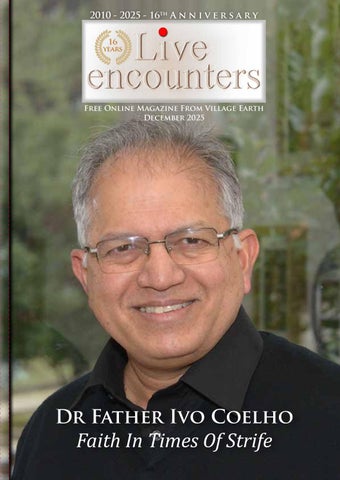
2010 - 2025 - 16th A n n i v e r s a r y
Free Online Magazine From Village Earth December 2025
Dr Father Ivo Coelho
Faith In Times Of Strife
2025 december © liveencounters.net
©Mark Ulyseas
LIVE ENCOUNTERS MAGAZINE
Photograph by Mark Ulyseas. ©liveencounters.net december 2025 Celebrating 16th Anniversary
December 2025
Support Live Encounters.
Donate Now and Keep the Magazine Live in 2026 Live Encounters is a not-for-profit free online magazine that was founded in 2009 in Bali, Indonesia. It showcases some of the best writing from around the world. Poets, writers, academics, civil & human/animal rights activists, academics, environmentalists, social workers, photographers and more have contributed their time and knowledge for the benefit of the readers of:
Live Encounters Magazine (2010), Live Encounters Poetry & Writing (2016), Live Encounters Young Poets & Writers (2019) and now, Live Encounters Books (August 2020).
We are appealing for donations to pay for the administrative and technical aspects of the publication. Please help by donating any amount for this just cause as events are threatening the very future of Live Encounters. Om Shanti Shanti Shanti Om Mark Ulyseas Publisher/Editor
All articles and photographs are the copyright of www.liveencounters.net and its contributors. No part of this publication may be reproduced without the explicit written permission of www. liveencounters.net. Offenders will be criminally prosecuted to the full extent of the law prevailing in their home country and/or elsewhere. 2025 december © liveencounters.net
©liveencounters.net december 2025 Celebrating 16th Anniversary
December 2025
Contributors Dr. Father Ivo Coelho - Guest Editorial Mark Ulyseas Dr Namrata Goswami Dr Cauvery Ganapathy Dr Ashok Sharma Tina Claffey Dr Greta Sykes José Truda Palazzo, Jr. Katie Costello Tang A Pau
2025 december © liveencounters.net
GUEST EDITORIAL
Dr Father Ivo Coelho ©liveencounters.net december 2025 Celebrating 16th Anniversary
IVO COELHO Ivo Coelho is Reader in Gnoseology and Metaphysics at Divyadaan: Salesian Institute of Philosophy, Nashik. Born in 1958 at Mumbai, he studied at Jnana Deepa Vidyapeeth, Pune, and later specialized in the hermeneutical thought of the Canadian philosopher, theologian and economist Bernard Lonergan. He has published Hermeneutics and Method: The ‘Universal Viewpoint’ in Bernard Lonergan (Toronto, 2001). Among the several books he has edited are Brahman and Person: Essays by Richard De Smet (Delhi, 2010), Understanding Śaṅkara: Essays by Richard De Smet (Delhi, 2013) and Richard De Smet, Guidelines in Indian Philosophy (Delhi, 2022).
He has been director of Divyadaan: Salesian Institute of Philosophy (1988-90), religious superior at the same institute (1994-2002), secretary of the Association of Christian Philosophers of India (2000-02), provincial of the Mumbai province of the Salesians of Don Bosco (2002-08), superior of the Ratisbonne Salesian Monastery, Jerusalem, and general councillor for formation of the Salesians of Don Bosco (2014-25). Currently he is once again superior of Divyadaan, Nashik and teacher in the Institute of Philosophy.
Dr Father Ivo Coelho Faith In Times Of Strife Faith is a deeply religious topic, but I asked myself: Would it be possible to think out faith from a nonreligious point of view? And how can we keep faith in a world torn apart by wars, violence and the open flouting of international laws and agreements, along with the destruction of so much that has been painstakingly achieved since the last two great world wars?
A key move is to distinguish faith from beliefs. Faith as distinct from beliefs is not immediately identified with this or that religion; it is an attitude of trust. It is a fundamental trust in the world, in life, in human beings, and religious people would say, in God or in divinity. There is a great difference between this kind of basic trust in life and its opposite, which in the end amounts to cynicism and indifference. This kind of faith is found everywhere and in surprising places.
I think of the Filippino mother and three kids with whom I was walking down King George street in Jerusalem. Suddenly the kids disappeared. To my surprise I found them hugging an Israeli woman. “What’s happening,” I asked. “That’s their teacher,” the mother explained. “She was the first one to come to our house when my husband was arrested for not having his documents in order. She brought food and comfort and then went on to organize her friends to collect money for the lawyer.” It was for me a wonderful reminder that there is goodness everywhere. I believe such goodness stems from a basic trust in life, in the world, in people. In a world that is getting increasingly polarized, such faith and goodness are precious. It is a sign that all is not lost. It is a sign that humanity knows how to live up to its deepest potential. It is a sign of HOPE.
© Ivo Coelho
2025 december © liveencounters.net
GUEST EDITORIAL
Such signs of faith and hope are everywhere. In Rwanda, despite memories of atrocious killings in the genocidal war of the late 1990s, we find extraordinary examples of people who have forgiven and are working for reconciliation. During the many communal riots in Mumbai I remember touching stories of people reaching across religious and communal lines to shelter, help, protect people from the vicious madness of violence. At the Taize prayer meetings in the Ratisbonne Monastery in Jerusalem, which would draw people from all walks of life, I remember meeting the settler from Gush Etzion outside Bethlehem who shared very simply with me his habit of giving a lift to any Palestinian he met on the road, regardless of his fellow settlers’ warnings. And then there was the Orthodox Jew at Hadassah Hospital outside Jerusalem who not only paid for the medical treatment of a Palestinian boy but also offered money to the family so that they could celebrate Ramadan. As long as there are acts such as these, there is hope. All is not lost. The lights have not all gone out. Faith is the eye of love. It is able to see the world with hope. And it knows that all of us have the choice either to take the path of cynicism and indifference, or worse still that of active involvement in violence and injustice, or else to be the difference, to make the difference. It does not matter that the difference we make is small. Every little bit counts. Every drop is precious. And perhaps our little act of faith, of hope, of love will ignite faith, hope and love in someone else. The choice is ours.
Our ethics professor in Pune, Salvino Azzopardi, used to say that the only reason for doing good is that it is good to do good. If someone cannot see that, don’t argue with them; the only solution, he would say, is to show them to a psychologist. It is good to do good. Human beings are built that way. Is this starry-eyed idealism? Will it get us anywhere? Is not the work of the world done by hardheaded realists? I am not sure. Of course, every little bit counts, and so who are we to discount the work of hard-headed realists. If they can bring a moment of peace to harried peoples by shortchanging them and by giving full support to the aggressor, so be it. All the same, absence of war is not equal to peace. Hatred lies deep in hearts and can be overcome only by a love that is ready to sacrifice itself.
©liveencounters.net december 2025 Celebrating 16th Anniversary
IVO COELHO
I am always amazed at the way the story of Christian de Chergé and his fellow monks of Thiberrine speaks to people of all faiths and of no faith at all. In the face of threats, these monks had a choice to leave their monastery in the Atlas Mountains, but they chose – in prayer – to remain with their Muslim neighbours, rather than abandon them. They died. But their lives speak loudly, cutting across boundaries of religion, nationality and belief, and Xavier Beauvois’ film, Of gods and men, is an extraordinary tribute to them. Humanity does not live on bread alone. We have a choice. I for one choose to believe that the little sparks of faith, hope and charity are saving the world. I believe that faith has the power of undoing decline. I believe that hope enables us to pick up the threads and start again despite everything. I believe that forgiving and self-sacrificing love can disrupt the spiral of violence. Faith, hope and love do not imply that we must passively suffer violence, never raising our voices and never doing what we can. But they do imply never losing faith while facing the consequences, never losing hope despite temptations to hopelessness, refusing to hate.
© Ivo Coelho 2025 december © liveencounters.net
2025 YEAR OF LIVING FOOLISHLY?
©Mark Ulyseas
Photograph by Mark Ulyseas. ©liveencounters.net december 2025 Celebrating 16th Anniversary
MARK ULYSEAS Mark Ulyseas has served time in advertising as copywriter and creative director selling people things they didn’t need, a ghost writer for some years, columnist of a newspaper, a freelance journalist and photo-grapher. In 2009 he created Live Encounters Magazine, in Bali, Indonesia. It is a not for profit (adfree) free online magazine featuring leading academics, writers, poets, activists of all hues etc. from around the world. March 2016 saw the launch of its sister publication Live Encounters Poetry, which was relaunched as Live Encounters Poetry & Writing in March 2017. In February 2019 the third publication was launched, LE Children Poetry & Writing (now renamed Live Encounters Young Poets & Writers). In August 2020 the fourth publication, Live Encounters Books, was launched. He has edited, designed and produced well over 300 editions of Live Encounters. Mark’s philosophy is that knowledge must be free and shared freely to empower all towards enlightenment. He is the author of three books: RAINY – My friend & Philosopher, Seductive Avatars of Maya – Anthology of Dystopian Lives and In Gethsemane: Transcripts of a Journey. https://www.amazon.com/Mark-Ulyseas/ https://liveencounters.net/mark-ulyseas-publisher-editor-of-live-encounters-magazines/
Mark Ulyseas 2025
Yet another year of living foolishly? This essay was written and published in 2008. Since then I have updated it every year. It is a reminder to us that the inhumanity of humanity has not changed. In fact, it appears to be growing in intensity. This year is grinding to a close, so what will it be in 2026? Human slavery? Theft of human organs? Infanticide?
Is our dead better than their dead? Do we continue killing them?
More wars for religious or commercial purposes or perceived historical lands? More bombings of civilians, children, hospitals and schools under the garb of fighting terrorism? Cultural genocide... like the deconstruction of indigenous cultures for homogenisation by a godless State? More public stabbings of innocent people?
Another Mass Extinction in the making, perhaps the Palestinians, followed closely by other sections of humanity? © Mark Ulyseas 2025 december © liveencounters.net
2025 YEAR OF LIVING FOOLISHLY? All this talk of saving the world is pointless. Everything is done half-heartedly. Let’s make a resolution for the New Year to decimate the planet. Destroy all our natural resources, pollute the rivers and farm the seas to extinction. At least we would be doing one thing properly.
Are there more insidious revelations that expose the all-pervasive criminality of governments, international politics and sections of the Media?
Is the UN still a coffee shop for the rich and powerful to hang out and where honour still exists among thieves? And are the medusa-like social media barons still lords of the manor? Do they control our hearts, minds and our freedom of speech? Or, is the rise of artificial intelligence taking the baton from them by appropriating (thievery) the intellectual property rights of poets, writers, academics et al, and regurgitating ‘data’ on search engines and other modes of communication without attribution to the source? And are the pharma and armaments companies increasing their profits as the body count grows?
And is tourism fast becoming online voyeurism? Or, has the tourist flood gates opened to the peddlers of obscenity? And is tourism the new terrorism?
And is the ether now the domain of roaming viral vitriolic mindsets looking for any cause? And is liberalism the bastard offspring of fascism?
And has exceptionalism become a fundamental right?
There is so much to choose from. It’s like a supermarket out there with all kinds of man-made disasters available on the shelves, one has simply to reach out and grab one.
2025 is ending on a note of negotiated delusions with the Climate Change Conference in Belém, Brazil. What happened to the good old days when we used a blanket instead of a heater? All this talk of saving the world is pointless. Everything is done half-heartedly. Let’s make a resolution for the New Year to decimate the planet. Destroy all our natural resources, pollute the rivers and farm the seas to extinction. At least we would be doing one thing properly.
©liveencounters.net december 2025 Celebrating 16th Anniversary
MARK ULYSEAS
©Mark Ulyseas
Baby monkey for sale on the road. Photograph by Mark Ulyseas. © Mark Ulyseas 2025 december © liveencounters.net
2025 YEAR OF LIVING FOOLISHLY?
©Mark Ulyseas
Garbage being removed from beach in South-East Asia. Photograph by Mark Ulyseas. ©liveencounters.net december 2025 Celebrating 16th Anniversary
MARK ULYSEAS Statistics are essential in war zones. They can always be rearranged to suit one’s perceived objectives. The little numbers represent people, mothers, fathers, sisters, brothers, relatives and friends. A neat way to manage these numbers is to write in pencil so that an eraser can be used judiciously. And as the death toll in war ravaged countries rises, a hysterical caucus threatens a host of other countries for deviating from the ‘the international rules based order’ like illegally invading countries on trumped up charges and bombing innocent folk back to the stone age. The ‘rules based order’ are, perhaps, former colonial masters in their death throes.
On one hand we talk of peace, love and no war. On the other hand, we bomb, rape, pillage, annex and subdue nations with money, military power and warped religiosity.
For instance, let’s take a quick look at Afghanistan. The British couldn’t control the tribes in the 19th century, the Russians failed miserably and the Americans with their assorted comrades in arms, poor souls, were being killed along with thousands of faceless unarmed Afghan civilians...until they abandoned the country and those that supported them after a failed two-decade war leaving the country in the hands of the great unwashed. I suppose Afghan life is cheaper by the dozen...the women and children are now at the mercy of pathological misogynistic aberrations of humanity. Will the ordinary Afghan civilians ever get to live in peace? And what about that European country presently being devastated by a war that has been created and funded by those countries whose mantra is ‘rules based international order’. Has it become the testing ground for newly developed killing machines? And when the killings subside will groups of loving hands at home descend on the land to make money from donations in the name of one fraud or another?
What about certain parts of the Middle East, areas that have become vast open-air abattoirs for the mindless slaughter of innocent people? Do you think they will run out of people considering the number of killings that are taking place? Education there is history – like the slaughter of unarmed civilians, including children, by an army from God. It stems from the barrel of a gun. The pen is for signing death certificates.
Statistics are essential in war zones. They can always be rearranged to suit one’s perceived objectives. The little numbers represent people, mothers, fathers, sisters, brothers, relatives and friends. A neat way to manage these numbers is to write in pencil so that an eraser can be used judiciously. And as the death toll in war ravaged countries rises, a hysterical caucus threatens a host of other countries for deviating from the ‘the international rules based order’ like illegally invading countries on trumped up charges and bombing innocent folk back to the stone age. The ‘rules based order’ are, perhaps, former colonial masters in their death throes. © Mark Ulyseas
2025 december © liveencounters.net
2025 YEAR OF LIVING FOOLISHLY? Africa, the Dark Continent, what can one say about its peoples and their ancient civilizations that have slowly been corrupted by large corporations and foreign governments meddling in the affairs of the states: Buying and selling governments on mammoth proportions? Oh, for the days of the Rwandan blood bath. Perhaps the genocide in Sudan has its moments of glory?
Are these the same countries that accuse China of ruthlessly dismantling the vibrant ancient Uighur culture, brainwashing and incarcerating the Uighurs in re-education camps whilst the Islamic countries appear deaf, blind and dumb to the slaughter of their fellow brethren? Is Tibet now lost forever in the dragon’s jaws of modernisation?
And which country or countries will become a killing field for jingoists in 2026?
This dragon, which had unleashed a terrible virus (a natural phenomenon?) on the world, killing millions, shutting down tourism and all but destroying economies, has quickly recovered from the scourge and is now selling merchandise in the millions across the world. Is this the soul of Profit & Loss - where people continue to get poorer while the rich get richer, like in democracies?
And is the much-peddled term of democracy actually the mask of plutocracy, where the rich get to be elected and poor are fed promises? And are democracies now avatars of fascism? Africa, the Dark Continent, what can one say about its peoples and their ancient civilizations that have slowly been corrupted by large corporations and foreign governments meddling in the affairs of the states: Buying and selling governments on mammoth proportions? Oh, for the days of the Rwandan blood bath. Perhaps the genocide in Sudan has its moments of glory? Everything is quiet now, no excitement and drama except for bloody popular uprisings, theft of natural resources and other inconsequential happenings like the sudden spread of highly infectious diseases and mass kidnapping of school children for forced marriage and conversion…and the continuing practice of female genital mutilation, which appears to be a thriving business across the world where doting parents in western countries take their little girls on ‘vacation’ cuts while their governments lecture Africans on the scourge of female genital mutilation. ©liveencounters.net december 2025 Celebrating 16th Anniversary
MARK ULYSEAS Now let’s see who is left on the black board? Hmmm…the indigenous people of the Amazon are still fighting a losing battle with the powers that be to stop the plunder of their home, the rain forest, the green lung of mother earth. South America appears to be lost in translation. We never seem to get a lot of news from there except for soccer, drug lords, plunder of the marine world and the continued exploitation of the poor and defenceless by rapacious governments sponsored by those from the North and elsewhere. It has become the battle ground of powerful countries that use the common folk as cannon fodder.
What about the sub-continent, India? Do they still abort female foetuses or do they bury them alive, now? Burn women who don’t bring enough dowry? Is rape intrinsic to the male mindset? Do they continue to decimate wildlife? Persevere in the destruction of the environment? And do millions still exist on the threshold of life and death? And is the arrogant Indian Middle Class growing to newer levels of self-indulgence? And is the Caste System still making a killing?
And is protection of the holy cow more important than feeding millions of people living below the poverty line? And are politicians continuing to feed off the socio-economicreligious insecurities of its people? And are sections of its media turning into manic performing artists, deliberately taking sides in political dramas and creating news for ratings?
Forgive me… I missed that little country to the west of India, the homeland of terrorism and an illicit nuclear arsenal – Pakistan, an army that has a country. Poor chaps they’ve had such a tiresome year with the constant ebb and flow of political violence and religious fundamentalism peppered with suicide bombings that probably the common folk want to migrate to the India… can’t really blame them. Their government is its armed forces’ ventriloquist doll. The common folks’ only desire is to live in peace to pray, work and procreate. Meanwhile, their government has been switching debtors from the West to China to the Middle East, countries that in turn have commercially colonised this country bleeding it by a thousand loans and assorted ventures like the supply of weapons to countries at war. But they (Pakistan) constantly reminds all and sundry that they have nuclear weapons...but not enough food to feed its own people. Now let’s see who is left on the black board? Hmmm…the indigenous people of the Amazon are still fighting a losing battle with the powers that be to stop the plunder of their home, the rain forest, the green lung of mother earth. South America appears to be lost in translation. We never seem to get a lot of news from there except for soccer, drug lords, plunder of the marine world and the continued exploitation of the poor and defenceless by rapacious governments sponsored by those from the North and elsewhere. It has become the battle ground of powerful countries that use the common folk as cannon fodder. © Mark Ulyseas
2025 december © liveencounters.net
2025 YEAR OF LIVING FOOLISHLY? There are many countries that lecture China on its human rights. Wonder who has a perfect track record…The world’s last self-proclaimed superpower? A superpower that continues to interfere in the affairs of other nations by supplying state of the art weapons that are often used against civilians living a hand to mouth existence. I suppose the term ‘collateral damage’ is more palatable than the term… murder. There is a killing to be made in the sale of armaments but little or no desire to urgently help its own people devastated by natural disasters like massive fires, super storms, joblessness, crumbling infrastructure and the perceived threat to the State by hardworking migrants. 1984 in a new avatar?
Let’s leave all this violence for some tuna, shark fin, whale, and dolphin meat. The Japanese and an assortment of other ‘civilised’ countries, Norway in particular, are so considerate to the world at large. For countries that pride themselves on rejecting nuclear weapons they have a rather odd way of showing their respect for the environment. I am referring to the mass killing of whales, dolphins and other sea creatures on an industrial scale. Actually, you must admire their concern. Ever considered the fact that they maybe ridding the oceans of monsters that take up so much space and are a serious health hazard to humanity? Will we see further progress of this mindless massacre with the mammoth 93,000 brand new whaling ship?
I think Japan’s neighbour China has the right approach. It has dispensed with the cumbersome concept of human rights and its implementation. In its place totalitarianism with a large dose of plutocracy has been suitably installed. It uses its economic power and loan shark activities to threaten countries that do not kowtow its line. There are many countries that lecture China on its human rights. Wonder who has a perfect track record…The world’s last self-proclaimed superpower? A superpower that continues to interfere in the affairs of other nations by supplying state of the art weapons that are often used against civilians living a hand to mouth existence. I suppose the term ‘collateral damage’ is more palatable than the term… murder. There is a killing to be made in the sale of armaments but little or no desire to urgently help its own people devastated by natural disasters like massive fires, super storms, joblessness, crumbling infrastructure and the perceived threat to the State by hardworking migrants. 1984 in a new avatar?
Civil liberties are essential for the survival of a nation and so is the health of its people. In some areas of society where common sense has been the victim, Nature has found a way of retaliating with diseases like Ebola, AIDS, Swine Flu and Zika, infecting millions and helping to keep the population in check: Of course, with a little assistance from the scientific community who often test drugs on unsuspecting illiterate folk and other living beings, in the holy name of finding new cures, while making a profit. ©liveencounters.net december 2025 Celebrating 16th Anniversary
MARK ULYSEAS
©Mark Ulyseas
Severed heads of pigs and other body parts being sold in a South-East Asian market. Photograph by Mark Ulyseas.
© Mark Ulyseas
2025 december © liveencounters.net
2025 YEAR OF LIVING FOOLISHLY?
©Mark Ulyseas
Photograph by Mark Ulyseas. ©liveencounters.net december 2025 Celebrating 16th Anniversary
MARK ULYSEAS And once again, as we have done in the past, this Christmas and New Year we shall all sit down to sumptuous meals, drink whatever fancies our taste buds, shop till we drop and pamper our overweight children and pets. It’s the season of happiness, love and family especially for the homeless, injured and maimed children of wars, missing people in Gaza, Ukraine, Russia, Afghanistan, Syria, Xinjiang (Uighur), Tibet, Yemen, Sudan and elsewhere; asylum seekers, political detainees and the fringe folk of the planet. They will surely be very happy and content with what they see, hear, feel and touch this festive season.
But Nature has a conscience. It has distanced itself from the prevailing pestilence, COVID-19… a deadly virus that originated from the den of the dragon…a Biblical-like plague not from God, but from the godless. A virus that has receded into the realms of laboratories after killing millions and making huge profits for pharma companies. There is now excited discussions and expectations for upcoming newer more deadly viruses like the chikungunya virus (CHIKV). Meanwhile, humanity is susceptible to dangerous new strains of super bacteria resistant to antibiotics. As 2025 downs its shutters the price of human body parts has gone up. Human trafficking, organ trafficking and harvesting around the world (transplant tourism), including the ‘civilised’ nations, is now second only to drug peddling in revenue. Profiteers forecast a higher income in 2026, thanks to continuing wars, growing poverty, disease and transmigration of people (illegal migrants?). And once again, as we have done in the past, this Christmas and New Year we shall all sit down to sumptuous meals, drink whatever fancies our taste buds, shop till we drop and pamper our overweight children and pets. It is the season of happiness, love and family especially for the homeless, injured and maimed children of wars, missing people in Gaza, Ukraine, Russia, Afghanistan, Syria, Xinjiang (Uighur), Tibet, Yemen, and elsewhere; asylum seekers, political detainees and the fringe folk of the planet. They will surely be very happy and content with what they see, hear, feel and touch this festive season.
From genocide to environmental disasters to devastating civil wars it has been a roller coaster ride through many countries and peoples and cultures and religions. This journey will end only when we truly comprehend the reason as to why we have been put on this planet by a power far greater than we can ever imagine. Merry Christmas and a peaceful New Year to you. Om Shanti Shanti Shanti Om
© Mark Ulyseas 2025 december © liveencounters.net
SPACE–USA-CHINA-INDIA
Dr Namrata Goswami ©liveencounters.net december 2025 Celebrating 16th Anniversary
NAMRATA GOSWAMI Dr. Namrata Goswami is an author and educator who specializes in space policy, international relations, and ethnic identity. Currently, she teaches at the Schriever and West Space Scholar Programs, the School of Advanced International Studies at Johns Hopkins University, and the Thunderbird School of Global Management at Arizona State University. She also serves as a guest lecturer at Emory University, where she conducts seminars on Technology, Society & Governance, and India today. She worked as a Research Fellow at MP-Institute for Defence Studies and Analyses, New Delhi; a Visiting Fellow at Peace Research Institute, Oslo, Norway; La Trobe University, Melbourne, Australia; University of Heidelberg, Germany; Jennings-Randolph Senior Fellow, United States Institute of Peace; and was a Fulbright Senior Fellowship Awardee. She was awarded the Minerva grant by the Office of the U.S. Secretary of Defense to study great power competition in outer space. In April 2019, Dr. Goswami testified before the U.S-China Economic and Security Review Commission on China’s space program. Her co-authored book, Scramble for the Skies: The Great Power Competition to Control the Resources of Outer Space was published in 2020 by Lexington Press; Rowman, and Littlefield. Her book on The Naga Ethnic Movement for a Separate Homeland was published in 2020 by Oxford University Press.
DR Namrata Goswami*
A Comparative Evaluation of the United States, China, and India in Space Through 2050 *Disclaimer: The views expressed are those of the author and do not reflect the official guidance or position of the United States Government, the Department of Defense, the United States Air Force, or the United States Space Force.
Introduction The 21st century has witnessed a decisive shift toward the strategic, commercial, and technological use of outer space, turning it into a realm of competition, calculated cooperation, and prestige among major powers. Nowhere is this shift more evident than in the paths of the United States, China, and India, whose civil, commercial, and military space initiatives are shaping the contours of a new space order. Each of these nations progresses along unique institutional paths, driven by different strategic cultures but aiming for similar goals: maintaining a presence in Earth orbit, mastering cislunar space, and expanding human and robotic activities toward Mars and the asteroids. Between now and 2050, their interactions will shape not only space exploration and utilization, but also the very foundations of global power.
© Namrata Goswami 2025 december © liveencounters.net
SPACE–USA-CHINA-INDIA
The Evolution of U.S. Space Policy and Power Projection Civil Program The United States still represents the typical example of a mature space power for now, but that could change by 2050. NASA’s civil program aims to advance scientific exploration and human spaceflight. In Low Earth Orbit (LEO), with the International Space Station set to deorbit in 2030, NASA has partnered with U.S. commercial firms such as Blue Origin, Axiom Space, Northrop Grumman, and Nanoracks to develop commercial space stations. In Geostationary Orbit (GEO), U.S. satellites support global communications and climate observation. The Artemis Lunar program, launched by the U.S. in 2017, refocuses national goals on a sustained return to the Moon, with crewed missions planned for the late 2020s and a permanent presence in cislunar space. These efforts serve as a stepping stone to Mars exploration in the 2030s and 2040s, reaffirming the United States as a leader in deep-space science and technology. Commercial Expansion
The commercial sector has revolutionized the American space industry. SpaceX, Blue Origin, and a network of private companies have transformed launch economics, establishing a dense commercial presence in LEO and beyond. Mega-constellations like Starlink have become vital parts of global communication, showing how commercial infrastructure now supports U.S. strategic advantages. By the 2030s, commercial players are expected to lead in orbital logistics, Lunar transport, and even asteroid resource ventures, working within a regulatory framework overseen by the Federal Aviation Administration (FAA) and Department of Commerce. The partnership between NASA’s civil exploration and private companies offers a strategic roadmap for the U.S. to maintain its space advantage through 2050.
©liveencounters.net december 2025 Celebrating 16th Anniversary
NAMRATA GOSWAMI
Military Domain The establishment of the U.S. Space Force (USSF) in 2019 confirmed space as a domain of warfare and deterrence. Military assets now include communications, navigation, reconnaissance, and missile-warning systems across LEO and GEO. Doctrine emphasizes resilience through proliferated constellations and rapid launch. By the 2030s, the U.S. military aims to expand awareness and control into cislunar space, integrating defense and civil monitoring systems. Commercial satellites are increasingly offering flexible space capabilities during crises. The United States thus maintains a three-part structure: NASA for exploration, the Space Force for defense, and a strong private sector, ensuring continued leadership even amid growing competition.
China: The Challenger to a U.S.-Led Space Order Civil Program
China has become the United States’ main competitor through a tightly integrated space program that combines civil, commercial, and military goals. The China National Space Administration (CNSA) guides policy under the direction of the State Administration for Science, Technology and Industry for National Defense (SASTIND), a key government agency under China’s Ministry of Industry and Information Technology (MIIT). SASTIND coordinates between China’s defense and civilian space industries, playing a vital role in managing dual-use technologies that connect China’s military and civilian space programs, ensuring alignment between the People’s Liberation Army (PLA) and national space organizations like the China Aerospace Science and Technology Corporation (CASC) and the China Aerospace Science and Industry Corporation (CASIC). CASC and CASIC lead the development of launch vehicles, spacecraft, and satellites, with major subsidiaries such as the China Academy of Space Technology (CAST), which designs satellites and spacecraft; © Namrata Goswami 2025 december © liveencounters.net
SPACE–USA-CHINA-INDIA
the China Academy of Launch Vehicle Technology (CALT), the leading developer of the Long March rockets; and the Shanghai Academy of Spaceflight Technology (SAST), which focuses on satellites and rocket components. Additional specialized institutions include the China Academy of Aerospace Electronics Technology (CATEC), which develops spacecraft avionics and sensors, and the China Satellite Launch and Tracking Control General (CLTC), responsible for launch operations and telemetry. On the research side, the Chinese Academy of Sciences (CAS) plays a key role through its various branches, including the Center for Space Science and Applied Research (CSSAR), which advances work in space physics, astrophysics, quantum theory, space weather, dark matter, and planetary science. The Technology and Engineering Center for Space Utilization (CSU) manages experiments aboard the Tiangong space station; the National Space Science Data Center (NSSDC) oversees national space data and information systems. Figure I: Organizational Framework of the NSSDC
Source: NSSDC at https://www.nssdc.ac.cn/nssdc_en/html/about.html
©liveencounters.net december 2025 Celebrating 16th Anniversary
NAMRATA GOSWAMI
Figure II: China’s Space Institutional Structure
© Namrata Goswami 2025 december © liveencounters.net
SPACE–USA-CHINA-INDIA
Collectively, these institutions form the backbone of China’s integrated civil, commercial, and strategic space infrastructure, positioning the country as a major player in global space exploration, utilization, and development. By 2035, China aims to establish an International Lunar Research Station at the Moon’s south pole, enabling sustained surface operations. The upcoming Long March 9 heavy-lift rocket, expected to make its first flight around 2030, will offer interplanetary capabilities comparable to those of the U.S. Space Launch System (SLS) and Starship. Commercial Expansion
China’s commercial space industry mainly acts as an extension of the government’s strategy. Many companies develop reusable launch vehicles and satellite constellations, but depend on government support and funding. The aim is to produce satellites on a large scale, export infrastructure, and achieve technological independence. By the 2040s, China envisions a complete space industrial chain encompassing manufacturing, in-space logistics, and resource utilization. The model merges commercial efficiency with state coordination, aiming to position China as a systemic alternative to Westernled commercial paradigms. Military Domain
Militarily, China regards space as critical to information dominance. The People’s Liberation Army Strategic Support Force, now the Aerospace Force, integrates space, cyber, and electronic warfare capabilities to ensure unity of command. China maintains large reconnaissance and communication satellite networks, rapid-launch capacity, and expanding counter-space capabilities, including co-orbital and electronic systems. Cislunar space has entered Chinese strategic planning as the next frontier of advantage. By 2050, China expects to operate routinely in Lunar orbit and deep-space regions, protecting national assets and securing access to extraterrestrial resources. This integrated approach, civil, commercial, and military, embodies China’s “2049 Space Dream,” a centenary vision of global leadership through space power. ©liveencounters.net december 2025 Celebrating 16th Anniversary
NAMRATA GOSWAMI
India’s Incremental Path to Space Civil Program India occupies a distinct position in this triad: a rising power that has achieved global recognition through the cost-effectiveness of its space program. The Indian Space Research Organisation (ISRO) has built an indigenous capability across launch, remote sensing, communications, and planetary science. Chandrayaan-3’s successful Lunar landing in confirmed India’s precision engineering, while the 2014 Mars Orbiter 2023 Mission demonstrated interplanetary reach on a minimal budget of $75 million. ISRO’s next step is the development of its heaviest rocket, the Lunar Module Launch Vehicle (LMLV) by 2035, designed for Lunar and deep-space missions with a lift capacity of 27 tons to the Moon and 80 tons to LEO. This launch system will vastly expand payload capacity, enabling more ambitious planetary exploration. Under the Department of Space, ISRO benefits from political stability and strategic visibility at the highest level of government; DoS is institutionally hosted within the Prime Minister’s office. Commercial Expansion
India’s commercial ecosystem is now liberalizing after decades of state control. The establishment of NewSpace India Limited and policies encouraging private space ventures have opened access to capital and international partnerships. Start-ups are entering satellite manufacturing, small-launch services, and remote-sensing markets. The guiding logic is cost-efficiency: to provide affordable access to space and to leverage India’s engineering talent as a global service hub. By 2047, under the “Space Vision 2047,” India aims to be a top-tier commercial provider and an active participant in deepspace logistics, extending its frugal innovation model to the Lunar economy.
© Namrata Goswami 2025 december © liveencounters.net
SPACE–USA-CHINA-INDIA
Military Domain India’s defense space posture, once limited, is becoming integral to national security. The 2019 anti-satellite test demonstrated kinetic capability, while new defense space agencies established that same year, coordinates communication, surveillance, and navigation systems. The strategy emphasizes deterrence and the protection of national assets. By 2050, India is expected to possess autonomous launch access, resilient dualuse satellite networks, and improved situational awareness. Though its military footprint will remain smaller than those of the U.S. and China, India’s steady institutional development and regional credibility will secure it a major role in shaping global space governance. Comparative Analysis: Divergent Paths, Converging Futures?
The United States, China, and India differ not only in capability but in institutional philosophy. The U.S. system separates civil, commercial, and military components, while China’s model centralizes control through state direction and limits independent entrepreneurship. India charts a hybrid course, blending state leadership with emerging private participation.
In civil space, the United States still leads across all orbital regimes, though China’s rapid advances narrow the gap. India’s trajectory shows that slow growth can replace scale and efficiency. In commercial space, the United States remains dominant, but China’s industrial acceleration and India’s liberalization point toward a more multipolar space market by 2050. Militarily, the U.S. and China are entrenched in a strategic competition that will define global security norms, while India’s developing capabilities add another layer to that mix and push for regional deterrence. The contest will expand beyond Earth orbit. Cislunar space will become the strategic pivot by 2050. Both the U.S. and China plan sustained Lunar operations, while India’s forthcoming heavy-lift systems will allow entry into that domain. Whether cooperation or confrontation prevails will depend on how these powers reconcile exploration with governance in an environment lacking precedent or regulation. ©liveencounters.net december 2025 Celebrating 16th Anniversary
NAMRATA GOSWAMI
Strategic Outlook to 2050 By 2050, space will be fully integrated into global policy, economics, and defense. The United States will remain the central node of innovation, supported by a resilient private sector and enduring alliances. China will consolidate its position as the main challenger, combining state-driven coordination with technological scale to realize Lunar industrialization and asteroid exploitation. India will mature into a capable, cost-efficient, and autonomous space power, contributing to exploration, commerce, and governance. The world will thus witness a triadic equilibrium: an established superpower, a systemic challenger, and a slow but persistent riser. Their interaction will decide if outer space becomes a shared resource or an extension of Earth’s conflicts. Table I: The Expanding Frontiers of Power: The United States, China, and India in Space to 2050. This table presents a comparative analysis of the space programs of the United States, China, and India across civil, commercial, and military domains, extending to 2050. It assesses the institutional structures, missions, and strategic trajectories of each nation and concludes with a comparative table divided into two phases: 2025-2030 and 2030-2050.
© Namrata Goswami 2025 december © liveencounters.net
SPACE–USA-CHINA-INDIA
©liveencounters.net december 2025 Celebrating 16th Anniversary
NAMRATA GOSWAMI
© Namrata Goswami 2025 december © liveencounters.net
I N D I A ’S $10 TN S T O R Y
Dr. Cauvery Ganapathy ©liveencounters.net december 2025 Celebrating 16th Anniversary
CAUVERY GANAPATHY Dr. Cauvery Ganapathy is a Non-Resident Fellow at the Observer Research Foundation, Middle East and a Strategic Risk Management Consultant. Previously she was a Research Associate with the Office of Net Assessment under the US Department of Defense. She has been Visiting Research Faculty, POLIS and Senior Fellow, Sidney Sussex College, University of Cambridge under the Wrangler Pavate Award and has been a Fulbright-Nehru Doctoral Fellow to the University of California, Berkeley. She started her career as a Research Fellow with Global India Foundation, Kolkata, and interned with the National institute of Advanced Studies, Bangalore.
Dr Cauvery Ganapathy
Telling India’s $10tn story: strength grows better in silence India will one day be a $10tn economy. This assessment is based on a linearity born out of economic trendlines, potential for growth and a demographic dividend. All of which are undeniable. Today, though, is not that day. The purpose of this commentary is to make the case that there may be value in muting avoidable noise and optics regarding India’s imminent, but yet to be achieved, $10tn success story. To contextualize the scale of this growth, consider the following statistics. Currently, the size of the Indian economy stands at roughly $4.3tn. Relatively large populations with smaller but comparably aggressive growth agendas such as Brazil, Indonesia and Vietnam are expected to be at $4tn, $3.6tn and $780bn respectively by 2030. China, at the same time, is expected to be at $26tn having supplanted the US at $23tn as the world’s largest economy. It is reasonable to contend that for bridging the gap from $4 to $10tn, for the most populous nation in the world which grapples with persistent diversity of socio-economic and political orientations within, a leeway of a couple of years, if not more, must of course also be made. Regardless, our aspiration of $10tn still remains far beyond where we stand today, just about four years from 2030.
© Cauvery Ganapathy 2025 december © liveencounters.net
I N D I A ’S $10 TN S T O R Y
Today it may serve the national cause better to avoid the noise and focus instead on the achievement of robust and well-distributed economic growth, creating structural resilience in both regulatory and infrastructural frameworks, consciously working towards better social equity, and building an operationally effective deterrence so formidable that state and non-state actors always judge an act against India, whether potential or kinetic, as not being commensurate to the anticipated benefits that may accrue from it. The curious thing with achievements of this kind is that they are their own advertisement. Successful achievement of such goals inherently means that they do not have to be spoken about by those achieving them.
Admittedly, it is an age where narrative formulations precede achievements. It is common for public narratives to drive policymaking, globally. To allow buoyant narratives to get ahead of achievements, though, does a disservice to the long-term interests of states, just as it imposes greater pressures and stresses on it. There is, of course, value in the consideration that if you do not tell your own story, someone else will, and it may then not sound as you had wished. For post-colonial societies, this is a very compelling logic to engage in largely useful narrative building about their own growth stories. Yet, acknowledging that all that is possible and plausible is not always automatically achievable is necessary self-awareness on the part of a state.
Being on the anvil of a change does not automatically translate into that change. Through the past century itself, there have been glaring examples of countries that stood on the threshold of great promise which did not materialize adequately for a multiplicity of reasons. The Lost Decade of the Japanese must be seen as a case in point. Lessons from the period where inflated stocks and overleveraged real estate ate into the promise of the Japanese growth story, demonstrates what happens when exuberance overlooks the inherent gaps in the pathway. A similar case led up to what made Germany ‘the Sick man of Europe’, when excited narratives of what its phenomenal growth potential being realized would look like flooded public discourse before the economy’s structural issues were corrected. These were both stories about the ‘next big thing’ that did not pan out. There is, however, one that did. China. ©liveencounters.net december 2025 Celebrating 16th Anniversary
CAUVERY GANAPATHY
There is much in the Chinese model of nation-building that cannot, and more importantly, should not be extrapolated to the Indian experience. There is, however, one strain of strategic thought that may prove valuable to replicate – that of tao guang yang hui which loosely translates into ‘hiding your strength and biding your time’. Now, although the invocation of it today is often made in reference to the Chinese consolidating capabilities before revealing it, Deng’s call was based on a more constructive vision for his country to cultivate its strength in order to achieve national prosperity and through that, international influence. Deng Xiaoping re-introduced the concept of tao guang yang hui – an age old Chinese proverb – to the national psyche and strategic culture as he led the Chinese state on its project of developing and consolidating elements of national strength through indus-trialization. Notably, it did this in a manner that completely transformed its relevance and status in the international comity of nations. The transformation of China’s international position did not come about by sheer dint of its ability to rally its people and resources to emerge a giant in manufacturing and trade. The final value of this approach emerged arguably from two reasons- first, that the Chinese focused on making their participation in the global manufacturing and production ecosystem integral to everyone else’s economic growth blueprint through an overwhelming control of supply-chains, and second, that Chinese statecraft leveraged the resultant economic clout globally in a manner which systematically established that exerting pressure on the Chinese could not happen without reciprocal pain points being felt by those seeking to curtail the Chinese interest or agenda.
Cutting out the noise and the perception battles, it was the single-minded pursuit of specific growth agendas that undergirded China’s economic growth story. Such an approach helps direct policy and allocate resources effectively. This is a lesson we would do well in India to adapt to our unique circumstance as a country. There is dogged groundwork in a more tangible sense that needs to be done to achieve an ambition such a $10tn economy. © Cauvery Ganapathy 2025 december © liveencounters.net
I N D I A ’S $10 TN S T O R Y
To be sure, a lot of the work has already begun and is indicated to be on-track. Infrastructure project outlays have been substantial, for instance. Implementation speeds, though, is a perpetual work in progress. Alongside the imperative of investing systematically in focused Research and Development in sectors that the country has a comparative advantage in or deems as being critical, it is manufacturing that will serve as the central pillar in this growth story. 26.67% of India’s exports for the year have been from engineering goods. This is a step in the right direction. There is also excellent research that has been done on the subject of why the strengthening of the manufacturing base is central to actualizing India’s growth potential. The generation of meaningful employment and the reduction of supply chain vulnerabilities play no small part in these calculations.
In addition to the twin factors of R&D and manufacturing growth, there are a few specific areas of concern that may be highlighted regarding the path ahead –
First, the realization of a dividend from the demography must be understood as being conditional on the investment of a sustained and substantive principal. Skilling, upskilling and reskilling in answer to specific market needs should be our most important national prerogative, second only to national defense and human security. The investment in human capital, unfortunately, seems almost an afterthought. Our people are our greatest asset. Not cultivating that asset and not providing for both, its potential and its ambitions, could just as easily turn the asset into a liability.
Second, governments in electoral democracies are hyper sensitive to public moods. Oftentimes, this leads to reactions which are based not on an appreciation of the strategic compulsions on the ground but in response to satiating demands of the vote-bank. India’s decisions regarding when and where to stop during the conduct of Operation Sindoor is an example of a government prudently not allowing the collective demands of greater punishments being imposed influence their own strategic calculations that led to the ceasing of firepower. There is no reason to believe that such prudence would always be forthcoming given its impact on political fortunes. ©liveencounters.net december 2025 Celebrating 16th Anniversary
CAUVERY GANAPATHY
As part of this, a better public understanding of the concept of escalation dominance may also help. If the pursuit of the $10tn mark and the achievement of unprecedented levels of growth as a country by 2047 is our ultimate objective, we must also know when and where to draw the line in terms of inflicting costs on our neighbours when borders are contiguous. Third, war-gaming of supply chains disruptions must be made part of our national defense strategizing and outlooks- if it is not already post the pandemic. The degree of dependence we have for both basic and critical commodities on countries that do not necessarily have any congruence of interest with us barring our value as a buyer, imbues a worrying chink in our armour.
Similarly, the country needs to prepare for targeted and repeated disruptions through disinformation campaigns, intelligence targeting and sustained cyber attacks. These must be expected to be both at a small scale as well as the debilitating ones on our critical infrastructure. Cybersecurity, grid security, energy security, food security, water security, security of the public health delivery mechanism and security of banking systems are all areas that can and will be targeted by state and non-state actors in this age of asymmetric warfare. Ensuring resilience of these systems is no small feat. It is, however, one that must form a central pillar of path forward. Fifthly, despite its enormous potential in manufacturing, India continues to remain an agrarian economy. Notably, the share of agriculture in India’s export basket stands at less than 7%. Ironically, it is a country that produces record harvests at the same time as it spends an increasing amount of forex on importing foodstuff. This dichotomy reflects mismatched priorities and policies, just as it represents a considerable loss of forex. Given the numbers that depend on it for both sustenance and earning, a re-alignment of the official incentives in the sector must be prioritized.
© Cauvery Ganapathy 2025 december © liveencounters.net
I N D I A ’S $10 TN S T O R Y
Relatedly, it is also necessary to consider the impact that urbanization which increases with the imminent migration of populations from the agrarian sector would have on the infrastructure of cities and towns. A $10tn economy should reflect in an improved quality of life, and focusing on urban infrastructure needs to be another area of priority focus to achieve this.
Again, India’s sheer size and diversity is a treasure trove for the development of language models. Focusing on creating our own Large Language Models (LLM) instead of being reduced to a data set for the development of ones that are made and owned by actors outside of the country should be a clear national priority. Lastly, India’s expanding zone of operation in the Indian Ocean region increases the scope of protection that the country needs to ensure outside of its borders, which creates additional pressures. Simultaneously, the strengthening of our deterrence capacities must be accompanied with the creation of a frontier policy- which again, need not be publicly pronounced until required- given the unending flux in our immediate physical neighbourhood is an idea whose time has come, if not already been surpassed. Growth does not compound by hope. It does through foundational strength. Focus on these elements will build that strength. And, strength grows better in silence.
Finally, a note on the element of soft power, which has become an important part of discussions that surround our position in the world today, and is part of the noise that surrounds the yet to arrive $10tn tomorrow –
Soft power, definitionally, rests on important but arguably abstract expressions such as the attractiveness of a state’s culture and the salience of the socio-political values it abides by in the conduct of its domestic and foreign policy. Countries, at the time the concept came into vogue, were at varyingly different levels of cultural access points. What seemed rare, and therefore exotic to one corner of the world, added great novelty to it. The movement of people across borders and the phenomenal dilution of cultural identities through it has taken away much of the attendant novelty. ©liveencounters.net december 2025 Celebrating 16th Anniversary
CAUVERY GANAPATHY
Soft Power used to be based a lot more on aspirations before globalisation took hold. It is today based more on need. The difference between the two is the same as the one between the value propositions of McDonald’s on the one hand and that of USAID on the other. Our vaccine diplomacy during the pandemic or our willingness to stake more in the climate change negotiations are the kind of calling cards that we should aspire towards in the realm of what is labelled soft power. It is when these are known to be emerging from a state which has phenomenal fire power too, that this transforms into Joseph Nye’s smart power framework. Power has to have an inherently deterrent feature to it for it to be formidable and respected. India’s $10tn aspiration will not come devoid of this combination. Appreciating that narrative-building through the much used and oft-abused concept of soft power can only go so far and no further, must also be an equally important part of this national effort. Bollywood, yoga, the wisdom of our ancient scriptures and the seemingly unending appeal of the turmeric are, and will forever remain, cherries on the cake. To mistake them for the cake has moved beyond an annoyance to becoming a dangerous blindspot in our global image-making enterprise. Soft Power is not the lever on which the $10tn story will unfold. It is for the day after. It should be treated as such.
© Cauvery Ganapathy 2025 december © liveencounters.net
INDIA
Dr. Ashok Sharma ©liveencounters.net december 2025 Celebrating 16th Anniversary
ASHOK SHARMA Dr. Ashok Sharma is a Visiting Fellow at the University of New South Wales Canberra at the Australian Defence Force Academy and an Academic Fellow of the Australia-India Institute at the University of Melbourne.
Dr Ashok Sharma
India’s Renewable Energy Geopolitics: Commitments, Pathways and the Hard Realities Abstract India’s renewable-energy transition has become both a domestic imperative and a central axis of its international posture. Having pledged net-zero by 2070 and set ambitious capacity goals — notably a 500 GW non-fossil target for 2030 — New Delhi now frames its clean-energy drive as an instrument of economic development, industrial policy and diplomatic influence. Yet this ambition sits alongside continued reliance on coal, contested domestic finance and system challenges, and a geopolitics shaped by supplychain dependencies, technology access and carbon-border politics. At COP30 India has emphasised adaptation and demanded large, concessional climate finance for the Global South, while rolling out policies to expand transmission, incentivise carbon capture and develop green hydrogen. This article examines what India has committed, how it is pursuing those commitments, the domestic and international obstacles it confronts, and the geopolitical consequences of its strategy. By situating policy instruments and diplomatic manoeuvres together, the piece argues that India’s leadership will depend on aligning credible domestic deeds with equitable international bargains.
© Ashok Sharma 2025 december © liveencounters.net
INDIA
Introduction India’s rapid rise as a renewable-energy power is a defining story of twenty-first-century climate politics. Over the past decade New Delhi has vaulted from a peripheral actor in low-carbon diplomacy to a convenor of South-South initiatives, most visibly through the International Solar Alliance and its high-profile pledges at successive COPs. The government has set ambitious numerical targets, built large-scale auction programmes and mobilised domestic manufacturing incentives. Yet, as 2025 closes, the promise of India’s renewable revolution is entwined with hard choices: the need to guarantee reliable, affordable electricity for hundreds of millions; a still-substantial coal fleet; international pressures from carbon-border mechanisms and supply-chain politics; and the practicalities of financing and grid integration. This article traces India’s commitments, the instruments it is deploying, the obstacles it faces at home and abroad, and the geopolitical implications of its renewable quest.
What India has committed
India’s headline climate commitment remains the pledge made by Prime Minister Narendra Modi at COP26: a target of net-zero greenhouse-gas emissions by 2070, accompanied by interim commitments to expand non-fossil energy capacity and reduce carbon intensity.[1] Domestically, the government has repeatedly framed a target of achieving 500 gigawatts (GW) of non-fossil power capacity by 2030, and has emphasised increasing the share of non-fossil capacity in the electricity mix to 50 per cent or more.[2] By mid2025 India had already crossed a significant milestone: non-fossil sources accounted for roughly half of installed power capacity, placing the country on a more ambitious trajectory than many had expected. [3] Beyond quantities, New Delhi has announced structural and institutional initiatives to facilitate the transition. A large Transmission Plan has been presented to link renewable-rich regions — primarily in western and northern states — with demand centres, under the rubric of Green Energy Corridors. ©liveencounters.net december 2025 Celebrating 16th Anniversary
ASHOK SHARMA
The government is also backing nascent industries such as electrolytic green hydrogen through Production-linked Incentives (PLIs), and pursuing domestic manufacturing of solar components to reduce import dependence. Finally, recognising the difficulty of completely phasing out fossil fuels in the short term, authorities in 2025 signalled sizeable incentives for Carbon Capture Utilisation and Storage (CCUS) pilot projects, with support levels that could cover significant shares of project costs.[4]
How India is pursuing these goals — policy instruments and practice
India’s strategy for scaling renewables is multi-pronged: auctions for large utility projects; state and central procurement mechanisms; fiscal incentives for domestic manufacturing; grid investment; and nascent market instruments for storage and long-duration firming. Auctions remain the principal delivery mechanism for large-scale solar and wind. Competitive bidding has historically driven down tariff levels and attracted private capital. Complementing auctions are industrial incentives: the government’s PLIs for domestic manufacturing are intended to build a homegrown solar-PV and electrolyser industry, addressing both jobs and strategic supply-chain vulnerabilities.
Grid investment has emerged as the critical bottleneck. To unlock the envisaged 500 GW, India has announced a multi-year transmission investment plan aimed at delivering high-capacity interconnections between renewables hubs in Rajasthan, Gujarat and Ladakh to major load centres.[5] Without this infrastructure, projects face curtailment, long transmission waits and the familiar friction of interstate power allocation.
On the technology front India is pursuing a pragmatic mix. Battery storage deployment is being encouraged via regulatory frameworks and tenders, while green hydrogen — still capital-intensive — is promoted through subsidies and public-private partnerships intended to anchor a nascent domestic industry. In sectors that are hard to electrify (steel, cement), policymakers see CCUS as a necessary bridging technology and have proposed fiscal incentives to accelerate demonstrations.[6] © Ashok Sharma 2025 december © liveencounters.net
INDIA
The gap between ambition and delivery Despite impressive headline figures, a range of signs reveal a distance between targets and implementation. First, project delivery has been uneven: a notable share of renewable tenders have been undersubscribed or cancelled due to complex tender designs, transmission constraints, and uncertain off-take arrangements. These operational frictions have left a pipeline of unsigned power purchase agreements exceeding tens of gigawatts, which poses a real risk to investor confidence. Second, financing remains a constraint. While many utility-scale projects are bankable, financing adaptation, distributed renewables for rural resilience, and long-duration storage requires concessional capital and tailored instruments. That need is part of India’s diplomatic message at COP30, where leaders emphasised that adaptation finance should be predictable, accessible and concessional rather than market-rate debt that deepens fiscal burdens. [8] Third, grid flexibility and market design lag behind capacity ambitions. Higher shares of variable renewables require improved forecasting, regional balancing, ancillary markets and demand-side management. India has begun regulatory reforms, but implementing changes across states with divergent political economies is a slow process.
Finally, the government’s parallel plans to expand thermal capacity complicate the transition story. Reports in 2024–25 indicated policies to add substantial coal and lignite capacity to ensure energy security and reliability as electricity demand grows — a choice justified on development grounds but one that raises questions about emissions pathways and lock-in.[9] The concomitant policy to subsidise CCUS is a pragmatic attempt to reconcile this, yet CCUS’s high costs and uncertain scaling prospects make it a contested bet. [10]
©liveencounters.net december 2025 Celebrating 16th Anniversary
ASHOK SHARMA
Geopolitical dimensions: supply chains, trade measures and diplomacy India’s renewable ambition has an overt geopolitical dimension. First, the global solar and battery supply chains have long been dominated by China. India’s attempts to build domestic manufacturing are in part a strategic response to that concentration: reducing import dependence is seen as a matter of energy security, local industrialisation and geopolitical autonomy.[11] However, establishing deep, competitive supply chains requires time, significant capital and technological partnerships.
Second, Carbon-Border Adjustment Mechanisms (CBAMs) and equivalent policies in Europe and elsewhere create a new layer of trade conditionality. As consumers and markets insist on low-carbon credentials, Indian exporters — particularly in energyintensive sectors such as steel — face the prospect of new costs unless they decarbonise or obtain exemptions.[12] India has therefore invested political capital in seeking carveouts, equivalence pathways and technology cooperation to help its industries remain competitive. Third, the diplomacy of finance and technology has intensified. India’s COP30 interventions emphasised adaptation and called for large concessional flows from developed countries; ministers argued that the world must mobilise “trillions, not billions” for vulnerable countries.[13] These demands reflect both an equity principle and a fiscal reality: many adaptation measures are public goods unattractive to private capital. India’s negotiating strategy has therefore been to bind climate ambition to development partnerships — bilaterally (with Japan, the EU, the United States, and the Gulf states) and plurilaterally through initiatives such as the International Solar Alliance. Finally, partnerships are shifting. The United States, European Union, Japan and Gulf states are all active in offering finance, technology and co-production deals. New Delhi seeks arrangements that prioritise co-production and joint manufacturing — not unilateral transfers — to build domestic capacity while protecting IP-linked innovation incentives. © Ashok Sharma 2025 december © liveencounters.net
INDIA
Domestic politics and institutional challenges India’s renewable push is also entangled with internal politics. States differ in their resource endowments, industrial priorities and fiscal capacities, creating a complex federal dynamic for transmission planning, land allocation and offtake contracts. Political leaders must balance the imperative of clean energy with the electoral salience of affordable, uninterrupted power. Moreover, land acquisition, environmental clearances and local social objections continue to delay projects.
Institutional capacity, particularly at the Distribution Company (DISCOM) level, is another constraint. DISCOM financial health affects their ability to sign long-term PPAs and honour payments, which in turn influences developers’ bankability. Though reforms and recapitalisation efforts have been ongoing, the legacy of stressed utilities complicates large-scale procurement.
Paths forward and policy priorities
If India is to reconcile its climate diplomacy with domestic delivery, several priorities are apparent. First, fast-tracking transmission and regional balancing will be decisive; without robust interconnection curtailment and bottlenecks will sap investor confidence. Second, blended finance that uses concessional public capital to leverage private investment for adaptation, storage and green hydrogen can mobilise needed flows. Third, carefully designed CCUS pilots with clear success metrics and sunset clauses can test the technology without perpetuating fossil lock-in. Fourth, trade diplomacy must be proactive: negotiating equivalence mechanisms and technical assistance to meet CBAM-like rules can protect exporters while accelerating decarbonisation. India’s renewable strategy is as much about industrial policy and development as it is about climate. If New Delhi can pair clear domestic measures — conditional National Determined Contributions (NDC) elements tied to finance, transparent adaptation budgets, time-bound CCUS demonstrations and aggressive grid investments — with an international bargain that supplies concessional finance and technology co-production, its claim to leadership will be credible and constructive.
©liveencounters.net december 2025 Celebrating 16th Anniversary
ASHOK SHARMA
Conclusion: ambition, realism and geopolitics India’s renewable transition is an unfinished but consequential project. It combines genuine technological progress and industrial ambition with profound governance and financing challenges. The country’s diplomacy at forums such as COP30 underscores a central reality: the global energy transition will not be achieved by technocratic targets alone but through negotiated bargains that recognise historic responsibility, current capacities and future development needs. For India, the test is to turn rhetorical leadership into verifiable domestic action and to translate international commitments into partnerships that bolster both energy security and decarbonisation. Success would make India a model of climate diplomacy for the Global South; failure would risk widening the gap between promise and performance — with consequences not only for India, but for the international climate order itself. End Notes
01. Climate Action Tracker, “Net Zero Targets — India,” Climate Action Tracker, https://climateactiontracker.org/countries/india/netzero-targets/ (accessed November 21, 2025) 02. Ministry of New and Renewable Energy , Government of India, “India Reframes Its Renewable Revolution: The Next Big Leap from Speed to System Strength for Viksit Bharat,” Press Information Bureau, October 22, 2025, https://www.pib.gov.in/PressReleasePage. aspx?PRID=2181433 . 03. “India hits 50% non-fossil power milestone ahead of 2030 clean energy target,” Reuters, July 14, 2025, https://www.reuters.com/business/energy/india-hits-50-non-fossil-power-milestone-ahead-2030-clean-energy-target-2025-07-14/ 04. Sethuraman NR, “India to offer large carbon capture incentives as coal remains major part of energy mix,” Reuters, September 11, 2025, https://www.reuters.com/sustainability/boards-policy-regulation/india-offer-large-carbon-capture-incentives-coal-remains-major-part-energy-mix-2025-09-11/ 05. “India Reframes Its Renewable Revolution, n. 2. 06 Sonali Mukherjee, “India to Launch National Carbon Capture Initiative,” Outlook Business, September 12, 2025, https://www.outlookbusiness.com/planet/industry/india-carbon-capture-incentives-coal-transition 07. Sethuraman N R “India’s renewable energy sector hit by weak demand, cancellations, report says,” Reuters, March 6, 2025, https:// www.reuters.com/business/energy/indias-renewable-energy-sector-hit-by-weak-demand-cancellations-report-says-2025-03-06/ 08. Anton L. Delgado and Sibi Arasu, “India delays climate pledge, pressures rich nations on funding at UN climate talks,” Associate Press, November 20, 2025, https://apnews.com/article/cbf0e66e2aca48a5b4c2bc3c3e91bff9 09. “India hits 500 GW installed power, over 50% from non-fossil sources,” Enerdata , October 31, 2025, https://www.enerdata.net/publications/daily-energy-news/india-hits-500-gw-installed-power-over-50-non-fossil-sources.html 10. Prakash Sharma, Roshna N, Mihir Vora and Harshul Kanwar,“India net-zero path and CCUS analysis,” Wood Mackenzie, January 2024 (accessed November 21, 2025), https://www.woodmac.com/horizons/india-net-zero-path/ 11. “Renewable Capacity Statistics 2025,” International Renewable Energy Agency, Abu Dhabi, March 2025, (accessed November 21, 2025), https://www.irena.org/Publications/2025/Mar/Renewable-capacity-statistics-2025 12. “Carbon Competitiveness: India at the Net Zero-Trade Nexus,” Net Zero Tracker , July 24, 2025, https://ca1-nzt.edcdn.com/PDFs-andExcels/Carbon_Competitiveness_India_Net_Zero_Trade_Nexus_24_Jul_2025.pdf?v=1753285279 13. David Stringer, “Rich Nations Must Hit Net Zero and Pay Up on Climate, India Says,” Bloomberg, November 18, 2025, https://www. bloomberg.com/news/articles/2025-11-18/rich-nations-must-hit-net-zero-and-pay-up-on-climate-india-says
© Ashok Sharma
2025 december © liveencounters.net
WINDOWS TO WINTER
Tina Claffey ©liveencounters.net december 2025 Celebrating 16th Anniversary
TINA CLAFFEY Tina Claffey is an award-winning Irish nature photographer and author of ‘Tapestry of Light-Ireland’s bogs & wetlands as never seen before’ in 2017, and ‘Portal-Otherworldly Wonders of Ireland’s Bogs, Wetlands and Eskers’ in 2022. Her observations and unique perspective through her macro lens of the flora and fauna of the raised bogs and wet woodlands of the Irish midlands are celebrated in her work. She has exhibited in group shows in the US, Botswana, Zambia and has had solo exhibitions throughout Ireland. Her work is part of many art collections, permanent exhibitions, including the permanent collection at Áras an Uachtaráin, home of the Irish President.She has presented her work on many worldwide online platforms including the Wildlife Habitat Council Online Conference in the US and the UN Climate Change Conference (COP 26) to promote the importance of the Irish bog wilderness. Find out more about Tina’s work here: https://www.tinaclaffey.com Instagram https://www.instagram.com/tinaclaffeyphotography/
Tina Claffey
Windows To Winter Photo feature I love to get ‘lost’ in the bogs, wetlands and woodlands of Ireland with my macro lens throughout the seasons.
Winter is a most magical season. The pace of life slows down, as the circle of life draws to full circle.
I love the light at this time of the year. During the short daylight hours, the sun is low in the sky for much of the day, and when the sun is shining, it casts its golden rays at a low angle, so we can enjoy the ‘golden hour’ throughout the day. Amber Jelly fungus clings to Willow branches, the evening golden light illuminating them like lanterns.
The drop in temperatures casts a magical frosty sparkle on the bog’s flora. Devil’s Matchstick lichen scarlet tips glow within the jewelled frost. Frosted Heather glistens in the morning sun, while frozen ribbon grasses weave through their limbs. The bog pools are at their most mystical. Sphagnum mosses lay still, frozen in suspended animation, kaleidoscopes of colour can be observed through their frozen windows. Window to their endless depths.
© Tina Claffey 2025 december © liveencounters.net
WINDOWS TO WINTER
Bog Pool Ice Layers
©liveencounters.net december 2025 Celebrating 16th Anniversary
TINA CLAFFEY
© Tina Claffey 2025 december © liveencounters.net
WINDOWS TO WINTER
Devils Matchstick Lichen
©liveencounters.net december 2025 Celebrating 16th Anniversary
TINA CLAFFEY
© Tina Claffey 2025 december © liveencounters.net
WINDOWS TO WINTER
Frosted Heather Jewels
©liveencounters.net december 2025 Celebrating 16th Anniversary
TINA CLAFFEY
Iced Sphagnum Window
© Tina Claffey 2025 december © liveencounters.net
WINDOWS TO WINTER
Amber Jelly Fungus
©liveencounters.net december 2025 Celebrating 16th Anniversary
TINA CLAFFEY
© Tina Claffey 2025 december © liveencounters.net
WINDOWS TO WINTER
Frosted Ribbon Grass
©liveencounters.net december 2025 Celebrating 16th Anniversary
TINA CLAFFEY
© Tina Claffey 2025 december © liveencounters.net
WINDOWS TO WINTER
Bejewelled Wild Angelica
©liveencounters.net december 2025 Celebrating 16th Anniversary
TINA CLAFFEY
Frosted Sphagnum Carpet
© Tina Claffey 2025 december © liveencounters.net
WINDOWS TO WINTER
Frozen Sphagnum Kaleidoscope
©liveencounters.net december 2025 Celebrating 16th Anniversary
TINA CLAFFEY
© Tina Claffey 2025 december © liveencounters.net
LEARNING FROM HISTORY
Dr. Greta Sykes ©liveencounters.net december 2025 Celebrating 16th Anniversary
GRETA SYKES Greta Sykes’ third novel came out in March this year. ‘Eve meets Dante’ invites the reader to join her on a captivating journey through time, weaving together the lives and legacies of extraordinary women from antiquity to the Renaissance. Together with her previous two novels ‘Under charred skies’ and ‘the defeat of Gilgamesh’ they form a trilogy exploring the fates of women in historical settings. Sykes has also published poetry volumes and a range of essays on psychology and politics which can be viewed on academia.edu. Some of them were previously published in liveencounters.net. Sykes is the convenor of the ‘London Voices’ poetry group which was founded in the 1970s. Sykes is a trained child psychologist who has worked for Camden Education Authority and London University.
Dr Greta Sykes
Learning from history: Two recent books on Byzantium illustrate a surprising world of consent between the people and their government In 1991 Francis Fukushima proposed the end of history. That year the Soviet Union decided to dissolve itself. The following ten years devastated the life of millions of Russian people who lost their jobs, their livelihood, their meaning in life. A triumphant West acquired previous state-owned industries and businesses. The thirty years that passed since then were interpreted by the Western media as the superiority of the capitalist system. It turned the globe into a unipolar world, allowing the United States to rule over the world as they wished. One war followed another for the duration of that time. The first one was the NATO attack on Yugoslavia which did not have UN backing. There followed Iraq, Libya, Syria and finally Ukraine and Gaza. Much effort was made by Western media to persuade their citizens that these war efforts were fair and necessary to ensure democracy and the rule-based order, but opinion polls suggest that the majority of people had different views. Vijay Prashad comments: ‘The theory of rogue states and terrorism provided the US with the ability to appropriate the entire discourse of liberalism and human rights to its side… In 1996 the CIA director drew up a list of ‘rogue nations’ – Iran, Iraq, North Korea and Libya in his report to the US Senate. The global war on terror followed in 2001. The US gave itself the licence to obliterate countries, a policy that went back to the genocide of the Native people of America in the 18th century and to the US wars in the 19th century, such as in the Philippines.’ (Washington Bullets, 2020,p122)
© Greta Sykes 2025 december © liveencounters.net
LEARNING FROM HISTORY
Economic decline in the West The tone of the media since those heydays of success due to financialization has since then become more guarded. We are constantly reminded by the BBC and the Government that there is not enough money to continue the Welfare state in its current form. Much money is spent on continuing wars both in the Ukraine and in Gaza. The decisions about such expenditures have not been discussed in Parliament. Dissatisfaction with the way we are governed is growing in the UK as well as in the rest of Europe. Shocking images of the continuation of murder by Israel supported by the West is increasing the feeling that our governments are unable to make peace and look after their citizens. It is a good time to look back into history to find out if things have always been this bad or if governments existed that ruled more rationally and compassionately. It is therefore a good idea to read and learn from the two new books on the Byzantian Empire written by Anthony Kaldellis (2023) and Johannes PreislerKapeller (2024). We find there intriguing facts that had so far been hidden from Western Europeans. Kaldellis speaks of ‘the sheer resilience of the Empire is fascinating’ (Utube interview about his book). The Roman Empire and Christianity
In the year 324 AD Emperor Constantine became the sole ruler over the vast territory of ancient Rome. He decided that the seat of his government should be in the old Greek town of Byzantion. It became the Second Rome. He had the town built with its grand walls and beautiful buildings with the cathedral of Hagia Sophia becoming the most famous. East and West Rome lived uneasily with each other. While West Rome fell into disrepair and was unable to withstand the arrival of Northern tribes the East became a centre for international trade, glory and admiration. When experiencing such a painful development it may not be surprising if Romans in the West began to envy the ability of East Rome to keep reinventing themselves and becoming the centre of power of the Roman world. Under Constantine the Roman Empire encompassed about a fourth of a total global population of some 190 million. Constantine created a new structure for the Roman army, created new laws and the solidus as a reliable currency which was made of pure gold and lasted until 1453. East Rome had a tradition of making peace rather than war through negotiations, translations of books and scriptures, presents and good communications. Philosopher, architects, artist, bishops, monks, mathematicians, merchants and traders moved to Constantinople and helped to turn it into the heart of progress and culture. ©liveencounters.net december 2025 Celebrating 16th Anniversary
GRETA SYKES
It had prestige and grandeur and was an experiment in ‘big government’, its longevity being an indication of its success. Kaldellis explains:
‘The new Roman state successfully threaded the needle, on the one hand extracting enough resources to maintain…an extraordinarily large military and administrative apparatus while, at the same time, not alienating its subjects and making them want to secede or topple the Monarchy.’ P3 intro).
East Rome or Romania
Byzantium or East Rome finally fell to the Ottomans in the year 1453. It had survived the decline of West Rome by another one thousand years. In spite of the many tribes and peoples who tried to invade or conquer or fought against East Rome they managed to survive every onslaught until the 15th century. Over the centuries large swathes of land were lost and occasional regained. By the 15th century only Constantinople continued to reign supreme behind its grand walls surrounding the city. By that time it had survived to be the centre of trade for the old world from China to Mesopotamia with trade routes along the silk roads with merchants on camels used for thousands of years to trade their goods and knowledge, customs and languages which then spread west. In the 12th century Sicily while being part of Byzantium saw the development of an early Renaissance at a time when the arrival of the Normans under Roger I led to the overthrow of the Muslims. The rich mixture of cultures from North Africa and Byzantium led to the creation of many exceptional buildings, such as Monreale, the Hall of Roger and the Palatine Chapel. The beginnings of Imperialism
While East Rome flourished and grew in popularity attracting the intelligentsia from all over the world West Rome had entered a dark age. People moved back out of the cities into the countryside to live of the land and the cities fell into disrepair. The hereditary ruling elite remained divided and quarrelsome. Meanwhile East Rome was not dependent on a hereditary elite. Anyone could potentially become an Emperor. Indeed, there were two women, neither of them from well to do families, Irene and Theodora, who became Empresses in their own right. East Rome’s language was Greek. In order to malign them the West often called them the ‘Greek Empire’. © Greta Sykes
2025 december © liveencounters.net
LEARNING FROM HISTORY
The early Renaissance in Sicily in the 12th century is a powerful example of how the convolution of so many cultural traditions, employed wisely, could bring forth such powerful cultural achievements. West roman historians continued to cast aspersions against East Rome as they kept playing catch up with the East. Their disregard and envy pervades all history books right until the 20th century. In his foreword Kaldellis writes:
He adds:
‘Starting around 800AD and continuing to this day western scholars and institutions have invidiously denied that this polity and its people were Roman at all, concocting both sham pretexts and alternative names to justify this stance…they claimed the Roman tradition as their exclusive right…For a thousand years they saw the East as a ‘Greek’, attributing to the name a host of negative connotations derived from ancient Latin literature, such as perfidiousness and effeminacy.’ P2 introduction)
‘in no other field of research is the identity of the people being studied denied so strenuously as in Byzantine studies.’ P3 introduction).
Judith Herrin (2006) brought out her book on Byzantium with the title ‘The surprising life of a medieval empire’ which illustrates how unknown Byzantium was in the Western world until fairly recently. In other words the knowledge of Byzantium was blotted out. Kaldellis advises us that,
‘It was in fact, the only civilisation that combined these elements (Roman political traditions, Greek literature and Biblical monotheism) in their original Roman, Greek and Christian forms. P3 intro).
©liveencounters.net december 2025 Celebrating 16th Anniversary
GRETA SYKES
Perhaps it is not surprising that another book on Byzantium was published a year before Kaldellis’ work by a German historian called Johannes Preisler-Kapeller in 2023 who had this to say about the definition of East Rome: The official in Constantinople when receiving a letter from the Pope’s office which addressed the Emperor as ‘Emperor of the Greeks’ responded with fierce temper:
‘Do the guests from the Tiber not understand that the holy Constantin brought the whole Roman senate, and the Roman army to the new Rome and only left fishermen, whores, layabouts, scoundrels, bird catchers and slaves behind!’ p11.
Preisler-Kapeller explains that West Rome (What was later called Europe) endeavoured until recently to maintain a narrative of East Rome separate from the Roman empire, thus making out that they themselves were the inheritors of the Roman world. It became even worse during the Enlightenment in the 18th century. Preisler-Kappeler remarks:
‘The thinkers of the Renaissance grouped Byzantium together with other hated ‘despotic oriental regimes’ as being on the wrong and anti- progress side of history.’ P12)
In a 1966 version of a study book for history published in Salzburg for pupils one could read the following description: ‘While the East Rome Empire had lost through the advance f Islam all African, Arabic and Mediterranean land and islands the new emperor Charles Magne in the West was young, strong and protected from the outside…’ p13.
The fourth crusade
The poignancy of West Rome’s envious and querulous behaviour to East Rome is best illustrated by the Fourth crusade in 1204 when Crusaders and Venetians drove the Emperor out of Constantinople and looted the town. But the Emperors managed to return and thus East Rome survived for several more centuries. © Greta Sykes
2025 december © liveencounters.net
LEARNING FROM HISTORY
Back to modern times Thirty years after the ‘end of history’ history is returning with a sharp reminder: It will not go away. History is out there and can be studied again and again. Like archaeology new finds can help to see the world in a different light from before. The unipolar world felt so secure and consoling for the West that Friedrich Merz spoke this at a conference on the 19th November 2025: ‘We are experiencing such a fundamental shift in global political and economic power that we must decide whether we want to remain passive objects or become active participants in shaping the future political order. We don’t know what it will be like but we know with considerable certainty that the order we in the West have experienced over the last 80 years has now come to an end.’
The German leader speaks of ‘The West’ as having to defend themselves from the East, Russia and China. His comments reiterate the bellicose and envious attitudes we have witnessed in Medieval times. In his utube interview Kaldellis comments that when the East Rome knowledge and culture had reached West Rome they appropriated the cultural and religious and practices from the East and renamed them as being from the West. They invented themselves by denying Byzantium: ie ‘It is the dark mirror of Europe’ It is unfortunate for us that West Rome (Europe) adopted an attitude of snobbism, racism and cultural theft towards an Empire that had, by its sheer longevity proved to us that it had something powerful to offer. Such attitudes became the precursors of the imperialist treatment of the many countries around the earth that the West invaded ever since the early Renaissance. They are illustrated by the Genocide of the original inhabitants of the Americas, the slave trade, the destruction of rain forests and all the ills of so-called progress. Where theft, pillage and rape occurred merchants usually had the backing of their governments, so that if local people resisted the army could be relied upon to achieve subordination. The Opium wars on China are a case in point. Amitav Gosh’s book ‘Nutmeg’ offers a detailed description of how it is done.
©liveencounters.net december 2025 Celebrating 16th Anniversary
GRETA SYKES
Byzantium returning We have now reached a point in history where even a man like Friedrich Merz realises that the cosy 80 years of American protection of imperialist ways is seizing to exist and the West has to find another way of being. It seems likely that it will be determined by the East, namely Russia and China, the originators of culture and civilisation. Preisler-Kapeller writes: ‘Iwan III wrote that the first Rome (Old Rome) and the second Rome (Constantinople) faded because of their sins. That is why in Moscow arose a third Rome which needs to continue to take care of the true faith to the end of our days. (p311).
As we have seen above fear and loathing of the East (Russia and China) runs deep in West European citizens. They have been fed a diet of colonialism, racism, hatred of the other and arrogance. It is the only way one can comprehend the widespread Russophobia that is still acceptable in all media programmes, although it impoverishes Western Europe. Peace with Russia would immediately bring all our energy costs down. Let’s not forget what this writer says when reviewing a book on Johannes Gutenberg (Eric Marshall White): ‘It is possible that the history of printing is a stitched-together story of the movement of knowledge from East to West rather as paper making spread from Asia through the Arab world from the eighth century to North Africa and eventually to Spain.’ Adam Smyth (LRB, 20.11.25).
© Greta Sykes 2025 december © liveencounters.net
CONSIDER THE SHARK
José Truda Palazzo Jr ©liveencounters.net december 2025 Celebrating 16th Anniversary
JOSÉ TRUDA PALAZZO JR José Truda Palazzo, Jr. Is a Brazilian environmental activist and writer with a career spanning 47 years and 16 books published as main author and co-author on several environmental subjects. A Life Member of the Australian Conservation Foundation and the National Wildlife Federation of the United States, Member of the Tourism and Protected Areas Specialist Group of IUCN – the World Conservation Union, and co-founder of the Divers for Sharks campaign, Palazzo has received the 2023 Animal Activist Award from the International Fund for Animal Welfare. Currently he serves as Institutional Development Coordinator for the Brazilian Humpback Whale Institute and general Coordinator for the Sharks of Ilha Grande Bay Project. E-mail: josepalazzo@gmail.com .
José Truda Palazzo, Jr. Consider The Shark
They survived 400 million years of global change, but may not survive us The young boy enters the wire cage with trepidation – but it is excitement, not fear, that makes him slide from the boat deck into the frigid emerald-green waters off the South African coast. It’s late September and despite a cool breeze the purpose-built catamaran quickly moved from the small harbor of Gansbaai out into the bay, where the group of about a dozen visitors expect to meet the locals in their own environment.
And slowly they show up, parading in front of my ten-year-old grandson João Pedro. Bronze whalers, one of the most beautiful shark species, half a dozen of them, attracted by the smell of the bait that is soaked in the water around the cage, mesmerize the tourists who come from all over the world to see them, generating jobs and income for this coastal community. Just this Ecotourism company, Marine Dynamics, employs some 140 people in shark and whale watching. Its founder, Wilfred Chivell, is a visionary entrepreneur who invests a substantial amount of his revenues in the Dyer Island Conservation Trust, which is helping to prevent the extinction of African penguins. Across the Atlantic and in the crystal-clear warm waters of the Mexican Caribbean, I follow a group of divers down to the sandy bottom about half a mile off Playa del Carmen. As we enter the water the silhouettes of massive female bull sharks appear, circling intently as our dive guide greets them with a box full of tuna heads.
© José Truda Palazzo Jr
2025 december © liveencounters.net
CONSIDER THE SHARK
We settle on the bottom in a line, watching these three-meter creatures continue to circle, occasionally taking a bite offered by the dive guide. Like what happens in South Africa, here a small company called Phantom Divers profits from the sharks’ presence, and its owner, Chino Loria, supports conservation efforts together with other dive operators through a local NGO, Saving Our Sharks A.C. which turned shark fishermen into shark guardians.
Like Wilfred and his Marine Dynamics, and Chino Loria and his Phantom Divers, many people and small businesses around the world now are making a profit by the nonextractive use of sharks through diving and Ecotourism. From the warm waters of the Bahamas to the cool currents bathing Yonaguni island in Japan, these encounters are worth millions of dollars for dozens of coastal communities who learned to protect them. Besides the economic worth, though, these encounters are an invaluable opportunity to dismiss the tragically false notion of sharks as mindless killing machines. Fueled by the popularity of the 1970’s movie Jaws, an adaptation of Peter Benchley’s book of the same name, this myth has allowed for sharks to be killed wantonly worldwide without any public reaction. These slender, wonderfully adapted predators, which evolved around 400 million years ago to become the diversified array of species currently in existence, should not be a cause for concern for beachgoers. In fact, one is hundreds of times more likely to be killed by a car accident, bee stinging, or coconut fall than by a shark incident. Even the much-maligned white shark of Jaws fame isn’t a people hunter; in the regions where the species is common, like the coasts of South Africa, Australia and California, hundreds of thousands of people go swimming or surfing every single day in their presence, and yet less than ten fatalities per year can be attributed to sharks globally. We are not considered prey by sharks, and incidents usually span from a mistaken identity case: surfers paddling at the surface look incredibly like sea turtles or seals when seen from below.
©liveencounters.net december 2025 Celebrating 16th Anniversary
JOSÉ TRUDA PALAZZO JR
While on the one hand the development of shark-watching operations around the world has been instrumental in dismissing the bad reputation of sharks and in creating financial incentives for their protection, on the other hand the overall situation of these unique animals is still dire. Experts estimate that about 100 million sharks are slaughtered by fisheries every year – a massacre that they simply cannot withstand. Biologically speaking, sharks are rather odd fish: they mature late in life, produce few offspring compared to other fish species, and simply cannot endure such a scale of predation by the ultimate Ocean reaper - ourselves. For some species, such as hammerhead sharks, we already wiped out around 90% of their populations on the planet. Once considered “bycatch” by this most wasteful and predatory of all industries, commercial fishing, with the demise of other top-value fish such as tuna due (again) to overfishing, sharks became a direct target of long-ranging longliners, thousands of which are on a daily rampage killing marine life without any effective controls. Sharks, now a direct target, then sea turtles and albatrosses which continue to be treated as “bycatch”, all fall victim to these heavily subsidized – and fully unsustainable – enterprises. It’s not just a “need” for shark meat that drives this genocide. Shark fin soup – made of cartilage and therefore providing no real nourishment - has risen in modern-day China as a status symbol for an emerging middle- and upper-class with deep roots in tradition, and despite recent attempts by the Chinese government to discourage its consumption, tons upon tons of fins continue to be shipped from around the world to China, Taiwan and other Asian countries, and also consumed by Asian communities abroad.
Despite many countries forbidding the practice, sharks continue to have their fins cut and then dropped back in the water to die a horrible, helpless death. Shark fin contraband is rampant, and not enough effort is put on ending it. On top of all this, shark meat carries unhealthy concentrations of toxic substances, from heavy metals to pesticides. It’s one of the most dangerous foods to eat, and yet countries like Brazil allow it to be served in public school meals, a double crime against sharks and against children. © José Truda Palazzo Jr
2025 december © liveencounters.net
CONSIDER THE SHARK
Photograph courtesy José Truda Palazzo, Jr.
©liveencounters.net december 2025 Celebrating 16th Anniversary
JOSÉ TRUDA PALAZZO JR
© José Truda Palazzo Jr 2025 december © liveencounters.net
CONSIDER THE SHARK
Recent studies, furthermore, have linked the existence of healthy shark populations to an improvement in overall marine ecosystem stability and resilience. Sharks help keep certain intermediate species in the food chain in check, and cull weaker and sick individuals, ensuring that the whole food web functions and other commercially interesting fish species continue to thrive. These effects that sharks provoke also help the Ocean to maintain its climate stability and oxygen-producing potential. Whether you live by the coast or way into the interior, your own well-being does depend therefore on sharks and a healthy Ocean.
There’s an urgent need to stop the decline of these Ocean guardians, and we can all do something about it. Refusing to eat shark meat and, of course, the infamous shark fin soup is a good beginning. But we also need to protect remaining shark populations by other measures. The so-called regional fisheries agreements, which regulate mostly industrial longline operations, must forbid the directed taking of sharks and the retention of “incidental” catches of these majestic creatures. International trade in sharks should be completely banned, and to this effect the CITES convention which regulates trade in endangered species has made much progress, including several shark and ray species in their prohibited trade lists. And more and larger marine protected areas must be established, with strict no-take rules, in order to allow populations to recover.
There is hope. In my native Brazil, protected areas such as the Fernando de Noronha National Park and the Alcatrazes Wildlife Refuge, both of them sanctuaries for which protection I’ve had the opportunity to campaign, are now showing clear signs of recovery in their shark populations. And in the Sharks of Ilha Grande Bay Project, initiated with help from the Shark Conservation Fund and currently sponsored by the national oil company Petrobras, our small research team was able to discover the largest aggregation of sharks along the entire Brazilian coast – of blacktips, a timid species which every winter shares the waters of the bay with beachgoers, unaware of their presence and their immense importance for all of us.
©liveencounters.net december 2025 Celebrating 16th Anniversary
JOSÉ TRUDA PALAZZO JR
Saving whales took us decades of campaigning. Saving sharks might take a while too. But if we want our species to last in a living planet, we need to make sure that it has a living Ocean, where whales, dolphins, sea turtles, albatrosses, corals and, yes, sharks, are protected from our own greed and shortsightedness. There is hope. There is time. We can win.
The Massacre of the World’s Sharks for Soup. Photograph courtesy https://www.sharks.org/massacre-for-soup
© José Truda Palazzo Jr 2025 december © liveencounters.net
THE ATLANTIC PUFFIN
Katie Costello ©liveencounters.net december 2025 Celebrating 16th Anniversary
KATIE COSTELLO Katie Costello was born and raised in Hubbard, Ohio, USA. Her greatest passion in life has always been animals. She is lucky enough to be a licensed veterinary technician and owner of The Canine Campus Training and Wellness Center where she works with animals through behavior work and training, as well as doggy daycare and overnight accommodations. A vegetarian since she was 6 years old and a vegan for the last 17 years, she currently has 7 dogs, 6 cats, 7 chickens, 3 roosters, 1 very special turkey and 1 farm pig that are amongst her dearest friends. She is founder of a non-profit organization, K-9’s for Compassion (Co-founded with her father) which has been in existence for 24 years and consists of visiting nursing home and hospitals with visiting pets. She has been on the board of many animal organizations throughout her life, including Happy Trails Farm Animal Sanctuary and C.H.A.I.N. (Community Helping Animals In Need) and SVBT (Society of Veterinary Behavior Technicians) She enjoys freelance writing about (mostly) animals for different magazines, with her favorite being Live Encounters! https://thecaninecampustraining.com/
Katie Costello
The Atlantic Puffin: A tribute to Stephen Kress* Photo feature There is something absolutely spectacular about Maine. Rugged and charming. But there is a hidden gem! The Atlantic Puffin — you can see this clown of the sea by boat, going to a few different islands off of the coast. My favorite island is Egg Rock.
About 22 years ago, my husband and I met Dr. Stephen Kress at a National Audubon Conference in Columbus, Ohio. His story was absolutely fascinating. Founder of “The Puffin Project”* where his brilliance helped to save this famous bird. In the 1800’s they were nearly decimated from hunting for feathers and meat. Dr. Kress set about to change that. He began project puffin in 1973, and through very creative convincing was able to bring a bird that was headed for extinction back. Today these birds are listed as “Vulnerable”. *https://seabirdinstitute.audubon.org/about/what-was-project-puffin
© Katie Costello 2025 december © liveencounters.net
THE ATLANTIC PUFFIN
Photograph by Katie Costello
©liveencounters.net december 2025 Celebrating 16th Anniversary
KATIE COSTELLO
©Katie Costello
© Katie Costello 2025 december © liveencounters.net
THE ATLANTIC PUFFIN
©Katie Costello
Photograph by Katie Costello
©liveencounters.net december 2025 Celebrating 16th Anniversary
KATIE COSTELLO
©Katie Costello
© Katie Costello 2025 december © liveencounters.net
THE ATLANTIC PUFFIN
Photograph by Katie Costello
©liveencounters.net december 2025 Celebrating 16th Anniversary
KATIE COSTELLO
©Katie Costello
© Katie Costello 2025 december © liveencounters.net
THE ATLANTIC PUFFIN
Photograph by Katie Costello
©liveencounters.net december 2025 Celebrating 16th Anniversary
KATIE COSTELLO
©Katie Costello
© Katie Costello 2025 december © liveencounters.net
THE ATLANTIC PUFFIN
Photograph by Katie Costello
©liveencounters.net december 2025 Celebrating 16th Anniversary
KATIE COSTELLO
©Katie Costello
© Katie Costello 2025 december © liveencounters.net
THE ATLANTIC PUFFIN
Photograph by Katie Costello
©liveencounters.net december 2025 Celebrating 16th Anniversary
KATIE COSTELLO
©Katie Costello
© Katie Costello 2025 december © liveencounters.net
THE ATLANTIC PUFFIN
Photograph by Katie Costello
©liveencounters.net december 2025 Celebrating 16th Anniversary
KATIE COSTELLO
©Katie Costello
© Katie Costello 2025 december © liveencounters.net
WILD - VIETNAM
Tang A Pau ©liveencounters.net december 2025 Celebrating 16th Anniversary
TANG A PAU Tang A Pau is a professional photographer living in Saigon. He has 15 years of experience. He is a volunteer photographer with ICF Asia (International Crane Foundation) and of some National Parks in Vietnam. Tang's stories are usually about the natural beauty of places, and species at risk, and encourage environmental awareness. He hopes through his experience and photographs he can highlight all the great benefits that Nature has to offer in Vietnam. Publications: 2021 - Co-author, Birds of Vietnam. Co-author, Atlas of Cattien National Park.
Special thanks to Nguyen Thuy Hoa.
Tang A Pau
Wild Vietnam Photo Feature These stunning images of the denizens of the tropical forests of wild Vietnam are taken from the vast body of work of the celebrated Vietnamese photographer, Tang A Pau. Come, experience wild Vietnam with Tang.
© Tang A Pau 2025 december © liveencounters.net
WILD - VIETNAM
01
©liveencounters.net december 2025 Celebrating 16th Anniversary
TANG A PAU
©Tang A Pau
© Tang A Pau 2025 december © liveencounters.net
WILD - VIETNAM
02
©liveencounters.net december 2025 Celebrating 16th Anniversary
TANG A PAU
©Tang A Pau
© Tang A Pau 2025 december © liveencounters.net
WILD - VIETNAM
03
©liveencounters.net december 2025 Celebrating 16th Anniversary
TANG A PAU
©Tang A Pau
© Tang A Pau 2025 december © liveencounters.net
WILD - VIETNAM
04
©liveencounters.net december 2025 Celebrating 16th Anniversary
TANG A PAU
©Tang A Pau
© Tang A Pau 2025 december © liveencounters.net
WILD - VIETNAM
05
©liveencounters.net december 2025 Celebrating 16th Anniversary
TANG A PAU
©Tang A Pau
© Tang A Pau 2025 december © liveencounters.net
WILD - VIETNAM
06
©liveencounters.net december 2025 Celebrating 16th Anniversary
TANG A PAU
©Tang A Pau
© Tang A Pau 2025 december © liveencounters.net
WILD - VIETNAM
07
©liveencounters.net december 2025 Celebrating 16th Anniversary
TANG A PAU
©Tang A Pau
© Tang A Pau 2025 december © liveencounters.net
2010 - 2025 - 16th A n n i v e r s a r y
Free Online Magazine From Village Earth December 2025
©liveencounters.net december 2025 Celebrating 16th Anniversary