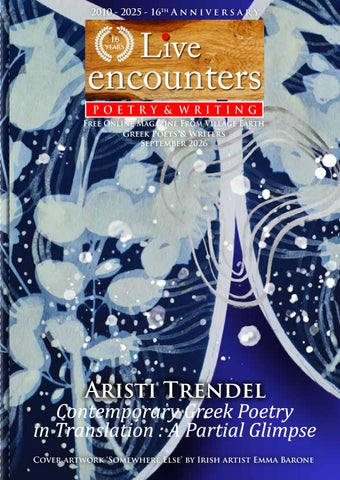
2010 - 2025 - 16th A n n i v e r s a r y
P O E T R Y & W R I T I N G Free Online Magazine From Village Earth Greek Poets & Writers September 2026
Aristi Trendel
Contemporary Greek Poetry in Translation : A Partial Glimpse Cover artwork ‘Somewhere Else’ by Irish artist Emma Barone 2026 September POETRY & WRITING © liveencounters.net
LIVE ENCOUNTERS MAGAZINE
©Mark Ulyseas
Stone relief on wall of Bayon Temple, Siem Reap, Cambodia. Photograph by Mark Ulyseas. © liveencounters.net Greek Poets & Writers September 2026 Celebrating 16th Anniversary
P O E T R Y & W R I T I N G
Greek Poets & Writers September 2026
Support Live Encounters.
Donate Now and Keep the Magazine Live in 2026 Live Encounters is a not-for-profit free online magazine that was founded in 2009 in Bali, Indonesia. It showcases some of the best writing from around the world. Poets, writers, academics, civil & human/animal rights activists, academics, environmentalists, social workers, photographers and more have contributed their time and knowledge for the benefit of the readers of:
Live Encounters Magazine (2010), Live Encounters Poetry & Writing (2016), Live Encounters Young Poets & Writers (2019) and now, Live Encounters Books (August 2020).
We are appealing for donations to pay for the administrative and technical aspects of the publication. Please help by donating any amount for this just cause as events are threatening the very future of Live Encounters. Om Shanti Shanti Shanti Om Mark Ulyseas Publisher/Editor
All articles and photographs are the copyright of www.liveencounters.net and its contributors. No part of this publication may be reproduced without the explicit written permission of www.liveencounters.net. Offenders will be criminally prosecuted to the full extent of the law prevailing in their home country and/or elsewhere. 2026 September POETRY & WRITING © liveencounters.net
Contributors
© liveencounters.net Greek Poets & Writers September 2026 Celebrating 16th Anniversary
P O E T R Y & W R I T I N G
Greek Poets & Writers September 2026
Aristi Trendel – Guest editorial Dimitra Christodoulou Anna Griva Tasoula Karageorgiou Konstantinos Loukopoulos Kostas Mavroudis Iro Nikopoulou Pavlina Pampoudi Yiannis Patilis Dinos Siotis Yiorgos Veis Spyros L. Vrettos Asimina Xirogianni
2026 September POETRY & WRITING © liveencounters.net
GUEST EDITORIAL
Aristi Trendel © liveencounters.net Greek Poets & Writers September 2026 Celebrating 16th Anniversary
ARISTI TRENDEL Aristi Trendel is associate professor/HDR at Le Mans University, France. She has published book chapters and articles on American writers in American and European journals, book reviews, and fiction in literary magazines. She is the author of the monograph Master and Disciple in the American Novel After the 1980s (Bloomsbury 2021) and six books of fiction. Her forthcoming books, My Sister’s Baby and Other Stories (Το μωρό της αδελφής μου και άλλες ιστορίες), Perispomeni, 2026, and The American Dream in the 21st-century: A Transcultural Perspective, ed. Bloomsbury, 2027.
Aristi Trendel
Contemporary Greek Poetry in Translation: A Partial Glimpse Few European literary cultures have maintained as sustained and public a commitment to poetry as Greece. Though not the only one, Greece remains a land of poetry. It is no wonder that such a small country produced two Nobel laureates, George Seferis and Odysseas Elytis, while others, such as Angelos Sikelianos and Yannis Ritsos, were nominated for this prestigious award. Even the economic crisis of 2009 and the severe austerity measures that followed, entailing socioeconomic deprivations, did not put poetry on hold. As Karen Van Dyck remarks in the introduction to her edited volume Austerity Measures: The New Greek Poetry, “Poetry, though, is one thing there is more of.” It is equally unsurprising that the last few decades have witnessed an unprecedented proliferation of poetry collections, many of them self-funded, alongside the growth of small independent presses, literary magazines—predominantly online—poetry festivals, public readings, and the many events that sustain Greece’s remarkably active poetic culture.
However, one may legitimately ask whether the democratization of poetry has also entailed a degree of trivialization, or whether such poetic abundance risks stifling voices of genuine distinction amid the ever-increasing number of collections published each year, especially as the number of readers continues to decline. Theodoros Pantoulas, in his recent Kathimerini article, “Throwaway Books,” has painted a bleak picture of the “publishing inflation” in the Greek book market, which “does not produce to consume but consumes to keep producing.” Indeed, books today are being destroyed not because they are considered dangerous but because, remaining unsold, publishers no longer have the space to store them. Yet who is in a position to judge the quality of this vast body of work? Greek literary criticism has repeatedly pointed not only to the proliferation of poetic voices but also to the fragmentation of the critical frameworks through which they are assessed.
continued overleaf... © Aristi Trendel
2026 September POETRY & WRITING © liveencounters.net
GUEST EDITORIAL
All this being said, to speak of contemporary Greek poetry today is to enter a field marked by “inflation” but also by plurality, tension, persistent reinvention, and a measure of creative chaos. At first glance, the landscape appears neither unified nor easily mapped. It is shaped by overlapping generations, divergent aesthetic commitments, and a critical discourse that struggles to keep pace with the sheer volume and heterogeneity of poetic production. Poetry circulates without a stable canon or broad critical consensus regarding literary significance. Far from signaling decline, this condition may instead point to a vibrant, if unruly, literary ecosystem. Recent Greek literary criticism has sought to understand this apparent fragmentation not as a symptom of decline but as the expression of broader historical and cultural conditions. In an essay in Chartis, a literary magazine of note, “Greek 21st Century Poetry on the Map of the Global South,” Vasilis Lambropoulos proposes that contemporary Greek literature may be viewed from the perspective of the Global South, or more broadly from the standpoint of a literary culture situated between centres and margins. Such a perspective encourages us to recognize the capacity of Greek poetry to negotiate multiple historical, linguistic, and cultural inheritances. Rather than occupying a marginal position within European literature, contemporary Greek poetry may be understood as participating in a wider constellation of literatures that share experiences of cultural asymmetry, historical discontinuity, and the continual negotiation between local traditions and transnational literary currents.
A complementary perspective is offered by Varvara Roussou, whose article, “What Are We Talking about When We Talk about Contemporary Greek Poetry and Its Criticism?”, questions the very possibility of reducing the present poetic landscape to a common aesthetic, generation, or movement. As Roussou suggests, the defining feature of contemporary Greek poetry is precisely its heterogeneity: the coexistence of multiple poetic idioms, sensibilities, and critical vocabularies that resist unifying narratives. If this is so, then any attempt to present contemporary Greek poetry in translation can only ever be selective. The twenty-four translated poems that follow, therefore, do not seek to establish a representative canon but instead offer a partial glimpse, shaped by personal editorial choices and bringing together both well-established and less widely known poets in the hope of offering Anglophone readers one possible point of entry into a literary field whose richness ultimately exceeds any single selection. The selection does not seek to illustrate every tendency in contemporary Greek poetry but instead highlights some of its most compelling thematic and stylistic directions. © liveencounters.net Greek Poets & Writers September 2026 Celebrating 16th Anniversary
ARISTI TRENDEL
Thus, the poets included here demonstrate the multiplicity of directions Greek poetry is taking. Dimitra Christodoulou’s work stages an almost metaphysical drama within the body and the cosmos. In “The Piper,” a poem rich with Baudelairean echoes, the heart becomes a site of grotesque vulnerability and defiance, oscillating between degradation and a strange, persistent nobility. Her imagery—devil’s babies, collapsing stars, celestial tumult—pushes toward excess, yet remains anchored in an emotional precision that resists abstraction. Similarly, “The Looking-Glass” turns inward, transforming the mirror into a symbol of fractured identity, self-consuming desire, and the painful construction of the self. Through images of broken glass, buried hunger, and a heart whose mouth has been sewn shut, the poem explores the limits of self-knowledge and the cost of a life devoted to an unattainable image, while suggesting that suffering itself becomes the final medium through which the self is revealed.
Anna Griva, by contrast, works through intimacy and mythological reconfiguration. In “My Lilith,” the encounter is both erotic and genealogical, reimagining myth as a shared, embodied inheritance. Her language is pared down but charged with symbolic resonance. “To Love” compresses desire into another unsettling question, where attraction and wound become indistinguishable and ineluctable. Tasoula Karageorgiou engages more explicitly with classical myth—a hallmark of her work—yet her approach is neither nostalgic nor reverential. In “Andromache When the Ice Melts,” the myth is projected into a speculative, even dystopian future. The question is not only what becomes of the world but, more compellingly, what becomes of the stories that once gave it meaning. Mythic figures persist as “holograms,” spectral residues hovering over ecological ruin. In “The Maidservant of Hegeso,” attention shifts to the marginal figure, the overlooked subject of history. The poem’s quiet insistence on exile and anonymity resonates with contemporary concerns about displacement and visibility. Konstantinos Loukopoulos introduces a different register altogether, one that blends conceptual reflection with physical immediacy. “Bandage” moves from dictionary definition to painful meditation, from the clinical to the existential. The body is objectified, then re-subjectified through suffering, memory, and language. In “Lilia,” a deeply erotic poem, geographic and emotional boundaries blur, while Eros embraces Thanatos. Loukopoulos’s work exemplifies a tendency toward hybrid forms that resist clear categorization. continued overleaf...
© Aristi Trendel
2026 September POETRY & WRITING © liveencounters.net
GUEST EDITORIAL
Kostas Mavroudis offers a poetic narrative in an understated, ironic mode. “The Pencil” begins as a seemingly trivial anecdote, only to unfold into a reflection on value, authorship, and the persistence of narrative. The object becomes an emblem of literary memory. “The Lizard” juxtaposes archaeological discourse with the indifferent presence of nonhuman life to question human happiness. Mavroudis allows the apparently incidental to open onto unexpectedly philosophical terrain, where everyday objects and chance encounters serve as occasions for meditations on memory, history, and the moral imagination.
Iro Nikopoulou’s poems are deeply attentive to memory, domestic space, and the persistence of the past within the present. “The Backyard” and “The House in Salamina” construct spaces where time folds in on itself in an Eliotic atmosphere, where absence yields a form of presence while the past and the present are steeped in detached melancholy. Thus, domestic interiors become repositories of collective memory, inhabited as much by the living as by the dead, so that the house itself emerges as an active witness to time. Her work is marked by rich sensory detail and a measured, meditative pace. Asimina Xirogianni’s “Medea” reclaims and destabilizes a canonical figure through performative intensity. The poem foregrounds its own theatricality, implicating both speaker and audience in its provocations. Here, myth turns into a site of confrontation, not only with tradition but with spectatorship, while “Autumn Story,” conversational in tone, confronts the aftermath of betrayal.
Pavlina Pampoudi, in turn, pushes language toward its limits. “Passage into the Ineffable” and “Mathematics” explore what lies beyond articulation, where sound, symbol, and meaning begin to dissolve. Here, even abstract systems—linguistic or mathematical— emerge as metaphysical thresholds, suggesting that what appears most rational ultimately opens onto mystery rather than certainty. Her work reflects a broader preoccupation with the limits of expression, the silence of death, and the possibility of giving voice to what ultimately resists language. Yiannis Patilis and Dinos Siotis bring a sharper socio-political edge. Patilis’s “Pax Americana” employs acute irony and historical reference to interrogate the rhetoric of peace and power, revealing the violence embedded within both. © liveencounters.net Greek Poets & Writers September 2026 Celebrating 16th Anniversary
ARISTI TRENDEL
While “Pax Americana” denounces the use of force to enforce peace, another kind of force emerges in “When Do We Celebrate Poetry?”, deriving from Logos, from poetry itself, thus offering the reader a powerful defense of poetry.
In contrast, Dinos Siotis’s “Ventriloquist Days” mourns the inertness and silence into which the poetic persona is sinking, while “Prophets” reveals a gleam of hope. Siotis navigates between skepticism and aspiration, attending to the fragile role of the poetic voice in a crowded, often indifferent public sphere. Even at their most elegiac, his poems continue to test the possibility that poetry might still intervene in public life, however faintly its voice may now be heard.
Finally, the poems of Spyros Vrettos and Yiorgos Veis return us to questions of per-ception, moral choices, art, and representation. Vrettos’s “War Correspondent in a Lyrical Rapture” confronts the aesthetics of violence, compelling the reader to reckon with the tension between beauty horror, and duty, while “The Sculptor and His Stone” deepens the relationship between ethics and aesthetics in the same understated way. Veis’s introspective work explores the act of writing itself. Through the poet and his muse, “His Way” points to the compelling nature of creation and the sensual undercurrent of poetry, while in “The Same, the Other/Or” the poet exposes how unstable that “inner” space has become under the pressure of mediation and technology. Photographs, diaries, philosophical fragments, and digital imagery blur into one another, unsettling any stable sense of authorship or identity. The poem stages a world in which experience is no longer immediate but continuously refracted through textual and technological layers, culminating in the striking image of the car that escapes control and races across the computer screen. Veis thus presents writing not as mastery but as exposure to a proliferating network of signs, where the boundaries between self, text, and machine become increasingly porous and truth itself turns into a slippery notion. Veis, like Karageorgiou in “Andromache When the Ice Melts,” ultimately points to the question of what future awaits poetry in a technological age. As artificial intelligence begins to generate poems of its own, that question acquires new urgency without exhausting the broader concerns of these texts that continue to resonate with Patilis’s s advocacy of poetry. continued overleaf... © Aristi Trendel
2026 September POETRY & WRITING © liveencounters.net
GUEST EDITORIAL
Throughout this anthology, questions of mediation—how reality is shaped, filtered, and reconfigured through art, language, and technology—form one of its recurring concerns. Taken together, these poems suggest rather than define the contours of contemporary Greek poetry. They reveal a literary field that is at once rooted and restless, attentive to its past yet unwilling to be constrained by it, engaging with global concerns while remaining deeply responsive to the particularities of language, history, and place. For Anglophone readers, translation offers both access and transformation. What is lost in translation—nuances of rhythm, etymology, and cultural reference—is gained by new resonances and a different kind of clarity. The aim here has not been to produce definitive versions but to create passages, however provisional, between linguistic worlds. References Van Dyck, Karen. ed. Austerity Measures: The New Greek Poetry. Penguin, 2016.
Lambropoulos, Vasilis. “Greek 21st century Poetry on the Map of the Global South” (Η ελληνική ποίηση του 21ου αιώνα στο χάρτη του Παγκόσμιου Νότου). Chartis 45, September 2022. https://www.hartismag.gr/print/212990
Pantoulas, Theodoros. “Throwaway Books” (Βιβλία του πεταματού). Kathimerini, 17 May 2026. https://www.kathimerini.gr/opinion/564230563/vivlia-toy-petamatoy/
Roussou, Varvara. “What are we Talking about when we Talk about Contemporary Greek Poetry and its Criticism?” (Για ποιο πράγμα μιλάμε όταν μιλάμε για σύγχρονη ποίηση και την κριτική (της);). O Anagnostis, 20 November 2022. https://www.oanagnostis.gr/gia-poio-pragma-milame-otan-milame-gia-sygchronipoiisi-kai-tin-kritiki-tis-tis-varvaras-royssoy/
© liveencounters.net Greek Poets & Writers September 2026 Celebrating 16th Anniversary
ARISTI TRENDEL
Forma I (acrylic on wood 84x78) © Iro Nikopoulou. © Aristi Trendel
2026 September POETRY & WRITING © liveencounters.net
THE PIPER
Dimitra Christodoulou © liveencounters.net Greek Poets & Writers September 2026 Celebrating 16th Anniversary
DIMITRA CHRISTODOULOU Dimitra H. Christodoulou, (Athens, 1953), studied Law and Philology. She is the author of seventeen poetry collections, a volume of prose, an anthology of translated Ancient Greek lyric poetry, and a volume of translations from Ancient Greek drama. She has received the Greek State Prize for Poetry (2008), the Anagnostis Poetry Prize (2015), the Jean Moréas Poetry Prize (2018), and the Makis Lachanas Prize of the Panthessalian Poetry Festival (2024). Her poetry has been translated into several languages.
Translated from Greek by Aristi Trendel.
The Piper My heart weeps like a devil’s baby Beaten by its former kindness. Since no hope remains to it It seeks applause for the role it plays. As if in revolt against its god With the eloquence of a giant firecracker.
The stars drain themselves inside their own mouths. They hurl foul words at one another, They buzz in the celestial tumult, They thrust their baubles into the earth And my heart weeps, robbed and empty Like a bitch whose puppies have been taken. My heart weeps with its timid beating Which the night wraps in a sheet. The little moon pops like a balloon And I am missing from the clothes I wear. With that crash from the four directions The first great cold is here.
My heart weeps like the smile of a cripple. Its nobility overcomes deprivation. A resurrection from the dominion of death Though angels turn their backs on it. Forever outside the eternal palaces The wise swallows keep beating their wings. (Unpublished)
© Dimitra Christodoulou
2026 September POETRY & WRITING © liveencounters.net
THE PIPER
The Looking-Glass Those two pitch-black stars in my mirror Will blaze when it breaks. Then the salt of my tears Will season my weary blood. My whole life, food, flesh and bone Of a reflection, of a daily tending, For my image of mercury and steel Drawn with a blade on water. Buried, the dead man of my hunger lived and immortal, his starving murderer. But the blue, the rose-colored, The winged flowers of my verses Only as much as a cloud can humble itself Touched the earth. Why seek consolation For the stitched mouth of my heart… There—it has come; I recognize it now, That Which I Cannot Recognize. That alien death I bought By wrapping the sky in silk In the silence of my all my years. Nursing bouquets of butterflies, Untouched by the warm breath of the world, Yet eaten to the marrow by it. (Unpublished)
© liveencounters.net Greek Poets & Writers September 2026 Celebrating 16th Anniversary
DIMITRA CHRISTODOULOU
Forma II (oil on wood) © Iro Nikopoulou. © Dimitra Christodoulou
2026 September POETRY & WRITING © liveencounters.net
MY LILITH
Anna Griva © liveencounters.net Greek Poets & Writers September 2026 Celebrating 16th Anniversary
ANNA GRIVA Anna Griva studied Philology in Athens and Rome and holds a PhD in Italian Renaissance Literature. She has published six poetry collections. Her collection The Lost Goddess (Melani, 2023) received the Greek National Poetry Award, while her collection Demons (Melani, 2020) was honored with an award from the Academy of Athens. She has also published a collection of short stories, The Animal Gods (Kichli, 2021), and three historical novels: The Alchemist (Melani, 2026), which received the First Prize of the UNESCO Club for Arts, Literature and Sciences of Greece; The Greek Slave (Melani, 2022); and Exiled Queens (Melani, 2021). Her works have been translated into numerous languages. She is also a translator of Italian literature. Her translation of the poems of Laura Battiferra received an award from the Italian Cultural Institute of Athens. Griva has published a study of Plato’s Parmenides, Ontology of the One in the Platonic Theory of Ideas (Zetros, 2021), and a monograph on Sapphic poetry, Aphrodites (Smili, 2022). She teaches Italian Literature and Creative Writing at the Hellenic Open University and the National and Kapodistrian University of Athens.
Translated from Greek by Aristi Trendel.
My Lilith They say you long for the seed of men and that you like to wander in the dark. But I am not a man, nor will you find me walking the streets at night. Then why do you visit me? Why do you love me? Perhaps you have learned that we are sisters wandering demons in secret gardens, daughters of silence, weavers of desire. Blood does not turn to water, however many centuries may pass. The gene binds us, an inherited disposition toward ecstasy. The Lost Goddess, Melani, 2023
© Anna Griva
2026 September POETRY & WRITING © liveencounters.net
MY LILITH
To Love O my bee! Why do I chase you? For your wings? For your honey? Or perhaps it is your sting that I desire that bitter tip, that dark needle that, little by little, weaves who I am? (Unpublished)
© liveencounters.net Greek Poets & Writers September 2026 Celebrating 16th Anniversary
ANNA GRIVA
Forma III (oil on canvas 120X80) © Iro Nikopoulou. © Anna Griva
2026 September POETRY & WRITING © liveencounters.net
ANDROMACHE WHEN THE ICE MELTS
Tasoula Karageorgiou © liveencounters.net Greek Poets & Writers September 2026 Celebrating 16th Anniversary
TASOULA KARAGEORGIOU Tasoula Karageorgiou (Alexandria, Egypt, 1954) is a poet, classicist, translator, and essayist. She studied Byzantine and Modern Greek Studies at the National and Kapodistrian University of Athens and completed a doctoral dissertation in Classical Philology, supported by a scholarship from the State Scholarship Foundation (IKY), on Modern Greek translations of Aristophanes. She worked as a philologist and as an advisor to philologists in Greek public secondary education. She has published ten poetry collections, translations of Ancient Greek lyric poets—including Sappho, Erinna, and Anyte—and works of literary criticism and essays. Her poetry has received two prizes from the Academy of Athens, and her work has been translated into English, Spanish, Arabic, German, Romanian, and Italian. Her collection The Metro was also translated into Italian by Gilda Tentorio (Il Metro, 2021). Her translation Anyte of Tegea received the 2026 Greek State Prize for Literary Translation from Ancient Greek into Modern Greek.
Translated from Greek by Aristi Trendel.
Andromache When the Ice Melts If the ice should melt, if the birds and forests disappear, if the earth somewhere dries out and elsewhere floods, what will truly become of all that we have loved so much? What will become of the myths? Perhaps there will remain, I propose, mythic forms — holograms — ethereal visions and ghosts floating above the ruins of the deserted earth.
Andromache, let’s say, standing upon the walls, just before receiving her child, smiling through tears.[2] Andromache in the palace, weeping. Andromache holding the dead Astyanax. Andromache afterward, a spear-won spoil an Anatolian lady, slave and noblewoman in the palace of Phthia.
Andromache forever majestic, a tri-dimensional image wandering through the universe, calling to Hector: “O beloved Hector, O my great love.” Andromache When the Ice Melts, Kedros, 2024 [1] Andromache: In Greek mythology, the wife of Hector of Troy. After the fall of Troy and the killing of her son Astyanax, she was taken captive by the Greeks. [2] The phrase “smiling through tears” translates the Homeric phrase δακρυόεν γελάσασα in the original (Iliad VI.442 ff.)
© Tasoula Karageorgiou
2026 September POETRY & WRITING © liveencounters.net
ANDROMACHE WHEN THE ICE MELTS
The Maidservant Of Hegeso And what if the craftsman shared sorrow fairly between the two figures? Memory he did not allot between them. Who knows what became of the little maidservant, once the earth had, at last, covered Hegeso?
I gaze at the sorrowful face the knee inclined in submission the hand holding the jewelry casket (symbol of the futility of her mistress’s life.) But even more I linger upon the long-sleeved tunic: barbarian[2] attire and foreign dress.
(So she came from afar— a bird gone into exile — and perhaps never returned to her distant homeland. Now all that remains is the sculpted grief upon her face, an honor to the fate of humble serving girls. Like a fifteen-syllable folk verse for the bitterness of exile: And if exile is death, then the refugee’s lot is Hades.)[3] Clay Poems, Kedros, 2021
[1] Hegeso: An Athenian noblewoman depicted in a famous 5th-century BCE funerary stele, now in the National Archaeological Museum of Athens. The relief shows Hegeso seated before a maidservant holding a jewelry casket. [2] In ancient Greek usage, barbarian denoted the foreign or non-Greek other, especially one marked by language and dress. [3] The final verse evokes the Greek fifteen-syllable folk meter (dekapentasyllabos), traditionally associated with songs of exile, migration, and loss.
© liveencounters.net Greek Poets & Writers September 2026 Celebrating 16th Anniversary
TASOULA KARAGEORGIOU
Forma IV (oil on canvas115x65) © Iro Nikopoulou. © Tasoula Karageorgiou
2026 September POETRY & WRITING © liveencounters.net
LILIA
Konstantinos Loukopoulos © liveencounters.net Greek Poets & Writers September 2026 Celebrating 16th Anniversary
KONSTANTINOS LOUKOPOULOS Konstantinos Ch. Loukopoulos (Elefsina, Greece, 1965) studied Physics at the University of Crete and History and Philosophy of Science at the National and Kapodistrian University of Athens. His poetry, prose, and literary criticism have been translated into German, Italian, and English. His work has appeared in print and online journals, collective volumes, and anthologies, including Modern Poetry in Translation. In 2017, he collaborated with the Mikis Theodorakis Orchestra on the music-theatre production Epitaph in Elefsina, presented at the Aeschyleia Festival. His published books include the poetry collections Epitaph in Elefsina (2018; revised edition, 2020), Dreams After the Festival (2020), Generics (2021), Nineteen Vignettes on Language and Silence (2024), and Low Countries – Pays Bas (2025); the prose collection Cities in Winter (2018); and the novel Family Root 70 (2023). He maintains the literary blog Eleusis: A Humble Dwelling Place of Immortality: https://loukopk.wordpress.com.
Translated from Greek by Aristi Trendel.
Bandage BANDAGE: a piece of fabric or surgical gauze. White gauze pads that turn deep red are meticulously counted so that, after the operation ends, none are accidentally left behind inside the patient’s body and cause sepsis. The patient is overwhelmingly treated as an object; yet, as he regains consciousness and begins to pity himself, he is irrevocably cast as a humble subject as well, while he senses that he will soon become a “lost body.” BANDAGE becomes a kind of search when truth presents itself as a gushing wound. As questions accumulate, a person grows old within them like an enormous ball swelling, riddled with holes. Then each hole begins to make you dizzy with its high-pitched chatter and won’t let you concentrate. And what can a flimsy band-aid do for you every now and then? nineteen VIGNETTES on LANGUAGE and SILENCE, AΩ Publishing, 2025.
continued overleaf... © Konstantinos Loukopoulos
2026 September POETRY & WRITING © liveencounters.net
LILIA
LILIA Tallinn
I guard my boundaries since I have been and remain as a lineage of rivers and as a deer among carnivores a lion cub with a mane of linden Unter den Linden yet let me at least become a pretext of ambiguity and may my image someday turn blurred an evening of probing in which I absorb your geography and the plain rooms drip at my feet earth and iron their doors open and at the stations we keep descending to Tallinn where the inward fire of your loins burned
© liveencounters.net Greek Poets & Writers September 2026 Celebrating 16th Anniversary
KONSTANTINOS LOUKOPOULOS
full of the weight of filtration the weight of approach and the weight of embrace yet our flesh is a lottery that ful-fills itself in the final digit and our load is a packet of data that becomes a silent quantum death stirs a windless wave whose frost lies in wait to dress us tightly tonight there are no dreams let my soul be the only winter landscape and let it endure me Pays Bas, Enastron 2025.
© Konstantinos Loukopoulos
2026 September POETRY & WRITING © liveencounters.net
THE PENCIL
Kostas Mavroudis © liveencounters.net Greek Poets & Writers September 2026 Celebrating 16th Anniversary
KOSTAS MAVROUDIS Kostas Mavroudis (Tinos, 1948) studied Law at the University of Athens. He made his literary debut with the poetry collection Logoi Dyo (1973) and has since published five poetry collections, as well as several volumes of prose and essays. His books have been translated into various European languages. Since 1978 he has continuously edited the influential literary magazine To Dentro (The Tree).
Translated from Greek by Aristi Trendel.
The Pencil ...and when the clerk stepped away to ask a colleague “about the matter,” a rare pencil, with Stratford’s red logo,* gave me a knowing wink.
It isn’t difficult. I’ll pretend to jot something down and then, with saintly naturalness, pocket it. I possess legions of pencils, enough to write entire encyclopedias, but who would leave behind, in a public office, such a legend?
“Come with me, famed piece of wood, quite possibly from the forests of Birnam Wood,** from their mists and their myths. You shall live among common pencils, you, a branch of an English birch!” I say to it with admiration. Its genealogy fascinated me, and I could not rule out the possibility that one day I might write a text with it, or some ordinary phrase, such as the one an elderly lady, visibly moved, once said to me while pointing to her antique dinner service: “Not a single crack, every one of the thirty-two pieces still intact!”
continued overleaf... © Kostas Mavroudis
2026 September POETRY & WRITING © liveencounters.net
THE PENCIL
At the tip of a pencil anything may appear: an arithmetic calculation, two lines of verse, even the monologue from Wings of Desire,*** if, in the darkness, I draw it out in time and write down what the old poet is reciting in the public library (Homer’s persona, if I understood correctly): “The world is sinking into darkness. I have been rescued from History. I am protected from the present and I feel safe for the future. I no longer roam through the centuries, nor through the past. My heroes will no longer be warriors and kings, but quiet objects, short-lived. No one has written an epic for peace. Why does peace no longer inspire us? If I leave, humanity will lose its storyteller, and if it loses him, childhood will be lost too.” Author’s notes
* Stratford-upon-Avon: Shakespeare’s birthplace. ** “Fear not till Birnam Wood comes to Dunsinane” (Macbeth, Act V, Scene 5). The witches’ prophecy to Macbeth. *** Wings of Desire (1987), Wim Wenders’ poetic film, from which the quoted monologue is taken.
© liveencounters.net Greek Poets & Writers September 2026 Celebrating 16th Anniversary
KOSTAS MAVROUDIS
Forma V (oil on canvas) 150X80) © Iro Nikopoulou. © Kostas Mavroudis
2026 September POETRY & WRITING © liveencounters.net
THE PENCIL
The Lizard The archaeologist guides the British crew and the theatrical presenter —full of self-satisfied mannerisms— through the museum. “This statuette,” he explains (a female torso), “was found dismembered. The head is made of serpentine (a silicate material), the limbs have been covered with ivory and gold, a masterpiece of miniature craftsmanship,” he says. A little later—now in a long shot— scattered stones from the city, “Of the Early Minoan period, unwalled, its inhabitants numbered over thirty thousand,” he clarifies, as the camera turns toward collapsed walls: “Ruins of dwellings, cemeteries, but also built ossuary chambers. The floor is sandstone. An exceptionally high standard of living is inferred.” “The boundaries of the beginning of the Western world are expanding,” she comments. She has been impressed by information about the ancient matriarchy (her feminist eyes shine). He takes the floor again, speaking of a great fire, “The city may have been burned by the Mycenaeans; we have no evidence,” he says, “we hypothesize it.”
© liveencounters.net Greek Poets & Writers September 2026 Celebrating 16th Anniversary
KOSTAS MAVROUDIS
They converse before the remains of a wall. Dry grasses sway at their feet. A lizard climbing vertically (in outdoor shots, animate life always intrudes) crawls for a while and then remains motionless, archaic, uncomprehending of what is being said. It watches them, as a lizard once looked Tolstoy in the eyes. “The sun warms you, you are happy,” he told it, and, after a brief silence, added: “I am not.” (Unpublished)
© Kostas Mavroudis
2026 September POETRY & WRITING © liveencounters.net
THE HOUSE IN SALAMINA
Iro Nikopoulou © liveencounters.net Greek Poets & Writers September 2026 Celebrating 16th Anniversary
IRO NIKOPOULOU Iro Nikopoulou studied Painting and Stage Design at the Athens School of Fine Arts. She has presented numerous solo and group exhibitions in Greece and abroad and has published twelve books of poetry and prose. Her poems and short stories have appeared in anthologies in several European languages. A Spanish selection of her poetry, Acepciones de la Miranda, translated by José Antonio Moreno Jurado, was published in Seville in 2019. She has participated as an invited guest at numerous international poetry festivals.
Translated from Greek by Aristi Trendel.
The Backyard Outside the trees resurrect the soil deep down the roots metabolize toxins From afar comes the persistent purring of a machine the avenue and the tram a kind of repetitive calm Far back in the hippocampus the morning voices of children lie low the whistles the shouts in the park Today the day may pass without glory its only gain the glittering rain behind the windowpanes and I safe behind Dry
(Unpublished)
© Iro Nikopoulou
2026 September POETRY & WRITING © liveencounters.net
THE HOUSE IN SALAMINA
The House in Salamina In memory of Miras and Nasou Nikopoulou Mud, foundations, lavish meals and laughter rooms high, with deep skies slender, startled pines shaggy forest brambles all around children, dogs, seawater entwined with stars in their palms, leaven of the night—drizzle and fine salt in the dazzle of Phaneromeni[1] the sweetness of a life not yet revealed.
Now it lives all alone in the reverie of dawn and dusk within its heavy air the hours slip in and out whispering with the sun at its side they whirl around the windowpanes like garden bees harvesting immaterial pollen. Old conversations flare at dusk humming with gentle passion the fireplace crackles, fed by olive root birds sing and through the night the cypresses wrap themselves in their long shadows forgotten words roost in the foliage and the ever-wronged cats all around faithful keepers of souls.
© liveencounters.net Greek Poets & Writers September 2026 Celebrating 16th Anniversary
IRO NIKOPOULOU
In the house of Salamina on Sundays they wander in their downy robes its luminous absent ones they gaze straight across to Perama, behind the glass half-closing their eyes at the shimmer of the waters beside Eleusis they praise the purple of the geranium resting in the northern flowerbed the small-leaved ivy—oro di bogliasco— hungrily suckling the walls the evergreen privets gleaming, impervious in the light then they turn their backs to the sea in the depths, beside the piano, Nabucco waits to drink coffee with them at the low table in transparent cups, with a slow motion hovering, refracted in the light below, you always hear the steady rhythm of the wooden loom weaving the Threads. Everything breathes quietly above the wave the house with its square sunporch embrace and all its faucets sleepless for the drought that dawns they smile faintly at Time with the wisdom of rock. Miracle in the ICU, ΑΩ Publishing, 2024
[1] Icon of Panagia Phaneromene: an icon of the Theotokos associated with the discovery/revealing of her icon at a number of churches and monasteries of Greece.
© Iro Nikopoulou
2026 September POETRY & WRITING © liveencounters.net
PASSAGE INTO THE INEFFABLE
Pavlina Pampoudi © liveencounters.net Greek Poets & Writers September 2026 Celebrating 16th Anniversary
PAVLINA PAMPOUDI Pavlina Pampoudi is a poet, fiction writer, translator, painter, and founding member of both the Hellenic Authors’ Society, where she served for five years as Secretary General, and the Circle of Poets. She studied History and Archaeology at the National and Kapodistrian University of Athens and also attended courses in Mathematics and Fine Arts in Athens and London. She has published eighteen poetry collections, six books of fiction, and more than forty books for children, translated twenty-two literary works—including T. S. Eliot, Charles Dickens, and Lewis Carroll—and written song lyrics, as well as radio and television scripts. She is currently editor-in-chief of the online literary magazine Peri Hou.
Translated from Greek by Aristi Trendel.
Passage into the Ineffable It exists, it does not exist, yet all of us In the depths of sleep encounter it– This dark tunnel with its fluorescent graffiti Advertisements for exotic destinations Indecipherable scenes from pasts and from the coming soon In a single unified time– I mean this submarine, this black passage Where, there, all of us, whether we want it or not, slide through– (We fit only naked Stripped of the disguises of discourse Of the tentacles of sibilants Of the cutters of dentals Of alveolars, of the hooks of diphthongs, Loosened in their Erasmian enunciation– Of vowels, of alpha, of omega, of high sounds– Stripped even of the still inarticulate Squeal, bleat, or bellow And of every sonic effect of existence–) It exists, it does not exist, yet all of us Thus in sleep discover the passage That slowly initiates us into the ineffable–
Slowly, because Each of us has several thousand rehearsals before The final curtain of silence rises. (Unpublished)
© Pavlina Pampoudi
2026 September POETRY & WRITING © liveencounters.net
PASSAGE INTO THE INEFFABLE
Mathematics You wake They sink as you surface Lessons learned, memories, ideas, people Dream books, poems, inspirations, everything nothing– (And yet bubbles slip free, the zeros
Invisible stems of water, countless, rise Something like imaginary numbers stays afloat
Into chords they curve, differentiate and equalize, Interweaving, coiling– From its nonexistent foundations The half-wrought human work that lies beyond reason Mathematics Branches without end into chaos Mapping, marking out The divine territories of the irrational–) (Unpublished)
© liveencounters.net Greek Poets & Writers September 2026 Celebrating 16th Anniversary
PAVLINA PAMPOUDI
Forma VI (oil on canvas 50x40) © Iro Nikopoulou. © Pavlina Pampoudi
2026 September POETRY & WRITING © liveencounters.net
WHEN DO WE CELEBRATE POETRY?
Yiannis Patilis © liveencounters.net Greek Poets & Writers September 2026 Celebrating 16th Anniversary
YIANNIS PATILIS Yiannis Patilis (Athens, 1947) studied Law and Modern Greek Literature at the University of Athens and worked as a teacher in secondary education. From 1986 to 2012, he was the founder and editor of Planodion, a journal of literature, politics, and culture. Since 2010, he has been the founder and editor of the online magazine Planodion Bonsai Stories, dedicated to flash fiction. He has published ten poetry collections, and three volumes of collected poems; his latest fourth volume: The Broken is the Most Resistant, Poems 1970–2024 (Ypsilon Books, 2023). His work has been translated into several languages, including English (Camel of Darkness: Selected Poems, translated by Stathis Gourgouris, Quarterly Review of Literature, Princeton, 1997) and Spanish (Lo Roto Es Más Persistente, translated by Antonio José Moreno Jurado, Renacimiento, 2018).
Translated from Greek by Aristi Trendel.
Pax Americana or World Peace (whether you like it or not) I think that on this matter We ought to ask, as is customary, Those most qualified for Humanity In their field: The Romans. Publius Flavius Vegetius Renatus, for instance. He said it concisely and memorably: Si vis pacem, para bellum.[1] Which indeed came to pass: Pistole Luger Parabellum, model 1908, The sidearm of the German Imperial Army. Also used by the Nazis until 1945. The most famous in History to this day! Tested in two World Wars And one hundred million dead The means for World Peace Proved its unquestionable value. World Peace is indeed Something very expensive. And no trial for its domination Will ever be superfluous. And today, as we speak, And forever in the Future.
[1] In Latin in the text: “If you want peace, prepare for war.” (Unpublished)
© Yiannis Patilis
2026 September POETRY & WRITING © liveencounters.net
WHEN DO WE CELEBRATE POETRY?
When do we celebrate poetry? A greeting from afar to be read on the 21st of March by the Music School of Komotini Poetry needs darkness to celebrate deep darkness like the one that crushed the wretched Oedipus when he thought he would escape the prophecy it needs Medea’s bloody feast when she realized she had lost forever her bridegroom. Achilles’ black abyss of honor, when the beautiful spoil was torn from his bed by his lord. No! poetry is no catechism school nor is the poet a romantic waiter who will bring us a soft drink on the veranda The poet is a butcher of his own language dark-souled, burning his own fat to make a candle to light, above all, his Erinys
© liveencounters.net Greek Poets & Writers September 2026 Celebrating 16th Anniversary
YIANNIS PATILIS
At night we celebrate poetry with poems as candles that poets the world over have lit for solace in the unimaginable stretch of darkness. Look around you and behind you and see how silent, how beautiful, and how many are burning. And above all think that you too can, if needed, make one.
That is why do not ask me again when we celebrate poetry On the twenty-first of March we simply observe one minute of silence all together mourning for all those days and nights of our lives deprived of the candle of Poetry The Ebb of Alcohol and Other Poems, Ypsilon, 2012
© Yiannis Patilis
2026 September POETRY & WRITING © liveencounters.net
VENTRILOQUIST DAYS
Dinos Siotis © liveencounters.net Greek Poets & Writers September 2026 Celebrating 16th Anniversary
DINOS SIOTIS Dinos Siotis (Tinos, 1944) studied Law in Athens and Comparative Literature in San Francisco. He has published 35 books of poetry and prose, of which three are in English, one in Spanish and one in French. He has also published sixteen literary and/or political magazines in Greece and North America, the most recent ones being (de)kata and Poetix. He served as a Press Counsellor in San Francisco, New York, Boston and Ottawa. Several of his poems and articles have been translated into European languages, Arabic and Chinese. In 2007 he was awarded the State Prize for Poetry, for his collection of poems Autobiography of a Target.
Translated from Greek by Aristi Trendel.
Ventriloquist Days The sky collapses, and with it collapse the night and counterpoint; the garden fades into the hush of the stars, everything bleeds, dragging from funeral to funeral and from tent to tent without paper garlands; the forces hidden within people
sleep, idly staring at the mute soprano of the circus, in vain I open a hole in my memory: the ventriloquist days follow me 2024 (Unpublished)
© Dinos Siotis
2026 September POETRY & WRITING © liveencounters.net
VENTRILOQUIST DAYS
Prophets I am glad to hear the prophets every morning crying out their wares in the marketplace, even if no one listens to them; I am glad they are
there and dare, with their sober words, to question the political system, for they know that a weak voice can stand out
among the countless voices of the crowd, and this voice, clothed in lightning, they prophesy, will blaze in the planetary firmament 2024 (Unpublished)
© liveencounters.net Greek Poets & Writers September 2026 Celebrating 16th Anniversary
DINOS SIOTIS
Forma VII (oil on canvas 50X40) © Iro Nikopoulou. © Dinos Siotis
2026 September POETRY & WRITING © liveencounters.net
HIS WAY
Yiorgos Veis © liveencounters.net Greek Poets & Writers September 2026 Celebrating 16th Anniversary
YIORGOS VEIS Yiorgos Veis: Ambassador (Ret.) Graduate of the Faculty of Law, National and Kapodistrian University of Athens (NKUA). Honorary Doctor of the Department of Philology, School of Philosophy, NKUA. Member of the Hellenic Authors’ Society, the Circle of Poets, the Parnassos Literary Society, and the Ionian Academy. Among other diplomatic appointments, he served as Ambassador and Permanent Delegate of Greece to UNESCO. He has translated works by Jorge Luis Borges, Raymond Chandler, John Luther Long, Li Bai, and Galway Kinnell. His poetry collection Details of Worlds received the Lambros Porfyras Prize of the Academy of Athens in 2007. In 2012, he was awarded the rank of Grand Commander of the Order of the Phoenix in recognition of his service in the Greek Diplomatic Corps. In 2014, he received the Poetry Prize of the Petros Charis Foundation of the Academy of Athens for his lifetime body of work. He has also been awarded the Greek State Literary Prize in the category of Testimonies/Memoirs on three occasions: 2000, 2010, and 2016.
Translated from Greek by Aristi Trendel.
His Way He could, of course, write every day from early dawn until late afternoon for he has so much to give to the page yes, for her alone but perhaps even that is not enough so in this way he abandons himself to words to the mercy of meanings a self-taught pupil of syllables and so, in the end, he may find a way never to forget how much he owes her from that first moment her gaze showed him the road to the homeland of pleasure (Unpublished)
© Yiorgos Veis
2026 September POETRY & WRITING © liveencounters.net
HIS WAY
The Same, the Other/Or He looked again at the photograph, from the beginning He reread what they had written in their diary. They were certain that only there could the truth be found It is all about the Tao only we are not going to learn the Tao of truth. Yes, we call it that but it is not its real name nor does the birth of heaven and earth have a name while it is the mother of the universe. Still, we will understand the secret if we remain utterly undistracted, and of course, we can see its images as long as we long deeply for something. Both together the mystery and its images flow from the same wellspring. And this source is darkness, a darkness absolute, incorruptible and yet there awaits us the door, open to the secrets of life. The only thing they did not know was where exactly to open the quotation marks and when to close them. The lake convinced him that they were already in Beijing in the Forbidden City, reading Lao Tzu translating once again the Tao Te Ching
© liveencounters.net Greek Poets & Writers September 2026 Celebrating 16th Anniversary
YIORGOS VEIS
Until suddenly the photograph opened by itself in the middle Then the road appeared in the half-light of the words It looked a little like Solonos Street or perhaps like Gua Huan Lu? In any case, this time he would follow it without hesitation, without telling anyone So he suddenly slammed the brakes with all their might For a moment he managed to see their past In a luminous sign advertising The latest gifts of artificial intelligence But meanwhile the car had a mind of its own It had no intention of stopping at all And it kept running, relentless, across the computer screen 2025 (Unpublished)
© Yiorgos Veis
2026 September POETRY & WRITING © liveencounters.net
THE SCULPTOR AND HIS STONE
Spyros Vrettos © liveencounters.net Greek Poets & Writers September 2026 Celebrating 16th Anniversary
SPYROS VRETTOS Spyros L. Vrettos, (Lefkada, 1960) studied Law in Athens. He has published ten poetry collections, a selected edition of his poems, three volumes of essays and literary studies, and two collections of short stories. His first five poetry collections were translated into English by Philip Ramp and published as Collected Poems (Shoestring Press, 2000). A selection of his poetry was published in Italy in a translation by Massimo Cacciulo (Il postscriptum della storia, Atelier, 2005). His poetry collection Negotiations (2019) was translated into Italian by Chiara Catapano (Trattative, puntoacapo, 2022) and received the Italian Critics’ Prize Sandomenichino 2022 as well as the International Literature Prize 2023, awarded by the Italian Cultural Institute of Naples. A selection of his poems has also been published in Spain in a translation by José Antonio Moreno Jurado. His poems and short stories have been translated into many European languages. He is a member of the Hellenic Authors’ Society and the Circle of Poets.
Translated from Greek by Aristi Trendel.
The Sculptor and His Stone Light falls on him like leaves and rouses him. He wakes from light, he wakes from leaves. He wakes and the light lies on the stone like flecks. Shadows stretching sideways sharpen the sculpted stone and reveal the persistent ant as it is also roused from its hole, wholly in the light, casting a shadow like ten bodies. And look—the hawk snatches the sparrow from the highest thorn of the spiny broom. Five meters away from him. And look—the spark from the stone at the blow of his hammer. Half a centimeter from his eye the stone breaking.
He strikes the stone gently to cajole it. He strikes the stone hard for from there the hidden will emerge. He strikes a little aside from where he meant to avoid the ant. So the nose will come out slightly askew the mouth slightly askew the speech slightly altered that the sculpture will speak.
continued overleaf... © Spyros Vrettos
2026 September POETRY & WRITING © liveencounters.net
THE SCULPTOR AND HIS STONE
And look—the hawk again swoops down to take his stone. And look—he holds on to his stone. He hews it. With the spark he burns it. “Will the hawk feed its young with fire?”
He goes back again to the dry-stone wall. A thousand forms carved in stone. Which one will he choose to sacrifice? (Unpublished)
© liveencounters.net Greek Poets & Writers September 2026 Celebrating 16th Anniversary
SPYROS VRETTOS
War Correspondent in a Lyrical Rapture All the horror took place in a plain of wheat.
At the beginning he was looking at the air, where nothing stirred. Therefore, at first he must have been looking at the sky. Then he lowered his gaze, and now, yes: he saw the air, where everything was moving. And where the air was swaying the wheat, it revealed one hidden figure after another one almost completely, one only a little. Of one hidden figure he saw half the body. Of another he saw only the legs. Of one he saw the face and a little of the hand. Of another, just a little of the face, and a hand, as if enormous, grasping the blood.
The wheat before them was golden and those hidden among it were blue as though once again he were looking at the sky as though once again he were in need of some art. So many hidden dead all around with no sound beforehand. As though a lyrical rapture had cut him off and he refused to see or hear.
continued overleaf... © Spyros Vrettos
2026 September POETRY & WRITING © liveencounters.net
THE SCULPTOR AND HIS STONE
But fortunately there was blood staining the blue into something else staining the gold into something else until everything seemed to be on a plain of red wheat.
And fortunately he came back and he will speak of all this because soon there will be no plain. They will burn even the red wheat. And of the dead they will say they were only people who were hiding, who went elsewhere to hide among other stalks of wheat, which before them are golden, and they among them blue. But the blood will be there again. (Unpublished)
© liveencounters.net Greek Poets & Writers September 2026 Celebrating 16th Anniversary
SPYROS VRETTOS
Forma VIII (oil on canvas 100X70) © Iro Nikopoulou. © Spyros Vrettos
2026 September POETRY & WRITING © liveencounters.net
MEDEA
Asimina Xiroyianni © liveencounters.net Greek Poets & Writers September 2026 Celebrating 16th Anniversary
ASIMINA XIROYIANNI Asimina Xirogianni (Athens) studied Classical Philology and Theatre Studies at the National and Kapodistrian University of Athens, as well as Acting at the Theatreon-Ergastirion Drama School (Empros). She teaches Greek Literature (ancient and modern) in Secondary Education. Her poems have been translated into English, French, Spanish, Italian, and Romanian. Her essays, articles, and critical texts are published in print and online journals and blogs. Since 2009, she has maintained the literary blog varelaki [varelaki. blogspot.com]. Her most recent books are: Poems 2009-2017, Vakhikon, 2021 and A Boundless Gaze: Poems 2018-2023, Vakhikon, 2023
Translated from Greek by Aristi Trendel.
Medea Here before you, spectators— (for I am no coward. I am made of original stuff. I carry a witch’s ancestry on my shoulders. I do not forget my past. Monstrosity is written into my DNA. I married all that was chaotic.) So here before you! I, the poetess. I officiate. My new work I write after Euripides’ olden play. I, not Seneca. I give myself permission to produce a subversive text. Here before you! It is truly highly provocative, Exquisite, exceptional, bestial, sadistic. I do harm, I know.
Upon the stage—oh, how sensual— I kill my children. I moan. I kill my children. I scream. I kill my children. How blatantly sensual!
And you! What a marvelous audience!
Author’s note *Inspired by Seneca’s Medea
© Asimina Xiroyianni
2026 September POETRY & WRITING © liveencounters.net
MEDEA
Autumn Story See you in autumn, then! So the story can go on The question is whether the words will come back to us, or whether they have been lost forever in the mazes of our summer wanderings. I was reading about the lover of a prostitute called Lou. So many men came and went through her body, yet only one managed to seduce her, outpacing even the night itself.
And I want to tell you the whole story, when, exhausted by love, we lie back in bed and sink into each other’s eyes, making sure not a single glance falls to the floor. Which autumn month will it be this time? September, perhaps? Or November? Will you atone for your summer betrayal?
A Boundless Gaze: Poems 2018-2023, Vakhikon, 2023
© liveencounters.net Greek Poets & Writers September 2026 Celebrating 16th Anniversary
ASIMINA XIROYIANNI
Forma IX (oil on canvas 150X75) © Iro Nikopoulou. © Asimina Xiroyianni
2026 September POETRY & WRITING © liveencounters.net
2010 - 2025 - 16th A n n i v e r s a r y
P O E T R Y & W R I T I N G Free Online Magazine From Village Earth Greek Poets & Writers September 2026
Cover artwork ‘Somewhere Else’ by Irish artist Emma Barone © liveencounters.net Greek Poets & Writers September 2026 Celebrating 16th Anniversary