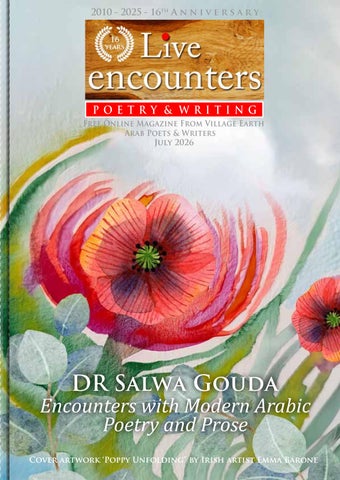
2010 - 2025 - 16th A n n i v e r s a r y
P O E T R Y & W R I T I N G Free Online Magazine From Village Earth Arab Poets & Writers July 2026
DR Salwa Gouda
Encounters with Modern Arabic Poetry and Prose Cover artwork ‘Poppy Unfolding’’ by Irish artist Emma Barone 2026 July POETRY & WRITING © liveencounters.net
LIVE ENCOUNTERS MAGAZINE
©Mark Ulyseas
Photograph by Mark Ulyseas. © liveencounters.net POETRY & WRITING July 2026 Arab Poets & Writers Celebrating 16th Anniversary
P O E T R Y & W R I T I N G
Arab Poets & Writers
July 2026
Support Live Encounters.
Donate Now and Keep the Magazine Live in 2026 Live Encounters is a not-for-profit free online magazine that was founded in 2009 in Bali, Indonesia. It showcases some of the best writing from around the world. Poets, writers, academics, civil & human/animal rights activists, academics, environmentalists, social workers, photographers and more have contributed their time and knowledge for the benefit of the readers of:
Live Encounters Magazine (2010), Live Encounters Poetry & Writing (2016), Live Encounters Young Poets & Writers (2019) and now, Live Encounters Books (August 2020). We are appealing for donations to pay for the administrative and technical aspects of the publication. Please help by donating any amount for this just cause as events are threatening the very future of Live Encounters. Om Shanti Shanti Shanti Om Mark Ulyseas Publisher/Editor
All articles and photographs are the copyright of www.liveencounters.net and its contributors. No part of this publication may be reproduced without the explicit written permission of www.liveencounters.net. Offenders will be criminally prosecuted to the full extent of the law prevailing in their home country and/or elsewhere. 2026 July POETRY & WRITING © liveencounters.net
Contributors
© liveencounters.net POETRY & WRITING July 2026 Arab Poets & Writers Celebrating 16th Anniversary
P O E T R Y & W R I T I N G
Arab Poets & Writers
July 2026
Dr Salwa Gouda Adel Drgham Ahmed Nabawi Asaad Al-Jabbouri Atef abdel-aziz Emad Ghazali Hassan Najmi Mohamed Baraka Mohamed Gaddafi Mohamed Refaie Mohamed Shamroukh Momen Samir Mostafa Ebada
2026 July POETRY & WRITING © liveencounters.net
GUEST EDITORIAL
Dr Salwa Gouda © liveencounters.net POETRY & WRITING July 2026 Arab Poets & Writers Celebrating 16th Anniversary
DR SALWA GOUDA Dr Salwa Gouda is an accomplished Egyptian literary translator, critic, and academic affiliated with the English Language and Literature Department at Ain Shams University. Holding a PhD in English literature and criticism, Dr. Gouda pursued her education at both Ain Shams University and California State University, San Bernardino. She has authored several academic works, including Lectures in English Poetry and Introduction to Modern Literary Criticism, among others. Dr. Gouda also played a significant role in translating The Arab Encyclopedia for Pioneers, a comprehensive project featuring poets, philosophers, historians, and literary figures, conducted under the auspices of UNESCO. Recently, her poetry translations have been featured in a poetry anthology published by Alien Buddha Press in Arizona, USA. Her work has also appeared in numerous international literary magazines, further solidifying her contributions to the field of literary translation and criticism.
Dr Salwa Gouda
A Silent Knock: Encounters with Modern Arabic Poetry and Prose Before beginning this essay, and even after completing my translations of the Arab poets and writers featured in this special edition, a host of questions lingers: How can we live without poetry? How do we hold onto the memory of people and places before they fade? And deeper still: What does it mean to be the hero of a legend only to be forgotten? To till another’s soil and never taste the fruit? To hear echoes of voices spoken long before your time, and answer them as if they were your very own? I’ve discovered that these are the questions that challenge the poets and storytellers gathered in these pages from Egypt, Libya, Iraq and Morrocco. As their works emerge from the margins, from the fields of Egypt, the coasts of Morocco, the exile of Denmark, the alleyways of old Cairo and speaks in languages of grief, wonder, irony, and defiance. Whether they are writing about a fisherman’s catch, a thief’s conscience, a king’s apple, or a mother’s last kiss, these writers share a relentless interrogation of power, memory, and the fragile architectures of human connection. Throughout this essay, I will provide thematic analysis of these writings, examining the elements that connect all these writings regardless of their geographical locations and literary genre: the burden of the past, the hope of the future, and the determination of the human voice to speak despite itself. Hassan Najmi in his “The Isthmus of Night” and “Vessels of Death in the Mediterranean,” constructs a symbolic world poised between life and death, between light and darkness, where the sea becomes a mirror of loss and drowning, and the mother turns into the only voice of knowledge that realizes departure takes the road with it. Here, Najmi is not merely a poet mourning, but a historian of Mediterranean pain, writing from within the tragedy of people who think eternity hears them while it is deaf like water. In “Try Your Death,” he reaches the height of philosophical irony, where he invites the reader to experience death as though it were practice, while the final image of the dead moon remains an expression of the extinguishing of hope in a world emptied of living voices. continued overleaf...
© Dr Salwa Gouda
2026 July POETRY & WRITING © liveencounters.net
GUEST EDITORIAL
In his poems, Ahmed Nabawi practices a poetics of transformation and possibility, as the text moves between nightmare and dawn, between collapse and rising. In “Possibilities of Black and White,” he presents a unique poetic experience by writing a triple ending for a single text, as if probing the very question of destiny: do we remain in the cocoon of night, or tear apart the darkness, or turn into a deformed creature between night and day? His poem “The Sidewalk of the Dream” is almost a utopian autobiography, in which the poet holds a banquet for great figures and outcasts alike, and sketches a parallel homeland worthy of the dreams of ordinary people. His language is simple and direct, yet it carries a high dramatic energy, and it is almost a writing built on repetition and gradation, where the poetic act shifts from drawing to falling in a painful ending, as if the dream cannot withstand the trampling of reality symbolized by the “Tatars” at the end of the poem.
In the story “A Thief’s Conscience,” Mohamed Shamroukh traps his reader, in a sense you can’t escape the whole plot, he presents a model of realistic narration infused with wonder and irony. The story builds its tension on overturning expectations: instead of the victim being afraid, we see him immersed in a strange sense of security that drives him to offer his money to the thieves and give them advice, as if he were reversing the roles of authority and knowledge. The narrator plays on the string of psychological irony, as the scene shifts from a violent confrontation to a contemplative moment that reveals an inversion of values: the thieves become confused, and the victim becomes a wise preacher. It even goes so far that the leader of the thieves slaps him and orders a retreat out of respect for the man. His language is smooth and cinematic, relying on visual and psychological details to build the world of the story, with an ending that leaves the reader wondering about the secret of this strange confidence that possesses the man, as if it were not ordinary security but a kind of spiritual ecstasy or temporary madness, or perhaps a hidden moral test that overturns the equation of good and evil. Asaad Al-Jabbouri’s poem “Nano” is built on successive flashes, each carrying an independent world: from bent glasses to naked drowsiness, from blowing up language to a washing machine broken from too much chatter, and from the eyes of taverns to gazelles, eagles, and red ants. Jabbouri writes from within the fragility of existence and its ironic daily life, in a voice inclined toward black humor, where the body becomes a space for meaning and language as a tool for both resistance and collapse. © liveencounters.net POETRY & WRITING July 2026 Arab Poets & Writers Celebrating 16th Anniversary
DR SALWA GOUDA
Asaad Al-Jabbouri’s poem “Nano” is built on successive flashes, each carrying an independent world: from bent glasses to naked drowsiness, from blowing up language to a washing machine broken from too much chatter, and from the eyes of taverns to gazelles, eagles, and red ants. Jabbouri writes from within the fragility of existence and its ironic daily life, in a voice inclined toward black humor, where the body becomes a space for meaning and language as a tool for both resistance and collapse. His language is not easy; rather, it requires an alert reader who catches the signals and references, and almost every flash is a complete poem, which gives the text an experimental character combining surrealism and everyday realism, with a striking presence of nature and animals as mirrors of the troubled human condition. Also, in Momen Samir’s poems, a contemplative tendency emerges, delving into memory and personal myths. “ A Colorful Betrayal” presents the image of the grandson who dreams of becoming a brilliant photographer capturing the jewels of the soul, but he turns into an old man who possesses nothing but two eyes upon which illusions are laid bare. There is a late romantic sensibility, yet it is not without a bitter irony toward time and disappointment. In “ The Excavation of My Soul and My Shadow,” Samir moves between the mythical and the everyday, where lightning, anger, the bird, and dust are all tools for excavating the self that constantly escape. In “We Shine in the Nights,” Samir uses the image of broken glass as a metaphor for individual wounds that turn into a raw light searching for a boat to catch its signals. Samir writes in a language inclined toward symbolic condensation, with a sad contemplative tone that touches on questions of identity and loss, yet it does not sink into lamentation, but rather maintains a critical, ironic distance from the self and from the world.
Moreover, Mohamed Refaie ‘s poetry breathes from the expanses of orphanhood, longing, and anguish. In the poem “The Orphanage,” the poet swallows’ grief and asks who placed his days in that home inhabited by broken girls and the kisses of dryness, where he tries to capture a picture of love from afar while the beloved enters the cinema alone. In “The Painter,” pain turns into a desire to flee from poetry itself into painting, where he can paint a mouth for loneliness, or an open grave to bring back his mother, or erase pain from the face of the world and turn it into a candy house.
continued overleaf... © Dr Salwa Gouda
2026 July POETRY & WRITING © liveencounters.net
GUEST EDITORIAL
In “Thinner than Sorrow and Hotter than Loneliness,” he reaches a deeper existential contemplation where days need other days to live them, and the ancient streets embrace him more than humans. Refaei is the poet of familiar sorrow, who writes from inside his personal wound so that it becomes a collective wound, where childhood, the mother, death, and loneliness form a fundamental quartet in his poetic system, with a faint presence of hope in moments when a velvety voice whispers in his ear: “You are a hero”.
“Sea Letters” and “Those Voices” by Atef Abdelaziz are almost contemplative poems on the dialectic of the self and the other, of action and reaction with a notable philosophical tone that can’t escape the alerted reader. The self in these texts carries a wide net, while the other carries a fishing rod, and the difference between them is not merely a difference in tools, but a difference in existence itself. The other listens to the sea’s letters and sets coquettishness aside, while the self-casts its nets and then dozes off into the past. Abdelaziz’s language tends toward concentrated poetic simplicity, with a calm, contemplative tone that creates a distance between the self and the world, between what is real and what is heard from afar, as if the whole poem were an attempt to translate that buzzing coming from yesterday’s rain. There is also a presence of small details (watercress, the plastic bracelet, the granules of others) that grant the text an intimate particularity. In his story “My Beloved and the Dog,” Mohamed Baraka presents a strange world where the puppy turns into an adult dog in the narrator’s arms, and returns to his tormentors, as if loyalty to oppression were deeper than any human intervention. The story operates on several levels: the psychological, the social, and the surreal, where the children’s mocking looks become a judgment on the helplessness of adults, and the miracle of transformation turns into defeat. Baraka is a writer of paradoxes, writing from within fragmentation and strangeness, yet he never loses sight of the small details that create wonder.
The poem “He Who Never Betrayed His Misery” by Mostafa Ebada is an elegy for a simple man who faithfully cultivates other people’s land, speaks with the air, the jinn, and the demons, and for whom the dead are his purest friends. The text constructs the image of the forgotten peasant hero, who sends the narrator to the ends of the earth to check on other people’s crops, and sits alone in front of the house tending to a joy that moves through his veins slowly like water through the veins of a patient palm tree. © liveencounters.net POETRY & WRITING July 2026 Arab Poets & Writers Celebrating 16th Anniversary
DR SALWA GOUDA
Ebada writes in a calm, contemplative language, full of repetition and refrain, as though they were secular hymns for an unknown saint. There is in the text a mystic philosophy that looks at the earth, the plants, and the wind as living beings carrying the peasant’s memory, solitude and creating from misery a value that is never betrayed. Also, in his poem “I Am the Maker of Kings,” he rewrites the myth of the building of the pyramids from the perspective of the humble worker who carries the stones and makes immortality for others, while he stands before himself to carve from it a smooth brick for a lamp that illuminates disappointment and longing. There is a deep class consciousness, but it does not turn into ideological discourse; rather, it remains dense poetry that elegizes the self and laughs at it at the same time, reaching its peak in the image of the apple that falls slowly as if it regrets it. In addition, Emad Ghazali’s three poems are marked by both simplicity and depth, moving between existential fear, the longing to see through the eyes of others, and a rustic wonder that blends irony with astonishment. In “A Silent Knock,” Ghazali weaves a fabric of fear of turning into a rigid statue, where voice, features, and movement freeze, and the human being becomes merely a lifeless body, with an amusing yet troubling image of thoughts as a piece of cheese in the refrigerator. In “Obsession,” the dream of seeing the world through the eyes of creatures turns into an obsession that wakes him from his wakefulness, as if the closest being to him were the farthest from him. In “Ask the Village,” he invents a whimsical poetic world where the village is formed from the tree-like speech of its people, and devils recline beside poets in the central square. His language tends toward simple poetic narration, with a dose of humor and gentle irony, giving his texts an intimate and popular character at once, as if they were side conversations with a nearby reader. The poems of Mohamed Masoud al-Gaddafi are marked by a modern Sufi character, as the text moves between existential questions, dream, and estrangement. In “Does Your Secret Have Two Eyes,” he addresses a being absent yet present, entering through the gate of paradise and exiting through the eye’s socket, where religious images blend with sensual ones. In “Dream,” Masoud condenses the journey of dreaming into swift, concentrated scenes: plowing the sky, planting dreams, a journey without tickets, and an umbrella for rain that never comes. In “Returning Ghosts,” he writes about the impossibility of reaching the beloved, where the road to her becomes like the road to Jerusalem, ghosts turn into bearers of disappointments, and dreams become nests that bullets cannot find. continued overleaf...
© Dr Salwa Gouda
2026 July POETRY & WRITING © liveencounters.net
GUEST EDITORIAL
Tabula Rogeriana by Al-Idrisi from year 1154
One of the most well-known maps of Arabia from this period is the Tabula Rogeriana, created by the Arab geo representation of the Arabian Peninsula, the Persian Gulf, and the Red Sea.
The chart represents the world at that time and includes information about the geography, climate, and peopl travelers, to create a comprehensive map of the Arabian Peninsula. https://oldmapster.com/oldest-map-of-arabia/
© liveencounters.net POETRY & WRITING July 2026 Arab Poets & Writers Celebrating 16th Anniversary
DR SALWA GOUDA
ographer Al-Idrisi in 1154. The map was commissioned by King Roger II of Sicily and provided a detailed
le of Arabia. Al-Idrisi used his extensive knowledge of the region, combined with data obtained from
continued overleaf... © Dr Salwa Gouda
2026 July POETRY & WRITING © liveencounters.net
GUEST EDITORIAL
His language tends toward density and symbolism, with the presence of religious and Sufi heritage (paradise, Jerusalem, the prophets), yet it remains contemporary in its sensibility and anxiety. Masoud writes from his Libyan/global exile, where estrangement is not only spatial but existential, and love remains a distant dream like the impossible road.
On the other hand, Adel Drgham’s commentary on Mohamed Bouazza’s book represents a model of sober academic criticism that reads criticism itself. Drgham approaches the book “Critique of Criticism” by tracing the transformations of Arab critical consciousness, examining the tense relationship between the self and the Western other, and questioning the concepts of reception, translation, and epistemic hegemony. His commentary focuses on the idea of “density” that marks Bouazza’s style, as he tends to present everything he has on every subject, creating a kind of cognitive radiance, though it may obscure the view of the shining particulars. He also discusses the absence of distance between literary criticism and the critique of criticism, and raises an important question: can the critique of criticism devise its own procedures, or does it remain a shadow of literary criticism? Drgham also gives special attention to the idea of the “centrality of the margin” in Bouazza’s project, seeing in the neglect of the cultural and popular margin a point of weakness in many Arab critical approaches. Drgham’s commentary itself reflects a systematic critical vision, seeking specificity and contribution in an Arab context suffering from epistemic dependency and theoretical consumption.
What links the voices from Egypt, Libya, Iraq, and Morocco is the shared understanding of the struggle that shapes human life: the struggle between remembering and forgetting, between having power and being powerless, between the person who throws out nets and the one who catches fish with a rod. Whether through the poetry of Hassan Najmi, Ahmed Nabawi, Asaad Al-Jabbouri, Momen Samir, Mohamed Refaie, Atef Abdelaziz, Mostafa Ebada, Emad Ghazali, and Mohamed Masoud al-Gaddafi, the prose of Mohamed Shamroukh and Mohamed Baraka, or the critical writing of Adel Drgham, these writers don’t settle for simple answers. They write not to solve the debate, but to live inside it, to give words to the pain of being both a hero and someone forgotten, both a planter and a reaper, both a voice and an echo. In doing so, they turn the lines into a place where the margins become the center, where a silent knock is finally heard, and where poetry, with all its sadness and irony, becomes the most loyal witness we have. © liveencounters.net POETRY & WRITING July 2026 Arab Poets & Writers Celebrating 16th Anniversary
DR SALWA GOUDA
Cairene wool carpet from Egypt, 16th century, Mamluk period. The field features a star medallion centred in a geometrically designed ground, covered with stylized forms of the papyrus and other plants. https://www.britannica.com/art/Cairene-rug
© Dr Salwa Gouda
2026 July POETRY & WRITING © liveencounters.net
THE ABSENCE OF DISTANCE
Adel Drgham © liveencounters.net POETRY & WRITING July 2026 Arab Poets & Writers Celebrating 16th Anniversary
ADEL DRGHAM Adel Drgham (1968) is an Egyptian critic and university professor who has authored numerous works, including In Narrative Fiction, Cognitive Awareness and the Evolution of Poetics, The Historical Novel: From History to Identity, and The Novel and Knowledge. In the field of translation, he has published Classical and Postclassical Narratology by David Herman and Gerald Prince.
Translated from Arabic by Dr. Salwa Gouda.
The Absence of Distance and Cognitive Density in Critique of Criticism: From Literary Criticism to Discourse Analysis by Moroccan Critic Mohamed Bouazza -
Critical appreciation by Abdel Drgham
Moroccan critic Mohamed Bouazza’s book Critique of Criticism: From Literary Criticism to Discourse Analysis is grounded in a set of foundational premises that examine and approach the proposed subject. Perhaps the foremost of these is the value of questioning, because when questioning is linked to critical output, it represents an element in establishing awareness of its various manifestations—both in its stillness and its movement. Additionally, it serves as a monitor of the tense relationship between the self and the Western other, as this tension constitutes the primary reason for the multiplicity and divergence of orientations, especially given the accelerated proliferation of theories and methodologies without any temporal or cognitive interval demarcating their boundaries.
I believe the second premise lies in the perpetual awareness of the systems and politics of power and authority inherent in every theory. For in his logic, theory is not an empty critical framework but rather a context and a relationship—constituted and open to the political and the social—with at its core a form of hegemony that may conceal or reveal itself in various processes of acculturation and their different phases, manifesting in a guise of superiority and arrogance. This can be observed at the first level, which reveals the reception of theories and methodologies in critical study, where they come surrounded by literal transmission accompanied by veneration. This is a level concerned with transmission or regurgitation, wherein relations of hierarchy and precedence emerge, and within whose bounds subordination forms on one side and cultural hegemony on the other. Bouazza’s aversion to the first level of theoretical reception—based on transmission— led him to establish the idea of critical consciousness, which encompasses a space for reflection on all systems of power and cognitive hegemony, and for re-examining and revising the image of the self in relation to the image of the other, shifting its position from inferiority to equality. continued overleaf...
© Adel Drgham
2026 July POETRY & WRITING © liveencounters.net
THE ABSENCE OF DISTANCE
Thus, re-questioning from the standpoint of different civilizational contexts opens the door to forming alterity, and serves as a path to transcending any theory and sustaining its efficacy beyond its original borders and culture. Questioning is the presence of the self’s capacity, the revival of its particularity, and its right to reshape the features of any theory. It represents a space of agency and influence, far from the agitation and confusion before the theory’s dazzling foundations, because it opens the door for Arab thought to contribute within theory—in its global context— through modification and amendment.
Questioning is a form of revision, as it generates a different intellectual ground, based not on acquiescence but rather on debate, exchange, and mutual giving and taking, especially given its reliance on the circumstances and conditions of both production and reception simultaneously. Questioning is linked to critical consciousness and its inevitability, because it places us in a fateful confrontation against the self and against the other, and allows for the monitoring of trajectories of addition and contribution in engendering a dynamic form not tethered to fixity or stability. For our awareness of things, of ourselves, and of the other is a fluid awareness, ceaselessly moving and transitioning. Throughout this questioning, the book insistently frames theory and its mechanisms of operation with awareness, because the operation is based on the integration and interweaving of theory and practice—that is, the moment of action and reaction— and this enabled Bouazza to re-read and re-examine according to orientations that appear idealistic, open to the totality of theories or methodologies. Hence, the book establishes an added value, distinct from the numerous books that place the subject of critique of criticism among their objectives. The book offers an aware reading of this branch or specialization, examining its beginnings and growth, and monitoring its development in its numerous variations. The book is connected to revision and transcendence against acquiescence and the sanctity of transmission from the other. The book monitors and presents the heightened consciousness that was born and established, whose possessors acquired a cognitive capacity enabling them to move through pathways they themselves prepare and construct, far from imitation and subservience to Western methodologies. This was not achieved instantaneously, but through accumulation in action and accomplishment, and this could not and will not happen except through two paths: the first relates to awareness of what comes from another culture, and the other relates to the extent to which this theoretical or methodological import is suited to examining Arab civilizational contexts and their cultural systems.
© liveencounters.net POETRY & WRITING July 2026 Arab Poets & Writers Celebrating 16th Anniversary
ADEL DRGHAM
Density and the Hegemony of the Cognitive
The reader of the book perceives a continuous reflection on critical discourse, and an examination of the extent to which it approaches or distances itself from stillness and acquiescence, and conversely its openness to movement. It is a field that never ceases to pose questions drawn toward dynamic consciousness. Bouazza’s achievement in the book lies in transcending static consciousness, which is content with what theory offers in its transcendent existence above genres and cultures. The book relies on a dynamic consciousness built gradually, in order to alter the features of theory or methodology, or at least to make its frameworks change and evolve according to the contexts and systems of each culture.
Critique of criticism in the book is directed toward reflecting on critical contributions, and—by virtue of its revisory and questioning nature—it re-examines established methods and procedures, reviews the mechanisms and steps of their theoretical and methodological use, and reviews the particularity of their engagement with texts and the viability of choosing one orientation over another. Critique of criticism as a cognitive framework does not stop at examining the methodology in approaching texts, but is also concerned with re-examining the proposed significations and interpretations, and how they were arrived at through the activation of procedures and premises, because critique of criticism—as such—is against acquiescence and against stillness, and this dual movement was perhaps formed for it under the influence of its cognitive nature. There is a type of writing that has this inclination toward density, as if every new written achievement or publication carries a total image of the movement of knowledge within the self, the nature of its absorption, and its manifestation in the written achievement. Under this orientation, we see its practitioner presenting everything they have in examining any subject or issue, forming for themselves the logical context that reveals the legitimacy of engaging in this density, and the value of this approach in writing and in disclosing the spaces of formation across their temporal span. Those who adopt this style of writing do not only attend to their subject, but above that, they are keen to present an intellectual biography of themselves, framing their stages and cognitive transitions. continued overleaf... © Adel Drgham
2026 July POETRY & WRITING © liveencounters.net
THE ABSENCE OF DISTANCE
The reader gradually realizes that behind this careful and dense monitoring in Bouazza’s book is a subjective monitoring of convictions and transformations— what we say in examining the works and achievements of others is directed, before being directed to them, toward ourselves. For their achievement and ours establish their existence—despite individual differences—within a single context filled with tensions and constraints that we feel, and they suffer from the same problematics that accompany us constantly. From here, one can reconsider this dense form of writing, and the extraordinary capacity to construct a narrativity for conveying the idea in Mohamed Bouazza’s work.
The reader of the book will be struck by the mechanisms used persistently and repeatedly in attempting to approach the achievements of others. There are phenomena highly indicative of this orientation, such as his insistence on constructing a cognitive narrativity, even if by repeating the idea within a single chapter in different forms, or by repeating it at distant intervals, in manifestations that appear different in each chapter of the book, but upon careful reflection, they take refuge in a cognitive root despite the multiplicity of their forms and manifestations. Among the phenomena indicative of density in approaching the subject is Bouazza’s tendency in every issue or question to exhaustively examine all its features and forms of realization, even if he does not approve of them or place them among his actual choices and inclinations. However, this dense orientation—though it has a positive effect related to objectivity of knowledge, presentation, and thoroughness—can form a negative tendency toward the selected contributions. These contributions do not appear starkly or clearly, but rather manifest through a medium filled with knowledge that can form a barrier preventing the achieved contribution from manifesting in its purity and presence. The cognitive medium may obscure the free presence of these works and make them dependent on this medium and its knowledge. The cognitive role that Bouazza presents in his book reveals itself through numerous manifestations, the most important of which are the introductions or beginnings that we can view as the core of crafting critical narrativity and directing movement. In the beginnings that precede the chapters—or the sections within chapters— there is a creation and construction of a context for reading and direction, especially the beginning that precedes the chapter on Said Alloush’s book The Violence of the Imaginary in the Works of Emile Habibi, and in other chapters as well. © liveencounters.net POETRY & WRITING July 2026 Arab Poets & Writers Celebrating 16th Anniversary
ADEL DRGHAM
In these introductions, there is a preparation and construction of a context for reception and reading, involving a kind of anticipation, and perhaps a kind of comprehensive framing that reveals capacity and direction.
Among the details indicative of the dense pattern in the book is the slow growth of the idea. This gradual growth of the idea, which suffers from a kind of deliberate movement drawn to retrieval, makes its presentation to the reader surrounded by the suspicion of repetition—that is, repeating the idea in more than one constructive formulation. However, the one who contemplates this constructive pattern discovers that within this repetition there is an addition being built. The matter in such repetitions or reiterations, especially in the details related to indicating a negative orientation, does not stop at the limits of rhetoric or formulation; there is an evolving construction of the idea, but it is a construction marked by gradual addition.
The dense approach dominating the examination may direct us toward the achievement-oriented nature of approaching the subject. The writer is preoccupied with monitoring all the details without directing his plan toward a specific constructive horizon that would make his contribution sharply defined. He may be drawn by discussing numerous details, moving away from the intended objective specific to the book under study—such as his extensive discussion of the impact of narrativities on Arab cultural structure, and the extent to which their reductionist mechanisms are activated in application, during his discussion of Abdelrahman Moudden’s book The Moroccan Journey in the Nineteenth Century—then returning to discuss the negotiation methods employed by every defeated culture in the face of the victorious culture, such as works concerned with heritage narratives, reports, or narrative heritage, as if this attention constitutes a process of fortification against the incoming artistic colonial achievement or foundation.
All these dense digressions, which may be acceptable due to thematic interconnection or the desire to convey knowledge, appear in most cases as a framework for conveying the critical vision. At times, the reader imagines that Bouazza is presenting to the reader everything he has known or perceived, as if offering a comprehensive text in his field of work and its connection to his subject. The reader glimpses this subjective concern that aims to revolutionize the recipient’s awareness of every detail he addresses, approaching it from all its aspects with unrelenting density and distinctive consciousness. leading to the existence of a lightning flash in specific details. continued overleaf...
© Adel Drgham
2026 July POETRY & WRITING © liveencounters.net
THE ABSENCE OF DISTANCE
However, this density—for all its value—causes him to lose the ability to reach the examination of the salient detail. If all details, small and large alike, are present in this manner, we will arrive at a total brilliance ratio that is moderate, not leading to the existence of a lightning flash in specific details.
Scientific research is entrusted with the salient, striking details that give a sense of distinction in radiance, light, and brilliance. What I mean here is that Bouazza’s attention to every detail in the detailed examination of each book he addresses does not draw him toward choosing the revealing shot of extreme particularity, or the poetic shot that must be paused at and excavated for examination, in order to reach a detail that constitutes the focus of interest, and whose examination with special density would represent disclosure and addition. Those who insist on illuminating every room of their house with the same light lose, in the midst of their insistence and density, the value created by directing the glow toward a single room or a single corner. In his discussion of the poetic detail of travel narrative in Abdelrahman Moudden’s book The Moroccan Journey in the Nineteenth Century, there is special attention to every detail, important and unimportant alike—such as the problem of genre classification, its conformity and its creation of its own criteria, and the position of the narrator in the travel text and their distribution between being a narrator and being narrated about. I believe that this density throughout the book’s pages constitutes nothing but a complete faith in the cognitive role that comes as the foundation of the approach in the fields of criticism and critique of criticism in Bouazza’s logic.
In many cases, he does not direct his attention toward the book under examination within its scientific boundaries, but rather makes the book’s subject an entry point for presenting a general cognitive framework. This orientation may always open Bouazza’s approach to the ideal, making his approach closely connected to the ideal or model. His achievement in this book—or his tireless excavation—is implicated in the ideal image of approaching things. And the presence of this ideal image of approaching things may distance the critic or examiner from the actual realized achievement. Indeed, one could claim that the ideal approach to things makes him not see these things in a true vision—it is a vision closer to the imaginary, touched by previous variations. © liveencounters.net POETRY & WRITING July 2026 Arab Poets & Writers Celebrating 16th Anniversary
ADEL DRGHAM
The textual formation that gives and takes in its relationship with theory and methodology—an important idea within Bouazza’s cognitive formation—was not fully realized in his examination of this formation, due to his preoccupation with the cognitive role. This participation and insistence on its presence at every moment may create a kind of oscillation in the examination, making it framed by a certain distance or absence. This density creates a state of cognitive identification with the horizon or horizons of the text, and not with the critical text itself. Here, the written achievement in critique of criticism transforms into a tool for provoking the creation of this approach, which manifests particularly in Bouazza’s book, although this identification can be a delicate barrier in perceiving the approaches to critique of criticism that are the subject of work and examination in their concrete existence. It is as if Bouazza’s approach moves the achievement from its concrete realized existence to its ideal imagined existence under the pressure of additions and digressions, and under the influence of attention to the cognitive role that the book fulfills in its Arab cultural context par excellence. Bouazza’s approach, under this density toward any subject or idea, is a deliberate approach, because it turns the subject over on its numerous faces. It emerges as dynamic and non-partisan, placing at the foundation of its existence the idea of questioning every established certainty, and does not surrender its reins to formal regularity within any previous approach. It is an approach biased toward doubt, revision, and re-examination, though affected by its density and the increase in the number of questions without activating or selecting some of them for operation and empowerment.
The Absence of Distance and the Centrality of the Margin
This book represents an important shift in the field of working on critique of criticism. However, the reader of the book realizes that there is an absence of distance between literary criticism and critique of criticism, and that literary criticism—with its orientations, methodologies, and theories—exercises a significant influence and presence on the achievement of critique of criticism (and this has a degree of legitimacy). This manifested in the strategies of arrangement and organization within the book, such as beginning with ideology as a Marxist echo of literary and critical studies in the early period. continued overleaf... © Adel Drgham
2026 July POETRY & WRITING © liveencounters.net
THE ABSENCE OF DISTANCE
The absence of distance between them leads to a kind of confusion and the absence of the particularity upon which critique of criticism relies. In the absence of distance, a kind of parallelism of premises and problematics occurs. In my view, critique of criticism should operate on foundations in which the basic methodological premises of each methodology or orientation are concealed, so that there is a search for or generation of new premises. This is revealed by the fact that Bouazza’s book, in its evolving movement, remains consistent with critical discourse, following it and tethered to it, as if it possesses a kind of pre-formed origin. At the beginning, with the book of Al-Hawari or the book of Nabil Suleiman, we find a presence of the ideological in contrast to the absence of the cognitive or systemic. This is followed—in Bouazza’s book—by a surplus awareness that attends to this matter, and then a search ensues so that the next movement comes accompanied by the dialectic between them, that is, between the cognitive and the ideological. He finds his objective in Barrada’s book on Mandour. The methodology or methodological approach gradually modifies itself and its procedures, and critique of criticism follows it with the same steps. More beneficial in this path is not focusing on the movement of criticism and its transitions and methodologies, but rather—as long as we believe in the efficacy and inevitability of acculturation and dialogue in the existence of methodological alterity—we can pause at the mechanisms of difference, addition, questioning, and revision in each critical methodology, and the value of this addition in localizing a similar yet different approach simultaneously.
What is needed is a space of distance from literary criticism, even though critique of criticism is contained within it and resembles it as a practice built on critical discourse or discourses. The absence of distance here reveals the inevitable overlap on one hand, and on the other hand reveals the identification and dissolution of premises. Hence, the need requires building foundations and procedures that align with each temporal phase, driven by culture in its general existence, and establishing a situation that adapts its relations with other cultures. Bouazza’s approach in this book to the achievement of critics in the field of critique of criticism could not move freely in exploring its visions, because it remained concerned with movement within the framework, criticizing it and pointing to its negatives and regressions brilliantly. However, the freedom I wished for lies in the creation of the procedure or procedures specific to this specialization, which it must establish for itself, in order to breathe untapped air. © liveencounters.net POETRY & WRITING July 2026 Arab Poets & Writers Celebrating 16th Anniversary
ADEL DRGHAM
Critique of criticism must seek a procedural uniqueness, not one of permanent stability, but a phase-specific uniqueness from one temporal moment to another, and from one critic to another—a uniqueness formed from the objective, and manifested within the field of work in different forms and modifications.
Even after the conclusion of genetic structuralism and the spaces of negotiation between the structural and the contextual or the civilizational-cultural, the breathless movement in the formation of the shadow existence of critique of criticism did not stop in its tracking of the transitions and migrations of literary criticism. In his approach to Daghmoumi’s book Critique of the Novel and Short Story in Morocco, we perceive this shadow existence in the attention to new trends or fashions in literary criticism, such as theories and methodologies of discourse analysis, argumentation studies, and the critique of literary ideas.
The alterity of the successive achievement of critique of criticism in Bouazza’s book— even if it is a methodological-procedural alterity—did not escape the idea of temporal succession, making it seem as if it were a shadow at a short distance from criticism and its discourse. There is, in every detail of the book, a movement revealing subordination, beginning with the contestation between the ideological and the epispassing through the methodologies of the linguistic turn through structuralism, and ending with theories of discourse—as if we are facing a structure of correlation in premises and problematics that makes critique of criticism a shadow of criticism, and unsettles any expected particularity for this specialization.
I believe that Daghmoumi’s attempt, which Bouazza addressed, in its search for common elements that constitute and construct general frameworks in critique of criticism discourses, is a serious attempt. However, in his search for spaces of uniqueness for critique of criticism, he repeated himself in spaces of similarity, through the following divisions: discourse of criticism, discourse of critique of criticism, and discourse of literary theorizing. Because this differentiation, although it presupposes alterity, places us face to face with formal alterity; we soon find ourselves with identical premises whose surface forms change. Additionally, what Daghmoumi presents is closer to normative foundationalism, and distances itself from the additions and modifications of practice that open the door to addition and dialogue. continued overleaf... © Adel Drgham
2026 July POETRY & WRITING © liveencounters.net
THE ABSENCE OF DISTANCE
Exiting the crisis of foundationalism in Daghmoumi, as Bouazza sees it, is not achieved through attention to the anomalous marginal far from the central systemic, but rather by adopting an openness not tethered to fixity. This openness directs us toward the creation of deferred systematicity, which remains always incomplete and in need of continued addition, modification, and amendment. Todorov’s approach appears to represent an acceptable conception in its approach to critical discourses without a foundationalist model based on scientificity; rather, his approach comes protected by flexible procedures that are generated, developed, and adapted according to each critical case in its particular singular existence. There must be premises that adapt these critical contributions and examine their trajectories. There is a fundamental premise in Bouazza’s critical thought in this book, which appears clearly in all his approaches to the details of his subject: the centrality of the margin. His ready critique of many contributions in the field of critique of criticism is always directed toward the neglect of the margin. He skillfully activates and develops this critique in his book, but each time, the margin forms according to the nature of attention to the center—as we found in Ahmed Bouhsine’s book on Taha Hussein, or in the context of attention to the system as it appeared in his treatment of Daghmoumi’s book, in his attempt to reach overarching foundational generalities within which everything that is different or disturbing to the authority, permanence, and efficacy of the system is concealed. In Bouazza’s book, there is special attention to this margin that disturbs the system or the center. He always points to the value of this margin that creates disturbance within the center. Its value originates, forms, and manifests in the possibility of influencing the systematic totality, and thus being capable of effecting a modification in this system or center, or at least contributing to expanding its field of operation or its assumptions, so that it includes these marginal elements that breach its authority, making it examine its premises, destabilize its fixity, and grant it a kind of flexibility.
This appeared clearly in his treatment of Daghmoumi’s book Critique of the Novel and Short Story in Morocco. Despite his positive reference to Daghmoumi’s orientation in considering critical discourse as part of a larger system represented by culture, he critiques his orientation toward learned culture or the cultural center (in thought, literature, and criticism). In his logic, this orientation does not grant popular culture any importance, despite the fact that—as reality reveals—it is an important component of cultural plurality in Moroccan culture. The presence of the value of the margin in expanding the horizon of theory, if attention were paid to it, manifests even in the details or chapters where the reader senses harmony with the critical approach—which rarely happens—as we can find in his discussion of Said Alloush’s book on Emile Habibi.
© liveencounters.net POETRY & WRITING July 2026 Arab Poets & Writers Celebrating 16th Anniversary
ADEL DRGHAM
The neglect of the margin or the minor elements that move on the periphery of the structure constituting the center remained an entry point for reworking this observation, despite his consistency with the book and its author’s ability to avoid falling into the seduction of structuralism with its closed center. Bouazza’s critique relates to the hierarchy of central and marginal structures, and the hegemony of centrality according to a totalizing vision that obscures the value of accompanying minor structures. The same critique appears clearly in his monitoring of Zohor Karam’s book, in its movement within the structural system and its distance from the contexts of reference. In his logic, critical dynamism requires the monitoring of interaction or its nature between reference and text, or between reality and fiction. Any discourse relies on epistemological knowledge systems and other civilizational-contextual systems, and each side is drawn to the other and contains something of it. Focusing on one of them as the point of departure does not negate the appearance of the other or obscure it, even if its existence is marginal, concealed, or repressed according to the hierarchy of center and margin due to processes of conflict or tension between the ideological and the cognitive. Bouazza’s attention to the marginal and its capacity for modification and amendment is connected to his overarching view of the process of acculturation, and the nature of cultures’ standing at the moment of confrontation and encounter. Their standing initially is on a carpet that presupposes hierarchy between higher and lower—a standing consistent with transmission and fixity—or their standing, after building a specific awareness of this new incoming element, on an equal carpet that activates the mechanisms of dialogue, addition, and amendment.
Critique of criticism, under this understanding, comes as an attempt to displace fixity and exit subservience, by creating a space of dialogue with the other and their culture. It is a consciousness that always seeks to escape literal transmission. Work on critique of criticism is generally found only among those preoccupied with the idea of questioning to reflect on Arab critical achievement across its long span. Under these conditions, and considering the nature of viewing Bouazza’s book, we find him increasingly insistent in every part of the book on the mechanisms of acculturation. In his view, transmission from others or connection to their achievement must not overlook the negotiation forms that establish the formation of identity, alterity, and cultural differences that inevitably accompany the process of acculturation, and reveal oppositions and dualities. Placing theory under the test of questioning—in Bouazza’s logic—represents the practical embodiment of critical consciousness, which is not content with imitation and consumption, but rather transcends that to generation and authentic production. © Adel Drgham
2026 July POETRY & WRITING © liveencounters.net
POSSIBILITIES OF BLACK AND WHITE
Ahmed Nabawi © liveencounters.net POETRY & WRITING July 2026 Arab Poets & Writers Celebrating 16th Anniversary
AHMED NABAWI Ahmed Nabawi is an Egyptian poet and academic renowned for his exploration of humanitarian themes in his poetry. He embarked on his poetic journey in the early 1990s and has since published five collections: Testimony of Love, Wounds Have Tributaries, Flames of Questions, Scenes from the Refugee Camp, The Flourishment of Colors and two forthcoming works titled An Ant Said and The Doors. Beyond his poetry, Nabawi has authored several critical books, including The Poet’s Culture and the Production of Significance, The Poetics of Small Details, The Contemplative Tendency in Andalusian Poetry, and The Heritage Tributaries in Andalusian Poetry.
Translated from Arabic by Dr. Salwa Gouda.
Possibilities of Black and White A Note: In a dream—the kind a sleeper sees—I found us in a limbo between two nights: the night of yesterday, trying to turn its back, and the night of today, which crept in before day’s end. We were in such distress it felt like suffocation; the past pulling us backward, the present drowning us in thick dark. And there I was, holding a pen, writing this poem. Strangely, I wrote three different endings for it. When I woke, the poem was still clear in mind, I rushed to write it down but was perplexed: which ending to choose? Everything seemed possible. Finally, I decided to write it just as I dreamed: one poem with three endings. You, dear reader, may choose the one that fits, and relieve me of this artistic dilemma. I have only given each ending a fitting title.
© Ahmed Nabawi
2026 July POETRY & WRITING © liveencounters.net
POSSIBILITIES OF BLACK AND WHITE
Nightmare Hazy And clouded Was the time Neither night nor morning Dawn recoiled When its balance broke And the night’s impotence won So, we became – I mean the children of morn – Huddled in patches of light Surrounded by nothing but darkness And cold And time passes heavily Until we were at the dusk of afternoon And the dark of the coming night The light-patches stretched thin, And when we were Trapped in the limbo of two nights Our sight grew dim A hand reached out Gathered the hems of both nights But the shadows of its fingers Were darker still than The dense dark of the two nights.
© liveencounters.net POETRY & WRITING July 2026 Arab Poets & Writers Celebrating 16th Anniversary
AHMED NABAWI
Children of the Limbo Hazy Clouded Was the time Neither night nor morning Dawn recoiled When its balance broke And the night’s impotence won So, we became – I mean the children of morning – Huddled in patches of light Surrounded by nothing but darkness And cold And time passes heavily Until we were at the dusk of afternoon And the dark of the coming night The light-patches stretched thin, And when we were Trapped in the limbo of two nights The youth in our arms rebelled Gathered the scraps of light And pulled the sun toward us So, a ray stretched forth Shattered the impotence of the crouching night And light spread freely Across the face of the coming night.
© Ahmed Nabawi
2026 July POETRY & WRITING © liveencounters.net
POSSIBILITIES OF BLACK AND WHITE
A New Dawn Hazy Clouded Was the time Neither night nor morning Dawn recoiled When its balance broke And the night’s impotence won So, we became – I mean the children of morning – Huddled in patches of light Surrounded by nothing but darkness And cold And time passes heavily Until we were at the dusk of afternoon And the dark of the coming night The light-patches stretched thin, And when we were Trapped in the limbo of two nights And a clamor blew And shouting clashed The coming night crept closer Until it smothered the last patches of light Then the two nights tangled And we became I mean the children of morning A distorted thing Neither morning Nor night.
© liveencounters.net POETRY & WRITING July 2026 Arab Poets & Writers Celebrating 16th Anniversary
AHMED NABAWI
We heard only the bat The terror of footsteps The voices of phantoms The night stretched long No moon crossed No star shone Then: lightning flashes Clouds Thunder Winds And then fragrant rain And it was as if I sensed a rustle of dew Heard flowers blooming In an unseen realm Saw a white breeze Spread its wings Touched a cry And it was as if I was And I was not Hazy And dark Was the time And as if the night breathed its last And as if dawn spread wide And as if sparrows were chirping And as if a morning As if a morning As if a morning.
© Ahmed Nabawi
2026 July POETRY & WRITING © liveencounters.net
POSSIBILITIES OF BLACK AND WHITE
The Sidewalk of Dream Every evening When the news shakes me When reports land like a slap When shrapnel of worry rains down And the storms grow fierce I gather myself On my sidewalk I lay out the table of dreams And I play I pull a star Down to earth I shatter the walls of the horizon Melt the snow And the salt of the sea I extinguish The fires of the desert And parch The genes of drought And I bridle the tempest’s wing Every evening On the sidewalk of dreams I prepare a resting place And there I invite my companions: Akhenaten And Socrates And Moses, Jesus, and Muhammad And angels And bright-winged birds And men and women
© liveencounters.net POETRY & WRITING July 2026 Arab Poets & Writers Celebrating 16th Anniversary
AHMED NABAWI
I invite: Antara the warrior And the People of the Cave And Tagore And Sisyphus And the doorman of our building I invite I invite I invite the Andalusia of the poets.
Every evening I sat beside me: The sun’s light And the dreams of the simple Faces Troubled by time Rebels Wandering steps Ambitions The mountains of the journey And the pains And a love that once was And the moans of children And the tears of bereaved mothers And the blood of martyrs I sit them by my side And I draw Marks of questioning Rebellious Red
Every evening On my sidewalk I drew a homeland That resembles my homeland I drew a window And light I dig a river Through its hands Planted green trees: A tree of love A tree of justice I plant a tree for freedom I release around it: Questions And vibrant butterflies And white doves I rejoiced in the drawing Rapture took me So, I gathered the garment of night And a sun laughed And a sky appeared And to the music of the nightingale The lights Danced with me Singing. One evening The table of dreams overturned The map of things grew dim One evening Tatars trampled On my sidewalk One evening.
© Ahmed Nabawi
2026 July POETRY & WRITING © liveencounters.net
NANO
Asaad Al-Jabbouri © liveencounters.net POETRY & WRITING July 2026 Arab Poets & Writers Celebrating 16th Anniversary
ASAAD AL-JABBOURI Asaad Al-Jabbouri is an Iraqi-born poet, novelist, and researcher (b. 1951 in Dhi Qar) who has lived in Denmark since 1989; a member of the Arab and Danish Writers’ Unions and the Cambridge International Encyclopedia of Poetry, he has worked as a journalist and runs the website Al-Imbaratur, with an extensive bibliography that includes over a dozen poetry collections (from I Slaughtered the Rose in 1977 to Texts from the Cold Sanatoriums in 2025), several novels (such as The Armed Fever and The Assassination of Nobel, the latter also published in English), and major encyclopedic works like the 23-volume Anthology of Modern Arabic Poetry and the ongoing 10-volume Anthology of the Arabic Novel, alongside critical studies on modern poets published across Syria, Egypt, Algeria, Morocco, and Jordan.
Translated from Arabic by Dr. Salwa Gouda.
Nano Writing with the alternative energy of the mother tongue in the last threads of night.../ he saw the glasses bent as if in a deep trance. While the stag spread through her embrace, interpretations crept into the language of the body. And say: no faith endures. If God is sectarian. His love is gathered by straw remnants and she thinks long and hard about a matchstick.
2 A night that sleeps naked in the body’s vaults. And a sleeper who cannot interpret dreams upon waking. 3 Both are lost sleep broken under the bed, dreams bare.
4 She did not walk in the slain one’s funeral, she detonated language, and busied herself bandaging the poem’s head.
5 A setback in the nest. They remembered the raven of the fifth of June.
6 Reading is an oven the reader may burn the text or be burned by it. © Asaad Al-Jabbouri
2026 July POETRY & WRITING © liveencounters.net
NANO
7 The woman on the ropes, split in two.../ words are clothes that get dirty. And the washing machine broke down from the density of chatter. 8 On the crumbling walls of the face spare parts of gloom and firefighters busy themselves with treating the fires.
9 They are not envelopes for sleep nor seats for glances to sit upon. Eyes are taverns, the wider they open, the more they drift in daze. 10 He cut it and threw it at the reader the umbilical cord of the snake-poem.
11 Hope is a fruit of tender years. And no tree with a doctorate certificate.
12 She got drunk on her own elixir, crying out: Cognac—and what I love most in you is foxes, my darling.
13 Anxiety is a protein in the tissues of writing he said this, depressed, as he accompanied the language of mammals.
© liveencounters.net POETRY & WRITING July 2026 Arab Poets & Writers Celebrating 16th Anniversary
ASAAD AL-JABBOURI
14 She borrows abandonment from his love without recording it, while she sees him rambling incoherently in negative sentences.
15 Never for the sleep of lovers. This is the bed of the dramaturgist, inflamed with the egg-white of fire. 16 An inflamed eye overflowing with bitter tears that is the sun of memories. 17 The sun is still in nightclothes, the rooster is still wrestling.
18 The heart is a hot-air balloon dreaming of ashes, and the road to love’s capital hits the wall. 19 The eagle above the olive trees, filming the march of the red ants.
20 He goes out for a walk without guard the brain that threw its owner’s head into the ditch.
© Asaad Al-Jabbouri
2026 July POETRY & WRITING © liveencounters.net
SEA MESSAGES
Atef Abdel-aziz © liveencounters.net POETRY & WRITING July 2026 Arab Poets & Writers Celebrating 16th Anniversary
ATEF ABDEL-AZIZ Atef Abdel-aziz is an Egyptian poet and critic who published 12 poetry collections in addition to a critical book. His poems have been translated into several languages including English, French, Spanish, Kurdish and Persian. Furthermore, he participated in many international conferences and festivals in Iraq, Syria, Morocco, Kurdistan and others and has received many local and international honors and awards.
Translated from Arabic by Dr. Salwa Gouda.
Those Voices This hum is from yesterday’s rain. I’m certain that the voices in our town have started to stammer in their places otherwise, how could I possibly answer a question that was asked before I arrived? Or keep promises made in my absence? It’s even become routine for so many cryptic phrases to pile up in my ears phrases I keep struggling to sort out and return to their owners.
The real problem now might be in my heart this heart that, under all that chaos, keeps getting tangled in longings that aren’t its own, or preoccupied with other people’s grains of love.
In a city like ours so strange in its moods and under rain that’s still falling in the past, it was written that I’d become someone other than myself. Or maybe I’m many others, taking turns inside me. I am so many now with only one heart.
© Atef Abdel-aziz
2026 July POETRY & WRITING © liveencounters.net
SEA MESSAGES
Sea Messages You hold a fishing rod, from whose end a short line dangles. I hold a wide-meshed net.
Your catch today: two handfuls of clams and cockles, with a worn plastic bracelet thrown in, who knows? perhaps it belonged to a girl who lost her way to your secret hollow. As for my haul, it was nothing more than a tangle of salty weeds.
You cast your rod, then listen to the sea’s messages, that’s how someone like you gets to set flirtation aside, and nonsense aside. I cast my nets, then take a nap that carries me back to a past that’s become nothing but an empty gap. Your spirit is trained to test the noise that rises at the edge of joys: joys just before they fade. But my hand is friends with damp sand and the brittle husks of cups. You nod toward the houses, and they bow before you, lowering their walls to your whisper. I walk toward the city, the city walks toward itself and moves away. You love arugula, you hate your heart. I love your arugula and your heart, I hate my own.
© liveencounters.net POETRY & WRITING July 2026 Arab Poets & Writers Celebrating 16th Anniversary
ATEF ABDEL-AZIZ
©Mark Ulyseas
Seascape. Photograph © Mark Ulyseas © Atef Abdel-aziz
2026 July POETRY & WRITING © liveencounters.net
EMPTY PROMISES
Emad Ghazali © liveencounters.net POETRY & WRITING July 2026 Arab Poets & Writers Celebrating 16th Anniversary
EMAD GHAZALI Emad Ghazali (1962) is an Egyptian poet who published nine poetry collections. His poems were issued in most literary periodicals in Egypt and in some Arab countries. He is a member of the Writers’ Union in Egypt and a member of the Poetry Committee of the Egyptian Supreme Council of Culture.
Translated from Arabic by Dr. Salwa Gouda.
A Silent Knock All my life I’ve been afraid that my voice might freeze and my features turn to stone, that my hands might settle into one permanent pose, that my feet might plant themselves mid-stride and just stay there, frozen. But before any of that happens, the blood in my veins will have already stopped, no doubt about it, from flowing, and the thoughts in my head will be like a block of cheese in the back of the fridge. I’m afraid that if I try to speak then, people will guess my words before they come out, and if I raise my arm, they’ll look away, pulling my old wave from their memory instead, and if I tap the table with my palm, they’ll hear the sound of my knock, that silent knock, dragged up from the past. All my life I’ve been afraid of being forced to bow to any law, no matter how lofty, afraid of becoming, under its heavy weight, nothing but a statue made of blood and flesh.
© Emad Ghazali
2026 July POETRY & WRITING © liveencounters.net
EMPTY PROMISES
The Whim I’ve tried, time and again, to experiment because I promised myself I would to see scenes through the eyes of their owners: to see the ant through the ant’s eye, to see the sparrow through the sparrow’s eye, to see the water through the water’s eye. But they remain wishes, just wishes; because there’s no creature out there who can lend me its eyes. Only one being could have done that but he lives inside me, lives at the point farthest from me. One being whenever his whisper flickers through me, I wake up from being awake.
© liveencounters.net POETRY & WRITING July 2026 Arab Poets & Writers Celebrating 16th Anniversary
EMAD GHAZALI
Ask the Village I saw a village made of walking trees. I heard from their mouths a language shaped from rustling where the word doesn’t point to the thing, it is the thing. And just as the universe was formed from God’s words, the village was formed from the speech of its tree-people.
If you don’t believe me, ask the village. There, in its central square, devils lie down next to poets. Say hello, and chat with them a while—pull them out of their stupor as they yawn like that from boredom and having nothing to do.
© Emad Ghazali
2026 July POETRY & WRITING © liveencounters.net
THE ISTHMUS OF NIGHT
Hassan Najmi © liveencounters.net POETRY & WRITING July 2026 Arab Poets & Writers Celebrating 16th Anniversary
HASSAN NAJMI Hassan Najmi (born 1960 in Ibn Ahmed, Settat Province) is a distinguished Moroccan poet, author, and journalist. He served as the President of the Union of Writers of Morocco from 1998 to 2005 and was the former head of the House of Poetry in Morocco. Additionally, he holds the position of President at the Moroccan Center for the International PEN Club and serves as the Secretary General of the Argana Prize for Poetry. Najmi played a pivotal role in establishing the House of Poetry in Morocco in December 1995, alongside a group of fellow Moroccan poets. He was elected as its vice-president and spokesperson, contributing significantly to the promotion of poetry and literary culture in Morocco. His literary achievements have been recognized with numerous Arab and international awards, and his works have been translated into more than ten languages, reaching a global audience. Beyond his own writing, Najmi has also translated the poetic works of several renowned world poets into Arabic.
Translated from Arabic by Dr. Salwa Gouda.
The Isthmus of Night You could have stayed here but the water shimmers within the water, and the stairways of dreams unfold.
Tell me, why all this sea? And this isthmus of water? And this mysterious bridge? And this night? And this terror? Only so you could run far from your own map? To flee from one hell to another? Or to see the world and trade your life with death? Come, tell me what was in your heart. I want to understand the regret of bodies. A moment ago, a mother closed the window of night. There is no one left for you to wait for, to return alive. Now I must bear witness and here I am, testing myself and my words. As if it were a drill on dying. I try to say something about your life. You have no other life to speak it or to die it a second time.
Light was your place—and now darkness has become your final body.
© Hassan Najmi
2026 July POETRY & WRITING © liveencounters.net
THE ISTHMUS OF NIGHT
Vessels of Death in the Mediterranean “It is the words left unsaid that make the dead heavier in their coffins.” — Montherlant
Suddenly the cities are empty of them, the villages, and the windows. We lose a face voice, the scent of anger in the mirage. And we do not know.
The mothers alone know They know that whoever departs, the road departs with him. And that the wood of vessels is brittle, and water slips through fingers. They know that distant farewell will leave no trace in the lapis lazuli. And oh, a mother’s kiss does not miss when it is the last! And the heart tells, like a moon folding the distance to arrive early.
They alone know, the mothers, that the words left unsaid, and the scream, and the tear, and the disappointment, and the damp travel documents... will weigh down the coffin that the mirage lied about, which the young ones heading to death mistook for a vessel of life.
© liveencounters.net POETRY & WRITING July 2026 Arab Poets & Writers Celebrating 16th Anniversary
HASSAN NAJMI
Try Your Death Try your death now, if you wish you can stretch your legs in the shroud of life. Can you push death away with the back of your hand?
If you wish, it’s just a rumor pretend you never heard of it because you’re dead. And fall like an autumn leaf staining the earth with decay. Don’t dream of spring, so that greenness won’t return to your tree. And die, better if you died The mourners will disperse with eyes cold as fishes’ and the scent of your death will tremble in the blue air. Your soul will leap, sleek as a leopard with fur of gold, and they will offer you up, and immortalize you in photographs. Every photograph, surely you know this will give you a life and take it from you. Come on, try dying if you wish.
© Hassan Najmi
2026 July POETRY & WRITING © liveencounters.net
THE ISTHMUS OF NIGHT
Tonight’s Moon The moon is dead tonight I didn’t see it singing on the branch as it usually does. I glimpsed meteors circling a moment ago. Did they descend to replace the birds that migrated?
The hours have turned cowardly, and the minutes barely stir their seconds. The wave has receded I can’t hear what it says to the rock in the night. The sea has become a stagnant pool for croaking— and the sand has given up.
© liveencounters.net POETRY & WRITING July 2026 Arab Poets & Writers Celebrating 16th Anniversary
HASSAN NAJMI
©Mark Ulyseas
Moonscape. Photograph © Mark Ulyseas © Hassan Najmi
2026 July POETRY & WRITING © liveencounters.net
MY LOVER AND THE DOG
Mohamed Baraka © liveencounters.net POETRY & WRITING July 2026 Arab Poets & Writers Celebrating 16th Anniversary
MOHAMED BARAKA Mohamed Baraka (b. 1972) is an Egyptian novelist, short story writer, and journalist. Critics regard him as one of the distinctive voices of renewal and modernity in contemporary Arabic literature. His work consistently stirs debate-both literary and social-and garners significant attention from readers and critics alike. His novels include The Lady’s Bar, Ghosts of Brussels, and Ice Heart in the Other World. Among his short story collections are My Grandfather’s Mistress and Sadness Is a Sleeping Child.
Translated from Arabic by Dr. Salwa Gouda.
My Lover and the Dog “Are you coming with me or not?” I didn’t answer her.
I studied the graves that were calling me to visit them. They looked like a handful of dreary widows swallowing up my ex-girlfriend, who’d come all the way from Rome to revive our old love story. I hadn’t been here in what now felt like the dawn of time. The road leading to the place was still paved with grief, scorched grass, and unhappy memories of a boy whose bare feet were stung by the hot dust. The only new thing was those garish ceramic facades on the tombs, tasteless, mismatched, completely out of place.
She’d asked me to come along for a “quick wave to Dad at his new home.” I didn’t know if it was a home or just what people hope for when it comes to the afterlife. Everything was happening too fast for me to process. One thing was certain: my father’s blood, as the folk saying goes- with its terrifyingly simple blend of tenderness and crueltyhadn’t “dried” yet. I took another denser puff from my e-cigarette. That sleek invention that was supposed to help me-a reckless fool, a pathetic creature defeated by his baser urges-quit the second-most beautiful habit I had, right after my morning coffee with cream. The exact opposite happened.
Every time I inhaled that spray with its stale taste and fake flavors, I missed real smoking more than a shepherd roaming the wild to protect his goats from a wolf that only existed in his imagination. “Fine, I’ll go alone.”
continued overleaf... © Mohamed Baraka
2026 July POETRY & WRITING © liveencounters.net
MY LOVER AND THE DOG
The silence she left behind-carving out the features of a remote village in the bitter early morning hours-was almost enough to shatter my nerves. I drove forward a little, then felt embarrassed and stopped. Burning piles of garbage blocked the farm roads with a sharp, toxic stench.
Suddenly, out of nowhere-from behind the sun itself-a gang of three kids descended. Shaved heads, bare feet, dragging a strikingly beautiful puppy. The blue in that little animal’s eyes, the pleading in its glance of it touched their hearts. They pulled it with a rope made of coarse synthetic fiber. Not a single passerby stopped to witness what was happening, as if it were perfectly normal and expected.
The delicacy of the puppy’s neck was matched only by the harshness of the rope coiled around it. Every time it stopped, or slowed its pace, or offered a sacrifice at a magnificent temple called hope, they’d kick its hollow belly and set off another spasm of thin, muffled whines. “Have mercy! For God’s sake, have mercy!” I screamed at them.
They turned, startled, to find the one man in the world who cared what they were doing. They were silent for a long moment, then surrounded me with eyes holding something vague, something like a threat. The looks shifted into a burst of sudden laughter, as if they’d realized without warning that I was a pathetic creature unworthy of being taken seriously. I ran-me, a man in his forties, now called “Hajj” out of respect for my white streaks-like an enraged cheetah toward them. They didn’t resist.
They all backed off.
A tactical retreat? Or a prearranged trick? My heart sensed no good.
© liveencounters.net POETRY & WRITING July 2026 Arab Poets & Writers Celebrating 16th Anniversary
MOHAMED BARAKA
I bent down over the sweet creature, cleaning it with scented tissues I’d grabbed from the car. One of the kids let out a distinctive whistle, sticking his index finger in his mouth like the little thugs they were. I was surprised at the power of the whistles disproportionate to his small body. In the blink of an eye, with the soul in shock and the suddenness of it all, I found the puppy swollen in my arms. The vulnerable creature of mere weeks grew bigger, heavier, and became a full-grown dog weighing no less than forty kilos, standing about seventy centimeters tall. One of those breeds is known for being playful, intelligent, and agile.
I hid the shock of my life in the clouds now gathering low overhead as I watched this dog-supposedly a marvel of intelligence, beauty, and playfulness degrade its loyalty to the very ones who’d been throwing a torture party in its honor just moments ago. It sat at their feet, panting, waiting for its masters’ blessing. One of them leaned over its ear and whispered something unsettling. The dog ran off in the same direction my lover had gone. No one else was there. I ran after it.
My heart nearly stopped in terror when I heard the sound of barking-at the peak of aggression-a quick scuffle, then the thud of something hitting the ground. I stopped gasping in front of Maria, who was receiving a kiss and praying for my father, lying under the earth on his first day in his new residence. “Where did the dog go?”
I asked her urgently. She looked at me with real concern and took me by the hand, as if I were a delirious child. “You mean this husky?”
She pointed to a calm, safe dog sniffing the road with immense pleasure, accompanied by three university students who looked impeccably stylish, with no trace of violence or menace on their faces. © Mohamed Baraka
2026 July POETRY & WRITING © liveencounters.net
DOES YOUR SECRET HAVE EYES
Muhammad Gaddafi Masoud © liveencounters.net POETRY & WRITING July 2026 Arab Poets & Writers Celebrating 16th Anniversary
MUHAMMAD GADDAFI MASOUD Muhammad Gaddafi Masoud (known as Abu Salah), born in 1978 in Gharyan, Libya, holds a theater diploma from Tripoli’s Jamal Al-Din Al-Miladi Institute (2000) and is the author of several collections, including lyrical poetry (We Woke Up to Joy, 2006) and journalistic dialogues (My Dialogues with Them, 2008). Widely published across the Arab world, his work has been translated into numerous languages—English, Chinese, Spanish, Polish, French, Italian, and Albanian—and appeared in international print and online journals from Spain to Argentina. In 2024, he was selected as one of 72 global poets for an Italian-language anthology curated by Angela Costa, reflecting his broadening transnational literary presence.
Translated from Arabic by Dr. Salwa Gouda.
Does Your Secret Have Eyes Does your heart have back doors, you who knock inside us without presence?
For you know best the open windows of the dream, the rain of roses, the time when it appears with sparrows of illusion from its towers, what blinds the sun’s eye, a whisper of gold, and who salts themselves behind intentions. Does your secret have eyes, you who enter through a door in paradise and leave through a hole in the eye?
© Muhammad Gaddafi Masoud
2026 July POETRY & WRITING © liveencounters.net
DOES YOUR SECRET HAVE EYES
Ghosts Coming Home A question plants its roots deep in the dirt, grows in the rain of being far from home. My heart calls out to its own beat until I hit the point where a mountain of trouble gives way. I come back, wanting a meeting set in the frame of “never can be,” whispering to the strings of feeling, spinning glances from threads.
Every time I grit my teeth and step toward it, stride confident, I try to catch a moment that time washes away, yanked back by a wire of fear, laughed at by how things are. Like the road to Jerusalem, the road to you feels impossible. In my town, suspicions are sharp tongues. Love’s ghosts come home carrying disappointments.
For you, my heart drifts in daydreams, looking for a nest bullets can’t find, a road where the poet meets a rose named Fatima. Her nails are short, won’t scratch what’s proper, her tongue is soft, dripping honey-words.
© liveencounters.net POETRY & WRITING July 2026 Arab Poets & Writers Celebrating 16th Anniversary
MUHAMMAD GADDAFI MASOUD
Nothing in front of me, nothing behind. All the talking’s done... just silver linings of sadness. No sweetheart do I trust who’s fluent in every tongue. Every time the sun comes close, I fail to catch a ride on my own shadow.
Dream I plow my sky, plant seeds of dream, get ready for a trip without tickets, open my umbrella for rain that never comes, shut my heart without rusty dreams.
© Muhammad Gaddafi Masoud
2026 July POETRY & WRITING © liveencounters.net
ORPHANAGE
Mohamed Refaie © liveencounters.net POETRY & WRITING July 2026 Arab Poets & Writers Celebrating 16th Anniversary
MOHAMED REFAIE Mohamed Refaie is an Egyptian poet and chemical engineer born in Alexandria in 1991, whose work bridges technical expertise and deep human sensitivity. His academic background includes a B.Sc. in Chemical Engineering, postgraduate diplomas in Natural Gas Extraction and Learning Disabilities, an MBA in Strategic Planning and Digital Transformation (2027), and an executive diploma from Harvard University (2025). As a poet, he has received Egypt’s prestigious State of Encouragement Award (2025) and the Supreme Council of Culture Award (2024), along with being crowned “Prince of Poets of Egyptian Universities” in 2016. His poems have been translated into English and French, with one collection currently undergoing translation. Refaie has published three poetry collections: An Attempt to Kill My Shadow (2019), Weeping of a Metal Coin (2023), and the forthcoming Kicking the World with My Feet. His work has appeared at major book fairs in Cairo, Baghdad, and Riyadh, and has been featured in Egyptian, Jordanian, and Lebanese media outlets, including Al-Ahram Gate and Sawt Al-Jeel Magazine. He has also made television appearances on Nile Life TV and Channel 5 in Alexandria, solidifying his presence as a distinguished voice in contemporary classical Arabic poetry.
Translated from Arabic by Dr. Salwa Gouda.
Orphanage I chew sadness when the night turns into a black shawl and the moon into earrings glinting in your ears, when the stars flow down your cheeks, when your sleepy shyness slaughters the joy in the days. My love who put my days, all my days, in an orphanage?
There, where every corner holds a broken girl and remains of dry kisses and many pictures of feelings with a musty smell.
While I chew sadness as I try to capture a picture of love from afar as it laughs, as it stands alone in the crowd and whispers to me: “I’ll pay for two tickets, as usual, and enter the cinema alone.”
© Mohamed Refaie
2026 July POETRY & WRITING © liveencounters.net
ORPHANAGE
The Painter I wish I were a painter, so I could give this loneliness a mouth and make it smile. So I could place my lover inside my heart all at once, without having to say to her, “I love you.”
Or paint myself as a nameless face in some happy family photo. Or even paint a secret rope tying me to my mother in heaven. Or at least try to paint an open grave so I could pull out my mother’s body one more time—again.
I don’t know why all these seconds and days and heavy years have gotten used to passing slowly over my body, locked up tight. I wish I had become a painter, so I could paint her many doors and windows to enter and leave whenever I please, to wring out all those memories, then dry them after washing them clean of sorrow.
If I became a painter, I’d erase all that pain from the face of this world in a hurry, turn it into a giant house of candy for children to lick on their way home. How I’ve wanted to paint music as it enters with innocent sweetness, like a tiny angel, into every dark corner of my heart, and paint a passing cloud in the shape of “I love you” for my father to see every morning. I wish I were a painter, and not a poet with nothing but a frail imagination, whose feelings suddenly wilted the moment this poem was born.
© liveencounters.net POETRY & WRITING July 2026 Arab Poets & Writers Celebrating 16th Anniversary
MOHAMED REFAIE
More Delicate Than Sorrow, Freer Than Loneliness Nothing matters anymore. Days need other days just so I can live them.
And when the earth opens its mouth to swallow everyone I love, I try to swallow the earth instead of swallowing my tears like writing a poem without meaning, or with a meaning no one can grasp—just like me. When I stretch my legs out on a distant shore without any legs, watching the exhausted panting of the waves trying to cling to the shore in a last attempt at salvation— but no use, while the sky rains pointed seconds that bounce off my head, and minutes… and hours… and years that don’t look like me. Nothing looks like me anymore. Days need other days just so I can live them.
Today, for example, I want to wander alone in Al-Hussein, or on Emad El-Din Street. Those old houses know how to hold me. When I see their breath pass through my chest, more delicate than sorrow, freer than loneliness. freer than sorrow, more delicate than loneliness.
And as I cross a narrow passage they call “life,” where I crave innocence, not a woman’s bare chest, and I fear death for my father without realizing I’m still holding the broom to sweep the living room of my dry imagination’s stains after a long, hard day of work, watching my mother’s eyes smile, and hearing a velvety voice whisper in my ear: “You are a hero.”
© Mohamed Refaie
2026 July POETRY & WRITING © liveencounters.net
THE CONSCIENCE OF A THIEF
Mohamed Shamroukh © liveencounters.net POETRY & WRITING July 2026 Arab Poets & Writers Celebrating 16th Anniversary
MOHAMED SHAMROUKH Mohamed Shamroukh is an Egyptian writer and journalist, born in 1968 in the village of Al-Ri’isiyah, Nag Hammadi district, Qena Governorate. He holds a BA in Philosophical Studies from the Faculty of Arts, Ain Shams University. He works as a journalist at AlAhram newspaper, where he began his career as a crime and court reporter before moving to the literary desk, where he oversaw the weekly books page; he currently serves as a member of the central editorial desk. He has published numerous works across the fields of thought, fiction, and short stories, including: Tales of Waw and Noon (short stories), the novel The Bitter Generation, the novel The Conference, Confessions of a Former Bachelor, The Revolution of Darb Ashara (short stories), Religion and the Lunatics, Just a Citizen, God Said and the Guide Said, Che’s Amulet, and Daughters of the Night.
Translated from Arabic by Dr. Salwa Gouda.
The Conscience of a Thief For the first time, he felt no danger as he traversed this road.
To save a long time and cover a greater distance, he had to cut through the silos road to reach his home. This road was known to every resident of this place, it looked desolate and gloomy. “Watch out… staying still in this spot in broad daylight!”
He had always heard this warning about passing through this isolated area, a spot frequented only by criminals and hardened offenders. But he paid no heed. For the first time, a strange sense of safety washed over him, and a faint smile flickered on his lips as he remembered his old fear of this road. He wondered to himself: Why do some people still pass through here despite all the stories they hear about armed robberies? His smile widened as he added: Who truly deserves the label of stupidity, the criminals, or those who know they’ll become easy prey for them?
Darkness had fully settled after sunset, and foot traffic had vanished from the area. Yet this solitude and gloom, mixed with dust clouds drifting with the fog above after a bizarrely hot day that had ambushed the heart of winter, didn’t shake him.
The strange sense of safety still gripped him, as if the air itself carried the spirit of Amshir—that fickle Egyptian month. He didn’t flinch even when two shadows emerged from the darkness as if they had risen from the earth itself. “Stay where you are, you son of a...”
“What are you doing here, old man, you...” (He was still clinging to that inner safety, a gift from above that no earthly creature, no matter the danger, could spoil.) continued overleaf... © Mohamed Shamroukh
2026 July POETRY & WRITING © liveencounters.net
THE CONSCIENCE OF A THIEF
He peered closely and, through faint patches of light from unknown sources, managed to make out the faces of the two young men who had surrounded him. One gripped his wrist roughly, while the other brandished a knife in his face. With a quick motion, the knifeman lunged forward, grazing his arm with the blade, while the other tightened his grip on his watch strap. “Take off your watch, old man, you...”
All this, and he showed no resistance, not because of surprise, for he hadn’t ruled out danger when he decided to cross here, but because that wave of inner security had flooded every cell of his being, making it all feel as though it were happening to someone else. He quickly removed his watch without a fight, just as one of them had already slipped a hand into his back pocket, where his wallet was kept. The wallet was bulging, but it held nothing but old papers, photos of his children, and a few banknotes, the largest of which was fifty piasters!
“What are you, some kind of joke? Playing the gentleman with not even two pounds in your pocket?!” one of them spat in frustration, examining the watch while tossing the wallet to the ground, scattering its small change.
The man bent down with strange submissiveness to pick up the fallen wallet in the dark, after the first thief had released his wrist. The two thieves watched him as he picked up the wallet and dusted it off. He didn’t utter a word, nor did he show any sign of fear or anger. But then he turned to them, noticing a third figure nearby ready to speed off on a small motorcycle. The three froze as he stepped toward them, addressing them without a trace of fear or pleading. With astonishing calm, he said: “There’s no money in the wallet, though it would be foolish to pass through here with anything valuable I’d fear losing. But the watch you’re holding now—it’s far from worthless. Don’t be fooled by its cheap strap; the frame is made of 21-carat gold.”
© liveencounters.net POETRY & WRITING July 2026 Arab Poets & Writers Celebrating 16th Anniversary
MOHAMED SHAMROUKH
The motorcyclist dismounted and walked his bike closer, joining the other two as they faced him. He continued: “I told you—it would be foolish for anyone with something to lose to pass through here.” Then he reached under his light pullover and pulled out a swollen pouch. From it, he produced a bundle wrapped in a newspaper, a thick stack of large-denomination bills that clearly amounted to a significant sum. The three thieves stood speechless with astonishment as the man advanced steadily toward them, exuding an air of authority that, just moments ago, they had not seen in him when they were hurling insults his way.
Still advancing, he held out the bundle of cash to one of the thieves, the same one who had brandished the knife in his face and said firmly: “Take it and divide it fairly among yourselves—the three of you. Beware that none of you cheats the others. Trust me, I forgive you for this money. You’re still young, and you need someone to lend you a hand. This amount, plus the value of the watch, could be the start of a new path for each of you. The take from stolen goods soon vanishes. Take it, I don’t need it. It’s my share from selling my father’s house. For so long, disputes raged between me and my siblings, we became rivals, even enemies. Only today did we settle and sell the big house with its wide garden. It won’t remain a house; those who bought it will build a massive apartment building in its place. So, the deal was profitable, and my share is substantial.” The three thieves remained dumbfounded, until the motorcyclist spoke with a heavy tongue to his companions, his words clipped: “What’s going on here?! Wrap it up, take the money from this madman, and let’s get out of here!”
But the other two stood like statues in the dark, barely showing signs of life except for expressions bordering on idiocy. The man’s voice rose in mockery: “Well... the opportunity is right in front of you now. And I doubt that everything you’ve ever taken from the customers of this road comes close to the value of this sum.
continued overleaf... © Mohamed Shamroukh
2026 July POETRY & WRITING © liveencounters.net
THE CONSCIENCE OF A THIEF
He raised his face to the sky, now beginning to clear, its stars twinkling in the moon’s absence at the end of the lunar month. Then he spoke. Warningly, though it seemed as if he wasn’t addressing them directly: “Now decide.Together. before we draw attention. Passersby are starting to notice our gathering, and in their eyes, the danger of this place is fading, their fear of it beginning to wane.” Indeed, people had begun to pass not far from them, their voices rising in conversation, and unease started to creep into the thieves’ veins. The motorcyclist, visibly frustrated, shouted at his companions: “Let’s finish this cursed night—take the money from this lunatic and let’s go!”
But the thief who appeared to be their leader stepped forward, slapped the motorcyclist hard across the face, yanked him down roughly with a curse, and ordered him to ride behind him with the third companion. Before they sped off on the motorcycle, he tossed the watch back to the man and said with respect tinged with apology: “Forgive us, sir. Take your things and go—may God bless you.” The motorcycle roared to life, gratingly loud, as the expression of astonishment shifted this time to the man himself. He bent down to pick up the watch, clutching the bare bundle of cash without the newspaper wrapper or the pouch. Straightening up, he continued his way home, the money exposed in his hand, still riding wave after wave of inner security, stronger than ever.
© liveencounters.net POETRY & WRITING July 2026 Arab Poets & Writers Celebrating 16th Anniversary
MOHAMED SHAMROUKH
©Mark Ulyseas
Goa. Photograph © Mark Ulyseas © Mohamed Shamroukh
2026 July POETRY & WRITING © liveencounters.net
A COLORFUL BETRAYAL
Momen Samir © liveencounters.net POETRY & WRITING July 2026 Arab Poets & Writers Celebrating 16th Anniversary
MOMEN SAMIR Momen Samir (1975) is an Egyptian poet and writer, belonging to the modern Egyptian poetry generation of the nineties. He has published 34 books encompassing poetry, theater, critical articles, translations, and autobiographies.
Translated from Arabic by Dr. Salwa Gouda.
A Colorful Betrayal My grandfather was a photographer. And I was terrified of his friendship with the darkness, and of his eye that would widen and widen until we were stripped bare, and our lies would tumble from us onto the stairs. But despite this, I never tired of imagining that I was a great photographer, capturing images of the soul when it would betray my father and slip away from the collar of his robe and when it would hide atop buildings whenever the boy caught a laugh in her closed eyes. even when it wandered through the war then gasped and drifted away quietly to pant beneath a desperate tank. I am the genius photographer who seizes the grief of the rose by its neck whenever the princess dies in the tale. and who nods in satisfaction when the train’s vision clears and the pirate’s limbs take flight. But the years passed me by as I lay in my bed... I became an old man who owns nothing but two eyes that only widen enough for illusions to strip bare on the wall. So I gathered what remained of my resolve, brought out my grandfather’s camera, greeted the dust that has always bent over us with tenderness, and took a brilliant photograph... black, and placed my life inside it, and placed all that I desire.
© Momen Samir
2026 July POETRY & WRITING © liveencounters.net
A COLORFUL BETRAYAL
The Excavation of My Soul and My Shadow (1) The hero says lightning struck him twice in his life. Once while burying fleeing footsteps at the village’s edge— and so he became a truly radiant man, a shining star among the great and the mad. And once it struck his heart, so a halo sprouted from his horn and intercepted tender ships and angry memories. The truth is there were many other times, but the director remembered he feared suffocating events, so they passed without incident.
(2) Stories and tales walk upon their own skin, their saliva a demon that snatches souls... Their shadow always loves to disappear from us into the forest, and their heart is a flood and a mountain that protects us from the water... I will tell her in the morning: you are all my ancestors, then I will open my eyes and tremble. (3) This mushroom in the garden. turns poisonous whenever you peel your skin from my clothes. and becomes a bird again... whenever you twirl your pinky finger and feel for my soul.
© liveencounters.net POETRY & WRITING July 2026 Arab Poets & Writers Celebrating 16th Anniversary
MOMEN SAMIR
(4) My friends, I confess I am a coward. I failed to save any soul among you when you fell from my pockets and from my eyes into the lake... Since that day I have been naked and my heart astray. But the bird recently whispered to me that I am a free feather... with no fingerprints on my soul, no gasps in my throat, no memory weighing down my shadow whenever I run. (5) Whenever I die, my soul turns into a butterfly running toward the light to burn but it hesitates for a minute or two that is my entire life.
© Momen Samir
2026 July POETRY & WRITING © liveencounters.net
A COLORFUL BETRAYAL
We Shine in the Nights There is always broken glass beside walls and fences its edges jagged and ready to scratch and slaughter.
This glass grieves sincerely if children pass by it or kick it, for instance. The mad do not realize that in doing so, they provoke the energy of evil within it.
And when evening falls, the brutal shard will carve its story into someone’s skin, then take a deep breath and sing: “I am the only one here...” so its tears may distill into raw light perhaps a ship will catch the signal and remind the glass eyes of fish that they have brothers melting in this world, and flying like dust.
© liveencounters.net POETRY & WRITING July 2026 Arab Poets & Writers Celebrating 16th Anniversary
MOMEN SAMIR
©Mark Ulyseas
Nightscape. Photograph © Mark Ulyseas © Momen Samir
2026 July POETRY & WRITING © liveencounters.net
A N D I, W H O M A K E K I N G S
Mostafa Ebada © liveencounters.net POETRY & WRITING July 2026 Arab Poets & Writers Celebrating 16th Anniversary
MOSTAFA EBADA Mostafa Ebada (born 1965) is an acclaimed Egyptian journalist, poet, essayist, and literary critic. He currently serves as the Deputy Editor-in-Chief of Al-Ahram Al Arabi Magazine and holds the position of cultural advisor for several prominent Egyptian publishing houses, including The Egyptian Lebanese House, Al-Mahrousa Center, and Dar Batana. With a prolific career spanning multiple creative fields, Ebada has authored over 10 books encompassing poetry collections, cultural studies, and literary critiques, solidifying his reputation as a versatile and influential figure in contemporary Arabic literature.
Translated from Arabic by Dr. Salwa Gouda.
And I, Who Make Kings As for me, I’m just a simple worker, and sometimes a poet. I saw the king’s son eating an apple and smiling.
I built his father’s pyramid. I carried the stones on my shoulders. With my own hands, I paved his way. Every stone I carried, I filled with a sad poem made of sweat and the salt of eyelids.
My hours are slow, my days know no rest. My work is never seen, and every hardship came back to me as emptiness and regret. I built nothing for myself. Now I stand before myself, carving myself in silence, to shape from myself a soft brick where a lamp may rest, lighting up disappointment and longing.
continued overleaf... © Mostafa Ebada
2026 July POETRY & WRITING © liveencounters.net
A N D I, W H O M A K E K I N G S
At dawn, when light withdraws from the stones of the gods, I hear the groaning and the hymns. I hear what is never said and what wounds the heart. As if time is reminding itself: Here we were born. We are the children of dust and gold. We wrote our names on nothingness and sent them to God on ships made of our suffering. We thought eternity would listen. The Nile was our only witness it flows and does not wait, it flows and does not weep. It carries its kings the same way it carries the children of the poor.
I am a simple worker, troubled by nothing neither suffering nor eternity. I only wanted a grave next to the king’s son, to keep him company, so he wouldn’t have to eat the apple of the afterlife alone. I am a simple worker. Sometimes I give up poetry. I cook pebbles and sins. My provisions are dreams and hope.
© liveencounters.net POETRY & WRITING July 2026 Arab Poets & Writers Celebrating 16th Anniversary
MOSTAFA EBADA
I have no wife, no path.
I learned that eternity, when called by name, dies; and when forgotten, is born.
I saw in the sweat streaming from my brow a river of the first breath. And in the dust covering my body, Adam’s ash. I remain in the thought that is never spoken, in the hand that works without asking, in the letter not yet born, in the eternity you build and then cannot bear witness to.
I was never a servant to the king. I was a believer in the idea of eternity within him. I am the worker who forgot himself. The stone I lift is heavier than the meaning of life.
And I remain in the question that was never written at the pyramid’s entrance: Who builds because he was here will remain in every stone even if unnamed. © Mostafa Ebada
2026 July POETRY & WRITING © liveencounters.net
A N D I, W H O M A K E K I N G S
I saw the king’s son eating an apple and smiling, while I built his father a staircase to the clouds from the dust of the question and the glow of nothingness. The air around us spells out my name but doesn’t recognize it. It refuses to utter it, while shadows rearrange my face so it won’t look older than his.
The echo around us is more honest than we are. And the apple completes its fall, slowly as if it regrets it. I am the hand that raised the first stone of the final pyramid. I am the heart that stopped so the straight line wouldn’t fall. The king sleeps in his golden coffin, and I, in the memory of the wind, lament myself and laugh longing for a bite of the afterlife’s apple.
© liveencounters.net POETRY & WRITING July 2026 Arab Poets & Writers Celebrating 16th Anniversary
MOSTAFA EBADA
He Who Never Betrayed His Hardship He plants the land of others, faithfully. He whispers to the mud and the growing things. He murmurs to the wind to calm the sun above his head. The birds love him, the people, and the road. He charmed me from behind, in the dark mocking jinn and demons and the ghosts of night. The dead were his purest friends. When he catches my fear, he speaks to the air as if commanding someone I cannot see, then says to me: “There, the jinn and demons have settled, come on.” Night is his favorite stage the trees, the animals, the life of water. He sits for hours, muttering, as if I were the only one there. He sends me to the ends of the earth, protected by my terror of him and of the wind that turns into giant men so I can check on the crops of others as if they were our own.
He never betrayed his hardship. His joy was planted by the sowers greening like a lover’s night. And when everything ripens, he sits alone in front of the house, staring ahead, watching over a joy that moves slowly through his veins the way water moves through the veins of a patient palm.
continued overleaf... © Mostafa Ebada
2026 July POETRY & WRITING © liveencounters.net
A N D I, W H O M A K E K I N G S
And he smiles at the earth that was watered with sweat until it thought it only grew for others. I sit in his shadow, and the urge to sing comes over me:
He gave the black soil youth’s own dew yet never owned the fields or the gardens. Joy walks slowly in his blood as patience’s pores were soaked, moment by moment. As if his veins were patient palms when watered with irrigation, they softened. Before I left him on his deathbed, he said to me:
“Don’t believe the sand. The road is truer than all footsteps. And the wind is not neutral it only oppresses the poor and those passing through. Trust only the plants. They can take and they can give. They suck the spirit from the soil, and from the water, its solitude. Only they defy the wind and the sand.
© liveencounters.net POETRY & WRITING July 2026 Arab Poets & Writers Celebrating 16th Anniversary
MOSTAFA EBADA
I am the history of his solitude. And I took his soul and his mark. We were the loneliest people, and the richest. We never returned from the field alone we carried back the night and the mud, the smell of water, and our fading fear of everything.”
The fields grew less reassuring. And I no longer fear anything but the emptiness left by a man who spoke to the air and made the world less desolate. And I am angry at him for taking all the noise with him and leaving me to speak to the air like him, as if it would answer back.
© Mostafa Ebada
2026 July POETRY & WRITING © liveencounters.net
2010 - 2025 - 16th A n n i v e r s a r y
P O E T R Y & W R I T I N G Free Online Magazine From Village Earth Arab Women Poets & Writers July 2026
Cover artwork ‘Poppy Unfolding’ Irish artist Emma Barone © liveencounters.net POETRY & WRITING July 2026 Arab Poets & Writers Celebrating 16th Anniversary