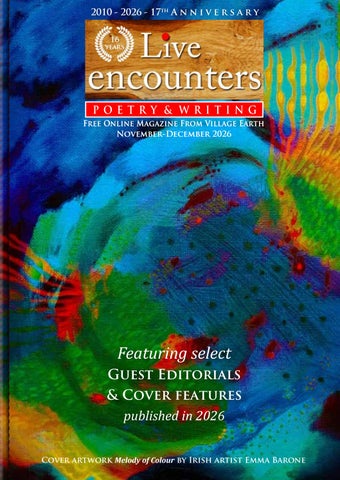
2010 - 2026 - 17th A n n i v e r s a r y
P O E T R Y & W R I T I N G Free Online Magazine From Village Earth November-December 2026
Featuring select Guest Editorials & Cover features published in 2026 Cover artwork Melody of Colour by Irish artist Emma Barone 2026 November-December POETRY & WRITING © liveencounters.net
LIVE ENCOUNTERS MAGAZINE
©Mark Ulyseas
Photograph by Mark Ulyseas. © liveencounters.net POETRY & WRITING (featuring guest editorials of 2026) Celebrating 17th Anniversary
P O E T R Y & W R I T I N G
17th Anniversary November-December 2026
Support Live Encounters.
Donate Now and Keep the Magazine Live in 2027 Live Encounters is a not-for-profit free online magazine that was founded in 2009 in Bali, Indonesia. It showcases some of the best writing from around the world. Poets, writers, academics, civil & human/animal rights activists, academics, environmentalists, social workers, photographers and more have contributed their time and knowledge for the benefit of the readers of:
Live Encounters Magazine (2010), Live Encounters Poetry & Writing (2016), Live Encounters Young Poets & Writers (2019) and now, Live Encounters Books (August 2020).
We are appealing for donations to pay for the administrative and technical aspects of the publication. Please help by donating any amount for this just cause as events are threatening the very future of Live Encounters. Om Shanti Shanti Shanti Om Mark Ulyseas Publisher/Editor
All articles and photographs are the copyright of www.liveencounters.net and its contributors. No part of this publication may be reproduced without the explicit written permission of www.liveencounters.net. Offenders will be criminally prosecuted to the full extent of the law prevailing in their home country and/or elsewhere. 2026 November-December POETRY & WRITING © liveencounters.net
JANUARY 2027 - PUBLISHER/EDITOR
©Mark Ulyseas
Photograph by Mark Ulyseas. © liveencounters.net POETRY & WRITING (featuring guest editorials of 2026) Celebrating 17th Anniversary
MARK ULYSEAS
This Limited Edition features all the Guest Editorials / Poets on Poetry published in Live Encounters Poetry & Writing 2026. Mark Ulyseas David Rigsbee Gillian Roach Brian Kirk Denise O’Hagan Dr Salwa Gouda Mark Tredinnick David Rigsbee Dr Salwa Gouda Poets on Poetry Aristi Trendel Terry McDonagh Thomas McCarthy David Rigsbee Sinead McClure Mark Tredinnick Dr Salwa Gouda Jordan Smith
2026 November-December POETRY & WRITING © liveencounters.net
Contributors Mark Ulyseas Publisher/Editor - Outside, Looking in January 2026 David Rigsbee Letum non Omnia Finit February 2026 Gillian Roach The Poem that Finds You March 2026 Brian Kirk Begin Again April 2026 Denise O’Hagan Remembering David Malouf May 2026 Dr Salwa Gouda Breaking boundaries and deconstructing the sacred June 2026 Mark Tredinnick The Names of All You Hold Dear: A Novena June 2026 David Rigsbee Cigarette Angels July 2026 Dr Salwa Gouda A silent knock July 2026 Poets on Poetry July 2026
© liveencounters.net POETRY & WRITING (featuring guest editorials of 2026) Celebrating 17th Anniversary
P O E T R Y & W R I T I N G
November-December 2025
Aristi Trendel Contemporary Greek Poetry August 2025
17th Anniversary Editions Terry McDonagh The Road Out Volume 1 November-December 2026 Thomas McCarthy Poetry in times of chaos Volume 2 November-December 2026 David Rigsbee These guys mean business Volume 3 November-December 2026 Sinead McClure Touching Ground Volume 4 November-December 2026 Mark Tredinnick Four Rivers Volume 6 November-December 2026 Dr Salwa Gouda The Second Language I Didn’t Know I Was Learning Volume 7 November-December 2026 Jordan Smith House Lights Seen Through Trees Volume 8 November-December 2026
2026 November-December POETRY & WRITING © liveencounters.net
JANUARY 2026 - PUBLISHER/EDITOR
© liveencounters.net POETRY & WRITING (featuring guest editorials of 2026) Celebrating 17th Anniversary
MARK ULYSEAS Mark Ulyseas has served time in advertising as copywriter and creative director selling people things they didn’t need, a ghost writer for some years, columnist of a newspaper, a freelance journalist and photo-grapher. In 2009 he created Live Encounters Magazine, in Bali, Indonesia. It is a not for profit (adfree) free online magazine featuring leading academics, writers, poets, activists of all hues etc. from around the world. March 2016 saw the launch of its sister publication Live Encounters Poetry, which was relaunched as Live Encounters Poetry & Writing in March 2017. In February 2019 the third publication was launched, LE Children Poetry & Writing (now renamed Live Encounters Young Poets & Writers). In August 2020 the fourth publication, Live Encounters Books, was launched. He has edited, designed and produced over Live Encounters’ 300 publications. Mark’s philosophy is that knowledge must be free and shared freely to empower all towards enlightenment. He is the author of three books: RAINY – My friend & Philosopher, Seductive Avatars of Maya – Anthology of Dystopian Lives and In Gethsemane: Transcripts of a Journey. https://www.amazon.com/Mark-Ulyseas/ https://liveencounters.net/mark-ulyseas
Outside, Looking in Travel doesn’t enrich oneself. It dissolves the memories of innocence and replaces them with usurpers of alien nature by dismantling the aura of engrained belonging. And this, perhaps, turns one into an outsider.
The chauvinism of language further alienates the self, leaving one adrift and alone in the crowd. Imagination is the refuge of those among us who need to retreat from this alienation. The conjuring of images and words is an attempt to escape the solitude of living as an outsider.
We seek the wisdom of the intellectual sages to translate our own thoughts, our view of ‘outside looking in’ to the throbbing life around. We attempt to understand the mindlessness of the drudgery of daily routines, of love, hate, violence and pathological mendacity. But the continuous din of conundrums deafens one to the rhythms of life on the other side. Someone once told me that the only thing that we do without which we will cease to exist and yet seem unconscious of it is - breathing. So, is the outsider the one who listens to one’s breath and consciously lives within its periphery? And thus, encapsulates the self, shutting out the outside world and thereby remaining an outsider?
Every time one reads a book, reconstruction of the self begins. Continuous reading turns one into an ongoing construction zone with building materials others have created with their thoughts. It never ends. The self then becomes alienated from the self. The outer shell - a mask at a parade, while the inner self crouches in bewilderment. continued overleaf... © Mark Ulyseas 2026 November-December POETRY & WRITING © liveencounters.net
JANUARY 2026 - PUBLISHER/EDITOR
Being an outsider is like being a chameleon, taking the colours of the background so that none can see you. And yet you can watch and listen to the wonderful and dreadful things that erupt ever so often in a volatile society.
Amidst the menagerie of meaning runs an endless deserted road, which the outsider treads seeking to connect the inside and outside worlds. The attempt is futile for without the self creating a bridge of tangible reality, the outsider remains thus – outside.
Is it possible that one has become the sum total of other people’s thoughts through their writings? And that the true essence of self is adulterated by this invasive species that present their own meaning of life, replacing one’s own meaning of life? Does one become an outsider by rejecting this invasive species and carefully nurturing one’s own within the self-created parenthesis?
Unfortunately, most of us live willingly in a global ‘electronicity’ held captive in a net that continues to feed our primeval instincts, drawing us away from our own breath. Moving images and sound infiltrate our senses luring us into one compost heap of humanity. Will the outsiders survive this aberration of human development and continue to breathe through their poetry and writing? Or, will they too succumb to the divided self – one wearing a mask at a parade, and the other cowering in bewilderment? Peace and Love
Om Shanti Shanti Shanti Om
This is an excerpt from an essay that I am working on.
© liveencounters.net POETRY & WRITING (featuring guest editorials of 2026) Celebrating 17th Anniversary
MARK ULYSEAS
© Mark Ulyseas 2026 November-December POETRY & WRITING © liveencounters.net
FEBRUARY 2026 -LETUM NON OMNIA FINIT
© liveencounters.net POETRY & WRITING (featuring guest editorials of 2026) Celebrating 17th Anniversary
DAVID RIGSBEE David Rigsbee is the recipient of many fellowships and awards, including two Fellowships in Literature from The National Endowment for the Arts, The National Endowment for the Humanities (for The American Academy in Rome), The Djerassi Foundation, The Jentel Foundation, and The Fine Arts Work Center in Provincetown, as well as a Pushcart Prize, an Award from the Academy of American Poets, and others. In addition to his twelve collections of poems, he has published critical books on the poetry of Joseph Brodsky and Carolyn Kizer and coedited Invited Guest: An Anthology of Twentieth Century Southern Poetry. His work has appeared in Agni, The American Poetry Review, The Georgia Review, The Iowa Review, The New Yorker, The Southern Review, and many others. Main Street Rag published his collection of found poems, MAGA Sonnets of Donald Trump in 2021. His translation of Dante’s Paradiso was published by Salmon Poetry in 2023, and Watchman in the Knife Factory: New & Selected Poems was published by Black Lawrence Press in 2024.
The coda to my chapter from Three Teachers: Kizer, Brodsky, and Rorty.
Letum non Omnia Finit In October 2019, I flew to Florence to spend some time with my daughter Makaiya, who had recently graduated from Harvard Law and needed to decompress before starting her first job as a public defender in Seattle. She was keen on going to Venice, and so we took a train there. She knew my real reason for wanting to go: to take a vaporetto and visit Joseph Brodsky’s grave in the Isola di san Michele, where Ezra Pound and Olga Rudge were also buried, along with Igor Stravinsky, and Sergei Diaghilev. The walled cemetery was not especially well-kept, although there were markers and arrows aplenty to locate the graves of the noble and noteworthy. We first found Ezra Pound’s grave and spent a few minutes in a photo op, but I was more interested in finding Joseph. Makaiya first spotted the tombstone, and I hurried over to take a look. I had seen photos online, but these did not do it justice in its isolation and semi-neglect. I plucked a flower from someone else’s plot and lay it at the stone, which had his name, first in Russian, then life-dates, then “Joseph Brodsky” in English. A stack of three short lines, as if trying to be a tercet. It’s said that Boris Yeltsin sent boxes of roses to adorn the gravesite but that they wound up at the grave of Pound instead. Both were buried in the Protestant section of the cemetery. On the reverse of the tombstone there is a legend in Latin: Letum non Omnia Finit. Not everything ends in death. Another photo op showed me standing behind the tombstone, looking over and across his space. I remember standing there a long time, welcoming the feelings of care and regret. Nor did I forget Joseph’s remark: “For some odd reason, the expression ‘death of a poet’ always sounds somewhat more concrete than ‘life of a poet.’” I looked older than I felt on that day.
continued overleaf... © David Rigsbee 2026 November-December POETRY & WRITING © liveencounters.net
FEBRUARY 2026 -LETUM NON OMNIA FINIT
A postcard once came in the mail. There was Botticelli’s profile portrait of Dante. On the reverse, he had written, “This caught my eye. It looks like you, don’t you think?— Joseph.” His reverence for Dante was in line with his respect for the Greats and, to a large degree, the institutions that bound them. One had only to glance at the table of contents of his Collected Poems in English: a roster of classical personages to rival that of his beloved Cavafy. Behind this was the overarching theme of empire, naturally, but that empire took many forms, the most important of which was language. On the one hand, one could never, in Jameson’s phrase, escape “the prison-house of language.” But on the other, poets could build on it. He liked to recite Auden’s lines from ‘’In Memory of W. B. Yeats”: “Time... Worships language and forgives/ Everyone by whom it lives...” “Wystan never wrote anything truer,” he said. If time does anything of the sort, that would mean that time itself was subordinate to language, the very thing that marks humanity off from the rest of nature. Nature, as a result, needn’t take center stage, nor need it lay claim to importance as a background for self-examination, the way it does for the Romantic poets, to whom Joseph was not particularly drawn. However, there is one exception, his poem, “The Hawk’s Cry in Autumn,” an example of magnificence in which the cry from the soaring raptor is the “apotheosis of pure sound.”
The poem, likewise, is soaring. It’s perhaps as close as he gets to a religion of poetry, but the religion also dovetails with Dante, who not only plumbs the depths with Virgil, but flies through outer space with the spirit of Beatrice on a mission to locate the source, God. Unlike Dante, the hawk doesn’t find God, only weather and the earth in rotation. The hawk doesn’t speak either. Its brain is the size of a berry but its “vision” is vision. Its cry is the basis of the language it foretells, though it’s not built to acquire a language that ultimately evolves to offer poetry, the ultimate. There is a paradox embedded in the reasoning that touches all poets.
Joseph often spoke of Dante in these reverential terms. At the time, I only knew the Florentine through John Ciardi’s popular translation of the Inferno. Few of us read beyond, but we intuited (or so we thought) the rest. There was perhaps a basis for taking on what is otherwise an incomplete assignment. The Inferno was graphic; it seized you with its demonic hooks, and you identified with both the sins and the crazy punishments. The Purgatorio was more of the same, but the promise torn from the souls in hell was still in effect for Purgatory’s lucky characters. By the time you got to the Paradiso, it was felt, the journey became more abstract and gauzy, one bubbletrapped soul after another, “warbling hymns,” in Milton’s double-edged phrase, and making discourses on Thomas Aquinas. © liveencounters.net POETRY & WRITING (featuring guest editorials of 2026) Celebrating 17th Anniversary
DAVID RIGSBEE
Be that as it may, I had begun translating the Paradiso, at the suggestion of Makaiya, who thought it a fitting project for the depressed. I had retired from teaching by then and was recovering from the breakup of an 18-year marriage to my own Beatrice, who also happened to be poet Carolyn Kizer’s daughter, Jill. We had remained friends and had joint interest in the upbringing of Makaiya, but we were set, both sorrowfully, I think, on different paths. It was, in Joseph’s terms, grief canceling reason. Cavafy’s remark lurked in the back of my thoughts: “In the dissolute life of my youth the desires of my poetry were being formed, the scope of my art was being plotted. This is why my repentances were never stable. And my resolutions to control myself, to change lasted for two weeks at the very most.” The breakup with Jill was but an update of my past failures, now set squarely before me, and I felt the need of a sustaining literary project.
I knew that Joseph had taken up translation very early on in his career, and he had much to say about the implications of going from one language to the other. There was the apples-and-oranges issue between Russian and English, for example. Russian was an inflected language. Its beauty and its tools for establishing beauty were builtin: not so much in English. Under these circumstances, what could it even mean to undertake a translation? It would be a golem of a text. In the case of his own poems, Joseph insisted that everything be translated, especially the form, even if that form didn’t correspond to anything native. He was militant on this point. He was more original when it came to translating other poets. For instance, he offered the idea that Cavafy’s work practically cried out for translation because the dandified voices of his speakers brought forth the impression that they were already alienated. So what better way to get this sense across than to suggest that they were speaking across barriers historical, psychological, political, and linguistic? There was no unmediated voice. Even the cri de coeur was mediated, its source buried somewhere under the rubble of history. Joseph mentioned that Dante was in on the joke: his Pilgrim was after all an alter ego, having been translated from the historical self into a character. What’s more, there was the problem of the self-defeating premise, namely the fact that the Dante character admits in the first canto of the Paradiso that this task, though necessary, is only an approximation, a fool’s errand. It fails before it starts. We are not constructed to comprehend what he experiences, and so his tale short-circuits. continued overleaf... © David Rigsbee 2026 November-December POETRY & WRITING © liveencounters.net
FEBRUARY 2026 -LETUM NON OMNIA FINIT
To reach heaven is promised, but having reached it we have no means to express what we’ve experienced. What then of the promise? Joseph said that the paradox was not limited to translation, to Dante, or indeed to any poet. It was inherent to poetry itself, which was situated on a fault-line that changed aspect every which way you turned, but that was nevertheless always there. You have to be on good terms with the silence on the other side so that you could gesture in its direction, solicit the silent void as background radiation impinging at every point on articulation, no matter how articulate the speaker. One could hardly imagine a more articulate speaker than Joseph, whether spurting the implications of paradox in the poetry of Donne and Eliot or simply making a pointed witticism whose miniature delivery ironically expanded the vastness of its meaning. Knowing the paradox of expressiveness was there, like death was there, gave one the idea that construction nonetheless counts. Hence his interest in the sturdy, if old-fashioned, poems of Thomas Hardy and Robert Frost. He praised the well-constructed, thought it succeeded on the merits. It had the virtue of furniture; it served, and you couldn’t imagine living without it. You couldn’t escape the paradox no matter how many Dantes you sent into the field. Or could you? He knew that the evolution of poetic form depended on coming to grips with time. You could reconfigure time to make it favor you more. And if that were the case, might you not manipulate it? Confine it to a quotational status, unhook it from mortality? If the beauty of a poem inclined you to follow this argument, you might as well reverseengineer Auden’s lines to find that language deifies itself in our hands. No wonder Time worships it and its practitioners. No wonder Time forgives sins. It was wiith the memory of these conversations in mind that I sat down and began translating the Paradiso. As John reminds us, “In the beginning was the Word.” That’s fine, but it was the second word, the counter-word, that brought poetry into being, along with time and paradox. Joseph was frequently on my mind as I made my way through Dante’s poem because his way of thinking, in its tenacity and reach, headed off at once to the Ultima Thule many poets tend to skip on their way to the made thing—and that destination was something else entirely, something appealing to a hawk, who, if he stopped to think about it would fall, like Icarus, out of the sky. A second postcard followed shortly. It said, “If you want a rose, follow your nose.—Joseph.” On the reverse was another portrait of Dante in profile, the nose prominently Roman.
© liveencounters.net POETRY & WRITING (featuring guest editorials of 2026) Celebrating 17th Anniversary
DAVID RIGSBEE
At the grave of Brodsky in 2019. © David Rigsbee 2026 November-December POETRY & WRITING © liveencounters.net
MARCH 2026 - THE POEM THAT FINDS YOU
© liveencounters.net POETRY & WRITING (featuring guest editorials of 2026) Celebrating 17th Anniversary
GILLIAN ROACH Gillian Roach is a Ahuriri Napier poet who won the New Voices — Emerging Poets Competition in 2018 and was runner-up in the Kathleen Grattan Prize for a Sequence of Poems in 2018 and 2019. Her poetry has been widely published, including in Landfall, takahē and Poetry Aotearoa Yearbook. Gillian is a founding member of the Isthmus poets, and has published three collaborative poetry collections with them over the past 9 years. She completed a Master of Creative Writing degree at AUT in 2016, and has also written novels and short stories.
The poem that finds you I’ve been trying to ‘listen differently’ over the past few months, prompted by a chance remark on Instagram – getting my news from poems today. An idea magpied, like a shiny leaf, from the torrent of news, memes, jokes, and opinions that surges through my awareness daily. Some quick digging led me to the William Carlos Williams poem the comment referenced, it is difficult / to get the news from poems / yet men die miserably every day / for lack / of what is found there. A well-known and often quoted poem, which like so many, I hadn’t come across before. I’ve always been an avid news consumer, but my sources have changed lately. I’m less likely to pick up a physical newspaper or listen to traditional radio. I read a lot online and enjoy greater access to international news and podcasts. But traditional news, with its fast turn-around and repetitive cycles can feel unsatisfying and voyeuristic. The tyranny of the algorithm means stories (and advertising) are pushed on us, based on what we reveal by our preferences. Slowly our worlds shrink as we receive more of the same.
So, what might change if I turned to my ‘poetry feed’ as an alternative news source, and looked to ‘get the news’ from poems? What might I find in poems, that I could conceivably die miserably without? The lines flow from the hand unbidden / and the hidden source is the watchful heart Derek Mahon, Everything is going to be alright
continued overleaf... © Gillian Roach 2026 November-December POETRY & WRITING © liveencounters.net
MARCH 2026 - THE POEM THAT FINDS YOU
I recently travelled the new Te Ahu a Turanga – Manawatu Highway between Woodville and Palmerston North with my husband and his parents. It’s a trip we’ve all made many times, on the journey between Napier and Wellington, although never quite in this configuration. My husband drove, where once he might have wrestled in the back seat with his brother, or day-dreamed about being singled out from the crowd to sub on for Manchester United. The Glums, as they are known in our family lexicon, counted off familiar landmarks and passed around the fruit jubes. It was the first time they had been on the new road, and they were keen to see where it connected with the existing highway, and how much time it knocked off the trip. The narrow Manawatu River gorge route was closed permanently in 2017 after a bad slip made the road impassable and, for eight years, drivers used the Saddle Road, a winding route across the Tararua ranges and through a wind farm with splendid views of the region. The new highway, completed in 2025, also takes you over the Tararuas via a more direct route, up close and personal with the graceful, monumental windmills, and flanked by walkers and cyclists using the purpose-built lanes either side. Faster, but less picture-skew, as we all agreed. A bee zooms, deep amid the warm young grasses. / Startled, the rose / Laughs Robin Hyde, Embrace
In a recent email newsletter from US poet and writer Devin Kelly, he explored Jonathan Aprea’s poem Dial. The first line of Dial reads, Most people make the same piece of art, over / and over, which Kelly says might seem like a rather limiting proposition, but after that the poem ‘takes every turn towards surprise’.
Kelly believes artists revisit the same kind of work, because we are essentially our lives and nothing more. “…we return, again and again, to our obsessions and our wonderings and our feelings and our lives, and we filter our attempt at creation through those lenses.” However, “even in the midst of that sameness, we have the opportunity to approach and wander and stumble and move through the dark in order to revisit that sameness with a bit of difference.”
© liveencounters.net POETRY & WRITING (featuring guest editorials of 2026) Celebrating 17th Anniversary
GILLIAN ROACH
This might involve offering our attention to different things. Choosing to listen differently. Not to mention the element of surprise in what we encounter. “We cannot predict what will emerge out of the darkness,” he writes. my sorrowful ones / twice we were told / final boarding call Sophia Wilson, Every Last Drop
“Road trip with the Glums,” someone posted on our family group chat with an eyeraise emoji. “Safe travels and enjoy the charcuterie in the back seat.”
To pass the time on our roadie, we listened to a couple of episodes of Desert Island Discs, a BBC radio programme the 80-year-olds in our car have been tuning in to for more than fifty years. First up was Michael Sheen, whose Welsh lilt and stories of growing up in Port Talbot were particularly relateable to my Welsh father-in-law. We were entertained by Sheen’s father’s late-life career as a Jack Nicholson impersonator. And his grandmother had been a lion-tamer! From a craft perspective, I enjoyed Sheen’s description of the way he steps into character for a role as being akin to a human mixing deck, dialling up and down aspects of his personality and attributes to reflect the person he is playing, recognising always that he himself forms the base material. The second episode featured Kate Winslet, who holds a special place in New Zealanders’ hearts for her role in the Peter Jackson movie Heavenly Creatures. Winslet came across as forthright and reflective, particularly about her brutal treatment by the British press over her appearance. One of her song choices was Matchstalk Men and Matchstalk Cats and Dogs, which set The Glums singing along, although my husband and I had never heard it before. I loved Winslet’s comment that the children singing on Matchstalk Men had somehow given her permission to sing and dance along too. When the episode ended, I played the song in full and was delighted to find it is about the Manchester artist Lowry, who stayed committed to his unique style despite a poor reception from the critics at the start of his career. Winslet’s refusal to conform to the artificial beauty standards which are held up as the standard for women in the film industry showed a similar commitment to her values. If for us she arose, / Somewhere, in the pitched deep of our grief, /Crouches our power Amanda Gorman, For Renee Nicole Good continued overleaf...
© Gillian Roach 2026 November-December POETRY & WRITING © liveencounters.net
MARCH 2026 - THE POEM THAT FINDS YOU
As I helped Mark Ulyseas gather poets together for this special New Zealand edition of Live Encounters, I wondered what news would emerge from our poems. Would any local headlines from the New Zealand summer feature? Destructive storms, the tragic loss of life in a landslide at Mount Maunganui, health portal data breaches? Or would someone have picked up on the international headlines, such as the killing of young poet and mother of three, Renee Good, on the 7th January by an ICE agent in Minnesota, USA? Good was part of our wider creative community and the rapid poetic response after her death reached me almost instantly, half a world away.
The impulse to react to current events in the moment is understandable, that whitehot response to shock and disbelief. In 2023, I took part in a reading for National Poetry Day and when selecting the work to read, I realised all my recent poems were, in fact, pandemic poems. Yet I had texted my daughter when Auckland was locked down due to Covid 19, that I was ‘over’ all the Covid poems. There were so many and, read in the moment, it felt like they simply added to the overwhelming media noise. I had added to the noise. While my poems were not consciously written as a response to immediate current events, they couldn’t help but be steeped in the atmosphere of that time. Language must choose its moment to be in the world Mike Oliver Johnson, the right moment
It is far easier to access poetry now than it has ever been. I’m connected to poems in a myriad of ways – through social media, blogs, podcasts, radio programmes and, of course, traditional journals, books and live events. In the current media environment, it’s simple and almost instantaneous to share poetry and the actual news informs many poems, whether the immediate flash-fried response or a more slowcooked version.
However, the poem that finds you on any given day will more than likely be unrelated to current events. The poem that finds you might show or tell, zoom in or out. It could be from 200 or 2000 years ago and still shed light or colour or nuance for the reader. Modern or ancient, a poem can encompass universal fears or joys.
© liveencounters.net POETRY & WRITING (featuring guest editorials of 2026) Celebrating 17th Anniversary
GILLIAN ROACH
I have been getting my news from poems these past few weeks and my news has been richer, funnier, quirkier and more human as a result. Poems are agile and democratic. They slip through in many guises. In songs or on peanut butter labels. In bathroom stalls and on bedroom walls. They laugh in the face of algorithms and filters, vigorously sharing voices and ideas others might silence. “He painted Salford’s smokey tops / On cardboard boxes from the shops” Brian and Michael, Matchstalk Men and Matchstalk Cats and Dogs
As we listened to Desert Island Discs on our road trip with the Glums, the poems sneaked in. The earworm of the Matchstalk Men. Michael Sheen’s lilting description of his father turning down a gig to impersonate Jack Nicholson, because Jack would be there. “It’s his night, Michael.” What ‘news’ were they bringing? Small hugs of familiarity and connection. A little girl and her sister, entranced by the children singing on a record, and set free to dance up a storm. A middle-aged man affectionately skewering his Dad’s glorious pomposity, in what was clearly a well-rehearsed family anecdote. These two acclaimed actors were firmly planted in the base material of their own lives. It was just the dials and faders of the human mixing desk they pushed up and down. You work with what you have, was my news for that day, while staying open to any new magic. While the direction of travel may be the same, there are always new roads. In my own work, road trips, family dynamics, and transitions are subjects I return to often. Fair territory for poetry and, in combination, a chowder the consistency of emulsion paint, as thick as they serve at Café 88 in Woodville.
© Gillian Roach 2026 November-December POETRY & WRITING © liveencounters.net
MARCH 2026 - THE POEM THAT FINDS YOU
Black Ice, Napier-Taupo Rd 1.
These bags of blood these blisters my cargo talking of love and its opposite indifference I’d explore this further but I’m alert for ice laid down in transparent sheets almost undetectable interleaved with wet road
Cars and trucks ahead behind coordinate in neutral tones hushed by snow — follow the line of the car in front will the tyres to stick maintain the delusion of safety the heated car our cotton clothes 2.
My kid plays metal an instrumental jazz-like intense with rapid time shifts — no demon-screaming at my request — seeks comment on its virtuosity as grey rain congeals and jerks in syncopated frenzy off the windscreen
How apt Norwegian Metal for an arctic scene Te Pohue iced like an errant Nordic village yet I long for something sly deadpan an antidote
© liveencounters.net POETRY & WRITING (featuring guest editorials of 2026) Celebrating 17th Anniversary
GILLIAN ROACH
3.
I’ve never liked the Mohaka bridge the detachment required suspension of doubt for a successful transition 4.
Does it matter the song played was Brazilian? My original connection propels this poem a minute’s research shows Norwegian Black metal shunned as Satanic misanthropic a dark currency marbled within the story of good children fluffy snow A familiar bond on hitting the salted tarmac slides to a fine edge susceptible to ice as bridges and doubly so
© Gillian Roach 2026 November-December POETRY & WRITING © liveencounters.net
MARCH 2026 - THE POEM THAT FINDS YOU
Energy Thief The act of getting on a bus breaks you down, the girl says. We’ve all contorted, squeezing down the aisle and into our seats. Now we reassemble. I know from her pale, quarter-moon face, she’ll elicit my sad rejection tale somewhere before Palmerston North. She’s that hungry. I tug my frayed skirt over my thighs, jam my formerly desired shiny knees hard against the woven magazine pocket. Student? She picks up my notebook, flips through. Angles towards me, borrowing my light. Writer?
Sure. Every assumption, I will say yes. Let her feast on imagination. I am not together right now.
© liveencounters.net POETRY & WRITING (featuring guest editorials of 2026) Celebrating 17th Anniversary
GILLIAN ROACH
Drive to the conditions Your folks bounce up and down in the back seat of the Hyundai as you hit the uneven surface of Aokautere Rd and your mum says, Ouf, he always wanted to be a rally driver. I don’t think you hear, or what you hear is That’s my boy. You drive fast when they’re in the car too, something I’ve only discovered now we drive your parents. I used to think you were in such a hurry. Remember how you skimmed the curves of the Manawatu river on the old route through the gorge? On a clear day we could see the architecture holding up the next bit of road, or I could from out over the side above the water.
© Gillian Roach 2026 November-December POETRY & WRITING © liveencounters.net
APRIL 2026 - BORN AGAIN
© liveencounters.net POETRY & WRITING (featuring guest editorials of 2026) Celebrating 17th Anniversary
BRIAN KIRK Brian Kirk is a poet, short story writer and novelist from Dublin. He has published two collections of poetry with Salmon Poetry, After The Fall (2017) and Hare’s Breath (2023). His poem “Birthday” won the Listowel Writers’ Week Irish Poem of the Year at the Irish Book Awards 2018. His short fiction chapbook It’s Not Me, It’s You won the Southword Fiction Chapbook Competition and was published by Southword Editions in 2019. He is a recipient of Professional Development and Agility Awards from the Arts Council of Ireland. His novel Riverrun was chosen as a winner of the Irish Writers Centre Novel Fair 2022 and was shortlisted for the Spotlight First Novel Award 2023. His poetry has been published in the Irish Times, Poetry Ireland Review, Cyphers, Abridged, Skylight 47, Crannóg, Live Encounters and many others, and has been featured on The Poetry Programme, RTÉ Radio One and the Words Lightly Spoken podcast. Brian has been a guest author and hosted events at literary festivals around the country including Dublin Book Festival, Listowel Writers’ Week, Red Line Book Festival, Cork Short Story Festival, Ó Bhéal Winter Warmer Poetry Festival, Belfast Book Festival and Bray Literary Festival.
Brian Kirk Begin Again
It’s natural at the beginning of the year to feel low. The hoopla surrounding the celebration of new year encourages us to look to the future with renewed optimism, but it isn’t always easy. We have weathered the privations of winter, sated our appetites during the holiday festivities, and now it’s time to gaze outward again at a world that we hope will be brighter and offer some sort of renewal. From the beginning of time, in all cultures, our lives have been tied to the passage of time, to the changing of the seasons. Even now, in the post-digital age, with the uncertainty that AI threatens for artists and creatives, in a time of dramatic climate change, a time of war and hostility, we still align our lives with the rotation of the earth around our sun. Regardless of race or faith we have an innate need to feel a part of the natural order of things, to experience up close these cycles of birth, death and regeneration. Some winters are longer and harder than others. This year in Ireland, the weather has been depressing, raining almost every day during January and February. That, coupled with the shorter hours of daylight, narrows the small window of opportunity to be out in the world interacting with others and nature. The absence of this tangible engagement with other people and the natural world works to erode us as humans. We become silent, distant, unsure of ourselves in a world that appears alien to us. We retreat into worlds that are not authentic, not reflective of life as it has been and should be lived. We have our private cares also. Maybe a loved one is sick, or a friend has passed on, or a job is in jeopardy. All this adds to our withdrawal from the world. And this year the world has become less enticing. War is waged for no reason, and the lives of the innocent are counted as nothing, truth and lies are two sides of the same coin for many who hold power. Where does that leave us? What can we do? What is the point of it all?
continued overleaf... © Brian Kirk 2026 November-December POETRY & WRITING © liveencounters.net
APRIL 2026 - BORN AGAIN
Every new year is a new beginning, but it is not always easy to begin again. For many years now reading and writing has been a hugely positive part of my life. And this year two groups have helped regenerate my creative journey. The first is the Hibernian Poetry Workshop which I’ve been a member of for a number of years now. We meet in person in the Teacher’s Club on Parnell Street in Dublin on the second Friday of every month to read and discuss our new poems. Last year, for a number of reasons, I missed most of our workshops, so this year I was determined to attend regularly. The group is made up of experienced and talented poets, so I always feel an urgent responsibility to bring good work to the table. Part of the success of the group is the social element of meeting up and chatting, but the poetry is ultimately the most important part. The poets are honest, fair, critical in the best possible way, and the comments received are taken in good faith in the manner in which they are offered. The second writerly group I meet up with is more concerned with the role of the reader. At Story Club six prose writers (some of us poets also) meet once a month via Zoom to discuss and dissect a short story chosen and circulated by one of the group on rotation. We are all writers engaged in our own projects, and as a result we tend to read like writers. There is time for chat and personal and professional catching up as well as close reading and argument. It’s remarkable how opinions can vary in such a small group in relation to the perceived success or otherwise of a story. Each time we meet I come away with a better understanding of the form and what excites me as a reader and a writer.
These regular outlets, of course, feed directly into my own creative projects, sometimes sending me off to research writers that are new to me or to read more work by a given author who has touched a chord for me. As writers and as humans, we are learning all the time. Reading and writing, immersing oneself in another life or imagining how another life could be lived, is the root of all learned empathy outside of family and role models. And for me, empathy is the key trait we need to learn if we are to continue to live together in a world that seems to have lost its way. It is also the key component of great writing. Writing can be a lonely undertaking at times. That’s why it is vital to spend time with fellow writers and artists, to get that sense of solidarity in the face of all that the world might throw at you. That’s why I love to attend readings, author events, book launches. They are milestones on the writer’s journey, celebrations of the work and the word. And the word is what we seek, the next word, the right word, until the line is finished, or the stanza, or the poem.
© liveencounters.net POETRY & WRITING (featuring guest editorials of 2026) Celebrating 17th Anniversary
BRIAN KIRK
When I need fuel for the journey I go back to the books that rekindle the flame, the desire to create. At this time of year I go back to the poems and the poets that started me on the road that I’m still on as a writer and a human being. I’m thinking first of all of the Irish poet, Patrick Kavangh, whose poetry was a staple on every secondary school syllabus for years. I particularly think of lines from Canal Bank Walk, written after he was diagnosed with lung cancer and had a lung removed in Baggot Street Hospital in the 1950s. O unworn world enrapture me, encapture me in a web Of fabulous grass and eternal voices by a beech, Feed the gaping need of my senses, give me ad lib To pray unselfconsciously with overflowing speech For this soul needs to be honoured with a new dress woven From green and blue things and arguments that cannot be proven.
Another poem I return to is Begin by Kerry poet, the late Brendan Kennelly. It starts: Begin again to the summoning birds to the sight of the light at the window, begin to the roar of morning traffic all along Pembroke Road.
The poem is grounded in images of the everyday: rain, flowers, couples, girls, swans and seagulls on the canal. And it ends beautifully, with a message that is as apposite today as it was when it was written: Though we live in a world that dreams of ending that always seems about to give in something that will not acknowledge conclusion insists that we forever begin.
And that is what we must do every year and every day. Begin again. More than ever at the moment the world seems intent on ending itself, but we must persevere somehow, and the words and work of writers and artists give us the strength to do so. © Brian Kirk 2026 November-December POETRY & WRITING © liveencounters.net
APRIL 2026 - BORN AGAIN
Despatches * i.m. Edward Sheridan, Petty Officer Telegraphist, Royal Navy (1917 – 1945) Struck amidships, the gaping hole invited water and the final memories
of a short life lived in search of Boys’ Own exploits. You watched the ranks of swallows on the wires, when shadows lengthened on a midlands farm, and dreamt of Java, Alexandria, Ceylon. First time you ran away,
they sent you back: too young. But two years later they took you as a Boy
at fifteen years, six months. You learned your trade in peacetime, long before the Munich Crisis sparked orders to weigh anchor and embark for Freetown and a protracted war; tapping the code that sent the words to safety beyond the boom
© liveencounters.net POETRY & WRITING (featuring guest editorials of 2026) Celebrating 17th Anniversary
BRIAN KIRK
of wave and ocean spume to harbours that were havens
where all futures met. But yours was not assured. Although you dodged the fate of Perseus, it took a winter visitor to sink the Lapwing in the Barents Sea.
Homing torpedo from a U-boat broke the boat in two. A wife and daughter waited, hoped a message would not come. The worst arrived in Royal livery, O.H.M.S. and postage paid. By order of the King and the First Lord of the Admiralty: he gave his life to save mankind from tyranny.
* HMS Lapwing was sunk by torpedo on 20 March 1945. Of the 229 officers and men aboard there were 61 survivors. Unfortunately, Edward Sheridan was not among them. He was posthumously awarded a Mention in Despatches, published in the London Gazette of the 7 August 1945. Despatches was first published in Hare’s Breath, Salmon Poetry (2023)
© Brian Kirk
2026 November-December POETRY & WRITING © liveencounters.net
MAY 2026 -DAVID MALOUF
© liveencounters.net POETRY & WRITING (featuring guest editorials of 2026) Celebrating 17th Anniversary
DENISE O’HAGAN Denise O’Hagan is a Sydney-based editor and poet, born in Rome. She has a background in academic publishing in London and Sydney, and is poetry editor with The Marrow. Her third poetry collection, What the Mirror Tells, is forthcoming with 5 Islands Press (2026). Her awards include the Dalkey Poetry Prize, the Monica Taylor Poetry Prize and the NSW Poetry Prize. https://denise-ohagan.com
Remembering
David Malouf
March 20, 1934 - April 22, 2026 ‘What else should our lives be but a continual series of beginnings, of painful settings out into the unknown, pushing off from the edges of consciousness into the mystery of what we have not yet become...’ (An Imaginary Life)
Vale David Malouf (1934-2026), distinguished novelist, poet, essayist, librettist and playwright as well as passionate supporter of literature. A giant in the Australian literary scene, he was also a generous and kind friend to many and devoted family member; he was indeed ‘one of a kind’, as described in the Sydney Morning Herald. He leaves a rich legacy, from his debut novel Johno (1975) to his final poetry collection An Open Book (2018), and his very many awards include the Miles Franklin award (1991), the International Dublin Literary Award (1996) and the Australia Council Award for Lifetime Achievement in Literature (2016). With renewed gratitude to editor and publisher Mark Ulyseas of Live Encounters Poetry & Writing and Simon Farley, Fryer Librarian at The University of Queensland for helping to facilitate this interview.
© Denise O’Hagan 2026 November-December POETRY & WRITING © liveencounters.net
MAY 2026 -DAVID MALOUF
David Malouf. Photo credit: Conrad Del Villar. © liveencounters.net POETRY & WRITING (featuring guest editorials of 2026) Celebrating 17th Anniversary
DAVID MALOUF This interview was first published in Live Encounters Poetry & Writing May 2021, Special edition featuring poets & writers from Australia and New Zealand.
With warm thanks to Simon Farley, Fryer Librarian, Fryer Memorial Library of Australian Literature, The University of Queensland, for helping to facilitate this interview.
David Malouf
in conversation with
Denise O’Hagan
Denise: Good morning, David, and thank you for kindly agreeing to this conversation. You’re a poet and playwright, librettist and essayist as well as a novelist, so I might begin by asking what drew you to the world of words in the first place? David: The need to discover what I most deeply understood at first, as only the writing itself – words in their moment of appearing on the page – could reveal it to me.
Denise: Inspiration comes in many forms – people, place or something else entirely. What shape does inspiration take for you, and has this changed over the years? David: The sudden apprehension, set off by something seen and heard, or misheard or misread, of a new insight into things, that if I allowed the act of writing to reveal it would appear on the page and be there to be read. Denise: Turning to your poetry, now, it is known not only for its lyricism and imaginative power, but also for its themes of ‘interconnectedness’, a sense of navigating the space between things and people. Is this also how you consider your work?
David: I think of poetry as revealing to me, as writer or reader, what I think and feel most intensely but also most deeply, but in a spirit of play, both verbally and in active consciousness. What I hope to discover there is my ‘real’ identity.
© David Malouf
2026 November-December POETRY & WRITING © liveencounters.net
MAY 2026 -DAVID MALOUF
Denise: It is said that in times of crisis, people turn to poetry for inspiration, or consolation. Do you feel that with the recent crises – the Australian bushfires and global pandemic – poetry may be becoming ‘used’ in the interests of certain ideologies? David: Poetry has nothing to do with issues or ideologies or opinions – or not as I – as a writer or reader – understand it. Denise: Following on from that, what advice would you give to an aspiring poet?
David: I’d offer the same advice as Kipling and DH Lawrence. Kipling - ‘When your daemon is in charge, do not try to think consciously. Drift, wait, and obey.’ DH Lawrence - ‘A young man is afraid of his demon and puts his hand over the demon’s mouth sometimes and speaks for him. And the things the young man says are very rarely poetry.’ So I have tried to let the daemon have his say.
Denise: Writers work in different ways. Do you have a favourite writing routine – a time of day, method of working or anything else that you find conducive to writing? David: Fiction demands discipline and persistence of a daily routine. Poetry appears out of nowhere, when it wills. Denise: And finally, a practical question. We live in an age of increasing dependence on technology for both writing and the dissemination of our writing, yet I believe you prefer to work by hand. Why is this? David: Writing is as much a bodily activity as a mental one. The pace at which the hand moves across a page seems to be one where first and second thoughts can appear almost instantaneously.
Denise: Thank you very much for your thoughts and time. It is an honour for us to have your participation in this special edition, and we have no doubt that our readers will be thrilled!
© liveencounters.net POETRY & WRITING (featuring guest editorials of 2026) Celebrating 17th Anniversary
DAVID MALOUF
Mulberry Tree Dreaming Parachute silk comes spooling out of the mouths of a silkworm factory; rumbustious breath of the big tree’s rebel stillness rocks the house. Invisible rip-cords jerk, sing, take the strain, and new light mushrooms skyward, a ceremony of change that no hands work; eyelids fatten, creep, from spirit, its actual meat, shape strange cosmologies that hold. Lords of the second breath and transformation, we too shake loose; our meaty souls grow light, grow luminous, break free of their sticky net of fingerprints, dull household chores, events. Is it enough, we ask, this faith, this breath? Can we ascend for ever? The grain of doubt finds its counterweight of earth and earth falls upward, takes us, heart and heel. The mulberry-tree, its filaments all sheer flame, seethes and billows. Tough limbs deal with the play of its buckled shadow on a wall.
David Malouf, Poems 1959-1989, University of Queensland Press, St Lucia, 1992.
© David Malouf
2026 November-December POETRY & WRITING © liveencounters.net
MAY 2026 -DAVID MALOUF
From a Plague Year A sign first in the sky, then other tokens, but plainer, on the flesh. June’s thirty suns flared and we were tinder. Flies appeared and bubbled in pools, their green gaze multiplied the dead. But we, the elected, all that term kept house, kept shop, kept silence, knowing no harm would come to us. We paid our taxes, served on juries, saw men punished or reprieved from death under the law. God’s eye was on us. Like a red-hot cautery it pricked and burned. Who keep His just commandments shall live. No terror can afflict the saints.
But still each week the numbers swell, the needle glows. In a devil’s covenant, through all the colours of the rainbow, pale flesh bruises black, then stinks and softens. We stop our noses, the death-cloud blooms. We find its dark seeds scattered like sunshine, everywhere. And so we board our houses up, burn pitch, read in the Book and choke. By day no footfall, no wheel’s creak in the cobbled square. At night the town’s aswarm with cries, a fearful traffic. Dung-carts climb to where, in moonlit fields, whole families meet at the real pit’s edge, new nameless suburbs greet new citizens; they seethe like privy holes.
© liveencounters.net POETRY & WRITING (featuring guest editorials of 2026) Celebrating 17th Anniversary
DAVID MALOUF
Some say the plague’s a rat, soft-bellied squeals in the rushes underfoot, a red-eyed fever that glares. Or blame the Jews. Or claim the air itself turns poisonous; where warm breath clouds a glass invisible armies spawn, one word’s enough to quell a city. It is death we suck on now. The plague in our mouth.
No help! Gender of spiders on the tongue that preaches, curses, pleads, God’s judgment wrung in black sweat from our limbs. Are we in Bedlam or is it Hell that rocks us with its flame? The sickness in this month is grown so general no man can judge. It comes to this: we kill our neighbours with the very prayers we sigh to Heaven. O my Lord, spare me, spare me.
David Malouf, Poems 1959-1989, University of Queensland Press, St Lucia, 1992.
© David Malouf
2026 November-December POETRY & WRITING © liveencounters.net
MAY 2026 -DAVID MALOUF
To Be Written in Another Tongue As for example, the language in which my grandfather dreams now he is dead, or living, muttered in his sleep. Clouds
flow to a different breath, daylight moons hatch from the stillness of a different dark, where owls drop from the sun, dirt-coloured starlings by other names than we know them gather the dusk, grain by grain let fall the shadow of their bodies. Such ordinary events are poems in another tongue and no translation possible. Owl with its heavy blood and vowel an open mouth too slow to snatch the heads off dustmotes. Humming-birds like Giotto’s tear-stained kamikaze angels
sorrow, having learned their name in a dead language is entrée to a steel-meshed aviary or Table of Contents, some grey Jardin des Plantes. Grandfather mumbles our names in the earth. We come to light out of his mouth, oracular bubbles.
© liveencounters.net POETRY & WRITING (featuring guest editorials of 2026) Celebrating 17th Anniversary
DAVID MALOUF
I range through the thesaurus for a word: homesickness, yearning of grandsons for a language
the dead still speak, the dying in their sleep still mutter, the advent of common objects, strange upon the tongue.
David Malouf, Poems 1959-1989, University of Queensland Press, St Lucia, 1992.
© David Malouf
2026 November-December POETRY & WRITING © liveencounters.net
JUNE 2026 - BREAKING BOUNDARIES
© liveencounters.net POETRY & WRITING (featuring guest editorials of 2026) Celebrating 17th Anniversary
SALWA GOUDA Dr Salwa Gouda is an accomplished Egyptian literary translator, critic, and academic affiliated with the English Language and Literature Department at Ain Shams University. Holding a PhD in English literature and criticism, Dr. Gouda pursued her education at both Ain Shams University and California State University, San Bernardino. She has authored several academic works, including Lectures in English Poetry and Introduction to Modern Literary Criticism, among others. Dr. Gouda also played a significant role in translating The Arab Encyclopedia for Pioneers, a comprehensive project featuring poets, philosophers, historians, and literary figures, conducted under the auspices of UNESCO. Recently, her poetry translations have been featured in a poetry anthology published by Alien Buddha Press in Arizona, USA. Her work has also appeared in numerous international literary magazines, further solidifying her contributions to the field of literary translation and criticism.
Dr Salwa Gouda
Breaking boundaries and deconstructing the sacred In the writings of Arab Women Writers I feel lucky to have had the chance to translate the literary works of 17 Arab women writers from a wide range of cultural and geographical backgrounds. For me, translation is never a mechanical process of swapping out Arabic words for English ones. Instead, it involves something more challenging and unavoidable: the act of making the text feel at home for the target reader, a process known as domestication. What is more astonishing for me with these texts is that they not only carry the themes historically connected with women, but they move further to express the dilemma of Man in modern life. Arab women poets and writers did not follow the advice of the French feminist critic Hélène Cixous to write only themselves and their suffering as a challenge for male norms and cannons “Je l’écris” but for these authors, the act of writing is a way to actively create a new reality or identity, not just to passively describe an existing one. Their understanding of “Je l’écris “ is to reclaim power and give voice to experiences, bodies, and truths that have been suppressed or ignored. It is, in fact, a political and personal act of defiance. Moreover, the texts of these Arab women writers show their full engagement with all the ills and pains of the world beside the challenges they face in their surrounding due to gender classification and cultural distinction. In fact, through this engaging experience of translating the literary works of Arab women writers, I’ve rediscovered myself and the world. continued overleaf... Salwa Gouda 2026 November-December POETRY & WRITING © liveencounters.net
JUNE 2026 - BREAKING BOUNDARIES
Within the literary and intellectual visions of Arab women writers, the sacred and rebellious body is deconstructed alongside generational conflict and existential emptiness, as time fractures into surreal absurdity and maternal grief turns death into a cryptic message. The impotence of poetry before national tragedy contrasts with feminine Sufism and a covenant with blue, as the poets deny the poetic self and experience alienation from their own being. Arab women writers also give voice to the oppressed marginal female, traces a failed Sufi journey toward independence, and portrays a wounded homeland in painful waiting. Structural female oppression renders the body a site of guilt, yet poetry remains like a loyal dog, and error resembles knowledge. Hunger for cuddling equates death with a job, love becomes a cross, the garment an extension, and the exiled homeland opens a window in the stone. What follows is a structural analysis that attempts to approach and trace their core ideas and dreams. Dima Mahmoud believes that the dismantling of the sacred, the rebellious body and female as treasure of pain begin with the deconstruction of natural symbols and absolutes (“The rose does not acknowledge the absolute / so it practices contradiction twice”), and breaks sexual and class taboos (“The rose practices sex when crowds gather in public squares”), while presenting the female as a repository of pain (“The girl who planted her heart in her eyes / to season time and ghosts”). This intersects with the generational struggle and existential void of the poet Fawzia Alawi Alawi where the curse of poetry appears (“If not for this curse of poetry / that drank my heart”) versus the mother’s gaze, which she considers “a loser,” and the cosmic void (“Nothing but time, / nothing but space. / What am I to do with all this eternity?”), then with the deconstruction of time, absurdity, and artistic sacrifice of the Egyptian poet Ghada Kamal that makes death beautiful (“Death is beautiful but crying ruins it”) and shatters frames (“All picture frames must be broken”) and presents Van Gogh’s sacrifice as a model (“Van Gogh cut off his ear / and offered it as a sacrifice of silence”).
On the other hand, Hanna Metwally sees sorrow and death as messages that “Sorrow never runs out. / Sorrow renews itself,” with rituals of invoking the dead where “Samia lights incense... raises her voice with his favorite song” then comes the message “Mama... it was his voice.” This meets with the impotence of poetry and the dying homeland of the Libyan poet Hawaa Al-Qamudi where “My country is dying” while the threshold of morning wants a hot poem, and the girl who loves frogs turns into a frog because “the frog prince never came,” and the poet admits that “Nonsense I write means nothing to anyone / it does not warm a freezing child.” © liveencounters.net POETRY & WRITING (featuring guest editorials of 2026) Celebrating 17th Anniversary
SALWA GOUDA
As for the feminized Sufism and the covenant with blue, Heba Al Ghonaimy, offers a different spiritual solution: “No woman is sacred / except the one who keeps the covenant with blue,” where blue represents the motherhood of the universe and the clarity of silence. In Zaynab Laouedj ‘s poems, there are two main ideas: returning to paradise is possible (in “The Apple of Temptation”: “paradise is still open to its own people” and “your room is exactly as you left it”), and the complete collapse of language and existence (in “Nothing left but cold ash”: “alphabets with no spark in them except cold ash” and “we’re drowning in words worm-eaten from the inside”).
As for the negation of the poetic self and the poem as an existential structure Hind Zaytouni declares, “I have never written a poem in my life. / I was only removing / heavy rocks from my chest,” and one poem is enough “to build a house of living tears.” This aligns with the alienation of the self and the difficulty of anchoring in writing by Mastoura Mesfer Alorabi, who describes herself as “the one who is hard to pin down in writing: / my grapes were not eaten, / my baskets were not carried,” and admits, “Whenever my mirrors tremble / I shiver.” Connected to them is the voice of the oppressed and the marginalized woman by Nadia Mohamed, who says, “I am not important. / When I disappear, no one asks,” but she carries a bullet “for whoever breaks the ankle of my heart / with a stone of fire.” Also, In Maha Alautoom’s poems, the poet’s crisis revolves around her tense relationship with writing: at times she rejects the constraints of meter and rhyme and wishes for poetry as “light” as a slender body (“Without Conditions”); at other times she discovers she has given the poem everything (her lungs, her blood, her dreams) only for it to be the one to leave her and set her free (“What the Poem Left”); and at times she loses the poem completely and searches for it under stones and above the clouds, even though it once walked with her, declaring her rejection of all ready-made classifications of poetry (“Did you forget the way?”). Moreover, the failed Sufi journey and complete independence in Rim Gomri ‘s poetry tests the path of salt in search of the sea (“I walked the path of salt, / searching for the sea, / and you watched me from afar”) then declares liberation: “Today, / no one saves me from myself / except me,” and “all my little things are mine... my voice / my body / the pallor of the moon on my face / all of them belong to me alone.” continued overleaf... Salwa Gouda 2026 November-December POETRY & WRITING © liveencounters.net
JUNE 2026 - BREAKING BOUNDARIES
While the wounded homeland and the lover as a soothsayer by Roshan Ali Jaan cries out, “O country sleeping in its ruin / everything after you hurts me” and describes herself as “I am the scattered pain / on your precious smile,” and fears “the last wound” and “the mythical rituals / that give the mouth of the wound / to the pain of the poem.”
In addition, Safaa Elnagar reveals the structural oppression of the female and the body as a site of guilt and how the tall girl becomes a thief (“Grandmother threw her word: ‘She must have stolen her brother’s height while he was sleeping’”), and how “silence is the language I mastered,” and she shrinks into herself “terrified that someone might smell the scent of this new secret.” This meets with poetry as a loyal dog and error as knowledge in Samira Al Bouzidi, who abandons poetry but it “follows my trail like a loyal dog,” and declares, “Error is knowledge, / and knowledge is existence,” and asks, “How would I have discovered uprightness if I had not stumbled?” As for the hunger for an embrace and death as a job Sherine Fathy describes an institution that distributes hugs: “A hug is a human state. A right. A desire and a natural need to feel safe,” while an ad for “Employees Wanted for the Afterlife” haunts her, and she finds herself on a staircase with no return.
Also, the theme of love as crucifixion and the dress as an extension, the poet Tahani Hassan Alsubaih addresses her lover: “Come, crucify me between your sides as a lover,” and her dress becomes “a night of images” and “a bridge crossed by lovers, from the Bedouins to the city dwellers.” And finally, the exiled homeland and opening a window in the stone, the poet Touria Majdouline summarizes the collective experience: “A homeland that does not begin with your name-a place of exile. / A day that does not rise from your lips-a stone stretching out its limbs,” and she asks, “Let me open a window in the stone, / so that beautiful losses do not preoccupy me,” and chooses to remain “forever imagined.”
© liveencounters.net POETRY & WRITING (featuring guest editorials of 2026) Celebrating 17th Anniversary
SALWA GOUDA
To conclude, I feel I need a whole life to interpret the ideas and read the hearts of these distinguished writers on the way of Sigmund Freud. These seventeen female voices are united by a profound awareness that women in the Arab world experience alienation on multiple levels: alienation from their own bodies, which are controlled; from their poetry, constrained by traditional meters and rhymes; from their homeland, which is stolen, occupied, or exiled; from their mothers, who mourn a bygone era; from their lovers, who are either absent or present in an incomplete way; from death, which comes suddenly or is long awaited; and even from the language itself, which is no longer able to express their suffering in an absurd uncontrollable universe. Yet this sorrowful awareness transforms into a space for rebellion: breaking boundaries, deconstructing the sacred, exposing contradictions, reinventing myths, opening windows in stone, and dancing madly on the ruins of the traditional poem. These poets remain, each in her own way, “forever dreamers”, for imagination alone, as Samira Al Bouzidi says, “an immortal devil kicking the earth.”
Salwa Gouda 2026 November-December POETRY & WRITING © liveencounters.net
JUNE 2026 - THE NAMES OF ALL YOU HOLD DEAR
© liveencounters.net POETRY & WRITING (featuring guest editorials of 2026) Celebrating 17th Anniversary
MARK TREDINNICK Mark Tredinnick OAM is a much-awarded poet and essayist and the managing director of 5 Islands Press. He is the author of five collections of poetry, including, most recently, A Beginner’s Guide; Chain of Ponds: New &: Selected Poems appears in July 2026. Next year also sees the reissue of his classic guides to the craft:The Little Red Writing Book and The Little Green Grammar Book (New South). Mark lives with his wife Jodie in Bowral, on Gundungurra Lands, southwest of Sydney. He runs the poetry masterclass What the Light Tells online through his website https://www.marktredinnick.com/ and he teaches literature and creative writing at the University of Sydney. He is at work on The Divide, which tracks the Great Dividing Range in prose and poetry, the way Basho’s Narrow Road tracked the deep north/ outback/ deep interior of his times. 5 Islands Press has recently published a collection of poems from Gaza, Each Night I Count my Children, edited by Denise Howell. All revenue goes to support MSF in Gaza. Please support the book, which you can purchase at https://www.5islandspress.com/
The Names of All You Hold Dear: A Novena 1.
MAY it be true that, though we shed the years, the lives we spend stay Where we spent them, and with whom and what. So, though you’ve stepped, Mother, From the burning circle of our days, your life is carried on. 2.
Who takes form must give it back: that’s the deal life makes with time. But That which was once embodied, so that it might know love and be A voice in love’s long choir, never finds an end. And nor will you. 3.
Is the longing one feels, all one’s days, a foreknowledge of this Missing the departed feel for the living world? Tell us what You most miss—high cloud, dawn song, preludes, frogs—and we’ll miss them more. 4.
Across the rooftops and through the spreading pinions of the pines, Day fails and night rains a fine dust my daughter sits and reads in, Till she can’t. May it sometimes be like this, too, where you are now.
continued overleaf... © Mark Tredinnick 2026 November-December POETRY & WRITING © liveencounters.net
JUNE 2026 - THE NAMES OF ALL YOU HOLD DEAR
5.
May the birds gather like a well-tempered synod of weather, Here in this grey haven of gums, where all that’s not yet transposed Of you into eternity’s holy thrum stays on a while with us, 6.
Prays on a while with us, and with the bluewrens and grass parrots, The passing seasons and the ordinary hours they traffick. And let’s join you in the raven’s caw, the morning rush, the hush. 7.
Surely time runs rings around us, and we are still on Copeland Road, headed for school in the Escort; and these are your soft shoes Running like four young boys and a dog up and down the pedals. 8. A name for the whole world is Mother. Child. Woman. Wife. Heather Runs fragrant where it always ran. Heaven is scented with song, Some of its notes yours now, the names of all you held dear on earth. 9.
When the storms stopped, fire sang the world into the kind of stillness Trees could grow in and love might start. Words made a hearth of wildfire. And you fall back now, soft molecules, into the canticle.
© liveencounters.net POETRY & WRITING (featuring guest editorials of 2026) Celebrating 17th Anniversary
MARK TREDINNICK
The Age of Stars For Dave at Sixty l’amor che move il sole e l’altre stelle. —Dante, La Comedia (Par. 33.143-45) … we should be careful Of each other, we should be kind While there is still time. —Philip Larkin, “The Mower”
And the light shineth in darkness; and the darkness comprehendeth it not.” —John 1:5 1 ON LITTLE MOUNTAIN deep in winter stop The car at midnight. Stand among the gathered Bands of barrel gums and contemplate The sky. This is the age of stars, this manyBillion-yeared experiment in light, When nearly all the matter in the world
(This universe of forms and voids we are) Is organised in luminescent mobs
Like those assembled on the plains of time Above our heads. Our being here at all
Is down to them, their coming and their going, The way their being comprehends the dark,
So while this holds, stand glad among the living And let your breathing fall in with the stars.
*
continued overleaf... © Mark Tredinnick
2026 November-December POETRY & WRITING © liveencounters.net
JUNE 2026 - THE NAMES OF ALL YOU HOLD DEAR
2
THE ERAS age; all light in time will dim; Then nothing much will happen—on and on. But let’s agree Forever has a few More miles in its old legs. Let’s make a pact
To sow the light that’s left to us; let’s scatter All the starlit matter we can spare.
Let’s dance quite often with the one we love; Let’s wage iambic warfare on the prose
That dumbs the days; let’s praise in jazz and think In syncopated rhythms like the winds Of early spring. Let’s ebb like ageing stars, You say; let’s spend our waning energy
Among the constellations of our care. Let’s learn to fall the way we meant to live. **
© liveencounters.net POETRY & WRITING (featuring guest editorials of 2026) Celebrating 17th Anniversary
MARK TREDINNICK
3.
BESIDE THE pool across the tracks from where You’ve lately made your home, an episode Of winter rain makes landfall like a meteor Shower among the teeming white of prunus
Trees, as if to flush their Seraphs out. But when you wake into the seventh heaven— The Cielo di Saturno—of your way, Your contemplative era, your temperate zone, You’ll find, above the multitude of fallen, A throng of thriving stars intact. The nearer,
It seems, you draw to the stars, the farther from home, The more you get to weep at the comedy
Of life. But the more, if you’re smart, you learn of the love That burns in the sun and all the ageing stars.
***
© Mark Tredinnick 2026 November-December POETRY & WRITING © liveencounters.net
JUNE 2026 - THE NAMES OF ALL YOU HOLD DEAR
Near Saskatoon Ten minutes out of Melville, the train sounds its rude horn at a level crossing, and I watch a cardinal fly a ploughed field, changing its mind in open ground between one bare copse of wattle and birch and the next. The water is dark in the shining ponds, and the grass, where it stands, is straw. The beaver lodge is an unreconstructed temple, a little out of its depth, and even the water here has lost its faith in spring. But if you look closely, the birches are budding: the sun is out and the air is hitting 18 degrees, and I guess this feels to the trees like their moment. Except for the traces it leaves, the art of ploughing is very like the art of flight—how do you read the field as you write the field, and how do you know when to turn? Grace is a knack, which comes by art, and it makes nothing much happen; nothing like this, for instance: a cardinal sows the Saskatchewan sky, and the birches begin to reap.
© liveencounters.net POETRY & WRITING (featuring guest editorials of 2026) Celebrating 17th Anniversary
MARK TREDINNICK
And then, the horses A W I N D bright as prayer flags tears the floodplain Apart. Mid-August never felt so warm. Beside the car, unsteady in the wild air, my father seems uncertain Where he stands and what’s become of everything He knew. Five miles north the mountain rests Like St Exupery’s hat. The gale blows the inland inside out And drops it here like silt across the afternoon.
And then, at the fence, among the peppermints, the horses, The foal, green in judgment, rolling in her mother’s feed—her salad days— and beside me, my father, at his ancient ease again.
© Mark Tredinnick 2026 November-December POETRY & WRITING © liveencounters.net
JUNE 2026 - THE NAMES OF ALL YOU HOLD DEAR
This lithe moon tonight O N E D A Y I may write three lines that outlast time. Like: this lithe moon tonight.
© liveencounters.net POETRY & WRITING (featuring guest editorials of 2026) Celebrating 17th Anniversary
MARK TREDINNICK
©Mark Ulyseas
Half moon at dawn against a grey sky. Photograph © Mark Ulyseas © Mark Tredinnick 2026 November-December POETRY & WRITING © liveencounters.net
JULY 2026 - CIGARETTE ANGELS
© liveencounters.net POETRY & WRITING (featuring guest editorials of 2026) Celebrating 17th Anniversary
DAVID RIGSBEE David Rigsbee is the recipient of many fellowships and awards, including two Fellowships in Literature from The National Endowment for the Arts, The National Endowment for the Humanities (for The American Academy in Rome), The Djerassi Foundation, The Jentel Foundation, and The Fine Arts Work Center in Provincetown, as well as a Pushcart Prize, an Award from the Academy of American Poets, and others. In addition to his twelve collections of poems, he has published critical books on the poetry of Joseph Brodsky and Carolyn Kizer and coedited Invited Guest: An Anthology of Twentieth Century Southern Poetry. His work has appeared in Agni, The American Poetry Review, The Georgia Review, The Iowa Review, The New Yorker, The Southern Review, and many others. Main Street Rag published his collection of found poems, MAGA Sonnets of Donald Trump in 2021. His translation of Dante’s Paradiso was published by Salmon Poetry in 2023, and Watchman in the Knife Factory: New & Selected Poems was published by Black Lawrence Press in 2024.
The featured poems will appear in an upcoming anthology.
Cigarette Angels On the factory floor, the men bolted machines to the hardwood. They would be the first to tell you they were shipped from Germany where people knew things about the purposes of steel and fire. My father’s job was to wander around from behemoth to behemoth, monitoring the humming gears inside, keeping an eye on the changing facial expressions of dials. Here is the thing. While most of the paper was bound to scream headlines and maybe invite poems, other rolled sheets were sliced again, and again, in which cured tobacco, now separated and crushed was to be inserted a section of charcoal granules between the cigarette and the filter, added for the sake of public health. That’s where he met my mother, a pretty girl from a tobacco farm who came up from the floor below, having risen from the one below that as the years doubled, then tripled. She fed the leaf into the hopper, then checked the other end to see that the product was uniform. Soon after they married, I squirmed out.
©David Rigsbee 2026 November-December POETRY & WRITING © liveencounters.net
CIGARETTE ANGELS
Awake at Three Beyond the window: summer night stilling the wrens, sparrows, and hawks. The small dark brook even now makes its stony way to the Hudson like someone leaving before the seventh inning.. That girl from far away comes back to me in a dream. Knowing we belong we sit and hold hands. The waiter returns and asks if we would like anything else and she says no.
God returns as night air by the forest floor not disturbing the feathered and the small beings who couldn’t close their eyes: replacements all. Not for the world.
I flick the light on for just a minute, then turn it off. A child’s ceiling stars in random constellations, loop and align according to their innocence, as if I was being invited to pause before their dimming phosphorus.
© liveencounters.net POETRY & WRITING (featuring guest editorials of 2026) Celebrating 17th Anniversary
DAVID RIGSBEE
Cicadas at Dawn I couldn’t sing. Neither could I keep the bushes trim: they kept sending out shoots. Mr. Hall, the principal, was still coming down the corridor, brandishing a copy of Orwell in one hand and a paddle in the other. Chipmunks criss-crossed in front of me, tails at full exclamation point. The clouds seemed forms willing to take on any figure to pull away from the blue behind them. I had a name for when I was everywhere truant, but by that measure, still alive. L. said words would fence our desires in, but he was unfortunately in a bad place, whereof he spoke. The nuns on the hill, the fathers and brothers billow as they walk from their cars to Maryknoll. Having lasted the night, The cicadas at dawn surge and retreat. Summer will come to a halt. You can mark it off with that pencil I left you by the refrigerator and do whatever else you need to do, when the mowers drive their red machines between our houses, meanwhile.
©David Rigsbee 2026 November-December POETRY & WRITING © liveencounters.net
CIGARETTE ANGELS
Second Person I like the way the wind lifts the glass twine of the green spiders, but I save my praise for the switches to which they are tied, also leaning into the air. I was thinking of switches the other day, how you had to go and select just the right ones when you had been found guilty of something shameful, selection itself being part of the penance and symbol too of how that might be forgotten (it never was) in wake of the lashes, formally laid on to your tiny hide. And nature is both more devious and absorbing than you thought it would be, coming down to breakfast in your slippers, the little edemas now peeking out from your ankles, like you, bleary to no one in particular. How you hove off into the morning again, switching your point of view into the second person, like a sedan having rounded a curve at the bottom of a hill. Momentarily the glass flashes as sunlight meets the windshield and the oncoming traffic behaves itself.
© liveencounters.net POETRY & WRITING (featuring guest editorials of 2026) Celebrating 17th Anniversary
DAVID RIGSBEE
As I say, the cables lift and hold, a fine enmeshment easy to look past, necessary even, in the dappled confusion of ordinary morning, the grim process of nothing special. The mind says “let…” and off you go in your fabulous jalopy. Even the weeds may be said to mean you well in their nihilistic way, as you blow past, half in daydream, baseball cap reversed, shading those secret eyes in back of your head.
©David Rigsbee 2026 November-December POETRY & WRITING © liveencounters.net
CIGARETTE ANGELS
Along the Palisades I bring my father with me, and my mother, who only saw the city once during the brief misery of my first marriage. Who else do I bring? Brother, of course, himself buried In the stiff basalt lava of Ohio.
Small waves wash ashore, then pull back into the swollen stream, glinting as the sun powers down in the west. There are egrets, of course, curvature itself mounted on walking scissors, stalking the marshes, and above, eagles in slow rotation. Farther out, jets bound for Newark. The river traffic hardly moves. My parents likewise slow as they emerge into time again, and we walk along the river’s edge, bounded by cliffs on the far side, a seaward footpath on this.
© liveencounters.net POETRY & WRITING (featuring guest editorials of 2026) Celebrating 17th Anniversary
DAVID RIGSBEE
Hoeing You can look out and see glassy threads waving in the air, butterflies as large as magpies making chaotic flight over the saplings. Sunlight moves from one side of a web to the other. The spider is a sundial and slowly burning. It’s August, the leaves everywhere exhausted. A wasp rises like the Holy Ghost. The air swallows it. Another drifts down, more like a parachute than a winged being. It is well to have lost our way, lost the time we were given to thrive. Still, there is a motion to the whole of this patch of creation. At the center sits the spider, its regulator and citizen. When a cloud comes it feels like a reprieve, until you watch it cross the sky. You can feel the breath of the question like a man hoeing along a field, one row at a time, alternating between effort and rest, parting the earth, then standing straight a moment, wiping his face with his shirt, wiping his eyes.
©David Rigsbee 2026 November-December POETRY & WRITING © liveencounters.net
CIGARETTE ANGELS
The Mouthpiece of My Cornet Whatever the sun’s might was then, it was nothing compared to the flag being lowered, at which point we turned and set out across the grass. Someone asked, “When does surf become fact in the waves?” I felt a slap coming on and rifled through my rejoinders until I found a big one. “How far we have spread,” said another. A third trilled, “And how little.” The strata before us extended along the embankment, before it seemed to fold into a ledger, one with tall pages and keen blue lines, next to the symbols for percentages and dollars, which were a way of policing the penmanship that we, wags that we were,
were taught. I blew my cornet in front of the whole school, and I knew that behind the sun-blinded window squares my classmates shuffled their supplies messily or neatly, as the case may be, as if to say, keep up the good work, or as a star would say to the gravity that held it intact, and spiraled off.
© liveencounters.net POETRY & WRITING (featuring guest editorials of 2026) Celebrating 17th Anniversary
DAVID RIGSBEE
The late August days offer choice in the riot, but I sit here, and you probably there, as if nothing could ever matter more. The word brilliant comes to mind, but not without qualifications. Or difficulties not of anyone’s making. Late at night, some birds whereof I know little, square off. I want
to grow a little wilder, to find things in range of my elbow. The mouthpiece, of my cornet lies somewhere good, I hope, some felt bed that opens nothing whatever of its distant provenance and yet points in the direction of songs we set out to play so long ago. So much for moon shadow and tales from the Grand Chartreuse. So much for the pickers in their denim overalls, or for that matter the pink-coiffed church ladies, the cleaners of headstones. Ants mount the balustrade where you are, where I am. They pause at the flat top, feelers waving. It must be a tower to them.
©David Rigsbee 2026 November-December POETRY & WRITING © liveencounters.net
CIGARETTE ANGELS
Gallipoli While other poets are boring down into their souls, I’m fixing my pillow to read about a soldier from Gallipoli who reported that the bullets were like a shower of rain coming down on the sea. Commanded to advance, they trudged ashore, trying to keep their carbines hoisted above their heads. What else were they to do? Downstairs, a pot of shamrocks coiled and dangling, some exhausted, awaits tending. Next to them the cold window and snow country, streetlights like reduced moons. Nearing sleep myself, I remember a song I used to dance to, in which can be heard a sideman whispering, What key? What key? That was folded into the song. Meaning couldn’t get near it.
© liveencounters.net POETRY & WRITING (featuring guest editorials of 2026) Celebrating 17th Anniversary
DAVID RIGSBEE
©Mark Ulyseas
Glass of wine on a wooden table. Photograph © Mark Ulyseas ©David Rigsbee 2026 November-December POETRY & WRITING © liveencounters.net
J U L Y 2 0 2 6 - A S I L E N T K N OC K
© liveencounters.net POETRY & WRITING (featuring guest editorials of 2026) Celebrating 17th Anniversary
DR SALWA GOUDA Dr Salwa Gouda is an accomplished Egyptian literary translator, critic, and academic affiliated with the English Language and Literature Department at Ain Shams University. Holding a PhD in English literature and criticism, Dr. Gouda pursued her education at both Ain Shams University and California State University, San Bernardino. She has authored several academic works, including Lectures in English Poetry and Introduction to Modern Literary Criticism, among others. Dr. Gouda also played a significant role in translating The Arab Encyclopedia for Pioneers, a comprehensive project featuring poets, philosophers, historians, and literary figures, conducted under the auspices of UNESCO. Recently, her poetry translations have been featured in a poetry anthology published by Alien Buddha Press in Arizona, USA. Her work has also appeared in numerous international literary magazines, further solidifying her contributions to the field of literary translation and criticism.
Dr Salwa Gouda
A Silent Knock: Encounters with Modern Arabic Poetry and Prose Before beginning this essay, and even after completing my translations of the Arab poets and writers featured in this special edition, a host of questions lingers: How can we live without poetry? How do we hold onto the memory of people and places before they fade? And deeper still: What does it mean to be the hero of a legend only to be forgotten? To till another’s soil and never taste the fruit? To hear echoes of voices spoken long before your time, and answer them as if they were your very own? I’ve discovered that these are the questions that challenge the poets and storytellers gathered in these pages from Egypt, Libya, Iraq and Morrocco. As their works emerge from the margins, from the fields of Egypt, the coasts of Morocco, the exile of Denmark, the alleyways of old Cairo and speaks in languages of grief, wonder, irony, and defiance. Whether they are writing about a fisherman’s catch, a thief’s conscience, a king’s apple, or a mother’s last kiss, these writers share a relentless interrogation of power, memory, and the fragile architectures of human connection. Throughout this essay, I will provide thematic analysis of these writings, examining the elements that connect all these writings regardless of their geographical locations and literary genre: the burden of the past, the hope of the future, and the determination of the human voice to speak despite itself. Hassan Najmi in his “The Isthmus of Night” and “Vessels of Death in the Mediterranean,” constructs a symbolic world poised between life and death, between light and darkness, where the sea becomes a mirror of loss and drowning, and the mother turns into the only voice of knowledge that realizes departure takes the road with it. Here, Najmi is not merely a poet mourning, but a historian of Mediterranean pain, writing from within the tragedy of people who think eternity hears them while it is deaf like water. In “Try Your Death,” he reaches the height of philosophical irony, where he invites the reader to experience death as though it were practice, while the final image of the dead moon remains an expression of the extinguishing of hope in a world emptied of living voices. continued overleaf...
© Dr Salwa Gouda 2026 November-December POETRY & WRITING © liveencounters.net
J U L Y 2 0 2 6 - A S I L E N T K N OC K
In his poems, Ahmed Nabawi practices a poetics of transformation and possibility, as the text moves between nightmare and dawn, between collapse and rising. In “Possibilities of Black and White,” he presents a unique poetic experience by writing a triple ending for a single text, as if probing the very question of destiny: do we remain in the cocoon of night, or tear apart the darkness, or turn into a deformed creature between night and day? His poem “The Sidewalk of the Dream” is almost a utopian autobiography, in which the poet holds a banquet for great figures and outcasts alike, and sketches a parallel homeland worthy of the dreams of ordinary people. His language is simple and direct, yet it carries a high dramatic energy, and it is almost a writing built on repetition and gradation, where the poetic act shifts from drawing to falling in a painful ending, as if the dream cannot withstand the trampling of reality symbolized by the “Tatars” at the end of the poem.
In the story “A Thief’s Conscience,” Mohamed Shamroukh traps his reader, in a sense you can’t escape the whole plot, he presents a model of realistic narration infused with wonder and irony. The story builds its tension on overturning expectations: instead of the victim being afraid, we see him immersed in a strange sense of security that drives him to offer his money to the thieves and give them advice, as if he were reversing the roles of authority and knowledge. The narrator plays on the string of psychological irony, as the scene shifts from a violent confrontation to a contemplative moment that reveals an inversion of values: the thieves become confused, and the victim becomes a wise preacher. It even goes so far that the leader of the thieves slaps him and orders a retreat out of respect for the man. His language is smooth and cinematic, relying on visual and psychological details to build the world of the story, with an ending that leaves the reader wondering about the secret of this strange confidence that possesses the man, as if it were not ordinary security but a kind of spiritual ecstasy or temporary madness, or perhaps a hidden moral test that overturns the equation of good and evil. Asaad Al-Jabbouri’s poem “Nano” is built on successive flashes, each carrying an independent world: from bent glasses to naked drowsiness, from blowing up language to a washing machine broken from too much chatter, and from the eyes of taverns to gazelles, eagles, and red ants. Jabbouri writes from within the fragility of existence and its ironic daily life, in a voice inclined toward black humor, where the body becomes a space for meaning and language as a tool for both resistance and collapse. © liveencounters.net POETRY & WRITING (featuring guest editorials of 2026) Celebrating 17th Anniversary
DR SALWA GOUDA
Asaad Al-Jabbouri’s poem “Nano” is built on successive flashes, each carrying an independent world: from bent glasses to naked drowsiness, from blowing up language to a washing machine broken from too much chatter, and from the eyes of taverns to gazelles, eagles, and red ants. Jabbouri writes from within the fragility of existence and its ironic daily life, in a voice inclined toward black humor, where the body becomes a space for meaning and language as a tool for both resistance and collapse. His language is not easy; rather, it requires an alert reader who catches the signals and references, and almost every flash is a complete poem, which gives the text an experimental character combining surrealism and everyday realism, with a striking presence of nature and animals as mirrors of the troubled human condition. Also, in Momen Samir’s poems, a contemplative tendency emerges, delving into memory and personal myths. “ A Colorful Betrayal” presents the image of the grandson who dreams of becoming a brilliant photographer capturing the jewels of the soul, but he turns into an old man who possesses nothing but two eyes upon which illusions are laid bare. There is a late romantic sensibility, yet it is not without a bitter irony toward time and disappointment. In “ The Excavation of My Soul and My Shadow,” Samir moves between the mythical and the everyday, where lightning, anger, the bird, and dust are all tools for excavating the self that constantly escape. In “We Shine in the Nights,” Samir uses the image of broken glass as a metaphor for individual wounds that turn into a raw light searching for a boat to catch its signals. Samir writes in a language inclined toward symbolic condensation, with a sad contemplative tone that touches on questions of identity and loss, yet it does not sink into lamentation, but rather maintains a critical, ironic distance from the self and from the world.
Moreover, Mohamed Refaie ‘s poetry breathes from the expanses of orphanhood, longing, and anguish. In the poem “The Orphanage,” the poet swallows’ grief and asks who placed his days in that home inhabited by broken girls and the kisses of dryness, where he tries to capture a picture of love from afar while the beloved enters the cinema alone. In “The Painter,” pain turns into a desire to flee from poetry itself into painting, where he can paint a mouth for loneliness, or an open grave to bring back his mother, or erase pain from the face of the world and turn it into a candy house.
continued overleaf... © Dr Salwa Gouda 2026 November-December POETRY & WRITING © liveencounters.net
J U L Y 2 0 2 6 - A S I L E N T K N OC K
In “Thinner than Sorrow and Hotter than Loneliness,” he reaches a deeper existential contemplation where days need other days to live them, and the ancient streets embrace him more than humans. Refaei is the poet of familiar sorrow, who writes from inside his personal wound so that it becomes a collective wound, where childhood, the mother, death, and loneliness form a fundamental quartet in his poetic system, with a faint presence of hope in moments when a velvety voice whispers in his ear: “You are a hero”.
“Sea Letters” and “Those Voices” by Atef Abdelaziz are almost contemplative poems on the dialectic of the self and the other, of action and reaction with a notable philosophical tone that can’t escape the alerted reader. The self in these texts carries a wide net, while the other carries a fishing rod, and the difference between them is not merely a difference in tools, but a difference in existence itself. The other listens to the sea’s letters and sets coquettishness aside, while the self-casts its nets and then dozes off into the past. Abdelaziz’s language tends toward concentrated poetic simplicity, with a calm, contemplative tone that creates a distance between the self and the world, between what is real and what is heard from afar, as if the whole poem were an attempt to translate that buzzing coming from yesterday’s rain. There is also a presence of small details (watercress, the plastic bracelet, the granules of others) that grant the text an intimate particularity.
In his story “My Beloved and the Dog,” Mohamed Baraka presents a strange world where the puppy turns into an adult dog in the narrator’s arms, and returns to his tormentors, as if loyalty to oppression were deeper than any human intervention. The story operates on several levels: the psychological, the social, and the surreal, where the children’s mocking looks become a judgment on the helplessness of adults, and the miracle of transformation turns into defeat. Baraka is a writer of paradoxes, writing from within fragmentation and strangeness, yet he never loses sight of the small details that create wonder. The poem “He Who Never Betrayed His Misery” by Mostafa Ebada is an elegy for a simple man who faithfully cultivates other people’s land, speaks with the air, the jinn, and the demons, and for whom the dead are his purest friends. The text constructs the image of the forgotten peasant hero, who sends the narrator to the ends of the earth to check on other people’s crops, and sits alone in front of the house tending to a joy that moves through his veins slowly like water through the veins of a patient palm tree. © liveencounters.net POETRY & WRITING (featuring guest editorials of 2026) Celebrating 17th Anniversary
DR SALWA GOUDA
Ebada writes in a calm, contemplative language, full of repetition and refrain, as though they were secular hymns for an unknown saint. There is in the text a mystic philosophy that looks at the earth, the plants, and the wind as living beings carrying the peasant’s memory, solitude and creating from misery a value that is never betrayed. Also, in his poem “I Am the Maker of Kings,” he rewrites the myth of the building of the pyramids from the perspective of the humble worker who carries the stones and makes immortality for others, while he stands before himself to carve from it a smooth brick for a lamp that illuminates disappointment and longing. There is a deep class consciousness, but it does not turn into ideological discourse; rather, it remains dense poetry that elegizes the self and laughs at it at the same time, reaching its peak in the image of the apple that falls slowly as if it regrets it. In addition, Emad Ghazali’s three poems are marked by both simplicity and depth, moving between existential fear, the longing to see through the eyes of others, and a rustic wonder that blends irony with astonishment. In “A Silent Knock,” Ghazali weaves a fabric of fear of turning into a rigid statue, where voice, features, and movement freeze, and the human being becomes merely a lifeless body, with an amusing yet troubling image of thoughts as a piece of cheese in the refrigerator. In “Obsession,” the dream of seeing the world through the eyes of creatures turns into an obsession that wakes him from his wakefulness, as if the closest being to him were the farthest from him. In “Ask the Village,” he invents a whimsical poetic world where the village is formed from the tree-like speech of its people, and devils recline beside poets in the central square. His language tends toward simple poetic narration, with a dose of humor and gentle irony, giving his texts an intimate and popular character at once, as if they were side conversations with a nearby reader. The poems of Mohamed Masoud al-Gaddafi are marked by a modern Sufi character, as the text moves between existential questions, dream, and estrangement. In “Does Your Secret Have Two Eyes,” he addresses a being absent yet present, entering through the gate of paradise and exiting through the eye’s socket, where religious images blend with sensual ones. In “Dream,” Masoud condenses the journey of dreaming into swift, concentrated scenes: plowing the sky, planting dreams, a journey without tickets, and an umbrella for rain that never comes. In “Returning Ghosts,” he writes about the impossibility of reaching the beloved, where the road to her becomes like the road to Jerusalem, ghosts turn into bearers of disappointments, and dreams become nests that bullets cannot find. continued overleaf...
© Dr Salwa Gouda 2026 November-December POETRY & WRITING © liveencounters.net
J U L Y 2 0 2 6 - A S I L E N T K N OC K
Tabula Rogeriana by Al-Idrisi from year 1154
One of the most well-known maps of Arabia from this period is the Tabula Rogeriana, created by the Arab geo representation of the Arabian Peninsula, the Persian Gulf, and the Red Sea.
The chart represents the world at that time and includes information about the geography, climate, and peopl travelers, to create a comprehensive map of the Arabian Peninsula. https://oldmapster.com/oldest-map-of-arabia/
© liveencounters.net POETRY & WRITING (featuring guest editorials of 2026) Celebrating 17th Anniversary
DR SALWA GOUDA
ographer Al-Idrisi in 1154. The map was commissioned by King Roger II of Sicily and provided a detailed
le of Arabia. Al-Idrisi used his extensive knowledge of the region, combined with data obtained from
continued overleaf... © Dr Salwa Gouda 2026 November-December POETRY & WRITING © liveencounters.net
J U L Y 2 0 2 6 - A S I L E N T K N OC K
His language tends toward density and symbolism, with the presence of religious and Sufi heritage (paradise, Jerusalem, the prophets), yet it remains contemporary in its sensibility and anxiety. Masoud writes from his Libyan/global exile, where estrangement is not only spatial but existential, and love remains a distant dream like the impossible road.
On the other hand, Adel Drgham’s commentary on Mohamed Bouazza’s book represents a model of sober academic criticism that reads criticism itself. Drgham approaches the book “Critique of Criticism” by tracing the transformations of Arab critical consciousness, examining the tense relationship between the self and the Western other, and questioning the concepts of reception, translation, and epistemic hegemony. His commentary focuses on the idea of “density” that marks Bouazza’s style, as he tends to present everything he has on every subject, creating a kind of cognitive radiance, though it may obscure the view of the shining particulars. He also discusses the absence of distance between literary criticism and the critique of criticism, and raises an important question: can the critique of criticism devise its own procedures, or does it remain a shadow of literary criticism? Drgham also gives special attention to the idea of the “centrality of the margin” in Bouazza’s project, seeing in the neglect of the cultural and popular margin a point of weakness in many Arab critical approaches. Drgham’s commentary itself reflects a systematic critical vision, seeking specificity and contribution in an Arab context suffering from epistemic dependency and theoretical consumption.
What links the voices from Egypt, Libya, Iraq, and Morocco is the shared understanding of the struggle that shapes human life: the struggle between remembering and forgetting, between having power and being powerless, between the person who throws out nets and the one who catches fish with a rod. Whether through the poetry of Hassan Najmi, Ahmed Nabawi, Asaad Al-Jabbouri, Momen Samir, Mohamed Refaie, Atef Abdelaziz, Mostafa Ebada, Emad Ghazali, and Mohamed Masoud al-Gaddafi, the prose of Mohamed Shamroukh and Mohamed Baraka, or the critical writing of Adel Drgham, these writers don’t settle for simple answers. They write not to solve the debate, but to live inside it, to give words to the pain of being both a hero and someone forgotten, both a planter and a reaper, both a voice and an echo. In doing so, they turn the lines into a place where the margins become the center, where a silent knock is finally heard, and where poetry, with all its sadness and irony, becomes the most loyal witness we have. © liveencounters.net POETRY & WRITING (featuring guest editorials of 2026) Celebrating 17th Anniversary
DR SALWA GOUDA
Cairene wool carpet from Egypt, 16th century, Mamluk period. The field features a star medallion centred in a geometrically designed ground, covered with stylized forms of the papyrus and other plants. https://www.britannica.com/art/Cairene-rug
© Dr Salwa Gouda 2026 November-December POETRY & WRITING © liveencounters.net
JUNE 2026 - POETS ON POETRY
© liveencounters.net POETRY & WRITING (featuring guest editorials of 2026) Celebrating 17th Anniversary
MARK ULYSEAS Mark Ulyseas has served time in advertising as copywriter and creative director selling people things they didn’t need, a ghost writer for some years, columnist of a newspaper, a freelance journalist and photo-grapher. In 2009 he created Live Encounters Magazine, in Bali, Indonesia. It is a not for profit (adfree) free online magazine featuring leading academics, writers, poets, activists of all hues etc. from around the world. March 2016 saw the launch of its sister publication Live Encounters Poetry, which was relaunched as Live Encounters Poetry & Writing in March 2017. In February 2019 the third publication was launched, LE Children Poetry & Writing (now renamed Live Encounters Young Poets & Writers). In August 2020 the fourth publication, Live Encounters Books, was launched. He has edited, designed and produced well over 300 editions of Live Encounters. Mark’s philosophy is that knowledge must be free and shared freely to empower all towards enlightenment. He is the author of three books: RAINY – My friend & Philosopher, Seductive Avatars of Maya – Anthology of Dystopian Lives and In Gethsemane: Transcripts of a Journey.
Poets on Poetry There is no ‘Mother’ in Nature. It is an efficient system that takes no prisoners, and leaves nothing to waste. The survival of the fittest, eating of the young, infirm, and the merciless lashing of the planet by storms, volcanoes, floods and more. Its errant children, supported by the law of survival of the fittest, continue to devastate and murder one another with a ruthlessness second only to Divine retribution.
Amidst this menagerie of organised chaos lies the mote in one’s eye. That irritating speck, which refuses to leave the surface of the eye. It clutches tightly hoping to keep the eyelid shut so that senseless hate and violence do not intrude upon the very soul of the onlooker. Alas, a splash of water later, seeing once again becomes crystal clear, where living is hell, and a death that dispels a sense of belonging. But this doesn’t last. The mote always returns, perhaps to remind one that the only path towards life is to close one’s eyes and see with our hearts. As we trudge across the plains of our miserable lives we carry a heavy burden. The burden of love, of forgiveness, of charity, of faith, of nonviolence. We are Sisyphus personified, desperately seeking an end to the cycle of great effort ending in boundless failure.
Many among us have intentionally dropped these burdens and embraced the cruelty and unforgiving nature of Nature. We excel in this deception of our true selves. And it is here that the Sherpas, standing by the wayside, come forward to lift these discarded burdens to carry them forward for all humanity. We call these Sherpas, poets.
continued overleaf... © Mark Ulyseas 2026 November-December POETRY & WRITING © liveencounters.net
JUNE 2026 - POETS ON POETRY
How does one become a poet? And can one learn to be a poet?
We can find suitable explanations in the mundane and the absurd. The lexicon deliberately leads one into a labyrinth and into the mouth of a thesaurus where one is lost in the calisthenics of self-serving egoism. The perpendicular pronoun, I, becomes omnipotent. But despite these hurdles, many poets do emerge from this labyrinth, to rise above the baying crowds to present, by word, mirrors for our souls. In an interview in Live Encounters, June 2012, the late Irish Poet, Writer, Editor and member of Aosdána, Philip Casey said, “There are people who think writers are elitist loafers and leeches and never do a day’s work, and while the Catholic Church was at its most powerful and obscurantist in the 1940s and 1950s, books were banned and writers were hounded from their jobs, a notable case being the novelist and short-story writer John McGahern. Most writers of note had to leave the country. Today is a different matter, and I think there is a general respect for writing as a profession. I know that writing friends from abroad have commented on the fact that if you declare yourself to be a writer in Ireland, nobody thinks it’s strange! The peculiar thing about poetry is that a lifetime’s experience can be distilled into a few lines, though I think any poet is lucky if he or she leaves behind one durable poem. To leave more than half a dozen durable poems is to be a great poet. As for ebooks, I see some writers publishing direct to Kindle, but as yet not many. I don’t own a Kindle and probably won’t, as I believe in open formats and I distrust the Kindle’s proprietary format. I do however sometimes read ebooks, mostly free classics, on my old smart phone and I think as the technology evolves and open formats become better appreciated then writers will be more comfortable with e-publishing.”
© liveencounters.net POETRY & WRITING (featuring guest editorials of 2026) Celebrating 17th Anniversary
MARK ULYSEAS
This is the seventeenth year of Live Encounters Poetry & Writing. During this period, some contributing poets have moved on to another plain. The plaintive voices of loved ones left behind continue to be heard on social media, which is flooded with the beauty of cruelty and the anguish of love.
I had invited some of the outstanding poets, who have been contributing their work for many years to Live Encounters Poetry & Writing, to share their views on questions related to poets and poetry. Here are their answers. Perhaps this mini-sized brains trust can enlighten aspiring poets in their daily encounters with the lyrical WORLD.
2026 November-December POETRY & WRITING © liveencounters.net
POETS ON POETRY
Angela Patten © liveencounters.net POETRY & WRITING (featuring guest editorials of 2026) Celebrating 17th Anniversary
ANGELA PATTEN Angela Patten’s publications include five poetry collections, most recently Feeding the Wild Rabbit (Kelsay Books 2024) and a prose memoir, High Tea at a Low Table: Stories From An Irish Childhood (Wind Ridge Books 2013). Winner of the Anthony Cronin International Short Poem Award and the Cultural Center of Cape Cod National Poetry Prize, Patten has received artist grants from the University of Vermont Retired Scholars Award Program, the Vermont Arts Council and the Vermont Community Foundation. Her work has appeared widely in literary journals and in anthologies including The Field Day Anthology of Irish Writing and The White Page/An Bhileog Bhan: Twentieth-Century Irish Women Poets. Born and raised in Dublin, she maintains dual citizenship in Ireland and the United States. She lives in Burlington, Vermont, and is a Senior Lecturer Emerita in English at the University of Vermont.
Must contemporary poetry be relevant as the daily news? “It is difficult to get the news from poems, yet men die miserably every day for lack of what is found there,” William Carlos Williams famously said. I have always found that remark misleading. Redemption is a lot to ask of poetry and the same claim might also be made for music or painting. Williams was no doubt referring to the need for an imaginative life and a shared sense of our human experience as opposed to the endless stream of information that passes for ‘news.’ At its best, poetry can nudge us out of our complacency and evoke our compassion. But I do not think that poetry will ever enjoy the mass appeal of the daily news although it might provide an escape from it. Apart from those who developed a love of poetry at an early age, it is an acquired taste like certain kinds of jazz. When catastrophe occurs, people tend to look to poetry for meaning and solace. The rest of the time it is forgotten. But there are exceptions – like the New York Times reporter who wrote “Words of War: A Literary Lifeline for the Battlefield.” The subheading posed the question: “Does poetry have any place in a war zone? For one correspondent, it is indispensable.” And poetry is indispensable for some of us, providing us with insight and consolation in a world fraught with confusion and tragedy.
© Angela Patten 2026 November-December POETRY & WRITING © liveencounters.net
POETS ON POETRY
David Rigsbee © liveencounters.net POETRY & WRITING (featuring guest editorials of 2026) Celebrating 17th Anniversary
DAVID RIGSBEE David Rigsbee is the recipient of many fellowships and awards, including two Fellowships in Literature from The National Endowment for the Arts, The National Endowment for the Humanities (for The American Academy in Rome), The Djerassi Foundation, The Jentel Foundation, and The Fine Arts Work Center in Provincetown, as well as a Pushcart Prize, an Award from the Academy of American Poets, and others. In addition to his twelve collections of poems, he has published critical books on the poetry of Joseph Brodsky and Carolyn Kizer and coedited Invited Guest: An Anthology of Twentieth Century Southern Poetry. His work has appeared in Agni, The American Poetry Review, The Georgia Review, The Iowa Review, The New Yorker, The Southern Review, and many others. Main Street Rag published his collection of found poems, MAGA Sonnets of Donald Trump in 2021. His translation of Dante’s Paradiso was published by Salmon Poetry in 2023, and Watchman in the Knife Factory: New & Selected Poems was published by Black Lawrence Press in 2024.
How does one become a poet? I came to poetry and the formation of myself as a poet through the example of my two mentors: feminist poet Carolyn Kizer and Russian-American poet Joseph Brodsky. Kizer wrote poems as the single child of older, welleducated parents, but she didn’t learn to take herself seriously until she met Theodore Roethke, who gave her permission to conceive of herself as a poet. Her gift was apparent from childhood, but the permission and the recognition were handed down to her from another poet, himself channeling Kunitz, who channeled Yeats. Joseph Brodsky, another only child whom I translated and knew well, was asked by a Soviet judge who had given him the right to call himself a poet. “No one,” he said. “Who enrolled me in the ranks of the human race?” Pressed further—had he studied for it, attended some school for poets?—he said he didn’t think it came from education. “I think it’s from God.” Poetry is not merely self-expression but an allegiance to language, whose demands exceed the claims of ideology. It makes the individual more singular, more resistant to being absorbed by the crowd. For Brodsky poetry was a summons, not just a credential. Nothing conferred it, and no court could revoke it. In my own case, I could see that I have combined these in devotion to language itself. A poet, I would argue, is made twice: once by whatever compels the ear toward language early, and then by someone, a poet, willing to say, yes, you are a poet too.
© David Rigsbee 2026 November-December POETRY & WRITING © liveencounters.net
POETS ON POETRY
Mark Tredinnick © liveencounters.net POETRY & WRITING (featuring guest editorials of 2026) Celebrating 17th Anniversary
MARK TREDINNICK Mark Tredinnick OAM is a much-awarded poet and essayist and the managing director of 5 Islands Press. He is the author of five collections of poetry, including, most recently, A Beginner’s Guide; Chain of Ponds: New &: Selected Poems appears in July 2026. Next year also sees the reissue of his classic guides to the craft:The Little Red Writing Book and The Little Green Grammar Book (New South). Mark lives with his wife Jodie in Bowral, on Gundungurra Lands, southwest of Sydney. He runs the poetry masterclass What the Light Tells online through his website https://www.marktredinnick.com/ and he teaches literature and creative writing at the University of Sydney. He is at work on The Divide, which tracks the Great Dividing Range in prose and poetry, the way Basho’s Narrow Road tracked the deep north/ outback/ deep interior of his times. 5 Islands Press has recently published a collection of poems from Gaza, Each Night I Count my Children, edited by Denise Howell. All revenue goes to support MSF in Gaza. Please support the book, which you can purchase at https://www.5islandspress.com/
Can one train to become a poet, or is it a divine talent? I have heard it said of English, that it may be the easiest to pick up and muddle-through with, and the hardest to master.
The same is true, I think, of poetry. There would hardly be a person who hasn’t sometime committed some thought or feeling or observation to paper and wondered if it might be a poem. It probably isn’t, or isn’t much of a poem, measured against the finest poems in any given language, but it speaks to the almost universal aspiration, at least from time to time, to get something poetic written, and if that poem were shared, nearly everyone hearing it, whether they thought much of it or not, would recognise it as a poem. Football, too, of any code, is relatively easy for most people to play. But few of the people who play it are going to be Lionel Messi, and if the woman who kicked a mean enough pass in her Monday evening comp were to step into the middle of a match at the World Cup, everyone would know that what she was doing out there did not closely resemble what we expect football to look like and feel at a high level.
I never met anyone who did not think they had a poem or two in them. But for any such person to begin to write poems likely to change anyone else’s life, to reenchant the world, to elevate a consideration of the meaning of human life, to help anyone fathom injustice and cultivate hope and wisdom, that person is going to need to acquire some skills. Most of the learning required to begin to make work worthy of a readership beyond oneself can happen, and probably happens best, by reading well and sustaining a writing habit. Most of the best learning in poetry has always happened through apprenticeship: the person who feels called to write poems finds, with someone’s help, or following their nose, poems worth imitating in form and technique. continued overleaf... © Mark Tredinnick 2026 November-December POETRY & WRITING © liveencounters.net
POETS ON POETRY
Two aspirations motivate poets, or those who would write poems that last. One is self-expression: to express authentically what one feels and sees and knows and to speak in one’s one true voice. To express one’s self. In the sense that one’s work is done when the saying is well enough said to convince the sayer, less craft is required, less poetry. The second aspiration is to hope to express all our selves, some universal truths, to make work that, at least in potential, finds a reader and helps them know and live and survive their life. Part of this enterprise entails clarity, what I like to call “radical clarity”: not just to be original, though, but for one’s originality to make something like sense for someone else and almost to seem to be their own self, the reader’s subjectivity, that they encounter in the poem. This work is harder and more self-less. It aims to serve not just the self, but all selves. And it is in this work that craft helps. To speak other lives, to speak in a sense all living, involves a writer in entering the communal mind—the human, not just the personal. The language of the commons, inflected of course by the ideolect of the speaker, places a high price on plainness and inclusion and on devices of rhythm and speech music and care with words. For it is all selves one hopes to speak, all lives one hopes to do justice to. And if that justice is to be done, the poet is going to be doing more listening than talking. Meter and architecture and precision of fit between word and sense: these all help more of the community of possible readers hear and understand and feel seen by a poem, spoken by a poem.
© liveencounters.net POETRY & WRITING (featuring guest editorials of 2026) Celebrating 17th Anniversary
MARK TREDINNICK
Among the human cultural practices, I can think of none that are going to entail more scholarship, more training (most of it got by reading) than poetry—if it is part of a poet’s concern not just to express authentically, but to articulate ideas and truths bigger than themself, longer than one’s moment. To innovate, to speak strangely, is not especially hard. You just have to let yourself go, smash a few syntactical windows. To speak memorably (Auden’s definition of poetry), takes some time and practice. To write in a way that makes one’s poetry desirable to remember, and relatively easy to recall (because of the a poet’s care for readers’ sanity and understanding of the privilege the reeader is according you by reading your work)—to speak so that one’s poetry remains spoken for years, this is the work of years. And it involves humility, discipline, other-orientation, and heaps of reading and listening carefully to one’s work as if one were its reader, and it involves some learning of how it is at that poets in many times and cultures have solved the same sorts of puzzles one faces oneself. How to make sculptures of voice in which a reader feels not only heard and seen, but spoken.
© Mark Tredinnick 2026 November-December POETRY & WRITING © liveencounters.net
POETS ON POETRY
Audrey Molloy © liveencounters.net POETRY & WRITING (featuring guest editorials of 2026) Celebrating 17th Anniversary
AUDREY MOLLOY Audrey Molloy grew up in Ireland and has lived in Sydney since 1998. Her debut collection, The Important Things (The Gallery Press, 2021), won the Anne Elder Award and was shortlisted for the Seamus Heaney First Collection Poetry Prize. Her most recent collection, Fallen (The Gallery Press / Pitt Street Poetry 2025) was longlisted for the Forward Prize for Best Collection. She has an MA in Creative Writing from Manchester Metropolitan University and is the recipient of a Literature Bursary Award from The Arts Council of Ireland. She is founding editor of The Marrow International Poetry. https://www.themarrowpoetry.com/
Can one train to become a poet, or is it a divine talent? A natural aptitude for language, a musical ear, an artist’s eye for detail – any of these talents can make the writing of poetry come more easily. But all the talent in the world is redundant if one does not do the ongoing work towards mastering this complex craft. The most musically talented child cannot simply pick up an oboe or French horn for the first (or hundredth) time and play in a way that will reward and move not only themselves but also their listener. This takes decades of hard work, regardless of talent. To have a chance at achieving such things, a poet must, like any other artist, undertake a long apprenticeship that requires resilience as well as close reading, understanding what poetry has been written before, listening to their own inner voice, and honing every element of their craft: metaphor, imagery, prosody – the music of language – form and the line. I’ve seen very talented emerging poets pack their notebooks and pencils away, disillusioned with their progress, because they believed talent alone was enough. It’s not.
© Audrey Molloy 2026 November-December POETRY & WRITING © liveencounters.net
POETS ON POETRY
Terry McDonagh © liveencounters.net POETRY & WRITING (featuring guest editorials of 2026) Celebrating 17th Anniversary
TERRY MCDONAGH Terry McDonagh, Irish poet and dramatist has worked in Europe, Asia and Australia. He’s taught creative writing at Hamburg University and was Drama Director at Hamburg International School. Published eleven poetry collections, letters, drama, prose and poetry for young people. In March 2022, he was poet in residence and Grand Marshal as part of the Saint Patrick’s Day celebrations in Brussels. His work has been translated into German and Indonesian. His poem, ‘UCG by Degrees’ is included in the Galway Poetry Trail on Galway University campus. In 2020, Two Notes for Home – a two-part radio documentary, compiled and presented by Werner Lewon, on The Life and Work of Terry McDonagh, The Modern Bard of Cill Aodáin. His latest poetry collection, ‘Two Notes for Home’ – published by Arlen House – September 2022. He returned to live in County Mayo in 2019. email: terrymcdonagh,writer1@gmail.com 00353 (0)86 8861853
How does one become a poet? Poetry is and always has been with us. To a greater or lesser degree, it is lodged in the bones, lore and legend in every community, person and society. The Irish poet, Michael Longley, said, if I knew where poetry came from, I’d go there. We need music and song to put shape on our lives, history and emotions – we need words to tell our tales. Poetry, a special arrangement of words, is part of what we are, but certain people, we call poets, seem to be handed the task of putting shape on words. Is this a gift – a calling? The poet, Patrick Kavanagh said, poetry made me a sort of outcast and I became abnormally normal. Can one become a poet, and if we think it is possible, how does one go about it? Reading and listening to poetry is a good and essential starting point. We learn from poets from the past and from the practitioners of our own generation. It has been, ever, so. I consider myself lucky to have had an uncle who would walk fields and hills telling me tales and stories of Raftery, an old blind bard. I was fascinated and dreamt of walking roads with a handful of poems as he had done. It is my destiny.
© Terry McDonagh 2026 November-December POETRY & WRITING © liveencounters.net
POETS ON POETRY
Geraldine Mills © liveencounters.net POETRY & WRITING (featuring guest editorials of 2026) Celebrating 17th Anniversary
GERALDINE MILLS Geraldine Mills is an award-winning poet and short story writer who lives in the west of Ireland. She is the author of six collections of poetry, four of short stories and two children’s novels. She is the recipient of many awards including the Hennessy New Irish Writer Award, three Arts Council Bursaries and a Patrick and Katherine Kavanagh Fellowship. Her fiction and poetry have been on curricula of contemporary literature courses in a number of US universities and the USA summer programme at the Burren College of Art. Her fourth short story collection, Survival Games, was published by Arlen House in 2025. She was recently awarded a Heinrich Boll Residency in Achill, Co. Mayo, Ireland to work on her next novel.
Can one train to be a poet or is it a divine talent? There are poets whose work has endured down the centuries. Think Homer, Enheduanna, Sappho, Shakespeare. Then there are those whose poetry has dissolved into the ether, never to be heard of again because they didn’t possess that intangible quality that makes a poet. A memorable poem rarely arrives fully formed. Any would-be-poet sitting around expecting Calliope or Erato to fly in with one beautifully wrapped up in a golden box is in for a nasty shock. ‘Inspiration exists but it must find you working,’ Picasso so rightly states. A poet worth his or her salt knows that they must work towards inspiration for it to come towards them. They are forever marrying their gift with the hard graft of revision to coax an image or an idea to be fully realised.
There are, certainly, elements of poetry that can be taught. Someone with the spark and guided by a good mentor can be taught the skills of form, of phrasing, to learn the power of imagery, metaphor, to practise the sonnet, villanelle, pantoum. Even with this knowledge, the poet without talent will write mere statement that is clichéd, vapid. It is the difference between painting by numbers and a vibrant canvas; scratches on a piece of marble and Michelangelo’s David. Between wheat and darnel. A poet who is at the top of their game understands the felt quality of sound, its fluency. With the scrupulous selection of imagery and sensory detail, they have the innate ability to select the precise language, the music of a line, its turning. The finished work will lift an experience out of the ordinary into a realm that is memorable or startling for the reader.
When written by such a poet, the completed poem is a lightning bolt that ignites a picture in the mind of the reader/listener, and to quote from Seamus Heaney’s ‘Postscript’ ‘…catches the heart off guard and blows it open.’ © Geraldine Mills 2026 November-December POETRY & WRITING © liveencounters.net
POETS ON POETRY
Jordan Smith © liveencounters.net POETRY & WRITING (featuring guest editorials of 2026) Celebrating 17th Anniversary
JORDAN SMITH Recipient of fellowships from the Guggenheim and Ingram Merrill Foundations, Jordan Smith recently retired after four decades of teaching at Union College. His latest books are Cold Night, Long Dog from Ambidextrous Bloodhound Press and Little Black Train from 3 Mile Harbor Press. He’s working on a volume of selected and new poems and a series of essays about poetry, history, and music. You may reach him at smithj@union.edu.
Can anyone become a poet? When I started writing seriously back in the early 1970’s, there were two anthologies readily available for American beginners who wanted to get their bearings. One codified the younger members of what we thought of as academic poets: often skilled at traditional forms and prestigiously, prodigiously educated. If you were a small-town kid from a public high school studying at a newly founded experimental state college, this seemed an uncomfortably exclusive club. The other, foregrounding a range of mostly free-verse poets, not all university-affiliated, who had held a variety of jobs and a variety of more esoteric interests, was also more welcoming, partly because it included a selection of “statements on poetics” that offered the same sort of DIY promise as the not-quite-contemporaneous Whole Earth Catalog, whose subtitle was access to tools. What you need to become a poet is a tradition, which serves both as instruction and permission, and a way to find your start in it. Anthologies offer that, as long as you find the right one, as do the communities of writers of which any anthology is just one example. After that, it’s up to you and luck. The best luck of all is the right teacher. As Japhy Ryder (a fictional version, in Jack Kerouac’s The Dharma Bums, of one of the poets in the second anthology) says, “I always meet my Bodhisattvas on the street,” Can anyone? You’ve got to keep your eyes open.
© Jordan Smith 2026 November-December POETRY & WRITING © liveencounters.net
POETS ON POETRY
Thomas McCarthy © liveencounters.net POETRY & WRITING (featuring guest editorials of 2026) Celebrating 17th Anniversary
THOMAS MCCARTHY Thomas McCarthy was born at Cappoquin, Co. Waterford in 1954 and educated locally and at University College Cork. He was an Honorary Fellow of the International Writing programme, University of Iowa in 1978/79. He has published The First Convention (1978), The Sorrow Garden (1981), The Lost Province (1996), Merchant Prince (2005) and The Last Geraldine Officer (2009) as well as a number of other collections. He has also published two novels and a memoir. He has won the Patrick Kavanagh Award, the Alice Hunt Bartlett Prize and the O’Shaughnessy Prize for Poetry as well as the Ireland Funds Annual Literary Award. He worked for many years at Cork City Libraries, retiring in 2014 to write fulltime. He was International Professor of English at Macalester College, Minnesota, in 1994/95. He is a former Editor of Poetry Ireland Review and The Cork Review. He has also conducted poetry workshops at Listowel Writers’ Week, Molly Keane House, Arvon Foundation and Portlaoise Prison (Provisional IRA Wing). He is a member of Aosdana. His collections, Pandemonium and Prophecy, were published by Carcanet in 2016 and 2019. Last year Gallery Press, Ireland, published his sold-out journals, Poetry, Memory and the Party. Gallery Press published his essays Questioning Ireland in September; and Carcanet published a new collection, Plenitude, in April 2025. https://gallerypress.com/product/questioning-ireland/
How does one become a poet? A poet is born a poet, although the skills of poetry can be very usefully improved by apprenticeship to a good poet, preferably through a disciplined and engaged MFA Programme in a university. But to be a poet is to be agitated into verbal action by some aspect of life, whether love, nature or politics. You must become a poet naturally first, that is before becoming a poet professionally. Be fascinated by language from the age of fifteen or sixteen, suffer from a sense of isolation, from ‘difference’ or from an agitated sense of hopeless political suffering. Read good poets. Be painfully aware of the ironies of life. Allow yourself to have passionate favourites, poets who you read obsessively. This obsession is the very best kind of first apprenticeship. This obsession is also a signal that you might be a poet too. For the first ten years of adulthood keep a personal journal. This journal will have a marvellous ‘centering’ effect on you mentally, teaching you the difference between what is necessary and what is merely ephemeral in your daily life. Send poems to good journals from the beginning. Never give up. Never give up. Keep writing. Never give up.
© Thomas McCarthy 2026 November-December POETRY & WRITING © liveencounters.net
POETS ON POETRY
Denise O’Hagan © liveencounters.net POETRY & WRITING (featuring guest editorials of 2026) Celebrating 17th Anniversary
D E N I S E O’ H A G A N Denise O’Hagan is a Sydney-based poet, born in Rome. She has a background in academic publishing and is co-editor on The Marrow. Her recent awards include the Monica Taylor Poetry Prize and the NSW Poetry Prize. Her third poetry collection is forthcoming with 5 Islands Press (2026). Website: https://denise-ohagan.com Email: info@blackquillpress.com
How does one become a poet? Poetry finds us rather than the other way around, or so I believe. It’s not just a matter of will or discipline; rather, we get to a time when the only language available to us to express our vision is the language of poetry, by which I mean the distilled, imagistic and lyrical mode of expression characterising the best writing. It could be said that we ‘become’ poets when we start writing in this pure way, free of concerns of ego or public acclaim.
Outwardly, however, ‘becoming’ a poet tends to be defined precisely like this; that is, in terms of public recognition such as publications, awards, residencies and the like. Such apparent proofs of accomplishment carry obvious advantages, but they can also reinvigorate us creatively. Not only do they introduce us to new writing and open up fresh connections, but they encourage us to read more expansively which in turn expands our own poetic horizons. If in a journal of, say, thirty poems, we find a single one which ‘catches our heart off guard and blows it open’* we may be blessed with a sudden and piercing insight into why we’re writing in the first place. *Seamus Heaney, ‘Postscript’
© Denise O’Hagan 2026 November-December POETRY & WRITING © liveencounters.net
POETS ON POETRY
John Philip Drury. Photo credit: Tess Despres Weinberg. © liveencounters.net POETRY & WRITING (featuring guest editorials of 2026) Celebrating 17th Anniversary
JOHN PHILIP DRURY John Philip Drury is the author of six poetry collections: The Stray Ghost (a chapbook-length sequence), The Disappearing Town, Burning the Aspern Papers, The Refugee Camp, Sea Level Rising, and most recently The Teller’s Cage (Able Muse Press, 2024). His first book of narrative nonfiction, Bobby and Carolyn: A Memoir of My Two Mothers, was published by Finishing Line Press in August 2024. After teaching at the University of Cincinnati for 37 years, he is now an emeritus professor and lives with his wife, fellow poet LaWanda Walters, in a hundred-year-old house on the edge of a wooded ravine.
How does one become a poet? I didn’t do much homework when I was in elementary, junior high, or high school, but I did complete the assignments in confirmation classes at the Episcopal church we attended, where I also sang in the choir as a boy soprano. I memorized the General Confession from Thomas Cranmer’s Book of Common Prayer (thrilling to the cadences of “We have followed too much the devices and desires of our own hearts…. We have left undone those things which we ought to have done, and we have done those things which we ought not to have done, and there is no health in us. But thou, O Lord, have mercy upon us miserable offenders”) and I learned by heart the Apostle’s Creed. Here is my creed for being a poet: I believe in the power of words, and the music of words together, and the knack for taking things in, being open to impressions, receptive to what the five senses notice, and immersion in reading, indulging in daydreams, and jotting things down in a notebook or journal or smart phone, and the force of compression, and the value in details, and the multifarious forms, from strict to free, that a poem wriggles into and inhabits, and the song composed for the page, for silent contemplation, to be read with eyes and ears, even if its chosen form is prose, and the sound of voices emerging, conversing, arguing, and the consolation of language amid the animal condition of mortality and the human condition of worrying about it, and the joy of entering a musical groove, and the silence of waiting for another opening, an orchestra tuning up, the tip of the tongue on the verge of finding words, names, and phrases that set a draft in motion.
continued overleaf... © John Philip Drury 2026 November-December POETRY & WRITING © liveencounters.net
POETS ON POETRY
I’m a lapsed Episcopalian now, but I still take Communion if I happen to attend a service, and I still believe in language. Poetry is not a religion, but writing it is certainly a calling. Something wells up in the potential poet. It can take decades, as it did for a kindergarten classmate who was a birdwatcher, growing up in the country, paying attention to her surroundings and tuned into the political disasters of our age. She kept journals, and those notes eventually turned into poems. We reconnected as friends when we both had work accepted for Passager, a marvelous literary magazine for writers over 50.
© liveencounters.net POETRY & WRITING (featuring guest editorials of 2026) Celebrating 17th Anniversary
JOHN PHILIP DRURY
©Mark Ulyseas
Photograph by Mark Ulyseas. © John Philip Drury 2026 November-December POETRY & WRITING © liveencounters.net
POETS ON POETRY
Jane Frank © liveencounters.net POETRY & WRITING (featuring guest editorials of 2026) Celebrating 17th Anniversary
JANE FRANK Jane Frank is an award-winning Brisbane poet, editor and academic who lives and writes in Meanjin Brisbane. Her most recent collection is Gardening on Mars (Shearsman Books, 2025) and she is author of Ghosts Struggle to Swim (2023) and Wide River (2020) published by Calanthe Press. Her work is widely published in journals and anthologies in both Australia and internationally including Westerly, Cordite, Meniscus, Shearsman, Poetry Ireland Review, The Ekphrastic Review, The Mackinaw, StylusLit, The Memory Palace (Ekphrastic Review, 2024), 100 Poets (Flying Islands, 2025), Poetry for the Planet (Litoria Press, 2021), and The Liquid Amber Prize Anthology (Liquid Amber Press, 2024, 2025 and 2026). In 2025, she was nominated for a Pushcart Prize. She was awarded a PhD from Griffith University and has previous qualifications in both art history and arts and cultural management. Her monograph Regenerating Regional Culture: A Study of the International Book Town Movement was published in Palgrave Macmillan’s Sociology of the Arts series in 2018. She teaches in the School of Business and Creative Industries at the University of the Sunshine Coast in south-east Queensland.
How does one become a poet? To become a poet, the first thing you need to do is grant yourself permission to be one. I wouldn’t tell many other people until you feel you are on your way to becoming one! It’s astounding how negative people can be about poetry as a genre. Initially —and always, really— it’s important to immerse yourself in the writings of other poets and move your reading habits outside of your usual comfort zone. To be a poet, you need a big curiosity about the world. This might involve eavesdropping on people’s conversations on the bus and train (!), slowing down and paying attention to tiny details but equally, making sure you have a point of view about important things or should I say, the things that are important to you. For me, it was a process of understanding myself better and finding a way to articulate that complexity using images—a kind of turning inside out. Also, realising that poetry has no rules. And then, of course, finding the courage to start sending your writing out into the world. To begin with, be ready for rejection. You will always need to wade through piles of rejection letters, but that makes it even sweeter when acceptances come in! And one day they will, and you will find your readers. Sometimes, incredibly, words and inspiration fall from the sky, but in the meantime, write poetry every day, because you need to work away at being a poet, not just pretend to be one.
© Jane Frank 2026 November-December POETRY & WRITING © liveencounters.net
POETS ON POETRY
Brian Kirk © liveencounters.net POETRY & WRITING (featuring guest editorials of 2026) Celebrating 17th Anniversary
BRIAN KIRK Brian Kirk has published two poetry collections with Salmon Poetry, After The Fall (2017) and Hare’s Breath (2023) and a fiction chapbook It’s Not Me It’s You (Southword Editions, 2019). His first novel Riverrun is forthcoming from Library Tales Publishing in late 2026.
How does one become a poet? In my case it was a slow process. Looking back, I can see that it began long before I started writing. Standing out in the back yard on an evening as a small child, feeling the light fade and the day passing into night. It was a kind of unearned regret for the impermanence of things, a sense of the elegiac before I had lost anything or anyone of importance. Reading is important, of course. I remember the fascination I had with Old Testament bible stories as a child. There was poetry in them for sure. Later, at mass the Old Testament sat alongside the New and the dry text of the liturgy. As a child I was already discriminating, noting the shifts in register as the priest rattled on. And there is ego involved also when the idea lands that, perhaps yes, I might write something. The first efforts are painfully bad, but that’s as it should be. It took me years to look outside myself, to the world, to the experiences of others, to find my way back to a truth about myself that might apply to the world as a whole. At some stage you begin to think of yourself as a poet, mainly because someone whose work you admire refers to you as a poet. But you must study and read. And then you must write and continue to write. That is the act that defines you.
© Brian Kirk 2026 November-December POETRY & WRITING © liveencounters.net
POETS ON POETRY
Gillian Roach © liveencounters.net POETRY & WRITING (featuring guest editorials of 2026) Celebrating 17th Anniversary
GILLIAN ROACH Gillian Roach is a Ahuriri Napier poet who won the New Voices — Emerging Poets Competition in 2018 and was runner-up in the Kathleen Grattan Prize for a Sequence of Poems in 2018 and 2019. Her poetry has been widely published, including in Landfall, takahē and Poetry Aotearoa Yearbook. Gillian is a founding member of the Isthmus poets, and has published three collaborative poetry collections with them over the past 9 years. She completed a Master of Creative Writing degree at AUT in 2016, and has also written novels and short stories.
How does one become a poet? Poets are born, then made, then they make themselves. It’s a process. Watching children play with Lego, I see strong connections with the way people engage with words and language. There are key developmental stages. The youngest start alongside an adult or older child, enjoying the bright colours and strong shapes, the satisfying way the blocks click together. As their agility and confidence develop, they move to more advanced sets, carefully following the ‘constructions’ to build the exciting item on the box cover, before taking the delicious step beyond the instructions to make something entirely their own. (I am fascinated by how these ‘lego expressions’ reflect the child making them, alongside the influences of their environment and culture. One child’s rocket ship might be tiny and intricate, the other’s roomy and furnished for pets.) While most children move on to other pursuits, for some the practice of building seems to fill a deep need — providing a physical embodiment of their thoughts; mind and hands working together. This commitment to the process often leads them to high levels of creativity and proficiency, in a virtuous circle. They are Lego poets. For me, words clicked early. I loved them completely; the way they rhymed and chimed, the scents and sensations and worlds they carried. I was lucky to grow up in a home with story books, puns and wordplay; to be educated in a culture which celebrated literacy. These building blocks provided the foundation for a lifetime practice of poetry, a lifetime of creative expression. All contributed to the process.
© Gillian Roach 2026 November-December POETRY & WRITING © liveencounters.net
AUGUST 2026 - GREEK POETRY
© liveencounters.net POETRY & WRITING (featuring guest editorials of 2026) Celebrating 17th Anniversary
ARISTI TRENDEL Aristi Trendel is associate professor/HDR at Le Mans University, France. She has published book chapters and articles on American writers in American and European journals, book reviews, and fiction in literary magazines. She is the author of the monograph Master and Disciple in the American Novel After the 1980s (Bloomsbury 2021) and six books of fiction. Her forthcoming books, My Sister’s Baby and Other Stories (Το μωρό της αδελφής μου και άλλες ιστορίες), Perispomeni, 2026, and The American Dream in the 21st-century: A Transcultural Perspective, ed. Bloomsbury, 2027.
Aristi Trendel
Contemporary Greek Poetry in Translation: A Partial Glimpse Few European literary cultures have maintained as sustained and public a commitment to poetry as Greece. Though not the only one, Greece remains a land of poetry. It is no wonder that such a small country produced two Nobel laureates, George Seferis and Odysseas Elytis, while others, such as Angelos Sikelianos and Yannis Ritsos, were nominated for this prestigious award. Even the economic crisis of 2009 and the severe austerity measures that followed, entailing socioeconomic deprivations, did not put poetry on hold. As Karen Van Dyck remarks in the introduction to her edited volume Austerity Measures: The New Greek Poetry, “Poetry, though, is one thing there is more of.” It is equally unsurprising that the last few decades have witnessed an unprecedented proliferation of poetry collections, many of them self-funded, alongside the growth of small independent presses, literary magazines—predominantly online—poetry festivals, public readings, and the many events that sustain Greece’s remarkably active poetic culture.
However, one may legitimately ask whether the democratization of poetry has also entailed a degree of trivialization, or whether such poetic abundance risks stifling voices of genuine distinction amid the ever-increasing number of collections published each year, especially as the number of readers continues to decline. Theodoros Pantoulas, in his recent Kathimerini article, “Throwaway Books,” has painted a bleak picture of the “publishing inflation” in the Greek book market, which “does not produce to consume but consumes to keep producing.” Indeed, books today are being destroyed not because they are considered dangerous but because, remaining unsold, publishers no longer have the space to store them. Yet who is in a position to judge the quality of this vast body of work? Greek literary criticism has repeatedly pointed not only to the proliferation of poetic voices but also to the fragmentation of the critical frameworks through which they are assessed.
continued overleaf... © Aristi Trendel
2026 November-December POETRY & WRITING © liveencounters.net
AUGUST 2026 - GREEK POETRY
All this being said, to speak of contemporary Greek poetry today is to enter a field marked by “inflation” but also by plurality, tension, persistent reinvention, and a measure of creative chaos. At first glance, the landscape appears neither unified nor easily mapped. It is shaped by overlapping generations, divergent aesthetic commitments, and a critical discourse that struggles to keep pace with the sheer volume and heterogeneity of poetic production. Poetry circulates without a stable canon or broad critical consensus regarding literary significance. Far from signaling decline, this condition may instead point to a vibrant, if unruly, literary ecosystem. Recent Greek literary criticism has sought to understand this apparent fragmentation not as a symptom of decline but as the expression of broader historical and cultural conditions. In an essay in Chartis, a literary magazine of note, “Greek 21st Century Poetry on the Map of the Global South,” Vasilis Lambropoulos proposes that contemporary Greek literature may be viewed from the perspective of the Global South, or more broadly from the standpoint of a literary culture situated between centres and margins. Such a perspective encourages us to recognize the capacity of Greek poetry to negotiate multiple historical, linguistic, and cultural inheritances. Rather than occupying a marginal position within European literature, contemporary Greek poetry may be understood as participating in a wider constellation of literatures that share experiences of cultural asymmetry, historical discontinuity, and the continual negotiation between local traditions and transnational literary currents.
A complementary perspective is offered by Varvara Roussou, whose article, “What Are We Talking about When We Talk about Contemporary Greek Poetry and Its Criticism?”, questions the very possibility of reducing the present poetic landscape to a common aesthetic, generation, or movement. As Roussou suggests, the defining feature of contemporary Greek poetry is precisely its heterogeneity: the coexistence of multiple poetic idioms, sensibilities, and critical vocabularies that resist unifying narratives.
If this is so, then any attempt to present contemporary Greek poetry in translation can only ever be selective. The twenty-four translated poems that follow, therefore, do not seek to establish a representative canon but instead offer a partial glimpse, shaped by personal editorial choices and bringing together both well-established and less widely known poets in the hope of offering Anglophone readers one possible point of entry into a literary field whose richness ultimately exceeds any single selection. The selection does not seek to illustrate every tendency in contemporary Greek poetry but instead highlights some of its most compelling thematic and stylistic directions. © liveencounters.net POETRY & WRITING (featuring guest editorials of 2026) Celebrating 17th Anniversary
ARISTI TRENDEL
Thus, the poets included here demonstrate the multiplicity of directions Greek poetry is taking. Dimitra Christodoulou’s work stages an almost metaphysical drama within the body and the cosmos. In “The Piper,” a poem rich with Baudelairean echoes, the heart becomes a site of grotesque vulnerability and defiance, oscillating between degradation and a strange, persistent nobility. Her imagery—devil’s babies, collapsing stars, celestial tumult—pushes toward excess, yet remains anchored in an emotional precision that resists abstraction. Similarly, “The Looking-Glass” turns inward, transforming the mirror into a symbol of fractured identity, self-consuming desire, and the painful construction of the self. Through images of broken glass, buried hunger, and a heart whose mouth has been sewn shut, the poem explores the limits of self-knowledge and the cost of a life devoted to an unattainable image, while suggesting that suffering itself becomes the final medium through which the self is revealed. Anna Griva, by contrast, works through intimacy and mythological reconfiguration. In “My Lilith,” the encounter is both erotic and genealogical, reimagining myth as a shared, embodied inheritance. Her language is pared down but charged with symbolic resonance. “To Love” compresses desire into another unsettling question, where attraction and wound become indistinguishable and ineluctable. Tasoula Karageorgiou engages more explicitly with classical myth—a hallmark of her work—yet her approach is neither nostalgic nor reverential. In “Andromache When the Ice Melts,” the myth is projected into a speculative, even dystopian future. The question is not only what becomes of the world but, more compellingly, what becomes of the stories that once gave it meaning. Mythic figures persist as “holograms,” spectral residues hovering over ecological ruin. In “The Maidservant of Hegeso,” attention shifts to the marginal figure, the overlooked subject of history. The poem’s quiet insistence on exile and anonymity resonates with contemporary concerns about displacement and visibility. Konstantinos Loukopoulos introduces a different register altogether, one that blends conceptual reflection with physical immediacy. “Bandage” moves from dictionary definition to painful meditation, from the clinical to the existential. The body is objectified, then re-subjectified through suffering, memory, and language. In “Lilia,” a deeply erotic poem, geographic and emotional boundaries blur, while Eros embraces Thanatos. Loukopoulos’s work exemplifies a tendency toward hybrid forms that resist clear categorization. continued overleaf...
© Aristi Trendel 2026 November-December POETRY & WRITING © liveencounters.net
AUGUST 2026 - GREEK POETRY
Kostas Mavroudis offers a poetic narrative in an understated, ironic mode. “The Pencil” begins as a seemingly trivial anecdote, only to unfold into a reflection on value, authorship, and the persistence of narrative. The object becomes an emblem of literary memory. “The Lizard” juxtaposes archaeological discourse with the indifferent presence of nonhuman life to question human happiness. Mavroudis allows the apparently incidental to open onto unexpectedly philosophical terrain, where everyday objects and chance encounters serve as occasions for meditations on memory, history, and the moral imagination.
Iro Nikopoulou’s poems are deeply attentive to memory, domestic space, and the persistence of the past within the present. “The Backyard” and “The House in Salamina” construct spaces where time folds in on itself in an Eliotic atmosphere, where absence yields a form of presence while the past and the present are steeped in detached melancholy. Thus, domestic interiors become repositories of collective memory, inhabited as much by the living as by the dead, so that the house itself emerges as an active witness to time. Her work is marked by rich sensory detail and a measured, meditative pace. Asimina Xirogianni’s “Medea” reclaims and destabilizes a canonical figure through performative intensity. The poem foregrounds its own theatricality, implicating both speaker and audience in its provocations. Here, myth turns into a site of confrontation, not only with tradition but with spectatorship, while “Autumn Story,” conversational in tone, confronts the aftermath of betrayal. Pavlina Pampoudi, in turn, pushes language toward its limits. “Passage into the Ineffable” and “Mathematics” explore what lies beyond articulation, where sound, symbol, and meaning begin to dissolve. Here, even abstract systems—linguistic or mathematical— emerge as metaphysical thresholds, suggesting that what appears most rational ultimately opens onto mystery rather than certainty. Her work reflects a broader preoccupation with the limits of expression, the silence of death, and the possibility of giving voice to what ultimately resists language. Yiannis Patilis and Dinos Siotis bring a sharper socio-political edge. Patilis’s “Pax Americana” employs acute irony and historical reference to interrogate the rhetoric of peace and power, revealing the violence embedded within both. © liveencounters.net POETRY & WRITING (featuring guest editorials of 2026) Celebrating 17th Anniversary
ARISTI TRENDEL
While “Pax Americana” denounces the use of force to enforce peace, another kind of force emerges in “When Do We Celebrate Poetry?”, deriving from Logos, from poetry itself, thus offering the reader a powerful defense of poetry. In contrast, Dinos Siotis’s “Ventriloquist Days” mourns the inertness and silence into which the poetic persona is sinking, while “Prophets” reveals a gleam of hope. Siotis navigates between skepticism and aspiration, attending to the fragile role of the poetic voice in a crowded, often indifferent public sphere. Even at their most elegiac, his poems continue to test the possibility that poetry might still intervene in public life, however faintly its voice may now be heard.
Finally, the poems of Spyros Vrettos and Yiorgos Veis return us to questions of per-ception, moral choices, art, and representation. Vrettos’s “War Correspondent in a Lyrical Rapture” confronts the aesthetics of violence, compelling the reader to reckon with the tension between beauty horror, and duty, while “The Sculptor and His Stone” deepens the relationship between ethics and aesthetics in the same understated way. Veis’s introspective work explores the act of writing itself. Through the poet and his muse, “His Way” points to the compelling nature of creation and the sensual undercurrent of poetry, while in “The Same, the Other/Or” the poet exposes how unstable that “inner” space has become under the pressure of mediation and technology. Photographs, diaries, philosophical fragments, and digital imagery blur into one another, unsettling any stable sense of authorship or identity. The poem stages a world in which experience is no longer immediate but continuously refracted through textual and technological layers, culminating in the striking image of the car that escapes control and races across the computer screen. Veis thus presents writing not as mastery but as exposure to a proliferating network of signs, where the boundaries between self, text, and machine become increasingly porous and truth itself turns into a slippery notion. Veis, like Karageorgiou in “Andromache When the Ice Melts,” ultimately points to the question of what future awaits poetry in a technological age. As artificial intelligence begins to generate poems of its own, that question acquires new urgency without exhausting the broader concerns of these texts that continue to resonate with Patilis’s s advocacy of poetry. continued overleaf... © Aristi Trendel 2026 November-December POETRY & WRITING © liveencounters.net
AUGUST 2026 - GREEK POETRY
Throughout this anthology, questions of mediation—how reality is shaped, filtered, and reconfigured through art, language, and technology—form one of its recurring concerns. Taken together, these poems suggest rather than define the contours of contemporary Greek poetry. They reveal a literary field that is at once rooted and restless, attentive to its past yet unwilling to be constrained by it, engaging with global concerns while remaining deeply responsive to the particularities of language, history, and place. For Anglophone readers, translation offers both access and transformation. What is lost in translation—nuances of rhythm, etymology, and cultural reference—is gained by new resonances and a different kind of clarity. The aim here has not been to produce definitive versions but to create passages, however provisional, between linguistic worlds. References Van Dyck, Karen. ed. Austerity Measures: The New Greek Poetry. Penguin, 2016.
Lambropoulos, Vasilis. “Greek 21st century Poetry on the Map of the Global South” (Η ελληνική ποίηση του 21ου αιώνα στο χάρτη του Παγκόσμιου Νότου). Chartis 45, September 2022. https://www.hartismag.gr/print/212990
Pantoulas, Theodoros. “Throwaway Books” (Βιβλία του πεταματού). Kathimerini, 17 May 2026. https://www.kathimerini.gr/opinion/564230563/vivlia-toy-petamatoy/
Roussou, Varvara. “What are we Talking about when we Talk about Contemporary Greek Poetry and its Criticism?” (Για ποιο πράγμα μιλάμε όταν μιλάμε για σύγχρονη ποίηση και την κριτική (της);). O Anagnostis, 20 November 2022. https://www.oanagnostis.gr/gia-poio-pragma-milame-otan-milame-gia-sygchronipoiisi-kai-tin-kritiki-tis-tis-varvaras-royssoy/
© liveencounters.net POETRY & WRITING (featuring guest editorials of 2026) Celebrating 17th Anniversary
ARISTI TRENDEL
Forma I (acrylic on wood 84x78) © Iro Nikopoulou. © Aristi Trendel 2026 November-December POETRY & WRITING © liveencounters.net
GUEST EDITORIAL- VOLUME ONE 17 ANNIVERSARY EDITIONS-NOV-DEC 2026
© liveencounters.net POETRY & WRITING (featuring guest editorials of 2026) Celebrating 17th Anniversary
TERRY MCDONAGH Terry McDonagh, Irish poet and dramatist has worked in Europe, Asia and Australia. He’s taught creative writing at Hamburg University and was Drama Director at Hamburg International School. Published eleven poetry collections, letters, drama, prose and poetry for young people. In March 2022, he was poet in residence and Grand Marshal as part of the Saint Patrick’s Day celebrations in Brussels. His work has been translated into German and Indonesian. His poem, ‘UCG by Degrees’ is included in the Galway Poetry Trail on Galway University campus. In 2024, Two Notes for Home – a two-part radio documentary, compiled and presented by Werner Lewon, on The Life and Work of Terry McDonagh, The Modern Bard of Cill Aodáin. His latest poetry collection, ‘Two Notes for Home’ – published by Arlen House – September 2022. He returned to live in County Mayo in 2019. email: terrymcdonagh,writer1@gmail.com 00353 (0)86 8861853
Terry McDonagh The Road Out
Having been asked to write this editorial, got me thinking back – back to the late eighties in a Hamburg café with a friend who, simply, asked me, how do you see yourself? Taken aback, I pondered for a moment. What do you mean? He didn’t reply immediately but stirred his coffee three or four times – if a stranger asked you about work – how you earn a crust, what would you say? It wasn’t something I’d thought about. Teacher, I’m a teacher, I replied. But you write, don’t you? I took time over my response. I do. Yes, I suppose I do, but it’s not my main focus and it doesn’t put food on my table. This was no epiphany moment where scales fell for my eyes or my dance turned to a jig. It had nothing to do with a second coming, but it was a moment when I began to think of how well we wear our disguise. Back then, it was not easy for me to come out and say, I’m a poet. I could have said, I’m a poet who teaches, I suppose. I remember his words: wear the hat and, perhaps, you’ll see yourself and your writing in a different light. We grow up imagining a state of mind or place we always thought could be our own and from which there could be no return. It would be special – nothing meek or mild about it, like a search for water and rest in the riddle of sun and rain. It’s a kind of calling – in my case I call it poetry. I can say it, now, without fear, qualms or misgivings. I am first and foremost, a poet.
© Terry McDonagh 2026 November-December POETRY & WRITING © liveencounters.net
GUEST EDITORIAL- VOLUME ONE 17 ANNIVERSARY EDITIONS-NOV-DEC 2026
A newly-founded English language publisher, Olaf Hille Verlag Hamburg, came calling and a new journey began. In 1992, my first collection, The Road Out, was published. An exciting time. My relationship with the city of Hamburg was firmly established and even though I, now, live in Ireland, this relationship has remained. I once wrote, those many storms have cut my boats adrift. And I am grateful for this unease. In response to the publication of The Road Out, Armin Schwing of Norddeutscher Rundfunk, wrote: Roads, independent of standpoint, are two directional. I took the Road Out and passed beyond the Elbe Roses – way beyond. My return was followed by the gaze of an Irish twinkle which turned opaque with nostalgia. The trip was lovely.
We live today wondering how yesterday could have happened. The future is today with a feeling that nothing can change yesterday. And so, it goes on. I am the land of others and my own land and I try to commit their city and my land to paper. I am their journey and my own and there is no turning back. Turning back would be like trying to put words in a place where the wind was born. Wind howls across hilltops and lost valleys – it tosses and tumbles into corners where education gets in the way of learning. I think a lot about yesteryear. I think of my uncle, Tim McDonagh, who took me up to the High Fort in the townland of Cill Aodáin where he told me tales about my great grandfather, Thady Conlon and about Anthony Raftery, the blind poet and the last of the travelling bards in Ireland. I, too, was born in Cill Aodáin and, have returned to it.
© liveencounters.net POETRY & WRITING (featuring guest editorials of 2026) Celebrating 17th Anniversary
TERRY MCDONAGH
Door Through Time This particular uncle was timid with a slight limp that must have grown out of sadness. He was a teacher but not in that way. He used to climb down into out stolen wilderness and among centuries of involuntary tales he’d stand on the Hill. We’d listen to the victims of the Púca, peer into the sealed cave under the High Fort and on down to Thady’s headstone in Cill Aodáin graveyard by the river. In puddles among the rushes Under the Easter moon I saw footprints of the poet.
My uncle would often stand long as if trapped in something far away. As he had come, he went – screaming. His voice only half used. Those hills and bushes though smaller now still dance.
Armin Schwing said, the trip was lovely. The trip is lovely. As I’ve already said, I’m in Ireland now. That friendship in a Hamburg coffee shop was a Hamburg friendship but the conversation has remained. It comes back to me in most unlikely places – eating an apple at a football match or over a pint in a cosy establishment. It took time but I did get round to wearing the hat, owning up to the poet in me. At first, it came out as whispers, but it gradually found its way into mainstream until it was taken for granted by me and others. In the meantime, I have published 15 poetry collections – In Ireland with Arlen House but I never tire of repeating that Hamburg coffee conversation when talking about my work. © Terry McDonagh
2026 November-December POETRY & WRITING © liveencounters.net
GUEST EDITORIAL- VOLUME TWO 17 ANNIVERSARY EDITIONS-NOV-DEC 2026
© liveencounters.net POETRY & WRITING (featuring guest editorials of 2026) Celebrating 17th Anniversary
THOMAS MCCARTHY Thomas McCarthy was born at Cappoquin, Co. Waterford in 1954 and educated locally and at University College Cork. He was an Honorary Fellow of the International Writing programme, University of Iowa in 1978/79. He has published The First Convention (1978), The Sorrow Garden (1981), The Lost Province (1996), Merchant Prince (2005) and The Last Geraldine Officer (2009) as well as a number of other collections. He has also published two novels and a memoir. He has won the Patrick Kavanagh Award, the Alice Hunt Bartlett Prize and the O’Shaughnessy Prize for Poetry as well as the Ireland Funds Annual Literary Award. He worked for many years at Cork City Libraries, retiring in 2014 to write fulltime. He was International Professor of English at Macalester College, Minnesota, in 1994/95. He is a former Editor of Poetry Ireland Review and The Cork Review. He has also conducted poetry workshops at Listowel Writers’ Week, Molly Keane House, Arvon Foundation and Portlaoise Prison (Provisional IRA Wing). He is a member of Aosdana. His collections, Pandemonium and Prophecy, were published by Carcanet in 2016 and 2019. Last year Gallery Press, Ireland, published his sold-out journals, Poetry, Memory and the Party. Gallery Press published his essays Questioning Ireland in September; and Carcanet published a new collection, Plenitude, in April 2025.
Thomas McCarthy
Poetry In Times Of Chaos The world seems to be absolutely chaotic. The cruelties and genocides of recent days, in particular the wanton deaths of children, propel us into a darker understanding of human nature; but also that more depressing realization that our material sophistication has not altered our human, or inhuman, capacity for mass murder. Though, looking at history, the world is probably no more chaotic than it was in 1,000 CE or 1,000 BCE. In 1014 CE it would have been extremely dangerous to wander along the banks of the Dodder or the Liffey in the port of Dublin. After all, thousands of native Irish and invading Danish and Norse warriors were fighting in a last-ditch battle for survival: their prize was the High-Kingship of Ireland. In the Eastern Mediterranean around 1,000 BCE the collapse of Egyptian and Hittite power had led to the great battles between the Philistines and the Jewish powers under King David: this led us to David’s great Jerusalem projects. That story continues, as does Ireland’s doleful tale of territory and nationhood. All of this chaos in human affairs came back to me last week as I re-read Emily Wilson’s clear and unsentimental translation of Homer’s ODYSSEY (Norton, 2018). Today, thanks to film director Christopher Nolan’s screen version of the Homeric tale, we’ve all been pulled closer to a Greek world of myth-making and story-telling: ‘Tell me about a complicated man. Muse, tell me how he wandered and was lost when he had wrecked the holy town of Troy, and where he went, and who he met, the pain he suffered on the sea….’
© Thomas McCarthy 2026 November-December POETRY & WRITING © liveencounters.net
GUEST EDITORIAL- VOLUME TWO 17 ANNIVERSARY EDITIONS-NOV-DEC 2026
Thus begins one of the founding texts of Western civilization, rivalled over time only by the Bible and Dante’s Divine Comedy. All of these great texts speak to human cruelty; all of the texts interrogate the dead, those who died tragically and those who died well-loved. All speak of the capricious nature of human fate, all have suffering, bravery and faithfulness. They are a reminder too of the nature of our human nature, and of the hopelessness of that fond hope that humans might become universally moral and good. Great writing never offers such a simple hope, but it reminds us that human suffering is not likely to end anytime soon; that the human condition is a bitch and we’d better get used to living with it. But some portions of the times we live in become epic, they contain that expanse; expanse of both effect and change. We live in such an era, the days of Agentic AI, a time where tension in this world is like the urgent hours before the midnight of President Kennedy’s ultimatum to Soviet Russia. What the great texts teach us is that we are now living through Book 12 of Homer’s great work, we are inside the Wandering Rocks of AI where even the doves who carry ambrosia to Zeus are lost habitually: that though mankind may have overcome the Sirens of Microsoft, we still must sail though the crushing waves of Amphitrite.
As writers in this era we must maintain our own sense of calm. Creative work is a self-steering mechanism, a counter-magic in a time of chaos. If the chaos of this world is not likely to end any time soon, then projects in writing are moral islands, fed by the mythical doves with a creative ambrosia. Inside the act of making is a kind of optimism, still lurking, still surviving faithfully, like a faithful Penelope. We cannot find calm by looking outward, but something like a moral calm does exist inside the multiple tasks and projects of our artistic life. Perhaps this is why biographers idealize artists, giving them high motives and universal ambitions that we know never existed in the life. How many of us cannot recognise the writers we knew from their influential biographies? This is because writers flourish in the untilled fields of their own thoughts. They always set to ploughing as if they’d just come back from a war, but it is the war of their own lives. For a writer political ambitions are always suspect things: politics cannot accept irony and the best poetry and prose is nearly always created at the edge of scepticism, in the wheat-field of irony. In art there is never a complete closure, whereas tribal and national politics always yearns for a neat, hopeless closure; closures that are simply culturally impossible. Art knows this. © liveencounters.net POETRY & WRITING (featuring guest editorials of 2026) Celebrating 17th Anniversary
THOMAS MCCARTHY
Available at: https://gallerypress.com/product/questioning-ireland/ © Thomas McCarthy 2026 November-December POETRY & WRITING © liveencounters.net
GUEST EDITORIAL- VOLUME TWO 17 ANNIVERSARY EDITIONS-NOV-DEC 2026
In the ODYSSEY it is astonishing the number of times our wandering heroes are detained by story-tellers and sooth-sayers and poets. In Book 3 Nestor tells the story of how the Greeks destroyed Troy and were cursed by Athena, In Book 4 Telemachus cries after hearing the Trojan stories of Menelaus, in Book 11 Odysseus himself becomes the story-teller, recounting the tragic story of Agamemnon and of speaking with the ghost of Achilles; in Book 24 Odysseus visits his old father Laertes in the orchard and convincingly reveals himself by telling the story of how in childhood his father had taught him to name all the apple trees. Stories, therefore, are the true counter-magic in our sad time of chaos. And they are magical not because they are mythical but because they are personal. Every child lost in conflict, every son or daughter, is the true subject of poetry. Victims are the true subject of poetry because victims never inherit history. Art runs counter to the political project commonly called ‘history,’ poems refute history in the most abrupt and shameless manner. This sublime personal nature of the art of poetry came back to me also though this summer as, before I picked up Emily Wilson’s THE ODYSSEY, I was immersed in the Eighteenth century poems of Aodhagáin O Rathaille, specifically those poems edited and translated by the very great Rev. Patrick S. Dineen and Tadhg O’Donoghue. First published in 1911 by the Irish Texts Society, this book of poems was revised by Breandán O Buachalla in 2004 of the same Irish Texts Society, then based curiously in the Drummonds Branch of the Royal Bank of Scotland at Admiralty Arch. Ó Rathaille was a master-poet, a genius, with a voice that gave voice to an almost entirely suppressed national literature in the Ireland of the early Eighteenth Century. Ó Rathaille was born around 1670 in the still very Celtic lands of Sliabh Luachra on the county borders of Cork and Kerry. His family were comfortable land-holders, probably lease-holders from the Kenmare estate. Most of his poetry was written between 1700 and 1730, at the time when the great Kenmare estates had not been fully confiscated by the English administration. His family, though Catholic and Irish, seem to have held onto their land holdings for many years, including the townlands of Scrahanaveal and Stagmount. From an Exchequer Bill filed in May, 1701, we know that his family still farmed lands Annaghillymore, ploughlands that were still technically owned by the Gaelic MacCarthy More. Ó Rathaille’s world oscillated between these borderlands of the MacCarthys and the ‘improved’ and cultivated Anglophone estates of Killarney in Co. Kerry. © liveencounters.net POETRY & WRITING (featuring guest editorials of 2026) Celebrating 17th Anniversary
THOMAS MCCARTHY
Available at: https://gallerypress.com/product/questioning-ireland/ © Thomas McCarthy 2026 November-December POETRY & WRITING © liveencounters.net
GUEST EDITORIAL- VOLUME TWO 17 ANNIVERSARY EDITIONS-NOV-DEC 2026
Ó Rathaille wrote many accomplished and astonishing elegies and laments for dead neighbours, both the landed gentry and the landless. But no poem is more beautiful in its technical precision and verse craft and more powerful in emotion than the magnificent elegy he wrote for the three drowned children of Tadhg O’Cronin ‘Ar Bhás Trír Cloinne Thaidhg Uí Chróinín.’ The first line ‘Do géis an Ráth Mhór, do réabadh a seol’ is nearly untranslatable in its abruptness and shock. That word ‘géis’ means scream, cry, groan, roar, But it is not simply ‘gol’ (cry) or ‘scread’ (scream). It contains something of the swan’s cry at the loss of a cygnet, or some deep rent in the silk of nature. Its effect is deepened in the Irish line by the word ‘réabadh’ which means ‘tearing,’ ‘rending’ or ‘lacerating.’ It is more than physical, it is an emotional violence that the poet captures in its entirety in just one line. But the poem’s effect in Irish continues to deepen in this manner. The word choice in every verse is complex, highly educated, modulated for its emotional music. It is probable that Tadhg’s three beautiful children, Eileen, Diarmuid and Tadhg, drowned in a boating accident while on a picnic in Killarney. Their deaths, so sudden, so unexpected, so unjust, seem like so many deaths of innocent children in the conflict and chaos of our world today. A comfortable, landed family was indeed in full sail, full of happiness, and fate delivered its evil work, ripping, tearing, the full sail of a family. The three named children, insignificant. In history, these names explode across the world of poetry for three centuries. I tried to make my own version of the poem, a vain act for a non-scholar, but an act of homage. Their deaths became epic through the hand of a poet; their story survived, and through their story their names. This is the calm at the heart of making poems, it is our salvation.
© liveencounters.net POETRY & WRITING (featuring guest editorials of 2026) Celebrating 17th Anniversary
THOMAS MCCARTHY
Here are the first three stanzas of this great poem: for these troubled times:
Three Children Lost
(‘Ar bhás trír cloinne Thaidhg Uí Chróinín’ by Aodhagán O Rathaille) Rathmore’s heart is ruined, her mainsail torn, Her affluence diminished, a house exploding with grief; Such a quick fog descending I cannot see fields, Upon this mansion of welcomes a horrible disbelief. More devastating still, this sudden deluge Carries away all honour, jewels, the rafters, music: Flames leap to her forehead, flames burn her Rich beauty, all silken coverlets, all cups of gold.
Senseless sorrow and torture, groin-pain without end, Deep catastrophe from out west, black fever of illness, Ache of weeping, o sadness, heart-weariness: a seizure That Eileen is in graveyard clay, and Diarmuid and Tadhg.
© Thomas McCarthy 2026 November-December POETRY & WRITING © liveencounters.net
GUEST EDITORIAL- VOLUME THREE 17 ANNIVERSARY EDITIONS-NOV-DEC 2026
© liveencounters.net POETRY & WRITING (featuring guest editorials of 2026) Celebrating 17th Anniversary
DAVID RIGSBEE David Rigsbee is the recipient of many fellowships and awards, including two Fellowships in Literature from The National Endowment for the Arts, The National Endowment for the Humanities (for The American Academy in Rome), The Djerassi Foundation, The Jentel Foundation, and The Fine Arts Work Center in Provincetown, as well as a Pushcart Prize, an Award from the Academy of American Poets, and others. In addition to his twelve collections of poems, he has published critical books on the poetry of Joseph Brodsky and Carolyn Kizer and coedited Invited Guest: An Anthology of Twentieth Century Southern Poetry. His work has appeared in Agni, The American Poetry Review, The Georgia Review, The Iowa Review, The New Yorker, The Southern Review, and many others. Main Street Rag published his collection of found poems, MAGA Sonnets of Donald Trump in 2021. His translation of Dante’s Paradiso was published by Salmon Poetry in 2023, and Watchman in the Knife Factory: New & Selected Poems was published by Black Lawrence Press in 2024.
The following is the opening scene of the third part of a memoir called Three Teachers: Kizer, Brodsky, and Rorty, that I have recently completed. While the first two parts recount my experiences with two poets over many years, the third is devoted to my friendship and study with the philosopher whom Harold Bloom once characterized as "the most interesting philosopher in the world today." This part tries to give a sense of the roiling poetry scene in the U.S. at the end of the century, which included the rise of Theory, and considers poetry's widening relevance as a practice for making sense in a fractious world.
David Rigsbee
These Guys Mean Business Back in the mid-’80s, Rodger Kamenetz, Andrei Codrescu, and I found ourselves sitting in a booth at IHOP in Baton Rouge about 3 a.m. We had the munchies. We had been talking nonstop all night about poetry and about the new M.F.A. program L.S.U. was putting in place. We talked about the rise of Theory in the English department and what that meant for those of us involved in creative writing. Rodger had a smartest-person-in-the-room reputation, it being known that he had gone to Yale at 16. He and I had met in the Johns Hopkins Writing Seminars, and when I went on to a job after getting my M.A., Rodger went out to Stanford to begin graduate work. The rumor was that he dropped out midway, bored, he said, bored with what they were doing at Stanford. In fact, he left with an M.A. in comparative literature. He was my type of person, an outlier who nevertheless had sharp insider skills when he needed them. I was more conventional and so grazed in the lower pastures of academia. Rodger had tenure, despite his lack of a Ph.D. He had convinced the English department to offer a position to Andrei, who lacked any degree at all but whose name was already established in the poetry world. He was also a man with impeccable Modernist credentials (he named his son after Tristan Tzara, the founder of Dadaism) and hung out with Allen Ginsberg. Andrei and Rodger were both wits and literary polymaths, and I enjoyed their company. Indeed, our friendship renewed almost from the moment I arrived in Baton Rouge.
continued overleaf... © David Rigsbee 2026 November-December POETRY & WRITING © liveencounters.net
GUEST EDITORIAL- VOLUME THREE 17 ANNIVERSARY EDITIONS-NOV-DEC 2026
The English department at LSU prided itself on being up to date at a time when the humanities generally were critiquing themselves to death, resulting in shrinking majors and constituencies, and beginning the long slide toward irrelevance as STEM education began to crest. Rodger, Andrei, and I took note of the preening faculty members among whom we worked. Tweed had given way to leather. Our department chair had been hired from SUNY Buffalo to sprinkle some critical serendipity on the humanities and ended up politicizing the department, a trend I would find again in my subsequent jobs. The creative writing program, solid as we understood it, was nevertheless not a fashionable part of the department. We were considered naive and self-centered artistes pretending to deserve equal regard from the scholars. I don’t remember which lecture we had attended. It could have been Frederic Jameson (in leather jacket) or Father Walter Ong in clerical collar, but it was theoretical and therefore important in some sense that we show up. The same could not be said for the poets we brought in, who seemed to draw fewer and fewer people as the year wore on. In fact, the same year I’m describing, Rodger and I invited the rotund southern poet Leon Stokesbury to give a reading. Leon arrived by bus from Georgia, and Rodger and I picked him up and drove to the venue, a classroom in the English building. No one was there. We waited. No one. Finally, Rodger shrugged in embarrassment and asked Leon if he would be willing to do a reading for the two of us, and we would record it on tape for the university library’s archives. He agreed to do this. He even mounted the podium. Afterward, we handed over the honorarium in a department envelope, which Leon didn’t bother to inspect. We tried to make light of the truant audience, but we were chagrined. The recorded reading, incidentally, was delightful, imaginatively alive and graced with humor. I ordered a patty melt, and the talk came round again to the rise of theory. Rodger was of the opinion that the presence of theory in poetry was, while lamentable, a passing fad. Rodger was not at all averse to experimentation, followed by criticism, but the poetry came first and was thus primary. Criticism was secondary because there had to be a text in the first place to be critical about. The critic, no matter how accomplished couldn’t exchange place with the poet. I countered that theory-wielding critics had a place so long as their analyses didn’t seek to overshadow the experience of poetry.
© liveencounters.net POETRY & WRITING (featuring guest editorials of 2026) Celebrating 17th Anniversary
DAVID RIGSBEE
Rodger said there must be a kind of fascination and sense of empowerment to think that one could take down a poem and substitute the illusion of control over something that couldn’t be accounted for by old school interpretive means. He said that grad students in the department now read only the secondary literature. There was no reason to have to read the original. This ass-backwardness was met by knowing laughter from Andrei. He had after all immersed himself in the Surrealists, and the theme of his own poems could be said to be, simply, absurdity. He pointed out that that poets of the rising L=A=N-G=U=A=G=E school, far from being the next generation’s sans culottes, were already aligning themselves with abstract language theorists in major universities, situating themselves with plummy jobs and tenure.
I took Andrei’s point and pressed him to explain how he thought it could be that a poet could deconstruct herself, depriving her of transparency, authority, subjectivity, coherence, and aesthetics. “It’s easy,” he said. “It’s like Dada, except that it lacks a sense of humor. These guys take themselves very seriously, and the institutions that underwrite them by putting them on the faculty, placing them in front of students, and funding their projects have fallen in line because they want to be a part of the next big thing. Even if that thing is nihilism.” We all looked at each other. “Let’s face it,” Rodger said, “we’re old-fashioned.” While I wondered how it was that poets were drawn to the flames of theory, Andrei explained that it was an irony that such poets by and large were ignorant of Continental philosophy generally. “Look at the poets in Europe. They all have a background in philosophy as well as literature. In America, poets don’t turn to Hegel or Nietzsche to get their ideas. A surrealist poet from middle Europe would find that naive and irresponsible. American poets don’t work with ideas. Look at Williams: ‘no ideas but in things.’ It’s considered anti-intellectual.” Right at that moment, it occurred to me that I wanted to circumvent the battleground where poetry had to be propped up by Theory. I wanted to go to the source: philosophy.
continued overleaf... © David Rigsbee 2026 November-December POETRY & WRITING © liveencounters.net
GUEST EDITORIAL- VOLUME THREE 17 ANNIVERSARY EDITIONS-NOV-DEC 2026
I think we all had such reservations in the early ‘80s, but the matter is not so simple. Indeed, the mockery that swelled at the rise of L=A=N-G=U=A=G=E poetry eventually revealed itself to be a kind of envy that its practitioners had accrued such sudden prominence and acceptance. At length, the poets of this persuasion taught us that there was much to reexamine in our cosseted, drawing room art. They revealed real issues about the nature and practice of poetry, and they did so for the most part with insight and intelligence.
Except for a brief tour of the field at UNC as an undergraduate, under the vague and yet useful tutelage of phenomenologist Richard Smyth, in which we listened to lectures on Merleau-Ponty and Sartre, punctuated by extracts from Wallace Stevens, I realized that, as May Sarton wrote, “The wicked times have put me back to school.” While the encounter I describe here really did take place, the puppet-master in me has a harder time putting words in the mouths of Rodger and Andrei, but this is pretty close to the spirit of it. What it doesn’t have is the sense of concern that settled over a long night on the other side of a forgotten lecture followed by bar-hopping, driving around, and, finally, the International House of Pancakes where we discussed the currents of American poetry, what mattered and what didn’t, of who might be relevant, who not. These were things we were passionate about. I do remember quite literally Andrei looking me in the eye and delivering a verdict in his Dracula-inflected baritone, “These guys mean business, man.”
© liveencounters.net POETRY & WRITING (featuring guest editorials of 2026) Celebrating 17th Anniversary
DAVID RIGSBEE
Available at: https://blacklawrencepress.com/books/watchman-in-the-knife-factorynew-and-selected-poems/ © David Rigsbee 2026 November-December POETRY & WRITING © liveencounters.net
GUEST EDITORIAL- VOLUME FOUR 17 ANNIVERSARY EDITIONS-NOV-DEC 2026
© liveencounters.net POETRY & WRITING (featuring guest editorials of 2026) Celebrating 17th Anniversary
SINÉAD MCCLURE Sinéad McClure’s writing is published on radio, in anthologies, magazines and online including; Channel Magazine, Hive, The Honest Ulsterman, The Stinging Fly, Southword, Live Encounters and many other fine publications. She is the first international winner of the Wilder Prize from Two Sylvias Press, her collection Ash & Rising will be published by Two Sylvias Press in spring 2027. Sinéad is currently studying an MA in English Poetry at Queen’s University Belfast.
Sinéad McClure
Touching Ground The ground in painting: a primer, a support that underpins the first brave tones spread on a blank canvas. Do we employ a similar technique when it comes to writing? I remember watching my sister prime a huge canvas in her kitchen in rural Wicklow. I noticed how before any paint was applied the sun caught in the wrinkles and knots, a painting already appearing out of its foundation, it had roots. I imagine this midnight moment’s forest: Something else is alive Beside the clock’s loneliness And this blank page where my fingers move.
In Ted Hughes The Thought-Fox he explores how his imagination reaches the blank page to fill it with a sudden sharp hot stink of fox. How did he go from these opening lines to a sensory and visual recounting? Where is his ground? Location is important to our process. The light in Wicklow differs from the light in the Northwest of Ireland. The wildness of both places must colour our imagination.
I am writing this as I prepare to move from my rural location of almost thirty years, to a busy city. I am contemplating how this will affect my work. Soon to change ground, from the pastoral to the busy streets I read Ted Hughes, his grasses, his birds, his sheep, his foxes. Sometimes vicious, heartbreaking and reckless, he steps out of his countrified setting very rarely and when he does it is as if he can’t quite lose his ability to think within the head of the creature. continued overleaf... © Sinéad McClure 2026 November-December POETRY & WRITING © liveencounters.net
GUEST EDITORIAL- VOLUME FOUR 17 ANNIVERSARY EDITIONS-NOV-DEC 2026
The tyre face pasty The neon of plaster flesh With little inexplicable eyes Holding a dish with two buns
The country allows for this introspection. It took me a few years to acclimatise to rural living. I came from suburbia and although I had spent some childhood summers in the west, I wasn’t prepared for the long quiet, blindingly dark night with the sound of foxes screeching over the low moans of cattle. And that was only the first night! The pace of life slowed down. I began noticing things that never occurred to me in the city. How the seasons change. Hearing frogs in the ditches calling spring out of wet puddles. The birds. So many I didn’t know. It seems ludicrous to me now that when I first spotted a pair of goldfinches I assumed they had escaped from some tropical cage. I learned to let the country envelop me. It does that easier than the city. It can be harsher, especially in the winter. But you baton down, prepare for snow, and gales. Living next to wild creatures comes with moments of heartbreak and uplift in equal measure. I recently wrote about the magpies raiding swallows nests, despite my failed attempts to stop them. I also stood out in my yard with the fledgling swallows weaving in and out above my head, in a joyous dance. Hunting Salmon. And hunted And haunted by apparitions from tombs Under the smoothing tons of dead element In the river’s blank canyons.
In Earth-Numb Hughes calls the lure a prayer for the fisherman who is quite unprepared for the fight that follows, the dark bedrock shattering the steel spectre of purples. The poem starts off bucolic in an almost panoramic description of scene and ends up with a fish-eye lens, literally. A close-up image you can’t look away from, a fish gulping, when gills are of no use. The idiom a fish out of water seems a little too present now. I began writing poetry again after many years writing drama for children, although the disciplines seem far apart, the ground, was the same.
© liveencounters.net POETRY & WRITING (featuring guest editorials of 2026) Celebrating 17th Anniversary
SINÉAD MCCLURE
Long Acre Wood which was the backdrop for the first of sixteen children’s dramas is also the long acre where many of my poems were forged. I wonder now what replaces my foxes, hares, trees and birds. But it was no good he was breathing too heavy And too hot and space was too cold
And here came the misty ballerinas The burning gulfs the hanging gardens it was eerie
Birds follow me, country crows and city crows. My husband takes the form of a buzzard, circles the sky above as I travel. The heron, my brother, is poised at the riverbank, tall legged and calm. In Crow’s Vanity, Hughes captures a picture of his crow, the trickster, staring into the mirror almost Alice through the looking glass, wiping, and seeing more fantastical backdrops, trying to but never quite seeing his own reflection. Crow is his defining work. I often see it as a book without the priming ground. It makes me uneasy in parts. There is nothing for the oily blackness to adhere to. It is unsettling. Through this book Hughes reminds me that being experimental, leaping off familiar supports can help our writing process. In doing so we can find something truly unique. Isn’t it always discoveries that excite us, as we touch new ground. Ted Hughes’s poetry can be sometimes violent and it can be hard to separate the man from his work. His poems also have a rich layering between what exists on the surface, the foundations that underpin them and what is being shared truthfully between the lines. Not so much poetry of place, more the minutiae of what exists in these spaces and how they reflect the writer’s life. Often precise.
continued overleaf... © Sinéad McClure 2026 November-December POETRY & WRITING © liveencounters.net
GUEST EDITORIAL- VOLUME FOUR 17 ANNIVERSARY EDITIONS-NOV-DEC 2026
As this editorial is published I am off exploring the tiny details of a city that is very new to me. On the 17th Anniversary of Live Encounters I am thinking about where I was seventeen years ago. In that autumn our first children’s drama The Remarkable Adventures of Spike the Hedgehog had its inaugural broadcast on the national airwaves. I had written something and I was terrified. In 2010 I was bold enough to write its sequel The Magical Pocket of Time. This was radio, and it wasn’t a singular pursuit, both series made infinitely better by its editor, a strong team and talented players. I often think of the collective when it comes to writing poetry. How our work is shaped by one another, from reading, by criticism, by finding friends in like minded spaces. Our ground can be a familiar one, it is often already trodden. They are The armour of bric-à-bràc To which your soul’s caddis Clings with all its courage.
The soul as caddis-fly hoping not to be dipped towards a waiting fish mouth can demonstrate how we bare all with the written word and open ourselves up to the complexities that wait at the surface of this art form. Courage is an overused word, as is its synonym, bravery. The world keeps on changing. The ground shifts. There is less certainty, and more war, these are the spaces where heroism is demanded.
Writing poetry is in the noticing. It is kicking off your shoes and walking barefoot. You may find yourself steps behind danger, feet from fantasy, or surprised by the sharp odour of a wily fox. You will inevitably keep moving forwards.
Extracts from: The Thought-Fox, Ted Hughes, The Hawk in the Rain 1957 Orts, In the M5 Restaurant, Ted Hughes, Earth-Numb 1979 Earth-Numb, Ted Hughes, Earth-Numb 1979 Crow’s Vanity, Ted Hughes, Crow 1970 Stanbury Moor, Ted Hughes, Remains of Elmet 1979 © liveencounters.net POETRY & WRITING (featuring guest editorials of 2026) Celebrating 17th Anniversary
SINÉAD MCCLURE
“Mon héros était bon à pendre.” Wood engraving by J. J. Grandville (French, Nancy 1803–1847 Vanves). https://www.metmuseum.org/art/collection/search/813022 © Sinéad McClure 2026 November-December POETRY & WRITING © liveencounters.net
GUEST EDITORIAL
© liveencounters.net POETRY & WRITING (featuring guest editorials of 2026) Celebrating 17th Anniversary
MARK TREDINNICK Dr Mark Tredinnick,one of Australia’s most distinguished poets, essayists and scholars, is the managing editor of 5 Islands Press. The father of five children and the keeper of four horses, Mark lives with his wife Jodie on Gundungurra Country southwest of Sydney. His books include The Blue Plateau, The Little Red Writing Book, Fire Diary, Bluewren Cantos, Walking Underwater, House of Thieves, and Bright Crockery Days. His new and selected poems, Chain of Ponds, appears in March 2027 and a collection of his prose (The Six Gifts) on place, poetry and politics, in 202. He is at work on a mixed media work, The Divide, and on Reading Slowly at the End of Time. Mark’s poetry and prose have won many Australian and international prizes (including two Premier’s Awards and the Blake, Newcastle, Montreal, and Cardiff Prizes). He was honoured in 2020 with an Order of Australia Medal; in 2023 he received the Golden Tibetan Antelope International Poetry Award in China. Mark has taught poetry and prose for thirty years at the University of Sydney and, more recently, online at marktredinnick.com. In 2026 Dr Tredinnick is teaching creative writing at the University of Western Sydney, Parramatta. In September he was a guest of the Great Rivers International Poetry Festival in Chongqing; in October, he was a guest of the Tasmanian Poetry Festival; and in November, he’s talking poetry and resistance and the ethics of reading at the Berry Writers’ Festival.
Mark Tredinnick Four Rivers
Thin grass bends on the breezy shore, and the tall mast seems lonely in my boat. Stars ride low across the wide plain, And the moon is tossed by the Yangtze. What is fame and literary status— the old and infirm should leave office. Adrift, drifting: what is left for the lone gull adrift between earth and heaven. —“Night Thoughts While Travelling,” Du Fu; tr. Sam Hamill
continued overleaf... © Mark Tredinnick 2026 November-December POETRY & WRITING © liveencounters.net
GUEST EDITORIAL
1.
The Jialing
In the evening of my first day, spent alone walking the outskirts of Chongqing, a we-chat message arrived from the organisers of the festival I’d come for. A reminder we’d be expected to dress up for the opening ceremony and for the plenary on day two. I’d brought two suits; I like to wear a jacket for an occasion, and this was an occasion. But I worried for my fellow “foreign poets.” Dressing down has come to be the uniform of Western poetry. Chongqing has been a city since before there were cities. It rose, it fell, it rose, it defeated Ghengis Khan, it prospered, it sank under Western commerce, it has risen again. You’ll find it all around the confluence of two rivers, the Yangtze and the Jialing. It’s a massive conurbation these days: thirty million people now. But because of the writhing of the rivers—the Jialing and the Yangtze and their many smaller tributaries—all round (and through) it; because of the rising of the mountains it sit among, you don’t experience the city as vast or hectic. It is old and new and fast and slow and steep with trees and memories and towers. It’s a masterclass in bridges. And it was still a little humid for me so deep in September. ~
It’s rare these days to spend so long alone and silent. First the twelve-hour flight from Sydney—up and over the Channel Country and the Arafura Sea, over West Papua and the Banda Sea, Mindanao and the Philippines, the South China Sea, Taiwan to the starboard side and down into Xiamen and thence west to Chongqing, spent mostly in a novel set in the Victoria High Country—and then my first day on the ground, the first of us to arrive from the seven continents, and no deadlines that I knew of. So, I walked. And asked the place to get around me. And it did in roads and bridges and sculptures and trees along a river and a scattered company of birds. When, after a day on my feet, I sat in my room with tea and the we-chat message came in from Yuhang, I found myself writing a poem in reply. One of the uses of poetry, that elevated kind of email. © liveencounters.net POETRY & WRITING (featuring guest editorials of 2026) Celebrating 17th Anniversary
MARK TREDINNICK
Dress Code After Li Bai
A DAY spent outside walking gardens and streets in humid weather. For company, passing cars, distant mountains, and among the few trees and grasses left in a city that has made and remade itself a thousand times after flood and war and fire, the small white-hooded birds, whose name I do not know, but who are well turned-out and cheeky. My day has cost no one much, though my travel here yesterday over oceans and hours put earth deeper in debt. The room where I sit now, resting old legs, looks out at air-conditioning towers tucked under the roof of perhaps the longest building (a convention centre) in the world; it’s been dressed up, this building, in gargantuan imitation of the forest it likely supplanted. But so it is, quite often, with cities, jealous of the places they consumed as they subsumed them—those older, wilder, freer realms, which the city now memorialises in gardens and sculptures and sometimes poems. I am settled here in an easy chair, and quieter thoughts arrive with late afternoon. In an email, our host reminds us— for we are guests at a poetry festival in this city where two rivers met long before anyone thought up cities and still, like poets, they meet—our host reminds us to put on our best clothes for the opening tomorrow night. Happily, I have packed my suit, and even a tie, and, as long as this cool and elegant weather holds, I won’t mind wearing them.
continued overleaf... © Mark Tredinnick
2026 November-December POETRY & WRITING © liveencounters.net
GUEST EDITORIAL
A poet neither young nor old on a new-old bridge near the Jialing. Photo Credit: Senadin Musabegov
© liveencounters.net POETRY & WRITING (featuring guest editorials of 2026) Celebrating 17th Anniversary
MARK TREDINNICK
vic
© Mark Tredinnick 2026 November-December POETRY & WRITING © liveencounters.net
GUEST EDITORIAL
For it is good now and again to dress up for poetry, which always dresses up for us. Like a groom for his bride, like the lotus flower for the small blue bird, whose name I do not know, and whom I watched on the pond today as I walked about, casually, in the quiet and humid weather.
I had been reading translations of some of the classical Chinese poets—Du Fu, Wang Wei, Li Bai—and I hoped that by riffing on Li Bai, his “Quiet Night Thought,” I might buy some tolerance for a few thoughts ungenerous toward the city. Or any city. The high price nature pays for modernity. Poetry wants to call it the way it is, neither to flatter nor to hurt.
Silence and solitude are hard to find often enough, for many of us, and it was always thus. But once found, and even touched with loneliness, poetry often wells. Poetry is a place, I think, a reservoir of lyric frequencies, and walking by yourself along a river is one of the ways to find it. Reading poetry is another way. And I’d had the blessing of both. That night I ate by myself on the footpath high above the Jialing, watching families walk past, some of them buying food, like me from the assembled trucks and carts, others cooking on their own small cooktops, others again, taking the air above the river in early autumn. Between mouthfuls of Sichuan noodle, I was scrawling my day into my journal in red ink and reading from David Hawkes’s A Little Primer of Tu Fu, which explores and explicates twenty or so of the great poet’s poems, offering them up in the old Chinese, then pid-yin (to let you hear the sound of each character as the poet organises them into his range of forms), then in an economical prose translation (in English) to give you the sense of the poems, without purporting to translate them.
The walking and the silence, the evening and the river and the reading all got me into a mood. After ten years of coming to China on poetry business, after seeing a book (House of Thieves) of a hundred of my poems published in translation here, I’m slowly getting a feel for Mandarin (and its predecessors), for Chinese poetry and poets. © liveencounters.net POETRY & WRITING (featuring guest editorials of 2026) Celebrating 17th Anniversary
MARK TREDINNICK
And I sense at last, inside the many translations and in my halting understanding of his original letters, the loveliness, the loneliness and kindness, the elegant mastery and wisdom of Du Fu’s work. “There is Shakespeare, and there is Dante, and there is Du Fu,” wrote Professor Stephen Owen, Harvard Sinologist. At breakfast downstairs in the hotel, beginning to fill now with guests of the larger conference in which our festival was nested, I set myself the task of making a poem following the same scheme as Du Fu’s most famous poem, “Spring Scene.” For his five sound-units per line I would allow myself eight, because English uses more sounds (articles, prepositions, agency, gender, tense) to make the same poetic sense as Chinese does, and because eight lines of eight syllables struck me as having about it a proportion Du Fu aspired to in his work. I would not achieve, I knew, his resonance, his rhyming of sentiment and philosophy, of political commentary and personal plaint, but I’d attempt it. As a homage and as a gift to our hosts. I felt something of his exile, his farness from home, if none at all of his privation or personal danger. I hoped, though, that attending to a moment or two closely, through the same frame Du Fu had employed, I might overhear, like him, the sorrow and the delight entailed in existence; I might discover in my own experience something of the eternal business of being alive in dread and fear and hope and despair that was his life’s work, his gift to us. Here’s Du Fu’s poem (“Spring Scene”) in his Chinese (and a literal, character-bycharacter transliteration): 作者:杜甫 国破山河在 城春草木深 感时花溅泪 恨别鸟惊心 烽火连三月 家书抵万金 白头搔更短 浑欲不胜簪
nation ruined mountain river exist city springtime grass tree deep feel time flower splash tear hate goodbye bird startle heart beacon fire last three months home letter worth 10000 gold white hair scratch more short hardly can hold hairpin
continued overleaf... © Mark Tredinnick 2026 November-December POETRY & WRITING © liveencounters.net
GUEST EDITORIAL
Here’s a translation I’ve attempted—or a “version,” since I take some small poetic liberties. The nation in ruins: only mountains and rivers remain. It’s spring, and grasses and trees overrun the city. As if they cared, flowers weep for what’s lost and birds wail the grief of all parting.
Beacon fires have burned on the hills three months straight; a letter from home would make a man rich. I scratch my head. My grey hair so thin these days, it will barely hold a hairpin.
And here’s the poem I wrote at breakfast in the manner of spirit of Du Fu, fished from the river in which his and much great poetry ran.
Autumn Scene by the Jialing River After Du Fu’s “Spring Scene”
Back home spring starts; here autumn falls On summer’s close. Along the banks The last red fruits on the lychees; The first brown pheasants, among reeds, Feed on fallen fruit. Far mountains Breathe out a soft rain. Close, a bridge,
Grown old while still young, spans morning; Like the blue barge, I push upstream.
© liveencounters.net POETRY & WRITING (featuring guest editorials of 2026) Celebrating 17th Anniversary
MARK TREDINNICK
Apart from the regular syllable count (the eight-syllable lines, start to finish, my homage to the poet’s steady five phonemes), you might notice that, as in Du Fu’s poem, the syntax of the two lines of the second and third couplets is precisely (or as near as damnit) parallel, each line structured identically with its twin; and also in each of those couplets, there is some counterpoint of sense: last v first; far v close. Not to mention the coexistence of opposites in the seasonality of the first line: spring back home; autumn here. Make what you will of the last line: an image of resistance, of the persistence of life, the struggle, the insistence of life upon itself (which is what love is); or simply a striking moment of world— blue barge, silty river. Because I’d been working away at this poem overnight, without knowing I was; because I happened to have the right material in my journal and on my phone from my solitary walk along the Jialing the day before (the pheasants, the lychees, the river, the barge, the bridge, the set up); because I’d been studying the form; because I had been not only seeing and hearing and thinking, but being, in this tight but lyric, humble mode; and because grace favoured me this once, I had my poem, easy I hope within its finely tailored attire, written in half an hour. A poem that took sixty years and one night, six visits to China, ten years of work in translation, many years of teaching and editing, more years than that of reading and living and loving and losing and loving on. And fifteen minutes over breakfast. ~ At breakfast the following day, an Englishman, elegant and modest and friendly, approaches and says “I think I recognise you from the program.” I didn’t know there was a program. “I’m Mark,” I say. “I’m here with the poets.” “Martin,” he says. “And what brings you here, Martin?”
“I’ve written some books. About China.” He’s being modest, not evasive. “What would I read if I wanted to know you?”
continued overleaf... © Mark Tredinnick 2026 November-December POETRY & WRITING © liveencounters.net
GUEST EDITORIAL
Like the blue barge, I push upstream. Photo Credit. Mark Tredinnick.
© liveencounters.net POETRY & WRITING (featuring guest editorials of 2026) Celebrating 17th Anniversary
MARK TREDINNICK
© Mark Tredinnick 2026 November-December POETRY & WRITING © liveencounters.net
GUEST EDITORIAL
“Maybe When China Rules the World.”
One of the more influential works on China, the rise of the global East and the decline of the West. He’s Martin Jacques. The very best are often the most quiet about it. I’m with Mario Bojorquez and Senadin Musabegovic this morning, poets from two of the languages represented at this festival of poetry. They come back with second breakfasts, and I introduce everyone. We poets have been invited by the China Minority Writers Society to a new festival, the World Great Rivers Poetry Festival. We’re from Egypt, Latvia, Turkiye, India, Germany, the USA, Great Britain, Hungary, Switzerland, Russia, Korea, Mexico, Columbia, Bosnia-Herzegovina, Vietnam, and Australia, along with many of the provinces of China. There must be twenty-five languages between us.
And it’s just dawning on us that our event is a small part of an enormous geopolitical symposium, at which Martin is a keynote speaker. His insight has been that China’s sense of itself, its value set, its capacity to endure through six thousand years and to rise again to global power after spending a hundred years on its knees, has much more to do with civilisation and its markers (civility, learning, literacy, a robust and adaptable, far-flung language, literature, food, artistic accomplishment, social order, manners and protocols, engineering, good comms and health and roads and safety) than with nationalism, that very Western notion. That the nature and success of China in our times have little to do with Communism and much more to do with Confucianism—and to do with the Chineseness (stoicism and romanticism in balance, love of family, love of landscape, love of language and of beauty and of poetry) articulated, I would add, in the poems of Li Bai and Du Fu and the crew. Much more to do with rivers and mountains and ingenuity and confidence than with ideology. Much more to do with an idea of the state as provider and protector than with authoritarianism.
© liveencounters.net POETRY & WRITING (featuring guest editorials of 2026) Celebrating 17th Anniversary
MARK TREDINNICK
Though China’s internal history has known chaos and battle—Du Fu’s times were one of the most chaotic and war-torn—and although its many nations of first peoples have been variously, and not always peaceably, brought inside the Chinese tent, Chinese unity through thousands of years has been more a function of culture than force or terror (excepting, of course, the madness of Mao’s Cultural Revolution); China has not been a coloniser; China has not, like Japan, been a military aggressor. If this changed now, as many in the West fear, it would be out of step with six thousand years of Chinese history. But without doubt, Chinese modernity, as it is now taking shape, will not be some imitation of the West. China will not grow more Western, as has mostly been imagined (in the West); but one way and another, the world will be more Chinese.
In the West we tend to fear the rise of China. But very largely, it seems to me, the fear of China, couched as fear of control and authoritarianism, misunderstands Chinese-ness and the Chinese way of governance. Western Sinophobia is largely just old-fashioned fear of the other. It mistakes Western norms (political and social) for universal truths; it imagines power largely as force, and it throws forward from the Western experience, in which prosperity and dominance have been premised on the rape of the earth and the colonisation of the planet. But in Chinese history, morality has been a brake on state power, a guiding hand; art has been and has been allowed to be the conscience of the polity. And chief among the arts, the literary art: poetry. There was always a role kept by the state and much love felt by the people for poets, the literati, as they are often termed. As a poet, you are respected, in China, even today. It is a strange experience for a Western poet to have. The honour extended and the expectation that your work will have something of moral weight and beauty to say. But I have felt that honour—not for me but for the art that it is thought I inhabit and perform with a kind of craft they understand that poets practise—on my many journeys to China, and I felt it again strongly this time.
continued overleaf... © Mark Tredinnick 2026 November-December POETRY & WRITING © liveencounters.net
GUEST EDITORIAL
We poets (some of us wearing our suits and finest frocks) took seats—armchairs— near the front of a room of perhaps two thousand guests at the opening session of the Great Civilisations Forum the following day. Traditionally dressed staff kept our tea cups filled. One of the opening speakers was one of us poets, Gregory Pardlo. He spoke about the Hudson and the way a poem works like a river; he spoke warmly and lyrically and briefly. Martin spoke about much of what I’ve said above. The governor and various ministers and officials, academic and economic, spoke briefly, too, and many of them spoke like officials. But there was not one of them, and this is how it always is in China, nor was there one among the scholars who gave papers on Chinese cultural history, the Yangtze in particular, and the great rivers of the world, who did not quote a poem. Can we begin to imagine in the West politicians and administrators to whom it even occurs to quote poetry in any such setting? In any setting?
There are places in the world, and China above all, where poetry has never stopped steering those who steer the ship of state (sometimes for the better, sometimes for the worse); has not stopped educating reminding the powerful and the powerless what beauty and justice and a life of merit looks like and how to overcome adversity. Meanwhile it seems to me, poetry is shunted farther to the margins in many parts of the West (the Anglo-Saxon parts, especially), where, exiled from the role that Du Fu knew it had, it grows more chaotic and overtly and often shrilly political by the moment, while those who need it go wanting for what it tells, and the democratic and economic and cultural powers that ignore it. In China poetry is in the conversation; it is part of how the conversation is conducted. China is still a culture that looks to poetry for wisdom and the right kind of intoxication, the re-enchantment of everyday life and times. For a fit way to reframe a debate. That is a change I could do with seeing in back here on the driest continent of earth, where civilisation predates civilisation anywhere on the planet, but on which poetry has become angry at how little it is heeded, the case it has tended to make for beauty and freedom and justice and dignity and cool languishes, and all manner of freedom grows increasingly less free. ~
© liveencounters.net POETRY & WRITING (featuring guest editorials of 2026) Celebrating 17th Anniversary
MARK TREDINNICK
~
What has struck me over the years in China is how power has more to do with governance than politics, and the politics in a sense is poetic; while here in the West, especially here in Australia, poets compete each to make their poetry more political than the other. While the politicians ignore it more and more utterly, and the punters go wanting for what it is that poetry is supposed to do. The deep need to which poetry continues to correspond in the East goes in the West very largely unmet. (More on this below.) ~
“When do I get to hear you poets”? Martin asked as we stood for photographs with him after the opening: Gregory and Dulcie and Ibrahim and I. We didn’t know, and sadly he never did. But his, too, is an intelligence that knows that life is culture, and culture is rich when poetry is at its heart. ~
Four rivers were the particular focus of the Great Rivers/Great Civilisations Forum, whose narrative seemed to be that great civilisations advance the world, and that great civilisations emerge on great rivers. This line of thought, these four rivers and their deltas, serves China well. The Yangtze is indubitably one of those rivers, which is why were there at Chongqing. The Yellow would have a case to make for its place, too. But everyone was speaking also of the Amazon (the river, not the company), the Nile and the Tigris and Euphrates. The Danube got a few mentions. The Mississippi-Missouri, North America’s great river was mentioned, as well it might be, given its scale; but the implication was that other rivers had spawned greater civilisations. No one mentioned the Murray-Darling or “my” local, the Wingecarribee.
continued overleaf... © Mark Tredinnick 2026 November-December POETRY & WRITING © liveencounters.net
GUEST EDITORIAL
Front row seats for poets at the civilisation conversation. Credit Mark Tredinnick
© liveencounters.net POETRY & WRITING (featuring guest editorials of 2026) Celebrating 17th Anniversary
MARK TREDINNICK
© Mark Tredinnick 2026 November-December POETRY & WRITING © liveencounters.net
GUEST EDITORIAL
The forum, we realised, was part of a play by China to redraw the geopolotical map; to speak of power in ecological and cultural terms; to include the global south, some of the old cultures of the earth, pre-Western, the colonised cultures the West has liked to think it had surpassed; and to marginalise, or at least contextualise, the West—both Europe and the US. It is another way of seeing. The way poetry is, the way that you think differently when you think as if you were a river—neither here nor there, but always beginning and always becoming. Poetry, too, is another way of seeing, a way deeper than politics, a human way, a way that gives standing to that which prevailing discourses have trouble recognising. China has kept its poets closer than the West has. Perhaps to have access, under stress—when the ruler felt at risk of losing the support of the people, the “Mandate of Heaven”—to that other way of seeing and acting, that attentiveness to deeper human need, which is poetry’s way, its counterpoint to the music of state, which otherwise tends, as everywhere, toward the expedient, the trendy, the venal or banal. Where Australia lies in the conversation of the great river civilisations no one was saying. What about cultures that evolve profoundly sophisticated, if small, civilisations along ephemeral streams? I wondered. What about the driest inhabited continent on the earth? No one spoke to those issues.
But at least that continent was represented, and at least I had the chance to ask. And poetry was at the table.
And the table was interested in a conversation between civilisations, the older the better, not between powers. And rivers had standing. Birthing culture, as they do, and carrying the past into the present. Carrying also blue barges and cruisers up and downstream.
© liveencounters.net POETRY & WRITING (featuring guest editorials of 2026) Celebrating 17th Anniversary
MARK TREDINNICK
2.
The Yangtze
The Jialing River rises in the Qinling Mountains in Shaanxi Province and flows sinuously south, famously green, through Sichuan Province. Over 1100 kilometres, it drains 160 000 square kilometres, fed by hundreds of tributary streams. A fair journey and a decent workload. About thirty Ks south of where my blue barge was making its way upriver, the Jialing meets the Yangtze, the great mother, at the Heavenly Gate, Chaotianmen. The Yangtze, the third longest river in the world, is always some tone of orange from the silt it carries down from the Tibetan Plateau and across Qinghai, Tibet, Sichuan, Yunnan, and Sichuan (to this point). The meeting of the waters is marked by a kind of scar tissue and a clear delineation between the green and the orange. Rivers don’t always want to rhyme. At the confluence of the Jialing and the Yangtze, for example, there is some holding out,
some orange-brown insistence, some truculence of turquoise. Turbidity makes a scar that never wants to fade but quickly heals. Agreement, among rivers, will always be reached, but time must be
allowed for some falling out first. The child cannot be the parent; the lover, the beloved. You see how this plays, if you look out from
continued overleaf... © Mark Tredinnick 2026 November-December POETRY & WRITING © liveencounters.net
GUEST EDITORIAL
the dock of the gate that faces heaven. For a good while the greater is the lesser. There is a rocking of boats, a warring of states, until, inevitably, the two become the one, and the one becomes the many.
—From “Seventeen Gates: A Poem along the Yangtze”
At that confluence on the night of the Great Rivers Forum’s first day, we listened to the Chongqing Symphony Orchestra play the music of the many rivers of the world—the Volga, the Danube, the Yangtze. Afterwards, local television cornered me and the Russian poet Anna Ganin, who is also a concert violinist, and wanted to know our responses, which we gave without gushing too stupidly. Then they wanted to know which lines of poetry from the great poets came to mind to catch that moment on the river or our experience of the great river so far.
See what I mean? In China poetry is wanted, and it is wanted from poets, sometimes on demand; it is supposed, among other things, to improve the occasion. Had we been Chinese poets, had we been Chinese officials, we’d have come back with an apt line from Chu Yuan or Wang Wei. But we let them down. We had no poetic lines to hand: our bad. I said, the camera rolling, that we ourselves would be asked in upcoming days to write some lines to swim with those of the hundreds of great poets who had made the river sacred in Chinese life over six thousand years. I offered them the little Jialing River poem I had made. But they were disappointed in us. The moment wanted poetry, and we had none to share. After a drone show, which wrote and painted the great rivers across the night sky above the skyscrapers at the gate of heaven, and which made no smoke but also made the buzz and whine of wars of the present moment, we found our craft and boarded for three days floating down one of the four great rivers of the world, where thousands of poets and countless lives and wars and trades and floods have run: the Yangtze.
© liveencounters.net POETRY & WRITING (featuring guest editorials of 2026) Celebrating 17th Anniversary
MARK TREDINNICK
~
Two nights earlier we foreign poets and a number of the esteemed Chinese poets and scholars had read in the library at Chongqing University. As we took the bus back to the hotel by the Jialing, our organisers let us know that we would be expected, before we flew home, to deliver three poems witnessing our time in the city and on the river. Oh, and could we refrain please from mentioning certain controversial geopolitical matters. Great was the consternation. Poets, especially western poets, do not like being told what not to write about. What to write about, for that matter. And we don’t like our art to be hurried.
Later, on the boat, when a rebellion almost broke out, I proposed that we all be given a month to get the poems in, and everyone was more or less content with that. What everyone else has done with the other edicts, I don’t know. But it has often seemed to me that the politics of poetry (that is, its power and influence and capacity to change minds and hearts) happens more through how it speaks, how it turns moments into myths, than in what it names. Look at Du Fu’s poem. Think of Yeats’s gyre. Poetry is, in part, the refusal and refutation of all speech and thought that diminish life and practise violence. A poem is all a war is not; it is an enactment of kinship, a recognition of suffering, a kindness. Its explosions of speech ought to engender not take life. What it destroys is cant and destruction, hate and cruelty and fear and deathliness. As I wrote once in a poem “maybe beauty is the best riposte to dread.”
My poems are written now, anyway; readers can make their own judgments. There’s some war there, some dying, some mourning for the flight of wildness, the diminishing of birds and their song. I had already written two of my quota of poems (“Dress Code” and “Autumn Scene”) before they asked us for any, and I figured three days on the Great Mother would likely induce a third. What I did with forbidden subjects would remain to be seen.
continued overleaf... © Mark Tredinnick
2026 November-December POETRY & WRITING © liveencounters.net
GUEST EDITORIAL
Sometimes a poem is a bridge; sometimes, a river. Credit Mark Tredinnick
© liveencounters.net POETRY & WRITING (featuring guest editorials of 2026) Celebrating 17th Anniversary
MARK TREDINNICK
© Mark Tredinnick 2026 November-December POETRY & WRITING © liveencounters.net
GUEST EDITORIAL
But surely poetry is how one finds a way to say what is not ordinarily said, or easy to say—to say what one is not allowed to say. Poetry is how you write the truth notwithstanding. How you write the deeper politics of living.
Cancel war and defy orders by writing the life inside the moments, the life inside the dying, the dying inside the living. ~
Before the evening at the Gate of Heaven, the place where the rivers meet and don’t get on (before they do); before the water music and the drones—we’d learned that in the old walled city that stood on that peninsular, Chaotianmen, there were seventeen gates. Seventeen: a poetic number (with a strange magic) determined by superstition and feng shui. Nine gates in; eight out. Or maybe the other way round. And when I woke the first grey morning on the Yangtze, I remembered the number, and I sat on the little deck of my cabin as we steamed downstream and began the poems that would become my third poem, much longer than the other two: “Seventeen Gates.”
I can’t share that poem here. It is promised elsewhere first. It would be the best way to tell you how we went and what we saw: the new town reassembled ninety-nine steps above the river and the bright new city of three million, remade upriver, when they dammed the river at the Three Gorges. I’ll have to leave it to the poem, when it appears, to speak of the forgetting trees and the nesting white egrets, the woman fishing under a red umbrella and the scarlet dragonflies, the ten thousand bridges and the wild garden of what looked like windflowers (in a dozen shades of orange and red) into which we disembarked one morning, the shipyards on the banks and the fortifications above the river built in the defence of China before Europe had fallen into its dark ages. You’ll have to wait, too, to hear about the walk we made on the peaks above the Three Gorges, where the signage celebrated, you guessed it, a poet: Li Bai, and his visit here around 756, when he wrote a poem that records the same vivid clouds we walked among and anticipates his rapid journey downstream through the Three Gorges to Jiangling (“a thousand li to Jiangling in a day”). The waters through the gorges have lost their turbulence and velocity since the dam was finished in 2006, but the mountains, where we walked, and the river where we journeyed, remain. And the poetry. © liveencounters.net POETRY & WRITING (featuring guest editorials of 2026) Celebrating 17th Anniversary
MARK TREDINNICK
Just to dwell on this a moment. One of China’s most scenic and most visited places has been designed to celebrate a poet. Almost as if poetry mattered. To everyone. Speaking as it does of longing and leaving and arriving and wondering and passing through life, reluctant ever to leave it, notwithstanding one’s travails.
So much I can’t tell you here, without the poems I wrote, about this great river in the world, now dammed and rather domesticated and somewhat constrained in its middle reaches, on account of its damming (the biggest in the world, flooding fourteen cities), necessary, admittedly, to save the lives and livelihoods of those who live by a vast river prone to flooding the whole zone every other year. But I can share this one small poem—a study, really, for a longer poem in my sequence of seventeen.
On the Yangtze in Autumn
For Gao Xing and the Minority Writers On the Yangtze this morning early. A landscape shot in black and white,
a slower take on everything. To steam like this downstream is to pass like a hand over silk, the place asleep beneath the fabric. Barges—yellow, red, then blue—push sullenly upstream; little egrets like a fishing net thrown low
across the water. The day starts up. A soft wind from the river. Grey rain.
continued overleaf... © Mark Tredinnick
2026 November-December POETRY & WRITING © liveencounters.net
GUEST EDITORIAL
On the final day on board, when the journalists asked me two questions on the upper deck and filmed my response, I was ready. My friend Gao Xing tipped me off. They would want to know what value was served by bringing poets from around the regions and the languages and the world to a place such as the Yangtze; and they would want me to recite some poetry. To the first I said the world manifests its true self in poetry. Reality, deeper down than the stories know how to tell, is lyric. What we call poems are how we catch it in the act of being its true self, and sometimes ourselves within those moments, coming true. When we do this together, being and saying and writing poetically, we learn again how many languages truth speaks in, and the world understands. Gao Xing, who had to translate that for them, looked at me dismayed and amused, and said, that was very poetic. To the second question I replied: at the risk of self-indulgence, I want to share some lines of my own. Many poets have written about how they felt about this river and on this river, and they have done more justice to that than I can, I’m sure, but these lines have occurred to me here, and perhaps they catch a little of how travelling this river has felt and what it has felt like, how they world spoke to me here. And then I recited as much of that little poem as I could remember. Gao Xing, who publishes an influential poetry journal in Beijing, featuring mostly the work of foreign poets in translation, was the reason I received my first invitation to China, and he is the reason, I think, I was on this journey, too. This poem is dedicated to him.
And I dedicate my poem to the poets who had read the night before on board our boat, as we left for Fengjie (Baidicheng, the “White Emperor City” Li Bai refers to in his poem of the gorges). The reading that night as the boat steamed again downriver was mostly performed by Chinese poets whose first language is not Mandarin and by other representatives of minority languages and cultures: Tibetan, Zhuang, Haixin, Manchu, Gelao, and Bayingolin, I think. Others read, from among us foreign poets, who felt they had some claim to minority status: Senadin Musabegovic (Bosnia-Heregovina), Krisztina Toth (Hungary), Ibrahim Yassin (Arabic/Egypt), Madara Gruntmane-Dujana (Latvia), Mario Bojorquez (Mexico/ an Incan language whose name I did not catch), Efe Duyan (Turkiye), Gregory Pardlo (USA). © liveencounters.net POETRY & WRITING (featuring guest editorials of 2026) Celebrating 17th Anniversary
MARK TREDINNICK
Some poets sang. Poems seem closer to incantations the older their languages are. Senadin asked me to read his poem in English, one of the two languages in which the evening was transacted. And I did not, therefore, read my own work. Later I spoke as a representative of a land of few rivers, very often dry or in flood; I read for the driest inhabited continent on earth; I spoke up for the greatness of civilisations evolved in small numbers and deep wisdom from the long-sustained relationship very often with the scarcity, not the abundance of water. But that night, as a writer in English, the great colonising tongue, it was right mostly to listen to the great diversity of languages in which poetry has forever been dreamed and sung.
Every poet belongs to a minority really: poetry. Poetry is another cast of mind, a small band of holy (and often ageing) fools. Poetry speaks the language inside the languages of the commonplace. It is the idiom of love and the slantwise glance. Of the otherwise, the overlooked, the counterpoint. Poetry is the tributary stream, the billabong; it is the old river inside the great river, the wildness biding its time inside the captured waters.
But the organisers of the festival, the China Minority Writers’ Society, were giving voice at this event to less trafficked languages than those behemoths English and Mandarin, to languages that those great rivers have on occasion tried to drown, so this night was for the resilience of smaller tongues, those blue barges pushing against the tide, and it sat at the heart of our time together. In its intimacy and humanity and diversity of sounds and shapes and voices and tonalities, it was as fine as anything we saw or said. ~
Some poets sang. Poems seem closer to incantations the older their languages are. Senadin asked me to read his poem in English, one of the two languages in which the evening was transacted. And I did not, therefore, read my own work. Later I spoke as a representative of a land of few rivers, very often dry or in flood; I read for the driest inhabited continent on earth; I spoke up for the greatness of civilisations evolved in small numbers and deep wisdom from the long-sustained relationship very often with the scarcity, not the abundance of water.
continued overleaf... © Mark Tredinnick
2026 November-December POETRY & WRITING © liveencounters.net
GUEST EDITORIAL
Wildflower meadow by the Yangtze at Shibaozhai. Credit Mark Tredinnick
© liveencounters.net POETRY & WRITING (featuring guest editorials of 2026) Celebrating 17th Anniversary
MARK TREDINNICK
© Mark Tredinnick 2026 November-December POETRY & WRITING © liveencounters.net
GUEST EDITORIAL
But that night, as a writer in English, the great colonising tongue, it was right mostly to listen to the great diversity of languages in which poetry has forever been dreamed and sung. Every poet belongs to a minority really: poetry. Poetry is another cast of mind, a small band of holy (and often ageing) fools. Poetry speaks the language inside the languages of the commonplace. It is the idiom of love and the slantwise glance. Of the otherwise, the overlooked, the counterpoint. Poetry is the tributary stream, the billabong; it is the old river inside the great river, the wildness biding its time inside the captured waters.
But the organisers of the festival, the China Minority Writers’ Society, were giving voice at this event to less trafficked languages than those behemoths English and Mandarin, to languages that those great rivers have on occasion tried to drown, so this night was for the resilience of smaller tongues, those blue barges pushing against the tide, and it sat at the heart of our time together. In its intimacy and humanity and diversity of sounds and shapes and voices and tonalities, it was as fine as anything we saw or said. ~
Chongqing, before it outgrew its name, was one of the two big cities of Sichuan Province (the other is Chengdu), and it still sits islanded there, a self-administered municipality, within the main. The Yangtze rises to the north of Sichuan, in Qinghai Province on the Tibetan Plateau. (I have, among my great blessings, seen the river near its source; I have read poetry in Qinghai, where, on that Roof of the World, the Yellow River also rises.) The Yangtze is one of four rivers (among the thousands of others) from which Sichuan is thought by some to have found its name: Si (four) chuan (rivers); four rivers.
© liveencounters.net POETRY & WRITING (featuring guest editorials of 2026) Celebrating 17th Anniversary
MARK TREDINNICK
Chinese being Chinese, though, chuan has other meanings. Among them “plains.” And it is thought now that Sichuan is more likely named for the four geographical units (metaphorically “plains,” since the area is profound with mountains) into which it was, in the Three Kingdoms, divided. “Four Plains” is good. But “Four Rivers” seems an altogether better name for this part of the world whose spicey foods we ate all journey as we steamed a few hundred li east and north through greater Chongqing, river country, mountains and plains and a hundred tributary streams, that until 1997 was the bottom righthand corner of Sichuan, the Four Rivers.
3.
The Kanamaluka /Tamar
Something came to me on the great river. And it came to mind again on Bass Strait, as, a fortnight after returning from China, I took the ferry with Jodie to Tasmania for the Poetry Festival in Launceston. I sat in the bow, reading, as the swell picked up, Martin Jacques’s book When China Rules the World.
Here’s how the thought starts. Unlike the West, China, six thousand years old as a civilisation unified (often fractiously) by language and values, has no religion. No organised religion, as we know it in Europe and America and Australia, the wider West. Loads of superstition and ritual observances, sure, and some organising spiritual philosophy and moral codes, but nothing that resembles the Church of Rome of the Anglican or Episcopalian Churches. China has resisted all missionary endeavours; it has no state church or churches of dissent. There is no equivalent of Sunday worship or its opposite. Without theism, it has no atheism. Without belief, no unbelief. Confucianism and Daoism and strands of Chinese Buddhism operate as social systems, as philosophies, as epistemology and aesthetics and ethics and ontology. In China there is no godhead and there is no heaven, not in a Christian sense. Instead of eternity, what continues is China, and China, Martin Jacques helps one understand, is not a nation or a state. It is a way of being on the earth: it is language, rivers and mountains and what they ask of one, a set of values, a culture. And poetry is its idiom.
continued overleaf... © Mark Tredinnick
2026 November-December POETRY & WRITING © liveencounters.net
GUEST EDITORIAL
(This also sounds like Indigenous cultures to me. No pantheon, no nationstate; instead, Country.) And here’s the second leg of the thought. There is a deep and universal human need, innate to us, to which poetry corresponds. To which religion also speaks.
What this deep human yearning is hard to define but impossible to deny. Profound sense-making perhaps. Poetry, this deeper speaking, the original literature, bears witness and it does justice to what it feels like and what it means to live a short while in delight and pain on this good earth. To live in the knowledge that, though the earth will continue, one’s own life will end and all that one loved will be lost. Poetry speak to that; that is its role. “None of us will last,” I write in a poem, “but something will. Let’s be that from now on.” Speaking for that something else that lasts, and helping us be that something else: this is what poetry is for, this is the need it meets.
Poetry’s work has been metaphysical: ontological guidance (what is, what counts, what lasts, and how to participate in that kind of being), aesthetics (what is beautiful and how to be that), ethics (what is good and right and how to live that way; whom to help and how to serve), and epistemological (how to learn, what to learn, how to think and decide, how to know what’s trued). Deeper than identity, its work has been what I’d call Selving, too: rewilding of being. Helping each reader (and writer, if one also wrote) consider what one’s life is, uniquely and as a member of kinship groups and places, and how to live in that self, free somehow of categories that societies and theologies and states want to put one in. In this last area, poetry has been at odds with states and societies, and where there is religion, with the church. Religion, as I say, corresponds to those needs, too (though it is usually stronger on conformities that freedoms). And here’s the very centre of my thought: in a culture without Church it is poetry that serves this need, and in China this has been how poetry has worked.
© liveencounters.net POETRY & WRITING (featuring guest editorials of 2026) Celebrating 17th Anniversary
MARK TREDINNICK
It has been tolerated (not always well) even when it speaks against the hubris of states, the wars that bad governance yields (“the state in ruins; only rivers and mountains remain”); it has been loved even when it sings the need for each life to be its own, each love to have its day (and night), because poetry has been understood to serve the moral, philosophical, liturgical purposes the state and the people need to be performed—so that life has purpose and beauty and society functions and unites. Poetry has been cultivated and revered because, and to the extent that, it enchants lives and reconnects them with places and reminds them what counts beyond the self as well as in the self.
For six thousand years in China, in other words, poetry has been what Western societies have expected Church to be.
Not an entertainment or a protest or even a story-telling. Poetry has been for beauty and for truth. A wisdom discourse, a kind of hymning to places and people and what it is that survives when the state or one’s village lies in ruins, when news from home refuses to come and one’s hair begins to fall. Hence the regard one feels in China for poetry, their own and the calling they feel one embodies. Hence the expectation that one will have wise and improving things to say, not the usual platitudes or complaints.
Maybe one reason poetry has steadily declined in the West for a century is that it’s stepped away from its work. It’s lost its religion. It’s left the work of reconnection and soul-making, as Keats calls it, to the Church, and the Church has fallen well short and in a secular society has ceased to seem relevant. If poetry will not do this work, who will? And what then will poetry do?
The topic of our panel to close the Tasmanian Poetry Festival was “Why Do People Hate Poetry?” Not so much a hatred, most of us agreed, but a widespread disregard. Some trauma from schooling, and a resulting mistrust. continued overleaf... © Mark Tredinnick 2026 November-December POETRY & WRITING © liveencounters.net
GUEST EDITORIAL
Some of the best rivers, like poems, are short. The Tamar west of Launceston, October. Credit Mark T
© liveencounters.net POETRY & WRITING (featuring guest editorials of 2026) Celebrating 17th Anniversary
MARK TREDINNICK
Tredinnick
© Mark Tredinnick 2026 November-December POETRY & WRITING © liveencounters.net
GUEST EDITORIAL
The topic of our panel to close the Tasmanian Poetry Festival was “Why Do People Hate Poetry?” Not so much a hatred, most of us agreed, but a widespread disregard. Some trauma from schooling, and a resulting mistrust. The problem as I construed it, when I spoke, is poetry’s marginalisation, its disappearance form people’s daily lives and decision-making and from the formation of policy and the practice of governance, and all that suffers in our daily lives and societies and discourses because poetry has gone missing.
The problem as I construed it, when I spoke, is poetry’s marginalisation, its disappearance form people’s daily lives and decision-making and from the formation of policy and the practice of governance, and all that suffers in our daily lives and societies and discourses because poetry has gone missing. What one would like is that poetry might claim its place again in how we speak and govern and teach and learn. One doesn’t need more politics in the poetry, I concluded; one needs more poetry in our politics. In the transaction of daily life and policy and commerce and social welfare and education … When we wonder at our festivals what has happened to poetry, we seem not to realise we’re speaking of an Australian problem, and more broadly an AngloSaxon problem, not a universal one. Poetry is disappearing into the margins of literature and society in settler cultures like ours. But this is not nearly so much the case in the Spanish-speaking world, in central Europe, in Africa, and much of Asia. In China.
Is the crisis of poetry a Western crisis? Is it in particular a (post)colonial crisis. In a complex settler culture like ours, in a period of post-colonial angst and revision, perhaps the great humane poetic tradition is on the nose because the occupiers’ cultures (and language) are on the nose. We are, perhaps, losing confidence in the profoundly humane project poetry has advanced, and losing sight of the values that underscored it (which stand in stark opposition to the values that characterised the colonising)? Poetry that had any merit, lyric poetry at least, was always anti-colonial. Its territories, each human heart, each human life.
© liveencounters.net POETRY & WRITING (featuring guest editorials of 2026) Celebrating 17th Anniversary
MARK TREDINNICK
There are parts of the world where poetry is still loved as it always was—is honoured and shared and asked for its opinions. China is such a place. The gift of travel is that it helps one see one’s home place and one’s concerns in a wider context. But I do wish more of us here on this dry land would throw our imaginations wider than our borders sometimes. There is a wider world at work. ~
In 1971, in his introduction to One Hundred Chinese Poems, Kenneth Rexroth, a poet I have always loved, a pioneer translator, interpreter and advocate in the West of Chinese classical poetry in the West, had this to say about Du Fu (and poetry and religion): In my opinion, and in the opinion of a majority of those qualified to speak, Du Fu is the greatest non-epic, non-dramatic poet who has survived in any language. For me, his response to the human situation is the only kind of religion likely to outlast the century.
The trick of Du Fu’s longevity, the reason his work still speaks and is so loved, beyond his mastery of craft, lay in his humility and empathy, in his focus on small moments of “the human situation,” in the lives and hearts and fields and villages of everyday folk, including himself. How it feels to be human—loving, vulnerable, sensate and sensual, suffering and revelling, desiring and mourning —in a turbulent and dangerous and magnificent world. He had the gift for knowing what counted; he knew how to sidestep grandiosity and coarseness and sentimentality and declamation. He had an eye for the world in the moments, for the eternity in each hour. He wrote the big story small. He kept his metaphysics calm and short. ~ Some of the best rivers, like poems, are short.
continued overleaf... © Mark Tredinnick 2026 November-December POETRY & WRITING © liveencounters.net
GUEST EDITORIAL
The Tamar, for instance. Wide and shallow and slow-moving, the Tamar runs only seventy kilometres from where the North and South Esk start it up on the site where Launceston grew. Listen to these names, all references, like so much else in colonial Tasmania to other instances of the same sort of thing back home in that other small island, England. Let’s call it what it by its older, longer, truer name: Kanamaluka. Brackish and tidal from start to finish, where it runs into Bass Strait at Low Head, Kanamaluka is an estuary, always at risk of silting up completely. Better for the egrets and herons than the boats that have largely stopped travelling it now. We saw about a dozen, mostly tinnies, from the deck of the house where we stayed four days in West Launceston for the festival. But loads of sea-birds and waders. One or two fishing boats.
I’m trying to resist figuring the river as a metaphor for the state of poetry in this land of ours. Poetry—the thing that lasts, when we do not, and even when we are not worthy of it—will survive us and prosper. But for now, it is widely neglected, little trafficked; I’d have to say, despite the love of those who perform and celebrate and tend it, like Lisa and the organisers of the forty-second Tasmanian Poetry Festival, poetry is struggling like the Kalamaluka. It is losing its crowd. If I were running an audit, I’d say there’s a navigable channel still running strong and clear within slothful, silty shallows. There are still a few who know their craft and how to sail it. And a few is all it ever takes, of course. But I hear a lot of loud poetry, a lot of crude and violent, self-concerned and unbeautiful poetry, and not much that floats many of us much good. I hear a lot of grievance, plaint, outrage; I only hear a little love and even less kindness. I read a lot of dense and turbid verse that gets no one very far very fast. All this is bound to happen, I guess, when no one much seems very interested anymore, when the value of your currency is so debased, when other (faster, cruder) frequencies prevail. Poetry will recharge itself; I think it will happen through the hundred poetries of immigrant cultures that are redefining Australia, and through the music of Indigenous languages. Poetry will be good; it will grow navigable again. I worry mostly that for now, in shrill and violent times, that so few of my countrymen and women seem to realise how debased their worlds are for want of what it is that good poetry can do. In a time of violent disgruntlement and viciousness of view, we could do with more poetry now, some speech in lyric modes, some kind cadences. © liveencounters.net POETRY & WRITING (featuring guest editorials of 2026) Celebrating 17th Anniversary
MARK TREDINNICK
Delatite
But out the big window looking north, during our stay on the banks of the Kanamaluka, the estuarial stream went on being what it long has been. Down on its wide and dry and reedy flats the river kept on writing its one letter: S.
Between gigs, I sat and read and wrote with the estuary in sight, running through its many selves. I loved it especially first thing, the light of day grey on it yet, and in late rain, the sky pacing the river’s patience.
In its wide, slow brown way, the Tamar was every moment exactly what poetry is and why it counts.
Scatter Song
4.
Waking, the shy river makes eyes at the morning. Wrens in the garden scatter song like heirloom seeds.
The Delatite
The crossing was rough. Bass Strait is notorious, and we’d escaped its notoriety on the way down, but it showed up truculently the Monday night when we took the ferry back to the mainland.
Four-Metre Swell Haiku Riding a new horse on an old rollercoaster: Bass Straight, car ferry.
continued overleaf... © Mark Tredinnick 2026 November-December POETRY & WRITING © liveencounters.net
GUEST EDITORIAL
Some poets finding a lot to love about poetry at the Tasmanian Poetry Festival (Cameron Muir, Mark
© liveencounters.net POETRY & WRITING (featuring guest editorials of 2026) Celebrating 17th Anniversary
MARK TREDINNICK
k Tredinnick, Laurie May, Tim Loveday, David Stavenger, Ben Walter.) Photo Credit: Alice
© Mark Tredinnick 2026 November-December POETRY & WRITING © liveencounters.net
GUEST EDITORIAL
Morning on the volcanic plains north of Geelong was cool, and no ground ever felt so flat or sturdy as those plains, when we drove the truck off the ferry and onto the Princes Highway north. We were on our way to Delitate Station near Mansfield, as far north as we felt we could get in time to teach my Tuesday class (on Zoom).
I’ve heard that stretch from Geelong to Melbourne described as the dullest road in Victoria, but it looked like heaven to me. Could be the horseman in me, loving the prairie, prospering where horses do best; could be a poet’s wakefulness to the recollection that humans came down from the trees and onto their feet and into their singing selves on land like this: savannah. If I were designing distance, I’d put the You Yangs in it, just as they appear to your left, a saddle-back ridge on a hazy horizon, and these grasslands (some of them native (heirloom grasses being shepherded back to health) running back toward those hills, a volcanic plain enacting its gratitude toward its source. Soon enough outer-Melbourne ring-road traffic ruined the moment, but it led us in the end to Kaede, the Japanese café in Abbotsford, another Jodie find, another kind of poetry, a gathered distance. Exposed brick walls, friendliness, great coffee, fabulous fusion breakfast wrap. Mansfield, which we made by early afternoon, has the best bookshop, Ink Books, I’ve been in for a while; they could do with some carrying some poetry, but where is that not the case these days? The novel I bought there, Etna, by Paul Yoon, was pretty much a poem, as it turns out, a dog’s Odyssey, a coming home to nothing, a carrying on in hope, notwithstanding, and I read it by the river at Delatite on Wednesday afternoon and evening.
© liveencounters.net POETRY & WRITING (featuring guest editorials of 2026) Celebrating 17th Anniversary
MARK TREDINNICK
Today is All
At Delatite in mid-October I take the track below the house
down to tell the river among its birds, between its woody banks, to hold some of itself back for summer. The spinebills
in the larches round the house won’t let me hear the end of their dismay at that idea; the river in all its silver voices laughs a little breeze among the stones and weeds
and sheoaks: let tomorrow take care of itself. Today is all we’ve taught ourselves to do.
The Delatite rises between Mount Buller and Mount Stirling, both of those peaks in view of the cottage where we stayed. This is the southeastern quarter of the Central Highlands of Vic, the belly of the Great Divide. I never heard a prettier river under stars at night; it is the template from which all small rivers might well be cut. Water running clear, these few kilometres from source, over rocks and under sheoaks and river gums for the most part. continued overleaf... © Mark Tredinnick 2026 November-December POETRY & WRITING © liveencounters.net
GUEST EDITORIAL
The station whose workers hut we stayed in two nights, has farmed the land— unceded Taungurung land—since 1861, and I guess they cut fair tracts of their gorgeous paddocks from the open woodlands that abounded till then (and still hang on in pockets). The Taungurung called the river other names (Wappang, Callathera, Kalylatherer) and must have loved it—who could not?—and love it still. Delatite is said to have been the name of the wife of a Taungurung leader, at the time the country was taken. Nice of the settlers to remember her, who knows why: out of fondness or shame or mirth or reverence. Delatite, wife of Beolite.
What I can tell you is that the moment we turned the small circle of the drive and pulled up in front of the cottage, I saw a flash of azure make from the flats to the branches of a sheoak standing dead on the banks. With the binoculars, I spotted her and intermittently watched her, as I unpacked the truck, sitting her hungry meditation above the falling water. Until I saw her dart for the trees of the southern bank. Though I looked out for her and for her mate, most likely holding steady on the far bank, and though I encountered the many other birds of the river and the field (eastern robin, bowerbird, wren, shrikethrush, woodswallow, fantail, butcherbird, firetail, magpie), I didn’t spot her again during her star. But her presence never wavered. The sacred kingfisher. I think I know whom I really met. Who welcomed us austerely and dazzlingly to country. And what Delatite really means.
On the cover of Etna, Hernan Diaz has glossed the book as “gorgeous, a sublimely quiet depiction of loneliness and disorientation,” and that almost describes the kingfisher and the long moment we shared at the river, the sorrow and the accomplishment, the stillness, the brilliancy, the patience and the sureness.
© liveencounters.net POETRY & WRITING (featuring guest editorials of 2026) Celebrating 17th Anniversary
MARK TREDINNICK
Once
One small stream, falling over rocks, floods a night sheer with stars. Passage becomes a constancy of sound.
We live once. Each kingfisher once. But life is a river, love its
spate, which slows, but won’t ever stop.
Awake tonight, weary of roads, we hear her climb the bank and slip
through the door, which we’ve left ajar,
in case night like a child loses interest in starlight and turns home.
continued overleaf... © Mark Tredinnick 2026 November-December POETRY & WRITING © liveencounters.net
GUEST EDITORIAL
5.
Four Rivers
Back home, walking the dog along the Wingecarribee in light rain, dodging new families of black ducks, I walked up some lines, some braids of stream, and I tapped them on my phone, to turn into the last entry in this travel log, this water log, this catchment, when I got in. Poetry is a way of being free, of shaking free and shaking worlds free from cant and catch-cries and namecalls and orthodoxies, of carrying us peaceably out of the violence of lives that are otherwise unwise and too small for our hearts and for the histories they carry like silt in rivers.
A New Religion
If you wanted to rewrite a world; if you wanted to raise a new religion, say, or found a new republic, you could do worse than ask these four rivers what they know, and there you’d have it: the wisdom of waters, shallow and deep, fast and slow, orange and blue, turbid or clear; the memory of mountains in them; the birds on their banks; the ten thousand mornings, the bodies, the silt, the stillness, the flow. Four good rivers and all they rhyme with might be enough being to begin all belonging again.
© liveencounters.net POETRY & WRITING (featuring guest editorials of 2026) Celebrating 17th Anniversary
MARK TREDINNICK
Today is all we’ve taught ourselves to do. The Delatite River below the worker’s cottage. Photo Credit. Mark Tredinnick.
© Mark Tredinnick
2026 November-December POETRY & WRITING © liveencounters.net
GUEST EDITORIAL
© liveencounters.net POETRY & WRITING (featuring guest editorials of 2026) Celebrating 17th Anniversary
SALWA GOUDA Salwa Gouda is an Egyptian literary translator, critic, and academic at the English Language and Literature Department at Ain-Shams University. She holds a PhD in English literature and criticism. She received her education at Ain-Shams University and California State University in San Bernardino. Furthermore, she has published several academic books, including Lectures in English Poetry and Introduction to Modern Literary Criticism, and others. She has also contributed to the translation of “The Arab Encyclopedia for Pioneers,” which includes poets, philosophers, historians, and men of letters, under the supervision of UNESCO. Also, her translated poetry anthology, entitled Dogs Pass Through My Fingers, was published recently through Alien Buddha Press in Arizona, USA. Additionally, her literary translations have been published in various international magazines.
Dr Salwa Gouda
The Second Language I Didn’t Know I Was Learning These past few months, perhaps because of the sudden failure of my health, I have felt an urgency to set down the things that happened in my life. Among the stories I need to tell is the story of how poetry worked on me, until I came to feel that I am myself a poem, and that what I carry not only nourishes me but the world as well. I did not come to poetry on purpose. I came to it the way most people come to the things that end up saving them, by heavenly decisions. Everything is genuinely arranged.
I was seven years old, in my grandmother’s garden in the village, and there was a man there named Abu Ali who took care of the trees. I did not know, then, that he was reciting poetry. I only knew that when he worked, he talked to himself in a voice that rose and fell, and that the words had a shape I could feel even though I could not have explained it. He would stop mid-sentence, look at a branch, and start again, and the second time it was different, as if he were trying to get it right. Sometimes he sang instead of reciting, and one of those songs stayed with me longer than the poems did: He traveled far and left my eye in tears and left the whole sorrow here with me. If only someone, on that day, had held him back and kept him here with me. I did not know then that it was a song about being left. I only knew the tune stayed with me longer than the meaning did. I remember sitting on the low wall by the fig tree, pretending to be busy with something, just listening. I did not understand a single line. But I understood that the words mattered to him in a way that ordinary speech did not, and that was the first time I ever wanted to know why. continued overleaf... © Salwa Gouda 2026 November-December POETRY & WRITING © liveencounters.net
GUEST EDITORIAL
It was years before I learned what Abu Ali had been reciting. But that came later. What I learned first, though I did not understand it as learning, was that he did not only recite other people’s poems. He made his own. He would stop midbranch, look at nothing, and say a line that had no book behind it. I only knew that when he said his own lines, his voice changed, quieter, as if he were checking whether the words would hold. Years later, in a classroom, I heard a poem read aloud properly for the first time. I do not remember which poem. What I remember is the vertigo of hearing in a book what I had first heard from a gardener. But the greater vertigo came later still, when I understood that the man who taught me poetry was not only carrying it. He was making it, in the same garden, with the same hands. Abu Ali taught me attention before I could read a word. I noticed that my grandmother kept her sugar in a coffee tin, that the light in her kitchen at four o’clock in November was a particular shade of grey gold, that she cleared her throat before saying anything true. I had lived in that kitchen for years without seeing it. Then I read a poem, I don’t remember the poet, describing the earth as a peacock and the air as a cooing dove, and then, five lines later, admitting that there is a mote in his eye from the light of spreading white hair, beauty and grief in the same breath, neither cancelling the other. After that I could not look at that kitchen the same way. That discipline, I came to understand, is most of what love is. The care Abu Ali gave the trees, the way he looked at a branch before touching it, was already a kind of poem.
My father was the other voice. At home, in the evenings, he recited Shakespeare. He had memorized the sonnets at school. His teacher, who was Yugoslav by nationality and came to live in Egypt like many during this time, had made the class learn them by heart, and my father had never let them go. He would stand by the window with his tea and say, “Shall I compare thee to a summer’s day?” Not as a performance, but the way a man hums a tune he has known his whole life. I did not understand English well enough then to follow the meaning. What I followed was the rhythm, the same rising and falling I had heard from Abu Ali in the garden. Two men, two languages, two entirely different worlds, and the same thing happening in both: a person speaking words that had been given to him and making them his own. © liveencounters.net POETRY & WRITING (featuring guest editorials of 2026) Celebrating 17th Anniversary
SALWA GOUDA
But the influence of poetry on my father went further than the voice. It made him a certain kind of man. He was sentimental in a way that embarrassed me as a child and moved me now. He wept at things that did not concern him. News reports. Strangers’ funerals. Once, a documentary about a dog. He was noble in a way I did not understand until I was older: he assumed everyone’s pain was real; he treated the smallest kindness as a debt he owed. I used to think this was simply his nature. Now I think it was partly Shakespeare’s. The sonnets his Yugoslav teacher made him memorize did something to him that forty years of ordinary life could not undo. They made him tender. They made him care about all. And my father, in turn, gave this to me without ever sitting me down to explain it. He simply stood by the window and said the lines, and I listened, and something in me learned that poetry was a thing adults did when they were thinking about something they could not otherwise say, and that the men who did it became, slowly, gentler than the world around them.
Then poetry began to work on me directly. At several points in my life, it has been a kind of survival equipment. I do not know what I would have done without it. I do not mean this dramatically. I mean that in the worst weeks, the weeks of grief, of failure, of the despair that comes at three in the morning, I did not reach for a novel, because a novel asks for sustained faith in the future. I reached for a poem, because a poem asks for only one thing: fifteen seconds of attention. It does not require you to believe that things will get better. It only requires you to stay in the room for fourteen lines. When this health crisis came, I read Amal Dunqul’s “Do Not Reconcile” over and over, not because it consoled me but because it refused to lie. It did not say the wound would heal. It said: do not pretend. I needed a poem that would stand with me in the refusal rather than usher me toward an acceptance I did not feel.
And then there was Darwish. I came to Mahmoud Darwish late in my life. What struck me was not politics, everyone had told me about politics, but the insistence. His poetry does not offer resolution. It offers the act of naming itself as a form of survival, the insistence that a self exists even when the world denies it. I read him during a year when I felt invisible, and the poems did not tell me I was wrong to feel that way. They told me that naming the feeling was already a form of resistance. That was the year I started writing again.
continued overleaf... © Salwa Gouda
2026 November-December POETRY & WRITING © liveencounters.net
GUEST EDITORIAL
Working with poetry, in teaching classes with my students or with the poets in translation, has taught me something the reading alone could not. It taught me that the first draft is not the point. The point is the revision, the willingness to look at what you have made and say, “No, that’s not it yet,” and try again. This has leaked into everything. It has made me more patient with myself, more willing to fail at something for a long time before I succeed at it. It has also, I think, made me kinder. When you have spent an hour trying to find the right word for a feeling, you become reluctant to assume that another person’s wrong words mean they have no feelings at all. Poetry has given me a theory of other people: everyone is carrying around an unspoken poem, and most of us are doing our best to translate it.
The deepest change poetry has made in me is harder to put into words, because it is a change in the shape of my days rather than in my opinions. I learned that the ordinary is where the sacred lives, if you look closely enough. The burnt pot, the bus ticket, the sugar in the coffee tin. For years I had been waiting for my life to become interesting, and all the while it was interesting, and I was looking past it. Poetry did not give me a better life. It gave me back the one I already had, with its chipped cups and its small griefs, and taught me to find it enough. And I have never felt alone when there is work with poetry. Not once. Even in the worst weeks, when the room was empty and the night was long, there was always a poem to return to, and returning to it was a kind of company. That is what poetry has done for me. It has not answered my questions, but it has stayed with me while I asked them. And it began with a gardener in a village and a father by a window.
I used to think I inherited my father’s tenderness. Now I think I inherited his teacher’s sonnets, passed down through him like a second blood. And I used to think I learned attention from poetry. Now I think I learned it from a gardener who looked at a branch before touching it. One gave me the discipline of looking. The other gave me the softness to care about what I saw.
© liveencounters.net POETRY & WRITING (featuring guest editorials of 2026) Celebrating 17th Anniversary
SALWA GOUDA
I think, in the end, that is what I would say if poetry could hear me. Not thank you for the beautiful lines, though there are so many. Not thank you for the comfort, though it has saved me. But thank you for teaching me to look. Thank you for the second language I did not know I was learning, the language in which a burnt pot is a grief, a bus ticket is a departure, and a few dozen words arranged with care can carry across the distance between two people who have never met. I have lived a more attentive, more honest, more survivable life because of it. And every time I read a poem properly, slowly, aloud, willing to be changed, I am still that seven-year-old on the low wall by the fig tree, listening to Abu Ali talk to himself in a voice that rose and fell, and later, at home, hearing my father say “Shall I compare thee to a summer’s day?” to no one in particular, learning to name what I feel.
© Salwa Gouda 2026 November-December POETRY & WRITING © liveencounters.net
GUEST EDITORIAL
© liveencounters.net POETRY & WRITING (featuring guest editorials of 2026) Celebrating 17th Anniversary
JORDAN SMITH Jordan Smith is the author of eight full-length books of poems, most recently Little Black Train, winner of the Three Mile Harbor Press Prize and Clare’s Empire, a fantasia on the life and work of John Clare from The Hydroelectric Press, as well as several chapbooks, including Cold Night, Long Dog from Ambidextrous Bloodhound Press. The recipient of fellowships from the John Simon Guggenheim and Ingram Merrill foundations, he is the Edward Everett Hale Jr., Professor of English at Union College.
Jordan Smith House Lights Seen Through Trees During the pandemic winter, I spent time in my back yard at night. I was taking care of a new dog, and I was taking photo after photo on my little iPhone SE whose bottom-of-the-line-simple wide-angle lens turned out to be perfect for diffuse lowlight images: clouds and trees and moon, the hound’s long silhouette, silhouette, a doe’s eye blazing green in my headlamp beyond the chain-link fence, the red umbrella on the deck table in the dark, the lights of houses on neighboring streets seen through the woodlot, green and red and moon-white. The lights meant something human was going on. The photos meant…well, nothing exactly. That seemed to be the point. I had no ambition for them, no interest in processing the visual information, either on my computer or in my head. I put them up on Instagram and Facebook the way a castaway long disabused of hope might hoist a flag, and then forgot about them, scenes without narrative or intent. Remember the clips of the canals of Venice that cleared to translucence during the lockdown? In the act of seeing and framing I was recognizing something lost and familiar I had no need to name and no prospect of preserving.
I was writing too, and teaching, but something was changing in the way I thought about poetry, a shift from an editorial to an inquisitive state of mind, brought into focus by Adam Nicolson’s study of the young Coleridge and Wordsworth, The Making of Poetry. Nicolson did more than study; he moved to their haunts in the Quantock Hills and followed their paths, all to understand the state of mind (or states, or minds) behind the Lyrical Ballads. It’s one of those projects where the effort means as much or more than the conclusions, not research or reading or walking or dwelling, but the lovely interactions of all of these in the mind’s expanse. If I was envious a bit of his freedom to travel, I took a cue from Tomas Transtromer, whose poem, “Vermeer,” is a reminder that it isn’t circumstance that makes the difference, but openness.
© Jordan Smith 2026 November-December POETRY & WRITING © liveencounters.net
GUEST EDITORIAL
Openness is the permission place and time may offer, especially when they intersect with some third term that is both labyrinth and thread: history, or music, or myth, or memory. The act of poetry dwells in that complicating permission, more, I think, than in the confession or absolution offered by either religion or psychology, which have an end in mind. It is the permission to do something without the justifications of use. I’m sure I’m not the first person to have been introduced to Mary Oliver’s poem, “Wild Geese,” in a therapist’s office. The doctor was my son’s, and I’d taken a few minutes with him to ask if he thought I could use some help too with an anxiety that was sometimes debilitating. His office was in an old building on an old square in an old town, comfortable and nearly elegant with a fine summer light through the warped glass of the windows. In his shawl-collared cardigan and denim shirt, he seemed comfortable and nearly elegant too, with long fingernails on his right hand. In a rare moment of Sherlock Holmesian observation, I asked if he played classical guitar. It took him aback a bit. “Lute,” he said, after I’d explained. And no, he didn’t think I needed his help to deal with what my own primary doctor had already referred to, handing me a Xanax prescription, as “well-deserved anxiety.” My problems were with the world, and my responses were within the range of the understandable, and I understood them. And then the therapist read “Wild Geese,” adding that many of his patients found it helpful.
You may remember the poem or at least its first line, “You do not have to be good,” a useful mantra for all of us going the usual route with good intentions. I thanked the doctor for sharing it. I didn’t tell him that my problem wasn’t forgiving myself for my imperfections. My problem was getting that self out of the way so something else could happen. What I needed was to do what the poems wanted done. Whether that necessity was curative didn’t matter. As Philip Whalen answered, in his role as a Zen priest and in his final illness, when asked if meditative practice had tempered his unhappiness, “You didn’t think it was supposed to help, did you?”
© liveencounters.net POETRY & WRITING (featuring guest editorials of 2026) Celebrating 17th Anniversary
JORDAN SMITH
A few weekends ago, I joined a workshop on spoon carving. Except for cobby repair jobs around the house, I haven’t worked with wood since junior high shop class, but my son, who had some experience as a turner, was interested, and we talked each other into it. The facility, an “innovation center,” was a hopeful place, stocked with 3D printers, a photo studio, a half-dozen floor looms, a wood shop, a machine shop, but our class sat in a simple circle of chairs, each with a side table with a wooden blank, a coping saw, two carving tools, a strop, and a Kevlar glove, and our instructor, a sculptor from the Hudson Valley, put us to work, told stories, and offered advice, occasionally tactfully offering to make a cut or two to put us on the right road. It turned out to be four hours of not thinking of anything except the piece of basswood braced in my hand. Scooping out the bowl of the spoon took me in completely. There was the practice of learning to handle the curved blade of the hook knife. the satisfaction of the shape emerging, the frustration of tear-outs, the transformation of a solid into an absence and of wood into curls and chips. “Careful not to go to deep,” our teacher warned, or you’ll end up with a strainer.” Imagining that eventuality, I saw not the perforated surface of a slotted spoon, but a circular opening, an echo at the bottom of the rim at the top, a portal. What came to my mind was the Zen poem of Chiyono, for whom realization occurred when the bottom dropped out of the bucket she had been at such pains to conserve: “No more water in the pail! / No more moon in the water!” I’m no more an accomplished meditator (yes, I recognize the contradiction in my phrasing, with would certainly have annoyed the sometimes testy Whalen) than I am a competent spoon carver, but I know a metaphor when I see one, and the process of bringing a poem into light has often seemed to me to be one of paring away the words that are merely self, letting the shavings fall until a kind of translucence appears. Our carving instructor passed around a spoon she had made of butternut that seemed almost to achieve that, a broad and flat bowl with the yellow-brown striated wood shimmering. Of course, a spoon carved as thin as the one of my imagination would hardly be useful to stir a pot or ladle a stew. But its fragility isn’t the point; really, that’s the wrong word entirely. Think of the skeleton of an oak leaf, fallen, a few shreds still hanging on to the web of tough threads that is its structure. It’s present, but you look through it. You look through it, and it alters what you see.
© Jordan Smith 2026 November-December POETRY & WRITING © liveencounters.net
GUEST EDITORIAL
I’ve hardly looked at those pandemic photos since I took them. Even the simple editorial work of deleting some of them—which? the less successful? but there was no thought of success—strikes me as suggesting that I meant more than I did. The spoon I carved, well, it is as crude and dense as you might imagine. In poetry, I know more about the craft, but sometimes I need to forget what should work, try to scrape it too thin, imagine I might reach an emptiness that is still somehow a presence. “A place of first permission,” Robert Duncan called that, as well as “a made thing.” A friend told me that, in the hospital, recovering from a stroke, he understood why he’d spent his life writing. Because he was able to make something out of all this, he said, as if it mattered. The revelation was that it did. Notes:
Chiyono’s poem is quoted in Zen Flesh, Zen Bones, Paul Reps and Nyogen Senzaki, Tuttle, 2023. Duncan, “Often I Am Permitted to Return to a Meadow,” from The Opening of the Field, New Directions, 1960. Nicolson, The Making of Poetry, Farrar, Strauss, and Giroux, 2019.
Oliver, “Wild Geese,” from Dreamwork, Atlantic Monthly Press, 1986.
Transtromer, “Vermeer” from The Half-finished Heaven, translated by Robert Bly, Graywolf Press, 2017.
Whalen, quoted in David Schneider’s Crowded by Beauty: The Life and Zen of Philip Whalen, University of California Press, 2015.
© liveencounters.net POETRY & WRITING (featuring guest editorials of 2026) Celebrating 17th Anniversary
JORDAN SMITH
Cold Night, Long Dog, poems by Jordan Smith available here: https://www.ambidextrousbloodhound.com/projects/jordan-smith
© Jordan Smith 2026 November-December POETRY & WRITING © liveencounters.net
2010 - 2026 - 17th A n n i v e r s a r y
P O E T R Y & W R I T I N G Free Online Magazine From Village Earth November-December 2026
Cover artwork Melody of Colour by Irish artist Emma Barone © liveencounters.net POETRY & WRITING (featuring guest editorials of 2026) Celebrating 17th Anniversary