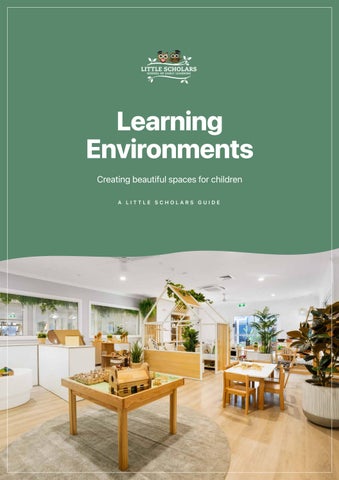
Learning Environments Creating beautiful spaces for children A LITTLE SCHOLARS GUIDE
“Environment as the third teacher” LORIS MALAGUZZI
What do our overarching documents say about learning environments?
ONE
TWO
THREE
FOUR
Campus Philosophy
Early Years Learning Framework and My Time Our Place
Quality Area 3 — Physical Environment
Theorists and current research 02
LEARNING ENVIRONMENTS
What our documents say What does our Campus Philosophy say? Environment
Our environment is designed to evolve with the children’s interests, ideas, play and developmental capabilities. We endeavour to create an extension of the child’s home; a place where they feel safe, secure and comfortable. Environments promote multi-age play and experiences, supporting peer interactions and collaboration. The indoor and outdoor spaces allow children to feel connected to the natural world, fostering a sense of responsibility to contribute to a sustainable environmental future. The environment is enriched with possibilities that allow children to construct new experiences, make new discoveries, and develop and acquire new skills.
What do the National Quality Standards say?
Quality Area 3 — Physical Environment
Indoor environments are characterised by open spaces that provide children with opportunities to be involved in self-chosen and negotiated experiences, or routines with small and large groups.
What do our frameworks say? Practice — Learning Environments
Welcoming, safe and inclusive indoor and outdoor learning environments reflect, respect and affirm the identities and enrich the lives of children and families. Educators plan and provide both active and calming spaces, as well as times in the daily schedule for active and quiet play.
03
First Impressions
ROOM ENVIRONMENTS · A LITTLE SCHOLARS GUIDE
Clutter, mess and disorganisation can lead to a chaotic classroom. Your room should smell fresh and clean, and there should be lots of evidence of children’s learning. The environment should offer a large range of opportunities for children that are age appropriate and part of the written program.
The environment should be light and airy, with calm colours, indoor plants, and a sense of belonging for children.
ed, child friendly, welcoming. Organis
04
A LITTLE SCHOLARS GUIDE
Creating engaging learning environments Furniture in our campuses
We have several suppliers whom we purchase our furniture and equipment from. If you are requiring furniture or equipment, please check this list first. To ensure all our furniture and equipment is safe and of a high standard, please do not bring in items from home or donated furniture. All of our furniture and equipment needs to be clean and in good repair. If you have equipment in your classroom that is not in good repair, please inform your Campus Manager.
05
Spaces within the room
Use your shelving and furniture to create various spaces within your classroom. You can do this by moving the shelving off the walls (ensuring it is safe) and planning out your room to include spaces for all different types of play. SPACES MAY INCLUDE
Dining areas Dramatic play Art space Quiet space Big block play
Ensure you plan out the room so that it is functional. Think about lockers being at the entrance of the room, an area to wash hands near the dining area, and calming areas in a quiet part of the room. Think about the age of the children in your room as well as their stage of development, interests, culture and individual needs. It is also important that we include children’s voices when planning out the room.
06
Creating a homely environment
Use the items below to create warm, welcoming and homely environments. Cushions and throws Comfy seating areas Mats and rugs Plants
Frames Artwork Mirrors
07
Interesting, organised and accessible
Your learning spaces should be interesting for children and well organised. Ensure children are able to access all the items they need in particular spaces — for example, children should have access to various art supplies in the art area, and all the items they need for eating and drinking in the dining areas. Your learning spaces should be thoughtful, purposeful and be planned from the ideas and interests of the children, as well as teaching them about new concepts. They should be a reflection of your program, and children should have long periods of uninterrupted play to explore.
Art areas
These areas should include a wide range of materials for children to use and explore, easily accessible for children. These can include:
Paint, pencils, paint brushes (of various sizes), paper and cardboard, charcoal pencils, playdough and clay, glue, pastels, watercolour paints, sticky tape, masking tape, string, twine, stapler, natural materials, pipe cleaners, cardboard tubes, boxes, textured paper and scissors.
The use of templates and colouring-in should be limited.
08
09
Dramatic play areas
Dramatic play areas should be filled with open-ended items for a range of different role play. THESE CAN INCLUDE
Table, chairs, stove, sink, washing machine, metal pots and pans, wooden and metal bowls and spoons, baskets, ceramic cups and plates, dolls beds, various dolls, dolls clothes
and blankets, dust pan and broom, materials, and items to promote literacy and numeracy — recipe books, posters and calculators.
10
Construction play areas
The construction space should be a large open space where children can build and create with various materials. MATERIALS ON OFFER COULD BE
Lego, Duplo, wooden blocks, driftwood, wooden slices, fabrics, sticks, pinecones, stickle bricks, planks, people, trees
and treehouses.
11
Final tips and takeaways A well thought out and well designed learning environment can ensure children and educators remain calm and engaged throughout the day. It is important that everyone plays a part in the learning environment set up, pack down and upkeep — including educators and the children. All spaces should be set up, organised, in good repair and inviting for children.
Written agreement
I agree to follow the Little Scholars learning environment guide. I will ask for assistance if any furniture or equipment is in poor condition, broken or needs replacing. I understand the procedure in place for requesting certain items for the room and outdoor learning spaces.
NAME
SIGNATURE
CAMPUS
DATE
12
VISUAL GUIDE
Whole rooms
Organised, functional rooms planned into clear spaces — light and airy, with calm colours, plants and evidence of children’s learning.
ZONED STUDIO · SHELVING OFF THE WALLS
LABELLED SPACES
ROOM FOR MOVEMENT
ACTIVE AND CALM TOGETHER
CONNECTED TO OUTDOORS 13
VISUAL GUIDE
Zones and corners
DRAMATIC PLAY
QUIET SPACE
HOMELY AND INVITING
CALMING AREA
CHILDREN’S LEARNING ON SHOW
AN EXTENSION OF HOME
14
VISUAL GUIDE
Materials and details
OPEN SHELVING, IN GOOD REPAIR
OPEN-ENDED CONSTRUCTION
ACCESSIBLE ART MATERIALS
CULTURE AND IDENTITY
REAL TOOLS, REAL MATERIALS
15
THE SCHOLARS GROUP