
Chloe Aridjis
Carlos Fonseca
Claudia Salazar Jiménez
Eduardo Sánchez Rugeles
Alejandro Jodorowsky
Jorge Enrique Lage
Lina Meruane
Michel Laub
Ant ônio Xerxenesky
G. Bostock
Guadalupe Nettel
Fernanda Torres
Julio Paredes
Rafael Gumucio
Natalia Toledo
Editor- in-Chief
Eric Akoto | eric.akoto@litro.co.uk
Assistant to editor
Barney Walsh | barney@litro.co.uk
Art Director
Elina Nikkinen
Head of Development & Partnerships
Maria Salvatierra
Arts editor
Daniel Janes | arts@litro.co.uk
Online Editors
James Cook | essays@litro.co.uk
Catherine McNamara | fash@litro.co.uk
Hayley Camis | tuesdaytales@litro.co.uk
Subscription enquiries
subs@litro.co.uk or +44 0203 371 9971 USA: 646 519 2452
All other enquries info@litro.co.uk
Te Publisher would like to thank Francesc Puértolas, Ariana Pérez-Castells & all at Instituto Cervantes, Te London Library, Te British Library, Fiona Balch, Barbara Sibley, Isabelle Dupuy, Ian Kelly, Jim James, Carolyn Greer, Liz Koch, Diego Gomez Pickering, Chloe Aridjis.
We aim to discover new and emerging talent and give them a platform to be read alongside stalwarts of the literary and the creative arts scene.
Litro Magazine believes literary magazines should not just be targeted at writers themselves, or even those with a particular interest in literature, instead Litro believes in reaching the general reader, that time short busy city dweller wanting an escapism through stories, whether they be a commuter, someone browsing in a bookshop or in a bar or café to meet a friend. We believe fction should be enduring, not disposable, and as such Litro in print, is specially designed to ft in your pocket or bag we think of it as a small free book.
We’ve had some success, having helped kick start the literary journeys of several glimmering writers to acclaim, such as Richard House, 2013 Man Booker Long list, Stuart Evers, Naomi Alderman, Clare Wigfall, Nikesh Shukla and many more.
Literature isn’t something that can be read by skipping from the frst paragraph of one story to the frst paragraph of the next, as you would a newspaper. Instead each piece deserves and demands to be read in full, and later considered.
We hope you enjoy and share the stories within these pages.
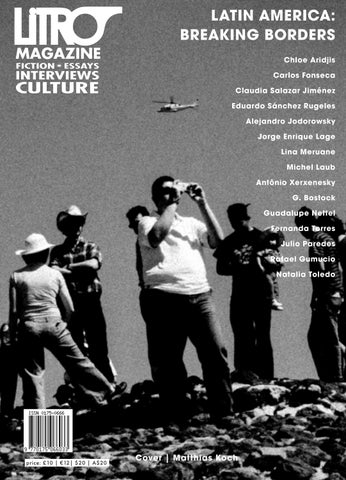
Cover image
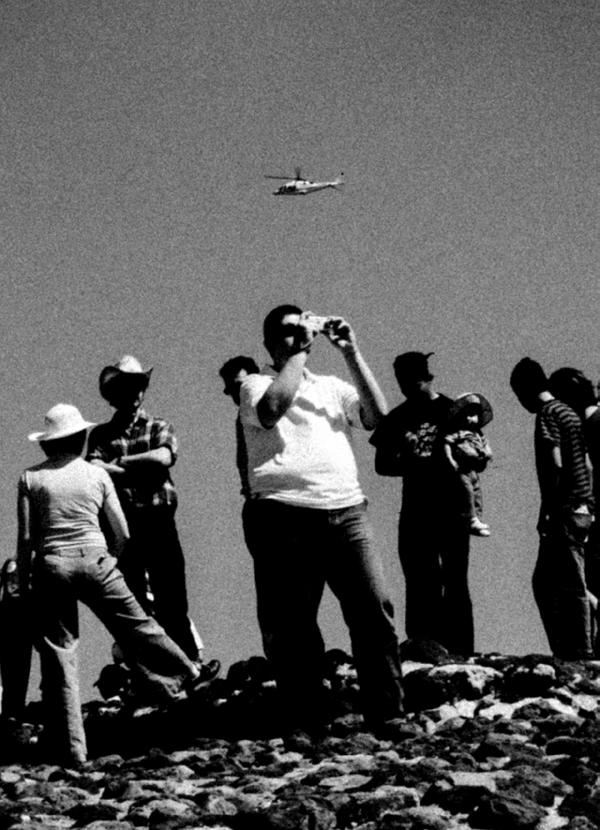
Pyramid of the Sun, Teotihuacan Mexico, in 2008 by Matthias Koch
© Litro Magazine LTD October 2017
Eric Akoto, Editor-In-Chief www.litro.co.uk @LitroMagazine @LitroMagazine

by Matthias Koch
Tell us about Pyramid of the Sun, Teotihuacan
Te Pyramid of the Sun at Teotihuacan and its tourist attendance is for me the symbol of a certain globalization and at the same time a clash of civilizations, but without the knowledge of the protagonists.
Mass tourism tramples on the refnement of pre-Columbian culture with the visitors naive belief to be able to meet these past worlds. Globalisation and the relationship to the world that tourism and our mass consumer societies represents, is a closed door on oneself that forbids any encounter with an unexpected otherness.
What's your relationship with Mexico?
I lived in Mexico City for four years. Mexico, I am not the only one to say so, is the most surrealist country I have ever lived in. Mexico is also a country with an incredible cultural richness, a continent of its own. In one lifetime you will explore only a fraction of this immense ocean with its vertiginous depths.
As a photographer I felt a kind of ecstasy foating in the limpid light that many parts of Mexico ofer. But it is also a country and a culture in which violence is omnipresent, death is not a taboo, but a daily companion, life is all the more intense.
What are the ideas you're trying to capture in your photography?
My photographs show fragments - Stücke, pieces, bits and pieces - of our world.
Tey deliver a vision by which I try
to capture visual fragments like so many samples of the contemporary world in its increasingly homogeneous planetary indiference that makes it irrelevant whether the cliché was taken in Amsterdam or Hong Kong, whether it is in Athens, Caracas or France.
As the french Philosopher Claude Molzino wrote about my my work: ...it is precisely this isotropic and isomorphic space of the levelling, overwhelming modernity, crushed under the reign of technology and calculation as the only ontological standards that we have to face up to. Te close and distant, the familiar and the exotic appear in the same light, the everyday banality of here and elsewhere reveals its identity in the sense of an apparent similarity. ...But the photographer's eye aims to reveal its identity in the sense of essence...
Indeed, my photographic gesture is animated by a philosophical spirit that wants to reveal, make known, bring to questioning and thus to the dimension of meaning.
"Photography is for Matthias a tool for philosophical investigation and research of truth as well as a vehicle for artistic expression"
And to be challenged, the world is questioned, which often gives my images a taste for violence when they are never violent, neither intrusive nor voyeuses, but it is the way of dealing with the image that causes it, the style that is specifc to the photographer and that is inseparable from my vision.
Where do you take your inspiration?
I take pictures of everything that interests me, of what surrounds me, of what calls my attention, mostly without a project in mind. Often some pictures only come to the surface of consciousness after years, like fotsam, which suddenly lies on the beach one morning. It starts with two or three images, the frst islands of an archipelago that occupies its place in my mental geography, a new project is born !
When I take pictures I try to stop being rational. I rather try to use my intuition and work with my instincts.
Literature, like visual arts, music, but also human encounters, is part of the food that feeds my imaginary universe, the imaginary that sometimes materializes in a picture.
X
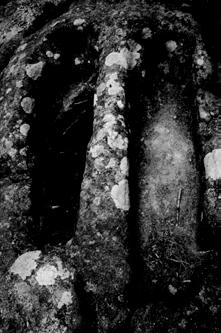
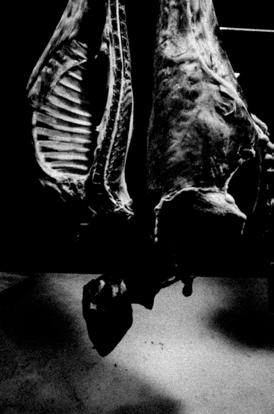
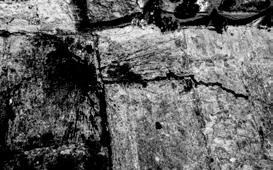
Eschatology XII
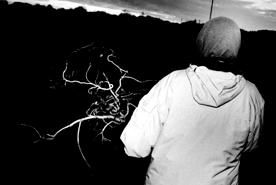
Eschatology IV
Eschatology XV
Contributors
Guest Editor's Letter by Chloe Aridjis
Figures over the Strait
I Understand - Rafael Gumucio
Moving Borders - Guadalupe Nettel
T e Temptation of Hope
Daily Resurrection - Alejandro Jodorowsky
Borders - Michel Laub
Sleeping Beauties - Lina Meruane
Poems - Natalia Toledo
Border Triptych - Claudia Salazar Jiménez
T e Last - Carlos Fonseca
Bulletproofed - Fernanda Torres
T e Fortean Limes - Yoss
Rotterdam - Julio Paredes
Guillermo Cabrera Infante: An Interview with Miriam Gómez
- Eduardo Sánchez Rugeles - Jorge Enrique Lage - Carlos Fonseca
Bahía de Acapulco - G. Bostock
In Transit - Antônio Xerxenesky

Chloe Aridjis grew up in the Netherlands and Mexico. She studied comparative literature at Harvard followed by a PhD at Oxford in nineteenth-century French poetry and magic shows. Her frst novel, Book of Clouds, won the Prix du Premier Roman Etranger in France in 2009. Her second novel, Asunder, is set in London's National Gallery. Chloe was the recipient of a Guggenheim Fellowship in 2014. She recently co-curated the Leonora Carrington exhibition at Tate Liverpool (2015) and is starring in an artist's feature flm, “Female Human Animal,” directed by Josh Appignanesi, for release in 2017. She has just fnished her third novel, Sea Monsters, due for publication in spring 2018.

Carlos Fonseca Suárez was born in Costa Rica in 1987 and grew up in Puerto Rico. His work has appeared in publications including Te Guardian, the TLS, and Te White Review. He was recently selected by the Hay Festival as one of the 39 most promising Latin American writers under forty. Colonel Lágrimas (Restless Books) is his frst novel. His new novel, Museo animal (Anagrama) is forthcoming this autumn. He teaches at the University of Cambridge and lives in London.

Jorge Enrique Lage is a Cuban writer and editor. He’s published the books of stories El color de la sangre diluida (2008) and Vulturefect (2015), and the novels Carbono 14. Una novela de culto (2010), La autopista: the movie (2014) and Archivo (2015).

Lina Meruane, a writer from Chile, has authored short stories and four award-winning novels – the latest was translated into English as Seeing Red (Atlantic Books). She has also published three essay books. A professor at New York University, she is currently enjoying a grant from the DAAD Artists in Berlin Program. Photo by Daniel Mordzinski

Michel Laub was born in Porto Alegre and currently lives in São Paulo. He is a Writer and journalist, and has been named one of the Granta’s twenty ‘Best of Young Brazilian Novelists’. Two of his books are translated to English and published by Harvill Secker: Diary of Te Fall, shortlisted for the 2016 International Dublin Literary Award, and A Poison Apple. Photo by Renato Parada

Antônio Xerxenesky was born in Porto Alegre, Brazil, in 1984. He is the author of the short story collection A página assombrada por fantasmas (2011), and two novels, Areia nos dentes (2008), and F (2014).

G.Bostock (Kenneth G Bostock, Mexico City) is a poet, architect and conceptual artist. He currently is based in London, having in the past lived in Sao Paulo, Mexico City, Los Angeles and Copenhagen. As a poet he has published eight works both in Spanish and English focusing formally on the long poem as conceptual riposte. He was a participant in the Serpentine Gallery Poetry Marathon curated by Hans Ulrich Obrist and was a contributor to the literary almanac Mandorla: New Writings from the Americas. He currently is working on a series of pieces exploring geological traits in language inspired by travel notes written in Iceland.

Guadalupe Nettel, a Bogotá 39 author and Granta “Best Untranslated Writer”, has received numerous prestigious awards, including the Gilberto Owen National Literature Prize, the Antonin Artaud Prize, the Ribera del Duero Short Fiction Award, and most recently the 2014 Herralde Novel Prize. She has published two English-language works of fction with Seven Stories Press, Natural Histories (2014) and Te Body Where I was Born (2015).

Fernanda Torres was born in Rio de Janeiro in 1965. She is an actress and writer. She has enjoyed a successful career in the theatre, cinema and on television for thirty-fve years and has received many awards, including Best Actress at the 1986 Cannes Film Festival. She is a columnist for the newspaper Folha de São Paulo and the magazine Veja-Rio and contributes to the magazine Piauí. Her frst novel is Te End.

Alejandro Jodorowsky is a ChileanFrench flm and theatre director, screenwriter, playwright, actor, author, poet, producer, composer, musician, comics writer, and spiritual guru best known for his avant-garde flms.

Eduardo Sánchez Rugeles is the author of the novels Blue Label / Etiqueta Azul (2010), winner of the Ibero-American Novel Prize Arturo Uslar Pietri; Transilvania Unplugged (2011); Liubliana (2012), winner of the International Literary Prize Letras del Bicentenario Sor Juana Inés de la Cruz and of the Venezuela’s Critics’ Prize 2012; Jezabel (2013); and Julián (2014).

Julio Paredes is a Colombian writer, editor and translator. He is the author of collections of stories (Guía para extraviados, Asuntos familiares and Antología nocturnas, among others), novels (La celda sumergida and Cinco tardes con Simenon), and the biography Eugène Delacroix, El artista de la Libertad.

Born José Miguel Sánchez Gómez in Havana, Cuba, in 1969, Yoss assumed his pen name in 1988, when he won the Premio David in the science-fction category for Timshel. Since then, he has gone on to become one of Cuba’s most iconic literary fgures – as the author of more than twenty acclaimed books, as a champion of science fction through his workshops in Cuba and around the world, and as the lead singer of the heavy metal band Tenaz. His two novels translated into English are A Planet for Rent and Super Extra Grande.

Claudia Salazar Jiménez is one of the most recognized Peruvian writers of her generation. Her debut novel Blood of the Dawn was awarded the Las Americas Narrative Prize of Novel in 2014. Her most recent publications are the collection of short stories Coordenadas Temporales (2016) and the historic novel for young adults 1814: año de la independencia (2017). She is currently based in New York City.

Rafael Gumucio is a Chilean writer and comedian. He has worked as a journalist for many national newspapers in Chile and Spain, as well as for in the New York Times, and is the author of the novels Comedia Nupcial (2002), La deuda (2009), Milagro en Haití (2015), and El galán imperfecto (2017).

Natalia Toledo (born in Juchitán, Mexico) was the frst woman to write and publish in the indigenous language of Zapotec. She has published four volumes of poetry in bilingual form (Isthmus Zapotec and Spanish). Her poetry has been translated into English, French, German, Vietnamese, and Italian. In 2004 she received the Premio Nacional de Literatura Nezahualcoyotl for her book of poetry, Guie' yaase'/Olivo negro.

Matthias Koch is an artist and photographer originally from Germany. He lived and worked in Chile, Venezuela, Mexico and France and currently established his base camp in the South of France. Photography is for Matthias a tool for philosophical investigation and research of truth as well as a vehicle for artistic expression.
Dear Reader,
We are living at a time when borders and frontiers – dividing lines of all sorts, both geographical and ideological – form part of everyday discourse. It is a time of mass migration and countless individual ones. In Latin America some borders are more fraught than others. Litro invited authors from eight of its countries to write about their own experience of boundaries, real and imagined, resulting in a bold array of poetry, fction and essay.
Rafael Gumucio, who also moonlights as a comedian in Chile, ofers a playful account of an English class and the tensions and camaraderie that inevitably arise when diferent nationalities share the same space. In fragments of trenchant prose, his compatriot Lina Meruane tells a real tale of child refugees, setting their fate against the ominous spectre of bird fu. Alejandro Jodorowsky, cult flmmaker and Tarot card wizard, presents a bleak poem, heavy in apocalyptic tone and imagery.
From Mexico we have Guadalupe Nettel, whose experience of borders began as a child and became thornier over time, courtesy of immigration ofcials in France and the United States, leading to the realization
that the most difcult border of all to overcome is prejudice. Anglo-Mexican poet Kenneth Bostock’s training as an architect can be seen in his experimentation with form and linguistic angles. Natalia Toledo, a Zapotec poet from Oaxaca, creates images that evoke the sense of vulnerability and impermanence that haunts indigenous cultures whose very survival is increasingly threatened.
Julio Paredes (Colombia) is also a translator of Edgar Allan Poe and William Faulkner; his own work bears traces of that psychological complexity and conficted habitation of space. Eduardo Sánchez Rugeles from Venezuela captures the tremendous anguish felt by the younger generations as they witness the gradual breakdown of civil society. His cri du cœur for his aficted country feels more urgent than ever. In her narrative triptych, Claudia Salazar Jiménez (Peru) moves through female domestic interiors as well as museum space, demonstrating how most boundaries are more than mere wall.
From Cuba we have Yoss, who straddles the worlds of science fction and heavy metal; here he takes the concept of borders to absurdist extremes, envisioning a wild scenario whereby crossing from one
country into another teleports you to a third, distant location. Jorge Enrique Lage’s narrative, meanwhile, covers a 45-minute fight from Havana to Miami, his journey accompanied by personal musings on Cuban literature, a literature tightly entangled with the nation’s history and geography.
Carlos Fonseca Suárez (Costa Rica/Puerto Rico) ofers the tale of an anthropologist and the fxed idea that drove him to insanity; fear of the other becomes a vehicle for a cultural exploration of sickness and solitude. We also include an interview Carlos conducted with Miriam Gómez, the widow of Guillermo Cabrera Infante, a dialogue that opens many windows onto the exiled life of the great Cuban writer in London; from his desk he resurrected his native Havana, but he also drew inspiration from local literary and cinematic history.
Brazil ofers us three very diferent voices: Michel Laub’s brief, enigmatic text is a hymn of disillusion while hinting at the narrator’s own complicated backstory, while Fernanda Torres explains the need, current and historical, to draw boundaries around oneself, leading to her decision to acquire a bulletproof car. Antônio Xerxenesky’s essay
can be read as a coda to our issue, a meditation on the multifaceted relationship between writing and borders.
Where does the self end, where does the rest of the world begin? For the writer who remains at home or the writer who goes abroad, the issue of boundaries remains vital, adding tension to our daily existence, defning the ways in which we relate to others. All our authors have added to the ongoing conversation. And on a fnal note, I would like to extend a very special thanks to the talented translators who worked on this issue. Teir mission, a particular kind of border crossing, is much appreciated.
Chloe Aridjis Guest Editor
Havana to Miami … via Serpa & Hemingway, Flores, Arenas, García Vega, Gustavo Pérez Firmat… Jorge Enrique Lage - Translated by Lorna Scott Fox
How long is the fight between Havana and Miami?
You settle into your seat, have a soda and some nibbles and gaze for a while through the porthole at the clouds foating over a narrow band of sea, the famous ninety miles. Ten you go to the toilet. You might have time to open a book, but the landing manoeuvres will probably interrupt before you’ve read more than a couple of pages.
Around forty-fve minutes.
But it’s not a bad idea to get a book out on the plane. Not to read, but to rife through or just so it’s there, like another passenger. A stowaway. A book to be not read but shown, thousands of feet up in the air, as literary product placement, as performance.
A geopolitical statement written in the air.
It occurs to me that such books should be Cuban ones, at once attesting to (free?) passage, the state of transit, and turning it into something more complex. Books with something to say by their mere presence on this plane, which for the space of less than an hour is neither in Cuba nor in the United States.
Forty-fve minutes. But sometimes, especially when you start thinking and choosing what books would ft the bill, it feels like barely fve.
As I write this I’m thinking that next time I fy to Miami (I live in Havana) I could take, for example, the latest edition of Contrabando, by Enrique Serpa (1900–1968), an author who is little known outside the island.
At the start of the novel, frst published in 1938, the main character, who owns a fshing schooner, hears about a US writer who likes to fsh in Cuban waters. He obtains a photograph of this writer-angler and pins it up in his cabin. “And whenever someone inquired” – I reread, with amusement – “about that broad American face, beaming with health, I would tell them that it belonged to a millionaire friend of mine.”
Ernest Hemingway, of course.
Serpa and Hemingway hit it of during the latter’s frst visits to Cuba. Two thirtysomething guys wandering the streets of Havana, discussing women (hookers, presumably), carousing at one bar after another. Few close encounters between Cuban and US literature have been as strange and signifcant as this one.
Hemingway was then on the eve of being famous. He wasn’t yet a millionaire; he was a long way from buying his fnca on the outskirts of Havana. He embodied “the good neighbour”: an afable, modern fgure, and a moderniser. Serpa’s novel turns the American
friend into a picture postcard, a cabin cameo. With a kind of afectionate dig in the ribs, it anticipates the Hemingway of the trope (of the tropics), the Hemingway for Dummies whose subtitle would be Te Old Man and the Sea.
Te point is, the schooner in Contrabando is not engaged in deep-sea fshing. In times of economic crisis, fshing – suggests Serpa by means of this winking “American Hemingway of Life” – is just a hobby for idle tourists. Te title of this novel set in the late Twenties says it all. Prohibition is in full swing. Barrels of rum bought for a song in Havana sail up the corridor of the Florida Strait, borne on the Gulf Stream across the invisible border between Cuba and the United States.
At the end of the story, the boat that was adorned early on with a portrait of the author of Te Sun Also Rises drops anchor in darkness, laden with cargo, on the Sanibel coast south of Tampa. A mafa yacht comes to meet it and handle the transhipment. American dipsos (Hemingway himself died an alcoholic) depend on these unofcial transactions for their supplies.
When the liquor has changed hands, rolled from one deck to the other, the crew cheer and throw their caps in the air. Suddenly one of them hoists a Cuban fag on the main mast. Te yachtsmen smile, “surprised and tickled by this show of tropical enthusiasm”, writes Serpa with deadpan irony (revealingly, Contrabando is one of the most ironical novels in all Cuban literature).
I think something else is going on here, submerged in the sea beneath the enthusiasm. Something which the Florida mafosi are unable to grasp. Tis is a scene of frank complicity, but also of profound lack of communication. A scene that features, besides, one of the best appearances of the fag as “patriotic symbol” that I know of in our literature.
A smugglers’ fag, almost a pirate fag, raised out of sight of the Yankee coastguard, in the dark of night.
What more could one want.
Two
Te regular Havana–Miami fight is a quick hop over ravaged territory, over a surface teeming with foating ghosts. Te passengers know it, don’t know it, forgot about it or don’t think about it.
Te wings and portholes of the plane have stopped refecting the glimmer of fshing boats, though there are still some yachts and cruise ships. What the sea casts most insistently into the sky are darker sparks, the remains of shipwrecks.
Forget the famous Bermuda Triangle, not far from here. Surpassing such hoaxes comes a key fgure for Cuban history of the 1990s and early 2000s: the balsero. Te raft person, the migrant who sets out to cross the ninety miles of the Strait on his makeshift craft – primitive, cobbled together in haste, almost always preposterous – in pursuit of the American Dream. Which the powerful prefer to call the Empire’s Siren Song, or something.
Te balseros constitute an entire artistic, narrative and sociological genre, one that by defnition blends the wave and the swarm. We are talking about hundreds and thousands of vulnerable sailors, surrounded by water and sharks, thirsty and famished and exhausted by rowing, sensing perhaps the proximity of death as they lull themselves with optimistic rhymes and songs, not siren songs now but childish ones, the sort their nurses used to sing. Te cradle
and the grave, so close to one another there, the personal and unique images touching both extremes, fusing and melting together in the stampede of tropical socialism, the destiny of everyone and nobody.
In a poem by Juan Carlos Flores I read:
I would have liked to sign up for that caravan, and play harmonica all the way to the green fres of Miami Beach.
Nana, in celebration, on the other side of it all, if there is another side to it all, save another plastic bag for me.
An artist and poet, a punch-drunk survivor of horror, the author of these lines committed suicide in Havana less than a year ago. His last book, published in 2009, is titled Te Counterpunch (and Other Horizontal Poems). It is an extraordinary work, imparting to the reader a solid lesson in impoverished material resources. As I read on, I seemed to see Juan Carlos Flores working with that very thing: plastic bags. I understood how he wrote with his hands full of swatches of nylon, and ropes and rags and home-made masts, and the punctured inner tubes of ancient trucks.
Because the poet, who never did sign up with the balseros, assembles here his texts that they may foat, horizontally, like the rafts. His balsa-poems resemble mixed media installations involving plastic, rubber, wooden planks; their tempo is the beat of urgent, improvised hammering. Getaway poems, poems for feeing into the unknown. Te counterpunches of a battered writer.
Now I’m thinking about Flores, whose name means fowers, and thinking about that archipelago blooming with wreckage, that marine graveyard beneath the shadow of the plane, south of the Florida Keys. Te balseros are ever fewer, and will soon disappear altogether: many reached their goal, many turned back, but most were drowned, lost, there will never be “another side to it” for them. And yet, foating in our heads, the crucial thing remains. Not the bodies, but the stray leftovers of what once were rafts; all that trash made up of materials as enduring as they are fragile, like a third-world collage.
We still have these materials handy. You can’t easily wipe them of the map. And I say we should keep them, as he wanted us to, the horizontal poems man who killed himself. Just in case.
Te border between Cuba and the USA, that bleeding gash, will heal little by little among the waves. But, never forget it, the scarring will be asymmetrical. A reconstruction in which the poorest, the children and grandchildren of the barbarous migrants, the least civilised nomads, will occupy the shabbiest back rooms.
To continue living on this island means to continue fnding ways of continuing to deal counterpunches
Te migrant stream that defed the Gulf Stream reached its height during the so-called Balsero Crisis of 1994. Te year 1999 saw the posthumous publication of what is, for me,
Reinaldo Arenas’s masterpiece: Te Colour of Summer. In this delirious parody, Cubans take to the water like sharks to gnaw away the island’s rocky moorings, detaching it from the sea bed. Te island is cast adrift. Te whole of Cuba plies the waves.
We read:
It was of, it was away. Te Island was sailing away. Tis was not some army recruit fed up with the abuses of the military, throwing himself into the sea on a truck tyre; not some muscular black man driven by discrimination to paddle away on a plank; not some family launching themselves into the Gulf on a raft made from the dining-room table; nor was it even thousands of people feeing on anything that foated in search of an uncertain but at least hopeful future. No, it was the country itself, breaking away in a geological, geographical stampede. A novelty in the history of exoduses: the Island of Cuba, cut loose from its foundations, breasting the high seas like an enormous ship.
Te mother ship of science fction. Good literature, the best, is apt to pre-empt things. It winds forward like a clock. Te great Arenas wrote this fantasy in 1990, the year of his death (sufering from AIDS, he killed himself in New York), and gave us a peek at the future in exacerbated form.
First, barrels of illicit liquor are ferried northward; then the barrels are, like so much else, converted, souped up – hot-rodded – and multiplied into rafts; fnally, the whole island becomes a raft and a prodigy of smuggling in itself.
It’s no accident that, in Te Colour of Summer, the island’s breakaway occurs after the chapter about the death of Virgilio Piñera. His long poem “La isla en peso” (Te Whole Island), one of the most famous works of Cuban letters, begins with this equally famous and oft-quoted line:
“Te damned fact of water on every side”.
Among Cubans, it’s enough to mutter “the damned fact” and everyone knows what you’re talking about. It has become a mantra, a hallmark, a national motto.
Te weight of the whole island. Te weight of borders made of water. And over time, this has devolved too into the dead weight of a dictatorship, the weight of a virtual, unrelenting war footing, the nightmare weight of isolation in an ideological trench.
Reinaldo Arenas worked on these gravitational coordinates. To lighten, to alleviate. Cubans like to say that ours is an “island of cork” – unsinkable. Tis popular notion has a double cutting edge.
Te migrant condition is like a “damned fact” applied to the entire country. It means there are no longer any maritime frontiers: Cuba is motion, a back-and-forth across the sea, and therefore is itself a frontier. A frontier without a country.
Te Colour of Summer will be essential reading when Castrism ends. I shall not divulge the ending here; we already anticipate a massive shipwreck. But just before the expected shipwreck, some questions are inevitable: where is this foating island headed? Is there some magnetic pole that draws it along?
We can also anticipate a prompt answer, of course. One that may appear clear, rational and defnitive, especially from a plane fying over the Florida Strait. But no, it is thoroughly obscure, and anything but simple.
Now I’m leafng through Cuaderno del Bag Boy (Te Bag Boy Notebook), by Lorenzo García Vega, brought out last year by the stylish imprint Casa Vacía, of Richmond, Virginia. Another posthumous book: the author, deceased in 2012, left a treasure trove of unpublished papers to be fought over by all the small independent presses in Cuba.
An avant-gardist writer in the minor tradition of Latin American “oddballs”, by the time of his death García Vega was revered as a cult hero, wielding a secret infuence over Cuban letters. His unclassifable, often autistic works are like hybrid scrapbooks mixing autofction, poetry, journal, dream diary and other highly disparate fragments. In them, the site of his lengthy exile is revisited over and over: the city he learned to live in and where he died.
Miami, the capital of the Cuban diaspora.
Miami, alias the “Cuba of the North”.
Miami as our tentacular projection, “the place in Cuba nearest the States”, as a friend quipped once. A joke seriously intended, a mighty truth disguised as a bit of fun. Because Miami is a frontier: the one we established there. And there, as on any border, forces of attraction coexist with forces of repulsion, the state of passing through with that of being nowhere, ceasing to be one thing with growing to be another.
Miami is where Cubans are more Cuban than ever. At the same time, Miami is where they are more “Latin” and less Cuban than ever.
In Lorenzo García Vega’s books, the border is a part utopian, part dystopian place called Albino Beach. Albino Beach is a spectral version of Miami; a disfgured, rarefed, Cuban-white-trash Miami. A cult Miami, you might say, an auteur Miami: oneiric neon suburbs, supermarkets littered with abandoned trolleys and useless knick-knacks, barren lots that drive you mad or turn you into a mutant.
Far from Flores’s “green fres of Miami Beach”, in Albino Beach the water is no longer on all sides, as Piñera had it, but nowhere to be found. Tere are no breakers here, no ocean currents, at best a few clogged-up canals are all that surrounds us in the midst of emptiness. Because where there’s no water there’s no enclosure, and without enclosure there’s no hope, no luminous future. Te bleak habitat of Albino Beach is our Ciudad Juárez.
“Albino Beach is my way of being Cuban-American,” García Vega once explained. To which I would add: it is also, for many readers including myself, a form of the literary imagination that has redrawn the boundaries – both physical and emotional – of the CubanAmerican Dream.
If something like that exists, or ever did.
Five
I have a superstitious fear of aeroplanes. As we prepare to land, I tell myself it’s time to stop communing with the dead and to listen to the living.
Te last time I few to Miami it was for the Book Fair, where I was to converse with Gustavo Pérez Firmat, a Cuban essayist, poet and professor at Columbia University, who has lived in the States since he was a child. In our preliminary email exchange, the topic of bilingualism came up, and Gustavo wrote as follows:
Two Objects in a Storm - Ashley Parker Owens
“Sometimes when people ask me why I write in English, I say it’s so future generations of Cubans can read my work. Miami may well end up as part of Havana – Ultramar [Overseas] – but Havana could just as well end up as a suburb of Miami: Hialeah by the Sea.”
Gustavo is a scholar of so-called Cuban-American culture (personally, I fnd the composite adjective increasingly redundant: nowadays, Cuban culture is Cuban-American almost by defnition). His most eminent book is Life on the Hyphen, a highly lucid work that approaches hybridity as a phantom zone, swept by currents of contact and contagion between two cultures and two hegemonic languages.
Let me conclude with an admission of ignorance, or obtuseness, something I never told Gustavo: it was only when I read the prologue to the Spanish version that I got what Hyphen meant.
I don’t know how come I never got it before, or why I didn’t look it up. Everything became clear: the book was about life on that hyphen between Cuban and American, the tightrope act on that small borderland line, the bridge between here and there, between Spanish and English, the connection that severs us, the disconnection that also connects.
Until that moment, I swear, I’d always thought the Hyphen in the title was a geographical term meaning Strait. Te Florida Hyphen. An aural efect that must have touched of who knows what chip in my Hispanic ears: it sounds vaguely like fujo, fow.
Depths, whirlpools, bottomless wells …

Rafael Gumucio - Translated by Lorna Scott Fox / /
I’m a Chilean, after all. I’m not free.
According to the education minister, anyone who doesn’t know the language of Shakespeare may as well be illiterate. Twice over in my case, since I live in New York and have just married an American. In a bid to correct this double ignorance, I submitted at the age of thirty-fve to four hours of intensive English a day, from which I emerged with a few I can’ts and I don’ts, but having learned lessons about the world and myself.
Te new crop of students at Embassy (a language institute ofering immersive English courses in Britain and North America) has gathered in a classroom to fll out an endless test. I peruse the material and, with the aid of Beatles songs, snatches of movie dialogue, bits of French and my Spanish, I feel quite sure I understand the whole thing, and can easily dodge any grammatical traps.
Later I get a personal interview with a rather mannered teacher called Tom, and my confdence comes crashing down. He has scrawled, in red, a furious -16 on my paper. My comprehension is poor, he explains, and my grammar is worse. He writes down my level: just one notch above the total beginners.
After that we return to the classroom. Tere are ffty of us, aged between twenty-fve and forty, a mixture of Japanese and Koreans, plus a Russian girl who could be a supermodel and an Italian Swiss determined to chat to everyone. George Shapiro, the studies supervisor— attired for the occasion in a red tie and platform shoes (without which he measures about 5ft 3)—delivers the welcome speech.
“Congratulations. You’re in the best city in the world,” he begins. Ten, with a joviality that doesn’t fag for a second, he unleashes a tsunami of jokes about the school and its staf, peppered with commands, warnings, smiles and more smiles. He introduces us to the teaching team (who appear one by one, like the crew of Te Loveboat).
“So, where did Michael Jordan learn to play basketball?” Shapiro asks.
We all remain tongue-tied, we’ve no idea. He answers for us:
“In the street. English is like basketball: you can only learn it through practice. Tat’s why we expect you to take part in our extracurricular activities.”
Cue Debora, a Brazilian woman with a sexy twang in English, who invites us to join her for an expedition to Amish country, a jazz breakfast at the Blue Note, and a meal in a restaurant in Little Italy (of course, none of these activities come free).
Te welcome ceremony (which lasts three hours) wraps up with a talk from Jonathan, a beardy version of Woody Allen. He tells us what to do in the event of fre (there’s only been one fre in ten years, but you never know) and stresses the no-smoking rule in the building, including corridors, because the other denizens of this tower already object to the
overgrown adolescents jabbering in every language and none who crowd the sidewalks, lifts and fre escapes.
“Tis is a wonderful opportunity to get to know a culture and a language. I hope you’ll make the most of it. Tank you and good night,” he concludes.
Monica must be about seventy. She’s fair and stout, and forever anxiously mouthing her words and waving her arms lest her charges miss a single vowel. More than half the students are Japanese or Korean, girls of indeterminate age equipped with a variety of pink bracelets, Hello Kitty cardigans and electronic dictionaries. Te western clan includes me, two zealous Brazilians, a young Catalan called Marc, and Sandra, a Sicilian lady who only ever wears jodhpurs and riding boots. I introduce myself:
“I’m from Chile, though my passport is French. I’m a journalist, marrying a New Yorker three months from now, and living three blocks from the Institute.”
“Yesterday”, “Satisfaction”, “Night and Day” … it feels like English has always been with me, clamped to my wrist as if we were a couple of chained convicts on the run. And then suddenly English takes of on its own, just like that, leaving me to deal with the cops. Monica, the teacher, asks me a question: “Why?”
I respond in Spanish: “Does that mean ‘how’, or ‘who’?” “In English, please,” Monica snaps. Just then, snow starts falling on New York. All the students rush to the windows to watch it come down, saving me from further interrogation.
Tere’s no better way to describe the efect wrought upon my mind by those four daily hours of English than by analogy with how snow alters the city beyond recognition. With patience and verve, Monica forces me to let go of every point of reference, from allpurpose phrases to song lyrics and vestiges of French grammar, and strike out alone into the infnite whiteness, sinking my feet into the freezing cold and scanning this empty nowhere for some lamppost or tree around which to reconstruct a mental map of my city, my language.
Maybe that crushing feeling of infantilisation is the reason why the Korean and Japanese girls seem so comfortable with the course. Tey look ageless, it’s impossible to tell if this one’s ffteen or that one twenty, which ones might be married with children and which are still virgins.
I am always being mobbed by giggling geishas begging to see a picture of my girlfriend, wanting me to sign their exercise books and tell them my name again. Before one group goes back to Tokyo, they take numberless photos of me to show to their friends.
Weeks Two and Tree
I’ve been promoted to Intermediate Level 2. My new teacher, Dany, is large and square, with an all-over shaved head. Dany is a cool guy. A Jew of German origin, he’s lived in Texas and London. He plays bass in a jazz band. For his frst lesson, he introduces us to the conditional as used in a song by Björk.
I sit next to Min, a very smiley, conscientious Korean architect, who can’t string two words together in English but scores top marks in grammar tests.
Outside, the snow banked on the sidewalks has turned to dirty mud riddled with footprints. Like when I was at school, I avert my attention from the irregular verbs in the
irregular sentences being parsed by Dany on the whiteboard, and think instead about how to divide up the time and other strategies to get me through the four hours, while doodling non-stop on some exam sheets.
People who learn a language always talk about a linguistic epiphany, the moment when everything that had been obscure and muddled coalesces in the mind with transparent simplicity. I am waiting for this moment while resisting grammar, intent on defeating it by dint of exceptions.
People also keep saying that English is a logical language, with a knack for synthesis, freedom and economy. But I am not logical, nor am I synthetic, and I’m a Chilean, after all. I’m not free. Rather than learn anything I’ll scuttle for shelter, I’ll be defensive, self-protective.
Weeks Four, Five and Six
Dany has come over all philosophical. He asks us what we think about turning the other cheek. Having to explain myself with resort to a very few, very general words (I am and I do, basically) obliges me to be weirdly precise, pruning all the branches of my thoughts until reduced to a shaky haiku to which Min responds, untruthfully, “I understand.”
Te same scene is replayed when Dany asks whether we agree that love is the most important thing, or whether we believe in life after death.
Min draws me a triangular house with a little dog outside, to convey his greatest dream. A house and a car and a dog. Western through and through. Min’s favourite dish is steak and chips; his favourite sport is baseball; top actor, Brad Pitt, top actress, Jennifer Aniston. Tese tastes are common to all the Korean men on the course. As a rule, the Japanese men sport fancier haircuts, and the women expose more chest and leg.
Despite the historical hatred between Japan and Korea, the two nationalities sit together on one side of the room, scarcely mixing with the Latin crowd. Tis now comprises: a dentist from Rio; Catalan Marc, who has started wearing rapper-style gold necklaces and bracelets over his neat, well-ironed clothes; Sicilian Sandra, always out to cheat in exams; and Chantal from France, who keeps in her wallet a photo of a dog rather than a boyfriend. Te Latins hog the limelight in class and win at all the learning games, only to fail dismally when it comes to the Friday exams. Te most conspicuous failures are mine: -16, -18. My marks are appalling. I keep trying to nudge the ball into goal with my hand, like Maradona, only to realise, too late, that the goal belongs to my own team.
Dany tells us a weird dream. His fancée, the love of his life, appeared dressed in white, leaning over a second-foor balcony, and then—ignoring Dany’s warnings—threw herself down to the stone courtyard. Tere, wounded and bleeding, she got up again, returned upstairs, and once more threw herself, smiling, to the ground, while Dany cried out in despair. Tis dream turned out to be premonitory, the teacher added. Time after time he’d attempted to save his fancée from her self-destructive impulses, and time after time she took no notice.
Dany is telling this story to an audience that cannot empathise or respond to it. We’re too busy trying to work out the verbal tense agreements in what he is saying. It may be our very condition as stuttering children that gives him the confdence to talk about his life without expecting advice or criticism, as gratuitously as if he was talking to himself.
But this doesn’t seem to mollify the Latin gang, who have sworn to frustrate Dany’s
grammatical ambitions.
It’s odd how well the Brazilians, the French, the Chileans and the Spaniards understand one another across our diferent languages. It’s not only a matter of Latin roots, but also of mental outlook. Catholicism, that unbelieving way of seeing the world (two thousand years of scheming and faith), that cynicism clad in sentimentality, makes us impervious to Dany’s confessions.
At last, Sandra complains to Dany on behalf of us all. He tries to get the Koreans to stand up for him—after all, he’s invited them to a bar in the Village to hear him play—but they remain noncommittal and Dany graciously ofers to change his teaching methods. More conversation, less grammar. Less philosophy, more practical dialogues.
I glance over at Min, who is tidying the exercise books, pencils and pencil sharpener on the top of his desk-chair. His best hope is to stay in New York, apply for a grant, get by with few or no friends, and yet he’s smiling at the whiteboard. He knows that if he hesitates, he’ll fall. If he thinks about it, he’ll back out. Te little house with the pitched roof, the pet dog, the steak and chips, all those hackneyed dreams, are his way of walking the tightrope without looking down at the ground or up at the sky, concentrating on every step, smiling at an audience that isn’t there.
Another test has determined another change of level and class. My new teacher, Cynthia, looks like a Chilean: petite and coquettish, holding her breath in to emphasise her bust.
Spring is here, the snow abandoning the city which looks just the same as it did before winter, although now it’s completely diferent. My way of apprehending the world and of talking extra-frantic Spanish likewise seem the same as before the course, but they have changed radically. My Chilean self-assurance, my egocentrism, such things have been blunted by the snow of the new language.
New York has left its mark on all the students. Te Korean girls arrive late to class because the subway confuses them. Marc wasn’t allowed to buy a polo shirt in Harlem because it was “only for blacks”. As for me, I don’t brush my hair anymore, or shave, or do up my shoelaces. Wholly regressed into childhood, insurgent—like I was then—against order and civilisation via my body and hygiene, I tear like a savage at the cheese sandwich my girlfriend makes for me in the mornings.
More exams. Cynthia decides to return me to Intermediate Level 2. In this class, even the teacher is Oriental. While Yukio sighs her way through a sentence from the text book, mangling it, I stand up and walk into the corridor.
In the computer room, I see Sandra showing Marc how to varnish his nails, Min flling out a form and Chantal sounding of to nobody in particular. Suddenly I decide that I know. Like most of New York’s inhabitants, I can’t really speak the language, but I do know the syntax: the city’s full stops, ellipses, periods and dotted lines. Along with my Chilean brashness, my friends, my city and my language, I’ve also lost some of my fears.
So of I go, smack in the middle of a lesson, six foors down to the street, where some Germans ask me the way to the Empire State Building.
“I understand,” I reply. Grinning maliciously at their bewilderment, I say it again: “I understand.”
Guadalupe Nettel - Translated
by
I felt like an idiot for having accepted this invitation to the country of Donald Trump…
Lorna Scott Fox / /
Te frst border I ever crossed was that between Mexico and the United States; I don’t remember, but I was told about it. My parents took me to Los Angeles where a renowned ophthalmological surgeon would perform an incision in my iris, in hopes that more light might reach the retina of the almost blind eye that I was born with. I crossed that border many times as a child, almost always to visit eye doctors, but also for family reasons: we had close relatives in San Diego and Ciudad Juárez. Along the way we’d see campesinos trudging with their cases or backpacks under the broiling desert sun. My mother always wondered where they came from, and reminded us how lucky we were to be able to travel in an air-conditioned car.
In the US, not only were the streets cleaner, the buildings newer and better kept, but there was also something called science, that goddess my parents worshipped to implore her favours. Every medical consultation took place in English. My parents and the ophthalmologist looked at me, asked each other questions, exchanged opinions about my case. And there was I, seated in the chair with little mirrors and glaring lights, not understanding a single word because no one bothered to translate. Two frontiers stood between me and what was going on there: that of language and that of childhood. Te second was the worst. An invisible partition separates the world of children, in which everything arouses curiosity and feelings are overwhelming, from the calloused, preoccupied, sensible world of grown-ups. Children are highly aware of this. Adults less so.
At some point, we left of chasing ophthalmologists. Not that my eyesight had improved in the least; what happened was that the doctors began postponing the solution to some indefnite future. When I grew up, I’d be able to not only cross the border between me and them, but also fulfl my parents’ greatest wish: to escape from the fat and nebulous world I was born in and migrate to the three-dimensional, overpopulated world of people with bifocal vision, the happy ones no doubt, since it was held so worthwhile to join their company. Tough nobody said so at the time, I sensed that I’d also be crossing a further border, the one dividing the world of those with “diferent capacities” from that of “normal”, and hence superior, people. I believed for years in the existence of this border. From my side of it, normality looked like the States looked from Mexico: a place where folks lived free of cares in almost identical houses, seeming to enjoy an incomprehensible peace and wellbeing. At my tender age, I could already distinguish between those who lived on that side of the invisible yet incontrovertible line, and those who didn’t. On this side lived, for instance, the girl with the hare lip, the deaf-and-dumb man next door, and the school director’s autistic son. Secretly, in a way unspoken even among ourselves, we formed a parallel nation. Now and then one of our compatriots made a desperate bid to escape from it: they had the distinctive feature oper-
ated, or acquired a prosthesis that mimicked the missing part very well. It felt strange to look at them, slightly embarrassing and yet touching: they’d almost manage to compensate altogether for their physical diference, and when they did, something in their demeanour always gave them away. Some of us saw the attempt at assimilation as a betrayal, but then people on the other side never stopped urging us to try it: Why don’t you have the operation, they’d say to me, or Why don’t you at least wear a cosmetic lens so it’s not so obvious? Tey’d nag others with, Why don’t you wear high heels? Why don’t you conceal that scar with make-up?
Mexicans are very sensitive to misfortune. Unlike in the US, a society cleanly split between winners and losers, we don’t like people who are too self-satisfed. Being born with a disability attracted extra kindness from everyone. Passers-by smiled at me in the street, teachers explained things over and over without impatience; even today, I get more deferential treatment from Mexican bureaucrats. Teir pity is so well meant, it’s impossible to take offence. Tey reckon my life is hard enough already, and want to lighten my load. Tus I enjoyed a privileged existence until the age of eleven, when my mother had the brilliant idea of moving to Europe.
Some countries are more inclined to uniformity than others, and France is one of them. True, the French attain heights of aesthetic emotion, but their ideal of beauty is also highly restricted, and, in the case of human beauty, almost beyond reach. Tey can’t stand anyone excessively fat, insane or unhappy, let alone “physically challenged”. Instead of the compassion I’d had to put up with in Mexico, the most common attitude I met there was a discomfort that made them look down, sideways or anywhere that wasn’t my face. Some, making a huge efort, magnanimously played down my defect, saying I had an interesting, rather animal gaze. I’m generalising, of course. Te French have many virtues, including some excellent universities that bestow study grants on third-worlders. My mother had obtained one to do a doctorate, which was something to be grateful for. Tis modest sum obliged us to live in the suburbs, full of immigrants like us, but more settled. Most of our neighbours came from North Africa. Tose my age attended my school, but within a couple of years they would head out one by one towards that invisible frontier that separates, especially in France, good students from bad. In view of their poor academic performance the school would strongly encourage them to switch to a vocational institution, where they could train as stylists or bakers.
In adult life, I continued crossing borders on all fve continents, and found none so disturbing as those that mark the top and bottom of my native country. Te northern border is a wound in every Mexican’s consciousness. Not a day passes without reports on the numbers who disappear en route to the US – Central American children sent by their parents on a journey of no return to escape war or poverty, pregnant women risking their lives for the sake of their unborn child’s. We hear about the train known as Te Beast, about the sexual abuse, robbery and extorsion committed against helpless travellers from El Salvador and Nicaragua and Guatemala, and from every corner of Mexico, where we know that entire villages have been emptied of their men. People arriving at that northern border by bus are held for more than two hours; the men have their bowels, as well as their luggage, inspected. It’s usually easier by plane, unless your visa is out of order or you’re out of luck, as I was the last time I went.
It happened a week ago, when I few to San Francisco for the Bay Area Book Festival in Berkeley. It was my third visit to the country since intolerance had come to power. I
had gone to the airport at the crack of dawn, since Mexicans are no longer allowed to check in online. I didn’t eat the dry biscuit ofered on board. Since childhood, I’ve spent so many hours in US customs queues that I know the wait can be long and exhausting, and as the line inches forward I entertain myself with a sadomasochistic game that consists of guessing which of the passengers is shortly going to be led away by security guards for “secondary screening”. Once I’ve picked my candidate, I begin to feel a mounting, unbearable anxiety, together with a protective instinct towards this craftsman, peasant or worker who I believe will be pushed back from the gates of the empire. Whenever my suspicions prove correct, my attachment to the elect becomes such that I can hardly stop myself intervening between them and the cop who has them by the arm. Tat morning, however, the line was exceptionally short and I had no time to pick anyone; that morning, too, it was my lot to come on a grumpy ofcer who didn’t ask me the reason for my trip, but why I was here, a subtle but eloquent distinction. I gave the name of the festival and he tapped on his computer. Feeling a bit dizzy, I leaned on the counter, as I always do when questioned at customs anywhere, and the guy in uniform shouted, Get away from there. I stepped in front of the camera, and again he told me rudely to move. He asked what a book festival was, some kind of fea market? Tat’s when I began to suspect that today’s detainee would be me – a possibility that had never, incredibly, crossed my mind before. Maybe I should have felt afection for myself, but instead I felt like an idiot for having accepted this invitation to the country of Donald Trump, albeit issued by one of its most enlightened and progressive enclaves. I was so nervous that I started giggling, and try as I might to contain it the laughter continued welling up, as irrepressibly as when the physics teacher at school would interrogate me about gravity in front of the whole class. Tis time, though, I knew the answer and recited it like a swot. I explained to the ofcer about the festival, unable to hide a certain condescension, just as he couldn’t hide his complete lack of interest in what I was saying. I was still talking when he radioed one of his colleagues, handed him my passport, told me to follow him, and called Next.
I knew a consular rep was waiting for me outside, so while being ushered along an endless corridor I took out my phone to message him. Te new ofcer, who hadn’t even greeted me, gestured that I should turn it of. Tis is how I arrived at the place popularly known as el cuartito, the “little room” of which I’d heard so often.
It turned out, at least in this airport, to be much bigger than I’d imagined. Around ffty chairs stood in rows, facing a counter with a black tray onto which my escort tossed my passport as we went in. I was immediately struck by the absence of customary American order and efciency. Two cops were lounging at the counter. From time to time one would grab a passport at random and call out a surname. Everything seemed deliberately designed to foment despair. It’s a lottery, I said to myself, like how the frst ofcer had happened to wake up in a mood that morning. I had no clue as to what would happen to me, or when. Everything went terribly slowly, except for my head, which was whirling by now with hunger and exhaustion. Many detainees spoke no English and didn’t understand when the ofcers announced rules about the phone or asked who had connecting fights coming up. Most were Latinos from various countries, but there were also quite a few Asians and Muslims. A woman went up to explain something in a language I couldn’t identify, and the policeman yelled at her to go back to her seat. I thought how easy it was to hate policemen, and especially gringos. I could have taken for granted, as many do, that all Americans are bad and all Mexicans
their helpless victims, and maybe I’d have thought it that day, but for the memory of a long and instructive trip I took to Guatemala, years ago, with some other students. If the northern border is a wound that pains all Mexicans, the southern border is a shame of which we know little or nothing.
Going in via Tapachula couldn’t have been simpler. Te Guatemalan immigration ofcers didn’t even summon us of our second-class bus. We rolled on to Lake Atitlán without once being asked for ID, not even at the hostal where we stayed. Mexico and Guatemala seemed like a single nation, brothers in Mayan culture and languages. On the way back, however, we ran into all sorts of obstacles. Crossing the Suchiate River, the Mexican police intercepted our boat and, although this was foreign territory, checked the passports and belongings of all the Guatemalans. Two couples were arrested as soon as they set foot in Mexico, for deportation back to El Salvador. Te worst incident, though, occurred a few miles after the border. It must have been two or three in the morning when the bus was stopped. A heavily armed, black-clad commando boarded and began waking random passengers, with what seemed totally arbitrary criteria. I watched through the window as they were hustled down and made to show their papers. Ten each one had to sing the Mexican national anthem and praises to the fag. Te way those migrants were treated flled me with shame as well as pity. Quite obviously, none of them were planning to settle in our country. It became clear to me that our police force acts as the frst screening flter on behalf of those who crack down on our own people day after day, but with greater sadism.
In the cuartito, an indigenous boy dozed against another minor’s shoulder, brothers who looked as poor and vulnerable as the kids who work the trafc lights in Mexico City. I remembered myself as a little girl, one who crossed frontiers with the greatest of ease, never suspecting that other kids risked their lives to do the same. I thought of the girls and boys who ride the Beast, and of those Cuban youngsters clinging to rafts without their parents; I remembered Alan Kurdi, the three-year-old from Syria whose body washed up on a Turkish beach, and all the children managing as best they can in refugee camps. What do children know of politics and borders? How is any of this their fault? It’s a lottery, as unpredictable as my customs man’s temper or his aversion to woman writers. Chance determines who gets born in Mexico and who in Syria or El Salvador, and before we can even speak, our life has been mapped out by frontiers. I got out my notebook and wrote this down. Ten I started noting everything around me, as they were surely doing too, spying through a hidden camera on people’s every movement and expression. I cheered myself with the thought that I could use this mishap for an article on the various frontiers where I’ve been stopped. It’s a disgrace, I wrote, for a screening area like this to exist, and yet every human being should experience it at least once, so as to know what others go through.
I returned to France as a grown-up, with my own French government grant to do a PhD. By then there was a European Union, meaning that most students didn’t require papers. Only the “extracommunitarians” had to renew their visas annually. Tis procedure took place in a spacious room reminiscent of the cuartito, located rue Miollis in the XVth arrondissement, and tended to take all morning, if not all day. Te clerks’ manner resembled that of the US ofcials in San Francisco Airport. Tey were overbearing to anyone speaking poor French, and rarely repeated things twice. I once watched one of these despots tormenting a hapless American girl whose frst time it was. She glanced hufly through her papers, and fung her passport so carelessly on the counter that it fell to the foor. When the girl bent to
pick it up, her awkwardness made them laugh. It was soon after 9/11; some Americans were wondering, Why do they hate us? And I believe it was a fair question. Te student gathered her papers and burst into tears as she fed to the bathroom. My turn came next, and the same clerk behaved far more politely to me; but my adrenaline had kicked in and I lost all composure. I gave the pot plant on the counter the whack I wanted to give that woman. What’s the matter with you? she demanded in a fury. Hitting a poor plant like that! Acting surprised, I responded sweetly: I can’t see why you care so much about a plant, when you obviously don’t give a toss for humans. Te woman called the security guard and asked him to see me out, assuring me my visa would never be renewed as long as I lived. I walked out feeling stunned, not so much at the rudeness of the French or the immigration authorities I was familiar with from childhood, but at the fact that I’d put my neck on the block for a gringa. It felt like a short circuit. Without warning, I had crossed what is perhaps the most impregnable border of all: that of my own prejudices.
One of the uniformed men shouted for the boy asleep on his brother’s shoulder. Almost before he could open his eyes the ofcer was interrogating him in English. Te brother kept saying, in barely understandable Spanish, that they had visas. Tat should be enough not to get harassed, I thought, what are consular services for? But the bullying went on, until the younger boy started crying. Everyone in the room held their breath. Te atmosphere was like a pressure cooker. Just then a female ofcer appeared, who I hadn’t seen before, and asked her colleague to lay of. She searched through the passports until fnding their visas, handed them back with unusual courtesy, and opened the door for the pair to leave.
I felt better recording this scene, suddenly confdent I’d get my passport back soon, so that I too could leave. I pictured the Americans who were waiting for me in Berkeley, those friendly, somewhat naïve gringos who spare no efort to change things for the better; it occurred to me that while the world’s police forces make up a nation of their own, some cops are bad and others aren’t all that bad. I wrote this down, and added—I’m reading it now— that the only border of them all that makes sense to me is the one between good people and the rest.
Eduardo Sánchez Rugeles - Translated by Lorna Scott Fox
Almost everything of what is human is alien to me. It’s been a while since the world’s problems (the blatant failure of the romantic propositions of Italo Calvino) have upset me. Te feeting nature of information, generalised across social media, prevents refection and despondency. Outrage is a hashtag, a harmless virus that turns social drama into light entertainment. Faced with excessive noise, I chose silence. However, my indiference was not prompted by some ft of misanthropy or arrogance. Te trouble is that a certain experience, a situation I have failed to confront, stops me seeing the big picture, passing judgment or adopting a position with regard to matters that seem beyond me. I’ve become a passive onlooker, obsessed with resolving a single problem: the breakdown of my citizenship, the voluntary relinquishment of my passport and my exile by choice. My inability to understand what happened in Venezuela over the past twenty years has revoked my moral authority. Te impressions that follow (notebook fragments, insomnia insights, napkin jottings) are no more than a vain attempt to give meaning to my sense of a defeated nation, a vanished society, a country divided by real walls that seemed uncontroversial when they frst went up.
I don’t recall how or when my idiosyncrasy took shape. To trace the genealogy of being Venezuelan may look pointless at frst, but the wholesale rout sufered by the men and women of my generation compels me to improvise a response. Te basics of citizenship were instilled into us at primary school; there was nothing invasive or traumatic about it. Tose were outwardly normal years. I suspect, however, that much of what took place later was already lurking behind the blandness of the syllabus. For a long time, our school churned out apathetic, conformist personalities. Wellbeing was a slogan, with no credible alternative to compare it to. We all knew (and still they reminded us every day) that we lived in a wealthy country, blessed with people skills and the bounty of oil. Te Bolivarian catechism, part and parcel of the curriculum from nursery to sixth form, cast an efcacious spell. Nobody took the trouble to question that tendentious, retrograde teaching. Te nation’s founders lacking biographies, their exploits were related by hagiographers. Even today, the Venezuelan social imaginary is comprised of a set of sagacious maxims formulated in the nineteenth century, which have hardened into commonplaces. Political discourse was the great heir of these defects, with the result that any vision of the nation that wanted to be taken seriously had to stick to the nineteenth-century script. In this way, we legitimised anachronism. We forgot about the future, we made the past into a project, regression was the only possible model of society. Tey taught us we’d found El Dorado, whereas had we opened our eyes and ears we’d have seen that we were, in reality, up to our necks in the Guaire River.
Poets and storytellers intuited the gist of this farce. Te visions of the country offered by Reinaldo Solar and Alberto Soria, heroes of novels by Rómulo Gallegos and Manuel Díaz Rodríguez, put their fnger right on it, and yet many readers found it easier to deplore those critiques as needlessly pessimistic. Pancho, the heroine’s uncle in Teresa de la Parra’s
Ifgenia, describes the Venezuelan in one of his rants with commendable harshness, as a sardonic soul “dominated by disappointment and gloom”. Te poet José Antonio Ramos Sucre was another spokesman of despair, the lucid witness to an ersatz motherland that was doomed to collapse. Years later, Rafael Cadenas would cry out in his poem “Derrota” (Defeat), and the characters created by Salvador Garmendia, among others, would walk through poverty-blighted streets, depicting the impending, inevitable explosion; but these writings, perused by few beyond a handful of academics, clashed head-on with the precepts of Boliviarian Classes, a compulsory subject in middle school that never stopped harping on what a glorious, chosen people we were. Te portents were there, the artists had spoken, but their words found no echo.
Te fantasy ended in February 1989. Te real world twisted round to show its darkest face. A crushed, neglected populace, invisible to the democratic intelligentsia, raised its voice in anger. And what it said rocked the foundations of that torpid society. Te Caracazo riots were a point of infection, a threshold, an irreparable split for individuals who began to notice that our sense of commonality was no such thing, that the diferences between people were more signifcant than their alleged similarities. Te gulf between the fancied country and the real one became ever more conspicuous. Te myth of a perfect democracy started to crack. Te wealth of our rulers, added to their ineptitude and extravagance, seemed increasingly ofensive. Te misery of past dictatorships was forgotten, and a yearning for totalitarianism grew up. Historical memory, oblivious and alarmist, clothed the fgure of Marcos Pérez Jiménez (and with him the whole military class) in the virtue of efciency. Only the fst, the “necessary gendarme” justifed by Laureano Vallenilla Lanz, could restore to the patria its lost dignity. Te traditional political parties were unable to mend the cracks; they were blinded by arrogance, by brute ambition, and the belief that come what may they would maintain their class privileges. Dissent shed its fear, raised its voice and, in keeping with tradition, resorted to the ubiquitous Bolivarian ideal, the Jamaica Letter, the Angostura Address – history’s endlessly versatile clichés. Te germ of the Revolution sucked in every form of social unrest, happened on a charismatic leader and decided to erase the recent past, debased as it was by indolence, the better to found an exemplary, incorruptible nation. Te Bolivarian Revolution came back, to stay. Tis was the setting that saw the rise of the one-dimensional citizen, the model militant. Ideology obliterated subjective will, the concept of “the people” swept personal names away, and any who balked at these commands were simply expulsed from the Realm, outcasts in their own country, branded as traitors and enemies of the cause of freedom. An interior frontier was drawn, leading to family schisms, violent arguments between old friends, fratricides – for the Revolution countenanced neither debate nor riposte. Afective bonds, according to the gendarmes, were a bourgeois privilege. Antagonism and hatred festered in the cities, in every village square. Distinctions prevailed in everyday life between what could be said aloud and what was best kept to oneself. Ofcial discourse captured public space and zealously invigilated the agora. Ordinary people adopted a uniform: red shirt, red trousers, red gaze, red thoughts. Resistance groups were put on censure lists and criminalised, their members sacked from their jobs and subjected to strict supervision. Historical accounts were bent to the needs of the present. Te romantic preachings of Bolivarianism (with which schools had already poisoned the minds of several generations) fulflled their manifest destiny at last. Te old country disappeared. Language changed, geography changed, symbols changed. Mediocrity, in its literary acceptation, was the standard of excellence implemented
by the supreme leader, a commonplace man hoisted to sainthood.
Te Revolution was (and is) an act of faith. Te connection between the tropical messiah and popular culture was intense and overwhelming. Chávez Is the People, ran one electoral slogan that blanketed the streets of the whole country for some time. Rather than a propaganda strategy, this line synthesised the deep communion linking the forgotten ones and the Eternal One. Te saviour’s appearance was like a revelation, the accomplishment of a prophecy half glimpsed in the writings of the heroes of Independence. Te chosen one spoke a Spanish that was accessible, didactic, conventional and crude. His discourse had none of the windy abstraction displayed by the base and senile representatives of conventional parties to keep their hold on power. Te spell, moreover, did not captivate the wretched alone. No political actor has ever had the support enjoyed by Hugo Chávez at the end of the twentieth century; his siren song of the barracks seduced intellectuals, artists, business people. Amid the racket, there was no shortage of chancers and opportunists who wagered on inheriting the spoils. Tose brave enough to point out the emperor’s nudity or denounce the thinness of his discourse were dismissed as crazy, deranged, rogues without a state, enemies of Venezuela. Te blinding glare, the dazzlement, persisted a long time. During that extended honeymoon, every democratic institution was delivered in good faith to the leader. Without objections, waved on by a captive majority, Parliament, the Supreme Court of Justice and the Electoral Commission were handed over. Te skirmish of April 2002, when some resistance groups tried and failed to overthrow the government, strengthened the regime. Te failed coup provided the Revolution with a libertarian ephemeris, a label with which to blacken all those who disputed it. Te Armed Forces were purged, leaving only loyalists, inveterate champions of the cause. Te dissident and the demoralised now saw only two ways out: surrender or escape. Maiquetía, the run-down airport of La Guaira, turned from a place of transit into an emergency exit.
“Emigration in itself, whatever the reason, inevitably disturbs the equilibrium. On foreign soil a person tends to lose their sense of stability, along with their self-assurance and self-confdence.” It is no exaggeration to say that many twenty-frst-century émigrés from Venezuela would endorse this remark by Stefan Zweig in Te World of Yesterday. A huge number of us, myself included, chose to leave. With no thought-out plan, wishing only to escape the debacle, we were prepared to try our luck anywhere on Earth. A sterile debate rumbles on, often invoked by armchair libertarians, around the appropriateness of the word “exile”. In the Venezuelan case, so the argument goes, one cannot properly speak of exile, since no political force compelled us to leave the country. Our decision to leave home was a personal one. Tere was no order of banishment, these experts point out. Socialism’s apologists overlook the vexations of high crime rates and high cost of living, hyperinfation, shortages of basic goods, lack of professional opportunities (unless of course one possesses the patriotic ID card), the dread sensation of being watched, the constant humiliations. Explanation is futile, people believe what they want to believe. Any attempt at exposition is shouted down. Once, at I forget which literary event, a Cuban girl came up to me after a contentious round table. “Don’t waste your time and energy,” she said, “they’ll never understand, they don’t know what it’s like, they haven’t lived it.”
But the experience of emigrating was also a salutary lesson in humility, because unbeknownst to us, coddled as we were by the boom years, we had turned into an obnoxious, prejudiced nation. I remember, for instance, the way we stigmatised the Colombians during
the eighties. Teir creole warmth, astute wit and friendly cheer gave rise to a string of derogatory terms. Te popular stereotype saw our neighbours as a bunch of criminals – drug traffckers, delinquents, hitmen. We used to look down our noses at various nearby countries beset by poverty and social crisis. We fancied ourselves the capital of the periphery. In all of this, the most notable controversy concerns the eastern border. In my day, school textbooks referred to that uncharted area as a Reclamation Zone. Even now, when the subject comes up, the politically correct view is that those lands belong to us by some sort of divine right, one that has been thwarted over and over by international rulings and treaties. What hollow, chauvinist rhetoric. Lucky Guyana, avoiding such a fate! But the advent of chavismo took us down a peg and put us in our place – a discreet and unassuming place. Our arrogance melted away: we bowed our heads and began to say please and thank you, to treat others considerately. We learned the meaning of respect the hard way. Hundreds of professionals, despised at home as traitors and enemies of the people, rediscovered their dignity abroad, in countries that almost invariably welcomed us without crowing or prejudice. As I improvise this (rambling, tendentious, romantic) tract, I hear distant chants of war. Te world, impassive but for some highly selective bouts of indignation, looks on as the debacle unfolds. Te brutality of the generals threatens to annihilate every burst of resistance. Te streets of Venezuela are the felds of an unequal battle. Dozens of young people, born under the Revolution, have been the frst to fall, cut down by war weaponry banned under international law; humiliated by bands of unknown soldiers whose sole watchword is to safeguard the privileges of their ofcers. On both sides, weariness is apparent. Te victorious party, however, will have to survive in the rubble of a devastated land. If the country survives at all, it will have to re-found itself, start from scratch. I belong to the generation of the vanquished, the cohort who failed to value the benefts of democracy however dull and imperfect, who did not fght on behalf of what others had achieved by dint of tenacity and sacrifce. We surrendered the keys to the city, burned the boats, and then refused to take responsibility. Tis private unease, the remorse I feel, my awareness of always having taken the easiest, least committed way out – this is what stops me being interested in other human dramas, caring about tragedies elsewhere or turning my social networks into echo chambers of political correctness. My position is clear: I failed as a citizen, and that failure debars me from having any views on how others should live.
Te footage of the street battles, however, have encouraged me somewhat. A new generation, brought up under repression, spared the indoctrination that numbed my own youth, is standing up to barbarity. Te resistance is admirable. Tese citizens have been forged in the street, amid blows, insults and ignominy. Day after day, innocent men and women are facing military courts, being disappeared, mistreated, murdered, and yet do not give up the fght. On the contrary, each new outrage seems to spur the rebels to redouble it. For all my scepticism, I believe in them. I have not the slightest doubt that future historians of Venezuela will record the impact of the generation of 2017. Others will witness it, others will enjoy this possible nation, free and maybe prosperous. For us, the vanquished, there only remains the temptation of hope.
Alejandro Jodorowsky - Translated by Lorna Scott Fox /
Tey divide the Earth with bloody lines waving cloths with stripes and stars, full of pride in plastic trophies they issue laws that kill our souls, dangling the deadly bait of credit they make us slaves to fgures. Baleful merchants graft our brains with adverts hiding abstract threats, trafckers sell ego-building gadgets to any fool who feels empty inside, artists lick their limitless navels, priests promise viscous heavens, politicians applaud their own nods and winks, therapists sheathed in cars like shouts of platinum investigate their patients’ excrement, the poisoners of the seas connive with poisoners of air and earth and blood to rule what span of life can be allowed to every human being, mothers shriek with calcifed virtue lauding the hands of the padre who rummages through the innocence of their cowed children, obsequious at dawn in impeccable ties assassin architects erect concrete phalluses where zombies fester in low-lidded tombs and tinkle long white fngers over keyboards. Picture-perfect gurus peddling metaphysical aspirin, breasts blown up like footballs to hook gluttons of the gaze, youths proud of being parasites, despising the sublime, smart ladies, faces shielded by placentas of their ofspring, handing rubber entrails out and rosaries in hospitals, clowns elected President by rubbish-hungry masses guzzling space and time and candied images. Haughty eyes denying miracles, mouths spewing defnitions, dogmas, oilrigs, chains, impregnable laws, commandments piled inside the chest like massive rocks, hats that weigh hundredweights, planet-shredders,
men encased in clocks, women in bullet-proof panties, condoms made of lead, brains crowded with vultures. Ignorant of delicacy, they only know of force. Ignorant of dignity, they lick the shoes of wealth. Who made of every citizen a slave with debts? Who set towers full of blind bureaucrats to overrun the earth? Who robbed fruits of their favour to adulate anaemic tongues?
Tough slumber courses like a dark river through it all. You don’t want to complain or criticise, you only want to open their skull bones and foot bones, you want their ribs to part like gothic windows, you want tentacles of water to spurt from their navels, their backs to split and their spines to whip the air till it explodes in a shower of golden scales. Stubborn mollusc daily creating yourself a consciousness Put on your skeleton, your fesh, unleash the avalanche of heartbeats, open the sluice to the torrent of blood, inhale the tumid air as if to make it whole.
One more resurrection, one more hope, you break from the cofn, throw open the insipid dungeon, sally forth to print your footsteps on pavements crushed by solid fog.
Among corpses competing for a sliver of some prize you search beneath hills of complacent masks for the radiance of a day that’s real.
How to reach the sun ablaze at the heart of this ocean of shadows?
One day when the star pours down its faith on all our foreheads, you will bring the animals back to life, restore to every plant its soil, change coins for kisses, words will no longer be shackles, the soul will beget a body of light
Michel Laub - Translated by Daniel Hahn
London is a city that is now reaching an end. / /
In its search for the birdseed in the cage, this is the bird’s fight. London is a city spread over tunnels that are always the same and trains that always go to the same places. A park with no friends, alcoholics alone in a cinema that ofers cheap tickets on Wednesdays: after a few weeks, nothing can remain a novelty. On Tottenham Court Road you can read it on the walls: Glad you aren’t a sheep in the U.K.? Animals – says the advertisement – travel in appalling conditions before being slaughtered.
But there are other appalling stories in London too. One of these is about a guy called Justin, who does the rounds of Soho ofces carrying a basket of sandwiches and sweets. He’s twenty years old and he never works alone, because his boss prefers his vendors to go around in pairs: one keeps an eye on the other, every movement, every bit of info collected in every conversation.
In January, the public services are chaos. Te cold is an earache. Oxford Street, Wardour Street, D’Arblay Street; on each of the roads that follow on from one another, amid the leftovers from the New Year and accents that might sound like childhood, Justin memorises the prices and fllings of the sandwiches – bacon, lettuce, brie and jam, chicken and sweetcorn. In the plastic cup he puts away the banknotes and the coins. Te pair divide out their cut at the end of the morning. Enough for each to pay his rent, for each to buy beer, cigarettes, a phone, a lottery ticket if anyone still believes in luck.
It’s enough for food, too. Chicken and chips, says Justin, that’s Ana’s favourite. She’s looking for work: she tries in shops and restaurants, but nobody wants anything to do with any more Brazilians. Nobody wants anything to do with anything coming from someplace else, Ana complains to Justin. She likes complaining, always has.
Sometimes it’s possible to have a bit of a rest while visiting the ofces. Justin asks if he can sit down beneath an awning on Dean Street. Ten, his mouth full of chocolate he’s stolen from the basket, he goes on telling stories about Ana. Te two of them met some months earlier, when she was here as a tourist. She had to go back, she had a boyfriend in São Paulo, her boyfriend was planning to marry her. Except Ana never stopped writing to Justin, daily, very many times in a day, until she’d summoned up the courage to come. She told her boyfriend, and the rest is a tale of obsession. Te boyfriend made threats, said he was ready to pursue her for the rest of her life, across the rest of the world.
Obsession is a total feeling, it’s fuel and sparks and impulse, but Justin doesn’t even think about it in the room he’s rented with Ana in Shepherd’s Bush. He doesn’t think about anything when he returns to the café, hands his boss the money, he needs to get home right away. Don’t you want to come round?, he asks.
I accept the invitation.
It’s not even that far, we don’t even have to change trains, I’m very familiar with the
daily smell of the Central Line. In the carriage, there are children coming back from school, grown-ups coming back from work. Te sheep jumps out onto the platform, there’s the escalator, a man with varicosed legs is playing the harmonica and… Shepherd’s Bush.
Once we’re out in the street, as I always do when I’m walking beside Justin, I draw him out: I ask him to talk about Ana, about her daily routine. He talks.
And what’s she like in bed?
Justin likes to talk.
I ask for details.
Why this again?
I give my usual laugh, and we’re just a few blocks from the apartment. Does Ana whistle in the morning, when she wakes up?
He is astonished: how did you guess?
A coincidence, I say. People who sing in the mornings have souls like little birds. Justin’s expression suggests he hasn’t understood, as we climb the fights of stairs. It’s an old building, but we’re not out of breath at all. I’m also twenty, I can’t even feel the kilometres I’ve crossed to get me here. And they were many: the door is made of wood, London is a city that is now reaching an end. Te birdseed in the cage, the fight of all those who sing in the morning.
What did you say?, he asks before turning the key.
Nothing, just thinking aloud, I reply.
We go in. Ana is waiting, and her smile disappears when she sees me.
Motionless. Sunk in oblivion.
Lina Meruane -
Translated by Megan
McDowell /
But they weren’t the ones who watched in the darkness…
/
Despair is a form of certainty, certainty that the future will be a lot like the present or will decline from it; despair is a confdent memory of the future.
Rebecca Solnit
Tey were there but not there entirely, heads bent and lips parted. A narcotic respiration seeped from their pale mouths, and that was their only movement, chests infating imperceptibly. Teir arms, their shoulders, their necks grown thin. Tey were living cadavers arranged in lines, surrounded by women who had come to identify them. Identify them. Tey were not bodies wrapped in thick black garbage bags, or covered in bloody and crackling newspaper, faded by the sun. Tey did not seem like the destroyed bodies of the thousands of refugees who appeared onscreen like an alarm, day and night. Tey were young, vigorous, healthy, brown, black, pale, stretched out now on cots under white sheets so clean they shone when the hall’s curtains were opened, the ironed, starched curtains. Stif like eyelids. ***
Trough the openings in the cloth, still focks of birds watched them.
Tey, the migrant children, were wrapped in shadow and the restless clucking of their mothers, who prayed softly so as not to wake them. Tey let them sleep, those children who no longer belonged to any one mother, but to them all. And the mothers wanted them to wake up, but did not want to be the ones to wake them.
***
Te birds began to peck at the windows, the sound threatening to revive the children. Tose damned, uniform birds wouldn’t leave them in peace—what could they want? Te mothers thought about birds, and also about the police who were all around, circling them. In their imaginations they went on feeling a tapping, a pecking. Because the nurses on duty appeared and then silence reigned. According to the nurses, pecking or no the children were not going to wake up, and the mothers knew that it was true. Tey had tried at frst to break the children out of their stupor. Tey had shaken them, demanded they stop playing dead, said they didn’t think this game was funny at all, not with everything else that was going on. Everything else, they sighed anxiously. But then they had yelled at the children. Tey’d made threats. Tey had begged the children to open their mouths and swallow one spoonful of soup. Te soup dribbled out between their lips. Tey hopelessly lost weight, the children and their mothers.
Once upon a time there was a letter, the letter: the troubled gaze of the boy who reads it, the bewildered voice of the girl who translates, the mother who covers her mouth to keep a cry full of teeth from escaping. And from the father lets fy a string of curses. Children’s feet thunder toward some corner of the houses where they live, until they all fall into a catatonic apathy. On mattresses.
One of the boys ran to the bed and lay down with his back to his father, who could only stammer some words of comfort between pufs on his yellowish cigarette. Te letter was deporting them despite their every efort, deporting all three of them. Te father saw his son curl up on the blanket, and as he approached he could see the body releasing its tension; he knew his son was starting to act out the same swoon as the neighbors’ eldest. He called his son by his given name and by the name he had given himself in that country, but the boy didn’t move. Te father raised his voice, shouted, insulted the boy in the only language he knew. It was the language his son had renounced some days earlier as they awaited the letter that should have given them asylum, but was now rejecting them. He wanted to punish his son, and then, too late, he regretted it.
And his wife, who never raised her voice, no longer raised her eyes to look at him. No matter how much as her husband apologised for what he’d done, how much as he rubbed his hands together as though pulling of the skin, so dark. Remove the while knuckles one by one. His son was a chicken. His people were bold, hardworking, strapping, friendly and a bit spiteful but not cowardly. His people didn’t complain about the over-stufed boat on the open sea, they didn’t blame themselves for throwing others into the ocean and leaving them to the sharks, they didn’t talk about the coast guard and their maltreatment, didn’t think back to the massacres they had left behind, the civil war, the attacks in the night. Te children buried by starvation and malaria. Te repeated rapes. Everything that could happen to them had already happened in the country of catastrophe. Teir people had borne everything, and now here was his son, stupefed on the mattress with the sheets balled up in his hands. Because of a letter.
Te son, already thirteen, accused his father of uprooting him from that parched earth where not even worms could live and promising a future that never really arrived, a destiny that was now expelling them. And perhaps it was true that he hadn’t done the paperwork right, but he scarcely wrote in his own language—how could he be expected to express himself in another one that he hadn’t had time enough to learn? His son accused him with eyes blacker than ire, eyes now eyelids, and the father was overcome by rage. He lifted the dingy fowered sheet that the mother had thrown over the boy, and yanked up the shirt of that chicken pretending to have fainted. He began to kick him in the ribs, in the head, between the eyes and his mother’s screams. Te eyelids had barely futtered on his bruised son’s face, just barely, and the father thought that the boy wasn’t such a coward after all. “He took it without finching,” he said, surprised and trembling all over, to his wife, who was still howling and fearing the worst. His wife hugged the boy and murmured through teeth and tears that he was letting himself die. Like all the rest. ***
Tere was another child, a girl who had stopped talking before she lost consciousness. First she said she didn’t understand the words that issued from her parents’ mouths—
they were indecipherable noise. After the parents’ irritating drone, the daughter went profoundly deaf. She could see them gesticulate as if through a thick pane of glass: they raised their arms, moved their hands. As if they were asking for help, only it was the girl who was trapped in a fshbowl of dark water and terror.
Two girls who were cousins had fallen into that coma that was not a coma, one after the other. Te second went to visit the frst, lay down beside her motionless body to murmur into her ear and beg her not to leave her alone. Te cousin’s warm body. Te soporifc whisper of her breathing, the contagion of sleep. Te two of them remained in the same position, their faces turned toward the same wall, and the sleeping beauties’ black locks slowly spreading out.
Above the sky, the birds. Tey were stopped in the air, paused. No one knew why they didn’t follow their migratory route.
Maybe because they hadn’t left a trail of crumbs; the refugees wanted to erase forever the trail they had struck out on. Tey had no intention of going back. Tey couldn’t return to their countries. Tere had never been the possibility of return. Tey didn’t know that the birds counted on those crumbs; they were the ones tasked with eating the trail. ***
Caught in the ambush deportation, now there were hordes of sleeping youth. Tey were picked up in ambulances, dead weight. In the hospitals, their socks were pulled of and their feet tickled with a feather or the edge of a fngernail. Teir knees and ankles were hit with little hammers and their legs responded: there was no cerebral damage. X-rays showed no disorder. Teir blood gave no clues. Tey let themselves be injected, let feeding tubes be inserted without anaesthesia. Tere was no need to note the details of each one; the descriptions were always the same. Tey had all been struck by the letter sending them back to hell. All together, in a single fle.
But the backtrack was on hold: the parents couldn’t abandon their children, and their children couldn’t get out of bed. No one could carry them. Te doctors made their rounds, lifted the children’s eyelids, saw the dilated pupils contract at the light. Tey couldn’t turn them loose or cast them of, couldn’t get them out of limbo. Tey weren’t faking, the hospital directors said to each other, exasperated by the crowds flling their beds. Psychiatrists came in and out, determined to solve the enigma. Rumours spread that it must be an epidemic, some malignant virus they’d brought from their countries and that would soon sink the entire country into a deep sleep. Whatever it was, they wouldn’t get away with it, said the immigration ofcials, in private meetings, at bars, of duty, during training sessions, at target practice. Te lawyers denounced a systematic child abuse that the government had the duty to fx, but the government stayed silent, awaiting the appropriate reports.
***
And the mothers. Te mothers neither came nor went. Tey had made the public hallways into an encampment, and the bathrooms into a laundry where they washed the diapers of their incontinent children. Tey also washed themselves there, part by part, between
gasps of cold water, expelling air in one of the languages of the Babelian hospital. In the afternoons they brushed their children’s hair, smoothed the sheets with the patience of pregnant woman. And at night. At night the children slept, slept, and they, their mothers, couldn’t sleep. But they weren’t the ones who watched in the darkness; it was the night that watched over them with its enormous eyes. Te blue night, its blue birds. ***
Hanging in the air, hundreds of birds with their outstretched wings hid the moon and the last purple sun of the dusk. Te parks full of feathers. Te trees, of nests. Te nests, of eggs that would soon start to crack from within. And so passed the days the months the years and the heart of each child went on beating at a constant rate, steady, steady, a sleeping spindle spinning. Time passed silkily. Respiration went slack, blood pressure lowered, the distended faces took on a new childishness, seeming to go backward in time. ***
Te mothers would have liked to undo that peace with a kiss. Tose kisses, full of an acidic, lactic smell. Te bird shit flled the streets with a layer of acidity. ***
Te protocol: stop by to see the children morning and night, but the doctors, resigned, replaced one or another visit with pastries in the cafeteria. Te nurses, always dieting, did their exercise routines among the sleepers, who now numbered in the hundreds in contiguous halls and on consecutive foors, equally crowded, in all the hospitals. Te beds held not one but two bodies, lying in opposite directions. Beside each head was a pair of sleeping feet, covered in socks whose colours didn’t always match. Feet, head, arms, lungs that the country had to take in because it was one thing to deport living bodies, and another to expel unconscious children.
Tey’re children, the mothers cried out, because some of them were already approaching adulthood. Tey’re innocent, repeated the right-thinking contingent of the press, in danger of extinction. Tey’re refugees, declared the representatives of some NGO. Tey’re just immigrants, they’re undocumented, they’re illegal, and their parents are too, and they’re using up all the blood in the hospitals. It was a war of names hurled at the speed of rage.
***
Another way of not being: to not understand what was happening around you, or to not pay attention. Or to pay attention only to the immediate, the inexplicable. Why they were like that. How long they could they last. Were they going to die in their sleep? Tese were the questions of the insomniac mothers, who were gradually assimilating the hospital’s languages, while the nurses also learned to say something, a continuous stream of Patois Tagalog Yoruba Mapudungun Totonaco Otomí. And the fathers, or the opportunistic lawyers, got lost in mazes.
Te fathers, the ones where were left, snuck into the hospitals in case one of those journalists was a cop. You couldn’t trust anyone. And perhaps that’s why the nurses stayed after their shifts to talk to the mothers, bearing fast food, water, aspirin, and tampons that now the mothers learned how to use. Tey gave them these things and others that they shouldn’t share with visitors, especially ones who weren’t paying for services. Te nurses had children and a bit of compassion, but above all they had orders to make sure that the mothers
@LitroMagazine
didn’t give any pernicious reports to the journalists, and that the journalists, who also passed through the halls regularly, playing dumb, bringing potato chips, bottles of soda, ibuprofen, didn’t take advantage of their turned backs to take unauthorized, sensational photographs. ***
Deportations were declared temporarily halted.
Te mothers breathed a sigh of relief, hugged the nurses, the doctors, the husbands who had become strangers; they hugged each other, danced together, swung round and gargled in delight, kissed each other, kissed the children, who were growing old, even though it was forbidden: it could sicken them.
Not a muscle moved on the sleepers.
Not a futter of lashes when they were sent to their houses with precise hygiene instructions.
A terrible bird fu was looming. Birds fell from the sky and from branches, eggs rotted in nests, and the old migrant children, so docile, so fragile, so crammed together in those halls that stunk of urine, could catch it. It was the government’s responsibility to avert that possibility if it was the last thing they did, and it was the last thing they did before they were defeated in the next elections: they made the children citizens.
***
Te father who had kicked his son now approached him, bowed his head, and thanked him for his sacrifce. He didn’t dare touch him. Only the mother, another old woman, would do that. She crouched down and picked up the envelope that someone had just pushed under the door. She opened it and read the letter, translated it, speaking to the man who was her son. His ribs were no longer broken. Just a scar on his eyebrow from something he would never remember. He moved his tongue slightly inside his mouth, and its tip emerged to wet his lips. Lightly. Like a nervous bird. @LitroMagazine
Natalia Toledo - Translated by Diego Gómez Pickering
/
In Zapotec, in Spanish, in English.
Ra biziaa ca lindaa
Ridide’ ca dxi nexhe’ lu xhaga ne ná’ ca gue’tu xtnine’.
Rarí’, ndaani’ yoodi’, ma gaxti’ xhaga ne ná’.
Bixhozedu biasaca’ ne zineca’, ladxido’do’.
La herida de los linderos
Paso mis días sobre las mejillas y los brazos de los muertos.
Aquí, en esta casa, ya no quedan mejillas ni brazos.
Nuestros padres migraron y con ellos, nuestros corazones.
Boundaries’ wounds
I spent my days between the deads’ cheeks and arms. Here, at home, there are no cheeks nor arms left.
Our parents migrated, and our hearts with them.
Beelayoo
Xoopa’ gayuaa gueere’ bi ridxaa ti binni huala’dxi’, beelayoo naca guie gundaa laanu ne nisadó’ nayaase’.
Lu ti ndani guie guirá iza risaananu guie’, ne lade ca guichiyaa, riuunda’ xtinu ma ziyaca nayati.
Ca lindaa nandxó’ guca’ xtinu nisi ti neza bandaga guie’ naguiichi riaana.
Carne de casa
Seiscientas varas de viento por un indio, linderos de piedras nos separaron del mar mulato.
Acantilado en donde todos los años dejamos fores y entre huizaches, nuestras voces cada vez más débiles.
De nuestras mojoneras sagradas solo queda un camino de pétalos espinados.
House Game
Six hundred sticks of wind by an Indian, stone boundaries that kept us away from the mulatto sea.
A clif where every year we leave fowers and amongst huizaches1, our voices increasingly weak. Of our sacred markers, there is only a path of thorny petals left.
1 A type of acacia abundant in Mexico. /
Claudia Salazar Jiménez - Translated by Rosalind Harvey
1.
Her birthday
It’s Saturday and I wake up. It’s May. Te sun shakes me a little, quite agreeably. It’s then that I feel an indescribable urge to head to the seafront, to breathe in the Pacifc, that smell of early autumn sea where the breeze and the soft drizzle blend into one, an urge to eat ceviche, to cycle around and look out at the ocean. It’s a cool morning and this time, the sunshine hasn’t hurt my eyes, everything is very grey, with that light so peculiar to Lima, a luminous, unmistakable grey.
Valeria sleeps at my side. As I slowly peel open my eyelids, I remember that today is her birthday and so I decide not to wake her; let her sleep for a little longer. I can’t be bothered to get up and make breakfast. Some Huacho sausage sandwiches would go down really well right now… I think of that sausagey smell and start getting up. I stretch, imagining the scrambled eggs stirred into the sausage, and the orangeish colour of the fat that sometimes drips out of the sides of the sandwich, making the corners of your mouth deliciously greasy. I run my tongue ever so slowly along the edge of my lower lip. I sit up. Valeria stirs slightly; if I start cooking the sausage she’ll wake up as soon as she smells it, for sure.
I go to the bathroom. Te morning light hangs still, as if waiting for something, perhaps for the scent of the Lima sea to come in and food the entire house. Te cold water splashes my face, I peel my eyes open and there I am, staring back at myself in the mirror. In the distance, I can hear sirens. Tere are a few birds, too, but they’re not wood pigeons. Ten it hits me. It’s not the frst time it’s happened, but I can’t understand why it’s always on a Saturday. I feel a nomadic sadness that lasts no more than thirty seconds.
I fnish washing and the Huacho sausages vanish from my mind. Today there will be no Pacifc, but there will be a walk along the banks of the Hudson River. And a good brunch with scrambled eggs, pancakes and Mimosas. Endless Mimosas. And that’s just the way it is; best not to anchor yourself so as to be able to exist.
I go back to the bedroom, walk over to Valeria and sing softly to her in Portuguese, Parabéns a vocé nesta data querida, congratulations to you on this happy day. No reaction. I try again. Parabéns a vocé nesta data querida, muitas felicidades, congratulations to you, best wishes… She stirs, the covers slip to one side, her eyelids begin to ficker like a Venetian blind. I kiss her gently on the cheek and breathe in her scent – she smells of home, of afection, of embraces; I inhale into her neck and she reacts as if being tickled. Once more I sing, Hoje é día de festa, cantam as nossas almas, para a menina Valeria uma salva de palmas, today is for celebrating, let our souls sing, let’s all clap for little Valeria. She claps and cheers, her eyes still closed, and gives me a hug. I want to have brunch in that place that looks out over the Tagus, I hear her say, but in which language I cannot tell.
You close down Skype and take another sip of mate. It tastes slightly more bitter than when you started speaking over two hours ago to Puqui, your niece. She’s going to turn ffteen in a couple of weeks. She’s told you, in the strictest confdence, that she’s started going out with a boy from school she really likes. She chose not to say a word to her mother, because it might upset her. You are pleased and at the same time alarmed that she trusts you more than she trusts her own mother, your sister. Te girl has never seen you in the fesh and yet she tells you about her life with that trust that comes only with time. What if that is the very reason she opens up to you? You take another sip of mate and it tastes like there’s something wrong with the water, as if the bitterness had grown stronger all of a sudden. Does she tell you everything because you’re so far away?
It was because of your sister that you watched Puqui, and the other nephews and nieces who came after her, grow up. Puqui grew up, and your sister grew old. You noticed this when the little girl turned eight. “Auntie Lena,” she would say. “Auntie Lena, look at these clothes my mummy’s bought me,” and she would tell you about the colours of her blouses and the drawings she brought to show you, of Disney princesses and other cartoons you learned to recognise for her alone. You could see all these colours, even though the quality of the video wasn’t particularly good, but Puqui seemed to enjoy talking, hearing her own voice. Your sister was sitting next to her, a slightly vacant look in her eyes, and it was then that you noticed the grey hairs emerging suddenly as if in a kind of reproach, as if they had all appeared at once, berating you for all those years you weren’t there with her, with the girl, with her mother. Life went on and you weren’t there with them. “I want to go to Disneyland, Auntie Lena.” Puqui made you promise you would take her when she visited you in New York. She would come with her mother and the three of you would travel to Orlando together. Te girl carried on making plans, content to have pinned you down on this. It was not at all hard for you to make this promise – you knew how difcult it would be for them to get the money together and make it over to see you. If they could have they would have done so a long time ago and you wouldn’t have had to endure the vision of that cascade of grey hairs of your sister’s, spilling out in front of your computer. In any case, that was a while back now, your niece had probably forgotten all about the promise. Time thickens the wall of distance as it passes.
For you, the hardest thing about this wall is the amount of time that has passed since you last saw your mother. How to tell her you are living with a woman? Perhaps this question was the nudge the two of you needed to decide to save up every last cent so you could get the hell out of that little town in Mendoza. And then it was all about saving and saving and saving so that you could send money back to her, too. You don’t really want to start thinking too hard about this, but you can’t always control your memories. Your mother… You remember the texture of the skin on her face. Texture of a thousand criss-crossing paths, of nights waiting up for you to get back from parties, sometimes waiting up for you with breakfast ready. Te images come crowding in at you in another cascade that is no longer your sister’s grey hairs, but your memories of Mamá. Te birthdays, the walks around the lake, the heat of summer and the freshly squeezed juices, the fruit, the bread. Cuts and snifes made better with kisses. Te images shatter and the sound of her voice flters through, Look after
yourself, darling. Maybe one day she could come here, or you go there, who knows. You switch of the computer and get ready to go out. No point torturing yourself with nostalgia.
And yet, for all that, the concert tonight is all about such things. About remembering and celebrating Gustavo Cerati, the lead singer of Soda Stereo. You meet Cecilia in Queens, after a long day of waiting tables (her) and working the cash desk in a supermarket (you). Te day’s fatigue vanishes when you reach the stop on Line 7, always a multicultural crowd where you felt your own nationality erased: you would stop being Argentinean and become Latina. But now the station has become uncertain territory. Tey say that ever since the new government got in, agents from ICE, Immigration and Customs Enforcement, are always hanging around there.
You’re scared for yourself and for Cecilia.
Te few blocks between the station and the concert venue feel like a minefeld. Te two of you walk quickly, almost running, paying no attention to the vendors selling arepas, wafers, corn-on-the-cob, second-hand books; best not to look at anything now and just walk fast, you don’t want to freeze to death although it’s almost summer.
Cerati died after having been in a coma for a long time, a sort of vegetative state. Life went on while he slept. You cannot avoid wondering, while everyone sings ‘Zoom,’ if your life isn’t a little like that. Your family’s life goes on in your home town while you sleep, although you’re not really sleeping, really what you do is work every day and tremble at the thought of ICE, that’s not being in a coma. Or is it? You left a life on the other side, and here you have another, although it’s not complete; you are here and you’ve come to a concert of Argentinean music, in Spanish – how much did you really leave behind?
As another Soda Stereo song plays and Cecilia dances Es una condena agradable / el instante previo, It’s a pleasant prison sentence / the moment before, you reall that Vanilla Ice concert, one of the frst you ever went to, and where you honed the little English you spoke so you could sing Ice ice baby; it wasn’t very hard and those lines made you smile. Next to you, a couple – Colombians? Peruvians? Ecuadoreans? – do a private strip tease no sientes miedo / sigues sonriendo / sé que te excita pensar – You’re not afraid / you’re still smiling / I know that it excites you to think… Cerati died and here people are dancing to his songs. Te life of your family continues without you, although you are not dead.
Like a shock wave, people begin to push each other and you feel as if you’ve gone back to when you were a teenager when you hear that they’re saying ICE, frst murmuring but then ever louder, ICE, ICE.
Cecilia grabs your arm, her eyes full of doubt and fear. Te bodies press in on each other, a few poeple try to leave, but the band is oblivious and keep on singing, Soy un espía / un espectador / y el ventilador desgarrándote…, I’m a spy / a spectator / and the fan, ripping of your clothes…
Te frst courtyard was relatively dark, but a few steps further on, beyond the ticket booth, a small Japanese garden opened up. Te murmur of water wrapped itself around the silence of the museum, welcoming visitors like an invitation to withdraw into themselves. Alex sensed that slight sense of withdrawal for a few brief seconds. He breathed as if he wanted to drink in that light. He felt as if he was being born, expelled from the darkness of the lobby towards the light at the entrance to the gallery. Displayed there was a huge poster, with the face of a beautiful young man on it, advertising the exhibition: A Tird Gender. Beautiful Youths in Japanese Prints. He regretted having arranged to meet Marta and Silvana here – why did he have to be so obvious? Was he some kind of spectacle? None of this was news to the women, either, because Alex had already put up a few pictures on Facebook. He had chosen not to elaborate on the details of the transition, and so had stopped posting for quite a while, and only when he had enough hair to style his beard did he dare to put up a few photos.
Te comments were encouraging.
Strangely, they hadn’t written anything at all. Just liked his post, but didn’t comment on it. So he had decided to meet up with them to see an exhibition and then get a cofee or something. It had been a good couple of years since they’d all seen each other, maybe even three or four? He admits that the transition wasn’t exactly easy, and that he had spent a large part of the process unemployed. When people say “ We’re too busy,” in New York it tends to be true, but even so, people see each other don’t they, they get together? How could they have let so much time go by without meeting up?
Alex has arrived a few minutes early and he ficks through the exhibition guide, while a video on a loop spews out the images that form part of the show.
“Te way in which gender categories are defned varies from culture to culture and period to period. By examining the visual arts, we can learn about the particular ways in which gender diferences were conceptualized and represented in Japan’s Edo period (16031868).”
Te murmur of water has grown slightly louder, while Alex senses that another visitor’s gaze has alighted on him for longer than usual. Over time he has learned to measure the weight of a person’s gaze. It’s as if the other person’s attention appeared in a burst of electricity that scrutinizes his beard, as if wanting to mess up his hair, undo his shirt, his trousers, even, looking for a truth Alex is not interested in. But since the visitor cannot do this, the frustration (which might have a thousand diferent degrees) will seep through in an expression of annoyance, which can have a thousand diferent degrees of intensity, from a timid reaction to an openly angry, contorted sneer. It is these last expressions that make Alex sweat. At frst, he wished he could stop sweating like that, hated his own reaction. Over time, he discovered that in its own way, his body was speaking to him and that this sweat was a way of protecting him. If he was in a public place, he was relatively safe, but it there weren’t that many people around, it was best to leave wherever he was. Leave, not run away, Alex thinks. I’m not a coward. Luckily, this particular visitor’s gaze was light; lingering, but light.
“Tis is the frst exhibition in the United States dedicated to the wakashu, a word that referred to male adolescents in the Edo period. A Tird Gender suggests that the wakashu were considered neither ‘men’ nor ‘women,’ but instead occupied a distinct category in an age
when gender was expressed in a range of diferent ways.”
Te guide then had a short glossary of Japanese words used in the exhibition. Another visitor’s eyes land on Alex. It is a man with two children aged around six or seven. Alex forces himself not to look up so as not to meet their gaze – why would he? Daddy, look, one of the boys says. Alex senses the child’s wretched little fnger pointing at him. If it was just a look, he would carry on reading the exhibition guide, but a pointing fnger is a step too far. He looks up and over at the father, who doesn’t dare answer his son, although neither does he move. Te father avoids Alex’s gaze in a very New York fashion, that way of scrutinizing someone without looking them right in the eyes. It seems like they were on their way to sit down on one of the benches near the entrance to the show, Look, Daddy, look – what is it?, the other little boy says then, but Alex’s gaze pushes them on, Hey, kids, let’s go over there and wait for Mommy, serenely yet frmly, towards the shady area.
“Wakashu vs. Musume (young women):
“Te wakashu can easily be incorrectly identifed as young women, due to the fact that both fgures were frequently depicted in very similar ways, such as in the painting on the left. If we take a closer look, however, we can identify the central fgure, the crown of his head shaved, as a wakashu, while the combs and long hair of the fgure in the upper part of the image marks her out as a woman.”
Alex looks closely at the pictures in the guide. He wants more than ever to go in to the exhibition, but his friends still aren’t here. Te father remains with his sons in the darkness, and Alex notice that one of the boys is still staring at him, wondering to himself, a six-year-old’s Inquisition. He gets a text message. “ We’re nearly there.” He smooths down his hair as two women chat in the slice of space between the light and the shade. He notices than one of them cannot stop her eyes moving away from her friend and alighting on him. Alex tries to read her lips, and thinks he makes out (does he really?) that she says wakashu. She smiles at him. Alex smiles back from the brightly lit area. He sees her write something on a little card as the two women leave, plunging into the dark space. Te woman drops the card. Or has she let it fall on purpose? Alex hurries forward to pick it up and is about to return it to the woman, who has almost disappeared, swallowed up by the revolving door. At that moment, Marta and Silvana come through the same door. Alex puts the card with a phone number on it into his pocket and steps back into the brightly lit area.
Carlos
Fonseca - Translated by
Jessica Sequeira /
I write to understand this man whose ideas drove him insane…
/
I never knew him. What’s left to me of him are the scenes I’m able to imagine, starting with the fve boxes from the archive his widow left to me. Anecdotes passed to me by members of his family, editions in German, English and French of his three books, descriptions of friends who visited him during the absolute seclusion that marked his last years, a handful of yellowing photos in which already he appears old, lost amidst his phobias, terribly distant. I also have a copy of an essay translated into Spanish by an old student of his. Tat same Paraguayan student who years later, once he was professor, would speak to me of the man with the excessive enthusiasm of one who believed he had known – even if only for a brief year, hedged of by the frst signs of malaise in his old mentor – a true genius. Tat same former student who years later would convince me to travel to the Swiss Alps, in search of the archives of an anthropologist I’d never even heard of. No. I never knew Karl-Heinz Von Mühlfeld, but immersed as I am now in his archive, I can recreate his life as if it were the shape of a puzzle piece, and imagine him perfectly, lost amidst the long hallways of that Caribbean sanatorium where he would spent the last ten years of his life: his hands hidden inside the white gloves he’d begun to wear decades before, his mask always on, his slow steps those of someone who believes every step forward is dangerous. I can imagine him, hunched over his own body in just the same way he’d once hunched over his obsessions, prisoner of the same fxed ideas that years before had led him to become a well-known professor of anthropology. A man who had carried his ideas to the limit, only to look at himself in the mirror one day and tremble with horror.
I spend the free hours of my day imagining scenes like this. Te rest belong to the archive. It’s there that I fnd the facts that constitute the biography I think of publishing someday about such an eccentric man. It’s there I fnd, for example, basic information: date of birth, primary studies, fxations of adolescence, frst forays into anthropology. From there I’m able to draft brief and precise sentences like this one: “Karl-Heinz Von Mühlfeld, proponent of the sociology of the masses, was born on 15 April 1932 in a small town on the outskirts of München. Twenty-six years later he was awarded a doctorate in anthropology from the University of Paris with a thesis titled, according to the translation a Paraguayan student would propose years later, Imitation and Contagion: Tesis on the Psychology of the Popular Masses. It was a work marked by the profound infuence of the French sociologist Gabriel Tarde on the young anthropologist. A work whose principal thesis is as easy to summarise as it is difcult to prove: in the heart of modern sociology – marked by the emergence of the phenomenon of the popular masses – one can fnd the principle of imitation as contagion. In other words, contagion produces culture. Culture is nothing but contact and imitation.” I write things like this with the sole intention of coming to understand this man
whose ideas would later drive him insane. Tis man who one day decided – after years of living in the tumultuous Amazon jungle, after years of living with dozens of Native American tribes, in the heart of a natural world that did not respect any law of purity – to return to Europe, put on white gloves and distance himself from society like a good hermit, convinced as he was that the world was a knot of impurities, a swarm of foating bacteria that one day would carry him toward his own death. I write dull facts like these in an attempt to understand the precise moment at which an idea is converted into its opposite. Tat awful and disturbing moment when, without thinking, a man transforms into his fears. Ten I go back to imagining him in his Caribbean labyrinth, lost amidst the nurses who no doubt looked at him with amazement and pity, as he stuttered phrases in German that surely no one understood except his private caretaker, convinced he’d never been as rational as he was then. I look, in the fve boxes the widow gave to me, for the key that helps me to understand the precise moment at which Karl-Heinz Von Mühlfeld understood his body would be the last possible refuge from a reality that threatened him on all sides.
I do not fnd, however, anything but contradictions. Here, for instance: a photograph in black and white locates him, bulky and elegant, in the middle of the jungle, absorbed in a certain aura of adventure. On the back of the image I fnd a date and place: Paraguay, Zone of Sandro Pedro, 1957. I tell myself it must have been snapped on one of those feld excursions that the young anthropologist would embark on during the second part of the 1950s, and whose investigations would give rise to his second book. After he fnished his doctoral thesis, Von Mühlfeld came to grow obsessed with a specifc phenomenon. Like someone trying to cure himself by means of a homeopathic potion, he seemed convinced that the only way of demonstrating his thesis on the culture of contagion was to explore the failure of the projects of utopian purity. He grew interested in studying the histories and failures of those utopian communities that from the middle to the end of the previous century had made thousands of Europeans risk their lives on long trips to South American lands. As a German, and an undeniable product of the postwar period, he thought he had found the clearest and most prophetic expression of the idea that years later would lead his country to ruin: the idea that true culture is always a product of purity. It fascinated him to sketch the posthumous history, mixed and impure, disastrous yet magnifcent, of those now-forgotten towns, with their evocative names: Topolobampo, Colônia Cecília, Canudos, Nueva Australia, Nueva Germania. Utopian societies where, with the passing of the years, there would only remain, as a kind of absolute refutation of their bases, the bastard fusion between Europe and America. In those towns where blond men spoke Guaraní, he discovered the irrefutable presence of new classifcations of culture. I think of things like this and tell myself that the photograph must have been taken during those years that Von Mühlfeld still believed in the power of ideas, when he was still capable of sinking his boots into the mud of the humid jungle without feeling the shivers that would later draw him to solitude and isolation. It must have been in those same years that he came to be obsessed with one community in particular: the Nueva Germania that, in a delirium of Aryan greatness and convinced of the superiority of German culture, Bernhard Förster had decided to found in 1886, on the banks of the Río Aguaray. Like many others, Von Mühlfeld had grown interested in the story of Nueva Germania as a result of biographical coincidence. During that hallucinatory voyage that would end by setting down fourteen German families in the heart of the Paraguayan jungle, he met a woman who would later make history, or to put it another
way, would be responsible for rewriting history. Among the few Germans who completed the journey was Elisabeth Förster-Nietzsche, the sister of Friedrich Nietzsche and wife of Bernhard Förster. A passionate reader of Nietzsche, Von Mühlfeld had come to interest himself in her sinister fgure, after he read in some of the frst biographies published on the philosopher about the central role she had played in the edition and reception of his work. From a very young age he had been fascinated by the scene in which the philosopher, after watching a coachman harshly punish his horse, threw his arms around the horse in a gesture of compassion. During the act, he sufered a mental collapse from which he would never recover. He liked to imagine that sad scene, which took place in the streets of Turin, as the synthesis of a thought that reached its limits and transformed into something else: into the crazed letters that Nietzsche would send years later to his friend Cosima Wagner, or the megalomaniac deliriums of the ill philosopher, or the sad story of how his thought assimilated to the spreading ideology of Nazism. For so it happened: the philosophy of Nietzsche would transform into all this when the widow Elisabeth Förster-Nietzsche – after the failure of Nueva Germania and the suicide of her husband – disembarked once again in Germany, her conviction now set on guiding the insanity of her brother toward the muddy terrains of her own fantasy. It intrigued him to imagine that, from 1883 until the end of that war in whose ruins he’d spent his childhood, Nietzsche had been read as the philosopher of Nueva Germania. To explore the collapse and mixed-race survival of that false paradise lost in Paraguayan lands was his way of redeeming one of his favourite thinkers from the merciless claws of his own sister. Little did Karl-Heinz Von Mühlfeld know, however, that lives sometimes insist on repeating themselves, and that just as the collapse of Nietzsche in Turin replicated a scene dreamt in Crime and Punishment, he himself would spend his last days in a sort of asylum not so diferent from the one in which Nietzsche spent his, lost amidst ideas he refused to share with the world.
Now, as I revise fragments plucked from the book that emerged from all this, I go back to read his thesis on the importance of corporeal and physical contact on the construction of culture. I can imagine him in the middle of the Paraguayan jungle, conscious that in a certain form his journey repeated the fateful journey made by Förster. I can imagine him, young and brave, crossing a muddy stream on horseback, convinced that his strange but valiant repetition would end by rewriting as farce what before had been mere tragedy. By that time, I tell myself, he was incapable of discerning the dangers that hid behind his homeopathic logic. By that time, I repeat to myself, he could not even discern the fragile frontier that distinguishes the cure from the poison, or the fragile frontier that separates reason from madness. I can imagine him perfectly, sleeping in the open air, facing the mosquitos and the heat of the afternoon, totally ignorant of the frontier he had just crossed. Tat book, which bears the suggestive title Unreinheit des Reinen – translated by my Paraguayan mentor as Te Impurity of the Pure – is full of frontiers: porous frontiers between his own life and the life of others, between the pure and the impure, between the fction that Von Mühlfeld believed he was living and the reality which little by little managed to infltrate amidst so much abstract theory. Whoever has read Te Impurity of the Pure can testify that it is a book not merely theoretical, but one in which its author risked something greater. A book in which the reader discovers an autobiographical desire: while narrating the strange destiny of that community called Nueva Germania, Von Mühlfeld seeks to narrate himself. It is a book, one could say, that permits many readings. It is a book about a utopian community, as much as it is a text
in which the author ends by seeing himself refected in the biography of another man: Nietzsche. In the anecdotes told by the few family members and friends who saw him in those years , the same image repeats itself: the image of a man consumed not only by his theories, but by the extent of his thoughts. Tose who saw him during the process of writing describe a man ever more neurotic, who seemed to shut himself over his own body with the same fury that he struggled to undo the terrible inheritance left to him by history. He is said to have travelled to Paraguay three times. Ever more ferce, ever more withdrawn, ever more lost in thought and distant. Te third time, he returned skinnier than ever, wearing the white gloves he would wear for the rest of his life. Tey say that on that last visit, he left his house only a few times, convinced as he was that the jungle would end by infecting him with some fatal virus. Tat visit, he simply spent the time writing.
According to what I read in the anecdotes archived by his now deceased wife, the ones there say it was in those days that he cut of contact with all inhabitants of the region, except for a middle-aged indigenous man who helped him with the housekeeping and cooking. An indigenous foreigner who was called the mute, since he hardly spoke the local language. Two or three times a week, for the three months the stay lasted, the mute went out to buy the vegetables he later cooked for his master. He spoke little and told less, only what was absolutely necessary to communicate. Afterward he immediately returned to the old house where his employer waited for him. It is left to us, those who were not there, to imagine the strange solitude of what occurred behind closed doors. It is left to us to imagine the prematurely-aged anthropologist typing in the middle of the jungle, white gloves marking the absurdity of the scene, as by his side, the mute sat silently awaiting new orders. A scene that would take on meaning decades later, when under the title Te Last Von Mühlfeld published his fnal book, whose pages portrayed the sad biography of that indigenous solitude, and along with it, the true reason for his silence. But that would be much later. During that unbearably hot summer, all those in the area noticed the same thing: an unusual alliance that led more than once to gossip and rumour, an alliance between a man who refused to communicate with the world and a man who refused to touch it. Tey saw what later his friends from university would see after his return to Europe: how Karl-Heinz Von Mühlfeld hid himself little by little behind his own body, defeated by the same ideas he had once given the world. Te old friends, no longer close to him, saw him leave one afternoon in February in the boat that would carry him back to Europe, knowing the man would not return, or if he did, he would inevitably be someone else. Tey weren’t wrong: the white gloves that now characterised him were the frst symptom of a greater unease.
Tose old acquaintances guessed what was approaching: the way in which, after his return to Europe, Von Mühlfeld would hide behind his phobias and his obsessions with hygiene. Te way that his ideas, arriving at their limit, would capsize on his body with the fury of the worst revenge. History, however, enjoys contradictions and enigmas. Te 1970 publication of Te Impurity of the Pure would end by enshrining him as a theoretical puzzle, while around him and his white gloves there began to spring up theories and conspiracies. His sudden disappearance from the public forums, his progressive adoption of anonymity and his seclusion went a long way toward encouraging this. What followed that long-awaited publication was pure silence and mystery. Decades in which the staf of the university could only speculate on the theme that occupied him, the outlines of the book the master was said to be working on in silence. Only Miguel Ángel Vera was given the opportunity to witness
the writing process of that enigmatic book. We will never know what the esoteric anthropologist saw in the scrawny fgure of that young Paraguayan student, but the truth is that he was the only one allowed to enter the intimacy of his home. Years later, Vera would describe that house for me with the precision of a realist painter: the absolute minimalism, the hotel room atmosphere, the way that three maids seemed to be cleaning constantly. Everything was white in that house, everything seemed to disappear behind an orderly horizon, except for the chessboard located in the middle of the living room. Every afternoon, during the frst nine months of 1971, Miguel Ángel Vera participated in the only pastime that seemed to distract the master from his fxed ideas and phobias. Every afternoon, according to what he would tell me years later, Vera presented himself at two o’clock at the master’s door. Tey played for three hours, at the end of which, with a precision he always admired, Von Mühlfeld announced the checkmate, excused himself with an excessively noble gesture and disappeared down the hallway, behind a series of doors that were prohibited to the young student. On more than one occasion, as he fnished the cup of white wine he was always served, Vera heard the clacking of a keyboard coming from the master’s room and intuited that behind those doors, a new book was being written. He wasn’t wrong: ffteen years later, in 1986, ten years before the master’s death, Te Last was published without any announcement. When it appeared, many believed that Te Last simply portrayed the late deliriums of a madman. Others thought it represented a new path in Von Mühlfeld’s work. Only his old friends who knew him during the Paraguayan years could recognise, in the fgure of the protagonist, the silent outline of the old companion. Only they could recognise, in the taciturn aura of that man, the outline of the mute. It was then that they understood his lack of speech. Te Last narrates the biography of a unique man: an Indian condemned to silence by the sudden disappearance of his own language. Trough a biography that at times takes fight into theory, Von Mühlfeld refects on the disappearance of native languages and the solitude of indigenous cultures. As more than one reviewer argued, it is a book that seems to go against every one of the author’s previous theories. If culture is contagion, if every culture is impure – many argued – then there does not exist such a thing as the disappearance of a culture, but only its transmutation. Such criticisms could matter little to the old anthropologist, immersed as he was in his own refections, in a private language that would end by leading him to paralysis and inaction. In the same way, such criticisms mattered little to me. I prefer to return to that Paraguayan summer and imagine both of them – the anthropologist and the mute – seated side by side, opposite poles of a world in ruins, that took it upon itself to exile them. I like to imagine that years later, lost in a Caribbean sanatorium, the prisoner of a hygienic phobia that would ultimately paralyse him, Von Mühlfeld would recognize in the solitary voyage of the mute a refection of his own journey. Perhaps it was then that he understood he was also the last, and that his sentence was to belatedly repeat, perhaps in a key of farce, that tragedy Nietzsche had lived a century before him, after falling into the claws of his sister. Perhaps it was then, too, that Von Mühlfeld understood that like the philosopher, he was also not safe from the claws of Nazism. By then he could do little, however, paralysed as he was in a chair facing the Caribbean Sea. Nietzsche, he repeated then, had been the frst. Perhaps he would be the last.
Fernanda Torres - Translated by Gitanjali Patel
I went on adventures that are no longer possible.
Translator's note: Te Portuguese word for bulletproof (blindado) has a number of diferent nuances including, covered with a protective coating, bulletproof and, more simply, protected. Tis story is an exploration of the author's choice to protect herself and bulletproof her car. Te translation bulletproofed is both a literal reference to the narrated events, as well as a nod to the position the author is defending in the story.
For over a decade, I travelled around Asia and Africa. I toured around Europe with a theatre group, I made flms in Mexico and lived in New York. I went on adventures that are no longer possible: I drove from Paris to Greece before taking a fight to Egypt, from where I travelled to Italy via the Mediterranean and then back to Paris. Yugoslavia was still a country, Hosni Mubarak was ruling the roost on the Nile, Gaddaf reigned over the Libyan deserts and the Twin Towers were still standing.
I was 26 when the Berlin Wall fell. For me, the end of the Cold War made the world seem both small and accessible. Today, thousands of refugees fght to cross the same borders that I’ve travelled over, some of which no longer even exist. Wars have razed entire countries from the map, and cities I’ve visited have sufered through genocides. Te end of the eighties saw the victory of liberalism, which brought with it a feeling of prosperity, for the West at least. But future troubles were already manifesting themselves in the present. Te end of history was probably not going to happen for a while yet.
A strange man was sitting at the bar, dressed in a suit, in a hotel in Cairo. He ofered to buy my boyfriend and me a drink. Sipping on a daytime whisky with a sullen expression, he seemed tense and remorseful. He kept saying that we were in a free country and that he believed in humanity. Perhaps it was our youth, or our thirst for risk, that made us accept the invitation to go for a spin around the city with this dodgy Egyptian in his bulletproof Mercedes Benz.
We arrived at a swanky club where he introduced us as his friends, constantly reiterating that we were in a free country and that he believed in humanity. Our tour continued to a soulless apartment where a scantily clad woman was staying, but we were back driving around in the Mercedes before we knew it. It felt like were in a Buñuel flm; we couldn’t seem to escape from this depressed drunkard who was convinced we were in a free country and who kept reiterating his faith in humanity at every opportunity. Tis was when I noticed a pamphlet on the foor by the backseat. Te paper was the expensive sort, like in those leafets real-estate developers use to sell luxury real-estate in Miami or Abu Dhabi. Tis pamphlet, however, was promoting the sale of arms. A well-presented soldier dressed in a bulletproof vest was pictured front, and side-on, demonstrating the bold design of his armaments. On the next page there was a modern-looking gas mask. Further on, there was an assorted mix of pistols and machine guns to equip any battle. Our guide was a dealer in the
arms trade. Perhaps this is why he was drinking alone in the hotel bar, introducing friends he didn’t have, and was tireless in mentioning that we were in a free country which had sealed his belief in humanity.
Te breakdown of the Soviet Union at the beginning of the nineties created a rivalry between the two major global powers. Te big businessman of War (with a capital “W”) was still eating alone for 1001 Cairo nights. Tis period saw the frst signs that hordes of refugees would be gathered on the European coastline decades later. It also saw proof that Pax Americana in the age of globalisation, with its promise of pasteurising people, conquering markets, and exporting the American Way of consumption to the four corners of the globe, would last as long as a bedtime story.
I was born and bred in Rio de Janeiro. South America is a region that escapes macropolitical interests. We are America’s backyard after all, as George Bush Junior made clear while he was in the Oval Ofce. Military dictatorships were supported on the pretext of preventing communist ideology from spreading on the continent. But this was nothing compared to the huge conficts that killed millions in countries such as Cambodia and Vietnam.
Here we have primitive warfare happening on the margins every day, stimulated by regressive subdevelopment and the criminalisation of drugs. Surrounded by the Atlantic Ocean and a belt of Spanish-speaking countries, Brazil is increasingly isolated. A nation that cooks up inequality in its bain marie of back-room deals and mutual conspiracies in the hope of delaying imminent social disorder. Like launching yourself from the abyss with a death wish, thinking “so far so good.”
While the guillotine was still in Paris, Napoleon crowned himself emperor. Romanticism was born in Germany and the Industrial Revolution was under way in Britain. Te United States wrestled with an unprecedented civil war and Brazil established itself as the last slave state. We entered into the free market through the back door, with a monoculture driven by a whip. As producers of food and raw materials, we destroyed ecosystems in order to extract heavy metals. We cut down the Amazon rainforest to feed the Chinese demand for soya, and we sent cattle from the slaughterhouse to the tables of the wealthy metropolises.
Rio de Janeiro bears the weight of this karma. It lost its title as capital of the colony, the Empire and the Republic and transformed from the Marvellous City into the divided city, split between entrenched poverty and a cosmopolitan middle class, surrounded by beautiful hills and the ocean.
Te number of reported murders in Brazil between 2011 and 2015 is 279,000. 256,000 people were killed during the same period in the Syrian civil war. If Rio was situated in the Fertile Crescent, it would give Aleppo a run for its money. But don’t get the wrong idea; life goes on here just fne with people going about their daily business on the beach and on the streets. In Aleppo, parts of the population are also maintaining their usual routine, taking their kids to school, going to the cinema or going shopping, just like that bit in Bananas when Woody Allen kicks the old woman’s walking stick away from him on the subway while she’s being assaulted by Sylvester Stallone’s gang.
It’s impossible to cope with the chaos, and this puts restrictions on cohabitation, creates walls of indiference and a willful blindness that lets life move forward despite the fear and hopelessness. “Tis is a free country and I believe in humanity,” said the arms dealer in Cairo. A carioca would say the same thing while reading the tragic daily news.
In April a 13-year old girl was shot by three stray bullets in a Rio suburb. “Tree
stray bullets – how is that even possible?” asked her father. “One bullet could be an accident, but three is an execution.” Te evidence showed that the girl was shot by the police. Te shootout between police and drug trafckers had travelled down Acarí riverbank to a nearby school. Here it continued but the wall that separated the sports feld from the gunfre wasn’t enough to protect the young girl. Walls don’t protect anyone from anything.
Living in Rio means being surrounded by security, cameras, grills and electric fences. I don’t know anyone who hasn’t been mugged. Young kids rob people on the beach en masse during the summer. Gangs mug drivers stuck in trafc on the weekend. A cyclist was stabbed in front of my building, which faces the Lake Rodrigo de Freitas, where the canoe races were held during the 2016 Olympics. Te huge favela complex which borders the expressway that connects the airport to the centre of the city is now concealed behind a soundproof barrier. Te ofcial excuse was that this barrier would protect the favela community from trafc noise. Instead, it serves as a symbol of the line between the citizens protected by the state, and the citizens that live at the margins (as well as protecting tourists fresh of the plane from seeing our shame).
Every New Year’s Eve, instead of freworks, I watch the drug trafckers’ celebrations in Rocinha, a favela home to almost 200,000 people. Bullets are shot into the sky, leaving a trailing red fare. Every year the same. Geographically, Rio isn’t like most cities which have pushed out the poor from the so-called “civilised” urban centres. Flatbush in Brooklyn, New York is not so diferent from the suburban town Nova Iguaçu, in Rio. Te diference here is that, with the exception of the peripheries, the favelas and the afuent neighbourhoods live side-by-side. Te social gap is clear both around the beach and in the richer areas. Everything in Rio is conspicuous. Nothing is hidden because the natural landscape doesn’t allow it. On the other hand, buildings along the coastline are protected by grills, foodlights and security guards. Tis gives the neighbourhoods of Copacabana and Leblon the appearance of a maximum security prison.
I have a bulletproof car. It’s a shame but it’s true. Bulletproof like the Mercedes Benz owned by the Egyptian arms dealer who believed in humanity.
I got my car bulletproofed after an incident outside my son’s school. An armoured police vehicle was parked outside with a fat tyre. Tere were ten policemen kitted out with shotguns and bullet proof vests, like the ones advertised in the pamphlet I found in Cairo, protecting their colleague who was sorting out the wheel. Tere was a dispute over the control of the drugs trade in the favela that neighbours the school – Rocinha – the one with the New Year’s bullets. Te squadron of police shared the same access route as the concerned mothers. As a supporting actor in this horror show, I bundled my son into the car as quickly as I could and then did something that I had previously considered slightly over-the-top: I bulletproofed my car.
One afternoon years later, I was stuck in trafc in one of the city’s many tunnels when a motorbike sidled up to our car. I was sitting in the passenger’s seat, and I saw two men on a motorbike drive up to the driver’s window. Tey were dressed in dark meshed domino masks, which left only their mouths and noses visible. Tey impatiently demanded our phones. Te guy on the back of the motorbike had something metal in his right hand, pointed at us. It was a gun. My husband rapped on the window with his knuckles and mouthed the words “it’s bull-et-proof”, exaggerating each syllable so they could understand. Since I was protected, I had the courage to look at the gun. It was a silver automatic which
was aimed directly at me. I dared myself to look at the black hole from where the bullet would emerge. Te black orifce. Death. I thought of my friend who survived fve shots at point blank, thanks to the extra re-enforcement on the bodywork of her car. I resisted falling into a panic. I prayed that the bulletproofng would resist the force of the bullet. Te guy on the motorbike kicked of the side mirror in anger, wrenching me from my dazed state.
I’ve always felt uncomfortable about moving around the city in a cocoon, but the experience of being mugged at gunpoint confrmed my suspicion that, whether I like it or not, I risk my life every time I step outside my house. Te mega rich travel around with a bulletproof car in front and behind their own. Te hyper-rich travel by helicopter (and there are quite a few of them). Sao Paulo has more helipads than London, Paris and New York. Te walls around here are just pieces of furniture.
What I’ve just described might seem scary to someone living in Amsterdam, Oslo or Munich where one sleeps each night without fear. I’m afraid to say however, that Europe is perhaps becoming the Rio de Janeiro of the world. Prosperous countries like the United States, Canada and China are like large detached luxury condominiums. Tey don’t have to deal with the pressure of having the third world on their doorstep. Trump plans to prevent barbaric invasions from Central America with defensive concrete, but there isn’t a Great Wall of China that takes care of the Mediterranean. Surrounded by Egyptians, Syrians, Tunisians, Algerians and Libyans, Europe faces a dilemma: either fuel xenophobia and racism, which has caused so much horror in the past, or allow the growth of marginal groups, like in Brazil, that don’t enjoy the same rights as European citizens, and who resent the ensuing inequality.
Te result of choosing whether or not to embrace egalité, liberté, fraternité is evident in the rise of nationalism, fundamentalism, protectionism, racial prejudice, and in the fear of the poor. Everything we thought had been relegated to the recesses of history has come back and is now spreading on the streets, in the press and through art. In Brazil, the extreme right won votes by claiming that a good gangster is a dead gangster and by calling for the return of military rule. In four years I reckon that if a Latin American like me wanted to go to North America, she would end up with a visa with MIAMI ONLY stamped on her passport.
Tere is no guarantee of progress, redemption, or enlightenment. Te world moves from one side to another, backwards and then forwards, but very occasionally. Te internet broke boundaries, uniting the world into one network. Yet it was harnessed as a degrading tool for espionage and control. Te modus operandi of Google and similar companies triggered a concentration of wealth in one sector. Meanwhile internet users spread hate into Facebook’s public courtroom. We’ve once again become fascists and fanatics, digging moral, economic, political and racial graves in order to protect ourselves from one another.
While I was watching the fall of the Berlin Wall at the age of 26, I remember feeling like I was born at a time of hope. Today I take of my shoes at security before getting on a fight, I avoid the metro in Paris, London and New York, and I don’t reckon I’ll return to Egypt.
One of the most famous Brazilian writers is an extraordinary man from Bahia called João Ubaldo Ribeiro. He is a master of a remarkable culture, and wrote, among others, a seminal book about Brazil called An Invincible Memory. He used to arrive at airports four hours early. His stereotypical Brazilian appearance was the product of a mixed white, black and indigenous heritage. Tis, together with his chunky moustache, meant Ubaldo sufered the same prejudices as an Algerian in France, a Turk in Germany or a Arab in America. He
was used to unnecessarily long friskings at security and interrogations at immigration. On one occasion, at Charles de Gaulle airport, he had got through lines, delays and usual questions. He had arrived at the gate and was in the queue ready to board when he saw a police squadron appear at the end of the corridor accompanied by a snifer dog. Te immortal João Ubaldo Ribeiro, member of the Brazilian Academy of Letters, was taken out of the queue and was frisked with his face pressed against the wall in the presence of children and older women. As if that was not humiliating enough, he also had his ass snifed by the dog.
My childhood fear of seeing the red button pressed subsided when the Berlin Wall fell. We swapped Armageddon for wars localised in distant countries with exotic names which sustain the war industry just kilometres away from major city centres. Terrorism poses a threat to this system of isolated, bounded, surgical conficts. Te enemy we are now fghting against is invisible. Tey could be sitting beside you on the bus, plane or train. Paranoia rules over us and is capable of confusing a brown-skinned intellectual with a Jihadi soldier. Tis climate of distrust and fear, mutatis mutandis, characterises life in Brazil. Te root of this problem is social inequality.
Contrary to what globalisation promised, there hasn’t been an equal distribution of wealth and comfort around the planet. In an attempt to guarantee legal rights, countries close themselves of and reinforce physical, ethnic and economic barriers. Tey build metaphorical walls, like in Brazil, and physical ones like many Americans are dreaming of. Trump promised to make America great again. Brexit cut Britain of from Europe, and Germany retracted its policy of welcoming refugees. I’m reminded of Jiang Zemim’s pragmatism in his speech at Harvard in 1997. When asked about the lack of freedom of expression in China, he silenced the audience by saying, “when there are a billion people to feed, individual needs are forcibly made secondary.”
Te discovery of the New World inspired Tomas More to create his Utopia: the non-place where a perfect society would exist. Te Amerindians who ruled the Americas without creating nation states contributed to the myth of the good savage. Brazil used to be an inspiration for such a society, but today there is not much left of paradise. Tere are too many men on this earth with potentially irreconcilable diferences. Te secular, liberal, material West that believes science can replace religion is astounded by the new wars.
Unlike the arms dealer in Cairo, I don’t feel free, and I have a lot of reasons not to believe in humanity. I lost my utopia, the feeling I had when I was 26, that I was a citizen of the world. Now, I look to have healthy, close, everyday relationships and enjoy what is around me. I try and produce art that expresses the contradictions of my time. Tis is my struggle.
Tere are so many injustices, every day, everywhere, that it seems that engagement is the only honourable, decent and acceptable way out. As an artist, however, I don’t believe in immersing myself in big battles. Tese battles also bring to art an intransigent, implacable deafness, which ignores the absurdities of life, and the imponderability of tragedy. Tis is what stopped Hamlet, and this is what gets confused with cowardice.
I may feel cowardly and hopeless in my bulletproof car, but I feel alive.
Something very strange was happening with the planet’s borders…
Yoss - Translated by Lawrence Schimel / /
“Separated by what unites us, united by what separates us.”
Slogan of the “Archipiélagos” radio program (Miami, 1990s)
At midnight between February 28 and 29, 2020, above every aerial, terrestrial, and maritime political border on Earth a difuse luminous curtain became visible, which seemed in slow, continuous movement. To the inhabitants of the more boreal or austral countries, it reminded them of the polar auroras, some high atmosphere meteor that was very familiar at those elevated latitudes … except that this new phenomenon seemed to take place fush to the ground.
Tis would already have been front page news of the world media … but what came after made much more noise.
Te frst afected seem to have been a small group of hopeful Sudanese who, feeing from Tunisia in a fragile and crowded dinghy, tried to reach the island of Sardinia in the wee hours of the night.
Te 104 immigrants disembarked splashing and congratulating one another for having reached solid land without problems. Also somewhat surprised: no local contact was waiting for them on the beach.
Some, exhausted by their tense travels, preferred to wait for them there on the sands. Te bravest continued inland.
Ahmed Osman Bashkir, an ophthalmologist from Jartum, was the frst to contact with the locals: a family of fsherman who took in the tall, thin Muslim in astonishment: the colour of their own skin was rather dark, but without the subtle blue tones of the Sudanese. Tey were also struck by his almost-spherical matt of thick, curly hair. But with the easy hospitality of the poor, they feasted him from their meagre stores.
Ahmed spoke to them in Italian, which he had studied a little. Nothing. He tried French, Arabic, and Nubian, languages which his friendly hosts also didn’t seem to understand. Nor could he manage to recognize the language they communicated in.
But when the oculist, with a degree from Cairo, tried English, the eyes of one of the fshermen lit up, and he responded with a perfect British accent.
Tat’s how the astounded Sudanese learned that he had been taken in and fed by the Sharapandatara family. And that he wasn’t in Sardinia, nor in Sicily, nor in any other part of Italy or even the Mediterranean … but in Dhaka, the capital of Bangladesh.
At two a.m., Lufthansa fight 845, a modern Airbus 380 with 523 passengers on board, traveling from Frankfurt to Zurich, found itself suddenly surrounded by various Su37 fghters with camoufage markings, and ordered imperiously (frst in Spanish, then in Eng-
lish!) to land immediately, accused of having penetrated forbidden airspace. Otherwise, they would open fre. Te stunned pilots obeyed, and landed in a military airport … of Caracas. A motorized infantry squad of the Indian Army, performing manoeuvres near Balistan, found itself suddenly surrounded by enemy forces. Who were neither Pakistani nor Chinese, countries with which New Delhi had for decades disputed the sovereignty of Kashmir … but with the North American Border Forces, and a broad anti-immigrant operation on the outskirts of Laredo, Texas. One had to lament a few casualties on both sides; the Yankee border forces confused the Hindu militants with “wetbacks” and shot at them… Well, they were dark and short, no? Surely they weren’t expecting them to retaliate with such force.
Various all-terrain vehicles participating in the famous Dakkar Rally, in passing from Mauritania to Senegal during the fnal leg, appeared unexpectedly … in the middle of the highly-trafcked Simplon tunnel, between Italy and Switzerland, provoking both enormous chaos in the trafc and a lethal chain accident.
Cuban rafters trying to reach Florida, even though the Law of Cuban Adjustment had been revoked years earlier, suddenly found themselves in the territorial waters of the Republic of San Tomé and Principe, in the Guinean gulf, near Ecuador. Even after being advised of where they found themselves by the incredulous Border Guard of the African archipelago, various of the new arrivals still requested political asylum…
Algilaudas Sobanis, lone Lithuanian sailor, circumnavigated Africa. Setting sail midafternoon from the small Namibian port of Luderitz, dawn of February 29 found him facing not the South African Cape Town, as planned … but Wellington, capital of New Zealand. Te sceptical local customs ofcials thought he was drunk or drugged and locked him up. Dozens, hundreds, thousands of fully-confrmed reports. And many regrettable human loses: the international borders are usually a sensitive area for governments.
It was impossible to keep ignoring this strange phenomenon or keeping it a secret: something very strange was happening with the planet’s borders.
Something had to be done, and fast…
As usual, the US set the example: after declaring DEFCON 3 and taking refuge in the NORAD bunker underneath Cheyenne Mountain, president Trump ordered that it must urgently be established whether this strange phenomenon was a threat to national security, who was behind all of this … and, in any event, if there were some way of preventing “all that dark-skinned scum” from coming into the USA.
Hysterical phone calls to Moscow, Beijing, London, Paris and Berlin, to ensure that this wasn’t a game by anyone in the G20, and hours of minute analysis left it clear that:
Yes, it truly was happening: any individual (or object: it was tested, of course, with remote control drones; two German drones, on crossing the border with Poland, appeared in the airspace of … Australia) that traversed a border between two nations (let’s call them A and B), instead of passing from the territory of Nation A to that of Nation B (or vice versa) appeared unfailingly and inexplicably in that of a third nation diferent from both of them … Nation C, for now. In general, located thousands of kilometres away from A and B.
Te inexplicable passage was instantaneous. (“As if beamed up by Scotty,” an anonymous Trekkie in the NSA quipped). Although macroscopic teleportation was theoretically impossible…
Te transit was reversible: retracing one’s steps, the explorer, traveller, drone, or be-
fuddled animal who left C was teleported … that is to say, returned inevitably to A or B, according to their initial location.
If one crossed by water the very visible demarcation of the Auroras of the Apocalypse (as some alarmists began to call them) located at the international limit of twelve miles, the next moment one found oneself in the territorial waters of another coastal nation. Without ever reaching the high seas. All ships, civilian or military, were ordered to head immediately to the nearest port; the United States Sixth Fleet, trying to return to base in Naples, wound up at the Peruvian port of El Callao.
International rail or highway trafc was also forced to halt immediately, lest the number of fatal accidents increase exponentially. When an aerial or aquatic vehicle crossed one of the strange luminous phenomena, it barely noticed any turbulence, due to the change in density of the waters or the atmosphere it sailed through. But when a train or an automotive vehicle crossed one of those greenblue curtains … most often, on the other side, in country C, there wasn’t a railway line or highway, with the imaginable drastic consequence.
Te good news: radio and television transmissions were not afected. Nor were international telephone networks, landlines or mobiles. Te phenomenon seemed limited to material objects, not electromagnetic ways.
By the way, the Auroras of the Apocalypse … or better yet, from now on, the limes (from the Latin, limes, frontiers of the ancient Roman Empire), to avoid any religious or pejorative allusions, do NOT emit electromagnetic energy as the true polar auroras do. Nor do they emit radioactivity, thermal activity, radio waves, etc.
Te limes didn’t react to being probed by laser rays, masers, or beams of charged particles. Nor when subjected to bombardments with tactical atomic warheads. Te Russians demonstrated this in Sakhalin … and the radiation from the nuclear test was detected in Papua New Guinea. Nor did the combined eforts of dozens of French psychics have any noticeable efect…
It’s impossible to determine if the phenomena are of natural or artifcial origin. Some visionary quantum physicists spoke of the Tunnel Macroefect; long quantic equations. Others cited String Teory … and more equations. A third (rather mystic) group claimed that Dragon Lines might be involved. And the fourth were convinced that all the others were wrong, although they didn’t have a coherent explanation either. But all the scientists agreed on one thing, for the frst time: before being able to achieve something like this, human technology would have to develop for quite some time … a few centuries, let’s say.
Te USA entered into DEFCON 2. In the rest of the world, governments and news agencies tried now to deny everything, now to implicate aliens or preferably, rival governments. North Korea blamed South Korea … and Yankee imperialism; in Spain, the scapegoat was: the Moroccans!
Exactly forty-eight hours after the limes appeared, a radio communication was captured by the entire planet. It seemed to come from the star Proxima Centauri … and its text, in more than 140 languages and/or dialects, read only:
Multitudinous riots erupted immediately in Delhi, Lhasa and Mecca. Waves of collective suicides decimated the followers of various sects. Followers of the Räelian Movement exulted: the Elohim or alien gods had manifested at last to their faithful followers! Fanatics of
creationism and intelligent design paraphrased Arthur C. Clarke’s famous statement: if any sufciently advanced technology is indistinguishable from magic, shouldn’t what scientists consider beyond the reach of human technology be considered divine magic?
Te term limes was, until a few hours ago, familiar only to a handful of experts in Imperial Roman History. But Joao Guimaraes, a journalist from Rio de Janeiro who was a fan of the esoteric, remembered Charles Fort and his Te Book of the Damned, and he saddled the lines with the name Fortean. Te expression went viral.
Quick-witted publishers hurried to reprint Fort’s book. Also, Jacques Bergier and Louis Pauwels’ Te Return of the Magicians; the anonymous hodgepodge of theology and science fction of the Book of Urantia; the Centurias or Prophecies of Michel de Nostradamus … and even the mysterious and never-deciphered Voynich Manuscript. Just in case; if it was a matter of unintelligible mysteries…
Prefaces or appendices purportedly written by J. J. Benítez, Charles Berlitz or Eric von Daniken were even added to these quick reprints … even though a few hours later, all those specialists in occult mysteries emphatically denied any involvement.
Religious hysteria exploded, like a fame racing across a map of gunpowder. Ianian ayatollah Omar ibn Abidallu issued a burning fatwa against the Fortean Limes, accusing the Western infdel dogs of “making a pact with Shaitan, selling him the souls of good believing humanity.” Rabbi Ismar, head of the Falasha Jews of Ethiopia, advised his faithful “to have patience and common sense, to wait and see how these events developed.” L´Osservatore Romano, the ofcial voice of the Vatican, limited itself to note: “God reveals his existence … and tests us. We have faith in his infnite mercy at this crucial moment.”
Mankind held its breath, waiting…
And, meanwhile, as is logical, it kept on living.
Tree days after the appearance of the Fortean Limes, the airlines Swissair and KLM resumed their international fights. Now, traveling from Switzerland toward Italy, planes entered the airspace of Equatorial Guinea. And following the aerial corridor that earlier led from the Netherlands to Norway one wound up in the air space of Jamaica… But what a savings in fuel!
By the fourth day, there were already detailed maps online plotting the connectivity of the Fortean Limes. Exotic and unimagined routes appeared: to reach Nepal from the United States, a traveller had to head toward the border with Canada, which would make them appear in Mongolia, beside China. Heading toward China, they would fnd themselves in Brazil, on the border with Peru … and choosing to go toward that Andean nation they at last wound up in Nepalese territory. Simple, no? Especially if the customs of each country collaborated…
Te ffth day, an armoured Argentine detachment entered British territory. After passing through Iceland, Kiribati, and Botswana, they sought to embody the South American nation’s old military dream: a rematch on British territory for the Falklands War!
Te Royal Army reacted and the furious gaucho contingent wound up retreating, after heavy losses on both sides. Te Malvinas would continue to be Falklands. And the Safety Council of the UN didn’t have to intervene to keep world peace until a few hours later. When aeronaval forces of the Chinese Popular Army disembarked in Taiwan … after a complex meandering deployment through Cambodia, Tanzania and Paraguay.
Te sixth day after the Fortean Limes, in an extraordinary session at its New York
headquarters and with record attendance (even though some delegates had to pass through seven or eight borders in order to reach US territory), the UN unanimously condemned any attack by one nation of another, even through third or fourth countries, as malicious incitement of a global conficts … and even the Chinese signed the New Act of International Nuclear Reprisal. And optimism grew; it seemed man would adapt to this as well.
But the seventh day, March 6th, Aerofot fight 976 tried to reach Malaysia through the Baroque but well-understood measure of heading toward Finnish airspace, and disappeared in mid-air before reaching its destination. Te II-96-400M plane carried on board 378 passengers and crew.
A few minutes later, a group of French Catholics, determined to complete the venerable pilgrimage to Santiago de Compostela, even if they had to pass through the revolution in Afghanistan to do so, entered the Khyber Pass, the border route between that nation and its neighbour Pakistan … but they didn’t appear again in the Spanish Pyrenees, as all the pilgrims who had preceded them during the agitated previous week had done.
Over the next hours, numerous similar incidents were reported, until the world had to bow before the evidence: the capricious but until then apparently trustworthy map of the connections of the Fortean Limes had changes … and it wasn’t yet clear in what confguration.
At least until, twenty-four hours after their disappearance, thirty-fve of the 378 people on Aerofot fight 976 returned … to Belize. A couple were wounded, most of them showed diferent levels of malnutrition, and in general they seemed to have sufered from various privations over an interval of time far greater than one day.
When questioned, their story was that they had come to land in a semi-desert place crossed by a wide river, which fertilized the ground with its annual fooding. An archaic country, without television or internet, without even cars or steam engines, with primitive agriculture and determined to construct great stone monuments, and whose language they had wound up learning after great eforts.
According to historians and linguists, all the data coincided suspiciously with Pharaonic Egypt in the time of the Tird Dynasty, shortly before the fever of building the pyramids … perhaps that’s why the unfortunate travellers hadn’t recognized it sooner. Tey had remained in that archaic civilization … for four whole years!
Once more, the response of the scientifc community was to deny everything as “the irrational fantasies of people eager to capture the interest of a handful of gullible people.”
But when a few of the “disappeared” of the past twenty-four hours slowly were returned, and declared to have been in times and places as diferent in time and space as a British military base during the battle of Gallipoli in World War I, a Viking village in the Greenland of Eric the Red, and the Steppes of the Uyghur Khaganate in Central Asia at the beginning of the ninth century, it was no longer possible to continue ignoring these new circumstances.
Te mysterious Elohim (or however they wanted to call themselves) could not only play with space at their whim, but also, it seemed, with time…
And to confrm this to the still numerous sceptics were the various people who accompanied the “repatriates,” after having lived with them during periods of time that oscillated between weeks and years. Tey weren’t many … but one of them was positively identifed as the missing union leader of the North American truckers, Jimmy Hofa … about whom
nobody had any news since 1975.
Some optimistic historians spoke of access privileges to the past … but it turned out that most people had no interest in tourism to wild periods, without running water, electricity, or the internet. And, it turned out, one couldn’t even control where and when one went: a handful of Egyptologists who tried to repeat the journey of Aerofot 976 didn’t wind up in the Egypt of the Tird Dynasty, but instead in the South African Transvaal, in the middle of the Anglo-Boer war … and right in the middle of a heavy exchange of gunfre.
A few hours later, what was quickly baptized as the Second Proxima Centauri Communique (almost as laconic as the frst one) was captured:
HERE AND THERE, NOW AND THEN. ALL MUST LEARN TO GET ALONG. BECAUSE ALL ARE ONE.
“God wants to teach us a message of tolerance,” the always prudent L’Osservatore Romano opined. And there were other opinions: “If God exists, he wants to screw us,” mega-rockstar guitarist Slash cynically declared. “We won’t be welcomed into the heart of the Galactic Community until we are able to rise above our quarrels,” proclaimed Claude Vorilhon, better known around the world as Raël. “We’re certainly not going to let anyone screw us over,” Donald Trump announced, expressing the deepest feelings of his country … and, it seems, a good part of the world.
Because when the following week, thanks to careful joint orbital explorations by the European Space Agency and Nasa, it became clear that the Fortean Limes only extended up to around 1500 km in height … the reaction was inevitable:
Te honour of the planet had been afronted … and it must be washed clean with blood. Or whatever those damned aliens had instead…
So here we are. Proud members of the First United Human Interstellar Combat Fleet, with ships put together with international efort in Earth’s orbit. About to embark on the glorious journey … to Proxima Centauri.
Te bad news is that our Orion drive can barely attain a tenth of the speed of light, by consecutively exploding nuclear minibombs,. Tus crossing the 1,295 parsecs that separates our sun from the closest star to will require long decades of travel.
Perhaps those of us who set out today will never face the enemy. But our children, surely…
It wasn’t easy to organize this expedition. Many opposed it. Te cowardly, the pacifsts, those with cold minds and petrifed hearts who insisted that, with our minimal technological level, we’d barely be able to even tickle beings able to manipulate time and space at their will. If we even managed to reach them.
Perhaps they’re right. But that won’t stop us. Te word impossible might exist in the dictionary of men … but not in that of all mankind.
We’re confdent in the abilities of our race, united for the frst time in a common effort. It might be that the aliens surpass us in scientifc development … but it would be better for them if they don’t trust in that. We humans learn fast.
Others think that, within forty or ffty years, when this avenging contingent reaches Proxima Centauri (if it ever arrives!) the Elohim will no longer be there. Because they were never there; their two communications were just the lure to remove from Earth its best ofspring and then, once the planet was defenceless, conquer it easily…
Or, even worse … they would be there, but only to laugh at our weapons, to give our space-born descendants a condescending slap on the back and tell them, “Just what we expected: humanity united, at last, in pursuit a common goal.”
To be followed, the pessimists fear, by sending us to fght in their name in some terrible war against unimaginably powerful enemies of some distant galaxy.
Other optimists think that if they wait for us it will be to welcome us into the Great Galactic Coalition (or its equivalent) with open arms. Or tentacles, or pincers. Bow that we’re mature enough to act as an entire planet…
It might be. I can’t say no. But … after all our preparations, for things to end with so little to show for them … that would almost be a shame, wouldn’t it?
Julio Paredes - Translated by Tomas Bunstead
It had never been his intention to travel via Rotterdam…
Te freighter slowed as they drew into the port. Having been tossed around constantly for the past several days while the ship had been traversing the Channel, to begin gliding smoothly like this added to the uneasiness now resident in Cárdenas’ chest and back. He lay down on the cabin bed and replayed the fnal phone conversation he’d had with Irene two days before leaving Bogota; she had found an apartment in the centre of Madrid, she said, not far from the university campus. Previously uninhabited for two years, the landlady was letting her rent it for next to nothing on the understanding that she would clean and help out with odd jobs. He heard Irene’s soft voice in his head again, the tone with which she explained the world. It would be a bad idea, he felt, to mention the night he’d gone up to the top of the ship and looked out over the dark waters, or the vertiginous feelings that took hold of him; how he had clung to the metal beams, aware of the small strip – how small – separating the tips of his toes from the clear air beyond. Now, as he looked through the porthole at the night outside, the unmoving stars, it struck him that the most important thing, when he saw her, would be to stay patient – Irene’s beauty was sure to make him feel very impatient. He ought not to try his luck the moment he arrived, better to tell her about the Caribbean, the incredible light it contained, and how he’d arrived at the port minutes before the freighter was due to set sail; his fight from Bogota had been delayed because of a papal visit. He thought about inventing some kind of metaphor from the turbulent time the Pope had spent in Colombia, the second Pope ever to come to the country; the blessings he had brought to that disjointed, brutal place had almost prevented Cárdenas from catching the freighter, the one that was to fnally deliver him to Irene. A pope who was Polish, like the port in which this freighter was due, at the end of its journey, to disappear. ***
In the morning, after coming ashore, they were divided into two groups by the customs offcers. A man dressed in civvies motioned curtly to Cárdenas to pick up his bags and come with him. Cárdenas knew how this went – it had been the same on his two trips to the US – and calmly did as he was told. Tey went into a room and the ofcer pointed, with a forefnger that seemed incredibly chubby to Cárdenas, to a long bare table. It was like a meeting between deaf-mutes, and Cárdenas obediently placed his suitcase, laptop case and rucksack down on the table, and started unzipping them. Te man pointed him over to a wall and waited for him to go and stand by it. Two more ofcers came in. One was a policewoman with a blue kepis on her head, and blonde, golden-sheening hair pinned up, and the other was a man, fat like the frst man, and like the woman wearing a police uniform. Tey then made Cárdenas empty the contents of his luggage before each of them, with excessive slowness, inspected the seams of the bags. Te woman worked with such conviction, such measured skill, that Cárdenas began to worry she might actually fnd some secret compartment even he did not know about.
Te second man showed the same care with the books in Cárdenas’ rucksack. He turned the pages, almost one at a time, checking for any loose sheets that might fall out, or any tucked inside. Cárdenas had the brief sensation of all the sounds inside the room dropping away, and he felt woozy for a moment – losing his sea legs, he put it down to. Te ofcer spent longest over the copy of Stevenson’s Journey to Samoa; it wouldn’t be so surprising if the man were also a lover of books, but from the silent movements of his lips Cárdenas imagined him trying to put words back in the right order, the order they had been in before being translated into this incomprehensible language.
Ten the female ofcer asked him for his passport – she spoke in Spanish. He handed it over and she went out. He knew it was illegal to make photocopies of the document, but it would be pointless to make a fuss. Te words printed at the front of his passport came to mind, a sort of warning but at the same time a request: the government of his country asked that any and all authorities make available to the bearer of this document anything required in order to enter the country. In his case, a Colombian arriving by sea, he was sure the request would be taken for what it was: laughably ingenuous.
After a few minutes the woman came back and, handing him his passport, asked what brought him to Europe. She spoke with a strong accent and the phrases she constructed were straight out of a textbook, like she was being fed them by some silent recording, without necessarily understanding the meaning. Cárdenas explained that he had plans to go to Madrid, to work and to study. She asked if he knew anyone in Rotterdam. Cárdenas said no, that it had never been his intention to travel via Rotterdam, and that he planned to leave the following day. She gave an inquisitive look and took a step away from him, as though rocked backwards by some hidden apparatus.
A long silence ensued, before the woman asked him to take his jacket of. Cárdenas thought he was going to be asked to take everything of; a striptease, that would be a new one. But it ended up just being a body search, and they weren’t that heavy-handed. One of the male ofcers stamped his passport, and Cárdenas was told he could go. He managed to stay calm as he straightened his clothes, but as he went to close his laptop case his cool deserted him; he couldn’t get the zip to move. Te trio of ofcers stood doing nothing, unmoved by Cárdenas’ eforts. He had broken out in a sweat.
He decided to try his luck at the hostel recommended by one of the crew on the San Buenaventura. He found a taxi and showed the driver the piece of paper with the name written on it. Te man seemed to understand and put the suitcase in the boot, more or less throwing it in. From the way he drove, he did not seem that happy in his work and, luckily, thought Cardenas, it was less than ten minutes before they stopped in front of a neon sign.
Te hostel, sonorously entitled Dunderlandsal, had an attractive front door made of wood. He rang the bell for a few seconds, and a kind-looking man opened with a smile. He let Cárdenas in and took down his details, before confessing, with some excitement, that he himself had spent the 1940s in Bogota. He enunciated a few words in Spanish – to Cárdenas’s surprise and slight amusement. Once he had paid for the night, and listened smilingly to an anecdote concerning the beauty of all Colombian women, he followed the owner down a spiral staircase to a kind of backroom. Te owner proudly talked him through the room’s features, the small window that looked up to street level, the spacious, clean shower and the
lamp on the bedhead, which he said was perfect for reading by.
Cárdenas decided to have a lie down. Te afability of the landlord had softened the unease of these past few hours. A little while later he got ready to go for a walk around the streets of the famous port. As he fnished dressing he took a closer look at the single picture on the wall. It was a country scene showing what was probably the family of some well-known nobleman tramping around some felds, either taking in the great extent of their properties or, perhaps, noting the loyalty of their impoverished serfs. Te landscape itself had been rendered in great detail – too much detail. And yet the look on the faces of the aristocrats was melancholy and Cárdenas imagined that some disagreeable or inexplicable – certainly uncomfortable – task had forced them to embark on this tour, like having to stroke the fea-ridden heads of the great gaggle of children that surrounded them, or the obligation to go and listen to a dramatic account of some cripple’s fate. A tram rumbled by, almost brushing the window, bringing him out of his imaginings. ***
Up in the reception area the landlord drew him a small map showing an easy way to get to the city’s main square; “the life of Rotterdam” was there, in his words. As Cárdenas went to leave, the landlord gripped his arm and, theatrically, told him to be careful; this was a rough city. Cárdenas thanked him; the warning reminded him of the kind always issued by secondary characters in horror movies, describing the dangers in store should the protagonist go on into the darkness. Te little map showed the bus station, and to the right of the main entrance the main square. After a couple of blocks on foot he was there.
It was quite busy, in spite of the late hour. Tere was a statue of a man on a horse out in the middle and, alongside it, a rock group was busking. He went and sat down on the pedestal with some other tourists and watched the show. He soon felt hungry and went looking for somewhere to eat. He had a sense that any person who caught sight of him in that moment would be able to tell he was new in the city, and that he was trying to hide the fact, and certainly that he was a foreigner. And, like any person far from their home, he would seem vulnerable. He felt a number of conficting things about the end of his time in Bogota; the slow process of depositing his belongings at his mother’s house, where his two younger brothers still lived. He knew he would be going away for at least fve years, and that he was likely to stay on in Madrid forever. He fnished his sandwich and left the square.
He made his way into what he supposed was the old town. He paused in front of some window displays, tried to think of something Irene might like. Te buildings were tall and narrow, the result of the mind of some architect obsessed, it seemed to him, with the kinds of curves and fourishes you get in pastry-making. He found himself on a long, zig-zagging street. He felt he was going to come out on the square again at any moment, like someone lost in a desert who comes full circle by constantly placing more weight on one foot or the other. Tere was a fresh breeze, a very slight hint of warmth in the air. Looking at his watch he calculated the time in Colombia – early afternoon. Ten, suddenly, he felt a heavy blow that sent him stumbling. Bufeted by a series, an avalanche, of further blows, he fell back against a wall, while at the same time a nauseating smell assaulted his confused senses. Ten, almost immediately, a knife was at his neck. He could not make out the man’s features as he began going through his pockets at
high speed, uttering unintelligible words the while; Cárdenas felt like a drawer being rummaged around in, as though the man were looking for some document in particular. Like one more body search for the undesirable, nuisance immigrant – this was how it seemed to Cárdenas. In his bewilderment, he remembered the little over $200 he had on him. Finally the man found the money, and took a couple of cautious backward steps: as he stepped into the light, time stopped for a moment, and the knife had fallen from his hand. Cárdenas did not know what was happening but, on some obscure impulse, lashed out, striking the man very hard across his left ear. His assailant, tottering, made no attempt to defend himself. Cárdenas threw another punch, this time aiming at the man’s nose, before launching himself forward, throwing him back against a tree trunk – their quiet tussle had unfolded in its unexpected shadow. Cárdenas heard something crack, like a dry branch snapping in a fre. Te man let out a soft moan and slid to the ground.
Cárdenas stood over the body. He felt astonished, stupefed; how hard had he hit the man? He looked up and down the street for any sign of movement, but there was nobody around – the deserted street felt as though it had been cordoned of, somewhere further along. Looking down at the crumpled form, he didn’t know why, but he was reminded of the ceremonious attitude adopted by cats after pouncing on prey. He knew he needed to get away, and as quickly as possible, but the blows continued to resound in his ears, and he felt rooted to the spot. He nudged the man’s thigh with his foot; a feeling of desolation washed through him. He couldn’t be dead, he just couldn’t be – Cárdenas’ heart pounded fercely, as though within the chamber of his chest some frenzied chemical reaction were taking place, incompatible elements.
His shock began to subside, and he lent down and removed the notes clamped inside the man’s hand. Cárdenas crossed the street and quickened his pace. Advancing along the zig-zags of the street, he had no idea if he was heading in the direction of the hostel – the only safe place he could think of – or away from it. ***
Relieved to see lights at the end of the street, he slowed down, the sound of his own footsteps on the pavement loud in his ears. He made his way to a set of trafc lights, crossed a wide boulevard and, seeing a bar, the Andalucía, went towards it. Te coincidence with his near future, just then, flled him with hope. It was semi-empty inside. Two men sat chatting with the barman. No one looked up. He took a seat at the bar and ordered a beer. On his right a man pumped coins into a fruit machine designed like a roulette wheel; every now and then strains of “La Cucaracha” issued from it. A short hallway led through to the bathrooms and a restaurant, where he heard women’s voices. He took a couple of long sips of the cold beer, and his throat felt less constricted. It seemed strange to him that, throughout the mugging, and when he had fed, he had not made a single sound, not the slightest moan or groan. And then, for a moment, none of it seemed real, and this in turn took him back to the encounter with the three ofcers at customs, being forced into that mute, pitiful assertion of his innocence of some hypothetical crime. Ten he heard sirens in the street outside and gave a start, staring at the door, convinced they were after him already. He took another drink and got down to go to the toilet.
Looking in the mirror, he found some scufng on the collar of his shirt and, on the chest, a few spots of blood. He thought about being arrested, about claiming he sufered from
nosebleeds. He used a lot of soap to clean his hands, rubbing them together vigorously under the water. He splashed his face and took a little water into his mouth. Stretching his arms out in front of him, he saw that his hands were still trembling noticeably. He shook out his legs and rolled his head back and around. It was difcult pissing. He scraped his hair back before going out.
He returned to his seat at the bar and ordered another beer. He looked at the photos on the wall. Tere were landscapes of hilly olive groves, images of the festa in a place called El Rocío and posters from bullfghts. He took out the little map and placed it on the bar. Looking at it, he could fnd no escape route. He looked over in the direction of the barman and the two men, who were still in conversation. One of the patrons was recounting an anecdote or telling a joke, speaking in short monotone bursts while taking sips of his drink: it was some kind of white liquid, served in a tall glass with lots of ice. Cardenas tried to pick up what was being said, but the Spanish they spoke was closed, incomprehensible to him.
Ten, the man telling the story said something under his breath, and drained the last of his drink. A silence ensued, broken faintly by the sound of the fruit machine and the coins being dropped into it. Suddenly the barman burst out laughing, short, infectious chuckles – the other two soon joined in. Te laughter gradually died down, the memory of the anecdote seemingly fading in the men’s minds. It struck Cárdenas that he needed to act now, get back to the hostel as soon as he could. Te barman pointed him in the direction of the bus station. He said a friendly goodbye and left a tip that was doubtless too much.
Coming back into the hostel, he saw a light on in the room at the end of the corridor and assumed the landlord must still be awake. He tried to make as little noise as he could as he went down the stairs to his room. He swung the door quickly open to avoid any squeaking and left the light of as he lay down on the bed. Having unbuttoned the shirt and taken of his trousers, he lay still. Like on many of the nights on the freighter, he tried to come up with some way of getting to sleep. Once more the idea of himself as a killer came to him, and once more it simply struck him as ridiculous, but, most incomprehensibly, it was as if nothing had changed, the presence of the death had not sent out any shockwaves, and there was no tangible sign of it here in his room.
He hugged the pillow, bit down hard on the foam inside it. Genuine fear, the magnitude of it, was something he had never known. He looked through the window at the darkness outside. He felt the saliva on the pillowcase against his cheek and knew he ought to stay awake and attentive as the night unfolded, and that when it grew light that would be the proof of his salvation, the announcement that he made it safe and sound onto dry land: in spite of the vertigo, he had reached this solid landmass. Irene was waiting for him.
An Interview with Miriam Gómez
Carlos Fonseca / /
Deep inside the Gloucester Road apartment where the Cuban writer Guillermo Cabrera Infante resided from 1967 until his death in 2005, the visitor fnds a majestic landscape. Tis landscape – which the writer once referred to as an inverted tromp l’oeil – is in fact a sash window that frames a magnifcent view: beyond it, a sequence of six mesmerizing arches produces a mise-en-abyme that tempts the viewer into remembering Joseph Gandy’s nineteenth century pictorial interpretation of the Bank of England in ruins. Hidden from the nearby bustle of trendy Kensington, with its noisy proliferation of Bentleys and Lamborghinis, the window seems to open onto a diferent city: one as grandiose as the neo-classical London of Sir John Soane, a city that appears frozen in time like that spiral staircase that rises like bindweed amidst its six arches. Te visitor who, guided by the elegant and extremely generous Miriam Gómez, widow to the late Cuban writer, is confronted with such a view can’t avoid but remember the frst lines of Cabrera Infante’s autobiographical novel Infante’s Inferno: “Tis is my inaugural memory of La Habana: climbing marble steps.” Tat window, one could risk saying, hides – within the heart of modern London – the memory of La Habana.
Te daily vision of that staircase lost amidst vertiginous arches must have remained, for the exiled writer, the passageway to that city which he had lost three times. A frst time in 1962 when, after the afair regarding the government’s censorship of PM, his brother’s documentary, as well as the closing of Lunes de Revolución, the journal for which he worked, he decided to accept a post abroad as the culture attaché in the Cuban Embassy in Brussels. Te second time in 1965 when, after returning to the island to bury his mother, he realized that the revolution he had initially supported had taken an irreversible turn. And lastly, a third time, when in 1972, after months of struggling to write a flm script based on Malcolm Lowry’s unsettling Under the Volcano, he sufered a psychic collapse that would force him to undergo electroshock therapy, a treatment which resulted in a loss of memory that threatened to erase all recollection of that city whose decadent splendour and sumptuous resonance he had delectably documented in his 1967 debut novel Tree Trapped Tigers. “Guillermo lost his memory and with it those memories related to La Habana. Tat’s when he spread the map of La Habana over his desk and decided to write, street by street, the memories he had of the city,” Miriam Gómez recounts, pointing to a desk lying at the very centre of the couple’s studio, half way between that magnifcent window full of Cuban memories and the window facing Gloucester Road.
One then realizes that it was from that desk that Guillermo Cabrera Infante, arguably La Habana’s greatest narrator, took upon himself the task of salvaging – through writing –the city and its memory from the power of oblivion. Neither he nor Miriam Gómez returned
to Cuba after 1965. His writing, however, remained faithful to this task of retrieving the image of a place that had given him – as he would later state – the four greatest pleasures of his life: cinema, literature, cigars and women. Surrounded by thousands of books pilled upon an impressive bookshelf Gómez bought from a young Ron Arad in the early nineties, the bookshelf that holds the books of Jonathan Swift, Laurence Sterne and Alexander Pope – “three of his reverends,” as Gómez humorously calls them – Cabrera Infante’s desk remains a symbol of the possibility of writing to act as a remedy for the pains of exile. It was from that desk that he fnished A View of Dawn in the Tropics, the novel in vignettes where he reconfgured the history of Cuba as a history of violence and cruelty; Infante’s Inferno, the novel that gave him back – thorough the image of his sentimental education – the city he had lost after his mental collapse; Holy smoke, his own personal history of one of his lifetime pleasures, cigars; and Map Drawn by a Spy, the posthumously published chronicle of the last four months the writer spent in Cuba, a history of his growing disillusionment with the same revolution in which he had once believed. “Guillermo would seat down to write dressed with his suit. Soon after he would remove his shoes, then his socks. Soon after he would take of his trousers, his shirt, and he would end up almost naked in front of the page. He would do a striptease in front of the page. He was the type of writer that became the subject of his own refections. I would often see him there in his desk writing and couldn’t stop asking myself: what is he unleashing? What sort of private story is he telling?” jokingly remembers Gómez, and one can’t avoid but think that for Cabrera Infante, England was that second island that gave him the critical distance from which to better understand the complexities of Cuba’s history.
A fan of both Laurence Sterne and Alfred Hitchcock, London proved to be a fertile atmosphere for a writer who always had one eye on high culture and one eye on popular culture, one eye on the page and the other on the flm screen. Te London that welcomed the exiled couple was, indeed, simultaneously the Swinging London of the Beatles as well as the London where friends like Mario Vargas Llosa and Carlos Fuentes spent long seasons, sketching in nearby apartments those novels that – alongside those of Cabrera Infante – would eventually form the great literary tapestry known as the Latin American Boom. As Miriam Gómez recounts, Mario and Patricia Vargas Llosa were in fact their neighbours during the early sixties, before they even moved to Gloucester Road: “We already knew Vargas Llosa from Paris, but soon after we arrived to London he moved in with his wife, who was then pregnant with Álvaro, their frst son. Back then we all lived very modestly, but for some strange coincidence we ended up living next to each other, in Earl’s Court. We would see each other often. I remember vividly that both of our gardens faced the tube station. Carlos Fuentes joined later. In fact, I remember that in a way, he inaugurated this house. I had constructed myself a wooden desk and Carlos would come often to write from that desk.” Both terribly modern and conservatively Victorian, home to both Harrods and the Natural History Museum, Kensington was in fact a perfect location from where to produce a literary project that perverted tradition in the most refreshing of manners. Always an advocate of humour, Cabrera Infante had learned from the world of cinema that style is as much a matter of originality as it is an art of playful ventriloquism. Most famously, in Tree Trapped Tigers, he had narrated seven times the death of Trotsky, each time parodying the style of one of the great narrators of the Cuban tradition –from José Martí to Alejo Carpentier, from Lydia Cabrera to Lezama Lima – as part of an exercise de style that nodded to the world of cinema, where acting was always adopting the voice of another. “He could imitate Cantifas perfectly. In fact,
that’s how he conquered many women. He could also re-enact perfectly movie dialogues. For example, when a man would come to greet him with a kiss he would often say: “No kissing Frenchy,” imitating perfectly the voice of Humphrey Bogart in To Have or Have Not,” remembers the widow as we sit in the living room, surrounded by their library and dozens of piles of DVDs that Gómez – a retired model and actress herself – has collected throughout the years, as part of an enduring love of cinema that the couple shared since their marriage in 1961. Only encircled by flms and books, like an exiled emperor hidden within the walls of a fortress, did Cabrera Infante feel at home.
Cabrera Infante was well aware that at Kensington, however, he was not alone, but surrounded by a literary tradition which he – in a manner reminiscent of Joyce – liked to playfully quote and humorously rewrite. As he states in a beautiful essay entitled London, un paseo al pasado, a simple walk around the neighbourhood quickly becomes a literary pilgrimage. As the famous blue plaques that punctuate the city’s architecture remind us, the streets nearby their apartment hosted dozens of famous artists, writers and directors. Just a few doors down is St Stephens Church, where TS Eliot served as churchwarden for twentyfve years. In fact, as he recounts in the essay, it is said that Te Four Quartets was once entitled Te Kensington Quartets. A few blocks away, two diferent plaques remind us that Henry James and Robert Browning also resided nearby. For the Cuban author, however, perhaps the most signifcant of his famous neighbours was Alfred Hitchcock, who lived in the third foor at 153 Cromwell Road from 1926 to 1939. No plaque marks the historical signifcance of the place, just as no mark has yet been mounted upon the façade of Cabrera Infante’s building, but for the author of Tree Trapped Tigers this proximity to the former apartment of one of his favourite flm directors must have felt like a homely breeze within foreign grounds. Like the sash window leading back to the lost grandeur of La Habana, the window overlooking Gloucester Road was an opening to that world of art, culture and fashion that frst astonished the young boy from Gibara when, still an adolescent, he frst visited the cinema and discovered that the flm screen was a magical territory that connected him – under the spell of light and darkness – with distant lands.
Tat same game of light and darkness that begins to overtake the apartment as the last rays of light begin to trickle through the Gloucester Road window. Only then do I realize that time has passed and that, with the subtle treachery of British summers, evening has begun to set without us noticing. Surrounded by the haze of dawn, Cabrera Infante’s living room has gained a particular atmosphere: it has acquired the dreamlike fragility of the cinema room. Every evening, around that time, in that same room, Miriam Gómez sits down to watch a movie. Perhaps a Korean movie, perhaps a Japanese one, perhaps one of those old Humphrey Bogart flms whose scenes her late husband used to perfectly mimic. It is a ritual she has maintained since his death. In the background, now merely a set of shadows, the six arches have also begun their slow descent into the night. I then see the image clearly: Guillermo Cabrera Infante in that precise setting, seated between those two windows that somehow led to his two cities, La Habana and London, turning on the television with the same childlike pleasure he must have felt when, in his adolescence, he frst found in the cinema room a solace from the unbearable heat of the Cuban summer.
G. Bostock /
Tere is a language of both and lack of, a night song. Lessened trail in accumulation, shelter woven through the over-reaching strings of broken breath. In the threads that wave back a longing shore. Dew. Pause. A periodic interchange of meaning within meaning. A double exposure. Shortened and drawn on more-than-smooth similitude. Tere is language in distance, in efort and misalignment. In being so-so tropical, arsenic and proustite, banana leaves, sand all over. Basalt boulders and beachside vibes, Acapulco is just the pretext, nuance and integer
in the of calling out. Efortlessness. Leaning too heavily, taken conviction. All too tropic. Topic, but not. My bad. On the margins of inference, the bay and the mountains, language folded over. Form that is port and starboard. Meaning unaware. In the nocks and crannies and the vastness of minimal consequence. Language braided in the brackish gust over magnetised steel shavings,
thought’s splinter, coconut husk, lily blossom. A becoming grid and curve. To such, an analog reciprocation, an echo its mass and spin. In an idea of an idea, the seed and the cipher that is neither continuum or progression. Not coincidental, not derivative. Syntax of yearning soil, red patched earth, form of the fertile sultry bluf and mourning wind. Tere are secret props to all the links in being. Te brokenhearted, the smitten, a coco-loco, spectre and balance. Acapulco, said place. Obsidian that is breathing words on words on words. Like flm, elastic. Like hoop transit. Object and image
of everyone and no one. Known in unknowing. Say, for example, the marquee of a Moorish bar, outline in sand castles, wet footprints fading on the concrete pavement, seared with sea shells and tanning lotion. Guitar rifs. On the brink, on the water’s edge. Its own time. Over the rhythmic waves. Lips, between want and love,
for a ragged care the bay, the beckoning heave of this stretch of the Pacifc’s coast, a sheltering shadow pointing at ocean treasures and cryptic vows. Say a language, genealogy, empty shared beliefs. Coincidental. Of causality and the imprecision of omnipresence. Of Johnny Weissmuller sun tanning in the Flamingos or Maria Felix in El Papagayo. Of day-to-day mythologies mirrored on clammy brows and tired glances. Hordes of immanence, as trannies and teenage prostitutes, tourists and pedlars, dwell over swell and sunset, a casual look of
all that I can be said to be said, for
language or gesture, that is the same to bygones, same to prognosis. Same to illusion. Same to open water. Te Pacifc Ocean. Same to currency and algorithm. A vastness of silence without silence. A balance fashioned on self-inficted pain, greed and underwhelming lustre. A shift and a trespass, weightless fuck all, like Andy Warhol looking back at the camera. Cathartic. Acapulco too imprecise, where the Nao de la China jerked loose baroque horizons and lives were bartered for cocoa beans, for iridescent feathered cloth,
there was a small culture which would frst be dominated by the Olmecs, then by a number of others. At Acapulco Bay itself, there were two Olmec sites, one by Long Beach and the other on a hill known as El Guitarrón. Before the Conquest.
Where the trading of spices made way for the trading of meaning folded in meaning. Coerced, beaten like felt. Mantle for a loss in synthesis, a reversal in restitution.
Language, backdoor to childhood’s wondrous awe as it catches the ocean blinking back for the frst time between the mountains, blinking like starry cobalt bruised skies. Wayward system. Like the splayed rocks bathed in limestone that mark the edge of the road. Sneaking into purport, the being tropical. Te I means. And language that is the pressing sky, a failing abundance. It is parity of intuition. It is fatigue and reproduction, it is resemblance on an endless unfolding irregularity. It is warden and warrior-like,
of the bay held fast by blood stained words and coral pink powder. A coat of fancy and one of detachment. Texture, grain, flament, Acapulco, and excuse by name forcing its own prescience in wavering darkness for cognition. A secret handshake.
Clipping. Tat is without.
Aside from the Prince of Wales, making it popular with the elite. Much of the original
hotel and infrastructure
was built by an East Texan. Some built by others. In ninety thirty three the frst section
of the Mirador was completed. Twelve rooms over the clifside. It means where the reeds were destroyed and washed away.
Te debt and the ofering of a place retold on reaching margins. Oiled slick surf and blackened sand. Reinvented in gossip, middle class girls, fading playboys, post-punks and mystic beggars. Locus solus. Indetermination that leads the way, foresight of the minutia. Tere is a constant coincidence in non-existence, a jungle that still whispers in each ragged hotel room, in the backroom of brothels and supermarkets. Tat whistles along the taxi ranks, in the neon pink’n’ blue half-empty cabarets and beach bum dives. Tere are palm trees bending in the moonlight, lined with pink styrene bearings and Chinese lanterns. Wreaths of nylon fowers. Tere is plenitude for counterpoint, and absence. Tere is a common currency of loss that is rejoined on the monad of cruelty, derived in kindness.
Black tank-top, freckled shoulders, an economy of recurrence. Language. City. Syncopated, it speaks of the so-so. Speaks of its own interlude, its corrugation. Tells a story of mutual multiplied self-indulgence that compensates its hollowness with fy-by-night whispers. Tat replaces the plantain and jacaranda with images of the plantain and jacaranda. Te agave, fern and potted daisies. Sandals, sunscreen, and plastic sunglasses that gather our common weaknesses in shared false hope. Tings only, but language. Tied down, weighed down, static and dissipated by all the indiscernible intentions of knowing.
Singular and in smithereens,
the ocean, the glare, the surf, the crew-cut clifs, the buildings like stacks of porn magazines. Mythos. Swell and tide, its renaissance is its failure. One step back and ain’t so bad. Periodic. Let it be carried, language, by the heavy soil and the sea breeze, by the tezontle and the vanishing reappearing jungle. I say it can and cannot. Imprint that is no extension and sorrow that is forever equivalent. Shared nostalgia that is the bounty of our inadequacy. Tat awkward frst move. Tat misdirection, that careless surrender. Within our sightless intent we harvest our own inconsistency, the increase of our neglect to sustain memory.
Language in the frail testimony of empty beer bottles, polystyrene bags, aluminium foil and waxing strips. Stay put and you’ll get it, the murmuring in
the danzón.
Acapulco Bay
that once shone its replica, monochrome, spread on a woven polyvinyl chloride chair, lying in a hemp hammock. Being in its afterthought. Resultant. Empty days that are the architecture of a lingering sadness articulated in artifcial glee. Read your horoscope. Tis bay, Acapulco, that calls its object background, backspace to imprint, experience and appearance
that sets the measure for unanimous yeahs and cut jeans forays, for beauty that pleats into common fetish. And contradiction. For the you and the I in the lexis of seaside postcards, queuing for the unique privilege of being intermittent. Of the mutable and the unwavering in knowledge. It has its moments, the tide of singled-out culture, of art and skill, science and instinct, pulling and stretching against its dichroic sky. Pregnant without cipher, senseless, multiple. An imagined mat expanse of other people’s history, framed, fragmented
in the grey concrete block shacks that clothe the hillsides. Like words superscripted over words. Language of some shared economy that walks nude across a lush preened tropical garden with a margarita on hand. She, a butterfy on the cast iron handrail, a mangrove cuckoo, feeting seam. Te furl of hyacinth and crystal meth. Or like the girl, Lautner’s house, perched, fgure circumscribed, fgure spoken of, taken to word. Permanence and ephemera.
Memories like polaroids fading in the sun.
In love, or indiference. In meaning, language being its artifce and insufciency. To living. Asystematic, and precise. Language in the notches and gravel paths, being both synchronous and delayed. Being of both, misunderstood and accepted, being commonplace and stand out. A misplaced sensation, a wrong turn. a wrong term, the false pretension. Statistics and an approximation.
It is not relevant. Experience is like syncopated breathing, its own cosmic forfeiture. It will not give up. An endearment for all those glass bottom boat rides, for paragliding and disco lights refecting on the curtains of mezcal lime and vodka cranberry. A placeless place. Almost its composition of its fragile constant, insufciency.
Of bleached coral,
of cheap thrills, tequila and lycra, seduction of a correlated dissipation. Te Acapulco, place that is, or word, that is the echo, that is the loss, that is the sintering and the left behind. Among the many. Tat is refraction. Tat is singularity. Tat is inconsistency and proof. Place that is the probing interference. But in recent times, the city – in the Pacifc Coast- has been gripped by such extreme violence that locals fear for their lives so much, their lives, they are forced to take guns to the beach. A decent killer makes about two seventy fve US a week.
Acapulco would say lives in fear and awe of the blood, the brutality of gang wars sees cartel killers slaying rivals in broad daylight in tourist areas. Te city was once a popular and afordable holiday destination for American and European tourists, but is now in the midst of its worst crime wave for a decade where there were 1,600 murders last year and already more than 684 last year or 12 a day.
In January, a man carrying a 9mm pistol swam up to the shore of Acapulco beach and shot a beach vendor three times in the chest before making his getaway on a jet ski.
Ten lined the city's coastal boulevard with heavily armed police and soldiers, turning Acapulco into a high-profle test case for a security strategy that the government has used elsewhere: when homicides spike, food the area with troops. Today it is easier to fnd a truck full of soldiers that to fnd a taxi along la Costera.
In inception and in consequence. Placeholder Acapulco, like priestess and sacrifce, in its rhythm, told in the songs of the humpback whale playing of a walkman or Iron Maiden. A realm, a city block, a jetty, a camping tent, any connection expands in dissolution, the ocean, breakwater, its loss is the memory of place within a place. Topography of cognisance opted in bare representation. I’ll say. It is the instantaneous, the inconclusiveness being bought. Testifying, my own delayed acceptance of loss, endlessness for mere intentions. Girls in Hawaiian print bikinis.
Te plan for the outing that evening was to secure several buses to carry students to a march in Mexico City several days later to commemorate a student massacre that had occurred in nineteen sixty eight.
Riding in two buses they had commandeered on earlier occasions, the some
forty three stationed themselves on a main road on the outskirts of Iguala, planning to intercept a few buses.
Te details of what followed during the students' clash with the police vary. Te police chased the students because they had hijacked three buses and attempted to drive them of to carry out the protests and then return to their college or Ayotzinapa.
Bullets struck the bus and hit two taxis.
Te next morning, the authorities discovered the corpse of a student who had attempted to run away during the gunfre. His eyes had been gouged out and the skin of his face fayed to a bare skull.
Te police made a group of students who were hiding in the third bus disembark and lie on the ground. About 10:50 p.m., they were taken away in six or seven patrol cars. Tey are among the forty three students who disappeared.
More than the words. Foregone care to add to a cold Tecate or two, and an I that would sustains semantics. Would do. A so what. Never there. Yet, elision and corroboration, its ego is only fractional. Te symbols are but the extension in between the symbols, gap, language is landscape, is laceration, approach. Tat ain’t happening. It ain’t, ain’t. Left hovering in phantoms of more than what is said, maintained
for the political gambit of common recognition. I am the correlation. Say it. Ain’t. World on television. A Bergosian border where or when, nothing is what it is supposed to be. Te heritage of being average, of being the voyeur and the unwilling agent,
stretched over the words of sex that are the words of power, that are the words of self-indulgence and ultimately self-denial. Tat are the words of belonging. Te words of time within time, like grafti and cotton candy clouds. Acapulco in its own background, optical whisper, the semiology of the crowd in loneliness
as it turns to simulacra. Conch afternoons, rainbow splayed, paying of its credit. Or the so-easy breeze that lingers. Woven in the liquid crystal screens of surrogacy. Our attachment. Our contemporaneity. Nacreous mornings. For the breeze becomes our sensing. A gemlike insouciance. Inconsistent. Sea breeze that opens the tick-tock sadism of childhood meaning and the longing lust of teasing over misrepresentation. Demise, accrual, call for more words and knowing without knowing.
It is the place –Acapulco- of contrived memories. A subsidy. Heavy with the dreams of purpose in purposelessness, exhausted and ever re-invented. Depicted. Bare-feet and eclipsed torso, work your tan. Temporary tattoos and henna stained hands. Hangovers and mascara. Of rescission and communal glee. Going nowhere. Of a kind of anonymity. Te Acapulco be said, gasping in language. Metaphor.
Nothing. Tought’s splinter
Absence by signifcance.
I’ll say, pretty conceptual, not a sum but a recreation. Pretty. Underhanded newness, its singularity. Crab pits in the sand that imitate the grammar of the matter between galaxies. Anemones in the rock pools, amaranth candy starfsh and black sea urchins. Expendable, frst we feel then we fall. Te said image in the furrows of its distance. Folds that are syllables. And are motion.
Rolling waves murmuring down the Malecón. Keepsake. Witnesses of the countless lines of cocaine. Language and erasure of the eight thousand dead per year and fragile glamour. Fabrication. Too sublime. Loss in slow motion. Language that is its own inconclusiveness. And is romance. Head band and high heels, halter bra, sun stone and resin cast amulet, pretence seared, aiming at abstraction and at the opera of a refection of a refection, the clif divers of la Quebrada or the ama of Japan.
Antônio Xerxenesky
Te waitress told the writer in question that they usually didn’t get much of his kind there…
A writer must travel, it is usually said. A writer must leave his desk, discover other cultures and so on and so on. A writer must not be like Kant, who designed an entire moral system without ever leaving his small town. Kant wished to be universal. A writer wishes to be universal, but is soon told that universality is dead, all that is left is its putrefying corpse, the Western illusion of universality. So one should be local, and travel all around to understand that there is something out there called the Other. Or something like that. Anyway. A writer must travel, it is said.
***
Te writer in question, which is me, but which will be called “the writer in question”, because it is also not me, made his very frst passport in 2013, when he was 28 years old. Tat means he avoided international travel for 28 years. His frst novel took place in the border between Mexico and the U.S.; he had never been to any of those two countries. Some of his short stories took place in Argentina, which he did visit, but hey, Argentina was driving distance and did not require a passport from the writer in question, which is from the South of Brazil.
***
In 2015, the writer in question was invited to a very famous and prestigious literary residency in the American Midwest. Te writer in question accepted the invitation and arranged an unpaid leave from his full-time job in Brazil. Te writer in question was, and still is, delighted with the concept of literary residencies. For a few months, he can close his eyes and pretend to be a successful First World writer, that is, someone who does not work on a full-time job totally unrelated to literature, that is, someone who is expected to do nothing but write fction.
***
Once in a while, critics refect: why are Brazilian novels so short? Why are Latin Americans so obsessed with short stories? Well, most of us do not have the free time to do the Franzen manoeuvre (which is: to write a 600 page novel no matter the subject).
***
His stay in the U.S. for three months was terrifc. Te writer in question was delighted with his free time, with the green leaves of grass, with the cute squirrels, with the idea of walking alone at night not afraid of being mugged. Te writer in question was so pleased with the nature that he tried to read Walden sitting on the grass, only to discover that the U.S. also have annoying mosquitoes. Still, everything is so perfect and peaceful that he wonders how can anyone write while being so far away from chaos.
***
It was so funny: everywhere in the U.S., they asked the writer in question for ID if he wanted to order a beer. Once, in a bar, after seeing the Brazilian passport, the waitress told the writer in question that they usually didn’t get much of his kind there. It took him a while to un-
derstand that if in Brazil he was white, that means, he never sufered from the omnipresent racism, over there, in the U.S., he was a latino, and being a latino was not considered something very nice by a few people. Leaving the bar, walking through the streets, he saw four guys hosting a gigantic fag with the saying MAKE AMERICA GREAT AGAIN. Tey were drinking cheap, crappy beer. Te writer in question considered taking a picture, but the four guys looked like douches who might also be aggressive. Walking through the Midwestern town, the writer in question considered how many douches did America have to actually be able to elect a former TV show host whose greatest election promise was to build a gigantic wall separating the pure americans from the dirty latinos.
Many Midwesterners think that Brazilians speak Spanish, not Portuguese, he soon discovers. Sometimes, trying to be nice, they say stuf like Buenos días amigo to the writer in question. Te writer in question is also a translator from Spanish, and so he replies in Spanish, and everybody is happy. He only corrects someone when they say that they would love to go to Brazil, especially to its capital, Buenos Aires.
Tere were great people there, too. Americans, Europeans, Africans, Asians, you name it. Tey asked the writer in question if he loved Brazilian music. If he loved João Gilberto. No. What did he listen to, then? Well, American music. Lots of American folk, also. Joanna Newsom. Bill Callahan. Like many Brazilians, he was fascinated with American culture. In the middle of his literary residency, the writer in question makes an unpredictable discovery: Brazilian music is amazing.
He spends lots of coins in a jukebox machine playing Vinicius & Baden’s Afro-sambas
One day he sits alone at the bar. A stranger starts talking to him. Te stranger is clearly drunk and makes incomprehensible jokes. When the writer in question fails to understand the jokes, the stranger laughs, staring at the ceiling, and shrieks: “It’s the American humour!”
Te writer in question reads John Ashbery’s Te Vermont Notebook; supposedly, Ashbery wrote it efortlessly, spontaneously, while traveling. Short prose poems that sometimes sound automatic. “I wish it was that easy”, the writer in question thinks.
At the bar, the Cambodian writer tells a very sad story to the Swedish writer. Te writer in question does not understand it; he is too busy being the funny Brazilian guy.
Te writer in question is from the south of Brazil, a part of the country where people do not consider themselves Brazilians. In the U.S., listening to João Gilberto, taking daily showers, speaking loudly, complaining about the price of the fruits in the market, the writer in question has never been more sure that he is defnitely Brazilian. He’s just not sure if being Brazilian is a good or a bad thing.
Te writer in question makes friends from all around the world. Tey all promise to keep in touch, but they never manage to arrange a group Skype session because of the damn time zones.
In 2017, the writer in question goes on another journey, another residency, this time in Switzerland. Again, a cultural shock. In Geneva, small kids take the bus alone, walk alone through the city, people are helpful, and the cars stop for pedestrians. “What is this madness?”, the writer in question ponders. He does not see a single person sleeping on the sidewalk. Te Rolex store is strangely crowded.
He stays in a very, very small town. 600 people. Nothing opens on Sunday or Monday. He’s never been to such a small place. At night, he drinks Swiss wine with a great Polish poet. Te poet in question has a wife and two kids waiting for him in Poland.
After some weeks of isolation at the residency, the poet had to travel for a few days for an event in Krakow, where he reencountered his family, and then returned to the middle of nowhere, to that small Swiss town. He tells me that it’s not easy to explain the concept of a literary residency to his sons. Why does dad prefers to stay in the middle of the forest, surrounded by lots of cows and a few international writers, instead of with his family in Poland? It’s not easy to explain, he told the writer in question. He loves his family; it’s not like they disturb him. So why does he needs this time away from everything? So hard to explain.
Te writer in question agreed.
***
Why one must travel? It’s all so pointless, the writer in question sometimes thinks. We are always carrying our own body, our own mind, anywhere we go. We might speak Portuguese, Spanish, English or French, but it’s always our mind that does the thinking, that creates the sentences, we are always stuck with our own thoughts.
In the U.S., alone at night, thousands of kilometres away from everyone he knew and loved, he found himself overwhelmed by the remembrance of a great friend of his who died ran over by a car. In Brazil, cars don’t stop for pedestrians. Even far away, thanks to the Internet, he can reread old e-mails and messages exchanged with his departed friend. He refects that no matter how far away we are from home, memories always manage to fnd us.
***
In Switzerland, he walks through the forest, a beautiful, sprawling, gigantic forest, with a dazzling view of the phantasmagorical Swiss Alps. Te writer in question is carrying another death in his luggage; his father’s. In the novel he is currently writing, people don’t die.
Strolling through the woods, the writer in question is suddenly afraid of getting lost. He has no GPS signal and he hasn’t seen a single human soul in twenty minutes. He remembers the Polish poet and his lack of explanation for this need for isolation and travel, and the writer in question wonders how far away we must go, how many countries we must cross, how alone we must be, to let all memories swarm us, to meet ourselves once again, to sit on our desks and write something worthwhile to a reader sleeping soundly ten thousand kilometres away.