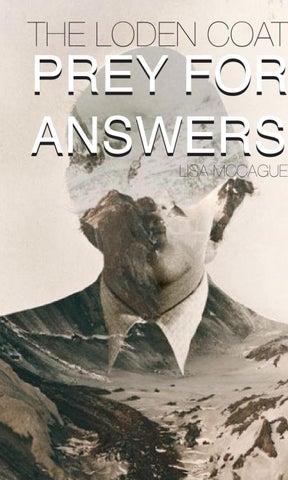
THE LODEN COAT
PREY FOR ANSWERS
LISA MCCAGUE
1
TABLE OF CONTENTS - INTRODUCTION - BASIC CLOTHING ARTICLE ANALYSIS - TECHNICAL ANALYSIS - FASHION ANALYSIS - RESEARCH ANGLE - RESEARCH QUESTION - CONCLUSIONS - SOURCELIST
2
LODEN
COAT The Loden coat was originally handwoven in the 16th century by peasants in Loderer, Austria. The name ‘Loden’ refers to the place it was first created.
Loden is a water-resistant material made from short pile sheep’s wool, conserving the lanolin. Strong yarns are woven loosely, which then go through a process of shrinking. During the process it resembles the texture of felt and becomes quite dense. After that the fabric is brushed with fuller’s teasel (a type of plant), to create a roughness. This process is repeated a couple of times until the material is supple, windproof, lightweight and extremely durable. To make the coat the cloth is first dyed, usually a bluish green, before assembling the pattern.
3
The loden coat was worn mostly by hunters in Austria because of the colours and freedom of movement.
TO
DAY? Hunting wear has inspired many designers today. For example, Thom Browne has based an entire menswear collection on hunting for Moncler Gamme Bleu in Fall 2011. The men were walking the runway with beagles on a leash and horse riding boots. But it’s not just about hunting influences, the actual Loden coat seems to pop up every autumn in the collections of lots of designers like Ralph Lauren, Lanvin, Billy Reid, Fendi and Dries van Noten. They vary in designs, sometimes designers stick to the original straight shape, but some designers like to change it up by making it more feminine with hidden buttons and a defining waistbelt. I decided to do my research from a hunting angle, because it is a very interesting way to look at fashion, what is was like then, and what it is like nowadays? So the question that filled my mind immediately was “Why is hunting wear always changing and how do we see that reflecting on hunting wear and high end fashion today?”
4
5
BASIC CLOTHING
ARTICLE ANALYSIS When I started to research my coat first of all, I found out that the label was Austrian brand which specialised in Loden coats, called Salko. It is a men’s coat. The shape is very simple and has a slight chain for hanging the coat up A-line. The coat is finished very neatly with some decorative stitching and straps on the lower arms with high quality leather buttons. With polyester lining on the upper back part and no lining in the remaining parts of the coat it is very easy to move braided buttons on sleeves (and front coat) around in. I also found holes underneath the arms, this is very interesting, because hunters would be moving around a lot and they would need to let some air out somehow to keep cool and stay comfortable.
decorative stitching and box pleat
6
TECHNICAL
DRAWING armpit hole simple collar
slit pocket
7
decorative triangle stitching box pleat
TECHNICAL
ANALYSIS
MATERIAL
sample of Loden from the coat 95% virgin wool 5% polyester
sample of Loden you can find in fabric stores today 65% virgin wool 35% polyester
8
The intense pride of a trophy on the wall contributes to the feeling of a real hunter.
Austrian hunters wearing variations of the Loden coat.
9
different
Painting by Andrew Wyeth (1975) of his neighbour Helga, who was originally German, and moved to the US. She always wore her Loden coat.
FASHION
ANALYSIS
Traditional Loden capes for women sold at the moment.
Loden coats are still ‘branded’ and sold as hunting coats, to make it appealing to a certain group of people. The original Loden coat in hunting wear today.
10
The perspective that I have based my research on is ‘hunting’. This started for me when I found out that the Loden coat was mostly used by hunters in the past, and is still worn in hunting today.
There are brands that focus completely and only on Loden coats, and also brands that are inspired by Loden coats. But it is not just the Loden coats that people are interested in. The whole influence of hunting wear seems to appeal to people. The neutral, camouflage colours are always in fashion.
11
Y-3
Moncler
RESEARCH
ANGLE But not only in fashion is hunting a big theme. Interior design also has a great fascination for the hunting atmosphere and influences. You can see a lot of modern interpretations of trophies, deer hides, fox fur and many more of those original features.
Today they are used to create a certain mood, a feeling. Even though these elements weren’t really meant for decoration when they were first used. They were meant for the more basic needs. The trophies were hung up on walls to show status, deer hides were laid across the floor to keep the warmth inside of the house. And fox furs were used as blankets. 12
WHY?
WHY? WHY?
WHY?
WHY? 13
RESEARCH
QUESTION WHY IS HUNTING WEAR ALWAYS CHANGING? AND HOW DO WE SEE HUNTING WEAR REFLECTING ON FASHION TODAY? From as far as we can remember there has been a distinct fashion in hunting. For example the red hunting coat that was worn a lot by royalty and aristocrats around the 1850’s. After a while they found out that the deer could see the colour red, and they needed to switch to something else if they wanted to catch dinner. This is when camouflage colours came in to the picture, inspired by the army uniforms. So the question that is stuck in my mind is; why is it always changing? What is it like today? And how do we see hunting wear reflected on the runways and in the stores?
14
The reason hunting wear changed so much has a lot to do with revolution. People found out that they were scaring the animals away because they could see the bright red they were wearing. So they needed to change their gear in order to get their jobs done. Pure functionality plays a big part in hunting wear; it has to be easy to move around in, blend in with the colours of nature and be as silent as possible. Because of revolution in technology and knowledge there are many ways to improve hunting wear. Nowadays brands like Jack Wolfskin, Deerhunter, and FjallRaven, are focusing on just hunting wear/ outerwear. They experiment with wax, and different materials that breathe, but are extremely protective under heavy weather conditions.
15
CONCLUSION In a different kind of market, highend designers are inspired by this masculine, rough, cool look and want to portray a certain image with their collections. Designers like Ralph Lauren show hunting wear inspired collections on the runway in a completely different manner than a ‘minimalist’ brand like Dries van Noten.
Ralph Lauren
Dries van Noten
One of the reasons brands love to work with these influences is because the atmosphere ‘hunting’ creates is so strong, and can be adapted to a lot of styles. It all comes down to the basic instinct of man, the core values of human beings.
WE ARE THE PREDATORS, ANIMALS MERELY A PREY..
16
SOURCES
17
PAGE PAGE DESCRIPTION 1 Cover Silhouette fillled with nature
SOURCE Vi.sualize.us
1
Billy Reid Fall 2012 Menswear
Style.com
2
Four seasons leaves
Ka-va.tumblr.com
3
Backstage at Dries van Noten
Trendland.net
Text
Encyclopedia Britannica
4
Trophy deer half on wall
Designmilk.com
5
Photo coat
Own photo
6
Photos details
Own photos
Text
Toolshop Clothing Analysis
7
Technical drawing
Own drawing
8
Samples
Own coat and fabric store
9
Trophy deers on walls
Hautemacabre.tumblr.com
Austrian hunters
Deer.com
Painting Loden coat
Paintings and prestudies of Andrew Wyeth
Girl in Loden coat
Vintagefashionguild.com
Man in Loden coat
Salko Loden Coats
Loden coat
The New Hunter encyclopedia
Deer skulls
Gloriousregalia.tumblr.com
Runway images Y-3 and Moncler
Style.com
12
Interior images (2)
VTWonen Magazine
13
Body with checked shirt
Sterling Taylor, photographer
Illustration rabbit head
Ralph Steadman, illustrator
Nature in a jar
Materialicious.com
Text
International Wildlife Encyclopedia
Hunting coat, parka
FjallRaven.nl
Hunting coat, wax coat
Deerhunter.dk
Ralph Lauren runway
Style.com
Dries van Noten runway
Style.com
Text
Own conclusions based on research
17
Boots
Huhhhhhhhh.tumblr.com
18
Lanvin runway
Style.com
Silhouette fillled with nature
Vi.sualize.us
10
11
14 15 16
Back
18