

ExecutiveSummary
This report presents initial findings from the first stage of a three-year evaluation partnership between The Housing Network and Homeless Link.
The evaluation aims to establish a robust and scalable approach to measuring the impact of The Housing Network’s Active Opportunities Pathway (AOP) supported housing services, both for residents and for the wider public sector.
The analysis applies a cost consequences methodology to estimate the financial impact of AOP provision by modelling what would be likely to happen if supported housing were not available. It provides a focused first-stage estimate of the immediate and measurable public sector cost consequences associated with the withdrawal of AOP supported housing.
AOPisdesignedtooperateinalignmentwiththeprinciplesoftheSupported Housing(RegulatoryOversight)Act,withaconsistentemphasison transparency,outcomesandqualityofprovision.
HeadlineFindings
The current cohort of 394 residents represents 45% of the total 880 units commissioned since the launch of AOP in September 2024.
Using initial data sets for this cohort, an initial estimate of annual public sector cost consequence of at least £3,510,720 has been calculated, if supported housing were withdrawn. This equates to an average of £8,910 per household per year.
The above value has been calculated using the ‘Keeping Safe’ outcome measurement, which is most clearly defined at this year one reporting stage. Where the ‘maintaining tenancy’ outcome measurement is used, the estimate of annual public sector cost consequences could increase by a further £1,897,480 per year.
There is a clear variation within year one cost consequence values between the distinct cohorts that are supported through different strands of AOP services, which also include wider AOP Momentum for care leavers and AOP Link for prison leavers.
• AOP Breathe (Families): £5,779 per household per year
• AOP Seen & Heard and AOP Live & Grow (Singles): £11,097 per person per year
AOP’s value lies not only in the accommodation it provides at a favourable cost to local authorities, but in the intensive support and crisis management work that enables
both single people and families to engage with the services and make progress towards their goals and aspirations.
Across the pathway, THN’s team is helping residents and families manage risk, avoid escalation of need, rebuild stability and move towards safe, more sustainable futures.
The cost consequences analysis captures the immediate measurable public sector value of this work, while the wider impact is seen in reduced crisis, improved stability, stronger family routines and increased confidence to move forward.
As the services scale to support over 800 households, made up of former care leavers, single people and families, these benefits are expected to translate into a significant cost saving to public services.
“Followinganaccident,mymentalhealthtookadownwardspiral.This impactaffectedeverypartofmylifeandeventuallyledtothebreakdownof myrelationship…Ifoundmyselfhomelessandsleepingrough.ThesupportI receivedhasencouragedmetofocusonmymentalwellbeing,buildhealthy routinesandsetgoalsforthefuture.”–CaseStudy:Single2
The findings show that AOP delivers value for single people and families, through three connected forms of impact.
Stabilisation
Prevention
Progression
Providing safe accommodation and support at points of crisis, instability and disruption
Reducing the likelihood of escalation into higher-cost statutory, crisis or emergency pathways
Helping residents and households build stability, confidence, routines and readiness for longer-term independence
A key learning from this first stage of this three-year evaluation is that progression towards independence should be understood as an outcome of AOP support and the positive impact this has had on individuals’ and families’ lives.
Where residents and households are now reporting a higher level of stability, confidence and ability to manage, this reflects the role of AOP in creating the conditions for that progress.
£3.51million
Estimated annual public cost consequence if supported housing was withdrawn for the 394 residents and households in AOP Breathe, AOP Seen & Heard and AOP Live & Grow
394residents
Included in the snapshot cohort across AOP Breathe, AOP Seen & Heard and AOP Live & Grow services
£8,910
Average estimated year one consequence savings across the resident cohort
£5,779
£11,097
£5,405vs £21,320
300children
Estimated annual cost consequence for AOP Breathe, expressed per household or family
Estimated annual cost consequence for AOP Seen & Heard and AOP Live & Grow, reflecting greater exposure to rough sleeping and crisis pathways
THN’s estimated annual AOP support cost is approximately £5,405 per household/resident, compared with a modelled local authority funded temporary accommodation cost of £21,320 per unit per year
Supported through AOP Breathe, THN’s family provision, over a 12-month period. This underlines that housing stability is central to preventing adverse childhood experiences and reducing future demand on high-cost public services
KeyInsights
PreventionandstabilisationarecentraltoTHN’simpact
AOP provides psychologically and trauma informed accommodation and support for residents and households experiencing homelessness, multiple disadvantage and crisis. The team takes a strength-based approach to the support it provides.
Within the currently live AOP services, resident profile differs from some more traditional supported housing cohorts, with lower levels of recent rough sleeping and lower representation of some high-cost pathways such as prison and psychiatric care. However, this should not be interpreted as evidence of low need. The analyses across the cohorts highlight consistently high levels of recorded support needs in all three models.
For single homeless clients in particular, the high proportions placed in local authorityfunded unsupported temporary accommodation and/or supported housing suggest that local authorities have determined they may be in priority need under Section 188 duty—representing a high threshold for this group to meet. This indicates that, despite lower visibility in some acute pathways, many residents present with significant vulnerability and complexity of need.
This is central to the value of the model. AOP is not only responding to crisis; it is actively preventing further crisis, wider system cost and trauma. It also indicates that AOP is often operating earlier in the pathway, working with residents and households before needs escalate further.
AOPsupportscomplexandhigh-needcohorts
The available data does not fully reflect the day-to-day intensity of AOP delivery. We have identified that across some AOP Seen & Heard and AOP Live & Grow schemes, THN’s team is managing significant levels of complexity, crisis and risk. This includes substance use, serious health incidents, safeguarding issues, domestic abuse, antisocial behaviour, neighbour incidents and repeat homelessness, often driven by multiple and intersecting needs.
This context is important. The cost consequences model estimates only what can be quantified using the available data. It does not capture the full intensity of operational delivery, the level of professional skill required to manage complex cases, or the preventative value of stabilising residents before further escalation occurs.
Notably, AOP Seen & Heard and AOP Live & Grow services operate with a deliberately non-risk-averse approach, where eviction is treated as the last resort. This model significantly reduces the risk of ‘journey failure’, helping to prevent further trauma and supporting residents to maintain trust and confidence in the wider system.
AOP should therefore be understood as a model that works with a diverse cohort, including residents and households experiencing severe and multiple disadvantage with complex needs.
Progressiontowardsindependenceshouldbeunderstoodasanoutcomeof support
The analysis identifies a substantial number of residents who, at the point of review, appeared closer to being able to manage with less support. This finding requires careful interpretation.
This is not evidence that those residents did not need AOP support. Rather, it may indicate that residents have stabilised and progressed as a result of the accommodation and support provided. In other words, movement towards independence is best understood as an outcome of successful stabilisation, not as an absence of need.
AOP operates in alignment with Supported Housing (Regulatory Oversight) Act principles, using a data-led approach to assess and respond to support needs and risks. Through THN’s OmniLedger Webchart system, a continuous and dynamic profile is maintained for each resident, capturing needs, risks and support interactions over time.
The data file helps clarify that this finding is not driven primarily by AOP Seen & Heard classification. Of 190 cases allocated to “own accommodation with sufficient support”, 102 are from AOP Breathe, 79 are from AOP Live & Grow, and 9 are from AOP Seen & Heard. The finding is therefore better understood as an output of the counterfactual allocation criteria and available review data, rather than a simple consequence of service classification.
AOPoffersanalternativetounsupportedtemporaryaccommodation. AOP provides a supported housing alternative to unsupported temporary accommodation, including B&B accommodation, which is cost-effective and outcomefocused.
This distinction matters. Unsupported temporary accommodation may provide a place to stay, but it does not necessarily provide the support, structure, advocacy, risk management and progression planning that residents and households need to stabilise and move forward.
AOP adds value by combining high-quality accommodation with tailored support, helping residents and households reduce risk, rebuild confidence and work towards longer-term stability.
Differentvalueprofilesforhouseholdsandsinglepeople
AOP Seen & Heard and AOP Live & Grow provision for single people shows higher immediate measurable cost consequences, reflecting greater exposure to rough sleeping and crisis-driven service use.
For families, AOP Breathe shows lower immediate measurable cost consequences on a household basis, but the long-term value is potentially very significant. This includes stabilising children’s routines, reducing stress, supporting access to education, preventing repeat homelessness and reducing the risk of adverse childhood experiences.
“Mostimportantly,thisaccommodationhasgivenourfamilystability,hope, andtheopportunitytofocusonbuildingabetterfuturetogether.”
–CaseStudy:Family1
TheActiveOpportunitiesPathwayModel
AOP supports residents and households from homelessness and crisis towards stability, confidence and independence through safe accommodation, tailored support and structured progression planning.
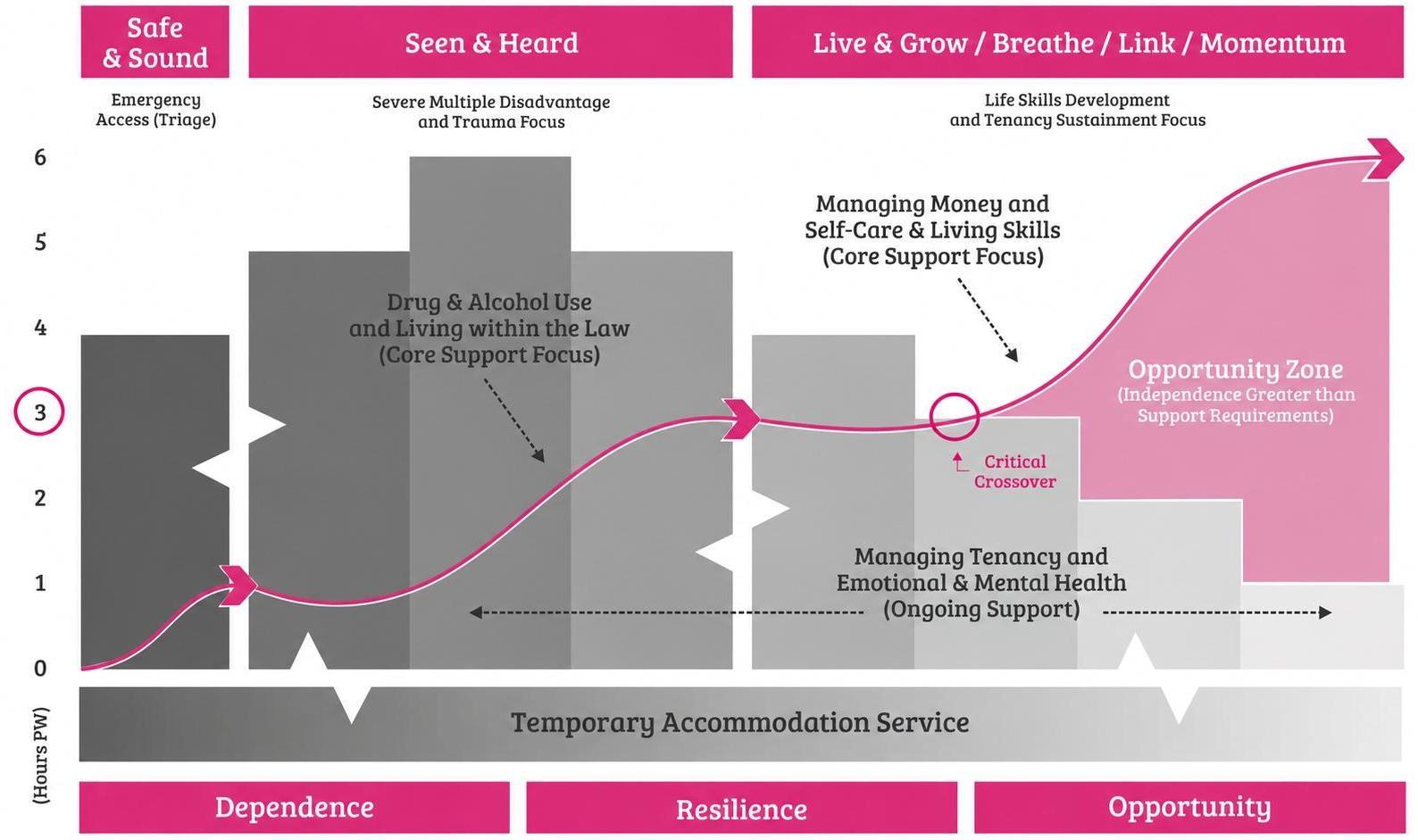
AOP is THN’s supported housing model for single people and families experiencing or at risk of homelessness and facing multiple or severe multiple disadvantage. Delivered in collaboration with local authorities, AOP provides safe accommodation with support for people experiencing homelessness and multiple disadvantage, helping them stabilise, make safe choices, build confidence and move towards independent living.
The model is structured, trauma-informed, strength-based and person-centred. Support is designed to meet residents where they are, helping each person progress at their own pace and ensuring they receive the right level of help at the right time.
For this evaluation, the analysis focuses on three AOP services listed below. These represent a subset of the six AOP services that THN have now also been commissioned and will be incorporated into the evaluation over the next two years:
• AOP Breathe
• AOP Seen & Heard
• AOP Live & Grow
AOP Momentum for care leavers and AOP Link for prison leavers will be incorporated into the evaluation over the next two years.
Together, these services provide a flexible pathway of support for households and single people experiencing homelessness, housing instability, multiple disadvantage and barriers to independent living.
AOPBreathe
AOP Breathe provides supported housing for vulnerable families at risk of repeat homelessness.
The service supports households who need more than accommodation alone. It provides a safe and stable environment where families can begin to recover from housing instability, rebuild routines and work towards longer-term stability.
For households with children, this stability can be especially important, helping reduce disruption, maintain routines, support access to education and create the conditions for improved wellbeing and prevent further adverse childhood experiences.
Critically,thispreventativeapproachcontributestothereductionofACEs,by improvingstability,reducingexposuretocrisisandtrauma,supportingsafe, moresecurelivingenvironmentsforchildrenandfamilies.
AOP Breathe combines accommodation with practical and emotional support. Households are supported to stabilise their circumstances, address barriers to sustaining accommodation and plan for a more secure future. The service plays an important preventative role by helping households move away from crisis and reducing the risk of repeat homelessness.
AOPBreathehelpshouseholdsmovefromcrisis,uncertaintyandhousing instabilityintosafety,routineandlonger-termstability.
AOPSeen&Heard
AOP Seen & Heard is a micro-hostel model with 24/7 on-site support for vulnerable single people who are learning to understand and overcome barriers.
The service provides a higher-support environment for residents who may be experiencing homelessness, multiple disadvantage, trauma, mental health needs, substance use or other barriers to stability. The availability of 24/7 support enables staff to respond to risk, crisis and emerging need in real time, while also building trusting relationships with residents.
AOPSeen&Heardoperateswithadeliberatelynon-risk-averseapproach,in whichevictionistreatedasalastresort.Thisenablesresidentsexperiencing crisisandinstabilitytoremainengagedwithsupport.
Seen & Heard is designed to help residents stabilise, develop confidence and begin to understand the barriers that may have contributed to homelessness or repeated instability. Through structured, person-centred support, residents are helped to build life skills, improve wellbeing and take positive steps towards greater independence.
AOPSeen&Heardprovidesintensivesupportforvulnerablesinglepeople, helpingresidentsunderstandbarriers,stabiliseandbeginmoving forward.
AOPLive&Grow
AOP Live & Grow provides dispersed housing for people moving on from homelessness, with support to develop the life skills needed to live independently.
The service supports residents who are ready to progress within the pathway but still need structured help to build confidence, routines and independence. Dispersed housing enables residents to experience a more independent living environment while continuing to access support that helps them sustain accommodation and prepare for move-on.
Live & Grow focuses on practical progression. This may include support with tenancy management, self-care, living skills, money management, wellbeing, relationships, community participation and planning for the future. These areas reflect the wider AOP focus on helping residents develop the skills, stability and confidence needed for independent living.
AOPLive&Growsupportsresidentsmovingonfromhomelessnesstodevelop theconfidence,routinesandlifeskillsneededforsustainableindependence.
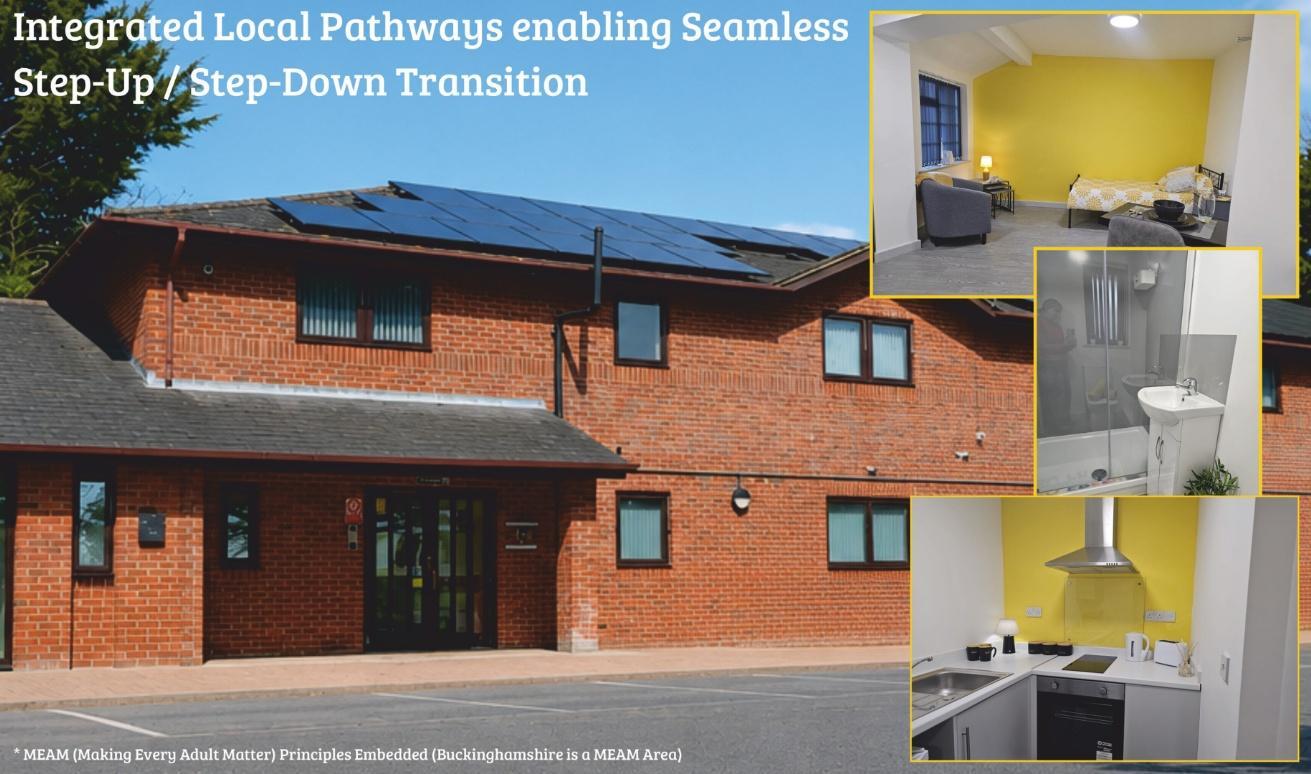
A key strength of the AOP model is its ability to operate as a seamless step-up and step-down pathway. The close alignment between AOP Seen & Heard and AOP Live & Grow enables residents to move flexibly between higher and lower support environments in response to changing needs, without losing continuity of care.
This reduces the risk of ‘journey failure’, ensuring that individuals can remain within a trusted support system during periods of crisis or transition. In practice, this approach
avoids unnecessary disruption, minimising risk of further trauma and helping sustain engagement with services.
It also contributes to more efficient use of wider system resources by preventing escalation into higher-cost interventions. Where services are co-located or in close proximity, as seen in Leicester, this model has demonstrated particular effectiveness, enabling responsive, person-centred transitions that support stability and progress.
Introduction
This report presents initial conclusions from the first stage of a three-year impact evaluation partnership between The Housing Network and Homeless Link.
The evaluation is designed to identify and mainstream measures that demonstrate the impact THN has for residents, households, local authorities and the wider public sector. The initial priority was to establish a method to assess and evidence the financial impact of AOP supported housing services at a broad-brush level.
To support this, Homeless Link selected a cost-consequences methodology, developed in partnership with HGO Consultancy, and this report sets out the results of that approach. Alongside the quantitative analysis, case studies highlight the lived experiences of residents and households, illustrating how stability, support and progression are achieved in practice.
Future phases of the evaluation (years two and three) will expand the scope of analysis to incorporate recognised social value frameworks, including HACT, enabling a more comprehensive assessment of both fiscal impact and wider added social value.
“Beforemovinghere,therewasalotofuncertaintyandstress…havingasafe placetolivehasmadeahugedifference[tous].”
–CaseStudy:Family1 “Iwaslivingunderabridge,feelingcompletelydisconnectedfromsociety andunsurehowIwouldeverturnthingsaround…havingaccessto[The HousingNetwork’s]supportedaccommodationgavemethefoundationI neededtostartlookingforwardandmakingplansforthefuture.”
–CaseStudy:Single2
CostConsequencesMethodology
This methodology seeks to establish what would happen to residents living in supported housing at a given point in time if that provision were withdrawn. It constructs a series of counterfactual scenarios based on individual circumstances. In
practice, these scenarios represent more than alternative housing outcomes. They reflect the potential loss of stability, support, risk management and direction.
Counterfactualsused
The methodology uses a limited number of potential alternative provisions that might be made available to certain individuals or households, or which will follow consequently from the removal of the supported housing. This includes:
• A return to custody
• Admission to psychiatric care
• Admission to a refuge for residents fleeing domestic abuse
• Placement in a registered care home
• Movement in and out of rough sleeping
• Own accommodation with sufficient support
• Own accommodation without sufficient support
• Placement in temporary accommodation by the local authority due to being accepted as a duty case under the Homelessness Reduction Act 2017.
It is accepted that a significant proportion of residents will fall outside these cohorts. Some residents may remain homeless or move in and out of rough sleeping. Others may find accommodation, potentially with assistance, but may not be able to access the support they need to sustain it.
The model also recognises that some residents may find alternative accommodation and sufficient support from family, friends, other agencies or their own resources.
Basisforestablishingcosts
Where the counterfactual involves placement in another form of statutory or commissioned provision, the direct cost of that provision is assumed to be the cost consequence. Where no placement is made, the model uses an estimate of additional generic service consumption across housing, health and criminal justice services, based on relevant research.
Costs are calculated on a weekly basis and then annualised. This avoids the difficulty of estimating how long a resident or household would remain in an alternative provision. The absence of cost in some parts of the model should not be interpreted as absence of impact. In some cases, stability and prevention are precisely what reduce measurable crisis costs.
Basisfordeterminingthecounterfactuals
The counterfactual is determined by triangulating three categories of data:
• Housing status prior to moving into supported housing
• Case history, including mental health, offending behaviour and care needs
• Assessment and review information from complex needs support staff
Historically, this methodology has been applied using purpose-designed snapshot surveys, which provide a high level of detail at resident level. For THN, information drawn from the existing OmniLedger Webchart system has been used. This provides a practical basis for this first stage of analysis, but the limitations of the data should be recognised when interpreting the findings.
In particular, the data captured at a single point in time does not fully capture the intensity of support, the complexity of risk, or the extent to which residents and households have progressed since entering AOP.
Limitationsofthemethodology
The methodology applied is intentionally conservative and likely to underestimate total impact. A key factor is the high proportion of residents assessed as independent, which creates a “dampening effect” on cost estimates. However, this reflects the nature of the AOP model:
• Supporting individuals earlier in their journey
• Stabilising people before crisis escalation
• Preparing residents for independence
The methodology also does not capture longer-term impacts, particularly in relation to repeat homelessness and social exclusion. As THN’s data capture approach continues to evolve, there is increasing scope to incorporate more granular and longitudinal information.
For example, while existing data can identify the presence of a diagnosed mental health condition, enhanced data capture will enable a more detailed understanding of how needs are being managed over time, including patterns of risk, intervention and stability.
As this level of detail develops, it will support more accurate modelling of outcomes and strengthen the ability to evidence both the depth and sustainability of impact achieved through AOP services.
DataUsed
Data from 394 open cases was used as of 20 May 2026 from AOP Breathe, AOP Seen & Heard and AOP Live & Grow services. The data file records 162 AOP Breathe cases, 56
AOP Seen & Heard cases and 176 AOP Live & Grow cases, as per the service breakdown used in this first-stage analysis.
Table1:Breakdownofcasesusedinsnapshotdataexercisebyservicetype
Service Type
AOP Breathe (supported housing for families)
Number of Cases
162 open cases
AOP Seen & Heard (supported housing where the focus is on developing confidence and life skills) 56 cases
AOP Live & Grow (supported housing where the focus is on preparing residents for independence)
176 cases
Total 394 cases
A key insight is that the resident profile differs from some more traditional supported housing cohorts, with lower representation of some high-cost pathways. However, this should be interpreted carefully. It does not mean that AOP residents and households have low or less complex needs. Rather, it reflects the fact that the model often intervenes earlier in the pathway, helping people stabilise and manage risk before needs escalate further.
Other fields used include:
• Primary support need
• Whether the resident is in receipt of a care package
• Whether the resident is under licence or on a community order
• Pregnancy
• Experience of domestic abuse
• Experience of rough sleeping in the last three years
• Keeping Safe score
Thisearlyinterventionapproachiscritical—preventingexposuretofurther trauma,reducingescalationintomoreintensiveandcostlyservice,and easingpressureonthewidersystem
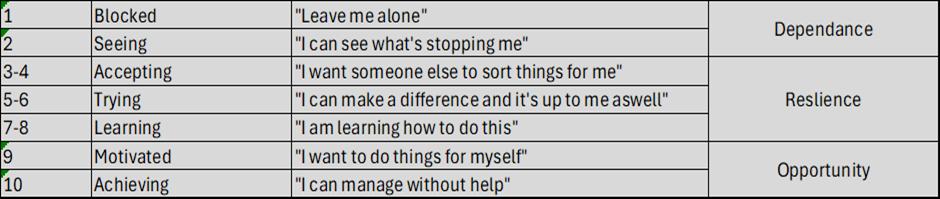
Resilience Opportunity Dependence
This breakdown of cases is underpinned by THN’s support planning and risk management system, which assesses client movement across fourteen different outcome objectives through a “Next Step Scores” approach.
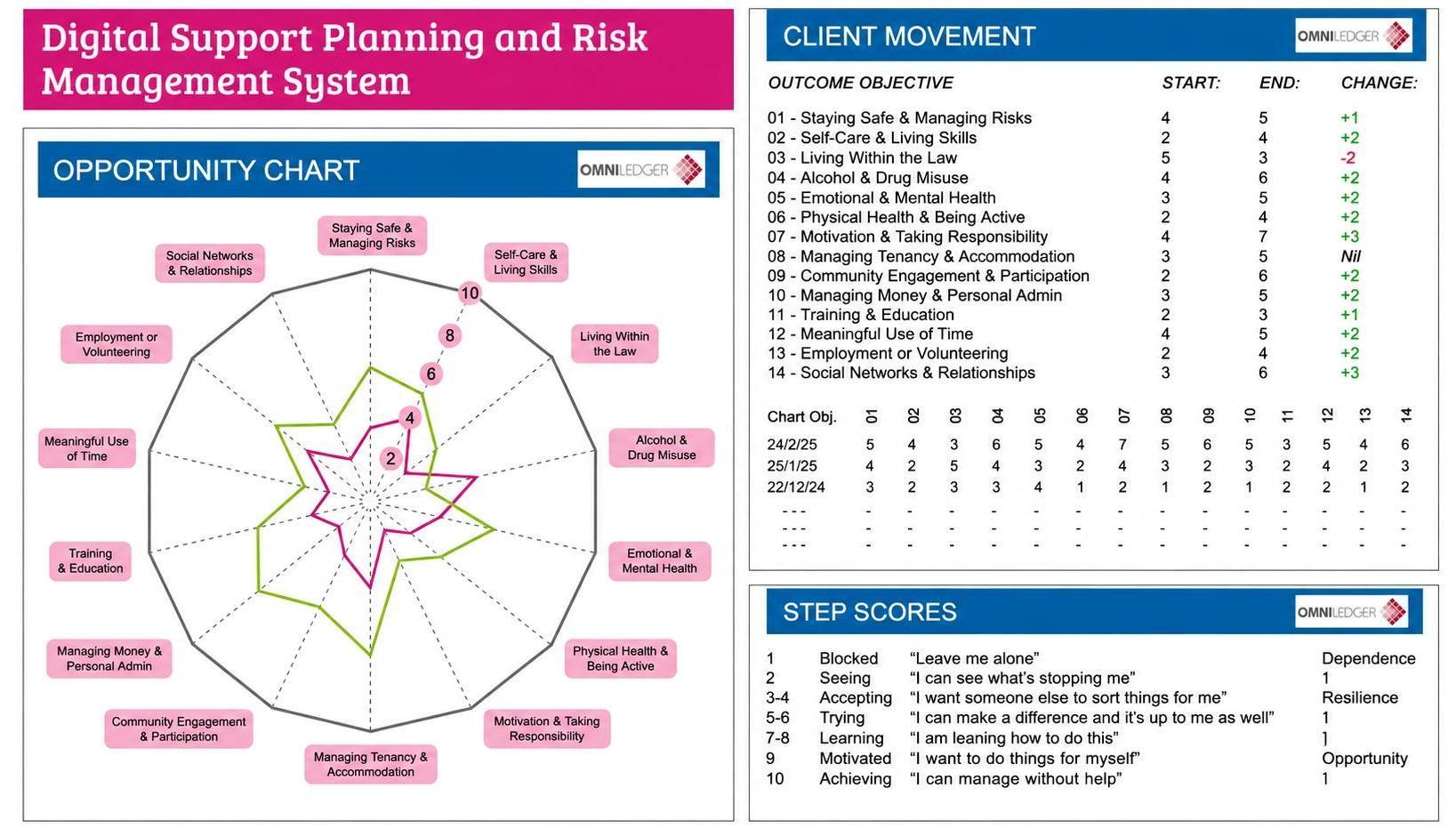
THN has worked in partnership with its More than a Voice (MtaV) lived experience resident groups to co-design AOP support planning and risk management processes.
Using OmniLedger Webchart (OLW) functionality, this has led to the development of seven distinct but interconnected “journey travelled” models, tailored to each AOP service area.
These journey models enable residents to work collaboratively with their Complex Needs Support Worker (CNSW) to assess their current strengths, needs and risks. Through a visual Webchart interface, residents can identify key areas that may be affecting their ability to progress towards stability and independence.
Support planning is co-produced, strengths-based, and rooted in shared understanding. MtaV residents have also contributed to the development of “realworld” definitions for the “Next Step Score” framework, ensuring that scoring reflects lived experience as well as professional assessment.
All residents—both single people and families—receive an initial OLW support and risk planning session within 72 hours of moving in. This is reviewed every four weeks, or more frequently following any significant change in circumstances, ensuring that support remains dynamic and responsive.
Using the data snapshot provided by THN, criteria were established for allocating cases to the relevant counterfactual scenarios. The weekly costs that are used to calculate the cost consequences with the explanation of where this originates, are shown in the following table
Table3:Co-producedsupportplanningandalternativescenariomodelling framework
Alternative Scenario
They will be placed in psychiatric care
Criteria for Allocation
If they had been in psychiatric care before they moved into supported housing, then it is assumed that they would return. There is not sufficient nuance around the mental health conditions in THN’s data to assume that anyone else would follow this scenario
They will be recalled to prison
They will be placed in a Registered Care Home
They will secure accommodation in a Refuge
If they were previously in prison before they moved into supported housing or if they are currently on licence and have a Keeping Safe score of less than 7 then it is assumed that they will return to prison
If they have a current social care package and are in receipt of a high level of support in their current accommodation
If they were in a Refuge immediately before they moved into supported housing or present a primary support need of domestic abuse
They will be accepted as a homeless duty case and placed in LA-funded Temporary Accommodation
They will find themselves In and out of rough sleeping
If they were in LA funded TA immediately prior to moving into supported housing or were pregnant or were a homeless family and had a Keeping Safe score of below 7
If they were rough sleeping prior to moving in to supported housing or if they had experienced rough sleeping in the previous 3 years and had a Keeping Safe Score of below 7
They will be in their own accommodation with sufficient support
They will be in their own accommodation but without sufficient support
If none of the above criteria apply and they have a Keeping Safe score of 10
The balance of cases where none of the above criteria apply and the individual does not have a Keeping Safe score of 10
Results
This year one analysis estimates an annual cost consequence of at least £3,510,720 equivalent to an average of £8,910 across the resident cohort per year.
The above value has been calculated using the ‘Keeping Safe’ outcome measurement, which is most clearly defined at this year one reporting stage. Where the ‘maintaining tenancy’ outcome measurement is used, the estimate of annual public sector cost consequences could increase by a further £1,897,480 per year.
This headline figure masks important variation between household and single-person provision. The split between AOP Breathe and single-person services is particularly important:
• AOP Breathe: £5,779 per household per year
• AOP Seen & Heard and AOP Live & Grow: £11,097 per person per year
Single-person provision shows higher immediate measurable cost consequences due to greater exposure to rough sleeping and crisis pathways.
AOP Breathe shows lower immediate measurable cost consequences on a household basis, but significant longer-term value, particularly in relation to children, domestic abuse, coercive control, repeat homelessness, education, safeguarding and adverse childhood experiences.
The category “living in dispersed accommodation with floating support” should be interpreted carefully. It does not mean residents have no need for support. It indicates that, based on the data available at the point of review, some residents have been supported by THN’s team to move closer to managing successfully in alternative accommodation, provided that suitable housing and support are in place.
This should also be understood in the context of AOP’s impact. Where residents have become more stable, more confident or better able to manage day-to-day challenges, this is often a direct result of the support they have received. In many cases, individuals
have been supported effectively, demonstrating how AOP enables residents to overcome barriers that were previously preventing progress towards independence.
Table5:Counterfactualcostconsequencesperweek
Counterfactual
In Prison
In Refuge
In LA funded Temporary Accommodation
In and out of rough sleeping
In their own accommodation but without sufficient support
Total
£4,276
£7,670
£39,360
£3,856
£12,168
£67,330
The weekly costs used in the model produce a total weekly counterfactual cost of £67,330, which annualises* to £3,510,720. This is the estimated immediate measurable public sector cost consequence if AOP supported housing were withdrawn.
The above value has been calculated using the ‘Keeping Safe’ outcome measurement, which is most clearly defined at this year one reporting stage. Where the ‘maintaining tenancy’ outcome measurement is used, the estimate of annual public sector cost consequences could increase by a further £1,897,480 per year.
Table 6 sets out the underlying weekly unit costs for each counterfactual scenario. These are applied to the distribution of residents across scenarios (Table 4) to produce the aggregated weekly cost consequence shown in Table 5.
*WeeklyCounterfactualCostannualisedacross52.14weeks.
Table6:Weeklycostsusedincalculatingthecostsofcounterfactualscenarios
Ministry
of Justice
(2025) Costs per place and costs per prisoner.
Based on cost per prison place figure for 2023/24, uplifted by annual CPI.
https://assets.publishing.s ervice.gov.uk/media/67e51 acfba11d0060f606d68/cost s-per-place-costs-perprisoner-2023-2024summary.pdf
Psychiatric care
£2,042
Local authorityfunded temporary accommodation
£410
Based on weekly cost per psychiatric acute inpatient placement for 2023/24, uplifted by annual CPI.
Claimont Health (2025) How Much Does a Psychiatric Hospital Cost?
https://claimonthealth.co.u k/blog/how-much-doespsychiatric-hospital-cost/
Refuge
£767
Based on total spend on temporary accommodation in 24/25, divided by number of households in temporary accommodation at the end of March 2025
Ministry of Housing, Communities & Local Government (2025) Local authority revenue expenditure and financing England: 2024 to 2025 –second release.
https://www.gov.uk/gover nment/statistics/localauthority-revenueexpenditure-and-financingengland-2024-to-2025-firstrelease/local-authorityrevenue-expenditure-andfinancing-england-2024-to2025-first-release
Care home
£1,298
Based on Refuge study in 2018/19 where weekly cost was estimated at £597, uplifted by annual CPI.
Women’s Aid (2019) Funding specialist support for domestic abuse survivors.
https://womensaid.org.uk/ wpcontent/uploads/2019/12/F unding-Specialist-SupportFull-Report.pdf
Based on average care home costs.
Carehome.co.uk (2026) Care home costs 2026: How much do you pay?
Rough sleeping
£241
Based on average service usage costs, uplifted by CPI.
https://www.carehome.co. uk/advice/care-home-feesand-costs-how-much-doyou-pay
Crisis (2016) Better than Cure? Testing the case for Enhancing Prevention of Single Homelessness in England.
https://www.crisis.org.uk/ media/20680/crisis_better_ than_cure_2016.pdf
Accommodation without support
£156
Based on average service usage costs quoted by “Benefits Realisation Research” for Supporting People services.
Communities and Local Government (2009) Research into the financial benefits of the Supporting People programme.
https://assets.publishing.s ervice.gov.uk/media/5a78e 3dd40f0b62b22cbd9c5/127 4439.pdf
The above costs are based on the results provided in each of the references included. The weekly cost represents the total cost of each alternative counterfactual scenario.
Interpretingtheresults
The estimate of at least £3.51 million demonstrates that AOP is associated with significant public sector value. However, the financial estimate should be read alongside the wider impact of the model. The cost consequences approach captures measurable costs associated with alternative scenarios such as prison, refuge, temporary accommodation, rough sleeping and accommodation without sufficient support. It does not fully capture the value of:
• Preventing crisis escalation
• Reducing repeat homelessness
• Supporting residents to manage substance use, mental health and risk
• Stabilising children and households
• Managing safeguarding concerns
• Rebuilding confidence and routines
• Supporting move-on and longer-term independence
The case studies gathered as part of this exercise show how these broader impacts are experienced by residents and households.
“Theaccommodationgaveusbreathingspaceandsomewheretofeelsecure whileweworkedthroughverydifficultcircumstances.”
–CaseStudy:Family2
“Theydidn’tjusthelpmefindaccommodation;theyhelpedmestart believinginmyselfagain.”–CaseStudy:Single2
Cost-benefitanalysis:AOPandunsupportedtemporaryaccommodation
AOP provides a supported housing alternative to unsupported temporary accommodation. This distinction is important. Unsupported temporary accommodation may provide a place to stay, but it does not necessarily provide the support, structure, advocacy, risk management and progression planning that residents and households need to stabilise and move forward.
This is particularly significant in the current national context. Temporary accommodation is placing increasing pressure on local authority finances. Based on published data, temporary accommodation costs are at record levels, with reported spending in England reaching £2.29 billion in 2023–24, while real costs are likely to be closer to £2.42 billion 1
This means that the annual cost of AOP support is less than 25% of the modelled cost consequence of unsupported temporary accommodation, before taking into account the wider benefits of AOP support.
This demonstrates that AOP provides an outcome-focused supported housing solution for single people and vulnerable families atlessthanhalfthecostof unsupportedtemporaryaccommodation, delivering both improvedoutcomes andgreatervalueforlocalauthorities.
These figures should not be treated as a full like-for-like comparison of total accommodation costs. The AOP figure reflects THN’s standard support charge, while the temporary accommodation figure reflects the modelled local authority-funded temporary accommodation cost consequence used in this analysis. However, the
1 https://www.homelessnessimpact.org/publication/spending-on-temporary-accommodation-value-formoney
comparison is useful because it illustrates the additional value of investing in supported housing rather than relying on unsupported temporary accommodation.
AOP combines accommodation with structured trauma-informed and strength-based support, crisis prevention, safeguarding, family stabilisation and progression planning. These elements help reduce repeat homelessness, improve stability and reduce wider demand on public services. In this context, AOP offers value not only because its support cost compares favourably with the modelled cost consequence of unsupported temporary accommodation, but because it provides the support needed to help residents and households move away from crisis and towards more sustainable futures.
The Housing Network’s estimated annual AOP support cost is approximately £5,405 per household or resident, compared with a modelled local authority funded temporary accommodation cost consequence of £21,320 per year while also providing structured support, crisis prevention and progression planning.
The AOP figure reflects THN’s support charge of £34.65 x 3 hours x 52 weeks = £5,405.40. Temporary accommodation figure is based on the modelled local authorityfunded temporary accommodation cost consequence of £410 per week x 52 weeks = £21,320.
Figures are illustrative and not directly comparable to total accommodation costs. Support levels—and therefore costs—may vary across AOP services (e.g. AOP Seen & Heard and AOP Breathe) in line with differing cohort needs and commissioned support intensity.
AdverseChildhoodExperiences(ACEs)
The longer-term consequences due to family homelessness may be significant, due to the impact of ACEs on the children housed.
Over a 12-month period, THN housed 207 families who had a total of 300 children, broken down by age group as follows:
• 0–4-year-olds: 142
• 5-10-year-olds: 83
• 11-18-year-olds: 75
ACEs can have long-lasting impacts on adult health, wellbeing and behaviour. Relevant experiences include abuse, neglect, victimisation, domestic abuse, coercive control and household instability.
The draft analysis estimated that the possible lifetime cost associated with adverse childhood experiences for this cohort could be £8.6 million, based on assumptions drawn from published research.
This assumes that 32% of these children might have at least four ACEs, and that the lifetime cost as a result is £90,000 per child. THN actively seeks to reduce this by responding quickly to the incidence of homelessness and preventing repeat incidents of homelessness.
ACEs that have long-lasting impacts on adult health and anti-social behaviour include various forms of abuse (sexual, physical and emotional) as well as neglect and victimisation.
A study of hidden homelessness found that those who had experienced homelessness were 2.5 times as likely to have had at least one ACE (85·5% vs 34·2%), and twelve times as likely to have had four ACEs (32.4% vs 2.7%) (2).
Draft analysis across AOP Breathe indicates that early intervention through the model couldmitigateupto£8.6millioninlifetimecosts linked to ACEs, by reducing exposure to trauma and supportingmorestablechildhood environments.
In terms of the cost consequences of ACE one study found that across all outcomes studied, the total estimated annual ACE-attributable cost across England and Wales was £42.8 billion, equivalent to 2.6% of the total Gross Value Added in England and Wales and representing approximately £1800 per household per annum.
Most of these costs related to multiple ACE categories. In another study undertaken in the UK, the lifetime cost per victim of non- fatal child maltreatment by a primary caregiver has conservatively been estimated at £90 000 (3). Again, a larger proportion of the value in this figure resulted from multiple ACEs.
Almost two-thirds of families in AOP Breathe identified at least one secondary support need. Mental health difficulties were reported by 45% of households, while one in five had experienced domestic abuse. A further six families identified domestic abuse as their primary support need.
2 Barnes AJ, Gower AL, Sajady M, Lingras KA. Health and adverse childhood experiences among homeless youth. BMC Pediatr. 2021;21(1):164
3 Conti G, Morris S, Melnychuk M, et al. The economic costs of child maltreatment in the UK. London: NSPCC and University College London, 2017. https:// learning. nspcc. org. uk/ researchresources/ 2017/ economic- cost- child- maltreatment/
Among the 64 families placed in B&B accommodation—the most unstable form of temporary accommodation—two had a primary support need of domestic abuse and 66% (42 families) had additional secondary support needs. These circumstances significantly increase the risk of children being exposed to adverse childhood experiences (ACEs), underlining the importance of the stability and support provided through AOP Breathe.
THN is developing additional ways of capturing data to evidence outcomes experienced for children in terms of school attendance and their achievements based on person-centred goals and aspirations. Qualitative feedback already suggests that stable supported housing has helped families re-establish daily routines, reduce disruption and support children’s engagement with education.
Some families and staff have reported improvements in school attendance; however, the early findings at this stage of the evaluation did not have access to sufficient attendance data to verify this outcome.
The final evaluation report will focus on this aspect specifically to establish a direct correlation between supported housing for families and school attendance.
“Havingastablehomehasreducedstressanduncertaintyandallowedusto focusonbeingafamilyratherthanworryingaboutwherewewouldlive.”–CaseStudy:Family1
“Havingaccommodationclosetomychildren’sschoolshasmadeahuge differencetoourwellbeing.Ithasallowedthemtocontinueaccessing educationandspecialistsupporttheyneedwithoutdisruption.”
–CaseStudy:Family2
Casestudyhighlights
The case studies included in this report provide important context to the financial analysis. They illustrate how access to stable accommodation, combined with tailored support, enables residents and households to rebuild confidence, establish routines and move forward with their lives.
Familystabilityandhope
“Mostimportantly,thisaccommodationhasgivenourfamilystability,hope andtheopportunitytofocusonbuildingabetterfuturetogether.”
–CaseStudy:Family1
Permanentaccommodationandlonger-termstability
“ThankstosupportfromTheHousingNetwork,I’venowsecuredpermanent accommodation,givingmyfamilythelong-termstabilitywe’vebeen workingtowardsandafoundationforthenextchapterofourlives.”
–CaseStudy:Family2
Structure,supportandconfidence
“Supportedaccommodationofferedmorethanjustaplacetostay.It providedstructure,supportandtheopportunitytorebuildmyconfidence.”
–CaseStudy:Single1
Fromroughsleepingtorebuildingalife
“HavingsomewheresafeandsecuretolivehasgivenmethestabilityI desperatelyneeded.It’sallowedmetofocusonrebuildingmyliferatherthan worryingaboutwhereIwasgoingtosleepeachnight.”
–CaseStudy:Single2
Purpose,volunteeringandreconnection
“VolunteeringhasremindedmethatIstillhavesomethingvaluabletooffer. It’shelpedmerebuildmyconfidenceandfeellikeacontributingmemberof societyagain.”–CaseStudy:Single2
Conclusions
This analysis provides a clear and credible first-stage assessment of the impact of The Housing Network’s Active Opportunities Pathway (AOP) supported housing model, which has been rapidly mobilised and is already delivering significant social impact across 394 of the 880 commissioned units.
Using a deliberately conservative cost consequences methodology, the findings demonstrate that AOP generates meaningful system value, even when assessed through a narrow, short-term financial lens.
The estimated annual cost consequence of at least £3.51 million for the current cohort demonstrates the significant level of demand that would likely fall to public services in
the absence of AOP supported housing. This should be understood as a conservative estimate, capturing only the most immediate and measurable system impacts, rather than the full value generated through prevention, stabilisation and longer-term outcomes.
A key feature of the findings is the proportion of residents and households who, at the point of review, appear closer to sustaining their living arrangements with appropriate support in place. This provides a strong indicator of the effectiveness of the AOP approach. Furthermore, it reflects the model’s ability to intervene early, stabilise individuals and families, and support progress towards independence.
In this context, reduced reliance on higher-cost pathways should not be interpreted as lower need, but as evidence of needs being effectively managed before escalation occurs.
ThisiscentraltoAOP’svalue:preventingexposuretocrisisandtrauma, reducingescalationintomoreintensiveandcostlyservices,andeasing pressureonthewidersystem.
This is reinforced by the resident profile, which differs from more traditional supported housing cohorts. Lower levels of recent rough sleeping and reduced representation of high-cost pathways indicate that AOP is operating earlier in the pathway, working with people before needs escalate.
As a result, the model is better understood as a preventative intervention, with its strongest value lying in avoiding future demand rather than generating immediate, cashable savings.
The distinction between families and single people further highlights how this value is distributed:
• For single people, the model demonstrates stronger short-term cost avoidance, reflecting higher exposure to rough sleeping and crisis-driven service use
• For families, the immediate financial impact is lower, but the long-term value is likely to be significantly greater, particularly through reducing the risk of repeat homelessness and mitigating adverse childhood experiences
Taken together, these findings reflect the strength of the wider AOP model across its full range of service offers—including AOP Breathe, AOP Seen & Heard and AOP Live & Grow, as well as AOP Momentum for care leavers, AOP Link for prison leavers and AOP Safe & Sound for single people.
Across these pathways, AOP delivers a flexible, outcomes-focused approach that responds to differing levels of need, prevents escalation and supports sustained progress towards independence.
The potential impact on children is especially significant. The scale of estimated lifetime costs associated with adverse childhood experiences reinforces the importance of early intervention and housing stability. In this context, AOP plays a critical role in breaking cycles of disadvantage and reducing future system pressure.
For local authorities, the findings strengthen the case for AOP as a viable and effective alternative to traditional unsupported temporary accommodation. The model delivers:
• Lower net costs at an estimated ~£15,915 per unit per year
• Improved stability and outcomes for residents
• Reduced risk of repeat homelessness and ongoing demand
It also contributes to addressing financial pressures, including those associated with temporary accommodation subsidy loss, while supporting broader system sustainability. While some cost effects may be distributed across different parts of the public sector, the overall impact is one of greater system efficiency and better outcomes.
The case studies included throughout this report provide important context to these findings. They illustrate how access to stable accommodation, combined with tailored support, enables individuals and families to rebuild confidence, establish routines, and move forward with their lives:
Looking ahead, the next phase of the evaluation provides an opportunity to build on this foundation by:
• Refining the methodology to capture more nuanced risk and need profiles
• Exploring cohort segmentation further, particularly between families and single people
• Strengthening the evidence base on longer-term outcomes and system impacts
• Developing a clearer understanding of where AOP delivers the greatest value across different resident groups
• Publishing a case study by following a small cohort over longer periods (e.g. 12-24 months post-exit) to evidence sustained independence and reduced repeat homelessness
• Including measures of distance travelled from initial to subsequent “Next Step Scores”
It is important to note that this first-stage analysis is based on a snapshot of current assessment scores at a single point in time. As such, it does not capture the progression that individuals and households may have made since entering AOP, including improvements in stability, confidence and ability to manage risk. This means that some of the outcomes reflected in the analysis, particularly movement towards independence, should be understood as the result of support already provided, rather than as an absence of need.
Future phases of the evaluation will incorporate longitudinal data, enabling analysis of change over time between initial and subsequent assessments. This will provide a more complete and nuanced understanding of how AOP support drives progression, strengthens outcomes and contributes to sustained impact for residents and households.
In conclusion, AOP represents a preventative, stabilising model of supported housing that delivers measurable short-term value and substantial longer-term benefits. Its greatest strength lies in preventing escalation, supporting independence, and improving outcomes for residents while contributing to a more sustainable and effective public service system.

Appendix1
CaseStudy:Single1
Howhasyourexperienceoflivinginthisaccommodationbeen?
My experience has been really positive. Before moving here, I was going through a difficult period and had lost a lot of confidence in myself. Having a safe and stable place to live has given me the opportunity to focus on my wellbeing and start enjoying life again.
One of the biggest things this accommodation has given me is stability. Knowing I have somewhere secure to live has taken away a lot of stress and allowed me to think about the future rather than just getting through each day. The support has been excellent. Staff have always treated me with respect, listened to me, and encouraged me to pursue things that are important to me. They haven't just focused on housing; they've looked at me as a person and helped me reconnect with things I enjoy.
Music has always been a big part of my life, and through the support I've received, I've been able to reignite that passion. It's given me something positive to focus on and has had a real impact on my wellbeing, and I have now released some music on YouTube.
Communication has been good, and I've always felt informed about what's happening with my support. Staff take the time to explain things and involve me in decisions that affect me.
If there was one thing that could be improved, it would be having even more opportunities and activities available for residents, but overall, my experience has been very positive.
Canyoutellmeabitaboutwhatwashappeningbeforeyoumovedintothis accommodation?
Before moving here, I was in a difficult situation and needed support to get back on my feet. I was struggling with uncertainty and didn't have the stability I needed to focus on my wellbeing or my future.
At that time, the most important thing I needed was somewhere safe and secure to live. I also needed support from people who understood my situation and could help me move forward.
Supported accommodation offered more than just a place to stay. It provided structure, support, and the opportunity to rebuild my confidence. It gave me the chance to start focusing on positive things again and work towards my goals. Looking back, having that support in place at the right time made a huge difference.
Howhasyourexperienceoflivinginthisaccommodationimpactedyour wellbeing?
The impact on my wellbeing has been significant. Having a stable place to live has helped me feel more settled, less anxious, and more positive about the future.
One of the biggest changes has been regaining a sense of purpose. Through the encouragement of staff, I've been able to reconnect with my love of music, which has given me confidence, motivation, and something to look forward to.
The support team understand my needs and communicates in a way that works for me. They listen, offer guidance when I need it, and genuinely care about helping me succeed. I feel much more stable than I did before moving in. Instead of focusing on the challenges I was facing, I've been able to focus on personal growth and rebuilding my confidence.
Most importantly, this accommodation has allowed me to move forward with hope. It's provided the stability and support I needed to rediscover parts of myself that I'd lost along the way.
Appendix2
CaseStudy:Single2
Howhasyourexperienceoflivinginthisaccommodationbeen?
Having somewhere safe and secure to live has given me the stability I desperately needed. It's allowed me to focus on rebuilding my life rather than worrying about where I was going to sleep each night.
The support from The Housing Network has been incredible. Staff took the time to understand my situation and what I wanted to achieve. They didn't just help me find accommodation; they helped me start believing in myself again.
They supported me to access courses, develop new skills and explore opportunities that would help me move forward. They encouraged me to focus on my wellbeing and take positive steps towards creating a better future.
I've always felt listened to and involved in decisions about my support. The staff genuinely care and have always treated me with respect, dignity and understanding.
Canyoutellmeabitaboutwhatwashappeningbeforeyoumovedintothis accommodation?
Before moving here, life had become very difficult. Following an accident, my mental health took a downward spiral. The impact affected every part of my life and eventually led to the breakdown of my relationship.
As things got worse, I found myself homeless and sleeping rough. At one point, I was living under a bridge, feeling completely disconnected from society and unsure how I would ever turn things around.
What I needed most was stability, support and an opportunity to start again. I needed somewhere safe where I could focus on my recovery and begin rebuilding my confidence. At the time, I wasn't thinking years ahead. I was just trying to get through each day. But having access to supported accommodation gave me the foundation I needed to start looking forward and making plans for the future.
More than anything, I wanted to become a better version of myself—for my children, for my future and for my own wellbeing.
Howhasyourexperienceoflivinginthisaccommodationimpactedyour wellbeing?
The impact on my wellbeing has been huge. Having a stable place to live has helped me regain confidence, structure and purpose. One of the most important things has been having the opportunity to work on myself. The support I've received has encouraged me to focus on my mental wellbeing, build healthy routines and set goals for the future.
I've been able to take part in courses that have helped me develop new skills and increase my confidence. I've also started volunteering at a local farm, which has been incredibly rewarding. It has given me a sense of purpose, helped me reconnect with people and allowed me to contribute to something positive.
Volunteering has reminded me that I still have something valuable to offer. It's helped me rebuild my confidence and feel like a contributing member of society again. Most importantly, I've been able to focus on becoming the person and father I want to be for my children. The stability and support I've received have given me the opportunity to work towards rebuilding those relationships and creating a better future.
Looking back at where I was a year ago and where I am today, the difference is incredible. The Housing Network didn't just give me somewhere to live; they gave me the support, encouragement and opportunities I needed to start rebuilding my life.

Appendix3
CaseStudy:Family1
Howhasyourexperienceoflivinginthisaccommodationbeenasafamily?
The Housing Network’s accommodation has made a huge difference to our family. Before moving here, there was a lot of uncertainty and stress, but having a safe and stable home has allowed us to settle down and focus on the future. My 1-year-old child has a secure place to grow up, and we've been able to establish routines that weren't possible before.
The support has been one of the most important parts of the experience. Staff have taken the time to get to know us, understand our situation, and help us work through challenges. They've always been approachable and willing to listen when we've needed advice or support. Living here has helped reduce a lot of the pressure we were under. It's given us stability, peace of mind, and somewhere we can call home while we work towards our longer-term goals.
Overall, communication has been good, and I've felt informed and supported throughout. I do feel listened to and involved in decisions about my housing and support. Staff regularly check in with me, ask for my views, and make sure I understand what's happening. They treat us with respect and make us feel valued rather than just another case.
Canyoutellmeabitaboutwhatwashappeningforyouandyourfamilybefore youmovedintothisaccommodation?
Before moving here, our situation was very unstable, and we lost our family home. We were facing uncertainty about where we were going to live, and that created a lot of stress and anxiety for the whole family.
At that point, our main priority was finding somewhere safe and secure where we could stay together as a family. We needed stability, but we also needed support to help us move forward and rebuild our lives. Supported housing was offered as an option because it could provide both accommodation and the additional support we needed. The decision was made based on what would give our family the best chance of becoming stable and independent again.
What mattered most to us was having a safe home, support we could trust, and an environment where our child could thrive. We wanted somewhere that would help us move away from the crisis and start planning for the future.
Howhasyourexperienceoflivinginthisaccommodationimpactedyour family’swellbeing?
The impact on our wellbeing has been significant. Having a stable home has reduced stress and uncertainty and allowed us to focus on being a family rather than worrying about where we would live.
We've been able to build routines, feel more settled, and create a positive environment for our child. Knowing that we have a safe place to live has improved our confidence and helped us feel more optimistic about the future and enabled my wife to get back into education and help her with her English, as not her first language.
The support from staff has been especially helpful. They've been understanding, supportive, and available when we've needed guidance. They've helped us navigate challenges and encouraged us to keep moving forward. Since living here, I haven't felt at immediate risk of homelessness because there has been support around us and a stable place to stay. That security has made a real difference to our wellbeing.
Staff understand our needs and communicate in a way that works for us. They take time to explain things, answer questions, and keep us updated. Overall, we've felt informed, respected, and supported throughout our journey.
Most importantly, this accommodation has given our family stability, hope, and the opportunity to focus on building a better future together.