LT ¢ENTS AND CESJDS / October 2026 / Volume 44 Issue 2
THE LION’S TALE
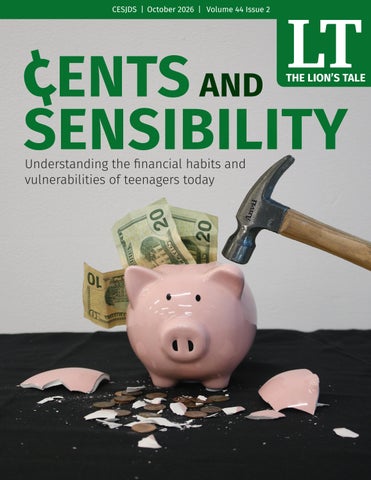
Understanding the financial habits and vulnerabilities of teenagers today
THE LION’S TALE STAFF ur do
ff:
sta
our y s at’ tem Wh orite i ver fav u’ve e t? yo ough b ske
a We
Editors-in-Chief Eliana Abrams & Leora Blumenthal
Managing Editor Jordana Dauber
Megan Moroney concert tickets Leora Blumenthal
In-Depth Editor
TJ Watt jersey David Federowicz
Lindsey Shapiro
News Editors Ephraim Blair & Kira Koplow
Features Editor
Boots Lena Lourenco
Jackson Gill
Olivia Rodrigo concert tickets Lindsey Shapiro
Opinion Editors Zoe Cohen & Lena Lourenco
Arts and Entertainment Editors Dalya Lurie & Liat Netter
Sports Editors David Federowicz & Eli Loeffler
Record player Eliana Abrams
Reporters
New shoes Liat Netter
Sophia Leinwand, Isaiah Segal-Geetter, Eden Segal-Geetter, Aviv Stein, Ayla Hurwitz, Noam Serlin, Molly Elbaum, Shira SkolnickEinhorn, Ren Baronofsky, Jemma Wallace, Liya Saratovsky, Mae Stein
Staff Adviser Adviser Emerita
Jessica Nassau Susan Zuckerman
iPad Zoe Cohen
Loafers Kira Koplow
Cover photo illustration by Lindsey Shapiro, LT.
Photos by Jordana Dauber and Eliana Abrams, LT.
EDITORIAL AND ETHICS POLICY As the student newspaper of the Charles E. Smith Jewish Day School, The Lion’s Tale (LT) is a public forum for student opinion and expression. All content is determined by students. Its purpose is to inform the CESJDS community and to express the views of its staff and readers. The staff has made every effort to ensure the accuracy and objectivity of its news. Signed columns reflect the opinion of the writer; staff editorials reflect the opinion of the majority of the LT editorial board. The LT staff welcomes letters to the editor and
2 October 2026
guest columns, which must be signed. The staff reserves the right to refuse any material and may edit letters or columns for length, clarity, libel, obscenity and/or disruptiveness. All other contents copyright of LT. All rights reserved. Submissions may be emailed to jdslionstale@gmail.com, mailed to LT or brought to room 320. LT magazine and website is funded by The Simon Hirshman Endowment for the Upper School Newspaper and The Kuttner-Levenson Endowment for the Upper School Cultural Arts and Student Publications.
AI is not permitted for any generation of content or brainstorming, including but not limited to the following: writing articles or headlines, spread designs, photography, letter to the editor, audio or video. The only AI usage permitted by LT is for the purpose of transcribing interviews. The staff will adhere to the ethics of The Society of Professional Journalists and National Scholastic Press Association. The adviser will be held to the Journalism Education Association’s Adviser Code of Ethics.
NEWS
04 05 Home sweet homecoming 06 Upcoming elections Last senior standing
Class of 2027 bonds over new tradition JDS hosts second annual dance
Guide to fall voting in Israel and the United States
OPINION
08 As the school year gets into full Get the Flock out of here swing, our editors are balancing classes, 09 extracurriculars and The Lion’s Tale. If we could describe this edition in one 10 Mackle-no-more word, we would choose “dedication.” Be a don’t-know-it-all
DEAR READERS,
Teens should keep an open mind about politics
New surveillance technology poses security risks
Dedication from our editors. Even with busy schedules, our editors continue to write, design, edit and revise each page of this magazine. Their work reflects the time and attention they put into every story. Dedication from our reporters. Our reporters have grown tremendously as writers and journalists, developing their skills and finding new ways to tell stories that matter to our community. They are the core of our staff, and we look forward to seeing them take on greater leadership roles and continue producing thoughtful, engaging articles. Dedication from our faculty and staff. Our faculty and staff do more than teach and support students. They also take the time to speak with our reporters, share their perspectives and help us tell the stories that shape our community. We appreciate their willingness to make time for our reporting. Dedication to our reporting. We believe good journalism means going beyond the first answer. It means seeking out different perspectives, asking difficult questions and taking the time to understand a story before telling it. This is what dedication looks like to us on The Lion’s Tale. With the school year underway, we hope students find time to dedicate themselves to the things they care about, even as their schedules fill up. We look forward to sharing more of our community’s stories throughout the year. Sincerely,
26
11 Arrive alive
Teenagers need to drive more safely
12
IN-DEPTH
Cents and Sensibility
Understanding the financial habits and vulnerabilities of teenagers today
FEATURES
PAGE
20
16 Beyond the classroom 18 All in a day’s work 19 Sealing the Shvil
Teachers share quirky professional experiences outside of school
Alumna finds success in multiple fields Teacher finishes cross-Israel hike after 17 years
A&E
20 22 Bagel break down 23 Rounding up Roundhouse Medieval magic
A review of the Maryland Renaissance Festival
PAGE
18
Breakfast places in Bethesda ranked Local theater celebrates 50th anniversary
SPORTS
24 25 Pace to race Tackles to throws 26 Teach me two coach 27 From digs to dances
Girls varsity and JV volleyball teams secure victories on homecoming day
PAGE
4
Which running event should you run this fall? Annual Powderpuff game changed from flag football to kickball
Editors-in-Chief
PAGE
Artists using their platforms to promote a pro-Palestinian agenda is dangerous
English teachers tag team in multiple sports
Photo credits from top to bottom: Jackson Gill, LT. Ephraim Blair, LT. Tess Mendelson, used with permission. Brielle Bassin, Dimensions.
The Lion’s Tale Magazine 3
- news -
LAST SENIOR STANDING
Class of 2027 bonds over new tradition Dalya Lurie & Eden Segal-Geetter A&E Editor & Reporter n a sprint, senior Micah Brickman makes it just in time to slip under the closing garage door and hear it click shut. Once in the garage, he waits for senior Gillian Krauthhamer to open her car door, and as she steps out, Brickman squirts her with his water gun, successfully eliminating his second target for senior assassin. Senior assassin, a relatively new tradition for JDS seniors, commenced in the first month of the 2026-2027 school year. The game has gained popularity throughout many high schools nationally in the past few years. Each student uses a water gun or bottle to eliminate an assigned target. When a player eliminates their target, they inherit that person’s target until only one player remains. The game is paused inside the school building and during any JDS-related sports event, but to be safe, many seniors still wear goggles, which serve as a shield to protect them from elimination. The goggles haven’t stopped participants like Brickman from making early eliminations by catching his targets without their goggles on inside their homes. “I was really excited because it was my second elimination and I was the only person to have more than one,” Brickman said. “It’s fun every time I get an elimination.” In addition to the thrill of the game, senior assassin requires a lot of behind-the-scenes planning and logistics. Seniors Yarden Wilkenfeld and Judah Trauben decided to be the administrators this
I
4 October 2026
1
2
3
safety risks that needed to be addressed, particularly surrounding activity in the parking lot. Last year, efforts to eliminate targets leaked into the school parking lot during heavy traffic hours, creating dangerous situations as students were navigating around moving cars during dismissal and drop-off. To ensure that the game remained safe, Silberman met with Trauben and Wilkenfeld to establish clear boundaries and set rules, such as not entering one another’s homes without parental consent or eliminating people in the school building. After having the conversation to ensure that safety precautions were taken seriously, Silberman felt a lot more optimistic about the game. “I think it definitely occupies them, and I think just seeing kids, seeing other students walking around with goggles is unifying,” Silberman said. “It reminds them that they’re seniors and they have a unique role in the school.”
a) Caleb Berman b) Lyla Silberg
Seniors share their locations with each other on the “Splashin” app, allowing their assassins to locate their targets. Photo by Leora Blumenthal, LT.
Target’s location
Total points Time left until targets switch
c) Molly Rose Cloutier ANSWERS: 1) c 2) a 3) b
MATCH THE GOGGLES TO THE SENIOR
year. One of their jobs is to run the game on an app called “Splashin” which logs eliminations and assigns targets to make sure everything runs smoothly. To eliminate their target, players are required to submit a video directly to the app of them getting their target out as evidence of the elimination. Another part of Trauben and Wilkenfeld’s job is to ensure eliminations are fair and to address questions about disputed eliminations as they occur. “If somebody gets eliminated but it wasn’t according to our rules that we’ve implemented, then the person’s still in,” Trauben said. “A person can get eliminated based on our judgment.” Questions regularly pop up regarding boundary lines and under what circumstances players are allowed to enter others’ homes. As enthusiastic as seniors are about the tradition, last year’s seniors brought a few unintended challenges to light, prompting the administration to step in and establish official guidelines this year. “There’d be a lot of very excited and disruptive conversations during class about assassin stuff in my senior classes last year, and it seemed like it was sometimes interfering with their ability to focus,” Junior and Senior Grade Dean Reuben Silberman said. “So I just wanted to be more aware of what was going on this year and also talk a little bit about what guidelines should be made to make sure that it didn’t disrupt school.” In addition to classroom disruptions, there were also some
Students dance to music played by a DJ hired by the school. Photo by Brielle Bassin, Dimensions.
Molly Elbaum & Liya Saratovsky Reporters As JDS high schoolers arrived at the Upper School gym on Sunday, Oct. 11, they found the room filled with decorations, snacks and music. Though only in its second year, JDS has adopted the classic fall high school tradition, a Homecoming dance The Homecoming dance started at 8 p.m., but excitement began earlier that morning with JDS sports teams taking on Berman Hebrew Academy in Homecoming games. While all outdoor games were canceled due to inclement weather, indoor events proceeded. Middle school, JV and varsity girls volleyball teams all defeated Berman at home. These games also honored Breast Cancer Awareness Month. Pink is the color for Breast Cancer Awareness Month, so all players wore pink socks as well as “Think Pink” shirts, with fans receiving wristbands to show their support. Freshman Yair Wilkenfeld felt the games brought the school together before the dance. “I think [the games] really generated school spirit and unity,” Wilkenfeld said. Homecoming was mainly planned by the high school administration, grade deans and the parent committee. They met several times prior to the dance to go over details and make sure everything was ready for the night. Additionally, there was a student feedback form sent out last year after the first dance to gather information on what students
HOME SWEET HOMECOMING
JDS hosts second annual dance
liked or disliked. Freshman Dean Matt Landy was heavily involved in the preparation of the dance and noted that student feedback was crucial in planning “This is only year two, so we’re still in the learning process of what works and what doesn’t,” Landy said. “ Student feedback is really important in that regard, but I think it’s been pretty consistent in terms of what we did last year.” The gym was decorated with string lights, balloon animals and a light-up sign across the bleachers reading “CESJDS HOCO.” The bright, colorful decorations created the setting for the nights’ activities. Amongst the decorations was the main attraction, the dance floor was the center of attention. There was a DJ booth playing popular music that people sang and danced to. All night, students crowded the dance floor, jumping in mosh pits and singing along to the songs. If students needed a break from dancing, there was a spread of popcorn, cookies, candy and an assortment of drinks in the cafeteria. There were also board games and tables for anyone who wanted to sit. “I thought it was really sweet how everyone who went to homecoming kind of knew that they were there for fun and to hang out and just listen to the music and dance with everybody,” senior Emunah Simkovich said. “It was nice to see how everybody was going with the flow and just
moshing.”
MOLLY’S To maintain structure and participation throughout the HOCO night, administration set strict rules. Students were FAVORITES attendance required to RSVP in advance and
Justin Bieber, “Beauty and a Beat”
Miley Cyrus, “Party in the U.S.A”
DJ Casper, “Cha-Cha Slide”
were required to arrive between 8 p.m. and 8:15 p.m. They could not leave until 9:30 p.m. According to Landy, enforcing these rules was essential to keeping the event organized and ensuring a safe and enjoyable environment for all attendees. “This dance is for the students...,” Landy said “We want [them] to have the best time possible in a safe environment. Being able to facilitate that in the best way possible is our main goal.” Though the Homecoming dance is a new addition to JDS, it is not the only formal dance hosted; seniors have the opportunity to go to prom before graduation. While this experience is unique to the seniors, Homecoming is open to all high school students, giving them an opportunity to come together for a dance. “I think it’s a nice opportunity for younger grades to get the experience of dressing up and going out for a dance,” Simkovich said. “I think it will be a nice tradition to keep going and to let everybody bond in different settings outside of the classroom.”
Photos from justinbiebermusic.com, wikimediacommons and mileyofficial.com.
The Lion’s Tale Magazine 5
- news -
UPCOMING ELECTIONS DATES TO KNOW
ASK THE LIONS:
Why are elections important to you?
6 October 2026
Oct.
22-29
Maryland early voting
Oct.
27
Israeli general election
Nov.
3
U.S. midterm elections
Nov.
4
Israeli official election results released
[in] Maryland’s congressional delegation,” History Department Chair Carl Atwood said. As opposed to the American midterm elections with voters electing a single person, Israeli elections are based on voting for a party rather than an individual. The Knesset is part of a parliamentary system, as opposed to the U.S. government, which is split into three branches. Israelis will be voting to fill each of the Knesset’s 120 seats. Each campaigning party has a party head and a list of members, but not everyone on the list gets a seat. To be elected, a party has to pass 3.25% of the total vote threshold. To get a majority in the Knesset, a party would have to win at least 61 seats, and since that is generally unattainable for a single party, coalitions are formed between them. According to Garrett Nada, a JDS Lower School parent and a policy analyst at Israel Policy Forum, the two most popular parties at present are Likud, the current governing party run by Prime Minister Benjamin Netanyahu, and Yashar, led by Gadi Eisenkot. However, neither party has enough support, according to opinion polling, to reach the numbers they need to form a coalition. “One of the interesting things about the upcoming election is that [within] the two most popular parties, Gadi Eisenkot’s Yashar and Benjamin Netanyahu’s Likud, neither party and their potential allies has a clear path for getting 61 or any more seats in the Knesset,” Nada said. “… So there’s a lot of different questions. This upcoming election is going to be
much more competitive than some other ones in the past.” Another difference between the Israeli and American elections is campaigning and voting. With the exception of government workers, Israeli citizens who live abroad and want to cast a ballot are only able to do so in the country itself. Over the next few weeks, thousands of Israeli citizens will return home to vote on the new government.
“
The next Israeli government could really impact a lot about the U.S.-Israel relationship and also the relationship between American Jews and Israel going forward.” -Israel Policy Forum policy analyst Garett Nada
“
Kira Koplow News Editor This fall, as the school year sets in, Americans and Israelis alike will head to the polls. The U.S. will hold midterm elections on Nov. 3, and voters will elect representatives and senators, as well as governors in some states, including Maryland. On Oct. 27, Israelis will vote to elect members of the Knesset, the Israeli parliament, who will then form a governing coalition. For American midterm elections, voters are choosing individuals to represent their districts and states in the federal government. One-third of Senate seats are up for election this year, as well as all 435 seats in the House of Representatives. Two close-hitting issues are Ballot Question Three and the Maryland gubernatorial race. The race is a repeat of the 2022 race, with incumbent and Democrat Wes Moore up for reelection against Republican Dan Cox. Question Three is a proposed Maryland constitutional amendment that will appear on the midterm ballot. While the question deals with redistricting, an issue that is already contested in of itself because of the gerrymandering nature of the proposed amendment, the language is also confusing and hard for an average voter to read, according to Maryland Matters. “That question is about to what degree will Maryland have freedom to redraw districts on a partisan basis, and how people vote on that constitutional amendment could have national ramifications on future elections
Israeli politicians also spend less time campaigning than American candidates, mostly because of the nature of a coalition government. Since not every member of each elected party will actually get a seat in the Knesset, campaigns revolve around parties and party leaders, rather than the individuals on the party list. “You’re kind of thinking a little bit more in terms of the party as a whole when you’re voting for things in the Knesset,” Nada said.
Junior Megan Poretsky: “I believe that in our governmental system, it’s important to have a voice and it’s important to be recognized as an individual.”
Guide to fall voting in Israel and the United States “So that’s one thing that’s different [in Israel].” Both elections are consequential in establishing the course of American Jews’ next few years, according to Nada. On the American side, many lawmakers are becoming increasingly upset with Israel’s military operation in Gaza and treatment of Palestinians in the West Bank. Many progressive members of the Democratic Party are pushing for more conditions on security aid to
ג
Israel or to end it entirely, and a Democratic majority in Congress could make these proposals more prominent. Zev Mendelson (‘25), an alumnus and student at Binghampton University, as a Jewish American his vote in the U.S. election is influenced by the positions lawmakers take in regards to Israel. After doing research on candidates in his district, he is choosing to vote for people who he believes better support both
ד
ב
ל
ש אג
FOR UNITED STATES REPRESENTATIVE DISTRICT MD-08
א
Nancy Wallace
FOR STATE SENATOR DISTRICT 3 Karen Lewis Young
vs.
Israel Parties running: 2 vs. 38
Frequency of general elections:
Every four years vs.
פ
גד
א
מ
Every four years or called by the prime minister
די
Voter turnout:
Jamie Raskin Cheryl Riley
Half of an Maryland midterm ballot (left), half of an Israeli election ballot. Illustration by Kira Koplow, LT.
U.S.
א
Shelley Aloi
63.9% vs. 68.80% Information from Ballotpedia and IFES Election Guide.
Freshman Max Jakabovics: “[They] allow the people of the electorate to really speak their mind and choose their leader.”
Israel and America. “Israel’s always on my mind because as the world gets more hostile towards Jews, it’s important to know who our friends are and who our friends aren’t in the election,” Mendelson said. Another way the Israeli elections could affect American Jews is in a significant ideology change. If a more centrist government with more moderate views on Gaza and the West Bank is elected, like Yashar, that could potentially translate into less antisemitism and anti-Zionism than American Jews are currently facing. According to Nada, many American Jews feel that they would have an easier time with certain domestic political conversations if a new governing party took charge. “The next Israeli government could really impact a lot about the U.S.-Israel relationship and also the relationship between American Jews and Israel going forward,” Nada said. The upcoming elections are influential in determining how the rest of President Donald Trump’s term will play out, as his Republican Party will battle to keep control of the House and Senate while Democrats seek to retake Congress. Atwood believes that all students, even those under 18, should remain educated on the issues presented in these upcoming elections. “Even if a young person can’t vote, that doesn’t mean that they should ignore what’s happening in their country,” Atwood said. “Everything is a learning process, and young people can still make a difference and have their voices heard and inspire change.”
Sophomore Zachary Grumet: “For me, elections mean development.”
The Lion’s Tale Magazine 7
- opinion -
BE A DON’T-KNOW-IT-ALL
Teens should keep an open mind about politics
W
hat are you? Are you a Democrat? Republican? Liberal? Conservative? There seems to be an expectation that we should have our political identities figured out by the time we graduate high school. But we don’t need to know exactly what political views we align with. In fact, maybe it’s better not to. When political affiliations become part of your identity, it can be hard to think about matters independently. Instead of asking, “What do I think about this issue?” people often start asking, “What does my side think?” Being bound to a political party can prevent us from forming our own thoughts. For one thing, our opinions will probably change. The next few years of our lives will expose us to new people and experiences. College, work, financial independence and getting older will change the way many of us understand the world. Many, if not all, of us will change our minds on a controversial political issue at some point in our lives. So why act like we need to permanently tie ourselves to our current views? Pew Research Center found that on average, about 10% of the members of each party switched parties over the 15 months of the 2016 presidential campaign, with younger adults more likely
Illustration by Lena Lourenco, LT.
8 October 2026
to move between affiliations. This fluidity shows that political beliefs are dynamic; our party ties should be allowed to evolve just as we do. Another outcome of the pressure to “pick a side” is that adolescents don’t take enough time to analyze their beliefs before deciding which party they align with most. In fact, many young people choose the party their parents are a part of. According to Pew Research Center, 89% of parents who identify as Democrats have teens who identify as Democrats, and this trend is seen in 81% of Republicans as well. The idea that aligning yourself with a party is instrumental to participating in American political life leads to further division in an already hyper-polarized world. When people begin viewing politics as a competition between two opposing teams, disagreement becomes personal. Instead of seeing someone who supports a different policy as someone who has reached a different conclusion, they can seem fundamentally different from us. It is okay to agree with a Republican position on one issue and a Democratic position on another. It is fine to strongly support one candidate but disagree with that candidate’s party on a different political issue else.
We aren’t saying high school students should be indifferent about politics. We shouldn’t. We should pay attention to elections, understand the issues that affect us and form opinions based on evidence. But rather than letting party affiliation drive our views, our beliefs should be shaped by staying informed on objective news. Being politically engaged does not require being politically certain on every issue. With midterm elections approaching, it is important to remind ourselves that political parties are simply labels, not an entire identity. As high school students, we can’t let the idea of being part of a party deter us from forming our own opinions. We don’t have to choose a side on every issue, and we don’t have to pretend that we know more than we do. So, next time someone asks “What are you,” it’s okay to answer “I’m still figuring it out.”
-THE LION’S TALE Vote of 13 members of the editorial board
13
0
AGREE
DISAGREE
GET THE FLOCK OUT OF HERE New surveillance technology poses security risks
Ren Baronofsky Reporter Security cameras are everywhere. Some monitor school buildings and are watched by security teams to make sure students stay safe. Some cameras, however, pop up in neighborhoods and cities, quietly recording where you travel, what you do and who you meet. A quickly emerging type of these cameras, called Flock cameras, have caused speculation and outrage due to the unclear policies against the collection and use of data. Flock cameras are a type of Automated License Plate Reader (ALPR) that use artificial intelligence to identify plate numbers. Introduced in 2017, they quickly spread across the United States, used by police agencies to investigate crimes, gather evidence and track vehicles. Like me, many citizens and government officials have expressed anger against the cameras because of inconsistent regulations on the data it collects and the misuse of that data that has occurred. Some groups have taken to vandalizing these cameras, ripping them down, covering or even smashing them. While these actions are extreme, the motivation behind them is plain and completely understandable: there is a lack of clear regulations around this technology.
On Aug. 25, a Kentucky police officer was arrested after using Flock’s database to search for his ex-partner over 2,000 times, according to CNN. In 2025, a Texas sheriff searched more than 83,000 cameras without a warrant to track a woman suspected of having an abortion. These are only some of the dozens of incidents reported in The Washington Post of law enforcement officers misusing Flock cameras, showing an alarming precedent being set. Opposition to this growing network of surveillance cameras is a view shared by figures across the political spectrum. Pennsylvania governor Josh Shapiro, a Democrat, criticized Flock cameras and welcomed bipartisan legislation to ban them statewide. “This is not something in the public interest,” he said at a press conference in August. Florida governor Ron DeSantis, a Republican, shared this sentiment, saying at a press conference in September: “I don’t want to have this become a surveillance state.” Even though they are disliked by many citizens and government figures, action to suspend or regulate Flock cameras has been limited. Texas Governor Greg Abbott, a Republican, froze state spending on Flock cameras and several communities have canceled their contracts, but national regulation has yet to catch up. This lack of regulation will only lead to more dangerous misuse of this technology, and more people will be driven to illegal action against these cameras. For over a decade, many
have warned about the dangers of surveillance cameras, and it’s not just speculation anymore. In the Harvard Law Review, legal scholars Danielle Keats Citron and David Gray wrote, “These warnings are no longer science fiction. The digital technologies that have revolutionized our daily lives have also created minutely detailed records of those lives.” Growing up in a digital world, I’ve always heard these warnings, but it’s shocking to see what it looks like in action. Warnings like these aren’t new. The Harvard Law Review article, which criticizes the surveillance made possible by cameras like Flock, was written in 2013. Yet the issues it emphasizes have only grown more relevant. In a scientific article found on Research Gate, Tianyue Chen puts it, “Mass surveillance brings discrimination and marginalization to society, leads to conflict between social classes, and only increasing the number of surveillance does not fundamentally improve social security.” It’s easy to worry about the issues and dangers surrounding Flock cameras, but it’s more important to understand what we can actually do about it: advocating to officials, becoming educated on the topic, spreading the word. This field is relatively new and is constantly expanding and changing, threatening the right to privacy. Teenagers shouldn’t be motivated to illegally destroy these cameras, but should use the power they have to make their voices heard.
Rec
BY THE NUMBERS
20+ billion vehicle scans per month on Flock’s network
~70% of people in the U.S. live within Flock’s coverage
80+ cities have canceled or shelved Flock contracts since 2025
Information from findingflock. com.
The Lion’s Tale Magazine 9
- opinion -
MACKLE-NO-MORE
Artists using their platforms to promote a pro-Palestinian agenda is dangerous
David Federowicz Sports Editor
STADIUMS WHERE HE’S BANNED
GILLETE STADIUM Boston On Sept. 4, in front of a 90,000-person crowd at MetLife Stadium in East Rutherford, New Jersey, American rapper Benjamin Haggerty, known as Macklemore, used his opening slot in Ed Sheeran’s 2026 global tour to condemn the Israeli “genocide” against Palestinians. Macklemore performed his anti-Israel song, “HIND’S HALL,” and repeatedly chanted “Free Palestine” while a screen behind him played a video from the war in Gaza. Led by Gillette Stadium owner and Jewish advocate Robert Kraft, eight major venues in the United States, including Gillette, have banned Macklemore from performing in their stadiums for hate speech and one-sided rhetoric against Israel and Jews. Shortly after, Sheeran followed and fully removed Macklemore from his tour. The drama surrounding Macklemore is a lose-lose situation for the Jews. On one hand, if the stadium owners do nothing, then Macklemore’s actions are normalized and artists can create hateful environments with divisive political commentary dumped on unassuming guests. On the other hand, while Kraft and others made the right decision to ban Macklemore, Macklemore claimed victimhood and was further brought into the media spotlight. The crowd in support of a “Free Palestine” along with Macklemore sensed an opportunity, mounting a pressure campaign against Sheeran and the stadium owners.
10 October 2026
LINCOLN FINANCIAL FIELD Philadelphia
MERCEDES -BENZ STADIUM Atlanta
LUCAS OIL STADIUM Indianapolis
BANK OF AMERICA STADIUM Charlotte, N.C.
RAYMOND JAMES STADIUM Tampa, Florida
AT&T STADIUM Arlington, Texas Information from Rolling Stone.
Two weeks later, on Sept. 19, Sheeran addressed the crowd in Philadelphia, apologizing for Macklemore’s political soapbox while continuing his tour solo. Five days later, Macklemore announced his own independent “Free Palestine Tour” with intentions to, like at MetLife, provide an uneducated loudmouth rant about his dogma against Israel and, by way of association, Jews. As of now, Macklemore has three shows scheduled: Dublin on Oct. 26, Paris on Oct. 29 and London on Oct. 30. Ironically, the Free Palestine Tour will not stop anywhere near Palestine. Macklemore’s career has been in decline after his last album dropped three years ago. Since then, he has turned towards exploiting supporters of the anti-Israel movement to make money and resurrect his career. According to The Hill, Sheeran lost nearly half a million followers after dropping Macklemore. Simultaneously, Macklemore has gained roughly 2.2 million followers on Instagram. The reality is that Macklemore’s strategy to use the “Free Palestine” political movement to gain the support of young adults is working, and sadly the damage has been done. Am I against freedom of speech? No. It’s a constitutional right. However, it’s also unacceptable that artists such as Macklemore use their entertainment platform to fuel antisemitism by subjecting a captive audience to inaccuracies and hatred toward Israel and Jews. The situation reminds me of the famous saying from the Marvel Spiderman Comic Series, “With great power comes great responsibility.” Those with an audience and platform have a responsibility to bring people together, not tear them apart. Macklemore and Sheeran’s audience showed up that night to hear his music and their favorite songs. Nobody at the concert came expecting the barrage of
anti-Zionist rhetoric and heightened anxiety that they received. Jewish mother Jessica Grabler was at the concert with her husband and two young kids. She said that there were many kids at Sheeran’s concert, which initially created a “warm” environment. Macklemore’s speech, according to Grabler, came as a shock. “My husband and I started looking at each other, and started looking around,” Grabler said. “It was a mix of people clapping and a mix of people yelling, but more clapping. And in that crowd … we started to feel really a little bit uncomfortable. I started to look to see where the exits were, and that’s an unfortunate feeling when you know you’re going to a fun concert.” Macklemore has a history of antisemitic actions at his performances. At an opening party at the Museum of Pop Culture in Seattle on May 16, 2014, Macklemore dressed up as a Hasidic Jew wearing a large fake prosthetic nose, black beard and a wig during a surprise performance. Macklemore’s motivations are not simply in the interest of the people in Gaza, they also have antisemitic connotations. In “HIND’S HALL,” Macklemore chants “f--- the police” and glorifies the protesters who harassed Jewish students at Columbia University who were trying to get to class. For whatever reason, Macklemore and a surprising number of others feel a need to repeatedly promote anything that isolates or delegitimizes Jews. Sadly, Jews like Kraft are likely to continue to face lose-lose situations and be torn between standing up for Israel and against hate, while unfortunately possibly amplifying those same messages they sought to block. In the end, fighting back is always the right choice, even with its controversial baggage.
ARRIVE ALIVE Photo from pitpony. photography.
Leinwand Teenagers must drive more safely Sophia Reporter
BY THE NUMBERS Getting your driver’s license should be exciting. It means freedom and independence. But with that freedom comes a responsibility that is easy to forget: every time we drive, our decisions can affect other people’s lives. When I started driving, my dad warned me: “Cars are a great tool, but can become an even greater weapon. For teenagers, managing this responsibility matters even more. According to the Center for Disease Control and Prevention (CDC), about 2,800 teens ages 1319 were killed, and about 227,000 were injured in motor vehicle crashes in the United States in 2020. That means that, on average, about eight teenagers died in crashes every day, while hundreds more were injured. Teen drivers also have a fatal crash rate almost three times as high per mile driven as drivers aged 20 and older, according to the CDC. One reason teen driving can be dangerous is that risky behaviors start to feel normalized. A driver might think that checking one notification or responding to one message will only take a few seconds, but that’s also the amount of time it could take to get in an accident. In 2019, 39% of U.S. high school students who drove reported texting or emailing while driving at least once in the previous 30 days. Teenagers may also underestimate the danger of speeding. Teens are more likely than older drivers to speed and keep shorter distances from the vehicle in front of them. In 2020, 35% of male drivers and 18% of female drivers aged 15-20 who were involved in fatal crashes were speeding at the time of the accident. Speeding not only makes a crash more
2,800 teens ages 13-19 were killed in car accidents in the United States in 2020
39%
of U.S. high school students reported that they text while driving in 2019
29% of drivers killed in accidents ages 15-20 in 2020 had been drinking
56% of drivers and passengers killed in a car crash in 2020 ages 16-19 were reported not wearing a seatbelt
44% of motor vehicle crashes with teen drivers occurred between 9 p.m. and 6 a.m. Information from the CDC.
likely, but also gives drivers less time to react when something unexpected happens, increasing impact. There is also a major difference between thinking you’re a good driver and making consistently safe decisions. Drivers might often think, “I always speed down this road,” or “There’s never anybody out at this time,” but being familiar with a road does not mean you can predict what might happen. A car could suddenly stop, someone could swerve lanes or a pedestrian could enter the road. Safe driving means leaving yourself enough time and space to respond in case something goes wrong. Alcohol is another serious risk. According to the CDC, 29% of drivers aged 15-20 who were killed in motor vehicle crashes in 2020 had been drinking. Driving after drinking isn’t a mistake you can dismiss as a minor lapse in judgment. A decision made before getting behind the wheel can affect everyone on the road. The solution does not require teenagers to stop driving or give up their independence. It requires us to take driving more seriously. People often think, “That would never happen to me,” until it does. Put the phone away. Follow the speed limit instead of treating it like a suggestion. Leave enough space between cars. Pay attention even when you think you have everything under control. Most importantly, stop assuming that because nothing has ever gone wrong that nothing can ever go wrong in the future. We cannot control everything that happens on the road, but we can certainly control our own decisions. Every time we get behind the wheel, we are making choices that not only affect ourselves, but also our passengers, other drivers and pedestrians. A driver’s license gives teenagers freedom, but it also gives them responsibility. We should not drive safely only because we are afraid of getting a ticket. We should drive safely because getting somewhere on time will never be more important than making sure everyone gets there alive.
The Lion’s Tale Magazine 11
¢ENTS AND
- in-depth -
Eliana Abrams Editor-in-Chief Leora Blumenthal Editor-in-Chief Liat Netter A&E Editor
Understanding the financial habits and vulnerabilities of teenagers today
A
first paycheck can feel like freedom. So can a $20 bill, a new job or a credit card in your name. But with every dollar comes a choice: spend it, save it or risk it. For teenagers, these choices are practice for financial independence, which looms closer every day. Americans now carry nearly $104,755-$151,274 in total household debt depending on whether mortgages and specific housing obligations are included, including more than $1.26 trillion in credit card balances, according to the Federal Reserve Bank of New York. For members of Gen Z, a stable financial independence can feel increasingly out of reach. Sixty two percent of Gen Z worry they will never own a home, according to real estate platform Clever Offers. As teenagers begin making financial decisions of their own, the habits they build during their adolescence will likely shape how they navigate an in-
“We're not strangers anymore. I expensive adulthood. Among creasingly This article explores how feel more in touch with them… earn and spend money and I've learned a lot of skills on teens... teenagers and how they are preparing for the how to interact with other people,
$$$$$
financial realities of adulthood.
Teen jobs and financial Independence There are few teenage mileDon’t understand stones as familiar as getting a first credit scores job. For some, this is a summer job at a camp or local retail store, while others work during the school year on top of their educational responsibilities. Sophomore Gabey SilverFear they won’t berg works as a window-cleaning have enough salesman for Ottolenghi Exterimoney in the or Cleaning. Silverberg works on future commission, meaning his pay is based on his sales. After starting the job last spring, Silverberg’s commission has increased as he has secured more clients for the business by pitching its services Want to learn financial literacy to neighbors. “I've learned a lot about my neighbors,” Silverberg said. Information from Junior
$$$$$
$$$$$ $$
especially in trying to convince them to hear my perspective. It also has [taught] me to better be able to read people and understand what their thoughts are at the moment so I can have a better outcome based on that.” Last school year, Silverberg worked around a half-hour for four days a week and spent most of his summer break working. He has found it challenging to find time to work this school year with the increased course load of sophomore year. According to the Bureau of Labor Statistics’ July report, 53.8% of people ages 16-24 are employed, with the summer being peak employment for this age group. Among high schoolers, 22.5% have jobs during the school year, with 35.5% being employed over the summer. Since he began working, Sil-
Achievement USA.
WHAT IS SOMETHING YOU HAVE SAVED FOR? Photos from Emmanuel Sarantos, Sarit Pearlman, Maya Deutsch and Adam Goldel, used with permission.
Junior Emmanuel Sarantos
What: Drum kit How: Selling hand-made napkin rings for holidays Why: He wanted to play the drums and did not own a good quality kit
12 October 2026
Sophomore Sarit Pearlman
What: Dyson Airwrap How: Babysitting Why: She wanted a tool to heat style her hair without as much damage
verberg no longer receives money from his parents for spending, and instead can only use what he has earned. Being responsible for his own money has given him a new outlook on how to be financially accountable. “One of the other things that it's taught me is to be conscious about my money and conscious of the purchases that I'm making, and realizing that when you spend $10 on food, or $10 on whatever, it's not just $10,” Silverberg said. “$10 is actually super important, and you don't want to waste even that small amount of money.” These minor purchases are especially important for young adults after graduation, according to alumnus Eli Gordon (‘22), who works at UBS Financial Services as a financial advisor trainee. He recommends budgeting as a way to be more aware of spending habits and savings. “Something that I wish I knew when I was younger is to try to save more money,” Gordon said. “Understanding that if you get yourself in a situation, like let's say you get injured in a car accident or you're not working, and you need finances, you need some money set aside in order to cover yourself in those tough times.” Irresponsible uses of money A significant concern when teenagers begin to handle their own money is irresponsible spending. Worries from parents and teens include unnecessary purchases, facing peer pressure to spend more money than wanted and gambling, which a more recent issue that has arisen. With apps that make gam-
TEEN SAVING TIPS
$
1. Try to save at least 10% of total earnings
$
2. Create a spreadsheet of possible expenses
$
3. Talk to a trusted adult with financial questions
$
4. Think through large purchases.
Sophomore Maya Deutsch
bling increasingly accessible to teenagers, more and more kids are getting involved. According to Worldmetrics, 12.3% of U.S. adolescents aged 12-17 gambled in the past year, and 30% of teen problem gamblers report financial debt. For one JDS student, called “Alex” to protect their anonymity, sports betting adds excitement to watching games. Alex began using the prediction market Kalshi at age 18. Alex mostly bets on baseball and football games, and they are currently up $50. They explained that having money at stake makes games feel more engaging, but also recognized how quickly gambling can become a risk for teens and adults alike. “I think it can become a very slippery slope very easily,” Alex said. “When you start to lose money, you have the natural tendency to try and win it back. That can lead to massive amounts of money being lost.” The excitement of winning can obscure the financial risks of continuing to bet. Ezra Karger, a senior economist at the Federal Reserve Bank of Chicago, says most people who bet on sports lose money in the long-term. According to Bank of America, the amount of money that online betters win averages less than three-quarters what they bet. This means people typically recover less than 75 cents for every dollar that is transferred to online betting platforms. Karger cautioned that apparent success of sports betters can be misleading. People who win occasionally may be more likely to share their experiences, creating
What: Ticket for a cruise with her mom How: Being a counselor Why: As a goal to motivate her to make money
the impression that betting is consistently profitable. “The ones you're hearing from are probably the ones who got lucky and have made a bit of money,” Karger said. Alex tries to be responsible when betting, tracking their financial results in a chart and setting a personal limit, only betting the amount they are willing to lose. They believe that having these systems in place will prevent them from going overboard and losing too much money. Karger also emphasized the importance of recognizing spending patterns before they become difficult to manage. This is especially important when teens aren’t spending their own money. According to financial services company Piper Sandler’s teen survey, parents contribute to around 60% of teen spending funds, while the remaining 40% is covered by teens themselves. Additionally, while 87% of teens consider saving money a priority, only 42% currently have savings, according to Next Gen Personal Finance. Karger believes teens must be mindful of what they are spending versus saving. “Being self-aware about how much money you're spending and what you're buying both in the moment, after the fact and beforehand can be really useful,” Karger said. Beyond sports betting, many students find they often spend money irresponsibly when with friends. A 2021 Pew Research Center study found that peers had the largest number of significant effects on adolescents’ consumer knowledge, attitudes and pur-
Senior Adam Goldel What: Record collection How: Babysitting Why: He had a record player and loves to listen to music, so he wanted to build his collection
The Lion’s Tale Magazine 13
- in-depth -
After high school For teenagers, financial independence can feel like a distant goal until decisions about college make it a reality. Current college tuitions for in-state schools range from $11,000-$12,000, with out-of-state tuitions reaching $32,000. According to college counselor Joshua Rauguth, many colleges are now surpassing $100,000 annually with tuition expenses, room and board costs and meal plans, making it difficult for seniors to choose schools based on prestige alone. Rauguth said that taking on substantial debt may make sense for certain careers with high starting salaries, such as some jobs in finance. However, borrowing hundreds of thousands of dollars to enter a lower-paying profession,
“
I would encourage students to think about who are my trusted people for asking big, seemingly dumb questions about what to do with money. What trusted adult do you want to go to for advice on those first choices about ... finances.
“
chasing behavior compared with other influences such as parents and media. These findings suggest that teenagers are easily influenced into spending money they might not spend independently when their friends are doing so. Karger sees this phenomenon frequently in adolescents. “If you are somewhere with friends and people start buying something … it's very easy for you to feel like you should as well,” Karger said.
- History Department Chair Carl Atwood
such as teaching, may create significant financial challenges. “If I want to go be a teacher, should I really go take out $400,000 to do that, right?” Rauguth said. “And if you want to, that's your prerogative, and I guess that's your choice, right? But it's being smart about it too. So I think students are thinking about it more, which I think is a good thing.” Because decisions about college are integrated so much into decisions about future careers, many teenagers are forced to think about their future plans from a very young age. Another factor of rising stress for teens is the current bleak workforce. According to the World Economic Forum, Gen Z is beginning their careers at a time of disruption in the workforce, leading to higher competition for roles, technological change and uncertain growth paths. Statistics show that entry-level job postings are declining while senior roles stabilize and grow. It is harder than ever to be a post-grad. Forty two percent of Gen Z members who are out of college live paycheck to paycheck, according to a Bank of America study on Gen Z and the cost of adulting. The average Gen Z college graduate owes between
HOW MUCH WILL NIKE AIR FORCE 1S COST IN...
$103 $113
$128
$145
$164
$185
$210
2027 2031 2036 2041 2046 2051 2056
Calculated with a 2.5% inflation rate
14 October 2026
Photo from Creative Commons
$21,000-$31,000 in college debt, according to Education Data Initiative. Since graduating from Lehigh University last spring, Gordon has adjusted to managing personal expenses including rent, utility bills, groceries and credit card payments. “I try to create an Excel spreadsheet so that I know how much I'm spending, where I'm spending too much, and where maybe I could spend a little more,” Gordon said. Gordon uses this spreadsheet to understand how much money he has to spend each month on necessities, and then sets limits on niceties including dining and activities he enjoys. He also makes saving part of his monthly budget. For many teenagers, the thought of financial independence after college can be daunting and may seem to mean cutting back on spending. However, Gordon puts money aside in his budget to spend. Gordon does not believe budgeting means cutting out all forms of enjoyable spending, and enjoys the financial freedom that comes after graduation. “I think I've gotten a little bit more freedom now that I have my own finances,” Gordon said. “And so I realize that I can do a little bit more, but I guess also that I'm accountable for my decisions.” Karger said that developing awareness around spending can help teenagers prepare for larger financial decisions in the future. While teens often spend relatively small amounts compared to adults, Karger said, budgeting can create habits that carry into college and adulthood. Karger also said that spending is not automatically “bad.” Before making a purchase, teenagers should consider if they will regret buying it later. For young adults, learning to make those decisions can be difficult. For Gordon, one of the most important financial habits for young adults is saving money. He emphasizes developing spending habits while teenagers still have a safety net. He sees budgeting as less about eliminating fun but about making necessary tradeoffs to save for emergencies. “The hardest thing is holding yourself accountable," Gor-
don said. "… I’m not a millionaire. I don’t have all the money in the world. There are certain things I can do and there’s certain things that I can’t do.” Financial literacy While financial literacy is not a class offered at JDS, financial topics are touched upon in certain elective classes and in senior seminars, which are a series of lessons to prepare seniors for life post-graduation. History Department Chair Carl Atwood’s economics elective focuses on general economic principles to understand decision-making and how societies function economically. While the course includes a mini-unit about personal finance, those topics are primarily saved for the two-part senior seminar, where a wide range of personal finance topics are covered. “These are really important things to think about,” Atwood said. “It's also for high schoolers a little often premature. It'll be so hypothetical and abstract that we just don't know what choices will be responsible once we're having to make those choices for ourselves. For some people, it might be right after high school or graduation, and for others, it might be more in the distant future.” Financial literacy discussions exist across departments at JDS. While Talmudic discussions and Jewish law might not seem to have any relation to spending money in the 21st century, Jewish Text teacher Maharat Ruth Balinsky Friedman’s Talmud II final project does just this, connecting sports betting to the course’s focus on who is a permissible witness under Jewish law. At the end of the year, students learn about four behaviors that would forbid someone from being allowed to testify as a witness. One of these behaviors is gambling. Before introducing this topic into the Talmud II curriculum in the fall of 2024, Friedman came across a podcast about how sports betting is a problem that is not being adequately addressed among Orthodox high school students in New York. “I like to connect what we do in the Gemara to contemporary issues, and it felt like a re-
GEN Z FINANCE FACTS 66% are currently saving money
54% says they would save if they
had $300 more a month
24% passed on events with friends
because of the expense
40% cut back on dining out
92%
59%
52%
say that they frequently buy sweet treats for themselves
who often buy sweet treats say it leads to overspending
buy a sweet treat for themselves once a week or more
49% says the high cost of living is a barrier to financial success 69% have taken steps to reduce the cost of living 20% started to shop at more affordable grocery stores
Average costs of... A new car: $49,855 College tuition: $26,034 a year A laptop: $1,200 Domestic flights: $445.26 Gasoline: $4.36 a gallon A new house: $393,700
ally important thing to address,” Friedman said. “And based on my research, it's not really being addressed in a lot of other places.” Friedman connects what the students are learning about gambling in the Talmud to the current sports betting issue among teenagers in the final project, where students draft a fictional school policy on sports betting. While this project informs students on sports betting, questions about other aspects of financial literacy often remain. Since personal finance can seem confusing and daunting at times, Atwood encourages students to ask questions and seek advice from trusted adults. “I would encourage students to think about who are my trusted people for asking big, seemingly dumb questions about what to do with money,” Atwood said. “ … What trusted adult do you want to go to for advice on those first choices about how do I get started with life and where's my finances?” Conclusion The financial decisions teenagers make today may seem small: a meal with friends, an online purchase or a few dollars put towards a game. But these smaller decisions are practice for the future. When amounts of money spent increase and the consequences become more significant, habits developed during high school can determine the ease of the transition towards financial independence in adulthood. That makes financial literacy about more than just knowing how to save money. It is about learning to pause before spending and recognizing outside influences. These skills can give teenagers something fundamental: confidence in making their own financial decisions. As teenagers move toward college, jobs and eventually supporting themselves, there will continue to be new ways to spend money. The challenge is not to avoid spending altogether, but to have the judgment to spend well.
Information from AAA, Kelly Blue Book, the New York Times, U.S. News and World Report, Bank of America, United States Census Bureau and the United States Department of Transportation
The Lion’s Tale Magazine 15
- features -
BEYOND
Teachers share quirky professional experiences outside of school Shira Skolnick-Einhorn Reporter
really holistic and healthy.” Dilworth said that working in a restaurant meant working “long, long hours” and smelling like the food she cooked for days on end. Despite these challenges, Dilworth gained valuable communication skills across all her proffesions. “Being a chef, being a mom, being a news photographer taught me how to talk to people, and to be truthful and put my guard down,” Dilworth said. “... It taught me how to communicate better.” Her father was a chef and photographer, so she was introduced to cooking and photography very early in life. As a child, Dilworth spent a lot of time in the kitchen helping her dad cook. Even though she would never go back to being a chef, Dilworth reflects on her time fondly. “When I do walk into the places that I’ve worked or similar places, it brings back really good memories,” Dilworth said. “Or when I do sit down and have a really good meal, it just brings a smile to my face.”
Recipe for Success U
pper School photography teacher Debra Dilworth had many jobs that prepared her for teaching at JDS. Some, including working as a news photographer at NBC 12, seem very connected to her current role. But, others are a bit more surprising, such as being a head chef and managing 50 kitchen employees. Throughout graduate school, while earning her M.F.A. in Photography and Film at Virginia Commonwealth University, Dilworth worked as a chef to pay her tuition. She started working at local Virginia restaurants, and training with international chefs. Dilworth worked her way up to sous chef, and eventually to head chef. “[My employees] drove me crazy,” Dilworth said. “But it was fun because I taught them how to cook, and I really cook from the heart. I really like to cook vegetarian or something
Something Sketchy Before he was a high school math teacher, John Watkins-Chow worked as a full-time online animator and artist. Watkins-Chow has always loved art, and after college, he decided to start taking it more seriously. He started by doing freelance comic book artwork, and eventually, he moved to San Francisco and took a job animating at a small startup company. Every day he would get to work around 11 a.m., go out to lunch with his colleagues and work on his projects until around 9 p.m. when he would go back home. The company was known for its animated parody videos; Watkins-Chow worked on a Backstreet Boys song, making storyboards for it, and eventually completed the full animated music video. “Other than the awful deadlines, there’s a lot of flexibility,” Watkins-Chow said. “It was really easy to decide how I was going to spend my time.”
16 October 2026
After that company went out of business, Watkins-Chow and his wife spent about a year and a half longer in San Francisco before moving back to the Greater Washington area, when he started working at JDS. Since moving back to Maryland, Watkins-Chow has continued to do art on the side. He works on his art late at night, on the weekends and over the summer. Watkins-Chow mostly draws sketch cards for baseball and entertainment card companies such as Topps and Upper Deck. Watkins-Chow is glad he made the switch to teaching, partly because he doesn’t think he has the “ambition” to be a freelance artist. He still really enjoys being creative, so he is grateful that he is still able to do art even as a full-time teacher. “I think [teaching is] a thing that I found my niche in, and it hasn’t prevented me from doing fun art on the side,” Watkins-Chow said.
A Wonder Woman sketch card drawn by Watkins-Chow at Baltimore Comic-Con. Photo by John Watkins-Chow, used with permission.
THE CLASSROOM Torah takes the Stage
Slater sits and strums his guitar that he uses for Friday “zinging.” Photo by Jackson Gill, LT.
Long before he became a high school Jewish Text teacher, Rabbi Reuven Slater spent a summer performing with the Miami Boys Choir. As a teenager, Slater spent a summer at an Israeli camp called Sdei Chemed, and he was chosen from among the boys at the camp to join the Miami Boys Choir for the summer. The Miami Boys Choir is a group of Jewish boys who perform renditions of popular Jewish songs. Although it was only a short period of time, Slater enjoyed his time with the choir. He said that even though it was a lot of work, it was a very fun experience for him. He enjoyed performing the songs live, singing to troops, being on TV and performing with other famous musicians. One of those musicians was singer Mordecai Ben David, who even borrowed
Beard Business
Middle school Jewish Studies teacher Marc Silberstein once worked as a model for his friend’s beard product. After receiving his Master’s in Education from the Pardes Institute of Jewish Studies and Hebrew College in Boston, Silberstein moved to Pittsburgh, where he modeled for his friend. The product was called Beard Balm, and his friend gave him a couple of free samples. Silberstein ended up really liking the product, and when his friend needed to make a commercial, he went to Silberstein for help.
Silberstein and his friend spent a day at a small studio. Silberstein had been instructed to grow his beard out for two months so the company could get a “before” shot. Then a stylist applied the balm to his beard and they took an “after” picture. The picture ran in a small Detroit newspaper advertisement for over five years. Even though it was only a small hobby for him, Silberstein thoroughly enjoyed his time as a beard model. “It was easy,” Silberstein said. “All I did was sit there … and stick my face
Slater’s Walkman. Reflecting on his time in the choir, Slater said that if he were to pursue a different career, he believes it would be in music. “To be able to go out and play and then get paid for something like that and enjoy what you’re doing means that you don’t work a day in your life,” Slater said. Slater said that music is a great way for people to connect with their Judaism, and he has always tried to incorporate that into his teaching. He says that the thing his students remember most from his class is the communal singing they do every Friday before Shabbat, known as zinging, the Yiddish word for singing. “There’s certain feelings that you can evoke with a chord, or two chords, that you can never duplicate,” Slater said.
out. People took pictures of me. I wish I’d asked for money, but all I got was a meal. So I guess that’s the compensation I get for it.” Even though Silberstein has not modeled since, he said the experience was interesting and fun for him. Silberstein did say that if the opportunity arose, he would model again and maybe even consider experimenting with hair dye. “[The experience was] ego-affirming, … ever-present and out of place,” Silberstein said.
The Lion’s Tale Magazine 17
- features -
ALL IN A DAY’S WORK
Alumna finds success in multiple fields
Lena Lourenco Opinion Editor Alumna Tess Mendelson (‘21) never wanted a typical desk job. Instead, she built a career around creativity. Mendelson founded her own digital marketing agency, teaches CorePower Yoga and runs a worldwide matchmaking platform with over 800 submissions. Mendelson began the process of creating her company, TM Creative Consulting, during her sophomore year at George Washington University. To start out, she coldcalled and emailed companies she wanted to work with. Overtime, Mendelson’s business expanded from social media management to designing logos and graphics, editing videos and organizing photo shoots, as well as other services that encompass creative branding and promotion. Her work with summer camps, jewelry stores, advocacy groups and bakeries only account for a small portion of the businesses she helps. “I think my business is a compilation of every single thing that I participated in when I was in high school and when I was in college,” Mendelson said. “It’s really all of my passions combined.” During her time at JDS, Mendelson was an editor-in-chief of Dimensions yearbook. She continued this trajectory by receiving her bachelor’s degree in Journalism and Mass Communication. Using skills built from years of experience with internships and contributions to marketing teams, Mendelson started her business alone while juggling her coursework and dedication to the dance team she was a part of. This past summer, Mendelson has taken on four other women with her as either employees or interns. TM Creative Consulting works with clients ranging from locals in Bethesda to schools in New York. Gale Weisswaser, co-owner of Wonderland Books, a women-owned book store in Bethesda, remembers admiring Mendelson while she was creating content for an event at the store. After the event, Mendelson reached out to Weisswaser to see if she would be interested in working with Creative Consultants. Since then, Mendelson has run
18 October 2026
the bookstore’s social media accounts, posting weekly about new releases and events to look forward to, as well as coming up with new promotional ideas and trends to follow. “People love our social media, so they really watch out for it,” Weisswaser said. “They know it’s going to be something good when they see that Wonderland has a new story or a new post, and I think that keeps them really interested. It’s great for engagement with our audience and our customers and helps us get the word out about events and new books.” Although Mendelson enjoys the creative process of working with clients like Wonderland Books, she finds the most meaning when helping Jewish advocacy groups. One of the groups she works closely with is Jewish on Campus, where JDS alumnus Micah Gritz (‘20) serves as the Chief Operating Officer. The foundation consists of chapters in colleges across America dedicated to helping Jewish leaders educate about and combat antisemitism. Gritz reconnected with Mendelson through a PR firm that they had in common. Since the commencement of their partnership, Gritz has observed increased viewership and output of posts on social media. “Our strategy is much more directed in terms of making sure that we have specific calls to action across our different social verticals,” Gritz said. “… Working with her has been incredible because she’s been able to help us cultivate specific messaging across our different platforms.” TM Creative Consulting isn’t the only way Mendelson stands up for the Jewish community. She also founded Ten Seven Stories, an organization whose focus is to disperse survivor stories about the attack on Oct. 7 across social media platforms in order to educate younger generations. While presenting her capstone project in college about a Holocaust survivor, Mendelson could hear chants from protesters yelling “burn Tel Aviv.” This experience, along with other
similar ones, inspired her to act. “Being able to contribute to the digital landscape feels meaningful for me and really helps me feel like I’m actually making a difference instead of just sitting and watching,” Mendelson said. Outside of Ten Seven Stories and Creative Consulting, Mendelson is active on her social media where she helps young Jewish singles find matches for dates. She spreads creativity and advocacy through challah baking and yiddish phrases. Her work has even been recognized by Jewish Women International, where she is being named a Rising Star Honoree for her leadership and creativity. “I like to use my own personal platform to be more about Jewish joy and combating hate through that,” Mendelson said. “My Jewish identity has never been something that I have hidden from the world. But I think recently on my social media platforms, it’s really begun to grow, and I’ve been showing it off more.”
Mendelson speaks at Woodmont Country Club. Photo from Tess Mendelson, used with permission.
Photo from Paul Blank, used with permission. Illustration by Anna Polon, used with permission.
SEALING THE SHVIL
Teacher finishes cross-Israel hike after 17 years Zoe Cohen Opinion Editor After 17 years of careful planning, more than 30 trips to Israel and support from over 50 friends and students, Jewish text teacher Paul Blank finally completed the Shvil Yisrael, Israel’s National Trail, this past summer. The 620-638 mile hike spans from the north to the south of Israel, and typically takes over two months for section hikers. It ranks among the world’s top 20 most epic hiking trails, according to National Geographic Magazine. When Blank’s college friend who lives in Israel first pitched the idea of the two of them hiking a section of the Shvil in 2009, Blank was instantly hooked. Despite being an avid hiker who had completed trails around the world and in Israel, Blank had never heard of this particular hike. He immediately fell in love with the trail and returned almost every year to continue. Whether traveling three times a year or not at all during COVID-19, Blank was determined to finish his journey. “It became a little bit of an obsession, and once I started, I had to finish it,” Blank said. “I knew there was always going to be something interesting. Israel is a fascinating country geographically and topographically. Everything changes all the time, so in that sense, I knew it was always going to be interesting. Plus, I met the most interesting people along the way.” Blank said that whether he hiked alone or with others, something always made the experience rewarding. In particular, Blank enjoyed hiking
PATH FACTS Miles 638
Start Point
Kibbutz Dan
End Point Eilat
Opened 1994
Hikers per year ~10,000 Information from Israeltrail.net and Israel Bonds International.
with JDS students on their capstone trip during their second semester of senior year almost every year he went. After building relationships with students in and out of the classroom for nearly four years, the students who joined him on these daylong hikes were often among the ones he stayed in contact with long after graduation. A friend and former student of Blank’s, Elie Teichman (‘99), has been hiking alongside Blank for nearly 30 years in the United States and in Israel. Given the difficulties that the Shvil Yisrael entails, Teichman believes Blank’s determination and willingness to keep coming back motivated him throughout his journey. “I remember being just so impressed with Mr. Blank because he was so determined to get it done, that no matter how hard the hike was, it was clear that we were going to get it done, even if it took all day or if we had to sleep out,” Teichman said. When Blank told the Class of 2012 on their capstone trip about the opportunity to accompany him on a five-day hike in the Negev, Henry Baron (‘12) was eager to sign up. After taking Blank’s Jewish Lifecycles and Rituals class freshman year, Baron had developed a relationship with his former teacher and was up for the challenge; since then, the two have stayed in touch. “There are a lot of adventures out there that people are afraid to do; they’re afraid to take that next step,” Baron said. “I would hope that they get inspired by some-
body who actually took that next step and actually did it with such passion.” After finishing the trail, Blank realized no one else had written about this journey from a personal reflection perspective, and the only existing books were more like travel guides. With this in mind, Blank wanted to bring his story to life and share the lessons he learned along the way by writing a book of his own. Blank is currently at the beginning of his publishing journey, which he expects will take time. However, when it came to writing his book, he instantly knew which details of his voyage he wanted to share with his audience. “All of the ideas were in my mind, and I knew exactly what I was going to write about,” Blank said. “I knew what all the headings were going to be beforehand. The book really wrote itself. I did almost the whole thing in two weeks.”
The Lion’s Tale 19
- arts & entertainment -
MEDIEVAL MAGIC A review of the Maryland Renaissance Festival
Ephraim Blair News Editor of bowling that set me back $1 to play two rounds. Other games earing shorts and a T-shirt, were classic carnival games with I immediately felt like a a Renaissance twist, including cultural heathen in a foreign “Dunk the Wench” and various land inhabited by witches and First modern versions of ax-and knife-throwing wenches, pirates and peasants, and archery. Similar to carnival and knights and nobles. It took Renaissance games, they were not designed to me a few moments to reorient fair held in let the player win, but unlike carmyself as I perused a map of RevLos Angeles nival games, these were charmel Grove, a 27-acre fictional Tudor in May 1963 ingly unique. town that is home to the annual The Festival has everything Maryland Renaissance Festival in from rock climbing to a Museum Crownsville, Maryland. The festiof Unnatural History, complete val is open on weekends from the with all sorts of freakish disend of August through October. plays, including the “bodies” of The annual festival has a chronological storyline, with The Maryland mythological creatures, dragons each year corresponding to a year Renaissance and cyclopes. It also has many food vendors scattered across during the reign of King Henry Festival was the fairgrounds, and throughout VIII of England. This year, the established the day I tried different food and Grove is set in 1540, centering in 1977 drinks, including a soft pretzel on Henry’s short-lived fourth and a pumpkin spice milkshake. marriage to Anne of Cleves. What None of the food tasted spectacumakes the Festival great is that lar, but I was pleasantly surprised its atmosphere is not dependent because it tasted much better on the storyline. The Festival than the food at other festivals I offers hundreds of different have been to. experiences, catering to guests’ Today, more After paying $36 for a ticket, varied interests. than 200 I was chagrined to discover that Instead of carefully plantake place so many of the activities and atning my day as many visitors annually tractions still required additional do, I wandered around, visiting cash payment. As a result, I had to vendors, playing games and across the stand in a long line at a “Ye Olde watching shows that piqued country ATM” that was conspicuously my interest. I tried my hand at Renaissance-themed games, in- Information from History. placed in the mud. However, what com and WAMU. I found was that the experiences cluding skittles, an ancient form
W
20 October 2026
FAIR HISTORY
I most enjoyed were the unpaid ones. I was not alone, as these were the most popular attractions in the entire fair. Included among the free offerings were the performances ranging from abbreviated, satirized versions of Shakespeare plays to whip and juggling demonstrations, held throughout the fair’s 10 stages. My favorite activity at the festival was the tri-daily jousting matches. Even though I showed up 30 minutes early to claim a seat, by the time I got to the 3,000-seat jousting arena, there was only standing room left. But the wait was worth it. It is almost impossible to describe the excitement stirred up by the king’s arrival and the heralds, who assigned each section their own knight to cheer on. Though I knew it was well-choreographed, a primeval, almost tribal instinct arose in me as I cheered for my knight, William, on horseback as he vanquished the competition in both jousting and other stunts, catching rings with his lance. As a red-blooded American, I was surprised by the gusto with which I shouted, “Huzzah, God save the King!” with the crowd as King Henry VIII entered the arena. The jousting transported me
CLASSROOM TO KINGDOM
to another world and was truly the most exciting and worthwhile part of my visit—especially because it was free. I also enjoyed window shopping and talking with the various artisans around the fair. These vendors, ranging from a costume rental shop to a bookstore, are independent businesses and most of them allow for cashless payment. They also added to the sense that Revel Grove was a functioning town rather than just an odd collection of attractions. A favorite vendor of mine was House of Musical Traditions, which also has a year-round location in Takoma Park, Maryland. They had many unique and historic instruments that they let visitors play. I particularly enjoyed playing the English folk song “Greensleeves” on a virginal, the Renaissance predecessor of the modern piano. Overall, I found the Maryland Renaissance Festival to be a surreal experience due to its peculiarity and size. It was too large to be quaint, too unusual to be mainstream, but just novel and entertaining enough to make my visit worthwhile.
FAN FAVORITES
The Festival brought together all types of people. Many, such as myself, were first-timers in modern clothes. Others were seasoned veterans who have their own Renaissance-era wardrobes and have been attending Renaissance festivals for many years. High School English teacher Alexandra Coleman belongs to the latter group. Growing up, she went with friends to the Ohio Renaissance Festival every year. This is Coleman’s third year going to the Maryland Renaissance Festival. While she always enjoyed going to the Ohio Renaissance Festival, Coleman says that she particularly loves the emphasis on storytelling at the Maryland Renaissance, especially the daily morning parades with King Henry VIII and his wife and the mini-version of Shakespeare’s Globe Theatre, which features comical abridged versions of the Bard’s greatest works, such as Macbeth and Hamlet. “You can just attend and not necessarily participate in the story for those who are less invested in that,” Coleman said. “But it’s really fun to have an environment where there is a narrative happening that you just find yourself in.”
Sword fighting
Jousting
Shakespearean play Photos from Ephraim Blair, LT.
Headline photo: The Maryland Renaissance Festival’s fictional Tudor town, Revel Grove. Photo by Ephraim Blair, LT. Bottom photo: English Teacher Alexandra Coleman poses in costume with her partner at the Maryland Renaissance Festival. Photo from Alexandra Coleman, used with permission.
The Lion’s Tale Magazine 21
- arts and entertainment Jemma Wallace & Mae Stein Reporters
Call Your Mother Deli Call Your Mother Deli offers a wide variety of bagels as well as many different sandwich-style bagels. We purchased the $13 Royal Palm, which consisted of plain cream cheese, lox, tomatoes, onions and capers on an everything bagel, and the $8.50 Edge Water, which consisted of chive cream cheese, avocado, carrots and cucumbers on a plain bagel. Both were delicious and very filling. The wait to receive our bagels was not too long, and there were many tables available where we could enjoy our food. Call Your Mother was a great experience not only because of the unique bagel sandwiches, which differed from the other bagels we tried, but it also provided a fun experience with a loudly decorated store that had a different vibe from the other bagel shops. We would recommend going to Call Your Mother Deli for brunch or lunch out as the fun ambiance adds greatly to the experience.
Pop Up Bagels
22 March 2026
Breakfast places in Bethesda ranked
Bethesda Bagels
We purchased Bethesda Bagels’ best seller, the everything bagel, along with a rainbow bagel which was their “weekend special.” We also bought plain and scallion cream cheese separately. The shop offers sandwich-style bagels like egg-and-cheese breakfast sandwiches and lox sandwiches. Both bagels went well with both cream cheeses. On a Sunday morning, we expected a long wait, but it went by quickly, and we received our bagels only seconds after we ordered them. The bagels sell for $2.25 each, although the rainbow bagel, being a weekend special, sold for $4, making Bethesda Bagels a more affordable option. Plain cream cheese is sold at $4.99 for a half pound and chive for $5.99. Bethesda Bagels is a perfect option for hosting an inexpensive hosting a get-together.
Photos by Jemma Wallace, LT.
PopUp Bagels has a unique taste to its bagels. Unlike a regular bagel sandwich, PopUp’s bagels are a unique on-the-go “rip n’ dip” style. The store offers five different bagel options: plain, salt, everything, sesame and poppy, and four traditional shmears: plain and scallion cream cheese, and brown sugar cinnamon and salted butters. New shmear options are offered weekly. When we visited, PopUp had a collaboration with Dancing With The Stars (DWTS) to create a “mirror ball” shmear. The shmear was a brown sugar and vanilla whipped cream cheese, with fudge and toffee chunks and white chocolate and butterscotch chips. We purchased two salt bagels and one everything bagel, along with plain cream cheese and the DWTS shmear. The plain cream cheese paired well with both the salt and everything bagel. The specialty schmear was a fun one-time purchase, but was very sweet and tasted more like dessert. Three bagels and two shmears cost $25, which was very expensive compared to the other two spots. Overall, we would recommend PopUp Bagels for a fun and special day out, but not for a regular bagel spot.
BAGEL BREAK DOWN
ROUNDING UP ROUND HOUSE Local theater celebrates 50th anniversary
Lindsey Shapiro In-depth editor When Scout Amakali, a senior at Albert Einstein High School, stepped into rehearsal for Round House Theatre’s Teen Performance Company (TPC), he immediately felt connected to the program’s other participants. TPC is an audition-based program where teens work with professional mentors to produce world premiere full-length plays. TPC members work on all aspects of the production, from directing, designing and acting to stage managing. They produce on the theater’s main stage after taking classes in these disciplines for the first part of the school year. Amakali directed last season’s TPC show and is hoping to participate as an actor this year. “Seeing this whole big group of young aspiring artists all wanting to jump into the deep end at first really made me feel at home,” Amakali said. For 50 years, Round House Theatre in Bethesda has been providing quality performances and educational opportunities for locals. During its 50th anniversary season, Round House Theatre is instituting special programs called “50 for 50” events, including classes, open tech rehearsals for upcoming plays and play readings. Round House Director of Education Danisha Crosby has been working at the theater since 1992. Crosby said that Round House has become a home for
kids and teens. “Theater as a collective art of imagining could literally change lives, and I believe that’s true,” Crosby said. “I...particularly believe it’s true by way of education.” Round House started in 1976 as Street 70, intended to be an educational program. The founder, June Allen, started Street 70 by handing out flyers to those interested in taking a theater class. Eventually, it expanded into what it is today: a professional theater offering summer camps for children in grades K-12 and classes for preschool-aged children to adults. They also offer two pre-professional teen programs. One unique part of Round House’s programming is that it is mostly free. Teenagers and undergraduate college students can see any Round House show that has tickets available without cost through the Free Play program. JDS students have attended Round House productions in the past. The Class of 2028 attended Round House’s current Main Stage production of “Ma Rainey’s Black Bottom” in September with a talk-back from the actors following the performance. The theater’s teen engagement is one of their strongest programs, according to Crosby. The two teen companies are both free as of this year. The Teen Performance Company has been free throughout the 25 years it
Round House over the years
Godspell 1976-1977
Our Town
2001 - 2002
has been in existence, and the newer comedy and improvisation group, Roundlings, which is seven years old, has just become free because of a donor’s contribution to the program. A key part of Round House’s philosophy is creating theater that represents all kinds of people. Crosby appreciates the diverse representation within their productions. “I think we truly have embraced the idea that we’re trying to reflect a lot of different kinds of stories on our main stage,” Crosby said. “...I think in a lot of different ways we are working really hard to be a theater for everyone, and that’s a great thing to support. Theater is important.” Another way for teenagers to engage in theater at Round House is Teen Nights. Teen Nights are a program including a dinner and pre-show discussion, a ticket to a performance and a post-show activity for only $10. The next Teen Night is coming up on Nov. 20 for their upcoming production, “Cult of Love.” Teenagers can benefit from Round House’s programming as it makes theater very accessible with its reasonable prices and frequent opportunities. “My favorite thing about Round House’s education program is that there’s just so many different ways for people to engage with it,” Amakali said. “Round House is theater for all.”
Photos from Round House Theatre, used with permission.
The Tempest 2002
Ma Rainey's Black Bottom 2026
DIGGIN’ IT
- sports Jordana Dauber Managing Editor Jackson Gill Features Editor
Girls varsity and JV volleyball teams secure victories on Homecoming day
Girls Varsity Volleyball The girls varsity volleyball team faced off against the Melvin J. Berman Hebrew Academy Cougars and ultimately defeated them in all three sets while maintaining a constant lead. Players on both teams showed immense hustle. For example, in a key play, junior Molly Anker dove and successfully saved the ball. Energy wasn’t just high on the court, however, as students and families from both schools gathered to cheer on their respective teams. Head Coach Juan Alcivar attributed the team’s success to their combined effort and synergy. “A lot of them are just friends first,” Alcivar said. “It helps a lot on the court with the chemistry… just coming in, taking care of business. The chemistry is through the roof with this team.” Alcivar’s opinion is shared by junior Jocelyn Fisher, who believes that despite the team’s lack of senior players, their teamwork and cohesiveness is strong. “I feel like we’re more connected as a team this year, which is really nice because most of the team is sophomores and juniors,” Fisher said. “We’re close in age, and there’s a lot of talent on the team and we’re a strong force together.”
Photo by Jackson Gill, LT.
After starting off their sets behind, the girls junior varsity volleyball team was able to win their game against Berman 2-0 with a late game comeback. Sophomore Eden Helfand believes the team’s serving and ability to return their opponent’s hits were strengths throughout the match. Ultimately, Helfand believes the team’s enthusiasm to rally helped secure their rivalry win. “I think part of the reason we don’t do as well is when our energy is low,” Helfand said. “So when we’re losing, I, and also our coaches and everybody else on the team, try to have our energy higher because when we have our energy higher, we play a better game.” Helfand hopes that the team will be able to build off Sunday’s energy in future games and continue learning from what they did well against Berman. Coming off a loss earlier in the week, Helfand was especially glad to secure a win against JDS’ rival. Helfand believes that because it was the homecoming game and also Breast Cancer Awareness Month, everyone on the team was especially ready and motivated to win. “I think we were all just very excited,” Helfand said. “Our energy was so high. We really wanted to win this game, and so we were able to take the victory.”
24 October 2026
Girls JV Volleyball
Photo by Eden Kotok, Dimensions.
PACE TO RACE
Kira Koplow News Editor Lena Lourenco Opinion Editor
Which running event should you run this fall?
t r ta
S
Do you want to run virtually?
No
Do you need time to train?
Do you want to celebrate a holiday?
Yes
No
Yes
Yes
Do you want an after party?
No
Yes
TURKEY TROT
Date: Nov. 26 Distance: 10K, 2 miles
Location: YMCA Bethesda
Photo by David Federowicz, LT.
Yes
Do you want to run in a group? No
Yes
No
Do you want to dress up?
Do you mind a hilly course?
No
Yes
No
Do you want a time limit? No
Yes
CELTIC WINTER SOLSTICE
MARINE CORPS 8K
BAY BRIDGE RUN
Date: Dec. 12 Distance: 5 miles Location: Druid Hill
Date: Oct. 24 Distance: 8K Location: West
Date: Nov. 8 Distance: 10K Location: Bay Bridge
Park, Baltimore
Potomac Park
Photo by Jessica Nassau, LT.
Photo by Eliana Abrams, LT.
Photo by Jessica Nassau, LT.
The Lion’s Tale Magazine 25
- sports -
TACKLES TO THR WS Annual Powderpuff game changed from flag football to kickball Noam Serlin Reporter espite not having a football team, JDS’ Powderpuff game has been an annual tradition going back more than 15 years. But when the junior and senior classes take the field on Nov. 4, the girls will swap a pigskin for a rubber ball in JDS’ first Powderpuff kickball game. In previous years, Powderpuff was a flag football game between the junior and senior girls, with the boys in their respective grades coaching and cheerleading. According to Director of Athletics Becky Silberman, flag football was becoming too contentious and dangerous for just a low-stakes bonding activity. “Football has a few issues,” Silberman said. “One, it gets a little too physical … We don’t have any legit referees [because] it’s just teachers helping out. Last year, a problem was we also started a little late and it got dark, and so there’s safety issues with that. We also don’t have an official field that’s painted for football … I know people were upset when we called the ball in [or] out.” One of the most significant problems with Powderpuff being flag football is the risk of injury. In last year’s 35-32 win by the Class of 2026, senior Molly Rose Cloutier was injured while setting a screen as a center on the offensive line. She was sidelined and was on concussion protocol for two weeks.
D
WHAT DO tive problems, it was announced
As a result of these collec-
juniors and seniors in grade THE LIONS to meetings that Powderpuff was no going to be flag football. SilTHINK? longer berman initially chose dodgeball
Junior Eden Kotok
“I feel like they could have taken steps like preparing participants to be less physical before changing a tradition.”
Senior Brielle Bassin
“I wish we could’ve explored other solutions rather than just fully switching the sport.” Photos by Freed Photography.
as the replacement sport, since Powderpuff was dodgeball during the socially-distanced game in 2020 due to COVID-19. However, Silberman’s decision faced backlash from both grades. “I’m actually really upset about [Silberman’s decision],” junior Evie May said. “I [was] really looking forward to it being football, and I play a contact sport outside of school, so I think it would be fun to be competitive with my grade and with the grade above me.” Similarly, Cloutier said her grade was “pretty upset” when they heard the news. Silberman heard their objection, and agreed to change Powderpuff to a kickball game, which was the preferred choice of the two grades, aside from flag football. Silberman then met with members of the Student-Athlete Leadership Committee, including junior and senior boys who will be the coaches of Powderpuff for their respective grades this year. The committee discussed how kickball will be implemented as a Powderpuff game. This dialogue included topics about the rules, which was a point of contention in the previous few years. Silberman hopes the changes will be
POWDERPUFF OVER THE YEARS
2010
2011
received in a favorable light due to the students’ input. “Anytime you make a change, there’s going to be feelings around it that might not always be positive,” Silberman said. “But I think if it’s coming from the student body, it’ll be exciting … The whole point of [Powderpuff] is that competitive piece, but it used to be more positive competition, and it’s gone towards the negative. So hopefully this brings it back to the positive.” Still, many students aren’t supportive of the transition from flag football. Despite being injured in last years’ game, Cloutier believes that flag football is still a viable option for Powderpuff, and that the problem was not in the game itself but in the conduct of both teams. She hopes that Powderpuff will still be able to fulfill its purpose of an evening of competition and grade bonding. “I think it would have been fine to play football if people were more respectful of each other,” Cloutier said. “If you’re playing on the same team, you’re gonna want to work with each other. [Powderpuff] gets people closer and unites us as a community.”
LEFT TO RIGHT: Photos by Alexander Zissman, Hannah Becker, Abby Zuckerman and Eden Kotok, Dimensions Yearbook.
2022
2025
TEACH ME TWO COACH
Ren Baronofsky & Ayla Hurwitz English Reporters Middle school English teacher teachers Samuel Sullivan and high school tag team English teacher Thomas Worden their mornings sitting toin multiple spend gether comparing their softball and tennis coaching notes in the sports
Q&A
shared English office. Other teachers regularly overhear and enjoy listening in on their conversations. This routine has been consistent for three years now. Sullivan and Worden’s coaching partnership began in the 2023-24 school year on the softball field, where Worden, already serving as head coach, had Sullivan join by his side as assistant coach. This year, however, their positions were reversed on the tennis court. Worden joined as an assistant coach for Sullivan, who had already been head coach of varsity girls tennis for five years. Sullivan, a sports enthusiast, has played baseball since he was five. He had always considered coaching, and collaborating with Worden felt like a great opportunity. Thus, after his first year working at JDS, he joined the softball team as assistant coach. So far, Worden and Sullivan’s partnership has been a success, as under their leadership, the varsity softball team has won five PVAC championships. “[Worden] was looking for an assistant coach, and I thought that with a baseball background it would be a really great fit, and when we started working together, it was really smooth,” Sullivan
said. Worden and Sullivan say they saw immense benefits from co-coaching their players. Worden pointed out that as a duo, they are able to be more focused on how their players work as a team and how to structure the roster to the benefit of all the players. For senior Lyla Silberg, who has played tennis with Sullivan for five years and softball with Worden for four years, Worden and Sullivan’s partnership has been a defining part of her high school sports experience. Silberg said that their guidance and constructive coaching styles have helped her grow as a player. “Not only are they awesome coaches, and I get help from them in my sports, but also if I see them during the day, we’ll interact, and they’ll help me out with other things in my life,” Silberg said. According to Silberg, their long-standing partnership creates a lighthearted atmosphere. Silberg explained that the duo’s relaxed dynamic spills into team traditions, where both coaches regularly participate in dress-up theme days. Worden credits Sullivan’s calm demeanor as a main factor that balances out the intensity of game days. He says this positivity helps turn potential losses into victories and fosters a supportive partnership between them. “He’s not a yeller,” Worden said. “To the contrary, he is a soft-spoken, positive, supportive
What do you admire most about your fellow coach?
“
Thomas Worden
“
He is a very patient, positive coach. Never yells, always looking for the good in everything.
”
He took our softball team from many years of struggles to a dominant force in the PVAC. He’s always calm, consistent and does what’s right.
Samuel Sullivan
”
Photos by Freed Photography.
Photo by David Federowicz, LT.
person out there who can calm down a bench, calm down a player and help bring the team to victories, even snatching victories out of the jaws of defeat.” Sullivan said that coaching together has created a closer bond between the two. Sullivan regularly brings his family to team events, giving Worden the opportunity to get to know Sullivan’s two kids. As co-coaches in two sports, the effects of Worden and Sullivan’s partnership have not gone unnoticed by both teachers and players. Silberg expressed that the feeling of unity is because of how their collaboration shapes the team’s dynamic. “They bring a lot of good energy and vibes, especially because they’re such likable people as coaches, as teachers or as people,” Silberg said.
STEP INTO FALL
Leora Blumenthal Editor-in-Chief
A color-by-color walk through the season
Photo by Leora Blumenthal, LT.
WHITE
BROWN
PUMPKINS FALL FOLIAGE
BLANK STREET COFFEE
Photo from Leora Blumenthal, LT. Photo by Leora Blumenthal, LT.
Photo by Jessica Nassau, LT.
YELLOW
FLOWERS
ORANGE
Photo by Lindsey Shapiro, LT.
BONFIRE
PURPLE