

POUR DECISIONS
THE LION’S TALE STAFF
Weaskedourstaff: favoriteWhat’syoursummer song?
“The other side of the door” by Hugh Jackman and Zac Efron Dalya Lurie
“Wildflowers” by Tom Petty Kira Koplow
“FREEDAWG” by Youngboy Never Broke Again
David Federowicz
Editors-in-Chief
Eliana Abrams & Leora Blumenthal
Managing Editor
Jordana Dauber
In-Depth Editor
Lindsey Shapiro
News Editors
Ephraim Blair & Kira Koplow Features Editors
Jackson Gill & Anna Polon Opinion Editors
Zoe Cohen & Lena Lourenco
Arts and Entertainment Editors
Dalya Lurie & Liat Netter
Sports Editors
David Federowicz & Eli Loeffler
Reporters
Ren Baronofsky, Molly Elbaum, Ayla Hurwitz, Sophia Leinwand, Eden Segal-Geetter, Isaiah Segal-Geetter, Noam Serlin, Shira SkolnickEinhorn, Aviv Stein, Jemma Wallace, Liya Saratovsky
Staff Adviser Jessica Nassau Adviser Emerita Susan Zuckerman
“Wrong Way” by Sublime Eliana Abrams
“Headlines” by Drake Leora Blumenthal “Shotgun” by George Ezra Liat Netter
“Sunroof” by Nicky Youre and Hey Daisy Eli Loeffler
“She looks so perfect” by 5 Seconds of Summer Lindsey Shapiro
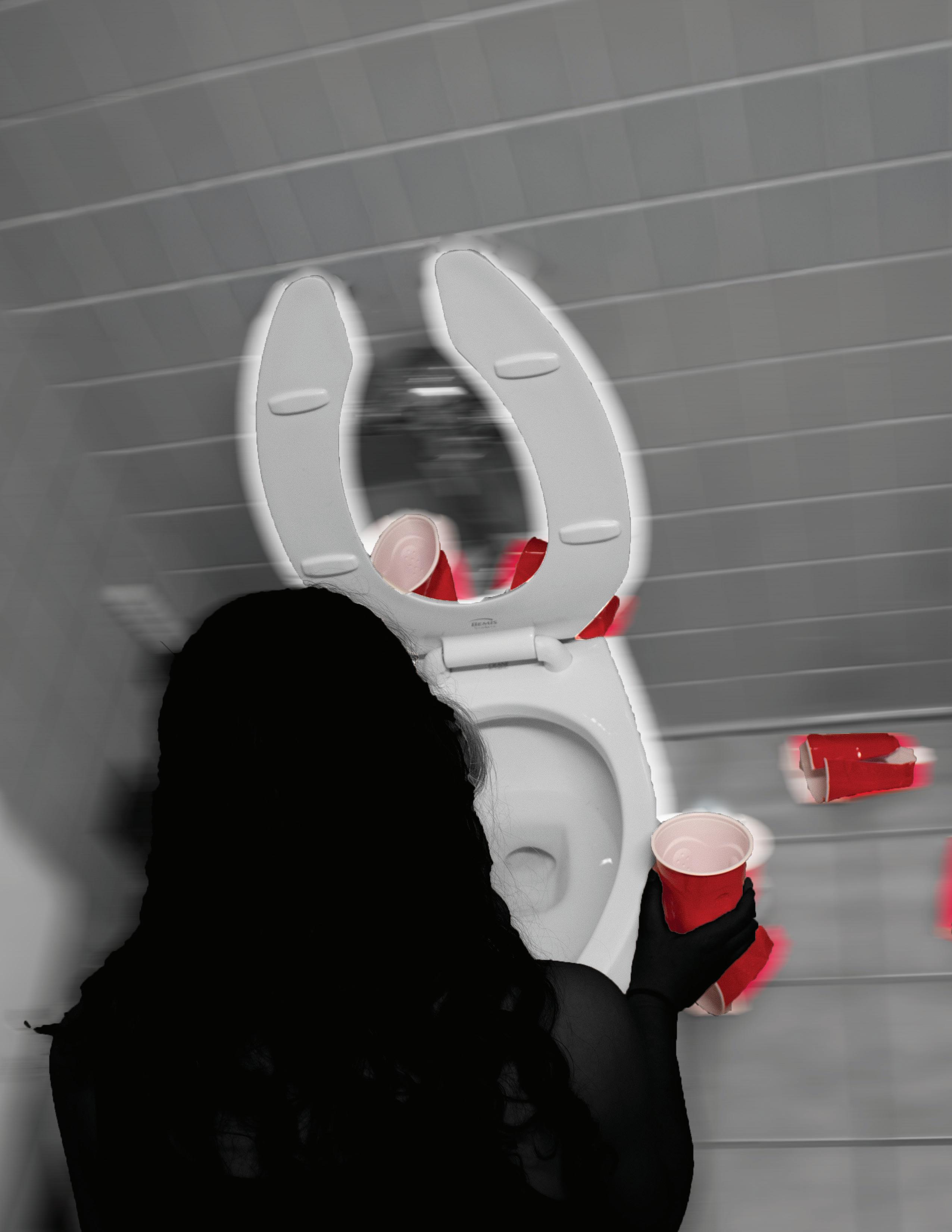
Note: Cover is a photo illustration, not a real situation. Photo illustration by Lindsey Shapiro, LT.
As the student newspaper of the Charles E. Smith Jewish Day School, The Lion’s Tale (LT) is a public forum for student opinion and expression. All content is determined by students. Its purpose is to inform the CESJDS community and to express the views of its staff and readers. The staff has made every effort to ensure the accuracy and objectivity of its news.
Signed columns reflect the opinion of the writer; staff editorials reflect the opinion of the majority of the LT editorial board. The LT staff welcomes letters to the editor and
EDITORIAL AND ETHICS POLICY
guest columns, which must be signed. The staff reserves the right to refuse any material and may edit letters or columns for length, clarity, libel, obscenity and/or disruptiveness. All other contents copyright of LT. All rights reserved. Submissions may be emailed to jdslionstale@gmail.com, mailed to LT or brought to room 320.
LT magazine and website is funded by The Simon Hirshman Endowment for the Upper School Newspaper and The Kuttner-Levenson Endowment for the Upper School Cultural Arts and Student Publications.
AI is not permitted for any generation of content or brainstorming, including but not limited to the following: writing articles or headlines, spread designs, photography, letter to the editor, audio or video. The only AI usage permitted by LT is for the purpose of transcribing interviews.
The staff will adhere to the ethics of The Society of Professional Journalists and National Scholastic Press Association. The adviser will be held to the Journalism Education Association’s Adviser Code of Ethics.
Photos by Lena Lourenco and Eliana Abrams, LT.
DEAR READERS, NEWS
With the end of the school year fast approaching, we are incredibly proud of our Lion’s Tale staff for their continued dedication. The fourth quarter is filled with quizzes, tests and endless assignments. Despite this, our editors have worked diligently to post daily articles on the website and to edit, write and design for the print edition.
Our first goal as editors-in-chief is to serve our community, but it’s also important to look outside the walls of CESJDS to learn what good scholastic journalism is. And for that reason, we are fortunate to have so many excellent scholastic journalism organizations to help us along the way.
Locally, we have the Maryland-D.C. Scholastic Journalism Association, which runs Journalism at the University of Maryland each spring. This year, JDS students went to University of Maryland’s JDay, attending sessions ranging from “Effective headline writing” to “Podcasting ins and outs.”
Two large national organizations that help support student journalists across the country are the Columbia Scholastic Press Association and the National Scholastic Press Association. In addition to large, multi-day conferences, both associations offer contests and critiques. The Lion’s Tale was happy to receive a Gold Crown from CSPA as well as six individual awards. But equally important are the lengthy annual critiques we get from NSPA and CSPA that help us align ourselves to national scholastic journalism standards.
Through all of these organizations and opportunities, one thing has remained clear: the importance of journalism programs and their support is vital. We are deeply grateful to all of these organizations for giving us the opportunity to learn and grow within journalism. As always, we hope you enjoy this issue. Sincerely,


04 Celebrations and ceremonies
Upper School observes Yom HaAtzmaut and commemorates Yom HaShoah and Yom HaZikaron
06 Shooting for the stars
07
JDS students compete in NASAsponsored rocketry competition
Zionist rabbinic coalition gathers in D.C
Rabbis hear from experts and politicians at annual Zionist Rabbinic Coalition
OPINION
09 08 10
Late to the game
The JDS deadline policy is too lenient
The case to stay local Reforms at the Washington Post hit close to home
Should we pop the Jewish bubble?
A look into the benefits and losses of insular community life
IN-DEPTH
12
Pour Decisions
How drinking is affecting teenagers today
FEATURES
16 That’s Dr. to you
Teachers balance the pursuit of higher education with classroom duties
17 Change of plans
Seniors travel after Capstone tripe altered
18 Metro milestone
D.C. Public Transit celebrates its 50th anniversary
19 Break a leg
Sophomore lands first professional role at Olney Theatre Center
A&E
21 20 22
Wilde about theater
The spring play cast puts on the Importance of Being Earnest Clawing craze
Arcade in nearby mall impresses Bagged bites
Local restaurant chain known for unique food impressed bowls
23 Bowls around town
A look into the slop bowl craze in the area
SPORTS
25 24 26
Rookies rise, captains command Different team experiences between returning players and newcomers
Going the distance
Rising star dominates running competitions
Taking the reins Freshman participates in competitive horseback riding
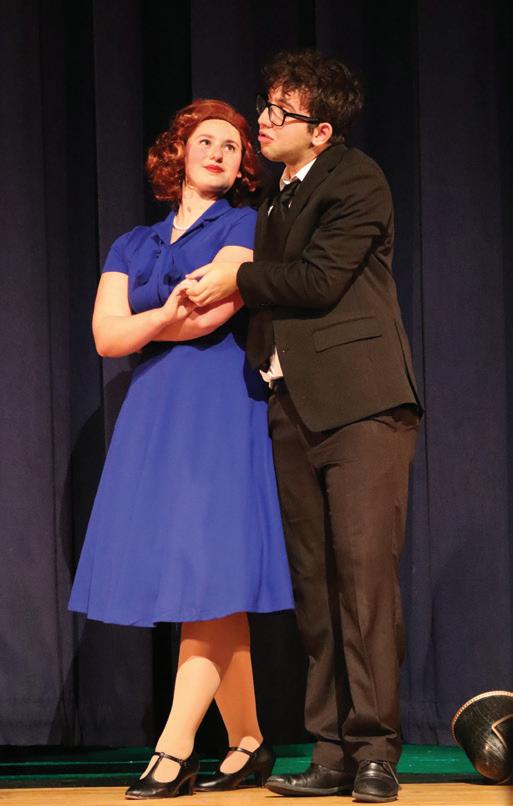

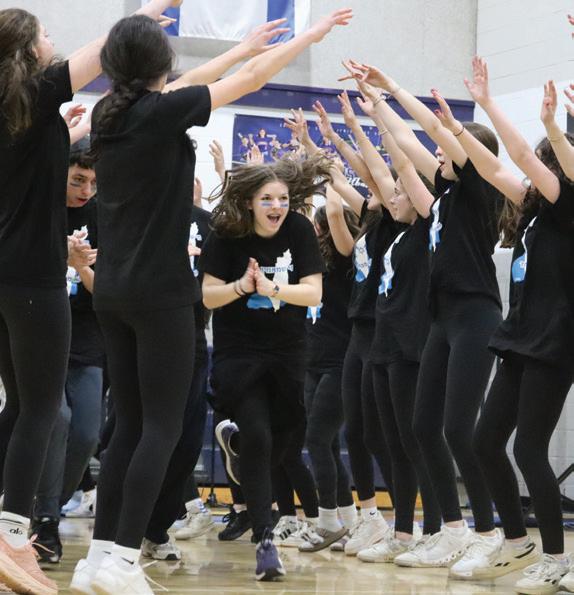

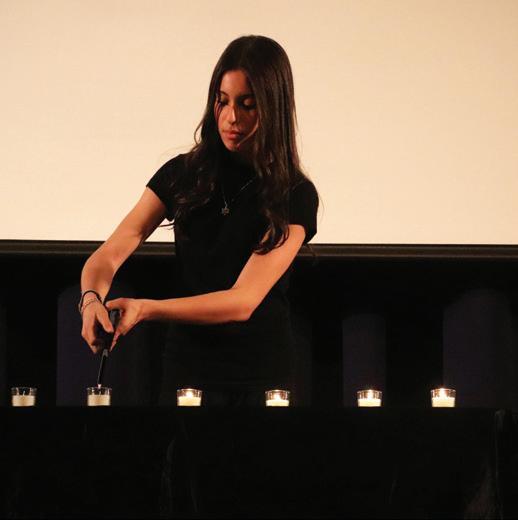
Photo credits from top to bottom: Brielle Bassin, Dimensions. Adam Hirsch, used with permission. Eden Kotok, Dimensions. Jonah Mellen, used with permission.
Molly Elbaum Reporter
Gabey Silverberg Guest Writer
AYom HaAtzmaut
s Zimriyah began, the Upper School grades packed into the gym to perform their well-rehearsed songs and dances. Energetic chants erupted from all sides, with each grade eagerly anticipating the performances.
CELEBRATIONS
Upper School observes Yom HaAtzmaut on April 23 and
ZIMRIYAH IN HIGH SCHOOL

JDS students celebrated Yom HaAtzmaut, Israeli Independence Day, on April 22. The first half of the day was academic, with shortened class periods. The second half included a special screening of the documentary “My Hero Brother” for high school students and a Q&A session with the director Yonatan Nir, followed by an Israeli-inspired lunch before moving to Zimriyah.
The documentary showcased a group of Israelis and their siblings with Down syndrome who work together to climb a mountain range in the Himalayas.
Kaufman, who organized the documentary screening and the Q&A session with Nir, felt that the film was a powerful experience that allowed students to experience Israeli culture in a new way.










mance. The theme of this year’s Zimriyah was tikvah and emunah (hope and faith), and was chosen to recognize Israel’s resilience in the face of its ongoing hardships. Freshman Miri Silverman thinks that this year’s theme had a strong connection to every individual in the JDS community.
“It’s just a good moral to look up to, having hope and faith in yourself, and always believing in yourself,” Silverman said. “So I think it just resonates with your everyday life.”






“It’s very emotional, but we will really enjoy it, because the filmmaker, Yonatan Nir, is always making documentaries of feeling with a lot of emotion,” Kaufman said.
Following the movie screening and Q&A session, students were offered a free Israeli-style lunch, including falafel, pita and Israeli salad. Junior Max Olin, who was a co-host of Zimriyah this year, enjoyed the day because it was a great time to connect with his peers.






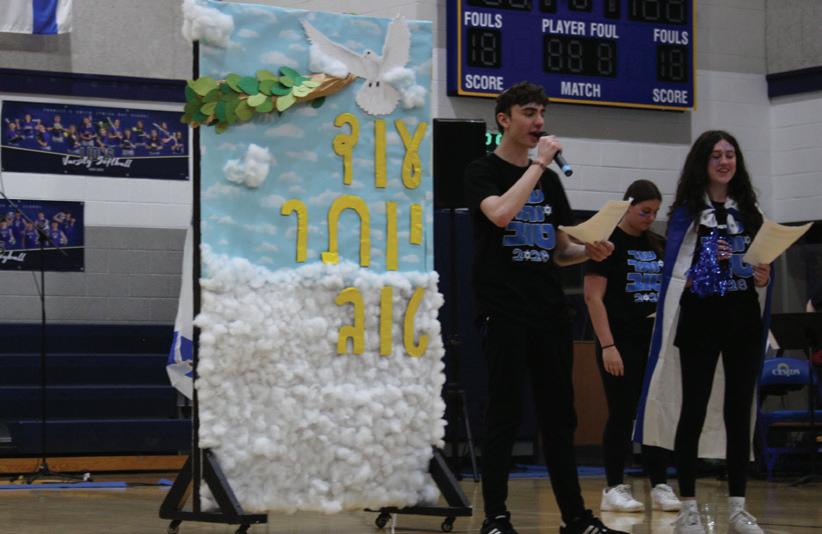
The hosts of Zimriyah this year were Olin and junior Ma’ayan Horwitz, who first introduced the judges before moving on to the song and dance portion of the celebration. Before each grade began their song, students presented a speech on its meaning and its significance, and the ideas between their grade-specific shirt designs. Additionally, in the high school, student-made poster boards were presented.











“It’s a very significant, real-world way to share Israeli culture with the entire school,” Olin said. “It also gives us the time to bond. It’s the only time of the year that everybody eats outside.”
After lunch, each grade went to their final individual rehearsals for Zimriyah before the perfor-

Zimriyah in their seventh and eighth grade years, this was their first high school victory. After the winners were announced, everyone was dismissed to the back fields for popsicles.
“I’m very much proud of our grade, especially because I hosted, and this was a very great way to end my Zimriyah career,” Olin said. “As a junior, it was my last it was my last time winning one, which was really meaningful.”
In the middle school competition, the class of 2031 won for the first time in their JDS career, while in the high school, the junior class won. Though the junior class won



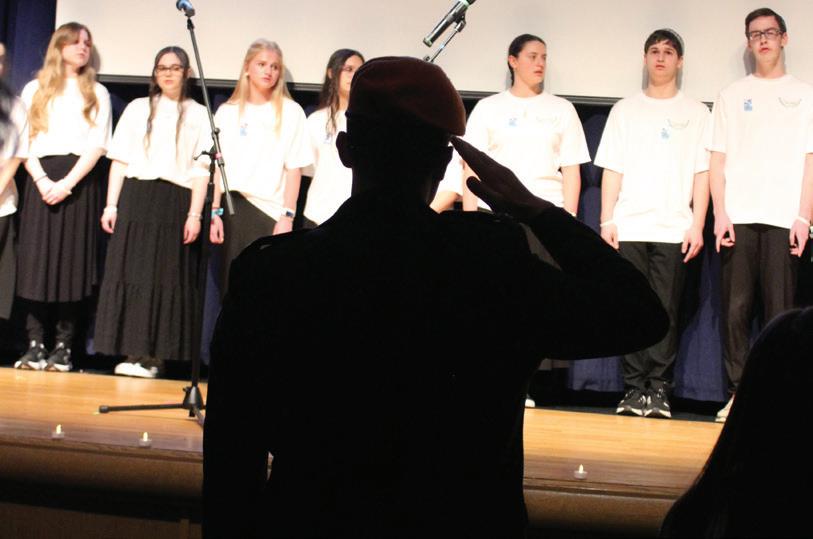
Yom HaShoah Sophomores partnered with the Jewish History department on April 14 to commemorate Yom HaShoah, Holocaust Remembrance Day, taking on the role of planning the day’s ceremonies as part of the Holocaust unit in their Modern Jewish History classes. The day included a vigil, the lighting of memorial candles and communal assemblies. All students and faculty were encouraged to wear black and white to create a solemn atmosphere.
This year, as part of the Yom HaShoah tekes (ceremony), the school hosted Holocaust survivor and alumni grandpar-
Freshmen song: Mah Yehiheh Machar
Sophomore song: Tamid Ohev Oti
Junior song: Mi SheMaamin
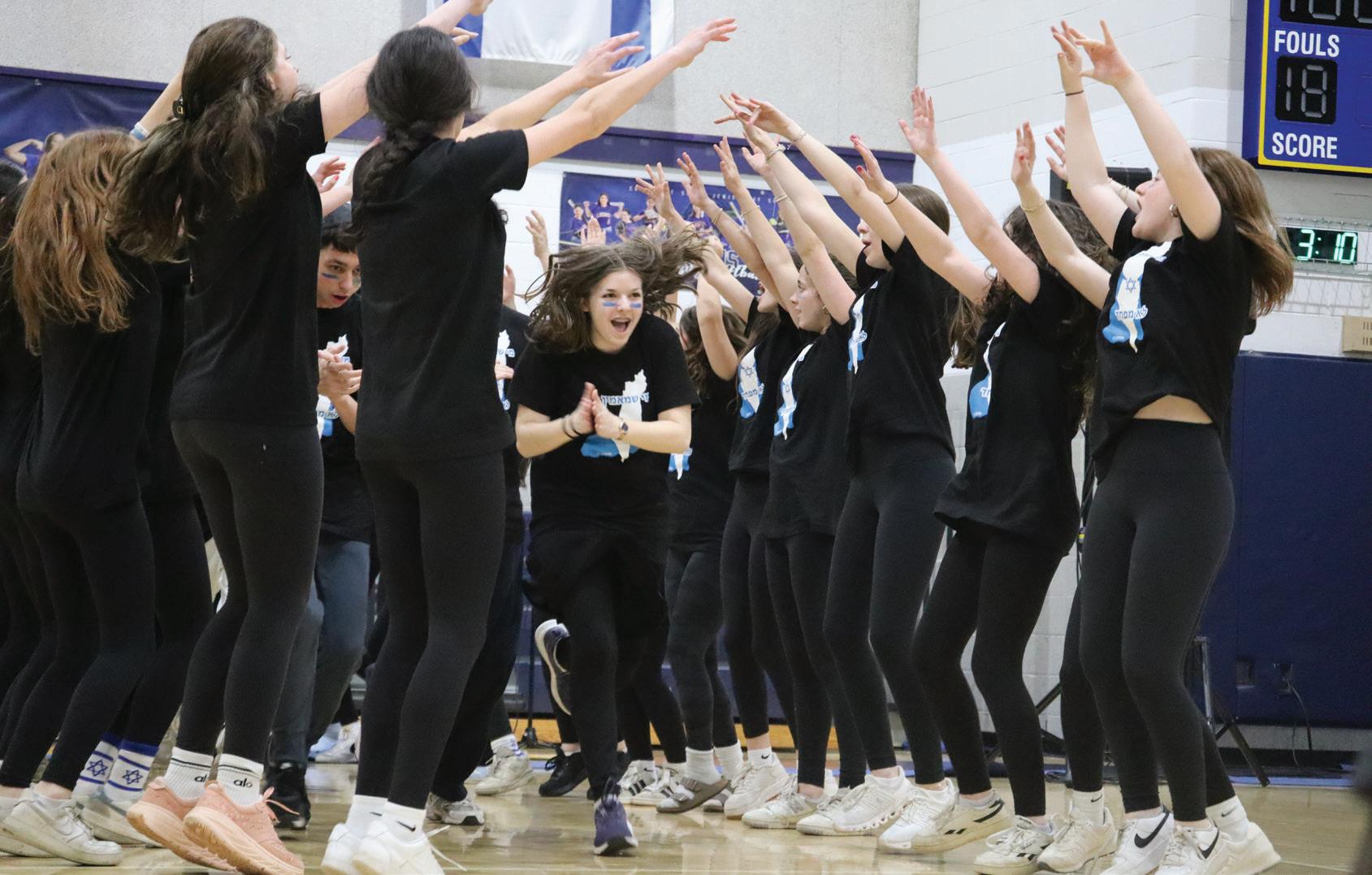
Left to right: Sophomore Leia Barnett lights a memorial candle. Students sing Hatikvah on Yom HaZikaron. Sophomores Ari Rein and Ayla Gerstenblith present their grade board at Zimriyah.
Junior Claire Elbaum dances with her grade on the gym floor.
Photos by Eden Kotok and Brielle Bassin, Dimensions.
AND CEREMONIES
commemorates Yom HaShoah and Yom HaZikaron on April 14 and 22
ent Ruth Cohen. She was interviewed about her experiences in multiple concentration camps including Auschwitz. Afterward, six sophomores each shared a story of a friend or family member Holocaust victim and lit a candle in their honor, representing the six million Jews who perished in the Holocaust. To close the tekes, sophomores led the recitation of “El Maleh Rahamim” and the specially written Mourner’s Kaddish for Yom HaShoah.
Before the tekes, students of all grades participated in an advisory lesson featuring a presentation on Cohen’s life, including guided discussion questions to help students reflect on her experiences and their broader significance. Jewish History Department Chair Rachel Bergstein emphasized the importance of hearing and understanding a personal story.
“I think it’s really powerful hearing [Cohen’s] first-person story,” Bergstein said. “But also, you can see that families, their children, the grandchildren and great-grandchildren of Holocaust survivors also feel this passion-
On Yom HaShoah, sophomores lit candles for:






Naomi Sampson
Frederick Orenstein
Freda Goldman
ately about sharing the experience and sharing their stories.”
Throughout the entire school day, a vigil was held where sophomores continuously read the names of those who perished in the Holocaust. Classes and individuals had the opportunity to attend at different times during the day. The day concluded with a five minute reading of Holocaust victims’ names over the loudspeaker for the whole school.
Sophomore class Vice President Ayla Gerstenblith played a significant role in organizing the tekes as a part of the Yom HaShoah student leadership team. She helped write the script for the tekes, organized the presentation and interviewed Cohen on stage.
“It was especially meaningful for me because I talked about in the tekes my great aunt, who wrote a memoir called ‘Hide’ and survived the Holocaust,” Gerstenblith said. “My grandma’s cousin, who is her daughter, came to the tekes today and got to see me honor her. And that was just very meaningful and very special for me to make that full circle.”
Yom HaZikaron
Students walked into school on April 21 wearing white T-shirts with the message “Be Kind As Omer” honoring Omer Balva (‘19) to commemorate Yom HaZikaron, the day of remembrance for Israel’s fallen soldiers and victims of terrorism. The high school heritage Hebrew class played the primary role in organizing the day’s events, including coordinating the theme of the tekes as well as leading and performing in it.
The tekes centered around the heroic story of the tatzpitaniyot, female surveillance soldiers who were tragically killed on Oct. 7, 2023, at the Nahal Oz base. It also included a commemoration of Balva, who was killed in action during the Israel-Hamas War following the Oct. 7 attacks.
Hebrew teacher and Israel Engagement Coordinator Anat Kaufman also played a significant role in planning the day. Kaufman taught Balva when he was in fifth grade, and she remembers him as a kind and bright student.
“It was such an honor to be [Balva’s] teacher and to remember him and to remind all the students about him, and how to be kind,” Kaufman said.
Though classes continued as usual, the solemn atmosphere of the tekes was felt throughout the day. During lunch and CT, students were encouraged to write letters to soldiers’ families.
Freshman and Israeli student Yael Kaplow was adamant about the importance of fully commemorating the fallen soldiers and being thankful for the state of Israel.
“Sometimes, people don’t realize how important having a Jewish state is,” Kaplow said. “People don’t realize how much of a privilege it is, and how much people sacrifice to make sure we have that privilege.”
Mordechai Ben Moshe Yaakov
Abe Feffer
Leon Felhendler
- newsSHOOTING FOR THE STARS
As sophomore Emmanuel Sarantos stands in an open field in Huntsville, Alabama, he hears the final countdown before JDS’ rocket is launched in the air. Although the moment lasted just about 90 seconds, Sarantos and his team had been working toward this launch since the beginning of the school year.
Following their second place finish in the American Rocketry Competition last year, the JDS rocketry team was invited to enter into the NASA Student Launch Initiative (SLI). Out of 30 teams who applied, JDS was one of 10 that got accepted. The competition took place from April 22-26 and included entries from high schools across the U.S.
To enter, the team first had to create a proposal about their vision for their rocket. Each team set their own goal height for their rocket to attain, creating a unique specialized cargo, or payload, that their rocket would feature. Once accepted to the competition, they worked with a timeline set by the organizers, serving as checkpoints during the planning and building.
“The process is very tedious for multiple weeks, getting all of your pieces put together, purchasing things, because you can’t exactly buy a rocket motor from just anywhere,” Sarantos said.
Their first milestone consisted of a 75-page report detailing a full design of their rocket, pay-
PARTS OF A ROCKET

















load and data from simulating their model’s flight. A few weeks later, the team gave a virtual presentation to experts at NASA.
“We would probably get grilled for 45 minutes on all the science in our presentation, and people, a bunch of NASA scientists, asking about the finer details of what we had just written,” Sarantos said. “And that was both cool and really nerve wracking every time, because they asked questions and you can’t really answer always at the level they want you to.”
After receiving approval to move forward, the team started turning their ideas into reality and created a halfsized version of their rocket. They were then able to test fly the smaller scaled version and see how the different components of the rocket worked.
In January, the team transitioned to creating their real rocket. Using Kraft paper, 3-D printing and a laser cutter, they prepared their final rocket to test fly and deploy its payload. For the payload, they laced a parachute with petroleum jelly to take samples of air particles for when the rocket is in the air.
“I think that’s when we first kind of realized that we were having more success than a lot of folks,” Director of Instructional technology and club adviser Ginger Thornton said. “They mentioned that …
a lot of teams had not successfully been able to test and had not successfully test flown.”
However, the process was not always entirely smooth, with this year’s high number of snow days resulting in test flight days being canceled. Despite this, they arrived at the competition fully prepared and ready to launch. Sophomore Ezra Libbin, who has been on the team since he was in seventh grade, was both anxious and excited for the launch.
“I was a bit nervous about the motor going wrong, or stuff exploding, but I was mostly pretty excited because I was going to see a lot of big rockets shoot up,” Libbin said. “And there is a lot of stuff there that was much bigger than I’ve ever seen before, and also a lot of cool designs.”
The team is still awaiting evaluation for their launch and will be giving a final presentation on May 15 at Capitol Hill. There, they will explain their design process and experience in SLI.
“It’s kind of amazing seeing something that you’ve built rocket into the sky,” Sarantos said. “It was just amazing sitting there and being like, ‘Wow I’m at one of the toughest rocketry challenges in the United States. All this work has just produced something amazing.’”
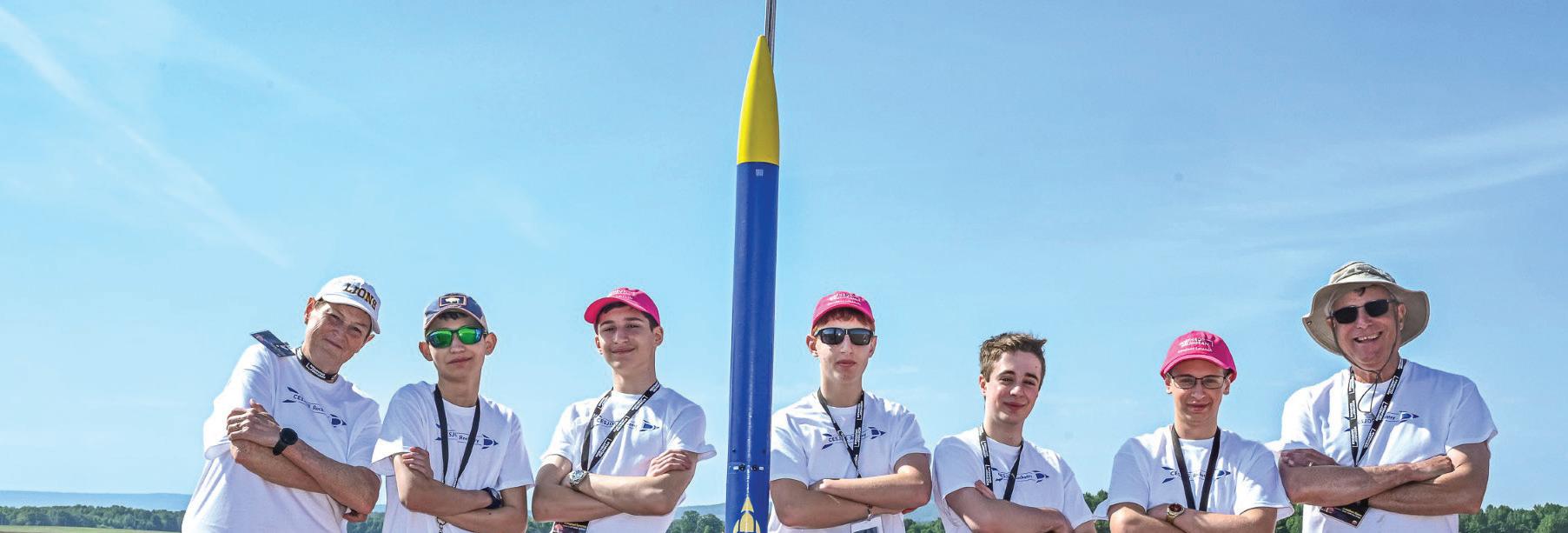
Above: Club adviser Ginger Thornton, students Kyle Berger, Emmanuel Sarantos, Jacob Lavinbuk, Jack Spiegel, Ezra Libbin and mentor Jonathan Rains pose with their rocket.
Lena Lourenco OpinionEditor
Photo by Jim Wilkerson, used with permission.
Students compete in NASA-sponsored rocketry competition in Alabama
ZIONIST RABBINIC COALITION
GATHERS IN DC
Ephraim Blair News Editor
Amidst war in the Middle East, antisemitism on college campuses and deepening divides within the American Jewish community, the Zionist Rabbinic Coalition (ZRC) convened its fifth annual conference in Washington, D.C. on April 28. The three-day conference gave approximately 100 rabbis and lay leaders the opportunity to hear from policymakers and experts on issues concerning Jews and Israel.
Rabbi Stuart Weinblatt, rabbi emeritus of Congregation B’nei Tzedek in Potomac, founded the ZRC in 2020 at the suggestion of former Israeli Ambassador Ron Dermer. According to Weinblatt, the ZRC is a nonpartisan, pluralistic organization for Zionist Jewish leaders to address issues affecting Jews around the world.
“We are the collective voice of Zionist rabbis,” Weinblatt said. “And in that context, just as rabbis are advocates ... for living a Jewish life, so too, we need to be advocates for the Jewish people and for the homeland of the Jewish people, which is the land of Israel.”
Over the past five years, the ZRC has grown from a group of 60 rabbis and lay leaders to a national network of over 2,000 members. It hosts events including an annual High Holidays seminar in New York, interfaith lobbying and international trips.
Since its inception, the ZRC has hosted an annual conference to give its members the opportunity to learn more about pressing Jewish issues. This year’s conference was the largest in the ZRC’s history. The conference theme, “The Eighth Front: What Rabbis Need to Know; What Rabbis Need to Do,” references the seven-front
Rabbis hear from experts and politicians at annual conference
war that Israel has been fighting for the past several years and its effect on Jews globally.
“The eighth front is the public arena,” Weinblatt said. “The eighth front is antisemitism on college campuses, in the public sphere, in the media. The eighth front refers to the attack and assault on Israel and the Jewish people outside of the battlefield.”
The conference’s first speaker was JDS parent Jonathan Schanzer, executive director of the foreign policy think tank Foundation for Defense of Democracies. Schanzer, a national security expert, spoke about the causes and effects of the U.S.-Israel-Iran War, particularly the “economic war” over the Strait of Hormuz.
This was Schanzer’s third time speaking to the ZRC. In addition to being a personal friend of Weinblatt, he says that he keeps returning because he believes it is important for the community to understand developments in the Middle East and how they affect them.
“If you identify as a Zionist rabbi, this is a crucial time to get facts and to be able to bring those facts back to your community and explain what is going on with clarity,” Schanzer said. “My job is to share the facts and my analysis. Their job is to do with it as they see fit.”
The conference also included Jewish learning sessions, a gala dinner honoring former House Majority Leader Rep. Steny Hoyer for his support for Israel and a lunch address from Israeli Ambassador Yechiel Leiter at the Israeli Embassy. On April 29, attendees went to the State Department to meet with leaders and policymakers, including Ambassador
CONFERENCE SPEAKERS’ TOPICS





Policy Expert


Jonathan Schanzer on the Causes and Effects of U.S.-Israel-Iran War




Rabbi Yehuda Kaploun, the U.S. Special Envoy for Monitoring and Combating Antisemitism. Programming on the final day focused on combating antisemitism and addressing polarization within the American Jewish community. In the morning, Roberta Kwall, a law professor at DePaul University in Chicago, spoke about her upcoming book “Polarized: Why American Jews Are Divided and What We Can Do About It.” Kwall emphasized the importance of allowing religious and political disagreements while maintaining standards that promote meaningful discourse.



Rabbi Yehuda Kaploun on His Work as Special Envoy to Monitor & Combat Antisemitism

“I think it’s just really imperative that we, as a Jewish community, do have a big tent,” Kwall said. “But my message is very clear: a tent without walls collapses. So while I want a big tent and I want a big center, I don’t think that the tent or center can be open-ended.”

Israeli Ambassador Yechiel Leiter on American-Israel Relationship



Weinblatt said that planning and organizing a large conference like this is a difficult process spanning months of preparation. Yet he said that all of that work pays off when rabbis return to their communities equipped with the new knowledge they learned.
“A successful conference will be one in which rabbis feel that they come away from it better informed,” Weinblatt said. “…Sometimes rabbis can be in isolated communities, and they sometimes need the reinforcement of an organization like this, which seeks to support rabbis in their work.”
of Democracies, U.S. Department of State, Israeli Embassy to the United States.
Photos by Foundation for the Defense
LATE TO THE GAME
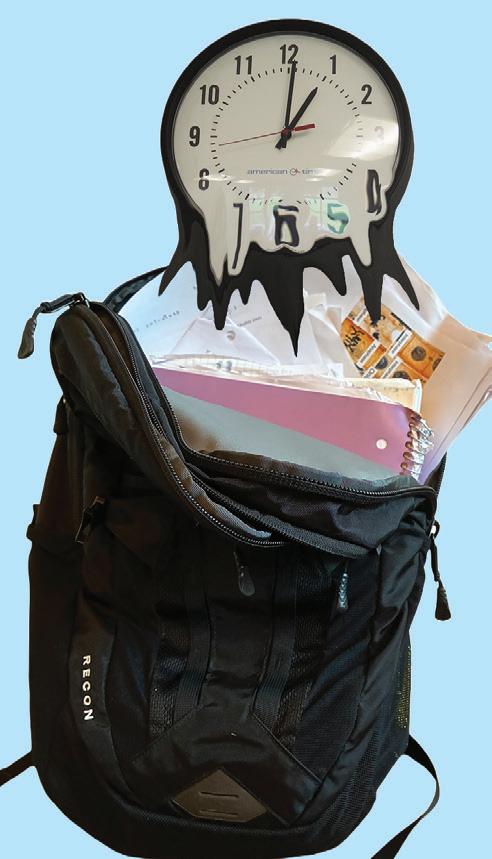
“I’ll just do it later,” is one of the most common phrases heard in the JDS hallways. Sometimes it applies to studying for a test, sometimes to finishing a problem set and sometimes to an assignment due yesterday. In a school where most deadlines don’t carry strict consequences, this phrase has become a frequent state of mind for many students.
During the 2023-2024 school year, the JDS high school adopted a new grading system, and alongside it came a new latework policy. The policy is simple: no grade deductions for late work if an initial deadline is missed.
Students are sometimes unable to retake late assignments and their grade could drop to a 50% at a later date. When assignments pile up, the goal is that students can take advantage of the policy and occasionally submit an assignment a couple of days late. However, the policy did not result in better time-management or organizational skills; students don’t have to organize their time because they know that if they miss a deadline, nothing immediately consequential will happen. This leads to even more missed deadlines. A study from the University of Tennessee found that people take twice as long to finish a task after missing an initial deadline.
The previous late penalty policy, which held a 10% grade reduction each late day, was punitive, not really enforced and when it was enforced it often wasn’t enforced equitably, according to High School Principal and Upper Campus Head Lisa Vardi. This led to rethinking how late work should be dealt
with. While it is necessary to have a standardized policy across the school, the transition to no enforced late penalties did not truly help solve this problem.
This imbalance also creates an unfair dynamic where students who submit work late are rewarded, as they have more time to improve their work than those who complete assignments on time. For assignments given in a short period of time, a “good” student will make time in their busy schedule to complete the work promptly, even if it means sacrificing some quality. However, a “smart” student will put the assignment off, knowing there will be no immediate consequence.
The next day in class, as the curriculum moves forward, many students drag behind as they have not fully completed the previous material. This diminishes the quality of classroom discussion and places additional stress on teachers, who must teach a class with students at different stages of the curriculum. When assignments are submitted late, teachers often cannot return graded assignments until everyone has completed their work. This becomes unfair for both students and teachers.
If, from the ages of 14-18, deadlines are effectively meaningless, students will not learn to plan their time in advance or respect others’ time. In college and in the real world deadlines are often strict and punitive. Missing them can mean reduced grades or professional consequences. With real late penalties, students will learn the skills and necessity of punctuality.
The lack of respect for deadlines taught at JDS can seep into
other aspects of life: if deadlines are not required for schoolwork, why should someone prepare for their interview on time?
The late policy was created to benefit students. However, nearly three years later, it is clear that it should be adjusted to better serve both students and teachers. This does not mean eliminating flexibility entirely. We advocate implementing extensions requested ahead of time alongside a strict late-work penalty. Extensions approved in advance by teachers offer a more structured and responsible approach to the issue.
We don’t necessarily have to return to the former model, where each teacher enforced late-work penalties to their own discretion. However, having a clear and standardized model across the board with immediate consequences will help create a better classroom environment.
Late work is inevitable in any high school. But it should be discouraged, not embraced. Students should learn to manage their time responsibly, and teachers should not have to slow down or consistently deal with late submissions. With a stricter policy, the school can better prepare its students for managing their workload in the future.



THE CASE TO STAY LOCAL







Changes at The Washington Post hit close to home







Every Sunday for the past nine years, I would wake up, walk downstairs to my kitchen and prop up The Washington Post against my cereal box as I ate breakfast. First, I read the comics, sounding out the words as I learned to read. As I got older, it was The KidsPost and the Sudoku. Then, advice columns and book reviews eventually turned into political and international coverage as I grew up, eagerly consuming everything I could about the world around me.
For many, The Post was a staple growing up, as it provided news for people living in the Greater Washington area and beyond. However, on Feb. 4, that all changed. The Washington Post, under the direction of owner Jeff Bezos, laid off almost half of its workforce, cutting their sports and books sections, the podcast Post Reports and generally restructuring the newspaper.
As one of the country’s foremost international newspapers with a uniquely close view of politics due to its base in the capital, The Post’s extreme cuts will not only decimate its ability to cover topics, events and stories, but also signal a potential warning sign for the future of traditional media as a whole.
When Bezos, founder of Amazon, bought The Post in 2013, he set out to elevate it to an international newspaper. However, this pursuit led to a decline in quality and


frequency of local coverage in favor of political and national news. Susan Hughes from the Harvard Kennedy School wrote: “For a couple of decades … we’ve been losing newspapers for understandable reasons … I think where it hurts the most is in the Metro coverage, the local coverage.”
When large newspapers like The Washington Post expand to focus on international news rather than local, communities suffer. According to the Columbia Journalism Review, areas where local newspapers closed reported a 6.9% increase in corruption charges of government officials; when local news coverage declines, oversight disappears. And upsettingly, in 2025, only 21% of Americans said they follow local news very closely, down from 37% in 2016, the Pew Research Center reported.


Even amongst these downward trends, The Post’s layoffs were a blow to many. However, Brian Cleveland, former Head of Print for The Washington Post, wasn’t surprised. Cleveland, who left The Post in January, said that newspaper companies have begun to struggle with readership decline due in large part to the rise of social media.
“The amount of people getting their news from social media now is significantly different than it was 10 years ago,” Cleveland said. “Part of it is declining readership, but that is also tied with changing reader habits [as] technology changes. ... It’s not just The Post, but all news organizations have [had] to adjust to those reader habits and how people are consuming news.”
Even before the layoffs, many readers became disenchanted with the news as a whole. News stories are filled with articles about another war, conflict or tragedy. Like 52% of
Americans, according to the Pew Research Center, I experienced news fatigue. I was worn out by the amount of depressing news surrounding me.
Another issue is the constant bombardment of “newsertainment,” what Montgomery Banner reporter Pamela Wood describes as media outlets who spend time rehashing news for entertainment. Wood also says that as a reporter for the Banner, a local newspaper in Montgomery County, she was upset to see how The Post handled local news coverage.
“In particular, as a local resident in Maryland, I was so disappointed to see The Washington Post absolutely gut … their local news in Maryland, D.C. and Virginia, because … they sort of abandoned their own backyard,” Wood said. “It’s great that The Post does top-notch national and international reporting, but very disappointing that they gave up on their hometown.”
When The Washington Post refocused on international news, it lost touch with its local base, making both the paper and its readers suffer. However, when local newspapers cover important stories that cater to their audiences, they don’t have to spread themselves thin or resort to dramatization and can create better quality news.
Even in this era where reputable sources cannot keep readers’ interest in an oversaturated media landscape, it’s important to prioritize truth over sensationalism and support local news organizations who give back to the community. We must encourage coverage of local news at The Washington Post to ensure that coverage is not made for shareholders or global readers, but community members who need it most.
Ren Baronofsky Reporter
- opinion -








RPEden Segal-Geeter Reporter
It is easy to live a life where everyone around you thinks and lives in roughly the same way that you do. The schools, communities and social circles we move through often reinforce familiarity. Although it feels comfortable and safe, it raises a question: what do we lose if we don’t step out of that bubble?
According to the Pew Research Center, in relatively homogeneous communities, most people share similar beliefs, which naturally reduces daily interactions with people who think
differently. As a result, ideas often go unchallenged because there is little outside pressure to question them. So, while “Jewish bubbles” foster close-knit communities, they can quickly become close-minded environments offering little room for nuance.
Interacting with different perspectives sharpens thinking; without it, it is easier to assume one’s worldview is complete. Pew Research Center found that many religious groups tend to cluster socially and share similar views, reinforcing internal consistency while reducing engagement with different ideas.
In these environments, beliefs are repeated so frequently that they feel like objective truth. As a research paper by Taylor and Francis Online explains, these “truth-conductive” echo chambers are limiting because they reduce access to alternative reasoning.
For minority groups, bubbles offer safety from biased outside environments. However, constant comfort hinders growth, which can only come from connections beyond inner circles. Although this does not mean abandoning one’s Jewish community, it does require expanding one’s range of interaction.
There is also a broader impact. When communities remain separate, antisemitic perceptions grow. Without real interaction, people form harmful opinions based on assumptions rather than experience. Engaging with the outside world can help challenge these misconceptions.
As an observant Jewish athlete, I’ve experienced this firsthand through playing soccer in a secular environment. When games fall on Shabbat, I usually book a hotel within walking distance to attend. The concept
SHOULD WE POP THE
Kira Koplow News Editor
Many JDS students live in what is called a “Jewish bubble,” the idea of only belonging to Jewish communities, as they go to Jewish day school while also belonging to synagogues and attending Jewish sleepaway camps. Taking advantage of the tight-knit connection of the bubble creates opportunities to build strong communal values that are crucial in creating unity.
Being in a community with shared experiences, values and practices increases a sense of be-
longing. According to the University of California Berkeley Science Magazine, having a collective identity is one of the best ways to build lasting connections.
Feeling a sense of belonging is vital for psychological well-being, and the easiest way to feel we belong is to be part of a community with a shared sense of identity.
In a post-Oct. 7 climate where antisemitism is prevalent worldwide, building a feeling of safety and comfort is essential.
Having the immediate tools and resources to build a Jewish identity by connecting with other
COMMUNITIES THAT MAKE UP OUR JEWISH BUBBLES
Jews is a significant part of being able to combat antisemitism and bias. In 2025, over half of Jewish Americans reported experiencing some form of hate, according to the Anti-Defamation League.
The “Jewish bubble” can be seen as a sort of safety net for young adults trying to escape hate crimes and fear. In this way, the tools and knowledge needed to combat harsh realities can be taught in the shelter of a bubble.
Immersing ourselves in a Jewish community is a great way to build a Jewish identity that knows how to combat antisemitism. Twice as many Jewish adults who received a Jewish day school education report being able to connect to Judaism at a higher level than those who did not, according to the Avi Chai Foundation. Additionally, Jews who attend Jewish sleepaway
of Shabbat was foreign to my teammates, prompting questions about my religious practice.
By teaching them about my traditions, I witnessed their consideration when it came to my religion. They had the opportunity to learn more about Judaism. If I had not stepped out of my “Jewish bubble,” this meaningful moment would have never happened had I not engaged with people who were more unlike myself than what I was used to, I learned more about their views and the reasons behind those beliefs, thereby expanding my worldview as well. But there is still much to learn, as I saw when engaging with my soccer teammates.
Experiences like this one also reveal a deeper gap in cultural awareness. Spending most of one’s time in Jewish spaces can create a disconnect between the reality of antisemitism and how
it is perceived by others. When people don’t have Jewish relationships, they lack the chance to fully understand the prevalence of antisemitism. According to the Blue Square Alliance, 58% of people recognize antisemitism as wrong but assume it is rare or a mostly historical occurrence.
I saw this phenomenon after the Oct. 7 attacks through a non-Jewish teammate’s mother who felt this disparity acutely, both the massacre and how quickly it was followed by justification and the explosion of overt antisemitism. She admitted she had not understood how present this hatred was, and she was less
35% of Jewish children in the U.S. attended day school at some point
impacted by it as it was not happening to people she loved. Had she not heard my opinions from a Jewish perspective, she would not have understood the issue of antisemitism so clearly.
Stepping outside of the “Jewish bubble” matters as it deepens the understanding between Jews and non-Jews. As one learns how to explain their beliefs more clearly, others begin to see them with more nuance. While comfort may be easy, it limits perspective. If we want real understanding and connection, we must be willing to step beyond what we already know.
44% of Jewish children in the U.S. went to sleep away camp
48% of Jewish college students feel unsafe at campus events
from Brandeis University (The Impact of Day School: a Comparative Analysis of Jewish College Students 2007), Pew Research Center ( Jewish Identity 2013) and the American Jewish Committee (The State of Antisemitism in America 2025).
JEWISH BUBBLE?
A look into the benefits and losses of insular community life
camps have a much higher rate of maintaining lasting friendships with other Jews.
In 2024, 96% of families who sent their kids to Jewish overnight camp said that camp created an environment where their children felt proud to be Jewish. Making connections that correlate to identity at a young age can provide tools for eventually helping young children navigate the adult world.
My own Jewish sleepaway camp has enabled me to connect not only with other Jews in a lasting way, but also with myself. Living encapsulated with people who are similar to me for seven weeks each year gives me opportunities to grow in my Judaism. We talk about our similar and different approaches to practices, learn about applying Jewish ideas to real life and play regular games of
Jewish geography. In this way, the experiences I have at camp guide me through the rest of the year at home.
Additionally, the “Jewish bubble” helps inculcate Jewish identity in a way that a more diverse community would not be able to do. The UC Berkley Science magazine says that when we feel like we’re part of a community with shared values and beliefs, it helps boost mental health and a positive mindset. Being able to discuss Jewish concepts with people who can relate is a great way to connect with those in our community and expand our knowledge. While experiencing diversity is important, having a sense of safety before going into the world can help combat hate and bias. As an adult, it’s nearly impossible to fully immerse ourselves in the Jewish community. College










and the workforce present times where working with people we may not know or relate to is necessary for collaboration. The fact that the bubble is ultimately temporary is all the more reason to appreciate it while we can. Diversity is a much-needed experience for everyone, allowing for many benefits and rewards. However, with rising antisemitism and the Jewish community being more united than ever, reaping the rewards of the “Jewish bubble” while still being able to is advantageous.
POUR DECISIONS

How drinking is affecting teenagers today
Leora Blumenthal Editor-In-Chief
ManagingEditor
Jordana Dauber
Photo illustration by Anna Polon, LT.
The question of whether or not to drink is one that pops into many teenagers’ heads at some point in high school. While contrasting viewpoints can villainize the consumption of alcohol or encourage the practice, this dilemma is not an easy one to approach.
Alcohol use among teens has significantly declined over the past few years. Consumption decreased 44% between 2000 and 2025, according to University of Michigan’s Institute for Social Research. And yet, teenage drinking remains a major factor in many teenagers’ lives.
The Lion’s Tale created an anonymous survey of JDS high school students that aimed to better understand the patterns of teenage drinking by asking about how often students drink, where they do so and when they first started. This article explores these findings, along with student and parent perspectives, as well as expert insights to provide a fuller story of teenage drinking at JDS.
Survey of the JDS experience
While the underage consumption of alcohol is often discussed as a single issue, the teenage drinking experience varies widely based upon students’ personal choices. Frequency, setting and motivation are all components that can vary depending on the teenager.
In the survey taken of 96 JDS high school students, including members of the class of 2026, making up 30% of the high school student population, teenagers were asked various questions about their drinking experiences. The survey was a voluntary sample rather than a random sample; it is possible that this method impacted the results.
When asked if they had ever drank alcohol recreationally, 50.5% said that they had while 49.5% said they had not. Among students who reported drinking recreationally, 41.5% answered that they drink a few times a year, while 22.6% answered once a month and 11.3% answered once a year or less.
Drinking most commonly takes place in social settings, with the majority of students who drink saying that they drink at parties. The second most common place
was at a friend’s house. Additionally, 39% of students who drink reported drinking with family, which may include religious settings.
The ages at which adolescents started drinking varied, with 52% of those who reported having consumed alcohol starting between the ages of 15 and 16 and 26% between 13 and 14. The percentage of students who started drinking before the age of 13 is 12% while those who began at 17 or older is 10%.
Of those who said that they drank recreationally, 72% reported drinking primarily with friends with 55% reporting getting alcohol from friends. Of the students who said that they drink alcohol, 22.7% said that it was already in their houses.
Why teenagers drink
Whenever the topic of teenage drinking is brought up, a large focus is on the incentive behind it. Whether it is because of peer pressure or the novelty of being drunk, teenagers drink or abstain for a variety of reasons.
Junior Solomon Ballas chooses not to drink and holds a negative view on teenage drinking. He believes that outside of religious circumstances, it is not acceptable to drink underage, as it is against the law. Beyond just following the law, Ballas believes that teenagers should follow their values, rather than external factors like peer pressure, when approaching the issue.
“I think that teenage drinking can be an attractive thing,” Ballas said. “It can be tempting and enticing to try it and see what happens … Just know what’s right and know what you believe in and know your values. And when you believe in the right thing, you can do that right thing.”
Peer pressure is also often posed as an answer to why teenagers drink. However, according to the survey, only 1.1% of JDS students answered that they often feel peer pressure to drink. In contrast, 17.2% of students answered that they sometimes do, 32.2% answered that they rarely do and 49.4% answered that they never do.
These numbers suggest that at least in the JDS community,
OF STUDENTS WHO DRINK ...

11%
Consume alcohol once a year or less

41%


37%
Have felt negative effects from drinking


Consume alcohol a few times a year

52%

12%
Own a fake indentification card

First tried alcohol recreationally at ages 15-16

From a poll of 96 JDS high school students, including members of the class of 2026.
in-depth -
LEGAL DRINKING AGES AROUND THE WORLD

peer pressure is not a significant factor that entices students to drink. A JDS student, who requested to remain anonymous, explained that they see drinking as an important social experience for high school students, especially before going to college.
“I think it’s important to explore drinking in safe settings, but also it’s just really fun,” they said. “I think there’s a lot of fun experiences that come with it.”
the wrong message can be taken away from that, and [drinking] is seen as a cool thing and something that you have to do.”
Lendzion said that teenagers believe alcohol is a way to cope with stress, anxiety, anger or pain. The appealing advertisement of alcohol makes it seems like the easiest solution to these negative emotions.



Kriya Lendzion, Addictions Clinician, Prevention Specialist and drug educator, owns her own private practice working with individuals going in “self-destructive directions” with drugs. Another important part of her job is speaking to high school students about the dangers of subtance abuse. Lendzion came to speak to JDS high school students as a part of a Wellness Wednesday program in February.
“[Alcohol] speaks to an adolescent brain, and what [teenagers] are looking for and noticing, and so I think you’re more susceptible to the brainwashing of that without realizing,” Lendzion said.
Parent perspectives on drinking
While the traditional view of parents when it comes to drinking is of strict opposition, in reality family opinions differ, making the issue more nuanced. In the survey, almost 62% of JDS students say their parents are aware that they drink.

According to Lendzion, teen brains are especially tuned to seek dopamine and belonging. Lendzion explained that when alcohol is constantly portrayed in the media as a fun form of connection, teenagers quickly link alcohol with those feelings.
For teenagers, alcohol can feel like a stimulant at first rather than a sedative, Lenzion said. Since they do not feel sedated as quickly as adults, teens are more likely to keep drinking.
“There’s that whole term ‘buzz,’” Lendzion said. “Getting a ‘buzz,’ catching a ‘buzz.’ It actually makes sense for an adolescent because you guys can feel a little bit more energized by it.”
A parent to two recent JDS alumni, who asked to remain anonymous, said that teenagers might be more susceptible to the appeal of drinking due to the carefree and risk-ignorant nature of adolescents. But they also believe that parental ultimatums against alcohol can be a factor that further pushes teenagers to drink.
Even without additional appeal that might motivate teenage drinking, the parent said that teenagers are attracted to the idea of alcohol purely because it is an opportunity to try something new.


Lendzion also said that the marketing of alcohol products is specifically geared toward teenagers. Many alcohol products are marketed as “spiked” versions of childhood drinks, like lemonade and fruit punch, and brands often use bright colors and sweet flavors, making alcohol appear less dangerous and more fun.
In addition to targeted marketing of alcoholic substances, Ballas believes that pop culture in America is particularly good at romanticizing addictive substances.
“Young people want to try things,” the parent said. “They want to act like they’re older, right? They want to be able to seem mature and adult, and they want to take chances because that’s fun, and … it is very common for kids to just want to do or try things that they’re not supposed to, to try to cross lines. It’s fun. It’s exhilarating.”



“Alcohol is portrayed as a way to relax and open up and have a good time, in films especially,” Ballas said. “And I think sometimes
Because alcohol consumption is such a socially relevant topic among many teenagers, the approach taken by students and parents when navigating the topic is often much more complex than just a simple yes or no. According to the anonymous parent, even if one is opposed to teenage drinking, it is important to set realistic expectations and prioritize safety
when discussing the topic with one’s child.
Sarah Trauben, mother to junior Judah Trauben and freshman Sasha Trauben, believes that it is best to “kick the can down the road” in regards to teenage drinking until the brain is more developed. Despite wanting to prevent drinking, Trauben understands that it happens, and therefore believes the most important thing is to be cautious and, specifically, never get into a car with a driver who has been drinking.
Trauben believes it is important to discuss and emphasize the dangers of underage alcohol consumption, while also recognizing that teenage drinking is a real and frequent occurrence in high school. Trauben also believes that education around the topic is crucial, which she think JDS provides in a productive way.
“I think that this whole wellness education in school didn’t exist in the way that it [did] 10, 15 years ago,” Trauben said. “And so I think that there are additional sources for kids to get educated on this topic, not just rely on their parents, which is a good thing.”
Dangers of teenage drinking
A major point of conversation when it comes to underage drinking is its dangers. Teenage minds and bodies process alcohol differently than adults, leading to many different effects.
In addition to the short-term effects of drinking, such as blacking out, vomiting and dizziness, there are also major negative long term impacts of drinking, including an increased risk of cancer as well as liver failure.
The Centers for Disease Control and Prevention (CDC) reports that around 4,000 people under the age of 21 die of excessive alcohol use each year. In addition, around 20,000 adults in the U.S. die from alcohol related cancers each year.
“It’s just hard when I watch really beautiful kids with tons of potential destruct themselves and I can only do what I can do,” Lendzion said.
There are also negative effects for teenagers while they are actively drinking. Young people who drink alcohol are more likely to
JDS vs. USA
Percentage of teens who drink who get alcohol from of-age adults
39%
engage in behaviors that can lead to injuries and other health conditions, such as alcohol-poisoning. They are also more likely to experience social, academic and legal issues, according to the CDC.
Other consequences include long-term damage to the brain’s executive functioning, Lendzion said. While drinking, teens have impaired judgement, weaker impulse control and reduced big-picture thinking. Their decision-making skills are also often impaired.
“I see choices that they wouldn’t make when they were sober, just doing things that they don’t believe in doing, that really contradict their own values and their own beliefs,” Lendzion said. “Because as soon as you put a drink in the body … it starts to shut down the judgment center … of good idea, bad idea, healthy, unhealthy, in line with who I want to be or not.”
Percentage of teens surveyed who drink alcohol multiple times a month
9%
22%
Percentage of teens surveyed who drive themselves after drinking
As a former addict, Lendzion has a unique perspective on the dangers of drinking. She was in rehab at age 19 and managed to stay sober after being dependent on alcohol from early adolescence. Lendzion uses this experience in helping others recover as she has seen the negative effects of drinking first hand.
According to responsibility. org, early drinking is a risk factor for alcohol use disorders. Adults who had taken their first drink of alcohol before the age of 15 were 6.5 times more likely to experience an alcohol use disorder like binge drinking or dependancy than those who didn’t start drinking before the age of 21.
“Once a connection is made at this age, because your brains are like molding clay, it really hard wires stronger than it does for us [adults],” Lendzion said. “So if you make a positive connection, if you have an experience and you like it … you’re more likely to fall for that.”
Takeaways
Teenage drinking, as the JDS survey and external perspectives show, is not a one-size-fits all experience. For some students, it is part of their social environment. For others, it is a choice they consciously avoid.
At the same time, the risks are clear. From immediate health
and safety concerns to long-term impacts on the developing brain, experts like Lendzion warn of the consequences of drinking at a young age.
Ultimately, the question of whether or not to drink is answered differently by various members of the community. Regardless, the topic is complex and requires consideration of all the potential outcomes. As students navigate high school and increasingly gain independence, understanding both the social appeal and real dangers of drinking can help adolescents make choices that prioritize their physical and mental well-being.
WHY DO YOU (OR PEOPLE AROUND YOU) CHOOSE TO DRINK ALCOHOL?
“People often feel uncomfortable in social situations so they turn to alcohol as a way to seem ‘normal,’ but that coping strategy is unhelpful in the long run. ”
“
Because it’s the norm ... [it is] extremely concerning and stupid that that’s the reality we face now, especially at such a young age.
”
“ I drink at family events because everyone is and at parties because it’s more fun. ”
“ To have fun, let loose, not feel embarrassed or socially awkward. ”
Quotes from anonymous JDS high school students.
- featuresTHAT’S DR. TO YOU
Teachers balance the pursuit of higher education with classroom duties
Ayla Hurwitz and Jemma Wallace Reporters
Since childhood, Upper School visual arts teacher Benjamin
Tellie has been immersed in the fine arts, exploring everything from watercolor to abstract painting. While remaining a practicing artist, he discovered a passion for teaching during his undergraduate studies at Columbia University. This discovery led him to share his love of art with students and ultimately pursue an Ed.D. (Doctor ate of Education).
Getting an advanced degree while teaching is a challenge many educators take on: in 202021, 51% of public school teachers pursued master’s degrees while teaching full time, according to the National Center for Education Statistics. At the JDS upper and lower schools, 22 of the 147 teachers which have a doctorate.
Tellie has been teaching at JDS for 16 years and is pursuing his Ed.D. at George Washington University with a focus on Social Justice and Art Education. He started the program in 2017 part-time and is graduating this May with his doctorate.
“I’ve always wanted to pursue my doctoral degree,” Tellie said. “2017 felt like the right time. I was seven years into full-time teaching and felt like I had gained a lot of experience.”
Despite how hard it can be to stay motivated while balancing a degree and full-time teaching, Tellie said one of the main things that supported him through the process was the JDS community.
“JDS was so tremendously supportive of the degree program and my growth as a professional,” Tellie said. “I feel like just that social, emotional support. They’re

always very positive. I felt like I had the space at JDS to pursue this and the encouragement to do so.”
Teachers with advanced degrees bring a deeper level of subjectmatter expertise, research skills and commitment to lifelong learning, all of which enrich the classroom experience for students.
For his degree, Tellie organized a curriculum called “Difficult Histories and Events in Our Lives,” which explores challenging personal or historical experiences through visual art. In his doctoral research, he interviewed three former JDS students to reflect on how his curriculum affected them over time, including during their college years.
Tellie’s experience is part of a bigger pattern of teachers pushing themselves to earn advanced academic or religious degrees while still working full-time in the classroom. Middle school math and Judaics teacher Rabba Aliza Libman Baronofsky had a similar experience with balancing her work in education and the demands of pursuing her ordination.
“You have to be very honest with yourself about the time commitment, knowing what you’re getting into and how it will affect your schedule,” Libman Baronofsky said.
and studying, her days stretched long, often turning weekends into workdays. Still, she found it to be worth the effort.
“Inside, I’m a Torah person,” Baronofsky said. “That’s who I am as a human being. I think rabbinic ordination was a part of me realizing that there was a space in my life for something big, and that it needed to be Torah because I needed to be who I was, to the outside world as well as inside.”
Libman Baranofsky and Tellie both value continuing education. Tellie has seen firsthand how advanced study can shape both teaching and learning. Like Libman Baronofsky, he believes that growing as an educator directly benefits students, allowing teachers to meet their needs and create an engaging classroom environment. For Tellie, pursuing his Ed.D. was an extension of his commitment to his students.
Kathryn Markey, JDS Director of People and Culture, said in an email interview that teachers getting advanced degrees positively impacts academic engagement.
- JDS Director of People and Culture
Kathryn Markey “ “
Libman Baronofsky was first inspired to get her rabbinic ordination because of her own experiences growing up in a Modern Orthodox Jewish family. She received her rabbinic ordination in June 2022 at Yeshivat Maharat. She began the process in early 2019, applying in the spring and beginning her studies that fall. The program was designed for women with prior experience in Jewish learning and had mostly Zoom-based classes with occasional in-person intensives.
To stay on top of everything, Libman Baronofsky explained that staying organized was key. Between teaching math full-time
“Teachers with advanced degrees bring a deeper level of subject-matter expertise, research skills and commitment to lifelong learning, all of which enrich the classroom experience for students,” Markey said.
This perspective is reflected in the experiences of teachers themselves, whose decisions to pursue advanced degrees can be driven by both professional growth and personal fulfillment.
“I just had it in my heart to [get an Ed.D.],” Tellie said. “It was a real lifetime goal that I had, and that I wanted to do for myself, and I’m just really happy I was able to get through it.”
CHANGE OF PLANS










Editor











TAKE A HIKE

Irene and Dan-
To read about changes to the senior capstone trip on lionstale.org, scan here:


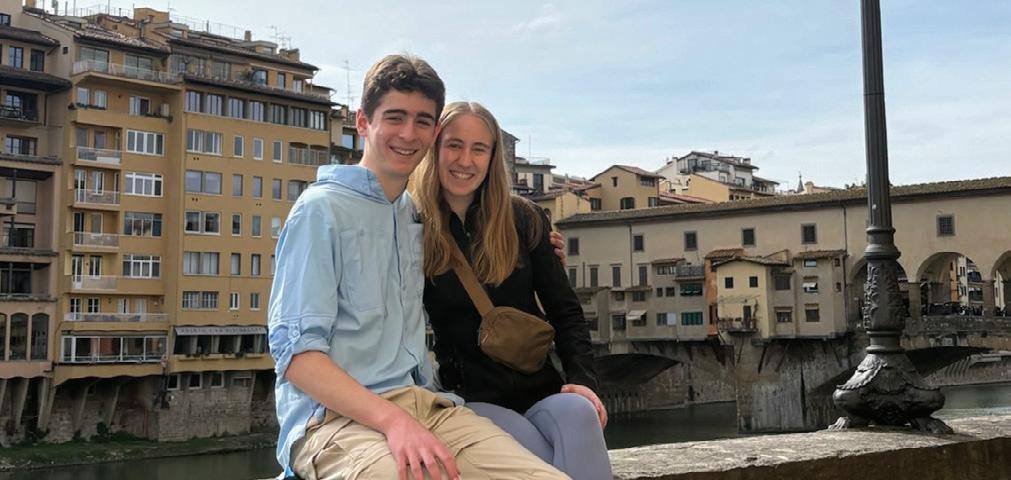
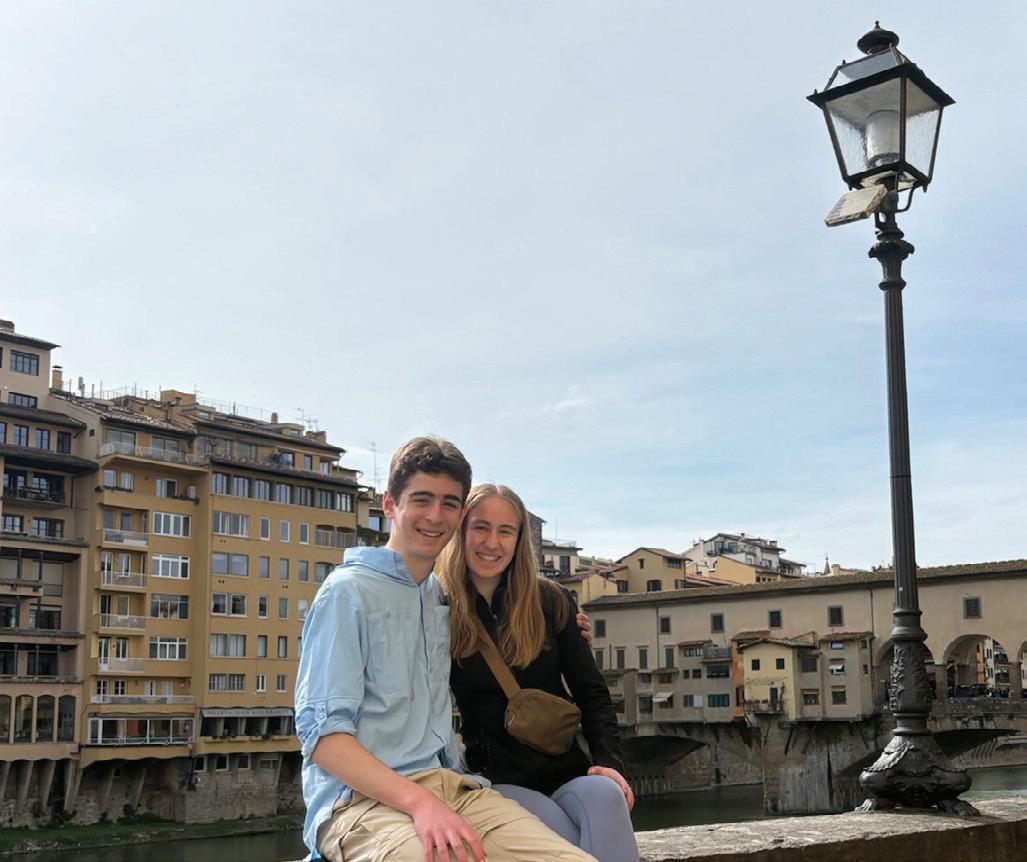
initial postponement of the iel Simpkins Senior Capstone Trip, seniors Eliana Wolf and Hadriel Dayanim spontaneously decided to use the time off to backpack through Europe. With only a week of planning and a rough itinerary, the two wanted to make their own mini capstone trip. Their agenda consisted of visiting nine cities in just under three weeks, spanning Italy, Switzerland and Austria. Trying to save money wherever possible, they each brought only one backpack, and their only form of transportation was by train, a new form of travel for Wolf.
Wolf’s favorite stop was Grindelwald, Switzerland, a village in the middle of the Alps surrounded entirely by nature. There, they hiked up one of the mountains and took a toboggan sled down, which was one of Wolf’s favorite activities.
Although Wolf was devastated by the alteration of the senior capstone trip, she found her backpacking experience an incredible alternative, as it was a trip she would not necessarily have taken otherwise.
“We just enjoyed time together,” Wolf said. “It’s going to get busy with life in later years. We were really lucky to have the time now to just kind of roam around Europe together with little to no obligation.”
BEHIND THE SCENES
After driving 15 hours to southern Florida, seniors Matty Stillman, Tyler Portnoy and Adam Salomon attended the Washington Nationals MLB spring training and the World Baseball Classic. The three had wanted to take this trip for some time, and with their Israel trip canceled, the opportunity opened up.
Although Stillman had watched spring training before with family, his experience seeing it with friends was different, as their itinerary was catered to what they had in mind.



























Seniors travel after capstone trip altered
ROME-ING AROUND ITALY
At the end of a 15-day trip around Italy, senior Jonah Mellen found himself most surprised by how much traveling had brought him and his friends closer together. After nine stops, seniors Cyrus Blumenthal, Ari Skolnick-Einhorn, Tani Simkovich, Daniel Jacobson, Dylan Kobrin and Mellen all shared unforgettable experiences that led them to strengthen their bond.
While Simkovich suggested going to Italy, Mellen and Becky Simkovich, Tani’s mother, planned the trip. Between train rides and navigation, the group learned how to rely on one another in new ways. Small challenges like getting lost or figuring out meals brought them closer together in ways they had never experienced before at home.
“One of the fantastic things about the Italy trip is that it was my first real grasp of independence and my first real time I felt like I was an adult,” Mellen said.
Although the trip was busy, the group found time to appreciate every city they went to and experience it as much as they could, even if it was only a short stop. The group went from historical landmarks such as Pompeii and Mount Vesuvius to relaxing beaches, like the Amalfi coast and Cinque Terre, while also visiting scenic and city stops, including small towns in Tuscany and Florence.
“It served as one of the most profound bonding experiences I’ve had with those people in my entire life,” Mellen said. “It really took our friendships to the next level.”
“Going with friends was a completely different experience,” Stillman said. “We had the freedom to choose what we wanted to do and when we wanted to go places, which made a huge difference and the experience unique.”
The three traveled between Miami and West Palm Beach, Florida, to watch the various games while also visiting and staying with each of their grandparents and other family members.
Through Stillman’s family friend connections, the three sat next to the
owner of the Washington Nationals, Mark Lerner, for one of the games. They had the opportunity to talk with him and learn from his experience as an owner and a baseball fan. They even toured some of the Nationals’ facilities that are not open to the public.
“Obviously, we are all bummed out not to go to Israel,” Stillman said. “We have been looking forward to that for almost our whole lives. But this trip to Florida with my friends was a once-in-alifetime experience.”

Photos from Eliana Wolf, Matty Stillman and Jonah Mellen, used with permission.
50th ANNIVERSARY METRO MILESTONE

Eliana Abrams Editor-in-Chief
For 41 of the 50 years the Greater Washington Area Metrorail has been in operation, middle school science teacher Nick Miller has taken the Metro to and from JDS almost every day. Miller, who lives in D.C., relies on the Metro’s Red Line and bus network to commute to the school each morning.
Although the nearest Metro station is about a mile from the Upper School campus, Miller structures his commute carefully, ensuring there are three possible buses to take from the station to school that allow him to arrive on time. If those fall through, he uses Uber to complete his trip to school. The commute takes Miller approximately an hour, but he views the time as productive. In the past years, Miller has begun saying psalms for peace in the Middle East while on the train.
“Other people who don’t take the Metro will say, ‘Oh it takes you so long to get here,’” Miller said. “But they’re driving. And when I’m in the Metro I can read or study.”
Over decades of commuting, Miller has witnessed the system’s transformation. When he first began taking the Metro, the rail network only reached the National Zoo in Cleveland Park. Today, it spans 98 stations across a 128mile system serving D.C., Maryland and Virginia. What began in 1976 as a 4.6 mile segment of the Red Line has grown into the fourth largest transit systems in the U.S., with over 250 million swipes annually.
Metro Timeline
1969 Metro begins laying rails
1973 Metro bus begins operation
1976 Metrorail service begins
1988 Nicknamed “America’s Subway”
D.C. public transit celebrates its 50th anniversary
2017 Construction of Purple Line starts
Information from Washington Metropolitan Transit Authority.
Washington Metropolitan Area Transit Authority
At JDS, however, commuters like Miller represent a small portion of the community. According to Chief Financial Officer Elanit Jakabovics, most students arrive by car, and approximately 150 students use school-operated buses. A limited number of students use public transportation regularly.
“I think it depends on where they live,” Jakabovics said. “We are seeing a lot more interest in public transportation and in having a shuttle from the Metro, especially from families who live further south or in D.C.”
Right now, JDS does have an afternoon shuttle to the North Bethesda Metro station that runs at 4:30, 5:30 and 6 p.m. However, the school is gauging interest in adding a morning shuttle. An early morning option is difficult logistically as the facilities team is busy managing drop-off and a staff member would be needed to wait for students at the station and drive the shuttle back and forth. The incoming freshman class includes a larger number of families from downtown, particularly those coming from Milton Gottesman Jewish Day School, who would benefit from having a morning shuttle available, according to Jakabovics.
Despite this, practical challenges remain for students during their commute to JDS. The distance between the Metro station and campus is a barrier, as it is a 20-minute walk and the


bus from JDS only runs once every half hour.
“I think public transportation is a wonderful thing,” Jakabovics said. “It reduces carbon footprint and causes less cars on the road. It’s complicated though, and if you don’t want to walk, then either you’re taking an Uber or waiting for a bus, but they don’t run as often.”
For students who already rely on the Metro, the system is integrated into daily life. Junior Danny Singerman lives in D.C. and has used the Metro to get to school since seventh grade. Without a family car, the Metro provides a practical alternative that does not increase the travel time compared to driving. Like Miller, Singerman uses the commute as flexible time.
“It’s in my brain now how long I can sleep before I miss the stop,” Singerman said. “It’s like it’s embedded in me.”
As the Metro marks 50 years since its first trains began running, its role in the region continues to evolve. For JDS, expanding access may depend on balancing logistical constraints with growing demand. However, many riders continue to rely on the Metro for their daily commute.
“The Metro’s clean, it’s reliable and it’s dependable,” Miller said. “The expansion of the Metro from just a few stops to what it is today has been such a big change.”
Photo by Washington Metropolitan Transit Authority
Graphic from
Sophomore lands first professional acting role at Olney Theatre Center
BREAK A LEG
Lindsey Shapiro In-DepthEditor
Just one week after she submitted her first audition tape for a professional show, sophomore Ruby Spencer found herself at a callback at Olney Theatre Center in Olney, Maryland. She was ultimately cast as Cassidy in the play “Appropriate,” which won three Tony Awards for its 2024 Broadway run. The show ran from March 18 through April 26.
ed her to tell her she was Cassidy, and the part was double-cast. This meant Ruby that would be working with Kirsten Cocks, a seventh grade student at Glenelg Country School in Glenelg, Maryland.
“I’ve gotten to learn so much on this show, and I’ve definitely improved my craft ... I just love learning everything about professional shows.”
- Ruby Spencer
Ruby has been performing in school and camp theater program productions since she was eight. She felt like a professional role would allow her to take her love of theater to the next level.
“I’ve gotten to learn so much on this show, and I’ve definitely improved my craft and everything I’m doing,” Ruby said. “And I just love learning everything about professional shows, because it’s so different from school productions or camp productions.”
“Appropriate” is a family drama about a group of siblings who return to their father’s plantation house following his death. Throughout their time preparing for an estate sale, they discover various family secrets, including a past of racism that leads them to question what they truly knew about their father.
The audition for “Appropriate” was an open call, meaning anyone could submit a video. Ruby heard of the opportunity because her mom, Alexa Spencer, had previously been involved with directing at Olney Theatre Center.
“I was sent the announcement that they were looking for someone who could play [someone the age of] 13, and Ruby looks young, so I thought, well, I’ll just see if she’s interested in auditioning,” Alexa said. “ … I sort of thought, well, it’s a long shot, so why not just go for it?”
SHOW DAY
When Alexa learned that Ruby got the role, she immediately text-
Throughout the rehearsal process, Ruby and Cocks spent a minimum of three hours, six days a week practicing scenes so each actor could get a feel for the part. They learned from each other and began taking pieces from each other’s performances to build their unique versions of Cassidy. Cocks said that she and Ruby became close friends throughout rehearsals, developing an almost sister-like relationship.
“I like seeing her every day, and sharing the same dressing room is so fun because we write jokes on the [white] board, and then I see them every day when I come in, but I just love her vibe, and having her as a double,” Cocks said.

Because of the intensive rehearsal schedule, Ruby had to work hard to stay on top of her schoolwork, studying during her rehearsal breaks. JDS allowed Ruby to have two study halls so that she could stay on top of assignments in her core classes.

Alexa appreciates the accommodations made for Ruby, and admired Ruby’s drive to prioritize her school work so she could later focus on her performance.


school from last year. We’re really happy that the school saw this as a great educational opportunity.”
Once the rehearsal process was over, the play went into a week of previews. Despite her nerves for her first professional performance, Ruby felt extremely rewarded after completing her first show.
“The best part of opening the show was just leaving and being in the lobby and hearing people come up to me and be like, ‘that was just such an amazing show to watch,’” Ruby said.
Ruby said that the experience of being in a professional show is unlike anything she has done before. As Ruby intends to participate in more professional productions and eventually work as an actress, she has taken a lot away from her first opportunity to be in a professional show.
“It’s really about commitment,” Ruby said. “That’s what really makes the show keep going and what really draws the audience in. I’d say everybody in this show fully commits to everything


they’re doing.”



















“We really have been overwhelmed by the support of JDS in the rehearsal process,” Alexa said. “I think five of her teachers came this weekend, and having that kind of school support is not a given. We don’t know if she would have been able to do this if she was still in her public









Ruby sits on stage in full costume in Olney Theatre Center’s production of “Appropriate.”
Photo by Sarah Straub, used with permission.
- arts & entertainment -

Guest Writers

Liya Saratovsky Reporter






CLAWING CRAZE CLAWING CRAZE
Arcade in nearby mall impresses
PRIZES TO WIN






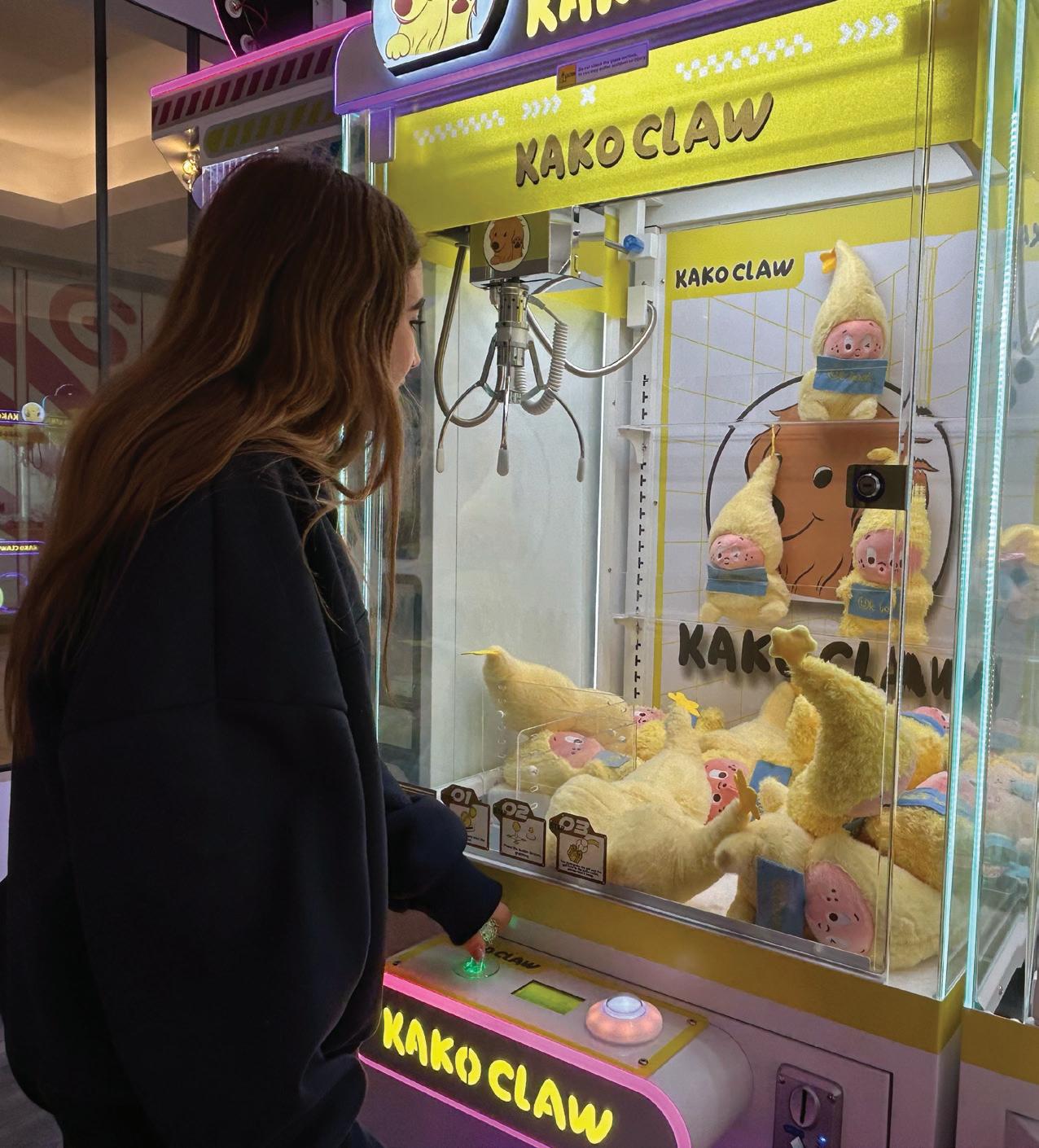
alking through Westfield Montgomery Mall, the bright colors and flashing lights of a claw machine arcade immediately pull customers in. Inside, machines line the walls and fill the interior of the store, along with racks filled with plushies and toys available for purchase.



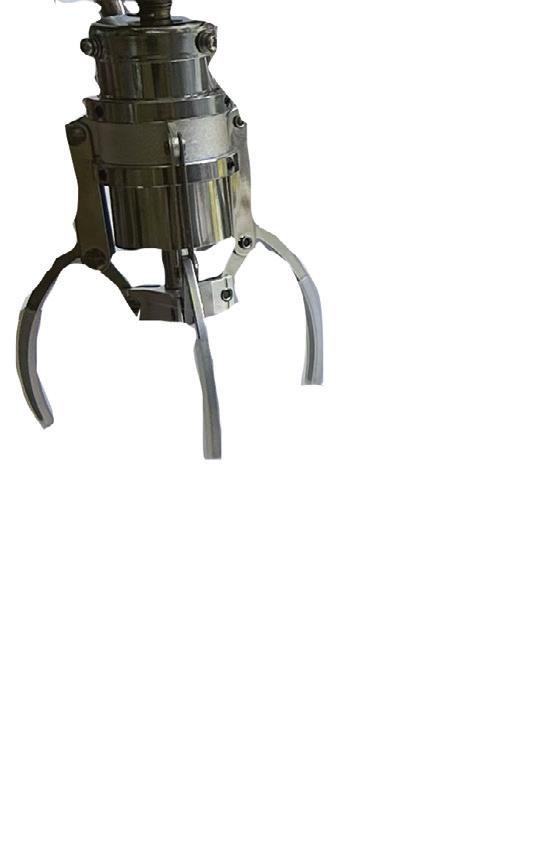
As claw machines continue to advance technologically, so do their locations. While each claw machine has its own theme and prizes, the machines are often heavily influenced by the location in which they reside. Machines in Tokyo not only include plushies and a variety of toys as prizes, but also include some of Japan’s most popular snacks, TV show and movie figurines and action characters. Certain claw machines feature specific Japanese gadgets, technology and more, according to LeonAmusment.
The neon yellow and pink LED lights welcomed us to Kako Claw at Montgomery Mall before we even stepped inside. The lights on the store and the modern technology on the machines are definitely a way to get customers to want to continue playing.
Claw machines originated in the U.S. and started as an activity at carnivals and fairs. In the 1970s and 1980s, their popularity grew immensely and they began appearing in places such as arcades, bowling alleys, movie theaters and shopping malls.
Recently, “Clawcades” have started appearing everywhere. These are arcades filled solely with claw machines. According to Today, the excitement around these arcade machines has had customers lining up outside the doors of stores.
TikTok and social media platforms have played a major role in the rise of this trend. Many videos feature hacks for winning the best prizes and satisfying wins.
These videos encourage people to try claw machines out for themselves, attracting more customers to “Clawcades.”
Companies have made significant changes to make these spaces more appealing and to have them fit current-day trends. They now use advanced technology, called smart systems, which control the level of difficulty for each machine. They also offer memberships and provide higher-end prizes, such as life-size plushies that make winning feel special.
In the store, one token was equivalent to one dollar. However, buying 55 tokens, gives costumers a 10% discount, and 120 tokens gives a 20% discount. Although we were not successful in winning any prizes from the five machines we played, other customers we saw
Keychains


were able to win prizes. The prizes included varieties of stuffed animals and plushies, relating to the themes of various machines, such as Hello Kitty, bunnies, Sonic the Hedgehog and more.
Kako Klaw was a unique experience compared to what we were used to when going into arcades.
As we walked out of Kako Klaw, the bright lights continued flashing, drawing in more customers. We enjoyed our time in the store, and it made for a fun and unique experience. We would recommend taking a trip to the Westfield Montgomery Mall to visit Kako Klaw for an entertaining and interesting day.

Plushies Balls

Miri Silverman plays a claw machine at KakoClaw, hoping to win a plushie.
Photos by Mae Stein, used with permission.
WILDE ABOUT THEATER WILDE ABOUT THEATER
The spring play cast puts on “The Importance of Being Earnest”
Junior Claire Elbaum straightens and tosses her hair to prepare for her scene in the JDS spring play, “The Importance of Being Earnest.” Sporting cat eye glasses and a purse, she is ready to embrace her conceited character, Lady Bracknell: the antagonist of the show.
The play, written by Oscar Wilde in 1895, is a comedy mocking social conventions and marriage. JDS’ production was performed on April 29 at 7:00 p.m. and was also shown to the entire high school, being the first play to be shown during the school day.
“I really think [the play is] just a very funny satire of the way that people behave when there are goals in society,” English teacher and director Nancy Wassner said.
Wassner has been directing the spring play for three years. She has switched off between one year of Shakespeare and two years of plays by other authors.
This year, the play followed the story of two men, Jack Worthing and Algernon Montcrieff, who take on false identities of a man named “Earnest” to escape their responsibilities and attract the attention of their intended lovers. Sophomore Noah Terl played Montcrieff and felt very connected to his character.
“He loves to eat, he’s very careless and expressive,” Terl said. “I kind of just play myself for a lot of it. It’s very convenient.”
Terl’s experience in the school musical and performances at Bucks Camp motivated him to audition for the play. Terl particularly enjoyed the first act, where he comically devoured cucumber sandwiches to annoy his friend Jack after being asked to share.
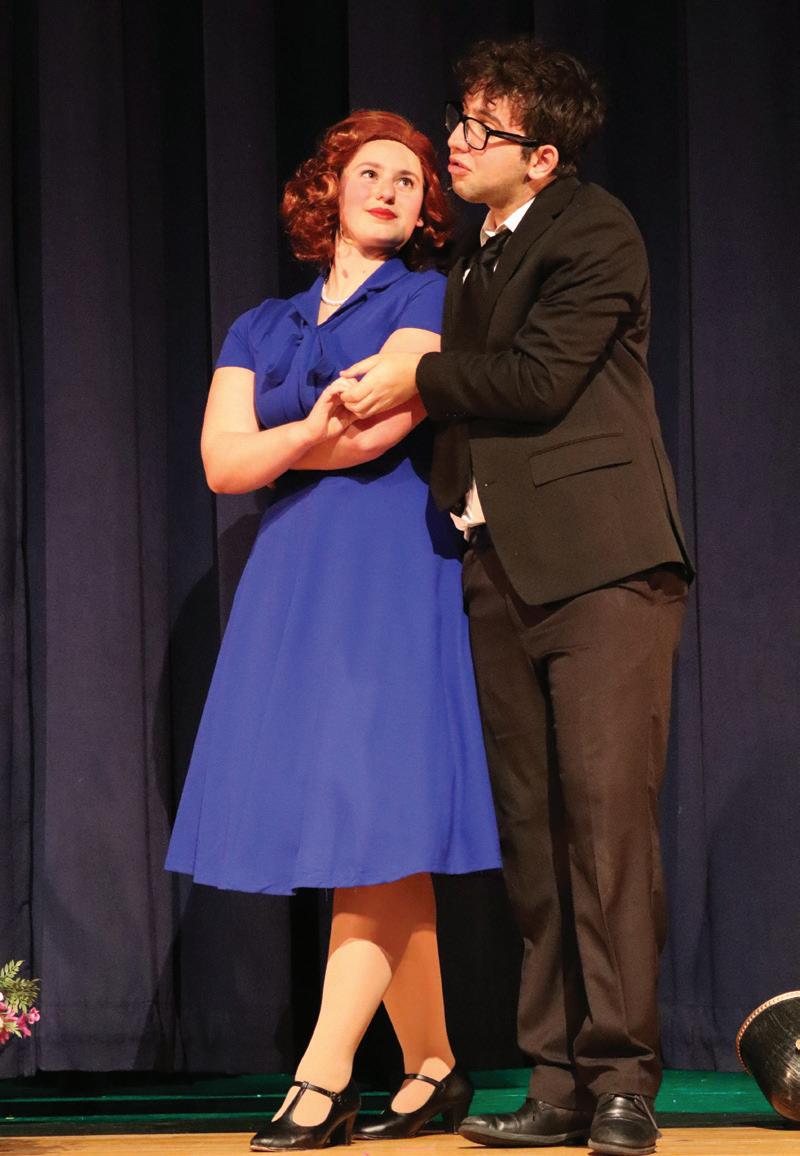
Compared to past productions he has been in, Terl appreciated how much time the cast was given to develop their characters personalities beyond memorizing lines and blocking.
“I felt it was really open to make your own creative decisions for your characters,” Terl said. “The moment where I kind of got to decide how [my character] walks, how does he talk, how does he say this line.”
To bring their characters and scenes alive, the show’s set and costumes were carefully procured at school and at the actors’ homes. Wass-
YEARS ACTING
Noah Terl
Eighth year


ner instructed her cast to bring clothes from home that could function well as costumes for their characters, and ensured any new costumes purchased could be used again in the future. The set was simple yet functional, featuring a donated coffee table, a couch, chairs and a picnic blanket.














The cast began rehearsing three days a week in January, and switched to four days with longer rehearsals as the show grew closer. At the beginning of the rehearsal process, actors were focused on memorizing lines and determining proper blocking. After the cast completely memorized their lines, the focus turned to refinements on specific scenes and full runthroughs of the play.


Delilah Dauber
Fourth year











One challenge the play faced was the frequent snow days and breaks dispersed across their preparation time. To ensure actors stayed on top of their roles, Wassner emphasized the importance of practicing lines over spring break so that rehearsals could run as smoothly as possible when students returned.






Elbaum is well-acquainted with this process and has been participating in the play since her freshman year. This year, although the play is set in 1950s America, the dialogue still included older 19th-century English. For Elbaum, part of the reason she finds this play especially humorous is because of this unique language style.
“When it comes to the actual performance, actually hearing the audience laugh at all these jokes that you forgot were funny is so exciting because it makes you feel like you did something that made somebody laugh and made someone smile,” Elbaum said. “That’s what it’s all about, really.”
Asa Salsberg
First year























Lena Lourenco OpinionEditor
Photos by Brielle Bassin, Dimensions.
Juniors Max Olin and Ash Cohen played love interests, Jack and Gwendolen.























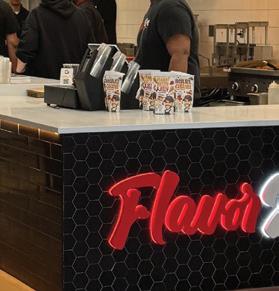


























Federowicz SportsEditor
Flavor Hive is a fast and casual restaurant chain in the D.C. area known for its viral “walking taco” and flavorful halal dishes. Starting as a food truck in Alexandria, Virginia, Flavor Hive now has five locations, two permanent stores and three food trucks. On social media, Flavor Hive is viral, with over 5 million followers on Instagram and 80 million views on their most watched video.
The North Bethesda restaurant opened on Feb. 12 as one of the two permanent locations, and it welcomes customers for lunch and dinner seven days a week. This location is a less than five-minute drive and a 20-minute walk from the JDS Upper School.
BUILD YOUR


delicious sauces: “The Hive,” green or white sauces.
- arts & entertainmentBAGGED BITES




With their extensive social media attention, Flavor Hive lives up to the hype. The food quality and unique walking taco bags are staples and taste phenomenal. Because of the fast casual service and large portions, Flavor Hive is a great place to eat with friends and share a walking taco. Flavor Hive’s proximity to JDS leads me to highly recommend that students and faculty try out their unique food. It would be an understatement to say that Flavor Hive is worth a visit. David
The menu and food selection procedure is very simple. Customers can either bring their favorite bag of chips or select a base of fries, salad or rice. Flavor Hive does not provide chips for walking tacos. Personally, I brought a large bag of Tostitos corn chips, but many people choose to bring Doritos or Takis.
After being offered rice on top of the chips, there is a wide variety of proteins, including chicken, beef and falafel. The next station features toppings like cheese and vegetables. The whole thing is topped by one of three

The Hive sauce is a sweet and savory red sauce. For spice lovers, the green sauce has a hot and fiery taste. Finally, their white sauce is yogurt-based, and tastes similar to tzatziki.








My falafel Tostitos bag included onion, tomato, cucumber and “The Hive” sauce. Even though it was very messy and required many napkins, the creation was packed with flavor. The falafel and crunchy cucumbers combined with the savory Hive sauce was mouthwatering and hard to put down.
Considering my bag of chips was substantial and filled to the brim with toppings, the cost was very reasonable at $15. I felt that the walking taco is so large that it can also be easily shared with multiple people.
I also ordered the fries, which were seasoned heavily and tasted perfect. Combined with the Hive sauce, they were tasty and very delicious. I can imagine the sauced fries with protein and toppings would be very appetizing as well.
Even though the restaurant was busy, the workers were very friendly. They were also not afraid to fill my walking taco up to the brim with food.
Personally, I was looking forward to trying Flavor Hive’s
walking taco because of its hype on social media. After trying it, I was blown away by the quality of their food and the experience as a whole.
In addition to the great service, the indoor and outdoor atmosphere felt unique and fun. Music, bright lights and sleek furniture created a modern and chill vibe. Flavor Hive’s bright red and black color scheme was on full display with the decorated signs and furniture, and the outdoor seating option was very relaxing in the spring weather.
Flavor Hive is located at 5568 Randolph Rd. North Bethesda. www.flavorhive.com
11 a.m. to 10 p.m. Mon.-Thurs 11 a.m. to 12 am. Fri.-Sat. 12 p.m. to 10 p.m. Sunday
Bag photos from Tostitos, Doritos and Lays.
Topping photos from Creative Commons.
Toppings:
Pickled Cabbage
Cucumber
Tomatoes
Fried Onions
Cilantro
Cheese
Photos by David Federowicz, LT.
BOWLS AROUND TOWN
Sophia Leinwand Reporter Poki DC
A look into the slop bowl craze in the area
Recently popularized, slop bowls are a new name for a familiar idea: customizable, all-in-one meals with bases, proteins, toppings and sauces. Here are some local favorite spots to indulge in some slop.
Playa Bowls
A good poke bowl spot should prioritize freshness and balance, and those qualities are exactly what makes Poki DC stand out to me. The location I went to in College Park, Maryland, DC was located within The Spot Mini, a food court housing several different Asian restaurants. Their bowls leave me feeling satisfied and healthy. My bowl consisted of seaweed, green onion, mango, edamame, ahi tuna, sesame seeds and soy sauce. The base usually starts with rice or greens, then gets layered with raw fish, chicken or tofu, plus toppings and a dressing.
The ingredients are always fresh and tasty, resulting in a colorful, nutritious meal. Despite usually being hesitant to order raw fish from fast food places, I have no regrets about my meal. Compared to other bowl options, Poki DC feels lighter while still being satisfying and filling.
CAVA









CAVA is perfect for a Mediterraneanstyle meal that is easily customizable. The process is similar to other slop bowl spots, starting with a base like greens, grains or a mix of both, and then layered with proteins, vegetables and dips. What sets CAVA apart is how much flavor is in each step. Unique toppings like “Crazy Feta,” “Fiery Broccoli,” falafel and “Hot Harissa Vinaigrette” dressing make CAVA a staple unlike any other, perfect for a filling and flavorful meal.
My go-to order is a white rice bowl with roasted white sweet potatoes, corn, persian cucumbers, roasted eggplant dip, traditional hummus, tomato and onions, topped with the “Lemon Herb Tahini” dressing. Although the ingredients were slightly disproportionate, with the sweet potatoes overpowering the rice portion, the overall flavors make CAVA my favorite slop bowl spot.
Playa Bowls is a staple for when I’m in the mood for a sweet treat that feels energizing and refreshing. My favorite bowl there is the “Goldie Mango,” which is a thick mango smoothie base topped with granola, Nutella, strawberries and bananas. The fruit is always cold and fresh, complementing the granola’s crunch and the Nutella’s gooeyness perfectly.
One thing Playa Bowls does especially well is variety. Playa Bowls offers an array of options for smoothie bases, including coconut and banana bases, along with more unique options like the green bowl, acai or pitaya. Additionally, the toppings range from bee pollen and coconut flakes to cacao nibs and almond butter.









Playa Bowls is a warmweather staple for me, customizable based on whether I am in the mood for a fruity and refreshing sweet treat or a filling meal.
Chipotle
Chipotle Mexican Grill is hailed as the catalyst of the slop bowl trend and leans into comfort and customization. My simple go-to order is a bowl with white rice, black beans, cheese, lettuce, tomato and avocado.
The portions are generous, almost to the point of being excessive. Each ingredient complements each other well: the rice is warm, the beans bring substance and protein and the toppings add freshness as well as texture. What makes Chipotle stand out to me is its consistency. I always know what I’m getting, and it’s easy to build a bowl that fits my mood.
The ingredients are straightforward yet slightly heavier than poke bowl places or salad spots, which makes it appealing when I’m looking for something substantial rather than simply refreshing.
Photos by Sophia Leinwand, LT.
- sports -
GOING THE DISTANCE
Liat Netter Arts & Entertainment Editor
Atop runner on both the cross country and track teams, freshman Rayut
Rising star dominates running competitions BY THE NUMBERS
Weiser-Rosenbaum is a seasoned member of the JDS running program. Racing for the Lions since sixth grade, after joining with only some experience, her times have improved significantly. During her eighth-grade season, Rayut became JDS’ second fastest runner for both the high school and middle school girls at the Maryland Private School State Championship for cross country, with a time of 21:59 for the 5K race, on Nov. 6, 2024.
Rayut began running during the COVID-19 pandemic with her father, Ted Rosenbaum, and gained experience through joining a local Girls on the Run team, an after-school program which helps elementary school-aged girls build confidence and promote healthy habits. Although she has been running for the Lions since sixth grade, Rayut is participating in all three running seasons for the first time this year: cross country, winter track and spring track.
“I really just enjoy running and the process of training,” Rayut said. “At first it was much more about racing and improving for racing, but I would say now I have much more of an appreciation for running itself and just the daily
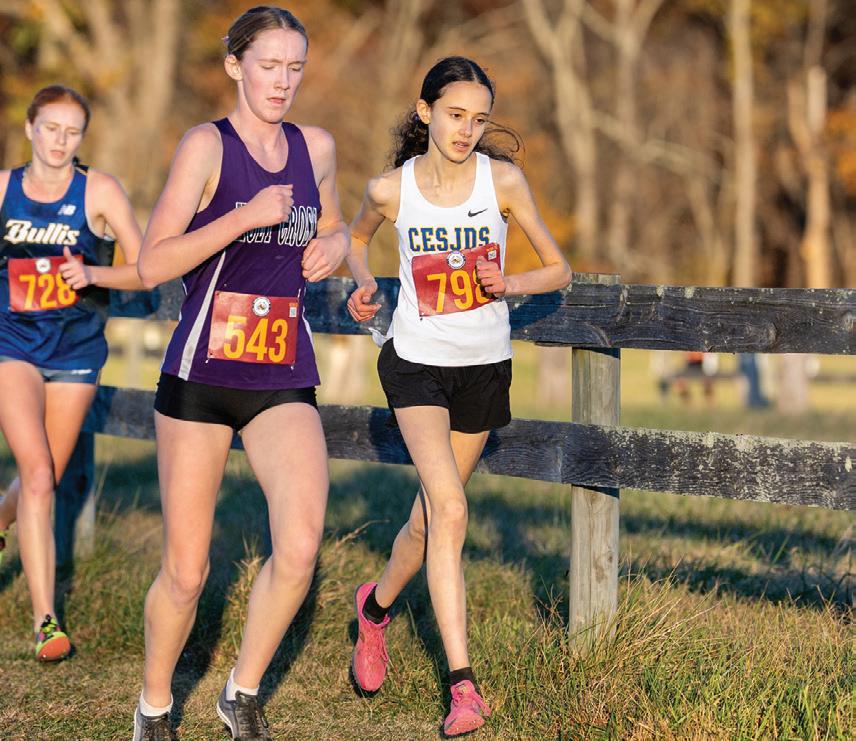
training.”
Although Rayut and Ted run together less frequently now, her father played a large role in encouraging her to start running, according to Rayut. Seeing him run inspired Rayut to ask him to join, which ultimately sparked her love for the sport.
Through running, Ted hopes his daughter will learn important skills that she can apply both to running and in life.
running at shorter distances, such as 100 or 200 meters, to improve speed.
“The future is very bright for Rayut,” Belinkie said. “She’s got a lot of talent and a lot of dedication and a lot of passion and when you have those three things, you’re going to go really far in the sport. The most important thing is that you enjoy and you have fun running and Rayut has always seemed to




“I think distance running is very much about persevering and continuing, even when there’s some pain and it feels challenging,” Ted said. “I think that’s a really important life lesson.”


Jason Belinkie, head coach of the cross country team and assistant coach of the outdoor track and field team, has coached Rayut since the beginning of her JDS running career.



Left to right: In the Maryland Private School Championship, freshman Rayut
Weiser-Rosenbaum runs with other athletes in the final stretch. Photo by Adam

























As a runner who specializes in longdistances, Rayut trains with workouts aimed at improving her fitness to run longer races. This includes running 400 meter repetitions at different paces or
Dimensions.














In a spring track meet at Berman, WeiserRosenbaum sprints to the finish line.

















Rayut prefers the scenic trails and hills in cross-country to running around the track during the spring and winter seasons. However, both settings allow her to ponder her own thoughts and appreciate the journey. Rayut’s times did not improve overnight, even though she is now a top athlete on her team. On April 24, in a meet against Berman Hebrew Academy, she ran a personal best and a winning time in the 3200-meter race, finishing with a time of 13:32.





































“People hear how much running I do now or my times, and they’re like, ‘whoa, that’s crazy,’” Rayut said. “But when I started off running, I wasn’t particularly fast or doing that many miles. It’s just important to ease into it and see progress over a long course of time.”















Hirsh.
Photo by Eve Sharp,
TAKING THE REINS
Dalya Lurie Arts & Entertainment Editor
After school, freshman Lirone Wolf heads to a different place than many of her peers: the barn. For Lirone, competitive horseback riding isn’t just an after-school activity, it is a major part of her life that has shaped both her schedule and her responsibilities.
Lirone’s connection to horses started as early as she can remember. Her mother Andrea also rode horses competitively as a child.
“I did that [horseback riding] with all my kids, and she’s the one who just loved it so much and wanted to pursue it and kept at it,” Andrea said. “I think it’s also related to the fact that she bonds really almost spiritually with animals and babies, so she has a deep connection.”
Lirone rides twice a week during show season and once a week after show season, with her practices taking place right after school at Free Rein Farm in Olney, Maryland. Although her riding schedule typically fits her daily routine, competitions require a larger time commitment. Most team events don’t conflict with Shabbat, but recently, Lirone had to stay overnight at a hotel to participate in a competition.

EQUIPMENT ON HOPPER



HORSE
CARE
DUTIES
1 Brush and freshen the coat 2 Feed oats 30 minutes before ride 3 Sweep and clean stall 4 Ensure the tack is put away 5 Pick out dirt from hooves
















Freshman competes in horseback riding
For Lirone and many student-athletes, schoolwork can contribute to a lot of stress, as it is difficult to balance academics with a time-consuming extracurricular like horseback riding.
“I sometimes get a little bit stressed out, but I love horseback riding, and it never feels like a burden, so [horseback riding] takes away from that,” Lirone said.
Recently, Lirone’s team qualified for Zones, a large regional competition featuring athletes from North Carolina, Virginia, West Virginia, Delaware and Maryland. This year’s competition was in Lexington, Virginia, and it is highly selective, as only the top two teams from each state qualify.
Unlike many sports, horseback riding relies on nonverbal communication with an animal, making it difficult to understand what the horses need. Despite this, Lirone loves that her sport is based on communication with the body. Lirone takes time with each animal before she rides them and bonds with them, making her connection even stronger with any horse she rides.
“She never gets frustrated, even when they’re being difficult or not listening,” Andrea said. “She just always stays steady with them, and in her mind, they’re al-




























ways right. A lot of times, people who ride or do anything with animals get frustrated when the animal is not doing what they wanted to do. But Lirone doesn’t.”
Despite riding at the barn for a few years, this is Lirone’s first year on a team. Lirone’s coach, Amber Philler, was very happy she decided to join her Interscholastic Equestrian Association (IEA) team. This organization is unique, because whenever Lirone goes to competitions, she doesn’t know which horse she will ride and draws a horse’s name to compete on. To prepare for the competitions, each practice Lirone rides with a new horse.
Even with that reality, her connection with the horses she rides never ceases to surprise Philler.
“She’s a very focused individual, really good student and very teachable,” Philler said. “She wants to progress, and she ... is just very focused, but also really, really enjoys the horses. I can tell how much she enjoys being around them. Horses can be very good for the soul.”
In spite of the few complications that come with having an important commitment outside of school, Philler and Andrea both agree that Lirone is great at what she does. Lirone believes that horseback riding has benefited her in many ways.
“[Horseback riding] definitely taught me a lot of discipline in terms of responsibility, cleaning stuff up and noticing and taking care of other people and other animals, which is really important,” Lirone said.















Freshman Lirone Wolf tends to her horse Hopper at a stable.
Photo by Molly Elbaum, LT.
Saddle
Shira Skolnick-Einhorn Reporter




How long have you been playing?









“My parents signed me up for Kidball, but I kept playing because I just really enjoyed it. I got to do it with my friends … and it’s [a] really fun sport to play.”
What’s the biggest difference between the middle school and high school sports teams?
“I think it’s a bigger deal, and it’s more competitive. When I was in eighth grade, I was the oldest guy. Now I’m the youngest guy, so that’s another big di erence. But in terms [of] the skill level, it’s a step up from middle school.”
How have the captains supported you as an athlete?
“ ey’ve taught me a lot and really helped me … If they ever see me doing something wrong, they’ll let me know … ey’re always willing to help.”
What is the [9th grade] experience?
“You’re kind of seeing what it’s all about, seeing the di erences in high school, and kind of getting to know what it’s going to be like for you for the next few years … [I am] taking it all in as a ninth grader.”
What is one goal you have for yourself this season?
“Be con dent in my game and be consistent with it. Being able to show up on any given day and perform de nitely is a goal for me.”


RO KIES RISE,










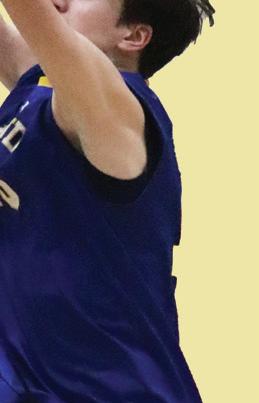

ZACH BERMAN
How long have you been playing?
“I’ve been playing basketball for 10 years, and I was drawn to it because my dad has always loved basketball, and so he just introduced me to the game. And so I just kept playing.”
What’s the biggest difference between the middle school and high school sports teams?
“Size, athleticism, physicality and just overall quickness.”
How have the captains supported you as an athlete?
“I think they all know that in order for the team to be successful in the upcoming years, they’re going to have to … rely on us new players to play a strong supporting role in the team. And so they want to help develop us up as much as they possibly can.”
Describe your relationship with the captains on your team.
“[We] are really just trying to listen and learn everything we can, and trying to pick up as much as possible.”
What is one goal you have for yourself this season?
“Just get as comfortable as I can with the new team and play with these better, stronger, bigger kids.”
How long have you been playing?
“I’ve been playing volleyball since the beginning of the volleyball season … I play because my brother, who is on the team, said … ‘it’s really fun,’ and he’s the main reason why I’m playing volleyball.”
What’s the biggest difference between the middle school and high school sports teams?
“It’s a lot more practices, [the schedule is] a lot more intense…, so there’s just gonna be more times where you’re practicing the sport.”
How have the captains supported you as an athlete?
“Helping us become better at volleyball, because there are a lot of new kids, so since they know how to play and basically they already know about the game, they teach us about the game.”
Describe your relationship with the captains on your team.
“ ere’s older people, and they kind of tell the freshmen and other people what to do … It’s more being told what to do by older people who know what this took.”
What is one goal you have for yourself this season?
“Get one really good hit, just have one really nice kill. at’d be very, very fun.”
Photos 1, 3, 4 & 5 by Brielle Bassin, Dimensions. Photos 2 & 6 by Adam Hirsch, used with permission.



CAPTAINS COMMAND



YARDEN WILKENFELD



Different team experiences between returning players and newcomers


RYAN KLEPPER EVE SHARP SOFTBALL
What motivates you to continue playing every year?
“I have friends that join each year, and really that’s the biggest pull, because … for so ball, I’d say it’s more about the people that I do it with.”
What has changed from the previous years, now that you’re a captain?
“I’d say a lot of it is the leadership ... I have to be more of a vocal teammate, li ing people up when they’re down, giving some pointers to people when they need it and also just … setting the right tone for the team so everyone else follows.”
What is do you wish you knew as a rookie on the team?
“It’s okay to have fun, the coach won’t get mad at you and the players won’t get mad at you.”
How do you try to engage freshmen on the team as captain?
“Truthfully, just talking to them, … creating a fun environment at practice and during the games, so they feel calm and at peace when they’re playing, because then they’re better … Just reinforcing the idea that just because it’s their rst time playing at the high school level, they’re able to do it, and they’re capable.”
How do you want to make your mark?
“I want to make my mark on the team by how many bases I’ve stolen, and by just bringing the smiles and the laughs.”
What motivates you to continue playing every year?
“I have so much fun doing the team that I just wanted to continue. And also, last year, [we] were so close to winning the PVAC that I really want to just give it another go.”
What has changed from the previous years, now that you’re a captain?
“I see myself running drills and teaching the new kids how to play more so than just practicing myself … So I think there’s a huge shi … [to] becoming one of the teachers.”
What is do you wish you knew as a rookie on the team?
“Tennis is a really mental game … you can get so in your head, so frustrated [and] nervous that you’re going to miss because you’re playing by yourself, you have nobody [to] talk to or encourage you during the match … I think the game is 70% mental and 30% physical. Because keeping your mind in the right, positive mode is extremely important.”
How do you try to engage freshmen on the team as captain?
“I see myself running drills and teaching the new kids how to play more.”
How do you want to make your mark?
“I’m really hoping we can win this year. We were really close last year … I think it’d be really cool to just win the PVAC as singles one on the team and leave my mark.”
What motivates you to continue running every year?
“It’s just really fun to see yourself grow and to see how far you’ve come from. ere is just so much growth [that] happens. at work really pays o a lot of the time, … you just really learn hard work, and I think it’s just a really valuable thing, which has kept me coming back.”
What has changed from the previous years, now that you’re a captain?
“I think becoming a captain, I’ve just taken a lot more responsibility on, and just de nitely taken a larger leadership role on the team.”
What do you wish you knew as a rookie on the team?
“I think it’s really important to not get discouraged if you are an older runner and you’re having trouble getting back to your times, or if you’re a younger runner … but you can’t get as good of a time.”
How do you try to engage freshmen on the team as captain?
“On a personal level, try and, especially as older runners, [have] close relationships with younger runners, because I think having a role model on the team is super signi cant.”
How do you want to make your mark?
“I just think I want to be remembered as a good leader and someone who is just a genuine person that people can look to as a role model.”
TENNIS
Finals personality Finals personality which Are
you?
START HERE:
Started studying yet?

Over/under 5 hours a week?
Leora Blumenthal Editor-in-Chief

“I COULD WRITE MY NAME AND KEEP AN A”
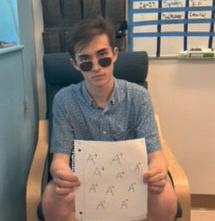



All your classes or just some?

BORDERLINE GRADES FAVORITE ONES UNDER OVER YES YES SOME ALL NO Plan to? Do grades matter to you?
“THE BIG LEAGUES ARE CALLING”





THEY DO NO
THEY DON’T
All your classes or just some?
SOME ALL




Which classes?

“GRADE CALCULATOR MASTER”
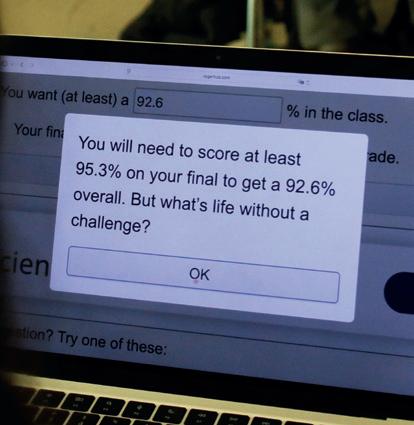
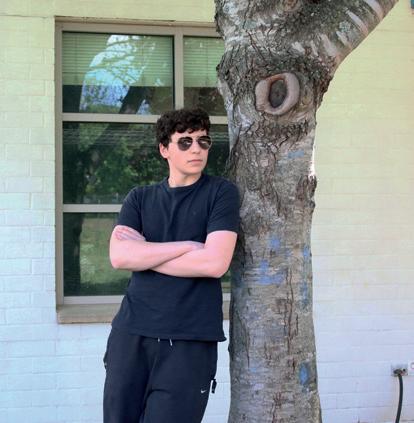
“DELAYED LOCK IN”









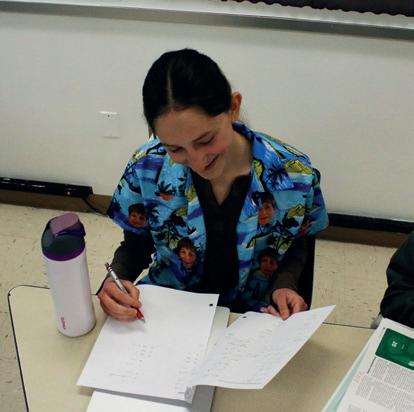
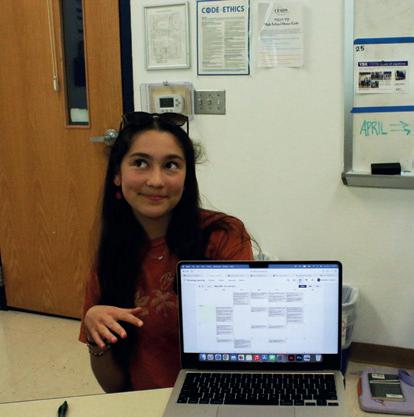
“TOO COOL FOR SCHOOL” IS ACTUALLY FUN”
Photos by Leora Blumenthal, LT and Dalya Lurie, LT.