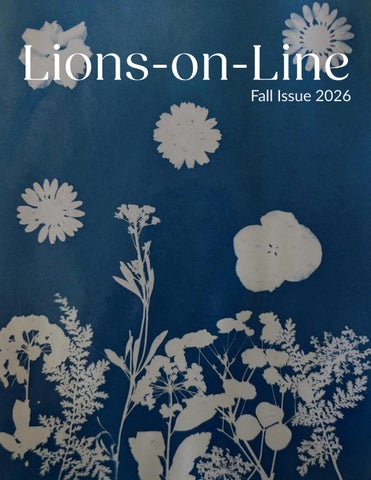
Lions-on-Line
Fall Issue 2026
Table of Contents Wildflower Cyanotype, artwork by Chloe Banta ..................Cover Barn, artwork by Michaelann Kelley ..................................................1 "The Sadim Touch," fiction by Aidan Christy.....................................2 Green Figure Study, artwork by Tori Orbegozo ..............................3 "A Mountain's Mouth," poem by Alex Taft ........................................4 Persephone, artwork by Ella-Jane Kuhnell .......................................5 "Seedling," poem by Sydney Dotson ....................................................6 Still Life from Below, artwork by Ella-Jane Kuhnell ........................7 "Accessibility and Inaccessibility on Mount St. Joseph University's Campus," essay by Kaitlyn Schulte .................................8 View from the Uffizi, artwork by Ella-Jane Kuhnell .........................12 Photography by Charles Owens ...........................................................13 "To the Student Who Used AI," poem by Joseph Knizner .............14 Mom Hands, artwork by Isabel Arviza ................................................15. "Sponsored by the Letter G," Essay by Isabel Arviza ...................16 Snow Drive, artwork by Michaelann Kelley .....................................18 "Finals," poem by Joseph Knizner ........................................................19 Dreaming, artwork by Ella-Jane Kuhnell ............................................20 "Those Prom Kings?" poem by Madeline Rappold .........................21 Leda, Artwork by Ella-Jane Kuhnell .....................................................22 Lions-on-Line
Fall Issue 2026
"Destroy our Local Flock Camera," poem by Alex Taft ..............23 "My Phone Is Stuck," poem by Madeline Rappold .......................24 ngel and Flowers, artwork by Ella-Jane Kuhnell.........................26 "Mass," poem by Alex Taft .....................................................................27 " e Was ever ours," poem by Maria Wendling ........................29 ll at ou Whole Love ou So, artwork by Keira Fiorito .........31 "Seeing ou Again," poem by Jim Barge .............................................32 Bleeding Heart , artwork by Ella-Jane Kuhnell .................................33
Lions-on-Line
Fall Issue 2026
Barn by Michaelann Kelley
1
The Sadim Touch By Aidan Christy In a small town called Buzbeth, which was extremely remote and cut off from nearby towns, there lived a young man named Oliver. There was something terribly wrong with Oliver. He stood out like a sore thumb wherever he went. No matter how hard he tried to fit in, he just couldn’t. Since childhood, anything and everything he laid his hands on shattered into pieces: delicate glassware, valuable objects, and even relationships with the people he cared about the most shattered like glass. Over time, Oliver found himself isolated and alone, feared by those around him and shunned by his peers. His parents, at a loss for how to help their son, sent him away to live his life in solitude, hoping that distance would shield others from his destructive touch. And so, Oliver was alone in a log cabin on the outskirts of town. He resigned himself to a life of loneliness, and solitude, his heart heavy with the weight of his curse. He lived years like this, avoiding passersby, and anyone else he might hurt. One day he was walking alone through the forest, and as he walked through a clearing, he saw a young woman sitting beneath the shade of a towering oak tree. He would soon learn that her name was Ally, and instantly, Oliver knew she too was different. Unlike the fearful townspeople, Ally was unbothered by his curse. She made him feel normal. The two of them got close, talking and laughing. But Oliver was cautious around her. He made sure never to physically touch her with his hands. As time went on, Oliver dared to hope that perhaps this curse could be broken after all. One day, he took Ally’s hand in the very spot they met; he was apprehensive. Would he destroy the only good thing in his life, like everything else? She wore an expression of understanding and acceptance. At that moment, Oliver realized that his “curse” was a testament to his resilience. Through his destruction, things were rebuilt. Things were repaired. The lives of the people around him went back to normal. And with Ally, he learned to control his fragile touch of Sadim.
2
Green Figure Study by Tori Orbegozo
3
A Mountain's Mouth By Alex Taft Swallowed by a mountain, The vengeful deity of stone. Humans are gorged by him, To satisfy his insatiable hunger. By magma they’re seared to the bone, By stalagmites and jagged rocks, they’re impaled; Their retched remains blight virgin crystals. The piquant mess rots in his infinite gut, As he eructs with a triumphant burp; The acrid cloud massing over the plains blocks out the sun, As if to shield the eyes of heaven, While hot bile desecrates the trees and buries the roses that stem from his surface. The disgraced lord of the cursed soils, The accumulation of human apathy and feigned concern. The last great pharaoh of gluttons leaves himself barren, So that his followers may tear the flesh from their own arms and masticate one another, Until all that’s left to eat is the very dirt and rock they have defiled.
4
Persephone by Ella-Jane Kuhnell
5
Seedling By Sydney Dotson Imagine that you took a seed and planted it in the ground. You cared for it and watered it and wanted it to grow unbound. It bloomed, and you were happy It grew, and you were proud— It grew, and you got angry It grew, and you said “slow down.” You tried to cut the plant but it was too strong. You ask, how did you end up like this? The plant wonders what to say— You told me to grow tall, it says. You told me to grow strong. You told me to reach high, it says. You told me to be bold. Now you want to cut me down— Now you want me to fall? I just did what you told me, I’m sorry if that’s wrong— But I am proud of who I am You cannot make me quit. I’m sorry that you planted me and that I didn’t fit.
6
Still Life from Below by Ella-Jane Kuhnell
7
Accessibility and Inaccessibility on Mount St. Joseph University’s Campus By Kaitlyn Schulte Accessibility, especially physical access, is something I am constantly aware of because I use a wheelchair and a walker daily. Many people don’t realize how accessibility benefits everyone. No one is immune to becoming disabled. It can happen at any time: a simple accident, a sudden illness, or even old age. I was born disabled, along with mental disabilities that I discovered later in my life. I have always been aware of my disability and the struggles of accessibility I tend to face. Accessibility gives everyone, especially disabled people, access to their environment that goes beyond simple inclusivity. Accessibility also ensures the dignity, safety, and independence of disabled people. Accessibility isn’t just a convenience issue; it's so everyone can fully participate, feel like and quite literally belong. When places and events aren't accessible, some people can’t participate at all or need extensive help to do so. I try not to take my privilege for granted. Yes, I am disabled, but I am only one disabled person, and people with the same disabilities as me have their own experiences that differ from mine. Since I completed my Senior Project for the Liberal Arts Culminating Experience with Dr. Jennifer Morris, I have become more aware of and passionate about accessibility issues. My project was a semester-long effort in which I highlighted the accessibility issues on campus at the time. On Dr. Morris's recommendation, she introduced me to an MSJ alum who is paralyzed and uses a wheelchair. We collaborated, and she also recommended that I reach out to Peak Productions to make a video of campus that shows the struggles we faced while going through a normal day on campus. The Peak Productions crew helped me, and I got to witness firsthand how wheelchairs and limited access to arms and hands, as well as legs and feet, affect someone's ability to participate in the environment effectively 8
and safely. A huge component of this experience got us all to realize the impact the bathrooms had on disabled people. Something as simple as needing the bathroom, something most take for granted, is huge to see firsthand. I already knew the struggle. Now, in some places but not very many on campus, we do have accessible buttons for the bathrooms. Before this, and still in some places without accessible buttons, I often had to leave the device I was using outside the door. Luckily, I can do this, but I shouldn’t have to, and not everyone can. One member from Peak Productions who helped me document the accessibility issues on campus was Alex Taft. We became closer through this experience, and I asked him to share his point of view on helping me with this project: Having had the opportunity to go around campus myself and watch your daily routine, I noticed so many accessibility issues that I never would have thought of. It never occurred to me how heavy our restroom doors are on campus, and how difficult it would be to push one open while using a wheelchair. It was honestly absurd to see that in some campus elevators, such as the one in Archbishop Library, wheelchairs couldn't fit. One design on campus meant to make MSJ more accessible is entirely inaccessible to anyone in a wheelchair. It's absurd! If anything, I hope we at least acknowledge how much we still need to do before we're genuinely an accessible campus. It's a shame this issue remains so pervasive on campus despite so much construction, and I know the Mount can do so much better. We need to put actual action behind the words of our mission. (Taft, 2026) Additionally, it’s a major safety risk. The one thing that Neil, the alum who worked with me, said that still sticks with me to this day is how he basically rammed his legs into the door to open them when going to the restrooms. He couldn’t feel it, but that doesn’t mean he couldn’t get hurt or that it's not a major dignity issue, and it's seriously very sad. I wrote this paper because of the recent construction on campus. Student spaces, along with bathrooms, were completely redone to enhance students' experiences. But the major problem is that they weren't designed 9
with accessible door buttons in mind. Even if you have strength, it's incredibly difficult to pull a wheelchair or walker through a doorway, especially if you can barely reach the handles. The east elevator down to Seton's ground floor is now in the new Seton Commons basement. If you use this elevator to access Market C, Lion’s Den, the mail room, or the Roar store, you must be able to exit through the door. Because I am alone or use my wheelchair most of the time, I use the west elevator to get my mail or access Market C. Most of the time, this is incredibly out of my way. However, I do this because it’s the easiest way for me to get down there. I can’t guarantee someone can help open the door, and besides, it's truly embarrassing to struggle; I either need to ask for help, or someone needs to be willing to open the door for me. What a lot of people also don’t realize is that the ADA (Americans with Disabilities Act) only protects so much, and most of the time it doesn’t meet all the requirements. Most plans are made without disabled people in mind and without their input, which leads to accessibility issues that could easily be avoided if you truly investigate what is accessible and talk to disabled people specifically. The ADA typically takes a bareminimum approach and often overlooks key accessibility issues. These accessibility issues on our campus limit students from reaching their true potential here at MSJ and also keep some students from coming here at all. There's a lot to do to make the dorms accessible; even the accessible rooms. I am in no way trying to shame MSJ for being inaccessible. It's mostly an old building, so it was built at a different time with different expectations. However, there have been a lot of newer buildings and additions to campus that could have been built with accessibility in mind. Also, it doesn't make you a bad person not to notice these accessibility issues. Most people don't see the issues until they are put in a position to notice them. Even I, as a disabled person, could only see so much until I worked with Neil and caught an even more full perspective. Using a wheelchair instead of a walker in my daily commute around MSJ has shown me a lot of what could be done. I see how much privilege 10
I have—being able to use my wheelchair more freely than some people— as well as the different challenges that arise using a walker vs. using a wheelchair. I have a lot of empathy for those who need more support than I do, since I have been able to see some of the struggles I don't face daily. Many changes could be made, both simple and not-so-simple. I am proud of the progress MSJ has made, and I am sure it will continue. But sometimes we need to be made aware of issues we don’t notice in our daily routine. This isn’t a bad thing! You can’t truly understand someone else's experience, no matter how similar your experiences are. Still, to be truly helpful and respectful to all people, you must be more aware of what their lives are like and how to improve them. Slowly and simply, it's possible when you plan well from the beginning. If you take anything from this, my main point is to think about those who are different from you and who may experience life a little differently. Use this to better understand people so you can be there for all types of people in your life. Accessibility affects us all and is needed in all types of ways, not just doors or doorways. There are a lot of accessibility issues all over the world, not just MSJ, and I am sure, or hope to be sure, you will be more open and see things differently every time you walk around on campus and outside of school to be aware of the struggles that some people may face. Sure, some people may have help, but not always, and they shouldn’t have to rely on it all the time. Writing this was worth it if I change even one person’s point of view on how we can enhance student experiences and truly value and implement the Sisters of Charity’s mission for MSJ.
11
View from the Uffizi by Ella-Jane Kuhnell
12
Photograph by Charles Owens
13
To the Student Who Used AI By Joseph Knizner I study your writing. I look for your words but see only a sloppy imitation of your thinking, your prompting. I push between the words and sentences, looking for the fresh spark of ideas, reflection. But your words aren’t yours. There is a curious door in your mind which I fear is closing, inching shut, day by day, paper by paper. The brilliant, illuminating light is being held back, blocked off. One day, the door will slam in its frame, the lock clicking in place. The flecks of paint will tumble off, and the golden knob will lose its luster under a film of black dust. What will you do then, when the light from the crack under the door is all you have to work by: a faint candle casting too many shadows? One day, crouching on the cold ground with your back pressed against the sealed door, the hearth of your creativity, how will you write, think, or live? As a human? When the sun of your originality and reasoning has set, and the only moon you see by is the wan light of Chat-GPT, what will you be? I do not mean to be so harsh, but the absence of your words, here, today, is no trivial matter. This is life and death, the difference between thoughts and words—and cryptic symbols signifying nothing, an empty mind.
14
Mom Hands by Isabel Arviza
15
Sponsored by the letter G By Isabel Arviza My mom died. She was 97 years old, and truthfully, my siblings and I knew it was coming, but the amount of pain we felt was not expected. You’re never ready. Suddenly, you start to remember a myriad of memories. Things long forgotten blast through me like rays of sunshine. The kind that burns the skin and makes it sting. One such memory is watching Sesame Street when I was young. My mom loved watching it with me because it helped her with her English. I watched it because it made her so happy, so I learned all about Ernie’s rubber ducky and the Count’s love of, well, counting. How appropriate, I thought as a four-year-old. Now that I’m older, I realize I didn’t really appreciate the show's sponsors. For those of you who don’t remember, the sponsors were the letters of the alphabet. I remember some of the more popular letters, like B, because B sounded so happy, like busy, bees, beautiful, brave, baby, and berries. Beans also start with B. My brother remembers the big dollop of beans with pizza because, as a MexicanAmerican family, my mother thought it necessary to eat beans with everything. As I reflect on my mother, though, I never fully appreciated the letter G. As I grew older, I set aside the childish shows and became enthralled with what many considered adult concerns. Things such as being gorgeous despite being gangly in my teen years, gloomy moods, hair gel, giggling with friends, and feeling great. Instant gratification was the goal. Later in my twenties, my main concern was meeting a gentleman I could call my boo because, of course, the letter B is happy, and having a boo would make my life complete. Instead, I graduated and became a high school English teacher for kids with the gift of gab who loved to giggle like me back then. It seemed I spent my evenings and weekends grading genuine awfulness. My mother became less important. Not that she wasn’t loved, but my career changed, and I left home when I joined the federal prison system. I 16
thought that when I was done with this line of work, I would triumphantly return, giddy and gleeful, and be with my mom again. I traveled the country and learned my geographical areas by the prisons I worked. I became cynical and cautious as I experienced hate and glaring stares from inmates. They made gang gestures and glorified the criminal world. It made me hard. Twenty-four years passed. I married my gentleman boo. My mother became older and needed 24/7 care, which my sisters provided. I felt guilty. I took a picture of her gnarled hands praying the rosary because that is what she did for us. As she grew older, I realized just how generous she was with her prayers. Her goodness radiated in her compassion for the needy and underprivileged. She was a giver of many things, such as laughter, advice, and grace. I saw her as glamorous and gifted, and a true gem of a woman. Her sacrifices for her family made me grateful. She loved flowers and gardens. She told me gossip and gluttony were wrong, and yet loved a grilled burger as we discussed family drama. I retired from my job in the prison system, and then she died. She died before I could go back home to be with her again, so now I’m glum. It hurts greatly, but all I can do is honor her memory. Remembering my time with her and my days of watching Sesame Street came back in a sea of tears and memories, and I realized the letter G was a grand letter that personified my sweet Mama. Her grandkids called her Gam Gam, and her great-grandkids thought she was, well, great. How appropriate. Now instead of being gorgeous or giggly, I’m drowning in grief. I’m grieving for the gentle, generous, genuine, graceful woman who often made me grin with her dry sense of humor. I miss my mom, the OG. Thank you for the lessons you gave me, Mom. I know you are sponsored by the big G in heaven. Rest in glorious peace.
17
Snow Drive by Michaelann Kelley
18
Finals By Joseph Knizner Earbuds in: the rhythmic clashing of coins. Money, it’s a gas... The spines of books on shelves flex away as I drop the envelope onto the oversized mahogany desk. A flash of green above mounds of ungraded papers, crumpled notes, and exam questions. An apple perched on your desk, its ruby skin frosted with light. You didn’t even look up, and I was out the door. But I know that apple was rotten through its core.
19
Dreaming by Ella-Jane Kuhnell
20
Those Prom Kings? By Madeline Rappold The bloke with the line of coke; Oh, the awful stroke! Too rough, too tough. What a lousy lay! Next time, I’ll say I’m gay
21
Leda by Ella-Jane Kuhnell
22
Destroy Your Local Flock Camera By Alex Taft Walking down the street, A grotesque implement offends my eyes. The latest tech of the panopticon, A metallic contraption fit for spies. I hang my head down low and curse beneath my breath, As I storm back home in a haste. My blood boils as my fists clench at the thought of that glaring lens, Foul device, soon you will meet your death! I searched my cabinets for the finest tool; A hammer prepared for a sacred duty, The liberation of man from mechanical rule. I polished my excalibur with a great big grin, And skipped out the door as I sang, “Let the fun begin!” I ran up to the cowardice camera, And brought down my justice with ferocious power. It lasted only a minute, But I could’ve gone for an hour! I know that millions like me share my vendetta, A righteous anger built on the premise of freedom for all, And a just desire to watch spies and tyrants fall. I know that you share my vendetta, So do the world a favor, And destroy your local flock camera! 23
My Phone Is Stuck By Madeline Rappold to my face like the stickers on your ceiling and like the stars to the sky when camilla calls to say that you’re hurt really bad, it’s serious this time. i take a deep breath and hold it in like smoke as words like collarbone and ulna and radius and rib crash into my ear. your car is wrapped around a live oak like your arms around my waist, and the firefighters barely got you out. there weren’t any jaws of life for me. i ask if you’re alive at the same time that i hope you’re not, and i wonder how anyone could ever be so awful as us. someone else is at the hospital with you now, snot and saltwater stuck to her cheeks, pushing red hair off of your forehead while you’re looking for a girl that died with the autumn leaves. your eyes are rolling back in the paramedic’s flashlight, searching behind your eyelids and in the back of your mind and around the back of that tree. did you see me, a deer in your headlights, 24
and finally swerve? i’m here, confusing the night sky with your ceiling, wondering if it’s your ghost or your memory haunting me now, phone still stuck to my face like that tattoo is stuck on your arm and like my broken record heart is always stuck skipping over and over and over and over and over and— camilla says you’re alive. the last time i was over, a comet flew by, and we didn’t see it. i still wonder if it saw us, curled under the glowing sky on your ceiling, little plastic cosmos blinking down at us from the rhythm of your ceiling fan, giggling over an inky black star needled into your forearm. i used to think the comet took that memory deep into the galaxy with it, dragged to death on its tail. i think about how many stars learned our name, and i hang up the phone.
25
Angel and Flowers by Ella-Jane Kuhnell 26
Mass By Alex Taft The Commander in Chief attended his mass on a Saturday morning; It was a crisp 31 degrees outside, and unadulterated February snow embraced the D.C. cherry blossoms. City pigeons glided over the blue Potomac while doves brooded over their kin, And the hymns of the capital reverberated from building to building. The regular traffic, the footsteps of citizens preparing for their work day or morning coffee, the big metal trains roaring through the shadowy subway tunnels. The conversations of people chatting about anything and everything, all blended together until their speech sounds like a collective nothing. The subtle thump of “OPEN” signs being turned on the front doors of stores and restaurants, And the sound of life flowing through the streets and alleys. The moon lingered, but the eager sun would soon command a new day in Washington. The mass commenced with a declaration: “Vindicate me, O God, and defend my cause against an ungodly people; from those who are deceitful and unjust deliver me!” The congregation sat around an oval table of worship, and gradually the fresh air of the room was purified by their cheap store-bought incense. It was burnt and pungent. “We the congregation have gathered here in our eternal struggle against the serpent,” said the commander in chief. “Today, his tail is grasped by the heavy hands of the Ayatollah.” The liturgical readings told harrowing tales of a nuclear program, of a wicked nation that threatened the righteous people of the United States and Israel, and of God’s just deliverance. Indeed, the proper punishment for such a wicked nation, the congregation settled, was sulfur and fire.
27
And so it was. The Commander in Chief, despite having no priestly background, administered the Eucharist. Each member of the congregation stood up to receive the blood and body of Christ, in their minds entirely blameless. And when each member had eaten the body and drank the blood, they stood up for round two, then round three, four and five. The congregation ate of his body and drank of his blood until their bellies bloated with yeast and they stumbled as drunkards. They ate and they drank, and relished in body and blood; gratifying the flesh as they deluded themselves with lies of living by the Spirit. The fools of the congregation danced and held hands together in their drunkenness, knowing that they would be delighted by the hymns of the capital the next morning: Sounds of a mother weeping over the charred remains of her daughter in Minab, Sounds of missiles expelling the wicked from their beds, Sounds of American soldiers losing limbs and lives in retaliatory strikes across the Middle East, Sounds of the American public crying for change, equally matched by cheers of support; Sounds of industrial machinery churning out new weapons of death, Sounds of war profiteers popping champagne corks in celebration of another pay day, Sounds of anxious tapping for what’s to come next, And above all else, the sound of the death rattle, shaking side to side. God bless America, God bless the Department of War, And God bless the singing city of D.C., the mother of earth’s abominations.
28
He Was Never Yours By Maria Wendling While in your car, with the doors locked and lights off, You cry to me about the one who repeatedly hurts you. I hate seeing you settle. I hate seeing you beg. I hate seeing you give up quarts of your blood to that hungry shark who bites off pieces of you, Every. Single. Time. And yet you swim after him, In a pool of your tears that he thrives in. How many limbs are you going to lose before you bleed out? How many times will you be swallowed up whole and spit back out, not because he’s sorry, but because he’s saving you for later? I helped build you a lighthouse, And you sailed right into the wreck you call love. I built a raft so you wouldn't drown, and you jump back into the jaws of the boy you call “the one.” Don’t coast on deadly waters and expect to not fall in. He’s not going to change. He’s only getting hungrier. I tread in hushed water as you make yourself bait, diving down to the hungry predator below. It’s me who cares that you find the right love. 29
But you feel love only stems from him, and that he won’t bite you again. Don’t bleed out for someone who swallows it up. You should not have to question if he loves you. Because if you do, he was never yours.
30
I’ll Eat You Whole, I Love You So by Keira Fiorito
31
Seeing You Again By Jim Barge The constant battering of life, Like a howling wind, And a pelting rain, Your back bent low from the weight, Hiding your face, downcast, grimacing. And then gradually your countenance changes, Relaxed, if only for moment or two, Free from heavy burdens, Life and light return to your face A sparkle back in your eyes, Radiating the beginnings of joy, A softening as you speak. The wind settling into a calm, gentle breeze. I see YOU again! Linger with me for a while In the eye of the storm.
32
Bleeding Heart by Ella-Jane Kuhnell
33
Submission Guidelines Initiated in January 2005, Lions-on-Line is a literally collection of works by the students and alumni of Mount St. Joseph University published online with the cooperation of the Liberal Arts Department. Lions-on-Line is published online twice yearly, during the fall and spring semesters. When our budget allows, Lions-on-Line goes “in print”. We take submissions during all twelve months of the year. If you are currently affiliated with Mount St. Joseph and you would like to see your work published, you may submit your work to LOL simply by emailing poetry, fiction, creative nonfiction or artwork to LOL@msj.edu. For full submission guidelines, consult our website. Lions-on-Line is always looking for new staff members. If you’re interested in joining LOL, please contact faculty advisor, Elizabeth Taryn Mason, Ph.D. at the following email address: elizabeth.mason@msj.edu. Editors and Staff Editor-in-Chief:
Alex Taft
Editors & Staff:
Chrissy Biggins Kiera Fiorito Mackenzie Grantmaier Denzel Kirkland Emily Lipps Roscoe Putnam
Treasurer:
Denzel Kirkland
Faculty Advisor:
Elizabeth Taryn Mason, Ph.D.
Henry Bowman Ethan Geiger Klohie Hinds Joseph Knizner Tori Orbegozo Madeline Rappold