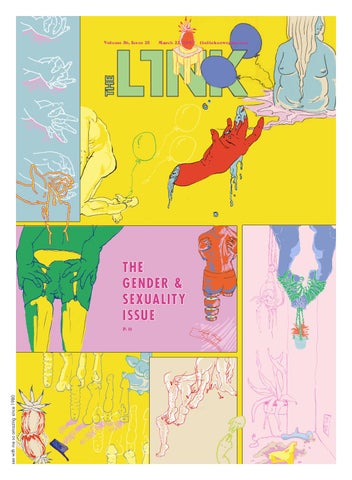
Volume 36, Issue 25
March 22, 2016
THE GENDER & SEXUALIT Y ISSUE
sex with me so amazing since 1980
P. 11
thelinknewspaper.ca
!
!
$ ! "! "$
EN P O
7
/7
'!
!&
! "# &
#
9<N=JLAK= AF L@= D -),%0,0%/,(.
! ( $% &* & $!
! $ $ %
ADVERTISE WITH US
514-848-7406
!&% )
#$"(
ads@thelinknewspaper.ca
"! % ) "!& !' "'$ &$ !% "$ & "! $! "$ "'& "'$ !& $!% # #$" $ % $" "!&$ '& &" & % "! ! #$" %% "# &" % "# ! # %%%
*"' & !
$
thelinknewspaper.ca !
MORE THAN 60 CHOICES OF AUTHENTIC LEBANESE PIZZA
Join The Link ! Meeting Every Tuesday at 4 pm ----
Hall Building
THE
1455 de Maisonneuve W. Room H649
Notice of election The Link Publication Society Board of Directors Three (3) Board Staff representatives Eligibility: You are a member of The Link (paying fees) and you have the staff status with four (4) or more contributions and are not a masthead member of The Link.
Candidates must present a letter of intent by Tuesday, March 22, 2016 at 5 p.m. to the secretary of the board of directors by email to business@thelinknewspaper.ca Elections will be held Wednesday March 29 at 4 p.m. in The Link’s office. 1455 de Maisonneuve W. Blvd. Room H-649.
Begin your
CURRENT AFFAIRS
Letwin Rusere, VP of the African Students Association of Concordia, speaks Shona fluently, her mother tongue from Zimbabwe.
HÉLÈNE BAUER
Why Can’t I Speak My Mother Tongue? The Trials of Learning African Languages in Canada HÉLÈNE BAUER @HELENEVBAUER
Letwin Rusere speaks Shona, one of the roughly 2,000 languages spoken in Africa. African languages make up about one third of the world’s spoken languages, but those languages rarely travel outside of the continent and its islands. Rusere is the VP of the African Students Association of Concordia. The association “provides a home away from home for many African students and anyone interested in African cultures,” she said. She was born in Harare, the capital of Zimbabwe, and moved to Montreal about ten years ago with her family. She learned to speak Shona and English simultaneously in her hometown, and continues to speak her language with her mother and friends here in Montreal. Her little brother, who was four years old when they moved to Canada, has lost his mother tongue, though. “When you move away from home, if you’re not being exposed to the language, you can easily lose it,” Rusere said. African languages are grouped in four distinguishable categories by shared linguistic characteristics: Afro-Asiatic, spoken in northern Africa, Nilo-Saharan, in central and eastern Africa, Niger-Congo, in central and southern Africa and Khoisan, in the western
part of southern Africa. The Niger-Congo is the biggest lingustic group, encompassing more than 1,000 languages. In Montreal, there are 2,995 people that speak a Niger-Congo language—almost a thousand more people than those who speak Hebrew. The latter, though, is far better represented in Montreal, with many schools and synagogues offering language classes. ELA Jambo is the only language school in Quebec that teaches African languages, offering seven in total: Swahili, Wolof, Bambara, Lingala, Tshibula, Yemba and Kikongo. The school opened in September 2012 and its mission is to promote African languages, with an eye on preserving the languages, said Guy-Serge Luboya, founder and director of ELA Jambo and Lingala professor. “A language has to be spoken to be preserved,” he said. Luboya founded the school after noting the number of Africans that don’t speak their mother tongue. “It’s linked to a lot of different factors, like the colonization of Africa,” he explained. “The school has a mission to mend that.” Since its opening, the school has taught about a hundred students from all backgrounds—Africans and non-Africans doing business with African countries, or who have taken an interest in the language. “It’s abroad that you realize the importance of your language,” Luboya said. He learned to
speak Lingala, one of the languages spoken in Congo, after moving to Montreal. “When you’re abroad, you’re looking for landmarks.” To this day, he speaks four languages fluently, and is learning three others. He’s hoping those who came to study at the school will continue to speak the language, and teach the next generation the language at home. “Future generations will not have this worry to learn the language,” he said. “The goal is that the students won’t have to continue studying at ELA Jambo, but that they will be able to teach their children the language themselves.” Concordia University doesn’t offer any African languages in its curriculum. Letwin Rusere, studying history as well as law and society at Concordia, wishes to see the university offer an African language course, starting with Swahili, for example, the most popular language. “It would be great to include a little more history and culture,” she said. Part of Concordia’s core values and mission statement is to be as inclusive and promote diversity through its classes and community events. Although the university does offer courses in African studies, Rusere said there needs to be more awareness and teaching about the topic. Rusere said one of the problems is that the courses are not
thelinknewspaper.ca/news
Keylogger Devices Found in Downtown and Loyola Concordia Libraries Devices were used to steal personal information discovered on Concordia public computers.
thelinknewspaper.ca/news • March 22, 2016
specific enough—they offer a too general overview of African history. To help fill the gap, students and professors are advocating for the creation of a Black studies minor at Concordia, which does not yet exist. The University of Toronto, for example, has been offering a full major in African studies since 1978. The university proposes programs such as Irish studies and First Peoples studies, but it’s lacking in representing the large African community it houses. “The language means my identity,” Rusere said. “It’s my heritage, where I’m from, my history. I don’t want to lose that part of me. I cannot be who I am and tell you the story of my life without using Shona in it. It’s part of who I am.” She will continue to speak her language, and hopes to teach it to her children and grandchildren. “You might feel like an outsider within your own community if you don’t speak the language,” she said. Montreal is a bilingual city, and it’s difficult for people to learn French, English and their mother tongue all at once, Rusere pointed out. That’s one of the reasons why her little brother forgot how to speak Shona, his mother tongue from Zimbabwe. “With French and English, when exactly can you explore this new language?” Rusere finished.
Xiao-Ming found a Montreal homestay through BISSI, a Chinese agency.
A Broken Homestay
JONATHAN CARAGARY-COOK
Concordia International Student Condemns Montreal Housing Conditions BY JONATHAN CARAGAY-COOK AND MICHELLE PUCCI @HIIMBIRACIAL AND @MICHELLEMPUCCI
Xiao-Ming was never sure whether to leave the light on or off. If he switched on the light in the empty kitchen, his landlord would scold him, asking him why he was wasting electricity. If he shut it off, he would hear more complaints about his apparent lack of judgment. Xiao-Ming—a pseudonym—says this was part of a problematic two-month homestay situation last semester. He moved to Montreal from Beijing to pursue graduate studies in computer software programming at Concordia University. The international student will be filing a violation this week to Quebec’s Human Rights Commission for discrimination based on ethnic origin and language, with the help of the Centre for Research-Action on Race Relations. “We want to see if we can hopefully create a precedent for international students in homestay situations,” said Fo Niemi, CRARR’s executive director. Deciding whether to leave the light on or off was only one of Xiao-Ming’s worries. From Sept. 6 to Nov. 1, he lived in a duplex located at 1215 Gohier St., only a few blocks away from the Cote-Vertu metro in Ville Saint-Laurent. Xiao-Ming had an eight-month lease with his landlord, Ju Ming Eh, who signed his name on the document as “Jupiter.” The duplex has three bedrooms on two floors. Ming Eh lives
there with his wife, Grace Hsieh, and their children. They moved to Canada from Taiwan almost two years ago. The homestay lease stipulated that Xiao-Ming would be fed three meals per day and “others as attached.” No utilities were included within his $850 monthly rent. To use basic necessities such as heating or hot water, he would have to pay an additional $20 per month. When the temperature started dropping in October, Xiao-Ming says his landlord never responded positively to requests to raise the heat. “‘In my home, winter begins in December,’” Xiao-Ming remembers his landlord saying. To gain access to a list of basic items like a clothes dryer, printer, microwave, toothpaste, or even dessert, the landlord set an additional monthly cost of up to $200. Xiao-Ming says he never paid more than the $20 fee associated with heating and hot water. He didn’t see the list of extra costs until after the lease was signed. The food, Xiao-Ming says, also made his stomach sick. His meals every day consisted mainly of carrots, potatoes and rice, with the occasional meat portion. The student from Beijing says the students living there often ate leftovers. Like the concerns about heat, the complaints over the food were ignored, Xiao-Ming says. So, on Nov. 1, he left. On Dec. 8, he received a legal notice from his former landlords, who demanded two months worth of rent. Hsieh and Ming Eh offer three rooms for students. According to the Régie du Logement,
homestays with up to two bedrooms are considered personal situations and do not require a lease. With three rooms or more, tenants and landlords are required to sign a lease. Upon arriving in September, Xiao-Ming was given a month to decide whether to stay or find a new place to live. At the beginning of October, he signed a lease, which was supposed to end in July. Hsieh says Xiao-Ming broke his lease in November without notice, and the room was left empty for two months. Xiao-Ming says the landlord threatened to use his passport and study permit against him to ensure that he wouldn’t find another place to live. He says he has “no idea” how they got his documents, but Hsieh says she asked for them before making a copy. According to the Commission d’accès à l’information, landlords can ask to see official documents, but do not have the right to collect the information or photocopy them. At least four students, including Xiao-Ming, have left the homestay since last October. The international student found the duplex in Montreal through Bright International Student Services Inc., an agency based in B.C. He signed a contract in China with BISSI, who he found through a Chinese organization. The firm, New Oriental Education and Technology Group, provides international study consultation and private education services. Xiao-Ming says he paid New Oriental $5,000 for beginner English lessons and to help with his application to Concordia, as well as paying BISSI $1,830 to help him locate a homestay.
Average rent in Ville SaintLaurent where Xiao-Ming paid $850 to live:
Studio: $739 One bedroom: $813 Two bedrooms: $1015 Three bedrooms: +$1173 INFORMATION COURTESY OF CBC, 2015
Concordia Residences, 2016-17: GREY NUNS: 600 undergrads. • Average monthly rent of $764 HINGSTON HALLS: 249 full-time first-year undergrads. • Average monthly rent of $575 JESUIT: 61 full-time grad and undergrads. • Average monthly rent of $670 + Mandatory meal plan cost per month of $518 INFORMATION COURTESY OF CONCORDIA UNIVERSITY
According to documents provided by Xiao-Ming, these were items available to use for an extra $200 per month: • • • • •
hot water heating clothes dryer microwave hairdryer
• • • • •
shampoo soap lunch bag photocopy scanner
• • • • •
iron bicycle dessert garbage bag towel
• • • •
tissues napkins toothpaste shower gel
Percentage of international students from each country, 2014-15:
China: 21.2
Iran: 6
Bangladesh: 1.5
France: 16.1
Saudi Arabia: 3.7
Lebanon: 1.4
India: 15.7
Pakistan: 2.3
United States: 6.4
Egypt: 2
Does this story sound familiar? In 2012, The Link published an exposé on a problematic homestay situation in Montreal, which also involved students from China. There were many similarities to Xiao-Ming’s situation: the use of the agency New Oriental, high monthly rent, poor quality of food, and the need to enroll in Concordia English lessons. The one main difference between the two stories—Concordia’s direct involvement. Instead of using Bright International Student Service Inc.—as Xiao-Ming did—the students were put in touch with Peter Low, who was an official university recruitment agent at the time. For a fee of $2,200, Low would “fast-track” the application process and help sort immigration hurdles, but students would have to live in a homestay for at least two months. Some of this paperwork was exported to Low’s company Orchard Consultant Ltd., which—like BISSI—was located in B.C. Since the incident, the university said it hasn’t used any external recruitment agent or contracted work with Orchard Consultant Ltd.
INFORMATION COURTESY OF CONCORDIA UNIVERSITY
BISSI kept $830 in fees, for services like airport pick up, plane ticket booking, help setting up medical insurance, filing tax-returns, opening a bank account as well as a cell phone plan and purchasing public transit tickets. Only half of the services were provided, XiaoMing says. The rest of the money went towards a rent deposit. When he arrived in Montreal he received $575 back of the $1,000 deposit. The rest of that money went towards first month’s rent. Two media representatives from New Oriental were contacted, but could not be reached by press time. A member from BISSI said they find homestays through online ads, which is how they found the one in Ville Saint-Laurent. BISSI then send a worker based in Montreal to inspect the house, interview the host family, and check for criminal records before connecting students there. If the student has a satisfactory experience, then they continue to use the homestay, the worker explained over the phone. He said English documents detailing the different packages they offer were confidential, as he declined to give his name before hanging up. Xiao-Ming had the choice between an English or Chinese homestay. He was originally supposed to stay in an English home because he wanted to improve his language skills. Despite the original agreement, he received a call from BISSI three days before he was expected to arrive in Montreal offering him a spot in a Chinese homestay instead. “I had no time,” he says. “I had to say yes.”
Recruiting internationally Concordia sends a team of three to four people approximately eight times a year to speak with students in China, according to Matthew Stiegemeyer, the university’s director of student recruitment. “We try to be ready to assist students with any questions they have with interest or vague [awareness] of Canada,” Stiegemeyer explained. Stiegemeyer and his three-person team visit major cities such as Beijing and Shanghai. Some team members are native Mandarin speakers. They arrange to speak at schools, convention halls and even directly with students over coffee, Stiegemeyer said. In 2012, The Link broke a similar story regarding a controversial homestay situation for international Chinese students. The main difference was that an external agent with a Concordia email address arranged the homestay. To his knowledge, the university hasn’t hired
a third-party contractor to act as an intermediate in recruiting processes since 2012, but Stiegemeyer wouldn’t rule out “one-off ” situations. As for students hiring their own agent or a third-party company—like New Oriental or BISSI—he says they don’t explicitly tell them not to, but if asked, they discourage their usage. Stiegemeyer says there are most interested in the academic programs offered and what it takes to be accepted. One of the requirements is taking an English fluency test. Depending on their test scores, a student may have to take at least one ten-week session of English lessons at the university’s language institute, which costs $3,995. Although Xiao-Ming has been accepted into a graduate studies program for computer software programming, he has yet to take a course in the subject. He first has to complete three levels of English studies, which he expects to finish in June at a total cost of about $12,000.
The CSU-run organization offers its information in Mandarin. One of Xiao-Ming’s English teachers referred him to HOJO after learning of the homestay situation. HOJO then referred the student to the Concordia Student Union Legal Information Clinic. “Concordia is getting so much money, surely they can allocate more of that money to try and resolve [the housing] problem,” says Walter Tom from the clinic. “We’re two [CSU] services with a limited budget.”
Finding a home in a new city Foreign students can feel restricted from speaking out about housing conditions, because they’re afraid of losing their international student status and being kicked out of the country, says Ashworth.
“It’s very easy for the institution to say, ‘It’s not our problem.’ But wait a minute, you’re bringing them here to study at Concordia, it is your problem,” Tom says. Housing conditions can have a lot to do with students’ success, he continued. Xiao-Ming left Beijing to pursue graduate studies in Montreal because he wants to work for the video game company, Ubisoft. So far, the international student says Montreal has been peaceful and quiet. He doesn’t yet consider himself a real Concordia student to give an opinion on the university, but he expects to start his computer software programming degree in September. In early March, Xiao-Ming moved into a new apartment. He’s been living with a friend since he left the homestay. Xiao-Ming found his new apartment online, and now only pays $460 per month.
How Concordia can help After being accepted into Concordia, international students receive an admissions package that includes a pre-departure guide, outlining what they should do before coming to Montreal. Page 13 of the guide states, “Do not sign a lease for an apartment or commit to any long-term off-campus housing arrangements until you arrive in Montreal.” Students can have an agreement with a landlord before they arrive, but shouldn’t sign a lease before they’ve seen the living arrangements. The university recommends admitted international students book a hotel room for the first few days in the city, according to Kelly Collins, manager of Concordia’s International Students Office. Xiao-Ming signed a contract with BISSI in China, but he signed the lease with the homestay landlord in Montreal. “Students will choose to stay with a family, because they think that means they’re going to be taken care of well,” says Leanne Ashworth of the Concordia Student Union Housing and Job Bank. “They’re willing to pay extra for that because they think they’re going to be safe. I think it’s especially disappointing that that kind of trust is abused.” The ISO runs webinars from March to April, Collins explains, where students can watch an online presentation and have questions answered live by a representative. In-person orientations are also offered when most students arrive in July and August, she says. The ISO provides information about tenants’ rights, using pamphlets and documents from HOJO. The student’s were promised three meals a day at the homestay.
COURTESY XIAO-MING
Coming soon to the Phi Centre jan.
Installation
18 —
mar.
Film
24
mar.
Film
29
mar.
31
Virtual Reality Garden 4 immersive experiences Free april
Show
9
Schneider vs. Bax
Mustang
By Alex van Warmerdam
César Award for Best First Film 2016
april
Talk
THE
11
The Link Publication Society Inc. Annual General Meeting Thursday, March 31, 2016, 4 p.m. 1455 de Maisonneuve W. Blvd. Room H-649 Agenda 1. Call to order 2. Election of a secretary 3. Reading and approval of the agenda 4. Reading and approval of the minutes of the 2015 AGM 5. By-law amendment 6. Board of directors report for 2015-2016 7. Presentation of the 2014-2015 financial statements 8. Appointment of the auditor 9. Presentation of financial statements as of the las day of February 2016 10. Presentation of the preliminary budget 2016-2017 11. Election of the board of directors 12. Other business 13. End of the assembly
All Concordia undergraduate students are eligible to attend, vote at the meeting and run for a position on The Link's board.
Classical Parcours: Dirty Light A classical experience in two acts may
Show
11
Joe Walker Floating Points (live) Blending jazz, post-rock and classical music
Editor of Shame, 12 Ye Years a Slave and Sicario Followed by a screening of Shame
Tickets and full programming at phi-centre.com 407 Saint-Pierre Street, Old Montreal
Square-Victoria—OACI
Board of Directors Two (2) positions are open to members at large and two (2) positions are open to members of the community who have had staff status within the last three (3) years. Candidates for the Board must present a letter of intent by Thursday, March 24, 2016 at 5 p.m. to the secretary of the board of directors by email to business@thelinknewspaper.ca Constitutional amendments are available at The Link office.
Join The Link ! Meeting Every Tuesday at 4 pm ----
Hall Building 1455 de Maisonneuve W. Room H649 fa c e b o o k . c o m / t h e l i n k n e w s p a p e r
514-848-7406
ads@thelinknewspaper.ca
Porn for the Soul
FRINGE ARTS
Experimental Blog, This is better than porn, Leaves Fans Wanting More ERIK TRUDEL @ERIKTRUDEL Photos of soft-lit bare skin, with shadows highlighting the smooth-and-freckled plains of the human body, and phrases of intimate poetry, all curated to whet the palate—this is the aesthetic of This is better than porn. Following a three-year run, the Montreal-based blog has been on a definitive break since Feb. 15, due to the busy schedules of its creators. Olivia Lagacé, a budding film director, is part of the blog’s backbone, along with Linakim Champagne. They also happen to be best friends. They’ve known each other for four or five years now and started the
blog not long after they met. “I think both of us had thought about [the concept], but the idea had sprung from an exposition that I had done before. It explored the themes of sexuality and intimacy,” Lagacé explained. “Linakim had written for the exposition too, so we both bonded over that,” she added. Their seedling of an idea began with exchanging themes involving erotica, intimacy and their relationships. It was created for their own interest by addressing these themes in a way that wasn’t being done elsewhere. Their goal was to find a new way to stimulate the erotic imagination, a sort of alternative to pornography. When they
started to see that people were investing their time in reading the blog site, the creators decided to expand their horizons. “It’s especially intimacy and the desires in all its shapes,” Lagacé said. The creators addressed these ideas with mediums such as photographs, stories, and poems. “We really wanted to have variety with a general [focus on] things dealing with sensuality, sexuality and intimacy.” Six months after the start of the blog, Lagacé and Champagne decided to turn their blog into a magazine. “We did a launch party,” Lagacé said. “We thought there would only be a handful of people who would show up, but the place was full after 20 minutes.” That night, they discovered they had a bigger following than they originally thought, as well as fans willing to contribute their own texts. Unlike the first two magazines, which are labelled as being “sexier” by Lagacé, the third installment is rawer, with a larger focus on another level of sexuality. “The third magazine is different than the others, because there’s a lot more variety in the models and texts,” Lagacé said. “Linakim was pregnant while she was writing, so there’s another side to what she wrote.” Despite all of their success, things started to pile up in their lives and new ambitions arose. “We’re going to bring back the theatre piece that we did last June,” Lagacé said.
The soft and raw eroticism of This is better than porn’s third magazine arouses and teases the mind.
thelinknewspaper.ca/fringe • March 22, 2016
“We had in mind to perform it multiple times. Otherwise, we have a lot of side projects. [The blog] brought us many contract projects, which is nice, but we’re both overloaded right now.” The concept of This is better than porn has nothing to with Lagacé’s upbringing. She grew up a normal life on the South Shore. At a young age, she became interested in performing arts. “I started doing theatre at the age of 12,” Lagacé said. “I pursued theatre in CÉGEP, but I discovered cinema and I realized I wanted to become a director, so that’s why I went to school in cinema.” Cinema has been her focus for a few years now, and is among the projects she intends to pursue with the time no longer being spent on the blog. “I’m in video production, so I have a short film and then a series coming up,” she said. While the state of the blog lies in limbo, likely permanently, fans and curious minds can still buy the 52-page third volume, available exclusively in their online boutique, which can be accessed via their Facebook page. Interested parties should not hesitate—half of them have already been sold. In the meantime, Lagacé is looking forward to the creative future. “We’re always trying new things and after three years with the blog, we’re hungry for new challenges.”
MARIE BRIÈRE DE LA HOSSERAYE
March 22 - March 30 TU 22
W 23
TH
Breaking the Siege
Be Like Others: Transexual in Iran
As part of Israeli Apartheid week, activist Ehab Lotayef and journalist Ben Norton will discuss the blockade preventing food and supplies from entering Gaza.
In Iran, homosexuality is against the law, but sex reassignment surgery is not. The film follows the stories of Iranian men, who feel the only way to be spared persecution is to transition. A discussion will be held following the screening.
• 1455 de Maisonneuve Blvd. W., Hall Building, 7th Floor // 7 p.m. // Free
Peace in Practice: The Life and Lessons of a Middle East Peace Activist
• 3200 Jean-Brillant St., Jean-Brillant Pavilion, B-4205 // 7 p.m. // Free
F 25
SA
Skill-Share Series 2016 Vol. 2
NOTHINGE // SUONO
Art Matters 2016: Never Again
Join the launch of a skill-share series, meant to build a calendar of activities for the coming months! This is a call-out to anyone who wants to participate/teach a workshop on any skill they’re looking to share, fermentation, home brewing, making bread, bee-keeping and any other DIY home-activity!
Catch the dream pop heroes at Brasserie with Magical Thinking and Hagalaz.
Enjoy a performance and video by a number of talented artists in this unique installment.
• 73 Beaubien St. E., Brasserie Beaubien // 9:30 p.m. // Pay what you can
• 7049 St. Urbain St., Never Apart // 7 p.m. // Free
• 4100 St. Dominique St., The Jam House // 7:30 p.m. // Free
• 179 Jean-Talon St. W., Bar Le Ritz PDB // 8 p.m. // $10 advance, $15 door
24
Join activist and journalist Lydia Aisenberg of the non-profit organization Givat Haviva, as she discusses her experiences in the Middle East.
Bystander Intervention: How to Look Out for Each Other and Party Safely
• 1455 de Maisonneuve Blvd. W., Hall Buidling, H-763 // 7 p.m. // Free
Julie Lalonde gives an interactive presentation on consent and intervening in risky situations.
26
LIP The Smiffs Joue “The Smiths” + Nyssa
A Queer Dance Party, thrown by-and-for the queers of Montreal who are looking to get out there and shred the dancefloor. Featuring the DJ stylings of Frankie Teardrop and Debbie Doe. • 179 Jean Talon St. W., Bar Le Ritz PDB // 11 p.m. // $5
Tattoo Pop-Up Toronto-based tattoo artist Sarah D’Angelo hosts a tattoo party at Atelier Lost Cause! Come by for a machine or stickn’poke piece!
• 1455 de Maisonneuve Blvd. W., Hall Building, H-763, H-765 // 4 p.m. // Free
• 3980 St. Denis St., Atelier Lost Cause // 1 p.m. // Prices vary
SU 27
TU 29
W 30
Antidope Vol.1
Cameron Carpenter
DJ Charlie B. will be playing a set with DJ Caz, so come on out and get your dance on.
Described as “wonderfully eccentric,” this Juilliard graduate composes his music on a digital organ with ten speakers and eight subwoofers.
Documentary Dreams: Migrant and Environmental Justice in the Work of Min Sook Lee
• 1254 Stanley St., Club La Boom // 10 p.m. // $15
• 175 Ste. Catherine St. W., Théâtre Maisonneuve // 8 p.m. // $33 - $82
Concordia Irish Studies First Annual Gaelic Football Tournament • 7200 Sherbrooke St W., Stingers Dome, Loyola Campus // 2 p.m. // Free
M 28
My Identity Is Not an Apology: On Femme Visibility and Challenging Femmephobia This workshop features Mona Faith Mousa on intersections between race, ethnicity, sexuality and femme identity.
Celebrate the work of activist and documentarian Min Sook Lee with Cinema Politica at the second-annual Alanis Obomsawin Award for Commitment to Community and Resistance. Lee will show brief segments of her work and discuss a range of topics, followed by a brief Q+A. • 1455 de Maisonneuve Blvd., Hall Building, H-110 // 8 p.m. // Pay what you can
• 1500 de Maisonneuve Blvd. W., Room 404, Centre for Gender Advocacy // 5 p.m. // Free
CALENDAR OF EVENTS
There’s nothing more fun than an event that rhymes. What’s an event that rhymes? A DRINK WITH THE LINK! It’s our last hoorah before heading into finals. Join our editors for the last Drink With The Link of the semester at Andrew’s Pub (1241 Guy St.) on April 8 @ 9 p.m. All current and future contributors welcome! It’s our chance to say thanks for a solid Volume 36. April 8 @ 9 p.m. // Andrew’s Pub, 1241 Guy St.
thelinknewspaper.ca/fringe • March 22, 2016
FRINGE ARTS
9
Silk Screening Studio a Haven of Transcendent Art
Concordia Fine Arts Students Open Print Studio in the Plateau MARCELLINE SELMAN
Who knew St. Jude was a muse? Nestled in the heart of the Plateau, Atelier Lost Cause has come a long way from its humble beginnings. For three Concordia fine arts students—Gabrielle Mulholland, Justin Gordon and Hillary Barnes, the process of opening Lost Cause has been both lengthy and inspiring. The soon-to-open silk screening, embroidery and print shop sits on St. Denis St., right next to the façade of St. Jude Church— now hollowed out into a gym and spa. The trio unites seasoned artistic and technical skills, clever business savvy and true grit with genuine charm, born of hard-won experience. They met serendipitously through mutual friends and decided to combine their efforts to set up shop. “It was kind of a fluke. It was a bunch of us knowing the same kind of people. I knew Hillary through a friend, and they mentioned that she was also interested in screen printing,” Mulholland said. After long hours spent searching for a suitable spot that would allow the artists to work freely, they found a somewhat grungy but within-budget venue. “I was looking on Craigslist for spaces that would be affordable, and we found this garage in the Mile End,” Mulholland said. With the help of a little TLC, it seemed to be what they were looking for. However, over time, the space came to no longer suit the group’s needs, yet again fueling their need to scout a space. Using their own funds, the intrepid entrepreneurs spent a year looking for the best space that would fit their budget—and one they could agree on. Now, they’ve finally found their dream space on St. Denis St., in the shadow of the church-turned-fitness space. The studio is now fully functional and provides the artists with the physical room to produce artwork that reflects each of their unique sensibilities. Mulholland’s work is an explorative blend of the esoteric with religious iconography, and also extends to cartoon illustrations. Meanwhile, Barnes’s art expresses bold graphic influences with vivid flourishes.
Gordon plays with pop culture references, using kaleidoscope imagination and colour. The studio provides silkscreen printing for retail, commercial and industrial clients. They hope to do foil and vinyl work soon. Queer Toronto artist Sarah D’Angelo will host a tattoo pop up at the studio from 1 to 8 p.m. on Friday, March 26 and Saturday, March 27. Mulholland and Barnes hope to fill a growing niche by providing space for fine arts students at Concordia in need of a workspace—especially in the summer months—as well as offer screening workshops for the general public. In the meantime, the next major project for Atelier Lost Cause is set to have an official launch party—tentatively in April. “We’re hoping to have some limited opening party shirts,” Mulholland said. As for what they want their company to represent, Mulholland was clear on their vision and ideals. “A safe space for any gender, queer, rational person, where they can come and share in our experience, here in the Montreal print scene,” she said. “We’re very open and kind-hearted people that just want to spread the creative vibe.”
Top right: Gabrielle Mulholland, left, and her business partner Hillary Barnes try out their colour press.
Bottom-right: Gabrielle Mulholland holds up her whimsical creation produced in the studio.
PHOTOS MARCELLINE SELMAN
thelinknewspaper.ca/fringe
The Link Live Check out the latest in Montreal musicality. This week: local angular psychedelic-shredders Corridor.
thelinknewspaper.ca/fringe • March 22, 2016
6 Years
!
ERY DELIV
urantsa/resta st-eat.c arc/menu u .j w w w 09-st-m thali-14
A LT R U I S M I S B U I LT I N T O OUR B R AINS S C I I EE N C E C O L L E G E P U B L L I I C L E E C T U R EE S EE R I I EE S S
!
!
' ' ' ' ' '
"
!
# " " !
& # !"
Across the centuries, “good” behaviour was taught to be, most exclusively, a function of law, religion and society. When philosophers thought about the brain, they would tend to assume special, extraordinary functions to account for “good” behaviour. The speaker Dr Donald Pfaff for this lecture will argue, that ordinary altruistic behaviour can explain without assuming any special properties beyond what is commonly accepted as neurophysiology. After good behaviour is explained in this way, the subsequent job of the neurobiologist is to explain the balance between traits that foster kind behaviour or aggressive behaviour. Dr Pfaff’s new book “The Altruistic Brain” cites the evidence for these statements and shows how they apply to problems in modern western societies.
!
! # ! % ! " $!" & !
TIME: 8:00 P.M. DATE: Thursday, March 31st, 2016 PL ACE: Oscar Peterson Concer t Hall
CONCORDIA UNIVERSIT Y 7141 SHERBROOKE STREET WEST, MONTREAL
FREE ADMISSION I N F O R M A T I O N : 5 1 4 - 8 4 8 - 24 24 E X T . 2 5 9 5
Like us on Facebook at facebook.com /thelinknewspaper
TH E SCIEN CE CO LLEG E O FFER S A PRO G R AM M E F O R H I G H LY M O T I V AT E D S C I E N C E S T U D E N T S .
The Science College is part of Concordia University. It offers gifted science undergraduates the opportunity to complement their regular curriculum with interdisciplinary training and early introduction to the methods of scientific research.
WHERE TO FIND THE LINK Thanks to our partners
Bikurious Montréal 1757 Amherst Presse Café 3501 Ave. du Parc Cinéma du Parc 3575 Ave. du Parc Pita Pit 3575 Ave. du Parc Le Coin Grec 4903 Ave. du Parc Leonidas 5111 Ave. du Parc Chez Boris 5151 Ave. du Parc Café Résonance 5175 Ave. du Parc Frites Alors! 5235 Ave. du Parc Caffe in Ginba 5263 Ave. du Parc New Navarino Café 5563 Ave. du Parc Melina's Phyllo Bar 5733 Ave. du Parc De La Cream Barbershop 162 Bernard Resto Venise 163 Bernard Dépanneur Café 206 Bernard Phonopolis 207 Bernard Sonorama 260 Bernard Kafein 1429 Bishop Irish Embassy 1234 Bishop Grumpys 1242 Bishop Burritoville 2055 Bishop Painnamou 2019 Bishop Madhatter's Pub 1208 Crescent
Brutopia 1219 Crescent Boustan 2020 Crescent Panthère Verte 2153 Mackay Fou D'ici 360 de Maisonneuve O. Eggspectation 1313 de Maisonneuve O. Foonzo 1245 Drummond. Galerie Fokus 68 Duluth E. Maison du Tibet 129 Duluth E. Utopia 159 Duluth E. Chat Café 172 Duluth E. Tienae Santé 279 Duluth E. Buanderie Net Net 310 Duluth E. Au Coin Duluth 418 Duluth E. Café Ouvert 611 Duluth E. Chez Bobette 850 Duluth E. Café Grazie 58 Fairmount O. Arts Café 201 Fairmount O. Maison de la Torréfaction 412 Gilford Java U 1455 Guy Comptoir du Chef 2153 Guy Hinnawi Bros 2002 Mackay Cafe Tuyo 370 Marie-Anne E. La Traite 350 Mayor
Paragraphe 2220 McGill College Second Cup 5550 Monkland George's Souvlaki 6995 Monkland Trip de Bouffe 277 Mont-Royal E. Autour d'Un Pain 100 Mont-Royal O. L’échange 713 Mont-Royal E. Café Expression 957 Mont-Royal E. Mets chinois Mtl 961 Mont-Royal E. Mt-Royal Hot Dog 1001 Mont-Royal E. Panthère Verte 145 Mont-Royal E. Maison Thai 1351 Mont-Royal E. Aux 33 Tours 1373 Mont-Royal E. Freeson Rock 1477 Mont-Royal E. Co Pains D'Abord 1965 Mont-Royal E. Café Henri 3632 Notre-Dame O. Rustique 4615 Notre-Dame O. Cafe Stouf 1250 Ontario E. Cafe Pamplemousse 1251 Ontario E. Le Snack Express 1571 Ontario E. Frites Alors! 433 Rachel E. Presse Café 625 René-Levesque O. L'Oblique 4333 Rivard Juliette et Chocolat 1615 Saint-Denis
Frites Alors! 1710 Saint-Denis Panthère Verte 1735 Saint-Denis L'Artiste Affamé 3692 Saint-Denis Beatnick 3770 Saint-Denis L'Insouciant Café 4282 Saint-Denis Eva B 2015 Saint-Laurent Bocadillo 3677 Saint-Laurent Coupe Bizarde 3770 Saint-Laurent Libreria Espagnola 3811 Saint-Laurent Frappe St-Laurent 3900 Saint-Laurent Copacabanna Bar 3910 Saint-Laurent Le Divan Orange 4234 Saint-Laurent Om Restaurant 4382 Saint-Laurent Le Melbourne 4615 Saint-Laurent Gab 4815 Saint-Laurent Casa del Popolo 4873 Saint-Laurent Kg Délices 5206 Saint-Laurent Citizen Vintage 5330 Saint-Laurent Smile Café 5486 Saint-Laurent Le Cagibi 5490 Saint-Laurent Snack and Blues 5606 Saint-Laurent Saj Mahal 1448 Saint-Mathieu Café Santropol 3990 Saint-Urbain
Barros Lucos 5201 Saint-Urbain Brooklyn 71 Saint-Viateur E. Pizza St. Viateur 15 Saint-Viateur O. Maestro Traiteur 86 Saint-Viateur O. Batory Euro Deli 115 Saint-Viateur O. Club social 180 Saint-Viateur O. Faubourg 1616 Sainte-Catherine O. Fatz 1635 Sainte-Catherine O. Nilufar 1923 Sainte-Catherine O. Hinnawi Bros 372 Sherbrooke E. Shaika Café 5526 Sherbrooke O. Maz Bar 5617 Sherbrooke O. Encore! 5670 Sherbrooke O. La Maison Verte 5785 Sherbrooke O. Café Zephyr 5791 Sherbrooke O. Mate Latte 5831 Sherbrooke O. Head and Hands 5833 Sherbrooke O. Café 92º 6703 Sherbrooke O. Second Cup 7335 Sherbrooke O. Bistro Van Houtte 2020 Stanley Memé Tartine 4601 Verdun
ARTWORK MADELEINE GENDREAU
GENDER & SEXUALITY ISSUE
REAL SHIT PEOPLE HAVE SAID TOO QUEER FOR MY COCK? I’M INTERESTED IN HANGING OUT I WANNA EXPER
T HE GE N D E R A N D S E X U A L I TY I S S U E
S
ociety’s definitions of gender, sex and sexuality are changing constantly. While more and more people are becoming aware of the implications of these topics on our daily lives, we at The Link believe it is crucial to continue talking about them. We must ask ourselves why our opinions are shaped the way they are,
and how the power structures around us shape our thought processes about, well, everything. This issue is by no means certain of itself. We attempted to stress narratives, individual experiences and the hard facts surrounding being alive in a gendered or sexualized body today— but we’ve certainly left many stories out. And who knows how this paper will read ten years, or
even five years down the line. Regardless of redefinitions, missteps or otherwise, The Link knows that this is a conversation that needs to continue being talked about. As a society, we cannot take these topics off the table. It’s imperative that we continue to consider, redefine and continue to move forward. So, with that in mind, The Link presents this, The Gender and Sexuality Special Issue.
W H AT IS INTE RS E CTIO NAL ITY ? An intersectional analysis helps us to understand the complex ways BY that gender-based oppression works, and is crucial in our collective struggle for justice. In my life, intersectionality is simply the recognition that my identities as a woman and as a person of colour cannot be separated, and that systems of oppression such as patriarchy and racism work together, compounding the inequality and discrimination I face. Intersectionality helps me to make sense of my life experiences: the poverty and lack of opportunities I faced as a child, being raised by a single-mother— a Guatemalan immigrant—the fact that I have often been the only woman of colour in many activist groups and professional workplaces, the othering and hypersexualization I face in my day-to-day life for being read as a “Latina,” and so much more. The term intersectionality was first coined in 1989 by Black legal scholar Kimberlé Crenshaw. In her groundbreaking work, Crenshaw brought to light the fact that violence against women of colour, a product of both racism and sexism, was not being adequately addressed within the legal system or social movements. An intersectional analysis and approach remains imperative in work to end violence against women.
imperialism and more. It also means engaging in solidarity with movements working to tackle these issues. Without addressing broader systemic issues, our feminism is severely limited, and only serves the interests of a select few: white, cisgendered, middle-class, as well as elite women. Yet, white liberal feminism is notorious for excluding the voices of racialized women, including Black and Indigenous people, as well as trans women and gender non-conforming folks. Meanwhile, white liberal feminists like celebrity Emma Watson get a lot of the airtime when it comes to talking about gender equality. Facebook executive Sheryl Sandberg, and her brand of corporate feminism, tells us that we can succeed if we “lean in,” overlooking the systemic barriers facing those of us who aren’t privileged white women. Taking an intersectional approach means taking stock of our privileges as women, and working to educate ourselves on issues that may not directly impact us. It means asking ourselves who is and is not in our feminist spaces, and working to create a more inclusive environment where they are welcome. It means working across difference and walking together in our struggle for justice.
S TAC EY GOM EZ OF THE C EN TR E F OR GEN D ER AD V OC AC Y
Knowing that Indigenous women, two-spirits as well as trans women—particularly trans women of colour—refugee and immigrant women, women with disabilities, and sex workers are disproportionately impacted by gender-based violence means centering these narratives in anti-violence work. More than that, it means listening to their needs and supporting their demands. Intersectional feminism teaches us that gendered oppression cannot be neatly separated from other forms of oppression. In the words of queer Black feminist Audre Lorde, “There is no such thing as a single-issue struggle because we do not live singleissue lives.” This means that our feminist analysis must include an analysis of racism, capitalism, settler-colonialism, heterosexism, cissexism, ableism,
THE GENDER AND SEXUALITY ISSUE DOES FAT GO WITH FEMINIST
YOU’RE LUCKY IM NOT EVEN ATTAC
RIENCE A TRANS SO YOU GONNA GIVE SOME HEAD????? THE GENDER AND SEXUALITY ISSUE YOU’RE KIND OF
Let’s Talk About Sex, Baby BY JENNIFER AEDY
JENNIFER AEDY
T
he first time I took a mirror and looked at what was going on in my nether-lands, I was about 19 or 20 years old. I had never had the opportunity or the interest before, because I shared a room with my sister until I was 15 and lived at home with my parents until age 19. Even when I had the room to myself, once she left for university, I had no interest in further exploring what I thought I already knew pretty well. I was also scared of getting caught doing something “weird.” It hadn’t occurred to me to check what was really going on downstairs until I had a room to myself in my first apartment in Montreal. I did have three to four roommates at any given time, but I also had my own closed door with a lock, and people knocked on it before entering. I wasn’t shocked or disgusted at what I saw—more pleasantly surprised to be acquainted with a part of myself I had never seen or understood so intimately. With my newfound space, I took some time to explore things further, and when I got bored of my own two hands, I made a trip to Boutique Erotika on Ste. Catherine St. I was 22 when I bought my first vibrator and I was very excited about it. I used it all the time. But that too grew old, once I realized how many watch batteries I went through and how expensive they were to replace. (Thank goodness Dollarama now carries batteries.) I decided it was time for an upgrade and opted for a model that took AAA batteries and had three speeds. This one suited me a little better, and definitely was designed to last longer than the one with a battery that’s only supposed to make things tick. I felt pretty comfortable around some of my closer lady friends and our conversations veered toward sex and masturbation—as they often should and do. I described the wonders of my triple speed toy with them and told them how well it worked. The conversation began with excitement and full engagement from everyone involved, but as I explained how late it kept me up rocking through the wee hours of the night, things took a turn—they began to get uncomfortable. They began saying things like “three speeds is too many; that sounds scary,” deciding that my allotted time for personal play was far too long, or exclaiming “I don’t need a vibrator because I have a boyfriend who can do that for me.” These friends were not horrible prudes. These were the type of friends who frequently if not constantly made sex jokes, dick jokes and would jokingly hump or thrust at things, more often than not just for
a laugh. We were all being open and honest in what started out as a warm and welcome conversation. As soon as I decided to be straightforward about my personal sexual exploration, they each resolved that what I chose to do with my own body in my own time and space was somehow abnormal or wrong. The flaw in the conversation was not to do with my friends, but with the way that society has moulded our minds to believe that when women have the liberty to talk about masturbation, personal pleasure or sexual fantasies in general, they must be shamed or disgraced for their sinful, un-ladylike thoughts and behaviours. Hell—the vibrator was basically invented to shut women up. Vibrators were initially used about 200 years ago to cure “hysteria” in women, which is presently known as sexual frustration, and they were designed to save men—doctors mostly—from the exhaustion of providing women pleasure. It was widely believed that women did not experience pleasure or even have sexual desires—unless it was the sheer delight of pleasing her man. A woman would have to set an appointment with a doctor to zap the sexual urges and crazed thoughts from her troubled mind in order to better serve her husband and stay focused on his sexual needs. Though some 200 years have passed since the initial “medical necessity” of creating the vibrator, the world we live in is still based around the pleasure of men. Based on my findings, the majority of porn on the internet is designed with a straight male viewer in mind, and is based on a repeated pattern. The story starts with a girl giving a BJ, followed by a variety of male dominant positions as the girl squeals with “pleasure” and the guy plugs away, followed by the climax of a much appreciated facial as the girl licks her lips and smiles. (Of course there are so many other genres of porn available out there with different partners and different story structures, but this format is the most widely available without hunting for specifics.) Every pervy schoolyard joke I can remember from high school, maybe earlier, told in reference to pornos or extreme sexual positions, was always based on male pleasure and the joys of sexually degrading a woman. (See urban dictionary for “superman dat hoe,” “downhill skiing,” or “pig roast.”) Everyone uses the universal symbol for jerking a penis as a sign to say “I don’t care,” or to show someone slacking off, jerking around or as an insult to another person. They are comfortable using these
gestures in everyday life. From this schoolyard banter or the general joking around of a societal norm, young boys are taught that it is normal to expect and express pleasure, as young girls are taught that it’s their role to provide it—one of the massive hallmarks of the rape culture eminent in society. Boys are encouraged to discuss their sexual desires in a joking manner with their buddies or even in front of girls, while girls are expected to keep it to themselves. I never once heard a casual conversation in the girls’ locker room in high school, or any safe haven away from boys, where a girl bragged about that guy she fucked or how great she felt when she jerked off. That would not be acceptable behavior for a young lady—that’s just generally not how we’re raised. Toddlers start to become aware of their gender identity around the age of two or three, and it is also at this time that they adopt gender roles and decide which behaviours are categorized as feminine or masculine. It’s natural during development for children to touch their own bodies in order to become familiar with them, and as boys have external sexual parts that can be seen, touched and played with, it’s easier for them to understand what is before them. Girls too will explore their bodies at a young age, and although children are taught that it’s inappropriate to touch oneself in public, it is the girls who are swiftly shamed into maintaining this behavior for the foreseeable forever. As boys grow older it’s seen as socially acceptable for them to “readjust” down there when things are sweaty, itchy, uncomfortable or out of place, but if a girl decides to pick a wedgie, it’s considered gross and un-ladylike. Girls are taught to be discrete when it comes to personal sexual matters, to keep their thoughts to themselves, and to keep their hands somewhere appropriate. If a girl does choose to speak up about her desires, she is considered to be kinky or freaky instead of a human with natural wants, needs and desires. When I was first approaching this subject, I wasn’t sure how much of my own private background story to include. I questioned whether it would be too much information, too personal, too something for someone. Isn’t that the problem? If I didn’t say my part, I would perpetuate the silence of yet another woman’s personal desires, in order to ensure that someone else’s comfort zone isn’t crossed. Think what you will, but I refuse to be shamed, guilted or disgraced into being silent, proper and ladylike, just to be sure that someone else is comfortable. What I choose to do with my body in my time and space is nobody’s business but my own, and so is my choice to speak freely about it.
CKING YOU OH COME ON YOUR [SIC] NO FUN LETS GET REALLY MAD AT EACH OTHER AND THEN FUCK
THAT’S MESSED UP I JUST WANTED TO FUCK YOU IF SOMEONE’S LOOKING AT YOU, IT’S PROBABLY BECAUSE OF
Women and Wikipedia
CONCORDIA PROFESSOR ENCOURAGES STUDENTS TO TAKE A CLOSER LOOK AT ONLINE CONTENT BY CLAIRE LOEWEN
I
never heard my friend Greg Pistol call himself a feminist before this semester. Don’t get me wrong—he’s aware of women’s rights, and wouldn’t make any sexist or disrespectful remarks. He just wouldn’t say “I’m a feminist.” So when he did, it struck me as significant, so I asked him what suddenly made him declare his newfound ideology. To my surprise, he said it was because of a film class he was taking. “Did you know that 85 per cent of all Wikipedia editors are male?” he told me with excitement. “That really affects the information people are exposed to.” Greg told me that his professor, Elizabeth Clarke, gave his Women in Film class an assignment to create a Wikipedia page about a female filmmaker from any genre at any time in history. She wanted to make her students aware that the information they see online is selected by the people who are putting it there. In this case, the people are a high percentage of males and almost no females—a wide gender gap that cannot be ignored, even by Wikipedia. “I actually wanted them to do something more activist,” Clarke said. “If you actually start to think about this one specific demographic that’s doing all the editing, then can we actually think of Wikipedia as completely unbiased?” But at the same time, Clarke said she doesn’t want to sound cynical about Wikipedia, because it’s a good thing that anyone can edit or create a page on the site. When it comes to teaching, this really shines through. Instead of having students write a paper to their professor, like they do in all their other classes, they can actually create something accessible by other people. “I like the experiential type of learning,” Clarke
KELSEY LITWIN
said. This means learning through experience and reflection of doing. Clarke brought up a 2013 scandal, in which American writer Amanda Filipacchi noticed the lack of women under the Wikipedia category “American Novelists.” Filipacchi thought this may be because some women writers were lesser-known, but soon noticed that many unknown male writers were still present on the list. Then the truth came to light: Wikipedia editors were putting female writers into a new subgenre called “American Women Novelists.” Subcategories of American novelists include genres like science fiction, thriller and mystery. So why are women authors considered a genre of writing? “Only about 10 per cent or less of the editors at Wikipedia are women,” Ryan Kaldari, a Wikipedia editor, told NPR. “And so a lot of times there’s this subconscious, white, male, privileged sexism that exists on Wikipedia that isn’t really acknowledged.” Clarke agrees—problems like these must come from the user base. The underrepresentation of women behind Wikipedia contributes to the lack of female perspectives being presented. “We need to go in and kind of fight against that,” Clarke said. This is why she wanted her students to actively create Wikipedia pages that create more female representation. “Hopefully [my students] are putting more people out there. They’re expanding the knowledge that’s on the internet,” she said. Since this “American Women Novelists” category scandal became public knowledge, many groups have been holding feminist Wikipedia edit-a-thons and how-to’s for digital feminist activism, in an attempt to better represent women on the website. Clarke got her idea for the assignment from a professor at Carleton University who organizes these events in Ottawa. Recently, there was a similar event in Montreal. On March 8, International Women’s Day, a Wikipedia edit-a-thon organized by Art+Feminism was held at the McGill library. Participants were taught to create their own Wikipedia account, and create and edit articles related to art, feminism and other topics. The goal of the event was to improve and encourage the creation of content on women and female editorship. Encouraging women to get involved in creating online content is a big step in changing the way society views them. This goes hand-in-hand with being aware that the information you are looking at was created and chosen by someone. To Clarke, this is something we must be thinking about constantly. “I can’t not talk about feminism,” she said. “It’s
how I see the world, so no matter what class I’m in, it always informs how I’m doing the analysis.” She added that her research has always been about identity studies and ideologies, and making sure people are analyzing film, or any kind of media text, with an awareness of power structures and the way things and people are being represented. An important part of this is looking at who makes these decisions. In that sense, Clarke said the Wikipedia assignment
“IF YOU ACTUALLY START TO THINK ABOUT THIS ONE SPECIFIC DEMOGRAPHIC THAT’S DOING ALL THE EDITING, THEN CAN WE ACTUALLY THINK OF WIKIPEDIA AS COMPLETELY UNBIASED?” — ELIZABETH CLARKE, PROFESSOR AT CONCORDIA is the perfect compliment to how she talks about film. “We’re always talking about who makes the films, who’s being represented, how they’re being represented,” she said. “These aren’t unbiased representations, and then if the same can be said of the materials we’re researching, how can we think about them critically?” In Greg’s case, Clarke’s wishes have come true— but we have a long way to go before women are properly represented in the content on Wikipedia, or online in general. “I want [my students] to not only be contributing to Wikipedia, but thinking more critically about how they use it when they do use it now,” she added. Clarke asked the company that created the website for her class Wikipedia assignment to give her the statistics on how many students went back to edit more content after the course. She was sad to hear that not one had done so, and expressed hope that at least one student would continue editing after her class was over. While women have come very far in their search for equality, it is important to remember that the power structures in every aspect of our lives are imbalanced. Only with this in mind will we be able to strive for equality in a way that actively changes society’s view of women. “Women are still suffering,” Clarke said. “A lot of these issues that feminists are trying to make visible [are] about women, and I still think that’s important. I just think we can’t lose sight of the fact that women are still suffering.”
THE GENDER AND SEXUALITY ISSUE DID YOU UNMATCH ME? I AM SORRY FOR HUNTING YOU DOWN ALL THE
YOUR ASS I LIKE YOUR BOOBS NOW. I USED TO BE LIKE ‘MEH,’ BUT NOW I LIKE THEM I USED TO THINK WOMEN
Between the Lines CENTRE FOR GENDER ADVOCACY HOSTS INTERSEX SUPPORT GROUP AND CHALLENGES GENDER MARKERS AND INTERSEX TREATMENT BY MICHELLE PUCCI
O
n Feb. 21, four people met for the first time to discuss what it’s like being intersex. It’s a conversation that doesn’t happen often, especially in Quebec. “The problem is that, some intersex people think they’re alone in life, that there aren’t any other people who are intersex,” said Hélène Beaupré, an intern with the Centre for Gender Advocacy. “It was the opportunity to realize, ‘wow, I’m not alone.’” The Concordia-based organization campaigning for gender and sexual rights hosted the first meeting for an intersex support group, which is expected to become a monthly gathering. “A lot of intersex people don’t even know they’re intersex,” said Gabrielle Bouchard, peer support and trans advocacy coordinator at the centre. “It’s hidden, there’s lies, it’s often presented as something nature did wrong.” Janik Bastien-Charlebois was born intersex, but didn’t understand this until after they agreed to surgeries at 17 that would make their genitals look “more female.” Bastien-Charlebois, who uses the gender-neutral pronoun, grew up with clitoris hypertrophy—the clinical word for an enlarged clitoris or a small penis, they described in a personal essay published in the Montreal Gazette. Though their mother rejected the doctor’s suggestion for surgery for infant BastienCharlebois, they still visited doctors every year or two to see how their genitals had “developed.” But mostly, no one talks about growing up intersex. Depending on your definition of the word, one child out of 1,000 or 2,000 is intersex. Some differences appear only in puberty. Others appear in one out of 200 people. Now a professor in sociology at UQAM, and a frequent resident of Germany, Bastien-Charlebois describes how violating those visits were, and continue to be for other intersex children. Doctors prod a child’s clitoris or penis to test for “sensation,” something Bastien-Charlebois calls sexual violence. “We don’t have control over decisions that have to do with our bodies.” Without knowing the number of children who do undergo surgery, Bastien-Charlebois was able to delay theirs, until they felt pressured at 17 to accept the operation that would no longer be free when they became an adult. “It’s hard to put exact numbers on how many people escape non-consensual surgery soon after birth,” Bastien-Charlebois said. The majority of births are carried out in hospitals. This gives doctors easy access to intersex bodies, they added. Children who undergo surgery, or are diagnosed with a disorder of sexual development are often discouraged from speaking about their different bodies. These diagnoses include different sexual anatomy, variations in size or shape of penises, clitorises, scrotums, labia, gonads or internal reproductive organs. Some people also have atypical hormone production or chromosomes that combine, deviate or defy the XX-female or XY-male dichotomy. Some young inter-
sex people are treated with hormones, as parents may not understand the consequences of operations that could lead to sterilization and a lifetime of surgeries. “The medical system wants to ‘invisibilize’ these people and standardize them,” Beaupré said. Genital surgeries can lead to scarring, loss of sensitivity and function, pain and sometimes require several follow-up surgeries for children who are only toddlers. On top of mental and physical health difficulties, treatment can create challenges to relationship building. “They’re going to say the techniques improved, but we’re the only ones who can make the final conclusions regarding that,” Bastien-Charlebois said. “What they refuse to hear from us is that the principle of consent is crucial. Submitting us to non-consensual interventions is a violation of our integrity.” There is no service that offers adequate adapted psychosocial support to intersex people, according to Bastien-Charlebois. The physical effects and trauma that follow surgeries make it hard to organize. “It’s really hard, especially for the kind of position intersex people are in, the very sort of treatment how medicine has managed us means it’s very hard to be political,” Bastien-Charlebois said. Intersex organization and activism has happened on a national and international level, but is largely absent from the local communities. The past decade has seen the release of key statements by human rights groups about the importance of self-determination and intersex rights. In 2013, the UN Special Rapporteur on Torture condemned non-consensual surgeries, which often sterilize, stigmatize and reduce the quality of life of intersex people. In his report, Special Rapporteur Juan E. Méndez called countries to end and repeal laws allowing “forced genital-normalizing surgery, involuntary sterilization, unethical experimentation, medical display, ‘reparative therapies’ or ‘conversion therapies,’” without consent. In Canada, a law exists under the criminal code allowing for genital mutilation under section 268 covering aggravated assault. The exception gives medical professionals the right to “excise, infibulate or mutilate” with the purpose of giving someone “normal reproductive functions or normal sexual appearance or function.” The only country in the western world to ban nonconsensual surgeries is Malta, which passed a law in April of last year forbidding unnecessary medical treatment of intersex infants. Australia adopted the Sex Discrimination Amendment (Sexual Orientation, Gender Identity and Intersex Status) Act in 2013, which included intersex as a status prohibited from discrimination. Based at Concordia, the Centre for Gender Advocacy—which advocates for issues related to gender identity—alongside two trans parents, are bringing these issues forward publicly. In a lawsuit denouncing the requirements of gender markers on provincial documents, the plaintiffs argue that lifting requirements will benefit trans youth, non-citizens, trans parents, and intersex youth. “We’re asking for people to have a choice,” said lawyer Audrey Boctor, who is a partner with Irving
ELIZABETH XU Mitchell Kalichman and is representing the Centre for Gender Advocacy and the parents. “We’re asking for people to have an option.” Understanding this court case requires the acknowledgment of a decision made at the National Assembly in the summer of 2015. Stéphanie Vallée, Quebec’s Justice Minister, with a committee of National Assembly members, modified the rules governing gender markers, making it possible for trans or people identifying as a gender not assigned to them at birth to modify certain provincial documents. The regulations themselves were the last step to implementing a bill passed in 2013 allowing trans people to change their gender without undergoing reassignment surgery, which are often difficult to get in Quebec and can be costly and dangerous if done in other countries. Since the regulations came into effect in the fall, there have been 250 requests for change of sex designation, according to Boctor. “I think this shows the extent to which this is important,” she said. “We need to act, we need to move forward, we can’t just wait for something to happen. Experience has demonstrated that it takes an awfully long time, and in the meantime this is having a serious impact on people’s health.” The ongoing lawsuit seeks the extension of these regulations to minors and non-citizens, which are currently excluded from changing their gender markers. Parents who transitioned after the birth of their child are also unable to change the identifier on birth certificates, which lists them as “father” or “mother” based on the gender marker at the time of their child’s birth. Right now, the plaintiffs are waiting on the Attorney General of Quebec to file its expert reports, before the case can go to trial, according to Boctor. In early March, the Attorney General filed a motion requesting more time to deliver its reports. The file was expected April 4, but may be delayed until July. “We’ll be contesting the motion,” Boctor said. “For our clients it’s not like a regular civil case where the delays are a matter of cost or something like that. This is crucial, there are people waiting for these rule to change.” If the lawsuit is successful at eliminating proscribed gender markers, advocates like Bouchard believe the number of surgeries for intersex people will decrease, because doctors won’t have to make choices about a child’s gender or function when their body is outside of the norm. There are no operation or genital requirements to choosing a gender marker, Beaupré said “Obviously this is not the solution, but we think it’s part of the solution,” Bouchard said. “There won’t be that pressure that we have to decide whether it’s a boy or a girl.” But Bastien-Charlebois said that while winning the lawsuit will be a victory for people who are trans, it won’t help children who are intersex. “There are aspects that sort of overlap between our experiences, but they’re not the same,” they said. “The discrimination that we’re facing does not have to do with our gender, it has to do with our body.”
E WAY TO FACEBOOK AFTER READING YOUR INTERVIEW AND FINDING YOUR FULL NAME ON THE GAZETTE
WERE STUPID AND THEN I MET YOU MIGHT JUMP THE GUN A LIL BUT DAMM GIRL THAT CAPTION GOT ME TURNED
Thoughts From the Spectrum One Writer s Co mmen tary on th e Trivial iz ation of P an S exua li ty a nd B eyo nd BY OCEAN DEROUCHIE
I
have never felt pressured to label my sexuality. I’ve used the terms poly and pan in conjunction with one another to help my friends understand me a bit more. Both make sense to me because I love to love, and it seems like my love has no preference for gender. It’s beautiful, fun and open—my sexuality has enabled me to meet, be with and love many different people from all walks of life. In honour of this article and for the sake of clarity, first let me openly express that I am attracted to: cis men, cis women, lesbian women, trans women, trans men, genderqueer and non-binary pals as well as all others on the spectrum of gender and sexuality. Suffice to say that my sexuality is dynamic—I can be attracted to anyone, as long as I find them, well, attractive. Since moving to Montreal, I’ve met an incredible amount of people who describe themselves similarly. It’s lovely being part of a community that accepts and relates to you in that way. And yet, as queer as I am, I seem to have a restless desire for straight male love. Relationships—with men, at least—have never been my cup of tea. Make no mistake, I love men. They are beautiful and complex. My relationships with them have tended to be crazy, confusing and heartwarming all at once. But one thing that has always stuck out to me about the guys I have become close with is the unique way they completely marginalize my sexuality. I just came out of a relationship with a dude, and during our relationship he told me that it was “okay” for me to sleep with women, but not with men. It didn’t occur to me until very recently that this isn’t the first time one of my male partners has said this to me. For a while, this double standard worked to my advantage, despite knowing that this notion of “it
doesn’t count if it’s with a girl” is problematic. But it started to get tiring—the wide-eyed expressions of the men I dated when I announced that I was in fact into women or otherwise, the relentless questions about the technicalities of female love, the way they never fully understood what it meant that I loved all genders, binary and beyond. My sexuality, in conjunction with my ability to love many people, has become an integral part of who I am as a person. It’s challenging to crave male love, yet not be understood and respected by them as a non-heterosexual female. What I’m trying to say is that I’m sick of having my sexuality ignored, because there are times when I fill the role of a cis man’s girlfriend. And if it’s not ignored, it’s dumbed down to me being into chicks, and suddenly my sexuality becomes an object of their desires, as if for some reason they are entitled to know every detail, the play-by-play of my experiences with non malebodied people. It’s confusing. It hurts. And it’s just a smaller piece of a larger, more puzzling issue regarding what we perceive to be acceptable in relationships. It’s this weird complex that all sex isn’t equal, and that the domination of heteronormative sex, paired with the othering of marginalized sexualities, is somehow okay. This societal habit of looking at relationships as something that should fit in one box is absolutely ridiculous. Love is love and love, sex is sex and sex, no matter who it’s with, and no matter who you’re with. It should be treated equally, and we need to drop these standards that we are currently holding ourselves to. But in the end, these men were phases in my life that ultimately opened my eyes to a larger issue, and for that I am thankful. Here’s to respecting our own and each other’s sexualities, and embracing free love. LAURA LALONDE
SHE ONLY DID IT FOR ATTENTION YES BUT YOU JUST DON’T HAVE AS MUCH EXPERIENCE I JUST WEN
D ON AS FUCKK.. I’D HAVE ___’S ASS… BUT WITH ____’S FACE YOU SHOULD DRESS SEXIER AT THE CLUB, LIKE YOUR
ON NEVADA,TRANS NARRATIVES, AND “CIS” BOYS AN OPEN LETTER TO THOSE “CIS” BOYS WHO MIGHT HAVE GENDER STUFF, WHO AREN’T SURE ABOUT IT, BUT FEEL PRETTY WEIRD A LOT OF THE TIME BY SADIE LAETT-BABCOCK
I
get it, okay? You read or hear about Those Gender People, and you’re meant to think either, “fuck, those people are weird, I’m glad I’m not one of them,” or, if you’re hip and 2016 about it, “wow, good for them, that must be tough, but I’m still glad I’m not one of them.” This is the way cis media talks about trans folks, and the expected reaction to any sort of media about trans people. The assumption being, of course, that everyone is super-hella-cis. The first time I heard about being trans was when I was eight or nine, leaving gymnastics class (I hated soccer and all that bullshit as a kid, but loved gymnastics—weird, right?) and asked my mom what a he-she was, and she said, “oh, you know, one of Those Weird People.” I’d heard the word “he-she” at a fundraiser for scouts: my friend Alexis had tied his older brother to a chair, duct taped his mouth shut and was rocking him back and forth, yelling “he-she for sale!” ad nauseam. I yelled it too, because I thought it was spelled “hishi,” and it sounded like some Dr. Seuss creature. Chronologically, my next memory of any mention of trans-ness is this girl in my grade 11 French class, who was really into calling people she didn’t like trannies and waxing poetic about “imagine—a tranny? Hahaha.” So you hear this shit, and whatever you do, you don’t process it or engage with it, because that’s an easy way to want to kill yourself. So you learn to gently remove yourself from your body whenever any sort of gender thing is brought up. And at your friend’s birthday-party-cum-picnic, she says you always compliment her on her dresses and she really appreciates that, and you, having not noticed that you compliment her dresses every time you see her, say “haha, dresses are so nice! Almost like—well I dunno, I’d almost want to wear a dress, not from like a gender thing, but just fashion, they’re good Objects Of Fashion.” You tear up grass in your hand. You’re vaguely aware of people who talk about gender shit on places like Tumblr, and you stay away from these places, because they are terrifying—remember, no engaging with anything allowed. Instead you go on 4chan and funnel how weird and fucked up you feel into the 4chan brand of “we all feel weird and fucked up and that makes us better than the normies.” You keep masking feeling weird and fucked up in elitist love of High Art Music or Hard Video Games or Really Expensive Steaks or whatever. You see the word “cis” for the first time in that “die cis scum” meme, used ironically, to lambast people who go on Tumblr. Your friend offers to do your nails, as practice, and you start shivering, even though you’re wearing a sweater. I get it, is what I’m saying. It’s okay. It’s okay to feel weird and not know why and be blankly terrified of knowing why. Not like “this is good” okay, but “this makes sense and is not your fault” okay. I felt that way for an extremely long part of my life, and when I read Nevada it felt like someone was stabbing me, but it was good because it meant that I could finally see my own blood.
Part of how the li’l piece of bullshit we call our society works is preventing anyone from having access to anything like an authentic, let alone empowering, trans narrative. I’m a Scouts leader, and I can’t tell the kids that trans people exist because it’s “inappropriate.” Because, like everyone, they all are Cis, Of Course. For so many of us, Nevada, or else stories like it, were the first things that introduced Being Trans as a reality. More than just “being trans: it’s okay actually,” it clocks you in the nose with the visceral reality of what it’s like just walking around while trans, which— spoiler alert—I’ve never found a single cis piece of art that does this. Nevada presents being trans, not as some theoretical framework, either of social decay or the proof of patriarchy or something we Should Be Accepting About or some shit, but just a thing that you live with. I think that sort of tangible image of trans-ness is much more accessible for those of us who don’t know what’s up with gender but feel weird, than the abstract theoretical talk we get, even in trans-adjacent circles. What I’m saying is: it’s one thing to see a tweet or Huffpost headline about why trans rights are important, and another to get your head dunked into a no-holds-barred 200-page account of what it’s like being trans, like a cold bathtub. And if you might have gender stuff, and you aren’t sure about it, but feel kinda weird a lot of the time, Nevada is the sort of thing that you might need to kick you out of the “haha of course im cis :)” rut we all found ourselves in once upon a time. I know it’s what I needed. I hope it can help you too. Yours, Sadie
MORAG RAHN-CAMPBELL P.S. Nevada takes an explicitly trans woman angle at being trans, but my sources tell me it’s frighteningly capable of awakening unseemly gender feelings in trans people who aren’t trans women too. Check it out y’all confused li’l beans. P.P.S. I was going to write a whole bunch of other open letters to people, like the cis girls who won’t stop asking me if I want them to take me shopping; or for me to do their gender 101 homework for them; or the profs who really want to teach about gender in this gender-y twenty-first century, but do it in a really boring cis way; or famous-man Eddie Redmayne. But the gist of all of those were “hey cis people: you think you know shit, but you don’t, and Imogen Binnie does, so read her book haha now get lost dweebs.” What’s the point of writing that four times? Plus, writing to/for cis people is boring. I hereby solemnly swear that all my emotional and intellectual labour goes towards helping trans people, or at least not the kind of cis people who I’d have written those letters to. There was also going to be a letter to trans people that have been out for a long time, but are still dealing with the emotional aftershocks from all the self-suppression that comes with growing up trans, but I’m not there yet, so I’m not going to try to speak to that experience. Imogen Binnie did though! And did a damn good job of it—so read her book. Nevada can be bought online, at the Concordia Co-op Bookstore, or downloaded for free with Imogen Binnie’s consent at haveyoureadnevada.com
NT THROUGH YOUR PICTURES, YOU’RE SO CUTE :) HEY CMON YOU’RE THE GIRL GO MAKE SANDWICHES
FRIEND HERE. I’M SURE YOU HAVE A NICE BODY, YOU SHOULD SHOW IT. YA, I GUESS YOU HAVE CURVES. ILL BE A
MAN IS MACHINE ON MALE FRAGILITY AND REJECTING THE PREDETERMINED BY ZACHARY GOLDBERG-MOTA
I
think I was 12 when I realized my dad was a coward. There were sure signs beforehand—little things that, to a child, just make up their parent. The Parent is capitalized permanently as the most powerful force of nature in the world. For those initial years of life, these titans of relation hold sway over “normality” as defined in your world. My mom called herself my mom, my guardian, my parent and I remember her as such. My dad, though—he mostly called himself a man, and he was the first man I ever knew. It meant a lot to him, to be a man. He shouted it frequently: “I am a man! I am a man!” Often breaking into fits of Spanish when English failed to capture the level of his perceived injustice. He was protective of his manhood, often hyper-aware of any possible slight. Around family, he was always the loudest in the room. Dad was a Dominican man, relocated to Nueva York with his siblings early on. I don’t know much about his early life—like many first-generation immigrant children, I only got the highlights—parents divorced, rough public education, impoverished struggle and eventual triumph. I knew that he thought himself a man, and that the attitudes that defined manhood to him always stank of cowardice to me. His manhood was fragile, easily affronted or thrown into question. He moved through the world in constant fear of indignity, which made him temperamental and quickly agitated. It was as if his standing within his own life and the lives around him was constantly in flux; that manipulation, whether through violence, assertion, contention or otherwise, was the only means of being a Man with a capital M. His father before him navigated the same world, as did my maternal grandfather. They were all men, determined to save face through conforming to a predetermined narrative of malehood—living as cartoonish giants, all inflated ego and wounded pride, blindly following the predetermined pathways of their fathers’ idols. It is a confusing world, to be yourself a male-bodied person, confronting the storied lineage of male fallacy. I think in some ways, the false institution that is malehood is a comfort, and it pacifies many. The superficial encouragement of malehood, to wake up and assert your will onto the world is reward enough (and the myriad of privileges for those at the top of patriarchy is certainly an idling drug) for most and many. And why shouldn’t it be? Men are raised to believe themselves the centre, the force of change, the beginning and end of justice, the ultimate agent of will, and that is a paci-
“...IN THOSE MOMENTS WE WERE JUST BIG, STUPID KIDS BRAWLING FOR MARBLES.” fying force. Sitting at the top, there’s no incentive to take a good hard look in the mirror. That’s why I don’t talk to most of the men in my family anymore. Dedicate yourself to the insulated cult of male privilege for long enough, and suddenly you’re not interested in being questioned. My father, my grandfathers, my uncles and cousins are not interested in reflection, they are interested in deflection.
ELIZABETH XU
I remember all the violence. Denying the malehood defined for me is consistently an unforgivable disappointment to the men in my life. But of course, malehood is a cycle, a selfsustaining indulgence perpetuated and insulated through violence. And of course, as a man myself, my initial vocabulary, especially during the most turbulent days of struggling with defining the precise fucked-up nature that seemed to pervade the character of every man I encountered, was one of violence. Why wouldn’t it be? It’s what I was taught. My father was a coward, so I fought him. My grandfather was a bitter failure, so I spat in his face. The simple edges of fractured egos collided, and in those moments we were just big, stupid kids brawling for marbles. In attempting to deny my forefathers’ malehoods, I played into the very structures of reciprocal manipulation and self-indulgence that formed them. I was taught the part, and without realizing, played right into it. It was easy. Going against the grain is never the easiest option. Having the support of the large swath of family I’ve scorned would undoubtedly make my life easier (mostly fiscally), but that’s the price of ethics. And regarding ethics, there’s just no question: it is unethical. To be a “man,” as defined by society at large, whether it be a Dominican Man from New York or a Jewish Man from Detroit, is to play into a hypocritical fallacy that is at once destructive to your Self and the world around you. To simply “be a man” is to pacify yourself; to “be a man” is to be a coward, to play up to a system that would have you believe that you are free. But I submit that a person conforming to the role dictated by society can never be truly free, and anyone who does not recognize the chains laden on them by their society, their environment and upbringing, can never truly fulfill themselves. How can you be happy, when your happiness is dependent on the fulfillment of predetermined rules? How can you be truly content, when your entire character is so fragile as to be dependent on the acceptance and/ or domination of others? At the end of the day, I’ll always have to fight the urge to simply be the sum of my parts. It’s a constant choice that all male-identifying folk have to make: to slip into the well-worn paths of our forefathers, or to rise up. Simple as that: be the ugly reality of malehood, or reject it and do something different with your place as a male-bodied person. I, for one, have no plans on calling my father any time soon.
BUT I GUESS YOU’RE JUST ONE OF THESE WOMEN WHO ARE JUST THAT LITTLE BIT TOO TOUGH TO FEEL
ABLE TO TELL BETTER IF I CAN FEEL THEM THE GENDER AND SEXUALITY ISSUE WHAT KIND OF TRANS ARE YOU
MORAG RAHN-CAMPBELL
At the SCPA, Consent Is Mandatory DEPA RTMEN T LA UN CHES P RO JE CT F O R IN- CL AS S CO NS E NT WORK SHOPS BY THE SCHOOL OF COMMUNITY AND PUBLIC AFFAIRS STUDENT ASSOCIATIO N (SCPASA)
S
ince the Mei-Ling scandal in 2015, the topic of consent has become increasingly important at Concordia. The case, which was the result of male Arts and Science Federation of Associations executives’ racialized sexual harassment of Mei-Ling, demonstrates that rape culture extends far beyond frosh parties—leaking into our student politics, our classrooms and our social interactions. We at the School of Community and Public Affairs were shaken by the sexism and racism Mei-Ling experienced. It forced us to ask ourselves how we could confront rape culture in our own community. This past September, our student association, in partnership with faculty members at the school, introduced consent workshops to our program. The workshops were given during class time, as part of required 200, 300 and 400-level courses. They were given by local sexual health educators, and the project was funded by the Concordia Student Union, ASFA and the SCPA department. Various faculty members have eagerly collaborated on the implementation of the consent workshops. Daniel Salée, a professor in the SCPA department who
actively participated in the project’s development, was happy to bring these issues to light in his classroom. “It’s a question of education,” he said. “This is an issue, and it has to be dealt with.” He described how the various laws in place do not effectively prevent sexual violence, but believes that promoting education can help “transform mentalities.” “Being a white male, I’ve never had to fear for my security,” Salée said. “It’s not the same for everyone.” By choosing to hold these workshops during class time, we are able to reach a larger audience than we would have otherwise. More importantly, through this project, both students and faculty demonstrate that the issue of consent must be seen as a priority in our education. For us, consent workshops are the first step towards anti-oppression. Following the success of the trial program last fall, we voted in our general assembly to continue and develop this project into the future. One change mandated by the general assembly is to involve Concordia’s Centre for Gender Advocacy in future workshops. Our academic and advocacy secretary, Farhana Haque, has been in communication with the centre regarding their involvement. According to her, working with a Concordia fee-levy
organization gives the project an additional level of “community development.” “[The Centre] is a community organization” she said, “that transcends individual associations, linking students from different departments who may want to begin similar projects.” Being an organization located on campus, the centre’s involvement would also make it “easier for future executives to coordinate and manage.” In the coming months, we are partnering with professor Salée to propose the inclusion of a consent workshop as part of our program’s introductory class syllabus. We will be attending a faculty meeting with our proposal this month, in the hopes of ensuring the workshop is given to our students for years to come. We recognize the significant role that racism played in Mei-Ling’s case. In the coming years, it is our association’s priority to implement similar anti-oppression projects to address racism and colonialism in SCPA classrooms and throughout Concordia. We, at the SCPASA, hope students reading this will be inspired to create similar programs in other departments at Concordia. Challenging oppression is a collective effort, and it must begin in our own spaces in order to truly transform Concordia’s communities.
L THE NEED TO LISTEN TO PEOPLE LIKE ME. OR MEN IN GENERAL! THE GENDER AND SEXUALITY ISSUE
DON’T BE AFRAID, PLEASE! I FUCKING HATE WOMEN DON’T MAKE THIS ABOUT YOU YOUR BUTCH SHIT IS LAME CO
MADELEINE GENDREAU
the emotional weight of womanhood HOW WOMEN ARE EXPECTED TO DO MORE FOR LESS BY MARIE BRIÈRE DE LA HOSSERAYE
D
oes “emotional labour” mean anything to you? Emotional work is one of the many burdens women have to lift in their lifetime. The unfair cost of being a woman is rarely acknowledged. Firstly, you men identifying as feminists—I urge you to educate yourself on these costs. Don’t wait for the women in your life to teach you a semester of women’s studies; it’s not going to happen. The facts are that women have to spend more, financially and emotionally, to fulfill the minimum expectations of their very existence in a patriarchal society.
The pink tax Abiding by the patriarchy, we have to buy makeup, shave and wax just to fit the mold—that’s just one of a million little expectations of conformity. Monthly, women buy sanitary products for their periods, as well as birth control or dental dams for their sexual life. Meanwhile, they’re being paid less, thanks to a persistent gender pay gap, and are charged more than men for similar products—the so-called marketing trend of the pink tax. The annual cost of being a woman, without including the pay gap, is estimated at $1,800. But that’s not all. We don’t only spend more financially. One of the perks of living in our delightful patriarchal society is that men are not socialized to think about how their actions and attitudes might burden and harm women.
Love don’t cost a thing In 2015 the hashtag #GiveYourMoneyToWomen
trended. It was launched to highlight all the unpaid emotional work that women do for men, because women’s time and attention has value—but apparently that’s not obvious.
Our daily energy is spent being empathetic, resourceful and navigating obstacles without any reward for our efforts. We have to be readily available at all times for anyone’s hardships, with no consideration of our own priorities and potential losses.
In 1983, Arlie Hochschild coined the principle of emotional labour in her book The Managed Heart, where she explored the commodification of emotions in the workplace. Among other findings, she includes that service jobs usually require women to handle the customers’ emotions and hide their own. They have to be likeable, fun, look pleasant and mediate conflicts with a smile—no matter how exhausting the situation is. A female professor is, for instance, often expected to double as a therapist. It is part of what she has to do, while a man acting the same way would be praised and celebrated. This double standard is another male privilege. The expectations are higher and unpaid, after all, emotional work is not considered a skilled task. Emotional strain does not get acknowledged and isn’t reflected in wages.
Home is where the heart isn’t It doesn’t stop in the workplace. At home, in personal relationships, women take the responsibility for emotionally tiring tasks. Staying on top of it is draining. Caring, providing guidance, worry work, listening... Women provide constant emotional support to their partners, at their own expense. It takes time and energy, and can leave them exhausted, before ever worrying about their own lives. So, are we just better at it? That’s what you hear about emotional work: we enjoy it, we are better at it. Apparently, men just lack the basic social skills to provide such emotional support to relieve their partners. Today, no one would dare to say that women are just better at cleaning, or cooking—but caring, noticing, listening are still deemed normal skills to expect from a woman. In a 2005 study, sociologist Rebecca Erickson found that the burden of emotional work was taken on by women not only at work but also at home, on top of childcare and housework. “Gender construction, not sex, predicts the performance of emotion work and that this performance
reflects a key difference in men’s and women’s gendered constructions of self,” she explained. We engage in emotional work because our gendered culture has made us accustomed to this role, not because of the nature of the female sex. We have internalized our own emotional oppression.
Sharing the workload A thread on MetaFilter discussed emotional labour, and different ways for men to check their own behaviour. Some of the list’s most recurrent items include contributing effectively to planning events, meals, or trips; checking in with your partner’s life and feelings; taking initiative to begin difficult conversations and ensuring an open dialogue; prioritizing and supporting the “busy-ness” of their work as much as yours and suggesting solutions to recurrent issues instead of merely acknowledging mistakes. Of course, this list is not exhaustive—there were plenty more said and unsaid—and the situation is not necessarily limited to cis, binary, heterosexual, romantic relationships. The gendered dynamic is prevalent, and we have to question and rework our education to change the patriarchal society we live in. I do not wish anyone to put a price on loving and caring. Those tasks are social glue and we should all be partaking in them. I do not feel comfortable having to measure my work and emotional input with the men in my life. I fear to be left exhausted. I want to be loved and supported equally, free from accounting and keeping tabs. I want to be appreciated and helpful, but I do not want to be needed as such. Forbearing, consulting, pacifying and tutoring is not part of my unreciprocated, unrewarded, unpaid, daily job in any of my relationships. Is that so much to ask? It’s about time men stop being emotionally lazy and educate themselves to be more aware of their environment. It’s about time men stop relying on women, and start being held accountable for their own socialization. It’s about time men stop draining women, and realize that being a feminist ally involves carrying emotional weight.
BYE CUNT BAG YOU’RE CUTE BUT WHY THE PIERCINGS? HOT SKIRT SORRY I JUST HAVE A SEXUAL MIND I WILL AC
OMPARED TO AN UNTAMED MANE THE GENDER AND SEXUALITY ISSUE THERE’S NO REASON NOT TO TALK TO ME
RIVER OF HONEY AND OIL PANIZ KHOSROSHAHY
untitled 12 (big strong man) zachary goldberg-mota
Sweet baby My tongue fits into her mouth It outpours honey into mine. My legs are a poorly folded love letter That she opens gently to find her playground And she reads every word circularly, every letter out-loud, And to make sure she’s reading them right She looks into my closed eyes And feels my palpitating heart My clenching fists And my tightened thighs.
Eat Your Own Head. Esquire, Volume 1400 Playboy, Issue 778 Sports Illustrated Swimsuit Edition Centerfold fold. You can live like a Millionaire. Hot Singles. Slavic Girlfriends (you wouldn’t believe) Your neighborhood (the Girl Next Door) Your city (She’s here for You ) You can be a Real Man.
And after she smokes She asks me if she can meet my mother And when I say no She sleeps. My lovers are always either the president of the university’s queer union Or the type that quotes Judith Butler They broke their closet in high school But kept kept the pieces To put them together around my body A cage To analyze me. So hear me my sweet baby My closet is a thousand barrels of oil Stolen from a land Whose culture was traumatized As the oil spilled on the ground like the blood Of the bodies that were criminalized. To my mother it matters more that I call her every weekend To my father, that I celebrate Norooz every spring Than it matters that I hold you in my arms Until I fall asleep. You teach me to need a closet Even if it shields me from nothing Because in my culture resistance is not visibility. In my country carpenters are more busy Building ships that float on River Karun That is as fluid as the sexuality of my people was Before colonialism took the sunshine From the Persian Gulf. Karun is in my bloodstream and so is your love So sweet baby Why is it so hard to love me Without all my family knowing That my greatest joy is running my fingers Through your hair on Sunday mornings And having your breath warm my spine That is too heavy too carry with the burden Of not fitting the perfect construction of a queer body.
this one Simple Trick. this one Weird Solution. can’t get enough. Quick and Easy. just can’t get enough. at the top of Your Pile, now you are a Real Man.
CLOSING THOUGHTS
This is Why. This is Why. the Killer of Sheep: make yourself Big. start Your Pile early and sit on it. notch them in your bedpost, and hold sway. You don’t want to look like a fool. You don’t want to be a faggot. Do you? Boy you better Get It Up. you better Capitalize, get Good and Correct. don’t give an inch or they’ll take Your Mile. don’t give em a single cent of Your Self or else. or Else or Else. or Other. eat your own head. take your fists and use them. that’s what God made you for. that’s what He wants: take your fists and Spread Your Influence. Sink or Swim. Fuck or get fucked. it’s Simple. another Easy Solution. but I can tell you ’re a Good Boy. but We know that You ’re your Father’s Boy and I can see that. make Them see that. because You ’re nobody’s fool are You.
CCEPT YOU! I WON’T HURT YOU I WOULD NEVER HIT YOU I SAID SHALOM BITCH YOU LOOK LIKE A NUBIAN QUEEN
SPORTS
Joel Jacobs is turning away from the Olympics and embracing coaching.
JONATHAN CARAGAY-COOK
Giving Up the Olympic Dream Concordia Student and Sprinter Joel Jacobs Turns Away From 2016 Summer Olympics SAFIA AHMAD @SAFSOTG
It’s not a stretch to say that every competitive athlete’s goal is to make the Olympics. Years of training and hard work are required. Sacrifices have to be made to progress in your athletic career. Not everyone makes it. For Concordia student and sprinter Joel Jacobs, closing the door on his Olympic dream was the most difficult and disappointing decision he had to make, after years of arduous work and dedication to the sport he has loved since the day he was born. “It wasn’t a good feeling,” Jacobs said. “It was hard. I cried. I actually had tears. It’s not something I wanted to give up right now.” Since arriving in Canada in 2009, the Saint Vincent and the Grenadines native has been a trainer at Le Gym. A year later, he enrolled at Concordia as an independent student, and later in the therapy recreation program, before finally switching to leisure studies. Despite having to balance school and work, Jacobs’s main priority remained obtaining a spot at the 2016 Rio de Janeiro summer Olympics. It wasn’t just about having the title of Olympian—Jacobs truly desired to succeed and compete at a high level with the best of the best. If his focus was solely on the superficial nature of an illustrious title, his life probably would have taken a different path. Prior to fully engaging in sprinting, he represented his country as a professional cricket player at
nationals. In fact, he was under contract with the Saint Vincent cricket team, and was supposed to travel to New Zealand. All he needed was a work visa. His application was denied, which turned out to be a blessing in disguise. “I wasn’t so sure I wanted to play cricket, even though I was good at it,” Jacobs said. “I realized that I didn’t really want to go to New Zealand. For me, it was more like ‘I wanna run, I wanna run, I wanna run.’” While becoming an Olympic sprinter topped the list of his priorities, he was also committed to a full-time course load and working at the Concordia fitness centre to make ends meet. According to him, the combination of all his responsibilities contributed to his setbacks, as he often found himself injured. “It was a hard transition to go to a different country,” Jacobs said. “When I leave to go to Saint Vincent or Jamaica, I don’t have to work. I just basically train. It’s easier.” Furthermore, he experienced difficulty adapting to the cold, Canadian climate. In his native country, where temperatures range between 22 C and 30 C depending on the season, he rarely experienced any problems training as he reached peak levels of performance. “Back home, we can be outside all year training and that’s important,” Jacobs said. “It makes a big difference. When I train in the cold, I don’t run well.” Last year, he was forced to face the facts. While training in Jamaica for six weeks, everything seemed to be going according to plan. Although he was not competing, his
performance during training was at a high level. However, an all too familiar situation occurred when he came back to Canada. “After two weeks, my body started to decline again, so I start losing speed, because I’m back in the cold,” he said. Having given much time and effort into his sprinting career, Jacobs was left feeling empty. Former coach and Olympic sprinter Joel Mascoll helped him come to terms with the hard reality. “The Olympics is a four year build-up,” Mascoll said. “Pretty much three years, because in the fourth year, you show what you’re made of. You can see that it takes lot of time in preparation. That’s why not everyone makes it.” “I helped him see what he should have done when he was at a certain point, when he was supposed to push through, but he didn’t. Those steps are the reason it didn’t happen.” Despite the disappointment, Jacobs finds himself in a good place today. While he is no longer in the pursuit of an Olympic medal, he has embraced the role of coach to help a younger generation of sprinters achieve their dreams. “I love coaching,” said a smiling Jacobs. Currently coaching three Canadian sprinting prospects, Jacobs finds himself back in familiar territory. Fresh out of high school, he coached primary school kids at the tender age of 18—giving him almost ten years of sprinting and coaching under his belt. His time as a trainer at the Concordia fitness centre
has allowed him to expand his knowledge to weightlifting, an area he was not familiar with in the past. “If you just know about coaching and you don’t have a good background in weightlifting, you wouldn’t know what to give your athletes. You can just suggest stuff,” Jacobs said. “The fact that you have both of them, [they] work good together so that you can be a better coach.” According to Jacobs, the best coaches are those who used to be athletes, making him an excellent candidate. His athletic past allows him to train his athletes with more realistic goals. “I know what it feels like,” Jacobs said. “I know how much to give to them, and how much to tell them to push. And they can’t fool me [with tricks] because I used to try [the same thing] on my coach,” he said, laughing. Deondra Green, who ranked first in the youth category during the Hershey Canadian Indoor Championships this past February, is already reaping the benefits of Jacobs’s guidance. “He helped me work on my starts and how to get a better run-outs,” said the 15-year-old. Green would like to represent Canada at the Olympics one day. Meanwhile, the newly married Jacobs is working hard to finish his degree, and finds himself in a period of transition. Without a doubt, he will do whatever it takes to help Green and other sprinters achieve what he could not: becoming an Olympian.
thelinknewspaper.ca/sports
Sports is Kickin’ We profiled a new Stingers football recruit, FC Montreal’s last preseason game, and a podcast with RSEQ women’s rugby MVP Frédérique Rajotte.
thelinknewspaper.ca/sports • March 22, 2016
THE WORKSHOP SERIES
CE-DIY: How to Survive Without a Copy Editor The saying goes that “good writes are rewrites,” but whoever slapped that on a coffee mug on Etsy never went into the trenches as a copy editor. This workshop will cover everything from how to write better articles and avoiding making your CE PO’d, to everyday stylistic errors to avoid in your work. Friday, April 1 @ 4 p.m.
Multimedia-ing Journalism The Link newspaper is a newspaper, but also a website! Do you know what you can do with a website? Cool multimedia stuff! Our reporter Matt D’Amours does cool multimedia stuff for our newspaper, that’s also a website, and he kinda sorta knows what he’s doing some of the time! Friday, April 8 @ 4:15 p.m.
Around the World with Words Being away from home can be inspiring, but not all travel writing is equal. Learn what makes a good travel story, from researching while travelling to pitching and working for a travel magazine by outgoing Fringe Editor and enRoute intern Marie Brière de la Hosseraye. Friday, April 8 @ 6 p.m.
JOIN US AT THE LINK OFFICE
1455 de Maisonneuve Blvd. W., Suite H- 649
SPORTS 13
Running for a Cause One Student’s Journey in Memory of Her Grandmother NIKOLAS LITZENBERGER @NIKLITZ8
She struggles to pace her breathing—each lungful cutting shorter than the last. The self-awareness only makes it worse. Is the treadmill getting faster? Ten kilometres. She feels like her lungs are going to collapse. How is she ever going to run 42? Two years into her university experience at Concordia, studying business with a minor in Spanish, Camille Bernard is preparing for a big leap: she wants to run the New York Marathon in 2016. It isn’t a new year’s resolution, or a milestone in a fitness program she’s undertaking. In fact, it isn’t even for herself—this goal is in memory of her grandmother, Geneviève Gadbin, who was something of a mother to Bernard. “When I was little, my mom wasn’t around much, due to business trips,” Bernard said. “I spent a lot of time with my grandma and grandpa and we had a special relationship. I could tell her everything.” Gadbin came from a low-income suburban Paris home and had always been fond of sports. Gadbin’s husband—Bernard’s grandfather—ran some 30 marathons in his time. It was a diagnosis that changed everything. “In January 2014, we discovered that we couldn’t save her,” Bernard said. Her grandmother, who she affectionately called “Mamie,” had been battling skin cancer for eight years at that point. “I couldn’t be there when she died, so that was really hard for me.”
“I know I can do this for my grandma, but there will be days it’s going to be hard and when I don’t think I can do it.”
—
Camille Bernard
Instead, Bernard has taken to making a tribute to her late loved one. Her goal of running the New York Marathon is not only a personal challenge—she is working to raise $5,000 in donations for the Cancer Research Society. “This is my goodbye to her,” she said.
Camille Bernard is preparing to run the New York Marathon in 2016 for cancer research.
The CRS is a Canadian not-for-profit organization that funds research of all types of cancer. It promotes involvement through its CRS Challenges, a series of expeditions and fundraising campaigns that can be undertaken by anyone who wants to get involved. Destinations this year range from trekking Machu Picchu and Icelandic landscapes to climbing Mount Kilimanjaro or a Bolivian volcano. “This cause is very important,” Bernard said. “I really hope more people get involved.” The tribute is pushing Bernard’s boundaries. “I’ve never run a marathon,” she said. “I like to run, but I’ve never done a competition. I’ve never even run 10K.” Instead, Bernard is regularly involved in equestrianism at the St. François stables in Laval. A lot of preparation is going into the upcoming race. “I’ve started seeing a coach because I can’t do this alone,” Bernard said. “Ten kilometres is one thing, but I don’t want to get injured running 40.” Hyongok Kent is a personal trainer who
specializes in Chi Running—a T’ai Chi-influenced running technique, supposed to reduce risk of injury. With 20 years of personal training experience and some twelve marathons under her belt, she is hopeful of getting Bernard on the right track. “It’s definitely challenging, because she’s never run,” Kent said. “But I think her attitude toward what she’s trying to do is really great.” Kent pointed out the risk involved, noting that many people think they don’t have to learn how to run efficiently. It’s her belief that it is essential in taking on such a challenge. “Running shouldn’t be done through ego, even if you have a good cause,” she said. “I’d like her to run without being hurt.” The challenge is not only a physical one. “I also have to prepare myself mentally,” Bernard said. “I know I can do this for my grandma, but there will be days it’s going to be hard and when I don’t think I can do it.” Her backbone in this undertaking is the support she gets from her peers. “The most important thing to me is the support of my family and friends, and people who
thelinknewspaper.ca/sports • March 16, 2016
NIKOLAS LITZENBERGER
hear my story and want to help me,” she said. Bernard has also quickly realized that raising money for a cause can be easier said than done. “You really have to reach people one by one,” she said. She hopes to get people involved in Montreal. “I’ve been thinking of making an event—perhaps a small donation marathon. I just want to thank this country for hosting me, and I want to give something in return.” Balancing her time has proven a challenge. In addition to her studies, Bernard works part-time as a French tutor. “It’s been allowing me to put some money on the side toward the charity,” she said. No matter the difficulty of the challenge, Bernard is hopeful. She has reached 75 per cent of her $5,000 goal, and continues to train. “People can reach their goal—if they want to do something that they really take to heart, they have to do it, even if it seems impossible,” she said. “I’m a small girl, and this marathon is crazy for me. The most important thing is to be surrounded by people you love and that support you.”
COURTESY CANCER RESEARCH SOCIETY
OPINIONS
About four dozen riot cops fired off tear gas on Nov. 30, 2015 in downtown Montreal.
WILLIE WILSON
WILLIE WILSON
BRANDON JOHNSTON
Who Do We Trust?
Police Brutality Hurts More Than Its Victims—It Harms Society as a Whole Nicholas Roberts
It seems impossible to turn on the television or pick up the newspaper without being confronted with yet another instance of police brutality. Videos of police officers punching unarmed citizens, thrusting a knee into their stomach or slamming them against the concrete have gone viral. Intimidation, threats of violence and unlawful detainment are just some of the weapons that round off the arsenal of illegal techniques which law enforcement uses to immobilize members of the public. Unfortunately, these instances do not represent an aberration in policing. The reality is that police have a history of abusing their power in Canada. On Monday, March 14, Toronto police killed a young man, who people say was a close friend to Sammy Yatim—who was also killed by police in 2012. Last Friday, news emerged that a Toronto police officer who fatally shot Andrew Loku will not face criminal charges. Black Lives Matter Toronto has since occupied an area outside police headquarters to protest the lack of charges. Some of us may also remember the G20 summit in 2010, when police and protestors met on the streets of downtown Toronto. Once the smoke cleared, the Office of the Independent Police Review Director—an Ontario police watchdog—concluded that the police breached civil rights, unlawfully detained protestors and engaged in acts of excessive force. During the summit, protestors were arbitrarily swept up off the street and unlawfully
searched. One protestor, Tommy Taylor, was restricted to handcuffs for almost 24 hours, while police removed his girlfriend’s bra— which they claimed she might have wielded as a weapon. Perhaps less known is the case of a Toronto police officer who, in 2009, beat two robbery suspects—Neil Singh and Randy Maharaj—in custody, in order to obtain a confession. After they were apprehended, three police officers slammed, choked, punched and kicked the suspects during questioning. The beating left Singh begging for his life, and Maharaj with a fractured rib. These tactics led to an official statement from Maharaj. Maharaj’s charges were eventually dropped, but Singh was initially sentenced to six and a half years, minus one year, due to police misconduct. Ontario Court of Appeal Justice Robert Blair eventually stayed Singh’s sentence, classifying the interrogation as torture according to the criminal code. You don’t need to be a robbery suspect or a protestor to have your rights stripped by the police, though. Walking along a sidewalk in downtown Toronto in 2009, a few friends and I noticed a slow-moving police cruiser travelling behind us. The police stepped out of the cruiser, and ordered us not to move. They instructed us to put our hands on the wall and spread our legs. We were searched and questioned for two hours, during which an amused crowd gathered around to watch the unfolding scene. The police refused to provide any justification for detaining us. The two girls that we had
taken out on a date decided they had waited long enough and eventually left. When we were finally let go, the police informed us that we had matched the description of another group of Black teenage boys. Apparently they were also wearing blue jeans and baseball caps. While I was frustrated by what had happened, my friend did not seem quite so surprised. He didn’t expect much more from the police. Fortunately for us, the only damage that had been done was to our pride, and the possibility of a second date. Why is all this important? After all, aren’t these just isolated, sporadic incidents on the fringe of society? Perhaps, but there is a reason why we feel outraged when we see or hear about cases of police brutality. It is part of a very human response to perceived injustice. Our moral sensibility pushes to the front of our mind powerful feelings of indignation when we see law enforcement harm the people they are supposed to serve and protect—even more so when these acts are done with impunity. It is important to note that, after the beating of Singh and Maharaj, no charges were brought against the officers. In fact, both of them were promoted to sergeants, and were reported to have made more than $100,000 in 2011. Policing is a very important job. It also isn’t an easy one. Being a public servant involves being in a position of power—power that has to be used responsibly. It is precisely that responsibility which makes the job difficult. We want, and need, to be able to trust the
thelinknewspaper.ca/opinions • March 22, 2016
police, and believe that they will not neglect the responsibility that their job demands. And if they fail in that responsibility, we need to trust that they will be punished for it. The very existence of law enforcement depends on that trust. Every time the police transform a citizen into a victim of injustice, they violate the source of their authority. Anyone who has been in a serious relationship, or has had a close friend, understands the importance of trust. In a very real way, an entire relationship pivots on integrity. When trust is broken, even once, the damage is unimaginable. What was bracing the relationship, and holding it together, begins to erode. The problem is that this process is not always obvious. Rather, it happens slowly and quietly. After a certain point, it is irreversible. What is true for individuals tends also to be true for society in general. That is why even one case of police brutality is too many. It chokes the life out of the living, breathing faith that, as human beings, we have certain fundamental and inalienable rights regardless of merit. What happens when the fragile trust that binds the social contract between the community and the police is shoved into the ground, or slammed against the side of a wall, or worse, killed? What happens when it becomes a lifeless ideal, when it isn’t realized, or is ignored, shamelessly? If we turn our back on these moral questions, then we should do so thoughtfully and consciously. After all, victims of state-sponsored violence are killed not just by guns or police tasers, but by beliefs—which can be lethal too.
OPINIONS
15
Cats Against Catcalling How Women Are Fighting the War on Rape Culture, One Reblog At a Time Savannah Scott @vanzillascott
The concept of rape culture has seen renewed awareness in the last few years, and we owe it all to websites like Tumblr, Instagram and Facebook, according to Dr. Carrie Rentschler, a McGill associate professor and William Dawson Scholar of Feminist Media Studies. Rape culture is defined as the normalization of sexual violence due to societal attitudes about gender and sexuality. It’s essentially victim-blaming, and the justification of male sexual violence and is deeply rooted in virtually every society around the world. It is totally ubiquitous—it reaches both women and men, regardless of their sexual orientation or ethnicity. It can be found in many forms. Whether you’re committing any kind of a sexual assault, “slut-shaming” a woman, wearing a t-shirt that says “Keep Calm and Rape A Lot” or not intervening when you witness gender-based violence, you’re perpetuating a deeply-skewed point-of-view that the survivors, who are usually women, should be held responsible for what happens to them. “It’s going to friends for help, and they ask you what you were wearing. It’s going to the authorities, and they ask you how much alcohol you drank,” Rentschler said. “It’s a response to demystify sexual assault.” In other words, it’s still too difficult for the world to understand that a woman might be a survivor of sexual violence for no reason other than the fact that the perpetrator decided so. For many, it’s still too hard to fathom that maybe, regardless of how she looked or what she said, she didn’t deserve it. While addressing the crowd at a speakers event on gender-based violence last Wednesday, organized by McGill Students’ Friends of Doctors Without
Borders and McGill Students for Partners in Health, Dr. Rentschler—who’s also the director of McGill’s Institute for Gender, Sexuality and Feminist Studies—emphasized the important role of the internet in today’s feminist movement. In a 2014 article entitled “Rape Culture and the Feminist Politics of Social Media,” she suggested “that online sites can serve as a key source of feminist education,” and that the bloggers that made up the movement “utilize social media in order to respond to rape culture, and hold accountable those responsible for its practices when mainstream news media, police and school authorities do not.” In other words, since our schools, the police and even the public have failed us time and time again, we’ve been forced to create a new support group online that reaches way beyond any borders or social demographic. Even the media, who arguably have the responsibility of correcting society’s wrongs, have failed us—not only does mainstream media frequently make excuses for the perpetrators and blame the survivors of high profile sexual abuse cases, but they dangerously replicate rape culture by refusing time and time again to show the side of the story in which the survivor is unequivocally right. According to the Quebec’s Department of Justice, “sexual aggression against women is widespread in Canadian society,” despite the fact that ours is one of the most egalitarian societies in the world. Women account for over 85 per cent of sexual assault victims, and disadvantaged groups are particularly at risk: women with disabilities, Aboriginal women, single, separated or divorced women and women who are unemployed or in poverty are at heightened risk of being assaulted. Furthermore, only 15 per cent of victims will report a sexual assault. Why? Because people
simply don’t believe them. Even in the case of Bill Cosby, in which 59 women have come forward to say he sexually assaulted or raped them, the media has met the survivors with suspicion, often accusing them of being after settlement money or bringing up their “dicey” pasts of partying and drug abuse—one article on conservative news site The Daily Caller was titled “Histories of Several Cosby Accusers Cast Doubt On Tales.” Looking for a place of non-judgment, or for someone who will believe your story, is often the hardest part of surviving a sexual assault. Survivors often keep their experiences to themselves, because of the shame they feel and the belief that they could have done something to prevent it, that it was somehow their fault, or that worse, nobody would believe them. That’s why the internet, known for its anonymity, is a great place for victims to come together, share their stories and find support. By replacing their real names with a username, survivors have found a way to speak out against sexual assault and genderbased violence with confidence—giving other women the strength and knowledge to call out rape culture when they see it in their everyday lives. In creating illustrations of cats that carry the message “Cats Against Catcalling” and sharing them across Tumblr or in sharing their survival stories, women are engaging in a worldwide conversation about rape culture from a place of true understanding. After all, who better to lead the fight against rape culture than the women who experience it every day, in its mildest to harshest forms? For your sanity, here are some of my favourite feminist Tumblr blogs for you to search up: Notorious R.B.G, Femsplain, Facts About Feminism and of course, the brilliant Feminist Lisa Frank.
FEMINIST TUMBLR: a selection Notorious R.B.G. Dedicated to United States Supreme Court Justice Ruth Bader Ginsberg, this feminist Tumblr features photos, gifs, articles, and merch. • By: Shana Knizhnik • Site: notoriousrbg.tumblr.com
Femsplain A place for women and non-gender conforming people to share stories, essays and articles. The opposite, in effect, of mansplaining. • By: Amber Gordon • Site: femsplain.com
Facts About Feminism There are a lot of facts. In shareable picture form. About Feminsim. • By: Anonymous • Site: factsaboutfeminism.tumblr.com
Feminist Lisa Frank Lisa Frank, maker of young girls’ school supplies, doesn’t like this blog. See her colourful style subverted in service of empowerment. • By: Anonymous • Site: feministlisafrank.tumblr.com
Jodi Tuck, faculty lecturer at McGill’s Ingram Nursing School, shows how to spot clues of an abusive relationship on Wednesday, March 16 at a speakers event on gender-based violence at the McGill law faculty.
thelinknewspaper.ca/opinions •March 22, 2016
GRAPHIC CARL BINDMAN PHOTO SAVANNAH SCOTT
16
OPINIONS
Vote YES to Opposing Pipelines and the Tar Sands
We must take power back from government, corporations and the billionaire class, in order to invest in an alternative economy that prioritizes the efforts of local communities towards environment sustainability and social justice. Students play an instrumental role in raising awareness and building coalitions that have the power to shift our economy and fundamentally transform our energy policies. As students we are the next generation, we will be forced to inherit this broken economy that is shackled to corporate interests, unless we stand up and fight today. Indigenous communities, environmental groups, unions and activists have taken the first step. Let’s join then in the fight for our future. From March 29 to 31, vote “yes” to the CSU opposing the Energy East and Line 9 pipelines, as well as any form of tar sands development.
Grassroots movements across the continent are leading the charge to amputate the tar sands in all directions, in an attempt to block the oil’s access to export markets. Whether its Enbridge Northern Gateway Pipeline going west towards the Pacific, or the Keystone XL going south towards the United States, courageous movements—led by Indigenous communities—are blocking access and taking a stand. Through the Line 9 and Energy East pipelines, tar sands oil is trying to break through the east and reach the Atlantic. It has now become our duty to resist, and to join the movement to end tar sands development and end pipeline construction. All fossil fuels projects are vestiges of the past. They represent the old way of doing things, the old way of thinking about our —Gabriel Velasco, Concordia Student Union relationship with the environment. Pipeline External Affairs and Mobilization Coordinator projects and further tar sands development are inconsistent with moving towards a sus- Vote for Act Together tainable future. They build infrastructure that holds us hostage to a fossil economy—an Being a student is weird. It’s at times economy that will soon be obsolete. fun, affirming, oppressive, enlightening,
thankless labour that takes a lot of time to anchor any significance to. Whether you’re fresh from CEGEP, a mature student returning from the depths of “the real world” for meaningful study, an international student who first must wrap their head around poutine (or English, or tuition), or a head-on-your-shoulders-vaguely-cynicalI-don’t-need-anyone-but-myself type of student, the reality is that you do indeed rely, very heavily, on systems of representation, not just to orient you to, but to sustain and improve your experience at Concordia. The Concordia Student Union is the body that represents undergraduates and members of the Concordia community at large. They should work to make things like orientation a safe and stimulating experience; they should advocate for the preservation of the quality of your education and support critical services (like the People’s Potato and Hive Free lunches) in times where being fired from Concordia gets you six figures; they should be constantly self-critical and strive to foster a culture of growing—of acting—together. I am writing in support of Act Together
for next year’s CSU executive. I can speak for the candidates of Act Together because of the dedication to and presence of these people in this community. I moved here in August. Members of the Act Together team—Lucy, Marcus, Sophia, Aloyse, and Adrian—were some of the first people that I met at Concordia. Throughout a very turbulent fall, they made my experience at Concordia feel immediately valid and important, stressing my access to services like the Centre for Gender Advocacy, including me in activity at CJLO, guiding me through a hostile political environment on campus in light of the ongoing student tribunals, and always—always—having an ear for whatever I needed. They highlighted my value and importance as a part of the student body which led me to consider, and follow through with, sitting on the CSU council of representatives for this academic year. All this to say: in a sea of big (often empty) talk, the actions of these individuals resonate clearly and meaningfully, and not just for me. If you let them, they will for you too. —Charles Gonsalves
Nahm’sayin?
Fitness Culture Doesn’t Give Us Squat RILEY WIGNALL @WILEYRILES
What the hell is a healthy lifestyle, anyway? Gwyneth Paltrow is publishing $200 smoothie recipes, while Lululemon is manufacturing compression tights so you can buy yourself a thigh gap. Fitspiration posts have stretched so far beyond “no pain, no gain” that they’re actually giving me brain cramps. I’m talking about new-fangled sayings, emblazoned across photos of bikini bodies and pictures of glowing white women, smiling on elliptical machines like the atmosphere in their gym is 50 per cent nitrous oxide. These are sayings like, “sweat is just fat crying” or the modern classic, “when you’re having a bad day and you feel like there’s a weight on your shoulders—do squats!” That’s right, forget self care or cutesy posters of kittens telling you to never give up, the new status quo for healthy living requires a big fat wallet (the only kind of acceptable fat) and a healthy dose of self-loathing. If I see one more Instagram meme extolling the best path to health as getting up with the perfectly-waxed asscrack of sunrise, banging out a 10-kilometre run and then chugging
a smoothie which has no flavour except the colour green—well, my next jog is going to be straight off the edge of the earth. I’m not trying to hate on people who want to improve themselves. I’m just exhausted and nauseated from wrestling with the fact that the one lane to being considered healthy in Western culture seems to be buying $10 bottles of organic juice and never skipping leg day. Check this: we are all different, which means there is more than one way to stay hardy. If you’re vegan, you’re right. If you’re paleo, you’re right too. If your thing is sleeping in until 1 p.m. and then crushing a bike-ride after class, or maybe an early-morning hike on the weekend through an enchanted Maple grove, hell yeah. Good for you. What I’m saying is that next time you find yourself in a grocery store, freaking out over whether or not kelp really is the new kale, remember this. The magazinegloss, high-adrenaline, muscle-bound, all-or-nothing, steroid-shooting cult of fitness excludes so many people of all body types and incomes, and it sucks. You can be healthy your own way. You are better than that. I’m better than that too—a kitten poster told me so. thelinknewspaper.ca/opinions • March 22, 2016
SAM JONES
OPINIONS
17
Fill m e in!
MORAG RAHN-CAMPBELL
thelinknewspaper.ca/opinions •March 22, 2016
18
COMICS
Standards by Graeme Shorten Adams @foreshortening
Crap Comics by Morag Rahn-Campbell
Balloon Ventures by Mangekko Jones
Drowning by Matisse ApSimon-Megens
Caity Comics by Caity Hall @caityhallart
thelinknewspaper.ca/comics • March 22, 2016
EDITORIAL 19
EDITORIAL
MORAG RAHN-CAMPBELL
Concordia, Help Your International Students With Housing Concordia needs to get organized when it comes to student housing. Last semester, an international student from China who goes by the pseudonym Xiao-Ming was subjected, without help, to the harsh rent market in Montreal— which resulted in inadequate living circumstances. He had to pay $850 per month for rent, and share a duplex with at least one other student at a time, along with the landlord and his wife. The heat was only turned on in December, despite the cold weather starting in October. To use “extra services,” he was asked to pay up to $200 per month in additional expenses. The fee would provide basic living expenses and items like access to a clothes dryer, microwave, hairdryer, television, shampoo, soap, lunch bag, photocopy, scanner, iron, bicycle, dessert, garbage bags, towels, tissues/napkins, toothpaste and shower gel.
Volume 36, Issue 25 Tuesday, March 22, 2016 Concordia University Hall Building, Room H-649 1455 de Maisonneuve Blvd. W. Montreal, Quebec H3G 1M8 editor: 514-848-2424 x. 7407 arts: 514-848-2424 x. 5813 news: 514-848-2424 x. 8682 business: 514-848-7406 advertising: 514-848-7406
International students should not be exploited simply for wanting to come to Canada. In fact, we should be encouraging students to come here to study, building a more global university community. There is a simple solution to this problem, and it starts with an initiative taken by the Concordia Student Union and UTILE, a local not-for-profit group. The CSU took $1.85 million of student money, collected for student space initiatives, to be put towards the Popular University Student Housing fund. With this money, the organization plans to build an affordable student-housing unit with about 100 to 150 rooms. It will be located about 30 minutes away from either of Concordia’s campuses. Rent will not exceed $450 per month, and the unit will operate as a cooperative. “Montreal is the second largest student city in North America,” Terry Wilkings,
general coordinator of the CSU, told CBC. “If you look at the universities and the residence halls they provide, they only provide about 5,000 beds.” There is an obvious lack of space for students coming from outside of the city to go to Concordia, as international students make up 15 per cent of the university’s 43,752 students. This housing project is exactly the kind of change that will help prevent serious problems for students coming to study at Concordia from different countries, or even different provinces and cities. UTILE and the CSU plan to make this project a model for other similar housing units across the city. The unit is set to be finished in July 2018, though—and the problem exists now. The Link sees a possible solution in HOJO, the CSU’s Off-Campus Housing
The Link is published every Tuesday during the academic year by The Link Publication Society Inc. Content is independent of the university and student associations (ECA, CASA, ASFA, FASA, CSU). Editorial policy is set by an elected board as provided for in The Link ’s constitution. Any student is welcome to work on The Link and become a voting staff member. Material appearing in The Link may not be reproduced without prior written permission from The Link. Letters to the editor are welcome. All letters 400 words or less will be printed, space permitting. The letters deadline is Friday at 4:00 p.m. The Link reserves the right toedit letters for clarity and length and refuse those deemed racist, sexist, homophobic, xenophobic, libellous, or otherwise contrary to The Link ’s statement of principles. BOARD OF DIRECTORS 2015-2016: Mathieu D’Amours, Colin Harris, Clément Liu, Jake Russell, Graeme Shorten Adams, Erin Sparks, non-voting members: Rachel Boucher, Michelle Pucci. TYPESETTING by The Link PRINTING by Hebdo-Litho. CONTRIBUTORS: Jennifer Aedy, Safia Ahmad, Matisse ApSimon-Megens, Carl Bindman, Ocean DeRouchie, Stacey Gomez, Melissa Gonzalez-Ley, Caity Hall, Sadie Laett-Babcock, Etienne Lajoie, Kelsey Litwin, Jon Milton, Harrison-Milo Rahajason, Morag Rahn-Campbell, Nicholas Roberts, Savannah Scott, Marcelline Selman, Graeme Shorten Adams, Erik Trudel, Elizabeth Xu, Taylor Yankowski Cover: Madeleine Gendreau
thelinknewspaper.ca/opinions • March 22, 2016
and Job Bank. HOJO works to educate and help university students by providing resources and references about housing and employment. The International Students Office refers students to HOJO for issues, from lease transfer papers to legal disputes with their landlord. Even the pamphlets available at the ISO office regarding housing are made by HOJO. If the school is already referring international students to a studentrun housing organization for residence issues, then Concordia should be funding this organization. With more money for resources, employment, outreach to students and information, HOJO will be able to go beyond what they are doing now to help create a less exploitative city for international students.
editor-in-chief coordinating editor managing editor news editor current affairs editor assistant news editor fringe arts editor fringe arts online editor sports editor sports online editor opinions editor copy editor creative director photo & video editor graphics editor business manager distribution system administrator
MICHELLE PUCCI OPEN OPEN JONATHAN CARAGAY-COOK HÉLÈNE BAUER JOSH FISCHLIN Marie BriÈre de la hosseraye ZACHARY GOLDBERG-MOTA VINCE MORELLO JULIAN MCKENZIE CLAIRE LOEWEN Riley Wignall Laura lalonde Nikolas Litzenberger MADELEINE GENDREAU rachel boucher MACKENZIE KIRBY cleve higgins
Come try our food court
• BANGKOK CUISINE
International Cuisine
• CHANG LAI
Thailand Cuisine Dim Sum & Dumplings
• FONDUE CHINOISE EXPRESS Chinese Fondue
• FORMOSA Taiwanese Teas & Cuisine
• JAPOTE Japanese Fast Food
• JULIETTE & CHOCOLAT Chocolate in all its forms
• KINKA IZAKAYA Japanese Cuisine
• LA BELLE ET LA BŒUF Burger Bar
• POULET TIKKA Indian Cuisine
Great specials studentsfor !
ONLY 2 STEPS FROM CONCORDIA!
• SAMIR Lebanese Cuisine
• WOK IMPERIAL Szechuan Cuisine
• YUKI RAMEN Japanese Noodle
1616 STE.CATHERINE ST. W. • RIGHT AROUND GUY ST. CORNER!
SPO SPOOF O OF CALLOUT C ALLOU UT for a ve r y s p e ci al ( s po o f ) i s s u e If you think the news is boring, life is a meaningless joke, and humour is the only way to make sense of a world tearing itself apart at the seams, we want you! Spoof what’s happening in the news on campus, in Montreal, and across Canada. Make people laugh. Forget the pain. Leave a mark of your existence that can decay on the internet long after you’re dead. Fun!
ALL STORIES MUST BE SUBMITTED BY MARCH 26 Send questions and stories to news@thelinknewspaper.ca or come by The Link’s office for our weekly Tuesday pitch meeting at 4 p.m. in room H-649 (1455 de Maisonneuve Blvd. W.).