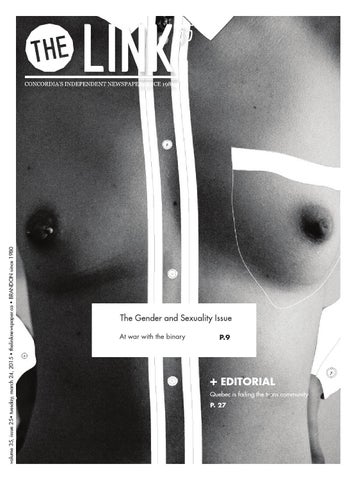
volume 35, issue 25• tuesday, march 24, 2015 • thelinknewspaper.ca • BRANDON since 1980
The Gender and Sexuality Issue At war with the binary
P.9
+ EDITORIAL
Quebec is failing the trans community
P. 27
clAssified $#
&
!
!" "
%$$ "
%
!"
Ads
$3.50+tax for Concordia undergraduate students. $5.00+tax for others $0.25/word after 15 words.
DeaDline: 2 p.m. Friday Classifieds must be purchased at our offices 1455 De Maisonneuve W. Room 649 and be accompanied by full payment. Monday to Friday, 10 a.m. to 5 p.m. Closed on Wednesdays. We do not take classified ads by telephone, fax or e-mail.
thelinknewspaper.ca
DRIVING PRATICE LESSONS: 70 min. / $32, 2 hrs / $52 with ad. Exam car rental starting $19 taxes included. 514-744-5623, Jimmy. STRING INSTRumENT REPAIR. Hand-made, guitars, mandolins and bouzouki’s. Call time 514-655-4941, Nick. TuTOR wANTED to teach an individual how to use a computer. Part-time. Call 514-489-4246.
notice of election The Link Publication Society Board of Directors Board Staff representatives Candidates are Graeme Shorten Adams & Verity Stevenson
Elections will be held Wednesday March 25 at 4 p.m. in the Link’s office, 1455 de Maisonneuve W. Blvd. Room H-649.
The Link Publication Society Inc. Annual General Assembly Thursday, March 26, 2015, 4 p.m. 1455 de Maisonneuve W. Blvd. Room H-649
YO U R VO T E F O R IVES UTIV C E ASFA E X T IMPORTAN AND IM ! Y V E F EE L
o V tE AASFA S FA IISS YYOURS; O U R S; TTAKE A K E OOWNERSHIP WN E R S H I P AAND N D VVOTE! OT
Are YOU an Arts and Science Student? ASFA’s annual elections are this April 7th, 8th, and 9th!
Stations located in: - H Building Lobby - LB Library Lobby - SP Building Main Hall - VL Library Entrance
Agenda 1. Call to order 2. Election of a secretary 3. Reading and approval of the agenda 4. Reading and approval of the minutes of the 2014 AGA 5. By-Law amendments 6. Board of directors report for 2014-2015 7. Presentation of the 2013-2014 financial statements 8. Appointment of the auditor 9. Presentation of financial statements as of the last day of February 2015 10 Presentation of the preliminary budget 2015-2016 11. Election of the board of directors 12. Other business 13. End of the assembly
* Only twO issues Of the link are left this semester
stay tuned!
*
Constitutional amendments are available at The Link’s office. All Concordia undergraduate students are eligible to attend and vote at the meeting. Board of Directors The candidate for a position open to members at large is Colin Harris and the candidates for the positions open to members of the community are Clement Liu and Erin Sparks.
Advertise in the link 9<N=JLAK= AF L 514-848-7406 -),%0,0%/,(.
24 march 2015
current affairs
3
Protesting P-6 on the Streets and in Court As Protest Season Begins, Controversial By-Law Comes Under Fire Again by Jonathan Cook @twowaywinger On April 5, 2013, Rima Athar, Jess Dorrance and Helen Bradley went to a demonstration against Montreal’s controversial bylaw P-6. It lasted 10 minutes.
“We walked around Berri square one and a half times,” Dorrance said. In attendance with over 200 people, the three demonstrators that day were caught in a kettle. The “chilling” sight of police with full riot gear and tear gas launchers led many protesters to stop before they even began. An attendee of many demos, Athar says that the April 5 demonstration featured the most officers she’d ever seen present at once. It’s March 5, 2015 and Athar, Dorrance and Bradley exit municipal court, chanting and blowing klaxons while holding a “Queers Against P-6” sign alongside dozens of other celebrators. The joyous scene is in response to the cancellation of tickets from years past given under P-6. Early last month, Montreal municipal courts ruled that fines three protesters received under P-6, a bylaw which declares demonstrations illegal if a routed itinerary is not provided and facemasks are used, were invalid. Eric Thibeault Jolin, Patrick René and A.K. (a minor at the time) were the defendants in a case overseen by Judge Randall Richmond. That senior officers trivialized the violation of the law was “staggering,” Richmond wrote in a statement from his decision. He added that thousands of annual penal prosecutions could be undermined if this is how ordered procedures are carried out. Although Richmond also called the bylaw “flawed,” Mayor Denis Coderre supported the rule, tweeting in February that it was
the application, rather than the law itself, that was problematic. The police ticketing techniques under question included what Athar, Dorrance, Bradley and others have called “an assembly line.” At the April 2013 demo, after two-plus hours in freezing weather, the three protesters said that STM buses arrived to act as “processing centres” for P-6 tickets. In principle, a fine under this bylaw is equivalent to a parking ticket, as it is not a criminal charge. A main reason judges acquitted thousands of fines was that many of the officers formally distributing the ticket were not eyewitnesses to the alleged offences. “Certainly [it was] not someone who could appear as a witness in court to say they saw any of these individuals—let alone all of them—commit the offence,” said Kevin Paul about the actual individual who fined him under the pretense of P-6. A member of Association pour une solidarité syndicale étudiante (ASSÉ), Paul said he also attended the April 2013 demonstration and received a ticket. He called the assembly line system used that day “efficient,” as there was an officer at each window of the bus doing a different task in the fining process. Already fined from this protest and one in 2012, Paul said his third formal offence on May 1, 2013 was where the Service de police de la Ville de Montréal enacted the most infringements. After waiting in a kettle for six hours protesters proceeded in buses, while restrained with plastic tie wraps, to an operational centre. The police photographed them without criminal charges, and Paul said that the person handing out the ticket was not present during the arrests. A P-6 fine can range
from $500 to $3000. Paul said a “big part” of the cancellation of P-6 fines were legal clinics, like ones hosted by QPIRG-Concordia called “Contempt of Court.” Open to anyone who is facing a legal offence or who wants to make a complaint about the police or sue the city, these clinics allow for the sharing of knowledge, skills and experiences, according to Paul.
endorsed by 86 groups. Jaggi Singh, a member of QPIRG Concordia and noted activist within the community, says that Montreal would have to quadruple its number of officers to successfully uphold the bylaw. “We would have to become a police state in order to have the law applied like Coderre implied,” he said about needing to have officers watching people at all times. A recipient of a ticket through the P-6 bylaw in a June 2012 protest, Singh says that the municipal court system was overwhelmed and could not handle the amount of trials, some of which were taking years to happen. “It’s very rare things go to trial,” he said. “ We were going to push trials for dozens and dozens of cases.” Mass arrests in the ‘90s and early 2000s were unsuccessful because people were charged criminally through offences like illegal assembly, mischief and disturbing the peace, and prosecutions were difficult - Jaggi Singh, QPIRG Concordia to enact, according to Singh. P-6, however, which he emphasized was The network of mutual support and equivalent to a speeding ticket and had solidarity enabled many self-represented minimal consequences, allows for the police accused to defeat the city of Montreal in to stop peaceful assembly more easily. “No court, Paul added. He is not optimistic, one’s surprised if you catch someone breakhowever, that the bylaw will be repealed by ing a window and you charge them,” Singh said, explaining that most assemblies are city officials following these victories. “I am hopeful that through the actions of the peaceful and without cause for cessation. protesters in the streets and in court, we can It’s protest season in Montreal, and the ultimately make P-6 unenforceable as a tool for city is waiting to see how the SPVM will shutting down demonstration,” he said. handle it. Singh says he can’t speculate. “I On November 20, 2013, Solidarity Across don’t know,” he said in response to a quesBorders posted a community statement tion about how police will navigate the on their website in response to an earlier bylaw in light of the recent decisions. City Hall decision that year to uphold the contentious bylaw, a statement which was Graphic Sam Jones
“No one’s surprised if you catch someone breaking a window and you charge them.
thelinknewspaper.ca/news
4
current affairs
5
Maple Spring 2.0 The Many Responses of Concordia Students to Austerity Why are people yelling in the streets? You may or may not have heard a thing or two about austerity in the past few weeks. So what is austerity anyways? According to the Oxford Dictionary, austerity is defined as “difficult economic conditions created by government measures to reduce public expenditure.” On a student level however, the term takes on a much different meaning. “We’re trying to build a social movement, and something that’s going to last,” said Camille Godbout, a spokesperson for the Association pour une solidarité syndicale étudiante (ASSÉ). “We hope to tell [the government] that they need to stop putting private profits and also the profits of big corporations on top of social benefits and our quality of life,” Godbout continued. Several student groups have taken anti-austerity stances, including the formal student federations Féderation étudiante universitaire du Québec (FEUQ) and ASSÉ, as well as informal organizations like Comité Printemps 2015 and Solidarity Concordia. They have been working on garnering support for the movement and denouncing the provincial government’s economic policies since the cuts were announced. “It’s important for us as students, because not only the cuts affect us in education,” said Godbout. “Austerity is a social issue that’s going to affect all of us one way or the other.” “What we’re seeing overall is an assault on social services and the welfare state that we’ve been building since WWII,” said Michael Finck, a member of Sustainable Concordia who recently presented Concordia President Alan Shepard with a “Trojan Horse of Austerity.” “There’s definitely power in collective action to shift the direction of public policy,” said Finck. “That’s what social movements have done, essentially since society began.” March 23 marked the first day of Concordia’s 2015 student strikes. “It’s important to maintain pressure and not just ignore the fact that social services are being cut,” said Aloyse Muller, a member of Solidarity Concordia. “It
inscribes itself in a larger and longer moveFounded in 2001, ASSÉ has been the most ment that’s probably going to carry on.” visible and militant advocate for free tuition and accessible education in recent years. The association represents approximately The main players: how are organizations working together? 70,000 members in student associations across Quebec. Though the CSU voted in There are several organizations across campus 2004 to leave ASSÉ and join FEUQ, the and across the province campaigning against former association represents students in austerity and mobilizing student strikes. Concordia’s School of Community and According to Muller, Solidarity Concordia Public Affairs. acts as a platform that serves to raise awareDifferent protest groups share a lot of inforness within the university. mation, according to the CSU’s VP External The group was created in October by and Mobilization Anthony Garoufalis-Auger. Concordia students who disagree with the “There’s a political culture that exists of Liberal government’s budget cuts and the solidarity among campuses, and of decisionParti Québécois cuts which preceded them. making bodies that are democratic, but also “It’s not an organization per se, it’s more like formalized and institutionalized,” he said. a group of people who are concerned,” Muller “So everybody’s on the same page when it said. On top of spreading information across comes to opposing these cuts to education,” campus, the group provides individuals with he continued. “There seems to be a wide coaliexamples of how to hold general assemblies tion of organizations representing groups and what strike mandates look like. mobilizing against austerity.” Printemps 2015 is a collective of several activist groups who are mobilizing, and rep- Administrative response resents one of the major anti-austerity forces this spring. The safety of students and staff is the first It’s a mobilization platform intended to priority, President Alan Shepard told the unite students, workers, unemployed people and people from all sectors of society to work towards building a social strike. Their initiatives focus on social change and student mobilization. Their symbol? A howling wolf. “Wolves organize horizontally as well; they have strong solidarity structures and they’re more combative,” said Brice Dansereau-Olivier, a member of Comité Printemps 2015. “We wanted to show that we’re trying to build a movement across the whole of society that’s combative. That is something that’s going to be needed if we want the government to back down on those issues.” The FEUQ is a student group with over 125,000 student members and 13 member associations, including the Concordia Student Union. It’s a more research-oriented student association than ASSÉ, and has been criticized by more militant groups in the past for providing police with protest itinerary and signing on to government compromises.
Concordia University Part-Time Faculty Association’s General Assembly last Thursday. He added that by using the term “strike,” the school is not giving up any legal ground. He is also upset by the approximately $30 million cuts in funding and feels his administration is “walking a tightrope” with student and government demands. “I think some students want me on the streets with a megaphone,” Shepard said to members of CUPFA. “That’s not my strategy. I’m playing a long-term game here.” Although things can change every day, according to Concordia University spokesperson Chris Mota, classes will run as usual for faculties and departments that are striking on future dates, such as SoPhiA, which has a weeklong strike planned. Mota adds that the decision to use the term “strike” was made by the senior administrators because it’s widely used by media, and they wanted to avoid confusion. “I think it’s pretty important, mostly to ensure safety on campus,” said Aloyse Muller. “Just recognizing the strike is the first step. But it’s not a very proactive step, it’s rather a minimal step that the administration could take.” 6
5
Who is striking?
Hard vs. soft pickets
How this relates to the environment
Students of Philosophy Association (SoPhiA) - March 23, plus March 26 to April 2 Fine Arts Student Association (FASA) March 23 and April 2 School of Community and Public Affairs Student Association (SCPASA) - March 23 and April 2 Graduate Students of Philosophy - March 23, plus March 26 to April 2 Liberal Arts Students (LAS) - April 1 and April 2 Geography Undergraduate Student Society (GUSS) - March 23 and April 2 Women’s Studies Student Association (WSSA) - March 23 plus week of March 30 to April 3 Sociology and Anthropology Graduate Student Association (SAGSA) - March 23 and April 2 Political Science Student Association (PSSA) – April 1 and 2 Department of Education Interdisciplinary Graduate Student Association (DOSEIGA) Failed to meet quorum Urban Planning Association (UPA) - Voted against striking
In the 2012 Maple Spring protests, some students won injunctions in Quebec courts that legally mandated their right to bypass a picket line of protesters. This time around, the majority of student associations that voted to strike have included a clause that picket lines be used to disrupt classes. The debates over having “hard pickets” versus “soft” ones have been popular at the general assemblies. A hard picket denotes that individuals will physically block—presumably nonviolently—a classroom or building, while a soft picket means that people at the entrances will encourage professors and classmates to skip class. Many students associations specified “hard picketing” professors while “soft-picketing” classmates. The Liberal Art Students said they will “hard picket” staff and students. “The problem with soft picketing, as I see it, is that it amounts to a boycott and not a real strike, because if you only soft picket then people will still go to classes,” Aloyse Muller explained. “I think it’s more important to enforce a hard picket than to go on strike for a long time. Hard picketing is not a violent procedure. Usually violence starts by people who want to go inside, not people who hard picket,” Muller said. “If the university acts responsibly and cancels classes for the departments that go on strike and hard picket, it should be totally fine.” The idea behind blocking only professors is to prevent them from holding classes, without confronting students on top of that. To avoid conflict and show solidarity with classmates, picketers will be able to effectively cancel class so students aren’t penalized for striking. At the Graduate Students of Philosophy general assembly, some made the case against singling out professors, many of whom are their colleagues. Professors are contractually obligated to teach and shouldn’t be prevented from doing so, they argued. Security will not be removing students from picket lines.
As students and unions march in the street, activists are raising awareness about oil-transporting projects like Energy East and Line 9B. “The Liberal party and the government, they’re going forward with restrictive measures on the environment and they’re not taking responsibility,” said Godbout. “This is also going to affect our quality of life and the future of the people that live in these cities.” The coalition of students against pipelines, Étudiants et étudiantes contre les oléoducs (ÉCO), includes more than 100,000 students from associations across the province calling for an end to pipelines and bituminous oil development, better known as the tar sands. “It’s worth noting that the cuts to universities are not helping,” said Anthony GaroufalisAuger, a spokesperson for ÉCO in addition to his role on the CSU. “The current cuts that are coming from the Couillard government and the Parti Québécois before them are really harming the university’s capacity to produce research into sustainable development and transition technologies.” The cuts in universities are undermining the institutions’ abilities to think freely, he says. Instead, universities rely more and more on corporations and producing information for the private sector, which doesn’t necessarily contribute to the public.
Communications students and Geography graduates are voting on March 26. The Sociology and Anthropology Student Union (SASU) is voting on March 31. On March 23, no classes were held for Fine Arts, Geography, Philosophy, Women’s Studies and School of Community and Public Affairs students. Pretty much every day until early April has its own protest or demonstration, but the most symbolic ones are being held on March 26, when the budget is set to be tabled, an ASSÉ-led general protest on April 2, and every Saturday for the next few weeks. by Jane Lakes, Josh Fischlin, Vince Morello, Michelle Pucci and Jon Cook photos: 1. Michelle Pucci 2-4 Shaun Michaud 5-6 Alex Bailey
Now and then
After changing governments twice, students find themselves in a very similar position today to that of the 2012 Maple Spring. Critics of the 2012 student movements tried to discredit the use of the term “strike,” saying that unlike labour unions who have the right to enact one, students don’t produce public goods or services and therefore can’t strike. “Boycott” was a more representative word, some argued. The protesters disagreed. “In 2012, the only people that ever referred to it as a boycott were the English media,” said Brice Dansereau-Olivier. “The French media did try to take back the term, because it implies that the student strike is not legitimate in a political sense.” This year, activist groups like ASSÉ and Comité Printemps 2015 are instead broadening the issue to all aspects of society. “It’s important to note that the point is not to recreate a second 2012,” said Dansereau-Olivier. “[The 2012 strikes] was very specifically a student issue, whereas now we’re trying to build more of a social movement comprising other members of society as well.” “The political context is quite different right now because it’s not only a tuition hike that we’re fighting, but a specific measure,” said Camille Godbout. “The Liberal Party is attacking many social issues and different people and it affects their quality of life.” According to the Quebec Labour Code, which a student association technically doesn’t fall under, a valid motion to strike must be conducted through a secret ballot. Apart from philosophy and political science students, all general assemblies have been decided by a hand count.
CUPFA itself issued a statement this past Friday to offer “its support for the students concerns over the Austerity measures.” It explained that “CUPFA members are presently under contract and therefore not in a position to withdraw our labour.” If teachers arrive at their classroom and there are no students present, they must wait 15 minutes before cancelling class. However, if a near-normal number of students arrive, then the teacher must proceed with class as usual. CUPFA’s statement also encouraged teachers not to relocate their classes to an offcampus location on protest days, as it could present liability and legal challenges. Teaching and Researching Assistants at Concordia (TRAC) is in opposition to austerity cuts and “applauds” the student strike initiative, according to a statement by President Nader Jafari Nodoushan on TRAC’s Facebook page. Although they support the strike, TRAC itself has not taken a strike mandate, which means its members will report to class regardless. Nodoushan adds in his statement that all TRAC members will “exercise understanding with students participating in strike actions.” Striking: day one
On March 23 a banner with the words, “You Cut Budgets, We Cut Classes,” was unraveled at the mezzanine level to the incoming and outgoing traffic of students in the Hall-Building. The faculty and departments affected by the class cancellations were tasked individually with organizing a time of “reflection and dialogue,” which the university requested in
1 2
3
4
its press release. FASA led a special general assembly in the EV building at 10 a.m., where approximately 50 students and faculty members gathered to discuss how austerity affects Quebec and the school. The majority of the speakers were students, but some professors and administrators spoke of how budget cuts have or have not hurt their operations. As the only faculty to declare a strike and with the largest number of students represented, FASA is dealing with an issue of mobilization. The discussion switched to the visibility, or lack thereof, of the strike vote and anti-austerity messages, which some argued was due to a lack of intimate space for dialogue and general apathy from classmates. Down the street near Phillips Square, another protest resulted in the arrest of two protesters. Tickets were given to 24 of them after they were kettled. About 200 gathered at the square at 11:30 a.m., where the first arrest took place. Moving to the streets, protesters circled around Union St. before heading east on René-Lévesque Blvd. There they broke into a sprint to the front of SNC-Lavalin headquarters. In recent years the Montreal-based engineering firm has been plagued with charges of fraud over shady dealings in the city’s construction sector. According to police, several protesters made it inside the building. Riot police appeared soon after, herding protesters to Ste. Urbain St. A tear gas flare was launched; at least four protesters were thrown to the ground by police throughout the duration of the protest. Around 12:30 p.m. protestors were scattered throughout Chinatown. Bystanders were pushed aside and each time a group of
protesters gathered police tried to disperse them, eventually kettling the last 24. According to the police media hotline, two officers were hurt. During the afternoon, approximately 100 students took their cause around Concordia, picketing classes and gathering support for their cause against austerity. As students arrived at the Library building in Concordia, the chants of “Hey hey, ho ho, austerity must go,” echoed through the building—all the way to Hall, where the protesters began picketing ongoing classes. At least three classes were targeted by the Concordia contingent on Monday afternoon. A class that included Fine Arts students at H-110 was interrupted as well as a geography crossover on the 12th floor. At a political science class on the 4th floor, class members were seen arguing with demonstrators. The class included SCPA in its title and Nicolas Levesque, one of the students there, says a classmate pushed one of the protesters. These incidents gathered attention from Concordia security as they filmed the protest. Police were also present as they briefly entered the Hall building. No arrests were made and students were for the most part free to go into the streets. “I think [the protest] is amazing,” said Catherine Fournier Poirier, a member of FASA. “It’s the best opportunity to build the momentum and build a sense of community in Concordia.” Two general assemblies were held on Monday night. The Urban Planning Association became the first student association to vote against a strike motion, while the Political Science Student Association voted to strike through a secret ballot.
fringe arts
6
24 march 2015
challenging ethnocentric visions of orientalism Artexte Hosts a Marathon Reading and Workshop on Edward Said by June Loper @loperjune
Stemming from a reflection on notions such as the other, post-colonial theory and the politics of representation, Artexte is convening a marathon reading of key works by famous intellectual Edward Said. Highly influential in the 1970s, Said pioneered the theoretical structure for literary post-colonial studies. With his foundational text Orientalism, published in 1978, Said pointed out the influence of imperialism on cultural politics, denouncing a prejudiced westernized perception of “the East.” In the light of recent events breaking out on a global scale—the Charlie Hebdo killings in Paris, attacks on mosques across the world, shootings in Denmark and a rising Islamophobic and racist discourse in Europe—the members of Artexte felt the urgency and necessity to address some of the issues circulating around these burgeoning sentiments. Sarah Watson, general and artistic director at Artexte, underlined the importance and timeliness of this re-reading of Edward Said. “It’s important for an international city like Montreal to address some of the rising discourse around racism in our city, discourses around new immigration and the rise of racism in Europe at this time, the fear of ‘Islam’ and what all this means. And more directly within the context of art presenta-
tion,” she said. Not only does this initiative challenge our conceptions about the meaning of Orientalism in 2015, it also re-evaluates the politics of cultural production as a whole. Why is it important for cultural workers and educators to be conscious of these issues? What role does the artistic sphere play in this geopolitical situation? The marathon reading day will look at three of Said’s major works. Starting with the first chapter of Out of Place: A Memoir (1999), the readers will then move on to the introduction and chapter one of Orientalism (1978) and finish with the introduction and opening chapter of Culture and Imperialism (1993). Divided into 15-minute reading segments, the performance is open to anyone who wishes to participate and in any language they wish to. A Google Doodle is available on the website and Artexte’s Facebook page for participants to sign up for a time slot between noon and 9 p.m on March 27. Adding a live element to the performance was a significant decision. Not only does it underline the critical urgency of the reading, but it also creates a meditative atmosphere— a time and space to bring people together, to create a pause outside of their everyday routine and to stop and think about these issues with the help of intellectuals and critical thinkers.
“Artexte is very much about the documents, the language, the words, the media. And the idea of doing something live struck us as very important,” said Watson. To follow up on the reading, Artexte has invited two professors in the cultural field to lead a workshop, discussing some of the questions deriving from the re-reading of Said. Monika Kin Gagnon, a Concordia communications professor and Monia Abdullah, a UQAM professor specializing in contemporary Islamic art and an expert on Said, will lead the discussion, looking at the relationship between post-colonial theory and art—most importantly what place it occupies in the transmission of knowledge. Gagnon listed some of the questions rising from discussions between herself, Abdullah and Watson that will take centre stage at the workshop. “How do we talk about art coming from North Africa? How do we talk about it in our schools? How do we teach it? What are the texts that we use now? How can we think otherwise? How can cultural workers have current notions of what it means to talk about post-colonialism and imperialism to students in culture and art now?” Watson told The Link. The sensitivity around politics of representation underlines the importance of paying close attention to the type of language, imag-
ery, words, sounds etc. that are used to frame a certain culture, especially coming from a colonizing power. Both Gagnon and Abdullah recognize the importance for cultural workers—as producers of content and meaning in society’s written and visual language—to be aware of these questions. Although the events hosted by Artexte are not aiming to condemn the exhibition on Orientalism happening at the Montreal Museum of Fine Arts, some of the controversy around it further encouraged them to take a closer look at the meaning of Orientalism today. Among some of the issues related to the representation of “Oriental” culture in the current exhibition at the Montreal Museum of Fine Arts, Watson mentions the oversexualization of the museum’s media campaign. “It’s one thing to do a retrospective,” she said. “It’s another to call it Orientalism in 2015 without [exploring] what that means within the museum context. Above and beyond that, the exhibition is one thing, but we’re not going after it. Exhibitions like that happen all the time because the type of society we live in produces it.” Rereading Said: Marathon Reading // Friday, March 27 // 12 p.m. to 9 p.m. // Artexte (2 Ste. Catherine St. E., Room 301) // Free Graphic Sam Jones
24 march 2015 by Zach Goldberg @zachgoldbergg
Nirvana was great. I mean, Nevermind kind of sucked, but even that record is good in a pop-grunge kind of way. What I’m saying is, no matter who you are, I think we can all agree: Nirvana was fucking great, and it sucks that they’re gone. But don’t despair, because Hervana is giving us everything we miss about Nirvana with the added bonus of riot grrrl, a great cause, and a shit ton of puns. Hervana is composed of four Toronto multi-instrumentalists and obvious lovers of puns and Nirvana, each with their own riot grrrl/Nirvana mashup pseudonyms. With Miss Novoselic (Erin Saunderson), Dave Grrrl (Adrian Pasen), Pap Smear (Michelle Turingan), and front woman Skirt Cobain, also known by her slave name Carly Beath, the quartet slams through Nirvana tracks with both a pop band’s upbeat attitude and riot grrrl’s ferocity. It’s at once jaunty, silly and totally mesmerizing, having the final quality of being completely endearing, with great songs not only kept intact, but added to in a way you never really thought you were searching for, but it turns out you had been searching for the entire time. Perhaps the most surprising thing about Hervana is their origins, specifically that there was very little planning behind this genius amalgamation of grrrl, puns and Nirvana. In fact, the true origins of Hervana are a tweet. 29 May 2013 @groshbarr: Toronto needs an all-girl cover band named Hervana. This tweet only got one reply, and it was negative. However, little did @groshbarr know that he had begun a chain reaction. “I didn’t know if he was serious, but I saw that, and thought it was a great idea, and decided to make it happen,” said Beath. Beath says she doesn’t usually create bands out of tweets and hadn’t even been particularly interested in starting a cover band. But this seemed like too good an idea to pass up, and so Hervana was born. The more-thanjust-a-coverband has been killing Toronto since. Beath and I spoke recently about what Nirvana meant to her and Hervana’s upcoming benefit for Rock Camp for Girls Montreal. We talked on the phone, and she is
fringe arts
7
not just a girl band, not just a cover band Hervana Are Bringing Back Nirvana and Riot Grrrl All at Once funny, upbeat and engaging. In Utero is her favorite record. “Nirvana was one of my first favourite bands,” She tells me. “When I was learning to play guitar, I learned their songs. They were an early influence, and I’ve always loved their music.” It isn’t just Cobain’s music that makes the cover band great for her. Beath thinks Nirvana is a perfect platform for getting out some good ideas. “Nirvana had great politics, and used this platform to get some great messages on sexism and racism and homophobia out there,” she said. Now the quartet of grrrl imposters are not
just reviving some great tunes live. They’re trying to be more than just an “all girl band” and to show other women and young girls that rock doesn’t have to stay dominated by males. Beath doesn’t necessarily like the term “girl band,” thinking that it’s used too often to brush aside bands with a label, although Hervana are happy to use the term to their advantage. “For us, there’s an argument to be made against being a girl band. But I think it’s good for all-female bands to be visible, because there aren’t as many,” she said. “The more there are out there, the more women will get into rock.” As an all-girl, more than just a grrrl, band, Hervana are looking to make waves.
Besides shredding classic tracks to adoring crowds on a regular basis, they’re hoping that at least a side effect of their rocking might be more women in punk. Hervana is now raising awareness for female-focused rock organizations, like Rock Camp for Girls Montreal, hoping that in the future they’ll see even more women involved in the punk scene. “I can’t wait for the bands that will come out of rock camp. It’s gonna be really amazing.”
with old LPs, and Socalled found every kind of music out there to use for his music production. “This was when I started finding Jewish and Hebrew music to sample,” he said. A few years later, a 2006 American Jewish Life Magazine feature about the artist catapulted him to notoriety in the Jewish community. Still, for Socalled, it was about expressing his identity through music more than trying to create Jewish hip-hop. He’s been making hip-hop since before computers existed, back when you had to buy expensive four-tracks and drum machine keyboards to make beats. Collaboration, both with other artists and different forms of art, is a big part of Dolgin’s creative process. From his puppet musical The Season, to the cookbook he wrote with his mother’s recipes, to his theatre class at Concordia, Socalled constantly works with different people on different platforms.
“I never wanted to be a musician,” Dolgin told the class. “I would still rather make movies, it’s a more complete collaboration of art.” In an impromptu tutorial, the rapper shows his class how to layer beats, samples and bass with an MPC. Choosing a sample of a Hungarian women’s choir and a slow but catchy bass line, Socalled creates a song in a matter of seconds. “Come on, kick it!” Dolgin says to Yassin Alsalman, the professor interviewing him and his long-time collaborator. “Kick it professor!” The class turns into a live concert as Alsalman begins to freestyle rap over Socalled’s improvised beat. Students’ hands fly in the air and heads are bobbing—Dolgin’s skill as a multi-faceted performer is evident, Poopsie still on his lap.
Hervana // Club Lambi (4465 St. Laurent Blvd.) // April 9 // 9 p.m. // $10 Photo courtesy of Hervana
busting out hebrew beats Hip-Hop Artist Socalled Blends Religious Traditions with Inner-City Funk by Claire Loewen @clairelwn
“The first rap I ever wrote was called ‘The Jew Funk’,” the wiry, well-spoken man sitting in front of our class said. “I remember there was this one line where I was like ‘Baruch Atah Adonai, mother fucker!’ Which is a Jewish prayer.” Josh Dolgin smiled nervously and joined in the class’s laughter. He wore a hoodie and jeans and sported a somewhat receding Jew-fro. His tiny dog Poopsie sat on his lap. He was a casuallooking person, though a little jumpy. Dolgin, also known by his stage name Socalled, is what I would consider a professional creative. His endeavors span the artistic spectrum. He is a rapper, producer, professor, cookbook author and composer, among other things. With what he calls a constraining background in classical piano, the Montrealbased Dolgin has spent his life making music. Jazz and funk were his favourite music genres growing up. He was always a fan of African-American music and culture, which led to his discovery of hip-hop in the 1980s. “I could relate to the fact that it comes from inner cities and repressed minorities [making] beautiful art with what they have,” he said. The artist developed a love for the genre and wanted to start making hip-hop music, but to his parents, his classical piano training came first. Dolgin joked that he was
“bribed, forced and beaten emotionally” to practice piano. “The thing was, I was pretty good. I couldn’t give up easily,” he added. Once the pressure subsided, he began to play jazz improv piano and the accordion, further expanding his creative musical side. Dolgin describes himself as a shy teenager and a “weird minority” growing up in the small town of Chelsea, Quebec. As the only Jewish person at his school, he stood out. That changed when he moved to Montreal to study literature at McGill. “There’s a sea of ‘Hebes’ here,” Dolgin said with a giggle. He was thrust into an environment where he was no longer unique due to his culture, one where he could further develop his identity and creativity. “Hip-hop is about representing who you are, where you are,” Dolgin said. “It’s about sampling and reflecting my culture.” Socalled often uses samples from Jewish music in his beats, but there is diversity in his selection. “I try not to remember where any of the sounds I find are from. I look for isolated sounds. Sampling is about turning shit into gold for me—finding weird sounds and trying to turn that into good stuff.” Sourcing songs to sample began in the 1990s for Socalled, when “everyone was throwing out their records to make room for CDs.” Garbage bins were filled to the brim
Still from video “Work With What You Got” by Socalled
8
SPORTS
by Julian McKenzie @JulianTheIntern
Liam Mahoney was once the face of Concordia Stingers football. The former star quarterback, league all-star and All-Canadian loved dodging players with his speed and fought for every yard on the field. He took a number of hits and suffered numerous concussions, but he still managed to reach the Canadian Football League, fulfilling his lifetime aspiration of playing professional football. Today, football doesn’t play as large a part in Mahoney’s life, and he seems content with this reality. The former team MVP is also unsure of whether he’d endure the grueling punishment that a football career brings all over again. “I was so immersed in football and so immersed in myself that it [became] the only thing that mattered,” said Mahoney. “But now that I’m outside of it and I feel like I have so many things that I can do, I feel like I don’t need football as much.” However, when asked if he would put his future kids through football, Mahoney’s answer was less hesitant: he wouldn’t. “My sister has a one-and-a-half-year-old and I’m his godfather,” said Mahoney. “I wouldn’t want him to play football either.” Since being cut by the Ottawa Redblacks of the CFL in 2014, Mahoney has become a communications assistant and football broadcaster for the Stingers. When the former player considers the amount of violence in the game today, he finds it hard to believe that his body was able to sustain such a grueling amount of contact. “The physical side of it wasn’t really worth it in terms of [wondering], ‘how many years did it shave off of my life?’” he said. “You’re seeing so much of it in the news; you don’t know what the toll is on your body.” These unknowns have even caused concerns among players from the National Football League, the pinnacle of professional football. It’s a league that’s operating with a giant elephant in the room: the problem of concussions and head trauma. Retired players are taking out concussion lawsuits against the league, suffering from nagging injuries and even depression, something that Mahoney himself has experienced and has gone to therapy to deal with. “My transition from being an athlete to being a civilian wasn’t very smooth at all,” he said. “There were a few years where I worked some really shitty jobs and just felt really terrible and super depressed and really down, and it seems like something most of us go through once we stop playing football.” Some former players are even suffering from chronic trauma encephalopathy, a degenerative disease that is often found in patients with a history of suffering concus-
1st & Done
The Joys and Dangers of Playing Football Through the Eyes of Former Players sions. It’s possible that the disease has played a part in the deaths of a few NFL players, including NFL linebacker Junior Seau and a 21-year old college lineman Owen Thomas, from the University of Pennsylvania, who both committed suicide. “The state of football at this point, it’s a bit embarrassing to me,” said Mahoney. “They need to be better at protecting their guys.” The NFL has seen five notable players aged 31 or younger retire during this offseason—including San Francisco 49er rookie linebacker Chris Borland, who retired at the age of 24—thanks in part to the game’s violent nature, the unknown repercussions from hits to the head, and ultimately to save themselves from further injury. Despite the known consequences of play-
“When I was in Hamilton [with the Tiger-Cats], I remember telling my girlfriend at the time, ‘I don’t know how long I want to do this.” -Liam Mahoney
ing football, Borland believes that not even the world’s top neurologists know all of the “risks and the connections” between football and head trauma. Sports pundits believe that his retirement could lead to a trickle-down effect, where other players may consider ending their careers early. While losing out on millions of dollars
24 march 2015
Before coming to Montreal the brothers grew up in Laconia, New Hampshire, where football was, according to Mickey, “the thing to do.” “If you grew up in Laconia, you were playing football,” he said. Mickey played three seasons with the Maroon and Gold before attempting a career in the CFL with the Hamilton Tiger-Cats, where an ACL injury suffered during a preseason game halted his playing career. “I was down in New Hampshire working,” said Patrick. “I get a phone call from my mom; she was crying and saying ‘your brother, he just tore his ACL.’” Mickey was given a chance the following season to continue his career, but tore ligaments in his foot at practice, ending his career. “It [was] a heartbreaker,” said Mickey. Patrick’s football career was also stopped in its tracks after he tore his pectoral muscle during his Pro Day, a day where attempted to show off his skills in front of 13 NFL scouts. The coaches acknowledge there is a concussion problem with the game of football, but they both believe that the usage of supplements and drugs that players take to enhance their performance may take a toll on the health of players after their careers have ended. “A couple of those [players] were putting things in their bodies that probably wasn’t best for them either,” said Mickey. “No one ever talks about that and that stuff can mess with the mind as well.” “People don’t realize what you put into your body and what it can do to your brain,” Patrick added. “That’s where the NFL, I feel, turns a blind eye,” Patrick continued. “Without the players having the physical ability that they have, would the NFL be the same? “To me, that’s the topic research should be focusing on.” The brothers delivered hits and took their fair share of pain throughout their careers but, unlike Mahoney, the brothers wouldn’t hesitate to play again if given the opportunity. “It’s the sport that I love, and I still love,” Patrick said. “If I wasn’t so old now would I still be playing? 100 per cent.” Fortunately for Mahoney and the Donovans, and unlike other retired and inactive players from professional football, they’re able to remain close to the game and enjoy a second life after football. However, with concerns for the game rising and issues of player safety still waiting to be addressed, it’s clear the sport of football is in need of the winds of change.
isn’t the reality of the Canadian Football League, Mahoney said he also expressed doubts about a lengthy professional career years ago. “When I was in Hamilton [with the TigerCats], I remember telling my girlfriend at the time, ‘I don’t know how long I want to do this,” he said. The irony in these doubts is that once upon a time, Mahoney had driven himself to play professional football from a young age. Despite taking Film Studies at Concordia, it was clear that he was all-in for a life on the gridiron. “Football or nothing” is a common mentality among aspiring pro players, and Mahoney isn’t the first Concordia athlete to think that way. “As a player, you don’t think there’s anything that’s more important than playing football,” said current Stingers football head coach and former linebacker Mickey Donovan. “At the time I would’ve done anything to make sure that I could still play no matter what injuries came my way. This is the mindset when you play this game.” The Donovan brothers, Mickey and Patrick (the latter is the assistant head coach and defensive coordinator of the Stingers), are another example of gridiron giants who jumped into football headfirst—literally, in Patrick’s case. The linebacker often led with his head when delivering tackles, yet he never suffered a concussion. Mickey has suffered concussions, but it never stopped him from getting on with his career. “It’s not an easy sport, it’s very physical, it’s hard on the body, it’s very demanding, and it does wear you down,” Mickey said. Graphic Sam Jones
thelinknewspaper.ca/sports
the gender and sexuality issue
Issues related to gender and sexuality are challenging the familiar binary of western society. But it’s important to consider that this is an illlegitimate way of looking at gender. Systems that are supposed to help vicitims of sexual assault are inadequate, and trans people are expected to jump through flaming hoops just for basic human rights. Recognizing these groups is crucial to shifting the binary.
10
gender & sexuality
march 24 2015
a secon
march 24 2015
11
gender & sexuality
nd assault Why Women Don’t Report Sexual Violence
by Erica Pishdadian @ericapish and Emilie Berthier @emilieberthier
For many women that have been sexually assaulted, getting a conviction for their rape is a process so lengthy and excruciating that it almost amounts to a second trauma. This may explain why the large majority of them decide to remain silent: more than 91 per cent of them, according to Statistics Canada. Many women are reluctant to report because “they know that their odds are statistically very, very low of getting a conviction,” said Lisa Steacy, a Canadian Association of Sexual Assault Centres representative. “They know that the criminal justice process is long, out of their control and quite difficult to go through.” This impression isn’t wrong. Reporting a sexual assault is an arduous process that can easily last hours, depending on how long you have to wait for detectives and doctors to see you. Even once you finish reporting, it can take up to two years to get a sexual assault conviction. The process of reporting begins when a victim contacts the authorities. “When it comes to a sexual assault, the person has two choices,” said Lina Borremans, a Community Relations Officer at the SPVM. “[One is to] call 9-1-1 right away on the spot. Then the patrol goes to the victim, and they’ll bring the victim right away to the hospital.” She explained that the doctor will then take a rape kit. After that, police will take a report of what happened, which will be turned over to an investigator in the sexual assault squad. “The other way is [to report] a sexual aggression from many, many years ago,” she said. There is no time limit on reports, she said. Many women come into police stations years later to relieve themselves of the burden they have been carrying. Once an assault is reported, the next step is to get a rape kit done. Rape kits, which also go by the formal title “sexual assault evidence collection kits,” are less of a “kit” and more of a full body exam, both internal and external. According to the Rape, Abuse and Incest National Network, an organization based in the United States, a standard rape kit involves a head-to-toe examination, samples of blood, hair, urine and other bodily secretions, photo documentation and collection of
the victim’s clothing along with any other physical evidence. They can take anywhere from two to four hours to complete, not counting any waiting time at the hospital. “Who wants to spend 12 hours of their day after having a traumatic event happen to them to sit around and wait for a stranger to re-traumatize them,” said Lucy Anacleto, the assistant coordinator for Concordia’s Peer Support and Advocacy program. “It’s a circus of trauma.” The Canadian criminal justice system is primarily designed to punish wrongdoers. In sexual assault cases, the Crown prosecutes the case on the behalf of the state while a lawyer defends the accused. As for the victim, she is treated like a witness to the crime that was perpetrated against her. This means that a lawyer does not necessarily represent women who report a sexual assault. Steacy says most women are not aware of this. “It’s a weird place to be,” she says. “And often when women learn that they don’t get an advocate, they’re quite surprised.” Anacleto explained that many women also opt not to report because of the type of questions they are subjected to during trial. Victims are typically asked questions on the stand about their drinking habits, drug usage and their sexual history and preferences. “You have to jump through so many hoops and your own character ends up being on trial, sometimes more than the perpetrator,” said Anacleto. “I think that a lot of women would look at that option and say, ‘I don’t want to be dissected.’” The problem with rape and sexual assault trials is that they are often one person’s word against the other’s. To add to that burden, 80 per cent of assailants are friends or family of the victim, according to Sexual Assault Canada. Steacy says the criminal justice system isn’t built to respond to that very well. “The lack of witnesses means that a lot of women are afraid.” In any case, making such a commitment adds to the stress women experience after being assaulted, which may very well dissuade them from speaking out. “It would be easier to drop the charges,” says Melissa Martin, psychologist at the Institut Universitaire en Santé Mentale de Montréal. “Sometimes it causes too much stress to go through it all.”
+ If you have been the victim of sexual assault, you can seek help by calling Quebec’s free help line for sexual assault at 1 (888) 933-9007, or by visiting the Regroupement québécois des Centres d’aide et de lutte contre les aggressions à caractère sexuel. Visit http://www.rqcalacs.qc.ca/ for more details.
graphic Andrew Harris-Schulz
What’s more, if the victim suffers from post-traumatic stress she is even less likely to talk to anyone, according to Martin. One of the symptoms of this psychological disorder is avoidance, so the last thing the victim will want to do is think about—let alone talk about—the traumatic event. Another reason many women choose not to report is low conviction rates. Because so few people who commit rape or other acts of sexual violence are even taken to trial, with an even smaller percentage receiving a guilty verdict, many women do not see the point in trying. “It’s this feeling that, in the end, what guarantee is there that any justice will be done?” said Maya Rolbin-Ghanie, the campaigns coordinator at Concordia’s Centre for Gender Advocacy. “What is justice? To what end? Why would someone report if most of the reports get thrown out anyway?” Statistics Canada indicates that 41 per cent of sexual assault cases resulted in a “guilty” verdict in 2011 and 2012. However, about 54 per cent of these cases received a sentence classified in the “other sentences” category on the website, which means the offender may have had their sentence suspended or been released on probation, among other possibilities. Another factor which clouds this data is that an assailant who is charged with more than one crime is counted under the statistics for the most severe charge. This means that a perpetrator charged with rape and attempted murder would be considered an incident of attempted murder in Statistics Canada’s eyes—not sexual assault. One thing that has been improving international dialogue about sexual assault, however, is social media. “I think that the ability to spread information the way we can on Facebook and Twitter has changed the scope of the conversation and the people that can be included in it,” said Rolbin-Ghanie. She expressed her hope that increased communication and openness would lead to an increase in reporting percentages in the coming years. “Survivors often say that they thought they were the only ones [...] until they start talking to other people.” Graphic Laura Lalonde
12
march 24 2015
gender & sexuality
women and austerity: your economic policy is gendered Women are more likely to occupy roles in the public sector, and these roles are most often described as "expenses" and at risk of budget cuts.
90%
10%
27% 73%
90%
construction sector
10%
mining sector
37%
revenue of over $100,00
63%
65% 35%
19% 81% health and social work
finance
women
teaching
men
Proportion of women and men by industry sector. Source: IRIS Research Centre, Femmes et austerité
by Michelle Pucci @michellempucci
Austerity is a very gendered policy, according to Couturier. When cuts to services are Women are more likely to have part-time jobs, made, they usually slash services that benefit work in the social sector and be single parents. women first. In Spain, for example, a minisWith cuts to the public sector, full-time jobs try of equality between sexes was created in being turned into part-time work and less 2008 and merged with the ministry of health investment in child care, inevitably women within a few years. There’s no room for equalwill be affected most. ity in austerity. Traditionally it’s understood that when “We’re trying to say that growth whateverit comes to wealth, women lose. In 2012, the-cost is not good growth,” she said. “The Concordia’s Simone de Beauvoir Institute economy should be at the service of our denounced the tuition hikes because studies values, and not our values at the service of showed they would impact women far more. our economy.” Now research groups like the Institut de recherche et d’informations socio-économique Get Your Values Straight (IRIS) in Montreal are saying women have One example of the gender bias in austerity been losing out since the financial crisis in measures is the vocabulary used. 2008—by about $7 billion. Whenever a new collaboration with the priAusterity has been creating visible backlash vate sector is announced, it’s an investment. in Europe since 2008, where protests continue When money is injected into the public sector, to fill streets in countries facing extreme cuts. it’s an “expense.” Eve-Lyne Couturier, author of a study on “Putting money in the public sector is also women and austerity at IRIS, compares the an investment,” Couturier said. policy rhetoric of austerity with the Charter Hiring more teachers and teaching staff like of Values. The charter was being sold as a speech therapists are long-term contributions to society, she says. gender equality issue. “But when the time comes to reflect on “We have to think of what kind of society how to manage our budget, there is no we’re creating when we’re investing money,” reflection on what will affect men and she said. women,” she said. The largest projects announced recently When IRIS asked the government whether by the ministry have been multi-million dollar gender bias was being considered in its pol- injections to Quebec infrastructure, repairing crumbling roadwork and shoddily mainicy-making, the answer they got was “no.”
tained highways. Though many agree with the fact that Quebec infrastructure is in an urgent state of disrepair, considering its history of construction and collusion—and the money being cut out of education and other services—investments like these are hard to sympathize with. The construction sector is also a male-dominated work environment. Comparably, women occupy more roles in the public sector, so when the public sector is trimmed, jobs held by women are being lost. Women also work primarily in the services sector—which in turn are often helpful to other women that tend to take on more tasks at home. “If you decide to cut back services in health care and education, then you’re asking the household to do more to help the kid that has problems at school,” Couturier said. “And that person will [likely] be the mother.” Summed up, collective responsibilities are becoming private ones. President of the South Asian Women’s Community Centre Dolores Chew has been outspoken about the winners and losers of austerity. Whenever austerity measures are introduced, they undermine essential services that help sections of the population already relying on some sort of social security. “Those are the first things to be cut,” Chew said.
In the not-for-profit sector women tend to be overrepresented, working jobs that don’t offer benefits or high wages. Not-for-profits are also dependent on government funding and increases—which have been cut. The women that use the South Asian Women’s Community Centre tend to be newer immigrants, or those applying for refugee status and seeking information for services. Lately, Chew says community workers seem to be overwhelmed with the caseload. “I’m not quite sure why this is happening. I don’t think there are more people arriving,” she said, especially not with government has clamping down on immigration and refugee status claims. Chew guesses that the government, like a number of underfunded institutions (including Concordia), is using attrition to cut back on government employees, offering buyouts and not replacing those positions. With health care and education, reforms are planned and said to affect higher levels of administrative sectors without changing frontline services. Couturier says that idea is false. “We need to have better care,” she said, insisting more money needs to be injected into frontline services in addition to the restructuring of management. “We need to talk about what is happening on the ground.” Graphic Laura Lalonde
march 24 2015
13
gender & sexuality
finding solidarity with pen and paper
Montreal Initiative Brings LGBTQ Community, Free or Otherwise, Together by Jane Lakes How do you build a community? A correspondence program for queer inmates is breaking down barriers of isolation, one letter at a time. The Prisoner Correspondence Project, a Montreal-based organization, aims to strengthen the LGBTQ community by creating friendship and ties between incarcerated and non-incarcerated members of the community through a system of pen pals. “The project is basically to get queer people talking to each other, and queer people in prison can’t necessarily do that,” explained project organizer E.K. “It’s you making ties with your community.” With meetings held on the second Thursday of every month, the Project offers social support that is otherwise inaccessible for the majority of incarcerated members of the LGBTQ community. “Friendships are important, and a lot of queers face isolation,” said E.K. “People want support through their letters and friendships, and they want to be honest and open.” The simple act of communication may seem like a small task to someone outside of jail, but for those behind bars it can be the very thing that pulls them through. “It’s a really simple, basic act you can take to single-handedly dismantle the dehumanizing affect of the prison-industrial complex and the isolated effect that they’re very consciously
trying to impose,” explained volunteer and member of the Project Stephanie Moore. “I saw it as one way to help out in a pretty tragic situation,” said Gregg Blachford, a vol-
sexually assaulted by another inmate during their incarceration. This rate is 15 times higher than the overall inmate population. On top of this, LGBTQ prisoners who report assault “are often subjected to further attacks, humiliating strip searches and punitive segregation.” Oftentimes, LGBTQ inmates have been incarcerated due to survival crimes—a product of a toxic environment. “Disadvantaged queer and trans people are more likely to be kicked out of their homes and have difficulty finding housing or a job, and that leads to a lot of queer and trans people to commit survival crimes out of being in a position of minority,” explained another member of the Project, Kristin Li. The Project is “a way for us to say that gay politics has to include the most vulnerable and marginalized aspect of the community too.” The Project also supports prisoners identifying as lesbian, gay, queer and trans by sending out -Gregg Blachford resource and information packages. “Prisoners are very isolated, and in parunteer for the project who has been writing to ticular queer and trans prisoners […] can an inmate in Texas for over a year and a half. face a lot of violence in prisons,” said Josh Inmates who identify as lesbian, gay, bisex- Pavan, who also contributes to the project. ual, transgender or queer face a much higher “We send […] knowledge that empowers the risk of sexual assault in prisons along with a prisoners and supports them in navigating prison life.” multitude of other challenges. However, the resources don’t always make According to research done by Just Detention International 67 per cent of inmates who it into the prisons, Pavan explained. “You can’t identified as LGBTQ reported having been send things that are too suggestive,” such as
“I saw it as one way to help out in a pretty tragic situation.”
genitalia that is seen in the medical diagrams in some pamphlets, he said. Since its debut in 2007, the Project has gained momentum both inside and outside of prisons and has seen many success stories. “It is pretty amazing to get insight into totally different lives, and I find it’s really a gift to get to know people that you wouldn’t necessarily cross paths with in other parts of your life,” said Moore. “It’s very humbling, and it’s also really mutually beneficial to be able to talk to each other.” Volunteers and pen pals for the project stressed the importance of the project for the LGBTQ community and the impact that a simple letter can have on someone’s life. “It’s obviously something that we need to talk about and we need to hear more about to be an ally with people,” said project member Émilie Savoie, who currently writes to one pen pal. “The whole process is very well-thought out and very respectful of [prisoners’] realities.” “Every single pen pal I’ve had has said ‘you’re my guardian angel’ because I write to them,” said Moore. “I’m just listening, and that is huge.” + To learn more about the project, and to be matched up with a pen pal of your own, visit www.prisonercorrespondenceproject.com. Graphic courtesy Noam Lapid
14
march 24 2015
gender & sexuality
women and aa don’t mix As Alcoholism in Women Becomes More Visible, Targeted Solutions Are Needed by Meagan Boisse @meaggylee If a woman was caught drinking wine in early Rome, that was enough cause for her husband to kill her—that’s how disparate the notions of womanhood and the use of alcohol were. In Memorable Deeds and Sayings, written in the first century AD, the author recounts the story of Egnatius Metellus beating his wife to death with a cudgel for having a glass of wine. “Not only did no one charge him with a crime, but no one even blamed him. Everyone considered this an excellent example of one who had justly paid the penalty for violating the laws of sobriety,” the author wrote. Metellus’ story seems hardly relatable today. The idea of denying women the right to enjoy alcohol comes off as totally strange and archaic to most of us modern Westerners. It’s difficult to imagine that not even a century ago women were prohibited from drinking in most public spaces without a male chaperon. Of course, much of the taboo surrounding females and alcohol seems to have faded with women being able to elevate their status in society. The entry of women into the workforce, women’s suffrage, the feminism of the ‘60s and ‘70s—all this progress has changed the cultural landscape of North America, and as such changed the cultural norms surrounding alcohol. Now there are Skinny Girl cocktails, Pinky Vodka, Real Housewives wine and (ahem) Bitch Juice—it would appear marketing executives have woken up to the fact that women drink the lion’s share of the nearly 800 million gallons of wine sold in the U.S. annually. However, whether society has woken up to fact that rates of alcohol abuse among young women are growing at an exponential rate is another question. By most every quantitative measure, women appear to be drinking more. An analysis for alcohol overdose found that the number of
women hospitalized with alcohol poisoning has ballooned in recent years. The hospitalization rate of women aged 18 to 24 jumped 50 per cent from 1999 to 2008, while rising only 8 per cent among young men. The FBI revealed that the number of women arrested for DUI rose by 30 per cent between 1998 and 2007, while male arrests dropped by 7.5 per cent. In 2010, Gallup polls reported that two thirds of all American women drank regularly, and that the most likely to imbibe were those with a high degree of education and in good socioeconomic standing. The gender gap in alcohol dependence has seemingly been shrinking for years. In the 1980s it was accepted that women accounted for about one tenth of the entire alcoholic population; in 2002 Harvard estimated that number to be roughly one fifth. While these numbers seem incontrovertible, it’s important to take them in context. In her book Fallen Angel, Professor Florence Ridlon writes, “It is certainly true that most statistics do show a large growth in the number of female alcoholics. Whether this is due to an actual expansion in the numbers or a greater willingness of people to deal with the problem of female alcoholics is questionable.” Also important to note is that the number of female drinkers has been growing at a considerable rate since the 1970s. It seems unlikely, however, that so few female alcoholics existed before then and that they weren’t worthy of study. What might be more telling is that between 1970 and 1980 the number of women graduating with PhDs rose exponentially, especially in the field of sociology. There exists a definite correlation between the amount of research given to the topic—as well as most issues of importance to women—and the number of female researchers out and about in the world.
That being said, the statistics are still alarming enough to elicit some serious attention. When you do look closer you’ll find available research on the topic of women and alcohol represents a very small amount of the overall work on alcoholism and does not proportionally reflect the female segment of the alcoholic population. As doctor and Concordia sociology professor Silvia Kairouz explains, women alcoholics are more likely to self-soothe, to use alcohol as a means to alleviate stress or to compensate for emotional states, whereas men drink more for sensation-seeking and social bonding. Women are more likely than men to take prescription drugs to treat their mood disorders, which leaves room for cross-addictions to flourish. “Treatment for women is harder,” says Kairouz. “Clinical features make the problem much more complex. We cannot address the issue of alcoholism without also working on this co-morbidity. It’s not one problem that is present; we have multiple problems and they interact together.” What this means is that traditional models of treatment, like Alcoholics Anonymous, which focus solely on the issue of alcoholism but ignore other dimensions, are not as effective in treating women. The philosophy espoused by AA—which involves ego taming and recognizing a measure of powerlessness—can actually be counter-productive for some women who are particularly vulnerable and suffer from anything but excess ego. Karen Hamm, a 51-year-old mother and wife, spent a year in AA before joining Women For Sobriety, which uses a cognitive behavioural approach to the treatment of addiction. Hamm felt like she was chasing her tail in AA and that her existence was hollow before finding the program. Now almost eight years
sober and a moderator for the group, Hamm recognizes that women often respond better to programs specifically tailored for them. “When I found Women For Sobriety I felt like I was coming home,” said Hamm. While Hamm recognizes the huge success of the WFS and programs like it, she also warns that there are still not enough resources specifically for women who struggle with addiction. The stigma surrounding female drinkers is far from gone. “Many women I work with are very worried about how they’ll be perceived, that they are judged more harshly for being a woman, that people will think they are bad mothers or wives,” said Hamm. “It’s a huge concern, and it keeps many women in the dark.” So maybe there’s a lesson for us contemporaries hidden in the stodgy, awful Metellus—that while undoubtedly no one would beat a woman to death for drinking today, we still cannot pretend that even our modern world exists without double standards of morality or restrictive social norms. Metellus killed his wife for drinking because it was believed that if woman drank wine it would prompt her to commit adultery. The roman poet Juvenal wrote in his Satires, “when she is drunk, what matters to the Goddess of Love? She cannot tell her groin from her head.” This tie between sexual laxity and female drinkers persists today—along with many other prescribed notions about women and drinking—and has no doubt abetted rape culture and victim blaming. While there’s no denying that enormous advancements have been made on this front in the last 50 years, we can’t negate the inequalities, stereotypes and stigmas that have survived. Graphic Jennifer Aedy
march 24 2015
15
gender & sexuality
blame it on the a-a-a-alcohol Looking at the Gendered Dimensions of Alcohol Advertising by Cora MacDonald Walking by the boisterous floats and crowded streets of downtown Montreal during the St. Patrick’s Day celebrations, it was the young, incapacitated men and women running amok that caught my attention. They were dressed in festive gear from head to toe, their green-coloured glasses perched on contorted, red faces. Countless young men and women were stumbling in the crowds; a few eventually lost consciousness. Many had been surreptitiously trying to keep up with the heaviest drinkers among them. “As a culture, we’re living in major denial. It’s time for an adult conversation. It’s time for a dialogue to begin,” said Ann Dowsett Johnston, winner of five National Magazine Awards and former vice-principal of McGill University. A panelist on the National Roundtable on Girls, Women and Alcohol, she is on a mission to disseminate information and the truths behind the advertising industry’s powerful role in the relationship some women have with alcohol. Johnston is the author of the national bestseller Drink: The Intimate Relationship Between Women and Alcohol and believes that this 360-degree marketing, embedded in social media like Facebook, Twitter and YouTube as well as on television and in the movies, contributes to people drinking at a young age. The numbers should be a serious wake up call. Over 23,000 women in the United States die from excess drinking every year, according to Johnston, but these numbers are not being broadcasted to women. “The alcohol business, like the tobacco business beforehand, has taken aim at the female market, and scored,” Johnston said in Drink. “Risky drinking has become normalized, and not all young women will mature out of it. In fact, many—like myself—may mature into it.” The CRTC hasn’t changed the advertising laws for alcohol since 1996 and now, almost 20 years later, the Internet has become a marketing playground that has helped alcohol advertisers flourish. Dan Delmar, co-founder and managing partner of the Montreal public relations agency Provocateur Communications, thinks that lifestyle branding and pull marketing play a crucial role in the alcohol advertising industry. “Much of the beer people drink has tasted the same for centuries,” he said. “As a consequence, marketers need to get creative and overcompensate a bit. “Beer companies have managed quite brilliantly to make their brands synonymous with things like hockey or football,” Delmar continued. “That’s more than a brand, it’s a part of a dude’s routine.” Johnston and Delmar have both conveyed that the alcohol industry has become almost as powerful as the tobacco industry was in the ‘60s. “The alcohol industry has at times taken the lead of big tobacco,” said Delmar. According to Johnston, the alcohol industry has become much like the tobacco industry in the sense that it has started to aggressively pursue young, female market segments. In Johnston’s book Drink, Jean Kilbourne— the author behind Can’t Buy My Love: How Advertising Changes the Way We Think and Feel—discusses how oblivious we seem to be to the direct impact that advertising has on us. “Ads are so trivial and silly that people feel above them,” Kilbourne told Johnston. “And for that reason, they don’t pay conscious atten-
tion. The advertisers love it: our radar is not on. We’re not on guard; it gets into our [non-conscious awareness] and affects us very deeply.” Although it appears that alcohol advertisers have kept the same form over decades, the simplistic nature of the messages keeps the ads memorable. “Drink an American beer, babes appear out of thin air...just that simple,” said Delmar. “Modern men are becoming more skeptical about some of these tired clichés in advertising. On the other end of the spectrum, there are highly successful brands geared toward female
drinkers; Skinnygirl comes to mind. That brand is pretty overt about its target demographic,” Delmar said. Johnston hopes that young women will eventually be propelled to talk more about their consumption habits. She believes that a public health dialogue about risky drinking needs to be opened to re-focus the conversation on the actual risks attached to heavy drinking. Not only are some “young women experimenting with the strongest beverage, but they’re more vulnerable because of the way alcohol metabolizes in the female body,”
Johnston said. “There’s a real initiative on a lot of campuses focusing on what safe drinking looks like. Johnston’s panel will arrive in Montreal on November 17. “Rather than having it talked down, it’s much more effective if the students try to talk amongst each other,” she said. “We’ve done such a good job at talking about what depression looks like and de-stigmatizing mental health issues but we’ve got long way to go from de-stigmatizing alcohol.” Graphic Andrew Harris-Schulz
16
by Thomas Shukr If you haven’t already looked at Kathleen Wynne’s comprehensive proposal for sex-education reform, I beseech you to do so. To have such social progress just a province away is refreshing. Although it is attracting harsh criticism, this is an influential and empowering milestone for education in Canada. At first glance, the ambitious Ontario premier’s proposal may seem bold. The new curriculum will introduce sex-ed to relatively younger age groups than before, but it appropriately reflects the complexities of our current society on the matter. For example, topics such as consent, sexting, sexual orientation, and the relationship of sexuality to the internet/ technology will be taught to students at the elementary school level. This is a significant step forward in education considering these topics are the least talked about, are usually misunderstood and thus create problematic social barriers. The proposal also outlines an explanatory curriculum for high school students covering the customary subjects of sexual activities and STDs in greater detail. Consent demands more awareness. We’re all accountable for being informed on the deep nuances of consent, as it involves more than “no means no.” It is essential that someone feels loved and desired, certainly not overpowered or uneasy during sexual activity. Consent establishes the appropriate way to behave, even after engaging in sexual activity is mutually agreed upon. Society should educate individuals at a younger age on the layered complexities of consent’s role in sexual activity. The initiatives to create awareness that already exist have certainly been helpful for us to understand what consent truly necessitates: communication, respect and tacit rules for engagement. I’ll admit, up until recently, I didn’t understand the full extent of the meaning consent bears. We must take responsibility for
march 24 2015
gender & sexuality
education reform to challenge social norms Can Quebec be so bold? our and others’ lack of information, correct our outlook if necessary and spread the message. Consent education is a never-ending process— there is always more that I could learn, you could learn, we could learn. Furthermore, the consequences of sexting are prevalent. We encounter an increasing rate of news stories covering incidents of inappropriate behaviour by young people using their phones in a sexual context. Most of them are not aware or don’t understand the severity of the implications sexting can have. As our society evolves technologically, the interaction between such mediums and sexuality needs to be constantly surveyed and explained. Moreover, too many of us are unofficially “educated” about sexuality through pornography, which deeply misinforms us about reality. This source of information needs to be counteracted with substantial education reform such as Wynne’s proposal in order to properly inform youth about the true nature of sexuality. Therefore this reform, which will renew a curriculum dating back to 1998, is not as radical as many have made it out to be. If striving to improve society makes a politician bold, then Quebec’s national assembly embodies mildness when it comes to education. Quebec’s curriculum hasn’t been updated since 2001 for elementary and 2006 for high school. I’m not an education professional, but this certainly seems alarming. Ontario has changed considerably in 17 years, to say nothing of
well being of our societies and its individuals? Norms continuously misrepresent, marginalize and harm individuals, notably women, visible minorities and the LGBTQ community. Education, as a driving institution of norms, can be quite damaging if misemployed. Society is only as ignorant as its education dogmatic and its individuals unquestioning. The philosopher Hilde Lindemann once wrote, “gender is a norm, not a fact,” which had a profound effect on me as I was prompted to question everything I thought I knew about the social institution. I realized that most of my identity, relative to my sex, is a by-product of social construction. How I should behave, how I should dress and what my interests should be amongst other personal characteristics are largely determined by the social conventions of gender. But why? Introspection is crucial to reveal the extent to which we are conditioned by the rigid and rather arbitrary customs of our culture. The LGBTQ community endures some of the most severe social barriers and too often faces unnecessary challenges. In a previous article, I wrote that any debate on diversity boils down to whether someone’s identity affects you. Another individual’s sexual orientation or the way in which they define their sexuality, gender, sex or identity truly doesn’t. When will society cease constraining individuals into “standardized” boxes that just don’t fit? We have no will or influence over this until we begin to question the imposed norms that we think define us. Some will sadly never gain such empowering agency unless education teaches us to develop it, instead of how to unknowingly conform to ill-conceived norms. Let Kathleen Wynne be an inspiration for us to muster the courage to say what needs to be said and continue to break down Quebec’s social barriers.
Quebec in the last nine. Perhaps I should give our representatives the benefit of the doubt— it’s difficult to accomplish anything with five education ministers in five years. My concern is how poorly our curriculum covers sexual education. Aside from introducing the body parts to early elementary students, the word “sexuality” is vaguely thrown into the targeted competencies section for grades 5 and 6. High school introduces the risk of STDs and teaches sexuality further, yet the latter is also vaguely outlined in this curriculum. Quebec needs to properly educate its youth on the matter. If what we learn in school is supposed to inform us about our society and our place within it, then it needs to effectively reflect that society. As it stands, our sex ed program does not. Quebec should take an equal initiative towards reforming education because it is the source and solution for many of society’s problems. Ontario’s reform extends further than teaching sexuality: it seeks to break down deep-rooted social barriers on gender and sexual orientation. I’m under the impression that a larger extent of our knowledge than we are aware of is crafted by a system of social construction. Put simply, our respective societies prescribe the norms for our existences. But how truthful and representative are these norms? How much of what we know have we questioned? To what extent are these norms detrimental to the Graphic Jennifer Aedy
march 24 2015
17
gender & sexuality
Beyond Those Exciting Chains and Whips It’s Not Just Men Like Christian Grey Who Find Acceptance in Submission by Mattha Busby @itsmattha The popularity of 50 Shades of Grey, with its dominant male protagonist, has not only thrust BDSM and its taboos into the spotlight of popular culture, but has also reinforced traditional gender roles and male sexual domination along with an extreme version of BDSM— which wasn’t exactly handled well in the film by director Sam Taylor-Johnson. Reality, however, offers an alternative to the prevailing mode of thought promoted by 50 Shades of Grey and indeed the supermajority of pornographic BDSM videos on the Internet, which present BDSM as male-domination crazed. Quentin Tarantino’s Pulp Fiction and Angela Carter’s The Bloody Chamber gave me my first insight into BDSM at the age of 17, yet also reinforced these manufactured assumptions of male domination. BDSM—which doesn’t necessarily demand a sexual encounter—allows people to escape the confines of contemporary society’s gender roles, which aren’t as fluid as one might presume, and the ubiquitous power dynamics in all walks of life. At the grassroots of BDSM, I have found male domination to be far less of a reality than the untrained eye may observe. Pornhub reported that since the premiere of the male-dominatrix-promoting 50 Shades of Grey, people searching for terms like “submission” and “bdsm” on the site have risen by 55 and 42 per cent respectively, along with a 200 per cent increase in women searching for BDSM-related terms. Within the first 24 bondage videos on Pornhub’s site, there were no videos fea-
turing female domination, but several with male domination and female humiliation. This only serves to perpetuate a distorted conception of BDSM. I interviewed several men and women, including Alura, Oliver and George, for this article. Alura, who is listed as a Domina and the “Original Femme Fatale” on her website, told me how one must look beyond the mainstream depictions of BDSM acts to “learn the truth and pleasure” behind it. George has embraced BDSM because he finds the idea of a female sexual counterpart assuming the dominant role as a more “comfortable prospect” in our patriarchal modern society. This is just what initially led Christian Grey in 50 Shades of Grey towards BDSM—“by giving up control, I felt free from responsibility, from making decisions, I felt safe”— although the film generally focuses on his domination of his female partner. Oliver also found himself during his seminal moments of sexual arousal “realizing the empowering quality of submission.” There are certainly many psychological pathways to an often-benign bashing, but these two men seemed to be escaping traditional relationships. The patriarchy of our society—demonstrated in the seemingly ubiquitous male-dominant pornography on the web, the majority of CEOs and politicians who are male in Canada and social conventions like men paying for the first drink on a date—has clearly led many men to seek solace in female domination away from the prescribed onuses of society. Another misconception, however, is the necessity of ultraviolence in BDSM, which
often simply does not exist. I went to a party on Friday and broached the topic on several occasions only to be met with squirms and “gee’s.” “Just blindfolding your partner, pulling them into the bedroom by their tie or a little hair pulling during sex is B&D [bondage and discipline],” said Alura. “I would think a lot of people do this in the throngs of passion and don’t put any label on it.” Oliver echoed these sentiments. “A sizeable majority of my sexual partners enjoy rough sex,” he said. The lines between BDSM and rough sex are very blurry, but many people are simply afraid of the label. Alura invited me to her dungeon, but unfortunately I couldn’t attend, leaving me to only imagine what goes on inside. Her dungeon is the home of some of the Alternative Lifestyles Community Centre’s workshops, where “like-minded individuals can meet, build and create meaningful relationships, discover, and seek information without fear of judgement,” according to its website. The presumed violence and sexual deviance of BDSM has undoubtedly contributed towards its taboo status today, which leads BDSMers underground for fear of alienation or perhaps sacking from work. Alura believes that the guilt and shame BDSMers experience is a product of the ostracization and degradation that outted gays and trans* people also experience. However, events such as the Japanese Rope workshop George attended last week; the Hurt Me Plenty downloadable game, a snippet of which has over 1,700,000 loops on creator Robert Yang’s Vine; and last week’s (In)Famous Women event at Café Cleopatra on St. Laurent
Blvd. are at the vanguard of the beginnings of a paradigm shift which so far has only affected sub- and not-so-popular cultures. Despite its underground nature, BDSM, according to a Kinsey Institute study referenced in a recent CBC article, is regularly practiced by 5 per cent of Canada’s adult population. So at the ripe old age of 21, I decided to sign up to FetLife and see what’s up. A brief browse of FetLife.com shows users (including “louisguy,” a.k.a. yours truly, who surfed for two days) are enjoying an active if not thriving Montreal scene. A particularly popular location for informational events and hangouts is “The Center,” at 9 Ste. Catherine St. E., Studio 101, where workshops this week included naked yoga, electroplay and rough body play. Whiplr—a messenger service with kinks—is a new app released several weeks ago that offers location services similar to Tinder and fosters potential meetups for the fetish community. It’s another example of BDSM branching out into other social media mediums—although there were only 23 users within 2 km of me when I first logged in. Eventually the taboo on BDSM will be lifted, but in the interim the subculture shall have to continue to reside in the shadows—albeit shadows which have been partly illuminated by a certain book whose film did little to challenge mainstream perceptions of leather, male domination and female innocence. If you want to reach support, you can contact the Alternative Lifestyles Community Centre at www.thealcc.org Graphic Madeleine Gendreau
18
march 24 2015
gender & sexuality
field of possibilities brings green to industrialized area
by Noelle Didierjean @noellesolange “If you want to have your gender marker changed, you’ll have to have your penis cut off.” This is the sort of voice message trans people receive from government officials during the transition process in Quebec, according to Centre for Gender Advocacy director Gabrielle Bouchard. Currently, trans people are required to undergo full surgery—a hysterectomy, which removes the uterus, or a vaginoplasty, where the penis is inverted and an artificial vaginal cavity created—before they’re allowed to legally change their gender markers on legal documents. The law is under review, as many trans activists believe it should be— both required surgeries are dangerous and expensive. But what should constitute an important step forward for Quebec’s trans community may instead force them several decades back. “The regulation is backwards—it is so 1990s,” said Bouchard, who is suing the government over proposed changes in the legislation. One proposed change would require
trans people to go under oath, saying that they will live in the gender they officially identify as until they die. This is problematic, firstly, because to lie under oath constitutes perjury—an offence which carries up to a 14-year prison sentence— and to even get to the point of swearing the oath, those wishing to officially change their gender marker need a third party to swear that they’ve been living as the gender they identify with for the past two years. “A lot of trans people, if they declare they meet the criteria and they don’t, they’ll be considered criminals and they’ll be charged. It’s a very strange formulation to say, you must declare, because the criteria are so ambiguous,” Jeansil Bruyere, a McGill law student and coordinator of a trans legal clinic, told me. “[Swearing to be in] the appearance of the gender that you wish to transition into for two years—if you don’t do it for two days, that means that you’re lying under oath, that means that you’re committing perjury, which means your a criminal,” Bruyere continued. Two years can be an eternity, and far from easy, during transition. To be forced to suddenly change your mode of dress before your physical
appearance can catch up with your wardrobe at your place of work, with your group of friends and acquaintances, and with your family can be awkward and risky. The requirement would jeopardize trans people’s livelihoods, relationships, and physical well-being. “When they say ‘must live within the appearance at all times,’ that removes mobility or flexibility for trans people during their transition. You might not necessarily embody your new gender right away—in certain circumstances, say maybe at work, they’re not ready for this,” Bruyere said. “There are so many factors that are put into play that when you say a trans individual has to live at all times, it really restrains their mobility. They’re not going to be able to do certain things in their day-to-day life.” To force people who don’t identify with the gender they were assigned at birth to conform to a strictly defined role robs them not only of the flexibility needed to transition smoothly, but also gives faceless bureaucrats the power to enforce gender roles. “Every feminist in the world should be screaming because of this law. What’s going to be next, the minister of gender? Or police of
gender?” Bouchard asks, the rhetorical question dripping with righteous indignation. “There also is a certain fear and a misunderstanding of gender norms. If you say, ‘in the appearance of the sex to which the designation is requested at all times for at least two years,’ it gives you the idea that you have to look as if, for M-to F, that you’re ‘feminine.’ What does that mean? Can you not have short hair? Does it mean you always have to wear a dress?” Bruyere said. “Who is going to decide what is dressed in that gender?” he queried. “There is a misunderstanding of the fluidity that gender can encompass.” Are there any alternatives to this arduous bureaucratic process? Argentina is an interesting example. All they require is a signed affidavit from the person wishing to change their gender. “I had the chance to shake the hand of a person representing a country that got it right,” Bouchard told me about meeting the consul of Argentina. “It was a good moment for me to be able to shake his hand, and say thank you.” Graphic Sam Jones
march 24 2015
19
gender & sexuality
public (non)exposure Why Female Athletes Aren’t As Popular As They Should Be
by Alexandra Robertson Hockey superstar Hayley Wickenheiser is known for her ability to skate up the ice and put the puck in the net. Soccer star Christine Sinclair grabs the attention of soccer fans with her speed on the field. These female athletes are household names to some sports fans, but they’re often overlooked by the majority of them. Women’s sports in general tend to be overlooked by major sponsors and media organizations. Only important games and tournaments, including the FIFA Women’s World Cup, are televised or broadcast on radio. Professional women’s sports need a balance of media exposure as well as sponsors. The Women’s Sport and Fitness Foundation monitors and keeps track of all the major events for women athletes. In 2013, they reported that women received seven per cent of coverage. This would be the answer to why these athletes do not receive any sponsorship. Any company that would like to sponsor an athlete will look for those who get the most exposure, simply because that’s how they make their money. If these women aren’t being broadcasted, they will most likely strike out.
But the question still remains: why do male athletes get more exposure? As sports fans, we’ve always been taught that male sports are more important and that the exclusion of women is just natural. As a female athlete myself, this can be disappointing, but there is a way to prove this is wrong. Women’s sports aren’t unpopular, they’re just lacking in visibility and coverage. There are plenty of fans out there that support female athletes from their countries. However, we only see this when we actually experience it and go see an event ourselves, even if major sports networks like TSN and ESPN do not advertise them. If sports fans saw these devoted fans cheering on their teams and having a good time, they might be more inclined to attend a game as well. Canada’s female athletes are highly talented. If they weren’t, leagues and championships wouldn’t have been created for them to perform. These women aren’t given a fair chance to show the world what they can do. This goes beyond the Olympics and into the smaller-scale championships and leagues as well. Not every hockey, soccer or basketball player makes the national team. There are many skilled athletes that are never broad-
casted on television or heard on radio. However, the biggest inequality between male and female athletes can be seen through their salaries. According to Forbes Magazine, the top-paid male athlete last year was Floyd Mayweather, a professional boxer, earning $105 million in 2014. Compare this to the top-paid female athlete of that year, Maria Sharapova. The tennis superstar earned $24.4 million. There has never been an answer as to why male athletes are paid significantly more than female athletes. This all goes back to the concept of sponsorship. There are many companies willing to support female athletes, but these women won’t bring in enough revenue. Of the top ten female athletes of 2013, Nike sponsors only five of them. Nike sponsors almost all male professional athletes. Since female athletes are not broadcast as much as men, they receive less exposure. These endorsement deals rely on how much the athlete is seen on television wearing their products. An athlete that is to be sponsored by high-end companies such as Nike or Adidas wears those products every time they compete, whether it’s a major championship or not. Because these female athletes cannot be
paid as much as male athletes, it’s sometimes difficult to rely solely on their talent. Danielle Goyette, a former member of Team Canada’s women’s hockey team, has represented her country at numerous Winter Olympics. According to The Globe and Mail, she had to work for Home Depot while attempting to make the cut for the national team. Although she made the team, she remained an employee at the hardware store because she had no other income. Playing for your national team is not a paying gig. The debate about how much female athletes should be paid or why their sports are unpopular mainly comes down to one thing: exposure. Although it may seem like something trivial, it has a major effect on the athletes themselves. Female athletes more often than not have to live a double life while playing the sport they’re passionate about. If these major sports networks broadcasted female sports as much as men, maybe this problem would disappear. These women work hard to be the best at their sport and should be given the opportunity to show their talent to the world. Graphic Liz Xu
Photos: Isabella Hin Text: June Loper Main dans la main, les couleurs fondent Qu’importe-t-il d’être bleu ou d’être rose? Le temps s’écoule, les couleurs se mélangent. Les barrières de glace succombent, et c’est dans un mélange monochrome que viennent mourir ces deux êtres éphémères.
opinions
24 march 2015
n a g a n a l F
21
Fuck Up
Why Was a Widely-Discredited Academic Invited to Speak at Concordia? by Lucinda Marshall-Kiparissis
On March 10, I received my annual email from the Political Science Department informing me of this year’s Workshops in Social Science Research (WSSR) series. Tom Flanagan—former professor of Political Science at the University of Calgary, former campaign manager and communications advisor for Stephen Harper and major influence on the particular brand of virulent conservatism which has taken hold of Parliament Hill since 2006—was invited to lead a workshop again, as he was last year and for the first WSSR session in 2012. On March 11, Flanagan’s profile was deleted from the WSSR website and his workshop scrubbed from the listings. Posters had gone up on the 12th floor of Hall, and Flanagan’s face was on none of them. I became unsure if the workshop had been cancelled; my call to the WSSR coordinator’s office was answered with a “no comment” and a “where are you calling from?” for good measure. But that he was invited at all is enough reason for pause. Flanagan is no stranger to controversy. In 2010, he advocated for the assassination of Julian Assange. In 2013 he was removed from his teaching post and fired as commentator for the CBC and The Globe and
Mail, after comments he made regarding child pornography went viral. During his WSSR workshop at Concordia last year, he suggested that concern around climate change was the basis for the “new Salem witch trials” (and having said that in the room next to the Geography graduate lab, he came back from break with pictures of flooded cities taped up behind him). The controversy in question here, however, spans his career-long discourse on Canada’s indigenous peoples. His workshop for this year was to be “First Nations, Further Thoughts,” based off of his 2000 publication First Nations? Second Thoughts. He was going to “present an overview of his research on First Nations, beginning with basic concepts such as nationhood and sovereignty, then moving on to issues of property rights.” It’s seemingly procedural and innocuous stuff. However, these just are variations on the primary theme in his commentary on indigenous affairs in Canada: the erasure of a legal indigenous identity and the outright denial of indigenous rights. Based on his writings and his public statements, Flanagan does not believe that the indigenous peoples of what we call Canada have any basis for special rights or claims for protection, since they are noth-
ing more than the immigrants that got to North America first. In fact, for Flanagan, it is racist for indigenous peoples to claim special rights based on genetic grounds. He has claimed that a shadowy cabal of “aboriginal orthodoxy”—made up of academics, indigenous politicians and activists—has perpetuated these claims to rights unfairly. For Flanagan, colonization was justified: “European civilization was several thousand years more advanced” than North America’s indigenous societies of “savages.” Flanagan defines “civilization” through a racist lens, which excludes any systems that did not reach European levels of technology, European forms of governance and property rights, and permanent settlement. Indigenous peoples apparently do not have a right to traditional use and ownership of land, since any land use that is not exploitative or based in intensive cultivation is supposedly wasted. There is no equivalent validity between European and indigenous histories, because cultural identity is invalidated if transmitted through oral history. It’s telling that Flanagan’s response to the emerging “Idle No More” movement in 2012 was simply: “What does anybody expect to come out of constant harping on grievances?”
Were these the opinions of just another crackpot, there wouldn’t be much to worry about; however, Flanagan is unfortunately considered an “expert” on indigenous property rights in some policy circles— including those circles in Ottawa—and his books are still the basis for a troubling mainstream policy narrative of how we should imagine indigenous rights in Canada. By inviting him to do a workshop for what would have been his third year, Concordia’s Department of Political Science has validated his unfortunate reputation of expertise. As a community, Concordia is making good, significant steps towards being a more inclusive institution. We are the first university in Quebec to offer an undergraduate major in First Peoples Studies. Resources and support are offered through the Aboriginal Student Centre. Student initiatives like the Aboriginal Art Research Group do fantastic work, and there are an increasing number of student associations (including the Concordia Student Union) that formally recognize that we all meet and work on un-ceded Kanien land. Flanagan’s invitation was a step back for us all. Graphic Sam jones
22
opinions
24 march 2015
Jaywalking Through a Misguided System Why We Should Contest the SPVM’s Prioritized Crackdown of Cross-Walkers
by Mattha Busby @itsmattha
Amid an all-enveloping snowstorm, as the ele ments of the gale force blizzards bully your now frosty exterior, you look left, look right, look left again and venture into the empty road. The traffic light count-downer, along with an authoritative palm, informs you that you have five seconds to complete your traversal. As you make it across the road just as the time expires, the law apprehends you. “It was a snowstorm as I’d never seen before,” said Jane Bernard, who recently received a $42 fine for failing to abide by Highway Safety Code C-24.2. Her offence is apparently non-compliance with the stipulation that “[a]t an intersection where there are pedestrian lights, pedestrians must comply therewith.” Events like this—albeit small—are evidence of the dehumanization of our public services that, as a result of budget cuts, become reliant
on fines accrued from petty offences. This is why guys like Circulation Officer 5590 spend their afternoons clandestinely searching for jaywalkers. “I had my head down to protect my eyes from the snow. I made a quick check for passing cars and the light then just went with a crowd of people who were also crossing,” Bernard continued. There is often a large police presence on Ste. Catherine St. W. and Stanley St., due to the location of their downtown headquarters. I went to the SPVM neighbourhood bureau to protest on behalf of Bernard for this pedantic application of a highway code, which, undoubtedly, only serves to add to the police’s coffers. In fairness to the guy I spoke to, he seemed pretty disgusted with Circulation Officer 5590 who, lurking in the throngs of other miscreants, had singled Bernard
out rather than apprehending the group of people who crossed at the same time as her. “Perhaps because I was alone I was vulnerable and the police officer considered me an easier target for prosecution than the group who crossed the road at the same time as me,” Bernard said. The mere existence of these laws and codes gives the police license to abuse them and this singular application is emblematic of wider society, which cracks down on individuals whilst corporations and indeed nations get away with murder. “He refused my request to sit in the car as he checked my information,” said Bernard. It was below zero as the snow catapulted itself downwards. “He purposefully left me outside his car.” Seeming to have basked in some sort of “sadistic enjoyment,” 5590 cheerily instructed Bernard to “have a nice day” after he stepped out of his car and pro-
vided the now snow-covered citizen with her ticket. What sort of society are we living in when one can be fined by smug law enforcers for failing to cross a road in an allotted time? It is these same curious city bylaws that demand homeless people move on, that regulate noise and ensure protestors cannot demonstrate spontaneously. We must challenge these authorities when they invade our day-to-day life at every juncture. Not by careless law-breaking or vigilantism but by fighting the power through the appropriate channels and, when that fails, through activism. Bernard will contest the charge due to the mitigating circumstances surrounding the event. Names have been changed to protect identities. Graphic Sam Jones
Political reporting workshop with the Montreal Gazette’s National Assembly correspondent Geoff Vendeville. Geoff will be going over the basics of covering Quebec politics – from political scandals to making the boring sound fascinating. Be sure not to miss out!
FRIDAY, MARCH 27 AT 5 P.M. The Link office: H-649 1455 de Maisonneuve Blvd. W. graphic Brandon Johnston
opinions
24 march 2015
23
Is Quebec’s De-radicalization Centre Fit For Purpose? Preventative Hotline is a Shallow Solution to a Deeper Problem by Joshua Fischlin @fishynewswatch
The abhorrent feats of cruelty and violence that have transpired across the globe in the past year have left the world in awe. But what has left us even more incredulous is the fact that people from within our own society have decided to abandon the comforts of home to fight alongside medieval-minded, religious zealots. Montreal’s municipal authority has taken it upon itself to stop radicalization in its tracks, but will Mayor Denis Coderre’s radicalization “prevention centre” be able to serve its intended purpose? For now, the centre itself is still in the works. In its place is a hotline that folks may use to inform the powers-that-be of anyone who they suspect might become radicalized. The whole thing reeks of the anti-communist, whistleblowing McCarthy era of the mid-20th century. Once the centre is up and running, it is intended to “prevent and detect” local radicals preparing to act on their convictions. Montreal police chief Marc Parent has described it as a “reference and expertise hub” that will help law enforcement deal with the issue. Dr. André Gagné, a Concordia professor from the Department of Theological Studies who has researched the radicalization process, is not entirely convinced of its usefulness. “It’s going to have to expand into something more, because now at the moment it’s only going to serve as a way to denounce people,” he said. “You can tell the authorities that you think there’s a danger, but you’re just dealing with authorities. You’re not dealing with the issue, which is radicalization.” Despite obvious criticisms one may have against this flimsy anti-terrorism measure, it didn’t come about without adequate provocation. Canada has experienced its fair share of
radicalization over the past year. Those who have been influenced by an ethos embodied by Islamic State have scarred our so-called peacekeeping nation. Petty criminal and addict, Michael ZehafBibeau, attacked Parliament Hill. Martin Couture-Rouleau ran his car over two Canadian soldiers, right here in our own province. And most recently, as The Globe and Mail reported on March 20, at least seven young Quebec students ran off to join the brutal, conquering terror group.
“We are fighting against an ideology more than anything else.” - Dr. André Gagné, Concordia Department of Theological Studies
This phenomenon of radicalization is baffling, and it has come to a boiling point here in the early 21st century. It’s important that the authorities give it the attention it deserves, but the hotline is merely a pitiable attempt to bandage a stinking, festering wound. It might just serve to irritate it further. “We are fighting against an ideology more than anything else,” Gagné said. “Of course politics mixes itself in that, but at the root, it’s ideology. It is a literalistic interpretation of Islam. “[Extremists] have a particular way of understanding their ideology, which is really literalistic. They read the Qur’an, they read the Hadith as if they were in the 7th century. They are not taking into account the com-
plexity of tradition and re-interpretation throughout time,” Gagné continued. “So we’re just brought back to the 7th century with this apocalyptic worldview.” While I agree with the professor about the dangers of a literalistic interpretation of religion, he and I differ on one thing: the root cause, or causes of radicalization. Whereas some might see religious fundamentalism as the base for extremism, I see it as the final step. Violent ideas do not grow in the minds of stable, satisfied individuals. Anger and confusion must come first. Groups like the Islamic State, while indeed fighting in the name of their interpretation of religion, also directly oppose the Western ideology and system. They serve to provide, for those who are most alienated from this society, an escape route. For people who don’t think they can keep up in the never-ending rat race of capitalism, who in turn grow angry at the system that they are forced to participate in; for those who struggle to find identity, meaning and purpose in this society, a mental seed is planted. Of course, in the vast majority of cases this seed never actually grows into violence. But, as history has proven, there are cases where alienation can lead to heinous acts. “When you go through isolation, or you have questions or doubts about your own identity, or a sense of injustice, you’re going to look for answers,” Gagné said. “Religion will give you the black-and-white answers. And this is where you need education to discern that it’s not black and white, it’s grey.” Anger, confusion, and a desperate search for purpose serve as the seed and religious fundamentalism acts as the water that makes the poisonous flower of radicalization grow. A profound sense of injustice also contributes to this perplexing phenomenon, according to Gagné. People are “seduced” by a radical ideology—a regrettable perversion of Islam—that often happens over the Inter-
net. They allow themselves to become totally consumed by it. “In some cases, people that are radicalized, they don’t even know much about their own tradition. They’re told! So they don’t discern if it’s actually correct,” Gagné said. “The right words at the right time caught [their] attention, and [they] got sucked in.” So how can Montreal’s de-radicalization efforts possibly help solve such a deep-seated issue? In cases where there is a vast amount of incriminating evidence, the hotline might be able to stop a few individuals from running off to war. But this does not address the underlying problem. The centre itself, once up and running, will not adequately help either. Tossing people right into the system they directly oppose is counterproductive. “We need to provide another narrative, we need to counterbalance with another narrative,” Gagné said. The de-radicalization center will not provide “another narrative.” It will simply enforce the notion that the West craves control, which will only serve to add fuel to the fire. Education is the best way to prevent radicalization, according to Dr. Gagné. Erasing the notion that the world is black and white is essential to the de-radicalization process. People who see the world as polarized, as good versus evil, are the ones who have within them the potential to act violently. So far, the hotline is merely a temporary preventative measure. Extremism will not be terminated by a superficial organization that blatantly labels itself as an anti-radicalization “Prevention Centre.” A question of such profound nature merits an answer of equal, if not greater depth. Graphic Sam Jones
24
opinions
24 march 2015
Locked on the 105 The Night an STM Bus Driver Held Me Captive
by Aimee Louw @AimeeLouw1
Mar 19, 2015. 10:30 p.m. Well, tonight I called the cops on a bus driver. Yes. The driver of the 105, bus number 22-288, departing from Concordia’s Loyola campus, held me captive on his bus at my stop. I was the only passenger left; he closed the doors, parked the bus, illuminated the out of service sign and told me I was not going anywhere. This happened after I had requested that he lower the bus when I got on at Loyola. He looked me up and down and said: “Vous êtes pas capable de prendre la marche?” I stared at him. I said, “Are you going to lower it?” He said, “S’il vous plait?” I stared at him. He reluctantly lowered it. I sat at the front of the bus and we departed. He said, “You could have said please.” In French. I said, “It’s not up to you to ask whether or not I can take a step.” In English. He said, “Vous pouvez parler en français.” I said, “Yes I could.” He sassed me. I sassed back. At my stop, someone was getting off first. I sat down to wait and hit record on my phone because I had a feeling this was not over, and then I found out that I was right. The driver got up out of his seat, came and leaned over me, and said that I was not polite. He said that he has children and he’s teaching them to be polite.
I said, “Oh now you’re comparing me to your kids? That’s demeaning.” I told him that it is his job to lower the bus and ramp whenever asked, regardless of what a person looks like. I was angry. He was threatening to call the cops. He had closed the doors, making it impossible for me to get off the bus. I was locked on the bus. He was going to call the cops? Fuck no! I dialed 9-1-1 and told the operator I was being held on a city bus against my will. I told her where I was and the bus number and she said she’d send a car. After hearing me speak very loudly, in English, to an emergency dispatch centre, the driver opened the doors of the bus. Imagine that. He got off and talked to the driver of another 105 who had pulled over to look out for his union brother. I waited on the bus for the cops. “Let’s do this shit,” I said to myself and to my recording cell phone, “fuck this. Let’s see what the cops have to say about a male bus driver locking a woman alone with him on a bus late at night.” The cops came to talk to the bus drivers, completely ignoring me. “Does anyone want to hear what I have to say?” One cop told me to go away—over there. The other, shorter, shittier cop grabbed me by the arm and pulled me away, and when he realized I was audio recording him he took my phone, stopped the recording, turned off my phone and wouldn’t give it
back to me. After having a chat with the driver the cop confronted me, saying if I “can’t live in the society,” that was my problem. He had my bag, including my wallet, and he threw it in the mud. He told me to go home. “Ma’am, go home. You’re off the bus now.” As though I am the problem. I am a hysterical, crazy bitch who should quiet down and disappear. I did something wrong by calling the police when my security was in danger. “Go home, ma’am, go home now. Back off. When I tell you to back off, you back off.” Me: “Don’t touch me, you can’t touch me.” Cop: “If you don’t follow my order I can touch you. Back off. That’s an order.” An older STM cop took me to sit down in his cruiser and take notes on my side of the story. I recounted the whole thing—how I didn’t answer the driver’s inappropriate question about my physical “capabilities”— and he took that as an opportunity to hold me hostage and reprimand me. I grilled him: “Who, according to the STM, is entitled to accessibility and who is not deemed disabled enough for those features?” He did not answer. I asked who gets this report. He dodged my question. He asked what my disability is. I asked him about protocol when a complaint is filed. He told me that I should consider taking Transport Adapté. I repeated how scary it was to be locked on a bus with an angry, aggressive man. He
offered to drive me home. I declined. We got out of the cruiser, out of earshot of his bitchy young white Quebec-supremacist lady cop partner with a swishy ponytail. He told me his mother is “handicapped” too, that she uses a wheelchair and she has a hard time getting anywhere, and it’s not just the STM. He said that this is a hard moment and it will pass. I said yes, discrimination is everywhere. Yes, this moment may pass, but actually, this happens every day. As I sit writing this with a strong impulse to destroy something and eat chocolate almonds, I ask myself: now what? Now, I keep trying. Keep resisting. I choose civil disobedience over quietly taking whatever abuse the STM throws at me. Now, I keep working with my comrades in Accessibilize Montreal, and we ask others to join us. Now we need you to be with us as we speak out, as we take direct action, as we get harassed, as we get abused, by the STM and the SPVM. We need you to stand by us, between us, and the people in uniform, so that this daily abuse is no longer kept a secret. We need to put an end to the daily violence hurled at us just because we attempt to access transit. Now we need to accessibilize the STM because they won’t do it themselves. Graphic Jennifer Aedy
letters
24 march 2015
25
The views expressed in the Letters and Opinions sections are the authors’ own and do not necessarily reflect The Link’s editorial policy.
Why I’m Supporting Community Action in the CSU Elections At a time when students are confronted with repeated austerity measures and widespread environmental degradation, it is important to have a student union that defends our interests, builds community and ensures that our voices are heard both inside and outside the university. Over the past two years I have been repeatedly impressed with the will, determination and perseverance of the individuals elected to the CSU council and executive. In a relatively short period of time, they have managed to initiate and build widespread support for a variety of sustainabilityrelated projects on campus, such as the Hive Solidarity Café, the Loyola Greenhouse, the Student Housing Co-op, the CSU Daycare and the Brewing Co-op just to name a few. The union has not shied away from taking strong political positions in favour of civil liberties and against austerity, and it has
Why You Should Think Twice Before Voting for Community Action
engaged the community in a productive discussion about a number of broad political issues of our time. This week students will be voting on who will be running the CSU for the next academic year. I am happy to throw my full support behind Community Action. They are running an excellent group of dedicated, hard-working and progressive individuals that are ready to continue supporting students and their projects. The election of the Community Action slate of executives will ensure that the CSU continues to build solidarity among community members while following through on the many excellent projects currently underway.
Student politics is one of the most brutal sectors of student involvement. I myself dived headfirst into positions of governance; I’m currently the Executive Secretary of the School of Community and Public Affairs. Heard of this major? Probably because four out of the seven current CSU executives come from there. Don’t get me wrong—I’m proud to have SCPA representation at the CSU level, yet I find myself perplexed at some of the decisions that have been made in the passing year. As you’ve already heard, Community Matters (CM) is running this year under a new name, Community Action (CA). We all voted —Alex Tyrrell for CM last year, who promised us transparLeader of the Green Party of Québec ency and the prioritization of students. Concordia Environmental Science Undergrad Sounds great, but in practice this ceased to exist with the passing of the BDS motion earlier this year, which continues to hinder the CSU’s legitimacy and intentions. I attended the CSU candidate debates, only to be disappointed at the turn out. CA and CM councillors, senators and executives past and present, as well as their friends and supporters, dominated one side of the room. The three independent candidates and their two friends took the opposite side. It was, undoubtedly, an intimidating social situation. During the debates Jonathan Mamane
The Upcoming March 26 GSA General Assembly The upcoming Graduate Student Association’s general assembly on March 26 brings to mind the awful assembly on October 23, 2014. I was interested in bringing matters regarding GSA’s accreditation to the notice of members at that assembly, but was disappointed with what happened. Most points at that assembly focused on the problems but not their root cause. A situation where people go to a GA simply to vote for their friends and leave should be a thing of great concern. The refusal of one candidate to accept a result, which had a close margin, sent the assembly into a state of chaos. The repeated calls for another vote by secret ballot should have been ruled out of order because the assembly earlier voted not to have a secret ballot. The election for VP Academic and Advocacy was subsequently tabled to the next GA. GSA president Houda Madnoune and other executives, VP External Mohammad Jawad Khan and VP Internal Rohit Patil, went against the association’s bylaws and appointed Trevor Smith as staff, to fulfill the functions of the VP Academic and Advocacy position. The council of directors censured them in their July 9, 2014 meeting and allowed Trevor’s contract to be held until the first GA in the fall. It is surprising to note
that Trevor’s pay was increased retroactively from June 1, 2014 at the January 19, 2015 council meeting. The GA seems to have been overruled because elections are off the agenda for the next GA. Two earlier attempts to hold GAs were unsuccessful. There is, however, a proposal for a bylaw change regarding elections at GAs on the agenda. This change calls for elections at GAs to be by secret ballot, unless unanimously adopted otherwise. It is interesting to see an anti-austerity motion and a motion to ratify the council of director’s call for an increase in member’s dues on the same agenda. The upcoming GSA elections would have been an opportunity to put this question to test in a referendum rather than gather a few people to vote for it. This question was previously put to a referendum disguised as a fee levy for advocacy services. More detailed financial statements should be made available to members to justify why this increase is required. The 2014-2015 budget that was approved at the January 19 council meeting should have been updated to show revenues which reflect the actual student numbers. —Alex Ocheoha
expressed his feelings towards the BDS motion, feelings that primarily encompassed shame, which was greeted rudely by the CA supporters. Furthermore, Terry Wilkings stated that he is not in favour of being financially transparent this year. This raises many questions. Considering the financial deficits that keep re-appearing, is this the right action to take? In addition, it’s no secret that CA candidates are pro-strike and will not only be supporting but also facilitating them. As Carla Marrouche pointed out, there’s nothing wrong with striking and showing solidarity, but many of Concordia’s attendees are international students who pay three times more than local students and whose Canadian visas depend on their attendance of university. As a result, I begin to question whether or not CA actually has a hidden agenda that we aren’t aware of. Ultimately, I’m not criticizing CA or CM per se. If anything, I have the utmost respect for students who dare run for these positions. I’m only sharing my concerns with the large apathetic majority who are letting a vocal, active, minority make decisions on their behalf. Get involved, do your research and make a vote that represents your beliefs. —Agunik Mamikonyan
Grab a Pint to End Homelessness Dear Concordians, On behalf of my colleagues, I am writing you this message in order to seek your collaboration. We are four students at the John Molson School of Business, and within the framework of our course Leadership and Motivation, we decided to raise awareness about homelessness in Montreal to Concordia students. Indeed, this problem is a constant issue that more and more people are faced with every day. In harsh weather, they struggle to find shelter and have to endure extreme temperature for days at a time. They lack food, shelter and basic health services. Therefore, we decided to dedicate our help to this cause by associating with Mission Old Brewery, a foundation that finds practical and sustainable solutions in order to help Montreal’s homeless people. On Saturday, March 28, we are organizing a major event in collaboration with
thelinknewspaper.ca/opinions
this association to raise funds and help the homeless people in our beloved city. This is why we are addressing this message to you, Concordians, to share this event to all your entourage and meet us starting from 9 p.m. at McKibbin’s Irish Pub on Bishop St., right next to Sir George Williams campus, to have a drink or two and share your support for our cause. All the funds raised during this night will be redistributed to Mission Old Brewery in order to support the establishment of new programs dedicated to fight homelessness. Don’t forget that a small donation from your part can pay for an entire dinner for someone who is in need! We hope to see a lot of you there! Best regards, Pierre-Auguste Comte Cyril Coussa Samy El-Osta Stephanie Mulligan Pittarelli
26
comics
24 march 2015
Balloon Ventures by Mengekko Jones
by Caity Hall Power Theater by Alex Callard
False Knees by Joshua Barkman
opinions
24 march 2015
27
editorial Trans Rights Are Moving Too Slow for Comfort Slowly, bit-by-bit, trans rights are improving in Quebec. The recent decision by Royal West Academy to allow student Bry Bitar to switch from a “boy’s” uniform to a “girl’s” uniform—the gender they more closely identify with—hopefully implies that Quebec society is moving in a positive direction in recognizing the fluidity of gender. Politically, however, we are only moving at a snail’s pace. The heavily bureaucratic process involved in legally changing one’s gender is a daunting task. First, you must provide documented proof that you have used another name prefix (Mr. rather than Mrs., for example) for at least five years. This can include things like bills, letters from schools, receipts and IDs. You must also maintain a Quebec residence status, making it difficult for people living in Quebec without official residency status to make a legal change. On top of all this, you must also pay several hundred dollars in processing fees for the documentation. You must also prove that you have undergone the necessary medical operations involved in sexual reassignment surgery. This means undergoing hormone treatments and receiving either a hysterectomy or vaginoplasty. These operations are both dangerous and expensive and leave little middle ground for trans people who identify as neither male nor female or simply do not feel compelled to undergo risky surgery to change the way they’re identified on a piece of paper. In 2013, the Quebec government proposed amendments to the Civil Code that would reform the process for changing one’s sexual
Volume 35, Issue 25 Tuesday, March. 24, 2015 Concordia University Hall Building, Room H-649 1455 de Maisonneuve Blvd. W. Montreal, Quebec H3G 1M8 editor: 514-848-2424 x. 7405 arts: 514-848-2424 x. 5813 news: 514-848-2424 x. 8682 business: 514-848-7406 advertising: 514-848-7406 fax: 514-848-4540
identity. However, these changes fall short of achieving any meaningful progress. They include that people applying for recognition of their sexual identity must prove that they have lived under their sexual identity for at least two years, find a “witness” to attest to their sexual identity, provide “confirmation” from a physician, psychologist, psychiatrist or sexologist that their claim is valid and take a legally binding oath attesting to their sexual identity. These amendments fail to address the problems faced by trans people in legally changing their sexual identity. How is a person supposed to prove they have lived at all times in a certain gender over two years? Why is it assumed by the government that physicians and doctors are trained to understand and evaluate trans people? Would trans people unable to provide proof of the stringent criteria be criminally prosecuted for “lying” under oath? The sterile treatment of gender as something that is either “this” or “that” highlights how archaic and outdated our government remains when it comes to dealing with trans rights. Gender is not a choice, it is not a role; it can’t always be placed into neat categories for the ease of organizing bureaucratic filing cabinets. Too often trans people are seen as “failed” gender projects of their “actual” male or female form. We need to accept how someone identifies at face value, beyond simple dualisms, rather than making them jump through legislative hoops and costly medical procedures as a form of proof. Our government’s hesitance is unexplainable, beyond the fact that they may be
intimidated by the “uncharted waters” of trans rights. If that’s the case they should look to governments who are leading the way, such as Argentina. Recent Argentine legislature has moved to include sex reassignment procedures into their public health program. They’ve also eliminated the unnecessary requirement of legal and medical approval for a citizen to change their gender or name on legal documents. They simply request the change, without having to supply “proof ” of their desired gender identifier to the state. People, not the state, should have the right to choose for themselves what gender they identify with. Gender should not be determined on the basis of whether someone “looks” this way or that, or whether they have signed a postcard with a certain prefix or a letter of attestation from a psychiatrist. Quebec should
The Link is published every Tuesday during the academic year by The Link Publication Society Inc. Content is independent of the university and student associations (ECA, CASA, ASFA, FASA, CSU). Editorial policy is set by an elected board as provided for in The Link ’s constitution. Any student is welcome to work on The Link and become a voting staff member. Material appearing in The Link may not be reproduced without prior written permission from The Link. Letters to the editor are welcome. All letters 400 words or less will be printed, space permitting. The letters deadline is Friday at 4:00 p.m. The Link reserves the right toedit letters for clarity and length and refuse those deemed racist, sexist, homophobic, xenophobic, libellous, or otherwise contrary to The Link ’s statement of principles. Board of Directors 2014-2015: Laura Beeston, Andrew Brennan, Colin Harris, Julia Jones, Clément Liu, Jake Russell, Erin Sparks; nonvoting members: Rachel Boucher, Brandon Johnston. Typesetting by The Link. Printing by Hebdo-Litho. Contributors: Jenn Aedy, Alex Bailey, Joshua Barkman, Alex Callard, Matteo Ciambella, Tristan D’Amours, Josh Fischlin, Madeleine Gendreau, Zach Goldberg, Caity Hall, Andrew Harris-Schulz, Mengekko Jones, Jane Lakes, Claire Loewen, Aimee Luow, Flora Magnan, Lucy Marshall-Kiparissis, Andrew Morgan, Lisa Revil, Louise Richard Molard, Matthew Rose, Thomas Shukr, Matthew Stefanson, Verity Stevenson, Erik Trudel, Liz Xu Cover: Photo: Andrew Morgan Graphic: Laura Lalonde
be moving towards extinguishing the barriers that exist, not reinforcing them. But while proponents of trans rights help open the eyes of the most ignorant, individuals need to actively seek out the work of the numerous trans activists bravely expressing their thoughts to the fearful world. The popular Facebook page “Darkmatter,” run by two trans people of colour who speak out against the lack of trans inclusiveness in society, sum up the message best: “Trans feminine people should be able to narrate our bodies on our own terms. If we say that we are women, then we are. If we say that we are femme, then we are. If we say that we have a pussy, a vagina, a clit, or anything else—then we do. That’s it.” Graphic Sam Jones
editor-in-chief managing editor coordinating editor news editor current affairs editor assistant news editor fringe arts editor fringe arts online editor sports editor sports online editor opinions editor copy editor community editor creative director photo & video editor graphics editor business manager distribution system administrator
BRANDON JOHNSTON OPEN MARIANA VORONOVSKA MICHELLE PUCCI NOËLLE DIDIERJEAN JONATHAN COOK ATHINA LUGEZ JUNE LOPER JULIAN MCKENZIE VINCE MORELLO MATTHA BUSBY GRAEME SHORTEN ADAMS ERICA PISHDADIAN LAURA LALONDE SHAUN MICHAUD SAM JONES RACHEL BOUCHER MACKENZIE KIRBY CLEVE HIGGINS
WHERE TO FIND THE LINK THANKS TO OUR PARTNERS Bikurious Montréal 1757 Amherst • Presse Café 3501 Ave. du Parc • Pita Pit 3575 Ave. du Parc • Cinéma du Parc 3575 Ave. du Parc • Le Coin Grec 4903 Ave. du Parc • Frites Alors! 5235 Ave. du Parc • Caffè in Gamba 5263 Ave. du Parc • New Navarino Café 5563 Ave. du Parc • Café l'Artère 7000 Ave. du Parc • Dépanneur Café 206 Bernard O. • Sonorama 260 Bernard O. • Burritoville 2055 Bishop • Irish Embassy 1234 Bishop • Grumpy's 1242 Bishop • Kafein 1429 Bishop • Madhatter's Pub 1208 Crescent • Brutopia 1219 Crescent • Boustan 2020 Crescent • Galerie Fokus 68 Duluth E. • Maison du Tibet 129 Duluth E. • Utopia 159 Duluth E. • Tienae Santé & Végétarienne 279 Duluth E. • Café Grazie 58 Fairmount • Arts Café 201 Fairmount O. • La Maison de la Torréfaction 412 Gilford • Java U 1455 Guy • Comptoir du Chef 2153 Guy • Eggspectation 1313 Maisonneuve O. • Caffe Cuore 100 Marie-Anne O. • Paragraphe 2220 McGill College • Second Cup 5550 Monkland • George's Souvlaki 6995 Monkland • L'Echange 713 Mont-Royal E. • Café Expressions 957 Mont-Royal E. • Café Art Java 837 Mont-Royal E. • Centre des mets chinois de Montréal 961 Mont-Royal E. • Restaurant Mont-Royal Hot Dog 1001 Mont-Royal E. • Starbucks 1241 Mont-Royal E. • Freeson Rock 1477 Mont-Royal E. • Dilallo Burger 2523 Notre-Dame O. • Rustique 4615 Notre-Dame O. • Café St-Henri 3632 Notre-Dame O. • Frites Alors! 433 Rachel E. • L'Oblique 4333 Rivard • Juliette et Chocolat 1615 Saint-Denis • Frites Alors! 1710 Saint-Denis • Yuan Vegetarian Restaurant 2115 Saint-Denis • Beatnick 3770 SaintDenis • Eva B 2015 Saint-Laurent • Bocadillo 3677 Saint-Laurent • Bizarde 3770 SaintLaurent • Liberia Espagnola 3811 Saint-Laurent • Frappe St-Laurent 3900 SaintLaurent • Le Divan Orange 4234 Saint-Laurent • Om Restaurant 4382 Saint-Laurent • Kg Délices 5206 Saint-Laurent • Snack'n Blues 5260 Saint-Laurent • Café Santropol 3990 Saint-Urbain • Barros Lucos 5201 Saint-Urbain • Batory Euro Deli 115 SaintViateur O. • Club Social 180 Saint-Viateur O. • Fats Billard 1635 Ste-Catherine O. • Buns Burgers 1855 Ste-Catherine O. • Nilufar 1923 Ste-Catherine O. • Café Ciné Express 1926 Ste-Catherine O. • Bull Pub 2170 Ste-Catherine O. • Shaika Café 5526 Sherbrooke O. • Maz Bar 5617 Sherbrooke O. • Co-op La Maison Verte 5785 Sherbrooke O. • Café 92º 6703 Sherbrooke O. • Second Cup 7335 Sherbrooke O. • Bistro Van Houtte 2020 Stanley • Mémé Tartine 4601 Verdun
&
%#
#
#
%# %#
# "!# ! '
%
#
#
%# # %#
%# %
% ! #
#
!
#
#$
%
GREAT SPECIALS FOR STUDENTS!