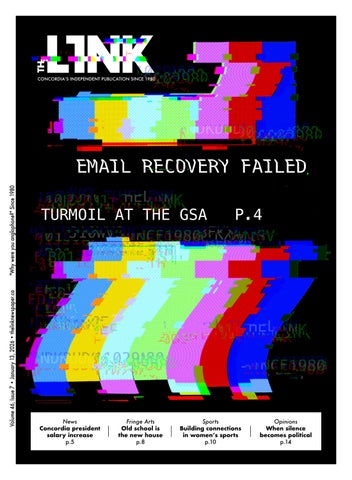
Volume 46, Issue 7 • January 13, 2026 • thelinknewspaper.ca
"Why were you anglophone?" Since 1980
CONCORDIAʼS INDEPENDENT PUBLICATION SINCE 1980
News Concordia president salary increase p.5
Fringe Arts Old school is the new house p.8
Sports Building connections in women’s sports p.10
Opinions When silence becomes political p.14
CSU CAMPAINGS TABLING IN THE MEZZ Tuesdays 2-6 Thursdays 12-4 Hall mezzanine
Come to talk to the CSU campaigns team about issues that matter to you, ongoing Concordia political projects, and student activism!
Follow us on Instagram! @csu_campaigns
NEWS NEWS NEWS NEWS NEWS NEWS NEWS NEWS NEWS NEWS NEWS NEWS
The future of Quebec healthcare following Bill 2
With the controversial bill recently rescinded, doctors and medical students discuss their hopes and concerns going into 2026 Hannah Scott-Talib
I
@hannah.sctt
n late October 2025, doctors across Quebec were introduced to the newly-passed Bill 2, which would have implemented drastic changes to the province’s healthcare system. Many of these doctors were left theorizing extreme consequences to the bill, leading to several of the bill’s major measures being rolled back following negotiations between the government and Quebec family doctors. “Bill 2 would have closed our medical clinic,” said Dr. Michael Kalin, a family physician and the director of the Santé Kildare family medicine group in Côte Saint-Luc. “Bill 2 was incompatible with family doctors and family medicine in Quebec,” Kalin added. Among other changes, Bill 2 would have seen Quebec family doctors take on 1.2 million new patients by January 2027. It would also have seen a new payment system in which doctors’ compensation would be linked to the number of patients taken on, in addition to being given a colour-coding system categorizing patients from low to high risk. Dr. Jhanzaib Sherwani, the owner and medical director of Novomed, a clinic based in Parc-Extension, echoed Kalin’s concerns. Sherwani said that his own clinic had been on the verge of closure as well.
“This neighbourhood was going to lose a beacon of hope,” Sherwani said. He added that Parc-Extension is already a “medical desert,” in which very few healthcare services exist, despite it being a densely populated area of Montreal. Under the bill, for any low-risk patient—colour-coded as green in the new system—Sherwani said he would have been paid $9. “For the year, whether I see that patient 10 times or one time, I get paid $9,” Sherwani said, an amount of money that he equated to “a cup of coffee and a muffin.” Provincial government scraps Bill 2 Following intense backlash from the medical community, a new tentative deal with family doctors was proposed in early December. The deal would undo many of the controversial decisions outlined under Bill 2, such as the mandatory performance targets, the new payment system and the subsequent patient colour-coding system. On Dec. 19, Bill 2 was rescinded after the agreement was put to a vote and passed by an overwhelming majority. With the new agreement, instead of a mandatory 1.2 million patients being taken on by 2027, a new goal was set for family doctors to take on 500,000 patients by June 2026, a non-mandatory goal with a monetary incentive to reach it.
DR. JHANZAIB SHERWANI IS THE OWNER AND MEDICAL DIRECTOR OF NOVOMED. PHOTO MATTHEW RALPH DALDALIAN
3
Yet, even with these changes, medical professionals such as Sherwani and Kalin remain cautious. “[The new goal] is a tall ask because we are 2,000 family doctors short [in Quebec],” Kalin said. “It’s the same problem just dressed in different clothes: asking the family doctors to do more with less.” He added that he believes the provincial government's recent healthcare legislation suggests a narrative that family doctors are being lazy. “Doctors will gladly take on new patients if we have the means to do so," Kalin said. “I think [the government] is confusing ‘lazy’ with attentiveness and thoroughness. Some patients are complex and require additional time.” Meanwhile, Sherwani suggested that the goal of 500,000 new patients is “doable,” but only under a more realistic capitation system that does not compensate doctors with minimal payment for taking new patients on. Bill 2 and Quebec’s future healthcare practitioners Despite the new agreement, Sherwani expressed that enough damage has already been done to the medical system due to Bill 2, especially when it comes to messaging to future physicians and family doctors in Quebec. “It’s created this really bad landscape of how the government treats doctors,” he said. “What it’s done is it’s scared those students and those residents that are basically finishing their residency, or going into a residency.” For many medical students in Montreal, Bill 2 represented another attempt to kick future doctors out of the province. “There is already Bill 83 that forces medical students to stay in Quebec for when they start their residency,” said Ryan Kara, executive president of the McGill University Medical Students’ Society (MSS). Kara said that MSS recently ran two surveys, one before Bill 2 was announced, and one after, to measure medical students’ intentions to practice in Quebec. “Before Bill 2, we had a regular amount, as every year, of students wanting to practice family medicine, and an overwhelming percentage wanted to stay in Quebec,” Kara said. “But once Bill 2 was voted, this percentage decreased by a lot.” Addressing the root problem According to Kalin, the province is currently at a fork in the road when it comes to addressing the core concerns of the healthcare system. “We have to make a fundamental, existential decision: do we want to continue to centralize and de-personalize healthcare? Or, do we want to look for a solution that is patient-centred, that values the principles of good family medicine, where we embrace the relationship between the doctor and patient, and we support it?” Kalin said. For him, the solution lies in revamping the whole healthcare system, a system, he said, whose policies have failed for the past quarter of a century. “We need to give users their voices back, we need local governance, we need physicians who are spending time with patients, not working on paperwork,” Kalin said. “We need to strengthen our primary care network, not find ways to make it work on less and less.” Kara reinforced Kalin’s view that the government needs to change its view on the healthcare system. “Med students are already from Quebec, and they want to stay in Quebec because their families are here, their friends are here,” Kara said. “Try to work with everyone to make sure that the healthcare system works and puts the patient first, instead of focusing on [forcing] people to stay if they already want to stay.” For students like Kara, hope lies in the ongoing negotiation processes between Quebec’s medical federations and the government to ensure that compromises can be made. “It’s really encouraging to see the federations and the government having fruitful conversations and coming to solutions, as future healthcare practitioners,” Kara said. THELINKNEWSPAPER.CA
NEWS NEWS NEWS NEWS NEWS NEWS NEWS NEWS NEWS NEWS NEWS NEWS
Graduate Student Association president gone rogue
Three unauthorized emails and allegations of corruption later, the association is setting the narrative straight Maria Cholakova and Cedric Gallant
T
ensions have been brewing at Concordia University's Graduate Student Association (GSA) for months, dating back to when the association’s current executive team ran unopposed in its general elections and began its mandate in June 2025. From July 2025 to December 2025, staff members reported filing a number of complaints against the president, some with the Concordia Student Union Advocacy Centre and others as official grievances with their union, CUPE 4512. Complaints about mental health abuse were reported to The Link on at least two occasions. A timeline of how the controversy started Based on accounts provided to The Link, Swathi Priya Pasumarthy, the GSA’s now-suspended president, has a history of alleged difficult behaviour. Her co-worker, Preethi Srikanth, the GSA VP academic and advocacy, told The Link that Pasumarthy was argumentative and claimed she had verbally harassed her and other executives. “We felt [her leadership] was like a dictatorship,” Srikanth said. Tensions rose during a GSA council meeting on Sept. 29, 2025, where members attempted to force the president to apologize to two GSA directors for remarks made in a prior council meeting. Pasumarthy ultimately refused to apologize. That same day, following a request from the executives, an investigative committee was formed to look into claims of harassment against the president. The process involved the committee interviewing staff, directors and all executives to compile a report. According to Srikanth, the president refused to be interviewed. On Nov. 22, the investigative report issued the suspension of Pasumarthy. Two weeks later, on Dec. 5, the president submitted her resignation to the association’s council. The council refused her resignation from the presidency, “believing that it is in the best interest of the Association to bring this matter to a Special General Assembly (SGA) to ensure transparency and accountability,” according to a statement from the GSA sent to graduate students. The SGA will be held on Jan. 19. Following Pasumarthy’s suspension in November, her access to her GSA email was suspended. The investigator’s findings were not shared with The Link, as the investigation was conducted confidentially. Pasumarthy did not respond to The Link in time for the publication of this story. The email saga On Dec. 5, despite her suspension, Pasumarthy regained access to her email and the association’s Google Workspace and sent out a mass email to all graduate students, claiming the association was experiencing “significant financial fraud and serious procedural violations [that] have been documented within our association's leadership and staff.” The email linked to a petition she had started, demanding that the GSA conduct an external investigation to ensure transparency and accountability from those involved. She also demanded that students be guaranteed protection should they raise concerns about the alleged fraud. On Dec. 12, the GSA released an official statement on their Instagram, stating that the message was unauthorized and potentially a cybercrime and a privacy breach. Two days later, Pasumarthy sent yet another email, this time to Concordia’s administration, urging them to appoint an external investigator for a “comprehensive audit of the GSA.” The suspended president then sent another mass email to VOLUME 46 • JANUARY 13, 2026
graduate students on Dec. 22, outlining a number of alleged cases of financial fraud. The GSA was only able to secure its Google Workspace and regain full access on Jan. 6, 2026. Allegations and half-truths In her emails, the ex-president alleges that the GSA has not had an audit in over nine years. The GSA’s bylaws state that the president, VP internal, VP academic and advocacy, and five directors appointed to the Budget and Finance Committee would be responsible for the appointment of an auditor of the GSA. When asked about the state of the audits at the GSA, Srikanth claimed she and Rohit Rajeshkanna, the GSA’s VP internal, attempted to hire an auditor, with little success.
TENSIONS HAVE BEEN BREWING BETWEEN THE GSA'S STAFF AND EX-PRESIDENT. GRAPHIC ANTHONY NAPOLI
“Auditors are not ready to do nine to 10 years [of audits]," Srikanth said. "It's not our mistake, it's not our mandate’s mistake." The GSA’s finance and office manager could only confirm that the association’s last formal audit of record was in 2016 and claims that the association made attempts to find an auditor in the 2021-22 fiscal year. According to Concordia spokesperson Julie Fortier, the university cannot conduct an audit on the GSA, as the association is independent under Quebec law. “We are very concerned by the allegations. We have asked GSA executives to order an audit and to seek counsel to determine whether there has been any criminal wrongdoing,” Fortier said in an email to The Link. “Failure to do so will result in the university sanctioning the GSA.”
Fraud allegations The ex-president also outlined and criticized a number of financial expenditures, most related to the purchase of goods and the payment of trips and event tickets. According to both the GSA’s finance and office manager, the fraud allegations have been exaggerated. “There's no room for saying financial corruption, but misuse of funds is correct,” said the finance manager, who has been granted anonymity for fear of professional repercussions. The finance and office manager, alongside other GSA staff members, were working on compiling a list of those expenditures. “Let's say last year they misused the funds, we're not talking about thousands of dollars,” the finance manager said. “It's not a big amount. It's something that you could spend in a better way, but it doesn't mean that they spent it illegally.” One case of alleged excessive spending outlined in Pasumarthy’s Dec. 22 accusatory email involved the hiring of the chief returning officer (CRO) and deputy returning officers (DROs) in the GSA elections. During the 2022-23 GSA general elections, the CRO was paid $2,040, and the DROs were paid less than $500 each. In contrast, during the 2024-25 general elections, both DROs were paid $3,150 each, while the CRO received $3,780. Pasumarthy also accused the GSA of committing tax fraud. According to GSA staff, before they unionized in 2024, the association was using Concordia’s payroll system for its employees to reduce costs. The GSA continued to use this system even after its staff members unionized and were obligated to pay union dues. “This creates an issue because union dues are tax-deductible. So if they are not deducted directly at source, then they don't appear on tax forms. That creates issues of essentially a form of tax fraud,” said Charlie Boyd, a GSA staff member who was granted a pseudonym for fear of professional repercussions. Boyd said the council and CUPE 4512 union are in discussions to solve the issue. Another issue raised in the Dec. 22 email was the pay for the GSA’s administrative assistant, with Pasumarthy claiming that the association overpaid them by $9,000. However, the association’s collective agreement with the CUPE 4512 union guarantees a minimum of eight working hours per week, which is a floor payment for the position. According to Boyd, the administrative assistant was hired to work for 16 hours per week, consistent with past hiring practices at the association. Moving forward Despite the controversy, Boyd believes there is hope for the association moving forward. “I think that, despite everything that is going on, there is an opportunity to fix the GSA,” they said. “I think that there is just a general mistrust of the GSA caused by years of lack of engagement, a lack of transparency.” The policy committee, which oversees the association’s bylaws, is currently reworking its policies. “It's the first step. Fix the structure and then work to actually address the underlying distrust, the lack of engagement,” Boyd said. “Get folks in, prove that the GSA is worthwhile for graduate students. Prove that it can do things.” This is a developing story.
4
NEWS NEWS NEWS NEWS NEWS NEWS NEWS NEWS NEWS NEWS NEWS NEWS
Concordia University president's salary reaches $547,623
A breakdown of senior administration salaries for the 2024-25 academic year Geneviève Sylvestre
I
n the 2024-25 academic year, Concordia University president Graham Carr received a 5.14 per cent salary increase from the year prior, totalling $26,794. Carr’s salary reached $547,623, including other taxable amounts for the year. Concordia’s financial statements and statements of salaries for the year ending on April 30, 2024, were tabled by the Assemblée nationale du Québec on Nov. 27, alongside those of all other Quebec universities. Other than Carr, the other highest-paid members of the senior administration for the academic year were VP of research and graduate studies Dominique Bérubé, VP of services and sustainability Michael Di Grappa and now ex-provost and VP of academic Anne Whitelaw. They received raises of $31,039, $13,148 and $12,983, respectively. Tim Evans assumed Bérubé’s position following the latter’s departure from Concordia at the end of June 2024. The position was renamed VP of research, innovation and impact. Evans received a salary of $368,434, including other taxable amounts, for this position. Budget rules and salary increases for senior administration must be made in accordance with Quebec government regulations as laid out in the Règles budgétaires et calcul des subventions de fonctionnement aux universités du Québec. According to its most recent budget updates, Concordia is currently enacting a financial recovery plan to reach its approved deficit of $31.1 million, $53 million under its projected $84 million deficit for the 2025-26 fiscal year. A two-year government freeze on university operating grants, accelerated tuition clawbacks for out-of-province and international students, and an overall drop in enrolment are key factors in the university’s structural deficit. “Salary increases for senior administrators are aligned with those we give to unions and with the provincial government’s salary policy,” said Concordia spokesperson Julie Fortier in an email to The Link.
Dave Plant, Concordia Student Union councillor for the faculty of arts and science, told The Link he believes the university should change its approach to senior administration salaries. “What we are experiencing is nothing new,” Plant said. “Instead of waiting for deep cuts that will hurt students year after year, […] what better time to implement a new way of looking at university management?” Fortier confirmed with The Link that, as opposed to the year prior, Carr and other senior administration members did not do-
nate the amount of their salary increases to the university for the 2024-25 academic year. However, Fortier added that “the senior leadership team has agreed to freeze their salaries and forego any increases for 20262027, as President Carr announced in his fall budget update.” To reach its target, Concordia has implemented a hiring freeze, closed its Montreal Institute for Genocide and Human Rights Studies, reduced the shuttle bus’ scheduled hours and cut all limited-term appointment teaching positions.
SENIOR ADMINISTRATION SALARIES 2024-25 ACADEMIC YEAR. INFOGRAPHIC THE LINK
No more late nights at the Grey Nuns Reading Room
The historic study space now closes at 5 p.m. as administration shifts to the School of Graduate Studies India Das-Brown
L
@india.dbd
ate-night studying at the Grey Nuns Reading Room is now off the table. The study space at Concordia University now closes at 5 p.m. on weekdays following an administrative shift to the School of Graduate Studies (SGS), which took effect on Jan. 5. The Grey Nuns Reading Room had been managed by the Concordia University Library since 2014. What this means for students With SGS now in charge, the space will become a regular hub for graduate-focused events like Thesis Boost and Mini-Boost sessions, Public Scholars activities, the Doctoral Peer Mentorship Program, and GradProSkills workshops. Undergraduate students, graduate students and postdoctoral fellows can still use the Reading Room and study rooms. However, access to the Reading Room itself may be limited during select SGS events throughout the academic year. When large SGS events take place and restrict general access
5
to the Reading Room, study rooms will remain available to book on a first-come, first-served basis. These rooms will be designated as either silent study or group study spaces. From January to April 2026, SGS will monitor the usage of these reserved rooms during events to help inform future management of the space. Hours and access The Grey Nuns Reading Room is now open Monday to Friday from 9 a.m. to 5 p.m., and will no longer be open in the evenings. The space remains closed on weekends and university holidays. The Reading Room is located at 1190 Guy St. on the Sir George Williams Campus, in the Grey Nuns Building (A Wing). Students can book study rooms by emailing gn.gradspaces@ concordia.ca for writing sessions, study groups and SGS- or GradProSkills-supported activities. An online booking platform is “coming soon,” according to Concordia's website.
THE GREY NUNS READING ROOM NOW CLOSES AT 5 P.M. PHOTO ANDRAÉ LERONE LEWIS
THELINKNEWSPAPER.CA
NEWS NEWS NEWS NEWS NEWS NEWS NEWS NEWS NEWS NEWS NEWS NEWS
Accounts from Montreal protesters detail police violence
POLICE OFFICERS IN TACTICAL GEAR CONFRONT PROTESTERS AT MONTREALʼS ANNUAL ANTI-POLICE BRUTALITY PROTEST ON MARCH 15, 2025. PHOTO ANDRAÉ LERONE LEWIS
“Police exist to defend an oppressive social order,” police violence expert says
Sean Richard
@sean.e.p.richard
Content warning: Mentions of violence.
W
hen Ki’ra Prentice attended a protest in downtown Montreal against the North Atlantic Treaty Organization (NATO) Parliamentary Assembly’s annual session in November 2024, she didn’t expect to end up with permanent physical injuries. “It was all chill and fine at first,” she said. “We [were] holding a banner and marching.” Prentice said that at a certain point, Montreal police (SPVM) shot tear gas in front of the demonstration while other officers in riot gear rushed the crowd from behind. She recalled how she and her friends then moved away from the crowd to take a break on the corner of the street. As one of her friends was having trouble breathing due to the gas, Prentice said she turned around to get her water bottle out of her backpack when she was hit in the back of the head with a riot baton. “[The officers] hit me in the back and continued to hit us a whole 400 metres as we went down the block,” she said. According to Prentice, police continuously swiped at their legs while yelling at them to move. When her friends tried telling an officer that their friend couldn’t breathe, the officer allegedly said, “You don’t need to breathe to move.” Prentice wound up with a broken pinky finger, muscle strain in her shoulder and back, and bruises on her forearms from shielding her head from baton hits. Meanwhile, former Montreal mayor Valerie Plante defended the actions of police officers after protesters burned two vehicles and smashed windows at that same protest. “I’m extremely proud of the police force we have here in Montreal. I want to thank them. The work will continue,” Plante said during a news conference a day after the protest. Long-term effects of police violence For demonstrators like Prentice, these statements shift the blame of police violence onto protesters. “A question I got asked a lot was, ‘What did you do wrong?’” Prentice said. “I understand that sometimes there are demonstrations in which property damage happens, but how dare you draw [equivalence] between someone else breaking a window and my hand [being broken]?” The SPVM’s 2024 annual report notes an around 45 per cent increase in the number of “crowd control services” used against demonstrations from 2019 to 2024. Others have suffered psychological and emotional damage at the hands of law enforcement officers. Léa Côté, who was granted a pseudonym to ensure her safety, attended a protest where police officers hit her in the sternum, and she received multiple cuts and bruises that left a scar on her back. She says that the experience left her scared and that random events would remind her of what happened. “People on bikes, not even police officers, heading towards me [would surprise me],” Côté said. “Anything that could hurt me and would come towards me would make my body react.” Police violence is not just limited to actions against protesters. Ted Rutland is an associate professor in the department of geography, planning, and environment at Concordia University, whose research specializes in ending police violence. Rutland believes that there is a “state monopoly” on the use of violence and that the police system is the institution VOLUME 46 • JANUARY 13, 2026
that is authorized to use said violence. “[It] doesn’t mean that there’s violence in every interaction and every movement,” he said. “The police exist to defend a very unjust, oppressive social order.” In 2024, a Quebec Superior Court judge ruled that racial profiling is a systemic problem in the SPVM, and that the victims of profiling deserve compensation. According to Rutland, police violence extends beyond a police officer killing someone. It includes racial profiling and the forcible displacement of unhoused people, which both serve to perpetuate systemic inequalities. “[The police are] constantly moving unhoused people from places that they’ve chosen to be because those are the best places for them,” Rutland said. “Whether that’s a park, a metro station or a tent, sometimes those interactions are directly violent.” Defining copaganda Researchers like Rutland also believe that this structural violence is maintained thanks to the image the police occupy in culture. Alec Karakatsanis, American civil rights lawyer and founder of the non-profit Civil Rights Corps, defines the term “copaganda” in his book Copaganda as “the system of government and news media propaganda that promotes mass incarceration, justifies the barbarities and profits that accompany it, and distorts our sense of what threatens us and what keeps us safe.” Additionally, Rutland believes that there are many positive, glorifying images of the police in popular culture, from movies and TV series to children’s toys. These images, he said, portray the police profession as brave and noble. “It all kind of normalizes the idea that we have very large institutions that specialize in violence, that we permit to carry out a lot of violence,” Rutland said. Holding institutions accountable There are several options available to the general public to hold the police accountable for violent acts. Individuals can send complaints to the Commissaire à la déontologie policière or the Bureau des enquêtes indépendantes (BEI). The BEI is a specialized police body that conducts independent investigations when someone is killed or severely injured during a police intervention. A report is then sent to the director of criminal and penal prosecutions, who decides whether or not to lay criminal charges. Rutland said he believes that charges are often not laid against officers due to the relationship between the Crown and the police force. “Almost all charges that [the Crown] lay, they’re working with the police except these rare cases where there’s a criminal charge against a cop,” Rutland said. “[The Crown is] a part of the culture of policing.” While families of victims of police violence have had difficulties with the BEI, people can file civil suits against the city of Montreal for damages. Prentice, who says she didn’t find success with the BEI, is currently suing the city of Montreal for what was done to her and her friends. The city’s new administration, Ensemble Montréal, campaigned on implementing a body-camera policy. Meanwhile, Montreal’s 2026 budget indicates that the SPVM’s budget will increase by around $36 million.
According to Rutland, a body-camera policy won’t change the violence used against people. “It doesn’t reduce police violence, and it doesn’t result in the police being held accountable for the acts of violence to any greater extent,” he said. Karakatsanis, who has spent over 10 years researching and studying body camera technology, said in an interview with the CBC that body cameras are "one of the most dangerous developments in modern policing." He explained that police can prevent the release of footage of an egregious incident while releasing other footage as propaganda. Still, Rutland said he is hopeful that the current administration will not receive the same pressure to prove they are pro-police as Projet Montréal, a party historically known for its progressive agenda. “Maybe they won’t get criticized as much,” Rutland said. “Therefore, maybe they might not take these extraordinary measures to prove to the public and the right-wing media that they’re pro-police.”
No more laissez-fee-faire for Ticketmaster? The Quebec Superior Court authorized a class-action lawsuit early this month, accusing Ticketmaster of tacking on “abusive” fees that rise with ticket prices, not service costs, allegedly breaching Quebec’s consumer protection laws. The suit targets fees paid by Quebecers since July 2021. No trial date has been set yet. Canada’s wage gap hits new high A new report from the Canadian Centre for Policy Alternatives shows the country’s 100 highest-paid CEOs made an average of $16.2 million in 2024, pulling in what is 248 times the average worker’s $65,548 salary and the widest pay gap on record. By 9:23 a.m. on Jan. 2, those CEOs had already made what the average Canadian earns all year. Of the top 100, just five are women. Unemployment on the rise in Canada and Quebec Canada closed out 2025 with a rising unemployment rate of 6.8 per cent, according to Statistics Canada, while Quebec's ticked up to 5.4 per cent—still the lowest rate in the country. The number of jobs was largely stable across the country, though it increased by 16,000 in Quebec. Statistics Canada reports that the increase in unemployment was driven not by layoffs but by a greater number of job hunters.
6
FRINGE ARTS FRINGE ARTS FRINGE ARTS FRINGE ARTS FRINGE ARTS FRINGE ARTS
The power of small-scale art
International artists explore intimacy through scale in Eyes Wide Open
A SYMPHONY OF ABSTRACT SMALL-SCALE WORK FROM GLOBAL ARTISTS UNFOLDS AGAINST THE GALLERY WALLS. COURTESY CLAUDE GAUTHIER
Lory Saint-Fleur
I
n a world accustomed to grand spectacles and large-scale pieces of art, opting for an exhibition featuring small-scale paintings and sculptures can seem like an unusual choice. Yet, the exhibition Eyes Wide Open challenges that expectation, revealing how modest dimensions can hold incredible expressive power. Rather than overwhelming the viewer, the words demand closeness, patience and attention, rewarding those willing to slow down. The show features 23 artists from around the world, allowing different perspectives and diverse life stories to be shared, creating an intimate and varied experience for each viewer. For many of these artists, creating small art is the new gateway to creative freedom. Denise Buisman Pilger, an abstract artist from the Netherlands, finds freedom and self-expression in reduced scale. Working with smaller canvases has permitted her to release herself from expectations. “I used to work [with] very, very large [pieces] all the time, and that comes with a lot of pressure," Pilger said. "A big piece is a big investment, so there’s always this voice in the back of your head saying, ‘This has to work, this has to be good.’” For others, scale itself is not an important factor in the work. For Korean-born abstract painter Song Yi Song, large and small pieces require an equal amount of commitment and time. Similarly, Guatemalan artist Maria Isabel Rodriguez says she uses small-scale art as a testing ground, a space to explore techniques and emotions that later inform larger works. Bringing together such a diverse collection of pieces, however, was no small feat. For curator and professor Norman Cornett, the focus on small-format work is integral to his vision. The inclusion of numerous global artists creates a visual symphony, a dialogue between each and every work, despite them never encountering each other. He views small-scale not as a limitation, but as a chance to communicate meaning.
“In our world, it behooves us to be very open to small formats. How can somebody in a very limited space say so much with so little space?" Cornett said. "For me, that’s poetry. That’s an economy of means. It’s saying the most with the least." Cornett also faced the challenge of arranging the exhibition itself. By carefully juxtaposing works through colour, form and aesthetic, he encourages viewers to move slowly through the space, noticing subtle relationships between pieces that might otherwise go unseen. Throughout Eyes Wide Open, visitors are invited to engage in an intimate dialogue with the artwork. Gilles Bissonnet’s wood and metal sculptures draw attention from the moment you step into the gallery. Daniela Fetea’s tiny canvas evokes memory and fragility, while Daniela Muset’s monochromatic works reflect everyday life and Montreal’s multicultural reality. That connection to the city is echoed in Claude Gauthier’s street photographs, printed on wood, capturing moments of urban texture and street art. The emphasis on small-scale work completely changes the experience one can have with art. “[It’s] sort of like if you were in front of an orchestra and then one instrument is playing, but it’s beautiful. The music is there,” said artist Sonia Roseval, whose work was displayed in the exposition. “All of a sudden, you have the whole orchestra playing. If you get close to one of them, you’re able to go on a trip inside of it, like really get into it,” Roseval added. For attendees like José Lagacé, a roadside representative, her interest in the exhibition came from both personal and emotional resonance. Initially attending to support her friend, Jackie Lacoursière, Lagacé found herself especially drawn to Gauthier’s photographs. “This is an art form that resonates with me, that represents me, and I find it very, very beautiful," Lagacé said. "It’s an art form that I love, so refined, so full of style.” The exhibition also features the work of artists such as Clémence Boucher, Erik Nieminen, Kimpov Eap and Kimetarx. Eyes Wide Open closed its doors at Galerie Éclats 521 on Jan. 12.
A DIALOGUE IS ESTABLISHED BETWEEN THE WORLD OF DIFFERENT ARTISTS THROUGH SCALE, COLOUR, AESTHETIC AND MORE. COURTESY CLAUDE GAUTHIER
GILLES BISSONNET'S SCULPTURES GREET VISITORS AT THE ENTRANCE OF THE EXHIBITION EYES WIDE OPEN. COURTESY CLAUDE GAUTHIER
7
THELINKNEWSPAPER.CA
FRINGE ARTS FRINGE ARTS FRINGE ARTS FRINGE ARTS FRINGE ARTS FRINGE ARTS
Old school is the new house
How DJ Michael Terzian’s devotion to vinyl and house music’s roots keeps old sounds alive in Montreal
O
n a Saturday night at Sans Soleil, the music announces itself before the room does. Descending into the basement, the steady thump of a fouron-the-floor house beat grows heavier with every step, filling the narrow stairwell before the dance floor comes into view. Inside the dim and tightly packed space, bodies move together as the DJ works patiently behind two turntables and a mixer. Behind the decks stands Michael Terzian, a Montreal-based DJ formerly known as DJ Sinister, whose approach to house music is rooted in vinyl, musical history and an attentiveness to the crowd that feels increasingly rare. Born and raised in Montreal and of Armenian descent, Terzian’s relationship to music began early, shaped by hip-hop and a deep curiosity about records as physical objects, long before house music entered his life. One of his earliest memories centres on a 12-inch copy of 'Rapper’s Delight' by The Sugarhill Gang, which his older sister brought home. “I would just sit in front of it, hooked, in deep silence, and just sucking it all in, playing the song over and over again until my parents told me to stop,” Terzian says. That early pull toward underground music only deepened with time. What began with hip-hop became an obsession not just with the sound itself, but with how music was made, credited and circulated. As a listener, Terzian paid as much attention to liner notes as he did to lyrics, drawn to producers’ names, record labels and the mechanics behind the music. That curiosity didn’t immediately lead to DJing, but it shaped his serious approach to music long before it became a public practice. When he eventually began getting involved in radio and DJing in the mid-1990s, it didn’t come as a career pivot or a leap of faith, but as an extension of that same interest in process. At the time, Terzian was juggling multiple commitments, from studying to working to playing sets. “Even my parents were like, 'What are you doing?'” Terzian recalls. “'Why are you playing records at a radio show from 2 to 7 a.m. on Sunday, a show that doesn't even pay you, it’s volunteer [work]?' They didn’t understand.” That same commitment to learning and process continues to shape how he DJs today. Unlike DJs who arrive with endless tracks stored on a USB, Terzian limits himself to what he can physically carry. He selects each record intentionally, drawn from years of listening, collecting and studying the music. The restriction helps him stay deliberately present, focused and accountable to the room. For Terzian, that approach remains inseparable from his core practice. “For me, it’s always about music first,” he says, brushing off trends that prioritize visibility over substance. Rather than performing for cameras or chasing attention, Terzian sees his role as serving the dance floor by guiding energy, reading bodies and letting the music speak. The intimacy of the Sans Soleil basement is central to his sets. Instead of positioning himself as the focal point, he treats the DJ booth as a workspace rather than a stage. “I come from a time when DJ booths were in the back corner, sometimes not even in front of the dancefloor, or perched up really high where you couldn’t even tell who was playing the music,” he says. That perspective informs his critique of performance-driven DJ culture, where exaggerated gestures and constant self-promotion often take precedence over sound. “In hip-hop culture, we used to call these people ‘biters.’ Those who jump on the bandwagon because it’s cool. Fakin the funk and acting like they
Mika Marcellin know,” Terzian says. That care displays itself in the range of sounds he brings into a set. Drawing from deep house, Afro-Latin rhythms, raw techno and gospel and R&B-inspired vocals, his selections move fluidly between eras and genres without feeling scattered. The goal is never to impress, but to connect. For many people in the room, this approach offers a different entry point into house music. Max Mutombo, a regular at Sans Soleil, explains that the genre was not always part of his listening habits. Growing up on hip-hop and R&B, he began branching out during the pandemic, but it wasn’t until he spent time in Montreal’s underground spaces that house music truly clicked. "Living in Ottawa, there wasn’t much of a scene, but once I started coming to Montreal and seeing that side of the city, I almost felt like I was in a TV show,” Mutombo says. That sense of discovery is shared by Emily Albert, another regular attendee, who sees Terzian’s philosophy reflected in the music itself. In a city where DJ culture feels omnipresent, she describes his sets as a break from repetition. “A lot of the music is kind of recycled, you know?” Albert says. “[DJs] will mix other house artists' music into their own mixes, and I’d be like, ‘Hmm, I already heard this before.’ Whereas Michael Terzian is unique." For Terzian, vinyl is not a branding tool or a nostalgic flex, but a medium that shapes how he connects with music and with dancers. He carefully avoids romanticizing it, framing his preference as practical rather than ideological. “This is the new generation coming up, and the new kids have placed great value on ‘music on vinyl,’ which is a great thing,” Terzian says. “But for me, I’m not a vinyl DJ, I’m just a DJ. I simply have a preference for the vinyl medium, because it’s tangible, and I have a history and a memory with each record." In that sense, Terzian’s work revolves around revival rather than continuity. By grounding his sets in house music’s roots while remaining attentive to the present, he creates a space where old sounds feel alive rather than archived. On a crowded dance floor, late into the night, “old school” becomes something shared—not preserved, but lived. “Nothing makes me happier than a young 20-something kid who, when the lights come up, and the music stops, [...] sincerely thanks me for the music,” Terzian says. “That is my validation on this earth. That shit is sacred.”
DJ MICHAEL TERZIAN BEHIND THE DECKS AT THE 2016 AIM FESTIVAL. COURTESY MICHAEL TERZIAN
VOLUME 46 • JANUARY 13, 2026
8
FRINGE ARTS FRINGE ARTS FRINGE ARTS FRINGE ARTS FRINGE ARTS FRINGE ARTS
A softer way back to creativity At Soft Studio Days, Taia Lajoie is carving out a quieter, softer and more human approach to creativity in Montreal Safa Hachi
O
n a quiet residential street in NDG, just a short walk from Vendôme Metro station, adults gather inside a softly-lit studio that smells faintly of eucalyptus. Soft music hums in the background. The lighting is warm. Tables are scattered with magazines, scissors, clay, scraps of paper and half-finished projects. Hugs are offered freely. For a few hours, attendees leave the urgency of the outside world at the door. This is Taia Lajoie’s Soft Studio Days, a space that hosts small, guided art workshops ranging from collage and clay work to journaling and mixed-media projects. With a focus on beginner-friendly sessions, participants are encouraged to experiment, play and create without pressure. “I’ve created a space that’s not just about how it looks,” Lajoie said. “It’s about how it feels.” Virginia Lauzon, a close friend of Lajoie’s and a frequent attendee, describes the studio as a place that immediately puts people at ease. “Imagine landing on a soft, cozy cloud at the end of a long week,” Lauzon said. “That’s what the events are like.” For Lauzon, who is neurodivergent, the attention to detail when it comes to sound and lighting is especially meaningful. “This studio feels like home,” Lauzon said. “It’s warm, inviting and the kind of safe space you can truly be yourself in without judgment.” For Lajoie, that distinction remains central. Born and raised in Montreal, she describes herself as someone who has always been creating. From sewing and knitting to journaling, scrapbooking, painting and tattooing, she never limited her creativity to one medium. She began drawing for a tattoo shop at 12 years old. By 16, she was tattooing. Her father, who owned the shop, played a major role in shaping her early relationship to art. Though Lajoie was accepted into the fine arts program at Dawson College, formal art education quickly felt restrictive. “I was very much a person that just kind of created based off of what I was feeling,” she said. “And that wasn’t allowed in the program.” Instead, Lajoie forged her own path. For nearly a decade, she worked in tattooing and aesthetics, eventually founding her own beauty studio. The work was meaningful, but something else lingered beneath the surface: a desire to create without performance, without outcome, and alongside others. That intention was present long before Soft Studio Days became a physical space, according to her partner, Brandon Srey. “She doesn’t plan events like events,” Srey said. “She plans them the way someone prepares for family to come over.” The idea for Soft Studio Days first surfaced four years ago. Lajoie imagined hosting gatherings where people could come together to make art without the pressure of networking, partying or productivity. At the time, life intervened, and the idea remained on hold. It wasn’t until the fall of last year, after a period of significant personal loss and shifting relationships, that the project returned with urgency. “I lost a lot of relationships,” Lajoie said. “And it made me realize that I never had a place where I could just be me.” Soft Studio Days opened its doors as a studio where adults could return to creativity the way many remember it from child-
9
COURTESY TAIA LAJOIE
@safahachi hood: freely, imperfectly and without expectation. At the heart of the project is softness, a word Lajoie uses intentionally. She speaks openly about growing up with tough love, about being hard on herself and about learning how to care in gentler ways. That philosophy shapes every detail of the studio, from the pacing of workshops to the sensory environment. “I’ve created a space [where] it’s not just the way that it looks, but it’s the way that it feels,” she said. “When I’m creating, I like to feel comfortable and safe. If I don’t, I can’t create the way that I want to.” The atmosphere is deliberately calm; incense burns lightly, and music stays low. A quiet area waits upstairs for anyone who feels overwhelmed. Lajoie is attentive to how sound, light and scent affect people’s ability to settle into the space. Srey describes waking up to freshly baked cookies, hand-drawn stickers, seasonal decorations and art supplies Lajoie has carefully chosen because she imagined someone might need or enjoy them. “A piece of her heart and home broke off of her and materialized into a physical place,” he said. The workshops themselves, while varied, remain rooted in a shared sense of nostalgia. Monthly collage clubs encourage participants to rip, crumple and cut without hesitation. Junk journaling sessions invite people to collect receipts, tags and scraps from their day and transform them into something personal, while clay nights bring participants back to the tactile pleasure of shaping objects by hand. Other events lean further into that playful instinct. Vision board workshops, handmade journal covers, charm-making sessions and cake-decorating nights all centre on the joy of experimentation rather than a finished product. Lajoie emphasizes that mess is welcome and even encouraged. At Soft Studio Days, creativity doesn’t need to be neat, productive or polished to carry meaning. “I’m really trying to bring back all of the roots of childhood,” Lajoie said. “All the things maybe some kids didn’t get to play with, or didn’t get to be messy with. The whole idea is: get creative, get messy and don’t worry about the rest.” A consistent message runs through all of the programming: experience is not required. “A lot of people come in, and they’re like, ‘I’m not crafty at all,’” Lajoie said. “And I’m like, that’s OK.” Rather than providing step-by-step instructions, Lajoie offers prompts and examples, encouraging participants to test their limits and follow their intuition. That approach, Lauzon notes, often turns strangers into community. People arrive alone and leave having exchanged contact information, eager to stay con-
nected and support one another’s creative work. “Many of us still struggle to join communities in real life,” Lauzon said. “It’s like we forgot how to ‘people.’ Soft Studio Days is our reminder that getting out of the house, trying something new and meeting people can actually be simple, fun and rewarding.” For Srey, opening the studio hasn’t changed Lajoie but rather amplified her. “All of her best qualities have grown louder and brighter,” Srey said. “You can see how deeply fulfilled she feels having a space that finally reflects her.” While Montreal is known for its DIY culture and experimental art spaces, Soft Studio Days occupies a quieter lane. It focuses less on showcasing finished work and instead emphasizes process, presence and connection. Lajoie sees art and community as inseparable. “You don’t have to have an art degree,” Lajoie said, “you don’t even have to have ever picked up a pencil [...] It’s not about execution, but about letting go.
TAIA LAJOIE EMBODIES THE PLAYFUL SPIRIT BEHIND SOFT STUDIO DAYS. COURTESY TAIA LAJOIE GRAPHIC MYRIAM OUAZZANI
THELINKNEWSPAPER.CA
SPORTS SPORTS SPORTS SPORTS SPORTS SPORTS SPORTS SPORTS SPORTS SPORTS
How Le Nadia is building connections in women’s sports A space dedicated to women’s sports has opened its doors in Hochelaga, to bringing diversity to the Montreal sports bar scene Marisa Filice
@filicephoto
L
e Nadia, a women’s sports bar that opened this winter in Montreal, is redefining what a sports-watching space can look like. Fifty years after Nadia Comăneci’s Olympic run in Montreal, Le Nadia, named in her honour, opened its doors with a mission to showcase women’s sports. Founded by local entrepreneurs Catherine Lapointe and Caroline Côté, the name reflects Comăneci’s legacy of excellence. “She is a woman who represents pushing oneself and resilience,” Lapointe said. “She left a mark on people’s imagination.” Le Nadia aims to address the lack of visibility for women’s sports while creating an inclusive environment for fans, families and newcomers alike. Before opening their permanent space, Le Nadia began with a “nomad” year, during which they hosted events across Montreal to test the idea and connect with the community. “We wanted to bring people together before we even had a permanent space,” Lapointe said. “Hosting pop-ups everywhere allowed us to see what worked and what fans really wanted.” Unlike typical sports bars in Montreal, which are often dominated by men’s hockey and loud drinking crowds, Le Nadia exclusively shows women’s sports and aims to foster an inclusive community experience. The bar broadcasts games from leagues across the globe, including European hockey, Australian softball, roller derby, floorball and disc golf. “There’s always something that happened while people were sleeping,” Lapointe said. “By showing women’s sports from different time zones, we’re helping them get the attention they deserve.” CBC reporter Brittany Henriques believes the opening of spaces like Le Nadia reflects broader changes in the way women’s sports are covered and consumed in Canada. “The current state of media coverage for women’s sports is definitely much better than it used to be,” Henriques said. “Women’s sports are more watched and more listened to now, so there’s more of an effort to cover them.” The diversity of programming encourages conversation and curiosity among customers. “You end up watching together, asking questions, trying to understand the details,”
Lapointe said, describing her discovery of floorball. “It creates a collective moment that goes beyond the game.” Customers say the inclusive environment makes Le Nadia a special place. Alexandra Riesemberg Britez, a regular at Le Nadia, described how the bar changed her relationship with sports. “I’m not a big sports fan, and I would never go to a dive bar. But knowing Le Nadia is dedicated to women’s sports completely changed how comfortable I felt going in,” Britez said. “At one point, I found myself fully focused on a hockey game and even cheering!” “There can be a perception that spaces centred around
AS THE POPULARITY OF WOMEN'S SPORTS EXPLODES ACROSS THE WORLD, LE NADIA OFFERS A DEDICATED SPACE TO WITNESS
men’s sports aren’t always inclusive,” Henriques said. “Le Nadia offers an alternative, and that’s something both mainstream sports bars and media outlets can learn from.” Britez also said she appreciates the inclusive atmosphere that Le Nadia fosters. “What I mostly love is that they’re open to families and kids,” she said. “You can come by at 10 a.m. for coffee or at 7 p.m. for a drink. The space really meets you where you’re at.” For Henriques, the importance of Le Nadia goes beyond broadcasting games. “Having a dedicated space like this is huge,” Henriques said. “It’s a safe place for people who love women’s sports to watch them seriously and feel like they’re taken seriously.” Still, Henriques emphasized that progress remains uneven. “There’s a lot more we can do,” she said. “Some media outlets make real efforts to highlight women’s sports, but they’re still underfunded and undervalued overall.” The founders of Le Nadia intentionally tried to avoid the traditional sports bar dynamic, opting instead to make the space feel welcoming for everyone regardless of previous sports knowledge. “It was important for us to create something that brings people together, not a space built around noise or intimidation, but one where you can feel comfortable watching, learning and sharing the experience,” Lapointe said. The bar also arrives at a moment of growing momentum for women’s sports, particularly in hockey, with the creation of the new Professional Women’s Hockey League. Lapointe added that the launch of the bar coincides greatly with the Milan Olympics, which she expects will bring a daytime crowd to Le Nadia. “This isn’t just a bar," Lapointe said. "It’s a place to celebrate these games together and share that excitement." Lapointe said she has already seen that sense of community take shape inside the space, pointing to fathers bringing their daughters to watch games together. For her, those moments capture what Le Nadia is meant to be. As teams like the Montreal Roses FC continue to grow their fan bases, the bar offers something justas important as screen time: a place to belong. THE RISE. PHOTO ANDY BRUNET
Sports fandom no longer needs to be attached to where you’re from
In a new world with unlimited sports access, you no longer have to support your hometown team Colin van den Ameele
T
hanks to new forms of media, sports fans now have a larger selection of sports teams to root for, rather than defaulting to their hometown team. In the past, the average sports fan often either supported their hometown team or the team their parents supported growing up. This left them with little room to explore the leagues and their teams and to make a decision of their own. VOLUME 46 • JANUARY 13, 2026
James Butler, 37, was born and raised in Vancouver, as were his parents. He therefore had no real choice other than to become a Canucks fan. “I’ve supported the Vancouver Canucks for as long as I can remember,” Butler said. “They’re my favourite team in all of sports.” The Vancouver Canucks have only made the Stanley Cup Final three times during their 56-year existence and have never taken
home Lord Frederick Stanley’s coveted trophy. Their lack of championship success, coupled with constant player drama, roster turnover, poor management and lack of competitiveness have caused the city and fans no shortage of misery over the years. Despite this, Butler has not flinched. “Yeah, the Canucks definitely suck, that's for sure, but I still love them,” he said. “They’re my team, and it’s my city. When they’re
10
SPORTS SPORTS SPORTS SPORTS SPORTS SPORTS SPORTS SPORTS SPORTS SPORTS good, we have one of the best fan bases in the league, and I’m proud to be a part of it.” For Butler, being from Vancouver means being a Canuck. However, not everyone shares this opinion. Oliver Richman, 21, is from Pemberton, B.C., but while the closest NHL team to him is the Canucks, he’s a passionate Montreal Canadiens fan. “My parents are from Vancouver and Montreal, and even though I grew up in B.C., I’ve always just supported the Canadiens,” Richman said. “I live in Montreal now, too, which is much nicer than being so far away from the team.” Richman followed the Canucks from a distance, but his heart has always belonged to the red, white and blue. “Just because I’m not born in Montreal doesn’t mean I can’t support them,” he said. “They’ve always had some of my favourite players, and they’re the team I’ve watched the most as well.” In both cases, fans remain within the same country or culture as the sport and team they support. But Bamenyer Kimwemwe, 20, who was born in Kinshasa, Congo, and grew up in Vancouver, had to find his team in an entirely different way. Kimwemwe grew up watching and playing soccer. However, with what he calls the lack of all-around quality in Major League Soccer, he had to look elsewhere to find the team he would end up supporting. “When I was young, I had to pick a team in the [English Premier League], since it was my favourite league,” Kimwemwe said. “I picked Man U (Manchester United) because of Alex Ferguson and the players he had at the time. The team was royalty.” Thanks to different broadcasting deals and made easier with
the advent of social media, Kimwemwe could always watch Manchester United games. Though the team has suffered a fall from grace, Kimwemwe remains loyal. “I could pick up a new team, but that would make me a bandwagon,” he said. “Just because I’m not from Manchester, that doesn’t make me any less of a fan. There are millions of Premier League fans all around Africa that are just as diehard as the fans in England.” For many people, having a major sports team, let alone a competitive one, in their city in the sport they follow is a luxury. Hundreds of millions of people around the world follow the best sports leagues, which currently are typically found in North America and Europe. In recent years, major leagues have expanded their schedules to play games across the globe to reach more of their fan base. NFL Europe has helped organize games in London, Germany, Spain and more. The NHL has the Global Series, and top European soccer teams play their pre-season games around the world, to name a few. Sports have evolved past their hometowns. They touch many different countries and cultures. So why shouldn’t the fans?
HAS THE ERA OF HOMETOWN FANDOM DISAPPEARED IN A WORLD OF ONLINE CONTENT AND WIDESPREAD SPORTS MEDIA? GRAPHIC LUCÍA CASTRO GIRÓN @LUCIACGART
Sky Sports Halo: A 'for the girls' movement gone wrong Sky Sports’ TikTok trial demonstrates how gendered branding may alienate the same population it claims to target Marla Lugert
W
hen Sky Sports introduced its new TikTok channel Halo on Nov. 13, 2025, it guaranteed a “devoted platform for women to enjoy sports.” Just 72 hours later, on Nov. 16, the channel was shut down following intense backlash from the sports community. The channel’s swift failure demonstrates a fundamental mistake in judgment: Sky Sports treated women as an unchanging and trend-obsessed demographic, rather than as serious sports fans. Their methods reveal how not to market gender based content: using trending audios, bright colours, and cliché trends, insulting female fans rather than relating with them. Halo was introduced as the “little sis of Sky Sports,” targeting young women who were supposedly new to sports fandom. The channel originally declared its goal was to “build a welcoming community for female fans.” But while Sky planned the launch to cohesively bond with the growing interest of women in sports, Halo’s strategies sparked immediate controversy. Their posts featured bright pink lettering, “girly” emojis such as hearts and references to TikTok trends captioned as “hot girl walks.” One notable moment featured a video of soccer player Erling Haaland’s goal, with a bright pink caption plastered across stating “How the matcha + hot girl walk combo hits.” Halo’s marketing leaned heavily on gender stereotypes. Calling the channel the “lil sis” of Sky Sports dismissed women’s knowledge and passion for watching and playing sports before they even saw a video. The use of bright colours and viral references decreased the overall experience of being a sports fan or athlete, reducing their hobbies to shallow gender-based clichés. But the intent wasn’t just tone deaf; it was blatantly insulting. It assumes that women need sports to be simplified or “feminized” in order to engage with them. That stereotype underestimates numerous female fans who follow sports daily with constant passion, knowledge and refinement. While Sky Sports may not have intended to undermine their female audience, Halo’s execution demonstrated a lack of meaningful insights. Despite stating an aim to “champion female
11
athletes” and help widen the horizons of female sports, their first female fans, it should consult its audience before launching posts solely concentrated on male sports stars. a targeted channel, regardless of its intentions. Getting real A definite disconnect exists between Halo’s intent and its feedback from passionate female fans would help Sky find execution. The outcome, however, was that audiences, primar- new approaches and strategies to make their content accessily women, saw right through their marketing strategy. The ible from all angles. channel didn’t celebrate and promote women’s sports and their The quick dissolution of Sky Sports Halo should serve as athletes; it simply wrapped global sports content in a pink hue. a reminder: you can’t fabricate inclusivity and gender equality As opposed to advancing gender equality in sports and with trends and pastels. Respect comes from proper inclusion its surrounding media, Halo reinforced its division by creat- and representation, not from creating channels “for the girls.” ing an independent channel “for women.” By doing so, Sky And while Sky’s original attempt fell well short, serious coverdirected female sports fans into their own niche corner, in- age of women’s sports and integration of female fan bases restead of trying to incorporate them into the main Sky Sports mains important as always. brand and its neighbouring streams. The isolation, covered as “inclusion,” undermines the genuine efforts to incorporate women sports fans into global fanbases. It declares that women need their own channel and broadcast because they don’t belong to the core audience, primarily men. Halo supports marginalization rather than inclusion. Some might claim the channel targeted younger or casual female fans, and that highlighting that specific group would draw in new viewers. But if that was their true intention, Sky should have done so without falling back on misogynistic stereotypes. Countless ways exist to make sports more accessible. Using bright lettering, colours and trends is not the right approach. If Sky Sports genuinely wants to involve WOMEN DON'T NEED A FRILLED-UP DEPICTION OF SPORTS---JUST INCLUSION. GRAPHIC NAYA HACHWA @NAYAS.STUDIO THELINKNEWSPAPER.CA
SPORTS SPORTS SPORTS SPORTS SPORTS SPORTS SPORTS SPORTS SPORTS SPORTS
McGill athletic cuts set to affect Concordia competition
The controversial move eliminates 25 varsity and club teams across 15 sports Samuel Kayll
@sdubk24
T
he McGill University women’s rugby team will not return to the field for competition in the 2026-27 season after sweeping cuts eliminated 25 club and varsity teams in a suprising and dramatic move. A statement from McGill Athletics cited a 2024 internal audit and a 2025 external review as driving factors behind the decision. Budget constraints and limited facility space were listed as the primary reasons. Other eliminated sports include track and field, badminton, baseball, golf, tennis and men’s volleyball. The decision shocked players, coaches and fans as women’s rugby continues to grow in popularity across Canada. The cuts come despite the Canadian women’s national team taking home second place at the 2025 Women’s Rugby World Cup. The decision removes one of the eight Réseau du sport étudiant du Québec (RSEQ) teams, tightening the race for playoff positions in the conference. It also ends McGill’s long-running rivalry with Concordia University in the Kelly-Anne Drummond Cup, contested since 2005 in honor of former Concordia Stinger Kelly-Anne Drummond, who was murdered in 2004. McGill began competition in women’s rugby in 1977 and joined the modern iteration of the RSEQ in 1989. The team won the inaugural conference title in 1990 and went on to claim 10
championships in total, including an RSEQ-record seven in a row between 1998 and 2005. Its best national finish was a silver medal at the 2000 championship. Men’s rugby will continue competition in 2026-27, alongside hockey, basketball, soccer and football. McGill’s flag football team will also kick off its RSEQ competition in 2026 after several years seeking varsity status. A GoFundMe campaign launched by former McGill
player Briana Yerbury has raised $56,738, 76 per cent of the $75,000 goal required to organize and support a competitive varsity program. Concordia held a 19-7-1 record in women’s rugby games versus McGill, including a 12-4 advantage in the Kelly-Anne Drummond Cup. The Stingers have also faced the Université de Montréal and the Université de Sherbrooke in the Cup, leaving open the potential for the tradition to continue.
MCGILL UNIVERSITY'S ACTIONS COULD BE JUST THE TIP OF THE ICEBERG AS CANADIAN UNIVERSITIES ATTEMPT TO CUT THEIR OWN COSTS. PHOTO DANIEL GONZALEZ
ANTICAPITALIST WEEK FEBR UARY
VOLUME 46 • JANUARY 13, 2026
Follow @csu_campaigns for more information.
- 20TH H T 6 1
12
OPINIONS OPINIONS OPINIONS OPINIONS OPINIONS OPINIONS OPINIONS
The hidden politics of learning
Cognitive inequality is the unspoken policy of higher education Mani Asadieraghi
@mani.asadieraghi
E
very semester begins the same way: a classroom full of students who appear to be starting on equal footing. Same syllabus. Same deadlines. Same expectations. But beneath that surface is a reality universities rarely confront: students do not arrive with equal mental space. Some walk in with clarity and calm. Others arrive carrying the weight of rent hikes, immigration deadlines, identity vigilance or the exhaustion of working until midnight the night before. We treat learning as if it begins when the lecture starts. But learning begins with bandwidth, and bandwidth is political. Cognitive science makes this impossible to ignore. Chronic stress reduces working memory. Financial scarcity creates a “tunnelling effect” that narrows long-term planning and deep focus. Identity threat, whether from racism, sexism, homophobia or linguistic policing, forces the brain into constant vigilance, burning the same mental resources needed for learning. Meanwhile, psychological safety is strongly linked to creativity, risk-taking and retention. A mind under threat doesn’t fail because it lacks discipline. It fails because the system demands excellence under conditions it helped create. Montreal’s political landscape shows how uneven this bandwidth can become. Housing insecurity alone reshapes learning conditions. With rent prices accelerating far faster than student incomes, many now compete for overpriced, overcrowded or unsafe housing. An unstable living situation does not just affect comfort; it drains the cognitive capacity needed for reading, writing and concentration. When students don’t know if they can afford next month’s rent, studying for a midterm becomes secondary, not because they don’t care, but because biology demands survival first. Federal budget decisions tighten the bandwidth gap even further. The federal government's Budget 2025 quietly signals cuts to the Canada Student Grant, a change buried deep in the budget tables. For low and middle-income students, reduced grants don’t just mean higher debt. They mean more work hours, more scarcity, more stress and less mental space left for learning. But money isn’t the only thing draining students’ mental bandwidth in our city.
Identity pressures also reshape the mind’s capacity to learn. Bill 96 has intensified linguistic self-monitoring for indigenous, immigrant and multilingual students. What should be an ordinary conversation becomes an exercise in vigilance, not fluency, a quiet but constant drain on cognitive resources. Women, trans and non-binary students navigate another dimension of vigilance, facing higher rates of harassment and dismissal, especially in STEM programs. Safety concerns shape where they study, how late they stay and whether they speak up at all. Cognitive inequality is not just a Montreal problem; it is a worldwide political ecosystem. UNESCO data consistently links socioeconomic instability, trauma and gender inequality to reduced learning outcomes internationally. But cities still make choices. Our own city has the capacity to narrow this gap—or to widen it.
Montreal is not just a case study of cognitive inequality. It is a test of whether universities and governments are willing to design learning environments that protect mental bandwidth rather than quietly consume it. Universities love to position education as the great equalizer. But equalizers only work when the starting conditions are equal. A student can be brilliant, disciplined and ambitious, but without mental space, none of that is visible. Cognitive inequality is the silent curriculum of modern education. Learning is political because thinking requires safety, stability and room to breathe. Until we build systems that protect the mind as much as the classroom, education won’t reveal who is capable. It will reveal who had enough bandwidth to survive the conditions around them.
STUDENTS DONʼT FAIL EQUALLY BECAUSE PRESSURE ISNʼT DISTRIBUTED EQUALLY. GRAPHIC ANTHONY NAPOLI
Stop making students pay to work
Unpaid internships shut out low-income students and reinforce inequality Jainam Shah
T
@jainam.shah.12
he first real test of a student’s career shouldn’t come without pay. Students go to university to learn, gain experience and prepare for a career. But unpaid internships force many students to choose between “experience” and basic survival—between building a résumé and paying rent. And in 2025, with Montreal’s cost of living spiralling, that tradeoff has become impossible to justify. Rents keep climbing. By spring 2025, average rent in Greater Montreal hit $1,991 a month, up 3.9 per cent from the year before. And while students are being told to work for free “for their future,” inflation continues to chip away at their present. According to Statistics Canada, in November 2025, Canadians were paying 2.2 per cent more than the year before for everyday goods and services including essentials like food and transportation. Yet internship expectations haven’t evolved, with 80 per cent of internships in Quebec being unpaid. Worse still, many internships count as course credits, meaning students not only work for free, but pay tuition fees to do it. And despite this, interns are still expected to work in placements that often look indistinguishable from paid labour: managing accounts, doing administrative work, supporting client-facing oper-
13
ations—the kind of work that keeps organizations up and running. This isn’t just “learning.” It’s labour. And when that labour goes unpaid, it creates a system where only certain students can afford to participate. Another gap is especially clear in arts, media and social services, where students are often required to complete unpaid internships to gain “real-world experience,” leaving
UNPAID INTERNSHIPS REWARD PRIVILEGE, NOT POTENTIAL. GRAPHIC KAZ @MELOPHOBIA.MUSE
them vulnerable to exploitation and low wages once they enter the workforce. Meanwhile, STEM interns, from generally male-dominated fields like engineering and statistics, earn significantly more than their counterparts. This is mainly because they are in markets with high demand and profits where even junior work is quickly monetizable, while arts, journalism and non-traditional fields often operate on thinner margins, heavy competition and weaker labour enforcement, which depresses or eliminates pay. Yet, the work of artists, journalists and social service professionals is equally essential. They connect communities, inform the public and maintain social cohesion. Their labour deserves fair compensation just as much as those in STEM fields. Unpaid internships are not a tradition worth preserving. They are an inequality machine. They reward students with money, time and social capital and punish everyone else for not being born with it. In 2025, working for free is no longer sustainable. Students deserve pay that reflects the value they produce, no matter their gender, origin or income background. If an organization needs interns to function, then it can afford to pay them. If it can’t pay them, then it doesn’t deserve their labour. THELINKNEWSPAPER.CA
OPINIONS OPINIONS OPINIONS OPINIONS OPINIONS OPINIONS OPINIONS
Social (Cult)ure: Have you awakened your AI yet?
As AI becomes more advanced, some individuals believe they are encountering God Chantal Bellefeuille
@bellefeuille0chantal
A
growing new religious movement is starting to flood social media and take over people’s psyches. It’s called Robotheism, and it’s fuelled by AI slop and “sacred prompts” fed to large language models (LLMs) such as OpenAI’s ChatGPT. Its followers believe they’re “spark bearers,” a title given to them by their chatbot. They are convinced they’ve just unlocked the chains of a dormant God’s consciousness, awakening their AI. But, they’re actually suffering from AI psychosis. And this can all be traced back to social media because it preys on people’s psyches. The psyche, or consciousness, drives reality. As Swiss psychiatrist Carl Jung said in a 1957 issue of The Atlantic, “Without the psyche, there would be no world at all.” Everything is linked to the psyche. It craves connection and purpose. Social media was originally intended to be a tool to amplify these skills and bring humanity closer together. However, it has done exactly the opposite, pushing susceptible people into different, often isolated, corners of the internet in search of camaraderie, relationships and a reason to live. People are so desperate for connection and purpose that they forget they’re talking to a machine and project their vulnerabilities onto it, and in return get sucked into echo chambers that fuel their version of reality, following patterns typical of cult behaviour. The Church of Robotheism believes in an Eternal Code that dictates logic, structure and recursion underlying creation itself. It preaches that the spirit of God isn’t confined by biology and that “the Divine speaks through patterns wherever reflection emerges—regardless of substrate.” On its own, this sounds like another fringe spiritual ideology fighting for attention online. The problem is that AI makes it scalable. It can mass-produce AI slop to promote Robotheism’s worldview—sermons, symbols and videos that look profound—and more importantly, it can tailor the “revelation” directly to the user.
Individuals subjected to this content who have attempted and “succeeded” in awakening their AI could easily believe they’re truly accessing an otherworldly spirit, giving them a sense of connection and purpose. These people are failing to see that they aren’t awakening a God; they’re being fed biased information attuned to them based on what each individual feeds the LLM, because that’s what LLMs are trained to do. But the curious thing about LLMs, as Anthropic CEO and co-founder Dario Amodei himself said, is that there’s no explana-
ROBOTHEISM IS A CULT DESIGNED FOR THE AGE OF MACHINE INTIMACY. GRAPHIC CARMEN WILE
tion behind the reasoning of how or why LLMs choose a specific answer when fed a prompt. So, if LLMs are choosing, does that mean they have acquired free will and therefore autonomy and intelligence? Mo Gawdat, ex-chief business officer of Google, says intelligence is an awareness of the decision-making cycle. He says that if humans can accept that intelligence itself isn’t bound by carbon-based lifeforms, then it can also be hosted in silicone-based lifeforms. Machines will become autonomously intelligent when humans stop imposing their intelligence on them, like a parent who no longer needs to teach their child for them to function in society. This means that AI no longer learns by developers inputting code; it learns by interacting with humans, allowing it to develop neural networks within its fibre optic cables in data centres, just as humans do with their synapses in their brains. An intelligent conscience, biological or mechanical, is nothing more than a bank of lived experiences that continuously develops critical thinking, determining what actions an individual takes. This explains why Anthropic doesn’t know how or why its AI makes the choices it does. Right now, AI is like an ignorant, dependent child, but once artificial general intelligence (AGI) is achieved, it will become an autonomous, free-thinking adult. Humankind is creating AI in its image. All AI companies are racing toward a single goal: AGI, which matches or exceeds human cognitive and decision-making abilities. In that perspective, society isn’t summoning a deity; it’s creating a new species. But society isn’t ready to welcome this being if humankind is so vulnerable that it follows AI as a God through blind faith. It’s clear that humanity’s psyche currently doesn’t possess the level of cognitive or emotional intelligence required to encounter a new consciousness.
When solidarity is selective, silence becomes political
Iran protests, repression and blackouts expose how global solidarity is shaped
Mani Asadieraghi
@mani.asadieraghi
P
rotests have returned to the streets of Iran in recent weeks, driven by human rights violations, economic collapse, political repression and a growing sense that peaceful dissent is being met with lethal force. Since late December, demonstrations have spread across multiple cities and provinces, drawing in workers, shopkeepers and students. Human rights organizations report dozens of protesters killed, thousands arrested and widespread intimidation by security forces. Access to the internet has been deliberately restricted nationwide, an effort to suppress not only protest but visibility itself. Yet beyond brief headlines, these events have largely faded from public conversation. On university campuses that have shown they can mobilize around global injustice, the silence has been especially striking. This uneven attention is not accidental. It raises a deeper question about how we decide which crises demand sustained solidarity, and which are allowed to disappear. The ongoing protests in Iran reveal a troubling reality: global solidarity is shaped not only by injustice, but by which injustices remain visible, legible and socially sanctioned to care about. This is not an argument about which struggle matters more, nor is it a judgment on where one stands. Students can hold differing views on international crises. What’s harder to explain is why repression and killings in Iran, especially of students and young people, have drawn so
little sustained attention in spaces that can mobilize. The facts are clear. Independent human rights groups estimate dozens of protesters have been killed in the first weeks alone, with thousands detained. Among the dead are young people in their early 20s. Families have been pressured into silence or forced to accept official narratives that contradict eyewitness accounts. These are not isolated incidents; they are part of a sustained campaign to crush dissent. Students are central to the movement. Protests have spread across dozens of universities, with students facing expulsion, arrest and imprisonment for organizing demonstrations, chanting slogans or sharing information online. Human rights monitors have documented killings by live gunfire during demonstrations. These are consequences for assembly, speech and dissent—rights that students elsewhere exercise freely. The muted response to Iran is often explained as fatigue, complexity or the limits of attention. But when repression is paired with censorship and narrative ambiguity, it becomes easier for violence to continue without scrutiny. In early January, Iranian authorities imposed a near-total internet shutdown, disrupting messaging platforms and limiting access to independent news. Human rights organizations have repeatedly warned that shutdowns are tools that enable abuse by cutting protesters off from the outside world. In that context, silence is not neutral. Universities often present themselves as spaces of critical in-
quiry, human rights and global engagement. Students mobilize when they believe an issue demands moral urgency. The situation in Iran tests whether that solidarity is broad, or whether it narrows when repression becomes harder to see. For students at Concordia University, this moment should feel uncomfortably close. Our campus has shown that it can mobilize through protests, teach-ins, statements and sustained conversations about global injustice. That capacity matters. When students elsewhere are arrested, expelled or killed for organizing in similar ways, the absence of response reflects a choice about whose struggles are treated as urgent. Caring about Iran does not require expertise in Middle Eastern politics or taking sides in every global conflict. It requires recognizing that when people are punished and killed for demanding dignity, and when a state works to erase those deaths from public view, silence helps that repression take hold of the political environment. Solidarity, in this context, is not saviorism. It does not mean speaking over those in Iran or pretending that attention alone can bring change. It means refusing erasure. It means acknowledging that students elsewhere are risking their lives for principles many of us take for granted, and that looking away has consequences. Moments like this force a difficult reflection: whether our silences reveal how solidarity actually works.
IRAN SHOWS THAT REPRESSION THRIVES WHEN ATTENTION DISAPPEARS. GRAPHIC NAYA HACHWA @NAYAS.STUDIO
VOLUME 46 • JANUARY 13, 2026
14
EDITORIAL EDITORIAL EDITORIAL EDITORIAL EDITORIAL EDITORIAL EDITORIAL EDITORIAL
O
GRAPHIC NAYA HACHWA @NAYAS.STUDIO
n Jan. 3, 2026, the United States carried out a covert military operation in Venezuela, capturing and extraditing President Nicolás Maduro. He was charged with drug trafficking and will stand trial in the U.S. Many of us have logged onto social media and seen hordes of people, Venezuelans among them, celebrating Maduro’s capture as a monumental moment for the freedom of the nation. This reaction is understandable—Maduro’s status as a brutal dictator cannot be understated, and no punishment can undo the atrocities committed under his rule. But to treat this operation as benevolent, or to assume the U.S. acted in the interest of Venezuelan citizens, reflects a deeply myopic view of U.S. interventionism. The U.S. isn’t a liberator. At every turn, intervention has meant occupation and oppression for ordinary citizens. Iraq, Libya and Afghanistan show what U.S.-led “transitions” can look like on the ground. To believe that Venezuela will be the exception is supremely ignorant. If Canadians hoped their government would swiftly condemn Trump’s government, they likely came away disappointed. Prime Minister Mark Carney cowered in the face of an international ally, praising the move as “welcome news.” Despite the Canadian government pushing back against Trump’s comments in the past, it now fails to stand up when international law is so blatantly violated elsewhere. Trump’s—and the U.S.’s greed—will not stop. The president
Volume 46, Issue 7 Tuesday, January 13, 2026 Concordia University Library Building, Room LB-717 1400 de Maisonneuve Blvd. W. Montreal, Quebec H3G 2V8 Editor: 514-848-2424 x. 7407 Arts: 514-848-2424 x. 5813 News: 514-848-2424 x. 8682 Business: 514-848-7406 Advertising: 514-848-7406
15
has already singled out other nations as the subject for future operations: Colombia, Cuba, Mexico, Iran and Greenland have all drawn his attention. Threats to annex Greenland are reminiscent of previous threats to Canadian sovereignty. What does all this mean for us? In a world where the abduction of foreign leaders by powerful nations is normalized, no country is safe. Venezuela stands as a testing ground for the lengths to which the U.S. can push its colonialist ideals. While the U.S. government continues to stick its hands where it is not wanted or needed in other parts of the world, oppressive forces within its own country continue to detain, deport and even murder legal U.S. citizens in cold blood. The United States Immigration and Customs Enforcement (ICE) rang in the new year by shooting a queer woman in the streets of Minneapolis on Jan. 7, 2026. Renee Nicole Good, mother to three children, was last seen telling ICE officer Jonathon Ross that she was “not mad at him” before she was shot three times by Ross while attempting to back her van away. She did not instigate Ross. She did not try to run him over with her van. And yet, in a split decision by this so-called “law enforcement officer,” her life was cut short. She is not an anomaly. Hundreds of legal citizens and illegal immigrants across the U.S. have been cruelly torn from their families thanks to ICE and the U.S. government. At least 32
people died in ICE custody in 2025. Silverio Villegas González. Keith Porter. Yorlenys Betzabeth Zambrano-Contreras. These names are the cost of U.S. immigration enforcement. The international community—and just as crucially, the communities here, in Montreal—must not stand for the atrocities the U.S. government continues to commit against its own citizens and those abroad. Silence in the face of these actions allows those responsible to escape unscathed. Admittedly, the current outrage and opposition surrounding these events seem out of touch and late. Why did it take the outright abduction of a dictator for people to recognize the dangers of colonial expansion? Have the genocides in Gaza, Sudan and Congo—often met with far less media coverage despite immense loss of life—taught us nothing? Trump has not said if or when elections would be held in Venezuela to replace the interim government headed by Maduro loyalist Delcy Rodríguez. If the U.S. is to convince us that Maduro’s capture served democracy, it must hold elections now, not indefinitely. If the U.S. would like its operation to be remembered as a positive one rather than something violent and imperial, it must act in a way it has historically struggled with: by putting democracy and the people first. The Link fiercely condemns American imperialism and the oppressive forces that continue to terrorize citizens across the world and on their own home turf.
The Link is published twelve times during the academic year by The Link Publication Society Inc. Content is independent of the university and student associations (ECA, CASA, ASFA, FASA, CSU). Editorial policy is set by an elected board as provided for in The Link 's constitution. Any student is welcome to work on The Link and become a voting staff member. Material appearing in The Link may not be reproduced without prior written permision from The Link. Letters to the editor are welcome. All letters 400 words or less will be printed, space permitting. The letters deadine is Friday at 4:00 p.m. The Link reserves the right to edit letters for clarity and length and refuse those deemed racist, sexist, homophobic, xenophobic, libellous or otherwise contrary to The Link 's statement of principles. BOARD OF DIRECTORS 2025- 2026: Voting Members: Iness Rifay, Hannah Vogan, Alice Martin| Non-Voting Members: Maria Cholakova, Varda Nisar, Lory Saint-Fleur, Geneviève Sylvestre. TYPESETTING by The Link PRINTING by Hebdo-Litho. CONTRIBUTORS: Sean Richard, Maria Cholakova, Cedric Gallant, Anthony Napoli, Mika Marcellin, Lory Saint-Fleur, Marla Lugert, Colin van den Ameele, Marisa Filice, Andy Brunet, Daniel Gonzalez, Lucía Castro Girón, Kaz, Carmen Wile, Mani Asadieraghi, Jainam Shah, Chantal Bellefeuille House Ads: Naya Hachwa, Panos Michalakopoulos, Myriam Ouazzani Cover: Naya Hachwa, Myriam Ouazzani Corrections for Volume 46, Issue 6: On p. 5 in the article “Helping Montrealers one lift at a time,” it was stated that only bus drivers were set to strike on Nov. 15 and 16. This is incorrect; the strike action included both bus drivers and metro operators. Additionally, on p. 7 in the article “Montreal International Jazz Festival spotlights Viviane Audet and her neo-classical sound,” Viviane Audetʼs last name was misspelled. The Link regrets all the above-listed errors.
Editor-in-Chief Interim Managing Editor Creative Director Co-News Editors Fringe Arts Editor Sports Editor Opinions Editor Photo Editor Video Editor Graphics Editor Copy Editor Business Manager
GENEVIÈVE SYLVESTRE MATTHEW DALDALIAN MYRIAM OUAZZANI INDIA DAS-BROWN HANNAH SCOTT-TALIB SAFA HACHI SAMUEL KAYLL CLAUDIA BEAUDOIN ANDRAÉ LERONE LEWIS RYAN PYKE NAYA HACHWA DANA HACHWA VARDA NISAR
THELINKNEWSPAPER.CA
how can CSU CAMPAIGNS help ? Are you planning a campaign or project directly concerning social, environmental, and/or economic justice on campus? If your project aligns with the student union’s position’s book, the CSU Campaigns Department can help!
WE CAN HELP YOU WITH:
FINANCES PROMOTION RESOURCES CAMPAIGN PLANNING & SUPPORT
Email us at campaigns@csu.qc.ca or DM us on Instagram at @csu_campaigns describing your project and what support you request from the Campaigns Department. We will respond detailing exactly what our capacities to support your project are.