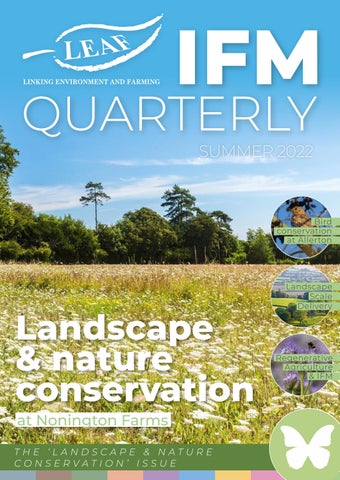
IFM
QUARTERLY SUMMER 2022
Bird conservation at Allerton
Landscape & nature conservation
Landscape Scale Delivery
Regenerative Agriculture & IFM
at Nonington Farms
THE ‘LANDSCAPE & NATURE CONSERVATION’ ISSUE
1
Caroline Drummond MBE 24T H J U N E 1 9 6 3 - 2 3 R D M AY 2 0 2 2
Chief Executive of LEAF for over 30 years
2
A F O R C E O F N AT U R E , A V I S I O N A R Y, & A C H A M P I O N F O R M O R E S U S TA I N A B L E FA R MIN G . We feel incredibly touched by your messages of condolence following the passing of our beloved CEO Caroline Drummond. The kindness and continued support from across the agricultural industry means a lot to us all at LEAF. We begin this edition of the IFM Quarterly reflecting on Caroline’s legacy - LEAF and Integrated Farm Management. It was Caroline’s passion and determination that enabled her and the whole LEAF team to develop the concept of IFM from the outset. Caroline believed strongly that consumers should have access to food that was produced on farms that were raising the environmental bar by managing soils and water more sustainably, conserving energy, reducing waste and enhancing biodiversity - all of which build on the nine core principles of IFM. Landscape and Nature Conservation was at the heart of Caroline’s vision, enriching the environment, habitats and nature. This continues to drive our ten- year strategy, with its three cross cutting themes of health, diversity and enrichment: supporting our farmers with more sustainable environmental practices. We are firmly focused on ensuring that Caroline's incredible legacy continues as we advance our work across the globe in developing and promoting more climate positive farming and food systems. You can watch the tribute video and take a look at a small selection of the many tributes we have received here, and read the moving obituary in the Guardian here. 3
Welcome to the
summer issue of the
IFM
Quarterly The technical magazine on everything Integrated Farm Management, exclusive to LEAF members
THE 'LANDSCAPE & NATURE CONSERVATION' ISSUE 4
Welcome to the Landscape & Nature edition of the IFM Quarterly! I’m Megan and I joined the IFM Technical team last October to manage the LEAF Network. In addition to working with LEAF’s incredible Demonstration Farms and Innovation Centres, I also work on a range of projects including the Beacons of Excellence, SHOWCASE and the Penwith Project. In my role I am very lucky to work with amazing farmers who are world class examples of how productive farming can be balanced with landscape and nature conservation, some of whom are mentioned in this edition. Building farm resilience is more important than ever and protecting and enhancing the diversity of species on farm is a key tool that will help improve resilience whilst letting nature thrive. I was born and bred in Cornwall and come from a fishing and farming community. I became interested in the agricultural sector after noticing the disconnect between people and food systems in urban areas. Before joining LEAF, I completed a BSc in Zoology at the University of Bristol and moved onto the University of Warwick where I worked on a study looking at how the EU neonicotinoid ban impacted carrot and lettuce growers in the UK. This sparked my move into the agricultural sector, and I am particularly captivated by the intersection between agricultural research and the work farmers are doing on the ground. This edition of the IFM Quarterly focuses on Landscape and Nature Conservation, covering topics such as the role of cluster groups in farmer-to-farmer knowledge exchange, updates on LEAF’s Nature Based Solutions project, the conservation of farmland birds and the benefits and grants available for planting trees on farm. We hope you enjoy it!
Megan Whatty
LEAF Technical Officer megan.whatty@leaf.eco
5
THE 'LANDSCAPE & NATURE CONSERVATION' ISSUE
6
Contents Summer 2022 8 10 12
Landscape scale delivery With Vicky Robinson, LEAF Director, Technical
Tech talks With James Fry, Forestry Commission
Landscape & nature conservation at Nonington Farms Our Quarterly LEAF Farm feature
16 18
IPM in Southern France with Callum Bennett, LEAF Technical Off icer
Bird conservation at Allerton with Chris Stoate, Head of Allerton Project Research
20
Regenerative agriculture
22
Demonstrating landscape & nature conservation to bring nature-based farming solutions
What is it and where do I start?
With Will Sibly, LEAF Technical Off icer
26 28
Project updates An overview of LEAF's projects
News & events The latest news, upcoming events, training opportunities, & where to f ind f ree advice and support
7
Landscape scale delivery Working together for more sustainable farming solutions Vicky Robinson LEAF Director, Technical vicky.robinson@leaf.eco
When considering the environmental
A landscape scale approach is not new
features and assets on a farm most
as demonstrated by one of the early agri-
don’t sit neatly within the farm
environment schemes; Environmentally
boundary but move through, across and around the wider landscape. Whether that’s a pollinator looking
specific geographic areas identified for their landscape, wildlife, or historical value. In the early days of my career as an ESA
for nectar, a farmland bird looking
adviser in the Upper Thames Tributaries
for a year-round supply of food
I worked with farmers in the river valleys
for themselves, their chicks and
north and east of Oxford to manage
a suitable nesting site or a river. Looking beyond the farm boundary and considering how a farm and its
adjacent meadows for the important breeding wader populations of lapwing, curlew, redshank, and snipe. Working with neighbouring farmers across the
business sits in the wider landscape
landscape provided a greater variety of
provides benefits and opportunities
habitats than on any one farm enabling
for farmers, nature, and the
birds to move around an area to find the
environment. 8
Sensitive Areas (ESA). The 22 ESAs covered
most suitable nesting and feeding sites.
Agriculture accounts for 71% of land use in the UK; farmers working collaboratively within and across landscapes will be front and centre to delivering more integrated and sustainable solutions. There are already some great examples across the country with an increasing number of farmers involved in a ‘Farmer Cluster’. A concept developed by the Game Wildlife and Conservation Trust (GWCT) and supported by Natural England. Farmer Clusters have a bottom up, farmer led approach identifying what is important to the farmers in their landscape supported by a trusted adviser.
Throughout my career working on agrienvironment schemes with Natural England and its predecessors, I have been privileged to work with farmers who embrace the landscape they farm
In addition to delivering great results for
in. This includes Ian Waller who is a LEAF
soil, water and wildlife farmer clusters
Demonstration Farmer as well as chairing
provide other benefits such as machinery
the Central Chilterns Farmer Cluster where
sharing, collaboration to access funding and
the priorities of the eighteen members
something close to my heart, knowledge
covering c6,500 ha in the Chilterns Area
exchange. The challenges facing farming
of Outstanding Natural Beauty reflect
are cross sector with no simple ‘off the
personal preferences as well as that of
shelf’ solutions. To share knowledge of, for
the geography including farmland birds,
example, different approaches to cover crops
hedgerows, owls, and chalk grassland.
or soil management in a similar geographic area is invaluable. My Nuffield Farming Scholarship on knowledge exchange also highlighted the benefits to mental health of meeting and sharing concerns within a trusted group. This is recognised by LEAF who strongly encourage knowledge exchange through its network of LEAF Demonstration Farms, where commercial farms showcase best practice on Integrated Farm Management (IFM) and through its Simply Sustainable Biodiversity booklet with one of the Six Simple Steps to help improve biodiversity on your land is to ‘Work with Others’.
Collaboration is an area Defra recognise as important. It is supported through the Countryside Stewardship Facilitation Fund and is being proposed for inclusion in the Environmental Land Management scheme. Through these initiatives along with the networks created through Farmer Clusters and LEAF Demonstration Farms, there are lots of opportunities to get involved and take up the many advantages that working together at landscape scale has to offer. Click here for more information on the LEAF Network.
9
Tech talks
LEAF Technical Officer, Lucy Fry, Partnership and Expertise
Lucy: Let’s start by asking, why are trees and woodland creation onfarm so important?
Manager, Forestry Commission,
James: Here at the Forestry Commission,
Southwest England to talk all
we believe that trees are nature’s answer
things trees! Here, Lucy delves
to many of the climate challenges we face.
deeper into the environmental
Planting the right trees in the right places
benefits of planting trees as well
can bring far-reaching benefits – while
Hando, caught up with James
as the support that is currently available for farmers who are looking to diversify their business and explore woodland creation. 10
complementing more sustainable food production and enhancing climate resilience. Trees and woodlands play a vital part in the journey towards net zero and nature recovery – two of the biggest goals of our time.
Lucy: So, from your point of view, how can planting trees benefit farmland? James: That’s a great question! Planting trees
What grants are available for larger areas of woodland?
can provide an array of benefits to the farm,
For proposed woodlands of more
some of the more obvious reasons include
than five hectares, there is also a
protecting livestock and crops, preventing
Woodland Creation Planning Grant.
soil erosion, cutting pollution, increasing farm
This provides support to design a UK
productivity, and boosting biodiversity.
Forestry Standard (UKFS) compliant
Other reasons which are becoming more topical
woodland, offering up to £30,000 per
include diversifying businesses, creating natural
project.
flood barriers, generating incomes, earning
For further information on the
carbon credits and offsetting emissions.
benefits that woodlands can provide
Lucy: Tell me more about the England Woodland Creation Offer (EWCO)?
and the grants and support available, visit www.gov.uk/woodland-creation. Or contact your local Woodland Creation Officer for advice on
James: EWCO is all about supporting new,
planning, planting and managing a
diverse woodland creation in areas as small
woodland.
as 1 hectare, which can be made up of blocks as small as 0.1 hectares. Plus, if the woodland provides environmental and social public benefits, you could qualify for additional payments.
Other opportunities for funding? There are various financial incentives available via our partners and other
As well as this, EWCO also supports the cost of
woodland creation organisations.
installing infrastructure required to manage the
Discover which grant is most suitable
woodland, annual payments to maintain young
for you:
trees, and allows you to continue to claim basic payments (provided the land meets certain
•
Trees for Climate Fund
eligibility requirements). All in all, it’s a really good package.
Lucy: When can farmers apply for the EWCO?
England’s Community Forests
•
The National Forest
•
Northern Forest
•
Woodland Trust
James: Applications are open year-round and what’s great is that farmers and land managers who create woodland now, will easily be able to transfer into the new Environmental Land Management schemes.
11
LEAF Feature
Landscape & nature conservation at Nonington Farms Megan Whatty LEAF Technical Officer megan.whatty@leaf.eco
James Loder-Symonds Nonington Farms
Based in Canterbury, Kent, Nonington Farms Ltd is a 400-acre familyowned arable farm also specialising in whole farm contracting, farming over 3,000 acres. LEAF Marque Certified and a LEAF Demonstration Farm since 2020, the environment lies at the heart of all activities at Nonington. LEAF Technical Officer, Megan Whatty, speaks to owner and farmer James Loder-Symonds, and Assistant Farm Manager Hugo Dwerryhouse, about how they integrate biodiversity and nature into the farm whilst still maximising output. 12
Kent, UK
Agri-environment schemes and conservation work Sustainable land management is at the heart of Nonington Farms, and the core values of the business are ‘Learn, Grow, Protect’ – all of which are underpinned by the principles of Integrated Farm Management. Balancing nature and output is key, and all of the farm businesses at Nonington participate in agri-environment schemes, ranging from field margins to wildflower and wild bird seed plots. The main farm itself is also in High Level Stewardship schemes, including areas for turtle dove conservation which is a priority species for the farm. Whitethroats, yellowhammers, and grey partridge all call the farm home, with careful habitat management resulting in 13 out of the 16 bird species on the Red List visiting the farm. One of the species which James is most proud of having on farm is the small blue butterfly, which has returned after efforts to plant kidney vetch in the local area. The farm is part of the Barham Cluster Group, which is a collaboration of ten farms working together to conserve the small blue, whilst expanding habitat areas and delivering nature recovery in the East Kent area.
13
Habitat and woodland management This year has seen a monumental tree planting effort take place at Nonington, with over 400 trees being planted to help improve diversity and resilience, and capture on-farm carbon. This has included planting oak, hazel, hawthorn, chestnut, white beam, beech, cherry and elm, creating new hedgerows and woodland areas. Ash dieback has affected many trees on the farm, and it is hoped that planting a wide diversity of species will help improve disease resilience in the future. Carboard tree guards have also helped reduce plastic waste whilst the saplings establish. Over half a kilometre of hedgerows have also been laid this year, providing habitats for nesting birds and maintaining the long-term viability of hedgerows. The importance of community engagement was highlighted whilst hedge laying, with many local people asking about the purpose of the process. Positive engagement is key to ensuring that the public understand the history of techniques such as hedge laying, and it is a great way of demonstrating the good work that farmers do to encourage biodiversity. LEAF offers a range of farm notice boards to help communicate to the public, including those explaining subjects such as farm hedges and hedge laying.
14
Sustainable land management The conservation of beneficial insects is also a key part of farm activities at Nonington, with no insecticides having been used for the last two years. A fully Integrated Pest Management (IPM) strategy is followed, which includes field margins, beetle banks, resistant varieties, and companion crops for oilseed rape. James admits that the move away from pesticides and towards regenerative practices can feel like a “leap of faith”, but by focusing activities emphasising good soil health and profit rather than yield, ecosystem functions have regenerated whilst input costs have reduced.
Challenges and easy wins of nature friendly farming When asked what the biggest barrier is to farmers implementing more biodiversity measures, Assistant Farm Manager Hugo suggests that the challenge lies with “farmers not seeing the longterm benefits of including biodiversity within their farming systems”. Whilst the hidden benefits of biodiversity can sometimes be hard to see, having a long-term view can help put the focus on the ecosystem services which biodiversity can provide for the farm. An easy first step that Hugo suggests for improving biodiversity is to focus on the difficult areas of the farm, such as land between telegraph poles or in areas of the field that are hard to spray. These areas can easily be taken out of cultivation, helping to provide greater habitat areas whilst also making field activities a lot easier. Looking forward, Nonington will be welcoming more schools onto the farm as part of their education work and they have recently been selected as a finalist for the Best Farmer in Kent 2022 Award. Read more about Nonington Farms here.
15
Integrated Pest Management in Southern France Callum Bennett LEAF Technical Officer callum.bennett@leaf.eco
I recently had the fantastic opportunity to attend the IPMWORKS Hub Coaches Capacity Building event in Toulouse. This EU funded project focusses on increasing the uptake of Integrated Pest Management (IPM) across Europe through demonstration events and the founding of new networks. 16
Toulouse, France As a part of this event the group visited a nearby DEPHY farm, giving us a great opportunity to see how local farmers were managing their land. DEPHY are a partner in the IPMWORKS project and are a French agricultural network focussed on reducing the use of plant protective products in France by 50% by 2025. They are made up of 3,000 farmers performing demonstration activities and testing and assessing different cropping systems. We visited a 114-hectare arable farm in Occitanie, Southern France, that has been using a range of innovative approaches. The farmer spoke about the local arable farming context -mostly growing winter soft wheat, barley, soybean, sunflower, and Durum wheat. The main focus was to extend the crop rotation by introducing chickpea, oat, spring barley and winter cover crop mixes, with an aim to reduce pest prevalence (and therefore pesticide use) and improve soil health and biodiversity. One of the farm’s main concerns was runoff and soil erosion, due to its effects on soil fertilitywith the aim to reduce wasted applications of fertilisers and pollution in surrounding water sources. To reduce the risk of runoff, cover crops are sown and hedgerows are planted around field boundaries, particularly close to the river on the property. This also has the added benefit of providing habitat area and increasing habitat connectivity on the farm. It was a great opportunity to visit a farm in the DEPHY network and I look forward to continuing to work together with our European partners in the future!
For more information about IPMWorks and LEAF’s involvement click here.
17
Bird conservation at Allerton Chris Stoate Head of Allerton Project Research
The Allerton Project celebrates
We monitor songbird numbers annually using
its first thirty years this year. In
a transect across the farm, and every five years
that time, we have carried out wide ranging research into the integration of environmental
we carry out an intensive census of all breeding territories for every species. The annual transects show how overall bird numbers are now around 190% higher than they were when the project
objectives with those for food
started in 1992, and detailed territory mapping
production and farm businesses.
reveals that species of conservation concern are
In recent years there has been a focus on topics such as soil, water and catchment management, and integration of trees into farming
76% more abundant than they were. More intensive research into the breeding ecology of these species has included detailed monitoring of nests, radio-tracking, foraging observations, and analysis of nestling diet. For
systems. But in this thirtieth year,
example, our work on yellowhammers and
it is important to remember the
song thrushes demonstrates how these species
work we did on bird conservation in our first decade. 18
benefit from the diverse agricultural landscape that results from our approach to an integrated farming system.
Yellowhammers nest in herbaceous
Loddington, UK
vegetation in field boundaries as well as in hedges and we found that nest predation was lower where nests were located in herbaceous vegetation, contributing to higher overall breeding success. This field margin habitat is also encouraged at Loddington as we know from other research there that it provides an important overwintering habitat for ground and rove beetles which help to control crop pests such as aphids and slugs. These beetles also contribute to the diet of yellowhammer nestlings, along with other invertebrates which benefit from reduced pesticide use in crops and habitats created specifically for wildlife. Although they feed almost exclusively on seed when adult, yellowhammers gather crucial high protein invertebrate food from arable crops for their young. Our research has shown that their use of different crops as a foraging habitat change through the breeding season, starting with rape, and then moving first to barley and then to wheat. A diverse rotation that is designed to reduce pest and weed burdens in crops therefore also benefits farmland birds such as yellowhammers. Song thrushes also benefit from a similar diversity of land use. We found that nesting success was higher where breeding song thrushes had access to pasture than where nests were surrounded only by arable land. This may be because pasture supports higher numbers of invertebrates such as earthworms, although our radio-tracking showed that adult birds were also foraging in woodland where invertebrate food was abundant. We have shown that our move from a plough-based system to direct drilling has resulted in increases in earthworm numbers in arable crops and so song thrush breeding success on arable land may be better than it was in the earlier years of the project. These and very many other results will be published as a book in August. ‘Farming with the Environment – Thirty Years of Allerton Project Research’ can be ordered from the publisher, Routledge. The Game & Wildlife Conservation Trust is one of 14 LEAF Innovation Centres, which together with 41 LEAF Demonstration Farms, make up the LEAF Network, set up to develop and promote more sustainable farming through Integrated Farm Management. For more information click here.
19
Regenerative Agriculture: what is it & where do I start? Rebecca Davis LEAF Technical Coordinator rebecca.davis@leaf.eco
New phrases and terms are introduced to our industry regularly, but only a select few stick and become the norm. More recently, ‘regenerative agriculture‘ has been having its turn in the
5 core principles of regenerative agriculture: 1. Keep the soil surface covered, as much as possible 2. Try to limit the amount of physical and chemical disturbance of the soil, as much as possible 3. A wide diversity of plants is encouraged to increase above and below ground biodiversity 4. Keep living roots in the soil, for as much of the year as possible 5. Integrate grazing livestock into the system
spotlight, but what is it, and where to start?
Since this movement emerged, a wide range of definitions combining practices and outcomes
As with many other agricultural systems,
have been identified by both researchers and
regenerative agriculture (RA) as first defined
practitioners seeking to improve the health of
by a distinct movement in the USA in the
land, soil, systems, and communities through
1980s is based on its own set of 5 core
farming ‘regeneratively’. Within this ever-
principles (see right). Regenerative agriculture
widening conversation, the dominant themes
aims to revitalise and regenerate the soil and
remain reduced tillage, cultivating biodiversity,
wider environment, not just minimise the
retention of organic matter and systemic crop
impact of production.
health.
20
Regenerative agriculture & Integrated Farm Management More recently, the principle of ‘context’ has been proposed within the regenerative agriculture framework. This highlights the importance of site specificity and recognising the individuality of each scenario. The principles that underpin regenerative agriculture align closely with Integrated Farm Management and as supporting practices within the LEAF Sustainable Farming Review. We are therefore confidently able to say that for over 30 years, LEAF has been developing and promoting regenerative agricultural practices and approaches through Integrated Farm Management (IFM). Regenerative agriculture is not solely based on the outcomes, nor the practices and tools used – it is a mindset that takes farmers on a journey and involves generation as well as regeneration and as a consequence sits well with IFM and our work at LEAF; •
Regenerating the health of our soils
•
Generating knowledge, collaboration, and relationships
•
Generating healthy and resilient food and farming solutions
•
Regenerating land and ecosystems
•
Generating value
•
Generating carbon and wider climate change solutions
For more information on how IFM aligns with regenerative agriculture, please click here. Or watch our video
21
Demonstrating Landscape & Nature Conservation to bring nature-based farming solutions Will Sibly LEAF Technical Officer will.sibly@leaf.eco
Two fantastic farms that LEAF have worked with in the Naturebased Solutions project are taking action to conserve and enhance their landscapes and natural habitats. The following case studies showcase some of these practices which are driving a more sustainable environment.
22
Trenance Farm Cornwall, UK Cornish dairy farmer, Kate Hoare is looking at the overall ecological value of her farm to identify areas for management and improvement. She has recently regenerated an old, dried-up pond at the bottom of her farm, bringing it back to its former wetland status. Knowing that the number of ponds on farmlands has declined over recent years, Kate recognises that ponds are important features within landscapes and for ecosystems providing purified, clean fresh water and shade, shelter, and food for many small animals. They also provide valuable habitats for a wide and diverse range of aquatic species, in addition to acting as ‘steppingstones’ that enable species to move around the farmed environment. Kate is using harvested rainwater from the top of her slurry lagoon to re-wet the former pond and has worked with her local Young Farmers Club to build a pipeline from the lagoon to the pond area. This summer, Kate will start see the benefits of this project. 23
Park Farm (University of Cambridge)
Cambridgeshire, UK Park Farm, Cambridge, is a mixed dairy, sheep and arable enterprise. It also acts as an educational resource for veterinary teaching at Cambridge University. It is unique in that it holds great historical significance to the University, the village of Madingley, and the adult education centre, Madingley Hall. Many areas across the site are of importance to wildlife, including several key species such as crested newts. A large area of parkland, where livestock graze, has protected status and the site has gone through many changes during different phases of management. Along with the University’s ecology groups and local organisations including Cambridgeshire Wildlife Trust and regional FWAG (Farming and Wildlife Advisory Group), Paul Kelly, Dairy Manager, and Peter Wilderspin, Estate Rural Surveyor, embrace their role in driving this forward. There are several old ponds across the site which are now being managed with a focus on restoration and protection to attract great crested newts and other amphibian life. Some of these ponds are located on the edge of arable fields, so buffer strips will be planted to protect them from any direct movement of nutrient laden soil, and to provide further habitats for wildlife. Furthermore, an area of scrubland has been selected as a conservation site targeting turtle doves (which have remained red on the UKs priority conservation list since 1996). New specialised seed mixes have been planted around the area to provide forage and cover.
24
Park Farm stats: Woodland:
89ha
Hedgerows:
23.5km
Ditches:
7.75km
Buffer strips:
9.25ha
Uncultivated field corners:
5.24ha
Permanent pasture:
108ha
Wildflower meadow:
16.6ha
Nectar flower mixes:
7.6ha
Wild bird seed mixes:
13.5ha
25
Projject Up pdates
LEAF is involved in a range of projects with our farmers, industry partners, and researchers across Europe. This work adds further depth and understanding to our core activities as we continue to drive more sustainable farming.
Nature-based Solutions to Climate Change
Knowledge to Action
LEAF is once again supporting
Knowledge to Action is a collaborate research project
farmers in the UK to deliver
run by Forest Research, University of Exeter, FERA and
nature-based farming solutions.
LEAF on understanding farmers’ knowledge of ash
A cohort of farmers in England
dieback and management responses. A Knowledge Tool
and Scotland have been selected
is currently in development, with the first draft ready to
to take part in this project, all
be discussed with the research team and in due course,
of whom are positive, forward
amongst stakeholders and intended users of the tool,
thinking and climate smart
before being launched in early 2023. We would love to
farmers. They will be trialling
get your views on what you would like the tool to deliver,
Carbon Footprinting tools and
please take a few minutes to complete this short survey.
benchmarking against each other,
If you would like to get more involved in guiding
receiving advice from industry
development workshops, attend tree health workshops
experts, and demonstrating
and to receive a copy of the guide when it is published,
sustainable farming practices.
please email eleanor.marks@leaf.eco
Calling farmers and growers interested in accelerating and demonstrating their journey to net zero! This exciting new three-year project, funded by a grant from The Co-Operative Foundation, aims to develop a network of five ‘Net Zero Carbon’ LEAF Demonstration Farms. Presenting a unique opportunity for you to access the tools, support and training to help you and others on the path to net zero farming. To apply to be considered for this fantastic project please click here. All applications to be submitted by Friday 19th August 2022. To find out more, please join us at our online Discovery Event on Tuesday 2nd August 1-2pm where we'll hear from the project leaders and a LEAF Demonstration Farmer. Register here (after registering, you will receive a confirmation email containing information about joining the meeting). Otherwise, please email lucy.hando@leaf.eco
26
Horizon 2020: ENVISION LEAF Marque in collaboration with ENVISION project partners, are investigating opportunities and challenges to incorporating earth observation data monitoring approaches into the LEAF Marque certification process. An online survey is currently underway to collect insights from farmers whilst an upcoming workshop will discuss the feasibility and potential use of earth observation data with certification stakeholders.
DiverIMPACTS
SolACE
LEAF have made significant progress
SolACE is now in its final phase with a project
in the dissemination of the research
meeting taking place in Belgium back in
being produced by the project, and
March 2022. Results from field trials were
has helped to create this suite of
presented to the project consortium and
videos which take a closer look at
the next steps were discussed. Additionally,
the full potential of diversification
a stakeholder workshop took place in which
of cropping systems for improved
external stakeholders joined to give their
productivity, delivery of ecosystem
views on the project and share experiences
services and resource-efficient and
with co-designing multi-actor projects with
sustainable value chains.
farmer networks.
The videos focus on the success
Looking forward to the months ahead, LEAF
stories from Poland and Sweden as
will be working onwards as co-leaders of the
well as consumer perspectives. Watch
dissemination activities for the project and
them here.
with fellow partners in its final months.
SHOWCASE The SHOWCASE project has recently finalised the development of a set of cover crop seed mixes which will be used to compare frost sensitive versus frost tolerant cover crop species, in conjunction with Oakbank Game and Conservation, and academics from the University of Reading and University of Worcester. Cover crop trials will be sown this summer, and measurements taken over the coming months to see how the different species mixes impact factors such as biodiversity, soil structure and organic matter levels.
27
News & Events Welcome to our new LEAF Demonstration Farmers! It's been a busy few months with the launch of three new Demonstration Farms - Newhouse Farm in Berkshire, farmed by Andy Bason, The Yattendon Estate, managed by Nick Down and HB Farms in Aberdeenshire farmed by Harriet Ross and Ben Lowe. They have all been part of the Resilient and Ready programme, run in partnership with Corteva, which supports farmers to become industry leaders in sustainable farming. Huge welcome to Andy, Nick, Harriet and Ben and we look forward to sharing their expertise and insights. Explore the LEAF Network here.
BASIS accredited Introduction to Integrated Farm Management Course Our BASIS accredited two-day training course covers all aspects of Integrated Farm Management, with reference to the LEAF Marque Standard. It is an ideal first step for anyone looking to understand more about IFM and becoming LEAF Marque certified. Aimed at producers, advisors, and auditors.
Date: Wednesday 12th & Thursday 13th October 2022
Becoming LEAF Marque certified – FREE workshops coming soon! We are excited to be delivering a series of four workshops (both virtual and inperson) this autumn for our members, focusing on a range of core areas within Integrated Farm Management and journey to LEAF Marque Certification, including writing management plans, continuous improvement and using the LEAF Sustainable Farming Review. There
Location: Newhouse Farm, Hampshire – a LEAF
is limited space for attendees, so please
Demonstration Farm
look out on our socials and website for
Please email events@leaf.eco to register your
more information in the coming weeks.
interest and look out for more details coming soon.
28
LEAF Open Farm Sunday A very big thank you to everyone who opened for this year’s LEAF Open Farm Sunday 2022. It was another huge success, with over 250 farms opening their gates to tens of thousands of visitors, helping to showcase British farming and all it delivers. Watch the video of #LOFS22 here and remember to save the date for next year’s LEAF Open Farm Sunday on Sunday 11th June 2023!
Keep up to date with our growing LEAF Team!
Big congratulations to Will Sibly, on his new position as LEAF Business Relationships Coordinator. Continuing with his work on the
Onto pastures new... Lucy Redmore, who began her LEAF journey in 2017, will be shortly leaving us to start an exciting new position with ISEAL as Associate Manager, Credibility and Innovations.
Nature-based Solutions project,
Lucy has made a significant contribution to LEAF,
Will will also be building strong relationships with our members and partners, supporting a diverse range of UK and EU projects as well as working with LEAF’S growing team to deliver business objectives!
working on Standard developments, Certification Body management, Claims and Labelling, ISEAL Code Compliance, training and leading the LEAF Marque team through a tremendous time of growth and change. Lucy certainly made her Marque at LEAF, and we wish her all the best with her future career.
We would also like to welcome to the LEAF Marque team, Ellen Vercoe-Gibson, who is taking on the role of Certification Manager and Phil Skentelbery who is Oversight and Certification Manager. We will be hearing more about them and their new roles in future issues of IFM Quarterly.
29
Cover photos: Nonington Farms © If you are interested in any of the projects, or have any feedback on IFM Quarterly, then please get in touch with lucy.hando@leaf.eco
www. l ea f.e co LEAF (Linking Environment And Farming) Stoneleigh Park Warwickshire CV8 2LG United Kingdom 02476 413 911 C harity 30
N umber : 104578 1
@LEAF_Farming
LinkingEnviro nmentAndFarming
© LEAF (Linking Environment And Farming)