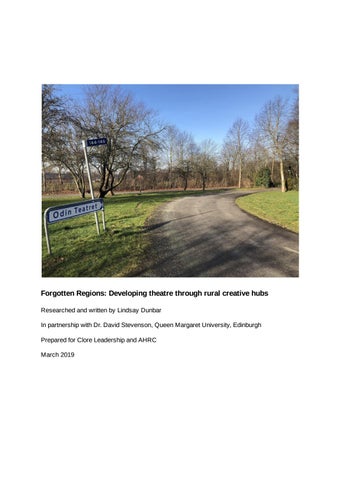
Forgotten Regions: Developing theatre through rural creative hubs Researched and written by Lindsay Dunbar In partnership with Dr. David Stevenson, Queen Margaret University, Edinburgh Prepared for Clore Leadership and AHRC March 2019
Abstract This paper will explore how the existence of a rural creative hub can support the development of authentic, high-quality theatre. With increasing pressure on public funding, support agencies and artists are exploring how sharing resources can help develop sustainable models of creative practice. One example of this are ‘Creative Hubs’, which are intended to allow those working across the creative and cultural industries, in any given geographical area, to come together and work collaboratively, often within the context of a shared building. However, in a rural context, resources and infrastructures associated with creative hubs can be fragmented and challenging. Often there is not one central, physical ‘hub’ but rather a connected network of individuals collaborating in various ways. Understanding the various models of networks is important because some of those working in the creative and cultural industries are finding the lack of opportunities and sustainable working in cities has resulted in an attempt to create employment and work in rural regions. As such, it is an opportune moment to reflect on the role that rural ‘hubs’ can play in supporting theatre-makers to produce high-quality, authentic theatre. Examining three case studies, conducted through interviews and focus groups in Dumfries and Galloway (Scotland) Devon (England) and Holstebro (Denmark) this paper will explore the different ways in which rural locations have created different models of the ‘creative hub’, In particular, the discussion will focus on the extent to which authentic rural theatre creation has been facilitated through the practice of these ‘hubs’ and the networks they create and depend upon. Although some of these are unique to their location the paper concludes that on a policy level there is much that local authorities and national funding bodies can learn from the organic, artist-led hubs that have pioneered change through culture in these rural areas. Keywords: rural, theatre, creative hubs, counter-urbanisation, cultural policy Introduction In the recent analysis of responses to the Public Consultation of the Cultural Strategy for Scotland, a comment highlights “there is a need for bespoke strategies for rural and small-town contexts in order to sustain cultural activities and economies” (SG, 2019 p. 40). Creative initiatives and strategies, developed by policymakers and institutions in urban areas are often ‘one size fits all’ and may fail to take into account the unique conditions that rural creatives need to work within. As such, work in this area has tended to focus on vulnerability and isolation as “an urban bias has resulted in academic discourse often entirely ignorant of the creative potential of rural places” (Townsend, 2016, p452). Likewise, the Cultural Cities Enquiry Report (ACE, 2019, p6) reveals that urban communities account for 9% of landmass, deliver 63% of economic output and 60% of jobs. Therefore, even with a lack of investment and clear cultural strategies, rural communities are delivering 37% of economic output and 40% of jobs. If rural communities are to reach their potential then a bespoke strategy should redress the imbalance that exists in regards to culture-led investment.
Relationships with institutions, whether they are local authorities, funding bodies or Universities are an essential component to the sustainability of a theatre organisation. Yet how does an individual or small company initiate and develop this relationship in order to build the necessary trust for a productive relationship? This is no different in rural communities, where sustainability depends on links with certain institutions, however, in a rural context many of these institutions are geographically distant and as such, this is not without its problems. Institutions tend to measure their activities by scale and broad impact which isn’t likely to be the same in rural areas. They also focus on a digital approach for engagement but in rural locations broadband infrastructure can be fragmented. Finally, rural isolation, which is exacerbated by poor public transport links, isn’t understood. Fundamentally there needs to be a different understanding of what scale of ambition and high-quality investment is needed in rural areas. Rural cultural priorities do not necessarily fit national policy rhetoric in a small nation. After a brief review of some relevant literature, this paper will begin by discussing a creative hub in Holstebro (Denmark), established over 50 years ago with a long-term commitment from the municipal government, community and artists. It will then move on to look at two different rural regions in the U.K who are at different stages in their progress towards delivering the same kind of culture-led regeneration. In doing so, the paper reflects on some of the factors that may increase the likelihood of a rural area being culturally ‘successful’, specifically in relation to the production of high-quality, authentic theatre. Each case study will look at the cultural and social background of the region, examining the role the council plays, the support of the community and existing networks, and how the theatre that is being produced is fundamentally connected to the place. Literature review Definition of a creative hub To fully understand why we need to consider a different, bespoke approach to creative hubs in rural regions it is useful to explore how creative hubs have been defined in the literature. There have been various studies undertaken across Europe that have attempted to understand and classify hubs for the creative industries. While some ‘hubs’ have been defined as creative clusters (Harvey, 2011, P. 529), compacts (ACE, 2019, p8) and entrepreneurial hotspots (Lysgård, 2015, p. 1) the British Council deemed them lighthouses in ‘forgotten areas of the city’ that were “largely misunderstood and often undervalued” (British Council, 2016, p. 2). In their report Creative Hubs: Understanding the New Econom y they define five different ‘creative hub’ models: ● Studio - a small collective of individuals and/or small businesses in a co-working space. ● Centre - a large-scale building which may have other assets such as a cafe, bar, cinema, maker-space, shop, exhibition space. ● Network - a dispersed group of individuals or businesses – tends to be sector or place specific. ● Cluster - co-located creative individuals and businesses in a geographic area. ● Online Platform - uses only online methods – website/social media to engage with a dispersed audience.
●
Alternative - focused on experimentation with new communities, sectors and financial models.
Of these, most applicable to rural areas are a network, cluster or alternative model. Rural theatre and creative hubs Although new theatre production is all too often associated with large, urban institutions, models of rural theatre produced by small regional theatre companies do exist. One example is Canada where professional theatres with producing companies began to appear in Saskatchewan’s rural towns and communities in the early 1990s (Powell, 2013, p11). Some of these theatres have gone on to become important creative hubs, supporting a cultural ecology that stretches far beyond the performances they produce (Holden, 2015, p5). For example, the Rosthern Station Arts Centre opened in 1990 is what we might commonly refer to as a ‘creative hub’ if it was in an urban context. The centre contains a theatre, a concert series, a meeting/seminar space, a tea room, and an art gallery showcasing local emerging as well as fully professional artists. While the theatre has a capacity of 160, which is comparable to village halls across the Highlands, their capacity to attract audiences is exceptional: Audiences number 15,000 to 20,000 each year, with attendance peaking in the summer at about 12,000. [They welcome] four to five senior bus tours annually, as well as people from across Saskatchewan and Canada (Powell, 2013, p. 12). The theatre embraces the idea that rural theatre should be authentic to the region, producing plays like The Seed Savers by Katherine Kroller, which is about genetically altered canola that grows locally. The significance of this form of rural theatre is that it “offers small communities like Blyth (pop. 970) a different chance to explore identity, providing the community with confidence and a sense of its own individuality” (Powell, 2013, p. 13). Work that has been created in rural Saskatchewan has gone on to tour to urban areas ensuring the rural voice is heard and can help influence the social, cultural and economic debates by the city-based decision makers. Creatives in rural communities The idea of a ‘rural creative class’ is captured in the mood of young creatives in 2011 in Denmark (Herslund, 2012). Whereas social and cultural change is presented as having been driven by incomers to communities in the 1980s and 1990s, Herslund’s argument about a dissatisfied urban populace can also be applied to young rural creatives who left to study and professionalise their creative practice but now seek to return to the region where they grew up: They had experienced unemployment and had sporadic jobs. A TV-producer and three health workers had to undergo re-training. Others (IT worker, communication worker and two teachers) had to travel further to work because public services had become centralised. They all had to commute far away in order to find a job that matched their competences. (Herslund, 2012, p. 242)
Herslund’s work reveals the challenges of working rurally, especially when trying to launch a creative enterprise. Even traditional routes of business support in rural areas have an urban-centric approach: they all approached their municipal business advisory service with their business idea. In all their initial meetings with the municipal advisory service, the advisor concluded that their idea was not suited for more than a part-time or hobby activity. Most respondents mention that it was mainly the specific field of their businesses, such as nutrition, therapy or art gallery that the advisory services did not believe could survive. The respondents describe the meeting in negative terms. They mention that they felt that they were not taken seriously. (Herslund, 2012, p. 243) There also appears to be a lack of understanding of the impact of creative industries in rural locations beyond their potential to provide economic benefits (Townsend, 2016, p452) yet “rural areas demonstrate greater engagement with art, [despite] funding for creative practices remain[ing] more limited compared to urban areas” (Crawshaw, 2015, p134). This highlights the challenges for theatre-makers in rural areas who have to innovate while knowing their value isn’t recognised by policy-makers and funders to the same degree as those working in urban locations. Culture and rural policy ‘Culture’ and ‘rural’ don’t appear to be natural companions when it comes to policy-making. Lysgård observes that “Rural places and small towns are, to a large extent, neglected in the culture-led development studies, and likewise, culture is largely neglected in rural development studies” (Lysgård, 2016). He argues that “cultural policies of small rural communities are more embedded in heritage and tradition based on ideas of participation, mobilization and social coherence”. These factors do not appear to align with the concept of creative hubs as being enterprising, innovative and forward-thinking. It could be that a shift of rural policy, could start to address the crisis cycle facing the arts with radical changes in economic, social and educational policies placing culture at the forefront of their ambitions (Hadley, 2018, p 221) Methodology This research has been conducted in partnership with Dr David Stevenson of Queen Margaret University who has acted as a critical friend for the research. A case study methodology has been adopted with the locations for the case studies being identified through an online survey to those working in the theatre sector across the U.K. Respondents were also asked to recommend European examples for a comparative study. Unfortunately there appeared to be limited awareness regarding activity happening outside of the UK, however, Odin Theatre in Holstebro was one of the few locations mentioned a number of times, arguably because of its long-standing history and international profile. Case study visits were made to Dumfries and Galloway as well as Holstebro, with online calls to conduct the case study in Devon. Case study data consisted of both semi-structured and informal interviews, observations, and group discussions. In addition, interviews were
conducted with the National Rural Touring Forum, the Federation of Scottish Theatre, Creative Scotland and the Touring Network that provided specific contextual information related to the case of Dumfries and Galloway as well as Devon. A common thread in these conversations, as well as the survey responses, was that there were models of what would be seen to be creative hubs or networks made up of individual organisations, people and places rather than a central building. The encouraged me to explore what the common components are in these alternative models of creative hubs, what links them and what, if anything, might be replicable. Case study one: Holstebro, Denmark Allegedly King Frederik described Holstebro as “Denmark’s most boring town” yet it is now hard to image Holstebro as a city people wanted to leave. In 2019, the centre is bustling with fashion retailers, cafes packed with families brunching and people making use of the public spaces. What is notable, is the art in every corner. Unlike some towns and cities that might decide to install public art in places off the beaten trail, to encourage people to seek them out, in Holstebro, there is art everywhere you look. Around the centre of town, there are many famous statues, in everyday places; the kneeling boy by Astrid Noack outside the job centre, The Hand of Jesus, The Source of Life, and The Eye of Odin by Bjørn Nørgaard in the pedestrian zone in the centre and George and the Dragon by Sten Lykke Madsen in the town’s square, the official emblem of Holstebro. However, the most iconic statue is that of Woman on Cart by Alberto Giacometti. ‘Maren’ as she is referred to by the community, is symbolic of the regeneration that was led by culture. Bought in 1966 for the then considerable sum of 210,000 kr, funding came from the New Carlsberg Foundation that contributed 60,000 kr, with the municipal government granting the remaining 150,000 kr. However, over the years not only has her economic value increased but so has her cultural and social value to the community of Holstebro. With her now worth millions and as the victim of regular acts of vandalism, it was suggested she be moved inside the museum. However, the community insisted on her remaining visible and accessible to all so now she is lowered into the ground at night and rises every morning at 10 am to ‘Hymn to Maren’. An innovative and elegant way to protect a much-loved cultural asset. "Holstebro sets the cultural agenda locally, nationally and internationally" (Holstebro Municipal Vision, 2019) Yet it was not always like this. In the mid-1960s, Holstebro was a provincial town people left rather than moved to. There was a common acknowledgement that young people were leaving the town for further education but failing to return due to a lack of opportunities. As a result, the town, which had previously relied on very traditional industries such as markets and agriculture, had high numbers of elderly, unskilled and unemployed residents. This made it difficult to attract significant numbers of new businesses. It was at this point that city planners recommended investing in arts and culture in order to improve the facilities and environment of the town. What is now called ‘Cultural Model Holstebro’ involved buying significant artworks and statues for public display, establishing a new art museum to feature significant work, and building a new town hall and music venue. It was a strategic approach to ensure Holstebro was taking its place in the cultural world. A new town museum and library followed.
Kai K. Nielsen [the Mayor] inaugurated an audacious cultural policy in this remote Danish province. He thought that investing in culture helped to improve the quality of life for the citizens of his town. (Odin Theatre, 2018, online) The turnaround in the population would suggest that their strategy has been a success. The town is attracting a high calibre of businesses and talented young people, just as it set out to achieve. In 1966 the population was approximately 18,000, in 2014 it was 34,873 and by 2017 it was 58,125. Recent increases in the population would also suggest a new generation of people moving away from urban regions, seeking the space and opportunities to try a different way of living. These are remarkable figures of growth and although cultural investment alone cannot be credited with this success, it is locally recognised that reinvigorating the cultural vibrancy of the area has been central in repositioning it as an attractive place to live. For this reason, the local council has remained committed to its support throughout the last fifty years. By 1983 the council was spending 2.5% of its annual budget on culture, equivalent to £1.9 million of investment. In 2017 Holstebro municipal government provided 47,839,167 kr, the equivalent of £5.5 million in support to twelve cultural institutions; this in a town roughly the same size of Dumfries (Scotland). Furthermore, the cultural growth of Holstebro shows no sign of abating with a diverse range of new organisations still appearing in the town. For example, the new artist collective space Slagteriet/Slaughterhouse and the Danish Talent Academy that focuses on developing the professional creative skills of 16 – 25 year-olds. Odin Theatre It was in 1966, during the first stages of this fervour of culture-led regeneration that Odin Theatre was invited to Holstebro. At that point, they were based in Oslo, yet despite receiving rave reviews and support from the theatre community Odin Theatre had found it difficult to secure a suitable permanent base from which to work. They were rehearsing in a cold, damp former bomb shelter. Even with touring success in Denmark, Norway and Finland the Norwegian authorities didn’t understand their work. They could not get formal support, for there was no funding as such, and they had no home. While the Holstebro municipal government equally did not understand the work that Odin Theatre was creating, they did understand that in the theatre world “they have something” (Kvame, 2018). Because of this, they were willing to give them time to find out what they were good at along with 75,000 kr and an old farm, which still had the animals residing in the barns when the company arrived. Initially, the community was against the idea of Odin Theatre, especially when they broadcast a performance of naked actors on primetime local television, resulting in a protest of two hundred people. Despite the town’s calls for the company to be shut down the mayor resisted and asked the local community to ‘give them 5 years’. It took 20 years to win the town over. There are various reasons it took two decades, which Per Kap Bech Jensen, Administrative Director, has two explanations for. To the Holstebro community, Odin Theatre was strange. Eugenio Barba the founder and Artistic Director explored questions around what theatre and culture are, should, and could be. What Odin Theatre has been doing for so long is helping people meet art and culture as part of their everyday lives by taking it from the black box of a theatre into the streets and fields, creating work related to the place. However,
people have prejudice without even participating, and therefore Barba’s artistic strategies focused on how actors could engage with people, how they could meet them in places with which they were familiar. Jensen believes that it is the personal meeting that changes the perspectives: “it’s taken 20 years to meet everyone in the municipality and for a new generation to meet it every day. It’s a personal and time-consuming thing” (Interview, February, 2019). The work produced by Odin Theatre invites the audience to interpret their response. Performances are innovative and often designed for small audiences. The 2012/13 production Saeta had a capacity of 70 while Memoria had a capacity of just 30 per show and was shown five times that year (Bak, 2014, p13). While many funders often look to justify a return on investment through the scale of the audience reached, the Holstebro Municipal Government and Danish Arts Foundation both appear to understand the value of cultural investment in terms of social and economic wellbeing, taking a more long-term view as to the success of Odin Theatre’s activities. A sustainable approach Today the theatre has grown, renovating the old farm to a fully functional theatre building with several wings, accommodation facilities, administration and archive offices, a library and three black box theatres that can be adapted for the purpose, performance and the audience. It has a homely feel and artists in residence contribute to the cleaning with a communal approach. There is a very homegrown, organic and sacred feeling to the space. This growth has been built upon an understanding from the outset that Odin Theatre should not be wholly dependent on the municipal authorities for its survival. As such, Odin Theatre has developed an effective model of creative and cultural enterprise and in 2017 51% of their overall income was self-generated. Odin Theatre is also more than just the company, their reach extends to a network of local 1 community and international relationships. In addition to the seminars, barters and International School of Theater Anthropology (ISTA) that make their approach unique, there are many interconnected strands to their work. Short and long-term artists in residence, a publishing house, and networking with theatres and universities around the world to bring theatre-makers together for symposiums all enrich the cultural vibrancy of the town. They have annual festivals, triennial celebrations and play host to numerous invited international creative practitioners who develop work in Holstebro that goes on to be seen across the world. They have created an archive of all the prolific writings of the founder and the company productions as well as the work by other Odin Theatre company members. The company tours annually, often with work developed over many decades. Their repertoire is extensive and their reach is international. In 2014, as the company celebrated its 50th anniversary, the Danish Arts Foundation conducted an impartial review to ensure not only that the company was meeting its artistic and economic responsibilities, but it’s ‘local anchoring’ as a regional theatre company. The review was highly favourable, citing the high artistic quality, effective management and 1
Barters are cultural exchanges between the visiting company and the host community, sharing songs, dance and stories. “The "barter" process developed as one of Odinteatret's reactions to encounters with foreign cultures and their arts, encounters that were sometimes systematic and some times accidental and uncontrolled, encounters in conceptual, technical, and social sphere” (Arnold, 1996, p. 1207)
extensive collaboration with the citizens. While recommendations encourage the organisation to share more about their international relationships and research with the rest of the Danish theatre sector, the evaluator states that “the theater's impact and visibility are great at a local, regional and international level. The theater's network of contacts counts 10,000 contacts, of which 150 are active professional partners. The national impact is less. It is considered a development area for the theater” (Bak, 2014, p. 5). The ‘national’ is later clarified as referring to Copenhagen, with visibility, impact and marketing in the capital listed as a ‘weakness’ in the SWOT analysis. Despite the impact and success of half a century of innovative theatre-making, the relationship between rural and urban theatre has not been bridged. Yet to some extent, it would appear it doesn’t matter. Here is a unique, internationally respected theatre company thriving without a centralised cultural strategy or the necessity of pandering to the urban creative classes. The community it serves, both local and international, have ownership of Odin Theatre. As a model of rural theatre production, it should encourage funders to recognise that rural and urban creative hubs can co-exist with neither competition or conflicting resources. One size does not fit all, nor should it. “He invited the world to our little area” As the world’s longest-running theatre company with original members still performing, in 2014 Odin Theatre launched a ten-day celebration, a Festuge, placing the community at the heart of many events, including feasts and ‘village selfies’. Performances took place in farms and the streets, with the theatre’s barters taking place with many of the international delegates, including young people from around the world. It was a multi-generational celebration of the old and new, marking the past and celebrating the future. Barba said he wanted to found a theatre because it was a way of founding a small society, to create a ritual meeting place (Kvame, 2018). This concept is reflected in the Third Theatre Manifesto: The Third Theatre lives on the fringe, often outside or on the outskirts of the centres and capitals of culture. It is a theatre created by people who define themselves as actors, directors, theatre workers, although they have seldom undergone a traditional theatrical education and therefore are not recognised as professionals. But they are not amateurs. Their entire day is filled with theatrical experience, sometimes by what they call training, or by the preparation of performances for which they must fight to find spectators. According to traditional theatre standards, the phenomenon might seem insignificant. But from a sociological point of view, the Third Theatre provides food for thought. Like islands without contact between themselves, young people in Europe, North and South America, Australia and Asia gather to form theatre groups, determined to survive. (Barba, 1999, pp. 169-170) Barba’s invitation to artists and audiences all over the world to explore theatre made by a company living in a small, remote town has resonated globally. Yet how has this model of a rural creative hub survived for nearly 55 years? While the drive of Barba to keep innovating is undeniable, the community and the support of the municipal government are also key.
While it took 20 years for the company to embed in the town, the community now has a genuine sense of connection to the theatre. In addition to this, the municipal government trusted the artists to be worth the long-term risk, having faith that the company were going to draw attention to their forgotten region. This ability to trust, to take a risk and to develop international relationships has helped Holstebro continue to attract alternative and innovative creative practitioners in need of space, support and belief in their value to a community. Case study two: Dumfries and Galloway, Scotland As with many rural areas, Dumfries and Galloway might be perceived as a receiver of culture, rather than a creator. However, the region has a rich heritage of significant cultural impact. Robert Burns, J.M. Barrie, John Law Hume and Thomas Telford all hail from the area. Yet many of the organisations in the region continue to refer to Dumfries and Galloway as the ‘forgotten corner’ of Scotland’s cultural sector. As with many local authority areas, young people can’t study music, dance or drama within the school curriculum. They need to leave the region if they want to gain qualifications for further education in the creative industries, limiting the opportunities to gain the necessary experience for the competitive world of dance or theatre. However, the pressures on resources in urban areas and the dominance of the existing cultural institutions in the central belt of Scotland exacerbates the types of structural inequalities that continue to limit career opportunities for many in the cultural and creative industries (O’Brien et al 2018). As such, there are increasing numbers of creative practitioners looking to create new cultural opportunities away from Scotland’s largest cities. Individuals such as Emma Jayne Parker, Drew Taylor and Martin O’Neill are all examples of those who have chosen to return to Dumfries and Galloway and contribute towards creating something new in the region that nurtured them. In 2011 the Dumfries and Galloway Arts Association was the main support agency for culture in the region but as an organisation, it had structural and strategy issues. There was a need to chase money and in doing so they spent more time creating projects to fit the funding rather than embedding a vision for the organisation and the region. Governance was an issue with staff lacking formal contracts, no line management and insufficient accountability. The organisation was wound up and as a result, created a vacuum for support in the region. Matt Baker, of The Stove Network, compared the vacuum created as being like seeing an empty building and the Dumfries and Galloway region very much felt like an empty building in 2011. “We can’t go on doing nothing” Yet in spite of, and perhaps because of, the rural location of the communities and their relative isolation in relation to the rest of Scotland, Dumfries and Galloway now have an active cultural network functioning as an important ‘hub’. Since 2011 there have been notable developments that have strengthened the network of cultural organisations and individuals. The first development was the Place Partnership (PP) programme, launched in 2011/12 by Creative Scotland to work with local authorities, encouraging interventions through creative partnerships that would address the needs of the region. In Dumfries and Galloway this manifested itself as artist-led, self-organising ‘hubs’ located across the region, focused mainly on supporting dance and visual arts. However, the ‘hubs’ had limited success. They had a brief to create and support twenty artists for both dance and visual arts, however, the
visual arts network was already established while the infrastructure needed to support a dance network wasn’t there. Around the same time, Rebecca Coggins, from Dumfries and Galloway Council (DGC) had been made responsible for ‘future-proofing’ the cultural activity taking place in the region, specifically by developing a plan that would embed the necessary knowledge and skills that would drive the culture-led regeneration of Dumfries. Coggins confirmed the trigger for change was more about impending crisis than strategic forward thinking. Despite this admission, Richard Grieveson, Head of Lifelong Learning and Wellbeing at DGC, realised the worth of cultural policy and they commissioned Sue Pirnie in 2011 to make recommendations for creative organisations in the region to adopt a more sustainable approach. The key recommendations included: ●
● ●
● ● ●
● ● ● ● ● ●
Create a cross-sectoral group to work with DGC's officers to create a joined-up and strategic approach to planning. Membership will be cross-artform and cross-regional and include practitioners and representatives of organisations. The Council should clarify its staff roles - transparency, shared-expertise The need for a general awareness-raising campaign was agreed; including council members and other influential figures in the community who are not always well-informed on the strengths and wider benefits of the arts sector in the region. The arts sector and Creative Scotland are both keen to support this. Advocacy should be further developed through creating 'Cultural Champions', in DGC, the community and the sector. Audience development - centralised information and marketing site The concept of developing 'hubs' across the region should be explored. Make better use existing venues. The proposal for a cultural hub for Dumfries in the context of other existing venues and possible developments is one topic for discussion joined up plan for other resources such as equipment should be developed The need to invest in the 'community voice' in planning and advocacy was promoted, The need for core funding to realistic levels for services and activities which are not intrinsically self-sustainable was highlighted. Creative practitioners are the life-blood of creativity, in every art form, development relies on them and other arts professionals within the region. Young people are agreed to be a very important target sector for the arts: as audience, but particularly as participants and potential creative practitioners in the future. (Pirnie, 2011, pp4-5)
While these are not radical recommendations, the transparency and willingness to work with and invest in a cultural network are clear. In essence, the idea was to build on what was already successful and to create longer or year-round programming that would enable local creative practitioners to develop professionally. This 2011 report led to several key developments, slowly and over some time. As a result, in 2013/14 the Dumfries and Galloway Chamber of Arts (DGCA) was created, primarily to be run on a voluntary basis by artists. The model of the Chamber has since evolved into Dumfries and Galloway Unlimited (DGU). By 2014, flagship festival Dumfries and Galloway Arts Festival (DGAF) expanded to
a year-round programme. Founded in 1979, DGAF programmed a large multi-art festival that brought artists into the region. The Director at the time, Pete Renwick, explored how best to programme work across the region in order to be representational, and as a result, the organisation has become a rural touring agency with a focus on rural touring potential. This has led to a willingness by artists to tour to the region, knowing that there is both the audience appetite and an infrastructure of support for high-quality work. This has fundamentally changed the outlook of the region. Now, there is support for retaining talent and new Director Dani Rae explains there is a desire to produce locally; “We’re going to make something happen here. We’ll try it here and then move on.” (Interview, January 2019). The loss of local trade and industry has created an opportunity for towns to focus on culture and the local authority recognises the economic benefits of a cultural festival. It is on this basis that Arts Live, the rural touring arm of DG Arts, is looking at commissioning work, connecting national artists with local talent. Rae is confident that local artists are good at producing quality and more can be done to support this such as investing in bringing more quality work to the region, to allow local practitioners to learn by seeing and collaborating. She is also a keen advocate for the introduction of an artist development fund. “Leave to find your people, return to find yourself” Graeme Main, founder of the Big Burns Supper (BBS) said the political landscape at this time (a referendum would shortly take place regarding Scotland’s independence) inspired a lot of people to “dig where they stand” in order to grow their own places and become part of the large national movement that was developing. One such example was Matt Baker who was an artist living in the region but often finding himself working elsewhere in Scotland. He decided to stay in the region to create The Stove Network, an organisation that grew out of a need for creative practitioners to have viable space in which to work and be ‘visible’. In 2012 The Stove Network started to ‘squat’ in the central building they now occupy, bringing much-needed life to the high street of Dumfries. Now that there was a more explicitly active community of artists needing support, the idea of an intermediary between the local authority and these creative practitioners was explored. With the Scottish Independence referendum building to its finale, the sense of creating something sustainable in what was seen as a forgotten corner of Scotland became stronger. Moving forward, a number of key developments can be highlighted as evidence of how this momentum was sustained and developed over the coming years: ● ● ●
2
2014 - Big Burns Supper expands from a weekend to a week-long programme of events & Dumfries & Galloway Arts Festival expands into other towns. 2 2015 - The Stove gets Regularly Funded Organisation status and officially secured their building in May 2015. 2015/16 - end of Creative Scotland Foundation funding which assisted organisations to transit from Scottish Arts Council to Creative Scotland. This shift in funding support resulted in new conversations and alliances being formed, strengthening the existence of an ‘alternative hub’.
A Regularly Funded Organisation (RFO) is supported for 3 years by Creative Scotland, as one of their main portfolio organisations. This network of organisations are expected to play a key role in helping Creative Scotland deliver against its overall ambitions.
●
2015 - Spring Fling Festival evolves into the Upland Community Interest Company to programme year-round events. 2016 - Arts Live launched facilitating regular conversations between touring artists and venues.
These developments weren’t strategically planned in advance and happened as a result of the network meeting regularly to share news and ideas through interactions that are far more akin to emergent models of strategy creation. (Stevenson, 2018) While the model of an 3 arms-length trust is widely accepted in Scotland , DGU is something different. The majority of trusts are primarily responsible for culture and leisure ‘provision’ which encompass everything from museums to sports centres. Whereas the creative community of Dumfries and Galloway have created DGU to support people and communities, with a focus on creating and sharing rather than the maintenance and provision of cultural venues. Space to create Since these significant changes in the cultural landscape, there have been further movements that have emboldened the creative practitioners living and working in the region. Many of them are now focusing on communities within the region that do not currently have easy access to the pathways that might lead them to establish sustainable carers in the cultural and creative industries. Specifically in regards to theatre, the most notable is the development of Performance Collective Stranraer led by Drew Taylor. This artist-led development lab is enabling new work to be created by young people in the region as well as offering them professional support and mentoring. He does this by twinning young artists with theatre talent so they can learn to professionalise their theatre skills. As a result, theatre is becoming embedded in the community; “when you are born into it it’s part of your culture.” said one of the participants. In addition to theatre, dancer Emma Jayne Park has succeeded in securing funding from Creative Scotland to launch a new Dumfries & Galloway Dance Network, developing new audiences for dance in this region. Her vision is to create an ensemble of dancers each year, enabling their professional career pathways and touring the work. Her research indicates that there is significant local participation in dance classes for both contemporary and traditional dance and yet this doesn’t translate to progression into the industry. Once again, this points to the extent to which many of those living in rural locations have become accustomed to seeing themselves as the consumers of imported culture rather than the makers of culture that has the potential to be toured both nationally and internationally. If Dumfries and Galloway wish to adopt or adapt ‘Cultural Model Holstebro’ then they are going about it in the right way. There is clear support from the local authority, combined with an understanding that there is social and economic benefit when you invest in culture first. The personality of the region is one of creativity, enterprise and nurture, very much in keeping with its agricultural heritage. This understanding is key to the growth of what could become a mature model of an alternative hub, with a thriving multi-genre approach to creative practice, democratically working to promote the region internationally. If this region is
3
For example in Glagow (Glasgow Life), Highland (High Life Highland), Perthshire (Culture Perth and Kinross) and Fife (OnFife).
on the same path as Holstebro, it’s gaining great ground locally as well as throughout Scotland. Case study three: Devon, England Devon, in the South West of England, shares many characteristics with Dumfries and Galloway. A region rich in agriculture, tourism and traditional industry, the population is mainly rural with some of the larger settlements feeling disconnected from the rest of the region. Arguably, Devon could be home to the original creative hub as Dorothy and Leonard Elmhirst opened their home, Dartington Hall, as a place of refuge and retreat for artists in the 1930s, bringing together artists such as Imogen Holst, Kurt Jooss and Bernard Leach to mix and work together (Coombe Farm, 2018) Historically Devon is an area that has suffered economically. It also suffers culturally due to its proximity to Bristol where there is a vibrant contemporary creative community and the oldest operating theatre in the U.K; Bristol Old Vic is arguably the main cultural destination for most theatregoers in the region. As with many rural areas, there is already a strong touring network, supported by the National Rural Touring Forum (NRTF). However, the region is also responding to the recent investment strategies by Arts Council England (ACE) and creating new ways of working, which are the focus of this case. Similarly to Odin Theatre who established international links with Universities, and Dumfries who are forging links with the University of West of Scotland campus in Crichton, in Devon theatre organisations are building relationships and networks with universities. The region even has links with Odin Theatre, stemming from an invitation from Bianca Mastrominico of Organic Theatre, inspired by the work of Barba to attempt to embed theatre in a rural community. “It was like putting your fork into an allotment and realising that no one had turned over the ground in years. It wasn’t ready.” Unlike Holstebro and Dumfries and Galloway where support for culture-led change was encouraged by the local authority, the main catalyst for changes in the South West has been led by ACE and driven by the financial crisis of 2008. While ACE claim that public authorities in England are the main funders of arts and culture, Exeter City Council, for instance, only offers support of up to £10,000 which is a small contribution when producing theatre or maintaining a building. While trusts such as Elm Grant and Devon Guild of Crafts remain supportive of rural theatre, the relationship with the local authority seems to be a weakness in the region. Amy Bere of Dartington Arts confirmed there is a “lack of infrastructure”, something which other artists echoed. While ACE remained supportive of funding regional theatre, due to the funding cuts in 2007/08, alliances and business plans shifted, resulting in further fragmentation in the area with organisations increasingly focusing on survival rather than partnership. Bristol Old Vic (BOV) closed for refurbishment in 2007 and, during this time, the spotlight shifted from the space BOV provided to alternative spaces in the city. Spaces such as the Tobacco Factory started to fill the void with commercial lets while contemporary theatre-makers found space further afield such as Seth Honner, theatre-maker and founder of the Theatre Bristol network, who relocated to Exeter. Some organisations, such as Organic Theatre, even opted to leave the area altogether.
Devon is currently a region without a cultural strategy or independent cultural development agency. However, Torbay recently secured ‘Great Places’ funding from ACE and does have its own Culture Board, which could provide a model for others to follow. Development strategies for regional theatre have been introduced by ACE, and while seen as successful in other regions, the model was unsuccessful in Devon. Doubtless, the fragmented corner of South West England created challenges for establishing relationships and networks. Furthermore, the funding was to coordinate an artistic strategy while the artists wanted funding to create work. The long-term approach was not popular, although as seen in Holstebro and Dumfries and Galloway, this could have been key to moving towards delivering a ‘Cultural Model Holstebro’. While the main funding agency is supportive, crucially the apparent lack of support from the local authority is preventing those in the region coming together productively. Yet for a region seemingly starved of funding and infrastructure, there are alternative creative hubs of activity working, albeit with a delicate, light touch. “Difficult work, being held in beauty” Dartington Arts in Totnes and Coombe Farm Studio, in rural Dartmouth, represent the high-quality professional support available to theatre-makers to create work in a rural hub context. As previously mentioned, Dartington has long been associated with bringing artists together through invitation and hospitality. Dartington College of Art grew out of an ambition to make art accessible to everyone, one example of which was providing music lessons with internationally renowned musicians to estate workers. However, in 2008 the College merged with Falmouth University and relocated. Amy Bere, Executive Director of Dartington Arts, noted that because of this the personality of Totnes changed from being a home to a university to being a market town. However, the culturally engaged audience still expected work that reflected the global world locally. She observed that in the region “rural touring and rural theatre can be parochial, they don’t take a risk, it’s outmoded. Touring work hasn’t caught up with the audience and their needs.” (Interview, February, 2019) Lara Lloyd, Director of Coombe Farm Studio, has returned to her home county after a successful career with the British Council in London. She took a role at Dartington College and was there for twelve years all together and in that time realised she had the capacity to programme a sell-out season of work but she was programming for the already converted audience. As a result, it was an unsustainable audience development model. In her opinion “there was a need for authentic connection - a true developing of thinking and feeling rather than consuming culture - which is very urban-centric due to the rich pickings.” (Interview, February, 2019) Lloyd took over Coombe Farm Studio in 2010 and due to her connection to the place, a professional network in London, and continuing to work part-time at Dartington Arts, she set about developing a new model of support for theatre in a rural area. But with no institutional support, it was hard. And yet, even with institutional support, the vision for culture is the region could be more dynamic. Despite securing funding from ACE, Seth Honnor, who left Theatre Bristol to found Kaleider, struggled to get support from Exeter City Council. He discovered there was no mechanism or system for new creative projects. While they did finally secure a small amount of funding, the relationship and desire for investing in culture wasn’t there. Honner felt as if there was “no possibility of ambition”(Interview, February, 2019). Another example of
potential failings in support was the closure of The Bike Shed in Exeter in 2018. This was an ambitious social enterprise theatre providing development space for theatre artists, performances and establishing professional links with BOV. With cultural and business development support this vulnerable venue may have continued to innovate or leave a legacy to be developed. However, that commitment from local authorities for long-term support does not appear to be present in the way that it was in Holstebro. In Devon, there is an awareness of the limited resources. “The way organisations are funded creates a sense of competition” observes Bere. This is something Lloyd also recognises. If you are in a city, in a big institution or even in a rural institution then it activates the ego and guards go up. Sometimes the idea of these creative, urban hubs can breed competition and jealousy. It can work in some instances but with limited resources nationally and a big building, it doesn’t lend itself naturally to the culture of sharing. This is very different from Coombe Farm where they are far from an urban centre, eating food at the communal table and sharing bathrooms, highly reminiscent of Odin Theatre. Similarly, like Mayor Nielsen inviting Odin Theatre to Holstebro in 1966, in 2016 Lloyd invited Dance Umbrella to experience this immersive retreat in what has gone on to become the Producers Farm. This is a partnership of Bristol Ferment, Dance Umbrella and Fuel, which came together naturally as Lara had been programming their work at Dartington College of Art and they all asked: “what would it look like if we all worked together?” Their alternative ‘hub’ model is very collaborative. Lloyd can offer subsidised space, in return, the partners contribute funding from their budgets. They take turns to administer the project, changing every two years, which means they are sharing their learning and developing leadership skills in a supportive environment. As a result of offering weekly courses in other art forms, Coombe Farm Studio generates enough income to be sufficient. Coombe Farm does not receive public funding. Asked about the relationship with ACE, Lara admits that their support is seen by many as validation. Yet despite having a sustainable and resilient business model, she has been unable to enter into meaningful dialogue with ACE to explore what resilience means to institutions, especially as a rural creative hub. Coombe Farm is a social enterprise model based on her theory of stay small, stay staffed and require no public funding. “Process in the country, product in the city” The audiences in Devon are culturally aware and engaged. Bere’s vision for Dartington Arts is to support work that reflects global issues, developed in a rural context. In this regard, they are similar to one of Scotland’s other alternative ‘hubs’ – Deveron Projects in Huntly, Aberdeenshire (Stevenson and Blanche, 2015). Rural audiences need diversity, and Lloyd wants to see them “challenged with a piece of work in their own community”. She believes that there is a need to “raise the game of rural productions”, not simply to recreate what is happening elsewhere but to be inventive, using strong scripts. With a small performance space with a capacity of 45, Lloyd can be selective about how they programme. Rather than programme work she finds amazing and knows the educated, cultured audience will support, she now thinks “who do we want the audience to be?” and programmes around that. Lloyd is interested in rural audiences experiencing urban theatre and rural theatre touring to urban audiences.
So, who are these audiences who are more used to being the receivers of culture and in need of challenging? Lloyd defines them in terms that are recognisable to rural promoters across the U.K: ● ● ●
Metro-Cultural - audiences who tend to travel to Bristol or London to consume culture. Non-Engagers - people living areas of deprivation (Dartmouth being the largest divide) ‘Trad’ workers - the farmers and fishers, traditional industry workers who earn a lot but question what is ‘theatre’?
While rural theatre means different things to everyone who makes it, Lloyd offers a lovely connection about the value of rural theatre to the communities of which they are a part; “rural theatre is about a connection to the land, their land, even if it’s concrete.” In many ways, this is the approach Odin Theatre took when they set out to ‘meet’ their community. They found ways to connect with them, their environment, their daily life and made it part of their theatre. It is this approach that embeds theatre in a community and allows a theatre company to become the focus for a sustainable creative hub. The challenge for Devon, which truly has the potential to come together and form an extended alternative hub, is to articulate the value of this way of working to institutions. Lloyd admits that rural theatre producers and artists feel the constant pull to take their work to urban venues in order to be seen. It’s difficult to put work on in a rural location and expect the reviewers, the funders, the programmers to come and see it. This places rural theatre at a massive disadvantage when it comes to the institutionally and urban-led process of policy-making, agenda setting and funding disbursal. Devon has many push-pull factors for creative practitioners - the push to reach the cultural decision-makers and critics in the cities such as Exeter, Bristol and Plymouth as well as a pull, back to the land, the slowness and breadth of possible networks that they can join. Unlike Holstebro and Dumfries & Galloway, Devon has yet to identify a leader who can draw all these threads together and inspire others to develop a clear, connected cultural vision for the region. To share the example of Holstebro’s cultural policy with the local authority could instigate the support necessary to bring the many micro-hubs of activity together, in order that they can work collaboratively and create an alternative creative hub for Devon. Conclusion “How can you build an institution with people and not bricks?” Per Kap Bech Jensen, Odin Theatre In all three case studies, there are common contextual conditions, specifically: ● ● ●
Young people leaving, an ageing population and high levels of unemployment Localised social and economic crisis Top-down strategic policy failure
These factors can be overcome through artist-led developments and a recognition from local government and national funding bodies that this has to be a long-term approach with arms-length support. If ‘Cultural Model Holstebro’ can teach us anything, it’s that authentic cultural investment takes many years but can potentially raise the profile of small communities internationally. In Denmark, Mayor Kaj K. Nielsen and in Dumfries & Galloway, Richard Grieveson have both fundamentally changed how rural creatives can focus on arts and culture through supporting the establishment of an alternative ‘hub’ that reaches across the region. While Holstebro had a head start, nearly forty years before Dumfries and Galloway or Devon, the activity that is now taking place in these two regions suggest that they have the potential to deliver similar results. They are each at different stages of their development but if everyone involved, from artists to the local authority, all keep faith in the capacity of cultural investment to deliver significant change over the long term then there are many benefits to reap. In sharing the findings of this paper I encourage the belief that alternative rural creative hubs offer a network of people that institutions of all sizes can work with. Their existence will ensure that rural areas are able to develop authentic, high-quality theatre that is born out of place. However, the evidence indicates the need for permanence in policy and approach. It takes decades to deliver. So, how best can this be achieved by bold and brave individuals and local authorities who are willing to demonstrate they are leaders in cultural and economic innovation? 1. Understand the model of creative hubs in a rural context ‘Hubs’ in a rural context come in many different forms although they have several components that link them; ● A willingness to collaborate formally and informally with individuals and institutions ● A desire to see long-term social and economic benefits for the area ● An ability to work internationally and be rural cultural ambassadors, inviting the world to experience these ‘forgotten’ regions. 2. Arms-length, permanent support and trust The traditional model of top-down strategic approaches is not working. Regions creating cultural strategies in response to urban-centric Governments or funding bodies isn’t representative. Instead; ● Work with the rural cultural sector to introduce new metrics, not based on maximising the number of people who see the work but the ambition to grow, benefiting the region. ● Put culture at the forefront of any rural development policies and have creative practitioners on the panels, steering groups and management committees of rural policy making. ● Provide support to develop an arms-length rural cultural institution that can nurture talent, support production and allocate funding.
3. Place, Play and Prestige How then, can these conditions support the development of high-quality, authentic theatre? ● Build long-term relationships with the community, embedding local and global issues. ● Provide time and space to innovate, test and develop ideas to a high standard. ● Support mutual, reciprocal international relationships and shared-learning based on experience. Postscript On my last day in Holstebro, I met Steen as I was taking a photograph of Borgerne fra Holstebro (Citizens of Holstebro). He approached me to explain that people from the town had posed as models for the sculpture and that there were many other statues by Bjørn Nørgaard in the centre and if I had time I should see them. I explained I had been researching at Odin Theatre and was interested to hear his thoughts on the cultural revolution in Holstebro. Steen has lived there for forty years and feels very proud of the art and culture in the town because it has brought so many people to the region. He delighted in telling me about how it makes him feel and how he enjoys telling visitors about the history of the art and the community. “Even Sting is coming to play here soon. Sting!”. He was equally thrilled about the new Danish Talent Academy attracting young people to develop professionally. Steen’s enthusiasm is indicative of the extent to which any successful rural creative hub is sustained through the people whose activities and values create it. Alternative models such as those discussed in this paper bring together artists and their communities without focusing on a physical building. Instead, their foundations are an understanding of the benefit and value of culture for a better society. The walls are the activities undertaken by individuals and groups and the roof is the networks and conversations that hold it all together. A strong hub can then act as a local institution to mediate the relationships with regional and national institutions like local authorities or funding bodies. Theatre produced within these creative hubs is thus not only more likely to be deeply connected with people and place but also more likely to be recognised and valued beyond the place where it was created. References ARNOLD, N., 1996, The barter concept and practices of Eugenio Barba's Odin Theatre: Cultural exchange or cultural colonialism?, The European Legacy, 1:3, pp. 1207-1212 ARTS COUNCIL ENGLAND., 2019, Cultural Cities Enquiry BAK, L., 2014, Statens Kunstfonds Project Support Committee for Performing Arts Evaluation of Ownership in Denmark Odin Theatret BARBA, E., 1999, Theatre. Solitude, Craft, Revolt, Aberystwyth, Black Mountain PRESS, pp. 169-170 BRITISH COUNCIL., 2016, Creative Hubs: Understanding the New Economy
COOMBE FARM STUDIOS,. 2019 [online] [viewed 5 February]. Available from https://www.dartington.org/about/our-history/people/ CRAWSHAW, J. & GKARTZIOS, M.,2016, Getting to know the island: Artistic experiments in rural community development. Journal of Rural Studies, v. 43, p. 134–144 HADLEY, S & BELFIORE, E., 2018, Cultural democracy and cultural policy. Cultural Trends, v. 27, n. 3, p. 218-223 HARVEY, D., HAWKINS, H. & THOMAS, N.J., 2012, Thinking creative clusters beyond the city: People, places and networks Geoforum 43, pp. 529–539 HERSLUND, L. The Rural Creative Class: Counterurbanisation and Entrepreneurship in the Danish Countryside. Sociologia Ruralis, v. 52, n. 2, p. 235–255 HOLDEN, J., 2015, The Ecology of Culture A Report commissioned by the Arts and Humanities Research Council’s Cultural Value Project. HOLSTEBRO MUNICPAL., 2019 [online] [viewed 16 February]. Available from https://www.holstebro.dk/kultur-fritid/kulturmodel-holstebro/kulturmodel-holstebro KVAME, E., 2018, The Art of the Impossible, Eugenio Barba and Odin Theatre’s Long journey (DVD) LYSGÅRD, H. K., 2016, The ‘actually existing’ cultural policy and culture-led strategies of rural places and small towns. Journal of Rural Studies, v. 44, p. 1–11 ODIN THEATER ARCHIVE., 2019 [online] [viewed 15 February]. Available from http://www.odinteatretarchives.com/odinstory/ POWELL, M.E., 2013, Growing Opportunities: Theatre Thrives in Rural Saskatchewan, Canadian Theatre Review 154 Spring 2013, pp. 11-18 PIRNIE, S., 2011, A creative future: the Arts in Dumfries and Galloway SCOTTISH GOVERNMENT., 2019, Scottish Government, A Culture Strategy for Scotland Analysis of responses to the public consultation: Full Analysis Report STEVENSON, D., 2018 Managing Organisational Success in the Arts, Routledge STEVENSON, D. & BLANCHE, R. (2015) The town is the venue: "Place-making" at the heart of cultural policy. In: Hristova, S., Dragićević Šešić, M. & Duxbury, N. Culture and Sustainability in European Cities: Imagining Europolis. Abingdon: Routledge, pp. 178-190. TOWNSEND, L., WALLACE, C., FAIRHURST, G. & ANDERSON, A.,2016, Broadband and the creative industries in rural Scotland, Journal of Rural Studies 54, p. 451–458