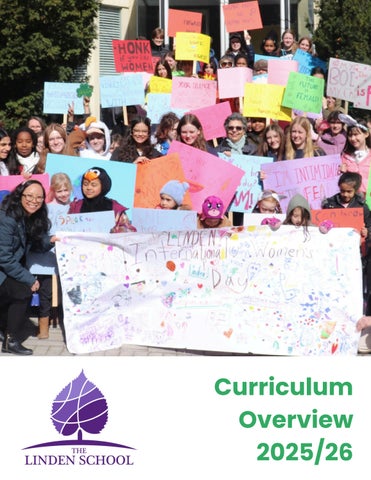
Curriculum Overview 2025/26
Table of Contents
Principal’s Message
Land Acknowledgment
Curricular Foundations
Early Learners
Grades 3 and 4
Grades 5 and 6
Grade 7
Grade 8
Grades 9 and 10
Grades 11 and 12
page 106
page 127
Cross-Grade Connections
Clubs at a Glance
page 3
page 5
page 25
page 64
page 189
page 4
page 6
page 44
page 85
page 190
www.lindenschool.ca
From the Principal It is my pleasure to introduce our curriculum for the 25/26 school year, a reflection of the values that define The Linden School. Each year, we share not only the opportunities our students will encounter, but also the mission that guides us: advancing progressive education for girls and gender-diverse students, rooted in equity, inclusion, and respect for every voice. At Linden, our values are lived daily—in the ways students approach challenges, collaborate with one another, and engage with the world. We nurture curiosity, critical thinking, and confidence. Our goal is to empower students to lead with compassion and contribute meaningfully to their communities. This year brings an especially exciting milestone as we begin our year in our new buiding. Designed with accessibility at the forefront, this building ensures that every member of our community can navigate and participate fully. It reflects Linden’s belief that inclusion is not an add-on, but a foundation for everything we do. Our new home also deepens our connections to the city around us. Situated in the heart of Toronto, Linden has always been enriched by its urban setting. Proximity to theatres, parks, and the Toronto Reference Library offers extraordinary opportunities for our students to extend learning beyond the classroom, linking academic study with the cultural and intellectual life of the city. Reading about our curriculum is just one way to get engaged with programming at Linden. We hope to see you at celebratory events through the year, encourage you to connect with teachers, and hope that you will ask your young people to share their learning. We are excited to begin this new chapter together, confident that our values and vision will continue to shape an education that is both rigorous and deeply connected to the world.
Principal
3
THE LINDEN SCHOOL CURRICULUM 2025/26
Learning on Treaty Land Linden is located close to Davenport Road, a path that was first carved by glaciers and later used by Indigenous peoples as a major travel and trade route for thousands of years. We gratefully acknowledge that we are learning and gathering on lands covered by Treaty 13, the Toronto Purchase, made with the Mississaugas of the Credit. These lands are also connected to the histories of the Anishinaabe, Haudenosaunee, Wendat, and countless Indigenous peoples who continue to live and thrive here today. We also recognize the responsibilities that come with living and learning on this land. We know that reconciliation is more than words. Reconciliation asks us to listen, to learn, and to act. At our school, we are working to answer the Truth and Reconciliation Commission’s Calls to Action by: Weaving Indigenous histories, voices, and perspectives into our classes, across all subjects and grade levels. Inviting Indigenous educators, artists, and knowledge keepers to share their teachings with our community. Encouraging students to learn not only about the injustices of colonialism, but also about the creativity, resilience, and leadership of Indigenous peoples today. Supporting our staff with ongoing opportunities to learn and unlearn, so that we can teach with care and respect. Reflecting together on how we can make reconciliation part of our daily practice, not just a one-time acknowledgment. As we walk along the same lands where people have gathered, traded, and built relationships for generations, we commit to honoring those histories and carrying them forward. By centering Indigenous voices and following through with action, we aim to nurture a school community rooted in respect, reciprocity, and justice.
4
The Early Learners connect their learning about salmon’s lives in Gabekanaang-ziibi to caring for the land.
The Foundations of Linden’s Curriculum The Linden School’s curriculum is guided by the Ministry of Education in Ontario, which sets curriculm expectations for each grade. You can read more about Ontario’s Curriculum here, and can learn about Ontario’s standards for student assessment here. On this solid foundation (recognized internationally as a thorough and developmentallyappropriate set of learning guidelines) Linden builds an enriched, student-centered programme that meets the needs of diverse learners, and that encouarges our students to leave their comfort zones in the pursuit of incredible things. We support our students as they question, build, reach, experiment, write, sing, grow, speak truth to power, and make inevitable mistakes. We celebrate each other’s achievements, lend a hand when things are hard, and reflect on the power of community as a catalyst for meaningful change. Here are some of the guiding questions used to develop our programmes: Whose voices are being left out of a conversation and how can we include them? How can we support students in developing critical thinking skills so they can take intelligent risks? What can we do to reduce barriers to learning? How can we balance technological learning with wellness? How can we continue to offer a gifted education--marked by depth of understanding and challenges based on student interest--to ALL students? How can our teaching and learning practices make the world a better place? How can we maintain flexibility in programming so we can offer a breadth of options even in a small school? How can we ensure that our graduates continue to be offered their first choice of postsecondary schooling, win scholarships, and feel fully prepared for life beyond Linden? As members of the LInden community, we invite you to join us in these conversations as we build on our solid foundations, adapt, and rise to new opportunties. It’s going to be another amazing year! Note: Because student voice is an important part of our programming, some of the curricular plans you read about may change as interests and opportunities arise. Beth Alexander Associate Principal
Answering interesting questions in the lab.
5
Early Learners
Curiosity Takes Root: Exploring the world through play, imagination, and first discoveries.
6
THE LINDEN SCHOOL CURRICULUM 2025/26
Early Literacy Course Description: In
Linden’s
Early
Learners
program,
students are active participants in their own learning. Each day, they explore, create, investigate, and problem-solve, building the skills and confidence to see themselves
as
readers,
writers,
mathematicians, scientists, engineers, and changemakers.
Learning
is
hands-on,
collaborative,
and
joyful,
with
many
opportunities
for
students
to
make
choices, share their voices, and see the value of their ideas. Students
engage
in
reading,
speaking,
and
listening
in
writing,
meaningful,
hands-on ways. They practice phonics, spelling patterns, and handwriting to build their
fluency.
We
use
the
following
programs: UFLI, Jolly Phonics, Handwriting Without Tears, and Words their Way.
Through the Daily 5 literacy framework, students: Read independently to practice fluency and comprehension Read with a partner to share strategies and explore texts together Listen to reading to encounter rich language and vocabulary Do word work to strengthen phonics and spelling skills Write to tell stories, express ideas, and reflect on their thinking
Students select activities that match their interests and developmental levels, giving them ownership of their learning. They read inclusive, socially just texts where girls’ voices are celebrated, explore new perspectives, and participate in discussions, literature circles, and storytelling workshops. By actively reading, writing, and discussing,
students
see
themselves
as
capable
communicators who can use language to connect, create, and advocate.
7
Early Numeracy Course Description: In Early Learners, students are actively reading,
writing,
experimenting,
solving,
asking,
building,
and
creating
every day. They share ideas, take risks, and develop independence, confidence, and a sense of agency in their learning. By the end of Grade 2, students have not only
met
Ontario
Curriculum
expectations but have also built habits of mind that reflect Linden’s mission: curiosity,
empathy,
resilience,
critical
thinking, and a commitment to fairness and social justice. They leave the Early Learners programme knowing they are capable learners with powerful voices— readers,
writers,
mathematicians,
scientists,
engineers,
and
engaged
community members who can shape the world around them In our numeracy programme, students explore
number
geometry, spatial
sense,
measurement, reasoning
operations, data,
through
and play,
collaboration, and hands-on problemsolving. They build with blocks, play store,
Students also keep math journals, recording their
measure items in the environment, and
problem-solving processes, explaining the tools and
use games and puzzles to discover
strategies they use, and reflecting on their reasoning.
patterns, shapes, and numbers.
These journals help students see their own thinking, share their ideas, and feel empowered as mathematicians.
In math learning centres, students tackle manipulatives,
puzzles,
real-world
challenges, and interactive games that allow
them
to
collaborate,
work
independently, and practice multiple strategies.
Throughout math activities, students learn that mistakes are
opportunities
understanding,
and
to
try
new
persevere.
strategies, They
deepen
develop
both
numeracy skills and confidence in their ability to approach problems creatively and thoughtfully.
8
Early Inquiry Course Description: Students act as investigators and explorers in both Science and Social Studies. They ask questions, test ideas, and examine the world around them. In Science, students explore plants, animals, materials, energy, and environmental systems. They conduct experiments, collect data, and make predictions. During Outdoor Education and CERES, students build circuits, program robots, design simple machines, and explore natural and technological systems. These activities help them connect scientific inquiry, creativity, and problem-solving, developing critical thinking and real-world skills. In Social Studies, students explore identity, family, traditions, and community. They share their own stories, compare celebrations, and consider fairness and responsibility. Students also investigate how communities are built and how people work together to solve problems. By applying engineering concepts from CERES, they design solutions for real-world challenges, plan sustainable projects, and engage in hands-on problem-solving that links Science and Social Studies. Both subjects come alive in inquiry centres, where students role-play community members, problem solve, build models, and map out ideas. They collaborate, record observations, and share findings creatively. Through these experiences, students grow into thoughtful scientists, engineers, and community members who understand the relationships between people, technology, and the environment. They learn to approach problems with curiosity, creativity, and responsibility, seeing themselves as capable changemakers in their communities.
9
Assessment in the Early Years Assessment in the Early Learners program is designed to celebrate growth, highlight strengths, and guide each child’s learning journey. We focus on providing meaningful feedback that helps students see themselves as capable learners while giving families a clear picture of their child’s development. Kindergarten (Junior and Senior): In Kindergarten, students are assessed through observational comments. Teachers carefully document children’s development across academic areas, learning skills, and work habits. Reports highlight what your child can do and provide clear next steps for continued growth. This approach allows us to focus on the whole child: honoring their unique pace and style of learning. Grades 1 and 2: For Grades 1 and 2, students continue to receive descriptive feedback through observational comments, while academic progress is measured using developmental benchmarks rather than traditional letter grades. Students are assessed as: Independently at grade level At grade level with support Working towards grade level This grading system gives families a more accurate picture of where their child is on the learning continuum, while ensuring that growth and progress are recognized and celebrated.
Learning Skills and Work Habits: Alongside academic progress, students are assessed in key learning skills and work habits that support lifelong success: Collaboration – working with others respectfully and productively Self-Regulation – managing emotions, attention, and behavior Independent Work – staying on task and completing work without direct supervision Intellectual Risk – showing curiosity, asking questions, and trying new ideas Responsibility – following through on commitments and caring for materials and community Organization – managing time, belongings, and responsibilities effectively Critical Thinking – analyzing, questioning, and making connections Initiative – showing independence and taking action without being prompted By valuing both academic learning and personal growth, our assessment practices help students build confidence, resilience, and a sense of responsibility for their own learning. Formal report cards for the Early Learning programme are issued in December and June. Conversations between caregivers and Linden teachers will happen throughout the year.
10
Monthly Major Focus of Early Learning Core Classes SEPTEMBER Language Arts - name stories, identity poems; Math - graphing birthdays, patterns in routines; Social Studies - identities and relationships; Science - growth and changes
OCTOBER Language Arts - family traditions, story structure, folktales; Math - timelines and sequencing; Social Studies - cultures and traditions; Science - air and water
NOVEMBER/DECEMBER Language Arts - oral observations, instructional text; Math - data about jobs/services, money concepts; Social Studies - communities; Science - plants and soil
JANUARY Language Arts - procedural writing, persuasive writing, role play interview and presentations; Math - measurement, graphing data; Social Studies - human innovation; Science - structures and mechanisms
FEBRUARY/MARCH Language Arts - poetry, dramatic reading; Math - musical patterns; Social Studies - expression through the arts; Science - matter and energy
MARCH/APRIL Language Arts - exploring cultural stories, multimodal presentations; Math - symmetry in art, geometric shapes in cultural artifacts; Social Studies - values, traditions, and knowledge through the arts; Science - earth and space systems
MAY Language Arts - non-fiction readings, science journals; Math - measurement, spatial reasoning (plant growth); Social Studies - human innovations and the natural world; Science - simple machines, growth and changes
JUNE Language Arts - opinion writing, eco-picture books, posters and campaigns; Math - collecting data waste audits, representing quantities; Social Studies - shared responsibility and sustainability; Science - living things and human impact
THE LINDEN SCHOOL CURRICULUM 2025/26
11
Other Information about the Early Learning Core Programme Homework Expectations In the Early Learners programme, homework is introduced gradually as students become more confident and independent. Homework is designed to reinforce skills taught in class and to build positive learning habits without overwhelming students. • Daily Reading: Families are expected to read with their child for at least 15 minutes each day. This practice supports language development, strengthens comprehension, and nurtures a love of reading. • Skill Practice: From time to time, short and meaningful tasks will be sent home to give students additional practice in literacy or numeracy. These activities are meant to be low-stress, focusing on reinforcing confidence and understanding. • Building Independence: Homework also extends beyond academics. Students are encouraged to develop independence and responsibility by making choices, solving problems, and helping at home. Ageappropriate chores, decision-making, and household contributions all support the growth of self-confidence and responsibility. By keeping homework purposeful and balanced, we aim to support each child’s learning while preserving time for play, rest, and family life.
Extra Help From time to time, a student may benefit from some extra time with the teacher. This will be arranged as needed.
Instructor Contact You can reach Sanchia Amor by email: sanchia@lindenschool.ca
12
Early CERES Course Description: From
the
earliest
years
in
the
CERES
(Coding, Engineering, Robotics, Electronics, and Science) programme, students are taught the skills of engineering design in an environment designed to foster techncal skills while giving them the confidence to use real tools to solve real problems. Students engage in coding activities first by playing
offline
games
that
emphasize
sequence and conditional statements (if this, then that), then move on to using Scratch
Jr.
To
build
enginering
skills,
students learn to identify success criteria for inventions, then make modifications to their designs. Playing with circuit components and receiving real-time feedback teaches students how electrical circuits behave. By learning
to
program
simple
robotics,
students start to demystify technology--as well as see themselves as creators and not just
consumers
of
technological
innovations. Finally, we connect to science topics
thoughout
the
year,
making
connections between the natural world and technology.
Teachers
use
framework
to
lessons,
plan
an
inquiry listening
carefully for topics of student interest, and following the lead of questions that students pose.
Students are not formally evaluated in this course. Teachers collect anecdotal evidence and report on the following: Ability to identify the names and attributes of common tools and materials; Engagement in all steps of the engineeing design process,
This programme works hand-in-hand with our social/emotional curriculum. Important topics include learning to persevere through challenges
(an
inevitable
part
of
the
engineering process), collaborating, caring for
A Breakdown of Assessment:
materials,
practising
sustainability,
balancing bodily autonomy with safety, and negotiating turns with equipment.
with
a
particular
focus
on
modifying
inventions; Perseverance through challenges; Collaboration with shared materials; Progress in logical thinking as a precursor to formal coding; Increasing independence when it comes to problemsolving; Self-advocacy in realizing ideas in the lab.
Materials Needed:
Major Focus Month by Month
Students should wear closed-toe shoes to the lab. (Running shoes for gym work well!) All other tools and materials, including
SEPTEMBER Exploring the Engineering Design Process: Designing and Testing Sit-Upons for Outdoor Ed
protective equipment, will be provided
OCTOBER Light Wings Build: Working with opaque and transparent materials
Extra Help: Beth holds extra help sessions on Monday after school in the CERES lab. Students
are
encouraged
to
join
Makers’
Club,
which
happens
on
NOVEMBER/DECEMBER Focus on Circuits: Snap Circuits, switches, Electric greeting cards; beginner keyboarding
Mondays during the second half of lunch.
JANUARY Inventions for S4BW Fair
Support at Home: Families can help support the goals of the
programme
students
to
help
by
encouraging
with
fixing
tasks
FEBRUARY/MARCH Preparing presentations for S4BW following Engineering Design Process, Scratch Jr.
around the house, watching videos or reading
books
representation
in
with STEM
diverse fields,
and
encouraging students to share their learning. When students use keyboards, please encourage the use of both hands, working toward 10-finger placement.
Instructor Contact: Beth Alexander: beth@lindenschool.ca
MARCH/APRIL Earth Day: Waste Audit of CERES Waste, Build Terrariums
MAY Simple Machines: identifying, Moving machines with air and water
JUNE Cardboard Toys
Sanchia Amor: sanchia@lindenschool.ca
THE LINDEN SCHOOL CURRICULUM 2025/26
14
Music/Movement/ Drama Course Description: Our youngest learners will have the opportunity to spend time in our music room twice each week to move their bodies and learn about the elements of music, drama, and dance through games and activities. We will foster agency and empowerment through our play, and build a skill set for expression through these mediums. We begin our classes with a dance party, moving our bodies to the beat of songs that students request. This allows us to introduce the concepts of beat and rhythm, practice body and spatial awareness, and experiment with our movements to match the music. Students will learn about music theory concepts such as rhythm comprehension and music notation this year, which will set them on a path to string instrument learning in the elementary grades. They will meet instruments from each
instrument
family
(strings,
woodwinds,
brass,
percussion) and play a variety of percussion instruments. They
will
also
be
introduced
to
their
bodies
as
instruments, using their voices to sing together. The class will perform at both Festival of Lights and Voice of Linden.
A Breakdown of Assessment: Participation and Engagement – Joining activities with curiosity and effort, trying new movements, sounds, and dramatic roles. Expression and Creativity –Using body, voice, or
In the spring we will take a look at the elements of drama,
instruments to communicate ideas, emotions, or
and build our dramatic toolkits leading up to our Junior
stories in unique ways.
Drama Night performance. Students will practice buying into
a
fictional
scene,
staying
in
character,
and
collaborating creatively with scene partners. We will be working closely with the Language Arts teacher to support students in co-creating their own play to rehearse and perform. Through their play in this class, students will practice their problem-solving, resiliency, self-expression, and most importantly have fun!
Collaboration
and
Respect
–
Working
cooperatively with peers, listening to others’ ideas, and taking turns in group activities. Use of Skills – Demonstrating growing control of rhythm, pitch, gesture, or movement patterns appropriate to the activity. Reflection and Response – Sharing what they enjoyed, learned, or noticed about their own or others’ performances.
Materials Needed:
Major Focus Month by Month
All materials and equipment will be provided.
SEPTEMBER Rhythm vs. Beat, Rhythm comprehension
Homework Expectations: Support from home will be encouraged
OCTOBER Pitch, Tempo, and Dynamics, Begin preparing for Festival of Lights performance
when it comes time to prepare for our performances - any scripts or links to songs will be provided.
Instructor Contact: You can contact Molly Tucci by email:
NOVEMBER/DECEMBER Clef and note drawing, Festival of Lights
JANUARY Pitched percussion, Reading basic sheet music
molly@lindenschool.ca
FEBRUARY/MARCH Ostinato rhythm, Begin preparing for Voice of Linden performance
MARCH/APRIL Elements of Drama, Voice of Linden, Prepare performance for Junior Drama Night
MAY Junior Drama Night, Exploring characters
JUNE Improvisation games, Soundscapes
THE LINDEN SCHOOL CURRICULUM 2025/26
16
Outdoor Education Course Description: Outdoor
education
at
nature’s
lead;
celebrate
happening
we
Linden
follows what
is
in
nature
at
any
given
moment.
We
achieve
this
by
doing
activities
to
bring
students
into
connection. For example, we harvest stinging nettle when nettle is young and tender and full of the most nutrients, we explore water while the weather is warm, we use willow to make crowns while willow is supple, and explore natural ice and snow when ice and snow appear. We are brought into relationship through the simple act of noticing and responding to these fleeting moments; a foundation to understanding and practicing Indigenous Ways of Being and Knowing. The curriculum is delivered based on who (plant or animal) we see and what they are doing. If we see sumach in the fall, we talk about plant life cycles and then taste the small berries or if we see salmon spawning and then notice gulls and turkey vultures we talk about animal lifecycles and/or food chains and food webs. The small class sizes and full day format
allows
us
to
explore
every
students’ excitement of discovery over the course of the day. This experiential and land-based learning plants seeds of curiosity which makes learning joyful and intuitive. While the Outdoor Education Lead Educator is responsible for guiding
Risk taking is another key component of outdoor education. In our outdoor education programme, risky play with supervision includes tree climbing, using carving knives, lighting matches and building fires, walking in creeks and crossing logs. Each opportunity to engage in risky play is presented as an invitation; there is no expectation or pressure. Engaging in risk taking supports the development of critical thinking. When students ask, “Can I climb this tree?” - they assess the answer by looking to see whether the branches are bigger than their wrist and if the branches are alive. Then while in the tree they have to check in themselves. “Do I want to go higher? If I do, am I sure I can get down?” Posing these kinds of questions internally or externally, helps us listen to our bodies and ourselves which supports a growing sense of selfconfidence.
the programme, the classroom teacher is there to gather real-world connections that they can refer to during classroom learning; in this way, we are practicing Etuaptumumk or Two-Eyed Seeing.
17
A Breakdown of
Major Focus Month by Month
Assessment: Most of our learning is experiential with checks to see how students integrate what they are learning. For example, as we are walking in Yellow Creek, I might ask, "Can you
SEPTEMBER Understanding how to safely take risks, Honorable Harvest, Seed harvesting
show me the direction downstream by pointing?" and then the follow-up question, "How do you know?". Or "Can everyone gather different dandelions to show me the lifecycle
OCTOBER
of a plant." Or "Can each person find one
Salmon Run, Toronto Island, Seed harvesting
Plantain Leaf and bring it to me and tell me how you know?" Or when climbing, "Why wouldn't you use that branch?". I also use qualitative observations to evaluate learning. For example, when I hear, students say, "Thank you Willow" after we harvest willow I
NOVEMBER/DECEMBER Candle Making, Basic tree ID through leaves
know that what we have learned about the Indigenous worldview of reciprocity has landed. Or hearing students say I'll pick some violets from this plant and some more from this one because I don't want to take all of them from one plant, I know they are
JANUARY
Skating and tobogganing, Fire Skills - making tean to stay warm, Indoor Climbing is the back up plan for really cold or raining days
practicing the Honorable Harvest, an Indigenous sustainability science.
Materials Needed: By
equipping
your
kids
with
weather-
FEBRUARY/MARCH
Skating and tobogganing, Fire Skills - making tean to stay warm, Indoor Climbing is the back up plan for really cold or raining days, Winter bird ID
appropriate gear and snacks we are able to learn from nature, learn about ourselves and build community. Rain boots or water shoes Rain jack and pants
MARCH/APRIL
Harvesting Stinging Nettle & Garlic Mustard to make soup and tea, Participating in the cultural burns “ Biinaakzigewok Anishnaabeg” in High Park, Water
Winter jacket and snow pants Two pairs of mitts Toque Sun hat Sunscreen
MAY Cherry Blossoms and Midland Painted Turtle Hatchlings, Harvesting edible flowers, Spring
Full change of clothes including socks and underwear
Instructor Contact:
JUNE Re-affriming and celebrating learning
You can reach Jenny Davis by email: jenny@lindenschool.ca
18
Early Art Course Description: The JK to Grade 2 Visual Arts programme introduces young learners to the joy of making art through exploration, play, and creative
expression.
Students
are
encouraged to discover and experiment with a variety of materials while building foundational art skills and developing confidence in their creative voices. The year begins with an exploration of lines, shapes, and colours, where students learn to identify primary and secondary colours, warm vs. cool tones, and draw lines using a range of tools such as markers, chalk, and watercolour. Projects inspired by artists like Mondrian help students understand how to use lines and colour to create bold compositions. In Texture & Touch, students build sensory
Later in the year, students will celebrate diverse cultures and
awareness
with
the natural world through printmaking, nature-inspired
materials like leaves, sand, and fabric.
drawings, and observational art. Abstract art inspired by
Clay play allows them to shape simple
Kandinsky helps students connect sound to visual shapes
forms while exploring texture and form
and colours. The year concludes with a student portfolio,
through their hands.
showcasing their growth, creativity, and joy in making art.
Painting becomes a form of expression
How Students are Assessed:
by
creating
artwork
as students are introduced to brushes, sponges,
and
finger
painting.
They’ll
explore rhythm by painting to music, using colour and movement to show how sound feels. Students use storytelling and art to illustrate scenes from books and their
own
imaginations,
building
connections to literacy and narrative thinking. Through Patterns & Play, they’ll explore
repetition
and
rhythm
stamping and found materials.
Although we do not provide formal grades at this stage, students in the early learning art class are assessed on an ongoing basis. Instructors observe how students develop fine motor control, experiment with tools and materials, and begin to understand artistic elements like line, colour, and shape. Equally important is how children share ideas, express feelings through art, and collaborate respectfully with peers.
using
19
Materials Needed: All
tools
and
equipment
will
Major Focus Month by Month be
provided in the course.
Homework Expectations: The majority of the coursework will be
SEPTEMBER Primary and secondary colours, warm vs. cool colours, Drawing lines using different tools (chalk, crayon, marker, watercolour), Art inspired by Mondrian’s grids
OCTOBER
Exploring textures using different materials: soft, rough, bumpy, smooth, Building sensory awareness, Clay play (pinch pots, simple forms, Creating art with natural materials (leaves, sand, twigs)
done in class and there is no assigned homework in this course.
Extra Help:
NOVEMBER/DECEMBER Exploring painting as a form of expression, Introduction to brushes and finger painting, Painting to music (mimicking rhythm with brush strokes)
JANUARY Extra help takes place every Thursday from 3:45 to 4:45pm in room 419.
Using visuals to tell stories, Connection to literacy (draw a story or illustrate a favourite book), Drawing scenes from stories
FEBRUARY/MARCH
Instructor Contact: Nazrin Alaskarov can be reached by email: nazrin@lindenschool.ca
Repetition and rhythm in design, Recognizing and creating visual patterns, Pattern stamping with found objects
MARCH/APRIL Art from various cultures, Connection to nature and the environment, Simple printmaking with sponges, Bug observational drawing
MAY Abstract shapes and colours, Associating sound with image, Kandinsky-inspired music paintings, Creating shapes that move to music
JUNE Creating a portfolio
THE LINDEN SCHOOL CURRICULUM 2025/26
20
Early Health and Physical Activity Course Description: In the early years, Health and Physical Education lays the foundation for lifelong well-being by combining active play, healthy habits, and social-emotional learning. Students in Junior Kindergarten through Grade 1 are introduced to the importance of caring for their bodies and minds, while also building the skills needed to navigate relationships and manage emotions. Through daily movement activities, students develop balance, coordination, and spatial awareness in fun, inclusive settings. Cooperative games and simple team challenges help children practice turn-taking, following rules, and showing respect for others. These activities nurture a sense of belonging and encourage children to celebrate one another’s strengths. Health lessons emphasize self-care, including nutrition, hygiene, rest, and safe practices at school and in the community. At the same time, the programme supports emotional literacy: children learn to identify feelings in themselves and others, use words to express needs, and practice calming strategies such as mindful breathing. Storytelling, role play, and group discussions encourage empathy, problem-solving, and conflict resolution.
with
music,
stories,
and
creative
play.
Teachers model positive communication and provide opportunities for children to reflect on their choices, fostering confidence and resilience.
foundation of physical skills, healthy habits, and socialawareness.
They
leave
the
primary
programme ready to continue growing as active, caring community members with the tools to support both their own well-being and that of others.
There are no marks assigned to this course. However,
parents/guardians
will
receive
and June, focusing on these areas: Physical
literacy
and
fundamental
movement skills during active play and cooperative games. Emotional awareness
By the end of Grade 1, students have built a strong emotional
Assessment:
anecdotal reports on progress in December
Connections are made across the curriculum by linking movement
A Breakdown of
Buildng
positive
relationships
during
group activities. Healthy habits Problem-solving and resilience
21
Materials Needed:
Major Focus Month by Month
Students should wear running shoes and clothes that are easy to move in. They should bring a water bottle to class.
Instructor Contact:
SEPTEMBER Classroom safety routines; movement basics; recognizing feelings
OCTOBER Locomotor skills; cooperation games; hygiene and handwashing
You can contact Sarah Louise Barbour by email: sarah@lindenschool.ca
NOVEMBER/DECEMBER Balance and coordination; teamwork; healthy food choices
JANUARY Dance and rhythm; sharing space; managing strong emotions
FEBRUARY/MARCH Ball skills; turn-taking games; winter safety practices
MARCH/APRIL Movement sequences; partner activities; healthy hearts and exercise
MAY Jumping and skipping; mindfulness; problemsolving with peers
JUNE Relay games; celebrating strengths; reviewing healthy habits
THE LINDEN SCHOOL CURRICULUM 2025/26
22
Early French Course Description: At Linden, we introduce the French languae at the earliest levels. French is one of Canada’s official languages and a vital part of its national identity, making it an important and valuable skill for young learners. Introducing French in the primary grades allows children to experience the language in a fun, engaging, and natural way, sparking curiosity and a love for learning. At this early stage, students begin building a foundation for communication by focusing on listening, speaking, and understanding simple words and phrases. Through songs, games, stories, and interactive activities, children are introduced to everyday vocabulary related to family, school, friends, and daily life situations. Learning French at a young age not only connects children with Canada’s French-speaking communities but also with millions of speakers around the world. By learning another language, students begin to understand how language and culture are closely linked, helping them develop respect and appreciation for diversity. This awareness nurtures open-mindedness, patience, and empathy, which are essential qualities for becoming caring and responsible citizens. In addition to cultural benefits, learning French strengthens cognitive skills such as memory, problem-solving, and creativity. Young learners who are exposed to a second language often demonstrate greater flexibility in thinking, improved concentration, and stronger communication skills overall. These abilities extend beyond French, supporting success in other areas of learning as well.
A Breakdown of Assessment: This course is project-based, and
The course emphasizes speaking skills, as oral communication is
students
essential for young learners to take full advantage of language
feedback as they work, at an age-
learning. Students will practice simple conversations, sentence
appropriate level. In December and
building, and vocabulary needed for everyday interactions, gaining
June, each student will be provided
confidence as they progress. By creating a positive and
with
encouraging environment, the programme ensures that learning
highlighting
French is both enjoyable and rewarding. Grade 1 French lays the groundwork for lifelong learning, opening the door to future academic success, personal growth, and expanded career opportunities.
will
a
receive
descriptive their
ongoing
report language
progress in French
23
Materials Needed:
Major Focus Month by Month
These materials will be provided by the school: French notes and worksheets Short stories for young learners French textbook with activities: Easy
SEPTEMBER Introducing myself, French alphabet, How to say goodbye
French
OCTOBER French sounds, Colors, Numbers
Homework Expectations: Although families are encouaraged to
NOVEMBER/DECEMBER Festival of Lights performance, Human body
engage in French-language activities at home like watching short videos or looking at French books, there will be no
JANUARY
formal homework.
Verb To Be, Animals
Extra Help:
FEBRUARY/MARCH Verb To Have, How to say your age
Tuesdays from 3:45 to 4:45 in room 305.
MARCH/APRIL Voice of Linden performance, Expressions with To Have verb
Instructor Contact: Shabnam Shiatifard can be reached by
MAY I like/ I don’t like, Food & drinks
email: shabnam@lindenschool.ca
JUNE The weather, Games and activities to review the year
THE LINDEN SCHOOL CURRICULUM 2025/26
24
Grades 3 and 4
Building Confidence, Growing Voice: Strengthening skills in literacy, numeracy, and collaboration while nurturing independence.
25
THE LINDEN SCHOOL CURRICULUM 2025/26
3/4 Literacy Course Description: In the Grade 3/4 Language program, the goal is to help students develop skills to read fluently, write confidently, and engage with texts for a variety of purposes. With a balance of fiction and non-fiction, students will broaden their worldviews while making meaningful connections to concepts explored in Science and Social Studies. Exposure to rich and diverse language will not only inspire a love of reading but also strengthen their vocabulary and support the development of clear, expressive writing. Throughout the year, students will be reading and writing a wide variety of texts deeply connected across the curriculum. This Fall term, students will research an endangered species to develop the background knowledge to create an informative and inspiring poster demonstrating their understanding of plants and habitats. We will then begin a novel study of The Tale of Despereaux written by Kate DiCamillo, where students will not only enjoy the story but also reflect on important themes such as courage, forgiveness, resilience, and staying true to oneself. Through character, plot, and theme analysis, students will build empathy, critical thinking, and paragraph writing skills. As authors, students will write their own short narratives, developing creativity and confidence in their storytelling. We will focus on the use of figurative language to enhance their creative writing. The Winter term will start with poetry reading and writing. By exploring the works of a range of poets, and types of poetry, students will once again have the opportunity to express themselves creatively. Following this, students will practice expository writing connected to our Science unit, Structures and Mechanisms, where they will be writing user manuals and news reports about their own designs. To conclude the term, they will be writing and performing their own class play for Jr. Drama Night.
Finally, in the Spring term, students will try their hand at persuasive writing, connecting to our Social Studies topic, People and Environments. These pieces will highlight big ideas around sustainability, climate change, and the importance of consultation with Indigenous communities in the use of land resources. Students will also be participating in
focused
reading
groups
with
texts
connected to climate change, land use, and Indigenous perspectives, including We Are Water Protectors by Carole Lindstrom, and Walking Together by Elder Albert D. Marshall and Louise Zimanyi. Throughout the Language programme, we will also dedicate time to practicing key reading
strategies
such
as
predicting,
summarizing, and making connections, as well as important writing skills like grammar, punctuation, Language
and
closely
spelling. to
our
By
linking
Inquiry
units,
students will see how reading and writing are powerful tools for learning about the world and for expressing their own voices.
26
A Breakdown of
Major Focus Month by Month
Assessment: Grade
3/4,
reading
and
writing
are
assessed in a variety of ways. During class, observational notes are taken as students
SEPTEMBER Building reading and writing habits/strategies, journal writing
read, write, and share their ideas. Written work such as journals, narratives, and reports are looked at closely to see how
OCTOBER
students are developing and applying skills
Paragraph writing and novel study (The Tale of Despereaux)
like
paragraph
organization,
spelling,
grammar, and creativity. Students have regular chances to talk about what they are reading, explain their thinking, and reflect on
NOVEMBER/DECEMBER
their progress. These conversations, along
Narrative writing
with short check-ins and feedback, help guide
next
steps
and
celebrate
the
progress they are making as readers and writers.
Students will be given individual
JANUARY Poetry, Oral Presentations for STEM Fair
challenges that reflect their grade level.
Homework Expectations: Homework is assigned weekly on Mondays. Students
will
have
spelling
words
to
FEBRUARY/MARCH Expository writing
practice at home. Students are also highly encouraged to read for 15 minutes each night to build their love of reading and
MARCH/APRIL
literacy skills.
Jr. Drama preparation, Voice of Linden
Extra Help:
MAY
Extra help is available Mondays from 3:45-
Persuasive writing and reading groups
4:45pm in Room 311.
Instructor Contact:
JUNE Museum exhibit
You can reach Corby Paterson by email: corby@lindenschool.ca
THE LINDEN SCHOOL CURRICULUM 2025/26
27
3/4 Numeracy Course Description: In the Grade 3/4 class, our Math programme is hands-on, engaging, and connected to the real world. Students will explore math concepts through a variety of approaches, using concrete materials and visual representations to support abstract thinking. This helps students build a deep understanding of mathematical ideas, rather than just memorizing steps. Throughout the year, we will cover all strands of the math curriculum, including: Number Sense, Patterns and Relationships, Operations, Data Literacy, Equations and Inequalities, Coding, Measurement, Geometric and Spatial Reasoning, Financial Literacy, and Probability. Within each strand,
students
will
build
understanding,
investigate problems, and make connections between math and everyday life.
and
reasoning.
Students
will
be
encouraged to explain their thinking during class discussions and independent work time, consider multiple strategies, and apply their knowledge in different
contexts.
There
will
will
also
focus
on
collaboration
and
communication in math. Students work in partners
A strong emphasis will be placed on problem solving
We
be
many
and small groups on activities, share strategies, and learn from each other’s perspectives. Overall, the goal
is
for
students
to
build
both
strong
foundational skills and a positive attitude toward math,
developing
confidence,
curiosity,
and
problem-solving skills.
opportunities for cross-curricular connections to CERES as well as our Inquiry topics in Science and Social Studies. For example, we will soon take part in the Let’s Talk Science Tomatosphere project, where students will plant and observe tomato seeds to explore how exposure to outer space can affect their growth. Students will learn about the process of germination and work on their data collection and interpretation skills. The results of our investigation will be reported back to Let’s Talk Science, demonstrating the real world application of these science and math skills.
28
A Breakdown of
Major Focus Month by Month
Assessment: Assessment
in
observations
math made
includes
daily
SEPTEMBER
during
class
Number Sense (whole numbers and fractions)
discussions and independent work time. A key focus is on students’ ability to explain their thinking clearly, use appropriate math vocabulary,
and
demonstrate
a
deep
understanding of concepts. In addition to
OCTOBER Patterns and Relationships
ongoing observations, students will also complete a short check-out at the end of each
topic
understanding
to
assess of
their
concepts
overall covered.
Students will be given individual challenges
NOVEMBER/DECEMBER Operations
that reflect their grade level.
Homework Expectations: Homework is assigned weekly on Mondays.
JANUARY Data Literacy
Students will usually have a math worksheet to complete.
Extra Help:
FEBRUARY/MARCH Equations and Inequalities and Coding
Extra help is available Mondays from 3:454:45pm in Room 311.
MARCH/APRIL Measurement and Geometric and Spatial Reasoning
Instructor Contact: You can reach Corby Paterson by email:
MAY Financial Literacy and Number Sense (decimals)
corby@lindenschool.ca
JUNE Probability
THE LINDEN SCHOOL CURRICULUM 2025/26
29
3/4 Inquiry Course Description: In our Grade 3/4 Inquiry program, students will explore Science and Social Studies through hands-on exploration, research and projectbased learning. They will step into the roles of biologists, engineers, geologists, geographers, and historians, developing curiosity and critical thinking as they investigate the world around them. To inspire and broaden perspectives, we will
welcome
guest
speakers,
particularly
women working in these fields, who will share their experiences and journeys. Throughout
the
year,
cross-curricular
connections will strengthen learning. Outdoor Education
will
provide
opportunities
for
fieldwork and environmental observation, while Language will support research and writing.
Examining stages in the life cycle of a dandelion.
Links to the CERES programme and Math will allow students to collect, represent, and analyze data,
deepening
their
understanding
of
In Social Studies, we will explore topics related to the
scientific patterns and real world systems.
strands, Heritage and Identity as well as People and
In Science, students will study Life Systems by
learn about communities in Canada between 1780–
exploring growth and change in plants as well as habitats and communities. In Matter and Energy, they will investigate forces and motion, along with light and sound. Structures and Mechanisms will be examined through strong and stable structures and machines in action, while Earth and Space Systems will focus on soils, rocks, minerals, and geological processes. Major projects will include creating model biodomes
to
study
plants
and
habitats,
designing and building prototypes to solve real world problems, and analyzing rock and soil samples
gathered
during
our
Outdoor
Education programming to present in a classcreated museum exhibition.
Environments. Throughout our first topic, students will 1850 and early societies to 1500 CE, making meaningful comparisons across time and place. Our second focus in Social Studies will be to examine living and working in Ontario and the political and physical regions of Canada. We will focus on sustainability, climate change,
and
consultation
with
Indigenous
communities on the use of land resources. Throughout these studies, students will ask questions, analyze sources, make comparisons, and consider different perspectives to better understand how people and places change over time and how the choices we make today can impact the future. This integrated approach encourages students to see connections between past and present, human and natural systems, and their role in shaping a sustainable future.
A Breakdown of
Major Focus Month by Month
Assessment: In Grade 3/4, Science and Social Studies assessment is focused on knowledge
SEPTEMBER
and
Life Systems, Informational Posters
understanding,
communication,
and
thinking, application.
Students are assessed on how well they remember
and
explain
key
facts,
concepts, and vocabulary, as well as on their inquiry skills including, how they ask
OCTOBER Biodomes, Heritage and Identity
questions, plan investigations, analyze information, and solve problems. They are also assessed on how clearly they communicate their ideas through writing, discussions,
and
presentations.
NOVEMBER/DECEMBER Matter and Energy, Design and Build Challenge
Assessment comes from a balance of observations, conversations, and student work along with ongoing check-ins and student reflections.
JANUARY Preparing for STEM Fair
Homework Expectations: Homework
is
assigned
FEBRUARY/MARCH weekly
on
Structures and Mechanisms
Mondays. Occasionally, students may be given a homework task related to one of our Science or Social Studies topics. This might be in addition to or instead of the math homework for the week.
Extra Help: Extra help is available Mondays from
MARCH/APRIL People and Environments
MAY Earth and Space Systems
3:45-4:45pm in Room 311.
Instructor Contact:
JUNE Museum Exhibit
You can reach Corby Paterson by email: corby@lindenschool.ca
THE LINDEN SCHOOL CURRICULUM 2025/26
31
3/4 CERES Course Description: The Grade 3/4 CERES programme introduces younger students to the exciting world of STEM through creativity, play, and problemsolving. At Linden, we believe that fostering curiosity and confidence in technology at an early age is essential, and this course provides
students
with
opportunities
to
explore coding, engineering, design, and science in ways that feel both accessible and inspiring. Through a blend of hands-on projects and digital tools, students learn to think like inventors. They explore the design process by
building
creating
organizational
felt
clothing
locker
tools,
prototypes,
and
experimenting with simple machines to design
amusement
park
rides.
These
projects encourage students to apply their imagination, collaborate with peers, and develop
resilience
when
faced
with
challenges.
A Breakdown of Assessment: Progress in this course is assessed in holistic ways that measure a student’s ability to use the engineering design process to solve technical problems, skills with a variety of
Students will participate in the STEM to
tools and materials, and the ability to persevere through
showcase their unique ideas and celebrate
challenges. Here is a breakdown of major assignments:
their voices as young changemakers. By linking STEM skills to creative expression and
Major Projects (STEM Fair, Passion Project)
real-world problem-solving, we ensure that
Process
students
collaboration)
understand
technology
to
make
the the
power world
of
more
&
Work
Habits
(organization,
safety,
Smaller Tasks (class activities, coding exercises, design
inclusive and just.
challenges)
By the end of the year, students will have
Portfolio of Work (digital and physical projects)
developed foundational skills in keyboarding, coding, design, and electronics while also growing
in
confidence,
teamwork,
and
creativity. This balance of technical and creative
exploration
prepares
them
for
future CERES courses and empowers them to see themselves as innovators.
32
Materials Needed: All
materials
electronics
(crafting
kits,
Major Focus Month by Month
supplies,
computers,
and
tools) will be provided in the CERES Lab. Closed-toe
shoes
are
SEPTEMBER Lab Safety, Designing an Organization Tool, Keyboarding
recommended when working with materials and tools.
OCTOBER Online Basics (Safety & Portfolios), Felt Clothing Design
Homework
NOVEMBER/DECEMBER
Expectations:
Inventions for Innovation Fair, Keyboarding
Most work will be completed during class. If students miss a class, they should plan to make up missed lab time during extra help sessions.
JANUARY Inventions for Innovation Fair, Spreadsheets for Data
FEBRUARY/MARCH STEM Fair, Coding in Scratch (Telling Digital Stories)
Extra Help: Tuesdays, 3:45–4:45 p.m. in room 412 (or by appointment).
Instructor Contact:
MARCH/APRIL Simple Machines & Amusement Park Design
MAY Electronics, Keyboarding
Mariam Damra can be reached by email: mariam@lindenschool.ca
JUNE Passion Project
THE LINDEN SCHOOL CURRICULUM 2025/26
33
3/4 Health and Physical Education Course Description: The Grade 3/4 Health and Physical Education programme
takes
a
holistic
approach,
combining movement skills, personal growth, and social awareness to support healthy development and an age-appropriate bodily autonomy.
The
programme
develops
fundamental sports skills—such as running, jumping, throwing, catching, and basic team strategies while encouraging students to explore a variety of activities that build coordination, stamina, and confidence. The emphasis is not on competition, but on fostering an active lifestyle, healthy habits, and a lifelong enjoyment of physical activity. Alongside
physical
development,
the
programme places a strong focus on social and emotional learning. Students practice communication, cooperation, and problemsolving through group games and team sports, while also reflecting on self-regulation, resilience, and fair play. Movement activities are
linked
to
lessons
in
empathy
and
Students will have many opportunities throughout the year to take part in sport-positive activities, including the Terry Fox Run, the Withrow Cup, Track and Field, and Junior Sports Clubs. Links to Outdoor Education and Science will also be regular parts of the programme.
inclusion, ensuring all learners feel safe, capable, and valued in the gym and beyond. A key feature of the programme is the integration of equity and representation. Students explore the role of women in sports, learning about trailblazers who challenged barriers and continue to shape athletics today. These stories help students see how sports can connect to broader themes of justice
and
them
to
empowerment,
consider
changemakers.
their
A Breakdown of Assessment: Although students in this grade do not receive letter marks for this course, they will be assessed on movement skills, team play, acquisition of the health curriculum, and participation. Families will receive written reports in December, March, and June.
encouraging
own
role
as
34
Materials Needed:
Major Focus Month by Month
Students should keep a pair of running shoes in their locker, and should bring a water bottle to gym class.
How Families can Support the Programme at Home: Using positive language when talking about movements, sports, and bodies is beneficial. When talking about food,
SEPTEMBER
Develop dribbling, passing, and positioning while learning how aerobic activity strengthens the heart, lungs, and overall endurance, Terry Fox Run
OCTOBER Practice shooting, rebounding, and teamwork while exploring balanced meals, portion sizes, and how nutrients fuel longer, more demanding activities, Withrow Cup
NOVEMBER/DECEMBER
Learn underhand serving, volleying, and footwork while discussing safety equipment, stretching, hydration, and ways to prevent common sports injuries.
focus on how it makes our bodies feel. Watch women’s sports to encourage healthy role models and to help grow this audience!
Instructor Contact:
JANUARY
Explore choreographed and creative dance while practicing strategies for stress management, expressing emotions, and supporting mental well-being through movement.
FEBRUARY/MARCH Practice sprinting, long jump, and shot put while learning about peer pressure, making safe choices, and refusing harmful substances.
You can reach Sarah Louise Barbour by email: sarah@lindenschool.ca
MARCH/APRIL Engage in team challenges and strategy games while focusing on fairness, resolving conflict, and celebrating diversity in sports participation.
MAY Work on balance, sequences, and tumbling while learning about sleep, hygiene, and building routines that support strong, healthy bodies, Track and Field
JUNE Play flag football, ultimate, or capture the flag while setting personal fitness goals, monitoring progress, and celebrating achievements in health.
THE LINDEN SCHOOL CURRICULUM 2025/26
35
3/4 French Course Description: The transition from primay to junior French is one of gaining confidence and a growing vocabulary in order to communicate in real-life scenarios. In Grade 3/4, students continue their French learning journey through engaging, project-based activities that strengthen communication skills and encourage curiosity about language. At this stage, children are building the confidence to use French more actively in daily situations while also deepening their understanding of cultural diversity.
A key focus of the course is listening and understanding. Students will practice determining meaning in a variety of oral French texts by applying different listening strategies. They will also engage in listening
to
accurately
interact, while
learning
how
communicating
in
to
interpret
French
messages
with
teachers,
classmates, and different audiences for a range of purposes. These activities not only strengthen comprehension but also encourage collaboration and social interaction in the classroom. In addition, students will explore intercultural understanding by listening to and discussing oral French texts that introduce them to diverse French-speaking communities in Canada and around the world. They will learn about cultural traditions, everyday practices, and the sociolinguistic conventions used in different French-speaking
contexts.
This
exposure
fosters
respect,
empathy, and appreciation for the role language plays in connecting people across cultures. Throughout
the
course,
students
will
practice
simple
vocabulary in areas such as family, school, friends, and daily routines. The programme emphasizes speaking as a core skill, ensuring students gain confidence in expressing themselves. French
also
memory,
creativity,
nurtures
and
Assessment: Although we do not issue formal grades at this level, students will receive ongoing feedback about their
conversations, build complete sentences, and expand their
Learning
A Breakdown of
cognitive
growth,
including
problem-solving,
while
preparing
speaking,
listening,
reading
and
writing skills in French. Reports will be issued four times a year and will indicate each student’s level relative to grade-level expectations.
students for lifelong learning and future opportunities. By the end of the year, students will have built a strong foundation in listening, speaking, and cultural awareness, equipping them to continue growing as confident French learners.
36
Materials Needed:
Major Focus Month by Month
All materials will be provided at school: French notes Worksheets French textbook with activities: Je
SEPTEMBER Les salutations, Les nombres de 0 à 100
parle français
OCTOBER
Homework
La négation, En ville
Expectations: NOVEMBER/DECEMBER Although families are encouaraged to engage in French-language activities
La cuisine, Les sports
at home like watching short videos or looking at French books, there will be no formal homework. If a student is absent
JANUARY
for multiple days, they are encouraged
La question, La communication
to join an extra help session in order to catch up.
FEBRUARY/MARCH Le camping, La question(2)
Extra Help: Tuesdays from 3:45 to 4:45 in Room 305
Instructor Contact:
MARCH/APRIL The Voice of Linden performance, Au restaurant
MAY Les adjectifs possessifs, À l’épicerie
You can contact Shabnam Shiatifard by email: shabnam@lindenschool.ca
JUNE La révision
THE LINDEN SCHOOL CURRICULUM 2025/26
37
3/4 Art Course Description: The grade 3/4 art class will be learning the fundamental premises and principles of design to help students build a foundation in art. We will focus on topics such as creating textures and patterns, colour theory, basics of values and contrast as well as how to create a composition, among
other
topics.
Students
will
also
be
introduced to sequential storytelling where they will get to develop an original character as they learn the basics of sculpture. In this course, we will also
explore
aspects
of
art
history
and
incorporate them in a unique way into their personal projects, such as learning about female artists like Yayoi Kusama and her use of pattern and mixed media or learning about repetition and rhythm in Indigenous art as inspiration for the student printmaking project. The projects in this course will vary from specific to open ended to ensure that students have a balance between understanding art and design fundamentals and getting the chance to explore
A Breakdown of Assessment:
their creativity. Students will be using a variety of
Unit projects (3-4 per term)
materials from clay tools to various paints like
Process mark (work habits and effective use
watercolour, acrylic and gouache. They will learn
of classtime)
to use different tools effectively to meet their
Summative assessment: Art Show
creative needs from sketching, painting a picture,
Portfolio work
creating textures with foam and sponges to carving
and
forming
three
dimensional
characters. In certain projects, students will mix and combine media to further expand their creative skill. Students will also experiment with working on various kinds of surfaces from smooth
At this level, students are not given letter grades, but
achievement
expectations
will
relative be
to
grade-level
communiated
in
the
December, March, and June reports.
tonal paper to more textured paper or canvas. While the majority of student work will be independent, they will get to work collaboratively on certain projects.
38
Materials Needed: All
tools
and
equipment
will
Major Focus Month by Month be
provided in the course.
Homework Expectations: The majority of the coursework will be
SEPTEMBER Textures and Patterns: Observational drawing on tonal paper (animal closeups), Mixed Media Rainbow Project, Taking inspiration from nature, Yayoi Kusama - Patterns
OCTOBER Colour Theory: Monochromatic, Complimentary colours, Secondary and Tertiary Colours, Watercolour and marker project
done in class and there is no assigned homework in this course. If a student misses a class, they are encouraged to attend extra help and can also request some of the class time to be assigned for finishing missing work.
NOVEMBER/DECEMBER Value & Contrast: Basics of lighting, Painting a value scale, Painting with acrylic and painting using a palette knife, Abstract painting project
JANUARY 3D Shape and Form: Basics of sculpture with Model Magic, Using Terra Cotta warriors as inspiration
Extra Help: Extra help takes place every Thursday from 3:45 to 4:45pm in room 419.
FEBRUARY/MARCH Repetition & Rhythm: Easy printmaking using foam, sponges and acrylic paint, Printmaking Project, Indigenous land and symbolical paintings through history
MARCH/APRIL
Instructor Contact: Nazrin Alaskarov can be reached by email: nazrin@lindenschool.ca
Environments & Composition: Foreground, midground and background, Depth, contrast, perspective, Impressionism Van Gogh, Composition building project
MAY Sequential Storytelling: Developing an original character, Gouache tempera painting depicting the character’s story in multiple panels
JUNE Portfolio preparation
THE LINDEN SCHOOL CURRICULUM 2025/26
39
3/4 Outdoor Education Course Description: Outdoor education at Linden follows nature’s lead; we celebrate what is happening in nature at any given moment. We achieve this by doing activities to bring students into connection.
For
example,
we
harvest
stinging nettle when nettle is young and tender and full of the most nutrients, we explore water while the weather is warm, we use willow to make crowns while willow is supple, and explore natural ice and snow when ice and snow appear. We are brought into relationship through the simple act of noticing and responding to these fleeting moments; a foundation to understanding and practicing Indigenous Ways of Being and Knowing. The curriculum is delivered based on who (plant or animal) we see and what they are doing. If we see sumach in the fall, we talk about plant life cycles and then taste the small berries or if we see salmon spawning and then notice gulls and turkey vultures we talk about animal lifecycles and/or food chains and food webs. The small class sizes and full day format allows us to explore every students’ excitement of discovery over the course of the day. This experiential and land-based
learning
plants
seeds
of
curiosity which makes learning joyful and intuitive. While the Outdoor Education Lead Educator is responsible for guiding the programme, the classroom teacher is there to gather real-world connections that they
Risk taking is another key component of outdoor education. In our outdoor education programme, risky play with supervision includes tree climbing, using carving knives, lighting matches and building fires, walking in creeks and crossing logs. Each opportunity to engage in risky play is presented as an invitation; there is no expectation or pressure. Engaging in risk taking supports the development of critical thinking. When students ask, “Can I climb this tree?” - they assess the answer by looking to see whether the branches are bigger than their wrist and if the branches are alive. Then while in the tree they have to check in themselves. “Do I want to go higher? If I do, am I sure I can get down?” Posing these kinds of questions internally or externally, helps us listen to our bodies and ourselves which supports a growing sense of selfconfidence.
can refer to during classroom learning; in this way, we are practicing Etuaptumumk or Two-Eyed Seeing.
40
A Breakdown of
Major Focus Month by Month
Assessment: Most of our learning is experiential with checks to see how students integrate what they are learning. For example, as we are walking in Yellow Creek, I might ask, "Can you
SEPTEMBER
Understanding how to safely take risks, Honorable Harvest, Seed harvesting
show me the direction downstream by pointing?" and then the follow-up question, "How do you know?". Or "Can everyone gather different dandelions to show me the lifecycle
OCTOBER
of a plant." Or "Can each person find one
Salmon Run, Toronto Island, Seed harvesting
Plantain Leaf and bring it to me and tell me how you know?" Or when climbing, "Why wouldn't you use that branch?". I also use qualitative observations to evaluate learning. For example, when I hear, students say, "Thank you Willow" after we harvest willow I
NOVEMBER/DECEMBER Candle Making, Basic tree ID through leaves
know that what we have learned about the Indigenous worldview of reciprocity has landed. Or hearing students say I'll pick some violets from this plant and some more from this one because I don't want to take all of them from one plant, I know they are practicing
the
Honorable
Harvest,
JANUARY
Skating and tobogganing, Fire Skills - making tean to stay warm, Indoor Climbing is the back up plan for really cold or raining days
an
Indigenous sustainability science.
Materials Needed: By
equipping
your
kids
with
weather-
FEBRUARY/MARCH
Skating and tobogganing, Fire Skills - making tean to stay warm, Indoor Climbing is the back up plan for really cold or raining days, Winter bird ID
appropriate gear and snacks we are able to learn from nature, learn about ourselves and build community. Rain boots or water shoes Rain jack and pants
MARCH/APRIL
Harvesting Stinging Nettle & Garlic Mustard to make soup and tea, Participating in the cultural burns “ Biinaakzigewok Anishnaabeg” in High Park, Water
Winter jacket and snow pants Two pairs of mitts Toque Sun hat Sunscreen Full change of clothes including socks
MAY Cherry Blossoms and Midland Painted Turtle Hatchlings, Harvesting edible flowers, Spring
and underwear
Instructor Contact:
JUNE Re-affriming and celebrating learning
You can reach Jenny Davis by email: jenny@lindenschool.ca
41
3/4 Music Course Description: Linden’s
music
programme
offers
students
the
opportunity to learn how to play an orchestral string instrument (violin, viola, or cello). Students will discover how to create sound with intention on these complex instruments, and build upon their musical skills and understanding each year as they play and perform as a group. Through their study of music at Linden, students will expand their problem solving and goal setting skills as well as their personal confidence and self expression. Opportunities will be given for students to compose music of their own and conduct each other’s playing, empowering them to practice artistic expression and collaborative leadership skills. Given the euro-centric nature of orchestral string instruments and culture, our music classes actively work to bring an anti-racist framework to our study. We discuss the challenges of striving for equity and inclusion as string players, and bring to light the musical works of marginalized composers. Students will practice critical thinking skills as they build community and connection through their collaborative music making. Our
grade
3-4
students
will
be
exploring
their
introduced to the expectations of our music class and tools
musician
Assessment: Students will not be asked to play solo for assessment
instruments for the very first time this year. They will be the
A Breakdown of
to
becoming
(active
a
cooperative
listening
to
others,
ensemble keeping
instruments quiet when asked, playing and listening at
conduct
purposes. regular
Instead,
‘Checkpoint
we
will
Video’
assessments where students are recorded playing as a class and provided feedback based on a rubric. Students’ music theory understanding will also be assessed based on written work and composition activities.
the same time). Students will learn to read music notation and music theory concepts such as major scales and time signatures. All students will work towards ensemble performances at our Festival of Lights and Voice of Linden events, in December and April respectively.
42
Materials Needed:
Major Focus Month by Month
Students are expected to bring their string instrument to school for each music class along with the music folder that
has
been
provided
to
them.
Instruments may be stored in lockers or
SEPTEMBER Playing Pizzicato, Note reading, Rhythm comprehension
in the music room between classes as needed.
OCTOBER Playing with the bow, Begin preparing for Festival of Lights performance
Homework Expectations:
NOVEMBER/DECEMBER Instrument families, Festival of Lights
In order to maintain and grow their skills on their instruments, students will be expected to practice at home twice
JANUARY
each week. Students are encouraged
Time Signatures
to take ownership of this task, with the help of the Practice Chart page that will live in their music folders.
FEBRUARY/MARCH Major and Minor Sounds, Begin preparing for Voice of Linden Performance
Extra Help: Extra help is available on Monday from 3:45 to 4:45 in the music room, or by
MARCH/APRIL Voice of Linden Preparation and Performance
appointment.
MAY
Instructor Contact: You can contact Molly Tucci by email: molly@lindenschool.ca
THE LINDEN SCHOOL CURRICULUM 2025/26
Writing Major Scales
JUNE Composition activities
43
Grades 5 and 6
Critical Thinkers in the Making Expanding knowledge, questioning the world, and taking first steps into leadership.
44
THE LINDEN SCHOOL CURRICULUM 2025/26
5/6 Literacy Course Description: In Grade 5/6 literacy at Linden, students bring their voices to life through a wide range of creative and collaborative projects that connect directly to their lived experiences. Our year begins with read-alouds that spark ideas, inspire discussion, and model the joy of reading. Students participate in short story writing workshops, exploring narrative structure and building confidence in sharing their own original work. They dive into novel studies—both guided and student-selected—which encourage them to engage
deeply
with
literature
while
developing
independence as readers. One highlight of the year is our collaborative script writing for Junior Drama Night, where every student helps shape characters and dialogue before stepping into performance roles to practice their presentation skills. Students also design and publish zines to share their perspectives on issues and topics that matter to them, blending writing, art, and media literacy. These skills are then extended into authentic
elements
applications
class
contribute to meaning. Writing is a central
newsletter or writing speeches for graduation, where
strand, with students exploring a variety of
students see their literacy skills being used in meaningful,
genres including persuasive essays, poetry,
real-world
and
personal narratives, and informative writing.
curated by students, extend this work into the wider
Through drafting, revising, and publishing,
school
of
they learn to support their ideas and refine
literacy as a shared experience. These projects not only
their voices. Media literacy threads through
build skills but also give students authentic opportunities
all strands as students create and analyze
to share their work with real audiences, fostering
media texts, considering point of view,
confidence, creativity, and agency.
purpose, audience, and bias. Together,
such
as
contexts.
community,
publishing
Library
a
displays,
highlighting
the
monthly
created
importance
like
structure
and
language
these goals ensure that Linden students Alongside these projects, students strengthen their
grow as thoughtful, capable, and confident
literacy foundations through focused instruction in oral
communicators.
communication, reading, writing, and media literacy. In oral
communication,
they
practice
comprehension
strategies, learn to make inferences, and develop clarity, coherence, and confidence in presentations and theatre activities.
Reading
instruction
emphasizes
making
connections—text to self, text to text, and text to world— while also encouraging students to analyze how
45
A Breakdown of
Major Focus Month by Month
Assessment: In Grade 5/6 at Linden, assessment is rooted in feedback rather than scores,
SEPTEMBER
percentages, or letter grades. Student
Zine creating & genre exploration; benchmark assessments
learning is demonstrated through a wide range
of
projects,
tasks—such experiments,
presentations,
as
research
creative
work,
and
class
quizzes,
participation—and is assessed primarily
OCTOBER Short Story Writing
through observation. The focus is on providing
meaningful
feedback
and
supporting students in applying that feedback to future learning. Students will be
given
individual
challenges
that
NOVEMBER/DECEMBER Independent novel study & library displays
reflect their grade level.
Homework
JANUARY Guided Literacy Circles, STEM Fair writing
Expectations: Students will periodically be responsible for completing novel study reading at home in order to come prepared for
FEBRUARY/MARCH
group
discussions.
aspect
of
Guided Literacy Circles, STEM Fair writing
a
Additionally,
project
needs
if
an
to
be
completed in order to not fall behind, students may occasionally be responsible for completing work at home or asked to
MARCH/APRIL
come to extra help.
Junior Drama Night
Extra Help:
MAY
Meaghan’s extra help will take place every
Poetry Cafe
Thursday from 3:45 to 4:45 in the Grade 5/6 classroom.
Instructor Contact:
JUNE Graduation Speeches, Benchmark assessments
Meaghan Bedal Grunberg can be reached by email: meaghan@lindenschool.ca
46
5/6 Numeracy Course Description: In Grade 5/6 math at Linden, students build strong mathematical foundations while engaging in projects and activities that make math meaningful and connected to their daily lives. I strive to lead an adaptable classroom, meaning that projects and strategies often shift based on student needs, interests, and community or global events. Past projects have included collecting and analyzing data for the STEM for a Better World Fair, creating small businesses to apply financial literacy skills, and integrating geometry through our Quilts for Change initiative.
These
projects
not
only
deepen
mathematical understanding but also connect math to real-world issues and opportunities for social justice. Students also engage with math through lowfloor, high-ceiling tasks that allow for multiple entry points and challenge levels, ensuring that every learner feels capable of success. Math centres, guided groups, and math games encourage fluency, collaboration, and joyful practice, while three-actmath inquiries invite students to explore open-ended, real-world problems that require both creativity and critical thinking. One-on-one conferences provide personalized feedback and goal setting, helping students see themselves as capable mathematicians
Spatial Sense develops their understanding of geometry through work with angles, coordinate systems, perimeter, area, and volume. Financial Literacy
provides
students
with
practical
knowledge of budgeting and payment systems, applied to projects such as designing class events or running their own mock businesses. Together, these strands and structures support
who can approach challenges with confidence.
Linden students in becoming capable, flexible,
Within this framework, students develop competency
use math both practically and imaginatively in
across the mathematics strands outlined in the
and confident mathematical thinkers who can the world around them.
Ontario curriculum. In Social-Emotional Learning, they strengthen perseverance, flexibility, and confidence in problem-solving. In Number, students build skills with whole numbers, fractions, percentages, ratios, rates, integers, and numerical patterns. Algebra introduces them to variables, expressions, and equations as tools for representing patterns and relationships. In Data, students learn to collect, organize, and interpret information in order to make informed decisions.
47
Assessment: In Grade 5/6 at Linden, assessment is
Major Focus Month by Month
rooted in feedback rather than scores, percentages, or letter grades. Student learning is demonstrated through a wide range
of
projects,
tasks—such experiments,
presentations,
quizzes,
as
research
creative
work,
and
class
participation—and is assessed primarily through observation. The focus is on providing
meaningful
feedback
and
supporting students in applying that
SEPTEMBER Numbers in the millions, number relationships (factors & multiples); benchmark assessments
OCTOBER Order of Operations, operations with whole numbers, word problems
feedback to future learning. Students will be
given
individual
challenges
that
reflect their grade level.
Materials Needed: All tools and materials will be provided.
NOVEMBER/DECEMBER Fractions, decimals, and percents
JANUARY Data Management, financial Literacy
Homework Expectations:
FEBRUARY/MARCH Positive and negative numbers, algebraic equations
Students will receive one math review page each Monday that will be due the following Monday.
Extra Help:
MARCH/APRIL Length, perimeter, and area
Meaghan’s extra help will take place every Thursday from 3:45 to 4:45 in the Grade 5/6 classroom.
Instructor Contact: Meaghan Bedal Grunberg can be reached by email:
MAY Geometry
JUNE Probability & year review, benchmark assessments
meaghan@lindenschool.ca
THE LINDEN SCHOOL CURRICULUM 2025/26
48
5/6 Inquiry Course Description: In Grade 5/6 inquiry at Linden, science and social studies come alive through hands-on projects, collaborative discussions, and connections to the world around us. Both subjects are taught with an adaptable,
student-centered
emphasizes
community
analogy,
theatre,
media,
philosophy
dialogue, and
that
storytelling,
cross-curricular
research. This means our projects often grow out of student
curiosity
meaningful
and
current
opportunities
for
events,
creating
engagement.
In
science, students might explore forces and flight through paper airplane competitions, test their engineering
skills
by
building
Rube
Goldberg
machines, or conduct electricity audits of our school to analyze energy use. Past projects have also included building buzz wire games to investigate electrical circuits and designing insolation devices to study heat transfer and sustainability. In social studies, students bring abstract ideas to life through simulations such as Model United Nations or mock elections, which connect directly to our studies of government
and
responsible
citizenship.
Novel
studies enrich our exploration of history, such as examining the interactions of Indigenous peoples and Europeans prior to 1713, allowing students to connect literature, empathy, and critical inquiry. This interdisciplinary and experiential approach ensures that students not only learn core content but also see themselves as active participants in shaping
problem-solving, and opportunities to apply learning in real-world contexts. In social studies, the curriculum emphasizes two key strands: Interactions
of
Europeans
prior
Indigenous
peoples
and
to
The
of
1713,
and
Role
Government and Responsible Citizenship. These topics
are
approached
through
multiple
perspectives,
encouraging
critical
thinking,
empathy, and connections to social justice. Across both subjects, students develop inquiry skills
by
asking
meaningful
questions,
conducting research, analyzing evidence, and
knowledge, community, and change.
communicating
The curriculum for inquiry builds a broad and
these experiences support Linden students in
balanced foundation in both science and social studies. In science, students will study human body systems and biodiversity, conservation of energy
their
ideas
through
writing,
media, movement, and performance. Together, becoming
curious,
informed,
and
engaged
learners who can connect classroom learning to the wider world.
sources and electricity, space and the properties and changes of matter, and forces acting on structures and flight. Each unit integrates experimentation,
49
Assessment:
Major Focus Month by Month
In Grade 5/6 at Linden, assessment is rooted in feedback rather than scores,
SEPTEMBER
percentages, or letter grades. Student
Body Systems & Biodiversity (Interconnection Maps)
learning is demonstrated through a wide range of tasks—such as research projects, experiments, creative work, presentations,
quizzes,
and
class
participation. The focus is on providing
OCTOBER Body Systems & Biodiversity (Interconnection Maps)
meaningful feedback and supporting students in applying that feedback to future learning.
NOVEMBER/DECEMBER
Materials Needed:
Interactions of Indigenous Peoples and Europeans prior to 1713
All tools and materials will be provided.
Conservation and Energy Sources, Interactions of Indigenous Peoples and Europeans prior to 1713 (Guided Novel Study)
Homework Expectations:
FEBRUARY/MARCH
If an aspect of a project needs to be completed in order to not fall behind, students
may
JANUARY
occasionally
Conservation and Energy Sources, Interactions of Indigenous Peoples and Europeans prior to 1713 (Guided Novel Study)
be
responsible for completing work at home or asked to come to extra help.
MARCH/APRIL
Properties and Changes in Matter (Insulation Design Challenge), The Role of Government and Responsible Citizenship (Mock Election)
Extra Help: MAY Meaghan’s extra help will take place every Thursday from 3:45 to 4:45 in the
Forces Acting on Structures (Rube Goldberg Machines), The Role of Government and Responsible Citizenship (Mock Election)
Grade 5/6 classroom.
Instructor Contact:
JUNE Forces Acting on Structures (Rube Goldberg Machines)
You can reach Meaghan Bedal Grunberg by email: meaghan@lindenschool.ca
50
5/6 Music Course Description: Linden’s music programme offers students the opportunity to learn how to play an orchestral string instrument (violin, viola, or cello). Students will discover how to create sound with intention on these complex instruments, and build upon their musical skills and understanding each year as they play and perform as a group. Through their study of music at Linden, students will expand their problem solving and goal setting skills as well as their personal
confidence
and
self
expression.
Opportunities will be given for students to compose music of their own and conduct each other’s playing, empowering them to practice artistic expression and collaborative leadership skills. Given the euro-centric nature of orchestral string instruments and culture, our music classes actively work to bring an anti-racist framework to our study. We discuss the challenges of striving for equity and inclusion as string players, and bring to light the musical works of marginalized composers. Students will practice critical thinking skills as they build community
and
connection
through
their
collaborative music making. Our grade 5-6 students will build upon musical skills from previous years, and expand their technique on their instruments. Our classroom ensemble will be expected to listen and adjust while they play in order to create a cohesive performance. Students will learn about music theory concepts such as intervals and chord progressions, and learn to manipulate compositional tools on Chrome Music
A Breakdown of Assessment: Students will not be asked to play solo for assessment purposes. Instead, we will conduct regular ‘Checkpoint Video’ assessments where students are recorded playing as a class and provided feedback based on a rubric. Students’ music
theory
assessed
understanding
based
on
written
will
also
work
be and
composition activities.
Lab. All
students
will
work
towards
ensemble
performances at our Festival of Lights and Voice of Linden events, in December and April respectively.
51
Materials Needed:
Major Focus Month by Month
Students are expected to bring their string instrument to school for each music class along with the music folder that
has
been
provided
to
them.
SEPTEMBER Note reading review, Rhythm comprehension
Instruments may be stored in lockers or in the music room between classes as needed.
OCTOBER Review time signatures, Begin preparing for Festival of Lights Performance
Homework Expectations:
NOVEMBER/DECEMBER Listening and Analysis activities, Festival of Lights
In order to maintain and grow their skills on their instruments, students will be expected to practice at home twice each week. Students are encouraged to take ownership of this task, with the
JANUARY Basic Intervals
help of the Practice Chart page that will live in their music folders.
FEBRUARY/MARCH Basic chord progressions, Begin preparing for Voice of Linden Performance
Extra Help: Extra help is available on Monday from 3:45 to 4:45 in the music room, or by
MARCH/APRIL Voice of Linden
appointment.
MAY
Instructor Contact: You can reach Molly Tucci by email: molly@lindenschool.ca
THE LINDEN SCHOOL CURRICULUM 2025/26
Using Chrome Music Lab
JUNE Composition activities
52
Outdoor Education Course Description: The Grade 5–6 Outdoor Education course invites students to explore Toronto’s natural and urban green spaces while building confidence, resilience, and a sense of belonging in the outdoors. Meeting for two hours each week, classes take place in Yellow Creek Ravine and Ramsden Park: nearby spaces that provide opportunities for adventure and discovery. By spending time outdoors, students deepen their connection to the natural world and to one another, learning how time outside supports wellness and community. The course emphasizes teamwork, creativity, and reflection. Seasonal changes shape our experiences: Taking measured risks in Yellow Creek.
autumn, for example, is a time for noticing patterns in plants and animals. Winter will bring the challenge and fun of ice skating! Students will also be introduced to Indigenous ways of knowing and caring
Examples of Assessment in
for the Land through consultation with local experts.
this Course:
For example, in springtime, we will attend the annual
Nature journals
Prescribed Burns at High Park.
Map-making task
Teachers act as facilitators, supporting curiosity while ensuring combines
safety
and
physical
inclusion.
activity
The
with
programme
creativity
and
mindfulness, cultivating a lifelong appreciation for
Tree profiling activity Shelter-building challenge Seasonal change project Final sharing circle
nature and a love for the outdoors. This class will take place outdoors regardless of weather
conditions
(safety
concerns
notwithstanding). Please ensure that students are prepared with appropriate outerwear (waterproof jackets, sunblock, rain boots, warm layers, etc.).
53
Looking at examples of weathering.
Materials Needed:
Major Focus Month by Month
Weather-appropriate clothing (layers in fall/winter, breathable fabrics in spring) Sturdy, closed-toe footwear
SEPTEMBER Ravine Exploration, Tree Profiling Activity
Hat (sun hat for warm weather; toque for cold weather) Gloves or mittens in colder months Reusable water bottle Skates and helmet (winter skating
OCTOBER Ravine Exploration, Map-Making Project
sessions only)
NOVEMBER/DECEMBER
Instructor Contact: You can reach Mathea Treslan and Molly Tucci by email:
Seasonal Changes in the City, Nature Journals
JANUARY Ice Skating at Ramsden Park
mathea@lindenschool.ca molly@lindenschool.ca
FEBRUARY/MARCH Ice Skating at Ramsden Park, Ice Safety Greetings Presentation
MARCH/APRIL Outdoor Survival Skills, Shelter-Building Challenge
MAY Seeing Nature like an Artist, Seasonal Changes Activity, Controlled Burn in High Park
JUNE Final Sharing Circles
THE LINDEN SCHOOL CURRICULUM 2025/26
54
5/6 CERES Course Description: The
CERES
programme
at
Linden—Coding,
Engineering, Robotics, Electronics, and Science— offers Grade 5/6 students a hands-on, studentcentered exploration of technology and innovation. CERES empowers students to see themselves as creators and problem-solvers, not just users of technology.
Through
engineering
design
challenges, cross-curricular woodworking, coding workshops, and 3D design with Tinkercad, students test ideas, take risks, and build confidence while learning resilience and perseverance. These habits of mind also prepare them to imagine future studies and careers in STEM, always grounded in sustainability, equity, and using technology for the greater good. Safety,
responsibility,
central.
Students
and
train
in
empowerment safe
lab
are
practices,
respectful tool use, and sustainable stewardship— cleaning,
storing,
and
considering
the
environmental impact of materials. This mindset connects science and engineering directly to caring for the world around us. In Term 2, students focus on the STEM for a Better World Fair. This “innovation year” challenges every learner to design, build, and test a personal invention tied to energy and conservation. Projects align with the UN’s Sustainable Development Goals,
Safety,
responsibility,
and
empowerment
are
central to the programme. All students receive training in safe lab practices, including the use of safety gear, respecting bodily autonomy, and proper
tool
use.
responsibility
for
They
are
materials
taught and
to
take
space,
emphasizing cleanup, storage, and sustainable choices in the lab. This focus on sustainability extends to thinking critically about the materials we use, how to dispose of them responsibly, and how to care for what we already have—practices that connect science and engineering directly to environmental stewardship.
encouraging students to see technology as a tool for meaningful change. Across the programme, resilience and collaboration are explicitly modeled: big problems become manageable through small steps and teamwork. CERES highlights the joy of making, where building itself is rewarding and confidence grows through challenge. At Linden, students experience how creativity, technology, and collaboration can shape a better future.
55
A Breakdown of
Major Focus Month by Month
Assessment: In Grade 5/6 at Linden, assessment is
SEPTEMBER
rooted in feedback rather than scores,
Engineering design cycle challenges, lab safety
percentages, or letter grades. Student learning is demonstrated through a wide range of tasks—such as research projects, experiments, creative work,
OCTOBER Woodworking Integrated Project, digital safety
presentations, quizzes, and class participation. The focus is on providing meaningful feedback and supporting students in applying that feedback to future learning.
NOVEMBER/DECEMBER Woodworking Integrated Project, digital safety
Materials Needed:
JANUARY
All tools and materials will be provided.
Homework
STEM Fair: Completing Innovation Projects
FEBRUARY/MARCH
Expectations:
STEM Fair: Final tests and communicating results
If an aspect of a project needs to be completed in order to not fall behind, students
may
occasionally
be
responsible for completing work at
MARCH/APRIL 3D printing
home or asked to come to extra help.
Extra Help: Thursday from 3:45 to 4:45 in the Grade
MAY 3D printing
5/6 classroom.
Instructor Contact:
JUNE Rube Goldberg Machines
Meaghan Bedal Grunberg can be reached by email: meaghan@lindenschool.ca
56
5/6 Art Course Description: The Grade 5/6 Visual Arts course offers a dynamic exploration of art through drawing, painting, sculpture, and
mixed
media,
encouraging
students to build technical skills while developing
their
creativity
and
personal expression. With a strong focus on the elements and principles of design, students will engage with historical and contemporary artists to make meaningful connections between art, culture, and their own ideas. The year begins with observational drawing, where students learn to break down complex images into basic
shapes,
develop
shading
techniques, and explore contrast to
The watercolour unit introduces students to a variety of techniques, from wet-on-wet to masking, with a focus on Berthe Morisot and Impressionism. In acrylic painting, students will explore texture and abstract composition in a Kandinsky-inspired music and emotion project.
create depth and form. A variety of
The year culminates in an Independent Research Project, where
drawing
strengthen
students investigate an artist or movement of their choice and
their foundational skills in rendering
create an original artwork inspired by their findings, showcasing
3D forms. In the Patterns and Design
their personal growth and understanding of visual arts.
unit,
exercises
students
will
explore
rhythm,
repetition, and symbolism through mixed media and collage. Influenced
A Breakdown of Assessment:
by artists like Gustav Klimt and Hilma af Klint, students will experiment with abstraction and pattern to create layered, symbolic artworks. Using acrylic gouache, students will paint vibrant paradise bird postcards and a landscape series inspired by Canadian artist Emily Carr. Sculpture projects will take inspiration from ancient African art, as students work with clay to explore texture, form, and cultural symbolism.
Unit projects (3-4 per term) Process mark (work habits and effective use of classtime) Summative assessment: Art Show Portfolio work At this level, students are not given letter grades, but achievement relative to grade-level expectations will be communiated in the December, March, and June reports.
57
Materials Needed: All
tools
and
equipment
will
Major Focus Month by Month be
provided in the course.
SEPTEMBER Drawing with Charcoal, Focus on proportions, shading, lines and drawing from the shoulder
Homework Expectations:
OCTOBER Acrylic Gouache, Landscape series with Emily Carr
The majority of the coursework will be done in class and there is no assigned homework in this course. If a student misses a class, they are expected to attend extra help.
Extra Help:
NOVEMBER/DECEMBER Texturing with Ink, Hokusai inspired art in ink
JANUARY Sculpture, Working with clay, reptile eye (repetition of colours and shapes)
Extra help takes place every Thursday from 3:45 to 4:45pm in room 419.
FEBRUARY/MARCH Introduction to Procreate App, Symmetry project
Instructor Contact:
MARCH/APRIL Digital Art, themed self portrait using digital tools
Nazrin Alazkarov can be reached by email: nazrin@lindenschool.ca
MAY Student Independent Research Project, Art Show
JUNE Portfolio, end of year critiques/reflection
THE LINDEN SCHOOL CURRICULUM 2025/26
58
5/6 French Course Description: In Grade 5/6, students continue their French journey
through
interactive,
project-based
activities that strengthen communication skills and
spark
curiosity
about
language
and
culture. Listening and understanding remain central goals. Students practice interpreting meaning from
songs,
short
videos,
podcasts,
and
classroom instructions by applying different listening strategies. They also engage in roleplays—ordering food in a café, asking for directions, or planning a trip—where they must listen carefully and respond in French. These activities
strengthen
encouraging
comprehension
collaboration
while
and
social
interaction.
Learning to make crêpes en français!
Students also build intercultural understanding by
exploring
Canada
and
francophone
communities
around
world.
the
in
Through
folktales, celebrations such as Mardi Gras, or interviews with guest speakers, they learn about traditions,
everyday
practices,
and
French learning also nurtures memory, creativity, and problem-solving. By the end of the year, students will have developed confidence in listening and speaking, expanded their cultural awareness, and gained a strong foundation for continued growth as French learners.
sociolinguistic conventions. Classroom projects might include researching a French-speaking country and presenting key facts in French, or comparing cultural customs through skits and discussions. Speaking
is
programme.
A Breakdown of Assessment: This course is project-based, and students will receive feedback during and after each completed assignment.
emphasized Learners
throughout practice
the
simple
conversations with partners, play vocabulary
At the end of each term, they will be provided with a descriptive report highlighting their language progress and proficiency level.
games, and create short dialogues around themes such as family, school, vacations, and hobbies. Writing short captions for illustrated storybooks or digital comics further strengthens vocabulary and sentence-building skills.
59
Materials Needed: All
books
and
materials
will
Major Focus Month by Month be
provided:
SEPTEMBER
French notes
Les salutations, Les nombres de 0 à 100
Worksheets French
textbook
with
activities:
Salto/A
OCTOBER
Homework
La négation, En ville
Expectations: Students are encouraged to seek out opportunties to practice French at
NOVEMBER/DECEMBER La cuisine, Les sports
home, including by watching television shows in French, and enjoying Frenchlanguage books. If a student has
JANUARY
missed class, they are encouraged to
La question, La communication
attend extra help.
Extra Help:
FEBRUARY/MARCH Le camping , La question(2)
Tuesdays from 3:45 to 4:45 in Room 305
MARCH/APRIL
Instructor Contact:
Voice of Linden performance, Au restaurant
You can reach Shabnam Shiatifard by email: shabnam@lindenschool.ca
MAY Les adjectifs possessifs, À l’épicerie
JUNE La révision
THE LINDEN SCHOOL CURRICULUM 2025/26
60
5/6 Health and Physical Education Course Description: The Grade 5/6 Health and Physical Education programme
builds
skills,
knowledge,
and
confidence
while
nurturing
a
lifelong
appreciation
for
well-being.
The
course
balances active participation with progressive health education, ensuring that students grow in
both
physical
literacy
and
personal
bodily
autonomy
awareness. A
central
focus
is
and
empowerment. Students learn to understand and respect their own bodies, to recognize personal boundaries, and to communicate consent
in
age-appropriate
ways.
This
approach supports confidence, self-advocacy, and respect for others, creating a safe and inclusive learning environment.
Partnership with the senior class through the Sisters in
Physical education emphasizes movement, skill development,
and
enjoyment
rather
than
competition. Students set personal goals, track their own progress, and celebrate individual growth. They participate in a wide variety of activities—team games, dance, fitness circuits, outdoor pursuits, and cooperative challenges— that promote agility, coordination, endurance, and strength. The focus on “personal bests” ensures
that
all
students
feel
successful,
regardless of athletic ability.
Sport
programme
deepens
the
experience.
Senior
students act as mentors, leading activities, modeling healthy habits, and fostering inter-grade connections. This
collaboration
highlights
leadership,
community
building, and the joy of shared physical activity. In health education, students explore topics such as healthy eating, digital well-being, stress management, puberty,
and
healthy
relationships,
always
framed
through respect, equity, and inclusivity. They learn practical strategies for making informed choices, solving problems, and supporting mental health.
Partnership with the senior class through the Sisters
in
Sport
programme
deepens
the
experience. Senior students act as mentors, leading activities, modeling healthy habits, and fostering
inter-grade
connections.
This
collaboration highlights leadership, community building, and the joy of shared physical activity.
61
Assessment: Although students in this grade do not
Major Focus Month by Month
receive letter marks for this course, they will be assessed on movement skills, team play, acquisition of the health curriculum, and participation. Families will receive written reports in December,
SEPTEMBER Team-building games, class agreements, personal best goal setting, and introduction to safe movement and bodily autonomy
March, and June.
OCTOBER Skill-building in running, jumping, throwing; cooperative fitness circuits; lessons on healthy eating and balanced daily activity
Materials Needed: Students
should
wear
comfortable
clothing and lace-up running shoes to class. They should also bring a water bottle.
All
other
materials
will
NOVEMBER/DECEMBER Creative movement and rhythm activities; health focus on digital well-being and screen-time balance.
be
provided.
JANUARY
How Families can Support the Programme:
Collaborative activities with senior class mentors; cooperative games, trust-building, and discussions on confidence and self-advocacy
FEBRUARY/MARCH Toboganning, skating, or winter games; indoor strength/endurance challenges; health focus on stress management and coping strategies
Using positive language when talking about movements, sports, and bodies is beneficial. When talking about food, focus on how it makes our bodies feel. Watch women’s sports to encourage
MARCH/APRIL Progressive health education: puberty, body changes, consent, and communication; movement focus on yoga and mindfulness practicesx
healthy role models and to help grow this audience!
MAY Students lead small group activities; focus on teamwork, problem-solving, and empathy; connections to equity and inclusion in sport.
Instructor Contact:
JUNE
Sarah Louise Barbour can be reached
Students reflect on fitness growth, set future goals; health lessons on substance use, risk awareness, and informed decision-making.
by email: sarah@lindenschool.ca
THE LINDEN SCHOOL CURRICULUM 2025/26
62
Aftercare Course Description: Welcome to Linden´s Aftercare programme! Aftercare at Linden is a creative, joyful, inclusive and supportive space for all students in JK to grade 6. At the end of each day, our curious learners are encouraged to continue their exploration and growth through a wide variety of experiences that are tailored to meet them where they are both socially and emotionally. Whether
our
creative/drama
students
are
engaged
play,
body
in
movement,
strengthening their gross and fine motor skills, creative
exploration,
exercising
their
interpersonal skills or delving into experiential learning – there is a unique opportunity for everyone. Our adventures begin every day at 4pm and students are provided with a nourishing, light snack
before
diving
into
a
variety
of
independent and cooperative activities. In a welcoming and safe environment, our students can ease into a calm and caring space with Linden´s core values at the heart of all that we do.
Instructor Contact: Nicole LaMontagne can be reached by email: aftercare@lindenschool.ca
63
Grade 7
Exploration and Self-Discovery Developing identity, deepening academic skills, and embracing new challenges.
64
THE LINDEN SCHOOL CURRICULUM 2025/26
7 English Course Description: The Grade 7 English course invites students to explore stories that foster a love of literature while connecting with Linden’s values. Through a range of texts, students will strengthen their skills in reading, writing, and oral communication while experimenting with creative performance. Students have begun the year by studying stories from an edited volume of short stories – Ancestor Approved – which follows characters from a range of First Nations communities as they prepare for and visit an intertribal powwow. Next, their novel study of Katya Balen’s October, October will invite them to engage with themes of family, resilience, and our relationship with the natural world. It will also prepare them to write their first literary essay. Alongside these and other texts, students will analyze
media,
including
advertisements
and
digital content, to build their media literacy
A Breakdown of Assessment:
resilience. Students will write their own short stories, poems, and scripts. Near the end of the school year, an independent novel study will allow each student to pursue a text of personal interest, supported by frequent one-on-one conferencing.
students will work together to write and perform scenes
through
tableau,
listening, and oral communication skills, and will include the following types of tasks: Persuasive letters and speeches Paragraphs and a beginner's essay
Drama will be an integral part of this course, as original
Assessment will focus on students’ reading, writing,
mime,
and
devised theatre. This work will culminate in a fullclass performance at Junior Drama Night in May… we look forward to seeing you in the audience! Students will also attend a live theatre production, bringing their studies from the page to the stage.
Character journals Scene recreation activities Creative writing: stories and poetry Art-based responses Video essays and podcasts An independent novel study (worth 20% of the final grade) A final exam (worth 10% of the final grade)
65
Materials Needed:
Major Focus Month by Month
Students should bring a laptop to class, as well as a binder with loose-leaf paper and
a
set
highlighters.
of
pens,
Class
pencils,
readings
will
and be
provided.
Homework Expectations: Students are encouraged to spend time
SEPTEMBER Grammar, Indigenous Short Stories from Ancestor Approved, Back-to-School Creative Writing Assignment
OCTOBER Novel Study Unit: October, October, Character Journals, Analytical Paragraph, Theatre Field Trip + Written Review
each evening reading! Other homework
NOVEMBER/DECEMBER
will usually consist of classwork or
October, October cont’d., Lit Circles, Unit Test, Intro Essay
assignments that were not completed during class time. Additionally, parts of the ISU will need to be completed as homework; this will be communicated
JANUARY
during Term 3.
Journalism + Public Speaking, Social Justice Research Report + Presentation, Inquiry Fair Public Speaking & Research
Extra Help: Extra help is available on Tuesdays from
FEBRUARY/MARCH Group Poetry Podcasts, Poetry Portfolios
3:45 to 4:45 in Room 406.
MARCH/APRIL
Instructor Contact: You can contact Mathea Treslan by email: mathea@lindenschool.ca
Junior Drama Night Drafting + Rehearsals, Media Studies: ethos, logos, and pathos, Advertisement Creation
MAY ISU Novel Study, Junior Drama Night
JUNE ISU Novel Study, ISU Novel Reports + Presentations, Final exam
THE LINDEN SCHOOL CURRICULUM 2025/26
66
7 Music Course Description: Linden’s music programme offers students the opportunity to learn how to play an orchestral string instrument (violin, viola, or cello). Students will discover how to create sound
with
intention
on
these
complex
instruments, and build upon their musical skills and understanding each year as they play and perform as a group. Through their study of music at Linden, students will expand their problem solving and goal setting skills as well as their personal confidence and self expression. Opportunities will be given for students to compose music of their own and conduct each other’s playing, empowering them to practice artistic expression and collaborative leadership skills. Given the euro-centric nature of orchestral string instruments and culture, our music classes actively work to bring an anti-racist framework to our study. We discuss the
All students will work towards ensemble performances at our Festival of Lights and Voice of Linden events, in December and April respectively.
challenges of striving for equity and inclusion as string players, and bring to light the musical works of marginalized composers. Students will practice critical thinking skills as they
build
community
and
connection
A Breakdown of Assessment: Students will not be asked to play solo for assessment
through their collaborative music making.
purposes. Instead, we will conduct regular ‘Checkpoint
Our grade 7 students will build upon musical
playing as a class and provided feedback based on a
Video’
skills from previous years, and expand their technique
on
their
instruments.
Our
classroom ensemble will be expected to listen and adjust while they play, and train their ear to recognize small adjustments in
assessments
where
students
are
recorded
rubric. Checkpoint Video Assessments: 60% Music Theory/Composition Assignments: 20% Musicianship Skills: 20%
intonation. Students will learn about music theory concepts such as major and minor scales and triads, and using digital notation software tools to create compositions.
67
Materials Needed:
Major Focus Month by Month
Students are expected to bring their string instrument to school for each music class along with the music folder that has been provided to them.
SEPTEMBER Elements of Music
Instruments may be stored in lockers or in the music room between classes as needed.
OCTOBER Begin preparing for Festival of Lights Performance
Homework Expectations:
NOVEMBER/DECEMBER Listening and analysis activities, Festival of Lights
In order to maintain and grow their skills on their instruments, students will be expected to practice at home twice
JANUARY
each week. Students are encouraged
Major and Minor scales
to take ownership of this task, with the help of the resources provided in class.
FEBRUARY/MARCH Major and Minor triads, Begin preparing for Voice of Linden performance
Extra Help: Extra help is available on Monday from 3:45 to 4:45 in the music room, or by
MARCH/APRIL Voice of Linden
appointment.
MAY Using music notation software
Instructor Contact: You can reach Molly Tucci by email: molly@lindenschool.ca
THE LINDEN SCHOOL CURRICULUM 2025/26
JUNE Independent study unit
68
7 Science and Technology Course Description: This Grade 7 Science programme is designed to strengthen inquiry, problem-solving, and design skills while building a deep understanding of the natural and technological world. Students explore the
four
major
strands—Interactions
in
the
Environment, Pure Substances and Mixtures, Form and Function, and Heat in the Environment— through
experiments,
projects,
and
design
emphasizes
critical
thinking,
awareness,
and
challenges. Our
approach
environmental connections,
encouraging
real-world
students
to
see
science as both relevant and transformative. By investigating ecosystems, properties of matter, structures, and energy systems, learners will recognize how science affects their lives, their communities, and the wider world. Equity is embedded through inclusive teaching practices, ensuring all students have opportunities to engage meaningfully with hands-on experiments and collaborative work. Student achievement is supported by differentiated assessments and opportunities for creativity, problem-solving, and reflection. Throughout
A Breakdown of Assessment: Labs, Projects & Design Challenges – 40% Quizzes & Tests – 25% Assignments & Classwork – 20%
the
year,
students
will
make
connections to sustainability, human impacts,
Final Exam (June 15) – 15%
and ethical decision-making in science and technology. Projects such as an environmental city audit, model structure design, and eco-house planning provide authentic opportunities to apply knowledge in innovative ways. The programme fosters both scientific literacy and a sense of responsibility, preparing students to contribute thoughtfully to an equitable and sustainable future.
69
Materials Needed:
Major Focus Month by Month
Binder (Science) Lined paper Chromebook or laptop for research Calculator Ruler, pencils, pens, coloured pencils
SEPTEMBER Abiotic and biotic ecosystem factors; explore food webs, energy flow, symbiosis, and interdependent organism relationships through modeling and inquiry
Safety goggles (provided at school when needed)
Extra Help: Mondays, 3:45–4:45 in CERES Lab
OCTOBER
Examine human impacts on ecosystems and sustainability; conduct environmental city audit assessing biodiversity, pollution, and community resource use participation
NOVEMBER/DECEMBER Investigate invasive species case studies; research causes, ecological consequences, prevention strategies, and design a community “wanted poster” outreach campaign.
JANUARY
Consolidate environmental learning; present audit and poster findings, reflect on human responsibility, sustainability actions, and inclusive community responses for change
FEBRUARY/MARCH Explore states of matter and properties of pure substances; observe particle behaviour, classify materials, and discuss everyday scientific applications
MARCH/APRIL
Investigate mixtures, separation techniques, and solubility; perform filtration, distillation, evaporation, and chromatography experiments to strengthen inquiry, data collection, and analysis
MAY Study forces, loads, and stability in structures; design, construct, and test bridges and towers while comparing natural and engineered examples
JUNE Examine heat transfer, insulation, and efficiency; design eco-house project linking science and sustainability; conclude with review, reflection, and cumulative exam
THE LINDEN SCHOOL CURRICULUM 2025/26
70
7 History / Geography Course Description: This integrated course brings Geography and History together to show how Canada’s land, peoples, and events are deeply interconnected. Students will explore Canada’s physical regions, resources, and climate while examining how Indigenous and European interactions shaped settlement, treaties, and alliances. A central theme
is
social
justice:
Indigenous
rights,
environmental sustainability, resource use, and power dynamics are woven throughout. Through inquiry, debate, and hands-on projects, students will investigate questions such as: Whose land was taken? Whose labour was valued? Whose voices were silenced? Historical topics include the fur trade, life in New France and British North America, the Rebellions of 1837–38, and the growth of immigration and transportation networks in the 19th century. Geographic
studies
focus
on
resource
distribution, sustainability, and Canada’s place in a global context. Assessment emphasizes critical thinking and creativity.
Students
will
map
Indigenous
territories, analyze resource use, debate issues of power and democracy, and connect past injustices to contemporary struggles for equity and sustainability. The course culminates in a Justice Inquiry Project in which students design a research essay, digital exhibit, or creative portfolio that demonstrates how Canada’s geography
has
shaped
A Breakdown of Assessment:
inequality
and
opportunity, and proposes pathways toward a
Assignments & Classwork – 25% Quizzes & Short Tests – 20% Projects & Presentations – 40% Final Summative (15%): Students design a Justice Inquiry Project — either a research essay, digital exhibit, or creative portfolio — showing how Canada’s
geography
shaped
inequality
and
opportunity in its history, and proposing how we can build a more sustainable and just Canada today.
more just future.
71
Materials Needed:
Major Focus Month by Month
Binder (History & Geography) Lined paper Chromebook or laptop for research
SEPTEMBER Explore Canada’s landforms and waterways; study Indigenous presence and early European contact
Pencils, pens, coloured pencils, ruler
OCTOBER
Access to library/online databases
Investigate treaties, alliances, and settlement; analyze Indigenous perspectives on land and sustainability
NOVEMBER/DECEMBER
Extra Help: Thursdays, 3:45–4:45 in Room 405
Examine resource distribution, trade routes, and colonial life in New France and British North America
JANUARY Analyze fur trade, women’s roles, and Indigenous knowledge; consider whose voices were silenced.
FEBRUARY/MARCH Study settlement expansion, land conflicts, and resource pressures leading to social and political unrest
MARCH/APRIL Investigate the Rebellions of 1837–38; debate democracy, government power, and popular resistance.
MAY Explore immigration, transportation growth, and changing communities; examine belonging and erasure in Canadian history
JUNE Connect geography, history, and justice; complete and present Justice Inquiry Projects on building a sustainable Canada
THE LINDEN SCHOOL CURRICULUM 2025/26
72
7 French Course Description: This
Grade
7
French
course
supports
students in meeting the expectations of the Ontario
Curriculum
communication,
while
cultural
emphasizing understanding,
and student wellbeing. Learners build their skills in listening, speaking, reading, and writing
through
meaningful,
interactive
activities that encourage confidence and personal
expression.
grammar
are
Vocabulary
introduced
in
and
context,
allowing students to use French in real-life situations such as ordering food, giving directions, and sharing opinions. The
course
highlights
the
diversity
of
French-speaking communities in Canada and around the world. Students explore francophone cultures in regions such as Québec, West Africa, the Caribbean, and
A Breakdown of Assessment:
Europe, learning how language connects to traditions, histories, and daily life. This cultural lens promotes equity by centering a range of voices and experiences, helping students develop empathy, respect, and global awareness. Wellbeing
is
programme. reflection
woven
throughout
Lessons
the
encourage
on
personal
progress,
creating a safe and inclusive environment where all students can succeed. The course also
The majority of the student’s grade is based on unit projects. These projects allow students to apply what they have learned in real-world or creative contexts, demonstrating their understanding of vocabulary,
collaboration, risk-taking in communication, and
Unit projects: 85 percent
incorporates
identity,
fairness,
showing
how
discussions and
language
about
representation, learning
can
strengthen students’ sense of self and belonging. By the end of the year, students will have gained both practical French skills and a deeper appreciation of the richness of francophone cultures.
grammar, speaking, listening, and cultural concepts. By working on projects, students develop critical thinking, problem-solving,
and
communication
skills
while
receiving ongoing feedback to support their growth.
Summative assessment: 15 percent At the end of the school year, students complete a summative assessment that evaluates their overall understanding
and
proficiency
assessment
measures
key
in
French.
learning
This
outcomes,
including listening, speaking, and comprehension, providing a snapshot of each student’s progress.
73
Materials Needed:
Major Focus Month by Month
All class materials will be provided: French notes and Worksheets French
textbook
with
activities:
Salto/B
SEPTEMBER Les sports, La vie marine
For extra learning: J’achète ou pas, excursion en famille
OCTOBER Impératif, La technologie et internet
Homework Expectations:
NOVEMBER/DECEMBER
Students are encouraged to improve their
French
engaging
in
outside activities
of
school
like
Le monde, Au jardin
by
reading,
watching shows, and listening to music
JANUARY
in the French language. From time to
La fête, quand/où/comment
time, small amounts of homework will be needed to prepare for quizzes or finish a project. If students are absent, they should arrange to attend extra
FEBRUARY/MARCH
help.
Le magasinage, Les verbes du 3ème groupe
Extra Help:
MARCH/APRIL Voice of Linden performance, Le journal, 0 à 1000
Tuesdays 3:45 to 4:45 in Room 305
MAY
Instructor Contact:
Au musée, Les médias
You can reach Shabnam Shiatifard by email: shabnam@lindenschool.ca
JUNE Révision
THE LINDEN SCHOOL CURRICULUM 2025/26
74
7 Math Course Description: The Grade 7 Math course is designed to strengthen foundational numeracy skills while encouraging students to see math as a powerful tool for solving real-world problems. This course emphasizes not only mastery of mathematical concepts but also creativity, collaboration, and critical thinking. Mathematics
should
be
engaging,
relevant,
and
empowering. Our approach integrates hands-on projects, games, and collaborative problem-solving activities that connect mathematical ideas to students’ everyday lives. From exploring integer operations through card games, to applying proportional reasoning while scaling recipes, students will consistently experience math as something meaningful and practical. Equity
and
inclusion
are
woven
throughout
the
programme, with assignments that highlight diverse applications of mathematics. For example, our Financial Literacy unit helps students build budgeting skills while examining fairness in resource distribution, while the Data Management unit emphasizes analyzing surveys and interpreting trends in ways that connect to student interests and social issues. Students demonstrate their learning through creative projects such as an “Algebra Comic Strip,” designing a “Real World Discounts” flyer, or presenting a culminating project called “Math in My Life,” where they explain how math connects to a passion of theirs—whether sports, art, fashion, or technology. By engaging with math in this way,
A Breakdown of Assessment: Major Projects (discounts flyer, algebra comic,
data
report,
budget
project,
culminating project): 45% Quizzes & Tests: 20% Process/Work
Habits
(collaboration,
organization, engagement): 10%
students gain not only strong academic skills but also the
Smaller
Tasks
(in-class
activities,
confidence to apply mathematical thinking in innovative
reflections, posters): 10%
ways.
Final Exam: The final exam will account for 15% of the course which will be split into
Through inquiry-based lessons, collaborative games, and
two parts. The first part will be at the end
creative projects, students leave this course with a deeper
of term 1 and the second at the end of
appreciation of mathematics as both an academic discipline and a life skill.
term 3.
Materials Needed:
Major Focus Month by Month
Students should bring their laptop, math notebook/binder, geometry kit (protractor, etc), ruler, graph paper, and calculator to class. All
manipulatives
(algebra
SEPTEMBER Review of Grade 6, Place value, whole numbers, decimals/fractions, intro to integers
tiles,
geometry tools, dice/cards) will be provided.
OCTOBER Fractions, Decimals & Percentages
Homework
NOVEMBER/DECEMBER
Expectations: Homework
will
typically
Patterns & Algebra
extend
classwork and may include: Practice
questions
for
reinforcement
JANUARY Geometry (2D & 3D), Integers & Equations
Finishing project components Reflections or research for financial literacy and data tasks Most larger projects will be completed
FEBRUARY/MARCH
in class.
Data Management, Financial Literacy
Extra Help:
MARCH/APRIL Probability & Statistics
Tuesdays, 3:45–4:45 p.m. in room 412
MAY
Instructor Contact: Mariam Damra can be reached by email: mariam@lindenschool.ca
THE LINDEN SCHOOL CURRICULUM 2025/26
Algebra & Proportional Reasoning
JUNE Math in the Real World (Culminating), Final Exam
76
7 Health and Physical Education Course Description: At Linden, all students, regardless of prior experience,
are
encouraged
to
see
themselves as athletes. We aim to reduce barriers to athletics by removing the need to try
out
for
collaboration,
teams, by
by
emphasizing
focusing
on
the
achievements of female role models, and by centering
healthy
self-image
in
our
students
with
the
programming. This
course
equips
knowledge and skills they need to make healthy choices now and lead healthy, active lives in the future. Through participation in a wide range of physical activities, students develop knowledge and skills related to movement competence and personal fitness that provide a foundation for active living.
Enjoying a hike in the ravine.
Students also acquire an understanding of
the development of a positive self-image and self-esteem.
the factors and skills that contribute to
Students will build strong peer connections by modeling
healthy development and learn how their
healthy relationships and social skills, both in class and in
own well-being is affected by, and affects,
their everyday lives.
the world around them. Students build their sense of self, learn to interact positively with others, and develop their ability to think critically and creatively.
A Breakdown of Assessment: Individual and team performance tasks: rubrics,
Students will engage in a wide range of sport,
checklists (40%)
recreation, and leisure experiences designed
Fitness assignment (10%)
to enhance motor skills, body awareness,
Test (10%)
and
Assignment and oral presentation (10%)
overall
fitness.
Through
personal
reflection, students will identify their strengths and areas for growth, set meaningful health goals, and develop strategies to maintain them.
Collaborative
activities
will
Performance Tasks (10%) Health Assignment (20%)
foster
leadership, respectful communication, and
77
Materials Needed:
Major Focus Month by Month
Lace up sports shoes, hat, sunscreen and water bottle.
SEPTEMBER Tennis, Cross Country, Dodgeball
Homework
OCTOBER
Expectations:
Tennis, Cross country, Human Development and Sexual Health
Most work will be covered in class. Students are encouraged to consider joining a Linden sports team to further the goals of the Health and Physical
NOVEMBER/DECEMBER Volleyball, Basketball, Personal Safety & Injury Prevention,
Education programme!
JANUARY Ball hockey, Volleyball
Extra Help: Tuesdays
and
Thursday
3:45pm-
4:45pm
FEBRUARY/MARCH Dance & Winter Activities, Badminton, Substance Use, Addictions & Related Behaviours
MARCH/APRIL Adaptive Sports, Track & Field
Instructor Contact: Natalie Stephenson can be reached by
MAY
email: natalie@lindenschool.ca
Softball, Soccer/ Futsal, Healthy Eating
JUNE Softball Skills, Coaching
THE LINDEN SCHOOL CURRICULUM 2025/26
78
7 CERES Course Description: The Grade 7 CERES course is a dynamic and
hands-on
interconnected
introduction
to
worlds
coding,
of
the
engineering, robotics, electronics, and science. Rooted in Linden’s mission of fostering creativity and student voice, this programme is designed to help students see themselves as innovators and creators of meaningful change.
Students will learn to approach challenges using the engineering design
process,
applying
design
thinking to create prototypes, test ideas, and refine solutions. Projects throughout
the
year
emphasize
collaboration, resilience, and ethical use of technology. For example, students explore topics such as cybersecurity, media literacy, and universal design, encouraging them to
critically
reflect
on
how
technology can both solve problems and impact communities. Through
exposure
to
coding
in
Python, 3D printing, robotics, and digital design, students will broaden both their technical expertise and creative thinking. In alignment with Linden’s
best
practices,
the
classroom environment emphasizes experimentation, collaboration, and the confidence to take intellectual risks.
A Breakdown of Assessment: Major
Projects
(S4BW
Innovation
Showcase,
Generative Art, Robotics): 40% Process/Work Habits & Professionalism: 15% Quizzes/Small
Assessments
(e.g.,
on
coding,
cybersecurity, spreadsheets): 10% Portfolio of Work: 35%
By the end of the year, students will have built a portfolio of innovative projects that showcase their growth across disciplines.
79
Materials Needed:
Major Focus Month by Month
Students should bring their laptops to class. All other equipment (robotics kits, 3D printer, art/crafting materials, tools) will be provided in the CERES
SEPTEMBER Organizing Digital Spaces, Design Thinking Process (Egg Drop)
Lab. Closed-toe
shoes
are
required
when working with equipment
Keyboarding, Spreadsheet Basics, Cutting and Assembling
Homework
NOVEMBER/DECEMBER
Expectations: Most
work
is
completed
The Design Engineering Process & Universal Design, 3D Printing
in
class;
however, students may occasionally be asked to: Complete
OCTOBER
unfinished
project
components,
JANUARY DesignAbility Project (showcased at the STEM for Better World Fair)
Conduct short research tasks If absent, students should plan to make up missed lab time during extra help
FEBRUARY/MARCH
sessions.
S4BW Project: Innovation Year, Cybersecurity, Media Literacy
Extra Help:
MARCH/APRIL Flowcharts and Binary, Coding in Python
Tuesdays, 3:45–4:45 p.m. in room 412
MAY
Instructor Contact: You can reach instructor Mariam Damra by email: mariam@lindenschool.ca
THE LINDEN SCHOOL CURRICULUM 2025/26
Generative Art Project, Beaver Computing Contest
JUNE Robotics
80
7 Guidance Course Description: This course is designed to help students navigate middle school successfully by developing study strategies, organizational tools,
wellness
practices,
and
self-
awareness. Students will explore their own strengths and learning styles, learn how to manage
stress,
and
build
healthy
relationships. With no formal assessments, the focus is on reflection, participation, and personal growth. Through discussions, group activities, and wellness practices, students will connect their academic success to social-emotional well-being. A social justice lens is included throughout, ensuring students think about how their choices impact themselves, their peers, and their wider community.
Materials Needed:
A Breakdown of Assessment:
Guidance notebook or journal
There are no formal evaluations in this course. Growth
Pens, pencils, coloured markers
will be measured through:
Chromebook
or
laptop
(for
select
activities) Personal
Active participation in discussions and activities Completion of self-reflection and organizational
folder
reflection sheets
for
handouts
and
tools Willingness to engage with peers in collaborative learning
Extra Help: Meetings with Guidance can be arranged by reaching out to megan@lindenschool.ca.
81
Guidance Major Focus Month by Month SEPTEMBER/OCTOBER Getting Organized & Knowing Yourself Building routines and using an agenda effectively Learning styles & strengths survey “Superpowers” worksheet: celebrating personal strengths Social Justice Focus: How diverse strengths and identities build inclusive communities
OCTOBER
NOVEMBER/DECEMBER Wellness & Stress Management Time management and balancing school, home, and activities Stress management techniques (mindfulness, breathing, journaling) Wellness on Tuesdays routines introduced Social Justice Focus: Mental health awareness and reducing stigma in girls’ education
JANUARY/FEBRUARY Study Skills & Goal Setting Note-taking methods, test preparation strategies SMART goals workshop for the new year Reflection on first-term successes and challenges Social Justice Focus: Fair access to education — why some students face learning barriers
MARCH/APRIL Relationships & Communication Building healthy friendships and resolving conflicts Communication skills: listening, empathy, self-advocacy Online safety and digital citizenship Social Justice Focus: Respecting diverse voices and perspectives
MAY/JUNE Reflection & Transition to Grade 8 Self-reflection on growth and accomplishments this year Building resilience and independence for Grade 8 Peer advice letters: “What I wish I knew in Grade 7” Social Justice Focus: How personal growth connects to being an active, responsible global citizen
THE LINDEN SCHOOL CURRICULUM 2025/26
82
7 Art Course Description: The Grade 7 Visual Arts course offers a dynamic exploration of art through drawing, painting,
sculpture,
and
mixed
media,
encouraging students to build technical skills while developing their creativity and personal expression. With a strong focus on the elements and principles of design, students will engage with historical and contemporary artists to make meaningful connections between art, culture, and their own ideas. The year begins with observational drawing, where
students
learn
to
break
down
complex images into basic shapes, develop shading techniques, and explore contrast to create depth and form. A variety of drawing exercises will strengthen their foundational skills in rendering 3D forms. In the Patterns and Design unit, students explore rhythm, repetition, and symbolism through mixed media and collage. Influenced by artists like Gustav Klimt and Hilma af Klint, students will experiment with abstraction and pattern to create layered, symbolic artworks. Using acrylic gouache, students will paint vibrant paradise bird postcards and a landscape series inspired by Canadian artist Emily Carr. Sculpture projects will take inspiration from ancient African art, as
The watercolour unit introduces students to a variety of techniques, from wet-on-wet to masking, with a focus on Berthe Morisot and Impressionism. In acrylic painting, students will explore texture and abstract composition in a Kandinsky-inspired music and emotion project. The year culminates in an Independent Research Project, where students investigate an artist or movement of their choice and create an original artwork inspired by their findings,
showcasing
their
personal
growth
and
understanding of visual arts.
A Breakdown of Assessment:
students work with clay to explore texture, form, and cultural symbolism.
Unit projects (approximately 2-4 each term): 40% Process mark (work habits and effective use of classtime): 10% Summative Assessment: 30% Portfolio mark: 10%
83
Materials Needed: All
tools
and
equipment
will
Major Focus Month by Month be
provided in the course.
SEPTEMBER Drawing with Charcoal, Focus on proportions, shading, lines and drawing from the shoulder
Homework Expectations:
OCTOBER Acrylic Gouache, Landscape series with Emily Carr
The majority of the coursework will be done in class and there is no assigned homework in this course. If a student misses a class, they are expected to attend extra help.
Extra Help:
NOVEMBER/DECEMBER Texturing with Ink, Hokusai inspired art in ink
JANUARY Sculpture, Working with clay, reptile eye (repetition of colours and shapes)
Extra help takes place every Thursday from 3:45 to 4:45pm in room 419.
FEBRUARY/MARCH Introduction to Procreate App, Symmetry project
Instructor Contact:
MARCH/APRIL Digital Art, themed self portrait using digital tools
Nazrin Alazkarov can be reached by email: nazrin@lindenschool.ca
MAY Student Independent Research Project, Art Show
JUNE Portfolio, end of year critiques/reflection
THE LINDEN SCHOOL CURRICULUM 2025/26
84
Grade 8
From Skills to Action Applying knowledge, strengthening leadership, and using academic skills to solve real-world challenges.
Our Engineer-in-Residence (Julia Kavuma) helps a student troubleshoot her circuitry.
85
THE LINDEN SCHOOL CURRICULUM 2025/26
8 CERES (TAS1O) Course Description: The grade 8 CERES (coding, engineering, robotics, electronics, and science) course builds on engineering skills developed in the elementary programme, focusing on solving problems
with
technology,
using
the
engineering design process to test and refine inventions, and making links between the skills of manufacturing and developing equitable societies with human wellness at the centre. In this course, we empower students to see themselves as creators of technology, and not just its consumers. They will develop critical thinking and creative skills through focused engagement in the technological design process and will connect coding, design, and engineering to issues of social justice. For
Students become expert at using power tools to build objects of their own design.
example, we examine new technologies like AI for sources of potential bias, and build robotics skills through the creation of devices
This course follows the curriculum for Technology and
designed to improve accessibility.
the Skilled Trades (TAS1O) and integrates with the grade 8
This is a reach-ahead course that earns
science, technology, and math curricula.
students their first high school credit. Although we tackle advanced topics, particularly in coding and robotics, we meet students where
A Breakdown of Assessment:
they are, and understand that there is a diversity of experience in our classes. Projects
Unit projects (approximately 2 each term): 40%
are open-ended, with an emphasis on making
Process mark (professionalism and work habits): 15%
modifications as students test their ideas.
Small quizzes: 5%
Students are given access to a wide range of
Portfolio mark: 10%
materials, and learn to safely use power tools, 3D printing technology, and other equipment
Summative assessment (Soapbox Derby): 30%
in our beautiful makerspace. Teachers in this course act as facilitators for student inquiry, broadening skills through exposure to new manufacturing
techniques,
coaching
for
resilient navigation through challenges, and encouraging students to think big.
86
Materials Needed:
Major Focus Month by Month
Tools and materials for projects in this course will be provided. Students are asked to bring a charged laptop to class for portfolio additions, as well as occasional research. Students should
SEPTEMBER Organizing digital spaces, Mechanical reference wall project
wear closed-toe shoes to class for
OCTOBER
safety.
Safe woodworking with power tools, Hydraulic invention project
Extra Help: Extra help is available in the CERES Lab
NOVEMBER/DECEMBER
on Mondays from 3:45 to 4:45
Integrating circuitry and servomotors
Homework
JANUARY
Expectations:
Arduino in robotics
This is a hands-on course where most of the work will be done during class time. For that reason, if a student is absent, they are asked to attend extra
FEBRUARY/MARCH S4BW Presentation: Robotics, 3D printing
help in order to make up time in the lab. One major project this year may result in higher homework expectations: The STEM for a Better World Fair in February will have an innovation focus, with students
preparing
presentations
MARCH/APRIL Working with clients: proposing a school improvment project
about their robotics invention. A full set of project expectations will be shared
MAY
with students in late November.
Python coding and ethical tech
Instructor Contact: Please
contact
Beth
Alexander
JUNE by
Summative task: Soapbox derby!
email: beth@lindenschool.ca
THE LINDEN SCHOOL CURRICULUM 2025/26
87
8 English Course Description: The Grade 8 English course prepares students for success
in
a
rigorous
high
school
English
programme. Students will engage with a variety of contemporary
and
historical
texts,
with
an
emphasis on issues of social and feminist justice, identity, culture, and equity. Texts from a range of voices and perspectives will be explored to deepen skills in critical thinking, academic writing, and oral communication.
This
identity–how
is
it
year’s
reflected,
central
theme
constructed,
is
and
challenged in literature. Core texts include poetic works by John Agard and Maya Angelou, The House on Mango Street by Sandra Cisneros, various short stories, including “Borders” by Thomas King, and Romeo and Juliet by William Shakespeare. Students will also explore activism in the media, applying media literacy and analytical skills to critique representations of power and create works that promote positive social change. Assessment in this
course
emphasizes
both
creative
and
academic expression. Students will respond to a live theatre production, craft original creative works such as poetry and short stories, and produce academic
essays
and
critical
responses.
In
addition, they will undertake an Independent Study Unit, which allows them to explore literature of personal significance through a combination of one-on-one conferences, a formal presentation, and a written essay. In drama, they will experiment with tableau and mime, improvisation, devised theatre, scriptwriting, and collaborative workshops to develop and refine their performance skills. The culmination of drama class will marry literature, writing, performance, and collaboration in the creation of an original play,
A Breakdown of Assessment: Assessment will focus on students’ reading, writing, listening, and oral communication skills, and will include the following types of tasks: Persuasive letters and speeches Formal literary paragraphs and essays Unit tests Character journals Scene recreation activities Video essays and podcasts An independent novel study
written and performed by the students for Junior
1-1 conferences
Drama Night in Term 3.
A final exam (worth 15% of the final mark)
Materials Needed:
Major Focus Month by Month
Students should bring a laptop to class, as well as a binder with a minimum of 3 dividers, loose-leaf paper, and a set of pens, pencils, and highlighters.
SEPTEMBER Poetry: History & Identity (ft. John Agard, Maya Angelou, & more…), Poetry Presentations
OCTOBER
Homework
Novel Study: The House on Mango Street, VignettesStyle Short Stories, Theatre Trip
Expectations: Homework will consist of classwork or assignments that were not completed during class time. Additionally, sections
NOVEMBER/DECEMBER The House on Mango Street Continued, Theme Analysis Essay, Unit Test
of reading will be assigned periodically.
JANUARY Activism & Media, Oral Presentations, Inquiry Fair Public Speaking & Research
Extra Help: Extra help is available on Tuesdays from 3:45 to 4:45 in Room 406 (Mathea) and 409 (Cassie).
FEBRUARY/MARCH Independent Novel Study, Multimedia Essay
MARCH/APRIL
Instructor Contact:
Drama: Romeo & Juliet, Scene Rewrite, Drafting/Prep for Junior Drama Night
Class 8A: You can reach the instructor, Mathea
Treslan,
by
at
mathea@lindenschool.ca
MAY Romeo & Juliet, Unit Test, Junior Drama Night
Class 8B: You can reach the instructor, Cassie
Parkin,
by
cassie@lindenschool.ca
at
JUNE Grammar for High School, Exam Review, Final Exam
THE LINDEN SCHOOL CURRICULUM 2025/26
89
8 Music Course Description: Linden’s music programme offers students the opportunity to learn how to play an orchestral string instrument (violin, viola, or cello). Students will discover how to create sound with intention on these complex instruments, and build upon their musical skills and understanding each year as they play and perform as a group. Through their study of music at Linden, students will expand their problem solving and goal setting
skills
as
well
as
their
personal
confidence and self expression. Opportunities will be given for students to compose music of their own and conduct each other’s playing, empowering
them
to
practice
artistic
expression and collaborative leadership skills. Given the euro-centric nature of orchestral string instruments and culture, our music classes actively work to bring an anti-racist framework
to
our
study.
We
discuss
the
All students will work towards ensemble performances at our Festival of Lights and Voice of Linden events, in December and April respectively.
challenges of striving for equity and inclusion as string players, and bring to light the musical works of marginalized composers. Students will practice critical thinking skills as they build community
and
connection
through
A Breakdown of Assessment:
their
collaborative music making.
Students will not be asked to play solo in order to be evaluated. Instead, we will use video of ensemble playing,
Our grade 8 students will build upon musical
in conjunction with a detailed rubric, in order to assess
skills from previous years, and expand their
progress. Here is a breakdown of how marks will be
technique on their instruments. Our classroom
determined:
ensemble will be expected to listen and adjust while they play, and train their ear to recognize
Checkpoint Video Assessments: 60%
small adjustments in intonation. Students will
Music Theory/Composition Assignments: 20%
learn about music theory concepts such as
Musicianship Skills: 20%
major and minor key signatures and nonstandard notation, and will work together to create a land acknowledgement composition for performance at Voice of Linden in the spring.
90
Materials Needed:
Major Focus Month by Month
Students are expected to bring their string instrument to school for each music class along with the music folder that
has
been
provided
to
them.
Instruments may be stored in lockers or
SEPTEMBER Re-introduction to stringed instruments and sheet music, Elements of Music posters
in the music room between classes as needed.
OCTOBER Begin preparing for Festival of Lights Performance
Homework Expectations:
NOVEMBER/DECEMBER Listening and analysis activities, Festival of Lights
In order to maintain and grow their skills on their instruments, students will be expected to practice at home twice each week. Students are encouraged to take ownership of this task, with the
JANUARY Graphic Notation
help of the resources provided in class.
FEBRUARY/MARCH
Extra Help: Extra help is available on Monday from
Begin Land Acknowledgement Composition for Voice of Linden
3:45 to 4:45 in the music room, or by
MARCH/APRIL
appointment.
Voice of Linden
Instructor Contact:
MAY
Molly Tucci can be reached by email:
Major and Minor Key Signatures
molly@lindenschool.ca
JUNE Composition activities
THE LINDEN SCHOOL CURRICULUM 2025/26
91
8 Science and Technology Course Description: The grade 8 science course is divided into 4 main units: Understanding Structures and Mechanisms: Systems in Action; Understanding Matter and Energy: Fluids; Understanding Earth and Space Systems: Water Systems; and Understanding Life Systems: Cells. We will begin the course by exploring fluids. Fluids are essential to many industrial processes and form the basis of hydraulic and pneumatic devices. Any substance that flows is considered to be a fluid. This includes such things as water, shampoo, sunscreen, and honey. Even gases, such as air, are classified as fluids. In the Fluids unit, students will learn about the diverse applications of the principles of fluid mechanics, the impacts of technological innovations based on the properties of fluids, and the industries and jobs related to fluids. To learn about the properties of fluids, students will experiment with and investigate the viscosity, buoyancy, and flow rates of different liquids and the ways in which these properties affect objects placed in those liquids. Students will also explore the implications of Archimedes’ principle by investigating and observing the buoyant forces on different objects. Building upon what was learned in the Fluids unit, we will move on rather intuitively to the Water Systems unit. More than 70 per cent of the earth’s surface is covered with water, and most of this water is found in the oceans. In learning about the earth’s water systems, students will develop an understanding of the important role that water systems play in global ecosystems. They will also evaluate the role media play in portraying controversial water issues and research recent technological innovations related to Earth’s water systems. In the Water Systems unit, students will gain a basic understanding of Earth’s water systems – including our local watersheds – and come to a better understanding of their own role in caring for this precious resource. From there, we will elaborate further on the concept of “systems” through an investigation of physical systems and simple machines. The smooth functioning of society depends on a great number and variety of physical systems.
Conversely, the needs of society can also influence the evolution of established systems or demand the introduction of new ones. Whether large or small, human, mechanical, or natural, all systems consist of many
components
that
can
be
studied
and
improved. In the Systems in Action unit, students will learn to calculate the mechanical advantage and efficiency of mechanical systems, and will learn about the overall safety and effectiveness of a variety of physical systems through hands-on engineering activities. We will conclude the course with the Cells unit. Cells are the smallest unit of life, and each cell is a system nested within a system. In this unit, students will continue to develop their knowledge of organisms by focusing on the structure and function of cells in plants, animals, and bacteria. Our knowledge of cells has increased enormously since the middle of the twentieth century, and students will examine the implications of this knowledge for individuals, society, and the environment. In the Cells unit, students will also be introduced to the use of microscopes, which are
invaluable
tools
for
scientists
and
provide
students with opportunities to explore objects in minute detail.
A Breakdown of
Major Focus Month by Month
Assessment: Worksheets/Problems/Classwork: 20%
SEPTEMBER
Unit Tests (3): 30%
Characteristics of Fluids, Cohesion and Adhesion, Flow Rate
Practical Labs, Lab Reports, and Simulations: 40% Final Exam: 10%
OCTOBER Density, Buoyancy & Pressure
Materials Needed: Computer Writing Utensils
NOVEMBER/DECEMBER
Close-Toed Shoes (to be worn during
Physical Systems, Simple Machines
lab work)
Homework
JANUARY
Expectations:
Forces, Mehanical Advantage, Work, & Efficiency, Systems Thinking
Students will have time to complete most work during class time. However, students are expected to complete missed work and tasks that they were unable to complete in the time provided
FEBRUARY/MARCH Water Systems: Changes of State, Weather, & Climate
on their own time or during extra help. Studying for tests and exams, as well as the
completion
of
long-term
unit
projects, may also require additional work time outside of class.
MARCH/APRIL Watersheds, Environmental Racism, Don River Field Study
Extra Help:
MAY
Thursdays at 3:45pm in the lab (room
Cell Theory & Structure, Life & The Organization of Cells, Cell Transport
304), or by appointment.
Instructor Contact:
JUNE Working Ahead: Organ Systems, Exam Preparation
You can reach Deanna Harris by email: deanna@lindenschool.ca
THE LINDEN SCHOOL CURRICULUM 2025/26
93
8 Health and Physical Education Course Description: Grade 8s at Linden are increasingly leaders and are encouraged to take healthy risks as they pursue athletics. We aim to reduce barriers to sport by removing the need to try out for teams, by emphasizing collaboration, by focusing on the achievements of female role models, and by centering healthy selfimage in our programming. This
course
equips
students
with
the
knowledge and skills they need to make healthy choices now and lead healthy, active
lives
in
the
future.
Through
participation in a wide range of physical activities, students develop knowledge and skills related to movement competence and personal fitness that provide a foundation
Getting ready for the high ropes!
for active living. Students also acquire an understanding of the factors and skills that contribute to healthy development and learn how their own well-being is affected by, and affects, the world around them. Students build their sense of self, learn to
communication, and the development of a positive selfimage and self-esteem. Students will build strong peer connections by modeling healthy relationships and social skills, both in class and in their everyday lives.
interact positively with others, and develop their ability to think critically and creatively.
A Breakdown of Assessment:
Students will engage in a wide range of sport, recreation, and leisure experiences
Individual and team performance tasks: rubrics,
designed to enhance motor skills, body
checklists (40%)
awareness, and overall fitness. Through
Fitness assignment (10%)
personal reflection, students will identify their
Test (10%)
strengths
Assignment and oral presentation (10%)
meaningful
and
areas
health
for
goals,
growth, and
set
develop
strategies to maintain them. Collaborative activities will foster leadership, respectful
Performance Tasks (10%) Health Assignment (20%)
94
Materials Needed:
Major Focus Month by Month
Lace up sports shoes, hat, sunscreen and water bottle.
SEPTEMBER Frisbee, Cross country, Mental Health Literacy and SEL Health Learning to Lead
→
Homework OCTOBER
Expectations:
Ultimate Frisbee, Sexual Education
This is an experiential class, although students may occasionally need to study for a health quiz. Students are encouraged to join a Linden sports team!
and
Basketball, Volleyball, Personal Safety & Injury Prevention
JANUARY
Extra Help: Tuesdays
NOVEMBER/DECEMBER
Fitness Workouts, Ball hockey, Personal Tracking Assignment
Thursday
3:45pm-
4:45pm
FEBRUARY/MARCH Dance & Winter Activities, Substance Use, Addictions & Related Behaviours
Instructor Contact: Natalie Stephenson can be reached by email: natalie@lindenschool.ca
MARCH/APRIL Adaptive Sports, Track & Field
MAY Badminton/Speedminton, Personal safety and Injury
JUNE Softball Skills, Soccer
THE LINDEN SCHOOL CURRICULUM 2025/26
95
8 History Course Description: In
Grade
8
history,
students
will
build
on
their
understanding of earlier Canadian history, examining how social, political, economic, and legal changes in Canada between 1850 and 1914 affected different individuals, groups, and communities, including First Nations, Métis, and Inuit individuals and communities, in an increasingly diverse and regionally distinct nation. They will explore experiences of and challenges facing people who lived in Canada around the beginning of the twentieth century and will compare them to those people who live in present-day Canada. Students will consider the impact of the Indian Act, the residential school system, the Numbered Treaties, and systemic
racism
on
Indigenous
individuals
and
communities in Canada. They will examine the internal and external forces that led to Confederation and territorial expansion and will analyse the impact of these developments on people in Canada, including First Nations, Métis, and Inuit, as well as new immigrants. Through an examination of inequalities in the new nation, students will learn that many of the rights and freedoms we have in Canada today are the result of actions taken by people in this era to change their lives. Students will develop their ability to apply the concepts of historical thinking as well as the historical inquiry process, using both primary and secondary sources to explore the perspectives of groups on issues of concern to people in Canada from the mid-nineteenth century to the eve of World War I. Throughout the course, students will discuss and analyze the role of women in this period of Canadian history. They will also write assignments in which they will put themselves in the context of the time being studied; in this way, they will demonstrate their comprehension of that time. Students will be asked to analyze the causes and consequences of the events being studied, as well as the continuity and change that they brought.
Students will work on projects that will immerse them into the world being studied. For example: In one project, students will write a diary of a ten-year-old kid of that time. In another one they will be journalists of the period
being
important
studied,
event.
In
reporting a
very
on
an
interesting
investigation, there will be a class role play to decide what to do with Louis Riel.
A Breakdown of Assessment: 3 Unit Tests (35%) Various Assignments/ Projects/Presentations (35%) Final Project (30%)
96
This is a half year course, alternating with grade 8 Geography.
Materials Needed: All materials will be provided.
Major Focus Month by Month MONTH ONE Historical thinking Sources, Citation and Bibliographies Pre-1850s Canada Life in the Colonies Changing borders & making historical inferences Blackout Poetry
Homework Expectations: Occasionally, students will need to study for a test or complete a short assignment. Most work will be done in class.
MONTH TWO American Developments: The Fugitive Slave Act & coded language Underground Railroad & Buxton Homecoming Emerging threats: Civil War, MD & Fenian Raids Commemorating problematic history The Legacy of SJAM
Extra Help: Fridays from 3:45 to 4:45
Instructor Contact:
MONTH THREE Confederation & Consequences: Conferences Red River and North West Resistance The Numbered Treaties & Indian Act Policing the West RRR Poster Project
Martin Ramirez can be reached by email: martin@lindenschool.ca
MONTH FOUR A New Century Canadian women at the turn of the century The Boer War
THE LINDEN SCHOOL CURRICULUM 2025/26
97
8 Geography Course Description: The Grade 8 Geography course explores how people and places are interconnected, and how geography helps us understand critical global challenges. Students engage with real-world issues such as settlement patterns, inequality, climate migration, and sustainability, always with an eye to how geography shapes human experiences and the future of our planet. Students develop essential skills in map reading, data
analysis,
and
critical
interactive
projects
and
designing
choropleth
thinking
case
maps
through
studies. to
From
interpreting
population pyramids, students learn to analyze patterns and tell meaningful stories with data. The course integrates mathematics, technology, and creative expression—for example, students use graphs, averages, and correlations to analyze migration
datasets,
then
share
through
posters,
podcasts,
their or
findings
interactive
dashboards.
This is a half year course, alternating with grade 8
A strong emphasis is placed on equity and justice. Students examine environmental racism, debate the fairness of resource distribution, and role-play as UN delegates tackling climate migration. These activities
encourage
students
to
connect
History.
A Breakdown of Assessment:
geography to pressing social issues while building confidence in public speaking and collaborative
Major Projects (Settlement Infographic,
problem-solving.
Inequality Reflection, Math–Geography Data Assignment, Sustainability Showcase): 55%
By the end of the year, students will not only have strengthened their geographic knowledge and data literacy, but also deepened their ability to connect academic learning with global citizenship, aligning with Linden’s commitment to preparing students to be thoughtful, engaged changemakers.
Process/Work Habits (collaboration and engagement): 15% Smaller Assignments & Quizzes: 15% Final Exam: 15%
98
Materials Needed:
Major Focus Month by Month
Students should bring their laptops for data and research activities. Pencils,
notebooks/paper,
binder,
markers, highlighters.
MONTH ONE What Is Geography? Settlement Patterns Infographic or short presentation: “Where would you settle and why?”
Homework Expectations: Homework
will
generally
extend
classroom activities and may include: Finishing
maps,
infographics,
or
reflections Conducting short research tasks
MONTH TWO Population & Inequality Reflection or video: “How does geography create inequality?”
Preparing creative presentations. If
absent,
students
may
complete
portions
of
need
to
projects
independently.
MONTH THREE Climate Migration
Extra Help:
Data Integration UN Delegate Debate, Data Analysis Report
Tuesdays, 3:45–4:45 p.m. in room 412.
MONTH FOUR Sustainability & Showcase
Instructor Contact:
Final Exam Design a Sustainable City
Mariam Damra can be reached by email: mariam@lindenschool.ca
THE LINDEN SCHOOL CURRICULUM 2025/26
99
8 Math Course Description: Get ready to embark on an exhilarating journey through the world of mathematics! In this course, students will build a rocksolid foundation in math, setting them up for success in secondary school and beyond. They'll dive deep into equations, master
the
order
of
operations,
and
conquer algebra. With these skills, they'll tackle
any
math
challenge
with
confidence! But
that's
newfound
not
all!
They'll
knowledge
to
apply
their
real-world
scenarios, analyzing graphs and news media to uncover hidden biases. They'll use their math superpowers to predict future trends and explore the fascinating world of economics. From understanding inflation to examining the wealth gap, they'll see how math shapes our world.
them with essential life skills. They'll learn the ins and outs of credit cards, interest rates, compound interest, taxes, and tips. By the end of this course, they'll be financial
The most important part of this Grade 8 adventure
reasoning,
analyzing the impact interest rates and using regression analysis to extrapolate for future values for TTC fare prices. Cultural Connections: The course will incorporate discussions on the contributions of female mathematicians from diverse the role of mathematics in various cultures. Cross-Disciplinary Learning: Expect integrations with subjects like economics, social studies, and the arts, demonstrating how math connects to various aspects of life.
A Breakdown of Assessment:
whizzes!
proficiencies
mathematical concepts to real-world scenarios, such as
backgrounds such as Abel prize winner Karen Uhlenbeck and
Our financial literacy unit will empower
math
Engaging Projects: Students will work on projects that apply
is in
developing
key
problem-solving,
reflecting,
connecting,
Unit Tests: There will be several unit tests throughout the course to assess students' understanding of the material. This can be in written or in any other form.
communicating, and selecting the right tools and strategies. These skills will be their
Assignments/Projects: Students will complete various
secret weapons for success in secondary
assignments and projects that apply the concepts learned
math courses and beyond.
in class to real-world situations. Final Exam: The final exam will account for 15% of the course.
Materials Needed:
Major Focus Month by Month
Scientific calculator • Laptop or TI-83
SEPTEMBER
• Binder
Grade 7 Review, Number Sense and Numeration, Wealth Inequality
• Ruler • Graph Paper • Different coloured pencils and pens
OCTOBER Number Sense and Numeration, Problems of the Month Assignment
Homework Expectations:
NOVEMBER/DECEMBER
Homework will be assigned each class. Students
will
have
access
to
a
Data Management and Probability (Graphing), Pythagorean Theorem, Measure of Central Tendency Assignment (Water Systems)
workbook or handouts for homework.
JANUARY Data Management and Probability
Extra Help: Mariam’s extra help is on Tuesday from
FEBRUARY/MARCH
3:45 to 4:45 in room 412.
Patterning and Algebra
Sang’s extra help is on Wednesday from 3:45 to 4:45 in room 407.
MARCH/APRIL Geometry and Spatial Sense, Sticky Surface Area Challenge Assignment
Instructor Contact: Mariam Damra and Sang Lee can be reached by email: mariam@lindenschool.ca
MAY Whole Curriculum Review, Surface Area, Gauss Math Contest, Practice Exam
sang@lindenschool.ca
JUNE Whole Curriculum Review, Introduction to MTH1W, Exam
THE LINDEN SCHOOL CURRICULUM 2025/26
101
8 Art Course Description: The Grade 8 Visual Arts programme encourages students to deepen their creative thinking, refine their technical skills, and explore a variety of media through both traditional and digital art-making. The course emphasizes composition, storytelling, and personal expression, while also engaging students in thoughtful reflection on culture and contemporary issues. The year begins with an exploration of composition, where students learn to build strong images by understanding foreground, middle ground, and background. Through sketchbook drawing and compositional studies, students create a surrealism-inspired piece, drawing from the imaginative works of Salvador Dalí and Elsa Schiaparelli. In perspective drawing, students build technical skills through one- and two-point perspective exercises using boxes and photographs. These lessons culminate in a detailed room drawing, allowing them to apply perspective techniques to real-life spaces. Students then shift to watercolour painting, where they learn facial proportions and explore abstraction in a Cubism-inspired portrait. This leads into a mixed media unit focused on texture, where students experiment with scratchboard, lino cut, and ink to create expressive animal or character faces.
A Breakdown of Assessment: Unit projects (approximately 2-4 each term): 40% Process mark (work habits and effective use of classtime): 10%
The class is introduced to digital art using Procreate, covering basic tools, layers, and simple drawing exercises.
Summative Assessment: 30%
Students design a pattern project inspired by Inuit art, with discussions on climate change and cultural preservation.
Portfolio mark: 10%
Later in the year, students create a digital looping animation symbolizing hope and peace, followed by an independent project based on a meaningful song, paired with a written reflection. The year concludes with a portfolio, showcasing each student’s growth, voice, and creative exploration across media.
102
Materials Needed: All
tools
and
equipment
will
Major Focus Month by Month be
provided in the course.
SEPTEMBER Digital Art - Procreate, Introduction to Principles of Design, Digital Postcard Series Project
Homework Expectations:
OCTOBER
Procreate Animation, Working with Layers, Proportions of the face, Basics of Animation, Time Travel Portrait
Most coursework will be done within class time. From time to time, students will likely wish to spend extra time on major projects. They are encouraged
NOVEMBER/DECEMBER Oil Painting, Still Life observational painting
to use the art room to complete work outside of class.
JANUARY Mixed Media and Collage
Extra Help: Extra help takes place every Thursday from 3:45 to 4:45pm in room 419.
FEBRUARY/MARCH Sculpture, Folklore creature sculpture, Mythology and Art
MARCH/APRIL
Instructor Contact: Nazrin Alaskarov can be reached by email: nazrin@lindenschool.ca
Art in Media , AI Art and Copyright. ARTEFFECT, Prep for Art Show
MAY Summative Independent Project, Art Show
JUNE Online Portfolio
THE LINDEN SCHOOL CURRICULUM 2025/26
103
8 French Course Description: French is one of Canada’s official languages and a key part of its national identity, making it an important skill for students to develop. In Grade 8, learners continue their French journey through engaging, project-based activities that strengthen communication skills and foster curiosity about language. At this stage, students build confidence in using French in daily situations while deepening their understanding of cultural diversity. They will learn a wide range of topics such as travelling, restaurant, festivities, francophony, etc. A central focus of the course is listening and understanding. Students develop the ability to determine meaning in a variety of oral French texts using appropriate listening strategies. They also practice listening to interact, interpreting messages accurately while communicating in French with teachers, classmates, and diverse audiences for a range of purposes. These
activities
enhance
comprehension
and
encourage
collaboration, critical thinking, and social interaction in the classroom. Students also cultivate intercultural understanding by exploring oral French texts that highlight cultural traditions, everyday
A Breakdown of Assessment: Unit projects: 85 percent The majority of the student’s grade is based on unit projects. These projects allow students to apply what they have learned in real-
practices, and sociolinguistic conventions in French-speaking
world
communities in Canada and around the world. This exposure
demonstrating their understanding
fosters respect, empathy, and awareness of how language
of vocabulary, grammar, speaking,
connects people across cultures.
listening, and cultural concepts. By
Throughout
the
course,
Grade
8
learners
engage
in
conversations, construct complete sentences, and expand vocabulary in areas such as school, restaurants, travel, francophony, and festivals. Speaking is emphasized as a core skill, helping students gain confidence in expressing themselves. Learning French also supports cognitive growth, including memory, problem-solving, and creativity, while preparing students for lifelong learning and future opportunities. By the end of the year, students will have built a strong foundation in listening, speaking, and cultural awareness. They will be able to determine meaning in oral texts, interact effectively in French, and demonstrate understanding of cultural and sociolinguistic information, equipping them to continue developing as confident and capable French learners.
or
working
on
creative
projects,
contexts,
students
develop critical thinking, problemsolving, and communication skills while receiving ongoing feedback to support their growth. Summative assessment: 15 percent At the end of the school year, students complete an exam that evaluates
their
overall
understanding and proficiency in French.
104
Materials Needed:
Major Focus Month by Month
These materials will be provided: French notes and Worksheets French textbook: Trouve ta cause, Des défis en perspective
Les professions , Le verbe faire
Expectations: Students are encouraged to improve French
engaging
in
outside activities
Les salutations, Le voyage, Les expressions avec avoir
OCTOBER
Homework
their
SEPTEMBER
of
school
like
by
reading,
NOVEMBER/DECEMBER Le transport, La francophonie
watching shows, and listening to music in the French language. From time to time, small amounts of homework will
JANUARY
be needed to prepare for quizzes or
Les adverbes, Le passé composé
finish a project. If students are absent, they should arrange to attend extra help.
FEBRUARY/MARCH Les fêtes francophones, La mode
Extra Help: MARCH/APRIL Tuesdays from 3:45 to 4:45 in room 305
Instructor Contact:
The Voice of Linden performance, Au restaurant , La négation
MAY Les pronoms d’objet, La phrase
Shabnam Shiatifard can be reached by email: shabnam@lindenschool.ca
JUNE Révision, exam
THE LINDEN SCHOOL CURRICULUM 2025/26
105
Grades 9 and 10 Foundations for the Future
Each spring, students choose courses for the following year. The following descriptions represent the courses that students signed up for. For a full list of course offerings at Linden, please consult this year’s Course Calendar.
Tackling new academic challenges, exploring interests, and connecting learning to real-world issues.
106
THE LINDEN SCHOOL CURRICULUM 2025/26
Drama (ADA1O) Course Description: In Grade 9 Drama, students learn to collaborate, take risks, and grow as performers. They explore movement, voice, improvisation, scene study, and the creative process, while developing confidence and respect for themselves and others. The year culminates in a final performance (15%) and a reflective portfolio (15%) that showcases each student’s learning and growth. At Linden, we value creativity, collaboration, and community. Drama gives students a safe space to take risks, build empathy, and strengthen their voices. Through ensemble work and performance, they learn to listen, support each other, and grow as confident, reflective learners. Assessments balance artistic skill with personal reflection, aligning with Linden’s mission to empower students as thoughtful, expressive, and socially responsible individuals.
107
Materials Needed: Comfortable clothing is recommended! Students will be provided with journals and pencils. Students can bring their own highlighters and will be asked to
Major Focus Month by Month SEPTEMBER Ensemble Building, Responsible Practices Terminology Test 1
→
bring laptops occasionally (please do not bring to each class). No personal tech in the class.
Homework Expectations: Homework is minimal. Most work is completed in class. When assigned, homework usually means learning lines
OCTOBER
→ Vocal Technique Test
Voice & Staging
NOVEMBER/DECEMBER
→
Improvisation Improv Showcase, Monologues Monologue Performance
JANUARY Paired Scenes I
→
→ Scene Performance
or rehearsing for performance.
FEBRUARY/MARCH
→
Paired Scenes II Terminology Test 2, Creative Process Group Devised Project
→
Extra Help: Mondays from 3:45 to 4:45 in Room 308
MARCH/APRIL Actor as Artist
→ Refined Monologue/Scene
MAY
Instructor Contact: Eliza Ward McCarthy can be reached by email: elizabethwm@lindenschool.ca
THE LINDEN SCHOOL CURRICULUM 2025/26
Culminating Rehearsals
JUNE Reflection
→ Final Performance (15%)
→ Final Portfolio (15%)
108
Visual Arts (AVI1O/2O) Course Description: The Visual Arts (AVI1O) course introduces students to the foundations of art-making through a wide range of traditional and digital media. Students will explore core artistic principles through drawing, painting, sculpting, and digital tools, while developing their creative voice and technical skills. A strong emphasis is placed on the creative process, visual storytelling, and the social and cultural context of art. Throughout the year, students will study figure drawing
and
portraiture,
learning
about
facial
proportions, gesture, and observation. They will maintain a personal sketchbook journal to document their growth and ideas. In painting, students will work with gouache to explore colour theory, composition, and technique, while comparing the works of influential
female
artists
like
Frida
Kahlo
and
Artemisia Gentileschi. Students will also explore visual xx
A Breakdown of Assessment:
storytelling by designing original characters and creating a short comic that reflects a personal moment of growth. Inking techniques and panel composition will be introduced to support narrative development.
In
mixed
media,
students
will
experiment with printmaking and clay sculpture while examining the role of art in political and social movements. Artists like Banksy and Augusta Savage
Unit projects (approximately 2-4 each term): 40% Process mark (work habits and effective use of classtime): 10% Summative Assessment: 30% Portfolio mark: 10%
will be studied as part of this exploration. Digital art will be introduced through Procreate, where students will learn the basics of digital illustration, including layers and simple drawing tools. Later in the year, students will engage in conceptual illustration
through
metaphor
and
thumbnail
sketching, creating works inspired by artists like Faith Ringgold. The course concludes with an independent summative project, allowing students to showcase their personal artistic journey.
109
Materials Needed: All
tools
and
equipment
will
Major Focus Month by Month be
provided in the course.
SEPTEMBER Figure Drawing & Portraits, Keeping a sketchbook journal, ARTEFFECT
Homework Expectations:
OCTOBER
The majority of the coursework will be
Painting & Composition, Colour theory , Painting techniques in gouache, Important Female Painters in History - Frida vs Artemisia Gentileschi
done in class and there is no assigned homework in this course. If a student misses a class, they are expected to attend extra help.
Extra Help:
NOVEMBER/DECEMBER
Storytelling, Drawing original characters, Sequential stories told in panels .Making your own comic, Inking techniques
JANUARY Mixed Media, Printmaking, Clay Sculpting
Extra help takes place every Thursday from 3:45 to 4:45pm in room 419.
FEBRUARY/MARCH Introduction to Procreate, Art and political movements (Banksy vs Augusta Savage)
Instructor Contact: You can reach Nazrin Alaskarov by email: nazrin@lindenschool.ca
MARCH/APRIL Metaphors & Ideation, Thumbnail sketching, Using metaphors in illustrations, Refugee Metaphor Poster, Prep for Art Show
MAY Summative Independent Project (15%), Character and Environmental Design, Art Show
JUNE Online Portfolio (15%), End of year critiques/reflection
THE LINDEN SCHOOL CURRICULUM 2025/26
110
Canadian Geography (CGC1W) Course Description: At The Linden School, Grade 9 Canadian Geography (CGC1W) is more than a study of maps, landforms, and climates—it is a course designed to empower young women to see their place in the world as critical thinkers and global citizens. Grounded in Linden’s mission to foster social justice, enrichment, and best practices in girls’ education, this course challenges students to ask questions about
who
has
power
over
land,
resources,
and
communities, and how geography can be used to promote equity and sustainability. Our small class setting allows for inquiry-based learning, where each student’s voice is heard and valued. Students will not only learn about the physical and human systems that shape Canada, but also examine pressing issues such as
climate
change,
Indigenous
land
rights,
urban
development, and global interdependence. We emphasize enrichment through experiential projects like city audits, land
reclamation
research,
and
environmental
case
studies that encourage hands-on exploration and critical analysis. What makes Linden unique is our explicit integration of social justice with geographic inquiry. For example, when studying urban spaces, students will conduct audits of Canadian and international cities to evaluate accessibility, sustainability, and inclusivity. They will also reflect on how gender impacts the way people experience public spaces. Girls are encouraged to see themselves as leaders who can analyze, critique, and imagine more equitable futures.
A Breakdown of Assessment: Classwork & Participation: 20% Assignments & Projects: 30%
By the end of this course, students will not only have
Tests & Quizzes: 20%
mastered key geographic skills such as mapping, graphing,
Culminating Summative Project (June):
and spatial analysis, but will also have grown as advocates,
30%
collaborators, and changemakers. At Linden, geography is more than knowledge—it is a tool for empowerment.
111
Materials Needed:
Major Focus Month by Month
Binder or digital folder for notes and handouts Access to Google Docs/Slides for projects Occasional software
use
of
mapping
Earth,
(for
population
and
statistical work)
Physical Geography – Landforms, Climate, and Natural Systems
Human Geography – Population, Migration, and Settlement Patterns
Expectations: Homework will generally involve short reflection
OCTOBER
NOVEMBER/DECEMBER
Homework
readings,
Introduction to Geography, Map of Canada Project, Geographic Inquiry Skills
ArcGIS
online – free versions) Calculator
SEPTEMBER
questions,
or
preparation for projects. Students may
JANUARY Urban Geography – City Audit Project (Canadian City), Midyear Review & Test
be asked to collect data, research case studies,
or
prepare
visuals
(maps,
graphs, or slides) for class discussions. On average, students should expect 20–30 minutes of homework per week,
FEBRUARY/MARCH Environmental Issues – Climate Change, Energy, and Sustainability
with more time required before major projects or the culminating task.
MARCH/APRIL
Extra Help:
Global Interdependence – Trade, Resources, and Development, Land Use and Land Reclamation Case Studies
Thursdays 3:45–4:45 in room 405, or by
MAY
appointment
Social Justice & Geography – Indigenous Land Rights, Gender & Space
JUNE Culminating Summative Project – “Hurricane Daisy” Case Study - for example
THE LINDEN SCHOOL CURRICULUM 2025/26
112
9 English (ENL1W) Course Description: The Grade 9 English course engages students with texts that both entertain and challenge, all while prioritizing social justice, identity, and equity. We will focus on developing the reading, writing, and oral
communication
skills
to
support
students
throughout high school and beyond. This course challenges students to see literature not only as art, but also as a lens through which to examine culture, power, and social stratification. Students will read Elizabeth Acevedo’s The Poet X, which brings issues of identity, family, and voice into sharp focus through spoken word poetry. Later, they will study Shakespeare’s Macbeth, which will invite an exploration of ambition, morality, and gender roles. We will study this text through both traditional textual analysis and “Active Shakespeare” activities in the drama room. Concurrently, media studies lessons will sharpen
students’
understanding
of
how
advertisements, film, and social media shape cultural narratives.
A Breakdown of Assessment: Assessment will focus on students’ reading,
As this is students’ introduction to High School English,
writing, listening, and oral communication skills,
they will become familiar with essay writing! They will
and will include the following types of tasks:
also hone their oral communication skills through
persuasive letters and speeches; formal literary
performance and presentation. As a summative
paragraphs and essays; unit tests; character
project, each student will choose a novel for an
journals; scene recreation activities; video
independent study project, with guidance and support
essays and podcasts
from the teacher to match their interests. Persuasive Writing: 7% As they extend their learning beyond pen and paper,
Novel Study 1: 20%
students will participate in the Youth Philanthropy
Drama Study: 25%
Initiative, which connects literacy with real-world
Media Studies: 8%
impact. They will also take part in a class-wide poetry
Short Fiction: 10%
slam based on The Poet X, where they can showcase
Independent Novel Study: 15%
their voices and creativity, and attend a live play at the
Final Exam: 15%
Young People’s Theatre.
113
Materials Needed:
Major Focus Month by Month
Students should bring a laptop to class, as well as a binder with loose-leaf paper and a set of pens, pencils, and
SEPTEMBER
highlighters.
Persuasive Writing, Opinion Paragraph, SJ Letter or Speech
Homework
OCTOBER
Expectations:
Novel Study: The Poet X, Formal Literary Paragraph, Poetry Slam< Theatre Field Trip: The Mush Pot
Homework for this course will consist of reading
for
novel
studies,
line
memorization
for
plays,
and
completing assignments not finished in
NOVEMBER/DECEMBER Novel Study: The Poet X, Narrative Poetry Cycle + Preface, Unit Test
class.
JANUARY
Extra Help:
Drama: Macbeth, Scene Recreation Activity, Formal Literary Paragraph, Youth Philanthropy Initiative
EExtra help is available on Tuesdays from 3:45 to 4:45 in Room 406.
FEBRUARY/MARCH Inquiry Fair Prep, Drama: Macbeth, Unit Essay, Unit Test
Instructor Contact:
MARCH/APRIL
Mathea Treslan can be reached by
Media: Advertising & the Male Gaze, Advertising Executive Assignment
email: mathea@lindenschool.ca
MAY Short Stories & ISU Novel Study, Podcasts, Personal Creative Response, Theatre Field Trip: Boys with Cars
JUNE ISU Novel Study, ISU Essay, Final Exam
THE LINDEN SCHOOL CURRICULUM 2025/26
114
9 French (FSF1D, FEF1D) Course Description: In Grade 9, students continue to develop their confidence in communicating and interacting in French, one of Canada’s official
languages,
while
building
the
knowledge, skills, and perspectives needed to participate fully as citizens in Canada and the world. This course emphasizes both independence and collaboration, allowing learners to use French effectively in a variety of social settings and everyday situations. The programme supports the goals of the French as a Second Language curriculum. Students will: use French to communicate and interact with growing fluency, learn about Canada’s official languages and other
cultures,
and
interconnectedness
appreciate of
the
the global
community. They are encouraged to take responsibility for their own learning by working
independently
applying
effective
and
in
language
groups, learning
strategies, and developing skills for lifelong learning.
In addition to language development, learners will explore and appreciate diverse French-speaking communities in Canada and
around
the
world.
This
intercultural
understanding fosters empathy, open-mindedness, and awareness of the role language plays in connecting people across cultures. By the end of Grade 9, students will communicate and
Throughout the course, students will expand
interact
their abilities in listening, speaking, reading,
demonstrating
and
strategies
reading, and writing. They will be well-prepared to continue
introduced in the elementary Core French
their language learning journey, equipped with the skills,
program. Emphasis is placed on familiar
confidence, and cultural awareness needed for personal
topics such as family, school, and short
growth and active participation as global citizens.
writing
by
building
on
in
French
with
proficiency
increasing across
independence,
listening,
speaking,
stories, providing meaningful contexts for language use. Students will also develop
Students with the ability to take on enriched work will
critical and creative thinking skills as they
complete the FEF1D (Extended French) credit.
express ideas, solve problems, and engage in discussions in French.
115
A Breakdown of
Major Focus Month by Month
Assessment: 70%
coursework:
assignments,
small
quizzes,
presentations,
unit
projects
SEPTEMBER Unité 0, C’est la rentrée
30% Final Exam
OCTOBER
Materials Needed:
Au café de l’europe
All materials will be provided: French notes and Worksheets
NOVEMBER/DECEMBER
Short stories
Grand cross au collège
French textbook: Décibel
JANUARY
Homework
Fête de famille
Expectations: Preparation for quizzes and completion of
projects
will
account
for
most
homework. Students are encouraged
FEBRUARY/MARCH L’ordinateur volé
to seek out extra opportunities to practise their French skills.
Extra Help: Tuesdays from 3:45 to 4:45 in room 305
MARCH/APRIL The Voice of Linden performance, Les 80 jours de Lucas MAY Sauvons les abeilles
Instructor Contact: Shabnam Shiatifard can be reached
JUNE Révision, exam
by email: shabnam@lindenschool.ca
THE LINDEN SCHOOL CURRICULUM 2025/26
116
Learning Strategies (GLE2O) Course Description: The Grade 9 Advanced Learning Strategies course is designed to help students strengthen their skills as learners while deepening their understanding of themselves as individuals. Rooted in Linden’s mission and values, this course emphasizes enrichment, social justice, and best practices in girls’ education. It provides young women with tools for academic success, personal growth, and selfadvocacy, while encouraging them to see learning as a lifelong journey. In this course, students explore how they learn best through activities such as self-assessments, reflection journals, and collaborative
projects.
They
develop
key
skills
in
organization, time management, goal-setting, and critical thinking.
The
curriculum
integrates
social-emotional
learning (SEL), wellness practices, and mindfulness to support
student
well-being
alongside
academic
achievement. What makes Linden’s approach distinctive is our emphasis on student voice and empowerment. Students learn strategies to advocate for themselves in academic and personal contexts, with a focus on equity, inclusion, and resilience. We discuss real-world applications of these skills,
A Breakdown of Assessment: Classwork & Participation: 20% Assignments & Reflections: 30% Skill-Based Projects: 20%
such as preparing for future careers, building strong
Culminating Portfolio Project (June):
communication, and understanding how social justice
30%
issues intersect with education. The small class environment ensures that each student’s strengths are recognized, and individualized feedback supports ongoing growth. By the end of the year, students will have created a personalized toolkit of strategies that will serve them well in high school and beyond. They will not only be prepared for academic challenges but also equipped with confidence, adaptability,
and
self-awareness.
At
Linden,
learning
strategies are more than study skills—they are skills for life.
117
Materials Needed:
Major Focus Month by Month
Binder or digital folder for organizing notes and handouts
SEPTEMBER
Access to Google Docs/Slides for collaborative projects Daily agenda or digital calendar (for planning and time management)
Organization Skills – Agendas, Digital Tools, Study Schedules
Time Management & Test Preparation Strategies
Expectations: Homework is minimal and designed to in-class
OCTOBER
NOVEMBER/DECEMBER
Homework
reinforce
Introduction to Learning Styles & Strengths, SelfAssessments, Goal-Setting
learning.
It
may
include short reflections, practice using
JANUARY Critical Thinking & Problem-Solving Projects, Exam Preparation Techniques
organizational tools, or preparation for projects. Students can expect 15–20 minutes per week, with some additional
FEBRUARY/MARCH
time when preparing their culminating
Communication & Collaboration Skills
portfolio.
Extra Help: Thursdays 3:45–4:45 in room 405, or by
MARCH/APRIL Wellness, Stress Management, and Mindfulness Practices
appointment
MAY Research Skills – Locating and Evaluating Sources
JUNE Independent Learning Project (choice-based, student-led inquiry), Porfolio
THE LINDEN SCHOOL CURRICULUM 2025/26
118
Latin 1 (LVLBD) Course Description: This
course
introduces
students
to
the
achievements of the classical world through the study of Latin. Students will learn vocabulary and grammatical concepts essential for reading and translating adapted classical texts. English is the language of instruction, and students will develop their oral communication, reading, and writing skills in both English and the classical language. Through a variety of enrichment activities, students will explore aspects of life in the ancient world, including trade, commerce, education, arts, sports, ecology, daily life, and social practices, and will make connections across the curriculum between the classical world and the world around them. The study of Latin is enriching and exciting. Beyond its own merits, this course will provide students with the tools to excel in a broad range of other disciplines. Students will sharpen their attention to detail, critical thinking, and ability to recognize patterns. Assignments throughout the course will allow students to develop their academic writing, reading comprehension, and oral communication skills. Because the study of the ancient Romans
Students explore history with all their senses by making authentic ancient Roman recipes for an ancient food party.
covers a broad variety of topics, each student will have the chance to approach the course in the way that suits their own interests, fostering their initiative and confidence through independent learning. It is important to the course that we approach ancient Rome in a way which helps us understand social issues of today. We will learn the stories of women, children, and marginalized individuals whose lives and voices are often overlooked in the study of classics and consider how language can be both a
A Breakdown of Assessment: Unit Tests: 20% Roman Video Game Research Papers: 20% Latin Composition: 15% Cultural Project: 30% Ancient Person Presentation: 15%
tool of oppression as well as liberation.
119
Materials Needed:
Major Focus Month by Month
Notebooks Pencils and pens Binder
Homework Expectations:
SEPTEMBER CLC Unit 1 Stage 1-2, Nominative and accusative nouns, third singular person verbs, Roman household, Stage test
OCTOBER Stage 2-3, Noun declensions, Roman business, Latin Video Game Research Papers
Handouts of short exercises may be assigned as homework.
NOVEMBER/DECEMBER Stage 3-4, 5, Pronouns and first and second person verbs, The forum, Stage test
Extra Help: JANUARY Extra help is available on Thursday from 3:45 to 4:45 in room 305, or by
Stage 5-6, Third person plural verbs, nominative plural, past tenses, Theatre, slavery, Stage test, Latin composition draft
appointment.
FEBRUARY/MARCH
Instructor Contact: You can reach Erika Sakaguchi by email: erika@lindenschool.ca
Stage 7-8, Perfect tense plural, superlative adjectives, Food, Roman burial, gladiators, Stage test, Latin composition assignment: Myth-making, Cultural project proposal
MARCH/APRIL Stage 9-10, Dative case, comparative adjectives, Roman baths, school, Stage test, Summative: Roman cultural project, rationale, and presentation
MAY Stage 11, Verbs taking dative objects, interrogatives, Politics, Stage test, Ancient Person Presentation, Classics conference (optional)
JUNE Stage 12, Imperfect verbs, The archaeology of Pompeii, Stage Test
THE LINDEN SCHOOL CURRICULUM 2025/26
120
9 Math (MTH1W) Course Description: Get ready to dive into the thrilling world of linear
functions
and
their
real-world
applications! In the grade 9 math course, students will make exciting connections between data and linear lines of best fit. They'll use real-world data to predict future values
with
equations
and
regression
analysis, tackling fascinating topics like future global temperature anomalies. But that's not all! Social justice will be a key theme as students explore living wages and wealth inequalities. They'll sharpen their mathematical skills in algebra, equations,
Cultural Connections: The course will incorporate
powers, and scientific notation, preparing
discussions on the contributions of mathematicians
them
from
for
Challenging
higher-level concepts
math like
courses.
infinity
and
diverse
backgrounds
and
the
role
of
mathematics in various cultures such as Madhava
different number sets, such as irrational
an Indian mathematician who derived pi.
numbers, will keep them engaged and
Cross-Disciplinary Learning: Expect integrations with
curious.
subjects like economics, social studies, and the arts,
Throughout the course, students will be inspired by the incredible achievements of women
in
mathematics,
like
demonstrating how mathematics connect to various aspects of life.
Karen
Uhlenbeck, the first woman to win the Abel Prize. This will boost their confidence and show them that they too can excel in
A Breakdown of Assessment:
mathematics. They will also learn about the
Unit Tests: There will be several unit tests throughout
origin of numbers and the diversity in their
the course to assess students' understanding of the
origins.
material. Assignments/Projects: Students will complete various
Course Highlights:
assignments and projects that apply the concepts
Engaging Projects: Students will work on projects
that
apply
mathematical
concepts to real-world scenarios, such as analyzing the impact of interest rates
learned in class to real-world situations. Final Exam: The final exam will account for 30% of the course grade.
or modeling temperature anomalies.
121
Materials Needed:
Major Focus Month by Month
Scientific calculator Laptop or TI-83
SEPTEMBER
Binder
Rational Numbers & Sets, Ratios, Percents, proportions, exponents, Infinity Assignment, Test
Ruler Graph Paper Different coloured pencils and pens
OCTOBER Algebra and Solving Equations, Graphing Equations, Desmos Art Project, Test
Homework NOVEMBER/DECEMBER
Expectations: Homework will be assigned each class. Students
will
have
access
to
Equation Coding, Applications of Linear Functions, Equations Programming Assignment, Kinematics and Motion Assignment
a
workbook or handouts for homework.
JANUARY Data analysis 1 variable & 2 variable, Mathematical Modelling, Graphing Workshop
Extra Help:
FEBRUARY/MARCH
Extra
Area, surface area, volume, Test, Waterloo Math Contest
help
is
available
every
Wednesday after school in room 407.
MARCH/APRIL
Instructor Contact: You can reach Sang Lee by email: sang@lindenschool.ca
Interest rates, loans, investing, appreciation, depreciation, budgets, Art with Functions Assignment, Investing
MAY Introduction to System of Linear Equations, Desmos Art Project, Practice Exam
JUNE Whole Curriculum Review, Exam
THE LINDEN SCHOOL CURRICULUM 2025/26
122
Healthy Active Living (PPL1O/2O) Course Description: This
course
equips
students
with
the
knowledge and skills they need to make healthy choices now and lead active, balanced
lives
in
the
future.
Through
participation in a wide range of physical activities, students will strengthen their movement competence, body awareness, and personal fitness in ways that promote lifelong
health.
Alongside
physical
development, students will learn strategies to support positive mental health, manage stress, and advocate for their own bodily autonomy and well-being. Students will engage in individual, partner, and group activities that highlight the value of recreation, leisure, and sport. A strong emphasis will be placed on developing confidence, celebrating personal progress, and achieving individual goals, rather than focusing solely on competition. Students will explore how their health decisions impact themselves and others, and reflect on the broader
and
practiced
as
women’s
sports
in
shaping
equitable
access,
representation, and opportunities in physical activity. Students will analyze how diverse role models in athletics
health,
contribute to healthier understandings of body image,
creative
thinking
will
Ultimately, students will apply personal and interpersonal
students
make
informed
be
health decisions and consider the social and cultural factors that influence wellbeing. Students will develop leadership skills through
The course will also spotlight the role of professional
between
connections
equity, and community. Critical
recognize the importance of empathy and collaboration.
opportunities
to
share
ideas,
persistence, and achievement.
skills to promote healthy living at home, at school, and in the wider community. This course prepares students not only to be active participants in their own health journey but also to contribute positively to the well-being of those around them.
support their peers, and model inclusive and respectful participation. They will be encouraged to strengthen their sense of self, practice positive relationship skills, and
123
A Breakdown of Assessment:
Major Focus Month by Month
Individual and team performance tasks:
SEPTEMBER
rubrics, checklists (40%)
Dodgeball, Ultimate, Basketball
Fitness assignment (10%) Test (10%) Assignment and oral presentation (10%) Performance Tasks (10%) Health Assignment (20%)
Materials Needed: Lace up sports shoes, hat, sunscreen and water bottle.
Homework
OCTOBER Ultimate, Dodgeball, Human development and Sexual Health
NOVEMBER/DECEMBER Volleyball, Basketball, Netball, Personal Safety & Injury Prevention
JANUARY Badminton, Ball hockey, Fitness Workouts
Expectations: Most work will be done in class.
FEBRUARY/MARCH
Students are encouraged to join a
Dance & Winter Activities, Substance Use, Addictions & Related Behaviour
Linden sports team!
Extra Help:
MARCH/APRIL Adaptive Sports, Track & Field
Tuesdays and Thursdays from 3:45 to 4:45
MAY Futsal, Soccer, Healthy Eating
Instructor Contact: Natalie Stephenson can be reached by email: natalie@lindenschool.ca
THE LINDEN SCHOOL CURRICULUM 2025/26
JUNE Softball Skills, Soccer
124
9 Science and Technology (SNC1W) Course Description: This course enables students to develop their understanding of concepts related to biology, chemistry, physics, and Earth and space science, and to relate science to technology, society, and the environment. Throughout the course, students will develop and refine their STEM skills as they use scientific research, scientific experimentation, and engineering
design
processes
to
investigate
concepts and apply their knowledge in situations that are relevant to their lives and communities. The course itself is organized into four core units of study: 1) Chemistry: The Nature of Matter; 2) Physics: Principles and Applications of Electricity; 3) Earth and Space Science: Space Exploration; and 4) Biology:
Sustainable
Ecosystems
and
Climate
change. We will begin the year with the chemistry unit. In this unit, students will learn about the fundamental components and properties of matter. Specifically, they will develop their understanding of the structure of atoms, the physical and chemical properties of common elements and compounds, and the organization of elements in the periodic table. In doing so, students will also evaluate the use of elements, compounds, and their associated technologies
in
society,
and
their
social,
environmental, and economic impacts.
where students will connect their knowledge of atomic structure to their understanding of the nature of electric charges, including properties of static and current electricity. Students will also assess the social, environmental, and economic of
electrical
energy
production
and
consumption, and describe more sustainable ways of powering our lives.
science unit. Here, students will demonstrate an understanding of the components, characteristics, and other phenomena associated with our own solar system and the universe at large. We will also link this knowledge to concepts learned early in the year, by paying particular attention to the importance of the Sun to processes on Earth. As with previous units, students
will
also
inquire
into
the
social,
environmental, and economic impacts of space exploration throughout their studies. To end the year, students will assess the myriad
Subsequently, we will begin work in the physics unit,
impacts
From there, we will move to the earth and space
impacts
of
climate
change
on
ecosystem
sustainability and measure biodiversity in our own local communities. In doing so, students will also be empowered to develop and evaluate different ways to mitigate these impacts. At the same time, students will also acquire an understanding of the dynamic and interconnected nature of ecosystems, including how matter cycles and energy flows through them.
125
A Breakdown of
Major Focus Month by Month
Assessment: Worksheets/Problems/Classwork: 20%
SEPTEMBER
Unit Projects (1): 10%
Atomic Model History and Structure, Indirect Observation & Inference Lab, Build an Atom
Unit Tests (4): 20% Practical
Labs,
Lab
Reports,
&
Simulations: 20% Summative Final Exam: 30%
Materials Needed: Computer Writing Utensils Close-Toed Shoes (to be worn during
OCTOBER The Periodic Table, Atomic Radius Investigation, Bohr Rutherford Diagram Assignment
NOVEMBER/DECEMBER Ionic & Covalent Bonds, WHMIS, Physical & Chemical Changes Lab, Safety Label
lab work)
Homework Expectations:
JANUARY Static Electricity, Current Electricity, Circuits, Electricity Generation, STEM Fair Prep
Students will have time to complete most work during class time. However, students are expected to complete missed work and tasks that they were unable to
FEBRUARY/MARCH Measuring Properties of Electricity (Ohm’s Law, Power, Efficiency), Calculations
complete in the time provided on their own time or during extra help. Studying for tests and exams, as well as the completion of
MARCH/APRIL
long-term unit projects, may also require additional work time outside of class.
Astronomy, Hertzsprung-Russell Diagram Assignment, Space Exploration Project
Extra Help:
MAY
Extra help will take place on Thursdays at
Sustainable Ecosystems, Biodiversity Field Study
3:45pm in the lab (room 304), or by appointment.
Instructor Contact:
JUNE Exam Prep
You can contact Deanna Harris by email: deanna@lindenschool.ca
126
Grades 11 and 12 Each spring, students choose courses for the following year. The following descriptions represent the courses that students signed up for. For a full list of course offerings at Linden, please consult this year’s Course Calendar.
Shaping Paths, Inspiring Futures Refining expertise, engaging with complexity, and preparing for post-secondary journeys.
Each Linden grad delivers a speech at our annual Celebration to Greet the Summer.
127
THE LINDEN SCHOOL CURRICULUM 2025/26
Graduation Prep Course Description: The Linden School Graduation Preparation programme prepares students for their post-secondary
future
through
16–18
sessions over the school year. Together, we will explore pathways, plan options, and create a roadmap for life after graduation. Students will: Build self-awareness and reflect on learning styles Research schools, programmes, and deadlines Learn how to apply to universities and colleges (Ontario, out-of-province, and abroad) Explore
gap
year
options
and
scholarships
Linden grads are ready to take on the world!
Strengthen academic skills through interactive workshops This is a mandatory part of the Grade 12 programme,
and
attendance
at
all
sessions is expected.
As grade 12 students also hold special responsibiilities within the school--including planning spirit week and organzing their gradutation trip--they will receive support as they plan these events.
University and college representatives will visit throughout the year. Grade 11 and 12 students are encouraged to attend these
Sessions will be held in Student Success Classroom 413 on Mondays at 12:00 p.m.
sessions, ask questions, and learn more about programmes and campus life. One-on-one planning is an important part of
this
process,
both
to
Assessment:
thoroughly
research good post-secondary fits for
This course is not formally assessed, but students receive
each
support in meeting important application deadlines.
student,
and
to
optimize
applications. 100% of Linden graduates are accepted
into
their
secondary programmes.
chosen
post-
128
Materials Needed:
Major Focus Term by Term
Computer with: digital calendar or a printed calendar to track deadlines Research tools
TERM ONE: Building Foundations Self Awareness Identifying values, strengths, and learning style Reflecting on what is important to you
Email
Pathways Exploration - Create Initial List Researching and exploring post-secondary options
Homework Expectations:
Financial Planning Exploring scholarships, student awards, and financial aid
Students are expected and encouraged
Submit Applications Beginning personal statements, essays, and supplementals
to do their own research and to keep track
of
their
deadlines.
announcements,
All
of
materials
the and
resources will be posted on our Grad
Goal Setting Defining personal action steps and milestones
Class Google Classroom page. Booking
individual
appointments
with
and Megan
regular is
highly
encouraged!
Extra Help: Megan’s office hours are:
TERM TWO: Preparing for the Next Step Academic Success Developing long lasting study strategies Residences & Housing Researching and applying for student residence/ housing Application Progress Finalizing supplemental applications and essays
Mondays 11am -3pm Tuesdays 9am to 1pm Thursdays: 11am to 4pm.
TERM THREE: Decision and Readiness Career Preparation
Instructor Contact: Megan Boriss can be reached by email: megan@lindenschool.ca
THE LINDEN SCHOOL CURRICULUM 2025/26
Resume building and interview practice Decision Making Comparing schools and rating personal importance factors (programme fit, campus life, location, cost, etc.) Alumni Visits mentorship opportunities
129
Drama (ADA3M/4M) Course Description: This senior Drama course asks students to
At The Linden School, drama is not only about performance
consider how the body itself is a living archive
but also about community, critical inquiry, and social
of memory, identity, and resistance. Students
responsibility. This course honours Linden’s values by:
will engage with advanced physical theatre
Encouraging students to explore equity and justice through
practices, experiment with movement, voice,
Theatre of the Oppressed, Verbatim Theatre, and other
improvisation, and composition, and develop
resistance-based forms.
their own artistic inquiries.
Prioritizing collaboration over hierarchy, with ensemble
creation and co-direction of performances.
Two major projects anchor the year:
Developing
-
Ensemble
collaborative
Devised
Production:
a
performance
exploring
the
confidence,
empathy,
and
reflection,
as
students take risks in a safe environment and respond to each other’s work with care and honesty.
year’s theme, staged in May. - Personal Praxis Project: a solo or small group
Valuing the body as a site of memory and resilience,
work rooted in personal research and creative
inviting students to tell stories that matter to them and
experimentation, presented in June.
their communities.
Students
Assessments balance artistic skill with critical reflection,
will
also
engage
in
units
on
improvisation, Acting Techniques, Theatre of
ensuring
the Oppressed, Verbatim Theatre, Viewpoints,
performers but as thoughtful, expressive, and socially
Physical
responsible young artists — in full alignment with Linden’s
Comedy,
and
Clowning.
These
experiences build toward a final performance and reflective portfolio, with assessments staggered
across
the
year
to
balance
performance, process, and critical reflection.
A Breakdown of Assessment: Ensemble Devised Production — Proposal (Dec), Work-in-progress (Mar), Final Performance (April/May) - Personal Praxis Project — Proposal (Dec), Mentor check-ins (Feb–May), Final Presentation & Artist Statement (June) - Reflective Drama Journal — Ongoing, with portfolio submission in June - Final Summatives: Performance (15%) + Portfolio (15%)
mission.
that
students
leave
not
only
as
stronger
Materials Needed:
Major Focus Month by Month
Drama Journal (provided) All-black
comfortable
clothing
(yoga pants/sweats) for movement and rehearsal Highlighters for script work and
SEPTEMBER
→
Troupe Building & Revolutionary Body Ensemble warmups, drama journal, character construction
annotation 2”
Binder
recommended
for
handouts and scripts
OCTOBER
→ Forum scene
Boal & Theatre of the Oppressed performance, reflective response
Homework
NOVEMBER/DECEMBER
→
Expectations:
Viewpoints & Composition Composition score, peer critique, Proposal & Research Praxis project proposal due, mentor pairing
→
Homework is minimal. Most rehearsal and creation work happens in class. When needed, homework will include learning lines, refining blocking choices,
JANUARY
→
Physical Comedy & Dramaturgy Mini-scene, clowning journal, dramaturgy map
or preparing reflective writing in the drama journal. Students are expected to contribute fully to group projects, which
may
occasionally
require
additional time outside of class.
Extra Help:
FEBRUARY/MARCH
→
Devising Lab Ensemble generative work, rehearsal journal, portfolio check-in, Multimedia Integration Staged excerpts, sound/lighting exploration
MARCH/APRIL
→
→
Performance & Reflection Senior Troupe performance, artist process journal
Mondays from 3:45 to 4:45 in room 308
MAY
→
Solo Project Performance Solo drafts, mentor feedback, performance design
Instructor Contact: Eliza Ward McCarthy can be reached by email:
JUNE
→
Final Presentations Solo/duo performance or installation, artist talk, portfolio submission
elizabethwm@lindenschool.ca
THE LINDEN SCHOOL CURRICULUM 2025/26
131
Senior Strings (AMS4M) Course Description: Linden’s music programme offers students the opportunity to achieve excellence on an orchestral string instrument (violin, viola, or cello). Students will build upon skills gained from previous study, and strive towards a level of musicianship required upon entry to University or College music programmes. Through the course of the year students will enhance their musical literacy through the creation,
appreciation,
analysis,
and
performance of music. They will build their awareness of the space that music holds in cultural, historical, and personal capacities, and be inspired to create music and performances that hold meaning. Students will practice self-reflection and assessment and receive feedback from peers and the instructor,
helping
students
become
empowered to discover their own strategies for
practice
and
performance.
Through
research and discussion of music in a wide range of cultures and time periods students will gain an understanding of the many roles that music plays in human society, and how oppression and patriarchal societies have formed the ways we view music.
All students will work towards ensemble performances at our Festival of Lights and Voice of Linden events, in December and April respectively.
A Breakdown of Assessment: Course Work (70%): Checkpoint video assessments (both collaborative and individual): 23% Music theory tests and assignments: 18%
Given the specific euro-centric nature of
Self-reflection/assessment and goal setting: 10%
orchestral string instruments and culture, our
Composition assignments: 7%
music classes actively work to bring an anti-
Research project: 6%
racist framework to our study. We discuss the
Listening/analysis assignments: 6%
challenges of striving for equity and inclusion as string players, and bring to light the musical works of marginalized composers. Students will practice critical thinking skills as they
build
community
and
connection
through their collaborative music making.
Summative Work (30%): Solo Performance: 20% Summative Project (Playlist for Humanity): 10%
132
Materials Needed:
Major Focus Month by Month
Students are expected to bring their string instrument, music folder, and computer to class. Instruments may be stored in lockers or in the music room between classes as needed.
SEPTEMBER Instrument technique goal setting, Music theory review keys and scales, intervals
OCTOBER Music theory - dotted/complex rhythms, Listening exercises - Key terms and concepts
Homework Expectations:
NOVEMBER/DECEMBER
Assignments will be communicated weekly
and
posted
on
Music theory - chords and harmony, Listening exercises - Key terms and concepts, Festival of Lights
Classroom along with any necessary reference materials. Students are also expected to practice at home regularly in order to rehearse and perform with
JANUARY Ear training exercises, Listening exercises - Key terms and concepts
accuracy.
FEBRUARY/MARCH
Extra Help: Extra help is available on Monday from 3:45 to 4:45 in the music room, or by appointment.
Research Project Presentation, Listening exercises Key terms and concepts
MARCH/APRIL Music theory - form and analysis, Voice of Linden, Begin preparing for solo performances
MAY
Instructor Contact: You can reach Molly Tucci by email: molly@lindenschool.ca
THE LINDEN SCHOOL CURRICULUM 2025/26
Assign summative research assignments, Preparing for solo performances
JUNE Summative solo performances, Summative assignments due
133
th
World History until the 15 Century (CHW3M) Course Description: This course explores the history of various societies and civilizations around the world, from earliest times to around 1500 CE. Students will investigate a range of factors that contributed to the rise, success, and decline of various ancient and pre-modern societies throughout the world and will examine life in and the cultural and political legacy of these societies. Students will extend their ability to apply the concepts of historical thinking and the historical inquiry process, including the interpretation and analysis of evidence, when investigating social, political, and economic structures and historical forces at work in various societies and in different historical eras. The study of history fulfills a fundamental human
Examining art at the ROM.
desire to understand the past. It also appeals to our love of stories. Through the narrative of history, we learn about the people, events, emotions, struggles, and challenges that produced the present and that will shape the future. Critical inquiry within history
A Breakdown of Assessment:
enables students to become critically informed citizens who are able to interpret and analyse historical, as well as current, issues, events, and developments, both in Canada and the world. In line with Linden’s mission, this course will center the perspectives of women, such as the female inventors, creators, and thinkers of Mesopotamia, Egypt, and the Islamic Golden Age. This course aspires to take a truly global
and
multicultural
approach,
by
making
concerted efforts to represent those pushed to the peripheries, interrogate biases in historiography, and
Small Assignments: 10% Agricultural Revolution Debate: 10% Innovation Assignment: 10% Film Analysis: 5% Midterm Test: 15% Empire Presentation 10% Medieval Movements Map: 5% Royal Instagram: 5% Final Exam: 30%
investigate the stories and contributions of societies, cultures and individuals from across the globe. Students will challenge their assumptions about ancient and medieval worlds by examining narratives from the perspective of those traditionally excluded from the historiographical narrative.
134
Materials Needed:
Major Focus Month by Month
Notebooks Pencils and pens Binder
Homework Expectations: Work not finished in class may be assigned as homework.
SEPTEMBER Early societies, The earliest humans and the homo genus, Neolithic period, Agricultural revolution
OCTOBER Rising civilizations, Earliest material culture and literature, The rise of the Mediterranean breadbasket, Ancient Africa and Asia
NOVEMBER/DECEMBER Classical antiquity, Golden ages of civilization
Extra Help: Extra help is available on Thursday from 3:45 to 4:45 in room 305, or by appointment.
JANUARY Flourishing societies and civilizations, Ancient East and Southwest Asia, Ancient Americas
FEBRUARY/MARCH
Instructor Contact: You can contact Erika Sakaguchi by email: erika@lindenschool.ca
Medieval period and cultural shift, Religious development
MARCH/APRIL Civilizations in decline, What causes collapses of civilizations?, Case studies: Bronze Age Mediterranean, the Mayans
MAY The legacy of civilizations, Tracing the impact of ancient movement and actions
JUNE Final Essay Assignment and Presentation, Final Exam
THE LINDEN SCHOOL CURRICULUM 2025/26
135
World History After the th 15 Century (CHY4U) Course Description: This course traces major developments and events in world history since approximately 1450. Students will explore social, economic, and political changes, the historical roots of contemporary issues, and the role of conflict and cooperation in global interrelationships. They will extend their ability to apply the concepts of historical thinking and the historical
inquiry
process,
including
the
interpretation and analysis of evidence, as they investigate key issues and ideas and assess societal progress or decline in world history. Linden’s students may follow their curiosity in this research-driven course. Through the narrative of history, we learn about the people, events, emotions, struggles, and challenges that produced the present and that will shape the future. The study of history enables students to become critically informed citizens who are able to interpret and analyse historical, as well as current, issues, events, and developments, both in Canada and the world. Modern activism’s efficacy relies on a deep and critical comprehension
of
historical
patterns.
Linden’s mission informs the topics within this course; each unit centres around the themes
of
oppression,
resistance,
and
liberation, from the Columbian Exchange to the Atlantic Revolutions to the Civil Rights
A student operates the printing press of William Lyon McKenzie
become more equitable. This course aspires to take a truly global and multicultural approach, by making concerted efforts to represent those pushed to the peripheries, interrogate biases in historiography, and investigate the stories
and
contributions
of
racialized
individuals,
and
Early Modernity Presentation: 10% Revolution Pamphlets: 10% Midterm Test: 15% Ideology Roundtable: 5%
operates,
Final Exam: 30%
liberate themselves, and how societies may
marginalized
Small Assignments: 10%
Primary Source Analysis: 5%
effectively
traditionally
A Breakdown of Assessment:
questions in order to investigate how power may
and
peoples will be the focus for each unit.
Curation Assignment: 15%
people
cultures
individuals from across the globe. The stories of women,
Movement. Students will ask fundamental how
societies,
136
Materials Needed:
Major Focus Month by Month
Notebooks Pencils and pens Binder
Homework Expectations:
SEPTEMBER Early Modernity, The Columbian Exchange, Colonization in the Americas, The Transatlantic Slave Trade, Queen Nzinga of Ndongo, Resistance to slavery and colonization
OCTOBER The Protestant Reformation, 30 Years’ War, Sovereignty, Witch Hunts, Humanism and the Renaissance - Female artists worldwide
Work not finished in class may be assigned as homework.
Extra Help: Extra help is available on Thursday from 3:45 to 4:45 in room 305, or by appointment.
NOVEMBER/DECEMBER A Time of Revolution, The Scientific Revolution and the Enlightenment, The Atlantic Revolutions, The Industrial Revolution
JANUARY The Globalized World, 19th century ideologies, Imperialism and Statehood, The scramble for Africa, Abolition and Civil War
FEBRUARY/MARCH
Instructor Contact:
The Globalized World, Russia, Japan, and Chinese interaction, The causes of WW1, Early feminism across the globe, The interwar years, The rise of totalitarianism
Erika Sakaguchi can be reached by
MARCH/APRIL
email: erika@lindenschool.ca
The Globalized World, WW2, The Holocaust and genocide, The Postwar World, The Cold War
MAY The Globalized World, Ideologies and philosophies,The Red Scare and Nuclear Panic, The Life and Death of Georgia Black, Modernism in art and fashion
JUNE Culminating assignment and final exam preparation
THE LINDEN SCHOOL CURRICULUM 2025/26
137
12 English (ENG4U) Course Description: The Grade 12 English course prepares students for engaging with challenging concepts at a university level. Students will engage with complex theoretical works, including Gayatri Spivak’s Can the Subaltern Speak?, developing persistence and resilience as they learn
to
approach
challenging
material
with
confidence and teacher support. This year’s central theme is adaptation: how meaning is reshaped through the process of adapting texts, and how these adaptations can be used to challenge stereotypes and confront injustice. Students will work with a selection of texts that embody Linden’s mission to foster diversity, inclusivity, and intellectual risk. Texts from a range of voices and perspectives will be explored to deepen skills in critical thinking, academic writing, and oral communication. Core texts include Thomas King’s Green Grass, Running Water, Aimé Césaire’s Une Tempête, and Natalie Diaz’s Postcolonial Love Poems. Students will engage with the texts through a variety of activities and assessments. These
A Breakdown of Assessment:
include formal research papers, where they will learn to use academic databases and substantiate their arguments
with
peer-reviewed
journal
articles;
Socratic seminars, which will develop both formal and informal
oral
communication
skills
as
students
collaborate to analyze poetic works and connect them to course theories; and video essays, in which students will use move-making programs to overlay oral commentary with spliced clips to critically examine a film, exploring how elements such as sound, lighting, and mise-en-scène create meaning. In addition, students will undertake an Independent Study Unit, allowing them to explore literature of personal significance. With a focus on adaptation as resistance, this project will guide students through writing their first university-length paper, supported by one-on-one mentorship.
Postcolonial Theory Seminar Presentations 9% Socratic Literature Circles 8% Student Choice Assignment 9% Short Research Essay 10% Film Textual Analysis 10% Media Re-creation Assignment 9% Summative Assignment: Extended Research Essay on a Text and its Adaptation 30% The remaining 15% of the course grade will be drawn from ongoing in-class assessments, such
as
brief
discussions,
and
written
responses,
mini-presentations.
marked These
tasks will be designed to reflect the diverse interests and strengths of students in the class.
138
Materials Needed:
Major Focus Month by Month
Binder Note paper
SEPTEMBER
Writing Utensils
Green Grass, Running Water, Review of postcolonial theory, Theory seminar presentations
Laptop
OCTOBER Green Grass, Running Water, Intertextuality & adaptation in literature, Research Essay
Homework Expectations: Students will be expected to read all course texts and Independent Study materials on their own time. To keep
NOVEMBER/DECEMBER PCT Poetry Collections, Poetry as Empowerment, Literature Circles
homework manageable, they will have frequent
opportunities
assignments teacher
during
support.
to
complete
class
time
with
Any
work
not
JANUARY The Tempest, Post-colonial Theory, Student Choice Assignment
completed during class time must be finished at home or during extra help sessions.
Extra Help: Extra help hours are Tuesdays from 3:45 pm to 4:45 pm in room 409, or upon request.
FEBRUARY/MARCH A Tempest, Adaptation in theatre, Short research paper
MARCH/APRIL Media studies, Berger’s Ways of Seeing, Film textual analysis
MAY Media Studies, Adaptation in film, Video essay
Instructor Contact: You can contact Cassie Parkin by
JUNE
email: cassie@lindenschool.ca
Independent study, Adaptation as empowerment, Major research paper and presentation
THE LINDEN SCHOOL CURRICULUM 2025/26
139
Writer’s Craft (EWC4U) Course Description: At The Linden School, we believe that education
must
creativity,
and
foster social
critical
thinking,
responsibility.
The
Writer’s Craft course embodies these values by providing students with the tools and freedom to explore their own voices, while also situating their work within broader conversations about equity, feminism, and justice. Writing is not taught as a solitary act but as a practice deeply connected to community
and
collaborate
as
peers—learning feedback
editors,
Students
performers,
and
to
give
and
ways
that
affirm
ideas
while
encouraging
in
classmates’
dialogue.
receive their
revision and growth. This
course
commitment
also to
reflects
Linden’s
amplifying
diverse
perspectives. Our units draw from Canadian authors, Indigenous voices, feminist poets, and writers across multiple genres, showing students that their own stories belong in the literary landscape. The culminating Linden Literary Journal allows students to take real ownership
of
a
published
product,
reinforcing the value of their contributions not only to the classroom but to our school community. By balancing creativity with rigour, individual with
September/October: Narrative short piece, Edited piece demonstrating structural choices. November /Dec: Original short story. December to February: Poetry collection with reflective introduction. March: Genre project with process notes. April: Edited submissions for LIt Journal, editing of other
voice
A Breakdown of Assessment:
collective
responsibility,
and
reflection with action, The Writer’s Craft
submissions, author’s bio, and peer feedback. May to June: Final Writer’s Portfolio.
models the very qualities Linden seeks to cultivate
in
our
graduates:
empathy,
resilience, and a passion for meaningful expression.
140
Homework
Major Focus Month by Month
Expectations: Students are given approximately 1/3 of each class hour to draft and workshop. Homework
typically
involves
SEPTEMBER Narrative Writing: personal and fictional narratives, focusing on voice, perspective, and storytelling techniques
brainstorming ideas to bring to their next class and editing/polishing their drafts, averaging about one to two hours per week if they use class time effectively. There is no exam for this
OCTOBER Conventions and Structure: Exploring grammar, style, editing, and revision as tools for clarity and power in writing
course. Their Writer’s Portfolio and the publishing of The Linden Literary Journal are major projects which may require more time both in and outside of the
NOVEMBER/DECEMBER Canadian-Inspired Short Story: Reading and writing short stories with Canadian themes, landscapes, and identities
class. Students will be given options to create preliminary written tasks on paper or on their laptops. They should bring their laptops to most classes. They will need a section of a multisubject
binder
or
a
1”
binder
JANUARY
Poetry: Deep study of Canadian, global feminist, and Indigenous poets. Students write, workshop, and perform their own poems.
for
handouts.
FEBRUARY/MARCH
Extra Help:
Genre ISU (Independent Study Unit)
Eliza is available on Mondays after school
from
3:45-4:45pm
to
assist
students in any step of their process and
will
weekends
answer as
emails
much
as
over
the
possible.
MARCH/APRIL
Linden Literary Journal: Independent exploration of a chosen genre (e.g., fiction genres, op-eds, creative nonfiction)
Students are encouraged to check the Google Classroom when they have missed a class and are expected to keep track of their assignments and
MAY
Preparing Writer’s Portfolio: Students act as editors, reviewers, and contributors for the school’s annual literary journal
due dates.
Instructor Contact:
JUNE
Culminating portfolio showcasing growth across genres with a personal reflection.
Eliza Ward McCarthy can be reached by email: elizabethwm@lindenschool.ca
141
Grade 11 French (FSF3U) Course Description: In Grades 11 and 12, students continue to develop their confidence and independence in communicating and interacting
in
French.
This
course
offers
extended
opportunities to use French in real-life situations, allowing learners to express themselves fluently and accurately while engaging with a variety of social, academic, and cultural contexts. Students will strengthen their listening, speaking, reading, and writing skills, while also honing critical and creative thinking abilities through responding to and analyzing a range of oral and written texts. The curriculum emphasizes both independence and collaboration, encouraging students to take responsibility for their own learning while applying effective language strategies. Learners will explore familiar and complex topics such as family, school, francophony, Canadian and world history, and literary extracts, providing meaningful contexts
for
communication
and
reflection.
These
Using French in the wild!
activities help students develop the ability to interpret and respond to ideas, solve problems, and engage thoughtfully in discussions in French. In addition to language proficiency, students will broaden their understanding and appreciation of diverse Frenchspeaking communities in Canada and around the world. Through exploration of cultural practices, historical perspectives,
and
literary
works,
learners
cultivate
empathy, open-mindedness, and a deeper awareness of the interconnectedness of the global Francophone community.
A Breakdown of Assessment: Unit tests (30%) Oral presentations (20%) In-class assignments and projects (20%) Summative: exam (30%)
By the end of high school, students will be able to communicate and interact in French with greater independence
and
confidence,
demonstrating
proficiency across listening, speaking, reading, and writing. They will have developed the skills and cultural understanding necessary for lifelong language learning, preparing them for further study, personal growth, and active participation as informed, globally aware citizens.
142
Materials Needed:
Major Focus Month by Month
French notes and Worksheets Short stories
SEPTEMBER
French textbook: En Vrai
Talking about your likes/preferences, Describing someone, Grammar: the comparative and the superlative
All materials will be provided.
OCTOBER Understanding the main ideas of a document, Agreeing or disagreeing, Grammar: the passé composé and the imperfect
Homework Expectations:
NOVEMBER/DECEMBER
Homework will primarily be completed in class during designated French time. In
some
cases,
students
may
Talking about an experience, Making recommendations, Grammar: the pronoun EN; Le subjonctif
be
assigned tasks to complete at home to reinforce learning or practice skills. If a
JANUARY
student is absent, missed work can be
Francophonie, Francophone culture
completed during extra help sessions for French.
FEBRUARY/MARCH
Extra Help: Tuesdays 15:45- 16:45 in Room 305
Recalling memories.Justifying a point of view grammar: Le plus que parfait
MARCH/APRIL Voice of Linden Performance, Expressing emotions Grammar : Conditional verbs
Instructor Contact: Shabnam Shiatifard can be reached by
MAY Describing a social phenomenon Grammar : expressing contrast or disagreement
email: shabnam@lindenschool.ca
JUNE Review and Exam
THE LINDEN SCHOOL CURRICULUM 2025/26
143
Senior Learning Strategies (GLS3O) Course Description: This course is designed to support students in becoming independent, confident learners through the development of executive function (EF) skills. Students will explore who they are as learners, build strategies to plan and organize their time, develop communication and selfadvocacy skills, and create a personalised toolkit to support their success in school and beyond. This course is aligned with the Ontario curriculum for Guidance and Career Education and supports the development of essential learning and life skills. The Managing My Learning (GLS3O) course is deeply rooted in Linden’s core values of equity,
Throughout the course, students will:
community, and student agency. Designed
Understand their learning strengths and needs
through a feminist lens, this course empowers
Set and monitor academic and personal goals
students
to
individual
Develop
learning
styles,
in
strategies
understand build
their
confidence
their
time
management
and
organisation
executive functioning skills, and take ownership
Practice communication and collaboration skills
of
Reflect on learning and adapt strategies for success
their
academic
and
personal
growth.
Emphasis is placed on self-advocacy, critical reflection, and collaborative problem-solving, allowing each student to thrive in ways that are meaningful to them. While students are
A Breakdown of Assessment:
introduced to adaptable frameworks such as The 7 Habits of Highly Effective Teens as a starting point, the course prioritises tools and strategies
that
are
responsive
to
each
learner’s evolving needs. Through a supportive and inclusive classroom environment, GLS3O helps students build trust in themselves and in their community—reflecting Linden’s mission to foster compassionate, self-aware, and socially engaged learners.
Learning Profile Poster (Section 1) SMART Goals Portfolio (Section 2) Organised Binders & Digital Audit (Section 3) Procrastination
Toolkit
+
Time
Audit
Reflection
(Section 4) Study Strategy Plan & Reflection (Section 5) Self-Advocacy Email & Role-Play (Section 6) Resilience Journal or Bounce Back Map (Section 7) Final Executive Function Toolkit (Section 8)
Materials Needed:
Major Focus Month by Month
A paper or digital journal or calendar system, student laptop & cord, pens, pencils, highlighters, a section in a school binder for handouts or a small 1” binder
Homework
reflections
Who Am I as a Learner?, EF Self-Inventory, Learning Styles Poster, Personal Reflection Journal
OCTOBER Setting and Managing Goals, SMART Goals Portfolio, Goal Tracker, Self-Check-Ins
Expectations: Weekly
SEPTEMBER
and
year
end
portfolio may require further editing as homework if not finished in class time
Extra Help:
NOVEMBER/DECEMBER Getting Organized, Binder/Filing Setup, Digital Folder Audit, Weekly Planning Templates
JANUARY Time Use and Avoiding Procrastination, Time Log, Time Audit, Anti-Procrastination Toolkit
Mondays 3:50-4:50 in room 308
FEBRUARY/MARCH
Instructor Contact: You can contact Eliza Ward McCarthy by email: elizabethwm@lindenschool.ca
Learning and Study Skills, Study Strategy Trials, Mind Maps, Peer-Reviewed Study Plan
MARCH/APRIL Self-Advocacy and Communication, Teacher Email Script, Self-Advocacy Role-Plays, Peer Feedback Forms
MAY Problem-Solving and Resilience, Case Studies, Frustration Coping Map, Personal Challenge Journal
JUNE Looking Ahead: EF Toolbox & Reflection, Final EF Strategy Guidebook, Vision Board, Learning Reflection Letter
145
Fashion (HNB4M) Course Description: The World of Fashion is a dynamic, handson course where students explore the art, history, and social impact of clothing design. With a focus on both creative practice and critical
reflection,
technical
this
skill-building
course
blends
with
deeper
questions about how fashion shapes and is shaped by society. Students will gain practical experience in garment construction, textile manipulation, and accessory design, working with a variety of manufacturing tools. A highlight of the year includes learning to make shoes using a
cobbler’s
possibilities
sewing for
machine,
repurposed
exploring materials.
Students will also design and construct
Working with tailoring tools in the CERES Lab.
original outfits for the end-of-year fashion show. Beyond
hands-on
learning,
the
course
matter to them, whether through experimenting with
critically engages with the ethics of the
repurposed
textiles,
investigating
fashion industry. Together, we will investigate
analyzing cultural movements.
digital
fashion,
or
issues such as sustainability, fast fashion, and labour rights, as well as the ways
By the end of the year, students will not only leave with an
clothing can reinforce or resist systems of
expanded set of design and sewing skills, but also with a
power. Central to our study is an exploration
critical awareness of how fashion can be a tool for
of fashion histories that often go untold, with
storytelling, resistance, and change.
attention
to
the
creativity
of
Black,
Indigenous, queer, and other marginalized communities
whose
innovations
have
profoundly shaped global style.
A Breakdown of Assessment: Unit projects (approx 2 per term): 40%
Student interests and voices are at the heart
Portfolio assessment: 10%
of this course. Opportunities for independent
Short written assignments: 10%
research and design projects allow students
Professionalism and working skills: 10%
to pursue questions and aesthetics that
Summative: Independent project for fashion show: 30%
146
Materials Needed:
Major Focus Month by Month
All tools needed for projects will be provided,
as
will
basic
fabrics
for
garment construction. If students prefer to use their own fabrics, they are
SEPTEMBER Portfolio website, Fashion history timeline
encouraged to bring them to class. Students should wear closed-toe shoes while working in the lab.
OCTOBER Ethics, culture, and globalization, Focus on tools and techniques
Homework Expectations:
NOVEMBER/DECEMBER Types of fabrics, Sustainable design project
This is a hands-on course where most of the work done will be projets done in class. From time to time, students will be
assigned
written
reflections
to
complete at home.
JANUARY Accessories, Unconventional material shoe design and construction
Due to the experiential nature of the course, attendance is very important. If a student misses a class, they are asked to make it up during an extra
FEBRUARY/MARCH Fashion merchandising: Brand concept project
help session.
Extra Help:
MARCH/APRIL Patternmaking for garment construction
Mondays from 3:45 to 4:45 in the CERES Lab
Instructor Contact: You can contact Beth Alexander by email: beth@lindenschool.ca
THE LINDEN SCHOOL CURRICULUM 2025/26
MAY Designing integrated pieces
JUNE Independent project fashion show
147
Introduction to Anthropology, Psychology, and Sociology (HSP3U) Course Description: This
course
opportunities
provides
students
with
to
critically
about
think
A studentdesigned zine about gentrification
theories, questions, and issues related to anthropology, psychology, and sociology. It offers students many opportunities to ask questions and share thoughts, to engage in class
discussions
on
meaningful
and
relevant topics, and to explore theories from a variety of perspectives. Given the breadth of the curriculum, the course can be tailored to reflect both the specific interests of students and the mission of The Linden School, with its commitment to addressing social injustice and applying academic principles to real-life action. Students will engage with a wide selection of texts, case studies, theorists, and experimental studies that embody Linden’s values of diversity, inclusivity, and intellectual risk-taking. The course is framed around three guiding questions: Who am I? Who are we? How are we “us”? These questions structure the content around students’ experiences as individuals, as members of groups, and as participants in society. Assessments are rooted in real-life applications. Early in the year, students will study the brain and key milestones
of
adolescent
development,
then design workshops to help younger students better understand their stage of development and strategies to support mental health. Other assessments touch upon a range of social science research methods
such
experimentation,
as content
secondary data analysis.
ethnography, analysis,
and
The culmination of the course will be a student-driven zine in which the students will have the freedom to explore a topic of their choosing through the lens of each of the three disciplines. This collaborative, professional-quality production will be shared with the broader community, highlighting both students’ academic learning and their capacity to connect scholarship with action.
A Breakdown of Assessment: Social Science Research Proposal 4% Adolescent Brain Development Workshop Creation 9% Psychological Theories of Personality Essay 6% Linden Ethnography 6% Cults & Conspiracy Theories Video presentation 6% Midterm Test 8% Differentiated Anthropology Assignment 8% Sociology in the Media Seminar 8% Independent Study Unit: Social Science Zine 15% Final Exam 15%
148
Materials Needed:
Major Focus Month by Month
Binder Note paper
SEPTEMBER
Writing Utensils
Introduction to the Social Sciences, Overview of research methods, Practice research proposal
Laptop
Homework
OCTOBER
Expectations:
Who Am I?: Biological and developmental psychology, Human evolution & cultural anthropology, Brain development workshops
Students will be given periodic readings and
resources
to
inform
their
understanding of course content. To keep homework manageable, they will
NOVEMBER/DECEMBER Who Am I?: Human Personality and Behaviour, Human evolution, primatology, and personality theories
have frequent opportunities to complete assignments teacher
during
support.
class
time
with
Any
work
not
completed during class time must be finished at home or during extra help
JANUARY Who Are We?: Culture & Cultural thinking, Elements of culture, Linden ethnography
sessions.
Extra Help: Tuesdays from 3:45 pm to 4:45 pm in room 409, or upon request
FEBRUARY/MARCH Who Are We?: Social groups and thinking, Groupthink, group performance, & social groups, Cults and conspiracies PSA video
MARCH/APRIL How Are We Us?: Social behaviour, Evolution of companionship & conformity & deviance, Differentiated assignment selection
Instructor Contact: You can contact Cassie Parkin by email: cassie@lindenschool.ca
MAY How Are We Us?: Social Stratification, Sociological theories of inequality and stratification, Sociology in the media assignment
JUNE Independent study, Social science zine
THE LINDEN SCHOOL CURRICULUM 2025/26
149
Challenge and Change in Society (HSB4U) Course Description: This course focuses on the use of social science theories,
perspectives,
and
methodologies
to
investigate and explain shifts in knowledge, attitudes, beliefs, and behaviour and their impact on society. Students will critically analyze how and why cultural, social, and behavioural patterns change over time. They will explore the ideas of various social theorists and use those ideas to analyze causes of and responses to challenges such as technological change, deviance, and global inequality. By analyzing varying human perceptions, social behaviours and interactions, students will have the opportunity to look critically at how our society, and global society, is comprised and how it functions. Through a social justice lens, the course
will
consider
how
civilizations
and
their
institutions have evolved, with a focus on identifying social injustices and proposing strategies for change. This course is designed to motivate students and instill positive habits of mind, such as curiosity and openmindedness; a willingness to think, question, challenge, and be challenged; and an awareness of the value of listening, reading closely, and communicating clearly. Over the year, students will learn to predict social change and apply social science theory to promote positive
transformation.
Assessments
emphasize
practical critical thinking skills, including the analysis of current issues such as Big Data manipulation, the impact
of
governmental
policies
on
specific
demographics, the effects of globalization, and the role of international institutions in shaping social outcomes. Students will also evaluate shifting social trends and their potential to shape the future of society. This year, the class will participate in an integrated research project with three other Linden classes in partnership with McGill University. As part of this initiative, students will design and conduct a social science research study to measure the impact of cross-grade integration, focusing on an area of their own choosing.
150
A student infographic on Canadian Immigration
A Breakdown of Assessment:
Major Focus Month by Month
Social change theories research presentation 7% Big Data Research Assignment, Infographic, and Action Plan. 8%
SEPTEMBER Introduction to the social sciences & social change, Social change and social science research, Research proposal
Differentiated Social Science Research Assignment 8% Social Trends Inquiry 8%
OCTOBER
Midterm Test 9%
Theories of social change, Marx, Weber, Darwin, etc., Big data research and presentation
World Bank Assignment 7% Demographic Challenges Case Study Presentations 8% Integrated Social Science Inquiry 15% Final Exam 15%
NOVEMBER/DECEMBER The changing nature of our society, Alienation, isolation, conformity, and anomie, Differentiated Assignment
Materials Needed: Binder Note paper Writing Utensils
JANUARY Social Demographics, The case for immigration & Poverty by Postcode, Case study assignment
Laptop
Homework
FEBRUARY/MARCH
Expectations:
Social Trends, Mead, Cooley, Bandura, Freud, etc., Social trend assignment
Students will be given periodic readings and resources to inform their understanding of course content. To keep
MARCH/APRIL
homework manageable, they will have
Globalization, Advantages and disadvantages of Global institutions and organizations, World Bank assignment
frequent opportunities to complete assignments during class with teacher support. Any work not completed during class time must be finished at home or during extra help sessions.
MAY Global & local human rights. Human rights documents and laws, Case study presentation
Extra Help: Tuesdays from 3:45 pm to 4:45 pm in room 409, or upon request.
JUNE Summative, Integrated research project
Instructor Contact: You can reach Cassie Parkin by email: cassie@lindenschool.ca
151
Computer Science (ICS3U/4U) Course Description: In this course, students will continue to explore JavaScript as their main programming language while also becoming proficient in other languages such as Java and Python. With increased exposure to several programming languages, students will become versatile and capable of programming in any language they may use in their undergraduate studies. But that's just the beginning! The course emphasizes the application of computer science in various contexts, including languages, music, art, math, and science. Students will create innovative projects that integrate other disciplines with computer science, showcasing their creativity and technical skills. They'll explore the fascinating world of artificial intelligence (AI) and its limitations, particularly in algorithmic proficiency, where they'll find more efficient ways to print the first 100,000 prime numbers than AI. Additionally, students will be inspired by the contributions of female computer scientists who have made significant impacts in their field. This will boost their confidence and show them that they too can excel in computer science. Real-world contests and competitions, such as social justice hackathons, will provide students with opportunities to develop software within a set period of time, fostering teamwork and problem-solving skills. Throughout the course, students will engage in cross-disciplinary learning, integrating subjects like economics, social studies, and the arts. They'll see how computer science connects to various aspects of life and how it can be used to address real-world challenges. By the end of this course, students will be well-prepared for higher-level computer science courses and ready to tackle any programming challenge with confidence and enthusiasm.
Course Highlights: Engaging Projects: Students will work on projects
that
apply
computer
science
concepts to real-world scenarios, such as developing
software
for
social
justice
hackathons. Cultural
Connections:
incorporate
The
course
will
on
the
discussions
contributions of female computer scientists and the role of computer science in various cultures. Cross-Disciplinary
Learning:
Expect
integrations with subjects like languages, art, math, and science, demonstrating how computer science connects to various
152
aspects of life.
A Breakdown of
Major Focus Month by Month
Assessment: Algorithms Tests: There will be one
SEPTEMBER
major
Programming Fundamentals, Programming Fundamentals Workshop for ICS3U Students
programming
evaluation
where students will be expected to develop
sorting
algorithms
from
scratch. Assignments/Projects:
Students
will
complete various assignments and projects that apply the concepts learned
class
to
situations.
They
will
applications
such
teacher
in
as
interview
OCTOBER Programming Fundamentals, Programs and Algorithms, Pickatime Project, Beaver Computing Contest
real-world create
the
parent
scheduling
application for real world use.
NOVEMBER/DECEMBER Programming Fundamentals, Programs and Algorithms, Software Development Cycle
Summative: Students are expected to complete
a
final
programming
assignment as their 30% summative.
JANUARY Programming Fundamentals, Programs and Algorithms, Software Development Cycle
Materials Needed: Laptop
Homework Expectations: Short homework will be assigned after
FEBRUARY/MARCH Modular Programming and Efficiency, Ethics and Research in computer science, Scheduling Application
MARCH/APRIL Modular Programming and Efficiency, Ethics and Research in Computer Science, AI debate
every class.
Extra Help:
MAY Modular Programming and Efficiency, Prime number efficiency assignment
Wednesdays from 3:45 to 4:45
Instructor Contact:
JUNE Whole Curriculum Review, Scheduling Application
You can reach Sang Lee by email: sang@lindenschool.ca
THE LINDEN SCHOOL CURRICULUM 2025/26
153
Independent Study (IDC4U)
Discussing accessibilty at the TTC with former mayer John Tory.
Course Description: In 12th grade, Linden students are invited to propose a yearlong learning project that helps them deeply explore an area of their own interest.
A Breakdown of Assessment:
Students work one-on-one with a subject-expert teacher to
Monthly goals as determined by the
plan a course of study, developing monthly benchmarks and
student in collaboration with the
co-creating an assessment plan. Each independent study
supervising teacher: 70%
will culminate in a presentation to the school using a medium that best fits the project. This might be a TED-style
Final project presentation to the
talk, an installation, a publication, or another form of sharing
community: 30%
to the community in June. Independent Study projects are diverse and have included costume
design,
psychological
museum
research.
studies,
podcasting,
Students
are
and
particularly
encouraged to develop projects that link with the world outside of the school, to foster connections to other organizations, and to make a positive impact in the wider community.
Contact: If
you
have
programme,
questions please
about
contact
this Beth
Alexander: beth@lindenschool.ca
154
Latin 2 (LVLCU) Course Description: This course provides students with opportunities to continue their exploration of the achievements of the classical world through the study of Latin. Students will expand
their
vocabulary
and
consolidate
their
knowledge of grammatical concepts by reading and translating moderately complex adapted selections in the classical language. English is the language of instruction, and students will further improve their ability to use their oral communication, reading, and writing skills in both English and the classical language. Students will also explore diverse aspects of classical culture, including science and technology, architecture, politics and military campaigns, geography and the environment, and religion, while developing their ability
Playing a Latin card game made by one of the students.
to think critically and to make connections across the curriculum between the classical world and the world around them.
A Breakdown of
The study of Latin is enriching and exciting. Beyond its
Assessment:
own merits, this course will provide students with the tools to excel in a broad range of other disciplines. Students will sharpen their attention to detail, critical thinking, and ability to recognize patterns. Assignments throughout the course will allow students to develop their academic writing, reading comprehension, and oral communication skills. Because the study of the
Unit Tests: 20% Latin Graphic Novel: 20% Latin Composition: 15% Cultural Project: 30% Conversation with a Roman Podcast: 15%
ancient Romans covers a broad variety of topics, each student will have the chance to approach the course in the way that suits their own interests, fostering their initiative and confidence through independent learning. It is important to the course that we approach ancient Rome in a way which helps us understand social issues of today. We will learn the stories of women, children, and marginalized individuals whose lives and voices are often overlooked in the study of classics and consider how language can be both a tool of oppression as well as liberation.
155
Materials Needed: Notebooks Pencils and pens Binder
Homework Expectations:
Major Focus Month by Month SEPTEMBER CLC Unit 2 Stage 13, Complementary infinitives, irregular verbs, -que, Roman Britain, Imperatives and vocative case
OCTOBER Stage 14, Third declension adjectives, prepositional phrases, Roman colonization
Handouts of short exercises may be assigned as homework.
NOVEMBER/DECEMBER Stage 15, Relative clauses, irregular verbs, imperfects, Ancient queens
Extra Help:
JANUARY Stage 16, The pluperfect, Roman palaces
Extra help is available on Thursday from 3:45 to 4:45 in room 305, or by appointment.
FEBRUARY/MARCH Stage 17, The genitive, Roman Alexandria
Instructor Contact: You can reach instructor Erika
MARCH/APRIL Stage 18, More on adjectives, neuter nouns, Demonstrative adjectives hic and ille, Egyptian glassmaking
Sakaguchi by email at erika@lindenschool.ca
MAY Stage 19, The goddess Isis
JUNE Stage 20, Present participles, demonstrative, pronoun is ea id, Roman medicine
THE LINDEN SCHOOL CURRICULUM 2025/26
156
Classical Civilizations (LVV4U) Course Description: This course introduces students to the rich cultural legacy of the classical world. Students
will
investigate
classical
culture,
literature, science,
aspects
of
including
mythology,
art,
architecture,
philosophy,
and
technology,
as
well
as
elements of the ancient Greek and Latin languages. Students will develop creative and critical thinking skills through exploring and responding to works by classical authors
in
English
translation
and
examining material culture brought to light through
archaeology.
They
will
also
increase
their
communication
and
research
skills
by
both
working
collaboratively and independently, and will acquire
an
understanding
and
Students participating in the annual Classics Conference at Brock University
appreciation of the interconnectedness of ancient and modern societies.
children, nonhuman persons, and gender nonconforming
The study of classics is, in large part, the study of human and animal patterns of behaviour. It explores every facet of human existence through extant primary source material. In forging a connection between the modern day and some of the most ancient of peoples, students will gain
persons. The discipline of classics itself will be considered, as its historical reception for oppression and liberation will be examined. Students will consider how they might draw on their knowledge of classics as activists for change in our modern world.
A Breakdown of Assessment:
insight into the vast variety of experience as well as the consistencies of behaviour
Small Assignments: 10%
across time and space. They will also gain
Myth Rewrite: 5%
crucial
Archaeological Report: 10%
skills
of
critical
reading
and
analytical thinking as they approach a
Bard Assignment: 10%
diverse corpus of literature and material
Research Essay: 10%
culture. In alignment with Linden’s mission,
Philosophy Debate: 10%
the narratives of the course will focus on
Mythology Fanfiction: 10%
the stories of marginalized individuals,
Classical Reception Project: 5%
including women, metics,
Ancient Sites and Monuments Presentations: 30%
Materials Needed:
Major Focus Month by Month
Notebooks Pencils and pens Binder
SEPTEMBER Myth and Material Culture, Mesopotamia, Minoans and Mycenaeans, Spreading stories
Homework
OCTOBER
Expectations:
Myth and Material Culture, Archaeology, The intersection of myth and history, Iron Age and colonization
Work not finished in class may be assigned as homework.
NOVEMBER/DECEMBER Gender and Identity, Archaic Greece, Greek and Roman gender norms, How the ancients constructed class, gender, and status
Extra Help: Extra help is available on Thursday from
JANUARY Gender and Identity, Classical Greece, Greek and Roman art and the creation of identity, Statuary and pottery
3:45 to 4:45 in room 305, or by appointment.
FEBRUARY/MARCH Philosophy and Religion, Alexander, Hellenistic Greece, philosophies, Roman philosophy
Instructor Contact: You can reach instructor Erika
MARCH/APRIL Philosophy and Religion, Greek and Roman animal sacrifice and worship, Religion and politics, Witchcraft and magic
Sakaguchi by email: erika@lindenschool.ca
MAY Imperialism and Legacy, Roman expansionism, Classics conference May 8-10 (optional)
JUNE Imperialism and Legacy, Classical reception
THE LINDEN SCHOOL CURRICULUM 2025/26
158
Latin 3 (LVLDU) Course Description: This
course
provides
students
with
opportunities to continue their exploration of the achievements of the classical world through the study of Latin. Students will expand their vocabulary and consolidate their knowledge of grammatical concepts by
reading
and
translating
moderately
complex adapted selections in the classical language.
English
is
the
language
of
instruction, and students will further improve their ability to use their oral communication, reading, and writing skills in both English and the classical language. Students will also explore diverse aspects of classical culture, including
science
and
architecture,
politics
campaigns,
geography
technology,
and and
military
Playing Latin scrabble!
the
environment, and religion, while developing their ability to think critically and to make connections across the curriculum between the classical world and the world around them. The study of Latin is enriching and exciting. Beyond its own merits, this course will provide students with the tools to excel in a broad range of other disciplines. Students will sharpen their attention to detail, critical thinking, and ability to recognize patterns. Assignments throughout the course will allow students to develop their academic writing, reading comprehension, and oral communication skills. Because the study of the ancient Romans covers a broad variety of topics, each student will have the chance to approach the course in the way that suits
their own interests, fostering their initiative and confidence through independent learning. It is important to the course that we approach ancient Rome in a way which helps us understand social issues of today. We will learn the stories of women, children, and marginalized individuals whose lives and voices are often overlooked in the study of classics and consider how language can be both a tool of oppression as well as liberation.
A Breakdown of Assessment: Unit Tests: 20% Latin Graphic Novel: 20% Latin Composition: 15% Cultural Project: 30% Conversation with a Roman Podcast: 15%
159
Materials Needed:
Major Focus Month by Month
Notebooks Pencils and pens Binder
Homework Expectations:
SEPTEMBER CLC Unit 3 Stage 21, 22 Participles, Britannia: Aquae Sulis
OCTOBER Stage 23, 24, Deponent verbs, Subjunctive Mood, Magic and curses
Handouts of short exercises may be assigned as homework.
NOVEMBER/DECEMBER Stage 24, 25, Subjunctive clauses, Roman religion
Extra Help: JANUARY Extra help is available on Thursday from 3:45 to 4:45 in room 305, or by
Stage 26, 27, Gerundives, Travel and communication, Roman legions
appointment.
FEBRUARY/MARCH
Instructor Contact:
Stage 27, 28, More uses of the ablative, Expressions of time, Roman fortresses
You can contact Erika Sakaguchi by
MARCH/APRIL
email: erika@lindenschool.ca
Stage 29, 30, Passive voice, Rome and Judea
MAY Stage 31, 32, Gerundives, The city of Rome, Roman philosophy, Classics Conference May 8-10 (Optional)
JUNE Stage 32
THE LINDEN SCHOOL CURRICULUM 2025/26
160
Spanish 3 (LWSDU) Course Description: This course provides students with opportunities to further develop their communication skills in Spanish and to increase their confidence in applying them in a variety of practical situations, including contexts related to future employment. Students will engage in a variety of activities and use resources that will allow them to use the language in various real-life situations. They will also continue to explore aspects of the culture of countries where the language is spoken, and investigate careers that require facility in the language. Consistent the mission of The Linden School, its Spanish
programme
includes
women’s
voices,
experiences, literature, art, and issues. Students will have multiple opportunities to develop awareness of issues such as, education, social justice among
Speaking at Music and Languages night.
others that affect women in Spanish speaking countries. The Spanish programme is also committed to developing in students’ self-awareness, critical
Attention will be paid to the development of the
thinking and the confidence they require to take their
four language skill areas. Reading and writing
place in society.
receive more attention at this level than in previous ones.
This course will be taught in Spanish. English will be used only if necessary to clarify grammar and
Course Highlights:
vocabulary, and introduce complex structures. The
Projects:
course
have
opportunities to express their opinions on a
successfully completed levels one, two and three of
variety of projects and work in class. Among
the Spanish as an international language Academic
others
Programme. Students will be encouraged to actively
(authentic material); short stories, which will
use Spanish during the different activities in the class.
introduce them into “magic realism”. Students
This course intends to refine students’ conversational
also will follow a Spanish show on Netflix, every
skills in a wide range of contexts, expand grammar
Friday they will summarize and discuss an
and vocabulary knowledge, and learn how to write in
episode that they have watched at home that
a simple, clear style. All grammar is used to increase
week.
is
designed
for
students
who
Students
they
will
will
read
have
articles
multiple
in
Spanish
the student’s ability to communicate effectively.
161
A Breakdown of
Major Focus Month by Month
Assessment: 6 Unit Tests (35%)
SEPTEMBER
Various
Review of the previous level, The subjunctive mood
Assignments/Projects/Presentation (35%) Final Exam (30%)
OCTOBER The subjunctive with verbs of volition and emotion, The subjunctive to express doubt, disbelief and denial
Materials Needed: All
materials,
including
the
NOVEMBER/DECEMBER course
Short Stories
textbook, will be provided.
JANUARY
Extra Help:
The subjunctive to express indefiniteness and nonexistense.
Fridays from 3:45 to 4:45
FEBRUARY/MARCH
Instructor Contact: Martin Ramirez can be reached by email: martin@lindenschool.ca
The subjunctive or indicative after certain conjunctions, The past participle
MARCH/APRIL The present perfect, The past perfect
MAY The future tense, The conditional tense,The future perfect and the conditional perfect
JUNE Short stories, exam
THE LINDEN SCHOOL CURRICULUM 2025/26
162
Functions (MCR3U) Course Description: In Functions, students will explore beyond
linear
functions,
and
venturing
fascinating
quadratic into
realms
the of
trigonometric, exponential, cubic, and other parent functions. They'll discover
how
these
functions
apply
real-world
scenarios,
to
especially exponential functions, which are crucial in finance and biology.
Course Highlights: Engaging Projects: Students will work on projects that apply
beginning!
mathematical concepts to real-world scenarios, such as
Students will analyze data that
calculating mortgage payments using annuities concepts.
requires exponential functions for
They will also look at how exponential functions are
best fit models, connecting these
connected to earthquakes and the Richter scale.
But
that's
just
the
concepts to real-life applications. They'll learn how mortgages and annuities work, deriving equations to calculate present and future values of annuities. Additionally, they'll
delve
economic
into
finance
concepts
such
and as
inflation, interest rates, the wealth gap, and living wages.
be
inspired
Connections:
The
course
will
incorporate
discussions on the contributions of mathematicians from diverse backgrounds and the role of mathematics in various cultures. Cross-Disciplinary
Learning:
Expect
integrations
with
subjects like economics, social studies, and the arts, demonstrating how advanced functions connect to various aspects of life. Especially in functions, students will be expected to create artwork using all the parent functions
Throughout the course, students will
Cultural
by
the
contributions of mathematicians
and their transformations.
A Breakdown of Assessment:
from diverse backgrounds and see how mathematics plays a vital role
Unit Tests: There will be several unit tests throughout the
in various cultures. They'll engage
course to assess students' understanding of the material.
in
Assignments/Projects:
cross-disciplinary
integrating
subjects
learning, like
economics, social studies, and the arts, demonstrating how functions connect to various aspects of life.
Students
will
complete
various
assignments and projects that apply the concepts learned in class to real-world situations such as forming retirement plans using annuities calculations. Final Exam: The final exam will account for 30% of the course grade.
Materials Needed:
Major Focus Month by Month
Scientific calculator Laptop or TI-83
SEPTEMBER
Binder
Functions Review, Characteristics of Functions and Rates of Change
Ruler Graph Paper Different coloured pencils and pens
OCTOBER Characteristics of Functions and Rates of Change, Displacement, Velocity, Acceleration Assignment
Homework Expectations:
NOVEMBER/DECEMBER
Homework will be assigned each class. Students
will
have
access
to
Polynomial Functions
a
workbook or handouts for homework.
JANUARY Polynomial Equations and Inequalities. Rational Functions, Modelling Using Polynomial Functions Assignment
Extra Help: Wednesdays from 3:45 to 4:45 in room 407.
FEBRUARY/MARCH Combining Functions, Exponential and Logarithms, Richter and Decibel Assignment
MARCH/APRIL
Instructor Contact: Sang Lee can be reached by email: sang@lindenschool.ca
Exponential and Logarithms. Trigonometric Functions, Art with Functions Assignment
MAY Sequences and Series, Financial Literacy Assignment
JUNE Whole Curriculum Review, Exam
THE LINDEN SCHOOL CURRICULUM 2025/26
164
Calculus and Vectors (MCV4U) Course Description: Welcome to the exciting world of Calculus and Vectors! This course is designed to provide a comprehensive understanding of key
mathematical
concepts
that
are
essential for success in university-level calculus. We cover a broad range of topics including limits, derivatives, vectors, and lines and planes in both 2D and 3D. Our goal is to ensure that your child not only masters these concepts but also develops a deep appreciation for the beauty and utility of calculus in various fields. Throughout
the
course,
students
will
become proficient in differentiating, solving complex
problems
involving
rates
of
change, and understanding the geometric interpretations of these concepts. They will also
explore
the
fascinating
world
of
vectors, learning how to perform operations with vectors and apply them to real-world scenarios.
and
challenging,
but
also
incredibly rewarding. Students will engage in hands-on projects that bring abstract concepts to life, such as creating 3D models of
the
geometry
cultural
and
Students
will
historical learn
significance
of
about
contributions
the
mathematics. of
mathematicians from diverse backgrounds, including Persian
mathematician
Al-Khwarizmi
and
pioneering
women such as Maria Gaetana Agnesi in mathematics. This approach helps students build confidence as they see themselves as mathematicians. We also integrate calculus with other disciplines such as physics, chemistry, and even music, demonstrating how calculus connects to all parts of our lives. This cross-
As a university prep course, MCV4U is rigorous
In addition to the technical aspects, we emphasize the
solar and
system
using
optimizing
Cartesian real-world
scenarios like maximizing profits for grad trip fundraising. These projects not only enhance their understanding of calculus but also develop their critical thinking and problem-solving skills.
disciplinary approach not only makes learning more engaging
but
also
shows
students
the
practical
applications of calculus in various fields. Course Highlights include projects like creating 3D models of the solar system using Cartesian geometry, optimize real-world scenarios like maximizing profits for grad trip fundraising, and exploring the magic of Euler’s number. We’ll embed topics into current events and the rich cultural diversity of mathematics, including contributions from Persian mathematician Al-Khwarizmi and pioneering women in mathematics. Expect integrations with subjects like physics, chemistry, and even music, showing how calculus connects to all parts of our lives.
A Breakdown of Assessment: 8 Unit Tests (35%) 8 Assignments/Projects/Presentation (35%)
Major Focus Month by Month SEPTEMBER Vectors in 2 and 3-space, Planes in 3D, Displacement (Linden Ghost) Assignment
Final Exam (30%) Extra Credit for Leading Workshops/Math Clubs, Peer Tutoring, Math Contest
OCTOBER Analytic geometry using vectors, Displacement, Velocity, Acceleration Assignment
Materials Needed: NOVEMBER/DECEMBER Scientific calculator Laptop or TI-83
Intersection of Vector and Planes, Canadian Math Contest
Binder Ruler Graph Paper
JANUARY
Different coloured pencils and pens
Rates of Change, Limits
Homework Expectations:
FEBRUARY/MARCH Polynomial Derivatives and Applications, Curve Sketching Assignment
Assigned each class, with access to a workbook or handouts
Extra Help: Every Wednesday after school in Room
MARCH/APRIL Trig and Rational Functions Derivatives and Applications, Waterloo Math Contest
MAY
407
Radical and Combinations of Functions Derivatives and Applications, Practice Exam
Instructor Contact:
JUNE Whole Curriculum Review, Exam
You can reach Sang Lee by email: sang@lindenschool.ca
THE LINDEN SCHOOL CURRICULUM 2025/26
166
Data Management (MDM4U) Course Description: This course broadens students’ understanding of mathematics as it relates to managing data. Students will apply methods for organizing and analysing large amounts of information; solve problems involving probability and statistics; and carry out a culminating investigation that integrates
statistical
concepts
and
skills.
Students will also refine their use of the mathematical success
in
processes
senior
necessary
mathematics.
for
Students
planning to enter university programmes in business,
the
social
sciences,
and
the
humanities will find this course of particular interest. The Linden School is also an academic, equitycentred school which reflects, responds to, and promotes
the
experience,
voice
and
development of women and gender-nonconforming
folks
in
its
policies,
structure,
programme and curriculum, utilizing the most current and credible resources, and which empowers
its
graduates
to
become
full
participants in, and to take on leadership roles in local, national or international arenas. As a result, a special focus of this course will be to consider how mathematics can be used to understand issues of justice and equity. For example, students will be encouraged to apply a
critical
lens
to
how
the
A Breakdown of Assessment:
media
uses
Counting & Probability Sample Problems: 5% Counting & Probability Unit Project: 15% Counting & Probability Unit Tests (2): 20% Probability Distributions Graphing Tasks: 5% Probability Distributions Unit Project: 15% Mini Statistical Analyses: 10% Summative Open Book Exam: 10% Summative
Independent
Data
Management
Investigation: 20%
mathematics, such as statistics, in conveying information. In general, this course will promote a sense of critical mathematics literacy that students’ can apply to their lives outside of the classroom.
167
Materials Needed:
Major Focus Month by Month
Scientific Calculator Computer
SEPTEMBER
Binder
Counting: Factorials, Permutations, Combinations
Writing Utensils Paper
Homework
OCTOBER Intro to Probability, Tree Diagrams, Odds
Expectations: Students will have time to complete most work during class time. However, students are expected to complete missed work and tasks that they were unable
to
complete
in
the
extra help. Studying for tests and exams, as well as the completion of unit
projects,
may
Dependent/ Independent Events, Mutually Exclusive/ Non-Mutually Exclusive Events
time
provided on their own time or during
long-term
NOVEMBER/DECEMBER
also
JANUARY Probability Distributions, Intro to Google Sheets, Types of graphs, Discontinuous Distributions: Binomial, Geometric,Hypergeometric
require additional work time outside of class.
Extra Help:
FEBRUARY/MARCH Probability Distributions: Continuous: The Normal Distribution
Extra help will take place on Thursdays
MARCH/APRIL
at 3:45pm in the lab (room 304), or by
Single-Variable Statistics Part 1, Quartiles, TwoVariable Statistics, Correlation & Regression
appointment.
Instructor Contact:
MAY Single-Variable Statistics Part II, Measures of Central Tendency, Measures of Spread
You can reach Deanna Harris by email at deanna@lindenschool.ca
JUNE Independent Data Management Investigation
THE LINDEN SCHOOL CURRICULUM 2025/26
168
Advanced Functions (MHF4U) Course Description:
In addition to the technical aspects, we emphasize the
In this course, students will explore beyond the basics, venturing into the fascinating realms of polynomial functions of degrees greater than 2, exponential and logarithmic functions,
rational
functions,
and
trigonometric functions and their inverses. They'll discover how these functions apply to real-world scenarios in fields such as engineering, music, and art. But that's just the beginning! Students will continuously explore current events and apply their mathematical skills to enhance their
understanding
of
topics
like
acidity/basicity, earthquakes, and more. They'll
make
meaningful
connections
through financial literacy and economics, including
annuities,
mortgages,
and
inflation. Social justice issues such as the wealth gap and the living wage will also be explored, showing students how math can be a powerful tool for understanding and addressing societal challenges. Throughout the course, students will engage
cultural
and
Students
will
historical learn
significance
of
about
contributions
the
mathematics. of
mathematicians from diverse backgrounds and the role of mathematics in various cultures. This approach helps students build confidence as they see themselves as mathematicians. By the end of this course, students will be well-prepared for higher-level math courses and ready to tackle any mathematical challenge with confidence and enthusiasm. Course Highlights: Engaging Projects: Students will work on projects that apply mathematical concepts to real-world scenarios, such as analyzing the impact of tariffs on global trade or modeling saturations of receptors in the human body using logarithms. Cultural Connections: The course will incorporate discussions on the contributions of mathematicians from diverse backgrounds and the role of mathematics in various cultures. Cross-Disciplinary Learning: Expect integrations with subjects like biology, economics, social studies, and the arts, demonstrating how advanced functions connect to various aspects of life.
in hands-on projects that bring abstract concepts to life. They'll analyze the impact of tariffs on global trade, model the effects of earthquakes, and much more. This approach
not
only
enhances
their
understanding of advanced functions but also develops their critical thinking and problem-solving skills. Students are participating in a kinesthetic polynomial activity. Students are showing a polynomial shape with their arms (currently x^3).
169
A Breakdown of Assessment: Unit Tests: There will be several unit tests throughout the course to assess students' understanding of the
Major Focus Month by Month SEPTEMBER Functions Review, Characteristics of Functions and Rates of Change
material. Assignments/Projects: Students will complete various assignments and projects that apply the concepts learned in class to real-world situations.
OCTOBER Characteristics of Functions and Rates of Change, Polynomial Functions
Final Exam: The final exam will account for 30% of the course grade.
Materials Needed: Scientific calculator Laptop or TI-83 Binder Ruler
NOVEMBER/DECEMBER Polynomial Functions
JANUARY Polynomial Equations and Inequalities, Rational Functions
Graph Paper Different coloured pencils and pens
Homework
FEBRUARY/MARCH Combining Functions, Exponential and Logarithms
Expectations: MARCH/APRIL Assigned each class, with access to a workbook or handouts
Extra Help: Every Wednesday after school in Room
Exponential and Logarithms, Trigonometric Functions
MAY Trigonometric Functions
407
Instructor Contact:
JUNE Whole Curriculum Review
You can reach Sang Lee by email: sang@lindenschool.ca
170
Contemporary First Nations, Métis, and Inuit Voices (NBE3U) Course Description: This university-preparation English course centers Indigenous voices, perspectives, and ways of knowing. Students will engage with literature, film, podcasts, oral storytelling, and drama to explore themes of identity, sovereignty, truth-telling, and resilience. The course emphasizes critical analysis, thoughtful discussion,
and
independent
Assessments
include
media
research.
critiques,
essays,
reflective writing, a collaborative podcast project, and a culminating digital Learner’s Portfolio (worth 30% of the final grade). Students are expected to read weekly and dedicate homework time that may match their in-class hours, as preparation for university-level work. At The Linden School, education is grounded in equity, justice, and respect for diverse voices. NBE3U reflects this mission by: - Centering Indigenous authors and media makers as primary voices. - Encouraging students to think critically about truth, reconciliation, and sovereignty in Canadian society. - Promoting collaboration and leadership, with projects like the student-created podcast and the Orange Shirt Day event. -
Balancing
academic
rigour
and
personal
reflection, preparing students for university study while nurturing empathy and social responsibility. Through
literature,
media,
and
performance,
students practice the Linden values of critical inquiry, creativity, and community accountability, leaving the course as stronger readers, writers, and leaders.
171
Materials Needed:
Major Focus Month by Month
Students will need: - Novels (supplied by the school)
SEPTEMBER
- Reflection Journal (provided) - Fully charged laptop (required daily) - Highlighters, pencils, sticky notes for
→
Identity & Leadership National Day for Truth and Reconciliation, reflective writing
close reading and annotation -
Binder
(2”
recommended)
handouts
and
drafts
with
for
teacher
feedback
Homework
OCTOBER Creation Stories analysis
→ Traditional storytelling, thematic
NOVEMBER/DECEMBER
→
Expectations:
Media Unit I Documentary film study and written response (essay)
Weekly reading is required throughout the course. Homework time may equal class time (approx. 3–4 hours per week). Assignments include reading, journaling,
drafting
essays,
JANUARY
→
Novel Study Firekeeper’s Daughter (essay + creative response
and
preparing portfolio entries.
FEBRUARY/MARCH
Extra Help: Extra Help: Mondays after school or by appointment
→
Media Unit II Jesse Wente podcast, Mary Two-Axe Early: I Am Indian Again, and the Missing Matoaka/Real Pocahontas Student-created Podcast project
MARCH/APRIL Novel Study
→ April Raintree with literature circles
Email Support: Eliza will also respond on weekends when possible
MAY
Instructor Contact: Eliza Ward McCarthy is available by email: elizabethwm@lindenschool.ca
THE LINDEN SCHOOL CURRICULUM 2025/26
→
Play Study Indigenous or sovereignty-themed play (performance/analysis project)
JUNE Digital Learner’s Portfolio (30%) — Reflection, synthesis, and personal voice across the year
172
Healthy Active Living (PPL3O/4O) Course Description: This course enables students to further develop the knowledge and skills they need to make healthy choices. It places special emphasis on how students can maintain the habits of healthy, active living throughout their lives as they make the transition to adulthood
and
independent
living.
Through
participation in a wide range of physical activities in a variety of settings, students can enhance their movement
competence,
personal
fitness,
and
confidence. Students also acquire an understanding of the factors and skills that contribute to healthy development and learn how their own well-being is affected by, and affects, the world around them. Students build their sense of self, learn to interact positively with others, and develop their ability to think critically and creatively. At
Linden,
we
emphasize
A Breakdown of Assessment: the
importance
of
balancing caring for ourselves with caring for others,
Individual
and this course represents both. Students are taught
rubrics, checklists (45%)
sport-specific skills in the context of equitable
Fitness assignments(10%)
access to athletics, practice bodily autonomy in the
Health booklet (10%)
context of working within community, and are
Test (5%)
inspired by female role models in athletics while also
Performance Tasks (10%)
providing mentorship to younger students.
and
team
performance
tasks:
Health Assignment (20%)
A key part of the programme is active participation. By taking measured risks with new sports, equipment, and facilities, students build strength and resilience in more than one sense of the word. Students are also encouraged to join Linden sports teams, where they have the opportunity to compete against other schools in the SSAF. We have a no tryouts policy, to encourage participating broadly.
173
Materials Needed:
Major Focus Month by Month
Lace up sports shoes, hat, sunscreen and water bottle.
SEPTEMBER Ultimate Frisbee, Basketball
Homework
OCTOBER
Expectations:
Ultimate, Dodgeball, Netball, Sexual Education
This is an experiential course where most work is done in class. If a student falls behind on health activities, they are requested to join extra help.
NOVEMBER/DECEMBER Volleyball, Kickball, Urban Hiking
JANUARY
Extra Help: Tuesdays
and
Pickleball, Fitness Workouts, Personal Safety & Injury Prevention
Thursday
3:45pm-
4:45pm
FEBRUARY/MARCH Dance & Para Sport, Sisters in Sport, Substance Use, Addictions & Related Behaviour
Instructor Contact:
MARCH/APRIL Lacrosse, Sisters in Sports
Natalie Stephenson can be reached by email: natalie@lindenschool.ca
MAY Badminton & Tennis, Sister in Sport, Healthy Eating
JUNE Softball, Sisters in Sports
THE LINDEN SCHOOL CURRICULUM 2025/26
174
11 Biology (SBI3U) Course Description: This course furthers students’ understanding of the processes that occur in biological systems. Students will study theory and conduct investigations in the areas of genetic processes and heredity; evolution; classification and biodiversity; and the anatomy, growth, and function of plants and animals. The course focuses on the practical and theoretical aspects of the topics under study, and helps students refine skills related to scientific investigation. Students will begin the year with the Genetic Processes unit. In this unit, students will revisit the process of cell division, or mitosis, and will be introduced to meiosis – the process by which sex cells are produced. This unit segues smoothly into the study of Heredity, where we will take an in-depth look at the caveats of biological
Collecting ecological disturbance and tree species richness data in the field in order to test the intermediate disturbance hypothesis.
inheritance by using tools like Punnet squares and pedigrees to understand how both simple and complex traits are passed down from one generation
After learning about the classification and
to another.
characteristics
From there, we will embark on a thorough study of
engage
of
viruses,
single-celled
organisms, protists, and fungi, students will
evolutionary processes. To do this, we will trace the history
of
evolutionary
thought
and
differentiate
between micro- and macroevolutionary mechanisms. In the closely related Classification & Biodiversity unit, students will build on their understanding of taxonomy by acquiring insight into the sometimes-complex relationship between biological evolution and the categorization of life. Students will learn to read and create phylogenies in order to depict the evolutionary relationships between extant and extinct organisms, and will develop their own taxonomic keys that can be used to identify unknown species in the wild. Students
in
a
more
in-depth
study
of
multicellular life in the Plants & Animals unit. Starting with plants, students will learn about the finer details of their anatomy, growth, and function. They will also engage in a large-scale plant growth experiment that they, themselves, will design and carry out. Our study of animals will focus largely on mammalian life. Here, students will refresh their knowledge of body systems
and
will
use
the
techniques
of
dissection to observe body organs and draw connections between their structures, functions, and relationships with other organs in the body.
will focus their attention on microscopic and often unicellular taxonomic groups in this unit, including viruses, bacteria, archaea, protists and fungi.
175
A Breakdown of
Major Focus Month by Month
Assessment: Worksheets/Problems/Classwork: 15% Unit Projects: 10%
SEPTEMBER
Unit Tests: 20%
Genetic Processes, DNA Structure, Chromosomes, Sex, & Gender, Mitosis & Meiosis, Reading Academic Articles
Practical
Labs,
Lab
Reports,
and
Simulations: 25% Summative Final Exam: 30%
OCTOBER Meiosis Modelling Project, Genetics Test, Inheritance, Mendelian Laws
Materials Needed: Computer Writing Utensils Close-Toed Shoes (to be worn during lab work)
NOVEMBER/DECEMBER Pedigrees, Complex Inheritance, Inheritance Problems and Test
Homework
JANUARY
Expectations:
Evolution & Classification, Evolutionary Mechanisms, Speciation, Selection Simulations
Students will have time to complete most work during class time. However, students
are
expected
to
complete
missed work and tasks that they were unable to complete in the time provided
FEBRUARY/MARCH Cladistics, Hierarchical Classification, & Keys, Phylogenetics Lab, Dichotomous Key, Evolution & Classification Test
on their own time or during extra help. Studying for tests and exams, as well as the
completion
of
long-term
unit
projects, may also require additional
MARCH/APRIL
work time outside of class.
Living Things, Domains & Kingdoms, Viruses, Prokaryotes, & Fungi, Experimental Design & Writing Lab Reports, Plant Classification
Extra Help:
MAY
Extra help will take place on Thursdays at 3:45pm in the lab (room 304), or by
Animal Classification, Mammalian Systems: Digestive, Respiratory, Circulatory, Fetal Pig Dissection
appointment.
JUNE
Instructor Contact:
Exam Preparation
You can reach Deanna Harris by email: deanna@lindenschool.ca
176
12 Biology (SBI4U) Course Description: This course provides students with the opportunity for in-depth study of the concepts and processes that occur in biological systems. Students will study theory and conduct investigations in the areas of biochemistry, metabolic processes, molecular genetics, homeostasis, and population dynamics. Emphasis will be placed on the achievement of detailed knowledge and the refinement of skills needed for further study in various branches of the life sciences and related fields. Students will begin the year in the Biochemistry unit, where they will learn about the structures and functions of fundamental biological
molecules,
including
enzymes,
as
well
as
key
biochemical reactions that support normal cellular function. They will perform guided laboratory activities, where they will identify and
differentiate
properties
and
between design
biomolecules
their
own
based
experiments
on
their
aimed
at
measuring enzyme activity and measuring osmolarity.
Observing a red tailed hawk with binoculars while collecting population density data on burr oaks in the Avoca ravine
The Biochemistry unit blends seamlessly into the Metabolic Processes unit. In this unit, students will take an in-depth look at two biological processes that they will have encountered in previous science courses: cellular respiration and photosynthesis. By
the
end
of
the
unit,
students
will
have
a
detailed
understanding of the biochemical reactions, chemical changes, and energy conversions involved in these complex metabolic pathways. To continue developing the lab and science writing skills, students will also design and carry out their own investigations into factors that affect rates of cellular respiration and photosynthesis in living organisms.
students will learn about the processes of DNA replication and gene expression. They will, in turn, use their understanding of the processes of transcription and translation to identify genetic mutations and discern their effects. In the lab, students will engage in a complete bioinformatics workflow, where they will extract their own DNA, amplify a particular genetic sequence using Polymerase Chain Reaction, and then assess genetic at
techniques.
this
genetic
locus
using
unit. Here, students will gain insight into how the human body uses negative and, to a lesser extent, positive feedback mechanisms to regulate its internal environment. In particular, we will look into how these mechanisms function in the urinary, endocrine, and nervous systems. To understand the structures involved in these systems, we will observe biological specimens and use other analytic tools, such as urinalysis, to diagnose homeostatic dysfunction.
We will then shift our focus to the Molecular Genetics unit,
diversity
Subsequently, we will venture into the Homeostasis
gel
electrophoretic
We will end the year with the Population Dynamics unit. In this unit, they will use computer simulations to understand, model, and explain observed trends in the growth of fictional populations to continue building their data analysis skills. In doing so, students will also consider the relationships between
population
growth,
personal
consumption, technological development, and ecological footprint, and assess the effectiveness of current Canadian initiatives that are directed at the management of biological populations.
A Breakdown of
Major Focus Month by Month
Assessment: Worksheets/Sample
SEPTEMBER
Problems/Classwork: 5% “Quests” (Short Open-Book Multiple Choice Assessments): 15%
Biochemistry & Cell Biology, Macromolecules of Life, Enzymes: Structure & Function, Macromolecule ID Guided Inquiry
Unit Tests: 20% Practical Labs, Lab Reports, &
OCTOBER
Simulations: 30%
Cells & Cell Transport, Experimental Design & Writing Lab Reports, Osmolarity Design Lab, Biochemistry Test
Summative Final Exam: 30%
Materials Needed:
NOVEMBER/DECEMBER Metabolic Processes. Cellular Respiration, Photosynthesis
Computer Writing Utensils Close-Toed Shoes (to be worn during lab work)
JANUARY Metabolic Processes Test, Photosynthesis/ Cellular Respiration Independent Inquiry
Homework Expectations: Students will have time to complete most work during class time. However, students are expected to complete
FEBRUARY/MARCH Molecular Genetics, DNA Structure, DNA Replication & Protein Synthesis, Mutations , PCR
missed work and tasks that they were unable
to
complete
in
the
time
provided on their own time or during extra
help.
Studying
for
tests
and
exams, as well as the completion of long-term
unit
projects,
may
MARCH/APRIL PCR Lab, Molecular Genetics Test, Intro to Homeostasis & Feedback Loops
also
require additional work time outside of class.
Extra Help:
MAY Systems: Nervous, Endocrine, Urinalysis Lab, Population Dynamics, Density & Regulation
Extra help will take place on Thursdays at 3:45pm in the lab (room 304), or by appointment.
JUNE Population Density & Growth Simulation, Exam
Instructor Contact: You can reach Deanna Harris by email: deanna@lindenschool.ca
178
11 Chemistry (SCH3U) Course Description: This course enables students to deepen their understanding of chemistry through the study of the properties of chemicals and chemical bonds; chemical reactions and quantitative relationships in those reactions; solutions and solubility; and atmospheric chemistry and the behaviour of gases. Students will further develop their analytical skills and investigate the qualitative and quantitative properties of matter, as well as the impact of some common chemical reactions on society and the environment. At the Linden School, the specific goal of teaching this course is to motivate students to develop their interest in the subject matter and to gain the confidence needed for success in future educational efforts. The students
will
continue
to
develop
competence in practicing science through constructive
activities
(investigations,
experiments, demonstrations, simulations, and other activities that are concrete, rather than representational, in nature). Other teaching and learning strategies utilized, capitalize on students’ strength as relational
Units: Matter, Chemical Trends, and Chemical Bonding and Chemical Reactions Quantities in Chemical Reactions Solutions and Solubility Gases and Atmospheric Chemistry
thinkers: discussion, debate, role-play, etc. Students will be constantly encouraged and
A Breakdown of Assessment:
instructed to develop their skills in scientific and technical writing. They will work on
Unit Tests: 50%
developing
Lab Reports: 15%
their
understanding
skills
in
scientific
reading and
and
technical
literature, gathering information and writing quality
scientific/technical
articles
and
Short Assignments: 5% Final Exam: 30%
reports.
179
Materials Needed:
Major Focus Month by Month
Textbook: Chemistry 11, McGraw-Hill Ryerson, Toronto, 2011. Binder, dividers, paper, pens/pencils, ruler. Scientific calculator.
SEPTEMBER Math in Science, Elements, Periodic Tab, Chemical Bonding, Exploration of an Element Assignment
Laptop
OCTOBER
Homework
Chemical Reactions, Types of Reactions Lab
Expectations: NOVEMBER/DECEMBER Assignments will be posted on Canvas. If a student misses class, they should check there, and then arrange to attend an extra help session.
Quantities in Chemistry, Proportions in Chemical Compounds, Empirical and Molecular Formulas, Chemical Formula of a Hydrate Lab
JANUARY Stoichiometry, Limiting and Excess Reactant Lab
Extra Help: Mondays from 3:45 to 4:45 in the Science Lab
Instructor Contact: Biljana Cavic can be reached by email:
FEBRUARY/MARCH Solubility, Solutions and their Properties, Concentrations of Solutions, Lab: Preparing Solutions
MARCH/APRIL Net Ionic Equations Solution, Stoichiometry, Qualitative Analysis, Water Quality and Water Treatment, Lab: Formation of Precipitates
biljana@lindenschool.ca
MAY Acids and Bases, Neutralization, Reactions, Titration Lab, Gases: Properties and Behaviour
JUNE Gas Laws, Gas Stoichiometry, Atmospheric Gases and Air Quality, Application of Gases Assignment
THE LINDEN SCHOOL CURRICULUM 2025/26
180
12 Chemistry (SCH4U) Course Description: This course enables students to deepen their understanding of chemistry through the study of organic chemistry, the structure and properties of matter, energy changes and rates of reaction, equilibrium
in
chemical
systems,
and
electrochemistry. Students will further develop their problem-solving and investigation skills as they investigate chemical processes and will refine their ability to communicate scientific information. Emphasis will be placed on the importance of chemistry in everyday life and on evaluating the impact
of
chemical
technology
on
the
environment. At Linden, the specific goal of teaching this course is to motivate students to make choices in related careers. Throughout this course, the students will develop an interest in the subject matter and gain the confidence needed for success in future educational efforts. The students will continue to develop
competence
through
constructive
in
practicing
activities
science
(investigations,
Units: Structure and Properties of Matter Organic Chemistry
experiments, demonstrations, simulations, and
Energy Changes and Rates of Reaction
other activities that are concrete, rather than
Chemical Systems and Equilibrium
representational, in nature). Other teaching and
Electrochemistry
learning strategies utilized, capitalize on students’ strength as relational thinkers: discussion, debate, role-play, etc. Students will be constantly encouraged and instructed to develop their skills in scientific and
A Breakdown of Assessment: Unit Tests: 50%
technical writing. They will work on developing their
Lab Reports: 15%
skills in reading and understanding scientific and
Short Assignments: 5%
technical literature, gathering information and
Final Exam: 30%
writing quality scientific/technical articles and reports. Such skills are necessary but missing with many students and professionals in science, medicine and engineering.
181
Materials Needed:
Major Focus Month by Month
Textbook: Chemistry 12, McGraw-Hill Ryerson, Toronto, 2011. Binder, dividers, paper, pens/pencils, ruler. Scientific/Graphing calculator.
SEPTEMBER The Quantum Mechanical Model of the Atom, Models of Chemical Bonding, Shapes, Intermolecular Forces, Types of Bonding Lab
Laptop
OCTOBER Organic Chemistry, Organic Compounds, Organic Reactions, Polymers, Biomolecules, Saponification Lab
Homework Expectations: All homework and other assignments
NOVEMBER/DECEMBER Energy and Heat, Thermochemical, Equations and, Calorimetry, Hess’s Law, Enthalpy of Neutralization Lab
will be posted on Canvas. If a student is absent, they should check there, and then attend an extra help session.
Extra Help:
JANUARY Chemical Reactions, Rates, Rate Law, Equations, Collision Theory, Reaction Mechanisms, Average and Instantaneous Rates
FEBRUARY/MARCH Chemical Equilibrium, Le Chatelier Principle, Applications of Equilibrium System
Mondays from 3:45 to 4:45 in the Science Lab.
MARCH/APRIL Calculation of Equilibrium Constants, ICE Tables for the Calculations of Equilibrium Concentrations
Instructor Contact: You can reach Biljana Cavic by email: biljana@lindenschool.ca
MAY Acid-Base Equilibria, pH Calculations Salts, Buffers, Titrations, Solubility Equilibria, Titration Lab, Equilibrium in Human Body Assignment
JUNE Electrochemistry, RedOx Reactions, Electrochemical, Cells
THE LINDEN SCHOOL CURRICULUM 2025/26
182
11 Physics (SPH3U) Course Description: This course develops students’ understanding of the basic concepts of physics. Students will explore kinematics, with an emphasis on linear motion; different kinds of forces; energy transformations; the properties of mechanical waves and sound; and electricity and magnetism. They will enhance their scientific investigation skills as they test laws of physics. In addition, they will analyse the interrelationships between physics and technology and
consider
applications
the
of
impact
physics
of
on
technological
society
and
the
environment. At Linden School, the specific goal of teaching this course is to motivate students to make choices in related
careers.
Throughout
this
course,
the
students will develop an interest in the subject matter and gain the confidence needed for
Units:
success in future educational efforts.
Kinematics
Students will continue to develop competence in
Energy and Society
Forces
practicing science through constructive activities (investigations,
experiments,
demonstrations,
Waves and Sound Electricity and Magnetism
simulations, and other activities that are concrete, rather than representational, in nature). Other teaching and learning strategies utilized, capitalize on
students’
strength
as
relational
thinkers:
A Breakdown of Assessment:
discussion, debate, role-play, etc. Unit Tests: 50% Students will be consistently encouraged and
Lab Reports: 15%
instructed to develop their skills in scientific and
Short Assignments: 5%
technical writing. They will work on developing their
Final Exam: 30%
skills in reading and understanding scientific and technical literature, gathering information and writing quality scientific/technical articles and reports. Such skills are necessary but are missing with many students and professionals in science and engineering.
183
Materials Needed: Textbook:
Physics
11,
Major Focus Month by Month Nelson
Education, Toronto, 2011. (Supplied by Linden) Binder, dividers, pens/pencils, ruler
SEPTEMBER Math in Science, Motion in a Straight Line, Speed and Velocity, Acceleratio, Motion Graphs
Graphing/Scientific calculator. Laptop
OCTOBER
Homework Expectations: All homework will be posted on Canvas.
Motion in Two Dimension, Component Method, Sine/Cosine Method, Relative Motion, Projectile Motion
NOVEMBER/DECEMBER Types of Forces, Newton’s Laws of Motion, Friction, Applications of Forces
Students who have missed class need to be sure to check the notes and assingments there, and to follow up
JANUARY
with an extra help session.
Work, Energy, Power,, Efficiency. The Law of Conservation of Energy, Thermal Energy, Nuclear Energy
Extra Help:
FEBRUARY/MARCH Vibrations and Waves, The Universal Wave Equation
Mondays from 3:45 to 4:45 in the Science Lab.
MARCH/APRIL Wave Interactions, Properties of Sound, Waves, The Doppler Effect, Applications of Waves
Instructor Contact: Biljana Cavic can be reached by email: biljana@lindenschool.ca
MAY Electricity, Electric Potential, Electric Current, Kirchoff's Laws, Electrical Resistance, Circuit Analysis
JUNE Magnetism, Straight Conductors, Solenoids, The Motor Principle, Electromagnetic Induction, DC and AC Motors, Transformers
THE LINDEN SCHOOL CURRICULUM 2025/26
184
12 Physics (SPH4U) Course Description: This
course
enables
students
to
deepen
their
understanding of physics concepts and theories. Students will continue their exploration of energy transformations and the forces that affect motion, and will investigate electrical, gravitational, and magnetic fields and electromagnetic radiation. Students will also explore the wave nature of light, quantum mechanics, and special relativity. They will further develop their scientific investigation skills, learning, for example, how to
analyse,
qualitatively
and
quantitatively,
data
related to a variety of physics concepts and principles. Students will also consider the impact of technological applications of physics on society and the environment. At Linden, the specific goal of teaching this course is to motivate students to make choices in related careers. Throughout this course, the students will develop an interest in the subject matter and gain the confidence needed for success in future educational efforts. The students will continue to develop competence in practicing
science
(investigations,
through
constructive
experiments,
activities
demonstrations,
simulations, and other activities that are concrete, rather than representational, in nature). Other teaching and learning strategies utilized, capitalize on students’ strength as relational thinkers: discussion, debate, roleplay, etc. Students
will
be
consistently
encouraged
and
instructed to develop their skills in scientific and technical writing. They will work on developing their skills in reading and understanding scientific and technical literature, gathering information and writing quality scientific/technical articles and reports. Such skills are necessary but are missing with many students and professionals in science and engineering.
Units: Dynamics Energy and Momentum Gravitational, Electric, and Magnetic Fields The Wave Nature of Light Revolutions in Modern Physics: Quantum Mechanics and Special Relativity
A Breakdown of Assessment: Unit Tests: 50% Lab Reports: 15% Short Assignments: 5% Final Exam: 30%
185
Materials Needed: Textbook:
Physics
12,
Major Focus Month by Month Nelson
Education, Toronto, 2012. Binder, dividers, paper, pens/pencils, ruler.
SEPTEMBER Kinematics, Motion Graphs, Acceleration in 2D, Projectile Motion, Relative Motion, Dynamics Assignment
Scientific/Graphing calculator. Laptop
OCTOBER
Homework Expectations: Assignments will be posted on Canvas. Students who have missed class should
Application of Newton’s Laws of Motion, Resolving Forces, Inertial and Non Inertial Frames of Reference, Circular Motion, Coefficient of Friction Lab
NOVEMBER/DECEMBER Work and Energy, Work-Energy Theorem, Elastic Potential Energy, Simple Harmonic Motion, Conservation of Mechanical Energy, Testing Real Springs
attend an extra help session to catch up.
JANUARY Newtonian Gravitation Orbits, Coulomb’s Law, Electric Fields, Electric Potential, The Millikan Experiment
Extra Help: Mondays from 3:45 to 4:45 in the Science Lab.
FEBRUARY/MARCH Magnetic Force on Moving Charges, Magnetic Force on a Conductor, Motion of Charged Particles in Magnetic Fields, Applications of Electric and Magnetic Fields Assignment
MARCH/APRIL
Instructor Contact: Biljana Cavic can be contacted by email: biljana@lindenschool.ca
Properties of Wave and Light, Interference of Light Waves, Thin Films, Double Slit Experiment, Diffraction Grating, Electromagnetic Radiation, Wave Nature of Light
MAY
Special Theory of Relativity, Mass-Energy Equivalence, Photons and the Quantum Theory of Light, Wave Properties of Particles, Standard Model of Elementary Particles, Modern Physics Assignment
JUNE Review; Final Exam
THE LINDEN SCHOOL CURRICULUM 2025/26
186
Communications Technology (TGJ4M) Course Description: This course invites students to explore communications technology through progressive, hands-on learning that blends
creativity,
collaboration,
Students
will
their
refine
and
technical
technolgical
skill.
skills
to
communicate ideas, tell stories, and make meaning of data. Using a project-based approach, students engage with audio-visual production and graphic design in ways that highlight their voices, interests, and identities. The main goal of the course is to allow students to take ownership of their work and contribute meaningfully to school and community culture while exploring possible pathways
for
post-secondary
careers
in
communications design. A central focus of the year will be setting up and using an audio/visual suite in our new building, including a greenscreen and sound booth. Students will learn to
Visiting the offices of a professional sound and video facility.
record and edit audio and design for multiple platforms. They
will
produce
podcasts
that
amplify
diverse
perspectives and practice critical media literacy by analyzing how stories are told, framed, and circulated.
A Breakdown of
In the second half of the course, attention shifts to
Assessment:
graphic
design.
communication
Students
skills
using
will
develop
industry-standard
visual tools,
designing professional-quality layouts and graphics. Their work culminates in the creation of the Linden yearbook.
Podcast assessment: 15% Short graphic prompts: 10% Infographic design: 10%
This course emphasizes inclusion, ethical practice, and student-led inquiry, preparing learners not only for postsecondary study in media and design but also for thoughtful
AV Booth Setup: 15%
participation
in
a
world
shaped
Professionalism and working skills: 10% Portfolio: 10% Summative: Yearbook Layout: 30%
by
communication technologies.
187
Materials Needed:
Major Focus Month by Month
Students should bring a laptop to class. They will be invited to download open source software, like Audacity. All other tools
(including
audio
and
video
SEPTEMBER AV Setup: Soundbooth and Mics, Starting a Portfolio
equipment) will be provided.
OCTOBER
Homework
Careers in Multimedia, Storyboard to Short Video, Pairing Video with Audio Tracks
Expectations: This is a hands-on course with most work being done in the CERES lab and A/V room. From time to time, students
NOVEMBER/DECEMBER Audio Production. Editing in Audacity, Ethics in Broadcasting, Podcasting
will be asked to complete written reflections for their portfolio outside of class.
JANUARY Layout and Composition, Project: Plan designs for Yearbook
If a student misses a class, they should attend an extra help session to make up for it.
FEBRUARY/MARCH Graphic Design Tools and Techniques, Infographics
Extra Help:
MARCH/APRIL Multimedia Social Media Posts
Extra help is available each Monday in the CERES Lab between 3:45 and 4:45.
MAY Yearbook Layouts
Instructor Contact: You can reach Beth Alexander by email:
JUNE Yearbook Design
beth@lindenschool.ca
THE LINDEN SCHOOL CURRICULUM 2025/26
188
Fostering Cross-Grade Connections Authentic learning is not contained within the rigid boundaries of subjects or grades. Here are some of the ways in which we are fostering integration across grades and subjects at Linden this year: Linden Families: Approximately every three weeks, students
meet
in
grade-combined
groups
to
complete actitivies ranging from building challenges to reflective art pieces that synthesize learning from special speakers like photojournalist Kiana Hayeri. “The Pause Button”: In consultation with Dr. Limin Jao of McGill University, teachers from across the school are working together to find curricular connections between Sociology, Science, Music, and CERES and cocreating a wellness space on the third floor and then measuring its effects. Menstrual Equity: We are partnering with The Period Purse to explore the connections between subjects like science, history, and math and equitable access to menstrual products and education. Our students will provide leadership to their education team as we co-author learning materials for teachers across the
Sisters in Sport: By pairing junior school with senior
country.
school athletes, older students offer guidance and mentorship to younger ones, reinforcing our
Connections with Partner Schools: Giving middle
philosophy that sport is for everyone.
school students opportunities to meet and work with peers at independent boys’ schools during social
STEM for a Better World: Innovation!: For the first
events expands social circles, helps combat gender
time, we are adding an “innovation” rotation into
stereotypes, and strengthens connections between
our STEM Fair themes. Students in each grade will
faculties. Co-learning during workshops from The
work on innovation projects in CERES, science,
Future Design School and attendance at social events
fashion, and senior humanitites courses. Creating
will be highlights of the winter and spring seasons.
prototypes, collecting data, modifying ideas, and then presenting findings will be part of each
Cross-Grade Math: We learn best by teaching! In
process.
senior math classes, students prepare and present lessons to junior math classes each year.
189
Clubs at a Glance Our extracurricular programme provides additional opportunities for learning, fun, and social connections. Students at Linden are encouraged to propose and help run new clubs all throughout the school year. Therefore, the list below is subject to change. The clubs schedule will be shared directly with families. Please encourage your young person to take full advantage of the wealth of opportunties available in Linden clubs!
EcoTeam
Senior Drama
Junior Drama
Strings
Guitar
Art
Creative Writing
French Journalling
Yearbook
Cross Country
Dance
Dodgeball
Basketball
Volleyball
Yoga & Pilates
Makers
Guitar
Model UN
Global Ideas Institute
Gardening
Dungeons and Dragons
Classics
Photography
Chess and Games
190
Where Inspiration Grows
191
www.lindenschool.ca