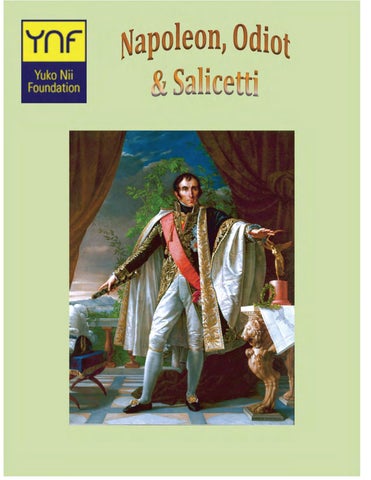
This is a highly important invoice and shipping customs document, shipping Odiot silver and gold dinner ware to Salicetti in Genoa Italy. Antoine Christophe Saliceti 1757 – 1809). He was a French politician and diplomat of the Revolution and First Empire. After studying law at the University of Pisa, he became a lawyer at the upper council of Bastia, and was elected deputy of the Third Estate to the French Estates-General of 1789. As deputy to the National Convention, Saliceti became a Montagnard and on 15 January 1793 voted for the death of King Louis XVI, and was sent to Corsica on mission to oversee Pasquale Paoli and enforce the Reign of Terror; however, he was compelled to withdraw to Provence, where he took part in repressing the revolts at Marseille and Toulon. During this time he met and promoted his compatriot Napoleon Bonaparte.
The First Page of the Invoice REP. FRA 50 SAF Soliatti Declaration of the objects, with reference to those taken abroad. I, the undersigned Jean Baptiste Claude Odiot, goldsmith, manufacturer, rue Honoré no. 1401, declare that I have today had the silverware checked, as follows: silver trays. Namely two jugs. four candlesticks. twenty-four covered plates, fourteen dessert covers, four double salt cellars, four single salt cellars, two mustard pots, four serving plates, two table centerpieces, two dessert sugar bowls, two teaspoons, a small dish with lid, two mustard spoons, large oval. All the said objects gathered together, enclosed in a large trunk in one all of which articles I have had duly recognized and legally marked with the assay and guarantee marks, in accordance with the law of 19 Brumaire of Year XI and hereby request my commission to have them taken out of the territory of the commune of Turin. of the French Republic, which must be issued at the Customs Office and to be returned within three months of this time. My commission to have them taken out of the territory, the commune of Turin. of the French Republic, which must be issued at the Customs Office and to be returned within three months of this time.
Odiot
Emperor Napoleon Bonaparte gave Jean-Baptiste Claude, grandson of Jean-Baptiste Gaspard, many prestigious commissions for himself and his family, such as the sacred scepter and sword and the King of Rome's cradle. Immense dinner services were ordered by Pauline Borghèse, by her mother and by the Emperor himself. Charles Nicolas Odiot, who excelled in the rocaille style, succeeded his father and became the purveyor by appointment to His Majesty the King Louis-Philippe and to the Royal Family of Orleans. He was later succeeded by his son Gustave who received the House of Odiot's most important commission ever, id est, 3,000 pieces of solid gold flatware for Saïd Pacha, the Viceroy of Egypt. He later became the purveyor by appointment to the court of His Imperial Majesty the Tsar. Gustave was also the last member of the Odiot family to preside over the company. The only surviving work by him dating from before the French Revolution (1789–95) is a coffee urn (Monticello, Virginia, Jefferson Foundation) designed and commissioned by Thomas Jefferson.
Cradle of the King of Rome by Odiot, Secular and Ecclesiastical Treasury, Vienna, Austria.
Christophe Saliceti; portrait by Jean-Baptiste Wicar (1808) Member of the National Constituent Assembly of 1789
These table legs in the Yuko Nii Foundation reading room are exactly like the ones in Salicetti’s palace