A summary of the impact of the Lincolnshire Wildlife Trust in 2025-2026
Annual Review
LIANNE DE MELLO
APRIL 2025 - MARCH 2026
Welcome W
Libby John Chair of Trustees Lincolnshire Wildlife Trust
Our vision Our vision is for a thriving natural world, with our wildlife and habitats playing a valued role in addressing the climate and ecological emergencies, and people inspired and empowered to take action for nature. Our three strategic goals are:
1 Nature in Lincolnshire is in recovery with abundant, diverse wildlife and natural processes creating wilder land and seascapes where people and nature thrive. 2 People in Lincolnshire are taking action for nature and the climate, resulting in better decision making for the environment at both the local level and national level. 3 Nature in Lincolnshire is playing a central and valued role in addressing local and global challenges.
2 | Annual Review 2025 - 2026
hether your passion is birds, butterflies, plants or any other wildlife you will find good news about the species we are supporting to thrive and grow in Lincolnshire. As a botanist I am delighted that orchids are flourishing in our reserves with over 20,000 greenwinged orchids recorded at Heath’s Meadow, nine different orchid species at Messingham Sand Quarry and an enigmatic lizard orchid popping up at Robert’s Field in 2025 for the first time since its restoration to a stunningly beautiful wildflower meadow, as well as gorgeous orchid populations thriving in so many of our reserves. As you read the pages that follow, you will find many reasons for optimism. This report highlights the positive impact that Lincolnshire Wildlife Trust, our members, volunteers, supporters and partners are having for wildlife across the county. However, these achievements sit within a wider context that is far less encouraging. These are challenging times for nature and people. Summer drought and heatwaves are likely to become normal alongside wetter-than-ever winters and we are thinking about what this will mean for nature. Having an extensive and diverse portfolio of nature reserves containing a mosaic of habitats will be part of the solution and we are pleased to have been able to extend some of our reserves over the last year. But nature doesn’t just live in reserves and luckily, we don’t have to solve everything alone.
We continue to support landowners across the county to maximise opportunities for nature to thrive and find space, food and shelter in a connected landscape. We are also part of a collaborative federation of 46 UK Wildlife Trusts, and work with partners including businesses, educational institutions, government agencies and other environmental charities. A successful example of multi-agency partnership working delivering largescale support for nature was the Fens East Peat Partnership. In restoring peat habitats across the four counties of the Fens we recreated ecosystems that support biodiversity, provided better water quality and flood management and reduced carbon dioxide emissions from degrading peat. We hope that as our Lincolnshire patch of this project at Bourne North Fen develops, it will come to be as rich in biodiversity as the nearby Willow Tree Fen has, demonstrating how nature can recover on former arable land. Much of our work of the Trust over the last year, as every year, has been supported by amazing volunteers. They are a diverse group, of all ages and backgrounds, without whom our activities would be severely limited. They share a love of nature and a willingness to give up their time, energy and expertise. Volunteers have roles including helping to manage our reserves, talking to visitors about wildlife, running Area Groups, engaging in fundraising or providing governance as
DANNY GREEN/2020VISION
The 2025-26 financial year saw mixed results, but overall our finances remain sound. We welcomed an increase in memberships and income from members, but overall our unrestricted income (that we can put towards general Trust activities) was somewhat down. During the year, we received almost £1 million in legacy income some of which was restricted to land purchase. More than ever, gifts in wills enable the Trust to achieve far more for wildlife than would otherwise be possible. These generous gifts help us care for our nature reserves, restore habitats, inspire future generations and, where opportunities arise, secure additional land for nature's recovery. Every legacy, whatever its size, represents an extraordinary act of support for wildlife. We would like to thank all those people who have remembered us in their wills and our thoughts are with the family and friends of those whose legacies we have received. I hope you enjoy reading this review, and that you can take some pride and pleasure in all we have achieved. Everything we do depends on the support of others, and on behalf of all the Trustees I would like to thank everyone who has contributed in so many different ways, to the vital work of the Lincolnshire Wildlife Trust.
Libby John, Chair Lincolnshire Wildlife Trust
Once a scarce and threatened species, green-winged orchids reached exceptional numbers at several reserves, with more than 20,000 recorded at Heath’s Meadow Our young Duke of Edinburgh Award volunteers at Whisby Nature Park got stuck into practical conservation including relocating a toad from the car park to the newly built hibernaculum After five successive years, Norfolk hawker dragonflies are now firmly established at Baston Fen nature reserve
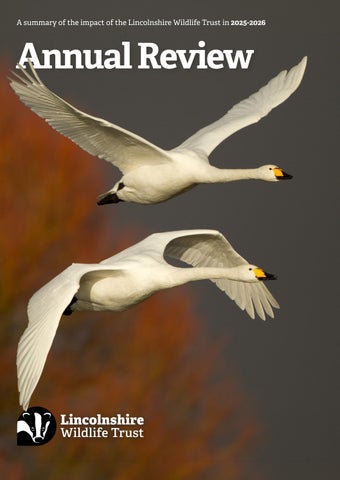
ON THE COVER: Every winter, whooper swans arrive from their nesting grounds in Iceland. Over 1,000 were recorded at Willow Tree Fen in the winter 2025-26
DANNY GREEN/2020VISION
Trustees. Some inspire the next generation of nature-lovers through leading our Watch Groups or other educational activities. Their rewards include positive feelings of making a difference, forming friendships and engaging in activities that support mental and physical wellbeing. We are very grateful to all of them. You can find out more about volunteering for us at lincstrust.org.uk/volunteer The volunteers I work most closely with are our Trustees. During 2025/26 year we said goodbye with many thanks to Mark Smith who stepped down from the Board and welcomed a number of new Trustees. Georgie Fletcher, Grace Kidman, Rachel Herron and Mike Zehetmayr bring a range of perspectives, fresh ideas and different expertise to our Board. Our appeal to enable us to purchase and secure nature-rich grassland at Hawthorpe is still ongoing. We are very pleased to have been awarded a number of large grants towards the purchase but are just as delighted to see the donations and support from members of the public. From the smallest to the largest, each donation is hugely valued. People have chosen donating to Hawthorpe as a way of commemorating births and 100th birthdays, and have made weekly sacrifices (such as bacon sandwiches and bus rides!) to be able to contribute. We are so grateful for each donation. More than anything the success of this appeal has reminded us how many people truly care about wildlife in Lincolnshire.
LEFT TO RIGHT: The spectacle of the high tide at Gibraltar Point was experienced by many during our sold-out High Tide Breakfast events
Lincolnshire Wildlife Trust | 3
MIKE WATTS
Fifteen little tern chicks fledged at Gibraltar Point; the last site in Lincolnshire where they nest
Goal 1
Nature in Lincolnshire is in recovery
DAVID TIPLING/2020VISION
A
cross Lincolnshire, landscapes for wildlife are becoming bigger, better and more connected through the Trust’s work. During the year, the Trust and its partners delivered major habitat restoration work across peatlands, wetlands, rivers, coast and grasslands, helping nature recover at scale while strengthening resilience to climate change and flooding. The year 2025-26 saw significant progress in strengthening the Trust’s nature reserve network. At Hawthorpe, a flagship 87-hectare grassland site with exceptional wildlife value was secured under a loan agreement while fundraising continues into 2026 towards permanent acquisition. The castle mound at Castle Bytham became a 9-hectare nature reserve under a long-term management agreement, connecting with the Trust’s Lawn Wood & Meadow reserves. Banovallum House nature reserve has been extended
thanks to a partnership with East Mercia Rivers Trust that has seen Harrison’s Holme added to become a proposed wetland. And important additions were made at Crowle Moor. Together, these additions strengthen the countywide impact of the Trust’s work and help to unlock collaboration from other landowners that create landscape-scale benefits, river corridor enhancements and connected spaces for nature and people, and 2025-26 was a significant step forward. The Trust's 100 nature reserves remain at the heart of what we do. These reserves, some of which were formerly quarry sites or arable land, show that nature recovery is possible. Over the year 2025-2026, many species across the Trust’s reserves showed encouraging signs of recovery and resilience during the year as exemplified at Willow Tree Fen and Gibraltar Point.
Cranes and more at Willow Tree
Crane Watch, with its dedicated team of volunteers, was in its sixth year at Willow Tree Fen with the near-resident breeding pair successfully fledging a chick, and a second breeding pair intriguingly appearing in September with a previously undetected chick! Up to 56 cranes appeared at winter roost – a new record for the reserve. Arable land as recently as 2009, Willow Tree With 17 churring (calling) males, Crowle Moor nature reserve is home to a nationally significant population of nightjars
Fen continued to establish itself as one of the county’s most important wetland reserves, with winter roosts of 52 marsh harriers, over 1,000 whooper swans and up to 120 goosanders recorded. The reserve also recorded its fourth consecutive year for spotted crake, underlining the growing importance of its reedbed habitat.
Shorebird sanctuary success
We were slightly later than usual closing off the shorebird sanctuary area at Gibraltar Point, due to clean-up efforts following the plastic nurdle pollution washing ashore. Fortunately, this didn’t appear to have an impact with shorebird numbers picking up in May despite a pair of crows nesting nearby posing more of a threat. Thereafter predator pressure was low, high tides posed little risk and weather was favourable, resulting in an excellent breeding outcome. Little terns had at least six confirmed nests producing 15 chicks fledging successfully. Ringed plover achieved at least 12 nests with an impressive total of 38 chicks. While oystercatchers produced three nesting attempts with seven chicks. The continued success of recent seasons may be a sign of ongoing recovery for these species, and a positive outlook for the sanctuary’s breeding populations as it enters its 50th year of protection in 2026. Elsewhere on the reserve, a pair of spoonbills attempted to nest for the first time in modern Lincolnshire history.
Working together in partnership Beyond the boundaries of nature reserves we are expanding our networks and working in partnership ensures nature recovery can happen at an even larger scale. The Fens East Peat Partnership continued to lead and co-ordinate the region’s largest peatland restoration programme, working across multiple sites throughout the Fens National Character Area spanning Lincolnshire, Cambridgeshire, Norfolk and Suffolk. Supported by Natural England and Defra through the Nature for Climate Peatland Grant Scheme, restoration activity continued at scale. Planning permission was secured for Bourne North Fen in January 2026, where the Trust aims to restore 50 hectares of Lincolnshire's lost peat fen habitat, helping to benefit wildlife, improve water management and reduce carbon emissions from degraded peat soils. Initial restoration works were completed by March in partnership with Black Sluice Internal Drainage Board. Phase one works at Baston Fen were also completed, including installation of a new tilting weir to support long-term peatland recovery. World Peatland Day activities and a series of webinars helped raise awareness of the importance of healthy peatlands for wildlife, water and carbon storage. The programme also continued to invest in skills and innovation, including additional drone pilot training for peatland monitoring and survey work. A further extension and
grant increase was secured for 2026–27, enabling work to continue at new restoration sites. Landscape-scale coastal and estuarine partnerships also continued to develop, bringing together landowners, organisations and communities to deliver nature recovery across entire landscapes. The Trust remains a key partner in The Wash Landscape Recovery initiative, led by the RSPB alongside landowners around the Welland and Witham catchments. The project moved closer to a long-term agreement with Defra during the year, supporting ambitious habitat restoration, climate resilience and sustainable land management across this internationally important landscape. Through the Green Investment in Greater Lincolnshire (GIGL) programme, launched in September 2025, the Trust is helping connect investment with highquality habitat creation and restoration projects, supporting the long-term delivery of nature recovery across the county. Work through the Wilder Humber partnership continued to explore innovative approaches to restoring rare saltmarsh and sand dune habitats along the Humber Estuary. Although initial seagrass transplants at Horseshoe Point were unsuccessful, investigations into alternative restoration sites are ongoing. Saltmarsh enhancement trials also began during the year, alongside significant investment in specialist coastal plant propagation infrastructure.
Goslings Corner Wood nature reserve is now a stronghold for the nationally scarce brown hairstreak butterfly This included the creation of a new saltmarsh nursery at Sea View Farm, Saltfleetby, featuring polytunnel greenhouses and seed-banking facilities to support future habitat restoration across the Humber Estuary. The Trust additionally supported work at Spurn Point in Yorkshire, including native oyster and seagrass restoration projects. Through Wilder Trent, work continued with fellow Wildlife Trusts and the Trent Rivers Trust to develop a “source to sea” framework for restoring wildlife-rich river corridors and connected habitats across the Trent catchment. The Trust also contributed to early development work supporting the Eastern Flyway UNESCO World Heritage Site proposal, recognising the international importance of the east coast for migratory birds and coastal wildlife. Lincolnshire Wildlife Trust | 5
SAM DAWSON
MAIN IMAGE: IMOGEN BENTLEY, INSET: COTTON-GRASS: TOM MARSHALL
Enhancing the Humberhead peatlands in north-west Lincolnshire Peatland restoration progressed at Epworth Turbary and on the part of Crowle Moor owned by North Lincolnshire Council where over 10,000 cotton-grass plugs were planted. Through the EU LIFE Moor Space project, a workshop was delivered to encourage land management practices that help buffer and protect the internationally important Thorne and Crowle Moor reserves. The Trust also secured two additional parcels of land at Crowle Moor for conservation management, funded through a gift in a will and EU LIFE Moor Space support, helping strengthen the long-term resilience of the reserve.
Goal 2
People in Lincolnshire are taking action for nature and the climate T hrough the year, thousands of people engaged with wildlife through events, volunteering, learning opportunities and visits to nature reserves and visitor centres. Members and supporters remained central to the Trust’s work, with a memorable Members Day at Gibraltar Point helping strengthen relationships with supporters and celebrate collective achievements for nature. More spontaneous out-of-hours wildlife experiences were also introduced for the first time, including a warden-led seasonal walk at Snipe Dales Country Park which, having been promoted to our digital audiences, sold out almost immediately and demonstrated a strong appetite for deeper, more personal wildlife experiences. The Trust continued to connect with new audiences through major public events and creative engagement. At the Lincolnshire Show, thousands of visitors experienced the sounds of Lincolnshire’s nocturnal wildlife through immersive audio installations, introducing many
people to species and soundscapes they might not have encountered before, yet could be enjoyed throughout the county. Fundraising appeals received strong public support during the year, particularly for the Woodhall Spa Airfield appeal which funded the creation of a memorial garden, providing a peaceful place at the entrance to the reserve for reflection and remembrance. Fundraising also commenced for the ambitious Hawthorpe nature reserve acquisition project, reflecting growing public enthusiasm for landscape-scale nature recovery. Education and youth engagement remained a major focus throughout the year. School visits, outreach sessions, careers events, nature clubs and community activities took place across the county, helping young people build confidence, skills and connections with the natural world. A new Junior Wardens programme launched at Gibraltar Point and the Trust continued to support and celebrate young people through the Young Environmentalist Awards.
Events across the Trust’s reserves showcased the diversity of Lincolnshire’s wildlife and encouraged people to experience nature in new ways. Gibraltar Point delivered another successful programme of seasonal events, including sold-out High Tide Breakfasts and “Mothy Mornings” celebrating the reserve’s remarkable moth diversity. At Whisby Nature Park, a programme of nature workshops attracted strong audiences, including a particularly popular wildflower identification series led by Trust Chair Libby John. Far Ings Nature Reserve also saw increased visitor interest following appearances on BBC Countryfile and Winterwatch, helping showcase the reserve and the wider Humber landscape to national audiences. Visitor experience improvements at Far Ings included a more family-friendly welcome, expanded retail ranges and improved café provision. Family engagement continued to grow through seasonal trails and activities running across multiple nature reserves during school holidays, including for the
Whisby Nature Park introduced a Duke of Edinburgh volunteering programme to support practical conservation skills and youth participation
6 | Annual Review 2025 - 2026
Empowering communities to connect with nature
Community engagement supporting local action for nature expanded during the year. Following completion of consultancy work with Wilder Doddington and the Lincoln & Witham Landscape Recovery Partnership, the Trust strengthened its own community engagement programme and established a new network connecting local groups managing and enhancing green spaces. Through a regular newsletter, training opportunities and skills workshops, community groups were supported to improve places for wildlife while sharing knowledge and experience with one another. New relationships were developed with groups including Tealby Village Green, Goxhill Millennium Green, Winterton Community Pavilion and Haxey. The annual Lincolnshire Environmental Awards and Community Day celebrated inspirational achievements while bringing together community groups, volunteers and conservation professionals to share ideas and expertise. The Trust also strengthened
links with the University of Lincoln through talks, work placements, dissertation opportunities, careers support and wildlife identification workshops delivered in partnership with the university’s iBiodiversity project, helping inspire and support the next generation of environmental professionals. Pollinator-friendly planting schemes at the University of Lincoln city campus demonstrated how urban environments can contribute to nature recovery and provide opportunities for people to experience wildlife in daily life. The Trust’s 16 Area Groups continued to play an important role in connecting people with wildlife close to home. Through a year-round programme of talks, guided walks, reserve open days, practical conservation activities and community events, Area Groups provide local opportunities for people to learn about wildlife, meet like-minded people and support nature recovery in their own area. Their knowledge, enthusiasm and community connections help ensure that the Trust’s work reaches far beyond its nature reserves and remains rooted in communities across Lincolnshire. Volunteers continued to make an enormous contribution across the Trust, supporting reserve management, visitor engagement, species monitoring, events, administration and governance. Their knowledge, commitment and generosity remain fundamental to the Trust's ability to deliver conservation at scale across Lincolnshire.
Raising the profile of the ecological significance of The Wash A collaboration with visual artists culminated in an exhibition Sounding The Wash at The Old Coastguard Station, Gibraltar Point, in September 2025 including this delicate porcelain piece by Kathryn Parsons inspired by the notes of the golden plover's call. Trust staff also contributed to a new film documentary The Wash: Britain's Secret Wilderness, which premiered in September 2025 with a screening in Kings Lynn.
GEOFF TRINDER
first time at Snipe Dales and Banovallum House. Digital engagement continued to expand rapidly throughout the year. The Trust’s Wilder Lincolnshire podcast grew its audience further, sharing stories from wardens, partners and conservation projects across the county. An episode in advance of Gibraltar Point shorebird sanctuary’s 50th anniversary received over 1,200 YouTube views and 300 listens. Wildlife content shared through social media - including crane chicks, starling murmurations, winter roosts at Willow Tree Fen and trail camera footage – reached large audiences and helped bring nature closer to people’s everyday lives. The Trust’s Facebook audience grew by 19% during the year, while the e-newsletter subscriber base increased to almost 11,000 supporters.
SO
N
1,924 grey seal pups born were born at Donna Nook, visited by nearly 50,000 people and supported by thousands of volunteer hours
SAM DA W
Marsh helleborine is one of nine species of orchid found at Messingham Sand Quarry - the highest total recorded on any Trust nature reserve Access to nature also improved during the year with the opening of the King Charles III England Coast Path between Mablethorpe and the Humber Bridge. The 47-mile route provides new opportunities for people to experience Lincolnshire’s internationally important coastline, while plans continue for a new footbridge over the River Steeping at Gibraltar Point to further improve access in 2026. Lincolnshire Wildlife Trust | 7
TERRY WHITTAKER/2020VISION
Avocets bred successfully for the first time at Woodhall Spa Airfield in 2025
Goal 3
Nature in Lincolnshire is playing a central and valued role T he year 2025–26 was pivotal for regional governance with the creation of the Greater Lincolnshire Combined County Authority and the election of the county’s first Mayor. The Trust engaged actively with the emerging authority, MPs and national policymakers to champion the role of nature in economic resilience, climate adaptation, water security, public health and sustainable growth. As Lincolnshire’s political and investment landscape evolves, ensuring that nature recovery remains embedded within future regional decision-making will be increasingly important. Throughout the year, the Trust continued to work with partners, communities, landowners, businesses and public bodies to demonstrate how nature recovery can support climate resilience, water management, sustainable development and healthier communities. The Ancholme Catchment Partnership, led by Lincolnshire Wildlife Trust, continued to bring together organisations, landowners and communities to shape the future of the river catchment. During the year, public and stakeholder consultation events
8 | Annual Review 2025 - 2026
informed development of the 2026–2030 Catchment Plan, helping identify shared priorities around water quality, flooding, habitat recovery and long-term resilience. The partnership’s annual conference, hosted at the Pink Pig Farm, brought together a wide range of stakeholders, including Water Resources East, which delivered workshops exploring future water demand and the challenges facing the region in a changing climate. A major milestone during the year was the formal launch of Green Investment in Greater Lincolnshire (GIGL) at Woodhall Spa. The programme is helping connect private investment with high-quality habitat creation and restoration projects across the county, supporting long-term nature recovery at scale. During the year, the programme’s website and Technical Advisory Group were established, while landowners began developing habitat management and monitoring plans linked to biodiversity delivery through Section 106 agreements. GIGL also secured its first biodiversity unit sale in March 2026, marking an important step towards attracting sustainable investment into nature recovery.
The Trust’s land management advisory work also continued to support wildlife beyond its own reserves, with substantial areas of land surveyed during the year and a range of community groups supported in improving their local green spaces for nature. This work helps extend habitat networks across the wider landscape while supporting people and communities to take practical action for wildlife close to home. Planning and policy work remained an increasingly important part of the Trust’s contribution to nature recovery. Staff contributed to consultations and strategic discussions at national, regional and local levels, including Biodiversity Net Gain implementation, Local Plans, the Greater Lincolnshire Local Nature Recovery Strategy and long-term “2100+” coastal and flood resilience programmes. The Trust also continued to engage directly with the planning process by advising developers at pre-application stage, responding to planning applications and representing nature at Examinations in Public alongside Planning Inspectors.
MIKE WATTS
Strength through partnership The year highlighted the importance of strong partnership working in responding to environmental incidents and emerging challenges. Following the collision of the container ship MV Solong with the oil tanker MV Stena Immaculate at the mouth of the Humber, plastic nurdle pollution prompted the Trust to work closely with partners including specialist organisation Nurdle.org and others to support clean-up efforts, environmental monitoring and public communication. The emergency response continued into late spring 2025 and demonstrated both the vulnerability of marine environments and the importance of collaborative action to protect wildlife and coastal habitats.
More than 18 tonnes of plastic nurdles were cleared from our beaches
Reducing greenhouse gas emissions Alongside nature recovery and public engagement, the Trust also continued to reduce the environmental impact of its own operations. Decarbonising buildings, reducing emissions and improving energy efficiency remain important parts of ensuring the organisation can demonstrate leadership and resilience in response to the climate emergency. The Trust continues to make meaningful progress towards its target of achieving net zero greenhouse gas emissions by 2030. During the year, further decarbonisation work was undertaken across the Trust’s estate, including the replacement of additional gas heating systems with biogas alternatives and plans for expanded electric heating provision within Trust buildings. A major decarbonisation and insulation programme was developed for the Whisby Education Centre ahead of its 25th anniversary in 2026, following successful funding support from the
FCC Communities Foundation. The project will improve energy efficiency, reduce emissions and help future-proof one of the Trust’s busiest education facilities. The Trust also continued to improve the energy performance of its domestic property portfolio, including sensitively upgrading historic farmhouse buildings that continue to provide important roosting habitat for bats and other wildlife. Scope 3 emissions were reduced through the introduction of a second-hand electric pool vehicle based at the Trust’s Horncastle headquarters, significantly reducing private business mileage in petrol vehicles while helping staff gain confidence using electric vehicles and charging infrastructure. Further plans are in place to expand solar photovoltaic installations, improve building efficiency and replace additional fleet vehicles with electric alternatives in the coming years.
GEOFF TRINDER
At Gibraltar Point, there were at least 12 ringed plover nests with an impressive total of 38 chicks
At Donna Nook, surveys at the Pyes Hall managed realignment site revealed an unexpectedly large population of water voles living within slightly brackish ditches. Lincolnshire Wildlife Trust | 9
DAVID ROBERTS
Financial summary
2025 –
Income £5,778,614
Marsh harrier roosts were particularly impressive across the Trust’s wetlands, with 52 birds counted at Willow Tree Fen alone, alongside significant roosts at Woodhall Spa Airfield, Wolla Bank Reedbed and Saltfleetby-Theddlethorpe Dunes.
Legacies
We are honoured to record our appreciation to the following individuals whose legacies we received or were notified of in the year ended 31 March 2026. Peta Bourdillon Dorothy Laking Sally Ogley Cynthia Ann Eaton Patricia Anne Parker Michael John Furness Marlene Mary Gilbert Malcolm John Wharton Margaret Joan Tottle Margaret Anne Harrison Brian Shurmer Ruth Fane Lord Martin Hugh Broadbridge Sheila Marshall Ian Buchannan Murray Jan Reeves John Loft Hildegard Felicitas Smart Roger Douglas Atkinson Stanley Johnson Peter James Nicholas Harvey Michael John Shaw James Roger Bowker Sheila Valerie Walker Michael Crooks John Charles Nicholson Nancy Stockwell Jennifer Regina Dickinson John Michael Drayton Margaret Shirley Clegg
Wider countryside conservation £715,866
Nature reserve income £2,475,742
Inspiring people £341,007 Other £78,162
Subscriptions, donations and gift aid £962,159
Investment income £138,074 Merchandising income £88,498
D
Legacies £979,106
uring the year 2025-26, the support that the Trust continues to receive from our members, partner organisations and funders has helped us carry out vital work across our nature reserves and the wider landscape. Through careful financial management and a wide range of income streams, the Trust has retained strong financial unrestricted reserves and is well placed to prosper in the future. The 100 nature reserves that are in our care are at the core of what we do. During the year, we invested in land purchases adjacent to existing nature reserves and, in late 2025, launched an appeal to fundraise for the acquisition of land at Hawthorpe. The funds received for the appeal including public donations and money from Biffa Award and the Swire Trust, are accounted for as income in the financial year 2025-26. However, the expenditure to purchase the land will be in the year 2026-27. The Trust is extremely grateful for the overwhelming number of people who have generously supported this appeal. We are also proud to work with a wide range of partners to deliver landscapescale restoration projects including the critically important peatlands of the Fens
and Humberhead Levels. As in previous years, these multi-partner, multi-year projects, facilitating work on both Trust sites and on those of other charity and commercial partners leads to significant year-on-year variances in restricted revenues, as income is recognised early in the projects, and associated expenditure is accounted for in later periods. The Trust reported £5.8m of total income in 2025-26, a reduction from the £8.9m seen in the previous year. This reduction was expected as the Trust reported exceptionally high levels of project income in the previous financial year. Charity accounting rules require the mandatory recognition of income as soon as its receipt becomes probable and measurable, and once the charity is entitled to it. This can be well before the income is received or spent. Because of this requirement, in 2024-25, the Trust accounted for over £4m associated with ongoing Natural England funded peatland restoration projects: Fens East Peat Partnership and Humberhead Levels. Income was recognised last year and expenditure related to this continued into 2025-26, resulting in the restricted deficit seen this year.
We are incredibly grateful to our members, staff, volunteers, donors, partner organisations and funders. Your continued generosity, support and dedication is crucial in helping nature recover across Lincolnshire. 10 | Annual Review 2025 - 2026
– 2026
Thank you to our corporate members
Air IT Limited Cleethorpes Builders Merchants Cray Valley Limited Creative Nature Crowder & Sons Limited Growing Wild Limited J E Piccaver & Co J W Ruddocks & Sons Limited Lindum Group Limited Micronclean Limited Mortons of Horncastle Limited Natureland Seal Sanctuary Sibelco UK Truelove Property & Construction Yara (UK) Limited Woodhall Country Park Vine House Farm YOU Development Limited
Expenditure £6,734,402 Nature reserve management £1,875,120
Wider countryside conservation £3,279,251
Merchandising costs £59,197
The Trust has continued to deliver many other restricted projects, with ongoing work on multi-year projects such as with Ørsted and Yorkshire Wildlife Trust, and the Crown Estate. Natural England and the Environment Agency also finance many smaller discrete pieces of work, including work on managed realignment at Donna Nook, work on Rivers and Wetlands and work financed under the Farming in Protected Landscapes programme. Income from membership is 1.5% up year-on-year, with the number of members reduced by 0.3% from 26,856 to 26,780. The number of memberships (separate addresses) has actually increased during the year by 1.65% to 13,600. This discrepancy is due to the mix of membership between individual, joint and family memberships. We are always truly grateful when our supporters choose to make nature a part of their special ongoing legacy and during the year, the Trust benefited from almost £1 million in income arising from legacies. These gifts in wills
In the Woodhall area, maternity roosts of soprano pipistrelle bats continued to thrive with more than 500 bats recorded across two key roost sites.
Inspiring people £1,280,678
and our donors, sponsors and funders
are a vital source of funds that support a range of conservation projects, nature reserve management and land purchase. We deeply appreciate those who chose to support us in this way. As a charity, the Trust relies on the generosity of its members and other supporters. Without this support we would not be able to achieve our aim of more nature everywhere, for everyone. Our heartfelt thanks to all the members, volunteers, supporters and organisations who’ve supported our work. You have helped protect more land for nature, restore habitats so wildlife can recover, helped thousands of people connect with the natural world. A comprehensive review of the financial situation can be found in our Annual Report & Financial Statements for the year ended March 2026. Available on our website at: lincstrust.org.uk/publications TOM MARSHALL
Costs of generating subscriptions, donations and gift aid £240,156
We are grateful to the many grant-making bodies, statutory authorities and other organisations that support us: Biffa Award Bowring Transport Limited Construction & Environmental Services Limited Defra Derbyshire Wildlife Trust Doddington Farms LLP Doddington Hall Conservation Charity Environment Agency Esmée Fairbairn Foundation European Union Fox (Owmby) Limited GTR4 Outer Dowsing Offshore Wind Institute of Cemetery and Crematorium Management (ICCM) Lincolnshire Bird Club Lincolnshire County Council Ministry of Defence National Lottery Heritage Fund Natural England The Crown Estate National Grid NTT DATA Ørsted Postcode Community Trust North Kesteven District Council Swire Charitable Trust Vine House Farm Yorkshire Wildlife Trust The Royal Society for the Protection of Birds Lincolnshire Wildlife Trust | 11
PRESIDENTS: Geoff Trinder (President) Tim Sands (Vice President) TRUSTEES/DIRECTORS: Elizabeth John (Chair) Caroline Steel (Vice Chair) Joanne Woolley (Honorary Treasurer) Michael Burgass Eve Crook Georgia Fletcher (appointed 25 October 2025) Kitty Hamilton Sophie Harris Rachel Herron (appointed 25 October 2025) Samuel Kemp Grace Kidman (appointed October 2025) Mark Smith (resigned 25 October 2025) Michael Zehetmayr (appointed 25 October 2025) SENIOR STAFF: Chief Executive and Company Secretary: Paul Learoyd Head of Conservation: Tammy Smalley Head of Finance: Sarah J Smith Head of Nature Reserves: Sarah Craythorne Head of Public Engagement & Communications: Paul Chibeba
LINCOLNSHIRE WILDLIFE TRUST Banovallum House, Manor House Street, Horncastle, Lincolnshire LN9 5HF 01507 526667 | info@lincstrust.co.uk | www.lincstrust.org.uk Registered charity no. 218895