Lincoln University of Missouri
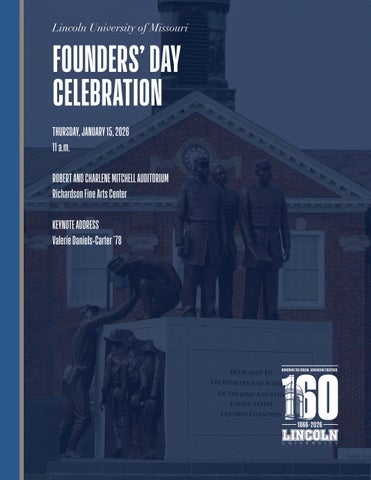
FOUNDERS’ DAY CELEBRATION THURSDAY, JANUARY 15, 2026 11 a.m. ROBERT AND CHARLENE MITCHELL AUDITORIUM Richardson Fine Arts Center KEYNOTE ADDRESS Valerie Daniels-Carter ’78
HONORING THE DREAM. ADVANCING TOGETHER.
1866-2026
TABLE OF CONTENTS Our Founding ..............................................................................................................................................................................................2 Order of Program......................................................................................................................................................................................4 Keynote Speaker.......................................................................................................................................................................................6 Family of the Year.....................................................................................................................................................................................7 Board of Curators and University Leadership..........................................................................................................................8 Alma Mater...................................................................................................................................................................................................9
1
OUR FOUNDING
A
s the American Civil War drew to a close in 1865, two regiments of emancipated Black soldiers took action on a decision that would reverberate from their Army station at Fort McIntosh, Texas, all the way to the Missouri state capital. The men, who learned to read and write as part of their training in boot camp, were determined to start a school for other freed Black people when they returned to their homes in Missouri after the war. The soldiers of the 62nd United States Colored Infantry, whose pay averaged $13 a month, came up with $5,000 to establish an educational institution in Jefferson City, which they named Lincoln Institute. The 65th Colored Infantry contributed another $1,400 to the school’s endowment. Preparations moved swiftly to open Lincoln Institute the following year. The charter specified three requirements: 1. The institution shall be designed for the special benefit of emancipated African Americans. 2. It shall be located in the state of Missouri. 3. Its fundamental idea shall be to combine study and labor. On January 14, 1866, an organization committee formally established Lincoln Institute. By June of the same year, it incorporated and the committee became the Lincoln Institute Board of Trustees. Richard Baxter Foster, a former first lieutenant in the 62nd Infantry, was named first principal of Lincoln Institute. On September 17, 1866, the school opened its doors to the first class of two students in an old frame building in Jefferson City. In 1870, the school began to receive aid from the state of Missouri for teacher training. In 1871, Lincoln Institute moved to its present campus. The curriculum added college-level coursework in 1877, and in 1879 Lincoln formally became a Missouri public institution with the deeding of the property to the state. Inman E. Page, Lincoln’s first president, took office in 1880 and served until 1898, overseeing enrollment growth, the construction of new buildings, hiring of new faculty and an expanding college curriculum. Under the second Morrill Act of 1890, Missouri designated Lincoln a land-grant university, emphasizing studies in agriculture, mechanics and teaching. In 1921, the Missouri Legislature passed a bill to expand the school to a four-year college and change the name from Lincoln Institute to Lincoln University, governed by a Board of Curators. Inman Page returned to Lincoln in 1922 to serve one more year as president of the newly designated university. Lincoln’s high school division earned accreditation from the North Central Association of Colleges and Secondary Schools in 1925; the teacher-training program followed in 1926 and the four-year College of Arts and Sciences in 1934. Longtime university President Sherman D. Scruggs witnessed tremendous growth during his time at the helm of Lincoln, from 1938 to 1956. Graduate instruction began in the summer session of 1940, with majors in education and history and minors in English, history and sociology. In 1954, following the Supreme Court decision in Brown v. Board of Education declaring segregated public schools unconstitutional, Lincoln University opened its doors to all who could meet its entrance criteria, regardless of ethnicity. Enrollment 2
climbed from 400 to more than 1,000 students, triggering a move to expand curriculum and facilities. Dr. James Frank was the first Lincoln alumnus to become president of the university, serving from 1973 to 1982. During his tenure, Lincoln University enhanced its land-grant status with the Cooperative Extension Center and acquired additional farm property. The Frank administration also developed a broadcast journalism program and began training students at campus television station JCTV. The 1990s saw the growth and integration of nursing, teacher education, computer science and agribusiness into Lincoln’s core offerings. As the school made its way into the 21st century, Lincoln enjoyed a resurgence in athletic programs and technological advancements, both in and out of the classroom. In 2014, John B. Moseley joined Lincoln as head basketball coach, rising to athletic director two years later. He began a term as interim president in May 2021, following the resignation of LU President Jerald Jones Woolfolk. On January 28, 2022, the Lincoln University Board of Curators named John Moseley president of the university. Today, Lincoln serves a diverse student population, both residential and nonresidential, and offers an array of academic programs, research projects and public services. The university grants associate, bachelor’s and master’s degrees in more than 30 areas of study. The legacy of those long-ago soldiers lives on in the growth of the university and the success of its graduates. The Soldiers’ Memorial Plaza on the campus quadrangle pays artistic tribute to the vision of the men of the 62nd and 65th Regiments and the embodiment of their dream.
ORDER OF PROGRAM Presiding Darius Watson, Ph.D., Assistant Provost for Academic Innovation, Outreach and Research, and Dean of the School of Professional Studies Prelude Lincoln University Band Processional* War March of the Priests by Felix Mendelssohn Lincoln University Band Posting of Colors* ROTC Color Guard The National Anthem* The Star-Spangled Banner by Francis Scott Key, arr. by Steven Smith Lincoln University Band Musical Selection* Lift Every Voice and Sing, lyrics by James Weldon Johnson and music by J. Rosamond Johnson Lincoln University Choir The Laying of the Wreath* John B. Moseley, Ed.D., Lincoln University President ROTC Cadet Elijah Teal ’27 Taps* Invocation* Rev. W. T. Edmonson Sr. ’75, ’85 Interim Pastor, Second Baptist Church Greetings Tina Shannon, Board of Curators Occasion John B. Moseley, Ed.D., Lincoln University President
4
Welcome Jamir Hunt ’26, 23rd Mister Lincoln University Dayonna Crump ’26, 101st Miss Lincoln University Introduction of Founders’ Day Speaker Jesse Canamore ’26, President, Student Government Association Founders’ Day Address Valerie Daniels-Carter ‘78 President and CEO, V&J Holding Companies Inc. Introduction of Family of the Year John B. Moseley, Ed.D., Lincoln University President The Cooper Family Alma Mater* Lincoln, O, Lincoln, words by Benjamin F. Allen and music by Robert Mitchell Sr. Lincoln University Band and Choir Benediction* Rev. W. T. Edmonson Sr. ’75, ’85 Interim Pastor, Second Baptist Church Retiring of Colors* ROTC Color Guard Recessional* Pomp and Circumstance by Edward Elgar, arr. by James Ployhar Lincoln University Band Michelle Gamblin-Green, Assistant Professor of Music and Director of Choirs Kalem Graham, Director of Bands Ceremonial Marshal Brian Norris, Ph.D., Macebearer and University Marshal
5
*Please rise and remain standing
SPEAKER HIGHLIGHT Valerie Daniels-Carter ‘78 President and CEO of V&J Holding Companies, a minority owner of the NBA’s Milwaukee Bucks and a board member of the NFL’s Green Bay Packers Valerie Daniels-Carter is president and CEO of V&J Holding Companies, owner of several quick-service restaurant franchises. She started the company in 1982 with one Burger King restaurant in Milwaukee and one investor — her brother, John W. Daniels Jr. Over the next 16 years, Daniels-Carter built a restaurant empire, growing V&J from one restaurant to 132 locations in eight states and employing more than 4,500 individuals. Today, V&J Holdings is a multibrand, multistate enterprise that also operates real estate and corporate venture businesses. Featuring such brands as Auntie Anne’s, Burger King, Captain D’s, Cinnabon, Coffee Beanery, Pizza Hut, Häagen-Dazs and many others, V&J is the largest female-owned restaurant franchise organization — and one of the largest restaurant franchise companies — in the United States. Daniels-Carter is also a minority owner of the NBA’s Milwaukee Bucks and a board member of the NFL’s Green Bay Packers. She has authored four books on business strategies and entrepreneurship. A member of the Class of 1978, Daniels-Carter earned a Bachelor of Science degree in business administration from Lincoln. She also holds an MBA from Cardinal Stritch University and several honorary Doctor of Humane Letters degrees. Prior to launching V&J Holding Companies, Daniels-Carter worked as a retail and commercial lender for First Wisconsin National Bank (now US Bank) and a financial underwriter for MGIC Corporation. Essence magazine calls her one of “the 50 Most Inspiring” African Americans in the United States. Her business success has enabled Daniels-Carter to support philanthropic efforts at home and abroad — building an orphanage, a medical facility, educational facilities and state-of-the-art water wells in Kenya and leasing 99 acres in Ghana to install irrigation systems for farmers in a blighted community. Her team created the Empowerment Initiative for Africa, which has seeded capital for 2,800 new businesses in Africa. In her hometown of Milwaukee, Daniels-Carter supports the Boys and Girls Club, a Family Service Center, three schools, a youth center, credit union and loan center. She is the lead supporter for the Institute for the Preservation of African American Music and Arts. Daniels-Carter was inducted into the National Black College Alumni Hall of Fame at Morehouse College in 2019. The United Negro College Fund honored her in 2023 with the Masked Award for her commitment to education. That same year, King Nyaho Tamakloe VI of Ghana crowned her the first Diaspora Queen 1 in the United States. 6
FAMILY OF THE YEAR The Cooper Family The Cooper family’s connection to Lincoln University spans decades and encompasses academic achievement, student leadership, campus employment and continued alumni engagement. Together, their contributions highlight the ways family ties strengthen the university community and support its mission of access, excellence and service. Eric Cooper ’10, a member of Alpha Phi Alpha Fraternity Inc. (Alpha Psi Chapter), worked in the Office of Admissions and was the 2008-09 Mr. Lincoln University. As an alumnus, Cooper has remained deeply engaged with the university, playing an instrumental role in planning the Alumni Honors Gala, an annual event that supports student scholarships. The 2023 gala welcomed more than 330 attendees and raised more than $25,000 for student scholarships. Cooper is also a co-founder of the Young Alumni Scholarship Fund and was recognized in 2023 as a St. Louis 40 Under 40 award recipient. Brandy Cooper ’13 earned a Bachelor of Liberal Studies and was a member of the Marching Musical Storm. She passed away in 2016 and is remembered for her deep love and strong support of Lincoln University. Brandon Jackson ’15 supported campus operations as a student employee in the Lincoln University Information Technology Department from 2013-15. After earning a Bachelor of Science degree, he continued working with the university as a help-desk technician from 2015 to 2016. Jackson later served as a support technician from 2016 to 2018 and as a telecom systems administrator from 2018 to 2021. Brittany Cooper ’16 earned a Bachelor of Liberal Studies and remains an active alumna, continuing the family’s tradition of engagement with Lincoln University through ongoing support and involvement. Jada Cooper-Jones ’19, a member of Alpha Kappa Alpha Sorority Inc. (Alpha Iota Chapter), served as a Lincoln University ROAR Agent. She was also a member of the Lincoln University Principles of Worship Gospel Choir, serving as president from 2017 to 2018. Her husband, Aaron Jones ’16, is also a Lincoln University alumnus. Derek Cooper ’22, a member of Omega Psi Phi Fraternity Inc. (Eta Sigma Chapter), held multiple leadership roles, including student ambassador, resident advisor and board member of the Campus Activity Board. Tydus Saunders is a current senior and a member of Omega Psi Phi Fraternity Inc. (Eta Sigma Chapter). His campus involvement includes serving as a Campus Activity Board intern from 2022 to 2023, a residential assistant in spring 2023, a student ambassador from 2022 to 2025 and LU National Pan-Hellenic Council chaplain from 2024 to 2025. Ja’Leisha Cooper is a current senior who served on the Royal Court as the 2024-25 Miss Senior. Her involvement includes membership in the National Association of Colored Women’s Clubs (Poise Chapter), service as a student ambassador from 2021 to 2025, participation as a ROAR Agent and recognition as a Dean’s List scholar. 7
LINCOLN UNIVERSITY BOARD OF CURATORS Vernon V. Bracy ’82, B.S. Everidge Cade ’73, B.S. Richard G. Callahan, J.D. Belinda M. Farrington ’79, M.A. Victor B. Pasley ’68, M.S.Ed. Richard R. Popp, J.D. Terry Rackers, B.S. Tina Shannon, M.P.A. Jonathan D. Truesdale, J.D.
PRESIDENT’S LEADERSHIP TEAM John B. Moseley, Ed.D., 21st President Tim Abney ‘78, B.S., Director of Athletics & Campus Recreation Ashton Cleveland, J.D., Ed.D., Chief Operating Officer Greg Emanuel Jr., Chief Information Officer Gary Hill, D.C.J., Vice President of Campus Culture, Chief of Police Tobias Morgan, Ph.D., Vice President of Student Affairs April Robinson, M.S., Executive Director and Chief Human Resources Officer Pamela Sandbothe, M.P.A., Vice President of Administration & Finance Piyusha Singh, Ph.D., Provost & Vice President of Academic Affairs Danisha Williams, Ed.D., Executive Director of Enrollment Management
Class year designates graduation from Lincoln University.
8
ALMA MATER Lincoln, O, Lincoln We thy proud children are; Thou art our guiding star, Lincoln believe. Ours are hearts that yearn for thee No matter where we be; Morning, noon and always, we Are Lincolnites. Thy name, O Lincoln Shall e’er us be dear. Thy mem’ries sacred, near Hold us to thee. Thy honors ours shall be, Thy cause when just shall we With loyalty defend For thee we’d die. Lincoln, O Lincoln! We thy proud children are; Our hearts, both near and far Love thee with delight. No matter where we are; Whether present, absent far, Morning, noon, we always are True Lincolnites!
9
TM
LincolnU.edu