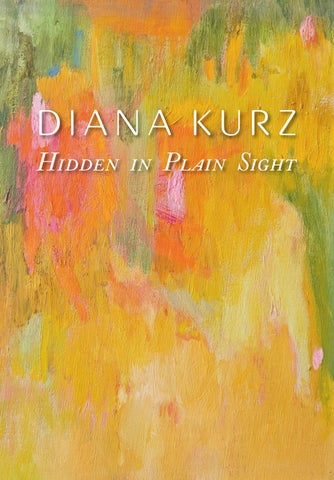
DIANA KURZ Hidden in Plain Sight
All rights reserved, 2026. This catalog may not be reproduced in whole or in any part, in any form or by any means both electronic or mechanical, without the written permission of Lincoln Glenn. Catalog design by Clanci Jo Conover Cover illustration: Diana Kurz Blossom, Early 1960s Oil on canvas 14 x 12 inches
DIANA KURZ: Hidden in Plain Sight October 29 - December 5, 2026
542 West 24th Street New York, NY 10011
(646) 764 - 9065 gallery@lincolnglenn.com www.lincolnglenn.com
Foreword It is with great joy and anticipation that we present Diana Kurz: Hidden in Plain Sight, our second solo exhibition devoted to Diana Kurz since opening our Chelsea gallery in 2023. We are especially excited to bring these works back into view— mementos of the vibrant New York art world from more than sixty years ago that, after remaining unseen for decades, have lost none of their immediacy or vitality. Our journey with Diana began nearly fifteen years ago, almost a decade before we went out on our own and founded Lincoln Glenn Gallery. We had the privilege of meeting Diana and seeing her paintings for the first time in her loft and studio. Immediately, we were captivated. Even then, we knew that one day we wanted the opportunity to share her work with a wider audience. As we opened our two New York City galleries, Diana became a frequent visitor. She would spend hours with us reminiscing about the past and sharing her memories of the artists, exhibitions, and places that shaped the art world she knew firsthand. For us, it has always been a thrill to hear these stories and to gain such personal insight into the artists and movements we have long admired. Two years ago, we had the privilege of presenting our first solo exhibition of Diana’s work. It is deeply meaningful to have the opportunity to do so again. Diana has been a fixture in the New York art world for seven decades. Throughout that time, her work has continually evolved as she has followed an independent path, resisting the pressures of fashion or easy categorization. Yet the paintings from her formative years as an artist had, until recently, largely disappeared from view. Rediscovered after decades, these works offer a remarkable window onto both Diana’s development as a young painter and a particular moment in postwar New York, when generations of artists were learning from one another, challenging convention, and forging distinctly individual voices. May Hidden in Plain Sight serve as a celebration of Diana Kurz: of her enduring legacy, her lifelong dedication to painting, and her determination to always march to the beat of her own drum. At the same time, we hope this exhibition provides an opportunity to look back—to recover a chapter of an artist’s life that had nearly slipped from view and to recognize that, more than sixty years later, these paintings remain as compelling and alive as ever. Sincerely, Douglas Gold & Eli Sterngass 1
AN EPHEMERAL MOMENT: DIANA KURZ’S ABSTRACT YEARS by Clanci Jo Conover There was never a doubt that Diana Kurz would be an artist, something her family embraced with certainty.1 When asked if she was encouraged to pursue the artist path, she replied: “I don’t know how anybody knew that or I knew that—there was never any question of doing anything else.” Kurz has a memory of her father telling her mother that they should start visiting art museums, recalling her father’s reasoning: “if she’s going to be an artist, we’d better know about it.”2 Kurz worked in abstraction during the late 1950s and early 1960s, developing a practice grounded in form, space, and light. She gradually transitioned out of abstraction and engaged exclusively in figurative works by the 1970s, capturing subjects from landscapes, portraits, and animals to a series confronting the Holocaust. She made an attempt to re-approach abstraction in earnest after exhibiting her larger abstract works with Lincoln Glenn in 2025, but found it no longer came naturally: “After my last show at Lincoln Glenn, I tried to paint abstractly again and I couldn’t do it. I found that it did not interest me because I now knew what to expect instead of the excitement at the time of experimenting with the unknown. When I made those paintings, I didn’t really know what I was doing. I did on some deep level, but a lot of it was exploration… What happens if I put this color down next to that color? What’s going to happen? How much space can it make? It was like everything was new in discovery. And I think now… I knew too much.” A fusion of passion, curiosity, and innocence enabled Kurz to venture into the abstract domain and bring forth a trove of canvases that now symbolize the precarious, everchanging nature of inspiration. Each abstract painting is accompanied by a sense of time and place, owing to the exuberance of a nascent artist freshly emerging in 1960s New York (Fig. 1). From Brandeis to the Bowery Kurz enrolled at Brandeis University after high school. She noted it was an excellent school, but that “it was not good if you wanted to be an artist. We never had life drawing with real models... And I had one painting class three hours a week. And I had, really, not very much background. I had more art history than I had studio art.” After graduating from Brandeis in 1957, Kurz decided to pursue an MFA at Columbia in an effort to round out her education, where she studied with painter John Heliker. There were unsurprisingly no female faculty in the art department, and Kurz emphasized that the female students generally received little encouragement at the time.
Fig. 1: Diana Kurz working in her studio, c. 1962
In this misogynistic environment, Kurz learned as much (if not more) from her fellow students at Columbia as she did from her instructors: “It was a wonderful group of people, very talented. I think there were maybe ten of us and maybe two or three of us were girls. We didn’t call ourselves women then. We were girls at that time. It was very male. The artwork was very male, so I probably learned more from my friends.” Another influence while in the program was the 2
work of Piet Mondrian (Fig. 2); for the MFA at Columbia, students at the time were required to work for one semester in the style of (but not copy directly) an Old Master. “I remember other students did Breughel, Cezanne, Rubens, etc., but I was interested in and loved Mondrian, both for his paintings and philosophical writings,” Kurz recalls. The formulaic paintings Mondrian is known for appear to have little in common with Kurz’s vibrant, freeform compositions, but traces of this early influence can be found in her piece Red and Gold (c. 1959, p. 9). Here, she transmutes Mondrian’s principles of Neoplasticism and applies them through her own understanding of nonobjectivity. It was common knowledge that Hans Hofmann was the artist to train with when Kurz was pursuing her MFA, and another student told her she should attend his classes. She phoned Hofmann at his home residence, only to learn from his wife Maria he was no longer accepting students. Somehow they started conversing in their native German, and Maria was charmed enough to arrange for Hofmann to view Kurz’s paintings even though she would not be studying Fig. 2: Piet Mondrian, Lozenge, 1921, oil on canvas, with him formally. She described the meeting: Collection of the Art Institute of Chicago “I remember bringing a bunch of paintings to his studio on 8th Street and he took my paintings and stood them up on the floor. I had to bring my paintings on the subway, so they were pretty small… And I remember this so well, he held me by my wrist, and he would point to two colors in my paintings and then go to one of his paintings and show me the same two colors and do kind of a push-pull movement. And that’s how I learned about space. I spent about 20 minutes or half an hour with him, and it was one of the most important things I ever learned—was that, about space. And that’s why I think I did learn from him, even though I didn’t study with him formally. Because he really showed me what color can do.” A dedication to color and space is evident within Kurz’s work. Brown Square #1 (c. 1960, p. 16) centers a field of brown in a sea of colors across streamer-like collage—the composition easily could have veered into chaos, but Kurz’s expert handling and application of color resulted in a stunning mosaic of abstraction. Spring Glow (early 1960s, p. 10) and Blossom (early 1960s, p. 15), in contrast, present softer planes that melt into one another, conveying the lightness of early spring flora. By remaining studious, Kurz was clearly able to glean pivotal realizations after just one meeting with Hofmann that would continue to inform her practice. Kurz completed her MFA at Columbia in 1960, but without any serious female role models, she did not know and was not told she was qualified to teach at the college level. She instead supported herself by educating younger students as well as high schoolers. By the time she graduated, she was living off the Bowery near the original Five Spot Café (Fig. 3). The Five Spot was a lively jazz club that hosted acts like Thelonious Monk—the namesake of Kurz’s late cat (Fig. 4)—and was frequented by artists including Willem de Kooning and Joan Mitchell,3 whose work Kurz greatly admired. She felt that Mitchell was one of the few women who had achieved serious acclaim in the art world, but that ‘role model’ wasn’t quite the right term given that her status seemed unattainable, mystical. To further illustrate how few women held this level of status, Kurz recalled, “as far as I knew at the time, Lee Krasner was just Jackson Pollock’s wife.” 3
Fig. 3 (left): The Miriam and Ira D. Wallach Division of Art, Prints and Photographs: Photography Collection, The New York Public Library. Paul Jenkins and Joan Mitchell. Sagamore Cafeteria, Cedar Bar, and Five Spot (bars where the artists hung out) [detail], The New York Public Library Digital Collections. 1950-1959. https://digitalcollections.nypl. org/items/c0758f10-9cce-0131-3661-58d385a7b928 Fig. 4 (right): Diana Kurz in her studio with her cat, circa 1962
In addition to de Kooning and Mitchell, Kurz cites Pierre Bonnard (Fig. 5) and Édouard Vuillard as sources of inspiration. What each of them have in common is an attentiveness to tone and space, facets that resonate strongly for Kurz. In her own work, she employs color to construct the forms themselves rather than using it to complete a preconceived composition, letting each shape develop through their relationship to different hues. She explains: “It was all color for me… Color is the means… that seems most natural to me to express myself. I’ve been told I’m not particularly linear, more relying on color for creating form and space and volume. My use of color has always been intuitive.” Pink and Green (1959-1960, p. 21) is an uninhibited exploration for the artist, juxtaposing hot, bright pinks with darker, earthy greens. Numerous other pigments combine with the varied hues of the two featured colors to give the painting dynamism, elevating the work from a simple color study. Orange to the Right (1962, p. 17), executed later, denotes a growing comfortability with form. As the title indicates, an orange plane serves as focal point, seamlessly integrating with the rest of the canvas. In many of the featured paintings, Kurz employed a visual device, placing a single color swatch at the center of the canvas (see: Red Study #17, c. 1960, p. 12 and Untitled, Early 1960s, p. 13). In the later 1962 works Orange to the Right and Yellow Square Fig. 5: Pierre Bonnard, Vernonnet - Paysage près de with Purple (p. 20), this central swatch, while still Giverny, 1922, oil on canvas, 19.8 x 24.8 in, collection of the Aberdeen Art Gallery, Scotland the focal point, is developed to further unify the elements across the canvas. 4
Abstraction Becomes Representation Kurz was finally able to try her hand at figure drawing with Mercedes Matter around 1963. Before Matter founded the New York Studio School, she hosted small private figure drawing classes, the first place Kurz was able to work with a live model. Philip Perlstein also invited Kurz to join a drawing group at his studio, where artists would get together once a week and share a model, and Kurz later hosted the group for many years at her own studio (Fig. 6), as well. Figure drawing has long been considered critical to the professional artist’s education—since she had little access to it during her formal training, Kurz eventually found the way through her colleagues.
Fig. 6: Diana Kurz, Studio Interior, 1964, oil on canvas, 52 x 72 in.
In 1965, Kurz lived in Paris for roughly one year on a Fulbright scholarship where she was mentored by Modernist Jean Hélion, whose background in chemistry and architecture contributed to his personal approach to abstraction. By that time, however, he had turned to figuration—after being held as a prisoner during World War II, he found his only interest was to create from life. Although Kurz herself would need more time before she was ready to paint representationally, her friendship with Hélion gave her a sort of subconscious permission to venture outside of abstraction, the de facto style during her years at Columbia.
Towards the end of the decade, Kurz was accepted to the prestigious Yaddo residency in both 1968 and 1969. While at Yaddo in 1968 she broke a toe and subsequently had to be stationary, so she sat in front of her studio and began to draw from nature, painting trees and landscapes. This marked the beginning of her practice working from direct observation of landscapes. Philip Guston was at the residency the following year, a longtime icon for Kurz, and she would spend hours listening to the loquacious artist talk. He, too, was strengthening ties to representation in his own art after years of working in abstraction. The limited timeline when Kurz created abstract works can truly be attributed to her zealous pursuit of artistic identity and authenticity. Through investigations into nonobjective space and color, her mature figurative practice could unfold under the same principles as her abstract practice, prioritizing light and tone in each piece. Starting in the late 1950s, the artist June Leaf would implore Kurz to paint representationally: “whenever she came to my studio, she would look at my paintings and tell me to stop painting abstractly and start painting the world around me. So little by little, I might be putting abstracted images of my cat or a chair or something in my studio in the painting.” Works like White Chair (p. 7) illustrate this gradual transformation, the piece of furniture clearly outlined while its surroundings are totally obscured. Conclusion Kurz’ abstract work is a distinctive portion of her oeuvre, one that cannot be replicated. As she has explained, she simply “knows too much” to be able to return to the point of innocent creativity these paintings were born from. She also notes that the time was simply different—in her opinion, the era itself was more innocent and hopeful compared to the present day. Even so, Kurz recognizes the expanded opportunities available to young artists today, especially for 5
women and artists of color. More role models exist where artists can see themselves represented in their field, and no longer is it commonplace for women artists to receive the “compliment” that they paint like a man. When asked what advice she might give emerging artists today, Kurz’s mantra is simple: “You just have to be yourself. I mean, not worry about the fashion… I think part of learning to be an artist is you have to throw out everything which is not you.” Kurz’s abstract works were relevant to her process and her evolution as an artist, always belonging to a specific moment in her life. She reassures, at the age of 90, that “I could make those physically, of course, but I can’t really make them anymore.” A memento of times past, the abstract work of Diana Kurz dually immortalizes her own artistic development and a quintessential era of art in New York.
Endnotes 1
Unless otherwise noted, all source information comes from a phone interview between the author and the artist conducted August 27, 2026.
2 Sharon Pomerantz, “Is the art world finally ready to celebrate Diana Kurz?” The Forward, June 23, 2026, https://forward.com/culture/832904/diana-kurz-jewish-artist-abstract-expressionism-lincoln-glenninstagram/ 3 James Kaplan, “Monk, Coltrane and the Five Spot in NYC: A hotbed of innovation for jazz in the 50s,” WBGO, March 6, 2024, https://www.wbgo.org/music/2024-03-06/monk-coltrane-and-the-five-spot-innyc-a-hotbed-of-innovation-for-jazz-in-the-50s
6
White Chair Oil on linen 17 1/2 x 15 inches
7
Untitled, c. 1959-60 Oil on canvas 12 3/8 x 10 1/4 inches Signed on the reverse
8
Red and Gold, c. 1959 Oil on canvas 14 x 12 inches Signed on the reverse
9
Spring Glow, Early 1960s Oil on canvas 14 x 12 inches Signed on the reverse
10
White and Brown #3, Early 1960s Oil on canvas 14 x 11 1/4 inches
11
Red Study #17, c. 1960 Oil on canvas 14 x 11 inches Signed on the reverse
12
Untitled, Early 1960s Oil on canvas 9 1/2 x 8 1/4 inches
13
Green and Pink, Early 1960s Oil and collage on canvas 14 x 12 inches Signed on the reverse
14
Blossom, Early 1960s Oil on canvas 14 x 12 inches Signed on the reverse
15
Brown Square #1, c. 1960 Oil and collage on canvas 14 x 12 inches Signed on the reverse
16
Orange to the Right, 1962 Oil on canvas 13 1/2 x 10 1/2 inches Signed and dated on the reverse
17
Green Field, Early 1960s Oil on canvas 14 x 12 inches Signed on the reverse
18
Untitled, Early 1960s Oil on canvas 9 1/2 x 7 1/2 inches Signed on the reverse
19
Yellow Square with Purple, 1962 Oil on canvas 15 x 10 1/4 inches Signed and dated on the reverse
20
Pink and Green, 1959-1960 Oil on linen 21 x 16 1/4 inches
21
Transparencies Mixed media on board 16 x 12 inches Signed lower center 22
Diana EndnotesKurz Select Exhibitions & Experience Solo Exhibitions 2025 2016 2015 2012 2010 2007 2003
2002 2000
1998 1996 1995 1991 1990 NJ 1989 1987 1986 1984 1982 1979 1977
1974 1972
Diana Kurz: A Journey of Discovery, Lincoln Glenn Gallery, New York, NY Landscapes - A Retrospective , Hewlett-Woodmere Public Library, Woodmere, NY Wien-New York-Wien, Palais Porcia, Vienna, Austria Portraits of Remembrance, Kingsborough Community College, Brooklyn, NY Loss, Memory, Remembrance, Suffolk Community College, Selden, NY Places and Faces, Show Walls, New York, NY Portraits of Remembrance, Boardroom Gallery, St. Joseph’s College, Patchogue, NY Paintings and Works on Paper, Holocaust Museum and Study Center, Spring Valley, NY Portraits and Narratives, VisualArts Gallery, Purdue University, Fort Wayne, IN Portraits of Remembrance, Walsh Library Gallery, Seton Hall University, South Orange, NJ Diana Kurz: Paintings, Trenton City Museum at Ellarslie, Trenton, NJ Diana Kurz: Loss, Memory, Remembrance, Harlan Gallery, Seton Hill College, Greensburg, PA An Artist’s Approach to the Memory of the Holocaust, Katherine E. Nash Gallery, University of Minnesota Diana Kurz, Bezirksmuseum Josefstadt, Vienna, Austria Loss, Memory, Identity, Santa Fe Gallery, Santa Fe Community College, Gainesville, FL Paintings on the Theme of the Holocaust, Synagogue for the Arts, New York, NY Diana Kurz, Kavehaz, New York, NY Diana Kurz, The Austrian Consulate General, New York, NY Flower Paintings, Thomas Center Gallery, Gainesville, FL Figures: Selections by Four Artists, Art Gallery, Mercer County Community College, Trenton, Flower Paintings, Brooklyn Botanic Garden, Steinhardt Conservatory, Brooklyn, NY New Work From New York, Bienville Gallery, New Orleans, LA Recent Paintings by Diana Kurz, Alex Rosenberg Gallery, New York, NY Diana Kurz: Peintures-1985-86, Palais de Justice, Aix-en-Provence, France Figures and Still Life, Alex Rosenberg Gallery, New York, NY Diana Kurz/Sylvia Sleigh, Rider College Art Gallery, Lawrenceville, NJ (two-artist show) Paintings 1980-1982, Snug Harbor Cultural Center, Staten Island, NY Diana Kurz, Green Mountain Gallery, New York, NY Boulder Landscapes, Bridge Gallery, Boulder Public Library, Boulder, CO Diana Kurz, Green Mountain Gallery, New York, NY Figure Studies, Paul Klapper Art Gallery, Queens College, New York, NY Drawings and Watercolors, College of Staten Island Art Gallery, Staten Island, NY Landscapes, Institute of International Education, New York, NY Diana Kurz, Green Mountain Gallery, New York, NY Diana Kurz: Landscapes, Brooklyn College, Brooklyn, NY Diana Kurz, Green Mountain Gallery, New York, NY
Awards and Residencies 2023 2017
Amen Institute Hambidge Residency, GA Wildacres Residency, NC
2005 1997 1996, 93 1994, 93, 92 1991 1987 1985-86 1985 1982 1977
Atlantic Center for the Arts Residency VCCA – Austrian Federal Ministry of the Arts Artist-in-Residence, Vienna Virginia Center for Creative Arts Fellowship Hambidge Center Fellowship Artists Space, Artist Grant Vermont Studio Center Fellowship American Center Residency, Cite International des Arts, Paris, France NY Artists Equity Mitchell Prize, Honorary Mention Artists Space, Artist Grant CAPS Grant, New York State Council on the Arts MacDowell Colony Fellowship 1976, 77 Visiting Artist-in-Residence, Artists for the Environment Foundation, Columbia, NJ 1976 Artist-in-Residence, Millay Colony for the Arts 1968, 69 Yaddo Fellowship 1965-66 U.S. Government Fulbright Grant to France 1959-60 Brevoort-Eickemeyer Fellowship Selected Teaching 1990 1988 1987 1980-81 1980 1979 1978 1976-78 1973 1971-76 1968-73
Vermont Studio Center, Johnson, VT Ox-Bow Summer School of Art, MI School of the Art Institute of Chicago, IL Cleveland Institute of Art, OH Virginia Commonwealth University, Richmond, VA State University of New York at Stony Brook, Long Island, NY University of Colorado at Boulder, CO Visiting Artist-in-Residence, Artists for the Environment Foundation, Columbia, NJ Pratt Institute, Brooklyn, NY Queens College, NY Philadelphia College of Art, PA
Selected Public Collections Bezirksmuseum Josefstadt, Vienna, Austria Brooklyn Botanic Garden, Brooklyn, NY City of Vienna Collection, Austria Columbia University, New York, NY Jacqueline Casey Hudgens Center for the Arts, Duluth, GA Jewish Museum of the City of Vienna Kingsborough Community College, CUNY, Brooklyn, NY Rose Art Museum, Brandeis University, Waltham, MA Rowan University, Glassboro, NJ Savannah College of Art and Design, Savannah, GA Seton Hall University, South Orange, NJ Smith College Museum of Art, Northampton, MA United States Holocaust Memorial Museum, Washington, DC Wien Museum, Vienna, Austria Woodman Family Foundation Yad Vashem Art Museum, Jerusalem, Israel
542 West 24th Street, New York, NY 10011 (646) 764 - 9065 | gallery@lincolnglenn.com www.lincolnglenn.com