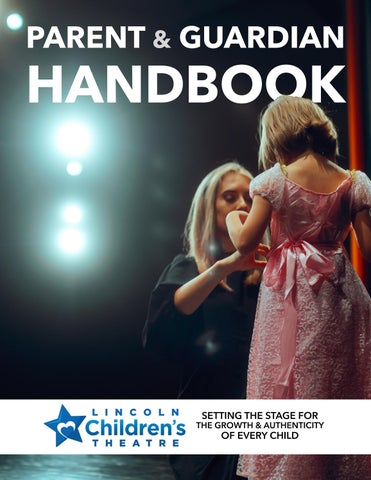
PARENT & GUARDIAN
HANDBOOK
SETTING THE STAGE FOR
THE GROWTH & AUTHENTICITY
OF EVERY CHILD
Lincoln Children's Theatre
© 2026
Parent & Guardian Handbook
DIRECTOR'S WELCOME My name is Leah Arington, and I am the Artistic Director of Lincoln Children's Theatre. On behalf of myself and all the staff and volunteers, welcome to the Lincoln Children’s Theatre community. Prepare to bene t from the total theatrical experience as we tap into every child's abilities both on-stage as performers and off-stage as assistant directors, student choreographers, and tech crew. We take great pride in the polished and professional productions we present (even with fewer resources than most imagine necessary), but the heart of Lincoln Children’s Theatre is all about the children. We believe great kids are always more important than great productions, but we know it doesn’t have to be one or the other. We have countless stories of Lincoln Children’s Theatre offering the unique, personalized support each child needs to reach their highest potential and experience the pride and satisfaction of putting on excellent shows. We are committed to setting the stage for growth and authenticity in every child. After thirty years of working with young performers, I still love the transformative power of theatre. Watching kids gain con dence, develop discipline, and discover their voices remain the most rewarding experiences of my career. When your child participates in a Lincoln Children's Theatre production, workshop, lesson, or activity, here's what you can expect: We go above and beyond to accommodate every participant. This means we do everything in our power to overcome obstacles—including, but not limited to, nancial barriers, neurodivergence, physical disabilities, and much more. We truly mean above and beyond. We elevate strengths and champion the potential of every child. We believe in providing mainstream opportunities for all kids, seeing both the possibility and the bene ts. Our expectations are high for every child and we tailor our approach for every child to be able to meet them. By familiarizing yourself with the contents of this guide and committing to the policies designed to ensure your child's best possible experience, you will have a leading role in the success of your child. •
• •
Your child will learn about all the magical parts of the theatrical experience, as well as the not-somagical parts of being a part of putting on a full theatrical production. The hard work, dedication and resilience will look good on them on and off the stage! Your child will work hard to present a quality performance with the poise and professionalism that makes the preparation worth it and leaves the audience wanting more. Your child will not only enjoy the bene ts of Lincoln Children’s Theatre participation being fun, but the higher good of working in a truly team environment. It’s good to have fun and it’s fun to be good!
I can’t wait to meet your child and have them join us on this adventure. Sincerely, Leah Arington Artistic Director
Parent & Guardian Handbook
fi
fi
© 2026
fi
fi
fi
Lincoln Children's Theatre
TABLE OF CONTENTS Welcome 1. Let’s All Get on the Same Script 2. LCT Program Overview 3. LCT Program Policies Safety Participation Photography Fees 4. Stage Production Casting 5. Expectations for Participants 6. Needed Equipment 7. Expectations for Parents & Guardians 8. Stage Production Performer Etiquette 9. Stage Production Audience Etiquette
Contact Information • Email is the best rst step for questions regarding schedules, expectations, or procedures. • LCT staff cannot answer questions during drop-off or pick-up, as their focus is on welcoming and safely dismissing participants. • In an emergency, contact the Director directly via phone call or text. The Director may not personally answer, but this system ensures messages are delivered quickly. Program-speci c emergency contact numbers will be provided in your information materials.
© 2026
Parent & Guardian Handbook
fi
fi
Lincoln Children's Theatre
1. Let’s All Get on the Same Script In theatre, the rst crucial step is simple: everyone uses the same script. When we don’t, confusion follows - missed cues, mixed messages, and sometimes even tears. At Lincoln Children’s Theatre, we want to make sure our parents, guardians, and young performers are all reading from the same page we are. Youth theatre programs come in all shapes and sizes. They vary widely in philosophy, purpose, and practice—not to mention the many hopes, dreams, and expectations that families bring with them. Some programs operate with enormous nancial commitments, funding lavish performance spaces or touring productions. They often draw only the most elite young performers and pair them with top-tier designers, coaches, and technology. Others function more like themed childcare. Lincoln Children’s Theatre is something different. We’re a lot more like a youth sports team. While we will always teach and practice the highest level of professionalism regardless of cost, we intentionally keep our fees - and the small list of required “equipment” - as reasonable and accessible as possible. And just like in youth sports, parents and guardians play a big role. LCT simply couldn’t do what we do without you. In the same way, some parents and guardians might imagine their child beginning a journey toward stardom - award nominations, bright lights, and acceptance speeches thanking “all the supportive people along the way.” Others are simply looking for a safe place for their child to spend a few hours. Again, the youth sports analogy helps clarify LCT’s role. Our team is deeply talented, with decades of combined experience performing on stages of all shapes and sizes across the country. But just like a Little League coach with college - or even professional - experience, our focus is always on development, not stardom. Our logo was created with this in mind. The star is simply the frame around the heart of every child and that is where our focus lies. We’re dedicated to helping each child grow in skill, con dence, and connection. We want them to experience the joy of working as a team, the responsibility of showing up prepared, and the thrill of success handled with humility. And when disappointment comes - as it does in both sports and theatre - we help them meet it with grit and grace. As parents and guardians, the more you embrace the idea that LCT functions much more like a highperforming youth sports program than a no-cost, no-commitment after-school activity, the better the experience will be for everyone - especially your child. The rest of this guide outlines the policies and protocols that allow Lincoln Children’s Theatre to offer high-level theatre training to all who are ready to join us in setting the stage for the growth and authenticity of every child. Your child's enrollment in any LCT program indicates you have read this document in its entirety and agree to follow all rules, requirements, and guidelines found within.
fi
© 2026
fi
fi
Lincoln Children's Theatre
Parent & Guardian Handbook
2. LCT Program Overview Age Groups Lincoln Children’s Theatre welcomes participants ages 3–15. Older students may be invited to continue their growth by serving in student leadership roles within select programs. We also occasionally offer shows for kids of all ages involving adults in our productions too. Workshops, Classes, & Activities Much like youth sports clinics or training camps, LCT offers workshops and classes where children can build skills in a fun, supportive environment. Registration is the only requirement for participation. All opportunities for families to watch what students have been working on will take place during the regular program time and at the regular location. Stage Productions Our stage productions function much like a youth sports season. Participation requires registration and a commitment to all rehearsals, tech/dress rehearsals, and performance dates. Productions begin with auditions — much like early practices where teams and positions are determined. 1. Auditions Participants learn audition songs, dances, or scenes as a group in a low-stress environment. 2. Rehearsals Participants practice everything it takes to put on a stage production - from learning songs and memorizing lines to working with props and collaborating as a team. 3. Tech / Dress Rehearsals Participants run through the entire show, bringing all production elements together. 4. Performance Dates Participants showcase their hard work by performing the production in front of a live audience. The Production Team Artistic Director The artistic director serves as the head coach and nal decision-maker for all artistic and educational aspects for the team. Music Director The music director leads and teaches all musical elements of the production. Assistant Directors / Stage Managers Assistant directors and stage managers support rehearsals by performing assigned tasks and overseeing various elements of the production process. Choreographer(s) © 2026
fi
Lincoln Children's Theatre
Parent & Guardian Handbook
The choreographer creates choreographed movements such as dance and sometimes traf c patterns that support the director’s artistic vision for the show. Lincoln Children’s Theatre creates a balance between guest professionals and current students serving as interns in these roles as a way to provide training and opportunity. Designers & Technicians These are skilled specialists - Light Designers, Sound Designers, Set Designers, etc. The ultimate goal of Lincoln Children’s Theatre is to provide professional resources in these areas to make student designers and technicians possible in as many productions as possible.
© 2026
Parent & Guardian Handbook
fi
Lincoln Children's Theatre
3. LCT Program Policies SAFETY Code of Conduct We expect every child and adult to help create a space free from bullying, exclusion, or hurtful behavior. LCT is a place where all kids - of all backgrounds and abilities - are welcomed and celebrated. There is zero tolerance for harassment or unsafe behavior of any kind. Security The well-being of all of our participants is our highest priority. Arrival For the safety of all participants, please arrive on time, but not early. We want to make sure everything is prepared and the staff is ready to provide the most safe and secure fun as possible. Closed Rehearsals Parents and guardians are not permitted to stay and watch or remain in the rehearsal or meeting space of any of our programs. Dismissal If transportation is running late to dismissal, contact us immediately so we can plan to make sure safe and secure accommodations are made. Medical Please contact the director or teacher directly with any required medical accommodations before the rst day of any LCT program. We want to make sure we know exactly how to give aid to the participant if needed to support their success.
PARTICIPATION Attendance We expect a commitment to attend all rehearsals, meetings, and performances of any of our programs. We have made provisions to this policy for the larger time-commitment of stage productions when necessary to set each child up for success and can be exible to a point, but we know the most bene t to the child results from consistent participation. Excused Absences In Stage Productions An absence will only be excused when the con ict adheres to all of the following: The con ict is presented in writing and approved by the Director. The con ict is presented before any stage production is cast. The con ict does not occur during any tech or dress rehearsals, or of any performance dates of a stage production.
Parent & Guardian Handbook
fl
© 2026
fl
fi
fl
fl
fl
fi
Lincoln Children's Theatre
Unexcused Absences In Stage Productions Unexcused absences will result in being removed from the show without refund of any fees or registration. Again, every effort will be made to accommodate unpredictable illness, but the short rehearsal period of a stage production and the success of the rest of the participants will be considered. Sometimes illness makes it impossible for a participant to perform. Attire & Appearance Costumes and appearance are an important part of bringing a character to life in theatre. Unlike other youth performing arts that rely on standard uniforms, stage productions often need a speci c look— sometimes including particular hairstyles or appearance details. For this reason, we may occasionally ask that your child avoid getting a haircut or making any major changes to their appearance during the rehearsal and performance period. These requests are standard in theatre and help maintain consistency for the character they’re portraying. Our goal is always to support your child in feeling con dent, prepared, and fully immersed in their role. All Programs & Rehearsals One way theatre differs from most youth activities is that all participants must always have clothes and shoes that are easy to move, dance, and work in. No ip- ops or snow boots! Feel free to bring dance shoes with you to change into. Please dress conservatively. • All shorts, skirts, and dresses must be as long as the length of the ngertips when at your side. • No crop tops, tube tops, see-through shirts, or open side tank tops showing skin or sports bras are permitted. All Stage Productions All performers will need a simple all-black base out t (no stripes, logos, or text) and speci c shoes, which we will outline before dress rehearsals. All additional costumes will be provided by LCT. Depending on the production, your child may wear anywhere from one to six different costumes. • No makeup • No changing of hair cut or hair color without permission from the director. • Basic black out ts must be free of any lines, logos, or markings of any color (including socks). Performers change backstage in shared dressing areas that are not gender-speci c, so it’s important that each child wears appropriate undergarments and respects the personal space of others. A helpful guideline is to think in terms of swimwear or dance attire - comfortable, secure, and providing proper coverage. Content Considerations At Lincoln Children’s Theatre, we understand that families and educators may hold different views about what is appropriate for children to see, hear, or perform. Our goal is to choose material that is age-appropriate, educational, and artistically meaningful. While we take a conservative approach to content, we also value exposing students to a wide range of musical theatre repertoire - which sometimes includes themes or humor that can be interpreted differently by different families. Even well-known, family-friendly shows (including many Disney titles) may contain moments that some parents nd questionable. Because of this, we encourage all parents and guardians to be familiar with the show they are registering their child for and to read all materials provided before casting.
fi
fi
Parent & Guardian Handbook
fi
fi
fl
fl
© 2026
fi
fi
fi
fi
Lincoln Children's Theatre
If you have concerns about content, choreography, or implied stage directions, it is your responsibility to notify the Director immediately - before casting is nalized. This allows us to clarify the context, address true oversights if they exist, and, when necessary per the Director’s discretion, offer a refund if the show’s material does not align with your family’s comfort level. Please note that once casting has occurred, adjustments to content or staging are unlikely unless a genuine oversight has taken place. We deeply respect the role of parents and guardians in guiding their child’s participation. Clear communication ensures that each performer - and their family - can fully enjoy the creative, challenging, and rewarding experience of being part of a Lincoln Children’s Theatre production.
PHOTOGRAPHY Participant Photography Enrollment in an LCT program grants Lincoln Children’s Theatre permission to photograph or lm your child for promotional purposes. If your family has a speci c circumstance that prevents this, please email info@tafk.org to request an exception. We are happy to accommodate, but this request must be received in writing prior to your child’s participation. Stage Production Photography & Videography Photography, videography, or any kind of recording is strictly prohibited at all LCT stage productions. This policy is required to comply with licensing agreements from the companies that hold the rights to each production. Violating these agreements could jeopardize LCT’s ability to continue operating. Because audience photos and video are not allowed at any point during a production, Lincoln Children’s Theatre provides professional photographs taken during closed rehearsals and dress rehearsals. These photos are made available on the Lincoln Children’s Theatre website for families to access, view, and download. When professional video licenses are possible, Lincoln Children’s Theatre provides videos as an option when the cost and logistics are possible. We do not guarantee a video option for any staged production, workshop, class or activity.
FEES Program Payments, Deposits, and Refunds Registering your child for an LCT program indicates your understanding that full payment is due at the time of registration, unless other arrangements have been made in advance. If you need a payment plan or alternate arrangement, please contact us. We are always happy to discuss options. If you are new to LCT and would like a parent referral or more information before enrolling, just let us know. We also welcome an introductory conversation by phone, email, or in person if there is anything we should know to help make your child’s experience as positive and successful as possible.
Parent & Guardian Handbook
fi
© 2026
fi
fi
Lincoln Children's Theatre
Script Deposits Some program levels (“Junior” or “Kids” shows) provide scripts that performers may keep. Fulllength productions often use rented scripts which must be returned in good condition. In these cases, families are required to submit a $50 script deposit. The deposit is refunded when the script is returned in usable condition. If a performer withdraws from the show or does not return the script, the deposit is forfeited. Forfeited deposits help offset a small portion of prepaid production costs such as costuming, materials, and administrative expenses. Refunds Refunds are not guaranteed. A refund may be issued at the Director’s discretion in situations where: • The Director feels the class or production is not an appropriate match based on age, maturity, or readiness • The Director determines, through early participation, that the program will not be a good t These decisions are always made with the best interest of the child and the overall production in mind. Please communicate with us early if you have concerns. Stage Production Tickets All tickets can be purchased via the website or via www.ludus.com. Audience Age Restriction Regardless of if they have a purchased ticket, children under the age of four are not permitted in the audience, so please plan accordingly for the evening. There will often be a scheduled performance for young audiences for children four and under. Please ask.
© 2026
Parent & Guardian Handbook
fi
Lincoln Children's Theatre
4. Stage Production Casting Lincoln Children’s Theatre is dedicated to helping children grow - not only as actors, singers, and dancers, but as con dent, responsible, and kind young people. All participants will learn audition songs, dances, or scenes as a group in a low-stress environment. Nothing needs to be prepared beforehand except a good attitude and the enthusiasm to "really go for it" in the audition. We know parents may have questions about auditions or role assignments. While roles cannot be changed once the cast list is posted, you are welcome to email the Director after the nal performance if you’d like feedback on how your child can strengthen their skills for future auditions. About Casting Casting can be one of the most emotional parts of theatre for young performers. It’s important to encourage your child to embrace whatever role they receive. A role that doesn’t look exciting at rst often becomes a wonderful opportunity for growth, creativity, and ownership once rehearsals begin. Because every child can’t play the same part, we work hard to place each performer in a role that ts their current abilities and challenges them to grow. When we cast a show, we consider several factors: 1. How well the child can perform the role (singing, reading lines, acting, movement, etc.) 2. Their experience, con dence, and reliability as they relate to the needs of the show. 3. The ensemble as a whole. Every child in the program is cast in the show. Unlike many school and community productions, no one is turned away. We pride ourselves on solving the casting “puzzle” in a way that supports each performer and strengthens the production There are no rigid formulas in casting. We make thoughtful judgment calls based on what will help each child — and the show — succeed. For children who participate year after year, this often means gradually growing from smaller roles into larger roles as their skills develop. Casting Help for Parents and Guardians Parents play a vital role in shaping how their children experience the casting process. By emphasizing the value of every role and the joy of working together toward a shared goal, you help your child see that theatre is a "team sport." When parents model how to celebrate others’ successes without diminishing their own child’s achievements, children naturally adopt the same mindset and begin to understand that every “position” in the production truly matters. Preparing Your Child for Casting Please talk with your child ahead of time about realistic expectations. Very few students receive their “dream role,” and that’s okay. What matters most is the attitude they bring to the part they are given. We expect every performer to: • Show up ready to work • Bring a positive attitude • Give 100% effort Tears and negative attitudes make the process harder for everyone. We ask for your help in preparing your child to handle the outcome with maturity, exibility, and enthusiasm. Most of all, encourage your child to have fun — and enjoy watching them grow throughout this experience!
fi
fi
Parent & Guardian Handbook
fi
© 2026
fl
fi
fi
Lincoln Children's Theatre
5. Expectations for Participants ⭐ Coming to Rehearsal When you join a show, your team is counting on you! • Come to every rehearsal unless you are sick or your grown-up has already told us about a con ict. • Arrive on time and stay until rehearsal is done, unless the director says it’s okay to leave early. ⭐ How We Treat Each Other Being in a show means being part of a caring team. • Be kind to everyone—your castmates, director, and staff. • Respect everyone’s feelings and ideas, even when things are challenging. • Whatever part you receive, accept it with a positive attitude. Every role matters! • Treat all costumes, props, sets, and rehearsal spaces carefully and responsibly. These items help make our show magical! ⭐ How We Talk To Each Other If you don’t understand something or you need help, ask questions in a respectful way. • Raise your hand until called upon and then speak up kindly, calmly, and clearly. • When a teacher or director gives you a note or suggestion, the only thing you are to say in response is “Thank you” so they know you heard and understand them. This is standard theatre protocol and helps us neutralize the process as opposed to taking critique personally. ⭐ Working Hard & Doing Your Best Putting on a show takes effort from everyone—just like playing on a sports team. • You will need to practice at home: memorizing your lines, music, and dances so you feel con dent and can have more fun onstage. • Everyone participates in all parts of the show even if it feels new or different that’s part of learning theatre! This includes staging, choreography, and partner work with same and opposite genders. • Take responsibility for yourself. Try your best even when it’s hard. • Be willing to help with anything to make the production better for everyone like moving set pieces, tidying costumes, waiting quietly while others get help, and pitching in whenever a staff person asks.
fl
fi
Lincoln Children's Theatre
© 2026
Parent & Guardian Handbook
6. Needed Equipment All Participants The following are items to bring if participating in ANY Lincoln Children's Theatre activity. • Water in a spill-proof, non-breakable container • Possibly a lunch or snack for day-long programs and activities. Stage Production Participants The following items to bring only if participating in a stage production • Basic Blacks Every LCT performer is required to have a simple “basic black” out t. These pieces are often worn under costumes, and sometimes they become part of the costume itself. The black base changes depending on the workshop/class/show. You will receive the required black base speci cs at least two weeks prior to the needed date. To make this work, everything must be completely black - no logos, no stripes, no patterns, no colorful stitching, and no brand marks of any kind. Plain black allows costumes to t properly, keeps distractions away from the audience, and helps the actors blend into the world of the show. Here is an example of what might be required. Male Identifying ✓ Plain Black Crew Neck Shirt ✓ Plain Black Pants ✓ Plain Black Socks ✓ Plain Black Dress or Jazz Shoes
•
Female Identifying ✓ Plain Black Crew Neck Shirt ✓ Plain Black Tights ✓ Plain Black Black Jazz, Character, or Heeled Shoes
One (1) Clear Plastic Storage Tub This will be used to transport and organize everything brought to and from rehearsals and performances. It needs to be big enough to hold everything and small enough to be carried by the participant. It will need to t the following inside and be clearly labeled with the participant's name: ✓ Script ✓ Costume pieces and/or shoes ✓ Hair and makeup products ✓ Personally provided props ✓ Water bottle and snacks
Provided by Lincoln Children's Theatre to Stage Production Participants The following items are supplied by LCT and will be distributed before rehearsals begin: • The script to memorize at home and to use for every rehearsal • Audio recordings of the songs to practice with at home either online or on a CD • All necessary costumes and props beyond the black base
fi
Parent & Guardian Handbook
fi
© 2026
fi
fi
Lincoln Children's Theatre
7. Expectations for Parents & Guardians A. Attendance Requirements Parents are expected to ensure that their child can attend all scheduled rehearsals and performances. Absences are permitted only for illness or for con icts that have been submitted in writing and approved by the Director before casting. Please make arrangements for your child to: • Arrive on time, ready to rehearse • Stay for the full duration of every rehearsal Excessive absences or repeated tardiness affect the entire cast and may result in reassignment of staging, reduction of responsibilities, or even removal from the production. For the safety and focus of all participants, all rehearsals are closed to parents, guardians, and anyone not directly involved in the production. B. Behavior and Conduct Standards Parents play a powerful role in setting the tone for a healthy, positive theatre environment. We ask you to help us create a space where children can thrive. Please commit to: • Model and encourage respect, kindness, and inclusivity toward all staff and participants • Celebrate effort over outcomes - growth and teamwork matter more than getting a desired role • Speak positively about all children - never comparing, criticizing, or undermining any participant • Never enter backstage and technical areas - ensure a safe, controlled space for every performer • Follow and support all audience etiquette guidelines for yourself and anyone attending with you C. Communication Clear communication is essential for a smooth production process. • Email is the best rst step for questions regarding schedules, expectations, or procedures. • LCT staff cannot answer questions during drop-off or pick-up, as their focus is on welcoming and safely dismissing participants. • In an emergency, contact the Director directly via phone call or text. The Director may not personally answer, but this system ensures messages are delivered quickly. Program-speci c emergency contact numbers will be provided in your information materials. All updates—including cast lists—will be sent via email. Please add info@TAFK.org to your contacts. Additional information and resources can always be found on our website: LCT.org D. Setting Your Child Up for Success During Tech Week and Performances Tech rehearsals and performance days can be both physically and emotionally demanding. Please support your child by: • Ensuring they get extra rest, maintain good hydration, and follow consistent routines • Making sure all costumes and personal items are labeled, organized, and ready • Encourage resilience and perseverance, celebrating their hard work and commitment • Resist engaging during performances by making eye contact or waving at your performer
Parent & Guardian Handbook
fi
© 2026
fl
fi
Lincoln Children's Theatre
8. Stage Production Performer Etiquette At LCT, we work hard to help you learn what it means to be a professional performer. These habits make our show stronger, keep everyone safe, and help you be your best. ⭐ Before the show • Check your props so you are sure everything is where it belongs. • Only touch your own props. Other people’s props are part of their job, just like yours are part of yours. • Once you are in costume, please stay backstage. We keep costumes a surprise for the audience! ⭐ Backstage Behavior Backstage is a quiet, focused place so the show can run smoothly. • Be respectful to everyone—other performers, helpers, and staff. • Leave all “backstage drama” at the door. We take care of each other here. • No talking backstage during rehearsals or performances. Quiet helps everyone stay safe and focused. • No gum backstage or onstage. • Cell phones must stay off and put away during rehearsals and performances. • Parents cannot come backstage, before or after the show. This helps us stay organized, focused, and safe. ⭐ Onstage Expectations When you’re onstage, you are in the world of the play! • Do not wave at or talk to friends or family in the audience—even if they try to get your attention. Ignore them and stay in the story! • If something goes wrong, stay in character. Mistakes happen, and the audience will never know if you stay calm. • Only do what your character is supposed to do. No extra talking, joking, or wandering onstage unless the director says so. ⭐ After the Show The show may be over, but your job is not! • Change out of your costume before going out to meet your fans. • Save all special “thank-you”s or gifts for your director and staff for after you're out of costume - like at a cast party. (They love hearing your gratitude!) • Everyone helps with strike, which means cleaning up props, costumes, and the backstage area. Lincoln Children's Theatre
© 2026
Parent & Guardian Handbook
9. Stage Production Audience Etiquette In addition to teaching your children performance etiquette, we also emphasize excellent audience etiquette. This is a ticketed event, so some special considerations and customs are in place that may not be present at a typical school event or church service. Please take a moment to read through and make preparations before your arrival at the venue to observe and support the following.
BEFORE THE SHOW Turn off all cell phones, smart watches, and other electronic devices because they interfere with our sound system. The kids have worked too hard to be distracted by something so easily avoidable. This includes beepers and other alerts for medical professionals.
DURING THE SHOW Refrain from speaking, whispering, or gesturing to your neighbor. Audience members of all ages should save all comments and questions until after the performance. Talking of any kind during the performance is distracting to the performers and other audience members. Never try to signal or get the attention of any performer on or off stage. Do not wave to or call out to a child as they walk onto the stage or at any time during the performance. The children have been strictly told to focus on the performance at all times. They are not allowed to acknowledge the audience at any time. Photography, videography, or any kind of recording is strictly prohibited at all LCT stage productions. Professional photography and video will be taken and made available. Do not get up, move around, or leave during the performance. If you must leave for an emergency, please do so during a scene change or during intermission. Audience members arriving late to the performance will be asked to stand at the entrance until a scene change or intermission as directed by the usher or house manager. Do not plan to bring any children under the age of 4. Without exception, children under four years of age are not permitted in the audience. At times, "all ages audience" matinees are scheduled to allow for younger audiences. Laugh and applaud all you want. The performers welcome your applause at the end of songs and scenes. Save all verbal encouragement such as whistling, whooping, and yelling for bows at the very end of the show.
AFTER THE SHOW Please patiently wait outside for your child to rst change out of their costume, gather and organize their things backstage, and then come out to you © 2026
fi
Lincoln Children's Theatre
Parent & Guardian Handbook