What Does a Digital Marketing Consultant Do?
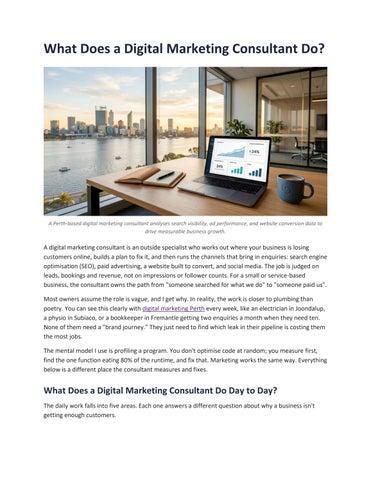
A Perth-based digital marketing consultant analyses search visibility, ad performance, and website conversion data to drive measurable business growth.
A digital marketing consultant is an outside specialist who works out where your business is losing customers online, builds a plan to fix it, and then runs the channels that bring in enquiries: search engine optimisation (SEO), paid advertising, a website built to convert, and social media. The job is judged on leads, bookings and revenue, not on impressions or follower counts. For a small or service-based business, the consultant owns the path from "someone searched for what we do" to "someone paid us". Most owners assume the role is vague, and I get why. In reality, the work is closer to plumbing than poetry. You can see this clearly with digital marketing Perth every week, like an electrician in Joondalup, a physio in Subiaco, or a bookkeeper in Fremantle getting two enquiries a month when they need ten. None of them need a "brand journey." They just need to find which leak in their pipeline is costing them the most jobs. The mental model I use is profiling a program. You don't optimise code at random; you measure first, find the one function eating 80% of the runtime, and fix that. Marketing works the same way. Everything below is a different place the consultant measures and fixes.
What Does a Digital Marketing Consultant Do Day to Day? The daily work falls into five areas. Each one answers a different question about why a business isn't getting enough customers.
The digital marketing consultant growth framework: connecting strategy and auditing to measurable revenue.
What Happens in Strategy, Auditing and Planning? This is the profiling step, and it comes first because skipping it is the most expensive mistake in the field. A consultant audits what already exists and writes down what is actually happening before touching anything. A typical audit covers:
Goals and numbers: what a new customer is worth, how many enquiries turn into jobs, and what the business can afford to pay per lead. Tracking: whether Google Analytics, Google Search Console and conversion tracking (form fills, calls, bookings) are set up and accurate. You'd be surprised how often they aren't (I suspect most smallbusiness sites have at least one broken event). Current channels: what traffic comes from where, and which sources produce paying customers rather than just visits. Competitors: who ranks and advertises for the searches your customers use, and what they offer.
The output is a prioritised plan: a short list of actions ordered by expected return, with a budget and a way to check whether each one worked. Planning here means choosing what not to do this quarter.
What Does an SEO Consultant Do? SEO is the work of making your business appear when people search for what you sell. For a local service business, it usually breaks into four parts:
Keyword and intent research: finding the exact phrases customers type, such as "blocked drain plumber Perth", and separating people ready to hire from people just browsing. On-page SEO: one clear page per service and location, with a descriptive title, headings that match real questions, and plain answers near the top. Technical SEO: page speed, mobile layout, crawlability, and structured data (schema) so search engines and AI answer engines can parse the page. Local SEO and authority: an optimised Google Business Profile, consistent business listings, reviews, and links from relevant Australian sites.
SEO is slow. Expect months, not days, and be wary of anyone who promises page one in a fortnight. The upside is that it compounds: a page that ranks keeps bringing enquiries without a per-click fee.
How Do Google Ads and Facebook Advertising Fit In? Paid acquisition is the fast channel. It buys attention now while SEO builds in the background. The two platforms do different jobs:
Google Ads captures existing demand. Someone searches "emergency plumber near me", sees your ad, and clicks. Intent is high, so it tends to suit urgent, high-value services. Facebook advertising (Meta) creates demand. You reach people by location, age and interests before they search, which suits services people don't think about until they see an offer, like a home-organising service or a seasonal promotion.
A consultant's daily work here is unglamorous: building campaigns around real intent, writing ad copy, adding negative keywords so you stop paying for irrelevant clicks, testing creative, and checking cost per lead every week. Here's the arithmetic that matters. These are illustrative numbers, not benchmarks. Say you spend $3,000 and pay $5 per click: that's 600 visitors. If 5% enquire, you get 30 leads at $100 each. If a better landing page lifts that to 8%, you get 48 leads at $62.50 each, a 60% increase in leads with the same ad spend. The ad budget didn't change; the page did.
What Makes a Website "Conversion-Focused"? A conversion-focused website is built so a visitor can quickly decide to contact you. It is not a brochure, and it's not just a nice design. Traffic is only worth what the site does with it, which is why a consultant spends real time here. The usual fixes are boring and effective:
A clear headline that says what you do and where, visible without scrolling. One obvious next step (call, book, or request a quote) repeated on every page.
Proof near the decision point: reviews, licences, before-and-after photos, named case studies. Fast load times on mobile, where most local searches happen. Short forms. Every extra field costs you enquiries.
Same trick as the ads: with 1,000 monthly visits, a 2% enquiry rate gives you 20 leads, and 3% gives you 30. That's 50% more customers without buying a single extra click.
Where Do Social Media Management and Business Process Automation Come In? Social media management is the steady, visible side: planning content, posting, replying to comments and messages, and keeping the profile consistent with the website. For service businesses, it mostly does two jobs: it builds trust (people check your page before they ring you) and it feeds retargeting audiences for paid ads. Automation is the less obvious side, and I'd argue the most underrated. It covers what happens after someone enquires:
A form submission lands in a CRM automatically instead of an inbox. The lead gets an instant confirmation text or email. Missed calls trigger a text-back. Quotes and reviews get follow-up reminders.
Response speed matters. Most likely, the business that replies in ten minutes beats the one that replies tomorrow, all else equal, and automation is how a small team does that without living on their phone.
How Does a Hands-On Consultancy Work in Practice? The difference between advice and a working engagement is whether someone ships the changes. A consultant who only sends a PDF of recommendations has described the thing. One who sets up the tracking, rebuilds the landing page, launches the campaign and reports on the results has made it. Linc Digital is a Perth-based digital marketing consultancy led by Ben-Lee D’limi, helping service-based businesses grow through SEO, Google Ads, Facebook advertising, website design and development, & social media management. That kind of single-team setup matters because the channels depend on each other. Ads send traffic to a page the same team designed, tracking measures the page, and the SEO work feeds the same content. When these are split across four vendors, nobody owns the number that matters.
How Do You Know If a Digital Marketing Consultant Is Working? Ask for a short monthly report that ties activity to business outcomes. The metrics worth tracking:
Enquiries and booked jobs from each channel, not just traffic. Cost per lead and cost per acquired customer for paid campaigns.
Conversion rate of the website, ideally by service page. Organic visibility: rankings and clicks for your priority search terms in Google Search Console. Lead response time and the share of enquiries that become customers.
If a report is mostly impressions, reach and likes, that's a yellow flag. Those numbers can be real and still not pay the rent.
When Should a Small Business Hire a Digital Marketing Consultant? Usually when one of these is true:
You rely on word of mouth and want a second, predictable source of customers. You're already spending on ads or a website and can't tell whether it's working. You've tried a freelancer or agency and ended up with activity but no clear results. You're about to grow (new suburb, new service, new hire) and need demand to match.
A consultant is a poor fit if there's no budget for ads or any appetite to improve the website, since there's very little left to optimise. In that case, fix the offer and the basics first.
Frequently Asked Questions What Is the Difference Between a Digital Marketing Consultant and an Agency? A consultant typically works directly with you, often with a smaller team, and is accountable for strategy and results. A large agency tends to split work across account managers and specialists. Neither is automatically better; what matters is who actually does the work and who owns the outcome.
How Much Does a Digital Marketing Consultant Cost? Pricing varies widely by scope. Expect a mix of a monthly retainer for ongoing work (SEO, ads management, social) plus a project fee for things like a website build, with ad spend paid separately to Google and Meta. Ask for the scope and the reporting in writing before you sign.
How Long Does It Take to See Results? Paid ads can produce leads within days of launch, though it usually takes a few weeks to tune them. SEO generally takes several months to build momentum. Website and process fixes can show up in your conversion rate within weeks.
Do I Need SEO, Google Ads, or Facebook Advertising First? If you need customers soon, start with Google Ads on your highest-value services and fix the landing page at the same time. Start SEO in parallel because it takes the longest. Add Facebook advertising when you have an offer that suits broader targeting or want to retarget past visitors.
Can a Digital Marketing Consultant Guarantee Rankings or Leads? No. Google controls rankings, and demand varies by season and suburb. What a good consultant can commit to is a clear plan, accurate tracking, and transparent reporting on cost per lead and conversion rate.
Does AI Search Change What a Marketing Consultant Does? Somewhat. AI answer engines pull from pages that state clear answers, name the business and its services, and are structured well. That overlaps heavily with good SEO, so the work is largely the same, with more emphasis on plain definitions, FAQ sections, and structured data. I suspect this overlap grows, and the consultants who already write for people first will have an easier transition.