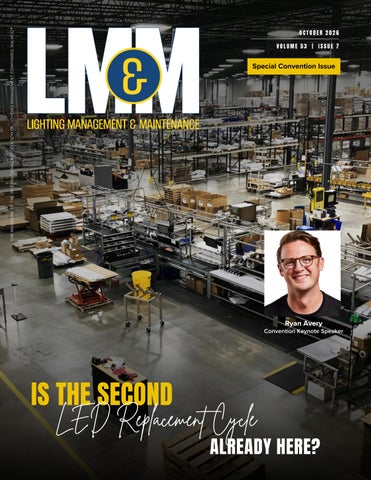
THE MAGAZINE OF THE INTERNATIONAL ASSOCIATION OF LIGHTING MANAGEMENT COMPANIES, NALMCO®
OCTOBER 2026 VOLUME 53 | ISSUE 7
Special Convention Issue
Ryan Avery
Convention Keynote Speaker
IS THE SECOND
LED Replacement Cycle
ALREADY HERE?
1
You Know the Client. We Know the Opportunity. Let’s Grow Together. At Acuity, your growth is our goal. Let’s work together to uncover hidden business opportunities in your existing customer base: ■ Many systems installed 5–8 years ago have 20 – 30% lumen depreciation ■ LED drivers may be approaching end-of-life at 50K – 60K hours ■ Facility owners may be unaware of declining light quality
Help your clients be prepared ■ We’ll help you review your past projects to identify retrofit candidates ■ Provide modern solutions and controls for better performance and savings ■ You bring the relationship — we bring the tools, insight, and product
Ready to uncover new opportunities? Come by our booth at the NALMCO Show to explore how we can grow your business together.
2
BOOTH #409
Explore Our Wealth of Resources Lighting Controls
Innovative New Products
BAA/BABA Solutions & Guides
STAKR: A Smarter Way to Upgrade Existing Troffers
SensorSwitch™
LEARN MORE
VISIT SENSORSWITCH
Retrofit Solutions
LEARN MORE
©2026 Acuity Brands Lighting, Inc. All rights reserved.
LEARN MORE
Acuity Academy Learn & Earn CEUs
LEARN MORE
3
CONTRIBUTORS Editor and Publisher Randy Reid Assistant Editor Bridget Leary VP, Associate Publisher, Advertising Cliff Smith 917.705.3439 Art Direction Seraphine Morris Lighting Management & Maintenance (LM&M) publishes information for the benefit of its members and readers. The sponsor (NALMCO), publisher and editor of LM&M cannot be held liable for changes, revision or inaccuracies contained in the material published. For detailed information on the products, programs, services or policies covered, it is recommended readers contact the appropriate person, company agency of industry group.
SHIRLEY COYLE Shirley Coyle has worked in the North American commercial lighting industry for several decades, holding various leadership roles. A Past President of the Illuminating Engineering Society (IES), Shirley is very active in the lighting community, including participation on lighting standards development.
LM&M is published by EdisonReport (ISSN 2835-821X). Statements and opinions expressed in articles and editorials in LM&M are the expressions of contributors and do not necessarily represent the policies or opinions of the EdisonReport. Advertisements appearing in the publication are the sole responsibility of the advertiser.
On The Cover
JASON SAMUELIAN MaxLite
4
SEAN GRASBY Wesco
Centerline Windsor Ltd. Windsor, Ontario
LISA ORLOFF, CLMC
5
The magazine of the International Association of Lighting Management Companies, NALMCO®
Volume 53, Issue 7 October 2026
Message from the President
8
From the Editor
10
NALMCO Takes on the Next Round of LED Retrofits
12
Ryan Avery to Challenge NALMCO: Why Be A When You Can Be THE?
18
Is the Second LED Replacement Cycle Already Here? By Jason Samuelian, MaxLite
22
What's New
26
When Lighting Gets More Complicated, NALMCO Gets More Important
28
Beyond Illumination: Safety in Senior Living
32
From Illumination to Intelligence
36
Who Is Going to Lead on Circadian Lighting? By Randy Reid
40
New Certifications
42
Up Close WITH Jon Ortiz
44
New Members
47
By Randy Reid
By Randy Reid
By Randy Reid
By Bridget Leary
By Sean Grasby
By Shirley Coyle, LC
6
SINCE 1973
PRECISION. DESIGN. LIGHT. At Barron Lighting Group, we don’t just build fixtures; we engineer partnerships. We blend advanced controls with precision optics to deliver sustainable solutions.
PRECISE OPTICS
SUSTAINABLE SOLUTIONS
A TRUSTED PARTNER
El i m inate glare a n d was ted li ght , ma ximizing ef fic acy w here it belongs .
Lower carbon foot pri n t s w it h d es i g n s for lon g term en ergy sav i n g s .
Deep i n d us try exper t i s e to gu ide you r proj e c t f rom conce pt to compl i a nce .
WE ARE A SILVER SPONSOR! VISIT US AT BOOTH #407
NALMCO 2026 73rd Annual Convention and Trade Show
ARCHITECTURAL FLAIR
|
ENERGY SAVINGS
|
LIGHTING THAT ELEVATES EVERY ENVIRONMENT ™ 80 0.533. 39 4 8 B A RRONLTG .CO M UNMATCHED RELIABILITY7
MESSAGE Dear
L M & M / / O C TO B E R 2 0 2 6 / / P R E S I D E N T ' S M E S S A G E
members and industry colleagues, As I reflect on the past year, I am reminded that the strength of NALMCO has always come from the people who are willing to step forward, share their expertise, and invest their time in advancing our association. Our committee members are at the heart of that effort. Their leadership, technical knowledge, willingness to collaborate, and commitment to serving their peers continue to make NALMCO a valuable resource for professionals across the lighting industry. I want to extend my sincere appreciation to every committee member who contributed ideas, participated in discussions, developed resources, supported our programs, and helped move our association forward. One of the most encouraging aspects of this past year has been NALMCO’s continued emphasis on industry collaboration. We recognize that the challenges facing our industry are not solved in isolation. By engaging manufacturers, distributors, service providers, educators, technical experts, and other industry organizations, NALMCO has worked to create meaningful connections and share knowledge that benefits the entire membership. These relationships bring different perspectives to the table, help us better understand emerging technologies and market dynamics, and ultimately allow NALMCO to deliver greater value to its members. Stay tuned as we continue our collaboration in the industry with the IES, NAESCO, NFMT, IUVA and the NLB. From my perspective as NALMCO president these last 2 years, I have seen firsthand how quickly our profession is evolving. Technology, energy efficiency, controls, connected systems, workforce development, and changing customer expectations are reshaping the way we approach lighting maintenance and management. That makes the role of an organization like NALMCO more important than ever. We provide unparalleled education and networking at our spring seminar and annual convention. Our greatest asset is our ability to bring knowledgeable professionals together, turn experience into practical education, and provide members with information they can apply in the real world. As we look ahead, I encourage every NALMCO member to stay engaged, participate in a committee, share your expertise, and take advantage of the relationships and educational opportunities our association provides. The future of our industry will be shaped by those willing to collaborate, learn from one another, and contribute to the advancement of our profession. Thank you to our dedicated board of directors, committee members, members, and industry partners for making NALMCO what it is today. Together we are helping shape the future of our industry.
Warm regards,
Erik
8
ERIK J. ENNEN
CLMC, CLA, CLCP, CSLC, CLEP, C-GUVMP President, NALMCO Board of Directors Center for Energy and Environment
PRESIDENT'S MESSAG
President's
LEDVANCE.COM/EN-US
AREA LIGHT LUNAVIA
BOLLARD OPTI-SELECT
LEARN MORE
CYLINDER OPTI-SELECT
MAKE YOUR OUTDOOR SPACES SHINE With the turn of a switch, you can dial up exactly the right optical distribution for the job. Discover today’s most flexible lighting solution for parking lots, walkways, gardens, and other outdoor areas. Our OPTI-SELECT family lets you change distribution in seconds—no lens swap needed. And with both wattage and CCT selectability, these versatile luminaires make it easy to deliver crisp, clean illumination tailored to any outdoor application.
OPTI-SELECT LEARN MORE
EDITOR Here We Go Again—and I’m Looking Forward to It
ROM THE EDITO
From the
L M & M / / O C TO B E R 2 0 2 6 / / F R O M T H E E D I TO R
I always look forward to NALMCO’s annual convention. I enjoy catching up with friends, meeting new members and hearing what is happening in your businesses. Put a roomful of lighting management professionals together, and there is plenty to discuss—and plenty to learn.
This year, the general session “Retrofitting 1st Gen to Next Gen LED: Here We Go Again” particularly catches my attention. The title alone raises questions that deserve our attention. How do we approach customers who have already upgraded to LED? What makes another investment worthwhile? And how do we explain the value of the next generation when the customer believes the lighting project is already finished? For me, this conversation goes well beyond replacing equipment. It is an opportunity to examine light quality, controls, maintenance and the customer’s changing needs. We should be asking what worked in the first installation, what could have worked better and what we can improve this time. I look forward to hearing how NALMCO members are approaching those conversations. Ryan Avery’s keynote, “Go From A to THE®: Stop Being A Team. Start Being THE Team!” adds another useful dimension. His title poses a question every business should consider: What makes us the team a customer calls first? Expertise matters, and so do communication, follow-through and trust.
The convention also helps me shape LM&M’s editorial plans for 2027. I am always looking for good content for future columns, and conversations with members are an important part of that process. Tell me about a challenging project, a lesson learned or an issue you think deserves more attention. What would you like to see us cover? Please find me and share your ideas. That is why I enjoy this gathering so much. We learn, renew friendships and make new connections. And many companies will leave with something else of lasting value: new business.
10
D
AR
RE
AN
NC
E
®
S T R EE T
ROM THE EDITO
C
26 SAL 0 2
EA
LI G H T I N G CO
NF
E
STREET & AREA
LIGHTING CONFERENCE 2026 Sheraton Phoenix Downtown • November 8-11, 2026
Join us for IES Street & Area Lighting Conference (SALC) 2026, the premier event that brings together decision-makers and their supporting teams to explore the latest developments, research, and trends in the street and area lighting industry and learn about the implementation of new technologies and solutions that will enable safer, greener, and more resilient lighting systems, in Phoenix, AZ, November 8-11, 2026.
Register today at ies.org/salc
11
NALMCO 73
rd
ANNUAL CONVENTION & TRADE SHOW
Convention Overview The 73rd Annual Convention and Trade Show brings lighting management professionals to Glendale, Arizona, October 11–13.
“Retrofitting 1st Gen to Next Gen LED: Here We Go Again…” That title caught my attention when I reviewed the agenda for NALMCO’s upcoming convention. Many NALMCO members spent years helping customers move from fluorescent and HID lighting to LED. Now they are returning to buildings where those firstgeneration systems are ready for another look. What should stay? What should be replaced? And how do you explain the next investment to a customer who remembers being told how long LEDs would last? Those are questions I plan to bring to Glendale. The program includes education, exhibitor appointments, association business and time to catch up with colleagues.
SUNDAY:
GOLF, REGISTRATION AND A WELCOME FROM KEYSTONE The convention begins Sunday, October 11, with golf at Palm Valley Golf Club, 2211 N. Litchfield Road, Goodyear, Arizona 85395. The bus begins loading at the hotel lobby at 7:15 a.m. and departs at 7:45 a.m. for the 8:30 a.m. shotgun start. The cost is $155 per golfer, including breakfast, lunch and transportation. Club rentals are $85. Exhibitors can set up in the Solana Ballroom from 1:00 to 5:00 p.m. Convention registration is open from 2:00 to 6:30 p.m. at the conference registration desk. That evening, Keystone Technologies sponsors the Welcome Reception from 6:30 to 8:30 p.m. in the Courtyard. It is an opportunity to find familiar faces and meet a few new ones before Monday’s schedule gets underway.
12
MONDAY:
LEADERSHIP AND TIME WITH ASSOCIATES Monday begins with breakfast and exhibitor visits from 7:00 to 8:00 a.m. in the Solana Ballroom. The Past Presidents’ Breakfast takes place during the same hour in Aurora A. Welcome and opening remarks follow from 8:00 to 8:30 a.m. in Solana, before Ryan Avery presents “Go From A to THE®: Stop Being A Team. Start Being THE Team!” from 8:30 to 9:30 a.m. The Networking Event with Associates runs from 9:45 a.m. to 12:30 p.m. in the Cira Ballroom. The speed-networking format gives members time to introduce their businesses, identify shared interests and arrange longer conversations at exhibitor booths. Come with something specific to discuss. If you need coverage in a particular market, say so. If you are looking for a product or help with an installation problem, bring the details. You can accomplish quite a bit in a short conversation when the other person understands what you need. The NALMCO Annual Meeting & Awards Luncheon follows from 12:45 to 1:45 p.m. in the Solana Ballroom.
MAKE THE EXHIBITOR APPOINTMENTS COUNT The agenda includes three dedicated blocks for one-on-one appointments with exhibitors, all in the Solana Ballroom: Monday, Oct 12, 2:00–3:30pm: Part 1
Tuesday, Oct 13, 9:40–11:10 am: Part 2
Tuesday, Oct 13, 1:30–3:00 pm: Part 3
Additional exhibitor time is scheduled Monday from 3:30 to 3:45 p.m., and Tuesday includes open networking from 1:10 to 1:30pm These appointments deserve some preparation. Review the exhibitor list, decide whom you need to see and make the arrangements. It is easy to spend a convention talking with people you already know and realize on the way home that you missed someone you wanted to meet.
BUILDING BRIGHTER PARTNERSHIPS The Labor Partner Meet & Greet takes place Monday from 3:45 to 5:00 p.m. in the Aurora Ballroom. Sponsored by Brighter Solutions, L.L.C., this year’s theme is “Building Brighter Partnerships.” The event brings together lighting management companies, contractors, ESCOs, manufacturers and labor partners. Organizers want attendees to make connections before they need additional project support or coverage in a new market. Labor Partner Meet & Greet was extremely well received in 2025. This is one of the reasons the Convention is so important. Not only do you leave with new knowledge and friendships. Many companies will leave with new business! Acuity Brands sponsors Monday’s evening reception, from 6:00 to 8:00 p.m. in the Courtyard.
13
TUESDAY:
TWO SESSIONS WORTH PLANNING AROUND Tuesday’s program gives the LED retrofit discussion two full hours, separated by exhibitor appointments.
Part 1 of “Retrofitting 1st Gen to Next Gen LED: Here We Go Again…” runs Tuesday, October 13, from 8:30 to 9:30 am in the Solana Ballroom. Part 2 follows from 11:10 am to 12:10 pm, also in Solana. Bobby Graham
Chad Palmer
Doug Stoneman
Jeff Seifert
Mark Fisher
Rob Wilson
I like the way this is scheduled. Attendees can hear the opening discussion, spend 90 minutes meeting with exhibitors, and then return for the second session. That gives everyone a chance to take a question from the room directly to a supplier before the discussion resumes.
When does replacing a failed component still make sense? When is a more complete upgrade the better recommendation? What happens to existing controls, and how much installation labor should the customer expect? Lunch follows from 12:10 to 1:10 pm, with the education wrap-up and closing comments. After Tuesday’s sessions and final exhibitor appointments, LEDVANCE sponsors the off-site reception from 6:30 to 8:30 p.m. at Chicken N Pickle, 9330 W. Hanna Lane, Glendale, Arizona 85305. Organizers say the venue is within walking distance of the hotel. A bus will also shuttle guests back and forth for those who prefer a ride.
Eric Fournier
Jason Samuelian
Josh Brown
Leslie Pope
Paul Chamberlain
Rob Cilic
Keep that reception in mind when making travel arrangements. The educational sessions finish earlier in the day, but there is still an evening together on the schedule.
AROUND THE HOTEL Kerigan Hunziker also suggested that we give readers a look at the nearby Westgate Entertainment District. Its directory lists restaurants including Yard House, Thirsty Lion and Kabuki Japanese Restaurant, along with entertainment options such as PopStroke, Dave & Buster’s and Stir Crazy Comedy Club. The Westgate map and directory can help with planning a meal or meeting outside the convention program. There is a full schedule in Glendale, but I hope attendees leave with a few questions answered—and a few people they can call the next time a job gets complicated. I will be especially interested in what comes out of Tuesday’s two-part retrofit discussion. The next generation of LED work is already becoming today’s work for lighting management companies.
14
GLENDALE WELCOMES NALMCO NALMCO’s 73rd Annual Convention and Trade Show brings the lighting management community to Glendale, Arizona, October 11–13, 2026. Home base is the Renaissance Phoenix Glendale Hotel & Conference Center, 9495 W. Entertainment Blvd., Glendale, AZ 85305. Most of the convention’s activity will center on the Solana Ballroom, where attendees will gather for general sessions, meals, exhibits and three rounds of one-on-one exhibitor appointments. Monday’s Networking Event with Associates takes place in the Cira Ballroom, while the Labor Partner Meet & Greet moves to the Aurora Ballroom.
THANK YOU TO THE SPONSORS Take a moment during the convention to thank the companies supporting this year’s gathering. Their sponsorships support the event, and many will also have teams on the exhibit floor ready to talk with attendees.
PLATINUM SPONSORS Acuity Brands Lighting
Keystone Technologies LEDVANCE
SILVER SPONSORS Barron Lighting Group
Direct Energy Controls, LLC
ESPEN Technologies
Maxlite
BRONZE SPONSORS Avi-on Labs, Inc. | BWI Light | Equipment Innovators | ESCO Retrofitters Direct | Energy Solutions International, Inc. Lighting Resources, LLC | LinmoreLED | RAB Lighting, Inc. | Retro Spec Lighting Corp | Satco Products Inc. | SnapCount
Brighter Solutions, L.L.C. also deserves recognition for sponsoring the Labor Partner Meet & Greet, Monday from 3:45 to 5:00 p.m. Under the theme “Building Brighter Partnerships,” the gathering connects lighting management companies, contractors, ESCOs, manufacturers and labor partners.
15
73rd NALMCO® CONVENTION AND TRADE SHOW
October 11-13, 2026 • Renaissance Phoenix Glendale Hotel & Conference Center
SUNDAY, OCTOBER 11, 2026 7:15 a.m.
Bus Starts Loading for Golf Tournament
Hotel Lobby
7:45 a.m.
Bus Departs for Golf Tournament
Hotel Lobby
8:30 a.m.
Golf Tournament
Palm Valley Golf Club
1:00-5:00 p.m.
Exhibitor Set-Up
Solana Ballroom
2:00 – 6:30 p.m.
Registration Open
Conference Registration Desk
6:30 – 8:30 p.m.
Welcome Reception sponsored by Keystone Technologies
Courtyard
MONDAY, OCTOBER 12, 2026 7:00 a.m. – 4:45 p.m.
Registration Desk Open
Conference Registration Desk
7:00 – 8:00 a.m.
Past Presidents’ Breakfast
Aurora A
7:00 – 8:00 a.m.
Breakfast – Visit with Exhibitors
Solana Ballroom
8:00 – 8:30 a.m.
Welcome and Opening Remarks
Solana Ballroom
8:30 – 9:30 a.m.
General Session: Go From A to THE®: Stop Being A Team. Start Being THE Team!
Solana Ballroom
9:45 a.m. – 12:30 p.m.
Networking Event with Associates
Cira Ballroom
12:45 – 1:45 p.m.
NALMCO Annual Meeting & Awards Luncheon
Solana Ballroom
2:00 – 3:30 p.m.
One-on-One Appointments with Exhibitors (Part 1)
Solana Ballroom
3:30 – 3:45 p.m.
Visit with Exhibitors
Solana Ballroom
3:45 – 5:00 p.m.
Labor Partner Meet & Greet sponsored by Brighter Solutions
Aurora Ballroom
6:00 – 8:00 p.m.
Monday Evening Reception sponsored by Acuity Brands
Courtyard
6:00 – 8:00 p.m.
Monday Evening Reception sponsored by Acuity Brands
Courtyard
TUESDAY, OCTOBER 13, 2026
16
7:30 a.m. – 5:00 p.m.
Registration Desk Open
Conference Registration Desk
7:30 – 8:30 a.m.
Breakfast – Visit with Exhibitors
Solana Ballroom
8:30 – 9:30 a.m.
General Session: Retrofitting 1st Gen to Next Gen LED: Here We Solana Ballroom Go Again…
9:40 – 11:10 a.m.
One-on-One Appointments with Exhibitors (Part 2)
11:10 a.m. – 12:10 p.m.
General Session: Retrofitting 1st Gen to Next Gen LED: Here We Solana Ballroom Go Again… PT. 2
12:10 – 1:10 p.m.
Lunch including Education wrap up and closing comments
Solana Ballroom
1:10 – 1:30 p.m.
Open Networking
Solana Ballroom
1:30 – 3:00 p.m.
One-on-One Appointments with Exhibitors (Part 3)
Solana Ballroom
3:15 – 5:00 p.m.
Exhibitor Tear-Down
Solana Ballroom
6:30 – 8:30 p.m.
Tuesday Evening Off- Site Reception sponsored by LEDVANCE
Chicken n Pickle
Solana Ballroom
EXHIBITOR LIST Booth Number
Acuity Brands Lighting
409
Illumus
102
All American Facility Maintenance
101
Keystone Technologies
209
ALTEC Industries, Inc.
106
LEDVANCE
609
Avi-on Labs, Inc.
402
Lighting Resources, LLC
206
Barron Lighting Group
407
LinmoreLED
406
BWI Light
403
Litetronics
603
CCPEO Consulting Inc.
108
MaxLite
109
Chariot Bucket Trucks by Van Ladder
301
Musco Sports Lighting
501
Current Lighting
602
mwConnect
306
E. Sam Jones Distributor, Inc.
600
National Distribution Services
103
Energy Solutions International, Inc.
507
RAB Lighting, Inc.
302
EnVision LED Lighting
700
Retro Spec Lighting Corp
401
EQUIPMENT INNOVATORS
300
Satco Products Inc.
502
Esco Retrofitters Direct
400
Shepherd Electric Supply
104
ESPEN Technology EverLights, Inc.
307
SLG Lighting
303
110
SnapCount
FSC Lighting
500
203
Veolia ES Technical Solutions, LLC
201
100
Zlight Technology LLC
606
202
Rexel Energy Solutions
200
Gigahertz-Optik, Inc. Greentech Energy Services IKIO Led Lighting
503
Partner Company
Booth Number
Partner Company
17
Ryan Avery to Challenge NALMCO: NALMCO’s keynote speaker Ryan Avery is bringing a highly interactive message to Phoenix, with practical strategies designed to help attendees become more effective leaders, communicators and influencers. When Ryan Avery takes the stage at the NALMCO convention in Phoenix, members should not expect a conventional motivational speech. There will be no PowerPoint deck, no stream of bullet points and no stack of handouts. Instead, Ryan describes his approach as a conversation—one built around stories, practical strategies and language that people can use immediately.
18
Why Be A When You Can Be THE? By Randy Reid For the past 14 years, Ryan has studied one central idea: the difference between being “a” and being “the.” Would you rather go on a vacation or the vacation? If your child needed medical care, would you want a doctor or the doctor? Ryan applies the same thinking to leadership and business. His keynote will ask NALMCO members to consider what separates a leader from the leader, a company from the company, and a professional from the professional people seek out first.
FROM WORLD CHAMPION TO KEYNOTE SPEAKER Ryan’s speaking career began in dramatic fashion. In 2012, he won the World Championship of Public Speaking. The next morning, he said, his inbox contained 269 requests asking him to speak.
At the time, Ryan had a full-time job with a nonprofit and was already working long hours. He began speaking on weekends, but the schedule quickly became unsustainable. Eventually, he asked his wife if he could leave his job and pursue speaking full time. They sold what they had, moved from Portland, Oregon to Texas and lived with his parents while Ryan built the business. About six months later, he had a full speaking calendar. Fourteen years later, he has delivered more than 1,000 keynotes in more than 33 countries, according to his website. His audiences have ranged from Fortune 500 companies to sales teams, entrepreneurs and associations across many industries. That variety matters because Ryan is not coming to NALMCO pretending to be a lighting maintenance expert. Instead, he is bringing ideas about communication and leadership that apply across industries.
19
LEADERSHIP DOES NOT REQUIRE A TITLE One idea Ryan emphasized during our interview should resonate with many NALMCO members. His definition of a leader is simple: “Anyone who influences someone.” That definition removes job titles from the equation. A technician can be a leader. A project manager can be a leader. A salesperson can be a leader. A business owner certainly can be a leader, but leadership does not begin when someone receives a title. Once people recognize that they influence coworkers, customers, employees and even family members, Ryan believes they can start thinking differently about how they communicate. That is where his interest in language becomes especially relevant. Ryan studies how words influence behavior. During the keynote, he plans to give attendees words they should stop using, words they should start using, and questions that can improve conversations with others—and with themselves. “I’m going to give you tangible takeaways that you will personally use instantaneously,” he told me.
20
PLAN TO TAKE NOTES Ryan’s speaking style may be as interesting as the message itself. He does not use slides. He does not read from a script. Instead, he works directly with the audience, telling stories and allowing the conversation to move when something interesting develops in the room. “I don’t want to speak at anyone,” he said. “I want to communicate with people.” That means attendees should probably bring something to write on. Ryan’s goal is not simply to create an entertaining hour. He wants people to leave with something they can use the next day in a meeting, with an employee, with a customer or even at home. His website makes the same point. Ryan describes his work as focused on relatable stories, tangible takeaways and strategies that leaders can put into practice immediately.
NOT MOTIVATION FOR MOTIVATION’S SAKE Ryan is also careful about the word “motivational.” He does not see his job as generating an emotional high that disappears before attendees reach the airport. Instead, he wants someone in the audience to hear an idea and think, “I never heard it that way before.” He hopes they write something down because it changes the way they approach their business, leadership or personal life. “You will walk away with something tangible,” he said. “That is what I strive to do.” That distinction may be especially valuable at an industry conference. NALMCO members spend much of their time dealing with practical issues— labor, customers, maintenance schedules, margins, technology and project execution. A keynote has to compete with all of those realities. Ryan appears well aware of that.
FROM GOOD ART TO GREAT ART Near the end of our conversation, Ryan offered an analogy that probably says more about his approach than any formal description of the keynote. He asked me the difference between good art and great art. His answer: “Good art makes you think. Great art makes you change.” Ryan said his goal is to create a keynote strong enough that people leave unable to think about a particular issue exactly the same way they did before. That is an ambitious standard. But it also gives NALMCO members a good reason to make sure they are in the room. The convention will offer plenty of technical education, networking and industry discussion. Ryan Avery’s keynote will provide something different: a chance to think about how we communicate, how we influence others and what separates being a leader from becoming the leader people want to follow. For anyone heading to Phoenix, this is one session I would not skip.
21
First Generation of LEDs installed March 2018, Clarksville, TN
Is the Second LED Replacement Cycle Already Here? As I prepared for an upcoming panel discussion at the NALMCO Convention, I examined how much of the U.S. LED installed base may already be functionally due for replacement—even though many of those fixtures still produce light.
By Jason Samuelian, MaxLite The first major wave of LED installations promised long life, lower energy use and reduced maintenance. A decade later, many of those systems still turn on every morning. But are they still delivering the lighting performance their owners originally purchased? That question led me to examine the age and condition of the U.S. LED installed base. My conclusion is that the industry may be approaching an inflection point in the second LED cycle—the transition from replacing legacy sources with LEDs to replacing older LEDs with newer LED systems. My best estimate is that approximately 10% to 20% of the total U.S. LED installed base may already be functionally due for replacement in 2026. For commercial, industrial and outdoor applications, I would place the estimate higher, at approximately 20% to 30%. Some early-generation, high-hour installations could reach 30% to 40% or more. These figures do not represent measured national market data. They are modeled estimates based on installation cohorts, operating hours, lumen depreciation, dirt accumulation, driver and system aging, and the difference between catastrophic failure and usefullight failure.
The Installation Timeline Matters The history of LED adoption helps explain why the replacement opportunity is becoming significant now.
22
The U.S. Department of Energy estimated that the country had 215 million LED installations in 2014, representing approximately 3% market penetration. By 2018, that figure had increased to 2.325 billion units, or 30% of general illumination lighting. A later DOE market characterization found that LEDs represented roughly 48% of the residential and commercial installed base by 2020. The lighting industry installed its first large LED cohorts between 2014 and 2018. Those products are now eight to 12 years old. Age alone does not determine whether an LED system needs replacement. Operating hours create a much different picture across applications. A residential LED operating 1,000 to 1,500 hours annually may accumulate only 10,000 to 15,000 hours over 10 years. An office or school installation might reach 25,000 to 35,000 hours during that period. Retail, industrial, warehouse, parking and exterior lighting operate much longer. After 10 years, many of these systems can accumulate 40,000 to 60,000 hours. A fixture operating continuously can reach 87,600 hours in a decade. Consider an LED high bay installed in 2015 or 2016 and operating 12 to 16 hours each day. It may have accumulated 45,000 to 60,000 hours or more. The fixture may still turn on, but that does not mean it continues to provide the lighting service for which the building owner purchased it.
“Dead” and “Due” Are Not the Same The traditional maintenance model often treats a fixture as a replacement candidate only after it fails. I believe that definition misses a much larger market. An aging LED system may continue operating while delivering lower light levels, poorer uniformity or an altered distribution. Drivers, controls and other components may also approach the end of their useful lives. I divide the LED replacement market into three categories:
consumed more than one-third of the traditional 30% output-loss allowance used to define LED lifetime. These findings reinforce a key point: Total lumens do not always reveal what is happening where people need the light.
The Replacement Wave Will Not Be Linear LED adoption accelerated rapidly. The technology represented only about 3% of U.S. general lighting in 2014, yet it reached approximately 30% by 2018. The replacement market may follow a similar curve.
• Failed LED market: Fixtures that no longer operate.
My working timeline looks like this:
• Functional-light market: Fixtures that operate but no longer deliver acceptable illumination, uniformity, color quality or distribution.
• 2024–2026: Early LED adopters begin aging out.
• Economic-obsolescence market: Fixtures that still perform adequately but no longer make economic sense because of their energy consumption, lack of controls, maintenance exposure or aging components. The third category could create the largest opportunity. Imagine a high bay installed in 2015. It still produces 82% of its initial lumens and has not reached L70. However, it consumes 150 watts, lacks integrated controls, has accumulated dirt and relies on an aging driver. It may also provide inadequate vertical illumination in parts of the space.
• 2026–2029: The mass-adoption cohort installed between 2015 and 2018 enters replacement territory. • 2029–2033: The LED replacement market grows substantially. • The 2030s: LED-to-LED replacement becomes the dominant retrofit story. If billions of LED lamps and luminaires now operate across the United States, even a 15% functionally due rate would represent hundreds of millions of points of light. The commercial opportunity becomes more significant when the analysis focuses on higher-value commercial, industrial and outdoor luminaires rather than residential lamps.
A current luminaire might deliver the required distribution at a lower wattage while adding occupancy sensing, daylight response and other control capabilities. Technically, the old fixture still works. Photometrically, it may have become marginal. Economically, it may already be obsolete.
Why L70 Does Not Tell the Whole Story The lighting industry commonly uses L70—the point at which an LED reaches 70% of its initial light output—as a useful-life benchmark. I believe that relying too heavily on L70 understates the actual LED replacement opportunity. LED package depreciation represents only one part of system performance. Dirt, optical changes, driver aging, color shift, controls limitations and changes in space use can all affect the lighting delivered to the task plane. Pacific Northwest National Laboratory studied exterior LED installations and found that accumulated dirt reduced luminous intensity by more than 25% at important peak angles. The aggregate lumen loss appeared less severe, but dirt had significantly changed the luminaires’ distribution. In another long-term study, PNNL measured approximately 12% dirt depreciation after about four and a half years. Researchers noted that dirt alone had Signify Set up a Warehouse Display at Light + Building, Frankfurt, 2026
23
What This Means for Lighting Maintenance Companies For NALMCO members, the emerging replacement cycle could expand the definition of lighting maintenance. The opportunity is no longer limited to finding failed products and replacing them. Lighting professionals can help building owners evaluate whether existing systems still meet operational, photometric and financial requirements. A meaningful assessment may include: • Measuring current light levels at the task plane. • Comparing present performance with the original design criteria. • Evaluating uniformity and vertical illumination. • Inspecting luminaires for dirt and optical degradation. • Reviewing driver age and expected component life. • Examining controls capabilities. • Comparing existing wattage with current alternatives. • Calculating energy, maintenance and operational savings. • Considering whether the lighting still supports the present use of the space. This approach changes the conversation from “Does it still turn on?” to “Does it still perform?” A Market Estimate That Needs More Data I recommend using approximately 15% as a planning midpoint for the total LED installed base. I would not
claim that precisely 15% has crossed a scientifically measured threshold. For the professional lighting market, my working estimates include: • Residential LED installations: approximately 5% to 10% functionally due. • Offices, schools and retail: approximately 15% to 25%. • Warehouses, industrial facilities and high bays: approximately 20% to 30%. • Parking garages, parking lots and exterior lighting: approximately 20% to 35%. • High-hour installations from 2012 to 2016: potentially 30% to 50% or more worth evaluating. I would attach a clear qualification to every estimate: Modeled estimate—not a measured industry statistic. The next step should involve building a more detailed market model. That research could divide DOE installation cohorts into categories such as high bays, linear fixtures, troffers, panels, area lights, parkinggarage luminaires, wall packs and downlights. We could then apply realistic operating-hour distributions, useful-light thresholds and economic criteria to estimate the LED-to-LED replacement market from 2026 through 2032. Such a model would turn an informed hypothesis into a market-sizing tool. Even without that additional work, this research raises an important question for the lighting industry: How many LED fixtures have reached the end of their useful service life without reaching the end of their ability to produce light? The answer may define the next major retrofit market.
Basement of Former CNN Center, 2018
24
25
WHAT'S NEW JELLY JARS - E26 MaxLite’s Jelly Jars – E26 are durable, weather-resistant luminaires designed for wall or ceiling mounting in outdoor environments. An aluminum housing and frosted polycarbonate globe provide reliable, evenly diffused illumination. Each fixture uses a replaceable, dimmable LED bulb with a standard E26 screw base, rated for safe operation inside the enclosed globe.
SLIDE 2" ARCHITECTURAL LED LINEAR LIGHT SLG Lighting’s SLIDE is a two-inch architectural linear system with selectable color temperatures, adjustable wattage, and customizable direct and indirect illumination. Available in 2-, 4-, and 8-foot lengths, its tool-free SLIDELock system supports fast installation and seamless continuous runs.
MAC SERIES SURGICAL SUITE LED RECESSED FLAT PANEL Barron Lighting Group’s MAC Series is a recessed LED flat panel designed for surgical suites, operating rooms, and other demanding healthcare environments. Available in four sizes, it offers white, green, or white-and-green illumination with outputs from 4,000 to 25,000 lumens. Optional IP65 protection, an antimicrobial finish, multiple distributions, and emergency battery capability support hygienic and performance-critical applications.
26
BLTDTC Lithonia Lighting’s BLTDTC is a recessed LED troffer engineered for data centers and compatible with structural grid and ceiling systems from Armstrong, Tate, Gordon, and Polargy. Available in 2 × 2 and 2 × 4 configurations, it offers lumen packages from 2,000 to 12,000 lumens, 3500K, 4000K, and 5000K color temperatures, and 80 or 90 CRI. Wired and wireless control options support flexible, energyconscious data-center installations.
LINEARSTAR US LED’s updated LinearStar is an outdoor LED sign-lighting and wall-washing system for exterior signage, building façades, walls, and architectural surfaces. Supporting uplight and downlight installations, it features linkable modular sections and refractive optics that deliver uniform illumination. Its sealed lens, corrosion-resistant aluminum housing, and IP65 rating ensure reliable outdoor performance.
LIFETIME LED LINEAR STRIP (LT10S)
HOVERBAY G2 ROUND HIGH BAY
Linmore’s LifeTime LED Linear Strip (LT10S) is a long-life lighting solution designed for commercial and industrial applications. Its tool-free, replaceable ReLuma® light engine simplifies maintenance and extends the fixture’s service life. By allowing the light engine to be replaced instead of the entire fixture, the LT10S helps reduce material waste.
Halco’s HoverBay G2 High Bay is an installer-friendly luminaire with selectable light output, color temperature, and optical distributions. Its flexible configuration allows one fixture to accommodate a range of commercial and industrial applications. Tool-less serviceability simplifies maintenance and helps extend the product’s useful life.
PRESCOLITE LITEFRAME® COMMERCIAL FAMILY EXPANSIONS Current’s Prescolite LiteFrame® Commercial family has been expanded with new beam distributions and BAA-compliant options. The downlights deliver reliable performance and flexibility for a range of commercial applications. Multiple configurations allow designers to tailor the lighting to specific project requirements. The expanded family is available through Current’s 10-day QuickShip program.
27
When Lighting Gets More Complicated, NALMCO Gets More Important By Randy Reid
NALMCO President Erik Ennen and IES consultant Mark Lien see a lighting industry that is changing quickly—and an increasingly important role for education, maintenance expertise, certification and collaboration. The lighting industry has never lacked technology. What it needs more than ever is people who understand how to apply that technology, maintain it and explain it to customers. That was the central theme of my recent conversation at IES26, the Lighting Conference with Erik Ennen, President of NALMCO, and Mark Lien, Illuminating Engineering Society consultant and President of Augmented Illumination LLC.
28
Erik described the current market as one of the most exciting periods the lighting industry has seen. LED, controls, connected lighting, smart buildings and energy efficiency continue to advance, yet technology alone does not solve customer problems. “At the end of the day, this industry is about people,” Erik said. “It’s about relationships, expertise, and helping customers solve real problems.” That is where he believes NALMCO’s role continues to grow.
LED CHANGED MAINTENANCE, NOT THE NEED FOR IT Mark focused on one of the biggest changes NALMCO members have faced: the transition from traditional lamp-andballast maintenance to solid-state lighting. The old model was relatively straightforward. Lamps failed, ballasts failed and maintenance companies replaced them. LED changed that equation. Components can last much longer, but when failures do occur, they can involve drivers, boards, controls, proprietary components or fixtures that manufacturers no longer produce. “Maintenance of LED products is an enormous issue,” Mark said. That does not make professional lighting maintenance less important. In many ways, it makes expertise more valuable. Erik noted that a general electrician may arrive at a site, discover that a luminaire is obsolete and recommend replacing the fixture. A lighting specialist may approach the problem differently because that person understands the technology, replacement options and the history of the system. Controls add another challenge. Buildings may contain multiple generations of control systems installed for different tenants. Manufacturers may disappear, software can become obsolete and owners are left asking a simple question: Who understands what is in my building? NALMCO members increasingly fill that role.
EDUCATION MATTERS MORE THAN EVER Erik believes education has become even more important as lighting systems become more sophisticated. “There’s so much technology available to us, but the technology itself isn’t the answer,” he said. “The real value comes from knowing how to apply it.” That means using technology to improve lighting quality, reduce energy consumption, lower operating costs and make buildings perform better. Certification provides one way to demonstrate that expertise. Mark sees NALMCO’s specialized certifications as complementary to the IES Lighting Certified, or LC, credential. The LC provides a broad lighting foundation, while NALMCO allows professionals to move into narrower areas of expertise. “NALMCO has a diverse package of certifications,” Mark said, noting that the association currently offers four general lighting certifications and three germicidal ultraviolet certifications. “They’re not really a conflict with LC (Lighting Certified) at all. They really build on it.”
THE IES–NALMCO RELATIONSHIP The relationship between NALMCO and IES has deepened in recent years.
The two organizations formalized their cooperation through a memorandum of understanding in 2023. The agreement encourages collaboration on standards, educational programs, committee participation and other initiatives. IES and NALMCO are also joint developers of ANSI/IES/NALMCO RP-36-24, Recommended Practice: Lighting Maintenance. RP-36 is particularly relevant to NALMCO members. The document addresses lighting-system maintenance, including failure modes, light loss factors, maintenance methods, economics, troubleshooting and planning systems for easier long-term maintenance. IES describes the goal as designing lighting systems that remain easy to maintain while optimizing energy efficiency through good maintenance practices and careful product selection. The IES Lighting Maintenance Committee itself reflects that partnership. Erik currently serves as a member of the committee. Mark described Erik as a “bridge” between NALMCO and other parts of the lighting and facilities community. That bridge-building has helped increase NALMCO’s visibility and broaden its industry relationships.
UNDERSTANDING RP-27 AND RP-44 At the end of our conversation, Mark referenced two additional IES Recommended Practices that support NALMCO’s work with germicidal ultraviolet technology: RP-27 and RP-44. I checked the current IES documents to clarify exactly what they cover. ANSI/IES RP-27-26, Recommended Practice: Photobiological Safety for Lighting Systems, deals with the safe use of optical radiation from lighting systems. It addresses potential photobiological hazards to the eye and skin. The related RP-27.1-22 specifically covers risk-group classification and minimizing photobiological hazards from ultraviolet lamps and lamp systems. That includes emission limits, measurement, labeling and safety measures for occupied spaces. ANSI/IES RP-44-21, Recommended Practice: Ultraviolet Germicidal Irradiation (UVGI), moves from hazard classification into application. It covers germicidal ultraviolet technologies and their use for disinfecting air and surfaces. The standard addresses upper-room systems, in-duct systems, mobile systems, handheld devices, effectiveness against microorganisms, human safety, material effects, commissioning, maintenance and performance verification. IES Webstore Together, the three documents form a useful framework for NALMCO members: RP-36 addresses how lighting systems should be maintained. RP-27 addresses photobiological safety. RP-44 addresses how UVGI systems can be applied safely and effectively. That connection helps explain why NALMCO’s GUV education and certification work fits naturally with IES standards.
29
GUV CREATES ANOTHER AREA FOR EXPERTISE
BUILDING ON THE MOMENTUM
NALMCO’s germicidal ultraviolet program grew from collaboration with the University of Maryland School of Public Health.
Erik also sees strong momentum inside NALMCO.
Erik said the work gained urgency after the pandemic when researchers found installations that had not always been designed or installed correctly. Improper GUV systems can create safety issues, which made installer education essential. That created a natural opportunity for NALMCO. The association has trained lighting professionals since 1953. Expanding that experience into GUV installation and maintenance allowed NALMCO to build on an existing culture of technical education. Erik said NALMCO remains unique in offering this combination of GUV certifications and lighting-maintenance expertise.
EXPANDING NALMCO’S REACH NALMCO is also extending its relationships beyond the traditional lighting community. Erik discussed partnerships with NAESCO and NFMT, the National Facilities Management and Technology organization. Those connections put NALMCO members in front of building owners, energy professionals and facility managers who increasingly need help managing sophisticated lighting and controls systems. That outreach matters because lighting touches virtually every commercial building. A facility manager may be responsible for roofing, cleaning, HVAC, automation, security and dozens of other systems. Lighting is only one part of that responsibility. NALMCO members can bring specialized knowledge that a facility team may not maintain internally.
30
The association has steadily rebuilt following the disruption of 2020 and continues to reinvest in education and events. Recent Spring Seminars have tested longer formats to create more networking opportunities, while the annual convention continues to emphasize both technical education and relationships. Last year’s Des Moines convention reinforced something important for Erik: members come because they see value in the education, networking and community, not simply because of the destination. That may be the strongest message from both Erik and Mark. NALMCO’s value is not tied to one technology. Lamps changed. Ballasts changed. LEDs changed the maintenance model, and controls continue to change it again. GUV opened another entirely new technical specialty. What remains constant is the need for knowledgeable people who can make those systems work. As lighting becomes more sophisticated, that need is growing—not shrinking. For NALMCO, that creates an opportunity to continue doing what it has done for decades: educate professionals, build expertise, strengthen relationships and help connect standards with what actually happens in the field.
Local Inventory + Lighting Design Support from One Partner More than a supplier Our local lighting design and controls specialists are here to make your job easy. We’ll support you with: • Professional on-site audits • Design layouts • Specifying products • Identifying rebates • Controls commissioning Sonepar brands across the US have extensive lighting inventory – and a single point of contact for your projects nationwide. Look to your local Sonepar distributor for your lighting needs.
soneparusa.com/lightingaudits
31
Beyond Illumination:
Safety in Senior Living By Bridget Leary One of the things I enjoy most about this industry is seeing lighting solve problems that have nothing to do with footcandles or watts. I recently caught up with Bastiaan de Groot, CEO of Ingy, whom I first met years ago at a Li-Fi conference in Eindhoven. Bastiaan shared a project that I believe illustrates where our industry is headed—and why lighting contractors have an opportunity to become technology partners rather than simply fixture installers. The project took place at Kendal at Ithaca, a 105-acre senior living community in upstate New York. While the installation certainly included lighting controls, the real story is how those controls became part of a larger connected ecosystem that improves resident safety while reducing operating costs.
32
The Opportunity Goes Beyond Lighting Many senior living campuses have evolved over decades. Different buildings often have different systems. Maintenance, nursing, security, and facility management may each rely on separate technologies that don't communicate with one another. At Kendal at Ithaca, staff members frequently coordinated using walkie-talkies because critical information wasn't centralized. Instead of replacing one lighting control system with another, the project team asked a different question: How can the lighting infrastructure become part of the building's intelligence? That question changed everything. Lighting Controls Become Network Infrastructure Ted Tzirimis and his team at Intrex provide the Rythmos platform, which combines information from wearables, emergency call devices, door locks, and environmental sensors into a single dashboard used by caregivers. Rather than installing a separate communications network, the project used Ingy's lighting controls as part of the Wirepas Mesh network. For lighting contractors, that's an important distinction. The light switches aren't simply controlling lights. They also become communications nodes that help create the building's wireless infrastructure. Motion sensors used for lighting control simultaneously provide occupancy information that helps caregivers recognize changes in residents' daily routines. That's a very different value proposition than simply replacing fluorescent fixtures with LEDs.
Installation Was Surprisingly Straightforward Complex technology doesn't always require a complicated installation. Because both systems were designed to operate on the same Wirepas Mesh platform, integrating the lighting controls took only two days. Local electricians worked alongside the facility's maintenance staff to complete the installation, and the learning curve proved modest. Another benefit is the network architecture. Since the lighting controls themselves function as mesh network nodes, the project eliminated the need for additional battery-powered repeaters throughout the campus. That reduces maintenance while simplifying future expansion. For contractors, fewer devices often translate into fewer service calls and a cleaner installation. A Strong Return on Investment Owners don't buy technology simply because it's interesting. They buy solutions that solve problems. At Kendal at Ithaca, approximately 80 residents now participate in an automated daily check-in program using the lighting controls and motion sensors. Staff members no longer need to walk across the 105-acre campus each morning to verify resident wellbeing manually. The estimated savings exceed $60,000 annually, creating a rapid return on investment while allowing caregivers to spend more time caring for residents instead of performing routine wellness checks. Those are numbers facility owners understand.
33
An Open Ecosystem Matters One aspect of this project that particularly caught my attention is Ingy's commitment to an open ecosystem. Rather than requiring customers to use proprietary hardware, the platform supports products from multiple lighting manufacturers. As Bastiaan explained: "Ingy is an open ecosystem with multiple different lighting suppliers, each having thousands of different luminaires, sensors and light switches to choose from. In this case we chose the products that were exactly right for the application. It is really great to see how we can add value to so many IoT environments in the Wirepas ecosystem by adding lighting control as the backbone technology." That flexibility gives contractors more options when designing a solution and helps building owners avoid being locked into a single supplier. A Different Kind of Contractor Opportunity Looking ahead, the same infrastructure could support adaptive nighttime lighting to reduce falls, HVAC integration, emergency lighting, and even voice control. The lighting system becomes the foundation for future building technologies rather than a standalone electrical system. For lighting contractors, that may be the biggest takeaway. Projects like this demonstrate that the conversation with a customer is changing. Instead of asking, "What fixtures would you like installed?" contractors increasingly have the opportunity to ask, "What problems are you trying to solve?" When lighting becomes part of a connected building strategy, contractors move beyond installation. They become trusted advisors who help owners improve safety, reduce operating costs, and prepare their facilities for the future. That's a role our industry should welcome.
34
TODAY TO D AY IIN N L LIGHTING I G HT I N G STAY INFORMED. STAY AHEAD.
Today in Lightin g (TiL) is th e daily broa dcast of EdisonRepor t (ER) an d designin g lightin g (dl). Be in th e kn ow in 90 secon ds or less! Hosted by Ran dy Reid, TiL is presented in audio an d video formats weekdays at 8 AM Eastern. Available via Spotify or anywhere you listen to podcasts, the EdisonReport YouTube channel, or LinkedIn. 35
From Illumination to Intelligence:
Why the Next Lighting Retrofit Must Begin with an Operational Problem By Sean Grasby Photos courtesy of Wesco
SEAN GRASBY, Senior Vice President and General Manager of U.S. Construction, Wesco For years, a lighting retrofit began with a fixture count and ended with a payback calculation. Facility managers compared wattage, maintenance costs, utility incentives and projected energy savings. That model made sense when the primary goal was replacing inefficient lighting with a betterperforming alternative. Today, it is no longer enough.
36
LED technology has matured, making energy efficiency an entry requirement rather than the end goal. The more consequential opportunity is to use lighting infrastructure to improve how a facility operates. With controls, sensors, connectivity and analytics, lighting systems can help organizations understand how spaces are used, coordinate activity across building systems and respond more intelligently to changing conditions. Realizing that value requires a different approach. The next generation of lighting projects should not begin with a fixture schedule or a catalog of available sensors. It should begin with an operational question: What decision are we trying to improve? The modern lighting retrofit is increasingly an operational-data project disguised as an electrical project.
EFFICIENCY IS THE STARTING POINT, NOT THE STRATEGY
A SENSOR IS NOT AN INSIGHT
The first wave of LED retrofits produced compelling results. Organizations replaced fluorescent and high-intensity discharge systems with more efficient, longer-lasting LED technology, reducing energy use and maintenance requirements. Controls can extend that value by using occupancy sensing, daylighting and task tuning to reduce unnecessary illumination.
The building technology market often treats data collection as the destination. Add sensors, connect devices and create a dashboard, and the facility is assumed to be “smart.” That approach can work, but simply collecting more data can create more complexity without producing better decisions.
A meta-analysis supported by the U.S. Department of Energy examined 240 estimates from 88 papers and case studies. It estimated average lighting-energy savings of 24% for occupancy controls, 28% for daylighting, 31% for personal tuning and 36% for institutional tuning, although actual results vary by building and application. Those savings matter, but they remain focused primarily on what happens within the lighting system. The larger opportunity emerges when lighting infrastructure informs decisions beyond lighting. Luminaires are distributed throughout nearly every occupied area of a facility. They are powered, elevated and positioned close to the activity happening below them. When appropriately equipped and connected, they can provide signals about occupancy, space utilization, operating patterns and system status.
An occupancy sensor may report that a conference room, warehouse aisle or production area is unused. That information has little value unless it triggers a meaningful response. Without such an action, the organization has collected information but created no operational value. This distinction is critical. A sensor produces a signal, but intelligence exists only when that signal leads to a better decision or an appropriate automated response. Consider the occupancy sensor example. True intelligence would then lead to the lights dimming, the HVAC system adjusting, the cleaning schedule changing or an evaluation of how the space is allocated. Facility leaders should resist evaluating connected lighting according to the volume of data it generates. The better measure is whether the system produces trusted, actionable signals that improve defined operational outcomes.
That gives lighting a potential role few other building assets can match: a pervasive information layer across the facility. But simply installing sensors does not make a building intelligent.
37
START WITH USE CASES, NOT CAPABILITIES A connected-lighting strategy should begin with a limited number of high-value operational challenges. Consider a distribution or retail facility where certain aisles experience highly variable activity. The objective should not simply be to add occupancy sensors. It should be to provide appropriate illumination when those aisles are active while minimizing unnecessary energy use when they are unoccupied. That framing clarifies the information required, the response that should occur and how success will be measured. The same discipline applies to space utilization. Occupancy data may help an organization identify consistently underused rooms or work areas. But the data becomes valuable only if facilities and business leaders use it to make decisions about layouts, cleaning schedules, maintenance coverage or future space requirements. Safety applications also benefit from this use-case approach. In a warehouse or manufacturing environment, intelligent controls may provide higher illumination in active work zones, loading areas or locations where detailed tasks are performed. After-hours activity in a normally unoccupied area might prompt the lighting system to respond and, when appropriate integrations are in place, provide a signal to security or building-management platforms.
38
Each application should be defined as a chain:
1
Operational problem
2
Required signal
3
Responsible system or team
4
Defined response
5
Measurable outcome
If any link is missing, the organization risks investing in technology that appears impressive during a demonstration but remains underused in daily operations.
INTEGRATION SHOULD BE PURPOSEFUL Because lighting infrastructure reaches across a facility, it can be an effective foundation for broader building intelligence. However, that does not mean every lighting system should immediately connect to every other building platform. Integration adds design requirements, commissioning work and ongoing management. It also introduces questions about interoperability, cybersecurity, data access, software support and system ownership. The strategic question is not, “What can we connect?” It is, “Which connection will create enough operational value to justify the complexity?” Using occupancy data to coordinate lighting and HVAC operation, for example, may produce incremental savings. But greater value depends on the systems exchanging usable information and the operating sequences being properly defined. As another example, sending information to a security platform provides value only when alert conditions are clear and someone is responsible for responding. Facilities, operations, IT, security and sustainability stakeholders should therefore be involved early, based on the use cases being pursued. A system affecting multiple functions cannot be planned as an isolated lighting decision and handed over after installation. The hidden work of a successful connected-lighting project is often not installing the hardware. It is establishing ownership, defining responses and ensuring the organization can sustain the solution after commissioning.
FOUR QUESTIONS FOR AN INTELLIGENT-LIGHTING STRATEGY
Before evaluating products or specifying sensors, facility leaders should answer four questions. 1. What decision are we trying to improve?
Begin with a clearly defined problem, such as unnecessary after-hours energy use, inconsistent illumination, underutilized space or inefficient maintenance schedules. “Make the building smarter” is not specific enough to guide an investment. 2. What signal is actually required? Identify the minimum information needed to improve that decision. Collecting additional data simply because the technology allows it can add cost without creating value. 3. Who or what will act on the information? Every useful signal needs an owner or automated response. If no one is responsible for acting, the data’s value will be limited. 4. How will success be verified? Establish a baseline and define the intended outcome before installation. Success might be measured through energy use, maintenance activity, space utilization or response time. A technically functioning system is not necessarily successful if teams do not use its information or integrations fail to influence operations.
REDEFINING A SUCCESSFUL RETROFIT Energy reduction, lighting quality and maintenance savings will remain fundamental. But they no longer represent the full value available from lighting infrastructure. The most advanced system is not necessarily the one with the most sensors, integrations or dashboard features. It is the one designed around a clear purpose, supported by accountable stakeholders and measured against meaningful outcomes. The lighting projects that create the greatest long-term value will not begin by asking how much technology can be installed. They will begin by asking what the facility needs to understand, what decision must improve and how lighting can help the organization act.
39
WHO IS GOING TO LEAD ON CIRCADIAN LIGHTING? WHY NOT THE LIGHTING MAINTENANCE CONTRACTOR? By Randy Reid
For years, the lighting industry has talked about circadian lighting, human-centric lighting, spectral power distribution and an alphabet soup of metrics. We have debated terminology and waited for the perfect standard. Meanwhile, people still spend most of their days indoors. As I listened to Mariana Figueiro, PhD, Professor and Director of the Light and Health Research Center at Icahn School of Medicine at Mount Sinai, speak at ArchLIGHT Summit, one thought kept coming back to me: Who is actually going to implement this? Mariana and her team have spent decades studying how light affects human biology. Her message was not that every lighting professional needs to become a medical expert. The research has advanced far enough that there are practical things we can do now. And that may create a significant opportunity for lighting maintenance contractors. The Basic Idea Is Surprisingly Simple Mariana repeatedly came back to one phrase: “Bright days, dim evenings, dark nights.” The human circadian system runs on a cycle slightly longer than 24 hours. Light helps reset that clock every day so our internal biology stays synchronized with local time. Too little light during the day, or too much at biologically inappropriate times, can disrupt that synchronization. For circadian entrainment, Mariana emphasized that the important measurement is light reaching the eye, not simply horizontal illuminance on a workplane. As a practical target, she discussed roughly 350 to 500 lux (35 to 50 footcandles) at the eye during the day and much lower levels—around 30 to 50 lux (3 to 5 footcandles)—in the evening. She also made an important point: circadianeffective lighting does not have to be 5000K or “blue-rich.” It can be accomplished with 3000K light if the dose and placement are right. That means this does not necessarily require replacing an entire lighting system with an exotic tunable-white package. Sometimes the answer may simply be more light where people need it, delivered at the right time.
40
The Evidence Is Hard to Ignore Mariana presented study after study showing why this matters. During the COVID-19 shutdown, her team studied people working at home, often in dim interior spaces. People who experienced brighter daytime conditions and spent more time outdoors reported fewer sleep disturbances, less daytime sleepiness and better mood. Her summary was memorable: the brighter your day, the better you sleep. In another study, participants working near electrochromic windows received more biologically useful daylight without the glare that often causes occupants to close shades. Those participants slept better and showed improved sleep regularity. Her work with older adults was even more striking. In nursing homes, residents with advanced dementia received a daytime lighting intervention over six months. Sleep disturbances declined. Depression declined. Agitation improved. The key was making the lighting part of the environment. Mariana pointed out that you cannot realistically expect Alzheimer’s patients to sit in front of a light box every morning. The light has to be where they naturally spend their time.
Dr. Mariana Figueiro Speaking at ArchLIGHT Summit in Dallas
One successful solution was a luminous table in a common area. Residents were already seated around tables doing activities and looking downward, so the researchers delivered the light where their eyes were naturally directed.
Start Small
Then there is safety. Mariana’s team developed horizontal and vertical low-level lighting cues to help older adults orient themselves at night. In nursing homes and assistedliving facilities, the approach was associated with a 34% reduction in fall risk.
Start with one memory-care common area. One nurses’ station. One employee break room. One windowless office department.
Stop Waiting for the Perfect Metric What struck me most during Mariana’s talk was how often the discussion returned to metrics. Circadian Stimulus. Melanopic EDI. Spectral power distribution. Which one should we use? Which one will become the standard? Mariana’s practical answer was essentially: choose a sound method and get to work. She explained that the UL Design Guide 24480 provides a step-by-step process. Her laboratory also offers a free Circadian Stimulus calculator. She stressed the importance of getting the spectral power distribution from the manufacturer because two 3000K sources can have very different SPDs and biological effects. But she was equally clear that uncertainty should not become an excuse to do nothing. Responding to concerns that designers are not doctors, she reminded the audience that the environment affects health whether we intervene or not. Light, noise, temperature and humidity are already acting on people inside a building. That was the moment I began thinking about NALMCO members. Why Not the Maintenance Contractor? Who has a better opportunity to lead this than the lighting maintenance contractor? You are already inside the building. You already know the facility manager. You know where employees work, where nurses chart, where residents gather and where the lighting system is outdated. Most importantly, you already have the customer’s trust. Instead of waiting for an architect, engineer or lighting designer to initiate a major renovation, the maintenance contractor can bring an idea directly to the owner. Imagine walking into your next meeting with a facility manager and saying: “There is strong research showing that brighter daytime light at the eye can support circadian entrainment, sleep and alertness. I would like to study three areas of your building and show you what a relatively simple retrofit might look like.” That is a very different conversation from “Would you like us to bid your next relamp?” It is consultative. It creates value. And because you identified the problem and brought the solution to the customer, it can become negotiated, no-bid work instead of another race to the bottom against three competitors.
A contractor does not need to redesign an entire hospital or office building.
Measure vertical illuminance at the eye. Obtain the SPD from the manufacturer. Study Mariana’s published research. Use the available design guides and calculation tools. Then develop a modest pilot. Perhaps that means adding a diffuse indirect source in the morning. Perhaps it means moving a source closer to occupants. Perhaps controls can raise light levels early in the day and reduce them later. In some applications, it may mean adding low-level nighttime navigation lighting. Then measure again. If the pilot works, the contractor now has a case study inside the customer’s own building. That is how a new maintenance category can be born. Someone Has to Lead Circadian lighting has spent too many years trapped between research and application. The scientists have done much of the research. Manufacturers have developed the products. Designers continue debating the metrics. But buildings need someone to actually make it happen. Mariana’s message was practical: light and darkness both matter. Dose matters. Timing matters. Light at the eye matters. I would add one more thing. Implementation matters. Lighting maintenance contractors have spent decades keeping buildings illuminated. Perhaps the next opportunity is helping those buildings deliver light that does more than help people see. If contractors can improve the environment, demonstrate value and create a profitable new service in the process, I cannot think of a better group to take the lead.
Bright days, dim evenings, dark nights. 41
NEW CERTIFI
L M & M / / O C TO B E R 2 0 2 6 / / N E W M E M B E R S A N D C E R T I F I C AT I O N S
CERTIFIED APPRENTICE LIGHTING TECHNICIAN™ Alpenglow Electric LLC
Greentech Energy Services
Matthew Hebert, CSLT
Ellaine Dionisio, CALT Tremaine Shorey, CALT
Sitelogiq Randy Hardin, CALT
Green Tech Leaders Brian Rodriguez, CALT Chorab Dorjee, CALT Dahlia Sosa, CALT Diego Cajas, CALT Erick Castelan, CALT Imran Bentahar, CALT Jade Blando, CALT Kaitlyn Nguyen, CALT Sadia Aktar, CALT Steven Bruno, CALT William Diaz, CALT Chris Loja Zuna, CALT Jhon Gonzales, CALT Jovanni Cayetano, CALT Sam Ihueze, CALT Melanie Edwards, CALT Mohamed Diabete, CALT Charles Daniels, CALT Seth Welch, CALT Marvin Thomas, CALT
Yesco Robert Vazquez, CALT
Cajlan Properties Megan Landry, CALT
Clear Blue Energy Corp Jaime Renteria, CALT
Willdan Energy Solutions Kristina Olsen, CALT Michael Anguiano, CALT Taylor McKerlich, CALT Dana Gray Sauceda, CALT
Colorado Lighting Jill Gryszkiewicz, CALT
Energy Management Collaborative MacKenzie Bristol, CALT
Tap Devin Daniels, CALT
Green Tech Leaders Keith Ford, CALT
NATURALED Serina Martinez, CALT
42
ICATIONS CERTIFIED SENIOR LIGHTING TECHNICIAN™
DMN Consulting
Colorado Lighting
Mateo Berrio, CLCP
George Deihl, CSLT
APAT
Clear Blue Energy Corp
Andy Garcia, CLCP
Power Design, Inc. Ryan Imondi, CLCP
McKinstry Benjamin Woodhouse, CLCP
Heath Engineering Neil Johnson, CLCP
Gasser Bush Associates Chris McRae, CLCP
Justin Giovanni Garcia, CSLT
Alpenglow Electric LLC Matthew Hebert, CSLT
CERTIFIED LIGHTING MANAGEMENT CONSULTANT® American Eagle Solutions (AES)
L M & M / / O C TO B E R 2 0 2 6 / / N E W M E M B E R S A N D C E R T I F I C AT I O N S
CERTIFIED LIGHTING CONTROLS PROFESSIONAL™
Shane Acernese, CLMC
Mantis Innovation Mike Roy, CLMC
43
Up Close with
Kayla Davis By Shirley Coyle, LC
44
When Kayla Davis, a newly trained Lightolier spec rep, walked out of her first solo meeting with an engineer, she was utterly discouraged. The encounter had been dry and intimidating. Wondering if she was cut out for this lighting industry that she had just transitioned to from non-profit facilities work, she decided to “cowboy up,” and pull herself up by her bootstraps: “that was sixteen years ago – and that engineer and I ended up working really well together, developing our own unspoken humor– and we got to collaborate on a lot of IES stuff.”
Two of her interviewers for the role at Lightolier would become mentors: James McCarty and John Gusella. Kayla recalls them saying during the interview “you have to have thick skin in this industry, but you can take care of your family if you get in”...Kayla was a single mom at that time; her daughter is now a junior in college. While Kayla grew up in rural Nevada, she has been living and working in Las Vegas since college. From specification sales, Kayla moved into major account work with LEDVANCE, working with distributors as well as end users Caesars Entertainment and Wynn Design. Kayla speaks highly of her mentor Susan Sutherland-Bishop from this time. Kayla would move on to work directly for Casesars, managing energy projects across a national portfolio of properties. As a woman in a still maledominated field, Kayla has had to navigate being underestimated—or openly questioned—on job sites and in meetings. On the specification side, her answer was preparation - Kayla made her presentations educational rather than purely product-driven, focusing on what engineers needed to learn rather than just what she needed to sell. Kayla cites a particularly ambitious retrofit of the Paris Convention Center and the event center at what was then Bally’s (now Horseshoe). The project involved replacing 500W quartz halogen PAR lamps with RGBW sources in expansive, high-profile spaces. It was technically demanding, but the real challenge was coordination. The project team included multiple firms, consultants, and contractors across several primary languages: English, Spanish, Chinese, Tagalog, and others. Kayla quickly realized that the success of the job hinged on writing specifications that could be clearly understood by everyone involved, regardless of language. That experience has shaped how Kayla works today as a Project Manager for Energy Management Collaborative (EMC). She now routinely translates field documents—such as job hazard analyses—into Spanish for contractors in California and Florida, and then walks the sites to physically demonstrate required PPE and procedures. Translation technology, she says, is one place where she sees real value in today’s tools: it enables safer, clearer communication in the field. Kayla is careful, even skeptical, about the role of AI in design and specification work. At EMC, where many systems are proprietary, she is particularly mindful of what information should and shouldn’t be entrusted to external tools. One incident at home in Nevada underscored her concern. On a local exterior lighting project, she challenged a specification and asked where the code reference had come from. The source turned out to be
a development zoning document, not the applicable lighting or energy code. Another party then used AI to “verify” the research rather than listening to Kayla— who not only lives in the jurisdiction but had personally confirmed with local contacts. It was a telling example of how overreliance on technology can undermine hard-earned professional judgment. Reflecting on advice to those coming into the lighting industry, Kayla stresses the value of educating ourselves as much as possible - that the fundamentals still matter: she maintains that understanding energy codes, ASHRAE, and IES standards such as TM-21 and TM-30 is non-negotiable. “You can’t ‘AI’ your way into code compliance,” Kayla argues; “someone has to know what good practice actually looks like.” Kayla has earned the CSLT certification from NALMCO. “I would also say: ask questions and get a mentor!” Kayla’s passion for fundamentals extends to the classroom. She has taught Fundamentals of Lighting for IES for many years, both locally and in online regional courses. She has seen a shift in how newer participants approach learning—more reliance on “looking it up online,” fewer questions when concepts don’t make sense, and more blank stares during photometric calculations. Kayla’s response to her students has been to slow down, start over when necessary, and make the case for why understanding the math and physics still matters. She keeps a massive, lovingly curated at-a-glance lighting binder— full of trimmed-out references, slides, and notes—as both a personal resource and a symbol of her belief in doing the work to really learn. The IES mentorship program played a major role in her own development, and she continues to value mentorship deeply. She also credits people like engineers Steve Pay and Andy Luong as formative influences. Every role she has held in lighting, she notes, has come by referral—a testament to the relationships she has built and the trust she has earned. Outside of work, Kayla gravitates toward travel and the outdoors, where she says her “soul grows” by encountering people and places beyond her everyday environment. A recent Thanksgiving trip to Grand Teton National Park stands out: standing in an open field, bundled against the cold, photographing moose as snow began to fall—a moment Kayla describes simply as “heaven.” Sharing a creative bond with her daughter, a film major, Kayla has helped source props, provided voiceover work, and even helped produce student films, earning herself an IMDb credit in the process— an unexpected accolade for someone who started in nonprofit maintenance and found her way, almost by chance, into lighting.
Kayla Davis 45
AD INDEX Page 2
Page 7
Page 9
Page 11
Page 31
46
NEW MEMBERS GENERAL COMPANY MEMBER Dalkia Energy Solutions, LLC JOIN DATE: 08/17/2026
Lucid Energy Solutions, LLC JOIN DATE: 09/10/2026
Southland Industries JOIN DATE: 08/19/2026
ASSOCIATE COMPANY MEMBER EnVision LED Lighting JOIN DATE: 08/10/2026
PROFESSIONAL MEMBER Deb Kravitz/TBD Lighting JOIN DATE: 07/23/2026
Doug Gooch JOIN DATE: 09/14/2026
47
Revisit Your 2015–2018 Projects There’s Business Waiting There Acuity is here to help you tap into profitable retrofit work that’s hiding in plain sight: ■ ■
LED systems from 2015–2018 are likely underperforming or failing Customers expect “long-lasting LEDs”—but some systems aren’t meeting that promise
We’ll help you: ■ ■ ■ ■
Pinpoint past installs likely due for upgrades Evaluate lighting performance and driver life Recommend retrofits or replacements tailored to each project Add lighting controls for next-level savings and intelligence
Partner with Acuity to strengthen customer trust and maximize your revenue per project
Let’s identify your next retrofit opportunity. Come by our booth at the NALMCO Show. Your growth is our mission.
BOOTH #409
Learn & Earn CEUs
48