CRACKING THE Data Center

Win More Data Center Retrofits
Turn opportunity into repeatable success with the right partner behind you.
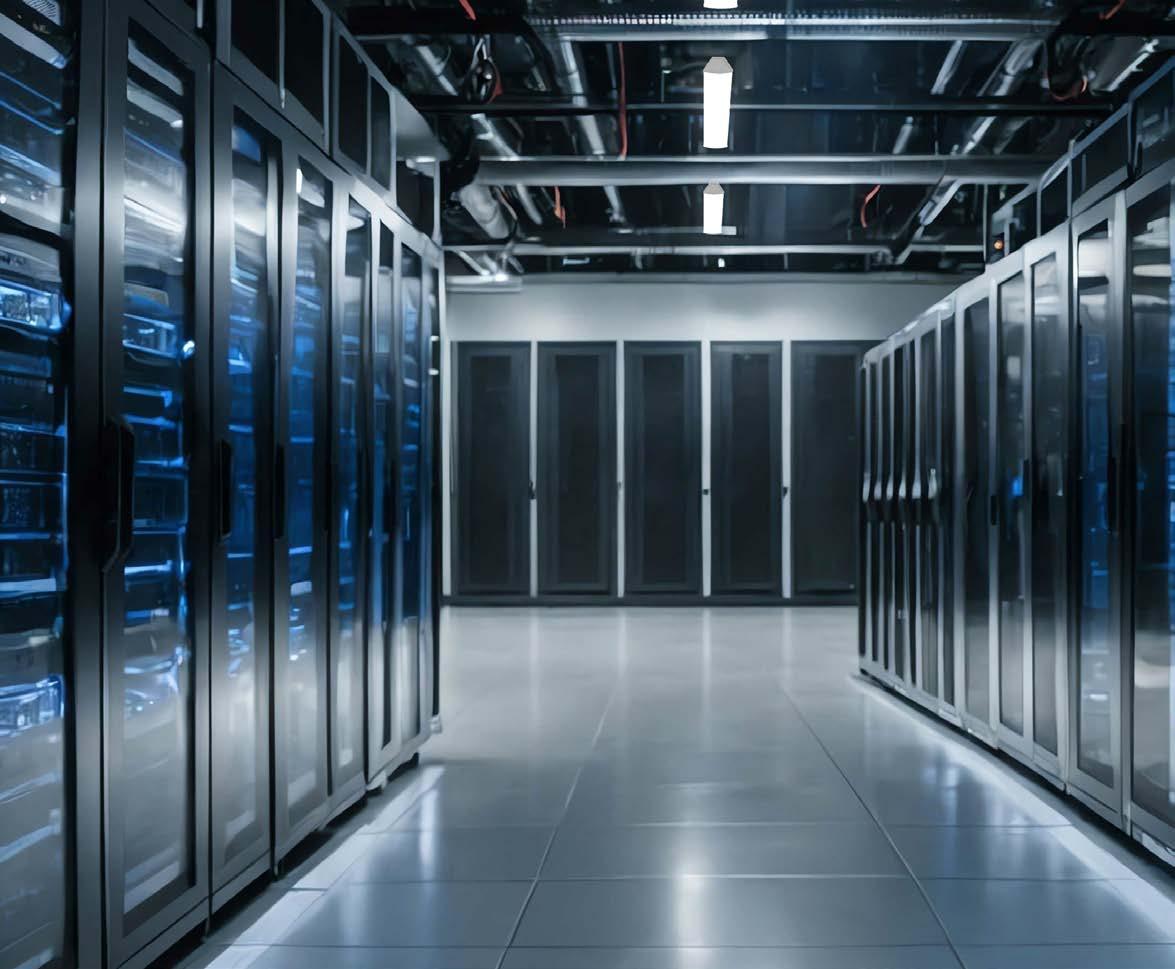
Data centers are moving fast. And so are the expectations. Tight timelines. No room for downtime. Complex environments where every decision matters. For retrofit contractors, the opportunity is real…but so is the pressure to deliver quickly, accurately, and without risk. The contractors winning in this space aren’t just installing products- they’re bringing complete, proven solutions.
Why Partner with Acuity Brands Lighting & Lighting Controls
y Built for Retrofit Reality
Solutions designed for fast installation, minimal disruption, and reliable performance in mission critical environments.
y Performance Where It Counts
Lighting and controls that support uptime, reduce energy use, and handle high-demand conditions.
y A Portfolio That Works Together
From data hall to exterior, a complete offering to simplify your projects and strengthen your bid.
Your Advantage
y Move faster with contractor-friendly installation
y Reduce risk on complex retrofit projects
y Deliver performance your customers can trust
Partner with Acuity Brands Lighting and Lighting Controls
Bring the right solutions. Win more business. Deliver with confidence.

CONTRIBUTORS

SHIRLEY COYLE
Shirley Coyle has worked in the North American commercial lighting industry for several decades, holding various leadership roles. A Past President of the Illuminating Engineering Society (IES), Shirley is very active in the lighting community, including participation on lighting standards development.

Editor and Publisher
Randy Reid
Assistant Editor
Bridget Leary
VP, Associate Publisher, Advertising
Cliff Smith
917.705.3439
Art Direction
Seraphine Morris
Lighting Management & Maintenance (LM&M) publishes information for the benefit of its members and readers. The sponsor (NALMCO), publisher and editor of LM&M cannot be held liable for changes, revision or inaccuracies contained in the material published. For detailed information on the products, programs, services or policies covered, it is recommended readers contact the appropriate person, company agency of industry group.
LM&M is published by EdisonReport (ISSN 2835-821X). Statements and opinions expressed in articles and editorials in LM&M are the expressions of contributors and do not necessarily represent the policies or opinions of the EdisonReport. Advertisements appearing in the publication are the sole responsibility of the advertiser.
On The Cover
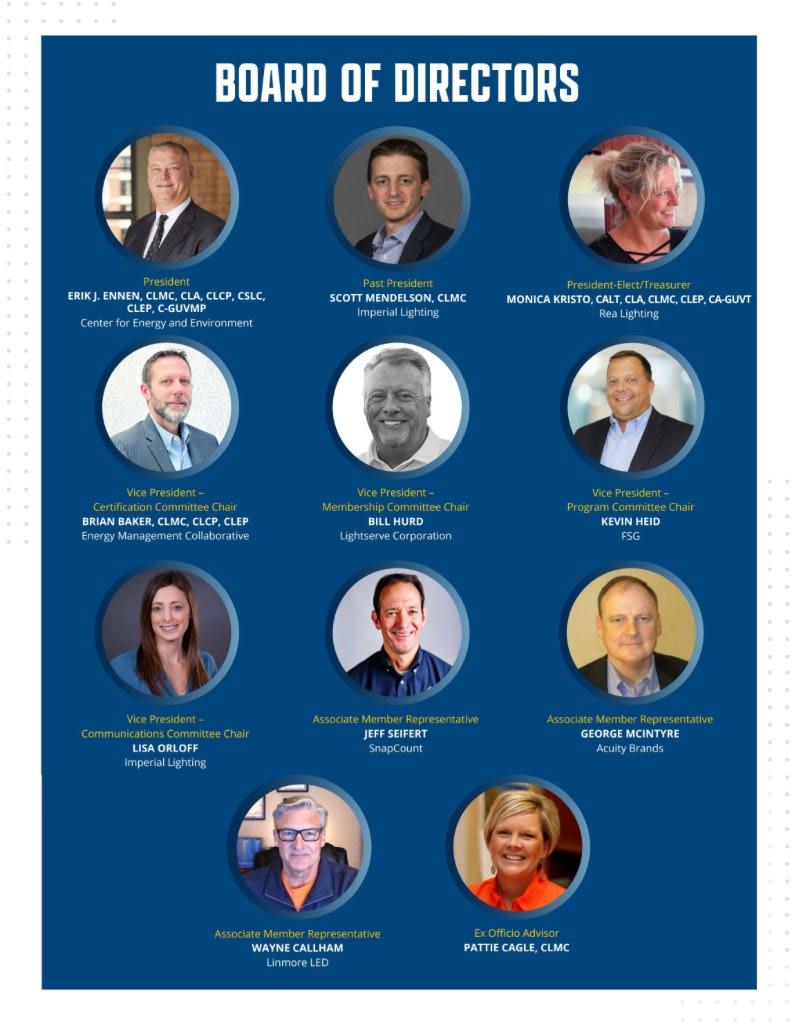
LISA ORLOFF, CLMC

Breakthrough OPTI-SELECT technology lets you change light distribution quickly and easily, with the turn of a switch or twist of the wrist. No lens or reflector swap, no need to open the luminaire or lamp.
Whether you’re installing area lights, bollards, track lights, wall cylinders, post tops, high bays, wall packs, floodlights, sports lights, or PAR38s, you can dial up exactly the right distribution and aiming that each lighting job requires. You’ll not only save time; you’ll also maximize the life of your luminaire or lamp by making sure that moisture never has a chance to get in.
President's MESSAGE
Dear
members and industry colleagues,
The Power of Showing Up
There is something remarkable that happens when dedicated professionals come together with a shared purpose. Ideas become solutions. Conversations become partnerships. And individual experiences become collective knowledge that strengthens our entire industry.
That is why I am excited to invite you to join us at the upcoming NALMCO Annual Conference in Phoenix, Arizona.
Whether you are a longtime member or considering your first conference, I encourage you to invest in yourself and your future by making the decision to attend. The most valuable opportunities often begin with a simple conversation—a chance meeting over coffee, a discussion during an educational session, or an introduction that leads to a lasting professional relationship.
Our annual conference is designed to bring together the brightest minds in lighting. You'll hear from industry experts who understand today's challenges and tomorrow's opportunities. You'll participate in educational sessions that provide practical insights you can take home and implement immediately. Most importantly, you'll connect with peers who face many of the same opportunities and challenges you do every day.
The value of collaboration has never been greater. As our industry continues to evolve, no one has all the answers. But together, we have an incredible wealth of experience, innovation, and expertise. The relationships you build at this conference can become trusted resources long after the event concludes.
And what better place to gather than Phoenix, Arizona? Surrounded by stunning desert landscapes, outstanding hospitality, and countless networking opportunities to unwind after a day of learning,
Every year, I hear from attendees who tell me the same thing: "I almost didn't come, and I'm so glad I did." Their biggest takeaways aren't just the educational sessions—they're the people they met, the ideas they exchanged, and the inspiration they found by being part of a community committed to excellence.
I hope you'll be one of those success stories this year. Join us. Share your knowledge. Ask questions. Build new relationships. Discover new ideas. Be inspired. Because when we come together as a community, we don't just improve our businesses—we elevate our profession.
I look forward to welcoming you to Glendale and seeing what we can accomplish together.
See you in Arizona!
Warm regards,
CLMC, CLA, CLCP, CSLC, CLEP, C-GUVMP President, NALMCO Board of Directors Center for Energy and Environment

Local Inventory + Lighting Design Support from One Partner
More than a supplier
Our local lighting design and controls specialists are here to make your job easy. We’ll support you with:
• Professional on-site audits
• Design layouts
• Specifying products
• Identifying rebates
• Controls commissioning
Sonepar brands across the US have extensive lighting inventory –and a single point of contact for your projects nationwide.
Look to your local Sonepar distributor for your lighting needs.
FROM THE EDITOR
I Thought the Hard Part Would Be Choosing Which Data Center
If you've watched the news lately, you know one thing: data centers are everywhere.
Some communities are rolling out the welcome mat. Others are trying to keep them out. In some places, local governments are even passing ordinances to limit or ban them.
For the lighting industry, however, data centers represent one of the fastest-growing markets around. While the margins on the lighting package may not rival those of a high-end architectural project, the volume is staggering. A single facility can contain thousands—or even tens of thousands—of luminaires. That creates enormous opportunities for manufacturers, distributors, contractors, and maintenance companies.
When we planned the LM&M editorial calendar last year, making data centers our cover story for July/August felt like an easy decision. They're being built everywhere. AI is driving unprecedented growth. What could possibly go wrong?
Turns out, just one thing. Nobody wants to talk. And I mean nobody.
Contractors. Distributors. Designers. Manufacturers. Everyone has signed an NDA. Not your everyday NDA, either. These are the "say one wrong thing and you may never work on another data center again" kind of NDAs.
Originally, I figured my biggest challenge would be deciding which data center to feature.
Naturally, I thought about starting with the most famous one: xAI's Colossus in Memphis, only about three hours from my house. I briefly imagined driving over, getting a tour, and interviewing Elon Musk about the lighting system.
As you may have guessed...that meeting never happened.
Eventually we found two distributors willing to speak on the record and one contractor willing to be interviewed—provided we concealed his company name, his identity, and even his first name. Interviewing him felt a little like interviewing someone in the witness protection program. He wouldn't tell us where the project was located, only the state.
Still, despite all the secrecy, we learned a tremendous amount. The result is one of the most interesting cover stories we've published this year. It explains how lighting packages for hyperscale data centers are procured, staged, and delivered—and why trust between contractors and distributors has become just as important as price.
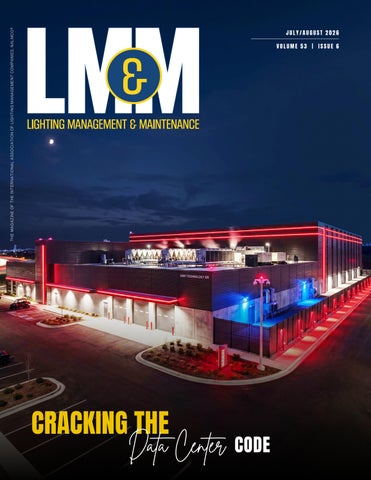
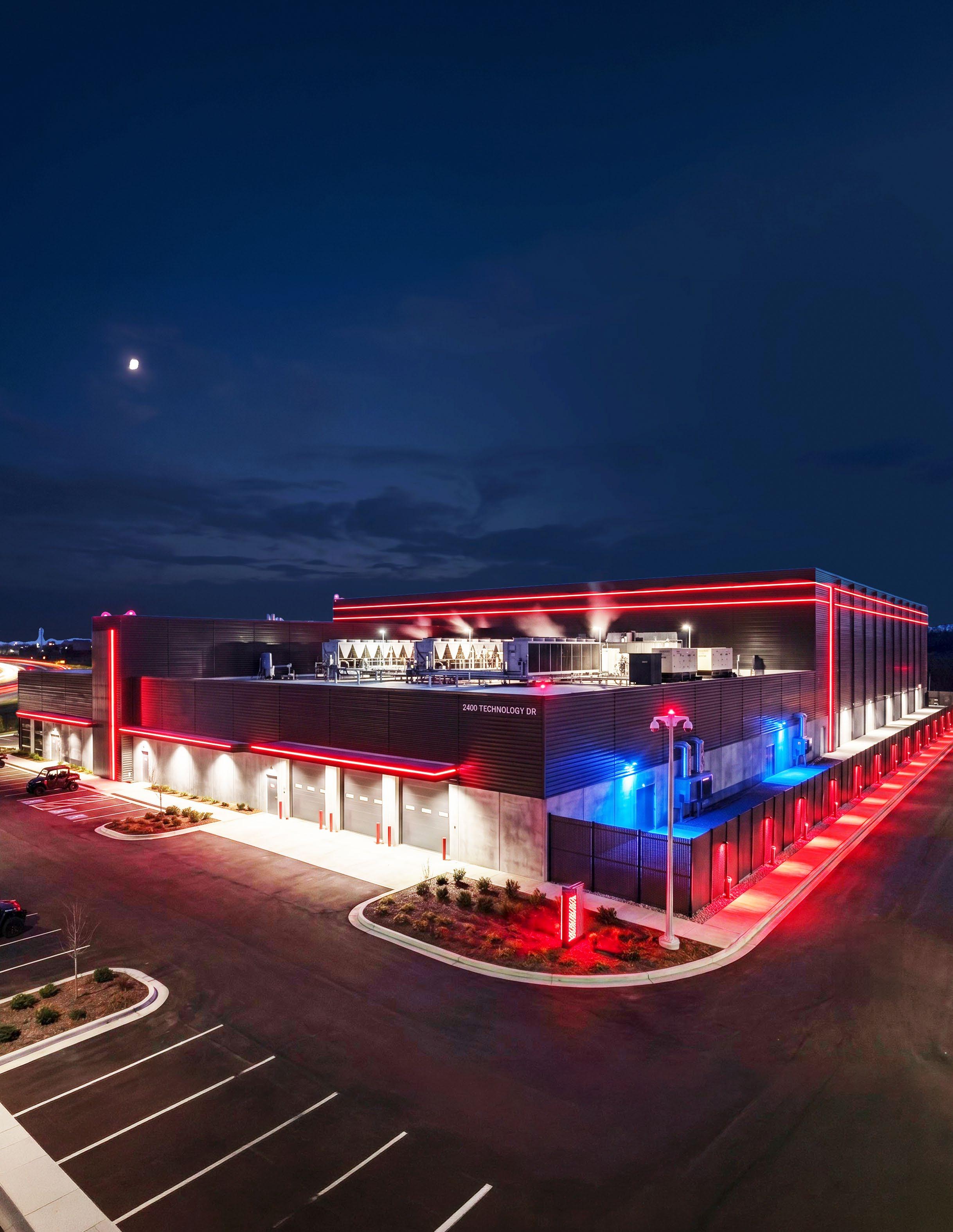
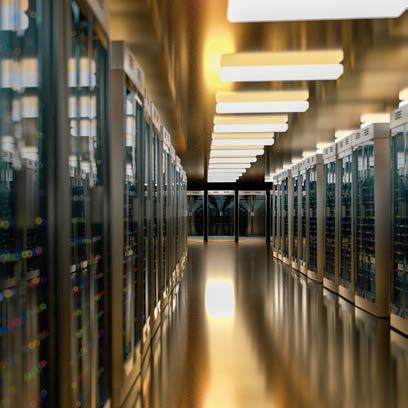
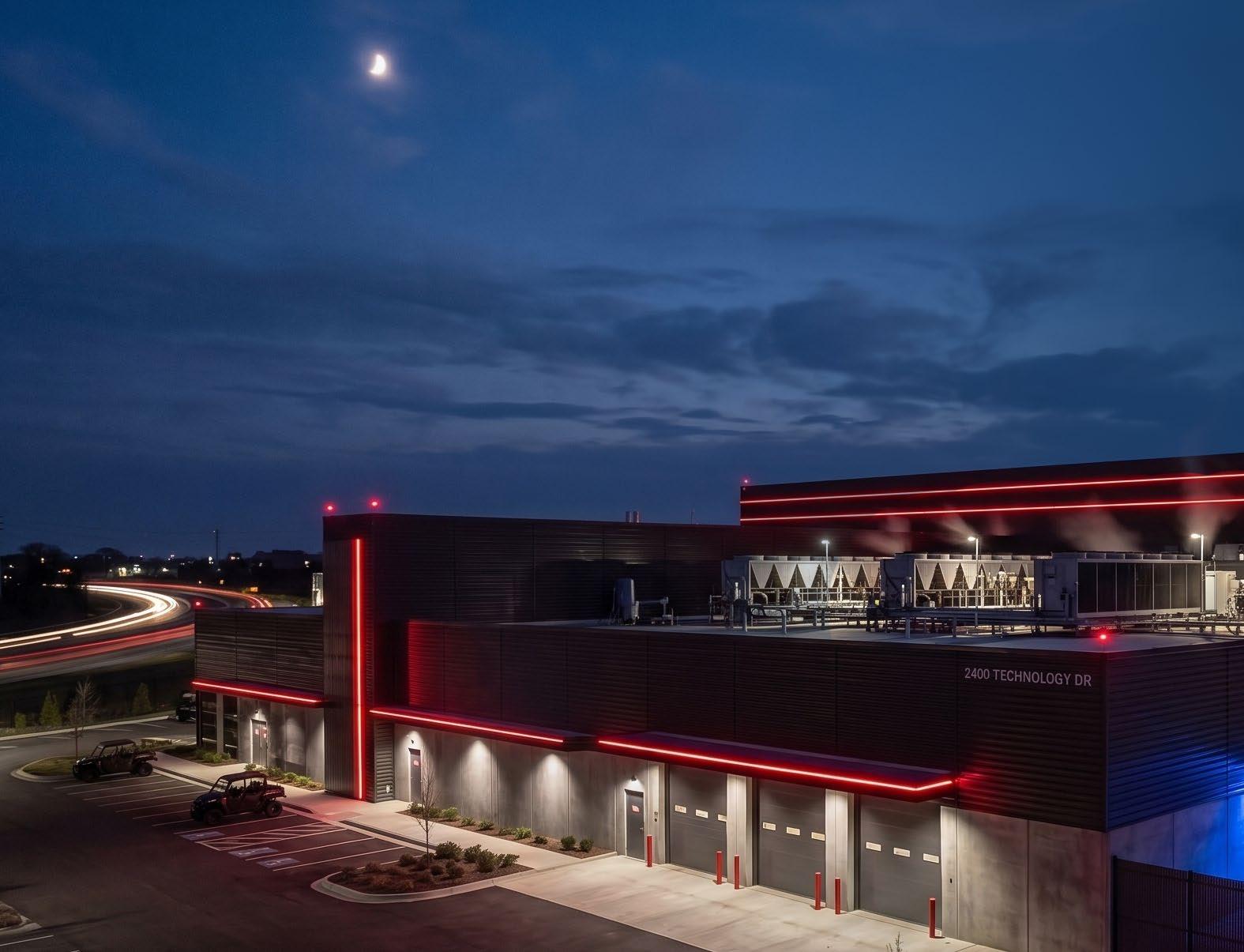
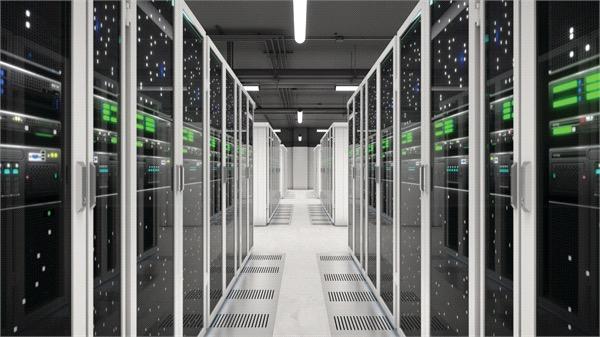
One final confession. The dramatic image on our cover isn't a real data center. It's an AI-generated illustration. Which somehow seems perfectly appropriate for this issue.

FROM THE EDITOR
73RD ANNUAL
OCTOBER 11-14, 2026 GLENDALE, AZ
EARLY BIRD DEADLINE: SEPTEMBER 10, 2026
Sign up
The Speed of Trust:
How Collaborative Distribution Mitigates Risk in Hyperscale Data Center Construction
By Randy Reid
If you've ever tried to learn about a hyperscale data center project, you've probably discovered one thing quickly: almost nobody wants to talk about it.
Owners rarely reveal the identity or location of new facilities until construction is well underway. General contractors, electrical contractors, distributors and manufacturers routinely sign non-disclosure agreements, while suppliers often know little more than the city where their products will ultimately be installed.
The project highlighted in this article is no exception. We interviewed the procurement leader for a major U.S. electrical contractor but agreed not to identify him, his company or the owner of the Texas facility. That level of confidentiality reflects the reality of today's data center market, where protecting information is considered just as important during construction as it is after the servers are energized.
Fortunately, confidentiality does not prevent valuable lessons from being shared. The project illustrates how lighting systems are planned, procured and delivered for some of the world's most demanding buildings. It also demonstrates why experienced lighting distributors have become strategic partners rather than simply suppliers of luminaires.
HOW IMPORTANT IS LIGHTING?
The modern data center is one of the most explosive segments of the commercial construction industry today. Yet, a common misconception persists outside of specialized electrical circles: because these massive facilities house more servers than human beings, people often assume they do not require much lighting.
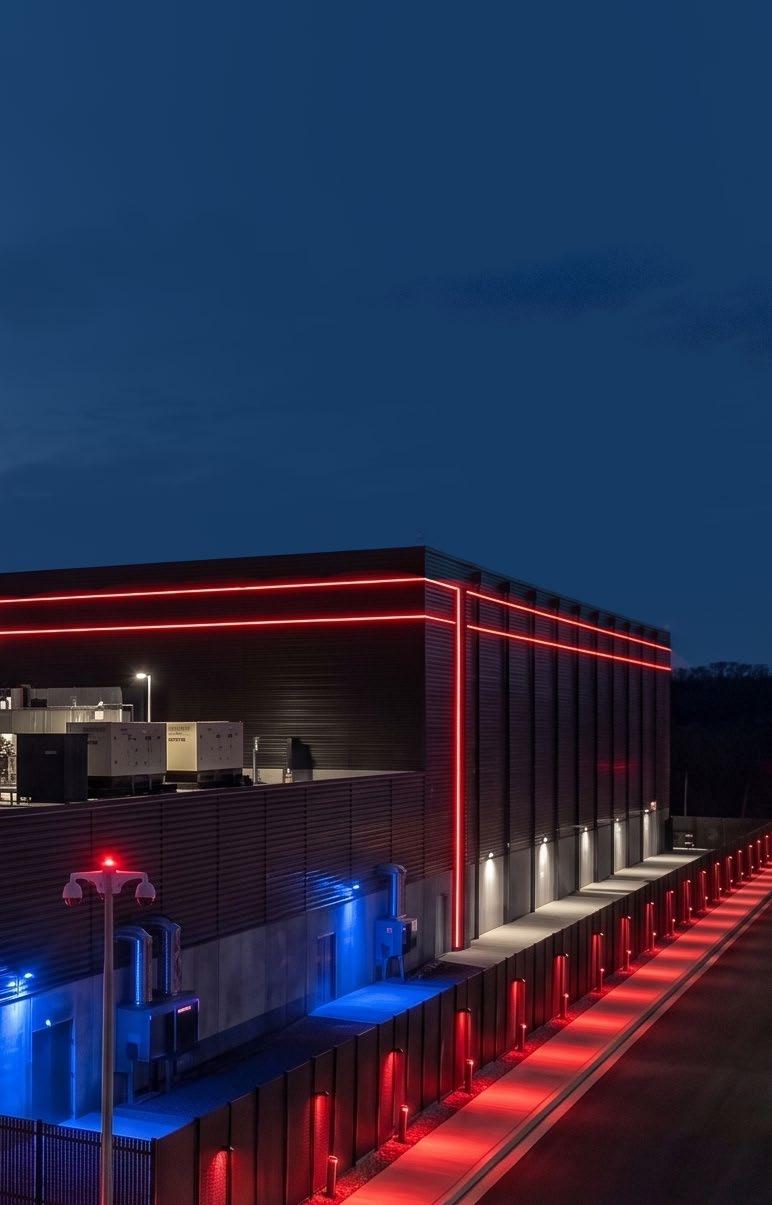
The reality on the ground tells a completely different story. Lighting a modern data center involves a complex, multi-layered environment spanning temporary construction lighting, extensive exterior security systems, and highly specialized interior data halls. As the artificial intelligence (AI) boom demands unprecedented power and compressed construction timelines, the lighting package has transitioned from a basic material order into a sophisticated exercise in risk mitigation.
Our panel included Dale Mauk, Head of Lighting Solutions at North Coast Electric; Steve Holdsworth, VP Sales & Marketing at Summit Electric; and an executive in procurement from one of the nation’s largest electrical contractors, who we will call Chris
What was considered adequate lighting back then may not meet today's maintenance philosophies or operational needs. It is critical to build an adaptable lighting infrastructure today that can serve tomorrow’s customer without requiring a major spatial overhaul."
What emerged from our conversation was a masterclass in how regional distribution networks can align to eliminate risk, optimize labor, and deliver consistency at a breakneck pace.
REDEFINING "LIGHTING A DATA CENTER"
To understand the scope of these projects, it helps to break the lighting package down into three distinct, concurrent phases:
• Temporary Lighting: The essential infrastructure required to keep thousands of trade workers safe and productive during aggressive, around-theclock construction schedules.
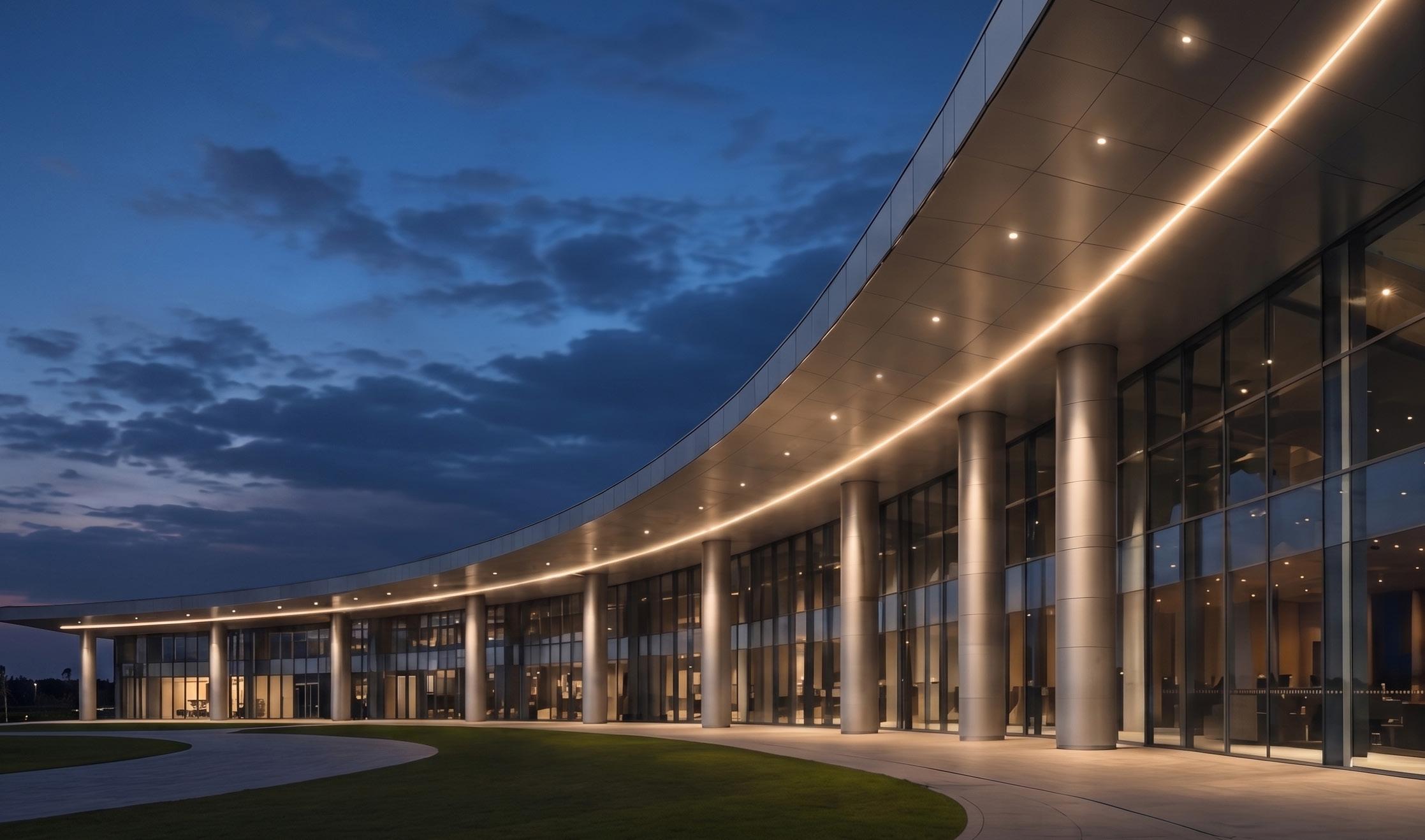
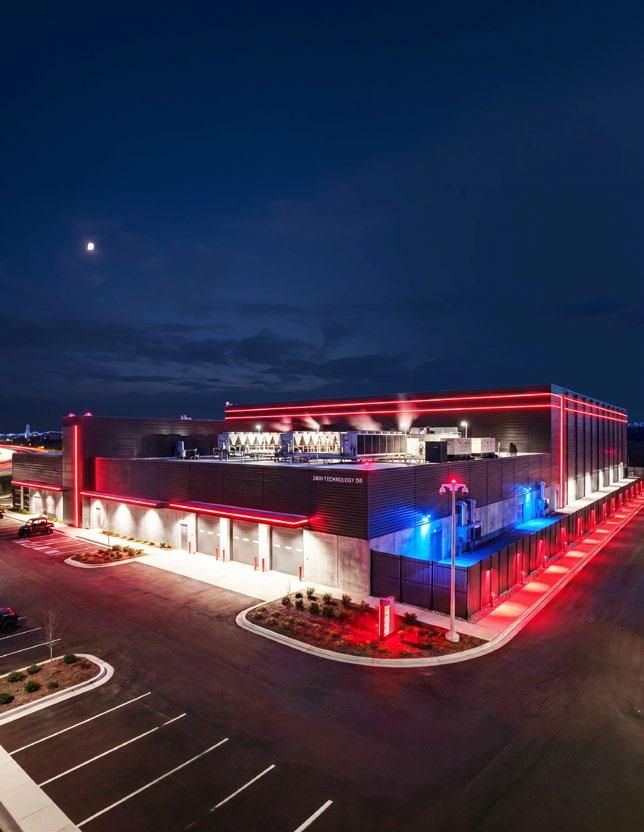
• Exterior Lighting: High-performance architectural and security illumination designed to manage light pollution while ensuring absolute campus security.
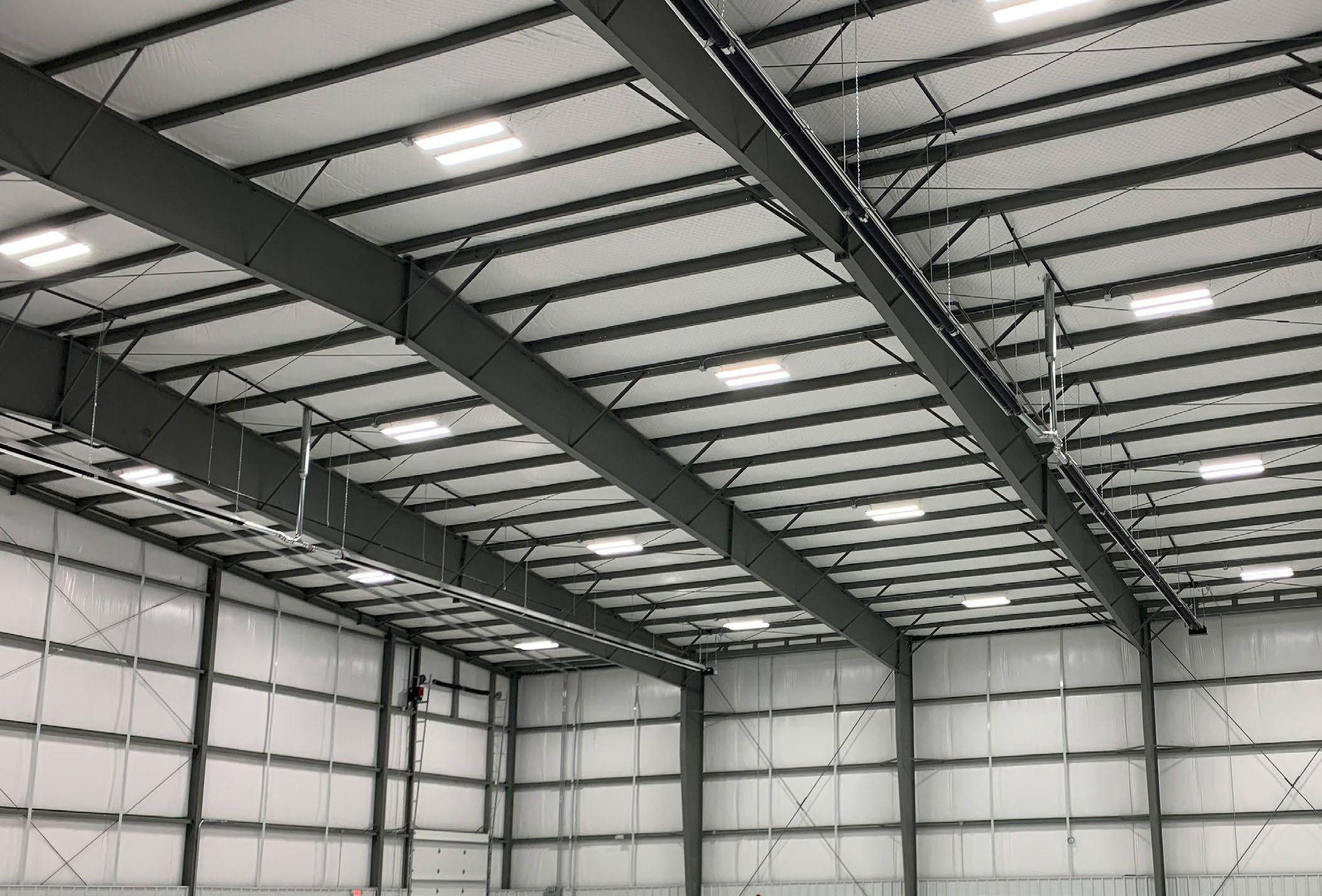
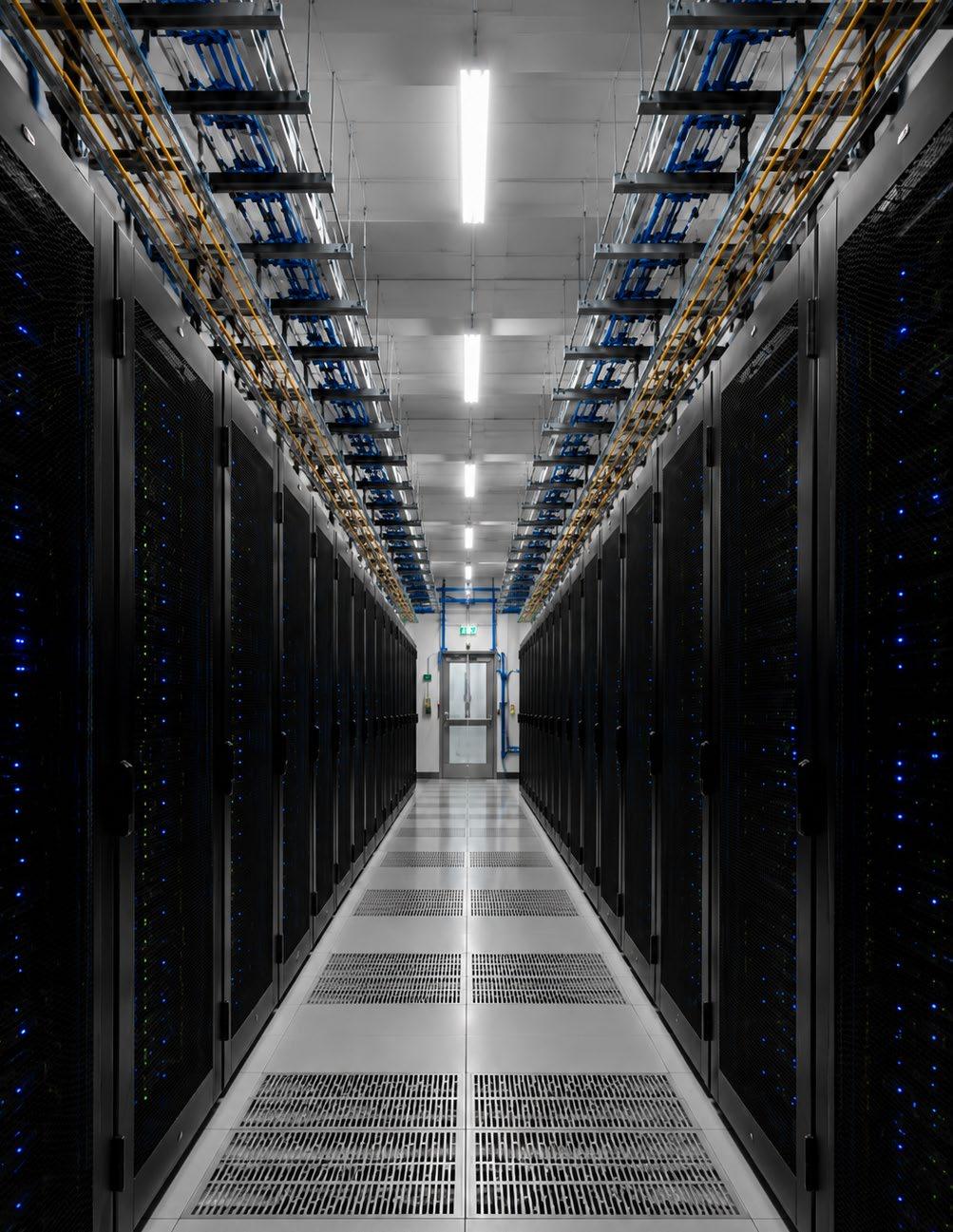
• Interior Lighting: A mix of conventional architectural lighting in administrative offices and thousands of industrial linear fixtures running through the heart of the facility.
"We're remodeling data centers today that were originally built 15 or 16 years ago because of the AI boom," noted Dale. "What was considered adequate lighting back then may not meet today's maintenance philosophies or operational needs. It is critical to build an adaptable lighting infrastructure today that can serve tomorrow’s customer without requiring a major spatial overhaul."
THE CORE OBJECTIVE: RISK MITIGATION
When an electrical contractor signs a contract for a multibillion-dollar data center project, they instantly inherit 100% of the project's execution risk. While the lighting and inverter package represents only a fraction of the overall capital spend, a single delayed shipment or missing fixture accessory can stall a jobsite, costing millions in cascading delays.
"Once that contract is signed, our responsibility as a distributor is to help reduce that risk," Dale explained. "If the contractor believes we have the experience and resources to handle the lighting package, it becomes one portion of the project they don’t have to worry about every day. We become an extension of their organization."
For Chris and his procurement team, selecting distribution partners is never just a race to the lowest bid. "The final selection is based on several factors—not simply price," Chris said. "We look at relationships, core competencies, ability to serve, and, most importantly, the ability to eliminate risk."
HARNESSING THE "SPEED OF TRUST" ACROSS STATE LINES
The Texas project highlights a unique geographical and logistical puzzle. Chris shares a 20-year working relationship with Dale and the Oregon-based North Coast team, having built 14 data centers together over the years. However, executing a massive project in Texas required local, bootson-the-ground support.
Because North Coast and Texas-based Summit Electric are both part of the Sonepar family of companies, they were able to build a seamless, cross-regional alliance.
"Without Summit Electric in Texas, we probably couldn't have worked with North Coast on this project," Chris admitted. "It comes down to what Stephen Covey calls the 'speed of trust.' We needed consistency. No matter where we build across the country, we want the same level of service—a 'Starbucks experience' for electrical contracting."
While Dale’s team in Oregon manages the complex ordering of the lighting and inverter packages, Steve’s team at Summit in Texas handles the intense physical logistics. Summit leased a dedicated 40,000-square-foot warehouse and a sixacre storage yard specifically to serve as a staging ground for this project. To ensure flawless execution, a project manager originally with North Coast even relocated to Texas to run the Summit staging operation.
"We're an extension of each other," said Dale. "Our teams work together every day to manage the project and make sure Chris's team receives exactly what they need."
KITTING: WHY FACTORY-DIRECT SALES FAIL
In an era where some manufacturers and independent sales representatives attempt to pitch factory-direct sales to major contractors, this project proves why the distributor remains irreplaceable.
Data center construction schedules have compressed dramatically. Timelines that historically spanned four years are now expected to conclude in twelve months, even as buildings grow larger. In this hyper-accelerated environment, field electricians cannot waste hours sorting through bulk factory crates looking for missing mounting brackets or specialized connectors.
This is where Steve’s staging warehouse provides a gamechanging service: kitting
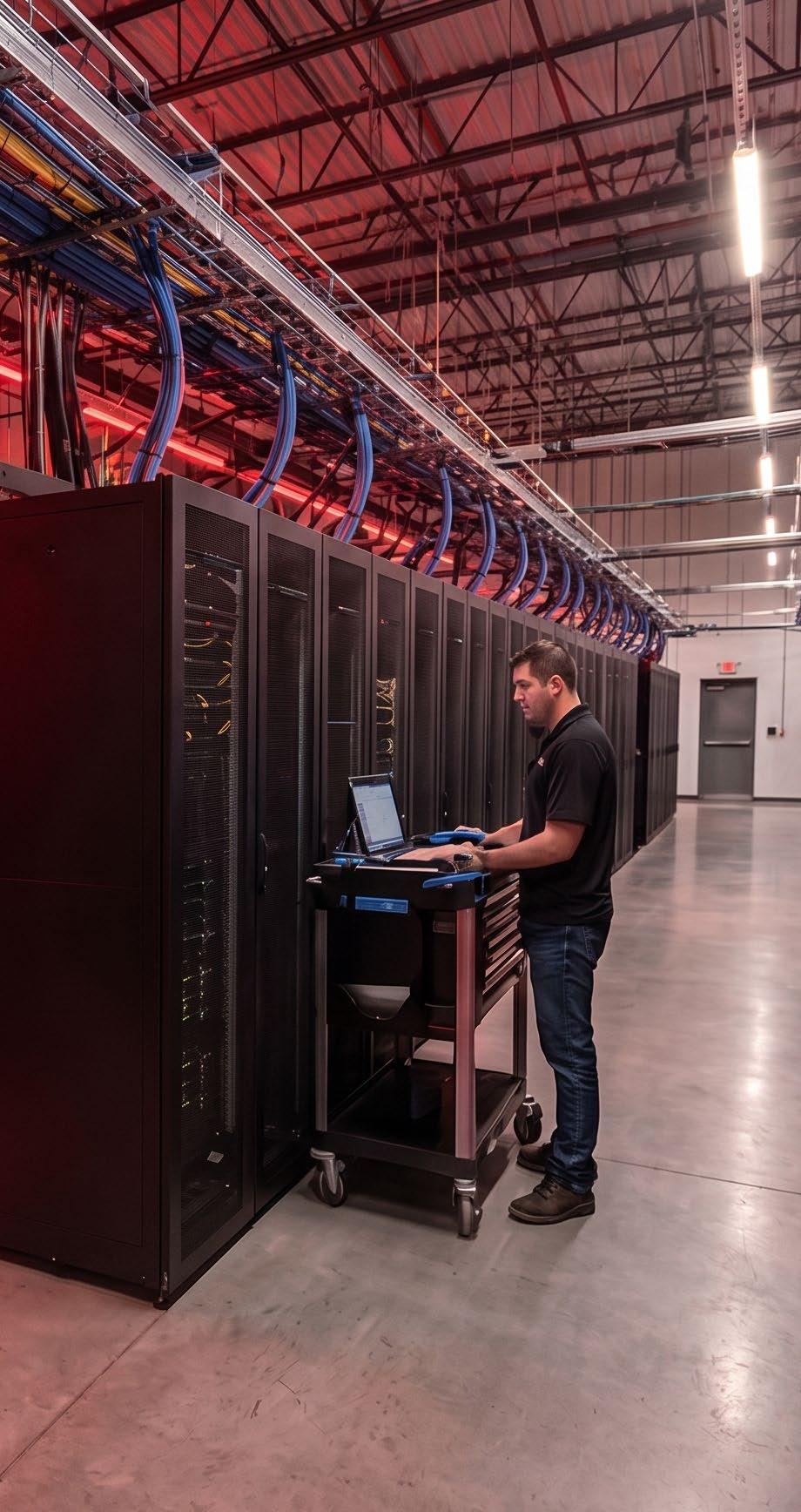
"Every fixture, mounting bracket, accessory, and related component comes into the distributor's staging facility first," Chris explained. "They unpack it, inspect it, organize it, and build installation kits exactly the way we've requested. Then those kits are delivered to the jobsite precisely when we need them."
A manufacturer simply does not possess the local real estate, local inventory, or specialized personnel to receive, inspect, kit, and deliver product on a just-in-time basis. By offloading this logistical burden to the distributor, the contractor optimizes its field labor.
Our teams work together every day to manage the project and make sure Chris's team receives exactly what they need."
"When you choose partners who consistently perform, office staff spend less time chasing problems, field crews spend more time building, and project managers spend more time managing," Chris noted. "That creates a much higher level of job satisfaction, which is vital when skilled labor is so difficult to find."
A MODEL FOR THE FUTURE
TECHNICAL TRENDS: SECURITY, LEDS, AND NO WIRELESS
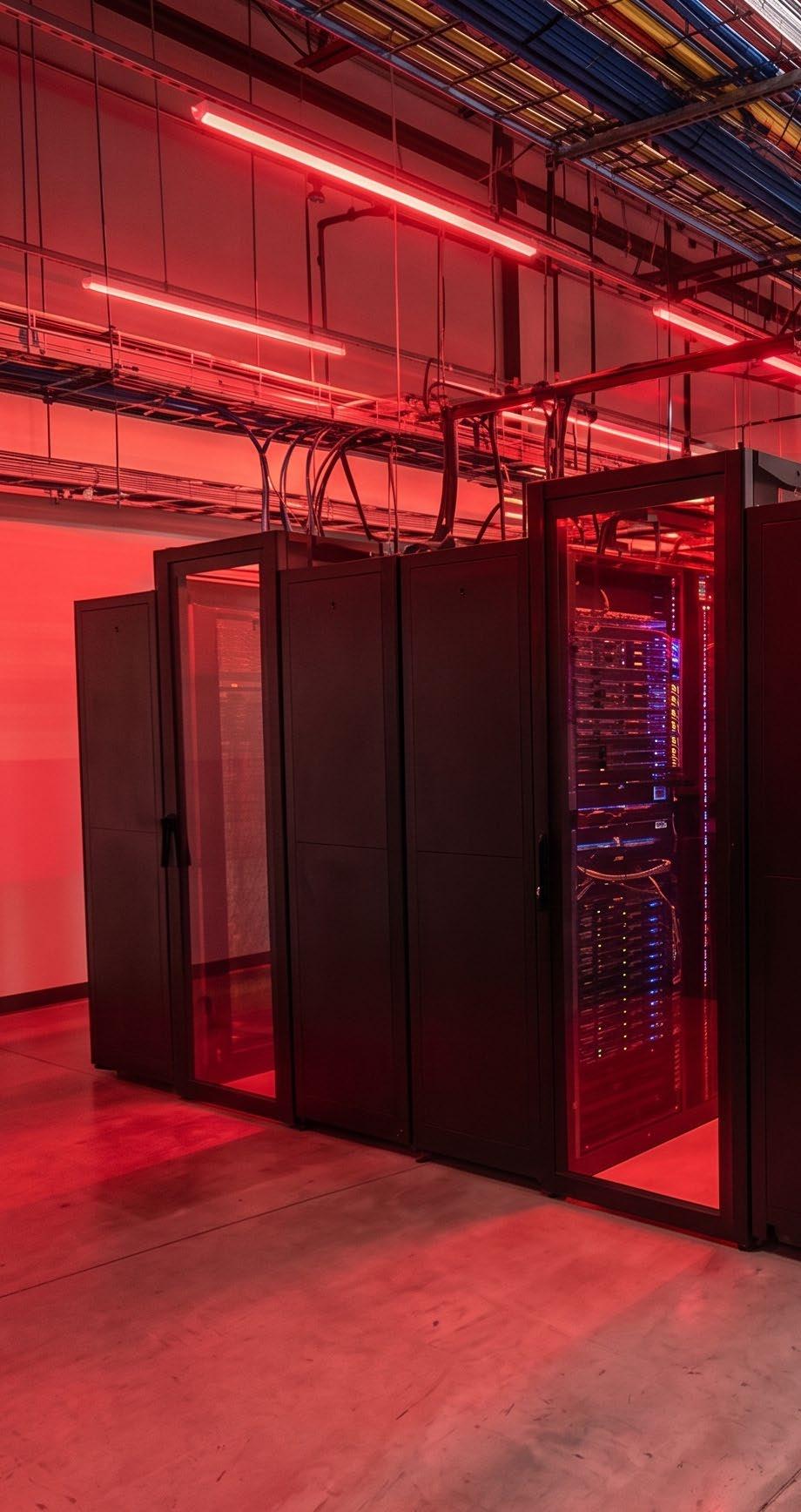
The technical specifications of modern data centers reflect their strict operational priorities. Inside the data halls, conventional architectural downlights are virtually nonexistent; instead, the standard solution relies heavily on high-efficiency four-foot and eight-foot linear fixtures. These spaces favor a cooler, cleaner working environment, typically utilizing 4000K or 5000K color temperatures, while administrative offices drop to a warmer 3500K.
On the exterior, security drives the design. Data centers often appear highly illuminated compared to typical commercial facilities to maximize visibility and surveillance. Fortunately, LED advancements allow for tighter optical control, meaning light can be directed precisely downward to eliminate glare and light trespass in sensitive communities while keeping energy costs low.
When it comes to lighting controls, the industry consensus is absolute: everything is wired.
"Most data center clients don't want anything operating wirelessly—even on a closed network," Dale emphasized. "They're in the business of protecting information. They know how sophisticated cyber threats have become, and they don't want to create another potential pathway into their systems. Their philosophy is simple: eliminate every possible point of entry."
NAVIGATING THE MODERN SUPPLY CHAIN SPACE RACE
Despite the bullish outlook for lighting procurement, global supply chains remain under intense pressure. A convergence of factors—including recent shortages in printed circuit boards (PCBs) and the influx of institutional projects funded by the Infrastructure Investment and Jobs Act—means that data center builders are constantly competing with schools, hospitals, and universities for manufacturing capacity.
Compounding this pressure is the intense culture of secrecy surrounding data center developments.
"The confidentiality surrounding these projects creates supply chain problems," Chris observed. "Because of strict NDAs, manufacturers often don't receive enough advance notice to prepare for future demand. It’s almost like a modern-day space race; everyone wants to be first, and nobody wants to reveal what they’re building. If more developers shared long-term forecasts under confidentiality agreements, many lead-time problems would disappear."

The success of this Texas hyperscale project demonstrates that the physical boundaries of electrical distribution are fading. Through trust, clear communication, and the combined regional strengths of Sonepar operating companies, distributors can successfully follow their contractor partners wherever they choose to build.
"One of the things we realized very early was that none of us could do this alone," concluded Steve. "North Coast needed Summit. Summit needed North Coast. More importantly, Chris needed both of us.
That collaboration became the biggest reason the project is a success."
Could Lighting Lead the Return of DC Power?
How Cence Power Is Rethinking Building Electrical Infrastructure
By Randy Reid
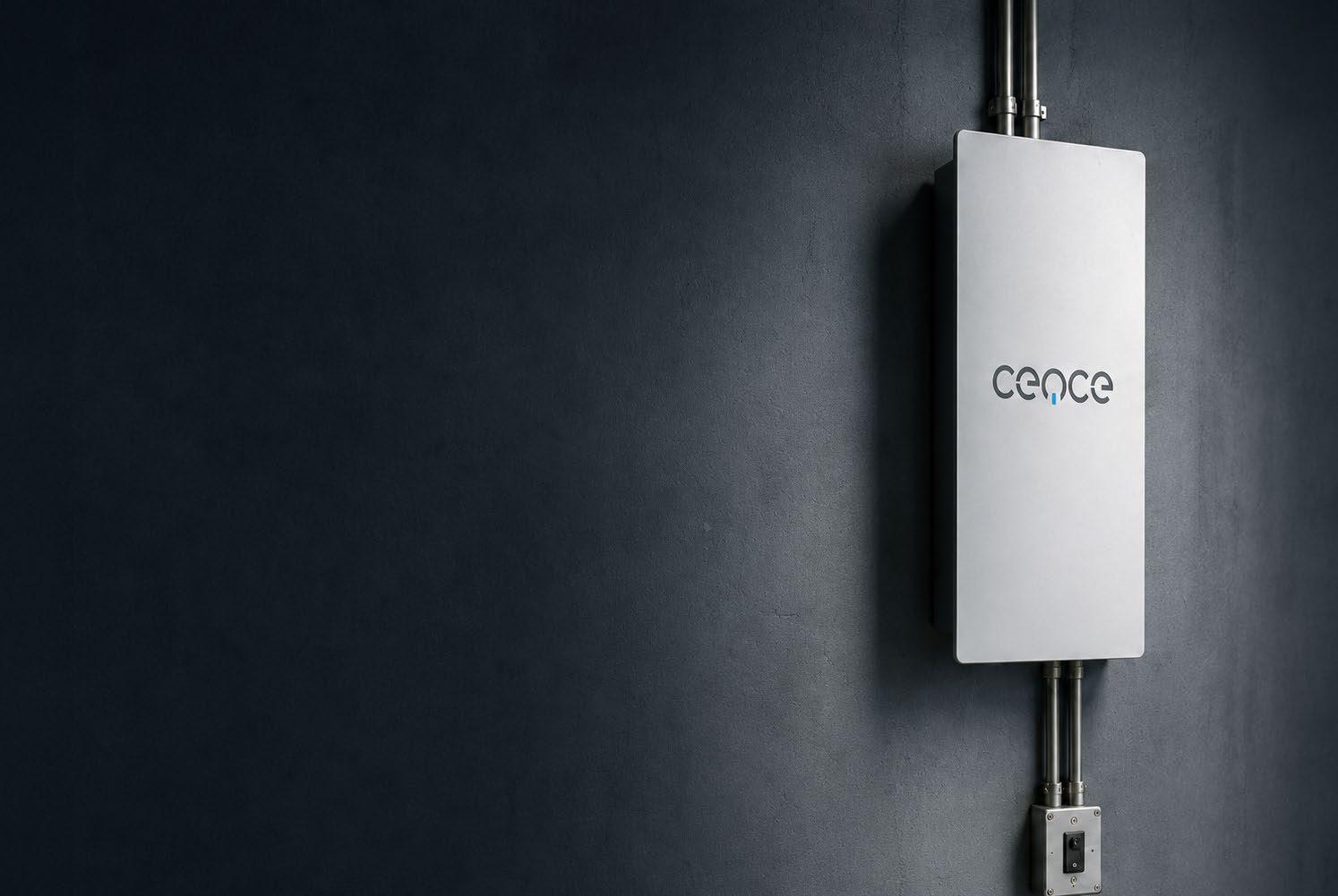
For more than a century, commercial buildings have distributed alternating current (AC) throughout their electrical systems. When LED lighting arrived, the industry largely maintained that architecture. Every luminaire received AC power and converted it to direct current (DC) inside its own driver.
Sean Correa believes that approach no longer makes sense.
Correa, Director of Technical Sales for Cence Power, argues that the lighting industry is carrying unnecessary complexity into every project by installing hundreds— or even thousands—of individual drivers above ceilings. Instead, he envisions centralized DC power distribution, where a single, highly efficient conversion takes place in an equipment room before lowvoltage DC power is distributed throughout the building.
The concept isn't entirely new. The industry has experimented with DC lighting before. But according to Sean, previous attempts failed because they solved only part of the problem. Cence believes it has learned from those failures and developed an approach that better aligns with the needs of contractors, engineers, lighting designers, and maintenance personnel.
If he's right, the implications extend far beyond lighting.
LEARNING FROM TWO FALSE STARTS
When discussing DC power, Sean doesn't pretend the industry is starting with a clean slate. Instead, he readily acknowledges two previous attempts that never achieved widespread adoption.
"The first was 24-volt systems," he explained. "There was simply too much voltage drop. Contractors didn't like it, and lighting designers found it too limiting."
The second attempt was Power over Ethernet (PoE).
Sean gives PoE credit for generating excitement, but he believes the technology ultimately created new challenges. Fixture selection remained limited, systems required point-to-point cabling, and contractors often viewed the work as belonging to the IT department rather than the electrical contractor. As installation costs became clearer, adoption slowed considerably.
Rather than simply building another DC system, Cence tried to understand why those earlier approaches struggled. The result is a platform that is cable agnostic, compatible with multiple control protocols, and designed to support a much broader range of luminaires than earlier DC architectures.
"There was simply too much voltage drop. Contractors didn't like it, and lighting designers found it too limiting."
ONE CONVERSION INSTEAD OF HUNDREDS
The heart of the system is surprisingly straightforward.
Instead of allowing every fixture to perform its own AC-to-DC conversion, Cence moves that conversion into a centralized cabinet.
Incoming building power—up to 277 volts AC—is converted to 60-volt DC by a centralized three-kilowatt rectifier. That power is then distributed through modular output cards that supply individual lighting circuits. Because the conversion occurs once instead of at every fixture, each luminaire can eliminate the traditional AC driver.
Sean describes the approach as
Each cabinet contains eight hot-swappable output modules, with four channels per module, providing 32 lighting circuits from a single hub. Individual modules can be configured for either constant-current or constant-voltage applications, allowing different fixture types to operate from the same centralized system.
Unlike conventional branch circuits, low-voltage Class 2 wiring can often be installed without conduit or junction boxes, depending on local code requirements. The result is a dramatically simplified ceiling infrastructure.
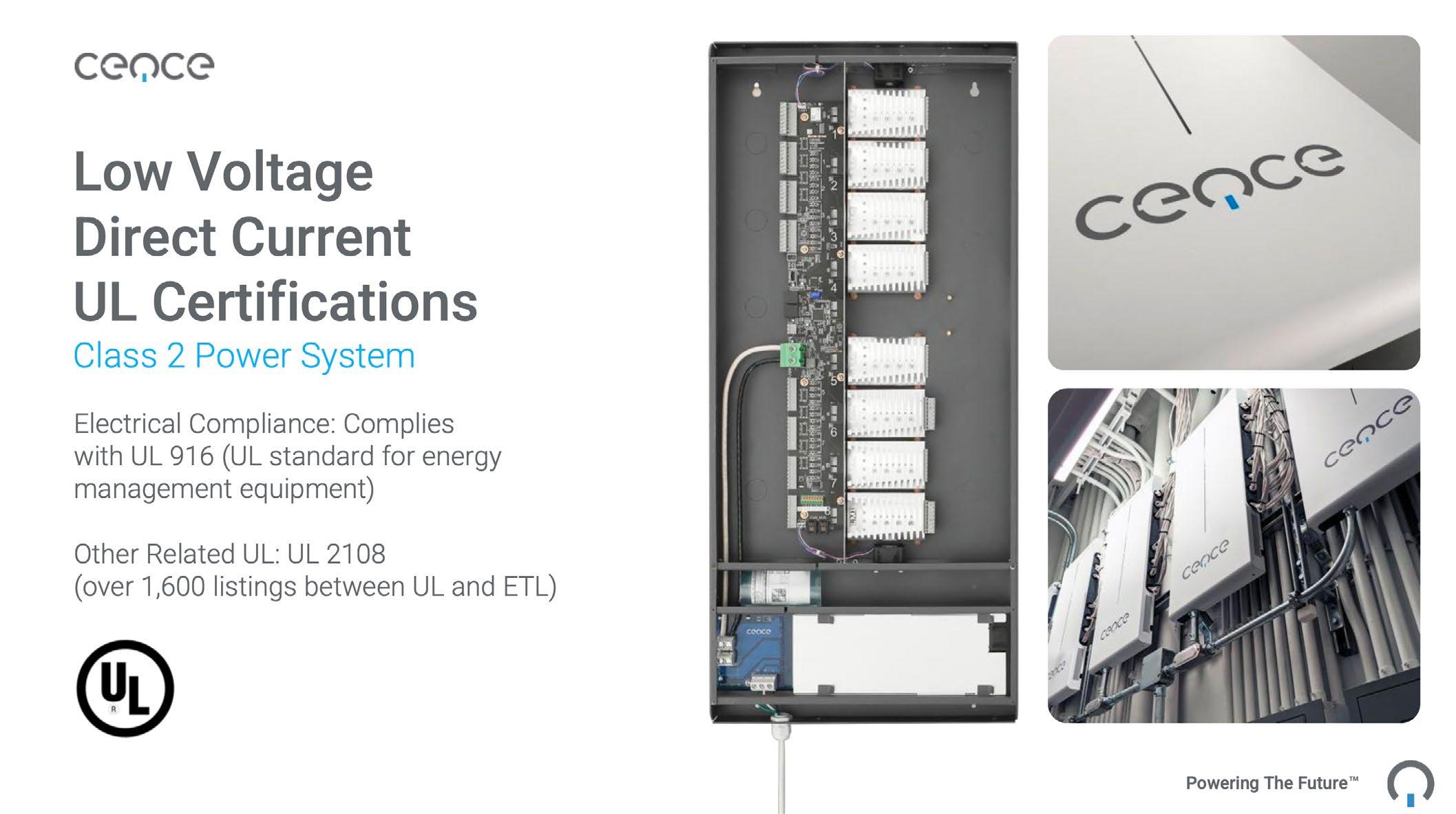
According to Sean, one factor accelerating adoption is the growing availability of UL 2108-listed luminaires. He says major lighting manufacturers, including Acuity Brands,
Signify, and QTL, now offer fixtures designed to comply with the UL 2108 standard for low-voltage lighting systems. If that trend continues, contractors and specifiers will have considerably more flexibility than they did during the industry's earlier experiments with low-voltage lighting.
Rather than being limited to a proprietary ecosystem, building owners could select fixtures from multiple established manufacturers while maintaining a common low-voltage infrastructure.
WHY IT FINANCIALLY BENEFITS LIGHTING CONTRACTORS
At first glance, a system that eliminates conduit, junction boxes, and hundreds of individual drivers might sound like bad news for electrical contractors. Sean sees it differently. He argues that contractors aren't losing work—they're changing the type of work they perform.
Instead of spending hours installing traditional branch circuits and later returning to troubleshoot failed drivers above ceilings, contractors can complete projects more quickly, take on more jobs each year with the same workforce, and generate recurring service revenue by maintaining centralized power hubs.
In an era when many contractors struggle to find enough qualified electricians, technologies that reduce repetitive installation tasks while improving productivity may actually increase profitability rather than reduce it.
Faster project turnover, lower warranty costs, and simplified maintenance can create a stronger long-term business model for both contractors and their customers.
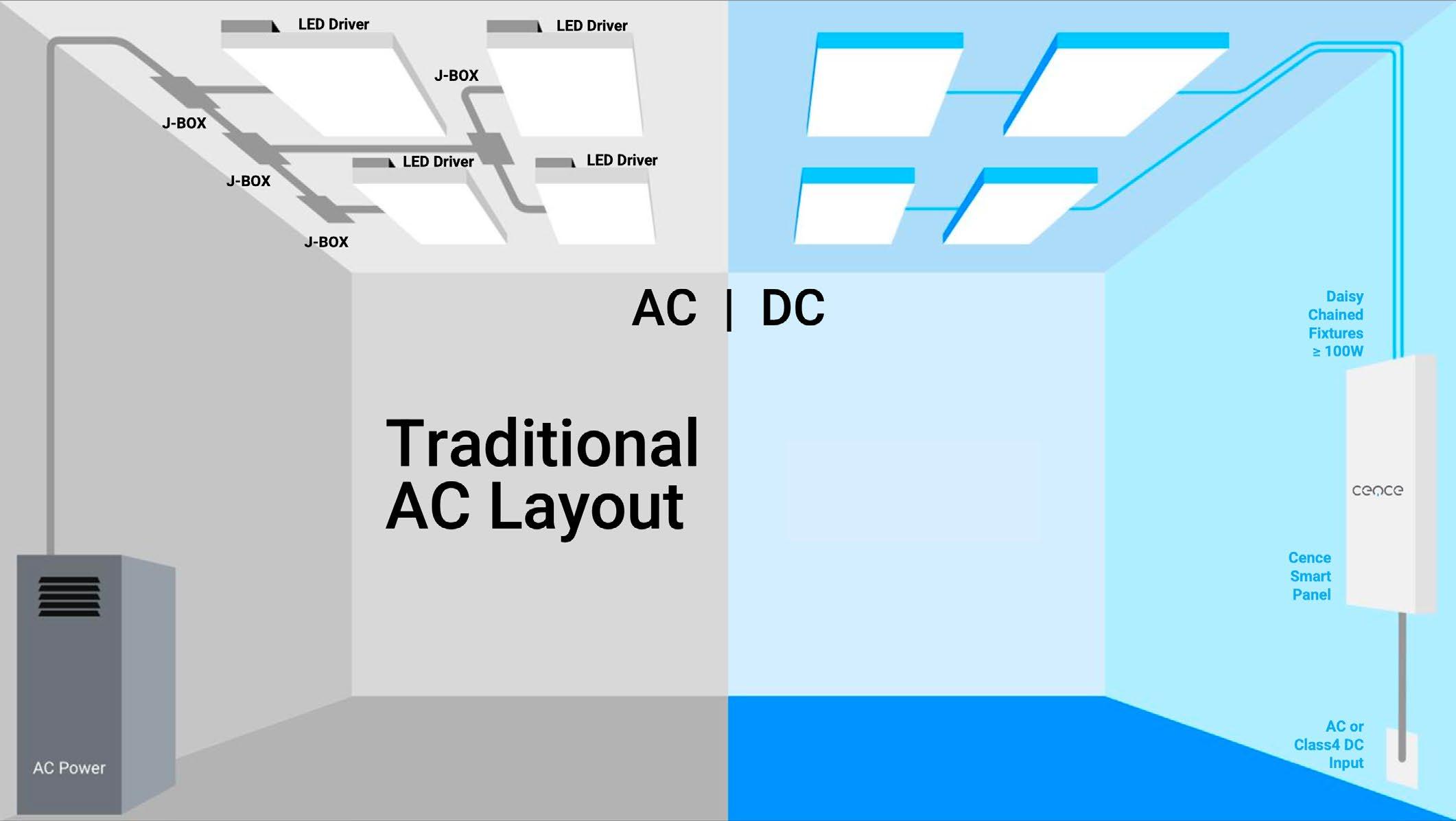
Figure 1: Traditional AC layout versus centralized DC distribution (Cence presentation, Page 9).
"purpose-built drivers in a box."
A MAINTENANCE STORY AS MUCH AS AN ELECTRICAL STORY
Although the centralized architecture offers installation advantages, Sean repeatedly returned to maintenance.
Every facility manager has experienced driver failures hidden above inaccessible ceilings. Diagnosing those failures often means locating the correct fixture, bringing in a ladder, opening the luminaire, testing the driver, and replacing components while the circuit is de-energized.
The Cence approach changes that workflow entirely.
If a circuit develops a fault, technicians can identify the affected module through status indicators located inside the centralized hub. Rather than opening ceilings, they simply remove the faulty output module and replace it with a new one while the remainder of the system continues operating. No branch circuit shutdown is required.
For maintenance departments responsible for hospitals, schools, office towers, or data centers, reducing service calls above occupied spaces could become one of the system's greatest advantages.
ELIMINATING LIGHTING'S WEAKEST LINK
One of the most interesting parts of our conversation focused on a component familiar to nearly every lighting engineer: the electrolytic capacitor.
Sean held one up during our interview.
"This is what causes most driver failures," he said.
The problem isn't the LEDs themselves. Modern LED packages routinely achieve lifetimes exceeding 100,000 hours. Instead, the limiting factor has often been the driver, particularly the electrolytic capacitors that gradually dry out, leak, or degrade under elevated temperatures. Those failures eventually produce flickering, intermittent operation, or complete driver failure.
By removing AC drivers from each fixture, Sean believes lighting systems can achieve significantly longer service
lives. The centralized architecture still contains power conversion equipment, but far fewer components are exposed to the harsh thermal conditions typically found above ceilings.
That distinction could become particularly valuable in facilities where maintenance access is difficult or expensive.
WHY DATA CENTERS ARE PAYING ATTENTION
Our discussion originally began because of data centers.
As I explored Cence's website, I noticed several references to the market, prompting the interview.
Sean explained that data center operators are especially interested because they already understand centralized power distribution. They also place enormous value on reliability, serviceability, and minimizing downtime.
According to Sean, Cence is currently discussing projects with organizations including Meta and Verizon. In those environments, centralized DC distribution eliminates drivers above hot aisles while allowing low-voltage wiring to share cable tray space with other building infrastructure where permitted by code.
Data centers also tend to embrace modular maintenance strategies. Replacing a hot-swappable module inside a centralized cabinet fits naturally with the operational
philosophy already common in mission-critical facilities.
HOSPITALS HAVE BECOME EARLY ADOPTERS
While data centers represent an emerging opportunity, healthcare appears to be driving today's momentum.
Sean explained that Cence has completed millions of square feet of lighting installations and has become part of Kaiser Permanente's base building specification for new hospitals and medical offices. Other healthcare organizations have followed that lead as they evaluate centralized DC architectures for future projects.
Healthcare environments present unique challenges. Ceiling access is often difficult, patient rooms contain multiple lighting zones, and minimizing maintenance disruptions has tangible operational value. A centralized power architecture addresses many of those concerns while simplifying future service work.
For contractors serving healthcare clients, this may represent one of the earliest opportunities to encounter large-scale centralized DC lighting systems.
LOOKING BEYOND LIGHTING
Perhaps the most intriguing part of our conversation came when Sean broadened the discussion beyond luminaires.
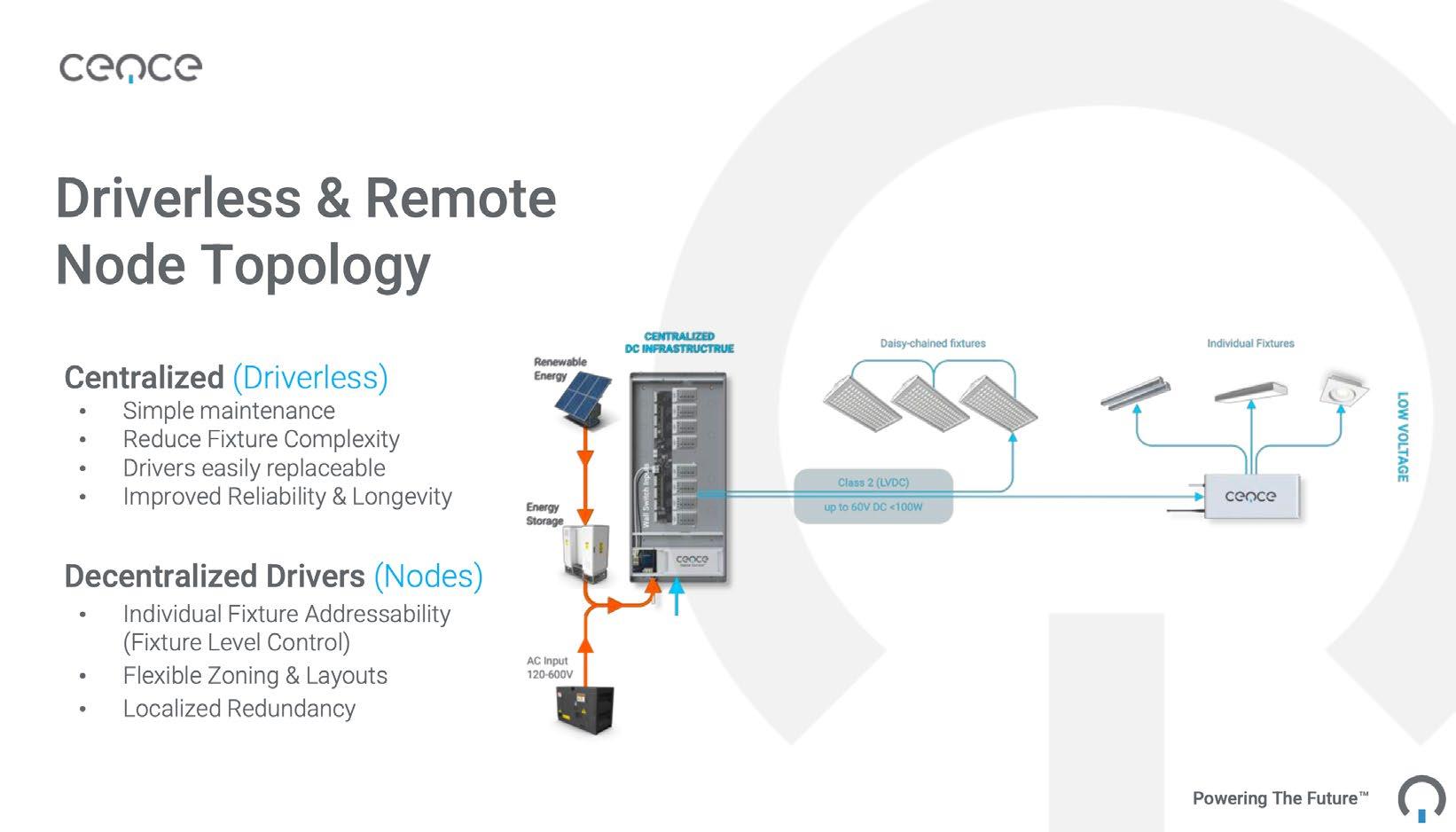
He argues that lighting is only one component of a much larger transition toward DC-powered buildings.
LED lighting already operates internally on DC. Brushless DC motors are increasingly common in HVAC equipment. Telecommunications systems, wireless infrastructure, electric vehicle charging, battery storage, solar generation, and many electronic devices all rely on DC power at some point in their operation.
Instead of repeatedly converting AC to DC throughout a building, Sean believes future facilities will gradually centralize those conversions and distribute DC power more directly.
He even envisions buildings eventually receiving high-voltage DC service in some applications before converting that power for internal distribution. While that remains a long-term vision rather than current industry practice, it reflects how some companies are thinking about the next generation of electrical infrastructure.
Figure 2: Driverless and remote-node topology illustrating centralized DC infrastructure (Cence presentation, Page 11).
WHAT CONTRACTORS SHOULD WATCH
Whether centralized DC ultimately becomes mainstream remains an open question. The lighting industry has seen promising technologies before that never achieved broad acceptance.
However, Cence appears to be addressing many of the obstacles that limited earlier DC systems. Rather than asking contractors to become IT specialists or forcing projects into proprietary fixture ecosystems, the company is focusing on familiar electrical installation practices while reducing ceiling complexity and improving serviceability.
For electrical contractors, the value proposition extends beyond energy savings. Lower material costs, fewer junction boxes, reduced conduit, simplified troubleshooting, and faster maintenance all have measurable economic value over a building's lifetime.
Figure 3: Competitive comparison of centralized LV Hub architecture versus PoE and conventional driver-based systems (Cence presentation, Page 14).
A DIFFERENT WAY TO THINK ABOUT BUILDINGS
After nearly an hour with Sean, I came away thinking less about a new lighting product and more about a different philosophy of building power distribution.
For decades, the industry has accepted hundreds of individual drivers scattered throughout ceiling spaces because that was simply how LED lighting evolved. Cence asks whether that architecture still makes sense.
The answer will ultimately be determined by contractors, engineers, facility managers, and building owners—not by manufacturers.
But if centralized DC distribution continues gaining traction in hospitals, data centers, and large commercial buildings, the lighting industry may once again find itself at the forefront of a much broader transformation in how buildings are powered.
3
Figure
WHAT'S NEW
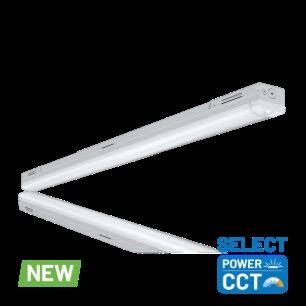
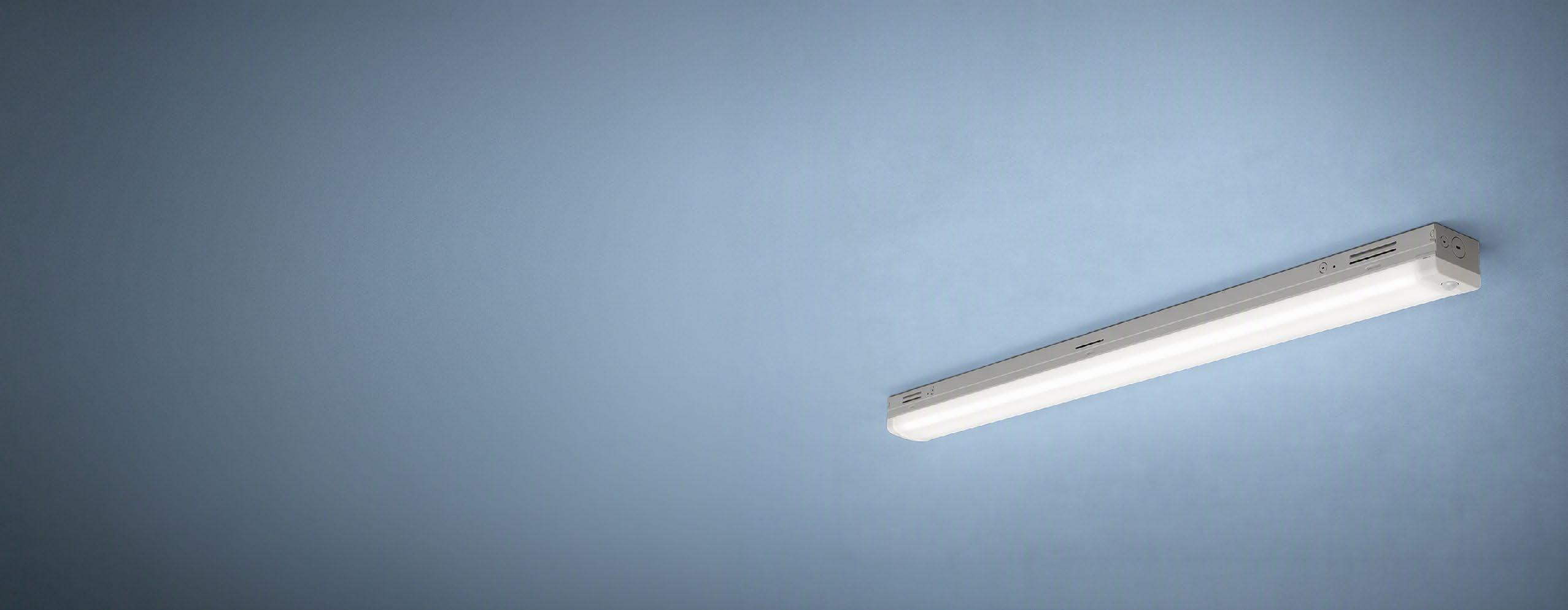
TSS G2
SLG Lighting’s TSS Series LED Commercial Strip Lighting delivers a versatile solution for commercial and industrial applications. Featuring a patented end-cap design with 3-in-1 control options, the series supports plug-in occupancy sensors and wireless controls for added flexibility. Built for reliable, long-term performance, the TSS Series simplifies installation while delivering dependable lighting solutions.

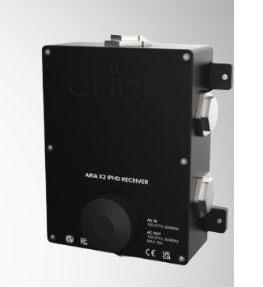
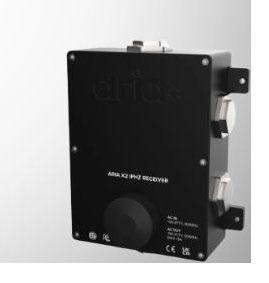
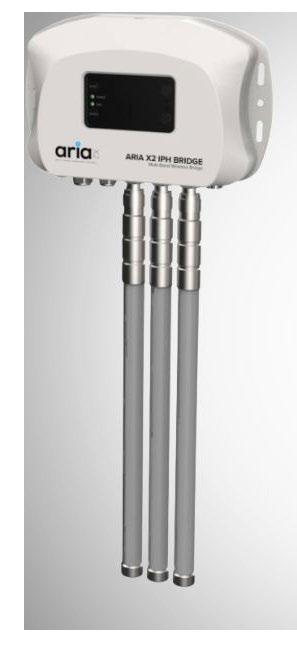
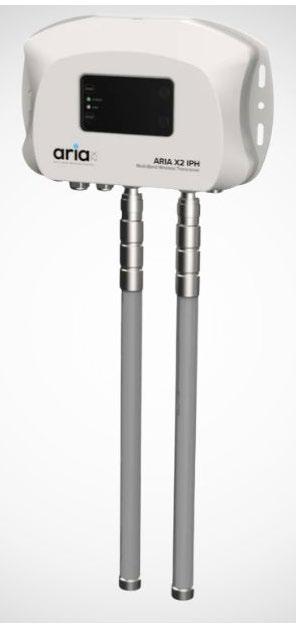
ARIA X2™ WIRELESS CONTROL SYSTEM
Acclaim Lighting’s Aria X2™ Wireless Control System delivers advanced wireless DMX control with multi-band technology, enhanced reliability, and expanded compatibility. Designed for large-scale architectural lighting installations, it supports DMX and 0–10V outputs with flexible system integration. Featuring IP66rated components, extended transmission range, and legacy system support, Aria X2 provides a reliable, future-ready lighting control solutioninstallation while delivering reliable smart lighting control.

LUMINATION® FLEX
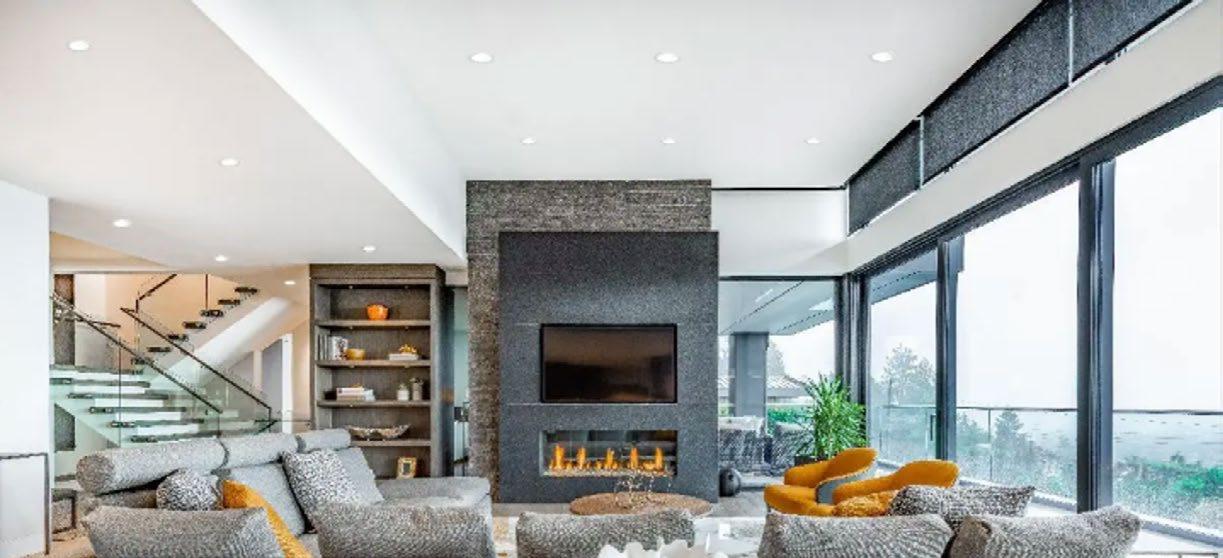
Current’s Lumination® Flex Downlights deliver flexible, high-performance illumination for commercial and light commercial applications, including higher ceiling environments. Featuring selectable lumens and CCT options, the canless design supports easy installation for new construction, retrofit, and remodel projects. With universal 120-347V compatibility, advanced dimming options, and customizable trim accessories, Lumination® Flex provides a versatile and cost-effective lighting solution.


LED LOW PROFILE WALL PACKS
SATCO|NUVO’s LED Low Profile Wall Packs offer a sleek, durable solution with field-selectable wattage and color temperature options. Featuring an IK08 vandal-resistant lens, IP65 rating, and 0-10V dimming, these fixtures deliver reliable outdoor performance. New emergency models provide up to 90 minutes of backup power for added safety and protection.

FORMFOCUS FFL
LumenFocus’s FormFocus FFL G2 delivers high-quality, energy-efficient illumination with 90+ CRI LED arrays for enhanced visual performance. Available in multiple sizes and lumen outputs, these LED troffers offer versatile solutions for a variety of commercial applications. Featuring a lightweight, low-profile design, optimized frosted diffuser, and easy installation options, the FFL G2 provides flexibility and dependable performance.


DIGITAL PROGRAMMABLE TIMER SWITCH
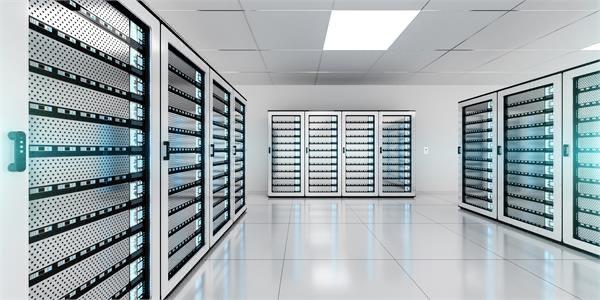
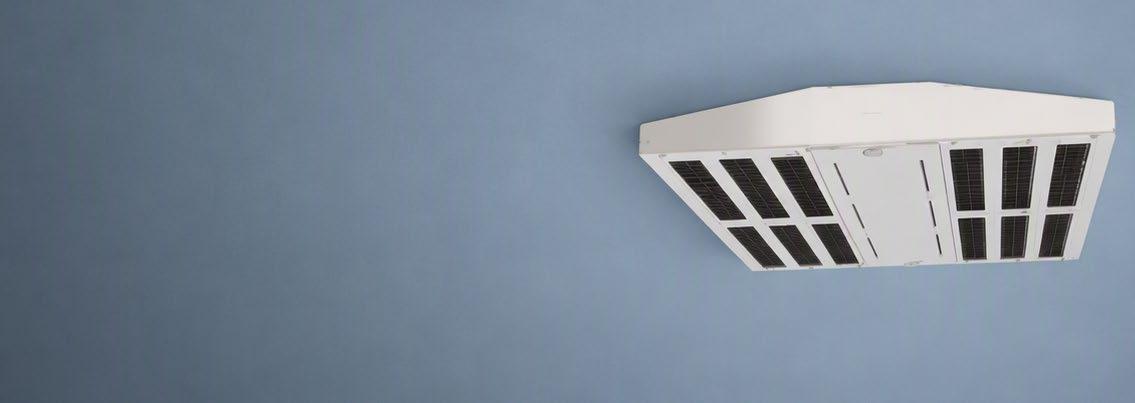
DPTS Digital Programmable Timer Switch is a simple, standalone switch designed for indoor environments with intermittent occupancy, such as data halls. Featuring flexible 7-day scheduling, a programmable countdown, and an integrated astronomical time clock, DPTS ensures reliable lighting operation while supporting energy savings in low-traffic spaces.

OPTI-BAY HIGH BAY LUMINAIRE
XtraLight’s Opti-Bay High Bay Luminaire is designed for spaces where visual comfort and performance are equally important. Featuring industry-leading low-glare optics (UGR as low as 9), lumen packages up to 50,000 lumens, rugged construction, and BAA-compliant reliability, it is ideal for manufacturing facilities, sports arenas, convention centers, and large-scale retail spaces.

MLX LINEAR LOW BAY
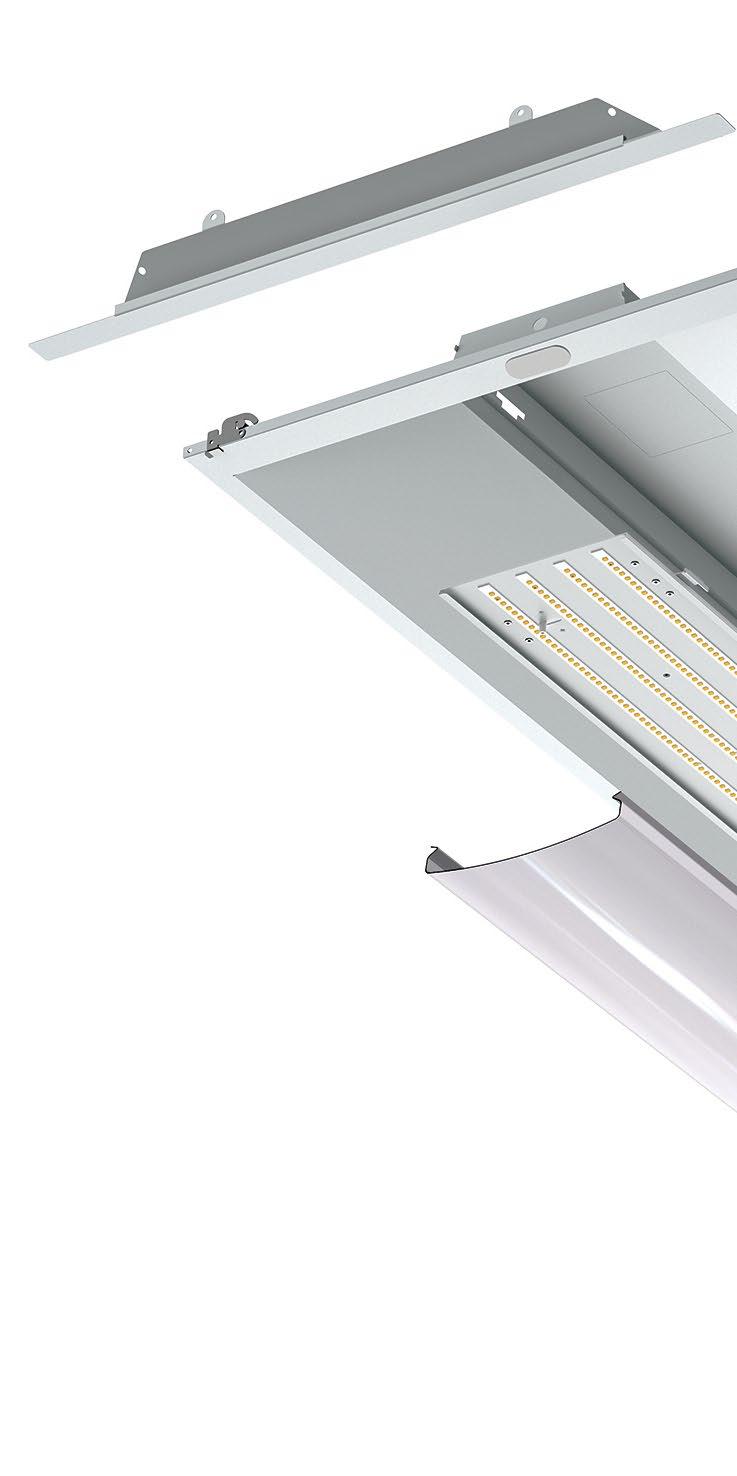
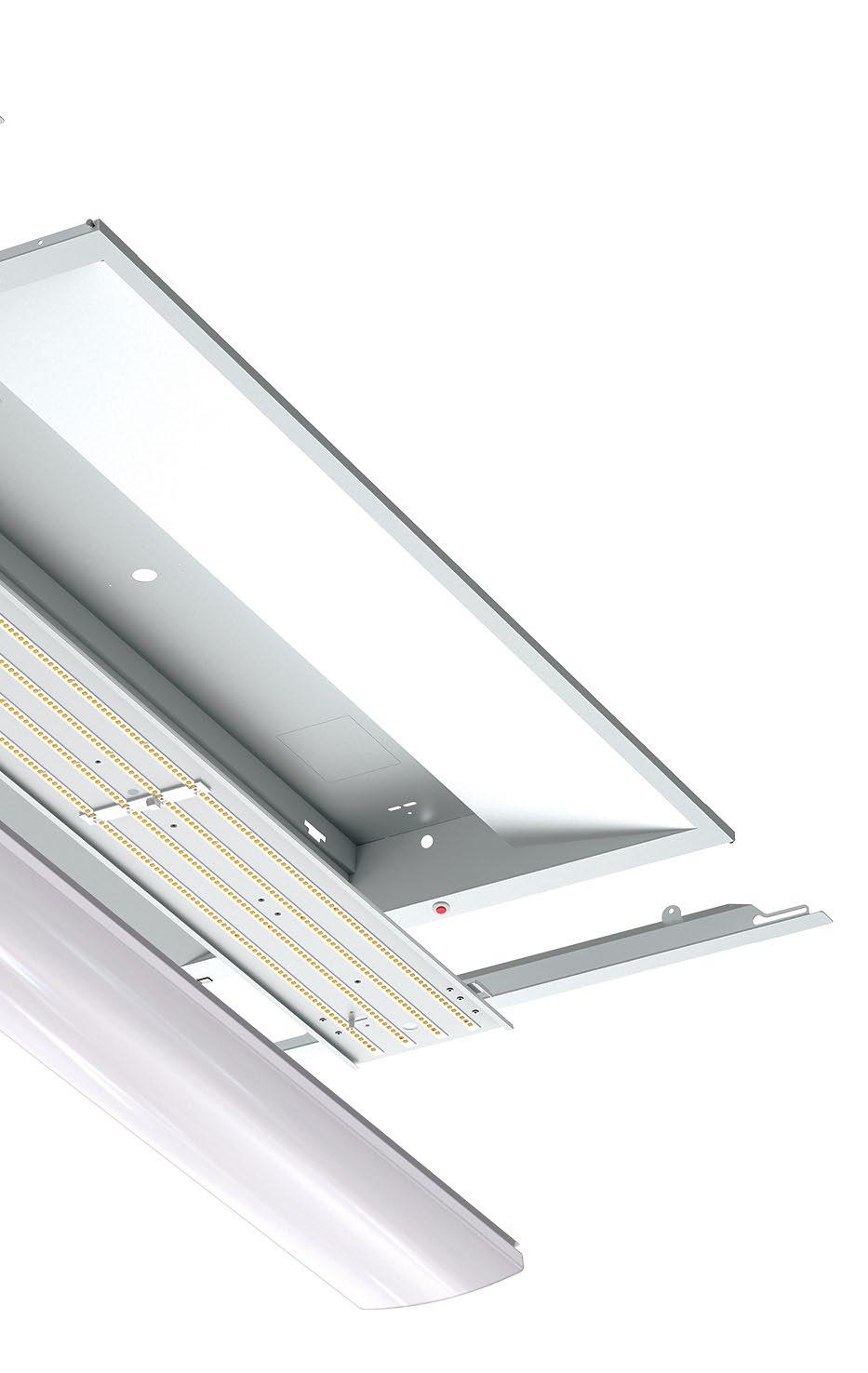
MLX is the Next-Generation Linear Low Bay from Lithonia Lighting®. Engineered for high performance and designed with bold flexibility, MLX redefines what lighting can do in commercial spaces both large and small. Whether illuminating aisles, open areas, or dynamic environments, MLX combines sleek aesthetics, powerful performance, and flexible configurations with high-efficiency optics to deliver lighting tailored to your needs.greater speed and confidence.
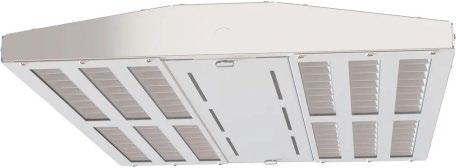
Shown with black optics
Shown with white optics
From NALMCO Connections to Complex Lighting Projects:
HOW DELTA WYE BUILT A NATIONAL BUSINESS
By Randy Reid
Sometimes the most valuable benefit of belonging to an industry association isn't the education or the networking event— it's the phone call that comes months later.
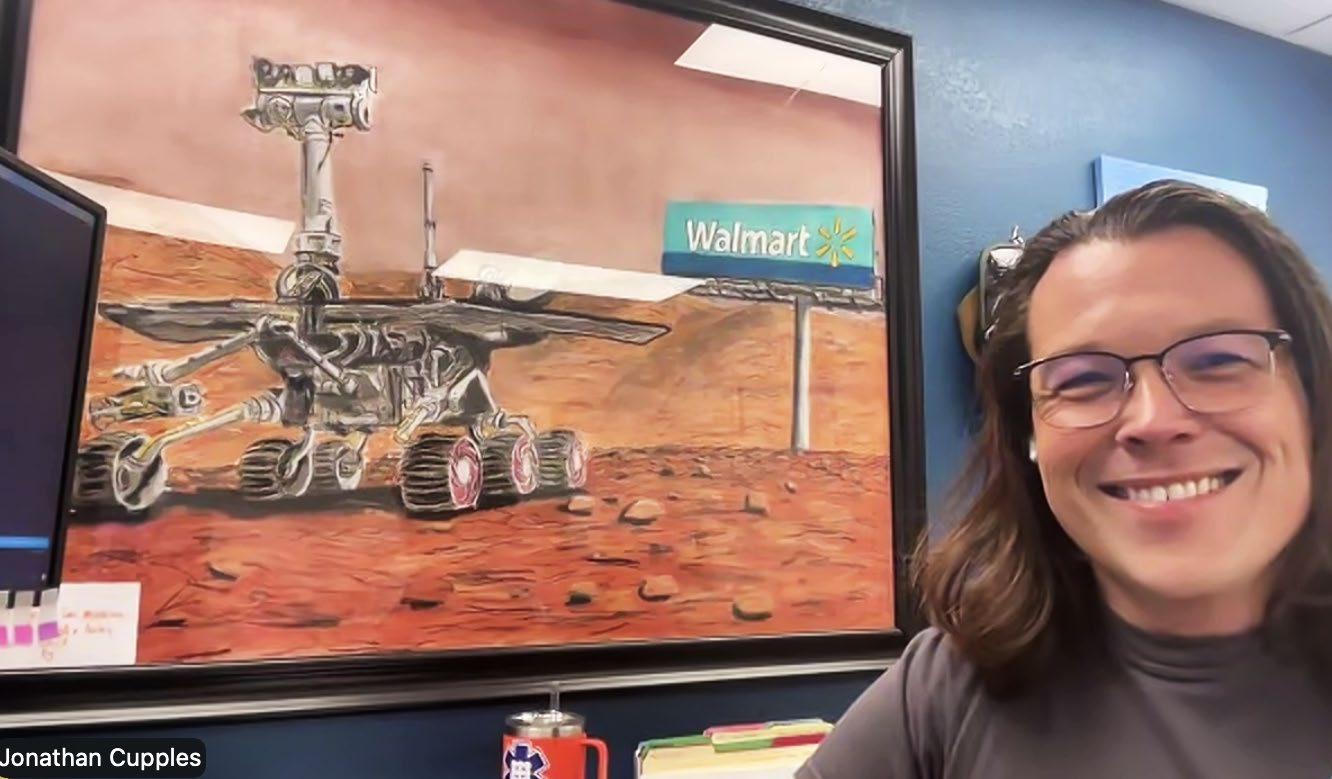
Just ask Jonathan Cupples, owner of Delta Wye Electric in Little Rock, Arkansas.
Jonathan estimates that a third to half of Delta Wye's business now comes through national accounts connected to NALMCO members. Those relationships have transformed what was once primarily a commercial electrical contractor into a company performing sophisticated lighting projects for some of the nation's largest facility maintenance organizations.
A DIFFERENT KIND OF GROWTH STORY
Jonathan's career didn't begin in lighting maintenance.
He started as an electrical apprentice in Arkansas in 2006 working in new construction. In January of 2011, he achieved his Arkansas Journeyman’s license. In the same year, he became an inside salesperson for a manufacture’s rep agency. He took a job the following year with an industrial electrical contractor on a short-term project. Once that contract was complete Jonathan found service and lighting was what he really enjoyed. He started working for a lighting management company working he way from technician to project lead to purchasing agent. In 2016 he passed his CLMC. The following year he passed his Master Electrical License. In September of 2017, he joined Cowling Electric, the company he would later acquire and rebrand in 2022 as Delta Wye Electric.
When Jonathan arrived, service represented only about 3% to 5% of the company's business. Most of its work came from commercial construction.
That would dramatically change in 2019.
NALMCO OPENED THE DOOR
The turning point came through relationships with national maintenance providers.
Facility Solutions Group (FSG), a long-time NALMCO member, asked Delta Wye to continue maintaining a chain of convenience stores after the properties changed ownership. Jonathan's team already knew the facilities, making them a logical local partner.
The previous owner had repeatedly rejected Jonathan's recommendations for LED retrofits, believing the technology was little more than a passing trend. Despite rebate opportunities and attractive return-on-investment calculations, the customer chose to continue replacing metal halide lamps and fluorescent systems rather than modernize.
Once ownership changed, the lighting strategy changed as well.
CLOSE TO 50% OF OUR WORK COMES FROM NATIONAL ACCOUNTS THROUGH NALMCO," Jonathan said.
"THAT'S WHAT MAKES NALMCO SUPER IMPORTANT TO US."
Jonathan officially joined NALMCO in 2022 after purchasing the company.
He already held his Certified Lighting Management Consultant (CLMC) credential years before that, but previous ownership saw little value in participating in trade associations.
"We were members of nothing," Jonathan recalled. "We had no Facebook page, we had no website."
“The only branding we had was our trucks and our t-shirts.”
For Jonathan, joining NALMCO wasn't simply about attending conferences.
It was about becoming part of a trusted network.
National account managers need reliable local contractors who understand lighting systems and respond professionally. NALMCO gives those contractors an opportunity to build relationships long before the first project arrives.
As Jonathan puts it, the connections have been priceless.
LEARNING THROUGH LIGHTING
The education and repartition as a leading lighting & controls contractor eventually led a local general contractor to select Delta Wye to complete the complex project. This project was one of their most challenging lighting projects to date: the new Findley Vinson Plaza in downtown Little Rock.
The public plaza serves as an extension of the nearby Robinson Center and ties into a citywide architectural lighting system that includes several bridges spanning the Arkansas River. The entire installation operates using DMX controls with synchronized RGBW lighting that changes for holidays, concerts, theatrical performances, and civic events.
For Jonathan and his team, it was their first major DMX installation.
"It was definitely a learning curve,"
he admitted.
The project includes RGBW tape lighting beneath benches, illuminated bollards, in-grade well lights, and dozens of RGBW recessed luminaires integrated into the plaza. The DMX system allows the plaza lighting to coordinate with nearby bridges and buildings, creating a unified visual experience throughout downtown Little Rock.
That project became the beginning of Delta Wye's relationship with FSG and ultimately opened the door to additional work through national account providers.
Today the company regularly performs projects for organizations such as FSG, Rogers Electric, and AGI—all companies Jonathan connected with through NALMCO.
SOLVING PROBLEMS IN THE FIELD
Installing decorative lighting was only part of the challenge.
The plaza sits above an existing parking structure constructed with post-tension concrete. Every penetration had to be carefully located to avoid damaging structural cables hidden inside the slab.
That meant X-raying concrete before drilling, redesigning mounting methods in the field, and fabricating custom steel plates to support poles and traffic-rated illuminated bollards where standard foundations simply wouldn't work.
The architectural drawings established the vision.
Jonathan's team helped determine how to make that vision constructible without compromising the structure below.
It's the type of field engineering that lighting contractors perform every day but rarely receive recognition for.
LOOKING AHEAD
Jonathan believes projects like Findley Vinson Plaza demonstrate how lighting contractors continue to expand their expertise.
Today's work extends far beyond replacing fixtures. Contractors are expected to understand controls, colorchanging systems, networked lighting, commissioning, and increasingly complex project coordination.
For Delta Wye, those opportunities continue to grow because of relationships built through NALMCO.
Near the end of our conversation, Jonathan mentioned one additional point of pride. Delta Wye is the nation's only LGBTQ-certified electrical contractor to complete the formal certification process. While that distinction reflects the company's values, Jonathan quickly returned the conversation to what matters most every day—delivering quality work for customers and strengthening the relationships that continue to generate new opportunities.
For lighting maintenance contractors, Jonathan's story offers a valuable reminder. Technical expertise wins projects. But professional relationships often create the opportunity to compete for them in the first place.
The lighting was provide by:
• B-K Lighting
• Insight Lighting
• Kelvix
• Lumca
• Pharos
LED 2.0: Why Repairability—and Lumens as a Subscription—Could Redefine Commercial Lighting
By Randy Reid
Fifteen years ago, the lighting industry embarked on one of the most successful technology transitions in its history.
LED lighting promised lower energy bills, longer life, and dramatically reduced maintenance. Utilities offered generous rebates, facility owners embraced the technology, and contractors replaced millions of fluorescent and HID fixtures across North America.
By almost every measure, LED 1.0 was a remarkable success.
Yet today, many of those same building owners are confronting an unexpected reality.
Their fixtures are failing, replacement parts are unavailable, and products that were installed only a few years ago have already become obsolete.
According to Paul Chamberlain, CEO of Linmore LED, that moment signals the beginning of a new
chapter for the industry.
"I define LED 1.0 as the period from roughly 2010 through the end of 2025," Paul said. "LED 2.0 begins now. We have an opportunity to redo lighting the right way."
His vision for LED 2.0 is about much more than brighter fixtures or incremental efficiency gains. It combines three ideas that have rarely been discussed together: maintainable lighting systems, circular manufacturing, and a new ownership model called Lumens as a Subscription (LaaS).
The Industry Didn't Mean to Create Disposable Lighting
Looking back, Paul believes the industry's biggest mistake wasn't technical.
It was philosophical.
"The industry had proven LEDs could create visible light that lasted
"LED 2.0 begins now. We have an opportunity to redo lighting the right way.
Lighting maintenance became lighting replacement," Paul said. "Facility owners can't buy the same fixture, can't buy the parts, and eventually they replace the entire lighting system simply because they want everything to look the same again."
a very long time such as traffic signals," Paul said. "What people hadn't experienced was LEDs being used to illuminate entire spaces."
Facility owners assumed the fixtures themselves would last for decades.
Manufacturers, meanwhile, raced to satisfy overwhelming demand.
"I don't think the industry intentionally created disposable lighting," Paul said. "Manufacturers built what customers were asking for. The market wanted LED, and everyone responded as quickly as they could. The intentions were good."
The result was thousands of unique fixture designs built around proprietary drivers, LED boards, optics, and electronics.
Unlike fluorescent systems, there were no standardized replacement components. Today, many facility managers are discovering what that means.
"Lighting maintenance became lighting replacement," Paul said. "Facility owners can't buy the same fixture, can't buy the parts, and eventually they replace the entire lighting system simply because they want everything to look the same again."
The first LED conversion usually paid for itself through rebates and energy savings. The second replacement cycle often becomes a capital expense with little financial return.
Ownership Is Becoming More Important Than Purchase Price
Paul believes the industry needs to stop thinking about fixtures as products and start thinking about them as long-term assets.
That change begins during specification.
"Part of every request for proposals should ask: Where are the parts? Are the parts in America? What are the SKUs for the drivers and LED boards?" Paul said. "If manufacturers can't answer those questions, buyers should probably find another manufacturer."
Those questions barely existed a decade ago. Paul believes they will become standard practice during the next one. He also envisions an industry-wide labeling system that quickly identifies maintainable products.
"We need symbols on specification sheets that immediately tell owners whether a product is maintainable and whether replacement parts are available."
In Paul's view, efficacy and color quality will remain important. But repairability will become a competitive differentiator.
Why Labor Changes Everything
The economics of lighting are changing. Not because electricity is becoming more expensive.
Because labor is.
Electrical labor rates have climbed dramatically, while qualified electricians have become increasingly difficult to find. Paul believes that reality changes the economics of maintenance.
"We're reaching the point where troubleshooting fixtures in the field simply becomes too expensive," he said.
Rather than dispatching electricians multiple times to diagnose failures, order parts, and complete repairs, he envisions replacing modular lighting assemblies during a single visit.
The failed module returns to the manufacturer, where technicians diagnose, repair, test, and certify it before placing it back into inventory.
The building experiences less downtime. Labor costs fall. Waste is reduced.
Sustainability Is No Longer Just About Energy
For years, sustainability meant lowering electrical consumption. Paul believes the conversation has matured.
"People used to think sustainability meant energy savings," he said. "Now we're realizing replacement means products going into landfills."
That realization is driving interest in circular manufacturing. Instead of replacing entire luminaires, manufacturers recover drivers, LED boards, and electronic assemblies, refurbish them, and return them to service.
The fixture stays in the ceiling. Only the technology evolves. It is a fundamentally different way of thinking about lighting.
Where Lumens as a Subscription Fits
Paul's vision becomes especially interesting when maintainability intersects with financing.
Several years before subscription-based business models became commonplace across industries, Linmore LED introduced Lumens as a Subscription (LaaS).
At first glance, LaaS appears to be another financing option.
Paul insists it is much more than that.
Instead of purchasing a lighting system as a capital expense, facility owners make a predictable monthly payment covering the fixtures, controls, maintenance, labor, and ongoing support throughout the agreement.
Perhaps more importantly, LaaS was intentionally designed to preserve the traditional lighting sales channel.
After our interview, Paul emphasized that point. "All channel partners are involved just as if it were a conventional capital project," he explained. "All normal margins and processes apply for everyone."
That distinction matters.
Previous lighting-as-a-service models often raised concerns among distributors and manufacturer representatives because they appeared to bypass the traditional sales process.
Paul says Linmore LED's model does exactly the opposite. Manufacturers still manufacture. Representatives still sell. Distributors still distribute. Electrical contractors still install. The only difference is how the customer pays.

People used to think sustainability meant energy savings," he said. "Now we're realizing replacement means products going into landfills."
Solving Projects That Otherwise Never Happen
Paul doesn't view LaaS as an alternative to traditional lighting projects. He views it as a way to make additional projects possible.
"LaaS is a vehicle to get projects done when they otherwise would not due to capital constraints," he said.
Many organizations know they need new lighting. They simply don't have room in this year's capital budget.
Others would rather focus their resources on their core business than maintaining lighting systems.
"Facilities often outsource copiers and forklifts," Paul said. "Lighting can work the same way."
With one monthly payment—often offset by reduced energy and maintenance costs—the customer receives new lighting, controls, ongoing maintenance, and predictable operating expenses.
As Paul summarized it: "They're out of the lighting business."
The Business Model Depends on Maintainability
What makes LaaS particularly compelling is that it reinforces everything Paul believes about LED 2.0.
If a manufacturer expects to maintain a lighting system for ten years, designing products that require complete replacement no longer makes economic sense.
Repairability becomes good business. Circularity becomes financially attractive. Manufacturers suddenly have an incentive to build products that can be serviced rather than discarded.
The ownership model and the product design begin supporting one another.

The Next Chapter
For much of the past fifteen years, the lighting industry has competed on efficacy, rebates, and first cost.
Paul believes the next generation will compete on something very different.
Can the product be repaired?
Will replacement parts still be available ten years from now?
Can components be remanufactured instead of discarded?
Does the manufacturer stand behind the lighting system for its entire life?
Those questions represent a significant shift in thinking.
The first generation of LED lighting changed how buildings consumed electricity. LED 2.0 may change how the industry defines ownership itself. And if Paul's vision proves correct, the future of commercial lighting won't be measured solely in watts saved.
It will also be measured by how long lighting systems remain in service—and how little ends up in a landfill.
NEW MEMBERS
GENERAL COMPANY MEMBER



Shepherd Electric Supply
JOIN DATE: 06/10/2026

Lyko Systems
JOIN DATE: 06/26/2026

Advance Lighting and Electric Inc
JOIN DATE: 07/18/2026
ASSOCIATE COMPANY MEMBER
Musco Sports Lighting
JOIN DATE: 05/11/2026

Archipelago Lighting, Inc.
JOIN DATE: 05/13/2026

EDUCATION PARTNER
TAP1 LLC
JOIN DATE: 07/01/2026
Sunshine Lighting
JOIN DATE: 06/24/2026
Gaylor Electric, Inc.
JOIN DATE: 07/07/2026
Mastermind Solutions LLC
JOIN DATE: 07/07/2026
ILLUMUS
JOIN DATE: 07/16/2026
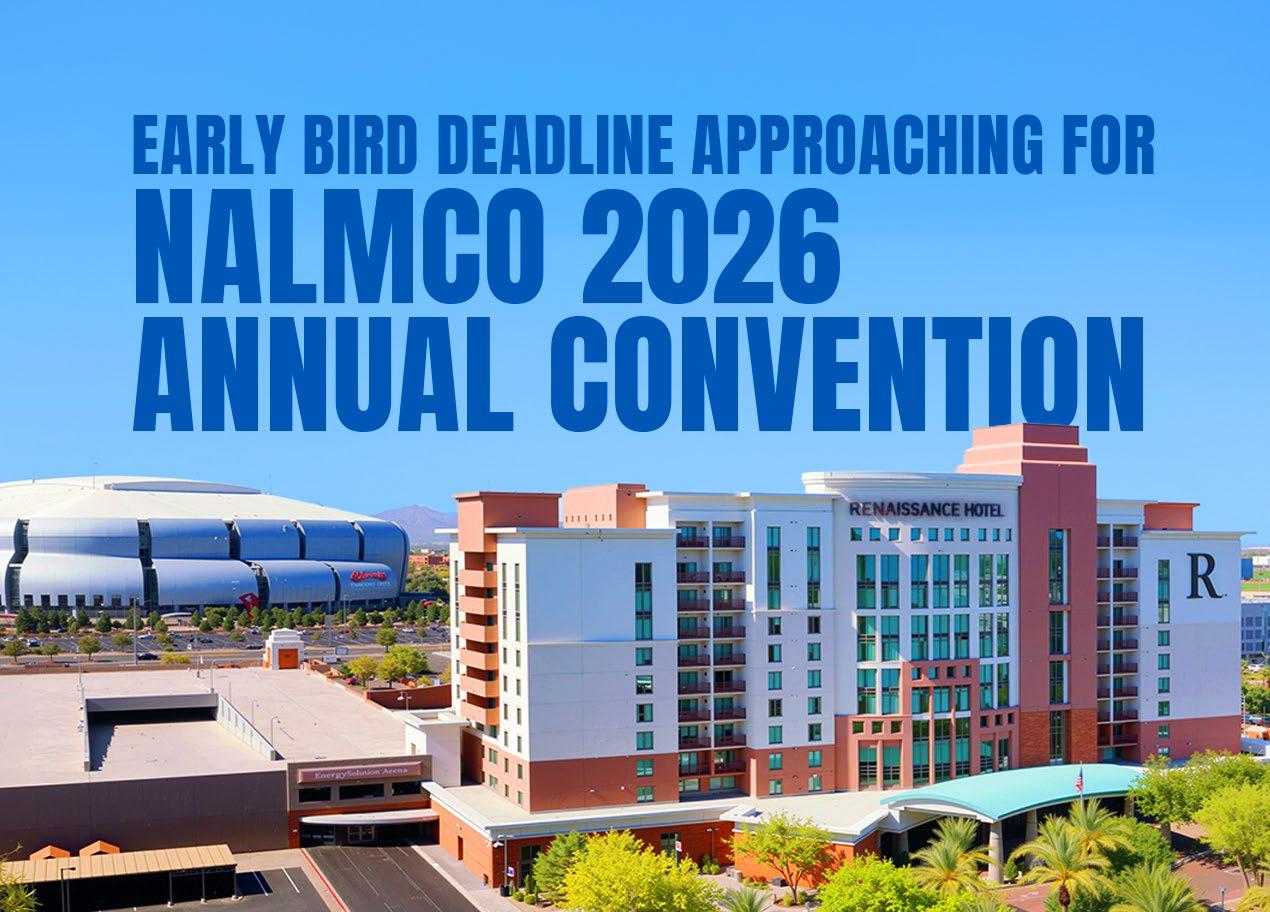
The countdown is on for the lighting maintenance industry's premier annual gathering. NALMCO's 2026 Annual Convention will bring lighting maintenance contractors, manufacturers, distributors, energy service companies, and facility professionals together in Glendale, Arizona, October 11–13.

Attendees who register by Thursday, September 10, can take advantage of Early Bird pricing before registration rates increase.
The convention will be headquartered at the Renaissance Phoenix Glendale Hotel & Conference Center, where participants will spend three days networking, meeting with suppliers, recognizing industry achievements, and discussing the latest developments in lighting maintenance and energy management.
New Sunday Golf Tournament
One of the biggest changes for 2026 is the annual golf tournament, which has been moved from its traditional Wednesday time slot to Sunday, October 11.
Golfers will tee off with an 8:30 a.m. shotgun start at Palm Valley Golf Club in Goodyear, Arizona. Registration includes breakfast, lunch, and transportation. The golf fee is $155 per player, with club rentals available for $85.
The day concludes with the convention's Welcome Reception giving attendees an opportunity to reconnect before the business sessions begin.


Networking Takes Center Stage
As in previous years, networking remains a primary focus of the convention.
Monday's agenda includes:
General Session
Networking Event with Associate Members
NALMCO Annual Meeting & Awards Luncheon
One-on-One Appointments with Exhibitors
Labor Partner Meet & Greet
Evening Reception
Tuesday continues with additional educational sessions, exhibitor appointments, and an off-site evening reception before exhibitors begin tear-down.
The structured one-on-one appointment format allows contractors and facility professionals to meet directly with manufacturers and suppliers, making the convention one of the industry's most productive business events.
Registration Categories
Early Bird registration is available through September 10.
Highlights include:
General Members: $600 Early Bird ($750 Regular)
First-Time Attendees: $500 Early Bird ($650 Regular)
Professional Members: $600 Early Bird ($750 Regular)
Non-Member General Attendees: $1,500 Early Bird ($1,750 Regular)
Associate Members (non-exhibiting): $2,500 Early Bird ($2,650 Regular)
Guest Registration: $400 Early Bird ($500 Regular)
Children under 12 attend free, while children ages 12–18 are $50 per day.
Hotel Information
NALMCO has secured a discounted room block at the:
Renaissance Phoenix Glendale Hotel & Conference Center
9495 W. Entertainment Blvd.
Glendale, Arizona
Rooms are available for $219 per night, subject to availability. Attendees are encouraged to reserve early, as the discounted room block may sell out before the reservation deadline.
Exhibits and Sponsorships
The convention will once again feature an exhibit hall showcasing products and services from leading lighting manufacturers, distributors, technology providers, and industry partners.
Companies interested in increasing their visibility can choose from a variety of sponsorship opportunities or reserve exhibit booths and tabletop displays.
Register Today
With discounted registration ending on Thursday, September 10, NALMCO encourages attendees to register and reserve hotel accommodations as soon as possible.
For contractors, facility managers, manufacturers, distributors, and energy professionals, the Annual Convention remains one of the best opportunities each year to strengthen relationships, discover new products, and discuss the trends shaping the future of lighting maintenance.
Wired vs. Wireless in Connected Lighting: Advantages, Limitations, and the Case for a Hybrid Approach
By Ameya Ainapure, System Architect, Cooper Lighting Solutions (Signify)

Recent advancements in connected lighting have been driven largely by wireless controls — and for good reasons. Wireless technology has made smart lighting flexible, easier to install, and more accessible than ever before. But as deployments grow more complex, wired lighting controls continue to play an important and often underappreciated role in connected lighting systems. The most effective deployments, in practice, can often leverage both. Drawing on a background in firmware and software development, this article looks at how these architectural choices play out at the system level — and what that means for reliability, scalability, and performance.
THE WIRELESS ADVANTAGE
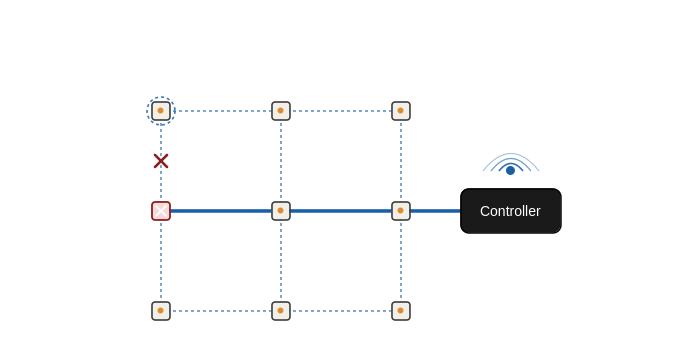
Mesh protocols such as Zigbee and BLE mesh also offer a distinct robustness advantage: the elimination of a single point of failure. Unlike many wired networks, where one failure can break communication across a segment, a mesh network allows communication paths to automatically heal around a failed device, provided there's sufficient redundancy. Consider a signal traveling from a controller across a few hops to reach a fixture at the far end of a mesh: if an intermediate device along that path goes offline, the message doesn't simply stop. The mesh recalculates and
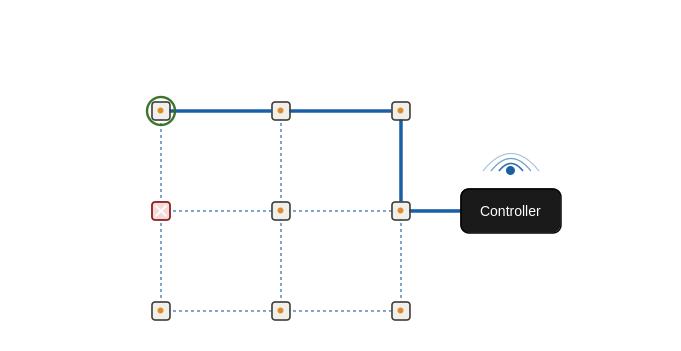
Wireless lighting control has matured rapidly over the past decade — moving from early mesh protocols like Zigbee, to Bluetooth Low Energy's native smartphone support, to Matter, which more recently tackled the device incompatibility and proprietary-hub problems that sometimes-held wireless back. Underlying all of this, wireless capability has become built directly into low-cost microcontrollers rather than requiring separate add-on radio modules, making wireless a native, affordable capability rather than an expensive extra.
The result is a set of real, practical advantages. Wireless eliminates the need to run wiring throughout a site, offering flexibility and, depending on the floor plan, potential cost savings — especially in retrofit projects, where running new wiring through finished walls and ceilings is often disruptive and expensive. Battery-powered wireless keypads and sensors go a step further, enabling control in locations where even running power isn't feasible.
The same mesh automatically finds an alternate path around the failed device.
Because these protocols also emphasize interoperability, a lighting network built on them can often expand to cover shades, occupancy sensors, or environmental monitoring — not just lighting — without a wholesale system change. Technologies like BLE also allow a mobile app to communicate directly with individual devices, which is useful both for distributed operation without a central controller and for fast, on-site diagnostics and provisioning.
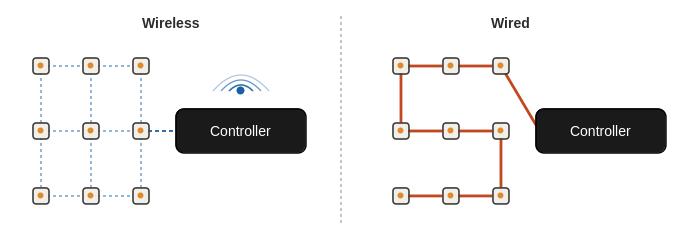
Wireless mesh grid (left) versus wired loop grid (right), each with its own controller.
WHERE WIRED STILL DELIVERS
Wired lighting control has its own long, proven track record. Simple analog 0-10V dimming remains widely supported for basic installations; DALI, the digital addressable interface used across much of the commercial lighting industry, adds individual addressing and status feedback; and Power over Ethernet more recently brought IP-native networking directly to the fixture over standard CAT cabling. Each is a different point on the same spectrum: deterministic communication that doesn't depend on radio conditions.
Those strengths become clearest in a sub-par RF environment. Most wireless lighting protocols share the 2.4GHz band with Wi-Fi, and as Wi-Fi device density in buildings increases, that shared spectrum can degrade wireless lighting performance. Physical factors — proximity to metal enclosures or cinderblock walls, for instance — can also shrink a wireless system's effective range well below its rated distance. Wired connections are simply immune to both problems.
Timing is another differentiator. Wireless networks are dynamic by nature, and a stable connection can degrade as conditions shift. For applications requiring a guaranteed response time, this matters; even with robust retry mechanisms built into wireless protocols, retries under degraded conditions can push actual latency past what's required. Wired connections offer deterministic, consistent latency that doesn't fluctuate with environmental conditions.
Installation economics matter too. A wired system's physical topology inherently defines its device groupings — lights wired together respond together, with no separate configuration step needed. Wireless devices generally have no such grouping out of the box and must be explicitly provisioned into zones after installation, adding time and cost at scale. Wireless installations can also suffer crossinterference when multiple areas of a site are provisioned simultaneously, with devices in one space affecting programming next door — a problem wired systems, isolated by their physical topology, simply don't have.
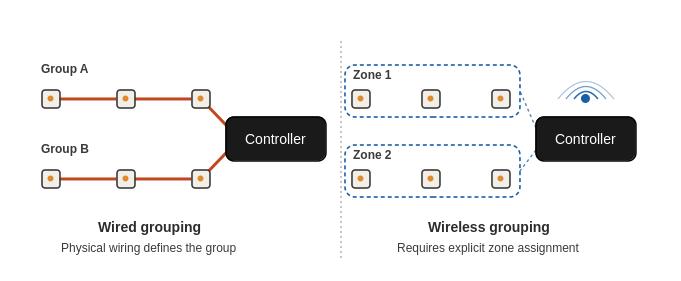
Wired topology inherently encodes device groupings; wireless devices must be provisioned into zones after installation.
Finally, as connected lighting takes on more advanced applications — audio/video processing, energy metering, embedded sensing — the data-rate ceiling of most wireless protocols becomes a limiting factor. IP-based wired approaches like PoE deliver substantially higher bandwidth while still meeting core lighting control needs.
Security follows a similar pattern. A wireless signal, broadcast openly over the air, is inherently easier to intercept or interfere with than a signal confined to a physical cable. Wireless protocols have made real progress on security over
the years, but unaddressed vulnerabilities still exist — and a protocol's theoretical security guarantees don't always hold up in the field. Sometimes that's because a manufacturer's implementation falls short of the specification; sometimes it's because end users don't follow recommended security practices during day-to-day operation. As connected lighting systems increasingly carry advanced application data, a security breach can expose more than just lighting control — it can also expose the sensitive data flowing through that same network.
THE CASE FOR A HYBRID APPROACH
Rather than treating wired and wireless as an either/or decision, a hybrid approach — combining both under a single, unified control system — can help eliminate this trade-off. In practice, this means a controller with wired and wireless interfaces — either built directly into the controller itself, or as separate peripheral hardware that communicates with it — bridging both mediums into a single system that the user can interact with, whether that's via a mobile app, a keypad, or a cloud dashboard.
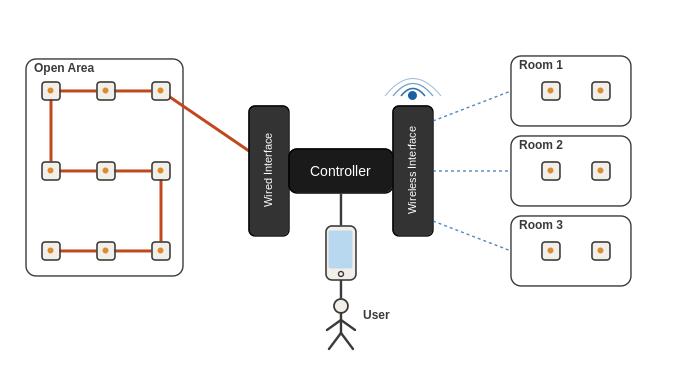
Here are two examples of where such a system is especially well suited. In a retrofit project, existing wired infrastructure can remain in place for core fixtures in open, easily-wired areas, while new wireless, battery-powered sensors fill in spaces where running additional wiring would be disruptive — combining the reliability of what's already there with room to expand.
In a retail environment, fixtures with embedded imageprocessing sensors might track foot traffic along aisles — a data- and bandwidth-intensive application well suited to a high-rate, IP-based wired network. Because that data can include sensitive customer behavior information, the physical containment of a wired connection also offers real security value. Meanwhile, back-of-house areas like stockrooms and offices, with simpler control needs, can rely on the convenience of wireless controllers and keypads, without the cost of extending high-bandwidth wiring where it isn't needed.
CONCLUSION
Advancements in wireless lighting controls have been a key enabler of smart, connected lighting. Wired networks still hold distinct advantages of their own, and both will continue to improve. But as connected lighting systems take on a bigger role in delivering value to a space, a hybrid approach — one that brings wired and wireless together under unified control — can spare project teams from having to choose one at the expense of the other.
A wired interface and a wireless interface, attached to a shared controller, each serving the environment they fit best.
NEW CERTIFICATIONS
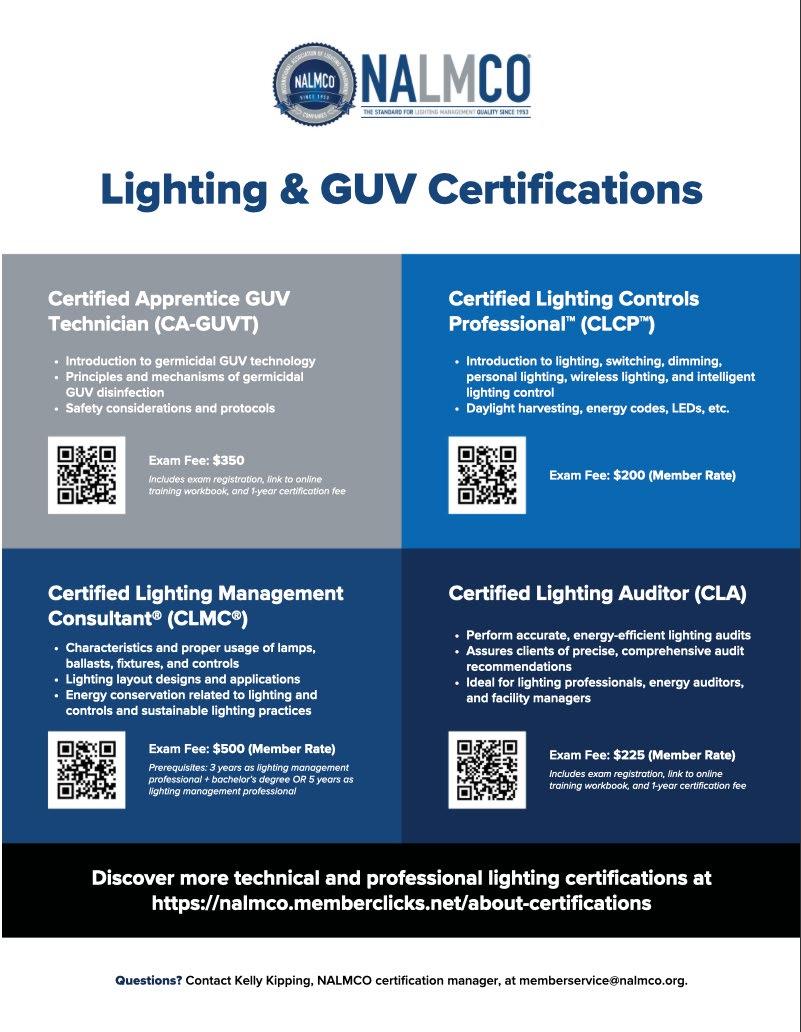
CERTIFIED APPRENTICE LIGHTING TECHNICIAN™
Yesco Mid Atlantic
Mike Tuccio, CALT
Energy Management
Collaborative
Joseph Mitchell, CALT
Marie Stousland, CALT
L&S Enterprises, LLC
Philip Fitzpatrick, CSLT
Colorado Lighting
John Hersam, CALT
Nate Raleigh, CALT
Greentech Energy
Otto Scharf, CSLT, CLA, CLCP
US LED
William Deck, CALT
DENERGY SOLUTIONS
Daniel Vargas, CALT
Clear Blue Energy Corp
Justin Giovanni Garcia, CALT
Evergreen Energy Partners
Aaron Schmidt, CALT

Earth Savers Energy Services, Inc
Isaac Cardona, CALT
Isaac Ramos, CALT AGI
Heather Herington, CALT
Green Tech Leaders
Keith Ford, CALT
NATURALED
Serina Martinez, CALT
CERTIFIED LIGHTING CONTROLS PROFESSIONAL™
Hercules LED
Bryan Joseph, CLCP
Smith + Andersen
Michael Chiddy, CLCP
SESCO Lighting Dallas
Brendan Kenna, CLCP
TechBruno Consulting
Bruno Silva, CLCP
CERTIFICATIONS

CERTIFIED SENIOR LIGHTING TECHNICIAN™
L&S Enterprises, LLC
Philip Fitzpatrick, CSLT
Greentech Energy
Otto Scharf, CSLT, CLA, CLCP
Joseph Cossman, CSLT
Vista Universal, Inc.
Kapuha Sablan, CSLT
Colorado Lighting
Brian Nipp, CSLT
Avail Services
Denise Dee Nichols, CSLT
CERTIFIED APPRENTICE GUV
TECHNICIAN (CA-GUVT)
University of Maryland |
School of Public Health
Melissa Jane Thomas, CA-GUVT
Sulakkhana De Saram, CA-GUVT
CERTIFIED LIGHTING MANAGEMENT CONSULTANT®
Greentech Energy Services
Andrew Sheck, CLMC, CLEP
Mantis Innovation
Mike Roy, CLMC
CERTIFIED LIGHTING AUDITOR (CLA)
Energyficient Lighting Systems
Josiah Lyman, CLA
Energyficient Systems, Inc.
Brett Downs, CLA
Hercules LED
James Bain, CLA
By Shirley Coyle, LC
For Jon Ortiz, lighting is far more than fixtures and circuits - it is a way to keep people safe, build a better world, and honor the family and faith that shaped him. Based in Tucson, Arizona, Jon brings decades of hands-on electrical and lighting experience to his work on complex projects, including federal and military facilities, where reliability, safety, and code compliance are non negotiable.

Up Close with Jon Jon Ortiz
Growing up in Southern California, Jon was surrounded by the electrical trade from an early age. His father worked in the electrical industry, and Jon absorbed the work ethic and practical skills that came with being around construction trades.
Eventually, family ties drew him to Tucson. Both of Jon’s parents had deep roots in the area and the pull of that “huge family” in Tucson brought Jon back to Arizona, where he would build both his career and his own large family.
Jon entered the electrical trade at 17, after earning his GED. In Tucson at that time, there wasn’t a traditional apprenticeship program, so he pieced together his education through college-based learning combined with on-the-job training. That meant juggling school, work, and family responsibilities—all at once.
From the outset, Jon pushed was determined: “I grew up really quickly, pushed myself to always try to be the top tier – the best electrician.” He started like many electricians do – digging trenches - in brutal Arizona heat. He recalls working in Phoenix during a record-breaking stretch of days over 120°F, hand-digging a 120-foot trench four feet deep and two feet wide. Those early experiences not only built technical skill but also gave him a deep appreciation for every stage of a project.
That full-system understanding “from panel to the farthest fixture,” whether for power, lighting, HVAC, or solar would later become a powerful asset on the managerial side, allowing Jon to estimate accurately and lead teams with a clear grasp of what field crews truly face.
When construction and the broader electrical industry were struggling, lighting began to stand out as a growth area. A friend called from a lighting company in Phoenix that needed a lead with strong troubleshooting skills. Jon made the strategic decision to step away from foremanlevel electrical work and into lighting.
That move proved pivotal. At his first lighting company, he learned to troubleshoot neon and legacy lighting systems—skills he jokingly calls “ancient,” now that LED dominates the industry. The foundation gave him something rare: a deep, practical understanding of legacy systems, modern controls and the transition to LED.
For Jon, lighting quickly became about immediate impact. Whether it’s a half-dark parking lot or a fixture that “hasn’t worked in 15 years,” he’s driven by the challenge of solving the
problem and seeing the results by the end of the night: “Lights back on, spaces made safer, and people able to move with confidence. It was an immediate gratification.”
Now a project manager with GreenTech Energy Services, Jon manages lighting retrofits and full building envelope energy savings: “we are the medium-sized ESCO of the future!” Jon handles systems that must meet stringent requirements, and that has made him a strong advocate for safety, interoperability, and education.
Continuing to invest in his own education, Jon has completed multiple lighting certifications through NALMCO and related programs. For him, these credentials are not about letters after a name, but about demonstrating a willingness to “go the extra mile” to understand what you’re working with in a rapidly evolving industry.
He also worries about a growing knowledge gap in the trade—journeyman-level electricians and technicians who lack core skills because they haven’t had strong mentorship or haven’t pushed themselves to study outside the job. His advice to those coming up: “get your electrical training card, pursue lighting certifications (take NALMCO and similar technical courses), and do the extra reading and self-study that sets you apart.”
When Jon reflects on his biggest challenge, he points to fear of failure and the risk of letting that fear hold him back. He has learned to see mistakes as teachers—believing you “learn so much more in the valley of errors and failures than in successes.” At the core of Jon’s outlook is a strong Christian faith and a deep sense of purpose. Equally central is his family. Jon’s wife, Cynthia, and their six boys and one daughter are his greatest motivation, along with their two grandchildren. Their home in Tucson has become a welcoming hub where children, friends, and extended family gather - a place he describes as peaceful, joyful, and exactly the life he hoped to build.
Weekends might mean swimming, lake trips, or finding a canyon with water to escape the heat, but more than anything, it’s about being together as a family. For Jon, that full house—the “whole tribe” showing up unannounced—is the truest measure of success.
In an industry defined by rapid technological change, Jon Ortiz stands out not only for his technical depth and certifications, but for the values that guide him: faith, family, safety, and a relentless desire to do things right—every time.
Jon Ortiz





Sheraton Phoenix Downtown • November 8-11, 2026
Join us for IES Street & Area Lighting Conference (SALC) 2026, the premier event that brings together decision-makers and their supporting teams to explore the latest developments, research, and trends in the street and area lighting industry and learn about the implementation of new technologies and solutions that will enable safer, greener, and more resilient lighting systems, in Phoenix, AZ, November 8-11, 2026