4 minute read
Basic forklift hand signals every operator should know

FORKLIFTS SIGNALS
Basic forklift hand signals every operator should know
Advertisement
Forklift signals let operators communicate with spotters while moving heavy loads. In loud, cramped environments, these signals ensure clear communication with anyone behind the wheel of a forklift.
Every year, 11 percent of forklifts will get into a workplace accident. As such, hand signals for forklift operators play a key role in workplace safety. Most companies use the seven standard OSHA forklift hand signals. These gestures all correlate to a forklift’s main components — in particular, they target a forklift’s tines, mast and brakes. Generally, operators only follow instructions from a spotter, but anyone on a work site may call an emergency stop. OSHA Forklift Hand Signals
OSHA forklift hand signals
RAISE THE TINES OSHA Forklift Hand Signals LOWER THE TINES MOVE TINES (L/R)
Spotters use this signal OSHA Forklift Hand Signals when operators need to angle the end of their mast lower to the floor. From this position, materials can easily slide forward onto the ground. When the mast tilts forward, crew members can also remove a load TILT MAST FORWARD by hand. TILT MAST BACKWARD
DOG EVERYTHING EMERGENCY STOP
RAISE THE TINES
TILT MAST FORWARD TILT MAST BACKWARD
DOG EVERYTHING EMERGENCY STOP
LOWER THE TINES MOVE TINES (L/R)
This signal tells operators to lift their forks, also known as tines. Forklifts raise their tines when lifting materials to a higher elevation. Once the tines are high enough, operators can safely transfer materials. And from this position, forklifts can set loads with greater precision.
Operators lower the tines when bringing their forks closer to the ground. From a lower elevation, their tines can pick up new materials. Spotters also use this signal when telling operators to place their loads.
RAISE THE TINES
TILT MAST FORWARD TILT MAST BACKWARD
DOG EVERYTHING EMERGENCY STOP
OSHA Forklift Hand Signals RAISE THE TINES LOWER THE TINES MOVE TINES (L/R) TILT MAST FORWARD TILT MAST BACKWARD DOG EVERYTHING EMERGENCY STOP
LOWER THE TINES MOVE TINES (L/R)
This signal angles the end of a mast higher off the ground. When an operator drives their forklift, a mast that’s tilted back has a OSHA Forklift Hand Signals more secure grip on the load. It also stabilizes weight distribution, preventing a forklift from tipping forward.
OSHA Forklift Hand Signals
RAISE THE TINES LOWER THE TINES MOVE TINES (L/R)
Dog everything is a signal telling the forklift operator to pause. RAISE THE TINES LOWER THE TINES MOVE TINES (L/R) Spotters use it when an unexpected safety hazard appears but hasn’t caused harm yet. If a person or object obstructs a forklift’s path, this signal halts movement until the operator can continue.
This is the last forklift signal relating to its tines. TILT MAST FORWARD TILT MAST BACKWARD It tells the operator to adjust their tines more to the left or right. This change in position allows the forklift to better distribute the weight from its load. Alternatively, it lets the operator adjust the material before placing it.
TILT MAST FORWARD TILT MAST BACKWARD LOWER THE TINES MOVE TINES (L/R) DOG EVERYTHING
Spotters call an emergency stop when facing imminent danger or after an accident occurs. This signal immediately ceases operations until the crew deals with their emergency. Unlike other forklift signals, operators must follow an emergency stop order from anyone on the work site.
Other common forklift signals
Most forklift hand signals meet most industry standards. But outside of this list, spotters use other forklift signals to communicate with operators. While not all teams recognize them, these signals allow for more precise communication. And depending on the project, they can help prevent hazards and accidents.
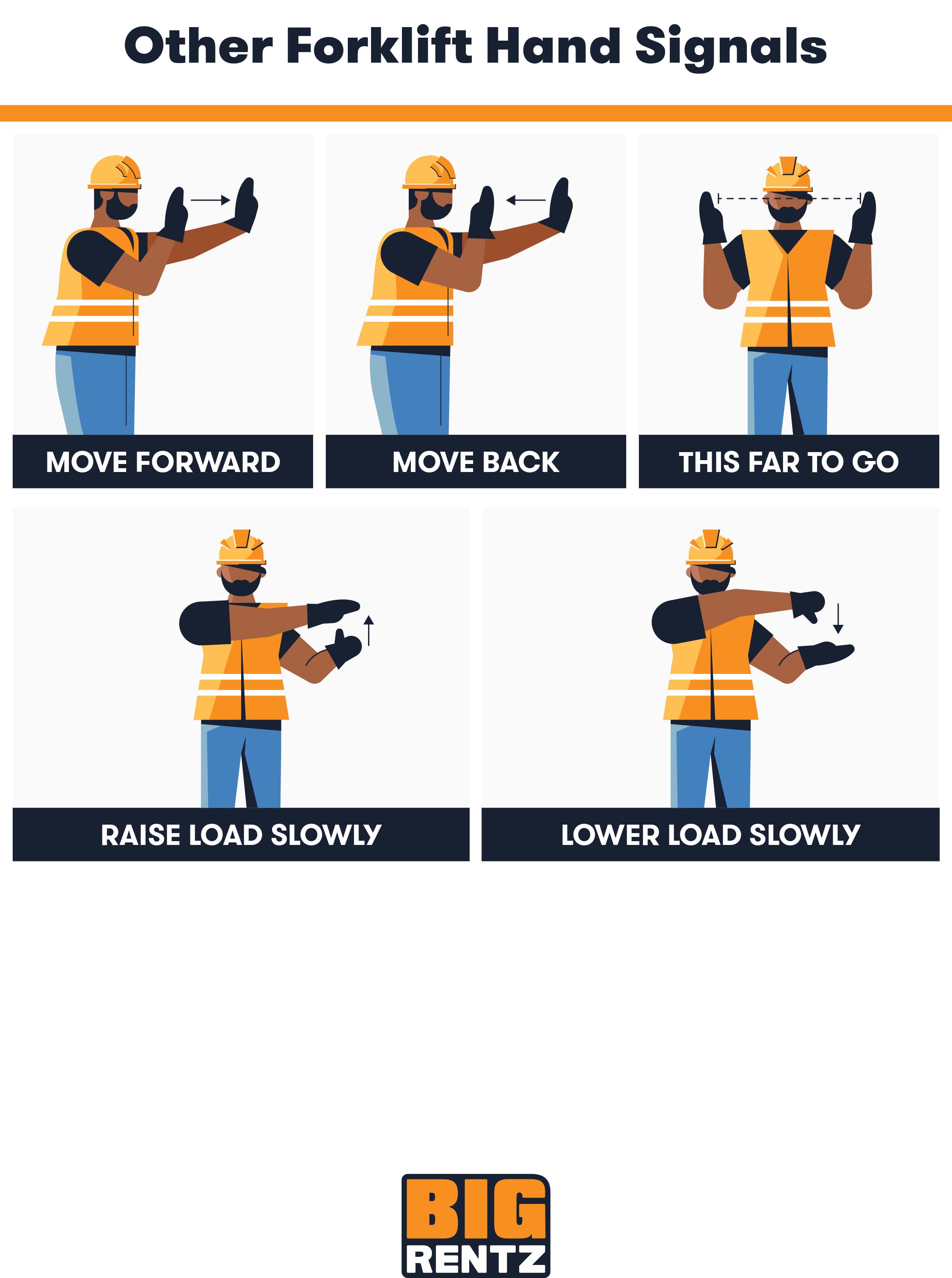
These signals tell the operator to continue moving forward or to back up. Operators follow this instruction to put their forklift in an ideal position to pick up or drop their load.
Spotters use this signal to show the remaining distance operators need to travel. The distance between their hands indicates how far the forklift needs to move. A spotter serves as an extra set of eyes for drivers, equipment operators and individual workers on the site. Similar to raising and lowering the tines, these signals tell operators to adjust their forks’ height. But unlike the standard OSHA signal, it encourages slower movement. Honk the Horn When approaching corners, intersections, blind spots, other devices or pedestrians, operators sound the horn to prevent a collision. Unlike hand signals from spotters, operators sound the horn for others’ safety. Anyone working near a forklift should steer clear when they hear its horn. These forklift signals all communicate a straightforward action. But without learning each signal’s corresponding motion, spotters and operators put their coworkers in danger. Graphs and tables like the one below can help with memorization — they summarize each hand signal in an easy-to-follow movement. Forklift accidents represent some of the worst hazards employees face on a job site. But thanks to OSHA’s forklift hand signals, spotters can ensure an entire crew’s safety. These signals won’t only protect companies from thousands of dollars in damages — they can also preserve the health and safety of everyone lifting materials.