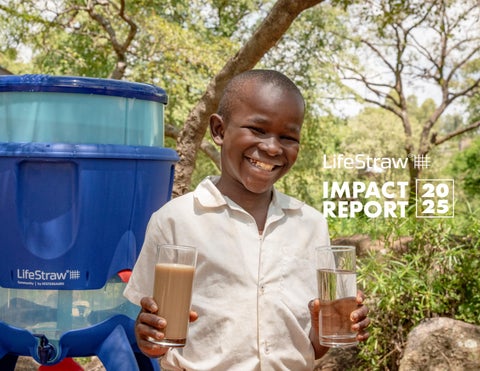
IMPACT 20 REPORT 25
There is a line I come back to often: safe water is a human right. It is simple. It is also an enormous promise. Every year, this report gives us an opportunity to ask ourselves whether we are living up to it. Not just in the number of filters we distribute or people we reach, but in the choices we make as a company, the communities we stand beside, the products we build, the way we treat our planet and our people, and whether we are willing to be as transparent about where we fall short as we are about where we succeed. In 2025, there was a great deal to be proud of.
A NOTE FROM ALISON “Safe water should not depend on where you were born, how much money you have, whether your community has been hit by a disaster, or whether the systems around you have failed. It is one of the most basic requirements for human health and dignity.”
Across our programs and partnerships, we reached more than 1.8 million people with safe drinking water in 27 countries. Through our Give Back Program, we added another 101,230 children in 270 schools in 2025, bringing the total number of children reached since the program began in 2014 to more than 14.2 million. But the annual number tells only part of the story. When we enter a school through LifeStraw’s Give Back program, we make a five-year commitment to provide safe water, training, maintenance and spare parts. That means the 101,230 children added this year represent more than half a million child-years of safe water access. Fourteen million children is an extraordinary milestone. But the number that matters most to us will always be the next one. Because LifeStraw Give Back has never been about dropping off a filter and leaving. It is about showing up, staying, building local capacity, and creating something that lasts. In 2025, we also expanded SafiCycle, our period equity movement, to 3,000 more girls in Western Kenya, bringing the program to 4,756 girls.
Here again, the number alone misses the real impact. Each of those 3,000 girls received menstrual health education and reusable period underwear designed to support her for at least four years. That is four years of dignity. Four years of not having to search for or afford period products. Four years in which having her period should never be the reason she misses school. Something as ordinary as a period should never be powerful enough to interrupt a girl’s education, confidence, or future. SafiCycle is about removing that barrier and giving girls the tools, knowledge, and confidence to keep moving forward. Our commitment to women and girls also continued through our longstanding support of the Emusanda Health Center and maternity ward in Western Kenya. In 2025, the clinic recorded nearly 7,000 patient appointments, while the maternity program continued supporting more than 30 safe deliveries each month. Since the maternity ward opened in 2018, it has supported more than 1,850 safe deliveries. This work is separate from SafiCycle, but rooted in the same fundamental belief: women and girls should have access to the basic resources, healthcare, and dignity that allow them to determine the course of their own lives. We also continued one of the longest and most important commitments in our history. LifeStraw donated 1,163,710 Guinea worm filters to The Carter Center in 2025, supporting the extraordinary global effort to eradicate a disease that once affected millions of people every year.When you’re counting cases on one hand instead of in the millions, eradication stops feeling impossible and starts feeling inevitable. This is where LifeStraw began. It is part of our origin story, and we intend to be there until the very end. And when crisis struck, we showed up. From the devastating wildfires in Los Angeles to Hurricane Melissa in Jamaica and Cuba, from ongoing humanitarian crises around the world to communities here in the United States struggling with something as basic as reliable access to
safe water, our teams and partners moved quickly. In a disaster, safe water cannot wait for the recovery. It is what makes recovery possible. One of the things I am increasingly convinced of is that showing up matters. Sometimes that means moving product halfway around the world in the first days after a disaster. Sometimes it means spending years maintaining water filters in schools in Western Kenya. Sometimes it means listening to local communities here in the United States about what they need. Sometimes it means our own employees planting trees, preparing meals, cleaning community spaces, reading to children or simply giving their time in the places they call home. Impact does not always happen at scale. Sometimes it happens one community, one school, one family or one person at a time. We also continued to push ourselves as a business. In 2025, LifeStraw completed our B Corp recertification with a score of 108.3, improving our score by 12 points. We measured and offset our greenhouse gas emissions and continued working to reduce emissions across our operations and supply chain. Our engineers found ways to dramatically reduce the water used in our own testing processes. We strengthened how we evaluate suppliers, kept new product packaging plastic-free, and continued working toward solutions for PFAS technologies and filter recycling. And this is where I think an impact report has to be more than a celebration. We did not accomplish everything we set out to do. Some of our goals proved harder than we expected. Some are taking longer. In some areas, we have learned that measuring progress well has to come before claiming progress at all. We are still working toward scalable
solutions for filter recycling, and PFAS continues to be a tremendous challenge. And we continue to learn that taking a successful community program and expanding it responsibly is far more complicated than simply replicating a model somewhere else.
I have spent nearly two decades building LifeStraw, and the longer I do this work, the more convinced I become that our greatest impact does not come from LifeStraw alone. It comes from what happens when people decide that a problem this big is still worth solving.
I am okay saying that. Because accountability is not about being perfect. It is about being willing to set the bar publicly, measure ourselves against it, learn when we miss it, and then come back the next year determined to do better.
It comes from our teams around the world. From our customers who choose to support a company with purpose built into its business model. From our retail and humanitarian partners. From teachers, health workers, first responders, and community leaders. And most importantly, from the people in the communities themselves who carry this work forward long after we leave.
That is exactly what we have been working do in 2026.
There is still an extraordinary amount of work ahead of us.
We are setting our sights higher. We will continue supporting the final push toward Guinea worm eradication with The Carter Center. We are working to reach at least 300,000 people through the Safe Water Fund, expand SafiCycle and menstrual health access, deepen our work on water equity here in the United States, strengthen Give Back globally, and continue building a workplace where our values show up in how we lead, how we work and how we treat one another.
That does not discourage me.
We are also pushing harder on the environmental footprint of the business itself, reducing emissions, addressing PFAS, reducing plastic waste, and continuing to challenge ourselves on the materials, products and supply chains behind the impact we create.
And until access to it is truly equitable, our work is not finished.
It makes me more determined. Safe water should not depend on where you were born, how much money you have, whether your community has been hit by a disaster, or whether the systems around you have failed. It is one of the most basic requirements for human health and dignity.
Thank you to everyone who continues to believe in this mission, challenge us to be better, and stand alongside us in doing the work.
Because we cannot separate the two. The communities with the least reliable access to safe water are often the same communities carrying the greatest burden of climate change, poverty, conflict, and inequity. Our responsibility is not simply to make a product that helps solve one piece of that problem. It is to build a company willing to take responsibility for the role we can play in changing it.
With gratitude,
Alison Hill
2025 BY THE NUMBERS
WHO WE ARE At LifeStraw, we believe that the strength of our mission begins with the strength of our people and the communities we engage with along the way. Building a brand that stands for equity and access means holding ourselves to that same standard internally, in how we tell our story, who we bring through our doors, and how we show up for our team every day. In 2025, we made intentional investments across our marketing, our internship programming, and our workplace culture to ensure that our values are not just reflected in the work we do in the field, but in every layer of how we operate as a company.
OUR TEAM
Gender
Our Marketing At LifeStraw, we prioritize diversity in both our creative direction and our collaborations with content creators. Throughout 2025, we partnered with agencies to ensure our photo and video productions featured talent from a broad range of backgrounds. In selecting influencers, we intentionally aimed to include individuals from historically underrepresented communities. We’ve also engaged with external experts to explore effective methods for monitoring and reporting on diversity within our content. At present, we have not identified a standardized approach to measuring diversity in marketing materials. Looking ahead to 2026, we plan to invite our models, creators, and partners to voluntarily complete a self-identification survey. This will help us more accurately assess our performance against our diversity objectives, and we remain committed to transparently sharing our progress.
Our Interns In 2025, LifeStraw was proud to participate in the Chill.org Alumni Summer Internship Program, hosting two talented interns in our Baltimore office as part of Chill’s evolving alumni initiative. The Chill Foundation’s mission is to inspire youth through board sports and build a more equitable outdoor community where young people can belong, grow confidence, and overcome challenges through experiential learning and core values like courage, respect, and pride - all at no cost to participants. Chill’s launch of the Alumni Internship program reflects its commitment to supporting youth beyond initial programming into meaningful career experiences and community engagement. Our participation aligned closely with LifeStraw’s values of
Ethnicity
Female
Male
empowering young leaders, fostering connection to place, and deepening ties with the outdoor industry and Baltimore community. By hosting Chill interns, we had the opportunity to support their professional growth, share insights into social impact work, and strengthen our commitment to inclusive pathways between outdoor equity and community-centered careers.
Our life LifeStraw places our people at the heart of our mission to ensure safe water access for all communities and break down barriers to equity. In 2025, LifeStraw reinforced our values by expanding training offerings for our staff, refreshing our code of conduct, and rewriting our employee handbook to place increased emphasis on our values. LifeStraw’s People team met regularly throughout the year, collaborating with consultants to establish actionable goals and a detailed roadmap for 2026. The committee also enhanced internal communication by launching weekly human resources newsletter. This newsletter celebrates milestones achieved by staff members, while sharing resources to keep employees apprised of new training and opportunities throughout the company. LifeStraw strengthened our commitment to our people by embedding our principles into performance reviews and introducing new training programs for employees. These initiatives reflect LifeStraw’s proactive approach to creating a workplace culture where every team member feels valued and empowered to contribute to our mission.
Black/ African American
Location
VOLUNTEERING At LifeStraw, we think Globally and Act Locally, supporting the communities in which we live. We volunteer both as individuals and as teams, and 2025 was a year full of volunteer events for each of our offices. In 2025 we participated in a variety of events, from tree planting in Vietnam, to waste segregation in India, distribution of mosquito nets for IDPs in Kenya, and community trail maintenance in Baltimore.
Vietnam In 2025, the Vietnam team took meaningful action to support the environment and community. Early in the year, the team becoming collaborators for an event “Trash for Trees”, an event organized by Green Life to raise awareness about environmental protection. Participants brought recyclable waste to exchange it for a small plant. At the event, team helped sort the collected waste and distribute plants to participants. They had the chance to meet many young people who are passionate about protecting the environment, as well as kids accompanied by their parents. In May, the team visited a primary school for ethnic minority children in Lang Son province. This school is located in a remote mountain area, accessed only by narrow and winding roads.The visit brought a meaningful gift from the LifeStraw team: a cozy library of more than 700 storybooks, fully equipped with bookshelves, tables, and chairs for the pupils. In addition, they gave small gift sets to every pupil at the school. One of the most memorable moments was hand-washing session - a “small lesson” that truly stirred up the energy. It brought laughter, curiosity, and excitement to the pupils.
Later in the year, the team organized the “21 Days Eco Journey” challenge with three activities: “Reduce Nylon Bag,” “Green on the Go,” and “Waste to Worth.” They committed to reducing or eliminating the use of nylon bags by switching to reusable fabric bags and personal containers; traveling to work by eco-friendly means such as bicycles, buses, electric vehicles, or simply walking; and collecting used cooking oil for proper recycling. Overall, they saved 510 nylon bags, achieved 3,025 km of green commuting, and collecting 29 liters of used cooking oil to prevent water pollution and recycle into biofuel or soap. Along the way, our team shared countless creative “green market tips” - from personal food containers and reusable fabric bags to banana leaves as eco-friendly packaging.
Kenya The Kenya Team started the year in volunteering at Tulukuyi Primary School, Kimaeti Sub-county, for an Antijigger Campaign and a tree planting exercise. With love and purpose, they trimmed nails, cleaned feet, treated jiggers, and supported learners with deworming medication, all in partnership with Mwema Water and Hygiene Initiative and the Community Health Promoters. Beyond restoring health, they planted hope - both in the soil and in young hearts. In April, the Nairobi office visited Huitfambo Library, located in one of the biggest low resource areas in Nairobi. This small library is managed by youth volunteers who depend on well-wishers to give a chance to these little kids to access books and other education materials. The tiny room is only 15’ by 10’ but full of hope and love. The team donated some books as well as a CPU, monitors, and keyboards.
In September, the Nairobi team spent time at a school that hosts 75 children with different special needs (autism, cerebral palsy, physical disabilities, down syndrome). They delivered supplies, helped serve them porridge, and then spent the day helping them paint on canvas. They sang and danced as we shared love and warm hugs. Each child carried home their painting with huge smiles.
United States In 2025, the US team engaged in a variety of volunteer activities to support local communities and promote environmental stewardship. Starting in January, we worked with Moveable Feast, providing medically tailored meals to Marylanders facing chronic illness and food insecurity. During our time in their kitchen, we provided 2,880 staged meals and 190 prepped meals for delivery. In February, the team volunteered with Living Classrooms, an organization that works to create access to equitable education, workforce development, health and wellness, and community safety opportunities. We supported a facility that serves over one hundred students daily with academic enrichment, health, sports and physical fitness education, and career development by painting their music studio, cleaning the computer lab, and helping to reorganize their sports storage area. In March, we joined forces with the United Way to celebrate Read Across America Day, reading books to local students to highlight the importance of early literacy and language skills. This day highlights an effort to ensure that all children are proficient readers by the start of fourth grade. In April, we supported Blue Water Baltimore in their efforts to keep our water safe and accessible to everyone in the region. They are on a mission to restore the quality of Baltimore’s rivers, streams and Harbor to foster a healthy environment, a strong economy and thriving communities. Our team of volunteers supported street tree planting in the Morrell Park community of Baltimore City. The team resumed volunteering in September, again in
partnership with the United Way and our professional football team, the Baltimore Ravens. As a part of their annual Caw to Action, LifeStraw staff organized a school food pantry and participated in a field day, playing games and supporting outdoor recreation with elementary school children. Together, we were a part of an effort that delivered 11 million minutes of service globally across 85 projects in the US, UK, Nigeria, and Canada. In October, we supported the Southeast Community Development Corporation which promotes healthy, dynamic, and diverse communities throughout Southeast Baltimore with education, family support, homebuyer education, and neighborhood revitalization programs. Their Conkling Street Garden is a free community gathering space in the Highlandtown neighborhood where neighbors come together to garden, celebrate, and share meals. The team helped their staff by preparing their garden beds for winter and clearing away plant growth that obstructed the murals in the garden.
Giving Tuesday For Giving Tuesday this year, the LifeStraw offices in Baltimore, Kenya, and Vietnam joined together to support women and children in their communities. In Baltimore, we partnered with House of Ruth, a shelter for those seeking refuge from domestic violence, by donating Home Dispensers for each unit in their facilities and administrative buildings. We also supported a family of six through their Adopt-AFamily holiday drive. In Kenya, our team supported “Usikimye” translated as “Do not keep quiet”, a shelter women who need protection from Gender Based Violence. They donated four Family 2.0 units. The LifeStraw Vietnam team visited Thanh Tam orphanage, which currently cares for 30 children with disabilities and abandoned children. There, the team brought the kids a truly different day: a morning full of laughter with fun games, a hand-washing lesson accompanied by soap bars
handmade from recycled oil (collected through “21 Days Eco Journey” earlier in the year), a small but warm gift for the coming winter (each child received a set of knitted scarf and hat), and a cozy, delicious lunch that was much more special than their usual meals. The children’s study corner was also refreshed and brightened with reused desks and a new bookshelf full of interesting storybooks. The team contributed 15 fruit trees and a vegetable garden to help the orphanage increase its income since their operations rely mainly on farming, with no other sources of livelihood. The children here are incredibly sweet and well-behaved; the older ones are very responsible, helping with housework and taking care of the younger kids. Everyone lives together like a family.
CERTIFICATIONS At LifeStraw, we are committed to continually improving our sustainability practices. We approach this journey with a mindset of learning, listening, and evolving - understanding our critical role in the global push toward a net-zero future. While our products and humanitarian initiatives aim to address the impacts of climate change, we also recognize that our operations contribute to these challenges. We believe that businesses have the power to drive meaningful change and that we have both the opportunity and the responsibility to be part of the solution. Guided by our principles of accountability and transparency, we remain focused on reducing our environmental footprint and making a lasting, positive impact.
The Climate Label At LifeStraw, we are deeply committed to reducing our environmental footprint, partnering with The Change Climate Project —a trusted third-party certifying body since 2019. Through the newly updated “Climate Label” certification by The Change Climate Project, we continue to meet stringent standards that demonstrate our accountability and transparency in climate action. Each year, we measure direct and indirect emissions across our entire value chain and offset these emissions by purchasing verified carbon credits and through efforts targeted at reducing our own emissions. We also refined our robust internal emissions tracking system, leveraging the greenhouse gas protocol and expert guidance. This system allows us to monitor emissions
quarterly and make informed decisions to address our emissions hotspots in real time. Through these initiatives, LifeStraw reinforces our role as a climate leader and our commitment to building a more sustainable, resilient future.
B Corp Since our inception, we’ve been in business to do good. In 2019, we became a certified B Corp, joining a global community of thousands of businesses that meet the highest standards of accountability and transparency. This thirdparty certification allows us to further our commitment to social and environmental responsibility. As a B Corp, we strive to balance profit with purpose, aiming to make a positive impact on people and the planet. In 2025, we completed our first recertification with a score of 108.3, marking a 12-point increase from our previous assessment.
Science-Based Targets Initiative LifeStraw is dedicated to reducing our carbon footprint by adhering to rigorous scientific standards through the Science-Based Targets Initiative. This initiative offers a clear framework for setting and achieving greenhouse gas emission reduction targets. Its Net-Zero Standard, the first science-based certification for corporate net-zero goals, aligns with the Paris Agreement’s objective to limit global warming to 1.5°C. Through this commitment, LifeStraw reinforces our role in the global effort to combat climate change with accountability and measurable impact.
2025 WORLD IMPACT MAP
1,839,448
people reached with safe drinking water across 27 countries
Top 10 countries reached in 2025 South Sudan — 570,000 Chad — 429,210 Kenya — 221,043 Myanmar — 214,540 Angola — 110,000 India — 40,550 Ethiopia — 39,804 Ghana — 34,317 Haiti — 34,049 Venezuela — 30,720
Give Back Guinea Worm Humanitarian Institutional
“This is where LifeStraw began.”
1,163,710 Guinea worm filters donated
GUINEA WORM ERADICATION
Why we do it? Guinea worm is one of the most painful diseases on earth, and it spreads entirely through unsafe water. A person drinks water from a stagnant source carrying Guinea worm larvae. Inside the body, the larvae mate and a female worm grows, sometimes up to three feet long, over about a year. Then it emerges slowly through the skin, causing fever, swelling, and intense pain. People who are infected often can’t work, farm, care for themselves, or go to school. One case ripples across a whole community. This is where LifeStraw began. Before we made a single consumer product, we partnered with The Carter Center in 1994 to design a simple mesh filter that removes Guinea worm larvae from drinking water.
The progress 1986 — 3.5 million cases across 21 countries. The Carter Center launches its eradication program, working with ministries of health on education and community interventions.
1994 — 100,000 cases across 18 countries. LifeStraw partners with The Carter Center to design the mesh pipe filter.
2024 — 14 cases across 2 countries. Guinea worm is expected to be eradicated by 2027, with WHO certification anticipated in 2030. When it happens, it will be the first disease ever removed from the planet without a vaccine. We intend to support The Carter Center all the way through.
2025 RESULTS 1,163,710 Guinea worm filters donated to The Carter Center
Hero Story: Violet Munjiri Violet Munjiri - Vio to the people who work alongside her - doesn’t talk about safe water as an abstract concept. For her, it’s personal. “I have lived through lack of safe water in different scenarios,” she says, whether in her rural home or in the city. That lived experience is what powers her work today as “the head of the Global Give Back at LifeStraw,” where she provides oversight of “our global safe water access programs… and all the community health-driven initiatives.” To Vio, Give Back isn’t charity, it’s a platform for transformation. It’s about “reach[ing] underserved communities,” and “giving our children a choice to a better life, a chance to an education that could probably transform their lives.” She explains that the program began by closing a critical gap. LifeStraw had helped bring safe water into homes in Western Kenya, but children spend most of their day elsewhere. “Given that the kids were in school between eight and 12 hours of the day,” she says, “the LifeStraw Give Back program started where we started donating water filters to schools across Western Kenya.” And “showing up” means more than delivering a product. “LifeStraw does not just drop off filters,” Vio emphasizes. The work includes “training on use and maintenance… as well as education on hygiene, health, and sanitation practices.” Because “children are good ambassadors of behavior change,” the impact can ripple outward—from schools to households to whole communities. Vio has seen what happens when people are equipped, not just helped. “When communities are supported with the right tools,” she says, “there comes a long-term sustainable behavior change… supporting generations to come.” And the why is simple, clear, and forward-looking: “We invest in communities because we believe in a future where resilient communities thrive with dignity and lasting impact.”
GIVE BACK PROGRAM
Why we do it Kids spend eight to twelve hours a day at school. If the water there isn’t safe, neither is their day. LifeStraw started bringing safe water into homes in Western Kenya. But Violet Munjiri, who leads Global Give Back, saw the gap: children were spending most of their waking hours somewhere the program didn’t reach. So Give Back started donating purifiers to schools, and it has grown from there. Vio doesn’t describe this as charity. “Give Back isn’t charity,” she says, “it’s a platform for transformation.” Her own history is part of why. “I have lived through lack of safe water in different scenarios,” she says, in her rural home and in the city. That’s the experience she brings to overseeing the program today.
How it works One LifeStraw Community purifier gives roughly 100 kids safe drinking water. When someone buys a LifeStraw product, part of that profit funds a purifier for a school, plus the training, education, and five years of maintenance and spare parts that keep it running. We don’t run a one-for-one model, on purpose. Not every product fits every water problem. We build a portfolio designed for low-resource and humanitarian settings, then match the right tool to the right place. And we don’t
101,230 kids reached with safe water in 270 new schools
drop off filters and leave. As Vio puts it, “LifeStraw does not just drop off filters.” The work includes training on use and maintenance, plus education on hygiene, health, and sanitation — because kids carry those habits home. “Children are good ambassadors of behavior change,” she says. Every school gets a five-year commitment. At the end of each five years, we reassess and renew until a school can provide safe water to all its students on its own. We also hire locally. In Western Kenya, the team that runs every part of the program is from the communities it serves.
Where we’re honest The Kenya model works because we’ve spent years building the footprint and the trust to support it. Copying it somewhere new isn’t simple. Rather than force it, we’re piloting expansion through partners who already know our products and already have a long-term presence in their regions.
2025 RESULTS 101,230 kids reached with safe water in 270 new schools 14,260,714 kids reached since the program began in 2014
2025 RESULTS 358,880 people reached through our institutional partners 34,138 people reached through Safe Water Fund emergency response 19,000+ people reached after the LA wildfires 7,375 people reached after Hurricane Melissa across Jamaica and Cuba
419,393 people reached with safe water
HUMANITARIAN IMPACT
Access to safe water is a fundamental human right, yet millions of people around the world are still denied it each year. As climate-driven disasters intensify and human-made crises persist, more communities are being pushed into situations where access to safe drinking water is urgently threatened. At LifeStraw, we respond through strong, trusted partnerships across the humanitarian ecosystem—from local community leaders to global institutions like UN agencies. These collaborations enable us to deliver safe drinking water where it’s needed most, especially during natural disasters and humanitarian emergencies. Our Safe Water Fund, supported by a 501(c)(3) nonprofit fiscal sponsor, allows us to mobilize support from individuals, corporations, foundations, and brands that share our commitment to equity and resilience. Every dollar raised goes directly toward producing and distributing water filters to communities in need —helping us scale our impact and reach more people, faster.
19,000+ People Reached
LA WILDFIRES In January, 14 wildfires swept across the Los Angeles metro area and San Diego County. 18,000 homes and structures were destroyed and 200,000 people evacuated. Working
with state officials, nonprofit partners, and our partners at JAM Collective and Waypoint Outdoor, we provided safe water access to over 19,000 people across the region.
Hero Story: Chris Sears When the January wildfires ignited across Los Angeles, Chris Sears was doing what he normally does - working from his home office in Southern California. But within minutes, everything changed. Chris had a Zoom call scheduled with a buyer based in Malibu. Fifteen minutes before the meeting, it was abruptly canceled. “A fire had started in the hills above the store,” he recalled. One employee rushed home to be with his family. “Sadly, within a couple of hours, those folks lost their home.” Chris still gets chills thinking about it. As the Palisades Fire exploded in size—driven by winds topping 100 miles per hour—it became clear this wasn’t an isolated incident. “Inside the first portion of the day, it was clearly evident this was a pretty large event,” Chris said. With multiple fires spreading across a city of millions, he knew it was time to shift priorities. “We were going to shift gears from selling to helping.”
For Chris, stepping up felt instinctual. “I decided to act because it is pretty much hardwired in me to act,” he shared. Raised in a firefighter family and having spent over 15 years as a first responder himself, helping in moments of crisis is part of who he is. In the days that followed, Chris coordinated closely with LifeStraw, local retailers, and community partners—handdelivering safe drinking water products to stores serving impacted neighborhoods. “Anything is possible when people band together,” he said. For Chris, the experience reaffirmed something simple and powerful: “We’re all sharing these spaces together… and when things go wrong, that’s when people show up.”
7,375 People Reached
HURRICANE MELISSA When Hurricane Melissa hit western Jamaica in late October with 185-mile-per-hour winds, it cut off food, medical care, and safe water for more than 1.5 million people. We reached out to longstanding and new partners
right away. With 10 partner organizations, we distributed 642 filters and purifiers and helped provide safe water to over 7,375 people across the hardest-hit areas of Jamaica and Cuba.
Partner in focus: Project Dynamo When Hurricane Melissa struck Jamaica, it left widespread devastation in its wake—displacing thousands of families, damaging critical infrastructure, and cutting off access to food, medical care, and safe water for more than 1.5 million people. In the immediate aftermath, as commercial access to the island remained limited, Project DYNAMO mobilized quickly to support emergency response efforts.
The operation was powered by deep coordination among nonprofit partners, faith-based organizations, and humanitarian suppliers, ensuring aid moved efficiently from U.S. logistics hubs to communities across western Jamaica. Once on the ground, Project DYNAMO teams worked alongside local partners to clear customs, transport supplies, and distribute aid directly to families in need.
Within days of landfall, Project DYNAMO launched Operation Cool Runnings, deploying veteran-led teams to Montego Bay and becoming the first American aircraft to land in the region following the storm. Their early arrival enabled rapid delivery of aid and urgent medical evacuations at a time when needs were greatest and access was most constrained.
In addition to ground and airlift operations, Project DYNAMO supported aerial reconnaissance flights, providing local authorities with critical information on damaged infrastructure, accessible supply routes, and communities still in need of assistance. These insights helped guide ongoing relief and recovery efforts long after the storm passed.
Over the following weeks, Project DYNAMO delivered more than 50,000 pounds of critical relief supplies, provided meals to thousands of residents, conducted search-and-rescue missions, and supported the safe evacuation of more than 150 American citizens, many requiring urgent medical transport. Their response relied on a diverse fleet—from small aircraft navigating damaged runways to a full Boeing 737 cargo mission that delivered approximately 20,000 pounds of lifesaving supplies to Montego Bay.
As the response entered its fourth week, the scale of need remained overwhelming—but Project DYNAMO continued operating, driven by its mission to reach people in crisis when help is hardest to deliver. For LifeStraw, partnering alongside organizations like Project DYNAMO reflects our commitment to rapid, effective, and collaborative humanitarian response. In moments of crisis, trusted partners on the ground make it possible to deliver safe water and essential supplies quickly—helping communities stabilize, recover, and begin rebuilding after disaster.
2025 RESULTS 6,930 patient appointments at Emusanda Health Clinic Over 30 safe deliveries per month SafiCycle expanded to 3,000 more girls, now reaching 4,756 girls across Western Kenya 97% approval rate for SafiCycle
WOMEN & GIRLS
When a woman or girl has what she needs, her family, her community, and her economy move with her. At LifeStraw, we believe that access to safe water, healthcare, and menstrual health are the foundation of equity. When women and girls thrive, families, communities, and economies thrive with them. That’s why our commitment to women and girls runs through the core of who we are as an expression of our brand. From supporting safe motherhood through the Emusanda Health Center in rural Kenya to launching SafiCycle, we are working to remove the barriers that hold women and girls back. Because when she has what she needs, there is no limit to what she can do.
“Emusanda Maternity...is a cornerstone of safer motherhood and healthier families in the region.”
6,930 patient appointments 1,857 safe deliveries since 2018
EMUSANDA Since 2008, LifeStraw and our parent company, Vestergaard, have supported the Emusanda Health Center in Lurambi, Kenya. This facility provides essential healthcare services, including HIV testing and treatment. In 2017, we helped establish a modern 12-bed maternity ward, leading to a rise in expectant mothers seeking ANC services. Notably, the clinic maintained a 0% HIV positivity rate among ANC patients in both 2022 and 2023.
and postnatal visits, family planning sessions, child welfare appointments, and maternity services. Since its opening in March 2018, Emusanda Maternity has successfully supported 1,857 safe deliveries as of October 2025. The facility has grown from handling just 4 to7 births per month in 2018 to consistently recording over 30 deliveries each month, a remarkable achievement that highlights its vital role in the rural community.
LifeStraw continues to drive impact in Emusanda through quarterly maternity “open days” that encourage families and individuals to seek healthcare. These sessions cover antenatal and postnatal care, family planning, early HIV testing, and hospital deliveries.
Emusanda Maternity is not just a health facility; it is a cornerstone of safer motherhood and healthier families in the region.
Emusanda has recorded 6,930 patient appointments year-to-date as of October 2025. These include antenatal
LifeStraw remains committed to closing healthcare gaps by supporting medicine costs, employing a pharmacist, and ensuring 24/7 facility operations, helping Emusanda thrive despite global health challenges.
“A period should mark progress, not pause it.“
3,000 more girls reached 12,000 pairs of period underwear
SAFICYCLE
At LifeStraw, we believe that safe water, hygiene, menstrual health, and gender equity intersect at a powerful nexus for global development and social justice. We know that building a better future begins with empowering women and girls. We believe a period should mark progress, not pause her potential. Every girl deserves access to safe, sustainable menstrual care—because periods don’t stop progress, lack of access does. That’s why we launched SafiCycle, a movement dedicated to advancing period health and hygiene worldwide. “Safi” means “safe” in Swahili, embodying our mission to provide sustainable menstrual products and comprehensive reproductive health education that empowers girls and women with the resources they need for safe, dignified menstrual health. In 2023, SafiCycle’s inaugural initiative reached 1,756 girls in Western Kenya, providing them with four pairs of The
Period Company’s reusable menstrual hygiene underwear, along with training and education on important hygiene practices and use of the Period. undergarments. An incredible 97% of participants shared positive feedback, reinforcing the impact of this movement. In 2025, we expanded the program to an additional 3,000 girls with 12,000 pairs of Period Underwear. To verify the success of this program, we are working with a local research team to launch a new baseline assessment. This study will track health, confidence, and school-related outcomes and guide future program improvements. We envision SafiCycle as not just a program, but a catalyst for change. As we look to 2026 and beyond, we are driven by an ambitious goal: to reach 100,000 girls by 2030 with the tools, education, and support they deserve. This is just the beginning of a powerful movement that will transform lives and communities for generations to come.
“Safe water gaps aren’t only an overseas problem. They’re in the United States too, concentrated where people have the least.”
UNHOUSED COMMUNITIES Unhoused communities in the United States face a deepening crisis: on any given night, more than 770,000 people experience homelessness, the highest level on record, with tens of thousands living outdoors, in vehicles, or in places not meant for human habitation. This lack of stable housing isn’t just a social issue. Housing is a fundamental determinant of health, and people without it experience far worse health outcomes, including higher rates of infectious diseases, chronic illness, mental health challenges, and a risk of premature death compared to people with stable homes. Homelessness amplifies barriers to basic needs like sanitation, hygiene, and healthcare, making everyday survival far more difficult and increasing vulnerability to illness and dehydration. Unhoused communities often rely on uncertain or unsafe water sources, further increasing their risk of sickness and dehydration. By providing portable, long-lasting filtration tools and supporting local partners, we help ensure that everyone - regardless of housing status - can drink safely. Supporting safe water access for unhoused populations is a powerful, practical step toward health equity and human dignity for all. In 2025, we supported 1,627 individuals through 8 organizations across the U.S.
1,627 unhoused individuals supported through 8 organizations
5,875 people reached through the Hopi Water Resources partnership 575 Navajo community members targeted through HUBitual
INDIGENOUS COMMUNITIES Across Navajo Nation, an estimated 40% of families lack piped water. Many haul it from wells or other unsafe sources across long distances, and drought, shortages, and tighter well regulation keep reducing access. Without running water at home, families often lack handwashing facilities too, which raises infection risk, especially for young children and elders. In 2025 we launched a program with HUBitual Learning and Outreach in Navajo Nation, funded in part by a grant from DigDeep, to empower youth and expand safe water access to 575 community members. Over the summer we partnered with the Hopi Water Resources program on a grant-funded effort that brought LifeStraw Community, Max, Home, and Go products to the tribal nation, reaching 5,875 people. This work builds on partners like Rez Refuge, a Fort Defiance organization founded in 2007 to support Navajo youth and community well-being through culturally grounded programming. Their approach stays rooted in a “commitment to people and commitment to place.” We follow that lead: youth-led needs assessments, safe water education, and filtration, storage, and handwashing tools designed for long-term use.
8,310 tCO2e SCOPE 1
SCOPE 2
SCOPE 3
9.5 tCO2e
34.1 tCO2e
8,266.4 tCO2e
Direct emissions under a company's control, such as natural gas used to heat an office of diesel burnt in fleet vehicles
Indirect emissions from energy (such as electricity) that is consumed at company facilities
Emissions from raw materials, manufacturing, shipping, air travel, and other activities in the supply chain.
SUSTAINABILITY
The people we exist to serve are the ones most exposed to climate change. How we treat the planet is part of how we serve them. Climate change hits the communities with the least access to safe water the hardest. That’s why we don’t treat environmental responsibility as a separate track from our humanitarian work. We’re a Climate Label Certified brand: we measure direct and indirect emissions across our value chain every year, reduce what we can, and offset the rest with verified carbon credits. We monitor emissions quarterly so we can address hotspots as they show up. From the materials in our products to the packaging they arrive in, every decision is made with the planet in mind, because for us, clean water and a healthy planet are two sides of the same mission.
Water Stewardship Our lab engineers built a closedgallons and cut detergent use by loop reflux system in-house that 23 kilograms, enzymatic cleaner reuses water during testing, saving by 15 liters, and concentrated acid 296,000 gallons in 2025. Switching by half a liter. In summer, we reuse to ultrasonic cleaning for lab reverse-osmosis wastewater to equipment saved another 185,000 cool the roof of our factory facility.
INVESTING IN A HEALTHIER PLANET This year we invested in three carbon credit projects chosen for measurable impact, not just offsets on paper. Two are Improved Forest Management projects: Ejido Tutuaca in Mexico and the North Maine Woods in the United States. Both shift working forests toward practices that store more carbon over the long term, protect biodiversity, and safeguard freshwater ecosystems, without giving up the forests’ economic role. Both are registered with the Climate Action Reserve and verified through voluntary carbon markets. The third hits closest to home: the SunCulture Solar Water Pump project in Kenya, registered under the Verified Carbon Standard. It replaces fossil-fuel and rain-dependent irrigation with solar-powered pumping for smallholder farmers. That cuts emissions and improves water access, crop yields, and climate resilience at the same time. For us, that’s the whole idea — climate action and water access in one move.
Ejido Tutuaca Improved Forest Management (Mexico) As part of our commitment to meaningful climate action and corporate responsibility, LifeStraw invested in Improved Forest Management carbon credits for a project in Mexico registered with the Climate Action Reserve. The Ejido Tutuaca IFM initiative improves forest management to sequester carbon and reduce emissions. By participating in this project, we are supporting real, verifiable emissions reductions and reinforcing our values of environmental stewardship and accountability. This investment reflects LifeStraw’s broader mission to protect human and planetary health by advancing solutions that deliver measurable impact.
North Maine Woods Improved
Forest Management (USA) North Maine Woods Improved Forest Management (IFM) supports sustainable forestry across vast private forestlands in northern Maine by shifting from intensive logging to practices that promote mature, climate-resilient forests. These projects increase long-term carbon storage, protect biodiversity, and improve water quality while maintaining working forests that support local economies and public recreation. Using advanced technologies and voluntary carbon markets, IFM helps fund conservation and responsible wood production without sacrificing ecological integrity. For LifeStraw, this approach aligns closely with our values of environmental stewardship and climate responsibility, recognizing that healthy forests play a critical role in protecting freshwater ecosystems and strengthening community resilience.
SunCulture Solar Water Pump (Kenya) The Solar Water Pump Project in Kenya supports smallholder farmers by replacing fossil fuel–powered and raindependent irrigation with efficient, solar-powered water pumping systems. Implemented by SunCulture and registered under the Verified Carbon Standard, the project reduces greenhouse gas emissions while improving water efficiency, agricultural productivity, and climate resilience for farming households across Kenya. By enabling year-round irrigation without fuel costs, the project helps farmers increase yields, strengthen food security, and adapt to increasingly unpredictable climate conditions, while delivering verified emissions reductions through the avoidance of diesel and petrol use. For LifeStraw, this project reflects our commitment to climate-smart solutions that protect water resources, reduce reliance on fossil fuels, and support communities at the intersection of water access, health, and resilience
2025 COMMITMENT ACCOUNTABILITY 2025 Commitments 1. LifeStraw will donate over 800,000 Guinea worm filters to The Carter Center. LifeStraw is committed to supporting The Carter Center through eradication.
2. Recertification as a B-Corp - LifeStraw will complete its B-Corp recertification and implement a 20+ point improvement roadmap to further institutionalize ethical governance, social impact, and environmental responsibility.
3. Reach 250,000 People with Safe Water Through the Safe Water Fund - LifeStraw will reach over 250,000 people through Safe Water Fund initiatives in disaster response, community partnerships, and international humanitarian programs.
4. Sustain and Expand SafiCycle - LifeStraw will sustain and expand the SafiCycle
program, empowering girls and women with menstrual health access and education, reaching 3,000 girls in 2025.
5. Respond to Natural Disasters and Ongoing Humanitarian Crises - LifeStraw will
continue its commitment to emergency response, delivering safe water during natural disasters and humanitarian crises.
6. Support 10+ Community Engagement Initiatives in Maryland - LifeStraw will implement a robust engagement plan in each of our home communities, including volunteer projects and clean water education, especially servicing under-resourced communities.
7. Reach 12 Million Kids with a Year of Safe Water - Through the Give Back program,
LifeStraw will provide over 12 million children around the world with access to a year of safe drinking water.
8. Strengthen Equity Through Ongoing Training and Integration - LifeStraw will implement lessons from training and use learnings from the 2024 people roadmap to enhance policies, hiring, and team culture.
9. Continue ‘Think Globally, Act Locally’ Employee Volunteer Program - LifeStraw
will offer each employee at least one paid workday per quarter to support local community initiatives, and organize a global day of service on Giving Tuesday.
10. Measure, Offset, and Reduce Company Emissions - LifeStraw will measure and offset
all 2024 greenhouse gas emissions and further reduce emissions across logistics, travel, and office energy consumption. We will implement business initiatives aimed at reducing our overall emissions.
11. Eliminate PFAS and Reduce Plastic Waste - LifeStraw will finalize a plan for PFAS
destruction and implement a recycling system for filters. All new product packaging will remain plastic-free or use sustainable alternatives, and a pilot to reduce plastic in legacy packaging will be launched.
12. Advance Supplier Diversity and Accountability - LifeStraw will integrate sustainability and social impact metrics into its supplier evaluations, require improvement plans for underperforming vendors, and implement a tracking system for supplier diversity.
13. Champion Local Water Equity in the U.S. - LifeStraw will deepen collaborations with
local officials, schools, and health providers to identify and support vulnerable water systems and communities across Maryland and beyond.
14. Convene Stakeholders Around Climate and Water Justice - LifeStraw will host or
participate in key global conversations and coalitions focused on the intersection of safe water access, gender equity, and climate resilience.
2025 Actuals 1. LifeStraw donated 1,163,710 Guinea worm filters donated to the Carter Center to
support eradication. We remain committed to supporting The Carter Center through eradication.
2. Recertification as a B-Corp - LifeStraw completed its B-Corp recertification and
achieved a 12 point improvement. We remain committed to our roadmap to further institutionalize ethical governance, social impact, and environmental responsibility.
3. LifeStraw continued to respond to people in need through Safe Water Fund initiatives, including disaster response, community partnerships, and international humanitarian programs. In total, we reached 37,871 people.
4. LifeStraw expanded the SafiCycle program, empowering girls and women with menstrual health access and education, reaching 3,000 girls in 2025.
5. LifeStraw continued its commitment to emergency response, delivering safe water during natural disasters and humanitarian crises. We reached 358,880 through our network of institutional partners this year.
6. LifeStraw implemented a robust engagement plan in each of our home communities, including volunteer projects and clean water education, especially servicing underresourced communities.
7. Through the Give Back program, LifeStraw has provided over 14 million children around the world with access to a year of safe drinking water.
8. LifeStraw implemented lessons from training and use learnings from the 2024 people roadmap to enhance policies, hiring, and team culture.
9. LifeStraw offered each employee at least one paid workday per quarter to support
local community initiatives, and organize a global day of service on Giving Tuesday.
10. LifeStraw measured and offset all 2025 greenhouse gas emissions, and we reduced emissions across logistics, travel, and office energy consumption.
11. LifeStraw continues to research the best methods available for for PFAS destruction and filter recycling. All new product packaging remained plastic-free.
12. LifeStraw integrated sustainability and social impact metrics into its supplier evaluations. We now require improvement plans for underperforming vendors, and we have implemented a tracking system for supplier diversity.
13. LifeStraw expanded collaborations with local officials, schools, and health providers to identify and support vulnerable water systems and communities across Maryland and beyond. We supported flood response in western Maryland, and received a public citation from the Governor of Maryland for our efforts.
14. LifeStraw participated in key global conversations and coalitions focused on the
intersection of safe water access, gender equity, and climate resilience. As members of the Millenium Water Alliance and participants in the Outdoor Industry Association’s Capitol Summit, we brought our voices to US Congress.
2026 COMMITMENTS
1. Advance Global Guinea Worm Eradication
6. Deepen U.S. Community Engagement and Water Equity Efforts
2. Strengthen Certified B Corp Leadership
7. Provide Safe Water to Millions of Children Through Give Back
LifeStraw will continue its long-standing partnership with The Carter Center by donating hundreds of thousands of Guinea worm filters, supporting the final push toward global eradication.
LifeStraw will build on its B Corp certification by executing priority improvements across governance, environmental performance, and worker and community impact, reinforcing accountability across the organization.
3. Reach 300,000 People Through the Safe Water Fund
LifeStraw will expand Safe Water Fund programming to reach at least 300,000 people through disaster response, U.S.-based water equity initiatives, and international humanitarian partnerships.
4. Scale SafiCycle and Menstrual Health Access
LifeStraw will grow the SafiCycle program, expanding access to menstrual health products and education while laying the groundwork for long-term sustainability and program scale.
5. Respond Rapidly to Emergencies and Humanitarian Crises
LifeStraw will maintain readiness to deliver safe water during natural disasters and complex humanitarian emergencies, prioritizing speed, local partnerships, and impact in the first days of response.
LifeStraw will strengthen place-based partnerships in Maryland and other U.S. communities to support under-resourced populations through safe water access, education, and emergency preparedness.
Through the Give Back program, LifeStraw will continue delivering years of safe water to millions of children globally with every product sold.
8. Foster an Inclusive, Values-Driven Workplace
LifeStraw will continue integrating equity, inclusion, and ethical leadership into hiring, training, and internal policies, supporting a culture that reflects our mission and values.
9. Empower Employees Through Service and Engagement
LifeStraw will sustain its “Think Globally, Act Locally” volunteer program, offering paid service time and organizing collective moments of action in support of community partners.
10. Reduce Environmental Impact Across Products and Operations LifeStraw will measure and reduce greenhouse gas emissions, advance responsible materials management, eliminate harmful substances such as PFAS, and reduce plastic waste across products, packaging, and supply chains.
At the core of our shared human experience lies an undeniable truth: safe water is a human right. While we are proud to have reached over 14 million children with access to safe water, we know our work is far from over. With your continued support, we are more determined than ever to expand our impact, innovate new solutions, and bring safe water to even more communities around the world. Your partnership is the foundation of our mission, and together, we can build a future where safe water is not a privilege but a reality for all. Thank you for joining us on this journey.