HUNGRY EYE MAGAZINE: ISSUE 12 VolUME 1
HuNGRY
EYE THE FILMMAKING AND PHOTOGRAPHY JOuRNAL
“look and think before opening the shutter. The heart and mind are the true lens of the camera’” – Yousuf Karsh
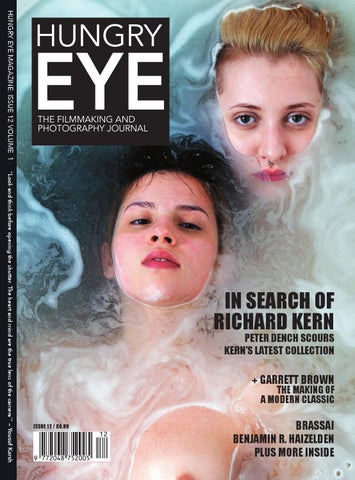
IN SEARCH OF RICHARD KERN PETER DENCH SCOURS KERN’S LATEST COLLECTION
+ GARRETT BROWN THE MAKING OF A MODERN CLASSIC
ISSUE 12 / £6.99
12
9 772048 752005
P Cover HE 12 2013.indd 1
BRASSAI BENjAMIN R. HAIzELDEN PLUS MORE INSIDE 23/08/2013 11:06
P Welcome HE 12 2013.indd 2
03/09/2013 10:35
WELCOME HUNGRY EYE MAGAZINE: ISSUE 12 VolUME 1
HuNGRY
EYE THE FILMMAKING AND PHOTOGRAPHY JOuRNAL
“look and think before opening the shutter. The heart and mind are the true lens of the camera’” – Yousuf Karsh
IN SEARCH OF RICHARD KERN PETER DENCH SCOURS KERN’S LATEST COLLECTION
+ GARRETT BROWN THE MAKING OF A MODERN CLASSIC
ISSUE 12 / £6.99
12
9 772048 752005
P Cover HE 12 2013.indd 1
BRASSAI BENjAMIN R. HAIzELDEN PLUS MORE INSIDE
Cover Image: Shot By Kern Published by TASCHEN © Richard Kern
23/08/2013 11:06
“Look and think before opening the shutter. The heart and mind are the true lens of the camera’” Yousuf Karsh
Progress. Something that every image maker strives for in some shape of form during their career in varying degrees. Some will utilise new technologies or blend with old to achieve ground breaking results and some, hell bent on working at the absolute limits of their fields. Both physically & technologically, will risk life & limb to get the shot. Think then of Garrett Brown, an inventor and cinematographer who has made it his life’s work to produce images that nobody else could. Inventing equipment that literally broke the mould and revolutionised the possibilities for image makers, the world over. Progress indeed. Read this fascinating story of evolution from p16 where we also glean the knowledge from the man himself from p26. Progress can, of course mean working within a medium that’s been off the boil for a period. On this topic, Zephie Bologo touches on her thoughts of the recent rise in the popularity of working in monochrome. She reports back from her visit to the outstanding photography festival Recontres d’Arles in the south of France, the theme of which was black and white photography and titled ‘Arles in Black’. Read her piece ‘The new black’ on p96. Cover story in this issue comes courtesy of Richard Kern, well, kind of. In a ‘waiting for Godot’ style interview, Hungry Eye regular Peter Dench explores a recent collection of works from the (ex) Vice Editor and wonders where he might leave his reference material when finished. Pete’s regular slot, the ‘Diary of a sometime working pro, kicks things off on p6 and our Hot Shot piece for issue 12 comes from Benjamin R. Hailzelden. Turn to p42 where he explains his approach in working quickly, whilst retaining his discipline in capturing the narrative. Hungry Eye Technical Editor asks if we’re ready for 4K, what are the advantages to us as filmmakers? Much more in this issue but I, alas, have a finite amount of space here to tell you about it. So read on and enjoy, not forgetting that you can see a lot more at hungryeyemagazine.com when you’re done. This issue see’s the end of Vol. 1. We hope you have all of yours. We have some real treats in store for Vol. 2. Till then... Simon Skinner - Curator - Hungry Eye
www.hungryeyemagazine.com 3
P Welcome HE 12 2013.indd 3
03/09/2013 10:35
THE DENCH DIARY
June 2013
The diary of a sometime working pro Peter Dench is based in London and works primarily in the advertising, editorial and portraiture fields of photography. In 2010 Peter placed 2nd in Advertising at the Sony World Photography Awards. He has also had a number of solo shows of his work including screenings at Visa Pour l’Image in France. Peter has received a World Press Award in the ‘People in the News Stories’ Category and participated in the World Press Joop Swart Masterclass. Football’s Hidden Story, a FIFA-sponsored project documenting 26 stories across 20 countries, received six global accolades including a World in Focus, AOP Open and PDN Photo Annual Award. www.peterdench.com
Derek, from Hull, who says he is a “good person”, doesn’t know the chunky man he is trying unsuccessfully to heave upright from the pavement. Derek is a self-confessed ‘wreck head’ and doesn’t like to leave people of any size passed out and alone on the pavement in case they get robbed. Living in Hull, I’d be surprised if Derek ever gets home at all. To be fair, the man on the pavement looks as though he has already been robbed; his feet are bare and the lack of tumescence in his pockets suggest likewise. Derek learnt that the man was English, but failed to get his name, during a brief verbal exchange before he collapsed. Derek has decided to name the man on the pavement, Derek. “Get the F*** UP Derek!” Shouts Derek. Derek from Hull has no credit on his mobile phone to call 24/7, a voluntary Christian organisation that finds people who have got themselves a little messed up and helps get them back to their accommodation. As the sun reflects on to the scene from the bleach being liberally hosed around by local business employees, a group of half a dozen friends at the end of their night out walk over. None of them have a phone Derek can use, or the few that admit they do, admit to not having any credit. Cars pass and splinter glass, crunching slowly away without a sideways glance from the driver and street cleaners sweep the debris from around the sleeping giant. An ambulance arrives, the seen-it-all-before employees disembark with fluorescent efficiency, flicking the ends of the fingers of their patient and firmly squeezing his face. It works, and he pings to a seated right angle, and then throws up in a proffered bag before being guided in to the ambulance and sirened away. It’s not what Derek from Hull wanted, aware that the man could now be presented with a medical bill as hefty as his midriff. Derek spent his night partying at club Amnesia; it’s not one he’ll forget. Probably. Welcome to San Antonio, Ibiza, one of four destinations I have chosen to document the British abroad during the month of June: Sunny Beach, Bulgaria; Ayia Napa, Cyprus and Magaluf, Majorca
6 www.hungryeyemagazine.com
P Dench HE 12 2013.indd 6
23/08/2013 14:34
www.hungryeyemagazine.com 7
P Dench HE 12 2013.indd 7
23/08/2013 14:34
P tiffen HE 12 2013.indd 16
23/08/2013 14:52
HOld Steady
Hungry Eye discovers the story behind one of the biggest game changers in the motion picture industry
left: Stabilizing the camera car on ‘Reds’ with the great Vittorio Storaro -- Garrett displays the imperturbable ‘look’ recommended for Steadicam operators... even after, say, being humbled by Spanish potholes
P tiffen HE 12 2013.indd 17
23/08/2013 14:52
The Steadicam was introduced to our industry in 1975 by director/cameraman turned inventor Garrett Brown, who originally named his creation the ‘Brown Stabilizer’. After completing the first working prototype, Brown shot a ten-minute demo reel of the revolutionary moves this new device could produce. This first reel was then watched by a host of directors, including Stanley Kubrick and John G. Avildsen. The Steadicam was subsequently licensed to, and manufactured by, the Tiffen company since 1999. Garrett’s burning desire to solve stability issues that had plagued cameramen, directors and just about everybody prior to his 1975 ‘revelation’ with the Brown Stabilizer, has not slowed to this day. With a little help from his friends, he continues to develop the iconic concept using modern techniques and materials including hand held models for the action camera market. Chris Fawcett, an operator, inventor and ex circus acrobat was travelling with Garrett late September 2005. While hurtling through a stoplight in Paris, Garrett asked: “Have you any thoughts on how we might improve the vest?” Chris had just recently arrived on the Steadicam scene, invited to lecture on posture at the Paris Steadicam Master class. As Jerry Holway cocked an ear, I might have voiced something memorable, but more likely, being in the presence of giants, I mumbled incoherently - but the idea set him spinning. Chris tells Hungry Eye where he went from that point. He told us that: “Over more than 30 years, every part of the Steadicam system had been through multiple upgrades but the current vest still looked like the one Garrett had used on Bound for Glory. It worked, and worked well, for sure just look at the shots that have been made with it - but was it as comfortable as it could be? I’d tried various vests and had settled on the LX. I liked the simple, hard padding better than the softer U2 vest, and the straight shape of the front spar suited my body shape better than that of the angled, front spar on the PRO vest that dug into my abdomen. I ruled out a back-mount vest for various reasons. I hated the hard spar pushing into the centre
18 www.hungryeyemagazine.com
P tiffen HE 12 2013.indd 18
23/08/2013 14:52
modern classic: steadicam®
Atop the Art Museum steps again on Rocky II, Sylvester Stallone’s said, “Yo, we can’t keep doing this!” (Brown’s last run was 13 years later on Rocky V.)
www.hungryeyemagazine.com 19
P tiffen HE 12 2013.indd 19
23/08/2013 14:52
30 www.hungryeyemagazine.com
P Kern HE 12 2013.indd 30
23/08/2013 14:54
In Search of rIchard Kern
www.hungryeyemagazine.com 31
P Kern HE 12 2013.indd 31
23/08/2013 14:54
in search of richard kern
With the release of Richard Kern’s latest collection, ‘Shot by Kern’ Peter Dench explores his work and attempts to communicate with the man himself At the turn of the millennium, I found myself packing lightly for an eight day assignment for Men’s Health magazine. The commission was to produce a photographic reportage on the health benefits of naturism. I was excited. I was nervous. Would I get an unwanted, you know? Would the residents, you know, be bigger? Arriving at the Desert Shadows nudist resort in Palm Springs, California, I knocked on the door of the apartment I was to share with the writer Benjamin Mee (on whose life, the 2011 film, We Bought a Zoo, is based). I’d never met Benjamin before: “Hello, I’m Peter Dench,” I said, eyes flicking to his satisfyingly covered groin. “Hello, I’m Benjamin Mee.” We immediately established a strict clothes must be worn inside the apartment rule, and a strict, clothes must not be worn outside of the apartment rule, and set off to work, giddy at the prospect of a week probing the world of the naked and nearly naked. On the sixth day, Benjamin and I had had enough, and crept out of the resort and in to the local town bars in search of nipple against cloth and bum bulging denim. The daily role call of nakedness at Desert Shadows had sedated our libido. It’s with a similar feeling of reprieve, that I reach page 278 of the Taschen book publishing title, Shot by Kern, by Richard Kern. “Would you like to review the new book by Richard Kern for Hungry Eye magazine?” I had been asked. “Yes I would,” I replied. I’d not heard of Richard Kern, and idly tapped his name into Google. I ought to have first cleared the room of my family. If you like photographs of pretty girls (I do), you should have heard of Richard Kern. If you like photographs of pretty girls in underpants (I do do), then you should definitely have heard of Richard Kern. I immediately put in a request with the Taschen publishing relations manager to spend a day accompanying Kern on a shoot, to witness first hand the motivation of the man behind the lens; this was not possible. “How about an in person interview?” He wasn’t due in the UK any time soon.
“How about a telephone or Skype chat?” Nope. A list of sample questions were requested. Kern would then make a decision on whether to reveal his answers personally. According to his Wikipedia page, Kern is: ‘A New York underground filmmaker, writer and photographer. He first came to underground prominence as part of the underground cultural explosion in the East Village of New York City in the 1980s, with erotic and experimental films featuring underground personalities of the time.’ Sample question number one to Richard Kern. “Do you still consider yourself, and your work, underground?” The book I ordered from Amazon arrived in a large brown box. As a result of ordering the book from Amazon, Peter Dench’s featured recommendations, along with children’s books and moth traps, now includes books by Helmut Newton, Nan Goldin, Guy Bourdin and Pussy Girls: Totally Unshaven & Natural Bushes by Walter Bosque. Making sure, this time, the apartment is clear of family, friends, the vulnerable, the easily offended and infirm, I run a scalpel down the packing tape and open. Two fresh faced girls peek out from the water along with a single unblinking nipple. I slide my hand across the wipeable cover and flip the girls over. On the reverse, two girls in knickers and bra play with another girls head hair. The wraparound cover can be fingered off, so I do, revealing an up-skirt shot of a girl wearing a blue dress and no panties. Her glistening labia is pressed firmly into the books spine. Delicately lifting back the front cover, the first image of the book is the books’ author, a 50-something Kern is pictured lying on a tiled floor, holding a reflector and looking up between a girls legs. What follows is turned after turned page of photographs of naked or semi-naked girls*. Girls brush their teeth. Girls brush each others teeth. Girls
32 www.hungryeyemagazine.com
P Kern HE 12 2013.indd 32
23/08/2013 14:54
Q&a: sharon harPer
www.hungryeyemagazine.com 33
P Kern HE 12 2013.indd 33
23/08/2013 14:54
HOT SHOT
Benjamin R. Haizelden tells us about his recent stills project, ‘An Orange Upon the Table’. A series of striking images shot over a very short period. Here, he explains his approach to this kind of work and his discipline in capturing the narrative
42 www.hungryeyemagazine.com
P Monologue HE 12 2013.indd 42
23/08/2013 14:56
www.hungryeyemagazine.com 43
P Monologue HE 12 2013.indd 43
23/08/2013 14:56
HuNGRY
EYE THE FILMMAKING AND PHOTOGRAPHY JOuRNAL
PRINT YOU CAN GET INDIvIDUAl IssUEs & bACk IssUEs Of hUNGRY EYE mAGAzINE DElIvERED sTRAIGhT TO YOU DIRECT fROm Us, wITh fREE POsT & PACkING hOw?
fIND OUT bY vIsITING www.hUNGRYEYEmAGAzINE.COm
fOllOw Us ON TwITTER @hungryeyemag
54 www.hungryeyemagazine.com
P art HE 12 2013.indd 54
23/08/2013 15:44
PORTfOlIO
100 Works of Art thAt Will Define our Age
Just as Diego Velázquez’s Las Meninas and Picasso’s Guernica survive as powerful cultural documents of their time, there will be works from our own era that will endure for generations to come. But which ones? This, potentially controversial collection of modern works has been compiled & written by one of the freshest new voices in cultural criticism and serves to predict which artists and artworks from the past two decades will come to define our age through their power to question, provoke and inspire. In selecting works made from 1989 to the present day, Kelly Grovier creates a compelling list of the artworks that have made the greatest impact. Here, we’ve selected a handful our favorites for your viewing pleasure and undoubtedly, your debate.
Misty and Jimmy Paulette in a Taxi ‘In the first experiments which I made for obtaining portraits from the life,’ wrote the nineteenth-century American scientist and inventor John William Draper, ‘the face of the sitter was dusted with a white powder, under an idea that otherwise no impression could be obtained.’ Draper is credited with capturing the very first photographs of living subjects – a challenge that the originators of the medium, Louis Daguerre and Joseph Nicéphore Niépce, had failed to overcome. Though Draper’s belief that it was necessary to apply white powder to a sitter’s face would prove unfounded, from the very start, it seems, the impulse to photograph and the impulse to mask
went hand in hand. Little wonder that a century and a half after Draper undertook his ‘first experiments’, between 1839 and 1840, one senses something fundamental in the powdered-face intensity of Nan Goldin’s celebrated double portrait Misty and Jimmy Paulette in a taxi, NYC (1991). Goldin came to prominence in the 1980s with a series of photographs devoted to violent relationships and drug abuse, but found herself at the start of the 1990s returning to an earlier preoccupation: chronicling the flamboyant transvestites and glamorous drag queens of New York clubs who were determined to carve out unconventional
www.hungryeyemagazine.com 55
P art HE 12 2013.indd 55
23/08/2013 15:44
56 www.hungryeyemagazine.com
P art HE 12 2013.indd 56
23/08/2013 15:44
www.hungryeyemagazine.com 57
P art HE 12 2013.indd 57
23/08/2013 15:44
62 www.hungryeyemagazine.com
P art HE 12 2013.indd 62
23/08/2013 15:44
www.hungryeyemagazine.com 63
P art HE 12 2013.indd 63
23/08/2013 15:44
library
Elliott Erwitt’s Kolor Kolor is a subtle tribute to George Eastman (who liked words with the letter K because he thought people remembered them better) and his photography empire, Kodak. To select the colour photographs for this vast project that have never been published in a book before, Elliott Erwitt sifted through his nearly forgotten ample archive of nearly half a million 35mm—primarily Kodachrome—film slides. Then he began the mammoth task of whittling it down to this epic collection of roughly 450 pages. For most of these images, the colour managed to stay miraculously preserved and every evocative detail is as crisp as the date they were developed, many nearly sixty years ago. Whether world leaders or sassy showgirls, the subjects reflect Erwitt’s own wry and eclectic sensibility. To say the juxtapositions are intriguing would be an understatement. From marketplaces to military camps, Vegas to Venice, there’s a rich mixture of public pageantry and carefully observed private interactions.
80 www.hungryeyemagazine.com 86
P Library HE 12 2013.indd 80
23/08/2013 14:44
THe LIBRARY
www.hungryeyemagazine.com 87 81
P Library HE 12 2013.indd 81
23/08/2013 14:44
86 www.hungryeyemagazine.com
P Library HE 12 2013.indd 86
23/08/2013 14:44
THe LIBRARY
Author Sylvie Aubenas is Chief Curator of the Department of Prints and Photographs at the Bibliothèque Nationale de France. Quentin Bajac was formerly Chief Curator of Photography at the Centre Pompidou, Paris, and is now Chief Curator of Photography at the Museum of Modern Art, New York.
Brassaï Paris Nocturne Brassaï (1899–1984) was the first and is still the most famous photographer to chronicle Paris after dark. Born in Hungary, he came to the French capital in 1924, working first as a journalist and then embracing photography, but it was the Paris of the 1930s that came to form the bedrock of his body of work. Walking the city streets at night, Brassaï discovered a previously unseen world and captured it on camera. He shows us every face and every facet, from tough guys and showgirls to prostitutes and pleasure-seekers, from the bustling cafés and dance halls to the stillness of deserted streets and mist-shrouded monuments. Through his eyes, Paris becomes a world of shadows, in which light, the prerequisite for any photograph, is reduced to dimly lit windows, streetlamps in the fog, or reflections on a rain-soaked pavement. Although firmly rooted in its time and place, Brassaï’s night photography is nonetheless timeless in its appeal. Full of beauty, bleakness and insight, these images assure his place among the greatest photographers of the 20th century.
Brassaï: Paris Nocturne Sylvie Aubenas and Quentin Bajac Thames and Hudson Ltd £48.00 ISBN: 9780500544259
www.hungryeyemagazine.com 87
P Library HE 12 2013.indd 87
23/08/2013 14:44
100 www.hungryeyemagazine.com
P zephie HE 12 2013.indd 100
23/08/2013 14:47